Abstract
Studies on double beta decay processes in Cd were performed by using a cadmium tungstate scintillator enriched in Cd at 66% (CdWO) with two CdWO scintillation counters (with natural Cd composition). No effect was observed in the data that accumulated over 26,033 h. New improved half-life limits were set on the different channels and modes of the Cd double beta decay at level of yr. The limit for the two neutrino electron capture with positron emission in Cd to the ground state of Pd, yr, was set by the analysis of the CdWO data in coincidence with the energy release 511 keV in both CdWO counters. The sensitivity approaches the theoretical predictions for the decay half-life that are in the range yr. The resonant neutrinoless double-electron capture to the 2718 keV excited state of Pd is restricted at the level of yr.
1. Introduction
Observations of the neutrino oscillations suggest that the neutrinos are massive, which calls for an extension of the Standard Model of particles and fields (SM). However, oscillation experiments cannot determine the neutrino mass and the neutrino mass hierarchy. One of the most promising tools for determining the absolute neutrino mass scale and the neutrino mass hierarchy, the nature of the neutrino (Dirac or Majorana particle?), in order to check the lepton number conservation is double beta () decay of atomic nuclei, a process in which two electrons (or positrons) are simultaneously emitted and nuclear charge changes by two units: (A,Z)→(A,Z) [1,2,3]. The neutrinoless mode of the decay () violates the lepton number conservation law and it is possible if the neutrinos are Majorana particles (particle is equal to its antiparticle). Being a process beyond the SM, the decay has the potential to test the SM [4,5,6]. Moreover, the Majorana nature of the neutrino might shed light on the Universe baryon asymmetry problem [7,8].
The two-neutrino decay () is a radioactive process that is allowed in the SM with the longest half-lives ever observed: – yr. The decay mode has been detected in several nuclides [9]. The decay is not observed. The most sensitive -decay experiments quote half-life limits at level of ) yr, which correspond to Majorana neutrino mass limits in the range eV. Probing the inverted hierarchy region of the neutrino mass requires improved sensitivities of experiments at the level of eV (i.e., half-life sensitivity in the range: yr).
The sensitivity of the experiments in the search for “double beta plus” processes: double electron capture (2EC), electron capture with positron emission (EC), and double positron decay () is substantially lower, while the physical lepton-number violating mechanisms of the neutrinoless 2EC, EC and processes are considered to be essentially the same as for the decay with electrons emission. At the same time, there is a motivation to search for the EC and decays owing to the potential to clarify the possible contribution of the right-handed currents to the decay rate [10], and an interesting possibility of a resonant 2EC process [11,12,13,14].
As for the allowed two-neutrino mode of the double beta plus decay, there are claims of positive results (indication) for the 2EC radioactivity of three nuclides. The 2EC decay of Ba was claimed in two geochemical experiments where anomaly in the isotopic concentrations of daughter xenon traces in old barite (BaSO) minerals was interpreted as the sought effect with the half-life yr [15], and with yr in [16]. In the analysis [17], the disagreement was explained by a possible cosmogenic contribution with a conclusion that the result of [15] is a more reliable one. An indication on the 2EC process in Kr with the half-life yr was obtained with a proportional counter with a volume of 49 lt filled by gas enriched in Kr to 99.81% [18]. The value was then updated to yr in [19]. Recently, a detection of the 2EC of Xe with the half-life yr was claimed in [20]. However, the indications of Ba 2EC decay should be confirmed in direct counting experiments, while the results for Kr and Xe need to be confirmed with bigger statistics and very stable experiments. Other allowed decay channels with decrease of the nuclear charge by two units, EC and , are not observed yet.
The nuclide Cd is one of the most appealing candidates to search for 2EC, EC, and decays with a long history of studies (a review of the previous investigations reader can find in Ref. [21]). The interest to Cd can be explained by one of the biggest decay energy keV [22], comparatively high isotopic abundance % [23], and possibility of gas centrifugation for enrichment, existing technologies of cadmium purification, the availability of Cd-containing detectors to realize calorimetric experiments with a high detection efficiency.
Presently, there are three running experiments searching for the double beta decay of Cd: COBRA, TGV-2, and the present one.
The COBRA collaboration utilizes CdZnTe semiconductor detectors at the Gran Sasso underground laboratory (Laboratori Nazionali del Gran Sasso, LNGS). The experiment started with one CdZnTe detector with mass of ≃3 g, and one CdTe detector (≃6 g) [24]. CdZnTe detectors are used in the current stage of the experiment [25,26]. The measurements resulted in the half-life limits for several channels of Cd double beta decay at the level of ∼ yr.
The main goal of the TGV-2 experiment, which is located at the Modane underground laboratory, is the search for EC decay of Cd (a decay channel expected to be the fastest one) with the help of 32 planar HPGe detectors with a total sensitive volume cm. In the first stage of the experiment, foils of cadmium enriched in Cd to (60–75)% were used [27,28,29]; now, 23.2 g of cadmium sample enriched in Cd to 99.57% are installed in the set-up [30]. The experiment gives the strongest limit on the EC decay: yr. For other decay modes and channels, the sensitivity is at level of yr [31].
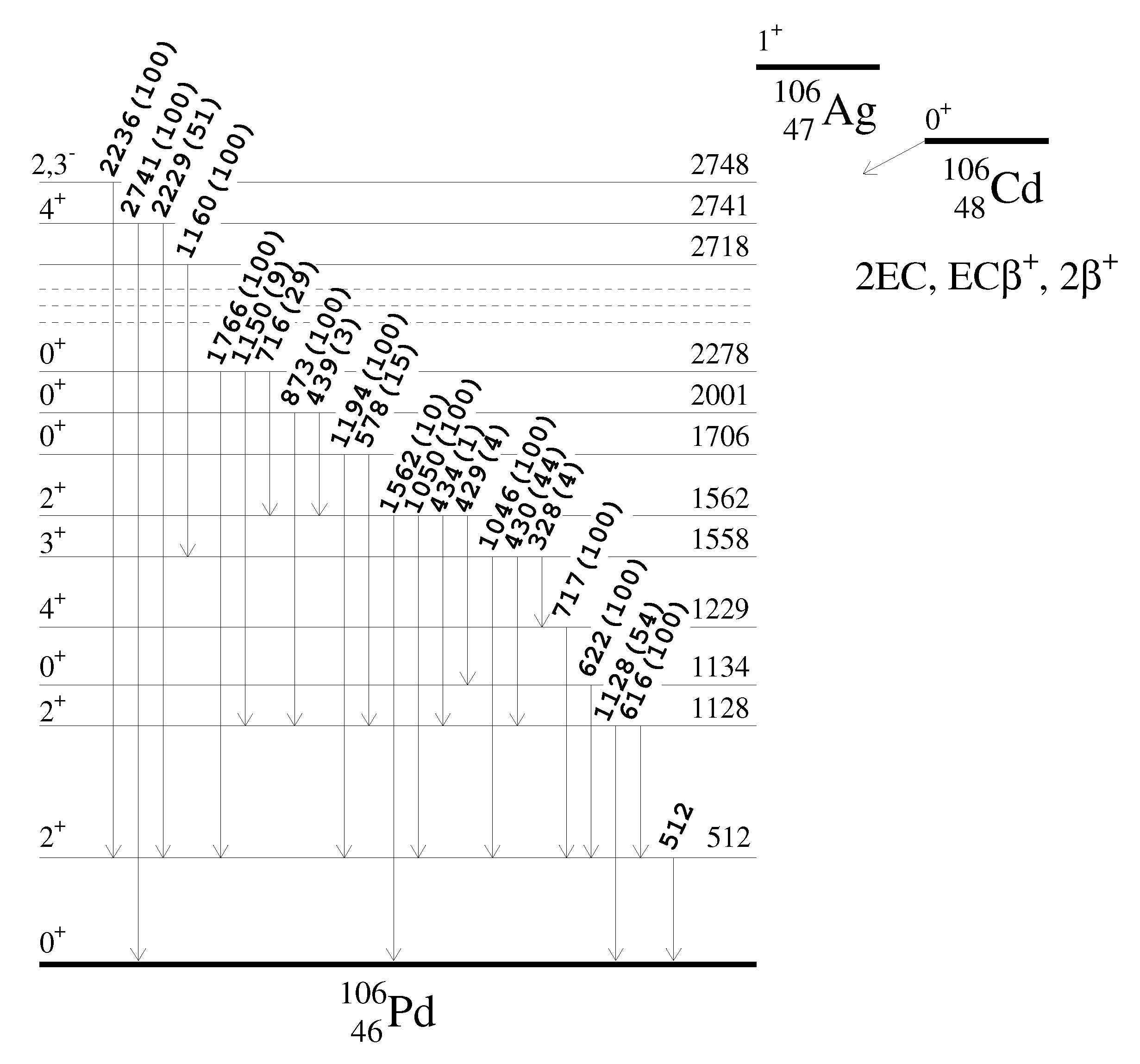
A cadmium tungstate crystal scintillator from cadmium enriched in Cd to 66% (CdWO) was developed in 2010 [32]. The experiments with that detector are carried out at the LNGS in the DAMA/CRYS, DAMA/R&D set-ups, and in an ultra-low background GeMulti HPGe spectrometer of the STELLA (SubTErranean Low Level Assay) facility [33] at the LNGS. The first stage of the experiment with the CdWO detector gave the half-life limits on processes in Cd at level of ∼ yr [21]. In the second stage, the CdWO scintillator was installed between four HPGe detectors (with volume cm each) of the GeMulti HPGe spectrometer to detect quanta expected in the most of the Cd decay channels, including the annihilation ’s emitted in decay modes with positron(s) emission (a simplified decay scheme of Cd is presented in Figure 1). The experiment improved the Cd half-life limits to the level of yr [34]. In the third stage, described in the present report, the CdWO detector was running in coincidence (anti-coincidence) with two large volume CdWO crystal scintillators in a close geometry in order to increase the detection efficiency to quanta expected to be emitted from the CdWO crystal in the double beta decay processes in Cd. Preliminary results of the experiment stage were reported in [35].
Figure 1.
Simplified decay scheme of Cd [36] (levels with energies in the energy interval (2283–2714) keV are omitted). The energies of the excited levels are in keV. Relative intensities of quanta are given in parentheses.
2. The Experiment
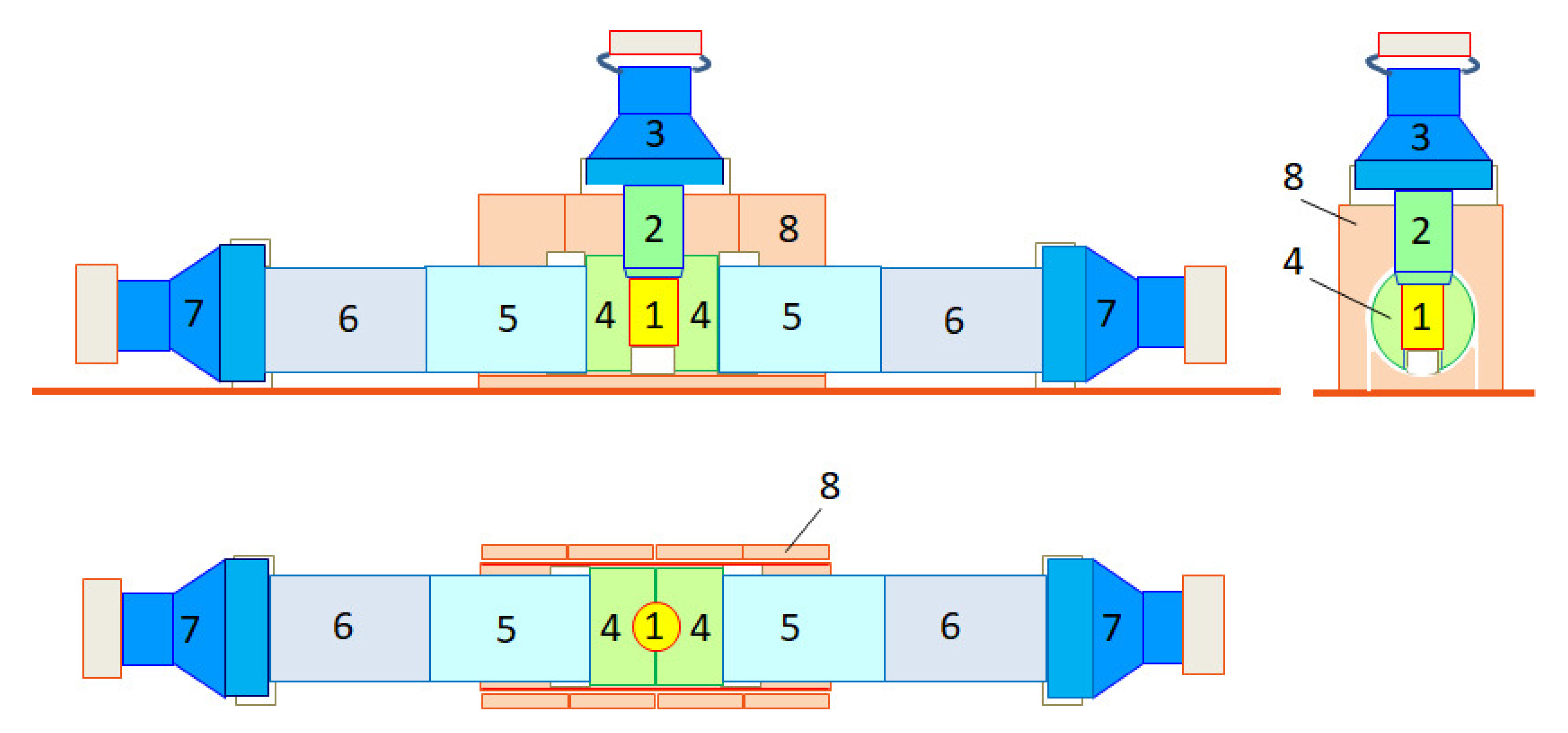
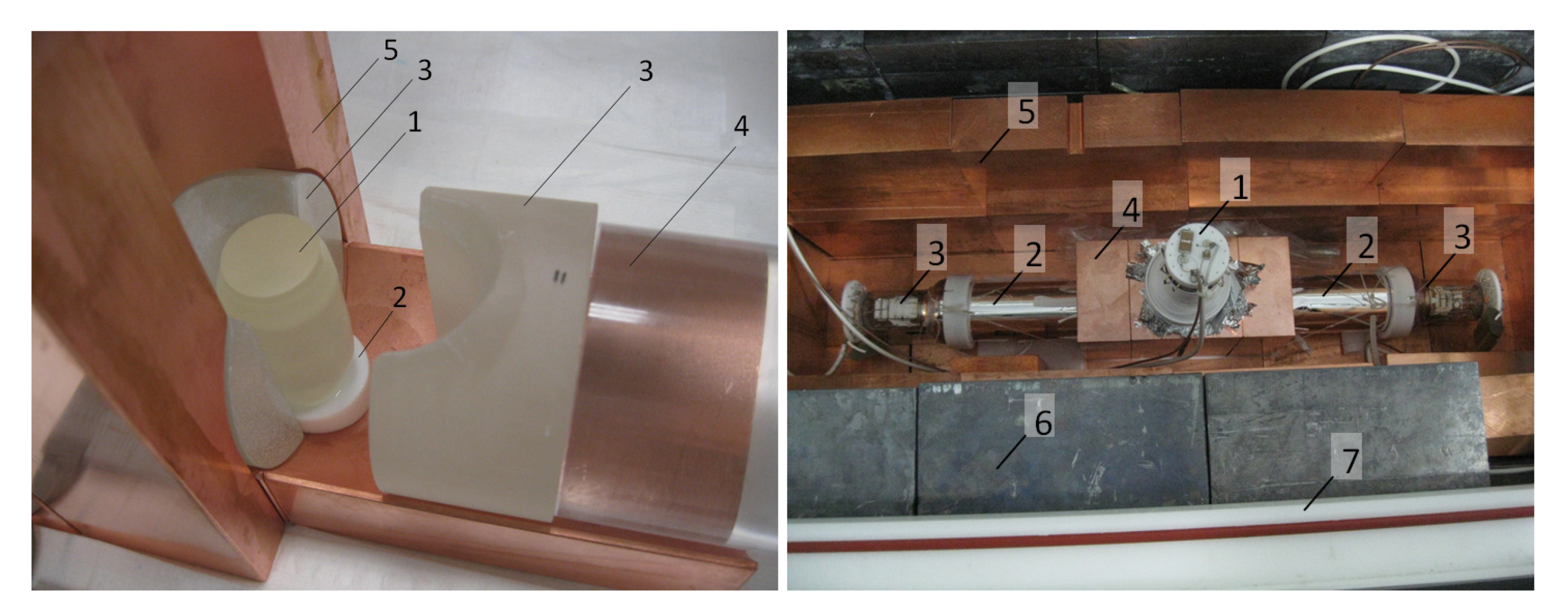
The CdWO crystal scintillator of roughly cylindrical shape (approximate sizes mm × 50 mm, mass 215.4 g) was viewed by a three inches low radioactive photo-multiplier tube (PMT) Hamamatsu R6233MOD through a lead tungstate (PbWO) crystal light-guide ( mm × 83 mm). The PbWO crystal has been developed from the highly purified [37] archaeological lead [38]. Two CdWO crystal scintillators mm × 38 mm include a cylindrical cut-out to house the CdWO crystal. They were viewed by two three-inch low radioactive PMTs EMI9265B53/FL through light-guides glued in two parts: low radioactive quartz ( mm × 100 mm, close to the CdWO scintillators) and optical quality polystyrene ( mm × 100 mm). Figure 2 shows a schematic of the set-up. The detector system was surrounded by four high purity copper bricks (referred hereinafter as “internal copper”) and by layers of high purity copper (11 cm, hereinafter referred as “external copper”), low radioactive lead (10 cm), cadmium (2 mm), and polyethylene (10 cm) in order to reduce the external background. The inner volume of the set-up with the detector system was continuously flushed by high-purity nitrogen gas to remove environmental radon. The grade of the high-purity N gas is at least 5.5, for what concerns the presence of other possible gases. However, the possible presence in trace of Radon gas in the Nitrogen atmosphere inside the copper box, housing the detector, has been checked with another set-up, by searching for the double coincidences of the -rays (609 and 1120 keV) from Bi Radon daughter. The obtained upper limit on the possible Radon concentration in the high-purity Nitrogen atmosphere has been measured to be: < Bq/m (90% C.L.) [39]. Figure 3 shows photographs of the detector system.
Figure 2.
Schematic of the experimental set-up with the CdWO scintillation detector. CdWO crystal scintillator (1) is viewed through PbWO light-guide (2) by photo-multiplier tube (3). Two CdWO crystal scintillators (4) are viewed through light-guides glued from quartz (5) and polystyrene (6) by photo-multiplier tubes (7). The detector system was surrounded by passive shield made from copper, lead, polyethylene, and cadmium (not shown). Only part of the copper details (8, “internal copper”), used to reduce the direct hits of the detectors by quanta from the PMTs, are shown.
Figure 3.
Left photograph: the CdWO crystal scintillator (1), Teflon support of the CdWO crystal (2), CdWO crystal scintillators (3), quartz light-guide (4), “internal copper” brick (5). Right photograph: the detector system installed in the passive shield: PMT of the CdWO detector (1), light-guides of the CdWO counters wrapped by reflecting foil (2), PMT of the CdWO counters (3), “internal copper” bricks (4), “external copper” bricks (5), lead bricks (6), and polyethylene shield (7). The copper, lead and polyethylene shields are not completed.
An event-by-event data acquisition system that is based on a 100 MS/s 14 bit transient digitizer (DT5724 by CAEN) recorded the amplitude, the arrival time, and the pulse shape of each event. To reduce the data volume due to presence in the CdWO crystal of Cd and Cd active nuclides [21,32], the energy threshold for the set-up was set at level of ≈510 keV for the anti-coincidence mode, while the energy threshold of the CdWO detector in the coincidence with the CdWO counters was ≈200 keV. The energy thresholds of the CdWO counters were ≈70 keV. The energy scale and energy resolution of the detectors were measured with Na, Co, Ba, Cs, and Th sources at the beginning, in the middle and end of the experiment.
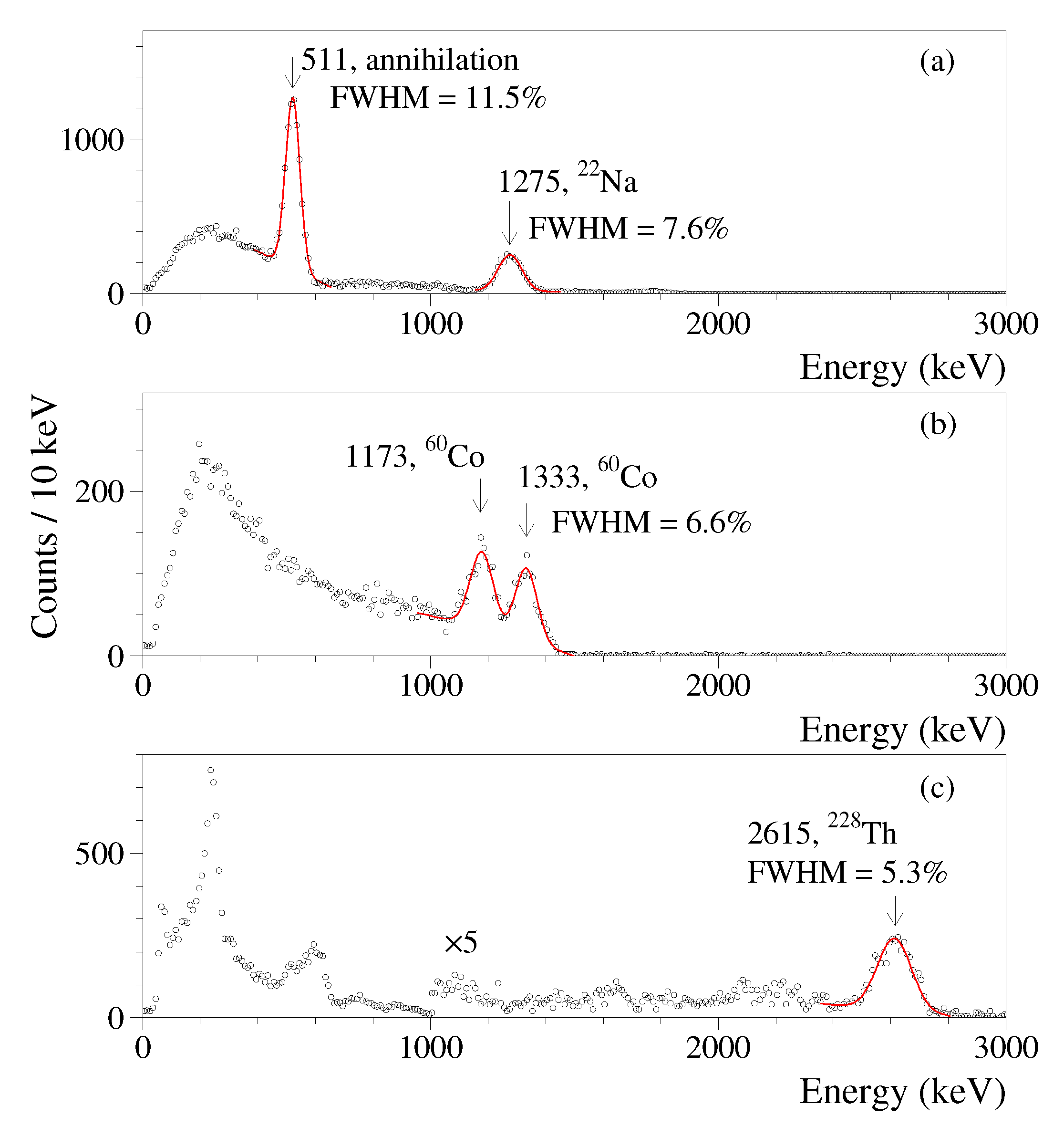
The energy resolution of the CdWO detector for the total exposure can be described by the function , where FWHM (full width at half maximum) and are given in keV. The poor energy resolution of the enriched detector (despite excellent optical properties of the material [32]) is caused by the elongated shape of the enriched scintillator that results in a rather low and non-uniform light collection, and by the using of not perfectly transparent PbWO crystal light-guide. The performance of the CdWO counters is substantially better. The energy spectra that were accumulated by one of the counters with Na, Co and Th sources are presented in Figure 4. The energy resolution of the counters was estimated by using the results of the three energy calibration campaigns as with the coefficient a equal to 2.97 and 3.13 for the two detectors. The resolution formulas also take into account energy scale shifts during the data taking over the experiment.
Figure 4.
Energy spectra of Na (a), Co (b) and Th (c) quanta measured by one of the CdWO detectors. Fits of intensive peaks by Gaussian functions are shown by solid lines. Energies of quanta are in keV.
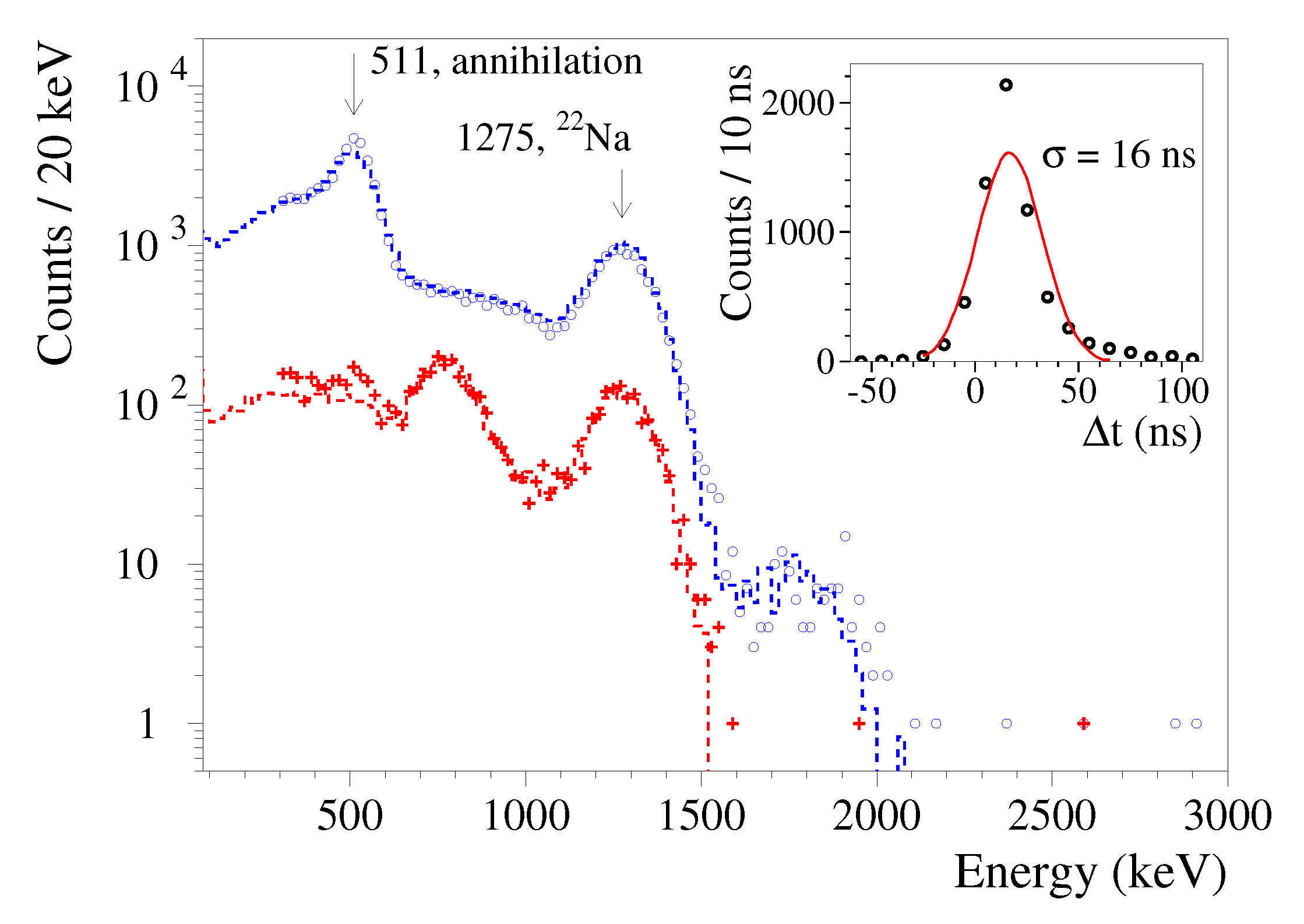
The energy spectra of Na source were simulated by the EGSnrc code [40]. The data measured with Na source without coincidence selection and in coincidence with energy 511 keV in at least one of the CdWO counters is compared with the simulated distribution in Figure 5. The experimental data are in reasonable agreement with the results of simulations.
Figure 5.
Energy spectra of Na quanta measured by the CdWO detector: with no coincidence cuts (blue circles) and in coincidence with energy 511 keV in at least one of the CdWO counters (red crosses). The data simulated by using the EGSnrc Monte Carlo code are drawn by dashed lines. (Inset) Distribution of the CdWO detector pulses start positions relative to the CdWO signals with the energy 511 keV.
The inset of Figure 5 shows a distribution of the CdWO detector pulses start positions relative to the CdWO signals with energy 511 keV. The time resolution of the detector system is rather high (the standard deviation of the distribution is 16 ns) due to the fast rise time of the CdWO scintillation pulses.
3. Results and Discussion
3.1. Backgrounds Reduction and Model of the Backgrounds
The difference in CdWO scintillation pulse shape for particles ( quanta) and particles can be used in order to suppress the background caused by radioactive contamination of the detector due to the residual contamination in Th and U with their daughters. The mean time method was applied to the data in order to discriminate signals of different origin by pulse shape. For each signal , the numerical characteristic of its shape (mean time, ) was defined using the following equation:
where the sum is over the time channels k, starting from the origin of signal up to 35 s; is the digitized amplitude (at the time ) of a given signal. The energy dependence of the parameter and its standard deviation (the distributions of for particles ( quanta) and particles are well described by a Gaussian function) was determined by using the data of the calibration measurements with Th gamma source. The obtained parameters were then used to discriminate () events from events in the data of the low-background experiment. We refer the reader to our previous works [21,34], where the pulse-shape discrimination (PSD) method was described in detail.
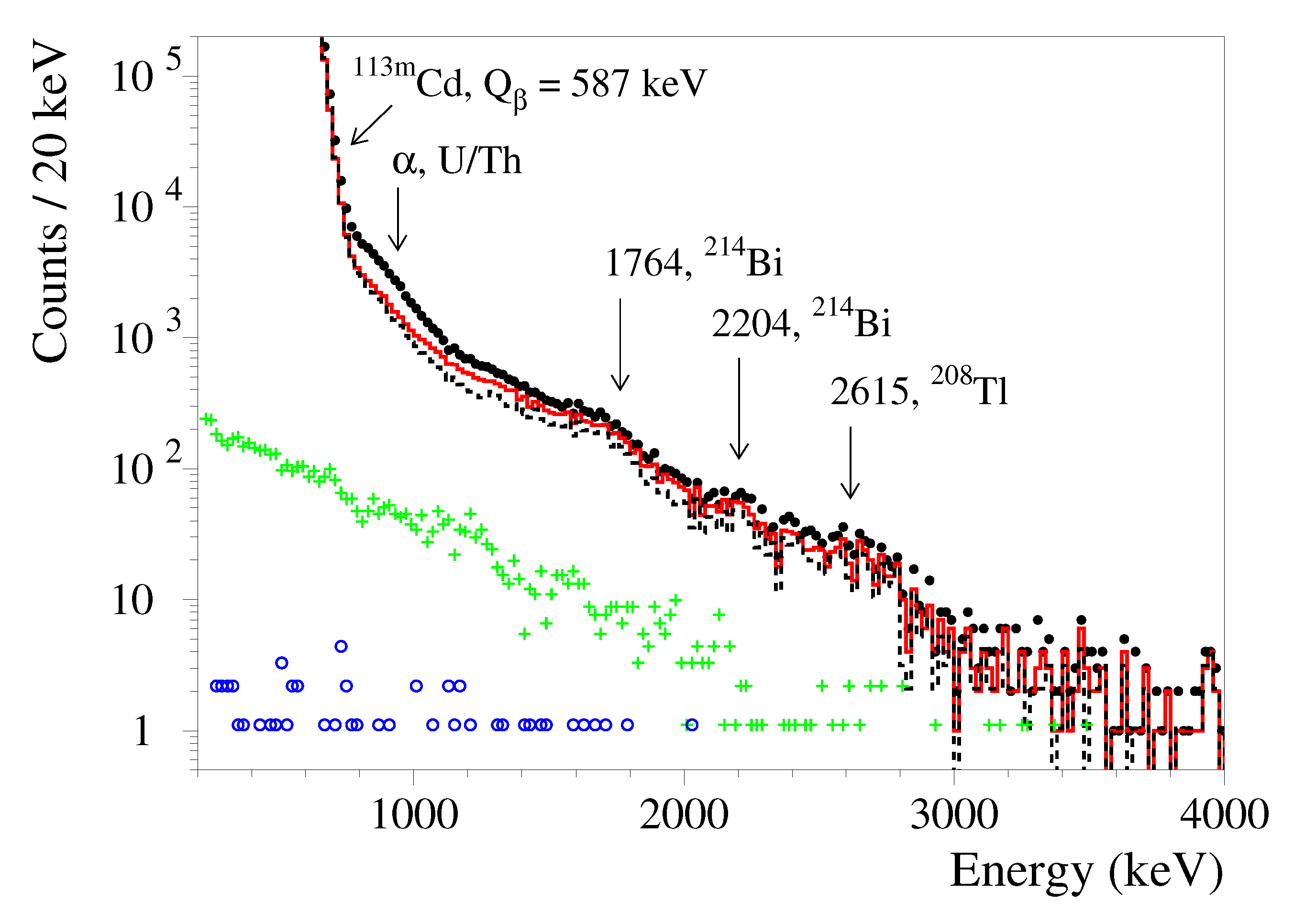
By using the PSD, the events were statistically separated from events. In addition the method discarded from the data events of the Bi – Po sub-chain from the Th family (due to the short decay time of Po s these decays are treated by the data acquisition system as a single event), PMT noise, pile-ups of signals in the CdWO detector, CdWO plus PbWO events, etc. Figure 6 shows the results of the PSD method application to the background data gathered for 26,033 h in the low-background set-up. The mean time method reduced the background mainly in the energy region (800–1300) keV (by a factor ∼1.6), where events of the Th and U with their daughters are expected.
Figure 6.
Energy spectra measured by the CdWO detector for 26,033 h in the low-background set-up without selection cuts (black dots), after selection of and events by PSD using the mean time method (solid red line), the and events in anti-coincidence with the CdWO counters (dashed black line), the and events in coincidence with event(s) in at least one of the CdWO counters with the energy keV (green crosses), the , and events in coincidence with events in both the CdWO counters with the energy keV (blue circles).
Further reduction of the background counting rate (by a factor ∼1.3 in the energy interval (1000–3000) keV) was achieved by exploiting the anti-coincidence with the CdWO counters. The background was significantly suppressed by the selection of events in the CdWO detector in coincidence with the event(s) in at least one of the CdWO counters with the energy release keV (by a factor ∼17 in the same energy interval; here, is the energy resolution of the CdWO counters for 511 keV quanta), and by selection of events in coincidence with the events in both the CdWO counters with the energy keV (by a further factor ∼42). Figure 6 presents the stages of the background spectra reduction.
The counting rate of the CdWO detector below the energy of ∼0.8 MeV is mainly caused by the decay of Cd with the energy keV [22] and of Cd ( keV [22,41]). A background model to describe the experimental data after the Cd spectrum was constructed from distributions of “internal” (radioactive contamination of the CdWO crystal) and “external” (radioactive contamination of the set-up details) sources. The equilibrium of the U and Th chains in all the materials is assumed to be broken1. The sub-chains RaTh, ThPb (the Th family) and UU, RaPb, PbPb (U) were assumed to be in secular equilibrium.
The following “internal” sources were simulated in the CdWO crystal scintillator:
- K, RaTh, ThPb, RaPb, and PbPb with activities estimated in the earlier stages of the experiment [45,46];
- distribution of particles of Th and U with their daughters not discarded by the pulse-shape analysis; and,
- two-neutrino double beta decay of Cd with the half-life yr [47].
The following “external” sources were simulated in the materials of the set-up:
- K, RaTh, ThPb, RaPb in the internal and external copper details, the quartz light guides, the PbWO crystal light-guide, the PMTs;
- PbPb in the PbWO crystal light-guide;
- ThPb and RaPb in the CdWO crystal scintillators; and,
- Co and Co in the internal copper bricks.
The background components were simulated using the EGSnrc package with initial kinematics given by the DECAY0 event generator [48]. The distribution of residual particles of Th and U with their daughters was constructed from the experimental data using the pulse-shape analysis.
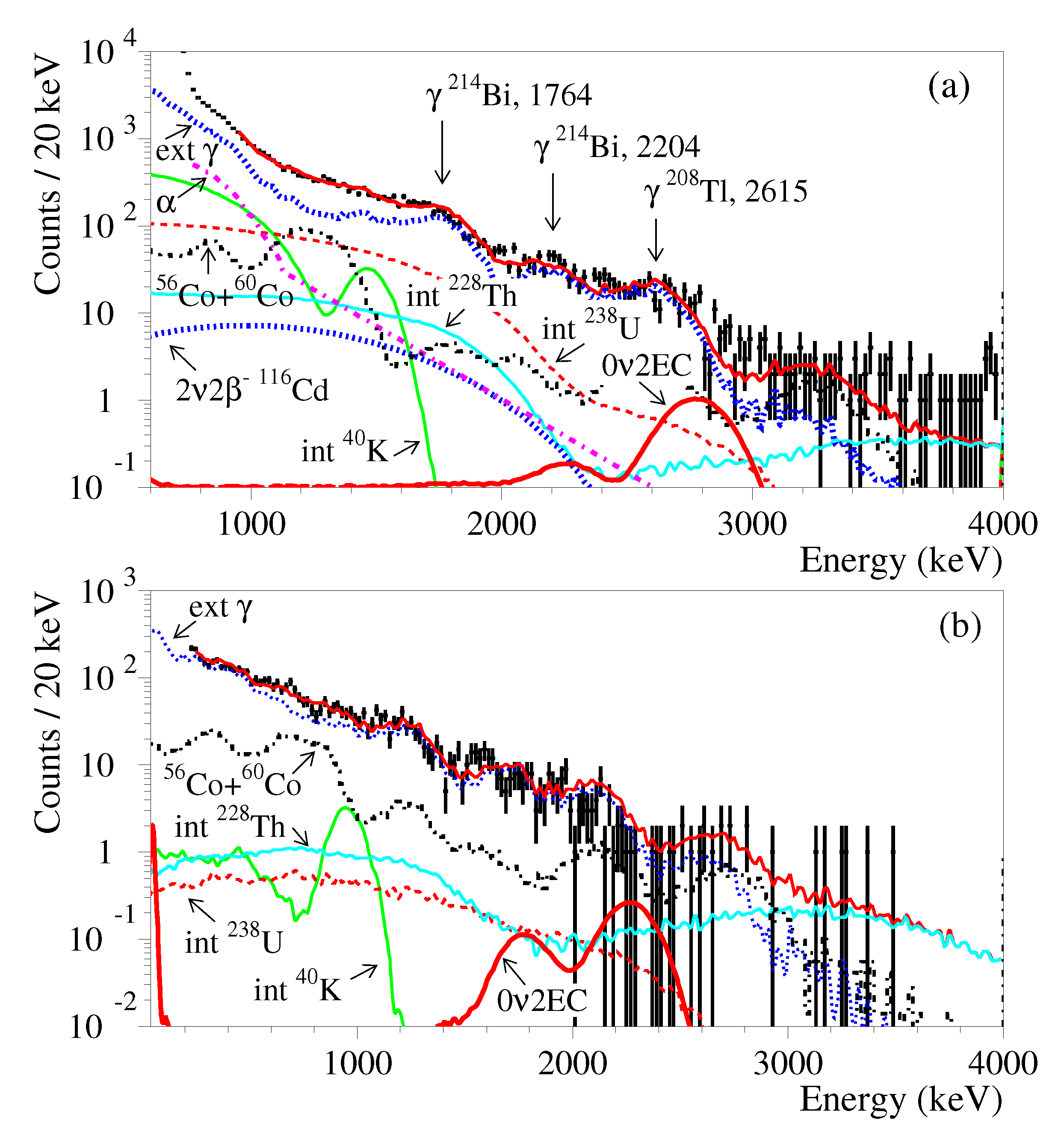
The simulated models were used to fit the energy spectra of and events in anti-coincidence with the CdWO counters and in coincidence with event(s) in at least one of the CdWO counters with the energy release keV. The data were fitted in the energy intervals (940–4000) keV (anti-coincidence data) and (240–3940) keV (coincidence with 511 keV). The fit quality is reasonable ( for 235 degrees of freedom). Figure 7 shows the results of the fit and the main components of the background.
Figure 7.
Energy spectra of the and events accumulated for 26,033 h by the CdWO scintillation detector in anti-coincidence with the CdWO counters (a) and in coincidence with the 511 keV annihilation quanta in at least one of the CdWO counters (b) (points) together with the background model (red line). The main components of the background are shown: the distributions of internal contaminations (“int K”, “int Th”, and “int U”) and external quanta (“ext ”), residual particles in the CdWO crystal (), cosmogenic Co and Co in the copper shield details, and the decay of Cd. The excluded distributions of the EC decay of Cd to the ground state of Pd with the half-life yr are shown by red solid line.
The fit allowed to estimate limits on radioactive contamination of the materials of the low-background set-up. Table 1 presents the data.
Table 1.
Radioactive contamination (mBq/kg) of the materials of the low-background set-up estimated by using the fit of the energy spectra that are presented in Figure 7. Upper limits are given at 68% C.L.
3.2. Limits on 2EC, EC and Processes in Cd
There are no peculiarities in the experimental data that could be ascribed to processes in Cd. Lower limits on the half-life of Cd relatively to different decay channels and modes can be estimated using the following formula:
where N is the number of Cd nuclei in the CdWO crystal (), is the detection efficiency for the process of decay (calculated as a ratio of the events number in a simulated distribution to the number of generated events), is the selection cuts efficiency (selection by PSD, time coincidence, energy interval), t is the time of measurements, and is the number of events of the effect searched for, which can be excluded at a given confidence level (C.L.). The responses of the detector system to different modes and channels of Cd double beta decay were simulated while using the EGSnrc package with initial kinematics that were given by the DECAY0 event generator. Approximately events were generated for each decay channel.
Different data were analyzed in order to estimate limits on the processes in Cd. Fit of the anti-coincidence spectrum by the above described model plus a simulated distribution of the EC decay of Cd to the ground state of Pd returns the area of the distribution counts that is no evidence for the effect searched for. According to [49], we took 367 events as at 90% C.L.2 The detection efficiency for the decay was simulated as . Taking into account the selection cut efficiency due to application of the PSD to select and events , we got a lower limit on the half-life of Cd relative to the EC decay to the ground state of Pd yr (the excluded distribution of the 2EC decay is shown in Figure 7). The limit is slightly worse than the one that was obtained in the previous stage of the experiment ( yr [21], also see Table 2).
Table 2.
Half-life limits on processes in Cd. The experimental selection is also reported (AC, anti-coincidence; CC, in coincidence, at the given energy (energies) with CdWO; CC 511&511, in coincidence with energies 511 keV in both of the CdWO counters). denotes the detection efficiency, is the selection cuts efficiency. The results of the most sensitive previous experiments are given for comparison.
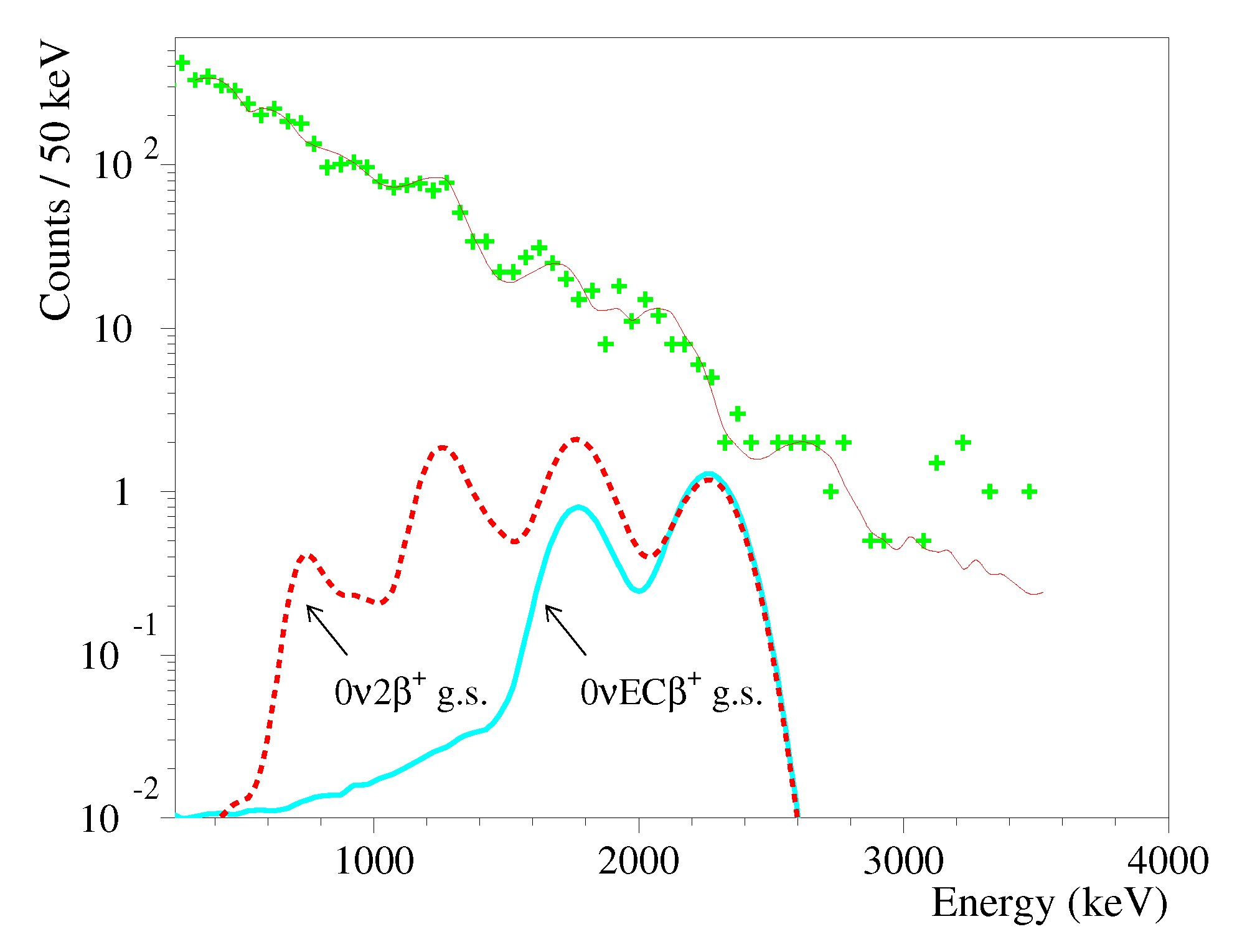
Fit of the CdWO detector data in coincidence with signal(s) in the CdWO counters by the above described background model was more sensitive to the most of the modes and channels of the decay searched for. An example of such an analysis for the EC and decays of Cd to the ground state of Pd using the data that were measured with the CdWO detector in coincidence with 511 keV events in at least one of the CdWO counters is shown in Figure 8. The selection cuts efficiency, e.g., for the EC process was calculated to be as a product of the PSD to select and events in the interval of the mean time values (0.9546), the time coincidence efficiency in the interval (0.9973), and the energy interval to select 511 keV events in the CdWO counters (0.9545). Table 2 provides the data on the efficiencies, values of , and the obtained half-life limits.
Figure 8.
Energy spectrum of the and events measured for 26,033 h by the CdWO detector in coincidence with events in at least one of the CdWO counters with energy keV (crosses). The solid red line shows the fit of the data by the background model (see Section 3.1). Excluded distributions of EC and decays of Cd to the ground state of Pd with the half-lives yr and yr, respectively, are shown.
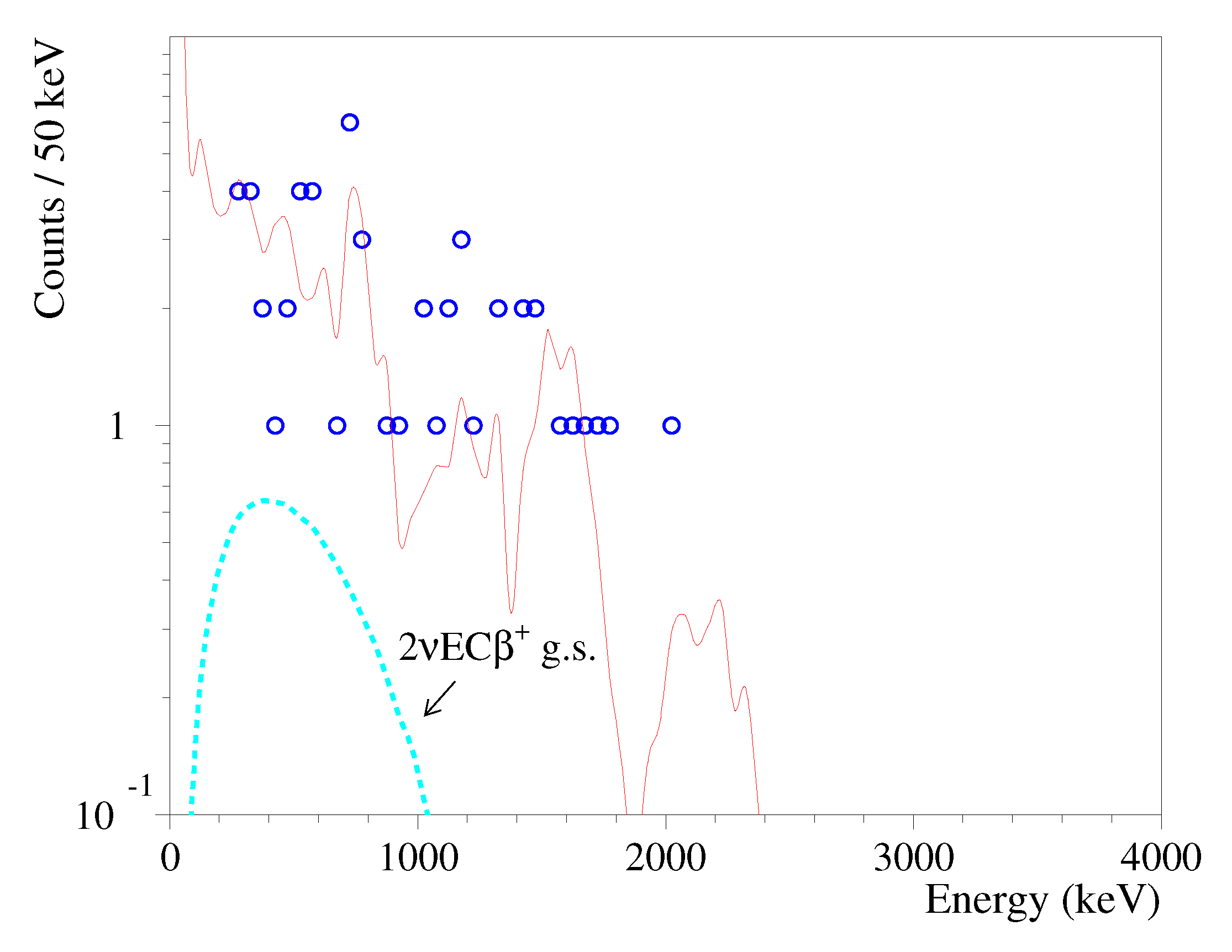
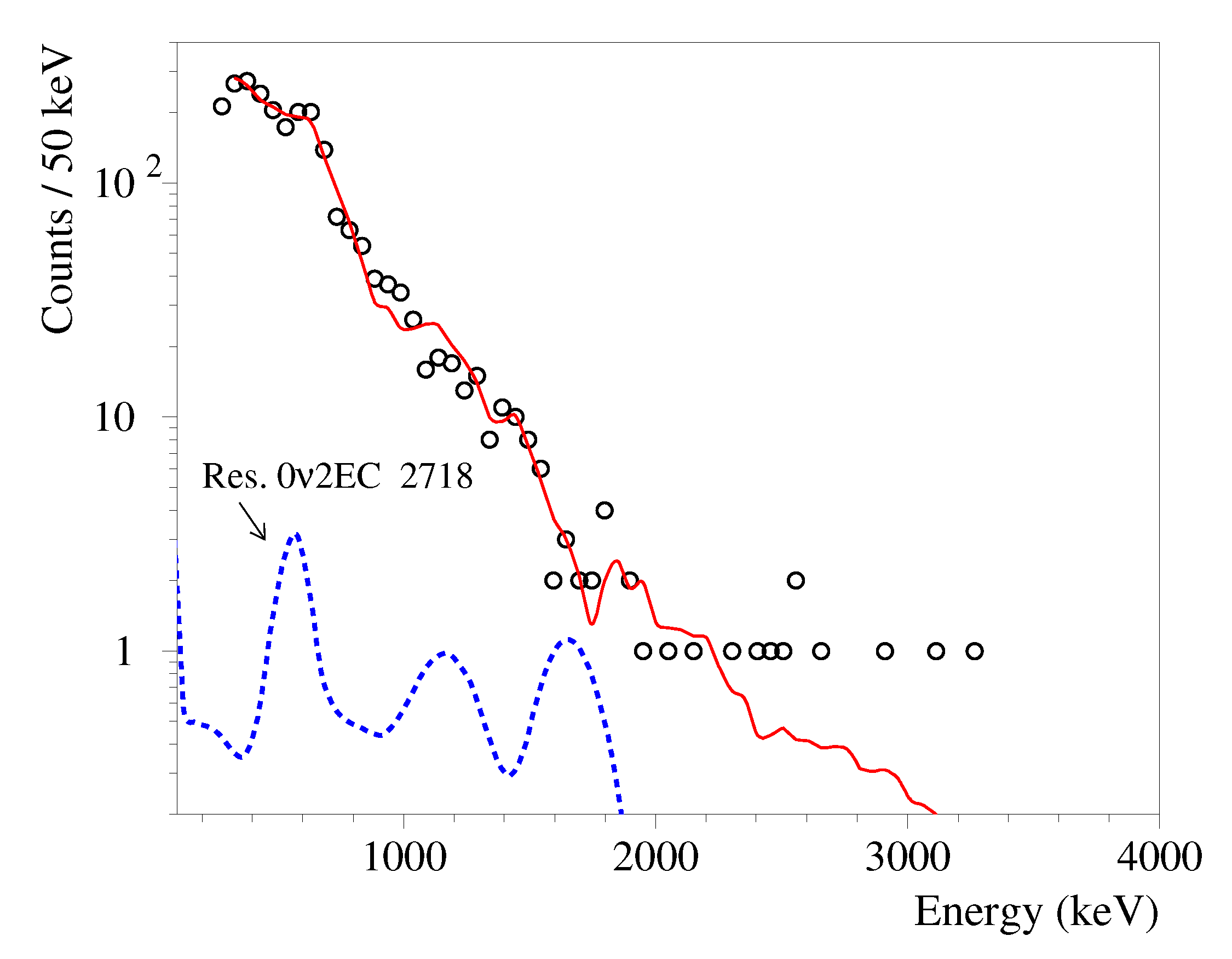
Another example is the search for EC transition of Cd to the 2718 keV excited level of Pd (considered as one of the most promising decay channels from the point of view of a possible resonant process [14]). The search was realized by analysis of the CdWO detector data in coincidence with event(s) in at least one of the CdWO counters in the energy interval ) − () keV. The interval should contain two intensive quanta with energies 1046 keV and 1160 keV being expected in the decay searched for (see the decay scheme in Figure 1). Figure 9 presents the spectrum and its fit, consisting of the background model and excluded distribution of the resonant process searched for.
Figure 9.
Energy spectrum of and events measured by the CdWO detector for 26,033 h in coincidence with event(s) in at least one of the CdWO counters in the energy interval ) − () keV (circles) and its fit by the model of background (red line). The excluded distribution of a possible resonant EC decay of Cd to the 2718 keV excited level of Pd with the half-life yr is shown.
The highest sensitivity to several decay channels with positron(s) emission was achieved using the data that were gathered by the CdWO detector in coincidence with 511 keV annihilation quanta in both of the CdWO counters thanks to a rather high detection efficiency of the CdWO counters and a very low background counting rate (see Figure 10). However, the fit of the spectrum by the background components is not reliable enough, due to the very low statistics of the data. Thus, the method of comparison of the measured background with the expected one was applied for the analysis. The expected background was estimated from the results of the fit that is shown in Figure 7. There are 54 counts in the whole spectrum, while the estimated background is 55.3 counts, confirming a correct background modelling. In the energy interval (250–1000) keV, the measured background is 33 counts, while the estimated one is 37.4 counts that leads to counts in accordance with the recommendations [49]. Taking into account the detection and the selections efficiencies for the EC decay of Cd to the ground state of Pd (0.040 and 0.703, respectively), one can obtain a half-life limit yr that is about two times higher than the limit ( yr) that was obtained in the previous stage of the experiment [34].
Figure 10.
Energy spectrum of and events measured by the CdWO detector for 26,033 h in coincidence with 511 keV annihilation quanta in both of the CdWO counters (circles). The expected background, which was built on the basis of the fit presented in Figure 7, is shown by a red solid line. The excluded distribution of the EC decay of Cd to the ground state of Pd with the half-life yr is shown.
Limits on other decay processes in Cd were obtained in a similar way. They are presented in Table 2, where the results of the most sensitive previous experiments are given for comparison.
A limit on effective nuclear matrix elements for the EC decay of Cd to the ground state of Pd could be estimated using the calculations of the phase-space factors for the decay [50,51] with the formula . The effective matrix nuclear element is expressed by , where is the axial-vector coupling constant, is nuclear matrix element. An upper limit on the value of the effective matrix nuclear element for the process can be estimated as (0.80–0.82).
The half-life limit on the EC decay of Cd to the ground state of Pd, yr, approaches the region of the theoretical predictions that are in the range – yr [10,52,53,54,55]. The sensitivity to the double beta decay processes presented in Cd is expected to be improved in the currently running experiment with reduced background thanks to the utilization of ultra-radiopure PMTs, longer quartz light-guides for the CdWO counters, a more powerful passive shield of the detector system. Additionally, the energy resolution of the CdWO detector was improved, roughly by a factor ∼1.8, thanks to the replacement of the PbWO light-guide by a plastic scintillator light-guide with substantially better optical transmittance. This replacement became possible due to an extremely low radioactive contamination of the specially developed R11065-20 MOD Hamamatsu PMT [56] used for the CdWO detector.
4. Conclusions
The experiment to search for double beta decay of Cd with enriched CdWO scintillator in coincidence with two large volume CdWO scintillation counters was performed at the Gran Sasso underground laboratory of INFN (Italy). New improved limits are set on the different channels of Cd double beta decay at the level of yr. The new improved limit on half-life of Cd relative to the EC decay was estimated as yr. The sensitivity is within the region of the theoretical predictions for the decay probability that are in the range of yr. A new improved limit was set for the resonant neutrinoless double-electron capture to the 2718 keV excited level of Pd, as yr.
The next stage of experiment is running at LNGS in the DAMA/R&D set-up with an improved sensitivity to all of the decay channels, thanks to a reduction of the background approximately by a factor 3–5 with utilization of ultra-radiopure PMTs, longer quartz light-guides for the CdWO counters, and a more powerful passive shield of the detector system. The energy resolution of the CdWO detector was also improved thanks to replacement of the PbWO light-guide by a plastic scintillator light-guide with a substantially better optical transmittance. As a result, the sensitivity to the EC decay of Cd is expected to be high enough to detect the process with the half-life at level of ∼ yr over five yr of measurements.
Author Contributions
All the authors of this paper have been significantly contributing to the presented results working on the various aspects of the different phases of this experiment. All authors have read and agreed to the published version of the manuscript.
Funding
This research received no external funding.
Acknowledgments
D.V.K. and O.G.P. were supported in part by the project “Investigation of double beta decay, rare alpha and beta decays” of the program of the National Academy of Sciences of Ukraine “Laboratory of young scientists” Grant No. 0120U101838. F.A.D., D.V.K., V.R.K., V.V.K., V.I.T. and M.M.Z. were supported in part by the project “Double beta decay” of the National Research Foundation of Ukraine Grant No. 2020.02/0011. F.A.D. greatly acknowledges the Government of Ukraine for the quarantine measures that have been taken against the Coronavirus disease 2019 that substantially reduced much unnecessary bureaucratic work.
Conflicts of Interest
The authors declare no conflict of interest.
References
- Giuliani, A.; Poves, A. Neutrinoless Double-Beta Decay. AHEP 2012, 2012, 857016. [Google Scholar] [CrossRef]
- Cremonesi, O.; Pavan, M. Challenges in Double Beta Decay. AHEP 2014, 2014, 951432. [Google Scholar] [CrossRef]
- Vergados, J.D.; Ejiri, H.; Šimkovic, F. Neutrinoless double beta decay and neutrino mass. Int. J. Mod. Phys. E 2016, 25, 1630007. [Google Scholar] [CrossRef]
- Bilenky, S.M.; Giunti, C. Neutrinoless double-beta decay: A probe of physics beyond the Standard Model. Int. J. Mod. Phys. A 2015, 30, 1530001. [Google Scholar] [CrossRef]
- Dell’Oro, S.; Marcocci, S.; Viel, M.; Vissani, F. Neutrinoless Double Beta Decay: 2015 Review. AHEP 2016, 2016, 2162659. [Google Scholar] [CrossRef]
- Dolinski, M.J.; Poon, A.W.P.; Rodejohann, W. Neutrinoless double beta decay: Status and prospects. Annu. Rev. Nucl. Part. Sci. 2019, 69, 219–251. [Google Scholar] [CrossRef]
- Asaka, T.; Shaposhnikov, M. The νMSM, dark matter and baryon asymmetry of the universe. Phys. Lett. B 2005, 620, 17–26. [Google Scholar] [CrossRef]
- Deppisch, F.F.; Graf, L.; Harz, J.; Huang, W.C. Neutrinoless double beta decay and the baryon asymmetry of the Universe. Phys. Rev. D 2018, 98, 055029. [Google Scholar] [CrossRef]
- Barabash, A.S. Precise Half-Life Values for Two-Neutrino Double-β Decay: 2020 Review. Universe 2020, 6, 159. [Google Scholar] [CrossRef]
- Hirsch, M.; Muto, K.; Oda, T.; Klapdor-Kleingrothaus, H.V. Nuclear structure calculation of β+β+, β+EC, and EC/EC decay matrix elements. Z. Phys. A 1994, 347, 151–160. [Google Scholar] [CrossRef]
- Winter, R. Double K capture and single K capture with positron emission. Phys. Rev. 1955, 100, 142–144. [Google Scholar] [CrossRef]
- Voloshin, M.B.; Mitselmakher, G.V.; Eramzhyan, R.A. Conversion of an atomic electron into a positron and double β+ decay. JETP Lett. 1982, 35, 656–659. [Google Scholar]
- Bernabeu, J.; De Rujula, A.; Jarlskog, C. Neutrinoless double electron capture as a tool to measure the electron neutrino mass. Nucl. Phys. B 1983, 223, 15–28. [Google Scholar] [CrossRef]
- Krivoruchenko, M.I.; Šimkovic, F.; Frekers, D.; Faessler, F. Resonance enhancement of neutrinoless double electron capture. Nucl. Phys. A 2011, 859, 140–171. [Google Scholar] [CrossRef]
- Meshik, A.P.; Hohenberg, C.M.; Pravdivtseva, O.V.; Kapusta, Y.S. Weak decay of 130Ba and 132Ba: Geochemical measurements. Phys. Rev. C 2001, 64, 035205. [Google Scholar] [CrossRef]
- Pujol, M.; Marty, B.; Burnard, B.P.; Philippot, P. Xenon in Archean barite: Weak decay of 130Ba, mass-dependent isotopic fractionation and implication for barite formation. Geochim. Cosmochim. Acta 2009, 73, 6834–6846. [Google Scholar] [CrossRef]
- Meshik, A.; Pravdivtseva, O. Weak Decay of Tellurium and Barium Isotopes in Geological Samples: Current Status. JPS Conf. Proc. 2017, 14, 020702. [Google Scholar]
- Gavrilyuk, Y.M.; Gangapshev, A.M.; Kazalov, V.V.; Kuzminov, V.V.; Panasenko, S.I.; Ratkevich, S.S. Indications of 2ν2K capture in 78Kr. Phys. Rev. C 2013, 87, 035501. [Google Scholar] [CrossRef]
- Ratkevich, S.S.; Gangapshev, A.M.; Gavrilyuk, Y.M.; Karpeshin, F.F.; Kazalov, V.V.; Kuzminov, V.V.; Panasenko, S.I.; Trzhaskovskaya, M.B.; Yakimenko, S.P. Comparative study of the double-K-shell-vacancy production in single- and double-electron-capture decay. Phys. Rev. C 2017, 96, 065502. [Google Scholar] [CrossRef]
- XENON Collaboration. Observation of two-neutrino double electron capture in 124Xe with XENON1T. Nature 2019, 568, 532–535. [Google Scholar] [CrossRef]
- Belli, P.; Bernabei, R.; Boiko, R.S.; Brudanin, V.B.; Cappella, F.; Caracciolo, V.; Cerulli, R.; Chernyak, D.M.; Danevich, F.A.; d’Angelo, S.; et al. Search for double-β decay processes in 106Cd with the help of a 106CdWO4 crystal scintillator. Phys. Rev. C 2012, 85, 044610. [Google Scholar] [CrossRef]
- Wang, M.; Audi, G.; Kondev, F.G.; Huang, W.J.; Naimi, S.; Xu, X. The AME2016 atomic mass evaluation. Chin. Phys. C 2017, 41, 030003. [Google Scholar] [CrossRef]
- Meija, J.; Coplen, T.B.; Berglund, M.; Brand, W.A.; De Bièvre, P.; Gring, M.; Holden, N.E.; Irrgeher, J.; Loss, R.D.; Walczyk, T.; et al. Isotopic compositions of the elements 2013 (IUPAC Technical Report). Pure Appl. Chem. 2016, 88, 293–306. [Google Scholar] [CrossRef]
- Kiel, H.; Münstermann, D.; Zuber, K. A search for various double beta decay modes of Cd, Te, and Zn isotopes. Nucl. Phys. A 2003, 723, 499–514. [Google Scholar] [CrossRef][Green Version]
- Ebert, J.; Fritts, M.; Gößling, C.; Göpfert, T.; Gehre, D.; Hagner, C.; Köttig, N.T.; Neddermann, T.; Oldorf, C.; Quante, T.; et al. Current status and future perspectives of the COBRA experiment. Adv. High Energy Phys. 2013, 2013, 703572. [Google Scholar] [CrossRef]
- Ebert, J.; Fritts, M.; Gehre, D.; Gößling, C.; Hagner, C.; Heidrich, N.; Klingenberg, R.; Kröninger, K.; Nitsch, C.; Oldorf, C.; et al. Results of a search for neutrinoless double-β decay using the COBRA demonstrator. Phys. Rev. C 2016, 94, 024603. [Google Scholar] [CrossRef]
- Rukhadze, N.I.; Briancon, C.; Brudanin, V.B.; Egorov, V.G.; Klimenko, A.A.; Kovalik, A.; Timkin, V.V.; Čhermák, P.; Shitov, Y.A.; Šimkovic, F.; et al. Search for double beta decay of 106Cd. Bull. Russ. Acad. Sci. Phys. 2011, 75, 879–882. [Google Scholar] [CrossRef]
- Rukhadze, N.I.; Bakalyarov, A.M.; Briançon, C.; Brudanin, V.B.; Cermák, P.; Egorov, V.G.; Klimenko, A.A.; Kovalík, A.; Lebedev, V.I.; Mamedov, F.; et al. New limits on double beta decay of 106Cd. Nucl. Phys. A 2011, 852, 197–206. [Google Scholar] [CrossRef]
- Rukhadze, N.I.; Beneš, P.; Briançon, C.; Brudanin, V.B.; Cermák, P.; Danevich, F.A.; Egorov, V.G.; Gusev, K.N.; Klimenko, A.A.; Kovalenko, V.E.; et al. Search for double electron capture of 106Cd. Phys. At. Nucl. 2006, 69, 2117–2123. [Google Scholar] [CrossRef]
- Rukhadze, N.I.; Brudanin, V.B.; Egorov, V.G.; Klimenko, A.A.; Kovalik, A.; Kouba, P.; Piquemal, F.; Rozov, S.V.; Rukhadze, E.; Salamatin, A.V.; et al. Search for double beta decay of 106Cd in the TGV-2 experiment. J. Phys. Conf. Ser. 2016, 718, 062049. [Google Scholar] [CrossRef]
- Rukhadze, N.; on behalf of TGV Collaboration. Search for double beta decay of 106Cd with the TGV-2 spectrometer. PoS 2016, 281, 245. [Google Scholar]
- Belli, P.; Bernabei, R.; Boiko, R.S.; Brudanin, V.B.; Bukilic, N.; Cerulli, R.; Chernyak, D.M.; Danevich, F.A.; d’Angelo, S.; Dossovitskiy, A.E.; et al. Development of enriched 106CdWO4 crystal scintillators to search for double β decay processes in 106Cd. Nucl. Instrum. Meth. A 2010, 615, 301–306. [Google Scholar] [CrossRef]
- Laubenstein, M.; Hult, M.; Gasparro, J.; Arnold, D.; Neumaier, S.; Heusser, G.; Köhler, M.; Povinec, P.; Reyss, J.-L.; Schwaiger, M.; et al. Underground measurements of radioactivity. Appl. Radiat. Isot. 2004, 61, 167. [Google Scholar] [CrossRef] [PubMed]
- Belli, P.; Bernabei, R.; Brudanin, V.B.; Cappella, F.; Caracciolo, V.; Cerulli, R.; Chernyak, D.M.; Danevich, F.A.; d’Angelo, S.; Di Marco, A.; et al. Search for double-β decay in 106Cd with an enriched 106CdWO4 crystal scintillator in coincidence with four HPGe detectors. Phys. Rev. C 2016, 93, 045502. [Google Scholar] [CrossRef]
- Polischuk, O.G.; Belli, P.; Bernabei, R.; Brudanin, V.B.; Cappella, F.; Caracciolo, V.; Cerulli, R.; Danevich, F.A.; Incicchitti, A.; Kasperovych, D.V.; et al. New limit on two neutrino electron capture with positron emission in 106Cd. AIP Conf. Proc. 2019, 2165, 020020. [Google Scholar]
- De Frenne, D.; Negret, A. Nuclear data sheets for A = 106. Nucl. Data Sheets 2008, 109, 943–1102. [Google Scholar] [CrossRef]
- Boiko, R.S.; Virich, V.D.; Danevich, F.A.; Dovbush, T.I.; Kovtun, G.P.; Nagornyi, S.S.; Nisi, S.; Samchuk, A.I.; Solopikhin, D.A.; Shcherban, A.P. Ultrapurification of archaeological lead. Inorg. Mater. 2011, 47, 645–648. [Google Scholar] [CrossRef]
- Danevich, F.A.; Kim, S.K.; Kim, H.J.; Kim, Y.D.; Kobychev, V.V.; Kostezh, A.B.; Kropivyansky, B.N.; Laubenstein, M.; Mokina, V.M.; Nagorny, S.S.; et al. Ancient Greek lead findings in Ukraine. Nucl. Instr. Meth. A 2009, 603, 328–332. [Google Scholar] [CrossRef]
- Bernabei, R.; Belli, P.; Cappella, F.; Cerulli, R.; Dai, C.J.; d’Angelo, A.; He, H.L.; Incicchitti, A.; Kuang, H.H.; Ma, J.M.; et al. First results from DAMA/LIBRA and the combined results with DAMA/NaI. Eur. Phys. J. C 2008, 56, 333–355. [Google Scholar] [CrossRef]
- Kawrakow, I.; Rogers, D.W.O. The EGSnrc Code System: Monte Carlo Simulation of Electron and Photon Transport, NRCC Report PIRS-701; National Research Council of Canada: Ottawa, ON, USA, 2003. [Google Scholar]
- Blachot, J. Nuclear data sheets for A = 113. Nucl. Data Sheets 2010, 111, 1471–1618. [Google Scholar] [CrossRef]
- Jagam, P.; Simpson, J.J. Measurements of Th, U and K concentrations in a variety of materials. Nucl. Instr. Meth. A 1993, 324, 389–398. [Google Scholar] [CrossRef]
- Righi, S.; Betti, M.; Bruzzi, L.; Mazzotti, G. Monitoring of natural radioactivity in working places. Microchem. J. 2000, 67, 119–126. [Google Scholar] [CrossRef]
- Danevich, F.A.; Tretyak, V.I. Radioactive contamination of scintillators. Int. J. Mod. Phys. A 2018, 33, 1843007. [Google Scholar] [CrossRef]
- Danevich, F.A.; Barabash, A.S.; Belli, P.; Bernabei, R.; Boiko, R.S.; Brudanin, V.B.; Cappella, F.; Caracciolo, V.; Cerulli, R.; Chernyak, D.M.; et al. Development of radiopure cadmium tungstate crystal scintillators from enriched 106Cd and 116Cd to search for double beta decay. AIP Conf. Proc. 2013, 1549, 201–204. [Google Scholar]
- Poda, D.V.; Barabash, A.S.; Belli, P.; Bernabei, R.; Boiko, R.S.; Brudanin, V.B.; Cappella, F.; Caracciolo, V.; Castellano, S.; Cerulli, R.; et al. CdWO4 crystal scintillators from enriched isotopes for double beta decay experiments. Radiat. Meas. 2013, 56, 66–69. [Google Scholar] [CrossRef]
- Barabash, A.S.; Belli, P.; Bernabei, R.; Cappella, F.; Caracciolo, V.; Cerulli, R.; Chernyak, D.M.; Danevich, F.A.; d’Angelo, A.; Incicchitti, A.; et al. Final results of the Aurora experiment to study 2β decay of 116Cd with enriched 116CdWO4 crystal scintillators. Phys. Rev. D 2018, 98, 092007. [Google Scholar] [CrossRef]
- Ponkratenko, O.A.; Tretyak, V.I.; Zdesenko, Y.G. Event generator DECAY4 for simulation of double-beta processes and decays of radioactive nuclei. Phys. Atom. Nucl. 2000, 63, 1282–1287. [Google Scholar] [CrossRef]
- Feldman, G.J.; Cousins, R.D. Unified approach to the classical statistical analysis of small signals. Phys. Rev. D 1998, 57, 3873–3889. [Google Scholar] [CrossRef]
- Kotila, J.; Iachello, F. Phase space factors for β+β+ decay and competing modes of double-β decay. Phys. Rev. C 2013, 87, 024313. [Google Scholar] [CrossRef]
- Mirea, M.; Pahomi, T.; Stoica, S. Values of the phase space factors involved in double beta decay. Rom. Rep. Phys. 2015, 67, 872–889. [Google Scholar]
- Barabash, A.S.; Umatov, V.I.; Gurriarán, R.; Hubert, F.; Hubert, P.; Aunola, M.; Suhonen, J. Theoretical and experimental investigation of the double beta processes in 106Cd. Nucl. Phys. A 1996, 604, 115–128. [Google Scholar] [CrossRef]
- Toivanen, J.; Suhonen, J. Study of several double-β-decaying nuclei using the renormalized proton-neutron quasiparticle random-phase approximation. Phys. Rev. C 1997, 55, 2314–2323. [Google Scholar] [CrossRef]
- Rumyantsev, O.A.; Urin, M.H. The strength of the analog and Gamow-Teller giant resonances and hindrance of the 2νββ-decay rate. Phys. Lett. B 1998, 443, 51–57. [Google Scholar] [CrossRef]
- Ejiri, H. Fermi surface quasi particle model nuclear matrix elements for two neutrino double beta decays. J. Phys. G 2017, 44, 115201. [Google Scholar] [CrossRef]
- Bernabei, R.; Belli, P.; Bussolotti, A.; Cappella, F.; Caracciolo, V.; Casalboni, M.; Cerulli, R.; Dai, C.J.; d’Angelo, A.; Di Marco, A.; et al. Performances of the new high quantum efficiency PMTs in DAMA/LIBRA. JINST 2012, 7, 03009. [Google Scholar] [CrossRef]
| 1. | Secular equilibrium in the Th and U decay families (when activities of daughter nuclides are equal to the activity of their parent nuclide) is typically broken in almost all of the materials due to physical or chemical processes utilized in the material production (see, e.g., [42,43,44]). |
| 2. | In the present work all the limits are given with 90% C.L. Only statistical errors coming from the data fluctuations were taken into account in the estimations of the values, and systematic contributions have not been included in the half-life limit values. |
Publisher’s Note: MDPI stays neutral with regard to jurisdictional claims in published maps and institutional affiliations. |
© 2020 by the authors. Licensee MDPI, Basel, Switzerland. This article is an open access article distributed under the terms and conditions of the Creative Commons Attribution (CC BY) license (http://creativecommons.org/licenses/by/4.0/).