
Polymer Quantum Mechanics on Compact Configuration Spaces


Abstract
1. Introduction
2. Quantization and the Stone–von Neumann Theorem
2.1. Canonical Quantization
2.2. Translation Operators
2.3. Weyl Algebra
2.4. The Stone–von Neumann Theorem
3. Polymer Quantum Mechanics
3.1. Integrals and Inner Products on
3.2. Polymer Hilbert Space: Position and Momentum Representations
3.3. Polymer Hilbert Space: Weyl Operators
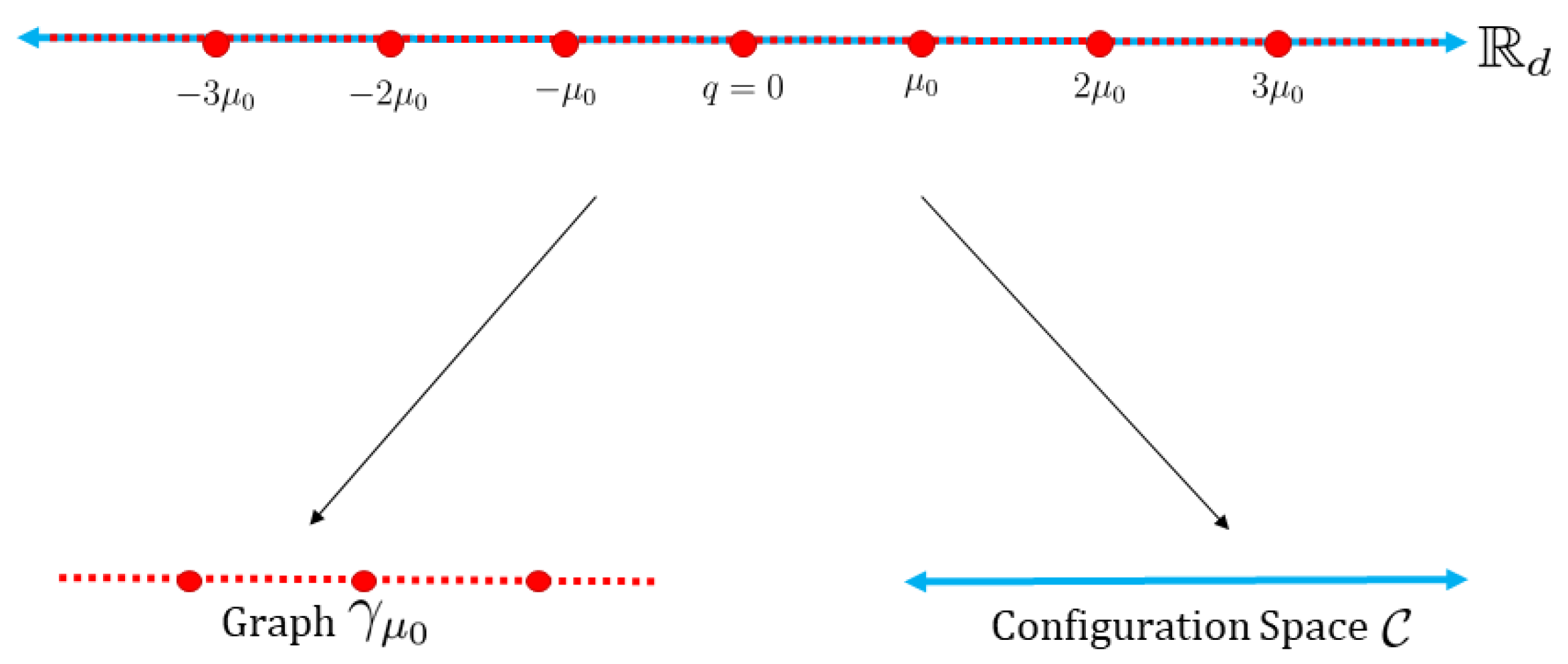
3.4. Quantum Mechanics on Position Graphs
- The points do not contain sequences with accumulation points (in the usual topology on ).
- For intervals of length above some threshold , there exists a maximum density of points on the interval.
3.5. Hamiltonian Dynamics on a Discrete Graph
4. Polymer Quantum Mechanics on Compact Spaces
Position Graphs on Compact Spaces
5. Polymer Particle on a Ring
5.1. Schrödinger Quantization
5.2. Polymer Quantization
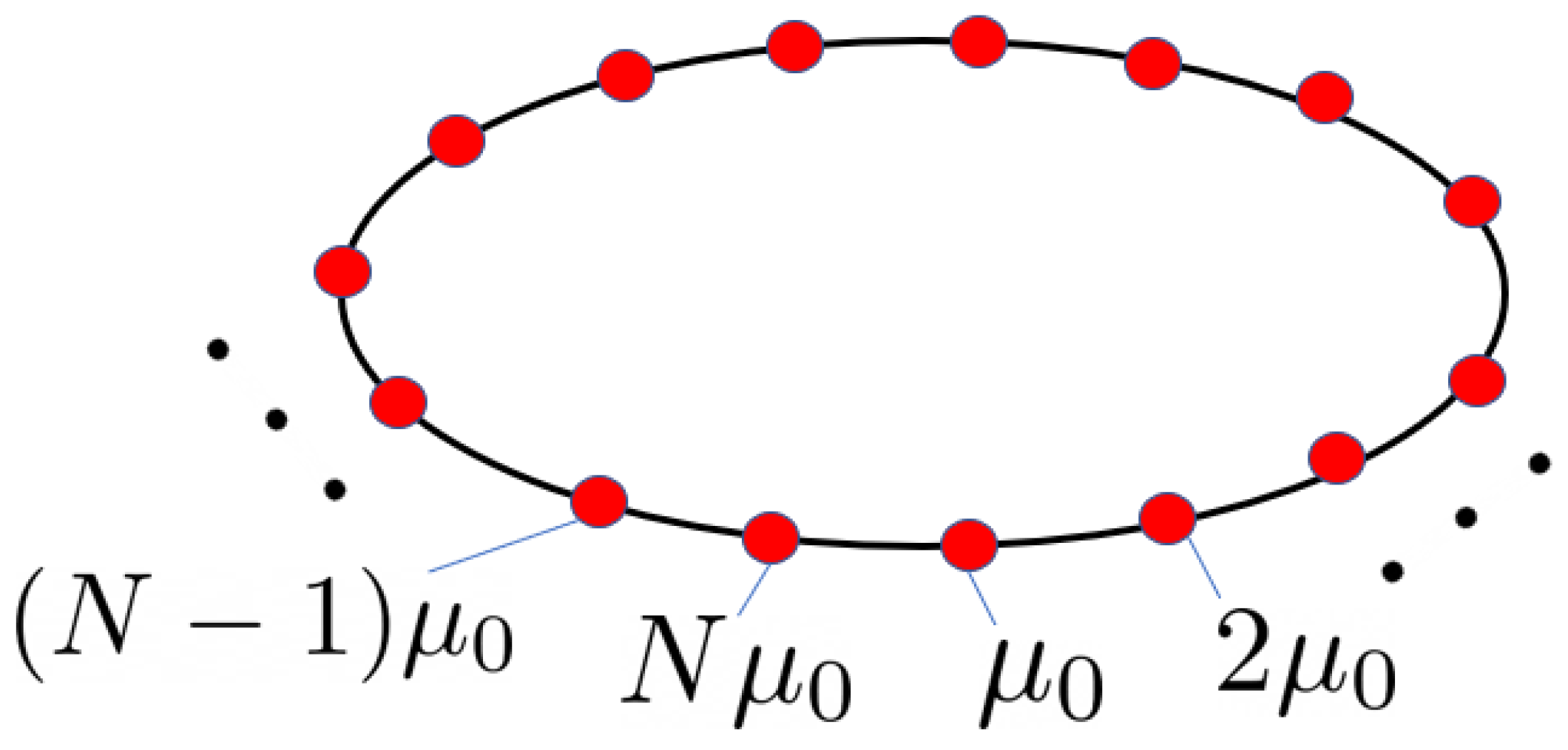
5.3. Position Graphs on a Ring
5.4. Operator Solution
5.5. Solution by Recurrence
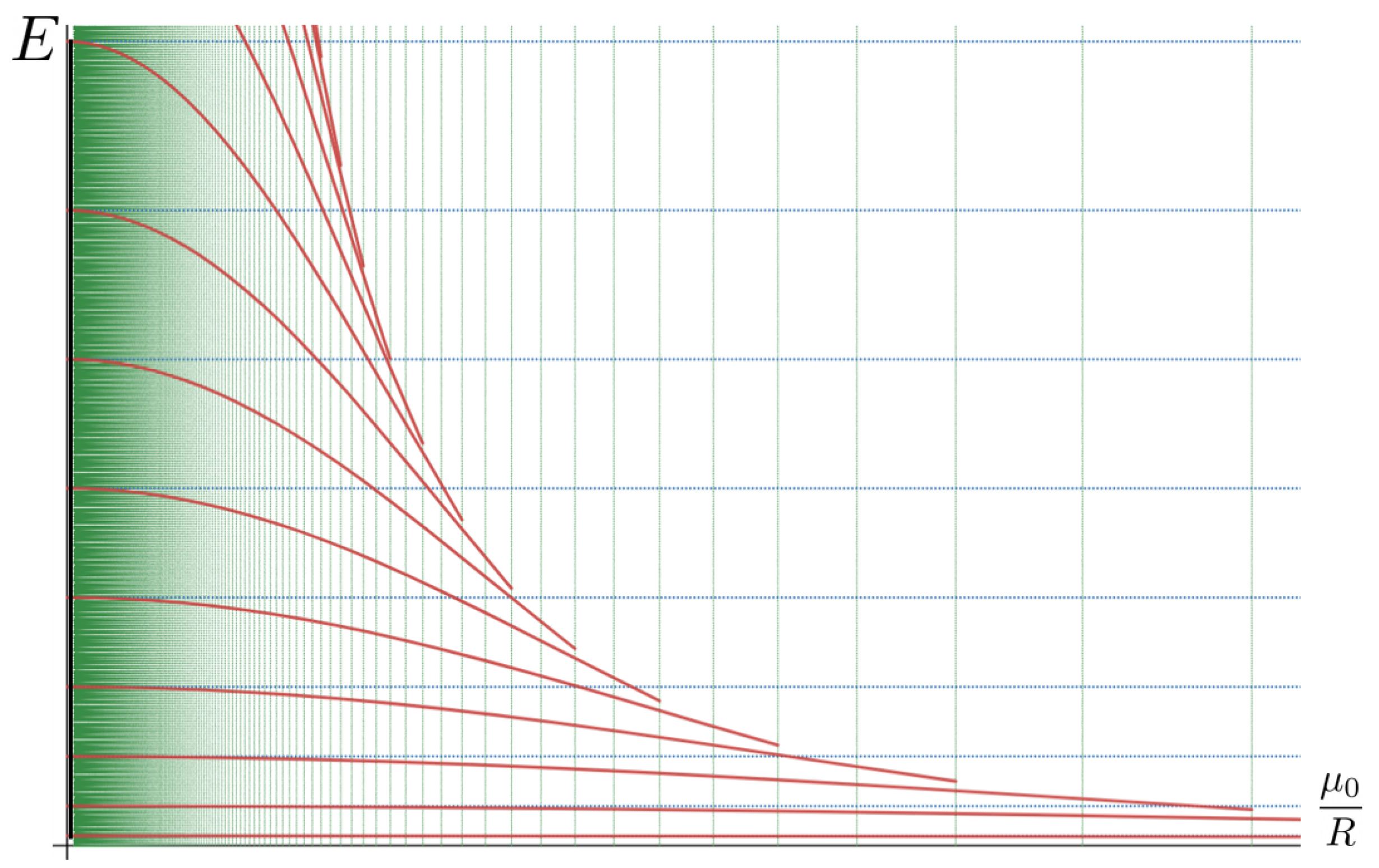
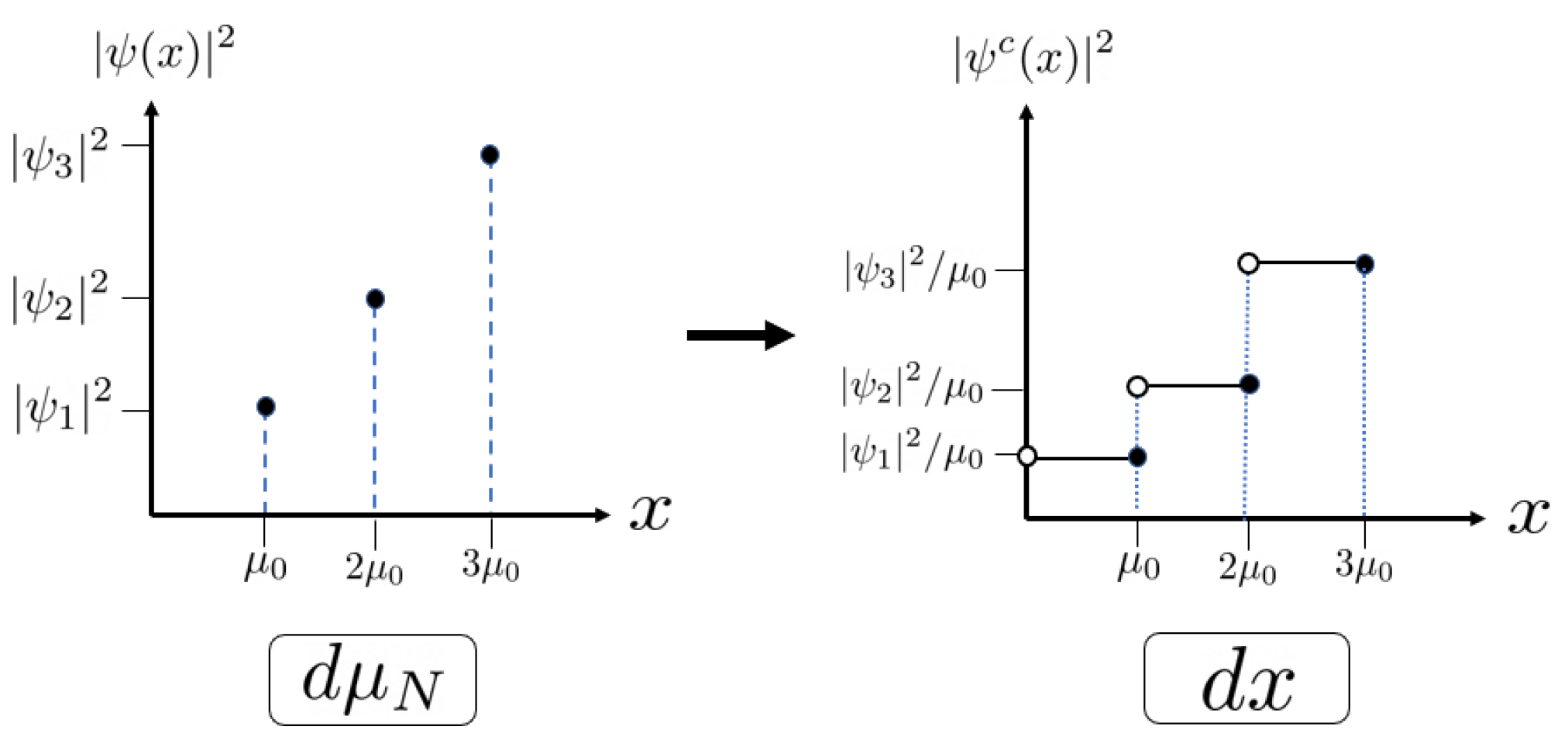
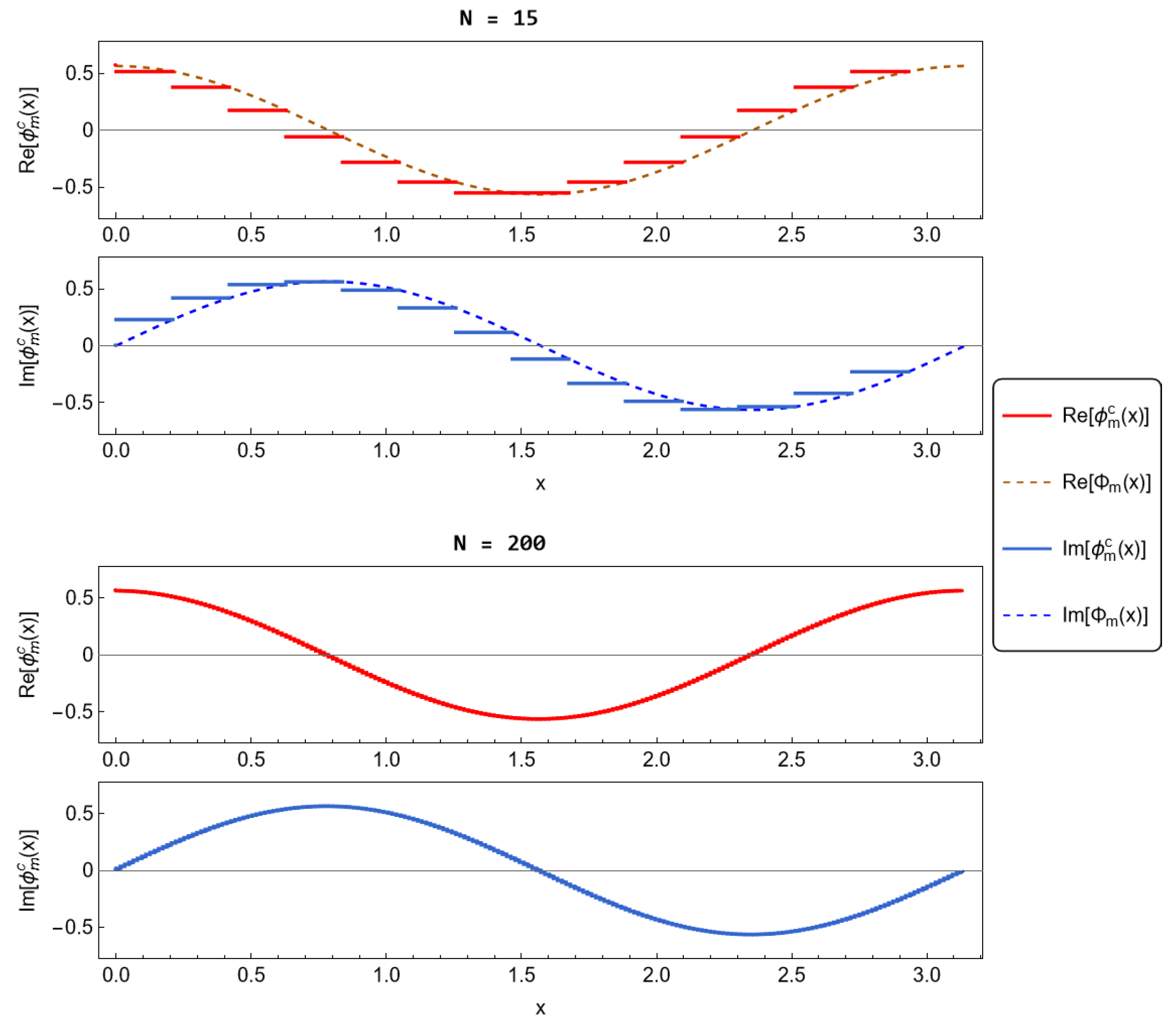
5.6. Continuum Limit
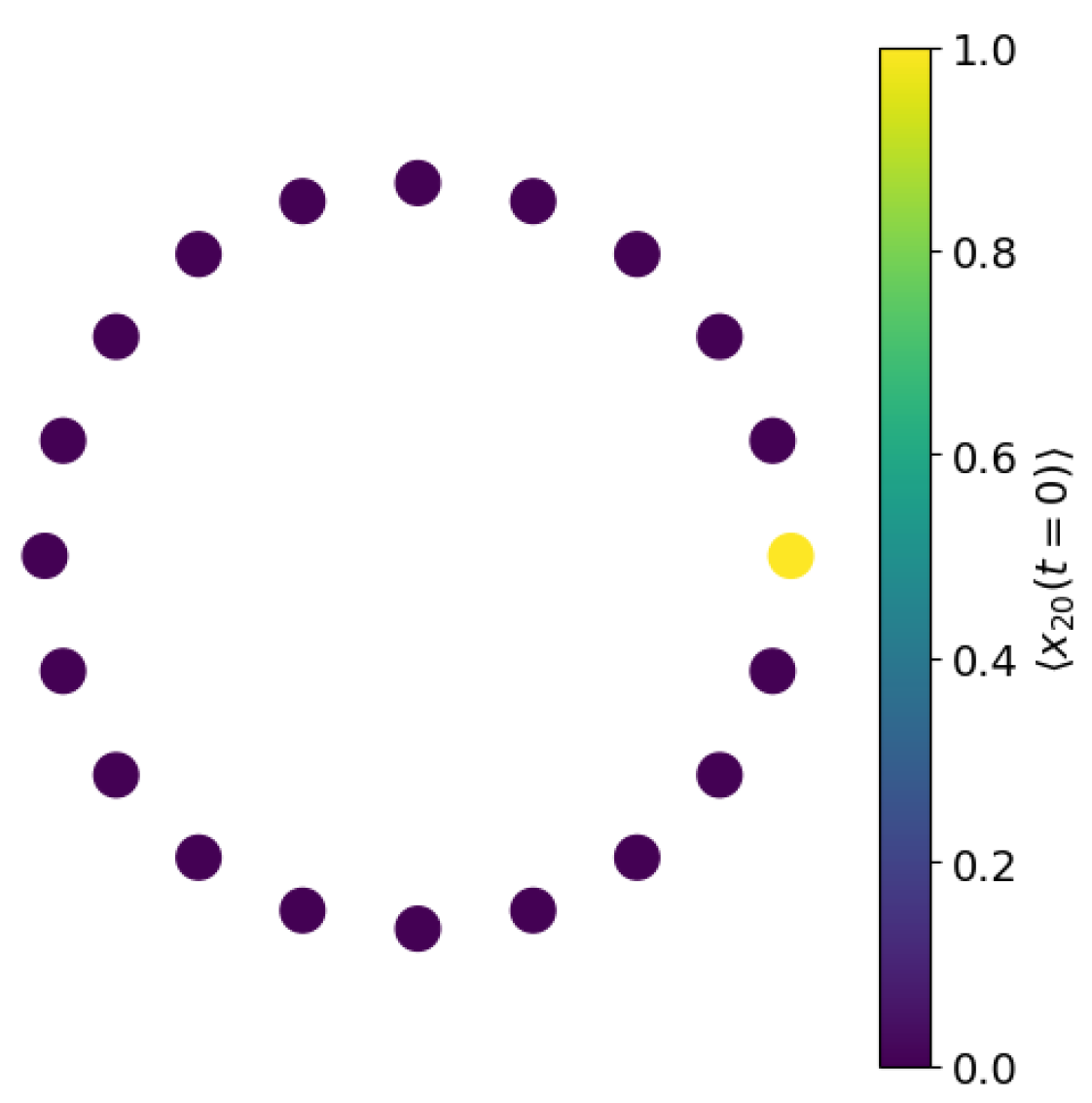
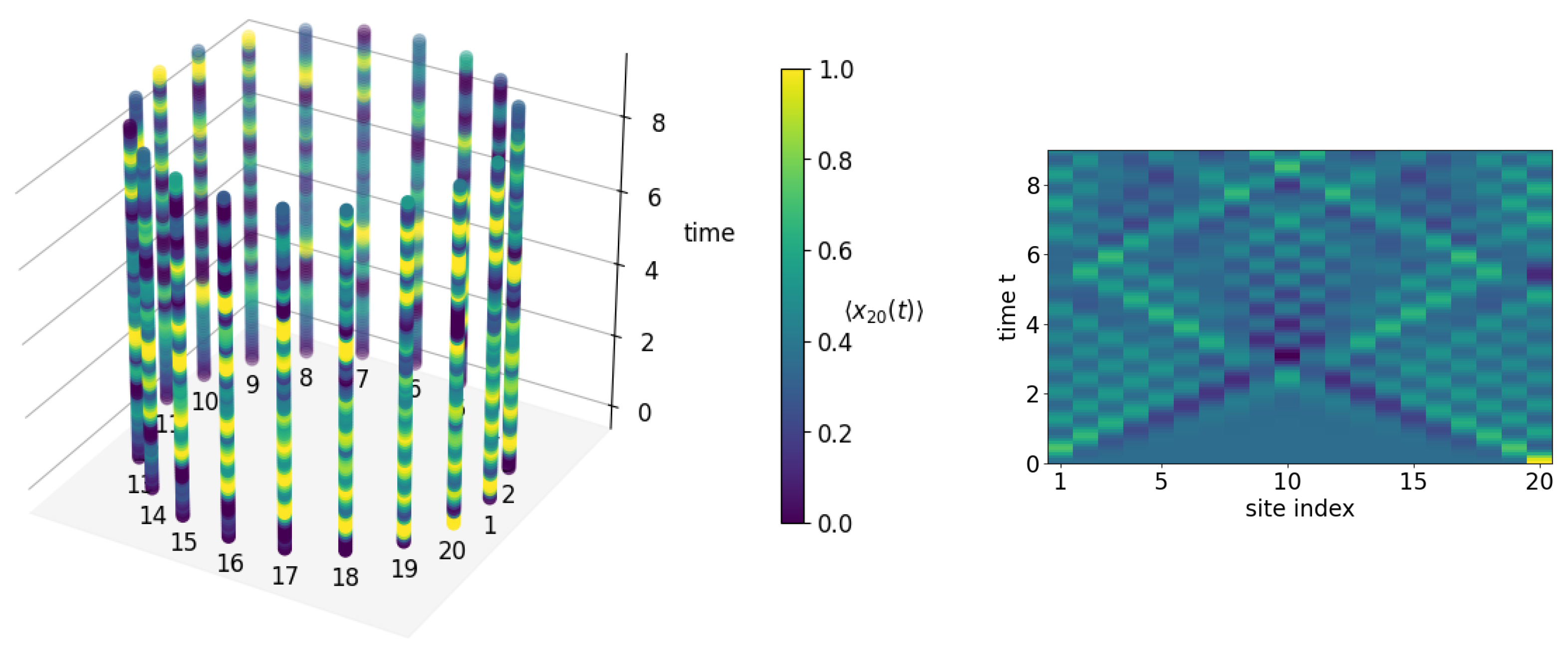
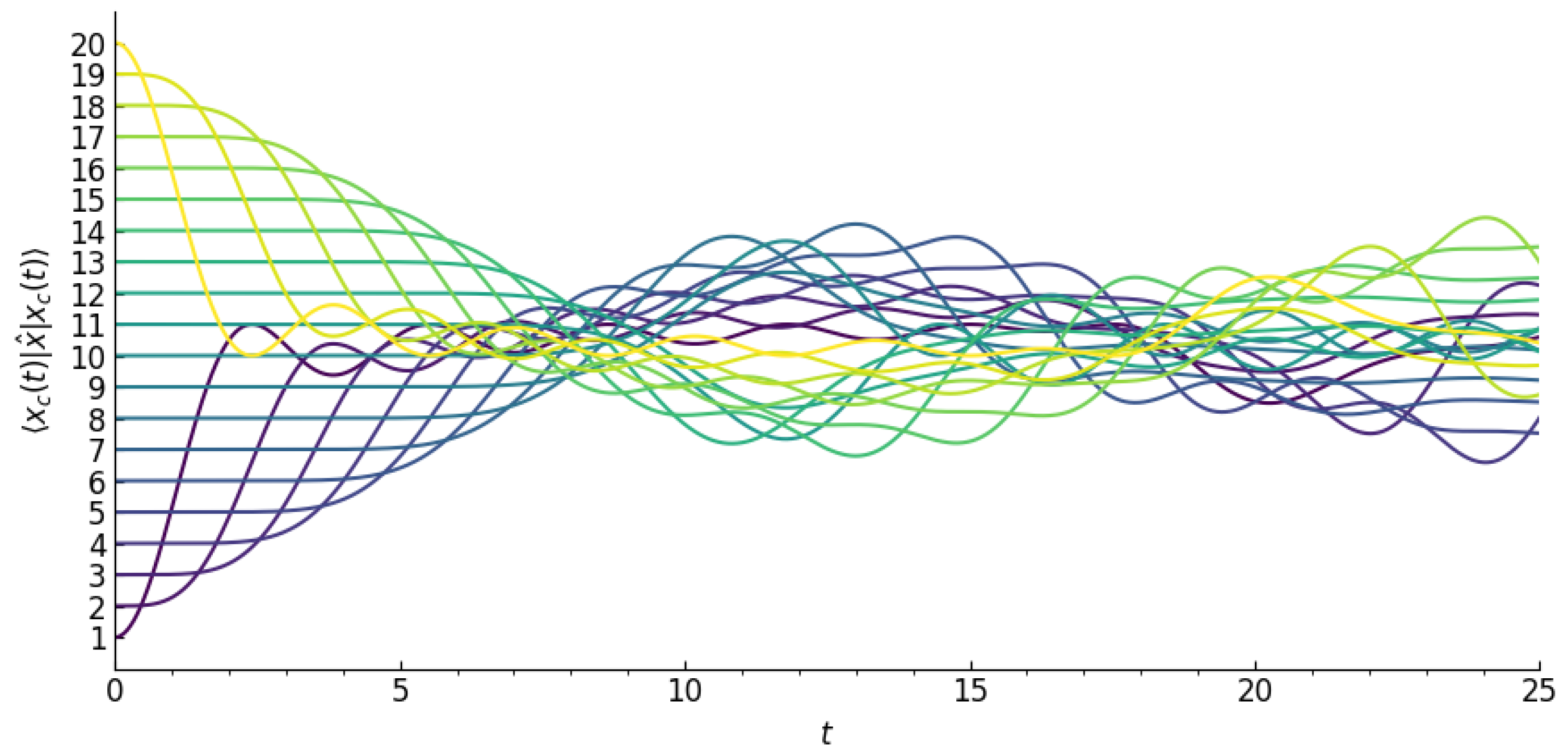
5.7. Time Evolution
Dispersion of a Localized State
6. Discussion
Author Contributions
Funding
Data Availability Statement
Acknowledgments
Conflicts of Interest
Appendix A. Bohr Compactification and the Quantum Momentum Space
Appendix A.1. Bohr Compactification
Appendix A.2. Dual Group of a Discrete Space
Appendix A.3. Quantum Momentum Space
- (i)
- Group characters are (by construction) eigenfunctions of translations, , and are thus eigenstates of the Weyl operator . When the momentum operator exists, they are thus also momentum eigenstates. As previously noted, this is why the Fourier transform on an LCA group is naturally defined in terms of the group characters, Equation (A3). Thus, the group dual to G is the set of translation (momentum) eigenfunctions.
- (ii)
- The domain of the Fourier transform Equation (A3) is the space of characters, but since these are naturally isomorphic to their labels, the labels effectively become the domain of the Fourier transform. Thus, for example, we normally consider the domain of the Fourier transform on to be , not the characters per se. More generally, functions on the characters can be naturally regarded as functions on the labels of the characters, whether or . Therefore, we somewhat loosely use this isomorphism to switch back and forth between thinking of the dual group as the set of characters (when we are interested in the translation eigenfunctions) or as the set of labels on those characters (when considering functions of those characters). (This is really just the familiar distinction between the eigenstates and their position-space representatives .)
- (iii)
- The space of almost-periodic functions on G is the space of linear combinations of G’s characters, the eigenfunctions of translations on G, and thus is naturally identified with the set of momentum-space states on the configuration space G.
- (iv)
- We have learned that is the space of continuous functions on the Bohr compactification . In the case that G is discrete, we have also learned that the polymer momentum (really, translation) eigenfunctions are identified with the Bohr compactification of G. We have just argued that the space of almost-periodic functions on G is the space of quantum momentum-space states on the configuration space G. More properly, since comprises the continuous functions on , it is dense in the square-integrable functions on , the Hilbert space we normally associate with momentum-space states.
Appendix B. Polymer Particle in a Box
Appendix B.1. Solution by Recurrence
Appendix B.2. Operator Solution
Appendix B.3. Continuum Limit
| 1 | It is reasonable to wonder about the origins of the evocative name “polymer representation”. The authors of [7], in which the term was first introduced, say it is because “states are mathematically analogous to the polymer-like excitations of quantum geometry”. The name “polymer quantum mechanics” is a reference to its inspiration, not anything intrinsic to the theory itself. |
| 2 | For a general discussion of the freedom available to define canonically conjugate pairs of operators in separable Hilbert spaces, see [39]. |
| 3 | Formally, at least, the right-hand side of the expression Equation (7) is simply the Taylor expansion of the left. |
| 4 | if we take . |
| 5 | |
| 6 | This is because the unitary translation operators used in Weyl’s formulation are bounded, while Schur’s lemma tells us the generators and cannot both be [45]. |
| 7 | The idea of a homomorphism in general is a map that preserves relevant algebraic structures. In the present context, a homomorphism is a map from the Weyl algebra to linear operators on that preserves the Weyl relations. |
| 8 | In the study of quantization, the choice of position or momentum representation is referred to as “polarization” [34]. |
| 9 | This result is usually stated as a separate theorem due to Stone. |
| 10 | For later reference, note that every function whose domain is a set with the discrete topology is therefore automatically continuous, since by definition a function is continuous if the pre-image of an open set is an open set [32]. |
| 11 | This rather cryptic naming has its origins in probability theory. The rough idea seems to be that these states are defined by fixing a finite (or sometimes merely countable) number of values of out of the uncountably infinite number of possible values of , leaving the rest unspecified, so these states can be pictured rather fancifully as living on a “cylinder” in the space of all possible values of that might have been selected. |
| 12 | “Cauchy completion” of an inner product space is the act of forming a new space by adding limits of all Cauchy sequences of vectors in the space to the space itself to yield a Hilbert space [32]. In [7], is defined by allowing cylinder states that are sums over countable sequences of points, not just finite sums, with the coefficients satisfying . In the present definition due to [9], these convergent infinite sequences are “added in” in the process of Cauchy-completing the space. See also our discussion of the AFW conditions in Section 3.4 below. |
| 13 | |
| 14 | Readers of Appendix A will recognize that cylinder states in the momentum representation include Bohr’s almost-periodic functions (as the space of continuous functions on , is dense in ), and that the Bohr compactification of is the set of maps () from these functions () to the complex numbers. Thus, . Put another way, again in the language of the appendix, the states introduced in Equation (36) are the characters on in terms of which the Fourier transform on is defined. In [7,9], essentially the same argument is made instead considering the spectrum of the Abelian -algebra formed by the Weyl operator on defined in Section 3.3. |
| 15 | The treatment of the particle in a box is reserved for Appendix B because, while polymer quantum mechanics may be formulated for it in much the same way as for the particle on a line or a ring, and may be solved using the same methods, the technical setting is different because unitary Weyl operators cannot be defined for the infinite well [34]. |
| 16 | |
| 17 | For , the result is immediate. For , each partial sum is a geometric series, and the triangle inequality may be used to bound the sum from above by a factor that does not depend on N. |
| 18 | This is in contrast to the corresponding basis states defined on the continuous ring, which satisfy . |
| 19 | |
| 20 | For discussion of phase operators in quantum theory, see, for example, [58]. We have already seen that it is usually best to consider the corresponding translation operators instead, such as in Equation (62). |
| 21 | The “Bohr” to whom this notion is originally due is Harald Bohr, younger brother to the renowned Niels. Harald Bohr pioneered the study of almost-periodic functions we discuss briefly below. |
| 22 | Note the slight (but common) abuse of notation in which the real number is also used to label the character itself. |
| 23 | The notation “” for the Bohr compactification is commonly encountered in the mathematics literature. |
| 24 | Recall that if the topology on not been replaced by the discrete topology, we have instead. |
| 25 | A homeomorphism is just a map that preserves all the topological properties of a space. The required example is the map from a coffee cup to a donut. |
| 26 | The discrete particle in a box has also been explored in other contexts. For example, in [64], a discrete version of the infinite well is investigated with a mathematical setup similar to that of polymer quantum mechanics, and [65] solves the same system in the context of solid-state physics. See also [30,39]. |
References
- Bojowald, M. Loop quantum cosmology. Living Rev. Relativ. 2008, 11, 4. [Google Scholar] [CrossRef] [Scilit] [PubMed]
- Ashtekar, A.; Singh, P. Loop quantum cosmology: A status report. Class. Quantum Gravity 2011, 28, 213001. [Google Scholar] [CrossRef] [Scilit]
- Ashtekar, A.; Pawlowski, T.; Singh, P. Quantum nature of the big bang: An analytical and numerical investigation. Phys. Rev. D 2006, 73, 124038. [Google Scholar] [CrossRef] [Scilit]
- Ashtekar, A.; Pawlowski, T.; Singh, P. Quantum Nature of the Big Bang: Improved dynamics. Phys. Rev. D 2006, 74, 084003. [Google Scholar] [CrossRef] [Scilit]
- Craig, D.A.; Singh, P. Consistent Probabilities in Wheeler-DeWitt Quantum Cosmology. Phys. Rev. D 2010, 82, 123526. [Google Scholar] [CrossRef] [Scilit]
- Craig, D.A. Dynamical eigenfunctions and critical density in loop quantum cosmology. Class. Quantum Gravity 2013, 30, 035010. [Google Scholar] [CrossRef] [Scilit][Green Version]
- Ashtekar, A.; Fairhurst, S.; Willis, J.L. Quantum gravity, shadow states and quantum mechanics. Class. Quantum Gravity 2003, 20, 1031–1061. [Google Scholar] [CrossRef] [Scilit]
- Corichi, A.; Vukašinac, T.; Zapata, J.A. Hamiltonian and physical Hilbert space in polymer Quantum Mechanics. Class. Quantum Gravity 2007, 24, 1495–1511. [Google Scholar] [CrossRef] [Scilit][Green Version]
- Corichi, A.; Vukasinac, T.; Zapata, J.A. Polymer Quantum Mechanics and its Continuum Limit. Phys. Rev. D 2007, 76, 044016. [Google Scholar] [CrossRef] [Scilit]
- Velhinho, J.M. Comments on the kinematical structure of loop quantum cosmology. Class. Quant. Gravity 2004, 21, L109. [Google Scholar] [CrossRef] [Scilit][Green Version]
- Velhinho, J.M. The Quantum configuration space of loop quantum cosmology. Class. Quant. Gravity 2007, 24, 3745–3758. [Google Scholar] [CrossRef] [Scilit]
- Ashtekar, A.; Bojowald, M.; Lewandowski, J. Mathematical structure of loop quantum cosmology. Adv. Theor. Math. Phys. 2003, 7, 233–268. [Google Scholar] [CrossRef] [Scilit]
- Bojowald, M. Mathematical structure of loop quantum cosmology: Homogeneous models. SIGMA 2013, 9, 082. [Google Scholar] [CrossRef] [Scilit][Green Version]
- Thiemann, T. Modern Canonical Quantum General Relativity; Cambridge University Press: Cambridge, UK, 2007. [Google Scholar]
- Hossain, G.M.; Husain, V.; Seahra, S.S. The Propagator in polymer quantum field theory. Phys. Rev. D 2010, 82, 124032. [Google Scholar] [CrossRef] [Scilit]
- Kreienbuehl, A.; Pawłowski, T. Singularity resolution from polymer quantum matter. Phys. Rev. D 2013, 88, 043504. [Google Scholar] [CrossRef] [Scilit]
- Zulfiqar, A.; Hassan, S.M. Polymer cosmology with polymer matter: Effective dynamics. JCAP 2025, 09, 018. [Google Scholar] [CrossRef] [Scilit]
- Amadei, L.; Perez, A.; Ribisi, S. Landscape of polymer quantum cosmology. Phys. Rev. D 2023, 107, 086007. [Google Scholar] [CrossRef] [Scilit]
- Chacon-Acosta, G.; Manrique, E.; Dagdug, L.; Morales-Tecotl, H.A. Statistical thermodynamics of polymer quantum systems. SIGMA 2011, 7, 110. [Google Scholar] [CrossRef] [Scilit][Green Version]
- Stargen, D.J.; Shankaranarayanan, S.; Das, S. Polymer quantization and advanced gravitational wave detector. Phys. Rev. D 2019, 100, 086007. [Google Scholar] [CrossRef] [Scilit]
- Garcia-Chung, A.; Carney, M.F.; Mertens, J.B.; Parvizi, A.; Rastgoo, S.; Tavakoli, Y. What do gravitational wave detectors say about polymer quantum effects? JCAP 2022, 11, 054. [Google Scholar] [CrossRef] [Scilit]
- Crowe, S.; Evans, S.; Smolyaninov, A. Analysis of polymerized superconducting circuits. Supercond. Sci. Technol. 2025, 38, 125011. [Google Scholar] [CrossRef] [Scilit]
- Kiefer, C. Quantum Gravity, 4th ed.; Oxford University Press: Oxford, UK, 2025. [Google Scholar]
- Rovelli, C.; Vidotto, F. Compact phase space, cosmological constant, and discrete time. Phys. Rev. 2015, D91, 084037. [Google Scholar] [CrossRef] [Scilit]
- McIntyre, D.H. Quantum Mechanics: A Paradigms Approach; Cambridge University Press: Cambridge, UK, 2023. [Google Scholar]
- Wilson, K.G. Confinement of Quarks. Phys. Rev. D 1974, 10, 2445–2459. [Google Scholar] [CrossRef] [Scilit]
- Šťovíček, P.; Tolar, J. Quantum mechanics in a discrete space-time. Rep. Math. Phys. 1984, 20, 157–170. [Google Scholar] [CrossRef] [Scilit]
- Lorente, M. Quantum mechanics on discrete space and time. In New Developments on Fundamental Problems in Quantum Physics; Springer: Berlin/Heidelberg, Germany, 1997; pp. 213–224. [Google Scholar]
- de la Torre, A.C.; Goyeneche, D. Quantum mechanics in finite dimensional Hilbert space. Am. J. Phys. 2003, 71, 49–54. [Google Scholar] [CrossRef] [Scilit]
- Vourdas, A. Quantum systems with finite Hilbert space. Rep. Prog. Phys. 2004, 67, 267–320. [Google Scholar] [CrossRef] [Scilit]
- Carroll, S.M. Completely discretized, finite quantum mechanics. Found. Phys. 2023, 53, 90. [Google Scholar] [CrossRef] [Scilit]
- Szekeres, P. A Course in Modern Mathematical Physics: Groups, Hilbert Space and Differential Geometry; Cambridge University Press: Cambridge, UK, 2004. [Google Scholar]
- Pal, P.B. A Physicist’s Introduction to Algebraic Structures; Cambridge University Press: Cambridge, UK, 2019. [Google Scholar]
- Hall, B.C. Quantum Theory for Mathematicians; Springer: Berlin/Heidelberg, Germany, 2013. [Google Scholar]
- Helliwell, T.M.; Sahakian, V.V. Modern Classical Mechanics; Cambridge University Press: Cambridge, UK, 2021. [Google Scholar]
- Schutz, B.F. Geometrical Methods of Mathematical Physics; Cambridge University Press: Cambridge, UK, 1980. [Google Scholar]
- Dirac, P. Principles of Quantum Mechanics, 4th revised ed.; Oxford University Press: Oxford, UK, 1958. [Google Scholar]
- Stone, M.; Goldbart, P. Mathematics for Physics, A Guided Tour for Graduate Students; Cambridge University Press: Cambridge, UK, 2009. [Google Scholar]
- van Enk, S.; Steck, D.A. All Hilbert spaces are the same: Consequences for generalized coordinates and momenta. Phys. Res. 2026, 8, 033117. [Google Scholar] [CrossRef] [Scilit]
- Sakurai, J.J.; Napolitano, J. Modern Quantum Mechanics, 3rd ed.; Quantum Physics, Quantum Information and Quantum Computation; Cambridge University Press: Cambridge, UK, 2020. [Google Scholar] [CrossRef] [Scilit]
- Hall, B.C. Lie Groups, Lie Algebras, and Representations, 2nd ed.; Springer: Berlin/Heidelberg, Germany, 2015. [Google Scholar]
- Zachos, C. Crib Notes on Campbell-Baker-Hausdorff Expansions; Technical Report; Argonne National Laboratory: Lemont, IL, USA, 1999. [Google Scholar]
- Moretti, V. Spectral Theory and Quantum Mechanics, 2nd ed.; Springer: Berlin/Heidelberg, Germany, 2017. [Google Scholar]
- Wald, R.M. Quantum Field Theory in Curved Spacetime and Black Hole Thermodynamics; University of Chicago Press: Chicago, IL, USA, 1994. [Google Scholar]
- Reed, M.; Simon, B. Methods of Modern Mathematical Physics I: Functional Analysis, revised and enlarged ed.; Academic Press: Cambridge, MA, USA, 1980; Volume I. [Google Scholar]
- Prugovečki, E. Quantum Mechanics in Hilbert Space, 2nd ed.; Academic Press: Cambridge, MA, USA, 1981. [Google Scholar]
- Blank, J.; Exner, P.; Havliček, M. Hilbert Space Operators in Quantum Physics, 2nd ed.; Springer: Berlin/Heidelberg, Germany, 2008. [Google Scholar]
- Katznelson, Y. An Introduction to Harmonic Analysis, 3rd ed.; Cambridge University Press: Cambridge, UK, 2004. [Google Scholar]
- Rudin, W. Fourier Analysis on Groups; Interscience: Saint-Nom-la-Bretèche, France, 1970. [Google Scholar]
- Diestel, J.; Spalsbury, A. The Joys of Haar Measure; Graduate Studies in Mathematics; American Mathematical Society: Washington, DC, USA, 2014; Volume 150. [Google Scholar]
- Hewitt, E.; Ross, K.A. Abstract Harmonic Analysis, 2nd ed.; Springer: Berlin/Heidelberg, Germany, 1979; Volume I. [Google Scholar]
- Armstrong, M.A. Basic Topology; Springer: Berlin/Heidelberg, Germany, 1983. [Google Scholar]
- Bojowald, M. Canonical Gravity and Applications: Cosmology, Black Holes, and Quantum Gravity; Cambridge University Press: Cambridge, UK, 2010. [Google Scholar]
- F., M. What is the Haar Measure on the Bohr Compactification b of the Integers? Mathematics Stack Exchange. 2025. Available online: https://math.stackexchange.com/q/5101741 (accessed on 14 October 2025).
- Chung, W.S.; Haouam, I.; Hassanabadi, H. Quantum mechanics on a circle with a finite number of α-uniformly distributed points. Phys. Lett. A 2023, 485, 129098. [Google Scholar] [CrossRef] [Scilit]
- Elaydi, S.N. An Introduction to Difference Equations; Springer: New York, NY, USA, 1996. [Google Scholar]
- Abbott, S. Understanding Analysis, 2nd ed.; Springer: Berlin/Heidelberg, Germany, 2015. [Google Scholar]
- Barnett, S.M.; Vaccaro, J.A. (Eds.) The Quantum Phase Operator: A Review; Taylor and Francis: Oxford, UK, 2007. [Google Scholar]
- Ashtekar, A.; Corichi, A.; Singh, P. Robustness of key features of loop quantum cosmology. Phys. Rev. D 2008, 77, 024046. [Google Scholar] [CrossRef] [Scilit]
- Craig, D.A.; Singh, P. Consistent probabilities in loop quantum cosmology. Class. Quantum Gravity 2013, 30, 205008. [Google Scholar] [CrossRef] [Scilit]
- Conway, J.B. A Course in Functional Analysis, 2nd ed.; Springer: Berlin/Heidelberg, Germany, 1990. [Google Scholar]
- Staten, C. Bohr Compactifications. 2009. Available online: https://math.osu.edu/sites/math.osu.edu/files/whatis_bohr.pdf (accessed on 16 August 2025).
- Flores-González, E.; Morales-Técotl, H.A.; Reyes, J.D. Propagators in polymer quantum mechanics. Ann. Phys. 2013, 336, 394–412. [Google Scholar] [CrossRef] [Scilit]
- Popov, D. Free particle trapped in an infinite quantum well examined through the discrete calculus model. arXiv 2023, arXiv:2303.08212. [Google Scholar]
- Boykin, T.B.; Klimack, G. The discretized Schrödinger equation and simple models for semiconductor quantum wells. Eur. J. Phys. 2004, 25, 503–514. [Google Scholar] [CrossRef] [Scilit]
- Bonneau, G.; Faraut, J.; Valent, G. Selfadjoint extensions of operators and the teaching of quantum mechanics. Am. J. Phys. 2001, 69, 322. [Google Scholar] [CrossRef] [Scilit]
- Gover, M. The eigenproblem of a tridiagonal 2-Toeplitz matrix. Linear Algebra Its Appl. 1994, 197–198, 63–78. [Google Scholar] [CrossRef] [Scilit]
- Noschese, S.; Pasquini, L.; Reichel, L. Tridiagonal Toeplitz matrices: Properties and novel applications. Numer. Linear Algebra Appl. 2012, 20, 302–326. [Google Scholar] [CrossRef] [Scilit]



| Particle on a Line | Particle on a Ring | ||||||
|---|---|---|---|---|---|---|---|
| Quantization | Representation | Hilbert Space | Dimension | Separable? | Hilbert Space | Dimension | Separable? |
| Schrödinger | Position | yes | yes | ||||
| Momentum | yes | yes | |||||
| Polymer | Position | no | no | ||||
| Momentum | no | no | |||||
| Position Graph | yes | yes (finite) | |||||
Disclaimer/Publisher’s Note: The statements, opinions and data contained in all publications are solely those of the individual author(s) and contributor(s) and not of MDPI and/or the editor(s). MDPI and/or the editor(s) disclaim responsibility for any injury to people or property resulting from any ideas, methods, instructions or products referred to in the content. |
© 2026 by the authors. Licensee MDPI, Basel, Switzerland. This article is an open access article distributed under the terms and conditions of the Creative Commons Attribution (CC BY) license.
Share and Cite
Siebersma, M.R.; Seibert, B.; Shuman, S.; Craig, D.A. Polymer Quantum Mechanics on Compact Configuration Spaces. Universe 2026, 12, 246. https://doi.org/10.3390/universe12080246
Siebersma MR, Seibert B, Shuman S, Craig DA. Polymer Quantum Mechanics on Compact Configuration Spaces. Universe. 2026; 12(8):246. https://doi.org/10.3390/universe12080246
Chicago/Turabian StyleSiebersma, Maxwell R., Basie Seibert, Samuel Shuman, and David A. Craig. 2026. "Polymer Quantum Mechanics on Compact Configuration Spaces" Universe 12, no. 8: 246. https://doi.org/10.3390/universe12080246
APA StyleSiebersma, M. R., Seibert, B., Shuman, S., & Craig, D. A. (2026). Polymer Quantum Mechanics on Compact Configuration Spaces. Universe, 12(8), 246. https://doi.org/10.3390/universe12080246