
Review

Magnetized QCD Matter
1
School of Nuclear Science and Technology, University of Chinese Academy of Sciences, Beijing 101408, China
2
College of Physics, Jilin University, Changchun 130012, China
*
Author to whom correspondence should be addressed.
Universe 2026, 12(6), 154; https://doi.org/10.3390/universe12060154
Submission received: 31 March 2026 / Revised: 15 May 2026 / Accepted: 19 May 2026 / Published: 25 May 2026

Abstract

Over the past decade, the study of QCD matter under the influence of magnetic fields has received widespread attention, yet several unresolved puzzles remain, including: inverse magnetic catalysis (IMC), diamagnetism (negative magnetic susceptibility) at low temperature and the nonmonotonic behavior of charged pion mass under magnetic fields. We present a brief overview of these unresolved challenges and discuss potential solutions.

1. Introduction

Strong magnetic fields exist in the early universe and neutron stars and can be created in heavy ion collisions. Primordial magnetic fields with magnitude 10 20 23 Gauss can be generated in the early universe through mechanisms driven by a chiral anomaly [1,2]. Neutron stars, among the most magnetized objects in the universe, exhibit magnetic field strengths typically ranging from 10 11 to 10 13 Gauss, while magnetars, a special class of neutron stars, can possess even stronger fields, reaching 10 14 to 10 15 Gauss. A magnetic field with a magnitude of 10 18 19 Gauss can be generated through non-central heavy ion collisions [3,4]. As a result, the study of Quantum Chromodynamic (QCD) matter under the influence of an external magnetic field has garnered wide interest.
QCD matter under an external magnetic field exhibits a range of intriguing phenomena. These include: (1) the Chiral Magnetic Effect (CME), describing the generation of an electric current along the direction of the applied magnetic field due to the chirality imbalance [5,6,7,8]; (2) magnetic catalysis (MC), characterized by an enhancement in chiral symmetry breaking with an increasing magnetic field [9,10,11]; (3) inverse magnetic catalysis (IMC), where the critical temperature of the chiral phase transition decreases as the magnetic field increases [12,13,14]; (4) diamagnetism (negative magnetic susceptibility) at low temperature and paramagnetism (positive magnetic susceptibility) at high temperature [15]; and (5) the nonmonotonic behavior of charged pion mass under a magnetic field [16].
Some of the above properties, e.g., inverse magnetic catalysis (IMC), diamagnetism (negative magnetic susceptibility) at low temperature and the nonmonotonic behavior of charged pion mass under a magnetic field, were not anticipated within effective theories, such as the Nambu–Jona-Lasinio model. In this article, we provide a brief overview of the progress made in understanding these puzzles from the perspective of effective theories.
It is worth mentioning that there are other reviews on magnetized QCD matter such as Refs. [17,18,19,20,21] and the references therein.

2. Puzzle-1: Diamagnetism at Low Temperature

Magnetic susceptibility is a fundamental property of a material, and it measures the amount of magnetization of a material there is in response to an applied external magnetic field. Following [22,23], magnetic susceptibility χ is defined as follows:
χ ( T ) = 2 Ω ( T , e B ) ( e B ) 2 | e B = 0 ( T ) χ ( T = 0 ) ,
where Ω is the grand canonical potential, and χ ( T = 0 ) = 0 is chosen to eliminate unobservable vacuum magnetic susceptibility.
The lattice QCD calculation in [23,24,25,26,27,28] showed that at low temperature, magnetic susceptibility is negative; thus the magnetized QCD matter exhibits diamagnetism, and at high temperature, magnetic susceptibility is positive; thus the magnetized QCD matter exhibits paramagnetism.
Paramagnetism is straightforward to understand, as quarks tend to align their spins with the magnetic field, leading to polarization. However diamagnetism at low temperature is different from the effective model predictions in the Nambu–Jona-Lasinio (NJL) model and linear- σ model in mean-field approximation [29,30]. When meson fluctuations are considered, diamagnetism at low temperature can be obtained from pion contributions [31,32,33].
For example, in [34], considering the two-flavor NJL model beyond mean-field approximation. The Lagrangian of the SU(2) NJL model in the presence of a uniform magnetic field takes the form of
L = ψ ¯ i γ μ D μ m ^ ψ + G ψ ¯ ψ 2 + ψ ¯ i γ 5 τ ψ 2 .
Here ψ = ( u , d ) T is a two-flavor quark field, m ^ = diag ( m u , m d ) with m u = m d = m 0 is the quark current mass matrix, and τ i is the i-th component of Pauli matrices and the covariant derivative D μ = μ i Q A μ coupling quarks with electric charge Q = diag ( 2 / 3 e , 1 / 3 e ) to a gauge field B = × A with A μ = ( 0 , 0 , B x 1 , 0 ) in the Landau gauge.
By taking into account the meson fluctuations, thermodynamic potential [35] has the form of
Ω = ( m q m 0 ) 2 4 G + Ω q + M Ω M ,
where m q is the dynamically generated constituent quark mass including the contribution from chiral condensation, and M is for neutral π 0 and charged pions π ± . Ω includes the contribution from quarks
Ω q ( T , B ) = Tr { c , f , s , x } ln 1 T S 1 ( x , x )
and mesons (mainly pions)
Ω π = d 3 k ( 2 π ) 3 E π 2 + T ln 1 e E π / T ,
with the energy dispersion relation of pions given by the following:
E π = m π , p o l e 2 + ( v · k ) 2 .
Here v is the propagating velocity [36,37,38,39] or the ratio of pole mass over screening mass, and its i-th component has the expression of
v i = m M , p o l e , i m M , s c r , i
where the pole mass m p o l e (static solution, setting q 1 = q 2 = q 3 = 0 ) defined through 1 2 G Π M ( q 0 2 = m p o l e 2 , 0 ) = 0 and the screening masses m s c r , i in q i (setting q 0 = 0 , and q j = 0 for j i ) through 1 2 G Π M ( 0 , q i 2 = m s c r , i 2 ) = 0 , with Π M being the one quark loop polarization function of pions.
The energy dispersion relation for a neutral pion is
E π 0 = m p o l e , π 0 2 + v 2 k 2 + v 2 k 3 2 ,
where v , v represents the propagating velocity in the parallel and transverse directions, respectively, and the energy dispersion relation of charged pions is given by
E π ± = m π ± 2 + v 2 ( 2 n + 1 ) | e B | + v 2 k 3 2 .
It was obtained in [34] that the neutral pion mass decreases invisibly with the magnetic field, and charged pion mass increases with the magnetic field. It is easy to understand the case for neutral pions, which are neutral but composite particles made of quark–antiquarks, and under a magnetic field, the polarization of quarks will induce a tiny change in the neutral pion mass under a magnetic field. When considering the effects of both neutral and charged pion fluctuations within the framework of the NJL model in [34], it is observed in Figure 1 that neutral pion fluctuations do not contribute, while charged pion fluctuations are responsible for the negative magnetic susceptibility (diamagnetism) at low temperatures. The quark’s contribution is dominant for positive magnetic susceptibility (paramagnetism) in the high-temperature region. This result is qualitatively in agreement with the lattice result.
Therefore, puzzle-1 on diamagnetism at low temperature can be understood as follows: Below the critical temperature, pions have a dominant degree of freedom, and charged spin-0 pion fluctuations generate a magnetic moment in the opposite direction due to their orbital rotation under the influence of the Lorentz force in a magnetic field, thus exhibiting Landau diamagnetism. As temperature increases, the dominant contribution comes from the quark’s degree of freedom, leading to the prevalence of Pauli paramagnetism.

3. Puzzle-2: Inverse Magnetic Catalysis

The calculations in the effective chiral models, for example, the NJL model, showed that chiral condensation increases with the magnetic field in the vacuum, and the enhancement in chiral symmetry breaking by the magnetic field is called the MC [9,10,11], which can be explained by magnetic dimensional reduction.
It is naturally expected that the MC effect should cause an increase in the chiral critical temperature with the magnetic field. However, the lattice results in [12,13,14] showed the opposite results, i.e., the chiral critical temperature decreased with the magnetic field, which is called the IMC effect around the critical temperature.
The IMC effect has been extensively studied over the past decade [23,24,25,26,27,28,29,30,31,32,40,41,42,43,44,45,46,47,48,49,50,51,52,53,54,55,56,57,58,59,60,61,62,63]. A deep understanding of an extra mechanism and the interplay between QCD and the electromagnetic field is needed to realize the IMC effect, and various efforts have been made to understand IMC, including studies of the following: (1) magnetic inhibition induced by neutral pion fluctuations [64]; (2) chirality imbalance between left-handed and right-handed quarks induced by a sphaleron transition [40] or instanton–anti-instanton molecule [41]; (3) the anomalous magnetic moment (AMM) of quarks [29,30,44]; and (4) the running coupling constant changing with the magnetic field [65,66].

3.1. Magnetic Inhibition Induced by Neutral Pion Fluctuations

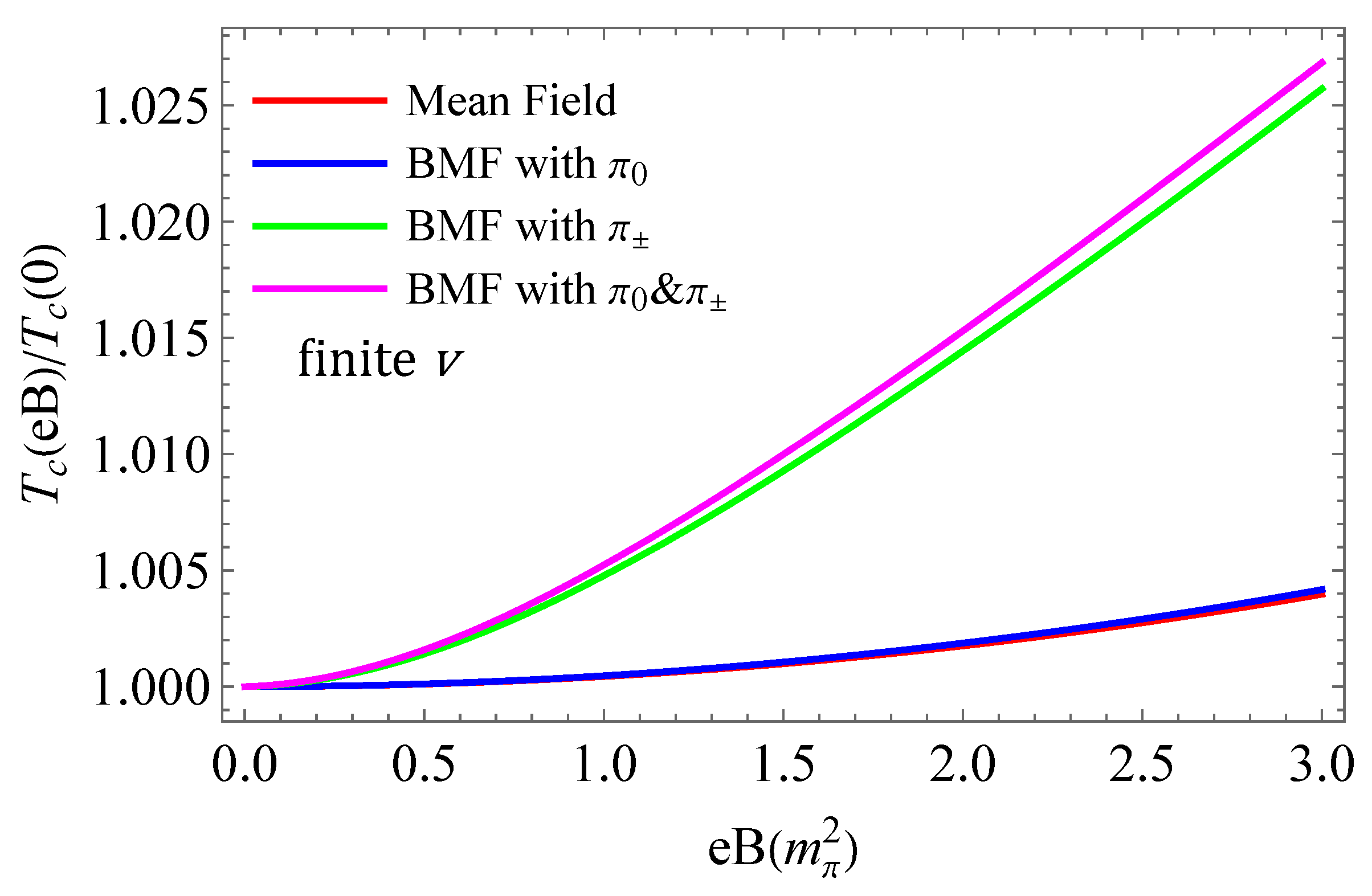
It is believed in [64,67,68] that neutral pion fluctuations are responsible for the IMC effect in the chiral limit. The authors of ref. [34] carefully investigated the magnetic inhibition induced by neutral and charged pion fluctuations in the framework of the NJL model beyond mean-field approximation. The results of pion fluctuations on T c are summarized in Figure 2. It was shown that for finite current quark mass or explicit chiral symmetry breaking, in the case of only neutral pion fluctuations, magnetic inhibition is not enough to achieve the IMC effect, and the critical temperature still increases with the magnetic field, and the result is almost the same as that in mean-field approximation. When considering the contribution from charged pion fluctuations, the critical temperature increases more quickly than that with only neutral pion contribution.

3.2. IMC by Chirality Imbalance

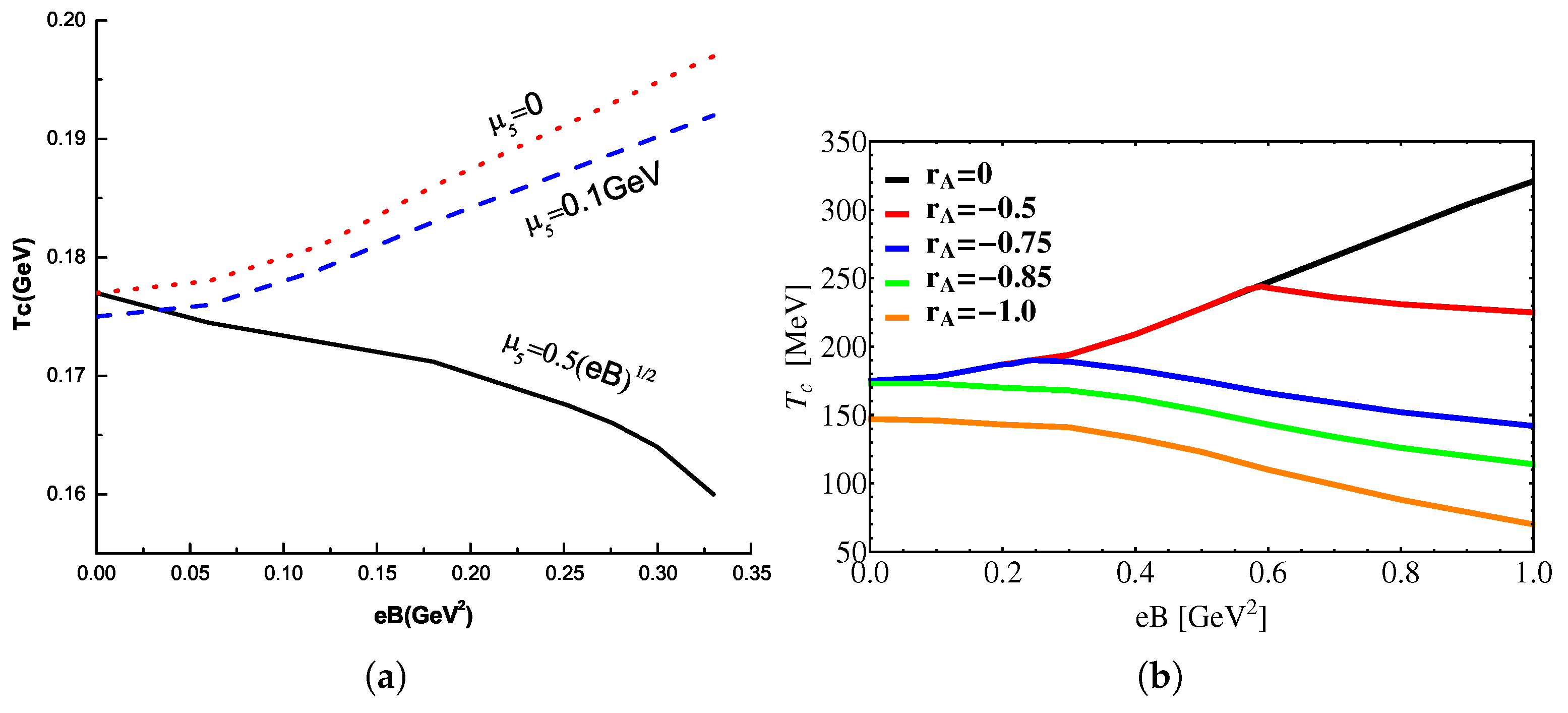
IMC can be easily realized if there is a chirality imbalance as shown in Figure 3a between left-handed and right-handed quarks induced by a sphaleron transition [40] with an extra contribution in the Lagrangian
L μ 5 = μ 5 ψ ¯ γ 0 γ 5 ψ
or by instanton–anti-instanton molecule-induced effective repulsive axial vector interaction in the Lagrangian as in [41]:
L A = G A ψ ¯ γ μ γ 5 ψ 2 ,
which spontaneously induces an effective chiral chemical potential
μ 5 = 2 G A ψ ¯ γ 0 γ 5 ψ
and modifies the energy dispersion relation
ω s k = σ 2 + | p | + s μ 5 sgn ( p z ) 2
with σ being chiral condensation and spin factors s = ± 1 , p 2 = p z 2 + 2 | q f B | k , and k = 0 , 1 , 2 , is a non-negative integer number labeling the Landau levels.

3.3. IMC by Quarks’ Anomalous Magnetic Moment

The IMC effect can also be realized by taking into account the anomalous magnetic moment of quarks [29,30,44] as shown in Figure 3b. The anomalous magnetic moments (AMMs) of quarks can be generated by spontaneous chiral symmetry breaking [69,70,71]. The effect of quarks’ AMM κ in a magnetic field can be introduced through effective interaction
L AMM = 1 2 ψ ¯ κ f q f F μ ν σ μ ν ψ
where σ μ ν = i 2 [ γ μ , γ ν ] , and the electromagnetic charge for quark flavor q u = + 2 e / 3 and q d = e / 3 . Correspondingly, the energy dispersion relation of up- and down-quarks in the external magnetic field with the quark AMM is modified as
E q f ( l , s ) = p 3 2 + | q f B | ( 2 l + 1 s ξ f ) + M 2 1 / 2 s κ f q f B 2
where l is the Landau level, and s = ± 1 is the spin-up/down of quarks.
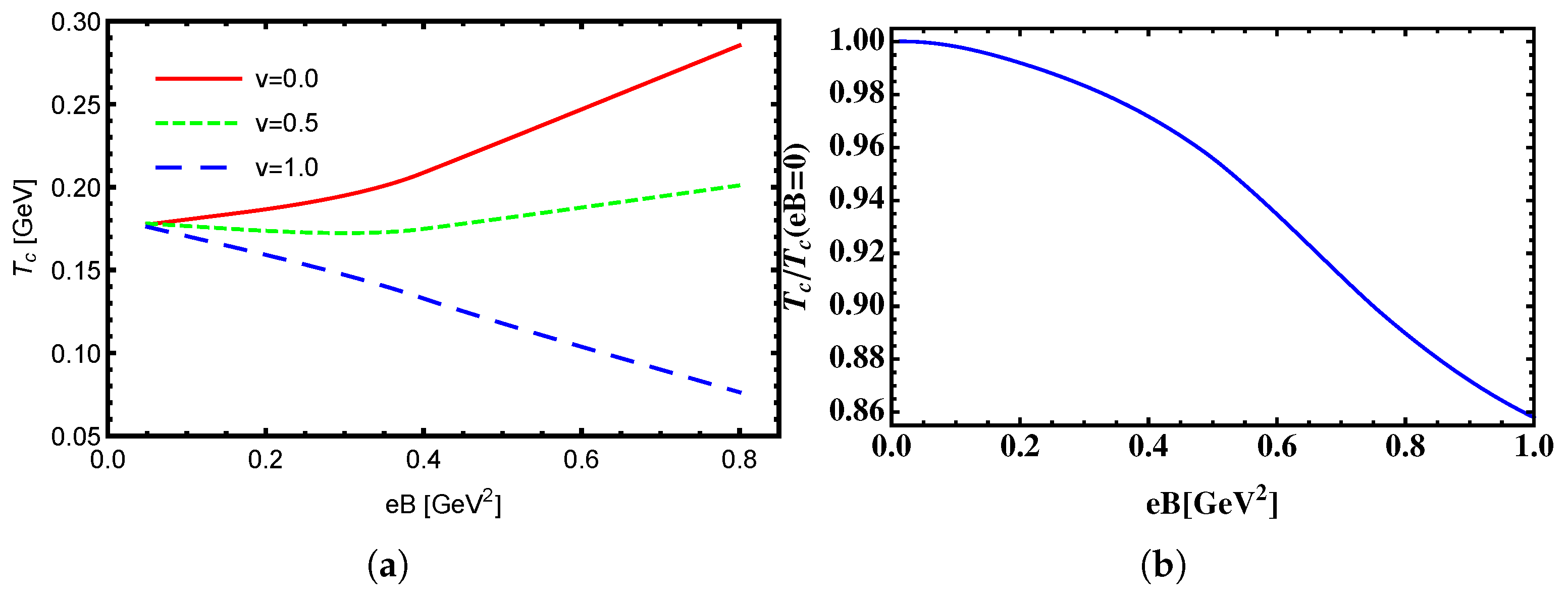
The IMC effect at finite temperature was observed in Refs. [29,30] and is shown in Figure 4a. Quantitative quarks’ AMM parameter κ f σ f 2 proportional to the square of the chiral condensate was subtracted in [44] from the lattice results in [16]. It is noticed that here, the quark AMM is proportional to σ 2 , and this naturally arises for a constituent quark in the process of spontaneous chiral symmetry breaking and dynamical mass generation.

3.4. IMC by Running Coupling Constant

IMC can also be realized when considering a running coupling constant that changes with the magnetic field [49,65,66]
G S ( ξ ) G S ( 0 ) = 1 + a ξ 2 + b ξ 3 1 + c ξ 2 + d ξ 4 ,
where G S ( 0 ) = G S , ξ = e B Λ Q C D 2 and Λ Q C D = 300 MeV. The fitted parameters are chosen as a = 0.014056 ,   b = 0.00532074 ,   c = 0.0281766 ,   d = 0.00161148 in [49] from lattice QCD calculations to produce the IMC effect, as shown in Figure 4b.

4. Puzzle-3: Nonmonotonic Charged Pion Mass

Hadron properties should also change in the presence of a magnetic field. For relativistic point-like charged particles, their energy under an external magnetic field takes the form of ε n , s z 2 ( p z ) = p z 2 + ( 2 n 2 sgn ( q ) s z + 1 ) | q B | + m 2 , which results in the linear rising behavior of charged pion mass m π ± 2 ( B ) = m π ± 2 ( B = 0 ) + e B , while a charge-neutral point-particle pion would not be affected by a magnetic field, and its mass remains constant.
Both model calculations and lattice QCD simulations have demonstrated that hadron properties under a magnetic field deviate from those expected for point-like particles [37,38,50,56,72,73,74,75,76,77,78,79,80]. Notably, the lattice QCD calculations in [81] revealed intriguing properties of pion masses under a magnetic field. The mass of the neutral pion decreases with increasing magnetic field strength and eventually saturates, while the mass of the charged pion exhibits nonmonotonic dependence on the magnetic field: it increases with the magnetic field up to e B 0.6 GeV 2 , after which it begins to decrease as the magnetic field continues to strengthen.
It is well-established that hadrons are not point-like particles but are composed of quarks. As a result, quark polarization due to a magnetic field is expected to influence the hadron spectrum. Within the framework of the NJL model, incorporating magnetized quark loop effects modifies the linear rising behavior of the charged pion mass as a function of the magnetic field [37,38,50,72,73,74,75,76,77,78,79].
The nonmonotonic behavior of the charged pion mass remains one of the most challenging puzzles. To date, only two studies have successfully reported this nonmonotonic behavior: one considers quarks’ AMM in [30] in the framework of the NJL model, and the other considers the vector form factor in the framework of DSE [82].
In the NJL model, mesons are represented as a quark–antiquark bound state or resonance and can be obtained from the quark–antiquark scattering amplitude by summing up quark loops through random phase approximation (RPA). The meson polarization function has the expression of
Π M ( x , y ) = i d 4 k ( 2 π ) 4 Tr { c , f , s } Γ M S ( x , y ) Γ M S ( y , x )
where M is the meson (here, we only focus on pion) vertex
Γ M = i γ 5 τ + , i γ 5 τ , i γ 5 τ 3 , M = π + M = π M = π 0 , ,
where τ ± = ( τ 1 ± i τ 2 ) / 2 . Here S f is the quark propagator, and translational invariance is broken by the magnetic field; thus the 4-momentum is not representative of a good quantum number. One can introduce a new set of “good” quantum numbers, i.e., the conserved Ritus momentum p ¯ = ( p 0 , 0 , s f 2 n | q f B | , p 3 ) [83], with n being the quark Landau level and s f = sign ( q f B ) the quark sign factor. In the Ritus scheme, the quark propagator with flavor f in coordinate space [84] can be expressed as
S f ( x , y ) = n d 3 p ˜ ( 2 π ) 3 e i p ˜ · ( x y ) P n ( x 1 , p 2 ) D f ( p ¯ ) P n ( y 1 , p 2 ) P n ( x 1 , p 2 ) = 1 2 g n s f ( x 1 , p 2 ) + I n g n 1 s f ( x 1 , p 2 ) + i s f 2 g n s f ( x 1 , p 2 ) I n g n 1 s f ( x 1 , p 2 ) γ 1 γ 2 D f ( p ¯ ) = 1 γ · p ¯ m q ,
where the Fourier-transformed momentum is p ˜ = ( p 0 , 0 , p 2 , p 3 ) , and I n = 1 δ n 0 , and g n s f ( x 1 , p 2 ) = ϕ n ( x 1 s f p 2 / | q f B | ) is expressed by the Hermite polynomial H n ( ζ )
ϕ n ( ζ ) = ( 2 n n ! π | q f B | 1 / 2 ) 1 / 2 e ζ 2 | q f B | / 2 H n ( ζ | q f B | ) .
By inserting the quark propagator S f into the pion polarization Π M , one can get the pion propagator
U M ( q ) = 2 G 1 2 G Π M ( q ) ,
and the pole mass m M is determined by
1 2 G Π M ( m M i Γ M / 2 , 0 ) = 0 .
With the above framework, one can calculate the pion mass with quark energy dispersion from any interaction in the Lagrangian and replace m q in D f ( p ¯ ) = 1 γ · p ¯ m q .
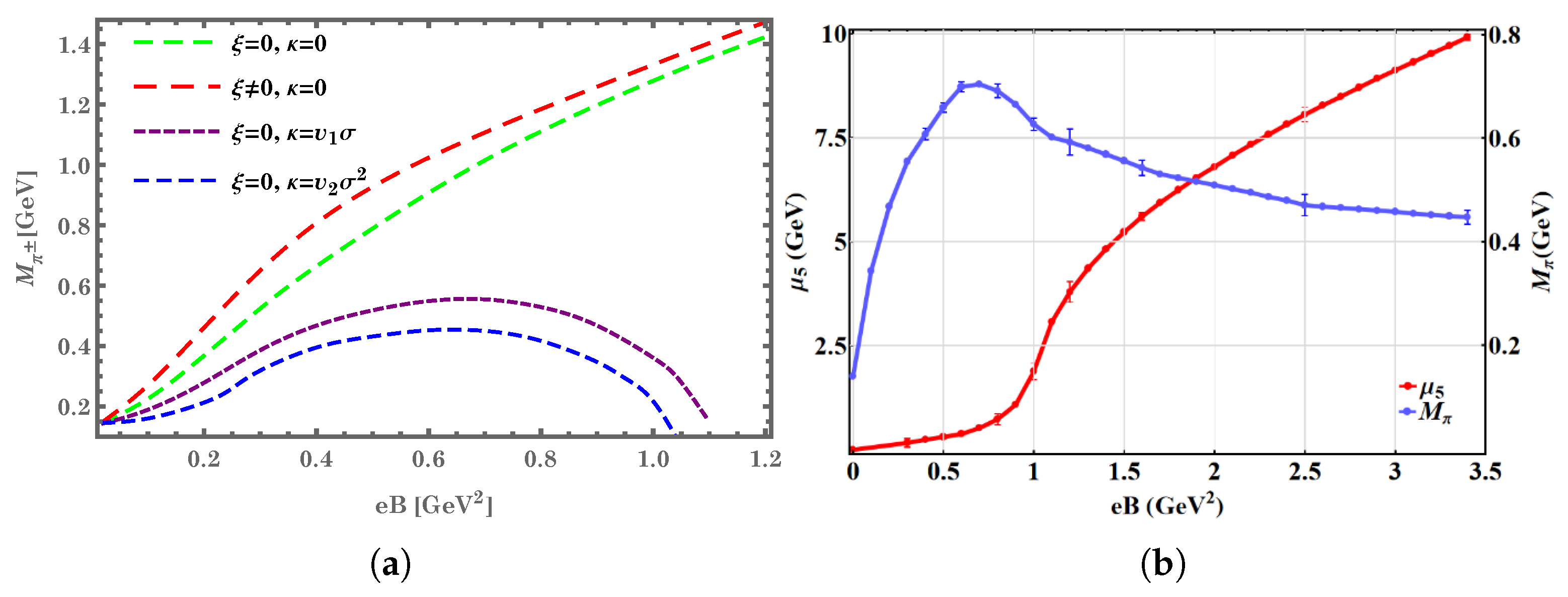
If there is one mechanism that can simultaneously explain the three aforementioned puzzles, i.e., diamagnetism, IMC and charged pion mass, it would be highly favored. As discussed in Section 2, the diamagnetism observed at low temperatures can be attributed to pion fluctuations, which can be separated. Consequently, the proposed mechanism must account for both the IMC effect and the nonmonotonic behavior of the charged pion mass. Among the four mechanisms discussed in Section 3, the running coupling constant alone fails to reproduce the nonmonotonic behavior of the charged pion mass, and the quark’s AMM can simultaneously realize IMC and the nonmonotonic behavior of the charged pion mass [30], as shown in Figure 5a, but the value of the charged pion mass is much smaller than the lattice results.
Here we discuss whether it is possible to obtain the nonmonotonic behavior of the charged pion mass from the chirality imbalance. We introduce an effective repulsive axial vector interaction in the Lagrangian as in [41]:
L A = G A ψ ¯ γ μ γ 5 ψ ,
which will spontaneously induce an effective chiral chemical potential
μ 5 = 2 G A ψ ¯ γ 0 γ 5 ψ .
To obtain pion mass, one has to replace
D f ( p ¯ ) = 1 γ · p ¯ m q D f ( p ¯ ) = 1 γ · p ¯ m q + μ 5 γ 0 γ 5
Detailed calculations will be presented in our upcoming work [85]. Here we only show the effective μ 5 extracted from the lattice data of the charged pion mass in [81] in Figure 5b.

5. Results

In this article, we present a short review on three puzzles related to QCD matter under a magnetic field, including: inverse magnetic catalysis, diamagnetism (negative magnetic susceptibility) at low temperature and the nonmonotonic behavior of charged pion mass under a magnetic field.
Diamagnetism at low temperatures can be attributed to and understood by considering pion fluctuations, which represent the dominant degrees of freedom in the chiral symmetry broken phase. It is noticed that neutral pion fluctuations do not induce diamagnetism, while charged spin-0 pion fluctuations generate a magnetic moment in the opposite direction due to their orbital rotation under the influence of the Lorentz force in a magnetic field, thus exhibiting Landau diamagnetism, which is responsible for negative magnetic susceptibility (diamagnetism) at low temperatures. At high temperature, the dominant contribution comes from the quark degree of freedom, leading to the prevalence of Pauli paramagnetism.
Then we need to find one mechanism to simultaneously explain IMC and the nonmonotonic behavior of the charged pion mass; potential candidates consider the quark’s AMM or an extra interaction in the axial vector channel, inducing a similar μ 5 term. But the quantitative value of the charged pion mass from the quark’s AMM is much smaller than the lattice results, so a deeper understanding is needed of the physics regarding the appearance of μ 5 at zero temperature with a finite magnetic field. It is also possible that the quark’s AMM and the interaction in the axial vector channel are related, which deserves further studies in the future.

Author Contributions

Conceptualization, M.H.; methodology, L.Y. and J.M.; software, S.Z.; validation, J.M. All authors have read and agreed to the published version of the manuscript.

Funding

This research was funded by the National Natural Science Foundation of China (NSFC) Grant Nos: 12235016, 12221005, 11605072 and the Seeds Funding of Jilin University.

Data Availability Statement

Data are available from the corresponding author upon reasonable request.

Conflicts of Interest

The authors declare no conflicts of interest.

References and Note

  1. Joyce, M.; Shaposhnikov, M.E. Primordial magnetic fields, right-handed electrons, and the Abelian anomaly. Phys. Rev. Lett. 1997, 79, 1193–1196. [Google Scholar] [CrossRef]
  2. Brandenburg, A.; He, Y.; Kahniashvili, T.; Rheinhardt, M.; Schober, J. Relic gravitational waves from the chiral magnetic effect. Astrophys. J. 2021, 911, 110. [Google Scholar] [CrossRef]
  3. Skokov, V.; Illarionov, A.Y.; Toneev, V. Estimate of the magnetic field strength in heavy-ion collisions. Int. J. Mod. Phys. A 2009, 24, 5925–5932. [Google Scholar] [CrossRef]
  4. Deng, W.T.; Huang, X.G. Event-by-event generation of electromagnetic fields in heavy-ion collisions. Phys. Rev. C 2012, 85, 044907. [Google Scholar] [CrossRef]
  5. Kharzeev, D.; Zhitnitsky, A. Charge separation induced by P-odd bubbles in QCD matter. Nucl. Phys. A 2007, 797, 67–79. [Google Scholar] [CrossRef]
  6. Kharzeev, D.E.; McLerran, L.D.; Warringa, H.J. The Effects of topological charge change in heavy ion collisions: ’Event by event P and CP violation’. Nucl. Phys. A 2008, 803, 227–253. [Google Scholar] [CrossRef]
  7. Fukushima, K.; Kharzeev, D.E.; Warringa, H.J. The Chiral Magnetic Effect. Phys. Rev. D 2008, 78, 074033. [Google Scholar] [CrossRef]
  8. Kharzeev, D.E.; Son, D.T. Testing the chiral magnetic and chiral vortical effects in heavy ion collisions. Phys. Rev. Lett. 2011, 106, 062301. [Google Scholar] [CrossRef]
  9. Klevansky, S.P.; Lemmer, R.H. Chiral symmetry restoration in the Nambu-Jona-Lasinio model with a constant electromagnetic field. Phys. Rev. D 1989, 39, 3478–3489. [Google Scholar] [CrossRef] [PubMed]
  10. Klimenko, K.G. Three-dimensional Gross-Neveu model in an external magnetic field. Teor. Mat. Fiz. 1991, 89, 211–221. [Google Scholar] [CrossRef]
  11. Gusynin, V.P.; Miransky, V.A.; Shovkovy, I.A. Dimensional reduction and catalysis of dynamical symmetry breaking by a magnetic field. Nucl. Phys. B 1996, 462, 249–290. [Google Scholar] [CrossRef]
  12. Bali, G.S.; Bruckmann, F.; Endrodi, G.; Fodor, Z.; Katz, S.D.; Krieg, S.; Schafer, A.; Szabo, K.K. The QCD phase diagram for external magnetic fields. J. High Energy Phys. 2012, 2012, 44. [Google Scholar] [CrossRef]
  13. Bali, G.S.; Bruckmann, F.; Endrodi, G.; Fodor, Z.; Katz, S.D.; Schafer, A. QCD quark condensate in external magnetic fields. Phys. Rev. D 2012, 86, 071502. [Google Scholar] [CrossRef]
  14. Bali, G.S.; Bruckmann, F.; Endrodi, G.; Gruber, F.; Schaefer, A. Magnetic field-induced gluonic (inverse) catalysis and pressure (an)isotropy in QCD. J. High Energy Phys. 2013, 2013, 130. [Google Scholar] [CrossRef]
  15. Bali, G.S.; Bruckmann, F.; Endrödi, G.; Katz, S.D.; Schäfer, A. The QCD equation of state in background magnetic fields. J. High Energy Phys. 2014, 2014, 177. [Google Scholar] [CrossRef]
  16. Ding, H.T.; Li, S.T.; Tomiya, A.; Wang, X.D.; Zhang, Y. Chiral properties of (2+1)-flavor QCD in strong magnetic fields at zero temperature. Phys. Rev. D 2021, 104, 014505. [Google Scholar] [CrossRef]
  17. Andersen, J.O.; Naylor, W.R.; Tranberg, A. Phase diagram of QCD in a magnetic field: A review. Rev. Mod. Phys. 2016, 88, 025001. [Google Scholar] [CrossRef]
  18. Miransky, V.A.; Shovkovy, I.A. Quantum field theory in a magnetic field: From quantum chromodynamics to graphene and Dirac semimetals. Phys. Rept. 2015, 576, 1–209. [Google Scholar] [CrossRef]
  19. Huang, X.G. Electromagnetic fields and anomalous transports in heavy-ion collisions—A pedagogical review. Rept. Prog. Phys. 2016, 79, 076302. [Google Scholar] [CrossRef]
  20. Kharzeev, D.E.; Liao, J.; Voloshin, S.A.; Wang, G. Chiral magnetic and vortical effects in high-energy nuclear collisions—A status report. Prog. Part. Nucl. Phys. 2016, 88, 1–28. [Google Scholar] [CrossRef]
  21. Bzdak, A.; Esumi, S.; Koch, V.; Liao, J.; Stephanov, M.; Xu, N. Mapping the Phases of Quantum Chromodynamics with Beam Energy Scan. Phys. Rept. 2020, 853, 1–87. [Google Scholar] [CrossRef]
  22. Bali, G.S.; Bruckmann, F.; Constantinou, M.; Costa, M.; Endrodi, G.; Katz, S.D.; Panagopoulos, H.; Schafer, A. Magnetic susceptibility of QCD at zero and at finite temperature from the lattice. Phys. Rev. D 2012, 86, 094512. [Google Scholar] [CrossRef]
  23. Bali, G.S.; Endrődi, G.; Piemonte, S. Magnetic susceptibility of QCD matter and its decomposition from the lattice. J. High Energy Phys. 2020, 2020, 183. [Google Scholar] [CrossRef]
  24. Bali, G.S.; Bruckmann, F.; Constantinou, M.; Costa, M.; Endrodi, G.; Fodor, Z.; Katz, S.D.; Krieg, S.; Panagopoulos, H.; Schafer, A.; et al. Thermodynamic properties of QCD in external magnetic fields. arXiv 2013, arXiv:1301.5826. [Google Scholar] [CrossRef]
  25. Bornyakov, V.G.; Buividovich, P.V.; Cundy, N.; Kochetkov, O.A.; Schäfer, A. Deconfinement transition in two-flavor lattice QCD with dynamical overlap fermions in an external magnetic field. Phys. Rev. D 2014, 90, 034501. [Google Scholar] [CrossRef]
  26. D’Elia, M.; Manigrasso, F.; Negro, F.; Sanfilippo, F. QCD phase diagram in a magnetic background for different values of the pion mass. Phys. Rev. D 2018, 98, 054509. [Google Scholar] [CrossRef]
  27. Endrodi, G. Critical point in the QCD phase diagram for extremely strong background magnetic fields. J. High Energy Phys. 2015, 2015, 173. [Google Scholar] [CrossRef]
  28. Endrodi, G.; Giordano, M.; Katz, S.D.; Kovács, T.G.; Pittler, F. Magnetic catalysis and inverse catalysis for heavy pions. J. High Energy Phys. 2019, 2019, 7. [Google Scholar] [CrossRef]
  29. Xu, K.; Chao, J.; Huang, M. Effect of the anomalous magnetic moment of quarks on magnetized QCD matter and meson spectra. Phys. Rev. D 2021, 103, 076015. [Google Scholar] [CrossRef]
  30. Lin, F.; Xu, K.; Huang, M. Magnetism of QCD matter and the pion mass from tensor-type spin polarization and the anomalous magnetic moment of quarks. Phys. Rev. D 2022, 106, 016005. [Google Scholar] [CrossRef]
  31. Kamikado, K.; Kanazawa, T. Magnetic susceptibility of a strongly interacting thermal medium with 2+1 quark flavors. J. High Energy Phys. 2015, 2015, 129. [Google Scholar] [CrossRef]
  32. Li, X.; Fu, W.J.; Liu, Y.X. Thermodynamics of 2+1 Flavor Polyakov-Loop Quark-Meson Model under External Magnetic Field. Phys. Rev. D 2019, 99, 074029. [Google Scholar] [CrossRef]
  33. Sahoo, B.; Pradhan, K.K.; Sahu, D.; Sahoo, R. Effect of a magnetic field on the thermodynamic properties of a high-temperature hadron resonance gas with van der Waals interactions. Phys. Rev. D 2023, 108, 074028. [Google Scholar] [CrossRef]
  34. Mei, J.; Wen, R.; Mao, S.; Huang, M.; Xu, K. Magnetic catalysis and diamagnetism from pion fluctuations. Phys. Rev. D 2024, 110, 034024. [Google Scholar] [CrossRef]
  35. Zhuang, P.; Hufner, J.; Klevansky, S.P. Thermodynamics of a quark—Meson plasma in the Nambu-Jona-Lasinio model. Nucl. Phys. A 1994, 576, 525–552. [Google Scholar] [CrossRef]
  36. Pisarski, R.D.; Tytgat, M. Propagation of cool pions. Phys. Rev. D 1996, 54, R2989–R2993. [Google Scholar] [CrossRef]
  37. Fayazbakhsh, S.; Sadeghian, S.; Sadooghi, N. Properties of neutral mesons in a hot and magnetized quark matter. Phys. Rev. D 2012, 86, 085042. [Google Scholar] [CrossRef]
  38. Fayazbakhsh, S.; Sadooghi, N. Weak decay constant of neutral pions in a hot and magnetized quark matter. Phys. Rev. D 2013, 88, 065030. [Google Scholar] [CrossRef]
  39. Sheng, B.; Wang, Y.; Wang, X.; Yu, L. Pole and screening masses of neutral pions in a hot and magnetized medium: A comprehensive study in the Nambu–Jona-Lasinio model. Phys. Rev. D 2021, 103, 094001. [Google Scholar] [CrossRef]
  40. Chao, J.; Chu, P.; Huang, M. Inverse magnetic catalysis induced by sphalerons. Phys. Rev. D 2013, 88, 054009. [Google Scholar] [CrossRef]
  41. Yu, L.; Liu, H.; Huang, M. Spontaneous generation of local CP violation and inverse magnetic catalysis. Phys. Rev. D 2014, 90, 074009. [Google Scholar] [CrossRef]
  42. Fayazbakhsh, S.; Sadooghi, N. Anomalous magnetic moment of hot quarks, inverse magnetic catalysis, and reentrance of the chiral symmetry broken phase. Phys. Rev. D 2014, 90, 105030. [Google Scholar] [CrossRef]
  43. Mei, J.; Mao, S. Inverse catalysis effect of the quark anomalous magnetic moment to chiral restoration and deconfinement phase transitions. Phys. Rev. D 2020, 102, 114035. [Google Scholar] [CrossRef]
  44. Kawaguchi, M.; Huang, M. Restriction on the form of the quark anomalous magnetic moment from lattice QCD results. Chin. Phys. C 2023, 47, 064103. [Google Scholar] [CrossRef]
  45. Tavares, W.R.; Avancini, S.S.; Farias, R.L.S.; Cardoso, R.P. Artificial first-order phase transition in a magnetized Nambu–Jona-Lasinio model with a quark anomalous magnetic moment. Phys. Rev. D 2024, 109, 016011. [Google Scholar] [CrossRef]
  46. Chaudhuri, N.; Ghosh, S.; Roy, P.; Sarkar, S. Collective modes of a massive fermion in a magnetized medium with finite anomalous magnetic moment. Phys. Rev. D 2023, 108, 116006. [Google Scholar] [CrossRef]
  47. Islam, C.A.; Ali, M.S.; Huang, M. Deciding on the anomalous magnetic moment of quarks in a framework of nonlocal NJL model. arXiv 2023, arXiv:2302.00696. [Google Scholar] [CrossRef]
  48. Ferreira, M.; Costa, P.; Lourenço, O.; Frederico, T.; Providência, C. Inverse magnetic catalysis in the (2+1)-flavor Nambu-Jona-Lasinio and Polyakov-Nambu-Jona-Lasinio models. Phys. Rev. D 2014, 89, 116011. [Google Scholar] [CrossRef]
  49. Liu, H.; Yu, L.; Chernodub, M.; Huang, M. Possible formation of high temperature superconductor at an early stage of heavy-ion collisions. Phys. Rev. D 2016, 94, 113006. [Google Scholar] [CrossRef]
  50. Avancini, S.S.; Farias, R.L.S.; Benghi Pinto, M.; Tavares, W.R.; Timóteo, V.S. π0 pole mass calculation in a strong magnetic field and lattice constraints. Phys. Lett. B 2017, 767, 247–252. [Google Scholar] [CrossRef]
  51. Ayala, A.; Dominguez, C.A.; Hernandez, L.A.; Loewe, M.; Raya, A.; Rojas, J.C.; Villavicencio, C. Thermomagnetic properties of the strong coupling in the local Nambu–Jona-Lasinio model. Phys. Rev. D 2016, 94, 054019. [Google Scholar] [CrossRef]
  52. Farias, R.L.S.; Timoteo, V.S.; Avancini, S.S.; Pinto, M.B.; Krein, G. Thermo-magnetic effects in quark matter: Nambu–Jona-Lasinio model constrained by lattice QCD. Eur. Phys. J. A 2017, 53, 101. [Google Scholar] [CrossRef]
  53. Chen, X.; Zhang, L.; Hou, D. Running coupling constant at finite chemical potential and magnetic field from holography. Chin. Phys. C 2022, 46, 073101. [Google Scholar] [CrossRef]
  54. Sheng, B.k.; Wang, X.; Yu, L. Impacts of inverse magnetic catalysis on screening masses of neutral pions and sigma mesons in hot and magnetized quark matter. Phys. Rev. D 2022, 105, 034003. [Google Scholar] [CrossRef]
  55. Mao, S.; Tian, Y. Pion superfluid phase transition under an external magnetic field including the inverse magnetic catalysis effect. Phys. Rev. D 2022, 106, 094017. [Google Scholar] [CrossRef]
  56. Wen, R.; Yin, S.; Fu, W.j.; Huang, M. Functional renormalization group study of neutral and charged pions in magnetic fields in the quark-meson model. Phys. Rev. D 2023, 108, 076020. [Google Scholar] [CrossRef]
  57. Kamikado, K.; Kanazawa, T. Chiral dynamics in a magnetic field from the functional renormalization group. J. High Energy Phys. 2014, 2014, 9. [Google Scholar] [CrossRef]
  58. Fukushima, K.; Pawlowski, J.M. Magnetic catalysis in hot and dense quark matter and quantum fluctuations. Phys. Rev. D 2012, 86, 076013. [Google Scholar] [CrossRef]
  59. Fu, W.j.; Liu, Y.x. Four-fermion interactions and the chiral symmetry breaking in an external magnetic field. Phys. Rev. D 2017, 96, 074019. [Google Scholar] [CrossRef]
  60. Bohra, H.; Dudal, D.; Hajilou, A.; Mahapatra, S. Anisotropic string tensions and inversely magnetic catalyzed deconfinement from a dynamical AdS/QCD model. Phys. Lett. B 2020, 801, 135184. [Google Scholar] [CrossRef]
  61. Bohra, H.; Dudal, D.; Hajilou, A.; Mahapatra, S. Chiral transition in the probe approximation from an Einstein-Maxwell-dilaton gravity model. Phys. Rev. D 2021, 103, 086021. [Google Scholar] [CrossRef]
  62. Wen, N.; Cao, X.; Chao, J.; Liu, H. Neutral pion masses within a hot and magnetized medium in a lattice-improved soft-wall AdS/QCD model. arXiv 2024, arXiv:2402.06239. [Google Scholar] [CrossRef]
  63. Wen, R.; Huang, C.; Huang, M. Functional renormalization group study of anomalous magnetic moment in a low energy effective theory. arXiv 2025, arXiv:2506.20246. [Google Scholar] [CrossRef]
  64. Fukushima, K.; Hidaka, Y. Magnetic Catalysis Versus Magnetic Inhibition. Phys. Rev. Lett. 2013, 110, 031601. [Google Scholar] [CrossRef]
  65. Ferrer, E.J.; de la Incera, V.; Wen, X.J. Quark Antiscreening at Strong Magnetic Field and Inverse Magnetic Catalysis. Phys. Rev. D 2015, 91, 054006. [Google Scholar] [CrossRef]
  66. Farias, R.L.S.; Gomes, K.P.; Krein, G.I.; Pinto, M.B. Importance of asymptotic freedom for the pseudocritical temperature in magnetized quark matter. Phys. Rev. C 2014, 90, 025203. [Google Scholar] [CrossRef]
  67. Mao, S. Inverse magnetic catalysis in Nambu–Jona-Lasinio model beyond mean field. Phys. Lett. B 2016, 758, 195–199. [Google Scholar] [CrossRef]
  68. Mao, S. Chiral Symmetry Restoration and Quark Deconfinement beyond Mean Field in a Magnetized PNJL Model. Phys. Rev. D 2018, 97, 011501. [Google Scholar] [CrossRef]
  69. Chang, L.; Liu, Y.X.; Roberts, C.D. Dressed-quark anomalous magnetic moments. Phys. Rev. Lett. 2011, 106, 072001. [Google Scholar] [CrossRef]
  70. Ferrer, E.J.; de la Incera, V. Dynamically Induced Zeeman Effect in Massless QED. Phys. Rev. Lett. 2009, 102, 050402. [Google Scholar] [CrossRef]
  71. Ferrer, E.J.; de la Incera, V.; Portillo, I.; Quiroz, M. New look at the QCD ground state in a magnetic field. Phys. Rev. D 2014, 89, 085034. [Google Scholar] [CrossRef]
  72. Liu, H.; Yu, L.; Huang, M. Charged and neutral vector ρ mesons in a magnetic field. Phys. Rev. D 2015, 91, 014017. [Google Scholar] [CrossRef]
  73. Liu, H.; Yu, L.; Huang, M. Survival of charged rho condensation at high temperature and density. Chin. Phys. C 2016, 40, 023102. [Google Scholar] [CrossRef]
  74. Liu, H.; Wang, X.; Yu, L.; Huang, M. Neutral and charged scalar mesons, pseudoscalar mesons, and diquarks in magnetic fields. Phys. Rev. D 2018, 97, 076008. [Google Scholar] [CrossRef]
  75. Wang, Z.; Zhuang, P. Meson properties in magnetized quark matter. Phys. Rev. D 2018, 97, 034026. [Google Scholar] [CrossRef]
  76. Mao, S. Pions in magnetic field at finite temperature. Phys. Rev. D 2019, 99, 056005. [Google Scholar] [CrossRef]
  77. Avancini, S.S.; Tavares, W.R.; Pinto, M.B. Properties of magnetized neutral mesons within a full RPA evaluation. Phys. Rev. D 2016, 93, 014010. [Google Scholar] [CrossRef]
  78. Coppola, M.; Gómez Dumm, D.; Scoccola, N.N. Charged pion masses under strong magnetic fields in the NJL model. Phys. Lett. B 2018, 782, 155–161. [Google Scholar] [CrossRef]
  79. Coppola, M.; Gomez Dumm, D.; Noguera, S.; Scoccola, N.N. Neutral and charged pion properties under strong magnetic fields in the NJL model. Phys. Rev. D 2019, 100, 054014. [Google Scholar] [CrossRef]
  80. Li, J.; Cao, G.; He, L. Gauge independence of pion masses in a magnetic field within the Nambu–Jona-Lasinio model. Phys. Rev. D 2021, 104, 074026. [Google Scholar] [CrossRef]
  81. Ding, H.T.; Li, S.T.; Mukherjee, S.; Tomiya, A.; Wang, X.D. Meson masses in external magnetic fields with HISQ fermions. arXiv 2020, arXiv:2001.05322. [Google Scholar] [CrossRef]
  82. Xing, Z.; Chao, J.; Chang, L.; Liu, Y.x. Exposing the effect of the p-wave component in the pion triplet under a strong magnetic field. Phys. Rev. D 2022, 105, 114003. [Google Scholar] [CrossRef]
  83. Gomez Dumm, D.; Noguera, S.; Scoccola, N.N. Charged meson masses under strong magnetic fields: Gauge invariance and Schwinger phases. Phys. Rev. D 2023, 108, 016012. [Google Scholar] [CrossRef]
  84. Mei, J.; Wen, R.; Zhou, M.; Mao, S.; Huang, M. Spectral function for pions in magnetic field. arXiv 2026, arXiv:2601.22422. [Google Scholar] [CrossRef]
  85. Zhai, S.; Mei, J.; Yu, L.; Huang, M. in preparation. Nonmonotonic behavior of the charged pion mass under magnetic field. 2026; in preparation.
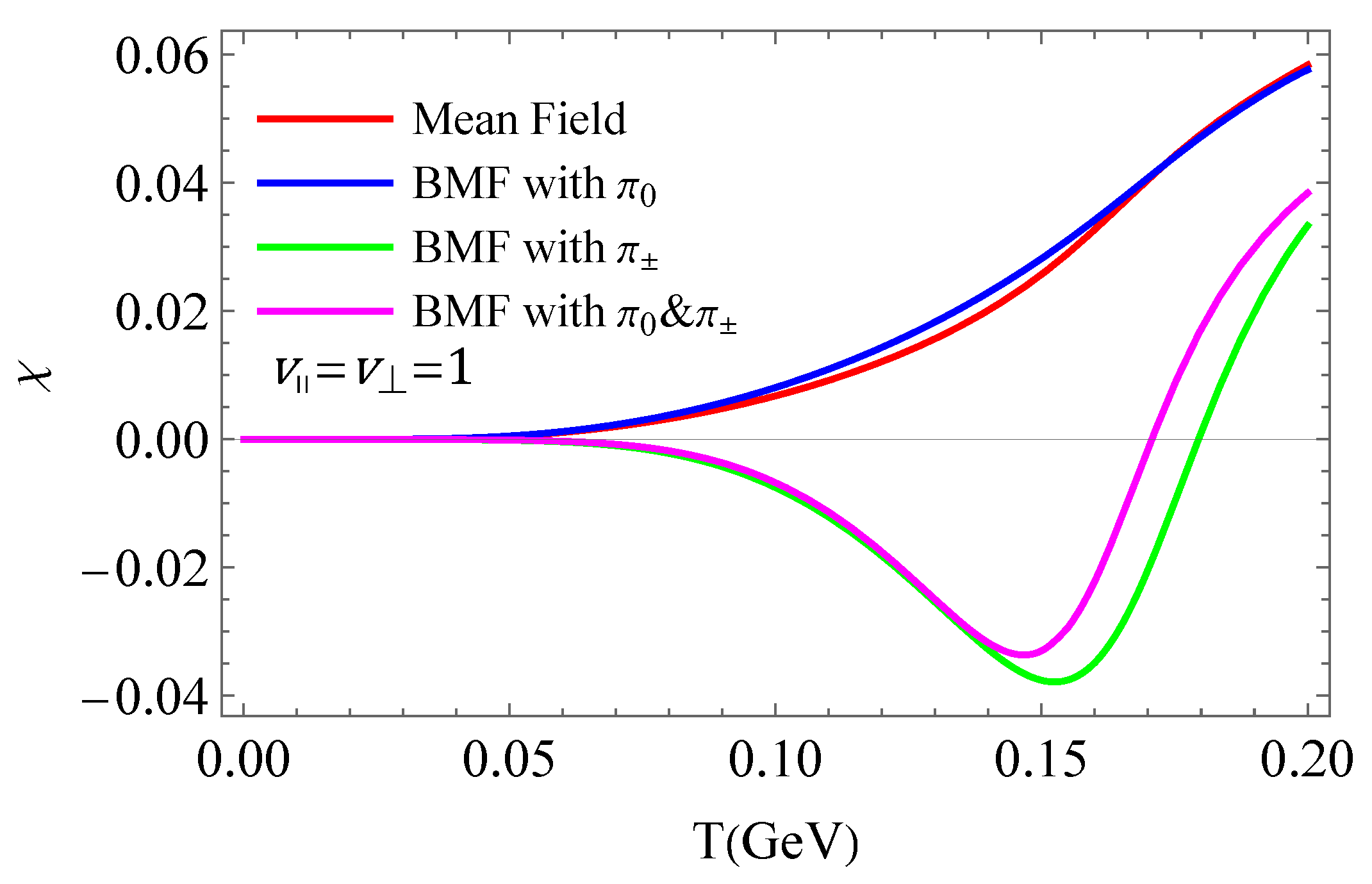
Figure 1. Magnetic susceptibility in the NJL model in mean-field approximation (red solid line) and beyond the mean field with the feedback from π 0 (blue solid line), π ± (green solid line) and π 0 , π ± (cyan solid line) as a function of temperature, with v = v = 1 .
Universe 12 00154 g001
Figure 2. The normalized critical temperature T c ( e B ) / T c ( e B = 0 ) of chiral symmetry restoration in mean-field approximation and three different cases beyond the mean field as a function of the magnetic field.
Universe 12 00154 g002
Figure 3. The critical temperature as a function of the magnetic field with finite chiral chemical potential μ 5 . (a) μ 5 induced by a sphaleron transition [40], (b) μ 5 induced by an instanton–anti-instanton molecule [41].
Universe 12 00154 g003
Figure 4. The critical temperature as a function of the magnetic field: (a) induced by the quark’s AMM [29], (b) induced by the running coupling constant [49].
Universe 12 00154 g004
Figure 5. The charged pion mass as a function of e B . (a) The contribution from the AMM with finite κ [30], (b) the contribution from μ 5 ; the blue curve depicts the lattice QCD data in [81], and the red curve represents the fitted chiral chemical potential μ 5 from lattice data.
Universe 12 00154 g005
Disclaimer/Publisher’s Note: The statements, opinions and data contained in all publications are solely those of the individual author(s) and contributor(s) and not of MDPI and/or the editor(s). MDPI and/or the editor(s) disclaim responsibility for any injury to people or property resulting from any ideas, methods, instructions or products referred to in the content.