
Simulation of the Spin Evolution of Some Selected Exoplanets and Inferences on Their Climate

 ,
,  , ,
, ,
Abstract
1. Introduction
- In Section 2.1, we describe the data selection criteria;
- In Section 2.2, we briefly present the VPLanet code for the simulations of the spin evolution;
- In Section 2.3, we explain the approach of climatological simulations;
- In Section 2.4, we show the input data for both VPLanet simulations and climatological simulations;
2. Methods
2.1. Data Selection Criteria
- -
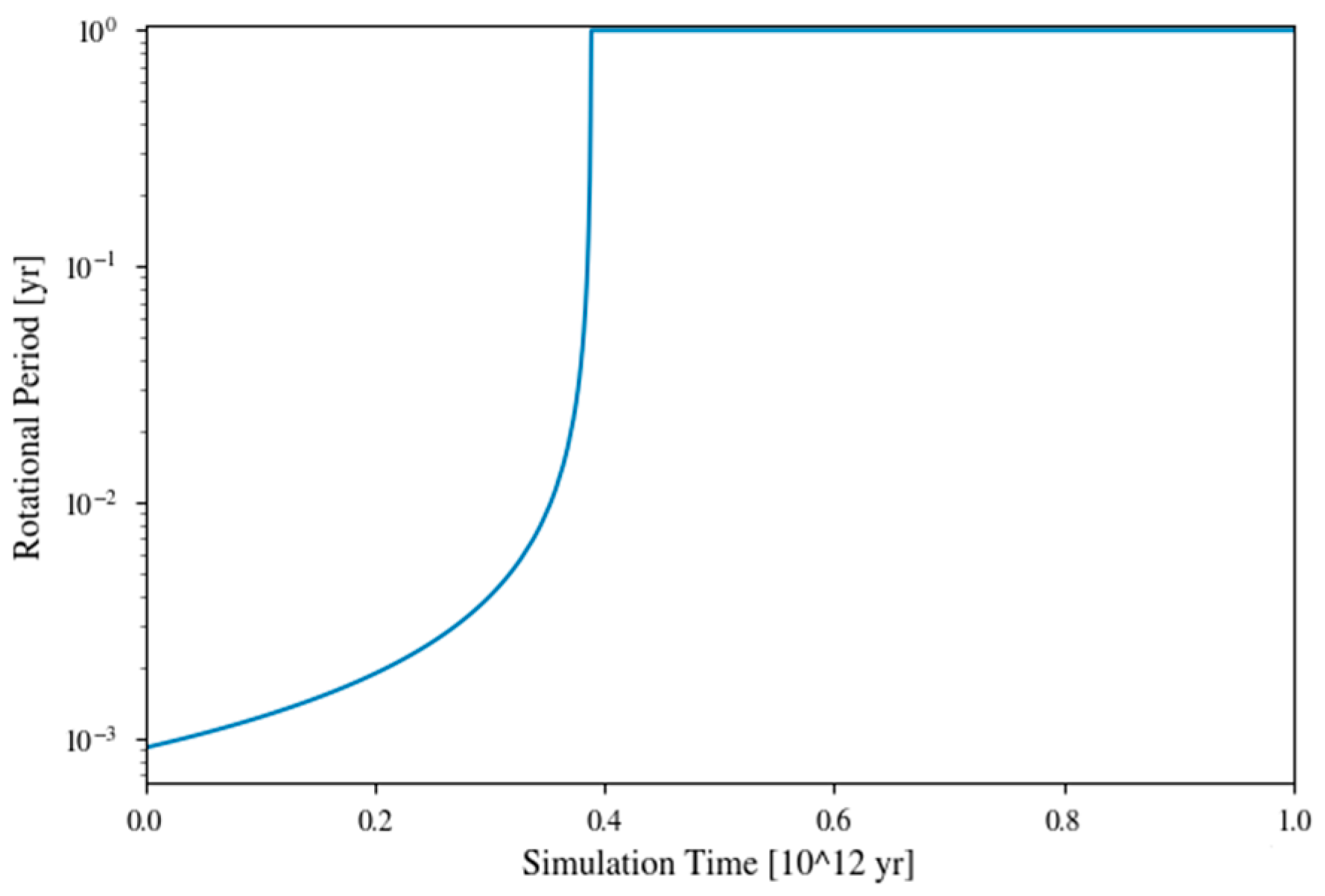
- Mercury has reached its stable resonance frequency ratio (3:2) in the past; many simulations (including ours, as we will see below) show that it has almost certainly been trapped in its current condition in less than 3 Gyr after its formation [3];
- -
- Earth has not experienced—for the 4.5 Gyr since its formation—a slowdown induced by the Sun; however, a spin slowdown of ~16 h has been estimated, but it has actually been induced by the Moon [4].
2.2. VPLanet Simulator
- -
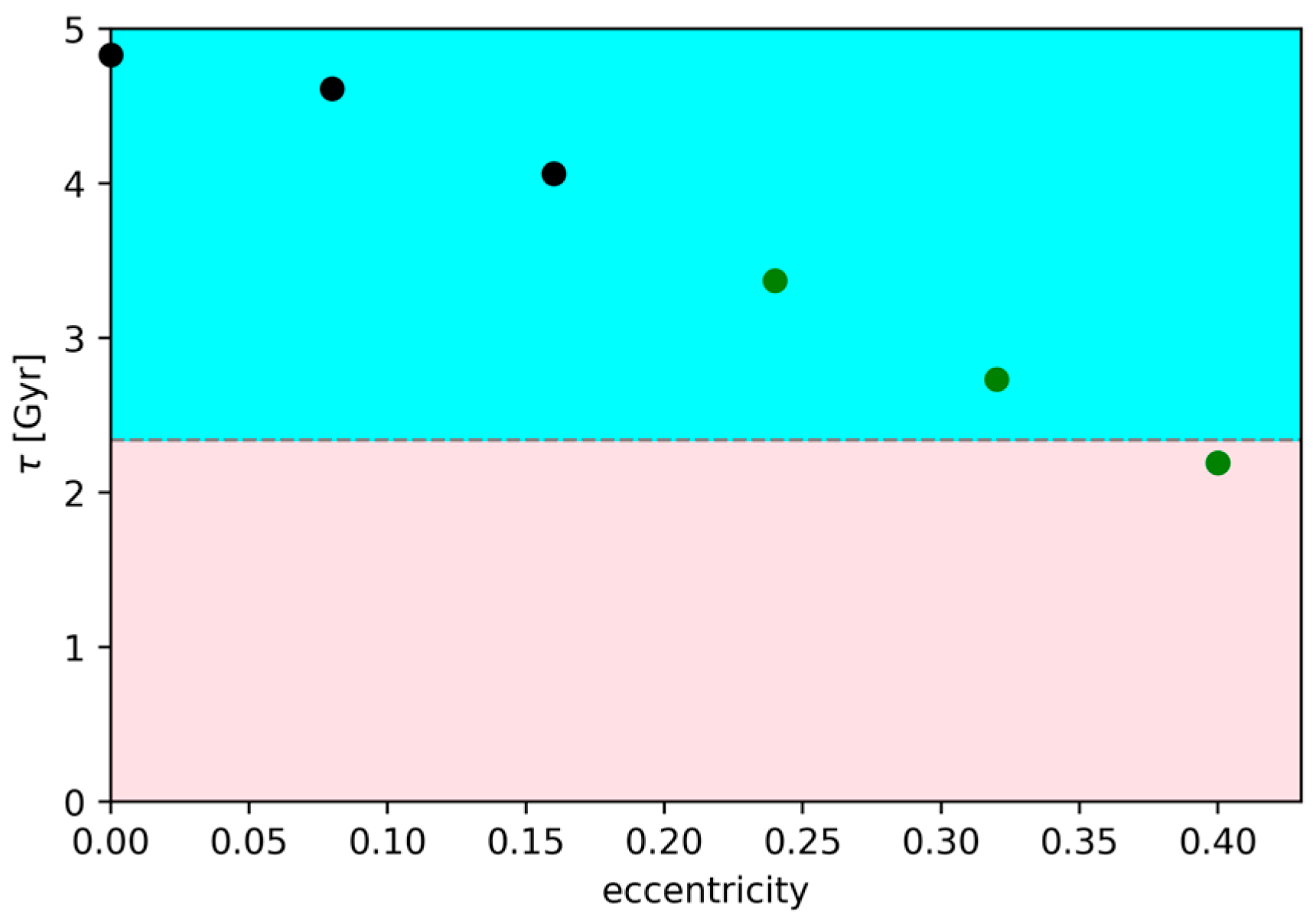
- decreases significantly as the initial orbital eccentricity of the planet increases;
- -
- The final equilibrium condition is a 1:1 resonance if the initial eccentricity is lower than 0.23; otherwise, it is a 3:2 resonance;
- -
- The evolution of eccentricity e and semi-major axis a values during the time is negligible if the initial value of the acceleration parameter is ;
- -
- If , the acceleration parameter is treated as constant; therefore, one has ;
- -
- The tidal trapping time is , where is the initial spin frequency of the considered planet; therefore, the faster the initial spin, the larger the time needed to achieve tidal trapping;
- -
- , where are the tidal quality factor of the planet and the second degree Love number of the planet, respectively (see Appendix A);
- -
- The dependence of on planetary mass and planetary radius is weak when compared to its dependence on , but it is not negligible;
- -
- The dependence of on stellar specific features (except for , which determines ) is extremely weak when compared to its dependence on ;
- -
- , and star radius are fixed, and their value is constant during the simulation;
- -
- does not depend on the initial planetary obliquity, which is the inclination of the spin axis with respect to the direction perpendicular to the orbital plane.
2.3. Climatological Considerations
- -
- Earth-like atmosphere (meaning that the considered atmosphere is identical to that of the Earth, both qualitatively and quantitatively);
- -
- A 2500 m deep global water ocean.
2.4. Input Data
- -
- -
- -
- The initial rotation period of the planets has been set to 8 h (), which is the expected value for “newborn” rocky planets [29].
3. Results
- -
- The insolation provided as an input to ExoPlaSim is taken from Table 1 for each planet;
- -
- The rotation period provided as input to ExoPlaSim in order to compute is always 8 h, which is the expected rotation period of “newborn” rocky planets [29];
- -
- The rotation period provided as input to ExoPlaSim in order to compute is simply 2/3 of the orbital period (which is taken from Table 1 for each planet), since we defined the “slow rotator” as a planet trapped in a 3:2 spin–orbit resonance.
4. Summary
- -
- Kepler-62f is almost certainly a fast rotator, having a frozen surface; it could be habitable only if it had a far denser atmosphere than what we assumed to prevent freezing.
- -
- Kepler-1126c is almost certainly a fast rotator, with a global average temperature of 357 K (84 °C). Therefore, it appears to be habitable, but we cannot exclude a runaway greenhouse, since we would need to simulate at least ~1 million years of atmospheric evolution [16], which is unfeasible.
- -
- Kepler-1544b is almost certainly a fast rotator, with a global average temperature of 281 K (8 °C), thus appearing as a “cool” but still habitable planet.
- -
- The spin conditions of Kepler-186f, Kepler-62e, and Kepler-442b cannot be determined, since we would need strong constraints on orbital eccentricity, which are currently missing.
- -
- We expect Kepler-440b to be tidally trapped and quite far from being habitable. In fact, climatological simulations yield a totally frozen surface.
Author Contributions
Funding
Data Availability Statement
Acknowledgments
Conflicts of Interest
Appendix A

Appendix B
References
- Wandel, A. Habitability and sub glacial liquid water on planets of M-dwarf stars. Nat. Commun. 2023, 14, 2125. [Google Scholar] [CrossRef] [PubMed]
- Wandel, A.; Gale, J. The bio-habitable zone and atmospheric properties for planets of red dwarfs. Int. J. Astrobiol. 2020, 19, 126–135. [Google Scholar] [CrossRef]
- Noyellesa, B.; Frouardb, J.; Makarovc, V.; Efroimsky, M. Spin–orbit evolution of Mercury revisited. Icarus 2014, 241, 26–44. [Google Scholar] [CrossRef]
- Williams, G. Geological Constraints on the Precambrian History of Earth’s Rotation and the Moon’s Orbit. Rev. Geophys. 2000, 38, 37–59. [Google Scholar] [CrossRef]
- Souchay, J.; Mathis, S.; Tokieda, T. Tides in Astronomy and Astrophysics, 1st ed.; Springer: Berlin/Heidelberg, Germany, 2013. [Google Scholar]
- Faure, G.; Mensing, T. Introduction to Planetary Science, 1st ed.; Springer: Berlin/Heidelberg, Germany, 2007. [Google Scholar]
- Raymond, S.; Schlichting, H.; Hersant, F.; Selsis, F. Dynamical and collisional constraints on a stochastic late veneer on the terrestrial planets. Icarus 2013, 226, 671–681. [Google Scholar] [CrossRef]
- Barnes, R.; Luger, R.; Deitrick, R.; Driscoll, P.; Quinn, T.R.; Fleming, D.P.; Smotherman, H.; McDonald, D.V.; Wilhelm, C.; Garcia, R.; et al. VPLanet The Virtual Planet Simulator. Publ. Astron. Soc. Pac. 2020, 132, 024502. [Google Scholar] [CrossRef]
- Barnes, R. Tidal locking of habitable exoplanets. Celest. Mech. Dyn. Astron. 2017, 129, 509–536. [Google Scholar] [CrossRef]
- Clouse, C.; Ferroglia, A.; Fiolhais, M. Spin-orbit gravitational locking—An effective potential approach. Eur. J. Phys. 2022, 43, 035602. [Google Scholar] [CrossRef]
- Nakajima, M.; Genda, H.; Asphaug, E.; Ida, S. Large planets may not form fractionally large moons. Nat. Commun. 2022, 13, 568. [Google Scholar] [CrossRef]
- Batalha, N. Exploring exoplanet populations with NASA’s Kepler Mission. Proc. Natl. Acad. Sci. USA 2014, 111, 12647–12654. [Google Scholar] [CrossRef]
- Otegi, J.; Bouchy, F.; Helled, R. Revisited mass-radius relations for exoplanets below 120 M⊕. Astron. Astrophys. 2020, 634, A43. [Google Scholar] [CrossRef]
- Lammer, H.; Selsis, F.; Chassefière, E.; Breuer, D.; Grießmeier, J.-M.; Kulikov, Y.N.; Erkaev, N.V.; Khodachenko, M.L.; Biernat, H.K.; Leblanc, F.; et al. Geophysical and atmospheric evolution of habitable planets. Astrobiology 2010, 10, 45–68. [Google Scholar] [CrossRef]
- Jinno, T.; Saitoh, T.; Ishigaki, Y.; Makino, J. N-body simulation of planetary formation through pebble accretion in a radially structured protoplanetary disk. Publ. Astron. Soc. Jpn. 2023, 75, 951–969. [Google Scholar] [CrossRef]
- Kasting, J.; Kopparapu, R.; Ramirez, R.; Harman, C. Remote life-detection criteria, habitable zone boundaries, and the frequency of Earth-like planets around M and late K stars. Proc. Natl. Acad. Sci. USA 2014, 111, 12641–12646. [Google Scholar] [CrossRef] [PubMed]
- Paradise, A.; Macdonald, E.; Menou, K.; Lee, C.; Fan, B.L. ExoPlaSim: Extending the Planet Simulator for exoplanets. Mon. Not. R. Astron. Soc. 2022, 511, 3272–3303. [Google Scholar] [CrossRef]
- Walker, J.C. How life affects the atmosphere. BioScience 1984, 34, 486–491. [Google Scholar] [CrossRef]
- Sleep, N.; Zahnle, K. Carbon dioxide cycling and implications for climate on ancient Earth. JGR Planets 2001, 106, 1373–1399. [Google Scholar] [CrossRef]
- Heller, R.; Leconte, J.; Barnes, R. Tidal obliquity evolution of potentially habitable planets. Astron. Astrophys. 2011, 528, A27. [Google Scholar] [CrossRef]
- Tobie, G.; Grasset, O.; Dumoulin, C.; Mocquet, A. Tidal response of rocky and ice-rich exoplanets. Astron. Astrophys. 2019, 630, A70. [Google Scholar] [CrossRef]
- Stassun, K.G.; Oelkers, R.J.; Paegert, M.; Torres, G.; Pepper, J.; De Lee, N.; Collins, K.; Latham, D.W.; Muirhead, P.S.; Chittidi, J.; et al. The Revised TESS Input Catalog and Candidate Target List. Astron. J. 2019, 158, 138. [Google Scholar] [CrossRef]
- Breuer, D.; Spohn, T.; Van Hoolst, T.; van Westrenen, W.; Stanley, S.; Rambaux, N. Interiors of Earth-Like Planets and Satellites of the Solar System. Surv. Geophys. 2022, 43, 177–226. [Google Scholar] [CrossRef]
- Morton, T.D.; Bryson, S.T.; Coughlin, J.L.; Rowe, J.F.; Ravichandran, G.; Petigura, E.A.; Haas, M.R.; Batalha, N.M. False positive probabilities for all kepler objects of interest: 1284 newly validated planets and 428 likely false positives. Astrophys. J. 2016, 822, 86. [Google Scholar] [CrossRef]
- Valizadegan, H.; Martinho, M.J.S.; Jenkins, J.M.; Caldwell, D.A.; Twicken, J.D.; Bryson, S.T. Multiplicity Boost of Transit Signal Classifiers: Validation of 69 New Exoplanets Using the Multiplicity Boost of ExoMiner. Astron. J. 2023, 166, 28. [Google Scholar] [CrossRef]
- Torres, G.; Kane, S.R.; Rowe, J.F.; Batalha, N.M.; Henze, C.E.; Ciardi, D.R.; Barclay, T.; Borucki, W.J.; Buchhave, L.A.; Crepp, J.R.; et al. Validation of Small Kepler Transiting Planet Candidates in or near the Habitable Zone. Astron. J. 2017, 154, 264. [Google Scholar] [CrossRef]
- Driscoll, P.; Barnes, R. Tidal Heating of Earth-like Exoplanets around M Stars: Thermal, Magnetic, and Orbital Evolutions. Astrobiology 2015, 15, 739–760. [Google Scholar] [CrossRef]
- Sagear, S.; Ballard, S. The orbital eccentricity distribution of planets orbiting M dwarfs. Proc. Natl. Acad. Sci. USA 2023, 120, e2217398120. [Google Scholar] [CrossRef]
- Harris, A.; Ward, W. Dynamical Constraints on the Formation and Evolution of Planetary Bodies. Annu. Rev. Earth Planet. Sci. 1982, 10, 61–108. [Google Scholar] [CrossRef]
- Kramm, U.; Nettelmann, N.; Redmer, R.; Stevenson, D. On the degeneracy of the tidal Love number k2 in multi-layer planetary models: Application to Saturn and GJ436b. Astron. Astrophys. 2011, 528, A18. [Google Scholar] [CrossRef]



| Kepler Name | Radius () | Expected or Real Mass () | Expected or Real () | Star Mass () | Orbital Period (Days) | Star Age ( Years) | () | |
|---|---|---|---|---|---|---|---|---|
| Earth | 1.00 | 1.00 | 0.28 [5,23] | 1.00 | 365.25 | [6] | 1.0 | 1.0 |
| 62f | 1.46 [24] | 3.9 | 0.38 | 0.72 [24] | 267 [24] | [24] | 2.0 | 0.52 |
| 1126c | 1.68 [25] | 6.4 | 0.41 | 0.92 [24] | 200 [25] | [24] | 3.4 | 1.85 |
| 1544b | 1.79 [26] | 8.0 | 0.42 | 0.74 [26] | 169 [26] | [26] | 4.7 | 0.92 |
| 186f | 1.12 [24] | 1.5 | 0.31 | 0.51 [24] | 130 [24] | [24] | 8.0 | 0.39 |
| 62e | 1.75 [24] | 7.4 | 0.41 | 0.72 [24] | 122 [24] | [24] | 9.0 | 1.42 |
| 442b | 1.59 [24] | 5.2 | 0.39 | 0.70 [24] | 112 [24] | [24] | 10.9 | 0.92 |
| 440b | 1.63 [24] | 5.7 | 0.40 | 0.55 [24] | 101 [24] | [24] | 12.8 | 0.74 |
| Mercury | 0.38 [6] | 0.055 [6] | 0.08 [5,23] | 1.00 | 87.97 [6] | [6] | 17.4 | 6.7 |
| Kepler Name, Age (Gyr) | () [] |
() [] |
() [] |
() [] |
() [] |
() [] | (K) | () | (K) | () | |
|---|---|---|---|---|---|---|---|---|---|---|---|
| Earth, | 4.54 | ~387 | ~369 | ~326 | ~271 | ~220 | ~176 | ~288 | / | / | / |
| 62f, | 2.34 | ~94.5 | ~90.2 | ~79.3 | ~65.9 | ~53.4 | ~42.9 | ~182 | / | / | / |
| 1126c, | 5.50 | ~34.4 | ~32.8 | ~28.8 | ~24.0 | ~19.4 | ~15.6 | ~357 | / | / | / |
| 1544b, | 3.90 | ~18.2 | ~17.4 | ~15.3 | ~12.7 | ~10.3 | ~8.27 | ~281 | / | / | / |
| 186f, | 3.89 | ~6.15 | ~5.87 | ~5.17 | ~4.29 | ~3.48 | ~2.79 | ~174 | ~120 | ~187 | ~163 |
| 62e, | 2.34 | ~4.83 | ~4.61 | ~4.06 | ~3.37 | ~2.73 | ~2.19 | ~344 | ~320 | ~335 | ~331 |
| 442b, | 3.09 | ~3.26 | ~2.96 | ~2.74 | ~2.27 | ~1.84 | ~1.48 | ~281 | ~234 | ~276 | ~216 |
| 440b, | 4.17 | ~2.35 | ~2.19 | ~1.97 | ~1.64 | ~1.33 | ~1.07 | / | ~173 | ~234 | ~194 |
| Mercury, | 4.54 | ~2.94 | ~2.81 | ~2.47 | ~2.05 | ~1.66 | ~1.33 | / | / | / | / |
Disclaimer/Publisher’s Note: The statements, opinions and data contained in all publications are solely those of the individual author(s) and contributor(s) and not of MDPI and/or the editor(s). MDPI and/or the editor(s) disclaim responsibility for any injury to people or property resulting from any ideas, methods, instructions or products referred to in the content. |
© 2026 by the authors. Licensee MDPI, Basel, Switzerland. This article is an open access article distributed under the terms and conditions of the Creative Commons Attribution (CC BY) license.
Share and Cite
Camposeo, S.; De Paolis, F.; Orofino, V.; Strafella, F.; Di Venere, L. Simulation of the Spin Evolution of Some Selected Exoplanets and Inferences on Their Climate. Universe 2026, 12, 140. https://doi.org/10.3390/universe12050140
Camposeo S, De Paolis F, Orofino V, Strafella F, Di Venere L. Simulation of the Spin Evolution of Some Selected Exoplanets and Inferences on Their Climate. Universe. 2026; 12(5):140. https://doi.org/10.3390/universe12050140
Chicago/Turabian StyleCamposeo, Salvatore, Francesco De Paolis, Vincenzo Orofino, Francesco Strafella, and Leonardo Di Venere. 2026. "Simulation of the Spin Evolution of Some Selected Exoplanets and Inferences on Their Climate" Universe 12, no. 5: 140. https://doi.org/10.3390/universe12050140
APA StyleCamposeo, S., De Paolis, F., Orofino, V., Strafella, F., & Di Venere, L. (2026). Simulation of the Spin Evolution of Some Selected Exoplanets and Inferences on Their Climate. Universe, 12(5), 140. https://doi.org/10.3390/universe12050140