1. Introduction
The exploration of nuclear structure, phases of strongly interacting matter, and the genesis and distribution of matter across different phase spaces has been significantly advanced by the use of particle colliders, most notably the Large Hadron Collider (LHC). In predicting the behaviour of high-energy particle collisions, relativistic hydrodynamics and thermal models have emerged as pivotal tools that trace the evolution of collisions from an initially thermalized system to the final hadronization step, even for elementary particle collisions [
1,
2]. While thermodynamic models have successfully predicted particle yields with statistically significant accuracy, they rely on the assumption that the system reaches (at least approximate) local equilibrium within very short times (less than ∼1 fm/
c). In a kinetic framework, equilibration is achieved through interactions that require time to occur, making it difficult to understand how such an equilibrium-like description can emerge in very small systems and on very short time scales. Furthermore, purely phenomenological approaches can obscure quantum-coherent aspects of the earliest stage of the collision.
Modern Monte Carlo event generators such as PYTHIA describe an elementary proton–proton collision primarily through parton–parton scatterings and subsequent hadronization, typically treating spectator degrees of freedom in a way that does not explicitly track quantum correlations in the incoming hadron wave functions. These limitations have motivated complementary approaches rooted in first principles of quantum mechanics, in which quantum correlations in the initial state can leave imprints on final-state observables [
3,
4,
5].
A promising avenue lies in the application of quantum information theory, particularly the concept of entanglement, to elucidate the initial state of colliding systems [
3,
4,
5]. Such approaches are grounded in fundamental quantum principles and have analogs in other areas of physics. Experiments with ultracold atomic systems have demonstrated that, following a quench, entanglement and coarse-graining can yield rapid emergence of equilibrium-like behavior even in regimes where conventional scattering-based equilibration is limited [
6,
7]. In the context of high-energy collisions, entanglement-based pictures have been discussed as a possible mechanism contributing to the early appearance of thermal-like features in finite systems [
8]. Related phenomenology, such as scaling relations between effective temperatures and the hard scale of the collision, has also been interpreted within frameworks that emphasize coherent color fields and correlated initial conditions [
9].
The intersection of information theory and physics, particularly through Shannon’s formulation of information entropy [
10], provides a natural language to quantify information loss under coarse-graining. In quantum mechanics the state of a system is represented by a density matrix, and the entanglement between a subsystem
A and its complement is quantified by the von Neumann entropy
where
is the reduced density matrix obtained by tracing out unobserved degrees of freedom. For a global pure state of a bipartite system
, the reduced entropies satisfy
, while the von Neumann entropy of the global state is zero; non-zero
therefore directly quantifies entanglement between
A and
B.
The initial state of a proton–proton collision, viewed through the parton model, is a superposition of valence quarks and a gluon-dominated sea, with quantum correlations across momentum fractions and transverse coordinates. A central question is whether such initial-state quantum correlations, combined with the experimentally unavoidable coarse-graining in the final state, can account for entropy-like observables traditionally associated with thermal descriptions.
In this paper we test this idea by comparing (i) an initial-state entanglement entropy, computed from proton PDFs in a low-
x approximation, with (ii) a final-state multiplicity Shannon entropy, extracted from ALICE charged-particle multiplicity distributions [
11]. We focus on midrapidity, where ALICE provides high-statistics multiplicity measurements, and map the measured pseudorapidity acceptance to an
x-range in the incoming proton wave function within a CGC-motivated approximation.
The paper is organized as follows.
Section 2 defines the initial-state subsystem partition and the low-
x approximation that leads to
, and describes how
N is computed from leading-order PDFs.
Section 3 defines the final-state multiplicity entropy observable, introduces the kinematic mapping between pseudorapidity and Bjorken-
x, and summarizes the full analysis procedure.
Section 4 presents the comparison to data, discusses the role of baseline event-generator calculations, and outlines limitations and falsifiable predictions for future measurements. Entanglement-driven redistribution of entropy following a quench has been directly observed in cold-atom systems [
6], motivating the question of whether analogous mechanisms may operate in relativistic quantum field theories.
2. Defining the Initial State
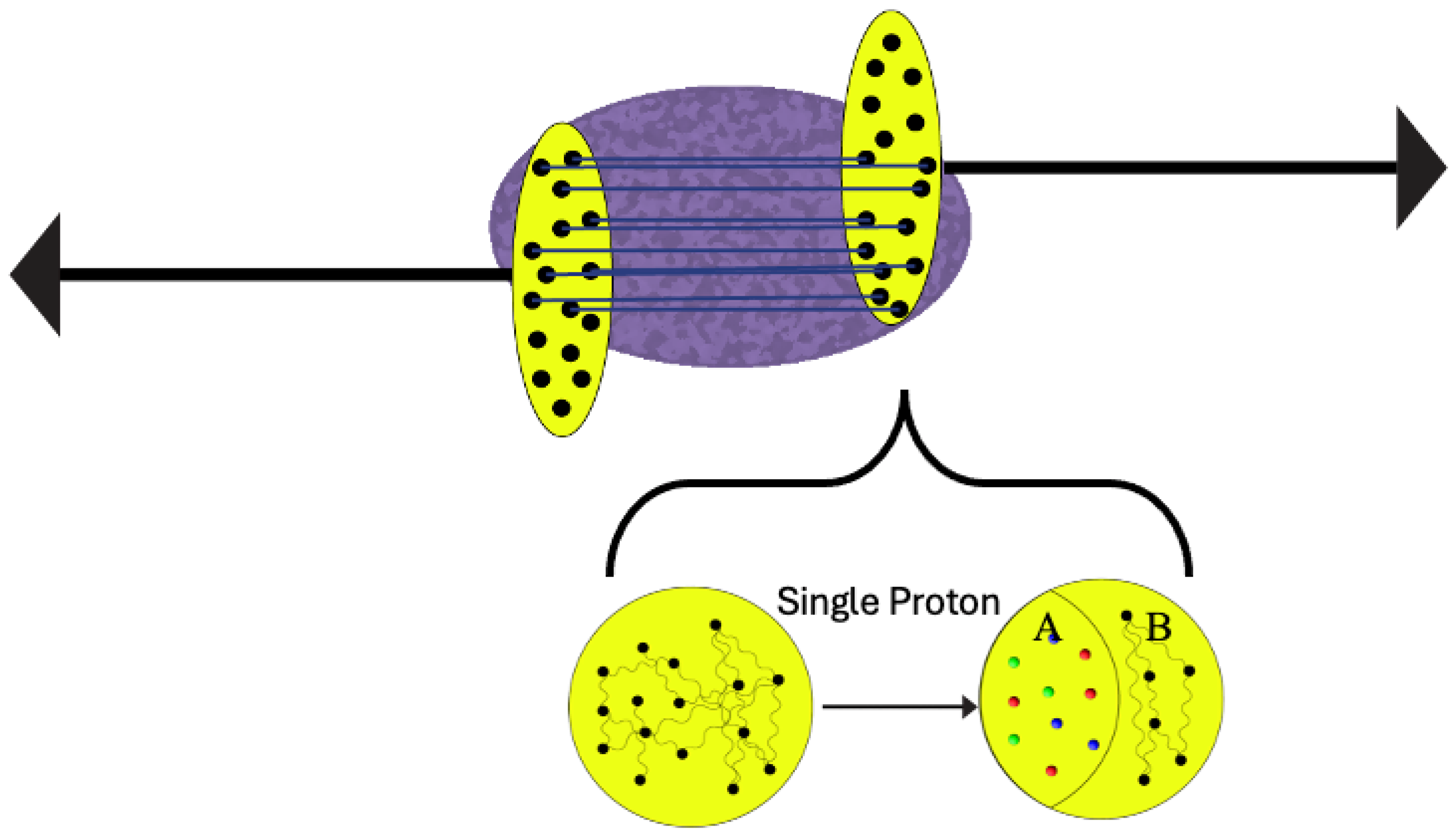
In pp collisions, entropy in a subsystem originates from tracing over unobserved degrees of freedom: we partition the incoming proton wave function into a “probed” region
A that can contribute to the experimentally selected final state and a complementary region
B that is not resolved (
Figure 1). The reduced density matrix
is in general mixed even when the global state is pure, and its von Neumann entropy equation (Equation (
1)) quantifies entanglement between the two regions.
A first-principles computation of
in QCD is difficult due to the large number of degrees of freedom. However, in the limit of small momentum fraction
x, where the proton wave function is gluon-dominated and occupation numbers can be large, one can motivate a simplified description in which
is approximated as maximally mixed in an effective parton-number basis. As shown in Ref. [
3], in this approximation the reduced density matrix takes the form
where
N is the effective number of accessible partonic microstates within the selected kinematic region and
is the identity matrix in that basis. The entanglement entropy then reduces to
In this work,
N is estimated by integrating parton distribution functions (PDFs) over an
x-range corresponding to the experimentally selected final-state phase space. PDFs are provided as functions of Bjorken-
x and the factorization scale
, which we relate to an average saturation-scale-like value appropriate for the small-
x region considered. Our analysis is restricted to the central rapidity region covered by the ALICE Time Projection Chamber (TPC), approximately
, which corresponds to
x values of order
and
of order unity [
12,
13]. In this low-
regime, higher-order perturbative expansions can be unreliable, so we focus on leading-order (LO) PDFs; even at LO, the gluon distribution at low
x carries sizable uncertainties.
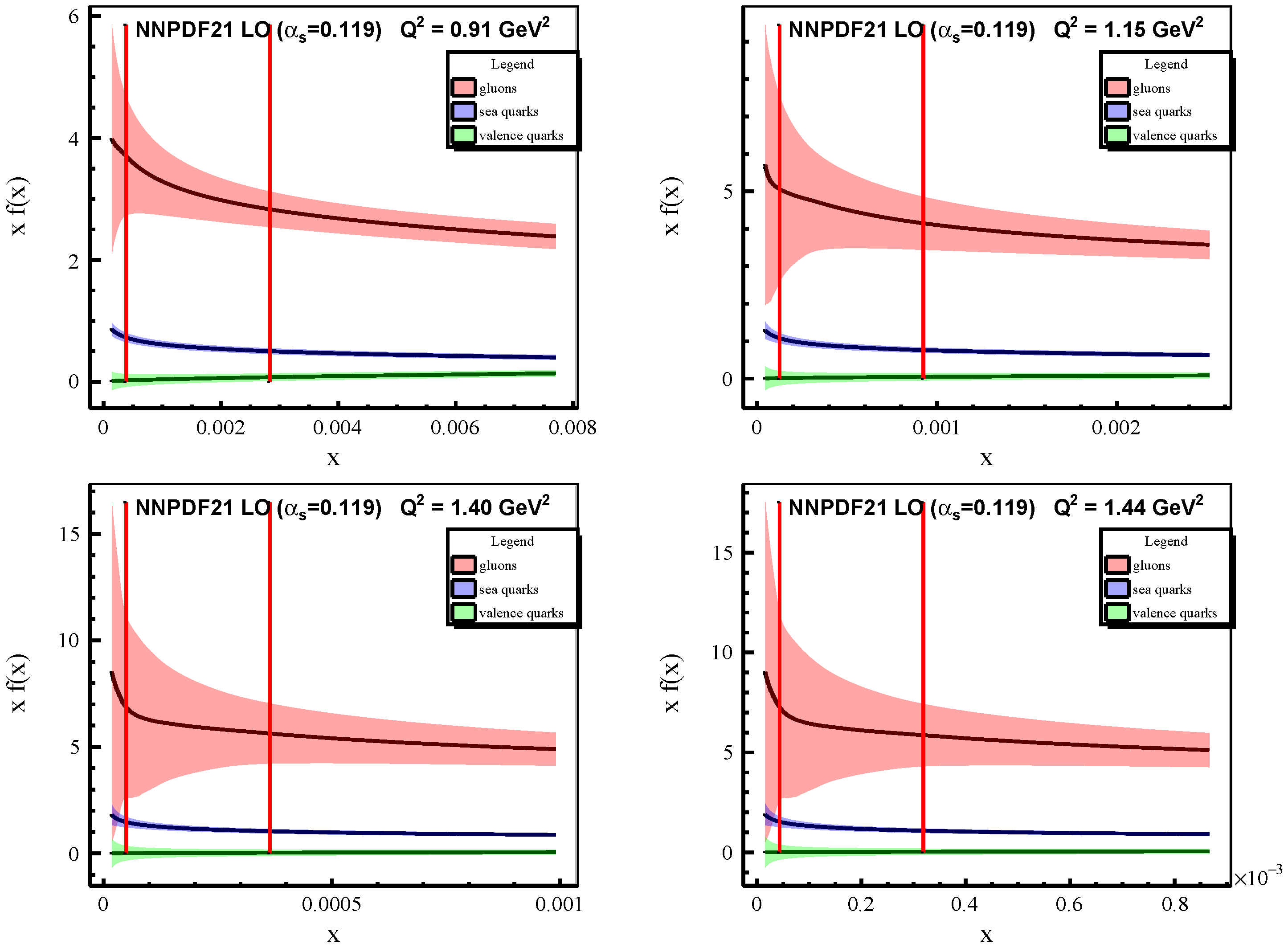
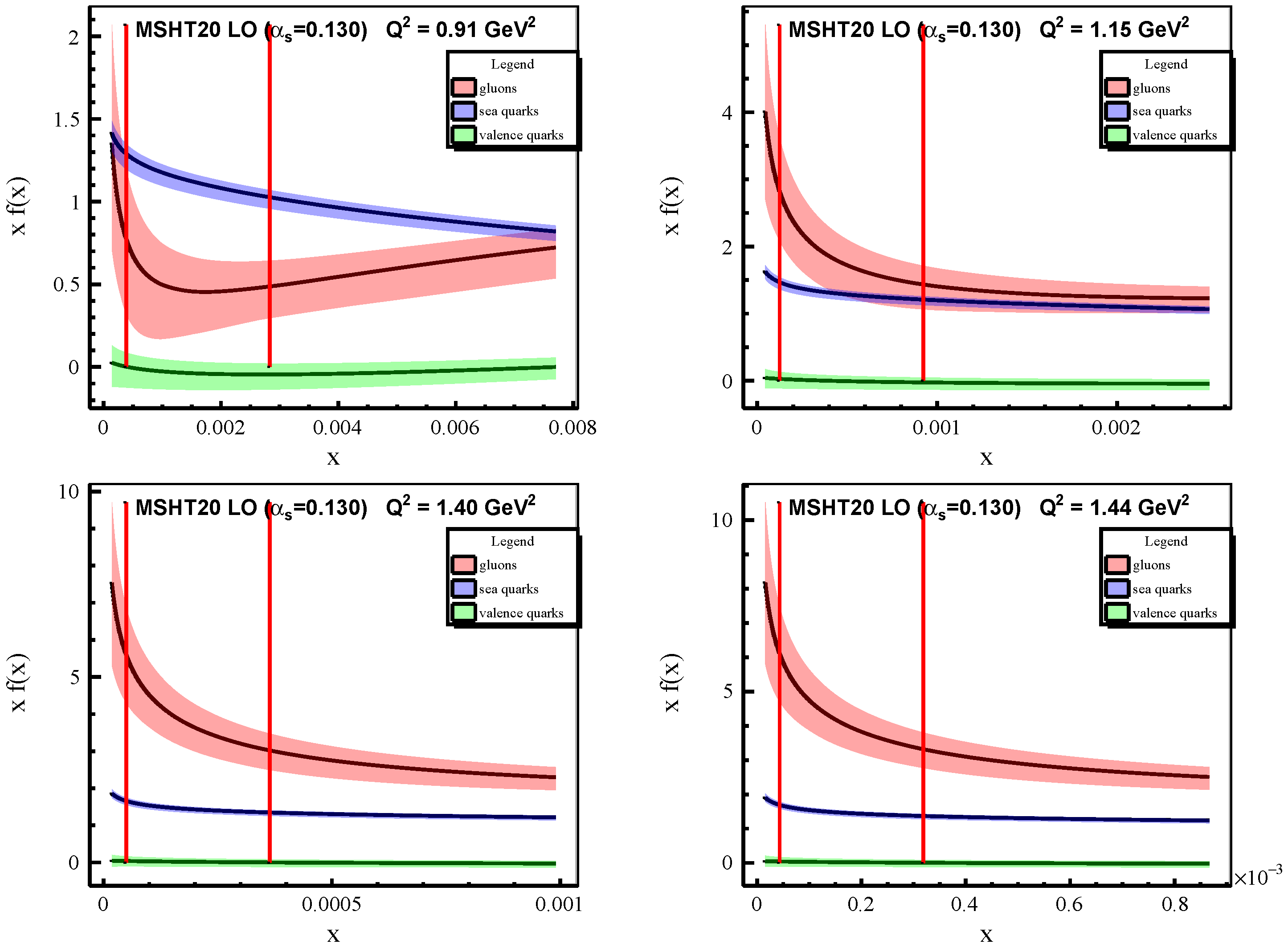
As representative examples we use the NNPDF21_LO and MSHT20_LO parton distribution function sets [
14,
15], accessed via LHAPDF [
16], and show the resulting gluon, sea-quark, and valence-quark contributions in
Figure 2 and
Figure 3, respectively. The sizable low-
x PDF uncertainties motivate complementary constraints from final-state measurements in kinematic regimes where entanglement-based approaches may be most relevant.
2.1. Entanglement of Collision Stages
The full pp collision is described by a unitary S-matrix, implying that the von Neumann entropy of the global quantum state is conserved under time evolution. Entropy production in experimentally accessible observables arises because measurements necessarily involve coarse-graining: we do not (and cannot) reconstruct the complete many-body density matrix of the produced system, but instead access reduced information such as particle multiplicities within finite acceptance. In this sense, “entropy generation” in a small system should be understood as the emergence of mixed reduced states through entanglement with unobserved degrees of freedom.
Prior to the collision, a Lorentz-contracted proton is described by a quantum wave function that is (to a good approximation) a pure state. A pure state does not imply maximal entanglement of its constituents; rather, entanglement is defined relative to a specific partition of degrees of freedom (e.g., in x, rapidity, and transverse position). The key point for our purposes is that tracing over unobserved regions of the proton wave function leads to a non-trivial reduced density matrix for the degrees of freedom participating in the interaction.
At the onset of the collision, correlations are established between the overlap region and spectator degrees of freedom. In a subsystem description, information about the overlap region becomes encoded in
, while the complement
B (including spectators and unmeasured phase space) is traced out. During the subsequent evolution, interacting partons exchange color and energy, generating flux tubes or strings along the beam axis [
17]. In dense regimes, coherent color fields may form an effective color glass condensate (CGC) [
18]. Independent of the microscopic language, if the interacting system is approximately isolated after the initial interaction, the entanglement entropy of a fixed subsystem is expected to remain approximately constant under unitary evolution, while the experimentally extracted entropy-like observable can still differ from the true entanglement entropy due to coarse-graining at hadronization and in the detector response.
2.2. Modeling Entanglement Entropy Proxies from PDFs
We test whether the initial-state entanglement entropy computed from PDFs can describe the magnitude and energy dependence of the final-state multiplicity entropy observable. Hints of such relations have been discussed in
[
19] and
interactions [
20]; in pp collisions, the overlap of two proton wave functions motivates additional care in defining the subsystem mapping.
Starting from Equation (
3), we estimate
N by integrating PDFs over the relevant
x-range. Many PDF grids (and LHAPDF) tabulate the quantity
, where
is the number density of partons of type
i. In discrete form we write
and define
for gluons and
as the sum over quark and antiquark flavors. Motivated by the importance of sea-quark contributions at low
, we follow the extension discussed in [
20] and use
To compare to charged-particle multiplicity measurements, we apply a charged-fraction correction at the parton level, following the approximation used in [
20] that roughly one-third of produced hadrons are neutral. This leads to an effective charged-sensitive entanglement entropy.
We emphasize that the factor is an approximation and should be treated as a source of systematic uncertainty.
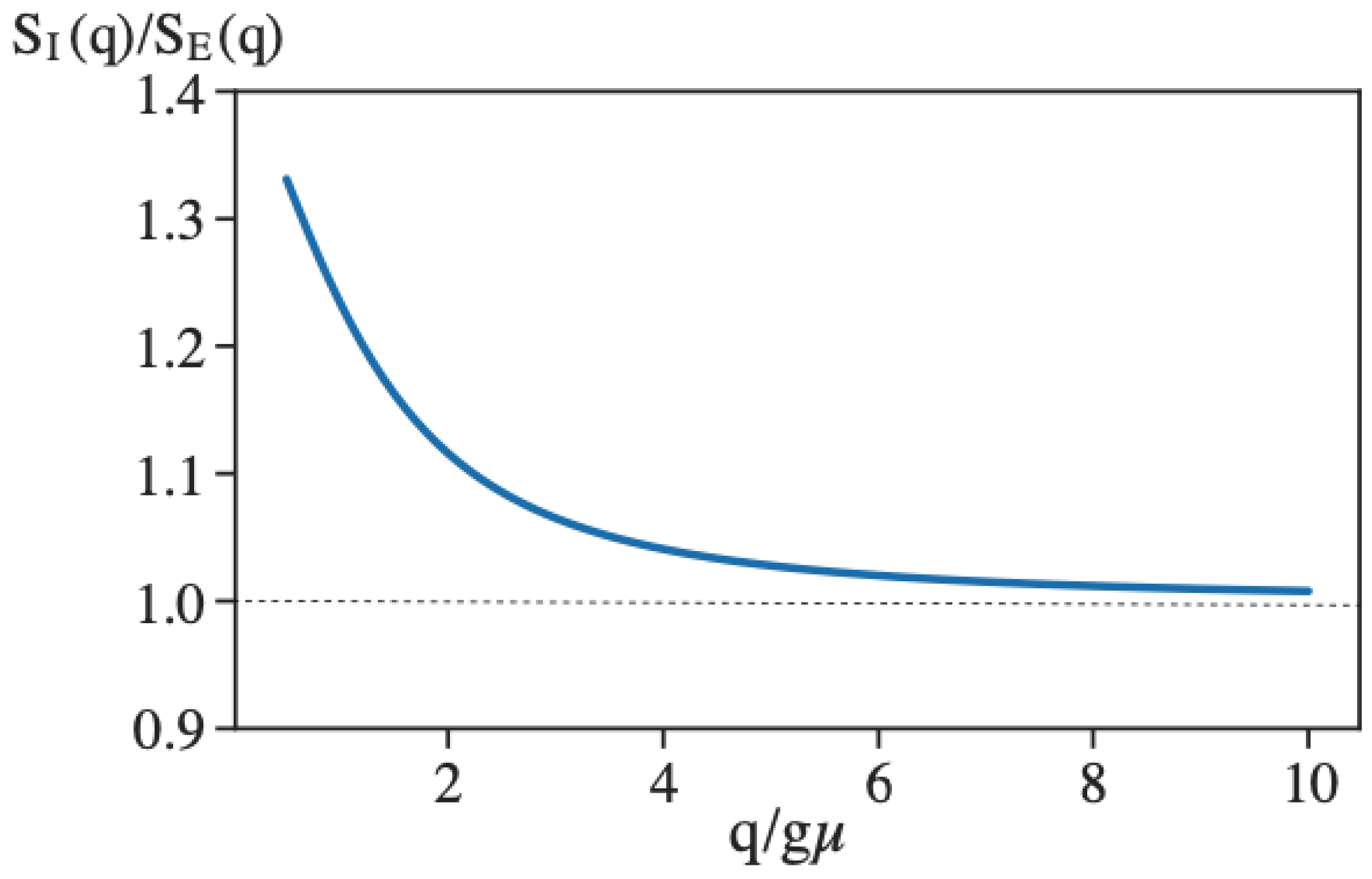
Finally, the experimentally accessible entropy observable is not the full entanglement entropy, but a coarse-grained entropy sensitive primarily to multiplicity. In information-theoretic language this is an “entropy of ignorance,” reflecting the limited set of measured degrees of freedom. In an initial CGC-based model, Duan et al. computed the ratio between this entropy of ignorance and the underlying entanglement entropy [
21], shown in
Figure 4. We denote this ratio by
and use it to map our entanglement entropy to the experimentally accessible multiplicity-sensitive quantity:
For the lowest point, the CGC-based calculation indicates at LHC energies, while at higher where the discrepancy becomes negligible.
3. Defining the Final State
The global pp collision is described by unitary time evolution, but experimentally we access only reduced information about the produced many-body state. In particular, because the complete density matrix of the produced hadrons is inaccessible, we focus on an entropy-like observable defined from an effective single-proton charged-particle multiplicity distribution
constructed from the charged-particle multiplicity distribution within a fixed acceptance [
11,
22]. We define the multiplicity Shannon entropy,
which quantifies the information content (or disorder) of the multiplicity distribution. Because the published ALICE measurement corresponds to a two-proton (
) system, while parton distribution functions describe a single proton, the distribution
used here is obtained by extrapolating the measured
multiplicity distribution to an effective single-proton distribution under the working assumption that particle production is evenly shared between the two incoming protons. While
can be related to thermodynamic entropy under additional assumptions, in this work it is treated explicitly as a coarse-grained, multiplicity-sensitive proxy to be compared to
from Equation (
7).
Since Bjorken-
x and
are not directly measured in minimum-bias pp collisions, we compare initial- and final-state proxies by mapping the pseudorapidity window used in the final state to an
x-range in the incoming proton. Within CGC-motivated kinematics a commonly used approximation is
which is expected to be most reliable in the low-
x, high-gluon-density region and can break down at large
x [
23]. For this analysis it is convenient to measure charged particles at midrapidity, where ALICE provides strong tracking and high statistics [
22]. A complementary approach that emphasizes entropy scaling without fixing a specific pseudorapidity acceptance has been explored in Ref. [
24], where the entropy is formulated directly in terms of the mean multiplicity; while that construction is not designed for mapping to a single-proton initial state as we do here, it provides a useful alternative viewpoint on how entropy-like measures evolve with multiplicity and collision energy.
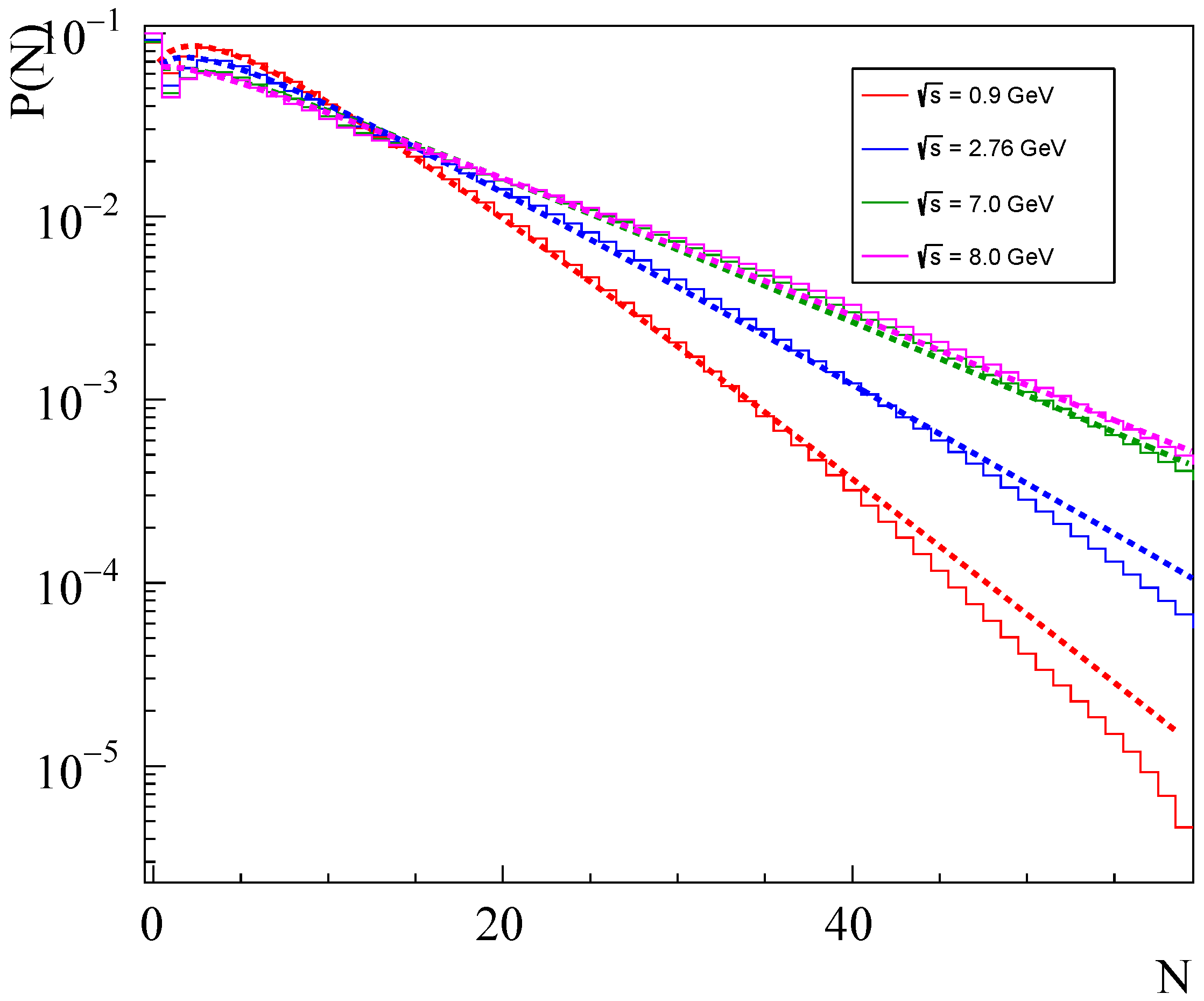
The final-state multiplicity input used throughout this work is taken from the published ALICE charged-particle multiplicity distributions for four collision energies ranging from
to 8 TeV [
11]. The measured multiplicity distributions from pp collisions at central pseudorapidity are shown in
Figure 5. The data are well described by a Negative Binomial Distribution (NBD), which we use as an interpolation tool where needed.
Because PDFs describe parton content in a single proton, while
describes the produced system in a pp collision, a transformation is required in order to make a meaningful comparison. Following [
5], we adopt the approximation that on average half of the produced hadrons originate from each proton. We therefore evaluate
for a “per-proton” multiplicity distribution obtained by rescaling the NBD fit accordingly. This assumption is part of our model and contributes to the overall systematic uncertainty of the comparison.
Analysis Procedure and Kinematic Mapping
For clarity and reproducibility, the analysis steps used to obtain the initial- and final-state entropy proxies compared in
Section 4 are summarized below:
Final-state input: Use the published ALICE charged-particle multiplicity distributions in the midrapidity window (approximately
) at
, 2.76, 7, and 8 TeV [
11].
Multiplicity entropy: Compute
from Equation (
8). Where needed, use an NBD fit to interpolate the discrete distribution (
Figure 5).
Per-proton mapping: Convert the pp multiplicity distribution to an effective “single-proton” distribution using the
scaling assumption of [
5], and evaluate the corresponding
.
Acceptance-to-
x mapping: Map the pseudorapidity window to an
x-range using Equation (
9), taking
at midrapidity. This defines
and
for each collision energy.
Initial-state parton counts: Using LO PDFs (e.g., NNPDF and MSHT LO sets), compute
and
via Equation (
4) and form
with Equation (
5), at a representative low-
scale appropriate for the mapped
x range.
Charged fraction: Apply the charged fraction correction to obtain
using Equation (
6).
Entropy-of-ignorance mapping: Rescale by the CGC-motivated ratio
(
Figure 4) to obtain
using Equation (
7).
Comparison: Compare the energy dependence and magnitude of
and
as functions of the mapped
x (or
), as shown in
Section 4.
Dominant sources of model dependence include the per-proton mapping, the charged fraction correction, the choice of in the low-x regime, and PDF uncertainties at low x.
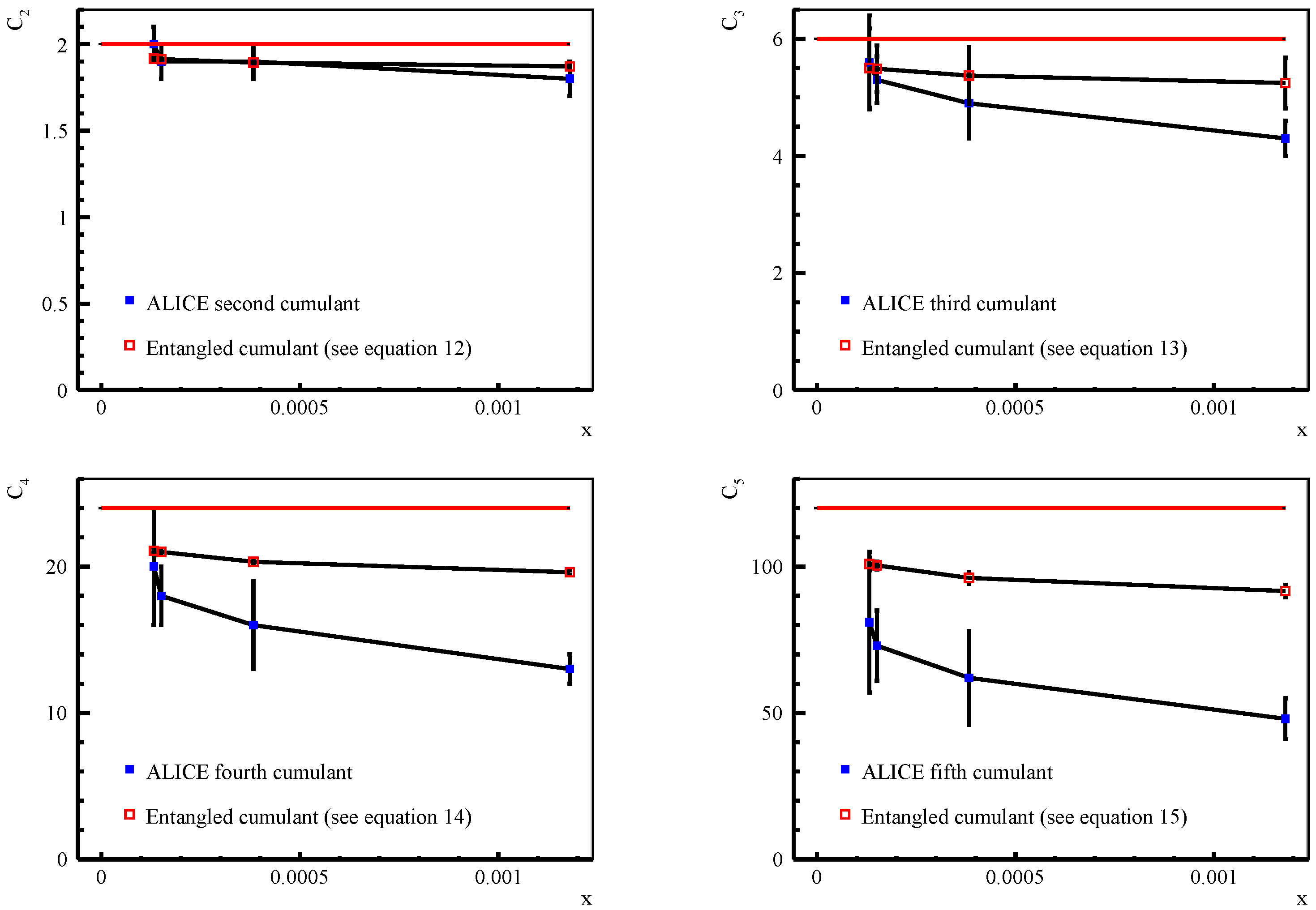
Since the multiplicity entropy is largely controlled by the mean of the distribution, it is natural to ask whether additional sensitivity to the underlying dynamics can be obtained by examining higher moments of the multiplicity distribution. Higher moments of the NBD distribution can be compared with a 1 + 1 toy model of non-linear QCD evolution of the BK equation suggested by Kharzeev and Levin [
3]. They demonstrated that one can construct a generating function that captures non-linear interactions leading to dipole formation in an entangled system, which sets an upper limit on the moments of the final-state NBD distribution:
where
represents the average multiplicity from data. We observe that the final-state multiplicity cumulants approach the limit expected from the fully entangled toy-model evolution; see
Figure 6.
4. Results and Conclusions
In
Figure 7,
Figure 8 and
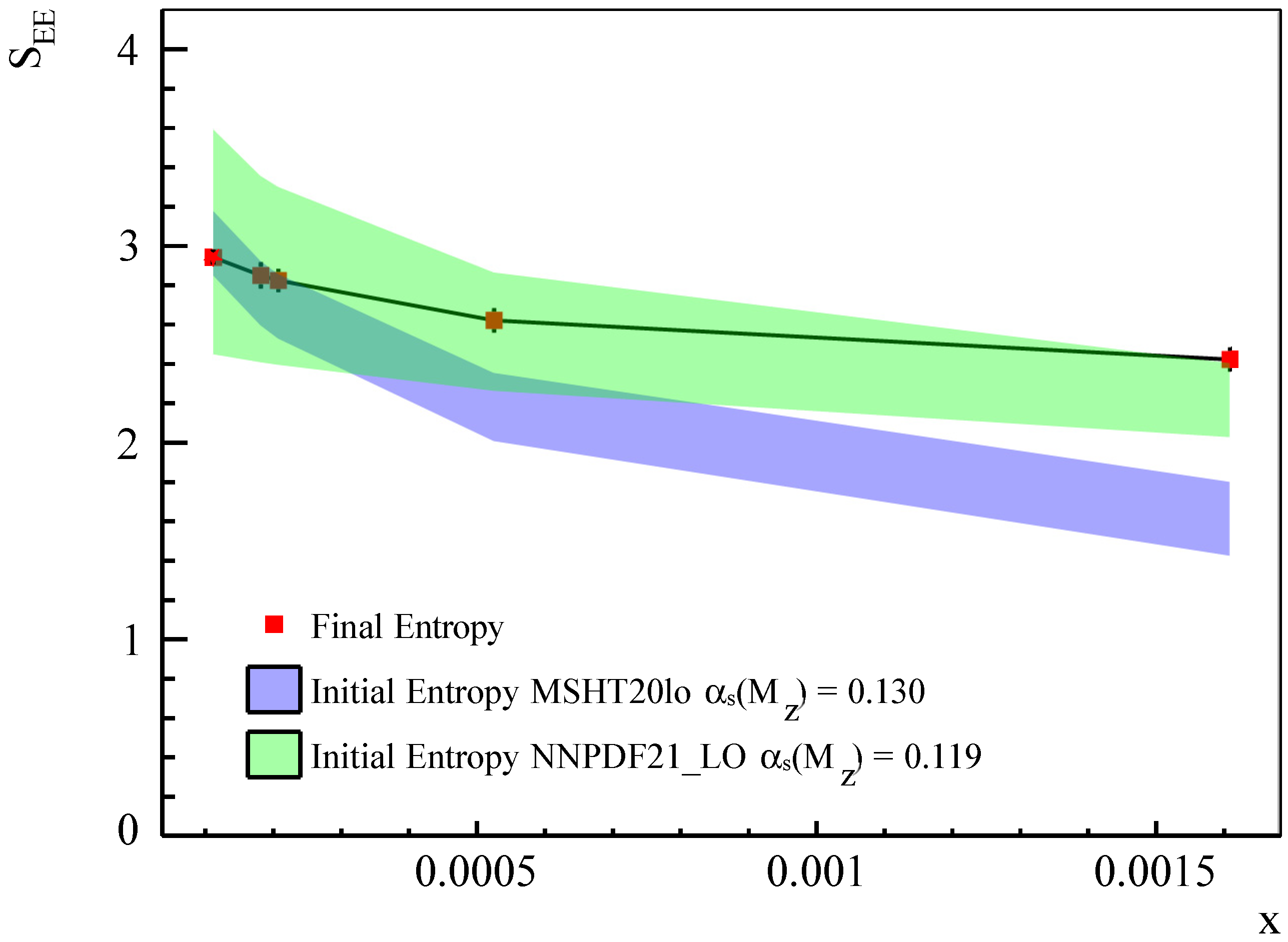
Figure 9 we compare the final-state entropy
(red points) to several initial-state calculations and baselines. The initial-state bands correspond to different assumptions in the construction of
: gluons only, gluons plus quarks, and the inclusion of the entropy-of-ignorance mapping (
Figure 4). The four data points at higher
x are obtained directly from the published ALICE multiplicity distributions [
11]. An additional point at the lowest
x is estimated by extrapolating the multiplicity evolution with a power-law fit of the mean; we treat this extrapolated point as a qualitative guide rather than a precision constraint.
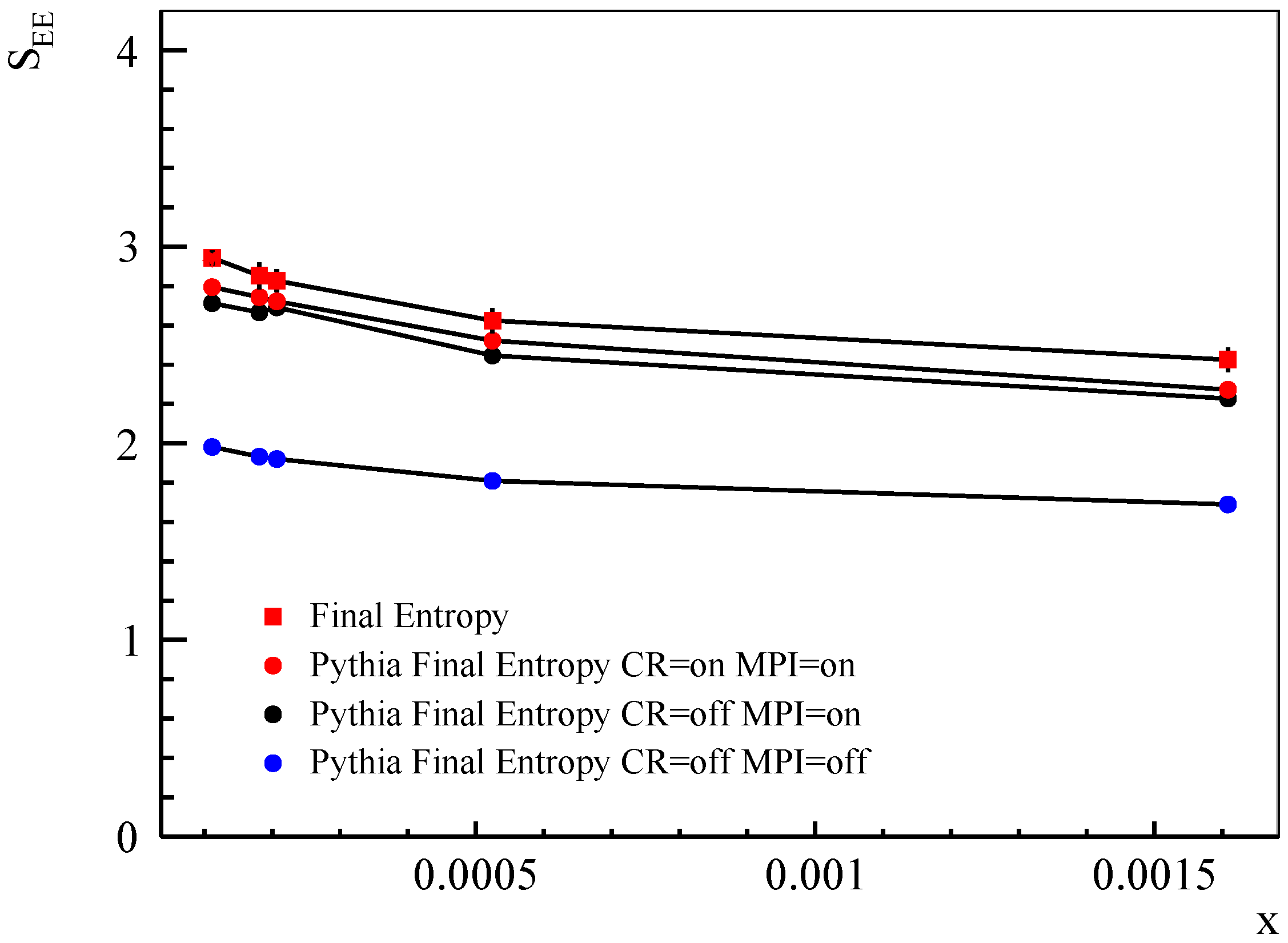
Particle production in proton–proton collisions is often modeled by string fragmentation models, such as PYTHIA, that do not explicitly encode initial-state entanglement in the incoming hadron wave functions. Even recent PYTHIA tunes can underestimate the multiplicity entropy unless additional mechanisms that increase final-state correlations and effective phase-space population are included. In practice, such effects are often emulated via model components such as multi-parton interactions (MPI) and color reconnection (CR). In this analysis we restrict ourselves to the Monash tune with CR mode 0 in order to provide a consistent baseline configuration [
25,
26].
Figure 7 compares
from ALICE data to three PYTHIA configurations, illustrating how these components move the baseline closer to the data.
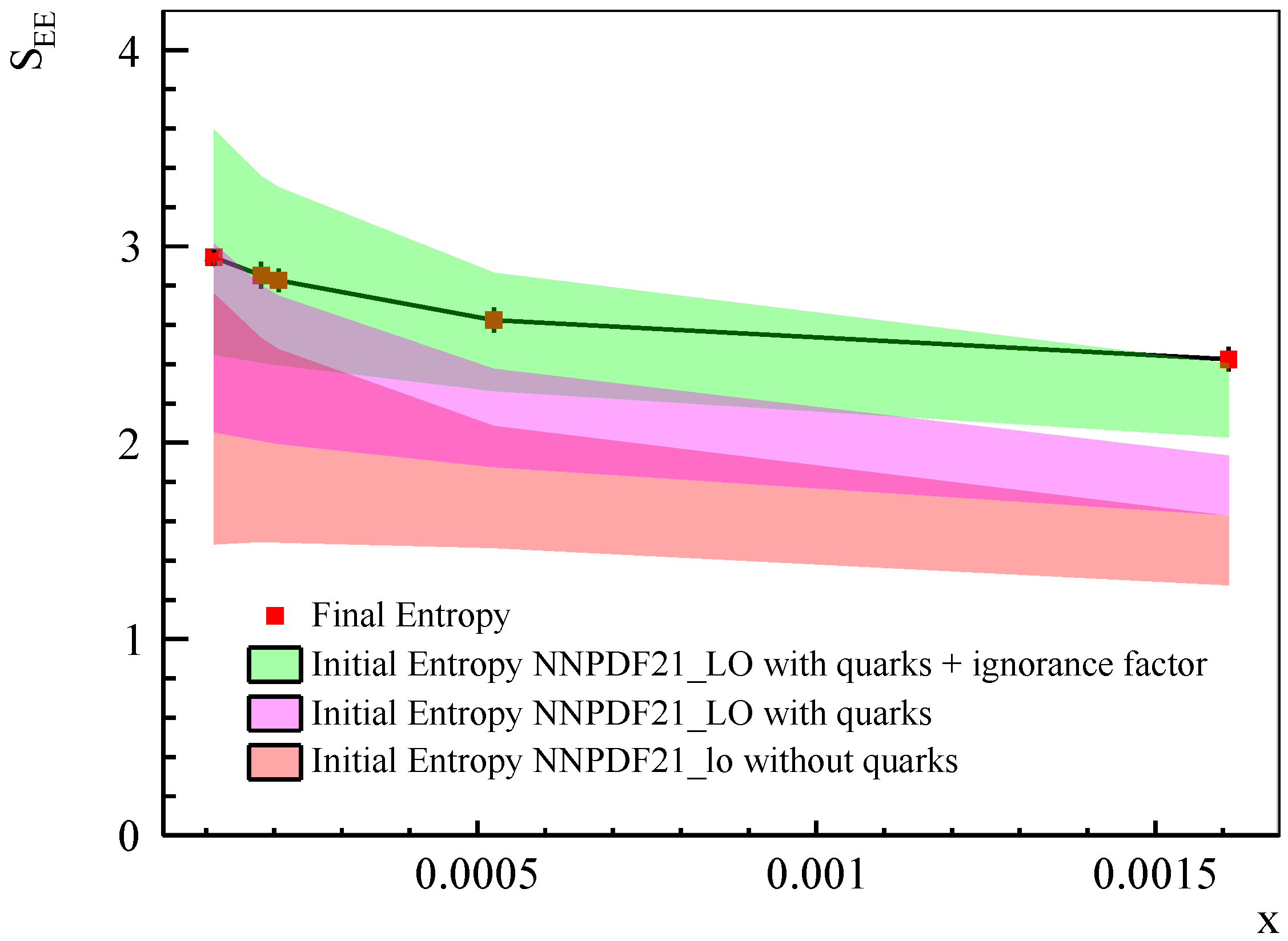
Figure 8 shows the comparison between
and the initial-state entropy proxies. The red band represents the initial state considering gluons only. The magenta band includes gluons and quarks. The green band includes gluons and quarks and applies the entropy-of-ignorance mapping
(
Figure 4). Within this framework, the inclusion of quark contributions and the coarse-graining correction are both important for bringing the initial-state into numerical compatibility with the measured multiplicity entropy toward low
x.
Figure 9 compares two different LO PDF sets at the relevant
x and
values. In our implementation, the resulting entropy bands show somewhat stronger agreement with the data for the PDF choice corresponding to
than for
. We stress that this comparison is not a standalone determination of
; it reflects the combined effect of PDF-set choices, low-
assumptions, and the mapping procedure outlined in Section Analysis Procedure and Kinematic Mapping.
Overall, we find that the initial-state entanglement entropy and the final-state multiplicity entropy become numerically compatible toward low x provided that (i) sea-quark contributions are included and (ii) the entropy-of-ignorance correction is applied. This supports (but does not uniquely prove) the interpretation that initial-state quantum correlations, when quantified through experimentally unavoidable coarse-graining, can manifest as thermal-like features in small collision systems.
The present comparison relies on a set of modeling assumptions whose impact can be systematically sharpened and tested. In particular, the mapping between final-state acceptance and the corresponding Bjorken-
x range, as expressed in Equation (
9), as well as the choice of a representative low-
scale introduce controlled model dependence, especially near the edges of the acceptance and at larger
x. Likewise, the use of a
charged-particle correction and the assumption that half of the produced hadrons can be attributed to a single proton are simplifying choices that can be varied in future studies to quantify their effect on the relative behavior of
and
. The
x range accessed by the present data does not yet exhibit a clear saturation-driven turnover [
22]; measurements at forward rapidity at the LHC and over a broader kinematic domain at a future Electron–Ion Collider will therefore be particularly relevant, where models predict that entropy-like observables should track the onset of saturation at very low
x. Finally, since multi-parton interactions and color reconnection mechanisms in event generators such as
PYTHIA can reproduce enhanced entropy-like signals, differential tests, including dependence on rapidity window, event activity class, and system size in
collisions, will be essential to discriminate entanglement-based interpretations from effective final-state modeling.