Article

Perturbative Analysis of Singularity-Free Cosmological Solutions in Unimodular Kaluza–Klein Theory

1
Núcleo Cosmo-Ufes & Departamento de Física, Centro de Ciências Exatas-CCE, Universidade Federal do Espírito Santo, Vitória 29075-910, ES, Brazil
2
Laboratoire de Physique Théorique de la Matière Condensée, Sorbonne-Université, Boîte 121, 4 Place Jussieu, 75005 Paris, France
*
Author to whom correspondence should be addressed.
Universe 2026, 12(3), 75; https://doi.org/10.3390/universe12030075
Submission received: 1 February 2026 / Revised: 3 March 2026 / Accepted: 6 March 2026 / Published: 9 March 2026
(This article belongs to the Section Cosmology)

Abstract

The unimodular version of the Kaluza–Klein theory is briefly discussed, and its projection onto four-dimensional spacetime is constructed. Imposing the unimodularity condition on the five-dimensional Kaluza–Klein metric, det g A B = 1 is equivalent to introducing a cosmological term in Einstein’s equations in four dimensions with a scalar field of the Brans–Dicke type. Singularity-free cosmological solutions with scalar field and matter sources are constructed, and their basic properties are analyzed In the present paper, attention is focused on the perturbative analysis of cosmological solutions, providing insights into their stability against small fluctuations.

1. Introduction

Unimodular Gravity was considered as early as 1919 by Einstein [1], who investigated an alternative to the initial formulation of General Relativity by imposing an extra unimodularity condition on the pseudo-Riemannian metric, | det g μ ν | = 1 . This condition seemed natural for at least two reasons: firstly, the Minkowskian metric tensor η μ ν = diag ( + 1 , 1 , 1 , 1 ) has this property, and its infinitesimal deformations h μ ν should be traceless if unimodularity were to be also imposed on the deformed metric g μ ν + ϵ h μ ν ; secondly, it permits replacing the cosmological term by a Lagrange multiplier, taking into account this constraint in the variational principle. In 1919, the Friedmann solution was not yet known, and Einstein [2] was attached to the Aristotelian vision of an eternal and stationary universe (at a very large scale, of course). This is why he introduced the cosmological term Λ g μ ν on the right-hand side of the field equations, acting as a source of negative pressure to balance the non-zero matter density and its repulsive contribution to gravity.
Closer to the present day, Unimodular Gravity is considered an alternative and quite a promising approach to the cosmological constant problem (see Refs. [3,4,5,6]).
Let us demonstrate how the unimodularity of the metric modifies the Einstein–Hilbert action integral using this extra constraint as a Lagrange multiplier in the corresponding variational principle and show what the new Einstein equations look like. For alternative approaches, see Refs. [7,8].
Let us consider the action
S = d 4 x { g R λ ( g ξ ) } + d 4 x g L m .
In this expression, λ is a Lagrange multiplier, and ξ is an external field introduced in order to give flexibility in the choice of the coordinate system. As a special case, ξ may be considered a pure number, which implies the choice of specific coordinates.
The variation with respect to the metric leads to
R μ ν 1 2 g μ ν R + λ 2 g μ ν = 8 π G T μ ν .
The variation with respect to λ leads to the unimodular constraint
ξ = g .
The trace of (2) implies
λ = R 2 + 8 π G T 2 .
Inserting this result in (2), we obtain the following unimodular field equations:
R μ ν 1 4 g μ ν R = 8 π G ( T μ ν 1 4 g μ ν T ) .
Note that this expression is traceless. The theory is now invariant under a restricted class of diffeomorphisms, often called “transverse diffeomorphisms”. The so-called transverse diffeomorphisms, conserving volume (or area in the two-dimensional case), were introduced by V. I. Arnold in his famous article on hydrodynamical applications of infinite-dimensional Lie groups of diffeomorphisms [9], see also [10]. They are akin to similar volume-preserving properties of Hamiltonian flows in phase space, studied previously by Poincaré.
The Bianchi identities applied to (5) imply that the usual energy-momentum tensor conservation must be generalized as follows:
R ; ν 4 = 8 π G ( T μ ν ; μ 1 4 T ; ν ) .
If the usual energy-momentum tensor conservation is imposed (which, in the unimodular context, would be in opposition with basic General Relativity theory), then
T μ ν ; μ = 0 ,
and the Equation (6) becomes
R ; ν 4 = 2 π G T ; ν .
Equation (8) may be integrated, leading to
R = 8 π G T + 4 Λ ,
where Λ is an integration constant that may be interpreted as the cosmological constant. Inserting the relation (9) in (2), the resulting equations are
R μ ν 1 2 g μ ν R + g μ ν Λ = 8 π G T μ ν .
We see that the equations of standard General Relativity are recovered but with a cosmological constant that was absent in the original structure. Here, it appears naturally as a constant of integration.
It is worth recalling that even when the unimodular constraint det g = 1 is satisfied, the metric tensor is not constant. Moreover, its transformation properties are typical of a tensor density:
g ( x ˜ ) = det x λ x ˜ μ x ρ x ˜ ν g ( x ) .
Thus,
g ( x ˜ ) = ( det J ) 1 g ( x ) ,
where J = det ( x ˜ x ) . The scalar density of a scalar field is multiplied by g :
F ( x ) = F ( x ) g .
Its covariant derivative with respect to connection Γ μ ν λ is then
λ F = g λ F + F λ g = g λ F F Γ ν λ ν .
and the Lie derivative with respect to an arbitrary vector field X μ is
L X F = g L X F + F L X g = X μ μ F + F μ X μ = μ F X μ ,
because
μ g = μ g g Γ λ μ λ = 0 .
with respect to the Christoffelian connection and because
g g μ ν = 1 2 g g μ ν .
We, therefore, get
L X g = g 2 g μ ν ( L X g ) μ ν = g μ X μ .
These properties of covariant and Lie derivatives of densities are crucial in the derivation of modified Einstein equations from a variational principle whose integrand is by definition a scalar density.

2. Unimodular Kaluza–Klein Theory

The first attempt to unify the new theory of gravitation, proposed by Einstein in 1915, with Maxwell’s theory of electromagnetism was made by Th. Kaluza [11] in 1921. The idea was to extend General Relativity to five dimensions, where the metric tensor g A B , A , B , . . . = 1 , 2 , 5 can accommodate 15 field degrees of freedom instead of 10 in the four-dimensional spacetime.
Quite obviously, the 15 independent components of a five-dimensional manifold’s metric tensor can accommodate not only the 10 components of a four-dimensional subspace’s metric, identified with the metric tensor of General Relativity, but also the extra four components of the four-potential of Maxwell’s electromagnetism, if they are identified with mixed components of the five-dimensional metric: g ˜ 5 μ = g ˜ μ 5 , where μ , ν = 0 , 1 , 2 , 3 :
g ˜ A B = g μ ν A μ A ν 1 .
In what follows, we denote geometrical objects defined in the five-dimensional Kaluza–Klein space using tilded symbols, with the same symbols relative to the four-dimensional spacetime being expressed as usual by non-tilded letters.
In the original version of his model, Kaluza had fixed the g 55 component at 1, leaving just 14 degrees of freedom but at the same time taking the risk of getting an overdetermined system. Indeed, the standard variational principle applied to the Einstein–Hilbert Lagrangian in five dimensions leads to 15 partial differential equations, although we have only 14 independent fields identified as g μ ν and A μ .
However, by a happy coincidence, even with this incomplete version, the system was not overdetermined due to the fact that out of the 15 Einstein equations in vacuo corresponding to the components of symmetric Ricci and metric tensors: ( μ ν ) , ( μ 5 ) and ( 55 ) the last one R ˜ 55 1 2 g ˜ 55 R ˜ reduces to tautology 0 = 0 , leaving exactly 14 equations, which are easily recognized as the usual four-dimensional Einstein’s equations with an electromagnetic energy-momentum tensor as a source, along with Maxwell’s equations coupled with the gravitational field through covariant derivatives
R ˜ A B 1 2 g ˜ A B R ˜ = 0 , ( A , B , . . ) = ( μ , 5 ) , R ˜ = R 1 4 F λ ρ F λ ρ .
With an extra assumption that the fields g μ ν and A μ depend exclusively on the spacetime variables x μ and not on x 5 , the equations give rise to the following system of coupled equations:
R μ ν 1 2 g μ ν R = g λ ρ F μ λ F ν ρ 1 4 g μ ν F λ ρ F λ ρ ,
g μ ν μ F ν λ = 0 ,
with the last 55 component reducing to 0 = 0 . This circumstance is often called “the Kaluza–Klein miracle”.
However, it is not the only “bonus” here. There is another happy coincidence, namely, the fact that the determinant of the five-dimensional Kaluza–Klein metric does not depend on the electromagnetic field A μ but is a product of the determinant of the four-dimensional metric of the spacetime multiplied by a function of the scalar field. This circumstance encourages the idea of introducing the unimodular condition in the five-dimensional Kaluza–Klein space.
In its first version, proposed by Th. Kaluza, the fifth dimension was just an extra space coordinate, with the entire space being isomorphic to M 4 × R 1 [ c t , x , y , z , x 5 ] M 5 , a five-dimensional Minkowski space. Later on, in 1926, O. Klein [12] introduced a modification inspired by the freshly discovered quantum theory, which postulated the wave-particle duality, according to which an elementary particle’s energy E and momentum p can also be identified with frequency ω and wave vector k of the corresponding wave. In the Schroedinger representation, each state of a quantum particle corresponds to its (complex) wave function ψ ( t , x ) , and the energy and momentum are represented by hermitian operators E i t , p i .
Klein proposed to consider a compact fifth dimension, a circle with a very small radius. Supposing that wave functions describing electrically charged point particles are defined on the Kaluza–Klein space, they should also depend on the fifth coordinate x 5 , the dependence being periodic if the fifth dimension is circular, i.e., isomorphic with a unit circle S 1 . The most general form of such wave functions should then be
f ( x μ , x 5 ) = k = 0 a k ( x μ ) e i k x 5 .
with dim(k) = cm 1 .
Identifying the fifth component of momentum p 5 with the operator of electric charge, p 5 i 5 , the eigenvalues of p 5 are multiples of q, corresponding to the discrete values of electric charge of elementary particles known at that time, electrons and protons.
The unimodularity condition in the Kaluza–Klein case becomes particularly natural in a non-holonomic local frame system. We can define the five-dimensional spacetime metric tensor following the tetrad technique known from General Relativity: the Riemannian metric is defined as g ˜ A B = η a b θ A a θ B b , with η a b = diag ( + , , , , ) , a , b = 1 , , 5 , A , B = 0 , 1 , 2 , 3 , 4 . The dependence of g A B on spacetime coordinates is encoded in local 1-forms θ A a ( x λ ) .
The non-holonomic local frame is defined by the following choice of local basis of 1-forms:
θ μ = d x μ , θ 5 = d x 5 + q A μ d x μ ,
the constant q must have the dimension of length in order to ensure the uniformity with space variables x μ .
The dual vector fields satisfy θ A ( D B ) = δ B A :
D μ = μ q A μ 5 , D 5 = 5 .
Introducing transition matrices U B A and U C B 1 such that θ A = U B A d x B , D C = U C D 1 D , we can write
U ν μ = δ ν μ , U 5 μ = 0 , U μ 5 = q A μ , U 5 5 = 1 ;
U ν μ 1 = δ ν μ , U ν 5 1 = q A ν , U 5 μ 1 = 0 U 5 5 1 = 1 .
Quite obviously, both determinants are equal to 1: det ( U B A ) = 1 and det ( U C B 1 ) = 1 . The metric tensor expressed in the non-holonomic frame is easily deduced from the square of the five-dimensional length element, taking on the following form:
d s 2 = g μ ν d x μ d x ν d x 5 + q A μ d x μ d x 5 + q A ν d x ν
leading to the following 5 × 5 matrix representation:
g ˜ A B = g μ ν q 2 A μ A ν q A μ q A ν 1
The inverse matrix becomes
g ˜ B C = g ν λ q A ν q A λ q 2 g ρ σ A ρ A σ 1
One easily checks that
g ˜ A B g ˜ B C = δ C A .
In order to make the theory complete, the full set of 15 field degrees of freedom should be included. The missing scalar field is displayed as the 55 component of the Kaluza–Klein metric tensor. The improved version of Kaluza–Klein theory, including a scalar field along with gravity and electromagnetism, was proposed by P. Jordan [13] and Y. Thiry [14], who also discussed the impact of the scalar field on gravity and electromagnetism.
In the complete theory, the diagonal metric is chosen to be g A B = diag ( 1 , 1 , 1 , 1 , ϕ 2 ( x μ ) ) , and the local frames and the metric are modified, consequently leading to the following form of the metric:
d s 2 = g μ ν d x μ d x ν ϕ 2 d x 5 + q A μ d x μ d x 5 + q A ν d x ν
leading to the following 5 × 5 matrix representation:
g A B = g μ ν q 2 ϕ 2 A μ A ν q ϕ 2 A μ q ϕ 2 A ν ϕ 2
The inverse matrix then becomes
g B C = g ν λ q A λ q A ν q 2 g ρ σ A ρ A σ ϕ 2
The somewhat unusual signs in the matrices representing the Kaluza–Klein metric tensor are due to the choice of the signature d i a g ( + , , , , ) , generalizing the four-dimensional Minkowskian metric d i a g ( + , , , ) commonly accepted nowadays. The original Kaluza ansatz used the opposite convention, with the Minkowskian metric represented as d i a g ( , + , + , + ) , as can be seen in Formula (19).
The extension of the Kaluza–Klein structure to include non-Abelian gauge fields is described in Ref. [15].

3. General Expressions

It is possible to construct an effective theory in four dimensions resulting from the Kaluza–Klein Unimodular Gravity (KK-UG). The derivation is sketched below. The main goal of the present work is to investigate the features of singularity-free cosmological solutions in the effective KK-UG in four dimensions in the presence of matter components, which emerge from the dimensional reduction of the five-dimensional theory. This framework was set out in Ref. [16], and some simple cosmological configurations were studied in Ref. [17].
The unimodular equations in D = 5 dimensions read
R ˜ A B 1 5 g ˜ A B R ˜ = 8 π G { T ˜ A B 1 5 g ˜ A B T ˜ } ,
3 10 R ˜ ; A = 8 π G { T ˜ A ; B B 1 5 T ˜ ; A } .
The spacetime decomposition D = 4 + 1 leads to
R ˜ μ ν = R μ ν ϕ ; μ ; ν ϕ ,
R ˜ a b = ϕ ϕ
R ˜ = R 2 ϕ ϕ .
The energy-momentum tensor T ˜ A B has the following components:
T ˜ μ ν = T μ ν
T ˜ a b = 0 ,
T ˜ = T = g μ ν T μ ν .
The spacetime components of the field equations for A = μ and B = ν are as follows:
R μ ν 1 5 g μ ν R = 8 π G { T μ ν 1 5 g μ ν T } + 1 ϕ { ϕ ; μ ; ν 2 5 g μ ν ϕ } .
Considering the component A = a , B = b of the multidimensional field equations, we obtain
ϕ ϕ = 1 3 ( R 8 π G T ) .
The final set of equations can be written as follows:
R μ ν = 8 π G T μ ν + 1 ϕ ( ϕ ; μ ; ν g μ ν ϕ ) ,
ϕ ϕ = 1 3 ( 8 π G T R ) ,
8 π G ( T ν μ ; μ + ϕ ; μ ϕ T ν μ ) = R ; ν 2 .
Equation (44) is the trace of (43), while Equation (45) comes from the Bianchi identity applied to (43).
Equation (43) may be rewritten using the familiar gravitational tensor as follows:
R μ ν 1 2 g μ ν R = 8 π G { T μ ν 1 2 g μ ν T + 1 ϕ ϕ ; μ ; ν + 1 2 g μ ν ϕ )
stressing the peculiar coupling of matter and scalar field to gravity in the effective four-dimensional framework resulting from the unimodular structure in five dimensions.
Let us now carry out an analysis of the effective Equations (43)–(45). These equations have a very peculiar structure, which is similar to Brans–Dicke gravity [18] with ω = 0 but with a crucial difference: the Ricci scalar is absent on the right-hand side of Equation (43). The vacuum solutions display a singularity-free scenario that reveals instability due to the change of sign in the scalar field ϕ during the evolution of the universe [17]. In what follows, configurations with matter will be constructed with some very peculiar properties. In particular, the perturbative analysis will display important differences with respect to the vacuum case.

4. Cosmology

From now on, the flat FLRW four-dimensional metric, describing an homogeneous and isotropic space,
d s 2 = d t 2 a 2 ( d x 2 + d y 2 + d z 2 )
is introduced in the field equations. The matter content is described by a perfect fluid:
T μ ν = ( ρ + p ) u μ u ν p g μ ν .
The components of the Ricci tensor and of the energy-momentum tensor have the usual form:
R 00 = 3 ( H ˙ + H 2 ) , R i j = ( H ˙ + 3 H 2 ) a 2 δ i j ,
T 00 = ρ , T i j = p a 2 δ i j .
Inserting the metric and the energy-momentum tensor in Equation (43), two non-linear differential equations are obtained:
3 ( H ˙ + H 2 ) = 8 π G ρ 3 H ϕ ˙ ϕ ,
H ˙ + 3 H 2 = 8 π G p + ϕ ¨ ϕ + 2 H ϕ ˙ ϕ .
These equations can be combined in order to obtain the modified Friedmann equation:
H 2 = 4 π G 3 ( ρ + 3 p ) + 1 2 ( ϕ ¨ ϕ + H ϕ ˙ ϕ ) .
There are three functions to be determined (a, ρ and ϕ ) and only two independent equations. An additional hypothesis must be introduced, meant to impose the conservation of the energy-momentum tensor, leading to the appearance of the cosmological constant as explained previously. Here, however, an alternative strategy will be employed, leading to non-singular solutions by imposing a constant Ricci scalar:
R = 6 ( H ˙ + 2 H 2 ) = R 0 = C o n s t .
This condition is satisfied if
a ( t ) = a 0 cosh 1 / 2 t ,
with R 0 = 3 . This solution represents a non-singular, eternal universe, exhibiting a bounce. Other solutions, with an initial singularity, are possible for positive and null values of R 0 , but we will restrict ourselves to the non-singular configuration represented by the above solution with negative R 0 . Notice that this solution remains valid regardless of the presence or absence of matter. The condition (54) leads to what could be called a generalized energy-momentum tensor conservation, with an extra term, compared with the usual one, containing explicitly the scalar field ϕ .

5. Solutions with Matter

The complete set of equations in the presence of matter is as follows:
3 ( H ˙ + H 2 ) = 8 π G ρ 3 H ϕ ˙ ϕ ,
H ˙ + 3 H 2 = 8 π G p + ϕ ¨ ϕ + 2 H ϕ ˙ ϕ ,
ρ ˙ + 3 H ( ρ + p ) + ϕ ˙ ϕ ρ = 0 .
Supposing a linear, barotropic equation of state p = ω ρ , with ω constant, the last equation has the solution
ρ = ρ 0 ϕ a 3 ( 1 + ω ) .
With this solution, the two remaining equations simplify to an ordinary, non-homogeneous equation for ϕ :
ϕ ˙ ( H ˙ H + H ) ϕ = 8 π G 3 ρ 0 H a 3 ( 1 + ω ) .
This is a first-order linear non-homogeneous equation for ϕ , which can be solved once a ( t ) and ω are given. This first-order differential equation is consistent with the second-order differential equation for ϕ given by (57). This very peculiar property of the model results from the structure of Equations (43)–(45) and the ansatz (54).
The solution of the homogeneous part is given by
ϕ h = A sinh t cosh 1 / 2 t ,
where A is a constant. To obtain the solution of the inhomogeneous equation, it is better to write
ϕ = a ˙ f ,
leading to
f = B d t sinh 2 t cosh 3 ω 2 t ,
with
B = 16 π G ρ 0 3 a 0 3 ( 1 + ω ) .
The final solution is given by
ϕ = A sinh t cosh 1 / 2 t + B sinh t cosh 1 / 2 t d t sinh 2 t cosh 3 ω 2 t
Now, some particular cases will be considered.

5.1. Pressureless Matter: ω = 0

In this case, the integral can be easily solved:
d t sinh 2 t = coth t .
Hence, the solution for ϕ is given by
ϕ = A sinh t cosh 1 / 2 t B cosh 1 / 2 t .
The scalar field ϕ changes sign at the time t 0 satisfying the condition,
tanh t 0 = B A .
Since 1 tanh t 0 1 , there is no change of sign in ϕ if A B . In this case, ϕ is always negative, implying a repulsive gravity during the entire cosmic evolution. However, the solution may be stable, as will be seen later.

5.2. Domain Wall: ω = 2 / 3

Another case is given by a fluid composed of domain wall topological defects [19]. The equation of state is given by p = 2 3 ρ . The integral in (65) can be easily evaluated, leading to
ϕ = A sinh t cosh 1 / 2 t B cosh 1 / 2 t .
There is a transition from positive to negative values if
sinh t 0 = B A .
There is always a transition from positive to negative values for any value of B and A. If A = 0 , t 0 . However, as for the pressureless fluid, ϕ is always negative.

6. Stability

In [17] it has been shown that the singularity-free cosmological vacuum solutions from Equations (43)–(45) are unstable. Such instability appears in the evolution of gravitational waves, and the reason is connected with the change of sign in the scalar field ϕ : during the evolution of the universe, ϕ is negative in the contracting phase, becoming positive in the expanding phase. The change of sign in ϕ coincides with the bouncing time, where there is a transition from contraction to expansion phases. Now, in the presence of matter, there is the possibility of having no change of sign in ϕ . However, if this is the case, ϕ may be purely negative, at least for pressureless and domain wall fluids investigated before. A complete perturbative analysis of the solutions found is beyond the scope of the present text. However, we can show that there is no sign of instability for tensorial modes, with indications that instabilities are absent in scalar modes. We will discuss these cases in what follows.

6.1. Tensorial Modes

The tensorial modes are obtained by introducing perturbations in Equations (43)–(45) and by retaining only the traceless and divergence-free part of the metric perturbation h i j . Here, the synchronous gauge is used. For a thorough discussion of the gauge issue in Unimodular Gravity, see Ref. [20].
Using the expressions for the metric perturbations and of the energy-momentum tensor [21] (see also [17]), the evolution of the gravitational waves in the presence of matter is given by
h ¨ i j ( H ϕ ˙ ϕ h ˙ i j + k 2 a 2 2 ( H ˙ + H 2 + H ϕ ˙ ϕ ) } h i j = 0 .
In this equation, the wavenumber k comes from the Fourier decomposition of perturbations.
The evolution of the tensorial modes, given by Equation (71), will now be analyzed for the two analytical solutions for the background determined previously.

6.1.1. Pressureless Fluid

The simplest case is when A = 0 in (67). This implies that
ϕ = B a ϕ ˙ ϕ = H .
Under such condition and using the relation (54) with R 0 = 3 , Equation (71) reduces to
h ¨ i j + { k 2 a 2 1 } h i j = 0 .
For t ± , the solutions take on the form
h i j = ϵ i j ( c 1 e t + c 2 e t ) ,
where ϵ i j is the polarization tensor. In order to have initially finite perturbations, as t , c 2 = 0 . The perturbations grow, but inside the interval
cosh 1 k 2 a 0 2 < t < + cosh 1 k 2 a 0 2 ,
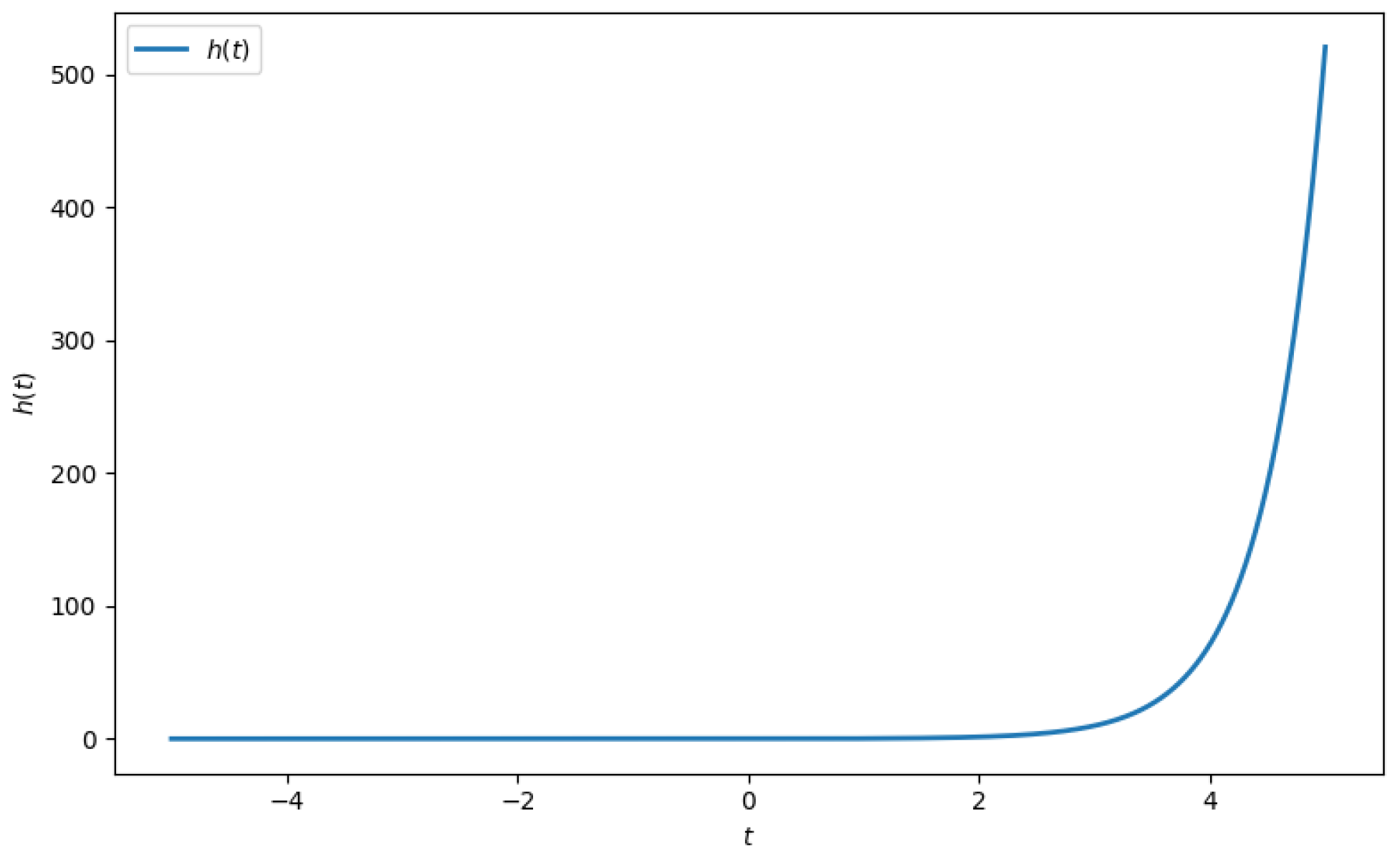
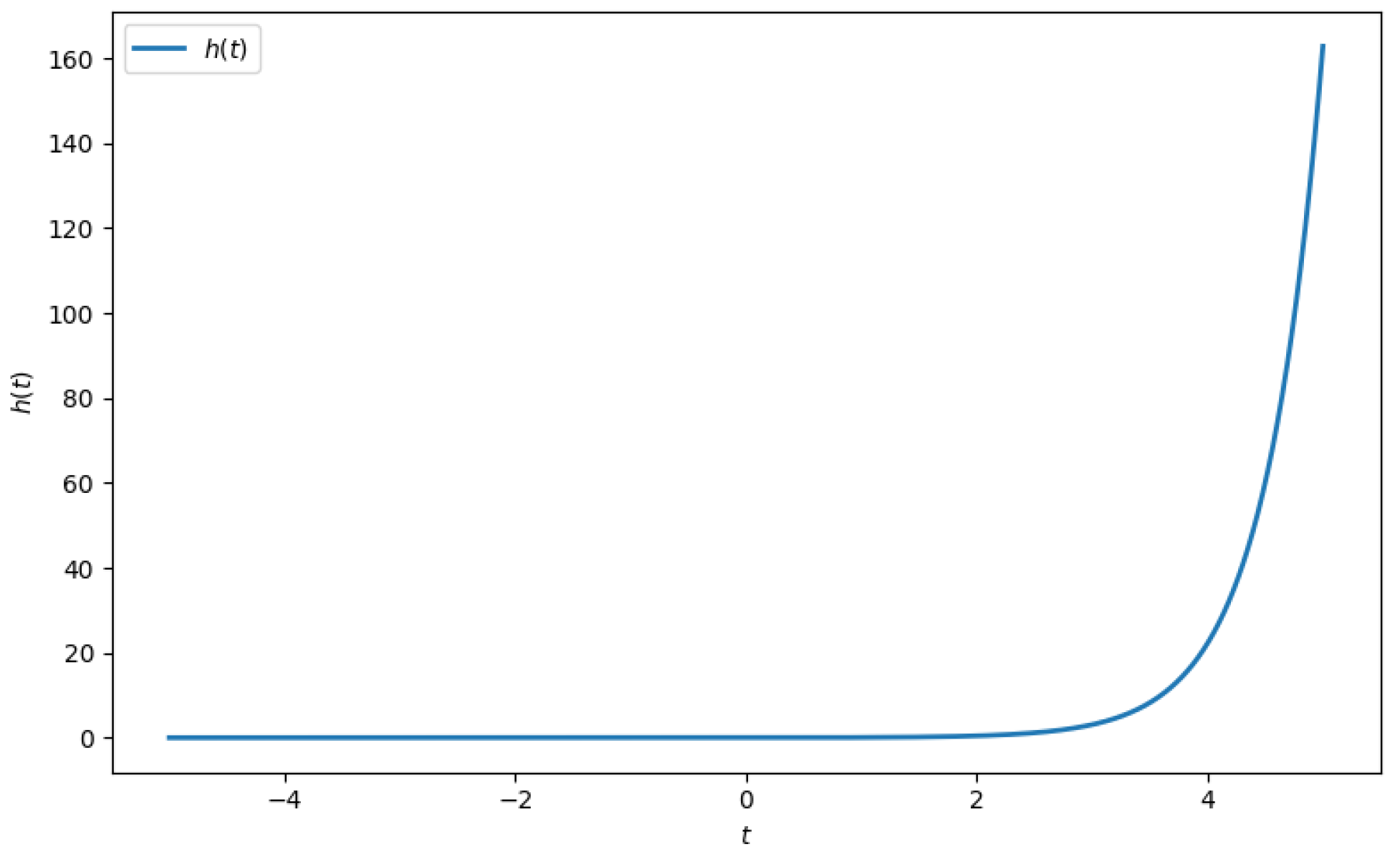
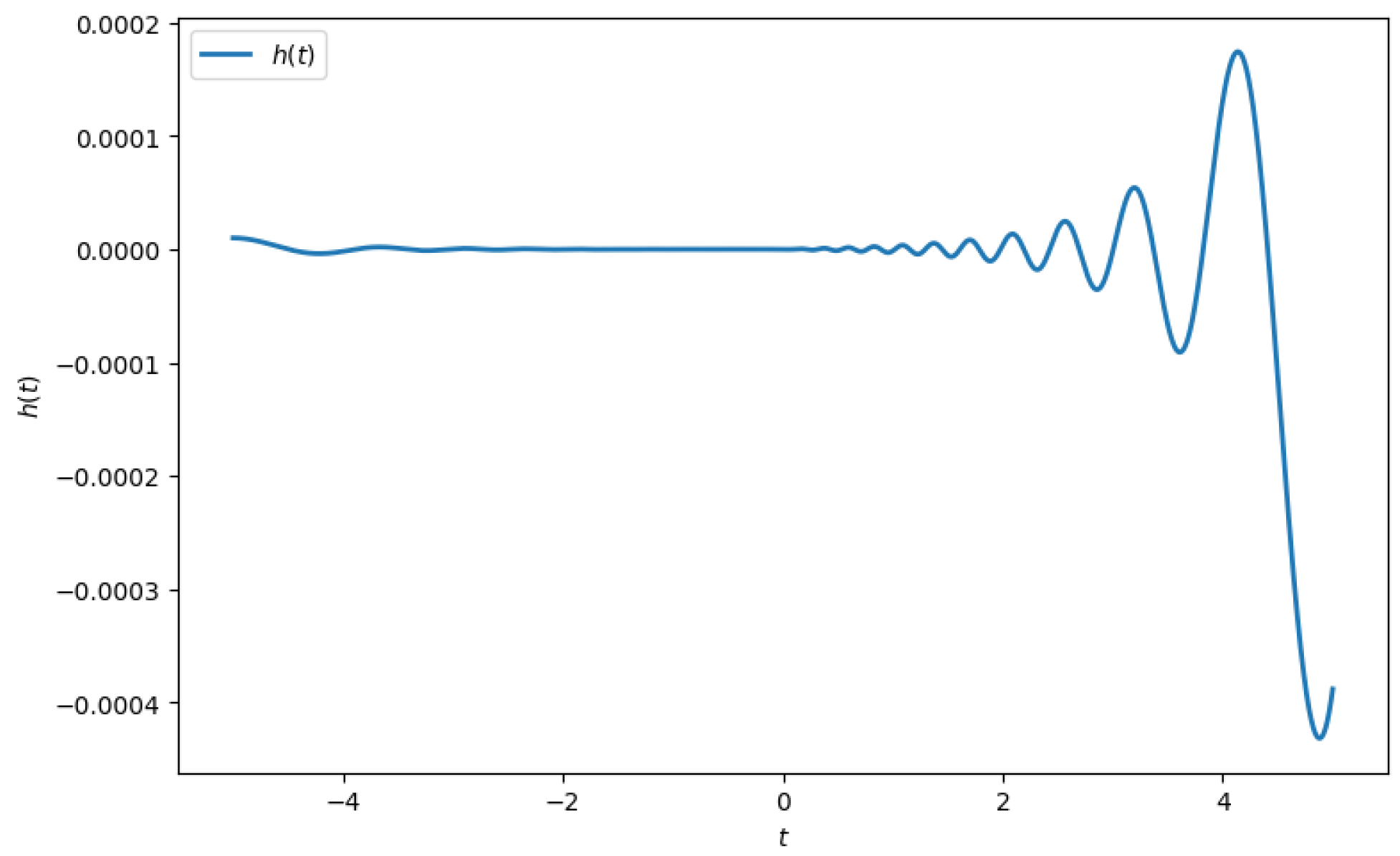
they stop growing and begin to oscillate. The lower the scale ( k ), the weaker the amplification of the tensorial modes. In the second regime, for large scales, there is an important amplification of the tensorial modes. In the long wavelength limit k 0 , the tensorial modes are amplified during the entire evolution of the universe. The general behavior for some specific configurations is given in Figure 1 and Figure 2. The appearance of oscillations is exemplified in Figure 3.
The instability found in Ref. [17] is now transferred to the future infinity, t , with the perturbations remaining finite for t < , diverging only asymptotically when the scale factor also diverges. Strictly speaking, the exponential divergence of the perturbations in the asymptotic future may indicate the presence of instabilities. However, these instabilities have a different character from that found in Ref. [17]. First of all, it must be underlined that the perturbative analyses made above used the linear regime, | h μ ν | 1 , a condition not satisfied when the tensorial modes begin to diverge. In this case, non-linear terms must be taken into account. Non-linear effects may, eventually, stabilize the configuration. If such a process occurs at a finite time, we may expect many observational signatures. One example is the fluctuation of the CMB temperature: observations indicate Δ T / T 10 5 , which is in the linear regime. If divergences in the fluctuations appear in our past, even if non-linear effects prevented a complete breakdown of the configuration, large fluctuations in observables such as the CMB temperature would be detectable outside the linear regime. A divergence at t may also be stabilized by non-linear effects but lead to no contradiction with the observables measured today. We would employ the word stable for those cases where the breakdown of the perturbative analysis occurs in the infinite future, even if, strictly speaking, from the geometric point of view, this may be considered an abuse of language.
The exponential growth of the perturbation in the asymptotic regime reflects the asymptotic de Sitter behavior of the singularity-free solution we are discussing. In the standard GR framework, the de Sitter phase is given by the background equation:
H 2 = 8 π G 3 ρ , 8 π G 3 ρ = Λ = c o n s t a n t .
Consequently, H is also constant. The scale factor behaves as follows:
a = a 0 e H t .
The evolution of gravitational waves using the variables employed in the analysis above is given by
h ¨ i j H h ˙ i j + { k 2 a 2 2 H 2 } h i j = 0 .
In the asymptotic region t ± (and also when k 2 / a 2 H 2 ), the solution contains exponentially growing modes given by
h i j t 2 H t .
displaying essentially the same behavior as found in the singularity-free model. As in the singularity-free model analyzed here, the gravitational perturbations grow asymptotically as the square of the scale factor, as we could expect. The statement that the singularity-free model is stable, in the sense discussed previously but with a huge amplification in some range of the gravitational wave modes, is coherent with similar properties of the de Sitter universe.

6.1.2. Domain Wall Fluid

The second case to be analyzed is the domain wall fluid. The solution for ϕ is given by (69). If the arbitrary constant A is again set at zero, the scalar field behaves as
ϕ = B cosh 1 / 2 t 1 a ϕ ˙ ϕ = H .
Hence, the equation for the propagation of the tensorial modes reads
h ¨ i j 2 H h ˙ i j + { k 2 a 2 2 H ˙ } h i j = 0 .
Inserting the background solution, the equation becomes
h ¨ i j tanh t h ˙ i j + { k ˜ 2 cosh t 1 cosh 2 t } h i j = 0 .
The initial conditions can be obtained by inspecting asymptotic solutions as t . The only finite solution is h i j constant. The second term in Equation (82) implies damping of the perturbations in the contraction phase and an anti-damping behavior during the expanding phase, leading to an amplification phenomenon. On the other hand, the last term implies that oscillations are present in the beginning of the contraction phase and at the end of the expanding phase, and amplifications do appear near the bounce in the time interval
cosh 1 a 0 2 k 2 < t < + cosh 1 a 0 2 k 2 .
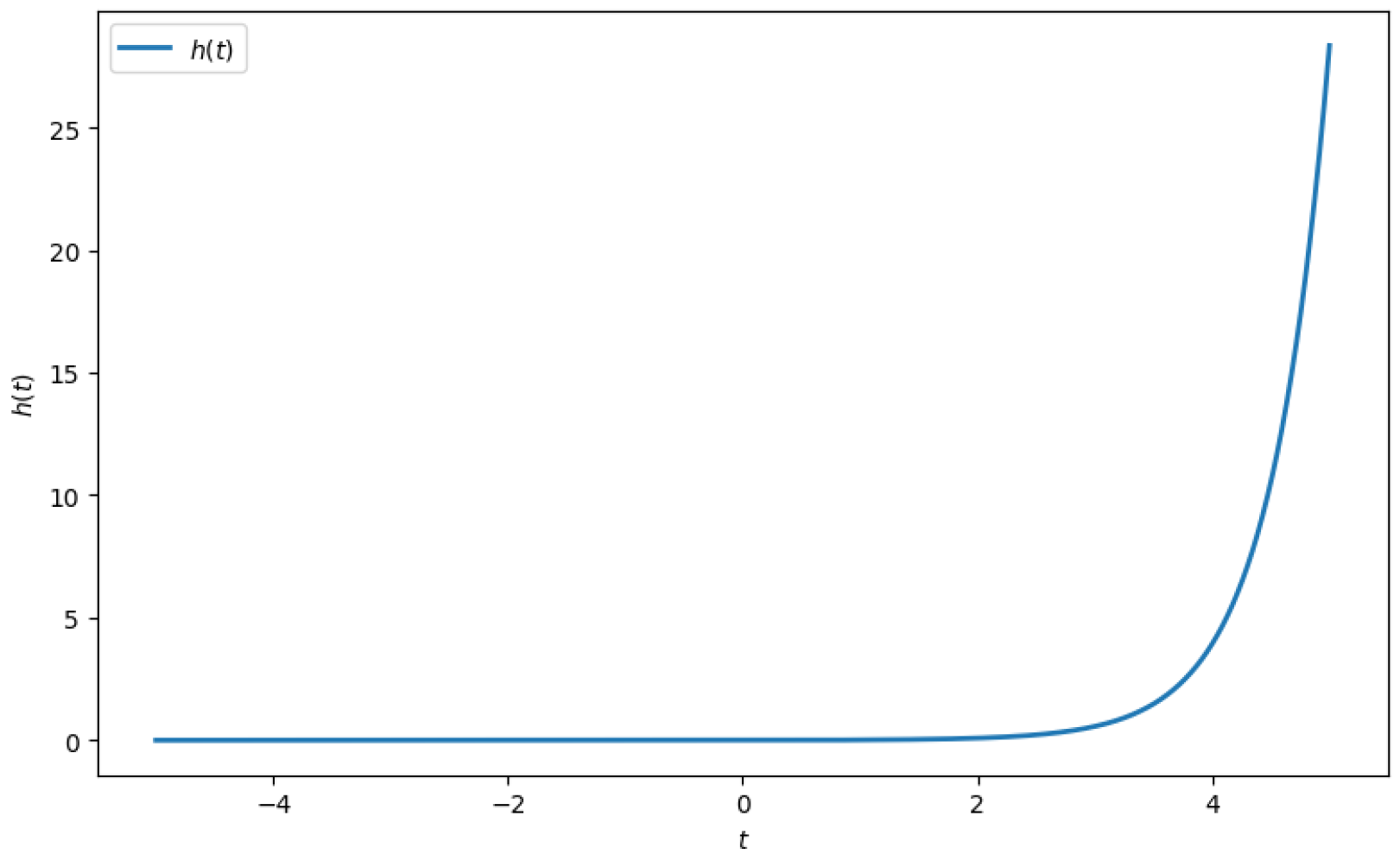
The amplification is less strong than for the pressureless case. A specific example is given in Figure 4. In any case, there is no possible divergence in a finite time interval.

6.2. Scalar Perturbations

Even if the tensorial modes display a regular behavior, instabilities due to the violation of the energy conditions can be revealed by considering scalar perturbations. In General Relativity, for example, fluid models with negative squared sound velocity, even with regular behavior in the tensorial modes sector, may display strong instabilities in scalar modes, mainly those directly connected with density perturbations [22]. However, for the model under analysis here, the non-singular behavior of the background is not driven by an exotic fluid but by the peculiar geometric structure of the effective equations in four dimensions resulting from the dimensional reduction from the five-dimensional UG.
A complete analysis of the scalar modes, and consequently of density perturbations, lies outside the purpose of the present article. One aspect that deserves a separate study concerns the ansatz of a constant four-dimensional Ricci scalar. This ansatz allows one to obtain a simple expression for the divergence of the energy-momentum tensor and, at the same time, an expression for the scale factor independent of the fluid. Even if the resulting equations for the background are all consistent with this ansatz, the perturbative analysis poses new questions. For example, should this ansatz also be valid for a perturbed universe? Moreover, there are also some more fundamental questions concerning the status of the unimodular five-dimensional constraint in five dimensions when projected to four dimensions and the resulting impact on the gauge choice for the perturbed quantities, a problem already presented in the usual four-dimensional UG (see [20,23]).
Now, we have just sketched a simple, particular analysis of the scalar mode that suggests that the background configuration discussed above is stable.
We will postpone the complete perturbative analysis to future work, mainly because there are many considerations that open the possibilities to more complex configurations, as discussed above. Hence, we will consider the pressureless case, with the background given by (67) with A = 0 , which is not essential for the final results but simplifies some expressions.
First, we note that the five-dimensional unimodular constraint, after reduction to four dimensions, can be written as
g ϕ = c o n s t a n t .
Perturbing this expression, using the synchronous gauge condition h μ 0 = 0 , results in the relation
δ ϕ ϕ = h 2 , h = h k k a 2 .
Perturbing the 0 0 component of the (43), the final equation is
h ¨ + 4 H h ˙ 2 h a 2 = 16 π G ρ δ , δ = δ ρ ρ .
The ansatz R = cte is preserved at the perturbed level. This is one of the working hypotheses that may admit other variants. However, it is a reasonable and consistent hypothesis. One consequence is that, for pressureless matter, the rotational mode decouples and a simple expression can be obtained for the density perturbations.
The perturbation of the resulting conservation law
T ν μ ; μ + ϕ ; μ ϕ T ν μ = 0 ,
after using the background equations, leads to
δ ˙ = 0 , δ = c o n s t a n t .
Performing a Fourier decomposition, the final equation for the pressureless case with the configuration (72) is
h ¨ + 4 H h ˙ + k 2 a 2 h = 16 π G ρ δ , δ = δ ρ ρ .
This equation clearly does not show any divergence, with a typically regular behavior of a damped non-homogeneous oscillator.
Even if the computation has been only sketchy and a deeper analysis is required, including on the underlying hypothesis, the final result suggests the possibility of stable behavior for the scalar modes.

7. Final Remarks

The unimodular Kaluza–Klein gravity (KK-UG) after dimensional reduction to four dimensions leads to an effective theory similar to the Brans–Dicke one with ω ˜ = 0 , with the important difference being that the Ricci scalar is absent in the pure four-dimensional field equations. The use of the Bianchi identities implies the possibility that the energy-momentum tensor is not conserved separately, a usual property of Unimodular Gravity. In the vacuum case, under an ansatz that imposes a constant Ricci scalar, the universe displays a bounce, avoiding a singularity. It has been shown [17] that such a configuration is unstable.
Similar instabilities appear already in the tensorial sector of the perturbed universe and are due to the change of sign in the scalar field (which, in the original theory, is connected to the fifth dimension). The inclusion of matter in the effective four-dimensional theory allows different scalar field configurations to be obtained without changing the behavior of the scale factor, which remains the same as in the vacuum case.
This curious fact seems to be related to the particular geometric structure of the effective theory in four dimensions. One feature of such solutions with matter is the possibility that the scalar field does not change its sign, remaining, in certain cases, always negative. This drastically changes the behavior at the perturbative level. In particular, the tensorial modes do not exhibit instabilities anymore, although the amplification of perturbations can be observed. An inspection of scalar perturbations also does not reveal instabilities, at least for a specific configuration.
Clearly, a complete perturbative analysis should be carried out. This implies the analysis of different variants of the perturbed model. For example, the condition R = cte may be relaxed at the perturbative level, leading to a complex coupling of the perturbed quantities, at least in the scalar sector. The tensorial modes are not affected by relaxing or not relaxing the above constraint. A complete perturbative analysis is under study, including possible observational signatures related to the cosmological scenario described in the present work.
Our final remark concerns a more detailed comparison with the standard cosmological model obtained in the GR framework, in particular with regard to the observational tests. Such a comparison would require an analysis of the different phases of the evolution of the universe in a multi-fluid scenario. This is the subject of future work, which aims to verify if a realistic cosmological model can be constructed in the KK unimodular framework considered here.


Author Contributions

Conceptualization, J.C.F. and R.K.; methodology, J.C.F. and R.K.; software, S.F.; validation, J.C.F., S.F. and R.K.; formal analysis, J.C.F., S.F. and R.K.; investigation, J.C.F., S.F. and R.K.; resources, J.C.F., S.F. and R.K.; data curation, J.C.F., S.F. and R.K.; writing—original draft preparation, J.C.F. and R.K.; writing—review and editing, J.C.F., S.F. and R.K.; visualization, J.C.F., S.F. and R.K.; supervision, J.C.F. and R.K.; project administration, J.C.F., S.F. and R.K.; funding acquisition, J.C.F. and R.K. All authors have read and agreed to the published version of the manuscript.

Funding

This research received no external funding.

Data Availability Statement

The original contributions presented in this study are included in the article.

Acknowledgments

J.C.F. and S.F. thank CNPq (Brasil) and FAPES (Brasil) for partial financial support.

Conflicts of Interest

The authors declare no conflicts of interest.

References

  1. Einstein, A. Spielen Gravitationsfelder im Aufbau der materiellen Elementarteilchen eine wesentliche Rolle? Sitzungsber. Preuss. Akad. Wiss. Berlin (Math. Phys.) 1919, 1919, 349–356. [Google Scholar]
  2. Einstein, A. Kosmologische Betrachtungen zur allgemeinen Relativitätstheorie. Sitzungsberichte Der KÖniglich Preuss. Akad. Der Wiss. Berlin (Math. Phys.) 1917, 1917, 142–152. [Google Scholar]
  3. Henneaux, M.; Teitelboim, C. The cosmological constant and general covariance. Phys. Lett. 1989, 222, 195–199. [Google Scholar] [CrossRef]
  4. Buchmüller, W.; Dragon, N. Gauge fixing and the cosmological constant. Phys. Lett. 1989, 223, 313–317. [Google Scholar] [CrossRef]
  5. Unruh, W.G. Unimodular theory of canonical quantum gravity. Phys. Rev. D 1989, 40, 1048. [Google Scholar] [CrossRef]
  6. Weinberg, S. The cosmological constant problem. Rev. Mod. Phys. 1989, 61, 1. [Google Scholar] [CrossRef]
  7. Alvarez, E.; Velasco-Aja, E. A Primer on Unimodular Gravity. arXiv 2023, arXiv:2301.07641. [Google Scholar] [CrossRef]
  8. Carballo-Rubio, R.; Garay, L.J.; García-Moreno, G. Unimodular gravity vs general relativity: A status report. Class. Quantum Grav. 2022, 39, 243001. [Google Scholar] [CrossRef]
  9. Arnold, V.I. Analytic Conservation Laws. Ann. De L’Institut Fourier 1966, 16, 319–327. [Google Scholar] [CrossRef]
  10. Arnold, V.I. Collected Works Volume II: Hydrodynamics, Bifurcation Theory, and Algebraic Geometry 1965–1972; Springer: Berlin, Germany, 2014. [Google Scholar]
  11. Kaluza, T. Zum Unitätsproblem der Physik. Sitzungsber. Preuss. Akad. Wiss. Berlin (Math. Phys.) 1921, K1, 966. [Google Scholar]
  12. Klein, O. Quantentheorie und fünfdimensionale Relativitätstheorie. Zeitschr. Phys. 1926, 37, 895. [Google Scholar] [CrossRef]
  13. Jordan, P. Erweiterung der projektiven Relativitätstheorie. Ann. Phys. Leipzig 1947, 1, 219–228. [Google Scholar] [CrossRef]
  14. Thiry, Y. The equations of Kaluza’s unified theory. Compt. Rend. Hebd. Seances Acad. Sci. 1948, 226, 216. [Google Scholar]
  15. Kerner, R. Geometrical background for the unified field theories: The Einstein-Cartan theory over a principal fibre bundle. Ann. Inst. Poincare Sect. A 1981, 34, 437. [Google Scholar]
  16. Fabris, J.C.; Kerner, R. A unimodular Kaluza-Klein theory. Phys. Scr. 2024, 99, 085042. [Google Scholar] [CrossRef]
  17. Fabris, J.C.; Kerner, R. On the Stability of Non-Singular Solutions in Effective Theory from Kaluza-Klein Unimodular Gravity. Symmetry 2025, 17, 419. [Google Scholar] [CrossRef]
  18. Brans, C.H.; Dicke, R.H. Mach’s Principle and a Relativistic Theory of Gravitation. Phys. Rev. 1961, 124, 925. [Google Scholar] [CrossRef]
  19. Vilenkin, A.; Shellard, E.P.S. Cosmic Strings and Other Topological Defects; Cambridge University Press: Cambridge, UK, 1994. [Google Scholar]
  20. Bengochea, G.R.; Leon, G.; Perez, A.; Sudarsky, D. A clarification on prevailing misconceptions in unimodular gravity. J. Cosmol. Astropart. Phys. 2023, 11, 11. [Google Scholar] [CrossRef]
  21. Weinberg, S. Cosmology and Gravitation; Wiley: New York, NY, USA, 1972. [Google Scholar]
  22. Fabris, J.C.; Martin, J. Amplification of density perturbations in fluids with negative pressure. Phys. Rev. D 1997, 55, 5205. [Google Scholar] [CrossRef]
  23. Gao, C.; Brandenberger, R.H.; Cai, Y.; Chen, P. Cosmological perturbations in unimodular gravity. J. Cosmol. Astropart. Phys. 2014, 9, 21. [Google Scholar] [CrossRef]
Figure 1. Evolution of the tensorial mode for Equation (73), with A = 0 and B = 1 , with the initial conditions at t = 5 , h ( t 0 ) = h ( t 0 ) = 10 6 . The parameters k and a 0 were fixed at 1.
Universe 12 00075 g001
Figure 2. Evolution of the tensorial mode for Equation (73), with A = 0.5 and B = 1 , with the initial conditions at t = 5 , h ( t 0 ) = h ( t 0 ) = 10 6 . The parameters k and a 0 were fixed at 1.
Universe 12 00075 g002
Figure 3. Evolution of the tensorial mode for Equation (73), with A = 0 and B = 1 , with the initial conditions at t = 5 , h ( t 0 ) = h ( t 0 ) = 10 6 . The chosen values are k = 30 and a 0 = 1 . Oscillations appear near the bounce.
Universe 12 00075 g003
Figure 4. Evolution of the tensorial mode for Equation (82), with A = 0 and B = 1 , with the initial conditions at t = 5 , h ( t 0 ) = h ( t 0 ) = 10 6 . The parameters k and a 0 were fixed at 1.
Universe 12 00075 g004
Disclaimer/Publisher’s Note: The statements, opinions and data contained in all publications are solely those of the individual author(s) and contributor(s) and not of MDPI and/or the editor(s). MDPI and/or the editor(s) disclaim responsibility for any injury to people or property resulting from any ideas, methods, instructions or products referred to in the content.