1. Introduction
Space weather is defined as the physical state and dynamic processes of the near-Earth space environment, especially those dominated by electromagnetic interactions that create measurable effects on technological systems on Earth and in orbit systems [
1]. Its variability is in large part due to solar activity, such as geomagnetic storms, substorms, energization of the Van Allen belts, ionospheric disturbances, scintillation that affects satellite-to-ground communication links, and geomagnetically induced currents on the Earth’s surface. Dominant drivers include coronal mass ejections as follows: vast expulsions of magnetized plasma from the solar corona whose propagation toward Earth significantly perturbs the Earth’s magnetosphere and drives geomagnetic storms [
2].
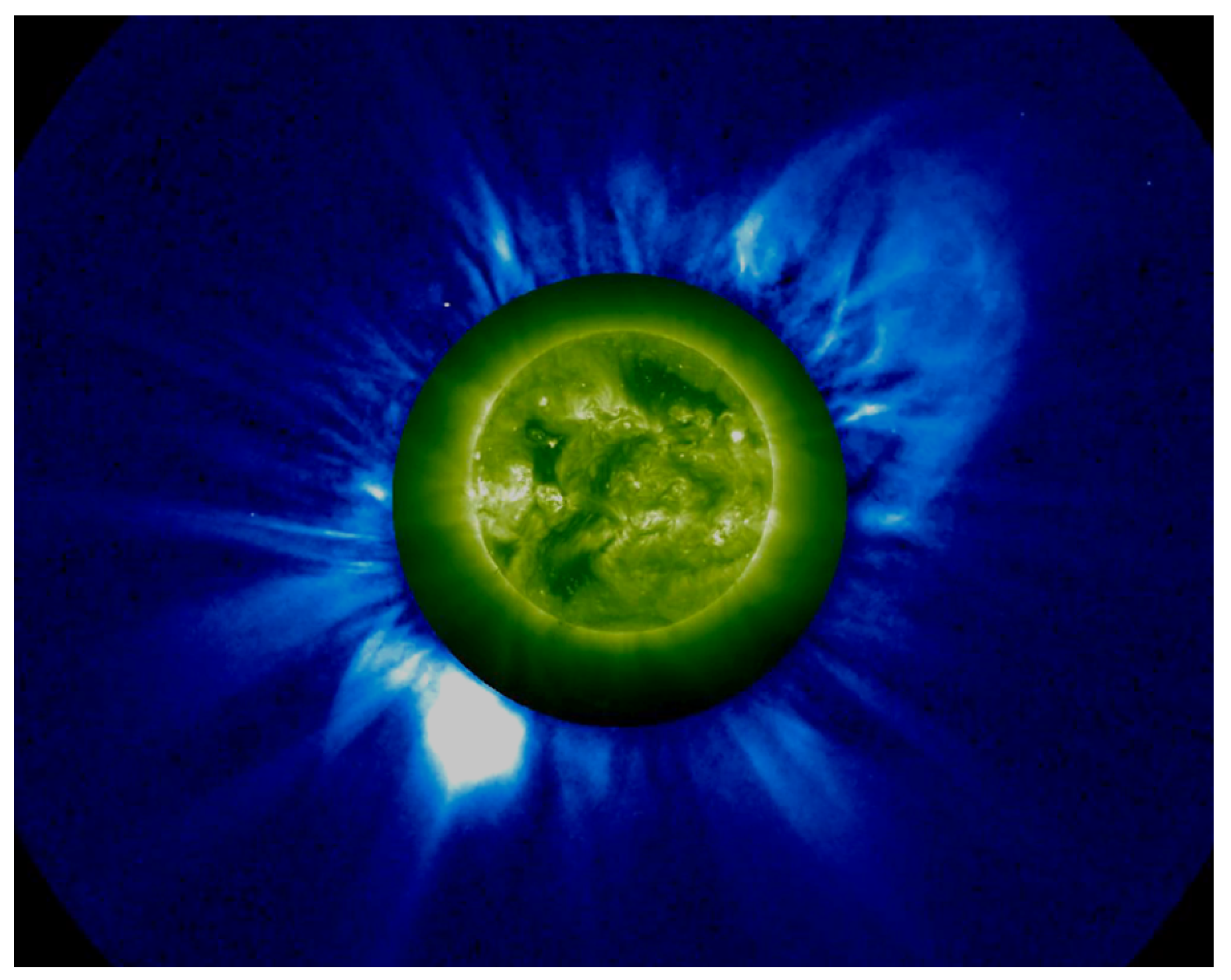
Figure 1 shows two coronal mass ejections (CME) detected by the STEREO Behind spacecraft, illustrating the outward propagation of a dense plasma cloud from the solar corona.
Space weather influences both terrestrial and space-based infrastructures, and one of the most sensitive domains is radio propagation and telecommunications. Geomagnetic disturbances can induce harmful currents in power transmission systems, disrupt navigation-dependent transportation networks, and degrade telecommunication services, leading to interruptions of critical public functions. Perturbations in the ionosphere and upper atmosphere driven by flares, solar energetic particles (SEP), CME, and plasma irregularities trigger radio blackouts across HF, VHF, and satellite communication bands; impair GNSS performance; affect aviation and military radar systems; and heat the upper atmosphere, increasing drag on low-Earth-orbit satellites, including the International Space Station [
3]. In space, enhanced surface and deep-dielectric charging may lead to electrical discharges, resets, permanent anomalies, or even loss of spacecraft, whereas high-energy particles induce single-event upsets (SEUs), saturate sensors, and degrade communication and navigation links [
4].
Radionavigation-satellite service (RNSS) signals are essential for the most recent positioning, navigation, and timing (PNT) applications and also for atmospheric sounding by radio occultation, and they are especially prone to these perturbations. Ionospheric irregularities distort the amplitude and phase during propagation, reducing signal reliability and potentially causing loss of lock between receiver and satellite [
5,
6,
7]. Variations in total electron content (TEC) further degrade positioning accuracy, affecting navigation and timing-dependent services [
1,
8]. Analogous vulnerabilities affect defense and aerospace operations dependent on resilient SATCOM links, over-the-horizon radars, and precise PNT services [
9]. Space weather-induced degradation can decrease situational awareness and operational efficiency—for instance, by altering GNSS-based guidance for UAVs or missile systems, or by compromising battlefield communications under enhanced scintillation conditions [
1,
10].
In broader terms, the implications involve satellite safety, mission longevity, and human activities in space. Geomagnetic storms increase atmospheric drag, which accelerates the orbital decay of LEO satellites, while energetic particle radiation poses health risks to astronauts [
11,
12]. On Earth, rapid geomagnetic fluctuations induce harmful voltages in power systems, which may trigger blackouts and disrupt civil and military logistics.
Given these vulnerabilities, continuous monitoring and accurate forecasting of space weather are essential to maintain the safety and continuity of modern communications, navigation, and defense services. However, this imperative now coincides with an unprecedented demand for radio frequency spectrum driven by technologies such as 5G/6G and IoT. Radio frequency bands vital for weather forecasts, early warnings, climate monitoring, and space weather prediction must be protected from harmful interference, as underscored by the World Meteorological Organization [
13]. The National Oceanic and Atmospheric Administration (NOAA) and National Center for Atmospheric Research (NCAR), for example, warn that 5G transmissions in the 24 GHz band may bleed into the adjacent 23.8 GHz frequency used by weather satellites to detect atmospheric water vapor [
14,
15]. Such interference could degrade water-vapor retrievals by up to 77%, harming forecast accuracy [
15]. Similar concerns arise in the 6/7 GHz range, where IMT reallocations threaten passive sea-surface temperature measurements [
13].
Recognizing these tensions, WRC-23 formally acknowledged space weather sensors in the Radio Regulations and created the new MetAids (space weather) service, laying the groundwork for WRC-27 allocations. Stakeholders, including the International Amateur Radio Union, argue that the spectral scope remains too broad and may affect incumbent services [
16]. Regulatory pressure intensifies as noted by [
17], who highlight that many WRC-27 agenda items may increase risks for aeronautical and space-based systems, reinforcing the need to secure the spectrum for passive sensing.
At this point, it is important to clarify the terminology used in this paper. In a technical sense, passive or receive-only sensors operate exclusively by receiving naturally occurring emissions, without transmitting radio frequency energy. However, within the ITU Radio Regulations, different categories of passive observations are associated with distinct radiocommunication services and protection criteria.
Although radio astronomy, Earth Exploration-Satellite Service (passive), and Meteorological Aids (space weather) all rely on passive reception, they are governed by different regulatory frameworks and benefit from different allocation statuses and protection criteria. The Radio Astronomy Service (RAS) and the Earth Exploration-Satellite Service (EESS, passive) have long-standing, explicitly defined allocations in specific frequency bands, whereas many space weather instruments have only recently been formally recognized within the Meteorological Aids (space weather) service following WRC-23. Accordingly, in this paper, the terms passive and receive-only describe the technical mode of operation, while space weather sensors, radio astronomy, and EESS (passive) refer to distinct regulatory categories, a distinction that is essential for the regulatory analysis developed in the following sections.
In this context, this paper makes two contributions. First, it provides a holistic technical and regulatory review of passive space weather sensors, such as riometers and solar-flare monitors, synthesizing their physical operating principles, documented interference vulnerabilities, and role in forecasting and operational continuity.
Section 2,
Section 3 and
Section 4 address the first contribution of this work by reviewing passive space weather sensors, their operating bands, and documented interference impacts.
Second, it provides an integrated cross-disciplinary analysis that contextualizes sensing requirements within the evolving spectrum-management landscape, examining how technical protection criteria relate to the regulatory mechanisms under consideration for WRC-27.
Section 5 and
Section 6 analyze coexistence challenges, compatibility studies, and protection criteria, while
Section 7 discusses the ongoing regulatory developments under WRC-27 Agenda Item 1.17. Finally,
Section 8 summarizes the main results and concludes with perspectives aimed at strengthening spectrum-protection mechanisms and ensuring the long-term viability of passive space weather observations.
2. Frequency Bands and Applications
Recent changes to the rules have highlighted the important role that space weather sensors play in managing global radio frequencies. The 2023 World Radiocommunication Conference (WRC-23) reached consensus on the formal recognition of space weather sensors within the Radio Regulations, adding a new service, Meteorological Aids (MetAids–space weather) [
18]. The WRC-23 formally identified that space weather observations are part of the Meteorological Aids Service, operating under the MetAids (space weather) subcategory in Article 29B of the Regulations. Moreover, WRC-23 adopted Resolution 675, which recognizes the vital importance of space weather observations and provides precise technical definitions for the space weather concept as well as for categories of active and receive-only sensors employed in these applications [
19]. This milestone represents not only the acknowledgment of the importance of these passive systems but also an enhancement of their protection against harmful interference.
Unlike the Radio Astronomy Service (RAS), which benefits from long-established protection criteria and explicitly defined regulatory provisions in specific frequency bands, receive-only space weather sensors are only now entering a phase of formal regulatory consolidation. While RAS has long relied on well-established recommendations and protection thresholds within the ITU framework, the MetAids (space weather) service is still in the process of defining its spectrum footprint, protection criteria, and notification procedures. This difference in regulatory maturity provides important context for the studies initiated under WRC-23 and motivates the ongoing work toward WRC-27.
Based on this, Agenda Item 1.17 (AI 1.17) was included in the agenda of the upcoming WRC-27, initiating actions involving the study of regulatory provisions for receive-only space weather sensors. Under this agenda item, ITU-R groups were invited to carry out the following tasks, according to Resolution 682 (WRC-23) [
20]:
- (a)
Assess spectrum demand, protection criteria, and the technical characteristics of receive-only space weather sensors.
- (b)
Conduct sharing and compatibility studies for potential new primary allocations in the 27.5–28.0 MHz, 29.7–30.2 MHz, 32.3–32.6 MHz, 37.5–38.325 MHz, 73.0–74.6 MHz, and 608–614 MHz bands, all dedicated to receive-only operations.
- (c)
Explore regulatory mechanisms that would allow administrations to formally notify receive-only sensors in the Master International Frequency Register (MIFR), thereby improving international awareness and coordination.
Therefore, AI 1.17 aims to consider regulatory provisions for receive-only space weather sensors and their protection within the framework of the Radio Regulations. This approach reflects the growing international recognition of space weather observations as a critical factor and highlights the necessity of robust protection for the technical systems supporting these observations. Ensuring proper regulatory treatment of these sensors is fundamental to maintaining the operational continuity of diverse human activities that rely heavily on space-based and radiocommunication technologies [
19].
It is important to emphasize that this initiative focuses on receive-only sensors, a technical characteristic that shapes the regulatory approach adopted. Since these sensors operate exclusively in receive mode, they do not cause interference to other services in the same or adjacent frequency bands, which significantly alters the traditional electromagnetic compatibility study methodology [
19]. Given this unique technical feature, conventional sharing and compatibility studies that typically assess the impact of new services on incumbents are not required. Instead, the methodological approach must be reversed: studies must analyze the impact of incumbent services on receive-only space weather sensors within the frequency bands under consideration. This revised approach aims to provide administrations with the technical conditions necessary for deploying space weather sensors under the potential new MetAids (space weather) allocations [
19].
Based on [
19] and the studies conducted under Resolution 682 [
19], this section examines the proposed new primary frequency bands for receive-only space weather applications under current regulatory processes and provides contextual links to the types of sensors and observations associated with these bands. Rather than focusing on the detailed technical implementation of each instrument, the emphasis here is on the spectral organization itself: how the candidate and allocated bands are grouped, what categories of passive observations they support, and how these bands relate to established classes of space weather sensors such as riometers, solar radio monitors, interplanetary scintillation systems, and GNSS-based receivers. This approach clarifies the regulatory and spectral context in which passive space weather sensing operates, while the physical principles, measurement techniques, and detailed sensor typologies are addressed in
Section 3. It is important to highlight that the riometers, solar radio monitors, and scientific GNSS receivers discussed in this work serve as representative examples of radio-based passive sensing systems within the broader classification outlined in [
1]. Although other relevant passive instruments—such as ionospheric D-region monitoring sensors and oblique ionospheric sounding systems—are included in this framework, individual details on these systems are not provided here to maintain focus on the illustrative cases directly related to current spectrum-sharing and interference challenges. As previously described, ref. [
20] establishes a technical study framework to support the integration of space weather monitoring capabilities into the international radiocommunication regulatory structure, focusing on the spectrum requirements and protection criteria necessary for receive-only space weather sensors.
Based on [
21], which provided formal definitions for space weather phenomena and designated space weather sensors within the meteorological aids service under the MetAids (space weather) subcategory, ref. [
20] addresses the practical implementation challenges. The proposed study covers three technical areas as follows: the assessment of spectrum needs, the development of appropriate protection criteria, and a comprehensive analysis of the system characteristics for receive-only space weather monitoring systems.
Also, ref. [
20] addresses the diverse spectral needs of space weather monitoring by identifying six frequency bands—covering the high-frequency (HF), very high-frequency (VHF), and ultra-high-frequency (UHF) ranges—that require sharing and compatibility analysis for possible new primary allocations. The selection of these specific bands indicates a strategic approach to accessing spectrum resources. This approach aims to support the wide-ranging measurement requirements of space weather science, covering different systems, from ionospheric monitoring to the detection of solar radio emissions.
Additionally, the aforementioned resolution introduces specific operational constraints for receive-only space weather sensor stations within the meteorological aids service, given that stations operating exclusively in receive-only mode are subject to important limitations regarding interference protection and spectrum development rights. These stations cannot claim protection from interference generated by existing services, nor can they impose constraints on the future expansion and development of several categories of primary services.
Table 1 shows the existing services allocated in the frequency bands considered under AI 1.17, based on [
22].
Additionally, the regulatory text establishes that those stations must operate without claiming protection from meteorological aids, fixed, and mobile services that hold primary allocations within the same frequency band. This principle of non-protection further extends to services of adjacent frequency bands, which include fixed services; mobile services, not including aeronautical mobile-amateur services; and amateur-satellite services that keep their primary allocation status in the neighboring spectral regions [
19]. Finally, accepting this status of protection, space weather monitoring systems shall have access to valuable spectrum resources, particularly unobstructing the operation and evolution of radiocommunication services. This proposal effectively balances the scientific importance of space weather observations with the practical necessity of efficient spectrum utilization, while establishing a coexistence model in a sustainable manner for critical monitoring and conventional radiocommunications applications [
19].
This regulatory approach recognizes the peculiar operational characteristics of receive-only sensors and their passive operation within the electromagnetic spectrum. In return for this subordinate protection status, space weather monitoring systems can leverage highly valuable spectrum resources, assured that their deployment will not hinder the ongoing operation and evolution of long-established radiocommunication services. Consequently, the framework effectively balances the scientific importance of space weather observations with the pragmatic imperative to sustain effective spectrum use across diverse categories of service-a model in support of both critical space weather monitoring and traditional radiocommunication applications [
19].
In the context of space weather monitoring, different parts of the radio spectrum support various observational strategies, from measuring solar radio emissions to diagnosing the ionosphere and monitoring geospace responses. These systems generate diverse datasets—such as spectral intensity, scintillation indices, and total electron content—which are crucial for forecasting and evaluating the resilience of radio-dependent infrastructures. From a regulatory viewpoint, the allocation and protection of these frequency bands are directly linked to their scientific and operational functions. Passive sensing activities depend on detecting naturally occurring emissions and weak signals, making them particularly vulnerable to interference. This highlights the need for effective spectrum management. The relationship between frequency use, sensor functionality, and data characteristics informs the later analysis of interference risks and regulatory considerations presented in this manuscript, summarized later in
Section 4.2, and aligns with the framework proposed for space weather sensor systems and their operational requirements [
1,
4,
7].
Finally, it is important to notice that the frequency bands identified under WRC-27 Agenda Item 1.1 are not arbitrary spectral intervals, but they are instead closely linked to specific classes of space weather observations and measurement objectives. Each group of bands supports a distinct set of physical diagnostics of the ionosphere, heliosphere, and solar activity, and therefore corresponds to different categories of receive-only sensors. At low frequencies, particularly in the HF and lower VHF ranges, candidate and allocated bands are associated with ionospheric monitoring techniques, including riometers, ionosondes, to monitor D-region absorption and plasma dynamics. In the VHF and UHF ranges, bands are more commonly linked to solar radio spectrographs, space weather radio monitoring networks, and GNSS-based ionospheric monitoring, which relies on adjacent protected bands to ensure data integrity.
From a regulatory perspective, this mapping between frequency bands and observation types highlights that protection requirements are driven not only by the spectral location of the band but also by the underlying measurement principle and sensitivity of the associated sensors. Instruments operating near the thermal noise floor or relying on weak natural emissions are particularly vulnerable to both in-band and out-of-band interference. Consequently, the spectral organization discussed in this section provides the necessary context for the more detailed technical description of sensor classes in
Section 3 and for the regulatory and coexistence analysis developed in
Section 5,
Section 6 and
Section 7.
In addition to regulatory allocations, the frequency bands discussed in this section are associated with well-established observation methods used in space weather science. In the HF range, ionosondes and coherent scatter radars are routinely employed to probe ionospheric structure and dynamics. In the VHF band, riometers and solar radio spectrographs monitor cosmic noise absorption and solar radio emissions, respectively. At UHF frequencies, GNSS-based receivers provide continuous measurements of total electron content and scintillation, while radio astronomy instruments operate in selected bands to observe natural celestial emissions. This correspondence between frequency ranges and observation methods provides the contextual basis for the examples summarized in
Section 4.
3. Passive Space Weather Sensors
Following the classification framework summarized in [
1], passive space weather sensors can be broadly grouped according to the physical domain they observe: sensors observing solar precursors, sensors observing the interplanetary medium, and sensors observing space weather impacts on the geospace environment.
In addition to radio-based passive sensors, space weather monitoring relies on a broader set of passive instruments operating across different physical domains. Ground- and space-based magnetometers measure geomagnetic field variations associated with solar wind–magnetosphere coupling. Particle detectors onboard satellites monitor energetic electrons and protons responsible for radiation hazards. Optical and ultraviolet imagers observe auroral emissions and ionospheric airglow, while spaceborne radiometers and spectrometers monitor solar irradiance and upper-atmospheric composition. Although these sensor classes are fundamental to space weather science, the present work focuses in greater detail on radio frequency passive sensors, as they are uniquely exposed to spectrum congestion and regulatory constraints.
In this context, and based on the regulatory studies summarized in [
1], the following subsections provide detailed discussion of three representative classes of radio-based passive sensors: riometers for ionospheric absorption monitoring, solar flare and solar radio burst monitors, and scientific GNSS receivers for ionospheric monitoring. Other sensor types relevant to space weather monitoring—including ionospheric oblique sounders, HF coherent scatter radars (e.g., SuperDARN), and D-region sensors—are acknowledged in
Table 2,
Table 3 and
Table 4 following the full taxonomy of ITU-R Report RS.2456-1, but are not examined in detail here. The three classes selected for deeper analysis were chosen based on the following two criteria: (i) their direct operational relevance to the frequency bands under study in WRC-27 Agenda Item 1.17 (particularly the HF, VHF, and UHF candidate bands listed in Resolution 682), and (ii) the availability of well-documented RFI case studies that directly support the regulatory and coexistence analysis developed in
Section 4,
Section 5,
Section 6 and
Section 7. Notably, oblique ionospheric sounders—while passive in their receive-only operational mode—also incorporate active transmission components, which places them in a distinct regulatory category not directly addressed by AI 1.17’s focus on receive-only sensors. These instruments illustrate the specific coexistence and protection challenges that motivate the regulatory analysis developed in the subsequent sections.
Passive sensors are an essential component of space weather monitoring architectures worldwide. Their importance lies in the continuous observation of natural emissions from the Sun–Earth system, enabling forecasting, hazard detection, situational awareness, and protection of technological infrastructures. Passive observations underpin early-warning capabilities, support both operational and strategic decisions, provide essential inputs to advanced numerical models, and enable fundamental research on the physical processes governing solar and geospace variability [
1].
Unlike active systems, passive sensors operate exclusively by detecting naturally occurring radiation—whether emitted, scattered, or modified by solar and geospace phenomena—without transmitting electromagnetic signals of their own. This operational mode inherently reduces system complexity and power consumption while eliminating risks of self-generated interference. As noted by NASA, passive sensors commonly observe ultraviolet, infrared, and radio frequency emissions intrinsic to solar and heliospheric dynamics [
23].
Passive space weather sensors may be broadly classified according to their scientific objectives and the physical parameters that they monitor. A major class consists of detectors observing solar radiation, including visible, ultraviolet, X-ray, and gamma-ray emissions, which provide key diagnostics of solar flares, coronal mass ejections, and irradiance variability. An example is the Solar Irradiance Variability Monitor proposed for future space weather missions [
24].
A second major class includes magnetometers designed to measure variations in the geomagnetic field caused by solar-wind coupling and geomagnetic storms. A representative example is the fluxgate magnetometer aboard GEO-KOMPSAT-2A, employed operationally for space weather surveillance [
25]. A third class comprises charged-particle detectors capable of measuring the flux, spectra, and composition of energetic electrons, protons, and ions. Instruments such as the SIXS particle-and-X-ray spectrometer exemplify this dual-channel capability [
26].
Beyond solar and interplanetary monitoring, several ground-based systems observe ionospheric variability that directly impacts radio-wave propagation. These complementary systems capture distinct aspects of ionospheric dynamics at different frequency ranges and altitude regions. GNSS-based monitoring has become central: multi-frequency receiver networks provide continuous estimation of total electron content (TEC), scintillation indices, and detection of equatorial plasma bubbles, as reported by large-scale distributed GNSS array studies in South America [
27]. Low-cost GNSS IoT sensors are increasingly deployed to support both educational activities and dense bubble-detection networks, enabling real-time monitoring via inexpensive hardware and embedded processing [
28]. Complementing GNSS, SDR-based receivers in HF/VHF/UHF bands provide flexible, low-cost platforms to investigate propagation changes, signal fading, and other ionospheric disturbances [
29].
Together, these heterogeneous systems form an integrated observational framework capable of capturing disturbances from the ionosphere, thereby supplying essential data for forecasting, modeling, and protecting radio-dependent infrastructures.
In this work, we adopt the sensor typology proposed in Report ITU-R RS.2456-1, categorizing passive space weather sensors into the following three domains:
Sensors observing solar precursors: solar-corona monitoring in radio bands from tens of MHz to tens of GHz.
Sensors observing the interplanetary medium: solar-wind structure, shock arrival, and magnetic-cloud detection along the Sun–Earth line.
Sensors observing space weather impacts: instruments monitoring ionospheric, magnetospheric, and radiation-belt responses that affect terrestrial and space-based technologies.
Passive space weather sensors operating in the radio spectrum can be further categorized based on their measurement technique and also according to the specific solar–terrestrial phenomena they observe. As summarized in
Table 2,
Table 3 and
Table 4, these passive sensors provide a logical radio-based observational infrastructure from solar through heliospheric to ionospheric domains that are be used to support scientific research and operational space weather services.
Table 2 emphasizes the sensors for monitoring solar precursor events. Those are single-frequency solar radio flux monitors, wideband solar radio spectrographs, and radioheliographs. These systems operate over microwave, VHF, and HF–UHF bands, detecting continuum emissions, solar burst activity, and spatially resolved radio maps of the solar atmosphere. Such measurements provide critical information about flare development, CME onset, and variability in solar irradiance.
Table 3 summarizes sensors used to observe the interplanetary medium, principally via interplanetary scintillation (IPS). IPS monitors record the rapid intensity fluctuations of cosmic radio sources resulting from density irregularities in the solar wind and CME structures. Operating entirely on celestial radio emissions, the IPS systems remotely sense heliospheric plasma without energy transmission.
Table 4 lists the sensors to monitor the geospace effects of space weather. RNSS receivers, when utilized as a monitoring tool, measure the ionospheric TEC and scintillation by analyzing distortions in the navigation satellite signals. Riometers measure absorption of cosmic noise in the VHF band to detect D-region disturbances caused by solar X-ray events and particle precipitation. Together, these sensors characterize the ionospheric and magnetospheric responses that directly affect communication, navigation, and space-based systems.
3.1. Riometers for Ionospheric Absorption Monitoring
Riometers (Relative Ionospheric Opacity Meters) quantify ionospheric absorption by measuring cosmic noise absorption (CNA), enabling the estimation of D-region electron densities at altitudes of approximately 70–100 km. Classical work by [
30] demonstrated that riometer absorption values near 27.6 MHz can be used to infer D-region electron densities with reasonable accuracy, typically within a factor of ∼1.6 for nearly half of the observations, establishing the method as a practical diagnostic tool for lower ionospheric studies. They play a important role in space weather applications because they can provide continuous measurements of ionospheric absorption directly associated with solar flares, auroral activity, and geomagnetic storms. By monitoring the attenuation of cosmic radio noise caused by free electrons in the ionosphere, particularly around the 100 km altitude region, these instruments supply real-time or near-real-time information on ionospheric conditions affected by dynamic space weather processes.
Riometers detect large increases in absorption during space weather disturbances, such as auroras or solar proton events, due to increased ionization. Such signatures indicate perturbations in the ionosphere that may degrade radio communications and navigation-system performance. Large-scale networks of riometers, such as the Global Riometer Array (GloRiA), are strategically deployed in high latitudes where ionospheric absorption events are most pronounced, providing extensive spatial coverage for monitoring geomagnetic activity [
1]. Riometers are also used operationally to provide near real-time space weather monitoring, providing input to nowcasting models and alerting systems. Representative operational frequencies such as 30 MHz and 38.2 MHz represent a compromise between absorption sensitivity and sufficient penetration through the ionosphere. Their data are commonly integrated with those acquired from ionosondes, GNSS receivers, and satellite borne sensors to form a combined picture of the space weather effects upon the ionosphere.
Solar flare studies using riometer data show strong correlations between CNA enhancements, increases in solar X-ray radiation, and elevated geomagnetic activity. These observations help quantify radio-wave fade-outs and signal attenuation during major space weather events, offering valuable constraints for understanding and mitigating ionospheric disturbances that impact communication and navigation services [
31]. Therefore, riometers are fundamental passive space weather monitoring instruments for measuring ionospheric absorption as a function of dynamic processes in the D-region. Long-term datasets from these instruments support not only scientific research but also operational forecasting in regions prone to auroral activity.
3.2. Solar Flare and Solar Radio Burst Monitors
Solar radio bursts (SRBs) are among the most critical solar emissions for operational space weather monitoring because their intense, broadband radio flux can directly disrupt radio frequency systems on Earth and in orbit. Observations from September 2017 solar events demonstrated that strong SRBs in the L-band can exceed the received power of GNSS signals by several orders of magnitude, causing widespread loss of lock, navigation outages, and severe positioning degradation, as documented in [
32,
33]. These events underscore the need for continuous monitoring of solar radio activity across multiple frequency ranges to support early warning, diagnostics, and forecasting of solar-driven disturbances.
SRB observations rely on radio flux measurements and dynamic spectra capable of resolving the rapid spectral–temporal evolution of bursts associated with solar flares, coronal mass ejections (CMEs), and CME-driven shocks. Dynamic spectrographs operating from approximately 20 MHz to 2 GHz provide key diagnostics for identifying burst types, source regions, and underlying emission mechanisms, while higher-frequency systems (e.g., EOVSA and MUSER) extend coverage into the decimetric and microwave domains. Continuous observations with high temporal resolution (subsecond to a few seconds) and low latency (1–5 min) are essential operational requirements, ensuring that SRB-driven hazards can be rapidly detected by global space weather service networks [
1].
Routine radio flux indices remain fundamental in contextualizing transient SRB activity. The daily 10.7 cm (2800 MHz) solar flux, for example, serves as a stable proxy for long-term solar ultraviolet and EUV variability and is routinely assimilated in atmospheric and climatological models. Although not a flare detector, the F10.7 index complements dynamic SRB observations by providing a baseline of solar activity, helping to attribution of space weather-related anomalies in GNSS, HF/VHF propagation, and satellite operations [
34].
SRBs themselves are highly structured emissions whose types are well characterized in the literature. Type II and Type III bursts, in particular, offer strong diagnostic value for flare and CME forecasting. A comprehensive review in [
35] using the Green Bank Solar Radio Burst Spectrometer confirms their importance in identifying regions of shock propagation and particle acceleration. Low-frequency interferometric arrays such as DLITE (30–40 MHz) have demonstrated the ability to detect long-duration Type II and Type IV bursts with fine spectral (approx. 16 kHz) and temporal (approx. 1 s) resolution, supporting the rapid detection of shock-associated signatures [
36]. Statistical analysis of e-CALLISTO network observations has shown strong correlations between Type III burst occurrence rates and solar cycle indicators, including sunspot number, reinforcing their value for near-real-time hazard prediction [
37]. Long-term Wind/WAVES observations demonstrate that nearly all high-flux (>10 MeV) solar energetic particle (SEP) events are associated with Type II bursts and about 92% with concurrent Type III bursts, enabling predictive models with detection probabilities of about 62% and correct-classification rates near 85% [
38].
Together, these studies confirm that SRB monitoring—particularly broadband dynamic spectral measurements—is indispensable for characterizing the onset and evolution of solar eruptive events. The integration of SRB spectrographs, flux monitors, interferometric arrays, and global networked systems (e.g., RSTN, e-CALLISTO, LOFAR, and MUSER) forms a foundational observational infrastructure for space weather services. Their data provide the earliest available signatures of flare initiation, shock emergence, and particle acceleration, offering critical lead time for protecting GNSS navigation, aviation, radio communication systems, satellite operations, and power-grid infrastructures.
3.3. Scientific GNSS Receivers for Ionospheric Monitoring
The International GNSS Service (IGS) is an international, voluntary collaboration of over 200 scientific and governmental organizations that operate, maintain and share continuous, high-precision, multi-frequency and multi-constellation GNSS observations from a worldwide tracking network. In addition to open-access measurements, the IGS produces precise orbit, clock, ionospheric and tropospheric products that serve as global standards for scientific research and operational space weather applications [
39,
40]. The Scintillation Network Decision Aid (SCINDA) complements the global GNSS monitoring infrastructure by operating a ground-based network of passive VHF, UHF, and GNSS scintillation receivers developed by the Air Force Research Laboratory (AFRL) and the Air Force Weather Agency (AFWA). SCINDA provides real-time measurements of amplitude and phase scintillation, drift velocities, and TEC, maintaining broad longitudinal coverage with stations distributed across South America, Africa, Southwest Asia, Southeast Asia, and selected high-latitude sectors. This configuration enables regional nowcasting capability for space-based communication and navigation users. Despite funding interruptions after 2014, most stations continue to operate and deliver data to Boston College, sustaining both operational situational awareness and a substantial body of scientific research [
41].
At the regional scale, dense networks provide high-resolution monitoring of ionospheric disturbances and equatorial plasma bubble dynamics. In Brazil, the INCT NavAer and RBMC networks provide continuous multi-frequency GNSS measurements that have been used extensively to characterize low-latitude scintillation and storm-time ionospheric variability [
27]. This coverage across South America is extended by the LISN, which provides distributed GNSS receivers and complementary sensors that support studies of TEC and scintillation over the continent. Large-scale networks in Asia add to global monitoring capability as follows: in China, nationwide systems such as CMONOC, the CMA GNSS ionospheric network and the Chinese MGEX infrastructure offer high-temporal and high-spatial-resolution observations essential for TEC mapping and regional space weather impact analyses [
42]. Similarly, the Indian Network for Space Weather Impact Monitoring (INSWIM) provides a dedicated low-latitude observational framework that incorporates distributed GNSS receivers to quantify scintillation occurrence, TEC variability and storm-time ionospheric disturbances over the Indian sector [
43]. Together these global and regional systems form a coordinated observational framework underpinning modern space weather diagnostics and strengthening resilience for GNSS-dependent services worldwide.
A key vulnerability for this class of passive GNSS-based sensors is their spectral proximity to Mobile Satellite Service (MSS) communication links (e.g., Iridium: 1610–1626.5 MHz; Inmarsat: 1525–1559 MHz) as well as to proposed terrestrial broadband allocations in adjacent bands. As discussed in the historical LightSquared case [
44], efforts to introduce high-power terrestrial LTE transmissions within 1525–1559 MHz revealed that even moderate out-of-band emissions can saturate GNSS front ends and make scientific monitoring and operational navigation measurements unusable. These events have highlighted the vulnerability of multi-frequency, multi-constellation GNSS receivers to interference even in the presence of selective filtering and high-dynamic-range architectures. These mitigation approaches serve to decrease, but do not completely remove, the risk of harmful interference in intense or widespread deployment scenarios. This represents an ongoing concern: in the absence of robust regulatory protection and careful spectrum management, the continuity and reliability of global GNSS-based ionospheric monitoring networks are likely to be threatened increasingly by the growing demands of modern MSS and broadband communication systems.
4. Interference Threats
The expansion of modern radiocommunication systems—from satellite large constellations such as Starlink to terrestrial 5G networks and HF/VHF/UHF transmitters—has significantly increased the risk of radio frequency interference (RFI) affecting sensitive scientific instrumentation. Facilities dedicated to radio astronomy, passive space weather monitoring, remote sensing, and scientific receivers (including riometers, GNSS-based ionospheric monitoring systems, and solar spectrographs) rely on the detection of extremely weak natural signals. However, these signals are increasingly threatened by the growing levels of electromagnetic noise and intentional transmissions present in the technologically dense environment of today [
45,
46,
47].
In this sense, this section presents a technical assessment of interference threats posed by contemporary radiocommunication systems to passive scientific instruments, supported by documented case studies and observational evidence. The focus is on identifying the main sources of interference and characterizing their impacts on high-sensitivity measurements used in space weather monitoring. The examples discussed in this section illustrate how emissions from terrestrial and spaceborne systems can contaminate weak natural signals, degrade data quality, and, in some cases, compromise the continuity of long-term observations.
4.1. Sensitive Instrumentation and Interference
Recent studies have shown that RFI sources are virtually ubiquitous—ranging from personal electronic devices and base stations to aircraft, ships, and satellites [
45]. Passive scientific sensors typically operate near the thermal noise limit, detecting signals on the order of milli-Kelvin or less. For instance, the BINGO radio telescope aims to detect baryon acoustic oscillations through neutral hydrogen emission (∼1 GHz) at a noise level of approximately 0.1 mK [
45]. Under such conditions, even a moderate communication carrier can easily overwhelm the signal of interest: a 100 W transmitter located 30 km away in the 1 GHz band would produce roughly −70 dBm at the receiver (assuming free-space path loss), which is about 80 dB higher than the noise level targeted by BINGO [
45]. Consequently, any anthropogenic interference—even slightly outside the nominal observation band—can severely degrade the signal-to-noise ratio (SNR) and compromise scientific data integrity.
The primary RFI mechanisms affecting sensitive instrumentation include the following: co-channel interference; spillover or side-lobe coupling, where strong off-axis signals enter through the antenna’s side-lobe response; front-end overload, where low-noise amplifiers (LNA) or frequency converters saturate due to strong out-of-band emissions; and intermodulation. Such effects can distort measured spectra, introduce spurious signals, or hinder the detection of transient events. Although specific bands are allocated to passive services—such as radio astronomy and Earth Exploration Satellite Service (EESS passive) many scientific measurements take place in adjacent spectral windows or are affected by out-of-band emissions from licensed systems [
48,
49].
Additionally, certain research instruments (e.g., space weather monitors) have only recently gained formal regulatory recognition, and often operate on a secondary or experimental basis. In summary, high-sensitivity scientific instrumentation is inherently vulnerable to interference and requires careful technical and regulatory scrutiny to ensure its protection.
4.2. Sources of Interference
This section analyzes how powerful emissions from emerging technologies—such as 5G and 6G networks, satellite services, and other active applications—may unintentionally leak into adjacent passive bands. Such interference can distort measurements or even saturate receivers, compromising data integrity.
Low-Earth-Orbit (LEO) satellites and large constellations represent a new and diffuse source of radio frequency interference (RFI). Since 2019, thousands of high-density communication satellites have populated the low Earth orbit [
50], transmitting primarily in the Ku, Ka, and V bands. Although these frequencies are, in principle, distinct from many scientific observation bands, significant unintended electromagnetic emissions have been detected from Starlink satellites at frequencies well beyond their nominal operating ranges [
50]. Observations with the LOFAR radio telescope (10–240 MHz) revealed that virtually all Starlink satellites observed in 2024 emit detectable broadband noise, including within or near the FM (∼100 MHz) and lower VHF bands [
50].
Alarmingly, second-generation “V2-mini” Starlink satellites exhibited unintended emissions up to 32 times stronger than those of the previous generation, exceeding international interference thresholds for intentional transmitters [
50]. The resulting background emission is up to ten million times brighter than the faintest astrophysical sources observed by LOFAR—comparable to the brightness contrast between the faintest visible star and the full Moon [
50]. Consequently, even traditionally “quiet” frequency bands for radio astronomy and ionospheric sensing are becoming polluted by noise from these moving satellites. The prospect of more than 100,000 LEO satellites in orbit by the end of the decade further amplifies this concern [
51,
52].
Terrestrial communication systems, including 5G/6G deployments, HF/VHF/UHF broadcast services, and mobile satellite links, pose serious interference risks to passive space weather and radio-science sensors throughout much of the spectrum [
53,
54]. Advanced mid-band and millimeter-wave 5G systems can raise the noise floor via intermodulation and harmonic generation, compromising GNSS-based ionospheric monitoring and adjacent-band atmospheric radiometry [
55], as summarized in
Table 5.
Of particular concern are deployments in the 24–26 GHz range, where out-of-band emissions may interfere with meteorological satellites, potentially degrading weather forecast accuracy by 30% [
56,
57].
At lower frequencies, the coexistence challenges widen. The spectral regions important to detect solar radio bursts, perform ionospheric sounding and riometry, as well as those used by low-frequency radio astronomy, overlap with HF, VHF and UHF emitters (
Table 6). Observational networks like CALLISTO note extreme RFI in the commercial FM range of 80–110 MHz, in the 460–500 MHz VHF television band, and in bands used for UHF mobile communications, rendering these ranges effectively unusable for scientific purposes in any urban or industrial environment [
58,
59].
Satellite communication systems also pose interference risks in protected scientific windows, as illustrated by
Table 7. MSS constellations, like Iridium operating near 1.6 GHz, have been found to degrade GNSS scintillation measurements and radio astronomy observations near the OH line at 1.612 GHz; this degradation requires specialized filtering that is often of limited effectiveness in high-interference scenarios [
60,
61].
Taken together,
Table 5 and
Table 7 summarize a clear progression toward the erosion of “radio-quiet” spectral regions, forcing scientific facilities toward increasingly remote locations, demanding increasingly complex mitigation strategies, and pointing out the strong need for robust spectrum-protection mechanisms to ensure the long-term viability of passive sensing and space weather monitoring infrastructures. These tables together depict an environment becoming increasingly congested across virtually the entire spectrum—from HF to tens of gigahertz—making it ever more challenging to isolate weak natural signals from the pervasive contamination of modern communication systems [
1,
62,
63].
Table 5.
Potential interference from advanced terrestrial systems (5G/6G).
Table 5.
Potential interference from advanced terrestrial systems (5G/6G).
| Band/Service | Primary Use | Risk to Scientific Sensors |
|---|
| Extended C-band (3.3–3.8 GHz) | 5G mid-band | Raised noise floor and intermodulation products that can affect
satellite-based monitoring and adjacent passive radiometry [53,64]. |
| 24–26 GHz | 5G mmWave | Out-of-band emissions may interfere with the 23.8 GHz water-vapour line
used by meteorological satellites, degrading weather forecasts [57,65]. |
| L-band adjacency (1.5–1.6 GHz) | MSS (Iridium, Inmarsat) | Degradation of GNSS scintillation measurements and interference with
observations near the 1.612 GHz [53,57]. |
Table 6.
Interference in HF, VHF, and UHF bands relevant to space weather science.
Table 6.
Interference in HF, VHF, and UHF bands relevant to space weather science.
| Band | Terrestrial Emitters | Scientific Systems and Reported Issues |
|---|
| HF (3–30 MHz) | Shortwave and long-distance communication systems | Solar and Jovian radio burst observations and ionosonde experiments suffer
from overlapping artificial transmissions that mask natural signals
[48]. |
| VHF (30–300 MHz) | FM broadcasting, analog/digital TV, land-mobile services | CALLISTO solar spectrographs and riometers experience severe RFI in
80–110 MHz and 460–500 MHz, making urban and industrial environments
effectively unusable
[58,59]. |
| UHF (300–3000 MHz) | 4G/5G networks (700–900 MHz), TV broadcasting | Radio astronomy observations near 608–614 MHz require remote sites
(e.g., the BINGO telescope in Paraíba, Brazil) to avoid saturation
[48,59]. |
Table 7.
Satellite communication interference affecting passive and GNSS-based sensors.
Table 7.
Satellite communication interference affecting passive and GNSS-based sensors.
| System | Frequency Range | Affected Scientific Use and Issue |
|---|
| Iridium | ∼1.6 GHz | GNSS scintillation monitoring and radio astronomy observations of the
OH line at 1.612 GHz can suffer harmful interference, requiring strong
filtering that may be only partially effective. |
| Geostationary MSS links | L and S bands | GNSS TEC and scintillation research, as well as adjacent passive sensing,
may be impacted by receiver desensitization and cross-polarization
interference from high-power communication carriers. |
4.3. Documented Case Studies
To illustrate the growing impact of RFI on scientific observations, this section discusses selected case studies spanning cosmological and solar radio astronomy, space weather monitoring, and ionospheric research. These examples reveal how even highly sensitive instruments remain vulnerable to emissions from modern communication systems and highlight the need for coordinated technical and regulatory protection. The first case, the BINGO radio telescope, demonstrates a proactive approach to mitigating RFI through careful site selection and spectrum management [
45].
Taken together, the mechanisms and case studies reviewed in this section demonstrate that radio frequency interference affecting passive scientific observations is no longer an isolated or marginal issue, but a systemic challenge driven by dense terrestrial deployments, satellite constellations, and increasingly complex spectral environments. The documented impacts on instruments such as e-CALLISTO, MUSER, BINGO, and GNSS-based sensors illustrate how both in-band and out-of-band emissions can compromise ultra-sensitive measurements across multiple services and frequency ranges. These examples establish the technical nature and operational consequences of current interference threats. The implications of these findings in terms of mitigation strategies and regulatory responses are addressed in the following section.
In addition, it is also important to observe WRC-27 AI 1.16, as well as the associated analysis, in accordance with Resolution 681 (WRC-23), which sets out instructions for the ITU-R to develop technical and regulatory studies aimed at safeguarding the Radio Astronomy Service (RAS) from the growing risk of aggregate radio frequency interference generated by non-geostationary satellite (non-GSO) systems. The resolution focuses on both globally allocated primary RAS frequency bands and geographically defined Radio Quiet Zones (RQZs), recognizing that the rapid deployment of large satellite constellations can exceed the protection capabilities of existing national measures. It calls for comprehensive assessments of unwanted emissions from single and multiple non-GSO systems operating in adjacent or nearby bands, with particular emphasis on scientifically critical observatories such as the Square Kilometre Array (SKA) in South Africa and Atacama Large Millimeter/submillimeter Array (ALMA) in Chile. Key proposals include the evaluation of new coexistence and mitigation measures prior to satellite deployment, the development of methods to determine appropriate separation distances between non-GSO gateways and radio astronomy facilities, and the possible international recognition and characterization of specific RQZs within the Radio Regulations. The resolution also invites administrations to actively contribute technical and operational data and directs that study results inform potential technical and regulatory actions at WRC-27, in coordination with broader international initiatives on the protection of “Dark and Quiet Skies” [
66].
4.3.1. Cosmological Radio Astronomy—The BINGO Telescope
The Baryon Acoustic Oscillations from the Integrated Neutral Gas Observations (BINGO) radio telescope, designed to measure redshifted neutral hydrogen emission in the 0.98–1.26 GHz range, exemplifies proactive measures against RFI. Aiming to detect brightness temperature fluctuations on the order of
(milli-Kelvin) [
45], BINGO requires an exceptionally clean radio environment. Extensive spectrum surveys across potential sites in Brazil and Uruguay mapped mobile phone signals, radio, and television transmissions, and even aircraft routes in search of a radio-quiet zone [
45,
67].
The selected site in Serra do Urubu, Paraíba, exhibited RFI levels below the detection threshold of portable instruments within the telescope’s operational band, indicating an absence of significant transmitters near 1 GHz—thanks largely to its favorable topography. Moreover, the project successfully established an officially recognized radio-quiet zone around the site, restricting new commercial emissions in the region [
45]. Despite these efforts, BINGO researchers emphasize that the telescope’s extreme amplifier sensitivity makes RFI “the critical issue” that could ultimately limit its performance [
45]. The instrument’s dual-mirror optical system and corrugated feed horns were engineered with ultra-low side-lobe levels to minimize off-axis signal reception [
45]. This case illustrates the importance of strategic site selection and early regulatory engagement through recognized radio-quiet zones, the extreme sensitivity requirements of cosmological observations remain vulnerable to the evolving landscape of radiocommunication services.
4.3.2. Low-Frequency Radio Astronomy—LOFAR
The Low-Frequency Array (LOFAR) exemplifies the vulnerability of modern radio telescopes to electromagnetic interference. While transmitters within LOFAR’s observational bands pose evident risks, equally problematic are FM broadcasting, digital television, aviation communications, and recently detected emissions from LEO satellite constellations [
50,
68]. These challenges have motivated ongoing RFI monitoring campaigns and the implementation of sophisticated post-processing mitigation or abandon contaminated frequency ranges entirely [
69,
70,
71].
This case demonstrates how even dedicated low-frequency radio astronomy facilities operating in relatively protected bands remain vulnerable to the growing diversity of anthropogenic emissions across the electromagnetic spectrum.
4.3.3. Solar Monitoring and Space Weather—e-CALLISTO and MUSER
The e-CALLISTO (International Network of Solar Radio Spectrometers) comprises dozens of low-cost solar spectrographs worldwide, covering roughly 45–870 MHz. Its goal is to detect solar bursts, coronal emissions, and space weather phenomena in metric and decimetric wavelengths. However, studies across the network have revealed that many frequency ranges below 1 GHz are heavily compromised by RFI, reducing the scientific utility of data from several stations. As mentioned previously, commercial FM broadcasting (∼88–108 MHz) and land communication services in the 460–500 MHz range are particularly pervasive and “severely affect” solar observations even at dedicated observatories [
58,
72].
In some cases, CALLISTO spectra exhibit entire frequency bands saturated or masked by artificial signals, necessitating post-processing filters or data masking. Local transmissions—from electronic devices, Wi-Fi networks, and other sources—also introduce narrowband interference and spikes that can mimic genuine spectral lines. These challenges have motivated ongoing RFI monitoring campaigns and the implementation of automated flagging algorithms to exclude contaminated data segments in real-time [
69,
70].
At higher frequencies of 0.4–15 GHz, the Chinese solar radioheliograph MUSER is located within a complicated electromagnetic environment [
73], with potential interference from the close proximity of urban centers and military installations. Mitigation strategies employed at MUSER include dynamic spectrum monitoring while making solar observations, automatic detection and excising of RFI-contaminated data, and careful calibration to prevent man-made noise from being mistaken for solar emission. These cases illustrate that even the solar observatories, although tuned to a bright object, remain susceptible to human-made signals of equal or higher power at some wavelengths. Consequently, effective RFI mitigation demands advanced filtering, remote instrument placement, and international collaboration (e.g., through ITU and URSI) to share interference information and establish coordinated protection standards.
4.3.4. GNSS Receivers and Ionospheric Monitoring in the Modern RFI Environment
The role of ground-based GNSS receivers in the monitoring of ionospheric scintillation, TEC, and plasma irregularities is still vitally important over low- and equatorial-latitude regions. However, recent global studies demonstrate that RFI has become one of the most serious threats to the reliability of scientific observations based on GNSS. Unlike earlier concerns-such as the LightSquared case of the early 2010s, wherein GPS L1 was shown to be vulnerable to adjacent-band LTE transmissions-current evidence indicates that the RFI problem is more pervasive, persistent, and complex than ever before. Indeed, as showned in [
74], RFI can generate false increases in the amplitude scintillation index, S4, which creates signatures nearly identical to true ionospheric scintillation even in the complete absence of physical irregularities. This has serious implications for existing global scintillation climatologies, with portions of these records likely partially contaminated by “fake scintillation” driven by anthropogenic signals rather than ionospheric dynamics.
Simultaneous observations from ground receivers and the COSMIC-2 constellation reveal that RFI often produces abrupt SNR drops, oscillatory modulation patterns, and broadband amplitude fluctuations that mimic natural scintillation but lack the corresponding phase disturbances-one of the key discriminators of genuine ionospheric events. Long-term COSMIC-2 maps show persistent RFI hotspots across Africa, the Middle East, the Caribbean, and parts of Asia, frequently collocated with regions of military activity, drone operations, and GNSS-denial systems. For scientific GNSS networks-such as those dedicated to characterizing equatorial plasma bubbles and identifying storm-time irregularities-these false signatures can obscure real plasma structures, bias detection algorithms, and distort long-term climatological analyses [
74].
RFI may significantly contaminate GNSS scintillation measurements, generating amplitude fluctuations that closely resemble true ionospheric irregularities. The distinction between the two is especially difficult to make at night, when scintillation is expected and RFI may assume its temporal and spectral characteristics. Careful interpretation is thus called for, and the morphology and typical duration of genuine events reported in the literature, such as those in [
75], furnish a valuable guideline against which physically consistent signatures can be checked.
During daytime hours, though, low latitude ionospheric scintillation is very rare, and amplitude disturbances are much more likely to arise from sources other than the ionosphere. In fact, daytime scintillation will only develop under specific conditions, as demonstrated by the exceptional case that is described in [
76], where a rocket-induced ionospheric hole created strong density gradients capable of causing Rayleigh–Taylor instability. Events of this nature are indeed very rare and require rigorous documentation and multi-instrument validation with the purpose of ensuring that fluctuations observed are actually ionospheric and not induced by interference.
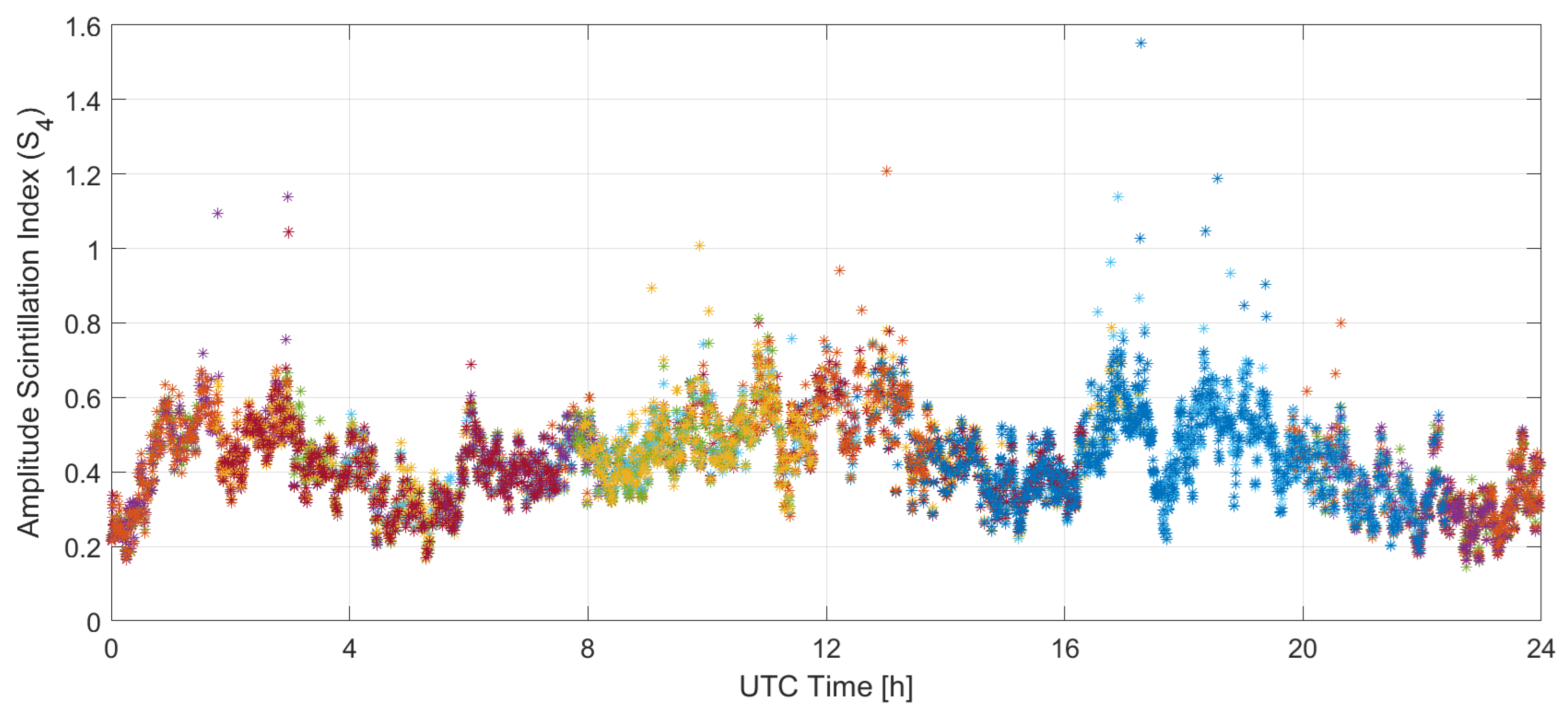
Figure 2 displays amplitude scintillation data recorded by an INCT NavAer GNSS receiver located in São José dos Campos during a 24 h interval in July 2017. This period corresponds to the southern-hemisphere winter. The solar cycle was near its minimum (F10.7 ≈ 70 sfu), and geomagnetic conditions were very mild, with Dst remaining at modest levels throughout the day (Dst
nT). Under such circumstances, ionospheric scintillation events are not expected, providing a baseline scenario in which the S
4 index should remain consistently small for all satellite links.
The plotted parameter is the amplitude scintillation index (S4)—the normalized standard deviation of the received signal power computed over one-minute intervals. Each color represents a different satellite link, all plotted simultaneously over the 24 h period. As can be seen from this figure, the enhanced S4 values over several links and during the daytime cannot be interpreted via any known ionospheric mechanism. Furthermore, no such simultaneous multi-link scintillation signatures have ever been reported in the literature, which further reinforces that this does not conform to ionospheric scintillation. While the preceding case studies focused on radio astronomy and solar monitoring systems, similar interference mechanisms also pose significant risks to space weather monitoring based on GNSS observations. In this context, GNSS scintillation measurements provide a particularly illustrative example of how radio frequency interference can mimic or obscure genuine ionospheric phenomena, thereby compromising the interpretation of high-sensitivity space weather data. While the preceding case studies focused on radio astronomy and solar monitoring systems, similar interference mechanisms also pose significant risks to space weather monitoring based on GNSS observations. Thus, GNSS scintillation measurements provide a particularly illustrative example of how radio frequency interference can mimic or obscure genuine ionospheric phenomena, thereby compromising the interpretation of high-sensitivity space weather data. Given these inconsistencies, the most likely interpretation for these measurements is contamination through RFI. While one cannot rule out contributions from multipath or isolated hardware anomalies, such are less likely to occur with a professional grade monitoring receiver. The relatively small magnitudes of the geomagnetic and solar flux further reinforce the conclusion above that the variability observed is of non-ionospheric origin.
Modern GNSS monitoring practices include automated RFI detection based on SNR time-series irregularities, combined amplitude-phase consistency checks, and cross-station validation frameworks. These are critical procedures to ensure that disturbances interpreted as being of ionospheric origin indeed represent geophysical processes rather than anthropogenic contamination. In this context, protection strategies in line with best practices need to be implemented for scientific networks. These contrasted examples point out the importance of stringent RFI mitigation for the scientific integrity of GNSS-based ionospheric observations.
The phenomena described above establish the physical basis for understanding interference mechanisms affecting space weather observations. These effects translate into receiver sensitivity, dynamic range, and protection constraints for riometers, GNSS, and solar radio instruments. These technical characteristics directly constrain receiver protection criteria and must therefore be considered within the regulatory framework discussed in the following section.
5. Regulatory and Technical Challenges and Mitigation Strategies for Passive Scientific Services
Building on scientific background and technical requirements discussed in
Section 4, this section shifts the focus toward regulatory implications and mitigation strategies applicable to passive scientific services. Rather than revisiting individual case studies, the discussion examines how these vulnerabilities are addressed within spectrum management frameworks, including technical mitigation approaches, protection criteria, coexistence studies, and regulatory measures under consideration in the ITU process, in the context of WRC–27 Agenda Item 1.17. This structure aims to clarify the respective roles of technical solutions and regulatory instruments in preserving the long-term viability of passive observations in an increasingly congested radio frequency environment.
Passive scientific services, including radio astronomy, atmospheric remote sensing, and space weather monitoring, are becoming increasingly vulnerable as modern telecommunication technologies occupy and pollute the radio spectrum. Case studies throughout this work demonstrate a key concern as follows: scientific measurements which had previously relied on well-protected “quiet zones” are now susceptible to harmful interference due to dense terrestrial networks and large satellite constellations. Even in their operating bands, the increasing levels of out-of-band emissions threaten the spectral environment necessary for ultra-sensitive observations [
50,
77]. One notable example is the unintentional interference from Starlink satellites, whose emissions have increased beyond internationally recognized limits for radio astronomy despite nominal compliance with fixed-satellite service limits [
50]. These examples represent just a subset of those illustrating that electromagnetic-compatibility standards are no longer sufficient for an era of massive deployments and agile radio systems. These developments highlight that interference is no longer solely a technical concern but a matter of policy and governance, requiring coordinated regulatory responses at national and international levels.
Spectrum governance perspective: Rather than revisiting individual case studies, the discussion examines how these vulnerabilities are addressed within spectrum management frameworks, including technical mitigation approaches, protection criteria, coexistence studies, and regulatory measures under consideration in the ITU process.
In contrast to the Earth Exploration-Satellite Service (EESS, passive), which operates under well-established allocations and protection regimes within the ITU Radio Regulations, space weather sensors under the Meteorological Aids service have only recently begun to acquire a formal regulatory status. A further complication arises from the historical lack of regulatory recognition for many passive space weather sensors. While the RAS and Earth Exploration-Satellite Service enjoy explicit protection under the ITU Radio Regulations, key space weather instruments, such as solar radio spectrographs, passive ionospheric sounders, and riometers, have traditionally operated without formal regulatory status. The WRC-23 resolved this omission by defining the space weather application within the Meteorological Aids Service, Resolution 675, and initiated studies to identify appropriate bands and protection criteria, Resolution 682 [
20]. These sensors nonetheless remain vulnerable under a “best-effort” regime, without guaranteed protection from higher-priority services, until such time as concrete allocations and constraints are agreed upon. Geographical and economic issues further limit the establishment of RQZs as follows: while Brazil was able to deploy the BINGO telescope in a remote region, many countries lack sufficient isolated territory, or financial resources to maintain associated infrastructure [
45].
Preserving the integrity of passive scientific observations, then, requires a coherent, forward-looking mitigation strategy at the technical and regulatory levels. Effective mitigation strategies range from high-dynamic-range receivers to selective and adaptive filtering, real-time RFI excision algorithms, low-noise site engineering, and frameworks for validating data across multiple instruments. These local improvements, however, cannot completely compensate for the interference from sources distributed worldwide-such as satellite constellations, dense terrestrial broadband systems, and spreading IoT infrastructures. Long-term protection requires harmonization in spectrum governance; more stringent out-of-band emission limits; coordination in management of satellite constellations; and continued efforts on the part of the ITU to formalize allocations and protection criteria for space weather passive sensors. Taken together, these challenges and mitigation strategies paint a picture of a crossroads that has been reached in this scientific community. Passive observations risk progressive degradation without determined action on the part of the global community-a “scientific blackout” in which the capability to monitor the Sun–Earth system, forecast hazards, and conduct fundamental research is increasingly compromised. The balance of this report provides practical and regulatory methods that must be applied to ensure that spectrum-dependent services continue to function while accommodating sustainable development of technology.
5.1. Instrumental Resilience and Spectral Filtering
Scientific instruments must be designed for enhanced resilience. This necessitates integrating selective spectral filters (e.g., precise notch filters for known mobile and satellite bands [
78]) into receiver front-ends. Receivers must exhibit a high dynamic range and superior linearity to prevent saturation and intermodulation from powerful out-of-band signals. Techniques proven in sectors like GNSS, utilizing robust AGC and custom digital filtering, should be universally applied [
79]. Furthermore, in sensitive applications like radio astronomy, adjustable attenuation is critical to manage the impact of strong local or orbital emitters and prevent chain saturation.
5.2. Control of Local Emissions and Shielding
Essential measures include comprehensive electromagnetic shielding of all sensitive electronics and cabling, ensuring that equipment is fully contained and grounded to prevent both inbound and outbound RFI. Observatories must implement on-campus spectral control programs to identify and suppress localized sources of interference, such as power supplies or Wi-Fi routers. This proactive control, addressing “domestic” RFI, has been shown to resolve a significant portion of noise issues [
58,
59].
5.3. Active RFI Management and Collaboration
Passive measures must be complemented by real-time spectral monitoring systems to track RFI intrusions continuously [
45]. Concurrently, scientific organizations must foster sustained collaboration with telecommunications and satellite operators. Many interference issues can be resolved at the source through minor technical adjustments (e.g., beam steering, power control) or by stricter regulatory enforcement of spurious emission limits, particularly for new services like 5G and LEO satellite large constellations [
1,
80,
81].
5.4. Standardization and Formalization of Passive Sensing Bands
Concerns regarding the protection of space weather observations were formally articulated before WRC-23, notably through Agenda Item 9.1(d) of WRC-19, which addressed regulatory actions and future agenda items (in particular agenda item 9.1 (a) for WRC-23) related to the sustainability of space services and scientific uses of the spectrum. During the 2015–2019 study cycle, the 7C ITU-R Working Party consistently highlighted the growing vulnerability of space weather observations—particularly solar radio monitoring, ionospheric diagnostics, and other passive sensing techniques—to increasing levels of radio frequency interference from terrestrial systems and emerging satellite constellations. These concerns reflected the increasing dependence of modern societies on space weather data for satellite operations, navigation, power grids, and communication infrastructure resilience. In parallel, the international relevance of space weather has been reinforced within the United Nations system, where UNOOSA/COPUOS maintains “Space Weather” as a permanent agenda item, recognizing it as a global challenge requiring sustained scientific observations and international coordination. Together, the WRC deliberations, the long-standing technical work of WP 7C, and the COPUOS framework illustrate a coherent and evolving international recognition that robust regulatory protection of passive spectrum use is essential to ensure the continuity and reliability of space weather monitoring.
Future system planning must be governed by established international standards. Furthermore, the scientific community must contribute to ongoing ITU studies (Resolution 682) to formalize specific bands for passive sensors, such as those already identified (e.g., ∼30 MHz, ∼74 MHz, 608–614 MHz, etc., which coincide with riometer and solar monitoring frequencies) [
82]. These critical bands should be vigorously promoted for primary allocation or protected passive use status in future WRCs [
82].
In short, high sensitivity scientific instrumentation is naturally susceptible to interference and technical and regulatory strategies to ensure its protection. The above recommendations aim at the promotion of a radio environment compatible with scientific research. Technical solutions contribute to decreasing the vulnerability of instruments, while regulatory and collaborative actions target the root of the problem as far as spectrum management and practical use are concerned. Thus,
Table 8 presents a summary of the main technical mechanisms of the RFIthe RFI in Scientific Instrumentation and possible mitigation techniques.
Therefore, to preserve the integrity of high-sensitivity scientific measurements, a combination of complementary approaches is required, including the following: (i) regulatory protection of passive allocations and coordination procedures; (ii) technical mitigation measures such as filtering, dynamic interference detection, and site shielding; and (iii) operational strategies, including remote siting, measurement scheduling, and data quality flagging. These measures jointly support the continuity and reliability of radio-based space weather observations under increasingly congested spectrum conditions.
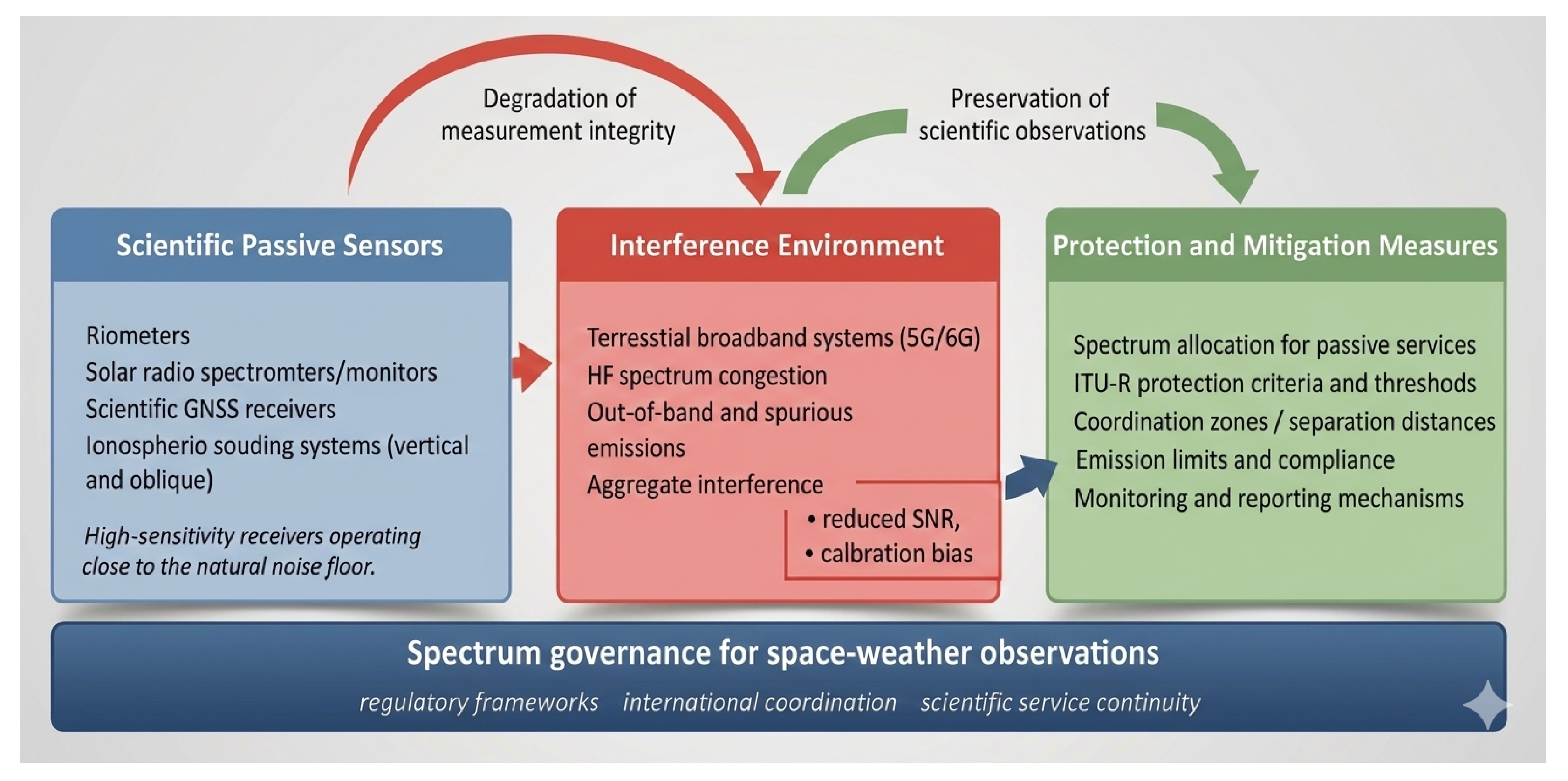
Thus, it is possible to state that the protection of high-sensitivity passive measurements involves the interaction between scientific sensing systems, interference sources, and regulatory mitigation measures, as summarized in
Figure 3.
6. Compatibility Studies and Protection Criteria
The compatibility and protection criteria studies for receive-only space weather sensors operating in the Meteorological Aids Service (space weather) represents a unique challenge in spectrum management, since these sensors provide data essential for forecasts and warnings of space weather events, supporting safety-of-life applications in aviation, satellite operations, and power grid management [
83,
84].
The regulatory framework under development for WRC-27 agenda item 1.17 must address a fundamental asymmetry: receive-only sensors do not cause interference to other services, yet they require protection from emissions of incumbent services [
1]. In this context, this section examines the technical basis for protection criteria developed through ITU-R Working Party 7C studies and analyzes their application in spectrum sharing and compatibility scenarios.
6.1. Protection Criteria Under WRC-27 Agenda Item 1.17 Framework
The protection criteria development, according to the ITU-R methodologies for passive sensors [
1,
80], recognizes the fundamental distinction between different space weather sensor types, for example, riometers derive protection criteria from radiometric principles based on cosmic noise observations [
85,
86], while solar flux monitors use minimum measurable solar flux as the reference rather than receiver noise floors [
1,
34]. This sensor-specific approach ensures protection criteria align with operational measurement requirements. Thus, based on ITU-R Recommendation RA.769-2 [
80],
Table 9 and
Table 10 present the protection criteria for operational frequencies identified in ITU-R Report RS.2456-1 for riometers and solar flux monitors, respectively [
1].
Interplanetary scintillation measurements rely on monitoring the flux variations of distant compact radio sources, and the protection criteria for these systems must align with those established for astrophysical continuum observations rather than those based on the quiet Sun, which is among the most intense natural radio emitters. Thus, the corresponding spectral power flux density parameters, calculated from characteristic space weather conditions, are summarized in
Table 11, which presents the protection criteria for operational frequencies identified in [
1].
6.2. Protection Criteria Analysis
It is important to mention that the protection criteria represent a technically framework balancing measurement requirements with spectrum efficiency. The fundamental principle—that solar observation sensors use system sensitivity based on measurable solar flux, which ensures protection criteria relate directly to operational needs [
1].
For riometers, protection criteria of −235 to −236 dB(W/(m
2·Hz)) align well with radio astronomy observations at similar frequencies [
80]. Solar flux monitor criteria derive from measuring quiet Sun with 1% precision. This conservative approach is justified since quiet Sun measurements establish baselines essential for detecting subsequent solar activity increases [
87]. On the other side, interplanetary scintillation sensors protection criteria are notably more stringent than riometers (spectral power flux density of −258 to −260 vs. −235 to −236 dB(W/(m
2·Hz)), reflecting the requirement to detect subtle signal variations [
88,
89].
Ongoing efforts by ITU-R Study Group 7C focus on refining these criteria and developing methodologies to assess and mitigate interference risks to passive sensing systems. These studies are integral to the preparatory work for WRC-27 and aim to ensure that passive sensors can operate without detrimental interference from other services.
6.3. Band-Specific Compatibility Considerations
Based on ITU-R Resolution 682 [
82] selected frequency bands, some compatibility considerations can be carried out, as follows:
HF bands (27.5–38.325 MHz): Field measurements at polar riometer sites show ambient noise 20–30 dB above galactic noise during active HF propagation, suggesting protection criteria should be achievable in most locations, particularly given the non-constraint framework [
90].
VHF band (73.0–74.6 MHz): Predominantly line-of-sight propagation limits interference range compared to HF [
91]. Coordination zones of 50–100 km radius typically suffice to protect sensitive receivers at VHF from terrestrial transmitters [
92].
UHF band (608–614 MHz): The most complex scenario due to broadcasting and mobile service allocations [
22]. Solar flux monitors may require geographical separation from high-power broadcast transmitters or careful site selection exploiting terrain shielding [
93].
In this sense, the allocation of frequency bands reflects the physical principles underlying each observation technique. These technical characteristics directly constrain receiver protection criteria and must therefore be considered within the regulatory framework discussed in the following section.
7. Regulatory Provisions Under WRC-27 Agenda Item 1.17
Building on the scientific requirements outlined above, this section discusses how current and emerging regulatory frameworks address these constraints, The focus here being institutional mechanisms, allocation strategies, and notification procedures within the ITU framework, to ensure sustainable global operation of passive space weather observation systems to enable the registration of receive-only sensors in the Master International Frequency Register (MIFR).
Current Regulatory Framework Analysis
WRC-27 Agenda Item 1.17 studies focus on protecting their reception quality from harmful interference rather than assessing their impact on incumbents (Draft CPM) [
19]. The goal of Agenda Item 1.17 is to incorporate clear regulatory provisions allowing such sensors to operate within the international spectrum framework, including their registration in the MIFR and inclusion in Appendix 4 of the Radio Regulations. Thus, there are two alternative regulatory methods are under consideration:
Method A proposes new primary allocations with footnotes explicitly limiting use to ground-based receive-only sensors and stipulating that allocations shall not claim protection from, nor constrain future development of, incumbent services in the same bands or adjacent bands. It also includes modifications to allow registration in the MIFR.
Method B proposes allocations with a single footnote stipulating that allocations shall not claim protection from stations of services allocated as of a specified date, providing a “grandfathering” mechanism [
19].
Additionally, the Draft CPM Text [
19] proposes modifications to the Radio Regulations including:
Based on the information described above, it is possible to identify distinct advantages associated with each regulatory approach.
Method B offers key advantages, including regulatory simplicity through a reduced number of footnotes, facilitated accommodation of future allocation changes via the “as of [date]” mechanism, and a clear temporal demarcation of incumbent services. This approach is consistent with established regulatory precedents whereby newly introduced allocations shall not constrain existing services.
Conversely, Method A provides advantages such as the explicit identification of all incumbent services, tailored regulatory language reflecting the service mix in each frequency band, and clearer guidance for implementation and coordination at the national level.
Overall, Method B may be considered advantageous from the perspective of long-term regulatory stability. However, its effective implementation would require the clear specification of the applicable date at WRC-27, the development of supporting ITU-R guidance and coordination materials, and targeted capacity-building activities for administrations [
81,
94].
The choice between these approaches reflects broader governance trade-offs between regulatory certainty, implementation flexibility, and long-term spectrum sustainability.
8. Final Remarks
Agenda Item 1.17 in WRC-27 offers an unprecedented opportunity to provide regulatory provisions for the formal incorporation of passive sensors into the global framework of telecommunications. The ITU ensures that clear definitions of dedicated frequency allocations, registration procedures, and non-interference clauses provide for long-term data continuity in space weather monitoring with spectrum coexistence with incumbent services. This initiative strengthens global resilience against the impacts of space weather on critical infrastructure, from aviation to satellite communications. Agenda item 1.17 is scheduled for resolution at WRC-31, marking a key milestone in the ongoing effort to address the long-term compatibility between emerging radiocommunication systems and scientific spectrum use. The outcomes of this process may naturally lead to additional studies covering a broader set of frequency bands used by passive sensors, reflecting the evolving requirements of space weather monitoring, radio astronomy, and Earth and space observation systems. Moreover, as spectrum sharing becomes increasingly complex, future study cycles may also need to extend beyond passive services to consider the protection and operational constraints of active scientific sensors, which have so far received comparatively limited regulatory attention.
In this context, this review and perspective article has synthesized technical, scientific, and regulatory dimensions that are typically addressed in isolation, providing a cross-disciplinary analytical assessment of the growing tension between expanding radiocommunication systems and the protection of critical passive sensing capabilities across the radio spectrum. Through structured analysis of documented interference cases—including BINGO, LOFAR, CALLISTO, MUSER, and GNSS Networks—the work has consolidated evidence demonstrating how instruments essential for cosmological research, solar storm forecasting, and environmental monitoring face increasing vulnerability to anthropogenic radio frequency interference. The contribution of this work is conceptual and integrative as follows: it integrates and synthesizes perspectives from radio astronomy, space weather operations, spectrum engineering, and international regulatory frameworks to provide a comprehensive assessment of ongoing developments. By contextualizing and comparatively evaluating protection criteria, compatibility scenarios, and regulatory mechanisms under consideration for WRC-27, this synthesis provides a foundation for informed policy development that can balance the legitimate needs of both radiocommunication services and passive scientific observations in an increasingly congested electromagnetic environment.
Coexistence needs coordination. Technically, deployment has to be complemented by resilient receivers and state-of-the-art filtering algorithms that go hand in hand with IMT networks, satellite constellations, and high-power transmitters. Regulators—most notably national authorities and the ITU—must maintain protection for passive scientific services beyond Resolutions 675 and 682, while commercial operators follow best practices to minimize interference and protect critical measurements.
The regulatory developments under WRC-27 agenda item 1.17 reflect this balance, emphasizing both the secondary nature of receive-only meteorological sensors and the very real need for robust design and operational resilience in increasingly congested spectra.
Success will critically depend on effective coordination procedures, capacity building, continued scientific-regulatory engagement, and operational validation of protection criteria. The regulatory approaches under consideration represent a balanced effort to respect incumbent service rights while acknowledging societal value of space weather observations for safety-of-life applications.
In moving forward, future refinements to international protection frameworks will need to take into account advances in interference-mitigation techniques, the evolution of commercial radiocommunication systems, and the likely expansion of space weather monitoring to space-based platforms. The technical studies initiated under the current ITU–R mandate provide a solid foundation for WRC–27 and subsequent regulatory cycles. Besides, they also reveal the following central and unavoidable concern: without effective spectrum management, the ability to perform high-quality passive scientific measurements will progressively erode.
Modern radiocommunication systems and scientific instrumentation can coexist, but doing so takes sustained innovation, coordination, and regulatory commitment. Protection of today’s passive observations is necessary not just to assure continued scientific discovery, but also for practical applications in forecasting, aviation safety, climate monitoring, and technological resilience. If spectrum governance cannot adapt, the global community will incrementally narrow the spectral environments suitable for science, a loss with long-term consequences for both knowledge and society. Ensuring that technological development remains aligned with scientific needs is therefore not optional but rather imperative for the future.





 ,
,