Article

Stability of Circular Orbits Around Kerr Black Holes Immersed in a Dehnen-Type Dark Matter Halo

1
School of Physics, Shanghai Jiao Tong University, Shanghai 200240, China
2
School of Aeronautics and Astronautics, Shanghai Jiao Tong University, Shanghai 200240, China
*
Author to whom correspondence should be addressed.
Universe 2026, 12(3), 68; https://doi.org/10.3390/universe12030068

Submission received: 25 January 2026 / Revised: 16 February 2026 / Accepted: 21 February 2026 / Published: 28 February 2026

Abstract

We investigate the dynamical stability of circular orbits around a Kerr black hole embedded in a Dehnen-type dark matter halo. The effective spacetime metric of the combined system is constructed using the Newman–Janis algorithm, and the effective potential for test-particle motion in the equatorial plane is derived. The stability of circular orbits is analyzed through the Hessian matrix of the effective potential, while the stability strength and restoring-force distribution are employed to quantify the orbital response to small perturbations. Our results show that the presence of the dark matter halo significantly alters the spatial structure of stable circular orbits, leading to non-continuous stable regions whose location and extent depend sensitively on the halo’s characteristic density, scale radius, and the black hole spin. The innermost stable circular orbit (ISCO) is shifted relative to the vacuum Kerr case, with its position determined by the combined effects of the spin and halo parameters. Two-dimensional heatmaps, parameter scans, and three-dimensional visualizations systematically illustrate how the black hole spin and dark matter halo properties influence the ISCO and the distribution of stable orbits. Finally, we analyze the influence of the dark matter halo on the structure of the black hole event horizon. These results provide a detailed theoretical investigation of orbital dynamics around rotating black holes in dark-matter-rich environments.

1. Introduction

Einstein’s General Theory of Relativity predicts the existence of black holes, regions of spacetime with extreme curvature where gravity dominates all other forces [1,2]. Since the first detection of gravitational waves from a binary black hole merger in 2015 [3], black holes have become a central topic in both theoretical physics and astrophysics. Among different types of black holes, Kerr black holes, characterized by their spin and angular momentum, have attracted particular attention due to their rich spacetime structure and complex dynamical behavior [4,5,6,7].
With growing understanding of dark matter in the universe, it has become clear that widely distributed dark matter may significantly influence the physical properties and dynamics of black holes. Dark matter neither emits nor absorbs light and interacts very weakly with electromagnetic radiation, yet it constitutes a substantial fraction of the total mass of the universe [8,9,10]. Its presence is strongly inferred from galactic rotation curves, large-scale structure, and cosmic microwave background observations. Recent studies suggest that dark matter may cluster around black holes, modifying the surrounding spacetime and potentially leaving observable imprints in black hole shadows or extreme-mass-ratio inspirals (EMRIs) [11,12,13,14].
The influence of dark matter on black hole spacetimes manifests primarily through modifications of the gravitational potential, which in turn affects the location of the innermost stable circular orbit (ISCO) and the dynamics of particles orbiting the black hole [15,16,17]. Previous works have explored various dark matter profiles, including uniform distributions, Navarro–Frenk–White (NFW) halos, and other phenomenological models, providing insights into how orbital stability is altered [18,19,20].
Recent studies from 2020 to 2025 have further examined the role of Dehnen-type dark matter halos around black holes. For example, the effects on gravitational lensing and geodesic structures around Schwarzschild black holes have been analyzed [21,22], while periodic orbits and associated gravitational waveforms have also been studied in these backgrounds [21,22,23,24]. Strongly interacting dark matter spikes have been proposed to influence EMRI gravitational waves [25], and fully relativistic models of EMRIs in collisionless or dense environments have highlighted the potential for detecting subtle signatures of dark matter halos through space-based GW observations [26]. Despite these advances, a systematic study of circular orbit stability around Kerr black holes embedded in Dehnen-type dark matter halos remains lacking, representing a clear gap in the literature.
In addition, Nakashi and Igata systematically investigated stable circular orbits and orbital structures in multi-black-hole systems [27,28], revealing detailed stability features of circular motion in complex gravitational environments. Wang et al. (2025) [29] further demonstrated that dark matter annihilation and the resulting halo structures can leave measurable imprints in EMRI gravitational wave signals. Since the ISCO location directly determines the maximum frequency and phase evolution of these waves, detailed studies of ISCO properties in black holes embedded in dark matter halos are crucial for accurate EMRI waveform predictions.
Moreover, recent studies have systematically investigated the stability of circular orbits in multi-black-hole systems and in configurations of charged black holes. Fan, Z.; Wang, Y.; Wang, X. [30] systematically investigated the structure and continuity of stable circular orbits in multi-static black hole systems, focusing on configurations of multiple Reissner–Nordström (RN) black holes. They found that as the number of black holes and the inter-black-hole distance α change, the peaks of the effective potentials of stable circular orbits transform from single-peaked to double-peaked, altering the continuity of the stable regions. The study also identified critical parameters that lead to changes in orbital stability and analyzed the effects of black hole spacing on the three fundamental frequencies of circular orbits (orbital frequency, radial local frequency, and vertical local frequency). Earlier, Wang et al. [31] examined the space-time properties of three static black holes, revealing the complex impact of multi-black-hole interactions on circular orbit stability. Shen et al. [32] further investigated extreme Reissner–Nordström black holes arranged in a static triangular configuration, analyzing how the arrangement of charged black holes regulates stable circular orbits and potential multi-stable structures. These studies highlight that both the black hole environment and the presence of additional matter play a crucial role in determining circular orbit stability, providing important guidance for understanding orbital dynamics in extreme-mass-ratio inspirals (EMRIs) and multi-black-hole systems [33].
In this work, we focus on Kerr black holes immersed in Dehnen-type dark matter halos. By constructing the combined spacetime metric using the Newman–Janis algorithm [34,35], we derive the effective potential for equatorial motion and perform a detailed stability analysis to identify stable circular orbits. In particular, we systematically explore how the black hole spin and dark matter halo parameters, such as density and scale radius, affect the innermost stable circular orbit (ISCO) and the structure of stable orbital regions. Our analysis shows that for prograde circular orbits, the ISCO shifts inward with increasing black hole spin or dark matter halo density, and that the stable regions can develop complex structures depending on these parameters. This framework provides a comprehensive understanding of how the surrounding dark matter environment influences circular orbit dynamics. The remainder of this paper is organized as follows: in Section 2, we introduce the Kerr black hole spacetime with a Dehnen-type dark matter halo; in Section 3, we present the two-dimensional effective potential, analyze the stability regions of circular orbits, and examine the parameter-dependent behavior of ISCO; in Section 4, we study the impact of dark matter halo spikes on the black hole event horizon; and finally, Section 5 summarizes our findings and discusses their astrophysical implications.

2. Schwarzschild Black Hole Spacetime with a Dehnen-Type Dark Matter Halo

In this section, we consider a static and spherically symmetric Schwarzschild black hole (BH) embedded in a Dehnen-type dark matter (DM) halo. This configuration provides the non-rotating background spacetime that will later be generalized to the rotating case using the Newman–Janis algorithm.

2.1. Dehnen Dark Matter Density Profile

The Dehnen density profile is a special class of double power-law models widely used to describe spherical galaxies and dark matter halos [23]. Its general form is given by
ρ ( r ) = ρ s r r s γ 1 + r r s α ( γ β ) / α ,
where ρ s and r s denote the characteristic density and scale radius of the halo, and α , β , and γ determine the inner and outer slopes of the profile.
In this work, following refs. [36,37], we adopt the commonly used Dehnen parameters
( α , β , γ ) = ( 1 , 4 , 0 ) ,
for which the density profile reduces to
ρ ( r ) = ρ s 1 + r r s 4 .
The corresponding enclosed dark matter mass is obtained from
M DM ( r ) = 0 r 4 π r 1 2 ρ ( r 1 ) d r 1 ,
which yields
M DM ( r ) = 4 π ρ s r s 3 3 r r + 3 r s r + r s 3 .

2.2. Schwarzschild–Dehnen Spacetime

We consider a static and spherically symmetric spacetime described by the line element
d s 2 = f ( r ) d t 2 + d r 2 f ( r ) + r 2 d θ 2 + sin 2 θ d ϕ 2 .
The metric function f ( r ) is obtained by solving Einstein’s field equations
R μ ν 1 2 g μ ν R = 8 π T μ ν ,
with the energy–momentum tensor describing the Dehnen dark matter halo,
T ν μ = diag ρ ( r ) , P r ( r ) , P t ( r ) , P t ( r ) .
Here, ρ ( r ) denotes the density of the Dehnen-type dark matter halo, while P r ( r ) and P t ( r ) represent the radial and tangential pressures, respectively. For the cold dark matter (CDM) assumption adopted in this work, the dark matter is effectively pressureless:
P r ( r ) = P t ( r ) 0 .
Including the pressure terms in the tensor allows for a general relativistic formulation. Under the CDM assumption, the pressures do not contribute significantly to the metric, and the spacetime is fully determined by the density profile ρ ( r ) .
The resulting exact Schwarzschild–Dehnen solution reads [36,37]
f ( r ) = 1 2 M r 4 π ρ s r s 3 ( r s + 2 r ) 3 ( r s + r ) 2 ,
where M denotes the mass of the central Schwarzschild black hole.
In the limit ρ s 0 , the metric function reduces to the standard Schwarzschild form,
f ( r ) 1 2 M r ,
as expected.

2.3. Event Horizon

The event horizon radius r h is determined by the largest real root of
f ( r h ) = 0 .
The presence of the Dehnen-type dark matter halo modifies the horizon structure compared to the vacuum Schwarzschild case. In particular, increasing either the characteristic density ρ s or the scale radius r s enhances the gravitational potential, leading to an increase in the event horizon radius.
This Schwarzschild–Dehnen spacetime provides a well-defined and exact non-rotating black hole solution surrounded by a dark matter halo. In the following section, we extend this framework to the rotating case by applying the Newman–Janis algorithm, constructing a Kerr-like black hole spacetime immersed in a Dehnen-type dark matter halo.

3. Two-Dimensional Effective Potential of Kerr Spacetime Influenced by a Dehnen-Type Dark Matter Halo

We begin with the Kerr black hole metric, which provides an exact vacuum solution of Einstein’s field equations describing a rotating black hole characterized by its mass M BH and spin parameter a. To model a more realistic astrophysical environment, we extend this spacetime to include the gravitational influence of a surrounding dark matter (DM) halo. In particular, we consider a Dehnen-type DM density profile [11,21,23], which is commonly used to describe cuspy or spiky halo distributions near galactic centers and can naturally arise through adiabatic growth around a supermassive black hole.
The presence of a DM halo modifies the spacetime geometry through its contribution to the gravitational potential. Rather than solving the full Einstein equations with a rotating, self-gravitating DM distribution, which would be highly nontrivial, we adopt an effective approach based on the Newman–Janis algorithm [38,39]. This procedure generates a stationary and axisymmetric rotating metric from a spherically symmetric seed solution via a complex coordinate transformation. Although approximate, this method has been widely employed to incorporate environmental effects into rotating black hole spacetimes and captures the leading-order impact of rotation on the background geometry.
Applying the Newman–Janis algorithm to the Schwarzschild–Dehnen solution, the Kerr-like metric reads
d s 2 = 1 2 M r + 4 π ρ s r s 3 ( r s + 2 r ) 3 ( r s + r ) 2 Σ 2 d t 2 4 a sin 2 θ M r + 2 π ρ s r s 3 ( r s + 2 r ) 3 ( r s + r ) 2 Σ 2 d t d ϕ + Σ 2 Δ d r 2 + Σ 2 d θ 2 + sin 2 θ r 2 + a 2 + 4 a 2 sin 2 θ M r + 2 π ρ s r s 3 ( r s + 2 r ) 3 ( r s + r ) 2 Σ 2 d ϕ 2 ,
where
Σ 2 = r 2 + a 2 cos 2 θ ,
and
Δ = r 2 f ( r ) + a 2 = r 2 1 2 M r 4 π ρ s r s 3 ( r s + 2 r ) 3 ( r s + r ) 2 + a 2 .
Here, M is the black hole mass, a is the spin parameter, and ρ s and r s are the characteristic density and scale radius of the Dehnen dark matter halo. In the limit ρ s 0 , the metric smoothly reduces to the standard Kerr solution.
This metric can be used to study geodesic motion, circular orbits, the ISCO, and gravitational wave emission for a Kerr black hole immersed in a Dehnen-type dark matter halo. For details of the derivation using the Newman–Janis algorithm, see Appendix A.

3.1. Effective Potential

For a test particle, the conserved energy E and angular momentum L lead to
g t t t ˙ + g t ϕ ϕ ˙ = E ,
g t ϕ t ˙ + g ϕ ϕ ϕ ˙ = L ,
where a dot denotes a derivative with respect to the affine parameter τ , chosen as the proper time. From these relations, the components of the 4-velocity are
d t d τ = E g ϕ ϕ + L g t ϕ g t ϕ 2 g t t g ϕ ϕ ,
d ϕ d τ = E g t ϕ + L g t t g t ϕ 2 g t t g ϕ ϕ .
From the normalization condition g μ ν x ˙ μ x ˙ ν = 1 , the effective potential for equatorial motion can be expressed as
V eff ( r , θ ) = g r r r ˙ 2 + g θ θ θ ˙ 2 ,
leading to the explicit form
V ( r , θ ) = 1 + E 2 g ϕ ϕ + 2 E L g t ϕ + L 2 g t t g t ϕ 2 g t t g ϕ ϕ .
V ( r , θ ) = 1 + E 2 sin 2 θ r 2 + a 2 + 4 a 2 sin 2 θ M ( r ) Σ 2 8 a E L sin 2 θ M ( r ) Σ 2 L 2 1 2 M ( r ) Σ 2 sin 2 θ Σ 2 r 2 + a 2 2 M ( r ) r Σ 2 ,
Here
Σ 2 = r 2 + a 2 cos 2 θ ,
and the effective mass function induced by the Dehnen dark matter halo is defined as
M ( r ) = M r + 2 π ρ s r s 3 ( r s + 2 r ) 3 ( r s + r ) 2 .
For prograde circular orbits, the presence of a dark matter (DM) halo deepens the effective potential well, which allows stable orbits to exist closer to the black hole and leads to a reduction in the ISCO radius. In contrast, in the absence of the DM halo, the effective potential becomes shallower, the ISCO shifts outward, and the region of stable circular orbits shrinks, particularly away from the equatorial plane.
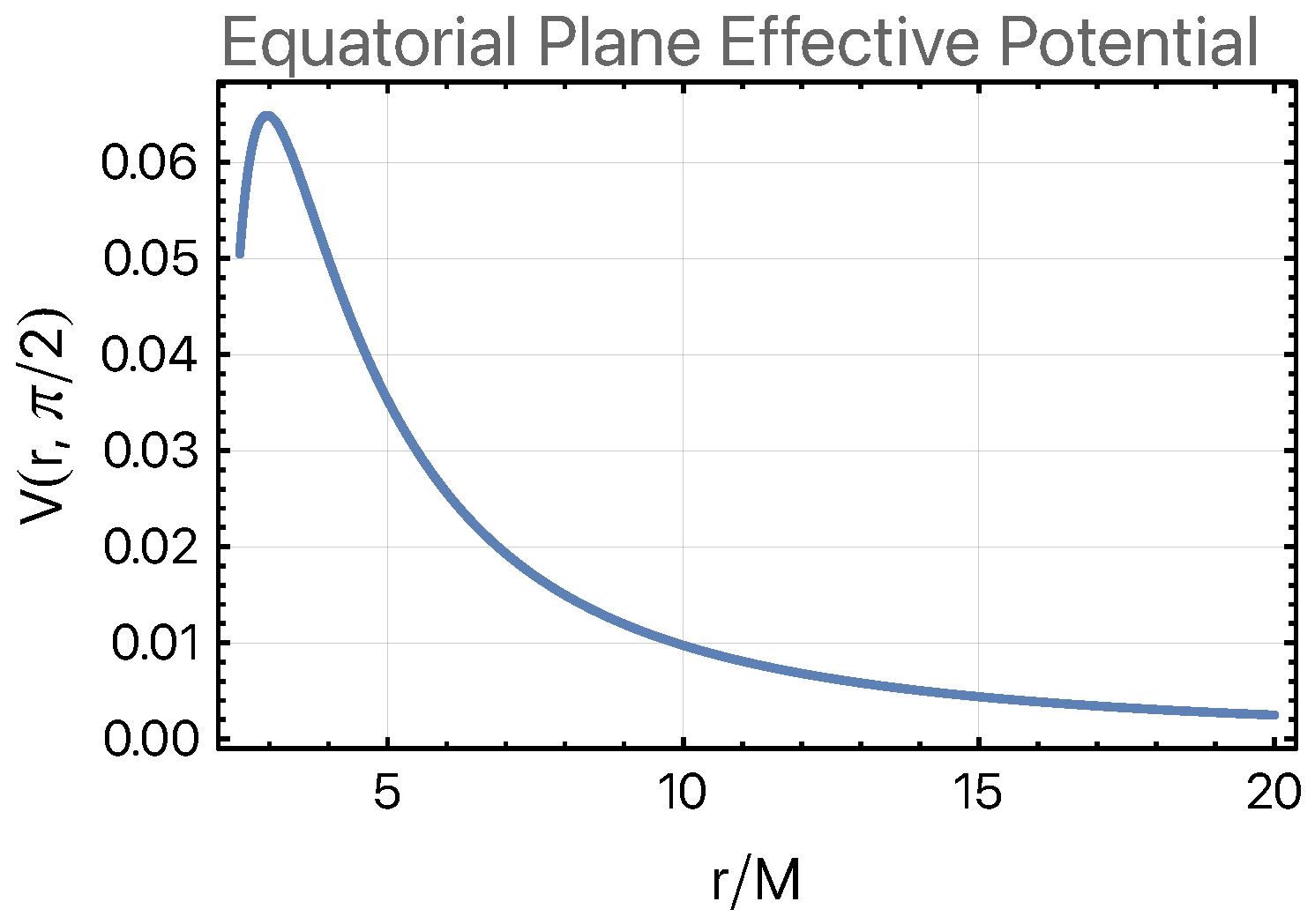
Figure 1 shows the effective potential in the equatorial plane ( θ = π / 2 ) for a test particle with energy E = 0.999 and angular momentum L = 2.0 , in the Kerr-like Schwarzschild–Dehnen spacetime. The plot illustrates the characteristic potential well near the black hole and the influence of the Dehnen dark matter halo on the depth of the potential.
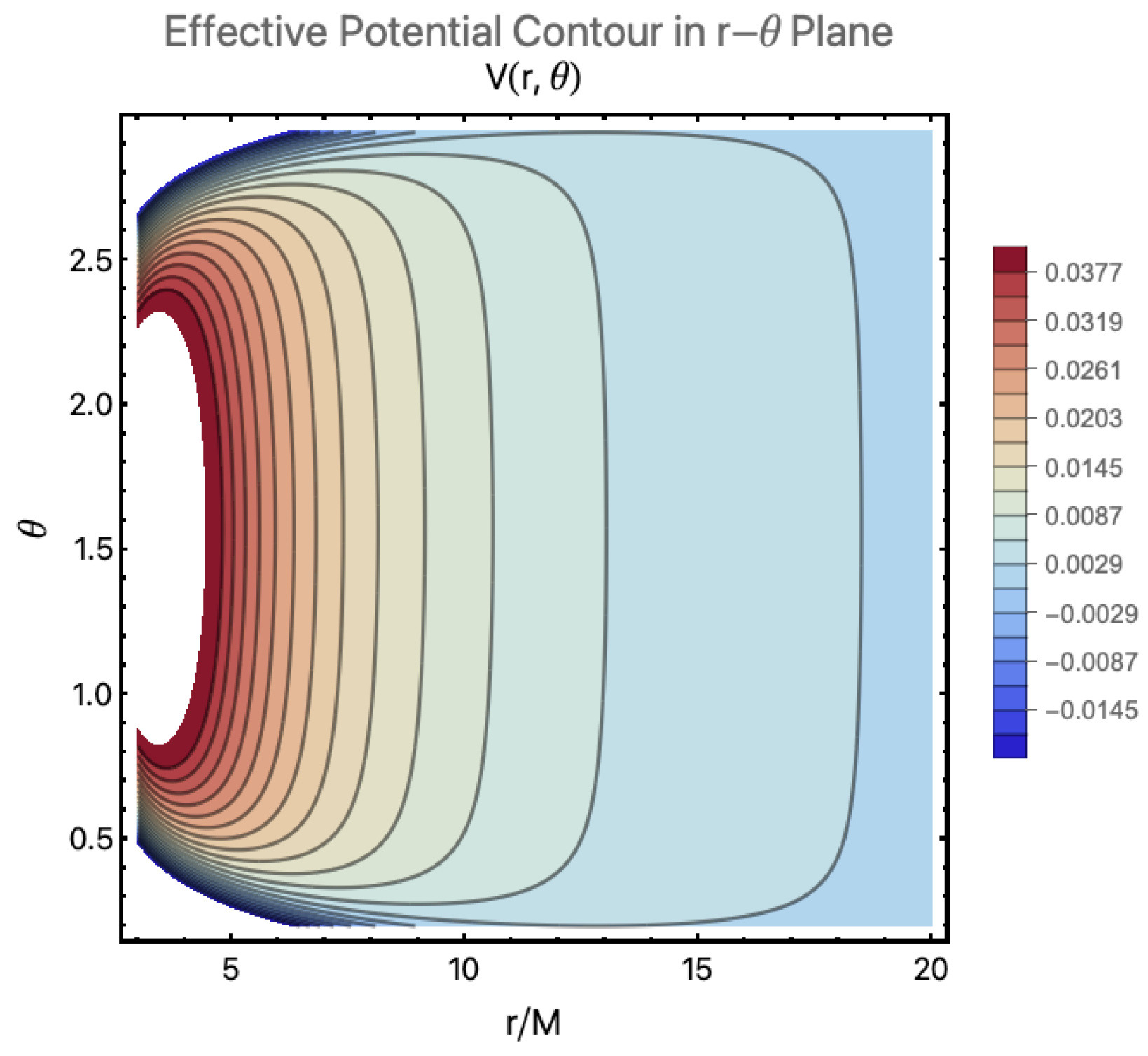
The corresponding r- θ plane contour plot is presented in Figure 2, where the stable and unstable regions of circular orbits away from the equatorial plane can be visualized. The contours reveal how the effective potential varies with both radial distance r and polar angle θ , demonstrating that orbits near the equatorial plane remain the most stable, while stability decreases at higher latitudes.
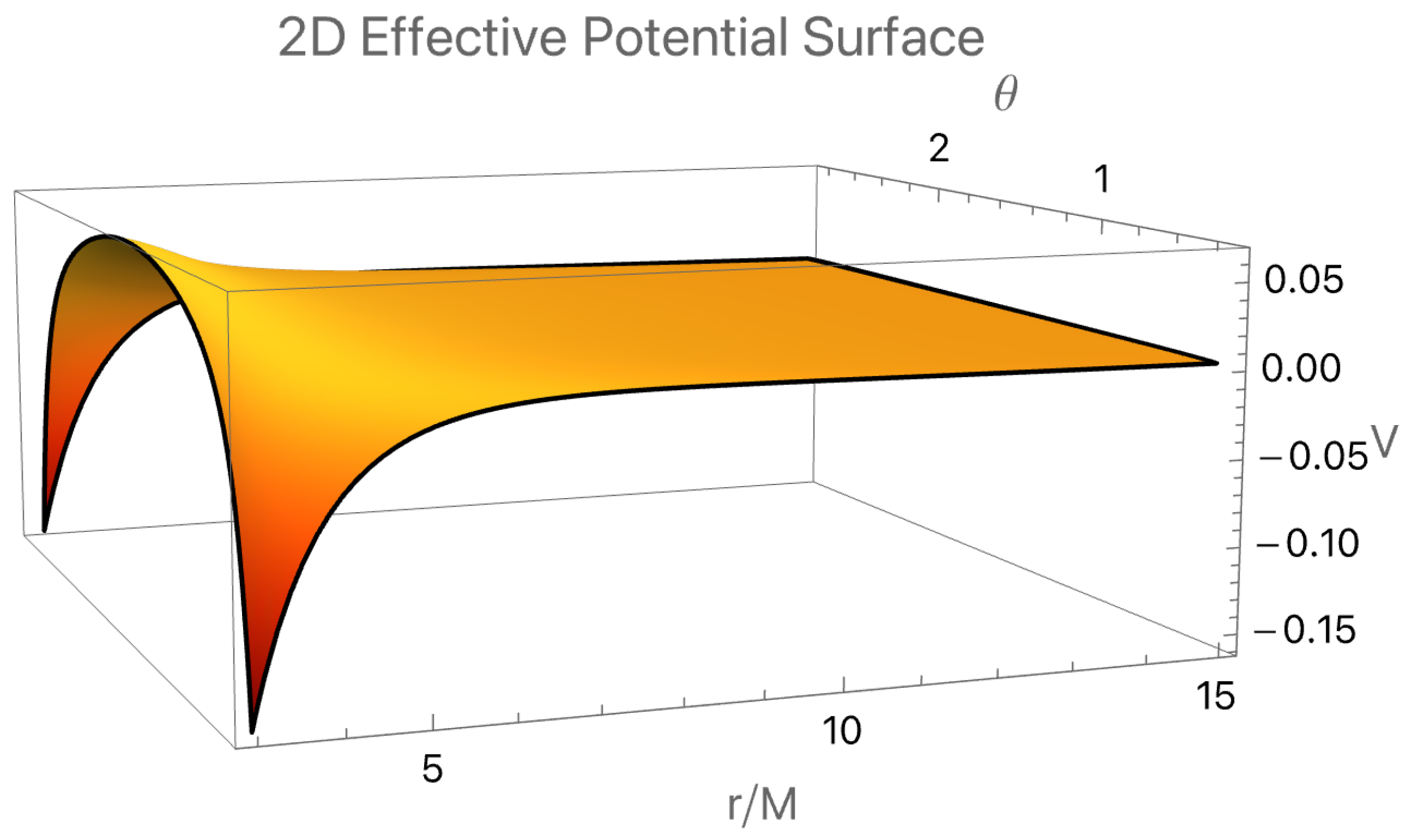
Finally, Figure 3 displays the three-dimensional surface of the effective potential V ( r , θ ) , providing a comprehensive visualization of the potential landscape. The 3D plot clearly shows the combined effects of the black hole spin and the dark matter halo, highlighting the deepened potential well near the black hole and the angular dependence of the stability regions. Together, these figures provide a complete picture of the effective potential structure and the regions where stable circular orbits are possible in the presence of a dark matter halo.

3.2. Stability Conditions of Circular Orbits

The stability of circular orbits can be analyzed using the Hessian matrix of the effective potential, whose eigenvalues determine the behavior of small perturbations around the equilibrium configuration.
h ( r , θ ; L 2 ) = det V i j = V r r V θ θ V r θ 2 ,
k ( r , θ ; L 2 ) = Tr V i j = V r r + V θ θ .
For circular orbits, these quantities are evaluated at U θ = 0 :
h 0 ( r , θ ) = h ( r , θ ; L 0 2 ) U θ = 0 ,
k 0 ( r , θ ) = k ( r , θ ; L 0 2 ) U θ = 0 .
The allowed region for stable circular motion is
D = ( r , θ ) | h 0 > 0 , k 0 > 0 , L 0 2 > 0 .

3.3. Stable Regions of Circular Orbits

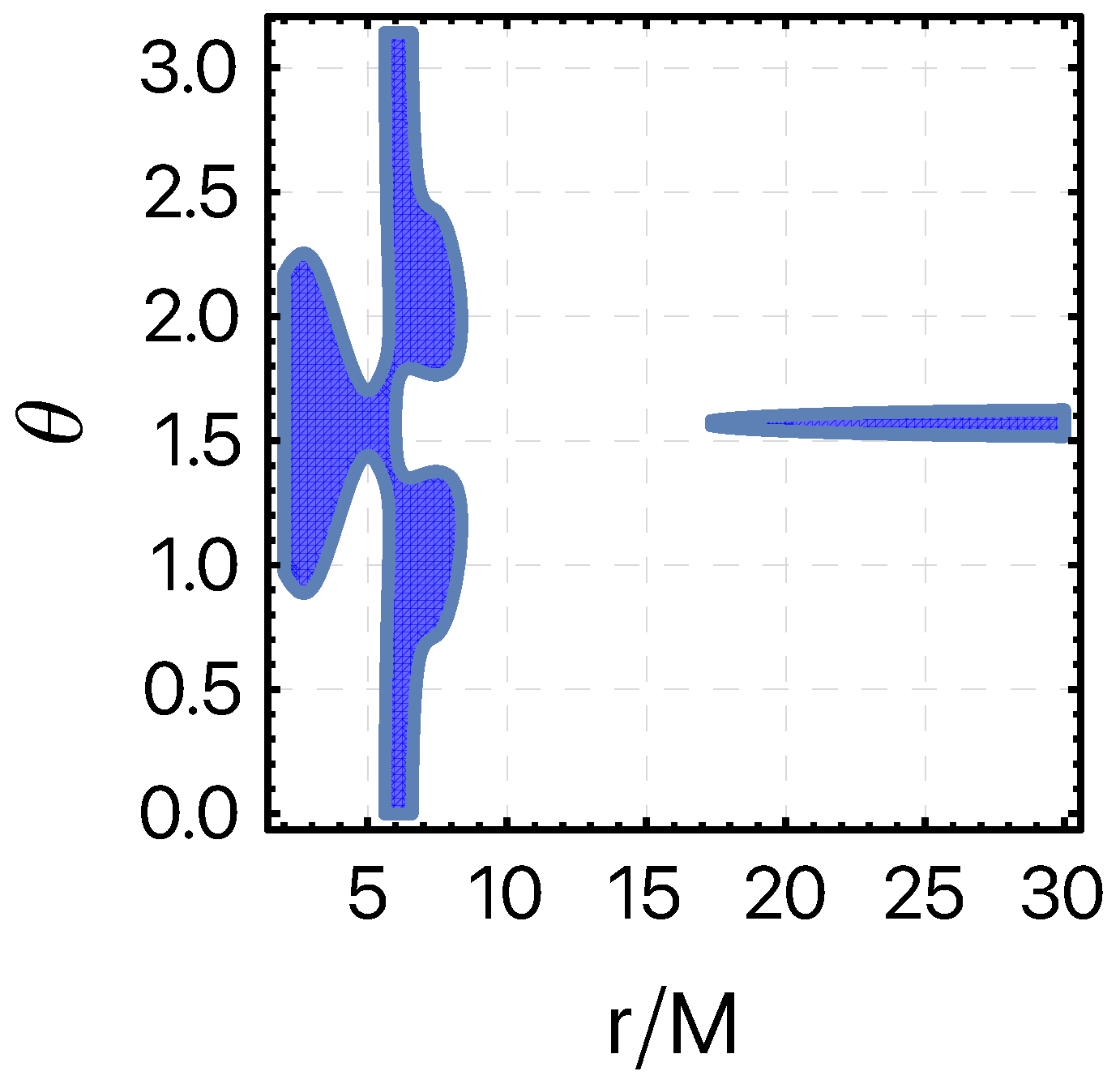
The stability of circular orbits depends sensitively on the black hole spin a BH and the properties of the surrounding dark matter halo, in particular its characteristic density ρ s and scale radius r s . A rapidly rotating black hole embedded in a dense dark matter halo shifts the innermost stable circular orbit (ISCO) toward smaller radii and significantly alters the structure of the stable orbital region. Figure 4 illustrates the resulting stability regions in the ( r , θ ) plane for the Kerr-like Schwarzschild–Dehnen spacetime.
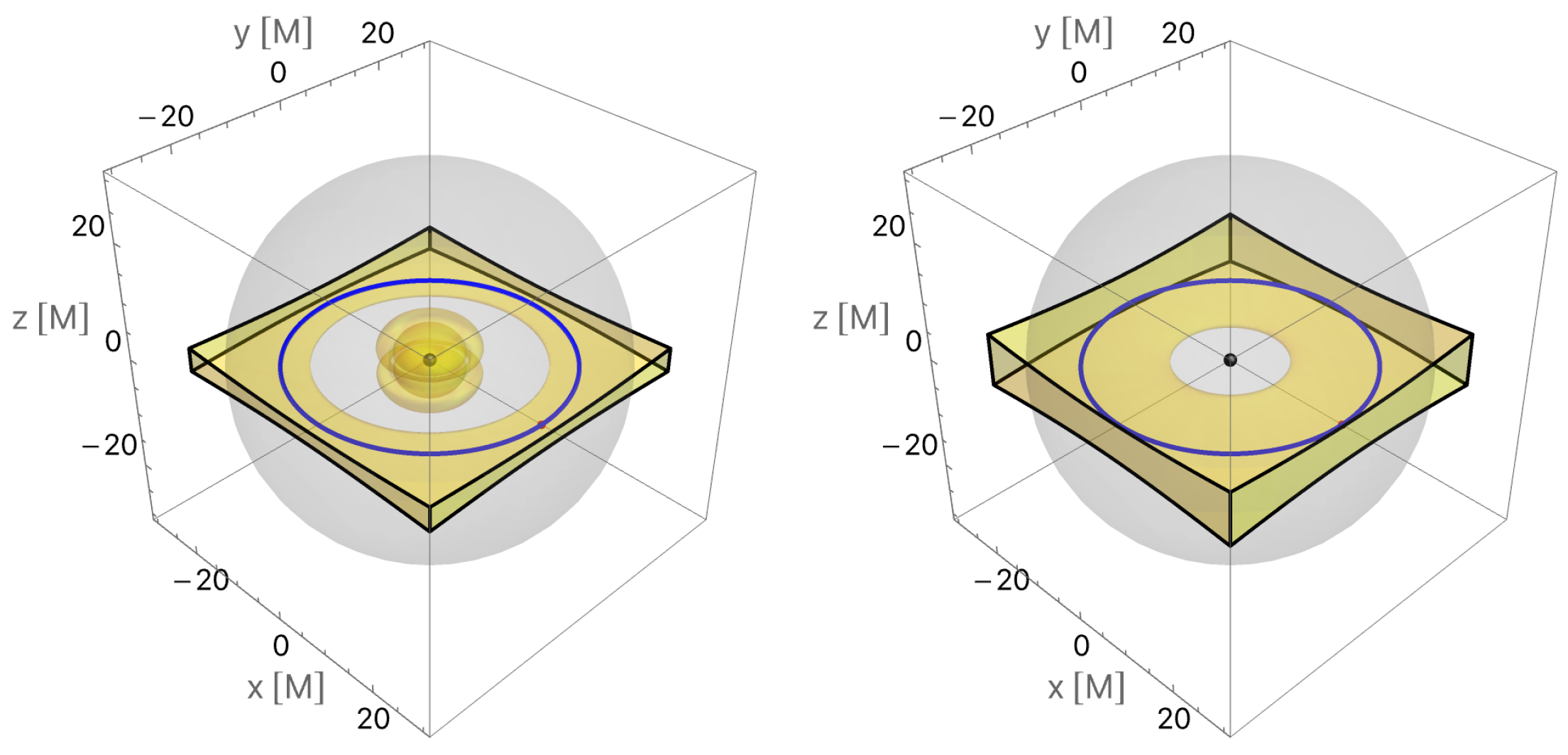
Figure 5 presents a three-dimensional visualization of the stable circular orbit region around a Kerr black hole with spin a BH = 0.96 , immersed in a Dehnen-type dark matter halo with density ρ s = 6 × 10 4 and scale radius r s = 2 . In the presence of the dark matter halo, the stable circular orbit region is no longer continuous, but instead splits into multiple disconnected zones, indicating the existence of several marginally stable circular orbits. The shape, connectivity, and extent of these zones are determined by the black hole spin and the dark matter halo parameters, highlighting the impact of the surrounding dark matter distribution on the orbital structure near the black hole. This figure clearly shows that a dense dark matter halo can break the continuity of stable orbital regions, which may be significant for extreme-mass-ratio inspiral (EMRI) systems.
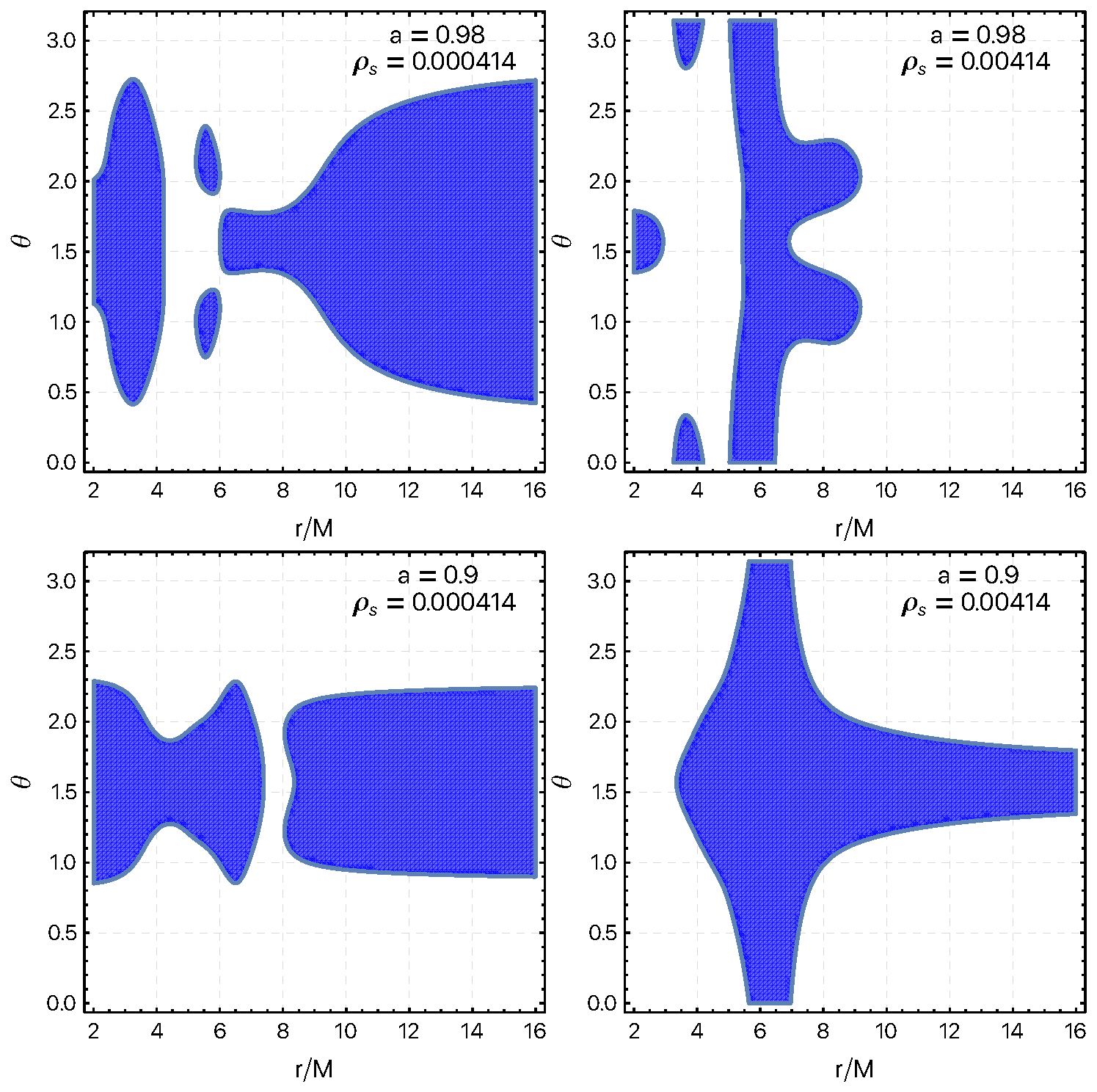
Figure 6 shows the stability regions of circular orbits around a Kerr black hole immersed in a Dehnen-type dark matter halo. Each of the four panels corresponds to a different combination of the black hole spin parameter a and the dark matter halo characteristic density ρ s , with the specific values labeled in the upper-right corner of each panel. The plots illustrate how the shape of the stable orbital regions changes under different parameter combinations. Comparing the panels reveals that variations in black hole spin and dark matter density can significantly affect the continuity of the stability regions, leading to gaps, highlighting the combined influence of relativistic rotation and the surrounding dark matter environment on orbital dynamics.

3.4. Innermost Stable Circular Orbit (ISCO) Analysis

The presence of a Dehnen-type dark matter halo modifies the Kerr spacetime and affects the location of the innermost stable circular orbit (ISCO). In order to quantify this effect, we perform a parameter scan of the ISCO radius as a function of black hole spin a and dark matter density ρ s , keeping the scale radius r s fixed at 10 M .
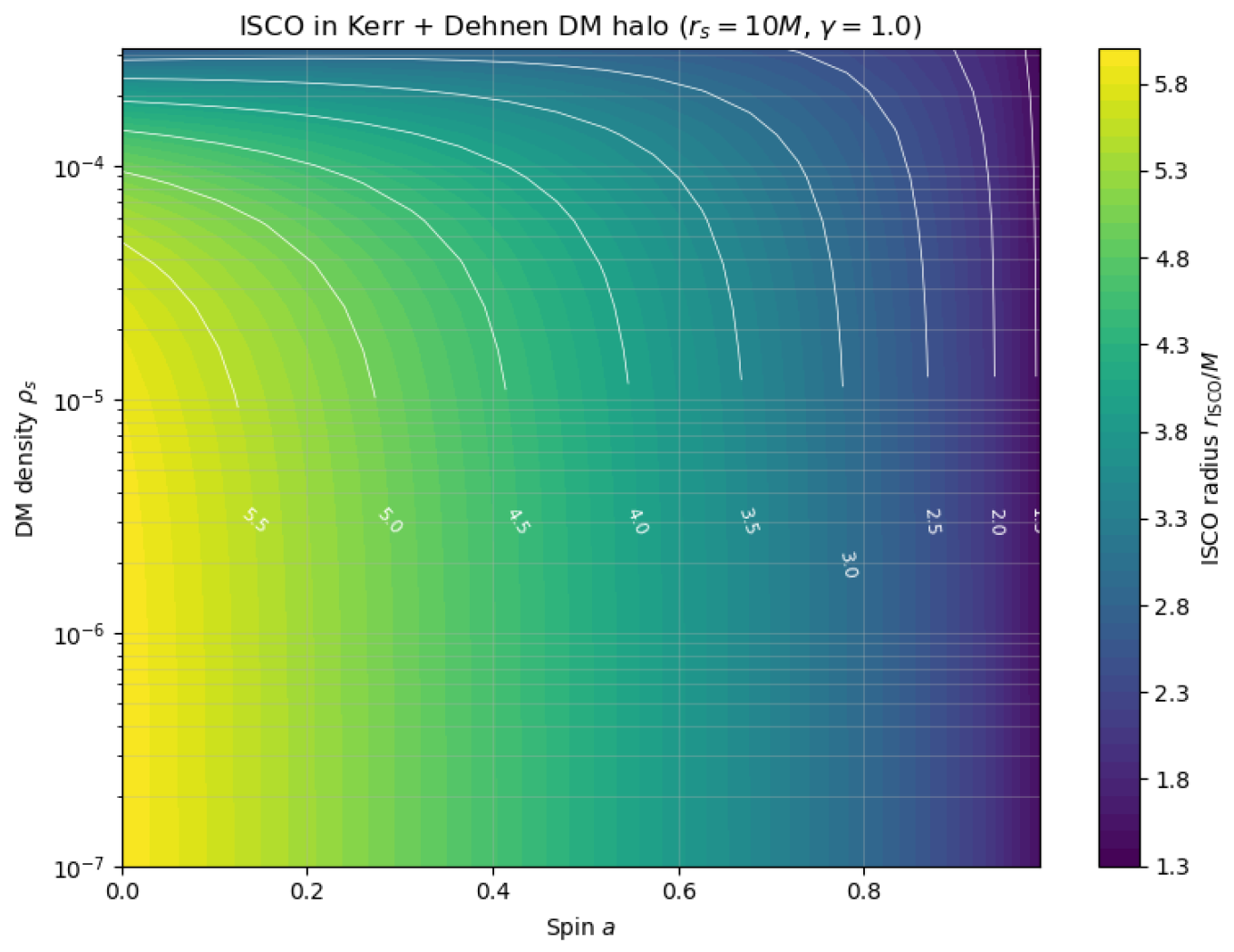
First, Figure 7 presents a 2D heatmap of the ISCO radius in the ( a , ρ s ) parameter space. One can clearly see that increasing the black hole spin or the DM density shifts the ISCO inward. The white contour lines highlight specific ISCO values, illustrating how the combined influence of spin and DM density determines the accessible stable circular orbits. This overview provides a global picture of the parameter dependence and serves as a reference for the following detailed analyses.
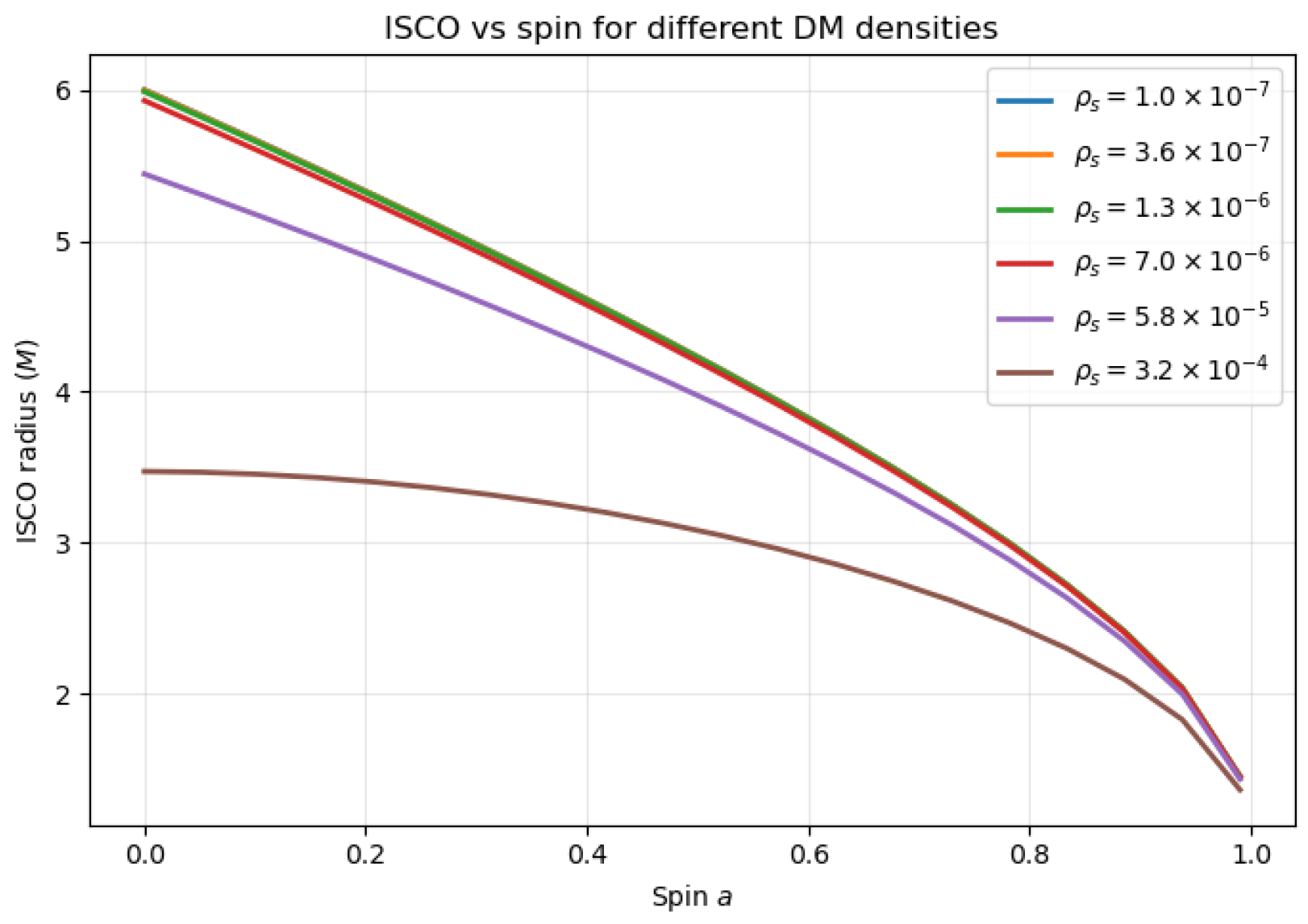
To better understand the impact of spin on the ISCO for fixed DM densities, Figure 8 shows ISCO vs. a for several representative values of ρ s . The curves demonstrate that higher spin systematically reduces the ISCO, allowing test particles to orbit closer to the black hole. Moreover, the effect is enhanced in the presence of a denser DM halo: the inward shift is larger for higher ρ s . This indicates that DM halos can have a non-negligible effect on the inspiral trajectory of compact objects, especially for rapidly rotating black holes.
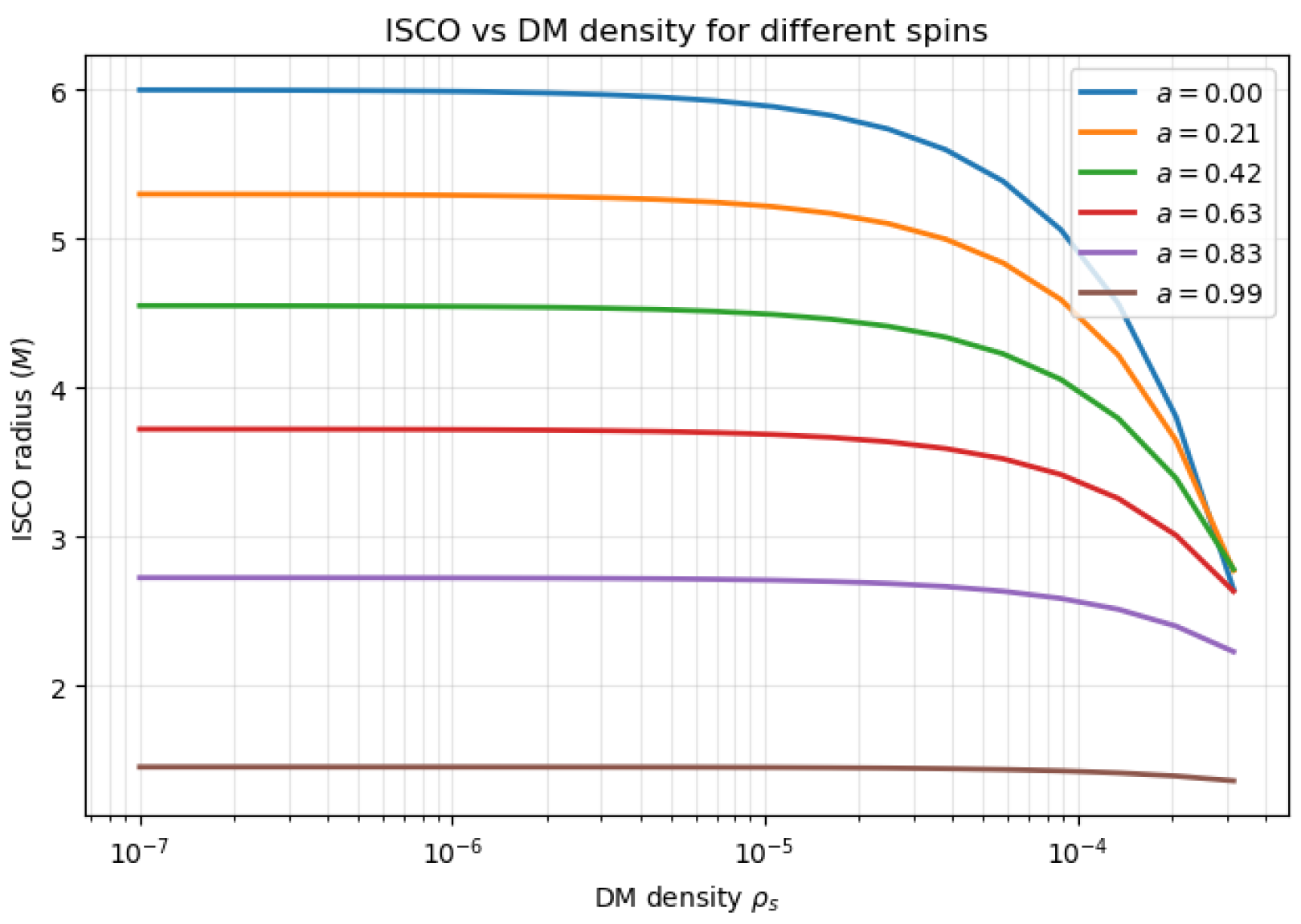
Conversely, Figure 9 shows the ISCO as a function of the dark matter density ρ s for several representative black hole spins a. For all spins, denser halos shift the ISCO inward, as the additional gravitational potential from the dark matter halo effectively pulls stable circular orbits closer to the black hole. This effect is more pronounced for high-spin black holes, where relativistic frame-dragging and centrifugal balance near the innermost stable orbit amplify the influence of the surrounding matter. In other words, the combined effect of black hole rotation and the dark matter halo modifies both the location and continuity of the innermost stable orbit. Changes in the ISCO directly impact the cutoff of the gravitational wave phase integral in EMRI systems, potentially producing observable effects in the waveform. These results highlight the importance of including dark matter halos when modeling EMRIs in realistic astrophysical environments.
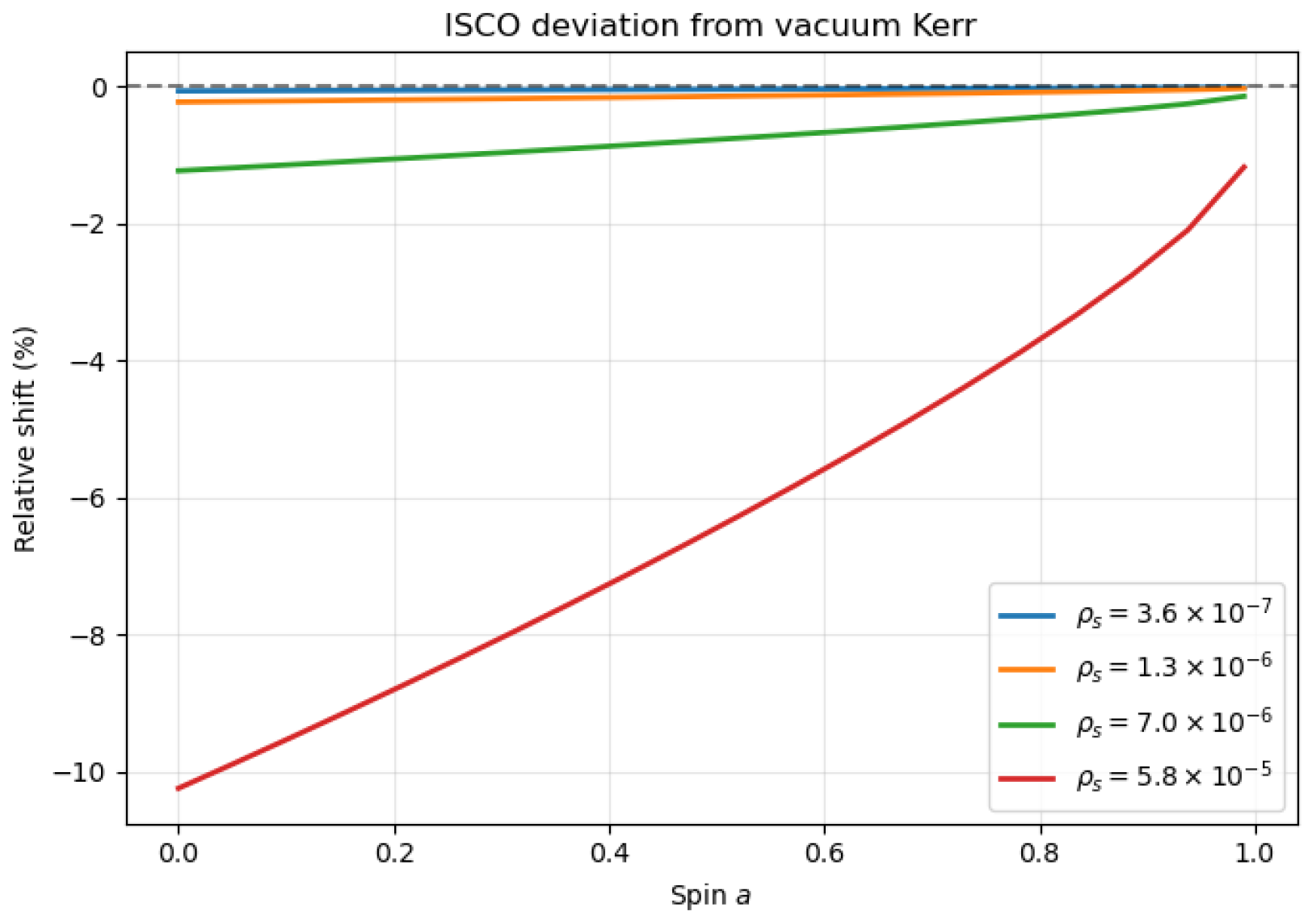
To directly quantify the deviation from the pure Kerr ISCO, Figure 10 plots the relative shift in the ISCO compared to the vacuum Kerr case, Δ r ISCO / r ISCO Kerr , as a function of a. Positive deviations correspond to inward shifts induced by the DM halo. This representation makes it clear that the DM effect is typically small but grows with both ρ s and a, confirming that even moderate halo densities can produce observable changes in EMRI dynamics if the black hole is rapidly spinning.
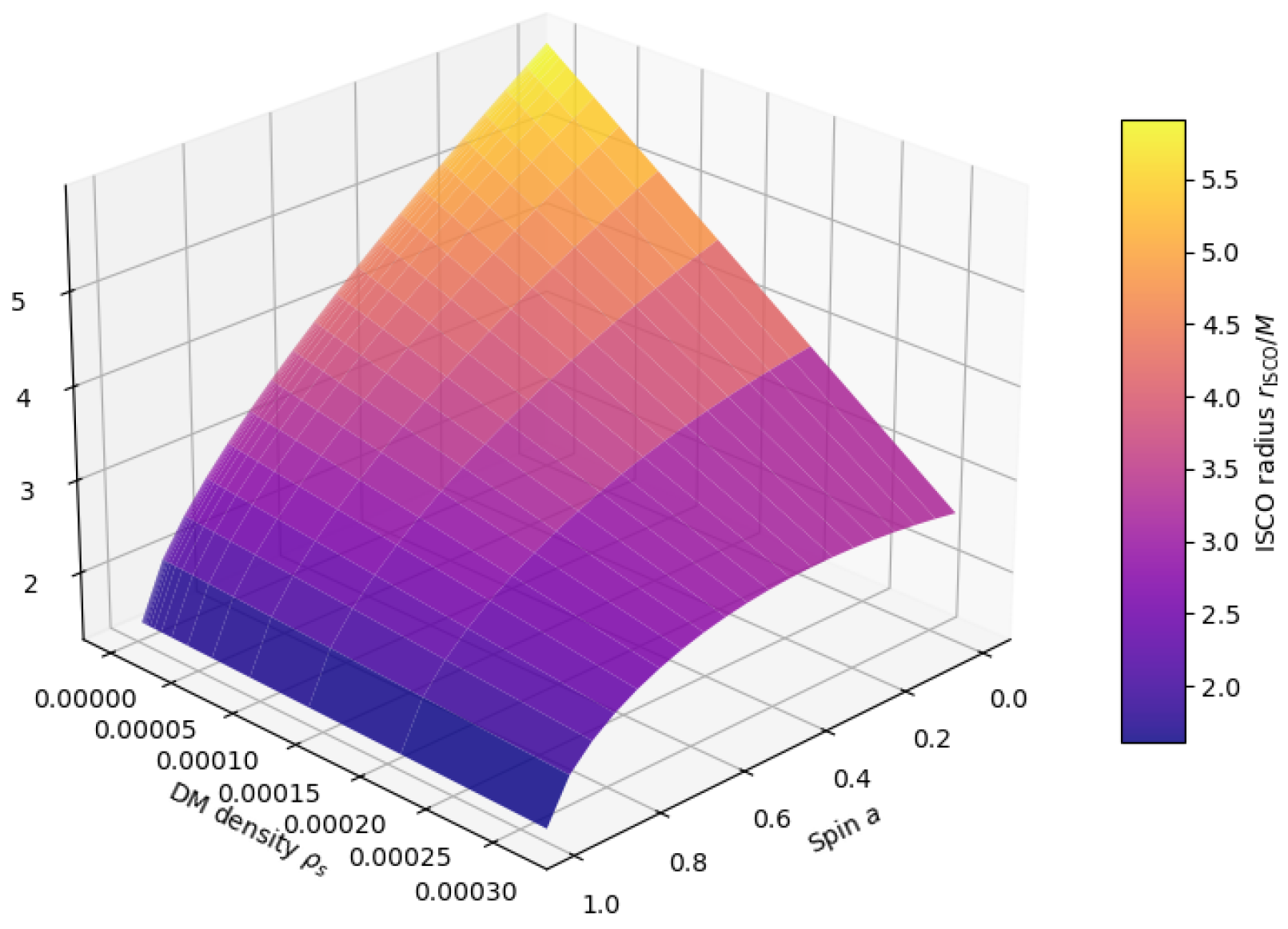
Finally, Figure 11 provides a 3D surface view of the ISCO radius as a function of both a and ρ s . The surface visualization allows one to simultaneously assess the joint impact of spin and DM density on the ISCO location. The plasma colormap clearly shows the gradient of ISCO values, emphasizing the regions of parameter space where the inward shift is most significant. This 3D representation complements the 2D heatmap and single-axis plots by offering an intuitive grasp of the combined parameter dependence.
In summary, these analyses demonstrate that the presence of a Dehnen-type dark matter halo can significantly modify the ISCO location, particularly for rapidly spinning black holes and denser halos. These inward shifts directly increase the EMRI gravitational wave cutoff frequency, offering a potential observational signature of dark matter distributions around supermassive black holes.

3.5. Analysis of Stability Strength

In this subsection, we analyze the stability of circular orbits around a Kerr black hole immersed in a Dehnen-type dark matter halo. The orbital stability is determined by examining the Hessian matrix of the effective potential V eff ( r , θ ) , defined as
H ( r , θ ) = r 2 V eff r θ V eff θ r V eff θ 2 V eff .
A circular orbit is locally stable if both the determinant and the trace of the Hessian are positive, i.e.,
det H ( r , θ ) > 0 , Tr H ( r , θ ) > 0 .
To quantify the degree of stability, we define the stability strength as the minimum eigenvalue of the Hessian matrix:
S ( r , θ ) = λ min ( H ( r , θ ) ) ,
which provides a measure of how strongly an orbit resists small perturbations. Points with larger S correspond to more stable orbits, whereas S 0 indicates marginal stability, such as near the innermost stable circular orbit (ISCO).
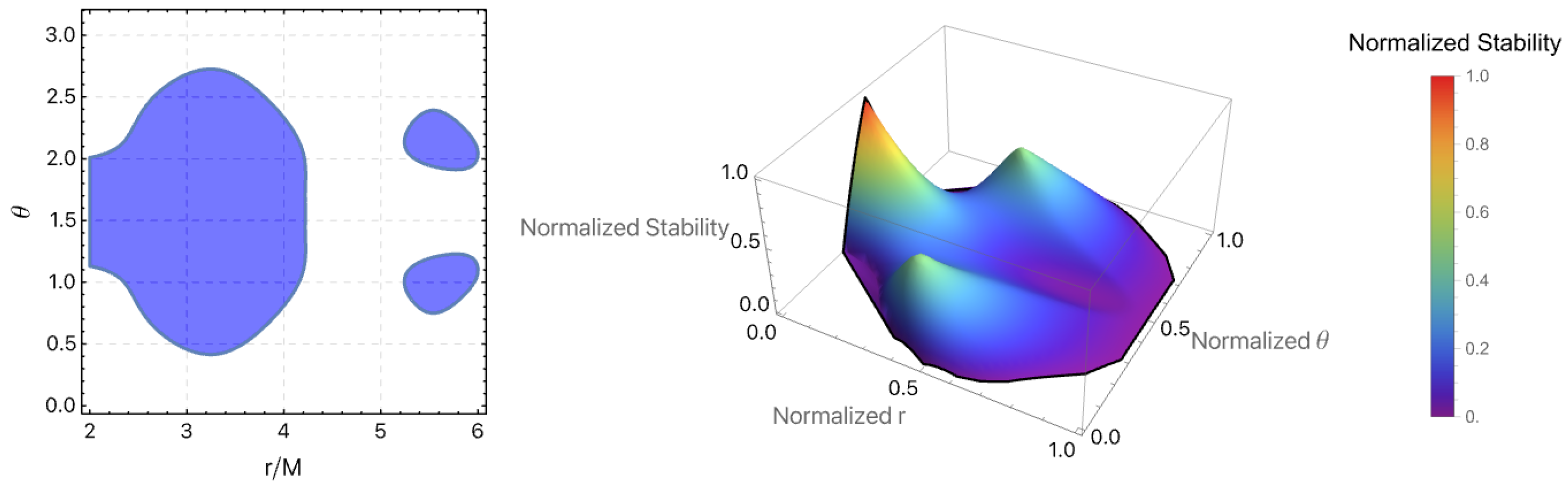
Figure 12 presents both a two-dimensional and a three-dimensional visualization of the orbital stability. The left panel shows the region of stable circular orbits in the ( r , θ ) plane, where the blue shaded area satisfies det H > 0 and Tr H > 0 . The right panel depicts the normalized stability strength S in the stable region, where warmer colors correspond to stronger stability. These results illustrate that the presence of a dark matter halo modifies both the extent of the stable orbital region and the distribution of orbital stability in Kerr spacetimes.
The analysis provides valuable insight into the orbital dynamics of extreme-mass-ratio inspirals (EMRIs) in dark-matter-rich environments, as the stability of orbits directly affects the evolution of the system and the phase of emitted gravitational waves.

3.6. Analysis of Restoring Force Magnitude

To further quantify the system’s stability, we analyze the magnitude of the restoring force acting on a test particle within the stable region. The restoring force is defined as the negative gradient of the effective potential:
F ( r , θ ) = F r F θ = V eff r V eff θ ,
where V eff ( r , θ ) is the effective potential of a particle orbiting a Kerr black hole surrounded by a dark matter halo.
The magnitude of the restoring force can be expressed using the Euclidean norm:
| F ( r , θ ) | = F r 2 + F θ 2 .
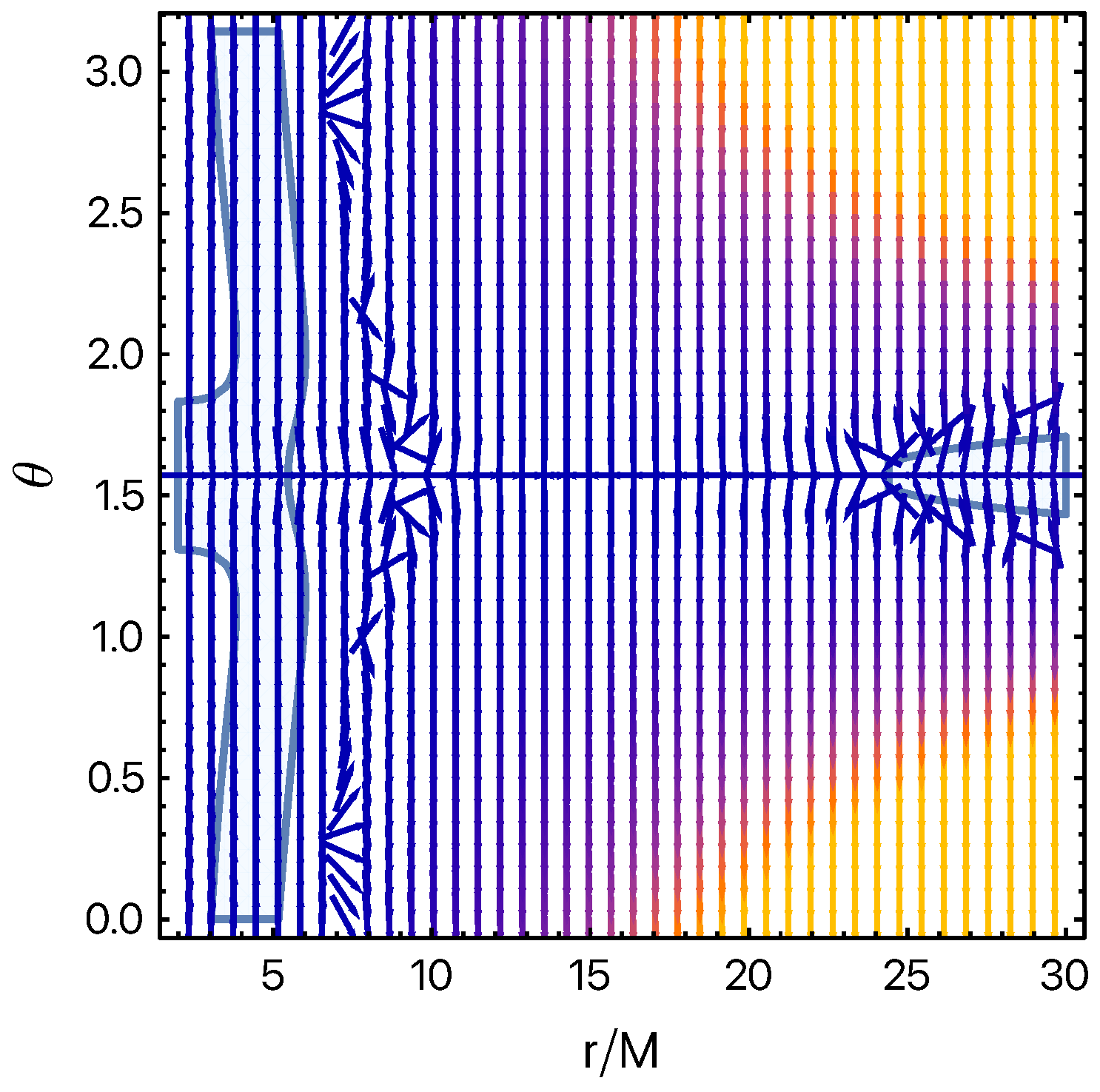
Figure 13 shows the distribution of the restoring force vectors in the stable region. The length and direction of each arrow indicate the magnitude and orientation of the force, respectively. The force is strongest near the inner edge of the stability region and gradually decreases toward the outer edge. This analysis provides a quantitative measure of the system’s resistance to deviations from circular orbits and complements the stability assessment based on the Hessian criteria.

4. Impact of Dark Matter Halo Spikes on the Event Horizon of Kerr Black Holes

4.1. Event Horizon of a Pure Kerr Black Hole

In general relativity, the event horizon of a Kerr black hole is determined by the metric function Δ ( r ) , appearing in the Kerr metric:
Δ ( r ) = r 2 2 M r + a 2 ,
where M is the black hole mass and a is the spin parameter. The event horizons correspond to the roots of Δ ( r ) = 0 , yielding
r ± = M ± M 2 a 2 ,
where r + and r denote the outer and inner horizons, respectively. The spatial radius R in the embedding diagram is defined as
R = r 2 + a 2 ,
so the outer and inner horizon radii in terms of R are
R ± = r ± 2 + a 2 .
These expressions illustrate the non-Euclidean geometric structure of Kerr spacetime. For a given spin a, the coordinate and spatial radii of the horizons can be explicitly computed.

4.2. Approximate Event Horizon in Kerr + Dehnen DM Halo

We now derive an approximate formula for the event horizon in the Kerr spacetime modified by a Dehnen-type dark matter (DM) halo. The metric function in our Kerr + DM halo model is defined as
Δ ( r ) = r 2 f ( r ) + a 2 , f ( r ) = 1 2 M r 4 π ρ s r s 3 ( r s + 2 r ) 3 ( r s + r ) 2 .
1.
DM Halo Correction
The DM contribution modifies Δ ( r ) by
δ Δ ( r ) = r 2 f ( r ) f Kerr ( r ) = 4 π ρ s r s 3 r 2 ( r s + 2 r ) 3 ( r s + r ) 2 .
2.
First-order Perturbation
Using a Taylor expansion around the Kerr horizons r ± :
Δ ( r ± + δ r ± ) Δ Kerr ( r ± ) + δ r ± Δ Kerr ( r ± ) + δ Δ ( r ± ) = 0 .
Since Δ Kerr ( r ± ) = 0 , the first-order shift in the horizons is
δ r ± = δ Δ ( r ± ) Δ Kerr ( r ± ) .
Here,
Δ Kerr ( r ) = 2 r 2 M Δ Kerr ( r ± ) = ± 2 M 2 a 2 .
3.
Approximate Horizon Formula
Finally, the perturbed horizons are approximately
r ± DM r ± 2 π ρ s r s 3 r ± 2 ( r s + 2 r ± ) 3 ( r s + r ± ) 2 M 2 a 2 .
The upper sign corresponds to the outer horizon r + , while the lower sign corresponds to the inner horizon r . This shows that the outer horizon expands and the inner horizon shrinks under the influence of the DM halo.
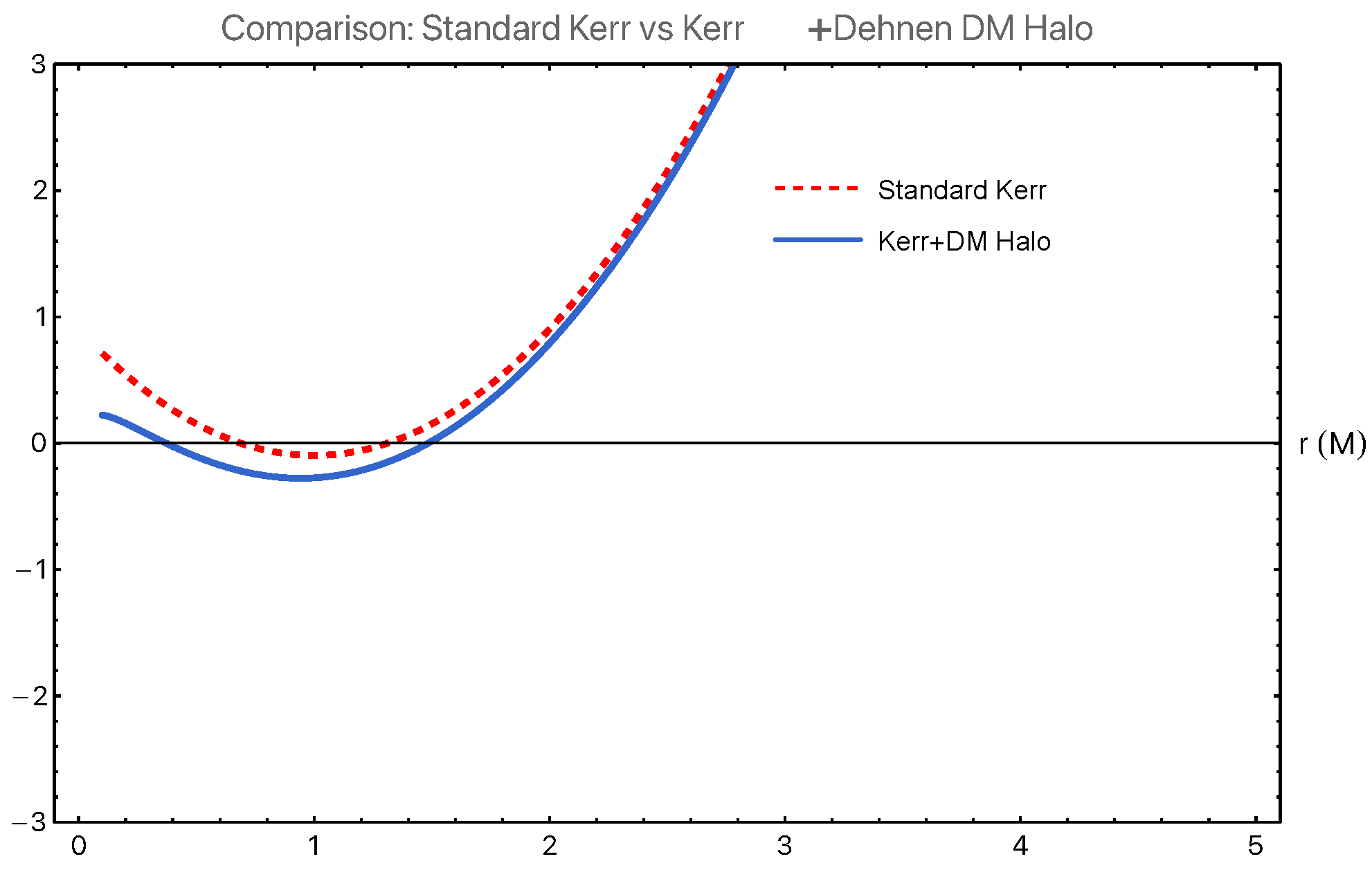
Figure 14 compares the metric function Δ ( r ) for a standard Kerr black hole (red dashed line) and a Kerr black hole embedded in a Dehnen-type dark matter halo (blue solid line), illustrating how the presence of dark matter modifies the gravitational potential. As a result, the outer horizon expands slightly while the inner horizon contracts, reflected in the corresponding zeros of Δ ( r ) . The inset region r [ 0.1 , 6 ] M highlights the subtle structure near the inner horizon. These deviations, although small, suggest that the gravitational influence of a dark matter halo could leave detectable imprints on the apparent shape and size of the black hole shadow, providing potential observational signatures in high-resolution black hole imaging.
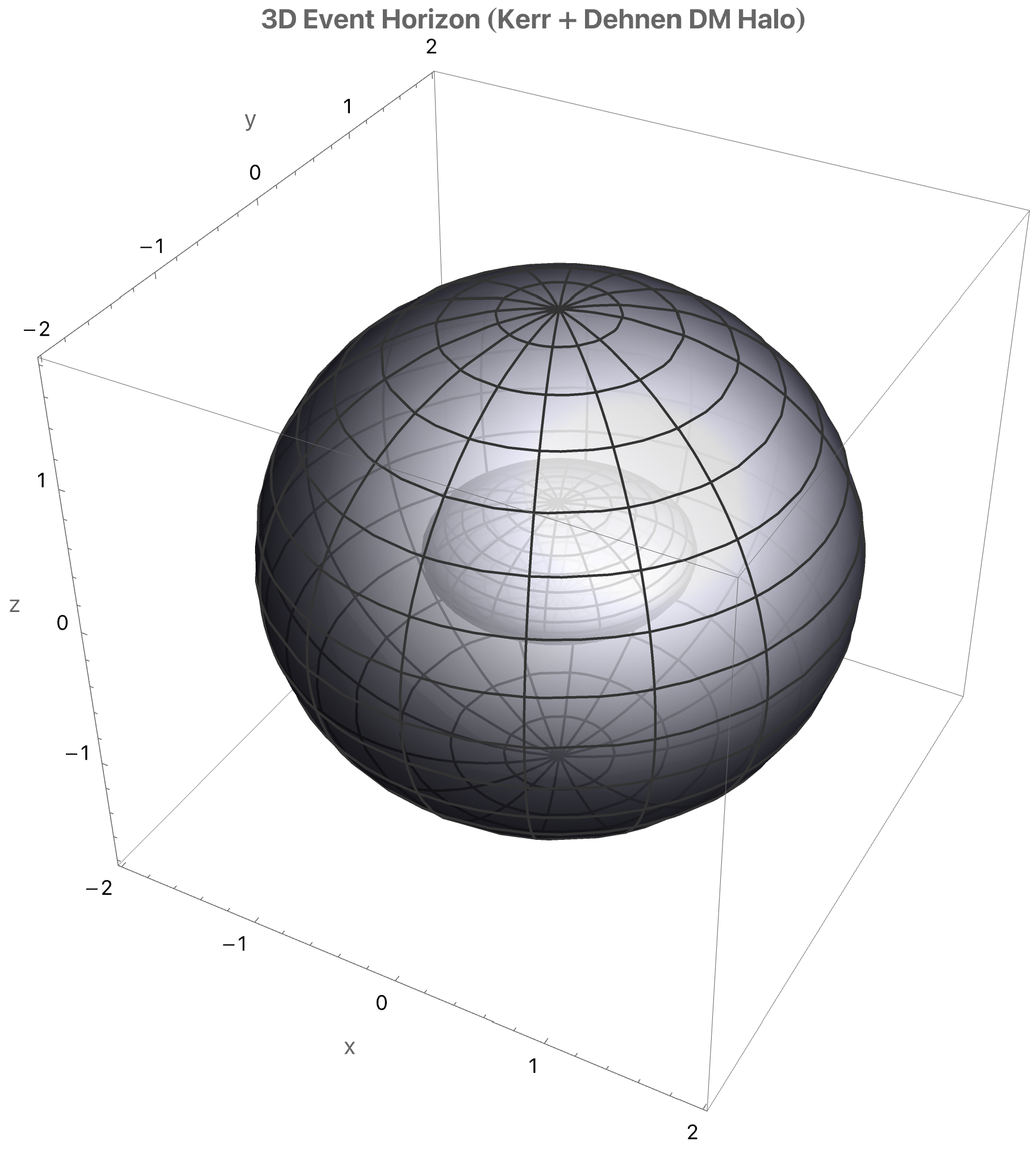
Figure 15 shows the three-dimensional structure of the event horizons of a Kerr black hole surrounded by a Dehnen-type dark matter spike. The radial locations of the horizons, r ± DM , are obtained by numerically solving Δ ( r ) = 0 , where Δ ( r ) incorporates the gravitational potential of the dark matter halo. The spatial radii are defined as R = r 2 + a 2 , corresponding to the embedding in 3D Cartesian coordinates. The visualization highlights the differential effect of dark matter: the outer horizon expands, while the inner (Cauchy) horizon contracts relative to the pure Kerr case. Semi-transparent surfaces are used to clearly reveal the inner horizon within the outer one, emphasizing how the presence of dark matter modifies the causal and thermodynamic structure of the black hole. This representation provides an intuitive geometric understanding of how a surrounding dark matter spike alters the horizon geometry.

4.3. Horizon Area and Physical Implications

The areas of the event horizons for a Kerr black hole are given by
A ± = 4 π r ± 2 + a 2 , A ± DM = 4 π ( r ± DM ) 2 + a 2 ,
where r ± and r ± DM denote the coordinate radii of the inner (−) and outer (+) horizons in the absence and presence of a dark matter (DM) spike, respectively. These expressions immediately indicate that the inclusion of a DM halo systematically increases the outer horizon area while decreasing the inner horizon area. From the perspective of black hole thermodynamics, the horizon area is directly related to entropy via the Bekenstein–Hawking relation
S ± DM = k B A ± DM 4 .
Thus, the presence of a DM spike modifies the thermodynamic properties of the black hole, effectively increasing the entropy associated with the outer horizon and reducing that of the inner horizon.
Physically, the expansion of the outer horizon implies a larger causal boundary, which enhances the black hole’s ability to hide its central singularity from external observers. Conversely, the contraction of the inner horizon can have stabilizing effects on the otherwise problematic Cauchy horizon, potentially mitigating classical instabilities such as mass inflation that arise due to infalling matter or perturbations. These effects suggest that the gravitational influence of DM spikes is not merely a perturbative modification of the horizon radius but can induce qualitatively meaningful changes in the causal structure and thermodynamic characteristics of the Kerr geometry.
Furthermore, in astrophysical scenarios where supermassive black holes are embedded within dense DM spikes, these modifications may influence observable phenomena indirectly, such as the shadow radius or the near-horizon photon trajectories. While the corrections to the horizon radii and areas are typically small for realistic DM densities ( ρ s r s 3 M ), they provide a direct link between the properties of the surrounding dark matter environment and the fundamental geometrical and thermodynamic features of the black hole. This analysis emphasizes the relevance of environmental effects in high-precision modeling of black hole spacetimes, particularly in the context of gravitational wave astronomy and horizon-scale imaging.

4.4. Series Expansion for Low-Density Dark Matter

For astrophysical black holes embedded in a low-density Dehnen-type dark matter (DM) halo, the characteristic DM density satisfies ρ s r s 3 M . In this regime, the gravitational influence of the DM spike on the Kerr black hole horizons is relatively weak, allowing a perturbative expansion of the inner and outer horizon radii:
r ± DM r ± 2 π ρ s r s 3 r ± 2 ( r s + 2 r ± ) 3 ( r s + r ± ) 2 M 2 a 2 + O ( ( ρ s r s 3 ) 2 ) ,
where the upper sign corresponds to the outer horizon r + , and the lower sign corresponds to the inner horizon r . It is clear that the outer horizon expands while the inner horizon contracts due to the gravitational pull of the DM halo.
The corresponding spatial radii can be approximated as
R ± DM ( r ± DM ) 2 + a 2 R ± 2 π ρ s r s 3 r ± 2 ( r s + 2 r ± ) 3 ( r s + r ± ) 2 r ± R ± M 2 a 2 ,
where R ± = r ± 2 + a 2 are the classical spatial radii of the Kerr black hole horizons.
Even though the corrections to the horizon radii are small for realistic DM densities, they can have observable consequences in high-precision astrophysical measurements. In particular, the expansion of the outer horizon and contraction of the inner horizon may influence the shadow radius and the trajectories of photons near the horizon, providing a potential link between the surrounding dark matter environment and observable features of black hole spacetimes, such as those accessible to horizon-scale imaging experiments.

5. Summary and Discussion

In this work, we have systematically studied the dynamical stability of circular orbits around Kerr black holes embedded in Dehnen-type dark matter halo, with a particular focus on the spatial distribution of stable orbits. The Kerr-like metric was constructed via the Newman–Janis algorithm, and the effective potentials for test particles on equatorial and non-equatorial planes were derived. The stability of circular orbits was analyzed using the Hessian matrix of the effective potential, while the stability strength and restoring force distributions were employed to quantify the response of orbits to perturbations.
Two-dimensional analysis reveals that stable circular orbits exhibit complex, non-continuous structures in the ( r , θ ) plane. An increase in black hole spin or dark matter halo density shifts the innermost stable circular orbit (ISCO) inward and may lead to multiple disconnected stable regions, indicating a high sensitivity of orbital stability to environmental parameters. Two-dimensional heatmaps, parameter scans, and three-dimensional visualizations further demonstrate that the extent, shape, and angular dependence of stable orbit regions are jointly determined by the black hole spin and halo properties, highlighting the importance of environmental effects in astrophysical contexts. Three-dimensional visualizations also show that orbits closer to the black hole generally exhibit stronger stability, while high-latitude orbits away from the equatorial plane are less stable. Analysis of restoring forces indicates that the inner edge of the stable regions exhibits the strongest restoring forces, providing maximal resistance to perturbations.
We further examined the influence of dark matter halos on the black hole horizons. First-order perturbative analysis shows that the outer horizon radius increases while the inner horizon radius decreases, consistent with the enhanced gravitational contribution at larger radii and the central stretching effect induced by the halo. These modifications may impact local spacetime stability and the dynamics near the Cauchy horizon.
Overall, our results indicate that dark matter halos not only significantly alter the ISCO position but also reshape the spatial distribution of stable circular orbits, providing important references for modeling orbital evolution and gravitational wave phase shifts in extreme-mass-ratio inspirals (EMRIs). Future work could extend to the effects of self-interacting or annihilating dark matter models on stable regions and horizons, explore the interactions between halos and accretion disks, and combine theoretical predictions with EMRI or black hole shadow observations to probe dark matter distributions around rotating black holes.

Author Contributions

Conceptualization, Y.W. and M.L.; methodology, Y.W.; software, Y.W.; validation, Y.W. and M.L.; formal analysis, Y.W.; investigation, Y.W.; resources, Y.W.; data curation, Y.W.; writing—original draft preparation, Y.W.; writing—review and editing, Y.W. and M.L.; visualization, Y.W.; supervision, M.L. and H.X.; project administration, M.L. and H.X.; funding acquisition, M.L. All authors have read and agreed to the published version of the manuscript.

Funding

This works is supported by the National Key Research and Development Program of China (No. 2024YFC2207003).

Data Availability Statement

The data supporting the findings of this study are available within the article. No additional datasets were generated or analyzed beyond the theoretical calculations and numerical results presented herein.

Acknowledgments

The authors gratefully acknowledge support from the project “Integrated Electronics Technology for Inertial Sensors” (2024YFC2207003) led by Meilin Liu. The authors also thank all colleagues who provided helpful discussions and assistance during this work, and especially Haiguang Xu for his guidance and support.

Conflicts of Interest

The authors declare no conflicts of interest. The funders provided financial support and participated in the design of the study, data collection, analysis, interpretation, manuscript writing, and the decision to publish the results.

Abbreviations

The following abbreviations are used in this manuscript:
BHBlack Hole
Kerr BHKerr Black Hole
DMDark Matter
Dehnen DM HaloDehnen-type Dark Matter Halo
EMRIExtreme-Mass-Ratio Inspiral
ISCOInnermost Stable Circular Orbit
HessianHessian Matrix of the Effective Potential

Appendix A. Rotating Schwarzschild–Dehnen Black Hole via the Newman–Janis Algorithm

In this Appendix, we outline the derivation of the rotating Schwarzschild–Dehnen black hole solution using the Newman–Janis algorithm (NJA).

Appendix A.1. Transformation to Eddington–Finkelstein Coordinates

We begin with the static and spherically symmetric Schwarzschild–Dehnen metric written in Boyer–Lindquist (BL) coordinates:
d s 2 = f ( r ) d t 2 + d r 2 f ( r ) + r 2 ( d θ 2 + sin 2 θ d ϕ 2 ) .
To implement the NJA, we first transform to the advanced Eddington–Finkelstein (EF) coordinates ( u , r , θ , ϕ ) defined by
d u = d t d r f ( r ) .
The metric then takes the form
d s 2 = f ( r ) d u 2 2 d u d r + r 2 ( d θ 2 + sin 2 θ d ϕ 2 ) .

Appendix A.2. Null Tetrad Representation

Following the Newman–Penrose formalism, the metric is rewritten in terms of a null tetrad basis { l μ , n μ , m μ , m ¯ μ } satisfying the orthogonality and normalization conditions.
A convenient choice of null tetrads is
l μ = δ r μ ,
n μ = δ u μ 1 2 f ( r ) δ r μ ,
m μ = 1 2 r δ θ μ + i sin θ δ ϕ μ .
m ¯ μ = 1 2 r δ θ μ i sin θ δ ϕ μ .
The contravariant metric can then be reconstructed as
g μ ν = l μ n ν l ν n μ + m μ m ¯ ν + m ν m ¯ μ .

Appendix A.3. Complex Coordinate Transformation

To generate rotation, we perform the complex coordinate transformation
u u i a cos θ ,
r r + i a cos θ ,
where a denotes the spin parameter.
Under this transformation, the metric functions are promoted according to
r 2 Σ r 2 + a 2 cos 2 θ ,
and the function f ( r ) generalizes to a function depending on r and θ through Σ .
Following the standard NJA prescription and adopting the non-complexification procedure, the rotating solution can be expressed in Boyer–Lindquist coordinates.

Appendix A.4. Rotating Schwarzschild–Dehnen Metric

After transforming back to BL coordinates, the rotating metric takes the form
d s 2 = 1 2 M r + 4 π ρ s r s 3 ( r s + 2 r ) 3 ( r s + r ) 2 Σ 2 d t 2 4 a sin 2 θ M r + 2 π ρ s r s 3 ( r s + 2 r ) 3 ( r s + r ) 2 Σ 2 d t d ϕ + Σ 2 Δ d r 2 + Σ 2 d θ 2 + sin 2 θ r 2 + a 2 + 4 a 2 sin 2 θ M r + 2 π ρ s r s 3 ( r s + 2 r ) 3 ( r s + r ) 2 Σ 2 d ϕ 2 ,
where
Δ = r 2 f ( r ) + a 2 = r 2 1 2 M r 4 π ρ s r s 3 ( r s + 2 r ) 3 ( r s + r ) 2 + a 2 , Σ = r 2 + a 2 cos 2 θ .
In the limit ρ s 0 , the metric reduces to the standard Kerr solution with
Δ = r 2 2 M r + a 2 .
This confirms that the obtained solution consistently generalizes the Kerr spacetime to the case of a Dehnen-type dark matter halo.

References

  1. Einstein, A. Die Feldgleichungen der Gravitation. In Sitzungsberichte der Preussischen Akademie der Wissenschaften; Verlag der Akademie der Wissenschaften: Berlin, Germany, 1915. [Google Scholar]
  2. Schwarzschild, K. On the Gravitational Field of a Point-Mass. In Sitzungsberichte der Preussischen Akademie der Wissenschaften; Verlag der Akademie der Wissenschaften: Berlin, Germany, 1916. [Google Scholar]
  3. Abbott, B.P.; Abbott, R.; Abbott, T.D.; Abernathy, M.R.; Acernese, F.; Ackley, K.; Adams, C.; Adams, T.; Addesso, P.; Adhikari, R.X.; et al. Observation of Gravitational Waves from a Binary Black Hole Merger. Phys. Rev. Lett. 2016, 116, 061102. [Google Scholar] [CrossRef]
  4. Kerr, R.P. Gravitational Field of a Spinning Mass. Phys. Rev. Lett. 1963, 11, 237. [Google Scholar] [CrossRef]
  5. Chandrasekhar, S. The Mathematical Theory of Black Holes; Oxford University Press: Oxford, UK, 1983. [Google Scholar]
  6. Carter, B. Global Structure of the Kerr Family of Gravitational Fields. Phys. Rev. 1968, 174, 1559–1571. [Google Scholar] [CrossRef]
  7. Wilkins, D.C. Bound Geodesics in the Kerr Metric. Phys. Rev. D 1972, 5, 814–822. [Google Scholar] [CrossRef]
  8. Bertone, G.; Hooper, D.; Silk, J. Particle dark matter: Evidence, candidates and constraints. Phys. Rept. 2005, 405, 279–390. [Google Scholar] [CrossRef]
  9. Rubin, V.C.; Ford, W.K.J. Rotation of the Andromeda Nebula from a Spectroscopic Survey of Emission Regions. Astrophys. J. 1980, 159, 379. [Google Scholar] [CrossRef]
  10. Collaboration, P. Planck 2018 results. VI. Cosmological parameters. Astron. Astrophys. 2020, 641, A6. [Google Scholar] [CrossRef]
  11. Gondolo, P.; Silk, J. Dark Matter Spikes at the Galactic Center. Phys. Rev. Lett. 1999, 83, 1719. [Google Scholar] [CrossRef]
  12. Eda, K.; Itoh, Y.; Kuroyanagi, S.; Silk, J. Gravitational waves as a probe of dark matter minispikes. Phys. Rev. Lett. 2013, 110, 221101. [Google Scholar] [CrossRef]
  13. Cardoso, V.; Pani, P. Testing the nature of dark compact objects: A status report. Living Rev. Relativ. 2019, 22, 4. [Google Scholar] [CrossRef]
  14. Barausse, E.; Cardoso, V.; Pani, P. Environmental effects for gravitational-wave astrophysics. Phys. Rev. D 2014, 89, 104059. [Google Scholar] [CrossRef]
  15. Bardeen, J.M.; Press, W.H.; Teukolsky, S.A. Rotating Black Holes: Locally Nonrotating Frames, Energy Extraction, and Scalar Synchrotron Radiation. Astrophys. J. 1972, 178, 347–370. [Google Scholar] [CrossRef]
  16. Shapiro, S.L.; Teukolsky, S.A. Black Holes, White Dwarfs, and Neutron Stars; Wiley: Hoboken, NJ, USA, 1983. [Google Scholar]
  17. Rezzolla, L.; Zhidenko, A. New parametrization for spherically symmetric black holes in metric theories of gravity. Phys. Rev. D 2014, 90, 084009. [Google Scholar] [CrossRef]
  18. Navarro, J.F. The Structure of Cold Dark Matter Halos. Astrophys. J. 1996, 462, 563–575. [Google Scholar] [CrossRef]
  19. Kiselev, V.V. Quintessence and black holes. Class. Quant. Grav. 2003, 20, 1187–1198. [Google Scholar] [CrossRef]
  20. Sadeghian, L.; Ferrer, F.; Will, C.M. Dark-matter distributions around massive black holes: A general relativistic analysis. Phys. Rev. D 2013, 88, 63522. [Google Scholar] [CrossRef]
  21. Ali, A.; Molla, N.U.; Ghosh, S.G.; Ramasamya, A.; Debnath, U. Observable signature of Dehnen-type dark matter halos via strong gravitational lensing by supermassive black holes and constraints from EHT observations. Phys. Dark Universe 2025, 48, 101859. [Google Scholar] [CrossRef]
  22. Li, Z.; Yu, J. Observational properties of a Schwarzschild black hole surrounded by a Dehnen-type dark matter halo. Eur. Phys. J. C 2025, 85, 1170. [Google Scholar] [CrossRef]
  23. Dehnen, W. A Family of Potential-Density Pairs for Spherical Galaxies and Bulges. Mon. Not. R. Astron. Soc. 1993, 265, 250–256. [Google Scholar] [CrossRef]
  24. Haroon, S.; Zhu, T. Periodic orbits and their gravitational wave radiations in a black hole with a dark matter halo. Phys. Rev. D 2025, 112, 044046. [Google Scholar] [CrossRef]
  25. Wang, Y.; Tang, R.; Han, W.; Liang, E. Distinguishing Strongly Interacting Dark Matter Spikes via EMRI Gravitational Waves. Symmetry 2025, 17, 1878. [Google Scholar] [CrossRef]
  26. Vicente, R.; Karydas, T.K.; Bertone, G. Fully Relativistic Treatment of Extreme Mass-Ratio Inspirals in Collisionless Environments. Phys. Rev. Lett. 2025, 135, 211401. [Google Scholar] [CrossRef]
  27. Nakashi, K.; Igata, T. Innermost stable circular orbits in the Majumdar-Papapetrou dihole spacetime. Phys. Rev. D 2020, 102, 024012. [Google Scholar] [CrossRef]
  28. Nakashi, K.; Igata, T. Circular and periodic orbits in dihole spacetimes. Class. Quant. Grav. 2022, 39, 045012. [Google Scholar]
  29. Wang, Y.; Han, W.; Wu, X.; Liang, E. Gravitational wave imprints of dark matter annihilation: Probing halo structures through EMRI signals. Class. Quantum Gravity 2025, 42, 175007. [Google Scholar] [CrossRef]
  30. Fan, Z.; Wang, Y.; Wang, X. Stability Analysis of Stable Circular Orbit in Multi-Static Black Hole Spacetime. Symmetry 2024, 16, 1140. [Google Scholar] [CrossRef]
  31. Wang, Y.; Shen, G.; Sun, X. The Space-Time Properties of Three Static Black Holes. Symmetry 2023, 15, 702. [Google Scholar] [CrossRef]
  32. Shen, G.; Wang, Y.; Lü, H. Space-Time Properties of Extreme RN Black Holes in Static Triangular Distribution. Symmetry 2023, 15, 505. [Google Scholar] [CrossRef]
  33. Igata, T. Stable circular orbits in multi-black-hole spacetimes. Phys. Rev. D 2019, 99, 104065. [Google Scholar]
  34. Newman, E.T.; Janis, A.I. Note on the Kerr spinning-particle metric. J. Math. Phys. 1965, 6, 915–917. [Google Scholar] [CrossRef]
  35. Azreg-Aïnou, M. Generating rotating regular black hole solutions without complexification. Phys. Rev. D 2014, 90, 064041. [Google Scholar] [CrossRef]
  36. Gohain, M.M.; Phukon, P.; Bhuyan, K. Thermodynamics and null geodesics of a Schwarzschild black hole surrounded by a Dehnen type dark matter halo. Phys. Dark Universe 2024, 46, 101683. [Google Scholar] [CrossRef]
  37. Uktamov, U.; Shaymatov, S.; Ahmedov, B. Static Black Hole Solution with a Dark Matter Halo. arXiv 2025. [Google Scholar] [CrossRef]
  38. Drake, S.P.; Szekeres, P. Uniqueness of the Newman–Janis algorithm in generating rotating solutions. Gen. Relativ. Gravit. 2000, 32, 445–457. [Google Scholar] [CrossRef]
  39. Gohain, M.M.; Gogoi, D.J.; Bhuyan, K.; Phukon, P. Investigating Optical and Ring-Down Gravitational Wave Properties of a Rotating Black Hole in a Dehnen Galactic Dark Matter Halo. arXiv 2025. [Google Scholar] [CrossRef]
Figure 1. Equatorial plane effective potential V ( r , θ = π / 2 ) showing the distribution of the effective potential for a test particle in the Kerr-like Schwarzschild–Dehnen spacetime. Parameters are E = 0.999 , L = 2.0 , and ρ s = 4.14 × 10 4 .
Universe 12 00068 g001
Figure 2. Contour plot of the effective potential in the r- θ plane, illustrating the distribution of stable regions off the equatorial plane in the Kerr-like Schwarzschild–Dehnen spacetime. Parameters are E = 0.999 , L = 2.0 , and ρ s = 4.14 × 10 4 .
Universe 12 00068 g002
Figure 3. Three-dimensional surface of the effective potential, showing how the potential varies with r and θ for a test particle in the Kerr-like Schwarzschild–Dehnen spacetime. Parameters are E = 0.999 , L = 2.0 , and ρ s = 4.14 × 10 4 .
Universe 12 00068 g003
Figure 4. 2D stability region around a Kerr-like Schwarzschild black hole surrounded by a Dehnen-type dark matter halo. The calculation is performed with a black hole spin a BH = 0.96 , a dark matter characteristic density ρ s = 6 × 10 4 , a scale radius r s = 2 M , and a normalized black hole mass M BH = 1 . The effective potential is expanded around a reference circular orbit at r 0 = 6 M on the equatorial plane ( θ 0 = π / 2 ). The blue shaded region indicates the domain where both the determinant and the trace of the Hessian matrix of the effective potential are positive ( h > 0 and k > 0 ), corresponding to stability against small radial and polar perturbations.
Universe 12 00068 g004
Figure 5. Three-dimensional visualization of the orbital stability region around a rapidly spinning Kerr black hole. The left panel shows the black hole surrounded by a Dehnen-type dark matter (DM) halo, with spin a BH = 0.96 , DM halo density ρ s = 6 × 10 4 , scale radius r s = 2 , and black hole mass normalized to M BH = 1 . The right panel corresponds to the pure Kerr case with the same black hole spin and mass but no DM halo ( ρ s = 0 ). In both panels, the yellow semi-transparent volume represents the region where circular orbits are stable, determined by the positivity of both the Hessian determinant and the trace of the effective potential, h > 0 and k > 0 . The central black sphere denotes the black hole, while the large gray sphere illustrates the spatial extent of the DM halo (left panel only). A representative equatorial circular orbit at r = 22 M is shown in blue, with the inspiraling compact object indicated by the red sphere.
Universe 12 00068 g005
Figure 6. Stability regions of circular orbits around a Kerr black hole immersed in a Dehnen-type dark matter halo. The four panels correspond to different combinations of black hole spin a and dark matter halo characteristic density ρ s . The values of a and ρ s are indicated in the upper-right corner of each panel. Comparison among the panels illustrates how both spin and dark matter density affect the extent and shape of the stable orbital regions.
Universe 12 00068 g006
Figure 7. Heatmap of ISCO radius r ISCO as a function of black hole spin a and dark matter density ρ s (log scale) for r s = 10 M . White contours indicate selected ISCO levels.
Universe 12 00068 g007
Figure 8. ISCO radius as a function of black hole spin a for several fixed dark matter densities ρ s . Denser halos enhance the inward ISCO shift.
Universe 12 00068 g008
Figure 9. ISCO radius as a function of dark matter density ρ s for several fixed spins a. Denser halos systematically reduce the ISCO radius, with stronger effects for higher spins.
Universe 12 00068 g009
Figure 10. Relative deviation of ISCO from the vacuum Kerr case as a function of spin a for selected DM densities ρ s . Positive values indicate inward shifts due to the DM halo.
Universe 12 00068 g010
Figure 11. 3D surface of ISCO radius r ISCO as a function of black hole spin a and DM density ρ s . The plasma colormap shows the ISCO value in units of M.
Universe 12 00068 g011
Figure 12. Orbital stability of circular motion in a Kerr black hole spacetime surrounded by a dark matter halo. The left panel shows the stable region of circular orbits in the ( r , θ ) plane, determined from the Hessian matrix of the effective potential V eff ( r , θ ) . The shaded blue area corresponds to configurations with a positive Hessian determinant and a positive trace, indicating local orbital stability, while the transparent region represents unstable orbits. The right panel displays the corresponding stability strength within the stable region, quantified by the minimum eigenvalue of the Hessian matrix. For visualization purposes, the radial coordinate r, the polar angle θ , and the stability strength are normalized. Warmer colors indicate stronger orbital stability. These results demonstrate that the presence of a dark matter halo modifies both the extent of the stable orbital region and the distribution of stability in Kerr spacetimes.
Universe 12 00068 g012
Figure 13. Two-dimensional stability region around a Kerr black hole surrounded by a Dehnen-type dark matter halo, overlaid with the corresponding restoring force vectors. The black hole spin is a BH = 0.85 , dark matter characteristic density is ρ s = 2 × 10 4 , scale radius r s = 2 , and normalized black hole mass M BH = 1 . The light blue shaded region indicates where the Hessian of the effective potential satisfies det H > 0 and Tr H > 0 , representing stable circular orbits against radial and polar perturbations. The red arrows show the direction and magnitude of the restoring forces, F r and F θ , driving the system back toward equilibrium.
Universe 12 00068 g013
Figure 14. Comparison of the metric function Δ ( r ) for a standard Kerr black hole (red dashed line) and a Kerr black hole embedded in a Dehnen-type dark matter halo (blue solid line), with parameters a BH = 0.95 , ρ DM = 4 × 10 4 , and r s = 2 M . The presence of the dark matter halo slightly modifies the gravitational potential, causing a small shift in the location of the event horizon, as indicated by the zero of Δ ( r ) . The inset region r [ 0.1 , 6 ] M highlights the structure of the inner horizon.
Universe 12 00068 g014
Figure 15. Three-dimensional visualization of the event horizons of a Kerr black hole embedded in a Dehnen-type dark matter halo. The radial coordinates of the horizons, r ± DM , are obtained numerically by solving Δ ( r ) = 0 , where Δ ( r ) accounts for the gravitational effect of the dark matter halo with parameters a BH = 0.75 , ρ DM = 9 × 10 6 , and r s = 2 . The spatial radii are defined as R = r 2 + a BH 2 . The inner and outer horizons are visualized using semi-transparent surfaces, highlighting the slight contraction of the inner horizon and the expansion of the outer horizon due to the presence of the dark matter halo. The axes ( x , y , z ) correspond to the embedding coordinates in 3D space.
Universe 12 00068 g015
Disclaimer/Publisher’s Note: The statements, opinions and data contained in all publications are solely those of the individual author(s) and contributor(s) and not of MDPI and/or the editor(s). MDPI and/or the editor(s) disclaim responsibility for any injury to people or property resulting from any ideas, methods, instructions or products referred to in the content.