


Abstract
We review some aspects of accretion disks physics, spacetime photon shell and photon orbits, related to retrograde (counter-rotating) motion in Kerr black hole (BH) spacetimes. In this brief review, we examine the counter-rotating components of the Kerr BH shadow boundary, under the influence of counter-rotating accretion tori, accreting flows and proto-jets (open critical funnels of matter, associated with the tori) orbiting around the central BH. We also analyze the redshifted emission arising from counter-rotating structures. Regions of the shadows and photon shell are constrained in their dependence of the BH spin and observational angle. The effects of the counter-rotating structures on these are proven to be typical of the fast-spinning BHs, and accordingly can be observed only in the restricted classes of the Kerr BH spacetimes. This review is intended as a concise guide to the main properties of counter-rotating fluxes and counter-rotating disks in relation to the photon shell and the BH shadow boundary. Our findings may serve as the basis for different theoretical frameworks describing counter-rotating accretion flows with observable imprints manifesting at the BH shadow boundary. The results can eventually enable the distinction of counter-rotating fluxes through their observable imprints, contributing to constraints on both the BH spin and the structure of counter-rotating accretion disks. In particular, photon trajectories and their impact parameters can manifest in the morphology of the BH shadow. Such features, when accessible through high-resolution imaging and spectral or polarization measurements, could provide a direct avenue for testing different theoretical models on accretion disk dynamics and their BH attractors.
1. Introduction
The Event Horizon Telescope (EHT) Collaboration in 2019 unveiled an image of M87*, the super-massive black hole (SMBH) at the center of the super-giant elliptical galaxy Messier 87 (M87) [1,2,3,4,5,6]. On the other hand, through VLBI (very-long-baseline interferometry), millimeter-band synchrotron images of the black hole (BH) and accretion disks at the center of SgrA galaxy were also resolved in 2022, providing an image of the emission regions close to SgrA*, the central BH, in the Milky Way [7].
Numerical general relativistic magnetohydrodynamic (GRMHD) torus models were matched to observations in [4,5,6,8,9,10,11,12]. Many analytic disk, accretion flow and jet ejection models have been developed [13,14,15]). Semi-analytical models of the M87* spectra have been also investigated [16]. In addition, semi-analytic GRMHD jet and accretion flow models were developed in [17] to simulate the emission from both M87* and SgrA*. The behavior of high-energy particles within jet–accretion flows, with synchrotron radiation signatures, has been also analyzed [18].
Following these detections, the observational results and theoretical interpretations were further refined and extended. In order to fit astronomical observations, several observables were constructed using special points on the shadow boundary in the celestial coordinates, focusing in particular on the analytical, geometric constraints provided by the gravitational background [11,13,19,20,21,22].
Our analysis fits within this framework, concentrating on the analytical constraints and distinctive features of the shadow boundary arising from flows and disks that counter-rotate relative to the central BH.
In this respect, properties of the BH shadows were investigated since the earlier studies [23,24,25,26,27]. The ring-shaped bright images from EHT analysis are known as the “emission ring” [28]. The image data, obtained for M87* and SgrA*, emerge as a bright, unresolved (thick) ring. Embedded within this, there is a (thin) ring, sometimes called “photon ring”, composed of infinite sub-rings, made of photon orbits around the BH, and directed to the observer at infinity. The set of these orbits approaches the BH shadow boundary, which is fixed by the BH spin and the view-angle only, and it is determined by (photons orbiting) the BH photon shell.
The photons in the region fall in or escape to infinity. The BH shadow corresponds to photon paths falling on its event horizon, and the (dark) region is surrounded by the bright emission ring, due to the accretion flow/disk or lensed photons.
The so-called photon ring corresponds, therefore to photon paths near the (unstable) photon orbits (passing through the emitting plasma, which, if optically thin, will be associated with a bright image. It has been evaluated (from GRMHD simulations and analytic analysis) that the photon ring would correspond to only 10% of the total image flux density [11].
The thick ring diameter is well analyzed, but its compositions, i.e., its internal sub-structure, including the photon orbit’s sub-structure, is not resolved. The photon ring decomposition into sub-rings features a self-similar structure (in the set of orbits) determined by the region orbital instability (see, for more discussion, [11,28,29,30,31,32]).
Each photon ring is indexed with an integer , where corresponds to a direct (the primary) image, photon trajectories from the emission point direct to the observer at infinity (if on the line of sight), with no orbit around the central BH. Each corresponds to an exponentially thinner ring-like image (as n increases, the photon orbits become progressively narrower). For (secondary image), photons complete half an orbit around the BH; photons with undergo a full orbit around the BH before reaching the observer. Then, photon trajectories are identified by indexes assigned by the number of half-orbits n completed around the central BH, before they reach the observer1, with each successive image corresponding to increasing n.
The photon ring defines the BH shadow boundary. The boundary of the shadow, which the photon rings in the limit approach, is also knoawn as the “critical curve”, and it is independent on the astrophysical context as the emitted plasma and the emission model2. Unlike the emission ring, the critical curve is regulated by the BH spin only and the view angle (intended as the observer inclination relative to the rotational axis).
In our analysis, we investigate the structure of the critical curve, associated with the photon ring, in connection with the spacetime photon shell, the accretion disk, and the dynamics of relativistic accretion flows. As photon orbits in the photon shell compose the shadow boundary, the photon shell’s internal structure, defined by and ℓ, the photons’ relativistic specific angular momentum (or impact parameter) is reflected in the internal structure of the critical curve. In our analysis, we examine the counter-rotating components, that is, the counter-rotating disks (which always orbit outside the photon shell); the photons orbit with a negative impact parameter and the counter-rotating accretion flow, with and . (Note that generally, the orbiting co-rotating tori can enter the photon shell (or even the ergoregion) directly influencing the photon shell and the BH shadow, while this is not possible for counter-rotating tori. For this reason, we have to consider indirect influence caused by the counter-rotating flow falling into the BH.)
Distinguishing counter-rotating from co-rotating BH accretion disks3 based on image morphology, such as brightness asymmetry induced by relativistic Doppler boosting, or from the geometry of photon orbits, remains extremely challenging. This difficulty arises due to strong dependencies on several factors, including the disk modelization (e.g., whether the accretion flow follows a standard and normal evolution (SANE) or a magnetically arrested disk (MAD) configuration), the resolution of photon–ring measurements, and various disk-emission model characteristics. These include the geometry and strength of the magnetic field, jet alignment, and jet energetics, all of which can significantly influence the observable features and complicate the interpretation of VLBI images4.
A discussion on the BH spin constraints from the interferometric measurements of the first photon ring is in5 [29]. More generally, constraints from photon rings are supported by different analyses—see, for example, [28,30,31,33,34].
In the analysis of the BH–accretion disk relative rotation orientation, the system under consideration, as inferred from BH imaging analysis conducted by the EHT, often consists of a central Kerr or Schwarzschild BH, surrounded by a (single) axially symmetric and equatorial accretion disk, accompanied by a jet and centered on the BH. The determination of the disk rotational orientation relative to the central BH, in some systems, often relies on assessing the alignment among the BH, jet, and disk spin axes. This alignment can be differently treated as a variable assumption, forming the basis for numerous best-fit model approaches. The spin of M87* is studied, for example, in [35], favoring a MAD disk for M87*, with respect to a SANE disk, and a co-rotating disk with a BH spin , or a BH spin for counter-rotating disks. In [36], two models with counter-rotating (MAD) disk (with a M87 BH with spin ) and a co-rotating (MAD) accretion disk (with faster spinning M87 BH, with ) were examined.
Hence, current counter-rotating/co-rotating claims concerning, respectively, the rotation orientation of M87* and SgrA* accretion disks, are (strongly) model-dependent. A counter-rotating (MAD) disk for M87* has been seen as favored in some analyses, within the (complex set of) assumptions made for the fitting models. However, other studies also constrain these expectations to different model assumptions, including, for example, the magnetization and the relativistic jet alignment, and features of the ray-tracing and GRMHD simulations6—see [5,32,37,38,39,41]—whereas SgrA* would be described as a spinning BH with a co-rotating accretion flow (and disk)7—see also [37].
However, the study of counter-rotating disks proves particularly relevant for the characterization of the accretion dynamics and their impact on the BH shadow formation, and observational diagnostics in Kerr spacetimes (constraining key parameters such as BH spin and disk rotation orientation). Their dynamics and observational signatures are influenced by several factors, including the effects of the relativistic frame dragging in Kerr spacetime, the stability and efficiency of accretion processes, and the distinct spectral and redshift features they produce.
Furthermore, multiple lines of evidence suggest the presence of counter-rotating disks, for example, from diverse features of the observed emission and luminosity. Notably, in the X-ray binaries, BH systems that lack a detectable ultra-soft component above 1–2 keV in their high-luminosity state may indicate the presence of a rapidly spinning, counter-rotating BH. We refer, for example, to refs. [43,44,45,46,47,48,49,50,51,52,53,54,55,56,57] for an extensive discussion of the distinguishing properties of the accretion discs, particularly in terms of emission and luminosity as shaped by their rotational orientation.
On the other hand, although current EHT observations remain substantially inconclusive regarding whether the accretion discs around SgrA* and M87* are co-rotating or counter-rotating [28,29,30,31,33,34], one could expect that forthcoming observations, combined with more refined analyses, may prove essential for the determination of the rotation orientation.
The constraints presented in this work could ground the construction of libraries’ counter-rotating models, to be systematically matched with the observational data. These constraints might be confronted with astrophysical observations, directly compared to current measurements.
Additionally, although counter-rotating disks themselves do not orbit within the photons’ shell region, the central BH accretes counter-rotating flows. The material they supply can penetrate both the photon shell, as well as the ergoregion, and photons with counter-rotating components in the photon shell. Within the ergoregion, only matter with positive azimuthal velocity, , is allowed. However, accreting material with negative angular momentum can also reside inside the spacetime ergoregion, provided it still satisfies . This indicates that frame-dragging acts on counter-rotating (with ) matter, as it accretes toward the central BH, before crossing the outer ergosurface, leading to the formation of points where (inversion surface and the inversion points).
Moreover, in [20,58] the counter-rotating cases were found to be significantly more constrained than the co-rotating case, which further motivates a focus on the counter-rotating components as effective discriminants of the viewing angle, BH spin, and other disk properties. More specifically the analysis in [20,58] is an extensive investigation of the co-rotating and counter-rotating photon trajectories in the BH shadows, which led to a map of the shadow boundaries. Focusing on the properties of the Kerr BH photons’ shell, it delved into the influence of aggregates of co-rotating and counter-rotating toroids orbiting within the photons’ shell, an effect referred to as BH photon shell obscuration. Since counter-rotating toroids were proven not to orbit in the photon shell for any BH spin, the investigation focused on the specific case of a co-rotating accretion disks. Five distinct classes of BHs were identified, each distinguished by unique features of their photon shells and shadow boundaries, in the context of co-rotating structures orbiting within the photon shell.
Therefore, in the present analysis, we concentrate on the counter-rotating disk, specifically analyzing the photon shell counter-rotating components (counter-rotating photon spherical orbits) and the effects on the shadow boundary of the counter-rotating matter orbiting around the central Kerr BH. We start by reviewing the main constraints on the counter-rotating flows, and we will further detail the properties of counter-rotating tori. We delve deeper into the analysis of shadow boundary variation under the influence of photons from counter-rotating structures outside the photon shell. Finally, we investigate the emission from counter-rotating structures, analyzing the redshift properties of the radiation from counter-rotating particles. The photon shell, as the region populated by unstable spherical photon orbits, plays a decisive role in shaping the shadow boundary and in mediating the interaction between counter-rotating accreting structures and observable emission. Within this framework, counter-rotating fluxes and disks represent a fundamental class of configurations whose properties are tightly constrained by the geometry of the Kerr spacetime (its dimensionless spin also through the effects of frame dragging). The investigation aims to clarify the conditions under which we could provide potential observational discriminants for identifying counter-rotating contributions in accretion flows. We believe this brief review can serve as a concise guide to several key effects that warrant closer analysis in light of the comparison with observational data.
Six different systems are under investigation: 1. counter-rotating accretion disks and structures; 2. the counter-rotating flux of accreting materials in photon shell; 3. the counter-rotating spherical photon orbits; 4. the bound unstable spherical photon orbits in the ergoregion and on the outer ergosurface; and 5. the photon spherical orbits with null impact parameter and 6. with .
The article is divided into two parts. In the first part, from Section 2 to Section 4, we introduce the model and investigate the constraints of the counter-rotating orbits on the BH shadow boundary. In detail, in Section 2 we introduce the spacetime metric. Constants of motion and geodesic equations are summarized in Section 2.1. In Section 3 we analyze the properties of the Kerr BH photon shell. In Section 3.1 we focus on the counter-rotating tori orbiting the central BH. In Section 3.2 we define the inversion surfaces, whereas the BH shadow boundary is the focus of Section 4.
The second part of this analysis is in Section 5, where we discuss the redshift emission from counter-rotating structures.
Final remarks follow in Section 6.
2. The Spacetime Metric
Adopting Boyer–Lindquist (BL) coordinates , we can write the Kerr spacetime line element as follows:
where
(We use geometrical units, where .) Parameter is the metric spin, while M is the (gravitational) mass parameter. Below, we will use dimensionless units with (where and ). According to the values of the spin parameter, metric (1) reduces to the Schwarzschild (non-rotating) BH solution by or to the Kerr BH by the condition . This includes the extreme Kerr BH solution, when .
The Kerr BH outer horizon and outer ergosurface are
respectively. The region is known as the outer ergoregion.
2.1. Geodesics Equations and Constants of Motion
In this section we introduce the Kerr spacetime constants of motion and geodesic equations. Let us start by defining the quantities , the geodesic four-vector tangent. (Here, is the affine parameter.) , for test particles, or otherwise, for a null geodesic.
Below, we also consider the constants of motion , where is the Carter constant of motion and
From in Equation (3), there is the constant of motion
known as the specific angular momentum (also called the impact parameter).
The introduction of the constant ℓ enables a precise definition of the rotational orientation of particles, fluxes and disks, with respect to the central BH, in terms of counter-rotating or co-rotating matter, according to or , respectively.
The constant regulates the motion in the direction and appears in the geodesic equations:
ref. [59], where
and for test particles, while there is for photons.
3. Shadows
In this section we introduce the concept of the boundary of the BH shadow. This object is the set of the (unstable) photon orbits with
(see Equation (5)).
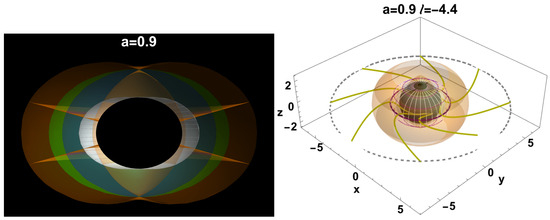
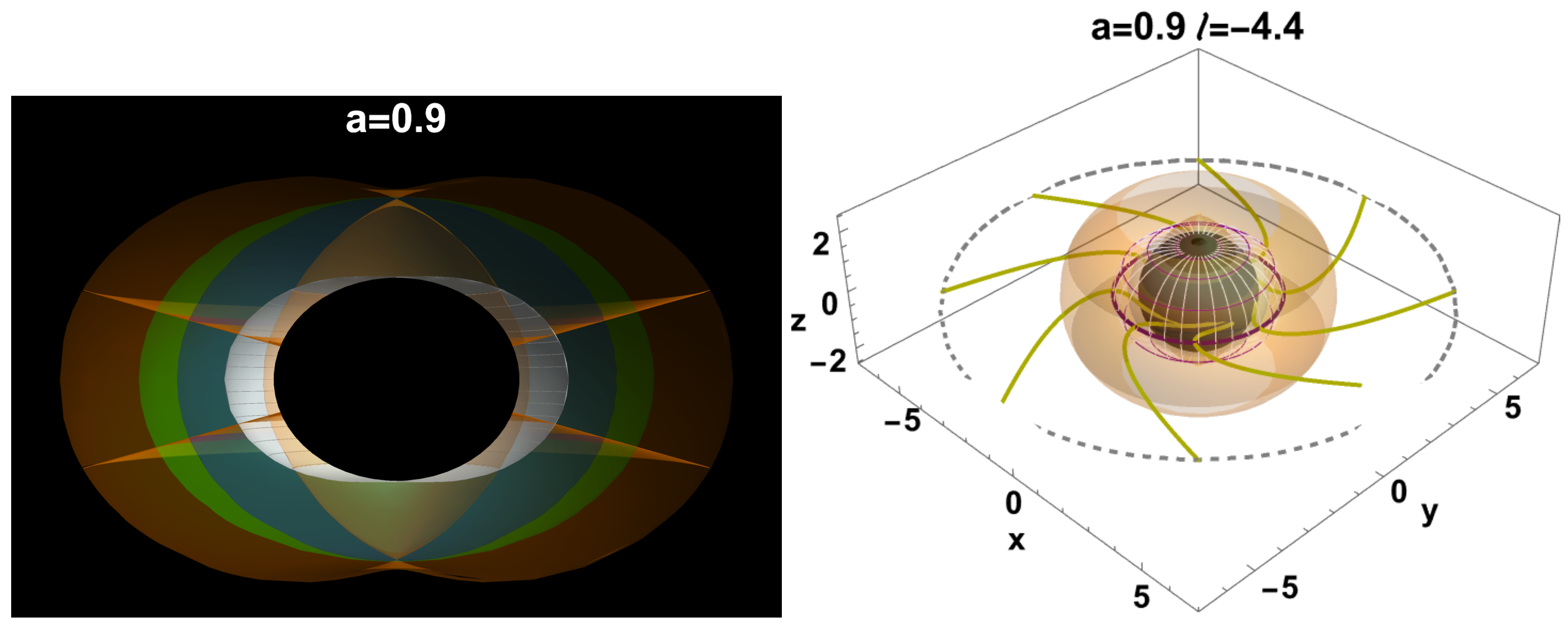
The concept of the BH shadow boundary is strongly related to the region of the spacetime known as the photon shell. Solutions of Equation (8) are contained in the photon shell. This region is divided into an outer part, with orbits , and an inner region, which includes the solutions . The inner region of the photon shell is close to the central BH and, depending on the spin of the BH, partially contained in the outer ergoregion—Figure 1 and Figure 2.
Figure 1.
The gray region is the outer ergosurface, the yellow region is the photon shell, and the black region is the central BH with spin . . Left panel: the green region is the range , and the darker green region is the range . Right panel: the purple surface is the inversion surface for the impact parameter . The dashed purple curve is the inversion surface on the equatorial plane. Yellow curves are null geodesics.
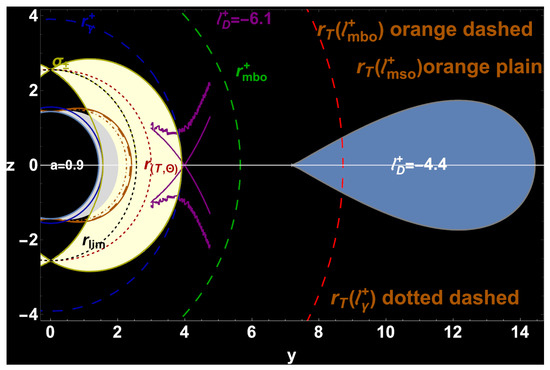
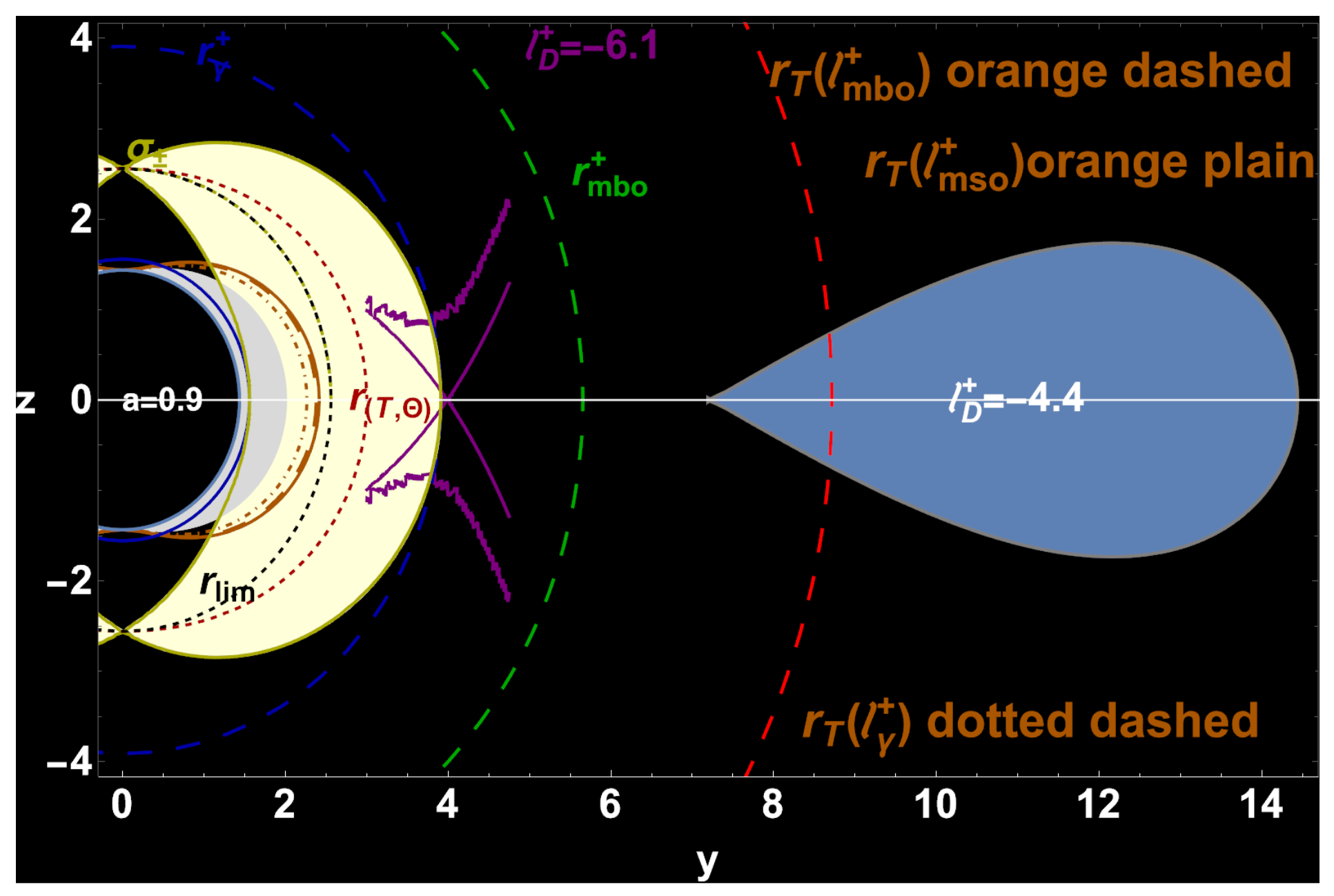
Figure 2.
The blue region is a counter-rotating torus with angular momentum parameter (for details on tori construction, see [20,60,61]). and . The gray region is the outer ergosurface, the yellow region is the photon shell, and the black region is the central BH with spin . Dashed blue, green, and red circles are the radii . Orange solid, dashed, and dotted curves are the inversion surface for with . The dashed black curve is the radius . The red dashed curve is radius , defined in Equation (14). The purple curve is a counter-rotating proto-jet with .
Solutions of Equation (8) can be found in terms of the impact parameter ℓ and the constant q, obtaining the two functions
Solutions can also be found in terms of the radius r, the orbit of the photons in the photon shell. By solving the equations , we obtain:
From , in Equations (5) and (6), and using and from Equation (9), we find the angles
defining the photon shell’s inner and outer boundaries.
Hence, the photon shell is defined in the polar angular range (with )—Figure 3.
Figure 3.
Left (Right) panel: photon shell boundary constant in the plane () for different angles (spin a) as signed on the panel. values are the counter-rotating and co-rotating photon circular orbits on the equatorial plane. Gray curves are the outer ergosurfaces at different values. Blue curves are the radii (where ). The yellow curve is radius (where ). Red, cyan, and blue curves are the impact parameter for evaluated at , with .
Furthermore, and on the orbit of radius , defined as follows:
Radius is therefore a limiting radius separating the counter-rotating orbits, in the outer region , from co-rotating photon orbits, in the inner region —Figure 1, Figure 2 and Figure 3.
3.1. Counter-Rotating Tori Orbiting the Central BH
Let us consider the radii and . On the equatorial plane, these radii coincide with the counter-rotating test particles’ marginally stable circular orbit and the marginally bounded circular orbit, respectively.
There is
and values are, on the equatorial plane, the counter-rotating and co-rotating circular photon orbit, respectively. (Note that only orbits in the photon shell can be observed on the shadow boundary (see for further details [20,58]).)
The photon shell is included in the region . Hence, from Equation (13), it follows that there are no solutions on the spherical surfaces defined by constant radii8 and . However, radii can be inside the photon shell.
The counter-rotating disk is therefore separated from the outer boundary of the photon shell (on the equatorial plane, this is ) by the radial interval .
In Figure 3, the solutions9 and are shown. A part of these curves is thus in the region of the photon shell. Therefore, orbits with these impact parameter values can appear on the BH shadow boundary.
On the other hand, the inner edge (and inner part) of a counter-rotating quiescent torus with a strong angular momentum magnitude10 can approach the photon shell on the equatorial plane, i.e., —Figure 2.
In these structures, there could be inversion surfaces where, for particles or photons, for time-like and light-like particles alike, with .
Only a part of the photon inversion surfaces correspond to spherical, bound, and unstable photon orbits, as found in solutions of Equation (8); consequently, only some may manifest on the BH shadow boundary [70].
In fact, the rotating BH always accretes matter with , and this could have . On the other hand, the photon shell is included in the ergoregion only for the faster-spinning BHs—Figure 3 left panel; for larger —Figure 4 [58].
Figure 4.
Left (Right) panel: the black region is the central BH, and the gray region is the outer ergoregion. Inversion surface for with , radius () and , defined in Equation (14), as a function of the spin for ().
3.2. The Inversion Surfaces
An inversion surface encloses the central Kerr BH and is situated outside the BH outer ergosurface. On the inversion surface, there are inversion points, defined by the condition , for particles and photon trajectories—Figure 1 [70].
Defined only by the parameter and the spin a, inversion points approach the outer ergosurface, for ℓ values that are large in magnitude (or, in general, small values)—see Figure 4.
Hence, within the condition , with radius , for timelike or light-like particles—see [58].
On the equatorial plane, there is always (where are the counter-rotating proto-jet and tori cusps respectively; see [58,70]) for the parameter , and therefore, it can be included in the photon shell if —Figure 3 and Figure 4.
We examine solutions for general timelike and lightlike geodesics, and in particular orbits , constituting a small set of all orbits, made up by photon spherical orbits with .
Hence, the condition leads to the radius
where there is
(for ).
Therefore, radius approaches for slowly spinning BHs or for decreasing angle (Figure 1, Figure 2, Figure 3, Figure 4, Figure 5 and Figure 6).
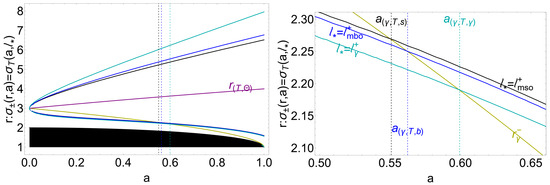
Figure 5.
The black region is the central BH. Radius where (cyan, blue, and black curves). The notation is for the evaluated at radius (the momenta of the counter-rotating geodesic structures), with radii and . is the photon shell boundary, and (purple curve) is defined in Equation (14). The yellow curve is (coincident, on the equatorial plane, on the co-rotating photon circular orbit). The right panel is a close-up view of the left panel.
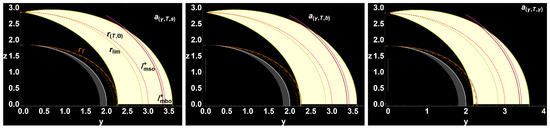
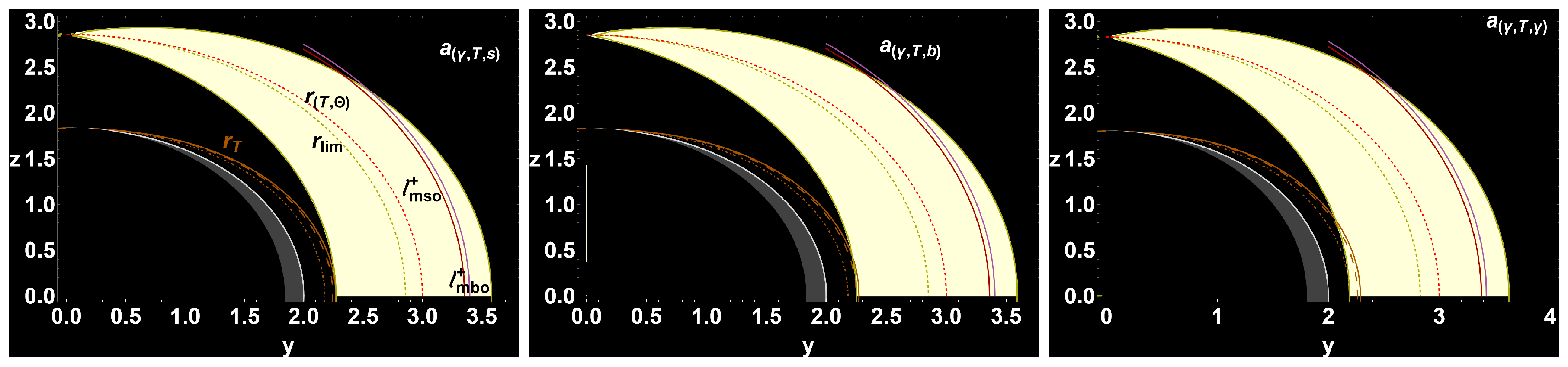
Figure 6.
Photon shells (yellow regions) and inversion surface (red dashed curve) for the spins in Figure 6. The yellow dashed curve is . The red and purple solid curves correspond to the impact parameter values , respectively. The gray region is the outer ergosurface, the central black region is the BH. The brown curves are (inversion surfaces for timelike and lightlike geodesics) for (solid), (dashed), and (dotted).
Note, in a fixed spacetime, for each value of , there are infinite inversion surfaces ; on the other hand, there is only one inversion surface with per plane .
In Figure 4, radii are shown for different values of the impact parameter , with the photon shell boundary, the radius , the ergosurface, and for two observational angle values and for all values of the spin.
As clear from Figure 5 and Figure 6, is true on the equatorial plane only for sufficiently large spin. In Figure 5, we show the radius r solution of , where , for . As made clear in Figure 6, the radius sets constraints on the intersection between the (inner) boundary of the photon shell and the inversion radius .
The following limiting spin values are identified: , , .
4. Shadow Boundary
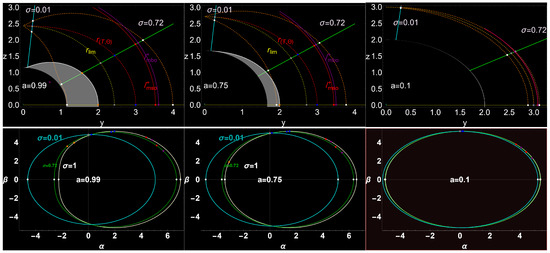
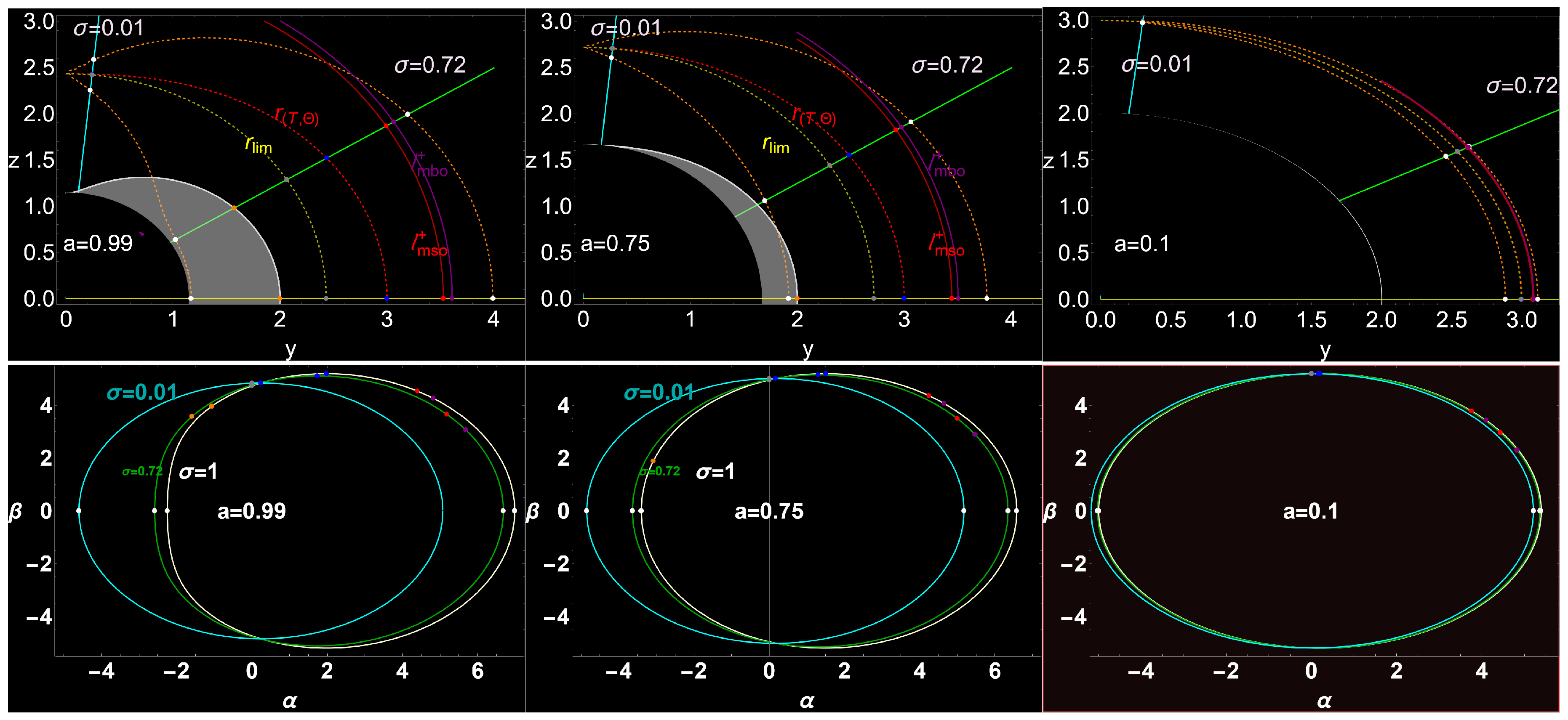
In this section we relate points and regions discussed in Section 3 to the BH shadow boundary. The location of these points on the shadow boundary and the shadow boundary morphology vary with the BH spin and the view angle . Results of this analysis, discussed below, are shown in Figure 7, Figure 8, Figure 9, Figure 10, Figure 11, Figure 12 and Figure 13.
Figure 7.
Upper panels: The central black region is the BH, gray region is the outer ergoregion. The dashed orange curves are the photon shell boundary. The lines (cyan), (green), and in the equatorial plane (white) show the region included in the photon shell on the upper panels; i.e., all points correspond to the upper panel points on the shadow boundary. White points correspond to intersecting with the photon shell boundary. The dashed yellow curve is for (where ), corresponding to the gray points. The dashed red curve is for (where ), defined in Equation (14), corresponding to the blue points. The crosses with the outer ergosurface correspond to the orange points. Red and purple points (solid curves) correspond to the impact parameter values (), respectively. Bottom panels: Shadow boundaries for different spins signed on the panels and angles signed on the curves of the left and center panels. Points correspond to the orbits with a fixed impact parameter ℓ or fixed radius r as represented correspondingly on the upper panels.
Figure 8.
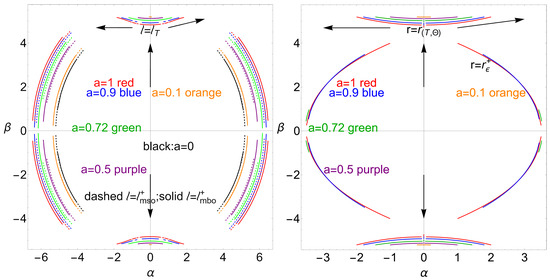
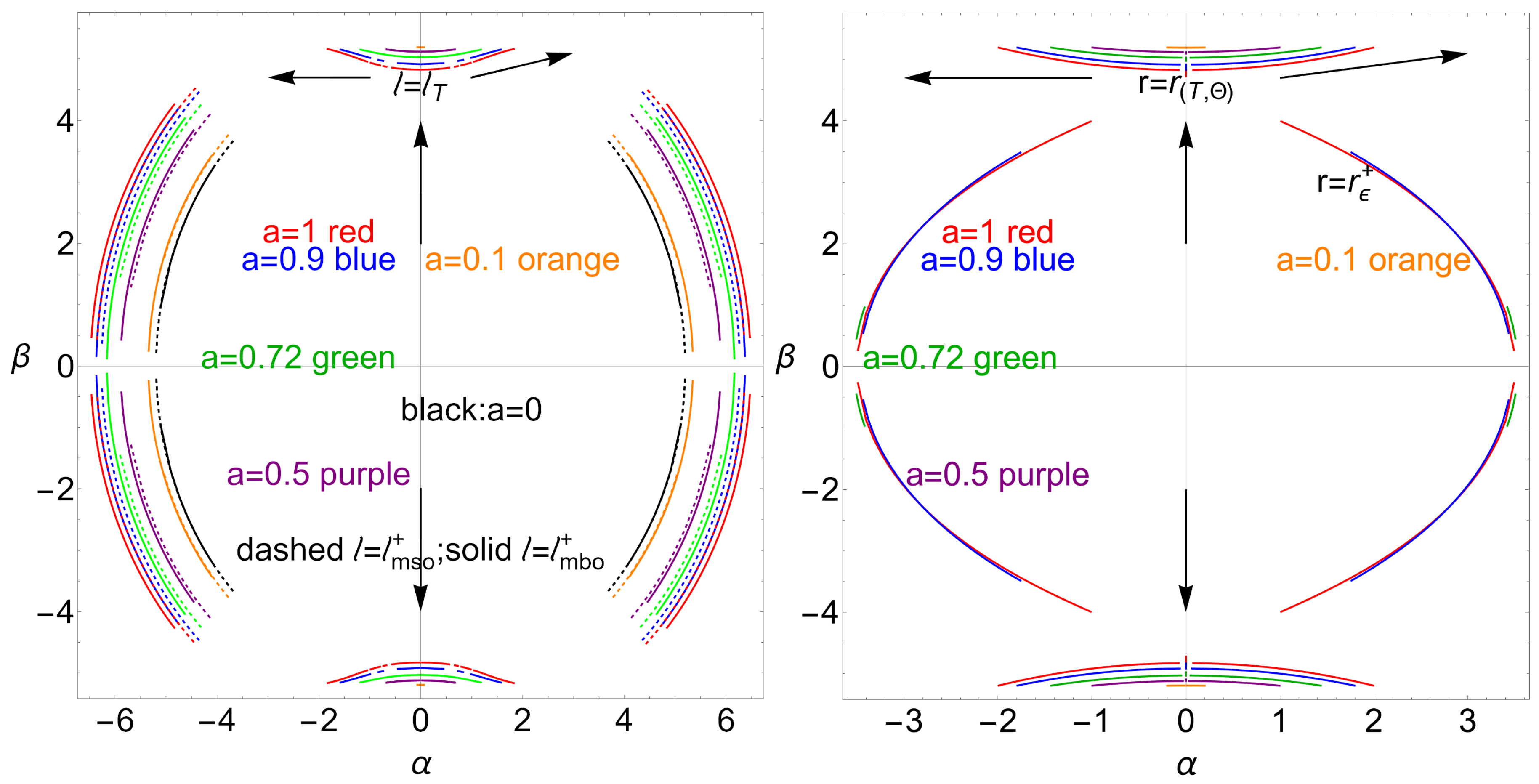
Celestial coordinate as a function of the coordinate for all values of angle , for fixed BH spin a and for the outer ergosurface and radius , where (right panel), and the radius impact parameter is (left panel). Arrows indicate the increasing values of along each curve. Each curve is for a fixed spin, and each point of a curve is for a different value of .
Figure 9.
Celestial coordinates for different values of the impact parameter ℓ signed on the panel as a function of the BH spin a and fixed angle (left panel) and as a function of the angle at fixed spins (right panel). Notation is for the evaluated at radius (the momenta of the geodesic structures), where the radii a are with .
Figure 10.
Left (Right) panel: celestial coordinate on the outer ergosurface as a function of a () for different (a).
Figure 11.
Left (Right) panel: celestial coordinate evaluated on (where ) and (where ) as a function of a () for different (a).
Figure 12.
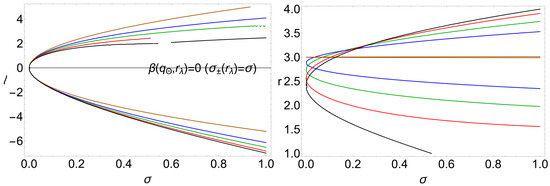
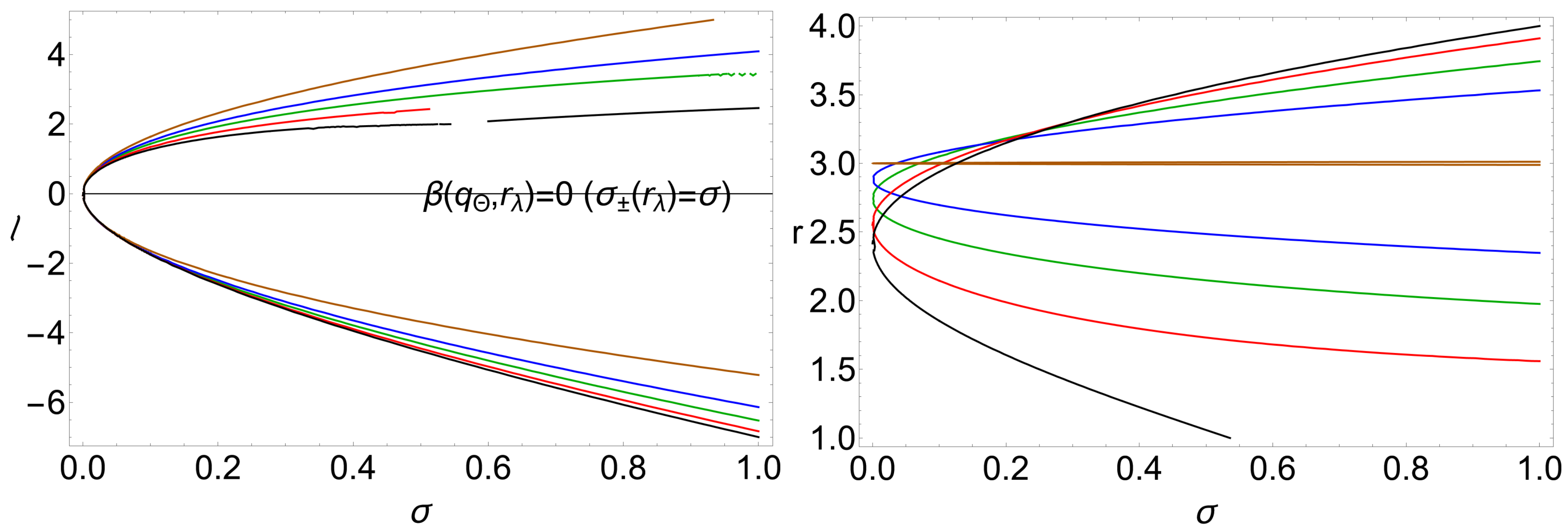
Analysis of (surfaces of Equation (11); white points are in Figure 7) in the plane . Each curve is for a BH spin as signed on the left panel. The celestial coordinates are defined in Equation (16), the spherical orbit radius is in Equation (10), and the Carter constant is in Equation (9). The right panel is for positive values of .
Figure 13.
Analysis of (surfaces of Equation (11), white points in Figure 7) in the plane , left panel (ℓ is the impact parameter), in the plane , right panel. Each curve is for a BH spin as signed on Figure 12 left panel: black is for , red is for , green is for , blue is for and brown is for . The celestial coordinates are defined in Equation (16), the spherical orbit radius is in Equation (10), and the Carter constant is in Equation (9).
At fixed spin a and angle , the BH shadow boundary, generated by the spherical orbits of the photon shell at a fixed viewing angle , appears as a closed curve in the plane, where the celestial coordinates for the null geodesics are defined as
(see [23]). Each point of the shadow boundary corresponds to solutions of Equation (8), giving a spherical orbit with constant radius r, constant q and constant parameter ℓ.
In Figure 7, white points correspond to , which is the intersection of the axis defined by the viewing angle constant with the boundary of the photon shell. Hence, at , these correspond to the circular orbits . In general, these points fix the maximum extension (diameter) of the BH shadow boundary on the axis.
Furthermore, the section of the outer ergoregion (the ergosurface corresponds to the orange points) is included in the photon shell, along with the angles where, instead, the photon shell is out of the ergoregion. The counter-rotating region on the shadow boundaries is clearly shown and bounded by the limiting radius (gray points) where .
Radius (blue points) is obviously in the range of counter-rotating photon orbits . As expected, in this range, the orbits with impact parameters (red points) and (purple points) are also located. The white right point corresponds to . The points in the external region of the photon shell correspond to larger values in magnitude of the impact parameter, as confirmed in Figure 8—left panel—where points on the shadow for impact parameter are shown for all values of the observational angle and for fixed BH spin a. (Each curve in the panel is for a fixed spin, and each point of a curve is for a different value of . Arrows indicate the increasing values of along each curve.)
In Figure 8, the right panel shows the results for , in agreement with the results for in Figure 8—left panel. The curve corresponding to is more external than the curve for . The static case ()—black curve in the panel—is more internal to the plane. The greater the is and the greater is, the smaller is in magnitude. The situation is the opposite for the curves corresponding to the inversion impact parameter located around (corresponding to ). There is no solution for the static case (at ). On the other hand, coordinate decreases and increases with decreasing BH spin. When increases, the coordinates and increase.
Counter-rotating cusped tori have momentum and an inner edge in . Within these ranges, the differences between the curves remain minimal, even at high spin values, and this behavior persists in general across all viewing angles .
These results are also confirmed in Figure 9, where there are limiting (bottom values of the) spins and view angles for the existence of the spherical orbits with impact parameter and —[20]. Solutions do not exist for all combinations of spin parameters and viewing angles. For small and small a, there are no curves for . In general, the separation between two curves corresponding to different ℓ values increases as the viewing angle decreases ( increases with spin and angle).
The separation between the two curves at different angular momentum is reduced for viewing angles close to the equatorial plane, while it becomes more pronounced for angles with . The difference between the curves at different spins is larger for angles close to the equatorial plane; this provides different constraints for spin and viewing angle. It is also evident from Figure 9 (right panel) that there is a clear distinction between the ranges of values below and above .
Figure 10 shows similar analysis for the outer ergosurface (orange points of Figure 7). The curves of the outer ergosurface exist only for (where ). Increasing the spin increases . The greater is, the greater is in magnitude. Clearly, the portion of the photon shell (and the shadow boundary) included in the ergoregion increases with the spin (and angle)—Figure 5.
In Figure 11, we show the coordinates for the orbits with radius and , as a function of the BH spin and viewing angles.
The celestial coordinate (on the shadow boundary) evaluated at is consistently smaller than the corresponding value at (but for ). For and , coordinate decreases with the BH spin. The curves, for fixed spin, approach one other for small values (near the rotational axis). Coordinate , for , increases increasing . For all values of the spin parameter, the curves at converge toward one another on the equatorial plane. Whereas for decreases increasing . Consequently, the largest separation between the curves at different radii and for fixed spin, occurs on the equatorial plane and becomes most pronounced at high spin values.
In Figure 12 and Figure 13 there is the analysis of the solutions , correspondent to the intersection points of the surfaces with the axis defined by the viewing angle . This analysis constrains the diameter of the BH shadow boundary in the celestial plane. This quantity increases with spin and . The situation differs for that is positive or negative. For (where ), the trend is consistent for all values of the BH spin and view angle. For (there is ), the trend is different for viewing angles . The corresponding parameter increases in magnitude with and spin a, for counter-rotating photons, and decreases with the spin for co-rotating photons—Figure 13, left panel. Meanwhile, there are generally two (orbital) radii r for fixed and spin, as shown in Figure 13, right panel. In general, the distance between the two orbits increases with the spin at large (close to the equatorial plane). The situation is instead more complex for angles close to the axis ().
5. Redshift Imaging
The frame-dragging effects also modulate the radiation emitted by the counter-rotating material in the vicinity of the Kerr BH. In this section, we focus on the redshift of signals produced by particles from counter-rotating accretion disks orbiting the central Kerr BH.
We introduce the redshift function , defined as the energy (frequency) ratio, between the energy as measured by the observer at infinity (with ), and the emitter particle in a circular orbit, with . The emitted signal is blueshifted if , redshifted when , and conserved for .
The quantity can be expressed in terms of the relativistic angular velocity of the emitter, which is defined as
On the equatorial plane, for a counter-rotating particle with specific angular momentum , the relativistic angular velocity of Equation (4) reads
as shown in Figure 14.
Figure 14.
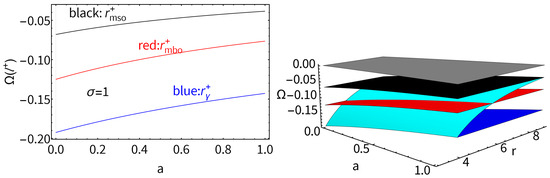
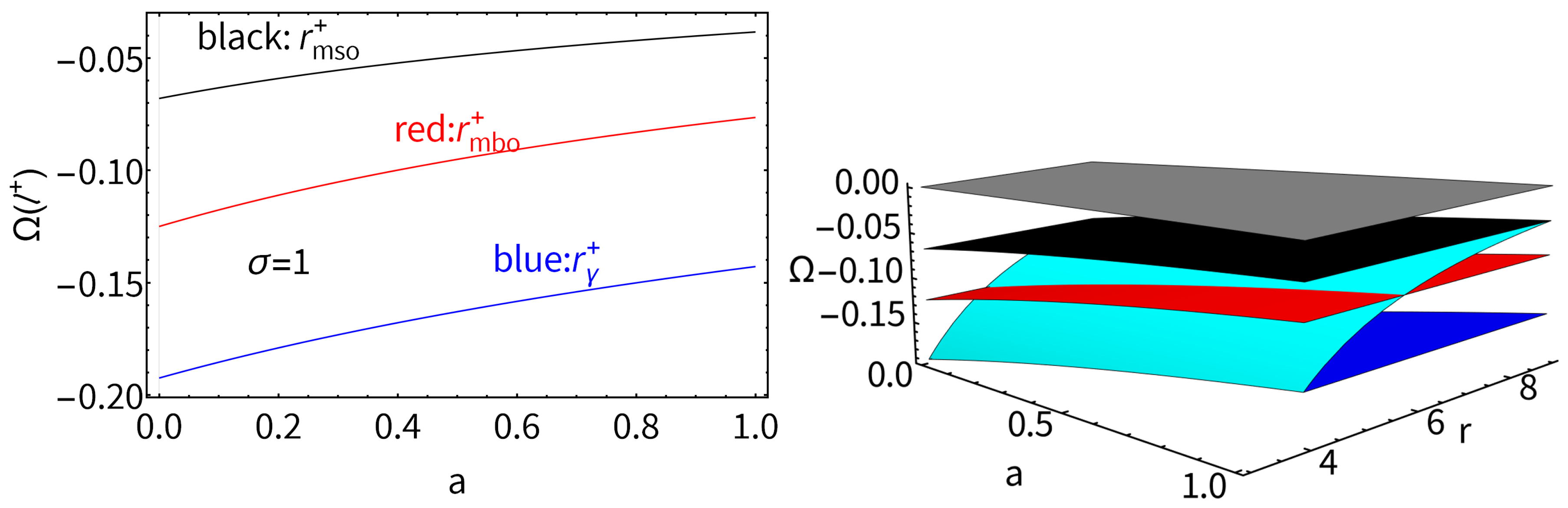
Left panel: Relativistic angular momentum of the emitting particle, evaluated on of Equation (18), on the equatorial plane , as a function of the BH spin a. is evaluated on the counter-rotating geodesic radii according to the color code signed on the panel. Right panel: relativistic angular velocity (cyan surface) of the emitting particle as a function of the BH spin a and the radius r. The gray surface is the value . The blue surface is on the radius . The red surface is on the radius . The black surface is on the radius .
As expected, (on the equatorial plane) decreases in magnitude with the spin a and the distance from the central attractor (there is, at a fixed radius r, and ).
Figure 15.
Left panel: Momentum of Equation (19) as a function of the BH spin a. Quantity is evaluated on different radii according to the colour code signed on the panel. Right panel: momentum (blue surface) as a function of the BH spin a and radius r. The red surface is evaluated on the radius .
In this analysis, we also introduced the radius
located in the orbital range (associated with quiescent counter-rotating disks’ inner edges and proto-jet cusps).11
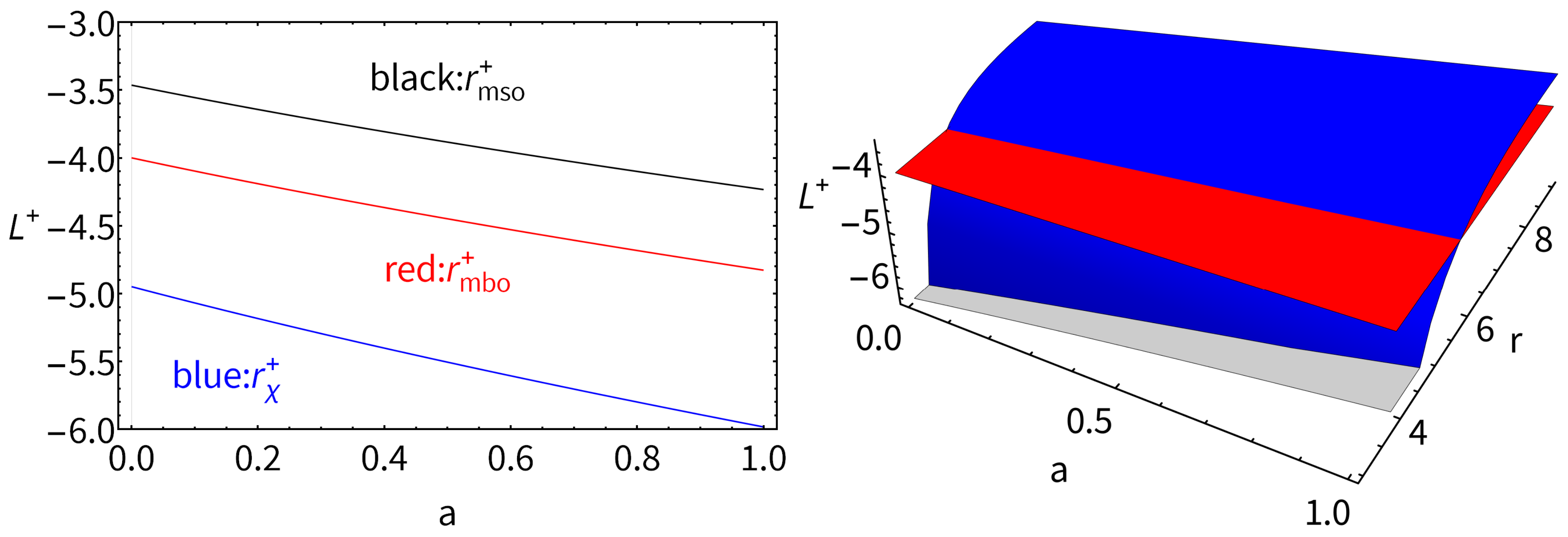
The angular momentum is negative and increases in magnitude with the spin (at the radii indicated in Figure 15). The momentum increases in magnitude at fixed spin and as the radius r approaches the attractor.
The constant of Equation (3), for the counter-rotating particles, is
and it is shown in Figure 16 (according to Equation (4), ).
Figure 16.
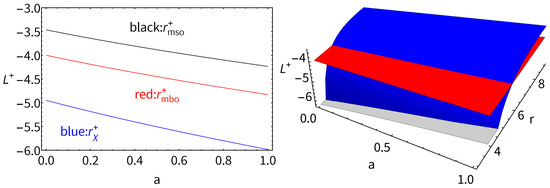
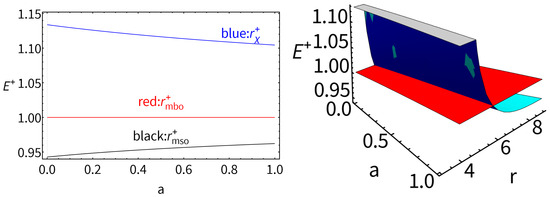
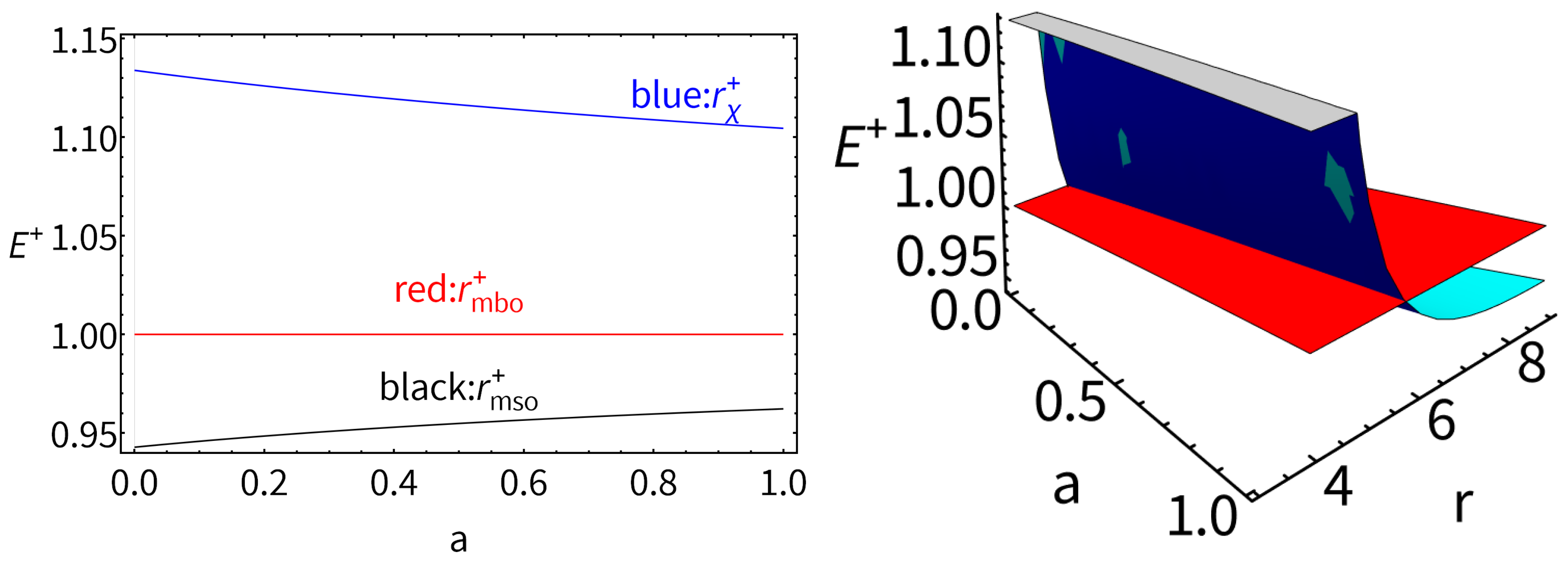
Left panel: Energy of Equation (21) as a function of the BH spin a. Quantities are evaluated on different radii according to the color code given on the panel. The red line is . Right panel: energy (cyan surface) as a function of the BH spin a and radius r. The red surface is .
The particle orbital energy generally decreases as the distance from the attractor increases, and at . When evaluated across the counter-rotating orbital domain (defined by the radii and ), the energy range of values12, associated with counter-rotating cusped disks, decreases as the BH spin increases (the energy at the marginally stable orbit grows with spin)13.
On the equatorial plane, therefore, the redshift function reads
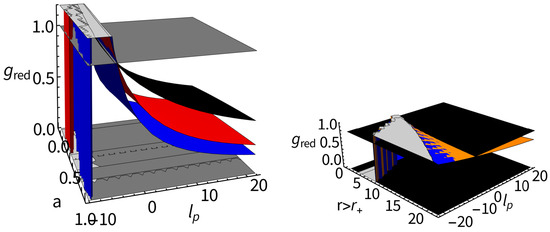
where is the photon impact parameter, and the four-momentum of emitted photons is . Function is shown in Figure 17. In general, the emission is redshifted for positive . The signal emitted by counter-rotating particles, on the equatorial plane, is blueshifted for a small range of negative values of14 . The redshift function generally decreases with the distance from the central attractor, and for positive 15. Our analysis also reveals a maximum of the redshift , within the blueshifted region, as a function of the radius r (The redshift is generally larger for a small spin).
Figure 17.
Left panel: redshift as a function of the BH spin and photon impact parameter . The gray plane is the value (conserved frequency). The black surface is evaluated on the radius , the red surface is evaluated on the radius , and the blue surface is evaluated on the radius . Right panel: redshift is plotted as a function of photon impact parameter and the radius , where is the BH outer horizon. The black planes are and . The orange (blue) surface is for spin ().
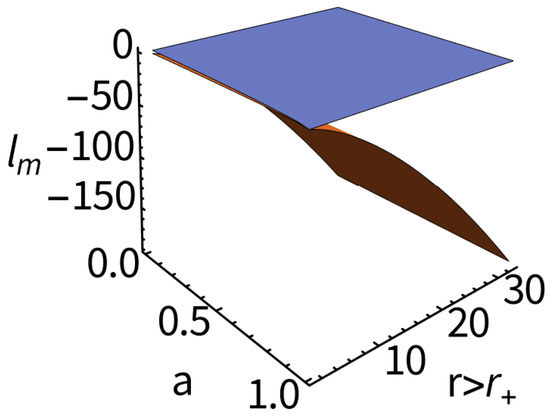
Redshift function in Equation (22) is well defined for impact parameter , where
shown in Figure 18 and Figure 19. The photon impact parameter is negative, and it decreases in magnitude, increasing spin and distance from the attractor.
Figure 18.
The limiting photon impact parameter of Equation (24) plotted as a function of the BH spin a and the radius ( is the BH horizon). The blue surface is the value .
Figure 19.
Photon impact parameter versus BH spin a. Left panel: the limiting impact parameter of Equation (24) as a function of a evaluated on the counter-rotating geodesic radii according to the color code in the panel. The redshift function is defined for . Right panel: solid lines are as a function of the spin. Dashed lines are the impact parameter of Equation (24) where (conserved frequency). At , (blueshifting), while at , (redshifting). The functions are evaluated on different radii according to the color code in the panel.
Hence, we also introduce the impact parameter , as follows:
defining conserved energy emission for , shown in Figure 19. For impact parameters greater than , the signal from counteracting matter is blueshifted. This analysis provides the conditions where the energy emitted from the counter-rotating structures is conserved (as measured by the observer at infinity). The curves increase in magnitude as the BH spin increases. The curves of impact parameter , associated with the different radii in Figure 19 are very close, although the impact parameter is larger in magnitude for radii farther from the central attractor.
6. Final Remarks
We reviewed properties of the counter-rotating accretion disks and photons motion around a central Kerr BH, investigating their possible effects on the BH shadow profiles, relating these structures to the (outermost region, with respect to the central BH) photon shell, depending on the BH’s dimensionless spin, the (constant) specific angular momentum of the disk, the state of the disk, whether quiescent or cusped, and the observer inclination viewing angle.
For fixed BH spins and observational angles, constraints are given on regions of observations of the shadow boundary, distinguished by regions of counter-rotating matter and photons.
We focused in this analysis on the outer ergosurface and the counter-rotating photons and counter-rotating accretion, in particular focusing on the tri cusps and counter-rotating proto-jet cusps. In the photon shell region we examined the imprint of the radii , where there is and the inversion surface radius on the photon orbits , where on the shadow boundary.
Observable regions of the boundary can be identified, at any viewing angle and for any spin value, as an imprint of the BH domains examined in this analysis.
Therefore, the analysis connects segments of the shadow boundary to bound, unstable spherical photon orbits, which are subject to specific constraints on the orbital radius r, or on the impact parameter ℓ. The existence and precise location of these points on the BH shadow boundary vary with the spin parameter a and the viewing angle, thereby serving potentially as a tracer of the BH properties.
Therefore, the setup provides an immediate astrophysical context, constraining the counter-rotating orbiting toroids. There are no counter-rotating tori or proto-jets in the photon shell (hence, no photon shell “obscuration” by counter-rotating toroids). However, the counter-rotating accreting flows, freely falling from the cusps, have been considered, leaving the marginally stable circular orbit with , and, more in general, leaving the toroid accreting cusp , or for the proto-jets. Materials accreting onto the central BH have an inversion surface (), which is constrained in this analysis in relation to the BH photon shell. We proved that only a restricted class, , of orbits are in the photon shell, and therefore can be observed, for the faster spinning BHs and the observational angles identified here. It is worth noting that the inversion surfaces lie in close proximity even for different values of the impact parameter—see Figure 1, Figure 2 and Figure 4. It should also be noted, however, that we expect such observational properties to depend strongly on the characteristic timescales of the underlying processes, specifically the time required for the flow to reach the inversion points. This fact has relevant consequences. In fact, this region may be filled with remarkably active components of the accreting flux of matter and photons (particularly near the BH poles and along the equatorial plane), as the region is ultimately characterized by enhanced luminosity and elevated flow temperatures. In Section 4, we discussed the conditions under which constraints on the spin, viewing angle, and rotation direction of cusped disks can be extracted from the shadow boundary regions. Moreover, in Section 5, we showed that the emergence of blue-shifted zones introduces additional restrictions, refining the characterization of cusped disk dynamics in the vicinity of the BH. In Section 5, we also studied the redshift properties of the radiation generated by particles from counter-rotating tori. We provided a detailed examination of how the emission is modified by the spacetime geometry (and the particle motion, by relativistic and gravitational Doppler effects). This highlights the redshift signatures arising from counter-rotating flows. The counter-rotating photon components at the shadow boundary reveal distinctive signatures that might be exploited to test theoretical models against observational data. Within the broader context of photon shell structure and shadow boundary formation, the redshift imaging can enable the identification of counter-rotating contributions within accretion flows, providing constraints on the spin parameter and the morphological characteristics of the counter-rotating disk. The results presented here connect the physics of photon shells, accretion dynamics, and shadow imaging, possibly establishing a framework for the modeling of the counter-rotating accreting matter and emission in the vicinity of Kerr BHs.
Author Contributions
Conceptualization, D.P. and Z.S. All authors have read and agreed to the published version of the manuscript.
Funding
This research received no external funding.
Data Availability Statement
No new data was used or generated in this article.
Conflicts of Interest
The authors declare no conflicts of interest.
Notes
| 1 | Following [28], they are classified according to the number of “polar turning points”, or “half polar-orbits” they complete before escaping to infinity; that is, the number of half latitudinal (polar) oscillations around the BH photon’s shell prior to reaching infinity. A discussion on the possibility of fully distinguishing the photon rings (in the emission ring) with future development of EHT and with space-based stations is in [11]. |
| 2 | For more discussion on the relation between the critical curve and event horizon in the radiative simulations and near-horizon synchrotron ring images, see also [32]. |
| 3 | The BH is described, in many analyses, as having spin , determining the rotation orientation (defined by the angular momentum vector) of the (equatorial and axisymmetric) accretion disk and flow (both the direction and alignment of jet emission are also often considered). In this work, we consider a BH with spin , and an equatorial, axisymmetric, disk characterized by a well-defined relativistic specific angular momentum , corresponding to co-rotating and counter-rotating disks, respectively. Note, BH spin constraints in the literature are provided, for M87* and SgrA* accretion disk (and jet) systems; in terms of BH spin values , for co-rotating (or prograde) disks; and in terms of BH spin values for counter-rotating (or retrograde) disks. (Some ambiguities in this convention may arise in the case of accretion models based on a tilted (or misaligned) disk. The alignment axis of the jet within the system may also contribute to potential ambiguities. Further ambiguities emerge when considering multiple accretion disks, which may be relatively counter-rotating, orbiting the central BH, or if an accretion disk has an internal ringed structure with a non-homogeneous distribution of angular momentum featuring co-rotating and counter-rotating parts within its structure, or if the definition of the rotation direction of the accretion flow is understood to refer to the flow components in terms of the toroidal velocity rather than to the relative angular momentum). Within this set-up, we consider particles of the accretion flow with angular momentum (from the disk), and angular velocity , which depends on ℓ and (for counter-rotating flows) can change sign. |
| 4 | The EHT investigation obtained the (polarized) M87* images (of the accretion flows) in close proximity of the BH, i.e., in a region, on the equatorial plane, largely located between the marginally stable orbits and (co-rotating) photon circular orbits (the VLBI has resolved the millimeter wavelength synchrotron images for M87* and SgrA*, close to the central BH in a orbital radial range ). The data are confronted with a library of numerous models, finding consistency with the observations. The comparing models are constructed by fixing the underlying model parameters and varying their values within a prescribed range. These include the BH spin a, the observer viewing angle, the magnetic field strength and geometry, the jet structure, and the accretion disk prescriptions, such as different electron energy distributions and the electron-to-ion temperature ratio (additionally, models incorporating two-temperature plasma evolution have also been considered within radiative and non-ideal GRMHD frameworks). Thus, the libraries produce large sets of different synthetic images (also spectral energy distributions) from general relativistic (GR) ray tracing and GRMHD simulation, across a postulated set of values of BH spins and magnetization states. The GR ray-tracing and synchrotron radiation transfer are able to simulate images of flows close to the central BH, using simulated GRMHD evolution and an (mostly) ad hoc prescription of ion-to-electron temperature ratio. This framework bases the theoretical interpretation of the EHT observations. From the consistency with the simulated scenarios, we can infer information on the central attractor and disks, obtaining constraints on the BH spin, the electron-to-ion temperature ratio, the accretion flow (and disk) rotation orientation and, in some cases, the observer inclination relative to the accretion flow angular momentum. |
| 5 | In [29], different emission models were considered, where the view angle is fixed at 17°, and the BH spin has been fixed at and for co-rotating disks. |
| 6 | In [37,38,39] a library of synthetic images (from the ray-traced GRMHD models simulations) was created and then used to train the neural networks for the inference of the accretion disks-BH systems of SgrA*. It is found SgrA* spin , with a co-rotating accretion flow, a “weak” jet emission, disfavoring a MAD accretion disk with a powerful outflow. (On the other hand, as discussed in [40], a strong magnetic field in SgrA* does not imply a MAD state accompanied by a strong jet.) An assessment of the inclination angles is also given, with the spin axis closely aligned with the line of sight. While M87* is described as a BH with spin , a strong synchrotron emission from its jet and with a MAD counter-rotating accretion flow (disk). In these analyses, the accretion disks are equatorial and a magnetized turbulent accretion flow is also assumed. In [32], a set of radiative, two-temperature GRMHD MAD simulations of M87* is discussed, for different BH spins (considering bremsstrahlung, synchrotron and inverse Compton radiation, Coulomb coupling, viscous heating, adiabatic compression, and expansion). The analysis is a 3-D simulation with self-consistent evolution of electrons temperature and ions temperature. Within the assumptions (and the limitations) of this framework, the simulation favors a (larger) BH spin for counter-rotating disks (flows), and for co-rotating disks (flows). In [41] a library of several images of the MAD equatorial, axially symmetric, accretion disks flows of SgrA* and M87*, was provided, and the BH spin, inclination view angle, and accretion disk parameters such as rotation orientation, magnetic field (polarity), and electron temperature versus ion temperature, were discussed. Within the adopted models and their underlying assumptions, M87* was described as high-spin BH with a counter-rotating disk (and large ion-to-electron temperature ratio) |
| 7 | In [42] a library of ideal, non-radiative, GRMHD simulations for SgrA* is examined in SANE and MAD models and for BH spins is examined for co-rotating and counter-rotating disks. In SANE models, the angular momentum and energy flux features favor a (co-rotating) thin-disk, with BH spin . Also MAD model simulations favor a BH spin , with powerful jets (with sub-Keplerian accretion flow) and a co-rotating disk (leading possibly to a BH spin-down). |
| 8 | Note, radii and also constrain the location of the counter-rotating tori [61]. |
| 9 | Below, we use the notation intended for any quantity evaluated on a radius . |
| 10 | These also include the cusps of the counter-rotating proto-jets, which are a matter funnel along the BH rotational axis, modeled as open cusped surfaces associated with these thick tori [62,63,64,65,66,67,68,69]. |
| 11 | The range of values obtained for all quantities in this analysis, when restricted to counter-rotating accretion disk configurations, is relatively narrow. This limited variation provides a distinct advantage in constraining counter-rotating configurations, possibly enhancing the precision with which constraints can be imposed on counter-rotating solutions in the Kerr metric. Here, the inner edge (surface cusp) of a counter-rotating disk in accretion is located in the radial range ; therefore, the values for the quantities referred to this range inform the counter-rotating cusped configurations. |
| 12 | This study also provides the range values for particles energy and momentum, reaching the BH from a counter-rotating cusped disk (or proto-jets). |
| 13 | From this perspective, counter-rotating disks become progressively more constrained at high spin values, reflecting the dynamical limits imposed by the Kerr geometry. |
| 14 | Then, the detection of blueshifted signals is potentially significant for constraining the parameter and for determining the orientation of disk rotation. |
| 15 | The gravitational field is primarily responsible for the redshift distortion close to the attractor. At large distances, the (kinetic) relativistic factor becomes predominant. |
References
- The Event Horizon Telescope Collaboration. First M87 Event Horizon Telescope Results. I. The Shadow of the Supermassive Black Hole. Astrophys. J. 2019, 875, L1. [Google Scholar] [CrossRef] [Scilit]
- The Event Horizon Telescope Collaboration. First M87 Event Horizon Telescope Results. II. Array and Instrumentation. Astrophys. J. 2019, 875, L2. [Google Scholar] [CrossRef] [Scilit]
- The Event Horizon Telescope Collaboration. First M87 Event Horizon Telescope Results. III. Data Processing and Calibration. Astrophys. J. 2019, 875, L3. [Google Scholar] [CrossRef] [Scilit]
- The Event Horizon Telescope Collaboration. First M87 Event Horizon Telescope Results. IV. Imaging the Central Supermassive Black Hole. Astrophys. J. 2019, 875, L4. [Google Scholar] [CrossRef] [Scilit]
- The Event Horizon Telescope Collaboration. First M87 Event Horizon Telescope Results. V. Physical Origin of the Asymmetric Ring. Astrophys. J. 2019, 875, L5. [Google Scholar] [CrossRef] [Scilit]
- The Event Horizon Telescope Collaboration. First M87 Event Horizon Telescope Results. VI. The Shadow and Mass of the Central Black Hole. Astrophys. J. 2019, 875, L6. [Google Scholar] [CrossRef] [Scilit]
- Event Horizon Telescope Collaboration. First Sagittarius A* Event Horizon Telescope Results. I. The Shadow of the Supermassive Black Hole in the Center of the Milky Way. Astrophys. J. Lett. 2022, 930, L12. [Google Scholar]
- Porth, O.; Chatterjee, K.; Narayan, R.; Gammie, C.F.; Mizuno, Y.; Anninos, P.; Baker, J.G.; Bugli, M.; Chan, C.; Davelaar, J. The Event Horizon General Relativistic Magnetohydrodynamic Code Comparison Project. Astrophys. J. Suppl. Ser. 2019, 243, 26. [Google Scholar] [CrossRef] [Scilit]
- Gralla, S.E.; Holz, D.E.; Wald, R.M. Black hole shadows, photon rings, and lensing rings. Phys. Rev. D 2019, 100, 024018. [Google Scholar] [CrossRef] [Scilit]
- Gralla, S.E.; Lupsasca, A. Lensing by Kerr Black Holes. Phys. Rev. D 2020, 101, 044031. [Google Scholar] [CrossRef] [Scilit]
- Johnson, M.D.; Lupsasca, A.; Strominger, A.; Wong, G.N.; Hadar, S.; Kapec, D.; Narayan, R.; Chael, A.; Gammie, C.F.; Galison, P.; et al. Universal interferometric signatures of a black hole’s photon ring. Sci. Adv. 2020, 6, 12. [Google Scholar] [CrossRef] [Scilit]
- Narayan, R.; Johnson, M.D.; Gammie, C.F. The Shadow of a Spherically Accreting Black Hole. Astrophys. J. Lett. 2019, 885, L33. [Google Scholar] [CrossRef] [Scilit]
- Vincent, F.H.; Wielgus, M.; Abramowicz, M.A.; Gourgoulhon, E.; Lasota, J.P.; Paumard, T.; Perrin, G. Geometric modeling of M87* as a Kerr black hole or a non-Kerr compact object. Astron. Astrophys. 2021, 646, A37. [Google Scholar] [CrossRef] [Scilit]
- Janssen, M.; Falcke, H.; Kadler, M.; Ros, E.; Wielgus, M.; Akiyama, K.; Baloković, M.; Blackburn, L.; Bouman, K.L.; Chael, A.; et al. Event Horizon Telescope observations of the jet launching and collimation in Centaurus A. Nat. Astron. 2021, 5, 1017–1028. [Google Scholar] [CrossRef] [Scilit]
- Chatterjee, K.; Liska, M.; Tchekhovskoy, A.; Markoff, S.B. Accelerating AGN jets to parsec scales using general relativistic MHD simulations. Mon. Not. R. Astron. Soc. 2019, 490, 2200–2218. [Google Scholar] [CrossRef] [Scilit]
- Lucchini, M.; Kraub, F.; Markoff, S. The unique case of the active galactic nucleus core of M87: A misaligned low-power blazar. Mon. Not. R. Astron. Soc. 2019, 489, 1633. [Google Scholar]
- Emami, R.; Anantua, R.; Chael, A.A.; Loeb, A. Positron Effects on Polarized Images and Spectra from Jet and Accretion Flow Models of M87* and Sgr A*. Astrophys. J. 2021, 923, 272. [Google Scholar] [CrossRef] [Scilit]
- Anantua, R.; Dúran, J.; Ngata, N.; Oramas, L.; Emami, R.; Ricarte, A.; Curd, B.; Röder, J.; Broderick, A.; Wayland, J. Emission Modeling in the EHT—ngEHT Age. Galaxies 2023, 11, 4. [Google Scholar] [CrossRef] [Scilit]
- Tamburini, F.; Thide, B.; Della Valle, M. Measurement of the spin of the M87 black hole from its observed twisted light. Mon. Not. R. Astron. Soc. Lett. 2020, 492, L22–L27. [Google Scholar] [CrossRef] [Scilit]
- Pugliese, D.; Stuchlík, Z. Constraining photon trajectories in black hole shadows. Eur. Phys. J. Plus 2024, 139, 531. [Google Scholar] [CrossRef] [Scilit]
- Perlick, V. Gravitational Lensing from a Spacetime Perspective. Living Rev. Relativ. 2004, 7, 9. [Google Scholar] [CrossRef] [Scilit] [PubMed]
- Teo, E. Spherical orbits around a Kerr black hole. Gen. Relativ. Gravit. 2021, 53, 10. [Google Scholar] [CrossRef] [Scilit]
- Bardeen, J.M. Black Holes; DeWitt, C., DeWitt, B.S., Eds.; Gordon & Breach: New York, NY, USA, 1973; p. 215. [Google Scholar]
- Cunningham, C.T.; Bardeen, J.M. The Optical Appearance of a Star Orbiting an Extreme Kerr Black Hole. Astrophys. J. 1973, 183, 237. [Google Scholar] [CrossRef] [Scilit]
- Synge, J.L. The escape of photons from gravitationally intense stars. Mon. Not. R. Astron. Soc. 1966, 131, 463. [Google Scholar] [CrossRef] [Scilit]
- Luminet, J.P. Image of a spherical black hole with thin accretion disk. Astron. Asrophys. 1979, 75, 228. [Google Scholar]
- Chandrasekhar, S. The Mathematical Theory of Black Holes. In Oxford Classic Texts in the Physical Sciences; Oxford University Press: Oxford, UK, 2002. [Google Scholar]
- Kumar Walia, R.; Kocherlakota, P.; Chang, D.O.; Salehi, K. Spacetime measurements with the photon ring. Phys. Rev. D 2025, 111, 104074. [Google Scholar] [CrossRef] [Scilit]
- Keeble, L.S.; Cárdenas-Avendaño, A.; Palumbo, D.C.M. Inferring black hole spin from interferometric measurements of the first photon ring: A geometric approach. Phys. Rev. D 2025, 111, 103042. [Google Scholar] [CrossRef] [Scilit]
- Broderick, A.E.; Tiede, P.; Pesce, D.W.; Gold, R. Measuring Spin from Relative Photon-ring Sizes. Astrophys. J. 2022, 927, 1. [Google Scholar] [CrossRef] [Scilit]
- Ricarte, A.; Tiede, P.; Emami, R.; Tamar, A.; Natarajan, P. The ngEHT’s Role in Measuring Supermassive Black-Hole Spins. Galaxies 2023, 11, 6. [Google Scholar] [CrossRef] [Scilit]
- Chael, A. Survey of radiative, two-temperature magnetically arrested simulations of the black hole M87* I: Turbulent electron heating. Mon. Not. Roy. Astron. Soc. 2025, 537, 2496–2515. [Google Scholar]
- Vincent, F.H.; Gralla, S.E.; Lupsasca, A.; Wielgus, M. Images and photon ring signatures of thick disks around black holes. Astron. Astrophys. 2022, 667, A170. [Google Scholar] [CrossRef] [Scilit]
- Reynolds, C.S. Observational Constraints onBlack Hole Spin. Annu. Rev. Astron. Astrophys. 2021, 59, 117–154. [Google Scholar] [CrossRef] [Scilit]
- Nemmen, R. The Spin of M87*. Astrophys. J. Lett. 2019, 880, L26. [Google Scholar] [CrossRef] [Scilit]
- Palumbo, D.C.M.; Baubock, M.; Gammie, C.F. Multifrequency Analysis of Favored Models for the Messier 87* Accretion Flow. Astrophys. J. 2024, 970, 151. [Google Scholar] [CrossRef] [Scilit]
- Janssen, M.; Chan, C.K.; Davelaar, J.; Wielgus, M. Deep learning inference with the Event Horizon Telescope-III. ZINGULARITY results from the 2017 observations and predictions for future array expansions. Astron. Astrophys. 2025, 698, A62. [Google Scholar] [CrossRef] [Scilit]
- Janssen, M.; Chan, C.-K.; Davelaar, J.; Natarajan, I.; Olivares, H.; Ripperda, B.; Röder, J.; Rynge, M.; Wielgus, M. Deep learning inference with the Event Horizon Telescope: I. Calibration improvements and a comprehensive synthetic data library. Astron. Astrophys. 2025, 698, A60. [Google Scholar] [CrossRef] [Scilit]
- Janssen, M.; Chan, C.-k.; Davelaar, J.; Wielgus, M. Deep learning inference with the Event Horizon Telescope: II. The ZINGULARITY framework for Bayesian artificial neural networks. Astron. Astrophys. 2025, 698, A61. [Google Scholar] [CrossRef] [Scilit]
- Galishnikova, A.; Philippov, A.; Quataert, E.; Chatterjee, K.; Liska, M. Strongly magnetized accretion with low angular momentum produces a weak jet. Astrophys. J. 2025, 978, 148. [Google Scholar] [CrossRef] [Scilit]
- Qiu, R.; Ricarte, A.; Narayan, R.; Wong, G.N.; Chael, A.; Palumbo, D. Using Machine Learning to link black hole accretion flows with spatially resolved polarimetric observables. Mon. Not. Roy. Astron. Soc. 2023, 520, 4867–4888. [Google Scholar] [CrossRef] [Scilit]
- Dhruv, V.; Prather, B.; Wong, G.N.; Gammie, C.F. A Survey of General Relativistic Magnetohydrodynamic Models for Black Hole Accretion Systems. Astrophys. J. Suppl. 2025, 277, 16. [Google Scholar] [CrossRef] [Scilit]
- Papavasileiou, T.V.; Kosmas, O.; Kosmas, T.S. Asimplified approach for reproducing fully relativistic spectra in X-ray binary systems: Application to Cygnus X-1. Astron. Astrophys. 2025, 693, A75. [Google Scholar] [CrossRef] [Scilit]
- Martinez-Sansigre, A.; Taylor, A.M. The Cosmological Consequence of an Obscured Agn Population on the Radiation Efficiency. Astrophys. J. 2009, 692, 964. [Google Scholar] [CrossRef] [Scilit]
- Krajnovic, D.; Weilbacher, P.M.; Urrutia, T.; Emsellem, E.; Carollo, C.M.; Shirazi, M.; Bacon, R.; Contini, T.; Epinat, B.; Kamann, S.; et al. Unveiling the counter-rotating nature of the kinematically distinct core in NGC 5813 with MUSE. Mon. Not. Roy. Astron. Soc. 2015, 452, 2–18. [Google Scholar] [CrossRef] [Scilit]
- Hirai, R.; Mandel, I. Conditions for accretion disc formation and observability of wind-accreting X-ray binaries. Publ. Astron. Soc. Aust. 2021, 38, e056. [Google Scholar] [CrossRef] [Scilit]
- Garofalo, D. Counter-rotating black holes from FRII lifetimes. Front. Astron. Space Sci. 2023, 10, 1123209. [Google Scholar] [CrossRef] [Scilit]
- Garofalo, D. Retrograde versus Prograde Models of Accreting Black Holes. Adv. Astron. 2013, 213105, 11. [Google Scholar] [CrossRef] [Scilit]
- Boshkayev, K.; Konysbayev, T.; Kurmanov, Y.; Luongo, O.; Muccino, M.; Taukenova, A.; Urazalina, A. Luminosity of accretion disks around rotating regular black holes. Eur. Phys. J. C 2024, 84, 230. [Google Scholar] [CrossRef] [Scilit]
- Wang, J.-M.; Songsheng, Y.-Y.; Li, Y.-R.; Du, P.; Zhe, Y. Dynamical evidence from the sub-parsec counter-rotating disc for a close binary of supermassive black holes in NGC-1068. Mon. Not. Roy. Astron. Soc. 2020, 497, 1020–1028. [Google Scholar] [CrossRef] [Scilit]
- Papavasileiou, T.; Kosmas, O.; Kosmas, T. Implications of the Spin-Induced Accretion Disk Truncation on the X-ray Binary Broadband Emission. Particles 2024, 7, 879–886. [Google Scholar] [CrossRef] [Scilit]
- Evans, D.A.; Reeves, J.N.; Hardcastle, M.J.; Kraft, R.P.; Lee, J.C.; Virani, S.N. The Hard X-Ray View Of Reflection, Absorption, and the Disk-Jet Connection in the Radio-Loud AGN 3C 33. Astrophys. J. 2010, 710, 859. [Google Scholar] [CrossRef] [Scilit]
- Choudhury, S.D.; Bhuvana, G.R.; Das, S.; Nandi, A. Revisiting disc-jet coupling in black hole X-ray binaries: On the nature of disc dynamics and jet velocity. Mon. Not. Roy. Astron. Soc. 2025, 541, 2934–2954. [Google Scholar] [CrossRef] [Scilit]
- Garofalo, D.; Evans, D.A.; Sambruna, R.M. The evolution of radio-loud active galactic nuclei as a function of black hole spin. Mon. Not. Roy. Astron. Soc. 2010, 406, 975–986. [Google Scholar] [CrossRef] [Scilit]
- Tchekhovskoy, A.; McKinney, J.C. Prograde and retrograde black holes: Whose jet is more powerful? Mon. Not. Roy. Astron. Soc. 2012, 423, L55. [Google Scholar] [CrossRef] [Scilit]
- Zhang, W.; Yu, W.; Karas, V.; Dovciak, M. Predictions for reverberating spectral line from a newly formed black hole accretion disk: Case of tidal disruption flares. Astrophys. J. 2015, 807, 89. [Google Scholar] [CrossRef] [Scilit]
- Taylor, C.; Reynolds, C.S. X-Ray Reverberation from Black Hole Accretion Disks with Realistic Geometric Thickness. Astrophys. J. 2018, 868, 109. [Google Scholar] [CrossRef] [Scilit]
- Pugliese, D.; Stuchlík, Z. photon shells, Black Hole Shadows, and Accretion Toroids. Astrophys. J. Suppl. Ser. 2024, 275, 45. [Google Scholar] [CrossRef] [Scilit]
- Carter, B. Global Structure of the Kerr Family of Gravitational Fields. Phys. Rev. 1968, 174, 1559. [Google Scholar] [CrossRef] [Scilit]
- Abramowicz, M.A.; Fragile, P.C. Black Hole Accretion Disks. Liv. Rev. Rel. 2013, 16, 1. [Google Scholar] [CrossRef] [Scilit]
- Pugliese, D.; Stuchlík, Z. Ringed accretion disks. Astrophys. J. 2015, 221, 25. [Google Scholar] [CrossRef] [Scilit]
- Kozlowski, M.; Jaroszynsk, M.; Abramowicz, M.A. The analytic theory of fluid disks orbiting the Kerr black hole. Astron. Astrophys. 1978, 63, 209–220. [Google Scholar]
- Abramowicz, M.; Jaroszynski, M.; Sikora, M. Relativistic, accreting disks. Astron. Astrophys. 1978, 63, 22. [Google Scholar]
- Sadowski, A.; Lasota, J.P.; Abramowicz, M.A.; Narayan, R. Black hole feedback from thick accretion discs. Mon. Not. Roy. Astron. Soc. 2016, 456, 3915. [Google Scholar] [CrossRef] [Scilit]
- Lasota, J.P.; Vieira, R.S.S.; Sadowski, A.; Narayan, R.; Abramowicz, M.A. The slimming effect of advection on black-hole accretion flows. Astron. Astrophys. 2016, 587, A13. [Google Scholar] [CrossRef] [Scilit]
- Pugliese, D.; Stuchlík, Z. Proto-jet configurations in RADs orbiting a Kerr SMBH: Symmetries and limiting surfaces. Class. Quant. Grav. 2018, 35, 105005. [Google Scholar] [CrossRef] [Scilit]
- Lyutikov, M. Magnetocentrifugal launching of jets from discs around Kerr black holes. Mon. Not. Roy. Astron. Soc. 2009, 396, 1545–1552. [Google Scholar] [CrossRef] [Scilit]
- Madau, P. Thick accretion disks around black holes & the UV/soft X-ray excess in quasars. Astrophys. J. Suppl. Ser. 1988, 327, 116–127. [Google Scholar]
- Sikora, M. Superluminous Accretion Discs. Mon. Not. Roy. Astron. Soc. 1981, 196, 257. [Google Scholar] [CrossRef] [Scilit]
- Pugliese, D.; Stuchlík, Z. Lense—Thirring effect on accretion flow from counter-rotating tori. Mon. Not. Roy. Astron. Soc. 2022, 512, 5895–5926. [Google Scholar] [CrossRef] [Scilit]
Disclaimer/Publisher’s Note: The statements, opinions and data contained in all publications are solely those of the individual author(s) and contributor(s) and not of MDPI and/or the editor(s). MDPI and/or the editor(s) disclaim responsibility for any injury to people or property resulting from any ideas, methods, instructions or products referred to in the content. |
© 2025 by the authors. Licensee MDPI, Basel, Switzerland. This article is an open access article distributed under the terms and conditions of the Creative Commons Attribution (CC BY) license (https://creativecommons.org/licenses/by/4.0/).