
Asymptotic Freedom and Vacuum Polarization Determine the Astrophysical End State of Relativistic Gravitational Collapse: Quark–Gluon Plasma Star Instead of Black Hole

 , , , and
Abstract
1. Introduction
2. On the Astrophysical Ultimate State of Relativistic Gravitational Collapse: A QGP/QCD Star
2.1. Astrophysical Insights
2.2. Flux Conservation During Collapse to Typical Neutron Stars vs. Field Amplification of Stellar Cores Collapsing to Color-Superconducting Quark Cores
2.2.1. Virial Theorem and Collapse to Canonical Neutron Stars
2.2.2. Field Amplification During HHMNS Collapse to Color-Superconducting Quark Cores

2.3. QED Vacuum Polarization/QCD Asymptotic Freedom

3. Deriving Nonlinear TOV Pressure-Gradient Equation for Equilibrium Configurations
Solutions to Pressure-Gradient Equation: The Unsuspected Mass–Radius Relation
4. Discussion on the Mass–Radius Relation

5. Summary
6. More on Magnetic Field Amplification Driven by Gravitational Collapse
7. Color Deconfinement Transition to QGP Star: Role of the QCD Asymptotic Freedom
- (a)
- (b)
8. Minimal Coupling of Gravitation to NLED: The Lagrangian Theory, the Effective Metric, and Einstein’s Field Equations
8.1. Born–Infeld Lagrangian for Featuring the QGP Star Extreme Electromagnetic Fields
General Lagrangians: Dispersion Relation and Effective Metric
8.2. Einstein’s Field Equations and QGP Star Dynamics Influenced by NLED
NLED and the Energy–Momentum Tensor of Collapsing HHMNS Cores
8.3. Extreme Magnetic Fields vs. Spherical Models and Actual Deformability of Ultra-Compact Star Cores
Author Contributions
Funding
Data Availability Statement
Acknowledgments
Conflicts of Interest
| 1 | Math/ly: linear in Maxwell scalar F = , ∴: the anti-symmetric electromagnetic field tensor; ∴ = : the electromagnetic 4-potential; : the electric scalar potential; c: the vacuum speed of light ∴: the magnetic vector potential. |
| 2 | A self-bound QGP star is a sort of astrophysical self-magnetization state of electrically charged quarks as a consequence of Bose–Einstein condensation (BEC) of such particles driven by gravitational shrinkage and color-charge deconfinement followed by quark-pairing (color superconductivity). The major role played by BECs not only in condensed matter physics but also in relativistic astrophysics was explained in detail a few years ago by Chavanis in [38], by highlighting the dynamical effect of the bosons’ repulsive scattering, i.e., the Heisenberg uncertainty principle’s degeneracy negative pressure, in stabilising galactic structures such as dark matter halos and astrophysical compact objects against gravitational collapse. Furthermore, ref. [38] emphasizes the fundamental role of the bosons’ scattering length in dictating the sort of collapsed remnant to wait for. In the case of stable boson stars featuring a positive scattering length, they could mimic the purported supermassive black holes said to reside at the core of most galaxies and other similar astrophysical ultra-compact galactic sources. See also the gravitational vacuum BEC alternative to black holes by Mazur and Mottola [39]. Aside from this, from a theoretical point of view, these BEC states are no longer considered thermal states, so they cannot be assigned a temperature; i.e., as the substance is not in (or near) equilibrium, there is no temperature. The preparation of a BEC as a deterministic variation of the quantum ground state is effectively a state of indeterminate temperature. This is simply an alternative framing of the Heisenberg Uncertainty Principle. |
| 3 | It is a null surface characterized by null world-lines on it, all with ( = 0) zero proper time, which is the amount of time elapsed along a world-line, i.e., what your wristwatch measures |
| 4 | It still appears to be room for estimating, via direct astronomical observations, the B-field strength of an ultra-magnetized QGP star by extracting the total chemical potential and, in particular, the contribution to it from the magnetic field present during the phase transition to quark–gluon plasma. See [79] which introduced such a method and our forthcoming paper on this promising avenue. |
| 5 | The unavoidable aftermath of such an advantageous—dust—approach involves reaching an infinite energy density at the centre of the star, a sort of a singularity. However, as discussed by Faraoni and Vachon [87], dust particles follow geodesics, but for a general perfect fluid endowed with pressure (as in our model here), the proper time along the trajectory does not coincide with the proper time along the corresponding geodesics. Notwithstanding, a 4-force parallel to the trajectory of a massive particle can always be eliminated by going to an affine parameterization, but the proper affine parameter is always different from the proper time. |
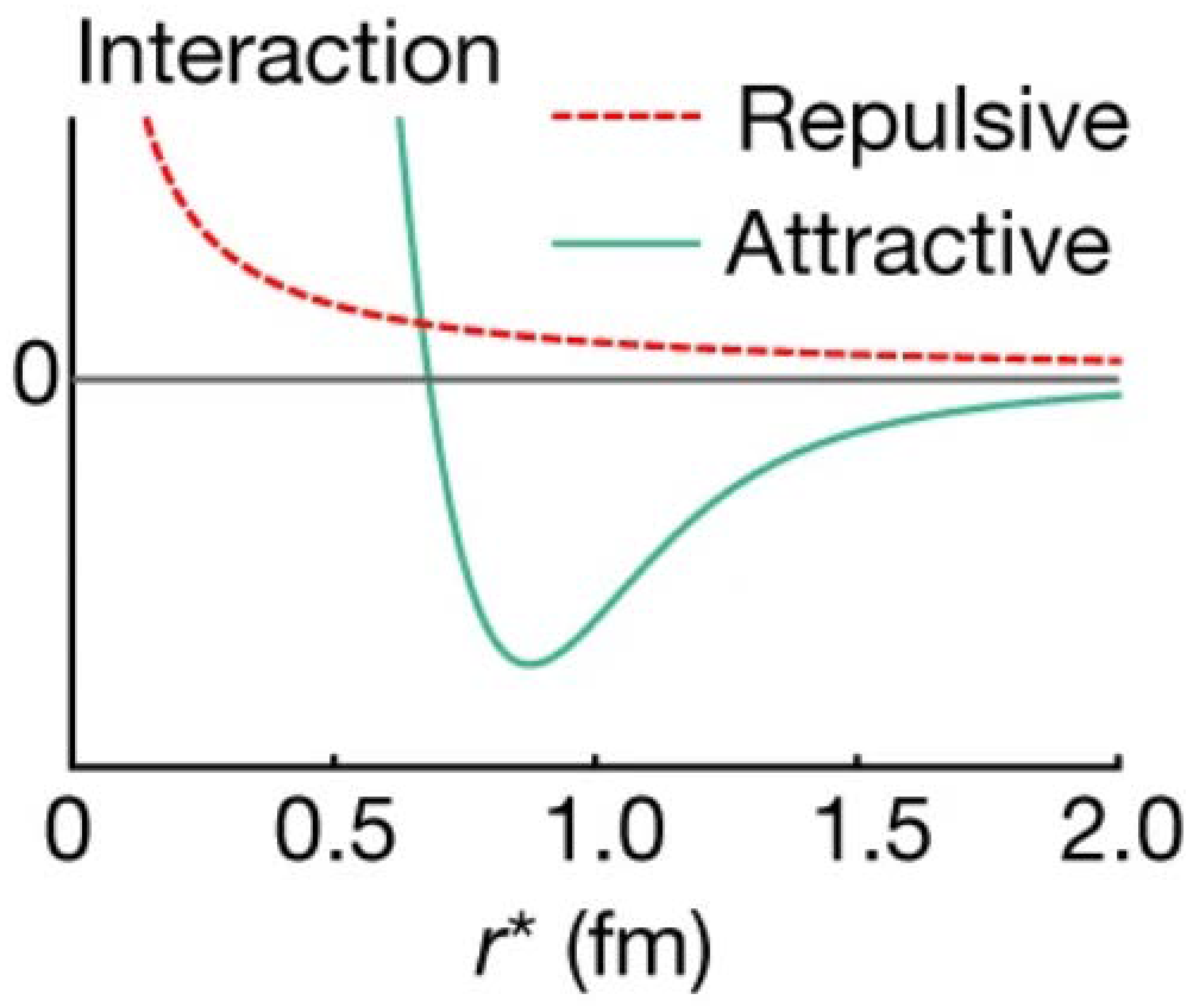
| 6 | It is worth remembering that in physics, most potentials are negative and attractive—defined as , e.g., the electrostatic (Coulomb) potential, the gravitational potential, or the elastic potential describing a deformable mechanical spring (Hooke’s law). Indeed, signs set out a physical fundamental difference. For a vector theory—like electromagnetism—the potential energy of the field among similar charges is positive and increases as their inter-distance decreases; i.e., one needs to invest work to push similar charges together; as a result, the force among them is repulsive. Conversely, for a tensor theory—like gravitation—where the charges are the masses themselves, the field potential-energy term is negative, which means work has to be injected in order to enlarge their separation. That is, the force among similar charges is attractive. The same behaviour holds for unlike charges in electromagnetism. Nonetheless, exceptions do occur in physics, and some natural phenomena are pictured differently. There exists a noticeable potential that combines both the repulsive () and the attractive () properties laid out above, the Lennard-Jones potential: a simplified, radially symmetric model describing the essential features of interactions between neutral pairs of either atoms or molecules: : distance at which the particle-particle potential energy , and : depth of the potential well, which has its minimum at: , where . Two interacting particles repel each other at very close distances, attract each other at moderate distances, and eventually stop interacting at infinite distance. |
| 7 | At this point, it is necessary to point out a key thermodynamic property: If a self-gravitating system loses energy, for instance, by radiating energy into space, the case of star-like objects, then it contracts itself, but, in contrast to standard substances, its average kinetic energy indeed increases (i.e., ). As the temperature is defined by the average heat content in the kinetic energy, the system can be said to possess negative specific heat capacity. The more extreme version of this feature happens with excessively ultra-compact astrophysical systems, such as black hole-like objects, including the self-bound QGP star in its BEC-like state. According to black hole thermodynamics [92], the more mass/gravitational energy a black hole absorbs, the colder it becomes. Conversely, if it is a pure emitter of energy, for example through Hawking radiation, as shown in a 1975 paper [93], it will become hotter and hotter until it finally boils away. |
| 8 | The opposite of explicit symmetry breaking of a theory happening in adding terms to its defining equations of motion, i.e., Lagrangian/Hamiltonian, such that the new equations do not preserve the posed symmetry. |
| 9 | Keynote: as the gravitational field reaches the state when its strength is comparable to other forces, its putative quantum nature can no longer be ignored. That is why NLED is called for in this paper, as the first step to integrating quantum effects into the whole astrophysical picture, as we do not yet have a quantum theory of gravitation to hand. |
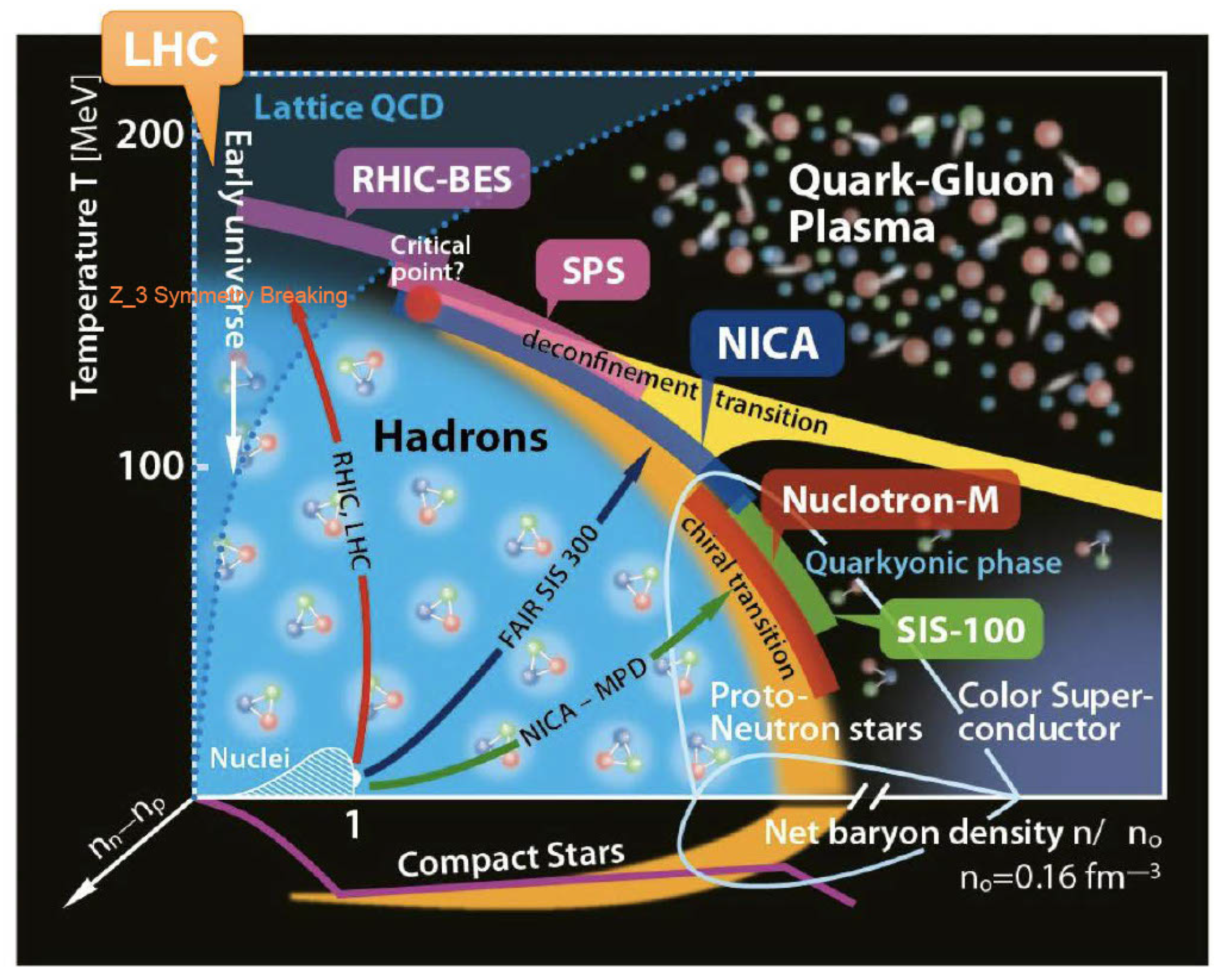
| 10 | First-order phase transitions are those that involve a latent heat. In a compact system, the matter gets heated up as gravity pulls it together (its negative specific heat at work). During such a transition, a system either absorbs or releases a fixed (typically large) amount of free energy per volume. In systems transitioning to deconfinement, the phases are connected at the chemical potential in which the pressure from the quark EoS matches/exceeds the one from hadronic EoS, pinpointing the phase transition to the quark–gluon plasma (QGP) state [105,106]. Such an extension of hadrons-to-quarks is similar to the Nambu–Jona-Lasinio (NJL) model extended up to include the Polyakov loop ( =0: relates to free energy), that is, a nonlinear sigma model that uses the Polyakov loop as the order parameter to feature the deconfinement (the ALICE results show up at the energies ≳ 150 MeV—a rightward shift of the Lattice QCD borderline in Figure 2): This is quite a natural next step, as the Polyakov loop is related to the Z3 symmetry (see Figure 1 the vortex percolation/de-percolation threshold, as described in QCD-Lattice gauge theory), which is spontaneously broken by the appearance of the quark condensate phase, which then makes ( ≠ 0) finite. (See further details in Verônica Dexheimer’s (2009) PhD thesis [105,106]). Such work, though, neither included Einstein’s gravity nor even Maxwell’s electrodynamics. Nonetheless, both physical key ingredients were included in a later paper. See [16]). In such a state, gluons also play a key role in both the entropy and baryon density via the Polyakov loop and its potential (V, which imitates the effects from confinement; see Figure 1 and Figure 2, with : the background color-charge gauge field with which quarks interact) and represent color-bound states that mimic extra possible states such as the QCD higher resonances, which last for t ≲ s (Delta baryons Δ++,+,0,−, upsilons (mesons of the bottom quark ()) pinpointing to the phase transition to a quark–gluon plasma state, or the spin-1 (vector) charged rho mesons (isospin- triplet of states with t s, a result of chiral symmetry breaking). But notice that mesons with a top (t) quark are very likely impossible, as high -ass → rapidly decays before it has time to form: Δt ∼ 5× s). The Polyakov potential was built for analysing Lattice QCD at nil/low chemical potential and high temperature but was redesigned to discuss neutron star (NS) dynamics where high chemical potential and stupendously low temperatures are dominant, as explained in Footnote (7). The Polyakov loop has key roles in the NS context: (a) for an increasing temperature/density, it takes on nonzero values. (b) It appears at the high-value coupling constants of both baryons () and quarks (). Its presence in the baryons’ effective mass hints at the suppression of baryons at the quoted threshold. Meanwhile, its appearance in the effective mass of the quarks ensures that no quarks will show up at low temperatures/densities [105,106]. In the present paper, we offer general insight into this unprecedentedly known fundamental result using our semi-classical approach. We postpone forthcoming research involving a full detailed analysis of this pathway to the astrophysical end state that follows the catastrophic deconfinement transition from the HHMNS to the QGP star, which we plan to model via either a Polyakov-loop-inspired NJL-like RMF model or the symmetry-restoring CMF Lagrangian, like the following one: The terms here represent Einstein’s gravity, NLED, the kinetic energy of hadrons (H); quarks (Q) and leptons (L); interactions between baryons (B and quarks) and vector (V) and scalar (S) mesons; self-interactions of scalar (S) and vector (V) mesons; the term explicitly breaking/restoring chiral symmetry (SB); and the Polyakov-loop potential (V()). Notice, en passant, that a study of neutron star equilibrium configurations joining the four interactions was performed by Prof. Ruffini’s group in [108], the very first of its kind. Nonetheless, they did not take into consideration NLED, neither the hadron-to-quark deconfinement nor a high-mass HHMNS model. As befits a model of this sort, its stability can be explored based on causality conditions, the adiabatic index, the generalized (-dependent) Tolman–Oppenheimer–Volkov (G-TOV) equation, Herrera’s cracking method, or the Buchdahl limit. |
| 11 | In general settings (i.e., non-spherical/anisotropic), the static configuration is achieved asymptotically and settles to a final radius greater than the photon sphere for the Schwarzschild black hole. The central density becomes arbitrarily large and approaches a sort of naked singularity [109,110,111]. |
| 12 | There is no Lorentz transformation to turn a slow speed motion into one of a speed faster than light. |
| 13 | See definitions of F and just below, which in turn define the magnetic induction , the electric field , and its “dual” magnetic field and electric displacement , much like in Maxwell’s theory. Also check Refs. [123,124] for a discussion on the limits to NLED and on the expanded B-I Lagrangian given next, in addition to the magnetic and electric properties of a quantum vacuum. |
| 14 | For a Maxwell Lagrangian the conserved Poynting flux energy density reads: , the Maxwell stress tensor. |
| 15 | A realistic spinning QGP model is in progress [130]. |
| 16 | The magnetic pressure can be derived from the magneto-hydrodynamics Cauchy momentum equation: : (Lorentz Force - Pressure Force), where by using Ampere’s law , one gets : (Magnetic Tension - Magnetic Pressure Force), with W/A-m vacuum permeability. |
References
- Abbott, B.P.; et al.; [LIGO Scientific Collaboration and Virgo Collaboration] Observation of Gravitational Waves from a Binary Black Hole Merger. Phys. Rev. Lett. 2016, 116, 061102. [Google Scholar] [CrossRef]
- Kerr, R.P. Do black holes have singularities? arXiv 2023, arXiv:2312.00841. [Google Scholar] [CrossRef]
- Taylor, J.H.; Weisberg, J.M. A new test of general relativity—Gravitational radiation and the binary pulsar PSR 1913+16. Astrophys. J. 1982, 253 Pt 1, 908–920. [Google Scholar] [CrossRef]
- Abbott, B.P.; et al.; [LIGO Scientific Collaboration and Virgo Collaboration] GW170817: Observation of Gravitational Waves from a Binary Neutron Star Inspiral. Phys. Rev. Lett. 2017, 119, 161101. Available online: https://www.ligo.org/detections/GW170817.php (accessed on 10 December 2017). [CrossRef] [PubMed]
- Nakar, E. The electromagnetic counterparts of compact binary mergers. Phys. Rep. 2020, 886, 1–84. [Google Scholar] [CrossRef]
- Thompson, C.; Duncan, R.C. The soft gamma repeaters as very strongly magnetized neutron stars—I. Radiative mechanism for outbursts. Mon. Not. R. Astron. Soc. 1995, 275, 255–300. [Google Scholar] [CrossRef]
- Paret, D.M.; Martínez, A.P.; Bocchi, G.P.; Angulo, G.Q. Magnetic fields in compact stars and related phenomena. Rev. Mex. Fis. 2020, 66, 538. [Google Scholar] [CrossRef]
- Lerche, I.; Schramm, D.N. Magnetic fields greater than 1020 gauss? Astrophys. J. 1977, 216 Pt 1, 881. [Google Scholar] [CrossRef]
- Kay, D.; Kumar, A.; Parthasarathy, R. Savvidy Vacuum in SU(2) Yang-Mills Theory. Mod. Phys. Lett. A 2005, 20, 1655–1662. [Google Scholar] [CrossRef]
- Broderick, A.; Prakash, M.; Lattimer, J.M. The Equation of State of Neutron Star Matter in Strong Magnetic Fields. Astrophys. J. 2000, 537, 351. [Google Scholar] [CrossRef]
- Glendenning, N.K. Compact Stars: Nuclear Physics, Particle Physics and General Relativity, 2nd ed.; Springer: Berlin, Germany, 2000. [Google Scholar]
- Weber, F. Pulsars as Astrophysical Laboratories for Nuclear and Particle Physics, 1st ed.; Institute of Physics: Bristol, UK; Philadelphia, PA, USA; CRC Press: Boca Raton, FL, USA, 1999. [Google Scholar]
- Ferrer, E.J.; Hackebill, A. Equation of State of a Magnetized Dense Neutron System. Universe 2019, 5, 104. [Google Scholar] [CrossRef]
- Ferrer, E.J.; de la Incera, V.; Keith, J.P.; Portillo, I.; Springsteen, P. Equation of state of a dense and magnetized fermion system. Phys. Rev. C 2010, 82, 065802. [Google Scholar] [CrossRef]
- Ferrer, E.J.; de la Incera, V.; Paret, D.M.; Martínez, A.P.; Sánchez, A. Insignificance of the anomalous magnetic moment of charged fermions for the equation of state of a magnetized and dense medium. Phys. Rev. D 2015, 91, 085041. [Google Scholar] [CrossRef]
- Gomes, R.O.; Pais, H.; Dexheimer, V.; Providência, C.; Schramm, S. Limiting magnetic field for minimal deformation of a magnetized neutron star. Astron. Astrophys. 2019, 627, A61. [Google Scholar] [CrossRef]
- González Felipe, R.; Pérez Martínez, A.; Pérez Rojas, H.; Orsaria, M. Magnetized strange quark matter and magnetized strange quark stars. Phys. Rev. C 2008, 77, 015807. [Google Scholar] [CrossRef]
- Sotani, H.; Tatsumi, T. Massive hybrid quark stars with strong magnetic field. Mon. Not. R. Astron. Soc. 2015, 447, 3155–3161. [Google Scholar] [CrossRef]
- Fraga, E.S.; Palhares, L.F.; Restrepo, T.E. Cold and dense perturbative QCD in a very strong magnetic background. Phys. Rev. D 2024, 109, 054033. [Google Scholar] [CrossRef]
- The STAR Collaboration/RHIC. Observation of an Antimatter Hypernucleus. Science 2010, 328, 58. [Google Scholar] [CrossRef] [PubMed]
- Adam, J.; et al.; [The STAR Collaboration] Measurement of the mass difference and the binding energy of the hypertriton and antihypertriton. Nat. Phys. 2020, 16, 409–412. [Google Scholar] [CrossRef]
- Aboona, B.E.; et al.; [STAR Collaboration] Observation of Directed Flow of Hypernuclei and in = 3 GeV Au+Au Collisions at RHIC. Phys. Rev. Lett. 2023, 130, 212301. [Google Scholar] [CrossRef]
- Ellis, J.; Mavromatos, N.E.; You, T. Light-by-Light Scattering Constraint on Born-Infeld Theory. Phys. Rev. Lett. 2017, 118, 261802. [Google Scholar] [CrossRef] [PubMed]
- The Event Horizon Telescope (EHT) Collaboration. First M87 Event Horizon Telescope Results. I. The Shadow of the Supermassive Black Hole. Astrophys. J. Lett. 2019, 875, L1. [Google Scholar] [CrossRef]
- ATLAS Collaboration. Evidence for light-by-light scattering in heavy-ion collisions with the ATLAS detector at the LHC. Nat. Phys. 2017, 13, 852–858. [Google Scholar] [CrossRef]
- Aad, G.; et al.; ATLAS Collaboration Observation of light-by-light scattering in ultraperipheral Pb+Pb collisions with the ATLAS detector. Phys. Rev. Lett. 2019, 123, 052001. Available online: https://atlas.cern/updates/physics-briefing/atlas-observes-light-scattering-light (accessed on 10 December 2018). See also the homepage of ALICE (A Large Ion Collider Experiment) at LHC. Available online: https://home.cern/science/experiments/alice (accessed on 10 December 2018). [CrossRef]
- ALICE Collaboration. Unveiling the strong interaction among hadrons at the LHC. Nature 2020, 588, 232–238. [Google Scholar] [CrossRef]
- Acharya, S. et al. [ALICE Collaboration]. The ALICE experiment: A journey through QCD. Eur. Phys. J. C 2024, 84, 813. [Google Scholar] [CrossRef]
- The ATLAS Collaboration. Observation of a new particle in the search for the Standard Model Higgs boson with the ATLAS detector at the LHC. Phys. Lett. B 2012, 716, 1–29. [Google Scholar] [CrossRef]
- Scholberg, K. Probing the Skin of a Lead Nucleus. Physics 2021, 14, 58. [Google Scholar] [CrossRef]
- Kalogera, V.; Baym, G. The Maximum Mass of a Neutron Star. Astrophys. J. Lett. 1996, 470, L61. [Google Scholar] [CrossRef]
- ATLAS Open Data. Available online: https://opendata.atlas.cern/ (accessed on 15 August 2024).
- Euler, H.U.; Kockel, B. Über die Streuung von Licht an Licht nach der Diracschen Theorie. Naturwissenschaften 1935, 23, 246. [Google Scholar] [CrossRef]
- Heisenberg, W.; Euler, H.U. Consequences of Dirac Theory of the Positron. Z. Phys. 1936, 98, 714. [Google Scholar] [CrossRef]
- Plebanski, J. Lectures on Nonlinear Electrodynamics; Nordisk Institut for Teoretisk Atomfysik: Stockholm, Sweden, 1970. [Google Scholar]
- Born, M.; Infeld, L. Foundations of the New Field Theory. Proc. R. Soc. A 1934, 144, 425–451. [Google Scholar] [CrossRef]
- Feynman, R.P. QED: The Strange Theory of Light and Matter; Princeton University Press: Princeton, NJ, USA, 1985. [Google Scholar]
- Chavanis, P.-H. Self-gravitating Bose-Einstein Condensates. In Quantum Aspects of Black Holes; Calmet, X., Ed.; Fundamental Theories of Physics; Springer: Cham, Switzerland, 2015; Volume 178, pp. 151–194. [Google Scholar] [CrossRef]
- Mazur, P.O.; Mottola, E. Gravitational Condensate Stars: An Alternative to Black Holes. Universe 2023, 9, 88. [Google Scholar] [CrossRef]
- Iwazaki, A. A possible origin of a strong magnetic field in magnetars. Phys. Rev. D 2005, 72, 114003. [Google Scholar] [CrossRef]
- Denniston, A.W.; Ježo, T.; Kusina, A.; Derakhshanian, N.; Duwentäster, P.; Hen, O.; Keppel, C.; Klasen, M.; Kovařík, K.; Morfín, J.; et al. Modification of Quark-Gluon Distributions in Nuclei by Correlated Nucleon Pairs. Phys. Rev. Lett. 2024, 133, 152502. [Google Scholar] [CrossRef]
- Oppenheimer, J.R.; Snyder, H. On Continued Gravitational Contraction. Phys. Rev. 1939, 56, 455. [Google Scholar] [CrossRef]
- Tolman, R.C.; Oppenheimer, J.R.; Volkoff, G.M. On Massive Neutron Cores. Phys. Rev. 1939, 55, 374. [Google Scholar] [CrossRef]
- Tolman, R.C. Static solutions of Einstein’s field Equations for spheres of fluid. Phys. Rev. 1939, 55, 364. [Google Scholar] [CrossRef]
- Mosquera Cuesta, H.J.; Salim, J.M. Nonlinear electrodynamics and the surface redshift of pulsars. Astrophys. J. 2004, 608, 925–929. [Google Scholar] [CrossRef]
- Mosquera Cuesta, H.J.; Salim, J.M. Non-linear electrodynamics and the gravitational redshift of highly magnetized neutron stars. Mon. Not. R. Astron. Soc. 2004, 354, L55–L59. [Google Scholar] [CrossRef]
- Mosquera Cuesta, H.J.; Pacheco, J.A.F.; Salim, J.M. Einstein’s gravitational lensing and nonlinear electrodynamics. Int. J. Mod. Phys. A 2006, 21, 43–55. [Google Scholar] [CrossRef]
- Carballo-Rubio, R. Stellar equilibrium in semiclassical gravity. Phys. Rev. Lett. 2018, 120, 061102. [Google Scholar] [CrossRef]
- Feynman, R.P. Quantum Electrodynamics; CRC Press: Boca Raton, FL, USA, 1971. [Google Scholar]
- Mitra, A.; Corda, C.; Mosquera Cuesta, H.J. How to distinguish an actual astrophysical magnetized black hole mimicker from a true (theoretical) black hole. Astrophys. Space Sci. 2021, 366, 25. [Google Scholar] [CrossRef]
- Misner, C.W.; Thorne, K.S.; Wheeler, J.A. Gravitation; W. H. Freeman and Company: San Francisco, CA, USA, 1973. [Google Scholar]
- Landau, L.D.; Lifshitz, E.M. Course of Theoretical Physics Volume 2: The Classical Theory of Fields, 4th Revised ed.; Oxford University Press: Oxford, UK, 1979. [Google Scholar]
- Landau, L.D.; Lifshitz, E.M. Théorie des Champs, 2nd ed.; Editions MIR: Moscow, Russia, 1970. [Google Scholar]
- Blau, M. Lecture Notes on General Relativity; University of Bern: Bern, Switzerland, 2020; Available online: http://www.blau.itp.unibe.ch/GRLecturenotes.html (accessed on 27 March 2022).
- Ruffini, R.; Wheeler, J.A. Introducing the black hole. Phys. Today 2009, 62, 47–53. [Google Scholar] [CrossRef]
- Dirac, P.A.M. Particles of finite size in the gravitational field. Proc. R. Soc. A 1962, 270, 354–356. [Google Scholar] [CrossRef]
- Chan, C.; Müller, B.; Heger, A.; Pakmor, R.; Springel, V. Black Hole Formation and Fallback during the Supernova Explosion of a 40 M⊙ Star. Astrophys. J. Lett. 2018, 852, L19. [Google Scholar] [CrossRef]
- Ginzburg, V.L. The Magnetic Fields of Collapsing Masses and the Nature of Superstars. Sov. Phys. Dok. 1964, 19, 329. [Google Scholar]
- Thorne, K.S. The resistance of magnetic flux to gravitational collapse. In Proceedings of the Second Texas Symposium on Relativistic Astrophysics, Austin, TX, USA, 15–19 December 1964; Princeton University: Princeton, NJ, USA. [Google Scholar]
- Thorne, K.S. Absolute stability of Melvin’s magnetic universe. Phys. Rev. 1965, 139, B244. [Google Scholar] [CrossRef]
- Lifshitz, E.M.; Khalatnikov, I.M. Investigations in relativistic cosmology. Adv. Phys. 1963, 12, 185–249. [Google Scholar] [CrossRef]
- Abramowicz, M.A.; Kluzniak, W.; Lasota, J.-P. No observational proof of the black-hole event-horizon. Astron. Astrophys. 2002, 396, L31–L34. [Google Scholar] [CrossRef]
- Saraswat, K.; Afshordi, N. Quantum nature of black holes: Fast scrambling versus echoes. J. High Energy Phys. 2020, 2020, 136. [Google Scholar] [CrossRef]
- Wang, Q.; Oshita, N.; Afshordi, N. Echoes from Quantum Black Holes. Phys. Rev. D 2020, 101, 024031. [Google Scholar] [CrossRef]
- Abedi, J.; Afshordi, N. Echoes from the abyss: A highly spinning black hole remnant for the binary neutron star merger GW170817. J. Cosmol. Astropart. Phys. 2019, 2019, 010. [Google Scholar] [CrossRef]
- Micchi, L.F.L.; Afshordi, N.; Chirenti, C. How loud are echoes from exotic compact objects? Phys. Rev. D 2021, 103, 044028. [Google Scholar] [CrossRef]
- Cardoso, V.; Franzin, E.; Pani, P. Is the Gravitational-Wave Ringdown a Probe of the Event Horizon? Phys. Rev. Lett. 2016, 116, 171101, Erratum in Phys. Rev. Lett. 2016, 117, 089902. [Google Scholar] [CrossRef]
- Olivares, H.R.; Younsi, Z.; Fromm, C.M.; De Laurentis, M.; Porth, O.; Mizuno, Y.; Falcke, H.; Kramer, M.; Rezzolla, L. How to tell an accreting boson star from a black hole. Mon. Not. R. Astron. Soc. 2020, 497, 521–535. [Google Scholar] [CrossRef]
- Uchikata, N.; Narikawa, T.; Nakano, H.; Sago, N.; Tagoshi, H.; Tanaka, T. Searching for gravitational wave echoes from black hole binary events in the third observing run of LIGO, Virgo, and KAGRA collaborations. Phys. Rev. D 2023, 108, 104040. [Google Scholar] [CrossRef]
- Corda, C.; Mosquera Cuesta, H.J. Inflation from R2 gravity: A new approach using nonlinear electrodynamics. Astropart. Phys. 2011, 34, 587–590. [Google Scholar] [CrossRef]
- Mosquera Cuesta, H.J.; Lambiase, G. Nonlinear electrodynamics and CMB polarization. J. Cosmol. Astropart. Phys. 2011, 3, 33. [Google Scholar] [CrossRef][Green Version]
- Mosquera Cuesta, H.J.; Lambiase, G. Primordial magnetic fields and gravitational baryogenesis in nonlinear electrodynamics. Phys. Rev. D 2009, 80, 023013. [Google Scholar] [CrossRef][Green Version]
- Peacock, J.A. Cosmological Physics; Cambridge University Press/Cambridge Astrophysics: Cambridge, UK, 1998; 696p, ISBN 13. [Google Scholar]
- Abazov, V.M.; et al.; [D0 Collaboration] Odderon Exchange from Elastic Scattering Differences between pp and Data at 1.96 TeV and from pp Forward Scattering Measurements. Phys. Rev. Lett. 2021, 127, 062003. [Google Scholar] [CrossRef]
- Antchev, G.; et al.; [TOTEM Collaboration] Elastic differential cross-section dσ/dt at = 2.76 TeV and implications on the existence of a colorless C-odd three-gluon compound state. Eur. Phys. J. C 2020, 80, 91. [Google Scholar] [CrossRef]
- Csorgo, T.; Novák, T.; Pasechnik, R.; Ster, A.; Szanyi, I. Evidence of Odderon-exchange from scaling properties of elastic scattering at TeV energies. Eur. Phys. J. C 2021, 81, 180. [Google Scholar] [CrossRef]
- Ablikim, M.; et al.; [BESIII Collaboration] Determination of Spin-Parity Quantum Numbers of X(2370) as 0−+ from J/ψ→γ. Phys. Rev. Lett. 2024, 132, 181901. [Google Scholar] [CrossRef]
- Corda, C.; Mosquera Cuesta, H.J. Removing Black-Hole Singularities with Nonlinear Electrodynamics. Mod. Phys. Lett. A 2010, 25, 2423–2429. [Google Scholar] [CrossRef]
- Bai, Z.; Liu, Y.-X. Extracting the hadron-quark phase transition chemical potential via astronomical observations. Phys. Rev. D 2023, 108, 014018. [Google Scholar] [CrossRef]
- Pétri, J. General-relativistic force-free pulsar magnetospheres. Mon. Not. R. Astron. Soc. 2016, 455, 3779. [Google Scholar] [CrossRef]
- Pétri, J. Strongly magnetized rotating dipole in general relativity. Mon. Not. R. Astron. Soc. 2016, 456, 4455. [Google Scholar] [CrossRef]
- Pétri, J. Multipolar electromagnetic fields around neutron stars. Mon. Not. R. Astron. Soc. 2017, 472, 3304–3336. [Google Scholar] [CrossRef]
- Martínez, A.P.; Rojas, H.P.; Cuesta, H.J.M. Anisotropic Pressures in Very Dense Magnetized Matter. Int. J. Mod. Phys. D 2008, 17, 2107–2123. [Google Scholar] [CrossRef]
- Chaichian, M.; Masood, S.S.; Montonen, C.; Martínez, A.P.; Rojas, H.P. Quantum Magnetic Collapse. Phys. Rev. Lett. 2000, 84, 5261–5264. [Google Scholar] [CrossRef]
- Martínez, A.P.; Rojas, H.P.; Mosquera Cuesta, H.J. Magnetic collapse of a neutron gas: Can magnetars indeed be formed? Eur. Phys. J. C 2003, 29, 111–123. [Google Scholar] [CrossRef]
- Martínez, A. P, Rojas, H.P, Mosquera Cuesta, H.J., Boligan, M., Orsaria, M.G. Quark stars and quantum-magnetically induced collapse. Int. J. Mod. Phys. D 2005, 14, 1959–1969. [Google Scholar] [CrossRef]
- Vachon, G.; Vanderwee, R.; Faraoni, V. Revisiting geodesic observers in cosmology. Eur. Phys. J. C 2021, 81, 820. [Google Scholar] [CrossRef]
- Gorini, V.; Kamenshchik, A.; Moschella, U. Can the Chaplygin gas be a plausible model for dark energy? Phys. Rev. D 2003, 67, 063509. [Google Scholar] [CrossRef]
- Lima, W.C.C.; Matsas, G.A.; Vanzella, D.A.T. Awaking the Vacuum in Relativistic Stars. Phys. Rev. Lett. 2010, 105, 151102. [Google Scholar] [CrossRef]
- Lima, W.C.C.; Vanzella, D.A.T. Gravity-Induced Vacuum Dominance. Phys. Rev. Lett. 2010, 104, 161102. [Google Scholar] [CrossRef] [PubMed]
- Avignone, F.T.; Irastorza, I.G.; Semertzidis, Y.K. Editorial: New developments in the quest for discovering axions and axion-like particles. Front. Phys. 2024, 12, 1488330. [Google Scholar] [CrossRef]
- Carlip, S. Black Hole Thermodynamics. Int. J. Mod. Phys. D 2014, 23, 1430023. [Google Scholar] [CrossRef]
- Hawking, S.W. Particle creation by black holes. Commun. Math. Phys. 1975, 43, 199–220. [Google Scholar] [CrossRef]
- Wilczek, F. QCD Made Simple. Phys. Today 2000, 53, 22–28. [Google Scholar] [CrossRef]
- Gross, D.J.; Wilczek, F. Ultraviolet Behavior of Non-Abelian Gauge Theories. Phys. Rev. Lett. 1973, 30, 1343. [Google Scholar] [CrossRef]
- Gross, D.; Wilczek, F. Asymptotically free gauge theories. II. Phys. Rev. D 1974, 9, 980. [Google Scholar] [CrossRef]
- Politzer, H.D. Reliable Perturbative Results for Strong Interactions? Phys. Rev. Lett. 1973, 30, 1346. [Google Scholar] [CrossRef]
- ’t Hooft, G. Naturalness, Chiral Symmetry, and Spontaneous Chiral Symmetry Breaking. In Recent Developments in Gauge Theories; ’t Hooft, G., C. Itzykson, A., Jaffe, H., Lehmann, P.K., Mitter, I.M., Singer, R., Stora, Eds.; NATO Advanced Study Institutes Series; Springer: Boston, MA, USA, 1980; Volume 59, pp. 135–157. [Google Scholar] [CrossRef]
- Feynman, R.P. Very High-Energy Collisions of Hadrons. Phys. Rev. Lett. 1969, 23, 1415–1417. [Google Scholar] [CrossRef]
- Altarelli, G.; Parisi, G. Asymptotic freedom in parton language. Nucl. Phys. B 1977, 126, 298–318. [Google Scholar] [CrossRef]
- Mishustin, I.N.; Hanauske, M.; Bhattacharyya, A.; Satarov, L.M.; Stöcker, H.; Greiner, W. Catastrophic rearrangement of a compact star due to the quark core formation. Phys. Lett. B 2003, 552, 1–8. [Google Scholar] [CrossRef]
- Schertler, K.; Greiner, C.; Schäffner-Bielich, J.; Thoma, M.H. Quark phases in neutron stars and a third family of compact stars as signature for phase transitions. Nucl. Phys. A 2000, 677, 463–490. [Google Scholar] [CrossRef]
- Most, E.R.; Papenfort, L.J.; Dexheimer, V.; Hanauske, M.; Schramm, S.; Stöcker, H.; Rezzolla, L. Signatures of Quark-Hadron Phase Transitions in General-Relativistic Neutron-Star Mergers. Phys. Rev. Lett. 2019, 122, 061101. [Google Scholar] [CrossRef]
- López Pérez, S.; Paret, D.M.; Terrero, D.A.; Ángulo, G.Q.; Martínez, A.P. Observables of spheroidal magnetized strange stars. Phys. Rev. C 2021, 103, 045807. [Google Scholar] [CrossRef]
- Dexheimer, V.A. Chiral Symmetry Restoration and Deconfinement in Neutron Stars. Ph.D. Thesis, Goethe University, Frankfurt am Main, Germany, 2009. [Google Scholar]
- Heshmatian, S.; Morad, R. QGP probes from a dynamical holographic model of AdS/QCD. Eur. Phys. J. C 2024, 84, 360. [Google Scholar] [CrossRef]
- Bauswein, A.; Bastian, N.-U.F.; Blaschke, D.B.; Chatziioannou, K.; Clark, J.A.; Fischer, T.; Oertel, M. Identifying a First-Order Phase Transition in Neutron-Star Mergers through Gravitational Waves. Phys. Rev. Lett. 2019, 122, 061102. [Google Scholar] [CrossRef]
- Belvedere, R.; Pugliese, D.; Rueda, J.A.; Ruffini, R.; Xue, S.-S. Neutron star equilibrium configurations within a fully relativistic theory with strong, weak, electromagnetic, and gravitational interactions. Nucl. Phys. A 2012, 883, 1–24. [Google Scholar] [CrossRef]
- Joshi, P.S.; Malafarina, D. Recent Developments in Gravitational Collapse. Int. J. Mod. Phys. D 2011, 20, 2641–2729. [Google Scholar] [CrossRef]
- Joshi, P.S. Gravitational Collapse and Spacetime Singularities; Cambridge University Press: Cambridge, UK, 2007; ISBN 9780511536274. [Google Scholar]
- Joshi, P.S.; Malafarina, D.; Narayan, R. Equilibrium configurations from gravitational collapse. Class. Quant. Grav. 2011, 28, 235018. [Google Scholar] [CrossRef]
- Annala, E.; Gorda, T.; Kurkela, A.; Nättilä, J.; Vuorinen, A. Evidence for quark-matter cores in massive neutron stars. Nat. Phys. 2020, 16, 907–910. [Google Scholar] [CrossRef]
- Annala, E.; Gorda, T.; Hirvonen, J.; Komoltsev, O.; Kurkela, A.; Nättilä, J.; Vuorinen, A. Strongly interacting matter exhibits deconfined behavior in massive neutron stars. Nature Comm. 2023, 14, 8451. [Google Scholar] [CrossRef]
- Kuster, M.; Raffelt, G.; Beltrán, B. (Eds.) Axions: Theory, Cosmology, and Experimental Searches; Lecture Notes in Physics; Springer: Berlin, Heidelberg, Germany, 2008; Volume 741, e-Book ISBN 978-3-540-73518-2. [Google Scholar] [CrossRef]
- Raffelt, G. Stars as Laboratories for Fundamental Physics: The Astrophysics of Neutrinos, Axions, and Other Weakly Interacting Particles; University of Chicago Press: Chicago, MA, USA, 1996; 664p, ISBN 0-226-70272-3. [Google Scholar]
- An, H.; Ge, S.; Guo, W.-Q.; Huang, X.; Liu, J.; Lu, Z. Direct Detection of Dark Photon Dark Matter Using Radio Telescopes. Phys. Rev. Lett. 2023, 130, 181001. [Google Scholar] [CrossRef]
- Dupourqué, S.; Tibaldo, L.; von Ballmoos, P. Constraints on the antistar fraction in the Solar System neighborhood from the 10-year Fermi Large Area Telescope gamma-ray source catalog. Phys. Rev. D 2021, 103, 083016. [Google Scholar] [CrossRef]
- Pereira, J.P.; Mosquera Cuesta, H.J.; Rueda, J.A.; Ruffini, R. On the black hole mass decomposition in nonlinear electrodynamics. Phys. Lett. B 2014, 734, 396–402. [Google Scholar] [CrossRef]
- Mosquera Cuesta, H.J.; Lambiase, G.; Pereira, J.P. Probing nonlinear electrodynamics in slowly rotating spacetimes through neutrino astrophysics. Phys. Rev. D 2017, 95, 025011. [Google Scholar] [CrossRef]
- Mosquera Cuesta, H.J. Neutrino Astrophysics in Slowly Rotating Spacetimes Permeated by Nonlinear Electrodynamics Fields. Astrophys. J. 2017, 835, 215. [Google Scholar] [CrossRef]
- Jaffe, R.L. MIT Quantum Theory Notes; Massachusetts Institute of Technology: Cambridge, MA, USA, 2007; p. 15. [Google Scholar]
- Wilczek, F. Fundamental Constants. arXiv 2007, arXiv:0708.4361. [Google Scholar] [CrossRef] [PubMed]
- Fouché, M.; Battesti, R.; Rizzo, C. Limits on nonlinear electrodynamics. Phys. Rev. D 2016, 93, 093020, Erratum in Phys. Rev. D 2017, 95, 099902. [Google Scholar] [CrossRef]
- Battesti, R.; Rizzo, C. Magnetic and electric properties of a quantum vacuum. Rept. Prog. Phys. 2013, 76, 016401. [Google Scholar] [CrossRef]
- Novello, M.; De Lorenci, V.A.; Salim, J.M.; Klippert, R. Geometrical aspects of light propagation in nonlinear electrodynamics. Phys. Rev. D 2000, 61, 045001. [Google Scholar] [CrossRef]
- Novello, M.; Pérez Bergliaffa, S.E.; Salim, J.M. Nonlinear electrodynamics and the acceleration of the Universe. Phys. Rev. D 2004, 69, 127301. [Google Scholar] [CrossRef]
- Novello, M.; Salim, J.M. Effective electromagnetic geometry. Phys. Rev. D 2001, 63, 083511. [Google Scholar] [CrossRef]
- Karplus, R.; Neuman, M. The Scattering of Light by Light. Phys. Rev. 1951, 83, 776–784. [Google Scholar] [CrossRef]
- Dymnikova, I. Image of the Electron Suggested by Nonlinear Electrodynamics Coupled to Gravity. Particles 2021, 4, 129–145. [Google Scholar] [CrossRef]
- Mosquera Cuesta, H.J.; dos Santos, R.F.; de Almeida, L.G. A rotating model of a QGP star supported by nonlinear electrodynamics as the astrophysical end-state of the catastrophic hadrons-to-quarks deconfinement transition of a hypermagnetised compact stellar core. paper to be published elsewhere.
- Zhang, X.-L.; Huang, Y.-F.; Zou, Z.-C. Recent progresses in strange quark stars. Front. Astron. Space Sci. 2024, 11, 1409463. [Google Scholar] [CrossRef]
- Doroshenko, V.; Suleimanov, V.; Pühlhofer, G.; Santangelo, A. A strangely light neutron star within a supernova remnant. Nat. Astron. 2022, 6, 1444–1451. [Google Scholar] [CrossRef]
- Shabad, A.E.; Usov, V.V. Positronium collapse and the maximum magnetic field in pure QED. Phys. Rev. Lett. 2006, 96, 180401. [Google Scholar] [CrossRef]
- Bhattacharyya, S. The permanent ellipticity of the neutron star in PSR J1023+0038. Mon. Not. R. Astron. Soc. 2020, 498, 728–736. [Google Scholar] [CrossRef]
- Abbott, R. et al. [LIGO Scientific Collaboration, Virgo Collaboration, and KAGRA Collaboration]. Search for continuous gravitational wave emission from the Milky Way center in O3 LIGO-Virgo data. Phys. Rev. D 2022, 106, 042003. [Google Scholar] [CrossRef]
- Haskell, B.; Samuelsson, L.; Glampedakis, K.; Andersson, N. Modelling magnetically deformed neutron stars. Mon. Not. R. Astron. Soc. 2008, 385, 531–542. [Google Scholar] [CrossRef]
- Pinkanjanarod, S.; Burikham, P.; Ponglertsakul, S. Tidal deformation and radial pulsations of neutron star with holographic multiquark core. Eur. Phys. J. C 2022, 82, 141. [Google Scholar] [CrossRef]
- Abbott, B.P. et al. [The LIGO Scientific Collaboration and the Virgo Collaboration]. Measurements of Neutron Star Radii and Equation of State. Phys. Rev. Lett. 2018, 121, 161101. [Google Scholar] [CrossRef]
- Miller, M.C.; Lamb, F.K.; Dittmann, A.J.; Bogdanov, S.; Arzoumanian, Z.; Gendreau, K.C.; Guillot, S.; Harding, A.K.; Ho, W.C.G.; Lattimer, J.M.; et al. PSR J0030+0451 Mass and Radius from NICER Data and Implications for the Properties of Neutron Star Matter. Astrophys. J. Lett. 2019, 887, L24. [Google Scholar] [CrossRef]
- Soldateschi, J.; Bucciantini, N.; Del Zanna, L. Quasi-universality of the magnetic deformation of neutron stars in general relativity and beyond. Astron. Astrophys. 2021, 654, A162. [Google Scholar] [CrossRef]
- Mendonça, J.T. Theory of Photon Acceleration; Taylor & Francis: London, UK, 2000; ISBN:978-0-7503-0711-6(2000), eBook ISBN: 978-1-4200-3327-4. [Google Scholar]
- Mendonça, J.T.; Marklund, M.; Shukla, P.K.; Brodin, G. Photon acceleration in vacuum. Phys. Lett. A 2006, 359, 700–704. [Google Scholar] [CrossRef][Green Version]

Disclaimer/Publisher’s Note: The statements, opinions and data contained in all publications are solely those of the individual author(s) and contributor(s) and not of MDPI and/or the editor(s). MDPI and/or the editor(s) disclaim responsibility for any injury to people or property resulting from any ideas, methods, instructions or products referred to in the content. |
© 2025 by the authors. Licensee MDPI, Basel, Switzerland. This article is an open access article distributed under the terms and conditions of the Creative Commons Attribution (CC BY) license (https://creativecommons.org/licenses/by/4.0/).
Share and Cite
Mosquera Cuesta, H.J.; Zuluaga Giraldo, F.H.; Alfonso Pardo, W.D.; Marbello Santrich, E.; Avendaño Franco, G.U.; Fragozo Larrazabal, R. Asymptotic Freedom and Vacuum Polarization Determine the Astrophysical End State of Relativistic Gravitational Collapse: Quark–Gluon Plasma Star Instead of Black Hole. Universe 2025, 11, 375. https://doi.org/10.3390/universe11110375
Mosquera Cuesta HJ, Zuluaga Giraldo FH, Alfonso Pardo WD, Marbello Santrich E, Avendaño Franco GU, Fragozo Larrazabal R. Asymptotic Freedom and Vacuum Polarization Determine the Astrophysical End State of Relativistic Gravitational Collapse: Quark–Gluon Plasma Star Instead of Black Hole. Universe. 2025; 11(11):375. https://doi.org/10.3390/universe11110375
Chicago/Turabian StyleMosquera Cuesta, Herman J., Fabián H. Zuluaga Giraldo, Wilmer D. Alfonso Pardo, Edgardo Marbello Santrich, Guillermo U. Avendaño Franco, and Rafael Fragozo Larrazabal. 2025. "Asymptotic Freedom and Vacuum Polarization Determine the Astrophysical End State of Relativistic Gravitational Collapse: Quark–Gluon Plasma Star Instead of Black Hole" Universe 11, no. 11: 375. https://doi.org/10.3390/universe11110375
APA StyleMosquera Cuesta, H. J., Zuluaga Giraldo, F. H., Alfonso Pardo, W. D., Marbello Santrich, E., Avendaño Franco, G. U., & Fragozo Larrazabal, R. (2025). Asymptotic Freedom and Vacuum Polarization Determine the Astrophysical End State of Relativistic Gravitational Collapse: Quark–Gluon Plasma Star Instead of Black Hole. Universe, 11(11), 375. https://doi.org/10.3390/universe11110375