
MSTune: A Data-Driven Approach to Parameter Tuning Using Grid Search and Differential Evolution for Gas Chromatography–Mass Spectrometry-Based Compound Identification


Highlights
- •
- Differential evolution (DE) tuned spectral preprocessing parameters without predefined search spaces.
- •
- Even within predefined parameter spaces, DE achieved modestly improved identification performance relative to grid search.
- •
- DE provides a data-driven approach for exploring unknown or high-dimensional parameter spaces without requiring predefined discretization.
- •
- The Julia-based command line tool MSTune implements both DE and grid search for flexible parameter tuning.
Abstract
1. Introduction
2. Materials and Methods
2.1. Data Description
2.2. Spectrum Preprocessing Transformations
- ○
- Weight factor transformation: Given a pair of user-defined weight factor parameters and spectrum with mass/charge values and intensities , the transformed spectrum has the same mass/charge values as and has intensities given by [10].
- ○
- Noise removal: Given a user-defined noise removal threshold , all ion fragments with intensity less than are removed.
- ○
- Low-entropy transformation: Given the normalized intensities of a mass spectrum with , the low-entropy transformation is applied to obtain with the following:
2.3. Similarity Score Computation
2.4. Optimization Approaches to Parameter Tuning
2.5. Brief Software Overview
- Tune parameters to maximize cross-validated accuracy or cross-validated MRR using differential evolution optimization.
- Compute cross-validated accuracy or cross-validated MRR for all parameter combinations in a user-defined grid.
- Compute similarity scores between all query spectra and reference spectra for a single user-defined parameter set.
2.6. Evaluation Metrics
- ○
- Accuracy:
- ○
- Mean reciprocal rank (MRR):where denotes the total number of query spectra, and denotes the rank of the true compound in the ranked list of predicted compounds for query spectrum .
- ○
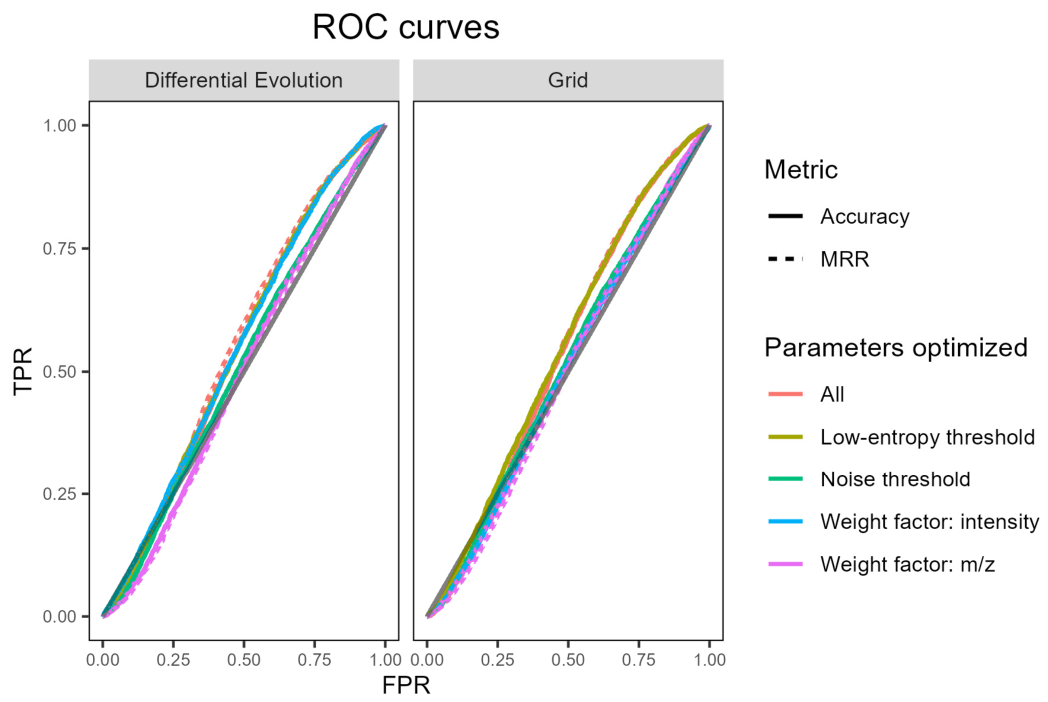
- Area under the receiver operating characteristic curve (AUC):For each query spectrum, the similarity score of the highest ranked candidate was used as a continuous ranking statistic for ROC analysis because practical library-based compound identification is based on the top-ranked match. The class label indicated whether the top-ranked candidate corresponded to the correct compound. This query-level formulation was chosen because the objective of library searching is compound identification rather than discrimination among all possible query reference pairs. This approach is equivalent to that used previously [5].
3. Results
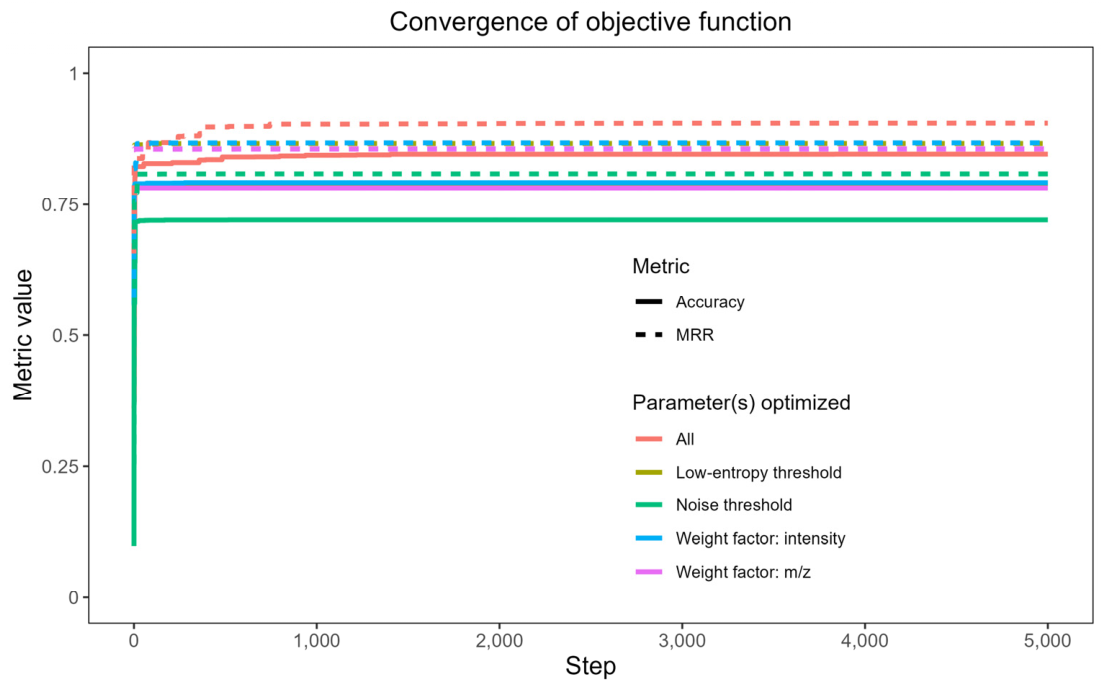
3.1. DE Convergence
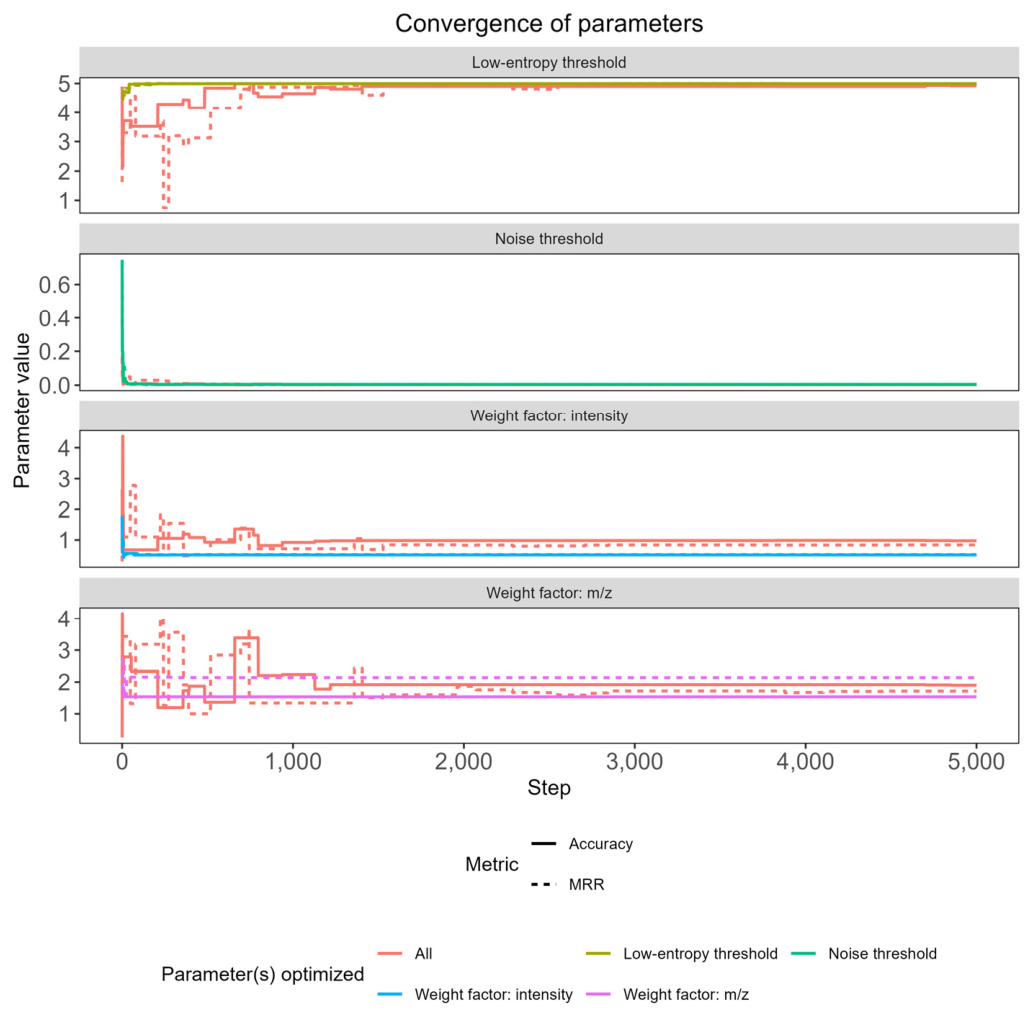
3.2. Optimal Parameter Estimates
3.3. ROC Curve Analysis
3.4. Ranked Identification Accuracy
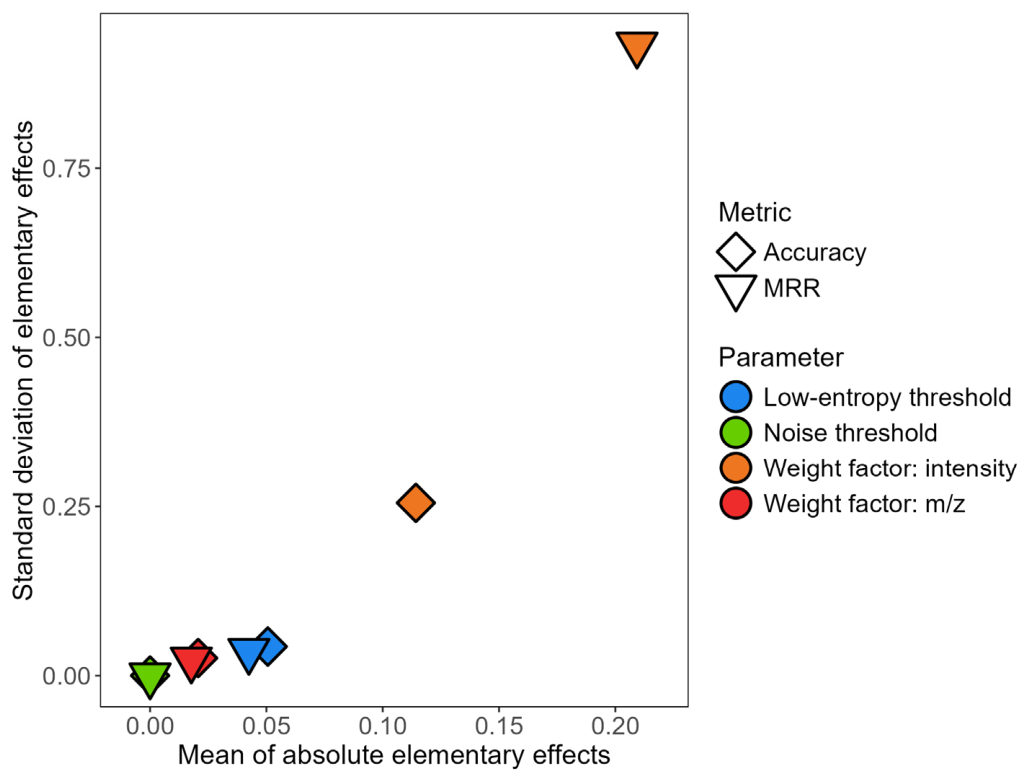
3.5. Global Sensitivity Analysis
4. Discussion
Author Contributions
Funding
Institutional Review Board Statement
Informed Consent Statement
Data Availability Statement
Acknowledgments
Conflicts of Interest
Abbreviations
| DE | Differential evolution |
| FPR | False positive rate |
| GC-MS | Gas chromatography–mass spectrometry |
| LC-MS | Liquid chromatography–mass spectrometry |
| MRR | Mean reciprocal rank |
| ROC | Receiver operator characteristic |
| TPR | True positive rate |
Appendix A

| Optimization | Metric | Parameters Optimized | Rank | Accuracy |
|---|---|---|---|---|
| DE | Accuracy | All | 1 | 0.849 [0.844, 0.854] |
| 2 | 0.934 [0.930, 0.937] | |||
| 3 | 0.963 [0.960, 0.965] | |||
| 4 | 0.973 [0.971, 0.975] | |||
| 5 | 0.980 [0.978, 0.982] | |||
| 10 | 0.990 [0.989, 0.991] | |||
| LE threshold | 1 | 0.801 [0.796, 0.806] | ||
| 2 | 0.904 [0.900, 0.908] | |||
| 3 | 0.941 [0.938, 0.944] | |||
| 4 | 0.957 [0.954, 0.960] | |||
| 5 | 0.967 [0.964, 0.969] | |||
| 10 | 0.981 [0.980, 0.983] | |||
| Noise threshold | 1 | 0.728 [0.722, 0.733] | ||
| 2 | 0.838 [0.833, 0.843] | |||
| 3 | 0.884 [0.880, 0.888] | |||
| 4 | 0.908 [0.904, 0.911] | |||
| 5 | 0.921 [0.918, 0.925] | |||
| 10 | 0.949 [0.946, 0.952] | |||
| WF: intensity | 1 | 0.798 [0.792, 0.803] | ||
| 2 | 0.901 [0.897, 0.905] | |||
| 3 | 0.940 [0.937, 0.943] | |||
| 4 | 0.957 [0.954, 0.960] | |||
| 5 | 0.967 [0.965, 0.969] | |||
| 10 | 0.984 [0.982, 0.985] | |||
| WF: mass/charge | 1 | 0.790 [0.784, 0.795] | ||
| 2 | 0.889 [0.885, 0.893] | |||
| 3 | 0.927 [0.923, 0.931] | |||
| 4 | 0.942 [0.939, 0.945] | |||
| 5 | 0.952 [0.950, 0.955] | |||
| 10 | 0.972 [0.969, 0.974] | |||
| MRR | All | 1 | 0.850 [0.844, 0.854] | |
| 2 | 0.933 [0.930, 0.936] | |||
| 3 | 0.963 [0.960, 0.965] | |||
| 4 | 0.974 [0.971, 0.976] | |||
| 5 | 0.979 [0.978, 0.981] | |||
| 10 | 0.991 [0.990, 0.992] | |||
| LE threshold | 1 | 0.801 [0.796, 0.806] | ||
| 2 | 0.904 [0.900, 0.908] | |||
| 3 | 0.941 [0.937, 0.943] | |||
| 4 | 0.957 [0.954, 0.960] | |||
| 5 | 0.967 [0.964, 0.969] | |||
| 10 | 0.981 [0.980, 0.983] | |||
| Noise threshold | 1 | 0.728 [0.722, 0.734] | ||
| 2 | 0.838 [0.833, 0.843] | |||
| 3 | 0.884 [0.880, 0.888] | |||
| 4 | 0.908 [0.904, 0.912] | |||
| 5 | 0.921 [0.918, 0.925] | |||
| 10 | 0.949 [0.947, 0.952] | |||
| WF: intensity | 1 | 0.798 [0.792, 0.803] | ||
| 2 | 0.901 [0.897, 0.906] | |||
| 3 | 0.941 [0.938, 0.944] | |||
| 4 | 0.957 [0.954, 0.960] | |||
| 5 | 0.967 [0.965, 0.969] | |||
| 10 | 0.983 [0.982, 0.985] | |||
| WF: mass/charge | 1 | 0.790 [0.785, 0.796] | ||
| 2 | 0.889 [0.886, 0.894] | |||
| 3 | 0.928 [0.925, 0.931] | |||
| 4 | 0.943 [0.940, 0.946] | |||
| 5 | 0.953 [0.950, 0.956] | |||
| 10 | 0.972 [0.970, 0.974] | |||
| Grid | Accuracy | All | 1 | 0.844 [0.840, 0.849] |
| 2 | 0.931 [0.928, 0.934] | |||
| 3 | 0.960 [0.957, 0.963] | |||
| 4 | 0.972 [0.970, 0.974] | |||
| 5 | 0.978 [0.976, 0.980] | |||
| 10 | 0.989 [0.988, 0.990] | |||
| LE threshold | 1 | 0.801 [0.796, 0.806] | ||
| 2 | 0.904 [0.900, 0.908] | |||
| 3 | 0.941 [0.937, 0.944] | |||
| 4 | 0.957 [0.954, 0.960] | |||
| 5 | 0.967 [0.964, 0.969] | |||
| 10 | 0.981 [0.979, 0.983] | |||
| Noise threshold | 1 | 0.727 [0.722, 0.733] | ||
| 2 | 0.838 [0.833, 0.843] | |||
| 3 | 0.883 [0.879, 0.888] | |||
| 4 | 0.907 [0.903, 0.911] | |||
| 5 | 0.922 [0.918, 0.925] | |||
| 10 | 0.949 [0.947, 0.952] | |||
| WF: intensity | 1 | 0.672 [0.666, 0.679] | ||
| 2 | 0.785 [0.780, 0.791] | |||
| 3 | 0.836 [0.831, 0.841] | |||
| 4 | 0.863 [0.858, 0.867] | |||
| 5 | 0.880 [0.876, 0.884] | |||
| 10 | 0.920 [0.916, 0.924] | |||
| WF: mass/charge | 1 | 0.787 [0.782, 0.792] | ||
| 2 | 0.886 [0.882, 0.891] | |||
| 3 | 0.924 [0.921, 0.927] | |||
| 4 | 0.940 [0.937, 0.943] | |||
| 5 | 0.951 [0.948, 0.953] | |||
| 10 | 0.970 [0.968, 0.972] | |||
| MRR | All | 1 | 0.844 [0.839, 0.849] | |
| 2 | 0.930 [0.927, 0.934] | |||
| 3 | 0.959 [0.956, 0.961] | |||
| 4 | 0.970 [0.968, 0.973] | |||
| 5 | 0.977 [0.975, 0.979] | |||
| 10 | 0.989 [0.987, 0.990] | |||
| LE threshold | 1 | 0.801 [0.795, 0.807] | ||
| 2 | 0.904 [0.900, 0.908] | |||
| 3 | 0.941 [0.937, 0.944] | |||
| 4 | 0.957 [0.954, 0.960] | |||
| 5 | 0.967 [0.964, 0.969] | |||
| 10 | 0.981 [0.979, 0.983] | |||
| Noise threshold | 1 | 0.727 [0.721, 0.733] | ||
| 2 | 0.838 [0.833, 0.843] | |||
| 3 | 0.883 [0.879, 0.888] | |||
| 4 | 0.907 [0.903, 0.911] | |||
| 5 | 0.922 [0.918, 0.925] | |||
| 10 | 0.949 [0.947, 0.952] | |||
| WF: intensity | 1 | 0.672 [0.666, 0.678] | ||
| 2 | 0.785 [0.780, 0.791] | |||
| 3 | 0.836 [0.831, 0.841] | |||
| 4 | 0.863 [0.858, 0.867] | |||
| 5 | 0.880 [0.876, 0.884] | |||
| 10 | 0.920 [0.916, 0.924] | |||
| WF: mass/charge | 1 | 0.787 [0.782, 0.793] | ||
| 2 | 0.889 [0.884, 0.893] | |||
| 3 | 0.927 [0.923, 0.930] | |||
| 4 | 0.943 [0.939, 0.946] | |||
| 5 | 0.953 [0.950, 0.955] | |||
| 10 | 0.972 [0.970, 0.974] |
References
- Alseekh, S.; Aharoni, A.; Brotman, Y.; Contrepois, K.; D’auria, J.; Ewald, J.; Ewald, J.C.; Fraser, P.D.; Giavalisco, P.; Hall, R.D.; et al. Mass spectrometry-based metabolomics: A guide for annotation, quantification and best reporting practices. Nat. Methods 2021, 18, 747–756. [Google Scholar] [CrossRef] [PubMed]
- Putri, S.P.; Fukusaki, E. Mass Spectrometry-Based Metabolomics: A Practical Guide; CRC Press: Boca Raton, FL, USA, 2014. [Google Scholar]
- Aggio, R.B.; Mayor, A.; Reade, S.; Probert, C.S.; Ruggiero, K. Identifying and quantifying metabolites by scoring peaks of GC-MS data. BMC Bioinform. 2014, 15, 374. [Google Scholar] [CrossRef] [PubMed]
- Koek, M.M.; Jellema, R.H.; van der Greef, J.; Tas, A.C.; Hankemeier, T. Quantitative metabolomics based on gas chromatography mass spectrometry: Status and perspectives. Metabolomics 2020, 7, 307–328. [Google Scholar]
- Dlugas, H.; Zhang, X.; Kim, S. Comparative analysis of continuous similarity measures for compound identification in mass spectrometry-based metabolomics. Chemom. Intell. Lab. Syst. 2025, 263, 105417. [Google Scholar] [CrossRef] [PubMed]
- Schrimpe-Rutledge, A.C.; Codreanu, S.G.; Sherrod, S.D.; McLean, J.A. Untargeted Metabolomics Strategies—Challenges and Emerging Directions. J. Am. Soc. Mass Spectrom. 2016, 27, 1897–1905. [Google Scholar] [CrossRef] [PubMed]
- Anderson, B.G.; Raskind, A.; Habra, H.; Kennedy, R.T.; Evans, C.R. Modifying Chromatography Conditions for Improved Unknown Feature Identification in Untargeted Metabolomics. Anal. Chem. 2021, 93, 15840–15849. [Google Scholar] [CrossRef] [PubMed]
- Bartmanski, B.J.; Rocha, M.; Zimmermann-Kogadeeva, M. Recent advances in data- and knowledge-driven approaches to explore primary microbial metabolism. Curr. Opin. Chem. Biol. 2023, 75, 102324. [Google Scholar] [CrossRef] [PubMed]
- Kim, S.; Koo, I.; Jeong, J.; Wu, S.; Shi, X.; Zhang, X. Compound identification using partial and semipartial correlations for gas chromatography-mass spectrometry data. Anal. Chem. 2012, 84, 6477–6487. [Google Scholar] [CrossRef] [PubMed]
- Kim, S.; Koo, I.; Wei, X.; Zhang, X. A method of finding optimal weight factors for compound identification in gas chromatography–mass spectrometry. Bioinformatics 2012, 28, 1158–1163. [Google Scholar] [CrossRef] [PubMed]
- Kim, S.; Ouyang, M.; Jeong, J.; Shen, C.; Zhang, X. A new method of peak detection for analysis of comprehensive two-dimensional gas chromatography mass spectrometry data. Ann. Appl. Stat. 2014, 8, 1209–1231. [Google Scholar] [CrossRef] [PubMed]
- Nefedov, A.V.; Gilski, M.J.; Sadygov, R.G. SVM Model for Quality Assessment of Medium Resolution Mass Spectra from 18O-Water Labeling Experiments. J. Proteome Res. 2011, 10, 2095–2103. [Google Scholar] [CrossRef] [PubMed]
- Benton, H.P.; Wong, D.M.; Trauger, S.A.; Siuzdak, G. XCMS2: Processing Tandem Mass Spectrometry Data for Metabolite Identification and Structural Characterization. Anal. Chem. 2008, 80, 6382–6389. [Google Scholar] [CrossRef] [PubMed]
- Depke, T.; Franke, R.; Brönstrup, M. CluMSID: An R package for similarity-based clustering of tandem mass spectra to aid feature annotation in metabolomics. Bioinformatics 2019, 35, 3196–3198. [Google Scholar] [CrossRef] [PubMed]
- Li, Y.; Kind, T.; Folz, J.; Vaniya, A.; Mehta, S.S.; Fiehn, O. Spectral entropy outperforms MS/MS dot product similarity for small-molecule compound identification. Nat. Methods 2021, 18, 1524–1531. [Google Scholar] [CrossRef] [PubMed]
- Kim, S.; Wong, W.K. Extended two-stage adaptive designs with three target responses for phase II clinical trials. Stat. Methods Med. Res. 2018, 27, 3628–3642. [Google Scholar] [PubMed]
- Koo, I.; Kim, S.; Zhang, X. Comparative analysis of mass spectral matching-based compound identification in gas chromatography–mass spectrometry. J. Chromatogr. A 2013, 1298, 132–138. [Google Scholar] [CrossRef] [PubMed]
- Kim, S.; Hooker, A.C.; Shi, Y.; Kim, G.H.J.; Wong, W.K. Metaheuristics for pharmacometrics. CPT Pharmacomet. Syst. Pharmacol. 2021, 10, 1297–1309. [Google Scholar] [CrossRef] [PubMed]
- Kaur, D.; Singh, S.; Mansoor, W.; Kumar, Y.; Verma, S.; Dash, S.; Koul, A. Computational intelligence and metaheuristic techniques for brain tumor detection through IoMT-enabled MRI devices. Wirel. Commun. Mob. Comput. 2022, 2022, 1519198. [Google Scholar] [CrossRef]
- Aviles, M.; Rodríguez-Reséndiz, J.; Ibrahimi, D. Optimizing EMG Classification through Metaheuristic Algorithms. Technologies 2023, 11, 87. [Google Scholar] [CrossRef]
- Storn, R.; Price, K. Differential evolution—A simple and efficient heuristic for global optimization over continuous spaces. J. Glob. Optim. 1997, 11, 341–359. [Google Scholar] [CrossRef]
- Pant, M.; Zaheer, H.; Garcia-Hernandez, L.; Abraham, A. Differential Evolution: A review of more than two decades of research. Eng. Appl. Artif. Intell. 2020, 90, 103479. [Google Scholar] [CrossRef]
- Holland, J.H. Adaptation in Natural and Artificial Systems; University of Michigan Press: Ann Arbor, MI, USA, 1975. [Google Scholar]
- Kennedy, J.; Eberhart, R.C.; Shi, Y. Swarm Intelligence; Morgan Kaufmann Publishers: San Francisco, CA, USA, 2001; pp. 11942–11948. [Google Scholar]
- Kirkpatrick, S.; Gelatt, C.D., Jr.; Vecchi, M.P. Optimization by simulated annealing. Science 1983, 220, 671–680. [Google Scholar] [CrossRef] [PubMed]
- Shahriari, B.; Swersky, K.; Wang, Z.; Adams, R.P.; De Freitas, N. Taking the human out of the loop: A review of Bayesian optimization. Proc. IEEE 2016, 104, 148–175. [Google Scholar] [CrossRef]
- Kim, S.; Kato, I.; Zhang, X. Comparative Analysis of Binary Similarity Measures for Compound Identification in Mass Spectrometry-Based Metabolomics. Metabolites 2022, 12, 694. [Google Scholar] [CrossRef] [PubMed]
- Dlugas, H.; Zhang, X.; Kim, S. Liquid chromatography-Tandem mass spectrometry (LC-MS/MS) and gas chromatography-Mass spectrometry (GC-MS) reference libraries from global natural products social molecular networking (GNPS) and national institute of standards and technology (NIST) WebBook processed for spectral library matching. Zenodo 2024. [Google Scholar] [CrossRef]
- Roberts, D.R.; Bahn, V.; Ciuti, S.; Boyce, M.S.; Elith, J.; Guillera-Arroita, G.; Hauenstein, S.; Lahoz-Monfort, J.J.; Schröder, B.; Thuiller, W.; et al. Cross-validation strategies for data with temporal, spatial, hierarchical, or phylogenetic structure. Ecography 2017, 40, 913–929. [Google Scholar] [CrossRef]
- Sagawa, S.; Koh, P.W.; Hashimoto, T.B.; Liang, P. Distributionally robust neural networks for group shifts: On the importance of regularization for worst-case generalization. arXiv 2019, arXiv:1911.08731. [Google Scholar]
- Lin, W.-C.; McIntosh-Smith, S. Comparing Julia to performance portable parallel programming models for HPC. In Proceedings of the 2021 International Workshop on Performance Modeling, Benchmarking and Simulation of High Performance Computer Systems (PMBS), St. Louis, MO, USA, 15 November 2021. [Google Scholar]
- Roesch, E.; Greener, J.G.; MacLean, A.L.; Nassar, H.; Rackauckas, C.; Holy, T.E.; Stumpf, M.P. Julia for biologists. Nat. Methods 2023, 20, 655–664. [Google Scholar] [CrossRef] [PubMed]
- Morris, M.D. Factorial sampling plans for preliminary computational experiments. Technometrics 1991, 33, 161–174. [Google Scholar] [CrossRef]
- Efron, B.; Tibshirani, R.J. An Introduction to the Bootstrap; Chapman & Hall: New York, NY, USA, 1993. [Google Scholar]
- Davison, A.C.; Hinkley, D.V. Bootstrap Methods and Their Application; Cambridge University Press: Cambridge, UK, 1997. [Google Scholar]
- McCall, J. Genetic algorithms for modelling and optimization. J. Comput. Appl. Math. 2005, 184, 205–222. [Google Scholar] [CrossRef]
- Kennedy, J.; Eberhart, R. Particle swarm optimization. In Proceedings of the ICNN’95-International Conference on Neural Networks, Perth, WA, Australia, 27 November–1 December 1995. [Google Scholar]
- Rubinstein, R. The cross-entropy method for combinatorial and continuous optimization. Methodol. Comput. Appl. Probab. 1999, 1, 127–190. [Google Scholar] [CrossRef]


| Optimization | Metric | Parameters Optimized | Low-Entropy Threshold | Noise Threshold | Weight Factor: Intensity | Weight Factor: m/z | Max Value of Metric |
|---|---|---|---|---|---|---|---|
| DE | Accuracy | All | 4.924 [4.448, 4.998] | 0.003 [0.003, 0.007] | 0.975 [0.798, 1.161] | 1.901 [1.677, 2.696] | 0.846 |
| LE threshold | 4.995 [4.933, 5.000] | 0 | 1 | 0 | 0.790 | ||
| Noise threshold | 0 | 0.005 [0.002, 0.012] | 1 | 0 | 0.720 | ||
| WF: intensity | 0 | 0 | 0.514 [0.501, 0.583] | 0 | 0.792 | ||
| WF: mass/charge | 0 | 0 | 1 | 1.536 [1.423, 2.298] | 0.782 | ||
| MRR | All | 4.985 [4.394, 5.000] | 0.003 [0.000, 0.007] | 0.841 [0.794, 1.250] | 1.717 [1.464, 2.485] | 0.904 | |
| LE threshold | 4.995 [4.991, 5.000] | 0 | 1 | 0 | 0.865 | ||
| Noise threshold | 0 | 0.005 [0.003, 0.012] | 1 | 0 | 0.809 | ||
| WF: intensity | 0 | 0 | 0.524 [0.501, 0.574] | 0 | 0.867 | ||
| WF: mass/charge | 0 | 0 | 1 | 2.140 [1.545, 2.298] | 0.856 | ||
| Grid | Accuracy | All | 5 | 0 | 1.25 | 2.5 | 0.838 |
| LE threshold | 5 | 0 | 1 | 0 | 0.789 | ||
| Noise threshold | 0 | 0 | 1 | 0 | 0.719 | ||
| WF: intensity | 0 | 0 | 1.25 | 0 | 0.662 | ||
| WF: mass/charge | 0 | 0 | 1 | 1.25 | 0.780 | ||
| MRR | All | 5 | 0 | 1.25 | 3.75 | 0.898 | |
| LE threshold | 5 | 0 | 1 | 0 | 0.865 | ||
| Noise threshold | 0 | 0 | 1 | 0 | 0.808 | ||
| WF: intensity | 0 | 0 | 1.25 | 0 | 0.757 | ||
| WF: mass/charge | 0 | 0 | 1 | 2.5 | 0.854 |
| Optimization | Metric | Parameters Optimized | AUC [95% CI] |
|---|---|---|---|
| DE | Accuracy | All | 0.543 [0.531, 0.554] |
| LE threshold | 0.550 [0.539, 0.560] | ||
| Noise threshold | 0.513 [0.504, 0.522] | ||
| WF: m/z | 0.550 [0.540, 0.561] | ||
| WF: intensity | 0.499 [0.489, 0.509] | ||
| MRR | All | 0.558 [0.546, 0.569] | |
| LE threshold | 0.550 [0.539, 0.560] | ||
| Noise threshold | 0.513 [0.504, 0.522] | ||
| WF: m/z | 0.549 [0.539, 0.559] | ||
| WF: intensity | 0.493 [0.483, 0.503] | ||
| Grid | Accuracy | All | 0.539 [0.528, 0.551] |
| LE threshold | 0.550 [0.540, 0.560] | ||
| Noise threshold | 0.513 [0.504, 0.522] | ||
| WF: m/z | 0.501 [0.493, 0.510] | ||
| WF: intensity | 0.504 [0.494, 0.514] | ||
| MRR | All | 0.540 [0.529, 0.552] | |
| LE threshold | 0.550 [0.540, 0.560] | ||
| Noise threshold | 0.513 [0.504, 0.522] | ||
| WF: m/z | 0.501 [0.493, 0.510] | ||
| WF: intensity | 0.491 [0.481, 0.500] |
Disclaimer/Publisher’s Note: The statements, opinions and data contained in all publications are solely those of the individual author(s) and contributor(s) and not of MDPI and/or the editor(s). MDPI and/or the editor(s) disclaim responsibility for any injury to people or property resulting from any ideas, methods, instructions or products referred to in the content. |
© 2026 by the authors. Licensee MDPI, Basel, Switzerland. This article is an open access article distributed under the terms and conditions of the Creative Commons Attribution (CC BY) license.
Share and Cite
Dlugas, H.; Li, J.; Zhang, X.; Kim, S. MSTune: A Data-Driven Approach to Parameter Tuning Using Grid Search and Differential Evolution for Gas Chromatography–Mass Spectrometry-Based Compound Identification. Metabolites 2026, 16, 428. https://doi.org/10.3390/metabo16060428
Dlugas H, Li J, Zhang X, Kim S. MSTune: A Data-Driven Approach to Parameter Tuning Using Grid Search and Differential Evolution for Gas Chromatography–Mass Spectrometry-Based Compound Identification. Metabolites. 2026; 16(6):428. https://doi.org/10.3390/metabo16060428
Chicago/Turabian StyleDlugas, Hunter, Jing Li, Xiang Zhang, and Seongho Kim. 2026. "MSTune: A Data-Driven Approach to Parameter Tuning Using Grid Search and Differential Evolution for Gas Chromatography–Mass Spectrometry-Based Compound Identification" Metabolites 16, no. 6: 428. https://doi.org/10.3390/metabo16060428
APA StyleDlugas, H., Li, J., Zhang, X., & Kim, S. (2026). MSTune: A Data-Driven Approach to Parameter Tuning Using Grid Search and Differential Evolution for Gas Chromatography–Mass Spectrometry-Based Compound Identification. Metabolites, 16(6), 428. https://doi.org/10.3390/metabo16060428