

Benchmarking Spatial Clustering Methods for Mass Spectrometry-Based Spatial Metabolomics


Abstract
1. Introduction
2. Materials and Methods
2.1. Data Collection and Preparation

| Dataset Name | Ion Source | Mass Analyzer | Ionization Mode | Resolution (μm) | Sample Type | No. of Pixels | No. of m/z | Source |
|---|---|---|---|---|---|---|---|---|
| mbrain1_neg20 | AFADESI | Orbitrap | Neg | 20 | Mouse brain | 107,423 | 2005 | In-house |
| mbrain1_neg50 | AFADESI | Orbitrap | Neg | 50 | Mouse brain | 23,531 | 2138 | In-house |
| mbrain1_neg100 | AFADESI | Orbitrap | Neg | 100 | Mouse brain | 5875 | 2162 | In-house |
| mbrain1_pos20 | AFADESI | Orbitrap | Pos | 20 | Mouse brain | 112,023 | 2578 | In-house |
| mbrain1_pos50 | AFADESI | Orbitrap | Pos | 50 | Mouse brain | 22,792 | 2989 | In-house |
| mbrain1_pos100 | AFADESI | Orbitrap | Pos | 100 | Mouse brain | 5373 | 3044 | In-house |
| mbrain2_pos50 | AFADESI | Orbitrap | Pos | 50 | Mouse brain | 14,283 | 2654 | In-house |
| PDX_mbrain_pos100 | MALDI | FTICR | Pos | 100 | Mouse brain | 3570 | 1131 | [28] |
| pfetus_neg | DESI | LTQ | Neg | NA 1 | Pig fetus | 4959 | 687 | [24] |
| mfetus_neg | MALDI | TOF | Neg | NA 1 | Mouse fetus | 16,197 | 2203 | [29] |
| mbrain_neg40 | MALDI | TOF | Neg | 40 | Mouse brain | 32,368 | 2531 | [30] |
| mkidney_neg40 | MALDI | Orbitrap | Neg | 40 | Mouse kidney | 45,623 | 258 | [31] |
2.2. Spatial Noise Score and Ion Filtering
2.3. Clustering Methods
2.4. Evaluation Metrics
2.4.1. Spatial Continuity Assessment
2.4.2. Inter-Cluster Metabolic Heterogeneity Assessment
2.4.3. Computational Resource Efficiency Assessment
2.4.4. Clustering Consistency and Biological Validation
2.5. Construction and Implementation of the Online Clustering Evaluation Platform
3. Results
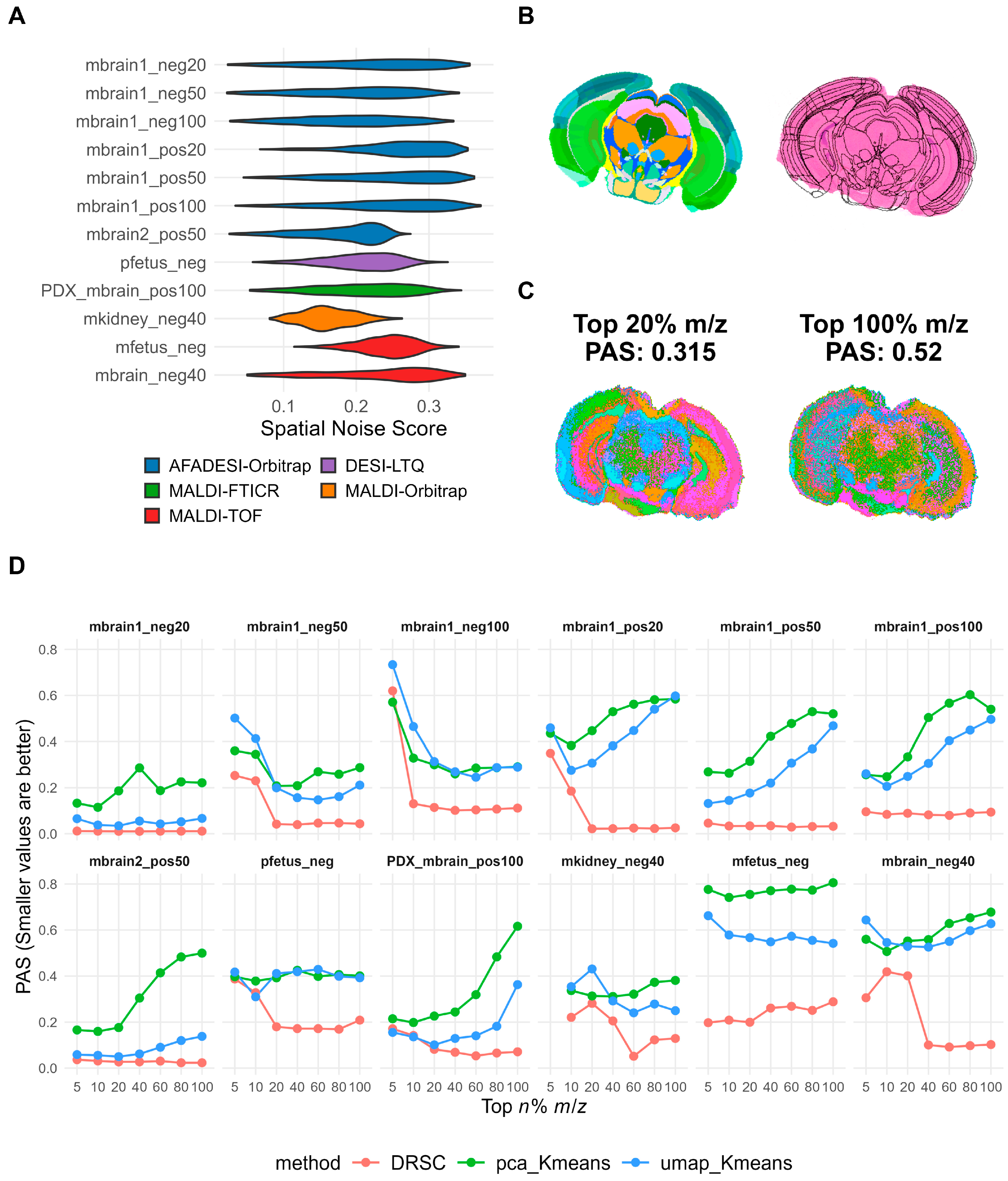
3.1. Effects of SNS-Based Ion Filtering on Spatial Clustering Performance
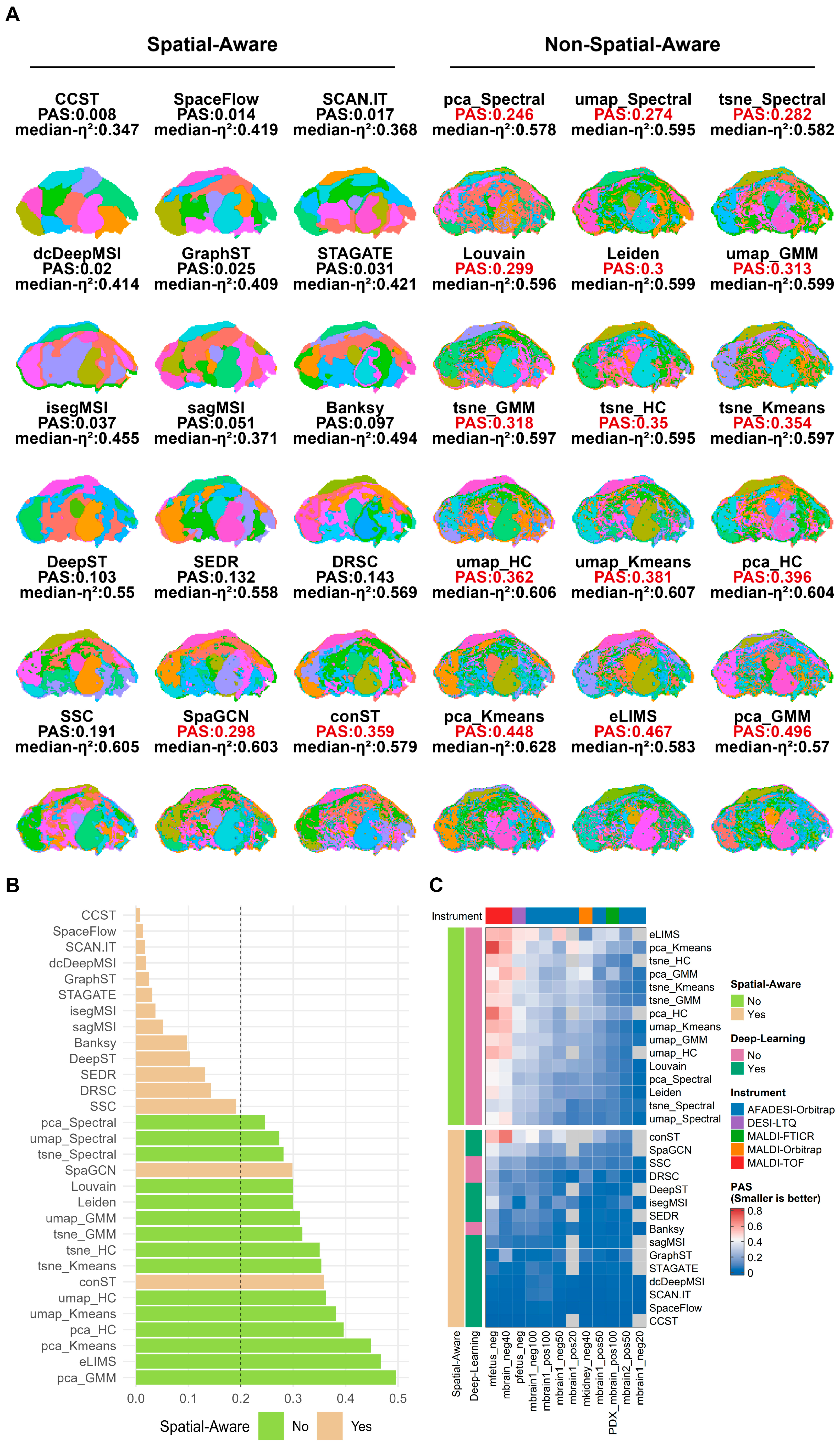
3.2. Spatial Continuity Across Clustering Methods
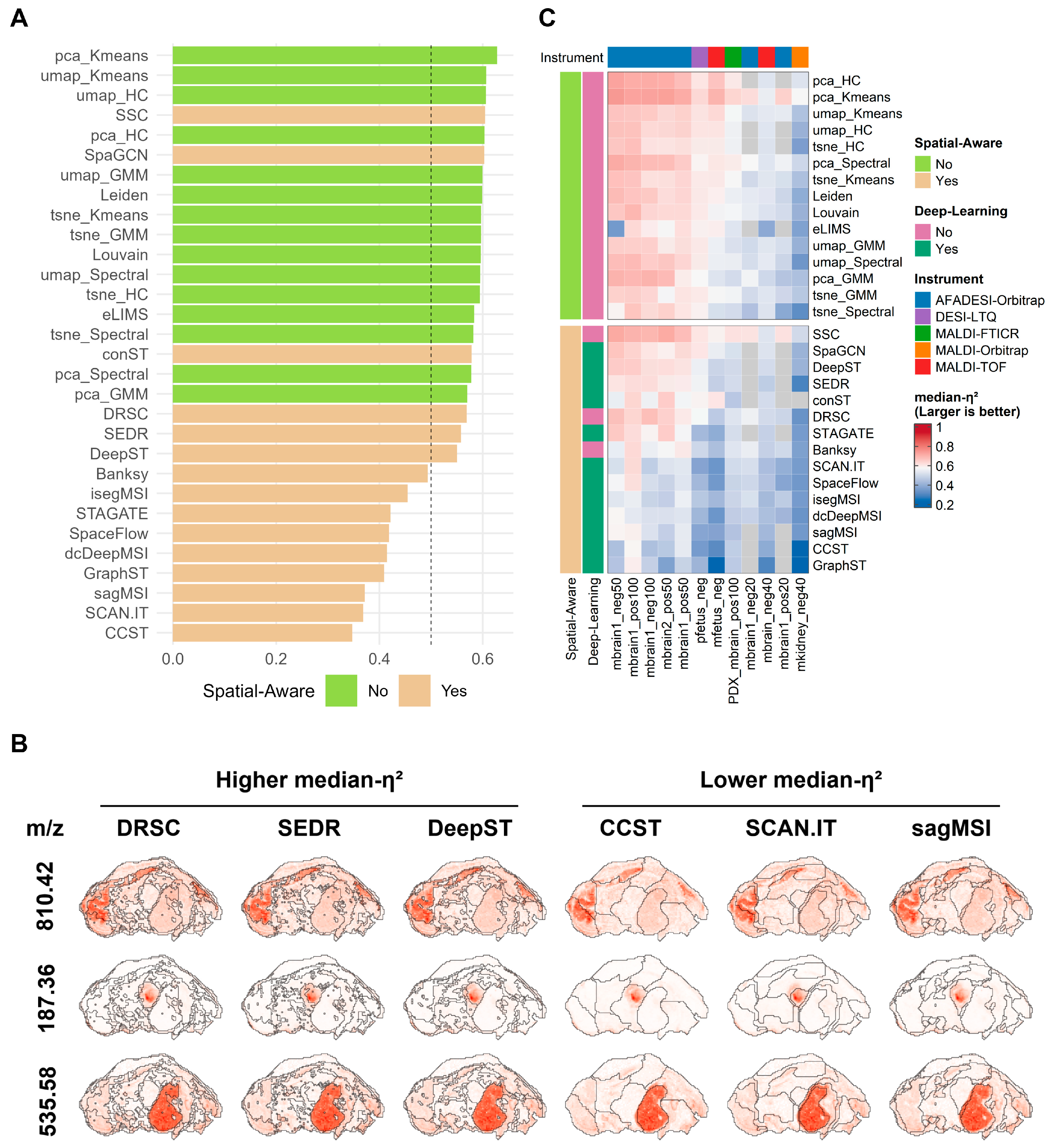
3.3. Inter-Cluster Metabolic Heterogeneity Across Clustering Methods
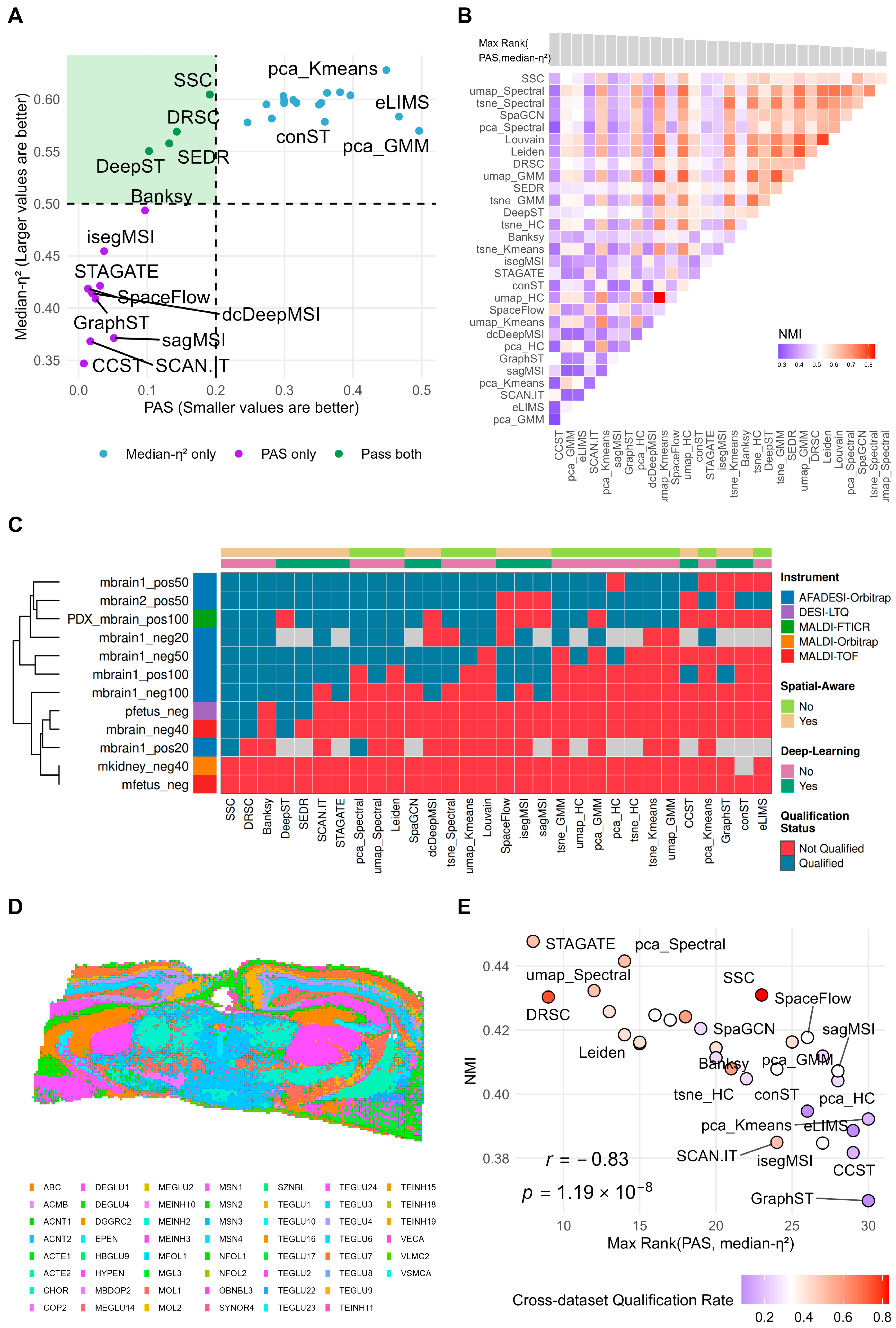
3.4. Dual-Metric Evaluation Framework and Its Biological Validation
3.5. Computational Efficiency of Clustering Methods
3.6. Online Clustering Evaluation Platform
4. Discussion
5. Conclusions
Supplementary Materials
Author Contributions
Funding
Institutional Review Board Statement
Informed Consent Statement
Data Availability Statement
Acknowledgments
Conflicts of Interest
Abbreviations
| SNS | Spatial Noise Score |
| PAS | Percentage of Abnormal Spots |
| AFADESI | Air flow-assisted desorption electrospray ionization |
| MSI | Mass spectrometry imaging |
References
- Fujimura, Y.; Miura, D. MALDI Mass Spectrometry Imaging for Visualizing In Situ Metabolism of Endogenous Metabolites and Dietary Phytochemicals. Metabolites 2014, 4, 319–346. [Google Scholar] [CrossRef] [Scilit]
- Chen, K.; Baluya, D.; Tosun, M.; Li, F.; Maletic-Savatic, M. Imaging Mass Spectrometry: A New Tool to Assess Molecular Underpinnings of Neurodegeneration. Metabolites 2019, 9, 135. [Google Scholar] [CrossRef] [Scilit]
- He, M.J.; Pu, W.; Wang, X.; Zhang, W.; Tang, D.; Dai, Y. Comparing DESI-MSI and MALDI-MSI Mediated Spatial Metabolomics and Their Applications in Cancer Studies. Front. Oncol. 2022, 12, 891018. [Google Scholar] [CrossRef] [Scilit]
- Caprioli, R.M.; Farmer, T.B.; Gile, J. Molecular Imaging of Biological Samples: Localization of Peptides and Proteins Using MALDI-TOF MS. Anal. Chem. 1997, 69, 4751–4760. [Google Scholar] [CrossRef] [Scilit]
- Takáts, Z.; Wiseman, J.M.; Gologan, B.; Cooks, R.G. Mass Spectrometry Sampling under Ambient Conditions with Desorption Electrospray Ionization. Sci. New Ser. 2004, 306, 471–473. [Google Scholar] [CrossRef] [Scilit] [PubMed]
- Ràfols, P.; Vilalta, D.; Brezmes, J.; Cañellas, N.; Del Castillo, E.; Yanes, O.; Ramírez, N.; Correig, X. Signal Preprocessing, Multivariate Analysis and Software Tools for MA(LDI)-TOF Mass Spectrometry Imaging for Biological Applications. Mass Spectrom. Rev. 2018, 37, 281–306. [Google Scholar] [CrossRef] [Scilit] [PubMed]
- Buchberger, A.R.; DeLaney, K.; Johnson, J.; Li, L. Mass Spectrometry Imaging: A Review of Emerging Advancements and Future Insights. Anal. Chem. 2018, 90, 240–265. [Google Scholar] [CrossRef] [Scilit]
- Mei, Z.; Ning, X.; Deng, H.; Chen, L.; Zhao, Y.; Zi, J. SMAnalyst: A Web Server for Spatial Metabolomic Data Analysis and Annotation. Biomolecules 2025, 15, 1562. [Google Scholar] [CrossRef] [Scilit]
- McCombie, G.; Staab, D.; Stoeckli, M.; Knochenmuss, R. Spatial and Spectral Correlations in MALDI Mass Spectrometry Images by Clustering and Multivariate Analysis. Anal. Chem. 2005, 77, 6118–6124. [Google Scholar] [CrossRef] [Scilit] [PubMed]
- Alexandrov, T.; Kobarg, J.H. Efficient Spatial Segmentation of Large Imaging Mass Spectrometry Datasets with Spatially Aware Clustering. Bioinformatics 2011, 27, i230–i238. [Google Scholar] [CrossRef] [Scilit]
- Bemis, K.D.; Harry, A.; Eberlin, L.S.; Ferreira, C.R.; Van De Ven, S.M.; Mallick, P.; Stolowitz, M.; Vitek, O. Probabilistic Segmentation of Mass Spectrometry (MS) Images Helps Select Important Ions and Characterize Confidence in the Resulting Segments. Mol. Cell. Proteom. 2016, 15, 1761–1772. [Google Scholar] [CrossRef] [Scilit]
- Shah, M.; Wang, L.; Guo, L.; Xie, C.; Lam, T.K.-Y.; Deng, L.; Xu, X.; Xu, J.; Dong, J.; Cai, Z. SagMSI: A Graph Convolutional Network Framework for Precise Spatial Segmentation in Mass Spectrometry Imaging. Anal. Chim. Acta 2025, 1358, 344098. [Google Scholar] [CrossRef] [Scilit] [PubMed]
- Dong, K.; Zhang, S. Deciphering Spatial Domains from Spatially Resolved Transcriptomics with an Adaptive Graph Attention Auto-Encoder. Nat. Commun. 2022, 13, 1739. [Google Scholar] [CrossRef] [Scilit]
- Xiao, K.; Wang, Y.; Dong, K.; Zhang, S. SmartGate Is a Spatial Metabolomics Tool for Resolving Tissue Structures. Brief. Bioinform. 2023, 24, bbad141. [Google Scholar] [CrossRef] [Scilit]
- Cheng, A.; Hu, G.; Li, W.V. Benchmarking Cell-Type Clustering Methods for Spatially Resolved Transcriptomics Data. Brief. Bioinform. 2023, 24, bbac475. [Google Scholar] [CrossRef] [Scilit]
- Hu, Y.; Xie, M.; Li, Y.; Rao, M.; Shen, W.; Luo, C.; Qin, H.; Baek, J.; Zhou, X.M. Benchmarking Clustering, Alignment, and Integration Methods for Spatial Transcriptomics. Genome Biol. 2024, 25, 212. [Google Scholar] [CrossRef] [Scilit]
- Yuan, Z.; Zhao, F.; Lin, S.; Zhao, Y.; Yao, J.; Cui, Y.; Zhang, X.-Y.; Zhao, Y. Benchmarking Spatial Clustering Methods with Spatially Resolved Transcriptomics Data. Nat. Methods 2024, 21, 712–722. [Google Scholar] [CrossRef] [Scilit]
- Kang, L.; Zhang, Q.; Qian, F.; Liang, J.; Wu, X. Benchmarking Computational Methods for Detecting Spatial Domains and Domain-Specific Spatially Variable Genes from Spatial Transcriptomics Data. Nucleic Acids Res. 2025, 53, gkaf303. [Google Scholar] [CrossRef] [Scilit] [PubMed]
- Guo, L.; Liu, X.; Zhao, C.; Hu, Z.; Xu, X.; Cheng, K.-K.; Zhou, P.; Xiao, Y.; Shah, M.; Xu, J.; et al. iSegMSI: An Interactive Strategy to Improve Spatial Segmentation of Mass Spectrometry Imaging Data. Anal. Chem. 2022, 94, 14522–14529. [Google Scholar] [CrossRef] [Scilit]
- Shah, M.; Guo, L.; Xu, X.; Deng, L.; Lu, K.; Dong, J.; Zhao, C.; Xu, J. eLIMS: Ensemble Learning-Based Spatial Segmentation of Mass Spectrometry Imaging to Explore Metabolic Heterogeneity. J. Proteome Res. 2024, 23, 3088–3095. [Google Scholar] [CrossRef] [Scilit]
- Alexandrov, T.; Becker, M.; Deininger, S.-O.; Ernst, G.; Wehder, L.; Grasmair, M.; Von Eggeling, F.; Thiele, H.; Maass, P. Spatial Segmentation of Imaging Mass Spectrometry Data with Edge-Preserving Image Denoising and Clustering. J. Proteome Res. 2010, 9, 6535–6546. [Google Scholar] [CrossRef] [Scilit]
- Guo, L.; Hu, Z.; Zhao, C.; Xu, X.; Wang, S.; Xu, J.; Dong, J.; Cai, Z. Data Filtering and Its Prioritization in Pipelines for Spatial Segmentation of Mass Spectrometry Imaging. Anal. Chem. 2021, 93, 4788–4793. [Google Scholar] [CrossRef] [Scilit]
- Mei, Z.; Sun, W.; Zhao, Y.; Deng, H.; Ning, X.; Feng, C.; Zi, J. SMQVP: A Web Application for Spatial Metabolomics Quality Visualization and Processing. Metabolites 2025, 15, 354. [Google Scholar] [CrossRef] [Scilit]
- Bemis, K.D.; Harry, A.; Eberlin, L.S.; Ferreira, C.; Van De Ven, S.M.; Mallick, P.; Stolowitz, M.; Vitek, O. Cardinal: An R Package for Statistical Analysis of Mass Spectrometry-Based Imaging Experiments. Bioinformatics 2015, 31, 2418–2420. [Google Scholar] [CrossRef] [Scilit]
- Deng, H.; Ning, X.; Lin, X.; Zong, L.; Zheng, S.; Zhao, Y.; Wang, J.; Chen, L.; Zi, J.; Mei, Z. SMIntegration: A Web Tool for Comprehensive Spatial Metabolomics and Transcriptomics Integrated Analysis and Visualization. GigaScience 2026, 15, giag033. [Google Scholar] [CrossRef] [Scilit]
- Kleshchevnikov, V.; Shmatko, A.; Dann, E.; Aivazidis, A.; King, H.W.; Li, T.; Elmentaite, R.; Lomakin, A.; Kedlian, V.; Gayoso, A.; et al. Cell2location Maps Fine-Grained Cell Types in Spatial Transcriptomics. Nat. Biotechnol. 2022, 40, 661–671. [Google Scholar] [CrossRef] [Scilit]
- Marconato, L.; Palla, G.; Yamauchi, K.A.; Virshup, I.; Heidari, E.; Treis, T.; Vierdag, W.-M.; Toth, M.; Stockhaus, S.; Shrestha, R.B.; et al. SpatialData: An Open and Universal Data Framework for Spatial Omics. Nat. Methods 2025, 22, 58–62. [Google Scholar] [CrossRef] [Scilit]
- Randall, E.C.; Emdal, K.B.; Laramy, J.K.; Kim, M.; Roos, A.; Calligaris, D.; Regan, M.S.; Gupta, S.K.; Mladek, A.C.; Carlson, B.L.; et al. Integrated Mapping of Pharmacokinetics and Pharmacodynamics in a Patient-Derived Xenograft Model of Glioblastoma. Nat. Commun. 2018, 9, 4904. [Google Scholar] [CrossRef] [Scilit]
- Zhao, C.; Xie, P.; Yong, T.; Huang, W.; Liu, J.; Wu, D.; Ji, F.; Li, M.; Zhang, D.; Li, R.; et al. Airborne Fine Particulate Matter Induces Cognitive and Emotional Disorders in Offspring Mice Exposed during Pregnancy. Sci. Bull. 2021, 66, 578–591. [Google Scholar] [CrossRef] [Scilit]
- Xu, Y. Brain-9aa-Neg-40um. METASPACE. 2023. Available online: https://metaspace2020.org/dataset/2023-08-25_17h02m43s (accessed on 14 March 2026).
- Kasarla, S.S.; Fecke, A.; Smith, K.W.; Flocke, V.; Flögel, U.; Phapale, P. Improved MALDI-MS Imaging of Polar and2 H-Labeled Metabolites in Mouse Organ Tissues. Anal. Chem. 2025, 97, 10720–10728. [Google Scholar] [CrossRef] [Scilit]
- Inglese, P.; Correia, G.; Takats, Z.; Nicholson, J.K.; Glen, R.C. SPUTNIK: An R Package for Filtering of Spatially Related Peaks in Mass Spectrometry Imaging Data. Bioinformatics 2019, 35, 178–180. [Google Scholar] [CrossRef] [Scilit]
- Singhal, V.; Chou, N.; Lee, J.; Yue, Y.; Liu, J.; Chock, W.K.; Lin, L.; Chang, Y.-C.; Teo, E.M.L.; Aow, J.; et al. BANKSY Unifies Cell Typing and Tissue Domain Segmentation for Scalable Spatial Omics Data Analysis. Nat. Genet. 2024, 56, 431–441. [Google Scholar] [CrossRef] [Scilit] [PubMed]
- Li, J.; Chen, S.; Pan, X.; Yuan, Y.; Shen, H.-B. Cell Clustering for Spatial Transcriptomics Data with Graph Neural Networks. Nat. Comput. Sci. 2022, 2, 399–408. [Google Scholar] [CrossRef] [Scilit] [PubMed]
- Zong, Y.; Yu, T.; Wang, X.; Wang, Y.; Hu, Z.; Li, Y. conST: An Interpretable Multi-Modal Contrastive Learning Framework for Spatial Transcriptomics. bioRxiv 2022. [Google Scholar] [CrossRef] [Scilit]
- Guo, L.; Dong, J.; Xu, X.; Wu, Z.; Zhang, Y.; Wang, Y.; Li, P.; Tang, Z.; Zhao, C.; Cai, Z. Divide and Conquer: A Flexible Deep Learning Strategy for Exploring Metabolic Heterogeneity from Mass Spectrometry Imaging Data. Anal. Chem. 2023, 95, 1924–1932. [Google Scholar] [CrossRef] [Scilit]
- Xu, C.; Jin, X.; Wei, S.; Wang, P.; Luo, M.; Xu, Z.; Yang, W.; Cai, Y.; Xiao, L.; Lin, X.; et al. DeepST: Identifying Spatial Domains in Spatial Transcriptomics by Deep Learning. Nucleic Acids Res. 2022, 50, e131. [Google Scholar] [CrossRef] [Scilit]
- Liu, W.; Liao, X.; Yang, Y.; Lin, H.; Yeong, J.; Zhou, X.; Shi, X.; Liu, J. Joint Dimension Reduction and Clustering Analysis of Single-Cell RNA-Seq and Spatial Transcriptomics Data. Nucleic Acids Res. 2022, 50, e72. [Google Scholar] [CrossRef] [Scilit]
- Long, Y.; Ang, K.S.; Li, M.; Chong, K.L.K.; Sethi, R.; Zhong, C.; Xu, H.; Ong, Z.; Sachaphibulkij, K.; Chen, A.; et al. Spatially Informed Clustering, Integration, and Deconvolution of Spatial Transcriptomics with GraphST. Nat. Commun. 2023, 14, 1155. [Google Scholar] [CrossRef] [Scilit]
- Traag, V.A.; Waltman, L.; Van Eck, N.J. From Louvain to Leiden: Guaranteeing Well-Connected Communities. Sci. Rep. 2019, 9, 5233. [Google Scholar] [CrossRef] [Scilit]
- Blondel, V.D.; Guillaume, J.-L.; Lambiotte, R.; Lefebvre, E. Fast Unfolding of Communities in Large Networks. J. Stat. Mech. 2008, 2008, P10008. [Google Scholar] [CrossRef] [Scilit]
- Cang, Z.; Ning, X.; Nie, A.; Xu, M.; Zhang, J. SCAN-IT: Domain Segmentation of Spatial Transcriptomics Images by Graph Neural Network. BMVC 2022, 32, 406. [Google Scholar]
- Xu, H.; Fu, H.; Long, Y.; Ang, K.S.; Sethi, R.; Chong, K.; Li, M.; Uddamvathanak, R.; Lee, H.K.; Ling, J.; et al. Unsupervised Spatially Embedded Deep Representation of Spatial Transcriptomics. Genome Med. 2024, 16, 12. [Google Scholar] [CrossRef] [Scilit]
- Ren, H.; Walker, B.L.; Cang, Z.; Nie, Q. Identifying Multicellular Spatiotemporal Organization of Cells with SpaceFlow. Nat. Commun. 2022, 13, 4076. [Google Scholar] [CrossRef] [Scilit] [PubMed]
- Hu, J.; Li, X.; Coleman, K.; Schroeder, A.; Ma, N.; Irwin, D.J.; Lee, E.B.; Shinohara, R.T.; Li, M. SpaGCN: Integrating Gene Expression, Spatial Location and Histology to Identify Spatial Domains and Spatially Variable Genes by Graph Convolutional Network. Nat. Methods 2021, 18, 1342–1351. [Google Scholar] [CrossRef] [Scilit]
- Abdelmoula, W.M.; Balluff, B.; Englert, S.; Dijkstra, J.; Reinders, M.J.T.; Walch, A.; McDonnell, L.A.; Lelieveldt, B.P.F. Data-Driven Identification of Prognostic Tumor Subpopulations Using Spatially Mapped t-SNE of Mass Spectrometry Imaging Data. Proc. Natl. Acad. Sci. USA 2016, 113, 12244–12249. [Google Scholar] [CrossRef] [Scilit]
- Healy, J.; McInnes, L. Uniform Manifold Approximation and Projection. Nat. Rev. Methods Prim. 2024, 4, 82. [Google Scholar] [CrossRef] [Scilit]
- Wang, J.; Li, X.; Christakos, G.; Liao, Y.; Zhang, T.; Gu, X.; Zheng, X. Geographical Detectors-Based Health Risk Assessment and Its Application in the Neural Tube Defects Study of the Heshun Region, China. Int. J. Geogr. Inf. Sci. 2010, 24, 107–127. [Google Scholar] [CrossRef] [Scilit]
- Vinh, N.X.; Epps, J.; Bailey, J. Information Theoretic Measures for Clusterings Comparison: Variants, Properties, Normalization and Correction for Chance. J. Mach. Learn. Res. 2010, 11, 2837–2854. [Google Scholar]
- Moran, P.A.P. NOTES ON CONTINUOUS STOCHASTIC PHENOMENA. Biometrika 1950, 37, 17–23. [Google Scholar] [CrossRef] [Scilit] [PubMed]
- Rousseeuw, P.J. Silhouettes: A Graphical Aid to the Interpretation and Validation of Cluster Analysis. J. Comput. Appl. Math. 1987, 20, 53–65. [Google Scholar] [CrossRef] [Scilit]
- Wolf, L.J.; Knaap, E.; Rey, S. Geosilhouettes: Geographical Measures of Cluster Fit. Environ. Plan. B Urban Anal. City Sci. 2021, 48, 521–539. [Google Scholar] [CrossRef] [Scilit]
- Yin, R.; Burnum-Johnson, K.E.; Sun, X.; Dey, S.K.; Laskin, J. High Spatial Resolution Imaging of Biological Tissues Using Nanospray Desorption Electrospray Ionization Mass Spectrometry. Nat. Protoc. 2019, 14, 3445–3470. [Google Scholar] [CrossRef] [Scilit] [PubMed]
- van der Maaten, L.; Hinton, G. Visualizing Data Using T-SNE. J. Mach. Learn. Res. 2008, 9, 2579–2605. [Google Scholar]
- Hastie, T.; Tibshirani, R.; Friedman, J. The Elements of Statistical Learning; Springer Series in Statistics; Springer: New York, NY, USA, 2009; ISBN 978-0-387-84857-0. [Google Scholar] [CrossRef]


| Algorithm | Primary Application | Spatially-Aware | Deep Learning | Language | Reference |
|---|---|---|---|---|---|
| Banksy | Spatial transcriptomics | ✓ | ✕ | Python | [33] |
| CCST | Spatial transcriptomics | ✓ | ✓ | Python | [34] |
| conST | Spatial transcriptomics | ✓ | ✓ | Python | [35] |
| dcDeepMSI | Spatial metabolomics | ✓ | ✓ | Python | [36] |
| DeepST | Spatial transcriptomics | ✓ | ✓ | Python | [37] |
| DRSC | Spatial transcriptomics | ✓ | ✕ | R | [38] |
| eLIMS | Spatial metabolomics | ✕ | ✕ | Python | [20] |
| GraphST | Spatial transcriptomics | ✓ | ✓ | Python | [39] |
| isegMSI | Spatial metabolomics | ✓ | ✓ | Python | [19] |
| Leiden | Single-cell omics | ✕ | ✕ | R/Python | [40] |
| Louvain | Single-cell omics | ✕ | ✕ | R/Python | [41] |
| pca_GMM | General | ✕ | ✕ | R/Python | -- |
| pca_HC | General | ✕ | ✕ | R/Python | -- |
| pca_Kmeans | General | ✕ | ✕ | R/Python | -- |
| pca_Spectral | General | ✕ | ✕ | R/Python | -- |
| sagMSI | Spatial metabolomics | ✓ | ✓ | Python | [12] |
| SCAN.IT | Spatial transcriptomics | ✓ | ✓ | Python | [42] |
| SEDR | Spatial transcriptomics | ✓ | ✓ | Python | [43] |
| SpaceFlow | Spatial transcriptomics | ✓ | ✓ | Python | [44] |
| SpaGCN | Spatial transcriptomics | ✓ | ✓ | Python | [45] |
| SSC | Spatial metabolomics | ✓ | ✕ | R | [11] |
| STAGATE | Spatial transcriptomics | ✓ | ✓ | Python | [13] |
| tsne_GMM | General | ✕ | ✕ | R/Python | [46] |
| tsne_HC | General | ✕ | ✕ | R/Python | -- |
| tsne_Kmeans | General | ✕ | ✕ | R/Python | [46] |
| tsne_Spectral | General | ✕ | ✕ | R/Python | -- |
| umap_GMM | General | ✕ | ✕ | R/Python | [47] |
| umap_HC | General | ✕ | ✕ | R/Python | -- |
| umap_Kmeans | General | ✕ | ✕ | R/Python | [47] |
| umap_Spectral | General | ✕ | ✕ | R/Python | -- |
Disclaimer/Publisher’s Note: The statements, opinions and data contained in all publications are solely those of the individual author(s) and contributor(s) and not of MDPI and/or the editor(s). MDPI and/or the editor(s) disclaim responsibility for any injury to people or property resulting from any ideas, methods, instructions or products referred to in the content. |
© 2026 by the authors. Licensee MDPI, Basel, Switzerland. This article is an open access article distributed under the terms and conditions of the Creative Commons Attribution (CC BY) license.
Share and Cite
Lu, Y.; Mei, Z.; Deng, H.; Zhao, Y.; Feng, C.; Liu, S. Benchmarking Spatial Clustering Methods for Mass Spectrometry-Based Spatial Metabolomics. Metabolites 2026, 16, 348. https://doi.org/10.3390/metabo16050348
Lu Y, Mei Z, Deng H, Zhao Y, Feng C, Liu S. Benchmarking Spatial Clustering Methods for Mass Spectrometry-Based Spatial Metabolomics. Metabolites. 2026; 16(5):348. https://doi.org/10.3390/metabo16050348
Chicago/Turabian StyleLu, Yunning, Zhanlong Mei, Haoke Deng, Yun Zhao, Chunlu Feng, and Siqi Liu. 2026. "Benchmarking Spatial Clustering Methods for Mass Spectrometry-Based Spatial Metabolomics" Metabolites 16, no. 5: 348. https://doi.org/10.3390/metabo16050348
APA StyleLu, Y., Mei, Z., Deng, H., Zhao, Y., Feng, C., & Liu, S. (2026). Benchmarking Spatial Clustering Methods for Mass Spectrometry-Based Spatial Metabolomics. Metabolites, 16(5), 348. https://doi.org/10.3390/metabo16050348