


Obesity and Cancer: From Systemic Metabolic Reprogramming to Immunotherapy Paradox
Highlights
- Obesity drives tumorigenesis through coordinated metabolic, hormonal, and inflammatory remodeling that precedes and conditions tumor microenvironment (TME) barriers.
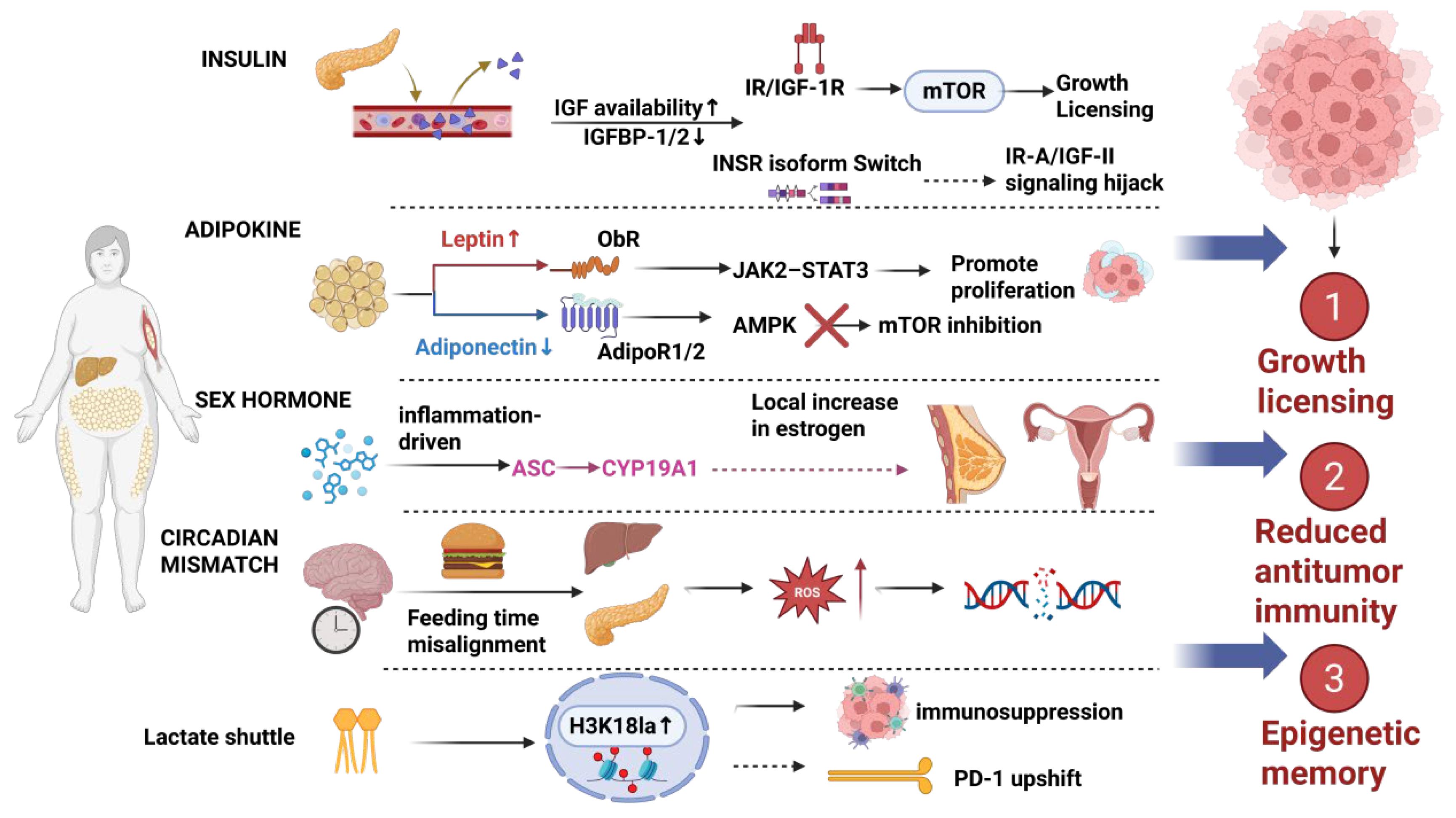
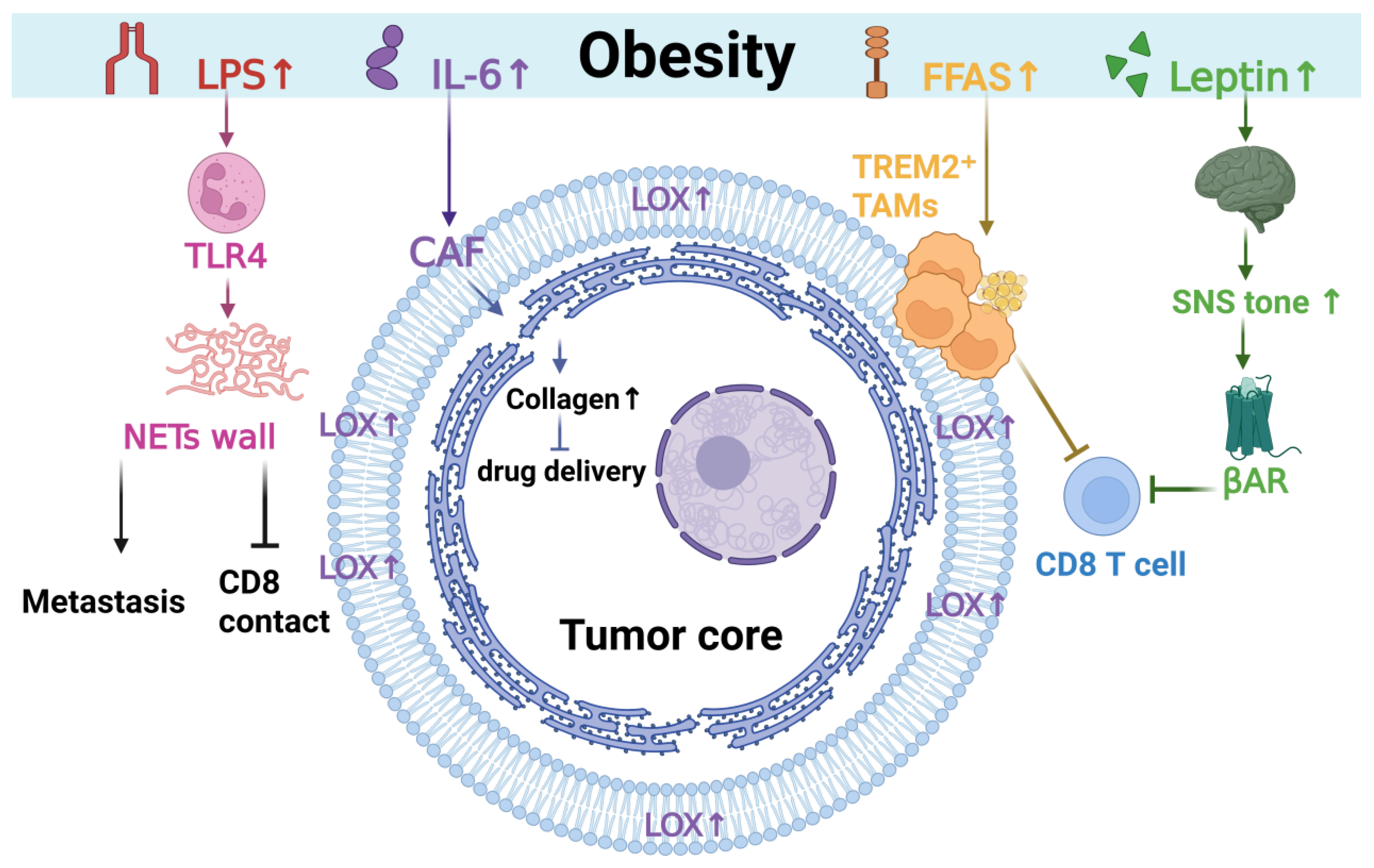
- The review proposes a multi-layered framework connecting systemic obesity-driven signals (e.g., insulin–IGF axis, leptin–PD-1 signaling, aromatase expression, histone lactylation) with local TME execution modules (perfusion, ECM, immune exhaustion).
- Conventional metrics like BMI are insufficient to capture cancer-relevant obesity exposures. Markers such as leptin/adiponectin ratio, histone lactylation, or checkpoint
- Integrating metabolic intervention (e.g., GLP-1-based agents) with immunotherapy may unlock new combination strategies by reversing pseudo-exhaustion and modifying checkpoint sensitivity.
Abstract
1. Introduction
Review Scope and Methodology
2. Systemic Metabolic Reprogramming of the Tumor Microenvironment
2.1. The Insulin–IGF-1 Axis: How Receptors Change and How Signals Are Misused
2.1.1. IGF Availability Issues
2.1.2. The Neglected Accomplice of Insulin Receptor Isoform A (IR-A)
2.2. The Storm of Adipokines: The Battle Between Leptin and Adiponectin
2.2.1. Leptin Balances Inflammation and Immune Responses
2.2.2. Key Players in Adiponectin Metabolism
2.3. Sex Hormone Metabolism: Aromatase and the “Estrogen Bath” of the Local Microenvironment
2.4. Circadian Rhythm Disruption: Systemic Mismatch of Molecular Clocks
2.4.1. The Disruption of Molecular Clocks
2.4.2. Systemic Mismatch
3. Physical Barriers and Immune Remodeling in the Tumor Microenvironment (TME)
3.1. Mechanobiology: Stiffening of the Matrix and Mechanical Memory
3.1.1. Fibrosis and Stiffening of the Extracellular Matrix (ECM)
3.1.2. Residual Risks of Mechanical Memory After Weight Loss
3.2. Immune Microenvironment: Paradigm Shift from M1/M2 to LAMs
3.2.1. TREM2+ Lipid-Associated Macrophages (LAMs)
3.2.2. Neutrophil Awakening: NETs Build Highways for Metastasis
3.3. Lactate Shuttling and Histone Lactylation: Epigenetic Executors of Metabolic Reprogramming
3.4. The Neuro–Immune–Tumor Axis: An Overlooked Regulatory Network
3.4.1. “Denervation” of Adipose Tissue and “Neurogenesis” in Tumors
3.4.2. Neural-Tumor Synapses and Metabolic Hijacking
4. Intercellular Communication Across Organs and Emerging Mechanisms of Carcinogenesis
4.1. Epigenetic Memory: Scars on Chromatin
4.2. Gut Microbiota: Metabolites as Carcinogenic Messengers
Colonization and Translocation of Pathogenic Bacteria
4.3. Distant “Cargo” Transport by Exosomes
4.4. Remodeling of Cell Death Forms: Ferroptosis and Autophagy
4.5. Life Cycle Scale: Early Developmental Imprinting and Adult Cancer Risk
5. Immunooncology and Mechanistic Insights into the “Obesity Paradox”
5.1. The Phenomenology of Paradox
5.2. Core Mechanisms: Metabolic Exhaustion vs. Antigenic Exhaustion
5.3. Structured Immunity: Tertiary Lymphoid Structures (TLS) in the Obesity–ICI Context
6. Clinical Practice of Metabolic Oncology: From Weight-Loss Drugs to Synergistic Immunotherapy
6.1. Chassis–Barrier–Window: A Biomarker-Guided Clinical Pathway
6.2. GLP-1 Receptor Agonists: From Metabolic Regulation to Immune Remodeling
6.3. New Strategies Targeting the Microenvironment
7. Conclusions and Outlook: Towards a New Era of “Metabolic-Immunotumorology”
Author Contributions
Funding
Institutional Review Board Statement
Informed Consent Statement
Data Availability Statement
Conflicts of Interest
References
- Kawai, T.; Autieri, M.V.; Scalia, R. Adipose tissue inflammation and metabolic dysfunction in obesity. Am. J. Physiol. Physiol. 2020, 320, C375–C391. [Google Scholar] [CrossRef] [Scilit]
- Frosti, C.L.; Connelly, S.P.; Layne, M.D. Mechanobiology of Adipose Tissue Remodeling. Tissue Eng. Part A 2025. ahead of print. [Google Scholar] [CrossRef] [Scilit]
- Lauby-Secretan, B.; Scoccianti, C.; Loomis, D.; Grosse, Y.; Bianchini, F.; Straif, K. Body Fatness and Cancer—Viewpoint of the IARC Working Group. N. Engl. J. Med. 2016, 375, 794–798. [Google Scholar] [CrossRef] [Scilit]
- Bhaskaran, K.; Douglas, I.; Forbes, H.; dos-Santos-Silva, I.; Leon, D.A.; Smeeth, L. Body-mass index and risk of 22 specific cancers: A population-based cohort study of 5.24 million UK adults. Lancet 2014, 384, 755–765. [Google Scholar] [CrossRef] [Scilit]
- Lin, C.; Chang, Y.; Cheng, T.; Lo, K.; Liu, S.; Yeh, T.L. The association between metabolically healthy obesity and risk of cancer: A systematic review and meta-analysis of prospective cohort studies. Obes. Rev. 2020, 21, e13049. [Google Scholar] [CrossRef] [Scilit]
- Mesquita, L.d.A.; Wayerbacher, L.F.; Schwartsmann, G.; Gerchman, F. Obesity, diabetes, and cancer: Epidemiology, pathophysiology, and potential interventions. Arq. Bras. Endocrinol. Metabol. 2023, 67, e000647. [Google Scholar] [CrossRef] [Scilit] [PubMed]
- Doerstling, S.S.; O’fLanagan, C.H.; Hursting, S.D. Obesity and Cancer Metabolism: A Perspective on Interacting Tumor–Intrinsic and Extrinsic Factors. Front. Oncol. 2017, 7, 216. [Google Scholar] [CrossRef] [Scilit] [PubMed]
- Haus, E.L.; Smolensky, M.H. Shift work and cancer risk: Potential mechanistic roles of circadian disruption, light at night, and sleep deprivation. Sleep Med. Rev. 2013, 17, 273–284. [Google Scholar] [CrossRef] [Scilit]
- Chaput, J.-P.; McHill, A.W.; Cox, R.C.; Broussard, J.L.; Dutil, C.; da Costa, B.G.G.; Sampasa-Kanyinga, H.; Wright, K.P. The role of insufficient sleep and circadian misalignment in obesity. Nat. Rev. Endocrinol. 2022, 19, 82–97. [Google Scholar] [CrossRef] [Scilit] [PubMed]
- Glaviano, A.; Foo, A.S.C.; Lam, H.Y.; Yap, K.C.H.; Jacot, W.; Jones, R.H.; Eng, H.; Nair, M.G.; Makvandi, P.; Geoerger, B.; et al. PI3K/AKT/mTOR signaling transduction pathway and targeted therapies in cancer. Mol. Cancer 2023, 22, 138. [Google Scholar] [CrossRef] [Scilit]
- Mendoza, M.C.; Er, E.E.; Blenis, J. The Ras-ERK and PI3K-mTOR pathways: Cross-talk and compensation. Trends Biochem. Sci. 2011, 36, 320–328. [Google Scholar] [CrossRef] [Scilit] [PubMed]
- Bowers, L.W.; Rossi, E.L.; O’Flanagan, C.H.; Degraffenried, L.A.; Hursting, S.D. The Role of the Insulin/IGF System in Cancer: Lessons Learned from Clinical Trials and the Energy Balance-Cancer Link. Front. Endocrinol. 2015, 6, 77. [Google Scholar] [CrossRef] [Scilit]
- Lewitt, M.S.; Dent, M.S.; Hall, K. The Insulin-Like Growth Factor System in Obesity, Insulin Resistance and Type 2 Diabetes Mellitus. J. Clin. Med. 2014, 3, 1561–1574. [Google Scholar] [CrossRef] [Scilit]
- Huang, G.; Song, C.; Wang, N.; Qin, T.; Sui, S.; Obr, A.; Zeng, L.; Wood, T.L.; Leroith, D.; Li, M.; et al. RNA-binding protein CUGBP1 controls the differential INSR splicing in molecular subtypes of breast cancer cells and affects cell aggressiveness. Carcinogenesis 2019, 41, 1294–1305. [Google Scholar] [CrossRef] [Scilit]
- Frasca, F.; Pandini, G.; Scalia, P.; Sciacca, L.; Mineo, R.; Costantino, A.; Goldfine, I.D.; Belfiore, A.; Vigneri, R. Insulin Receptor Isoform A, a Newly Recognized, High-Affinity Insulin-Like Growth Factor II Receptor in Fetal and Cancer Cells. Mol. Cell. Biol. 1999, 19, 3278–3288. [Google Scholar] [CrossRef] [Scilit] [PubMed]
- Ulanet, D.B.; Ludwig, D.L.; Kahn, C.R.; Hanahan, D. Insulin receptor functionally enhances multistage tumor progression and conveys intrinsic resistance to IGF-1R targeted therapy. Proc. Natl. Acad. Sci. USA 2010, 107, 10791–10798. [Google Scholar] [CrossRef] [Scilit]
- Zhang, A.M.; Wellberg, E.A.; Kopp, J.L.; Johnson, J.D. Hyperinsulinemia in Obesity, Inflammation, and Cancer. Diabetes Metab. J. 2021, 45, 285–311. [Google Scholar] [CrossRef] [Scilit] [PubMed]
- Wozniak, S.E.; Gee, L.L.; Wachtel, M.S.; Frezza, E.E. Adipose Tissue: The New Endocrine Organ? A Review Article. Dig. Dis. Sci. 2008, 54, 1847–1856. [Google Scholar] [CrossRef] [Scilit]
- Bocian-Jastrzębska, A.; Malczewska-Herman, A.; Kos-Kudła, B. Role of Leptin and Adiponectin in Carcinogenesis. Cancers 2023, 15, 4250. [Google Scholar] [CrossRef] [Scilit]
- Chang, C.-C.; Wu, M.-J.; Yang, J.-Y.; Camarillo, I.G.; Chang, C.-J. Leptin–STAT3–G9a Signaling Promotes Obesity-Mediated Breast Cancer Progression. Cancer Res. 2015, 75, 2375–2386. [Google Scholar] [CrossRef] [Scilit]
- Liu, J.; Yang, X.; Yu, S.; Zheng, R. The Leptin Resistance. Adv. Exp. Med. Biol. 2018, 1090, 145–163. [Google Scholar] [PubMed]
- Tan, B.; Hedbacker, K.; Kelly, L.; Zhang, Z.; Moura-Assis, A.; Luo, J.-D.; Rabinowitz, J.D.; Friedman, J.M. A cellular and molecular basis of leptin resistance. Cell Metab. 2025, 37, 723–741.e6. [Google Scholar] [CrossRef] [Scilit]
- de Candia, P.; Prattichizzo, F.; Garavelli, S.; Alviggi, C.; La Cava, A.; Matarese, G. The pleiotropic roles of leptin in metabolism, immunity, and cancer. J. Exp. Med. 2021, 218, e20191593. [Google Scholar] [CrossRef] [Scilit]
- Souza-Almeida, G.; Palhinha, L.; Liechocki, S.; Pereira, J.A.d.S.; Reis, P.A.; Dib, P.R.B.; Hottz, E.D.; Gameiro, J.; Vallochi, A.L.; de Almeida, C.J.; et al. Peripheral leptin signaling persists in innate immune cells during diet-induced obesity. J. Leukoc. Biol. 2020, 109, 1131–1138. [Google Scholar] [CrossRef] [Scilit]
- Naaman, S.C.; Shen, S.; Zeytinoglu, M.; Iyengar, N.M. Obesity and Breast Cancer Risk: The Oncogenic Implications of Metabolic Dysregulation. J. Clin. Endocrinol. Metab. 2022, 107, 2154–2166. [Google Scholar] [CrossRef] [Scilit]
- Shen, L.; Zhang, C.; Cui, K.; Liang, X.; Zhu, G.; Hong, L. Leptin secreted by adipocytes promotes EMT transition and endometrial cancer progression via the JAK2/STAT3 signalling pathway. Adipocyte 2023, 13, 2293273. [Google Scholar] [CrossRef] [Scilit]
- Lagarde, C.B.; Thapa, K.; Cullen, N.M.; Hawes, M.L.; Salim, K.; Benz, M.C.; Dietrich, S.R.; Burow, B.E.; Bunnell, B.A.; Martin, E.C.; et al. Obesity and leptin in breast cancer angiogenesis. Front. Endocrinol. 2024, 15, 1465727. [Google Scholar] [CrossRef] [Scilit]
- Deng, J.; Chen, Q.; Chen, Z.; Liang, K.; Gao, X.; Wang, X.; Makota, F.V.; Ong, H.S.; Wan, Y.; Luo, K.; et al. The metabolic hormone leptin promotes the function of T(FH) cells and supports vaccine responses. Nat. Commun. 2021, 12, 3073. [Google Scholar] [CrossRef] [Scilit]
- Miracle, C.E.; McCallister, C.L.; Egleton, R.D.; Salisbury, T.B. Mechanisms by which obesity regulates inflammation and anti-tumor immunity in cancer. Biochem. Biophys. Res. Commun. 2024, 733, 150437. [Google Scholar] [CrossRef] [Scilit] [PubMed]
- Wang, Z.; Aguilar, E.G.; Luna, J.I.; Dunai, C.; Khuat, L.T.; Le, C.T.; Mirsoian, A.; Minnar, C.M.; Stoffel, K.M.; Sturgill, I.R.; et al. Paradoxical effects of obesity on T cell function during tumor progression and PD-1 checkpoint blockade. Nat. Med. 2018, 25, 141–151. [Google Scholar] [CrossRef] [Scilit] [PubMed]
- Bader, J.E.; Wolf, M.M.; Lupica-Tondo, G.L.; Madden, M.Z.; Reinfeld, B.I.; Arner, E.N.; Hathaway, E.S.; Steiner, K.K.; Needle, G.A.; Hatem, Z.; et al. Obesity induces PD-1 on macrophages to suppress anti-tumour immunity. Nature 2024, 630, 968–975. [Google Scholar] [CrossRef] [Scilit]
- Cote, A.L.; Munger, C.J.; Ringel, A.E. Emerging insights into the impact of systemic metabolic changes on tumor-immune interactions. Cell Rep. 2025, 44, 115234. [Google Scholar] [CrossRef] [Scilit]
- Kadowaki, T.; Yamauchi, T. Adiponectin and adiponectin receptors. Endocr. Rev. 2005, 26, 439–451. [Google Scholar] [CrossRef] [Scilit]
- Han, Y.; Sun, Q.; Chen, W.; Gao, Y.; Ye, J.; Chen, Y.; Wang, T.; Gao, L.; Liu, Y.; Yang, Y. New advances of adiponectin in regulating obesity and related metabolic syndromes. J. Pharm. Anal. 2023, 14, 100913. [Google Scholar] [CrossRef] [Scilit] [PubMed]
- Manley, S.J.; Olou, A.A.; Jack, J.L.; Ruckert, M.T.; Walsh, R.M.; Eades, A.E.; Bye, B.A.; Ambrose, J.; Messaggio, F.; Anant, S.; et al. Synthetic adiponectin-receptor agonist, AdipoRon, induces glycolytic dependence in pancreatic cancer cells. Cell Death Dis. 2022, 13, 114. [Google Scholar] [CrossRef] [Scilit] [PubMed]
- Li, C.; Zhang, J.; Dionigi, G.; Liang, N.; Guan, H.; Sun, H. Uncovering the connection between obesity and thyroid cancer: The therapeutic potential of adiponectin receptor agonist in the AdipoR2-ULK axis. Cell Death Dis. 2024, 15, 708. [Google Scholar] [CrossRef] [Scilit] [PubMed]
- Pu, X.; Chen, D. Targeting Adipokines in Obesity-Related Tumors. Front. Oncol. 2021, 11, 685923. [Google Scholar] [CrossRef] [Scilit]
- Li, C.; Zhang, J.; Dionigi, G.; Liang, N.; Guan, H.; Sun, H. Adiponectin Inhibits the Progression of Obesity-Associated Papillary Thyroid Carcinoma Through Autophagy. Endocrinology 2024, 165, bqae030. [Google Scholar] [CrossRef] [Scilit]
- Simpson, E.R. Sources of estrogen and their importance. J. Steroid Biochem. Mol. Biol. 2003, 86, 225–230. [Google Scholar] [CrossRef] [Scilit]
- Richards, J.A.; Brueggemeier, R.W. Prostaglandin E2 Regulates Aromatase Activity and Expression in Human Adipose Stromal Cells via Two Distinct Receptor Subtypes. J. Clin. Endocrinol. Metab. 2003, 88, 2810–2816. [Google Scholar] [CrossRef] [Scilit]
- Bulun, S.E.; Chen, D.; Moy, I.; Brooks, D.C.; Zhao, H. Aromatase, breast cancer and obesity: A complex interaction. Trends Endocrinol. Metab. 2012, 23, 83–89. [Google Scholar] [CrossRef] [Scilit]
- Martínez-Chacón, G.; Brown, K.A.; Docanto, M.M.; Kumar, H.; Salminen, S.; Saarinen, N.; Mäkelä, S. IL-10 suppresses TNF-α-induced expression of human aromatase gene in mammary adipose tissue. FASEB J. 2018, 32, 3361–3370. [Google Scholar] [CrossRef] [Scilit]
- Morris, P.G.; Hudis, C.A.; Giri, D.; Morrow, M.; Falcone, D.J.; Zhou, X.K.; Du, B.; Brogi, E.; Crawford, C.B.; Kopelovich, L.; et al. Inflammation and Increased Aromatase Expression Occur in the Breast Tissue of Obese Women with Breast Cancer. Cancer Prev. Res. 2011, 4, 1021–1029. [Google Scholar] [CrossRef] [Scilit] [PubMed]
- Sestak, I.; Distler, W.; Forbes, J.F.; Dowsett, M.; Howell, A.; Cuzick, J. Effect of Body Mass Index on Recurrences in Tamoxifen and Anastrozole Treated Women: An Exploratory Analysis From the ATAC Trial. J. Clin. Oncol. 2010, 28, 3411–3415. [Google Scholar] [CrossRef] [Scilit] [PubMed]
- Ewertz, M.; Gray, K.P.; Regan, M.M.; Ejlertsen, B.; Price, K.N.; Thürlimann, B.; Bonnefoi, H.; Forbes, J.F.; Paridaens, R.J.; Rabaglio, M.; et al. Obesity and Risk of Recurrence or Death After Adjuvant Endocrine Therapy With Letrozole or Tamoxifen in the Breast International Group 1-98 Trial. J. Clin. Oncol. 2012, 30, 3967–3975. [Google Scholar] [CrossRef] [Scilit]
- Pfeiler, G.; Königsberg, R.; Fesl, C.; Mlineritsch, B.; Stoeger, H.; Singer, C.F.; Pöstlberger, S.; Steger, G.G.; Seifert, M.; Dubsky, P.; et al. Impact of Body Mass Index on the Efficacy of Endocrine Therapy in Premenopausal Patients With Breast Cancer: An Analysis of the Prospective ABCSG-12 Trial. J. Clin. Oncol. 2011, 29, 2653–2659. [Google Scholar] [CrossRef] [Scilit] [PubMed]
- Hershman, D.L.; Kushi, L.H.; Shao, T.; Buono, D.; Kershenbaum, A.; Tsai, W.-Y.; Fehrenbacher, L.; Gomez, S.L.; Miles, S.; Neugut, A.I. Early Discontinuation and Nonadherence to Adjuvant Hormonal Therapy in a Cohort of 8,769 Early-Stage Breast Cancer Patients. J. Clin. Oncol. 2010, 28, 4120–4128. [Google Scholar] [CrossRef] [Scilit]
- Oh, H.; Wild, R.A.; Manson, J.E.; Bea, J.W.; Shadyab, A.H.; Pfeiffer, R.M.; Saquib, N.; Underland, L.; Anderson, G.L.; Xu, X.; et al. Obesity, Height, and Serum Androgen Metabolism among Postmenopausal Women in the Women’s Health Initiative Observational Study. Cancer Epidemiol. Biomark. Prev. 2021, 30, 2018–2029. [Google Scholar] [CrossRef] [Scilit]
- Babayev, S.N.; Park, C.W.; Keller, P.W.; Carr, B.R.; Word, R.A.; Bukulmez, O. Androgens Upregulate Endometrial Epithelial Progesterone Receptor Expression: Potential Implications for Endometriosis. Reprod. Sci. 2017, 24, 1454–1461. [Google Scholar] [CrossRef] [Scilit]
- Kohsaka, A.; Laposky, A.D.; Ramsey, K.M.; Estrada, C.; Joshu, C.; Kobayashi, Y.; Turek, F.W.; Bass, J. High-Fat Diet Disrupts Behavioral and Molecular Circadian Rhythms in Mice. Cell Metab. 2007, 6, 414–421. [Google Scholar] [CrossRef] [Scilit]
- Branecky, K.L.; Niswender, K.D.; Pendergast, J.S. Disruption of Daily Rhythms by High-Fat Diet Is Reversible. PLoS ONE 2015, 10, e0137970. [Google Scholar] [CrossRef] [Scilit]
- Shafi, A.A.; Knudsen, K.E. Cancer and the Circadian Clock. Cancer Res. 2019, 79, 3806–3814. [Google Scholar] [CrossRef] [Scilit]
- Huang, C.; Zhang, C.; Cao, Y.; Li, J.; Bi, F. Major roles of the circadian clock in cancer. Cancer Biol. Med. 2023, 20, 1–24. [Google Scholar] [CrossRef] [Scilit]
- Erren, T.C.; Morfeld, P.; Groß, J.V.; Wild, U.; Lewis, P. IARC 2019: “Night shift work” is probably carcinogenic: What about disturbed chronobiology in all walks of life? J. Occup. Med. Toxicol. 2019, 14, 29. [Google Scholar] [CrossRef] [Scilit] [PubMed]
- Manouchehri, E.; Taghipour, A.; Ghavami, V.; Ebadi, A.; Homaei, F.; Roudsari, R.L. Night-shift work duration and breast cancer risk: An updated systematic review and meta-analysis. BMC Women’s Health 2021, 21, 89. [Google Scholar] [CrossRef] [Scilit]
- Moon, J.; Ikeda-Araki, A.; Mun, Y. Night shift work and female breast cancer: A two-stage dose-response meta-analysis for the correct risk definition. BMC Public Heal. 2024, 24, 2065. [Google Scholar] [CrossRef] [Scilit] [PubMed]
- Xin, H.; Zhang, J.; Huang, R.; Li, L.; Lam, S.M.; Shui, G.; Deng, F.; Zhang, Z.; Li, M.-D. Circadian signatures of adipose tissue in diet-induced obesity. Front. Physiol. 2022, 13, 953237. [Google Scholar] [CrossRef] [Scilit]
- Godos, J.; Currenti, W.; Ferri, R.; Lanza, G.; Caraci, F.; Frias-Toral, E.; Guglielmetti, M.; Ferraris, C.; Lipari, V.; Altamiranda, S.C.; et al. Chronotype and Cancer: Emerging Relation Between Chrononutrition and Oncology from Human Studies. Nutrients 2025, 17, 529. [Google Scholar] [CrossRef] [Scilit] [PubMed]
- Walker, W.H., 2nd; Kaper, A.L.; Meléndez-Fernández, O.H.; Bumgarner, J.R.; Liu, J.A.; Walton, J.C.; DeVries, A.C.; Nelson, R.J. Time-restricted feeding alters the efficiency of mammary tumor growth. Chronobiol. Int. 2022, 39, 535–546. [Google Scholar] [CrossRef] [Scilit]
- Das, M.; Webster, N.J.G. Obesity, cancer risk, and time-restricted eating. Cancer Metastasis Rev. 2022, 41, 697–717. [Google Scholar] [CrossRef] [Scilit]
- Karaboué, A.; Innominato, P.F.; Wreglesworth, N.I.; Duchemann, B.; Adam, R.; Lévi, F.A. Why does circadian timing of administration matter for immune checkpoint inhibitors’ efficacy? Br. J. Cancer 2024, 131, 783–796. [Google Scholar] [CrossRef] [Scilit]
- Landré, T.; Karaboué, A.; Buchwald, Z.; Innominato, P.; Qian, D.; Assié, J.; Chouaïd, C.; Lévi, F.; Duchemann, B. Effect of immunotherapy-infusion time of day on survival of patients with advanced cancers: A study-level meta-analysis. ESMO Open 2024, 9, 102220. [Google Scholar] [CrossRef] [Scilit]
- Huang, Z.; Karaboué, A.; Zeng, L.; Lecoeuvre, A.; Zhang, L.; Li, X.-M.; Qin, H.; Danino, G.; Yang, F.; Malin, M.-S.; et al. Overall survival according to time-of-day of combined immuno-chemotherapy for advanced non-small cell lung cancer: A bicentric bicontinental study. EBioMedicine 2025, 113, 105607. [Google Scholar] [CrossRef] [Scilit]
- Ahmed, R.L.; Thomas, W.; Schmitz, K.H. Interactions between Insulin, Body Fat, and Insulin-Like Growth Factor Axis Proteins. Cancer Epidemiology Biomarkers Prev. 2007, 16, 593–597. [Google Scholar] [CrossRef] [Scilit] [PubMed]
- Renehan, A.G.; Zwahlen, M.; Minder, C.; O’Dwyer, S.T.; Shalet, S.M.; Egger, M. Insulin-like growth factor (IGF)-I, IGF binding protein-3, and cancer risk: Systematic review and meta-regression analysis. Lancet 2004, 363, 1346–1353. [Google Scholar] [CrossRef] [Scilit] [PubMed]
- Zhang, K.; Bai, P.; Dai, H.; Deng, Z. Metformin and risk of cancer among patients with type 2 diabetes mellitus: A systematic review and meta-analysis. Prim. Care Diabetes 2021, 15, 52–58. [Google Scholar] [CrossRef] [Scilit]
- Ricart, W.; Fernández-Real, J.-M. No Decrease in Free IGF-I with Increasing Insulin in Obesity-Related Insulin Resistance. Obes. Res. 2001, 9, 631–636. [Google Scholar] [CrossRef] [Scilit] [PubMed]
- Frühbeck, G.; Catalán, V.; Rodríguez, A.; Gómez-Ambrosi, J. Adiponectin-leptin ratio: A promising index to estimate adipose tissue dysfunction. Relation with obesity-associated cardiometabolic risk. Adipocyte 2018, 7, 57–62. [Google Scholar] [CrossRef] [Scilit]
- Seghieri, M.; Christensen, A.S.; Andersen, A.; Solini, A.; Knop, F.K.; Vilsbøll, T. Future Perspectives on GLP-1 Receptor Agonists and GLP-1/glucagon Receptor Co-agonists in the Treatment of NAFLD. Front. Endocrinol. 2018, 9, 649. [Google Scholar] [CrossRef] [Scilit]
- Ji, L.; Gao, L.; Jiang, H.; Yang, J.; Yu, L.; Wen, J.; Cai, C.; Deng, H.; Feng, L.; Song, B.; et al. Safety and efficacy of a GLP-1 and glucagon receptor dual agonist mazdutide (IBI362) 9 mg and 10 mg in Chinese adults with overweight or obesity: A randomised, placebo-controlled, multiple-ascending-dose phase 1b trial. eClinicalMedicine 2022, 54, 101691. [Google Scholar] [CrossRef] [Scilit]
- Deng, B.; Ruan, T.; Lu, W.; Ying, J.; Li, S.; Zhou, R.; Mu, D. Safety and efficacy of GLP-1 and glucagon receptor dual agonist for the treatment of type 2 diabetes and obesity: A systematic review and meta-analysis of randomized controlled trials. Endocrine 2024, 86, 15–27. [Google Scholar] [CrossRef] [Scilit] [PubMed]
- Zhao, Y.; Nichols, J.E.; Bulun, S.E.; Mendelson, C.R.; Simpson, E.R. Aromatase P450 Gene Expression in Human Adipose Tissue. Role of a Jak/Stat Pathway in Regulation of the Adipose-Specific Promoter. J. Biol. Chem. 1995, 270, 16449–16457. [Google Scholar] [CrossRef] [Scilit]
- Zhang, D.; Tang, Z.; Huang, H.; Zhou, G.; Cui, C.; Weng, Y.; Liu, W.; Kim, S.; Lee, S.; Perez-Neut, M.; et al. Metabolic regulation of gene expression by histone lactylation. Nature 2019, 574, 575–580. [Google Scholar] [CrossRef] [Scilit]
- Ma, Z.; Yang, J.; Jia, W.; Li, L.; Li, Y.; Hu, J.; Luo, W.; Li, R.; Ye, D.; Lan, P. Histone lactylation-driven B7-H3 expression promotes tumor immune evasion. Theranostics 2025, 15, 2338–2359. [Google Scholar] [CrossRef] [Scilit]
- Deng, J.; Li, Y.; Yin, L.; Liu, S.; Li, Y.; Liao, W.; Mu, L.; Luo, X.; Qin, J. Histone lactylation enhances GCLC expression and thus promotes chemoresistance of colorectal cancer stem cells through inhibiting ferroptosis. Cell Death Dis. 2025, 16, 193. [Google Scholar] [CrossRef] [Scilit] [PubMed]
- Wu, X.; Zhang, X.; Tang, S.; Wang, Y. The important role of the histone acetyltransferases p300/CBP in cancer and the promising anticancer effects of p300/CBP inhibitors. Cell Biol. Toxicol. 2025, 41, 32. [Google Scholar] [CrossRef] [Scilit] [PubMed]
- Liu, X.; Zhao, L.; Chen, Y.; Gao, Y.; Tian, Q.; Son, J.S.; Chae, S.A.; de Avila, J.M.; Zhu, M.-J.; Du, M. Obesity induces adipose fibrosis and collagen cross-linking through suppressing AMPK and enhancing lysyl oxidase expression. Biochim. et Biophys. Acta (BBA)-Mol. Basis Dis. 2022, 1868, 166454. [Google Scholar] [CrossRef] [Scilit]
- Di Caprio, N.; Bellas, E. Collagen Stiffness and Architecture Regulate Fibrotic Gene Expression in Engineered Adipose Tissue. Adv. Biol. 2020, 4, E1900286. [Google Scholar] [CrossRef] [Scilit]
- DeBari, M.K.; Abbott, R.D. Adipose Tissue Fibrosis: Mechanisms, Models, and Importance. Int. J. Mol. Sci. 2020, 21, 6030. [Google Scholar] [CrossRef] [Scilit]
- Quail, D.F.; Dannenberg, A.J. The obese adipose tissue microenvironment in cancer development and progression. Nat. Rev. Endocrinol. 2018, 15, 139–154. [Google Scholar] [CrossRef] [Scilit]
- Wenderott, J.K.; Flesher, C.G.; Baker, N.A.; Neeley, C.K.; Varban, O.A.; Lumeng, C.N.; Muhammad, L.N.; Yeh, C.; Green, P.F.; O’rOurke, R.W. Elucidating nanoscale mechanical properties of diabetic human adipose tissue using atomic force microscopy. Sci. Rep. 2020, 10, 20423. [Google Scholar] [CrossRef] [Scilit]
- Abuhattum, S.; Kotzbeck, P.; Schlüßler, R.; Harger, A.; de Schellenberger, A.A.; Kim, K.; Escolano, J.-C.; Müller, T.; Braun, J.; Wabitsch, M.; et al. Adipose cells and tissues soften with lipid accumulation while in diabetes adipose tissue stiffens. Sci. Rep. 2022, 12, 10325. [Google Scholar] [CrossRef] [Scilit]
- Cai, X.; Wang, K.-C.; Meng, Z. Mechanoregulation of YAP and TAZ in Cellular Homeostasis and Disease Progression. Front. Cell Dev. Biol. 2021, 9, 673599. [Google Scholar] [CrossRef] [Scilit]
- Panciera, T.; Azzolin, L.; Cordenonsi, M.; Piccolo, S. Mechanobiology of YAP and TAZ in physiology and disease. Nat. Rev. Mol. Cell Biol. 2017, 18, 758–770. [Google Scholar] [CrossRef] [Scilit] [PubMed]
- Tharp, K.M.; Kersten, K.; Maller, O.; Timblin, G.A.; Stashko, C.; Canale, F.P.; Menjivar, R.E.; Hayward, M.-K.; Berestjuk, I.; Hoeve, J.T.; et al. Tumor-associated macrophages restrict CD8+ T cell function through collagen deposition and metabolic reprogramming of the breast cancer microenvironment. Nat. Cancer 2024, 5, 1045–1062. [Google Scholar] [CrossRef] [Scilit]
- Mai, Z.; Lin, Y.; Lin, P.; Zhao, X.; Cui, L. Modulating extracellular matrix stiffness: A strategic approach to boost cancer immunotherapy. Cell Death Dis. 2024, 15, 307. [Google Scholar] [CrossRef] [Scilit] [PubMed]
- Feng, X.; Cao, F.; Wu, X.; Xie, W.; Wang, P.; Jiang, H. Targeting extracellular matrix stiffness for cancer therapy. Front. Immunol. 2024, 15, 1467602. [Google Scholar] [CrossRef] [Scilit] [PubMed]
- Wang, Y.; Zhang, F.; Qian, Z.; Jiang, Y.; Wu, D.; Liu, L.; Ning, X.; Mei, J.; Chen, D.; Zhang, Y. Targeting collagen to optimize cancer immunotherapy. Exp. Hematol. Oncol. 2025, 14, 101. [Google Scholar] [CrossRef] [Scilit]
- Cetin, M.; Saatci, O.; Rezaeian, A.-H.; Rao, C.N.; Beneker, C.; Sreenivas, K.; Taylor, H.; Pederson, B.; Chatzistamou, I.; Buckley, B.; et al. A highly potent bi-thiazole inhibitor of LOX rewires collagen architecture and enhances chemoresponse in triple-negative breast cancer. Cell Chem. Biol. 2024, 31, 1926–1941.e11. [Google Scholar] [CrossRef] [Scilit]
- Yang, C.; Tibbitt, M.W.; Basta, L.; Anseth, K.S. Mechanical memory and dosing influence stem cell fate. Nat. Mater. 2014, 13, 645–652. [Google Scholar] [CrossRef] [Scilit]
- Hinte, L.C.; Castellano-Castillo, D.; Ghosh, A.; Melrose, K.; Gasser, E.; Noé, F.; Massier, L.; Dong, H.; Sun, W.; Hoffmann, A.; et al. Adipose tissue retains an epigenetic memory of obesity after weight loss. Nature 2024, 636, 457–465. [Google Scholar] [CrossRef] [Scilit]
- Lee, J.W.N.; Holle, A.W. Engineering approaches for understanding mechanical memory in cancer metastasis. APL Bioeng. 2024, 8, 021503. [Google Scholar] [CrossRef] [Scilit] [PubMed]
- Wang, T.-C.; Abolghasemzade, S.; McKee, B.P.; Singh, I.; Pendyala, K.; Mohajeri, M.; Patel, H.; Shaji, A.; Kersey, A.L.; Harsh, K.; et al. Matrix stiffness drives drop like nuclear deformation and lamin A/C tension-dependent YAP nuclear localization. Nat. Commun. 2024, 15, 10151. [Google Scholar] [CrossRef] [Scilit] [PubMed]
- Swift, J.; Ivanovska, I.L.; Buxboim, A.; Harada, T.; Dingal, P.C.D.P.; Pinter, J.; Pajerowski, J.D.; Spinler, K.R.; Shin, J.-W.; Tewari, M.; et al. Nuclear Lamin-A Scales with Tissue Stiffness and Enhances Matrix-Directed Differentiation. Science 2013, 341, 1240104. [Google Scholar] [CrossRef] [Scilit]
- Dhankhar, M.; Guo, Z.; Kant, A.; Basir, R.; Joshi, R.; Vinayak, V.; Heo, S.C.; Mauck, R.L.; Lakadamyali, M.; Shenoy, V.B. Revealing the biophysics of lamina-associated domain formation by integrating theoretical modeling and high-resolution imaging. Nat. Commun. 2025, 16, 7909. [Google Scholar] [CrossRef] [Scilit]
- Qu, Y.; Cui, J.; Wu, Z.; He, P.; Wei, F.; Guo, T.; Huang, Y.; Yu, X.; Tsoy, M.; Liu, K.; et al. Mechano-regulation of cancer cell memory in tumor progression and therapy. Mechanobiol. Med. 2025, 4, 100165. [Google Scholar] [CrossRef] [Scilit]
- Strizova, Z.; Benesova, I.; Bartolini, R.; Novysedlak, R.; Cecrdlova, E.; Foley, L.K.; Striz, I. M1/M2 macrophages and their overlaps-myth or reality? Clin. Sci. 2023, 137, 1067–1093. [Google Scholar] [CrossRef] [Scilit]
- Kang, H.; Lee, J. Adipose tissue macrophage heterogeneity in the single-cell genomics era. Mol. Cells 2024, 47, 100031. [Google Scholar] [CrossRef] [Scilit]
- Ma, R.-Y.; Black, A.; Qian, B.-Z. Macrophage diversity in cancer revisited in the era of single-cell omics. Trends Immunol. 2022, 43, 546–563. [Google Scholar] [CrossRef] [Scilit]
- Massier, L.; Jalkanen, J.; Elmastas, M.; Zhong, J.; Wang, T.; Nankam, P.A.N.; Frendo-Cumbo, S.; Bäckdahl, J.; Subramanian, N.; Sekine, T.; et al. An integrated single cell and spatial transcriptomic map of human white adipose tissue. Nat. Commun. 2023, 14, 1438. [Google Scholar] [CrossRef] [Scilit] [PubMed]
- Loft, A.; Emont, M.P.; Weinstock, A.; Divoux, A.; Ghosh, A.; Wagner, A.; Hertzel, A.V.; Maniyadath, B.; Deplancke, B.; Liu, B.; et al. Towards a consensus atlas of human and mouse adipose tissue at single-cell resolution. Nat. Metab. 2025, 7, 875–894. [Google Scholar] [CrossRef] [Scilit] [PubMed]
- Qi, J.; Sun, H.; Zhang, Y.; Wang, Z.; Xun, Z.; Li, Z.; Ding, X.; Bao, R.; Hong, L.; Jia, W.; et al. Single-cell and spatial analysis reveal interaction of FAP+ fibroblasts and SPP1+ macrophages in colorectal cancer. Nat. Commun. 2022, 13, 1742. [Google Scholar] [CrossRef] [Scilit]
- Xu, R.; Vujić, N.; Bianco, V.; Reinisch, I.; Kratky, D.; Krstic, J.; Prokesch, A. Lipid-associated macrophages between aggravation and alleviation of metabolic diseases. Trends Endocrinol. Metab. 2024, 35, 981–995. [Google Scholar] [CrossRef] [Scilit]
- Long, F.; Zhong, W.; Zhao, F.; Xu, Y.; Hu, X.; Jia, G.; Huang, L.; Yi, K.; Wang, N.; Si, H.; et al. DAB2+ macrophages support FAP+ fibroblasts in shaping tumor barrier and inducing poor clinical outcomes in liver cancer. Theranostics 2024, 14, 4822–4843. [Google Scholar] [CrossRef] [Scilit]
- Peng, D.H.; Rodriguez, B.L.; Diao, L.; Chen, L.; Wang, J.; Byers, L.A.; Wei, Y.; Chapman, H.A.; Yamauchi, M.; Behrens, C.; et al. Collagen promotes anti-PD-1/PD-L1 resistance in cancer through LAIR1-dependent CD8+ T cell exhaustion. Nat. Commun. 2020, 11, 4520. [Google Scholar] [CrossRef] [Scilit] [PubMed]
- Kuczek, D.E.; Larsen, A.M.H.; Thorseth, M.-L.; Carretta, M.; Kalvisa, A.; Siersbæk, M.S.; Simões, A.M.C.; Roslind, A.; Engelholm, L.H.; Noessner, E.; et al. Collagen density regulates the activity of tumor-infiltrating T cells. J. Immunother. Cancer 2019, 7, 68. [Google Scholar] [CrossRef] [Scilit]
- Jaitin, D.A.; Adlung, L.; Thaiss, C.A.; Weiner, A.; Li, B.; Descamps, H.; Lundgren, P.; Bleriot, C.; Liu, Z.; Deczkowska, A.; et al. Lipid-Associated Macrophages Control Metabolic Homeostasis in a Trem2-Dependent Manner. Cell 2019, 178, 686–698.e14. [Google Scholar] [CrossRef] [Scilit]
- Reyes-Farias, M.; Fernández-García, P.; Corrales, P.; González, L.; Navarro-Sanagustín, D.; Soria-Gondek, A.; Pellitero, S.; Tarascó, J.; Moreno, P.; Balibrea, J.M.; et al. Lipid-associated macrophages are more abundant in subcutaneous than visceral adipose tissue in patients with obesity. Obesity 2025, 33, 1543–1554. [Google Scholar] [CrossRef] [Scilit]
- Molgora, M.; Esaulova, E.; Vermi, W.; Hou, J.; Chen, Y.; Luo, J.; Brioschi, S.; Bugatti, M.; Omodei, A.S.; Ricci, B.; et al. TREM2 Modulation Remodels the Tumor Myeloid Landscape Enhancing Anti-PD-1 Immunotherapy. Cell 2020, 182, 886–900.e17. [Google Scholar] [CrossRef] [Scilit]
- Li, H.; Miao, Y.; Zhong, L.; Feng, S.; Xu, Y.; Tang, L.; Wu, C.; Zhang, X.; Gu, L.; Diao, H.; et al. Identification of TREM2-positive tumor-associated macrophages in esophageal squamous cell carcinoma: Implication for poor prognosis and immunotherapy modulation. Front. Immunol. 2023, 14, 1162032. [Google Scholar] [CrossRef] [Scilit] [PubMed]
- Binnewies, M.; Pollack, J.L.; Rudolph, J.; Dash, S.; Abushawish, M.; Lee, T.; Jahchan, N.S.; Canaday, P.; Lu, E.; Norng, M.; et al. Targeting TREM2 on tumor-associated macrophages enhances immunotherapy. Cell Rep. 2021, 37, 109844. [Google Scholar] [CrossRef] [Scilit]
- Di Luccia, B.; Molgora, M.; Khantakova, D.; Jaeger, N.; Chang, H.-W.; Czepielewski, R.S.; Helmink, B.A.; Onufer, E.J.; Fachi, J.L.; Bhattarai, B.; et al. TREM2 deficiency reprograms intestinal macrophages and microbiota to enhance anti–PD-1 tumor immunotherapy. Sci. Immunol. 2024, 9, eadi5374. [Google Scholar] [CrossRef] [Scilit]
- Lee, W.; Ko, S.Y.; Akasaka, H.; Weigert, M.; Lengyel, E.; Naora, H. Neutrophil extracellular traps promote pre-metastatic niche formation in the omentum by expanding innate-like B cells that express IL-10. Cancer Cell 2025, 43, 69–85.e11. [Google Scholar] [CrossRef] [Scilit]
- McDowell, S.A.C.; Luo, R.B.E.; Arabzadeh, A.; Doré, S.; Bennett, N.C.; Breton, V.; Karimi, E.; Rezanejad, M.; Yang, R.R.; Lach, K.D.; et al. Neutrophil oxidative stress mediates obesity-associated vascular dysfunction and metastatic transmigration. Nat. Cancer 2021, 2, 545–562. [Google Scholar] [CrossRef] [Scilit]
- McDowell, S.A.; Milette, S.; Doré, S.; Yu, M.W.; Sorin, M.; Wilson, L.; Desharnais, L.; Cristea, A.; Varol, O.; Atallah, A.; et al. Obesity alters monocyte developmental trajectories to enhance metastasis. J. Exp. Med. 2023, 220, e20220509. [Google Scholar] [CrossRef] [Scilit]
- Morawiec, M.-L.; Kubina, R.; Stępień, S.; Smycz-Kubańska, M.; Królewska-Daszczyńska, P.; Ratajczak-Wrona, W.; Mielczarek-Palacz, A. Neutrophil extracellular traps in diseases of the female reproductive organs. Front. Immunol. 2025, 16, 1589329. [Google Scholar] [CrossRef] [Scilit]
- Zhang, J.; Miao, C.; Zhang, H. Targeting neutrophil extracellular traps in cancer progression and metastasis. Theranostics 2025, 15, 5846–5869. [Google Scholar] [CrossRef] [Scilit]
- Cani, P.D.; Amar, J.; Iglesias, M.A.; Poggi, M.; Knauf, C.; Bastelica, D.; Neyrinck, A.M.; Fava, F.; Tuohy, K.M.; Chabo, C.; et al. Metabolic endotoxemia initiates obesity and insulin resistance. Diabetes 2007, 56, 1761–1772. [Google Scholar] [CrossRef] [Scilit] [PubMed]
- Yang, L.; Liu, Q.; Zhang, X.; Liu, X.; Zhou, B.; Chen, J.; Huang, D.; Li, J.; Li, H.; Chen, F.; et al. DNA of neutrophil extracellular traps promotes cancer metastasis via CCDC25. Nature 2020, 583, 133–138. [Google Scholar] [CrossRef] [Scilit] [PubMed]
- Vansaun, M.N.; Lee, I.K.; Washington, M.K.; Matrisian, L.; Gorden, D.L. High fat diet induced hepatic steatosis establishes a permissive microenvi-ronment for colorectal metastases and promotes primary dysplasia in a murine model. Am. J. Pathol. 2009, 175, 355–364. [Google Scholar] [CrossRef] [Scilit] [PubMed]
- Kaltenmeier, C.; Yazdani, H.O.; Morder, K.; Geller, D.A.; Simmons, R.L.; Tohme, S. Neutrophil Extracellular Traps Promote T Cell Exhaustion in the Tumor Microenvironment. Front. Immunol. 2021, 12, 785222. [Google Scholar] [CrossRef] [Scilit]
- Boufaied, N.; Chetta, P.; Hallal, T.; Cacciatore, S.; Lalli, D.; Luthold, C.; Homsy, K.; Imada, E.L.; Syamala, S.; Photopoulos, C.; et al. Obesogenic High-Fat Diet and MYC Cooperate to Promote Lactate Accumulation and Tumor Microenvironment Remodeling in Prostate Cancer. Cancer Res. 2024, 84, 1834–1855. [Google Scholar] [CrossRef] [Scilit]
- Feng, T.; Zhao, X.; Gu, P.; Yang, W.; Wang, C.; Guo, Q.; Long, Q.; Liu, Q.; Cheng, Y.; Li, J.; et al. Adipocyte-derived lactate is a signalling metabolite that potentiates adipose macrophage inflammation via targeting PHD2. Nat. Commun. 2022, 13, 5208. [Google Scholar] [CrossRef] [Scilit]
- Chen, J.; Huang, Z.; Chen, Y.; Tian, H.; Chai, P.; Shen, Y.; Yao, Y.; Xu, S.; Ge, S.; Jia, R. Lactate and lactylation in cancer. Signal Transduct. Target. Ther. 2025, 10, 1–26. [Google Scholar] [CrossRef] [Scilit]
- de Heredia, P.; Fátima; Wood, I.S.; Trayhurn, P. Hypoxia stimulates lactate release and modulates monocarboxylate transporter (MCT1, MCT2, and MCT4) expression in human adipocytes. Pflügers Arch. Eur. J. Physiol. 2009, 459, 509–518. [Google Scholar] [CrossRef] [Scilit] [PubMed]
- Ziogas, A.; Novakovic, B.; Ventriglia, L.; Galang, N.; Tran, K.A.; Li, W.; Matzaraki, V.; van Unen, N.; Schlüter, T.; Ferreira, A.V.; et al. Long-term histone lactylation connects metabolic and epigenetic rewiring in innate immune memory. Cell 2025, 188, 2992–3012.e16. [Google Scholar] [CrossRef] [Scilit] [PubMed]
- Wei, J.; Ding, Q.; Wang, H.; Liu, Y. Lactylation in digestive system tumors: From mechanisms to therapeutic target. Front. Oncol. 2025, 15, 1607249. [Google Scholar] [CrossRef] [Scilit]
- Wang, K.-X.; Shi, D.-M.; Shi, X.-L.; Wang, J.-Y.; Ai, X.-H. Obesity promotes immunotherapy efficacy by up-regulating the glycolytic-mediated histone lactacylation modification of CD8+ T cells. Front. Pharmacol. 2025, 16, 1533464. [Google Scholar] [CrossRef] [Scilit] [PubMed]
- Lee, J.-M.; Govindarajah, V.; Goddard, B.; Hinge, A.; Muench, D.E.; Filippi, M.-D.; Aronow, B.; Cancelas, J.A.; Salomonis, N.; Grimes, H.L.; et al. Obesity alters the long-term fitness of the hematopoietic stem cell compartment through modulation of Gfi1 expression. J. Exp. Med. 2017, 215, 627–644. [Google Scholar] [CrossRef] [Scilit]
- Raychaudhuri, D.; Singh, P.; Chakraborty, B.; Hennessey, M.; Tannir, A.J.; Byregowda, S.; Natarajan, S.M.; Trujillo-Ocampo, A.; Im, J.S.; Goswami, S. Histone lactylation drives CD8+ T cell metabolism and function. Nat. Immunol. 2024, 25, 2140–2151. [Google Scholar] [CrossRef] [Scilit]
- Wang, R.; Li, C.; Cheng, Z.; Li, M.; Shi, J.; Zhang, Z.; Jin, S.; Ma, H. H3K9 lactylation in malignant cells facilitates CD8(+) T cell dysfunction and poor immuno-therapy response. Cell Rep. 2024, 43, 114686. [Google Scholar] [CrossRef] [Scilit]
- Winkler, F.; Venkatesh, H.S.; Amit, M.; Batchelor, T.; Demir, I.E.; Deneen, B.; Gutmann, D.H.; Hervey-Jumper, S.; Kuner, T.; Mabbott, D.; et al. Cancer neuroscience: State of the field, emerging directions. Cell 2023, 186, 1689–1707. [Google Scholar] [CrossRef] [Scilit]
- Blaszkiewicz, M.; Willows, J.W.; Dubois, A.L.; Waible, S.; DiBello, K.; Lyons, L.L.; Johnson, C.P.; Paradie, E.; Banks, N.; Motyl, K.; et al. Neuropathy and neural plasticity in the subcutaneous white adipose depot. PLoS ONE 2019, 14, e0221766. [Google Scholar] [CrossRef] [Scilit]
- Zeng, W.; Pirzgalska, R.M.; Pereira, M.M.; Kubasova, N.; Barateiro, A.; Seixas, E.; Lu, Y.-H.; Kozlova, A.; Voss, H.; Martins, G.G.; et al. Sympathetic Neuro-adipose Connections Mediate Leptin-Driven Lipolysis. Cell 2015, 163, 84–94. [Google Scholar] [CrossRef] [Scilit]
- Tang, L.; Okamoto, S.; Shiuchi, T.; Toda, C.; Takagi, K.; Sato, T.; Saito, K.; Yokota, S.; Minokoshi, Y. Sympathetic Nerve Activity Maintains an Anti-Inflammatory State in Adipose Tissue in Male Mice by Inhibiting TNF-α Gene Expression in Macrophages. Endocrinology 2015, 156, 3680–3694. [Google Scholar] [CrossRef] [Scilit]
- Bucsek, M.J.; Qiao, G.; MacDonald, C.R.; Giridharan, T.; Evans, L.; Niedzwecki, B.; Liu, H.; Kokolus, K.M.; Eng, J.W.-L.; Messmer, M.N.; et al. β-Adrenergic Signaling in Mice Housed at Standard Temperatures Suppresses an Effector Phenotype in CD8+ T Cells and Undermines Checkpoint Inhibitor Therapy. Cancer Res. 2017, 77, 5639–5651. [Google Scholar] [CrossRef] [Scilit]
- Nissen, M.D.; Sloan, E.K.; Mattarollo, S.R. β-Adrenergic Signaling Impairs Antitumor CD8+ T-cell Responses to B-cell Lymphoma Immunotherapy. Cancer Immunol. Res. 2018, 6, 98–109. [Google Scholar] [CrossRef] [Scilit]
- Venkataramani, V.; Tanev, D.I.; Strahle, C.; Studier-Fischer, A.; Fankhauser, L.; Kessler, T.; Körber, C.; Kardorff, M.; Ratliff, M.; Xie, R.; et al. Glutamatergic synaptic input to glioma cells drives brain tumour progression. Nature 2019, 573, 532–538. [Google Scholar] [CrossRef] [Scilit]
- Zeng, Q.; Michael, I.P.; Zhang, P.; Saghafinia, S.; Knott, G.; Jiao, W.; McCabe, B.D.; Galván, J.A.; Robinson, H.P.C.; Zlobec, I.; et al. Synaptic proximity enables NMDAR signalling to promote brain metastasis. Nature 2019, 573, 526–531. [Google Scholar] [CrossRef] [Scilit]
- Venkataramani, V.; Tanev, D.I.; Kuner, T.; Wick, W.; Winkler, F. Synaptic input to brain tumors: Clinical implications. Neuro-Oncology 2021, 23, 23–33. [Google Scholar] [CrossRef] [Scilit]
- Ren, L.; Liu, C.; Çifcibaşı, K.; Ballmann, M.; Rammes, G.; Reyes, C.M.; Tokalov, S.; Klingl, A.; Grünert, J.; Goyal, K.; et al. Sensory neurons drive pancreatic cancer progression through glutamatergic neuron-cancer pseudo-synapses. Cancer Cell 2025, 43, 2241–2258.e8. [Google Scholar] [CrossRef] [Scilit]
- Miranda, A.M.A.; McAllan, L.; Mazzei, G.; Andrew, I.; Davies, I.; Ertugrul, M.; Kenkre, J.; Kudo, H.; Carrelha, J.; Patel, B.; et al. Selective remodelling of the adipose niche in obesity and weight loss. Nature 2025, 644, 769–779. [Google Scholar] [CrossRef] [Scilit]
- Sánchez, E.C.; Barajas-Olmos, F.; Baca, P.; Zerrweck, C.; Guilbert, L.; Martínez-Hernández, A.; Centeno, F.; Orozco, L. DNA Methylation Remodeling after Bariatric Surgery Correlates with Clinical Parameters. Adv. Biol. 2023, 7, e2300001. [Google Scholar] [CrossRef] [Scilit]
- Talukdar, F.R.; Marcillo, D.I.E.; Laskar, R.S.; Novoloaca, A.; Cuenin, C.; Sbraccia, P.; Nisticò, L.; Guglielmi, V.; Gheit, T.; Tommasino, M.; et al. Bariatric surgery-induced weight loss and associated genome-wide DNA-methylation alterations in obese individuals. Clin. Epigenetics 2022, 14, 176. [Google Scholar] [CrossRef] [Scilit]
- Chanda, D.; De, D. Meta-analysis reveals obesity associated gut microbial alteration patterns and reproducible contributors of functional shift. Gut Microbes 2024, 16, 2304900. [Google Scholar] [CrossRef] [Scilit]
- Sun, W.; Zhang, Y.; Guo, R.; Sha, S.; Chen, C.; Ullah, H.; Zhang, Y.; Ma, J.; You, W.; Meng, J.; et al. A population-scale analysis of 36 gut microbiome studies reveals universal species signatures for common diseases. NPJ Biofilms Microbiomes 2024, 10, 96. [Google Scholar] [CrossRef] [Scilit]
- Cai, J.; Sun, L.; Gonzalez, F.J. Gut microbiota-derived bile acids in intestinal immunity, inflammation, and tumorigenesis. Cell Host Microbe 2022, 30, 289–300. [Google Scholar] [CrossRef] [Scilit]
- Camilleri, M. Is intestinal permeability increased in obesity? A review including the effects of dietary, pharmacological and surgical interventions on permeability and the microbiome. Diabetes Obes. Metab. 2022, 25, 325–330. [Google Scholar] [CrossRef] [Scilit]
- Song, Y.; Lau, H.C.; Zhang, X.; Yu, J. Bile acids, gut microbiota, and therapeutic insights in hepatocellular carcinoma. Cancer Biol. Med. 2023, 21, 144–162. [Google Scholar] [CrossRef] [Scilit]
- Rubinstein, M.R.; Wang, X.; Liu, W.; Hao, Y.; Cai, G.; Han, Y.W. Fusobacterium nucleatum Promotes Colorectal Carcinogenesis by Modulating E-Cadherin/β-Catenin Signaling via its FadA Adhesin. Cell Host Microbe 2013, 14, 195–206. [Google Scholar] [CrossRef] [Scilit]
- Chung, L.; Thiele Orberg, E.; Geis, A.L.; Chan, J.L.; Fu, K.; Shields, C.E.D.; Dejea, C.M.; Fathi, P.; Chen, J.; Finard, B.B.; et al. Bacteroides fragilis Toxin Coordinates a Pro-carcinogenic Inflammatory Cascade via Targeting of Colonic Epithelial Cells. Cell Host Microbe 2018, 23, 203–214.e5. [Google Scholar] [CrossRef] [Scilit]
- Pleguezuelos-Manzano, C.; Puschhof, J.; Rosendahl Huber, A.; Van Hoeck, A.; Wood, H.M.; Nomburg, J.; Gurjao, C.; Manders, F.; Dalmasso, G.; Stege, P.B.; et al. Mutational signature in colorectal cancer caused by genotoxic pks+ E. coli. Nature 2020, 580, 269–273. [Google Scholar] [CrossRef] [Scilit]
- Dziubańska-Kusibab, P.J.; Berger, H.; Battistini, F.; Bouwman, B.A.M.; Iftekhar, A.; Katainen, R.; Cajuso, T.; Crosetto, N.; Orozco, M.; Aaltonen, L.A.; et al. Colibactin DNA-damage signature indicates mutational impact in colorectal cancer. Nat. Med. 2020, 26, 1063–1069. [Google Scholar] [CrossRef] [Scilit]
- Donohoe, D.R.; Collins, L.B.; Wali, A.; Bigler, R.; Sun, W.; Bultman, S.J. The Warburg Effect Dictates the Mechanism of Butyrate-Mediated Histone Acetylation and Cell Proliferation. Mol. Cell 2012, 48, 612–626. [Google Scholar] [CrossRef] [Scilit]
- Yoshimoto, S.; Loo, T.M.; Atarashi, K.; Kanda, H.; Sato, S.; Oyadomari, S.; Iwakura, Y.; Oshima, K.; Morita, H.; Hattori, M.; et al. Obesity-induced gut microbial metabolite promotes liver cancer through senescence secretome. Nature 2013, 499, 97–101. [Google Scholar] [CrossRef] [Scilit]
- Jiang, S.; Geng, S.; Chen, Q.; Zhang, C.; Cheng, M.; Yu, Y.; Zhang, S.; Shi, N.; Dong, M. Effects of Concomitant Antibiotics Use on Immune Checkpoint Inhibitor Efficacy in Cancer Patients. Front. Oncol. 2022, 12, 823705. [Google Scholar] [CrossRef] [Scilit]
- Susiriwatananont, T.; Eiamprapaporn, P.; Roque, M.V.; Farraye, F.A.; Perlman, A.; Chumsri, S. The Gut Microbiome as a Biomarker and Therapeutic Target of Immune Checkpoint Inhibitors: A Review for Oncologists. Cells 2025, 14, 1779. [Google Scholar] [CrossRef] [Scilit]
- Derosa, L.; Routy, B.; Thomas, A.M.; Iebba, V.; Zalcman, G.; Friard, S.; Mazieres, J.; Audigier-Valette, C.; Moro-Sibilot, D.; Goldwasser, F.; et al. Intestinal Akkermansia muciniphila predicts clinical response to PD-1 blockade in patients with advanced non-small-cell lung cancer. Nat. Med. 2022, 28, 315–324. [Google Scholar] [CrossRef] [Scilit]
- Moraes, J.A.; Encarnação, C.; Franco, V.A.; Botelho, L.G.X.; Rodrigues, G.P.; Ramos-Andrade, I.; Barja-Fidalgo, C.; Renovato-Martins, M. Adipose Tissue-Derived Extracellular Vesicles and the Tumor Microenvironment: Revisiting the Hallmarks of Cancer. Cancers 2021, 13, 3328. [Google Scholar] [CrossRef] [Scilit]
- Clement, E.; Lazar, I.; Attané, C.; Carrié, L.; Dauvillier, S.; Ducoux-Petit, M.; Esteve, D.; Menneteau, T.; Moutahir, M.; Le Gonidec, S.; et al. Adipocyte extracellular vesicles carry enzymes and fatty acids that stimulate mitochondrial metabolism and remodeling in tumor cells. EMBO J. 2020, 39, e102525. [Google Scholar] [CrossRef] [Scilit]
- Lazar, I.; Clement, E.; Dauvillier, S.; Milhas, D.; Ducoux-Petit, M.; LeGonidec, S.; Moro, C.; Soldan, V.; Dalle, S.; Balor, S.; et al. Adipocyte Exosomes Promote Melanoma Aggressiveness through Fatty Acid Oxidation: A Novel Mechanism Linking Obesity and Cancer. Cancer Res. 2016, 76, 4051–4057. [Google Scholar] [CrossRef] [Scilit]
- Théry, C.; Witwer, K.W.; Aikawa, E.; Alcaraz, M.J.; Anderson, J.D.; Andriantsitohaina, R.; Antoniou, A.; Arab, T.; Archer, F.; Atkin-Smith, G.K.; et al. Minimal information for studies of extracellular vesicles 2018 (MISEV2018): A position statement of the International Society for Extracellular Vesicles and update of the MISEV2014 guidelines. J. Extracell. Vesicles 2018, 7, 1535750. [Google Scholar] [CrossRef] [Scilit]
- Mercadal, M.; Herrero, C.; López-Rodrigo, O.; Castells, M.; de la Fuente, A.; Vigués, F.; Bassas, L.; Larriba, S. Impact of Extracellular Vesicle Isolation Methods on Downstream miRNA Analysis in Semen: A Comparative Study. Int. J. Mol. Sci. 2020, 21, 5949. [Google Scholar] [CrossRef] [Scilit]
- Ge, Y.-Y.; Xia, X.-C.; Wu, A.-Q.; Ma, C.-Y.; Yu, L.-H.; Zhou, J.-Y. Identifying adipocyte-derived exosomal miRNAs as potential novel prognostic markers for radiotherapy of esophageal squamous cell carcinoma. World J. Gastrointest. Oncol. 2025, 17, 98808. [Google Scholar] [CrossRef] [Scilit]
- Zhang, Y.; Li, S.; Li, F.; Lv, C.; Yang, Q.-K. High-fat diet impairs ferroptosis and promotes cancer invasiveness via downregulating tumor suppressor ACSL4 in lung adenocarcinoma. Biol. Direct 2021, 16, 10. [Google Scholar] [CrossRef] [Scilit]
- Zhang, Q.; Deng, T.; Zhang, H.; Zuo, D.; Zhu, Q.; Bai, M.; Liu, R.; Ning, T.; Zhang, L.; Yu, Z.; et al. Adipocyte-Derived Exosomal MTTP Suppresses Ferroptosis and Promotes Chemoresistance in Colorectal Cancer. Adv. Sci. 2022, 9, e2203357. [Google Scholar] [CrossRef] [Scilit]
- Doll, S.; Proneth, B.; Tyurina, Y.Y.; Panzilius, E.; Kobayashi, S.; Ingold, I.; Irmler, M.; Beckers, J.; Aichler, M.; Walch, A.; et al. ACSL4 dictates ferroptosis sensitivity by shaping cellular lipid composition. Nat. Chem. Biol. 2016, 13, 91–98. [Google Scholar] [CrossRef] [Scilit]
- Lei, G.; Zhuang, L.; Gan, B. The roles of ferroptosis in cancer: Tumor suppression, tumor microenvironment, and therapeutic interventions. Cancer Cell 2024, 42, 513–534. [Google Scholar] [CrossRef] [Scilit]
- Wiernicki, B.; Maschalidi, S.; Pinney, J.; Adjemian, S.; Berghe, T.V.; Ravichandran, K.S.; Vandenabeele, P. Cancer cells dying from ferroptosis impede dendritic cell-mediated anti-tumor immunity. Nat. Commun. 2022, 13, 3676. [Google Scholar] [CrossRef] [Scilit]
- Dai, E.; Han, L.; Liu, J.; Xie, Y.; Zeh, H.J.; Kang, R.; Bai, L.; Tang, D. Ferroptotic damage promotes pancreatic tumorigenesis through a TMEM173/STING-dependent DNA sensor pathway. Nat. Commun. 2020, 11, 6339. [Google Scholar] [CrossRef] [Scilit]
- Khambu, B.; Yan, S.; Huda, N.; Liu, G.; Yin, X.-M. Autophagy in non-alcoholic fatty liver disease and alcoholic liver disease. Liver Res. 2018, 2, 112–119. [Google Scholar] [CrossRef] [Scilit]
- Mulcahy Levy, J.M.; Thorburn, A. Autophagy in cancer: Moving from understanding mechanism to improving therapy responses in patients. Cell Death Differ. 2019, 27, 843–857. [Google Scholar] [CrossRef] [Scilit]
- Klionsky, D.J.; Abdel-Aziz, A.K.; Abdelfatah, S.; Abdellatif, M.; Abdoli, A.; Abel, S.; Abeliovich, H.; Abildgaard, M.H.; Abudu, Y.P.; Acevedo-Arozena, A.; et al. Guidelines for the use and interpretation of assays for monitoring autophagy (4th edition). Autophagy 2021, 17, 1–382. [Google Scholar] [CrossRef] [Scilit]
- Ren, Q.; Sun, Q.; Fu, J. Dysfunction of autophagy in high-fat diet-induced non-alcoholic fatty liver disease. Autophagy 2023, 20, 221–241. [Google Scholar] [CrossRef] [Scilit]
- Shi, Y.-H.; Ding, Z.-B.; Zhou, J.; Hui, B.; Shi, G.-M.; Ke, A.-W.; Wang, X.-Y.; Dai, Z.; Peng, Y.-F.; Gu, C.-Y.; et al. Targeting autophagy enhances sorafenib lethality for hepatocellular carcinoma via ER stress-related apoptosis. Autophagy 2011, 7, 1159–1172. [Google Scholar] [CrossRef] [Scilit]
- Pan, H.; Wang, Z.; Jiang, L.; Sui, X.; You, L.; Shou, J.; Jing, Z.; Xie, J.; Ge, W.; Cai, X.; et al. Autophagy inhibition sensitizes hepatocellular carcinoma to the multikinase inhibitor linifanib. Sci. Rep. 2014, 4, 6683. [Google Scholar] [CrossRef] [Scilit]
- Barthet, V.J.A.; Brucoli, M.; Ladds, M.J.G.W.; Nössing, C.; Kiourtis, C.; Baudot, A.D.; O’prey, J.; Zunino, B.; Müller, M.; May, S.; et al. Autophagy suppresses the formation of hepatocyte-derived cancer-initiating ductular progenitor cells in the liver. Sci. Adv. 2021, 7, eabf9141. [Google Scholar] [CrossRef] [Scilit]
- Faa, G.; Ziranu, P.; Pretta, A.; Cau, R.; Coghe, F.; Cau, F.; Fraschini, M.; Castagnola, M.; Saba, L.; Scartozzi, M. The impact of the fetal exposome as a predictor of cancer risk in childhood and adulthood. Aberrant epigenetic events occurring during gestation: May they trigger fetal programming of cancer risk later in life? Int. J. Gynecol. Obstet. 2025, 171, 651–661. [Google Scholar] [CrossRef] [Scilit]
- Garcia, H.; Song, M. Early-life obesity and adulthood colorectal cancer risk: A meta-analysis. Rev. Panam. De Salud Publica-Pan Am. J. Public Health 2019, 43, e3. [Google Scholar] [CrossRef] [Scilit]
- An, Y.; Wu, Z.; Wang, N.; Yang, Z.; Li, Y.; Xu, B.; Sun, M. Association between body mass index and survival outcomes for cancer patients treated with immune checkpoint inhibitors: A systematic review and meta-analysis. J. Transl. Med. 2020, 18, 235. [Google Scholar] [CrossRef] [Scilit]
- Kichenadasse, G.; Miners, J.O.; Mangoni, A.A.; Rowland, A.; Hopkins, A.M.; Sorich, M.J. Association Between Body Mass Index and Overall Survival With Immune Checkpoint Inhibitor Therapy for Advanced Non–Small Cell Lung Cancer. JAMA Oncol. 2020, 6, 512–518. [Google Scholar] [CrossRef] [Scilit]
- McQuade, J.L.; Daniel, C.R.; Hess, K.R.; Mak, C.; Wang, D.Y.; Rai, R.R.; Park, J.J.; Haydu, L.E.; Spencer, C.; Wongchenko, M.; et al. Association of body-mass index and outcomes in patients with metastatic melanoma treated with targeted therapy, immunotherapy, or chemotherapy: A retrospective, multicohort analysis. Lancet Oncol. 2018, 19, 310–322. [Google Scholar] [CrossRef] [Scilit]
- Cortellini, A.; Bersanelli, M.; Buti, S.; Cannita, K.; Santini, D.; Perrone, F.; Giusti, R.; Tiseo, M.; Michiara, M.; Di Marino, P.; et al. A multicenter study of body mass index in cancer patients treated with anti-PD-1/PD-L1 immune checkpoint inhibitors: When overweight becomes favorable. J. Immunother. Cancer 2019, 7, 57. [Google Scholar] [CrossRef] [Scilit]
- Schuiveling, M.; Ter Maat, L.S.; Duin, I.A.J.V.; Verheijden, R.J.; Troenokarso, M.F.; Moeskops, P.; Verhoeff, J.J.C.; Elias, S.G.; Amsterdam, W.A.C.v.; Burgers, F.; et al. Body composition and checkpoint inhibitor treatment outcomes in advanced melanoma: A multicenter cohort study. JNCI J. Natl. Cancer Inst. 2025, 117, 1245–1252. [Google Scholar] [CrossRef] [Scilit]
- Chae, Y.K.; Davis, A.A.; Raparia, K.; Agte, S.; Pan, A.; Mohindra, N.; Villaflor, V.; Giles, F. Association of Tumor Mutational Burden With DNA Repair Mutations and Response to Anti–PD-1/PD-L1 Therapy in Non–Small-Cell Lung Cancer. Clin. Lung Cancer 2019, 20, 88–96.e6. [Google Scholar] [CrossRef] [Scilit]
- Jin, J.; Visina, J.; Burns, T.F.; Diergaarde, B.; Stabile, L.P. Male sex and pretreatment weight loss are associated with poor outcome in patients with advanced non-small cell lung cancer treated with immunotherapy: A retrospective study. Sci. Rep. 2023, 13, 17047. [Google Scholar] [CrossRef] [Scilit]
- Freshwater, T.; Kondic, A.; Ahamadi, M.; Li, C.H.; de Greef, R.; de Alwis, D.; Stone, J.A. Evaluation of dosing strategy for pembrolizumab for oncology indications. J. Immunother. Cancer 2017, 5, 43. [Google Scholar] [CrossRef] [Scilit]
- Mckinney, E.F.; Smith, K.G.C. Metabolic exhaustion in infection, cancer and autoimmunity. Nat. Immunol. 2018, 19, 213–221. [Google Scholar] [CrossRef] [Scilit]
- Scharping, N.E.; Menk, A.V.; Moreci, R.S.; Whetstone, R.D.; Dadey, R.E.; Watkins, S.C.; Ferris, R.L.; Delgoffe, G.M. The Tumor Microenvironment Represses T Cell Mitochondrial Biogenesis to Drive Intratumoral T Cell Metabolic Insufficiency and Dysfunction. Immunity 2016, 45, 374–388. [Google Scholar] [CrossRef] [Scilit]
- Scharping, N.E.; Rivadeneira, D.B.; Menk, A.V.; Vignali, P.D.A.; Ford, B.R.; Rittenhouse, N.L.; Peralta, R.; Wang, Y.; Wang, Y.; DePeaux, K.; et al. Mitochondrial stress induced by continuous stimulation under hypoxia rapidly drives T cell exhaustion. Nat. Immunol. 2021, 22, 205–215. [Google Scholar] [CrossRef] [Scilit]
- Khan, O.; Giles, J.R.; McDonald, S.; Manne, S.; Ngiow, S.F.; Patel, K.P.; Werner, M.T.; Huang, A.C.; Alexander, K.A.; Wu, J.E.; et al. TOX transcriptionally and epigenetically programs CD8+ T cell exhaustion. Nature 2019, 571, 211–218. [Google Scholar] [CrossRef] [Scilit]
- Pauken, K.E.; Sammons, M.A.; Odorizzi, P.M.; Manne, S.; Godec, J.; Khan, O.; Drake, A.M.; Chen, Z.; Sen, D.R.; Kurachi, M.; et al. Epigenetic stability of exhausted T cells limits durability of reinvigoration by PD-1 blockade. Science 2016, 354, 1160–1165. [Google Scholar] [CrossRef] [Scilit]
- Ghoneim, H.E.; Fan, Y.; Moustaki, A.; Abdelsamed, H.A.; Dash, P.; Dogra, P.; Carter, R.; Awad, W.; Neale, G.; Thomas, P.G.; et al. De Novo Epigenetic Programs Inhibit PD-1 Blockade-Mediated T Cell Rejuvenation. Cell 2017, 170, 142–157.e19. [Google Scholar] [CrossRef] [Scilit]
- Mognol, G.P.; Spreafico, R.; Wong, V.; Scott-Browne, J.P.; Togher, S.; Hoffmann, A.; Hogan, P.G.; Rao, A.; Trifari, S. Exhaustion-associated regulatory regions in CD8+ tumor-infiltrating T cells. Proc. Natl. Acad. Sci. USA 2017, 114, E2776–E2785. [Google Scholar] [CrossRef] [Scilit]
- Patsoukis, N.; Bardhan, K.; Chatterjee, P.; Sari, D.; Liu, B.; Bell, L.N.; Karoly, E.D.; Freeman, G.J.; Petkova, V.; Seth, P.; et al. PD-1 alters T-cell metabolic reprogramming by inhibiting glycolysis and promoting lipolysis and fatty acid oxidation. Nat. Commun. 2015, 6, 6692. [Google Scholar] [CrossRef] [Scilit] [PubMed]
- Ogando, J.; Sáez, M.E.; Santos, J.; Nuevo-Tapioles, C.; Gut, M.; Esteve-Codina, A.; Heath, S.; González-Pérez, A.; Cuezva, J.M.; Lacalle, R.A.; et al. PD-1 signaling affects cristae morphology and leads to mitochondrial dysfunction in human CD8+ T lymphocytes. J. Immunother. Cancer 2019, 7, 151. [Google Scholar] [CrossRef] [Scilit]
- Seo, H.; Chen, J.; González-Avalos, E.; Samaniego-Castruita, D.; Das, A.; Wang, Y.H.; López-Moyado, I.F.; Georges, R.O.; Zhang, W.; Onodera, A.; et al. TOX and TOX2 transcription factors cooperate with NR4A transcription factors to impose CD8+ T cell exhaustion. Proc. Natl. Acad. Sci. USA 2019, 116, 12410–12415. [Google Scholar] [CrossRef] [Scilit]
- Jain, A.; Zhang, S.; Shanley, R.M.; Fujioka, N.; Kratzke, R.A.; Patel, M.R.; Kulkarni, A.A. Nonlinear association between body mass index and overall survival in advanced NSCLC patients treated with immune checkpoint blockade. Cancer Immunol. Immunother. 2022, 72, 1225–1232. [Google Scholar] [CrossRef] [Scilit]
- Shiroyama, T.; Nagatomo, I.; Koyama, S.; Hirata, H.; Nishida, S.; Miyake, K.; Fukushima, K.; Shirai, Y.; Mitsui, Y.; Takata, S.; et al. Impact of sarcopenia in patients with advanced non–small cell lung cancer treated with PD-1 inhibitors: A preliminary retrospective study. Sci. Rep. 2019, 9, 2447. [Google Scholar] [CrossRef] [Scilit] [PubMed]
- Naik, G.S.; Waikar, S.S.; Johnson, A.E.W.; Buchbinder, E.I.; Haq, R.; Hodi, F.S.; Schoenfeld, J.D.; Ott, P.A. Complex inter-relationship of body mass index, gender and serum creatinine on survival: Exploring the obesity paradox in melanoma patients treated with checkpoint inhibition. J. Immunother. Cancer 2019, 7, 89. [Google Scholar] [CrossRef] [Scilit] [PubMed]
- Roccuzzo, G.; Moirano, G.; Fava, P.; Maule, M.; Ribero, S.; Quaglino, P. Obesity and immune-checkpoint inhibitors in advanced melanoma: A meta-analysis of survival outcomes from clinical studies. Semin. Cancer Biol. 2023, 91, 27–34. [Google Scholar] [CrossRef] [Scilit]
- Young, A.C.; Quach, H.T.; Song, H.; Davis, E.J.; Moslehi, J.J.; Ye, F.; Williams, G.R.; Johnson, D.B. Impact of body composition on outcomes from anti-PD1 +/− anti-CTLA-4 treatment in melanoma. J. Immunother. Cancer 2020, 8, e000821. [Google Scholar] [CrossRef] [Scilit]
- Lalani, A.-K.A.; Bakouny, Z.; Farah, S.; Donskov, F.; Dudani, S.; Heng, D.Y.C.; Choueiri, T.K. Assessment of Immune Checkpoint Inhibitors and Genomic Alterations by Body Mass Index in Advanced Renal Cell Carcinoma. JAMA Oncol. 2021, 7, 773–775. [Google Scholar] [CrossRef] [Scilit] [PubMed]
- Takemura, K.; Yonekura, S.; Downey, L.E.; Evangelopoulos, D.; Heng, D.Y. Impact of Body Mass Index on Survival Outcomes of Patients with Metastatic Renal Cell Carcinoma in the Immuno-oncology Era: A Systematic Review and Meta-analysis. Eur. Urol. Open Sci. 2022, 39, 62–71. [Google Scholar] [CrossRef] [Scilit] [PubMed]
- Anami, T.; Motoshima, T.; Matsushita, Y.; Kojima, T.; Yamashita, S.; Taniguchi, H.; Monji, K.; Ishiyama, R.; Kawasaki, Y.; Kato, T.; et al. Impact of body mass index on the efficacy of immune combination therapy in metastatic renal cell carcinoma: A multicenter study in Japan. Int. J. Clin. Oncol. 2025, 30, 2079–2086. [Google Scholar] [CrossRef] [Scilit]
- Hugaboom, M.B.; Wirth, L.V.; Street, K.; Ruthen, N.; Jegede, O.A.; Schindler, N.R.; Shah, V.; Zaemes, J.P.; El Ahmar, N.; Matar, S.; et al. Presence of Tertiary Lymphoid Structures and Exhausted Tissue-Resident T Cells Determines Clinical Response to PD-1 Blockade in Renal Cell Carcinoma. Cancer Discov. 2025, 15, 948–968. [Google Scholar] [CrossRef] [Scilit]
- Ringel, A.E.; Drijvers, J.M.; Baker, G.J.; Catozzi, A.; García-Cañaveras, J.C.; Gassaway, B.M.; Miller, B.C.; Juneja, V.R.; Nguyen, T.H.; Joshi, S.; et al. Obesity Shapes Metabolism in the Tumor Microenvironment to Suppress Anti-Tumor Immunity. Cell 2020, 183, 1848–1866.e26. [Google Scholar] [CrossRef] [Scilit]
- Germain, C.; Gnjatic, S.; Dieu-Nosjean, M.-C. Tertiary Lymphoid Structure-Associated B Cells are Key Players in Anti-Tumor Immunity. Front. Immunol. 2015, 6, 67. [Google Scholar] [CrossRef] [Scilit]
- Meylan, M.; Petitprez, F.; Becht, E.; Bougoüin, A.; Pupier, G.; Calvez, A.; Giglioli, I.; Verkarre, V.; Lacroix, G.; Verneau, J.; et al. Tertiary lymphoid structures generate and propagate anti-tumor antibody-producing plasma cells in renal cell cancer. Immunity 2022, 55, 527–541.e5. [Google Scholar] [CrossRef] [Scilit]
- Long, S.; Li, M.; Chen, J.; Zhong, L.; Dai, G.; Pan, D.; Liu, W.; Yi, F.; Ruan, Y.; Zou, B.; et al. Transfer learning radiomic model predicts intratumoral tertiary lymphoid structures in hepatocellular carcinoma: A multicenter study. J. Immunother. Cancer 2025, 13, e011126. [Google Scholar] [CrossRef] [Scilit] [PubMed]
- Vanhersecke, L.; Brunet, M.; Guégan, J.-P.; Rey, C.; Bougouin, A.; Cousin, S.; Le Moulec, S.; Besse, B.; Loriot, Y.; Larroquette, M.; et al. Mature tertiary lymphoid structures predict immune checkpoint inhibitor efficacy in solid tumors independently of PD-L1 expression. Nat. Cancer 2021, 2, 794–802. [Google Scholar] [CrossRef] [Scilit] [PubMed]
- Dankner, R.; Murad, H.; Agay, N.; Olmer, L.; Freedman, L.S. Glucagon-Like Peptide-1 Receptor Agonists and Pancreatic Cancer Risk in Patients With Type 2 Diabetes. JAMA Netw. Open 2024, 7, e2350408. [Google Scholar] [CrossRef] [Scilit]
- Baxter, S.M.; Lund, L.C.; Andersen, J.H.; Brix, T.H.; Hegedüs, L.; Hsieh, M.H.-C.; Su, C.T.-T.; Cheng, M.C.-Y.; Chang, Z.C.-J.; Lai, E.C.-C.; et al. Glucagon-Like Peptide 1 Receptor Agonists and Risk of Thyroid Cancer: An International Multisite Cohort Study. Thyroid® 2025, 35, 69–78. [Google Scholar] [CrossRef] [Scilit]
- Dai, H.; Li, Y.; Lee, Y.A.; Lu, Y.; George, T.J.; Donahoo, W.T.; Lee, K.P.; Nakshatri, H.; Allen, J.; Guo, Y.; et al. GLP-1 Receptor Agonists and Cancer Risk in Adults With Obesity. JAMA Oncol. 2025, 11, 1186. [Google Scholar] [CrossRef] [Scilit]
- Zhu, D.; Zhao, J.; Cai, H.; Chu, X.; Xiu, S.; Song, C.; Cheng, Z.; Cao, H.; Jiang, H.; Zhang, L.; et al. Mazdutide versus placebo in Chinese adults with type 2 diabetes. Nature 2025, 1–3. [Google Scholar] [CrossRef] [Scilit]
- Guo, L.; Zhang, B.; Xue, X.; Zhang, X.; Cai, H.; Jiang, H.; Zhang, L.; Jin, P.; Wang, X.; Cheng, Z.; et al. Mazdutide versus dulaglutide in Chinese adults with type 2 diabetes. Nature 2025, 1–3. [Google Scholar] [CrossRef] [Scilit]
- Mosenzon, O.; Capehorn, M.S.; De Remigis, A.; Rasmussen, S.; Weimers, P.; Rosenstock, J. Impact of semaglutide on high-sensitivity C-reactive protein: Exploratory patient-level analyses of SUSTAIN and PIONEER randomized clinical trials. Cardiovasc. Diabetol. 2022, 21, 172. [Google Scholar] [CrossRef] [Scilit]
- Miousse, I.R. GLP-1 receptor agonists in the context of cancer: The road ahead. Am. J. Physiol. Physiol. 2025, 328, C1822–C1828. [Google Scholar] [CrossRef] [Scilit]
- Lynch, L.; O’SHea, D.; Winter, D.C.; Geoghegan, J.; Doherty, D.G.; O’FArrelly, C. Invariant NKT cells and CD1d+ cells amass in human omentum and are depleted in patients with cancer and obesity. Eur. J. Immunol. 2009, 39, 1893–1901. [Google Scholar] [CrossRef] [Scilit] [PubMed]
- Lynch, L.; Nowak, M.; Varghese, B.; Clark, J.; Hogan, A.E.; Toxavidis, V.; Balk, S.P.; O’sHea, D.; O’fArrelly, C.; Exley, M.A. Adipose Tissue Invariant NKT Cells Protect against Diet-Induced Obesity and Metabolic Disorder through Regulatory Cytokine Production. Immunity 2012, 37, 574–587. [Google Scholar] [CrossRef] [Scilit] [PubMed]
- Wong, C.K.; Drucker, D.J. Antiinflammatory actions of glucagon-like peptide-1–based therapies beyond metabolic benefits. J. Clin. Investig. 2025, 135, e194751. [Google Scholar] [CrossRef] [Scilit]
- Druso, J.E.; Fischbach, C. Biophysical Properties of Extracellular Matrix: Linking Obesity and Cancer. Trends Cancer 2018, 4, 271–273. [Google Scholar] [CrossRef] [Scilit]
- Pellegata, N.S.; Diaz, M.B.; Rohm, M.; Herzig, S. Obesity and cancer—Extracellular matrix, angiogenesis, and adrenergic signaling as unusual suspects linking the two diseases. Cancer Metastasis Rev. 2022, 41, 517–547. [Google Scholar] [CrossRef] [Scilit] [PubMed]
- Nicolas-Boluda, A.; Vaquero, J.; Vimeux, L.; Guilbert, T.; Barrin, S.; Kantari-Mimoun, C.; Ponzo, M.; Renault, G.; Deptula, P.; Pogoda, K.; et al. Tumor stiffening reversion through collagen crosslinking inhibition improves T cell migration and anti-PD-1 treatment. eLife 2021, 10, e58688. [Google Scholar] [CrossRef] [Scilit] [PubMed]
- Jiang, H.; Hegde, S.; Knolhoff, B.L.; Zhu, Y.; Herndon, J.M.; Meyer, M.A.; Nywening, T.M.; Hawkins, W.G.; Shapiro, I.M.; Weaver, D.T.; et al. Targeting focal adhesion kinase renders pancreatic cancers responsive to checkpoint immunotherapy. Nat. Med. 2016, 22, 851–860. [Google Scholar] [CrossRef] [Scilit]
- Gandhi, S.; Pandey, M.R.; Attwood, K.; Ji, W.; Witkiewicz, A.K.; Knudsen, E.S.; Allen, C.; Tario, J.D.; Wallace, P.K.; Cedeno, C.D.; et al. Phase I Clinical Trial of Combination Propranolol and Pembrolizumab in Locally Advanced and Metastatic Melanoma: Safety, Tolerability, and Preliminary Evidence of Antitumor Activity. Clin. Cancer Res. 2020, 27, 87–95. [Google Scholar] [CrossRef] [Scilit] [PubMed]
- Falcinelli, M.; Al-Hity, G.; Baron, S.; Mampay, M.; Allen, M.; Samuels, M.; Jones, W.; Cilibrasi, C.; Flaherty, R.L.; Giamas, G.; et al. Propranolol reduces IFN-γ driven PD-L1 immunosuppression and improves anti-tumour immunity in ovarian cancer. Brain Behav. Immun. 2023, 110, 1–12. [Google Scholar] [CrossRef] [Scilit]
- Tokunaga, K.; Fujiwara, Y.; Omori, R.; Sato, T.; Ahluwalia, M.S.; Mukherjee, S. The Efficacy and Safety of Beta-blockers and Immune Checkpoint Inhibitors in Patients with Cancer: A Systematic Review and Meta-analysis. Target. Oncol. 2025, 20, 893–905. [Google Scholar] [CrossRef] [Scilit]



| Driver Module | Molecular Marker(s) | Direction of Change in Obesity | Key Oncogenic Output | Clinical Leverage Point | Representative Evidence |
|---|---|---|---|---|---|
| Pro-growth axis | Circulating bioavailable/free IGF-1 | ↑ (often via insulin-suppressed IGFBP-1/2; total IGF-1 may be variable) | PI3K–AKT–mTOR activation and mitogenic signaling | Metformin; insulin sensitization | [64,65,66,67] |
| Adipokine axis | Leptin/Adiponectin ratio | Markedly imbalanced (leptin ↑, adiponectin ↓) | PD-1-linked exhaustion-like state (metabolic/pseudo-exhaustion phenotype) and checkpoint dependence in obesity contexts | GLP-1R/GCGR co-agonists (weight-loss metabolic reset) | [30,68,69,70,71] |
| Steroid microenvironment | Aromatase (CYP19A1) | ↑ local expression/activity (especially in adipose stromal compartments post-menopause) | Local estrogen “bath” fueling hormone-dependent tumor growth | Aromatase inhibitors (AIs); anti-inflammatory intervention | [40,41,72] |
| Metabolic epigenetics | H3K18la (histone lactylation) | ↑ accumulation (lactate-coupled) | Transcriptional program stabilization/”locking” (e.g., immune evasion/drug resistance–permissive states) | Exploratory (preclinical): lactate/LDH-axis modulation and p300/CBP inhibition; not clinically approved for this indication | [73,74,75,76] |
| Bias/Confounder Type | Mechanism & Impact on the “Obesity Paradox” | Analytic Remedies & Mitigation Strategies |
|---|---|---|
| Reverse Causation (Cachexia/Sarcopenia) | Severe or rapidly progressing disease causes pre-treatment weight loss. These patients have lower BMI and poorer OS, making the high-BMI group artificially appear to have a survival advantage. | Stratify by CT-based body composition (e.g., sarcopenia). Adjust for cachexia biomarkers (e.g., albumin, CRP, NLR). Exclude early deaths (e.g., within 3–6 months) in landmark analyses. |
| Collider/Selection Bias | Conditioning the cohort on “having advanced cancer” or “receiving ICI” can induce spurious associations between two independent risk factors (e.g., obesity and smoking) that both influence selection into the cohort. | Construct Directed Acyclic Graphs (DAGs) to identify colliders. Perform sensitivity analyses across different selected populations. Avoid adjusting for variables that are consequences of both obesity and tumor progression. |
| Immortal Time Bias (Common in real-world data) | Defining “obesity” or “treatment exposure” based on post-baseline weight changes or cumulative doses guarantees the patient survived long enough to be classified, artificially inflating survival in that group. | Ensure strict time-zero alignment (e.g., BMI strictly at ICI initiation). Use time-dependent covariate modeling. Conduct landmark analyses. |
| Confounding by Smoking/COPD | Smokers often have lower BMI but higher Tumor Mutational Burden (TMB), which drives better ICI responses in cancers like NSCLC, creating a complex confounding triangle. | Stratify models by smoking status and pack-years. Adjust directly for TMB or PD-L1 status where available. Propensity score (PS) matching or weighting. |
| Dosing/Pharmacokinetic (PK) Artifacts | Flat (fixed) vs. weight-based dosing strategies may result in different pharmacokinetic exposures or clearance rates in obese vs. lean patients. | Adjust for dosing strategy and relative dose intensity. Incorporate PK/pharmacodynamic exposure variables into multivariable models. |
| Cancer Type | Obesity Definition (BMI) | Reported ICI Outcome Signal (ORR/PFS/OS) | Key Mechanistic Interpretation (Hypothesis-Level) | Potential Bias/Confounding to Flag | Evidence (Representative) |
|---|---|---|---|---|---|
| Non-small cell lung cancer (NSCLC) | ≥30 kg/m2 | Multiple cohorts/trial-level analyses report improved survival metrics in higher BMI groups treated with PD-(L)1 blockade | Checkpoint dependence may be enriched in specific immune states; apparent benefit can reflect reversibility of metabolic braking in a subset | Smoking history; performance status; reverse causation (pre-treatment weight loss/cachexia); body composition (sarcopenia/sarcopenic obesity) | [181,198,199] |
| Melanoma | ≥30 kg/m2 | Several cohorts/meta-analyses report an “obesity paradox” signal (often sex- and inflammation-dependent) | Leptin/LepR-linked nutrient-excess signaling may increase PD-1-associated inhibitory tone while preserving reactivation potential in some contexts | Sarcopenia/sarcopenic obesity; sex effects; systemic inflammation as a modifier | [182,200,201,202] |
| Renal cell carcinoma (RCC) | ≥30 kg/m2 (some use ≥ 25) | Higher BMI frequently associates with better outcomes in ICI-treated cohorts/meta-analyses; heterogeneity across regimens and risk strata | Tumor immune contexture matters; TLS can stratify responsiveness to PD-1 blockade (not obesity-specific, but relevant to interpretation) | Reverse causation (cachexia); IMDC risk; comorbidities; body composition metrics | [203,204,205,206] |
Disclaimer/Publisher’s Note: The statements, opinions and data contained in all publications are solely those of the individual author(s) and contributor(s) and not of MDPI and/or the editor(s). MDPI and/or the editor(s) disclaim responsibility for any injury to people or property resulting from any ideas, methods, instructions or products referred to in the content. |
© 2026 by the authors. Licensee MDPI, Basel, Switzerland. This article is an open access article distributed under the terms and conditions of the Creative Commons Attribution (CC BY) license.
Share and Cite
Han, G.; Yuan, S.; Yu, W. Obesity and Cancer: From Systemic Metabolic Reprogramming to Immunotherapy Paradox. Metabolites 2026, 16, 174. https://doi.org/10.3390/metabo16030174
Han G, Yuan S, Yu W. Obesity and Cancer: From Systemic Metabolic Reprogramming to Immunotherapy Paradox. Metabolites. 2026; 16(3):174. https://doi.org/10.3390/metabo16030174
Chicago/Turabian StyleHan, Guoxiao, Shuyu Yuan, and Wangui Yu. 2026. "Obesity and Cancer: From Systemic Metabolic Reprogramming to Immunotherapy Paradox" Metabolites 16, no. 3: 174. https://doi.org/10.3390/metabo16030174
APA StyleHan, G., Yuan, S., & Yu, W. (2026). Obesity and Cancer: From Systemic Metabolic Reprogramming to Immunotherapy Paradox. Metabolites, 16(3), 174. https://doi.org/10.3390/metabo16030174