
Article

Transcriptomics and Metabolomics Analysis Reveal the Mechanism of Petal Number Variation in Gardenia jasminoides

Fujian Colleges and Universities Engineering Research Institute of Conservation and Utilization of Natural Bioresources, College of Forestry, Fujian Agriculture and Forestry University, Fuzhou 350002, China
*
Author to whom correspondence should be addressed.
Metabolites 2026, 16(2), 130; https://doi.org/10.3390/metabo16020130
Submission received: 13 January 2026 / Revised: 2 February 2026 / Accepted: 4 February 2026 / Published: 13 February 2026
(This article belongs to the Special Issue The Influencing Factors of Nutrients and Metabolites in Plants)

Abstract

Background/Objectives: This study was based on the joint analysis of transcriptome and metabolome to explore the key genes and metabolic pathways of gardenia single flower petal number variation and to explore the possible mechanism of floral organ variation. Methods: Five, six, and seven petals of single-flower gardenia were selected as test materials for transcriptome and metabolome determination to excavate the key genes in regulating petal number in gardenia. Results: Metabolomic analysis identified triethylamine, succinic acid, succinylaldehyde, 2-phenylethanol, and o-xylene as the top five differentially expressed metabolites affecting petal number variation in gardenia. In the KEGG enrichment analysis, gardenia five, six, and seven DEGs were mainly enriched in amphetamine biosynthesis, the biosynthesis of plant secondary metabolites; transcriptome results showed that the identified differential transcription factors mainly come from NAC, ERF, C2H2, MYB, and MADS-box gene families; the expression of GjMADS50, GjMADS59, and GjERF28 changed with the increase in petal number. The commonality between gardenia five, six, and seven flowers exceeded the difference, and the expression pattern of MADS-box and ERF gene family members was the upregulation of GjERF28, GjERF39, and GjMADS67 and downregulation of GjMADS50, GjMADS59, and GjMADS60. Conclusions: We propose that ERF transcription factors may determine the initial number of petal primordia by mediating gibberellin biosynthesis or signaling, thereby coordinately regulating floral meristem activity and specific metabolic states.

1. Introduction

As the characteristic reproductive and ornamental organs of angiosperms, flowers develop under the orchestration of a series of conserved and complex gene regulatory networks [1,2]. Morphologically, a typical flower is composed of four distinct parts: the calyx, corolla, androecium, and gynoecium. The canonical ABC and ABCDE models have successfully elucidated the determination mechanisms of floral organ identity [3,4], laying the foundation for understanding the origin and transformation of floral organs. However, while these classical models primarily address the determination of organ identity, the regulatory mechanisms governing the natural variation in floral organ number remain largely unclear in non-model plants.
In ornamental plants, variation in petal number is a common phenotypic trait regulated by the dual interplay of intrinsic genetic programs and extrinsic environmental signals [5,6]. Double flowers represent one of the earliest recorded floral mutants, often manifesting a double-flowered phenotype through corolla duplication, stamen petaloidy, and pistil petaloidy [7,8,9,10]. As an economic plant possessing both high ornamental and significant medicinal value, Gardenia jasminoides Ellis exhibits diverse variations in its double-flowered forms; in contrast, the petal number in single-flowered varieties, with occasional natural variants, remains relatively stable, and the underlying molecular regulatory mechanisms remain obscure. Despite long-standing observations of this phenotypic variation, research into the molecular mechanisms governing petal number formation in single-flowered gardenia remains in its infancy, and the underlying molecular genetic basis and systematic metabolic regulatory networks have yet to be elucidated. Identifying the key regulatory genes driving variation in petal primordia number and clarifying whether this developmental process is accompanied by specific hormonal signal transitions and changes in secondary metabolite accumulation is central to understanding the developmental plasticity of gardenia flowers. Furthermore, this knowledge lays a critical theoretical foundation for the targeted improvement of ornamental traits through molecular design breeding.
Traditional single-omics analyses often possess inherent limitations when deciphering such complex traits, failing to systematically unveil the complete causal chain from gene regulation to metabolic phenotypes. Integrated multi-omics analysis provides a robust tool to address this challenge, capable of directly capturing the physiological and developmental states of cells [11]. The conjoint analysis of these datasets not only enables cross-validation at the data level but also facilitates the systematic inference of potential regulatory relationships through the construction of gene-metabolite association networks. Consequently, this approach efficiently elucidates the underlying mechanisms of trait formation and identifies core candidate regulatory factors [12].
Therefore, this study aims to systematically elucidate the molecular regulatory basis underlying natural variation in petal number. By integrating transcriptomic and metabolomic analyses, we investigated the differential profiles of metabolites and key genes among five-, six-, and seven- petaled gardenia flowers. The findings not only provide critical candidate genes for the molecular breeding of gardenia but also offer valuable insights into the mechanisms governing the developmental plasticity of floral organ number in plants.

2. Materials and Methods

2.1. Materials

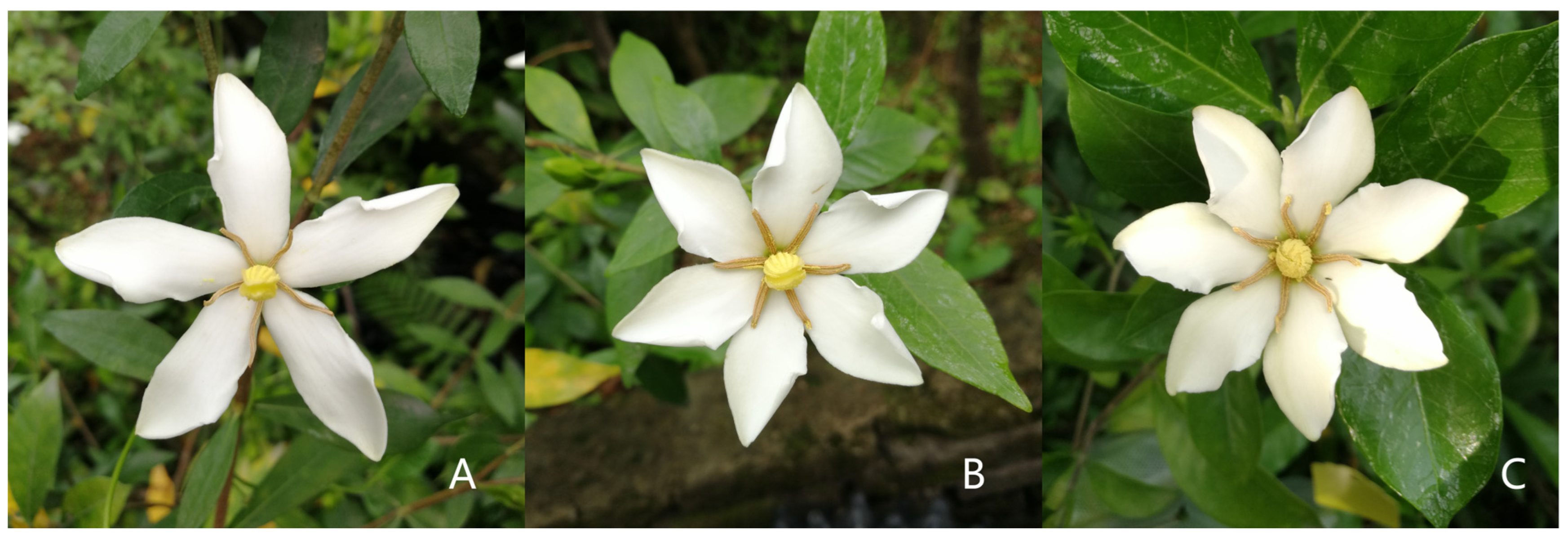
Single-flowered genotypes of gardenia originating from the Quanzhou germplasm were uniformly maintained and subsequently cultivated under controlled conditions at the Fujian Agriculture and Forestry University. At the full-bloom stage of gardenia, flowers with five (Fr_5), six (Fr_6), and seven (Fr_7) petals from the same plant were collected (Figure 1). Each sample type included three biological replicates, which were immediately transferred into cryogenic tubes, flash-frozen in liquid nitrogen, and stored at −80 °C for transcriptome and metabolome sequencing.

2.2. Transcriptome Sequencing and Analysis Methods

The original data was downloaded using the cloud platform of Shanghai Pasenno Biotechnology Co. LTD (Shanghai, China) (https://www.genescloud.cn/ (accessed on 6 May 2023)). The sequencing data were filtered using the SOAPnuke V1.4.0 software. The reference genome was gardenia (V1, ID53980) [13], and the clean reads were aligned to the reference genome using the HISAT2 software. Open reading frames (ORFs) of the assembled unigenes were predicted, followed by functional annotation through sequence alignment against the Plant Resistance Gene database (PRGdb) using appropriate bioinformatic tools.
The Poisson distribution method was used to screen the differentially expressed genes. Multiple differential expressions among different samples were calculated based on the FPKM value (FDR ≤ 0.001, and the multiple difference was more than two times). The GO functional classification was performed on the differentially expressed genes and the enrichment analysis was conducted; the biological pathway classification and enrichment analysis were performed on the differentially expressed genes (significant enrichment: Qvalue ≤ 0.05).

2.3. Metabolome Sequencing and Analysis Methods

The original data download was the same as in Section 2.2. Pairwise sample distances were calculated based on the Euclidean distance metric, and hierarchical clustering was conducted to generate a dendrogram, thereby evaluating the degree of similarity among samples. Agglomerative hierarchical clustering was performed to classify metabolites across all samples and groups, and relative metabolite abundances under different experimental conditions were used to indicate the corresponding metabolic levels.
To extract the most informative features from the dataset, dimensionality reduction and classification analyses were conducted. Prior to analysis, the data were auto-scaled, and principal component analysis (PCA) was applied as the major method for multivariate statistical evaluation. In search for differential metabolites from the first-level substance list of the sample (p value and VIP), metabolites were determined based on MS/MS fragmentation patterns and databases such as HMDB, massbank, LipidMaps, and mzcloud. Screening was conducted based on the preset p value and VIP threshold in the statistical test. The metabolic pathways of the two groups of differential metabolites were analyzed by using the hypergeometric test and the MetPA database. According to the MetPA analysis results and the relative response values of metabolic pathways, the correlation coefficients between metabolic pathways were calculated.

3. Results

3.1. Evaluation of Transcriptome Sequencing Data Quality

The original data obtained by sequencing the nine samples on the machine were screened and filtered, respectively, by removing sequences with joints and low quality; 36,357,562 to 43,485,564 high-quality sequences were obtained (Table 1). The proportion of it in the original sequence was calculated to be 93.28~93.47%, and the number of high-quality sequence bases was 5,609,302,500~6,426,642,600. The base percentage (Q20) with an identification accuracy rate above 99% is ≥98%, and the base percentage (Q30) with an identification accuracy rate above 99.9% is ≥94%. The alignment rate of high-quality reads to the reference genome ranged from 92.66% to 94.01% (Table 2), while the proportion of reads mapped to multiple genomic locations accounted for 4.25% to 5.67% of the total value. Among the mapped reads, 94.33% to 95.75% were uniquely aligned to a single genomic locus, whereas 86.42% to 88.31% of the total reads were mapped to annotated gene regions, indicating a high proportion of gene-associated transcriptional reads. A total of 11.69–13.58% of reads were mapped to intergenic regions, whereas 95.57–96.58% were aligned to exonic regions. The high proportion of exonic reads suggests that the sequencing data are of high integrity and suitable for downstream analyses.

3.2. Analysis of Differential Gene Expression

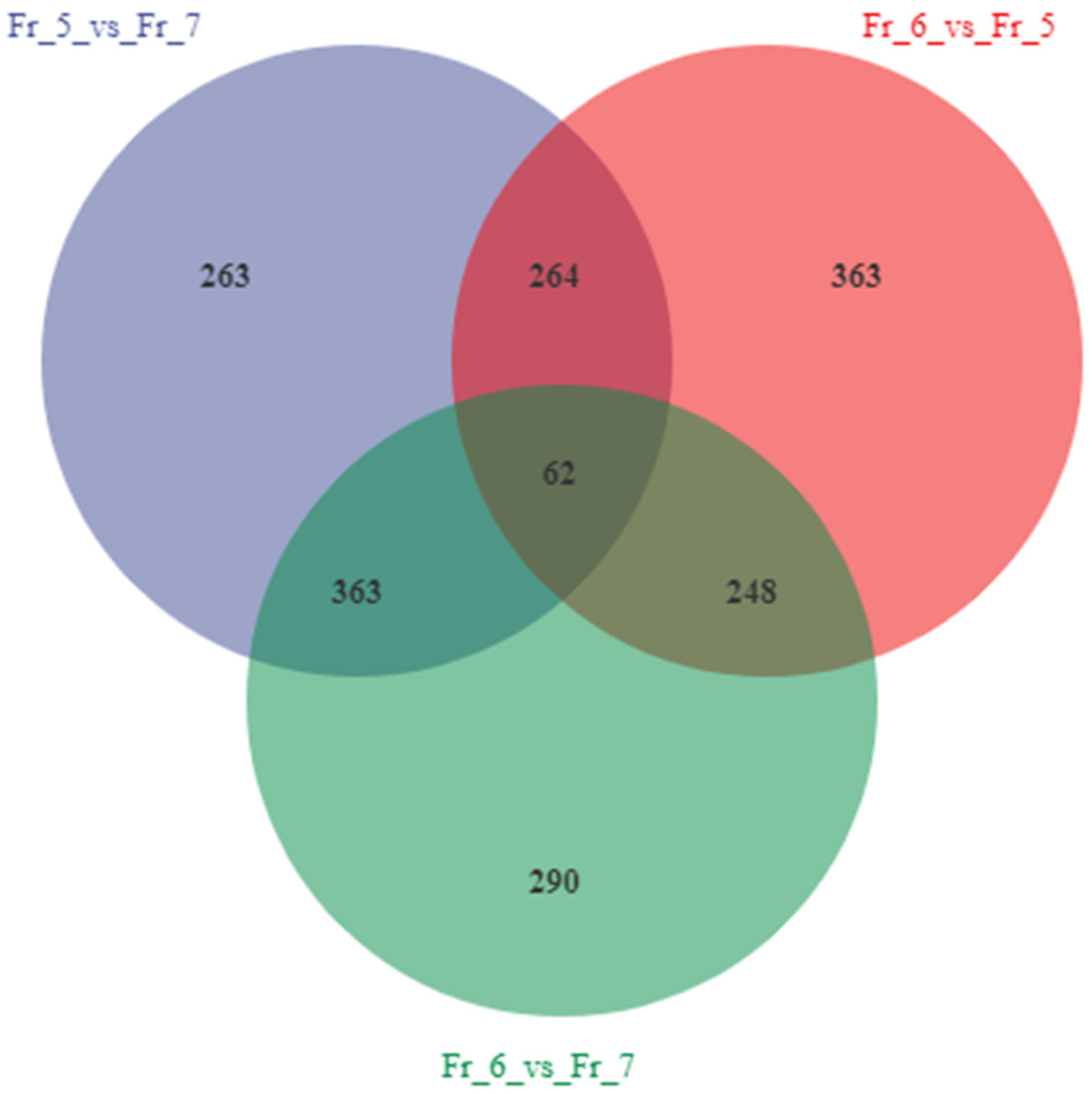
DESeq was used to conduct the differential analysis of gene expression, and the number of differentially expressed genes among the three comparison groups of Fr_5 vs. Fr_7, Fr_6 vs. Fr_5, and Fr_6 vs. Fr_7 was statistically analyzed. The Venn diagram was used to represent the number of shared and unique differentially expressed genes among the three comparison groups (Figure 2). The three groups of differentially expressed genes were 952 (440 upregulated genes and 512 downregulated genes), 937 (569 upregulated genes and 368 downregulated genes), and 963 (558 upregulated genes and 405 downregulated genes), respectively. The results indicate that the six-petal gardenia has more upregulated genes than downregulated genes compared to the five-petal and seven-petal gardenia. The reduction in the number of genes regulating six-petaled gardenia is presumed to contribute to the emergence of the five-petaled and seven-petaled gardenia phenotypes.
The number of differentially expressed genes shared by all three groups is 62, while the numbers of unique differentially expressed genes in Fr_5 vs. Fr_7, Fr_6 vs. Fr_5, and Fr_6 vs. Fr_7 are 263, 363, and 290, respectively. The results indicate that the similarity between six-petaled and five-petaled gardenia flowers is higher than that between six-petaled and seven-petaled gardenia flowers.

3.3. Differential Metabolic Pathway Analysis of Petal Number Variation

The GO enrichment analysis was performed on the differentially expressed genes between each pair of samples, and the GO classification was conducted according to cellular component, molecular function, and biological process (Table 3). Among them, the most significant GO terms in each GO category for the differentially expressed genes between Fr_5 and Fr_7 were the cell wall, glucose binding, and response to oxygen-containing compound. The most significant GO terms in each GO category for the differentially expressed genes between Fr_6 and Fr_5 were the cell periphery, transmembrane transporter activity, and transmembrane transport. The most significant GO terms in each GO category for the differentially expressed genes between Fr_6 and Fr_7 were the cell exterior, glucosyltransferase activity, and response to jasmonic acid.
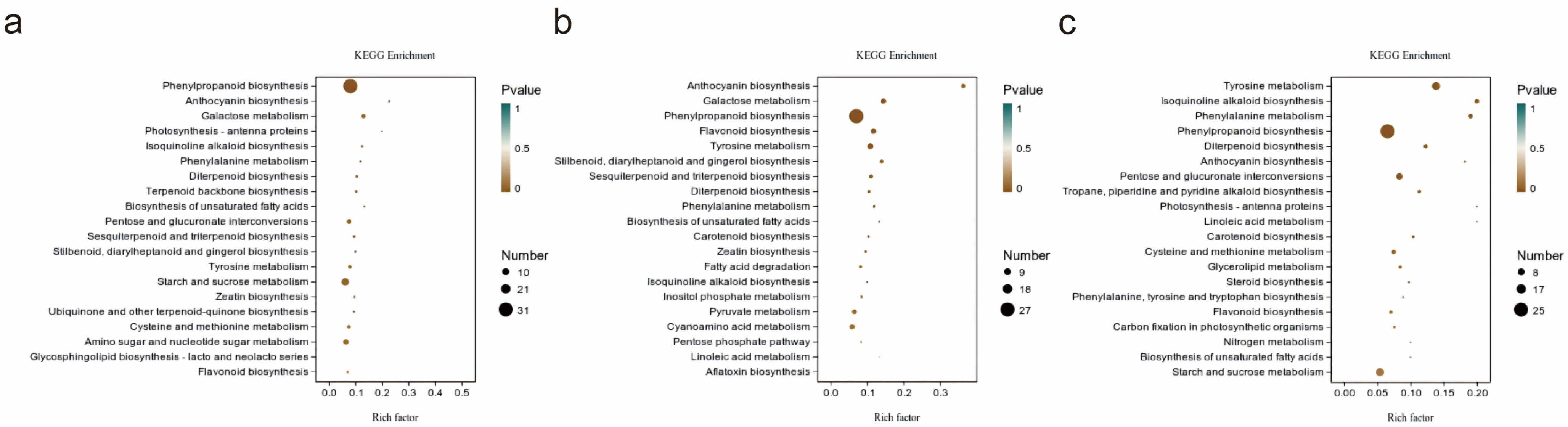
The KEGG pathway enrichment analysis was performed on the differentially expressed genes between each pair of samples, presenting the top 20 KEGG pathways (Figure 3). The degree of enrichment was measured by the enrichment factor (Rich factor), p-value, and the number of genes enriched in the pathway. A larger Rich factor indicates a higher degree of enrichment; the p value typically ranges from 0 to 1, with values closer to 0, indicating more significant enrichment. The differentially expressed genes from the three groups were primarily enriched in phenylpropanoid biosynthesis. The secondary enriched pathways for each group were as follows: for Fr_5 vs. Fr_7, the differential genes were enriched in starch and sucrose metabolism; for Fr_6 vs. Fr_5, the differential genes were enriched in tyrosine metabolism, flavonoid biosynthesis, and galactose metabolism; and for Fr_6 vs. Fr_7, the differential genes were enriched in tyrosine metabolism, among other pathways.

3.4. The Analysis of Differentially Expressed Genes Underlying Petal Number Variation and the Expression Level in the Sample

Among the 47 gene families identified in the transcriptome sequencing data (Table 4), a total of 35 families encompassing 167 transcription factors were detected in the comparison between Fr_5 and Fr_7, with 80 transcription factors being upregulated and 87 being downregulated. In the comparison between Fr_6 and Fr_5, 37 families comprising 159 transcription factors were identified, including 89 upregulated and 70 downregulated factors. For the comparison between Fr_6 and Fr_7, 40 families involving 199 transcriptional genes were identified, of which 113 were upregulated and 86 were downregulated.
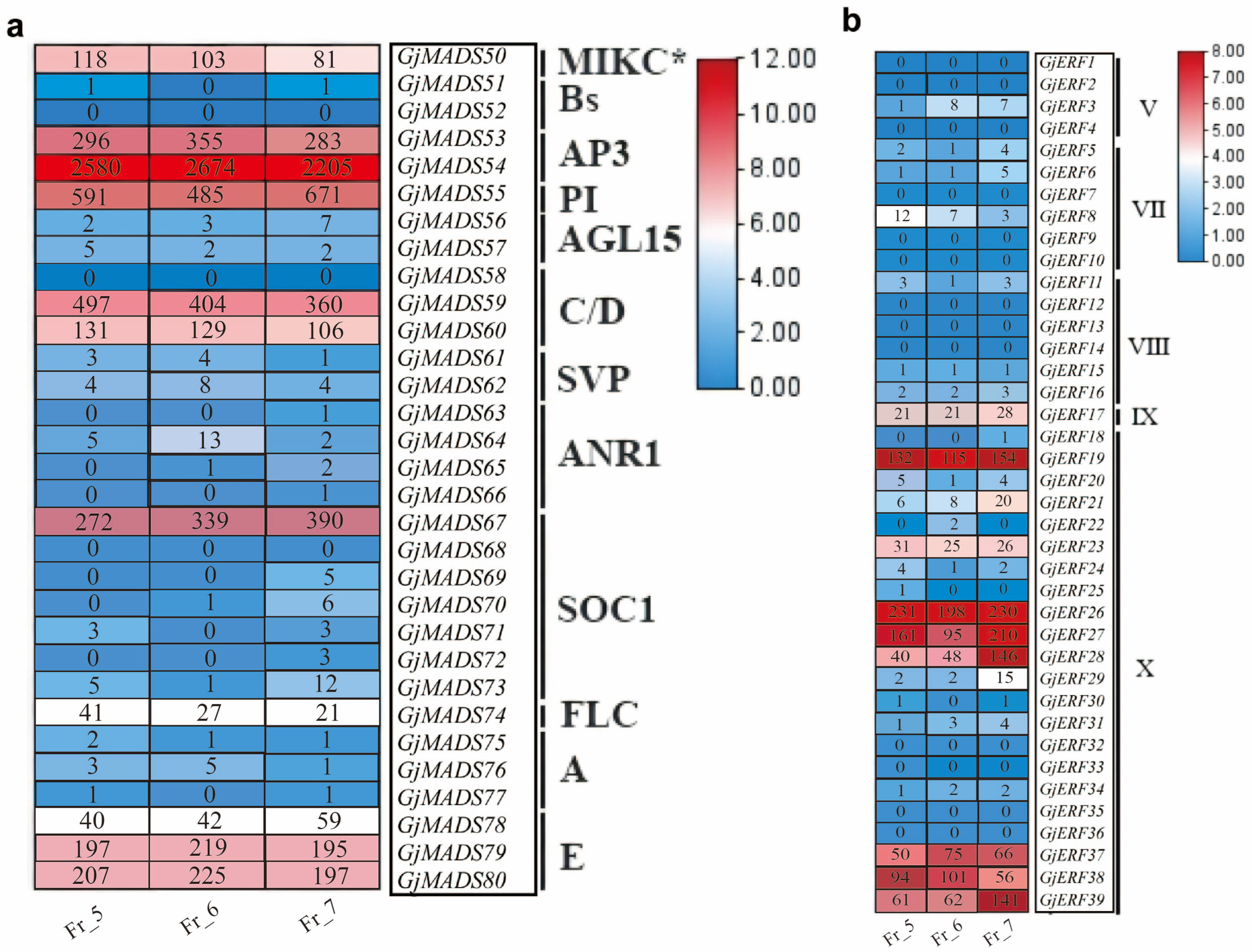
In the fully bloomed flowers of Fr_5, Fr_6, and Fr_7, the genes with relatively high expression levels included class B genes (GjMADS53, GjMADS54, and GjMADS55), class C/D genes (GjMADS59 and GjMADS60), the SOC1 gene (GjMADS67), and class E genes (GjMADS79 and GjMADS80), all of which belong to the MADS-box gene family (Figure 4a). According to the classification of differentially expressed gene families, members of the ERF subfamily belonging to the X branch—such as GjERF19, GjERF26, GjERF27, GjERF28, GjERF37, GjERF38, and GjERF39—also exhibited high expression (Figure 4b). As the petal number increased, the expression levels of GjMADS50, GjMADS59, and GjMADS60 gradually decreased, whereas the expression of GjMADS67, GjERF28, and GjERF39 increased correspondingly with the number of petals.

3.5. Metabolomic Data and Sample Differential Metabolite Analysis

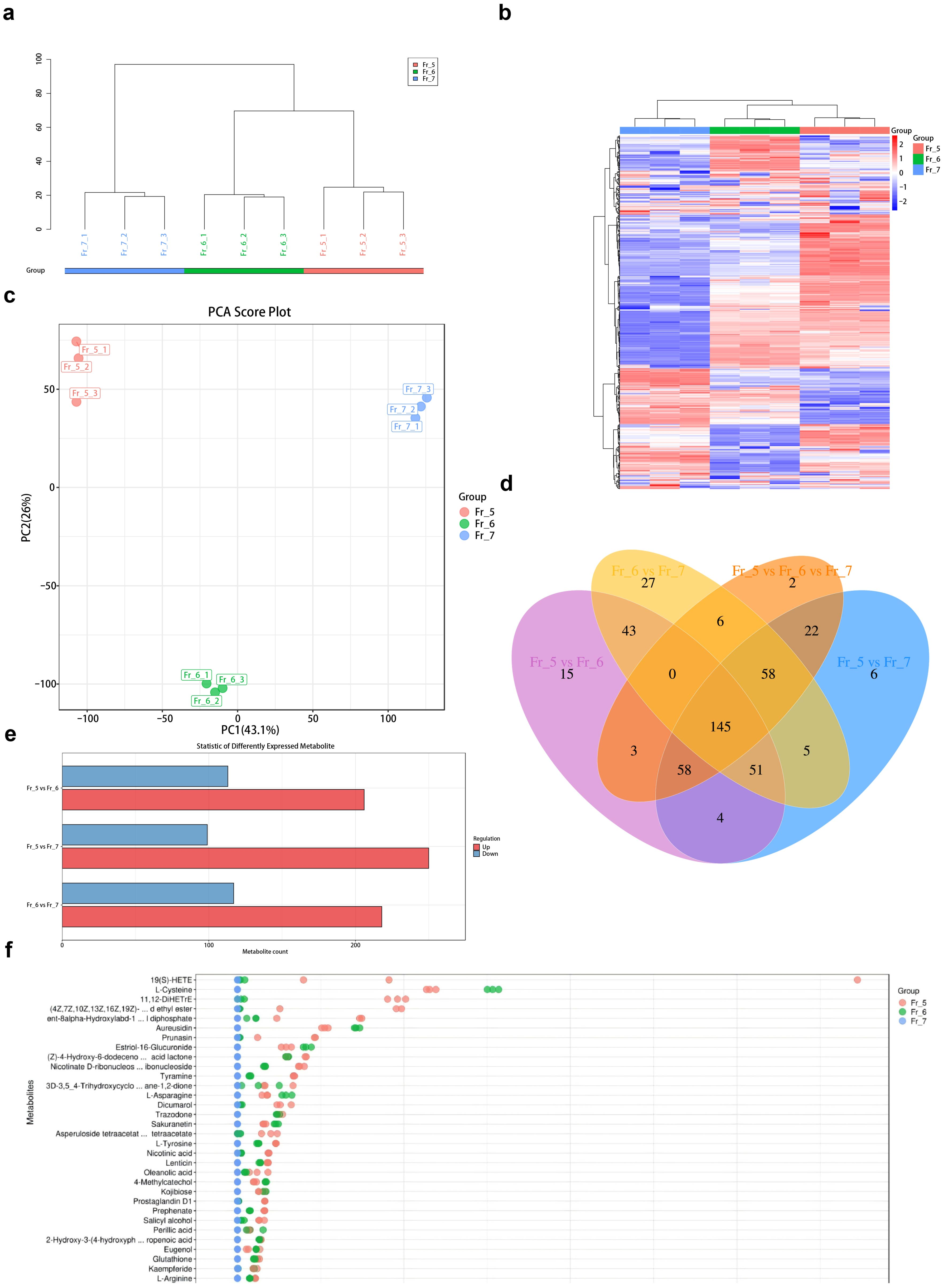
Chromatographically separated components were subjected to mass spectrometric analysis to collect data and generate mass spectra. The most intense ions at each time point in the mass spectrum were selected for continuous plotting, resulting in the base peak chromatogram (BPC). The more similar the trends of the lines in the chromatogram, the better the reproducibility of the samples, indicating reliable results. The three biological replicates of each sample were closely clustered, and the similarity between replicates was high. The similarity between the Fr_5 and Fr_6 samples was greater than that between the Fr_5 and Fr_7 samples (Figure 5a). The metabolites of the three biological replicates of each sample were relatively similar (Figure 5b); however, there were certain differences in the metabolites among the three samples. The metabolites of the Fr_5 and Fr_6 samples were more similar to each other.
In the principal component analysis (PCA) (Figure 5c), the samples within the Fr_5 and Fr_6 groups were more tightly clustered, while the samples between groups were more dispersed, indicating that the results are relatively reliable. Metabolite profiling of gardenia flowers with five, six, and seven petals was performed using MS/MS-based identification, resulting in the detection of a total of 572 metabolites. The number of differential metabolites between the four comparison groups, Fr_5 vs. Fr_7, Fr_6 vs. Fr_5, Fr_6 vs. Fr_7, and Fr_5 vs. Fr_6 vs. Fr_7 (Figure 5d), was calculated. A Venn diagram was used to represent the shared and unique differential metabolites among the four groups (Figure 5e). The total number of differential metabolites for the four groups were 349 (250 upregulated genes and 99 downregulated genes), 319 (206 upregulated genes and 113 downregulated genes), 315 (218 upregulated genes and 117 downregulated genes), and 294, respectively. The number of differential metabolites commonly shared by the four groups was 145, which corresponds to the number of main metabolites of gardenia. The number of unique differential metabolites for Fr_5 vs. Fr_7, Fr_6 vs. Fr_5, and Fr_6 vs. Fr_7 were 204, 174, and 170, respectively. The number of differential metabolites shared by the four groups is 145, which represents the main metabolites of gardenia. The top five differential metabolites were triethylamine, succinic acid, succinic acid semialdehyde, 2-phenylethanol, and o-xylene (Table 5).
Using the metabolites of Fr_7 as a reference (Figure 5f), the top three metabolites with the highest Z-scores in Fr_5 are 19(S)-HETE, 11,12-DiHETrE, and (4Z,7Z,10Z,13Z,16Z,19Z)-…d ethyl ester. The top three metabolites with the highest Z-scores in Fr_6 are l-cysteine, aureusidin, and estriol-16-glucuronide.

3.6. Pathways of Differential Metabolites in Samples

The KEGG pathway enrichment analysis was performed on the differential metabolites between each pair of samples. The top five differential metabolite pathways (Table 6) were biosynthesis of phenylpropanoids, biosynthesis of plant secondary metabolites, central carbon metabolism in cancer, protein digestion and absorption, and alanine, aspartate, and glutamate metabolism.
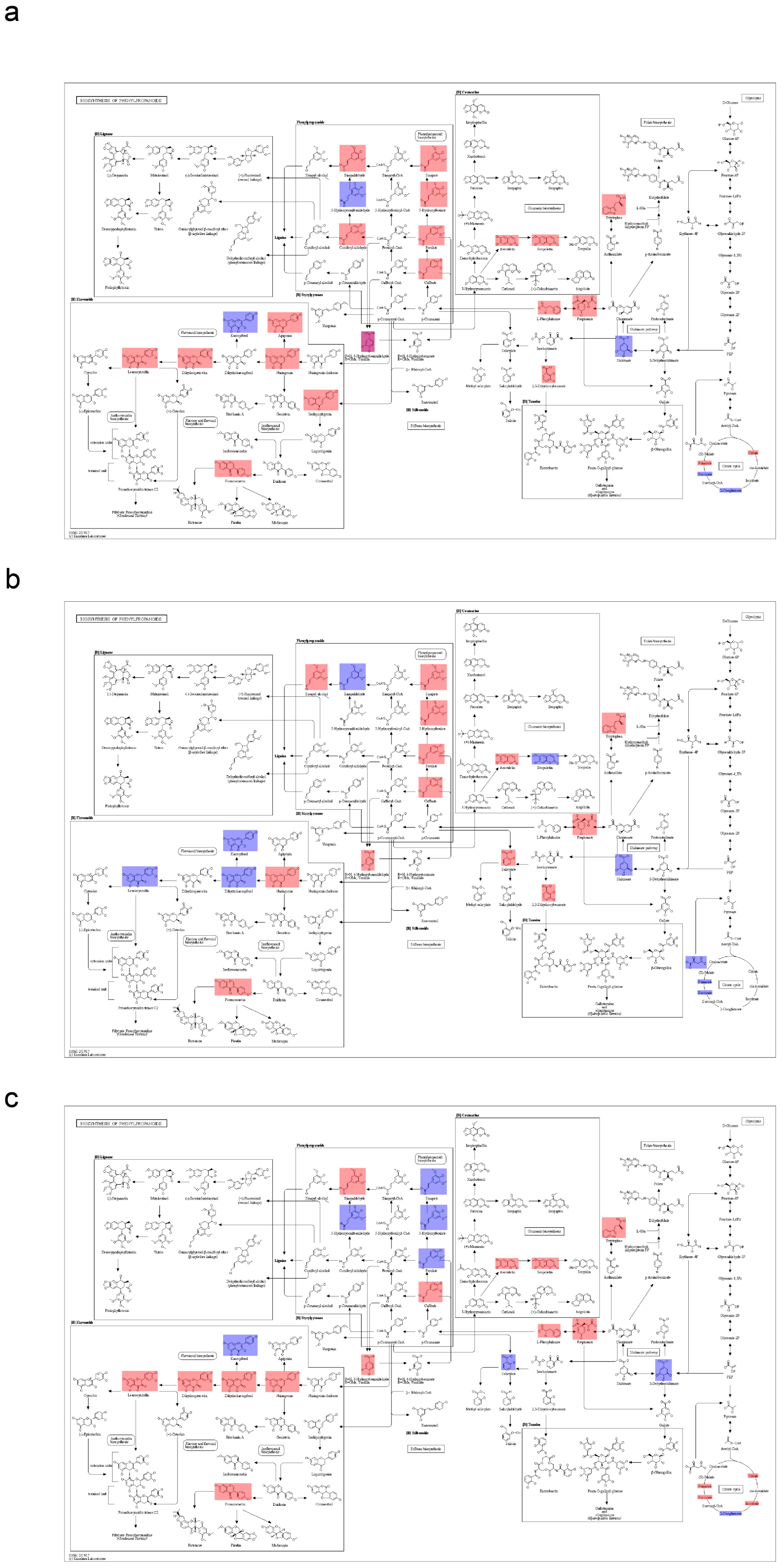
The phenylpropanoid metabolic pathway network for Fr_5, Fr_6, and Fr_7 is shown in (Figure 6). The types and concentrations of phenylpropanoid compounds synthesized showed significant differences among Fr_5, Fr_6, and Fr_7. The compounds in Fr_5 and Fr_6 were similar, while the differences between Fr_5 and Fr_7 were more pronounced.

4. Discussion

Variation constitutes the fundamental basis of biological evolution [14]. As a pivotal ornamental and developmental trait, the variation in petal number is likewise the outcome of the interplay between heredity and variation. From the perspective of evolutionary ecology, an increase in petal number acts as a ‘double-edged sword’: while it can potentially enhance reproductive success by expanding the floral display area and increasing attraction to pollinators, a complex floral structure alters resource allocation patterns, diverting energy originally intended for vegetative growth or other functions, and increases the risk of predation due to higher visibility [15]. Consequently, the variation and stability of this trait are collectively shaped by genetic bases, developmental programs, and environmental selection pressures.
Such phenotypic differentiation within a single species is primarily driven by two mechanisms: phenotypic plasticity arising from environmental heterogeneity in genetically identical individuals and the fixation of standing genetic variation within populations under natural selection [6]. In model plants, the molecular basis has been revealed to involve a multi-layered and precise regulatory network. For instance, specific transcription factors, such as PTL, indirectly regulate petal number by controlling the size of the boundaries between sepals [16], while CUC genes influence the physical space available for petal initiation by suppressing sepal growth [17]. Environmental signals, such as low temperature, can alter the developmental timing of floral buds, thereby creating possibilities for increasing petal count [18]. Regarding intrinsic regulation, hormonal pathways play a pivotal role; for example, gibberellins (GA) promote petal formation by degrading DELLA proteins to release transcription factors such as SPLs, which subsequently activate the expression of downstream MADS-box floral organ identity genes [19]. Collectively, these studies indicate that variation in petal number is the combined outcome of the dynamic interplay among the genetic blueprint, environmental signals, and endogenous hormonal networks, providing a theoretical framework for dissecting similar phenomena in non-model plants.
Within this framework, this study integrated transcriptomic and metabolomic analyses to systematically dissect the co-varying molecular networks underlying petal number variation in gardenia. The differential expression analysis identified a series of key transcription factors, predominantly enriched in the NAC, ERF, C2H2, MYB, and MADS-box families. Among them, MADS-box family members serve as core determinants of floral organ identity and developmental timing; the significant co-variation in their expression patterns with petal number strongly suggests that they play an evolutionarily conserved regulatory role in the establishment of floral whorls in gardenia [20,21,22]. Although genes from the NAC, ERF, and MYB families are widely known for their involvement in abiotic stress responses [23,24,25], their roles in developmental processes—such as floral meristem maintenance, organ boundary delineation, and hormone signal integration—have also been extensively documented. Therefore, the differential expression of these factors observed in this study is more likely associated with the intrinsic regulatory mechanisms governing the developmental trait of petal number itself.
Further analysis revealed that the expression levels of multiple ERF genes, including GjERF28 and GjERF39, exhibited a precise gradient of co-variation with petal number. Notably, differentially expressed genes (DEGs) were significantly enriched in the ‘alanine, aspartate and glutamate metabolism’ pathway. Although conserved amino acid residues (e.g., alanine and aspartate) within specific ERF subfamilies share a nominal association with the pathway’s nomenclature [26], a functional linkage between these sequence motifs and metabolic pathway perturbations has not yet been established. In the absence of experimental evidence, this should be prudently interpreted as an intriguing correlative observation. Given that the ERF family functions as a central hub for integrating multiple hormonal signals, such as gibberellin and ethylene [24,27,28,29,30], we postulate that these ERF genes may influence the initiation patterns of organ primordia by modulating the hormonal microenvironment within the floral meristem; however, this hypothesis requires validation through functional experiments.
At the metabolic level, the phenylpropanoid biosynthesis pathway emerged as the primary site of differential accumulation. Furthermore, its known upstream regulators (e.g., MYB and bHLH factors) exhibited concurrent differential expression [31,32,33], thereby constructing a coherent landscape linking ‘transcriptional regulatory perturbations’ to ‘downstream metabolic phenotypes.’ However, it is crucial to clarify that the relationship observed between metabolic alterations and petal number represents a correlation. Underlying this observation, multiple possibilities exist: the metabolic shifts may represent secondary effects or physiological feedback resulting from alterations in biomass or carbon source allocation following changes in petal number; alternatively, they may constitute parallel outputs driven by the pleiotropic regulation of upstream core factors, such as ERF or MADS proteins. Based on the omics data and co-expression network analysis in this study, we hypothesize that ERF transcription factors likely mediate gibberellin biosynthesis or signaling, thereby coordinately regulating floral meristem activity and specific metabolic states to jointly determine the initial number of petal primordia. The key candidate genes identified herein provide crucial anchors for this hypothesis, although the precise causal relationships await final elucidation through subsequent experimental validation.
It should be acknowledged that a limitation of this study is the sampling at the full-bloom stage. Critical developmental decisions governing petal primordium initiation and organ number likely occur much earlier, during floral bud differentiation. Consequently, the transcriptomic and metabolomic profiles we captured primarily reflect the maintenance phase or the final steady state of the mature petals, rather than the initial decision-making events. We chose this stage for its practical advantages: it ensures unambiguous phenotypic scoring of petal number and enables synchronized sampling of tissues for integrated omics analyses. Nevertheless, the strong and consistent correlations we observed between petal number and the expression levels of key candidate genes (e.g., GjERF28 and GjMADS67), even at this late stage, remain highly informative. These patterns suggest that these genes may play ongoing roles in maintaining organ identity, final size determination, or cellular homeostasis in petals, which are integral to the realization of the stable phenotype. Future studies employing high-resolution time-series sampling across early floral developmental stages will be essential to precisely delineate the temporal dynamics of these regulatory networks and to conclusively identify the upstream drivers of petal number variation in gardenia.

5. Conclusions

The corolla area, sepal number, and stamen number of gardenia flowers all increase with the number of whorled petals. A total of 18,720 genes are shared among the five-petal, six-petal, and seven-petal flowers. The gene expression level regulating the six-petal flower is higher than that of the five-petal and seven-petal flowers. The genetic and metabolic differences between the six-petal and five-petal gardenia are smaller, while the differences between the six-petal and seven-petal gardenia are larger. The commonalities among the three flower types are greater than their differences, and the differential genes are primarily located on chromosome 9. The differential genes between the six-petal flower and the five-petal and seven-petal flowers are primarily located extracellularly, with molecular functions mainly related to transmembrane transport and jasmonic acid responses. The differential genes between the five-petal and seven-petal flowers are mainly enriched in the cell wall, with molecular functions primarily involved in responses to oxygen-containing compounds. The differential genes in the five-petal, six-petal, and seven-petal gardenia flowers are all enriched in the biosynthesis of phenylpropanoids. The E-class genes of gardenia (GjMADS79 and GjMADS80) are involved in various parts and stages of flower development. The expression patterns of the MADS-box and ERF gene family members in the five-petal, six-petal, and seven-petal gardenia flowers indicate that the upregulation of GjERF28, GjERF39, and GjMADS67, along with the downregulation of GjMADS50, GjMADS59, and GjMADS60, may influence the increase in the number of whorled petals in gardenia. There are 145 metabolites shared among the five-petal, six-petal, and seven-petal flowers. The differential metabolites primarily include triethylamine, succinic acid, succinaldehyde, 2-phenylethanol, and o-xylene. The pathways of the differential metabolites are mainly related to the biosynthesis of phenylpropanoids, biosynthesis of plant secondary metabolites, and metabolism of alanine, aspartate, and glutamate.

Author Contributions

Conceptualization, X.Z.; methodology, B.G. and Y.L. (Yi Lu); software, B.G.; validation, Y.L. (Yi Lu); formal analysis, W.L.; investigation, B.G. and Y.L. (Yiwen Liao); resources, X.Z. and S.Z.; data curation, L.D.; writing—original draft preparation, B.G.; writing—review and editing, X.Z.; visualization, Q.Z.; supervision, X.Z.; project administration, S.Z.; funding acquisition, X.Z. and S.Z. All authors have read and agreed to the published version of the manuscript.

Funding

This research was funded by the University-Industry Cooperation Project of the Fujian Provincial Science and Technology Department, grant number: 2022N5009, Shaowu Erdu State-owned Forest Farm Co., Ltd., grant number: KH250309A, and Institute of Rural Revitalization, Zhenghe, Fujian Agriculture and Forestry University, grant number: KH250114A.

Institutional Review Board Statement

Not applicable.

Informed Consent Statement

Not applicable.

Data Availability Statement

Data are available on request from the authors.

Conflicts of Interest

The authors declare no conflicts of interest.

References

  1. Endress, P.K. Evolutionary diversification of the flowers in angiosperms. Am. J. Bot. 2011, 98, 370–396. [Google Scholar] [CrossRef]
  2. Hao, L.; da Silva, J.A.T.; Yu, X. Transcriptome analysis of floral bud development in Fritillaria pallidiflora. Ornam. Plant Res. 2025, 5, e034. [Google Scholar] [CrossRef]
  3. Coen, E.S.; Meyerowitz, E.M. The war of the whorls: Genetic interactions controlling flower development. Nature 1991, 353, 31–37. [Google Scholar] [CrossRef]
  4. Krizek, B.A.; Fletcher, J.C. Molecular mechanisms of flower development: An armchair guide. Nat. Rev. Genet. 2005, 6, 688–698. [Google Scholar] [CrossRef]
  5. Wang, D.; Dong, X.; Zhong, M.; Jiang, X.; Cui, W.; Bendahmane, M.; Hu, J. Molecular and genetic regulation of petal number variation. J. Exp. Bot. 2024, 75, 3233–3247. [Google Scholar] [CrossRef]
  6. Pieper, B.; Monniaux, M.; Hay, A. The genetic architecture of petal number in Cardamine hirsuta. New Phytol. 2016, 209, 395–406. [Google Scholar] [CrossRef]
  7. Meyerowitz, E.M.; Smyth, D.R.; Bowman, J.L. Abnormal flowers and pattern formation in floral development. Development 1989, 106, 209–217. [Google Scholar] [CrossRef]
  8. Gong, P.; Ao, X.; Liu, G.; Cheng, F.; He, C. Duplication and Whorl-Specific-Down Regulation of the Obligate AP3-PI Heterodimer Genes Explain the Origin of Paeonia lactiflora Plants with Spontaneous Corolla Mutation. Plant Cell Physiol. 2017, 58, 411–425. [Google Scholar]
  9. Wang, Q.; Zhang, X.; Lin, S.; Yang, S.; Yan, X.; Bendahmane, M.; Bao, M.; Fu, X. Mapping a double flower phenotype-associated gene DcAP2L in Dianthus chinensis. J. Exp. Bot. 2020, 71, 1915–1927. [Google Scholar] [PubMed]
  10. Zheng, Y.; Fan, Y.; Chen, Q.; Sun, M.; Chen, X.; Zhu, W.; Wang, Y.; Teixeira da Silva, J.A.; Yu, X. Exploring miRNA-target modules in Paeonia lactiflora stamen petalization through integrated miRNAome, transcriptome, and degradome analysis. Ind. Crops Prod. 2024, 215, 118662. [Google Scholar] [CrossRef]
  11. Chen, C.; Wang, J.; Pan, D.; Wang, X.; Xu, Y.; Yan, J.; Wang, L.; Yang, X.; Yang, M.; Liu, G. Applications of multi-omics analysis in human diseases. Medcomm 2023, 4, e315. [Google Scholar] [CrossRef]
  12. Argelaguet, R.; Velten, B.; Arnol, D.; Dietrich, S.; Zenz, T.; Marioni, J.C.; Buettner, F.; Huber, W.; Stegle, O. Multi-Omics Factor Analysis-a framework for unsupervised integration of multi-omics data sets. Mol. Syst. Biol. 2018, 14, e8124. [Google Scholar] [CrossRef]
  13. Xu, Z.; Pu, X.; Gao, R.; Demurtas, O.C.; Fleck, S.J.; Richter, M.; He, C.; Ji, A.; Sun, W.; Kong, J.; et al. Tandem gene duplications drive divergent evolution of caffeine and crocin biosynthetic pathways in plants. BMC Biol. 2020, 18, 63. [Google Scholar] [CrossRef]
  14. Stebbins, G.L. Variation and Evolution in Plants: Progress During the Past Twenty Years. In Essays in Evolution and Genetics in Honor of Theodosius Dobzhansky: A Supplement to Evolutionary Biology; Hecht, M.K., Steere, W.C., Eds.; Springer: Boston, MA, USA, 1970; pp. 173–208. [Google Scholar]
  15. Bell, G. On the function of flowers. Proc. R. Soc. Lond. Ser. B Biol. Sci. 1985, 224, 223–265. [Google Scholar] [CrossRef]
  16. Lampugnani, E.R.; Kilinc, A.; Smyth, D.R. PETAL LOSS is a boundary gene that inhibits growth between developing sepals in Arabidopsis thaliana. Plant J. 2012, 71, 724–735. [Google Scholar] [CrossRef] [PubMed]
  17. Laufs, P.; Peaucelle, A.; Morin, H.; Traas, J. MicroRNA regulation of the CUC genes is required for boundary size control in Arabidopsis meristems. Development 2004, 131, 4311–4322. [Google Scholar] [CrossRef] [PubMed]
  18. McKim, S.M.; Routier-Kierzkowska, A.; Monniaux, M.; Kierzkowski, D.; Pieper, B.; Smith, R.S.; Tsiantis, M.; Hay, A. Seasonal Regulation of Petal Number. Plant Physiol. 2017, 175, 886–903. [Google Scholar] [CrossRef]
  19. Yu, S.; Galvao, V.C.; Zhang, Y.; Horrer, D.; Zhang, T.; Hao, Y.; Feng, Y.; Wang, S.; Schmid, M.; Wang, J. Gibberellin Regulates the Arabidopsis Floral Transition through miR156-Targeted SQUAMOSA PROMOTER BINDING-LIKE Transcription Factors. Plant Cell 2012, 24, 3320–3332. [Google Scholar] [CrossRef] [PubMed]
  20. Arora, R.; Agarwal, P.; Ray, S.; Singh, A.K.; Singh, V.P.; Tyagi, A.K.; Kapoor, S. MADS-box gene family in rice: Genome-wide identification, organization and expression profiling during reproductive development and stress. BMC Genom. 2007, 8, 242. [Google Scholar] [CrossRef]
  21. Alvarez-Buylla, E.R.; Liljegren, S.J.; Pelaz, S.; Gold, S.E.; Burgeff, C.; Ditta, G.S.; Vergara-Silva, F.; Yanofsky, M.F. MADS-box gene evolution beyond flowers: Expression in pollen, endosperm, guard cells, roots and trichomes. Plant J. 2008, 24, 457–466. [Google Scholar]
  22. Saedler, H.; Becker, A.; Winter, K.U.; Kirchner, C.; Theissen, G. MADS-box genes are involved in floral development and evolution. Acta Biochim. Pol. 2001, 48, 351–358. [Google Scholar] [CrossRef] [PubMed]
  23. Liu, M.; Sun, W.; Ma, Z.; Yu, G.; Li, J.; Wang, Y.; Wang, X. Comprehensive multiomics analysis reveals key roles of NACs in plant growth and development and its environmental adaption mechanism by regulating metabolite pathways. Genomics 2020, 112, 4897–4911. [Google Scholar] [CrossRef]
  24. Thirugnanasambantham, K.; Durairaj, S.; Saravanan, S.; Karikalan, K.; Muralidaran, S.; Islam, V.I.H. Role of Ethylene Response Transcription Factor (ERF) and Its Regulation in Response to Stress Encountered by Plants. Plant Mol. Biol. Report. 2015, 33, 347–357. [Google Scholar]
  25. Du, H.; Zhang, L.; Liu, L.; Tang, X.; Yang, W.; Wu, Y.; Huang, Y.; Tang, Y. Biochemical and molecular characterization of plant MYB transcription factor family. Biochemistry 2009, 74, 1–11. [Google Scholar] [CrossRef]
  26. Wang, K.; Guo, H.; Yin, Y. AP2/ERF transcription factors and their functions in Arabidopsis responses to abiotic stresses. Environ. Exp. Bot. 2024, 222, 105763. [Google Scholar] [CrossRef]
  27. Hwang, J.; Kang, S.; Kwon, E.; Lee, I.; Seo, J.S.; Kim, M. The barley ERF factor HvRAF enhances tillering and grain yield in transgenic rice by modulating cytokinin–gibberellin homeostasis. Plant Biotechnol. Rep. 2026, 20, 6. [Google Scholar]
  28. Cui, Z.; Gao, W.; Wang, R.; Yan, Y.; Xu, X.; Ma, C.; Zhang, H.; Chang, C. The ethylene responsive factor TaERF-2 A activates gibberellin 2-oxidase gene TaGA2ox2-3B expression to enhance seed dormancy in wheat. Int. J. Biol. Macromol. 2025, 314, 144483. [Google Scholar] [CrossRef]
  29. Li, L.; Wang, J.; Chen, J.; Wang, Z.; Qaseem, M.F.; Li, H.; Wu, A. Physiological and Transcriptomic Responses of Growth in Neolamarckia cadamba Stimulated by Exogenous Gibberellins. Int. J. Mol. Sci. 2022, 23, 11842. [Google Scholar] [CrossRef] [PubMed]
  30. Pandey, S.P.; Srivastava, S.; Goel, R.; Lakhwani, D.; Singh, P.; Asif, M.H.; Sane, A.P. Simulated herbivory in chickpea causes rapid changes in defense pathways and hormonal transcription networks of JA/ethylene/GA/auxin within minutes of wounding. Sci. Rep. 2017, 7, 44729. [Google Scholar]
  31. Zhao, L.; Gao, L.; Wang, H.; Chen, X.; Wang, Y.; Yang, H.; Wei, C.; Wan, X.; Xia, T. The R2R3-MYB, bHLH, WD40, and related transcription factors in flavonoid biosynthesis. Funct. Integr. Genom. 2013, 13, 75–98. [Google Scholar]
  32. Dal Cin, V.; Tieman, D.M.; Tohge, T.; McQuinn, R.; de Vos, R.C.H.; Osorio, S.; Schmelz, E.A.; Taylor, M.G.; Smits-Kroon, M.T.; Schuurink, R.C.; et al. Identification of Genes in the Phenylalanine Metabolic Pathway by Ectopic Expression of a MYB Transcription Factor in Tomato Fruit. Plant Cell 2011, 23, 2738–2753. [Google Scholar] [CrossRef] [PubMed]
  33. An, J.; Li, H.; Song, L.; Su, L.; Liu, X.; You, C.; Wang, X.; Hao, Y. The molecular cloning and functional characterization of MdMYC2, a bHLH transcription factor in apple. Plant Physiol. Biochem. 2019, 135, 612. [Google Scholar] [CrossRef] [PubMed]
Figure 1. Gardenia flower of the same plant at the same period. (A): Five-petaled flower; (B): six-petaled flower; (C): seven-petaled flower.
Metabolites 16 00130 g001
Figure 2. Venn diagram of sample differential genes.
Metabolites 16 00130 g002
Figure 3. Factor diagram of differential genes. (a): Fr_5 vs. Fr_7; (b): Fr_6 vs. Fr_5; (c): Fr_6 vs. Fr_7.
Metabolites 16 00130 g003
Figure 4. Expression levels of MADS-box and ERF family genes for Fr_5, Fr_6, and Fr_7. (a): MADS-box family; (b): ERF family.
Metabolites 16 00130 g004
Figure 5. (a): Sample hierarchical cluster tree; (b): Cluster heat map of sample metabolites, red to blue indicates a gradual decrease in expression level; (c): PCA score diagram of Fr_5, Fr_6, and Fr_7, the horizontal axis represents the decomposition degree of the first main component, and the vertical axis represents the decomposition degree of the second main component, dots represent experimental samples, and colors represent different groups; (d): Venn diagram of differential metabolites; (e): Bar chart of statistical analysis of differential metabolites in each group, the horizontal axis shows the number of differential metabolites, and the vertical axis shows the grouping comparison conditions; (f): Z-score diagram, the vertical axis is the name of the metabolite, and the color of the dot represents different groups, the horizontal axis is the value of the relative content of the metabolite in the group converted by Z-score, the further to the right, the more the metabolite is in the group.
Metabolites 16 00130 g005
Figure 6. KEGG-enriched pathway map of amphetamine biosynthesis. (a): Fr_5 vs. Fr_6; (b): Fr_5 vs. Fr_7; (c): Fr_6 vs. Fr_7. Red indicates upregulation of the substance, while blue indicates downregulation of the substance. Boxes represent protein molecules, and circles represent metabolic molecules.
Metabolites 16 00130 g006
Table 1. Statistics of the transcriptome sequencing. Q20, percentage of bases with base recognition accuracy higher than 99%; Q30, percentage of bases with base recognition accuracy higher than 99.9%.
SampleClean Reads/bpClean Reads/%Clean Data/bpQ20/%Q30/%
Fr_542,844,28493.366,426,642,60098.0194.54
Fr_640,703,31693.376,105,497,40098.0795.12
Fr_737,395,35093.285,609,302,50098.2494.62
Table 2. Statistics of sample comparison results.
SampleClean ReadsTotal MappedMultiple MappedUniquely MappedMap Events
Fr_542,844,28439,699,613 (92.66%)2,251,421 (5.67%)37,448,192 (94.33%)37,448,192
Fr_640,703,31638,249,467 (93.97%)1,958,780 (5.12%)36,290,687 (94.88%)36,290,687
Fr_737,395,35035,155,842 (94.01%)1,495,440 (4.25%)33,660,402 (95.75%)33,660,402
Table 3. GO enrichment analysis of the differentially expressed genes. —, indicates the absence of this GO Term.
CategoryGO TermFr_5 vs. Fr_7Fr_6 vs. Fr_5Fr_6 vs. Fr_7
Cellular ComponentCell wall5.356.313.71
External encapsulating structure5.356.313.71
Extracellular region4.51
Cell junction4.38
Cell–cell junction4.33
Anchoring junction4.33
Plasmodesma4.18
Symplast4.18
Cell periphery6.325.16
Membrane3.643.32
Plasma membrane2.93
Molecular FunctionGlucose binding5.333.81
Inositol 3-alpha-galactosyltransferase activity5.043.6
Monosaccharide binding5.043.6
Glycogenin glucosyltransferase activity4.03
Glucosyltransferase activity4.023.423.14
UDP-glucosyltransferase activity4.012.72
Transmembrane transporter activity4.98
Transporter activity4.73.04
(E,E)-geranyllinalool synthase activity4.39
Oxidoreductase activity, acting on paired donors, with incorporation or reduction in molecular oxygen3.6
4,8,12-trimethyltrideca-1,3,7,11-tetraene synthase activity2.88
(3E)-4,8-dimethyl-1,3,7-nonatriene synthase activity2.88
BioprocessResponse to oxygen-containing compound5.25
Response to stimulus4.342.81
Galactose metabolic process4.1
Response to iron ion4.05
Response to acid chemical4.01
Response to stress3.99
Transmembrane transport6.18
Secondary metabolite biosynthetic process5.853.22
Secondary metabolite process5.193.16
Anion transport4.69
Viral gene silencing in virus-induced gene silencing4.48
Anion transmembrane transport4.15
Transport3.37
Oxidation-reduction process3.36
Response to jasmonic acid4.31
Hormone metabolic process3.22
Regulation of hormone levels3.16
Negative regulation of circadian rhythm2.93
Molybdate ion export from vacuole2.93
Cellular response to inorganic substance2.9
Response to ethylene2.74
Table 4. Differential transcription factors and their classification.
TreatmentUpregulatedDownregulatedTotalTranscription Factor Family
Fr_5 vs. Fr_78087167AP2, ARF, ARR-B, B3, BBR-BPC, BES1, bHLH, bZIP, C2H2, C3H, CO-like, DBB, ERF, FAR1, G2-like, GATA, GeBP, GRAS, HB-other, HB-PHD, HD-ZIP, HSF, LBD, M-type_MADS, MYB, MYB_related, NAC, NF-YB, Nin-like, SBP, SRS, STAT, TCP, Trihelix, WRKY
Fr_6 vs. Fr_58970159AP2, ARF, B3, BBR-BPC, BES1, bHLH, bZIP, C2H2, C3H, CO-like, DBB, ERF, FAR1, G2-like, GATA, GeBP, GRAS, HD-ZIP, HSF, LBD, MIKC_MADS, M-type_MADS, MYB, MYB_related, NAC, NF-X1, NF-YA, NF-YB, NF-YC, Nin-like, SRS, STAT, TALE, Trihelix, WRKY, YABBY, ZF-HD
Fr_6 vs. Fr_711386199AP2, ARF, ARR-B, B3, BBR-BPC, BES1, bHLH, bZIP, C2H2, C3H, CO-like, DBB, Dof, ERF, FAR1, G2-like, GATA, GeBP, GRAS, HB-other, HD-ZIP, HSF, MIKC_MADS, M-type_MADS, MYB, MYB_related, NAC, NF-YA, NF-YC, Nin-like, RAV, SBP, STAT, TALE, TCP, Trihelix, VOZ, WRKY, YABBY, ZF-HD
Table 5. Top five differential metabolites. m/z: mass charge ratio; VIP: importance value; log2(FC): log2 value of the difference factor; p value: statistical p-value; KEGG number: KEGG compound ID.
Namem/zVIPlog2(FC)p ValueFormulaKEGG Number
Triethylamine101.061.300.282.18 × 10−4C6H15NC14691
Succinic acid101.061.30−1.113.35 × 10−6C4H6O4C00042
Succinic acid
Semialdehyde
103.041.301.671.90 × 10−3C4H6O3C00232
2-Phenyl ethanol105.071.300.412.94 × 10−5C8H10OC05853
o-xylene107.091.302.355.53 × 10−7C8H10C07212
Table 6. Top five differential metabolite pathways. Hits: number of differential metabolites; FDR: post-correction false positive value; Impact: impact value. The larger the FDR value, the higher the possibility of false positives. The larger the impact value of metabolic pathways, the greater the impact of differential metabolites detected on the target pathway.
Pathway IDPathway NameTotal p ValueHitsFDRImpact
map01061Biosynthesis of phenylprop anoids1030224.14 × 10−60.21
map01060Biosynthesis of plant secondary metabolites1410251.05 × 10−50.18
map05230Central carbon metabolism in cancer370112.66 × 10−40.30
map04974Protein digestion and absorption470123.97 × 10−40.26
map00250Alanine, aspartate, and glutamate metabolism28096.23 × 10−40.32
Disclaimer/Publisher’s Note: The statements, opinions and data contained in all publications are solely those of the individual author(s) and contributor(s) and not of MDPI and/or the editor(s). MDPI and/or the editor(s) disclaim responsibility for any injury to people or property resulting from any ideas, methods, instructions or products referred to in the content.