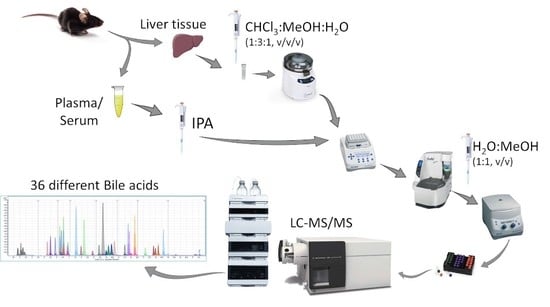
Development and Validation of a Highly Sensitive LC-MS/MS Method for the Analysis of Bile Acids in Serum, Plasma, and Liver Tissue Samples



Abstract
Share and Cite
Gómez, C.; Stücheli, S.; Kratschmar, D.V.; Bouitbir, J.; Odermatt, A. Development and Validation of a Highly Sensitive LC-MS/MS Method for the Analysis of Bile Acids in Serum, Plasma, and Liver Tissue Samples. Metabolites 2020, 10, 282. https://doi.org/10.3390/metabo10070282
Gómez C, Stücheli S, Kratschmar DV, Bouitbir J, Odermatt A. Development and Validation of a Highly Sensitive LC-MS/MS Method for the Analysis of Bile Acids in Serum, Plasma, and Liver Tissue Samples. Metabolites. 2020; 10(7):282. https://doi.org/10.3390/metabo10070282
Chicago/Turabian StyleGómez, Cristina, Simon Stücheli, Denise V. Kratschmar, Jamal Bouitbir, and Alex Odermatt. 2020. "Development and Validation of a Highly Sensitive LC-MS/MS Method for the Analysis of Bile Acids in Serum, Plasma, and Liver Tissue Samples" Metabolites 10, no. 7: 282. https://doi.org/10.3390/metabo10070282
APA StyleGómez, C., Stücheli, S., Kratschmar, D. V., Bouitbir, J., & Odermatt, A. (2020). Development and Validation of a Highly Sensitive LC-MS/MS Method for the Analysis of Bile Acids in Serum, Plasma, and Liver Tissue Samples. Metabolites, 10(7), 282. https://doi.org/10.3390/metabo10070282