1. Introduction
Adverse Drug Reactions (ADRs) represent a major global health problem. The World Health Organization (WHO) defines ADRs as harmful, unintended and undesired responses following the administration of a medicinal product at doses normally used in clinical practice. These reactions may compromise patient safety, increase morbidity and even lead to hospitalizations, highlighting the need for effective systems for detecting and reporting suspected ADRs [
1].
In Spain, the Spanish Agency of Medicines and Medical Devices, coordinates the National Pharmacovigilance System, which is responsible for receiving and analyzing reports submitted by healthcare professionals, patients and pharmaceutical companies. These reports are integrated into the FEDRA database (Spanish Pharmacovigilance System, Adverse Drug Reaction Data) and shared with the European system EudraVigilance. This collaboration enables the identification of new safety signals, the updating of summaries of product characteristics and patient information leaflets, and the implementation of regulatory measures when necessary [
2].
In this context, the community pharmacists play a fundamental role through the provision of Professional Pharmaceutical Care Services, particularly through pharmacotherapeutic follow-up. This intervention allows the detection of Drug-Related Problems (DRPs), the early identification of potential ADRs and collaboration with other healthcare professionals in the prevention and resolution of Negative Outcomes associated with Medication (NOMs), thereby contributing to improving treatment safety and effectiveness [
3].
This article describes the case of a 70-year-old polymedicated woman with a history of hypertension, type 2 diabetes mellitus, gastroesophageal reflux disease, hypercholesterolemia, chronic pain, insomnia and depression. The patient has been participating for several years in a Personalized Dosage System (PDS) service provided by her Community Pharmacy (CP), where she attends weekly to collect her medication in blister packs. In September 2023, following an adjustment to her chronic treatment that included the substitution of diazepam with clonazepam and an increase in the dose of semaglutide, she began to experience urinary incontinence, nausea and abdominal pain. These symptoms prompted a consultation at the community pharmacy in order to conduct a comprehensive review of her pharmacotherapy and assess the possible occurrence of ADRs related to the medications involved. The objective of this case report is to describe the detection and management of suspected ADRs in a polymedicated older patient through structured pharmacotherapeutic follow-up in community pharmacy, highlighting the role of the PDS in identifying DRPs and improving medication safety.
2. Case Presentation
Patient: 70-Year-Old Polymedicated Woman
Reason for consultation: The patient reported the onset of urinary incontinence, abdominal pain and nausea after recent modifications in her chronic treatment.
Medical history: Hypertension (HTN), type 2 diabetes mellitus (T2DM), gastroesophageal reflux disease, hypercholesterolemia, chronic pain, insomnia and depression. The patient had been enrolled for several years in a Personalized Dosage System (PDS) program provided by her CP, attending weekly to collect her medication in individualized blister packs, according to the methodology of the Pharmaceutical Care Forum–Community Pharmacy (AF-FC) [
3], a structured approach for identifying medication-related problems and negative outcomes associated with medication.
Treatment evolution: On 15 September 2023, her Primary Care Physician (PCP) modified her chronic treatment, replacing diazepam 10 mg with clonazepam 2 mg taken orally at night and increasing the dose of oral semaglutide from 7 mg to 14 mg once daily. On 20 September 2023, the patient began experiencing nausea, abdominal pain and urinary incontinence. Suspecting a urinary tract infection, the patient attended the emergency department, where a urine culture was performed and returned negative.
On 27 September 2023, the patient visited the community pharmacy reporting persistent urinary incontinence, nausea and vomiting. A structured pharmacotherapy review, including the PDS record was conducted at the pharmacy, identifying the recent treatment changes and their possible temporal relationship with the symptoms. The findings were documented and communicated to the PCP for evaluation and coordination of therapeutic adjustments.
Based on the information obtained through structured clinical interview, review of medical reports and analysis of the pharmacotherapeutic record (including the PDS), and following the methodology of the AF-FC, the initial clinical situation was established (
Table 1), detailing the health problems, the concerns expressed by the patient, the perceived level of control of the diseases and the prescribed pharmacotherapy (dose, regimen and route of administration), comparing it with the actual use reported by the patient. This global overview allowed the temporal relationship between therapeutic changes and symptom onset to be established, facilitating the prioritization of DRP/NOM and the planning of interventions. Furthermore, the patient provided written informed consent for the use and transfer of her data from the community pharmacy, within the framework of the study approved by the Ethics Committee (code SPD-SFT2122).
3. Evaluation
An analysis of the different DRPs identified and their possible relationship with NOMs was carried out following the methodology of the AF-FC [
3]. The main findings are summarized in
Table 2.
Regarding clonazepam, prescribed for the management of anxiety and insomnia, a DRP with a high probability of an ADR was identified due to the documented presence of urinary incontinence and gastrointestinal symptoms as potencial adverse effects. According to pharmacovigilance data from the Spanish Agency of Medicines and Medical Devices (1990–2025), 68 reports of gastrointestinal disorders and 21 reports of renal and urinary disorders associated with clonazepam have been registered [
2,
4]. In this clinical case, the occurrence of urinary incontinence was classified as a non-quantitative safety NOM, due to its direct impact on the patient’s quality of life and the increased risk of falls [
5].
In addition to the initial clinical assessment, the temporal sequence observed reinforced the suspected casual relationship with the treatment: after reducing the dose of clonazepam, an improvement in urinary symptoms was observed and, subsequently, approximately one month later, the drug was reintroduced at a reduced dose of 1 mg (half tablet) at night, without recurrence of urinary incontinence.
In order to reinforce the causality assessment, improve the traceability of the case and standardize the analysis of imputability of the suspected ADR, the Naranjo algorithm was additionally applied to estimate the probability that urinary incontinence and the associated symptoms were related to clonazepam. A score of 2 points was obtained, compatible with possible causality (
Table 3) [
4,
6].
In relation to semaglutide, although the dose increase followed the recommendations for gradual titration, a DRP with a high probability of ADR was also identified, due to the high frequency of symptoms such as nausea, abdominal pain, diarrhea and vomiting. According to AEMPS data, between 1990 and 2025, 834 cases of gastrointestinal disorders and 29 cases of renal and urinary disorders associated with semaglutide were reported [
2,
4]. In this context, the gastrointestinal symptoms presented by the patient were considered a non-quantitative safety NOM, since they compromised both treatment tolerance and adherence.
To support the relationship between semaglutide and gastrointestinal symptoms, the Naranjo algorithm was also applied [
6], obtaining a score of 4 points (
Table 4).
4. Intervention
Given the well-founded suspicion that the patien’s symptoms were medication-related, the possible relationship between the following factors was communicated to the PCP:
Urinary incontinence associated with clonazepam use.
Persistent nausea and gastrointestinal discomfort associated with semaglutide.
The sporadic and unjustified use of naproxen, without a current clinical indication, with the consequent risk of adverse drug reactions in a polymedicated patient.
The PCP was asked to evaluate the suspension or adjustment of these treatments, with particular attention to clonazepam and semaglutide, as well as the definitive withdrawal of naproxen due to its limited therapeutic benefit and its risk profile.
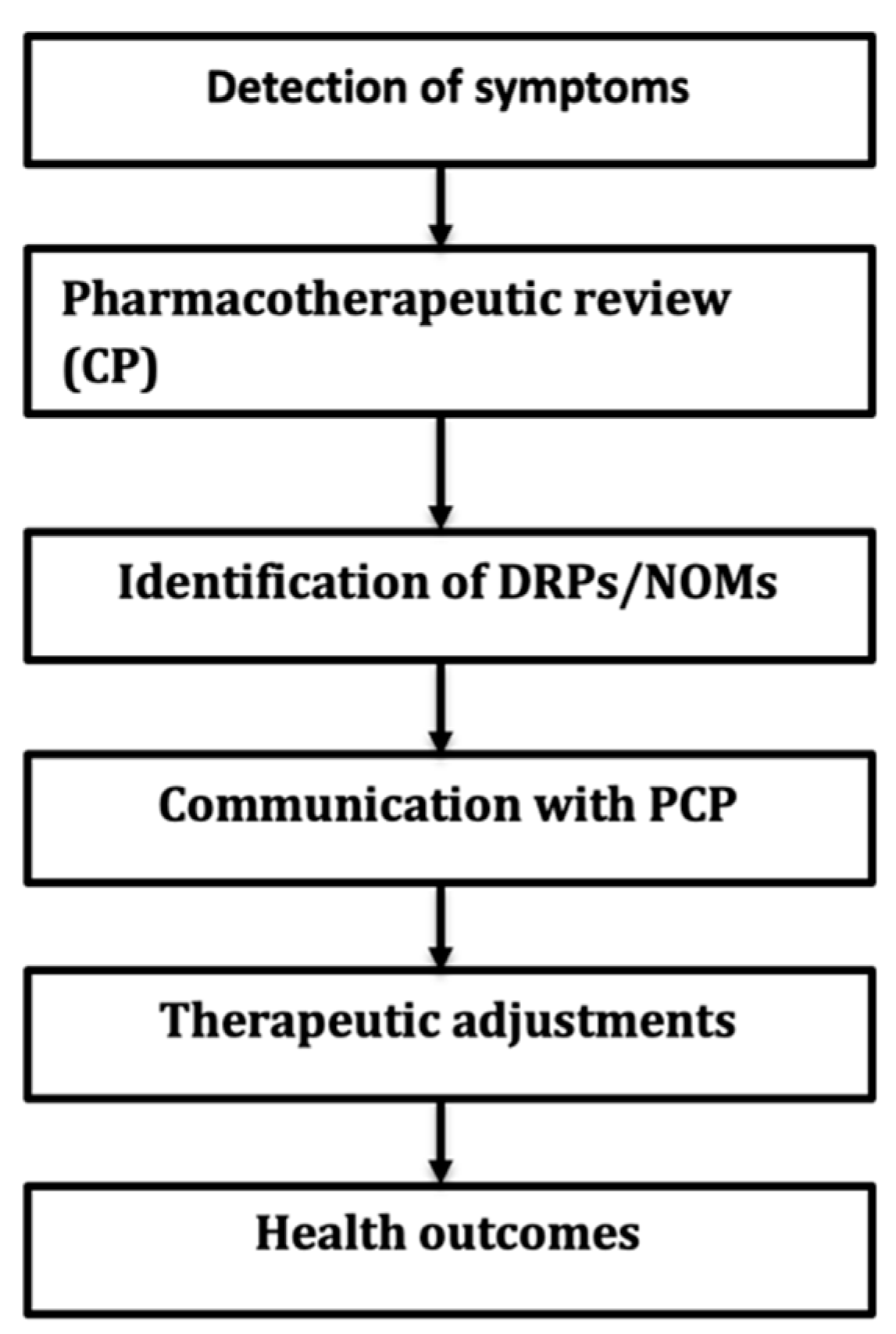
The process of detecting and managing drug-related problems is summarized in
Figure 1.
5. Results
Following coordinated intervention between the pharmaceuticy team and the PCP, several pharmacotherapeutic adjustments were carried out.
Semaglutide: the dose was reduced from 14 mg to 7 mg once daily. In addition, the recommendation to administer the medication under fasting conditions and separated from the omeprazole intake were reinforced in order to standardize administration and improve tolerability. From the community pharmacy, the PDS continued to be provided, ensuring the weekly dispensing of the exact doses in the individualized blister pack. In addition, the withdrawal of leftover medication was supervised, facilitating correct administration, in fasting conditions and with a glass of water. These measures improved gastrointestinal tolerance, with a clear reduction in nausea and abdominal pain. After these measures, the patient reported a decrease in nausea and abdominal pain.
Clonazepam: the dose was adjusted to half a tablet at night. This modification was associated with a progressive improvement in urinary incontinence and a reduction in daytime somnolence. During follow-up, approximately one month later, clonazepam was reintroduced at half-tablet nightly dose, without recurrence of urinary incontinence.
Naproxen: it was definitively discontinued, as it was considered unnecessary in the patient’s current clinical context.
Overall, these interventions were a significant improvement in ADRs while maintaining control of the underlying chronic diseases and promoting a safer, more rational and personalized use of medications. In addition, the patient reported a notable improvement in quality of life, with reduced daytime somnolence, greater autonomy in daily activities and less concern about episodes of urinary incontinence.
6. Discussion
The case presented illustrates the importance of pharmacotherapeutic follow-up in polymedicated patients, particularly in the community pharmacy setting, where frequent contact with the patient and the use of tools such as the PDS facilitate the early detection of ADRs and coordination with other healthcare professionals. These aspects are especially relevant in older adults, in whom pharmacokinetic and pharmacodynamic changes increase susceptibility to adverse reactions [
7], and where optimization of prescribing through structured interventions has been shown to improve safety and quality of care [
8].
In this case, the PDS played a relevant role by allowing a structured and chronological review of pharmacotherapy. The systematic record of weekly dispensing made it possible to accurately identify recent treatment changes and establish the temporal relationship between the introduction of clonazepam and the dose increase of semaglutide with the onset of symptoms. In addition, the PDS made it possible to verify the actual use of medication, detect possible deviations in administration and reinforce therapeutic adherence. The periodic return of the blister pack also allowed verification of adherence levels and review of leftover medication, facilitating confirmation of correct treatment administration and adjustment of usage recommendations.
The adverse reactions described are consistent with those reported in the literature. Clonazepam and other benzodiazepines have been associated with urinary disorders and an increased risk of falls in older populations [
9,
10]. These effects may be related to their mechanism of action, based on the potentiation of GABAergic neurotransmission in the central nervous system, producing sedative effects and potentially altering neurological control of micturition in elderly patients [
2,
11]. In addition, this group of active substances potentiates central nervous system depression when combined with opioids such as tapentadol, which justifies close monitoring and continuous reassessment of therapeutic necessity [
12].
Regarding semaglutide, gastrointestinal adverse reactions such as nausea, abdominal pain and vomiting are the most frequent and have been consistently reported in clinical trials and post-marketing surveillance [
13]. Moreover, recent studies have confirmed that these events are dose-dependent and occur more frequently during the initial treatment phases or after rapid dose escalation [
14]. In this case, dose reduction and optimization of administration improved tolerability, in line with clinical practice recommendations.
Furthermore, in the oral formulation of semaglutide, absorption depends on specific administration conditions. According to the summary of product characteristics, no clinically relevant changes in the AUC or Cmax of semaglutide were observed when it was administered concomitantly with omeprazole. However, in a pharmacokinetic trial in which semaglutide was administered simultaneously with multiple oral tablets, AUC decreased by 34% and Cmax by 32%, suggesting that the simultaneous presence of multiple tablets in the stomach may interfere with its absorption. For this reason, semaglutide is recommended to be administered in fasting conditions and at least 30 min before taking other oral medications. In the present case, reinforcing these recommendations allowed optimization of drug exposure and improvement of gastrointestinal tolerability [
2,
13].
On the other hand, the identification of an unnecessary medication (naproxen) highlights the importance of deprescribing in polymedicated patients, reducing risks associated with the use of non-steroidal anti-inflammatory drugs. This finding is consistent with systematic reviews that emphasize the importance of discontinuing active substances without a current indication in order to improve safety in older adults [
15].
This case reinforces the role of the community pharmacy in active pharmacovigilance, where the pharmacist not only detects and reports suspected ADRs but also coordinates with primary care in implementing corrective measures. In this context, structured pharmaceutical interventions have been shown to improve medication adherence, safe use of medicines and patient quality of life [
16].
As limitations, it should be noted that this is a single clinical case, which prevents extrapolation of the findings to other populations. Furthermore, not all analytical parameters necessary for a complete evaluation were available, such as estimated glomerular filtration rate. Nevertheless, according to the summaries of product characteristics of the medications involved, these do not require specific dose adjustment based on renal function under the clinical conditions described. Additionally, although some recent analytical parameters were available, a complete set of biochemical data was not available at the time of intervention. Finally, the suspected ADR was not reported to the pharmacovigilance system because the reactions were previously described in the summaries of product characteristics of the medications involved and causality was not conclusive.
Despite these limitations, the case provides practical evidence of the relevance of integrating community pharmacy into pharmacovigilance programs and the multidisciplinary management of polypharmacy in older patients.
7. Conclusions
The clinical case described highlights the role of pharmacotherapeutic follow-up in detecting drug-related problems and identifying possible adverse drug reactions in polymedicated patients. The intervention carried out by the community pharmacy enabled identification of DRPs, evaluate the probability of ADR occurrence and coordinate with the primary care physician the necessary adjustments to optimize pharmacotherapy.
The use of a Personalized Dosage System facilitated a structured treatment review, verification of therapeutic adherence and early detection of pharmacotherapy changes associated with the onset of symptoms.
This case illustrates how collaboration between community pharmacy and primary care can contributes to improving the safety and appropriateness of pharmacological treatment in polymedicated older patients.
Author Contributions
Conceptualization, A.P.-V. and S.A.K.; methodology, A.P.-V.; software, A.P.-V.; validation, A.P.-V., S.D.-G. and I.V.F.; formal analysis, A.P.-V.; investigation, A.P.-V. and C.M.M.; resources, S.A.K.; data curation, A.P.-V.; writing—original draft preparation, A.P.-V.; writing—review and editing, S.A.K., S.D.-G., C.M.M. and I.V.F.; visualization, A.P.-V.; supervision, S.A.K.; project administration, S.A.K.; funding acquisition, S.A.K. All authors have read and agreed to the published version of the manuscript.
Funding
This research received no external funding.
Institutional Review Board Statement
The study was conducted in accordance with the Declaration of Helsinki, and approved by the Ethics Committee of Investigación con medicamentos del Complejo Hospitalario Universitario de Canarias (Provincia de Santa Cruz de Tenerife) (protocol code SPD-SFT2122 and date of approval 21 December 2021).
Informed Consent Statement
Informed consent was obtained from all subjects involved in the study.
Data Availability Statement
The study data are not available because the repository designated for their storage had a limited duration, which has now expired. Once this period concluded, in accordance with the established preservation conditions, access to and availability of the information ceased to be in effect.
Conflicts of Interest
The authors declare no conflict of interest.
References
- World Health Organization. Safety of Medicines: A Guide to Detecting and Reporting Adverse Drug Reactions; WHO: Geneva, Switzerland, 2002; Available online: https://www.who.int/publications/i/item/WHO-EDM-QSM-2002-2 (accessed on 31 August 2025).
- Spanish Agency of Medicines and Medical Devices (AEMPS). Information on Suspected Adverse Drug Reactions to Medicines for Human Use. Available online: https://www.aemps.gob.es/medicamentos-de-uso-humano/farmacovigilancia-de-medicamentos-de-uso-humano/informacion-de-sospechas-de-reacciones-adversas-a-medicamentos-de-uso-humano/informacion/ (accessed on 30 August 2025).
- Pharmaceutical Care Forum–Community Pharmacy (AF-FC), Expert Panel. Practical Guide for Professional Pharmaceutical Care Services in Community Pharmacy; General Council of Official Colleges of Pharmacists: Madrid, Spain, 2024; ISBN 978-84-09-57269-4. [Google Scholar]
- General Council of Official Colleges of Pharmacists. BOT PLUS. Madrid, Spain, 2025. Available online: https://botplusweb.farmaceuticos.com/ (accessed on 30 August 2025).
- Brown, J.S.; Vittinghoff, E.; Wyman, J.F.; Stone, K.L.; Nevitt, M.C.; Ensrud, K.E. Urinary incontinence and risk of falls and fractures in older women. J. Am. Geriatr. Soc. 2000, 48, 721–725. [Google Scholar] [CrossRef] [PubMed]
- Naranjo, C.A.; Busto, U.; Sellers, E.M.; Sandor, P.; Ruiz, I.; Roberts, E.A.; Janecek, E.; Domecq, C.; Greenblatt, D.J. A method for estimating the probability of adverse drug reactions. Clin. Pharmacol. Ther. 1981, 30, 239–245. [Google Scholar] [CrossRef] [PubMed]
- Gronich, N. Central Nervous System Medications: Pharmacokinetic and Pharmacodynamic Considerations for Older Adults. Drugs Aging 2024, 6, 507–519. [Google Scholar] [CrossRef] [PubMed]
- Persaud, N.; Sabir, A.; Woods, H.; Sayani, A.; Agarwal, A.; Chowdhury, M.; de Leon-Demare, K.; Ibezi, S.; Hameed Jan, S.; Katz, A.; et al. Interventions to address potentially inappropriate prescribing for older primary care patients: A systematic review and meta-analysis. JAMA Netw. Open 2025, 8, e2517965. [Google Scholar] [CrossRef] [PubMed]
- StatPearls. Clonazepam; StatPearls Publishing: Treasure Island, FL, USA, 2023. Available online: https://www.ncbi.nlm.nih.gov/books/NBK556010/ (accessed on 22 September 2025).
- Nishii, H.; Kitta, T.; Chancellor, M.B.; Yoshimura, N. A review of aging and the lower urinary tract: The future of urology. Int. Neurourol. J. 2021, 25, 191–200. [Google Scholar] [CrossRef] [PubMed]
- Sun, E.C.; Dixit, A.; Humphreys, K.; Darnall, B.D.; Baker, L.C.; Mackey, S. Association between concurrent use of prescription opioids and benzodiazepines and overdose: Retrospective analysis. BMJ 2017, 356, j760. [Google Scholar] [CrossRef] [PubMed]
- Buckley, S.T.; Bækdal, T.A.; Vegge, A.; Maarbjerg, S.J.; Pyke, C.; Ahnfelt-Rønne, J.; Nielsen, L.K.; Jensen, T.B.; Hansen, C.L.; Madsen, K.; et al. Transcellular stomach absorption of a derivatized glucagon-like peptide-1 receptor agonist. Sci. Transl. Med. 2018, 10, eaar7047. [Google Scholar] [CrossRef] [PubMed]
- Wilding, J.P.H.; Batterham, R.L.; Calanna, S.; Davies, M.; Van Gaal, L.F.; Lingvay, I.; McGowan, B.M.; Rosenstock, J.; Tran, M.T.D.; Wadden, T.A.; et al. Once-weekly semaglutide in adults with overweight or obesity. N. Engl. J. Med. 2021, 384, 989–1002. [Google Scholar] [CrossRef] [PubMed]
- Wharton, S.; Calanna, S.; Davies, M.; Dicker, D.; Goldman, B.; Lingvay, I.; Mosenzon, O.; Rubino, D.M.; Thomsen, M.; Wadden, T.A.; et al. Gastrointestinal tolerability of once-weekly semaglutide: Pooled analysis of the STEP 1–3 trials. Diabetes Obes. Metab. 2022, 24, 94–105. [Google Scholar] [CrossRef] [PubMed]
- Lanas, A.; Chan, F.K.L. Peptic ulcer disease. Lancet 2017, 390, 613–624. [Google Scholar] [CrossRef] [PubMed]
- Aizpurua-Arruti, X.; Martínez-Irujo, J.J.; Lekuona, L.; Mendizabal, A.; Aguirre, C.; Salvador, J. Outcomes of community pharmacy interventions on safety, adherence, use & knowledge and quality of life: A prospective study. Healthcare 2024, 12, 315. [Google Scholar]
| Disclaimer/Publisher’s Note: The statements, opinions and data contained in all publications are solely those of the individual author(s) and contributor(s) and not of MDPI and/or the editor(s). MDPI and/or the editor(s) disclaim responsibility for any injury to people or property resulting from any ideas, methods, instructions or products referred to in the content. |
© 2026 by the authors. Published by MDPI on behalf of the Österreichische Pharmazeutische Gesellschaft. Licensee MDPI, Basel, Switzerland. This article is an open access article distributed under the terms and conditions of the Creative Commons Attribution (CC BY) license.




 ,
,