
Impact of Equation Choice on Models Assessing the Association Between Lipoprotein(a) and Estimated Glomerular Filtration Rate in Adult Patients Without Chronic Kidney Disease

Abstract
1. Introduction
2. Materials and Methods
2.1. Subjects
2.2. Methods
2.3. Statistical Analysis
3. Results
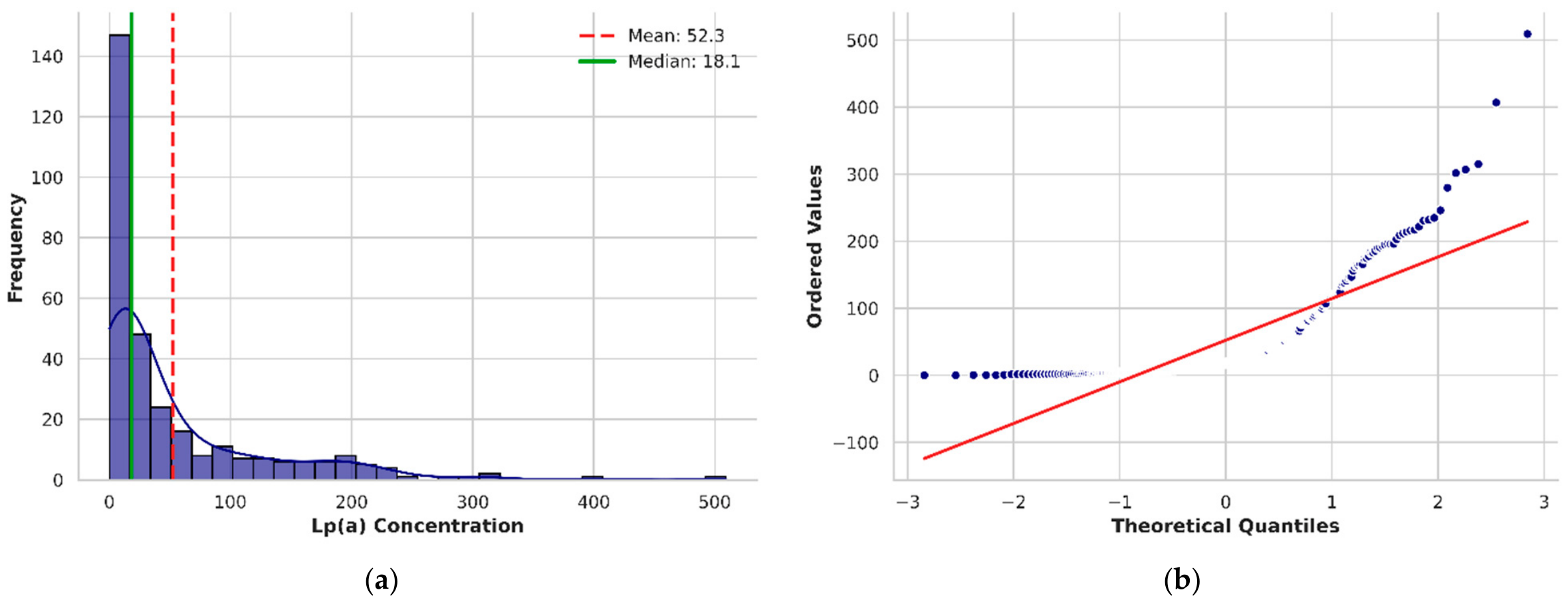
3.1. Results of the Normality Tests for the Independent Variable Lp(a)
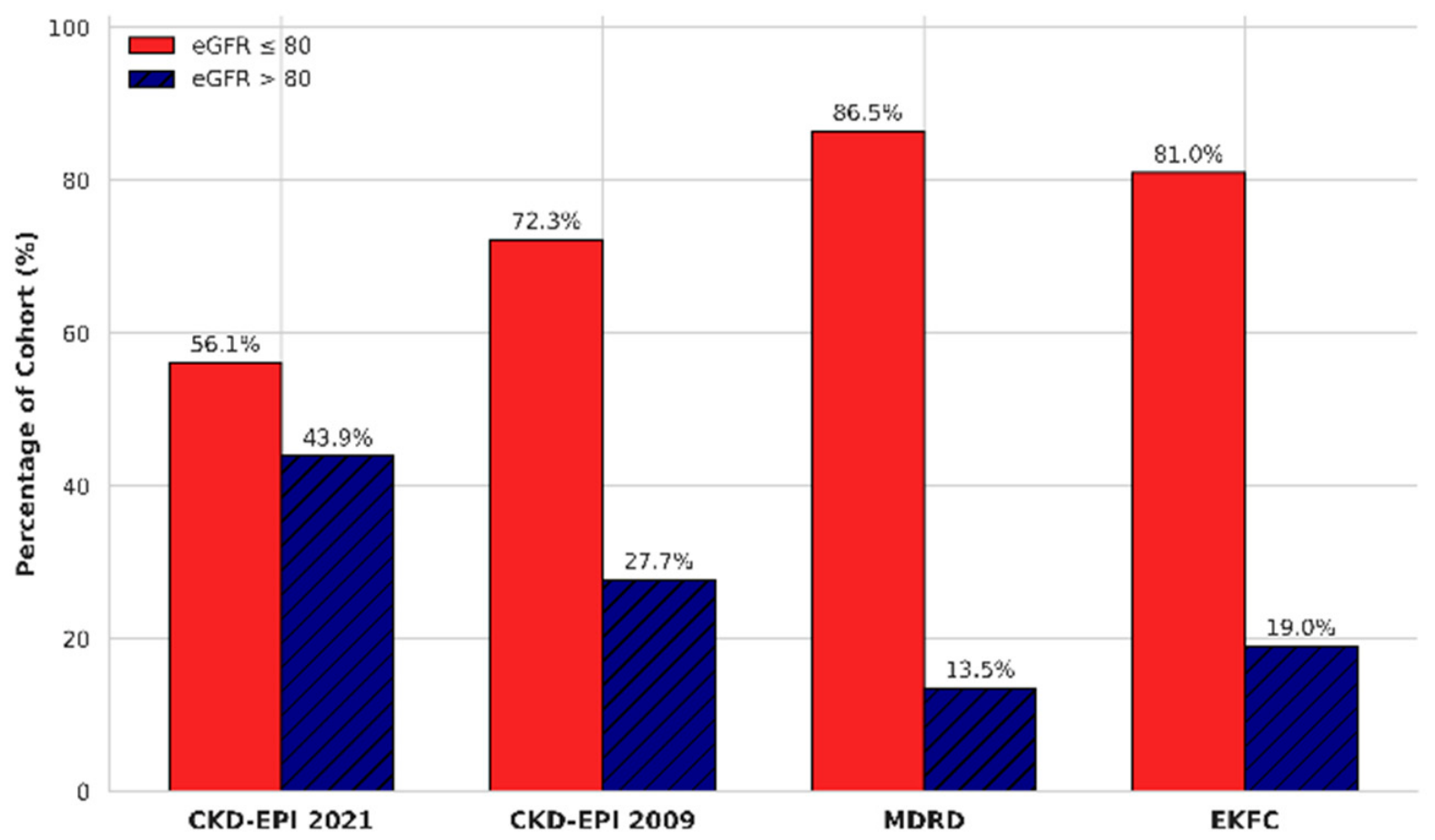
3.2. Definition of Target and Control Groups and Cohort Distribution According to eGFR Equations
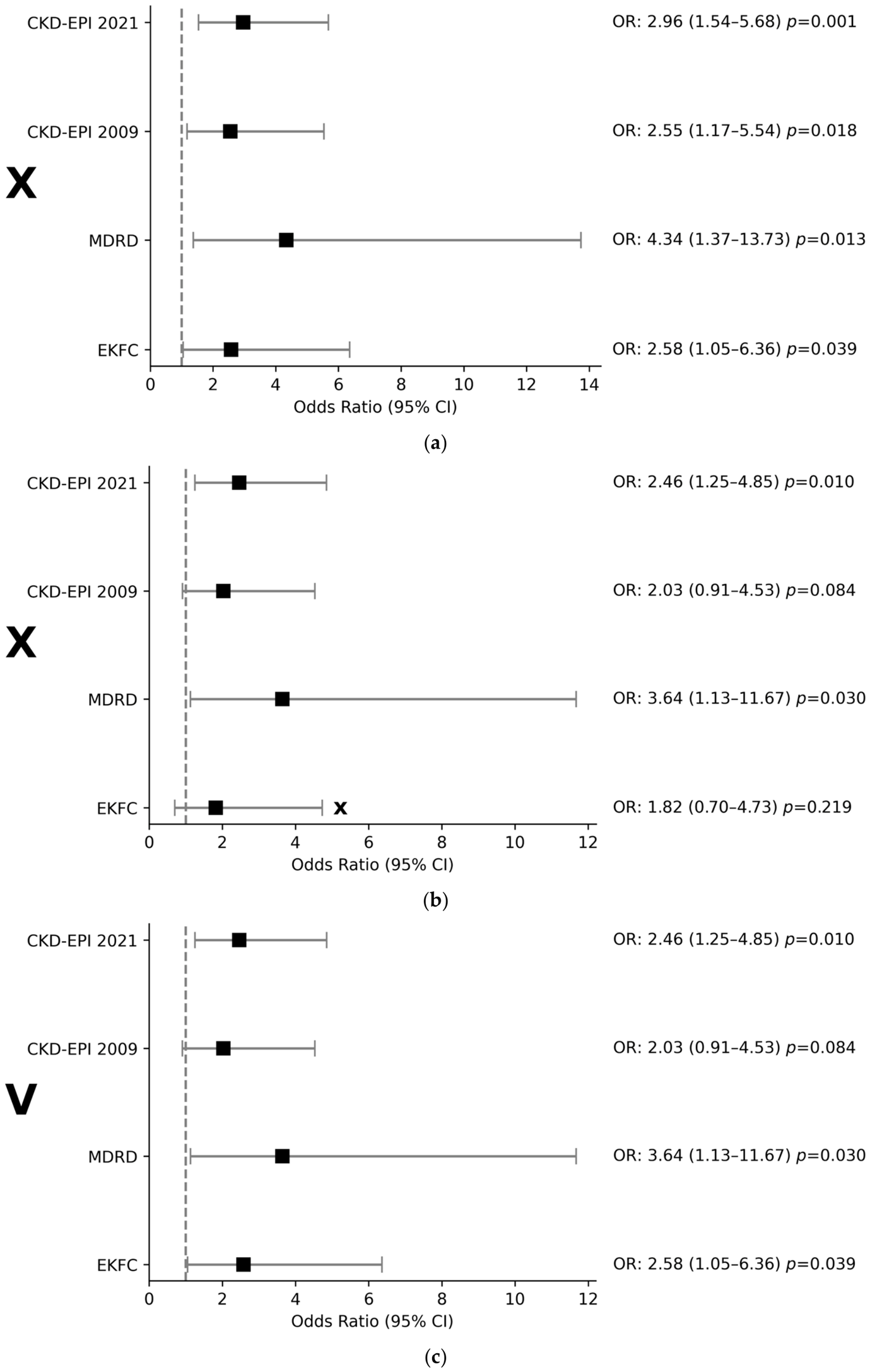
3.3. Initial Non-Parametric Evaluation and Multivariable Logistic Regression Without Adjustment for Age and Sex
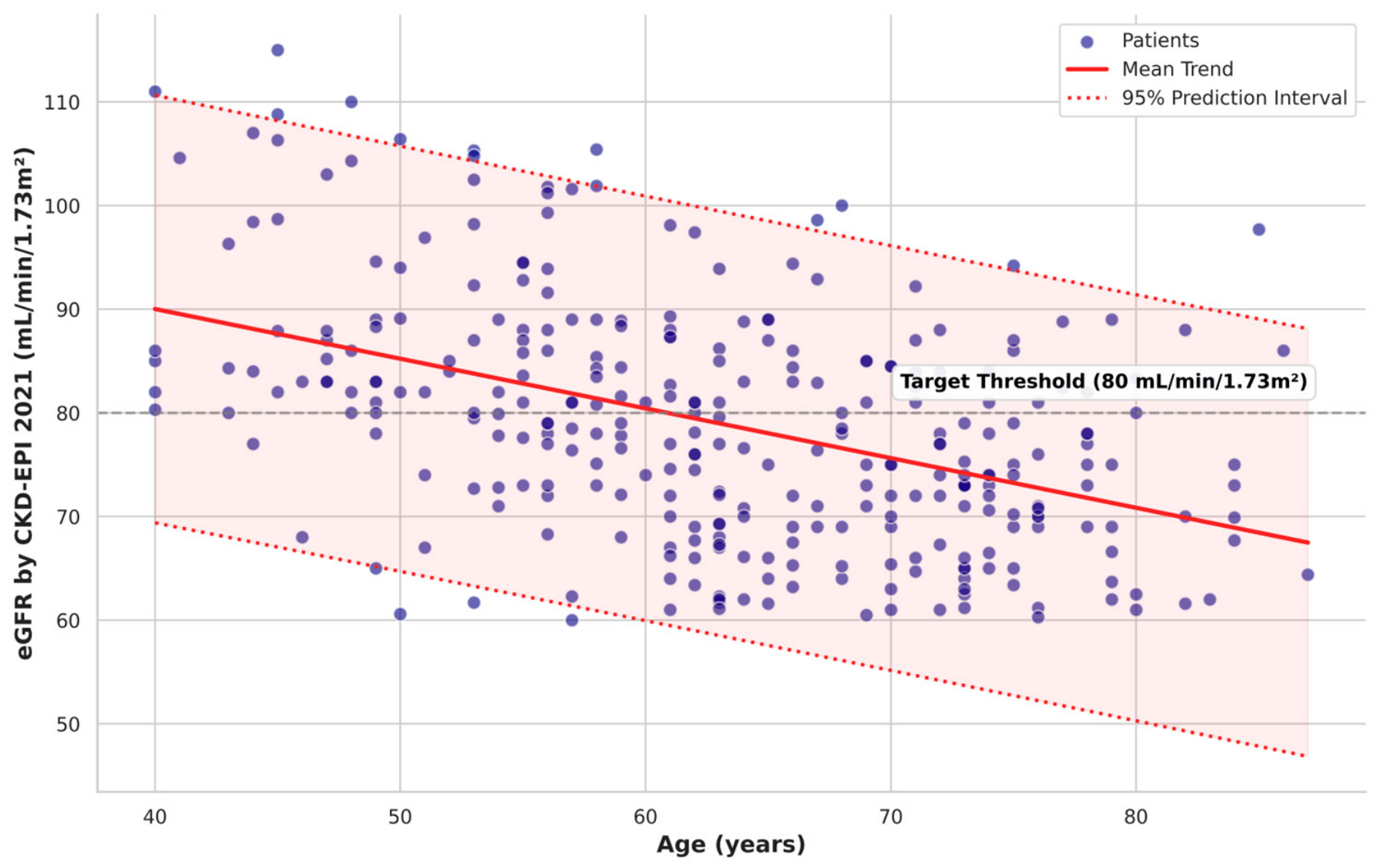
3.4. Cohort Age Distribution According to CKD-EPI 2021-Estimated eGFR
3.5. Results of Multivariable Logistic Regression Analysis Adjusted for Age and Sex
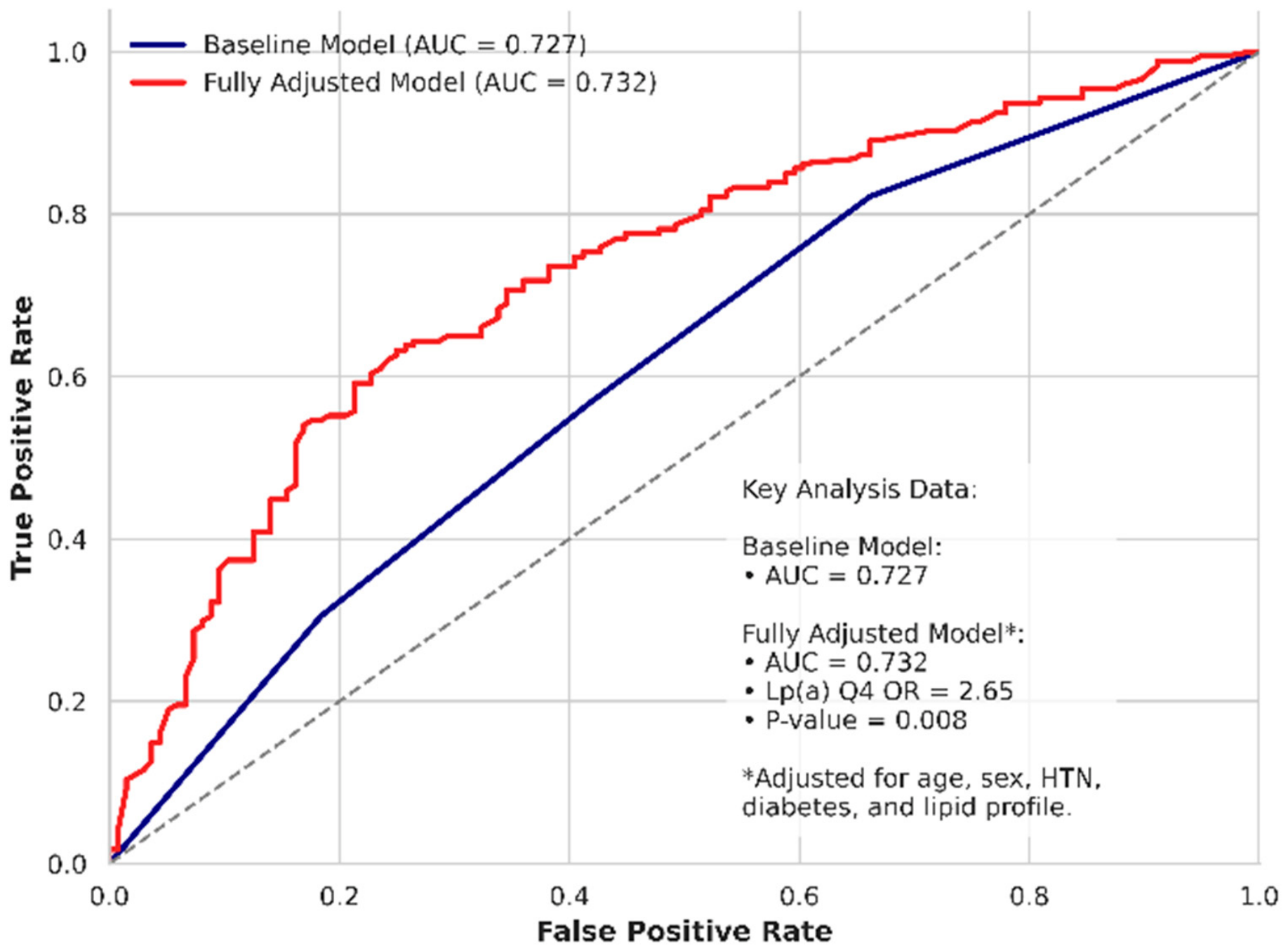
3.6. Assessment of Additional Clinical Confounding Factors
4. Discussion
5. Conclusions
- CKD-EPI 2009 does not fully isolate age as a confounding factor. This limitation must be taken into consideration in comparative analyses and meta-analyses that include studies conducted before the new CKD-EPI 2021 equation was established.
- The mathematical instability of CKD-MDRD in our case is due to the “depletion” of the control group resulting from the artificial redistribution of participants. We did not consider the lack of sufficient data for a robust statistical analysis to be a major limitation, as this equation is rarely used in routine clinical practice.
- EKFC is in the process of validation. When constructing assessment models seeking new biomarkers causing renal injury, it must be used without applying statistical adjustment for age and sex (as these demographic parameters are inherently embedded in the equation itself). This must also be taken into consideration when making comparisons with studies in which CKD-EPI 2021 is used for the assessment of renal function (where accounting for age as a confounding factor is mandatory) (Figure 3c).
Author Contributions
Funding
Institutional Review Board Statement
Informed Consent Statement
Data Availability Statement
Conflicts of Interest
Abbreviations
| AUC | Area Under the Curve |
| BMI | Body Mass Index |
| CI | Confidence Interval |
| CKD | Chronic kidney disease |
| CKD-EPI | Chronic Kidney Disease Epidemiology Collaboration |
| CMH | Cochran–Mantel–Haenszel |
| eGFR | estimated Glomerular Filtration Rate |
| EKFC | European Kidney Function Consortium |
| FAS | Full Age Spectrum |
| HDL | High-Density Lipoprotein |
| IDMS | Isotope Dilution Mass Spectrometry |
| IFCC | International Federation of Clinical Chemistry and Laboratory Medicine |
| LDL | Low-Density Lipoprotein |
| Lp(a) | Lipoprotein(a) |
| MDRD | Modification of Diet in Renal Disease |
| OR | Odds Ratio |
| Q | Quartile |
| REF | Reference category |
| ROC | Receiver Operating Characteristic |
| TC | Total Cholesterol |
| TG | Triglycerides |
References
- Lu, S.; Robyak, K.; Zhu, Y. The CKD-EPI 2021 Equation and Other Creatinine-Based Race-Independent eGFR Equations in Chronic Kidney Disease Diagnosis and Staging. J. Appl. Lab. Med. 2023, 8, 952–961. [Google Scholar] [CrossRef] [Scilit] [PubMed]
- Meeusen, J.W.; Kasozi, R.N.; Larson, T.S.; Lieske, J.C. Clinical Impact of the Refit CKD-EPI 2021 Creatinine-Based eGFR Equation. Clin. Chem. 2022, 68, 534–539. [Google Scholar] [CrossRef] [Scilit] [PubMed]
- Lee, K.S.; Jang, J.; Jang, H.; Kang, H.; Rim, J.H.; Lim, J.-B. Better Prediction of Clinical Outcome with Estimated Glomerular Filtration Rate by CKD-EPI 2021. J. Appl. Lab. Med. 2025, 10, 274–285. [Google Scholar] [CrossRef] [Scilit] [PubMed]
- Scandrett, K.; Sitch, A.J.; Barratt, J.; Brettell, E.A.; Cockwell, P.; Dalton, R.N.; Deeks, J.J.; Eaglestone, G.; Kalra, P.A.; Khunti, K.; et al. Accuracy of Glomerular Filtration Rate Estimation Based on Creatinine and Cystatin C for Monitoring Moderate Chronic Kidney Disease in Adults: Prospective, Longitudinal Cohort Study. BMJ 2026, 392, e085005. [Google Scholar] [CrossRef] [Scilit] [PubMed]
- Kronenberg, F.; Mora, S.; Stroes, E.S.G.; Ference, B.A.; Arsenault, B.J.; Berglund, L.; Dweck, M.R.; Koschinsky, M.; Lambert, G.; Mach, F.; et al. Lipoprotein(a) in Atherosclerotic Cardiovascular Disease and Aortic Stenosis: A European Atherosclerosis Society Consensus Statement. Eur. Heart J. 2022, 43, 3925–3946. [Google Scholar] [CrossRef] [Scilit] [PubMed]
- Pasławska, A.; Tomasik, P.J. Lipoprotein(a)—60 Years Later—What Do We Know? Cells 2023, 12, 2472. [Google Scholar] [CrossRef] [Scilit] [PubMed]
- Kronenberg, F.; Utermann, G.; Dieplinger, H. Lipoprotein(a) in renal disease. Am. J. Kidney Dis. 1996, 27, 1–25. [Google Scholar] [CrossRef] [Scilit] [PubMed]
- Hopewell, J.C.; Haynes, R.; Baigent, C. The Role of Lipoprotein (a) in chronic kidney disease. J. Lipid Res. 2018, 59, 577–585. [Google Scholar] [CrossRef] [Scilit] [PubMed]
- Mondorf, U.F.; Piiper, A.; Herrero, M.; Olbrich, H.-G.; Bender, M.; Gross, W.; Scheuermann, E.; Geiger, H. Lipoprotein(a) Stimulates Growth of Human Mesangial Cells and Induces Activation of Phospholipase C via Pertussis Toxin-Sensitive G Proteins. Kidney Int. 1999, 55, 1359–1366. [Google Scholar] [CrossRef] [Scilit] [PubMed]
- Magkrioti, C.; Antonopoulou, G.; Fanidis, D.; Pliaka, V.; Sakellaropoulos, T.; Alexopoulos, L.G.; Ullmer, C.; Aidinis, V. Lysophosphatidic Acid Is a Proinflammatory Stimulus of Renal Tubular Epithelial Cells. Int. J. Mol. Sci. 2022, 23, 7452. [Google Scholar] [CrossRef] [Scilit] [PubMed]
- Eknoyan, G.; Levin, N.W. Foreword. Am. J. Kidney Dis. 2002, 39, S14–S16. [Google Scholar] [CrossRef] [Scilit]
- Greg Miller, W.; Myers, G.L.; Ashwood, E.R.; Killeen, A.A.; Wang, E.; Thienpont, L.M.; Siekmann, L. Creatinine Measurement: State of the Art in Accuracy and Interlaboratory Harmonization. Arch. Pathol. Lab. Med. 2005, 129, 297–304. [Google Scholar] [CrossRef] [Scilit] [PubMed]
- Inker, L.A.; Eneanya, N.D.; Coresh, J.; Tighiouart, H.; Wang, D.; Sang, Y.; Crews, D.C.; Doria, A.; Estrella, M.M.; Froissart, M.; et al. New Creatinine- and Cystatin C-Based Equations to Estimate GFR without Race. N. Engl. J. Med. 2021, 385, 1737–1749. [Google Scholar] [CrossRef] [Scilit] [PubMed]
- Myers, G.L. Recommendations for Improving Serum Creatinine Measurement: A Report from the Laboratory Working Group of the National Kidney Disease Education Program. Clin. Chem. 2006, 52, 5–18. [Google Scholar] [CrossRef] [PubMed]
- Marcovina, S.M.; Koschinsky, M.L.; Albers, J.J.; Skarlatos, S. Report of the National Heart, Lung, and Blood Institute Workshop on Lipoprotein(a) and cardiovascular disease: Recent Advances and Future Directions. Clin. Chem. 2003, 49, 1785–1796. [Google Scholar] [CrossRef] [Scilit] [PubMed]
- Marcovina, S.M.; Albers, J.J. Lipoprotein (a) Measurements for Clinical Application. J. Lipid Res. 2016, 57, 526–537. [Google Scholar] [CrossRef] [Scilit] [PubMed]
- Levey, A.S.; Stevens, L.A.; Schmid, C.H.; Zhang, Y.; Castro, A.F.; Feldman, H.I.; Kusek, J.W.; Eggers, P.; Van Lente, F.; Greene, T.; et al. A New Equation to Estimate Glomerular Filtration Rate. Ann. Intern. Med. 2009, 150, 604–612. [Google Scholar] [CrossRef] [Scilit] [PubMed]
- Levey, A.S.; Coresh, J.; Greene, T.; Stevens, L.A.; Zhang, Y.; Hendriksen, S.; Kusek, J.W.; Van Lente, F. Using Standardized Serum Creatinine Values in the Modification of Diet in Renal Disease Study Equation for Estimating Glomerular Filtration Rate. Ann. Intern. Med. 2006, 145, 247–254. [Google Scholar] [CrossRef] [Scilit] [PubMed]
- Pottel, H.; Björk, J.; Courbebaisse, M.; Couzi, L.; Ebert, N.; Eriksen, B.O.; Dalton, R.N.; Dubourg, L.; Gaillard, F.; Garrouste, C.; et al. Development and Validation of a Modified Full Age Spectrum Creatinine-Based Equation to Estimate Glomerular Filtration Rate: A Cross-Sectional Analysis of Pooled Data. Ann. Intern. Med. 2021, 174, 183–191. [Google Scholar] [CrossRef] [Scilit] [PubMed]
- Mantel, N.; Haenszel, W. Statistical Aspects of the Analysis of Data from Retrospective Studies of Disease. J. Natl. Cancer Inst. 1959, 22, 719–748. [Google Scholar] [CrossRef] [Scilit]
- McKinney, W. Data Structures for Statistical Computing in Python. SciPy 2010, 445, 56–61. [Google Scholar] [CrossRef] [Scilit]
- Virtanen, P.; Gommers, R.; Oliphant, T.E.; Haberland, M.; Reddy, T.; Cournapeau, D.; Burovski, E.; Peterson, P.; Weckesser, W.; Bright, J.; et al. SciPy 1.0–Fundamental Algorithms for Scientific Computing in Python. Nat. Methods 2020, 17, 261–272. [Google Scholar] [CrossRef] [Scilit] [PubMed]
- Seabold, S.; Perktold, J. Statsmodels: Econometric and Statistical Modeling with Python. In Proceedings of the 9th Python in Science Conference, Austin, TX, USA, 28 June–3 July 2010. [Google Scholar]
- Hunter, J.D. Matplotlib: A 2D Graphics Environment. Comput. Sci. Eng. 2007, 9, 90–95. [Google Scholar] [CrossRef] [Scilit]
- Mach, F.; Koskinas, K.C.; Roeters Van Lennep, J.E.; Tokgözoğlu, L.; Badimon, L.; Baigent, C.; Benn, M.; Binder, C.J.; Catapano, A.L.; De Backer, G.G.; et al. 2025 Focused Update of the 2019 ESC/EAS Guidelines for the Management of Dyslipidaemias. Eur. Heart J. 2025, 46, 4359–4378. [Google Scholar] [CrossRef] [Scilit] [PubMed]
- Xuan, L.; Wang, T.; Dai, H.; Wang, B.; Xiang, J.; Wang, S.; Lin, H.; Li, M.; Zhao, Z.; Lu, J.; et al. Serum Lipoprotein (a) Associates with a Higher Risk of Reduced Renal Function: A Prospective Investigation. J. Lipid Res. 2020, 61, 1320–1327. [Google Scholar] [CrossRef] [Scilit] [PubMed]
- Zhang, H.; Chen, R.; Xiang, S.; Gao, P.; Zhu, J.; Wang, L.; Jiang, X.; Hua, F.; Huang, X. Association between Serum Lipoprotein(a) and Mildly Reduced eGFR: A Cross-Sectional Study. BMC Nephrol. 2023, 24, 364. [Google Scholar] [CrossRef] [Scilit] [PubMed]
- Xie, Y.; Qi, H.; Li, B.; Wen, F.; Zhang, F.; Guo, C.; Zhang, L. Serum Lipoprotein (a) Associates with the Risk of Renal Function Damage in the CHCN-BTH Study: Cross-Sectional and Mendelian Randomization Analyses. Front. Endocrinol. 2022, 13, 1023919. [Google Scholar] [CrossRef] [Scilit] [PubMed]
- Liu, Y.; Wang, R.; Li, S.; Zhang, C.; Lip, G.Y.H.; Thabane, L.; Li, G. Relationship Between Lipoprotein(a), Renal Function Indicators, and chronic kidney disease: Evidence from a Large Prospective Cohort Study. JMIR Public Health Surveill. 2024, 10, e50415. [Google Scholar] [CrossRef] [Scilit] [PubMed]
- Fox, C.S. Predictors of New-Onset Kidney Disease in a Community-Based Population. JAMA 2004, 291, 844. [Google Scholar] [CrossRef] [Scilit] [PubMed]
- Ataklte, F.; Song, R.J.; Upadhyay, A.; Musa Yola, I.; Vasan, R.S.; Xanthakis, V. Association of Mildly Reduced Kidney Function with Cardiovascular Disease: The Framingham Heart Study. JAHA 2021, 10, e020301. [Google Scholar] [CrossRef] [Scilit] [PubMed]
- Russel, W.A.; Fu, E.L.; Creon, A.; Faucon, A.-L.; Caldinelli, A.; Bouwmans, P.; Inker, L.A.; Delanaye, P.; Pottel, H.; Ortiz, A.; et al. Changing from the CKD-EPI to the EKFC Creatinine Equation to Estimate Glomerular Filtration Rate in Adults in a Northern European Health System. Nephrol. Dial. Transplant. 2026, 41, 275–285. [Google Scholar] [CrossRef] [Scilit] [PubMed]



| eGFR Comparison Groups | Lp(a) Quartiles (ORs vs. Q1) | CMH Test | Woolf Test | |||
|---|---|---|---|---|---|---|
| (mL/min/1.73 m2) | Q2 | Q3 | Q4 | Overall OR (95% CI) | p-Value | p-Value |
| 80–90 vs. >90 | 0.963 | 0.673 | 1.750 | 0.984 (0.553–1.752) | 0.927 | 0.456 |
| 60–80 vs. >90 | 2.077 | 1.529 | 4.787 | 2.301 (1.333–3.971) | 0.003 | 0.282 |
| 60–80 vs. 80–90 | 2.159 | 2.271 | 2.735 | 2.376 (1.572–3.589) | <0.001 | 0.889 |
| CKD-EPI 2021 | CKD-EPI 2009 | CKD-MDRD | CKD-EKFC | |||||
|---|---|---|---|---|---|---|---|---|
| OR 95% CI | p-Value | OR 95% CI | p-Value | OR 95% CI | p-Value | OR 95% CI | p-Value | |
| Q1 | REF | - | REF | - | REF | - | REF | - |
| Q2 | 1.92 (1.01–3.63) | 0.046 | 1.14 (0.57–2.26) | 0.715 | 1.74 (0.71–4.27) | 0.223 | 1.31 (0.6–2.86) | 0.503 |
| Q3 | 1.86 (0.98–3.51) | 0.056 | 0.86 (0.44–1.67) | 0.651 | 1.05 (0.47–2.36) | 0.897 | 0.90 (0.43–1.88) | 0.781 |
| Q4 | 2.96 (1.54–5.68) | <0.001 | 2.55 (1.17–5.54) | 0.018 | 4.34 (1.37–13.73) | 0.013 | 2.58 (1.05–6.36) | 0.039 |
| Quartiles | CKD-EPI 2021 | CKD-EPI 2009 | CKD-MDRD | CKD-EKFC | ||||
|---|---|---|---|---|---|---|---|---|
| OR 95% CI | p-Value | OR 95% CI | p-Value | OR 95% CI | p-Value | OR 95% CI | p-Value | |
| Q1 | REF | - | REF | - | REF | - | REF | - |
| Age (>63) | 3.21 (1.98–5.21) | <0.001 | 3.77 (2.13–6.67) | <0.001 | 2.62 (1.25–5.51) | 0.010 | 13.79 (5.28–36.04) | 0.001 |
| Sex (men) | 0.67 (0.41–1.08) | 0.100 | 0.73 (0.43–1.24) | 0.246 | 0.53 (0.27–1.05) | 0.068 | 0.67 (0.36–1.26) | 0.215 |
| Q2 | 1.77 (0.91–3.45) | 0.094 | 0.99 (0.49–2.04) | 0.988 | 1.52 (0.61–3.80) | 0.368 | 1.08 (0.46–2.51) | 0.858 |
| Q3 | 1.54 (0.79–3.00) | 0.206 | 0.65 (0.32–1.33) | 0.242 | 0.82 (0.35–1.91) | 0.649 | 0.58 (0.25–1.33) | 0.193 |
| Q4 | 2.41 (1.22–4.78) | 0.012 | 1.98 (0.88–4.45) | 0.096 | 3.49 (1.08–11.27) | 0.037 | 1.76 (0.67–4.59) | 0.249 |
| Quartiles | CKD-EPI 2021 | CKD-EPI 2009 | CKD-MDRD | CKD-EKFC | ||||
|---|---|---|---|---|---|---|---|---|
| OR 95% CI | p-Value | OR 95% CI | p-Value | OR 95% CI | p-Value | OR 95% CI | p-Value | |
| Q1 | REF | - | REF | - | REF | - | REF | - |
| Age | 3.21 (1.98–5.21) | <0.001 | 3.77 (2.13–6.67) | <0.001 | 2.62 (1.25–5.51) | 0.010 | 13.79 (5.28–36.04) | 0.001 |
| Sex | 0.67 (0.41–1.08) | 0.100 | 0.73 (0.43–1.24) | 0.246 | 0.53 (0.27–1.05) | 0.068 | 0.67 (0.36–1.26) | 0.215 |
| Hypertension | 2.43 (1.34–4.08) | 0.003 | 2.53 (1.38–4.64) | 0.003 | 2.08 (0.95–4.57) | 0.068 | 3.93 (1.85–8.35) | <0.001 |
| Diabetes | 0.87 (0.49–1.55) | 0.640 | 0.58 (0.30–1.11) | 0.098 | 0.51 (0.23–1.15) | 0.104 | 0.41 (0.18–0.93) | 0.033 |
| TC | 1.18 (0.59–2.37) | 0.640 | 1.40 (0.65–3.0) | 0.389 | 1.68 (0.62–4.51) | 0.306 | 1.70 (0.68–4.23) | 0.254 |
| LDL | 0.90 (0.404–1.84) | 0.777 | 1.10 (0.50–2.42) | 0.819 | 0.92 (0.33–2.56) | 0.880 | 1.01 (0.39–2.63) | 0.984 |
| HDL | 1.10 (0.58–2.06) | 0.776 | 1.11 (0.54–2.25) | 0.779 | 0.84 (0.32–2.22) | 0.720 | 0.76 (0.31–1.85) | 0.550 |
| TG | 0.72 (0.41–1.28) | 0.265 | 0.51 (0.26–0.98) | 0.043 | 0.32 (0.13–0.83) | 0.018 | 0.52 (0.23–1.16) | 0.111 |
| Q2 | 1.97 (0.98- 3.97) | 0.057 | 1.10 (0.52–2.34) | 0.806 | 1.86 (0.71–4.86) | 0.207 | 1.16 (0.47–2.87) | 0.750 |
| Q3 | 1.72 (0.85- 3.45) | 0.129 | 0.73 (0.35–1.53) | 0.402 | 0.97 (0.41–2.34) | 0.954 | 0.61 (0.25–1.48) | 0.275 |
| Q4 | 2.65 (1.29–5.43) | 0.008 | 2.14 (0.92–4.97) | 0.078 | 3.79 (1.13–12.69) | 0.031 | 1.74 (0.63–4.83) | 0.289 |
Disclaimer/Publisher’s Note: The statements, opinions and data contained in all publications are solely those of the individual author(s) and contributor(s) and not of MDPI and/or the editor(s). MDPI and/or the editor(s) disclaim responsibility for any injury to people or property resulting from any ideas, methods, instructions or products referred to in the content. |
© 2026 by the authors. Licensee MDPI, Basel, Switzerland. This article is an open access article distributed under the terms and conditions of the Creative Commons Attribution (CC BY) license.
Share and Cite
Gencheva-Angelova, I.; Nuneva-Doncheva, R. Impact of Equation Choice on Models Assessing the Association Between Lipoprotein(a) and Estimated Glomerular Filtration Rate in Adult Patients Without Chronic Kidney Disease. Diseases 2026, 14, 277. https://doi.org/10.3390/diseases14080277
Gencheva-Angelova I, Nuneva-Doncheva R. Impact of Equation Choice on Models Assessing the Association Between Lipoprotein(a) and Estimated Glomerular Filtration Rate in Adult Patients Without Chronic Kidney Disease. Diseases. 2026; 14(8):277. https://doi.org/10.3390/diseases14080277
Chicago/Turabian StyleGencheva-Angelova, Irena, and Radka Nuneva-Doncheva. 2026. "Impact of Equation Choice on Models Assessing the Association Between Lipoprotein(a) and Estimated Glomerular Filtration Rate in Adult Patients Without Chronic Kidney Disease" Diseases 14, no. 8: 277. https://doi.org/10.3390/diseases14080277
APA StyleGencheva-Angelova, I., & Nuneva-Doncheva, R. (2026). Impact of Equation Choice on Models Assessing the Association Between Lipoprotein(a) and Estimated Glomerular Filtration Rate in Adult Patients Without Chronic Kidney Disease. Diseases, 14(8), 277. https://doi.org/10.3390/diseases14080277