
Emerging and Newly Approved Therapies for Antihistamine-Refractory Chronic Spontaneous Urticaria: A Narrative Review

 , ,
, ,
Abstract
1. Introduction
1.1. Literature Search and Selection
1.2. Use of Non–Peer-Reviewed Sources
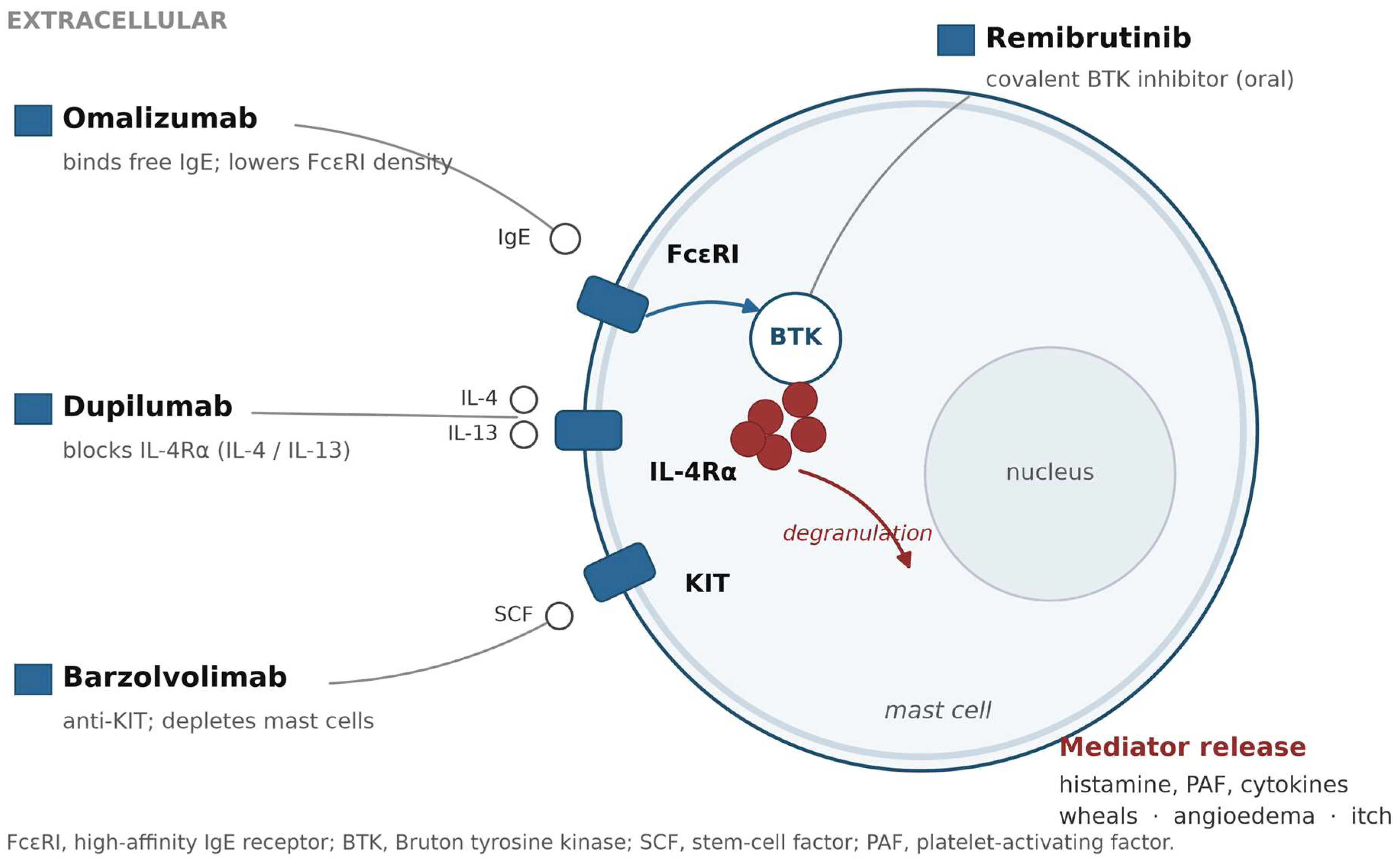
2. Disease Mechanism in Brief
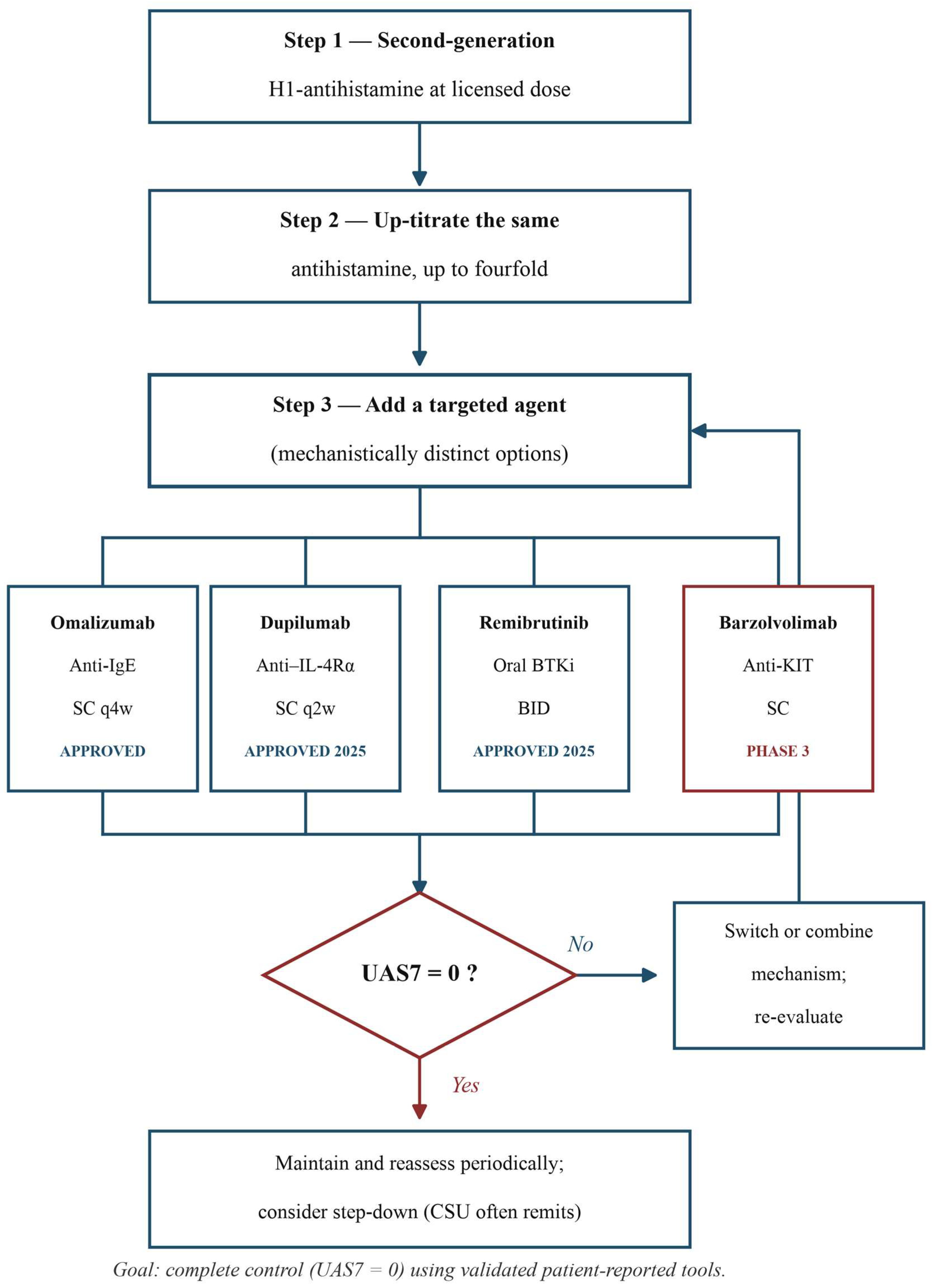
3. Guideline-Based Management
4. Anti-IgE Therapy: Omalizumab
5. A New Biologic: Dupilumab
6. Oral BTK Inhibition: Remibrutinib
7. Mast Cell-Directed Therapy: Barzolvolimab
8. Comparative Positioning and Sequencing
8.1. Cost, Access, and Real-World Implementation
8.2. Special Populations
9. Future Directions
10. Conclusions
Author Contributions
Funding
Institutional Review Board Statement
Informed Consent Statement
Data Availability Statement
Acknowledgments
Conflicts of Interest
Abbreviations
| BTK | Bruton tyrosine kinase |
| CSU | Chronic spontaneous urticaria |
| EAACI | European Academy of Allergy and Clinical Immunology |
| FcεRI | High-affinity IgE receptor |
| IgE | Immunoglobulin E |
| IgG | Immunoglobulin G |
| IL | Interleukin |
| KIT | Stem cell factor receptor |
| PAF | Platelet-activating factor |
| SC | Subcutaneous |
| SCF | Stem cell factor |
| UAS7 | Weekly Urticaria Activity Score |
References
- Zuberbier, T.; Latiff, A.H.A.; Abuzakouk, M.; Aquilina, S.; Asero, R.; Baker, D.; Ballmer-Weber, B.; Bangert, C.; Ben-Shoshan, M.; Bernstein, J.A.; et al. The international EAACI/GA2LEN/EuroGuiDerm/APAAACI guideline for the definition, classification, diagnosis, and management of urticaria. Allergy 2022, 77, 734–766. [Google Scholar] [CrossRef] [Scilit] [PubMed]
- Kolkhir, P.; Bonnekoh, H.; Metz, M.; Maurer, M. Chronic spontaneous urticaria: A review. JAMA 2024, 332, 1464–1477. [Google Scholar] [CrossRef] [Scilit] [PubMed]
- Kolkhir, P.; Giménez-Arnau, A.M.; Kulthanan, K.; Peter, J.; Metz, M.; Maurer, M. Urticaria. Nat. Rev. Dis. Primers 2022, 8, 61. [Google Scholar] [PubMed]
- Fricke, J.; Ávila, G.; Keller, T.; Weller, K.; Lau, S.; Maurer, M.; Zuberbier, T.; Keil, T. Prevalence of chronic urticaria in children and adults across the globe: Systematic review with meta-analysis. Allergy 2020, 75, 423–432. [Google Scholar] [PubMed]
- Gonçalo, M.; Gimenéz-Arnau, A.; Al-Ahmad, M.; Ben-Shoshan, M.; Bernstein, J.; Ensina, L.; Fomina, D.; Galvàn, C.; Godse, K.; Grattan, C.; et al. The global burden of chronic urticaria for the patient and society. Br. J. Dermatol. 2021, 184, 226–236. [Google Scholar] [CrossRef] [Scilit]
- Maurer, M.; Weller, K.; Bindslev-Jensen, C.; Giménez-Arnau, A.; Bousquet, P.J.; Bousquet, J.; Canonica, G.W.; Church, M.K.; Godse, K.V.; Grattan, C.E.H.; et al. Unmet clinical needs in chronic spontaneous urticaria: A GA2LEN task force report. J. Allergy Clin. Immunol. 2025, 155, 1290–1298. [Google Scholar]
- Johal, K.J.; Saini, S.S. Current and emerging treatments for chronic spontaneous urticaria. Ann. Allergy Asthma Immunol. 2020, 125, 380–387. [Google Scholar] [CrossRef] [Scilit] [PubMed]
- Kolkhir, P.; Fok, J.S.; Kocatürk, E.; Li, P.H.; Okas, T.-L.; Marcelino, J.; Metz, M. Update on the treatment of chronic spontaneous urticaria. Drugs 2025, 85, 475–486. [Google Scholar] [CrossRef] [Scilit] [PubMed]
- Dupixent (Dupilumab) Approved in the US as the First New Targeted Therapy in Over a Decade for Chronic Spontaneous Urticaria; Press Release; Sanofi: Paris, France; Regeneron Pharmaceuticals: Tarrytown, NY, USA, 2025.
- Dupixent (Dupilumab) Approved in the US as the First Biologic Medicine for Young Children with Uncontrolled Chronic Spontaneous Urticaria; Press Release; Regeneron Pharmaceuticals: Tarrytown, NY, USA, 2026.
- Rhapsido (Remibrutinib) Tablets, Prescribing Information; Novartis Pharmaceuticals Corporation: East Hanover, NJ, USA, 2025.
- Giménez-Arnau, A.M.; Szalewski, R.; Hide, M.; Jain, V.; Khemis, A.; Lebwohl, M.; Metz, M.; Mosnaim, G.; Palumbo, M.; Şavk, E.; et al. Long-term efficacy and safety of remibrutinib in chronic spontaneous urticaria: 52-week results from the phase 3 REMIX-1 and REMIX-2 studies. J. Allergy Clin. Immunol. 2026, 157, 143–154. [Google Scholar] [CrossRef] [Scilit] [PubMed]
- Metz, M.; Mitha, E.; Leflein, J.; Talreja, N.; Gotua, M.; Krasowska, D.; Peter, J.; Anderson, J.; Young, D.; Heath-Chiozzi, M.; et al. Randomized dose-finding study of anti-KIT barzolvolimab in patients with chronic spontaneous urticaria. J. Allergy Clin. Immunol. 2026, in press. [Google Scholar] [CrossRef] [Scilit] [PubMed]
- Chaudhry, U.; Metz, M.; Anderson, J.; Leflein, J.; Gotua, M.; Talreja, N.; Maurer, D.; Alvarado, D.; Greenberg, S.; Paradise, E.; et al. Prolonged off-treatment efficacy of barzolvolimab in chronic spontaneous urticaria. J. Allergy Clin. Immunol. 2026, 157, AB26. [Google Scholar] [CrossRef] [Scilit]
- Celldex Therapeutics. A Phase 3 Study of Barzolvolimab in Participants with Chronic Spontaneous Urticaria (EMBARQ-CSU1); ClinicalTrials.gov Identifier NCT06445023. Available online: https://clinicaltrials.gov/study/NCT06445023 (accessed on 6 June 2026).
- Celldex Therapeutics. A Phase 3 Study of Barzolvolimab in Participants with Chronic Spontaneous Urticaria (EMBARQ-CSU2); ClinicalTrials.gov Identifier NCT06455202. Available online: https://clinicaltrials.gov/study/NCT06455202 (accessed on 6 June 2026).
- Kaplan, A.; Lebwohl, M.; Giménez-Arnau, A.M.; Hide, M.; Armstrong, A.W.; Maurer, M. Chronic spontaneous urticaria: Focus on pathophysiology to unlock treatment advances. Allergy 2023, 78, 389–401. [Google Scholar] [PubMed]
- Kolkhir, P.; Elieh-Ali-Komi, D.; Metz, M.; Siebenhaar, F.; Maurer, M. Understanding human mast cells: Lessons from therapies for allergic and non-allergic diseases. Nat. Rev. Immunol. 2022, 22, 294–308. [Google Scholar] [PubMed]
- Alvarado, D.; Maurer, M.; Gedrich, R.; Seibel, S.B.; Murphy, M.B.; Crew, L.; Goldstein, J.; Crocker, A.; Vitale, L.A.; Morani, P.A.; et al. Anti-KIT monoclonal antibody CDX-0159 induces profound and durable mast cell suppression in a healthy volunteer study. Allergy 2022, 77, 2393–2403. [Google Scholar] [CrossRef] [Scilit] [PubMed]
- Maíz-Saenz, L.; Giménez-Arnau, A.M. Chronic spontaneous urticaria guidelines: What is new? J. Allergy Clin. Immunol. 2022, 150, 1289–1291. [Google Scholar] [CrossRef] [Scilit] [PubMed]
- Hawro, T.; Ohanyan, T.; Schoepke, N.; Metz, M.; Peveling-Oberhag, A.; Staubach, P.; Maurer, M.; Weller, K. The urticaria activity score—Validity, reliability, and responsiveness. J. Allergy Clin. Immunol. Pract. 2018, 6, 1185–1190.e1. [Google Scholar] [CrossRef] [Scilit] [PubMed]
- Terhorst-Molawi, D.; Fox, L.; Siebenhaar, F.; Metz, M.; Maurer, M. Stepping down treatment in chronic spontaneous urticaria: What we know and what we don’t know. Am. J. Clin. Dermatol. 2023, 24, 397–404. [Google Scholar] [CrossRef] [Scilit] [PubMed]
- Maurer, M.; Rosén, K.; Hsieh, H.-J.; Saini, S.; Grattan, C.; Gimenéz-Arnau, A.; Agarwal, S.; Doyle, R.; Canvin, J.; Kaplan, A.; et al. Omalizumab for the treatment of chronic idiopathic or spontaneous urticaria. N. Engl. J. Med. 2013, 368, 924–935. [Google Scholar] [CrossRef] [Scilit] [PubMed]
- Saini, S.S.; Bindslev-Jensen, C.; Maurer, M.; Grob, J.-J.; Baskan, E.B.; Bradley, M.S.; Canvin, J.; Rahmaoui, A.; Georgiou, P.; Alpan, O.; et al. Efficacy and safety of omalizumab in patients with chronic idiopathic/spontaneous urticaria who remain symptomatic on H1 antihistamines: A randomized, placebo-controlled study. J. Investig. Dermatol. 2015, 135, 67–75. [Google Scholar] [CrossRef] [Scilit] [PubMed]
- Kaplan, A.; Ledford, D.; Ashby, M.; Canvin, J.; Zazzali, J.L.; Conner, E.; Veith, J.; Kamath, N.; Staubach, P.; Jakob, T.; et al. Omalizumab in patients with symptomatic chronic idiopathic/spontaneous urticaria despite standard combination therapy. J. Allergy Clin. Immunol. 2013, 132, 101–109. [Google Scholar] [CrossRef] [Scilit] [PubMed]
- Maurer, M.; Casale, T.B.; Saini, S.S.; Ben-Shoshan, M.; Giménez-Arnau, A.M.; Bernstein, J.A.; Yagami, A.; Stjepanovic, A.; Radin, A.; Staudinger, H.W.; et al. Dupilumab in patients with chronic spontaneous urticaria (LIBERTY-CSU CUPID): Two randomized, double-blind, placebo-controlled, phase 3 trials. J. Allergy Clin. Immunol. 2024, 154, 184–194. [Google Scholar] [CrossRef] [Scilit] [PubMed]
- Casale, T.B.; Saini, S.S.; Ben-Shoshan, M.; Giménez-Arnau, A.M.; Bernstein, J.A.; Hayama, K.; Amin, N.; Robinson, L.B.; Bauer, D.; Dakin, P.; et al. Dupilumab improves itch and urticaria activity in patients with chronic spontaneous urticaria: Pooled results from two phase 3 trials (LIBERTY-CSU CUPID Study A and Study C). J. Allergy Clin. Immunol. 2025, 155, AB248. [Google Scholar] [CrossRef] [Scilit]
- Metz, M.; Giménez-Arnau, A.; Hide, M.; Lebwohl, M.; Mosnaim, G.; Saini, S.; Sussman, G.; Szalewski, R.; Haemmerle, S.; Lheritier, K.; et al. Remibrutinib in chronic spontaneous urticaria. N. Engl. J. Med. 2025, 392, 984–994. [Google Scholar] [CrossRef] [Scilit] [PubMed]
- Maurer, M.; Giménez-Arnau, A.; Metz, M.; Jain, V.; Stull, D.; Aldridge, S.; Heath-Chiozzi, M.; Ma, R.; Paradise, E.; Hawthorne, T.; et al. Anti-KIT barzolvolimab for chronic spontaneous urticaria. Allergy 2025, 80, 2178–2186. [Google Scholar] [CrossRef] [Scilit] [PubMed]
- Khan, A.A.; Riaz, A.A.; Naseer, F.; Fatima, N.; Abrar, Z.; Malik, L.; Khan, J.; Aslam, R.; Rab, A.A.; Khan, A. Efficacy, safety, and quality-of-life outcomes of remibrutinib in chronic spontaneous urticaria: A systematic review and meta-analysis. J. Allergy Clin. Immunol. Pract. 2025, 13, 3406–3419. [Google Scholar] [CrossRef] [Scilit] [PubMed]
- Türk, M.; Yılmaz, İ.; Ertaş, R.; Kocatürk, E. Efficacy of omalizumab, dupilumab, and remibrutinib in chronic spontaneous urticaria: Phase data and placebo response. Allergy 2025, 80, 2410–2413. [Google Scholar] [CrossRef] [Scilit] [PubMed]
- Xiong, G.; Rayner, D.G.; Kim, L.; Sussman, G.; Chu, D.K. Comparative efficacy of omalizumab, dupilumab, and remibrutinib in chronic spontaneous urticaria: A network meta-analysis of randomized controlled trials. J. Dermatolog. Treat. 2025, 36, 2580374. [Google Scholar] [CrossRef] [Scilit] [PubMed]
- Bernstein, J.A.; Maurer, M.; Saini, S.S.; Griswold, N.; Mast, J.; Martzloff, E.-D.; Rodrigues, J.; Hawkes, J.E. Efficacy of remibrutinib versus dupilumab at early timepoints in chronic spontaneous urticaria: US phase 3b study design (RECLAIM, NCT06868212). Dermatol. Ther. 2026, in press. [Google Scholar] [CrossRef] [Scilit] [PubMed]
- Yao, X.; Liu, Y.; Luo, Y.; Liu, X.; Zhou, M.; Yang, B.; Liu, L.; Li, L.; Liu, W.; Man, X.; et al. Safety and efficacy of the selective tyrosine kinase 2/Janus kinase 1 inhibitor TLL-018 in patients with moderate-to-severe chronic spontaneous urticaria with inadequate response to H1 antihistamines: A phase Ib, randomized, double-blind, placebo-controlled pilot study. Br. J. Dermatol. 2026, 195, 222–231. [Google Scholar] [CrossRef] [Scilit] [PubMed]
- Zhu, Y.; Zhang, W.; Wang, D.; Chen, S.; Shao, Y.; Peng, L.; Shen, Y.; Tang, H. Real-world outcomes and tolerability of Janus kinase inhibitors in chronic spontaneous urticaria and chronic inducible urticaria: A single-center retrospective study. J. Am. Acad. Dermatol. 2026, 95, 166–169. [Google Scholar] [CrossRef] [Scilit] [PubMed]
- Vahabi, S.M.; Heidari, S.; Pourgholi, E.; Memari, H.; Hashemnejad, M.A.; Ansari, M.S.; Esmaeili, F.; Sadeghi, B.; Soveizi, S.; Etesami, I. Janus kinase inhibitors for the treatment of prurigo nodularis: A systematic review of 211 patients. J. Dermatol. 2026, 53, 556–577. [Google Scholar] [CrossRef] [Scilit] [PubMed]
- Zhu, C.K.; Bendayan, E.; Farzad, A.; Ben-Shoshan, M.; Fein, M.; Netchiporouk, E. Janus kinase inhibitors as a therapeutic option for chronic spontaneous urticaria refractory to antihistamines and omalizumab: A case series. J. Cutan. Med. Surg. 2026, in press. [Google Scholar] [CrossRef] [Scilit] [PubMed]



| Agent | Target/Mechanism | Route and Regimen | Pivotal Trial(s) | Complete Response (UAS7 = 0) | Status and Key Safety |
|---|---|---|---|---|---|
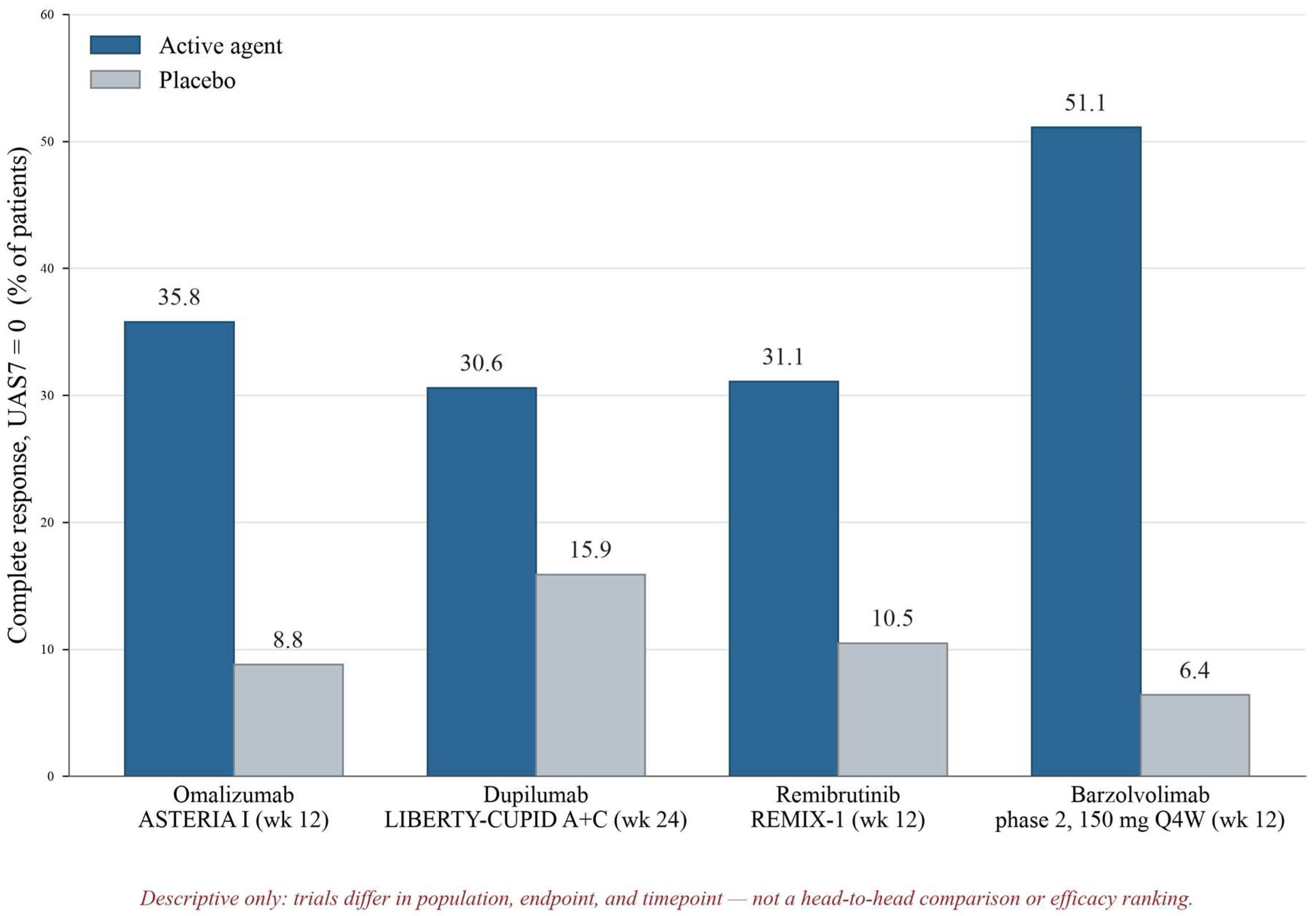
| Omalizumab | Anti-IgE; lowers free IgE and FcεRI density | SC, every 4 weeks | ASTERIA I/II, GLACIAL (phase 3) | 35.8% vs. 8.8% (ASTERIA I, wk 12) | Approved; long real-world safety record |
| Dupilumab | Anti–IL-4Rα; blocks IL-4 and IL-13 | SC, every 2 weeks | LIBERTY-CUPID A, B, C (phase 3) | 30.6% vs. 15.9% (pooled A + C, wk 24) | Approved 2025 (≥12 y); 2026 (≥2 y) |
| Remibrutinib | Oral covalent BTK inhibitor | Oral, 25 mg twice daily | REMIX-1, REMIX-2 (phase 3) | 31.1% vs. 10.5% (REMIX-1, wk 12) | Approved Sep 2025; petechiae 3.8% vs. 0.3% |
| Barzolvolimab | Anti-KIT; depletes mast cells | SC (dose-finding) | Phase 2; EMBARQ-CSU1/2 ongoing | 51.1% vs. 6.4% (150 mg Q4W, wk 12) | Investigational; hair-color change, cytopenias |
| Consideration | Omalizumab | Dupilumab | Remibrutinib | Barzolvolimab |
|---|---|---|---|---|
| Route | Subcutaneous | Subcutaneous | Oral | Subcutaneous |
| Typical regimen | Every 4 weeks | Every 2 weeks | Twice daily | Investigational |
| Onset of effect | Days to weeks | Weeks | Within 1–2 weeks | Within 1–2 weeks (ph 2) |
| Routine lab monitoring | Not required | Not required | Not required | Blood counts (KIT effect) |
| Best-suited niche | Established first targeted step | Coexisting type 2 disease | Preference for an oral agent | Multi-refractory disease (if approved) |
| Status (2026) | Approved | Approved | Approved | Phase 3 |
| Approved age groups | ≥12 y (CSU) | ≥2 y | Adults (≥18 y) | Investigational (adults studied) |
| Major contraindications/cautions | Prior anaphylaxis to omalizumab; observation for anaphylaxis | Known hypersensitivity; ocular surface disease (conjunctivitis) | Active bleeding risk; caution with antiplatelet/anticoagulant use | On-target cytopenias and pigmentary change; data limited |
| Evidence level | Phase 3 + >10 y real-world | Phase 3 | Phase 3 | Phase 2 (phase 3 ongoing) |
| Trial (Agent; Phase) | Population/Prior Biologic Exposure | Key Inclusion/ Baseline Severity | N-Randomized | Primary Endpoint (Timepoint) | Complete Response, UAS7 = 0 (Active vs. Placebo) | Key Safety Findings |
|---|---|---|---|---|---|---|
| ASTERIA I (omalizumab 300 mg; ph 3) | H1-antihistamine–refractory; biologic-naïve | UAS7 ≥ 16 (moderate–severe) | 319 | Change in weekly itch severity (wk 12) | 35.8% vs. 8.8% (wk 12) | AEs ≈ placebo; headache, nasopharyngitis |
| ASTERIA II (omalizumab 300 mg; ph 3) | H1-antihistamine–refractory; biologic-naïve | UAS7 ≥ 16 (moderate–severe) | 323 | Change in weekly itch severity (wk 12) | 44.3% vs. 5.1% (wk 12) | AEs ≈ placebo; class profile |
| GLACIAL (omalizumab 300 mg; ph 3) | Refractory to up-to-4× H1 + H2 and/or LTRA (more refractory); biologic-naïve | UAS7 ≥ 16; broader refractory entry | 336 | Safety at wk 12 (efficacy secondary) | 33.7% vs. 4.8% (wk 12) | AEs ≈ placebo; safety was primary endpoint |
| LIBERTY-CUPID A (dupilumab; ph 3) | Omalizumab-naïve; H1-refractory; ≥6 y | UAS7 ≥ 16 | 138 | Change in UAS7 or ISS7 (wk 24) | 30.6% vs. 15.9% (pooled A + C, wk 24) | Injection-site reactions, conjunctivitis, transient eosinophilia |
| LIBERTY-CUPID B (dupilumab; ph 3) | Omalizumab-intolerant/incomplete responders (biologic-experienced); ≥12 y | UAS7 ≥ 16 | 108 | Change in UAS7 or ISS7 (wk 24) | Primary endpoint not met; supportive data | Class profile |
| LIBERTY-CUPID C (dupilumab; ph 3) | Omalizumab-naïve (replicate of Study A); ≥6 y | UAS7 ≥ 16 | 151 | Change in UAS7 or ISS7 (wk 24) | Pooled with Study A (30.6% vs. 15.9%) | Class profile |
| REMIX-1 (remibrutinib 25 mg BID; ph 3) | Adults ≥ 18 y; inadequately controlled on H1 (2:1 randomization) | UAS7 mean ≈ 30 at baseline | 470 | Change in UAS7 and ISS7/HSS7 (wk 12) | 31.1% vs. 10.5% (wk 12) | Petechiae 3.8% vs. 0.3%; AEs otherwise ≈ placebo |
| REMIX-2 (remibrutinib 25 mg BID; ph 3) | Adults ≥ 18 y; inadequately controlled on H1 (2:1 randomization) | UAS7 mean ≈ 30 at baseline | 455 | Change in UAS7 and ISS7/HSS7 (wk 12) | 27.9% vs. 6.5% (wk 12) | Petechiae 3.8% vs. 0.3% (pooled) |
| Barzolvolimab phase 2 (dose-finding) | Antihistamine-refractory; mixed prior biologic exposure | UAS7 ≥ 16 | 208 (3 regimens + placebo) | Change in UAS7 (wk 12) | 51.1% (150 mg Q4W)/37.5% (300 mg Q8W) vs. 6.4% (wk 12) | Hair-color change, transient neutropenia/cytopenias, injection-site reactions |
Disclaimer/Publisher’s Note: The statements, opinions and data contained in all publications are solely those of the individual author(s) and contributor(s) and not of MDPI and/or the editor(s). MDPI and/or the editor(s) disclaim responsibility for any injury to people or property resulting from any ideas, methods, instructions or products referred to in the content. |
© 2026 by the authors. Licensee MDPI, Basel, Switzerland. This article is an open access article distributed under the terms and conditions of the Creative Commons Attribution (CC BY) license.
Share and Cite
Asiri, R.S.; Amer, K.A.; Sarhan, L.A.; Jahash, N.A.; Alharbi, R.H. Emerging and Newly Approved Therapies for Antihistamine-Refractory Chronic Spontaneous Urticaria: A Narrative Review. Diseases 2026, 14, 276. https://doi.org/10.3390/diseases14080276
Asiri RS, Amer KA, Sarhan LA, Jahash NA, Alharbi RH. Emerging and Newly Approved Therapies for Antihistamine-Refractory Chronic Spontaneous Urticaria: A Narrative Review. Diseases. 2026; 14(8):276. https://doi.org/10.3390/diseases14080276
Chicago/Turabian StyleAsiri, Raghad Saeed, Khaled Abdulwahab Amer, Leen Abdulmohsin Sarhan, Najla Ahmad Jahash, and Riham Hamoud Alharbi. 2026. "Emerging and Newly Approved Therapies for Antihistamine-Refractory Chronic Spontaneous Urticaria: A Narrative Review" Diseases 14, no. 8: 276. https://doi.org/10.3390/diseases14080276
APA StyleAsiri, R. S., Amer, K. A., Sarhan, L. A., Jahash, N. A., & Alharbi, R. H. (2026). Emerging and Newly Approved Therapies for Antihistamine-Refractory Chronic Spontaneous Urticaria: A Narrative Review. Diseases, 14(8), 276. https://doi.org/10.3390/diseases14080276