

Hemodialysis Tends to Improve Thyroid Function by Restoring Hormone Levels in ESRD Patients Compared to Non-Dialysis Kidney Disease Patients: A Case–Control Study

 ,
,  ,
,  , ,
, ,  , ,
, , 
Abstract
1. Introduction
2. Materials and Methods
2.1. Ethical Approval, Study Settings, and Participants
2.2. Inclusion and Exclusion Criteria
- Normal patients (NPs): individuals suspected of having thyroid complications with no kidney complications or other confirmed diagnosed diseases.
- Non-dialysis kidney disease patients (NDKPs): individuals with kidney or renal complications confirmed by a creatinine level > the reference range (0.6–1.3 mg/dL) who were suspected of having thyroid complications.
- Dialysis patients (DPs): ESRD patients receiving dialysis for 1–2 years, but not less than 1 year, who were suspected of having thyroid complications.
2.3. Sample Collection
2.4. Measurement of T3, T4, and TSH Levels
2.5. Statistical Analysis
3. Results
3.1. Participant Demographics and Hormonal Level Determination
3.2. Comparison of Thyroid Hormone Levels
3.3. Comparison of Hormone Levels Based on Sex and Age
3.4. Association Between Hormone Levels
4. Discussion
5. Limitations of This Study
6. Future Perspectives and Recommendations
- Research Gap: Limited research exists on the interplay among thyroid function, hormone levels, and dialysis outcomes in CKD patients, especially in the Bangladeshi context.
- Future Research Direction: Multifactorial longitudinal studies with multicenter designs and larger and more diverse cohorts are needed to robustly evaluate the interplay among thyroid function, hormone levels, and dialysis outcomes in CKD patients.
- Study Design Justification: Such studies are crucial to enhance generalizability, mitigate selection bias, and enable comprehensive statistical analysis.
7. Conclusions
Author Contributions
Funding
Institutional Review Board Statement
Informed Consent Statement
Data Availability Statement
Conflicts of Interest
Correction Statement
References
- Neuen, B.L.; Bello, A.K.; Levin, A.; Lunney, M.; Osman, M.A.; Ye, F.; Ashuntantang, G.E.; Bellorin-Font, E.; Gharbi, M.B.; Davison, S.; et al. National Health Policies and Strategies for Addressing Chronic Kidney Disease: Data from the International Society of Nephrology Global Kidney Health Atlas. PLoS Glob. Public Health 2023, 3, e0001467. [Google Scholar] [CrossRef] [PubMed]
- Khandker, S.S.; Jahan, S.; Khan, A.A.; Abrittee, B.F.; Nanjiba, R.; Islam, D.Z.; Suez, E.; Rahman, M.H.; Farahim, F.; Ali, T. Global Epidemiology of Hiv Among Dialysis Patients: A Systematic Review and Meta-Analysis. Int. Urol. Nephrol. 2025, 57, 2209–2226. [Google Scholar] [CrossRef]
- Cotoi, L.; Borcan, F.; Sporea, I.; Amzar, D.; Schiller, O.; Schiller, A.; Dehelean, C.A.; Pop, G.N.; Borlea, A.; Stoian, D. Thyroid Pathology in End-Stage Renal Disease Patients on Hemodialysis. Diagnostics 2020, 10, 245. [Google Scholar] [CrossRef]
- Khandker, S.S.; Jannat, N.; Sarkar, D.; Pranto, A.H.; Hoque, I.A.; Zaman, J.; Uddin, M.N.; Suez, E. Association Between Glomerular Filtration Rate and Β-Thalassemia Major: A Systematic Review and Meta-Analysis. Thalass. Rep. 2023, 13, 195–205. [Google Scholar] [CrossRef]
- Zoccali, C.; Kramer, A.; Jager, K.J. Chronic Kidney Disease and End-Stage Renal Disease—A Review Produced to Contribute to the Report ‘the Status of Health in the European Union: Towards a Healthier Europe’. NDT Plus 2010, 3, 213–224. [Google Scholar] [CrossRef]
- Fan, J.; Yan, P.; Wang, Y.; Shen, B.; Ding, F.; Liu, Y. Prevalence and Clinical Significance of Low T3 Syndrome in Non-Dialysis Patients with Chronic Kidney Disease. Med. Sci. Monit. Int. Med. J. Exp. Clin. Res. 2016, 22, 1171. [Google Scholar] [CrossRef]
- Shahid, M.A.; Ashraf, M.A.; Sharma, S. Physiology, Thyroid Hormone. In StatPearls; StatPearls Publishing: Treasure Island, FL, USA, 2026. Available online: https://www.ncbi.nlm.nih.gov/books/NBK500006/ (accessed on 1 February 2026).
- Schroeder, A.C.; Privalsky, M.L. Thyroid Hormones, T3 and T4, in the Brain. Front. Endocrinol. 2014, 5, 40. [Google Scholar] [CrossRef] [PubMed]
- Gomes-Lima, C.; Wartofsky, L.; Burman, K. Can Reverse T3 Assay Be Employed to Guide T4 vs. T4/T3 Therapy in Hypothyroidism? Front. Endocrinol. 2019, 10, 856. [Google Scholar]
- Wiersinga, W.M. L-T4 and L-T3 Combined Treatment vs L-T4 Alone. Ann. d’Endocrinologie 2007, 68, 216–219. [Google Scholar] [CrossRef] [PubMed]
- Sapin, R.; Schlienger, J.L. Thyroxine (T4) and Tri-Iodothyronine (T3) Determinations: Techniques and Value in the Assessment of Thyroid Function. Ann. Biol. Clin. 2003, 61, 411–420. [Google Scholar]
- Biondi, B.; Cappola, A.R.; Cooper, D.S. Subclinical Hypothyroidism: A Review. JAMA 2019, 322, 153–160. [Google Scholar] [CrossRef]
- Nillni, E.A. Regulation of the Hypothalamic Thyrotropin Releasing Hormone (Trh) Neuron by Neuronal and Peripheral Inputs. Front. Neuroendocrinol. 2010, 31, 134–156. [Google Scholar] [CrossRef] [PubMed]
- Duntas, L.H. New Insights into the Hypothalamic-Pituitary-Thyroid Axis. Acta Endocrinol. 2016, 12, 125. [Google Scholar] [CrossRef]
- Salih, S.S.; Yenzeel, J.H. Evaluation of Thyroid Hormones and Some Biochemical Variables in Patients with Chronic Kidney Disease. Iraqi J. Sci. 2020, 61, 985–992. [Google Scholar] [CrossRef]
- Mohamedali, M.; Reddy Maddika, S.; Vyas, A.; Iyer, V.; Cheriyath, P. Thyroid Disorders and Chronic Kidney Disease. Int. J. Nephrol. 2014, 2014, 520281. [Google Scholar] [CrossRef]
- Rhee, C.M.; You, A.S.; Nguyen, D.V.; Brunelli, S.M.; Budoff, M.J.; Streja, E.; Nakata, T.; Kovesdy, C.P.; Brent, G.A.; Kalantar-Zadeh, K. Thyroid Status and Mortality in a Prospective Hemodialysis Cohort. J. Clin. Endocrinol. Metab. 2017, 102, 1568–1577. [Google Scholar] [CrossRef]
- Agahi, S.; Amouzegar, A.; Honarvar, M.; Azizi, F.; Mehran, L. Interrelationship between Thyroid Hormones and Reduced Renal Function, a Review Article. Thyroid. Res. 2024, 17, 14. [Google Scholar] [CrossRef]
- Raj, R.; Kumar, V.; Bhushan, D.; Biswas, R.; Ojha, V.S. The Prevalence of Thyroid Abnormalities in Patients with Chronic Kidney Disease: A Cross-Sectional Study at a Tertiary Care Hospital. Cureus 2023, 15, e43065. [Google Scholar] [CrossRef]
- Kaka, N.; Sethi, Y.; Patel, N.; Kaiwan, O.; Al-Inaya, Y.; Manchanda, K.; Uniyal, N. Endocrine Manifestations of Chronic Kidney Disease and Their Evolving Management: A Systematic Review. Disease-a-Month 2022, 68, 101466. [Google Scholar] [CrossRef] [PubMed]
- Kadatane, S.P.; Satariano, M.; Massey, M.; Mongan, K.; Raina, R. The Role of Inflammation in Ckd. Cells 2023, 12, 1581. [Google Scholar] [CrossRef] [PubMed]
- Hu, X.-Y.; Liang, Y.-C.; Zhang, H.-H.; Li, H.-L.; Liu, D.-L. Association between the Systemic Immune-Inflammation Index and Thyroid Function in Us Adults. Mediat. Inflamm. 2023, 2023, 5831858. [Google Scholar] [CrossRef]
- Horacek, J.; Sulkova, S.D.; Malirova, E.; Dlabalova, B.; Safranek, R.; Kubisova, M.; Kalousova, M.; Maly, J.; Zak, P. Haemodialysis-Induced Changes in Thyroid Hormones and Thyrotropin. Endocr. Abstr. 2013, 32, 1042. [Google Scholar] [CrossRef]
- Weaver, V.M.; Fadrowski, J.J.; Jaar, B.G. Global Dimensions of Chronic Kidney Disease of Unknown Etiology (Ckdu): A Modern Era Environmental and/or Occupational Nephropathy? BMC Nephrol. 2015, 16, 145. [Google Scholar] [CrossRef]
- Lo, J.C.; Chertow, G.M.; Go, A.S.; Hsu, C.-Y. Increased Prevalence of Subclinical and Clinical Hypothyroidism in Persons with Chronic Kidney Disease. Kidney Int. 2005, 67, 1047–1052. [Google Scholar] [CrossRef]
- Delanaye, P.; Ebert, N.; Melsom, T.; Gaspari, F.; Mariat, C.; Cavalier, E.; Björk, J.; Christensson, A.; Nyman, U.; Porrini, E. Iohexol Plasma Clearance for Measuring Glomerular Filtration Rate in Clinical Practice and Research: A Review. Part 1: How to Measure Glomerular Filtration Rate with Iohexol? Clin. Kidney J. 2016, 9, 682–699. [Google Scholar] [CrossRef] [PubMed]
- Zahra, S.; Saleem, M.K.; Ejaz, K.F.; Akbar, A.; Jadoon, S.K.; Hussain, S.; Ali, A.I.; Ifty, M.; Jannati, S.Z.; Armin, F. Prevalence of Nephropathy among Diabetic Patients in North American Region: A Systematic Review and Meta-Analysis. Medicine 2024, 103, e39759. [Google Scholar] [CrossRef] [PubMed]
- Kashif, M.; Hussain, M.S.; Anis, M.; Shah, P.K.; Siddiqui, M.A., Sr. Thyroid Dysfunction and Chronic Kidney Disease: A Study among the Northeastern Population of India. Cureus 2023, 15, e38700. [Google Scholar] [CrossRef] [PubMed]
- Chehade, J.M.; Belal, H.F. Cross-Section of Thyroidology and Nephrology: Literature Review and Key Points for Clinicians. J. Clin. Transl. Endocrinol. 2024, 37, 100359. [Google Scholar] [CrossRef]
- Rhee, C.M.; Brent, G.A.; Kovesdy, C.P.; Soldin, O.P.; Nguyen, D.; Budoff, M.J.; Brunelli, S.M.; Kalantar-Zadeh, K. Thyroid Functional Disease: An under-Recognized Cardiovascular Risk Factor in Kidney Disease Patients. Nephrol. Dial. Transplant. 2015, 30, 724–737. [Google Scholar] [CrossRef]
- Reque Santivañez, J.; Garcia Peris, B.; Panizo Gonzalez, N.; Perez Alba, A.; D’Marco, L.; Collado Boira, E. Subclinical Hypothyroidism in Advanced Chronic Kidney Disease Patients: Prevalence and Associated Factors. J. Thyroid Res. 2022, 2022, 1077553. [Google Scholar] [CrossRef]
- Sanai, T.; Okamura, K.; Onoue, T.; Ono, T.; Motomura, K.; Miyazono, M.; Shimamatsu, K. Hemodilution Impacts Assessment of Thyroid Status before and after Hemodialysis in Patients with End-Stage Renal Disease. Am. J. Nephrol. 2021, 51, 988–994. [Google Scholar] [CrossRef]
- Shamsadini, S.; Darvish-Moghaddam, S.; Abdollahi, H.; Fekri, A.R.; Ebrahimi, H.A. Creatinine, Blood Urea Nitrogen and Thyroid Hormone Levels before and after Haemodialysis. East. Mediterr. Health J. 2006, 12, 231. [Google Scholar]
- Bauer, M.; Glenn, T.; Pilhatsch, M.; Pfennig, A.; Whybrow, P.C. Gender Differences in Thyroid System Function: Relevance to Bipolar Disorder and Its Treatment. Bipolar Disord. 2014, 16, 58–71. [Google Scholar] [CrossRef]
- Mirahmad, M.; Mansour, A.; Moodi, M.; Safkhani, E.; Haghpanah, V.; Asili, P.; Fakhrzadeh, H.; Payab, M.; Ebrahimpur, M.; Khorashadi, M.; et al. Prevalence of Thyroid Dysfunction among Iranian Older Adults: A Cross-Sectional Study. Sci. Rep. 2023, 13, 21651. [Google Scholar] [CrossRef] [PubMed]
- Samuels, M.H. Hyperthyroidism in Aging. In Endotext [Internet]; Feingold, K.R., Adler, R.A., Ahmed, S.F., Anawalt, B., Blackman, M.R., Chrousos, G., Corpas, E., de Herder, W.W., Dhatariya, K., Dungan, K., et al., Eds.; MDText.com, Inc.: South Dartmouth, MA, USA, 2000. Available online: https://www.ncbi.nlm.nih.gov/books/NBK278986/ (accessed on 1 February 2026).
- Kumar, M.S.; Safa, A.M.; Deodhar, S.D.; Schumacher, O.P. The Relationship of Thyroid-Stimulating Hormone (Tsh), Thyroxine (T4), and Triiodothyronine (T3) in Primary Thyroid Failure. Am. J. Clin. Pathol. 1977, 68, 747–751. [Google Scholar] [CrossRef]
- Rothacker, K.M.; Brown, S.J.; Hadlow, N.C.; Wardrop, R.; Walsh, J.P. Reconciling the Log-Linear and Non-Log-Linear Nature of the TSH-Free T4 Relationship: Intra-Individual Analysis of a Large Population. J. Clin Endocrinol. Metab. 2016, 101, 1151–1158. [Google Scholar] [CrossRef]
- Wiersinga, W.M. T4+ T3 Combination Therapy: An Unsolved Problem of Increasing Magnitude and Complexity. Endocrinol. Metab. 2021, 36, 938–951. [Google Scholar] [CrossRef] [PubMed]
- Li, H.; Yuan, X.; Liu, L.; Zhou, J.; Li, C.; Yang, P.; Bu, L.; Zhang, M.; Qu, S. Clinical Evaluation of Various Thyroid Hormones on Thyroid Function. Int. J. Endocrinol. 2014, 2014, 618572. [Google Scholar] [CrossRef] [PubMed]



| NPs | NDKPs | DPs | |
|---|---|---|---|
| Participant demographics | |||
| Overall, patients, n | 106 | 32 | 23 |
| Age in years (mean ± SD) | 38.64 ± 17.05 | 43.75 ± 17.54 | 43.00 ± 17.51 |
| Male, n | 32 | 10 | 8 |
| Age in years (mean ± SD) | 37.55 ± 17.01 | 45.7 ± 18.22 | 45 ± 15.90 |
| Female, n | 74 | 22 | 15 |
| Age in years (mean ± SD) | 39.12 ± 17.10 | 42.86 ± 17.53 | 41.93 ± 17.51 |
| Overall levels of thyroid hormones | |||
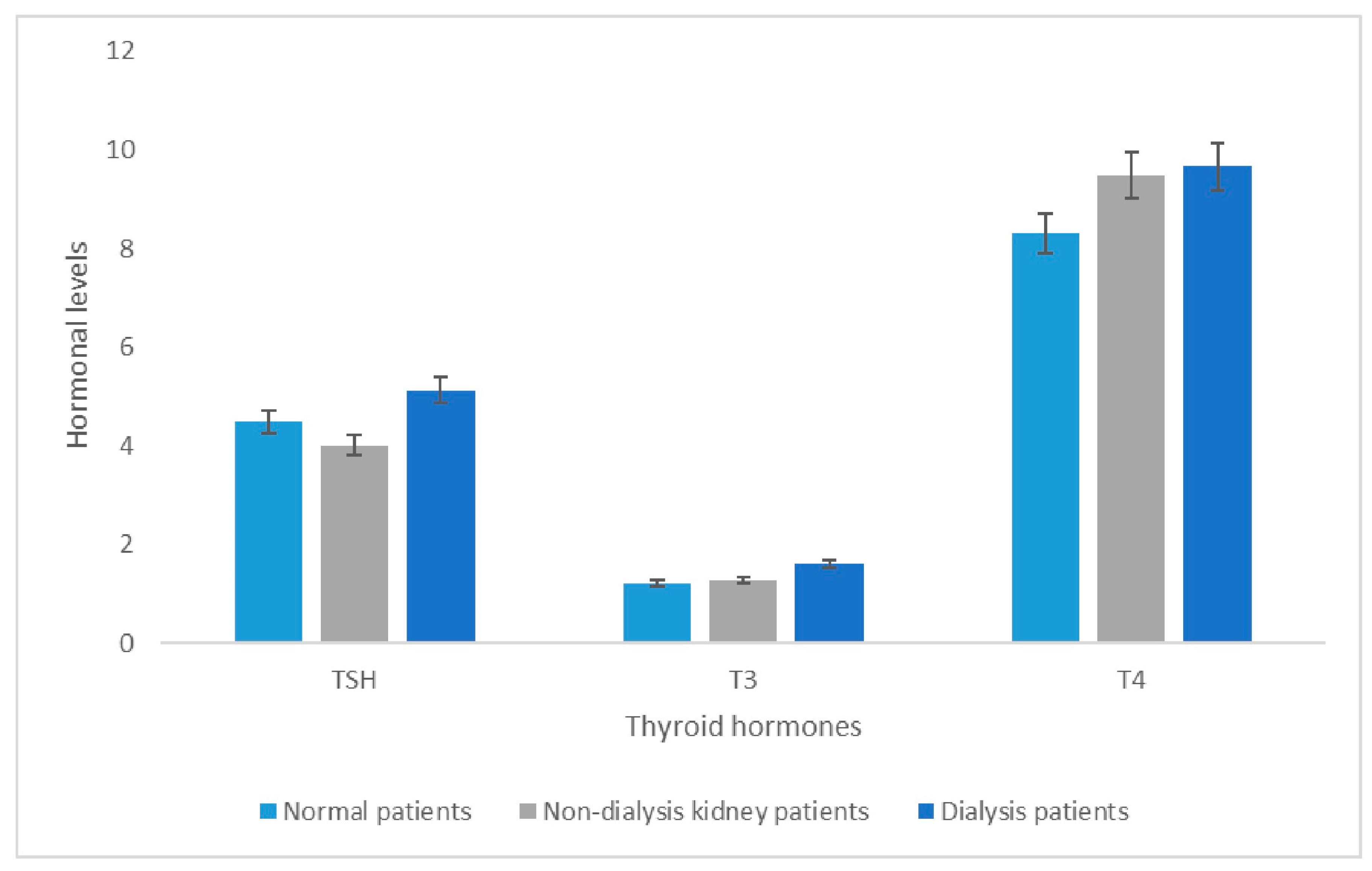
| TSH, µIU/mL (mean ± SD) | 4.49 ± 0.24 | 4.01 ± 0.20 | 5.13 ± 0.25 |
| T3, ng/mL (mean ± SD) | 1.23 ± 0.06 | 1.29 ± 0.06 | 1.61 ± 0.08 |
| T4, µg/dL (mean ± SD) | 8.31 ± 0.41 | 9.49 ± 0.47 | 9.67 ± 0.48 |
| Patients of Different Groups, n (%) | Normal Level, n (%) | Higher Level, n (%) | Lower Level, n (%) |
|---|---|---|---|
| NPs, n = 106 (100) | |||
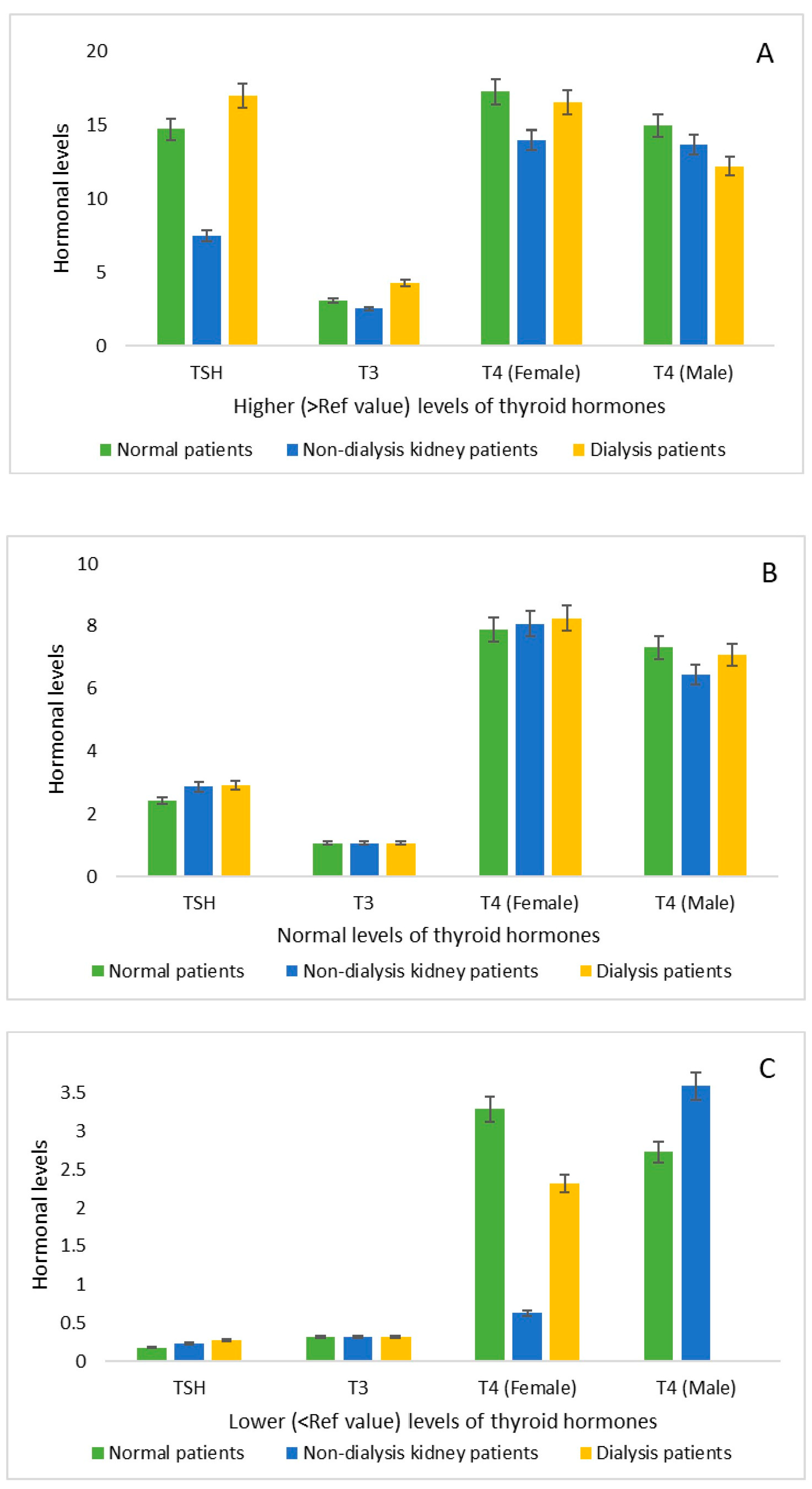
| TSH | 80 (75.47) | 19 (17.92) | 7 (6.60) |
| T3 | 67 (63.20) | 17 (16.03) | 22 (20.75) |
| T4 (female) | 43 (40.56) | 11 (10.37) | 18 (16.98) |
| T4 (male) | 19 (17.92) | 9 (8.49) | 6 (5.66) |
| T4 overall | 62 (58.49) | 20 (18.86) | 24 (22.64) |
| NDKPs, n = 32 (100) | |||
| TSH | 26 (81.25) | 5 (15.62) | 1 (3.12) |
| T3 | 20 (62.50) | 7 (21.32) | 5 (15.62) |
| T4 (female) | 17 (53.12) | 5 (15.62) | 1 (3.12) |
| T4 (male) | 4 (12.5) | 4 (12.5) | 1 (3.12) |
| T4 overall | 21 (65.62) | 9 (28.12) | 2 (6.25) |
| DPs, n = 23 (100) | |||
| TSH | 17 (73.91) | 4 (17.39) | 2 (8.69) |
| T3 | 13 (56.52) | 5 (21.73) | 5 (21.73) |
| T4 (female) | 9 (39.13) | 4 (17.39) | 2 (8.69) |
| T4 (male) | 4 (17.39) | 4 (17.39) | 0 (0.0) |
| T4 overall | 13 (56.52) | 8 (34.78) | 2 (8.69) |
| Category | Thyroid Hormones | Hormonal Levels (Mean) | ||
|---|---|---|---|---|
| NPs | NDKPs | DPs | ||
| Male | TSH | 3.97 | 4.10 | 4.26 |
| T3 | 1.54 | 1.39 | 1.13 | |
| T4 | 8.2 | 9.33 | 9.65 | |
| Female | TSH | 4.71 | 3.96 | 5.60 |
| T3 | 1.10 | 1.24 | 1.86 | |
| T4 | 8.36 | 9.55 | 9.67 | |
| Age < 45 y | TSH | 3.94 | 4.64 | 5.54 |
| T3 | 1.24 | 1.40 | 2.32 | |
| T4 | 8.59 | 11.07 | 8.74 | |
| Age > 45 y | TSH | 5.89 | 3.25 | 4.64 |
| T3 | 1.24 | 1.23 | 1.12 | |
| T4 | 8.11 | 7.95 | 10.77 | |
| Patient Group | Thyroid Hormone Levels/Activity | Implications |
|---|---|---|
| Dialysis patients with renal complications | Moderately enhanced thyroid hormone levels and activity | Suggests potential benefits of routine dialysis for CKD/ESRD patients |
| Non-dialysis patients with kidney disease | Not significantly enhanced thyroid hormone levels and activity | Supports the need for further investigation with larger cohorts |
Disclaimer/Publisher’s Note: The statements, opinions and data contained in all publications are solely those of the individual author(s) and contributor(s) and not of MDPI and/or the editor(s). MDPI and/or the editor(s) disclaim responsibility for any injury to people or property resulting from any ideas, methods, instructions or products referred to in the content. |
© 2026 by the authors. Licensee MDPI, Basel, Switzerland. This article is an open access article distributed under the terms and conditions of the Creative Commons Attribution (CC BY) license.
Share and Cite
Islam, H.; Khandker, S.S.; Khatun, A.; Suez, E.; Pranto, A.H.; Islam, D.Z.; Begum, R.; Uddin, M.N.; Hasan, M.A.; Alam, M.S.; et al. Hemodialysis Tends to Improve Thyroid Function by Restoring Hormone Levels in ESRD Patients Compared to Non-Dialysis Kidney Disease Patients: A Case–Control Study. Diseases 2026, 14, 128. https://doi.org/10.3390/diseases14040128
Islam H, Khandker SS, Khatun A, Suez E, Pranto AH, Islam DZ, Begum R, Uddin MN, Hasan MA, Alam MS, et al. Hemodialysis Tends to Improve Thyroid Function by Restoring Hormone Levels in ESRD Patients Compared to Non-Dialysis Kidney Disease Patients: A Case–Control Study. Diseases. 2026; 14(4):128. https://doi.org/10.3390/diseases14040128
Chicago/Turabian StyleIslam, Hasibul, Shahad Saif Khandker, Anwara Khatun, Ehsan Suez, Alif Hasan Pranto, Dewan Zubaer Islam, Rahima Begum, Md. Nizam Uddin, Md. Ashraful Hasan, Md. Shah Alam, and et al. 2026. "Hemodialysis Tends to Improve Thyroid Function by Restoring Hormone Levels in ESRD Patients Compared to Non-Dialysis Kidney Disease Patients: A Case–Control Study" Diseases 14, no. 4: 128. https://doi.org/10.3390/diseases14040128
APA StyleIslam, H., Khandker, S. S., Khatun, A., Suez, E., Pranto, A. H., Islam, D. Z., Begum, R., Uddin, M. N., Hasan, M. A., Alam, M. S., & Mamun-Or-Rashid, A. N. M. (2026). Hemodialysis Tends to Improve Thyroid Function by Restoring Hormone Levels in ESRD Patients Compared to Non-Dialysis Kidney Disease Patients: A Case–Control Study. Diseases, 14(4), 128. https://doi.org/10.3390/diseases14040128