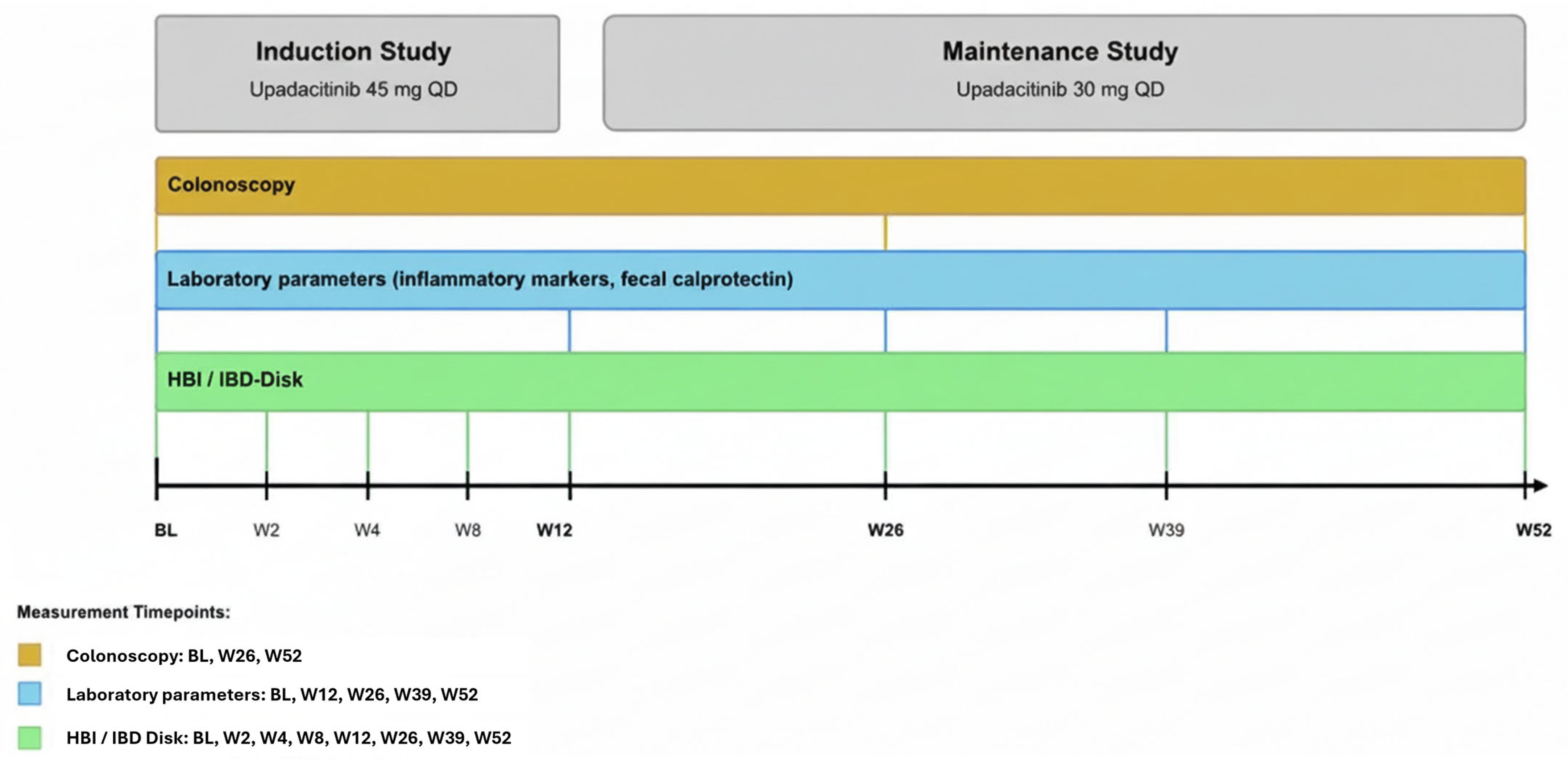

Prospective Bi-Centric Real-World Outcomes of Upadacitinib in Biologic-Experienced Patients with Crohn’s Disease

 , ,
, ,
Simple Summary
Abstract
1. Introduction
2. Materials and Methods
2.1. Trial Design and Oversight
2.2. Efficacy and Safety Evaluations
Statistical Analysis
3. Results
3.1. Patient Characteristics
3.2. Induction/Maintenance Phase After Initiation of Upadacitinib: Primary and Secondary Endpoints (Per Protocol Analysis)
3.3. Efficacy Analyses, Quality of Life, and Safety Outcomes
4. Discussion
5. Conclusions
Supplementary Materials
Author Contributions
Funding
Institutional Review Board Statement
Informed Consent Statement
Data Availability Statement
Conflicts of Interest
References
- Chang, J.T. Pathophysiology of Inflammatory Bowel Diseases. N. Engl. J. Med. 2020, 383, 2652–2664. [Google Scholar] [CrossRef]
- Loftus, E.V.; Panés, J.; Lacerda, A.P.; Peyrin-Biroulet, L.; D’Haens, G.; Panaccione, R.; Reinisch, W.; Louis, E.; Chen, M.; Nakase, H.; et al. Upadacitinib Induction and Maintenance Therapy for Crohn’s Disease. N. Engl. J. Med. 2023, 388, 1966–1980. [Google Scholar] [CrossRef]
- Peyrin-Biroulet, L.; Sandborn, W.; Sands, B.E.; Reinisch, W.; Bemelman, W.; Bryant, R.V.; D’Haens, G.; Dotan, I.; Dubinsky, M.; Feagan, B.; et al. Selecting Therapeutic Targets in Inflammatory Bowel Disease (STRIDE): Determining Therapeutic Goals for Treat-to-Target. Am. J. Gastroenterol. 2015, 110, 1324–1338. [Google Scholar] [CrossRef]
- Turner, D.; Ricciuto, A.; Lewis, A.; D’Amico, F.; Dhaliwal, J.; Griffiths, A.M.; Bettenworth, D.; Sandborn, W.J.; Sands, B.E.; Reinisch, W.; et al. STRIDE-II: An Update on the Selecting Therapeutic Targets in Inflammatory Bowel Disease (STRIDE) Initiative of the International Organization for the Study of IBD (IOIBD): Determining Therapeutic Goals for Treat-to-Target strategies in IBD. Gastroenterology 2021, 160, 1570–1583. [Google Scholar] [CrossRef]
- Salas, A.; Hernandez-Rocha, C.; Duijvestein, M.; Faubion, W.; McGovern, D.; Vermeire, S.; Vetrano, S.; Vande Casteele, N. JAK-STAT pathway targeting for the treatment of inflammatory bowel disease. Nat. Rev. Gastroenterol. Hepatol. 2020, 17, 323–337. [Google Scholar] [CrossRef] [PubMed]
- Mudter, J.; Neurath, M.F. The role of signal transducers and activators of transcription in T inflammatory bowel diseases. Inflamm. Bowel Dis. 2003, 9, 332–337. [Google Scholar] [CrossRef] [PubMed]
- Sandborn, W.J.; Feagan, B.G.; Loftus, E.V.; Peyrin-Biroulet, L.; van Assche, G.; D’Haens, G.; Schreiber, S.; Colombel, J.-F.; Lewis, J.D.; Ghosh, S.; et al. Efficacy and Safety of Upadacitinib in a Randomized Trial of Patients with Crohn’s Disease. Gastroenterology 2020, 158, 2123–2138.e8. [Google Scholar] [CrossRef]
- Mohamed, M.-E.F.; Klünder, B.; Lacerda, A.P.; Othman, A.A. Exposure-Response Analyses for Upadacitinib Efficacy and Safety in the Crohn’s Disease CELEST Study and Bridging to the Extended-Release Formulation. Clin. Pharmacol. Ther. 2020, 107, 639–649. [Google Scholar] [CrossRef]
- Daperno, M.; D’Haens, G.; van Assche, G.; Baert, F.; Bulois, P.; Maunoury, V.; Sostegni, R.; Rocca, R.; Pera, A.; Gevers, A.; et al. Development and validation of a new, simplified endoscopic activity score for Crohn’s disease: The SES-CD. Gastrointest. Endosc. 2004, 60, 505–512. [Google Scholar] [CrossRef] [PubMed]
- Harvey, R.F.; Bradshaw, J.M. A simple index of Crohn’s-disease activity. Lancet 1980, 1, 514. [Google Scholar] [CrossRef]
- Ghosh, S.; Louis, E.; Beaugerie, L.; Bossuyt, P.; Bouguen, G.; Bourreille, A.; Ferrante, M.; Franchimont, D.; Frost, K.; He-buterne, X.; et al. Development of the IBD Disk: A Visual Self-administered Tool for Assessing Disability in Inflammatory Bowel Diseases. Inflamm. Bowel Dis. 2017, 23, 333–340. [Google Scholar] [CrossRef]
- Baumgart, D.C.; Stallmach, A.; Grunert, P.; Schubert, S.; Howaldt, S.; Arnim, U.v.; Ochsenkühn, T.; Stein, J.; Lügering, A.; Schmidt, D.; et al. Induction and maintenance of mucosal healing in Crohn’s disease with ustekinumab in clinical practice across all care levels in Germany (MUCUS). Sci. Rep. 2024, 14, 20502. [Google Scholar] [CrossRef]
- Singh, A.; Gupta, Y.K.; Dhaliwal, A.S.; Kahlon, B.K.; Bansal, V.; Mahajan, R.; Mehta, V.; Singh, D.; Kaur, R.; Bansal, N.; et al. Inflammatory bowel disease (IBD)-disk accurately predicts the daily life burden and parallels disease activity in patients with IBD. Intest. Res. 2023, 21, 375–384. [Google Scholar] [CrossRef]
- Wagner, K.; Müller, T.M.; Vitali, F.; Fischer, S.; Haberkamp, S.; Rouse-Merkel, R.; Atreya, R.; Neurath, M.F.; Zundler, S. Treatment trajectories and outcomes in inflammatory bowel disease: A tertiary single-centre experience. Therap. Adv. Gastroenterol. 2024, 17, 17562848241284051. [Google Scholar] [CrossRef]
- Ben-Horin, S.; Novack, L.; Mao, R.; Guo, J.; Zhao, Y.; Sergienko, R.; Zhang, J.; Kobayashi, T.; Hibi, T.; Chowers, Y.; et al. Efficacy of Biologic Drugs in Short-Duration Versus Long-Duration Inflammatory Bowel Disease: A Systematic Review and an Individual-Patient Data Meta-Analysis of Randomized Controlled Trials. Gastroenterology 2022, 162, 482–494. [Google Scholar] [CrossRef]
- Peyrin-Biroulet, L.; Panaccione, R.; Louis, E.; Atreya, R.; Rubin, D.T.; Lindsay, J.O.; Siffledeen, J.; Lukin, D.J.; Wright, J.; Watanabe, K.; et al. Upadacitinib Achieves Clinical and Endoscopic Outcomes in Crohn’s Disease Regardless of Prior Biologic Exposure. Clin. Gastroenterol. Hepatol. 2024, 22, 2096–2106. [Google Scholar] [CrossRef] [PubMed]
- Colombel, J.-F.; Sandborn, W.J.; Rutgeerts, P.; Enns, R.; Hanauer, S.B.; Panaccione, R.; Schreiber, S.; Byczkowski, D.; Li, J.; Kent, J.D.; et al. Adalimumab for maintenance of clinical response and remission in patients with Crohn’s disease: The CHARM trial. Gastroenterology 2007, 132, 52–65. [Google Scholar] [CrossRef] [PubMed]
- Feagan, B.G.; Sandborn, W.J.; Gasink, C.; Jacobstein, D.; Lang, Y.; Friedman, J.R.; Blank, M.A.; Johanns, J.; Gao, L.-L.; Miao, Y.; et al. Ustekinumab as Induction and Maintenance Therapy for Crohn’s Disease. N. Engl. J. Med. 2016, 375, 1946–1960. [Google Scholar] [CrossRef] [PubMed]
- Sands, B.E.; Sandborn, W.J.; van Assche, G.; Lukas, M.; Xu, J.; James, A.; Abhyankar, B.; Lasch, K. Vedolizumab as Induction and Maintenance Therapy for Crohn’s Disease in Patients Naïve to or Who Have Failed Tumor Necrosis Factor Antagonist Therapy. Inflamm. Bowel Dis. 2017, 23, 97–106. [Google Scholar] [CrossRef]
- Ferrante, M.; Panaccione, R.; Baert, F.; Bossuyt, P.; Colombel, J.-F.; Danese, S.; Dubinsky, M.; Feagan, B.G.; Hisamatsu, T.; Lim, A.; et al. Risankizumab as maintenance therapy for moderately to severely active Crohn’s disease: Results from the multicentre, randomised, double-blind, placebo-controlled, withdrawal phase 3 FORTIFY maintenance trial. Lancet 2022, 399, 2031–2046. [Google Scholar] [CrossRef]
- D’Haens, G.; Panaccione, R.; Baert, F.; Bossuyt, P.; Colombel, J.-F.; Danese, S.; Dubinsky, M.; Feagan, B.G.; Hisamatsu, T.; Lim, A.; et al. Risankizumab as induction therapy for Crohn’s disease: Results from the phase 3 ADVANCE and MOTIVATE induction trials. Lancet 2022, 399, 2015–2030. [Google Scholar] [CrossRef]
- Zittan, E.; Kabakchiev, B.; Kelly, O.B.; Milgrom, R.; Nguyen, G.C.; Croitoru, K.; Steinhart, A.H.; Silverberg, M.S. Develop-ment of the Harvey-Bradshaw Index-pro (HBI-PRO) Score to Assess Endoscopic Disease Activity in Crohn’s Disease. J. Crohn’s Colitis 2017, 11, 543–548. [Google Scholar] [CrossRef]
- Ghosh, S.; Feagan, B.G.; Parra, R.S.; Lopes, S.; Steinlauf, A.; Kakuta, Y.; Joshi, N.; Lee, W.-J.; Lacerda, A.P.; Zhou, Q.; et al. Impact of Upadacitinib Induction and Maintenance Therapy on Health-related Quality of Life, Fatigue, and Work Produc-tivity in Patients with Moderately-to-severely Active Crohn’s Disease. J. Crohn’s Colitis 2024, 18, 1804–1818. [Google Scholar] [CrossRef]
- Fierens, L.; Carney, N.; Novacek, G.; van der Woude, C.J.; Siegmund, B.; Casellas, F.; Borruel, N.; Huberts, A.S.; Sonnenberg, E.; Gerold, N.; et al. A Core Outcome Set for Inflammatory Bowel Diseases: Development and Recommendations for Im-plementation in Clinical Practice Through an International Multi-stakeholder Consensus Process. J. Crohn’s Colitis 2024, 18, 1583–1595. [Google Scholar] [CrossRef]
- Friedberg, S.; Choi, D.; Hunold, T.; Choi, N.K.; Garcia, N.M.; Picker, E.A.; Cohen, N.A.; Cohen, R.D.; Dalal, S.R.; Pekow, J.; et al. Upadacitinib Is Effective and Safe in Both Ulcerative Colitis and Crohn’s Disease: Prospective Real-World Experience. Clin. Gastroenterol. Hepatol. 2023, 21, 1913–1923.e2. [Google Scholar] [CrossRef] [PubMed]
- Danso, Y.; Radia, C.; Elford, A.; Yeo, J.H.; Morris, T.; Patel, C.; Butler, K.; Kalyanji, S.; Yeung, K.; Dong, C.; et al. Effectiveness and safety of upadacitinib in a real-world cohort of patients with Crohn’s disease in the UK: A multicentre retrospective cohort study. BMJ Open Gastroenterol. 2025, 12, e001916. [Google Scholar] [CrossRef]
- Fu, X.; Tu, L.; Fu, Y.; Wang, H.; Chen, Y.; Zhang, X.; Yu, Q.; Liu, F.; Cheng, Y.; Li, J.; et al. Upadacitinib induction therapy in Crohn’ s disease: A retrospective real-world study in biologic-refractory patients. BMC Gastroenterol. 2025, 25, 707. [Google Scholar] [CrossRef] [PubMed]
- Richard, N.; Amiot, A.; Seksik, P.; Altwegg, R.; Laharie, D.; Vuitton, L.; Nachury, M.; Bouguen, G.; Nancey, S.; Gilletta, C.; et al. Effectiveness and Safety of Upadacitinib Induction Therapy for 223 Patients with Crohn’s Disease: A GETAID Multicentre Cohort Study. Aliment. Pharmacol. Ther. 2025, 61, 1662–1670. [Google Scholar] [CrossRef] [PubMed]
- Papathanasiou, E.; Ioannou, A.; Pardalis, P.; Leonidakis, G.; Michalopoulos, G.; Manolakopoulos, S.; Siakavellas, S.; The-odoropoulou, A.; Tasovasili, A.; Giouleme, O.; et al. Induction with upadacitinib in Crohn’s disease: Real-world experience from an early-access program in Greece. Ann. Gastroenterol. 2025, 38, 306–310. [Google Scholar] [CrossRef]
- Devi, J.; Xu, A.; Stone, M.; Patel, A.; Khan, A.; Reddy, N.; Klein, J.; Chowla, N.; Benson, C.; Luu, B.C.; et al. Real-World Effectiveness and Safety of Upadacitinib in Crohn’s Disease: A Multicenter Study. Clin. Gastroenterol. Hepatol. 2025, 23, 2281–2291.e4. [Google Scholar] [CrossRef]
- Elford, A.T.; Bishara, M.; Plevris, N.; Gros, B.; Constantine-Cooke, N.; Goodhand, J.; Kennedy, N.A.; Ahmad, T.; Lees, C.W. Real-world effectiveness of upadacitinib in Crohn’s disease: A UK multicentre retrospective cohort study. Frontline Gastroenterol. 2024, 15, 297–304. [Google Scholar] [CrossRef]
- Falcon, B.T.Q.; de Mello Guimaraes, T.; Halpern, G.A.; Gomes, C.; de Mello Guimaraes, T. Insights into adverse events and safety profile of upadacitinib in the management of inflammatory bowel diseases—A meta-analysis of randomized controlled trials. Indian J. Gastroenterol. Off. J. Indian Soc. Gastroenterol. 2025, 44, 154–162. [Google Scholar] [CrossRef] [PubMed]
- Zhang, C.; Fu, Z.; Liu, J.; Li, S.; Chen, X.; Zhang, Y.; Xie, J. Safety profile and dose-dependent adverse events of upadacitinib in randomized clinical trials: A systematic review and meta-analysis. Front. Pharmacol. 2025, 16, 1598972. [Google Scholar] [CrossRef] [PubMed]
- Chai, R.; Li, X.; Shen, W.; Jin, Z.; Yao, G.; Tang, X.; Geng, L.; Sun, L. Efficacy and safety of upadacitinib for patients with immune-mediated inflammatory diseases: A systematic review and meta-analysis. Front. Immunol. 2025, 16, 1586792. [Google Scholar] [CrossRef] [PubMed]



| Baseline Characteristics | Value |
|---|---|
| Age at induction, median (min–max), years | 37 (25–64) |
| Age at initial diagnosis, median (min–max), years | 20 (12–59) |
| Median duration of disease, (IQR), years | 15 (9–18) |
| Male sex, n (%) | 13 (46) |
| BMI, median (IQR), kg/m2 | 24 (22–27) |
| Positive smoking status, n (%) | 6 (21) |
| Location of disease, n (%): | |
| L1, ileum | 6 (21) |
| L2, colon | 5 (18) |
| L3, ileocolon | 17 (61) |
| if applicable L4, upper GI tract | 3 (11) |
| Disease behavior, n (%): | |
| B1, inflammatory (non-stricturing/non-penetrating) | 1 (4) |
| B2, stricturing | 18 (64) |
| B3, penetrating | 9 (32) |
| if applicable: Perianal disease | 13 (46) |
| Ileostomy, n (%) | 2 |
| Previous failure to biologic agents, n (%) | |
| Anti-TNF | 28 (100) |
| Vedolizumab | 15 (54) |
| Ustekinumab | 20 (71) |
| No. of previous failures of biological therapy, n (%) | |
| 0 | 0 (0) |
| 1 | 3 (11) |
| 2 | 4 (14) |
| 3 | 21 (75) |
| No. of previous failures of immunosuppressants, n (%): | |
| Azathioprine/6-mercaptopurine | 15 (54) |
| MTX | 6 (21) |
| Endpoints | Induction | Maintenance | |||||||
|---|---|---|---|---|---|---|---|---|---|
| 2 wk | 4 wk | 8 wk | 12 wk | 26 wk | 39 wk | 52 wk | |||
| Primary end points, % (95% CI) | |||||||||
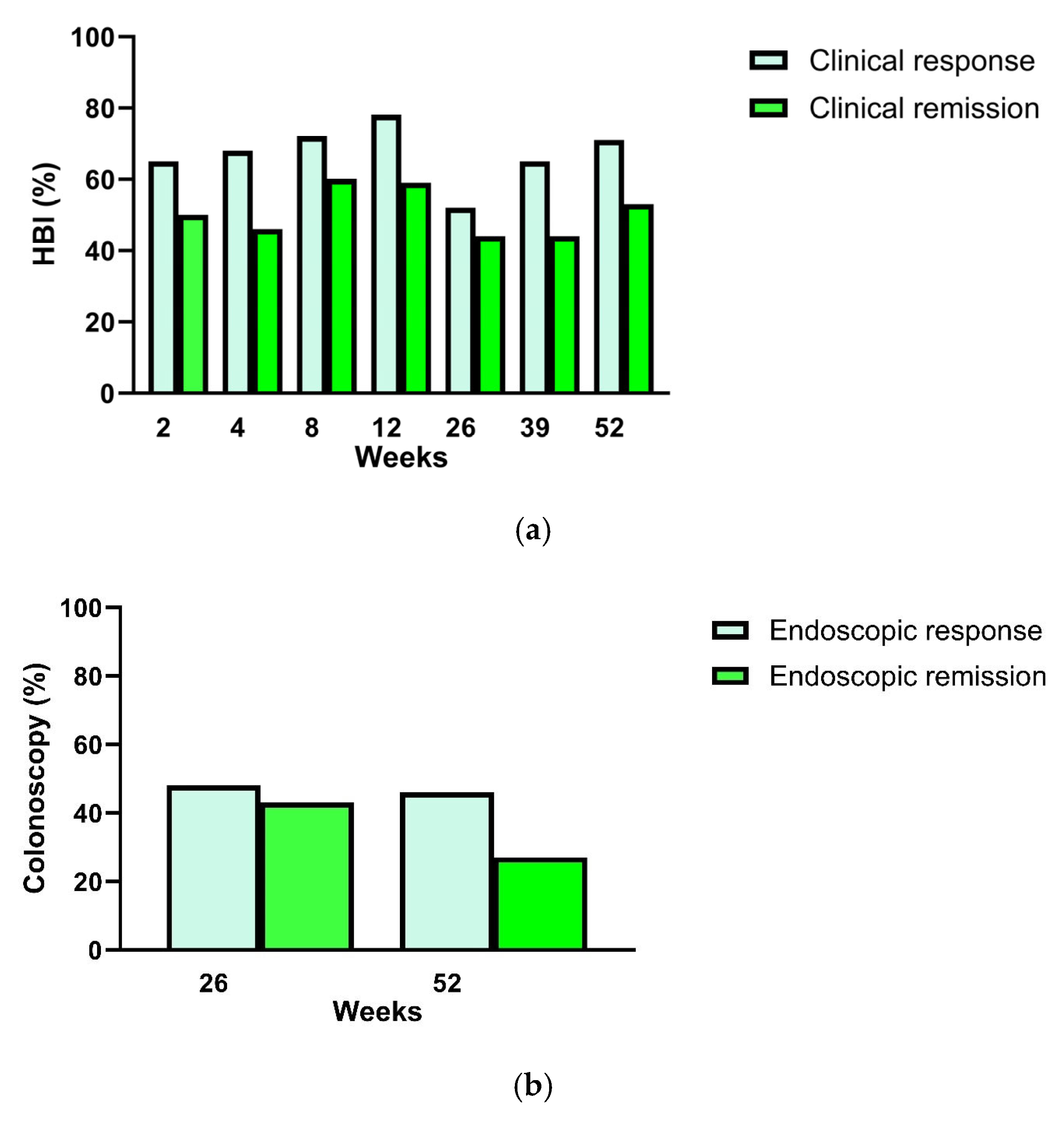
| Endoscopic response | 48 (44–52) | 46 (21–72) | |||||||
| Clinical remission (HBI) | 50 (32–68) | 46 (29–65) | 60 (41–77) | 59 (41–75) | 44 (27–63) | 44 (25–66) | 53 (47–58) | ||
| Secondary end points, % (95% CI) | |||||||||
| Endoscopic remission | 43 (40–48) | 27 (10–57) | |||||||
| Clinical response (HBI) | 65 (46–81) | 68 (48–83) | 72 (52–86) | 78 (59–89) | 52 (33–70) | 65 (41–83) | 71 (62–72) | ||
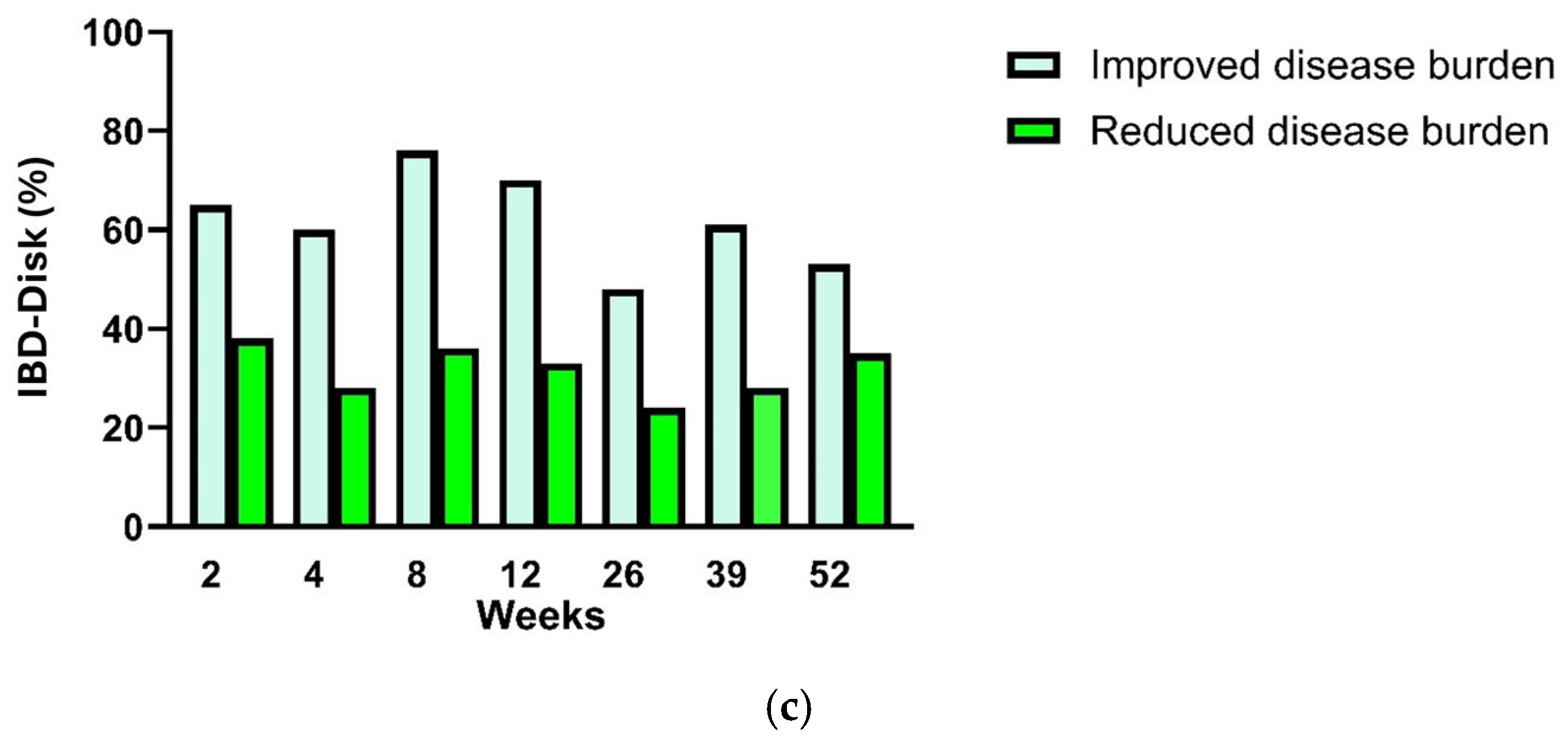
| Reduced Disease Burden (IBD-Disk) | 38 (37–43) | 28 (28–34) | 36 (34–41) | 33 (32–39) | 24 (24–31) | 28 (27–36) | 35 (33–43) | ||
| Improved Disease Burden (IBD-Disk) | 65 (60–67) | 60 (55–62) | 76 (69–76) | 70 (65–71) | 48 (45–52) | 61 (54–64) | 53 (47–58) | ||
| Baseline | Induction | Maintenance | ||||||||||||||
|---|---|---|---|---|---|---|---|---|---|---|---|---|---|---|---|---|
| 0 wk | 2 wk | 4 wk | 8 wk | 12 wk | 26 wk | 39 wk | 52 wk | |||||||||
| n/N | N | n/N | N | n/N | N | n/N | N | n/N | N | n/N | N | n/N | N | n/N | ||
| Patients | 28 | 28 | 28 | 28 | 28 | 24 | 19 | 16 | ||||||||
| Withdrawal from treatment | 0 | 0 | 0 | 0 | 1 | 4 | 9 | 12 | ||||||||
| SES-CD Score | 9 (6–17) | 27/28 | 6 (2–12), p = 0.14 | 19/24 | 5 (1–12), p = 0.005 | 8/16 | ||||||||||
| Fecal calprotectin, Median (IQR), µg/g | 350 (100–1280) | 26/28 | 184 (58–809), p = 0.157 | 23/28 | 289 (88–723), p = 0.181 | 21/24 | 114 (29–870), p = 0.05 | 9/19 | 214 (17–449), p = 0.875 | 12/16 | ||||||
| Laboratory parameters, Median (IQR) | ||||||||||||||||
| Hemoglobin, g/dL | 12.7 (11.9–13.9) | 28/28 | 11.9 (11–12.8), p = 0.004 | 28/28 | 12.2 (10.9–13.5), p = 0.282 | 24/24 | 11.7 (10.9–13.4), p = 0.423 | 16/19 | 11.2 (10.7–13), p = 0.066 | 14/16 | ||||||
| Leukocyte count, ×109/L | 9.1 (6.4–11.2) | 28/28 | 6.9 (5.2–9.8), p = 0.017 | 28/28 | 7.1 (5.2–9.4), p = 0.178 | 24/24 | 6.7 (5.5–10.4), p = 0.222 | 16/19 | 6.4 (5.4–8.2), p = 0.286 | 14/16 | ||||||
| CRP, mg/L | 0.6 (0.5–1.4) | 28/28 | 0.5 (0.5–0.7), p = 0.379 | 28/28 | 0.5 (0.5–1.2), p = 0.205 | 24/24 | 0.5 (0.5–0.7), p = 0.035 | 16/19 | 0.5 (0.5–0.6), p = 0.010 | 14/16 | ||||||
| HBI, Median (IQR) | 9 (5–14) | 28/28 | 5 (0–7), p < 0.001 | 26/28 | 5 (0–7), p < 0.001 | 25/28 | 3 (1–10), p = 0.006 | 25/28 | 3 (1–8), p = 0.002 | 27/28 | 5 (2–10), p = 0.033 | 23/24 | 5 (2–8), p = 0.010 | 16/19 | 4 (1–8), p = 0.035 | 14/16 |
| IBD-Disk, Median (IQR) | 53 (23–73) | 28/28 | 23 (4–47), p < 0.001 | 26/28 | 25 (3–58), p < 0.001 | 25/28 | 19 (5–41), p = 0.006 | 25/28 | 2 (0–7), p = 0.002 | 27/28 | 40 (10–60), p = 0.033 | 23/24 | 35 (14–51), p = 0.023 | 16/19 | 19 (10–38); p = 0.026 | 14/16 |
| Abdominal pain | 5 (1–8) | 28/28 | 3 (0–6), p = 0.006 | 26/28 | 4 (0–6), p = 0.002 | 25/28 | 1 (0–5), p = 0.002 | 25/28 | 2 (0–7), p = 0.016 | 27/28 | 2 (0–6), p = 0.013 | 23/24 | 2 (0–5), p = 0.011 | 16/19 | 2 (0–4), p = 0.016 | 14/16 |
| Stool control | 5 (0–9) | 28/28 | 2 (0–5), p < 0.001 | 26/28 | 0 (0–0), p < 0.001 | 25/28 | 1 (0–4), p = 0.001 | 25/28 | 1 (0–4), p = 0.005 | 27/28 | 1 (0–6), p = 0.038 | 23/24 | 0 (0–2), p = 0.009 | 16/19 | 2 (0–4), p = 0.314 | 14/16 |
| Interpersonal interactions | 3 (0–7) | 28/28 | 2 (0–5), p = 0.047 | 26/28 | 0 (0–0), p = 0.176 | 25/28 | 0 (0–4), p = 0.006 | 25/28 | 0 (0–5), p = 0.07 | 27/28 | 4 (0–8), p = 0.944 | 23/24 | 4 (0–8), p = 0.815 | 16/19 | 1 (0–3), p = 0.186 | 14/16 |
| Education/Work | 6 (0–10) | 28/28 | 0 (0–0), p = 0.003 | 26/28 | 0 (0–0), p = 0.114 | 25/28 | 0 (0–5), p = 0.007 | 25/28 | 1 (0–5), p = 0.048 | 27/28 | 4 (0–8), p = 0.337 | 23/24 | 2 (0–6), p = 0.012 | 16/19 | 0 (0–5), p = 0.132 | 14/16 |
| Sleep | 6 (3–8) | 28/28 | 3 (0–5), p < 0.001 | 26/28 | 3 (0–6), p = 0.001 | 25/28 | 3 (0–6), p < 0.001 | 25/28 | 4 (0–7), p = 0.018 | 27/28 | 4 (0–6), p = 0.015 | 23/24 | 4 (0–6), p = 0.109 | 16/19 | 2 (0–4), p = 0.017 | 14/16 |
| Energy | 7 (4–10) | 28/28 | 4 (0–7), p < 0.001 | 26/28 | 5 (0–7), p = 0.01 | 25/28 | 5 (0–6), p = 0.004 | 25/28 | 4 (0–7), p = 0.002 | 27/28 | 5 (2–8), p = 0.147 | 23/24 | 5 (2–8), p = 0.299 | 16/19 | 3 (0–6), p = 0.025 | 14/16 |
| Emotions | 5 (3–7) | 28/28 | 0 (0–5), p < 0.001 | 26/28 | 0 (0–6), p = 0.003 | 25/28 | 0 (0–5), p < 0.001 | 25/28 | 2 (0–5), p = 0.006 | 27/28 | 5 (0–8), p = 0.123 | 23/24 | 3 (1–7), p = 0.076 | 16/19 | 2 (0–5), p = 0.021 | 14/16 |
| Body image | 4 (0–7) | 28/28 | 0 (0–5), p = 0.01 | 26/28 | 0 (0–0), p = 0.084 | 25/28 | 1 (0–4), p = 0.017 | 25/28 | 0 (0–5), p = 0.097 | 27/28 | 3 (0–6), p = 0.364 | 23/24 | 4 (0–7), p = 0.916 | 16/19 | 2 (0–5), p = 0.166 | 14/16 |
| Sexuality | 5 (0–8) | 28/28 | 0 (0–5), p < 0.001 | 26/28 | 0 (0–0), p = 0.011 | 25/28 | 0 (0–5), p = 0.001 | 25/28 | 1 (0–5), p = 0.016 | 27/28 | 3 (0–6), p = 0.081 | 23/24 | 5 (0–7), p = 0.048 | 16/19 | 0 (0–3), p = 0.007 | 14/16 |
| Joint pain | 6 (0–8) | 28/28 | 0 (0–5), p = 0.005 | 26/28 | 0 (0–7), p = 0.029 | 25/28 | 1 (0–5), p = 0.003 | 25/28 | 0 (0–4), p = 0.024 | 27/28 | 2 (0–8), p = 0.419 | 23/24 | 2 (0–7), p = 0.555 | 16/19 | 4 (0–6), p = 1.000 | 14/16 |
| Concomitant Crohn’s disease medications | ||||||||||||||||
| Glucocorticoids | 15 (54) | 28/28 | 4 (15) | 28/28 | 5 (21) | 24/24 | 2 (11) | 19/19 | 1 (6.3) | 16/16 | ||||||
| Adverse Events | n (%) |
|---|---|
| Any adverse event | |
| Severe adverse event | 0 (0) |
| Serious adverse event | 0 (0) |
| Death from any cause | 0 (0) |
| Adverse events of special interest | 3 (11) |
| Serious infection | 0 (0) |
| Opportunistic infection | 0 (0) |
| Herpes zoster infection | 0 (0) |
| Tuberculosis | 0 (0) |
| Lymphopenia | 1 (4) |
| Skin disease | 2 (7) |
| Adjudicated cardiovascular events | 0 (0) |
| Adjudicated thrombotic events | 0 (0) |
| Cancer of any type | 0 (0) |
| Reasons | n (%) |
|---|---|
| Primary non-response | 7 (25) |
| Adverse events | 3 (11) |
| Skin disease | 2 (7) |
| Lymphopenia | 1 (4) |
| Others | 2 (7) |
Disclaimer/Publisher’s Note: The statements, opinions and data contained in all publications are solely those of the individual author(s) and contributor(s) and not of MDPI and/or the editor(s). MDPI and/or the editor(s) disclaim responsibility for any injury to people or property resulting from any ideas, methods, instructions or products referred to in the content. |
© 2026 by the authors. Licensee MDPI, Basel, Switzerland. This article is an open access article distributed under the terms and conditions of the Creative Commons Attribution (CC BY) license.
Share and Cite
Lüke, J.; Zippel, C.; Tepasse, P.-R.; Lenze, F.; Strauss, M.; Bokemeyer, A.; Buskermolen, J.; Schomacher, T.; Fischer, J.; Trebicka, J.; et al. Prospective Bi-Centric Real-World Outcomes of Upadacitinib in Biologic-Experienced Patients with Crohn’s Disease. Diseases 2026, 14, 54. https://doi.org/10.3390/diseases14020054
Lüke J, Zippel C, Tepasse P-R, Lenze F, Strauss M, Bokemeyer A, Buskermolen J, Schomacher T, Fischer J, Trebicka J, et al. Prospective Bi-Centric Real-World Outcomes of Upadacitinib in Biologic-Experienced Patients with Crohn’s Disease. Diseases. 2026; 14(2):54. https://doi.org/10.3390/diseases14020054
Chicago/Turabian StyleLüke, Janina, Clara Zippel, Phil-Robin Tepasse, Frank Lenze, Markus Strauss, Arne Bokemeyer, Joost Buskermolen, Tina Schomacher, Julia Fischer, Jonel Trebicka, and et al. 2026. "Prospective Bi-Centric Real-World Outcomes of Upadacitinib in Biologic-Experienced Patients with Crohn’s Disease" Diseases 14, no. 2: 54. https://doi.org/10.3390/diseases14020054
APA StyleLüke, J., Zippel, C., Tepasse, P.-R., Lenze, F., Strauss, M., Bokemeyer, A., Buskermolen, J., Schomacher, T., Fischer, J., Trebicka, J., & Vollenberg, R. (2026). Prospective Bi-Centric Real-World Outcomes of Upadacitinib in Biologic-Experienced Patients with Crohn’s Disease. Diseases, 14(2), 54. https://doi.org/10.3390/diseases14020054