
The Diagnostic Value of Cellular Phenotyping and Pathological Casts Using Urine Flow Cytometry in Children with Lupus Nephritis

 ,
,  , , and
Abstract
1. Introduction
2. Materials and Methods
2.1. Subjects
2.2. Urine Flow Cytometry
2.3. Ethical Clearance
2.4. Statistical Analysis
3. Results
4. Discussion
5. Limitations
6. Conclusions
Author Contributions
Funding
Institutional Review Board Statement
Informed Consent Statement
Data Availability Statement
Conflicts of Interest
Correction Statement
References
- Anders, H.-J.; Saxena, R.; Zhao, M.-H.; Parodis, I.; Salmon, J.E.; Mohan, C. Lupus nephritis. Nat. Rev. Dis. Prim. 2020, 6, 7. [Google Scholar] [CrossRef]
- Pennesi, M.; Benvenuto, S. Lupus Nephritis in Children: Novel Perspectives. Medicina 2023, 59, 1481. [Google Scholar] [CrossRef] [PubMed]
- Krishnamurthy, H.; Yang, Y.; Song, Q.; Krishna, K.; Jayaraman, V.; Wang, T.; Bei, K.; Rajasekaran, J.J. Evaluation of renal markers in systemic autoimmune diseases. PLoS ONE 2023, 18, e0278441. [Google Scholar] [CrossRef]
- Maulidan, E.B.; Marpaung, F.R. Diagnostic Value of Urinary Dysmorphic Erythrocytes in SLE Patients with Three Different Methods. Indones. J. Clin. Pathol. Med. Lab. 2021, 28, 41–45. [Google Scholar] [CrossRef]
- Ritonga, N.F.H.M.; Marpaung, F.R.; Kahar, H.; Mardiana, N.; Puspitasari, Y. Performance Comparison of Urine Sediment Analytical Tool by Flowcytometry and Digital Imaging with Standardized Manual Microscopic Testing. Pharmacogn. J. 2023, 15, 1189–1196. [Google Scholar] [CrossRef]
- Bajema, I.M.; Wilhelmus, S.; Alpers, C.E.; Bruijn, J.A.; Colvin, R.B.; Cook, H.T.; D’Agati, V.D.; Ferrario, F.; Haas, M.; Jennette, J.C.; et al. Revision of the International Society of Nephrology/Renal Pathology Society classification for Lupus nephritis: Clarification of definitions, and modified National Institutes of Health activity and chronicity indices. Kidney Int. 2018, 93, 789–796. [Google Scholar] [CrossRef]
- Çorbacıoğlu, Ş.K.; Aksel, G. Receiver operating characteristic curve analysis in diagnostic accuracy studies: A guide to interpreting the area under the curve value. Turk. J. Emerg. Med. 2023, 23, 195–198. [Google Scholar] [CrossRef] [PubMed]
- Charras, A.; Smith, E.; Hedrich, C.M. Systemic Lupus Erythematosus in Children and Young People. Curr Rheumatol Rep. 2021, 23, 20. [Google Scholar] [CrossRef]
- Brunner, H.I.; Gladman, D.D.; Ibañez, D.; Urowitz, M.D.; Silverman, E.D. Difference in disease features between childhood-onset and adult-onset systemic lupus erythematosus. Arthritis Rheum. 2008, 58, 556–562. [Google Scholar] [CrossRef]
- Murugesan, V.; Mathew, A.; Rajasekharan Nair, R.; Kurian, G.; Paul Polachirakal, Z.; Sreedharan, S. Comparison of Histomorphological Indices Between Adult and Pediatric Patients in Response to Induction Therapy. Cureus 2024, 16, e66673. [Google Scholar] [CrossRef]
- Liu, T.; Yang, Y.L.; Zhou, Y.; Jiang, Y.M. Noninvasive biomarkers for lupus nephritis. Lab. Med. 2024, 55, 535–542. [Google Scholar] [CrossRef] [PubMed]
- Kim, H.J.; Kim, M.; Zhang, H.; Kim, H.R.; Jeon, J.W.; Seo, Y.; Choi, Q. Artificial Intelligence in Diagnostics: Enhancing Urine Test Accuracy Using a Mobile Phone–Based Reading System. Ann. Lab. Med. 2025, 45, 178–184. [Google Scholar] [CrossRef]
- Setiawan, D.; Sidharta, B.R.A.; Ariningrum, D. Determining Glomerular and Non-Glomerular Hematuria Dysmorphic Red Blood Cell: Study on Automatic Urine Analyzer. Indones. J. Clin. Pathol. Med. Lab. 2022, 28, 319–323. [Google Scholar] [CrossRef]
- Zaman, Z.; Proesmans, W. Dysmorphic erythrocytes and G1 cells as markers of glomerular hematuria. Pediatr. Nephrol. 2000, 14, 980–984. [Google Scholar] [CrossRef]
- Mizuno, G.; Hoshi, M.; Nakamoto, K.; Sakurai, M.; Nagashima, K.; Fujita, T.; Ito, H.; Hata, T. Evaluation of red blood cell parameters provided by the UF-5000 urine auto-analyzer in patients with glomerulonephritis. Clin. Chem. Lab. Med. 2021, 59, 1547–1553. [Google Scholar] [CrossRef] [PubMed]
- Cho, H.; Yoo, J.; Kim, H.; Jang, H.; Kim, Y.; Chae, H. Diagnostic Characteristics of Urinary Red Blood Cell Distribution Incorporated in UF-5000 for Differentiation of Glomerular and Non-Glomerular Hematuria. Ann. Lab. Med. 2022, 42, 160–168. [Google Scholar] [CrossRef]
- Dong, Z.; Wang, Y.; Qiu, Q.; Hou, K.; Zhang, L.; Wu, J.; Zhu, H.; Cai, G.; Sun, X.; Zhang, X.; et al. Dysmorphic erythrocytes are superior to hematuria for indicating non-diabetic renal disease in type 2 diabetics. J. Diabetes Investig. 2016, 7, 115–120. [Google Scholar] [CrossRef]
- Saha, M.K.; Massicotte-Azarniouch, D.; Reynolds, M.L.; Mottl, A.K.; Falk, R.J.; Jennette, J.C.; Derebail, V.K. Glomerular Hematuria and the Utility of Urine Microscopy: A Review. Am. J. Kidney Dis. 2022, 80, 383–392. [Google Scholar] [CrossRef]
- Hamadah, A.M.; Gharaibeh, K.; Mara, K.C.; Thompson, K.A.; Lieske, J.C.; Said, S.; Nasr, S.H.; Leung, N. Urinalysis for the diagnosis of glomerulonephritis: Role of dysmorphic red blood cells. Nephrol. Dial. Transplant. 2018, 33, 1397–1403. [Google Scholar] [CrossRef]
- Charoensappakit, A.; Puapatanakul, P.; Praditpornsilpa, K.; Palasuwan, A.; Noulsri, E.; Palasuwan, D. Urinary red blood cell-derived microparticles and phosphatidylserine-exposing red blood cells in glomerular and non-glomerular hematuria patients. Cytom. B Clin. Cytom. 2022, 102, 370–376. [Google Scholar] [CrossRef]
- Koo, K.C.; Lee, K.S.; Choi, A.R.; Rha, K.H.; Hong, S.J.; Chung, B.H. Diagnostic impact of dysmorphic red blood cells on evaluating microscopic hematuria: The urologist’s perspective. Int. Urol. Nephrol. 2016, 48, 1021–1027. [Google Scholar] [CrossRef]
- Lee, A.-J.; Bang, H.I.; Lee, S.M.; Won, D.; Kang, M.S.; Choi, H.-J.; Lee, I.H.; Jeon, C.-H. Comparison of Urinary Red Blood Cell Distribution (URD) and Dysmorphic Red Blood Cells for Detecting Glomerular Hematuria: A Multicenter Study. J. Clin. Lab. Anal. 2025, 39, e25159. [Google Scholar] [CrossRef]
- Roring, M.E.; Nugraha, J.; Prasetyo, R.V.; Marpaung, F.R. Marpaung The Concordance of Dysmorphic Erythrocyte and Cast Erythrocyte Examination using Flowcitometry, Low Condenser Light Microscope, and Phase Contrast Microscope in Children with Glomerular Hematuria. Indian J. Forensic Med. Toxicol. 2021, 15, 1803–1809. [Google Scholar] [CrossRef]
- Li, Z.-L.; Li, X.-Y.; Zhou, Y.; Wang, B.; Lv, L.-L.; Liu, B.-C. Renal tubular epithelial cells response to injury in acute kidney injury. eBioMedicine 2024, 107, 105294. [Google Scholar] [CrossRef] [PubMed]
- Feng, A.; Yin, R.; Xu, R.; Zhang, B.; Yang, L. An update on renal tubular injury as related to glycolipid metabolism in diabetic kidney disease. Front. Pharmacol. 2025, 16, 1559026. [Google Scholar] [CrossRef] [PubMed]
- Chen, J.; Zhang, H.; Yi, X.; Dou, Q.; Yang, X.; He, Y.; Chen, J.; Chen, K. Cellular senescence of renal tubular epithelial cells in acute kidney injury. Cell Death Discov. 2024, 10, 62. [Google Scholar] [CrossRef]
- Poloni, J.A.T.; de Oliveira Vieira, A.; Dos Santos, C.R.M.; Simundic, A.-M.; Rotta, L.N. Survey on reporting of epithelial cells in urine sediment as part of external quality assessment programs in Brazilian laboratories. Biochem. Medica 2021, 31, 20711. [Google Scholar] [CrossRef]
- Elsayed, M.M.; Eldeeb, A.E.; Tahoun, M.M.; El-Wakil, H.S.; Naga, S.S. Does combining urine sediment examination to renal cell arrest and damage biomarkers improve prediction of progression and mortality of sepsis associated acute kidney injury? BMC Nephrol. 2025, 26, 195. [Google Scholar] [CrossRef]
- Alamilla-Sanchez, M.; Alcalá Salgado, M.A.; Ulloa Galván, V.M.; Yanez Salguero, V.; Yamá Estrella, M.B.; Morales López, E.F.; Ramos García, N.A.; Carbajal Zárate, M.O.; Salazar Hurtado, J.D.; Delgado Pineda, D.A.; et al. Understanding Renal Tubular Function: Key Mechanisms, Clinical Relevance, and Comprehensive Urine Assessment. Pathophysiology 2025, 32, 33. [Google Scholar] [CrossRef]
- Ringsrud, K.M. Casts in the Urine Sediment. Lab. Med. 2001, 32, 191–193. [Google Scholar] [CrossRef]
- Zheng, C.; Wang, W.; Chen, R.; Liu, J.; Li, Y.; Qin, X. Diagnostic value of urinary microprotein concentration for patients with negative urinary protein test results and positive urinary casts on microscopic examination. J. Clin. Lab. Anal. 2020, 34, e23487. [Google Scholar] [CrossRef] [PubMed]


| Characteristic | Result |
|---|---|
| Sex (n, %) | |
| Male | 160 (50.5%) |
| Female | 157 (49.5%) |
| Age (years) | |
| Median (IQR) | 13 (7) |
| BW (kg) | |
| Median (IQR) | 36.6 (22) |
| Height (cm) | |
| Median (IQR) | 145 (32) |
| LN classification system (n, %) | |
| Class I | 8 (3.6%) |
| Class II | 16 (7.2%) |
| Class III | 56 (25.3%) |
| Class IV | 124 (56.1%) |
| Class V | 7 (3.2%) |
| Class VI | 10 (4.6%) |
| ACR (n, %) | |
| <30 | 211 (66.6) |
| 30–300 | 42 (13.2) |
| >300 | 64 (20.2) |
| Characteristic | Result | p Value |
|---|---|---|
| Blood Creatinine (mg/dL) | ||
| Median (IQR) | 0.63 (0.4) | |
| LN Median (IQR) | 0.67 (0.39) | 0.021 * |
| Non-LN Median (IQR) | 0.57 (0.32) | |
| Urine ACR (mg/g) Median (IQR) | ||
| Total | 9.9 (173.6) | |
| LN | 14.8 (304.4) | <0.001 * |
| Non-LN | 4.3 (9.5) | |
| %DysRBC | ||
| ACR < 30 | 39 | |
| ACR 30–300 | 56 | 0.022 * |
| ACR > 300 | 59 | |
| RTEC/uL | ||
| ACR < 30 | 0.6 (1.9) | |
| ACR 30–300 | 1.5 (4.0) | 0.006 * |
| ACR > 300 | 1.7 (3.9) | |
| PathCast (/µL) | ||
| ACR < 30 | 0.01 (0.4) | |
| ACR 30–300 | 0.27 (1.4) | 0.002 * |
| ACR > 300 | 0.41 (1.2) | |
| %DysRBC (median, IQR) | ||
| Total | 48 (52.5) | |
| LN | 60 (32) | <0.001 * |
| Non-LN | 8 (14) | |
| RTEC (/µL) | ||
| Total Median (IQR) | 1.4 (3.43) | |
| LN Median (IQR) | 1.5 (3.5) | 0.0258 * |
| Non-LN Median (IQR) | 0.95 (2.2) | |
| PathCast (/µL) | ||
| Total Median (IQR) | 0.27 (1.34) | |
| LN Median (IQR) | 0.41 (1.84) | <0.001 * |
| Non-LN | 0.01 (0.5) |
| ACR Classification | Total (n, %) | |||
|---|---|---|---|---|
| Diagnosis | <30 | 30–300 | >300 | |
| Non-LN | 77 | 10 | 3 | 90 (28.4) |
| LN | 134 | 32 | 61 | 227 (71.6%) |
| Total (n, %) | 211 (66.6%) | 42 (13.2%) | 64 (20.2%) | |
| p value < 0.001 * | ||||
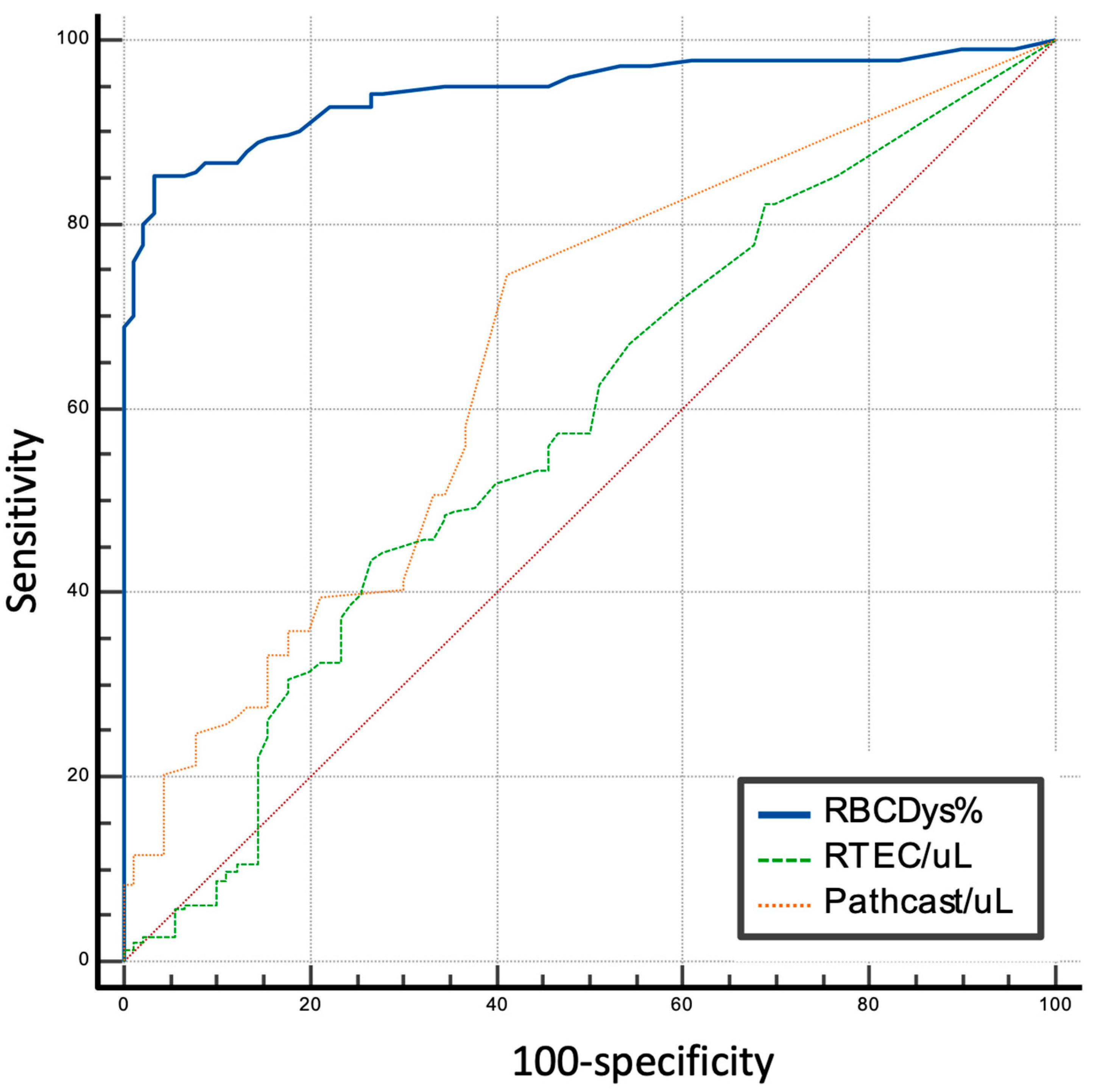
| Parameter | AUC | Sens | Spes | Cut off | p Value |
|---|---|---|---|---|---|
| %DysRBC | 0.945 | 84.6 | 96.7 | >35 | <0.0001 |
| RTEC (/uL) | 0.580 | 43.17 | 73.33 | >2.2 | <0.001 |
| PathCast (/uL) | 0.664 | 74.67 | 58.89 | >0.13 | <0.001 |
Disclaimer/Publisher’s Note: The statements, opinions and data contained in all publications are solely those of the individual author(s) and contributor(s) and not of MDPI and/or the editor(s). MDPI and/or the editor(s) disclaim responsibility for any injury to people or property resulting from any ideas, methods, instructions or products referred to in the content. |
© 2026 by the authors. Licensee MDPI, Basel, Switzerland. This article is an open access article distributed under the terms and conditions of the Creative Commons Attribution (CC BY) license.
Share and Cite
Marpaung, F.R.; Prasetyo, R.V.; Lumban Toruan, A.A.; Santoso, D.; Aryati, A. The Diagnostic Value of Cellular Phenotyping and Pathological Casts Using Urine Flow Cytometry in Children with Lupus Nephritis. Diseases 2026, 14, 53. https://doi.org/10.3390/diseases14020053
Marpaung FR, Prasetyo RV, Lumban Toruan AA, Santoso D, Aryati A. The Diagnostic Value of Cellular Phenotyping and Pathological Casts Using Urine Flow Cytometry in Children with Lupus Nephritis. Diseases. 2026; 14(2):53. https://doi.org/10.3390/diseases14020053
Chicago/Turabian StyleMarpaung, Ferdy Royland, Risky Vitria Prasetyo, Anggia Augustasia Lumban Toruan, Djoko Santoso, and Aryati Aryati. 2026. "The Diagnostic Value of Cellular Phenotyping and Pathological Casts Using Urine Flow Cytometry in Children with Lupus Nephritis" Diseases 14, no. 2: 53. https://doi.org/10.3390/diseases14020053
APA StyleMarpaung, F. R., Prasetyo, R. V., Lumban Toruan, A. A., Santoso, D., & Aryati, A. (2026). The Diagnostic Value of Cellular Phenotyping and Pathological Casts Using Urine Flow Cytometry in Children with Lupus Nephritis. Diseases, 14(2), 53. https://doi.org/10.3390/diseases14020053