
Navigating the Latest Hepatitis B Virus Reactivation Guidelines


Abstract
1. Introduction
2. Materials and Methods
3. Definition of Hepatitis B Reactivation (According to the Major Gastroenterology/Liver Societies)
4. Risk Factors for Hepatitis B Reactivation
4.1. Viral Factors
4.2. Host Factors
4.2.1. Demographics
4.2.2. Underlying Disease
4.2.3. Immunosuppressive Therapy
5. Prevention of HBV Reactivation
5.1. Screening
5.2. Vaccination
5.3. Risk Stratification
5.3.1. High Risk Category
HBsAg Positive Patients (in the EASL Guidelines Also Applies to Patients That Are HBsAg Negative/Anti-HBc Positive with Positive HBV DNA)
HBsAg Negative/Anti-HBc Positive Patients (in the EASL Guidelines, These Group Recommendations Apply Only to Patients Who Are Also HBV DNA Negative)
5.3.2. Moderate Risk Category
HBsAg Positive Patients (in the EASL Guidelines Also Applies to Patients That Are HBsAg Negative/Anti-HBc Positive with Positive HBV DNA)
HBsAg Negative/Anti-HBc Positive Patients (in the EASL Guidelines, These Group Recommendations Apply Only to Patients Who Are Also HBV DNA Negative)
5.3.3. Low Risk Category
HBsAg Positive Patients (in the EASL Guidelines, This Also Applies to Patients That Are HBsAg Negative/Anti-HBc Positive with Positive HBV DNA)
HBsAg Negative/Anti-HBc Positive Patients (in the EASL Guidelines, These Group Recommendations Apply Only to Patients Who Are Also HBV DNA Negative)
5.4. Prophylaxis Therapy
5.5. Duration of Prophylaxis Therapy
5.6. Cost-Effectiveness of Prophylaxis Therapy
6. HBV Reactivation Treatment
7. Conclusions
Author Contributions
Funding
Institutional Review Board Statement
Informed Consent Statement
Data Availability Statement
Conflicts of Interest
Abbreviations
| AASLD | American Association for the Study of Liver Diseases |
| AGA | American Gastroenterological Association |
| anti-HBC+/− | anti-hepatitis B core antibody positive/negative |
| anti-HBs+/− | anti-hepatitis B surface antibody positive/negative |
| ALT | alanine aminotransferase |
| anti-TNF | anti-tumor necrosis factor |
| APASL | Asian Pacific Association for the Study of the Liver |
| ASCO | American Society of Clinical Oncology |
| CAR-T | chimeric antigen receptor T cell |
| cccDNA | covalently closed circular DNA |
| CD20 | cluster of differentiation 20 |
| CDC | Centers for Disease Control |
| DAA | direct-acting antiviral |
| DNA | deoxyribonucleic acid |
| EASL | European Association for the Study of the Liver |
| ETV | entecavir |
| ESRD | end stage renal disease |
| HBc | hepatitis B virus core antigen |
| HBeAg | hepatitis B virus envelope antigen |
| HBsAg | hepatitis B virus surface antigen |
| HBV | hepatitis B virus |
| HBVr | hepatitis B virus reactivation |
| HCC | hepatocellular carcinoma |
| HCV | hepatitis C virus |
| HIV | human immunodeficiency virus |
| ICIs | immune checkpoint inhibitors |
| IL | interleukin |
| IST | Immune suppressive therapy |
| JAK | Janus kinase (JAK) inhibitors |
| mTOR | mammalian target of rapamycin |
| NA | nucleos(t)ide analogue |
| PTX | paclitaxel |
| PCR | polymerase chain reaction |
| PEG-IFNα | pegylated interferon alpha |
| qHBsAg | quantitative hepatitis B surface antigen |
| RCT | randomized controlled trial |
| TACE | transcatheter arterial chemoembolization |
| TAF | tenofovir alafenamide |
| TDF | tenofovir disoproxil fumarate |
| TKI | tyrosine kinase inhibitor |
| TNF | tumor necrosis factor |
| ULN | upper limit of normal |
| USPTF | United States. Preventive Services Task Force |
| WHO | World Health Organization |
References
- World Health Organization. Global Progress Report on HIV, Viral Hepatitis and Sexually Transmitted Infections; World Health Organization: Geneva, Switzerland, 2021; ISBN 978-92-4-002707-7. [Google Scholar]
- World Health Organization. Global Hepatitis Report 2024: Action for Access in Low- and Middle-Income Countries; World Health Organization: Geneva, Switzerland, 2024. [Google Scholar]
- Marrapu, S.; Kumar, R. Chronic Hepatitis B: Prevent, diagnose, and treat before the point of no return. World J. Hepatol. 2024, 16, 1151–1157. [Google Scholar] [CrossRef]
- Jeng, W.J.; Papatheodoridis, G.V.; Lok, A.S.F. Hepatitis B. Lancet 2023, 401, 1039–1052. [Google Scholar] [CrossRef]
- Heath, R.D.; Tahan, V. Natural History of Hepatitis B Virus. In Viral Hepatitis: Chronic Hepatitis B; Ozaras, R., Tahan, V., Eds.; Springer International Publishing: Cham, Switzerland, 2018; pp. 1–10. [Google Scholar]
- Terrault, N.A.; Bzowej, N.H.; Chang, K.M.; Hwang, J.P.; Jonas, M.M.; Murad, M.H. AASLD guidelines for treatment of chronic Hepatitis B. Hepatology 2016, 63, 261–283. [Google Scholar] [CrossRef]
- Wands, J.R.; Chura, C.M.; Roll, F.J.; Maddrey, W.C. Serial studies of hepatitis-associated antigen and antibody in patients receiving antitumor chemotherapy for myeloproliferative and lymphoproliferative disorders. Gastroenterology 1975, 68, 105–112. [Google Scholar] [CrossRef]
- Hoofnagle, J.H.; Dusheiko, G.M.; Schafer, D.F.; Jones, E.A.; Micetich, K.C.; Young, R.C.; Costa, J. Reactivation of chronic Hepatitis B virus infection by cancer chemotherapy. Ann. Intern. Med. 1982, 96, 447–449. [Google Scholar] [CrossRef] [PubMed]
- Hsu, Y.C.; Huang, D.Q.; Nguyen, M.H. Global burden of Hepatitis B virus: Current status, missed opportunities and a call for action. Nat. Rev. Gastroenterol. Hepatol. 2023, 20, 524–537. [Google Scholar] [CrossRef] [PubMed]
- Mozessohn, L.; Chan, K.K.; Feld, J.J.; Hicks, L.K. Hepatitis B reactivation in HBsAg-negative/HBcAb-positive patients receiving rituximab for lymphoma: A meta-analysis. J. Viral Hepat. 2015, 22, 842–849. [Google Scholar] [CrossRef]
- Lok, A.S.; Liang, R.H.; Chiu, E.K.; Wong, K.L.; Chan, T.K.; Todd, D. Reactivation of Hepatitis B virus replication in patients receiving cytotoxic therapy. Report of a prospective study. Gastroenterology 1991, 100, 182–188. [Google Scholar] [CrossRef]
- Anvari, S.; Tsoi, K. Hepatitis B Virus Reactivation with Immunosuppression: A Hidden Threat? J. Clin. Med. 2024, 13, 393. [Google Scholar] [CrossRef]
- Perrillo, R.P.; Gish, R.; Falck-Ytter, Y.T. American Gastroenterological Association Institute technical review on prevention and treatment of Hepatitis B virus reactivation during immunosuppressive drug therapy. Gastroenterology 2015, 148, 221–244.e223. [Google Scholar] [CrossRef] [PubMed]
- Ali, F.S.; Nguyen, M.H.; Hernaez, R.; Huang, D.Q.; Wilder, J.; Piscoya, A.; Simon, T.G.; Falck-Ytter, Y. AGA Clinical Practice Guideline on the Prevention and Treatment of Hepatitis B Virus Reactivation in At-Risk Individuals. Gastroenterology 2025, 168, 267–284. [Google Scholar] [CrossRef]
- Liu, C.; Shih, Y.F.; Liu, C.J. Immunopathogenesis of Acute Flare of Chronic Hepatitis B: With Emphasis on the Role of Cytokines and Chemokines. Int. J. Mol. Sci. 2022, 23, 1407. [Google Scholar] [CrossRef]
- Lazarevic, I.; Banko, A.; Miljanovic, D.; Cupic, M. Immune-Escape Hepatitis B Virus Mutations Associated with Viral Reactivation upon Immunosuppression. Viruses 2019, 11, 778. [Google Scholar] [CrossRef]
- Li, M.; Gao, Y.; Yang, L.; Lin, Y.; Deng, W.; Jiang, T.; Bi, X.; Lu, Y.; Zhang, L.; Shen, G.; et al. Dynamic changes of cytokine profiles and virological markers during 48 weeks of entecavir treatment for HBeAg-positive chronic Hepatitis B. Front. Immunol. 2022, 13, 1024333. [Google Scholar] [CrossRef] [PubMed]
- Jin, X.; Bi, J. Prospects for NK-based immunotherapy of chronic HBV infection. Front. Immunol. 2022, 13, 1084109. [Google Scholar] [CrossRef]
- Ma, H.; Yan, Q.Z.; Ma, J.R.; Li, D.F.; Yang, J.L. Overview of the immunological mechanisms in Hepatitis B virus reactivation: Implications for disease progression and management strategies. World J. Gastroenterol. 2024, 30, 1295–1312. [Google Scholar] [CrossRef]
- Chen, S.; Li, B.; Luo, W.; Rehman, A.U.; He, M.; Yang, Q.; Wang, S.; Guo, J.; Chen, L.; Li, X. Paclitaxel-induced Immune Dysfunction and Activation of Transcription Factor AP-1 Facilitate Hepatitis B Virus Replication. J. Clin. Transl. Hepatol. 2024, 12, 457–468. [Google Scholar] [CrossRef]
- Buti, M.; Manzano, M.L.; Morillas, R.M.; García-Retortillo, M.; Martín, L.; Prieto, M.; Gutiérrez, M.L.; Suárez, E.; Gómez Rubio, M.; López, J.; et al. Randomized prospective study evaluating tenofovir disoproxil fumarate prophylaxis against Hepatitis B virus reactivation in anti-HBc-positive patients with rituximab-based regimens to treat hematologic malignancies: The Preblin study. PLoS ONE 2017, 12, e0184550. [Google Scholar] [CrossRef] [PubMed]
- Lau, G.K.; Yiu, H.H.; Fong, D.Y.; Cheng, H.C.; Au, W.Y.; Lai, L.S.; Cheung, M.; Zhang, H.Y.; Lie, A.; Ngan, R.; et al. Early is superior to deferred preemptive lamivudine therapy for Hepatitis B patients undergoing chemotherapy. Gastroenterology 2003, 125, 1742–1749. [Google Scholar] [CrossRef] [PubMed]
- Jang, J.W.; Choi, J.Y.; Bae, S.H.; Yoon, S.K.; Chang, U.I.; Kim, C.W.; Cho, S.H.; Han, J.Y.; Lee, Y.S. A randomized controlled study of preemptive lamivudine in patients receiving transarterial chemo-lipiodolization. Hepatology 2006, 43, 233–240. [Google Scholar] [CrossRef]
- Papatheodoridis, G.V.; Lekakis, V.; Voulgaris, T.; Lampertico, P.; Berg, T.; Chan, H.L.Y.; Kao, J.H.; Terrault, N.; Lok, A.S.; Reddy, K.R. Hepatitis B virus reactivation associated with new classes of immunosuppressants and immunomodulators: A systematic review, meta-analysis, and expert opinion. J. Hepatol. 2022, 77, 1670–1689. [Google Scholar] [CrossRef]
- Cornberg, M.; Sandmann, L.; Jaroszewicz, J.; Kennedy, P.; Lampertico, P.; Lemoine, M.; Lens, S.; Testoni, B.; Lai-Hung Wong, G.; Russo, F.P. EASL Clinical Practice Guidelines on the management of Hepatitis B virus infection. J. Hepatol. 2025, 83, 502–583. [Google Scholar] [CrossRef] [PubMed]
- Lau, G.; Yu, M.-L.; Wong, G.; Thompson, A.; Ghazinian, H.; Hou, J.-L.; Piratvisuth, T.; Jia, J.-D.; Mizokami, M.; Cheng, G.; et al. APASL clinical practice guideline on Hepatitis B reactivation related to the use of immunosuppressive therapy. Hepatol. Int. 2021, 15, 1031–1048. [Google Scholar] [CrossRef] [PubMed]
- Lampertico, P.; Agarwal, K.; Berg, T.; Buti, M.; Janssen, H.L.A.; Papatheodoridis, G.; Zoulim, F.; Tacke, F. EASL 2017 Clinical Practice Guidelines on the management of Hepatitis B virus infection. J. Hepatol. 2017, 67, 370–398. [Google Scholar] [CrossRef] [PubMed]
- Smalls, D.J.; Kiger, R.E.; Norris, L.B.; Bennett, C.L.; Love, B.L. Hepatitis B Virus Reactivation: Risk Factors and Current Management Strategies. Pharmacotherapy 2019, 39, 1190–1203. [Google Scholar] [CrossRef]
- Conners, E.E.; Panagiotakopoulos, L.; Hofmeister, M.G.; Spradling, P.R.; Hagan, L.M.; Harris, A.M.; Rogers-Brown, J.S.; Wester, C.; Nelson, N.P.; Rapposelli, K.; et al. Screening and Testing for Hepatitis B Virus Infection: CDC Recommendations—United States, 2023. Morb. Mortal. Wkly. Rep. Recomm. Rep. 2023, 72, 1–25. [Google Scholar] [CrossRef]
- Chou, R.; Blazina, I.; Bougatsos, C.; Holmes, R.; Selph, S.; Grusing, S.; Jou, J. Screening for Hepatitis B Virus Infection in Nonpregnant Adolescents and Adults: Updated Evidence Report and Systematic Review for the US Preventive Services Task Force. Jama 2020, 324, 2423–2436. [Google Scholar] [CrossRef]
- Hwang, J.P.; Feld, J.J.; Hammond, S.P.; Wang, S.H.; Alston-Johnson, D.E.; Cryer, D.R.; Hershman, D.L.; Loehrer, A.P.; Sabichi, A.L.; Symington, B.E.; et al. Hepatitis B Virus Screening and Management for Patients With Cancer Prior to Therapy: ASCO Provisional Clinical Opinion Update. J. Clin. Oncol. 2020, 38, 3698–3715. [Google Scholar] [CrossRef] [PubMed]
- Terrault, N.A.; Lok, A.S.F.; McMahon, B.J.; Chang, K.M.; Hwang, J.P.; Jonas, M.M.; Brown, R.S., Jr.; Bzowej, N.H.; Wong, J.B. Update on prevention, diagnosis, and treatment of chronic Hepatitis B: AASLD 2018 Hepatitis B guidance. Hepatology 2018, 67, 1560–1599. [Google Scholar] [CrossRef]
- Mack, C.L.; Adams, D.; Assis, D.N.; Kerkar, N.; Manns, M.P.; Mayo, M.J.; Vierling, J.M.; Alsawas, M.; Murad, M.H.; Czaja, A.J. Diagnosis and Management of Autoimmune Hepatitis in Adults and Children: 2019 Practice Guidance and Guidelines From the American Association for the Study of Liver Diseases. Hepatology 2020, 72, 671–722. [Google Scholar] [CrossRef]
- Lin, Y.; Lin, X.; Xia, R.; Chen, J.; Lin, Z.; Lu, S. Tenofovir alafenamide is superior to tenofovir disoproxil fumarate and entecavir in cost-effectiveness of treatment of chronic Hepatitis B in china with new volume-based procurement policy. PLoS ONE 2025, 20, e0327298. [Google Scholar] [CrossRef] [PubMed]
- Toka, B.; Koksal, A.S.; Eminler, A.T.; Tozlu, M.; Uslan, M.I.; Parlak, E. Comparison of Tenofovir Disoproxil Fumarate and Entecavir in the Prophylaxis of HBV Reactivation. Dig. Dis. Sci. 2021, 66, 2417–2426. [Google Scholar] [CrossRef]
- Kim, H.L.; Kim, G.A.; Park, J.A.; Kang, H.R.; Lee, E.K.; Lim, Y.S. Cost-effectiveness of antiviral treatment in adult patients with immune-tolerant phase chronic Hepatitis B. Gut 2021, 70, 2172–2182. [Google Scholar] [CrossRef]
- Kim, J.; Hur, M.H.; Kim, S.U.; Kim, J.W.; Sinn, D.H.; Lee, H.W.; Kim, M.Y.; Cheong, J.Y.; Jung, Y.J.; Lee, H.A.; et al. Inverse Propensity Score-Weighted Analysis of Entecavir and Tenofovir Disoproxil Fumarate in Patients with Chronic Hepatitis B: A Large-Scale Multicenter Study. Cancers 2023, 15, 2936. [Google Scholar] [CrossRef]
- Dusheiko, G.; Agarwal, K.; Maini, M.K. New Approaches to Chronic Hepatitis B. N. Engl. J. Med. 2023, 388, 55–69. [Google Scholar] [CrossRef]
- Ekpanyapong, S.; Reddy, K.R. Hepatitis B Virus Reactivation: What Is the Issue, and How Should It Be Managed? Clin. Liver Dis. 2020, 24, 317–333. [Google Scholar] [CrossRef] [PubMed]
- Broquetas, T.; Carrión, J.A. Current Perspectives on Nucleos(t)ide Analogue Therapy for the Long-Term Treatment of Hepatitis B Virus. Hepat. Med. 2022, 14, 87–100. [Google Scholar] [CrossRef] [PubMed]


| Therapy/Medication | Serology | AGA | APASL | EASL |
|---|---|---|---|---|
| B Cell depleting agents | HBsAg(+) | High risk | High risk a | High risk |
| HBsAg(−)/anti-HBc(+) | High risk | High risk a | HBV DNA(+): High risk HBV DNA(−): High risk | |
| Anti-TNF therapy | HBsAg(+) | High risk | High risk b | High |
| HBsAg(−)/anti-HBc(+) | Low risk | Moderate risk b | HBV DNA(+): High risk HBV DNA(−): Moderate risk | |
| CAR-T cell therapy | HBsAg(+) | High risk | Not addressed | High risk |
| HBsAg(−)/anti-HBc(+) | Moderate risk | Not addressed | HBV DNA(+): High risk HBV DNA(−): Moderate risk | |
| Chemotherapy | HBsAg(+) | Anthracyclines addressed and considered high risk | Moderate risk if cytotoxic chemotherapy, except anthracyclines, which are high risk | High risk if high dose combination chemotherapy or anthracyclines |
| HBsAg(−)/anti-HBc(+) | Anthracyclines addressed and considered moderate risk | Low risk if cytotoxic chemotherapy, except anthracyclines and proteasome inhibitors, which are moderate risk | HBV DNA(+): High risk if high dose combination chemotherapy or anthracyclines HBV DNA(−): High risk if high dose combination chemotherapy or anthracyclines | |
| Cytokine/integrin inhibitors (includes anti-IL-6 therapy) | HBsAg(+) | High risk | APASL was uncertain about Natalizumab and Tocilizumab. Ustekinumab is moderate risk. Other drugs in this class were not addressed | anti-IL-12/23 is moderate risk. Anti-IL-17 and IL-6 are high risk. The others are not addressed. |
| HBsAg(−)/anti-HBc(+) | Moderate risk | Ustekinumab is moderate risk. Other drugs in this class were not addressed | HBV DNA(+): Anti-IL-12/23 are moderate risk. Anti-IL-17 and IL-6 are high risk. HBV DNA(−): Anti-IL-17 and IL-12/23 are moderate risk. Anti-IL-6 are not addressed | |
| TACE | HBsAg(+) | High risk | High risk | High risk (also radiotherapy, resection, ablation, and systemic therapies) |
| HBsAg(−)/anti-HBc(+) | Moderate risk | Not addressed | HBV DNA(+): High risk (also radiotherapy, resection, ablation, and systemic therapies) HBV DNA(−): High risk in case of TACE therapy. | |
| Tyrosine kinase inhibitor therapy | HBsAg(+) | High risk | High risk c | High risk |
| HBsAg(−)/anti-HBc(+) | Moderate risk | Low risk | HBV DNA(+): High risk HBV DNA(−): Moderate risk | |
| JAK inhibitor therapy | HBsAg(+) | High risk | Not addressed | High risk |
| HBsAg(−)/anti-HBc(+) | Moderate risk | Not addressed | HBV DNA(+): High risk HBV DNA(−): Moderate risk | |
| DAA therapy for HCV infection | HBsAg(+) | High risk | High risk but low risk for non-cirrhotic patients with HBsAg < 10 IU/ml | Not addressed |
| HBsAg(−)/anti-HBc(+) | Low risk | Low risk | Not addressed | |
| Anti-T cell therapy | HBsAg(+) | Moderate risk | Abatacept mentioned as having an uncertain risk | Moderate risk |
| HBsAg(−)/anti-HBc(+) | Moderate risk | Not addressed | HBV DNA(+): Moderate risk HBV DNA(−): High risk if belatacept (in the setting of transplantation) and moderate risk if abatacept | |
| Immune check point inhibitors | HBsAg(+) | Moderate risk | High risk | Low risk |
| HBsAg(−)/anti-HBc(+) | Low risk | Uncertain risk | HBV DNA(+): Low risk HBV DNA(−): Not addressed | |
| Azathioprine, methotrexate and mycophenolate mofetil | HBsAg(+) | Low risk d | Low risk d | Low risk |
| HBsAg(−)/anti-HBc(+) | Low risk d | Not addressed | Low risk | |
| Cyclophosphamide | HBsAg(+) | Not addressed | Not addressed | High risk |
| HBsAg(−)/anti-HBc(+) | Not addressed | Not addressed | HBV DNA(+): High risk HBV DNA(−): Moderate risk | |
| mTOR inhibitors | HBsAg(+) | Not addressed | Not addressed | Moderate risk |
| HBsAg(−)/anti-HBc(+) | Not addressed | Not addressed | HBV DNA(+): Moderate risk HBV DNA(−): Low risk | |
| Stem cell transplantation | HBsAg(+) | Not addressed | High if hematopoietic stem cell transplantation | High risk |
| HBsAg(−)/anti-HBc(+) | Not addressed | High if allogeneic HSCT. Moderate if autologous HSCT. | High risk | |
| Steroids therapy | HBsAg(+) | High risk if prednisone dose is ≥10 mg/day ≥ 4 weeks. Moderate risk if the prednisone dose is <10 mg/day ≥ 4 weeks. Low risk at any prednisone dose if for ≤1 week e | High risk if prednisone dose is ≥20 mg for ≥4 weeks. Moderate risk if prednisone dose is 10–20 mg/day for ≥4 weeks. Low risk if prednisone dose is <10 mg/day. | High risk if the corticosteroid dose is >20 mg/day for > 4 weeks. Low risk if the corticosteroids dose is <10 mg/day. |
| HBsAg(−)/anti-HBc(+) | Moderate risk if prednisone dose is ≥10 mg/day for ≥4 weeks. Low risk if prednisone dose is <10 mg/day for ≥4 weeks. Low risk at any dose of prednisone if for ≤1 week e | Low risk if ≥20 mg prednisone dose. | HBV DNA(+): High risk if the corticosteroid dose is >20 mg for >4 weeks. Low risk if the corticosteroids dose is <10 mg/day. HBV DNA(−): Moderate risk if the corticosteroids dose is >40 mg/day. Low risk if the corticosteroids dose is <40 mg/day for ≤1 week. |
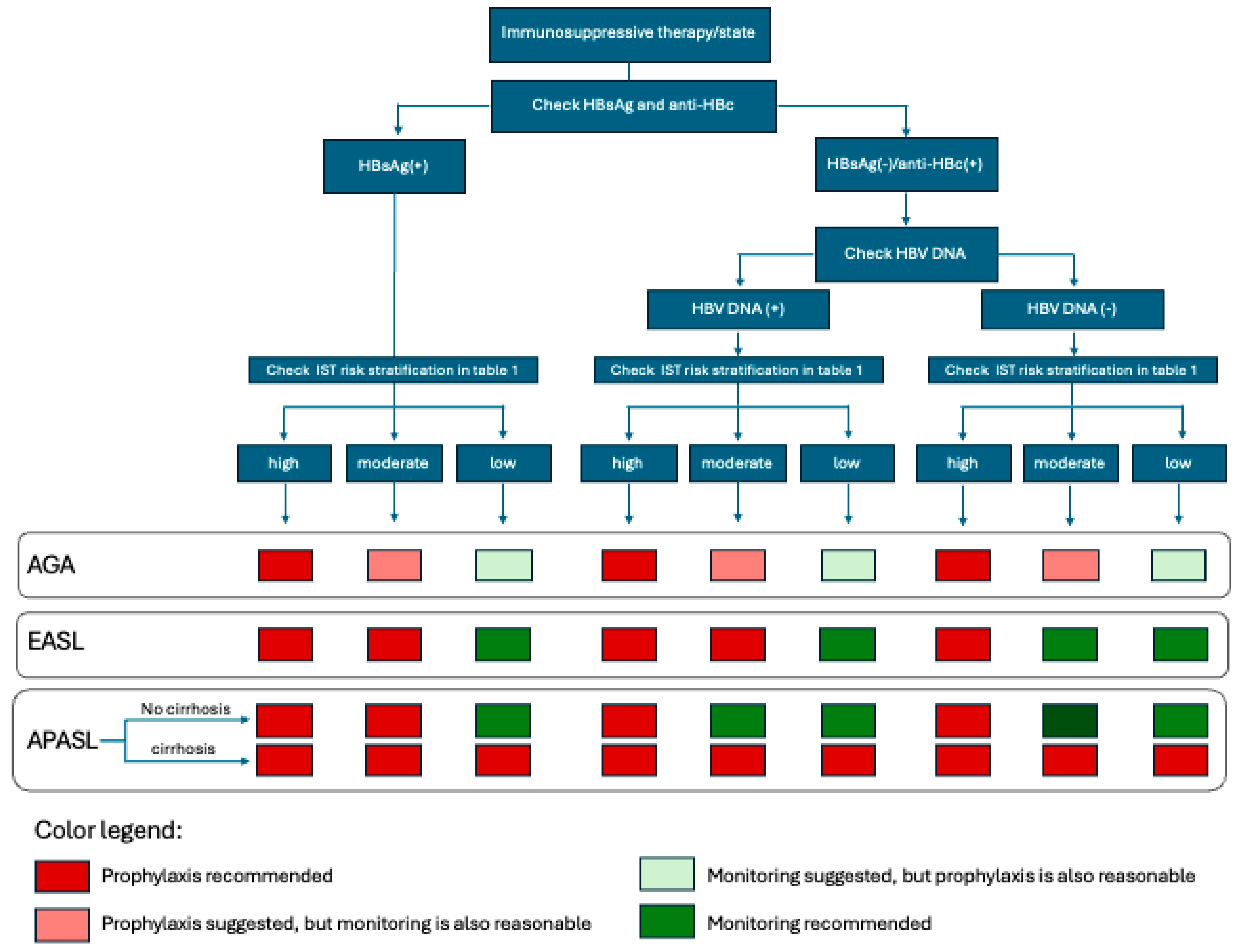
| Risk of Reactivation | AGA 2025 Guidelines | APASL 2021 Guidelines | EASL 2025 Guidelines |
|---|---|---|---|
| High > 10% | |||
| HBsAg(+) | Prophylaxis recommended | Prophylaxis recommended | Prophylaxis recommended |
| HBsAg(−)/anti-HBc(+) | Prophylaxis recommended | Prophylaxis recommended | Prophylaxis recommended |
| Moderate 1–10% | |||
| HBsAg(+) | Suggest prophylaxis but monitoring is also reasonable | Prophylaxis recommended | Prophylaxis recommended |
| HBsAg(−)/anti-HBc(+) | Suggest prophylaxis but monitoring is also reasonable | Prophylaxis recommended if advanced fibrosis or cirrhosis. Otherwise, monitoring is recommended. | Prophylaxis recommended if HBV DNA is positive. Close monitoring if HBV DNA is negative |
| Low < 1% | |||
| HBsAg(+) | Suggest monitoring but prophylaxis is acceptable | Prophylaxis recommended if advanced fibrosis or cirrhosis. Otherwise, monitoring is recommended. | Monitor closely |
| HBsAg(−)/anti-HBc(+) | Suggest monitoring but prophylaxis is acceptable | Prophylaxis recommended if advanced fibrosis or cirrhosis. Otherwise, monitoring is recommended. | Monitor closely |
Disclaimer/Publisher’s Note: The statements, opinions and data contained in all publications are solely those of the individual author(s) and contributor(s) and not of MDPI and/or the editor(s). MDPI and/or the editor(s) disclaim responsibility for any injury to people or property resulting from any ideas, methods, instructions or products referred to in the content. |
© 2025 by the authors. Licensee MDPI, Basel, Switzerland. This article is an open access article distributed under the terms and conditions of the Creative Commons Attribution (CC BY) license (https://creativecommons.org/licenses/by/4.0/).
Share and Cite
Elharabi, Z.; Saba, J.; Akin, H. Navigating the Latest Hepatitis B Virus Reactivation Guidelines. Diseases 2025, 13, 355. https://doi.org/10.3390/diseases13110355
Elharabi Z, Saba J, Akin H. Navigating the Latest Hepatitis B Virus Reactivation Guidelines. Diseases. 2025; 13(11):355. https://doi.org/10.3390/diseases13110355
Chicago/Turabian StyleElharabi, Zeyad, Jowana Saba, and Hakan Akin. 2025. "Navigating the Latest Hepatitis B Virus Reactivation Guidelines" Diseases 13, no. 11: 355. https://doi.org/10.3390/diseases13110355
APA StyleElharabi, Z., Saba, J., & Akin, H. (2025). Navigating the Latest Hepatitis B Virus Reactivation Guidelines. Diseases, 13(11), 355. https://doi.org/10.3390/diseases13110355