1. Introduction
With the rapid advancement of technology and the emergence of smart railway systems and autonomous train operations, next-generation railway communication systems are required to reliably accommodate exponentially increasing traffic demands [
1,
2]. These demands include not only train control data [
3], but also ultra-high-definition closed-circuit television (CCTV) video streams [
4], real-time operational control information [
5], and high-capacity passenger data services [
6]. In addition, ensuring operational safety in high-speed railway systems requires not only reliable communication infrastructure but also advanced train performance and condition monitoring technologies. For example, recent wayside detection systems have been shown to effectively diagnose dynamic performance issues such as hunting instability [
7], which complements the communication reliability considered in this paper. To address these requirements, existing railway-dedicated communication systems such as Global System for Mobile Communications for Railway (GSM-R), which is a second-generation voice-centric communication network, and Long Term Evolution for Railway (LTE-R), which is a fourth-generation packet-data-based system, are evolving toward the Future Railway Mobile Communication System (FRMCS). FRMCS is a next-generation railway communication system based on fifth-generation mobile communication technologies that support ultra-low-latency, ultra-high-reliability, high-availability, and high-capacity data transmission [
8,
9].
However, ultra-high-speed railway environments, where trains typically operate at speeds of 300 to 500 km/h, create extreme communication conditions in which the channel stability and mobility management mechanisms assumed in conventional terrestrial mobile communication systems are no longer valid [
10]. Performance degradation at the physical layer caused by ultra-high-speed mobility can lead to frequent handover failures (HOFs) at cell boundaries, which may result in delays in train control signal delivery and packet loss [
11].
In particular, threshold-based reactive control mechanisms and fixed resource allocation schemes widely used in current communication networks have inherent limitations in responding in real time to the rapidly changing channel conditions of ultra-high-speed railway environments. Many existing studies address either handover management or network resource management independently, and research that comprehensively considers both communication reliability and network resource management in ultra-high-speed railway environments remains limited [
12,
13].
Recently, artificial intelligence (AI)-based network optimization techniques have attracted significant attention [
14,
15]. In particular, learning-based approaches such as deep reinforcement learning (DRL) and federated learning (FL) have been actively investigated for dynamic resource management and distributed network optimization [
16,
17]. AI techniques require a relatively large amount of time and computational resources during the training phase, as network parameters are learned and optimized using large-scale channel data. However, once the training process is completed, they enable fast and accurate prediction of communication quality without introducing significant computational latency. In particular, when deep-learning-based prediction models are employed, signal quality degradation that a terminal may experience can be predicted in advance and proactively mitigated. This capability reduces unnecessary communication delays associated with conventional reactive approaches and effectively decreases the wireless link failure rate [
18].
In this paper, we provide a comprehensive review and analysis of AI-driven techniques for improving communication reliability and network resource utilization efficiency in ultra-high-speed railway environments. Specifically, the physical constraints of ultra-high-speed railway communication environments are analyzed using mathematical models to identify the fundamental causes of communication quality degradation. Based on this analysis, the applicability of AI-based predictive mobility management, intelligent multi-agent resource management, and task offloading strategies is comprehensively investigated. Compared with existing surveys that typically focus on a single technical dimension, this review consolidates three complementary technical pillars, AI-based predictive mobility management, O-RAN-based intelligent control, and MEC-based task offloading, within a unified discussion tailored to ultra-high-speed railway operations. A more detailed comparison with existing surveys is provided in
Section 2.
The main contributions of this paper are summarized as follows:
First, the Doppler effect and mobility-related challenges in ultra-high-speed railway environments are analyzed, and the key causes of communication performance degradation are identified.
Second, AI-based predictive handover approaches using time series data are reviewed in terms of their potential to improve communication reliability.
Third, integrated approaches are discussed for improving network resource utilization efficiency in ultra-high-speed railway environments, by combining an intelligent control architecture based on Open Radio Access Network (O-RAN) with a dynamic offloading strategy based on mobile edge computing (MEC).
It should be noted that this paper is positioned as a review that consolidates recent advances in AI-driven mobility management, O-RAN-based intelligent control, and MEC-based offloading for ultra-high-speed railway communications, rather than a study introducing an original algorithm. Accordingly, quantitative performance evidence is compiled from existing studies in the literature rather than from newly conducted experiments.
The remainder of this paper is organized as follows.
Section 2 describes the methodology adopted in this review.
Section 3 analyzes the technical characteristics and major challenges of ultra-high-speed railway communication environments.
Section 4 describes the O-RAN-based architecture and AI-based handover optimization techniques.
Section 5 introduces intelligent offloading and migration techniques for traffic optimization.
Section 6 discusses future research directions, and
Section 7 concludes the paper.
2. Review Methodology
This section describes the methodology adopted in this review, including the scope of literature selection, the criteria used to classify the reviewed studies, and the comparison with representative existing surveys. By making these aspects explicit, we aim to clarify the position of this paper among prior works and to provide a transparent basis for the consolidated discussion presented in the remainder of the manuscript.
2.1. Literature Selection Scope
The literature reviewed in this paper was identified through searches of major academic databases, including IEEE Xplore, ACM Digital Library, Web of Science, and Google Scholar. The searches used combinations of keywords such as “high-speed railway communications,” “FRMCS,” “LTE-R/5G-R,” “O-RAN,” “xApp,” “handover prediction,” “MEC offloading,” “task migration,” “LSTM,” “DQN,” and “M-DDPG.” Priority was given to peer-reviewed journal and conference papers published between 2013 and 2026, which covers the period spanning from early high-speed railway channel measurement studies to the most recent AI-driven and O-RAN-based developments. In addition, a limited number of foundational works, such as the seminal LSTM paper [
19], and official specifications, such as the O-RAN Alliance architecture description [
20], were included to provide technical grounding where such references are essential for correctly interpreting the reviewed methods.
2.2. Classification Criteria
The selected literature is organized along three complementary technical pillars that jointly govern the communication performance of ultra-high-speed railway systems: (i) Physical layer characteristics and impairments of ultra-high-speed railway channels, covered in
Section 3. (ii) AI-based predictive mobility management embedded in O-RAN-based intelligent control, covered in
Section 4. (iii) MEC-based traffic offloading and mobility-aware task migration, covered in
Section 5. Within each pillar, the reviewed studies are further grouped by their methodological category, such as threshold-based versus AI-based handover, or mobility-agnostic versus mobility-aware offloading. This classification enables technical progress along each pillar to be traced both chronologically and methodologically, and it also clarifies how the three pillars interact in the ultra-high-speed railway setting, which is the central focus of this review.
2.3. Differentiation from Existing Surveys
Table 1 summarizes how this review differs from representative prior surveys on high-speed railway and related communication systems. Ai et al. [
1] provided a tutorial-style review of the fundamental challenges of high-speed railway wireless communications, with an emphasis on channel modeling in viaducts, cuttings, and tunnels, as well as non-stationary and line-of-sight multiple-input–multiple-output (MIMO) characteristics. Xu et al. [
21] surveyed high-speed railway communications from a radio resource management perspective, including admission control, mobility management, power control, and resource allocation. Sheng et al. [
22] reviewed the development of space-air-ground integrated networks and their applications in high-speed railway environments, mainly focusing on architectural aspects and partial discussions on AI-assisted management and edge-side processing. More recently, Polese et al. [
23] provided a comprehensive tutorial on the O-RAN architecture, interfaces, algorithms, and research challenges, but without a dedicated discussion of ultra-high-speed railway operations.
As summarized in
Table 1, each of these prior surveys primarily focuses on a single technical dimension, such as physical layer channel characterization, radio resource management, satellite-terrestrial integration, or general-purpose O-RAN architecture. In contrast, the present review consolidates all three complementary pillars, physical layer impairments of ultra-high-speed railway channels, AI-based predictive mobility management embedded in O-RAN-based intelligent control, and MEC-based traffic offloading with mobility-aware task migration, within a unified discussion tailored to ultra-high-speed railway operations. Moreover, this review explicitly elaborates on the interaction among these pillars, such as how O-RAN xApps can host AI-based handover predictors and how mobility-aware offloading schemes can cooperate with handover decisions under sub-second channel variations. As a result, this paper provides a more integrated and railway-specific perspective than prior surveys, while building upon the technical foundations established by them.
3. Analysis of Challenges in Ultra-High-Speed Railway Communication Environments
3.1. Physical Layer Performance Degradation Due to the Doppler Effect
One of the major factors that degrade the reliability of wireless communications in ultra-high-speed railway environments is the Doppler effect [
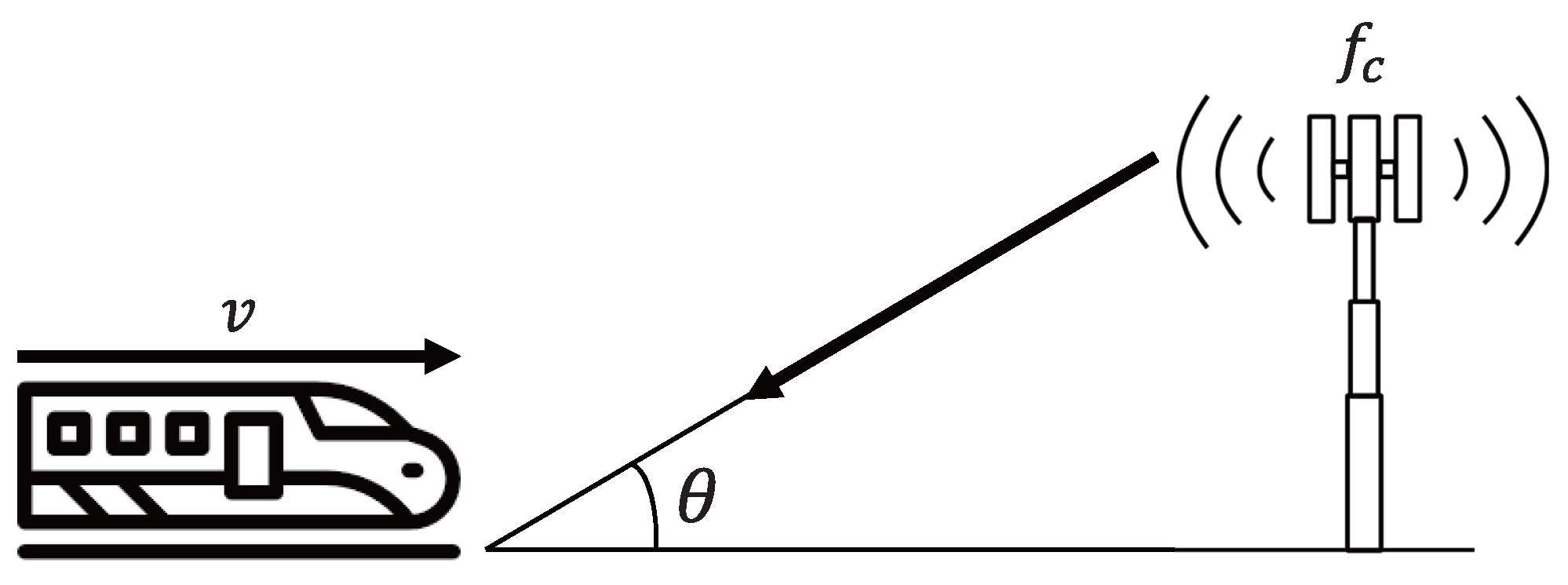
24]. When a relative velocity exists between a terminal and a base station, the frequency of the received signal changes, resulting in a Doppler shift. The Doppler shift
is defined as
where
represents the carrier frequency,
v is the velocity of the terminal,
c is the speed of light, and
denotes the angle between the direction of train motion and the signal propagation path from the base station to the terminal. In particular, as the velocity of the train increases, the magnitude of the Doppler shift also increases.
Figure 1 illustrates a conceptual model in which Doppler shift occurs due to the relative motion between the terminal and the base station in a high-speed railway environment.
For example, when a train travels at a speed of approximately
km/h in the
GHz band, the maximum Doppler shift can increase to approximately
kHz. Such Doppler shifts significantly increase the temporal variation of the wireless channel. In particular, in systems based on orthogonal frequency division multiplexing (OFDM), large Doppler shifts may cause interference between adjacent subcarriers. In OFDM systems, each subcarrier needs to maintain orthogonality with the others. However, when the Doppler shift becomes large, this orthogonality is degraded, resulting in increased inter-carrier interference (ICI) [
25]. Consequently, the signal-to-interference ratio (SIR) decreases, which can lead to degradation in data transmission performance.
From a receiver’s perspective, the Doppler-induced frequency variation corresponds to a carrier frequency offset (CFO), which is the root cause of the ICI described above. In addition to CFO, ultra-high-speed railway environments also exhibit a carrier time offset (CTO), which arises because the propagation path length between the moving train and the base station changes continuously, leading to timing misalignment at the receiver. CTO induces inter-symbol interference (ISI) and degrades the accuracy of channel estimation, further deteriorating reception performance beyond the degradation caused by CFO alone [
21,
25].
To mitigate these combined impairments, several categories of solutions have been investigated in the literature. Pilot-based CFO and CTO estimation and compensation techniques exploit known reference signals to track and correct frequency and timing offsets in rapidly varying channels [
26]. Location-aware Doppler prediction schemes leverage train position and velocity information, which are typically available in railway environments, to proactively estimate and compensate for Doppler effects. In particular, recent studies have further introduced machine learning-based speed estimation and CFO compensation algorithms that achieve lower mean squared error and improved bit error rate performance compared with conventional approaches [
27]. In addition, robust multicarrier modulation schemes such as orthogonal time frequency space (OTFS) modulation have been proposed to provide inherent robustness against high Doppler spreads by exploiting the delay-Doppler domain representation of the channel [
28].
Beyond the ICI and timing-offset effects induced by the Doppler shift, ultra-high-speed railway wireless channels also exhibit additional physical layer impairments that make their modeling substantially more complex than conventional cellular channels. Fast fading arises from rapid multipath variations as high-speed trains traverse heterogeneous propagation environments such as cuttings, tunnels, bridges, and viaducts [
10]. In addition, when radio signals from external base stations propagate into the train, they experience significant penetration loss through the carriage body, and carriage shadowing caused by the relative geometry between the on-board antenna and the base station further attenuates the received signal [
21,
25]. As a result, reliable communication system design for ultra-high-speed railway environments requires joint consideration of Doppler-induced distortions, fast fading, penetration loss, and carriage shadowing.
3.2. Handover Performance Degradation in Ultra-High-Speed Mobility Environments
Ultra-high-speed railway environments, where communication must be maintained at speeds exceeding km/h, exhibit propagation characteristics that differ from those of conventional cellular environments. In particular, in railway-dedicated communication systems such as LTE-R and fifth-generation for railway (5G-R), the cell radius is relatively small. As a result, a train passes through multiple cell boundaries within a short period of time. This leads to frequent handover events, which may significantly affect communication reliability. In addition, performance degradation occurring at the physical layer further increases the likelihood of HOFs in ultra-high-speed mobility environments.
To better understand the handover problem, it is necessary to examine the key indicators used to determine whether a base station change is required. One of the representative indicators is reference signal received quality (
), which is computed based on the reference signal received power (
) and the received signal strength indicator (
), and is defined as
where
represents the total received signal power including interference and noise,
N denotes the number of resource blocks (RBs) within the measurement bandwidth, and
represents the average power of the reference signals received by the terminal. The
value is therefore an important metric used to evaluate wireless link quality and support handover decisions.
However, in ultra-high-speed mobility environments, channel variability significantly increases due to the Doppler effect, which may also increase the level of interference. In such cases, the RSSI value increases, and consequently the RSRQ value may decrease according to (
2). If the RSRQ value fluctuates rapidly within a short period of time, the terminal may fail to select the optimal base station and repeatedly perform unnecessary cell searches. In addition, if the degradation of signal quality occurs faster than the handover processing delay, the existing connection may be lost before a new connection is successfully established. This phenomenon increases the uncertainty of the handover trigger timing and can lead to the ping-pong effect or radio link failure (RLF) [
21].
Conventional mobility management schemes widely used in current networks rely on RSRP and RSRQ measurements and typically follow a reactive approach, where the handover procedure is initiated only after the signal quality drops below a predefined threshold. However, in ultra-high-speed railway environments, the channel state changes very rapidly due to the high mobility of the terminal, and therefore such reactive decision mechanisms may not adequately capture abrupt channel variations [
29]. Recent studies have shown that learning-based radio control frameworks can better adapt to such rapidly varying environments, for example, through uncertainty-aware deep learning for interference management and online learning methods such as multi-armed bandit-based adaptive control [
30,
31]. Nevertheless, in conventional reactive schemes, if handover is initiated only after the communication quality has already fallen below the threshold, the link quality may already be significantly degraded at the start of the handover process. As a result, the probability of HOF or RLF increases, which may negatively affect the reliability of critical services such as train control signaling.
According to [
8], when a train travels at approximately
km/h, the handover failure rate is about
, and it increases to approximately
in a
km/h environment. In contrast, when an AI-based predictive model is applied, the HOF rate can be reduced to approximately
even in a
km/h environment. The corresponding HOF rates across multiple mobility speeds, ranging from
km/h to
km/h, are summarized in
Table 2, where all reported values are taken from the same reference [
8] to ensure consistency.
These results highlight the limitations of conventional reactive handover mechanisms in ultra-high-speed railway environments. In particular, the reported HOF rate reductions in
Table 2, from approximately
down to
at
km/h, correspond to a relative reduction of roughly
, which directly translates into improved wireless link reliability and fewer radio link failures for train control signaling. Similar trends have also been reported in related studies on AI-assisted mobility management for high-speed rail, where predictive schemes consistently outperform threshold-based baselines in terms of handover success probability and service interruption time [
8,
18]. Therefore, AI-based predictive handover techniques that can anticipate channel state variations in advance and proactively perform cell switching are required. By learning historical channel data and mobility patterns, AI models can predict future communication quality experienced by the terminal. Through this approach, cell switching can be performed before severe communication degradation occurs, thereby preventing RLFs and reducing handover latency.
3.3. Network Resource Management Issues Due to Increasing Traffic
In addition to ensuring communication reliability, efficiently distributing rapidly increasing network traffic and computational workloads has become an important technical challenge. In ultra-high-speed railway environments, data traffic generated by passenger terminals tends to be concentrated at base stations. Moreover, as frequent handovers occur, network load may become even more severe during peak periods such as commuting hours. As a result, communication speed may decrease and the quality of service (QoS) may degrade, which has been continuously reported as a major issue [
29]. However, conventional base stations rely on resource control mechanisms based on fixed schedulers, which have limitations in flexibly handling irregular and instantaneous increases in traffic demand generated by ultra-high-speed trains.
To address this issue, the adoption of an open architecture based on O-RAN, which separates hardware and software and provides open interfaces, has been actively studied. In particular, approaches that apply AI-based multi-agent techniques to the radio intelligent controller (RIC) of O-RAN have been proposed and validated for optimizing resource allocation in real time even under rapidly changing wireless network environments, and their effectiveness has been demonstrated [
32].
In addition to communication network resource management, computing offloading techniques are also required to alleviate computational workloads at both terminals and network nodes. Computing offloading refers to a technique that distributes computational tasks performed at terminals or network nodes to external systems for processing. In ultra-high-speed railway environments, processing large volumes of data generated inside trains locally may lead to computational delays. Therefore, it is necessary to develop an intelligent task offloading framework that distributes data processing through train-to-train communications or MEC nodes.
3.4. Necessity of AI-Based Intelligent Network Control Technologies
As discussed above, physical layer instability caused by the Doppler effect and conventional threshold-based reactive handover mechanisms may lead to frequent communication interruptions and HOFs in ultra-high-speed railway environments. In addition, rapidly increasing traffic and computational workloads can be difficult to handle efficiently using conventional fixed resource allocation mechanisms alone.
Therefore, to simultaneously overcome these physical and structural limitations, AI-based intelligent network control technologies capable of predicting channel state variations in advance and responding proactively are required. In particular, by combining AI-based predictive handover techniques with an O-RAN-based open intelligent architecture and MEC-based dynamic offloading technologies, a new network operation paradigm is required that can optimize resource allocation in real time even under highly dynamic network environments.
In the next section, we review integrated frameworks that combine AI-based predictive handover models, O-RAN-based intelligent control technologies, and MEC-based task offloading architectures to address the limitations discussed above.
4. AI-Based Intelligent Network Control Technologies for Ultra-High-Speed Railway Communications
This section presents technical approaches to address the challenges of ultra-high-speed railway communication environments analyzed in the previous section. In particular, an O-RAN-based intelligent network control architecture and AI-based predictive handover optimization techniques are described to overcome channel instability caused by the Doppler effect and the limitations of conventional reactive mobility management schemes. In addition, the practical applicability of these technologies and remaining technical challenges are also discussed.
4.1. O-RAN-Based Intelligent Network Control Architecture
In order for AI-based handover technologies to achieve practical effectiveness in railway communication networks, a network architecture capable of flexibly accommodating such technologies is required. Recently, O-RAN-based architectures have attracted significant attention as a next-generation radio access network (RAN) architecture that can meet these requirements. O-RAN provides a flexible framework for network intelligence by separating hardware and software components and providing standardized open interfaces [
20].
The RIC, which is a core component of the O-RAN architecture, is divided into the non-real-time RIC (Non-RT RIC) and the near-real-time RIC (Near-RT RIC) according to functional roles and control time scales. The Non-RT RIC operates over time scales longer than
and performs functions such as network policy generation and AI model training and management. In this context, distributed learning frameworks such as federated learning have been actively studied to enable scalable and privacy-preserving model training across distributed network entities, and recent works have further investigated secure and trustworthy model aggregation mechanisms based on distributed ledger technologies [
33,
34]. In contrast, the Near-RT RIC operates within shorter time scales ranging from approximately
to
, where it analyzes wireless network states and performs control functions. In particular, to accommodate rapid channel variations in ultra-high-speed railway environments, it is essential to optimize the control loop of the Near-RT RIC in order to minimize control latency.
Within the Near-RT RIC, various AI-based control algorithms can be executed through applications called xApps. In ultra-high-speed railway environments, train trajectories are relatively fixed and similar propagation characteristics tend to repeatedly appear in specific track segments. By exploiting these characteristics, the xApps in the Near-RT RIC can dynamically adjust handover parameters on the order of several tens of milliseconds, enabling effective responses to rapid channel variations.
Furthermore, in an O-RAN-based architecture, network data from different railway segments can be continuously collected and learned to generate handover policies optimized for specific environments such as tunnels or curved track sections in advance [
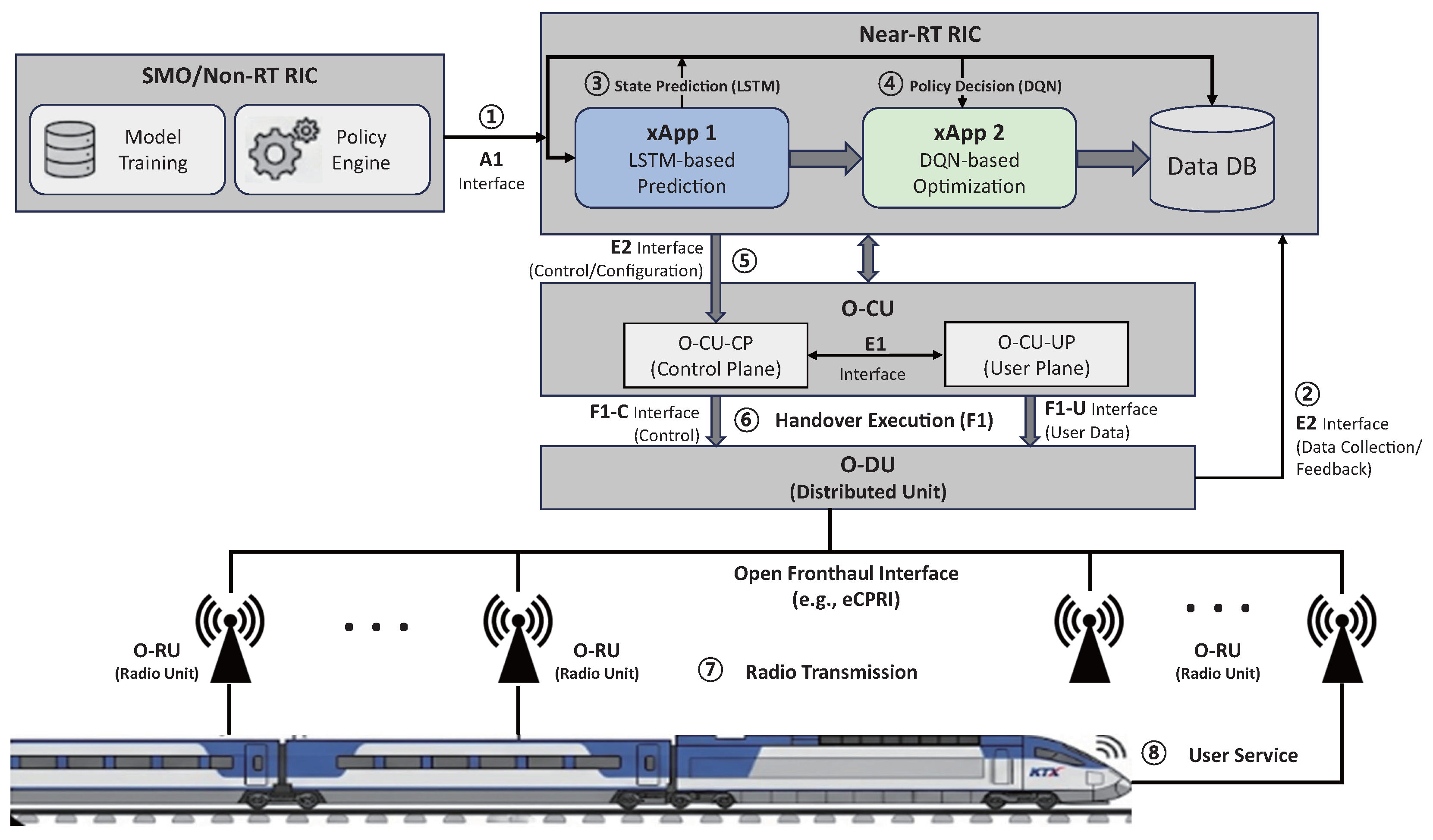
35]. Compared with conventional closed RAN architectures, this approach significantly improves adaptability to railway environments and provides a foundation for applying AI-based predictive model outputs to actual wireless resource control. A representative O-RAN-based intelligent handover control architecture, along with its end-to-end execution workflow for ultra-high-speed railway environments, is illustrated in
Figure 2.
To clarify how the O-RAN components interact in an ultra-high-speed railway context, the end-to-end execution workflow illustrated in
Figure 2 proceeds as follows. In Step 1, the Service Management and Orchestration (SMO)/Non-RT RIC transfers long-term handover policies and pretrained AI models to the Near-RT RIC through the A1 interface. These policies and models are generated offline by leveraging accumulated track-segment-specific data, such as historical RSRP patterns along tunnels and curved sections. In Step 2, real-time measurements collected from the train and the base station, including speed, position, serving-cell RSRP, cell load, and neighbor-cell information, are delivered to the Near-RT RIC through the E2 interface and stored in the data repository for subsequent inference. In Step 3, the long short-term memory (LSTM)-based prediction xApp (xApp 1) ingests these time series measurements and forecasts near-future link quality and the most likely handover target cell. In Step 4, the deep Q-network (DQN)-based optimization xApp (xApp 2) consumes the predicted state and determines the optimal handover trigger timing and parameter configuration (e.g., A3 offset, time-to-trigger) that jointly minimize handover failure probability and control latency. In Step 5, the resulting control and configuration decisions are dispatched to the O-CU-CP through the E2 interface. In Step 6, the O-CU relays the handover execution command to the O-DU over the F1-C interface, while user-plane data continues to be forwarded via the F1-U interface. In Step 7, the O-DU coordinates with the target O-RU over the open front-haul interface (e.g., eCPRI), and the O-RU transmits the reconfigured radio signal to the on-board antenna. Finally, in Step 8, seamless service is delivered to the on-board terminals and passenger user equipment inside the train. This closed-loop workflow, operating within the
–
control timescale of the Near-RT RIC, enables proactive and location-aware handover execution tailored to the repetitive yet rapidly varying channel conditions of ultra-high-speed railway operations.
Railway-specific module interactions. The closed-loop workflow described above takes a distinctive form in ultra-high-speed railway environments compared with conventional cellular deployments. First, the measurements delivered to the Near-RT RIC in Step 2 include not only standard terminal-side metrics but also railway-specific context, such as the train’s current track-segment identifier, instantaneous velocity exceeding km/h, and fine-grained position information obtained from on-board GPS or trackside balises. These additional inputs allow the LSTM-based prediction xApp in Step 3 to exploit the inherently repetitive and trajectory-constrained mobility pattern of trains, which is in sharp contrast to the largely random mobility of conventional terminals. Second, the DQN-based optimization xApp in Step 4 can leverage pretrained policies that are specific to individual track segments, such as tunnel entries, curved sections, and viaducts, so that the policy best matched to the train’s current location is selected in advance rather than reactively after link degradation. Third, the F1-C/F1-U control and user-plane split, together with the open front-haul interface, is typically realized along the trackside, with O-RUs installed either on lineside poles for outdoor coverage or inside tunnels for continuous service, while O-DUs are hosted at nearby stations or trackside cabinets in order to satisfy the strict latency constraints of the F1-U interface under high mobility.
Practical deployment logic. From a deployment perspective, an ultra-high-speed railway line typically requires a chain of O-RUs placed at sufficiently short inter-site distances, on the order of a few hundred meters to a few kilometers depending on the carrier frequency and the target train speed, so that handovers can be proactively triggered before the serving link degrades. The SMO/Non-RT RIC, deployed centrally at the operator’s data center, continuously collects measurements from all track segments and periodically updates the AI models used by the xApps through the A1 interface, which enables the entire closed-loop workflow to adapt to long-term changes in traffic demand, seasonal variations in propagation conditions, and newly constructed track segments. In parallel, safety-critical train control traffic can be routed through a dedicated logical path with guaranteed ultra-low latency and ultra-high reliability, while passenger data traffic is offloaded through the MEC-based mechanisms discussed in
Section 5, in line with the FRMCS service categorization. This deployment logic highlights that, unlike general-purpose cellular networks, O-RAN-based ultra-high-speed railway systems benefit from linear topology, deterministic trajectories, and pre-known propagation hotspots, which together create a favorable setting for proactive AI-based network control.
Such an O-RAN-based architecture provides a practical foundation for deploying AI-based predictive handover algorithms in real wireless resource control.
4.2. AI-Based Predictive Handover Optimization Techniques
The O-RAN-based architecture described in the previous subsection provides a foundation for applying AI-based algorithms to network control. By leveraging this architecture, intelligent handover control mechanisms can be implemented to predict rapid channel variations in ultra-high-speed railway environments in advance and respond proactively.
Conventional threshold-based handover schemes usually rely on reactive decisions based on signal strength measurements at a specific time, such as RSRP and RSRQ. However, in ultra-high-speed railway environments, the wireless channel state changes rapidly due to the high mobility of trains. As a result, it becomes difficult to determine the optimal handover timing using only such reactive approaches. Therefore, AI-based predictive handover techniques have recently attracted significant research attention.
Wireless channel data collected in ultra-high-speed railway environments exhibit the characteristics of time series data that continuously change as the train moves. Considering these characteristics, this study examines the use of models based on recurrent neural network (RNN) [
36] and LSTM [
37], which are well suited for time series data learning [
38,
39]. RNN models are appropriate for sequential data processing because their recurrent structure allows past information to influence current decisions. In particular, LSTM introduces cell states and gate structures to address the vanishing gradient problem that occurs in conventional RNN models, enabling the effective learning of long-term dependencies.
Ultra-high-speed railway environments also exhibit location-dependent propagation characteristics. For example, signal attenuation repeatedly occurs in specific locations such as tunnels or curved track sections. By utilizing an LSTM model, it is possible to predict future link quality based on the train position, mobility speed, and historical signal strength variations. This enables the implementation of a predictive handover strategy that determines the handover timing in advance before communication quality significantly degrades, thereby reducing the handover failure rate and improving wireless link reliability [
21].
In typical LSTM-based handover prediction schemes considered in the literature, the input sequence consists of time-stamped measurements such as RSRP, RSRQ, train position, and mobility speed collected over a sliding observation window, while the model output is the predicted link quality or the index of the target cell at a short horizon ahead [
36,
37]. The network architecture generally comprises one or two LSTM layers followed by fully connected layers, with the hidden state size and sequence length chosen to balance prediction accuracy and inference latency. Training is typically performed offline using historical channel measurements collected from railway test lines or via ray-tracing based simulators, with supervised losses such as mean squared error for regression targets or cross-entropy for target-cell classification.
In addition, reinforcement learning (RL)-based approaches can also be applied to optimize handover policies [
40,
41]. In RL, an agent interacts with the network environment and learns optimal policies based on reward functions. Conventional approaches rely on manually defined thresholds, which limits their ability to adapt to dynamic environmental changes. In contrast, RL-based approaches can continuously update policies according to changes in network states.
In particular, algorithms such as Q-learning or DQN can be used to design reward functions that simultaneously consider handover success probability and latency. Through this approach, handover policies optimized for ultra-high-speed railway environments can be derived [
18]. For DQN-based handover optimization, the state space typically includes current and neighbor-cell signal quality indicators, train position and velocity, and recent handover history, while the action space corresponds to candidate handover decisions, such as triggering, delaying, or selecting a target cell. The reward function is commonly designed to reward successful handovers and to penalize handover failures, ping-pong events, and excessive handover latency, so that the learned policy jointly accounts for reliability and responsiveness [
18,
41]. The Q-network is usually realized as a fully connected neural network whose size is constrained by the inference-latency budget of the Near-RT RIC discussed in
Section 4.3. Such AI-based approaches have the advantage of providing higher adaptability to environmental variations compared with conventional rule-based schemes. In particular, recent studies have quantitatively demonstrated these benefits. For example, LSTM-based handover prediction schemes have been reported to substantially reduce HOF rates compared with threshold-based baselines (see
Table 2), while DQN-based handover policies have been shown to improve handover success probability and reduce service interruption time under high-mobility conditions [
18,
41].
However, several technical challenges still remain when applying AI-based handover techniques to practical railway communication networks. These challenges include real-time operation requirements, the availability of sufficient training data, and the need for lightweight AI models suitable for deployment in practical network systems.
4.3. Applicability and Technical Challenges of O-RAN-Based AI Handover
The integration of O-RAN architecture with AI-based handover techniques has significant potential to enhance the intelligence of ultra-high-speed railway communication systems. By leveraging the open architecture of O-RAN together with AI-based algorithms, it becomes possible to respond more effectively to rapid channel variations occurring in high-speed mobility environments. As a result, both communication reliability and network resource utilization efficiency can be improved simultaneously.
However, several technical challenges must be addressed before these technologies can be applied to practical railway communication networks. First, ensuring the real-time operation of AI models, together with careful consideration of computational complexity, inference latency, and deployment cost, is a critical issue. According to the O-RAN specifications, the control loop of the Near-RT RIC is expected to operate within a timescale of
to
[
23]. Therefore, the inference latency of AI-based xApps must remain well below this bound in order to avoid violating the control-loop deadline in ultra-high-speed railway environments, where channel conditions can change on a sub-second timescale.
From a computational complexity perspective, the per-inference cost of the LSTM-based prediction xApp is approximately
, where
T is the input sequence length,
d is the input feature dimension, and
h is the hidden state size [
19]. The DQN-based optimization xApp has a per-inference cost proportional to the number of parameters in its fully connected layers. For moderately sized models typically considered in the O-RAN literature, reported inference latencies fall within a few tens to a few hundreds of milliseconds on commodity edge hardware, which is compatible with the Near-RT RIC control-loop requirement [
23,
42]. Experimental platforms such as OpenRAN Gym have further demonstrated that AI-driven xApps can be deployed and benchmarked at scale, providing empirical evidence that data collection, inference, and control dispatch can be completed within the Near-RT RIC timescale [
42].
From a deployment cost perspective, two factors dominate. First, the Non-RT RIC must provide sufficient storage and computational resources to support offline training on large volumes of track-segment-specific channel data. Second, the Near-RT RIC, typically deployed on edge infrastructure close to the radio sites, must host multiple concurrent xApps with bounded memory and CPU budgets. As the number of deployed base stations and track segments increases, model lightweighting techniques such as pruning, quantization, and knowledge distillation become essential to keep per-xApp resource consumption manageable and to enable scalable deployment across a wide railway coverage area. In particular, deep-learning-based models such as LSTM and DQN can provide high prediction accuracy, but increased model complexity may degrade real-time control performance. Therefore, the design of lightweight AI models suitable for railway environments and inference acceleration techniques should be further investigated [
20].
In addition, the open architecture of O-RAN may introduce new challenges in terms of network data management and security. Railway communication networks are safety-critical systems, and therefore strict data security policies are typically enforced. As a result, there may be limitations on the collection and sharing of network data. These constraints can make it difficult to secure sufficient data for AI model training and may affect the generalization performance of trained models.
To address these challenges, distributed learning approaches such as FL have recently attracted significant attention. FL enables collaborative model training by exchanging only locally trained model parameters without sharing raw data. This approach allows AI model training to be performed while preserving data privacy and security [
35].
In summary, implementing reliable mobility management in ultra-high-speed railway communication environments requires an integrated approach that jointly considers AI-based intelligent algorithms and O-RAN-based open network architectures. Nevertheless, technical challenges such as real-time operation, data availability, and model lightweighting must be addressed before practical deployment in railway communication networks becomes feasible. These issues are expected to remain important research topics in future studies on ultra-high-speed railway communications.
5. Intelligent Traffic Offloading and Task Migration Technologies in Ultra-High-Speed Railway Environments
In the previous section, AI-based predictive handover techniques and an O-RAN-based intelligent network control architecture were discussed to address mobility challenges in ultra-high-speed railway environments. However, in addition to mobility issues, large-scale traffic generated by increasing numbers of passenger terminals inside trains and the limitation of computational resources also emerge as important technical challenges.
In particular, if the large volume of data traffic generated inside trains is processed entirely through terrestrial base stations, network load may increase and the QoS may degrade. To address this problem, MEC-based intelligent offloading techniques and mobility-aware task migration technologies have recently attracted significant attention [
43,
44].
In this section, traffic separation techniques considering QoS in ultra-high-speed railway environments are first examined. Subsequently, AI-based traffic offloading techniques and task migration optimization methods that consider train mobility are discussed.
5.1. QoS-Based Traffic Separation and AI-Based Offloading Techniques
In ultra-high-speed railway environments, train control signals and passenger data traffic are generated simultaneously, and these traffic types have different service requirements. Train control signals require ultra-low latency and high reliability, whereas passenger data traffic typically requires high bandwidth but has relatively lower sensitivity to delay.
Recently, communication environments based on satellite-terrestrial integrated networks (STINs) have been investigated to efficiently support diverse service requirements [
45,
46]. In such environments, critical traffic such as train control signals can be processed through terrestrial networks, while passenger data traffic with higher delay tolerance can be offloaded to networks based on low Earth orbit (LEO) satellites or unmanned aerial vehicles (UAVs) [
22].
However, in ultra-high-speed railway environments, channel conditions and network load change rapidly. Therefore, manually controlling traffic distribution is impractical. To address this issue, automated traffic management techniques based on AI and machine learning (ML) have been introduced [
47,
48,
49].
In particular, QoS-aware selection models determine the optimal communication path by analyzing various network performance metrics such as transmission latency, reliability, and bandwidth in real time [
47]. In addition, QoS-constrained scheduling strategies in multi-carrier systems have been investigated to ensure long-term service performance and fairness under heterogeneous traffic demands [
48]. In addition, DRL-based offloading techniques have been proposed as effective solutions. These approaches learn wireless channel conditions and base station load information to intelligently distribute traffic across multiple network resources [
49].
5.2. Task Migration Optimization Considering Ultra-High Mobility
In ultra-high-speed railway environments, trains move at extremely high speeds, which means that terminals can remain within the coverage area of a specific base station only for a short period of time. As a result, situations may occur in which an offloaded task cannot be completed before the terminal moves into the coverage area of the next base station. In such cases, task migration becomes necessary [
29].
Conventional DRL-based offloading techniques are effective for optimizing resource allocation based on network conditions. However, they often fail to sufficiently consider task migration costs caused by the ultra-high mobility of trains. To address this limitation, recent studies have proposed reinforcement learning algorithms that explicitly incorporate mobility awareness [
50,
51].
A representative example is the mobility-aware deep deterministic policy gradient (M-DDPG) algorithm [
52]. M-DDPG extends the deep deterministic policy gradient (DDPG) framework, which is a reinforcement learning algorithm designed for continuous control, by incorporating train mobility and task migration costs into the decision process. Through this approach, both network resource allocation and task migration decisions can be optimized simultaneously. The algorithm operates based on an actor–critic architecture optimized for continuous control [
53].
Specifically, the M-DDPG algorithm observes the network state
, which typically includes network latency, bandwidth availability, base-station load, and train mobility indicators such as position and velocity, and determines the action
corresponding to traffic distribution and task migration decisions. The reward
is designed to reflect QoS satisfaction, successful task completion, and penalties for migration cost and service interruption caused by train mobility. Based on this reward, the actor and critic networks, typically realized as fully connected neural networks in an actor–critic architecture, are iteratively updated to learn a resource allocation and migration policy tailored to ultra-high-speed railway environments [
52,
53].
A key practical consideration in ultra-high-speed railway environments is the coordination between handover and task migration, which directly affects service continuity. Because a handover changes the serving base station while a task migration changes the MEC node hosting the offloaded computation, uncoordinated execution of the two procedures can lead to redundant data transfer, prolonged service interruption, or even task restart. To address these issues, mobility-aware migration schemes explicitly account for (i) migration cost, typically modeled in terms of the volume of transferred state and the associated bandwidth and energy consumption, (ii) interruption duration, defined as the time during which the offloaded service is unavailable while the task is being relocated, and (iii) the timing relationship between handover and migration events [
44,
50,
52]. By leveraging predicted train trajectory and dwell-time information, M-DDPG-based policies can initiate task migration proactively toward the next serving MEC node before the handover occurs, so that computation continues on the target side with minimal interruption. Such proactive coordination, combined with the predictive handover decisions discussed in
Section 4, enables seamless service continuity even under the frequent handovers that characterize ultra-high-speed railway operations.
Through these mechanisms, overload in terrestrial networks can be mitigated and variations in service quality can be minimized. Furthermore, it effectively alleviates the short contact time problem that arises in ultra-high-speed railway environments. Reported results in the literature indicate that mobility-aware task migration schemes can reduce service interruption time and improve task completion rates by a substantial margin compared with mobility-agnostic baselines, confirming the practical benefit of incorporating mobility awareness into the offloading decision process [
44,
52].
6. Future Directions
Although the intelligent network control technologies reviewed in this paper demonstrate clear potential for ultra-high-speed railway communications, several practical challenges must be addressed before they can be deployed in real-world railway systems. In this section, specific research directions that follow from the analysis in the previous sections are discussed.
Lightweight AI model design and inference latency reduction. As discussed in
Section 4, the inference latency of xApps running on the Near-RT RIC must stay well below the
–
control-loop bound, while channel conditions in ultra-high-speed railway environments may change on a sub-second timescale. This creates a tight budget for both prediction (LSTM-based) and decision-making (DQN-based) modules. Future work should therefore systematically investigate model compression techniques such as pruning, quantization, and knowledge distillation, specifically adapted to railway channel characteristics. In addition, hardware-aware inference acceleration for edge deployment, including the use of dedicated AI accelerators at the Near-RT RIC and O-DU sites, and adaptive model-switching schemes that select between lightweight and full-complexity models depending on the current mobility regime, represent important research directions.
Security and reliability of AI-based network control. Because railway communication networks are safety-critical systems, both the robustness of AI models and the secure management of training data require dedicated attention. In particular, the behavior of predictive handover and offloading models under adversarial inputs, sensor faults, and out-of-distribution channel conditions should be characterized, and fail-safe fallback mechanisms that revert to conservative threshold-based control when AI outputs are deemed unreliable should be developed. Furthermore, because O-RAN-based architectures rely on data collected across multiple track segments and operators, privacy-preserving learning schemes such as federated learning with secure aggregation, as well as auditability mechanisms for xApp decisions, are expected to become important research topics.
Validation through field testing with real railway data. Most of the performance gains reported for AI-based predictive handover and mobility-aware task migration have so far been obtained under simulation or limited measurement campaigns. To confirm the effectiveness of the reviewed techniques under realistic operating conditions, large-scale field measurements collected along actual high-speed railway lines are required. These measurements should cover diverse environments, including tunnels, curved track sections, viaducts, and high-density passenger scenarios during commuting hours. Close cooperation with railway operators and infrastructure providers will be essential to build open datasets and reference testbeds that enable reproducible evaluation of AI-driven network control schemes.
Integration with FRMCS and related standardization. The reviewed technologies should ultimately be integrated within the evolving FRMCS framework for next-generation railway communications. Future studies should investigate how O-RAN-based intelligent control architectures and MEC-based offloading schemes can be mapped onto FRMCS service categories such as train control, critical voice, and passenger data services, while satisfying the associated ultra-low-latency and ultra-high-reliability requirements. In addition, interoperability between O-RAN interfaces (A1, E2, and open front-haul) and railway-specific protocols, as well as alignment with 3rd Generation Partnership Project (3GPP) releases targeting high-speed rail scenarios, deserves systematic analysis.
Cross-layer and multi-domain optimization. Finally, most existing studies address either physical layer impairments, mobility management, or resource allocation in isolation. A promising future direction is to develop cross-layer optimization frameworks that jointly exploit physical layer channel information, mobility prediction at the radio access layer, and task-level offloading decisions at the edge computing layer. Such integrated frameworks, potentially realized through multi-agent reinforcement learning across xApps and MEC controllers, can further enhance both communication reliability and resource utilization efficiency in ultra-high-speed railway environments.
7. Conclusions
This paper reviewed AI-based intelligent network control technologies for addressing communication instability and network resource management challenges in ultra-high-speed railway environments. The applicability of an O-RAN-based intelligent network control architecture, AI-based predictive handover techniques, and MEC-based traffic offloading and mobility-aware task migration schemes was examined in an integrated manner.
Quantitative evidence compiled from the surveyed literature supports the reviewed directions. For example, AI-based predictive handover has been reported to reduce the HOF rate from approximately to at km/h, corresponding to a relative reduction of roughly , while mobility-aware task migration schemes have been shown to reduce service interruption time and improve task completion rates compared with mobility-agnostic baselines.
These consolidated results directly respond to the core question raised in the introduction: the joint adoption of AI-based predictive handover, O-RAN-based intelligent control, and MEC-based offloading can simultaneously improve communication reliability and network resource utilization efficiency in ultra-high-speed railway communications, and their convergence is expected to play a key role in building reliable communication infrastructures for future autonomous trains and smart railway systems.
Author Contributions
Conceptualization, I.-H.Y., D.-S.K. and J.A.; methodology, J.A.; software, I.-H.Y.; validation, I.-H.Y., D.-S.K. and J.A.; formal analysis, D.-S.K.; investigation, J.A.; resources, D.-S.K.; data curation, D.-S.K.; writing—original draft preparation, I.-H.Y., D.-S.K. and J.A.; writing—review and editing, I.-H.Y., D.-S.K., J.A. and D.-Y.K.; visualization, J.A.; supervision, D.-Y.K.; project administration, D.-Y.K.; funding acquisition, D.-Y.K. All authors have read and agreed to the published version of the manuscript.
Funding
This research received no external funding.
Institutional Review Board Statement
Not applicable.
Informed Consent Statement
Not applicable.
Data Availability Statement
The original contributions presented in this study are included in the article. Further inquiries can be directed to the corresponding authors.
Acknowledgments
During the preparation of this manuscript, the authors used ChatGPT (GPT-5.3, OpenAI) Auto to assist in language refinement and formatting. The authors have reviewed and edited all generated text and take full responsibility for the content of this publication.
Conflicts of Interest
The authors declare no conflicts of interest.
Abbreviations
The following abbreviations are used in this manuscript:
| 5G-R | Fifth-Generation for Railway |
| AI | Artificial Intelligence |
| CCTV | Closed-Circuit Television |
| CFO | Carrier Frequency Offset |
| CTO | Carrier Time Offset |
| DDPG | Deep Deterministic Policy Gradient |
| DQN | Deep Q-Network |
| DRL | Deep Reinforcement Learning |
| FL | Federated Learning |
| FRMCS | Future Railway Mobile Communication System |
| GSM-R | Global System for Mobile Communications for Railway |
| HOF | Handover Failure |
| ICI | Inter-Carrier Interference |
| ISI | Inter-Symbol Interference |
| LEO | Low Earth Orbit |
| LTE-R | Long Term Evolution for Railway |
| LSTM | Long Short-Term Memory |
| M-DDPG | Mobility-Aware Deep Deterministic Policy Gradient |
| MEC | Mobile Edge Computing |
| MIMO | multiple-input–multiple-output |
| ML | Machine Learning |
| Near-RT RIC | Near-Real-Time Radio Intelligent Controller |
| Non-RT RIC | Non-Real-Time Radio Intelligent Controller |
| OFDM | Orthogonal Frequency Division Multiplexing |
| O-RAN | Open Radio Access Network |
| OTFS | Orthogonal Time Frequency Space |
| QoS | Quality of Service |
| RAN | Radio Access Network |
| RB | Resource Block |
| RIC | Radio Intelligent Controller |
| RL | Reinforcement Learning |
| RLF | Radio Link Failure |
| RNN | Recurrent Neural Network |
| RSRP | Reference Signal Received Power |
| RSRQ | Reference Signal Received Quality |
| RSSI | Received Signal Strength Indicator |
| SIR | Signal-to-Interference Ratio |
| SMO | Service Management and Orchestration |
| STIN | Satellite-Terrestrial Integrated Network |
| UAV | Unmanned Aerial Vehicle |
References
- Ai, B.; Cheng, X.; Kürner, T.; Zhong, Z.D.; Guan, K.; He, R.S.; Xiong, L.; Matolak, D.W.; Michelson, D.G.; Briso-Rodriguez, C. Challenges toward wireless communications for high-speed railway. IEEE Trans. Intell. Transp. Syst. 2014, 15, 2143–2158. [Google Scholar] [CrossRef]
- Liu, J.; Wang, X. Handover analysis on high speed train with Doppler frequency spread. arXiv 2017, arXiv:1703.09869. [Google Scholar] [CrossRef]
- Pencheva, E.; Atanasov, I.; Vatakov, V. Policy based railway communications. In 2023 International Conference on Control, Automation and Diagnosis (ICCAD), Rome, Italy, 10–12 May 2023; IEEE: Piscataway, NJ, USA, 2023; pp. 1–6. [Google Scholar]
- Atanasov, I.; Vatakov, V.; Pencheva, E. An approach to design railway specific features for critical voice communications. In 2023 3rd International Conference on Electrical, Computer, Communications and Mechatronics Engineering (ICECCME), Tenerife, Spain, 19–21 July 2023; IEEE: Piscataway, NJ, USA, 2023; pp. 1–6. [Google Scholar]
- Zhao, R.; Li, C.; Xie, J.; Zhang, Z. Handoff algorithm of high-speed railway wireless communication based on CNN-WaveNet. J. Meas. Sci. Instrum. 2025, 16, 47–57. [Google Scholar] [CrossRef]
- Mach, P.; Becvar, Z.; Plachy, J. Mitigation of Doppler effect in high-speed trains through relaying. In 2022 IEEE 95th Vehicular Technology Conference: (VTC2022-Spring), Helsinki, Finland, 19–22 June 2022; IEEE: Piscataway, NJ, USA, 2022; pp. 1–6. [Google Scholar]
- Wang, Q.; Li, D.; Zeng, J.; Peng, X.; Wei, L.; Du, W. A diagnostic method of freight wagons hunting performance based on wayside hunting detection system. Measurement 2024, 227, 114274. [Google Scholar] [CrossRef]
- Li, W.; Chen, W.; Wang, S.; Zhang, Y.; Matthaiou, M.; Ai, B. AI-driven mobility management for high-speed railway communications: Compressed measurements and proactive handover. IEEE Veh. Technol. Mag. 2025, 20, 84–94. [Google Scholar] [CrossRef]
- Trifonov, V.; Atanasov, I.; Pencheva, E. Connectivity negotiation as a service in future railway mobile communications. In 2022 13th National Conference with International Participation (ELECTRONICA), Sofia, Bulgaria, 19–20 May 2022; IEEE: Piscataway, NJ, USA, 2022; pp. 1–4. [Google Scholar]
- He, R.; Molisch, A.F.; Zhong, Z.; Ai, B.; Ding, J.; Chen, R.; Li, Z. Measurement based channel modeling with directional antennas for high-speed railways. In 2013 IEEE Wireless Communications and Networking Conference (WCNC), Shanghai, China, 7–10 April 2013; IEEE: Piscataway, NJ, USA, 2013; pp. 2932–2936. [Google Scholar]
- Chen, Y.; Kang, J.; Niu, K. Research on adaptive handover decision algorithm in next-generation high-speed railway scenario. Mob. Inf. Syst. 2022, 2022, 7557917. [Google Scholar] [CrossRef]
- Qiao, Y.; Niu, Y.; Chen, S.; Zhong, Z.; Zhang, C.; Wang, N.; Ai, B. Energy efficiency optimization of ultra-reliable low-latency communication for high-speed rail. IEEE Trans. Veh. Technol. 2024, 73, 16638–16653. [Google Scholar] [CrossRef]
- Wang, S.; Zhang, L. Q-learning based handover algorithm for high-speed rail wireless communications. In 2023 IEEE Wireless Communications and Networking Conference (WCNC), Glasgow, UK, 26–29 March 2023; IEEE: Piscataway, NJ, USA, 2023; pp. 1–6. [Google Scholar]
- Li, P.; Niu, Y.; Wu, H.; Han, Z.; Sun, G.; Wang, N.; Zhong, Z.; Ai, B. RIS-assisted high-speed railway integrated sensing and communication system. IEEE Trans. Veh. Technol. 2023, 72, 15681–15692. [Google Scholar] [CrossRef]
- Embalo, H.; Zhang, J. Wireless channel characteristics and model research in rail traffic scenarios. Commun. Netw. 2025, 17, 21–53. [Google Scholar] [CrossRef]
- Kim, D.Y.; Lee, D.E.; Kim, J.W.; Lee, H.S. Collaborative policy learning for dynamic scheduling tasks in cloud-edge-terminal iot networks using federated reinforcement learning. IEEE Internet Things J. 2024, 11, 10133–10149. [Google Scholar] [CrossRef]
- Lee, H.S.; Kim, D.Y.; Lee, J.W. Radio and energy resource management in renewable energy-powered wireless networks with deep reinforcement learning. IEEE Trans. Wirel. Commun. 2022, 21, 5435–5449. [Google Scholar] [CrossRef]
- Dekate, N.; Anubhab, A.; Menon, S.; Arya, S.; Bhowmick, A.; Choukiker, Y.K.; Chidambaram, S.K. Intelligent handover management in ultra-dense 5G networks: A deep Q-learning based prediction model. IEEE Access 2025, 13, 146068–146080. [Google Scholar] [CrossRef]
- Hochreiter, S.; Schmidhuber, J. Long short-term memory. Neural Comput. 1997, 9, 1735–1780. [Google Scholar] [CrossRef]
- O-RAN Alliance. O-RAN Architecture Description (O-RAN.WG1.OAD-R003). Technical Report, O-RAN Alliance. 2024. Available online: https://www.etsi.org/deliver/etsi_ts/103900_103999/103982/08.00.00_60/ts_103982v080000p.pdf (accessed on 27 April 2026).
- Xu, S.; Zhu, G.; Ai, B.; Zhong, Z. A survey on high-speed railway communications: A radio resource management perspective. Comput. Commun. 2016, 86, 12–28. [Google Scholar] [CrossRef]
- Sheng, J.; Cai, X.; Li, Q.; Wu, C.; Ai, B.; Wang, Y.; Kadoch, M.; Yu, P. Space-air-ground integrated network development and applications in high-speed railways: A survey. IEEE Trans. Intell. Transp. Syst. 2022, 23, 10066–10085. [Google Scholar] [CrossRef]
- Polese, M.; Bonati, L.; D’oro, S.; Basagni, S.; Melodia, T. Understanding O-RAN: Architecture, interfaces, algorithms, security, and research challenges. IEEE Commun. Surv. Tutor. 2023, 25, 1376–1411. [Google Scholar] [CrossRef]
- Molisch, A.F. Wireless Communications; John Wiley & Sons: Hoboken, NJ, USA, 2012. [Google Scholar]
- Park, J.J.; Lee, J.; Kim, K.W.; Kwon, H.K.; Kim, M.D. Empirical millimeter-wave wideband propagation characteristics of high-speed train environments. ETRI J. 2021, 43, 377–388. [Google Scholar] [CrossRef]
- Simon, E.P.; Kaltenberger, F. Intercarrier interference analysis for high-speed trains based on broadband channel measurements. IEEE Antennas Wirel. Propag. Lett. 2016, 15, 1502–1505. [Google Scholar] [CrossRef]
- Huong, T.T.; Anh, N.D. A novel method for reducing the effect of Doppler frequency shift in high-speed railway mobile communication using machine learning. Transp. Commun. Sci. J. 2024, 75, 2104–2118. [Google Scholar] [CrossRef]
- Hadani, R.; Rakib, S.; Tsatsanis, M.; Monk, A.; Goldsmith, A.J.; Molisch, A.F.; Calderbank, R. Orthogonal time frequency space modulation. In 2017 IEEE Wireless Communications and Networking Conference (WCNC), San Francisco, CA, USA, 19–22 March 2017; IEEE: Piscataway, NJ, USA, 2017; pp. 1–6. [Google Scholar]
- Zhang, X.; Niu, Y.; Mao, S.; Cai, Y.; He, R.; Ai, B.; Zhong, Z.; Liu, Y. Resource allocation for millimeter-wave train-ground communications in high-speed railway scenarios. IEEE Trans. Veh. Technol. 2021, 70, 4823–4838. [Google Scholar] [CrossRef]
- Lee, H.S.; Kim, D.Y.; Min, K. Self-improving interference management based on deep learning with uncertainty quantification. IEEE Trans. Veh. Technol. 2025, 74, 19927–19932. [Google Scholar] [CrossRef]
- Lee, H.S.; Kim, D.Y.; Min, K. Universal dynamic pilot allocation for beam alignment based on multi-armed bandits. IEEE Wirel. Commun. Lett. 2024, 13, 756–760. [Google Scholar] [CrossRef]
- Lotfi, F.; Rajoli, H.; Afghah, F. Task-specific sharpness-aware O-RAN resource management using multi-agent reinforcement learning. IEEE Trans. Mach. Learn. Commun. Netw. 2025, 4, 98–114. [Google Scholar] [CrossRef]
- Goh, E.; Kim, D.Y.; Lee, K.; Oh, S.; Chae, J.E.; Kim, D.Y. Blockchain-enabled federated learning: A reference architecture design, implementation, and verification. IEEE Access 2023, 11, 145747–145762. [Google Scholar] [CrossRef]
- Yoo, S.; Kim, D.Y.; Kim, D.Y. A procedural architecture for agent trust and credibility verification in distributed ledger-based federated learning. IEEE Access 2026, 14, 38361–38374. [Google Scholar] [CrossRef]
- Sun, Y.; Peng, M.; Zhou, Y.; Huang, Y.; Mao, S. Application of machine learning in wireless networks: Key techniques and open issues. IEEE Commun. Surv. Tutor. 2019, 21, 3072–3108. [Google Scholar] [CrossRef]
- Zhou, T.; Zhang, H.; Ai, B.; Xue, C.; Liu, L. Deep-learning-based spatial–temporal channel prediction for smart high-speed railway communication networks. IEEE Trans. Wirel. Commun. 2022, 21, 5333–5345. [Google Scholar] [CrossRef]
- Diasakos, D.; Prodromos, N.; Gkamas, A.; Kokkinos, V.; Bouras, C.; Pouyioutas, P. Comparative analysis for Doppler shift prediction in high-speed 5G scenarios. In 2025 Sixteenth International Conference on Ubiquitous and Future Networks (ICUFN), Lisbon, Portugal, 8–11 July 2025; IEEE: Piscataway, NJ, USA, 2025; pp. 150–155. [Google Scholar]
- Sejan, M.A.S.; Rahman, M.H.; Aziz, M.A.; Tabassum, R.; You, Y.H.; Hwang, D.D.; Song, H.K. Interference management for a wireless communication network using a recurrent neural network approach. Mathematics 2024, 12, 1755. [Google Scholar] [CrossRef]
- Tommy, I.; Akinola, T.; Li, X.; Qian, L. Spatio-temporal beam-level traffic forecasting in 5G wireless systems using multi-task learning. Front. Commun. Netw. 2025, 6, 1658461. [Google Scholar] [CrossRef]
- Mollel, M.S.; Kaijage, S.; Kisangiri, M. Deep reinforcement learning based handover management for millimeter wave communication. Int. J. Adv. Comput. Sci. Appl. 2021, 12, 784–791. [Google Scholar] [CrossRef]
- Tan, K.; Bremner, D.; Le Kernec, J.; Sambo, Y.; Zhang, L.; Imran, M.A. Intelligent handover algorithm for vehicle-to-network communications with double-deep Q-learning. IEEE Trans. Veh. Technol. 2022, 71, 7848–7862. [Google Scholar] [CrossRef]
- Bonati, L.; Polese, M.; D’Oro, S.; Basagni, S.; Melodia, T. OpenRAN Gym: An open toolbox for data collection and experimentation with AI in O-RAN. In 2022 IEEE Wireless Communications and Networking Conference (WCNC) Workshops, Austin, TX, USA, 10–13 April 2022; IEEE: Piscataway, NJ, USA, 2022; pp. 518–523. [Google Scholar]
- Wu, W.; Song, H.; Wang, H.; Dong, H. Potential game based task offloading in the high-speed railway with reinforcement learning. IEEE Trans. Intell. Transp. Syst. 2023, 24, 12671–12685. [Google Scholar] [CrossRef]
- Dai, B.; Niu, J.; Ren, T.; Atiquzzaman, M. Toward mobility-aware computation offloading and resource allocation in end-edge-cloud orchestrated computing. IEEE Internet Things J. 2022, 9, 19450–19462. [Google Scholar] [CrossRef]
- Zhang, Z.; Zheng, Y.; Chu, X.; Zhao, D.; Zhuge, B.; Dong, L.; Jiang, X.; Zhou, H. Low-latency content delivery in high-speed railway communication systems enabled by space-terrestrial integrated networks. IEEE Trans. Wirel. Commun. 2026, 25, 11834–11849. [Google Scholar] [CrossRef]
- Zhang, W.; Liao, P.; Yang, D.; Dong, P.; Peng, H.; Zhang, H. TRAVEL: Deterministic transmission scheduling for satellite-terrestrial integrated networks. In 2024 IEEE/CIC International Conference on Communications in China (ICCC), Hangzhou, China, 7–9 August 2024; IEEE: Piscataway, NJ, USA, 2024; pp. 1133–1138. [Google Scholar]
- Yu, Z.; Xu, X.; Zhou, W. Task offloading and resource allocation strategy based on deep learning for mobile edge computing. Comput. Intell. Neurosci. 2022, 2022, 1427219. [Google Scholar] [CrossRef]
- Lee, J.W.; Lee, J.Y.; Kim, Y.H.; Kim, S.Y.; Kim, D.Y. Long-term QoS-constrained RSMA scheduling in multi-carrier systems. Mathematics 2026, 14, 92. [Google Scholar] [CrossRef]
- Foukas, X.; Patounas, G.; Elmokashfi, A.; Marina, M.K. Network slicing in 5G: Survey and challenges. IEEE Commun. Mag. 2017, 55, 94–100. [Google Scholar] [CrossRef]
- Wang, Z.; Zhao, Z.; Min, G.; Huang, X.; Ni, Q.; Wang, R. User mobility aware task assignment for mobile edge computing. Future Gener. Comput. Syst. 2018, 85, 1–8. [Google Scholar] [CrossRef]
- Qin, X.; Zhang, Z.; Meng, C.; Dong, R.; Xiong, K.; Fan, P. Age of information minimization in vehicular edge computing networks: A mask-assisted hybrid PPO-based method. Network 2025, 5, 12. [Google Scholar] [CrossRef]
- Zhao, J.; Gao, X.; He, L.; Zhang, Q.; Han, H. Deep reinforcement learning-based task offloading and migration for rail transit. IEEE Trans. Veh. Technol. 2026, 75, 1184–1194. [Google Scholar] [CrossRef]
- Sumiea, E.H.; Abdulkadir, S.J.; Alhussian, H.S.; Al-Selwi, S.M.; Alqushaibi, A.; Ragab, M.G.; Fati, S.M. Deep deterministic policy gradient algorithm: A systematic review. Heliyon 2024, 10, e30697. [Google Scholar] [CrossRef]
| Disclaimer/Publisher’s Note: The statements, opinions and data contained in all publications are solely those of the individual author(s) and contributor(s) and not of MDPI and/or the editor(s). MDPI and/or the editor(s) disclaim responsibility for any injury to people or property resulting from any ideas, methods, instructions or products referred to in the content. |