1. Introduction
Image-based 3D reconstruction is increasingly used in underwater archaeology, habitat monitoring, infrastructure inspection, and environmental documentation [
1,
2,
3]. However, underwater imagery is affected by wavelength-dependent attenuation, backscatter, reduced contrast, blur, and color shift, which degrade both visual quality and geometric reliability [
4,
5,
6,
7,
8,
9]. These degradations are especially problematic for Structure-from-Motion (SfM) pipelines, whose performance depends on stable feature detection, matching, triangulation, and verification [
1,
2,
3,
10,
11,
12].
Underwater image enhancement has therefore developed rapidly, supported by benchmark datasets such as the Real-world Underwater Image Enhancement (RUIE) benchmark and the Underwater Image Enhancement Benchmark (UIEB) and by a broad range of restoration and learning-based enhancement methods [
13,
14,
15,
16,
17,
18,
19]. At the same time, underwater image quality assessment has been increasingly standardized through no-reference metrics such as the Underwater Color Image Quality Evaluation (UCIQE) and the Underwater Image Quality Measure (UIQM), frequency-domain quality measures, and broader underwater image quality assessment (UIQA) frameworks [
20,
21,
22,
23]. Nevertheless, most enhancement studies still emphasize perceptual quality, whereas underwater robotics and photogrammetry ultimately require downstream geometric utility. Recent work has shown that radiometric preprocessing can alter underwater 3D reconstruction outcomes and that visually improved images do not always produce better feature matching or reconstruction [
1,
2,
3,
10,
11,
24].
1.1. Related Work
Relevant studies can be grouped into four lines. The first line concerns underwater image formation and physically grounded restoration, including polarization-based recovery, wavelength compensation, attenuation modeling, and water removal [
4,
5,
6,
7,
8,
9].
The second line focuses on underwater enhancement benchmarks and algorithms. RUIE and UIEB enabled more reproducible evaluation of enhancement methods under real underwater degradations, while subsequent methods explored prior-guided convolutional models, adversarial learning, color-space fusion, and multi-feature enhancement strategies [
13,
14,
15,
16,
17,
18,
19].
The third line addresses underwater image quality assessment. UCIQE and UIQM remain widely used, while frequency-domain and more comprehensive no-reference assessment frameworks have been proposed to better characterize underwater image quality [
20,
21,
22,
23].
The fourth line concerns downstream task-oriented evaluation. Earlier studies showed that underwater radiometric preprocessing can change reconstruction quality [
10,
11], and more recent work has further highlighted the mismatch between perceptual improvement and geometric utility in feature matching, SLAM, and related vision tasks [
1,
2,
3,
24]. These findings motivate preprocessing selection as a task-aware decision problem rather than a universally fixed enhancement rule.
1.2. Study Objective
Against this background, this study addresses a practical question: when implementation complexity and computational cost must remain low, should an underwater subsequence be reconstructed directly from raw imagery or after lightweight preprocessing? To answer this question, four practical candidates are compared within a COLMAP-based sparse reconstruction pipeline: raw input, CLAHE, gray-world white balancing, and white-balance-plus-CLAHE [
11,
12,
25].
To address these challenges, this paper makes the following contributions:
1. Task-aware preprocessing formulation for underwater 3D reconstruction. We reformulate underwater image enhancement as a task-driven preprocessing selection problem, explicitly linking image restoration strategies to downstream sparse 3D reconstruction performance rather than perceptual quality.
2. Lightweight machine-learning-based preprocessing selector. We develop a low-complexity regression-based selector that predicts reconstruction outcomes from image statistics and adaptively recommends preprocessing strategies, enabling practical deployment without heavy computational overhead.
3. Grouped evaluation protocol for unbiased performance assessment. We introduce a grouped leave-one-parent-sequence-out evaluation scheme designed to reduce data leakage caused by overlapping subsequences and to provide a more conservative estimate of generalization. Together, these contributions provide an exploratory framework for task-aware preprocessing under reduced-leakage evaluation.
The remainder of this paper is organized as follows.
Section 2 describes the materials and methods, including the preprocessing strategies, feature extraction, reconstruction pipeline, and evaluation protocol.
Section 3 presents the experimental results and analysis.
Section 4 discusses the findings, limitations, and implications for underwater vision applications. Finally,
Section 5 concludes the paper and outlines directions for future work.
2. Materials and Methods
2.1. Overall Framework
Underwater sparse 3D reconstruction is strongly affected by wavelength-dependent attenuation, scattering, reduced contrast, blur, and color distortion in water [
4]. Recent studies have shown that image enhancement may influence downstream geometric tasks, but the best preprocessing strategy is often scene-dependent rather than globally fixed [
10,
11,
24]. Motivated by this observation, the present study formulates preprocessing selection as a lightweight machine-learning problem instead of designing a new enhancement network. (
Figure 1).
Given an underwater image subsequence s = {I
1, I
2,…, I
N}, a candidate preprocessing pool is defined as
Each candidate-transformed subsequence is reconstructed by a sparse Structure-from-Motion pipeline. Let
denote the set of sparse 3D points in the final selected COLMAP model reconstructed from subsequence s using preprocessing method m. The primary comparison variable is then defined as:
where
denotes set cardinality.
The complete workflow consists of long-sequence splitting, candidate preprocessing generation, sequence-level descriptor extraction, sparse reconstruction, and machine-learning-based preprocessing recommendation. The artificial intelligence component of the framework lies in the learned decision module that predicts which candidate preprocessing strategy is more likely to improve downstream reconstruction.
2.2. Data Sources and Sequence Organization
The experiments were conducted on five underwater parent sequences derived from the Underwater Image Quality Set (UIQS) subset of the Real-world Underwater Image Enhancement (RUIE) benchmark [
13]. Each parent sequence contained 726 temporally ordered frames, resulting in a total of 3630 raw underwater images. These sequences were used as the reconstruction benchmark because they preserved the temporal continuity and viewpoint progression required by sparse Structure-from-Motion.
Each parent sequence was initially divided into three overlapping subsequences, yielding 15 subsequences in total. Since four preprocessing candidates were evaluated for each subsequence, the benchmark accounting reported in this paper corresponds to 60 original subsequence–method sparse reconstruction runs. Some weak subsequences were additionally inspected through shorter overlapping windows during reconstruction troubleshooting. However, these refined windows were not treated as new statistical units in the final reporting. Unless otherwise stated, all quantitative counts in this paper therefore continue to refer to the original 15 subsequences.
2.3. Lightweight Preprocessing Candidates
Four lightweight preprocessing candidates were considered in this study: raw input, contrast-limited adaptive histogram equalization (CLAHE), gray-world white balancing, and white-balance-plus-CLAHE. The raw branch leaves the image unchanged. CLAHE was applied to the luminance channel in LAB color space with a clip limit of 2.0 and a tile-grid size of 8 × 8 [
25]. Gray-world balancing was used to compensate channel imbalance through global channel scaling. The white-balance-plus-CLAHE variant combined gray-world correction and CLAHE in sequence.
These four methods were selected because they are computationally inexpensive, easy to reproduce, and representative of practical low-cost preprocessing options for underwater reconstruction [
11,
25].
For clarity, the main symbols used in Equations (1)–(8) are summarized in
Table A1.
2.4. Subsequence Generation and Refinement
Each original sequence was first divided into three overlapping subsequences to reduce long-range appearance drift and unstable overlap. The overlap in the initial split was fixed to 40 frames.
A subsequence was regarded as weak when none of the candidate preprocessing methods produced a sufficient number of registered images:
For difficult clips, shorter overlapping windows were used only as an internal troubleshooting step to inspect whether local overlap could be improved. In this refinement stage, the window length was set to 150 frames, the overlap was set to 30 frames, and the minimum allowed window length was 80 frames. These refined windows were not counted as additional benchmark subsequences in the final reporting.
2.5. Sequence-Level No-Reference Descriptors
For each subsequence–method pair, the first 20 frames were sampled in temporal order. From these sampled frames, a compact set of sequence-level no-reference descriptors was extracted. The final feature vector is expressed as
These descriptors summarize underwater color distortion, entropy, blur, contrast, edge structure, color richness, and intensity variation [
13,
14,
20,
24]. Since the goal of the model is not to generate images but to recommend a preprocessing policy, compact statistical descriptors were preferred over high-dimensional image embeddings.
2.6. Sparse 3D Reconstruction
For each subsequence–method pair, an independent sparse reconstruction was performed using COLMAP [
12]. The reconstruction process included feature extraction, feature matching, geometric verification, and incremental mapping. In addition to the number of reconstructed sparse 3D points
R(
s,
m), the number of registered images, the mean track length, and the mean reprojection error were also recorded.
If multiple sparse models were produced for the same subsequence–method pair, the final model was selected according to a lexicographic rule that prioritized more reconstructed points, then more registered images, and finally smaller reprojection error.
2.7. Artificial-Intelligence-Based Preprocessing Selection
This section is the core artificial intelligence component of the proposed framework. Instead of learning image appearance, the model learns preprocessing utility for downstream reconstruction.
For each subsequence s, let the raw reconstruction score be
R(
s, raw). The learning target is defined as the relative gain of candidate method m over raw input:
This formulation reduces the dominance of easy subsequences with unusually large point counts and directly reflects the practical decision question of whether a candidate preprocessing method is likely to improve reconstruction relative to the raw input.
Two lightweight regressors were considered, namely ridge regression and random forest regression. Within each outer training fold, an inner grouped cross-validation was used to select the better regressor according to the mean absolute error. For a test subsequence s, the trained model predicts the gain of each candidate method, and the recommended preprocessing method is defined as
In this way, machine learning is integrated with underwater sparse reconstruction at the preprocessing-policy level: sequence-level descriptors are used as input, actual reconstruction outcomes are used as supervision, and the final output is a preprocessing decision for the target subsequence.
Ridge regression and random forest regression were selected as two complementary lightweight regressors under small-sample grouped evaluation. Ridge provides a stable linear estimator when handcrafted sequence-level descriptors are correlated, whereas random forest can capture nonlinear interactions among descriptors without heavy hyperparameter tuning. These models were prioritized because the present study focused on practical preprocessing selection under limited grouped data rather than on model-size scaling. Ridge regression also served as a regularized linear reference under correlated handcrafted descriptors. Additional simpler baselines were not separately emphasized, and more complex models were intentionally not pursued because the grouped dataset was small and the goal of the study was lightweight, deployable preprocessing selection rather than model-size scaling.
2.8. Grouped Leave-One-Parent-Sequence-Out Evaluation
Let
p(
s) denote the parent sequence of subsequence
s. To avoid train–test leakage caused by overlapping clips extracted from the same original sequence, evaluation was performed using a grouped leave-one-parent-sequence-out protocol:
All clips originating from the same parent sequence were therefore held out together. This grouped protocol is intended to reduce train–test leakage caused by overlapping subsequences and to provide a more conservative estimate of generalization.
2.9. Fair Fixed Baseline and Oracle
For each outer fold, a fair fixed baseline was defined by selecting one single preprocessing method using only the training fold. Let the average training gain of method m be
The fixed baseline used the method with the highest average training gain. In addition, an oracle upper bound was defined by selecting the true best-performing preprocessing method for each test subsequence. The final grouped comparison therefore included four outputs: raw input, the fair fixed baseline, the machine-learning-based selected method, and the oracle upper bound.
2.10. Statistical Analysis
The primary comparison variable was the number of reconstructed sparse 3D points. Because reconstruction outcomes were highly heterogeneous across subsequences, both mean and median values were reported in the grouped comparison. In addition, win/tie/loss counts were computed to compare the machine-learning selector with the fixed baseline on a per-subsequence basis. In addition, reconstruction pass rate under the predefined registration threshold was reported as a complementary viability metric across the full benchmark.
For model selection within the training folds, mean absolute error was used as the optimization criterion. For the final grouped evaluation, descriptive statistics were reported for the raw input, the fair fixed baseline, the selected method, and the oracle upper bound. No significance test was used because the final grouped comparison set was small and the aim of the study was exploratory task-oriented evaluation rather than formal population inference.
2.11. Implementation Details
All preprocessing, feature extraction, sequence splitting, grouped evaluation, and result aggregation were performed in Python 3.10. Sparse reconstruction was carried out using the command-line interface of COLMAP [
12]. Sequential matching was adopted as the default matching strategy because the input data consisted of temporally ordered underwater subsequences. The camera model was set to a single shared simple radial model across images within the same reconstruction task.
The experimental dataset comprised five parent sequences derived from the UIQS subset of RUIE [
13], with 726 frames in each sequence and 3630 frames in total. The preprocessing parameters were fixed for all experiments: CLAHE clip limit = 2.0, CLAHE tile-grid size = 8 × 8, initial split overlap = 40 frames, refined split window length = 150 frames, refined split overlap = 30 frames, sampled frames per subsequence–method pair = 20, and registered-image threshold = 10.
For the artificial intelligence module, ridge regression and random forest regression were used as lightweight candidate models. The ridge model used a regularization coefficient of 1.0, while the random forest used 300 trees. These choices were intentionally kept simple in order to emphasize preprocessing selection under low implementation complexity rather than model over-optimization.
The refined split parameters were used only for troubleshooting weak clips and did not alter the benchmark accounting based on the original 15 subsequences and 60 subsequence–method runs.
Runtime statistics were measured on the same hardware environment for candidate preprocessing generation, descriptor extraction, selector inference, and sparse COLMAP reconstruction.
3. Results
3.1. Main Quantitative Set and Failure Cases
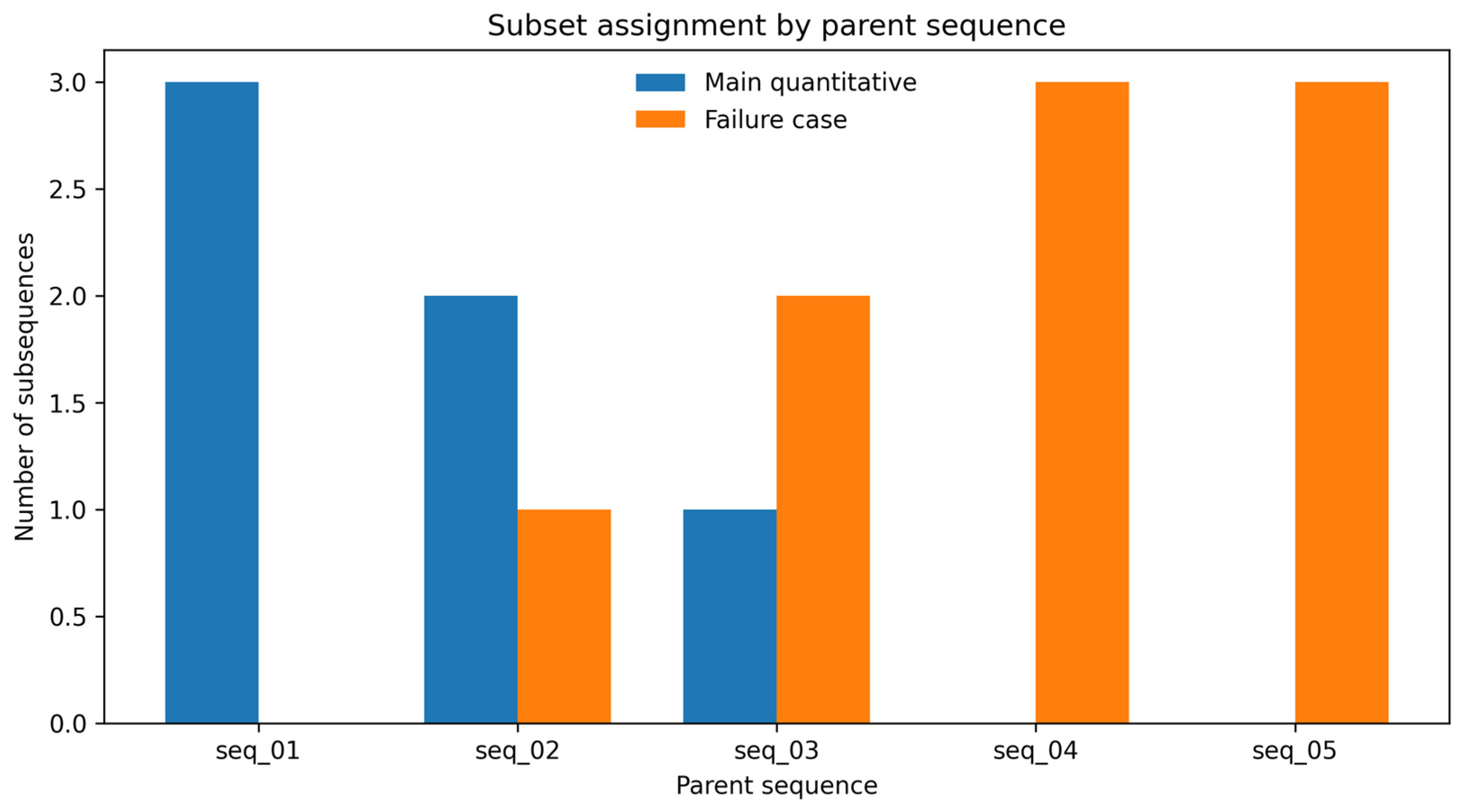
After threshold-based filtering, only six of the original 15 subsequences remained suitable for the main grouped comparison, while the remaining nine were categorized as failure cases. This result itself is important because it shows that underwater sparse reconstruction is constrained not only by the choice of preprocessing, but also by the inherent viability of the sequence. The benchmark accounting reported in this paper continues to refer to the original five parent sequences, 3630 frames, 15 subsequences, and 60 subsequence–method reconstruction runs.
The subset assignment by parent sequence is summarized in
Table 1 and visualized in
Figure 2. Among the five parent sequences, seq_01 contributed three subsequences to the main quantitative set, seq_02 contributed two, and seq_03 contributed one, whereas all subsequences from seq_04 and seq_05 remained in the failure-case set under the predefined registration threshold. Therefore, the final grouped comparison reported below was effectively supported by three parent sequences.
Table 2 reports full-benchmark viability across the original 15 subsequences. Overall, 6 subsequences passed the predefined registration criterion, whereas 9 failed under all candidate preprocessing strategies. The best registered-image counts ranged from 10 to 136 in the passing subset and from 3 to 6 in the failure subset. By contrast, best sparse-point counts remained nonzero even in failed cases, ranging from 276 to 1542. The failed subsequences were not excluded because they contained zero sparse points, but because none of the candidate preprocessing strategies reached the minimum registration criterion. In practice, these failures were characterized by persistently insufficient image registration (best registered-image counts of only 3–6) and weak, fragmented reconstructions even after local troubleshooting. This confirms that sequence-level reconstruction viability cannot be judged by sparse-point count alone and supports reporting pass/fail statistics alongside the main geometric comparison.
3.2. Overall Comparison of Raw, Fixed Baseline, Selected Method, and Oracle
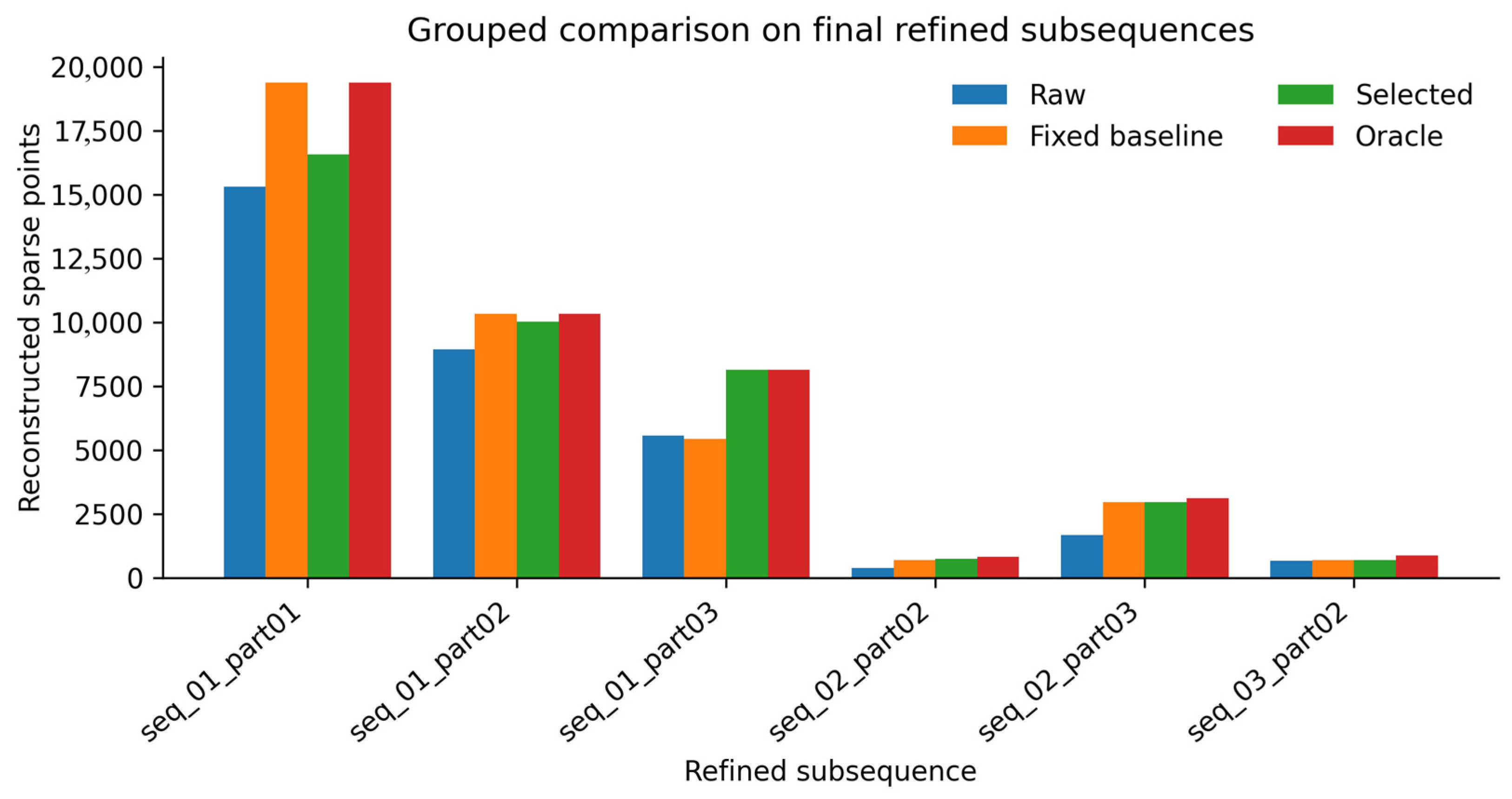
In the grouped evaluation set, the raw input yielded a mean of 5420.3 reconstructed sparse points. The machine-learning-based selector increased this value to 6518.2, corresponding to a relative improvement of 20.3% over raw input. The fair fixed baseline achieved 6582.0 reconstructed sparse points on average, corresponding to a 21.4% improvement over raw input. The oracle upper bound reached 7111.8 reconstructed sparse points on average, which was 31.2% higher than raw input.
These results indicate that preprocessing selection can substantially influence sparse reconstruction quality. At the same time, they also show that a strong fixed baseline remained highly competitive under the grouped evaluation protocol. The per-subsequence comparison is listed in
Table 3, the summary statistics are reported in
Table 4, and the grouped comparison is visualized in
Figure 3.
3.3. Secondary Geometric Indicators and Accuracy Trade-Offs
Table 5 reports secondary geometric indicators for the grouped evaluation set. Although sparse-point count remained the primary comparison variable, the auxiliary results show that preprocessing also changed registration behavior and geometric consistency. Compared with raw input, the selector increased sparse-point count, mean registered images, and mean track length, but with a modest increase in mean reprojection error (0.838 vs. 0.748). Compared with the fixed baseline, however, the selector achieved a lower mean reprojection error (0.838 vs. 0.917) while remaining close to it in sparse-point count. These results indicate a mixed geometry trade-off rather than a systematic degradation of geometric accuracy. At the same time, pass rates differed across strategies, confirming that reconstruction viability cannot be assessed from sparse-point count alone.
3.4. Per-Subsequence Behavior
A more detailed analysis reveals that the selector improved over the raw input on all six evaluated subsequences. In comparison with the fair fixed baseline, the selector outperformed the fixed strategy on three subsequences, tied it on one subsequence, and underperformed it on two subsequences. This indicates that the selector improved over raw input, but was not yet consistently superior to the strongest fixed preprocessing choice.
The median number of reconstructed points further supports this observation. The selector achieved a median of 5545.0 reconstructed points, whereas the fixed baseline achieved 4188.0. Hence, although the fixed baseline slightly exceeded the selector in mean performance, the selector remained competitive on typical clips.
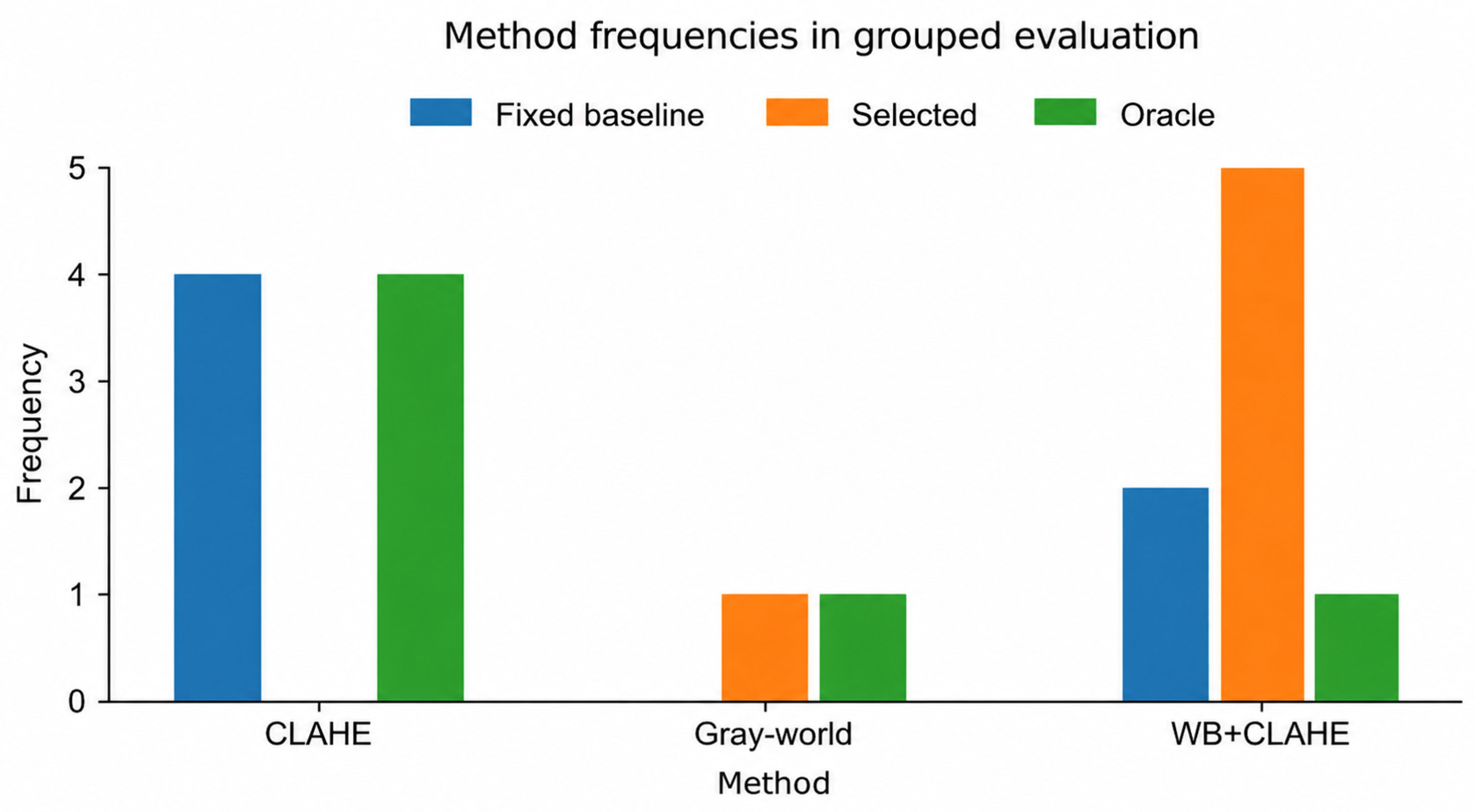
The oracle method also varied across subsequences. In the evaluated set, the oracle was CLAHE on four subsequences, white-balance-plus-CLAHE on one subsequence, and gray-world white balancing on one subsequence. This variability directly supports the main hypothesis of the study: the best preprocessing strategy is not universally fixed, but depends on the visual and geometric characteristics of the subsequence.
3.5. Method Frequency and Selection Behavior
The method frequencies in grouped evaluation are shown in
Figure 4. The fair fixed baseline selected CLAHE in four cases and white-balance-plus-CLAHE in two cases. In contrast, the machine-learning selector preferred white-balance-plus-CLAHE in five cases and gray-world white balancing in one case. The oracle upper bound was still dominated by CLAHE, but not exclusively so.
These counts indicate that CLAHE acted as a strong robust baseline, whereas the selector behaved more aggressively and favored white-balance-plus-CLAHE more often. This difference helps explain why the selector exceeded the fixed baseline in some clips while remaining slightly lower on mean performance.
3.6. Runtime Overhead of the Selection Module
Table 6 reports the runtime overhead of the proposed selection framework. Candidate preprocessing generation, descriptor extraction, and selector inference together required 3.201 s per subsequence on average, corresponding to 10.7% of the average sparse COLMAP reconstruction time (30.0 s). Among these components, candidate preprocessing generation accounted for the largest share of the selector-related cost, whereas model inference itself was negligible. By comparison, exhaustively reconstructing all four preprocessing candidates was estimated to require approximately 120.0 s per subsequence, corresponding to about 400.0% of one selected sparse reconstruction. These results support the characterization of the proposed selector as lightweight relative to the overall sparse reconstruction pipeline.
4. Discussion
The results support three main observations. First, underwater sparse 3D reconstruction is strongly influenced by lightweight preprocessing, confirming that radiometric changes can materially affect downstream geometry [
10,
11]. This finding reinforces the need to evaluate enhancement methods in a task-aware manner rather than relying solely on perceptual quality improvements.
Second, the optimal preprocessing strategy is inherently scene-dependent. Although CLAHE emerged as a strong baseline, the oracle method still varied across subsequences, indicating that no single enhancement strategy is universally optimal. This observation is consistent with recent task-oriented studies showing that visual enhancement and geometric utility may not coincide [
11,
24]. From a practical perspective, this variability motivates adaptive selection mechanisms rather than fixed preprocessing pipelines.
Third, the evaluation protocol plays a critical role in estimating generalization performance. By holding out all subsequences from the same parent sequence together, the grouped setting is intended to reduce overlap-induced leakage and provide a more conservative estimate of generalization. Under this stricter protocol, the proposed selector consistently improved over raw input across all evaluated subsequences. At the same time, it did not outperform the strongest fixed baseline in mean performance. This is an important limitation of the current study. The present results therefore provide preliminary evidence that adaptive preprocessing can improve robustness relative to raw input while remaining competitive with a strong fixed baseline.
The study also has several limitations. The grouped comparison set was relatively small, and only a limited number of parent sequences remained quantitatively valid after thresholding, which may restrict the statistical strength of the conclusions. In particular, because the final grouped comparison was effectively supported by only three parent sequences, the current evidence on generalization should be interpreted as preliminary. In addition, the feature representation was intentionally lightweight and relied on sequence-level no-reference descriptors rather than learned embeddings or temporal representations. While this design supports practical deployment, it may limit predictive accuracy in more complex scenarios.
Future work will expand the diversity and scale of parent sequences, investigate richer task-aware descriptors and ranking-based learning objectives, and extend the same decision framework to dense reconstruction, SLAM stability, and broader underwater mapping tasks. These directions will further clarify the role of adaptive preprocessing in improving the reliability of underwater vision systems.
5. Conclusions
This paper presented a machine-learning-based preprocessing selection framework for underwater sparse 3D reconstruction. Instead of proposing a new enhancement network, the study formulated preprocessing selection as a lightweight task-aware decision problem. Four candidate preprocessing strategies were evaluated, including raw input, CLAHE, gray-world white balancing, and white-balance-plus-CLAHE. Sequence-level no-reference descriptors were used to predict reconstruction gains, and a grouped leave-one-parent-sequence-out protocol was adopted to reduce train–test leakage and provide a more conservative estimate of generalization.
The experimental results indicate that underwater sparse reconstruction is highly sensitive to preprocessing choice. Relative to raw input, the proposed selector improved the mean number of reconstructed sparse points from 5420.3 to 6518.2, remaining competitive with a strong fixed baseline (6582.0) and below the oracle upper bound (7111.8). The selector consistently improved over raw input across all evaluated subsequences, but it did not surpass the strongest fixed baseline in mean performance.
Overall, this study suggests three main insights: (1) preprocessing should be treated as a task-aware decision problem rather than a fixed enhancement step; (2) grouped evaluation is useful for reducing overlap-induced leakage and providing a more conservative estimate of generalization; and (3) lightweight machine-learning-based selection is a promising exploratory approach for improving reconstruction robustness relative to raw input under heterogeneous underwater conditions.
These findings provide preliminary evidence on the role of preprocessing in underwater vision systems and offer task-oriented guidance for studying enhancement strategies in real-world 3D reconstruction pipelines.
Author Contributions
Conceptualization, N.H. and S.C.; methodology, N.H.; software, N.H.; validation, N.H. and S.C.; formal analysis, N.H.; investigation, N.H.; resources, N.H.; data curation, N.H.; writing—original draft preparation, N.H.; writing—review and editing, N.H. and S.C.; visualization, N.H. and S.C.; supervision, N.H.; project administration, N.H. All authors have read and agreed to the published version of the manuscript.
Funding
This research received no external funding.
Data Availability Statement
Acknowledgments
During the preparation of this manuscript, the authors used ChatGPT (OpenAI, GPT-5) for language editing and text refinement. The authors have reviewed and edited all outputs and take full responsibility for the content of this publication.
Conflicts of Interest
The authors declare no conflicts of interest.
Appendix A
Table A1.
Main notation used in the proposed framework.
Table A1.
Main notation used in the proposed framework.
| Symbol | Meaning |
|---|
| Underwater image subsequence |
| Parent sequence of subsequence |
| Preprocessing method |
| Candidate preprocessing pool |
| Number of reconstructed sparse 3D points |
| Number of registered images |
| Relative gain over raw input |
| Registration threshold |
| The -th frame in subsequence |
| Number of frames in subsequence |
| Set of sparse 3D points reconstructed from subsequence using preprocessing method |
References
- Russo, F.; Del Pizzo, S.; Di Ciaccio, F.; Troisi, S. An enhanced photogrammetric approach for the underwater surveying of the posidonia meadow structure in the Spiaggia Nera Area of Maratea. J. Imaging 2023, 9, 113. [Google Scholar] [CrossRef] [Scilit] [PubMed]
- Calantropio, A.; Chiabrando, F. Underwater cultural heritage documentation using photogrammetry. J. Mar. Sci. Eng. 2024, 12, 413. [Google Scholar] [CrossRef] [Scilit]
- Qiu, H.; Tang, Y.; Wang, H.; Wang, L.; Xiang, D.; Xiao, M. An improved underwater visual SLAM through image enhancement and sonar fusion. Remote Sens. 2024, 16, 2512. [Google Scholar] [CrossRef] [Scilit]
- Akkaynak, D.; Treibitz, T. A revised underwater image formation model. In Proceedings of the IEEE Computer Society Conference on Computer Vision and Pattern Recognition, Salt Lake City, UT, USA, 18–23 June 2018. [Google Scholar]
- Schechner, Y.Y.; Karpel, N. Clear underwater vision. In Proceedings of the IEEE Computer Society Conference on Computer Vision and Pattern Recognition, Washington, DC, USA, 27 June–2 July 2004. [Google Scholar]
- Chiang, J.Y.; Chen, Y.C. Underwater image enhancement by wavelength compensation and dehazing. IEEE Trans. Image Process. 2012, 21, 1756–1769. [Google Scholar] [CrossRef] [Scilit]
- Ancuti, C.; Ancuti, C.O.; Haber, T.; Bekaert, P. Enhancing underwater images and videos by fusion. In Proceedings of the IEEE Computer Society Conference on Computer Vision and Pattern Recognition, Providence, RI, USA, 16–21 June 2012. [Google Scholar]
- Akkaynak, D.; Treibitz, T.; Shlesinger, T.; Tamir, R.; Loya, Y.; Iluz, D. What is the space of attenuation coefficients in underwater computer vision? In Proceedings of the 30th IEEE Conference on Computer Vision and Pattern Recognition, CVPR 2017, Honolulu, HI, USA, 21–26 July 2017. [Google Scholar]
- Akkaynak, D.; Treibitz, T. Sea-THRU: A method for removing water from underwater images. In Proceedings of the IEEE Computer Society Conference on Computer Vision and Pattern Recognition, Long Beach, CA, USA, 15–20 June 2019. [Google Scholar]
- Agrafiotis, P.; Drakonakis, G.I.; Georgopoulos, A.; Skarlatos, D. The effect of underwater imagery radiometry on 3D reconstruction and orthoimagery. In Proceedings of the International Archives of the Photogrammetry, Remote Sensing and Spatial Information Sciences-ISPRS Archives, Nafplio, Greece, 1–3 March 2017. [Google Scholar]
- Vrochidis, A.; Tzovaras, D.; Krinidis, S. Enhancing 3D reconstructions in underwater environments: The impact of image enhancement on model quality. In Proceedings of the International Archives of the Photogrammetry, Remote Sensing and Spatial Information Sciences-ISPRS Archives, Vienna, Austria, 8–11 July 2025. [Google Scholar]
- Schonberger, J.L.; Frahm, J.M. Structure-from-motion revisited. In Proceedings of the IEEE Computer Society Conference on Computer Vision and Pattern Recognition, Las Vegas, NV, USA, 27–30 June 2016. [Google Scholar]
- Liu, R.; Fan, X.; Zhu, M.; Hou, M.; Luo, Z. Real-world underwater enhancement: Challenges, benchmarks, and solutions under natural light. IEEE Trans. Circuits Syst. Video Technol. 2020, 30, 4861–4875. [Google Scholar] [CrossRef] [Scilit]
- Li, C.; Guo, C.; Ren, W.; Cong, R.; Hou, J.; Kwong, S.; Tao, D. An underwater image enhancement benchmark dataset and beyond. IEEE Trans. Image Process. 2020, 29, 4376–4389. [Google Scholar] [CrossRef] [Scilit] [PubMed]
- Li, C.; Anwar, S.; Porikli, F. Underwater scene prior inspired deep underwater image and video enhancement. Pattern Recognit. 2020, 98, 107038. [Google Scholar] [CrossRef] [Scilit]
- Islam, M.J.; Xia, Y.; Sattar, J. Fast underwater image enhancement for improved visual perception. IEEE Robot. Autom. Lett. 2020, 5, 3227–3234. [Google Scholar] [CrossRef] [Scilit]
- Wang, Y.; Guo, J.; Gao, H.; Yue, H. UIEC^2-net: CNN-based underwater image enhancement using two color space. Signal Process. Image Commun. 2021, 96, 116250. [Google Scholar] [CrossRef] [Scilit]
- Li, C.; Anwar, S.; Hou, J.; Cong, R.; Guo, C.; Ren, W. Underwater image enhancement via medium transmission-guided multi-color space embedding. IEEE Trans. Image Process. 2021, 30, 4985–5000. [Google Scholar] [CrossRef] [Scilit] [PubMed]
- Zhou, J.; Sun, J.; Zhang, W.; Lin, Z. Multi-view underwater image enhancement method via embedded fusion mechanism. Eng. Appl. Artif. Intell. 2023, 121, 105946. [Google Scholar] [CrossRef] [Scilit]
- Yang, M.; Sowmya, A. An underwater color image quality evaluation metric. IEEE Trans. Image Process. 2015, 24, 6062–6071. [Google Scholar] [CrossRef] [Scilit] [PubMed]
- Panetta, K.; Gao, C.; Agaian, S. Human-visual-system-inspired underwater image quality measures. IEEE J. Ocean. Eng. 2016, 41, 541–551. [Google Scholar] [CrossRef] [Scilit]
- Yang, N.; Zhong, Q.; Li, K.; Cong, R.; Zhao, Y.; Kwong, S. A reference-free underwater image quality assessment metric in frequency domain. Signal Process. Image Commun. 2021, 94, 116218. [Google Scholar] [CrossRef] [Scilit]
- Yang, X.; Li, J.; Liang, W.; Wang, D.; Zhao, J.; Xia, X. Underwater image quality assessment. J. Opt. Soc. Am. A 2023, 40, 1276–1288. [Google Scholar] [CrossRef] [Scilit] [PubMed]
- Summers, J.M.; Jones, M.W.; Seale, C. Impact of underwater image enhancement on feature matching. Sensors 2025, 25, 6966. [Google Scholar] [CrossRef] [Scilit] [PubMed]
- Pizer, S.M.; Johnston, R.E.; Ericksen, J.P.; Yankaskas, B.C.; Muller, K.E. Contrast-limited adaptive histogram equalization: Speed and effectiveness. In Proceedings of the First Conference on Visualization in Biomedical Computing, Atlanta, GA, USA, 22–25 May 1990. [Google Scholar]
| Disclaimer/Publisher’s Note: The statements, opinions and data contained in all publications are solely those of the individual author(s) and contributor(s) and not of MDPI and/or the editor(s). MDPI and/or the editor(s) disclaim responsibility for any injury to people or property resulting from any ideas, methods, instructions or products referred to in the content. |