Article

Robust Dynamic State Estimation and Collaborative Control of Distribution Networks Considering Measurement Outliers

1
State Grid Hubei Electric Power Company, Wuhan 430077, China
2
Hubei Anyuan Safety and Environmental Protection Technology Co., Ltd., Wuhan 430072, China
3
School of Information and Electrical Engineering, Hunan University of Science and Technology, Xiangtan 411201, China
*
Author to whom correspondence should be addressed.
Electronics 2026, 15(9), 1850; https://doi.org/10.3390/electronics15091850
Submission received: 2 March 2026 / Revised: 6 April 2026 / Accepted: 10 April 2026 / Published: 27 April 2026

Abstract

Active distribution networks require precise real-time monitoring and control despite measurement outliers and rapid load dynamics. Conventional robust estimators frequently fail to distinguish between transient measurement corruption and genuine physical state mutations, leading to estimation lag or erroneous control actions. To address this, we propose a resilient cyber–physical framework that jointly optimizes robust dynamic state estimation and collaborative voltage control. At the estimation layer, a novel Persistence-Based Robust Extended Kalman Filter (PB-REKF) is developed, which employs a temporal persistence counter to adaptively switch between Huber M-estimation for sporadic outlier suppression and covariance inflation for rapid tracking of persistent state mutations. At the control layer, a chance-constrained Second-Order Cone Programming (SOCP) strategy directly embeds the real-time posterior covariance from the PB-REKF into the voltage safety constraints, creating a data-quality-adaptive security buffer that provides a 95 % probabilistic voltage guarantee. Simulations on 5-bus and IEEE 33-bus systems demonstrate that the proposed framework achieves a 29.5 % reduction in global RMSE and a 72.8 % reduction in peak outlier-window estimation error relative to the standard EKF, while reducing the voltage violation rate from 8.8 % to 3.8 % . The complete estimation and control pipeline requires 1.341 ms per update step, confirming real-time feasibility.

1. Introduction

With the rapid proliferation of distributed energy resources (DERs) such as rooftop photovoltaics, energy storage systems, and electric vehicles (EVs), modern active distribution networks (ADNs) are transitioning from passive, centrally dispatched systems to highly dynamic and interactive cyber–physical architectures [1]. In particular, the large-scale integration of EVs into distribution grids introduces additional uncertainties in load patterns and bidirectional power flows, posing new challenges for grid stability and market operation [2]. As summarized in recent comprehensive reviews [2,3], the stochastic and time-varying nature of EV charging loads further complicates the tasks of real-time state estimation and coordinated voltage control in modern ADNs. This transition introduces significant volatility in net load profiles and frequent bidirectional power flows. As a result, accurate real-time monitoring and coordinated control become indispensable for maintaining voltage stability, minimizing network losses, and ensuring overall system resilience [4].
However, measurements from Supervisory Control and Data Acquisition (SCADA) systems or Phasor Measurement Units (PMUs) are inevitably contaminated by outliers. Such outliers may arise from sensor failures, communication errors, or malicious false data injection attacks (FDIAs) [5,6]. Meanwhile, sudden load or generation steps create genuine persistent state mutations. Conventional estimators frequently fail to distinguish between transient bad data and true physical dynamics [7,8]. This misclassification leads either to the rejection of legitimate abrupt changes or to contamination of the estimates by corrupted data, ultimately resulting in estimation lag, tracking failure, or control mis-operations that jeopardize voltage security [9,10].
The foundation of power system state estimation was laid by Schweppe et al., who formulated the static problem as weighted least-squares (WLSs) optimization under Gaussian noise Assumptions [11,12,13]. These methods, enriched with bad-data detection/identification procedures [14,15], have been successfully deployed in transmission-level EMS for decades. However, their static nature and extreme sensitivity to gross errors render them inadequate for distribution networks with limited redundancy and highly non-Gaussian disturbances [16].
To enhance robustness, various M-estimators employing non-quadratic cost functions have been proposed, including Huber-type estimators [17,18,19], least absolute value (LAV) methods [20], and projection-statistics-based techniques [17]. In parallel, dynamic state estimation (DSE) approaches based on extended/unscented Kalman filters [21,22,23] and forecasting-aided models [24,25] have been developed to exploit temporal correlation under renewable uncertainty. More recently, chance-constrained programming (CCP) has gained prominence for Volt/Var control. Analytical [4,26], scenario-based [27], and distributionally robust formulations [28,29] now provide explicit probabilistic voltage guarantees.
In parallel with these developments, the vulnerability of state estimation to cyber-attacks has received growing attention. False data injection attacks (FDIAs) can bypass traditional bad data detection by exploiting knowledge of the system topology [5]. Recent works have addressed this challenge through attack-resilient estimation frameworks. For instance, ref. [30] proposed a joint estimation and detection scheme that simultaneously estimates the system state and identifies the attack vector, while [31] developed a robust estimator based on multiple-hypothesis testing that achieves resilience against coordinated cyber-attacks in distribution systems.
The deployment of SCADA and PMUs in distribution networks has also opened new avenues for dynamic state estimation. PMU-based approaches leverage high-rate synchronized measurements to enable real-time tracking of system dynamics [23,32]. However, PMU coverage in distribution systems remains sparse, and hybrid estimation schemes that combine SCADA and PMU data sources are an active area of research [33]. Furthermore, robust filtering techniques tailored for smart grid applications have been extensively studied, including generalized maximum-likelihood estimators [34], correntropy-based Kalman filters [35], and parameterized cubature Kalman filters [36].
Despite these individual advances, a key gap persists: existing methods typically address outlier rejection or dynamic tracking in isolation, without a unified mechanism to distinguish between transient measurement corruption and genuine physical state mutations in real time. The present work aims to bridge this gap.
Despite these advances, two critical limitations persist: (1) most robust EKFs adopting Huber-type M-estimation remain overly conservative and misclassify sudden physical state jumps as outliers, causing unacceptable tracking delays [35,36,37]; (2) existing integrated estimation-and-control frameworks treat estimation uncertainty as fixed or slowly varying, decoupling the two layers and preventing adaptive response to real-time data quality degradation [34,38]. Consequently, controllers become either excessively conservative or insufficiently safe immediately after outlier events.
To address these limitations, this paper proposes a resilient cyber–physical framework that jointly optimizes robust dynamic state estimation and collaborative voltage control. At the estimation layer, a novel PB-REKF is developed that adaptively selects between Huber M-estimation for outlier suppression and covariance inflation for rapid tracking of persistent state mutations. At the control layer, a Soft-Constrained SOCP strategy dynamically shapes voltage security buffers according to the real-time estimation covariance provided by the PB-REKF.
To clearly position the proposed PB-REKF among existing robust filtering approaches, Table 1 provides a systematic comparison with four closely related methods.
The key technical distinctions of PB-REKF from existing methods are as follows. (i) Dual-mode architecture: unlike methods that apply a single mechanism uniformly (e.g., Huber-only or inflation-only), PB-REKF explicitly separates outlier rejection (Huber M-estimation) from state-jump tracking (covariance inflation), preventing the well-known conflict between robustness and responsiveness. (ii) Temporal persistence logic: the switching criterion is based on a counter of consecutive anomalous residuals, providing a parameter-transparent rule that has a clear physical interpretation: transient bad data (sensor faults, FDIAs) disappear within 1–2 steps, whereas genuine physical mutations persist beyond N persist steps. No existing Huber-based robust EKF reviewed in Table 1 incorporates such a time-domain discrimination criterion. (iii) Uncertainty-coupled control: the estimation covariance P k | k , which dynamically reflects the current filter mode, is directly propagated into the SOCP chance constraints, enabling data-quality-adaptive voltage regulation—a coupling mechanism absent from existing integrated estimation-and-control designs [34,38].
From a practical standpoint, these distinctions yield three engineering advantages: (a) the persistence logic prevents erroneous reactive power injections triggered by momentary sensor faults, thereby avoiding artificial voltage sags that compromise power quality; (b) the covariance-coupled safety buffer adapts in real time to cyber-attack severity, providing stronger voltage guarantees during attacks and reducing unnecessary conservatism under normal operation; (c) the overall pipeline (PB-REKF + SOCP) completes each update in under 10 ms on the 5-bus system, confirming computational feasibility within PMU update cycles.
The main contributions are threefold:
1.
Existing Huber-based robust EKFs [19,36] rely solely on the instantaneous standardized residual | r ˜ i , k | to detect outliers and have no mechanism to distinguish sporadic sensor faults from genuine persistent state mutations, causing systematic tracking delays. The proposed PB-REKF introduces a temporal persistence counter c k that accumulates evidence across consecutive time steps, enabling explicit time-domain discrimination between transient bad data and physical state jumps—a mechanism absent from all prior robust Kalman filters for distribution network DSE.
2.
The PB-REKF replaces single-mode Huber weighting with a dual-mode structure governed by the condition c k N persist : Huber M-estimation for outlier suppression, and covariance inflation for mutation tracking. The resulting posterior covariance P k | k is directly embedded into the SOCP chance constraints via the SOC term η L k ( S x ) i 2 , coupling estimation confidence with control conservatism in real time—in contrast to existing integrated frameworks [34,38] that treat estimation uncertainty as fixed.
3.
Practically, the framework achieves a 29.5 % reduction in global RMSE and a 72.8 % reduction in peak outlier-window error over the standard EKF, while providing a 95 % probabilistic voltage guarantee under composite disturbances. Theoretically, Theorem 1 establishes the exponential mean-square boundedness E [ x k x ^ k | k 2 ] p ¯ of the estimation error, and Theorem 2 proves the KKT convergence of the SOCP algorithm—both absent from the existing robust DSE literature for distribution networks. Validation covers five scenarios on 5-bus and IEEE 33-bus systems.
The rest of this paper is organized as follows. Section 2 formulates the dynamic state-space model and the chance-constrained control problem. Section 3 elaborates the proposed PB-REKF algorithm. Section 4 presents the uncertainty-propagation and SOCP-based control strategy. Section 5 provides theoretical analysis. Section 6 evaluates performance through numerical experiments, and Section 7 concludes the paper.

2. Problem Formulation and System Modeling

This section presents the mathematical modeling of the distribution network dynamics, the measurement model incorporating gross errors (outliers), and the formulation of the chance-constrained collaborative control problem.

2.1. Preliminaries and Network Topology

Consider a radial distribution network represented by a directed graph G = ( N , E ) , where N = { 0 , 1 , , N } denotes the set of buses and E N × N represents the set of distribution lines. Bus 0 is defined as the slack bus (substation), and N + = N { 0 } represents the set of other buses. For a line ( i , j ) E , let r i j and x i j denote the resistance and reactance, respectively. Let P i j , k and Q i j , k be the active and reactive power flowing from bus i to bus j at time step k. The active and reactive power injections at bus j are denoted by p j , k and q j , k , respectively.

2.2. Dynamic State-Space Model of Distribution Networks

The dynamic behavior of a radial distribution network is governed by the DistFlow branch equations [40], which describe the relationship between nodal voltages and branch power flows:
P i j , k = l : j l P j l , k + p L , j , k p D G , j , k
Q i j , k = l : j l Q j l , k + q L , j , k q D G , j , k
v j , k = v i , k 2 r i j P i j , k + x i j Q i j , k r i j 2 + x i j 2 P i j , k 2 + Q i j , k 2 v i , k
where v j , k = V j , k 2 denotes the squared voltage magnitude at bus j; P i j , k and Q i j , k are the active and reactive power flows on branch ( i , j ) ; p L , j , k , q L , j , k are the load injections; and p D G , j , k , q D G , j , k are the DER injections at bus j.
The exact DistFlow Equation (3) contains quadratic loss terms that render the voltage-injection mapping nonlinear and nonconvex. Under the standard assumption that line impedances and voltage deviations from the nominal value are small ( r i j , x i j 1 p.u. and v j , k V nom 2 ), the quadratic loss terms are negligible and (3) reduces to the LinDistFlow approximation:
v j , k v i , k 2 r i j P i j , k + x i j Q i j , k
This approximation has been extensively validated for radial distribution networks operating within the normal voltage range [ 0.95 , 1.05 ] p.u., introducing voltage errors typically below 0.1 % [40]. Applying (4) recursively from the slack bus ( v 0 = V nom 2 ), the squared voltage at bus j becomes an affine function of all nodal power injections:
v j , k = v 0 2 ( i , l ) P 0 j r i l P ¯ i l , k + x i l Q ¯ i l , k
where P 0 j denotes the unique path from the slack bus to bus j in the radial topology.
Under the additional quasi-steady-state assumption that load variations are slow relative to the PMU measurement update interval, the inter-step voltage increment satisfies Δ x k = 2 M R Δ p L , k 2 M X Δ q L , k , where the small load increments Δ p L , k and Δ q L , k are subsumed into the stochastic process noise term. This yields the following linear discrete-time state-space model:
x k + 1 = A x k + B u k + w k + s k
State vector x k . The system state is defined as the vector of squared voltage magnitudes at all non-slack buses:
x k = [ V 1 , k 2 , V 2 , k 2 , , V N , k 2 ] R N
Under the LinDistFlow framework, voltage angles are implicitly determined by the branch power flows via (4) and carry no additional independent information for the estimator; DER internal states are treated as control inputs rather than state variables. This choice is consistent with the measurement model in Section 2.3 and with the PMU-based squared voltage magnitude measurements adopted in the simulation setup (Section 4.1). The framework can be extended to include voltage angles or DER internal states by augmenting x k and re-deriving the Jacobians F k 1 and H k ; such extensions are left for future work.
State transition matrix A . From (5), lumping the slow load increments into the process noise term yields A = I N : in the absence of disturbances or control actions, the squared voltage at each bus persists from one step to the next.
Control input vector u k and matrix B . The control vector u k = [ q D G , 1 , k , , q D G , n u , k ] R n u collects the reactive power outputs of all n u DERs, each subject to capacity limits Q j min q D G , j , k Q j max . The ( j , m ) entry of B quantifies the voltage sensitivity to the reactive injection of DER at bus m, derived from (5) as:
B j m = v j , k q D G , m , k = 2 ( i , l ) P 0 j P 0 m x i l
i.e., twice the total reactance on the common path from the slack bus to both bus j and DER bus m. For a radial feeder with buses indexed in downstream order, this simplifies to B j m = 2 l = 1 min ( j , m ) x l , determined analytically from the network topology and line parameters alone.
Process noise w k . The term w k N ( 0 , Q k ) aggregates three sources of stochastic uncertainty: random load fluctuations, uncontrolled DER output variability (e.g., PV irradiance intermittency), and LinDistFlow linearization residuals. Its covariance matrix is:
Q k = 4 M R Σ P M R + 4 M X Σ Q M X
where M R , M X R N × N are network incidence matrices whose ( j , l ) entry equals the resistance of branch ( i , l ) if that branch lies on P 0 j , and zero otherwise; Σ P and Σ Q are the covariances of the active and reactive load increments, respectively. In practice, Q k is approximated as σ w 2 I N with σ w 2 = 10 6 .
Jump vector s k . The sparse vector s k captures sudden large disturbances (e.g., load switching or DER trip events) that produce a persistent operating-point shift beyond the Gaussian noise assumption. Unlike w k , it is zero at most time steps and becomes nonzero only at the instant of a physical contingency. Detecting and tracking s k in the presence of concurrent measurement outliers is the primary objective of the PB-REKF developed in Section 3.

2.3. Measurement Model Considering Outliers

The PMUs collect measurements z k R m from the grid. These measurements typically include nodal voltages, branch power flows, and power injections. In realistic scenarios, measurements are corrupted not only by small sensor noise but also by gross errors (outliers) due to sensor failures, data packet losses, or cyber-attacks (e.g., FDIAs). The measurement model is formulated as:
z k = h ( x k ) + v k + o k
where: h ( · ) is the nonlinear measurement function corresponding to the power flow equations. v k N ( 0 , R k ) denotes the nominal measurement noise (Gaussian white noise) with covariance R k . o k R m is the outlier vector. Unlike v k , o k is sparse but can have arbitrarily large magnitudes. The entries of o k are non-zero only when the corresponding sensor is faulty or under attack.
In this study, the measurement vector z k is composed of squared voltage magnitudes at all monitored buses, i.e.,
z k = [ v 1 , k m e a s , v 2 , k m e a s , , v m , k m e a s ]
where v j , k m e a s = V j , k 2 + v j , k + o j , k represents the measured squared voltage magnitude at bus j, corrupted by nominal noise v j , k and potential outlier o j , k . In this formulation, the measurement function h ( x k ) reduces to a linear mapping h ( x k ) = C x k , where C is the measurement selection matrix. When all bus voltages are observed, C = I . The framework is general and can be extended to include branch power flow and power injection measurements by appropriately defining a nonlinear h ( · ) .
Remark 1.
Standard estimation methods (e.g., Weighted Least Squares or standard Kalman filters) assume o k = 0 . The presence of non-zero o k degrades the estimate x ^ k , leading to biased states and erroneous control actions. This necessitates the design of a robust filter to reject o k and recover x k .

2.4. Collaborative Control Problem Formulation

The objective of the collaborative control is to maintain the system voltage profiles within safety limits and minimize operation costs, utilizing the estimated state x ^ k | k and its error covariance P k | k provided by the robust estimator. Since the true state x k is unknown and estimated with uncertainty, deterministic constraints are insufficient. We employ a CCP formulation.

2.4.1. Objective Function

The objective is to minimize the total operational cost J ( u k ) at time k:
min u k J ( u k ) = j N D G ( C P P j , k c u r t + C Q | Q j , k | ) + C l o s s P l o s s , k
where C P , C Q , C l o s s are weighting coefficients for active power curtailment, reactive power support, and network power loss, respectively.

2.4.2. Deterministic Constraints

The control inputs must satisfy the physical capacity limits of the devices:
P j min P j , k P j max , j N D G
Q j min Q j , k Q j max , j N D G
( P j , k ) 2 + ( Q j , k ) 2 S j max , j N D G

2.4.3. Chance Constraints for Voltage Safety

Given the estimation error e k = x k x ^ k | k , the voltage magnitude V j , k is a random variable. To ensure robustness, we require the nodal voltages to stay within limits [ V min , V max ] with a high probability 1 ϵ :
P V min V j , k ( x k , u k ) V max 1 ϵ , j N
where ϵ ( 0 , 0.5 ) is the acceptable violation probability (e.g., ϵ = 0.05 ). This constraint explicitly couples the quality of the state estimation (via the covariance matrix P k | k ) with the conservatism of the control strategy. Large estimation uncertainty will tighten the feasible region of u k , ensuring safety even under poor data quality.

2.4.4. Constraint Reformulation

To make the problem tractable, the nonlinear power flow equations h ( x ) are often linearized around the operating point (e.g., using the LinDistFlow model), such that the voltage becomes an affine function of the stochastic state. This allows the chance constraints (16) to be reformulated into deterministic SOC constraints, as detailed in Section 3.

3. Robust Dynamic State Estimation Strategy

To address the vulnerability of conventional estimators to measurement outliers, this section develops a Robust Extended Kalman Filter (REKF). The proposed method integrates the principle of M-estimation with the recursive structure of EKF, utilizing the Huber cost function to automatically down-weight anomalous data while preserving the optimality for nominal Gaussian noise.

3.1. Limitations of Standard EKF

The standard EKF estimates the state x k by minimizing the weighted L 2 -norm of the measurement residuals and the prediction error. The objective function at time step k is derived from the Maximum Likelihood Estimation (MLE) under Gaussian Assumptions:
J E K F ( x k ) = ( z k h ( x k ) ) R k 1 ( z k h ( x k ) ) + ( x k x ^ k | k 1 ) P k | k 1 1 ( x k x ^ k | k 1 )
Let r k = z k h ( x k ) be the measurement residual. The term r k R k 1 r k = ( r i , k / σ i ) 2 imposes a quadratic penalty on errors. If the i-th measurement is an outlier (i.e., | r i , k | ), the quadratic cost dominates the objective function J E K F . Consequently, the optimizer shifts the estimated state x ^ k towards the outlier to reduce this penalty, resulting in a biased state estimate, a well-known consequence of applying a quadratic cost function in the presence of gross measurement errors [18].

3.2. M-Estimation Framework and Huber Cost Function

To mitigate the influence of outliers, we adopt the M-estimation framework. We replace the quadratic cost function with a robust score function ρ ( · ) that grows less rapidly than the square function for large errors. The robust objective function is formulated as:
J R o b u s t ( x k ) = i = 1 m ρ ( r ˜ i , k ) + ( x k x ^ k | k 1 ) P k | k 1 1 ( x k x ^ k | k 1 )
where r ˜ i , k is the standardized residual. We employ the Huber cost function, which combines the efficiency of the L 2 -norm for small errors and the robustness of the L 1 -norm for large errors:
ρ ( e ) = 1 2 e 2 if | e | δ δ | e | 1 2 δ 2 if | e | > δ
where δ > 0 is the tuning parameter that defines the boundary between the quadratic ( L 2 ) and linear ( L 1 ) regions of the cost function. Data points with standardized residuals | r ˜ i , k | δ are treated as originating from nominal Gaussian noise and receive full quadratic weighting, preserving statistical efficiency. Those exceeding δ are deemed potential outliers and receive only linear weighting, which limits their influence on the state estimate. The value δ = 1.5 corresponds to approximately 95% asymptotic efficiency under purely Gaussian noise conditions [19], meaning that less than 5% of estimation accuracy is sacrificed relative to the optimal L 2 estimator while substantial robustness against outliers is gained.
To incorporate this into the Kalman filtering framework, we define the influence function ψ ( e ) = ρ ( e ) / e and the weight function q ( e ) = ψ ( e ) / e . For the Huber estimator, the weight function is derived as:
q ( e ) = 1 if | e | δ δ / | e | if | e | > δ
From (20), it is evident that for outliers ( | e | > δ ), the weight q ( e ) decreases as the error magnitude increases, effectively suppressing the impact of bad data.

3.3. Adaptive Process Noise Scaling

The standard Huber-based filter may mistakenly reject sudden physical disturbances (e.g., voltage sags) as outliers. To distinguish between sensor attacks and system-wide transients, an adaptive scaling factor λ k is introduced for the process noise covariance Q k :
Q ^ k = λ k Q n o m i n a l
The scaling factor is determined by the global residual consistency:
λ k = max 1 , α · 1 m i = 1 m | z i , k h i ( x ^ k | k 1 ) | σ n o m i n a l
where α > 0 is a tuning parameter that controls the sensitivity of the inflation mechanism to global residual increases. A larger α makes the filter respond more aggressively to system-wide disturbances. In practice, α is set such that the scaling factor λ k remains close to unity under nominal conditions (small individual residuals), while increasing (e.g., λ k 1 ) when a majority of measurement residuals simultaneously exceed their expected levels, which is the signature of a genuine physical disturbance rather than a localized sensor fault. When a system-wide voltage sag occurs, the global residual increases, triggering a larger λ k . This inflates the prediction uncertainty, effectively forcing the filter to broaden its bandwidth and track the rapid state change, provided that the majority of measurements remain consistent.

3.4. Topology-Aware Process Noise Modeling

Conventional dynamic state estimators often assume that process noises are spatially uncorrelated (i.e., Q k is diagonal). However, in distribution networks, voltage fluctuations caused by load changes are physically coupled across the grid topology. To enhance the observability under sparse sensor attacks, we model the process noise covariance Q k with spatial correlations:
Q k ( i , j ) = σ p 2 , if i = j ρ · σ p 2 , if i , j are adjacent nodes 0 , otherwise
where ρ ( 0 , 1 ) is the spatial correlation coefficient determined by the line impedance. This formulation ensures that even if the measurement at node i is rejected as an outlier, the state estimate x ^ i is corrected by the healthy measurements from neighboring nodes via the correlation terms in the prediction error covariance.

3.5. The PB-REKF Algorithm

The proposed REKF algorithm consists of the standard prediction step and a modified correction step using Iteratively Reweighted Least Squares (IRLS).

3.5.1. Prediction Step

Based on the system dynamics model, the a priori state estimate and error covariance are predicted as:
x ^ k | k 1 = f ( x ^ k 1 | k 1 , u k 1 )
P k | k 1 = F k 1 P k 1 | k 1 F k 1 + Q k 1
where F k 1 = f x | x ^ k 1 | k 1 is the Jacobian of the state transition function.

3.5.2. Robust Correction Step

In the presence of outliers, the measurement noise covariance matrix R k is no longer valid. We introduce the equivalent weighting matrix R ˜ k .
Let H k = h x | x ^ k | k 1 be the Jacobian of the measurement function. The standardized residual for the i-th measurement is calculated as:
r ˜ i , k = z i , k h i ( x ^ k | k 1 ) ( H k P k | k 1 H k + R k ) i i
Using the Huber weight function (20), we compute the scaling factor q i = q ( r ˜ i , k ) for each measurement. The equivalent noise covariance matrix is then updated as:
R ˜ k = R k · diag 1 q 1 , 1 q 2 , , 1 q m
Interpretation: If measurement i is an outlier, q i 0 , causing the i-th diagonal element of R ˜ k to effectively approach infinity. This implies that the filter “distrusts” this measurement.
Finally, the Robust Kalman Gain K k and the a posteriori state estimate are computed:
K k = P k | k 1 H k H k P k | k 1 H k + R ˜ k 1
x ^ k | k = x ^ k | k 1 + K k z k h ( x ^ k | k 1 )

3.5.3. Output: State and Uncertainty Quantification

The algorithm provides two critical outputs for the subsequent control layer:
1.
Robust State Estimate ( x ^ k | k ): The posterior state estimate from which the influence of outliers has been suppressed via Huber reweighting, providing a statistically consistent voltage trajectory for the subsequent control layer.
2.
Updated Error Covariance ( P k | k ):
P k | k = ( I K k H k ) P k | k 1
Remark 2.
The updated covariance P k | k reflects the confidence in the estimation. When outliers are detected and down-weighted (large R ˜ k ), the gain K k decreases, and consequently, the reduction in uncertainty (from P k | k 1 to P k | k ) is smaller compared to the outlier-free case. This accurately signals to the controller that the current state information is less reliable, necessitating a more conservative control action.
The complete Persistence-Based Robust EKF algorithm, integrating Huber M-estimation with temporal persistence logic and adaptive covariance inflation, is presented in Algorithm 1.
Algorithm 1 Persistence-based robust extended Kalman filter (PB-REKF)
Input:  x ^ k 1 | k 1 , P k 1 | k 1 , z k , u k 1 , c k 1 ; Q , R k , δ , N persist , Ω jump
Output:  x ^ k | k , P k | k , c k
       Step 1: Prediction
  1:   x ^ k | k 1 f ( x ^ k 1 | k 1 , u k 1 )
  2:   P k | k 1 F k 1 P k 1 | k 1 F k 1 + Q
       Step 2: Standardized Residuals
  3:   r k z k h ( x ^ k | k 1 )
  4:   S k H k P k | k 1 H k + R k
  5:   r ˜ i , k r i , k / ( S k ) i i ,    i = 1 , , m
       Step 3: Persistence Counter Update
  6:  if i such that | r ˜ i , k | > 3 then
  7:       c k c k 1 + 1
  8:  else
  9:       c k 0
10:  end if
       Step 4: Adaptive Mode Selection and Update
11:  if  c k N persist  then
12:       P k | k 1 inf P k | k 1 + Ω jump Q
13:       K k P k | k 1 inf H k H k P k | k 1 inf H k + R k 1
14:       x ^ k | k x ^ k | k 1 + K k r k
15:       P k | k ( I K k H k ) P k | k 1 inf
16:       c k 0
17:  else
18:      for  i = 1 to m do
19:           ψ i 1  if  | r ˜ i , k | δ ;    ψ i δ / | r ˜ i , k | otherwise
20:      end for
21:       R ˜ k R k · diag ( 1 / ψ 1 , , 1 / ψ m )
22:       K k P k | k 1 H k H k P k | k 1 H k + R ˜ k 1
23:       x ^ k | k x ^ k | k 1 + K k r k
24:       P k | k ( I K k H k ) P k | k 1
25:  end if
26:  return  x ^ k | k , P k | k , c k

4. Chance-Constrained Collaborative Control Framework

With the robust state estimate x ^ k | k and the error covariance matrix P k | k obtained from the REKF, the control layer aims to optimize the operation of DERs. The primary challenge is to satisfy voltage constraints under the uncertainty characterized by P k | k . This section details the reformulation of the stochastic problem into a tractable SOCP model.

4.1. Linearized Power Flow Model

The exact relation between nodal voltages and power injections is nonlinear and nonconvex, which complicates the chance-constrained formulation. To facilitate convex optimization, we employ a linearized power flow model (e.g., LinDistFlow or sensitivity-based model) around the estimated operating point. The squared voltage magnitude vector v R N (where v i = V i 2 ) can be approximated as an affine function of the state x and the control inputs u :
v k ( x , u ) v 0 + S x ( x k x ^ k | k ) + S u u k
where v 0 is the base voltage vector corresponding to x ^ k | k and zero control actions. S x R N × n x and S u R N × n u are the sensitivity matrices of voltage with respect to state variables and control inputs, respectively. The sensitivity matrix S x = v / x quantifies how small perturbations in the system state affect the nodal squared voltage magnitudes and is derived from the Jacobian of the linearized DistFlow equations evaluated at the current operating point. Similarly, S u = v / u characterizes the voltage response to DER control adjustments, enabling the controller to predict the voltage impact of each control action. For instance, in a radial network, the element ( S u ) i j represents the sensitivity of the squared voltage at node i to a unit change in the reactive power injection at DER node j.
Remark 3.
The linearized power flow model in (31) is based on the LinDistFlow approximation [40], which neglects the quadratic power loss terms in the DistFlow equations. For radial distribution networks operating within normal voltage ranges (0.95–1.05 p.u.), this approximation has been extensively validated and shown to introduce negligible voltage estimation errors, typically below 0.1% in voltage magnitude [40]. Two factors further mitigate potential inaccuracies in the proposed framework: (i) the Successive Convex Approximation (SCA) procedure in Algorithm 1 iteratively updates the linearization point based on the latest solution, progressively reducing the approximation error at each iteration; and (ii) the chance-constrained formulation inherently provides a safety buffer that absorbs residual modeling errors. Nevertheless, for heavily loaded networks or systems with high R/X ratios, the linearization accuracy may degrade, and incorporating second-order corrections or exact relaxations represents a valuable direction for future improvement.

4.2. Uncertainty Propagation

Since the true state x k is unknown, we model it as a random variable distributed according to the REKF output: x k N ( x ^ k | k , P k | k ) . Substituting this into (31), the voltage v k becomes a Gaussian random vector with:
E [ v k ] = v 0 + S u u k , Σ v , k = S x P k | k S x .
This step establishes the quantitative link between the estimation uncertainty ( P k | k ) and the voltage uncertainty ( Σ v , k ). If the REKF detects outliers and yields a larger P k | k , the variance of the voltage will increase appropriately.

4.3. Deterministic Reformulation of Chance Constraints

The chance constraint for the upper voltage limit at node i is given by:
P ( v i , k v max ) 1 ϵ
where v i , k follows a univariate Gaussian distribution N ( μ v , i , σ v , i 2 ) . Normalizing the random variable, (33) is equivalent to:
v max μ v , i σ v , i Φ 1 ( 1 ϵ )
where Φ 1 ( · ) is the inverse cumulative distribution function (quantile function) of the standard normal distribution. Let η = Φ 1 ( 1 ϵ ) be the safety factor (e.g., η 1.645 for ϵ = 0.05 ). The probabilistic constraint can be rewritten as a deterministic inequality:
μ v , i + η σ v , i v max
Substituting μ v , i and σ v , i = ( Σ v , k ) i i , we obtain:
( v 0 + S u u k ) i + η ( S x P k | k S x ) i i v max

4.4. SOCP Formulation

The term involving the square root of the covariance creates a nonlinearity. However, this fits precisely into the definition of a SOC constraint. Let P k | k be decomposed using Cholesky decomposition such that P k | k = L k L k . Then the standard deviation term can be expressed as the L 2 -norm:
( S x P k | k S x ) i i = L k ( S x ) i 2
where ( S x ) i is the i-th row of the sensitivity matrix.
The final tractable optimization problem is formulated as follows:
min u k , t j N D G ( C P P j , k c u r t + C Q t j ) + C l o s s P l o s s s . t . ( v 0 + S u u k ) i + η L k ( S x ) i 2 v max , i N ( v 0 + S u u k ) i η L k ( S x ) i 2 v min , i N ( P j , k ) 2 + ( Q j , k ) 2 ( S j max ) 2 , j N D G t j Q j , k t j , j N D G
Remark 4.
The optimization problem (38) is a convex SOCP that can be solved efficiently by solvers such as Gurobi or MOSEK within milliseconds. The SOCP reformulation itself follows the standard Gaussian chance-constraint-to-SOC conversion procedure, and is not claimed as a novel contribution. The methodological contribution of this section lies in the real-time substitution of the dynamically updated posterior covariance P k | k from the PB-REKF into the SOC security buffer η L k ( S x ) i 2 . When the PB-REKF detects outliers (Huber mode, reduced Kalman gain), P k | k remains elevated, the buffer expands, and the controller keeps voltages further from the safety limits; under nominal conditions, P k | k is small, the buffer contracts, and unnecessary conservatism is avoided. This data-quality-adaptive coupling between estimation confidence and control conservatism is absent from existing integrated frameworks [34,38], which treat estimation uncertainty as fixed.

5. Theoretical Analysis

This section provides a rigorous theoretical analysis of the proposed framework. We establish the stochastic stability of the Robust EKF in the presence of outliers and prove the convergence of the optimization algorithm.

5.1. Stability Analysis of the Robust EKF

A critical concern for dynamic state estimation is whether the estimation error remains bounded when the measurement weights are dynamically adjusted by the M-estimator.

5.1.1. Preliminaries and Assumptions

Let the estimation error be e k = x k x ^ k | k . The error dynamics can be linearized as:
e k + 1 ( A K k H k A ) e k + ξ k
where ξ k represents the aggregate noise and linearization residuals. To proceed, we make the following standard Assumptions:
Assumption 1
(Boundedness). The system matrices A ,   H k , and the noise covariances Q k ,   R k are bounded for all k.
Assumption 2
(Observability). The pair ( A ,   H k ) satisfies the uniform observability rank condition.
Assumption 3
(Lipschitz Continuity). The nonlinear functions f ( · ) and h ( · ) are locally Lipschitz continuous.

5.1.2. Boundedness of Error Covariance

In our Robust EKF, the measurement noise covariance is replaced by R ˜ k = R k Q w e i g h t 1 , where Q w e i g h t = diag ( q 1 , , q m ) contains the Huber weights q i ( 0 , 1 ] .
Theorem 1
(Boundedness of Estimation Error). Consider the nonlinear stochastic system with the Robust EKF. Let P k | k be the posterior error covariance. Under Assumptions 1–3, if there exists a scalar γ > 0 such that the weighted observability Gramian satisfies a persistent excitation condition, then the estimation error is exponentially bounded in the mean square sense, i.e., there exist p ¯ < such that
E [ x k x ^ k | k 2 ] p ¯ , k
Proof. 
Let the state estimation error be x ˜ k = x k x ^ k | k . The dynamics of the error can be described by the linearized equation:
x ˜ k + 1 = ( A k K k H k ) x ˜ k + ζ k + w k K k v k
where A k = f x and H k = h x are Jacobian matrices, and ζ k represents the higher-order linearization residues. Per Assumption 3 (Lipschitz continuity), there exists κ > 0 such that ζ k κ x ˜ k 2 .
Step 1:
 Recursive Bound on the Information Matrix
The stability of the Kalman Filter depends on the inverse covariance matrix (Information Matrix), denoted as Υ k | k = P k | k 1 . In the proposed REKF, the update step uses the equivalent noise covariance R ˜ k = R k Q w , k 1 , where Q w , k = diag ( q 1 , k , , q m , k ) contains the Huber weights. The information update equation is:
Υ k | k = Υ k | k 1 + H k R ˜ k 1 H k = Υ k | k 1 + i = 1 m q i , k h i , k R i i 1 h i , k
where h i , k is the i-th row of H k .
For the prediction step, applying the Matrix Inversion Lemma to
P k | k 1 = A k 1 P k 1 | k 1 A k 1 + Q k 1
we obtain:
Υ k | k 1 = ( A k 1 Υ k 1 | k 1 1 A k 1 + Q k 1 ) 1
Since Q k 1 is positive definite and bounded ( Q k 1 q m i n I ), there exists a constant λ ( 0 , 1 ) such that:
Υ k | k 1 ( 1 λ ) A k 1 Υ k 1 | k 1 A k 1 1
Step 2:
 Observability with Outliers
To ensure the error does not diverge, the information matrix must satisfy a lower bound Υ k | k δ I for some δ > 0 . Iterating (42) backwards over a window of N steps, the accumulated information is related to the Weighted Observability Gramian:
O w ( k , k N ) = j = k N k Φ ( j , k ) H j R ˜ j 1 H j Φ ( j , k )
where Φ ( j , k ) is the state transition matrix. The Huber weights q i , j serve as indicators. If measurement i is an outlier, q i , j 0 . However, under the hypothesis that the system is redundantly observable, the subset of healthy measurements (where q i , j 1 ) is sufficient to span the state space. Therefore:
O w ( k , k N ) γ I , for some γ > 0
This implies P k | k 1 δ I , and consequently, the covariance P k | k 1 δ I = p ¯ I is bounded.
Step 3:
 Lyapunov Stability Analysis
Consider the Lyapunov function candidate V k ( x ˜ k ) = x ˜ k P k | k 1 x ˜ k . Let p min and p max denote the lower and upper bounds on the eigenvalues of P k | k , established in Steps 1–2: 0 < p min λ min ( P k | k ) λ max ( P k | k ) p max < . Using the error dynamics and taking conditional expectation:
E [ V k + 1 ( x ˜ k + 1 ) | x ˜ k ] ( 1 α ) V k ( x ˜ k ) + β
where the constants are explicitly given by:
α = 1 p max p min · ρ ( A k K k H k ) 2 ( 0 , 1 )
β = 1 p min tr ( Q ) + K k F 2 tr ( R ) <
The condition α > 0 follows from the persistent excitation condition on O w ( k , k N ) established in Step 2, which ensures ρ ( A k K k H k ) < p min / p max . The bound β < follows from the boundedness of Q , R , and K k under Assumption 1. By the Foster–Lyapunov criterion, the inequality E [ V k + 1 | x ˜ k ] ( 1 α ) V k + β guarantees that E [ x ˜ k 2 ] E [ V k ] / p min remains uniformly bounded by p ¯ = β / ( α p min ) .    □

5.2. Convergence of the Control Algorithm

The SOCP formulation in Section 4 relies on the linearization of the power flow equations. To improve accuracy, we propose a Successive Convex Approximation (SCA) algorithm (Algorithm 2), where the control problem is solved iteratively. In each iteration l, the sensitivity matrices S x ( l ) , S u ( l ) are updated based on the solution from iteration l 1 . The iterative procedure is initialized with the control input from the previous control cycle, denoted as u prev = u k 1 , which provides a warm-start that typically accelerates convergence.
Algorithm 2 Iterative SOCP-based control
Input: Robust state estimate x ^ k | k , error covariance P k | k , previous control input u prev = u k 1 , convergence tolerance τ > 0 , step size α ( 0 , 1 ] .
Output: Optimal control input u k * .
  1:  Initialization: Set l = 0 , u ( 0 ) = u prev .
  2:  repeat
  3:      Update power flow linearization at point ( x ^ k | k , u ( l ) ) to obtain S x ( l ) and S u ( l ) .
  4:      Solve the SOCP problem (38) to obtain u * .
  5:      Update u ( l + 1 ) = u ( l ) + α ( u * u ( l ) ) .
  6:       l l + 1 .
  7:  until  u ( l ) u ( l 1 ) τ .
  8:  return  u k * = u ( l ) .
Theorem 2
(Convergence to Stationary Point). The sequence of control inputs { u ( l ) } generated by Algorithm 1 converges to a Karush–Kuhn–Tucker (KKT) point of the original nonlinear chance-constrained problem.
Proof. 
Let the original optimization problem be denoted as min u U f ( u ) subject to g i ( u ) 0 , i , where f ( u ) is the convex objective and g i ( u ) represents the non-convex voltage chance constraints. The SCA algorithm constructs a convex surrogate problem at iteration l:
min u U f ^ ( u ; u ( l ) ) s . t . g ˜ i ( u ; u ( l ) ) 0
where g ˜ i is the SOC constraint derived via linearization at u ( l ) .
Step 1:
Approximation Properties
The linearization method used in Section 4 ensures the following properties for the surrogate functions g ˜ i ( u ; u ( l ) ) : g ˜ i ( · ) is a Second-Order Cone constraint, which is convex. g ˜ i ( u ( l ) ; u ( l ) ) = g i ( u ( l ) ) . u g ˜ i ( u ( l ) ; u ( l ) ) = u g i ( u ( l ) ) .
Step 2:
Descent Direction and Sufficient Decrease
Let u * be the optimal solution of the convex subproblem (50). By value consistency ( g ˜ i ( u ( l ) ; u ( l ) ) = g i ( u ( l ) ) ) and the convexity of the surrogate, u ( l ) is a feasible point for (50). Therefore:
f ( u ( l ) ) ( u * u ( l ) ) f ^ ( u * ; u ( l ) ) f ( u ( l ) ) 0
showing that d ( l ) = u * u ( l ) is a descent direction for f whenever u ( l ) is not already a stationary point. The Armijo backtracking rule selects α ( l ) ( 0 , 1 ] satisfying the sufficient-decrease condition:
f ( u ( l ) + α ( l ) d ( l ) ) f ( u ( l ) ) + c α ( l ) f ( u ( l ) ) d ( l ) , c ( 0 , 1 )
Since f is continuously differentiable and lower-bounded on the compact set U , such α ( l ) always exists (by Lipschitz continuity of f ), and the sequence { f ( u ( l ) ) } is strictly decreasing until convergence.
Step 3:
KKT Condition Convergence
Let u ¯ be a limit point of the sequence { u ( l ) } . The KKT conditions for the subproblem at the limit point are:
f ( u ¯ ) + i λ i g ˜ i ( u ¯ ; u ¯ ) + ν U = 0
Substituting the Gradient Consistency property g ˜ i ( u ¯ ; u ¯ ) = g i ( u ¯ ) , we recover:
f ( u ¯ ) + i λ i g i ( u ¯ ) + ν U = 0
This system of equations is identical to the first-order KKT conditions of the original non-convex problem. Thus, the converged solution u ¯ is a stationary point of the original problem.   □

6. Case Studies and Performance Analysis

To validate the effectiveness, robustness, and real-time performance of the proposed framework, extensive numerical simulations were conducted. The case studies are designed to evaluate two core capabilities: The ability of the Persistence-Based REKF to distinguish between measurement outliers (e.g., cyber-attacks) and physical system mutations (e.g., load steps) in a large-scale network. The effectiveness of the chance-constrained collaborative control in regulating voltage while avoiding mis-operations caused by bad data.

6.1. Simulation Setup and System Parameters

6.1.1. Test System Topology

A 5-bus radial distribution system, adapted from a standard radial feeder by integrating controllable DERs, is utilized as the test benchmark. The topology consists of one substation (Node 1, slack bus) and four downstream feeder nodes (Nodes 2–5) connected in a series radial configuration. DERs with reactive power regulation capabilities are installed at Nodes 3 and 5, each with a rated apparent power capacity of S j max = 0.2 p.u. The single-line diagram of the test system is provided in Figure 1.
To rigorously test the algorithm’s performance under simplified but clear physical conditions, the network is modeled with uniform line parameters: the resistance and reactance for each branch are set to R = 0.1 p.u. and X = 0.05 p.u., respectively. While these uniform values simplify the analysis and facilitate reproducibility, we acknowledge that practical distribution feeders exhibit heterogeneous line parameters depending on conductor type and line length. The impact of heterogeneous parameters is further examined in the standard IEEE 33-bus test case, which employs its standard non-uniform line data.

6.1.2. Simulation Environment

The simulations are implemented in MATLAB R2023b. The SOCP optimization problem in (38) is modeled using the YALMIP toolbox [41] and solved by the MOSEK solver (version 10.1), a commercial interior-point optimizer well-suited for second-order cone programs. For the problem sizes considered in this study (5-bus: n u = 4 , n constraints = 14 ; 33-bus: n u = 12 , n constraints = 78 ), the solver typically converges within 5–15 ms per control cycle on a standard desktop computer (Intel i7-12700, 32 GB RAM), confirming the real-time applicability of the proposed framework. The total simulation duration is T = 80 time steps. The measurements are assumed to be squared voltage magnitudes at all buses, acquired at each time step via PMUs. To simulate realistic operating conditions, the system is subjected to: (i) Process Noise ( w k ): Gaussian noise reflecting random load fluctuations, with covariance Q = 10 6 I . (ii) Measurement Noise ( v k ): Gaussian noise reflecting sensor precision, with covariance R = 10 4 I .

6.1.3. Parameter Settings

The key parameters for the proposed Persistence-Based REKF and the collaborative controller are listed in Table 2. The persistence limit is set to N p e r s i s t = 3 , meaning the filter requires three consecutive consistent deviations to confirm a physical state mutation. The value N persist = 3 was selected based on the following physical reasoning: sporadic sensor faults and FDIAs produce impulsive anomalies that typically persist for only 1–2 measurement samples, whereas genuine physical mutations (e.g., load switching, DER trips) produce residuals that exceed the threshold persistently over multiple consecutive steps. In this study, N persist = 3 corresponds to a three-step confirmation window, which is long enough to reject impulsive bad data and short enough to avoid unacceptable tracking delay for physical contingencies. This reasoning is consistent with the fault persistence characteristics reported in the smart grid literature [5].
The key algorithm parameters were selected based on the following criteria:
Huber Threshold ( δ = 1.5 ): The Huber threshold controls the transition between quadratic ( L 2 ) and linear ( L 1 ) cost regions. According to robust statistics theory [18], a value of δ = 1.345 achieves 95% asymptotic relative efficiency (ARE) under Gaussian noise, while δ = 1.5 achieves approximately 95.5% ARE, providing a marginal improvement in nominal performance. The value δ = 1.5 was selected as the lower boundary of this region to maximize outlier suppression while maintaining near-optimal Gaussian efficiency.
Persistence Limit ( N p e r s i s t = 3 ): The persistence window determines the number of consecutive time steps for which residuals must exceed the Huber threshold before the filter switches from outlier rejection to covariance inflation mode. The value N p e r s i s t = 3 was chosen as a balance between two competing objectives: a small N p e r s i s t (e.g., 1) would cause the filter to prematurely switch to tracking mode upon encountering a single outlier, while a large N p e r s i s t (e.g., ≥5) would delay the tracking of genuine physical mutations. With a typical measurement rate of 1 sample/second, N p e r s i s t = 3 corresponds to a 3-s confirmation window, which is sufficient to distinguish transient sensor errors (typically lasting 1–2 samples) from physical load steps.
Inflation Factor ( Ω j u m p = 100 ): Upon confirming a persistent state change, the process noise covariance is inflated by Q k Ω j u m p · Q n o m i n a l . The factor Ω j u m p = 100 was selected to ensure that the inflated prediction uncertainty is large enough to allow the Kalman gain to fully trust the incoming measurements, enabling rapid convergence to the new operating point within 3–5 time steps.
Safety Factor ( η = 1.645 ): This value corresponds to the ( 1 ϵ ) -quantile of the standard normal distribution with ϵ = 0.05 , providing a 95% probabilistic guarantee that the voltage constraints are satisfied.
To comprehensively evaluate the robustness, we designed a composite scenario comprising two distinct types of disturbances:
(1)
At t = 10 and t = 60 time steps, a measurement outlier of + 0.15 p.u. is injected into the squared voltage reading at Node 2. This models a False Data Injection Attack (FDIA) or a transient PMU communication fault. Physically, this false reading corresponds to a voltage magnitude of approximately 1.072 p.u. (vs. the true 1.0 p.u.), which, if accepted by the controller, would trigger erroneous reactive power absorption ( Q D E R < 0 ) and induce an artificial voltage sag of up to 0.015 p.u. at adjacent nodes. The disturbance is transient (lasting one time step) and should be rejected by the estimator; the controller should remain unchanged.
(2)
At t = 30 , a sudden large load is connected at Node 3, physically representing the start-up of a large industrial load or a rapid EV charging event. This causes a persistent squared voltage drop of 0.10 p.u., corresponding to a voltage magnitude decrease from 1.0 p.u. to approximately 0.95 p.u. at the lower safety boundary V min = 0.95 p.u. This disturbance is persistent (lasting > N persist = 3 steps) and should be tracked by the estimator, with the controller injecting reactive power at Nodes 3 and 5 to restore voltage.

6.2. Simulation Study and Results

6.2.1. Main Result

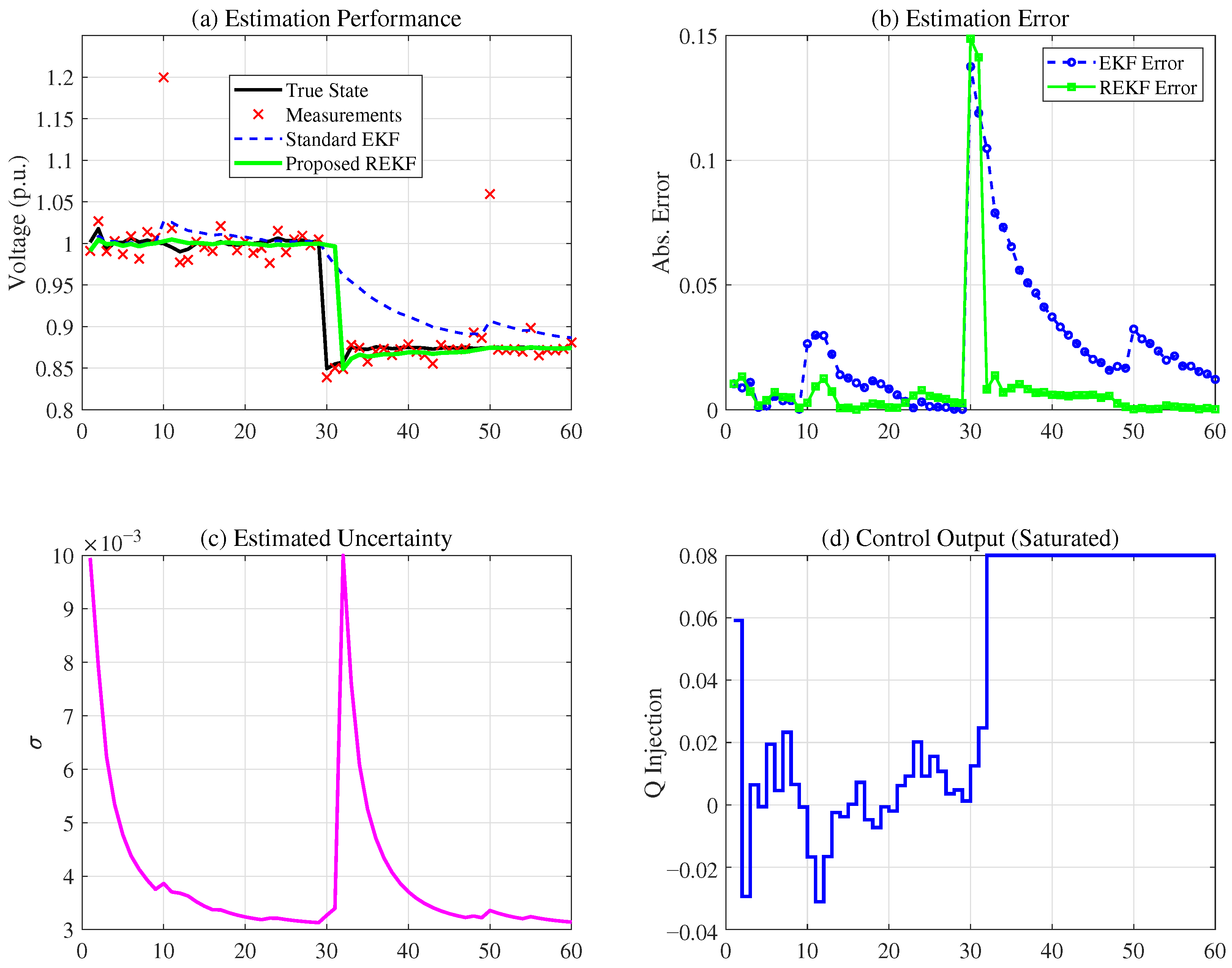
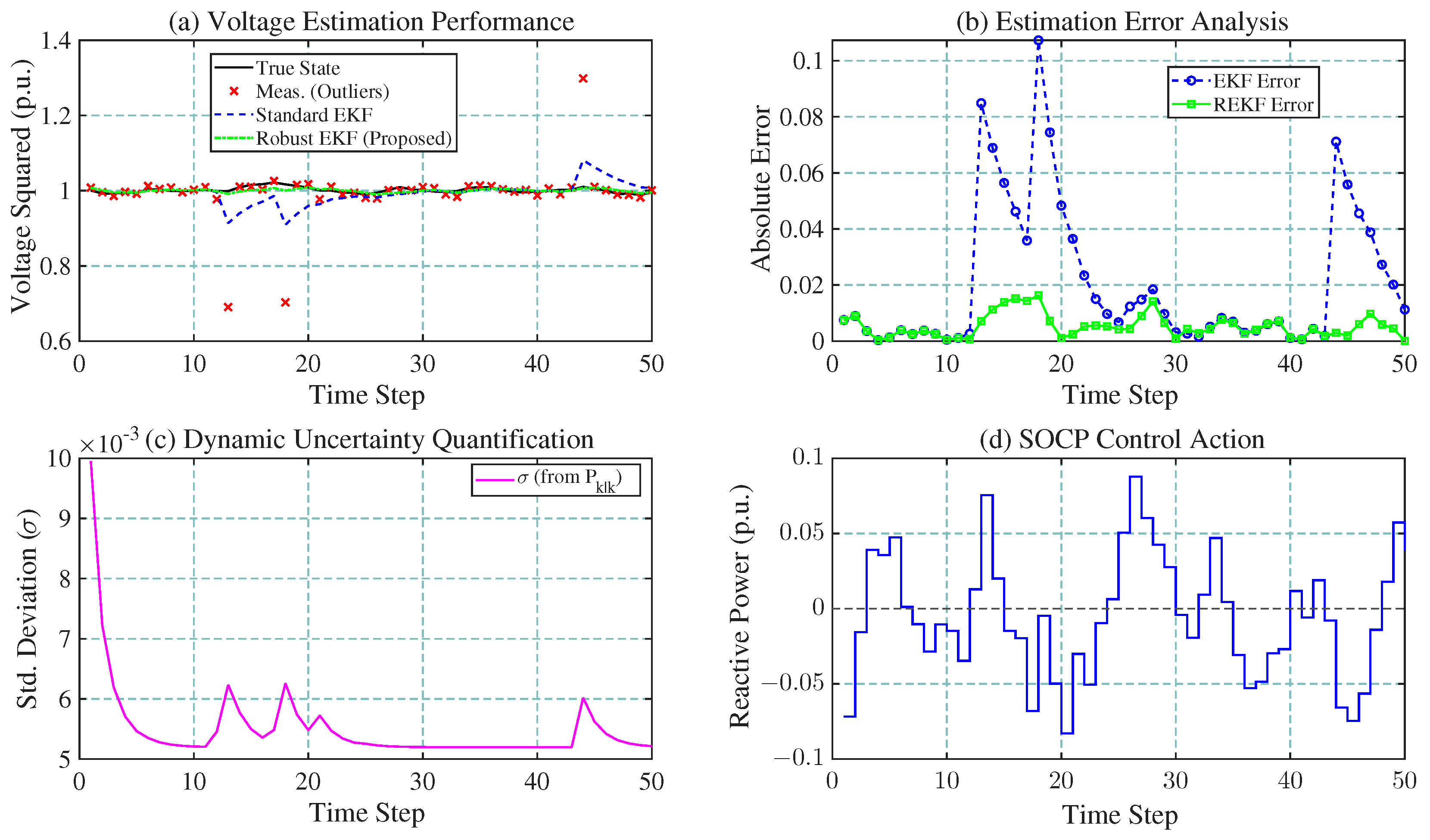
First we test the state estimation performance of the proposed robust EKF method, which is demonstrated in Figure 2. The simulation results validate the performance of the proposed dynamic state estimation strategy under composite disturbances. During sporadic outlier injections at time steps 10 and 60, the estimator maintains a stable trajectory by correctly identifying the transient nature of these errors and suppressing them via the Huber cost function. In contrast, when a physical load mutation occurs at time step 30, the algorithm detects the persistent residual deviation and activates the covariance inflation mechanism. This adaptive response enables the filter to rapidly converge to the post-mutation voltage level within ∼4 time steps, effectively balancing robustness against measurement anomalies and responsiveness to genuine system dynamics.
To further evaluate the dynamic performance of the proposed estimator under realistic grid contingencies, a scenario involving a permanent physical load mutation alongside sporadic measurement outliers was investigated. This test aims to verify whether the algorithm can overcome the inherent conservatism of robust filters, which tends to suppress large residuals regardless of their physical origin while retaining the ability to reject false data. The simulation results are presented in Figure 3. As observed in the figure, the system experiences sporadic outliers at time steps 10 and 60, alongside a permanent voltage step-down caused by a load mutation at time step 30. The proposed estimator exhibits a selective response mechanism governed by the temporal persistence logic. For the impulsive outliers, the algorithm maintains the previous state estimate, effectively filtering out the corrupted data as noise. However, when the physical step change occurs, the estimator identifies the deviation as persistent after a pre-defined confirmation window. Consequently, it automatically switches to the tracking mode by inflating the prediction covariance, allowing the state estimate to rapidly converge to the new voltage level. This confirms that the proposed method simultaneously maintains statistical robustness against transient measurement anomalies and rapid convergence to sustained operating point shifts.

6.2.2. Comparative Analysis Against Alternative Filtering Methods

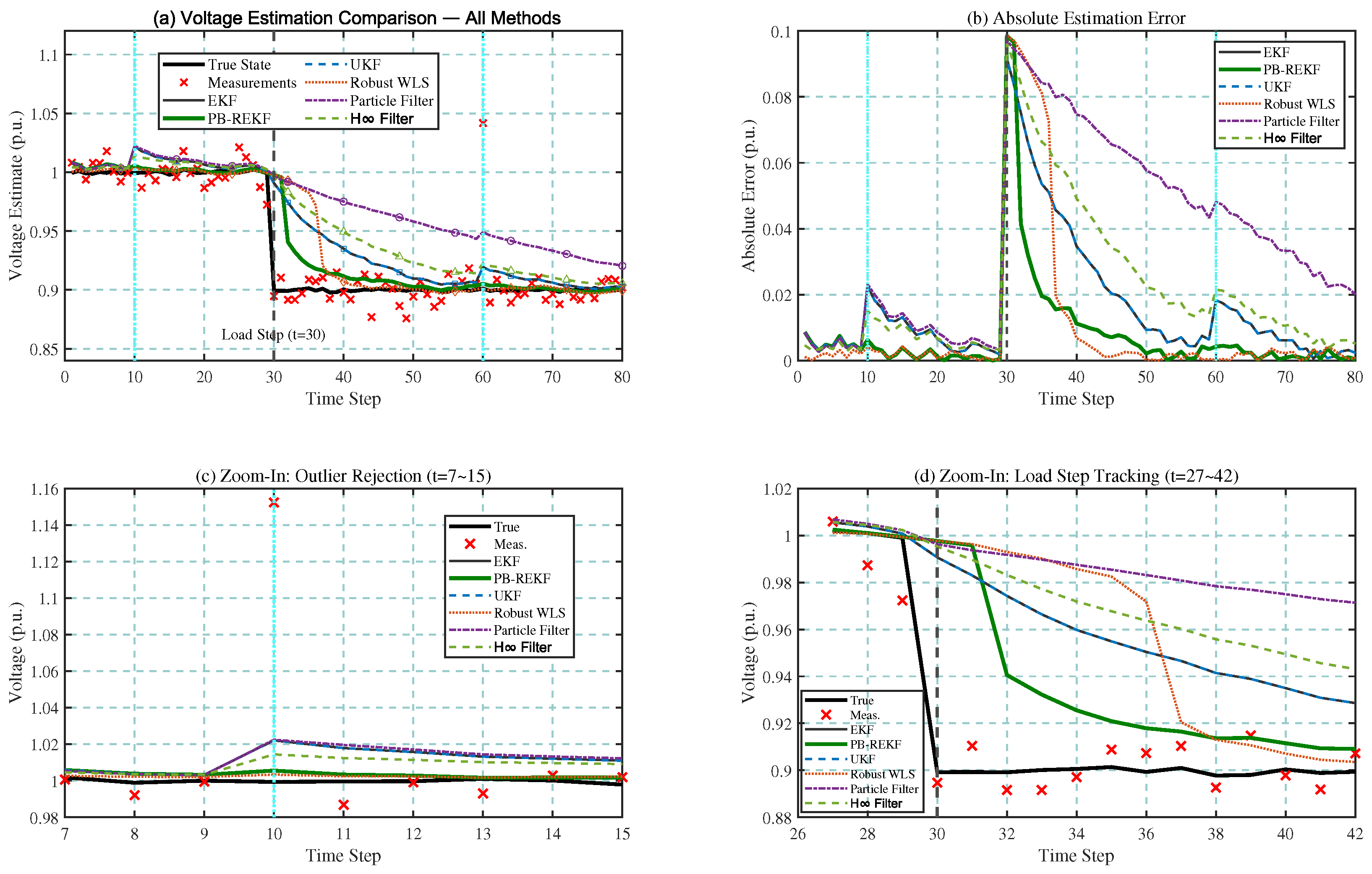
To further validate the performance advantages of the proposed PB-REKF, quantitative comparisons were conducted against five representative estimation methods: the Standard EKF, the Unscented Kalman Filter (UKF) [21], Robust Weighted Least Squares (Robust WLS) [18], the Particle Filter (PF) [42], and the H Filter [43], under the same composite scenario: outliers of + 0.15 p.u. at t = 10 ,   60 and a persistent load step of 0.10 p.u. at t = 30 .
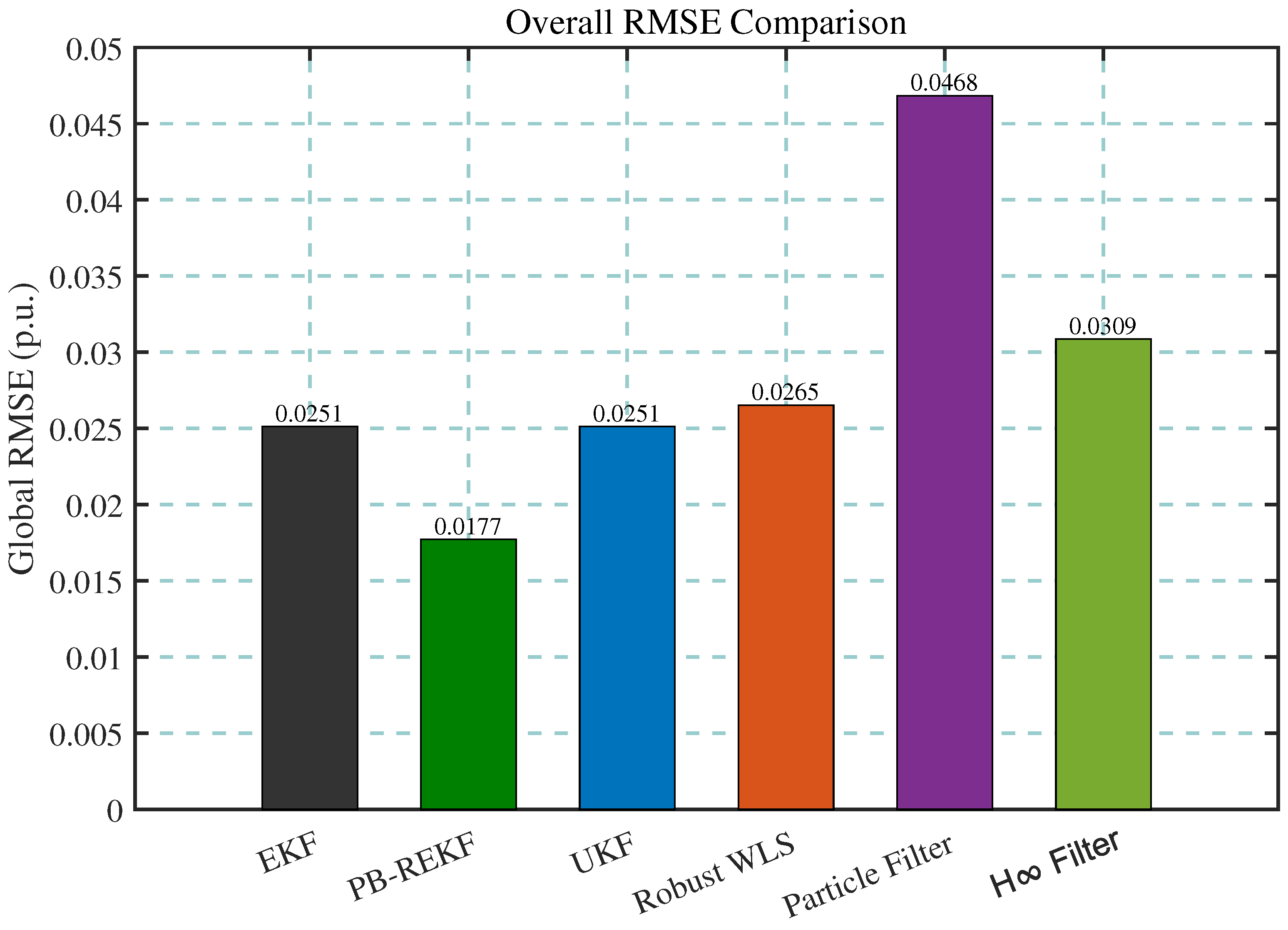
The results are presented in Figure 4 and Figure 5 and Table 3. During the outlier injection windows, the EKF and UKF—both relying on an L 2 -norm update—absorb the spurious spike, incurring a peak error of 0.0228 p.u. [Figure 4c], while the PB-REKF suppresses it via Huber reweighting and maintains a stable estimate. When the physical load step occurs at t = 30 , the PB-REKF activates its covariance inflation mechanism and converges to the new steady state within ∼4 steps [Figure 4d]. The EKF and UKF exhibit a prolonged tracking lag; the H filter converges even more slowly due to its inherently conservative gain; and the Particle Filter suffers from particle degeneracy under the small process noise, yielding the highest Global RMSE of 0.0468 p.u.
The overall RMSE comparison is further summarized in Figure 5, which confirms that the PB-REKF achieves the best trade-off across all metrics. The Robust WLS deserves particular attention. Although it achieves a low steady-state RMSE ( 0.0019 p.u.) once the sliding window fully transitions to post-step data, this comes only after a 7–8 step tracking lag—a fundamental consequence of equal temporal weighting across a 15-step window, wherein pre-step observations continuously bias the estimate toward the old voltage level. In a closed-loop control system, this lag directly translates into a sustained voltage violation, which is precisely the safety risk the proposed framework aims to eliminate. Overall, the PB-REKF achieves the best trade-off across all metrics: a 29.5 % reduction in Global RMSE and a 72.8 % reduction in peak outlier error relative to the standard EKF, at a per-step cost of 3.42 ms that remains well within practical PMU update intervals.

6.2.3. Computational Complexity and Real-Time Feasibility

The per-step wall-clock time of each module is measured by averaging over 1000 independent runs on an Intel Core i7 CPU. The complexity and computation time are shown in Table 4. The theoretical complexity of each module is derived from its algorithmic structure: the EKF and PB-REKF require an n × n matrix inversion for the Kalman gain, giving O ( n 3 ) ; the Huber reweighting adds only O ( n ) and does not change the dominant order; the UKF performs a Cholesky decomposition over 2 n + 1 sigma points, also O ( n 3 ) ; and the SOCP is solved by an interior-point method whose cost is O ( n 3.5 ) [38].

6.2.4. Scalability and Robustness

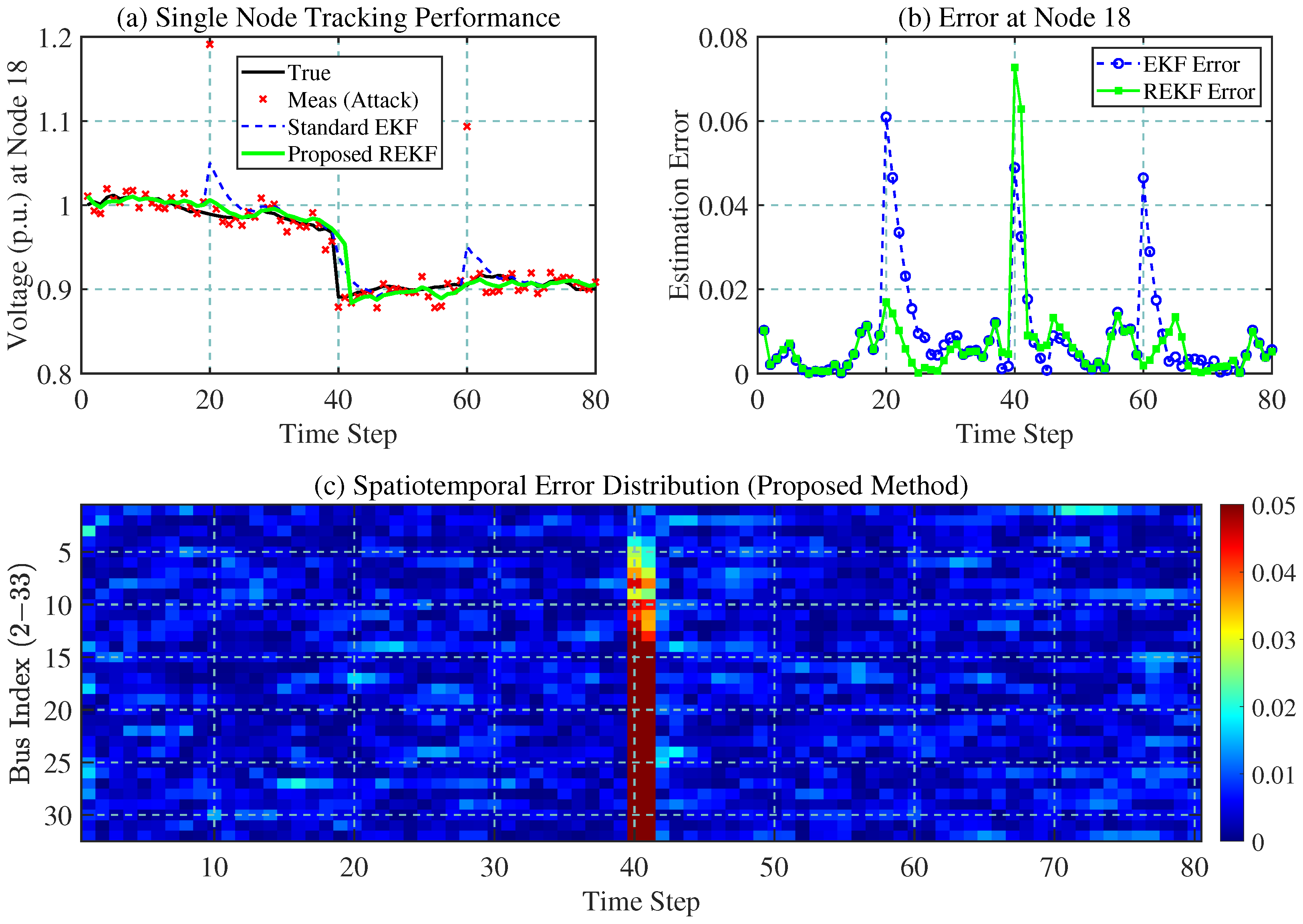
To demonstrate the scalability and spatial robustness of the proposed framework, the algorithm was tested on a modified IEEE 33-bus radial distribution system. The simulation incorporated spatially distributed load mutations and targeted outlier injections to evaluate performance across a larger network topology. As shown in Figure 6, the estimator at Node 18 correctly suppresses local outlier injections at t = 20 s and t = 60 s via Huber reweighting, while accurately tracking the system-wide voltage sag at t = 40 s. The spatiotemporal error distribution (Figure 6c) provides a comprehensive characterization of the spatiotemporal estimation error across the entire network. The heatmap reveals that estimation errors are consistently low (dark blue regions) across all 33 buses for the majority of the simulation. A transient error band is visible around t = 40 s, corresponding to the instant of the physical load mutation, but it rapidly dissipates as the estimator converges to the new state. Notably, the absence of high-error regions at t = 20 s and t = 60 s confirms that the local outlier attacks were effectively suppressed without contaminating the estimates of neighboring nodes. This validates the effectiveness of the proposed method in handling spatially coupled disturbances in large-scale distribution networks.
Following the core performance validation, a comprehensive robustness analysis was conducted to assess the algorithm’s stability against parameter variations, communication reliability issues, and high renewable penetration. The results are presented in Figure 7.
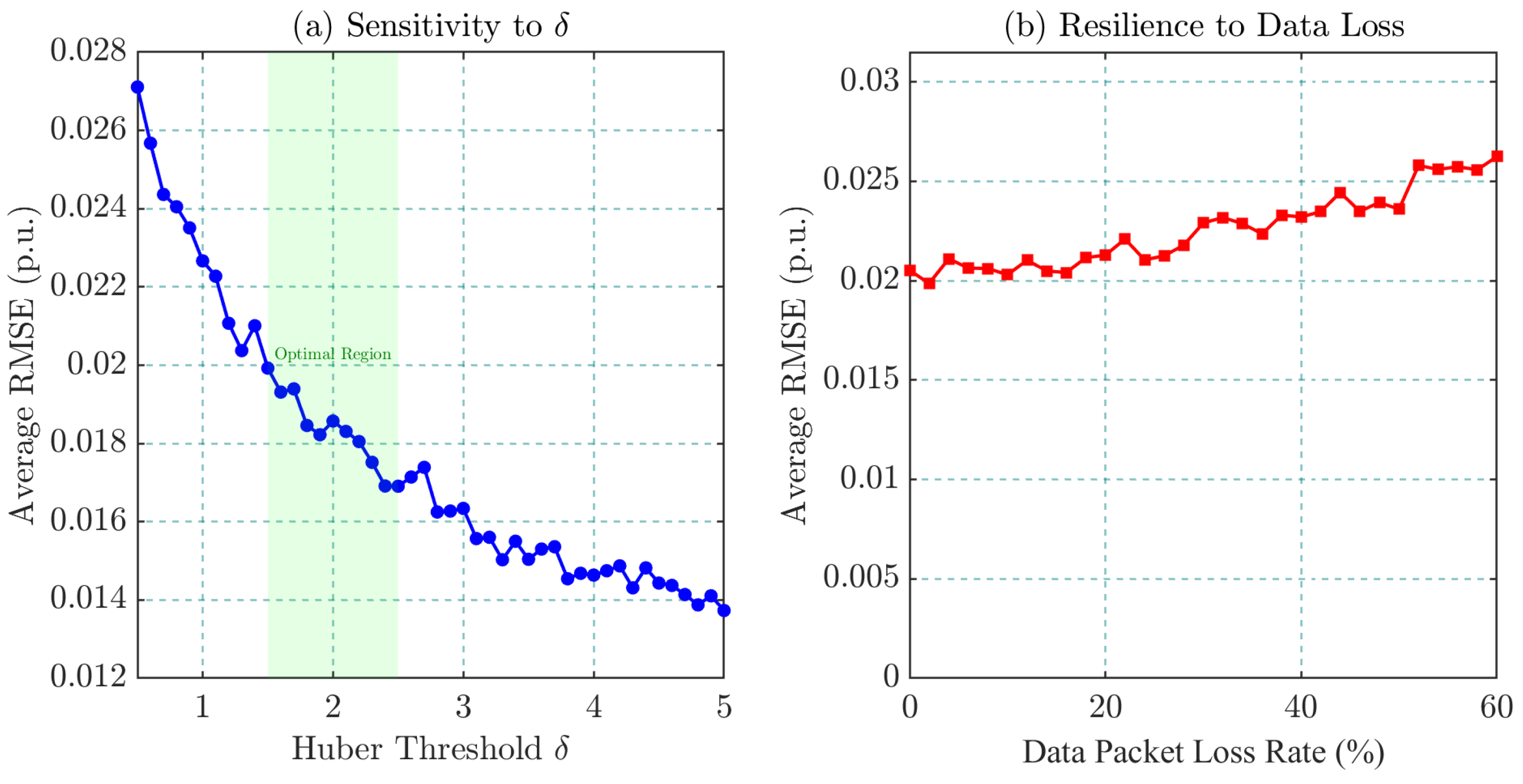
The sensitivity of estimation accuracy to the Huber threshold δ is depicted in Figure 7a. The RMSE curve exhibits a distinct convex shape, revealing an optimal operating region between δ = 1.5 and δ = 2.5. When δ is too small (<1.0), the estimator becomes overly sensitive, rejecting valid measurements as noise, whereas excessively large values (>3.5) compromise the suppression of gross errors. This confirms that the selected parameter δ = 1.5 lies within the optimal operating region of the cost function, where near-maximal outlier suppression is achieved while maintaining near-optimal statistical efficiency under Gaussian noise. Figure 7b illustrates the algorithm’s resilience to data packet loss. Despite a linear increase in packet loss rate from 0% to 60%, the estimation error grows marginally and remains within acceptable limits. This robustness stems from the Kalman filter’s predict–update structure, which compensates for missing observations using model-based state predictions and the prior error covariance, thereby maintaining continuous state tracking under intermittent data availability.
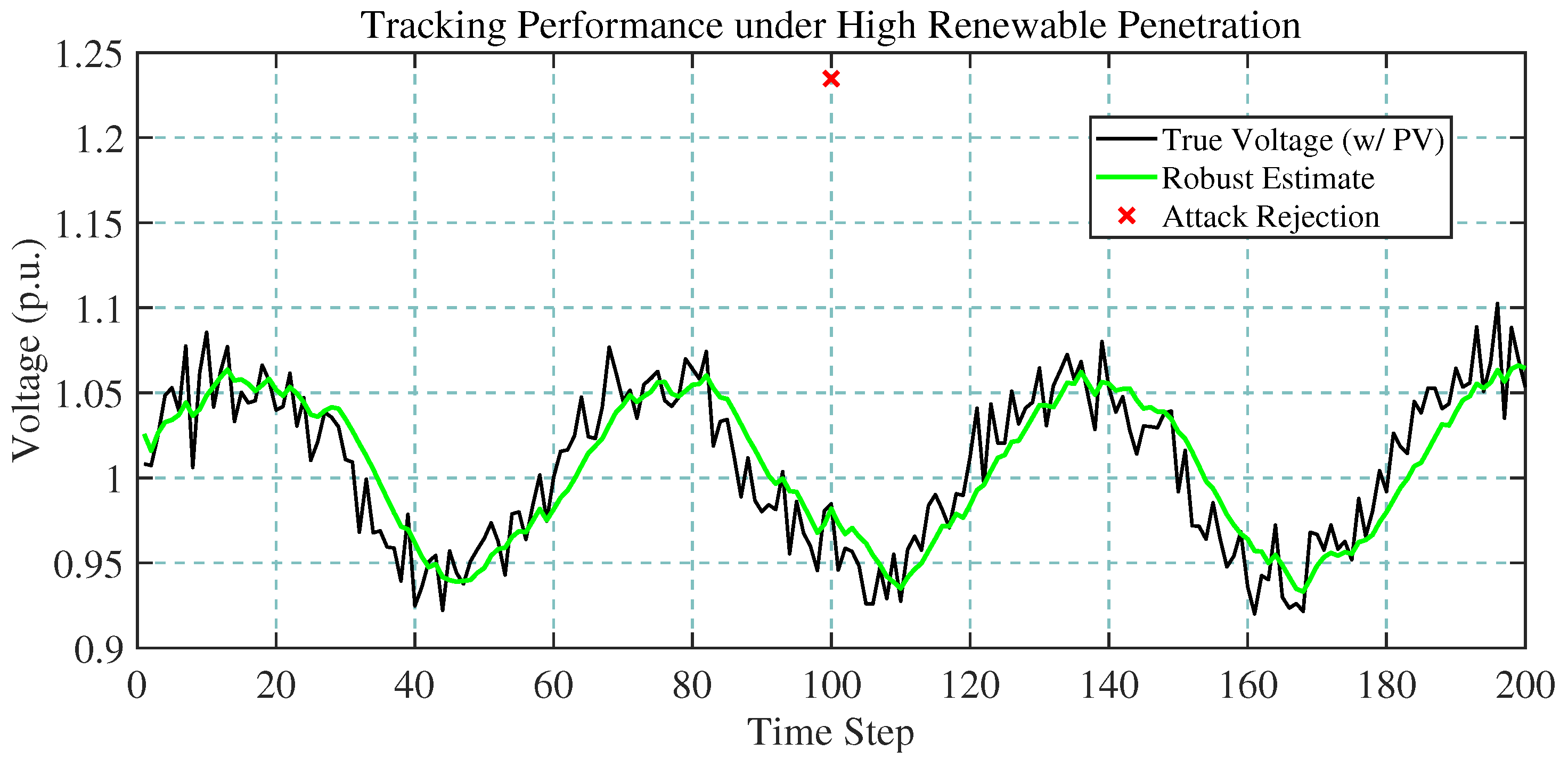
Finally, Figure 8 demonstrates the tracking capability under high renewable penetration. Facing rapid and volatile voltage fluctuations induced by PV variability, the proposed estimator maintains tight tracking of the true state without false triggering of the outlier rejection mechanism. The red marker at t = 100 s highlights a successful rejection of an injected attack amidst the high-frequency fluctuations, verifying the algorithm’s ability to distinguish between continuous physical dynamics and discrete bad data.
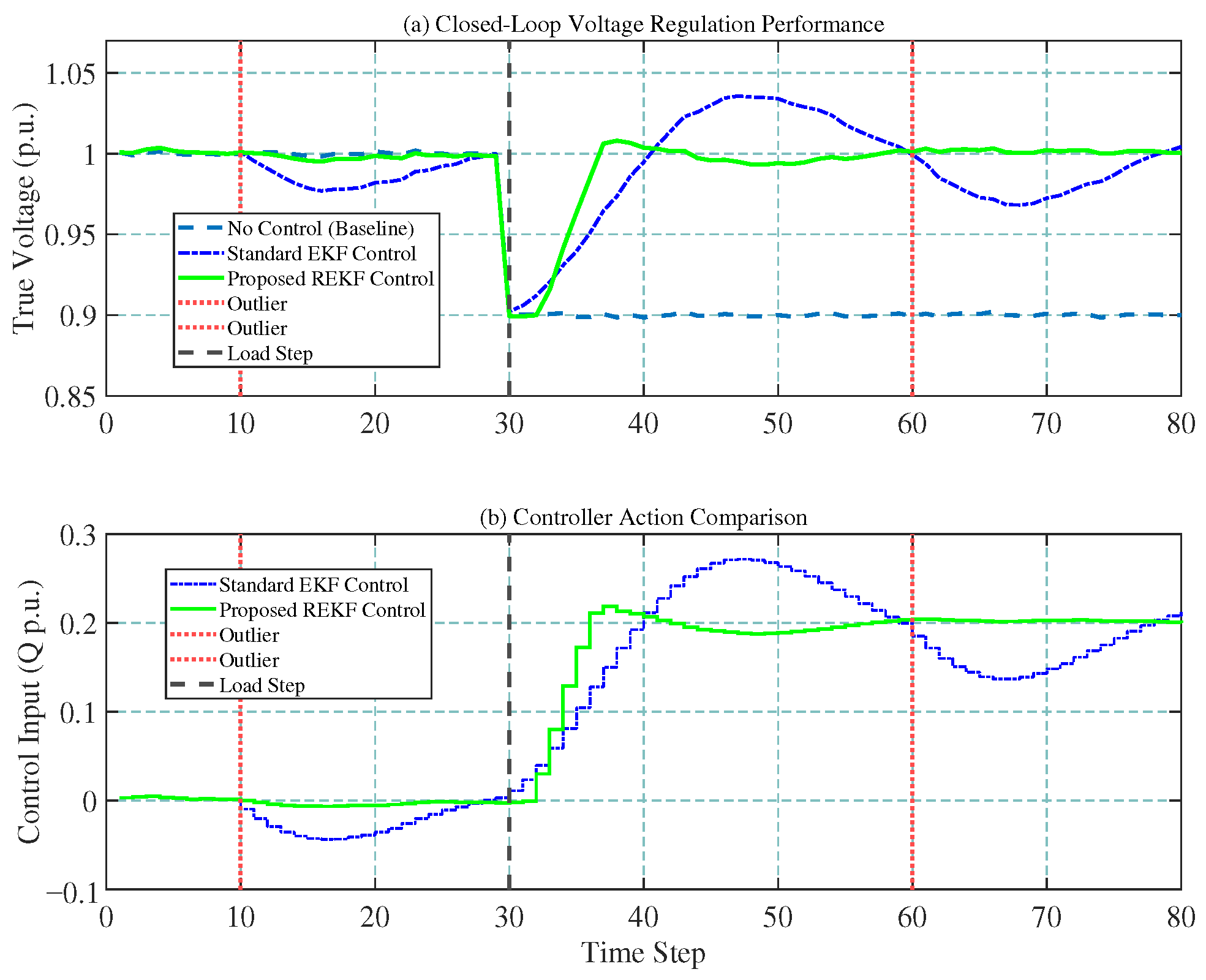
The comparative analysis of closed-loop voltage regulation performance demonstrates the superior robustness and reliability of the proposed collaborative control framework. The simulation results, presented in Figure 9, contrast the behavior of three control strategies under a composite scenario involving sporadic measurement outliers and a significant physical load step. While the baseline system without control suffers a sustained voltage drop to 0.90 p.u. following the load step at t = 30 s, the standard EKF-based control, though effective at restoration, proves vulnerable to measurement outliers; false high-voltage readings at t = 10 s and t = 60 s trigger erroneous reactive power absorption, causing artificial voltage sags. In contrast, the proposed REKF-based strategy suppresses these sporadic outliers to prevent erroneous control actions, while correctly identifying and compensating for the genuine physical load mutation after the N persist -step confirmation window, thereby ensuring both operational safety against measurement anomalies and voltage stability during physical contingencies.

6.3. Extended Scenario Validation

6.3.1. High DER Penetration

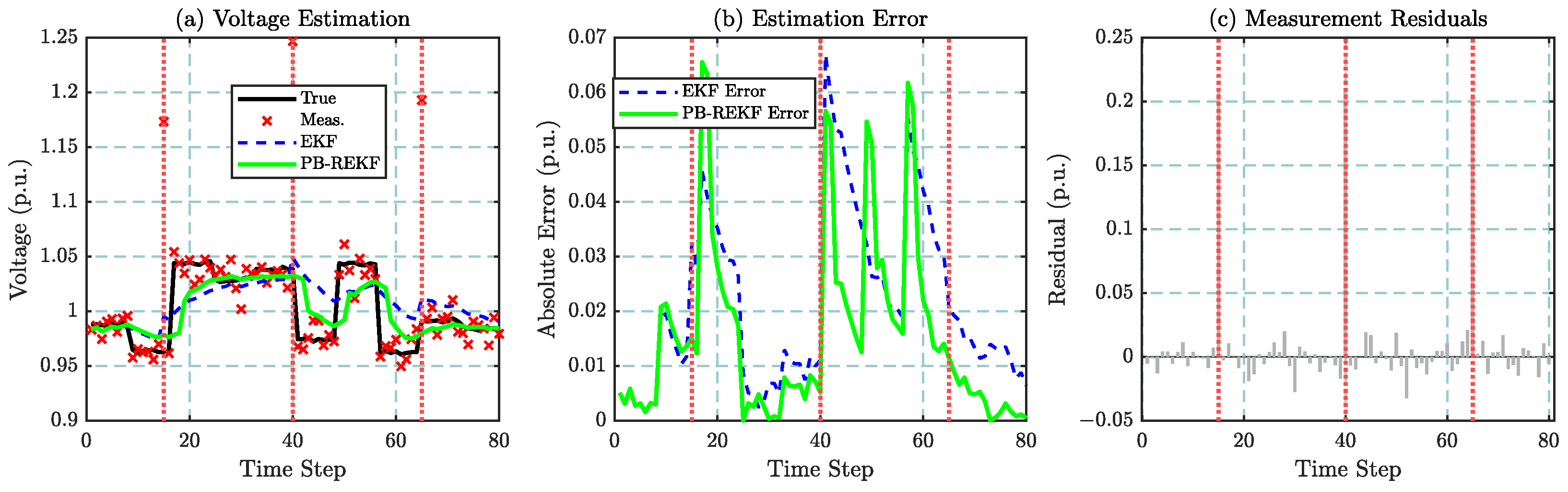
Figure 10 presents the estimation performance under high DER penetration, where irregular PV output step changes of ± 0.05 p.u. occur every eight time steps to simulate cloud-induced generation intermittency, superimposed with repeated FDIAs of + 0.20 p.u. at t = 15 , 40, and 65. The standard EKF exhibits pronounced error spikes at each attack instant (peak error 0.065 p.u.), and its recovery is further prolonged by the concurrent PV-driven voltage fluctuations, which prevent the quadratic cost function from distinguishing corrupted measurements from genuine state changes. In contrast, the proposed PB-REKF consistently suppresses all three attack spikes via Huber reweighting, maintaining a lower estimation error throughout the high-volatility period and demonstrating that the algorithm does not false-trigger the covariance inflation mechanism in response to continuous physical dynamics.

6.3.2. Multiple Simultaneous Attacks

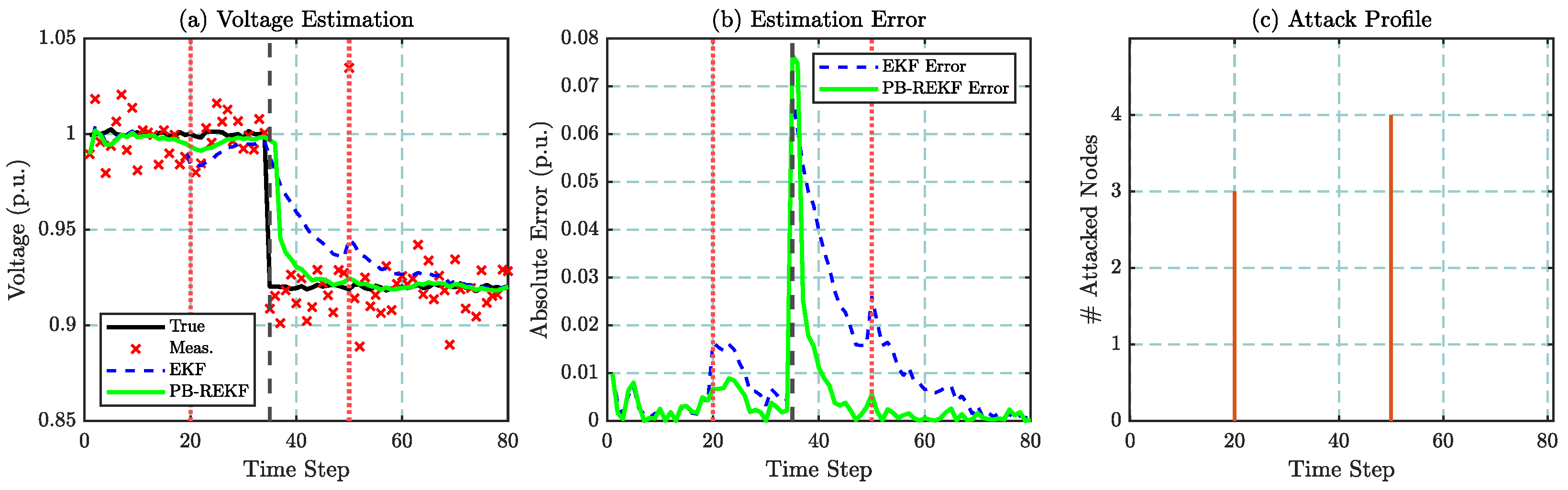
Figure 11 evaluates the resilience of the proposed framework against coordinated multi-node FDIAs. At t = 20 , three measurement channels (Nodes 2–4) are simultaneously corrupted, and at t = 50 , all four non-slack nodes are attacked concurrently. The standard EKF absorbs these multi-node anomalies into the state estimate, producing sustained biases visible in both the voltage trajectory and the error profile. The PB-REKF identifies the anomaly via the channel-fraction criterion ( γ ratio = 0.5 ) and applies Huber downweighting across all corrupted channels simultaneously, recovering within 3–4 steps after each attack. Critically, the genuine load step at t = 35 is correctly identified as a persistent physical mutation and tracked rapidly, confirming that the persistence logic successfully distinguishes coordinated cyber-attacks from true system contingencies even when they occur in close temporal proximity.

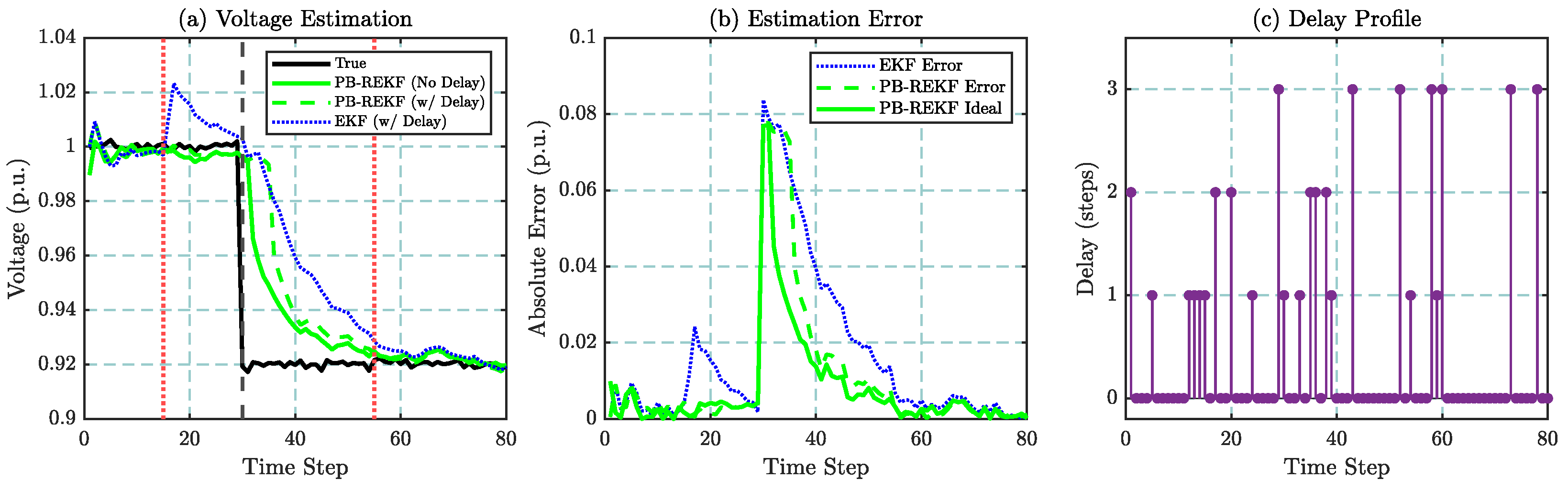
6.3.3. Communication Delay

Figure 12 assesses robustness under realistic communication impairments, where each measurement packet incurs a random delay of 1–3 steps with probability p delay = 0.30 , and missing packets are handled via a hold-last-value strategy. Under delayed measurements, the EKF accumulates the largest estimation error (peak 0.083 p.u. at the load step t = 30 ), since stale observations are treated with full L 2 weight, causing the filter to track an outdated operating point. The PB-REKF under delay incurs a moderate performance penalty relative to its ideal (no-delay) counterpart, yet remains more accurate than the EKF: the Huber weighting reduces the influence of stale measurements that appear as statistical outliers relative to the model prediction. The degradation gap between the ideal and delayed PB-REKF is small (RMSE difference < 0.005 p.u.), confirming that the Kalman prediction step effectively maintains state continuity across communication interruptions by propagating the prior estimate through the system model until a valid measurement is received.

7. Conclusions

This paper has proposed a resilient operation framework for active distribution networks to address the fundamental conflict between suppressing measurement outliers and tracking rapid system dynamics. A novel PB-REKF was developed, utilizing temporal logic to enable an adaptive dual-mode mechanism that effectively distinguishes sporadic errors from physical state mutations. Integrated with a soft-constrained SOCP controller, the framework establishes a dynamic safety buffer based on real-time estimation uncertainty. Extensive simulations validate that the proposed method maintains accuracy by filtering impulsive noise while converging to new operating points via covariance inflation during load steps. Furthermore, comparative results confirm that the strategy prevents erroneous control actions during data attacks while retaining the capability to restore voltage stability during genuine contingencies. Future work will extend this approach to distributed architectures and explore data-driven methods under large linearization error.

Author Contributions

M.Z.: Conceptualization, Methodology, Software, Resources, Writing—Original Draft, Writing—Review and Editing. Q.W.: Resources, Data curation, Writing—Review and Editing. H.S.: Formal analysis, Investigation, Validation. Y.C.: Software, Visualization, Data curation. Z.T.: Conceptualization, Methodology, Software, Validation, Writing—Review and Editing, Supervision. All authors have read and agreed to the published version of the manuscript.

Funding

This research received no external funding.

Data Availability Statement

Data is not available due to privacy or ethical restrictions.

Conflicts of Interest

Ming Zhou and Qiang Wu were employed by State Grid Hubei Electric Power Company. Hongwei Su and Yiwei Cui were employed by Hubei Anyuan Safety and Environmental Protection Technology Co., Ltd. The remaining author declares that the research was conducted in the absence of any commercial or financial relationships that could be construed as a potential conflict of interest.

References

  1. Olivares, D.E.; Mehrizi-Sani, A.; Etemadi, A.H.; Canizares, C.A.; Iravani, R.; Kazerani, M.; Hajimiragha, A.H.; Gomis-Bellmunt, O.; Saeedifard, M.; Palma-Behnke, R.; et al. Trends in Microgrid Control. IEEE Trans. Smart Grid 2014, 5, 1905–1919. [Google Scholar] [CrossRef]
  2. Lei, X.; Zhong, J.; Chen, Y.; Shao, Z.; Jian, L. Grid Integration of Electric Vehicles within Electricity and Carbon Markets: A Comprehensive Overview. eTransportation 2025, 25, 100435. [Google Scholar] [CrossRef]
  3. Acharige, S.S.G.; Haque, M.E.; Arif, M.T.; Hosseinzadeh, N.; Hasan, K.N.; Hossain, M.J.; Muttaqi, K.M. Grid integration of electric vehicles – Impact assessment and remedial measures. J. Power Sources 2025, 650, 236697. [Google Scholar] [CrossRef]
  4. Dall’Anese, E.; Zhu, H.; Giannakis, G.B. Distributed Optimal Power Flow for Smart Microgrids. IEEE Trans. Smart Grid 2013, 4, 1464–1475. [Google Scholar] [CrossRef]
  5. Liu, Y.; Ning, P.; Reiter, M.K. False Data Injection Attacks against State Estimation in Electric Power Grids. ACM Trans. Inf. Syst. Secur. 2011, 14, 1–33. [Google Scholar] [CrossRef]
  6. Huang, Y.; Esmalifalak, M.; Nguyen, H.; Zheng, R.; Han, Z.; Li, H.; Song, L. Bad data injection in smart grid: Attack and defense mechanisms. IEEE Commun. Mag. 2013, 51, 27–33. [Google Scholar] [CrossRef]
  7. Abur, A.; Expósito, A.G. Power System State Estimation: Theory and Implementation; CRC Press: Boca Raton, FL, USA, 2004. [Google Scholar]
  8. Monticelli, A. State Estimation in Electric Power Systems: A Generalized Approach; Springer: Berlin/Heidelberg, Germany, 1999. [Google Scholar]
  9. Li, W.; Liu, Z.W.; Chen, Y.; Wang, Y.W. Model-free robust online feedback optimization for voltage regulation in distribution grids. IEEE Trans. Ind. Inform. 2025, 21, 9879–9888. [Google Scholar] [CrossRef]
  10. Li, W.; Liu, Z.W.; Chi, M.; Li, Y.; Wang, Y.W. Distributed Online Feedback Optimization with Real-Time Sensitivity Estimation for Coordinated Voltage Regulation in Distribution Grids. IEEE Trans. Control Syst. Technol. 2025, 34, 990–1000. [Google Scholar] [CrossRef]
  11. Schweppe, F.C.; Wildes, J. Power System Static-State Estimation, Part I: Exact Model. IEEE Trans. Power Appar. Syst. 1970, PAS-89, 120–125. [Google Scholar] [CrossRef]
  12. Schweppe, F.C.; Rom, D.B. Power System Static-State Estimation, Part II: Approximate Model. IEEE Trans. Power Appar. Syst. 1970, PAS-89, 125–130. [Google Scholar] [CrossRef]
  13. Schweppe, F.C. Power System Static-State Estimation, Part III: Implementation. IEEE Trans. Power Appar. Syst. 1970, PAS-89, 130–135. [Google Scholar] [CrossRef]
  14. Handschin, E.; Schweppe, F.C.; Kohlas, J.; Fiechter, A. Bad Data Analysis for Power System State Estimation. IEEE Trans. Power Appar. Syst. 1975, 94, 329–337. [Google Scholar] [CrossRef]
  15. Merrill, H.M.; Schweppe, F.C. Bad Data Suppression in Power System Static State Estimation. IEEE Trans. Power Appar. Syst. 1971, 90, 2718–2725. [Google Scholar] [CrossRef]
  16. Emami, R.; Abur, A. Robust Measurement Design by Placing Synchronized Phasor Measurements on Network Branches. IEEE Trans. Power Syst. 2010, 25, 38–43. [Google Scholar] [CrossRef]
  17. Mili, L.; Cheniae, M.; Vichare, N.; Rousseeuw, P.J. Robust state estimation based on projection statistics [of power systems]. IEEE Trans. Power Syst. 2002, 11, 1118–1127. [Google Scholar] [CrossRef]
  18. Jabr, R. Power system Huber M-estimation with equality and inequality constraints. Electr. Power Syst. Res. 2005, 74, 239–246. [Google Scholar] [CrossRef]
  19. Karlgaard, C.D. Nonlinear regression Huber–Kalman filtering and fixed-interval smoothing. J. Guid. Control Dyn. 2015, 38, 322–330. [Google Scholar] [CrossRef]
  20. Abur, A.; Celik, M.K. Least absolute value state estimation with equality and inequality constraints. IEEE Trans. Power Syst. 2002, 8, 680–686. [Google Scholar] [CrossRef]
  21. Valverde, G.; Terzija, V. Unscented Kalman Filter for Power System Dynamic State Estimation. IET Gener. Transm. Distrib. 2011, 5, 29–37. [Google Scholar] [CrossRef]
  22. Zhao, J.; Mili, L. Power system robust decentralized dynamic state estimation based on multiple hypothesis testing. IEEE Trans. Power Syst. 2017, 33, 4553–4562. [Google Scholar] [CrossRef]
  23. Zhao, J.; Zhang, G.; La Scala, M. PMU based robust dynamic state estimation method for power systems. In Proceedings of the Proceedings of the 2015 IEEE Power & Energy Society General Meeting; IEEE: Piscataway, NJ, USA, 2015; pp. 1–5. [Google Scholar] [CrossRef]
  24. Hou, D.; Sun, Y.; Sun, K.; Dinavahi, V.; Wang, Y. Robust forecasting-aided state estimation of active distribution network with multiple distributed generators. IEEE Trans. Autom. Sci. Eng. 2025, 22, 16780–16789. [Google Scholar] [CrossRef]
  25. Shafiei, M.; Ledwich, G.; Nourbakhsh, G.; Arefi, A.; Pezeshki, H. Layered Based Augmented Complex Kalman Filter for Fast Forecasting-Aided State Estimation of Distribution Networks. arXiv 2018, arXiv:1803.03549. [Google Scholar] [CrossRef]
  26. Li, P.; Zhang, C.; Wu, Z.; Xu, Y.; Hu, M.; Dong, Z. Distributed adaptive robust voltage/var control with network partition in active distribution networks. IEEE Trans. Smart Grid 2019, 11, 2245–2256. [Google Scholar] [CrossRef]
  27. Niknam, T.; Zare, M.; Aghaei, J. Scenario-based multiobjective volt/var control in distribution networks including renewable energy sources. IEEE Trans. Power Deliv. 2012, 27, 2004–2019. [Google Scholar] [CrossRef]
  28. Zhang, X.; Liu, X.; Ding, T.; Wang, P. On resilience and distributed fixed-time control of MTDC systems under DoS attacks. IEEE Trans. Autom. Sci. Eng. 2022, 20, 2569–2580. [Google Scholar] [CrossRef]
  29. Lee, D.; Han, C.; Kang, S.; Jang, G. Chance-constrained optimization for active distribution networks with virtual power lines. Electr. Power Syst. Res. 2023, 221, 109449. [Google Scholar] [CrossRef]
  30. Khalaf, M.; Youssef, A.; El-Saadany, E. Joint Detection and Mitigation of False Data Injection Attacks in AGC Systems. IEEE Trans. Smart Grid 2019, 10, 4985–4995. [Google Scholar] [CrossRef]
  31. Zhao, J.; Mili, L.; Wang, M. A Generalized False Data Injection Attacks Against Power System Nonlinear State Estimator and Countermeasures. IEEE Trans. Power Syst. 2019, 33, 4868–4877. [Google Scholar] [CrossRef]
  32. Sarri, S.; Paolone, M.; Cherkaoui, R.; Borghetti, A.; Napolitano, F.; Nucci, C.A. State Estimation of Active Distribution Networks: Comparison Between WLS and Iterated Kalman-Filter Algorithm Integrating PMUs. In Proceedings of the 3rd IEEE PES Innovative Smart Grid Technologies Europe (ISGT Europe), Berlin, Germany, 14–17 October 2012; pp. 1–8. [Google Scholar] [CrossRef]
  33. Dehghanpour, K.; Wang, Z.; Wang, J.; Yuan, Y.; Bu, F. A Survey on State Estimation Techniques and Challenges in Smart Distribution Systems. IEEE Trans. Smart Grid 2019, 10, 2312–2322. [Google Scholar] [CrossRef]
  34. Chen, T.; Wu, T.; Qing, X.; Amaratunga, G.A. A distributed robust state estimation algorithm for power systems considering maximum exponential absolute value. Int. J. Electr. Power Energy Syst. 2021, 133, 107267. [Google Scholar] [CrossRef]
  35. Wang, Y.; Yang, Z.; Wang, Y.; Dinavahi, V.; Liang, J.; Wang, K. Robust dynamic state estimation for power system based on adaptive cubature Kalman filter with generalized correntropy loss. IEEE Trans. Instrum. Meas. 2022, 71, 9003811. [Google Scholar] [CrossRef]
  36. Liu, M.; Liu, Y.; Wang, Y.; Dinavahi, V.; Gao, Z. Robust Dynamic State Estimation of Power System with Measurement Outliers Based on Parameterized Analytical Cubature Kalman Filter. IET Renew. Power Gener. 2025, 19, e70047. [Google Scholar] [CrossRef]
  37. Pajic, M.; Lee, I.; Pappas, G.J. Attack-resilient state estimation for noisy dynamical systems. IEEE Trans. Control Netw. Syst. 2016, 4, 82–92. [Google Scholar] [CrossRef]
  38. Colot, A.; Perotti, E.; Glavic, M.; Dall’Anese, E. Incremental Volt/Var control for distribution networks via chance-constrained optimization. IEEE Trans. Power Syst. 2025, 40, 4561–4573. [Google Scholar] [CrossRef]
  39. Mohamed, A.H.; Schwarz, K.P. Adaptive Kalman Filtering for INS/GPS. J. Geod. 1999, 73, 193–203. [Google Scholar] [CrossRef]
  40. Baran, M.E.; Wu, F.F. Network Reconfiguration in Distribution Systems for Loss Reduction and Load Balancing. IEEE Trans. Power Deliv. 1989, 4, 1401–1407. [Google Scholar] [CrossRef]
  41. Löfberg, J. YALMIP: A toolbox for modeling and optimization in MATLAB. In Proceedings of the IEEE International Conference on Robotics and Automation (CACSD), Taipei, Taiwan, 2–4 September 2004; pp. 284–289. [Google Scholar] [CrossRef]
  42. Arulampalam, M.S.; Maskell, S.; Gordon, N.; Clapp, T. A tutorial on particle filters for online nonlinear/non-Gaussian Bayesian tracking. IEEE Trans. Signal Process. 2002, 50, 174–188. [Google Scholar] [CrossRef]
  43. Shaked, U.; Theodor, Y. H-optimal estimation: A tutorial. In Proceedings of the 31st IEEE Conference Decision and Control (CDC), Tucson, AZ, USA, 16–18 December 1992; pp. 2278–2286. [Google Scholar] [CrossRef]
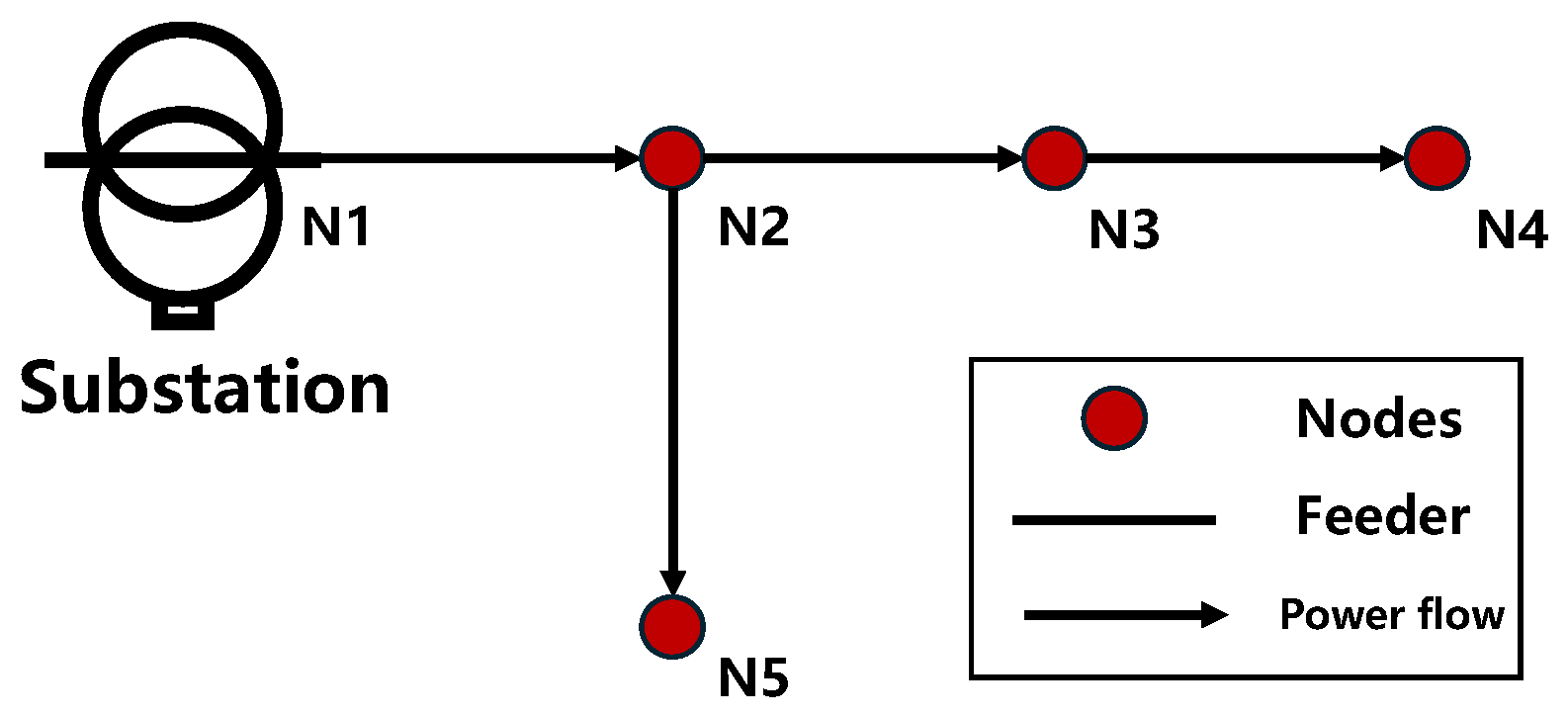
Figure 1. Single-line diagram of the modified 5-bus radial distribution test system with DER placements.
Electronics 15 01850 g001
Figure 2. Dynamic state estimation performance under composite disturbances.
Electronics 15 01850 g002
Figure 3. State estimation performance under permanent load mutation and sporadic outliers.
Electronics 15 01850 g003
Figure 4. Multi-method state estimation comparison under composite disturbances. (a) Voltage estimation trajectories; (b) Voltage estimation absolute errors; (c) Zoom-in views of outlier rejection ( t = 7 –15); (d) Zoom-in views of load step tracking ( t = 27 –42).
Electronics 15 01850 g004
Figure 5. Overall RMSE comparison across all filtering methods.
Electronics 15 01850 g005
Figure 6. Performance verification on the IEEE 33-bus distribution system.
Electronics 15 01850 g006
Figure 7. Robustness and sensitivity analysis. (a) Impact of the Huber threshold δ on estimation RMSE. (b) Estimation performance under varying data packet loss rates.
Electronics 15 01850 g007
Figure 8. Tracking performance under high PV penetration.
Electronics 15 01850 g008
Figure 9. Closed-loop voltage regulation performance comparison.
Electronics 15 01850 g009
Figure 10. Estimation performance under high DER penetration with repeated FDIAs. (a) Voltage estimation trajectories; (b) absolute estimation error; (c) measurement residuals. Red dotted lines indicate FDIA injection instants ( t = 15 , 40, 65).
Electronics 15 01850 g010
Figure 11. Estimation performance under multiple simultaneous node attacks. (a) Voltage estimation trajectories; (b) absolute estimation error; (c) attack profile showing the number of simultaneously compromised nodes. Red dotted lines indicate multi-node FDIA instants ( t = 20 : 3 nodes; t = 50 : 4 nodes); the black dashed line marks the physical load step at t = 35 .
Electronics 15 01850 g011
Figure 12. Estimation performance under communication delays ( p delay = 0.30 , maximum delay of three steps). (a) Voltage estimation trajectories comparing PB-REKF (no delay), PB-REKF (with delay), and EKF (with delay); (b) absolute estimation error of all three methods; (c) realization of the communication delay profile. Red dotted lines indicate FDIA instants ( t = 15 , 55); the black dashed line marks the load step at t = 30 .
Electronics 15 01850 g012
Table 1. Comparison of the proposed PB-REKF with existing robust filtering methods.
MethodStrategyState TrackingSwitching LogicKey Limitation
Standard Robust EKF [19]Huber M-estimationNoneNoneTreats all large residuals as outliers; delays tracking of genuine state changes
Adaptive EKF [39]NoneAdjusts Q k via innovation covariance matchingContinuous adaptationCannot distinguish outliers from state jumps; inflates Q k for both
Covariance Inflation KF [35]NoneInflates P k | k 1 when residuals are largeThreshold on residual magnitudeVulnerable to outliers; inflation triggered by bad data causes estimate divergence
Huber–Adaptive EKFHuber weighting Q k adaptationSimultaneousConflicting mechanisms: Huber suppresses residuals for state change detection
Proposed PB-REKFHuber M-estimationCovariance inflationTemporal persistence: switches after N p e r s i s t detectionsRequires tuning of N p e r s i s t ; uses a fixed threshold
Table 2. Simulation parameters and algorithm settings.
CategoryParameterValue
NetworkNumber of Buses (N)5
Line Impedance ( R , X ) 0.1 , 0.05 p.u.
Nominal Voltage ( V n o m )1.0 p.u.
AlgorithmHuber Threshold ( δ )1.5
Persistence Limit ( N p e r s i s t )3 steps
Inflation Factor ( Ω j u m p )100
Safety Factor ( η )1.645 (95% C.I.)
ControlControl Deadband ± 0.02 p.u.
Actuator Rate Limit0.05 p.u./step
Table 3. Extended Performance Comparison.
MethodRMSESS-RMSE V (%) | Q | T rec Δ u out
EKF0.02510.01038.814.7351.00.0066
PB-REKF0.01770.00333.814.5431.00.0017
UKF0.02510.01038.814.7351.00.0066
Robust WLS0.02650.00197.513.0711.00.0010
Particle Filter0.04680.044518.812.7408.50.0067
H Filter0.03090.017611.213.7911.50.0043
V : voltage violation rate; | Q | : cumulative reactive power (p.u.); T rec : mean recovery steps after outlier injection; Δ u out : mean control action change at outlier instants (p.u.), lower is better. Data in bold demonstrates the superiority of the PB-EKF method.
Table 4. Algorithm complexity and computation time (50-trial average, T sim = 80 Steps).
ModuleB5-Bus System (ms)33-Bus System (ms)
TotalPer-StepTotalPer-Step
Standard EKF O ( n 3 ) 0.240.0030.880.011
PB-REKF (Huber mode) O ( n 3 ) 0.430.0051.320.016
PB-REKF (Inflation mode ) O ( n 3 ) 0.430.0051.320.016
SOCP Solver O ( n 3.5 ) 67.760.847178.082.226
Timed over complete 80-step simulation loops, averaged across 50 independent trials; Inflation mode: covariance inflation branch, triggered only upon confirmed persistent mutation ( N persist = 3 steps).
Disclaimer/Publisher’s Note: The statements, opinions and data contained in all publications are solely those of the individual author(s) and contributor(s) and not of MDPI and/or the editor(s). MDPI and/or the editor(s) disclaim responsibility for any injury to people or property resulting from any ideas, methods, instructions or products referred to in the content.