Robust Dynamic State Estimation and Collaborative Control of Distribution Networks Considering Measurement Outliers

Abstract
1. Introduction
- 1.
- Existing Huber-based robust EKFs [19,36] rely solely on the instantaneous standardized residual to detect outliers and have no mechanism to distinguish sporadic sensor faults from genuine persistent state mutations, causing systematic tracking delays. The proposed PB-REKF introduces a temporal persistence counter that accumulates evidence across consecutive time steps, enabling explicit time-domain discrimination between transient bad data and physical state jumps—a mechanism absent from all prior robust Kalman filters for distribution network DSE.
- 2.
- The PB-REKF replaces single-mode Huber weighting with a dual-mode structure governed by the condition : Huber M-estimation for outlier suppression, and covariance inflation for mutation tracking. The resulting posterior covariance is directly embedded into the SOCP chance constraints via the SOC term , coupling estimation confidence with control conservatism in real time—in contrast to existing integrated frameworks [34,38] that treat estimation uncertainty as fixed.
- 3.
- Practically, the framework achieves a reduction in global RMSE and a reduction in peak outlier-window error over the standard EKF, while providing a probabilistic voltage guarantee under composite disturbances. Theoretically, Theorem 1 establishes the exponential mean-square boundedness of the estimation error, and Theorem 2 proves the KKT convergence of the SOCP algorithm—both absent from the existing robust DSE literature for distribution networks. Validation covers five scenarios on 5-bus and IEEE 33-bus systems.
2. Problem Formulation and System Modeling
2.1. Preliminaries and Network Topology
2.2. Dynamic State-Space Model of Distribution Networks
2.3. Measurement Model Considering Outliers
2.4. Collaborative Control Problem Formulation
2.4.1. Objective Function
2.4.2. Deterministic Constraints
2.4.3. Chance Constraints for Voltage Safety
2.4.4. Constraint Reformulation
3. Robust Dynamic State Estimation Strategy
3.1. Limitations of Standard EKF
3.2. M-Estimation Framework and Huber Cost Function
3.3. Adaptive Process Noise Scaling
3.4. Topology-Aware Process Noise Modeling
3.5. The PB-REKF Algorithm
3.5.1. Prediction Step
3.5.2. Robust Correction Step
3.5.3. Output: State and Uncertainty Quantification
- 1.
- Robust State Estimate (): The posterior state estimate from which the influence of outliers has been suppressed via Huber reweighting, providing a statistically consistent voltage trajectory for the subsequent control layer.
- 2.
- Updated Error Covariance ():
| Algorithm 1 Persistence-based robust extended Kalman filter (PB-REKF) |
| Input: , , , , ; , , , , |
| Output: , , |
| Step 1: Prediction |
| 1: |
| 2: |
| Step 2: Standardized Residuals |
| 3: |
| 4: |
| 5: , |
| Step 3: Persistence Counter Update |
| 6: if such that then |
| 7: |
| 8: else |
| 9: |
| 10: end if |
| Step 4: Adaptive Mode Selection and Update |
| 11: if then |
| 12: |
| 13: |
| 14: |
| 15: |
| 16: |
| 17: else |
| 18: for to m do |
| 19: if ; otherwise |
| 20: end for |
| 21: |
| 22: |
| 23: |
| 24: |
| 25: end if |
| 26: return , , |
4. Chance-Constrained Collaborative Control Framework
4.1. Linearized Power Flow Model
4.2. Uncertainty Propagation
4.3. Deterministic Reformulation of Chance Constraints
4.4. SOCP Formulation
5. Theoretical Analysis
5.1. Stability Analysis of the Robust EKF
5.1.1. Preliminaries and Assumptions
5.1.2. Boundedness of Error Covariance
- Step 1:
- Recursive Bound on the Information Matrix
- Step 2:
- Observability with Outliers
- Step 3:
- Lyapunov Stability Analysis
5.2. Convergence of the Control Algorithm
| Algorithm 2 Iterative SOCP-based control |
| Input: Robust state estimate , error covariance , previous control input , convergence tolerance , step size . |
| Output: Optimal control input . |
| 1: Initialization: Set , . |
| 2: repeat |
| 3: Update power flow linearization at point to obtain and . |
| 4: Solve the SOCP problem (38) to obtain . |
| 5: Update . |
| 6: . |
| 7: until . |
| 8: return . |
- Step 1:
- Approximation Properties
- Step 2:
- Descent Direction and Sufficient Decrease
- Step 3:
- KKT Condition Convergence
6. Case Studies and Performance Analysis
6.1. Simulation Setup and System Parameters
6.1.1. Test System Topology
6.1.2. Simulation Environment
6.1.3. Parameter Settings
- (1)
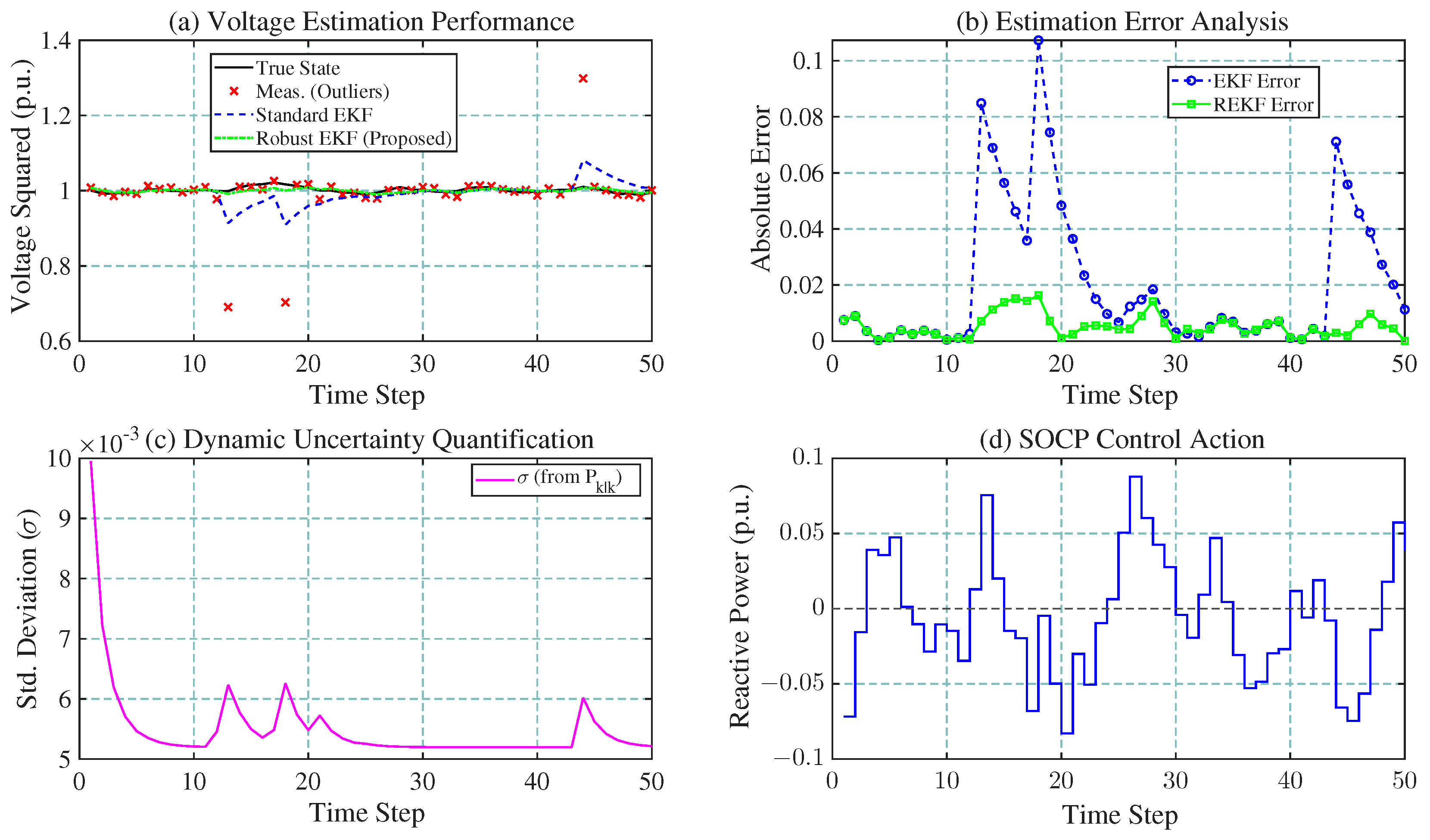
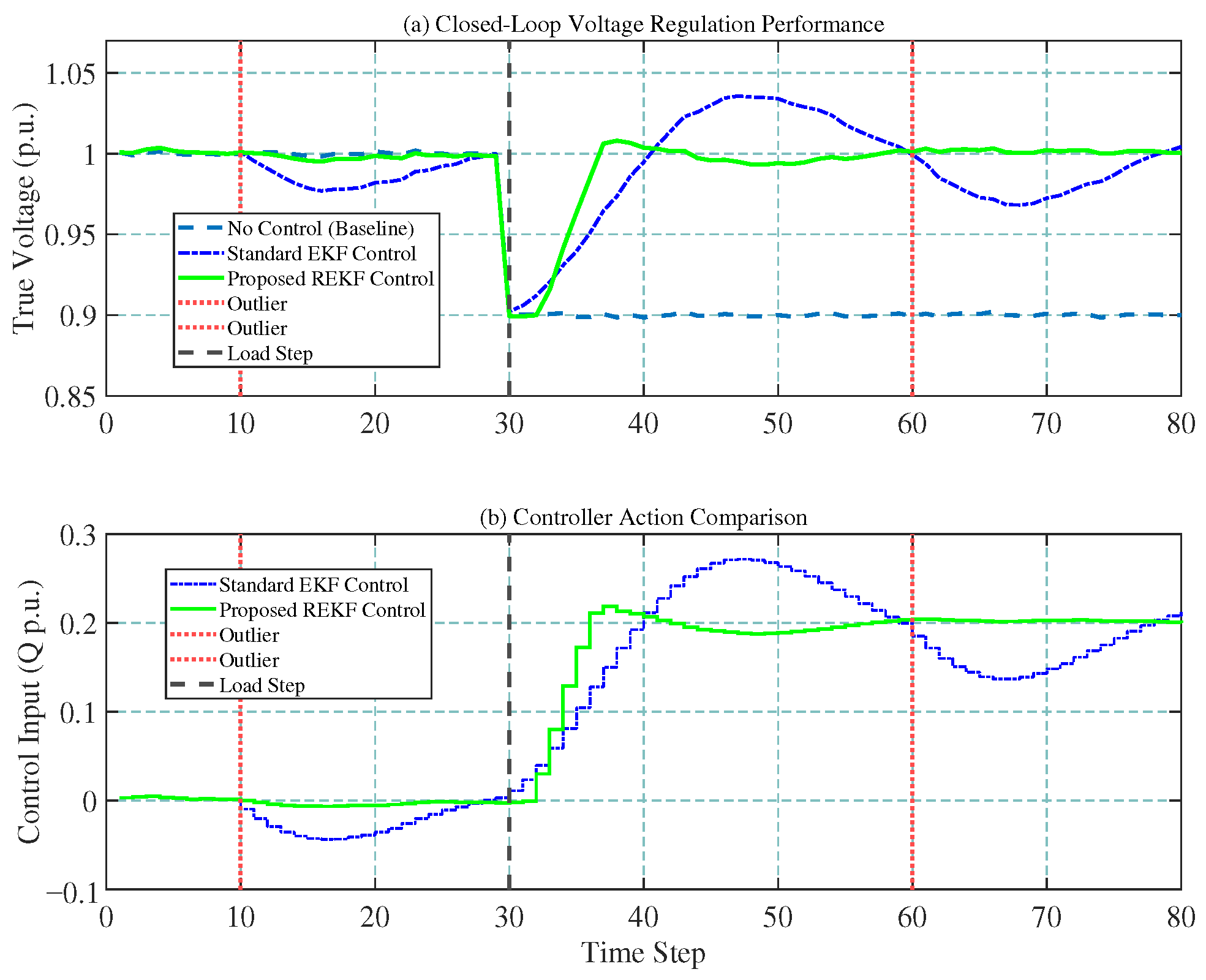
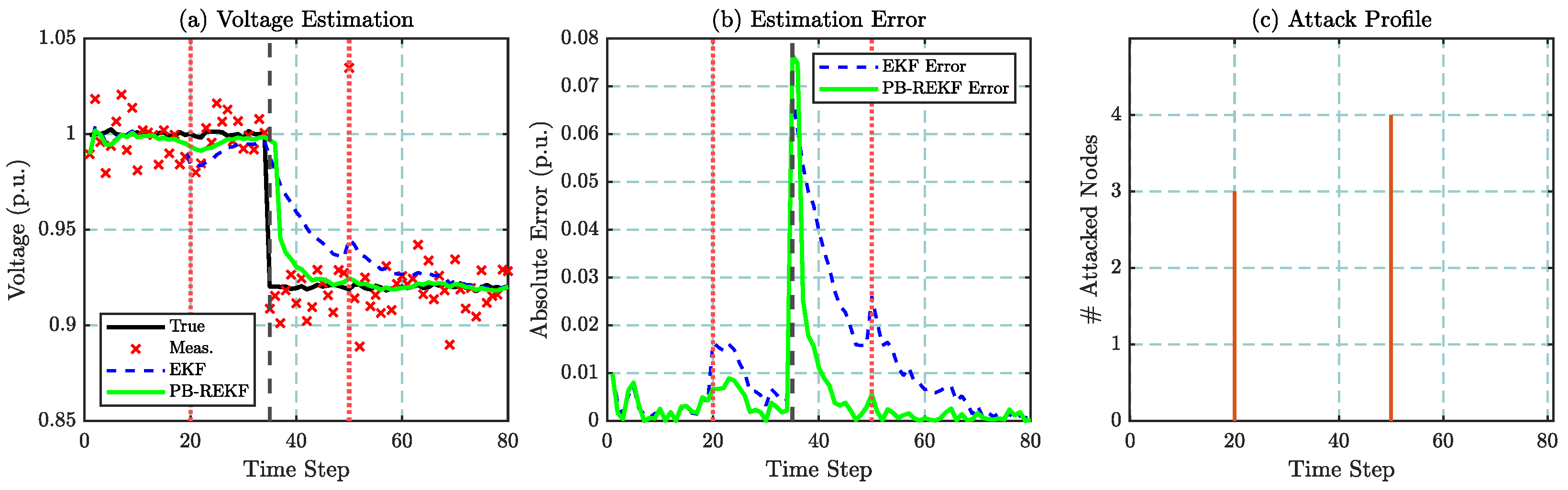
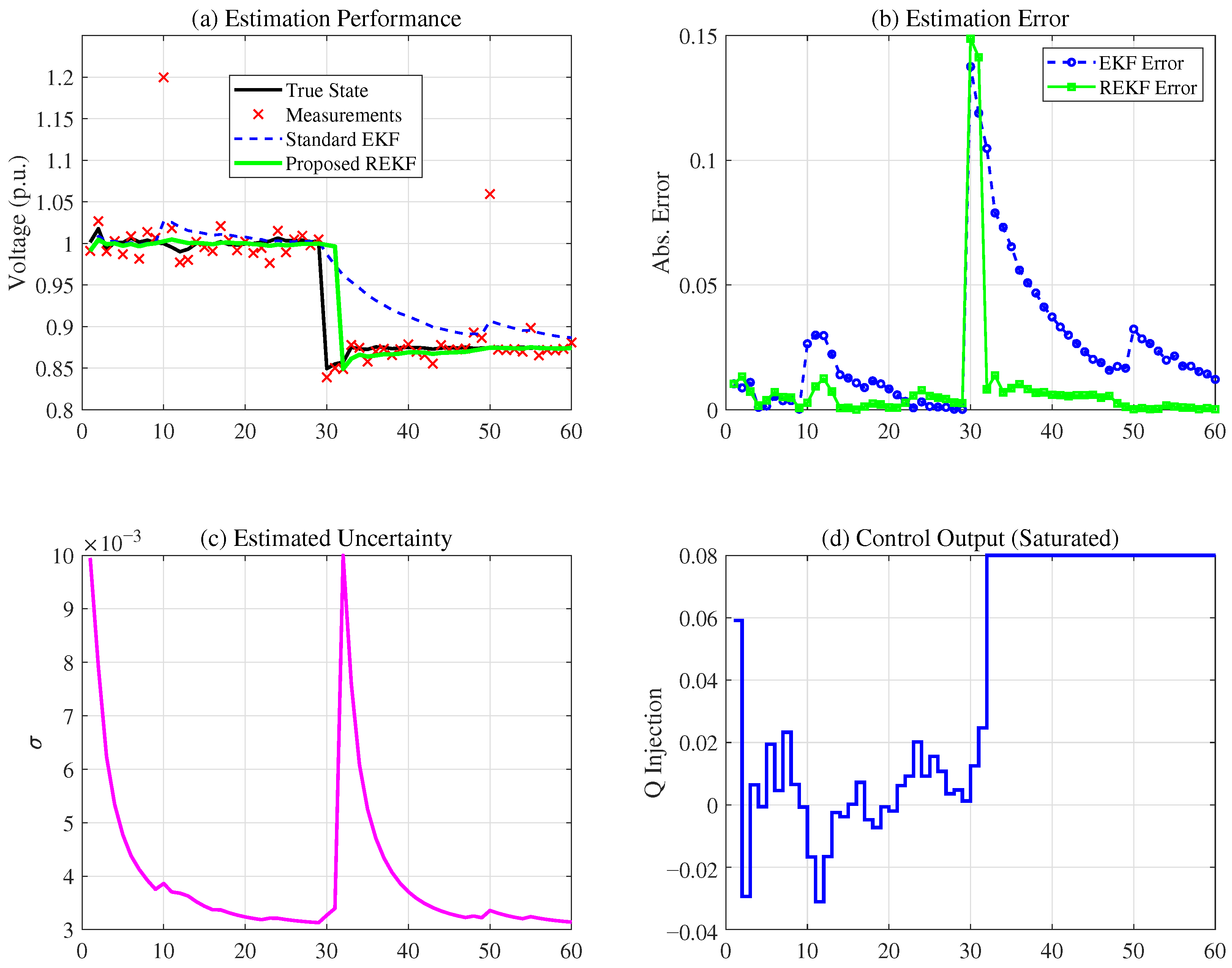
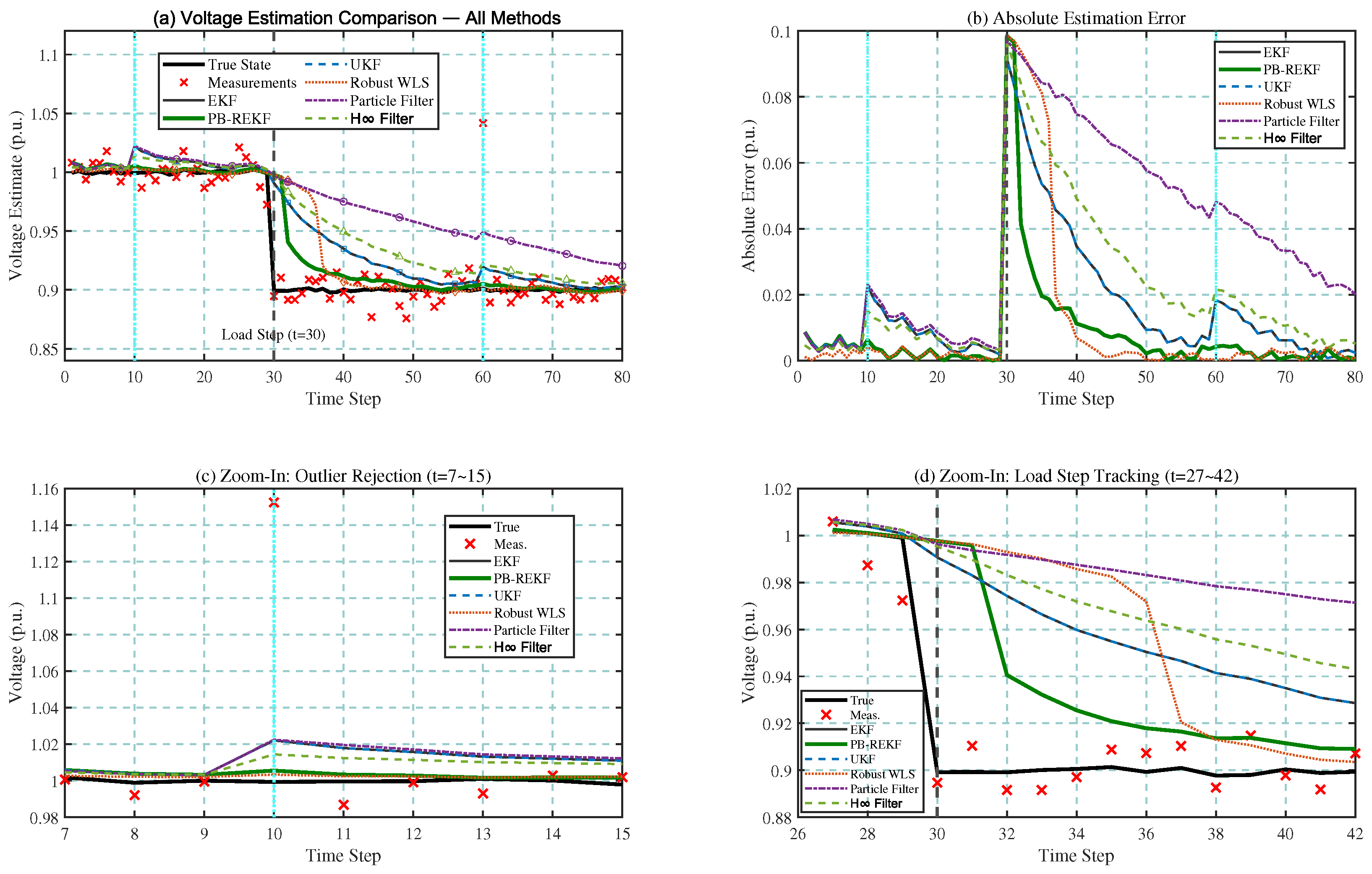
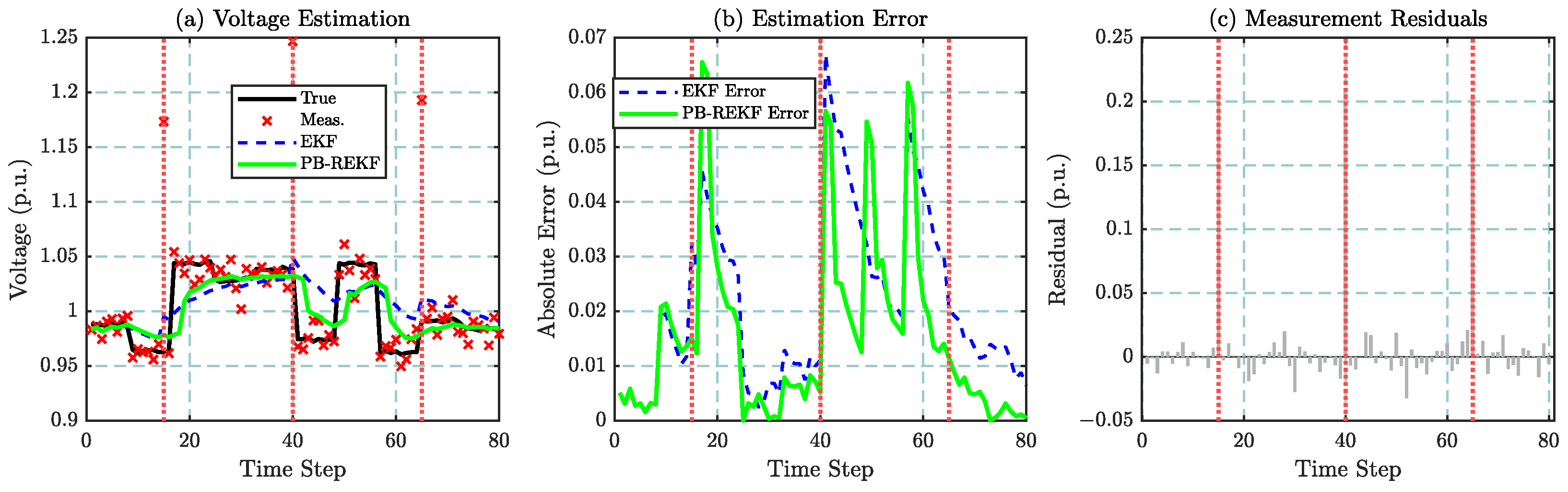
- At and time steps, a measurement outlier of p.u. is injected into the squared voltage reading at Node 2. This models a False Data Injection Attack (FDIA) or a transient PMU communication fault. Physically, this false reading corresponds to a voltage magnitude of approximately p.u. (vs. the true p.u.), which, if accepted by the controller, would trigger erroneous reactive power absorption () and induce an artificial voltage sag of up to p.u. at adjacent nodes. The disturbance is transient (lasting one time step) and should be rejected by the estimator; the controller should remain unchanged.
- (2)
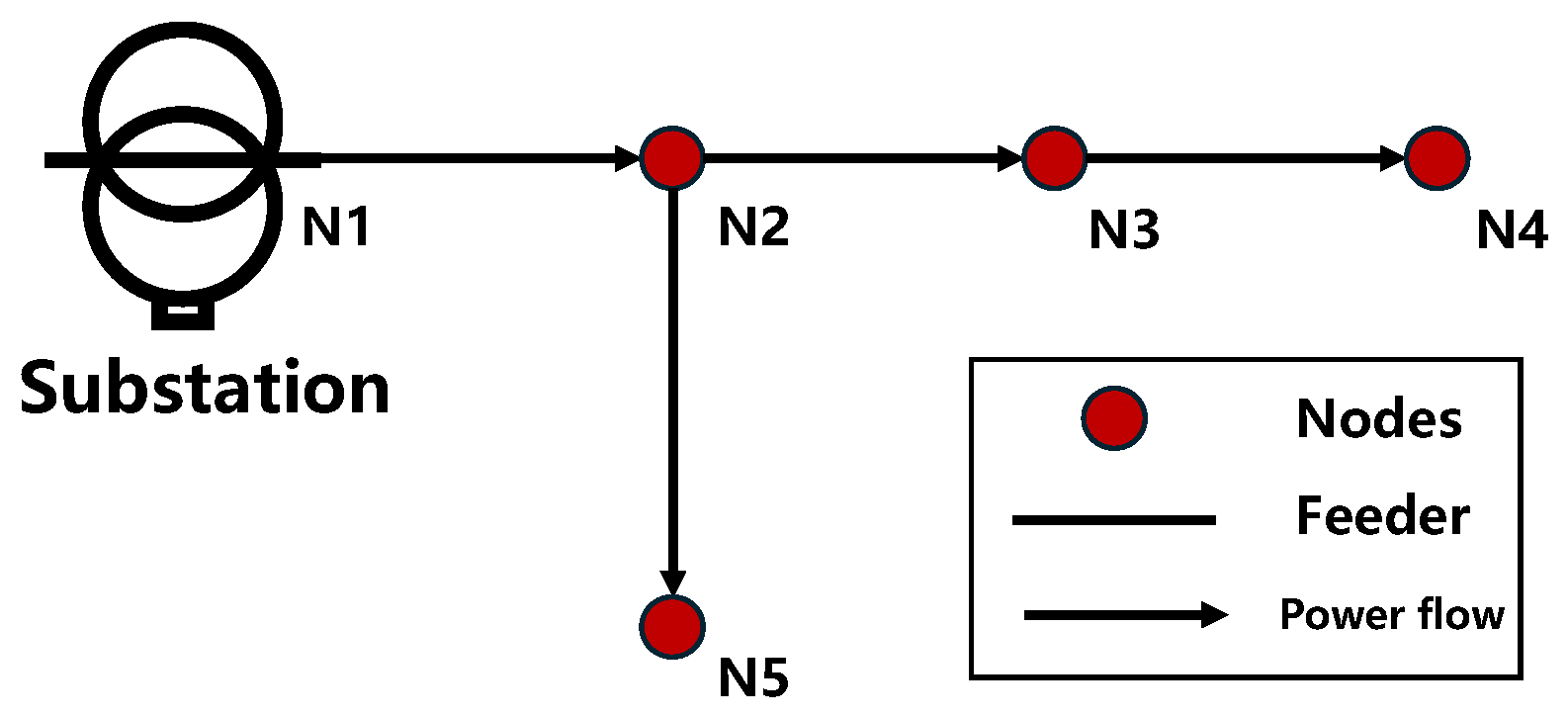
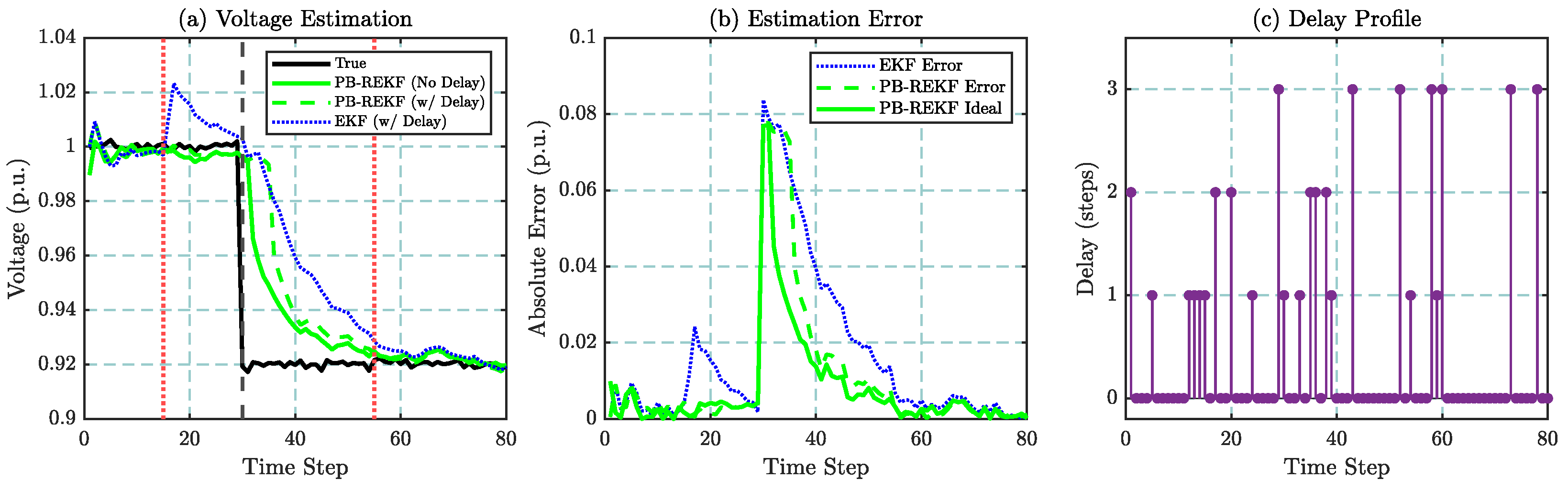
- At , a sudden large load is connected at Node 3, physically representing the start-up of a large industrial load or a rapid EV charging event. This causes a persistent squared voltage drop of p.u., corresponding to a voltage magnitude decrease from p.u. to approximately p.u. at the lower safety boundary p.u. This disturbance is persistent (lasting steps) and should be tracked by the estimator, with the controller injecting reactive power at Nodes 3 and 5 to restore voltage.
6.2. Simulation Study and Results
6.2.1. Main Result
6.2.2. Comparative Analysis Against Alternative Filtering Methods
6.2.3. Computational Complexity and Real-Time Feasibility
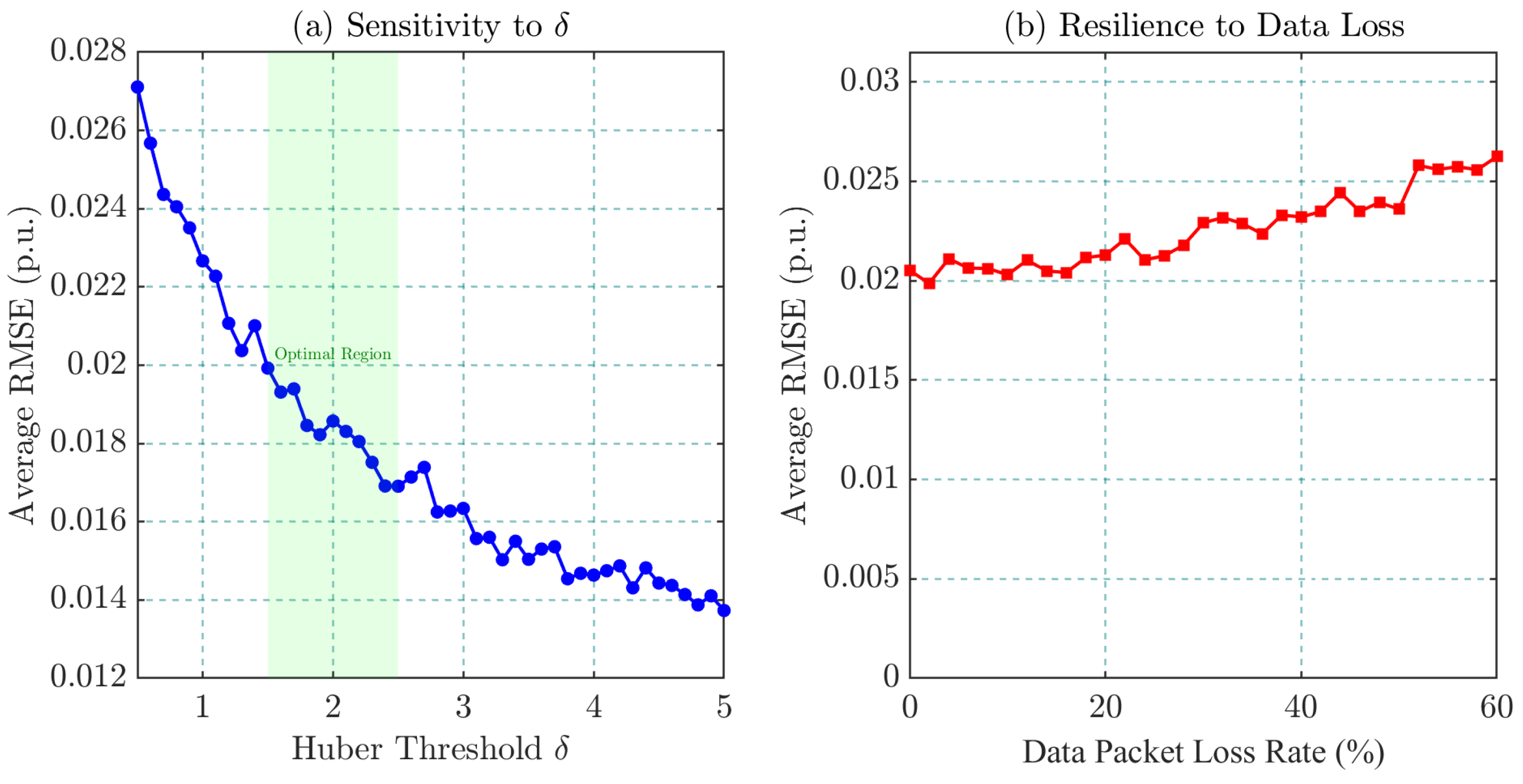
6.2.4. Scalability and Robustness
6.3. Extended Scenario Validation
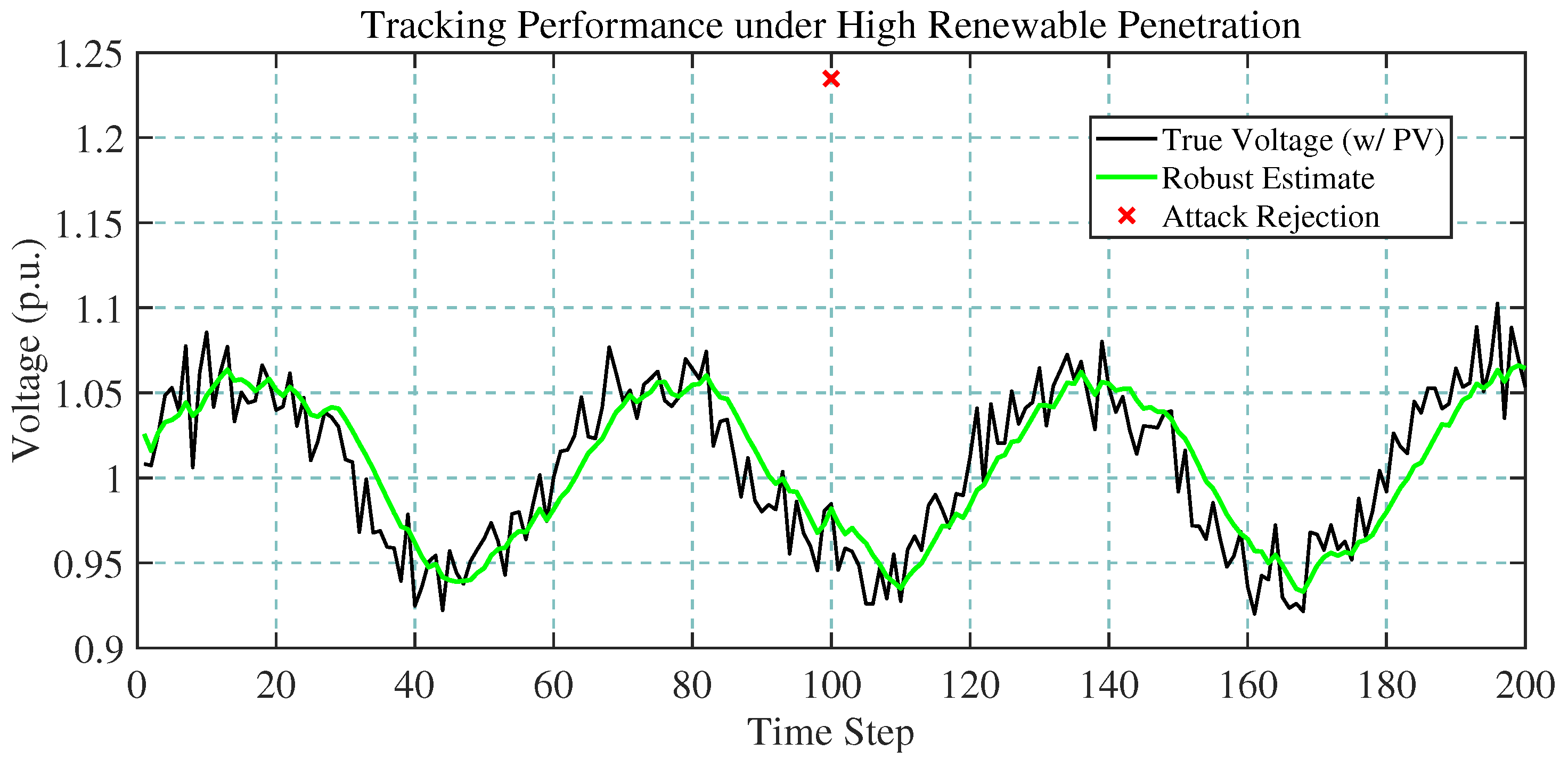
6.3.1. High DER Penetration
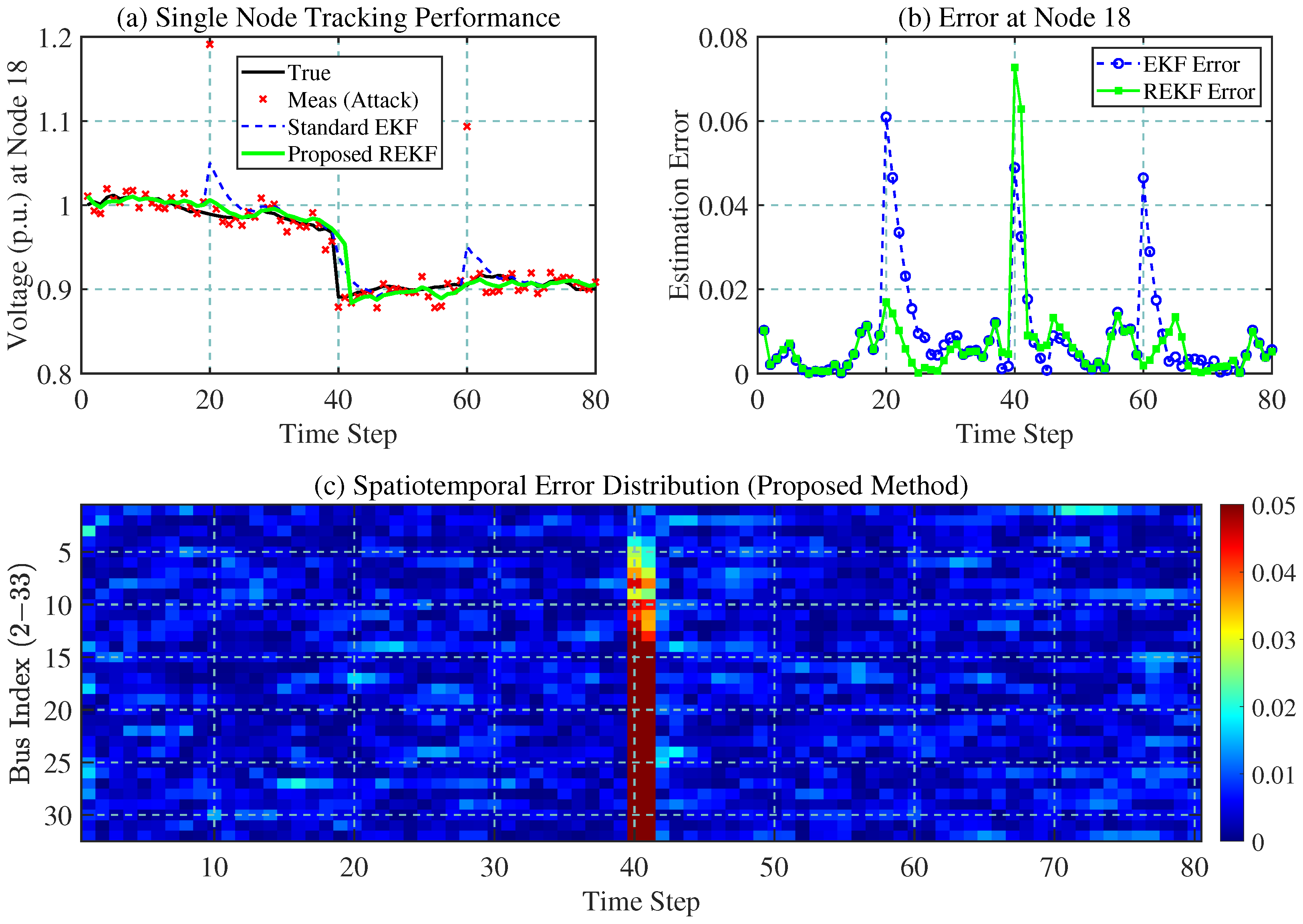
6.3.2. Multiple Simultaneous Attacks
6.3.3. Communication Delay
7. Conclusions
Author Contributions
Funding
Data Availability Statement
Conflicts of Interest
References
- Olivares, D.E.; Mehrizi-Sani, A.; Etemadi, A.H.; Canizares, C.A.; Iravani, R.; Kazerani, M.; Hajimiragha, A.H.; Gomis-Bellmunt, O.; Saeedifard, M.; Palma-Behnke, R.; et al. Trends in Microgrid Control. IEEE Trans. Smart Grid 2014, 5, 1905–1919. [Google Scholar] [CrossRef]
- Lei, X.; Zhong, J.; Chen, Y.; Shao, Z.; Jian, L. Grid Integration of Electric Vehicles within Electricity and Carbon Markets: A Comprehensive Overview. eTransportation 2025, 25, 100435. [Google Scholar] [CrossRef]
- Acharige, S.S.G.; Haque, M.E.; Arif, M.T.; Hosseinzadeh, N.; Hasan, K.N.; Hossain, M.J.; Muttaqi, K.M. Grid integration of electric vehicles – Impact assessment and remedial measures. J. Power Sources 2025, 650, 236697. [Google Scholar] [CrossRef]
- Dall’Anese, E.; Zhu, H.; Giannakis, G.B. Distributed Optimal Power Flow for Smart Microgrids. IEEE Trans. Smart Grid 2013, 4, 1464–1475. [Google Scholar] [CrossRef]
- Liu, Y.; Ning, P.; Reiter, M.K. False Data Injection Attacks against State Estimation in Electric Power Grids. ACM Trans. Inf. Syst. Secur. 2011, 14, 1–33. [Google Scholar] [CrossRef]
- Huang, Y.; Esmalifalak, M.; Nguyen, H.; Zheng, R.; Han, Z.; Li, H.; Song, L. Bad data injection in smart grid: Attack and defense mechanisms. IEEE Commun. Mag. 2013, 51, 27–33. [Google Scholar] [CrossRef]
- Abur, A.; Expósito, A.G. Power System State Estimation: Theory and Implementation; CRC Press: Boca Raton, FL, USA, 2004. [Google Scholar]
- Monticelli, A. State Estimation in Electric Power Systems: A Generalized Approach; Springer: Berlin/Heidelberg, Germany, 1999. [Google Scholar]
- Li, W.; Liu, Z.W.; Chen, Y.; Wang, Y.W. Model-free robust online feedback optimization for voltage regulation in distribution grids. IEEE Trans. Ind. Inform. 2025, 21, 9879–9888. [Google Scholar] [CrossRef]
- Li, W.; Liu, Z.W.; Chi, M.; Li, Y.; Wang, Y.W. Distributed Online Feedback Optimization with Real-Time Sensitivity Estimation for Coordinated Voltage Regulation in Distribution Grids. IEEE Trans. Control Syst. Technol. 2025, 34, 990–1000. [Google Scholar] [CrossRef]
- Schweppe, F.C.; Wildes, J. Power System Static-State Estimation, Part I: Exact Model. IEEE Trans. Power Appar. Syst. 1970, PAS-89, 120–125. [Google Scholar] [CrossRef]
- Schweppe, F.C.; Rom, D.B. Power System Static-State Estimation, Part II: Approximate Model. IEEE Trans. Power Appar. Syst. 1970, PAS-89, 125–130. [Google Scholar] [CrossRef]
- Schweppe, F.C. Power System Static-State Estimation, Part III: Implementation. IEEE Trans. Power Appar. Syst. 1970, PAS-89, 130–135. [Google Scholar] [CrossRef]
- Handschin, E.; Schweppe, F.C.; Kohlas, J.; Fiechter, A. Bad Data Analysis for Power System State Estimation. IEEE Trans. Power Appar. Syst. 1975, 94, 329–337. [Google Scholar] [CrossRef]
- Merrill, H.M.; Schweppe, F.C. Bad Data Suppression in Power System Static State Estimation. IEEE Trans. Power Appar. Syst. 1971, 90, 2718–2725. [Google Scholar] [CrossRef]
- Emami, R.; Abur, A. Robust Measurement Design by Placing Synchronized Phasor Measurements on Network Branches. IEEE Trans. Power Syst. 2010, 25, 38–43. [Google Scholar] [CrossRef]
- Mili, L.; Cheniae, M.; Vichare, N.; Rousseeuw, P.J. Robust state estimation based on projection statistics [of power systems]. IEEE Trans. Power Syst. 2002, 11, 1118–1127. [Google Scholar] [CrossRef]
- Jabr, R. Power system Huber M-estimation with equality and inequality constraints. Electr. Power Syst. Res. 2005, 74, 239–246. [Google Scholar] [CrossRef]
- Karlgaard, C.D. Nonlinear regression Huber–Kalman filtering and fixed-interval smoothing. J. Guid. Control Dyn. 2015, 38, 322–330. [Google Scholar] [CrossRef]
- Abur, A.; Celik, M.K. Least absolute value state estimation with equality and inequality constraints. IEEE Trans. Power Syst. 2002, 8, 680–686. [Google Scholar] [CrossRef]
- Valverde, G.; Terzija, V. Unscented Kalman Filter for Power System Dynamic State Estimation. IET Gener. Transm. Distrib. 2011, 5, 29–37. [Google Scholar] [CrossRef]
- Zhao, J.; Mili, L. Power system robust decentralized dynamic state estimation based on multiple hypothesis testing. IEEE Trans. Power Syst. 2017, 33, 4553–4562. [Google Scholar] [CrossRef]
- Zhao, J.; Zhang, G.; La Scala, M. PMU based robust dynamic state estimation method for power systems. In Proceedings of the Proceedings of the 2015 IEEE Power & Energy Society General Meeting; IEEE: Piscataway, NJ, USA, 2015; pp. 1–5. [Google Scholar] [CrossRef]
- Hou, D.; Sun, Y.; Sun, K.; Dinavahi, V.; Wang, Y. Robust forecasting-aided state estimation of active distribution network with multiple distributed generators. IEEE Trans. Autom. Sci. Eng. 2025, 22, 16780–16789. [Google Scholar] [CrossRef]
- Shafiei, M.; Ledwich, G.; Nourbakhsh, G.; Arefi, A.; Pezeshki, H. Layered Based Augmented Complex Kalman Filter for Fast Forecasting-Aided State Estimation of Distribution Networks. arXiv 2018, arXiv:1803.03549. [Google Scholar] [CrossRef]
- Li, P.; Zhang, C.; Wu, Z.; Xu, Y.; Hu, M.; Dong, Z. Distributed adaptive robust voltage/var control with network partition in active distribution networks. IEEE Trans. Smart Grid 2019, 11, 2245–2256. [Google Scholar] [CrossRef]
- Niknam, T.; Zare, M.; Aghaei, J. Scenario-based multiobjective volt/var control in distribution networks including renewable energy sources. IEEE Trans. Power Deliv. 2012, 27, 2004–2019. [Google Scholar] [CrossRef]
- Zhang, X.; Liu, X.; Ding, T.; Wang, P. On resilience and distributed fixed-time control of MTDC systems under DoS attacks. IEEE Trans. Autom. Sci. Eng. 2022, 20, 2569–2580. [Google Scholar] [CrossRef]
- Lee, D.; Han, C.; Kang, S.; Jang, G. Chance-constrained optimization for active distribution networks with virtual power lines. Electr. Power Syst. Res. 2023, 221, 109449. [Google Scholar] [CrossRef]
- Khalaf, M.; Youssef, A.; El-Saadany, E. Joint Detection and Mitigation of False Data Injection Attacks in AGC Systems. IEEE Trans. Smart Grid 2019, 10, 4985–4995. [Google Scholar] [CrossRef]
- Zhao, J.; Mili, L.; Wang, M. A Generalized False Data Injection Attacks Against Power System Nonlinear State Estimator and Countermeasures. IEEE Trans. Power Syst. 2019, 33, 4868–4877. [Google Scholar] [CrossRef]
- Sarri, S.; Paolone, M.; Cherkaoui, R.; Borghetti, A.; Napolitano, F.; Nucci, C.A. State Estimation of Active Distribution Networks: Comparison Between WLS and Iterated Kalman-Filter Algorithm Integrating PMUs. In Proceedings of the 3rd IEEE PES Innovative Smart Grid Technologies Europe (ISGT Europe), Berlin, Germany, 14–17 October 2012; pp. 1–8. [Google Scholar] [CrossRef]
- Dehghanpour, K.; Wang, Z.; Wang, J.; Yuan, Y.; Bu, F. A Survey on State Estimation Techniques and Challenges in Smart Distribution Systems. IEEE Trans. Smart Grid 2019, 10, 2312–2322. [Google Scholar] [CrossRef]
- Chen, T.; Wu, T.; Qing, X.; Amaratunga, G.A. A distributed robust state estimation algorithm for power systems considering maximum exponential absolute value. Int. J. Electr. Power Energy Syst. 2021, 133, 107267. [Google Scholar] [CrossRef]
- Wang, Y.; Yang, Z.; Wang, Y.; Dinavahi, V.; Liang, J.; Wang, K. Robust dynamic state estimation for power system based on adaptive cubature Kalman filter with generalized correntropy loss. IEEE Trans. Instrum. Meas. 2022, 71, 9003811. [Google Scholar] [CrossRef]
- Liu, M.; Liu, Y.; Wang, Y.; Dinavahi, V.; Gao, Z. Robust Dynamic State Estimation of Power System with Measurement Outliers Based on Parameterized Analytical Cubature Kalman Filter. IET Renew. Power Gener. 2025, 19, e70047. [Google Scholar] [CrossRef]
- Pajic, M.; Lee, I.; Pappas, G.J. Attack-resilient state estimation for noisy dynamical systems. IEEE Trans. Control Netw. Syst. 2016, 4, 82–92. [Google Scholar] [CrossRef]
- Colot, A.; Perotti, E.; Glavic, M.; Dall’Anese, E. Incremental Volt/Var control for distribution networks via chance-constrained optimization. IEEE Trans. Power Syst. 2025, 40, 4561–4573. [Google Scholar] [CrossRef]
- Mohamed, A.H.; Schwarz, K.P. Adaptive Kalman Filtering for INS/GPS. J. Geod. 1999, 73, 193–203. [Google Scholar] [CrossRef]
- Baran, M.E.; Wu, F.F. Network Reconfiguration in Distribution Systems for Loss Reduction and Load Balancing. IEEE Trans. Power Deliv. 1989, 4, 1401–1407. [Google Scholar] [CrossRef]
- Löfberg, J. YALMIP: A toolbox for modeling and optimization in MATLAB. In Proceedings of the IEEE International Conference on Robotics and Automation (CACSD), Taipei, Taiwan, 2–4 September 2004; pp. 284–289. [Google Scholar] [CrossRef]
- Arulampalam, M.S.; Maskell, S.; Gordon, N.; Clapp, T. A tutorial on particle filters for online nonlinear/non-Gaussian Bayesian tracking. IEEE Trans. Signal Process. 2002, 50, 174–188. [Google Scholar] [CrossRef]
- Shaked, U.; Theodor, Y. H∞-optimal estimation: A tutorial. In Proceedings of the 31st IEEE Conference Decision and Control (CDC), Tucson, AZ, USA, 16–18 December 1992; pp. 2278–2286. [Google Scholar] [CrossRef]




| Method | Strategy | State Tracking | Switching Logic | Key Limitation |
|---|---|---|---|---|
| Standard Robust EKF [19] | Huber M-estimation | None | None | Treats all large residuals as outliers; delays tracking of genuine state changes |
| Adaptive EKF [39] | None | Adjusts via innovation covariance matching | Continuous adaptation | Cannot distinguish outliers from state jumps; inflates for both |
| Covariance Inflation KF [35] | None | Inflates when residuals are large | Threshold on residual magnitude | Vulnerable to outliers; inflation triggered by bad data causes estimate divergence |
| Huber–Adaptive EKF | Huber weighting | adaptation | Simultaneous | Conflicting mechanisms: Huber suppresses residuals for state change detection |
| Proposed PB-REKF | Huber M-estimation | Covariance inflation | Temporal persistence: switches after detections | Requires tuning of ; uses a fixed threshold |
| Category | Parameter | Value |
|---|---|---|
| Network | Number of Buses (N) | 5 |
| Line Impedance () | p.u. | |
| Nominal Voltage () | 1.0 p.u. | |
| Algorithm | Huber Threshold () | 1.5 |
| Persistence Limit () | 3 steps | |
| Inflation Factor () | 100 | |
| Safety Factor () | 1.645 (95% C.I.) | |
| Control | Control Deadband | p.u. |
| Actuator Rate Limit | 0.05 p.u./step |
| Method | RMSE | SS-RMSE | (%) | |||
|---|---|---|---|---|---|---|
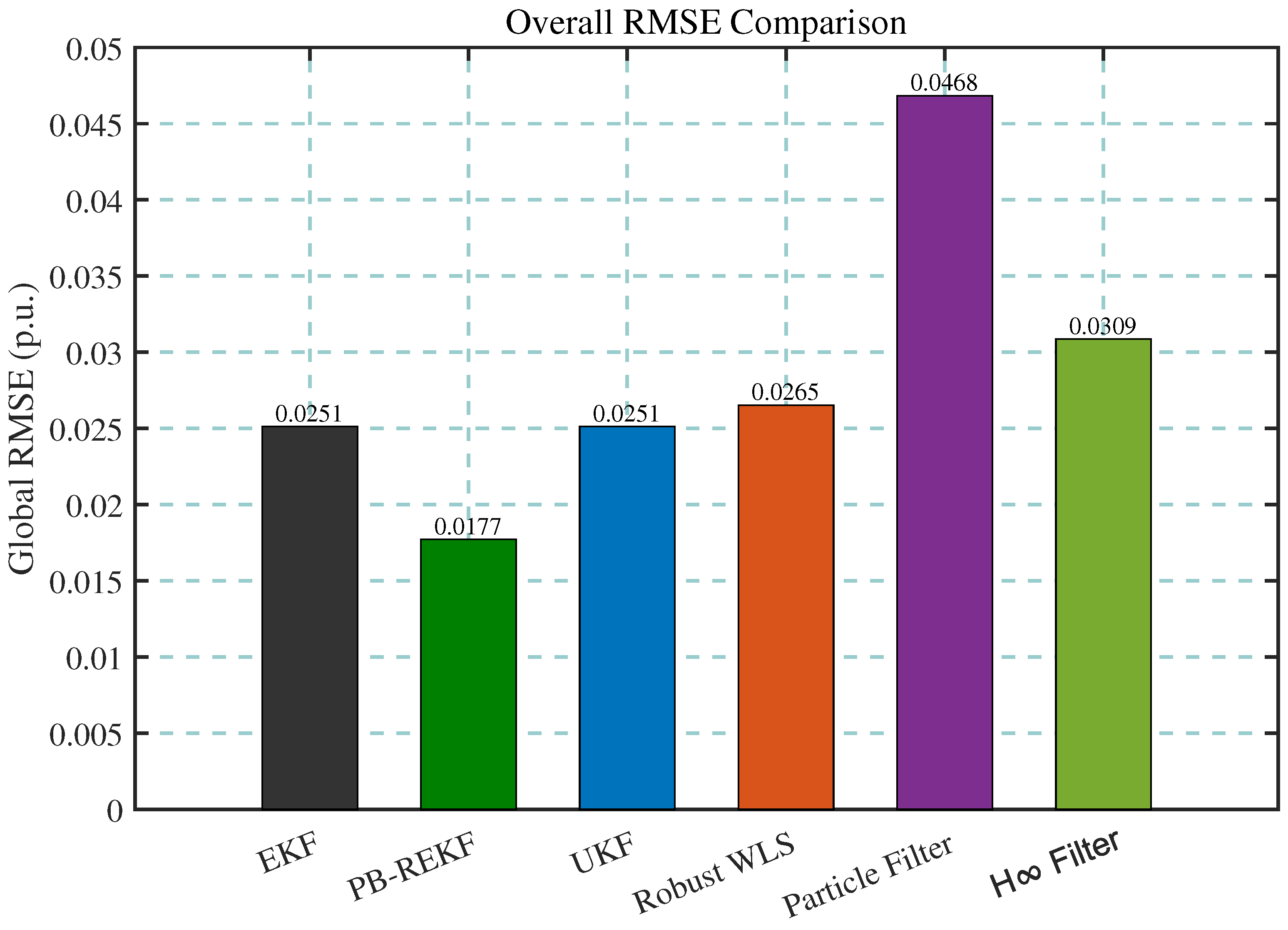
| EKF | 0.0251 | 0.0103 | 8.8 | 14.735 | 1.0 | 0.0066 |
| PB-REKF | 0.0177 | 0.0033 | 3.8 | 14.543 | 1.0 | 0.0017 |
| UKF | 0.0251 | 0.0103 | 8.8 | 14.735 | 1.0 | 0.0066 |
| Robust WLS | 0.0265 | 0.0019 | 7.5 | 13.071 | 1.0 | 0.0010 |
| Particle Filter | 0.0468 | 0.0445 | 18.8 | 12.740 | 8.5 | 0.0067 |
| Filter | 0.0309 | 0.0176 | 11.2 | 13.791 | 1.5 | 0.0043 |
| Module | B | 5-Bus System (ms) | 33-Bus System (ms) | ||
|---|---|---|---|---|---|
| Total | Per-Step | Total | Per-Step | ||
| Standard EKF | 0.24 | 0.003 | 0.88 | 0.011 | |
| PB-REKF (Huber mode) | 0.43 | 0.005 | 1.32 | 0.016 | |
| PB-REKF (Inflation mode †) | 0.43 | 0.005 | 1.32 | 0.016 | |
| SOCP Solver | 67.76 | 0.847 | 178.08 | 2.226 | |
Disclaimer/Publisher’s Note: The statements, opinions and data contained in all publications are solely those of the individual author(s) and contributor(s) and not of MDPI and/or the editor(s). MDPI and/or the editor(s) disclaim responsibility for any injury to people or property resulting from any ideas, methods, instructions or products referred to in the content. |
© 2026 by the authors. Licensee MDPI, Basel, Switzerland. This article is an open access article distributed under the terms and conditions of the Creative Commons Attribution (CC BY) license.
Share and Cite
Zhou, M.; Wu, Q.; Su, H.; Cui, Y.; Tan, Z. Robust Dynamic State Estimation and Collaborative Control of Distribution Networks Considering Measurement Outliers. Electronics 2026, 15, 1850. https://doi.org/10.3390/electronics15091850
Zhou M, Wu Q, Su H, Cui Y, Tan Z. Robust Dynamic State Estimation and Collaborative Control of Distribution Networks Considering Measurement Outliers. Electronics. 2026; 15(9):1850. https://doi.org/10.3390/electronics15091850
Chicago/Turabian StyleZhou, Ming, Qiang Wu, Hongwei Su, Yiwei Cui, and Zhuangxi Tan. 2026. "Robust Dynamic State Estimation and Collaborative Control of Distribution Networks Considering Measurement Outliers" Electronics 15, no. 9: 1850. https://doi.org/10.3390/electronics15091850
APA StyleZhou, M., Wu, Q., Su, H., Cui, Y., & Tan, Z. (2026). Robust Dynamic State Estimation and Collaborative Control of Distribution Networks Considering Measurement Outliers. Electronics, 15(9), 1850. https://doi.org/10.3390/electronics15091850