Article

Distance Velocity Fusion Algorithm Based on Sequential Monte Carlo Probability Hypothesis Density Filter in Low-to-No Power Scenario

College of Electronic Engineering, National University of Defense Technology, Hefei 230009, China
*
Author to whom correspondence should be addressed.
Electronics 2026, 15(9), 1787; https://doi.org/10.3390/electronics15091787
Submission received: 17 March 2026 / Revised: 13 April 2026 / Accepted: 18 April 2026 / Published: 22 April 2026

Abstract

In the context of an increasingly chaotic electromagnetic environment, the problem of multisensor data fusion for tracking airborne maneuvering targets has garnered significant attention and applications. In low-to-no power scenarios, certain sensors exhibit measurement inaccuracies, and the disparity in measurement precision among networked sensors leads to data inequality. This results in poor fusion accuracy in the multisensor fusion process, particularly when prior weights are unknown. To address the aforementioned problems, this study first redefines the motion model of airborne maneuvering targets by capturing the complexity of the trajectory of the target. Subsequently, a modeling framework for low-to-no power scenarios is established using a one-transmitter three-receiver radar system. In this model, the Signal-to-Noise Ratio (SNR) of the two sensors was intentionally reduced to simulate data inequality. Finally, a distance velocity (DV) fusion algorithm was designed based on the Sequential Monte Carlo Probability Hypothesis Density (SMC-PHD) algorithm. Specifically, after the state extraction step of the SMC-PHD filter algorithm, the final estimated target was obtained in two steps: judgment and weighted summation. The simulation results demonstrate the effectiveness of the proposed algorithm in improving fusion accuracy and robustness in dynamic environments and under real electromagnetic interference.

1. Introduction

The fusion of multisensors originated from military demand applications in the 1970s. Compared to a single sensor, it can improve estimation confidence, expand sensing range, and enhance survivability. In the field of random sets, multisensor fusion is divided into measurement fusion and density fusion based on the different information transmitted between sensors. Generally, fusion that transfers raw measurements is called centralized fusion, and multisensor versions of random set filters [1,2,3,4,5,6,7], belong to this category. They are theoretically Bayes optimal, but the segmentation of measurements makes them exhibit combinatorial complexity. The fusion of transmitting multitarget densities corresponds to distributed fusion, which performs the filter process first in local sensors and then fuses the local multitarget densities with those received from neighboring sensors. Compared to centralized fusion, distributed multitarget density fusion is simpler to implement and can better meet the current trend of low-cost and low-power consumption for sensor platforms.
References [8,9,10,11,12] provide an overview of the latest advancements in multisensor multitarget tracking based on Random Finite Set (RFS) methods. They outline the significant properties of each fusion rule, including optimality and suboptimality. In particular, the literature discusses in detail two robust multitarget density averaging methods: Algorithm Average (AA) and Geometric Average (GA) fusion. Specifically, distributed multitarget density fusion methods mainly include GA fusion and AA fusion, both of which can be regarded as Kullback-Leibler Average (KLA) fusion. GA fusion originated from the literature [13,14], where the covariance intersection (CI) fusion method for Gaussian distributions was generalized to the fusion of arbitrary distributions, hence it is also called generalized covariance intersection (GCI) fusion. GA fusion has been extensively studied in the field and has been applied to various random set filters [15,16,17,18,19,20], demonstrating good effectiveness. AA/GA fusion is a direct extension of univariate average fusion to multitarget densities and has also been studied [21,22,23,24,25,26,27] to some extent in some random set filters.
In AA/GA fusion, the fusion weight w = w 1 , w 2 , T serves as a free parameter and must be calculated before fusion. The most rigorous method is to calculate it by minimizing a cost function, which can be set as the Fréchet function, the sum of Kullback–Leibler divergence (KLD), or Rényi convergence [28]. However, this is very complex and difficult to solve in real-time, and most of the time, the value of the weight w is directly specified. One method of specifying weights is to utilize prior knowledge, such as using the quality of the sensor as its fusion coefficient. The fusion coefficient itself is the weight assigned to the corresponding sensor distribution, and sensors with higher quality should naturally receive more trust. The weight can also be set based on the amount of information, for example, in heterogeneous radar fusion, active radar contains more information than passive radar and should have a higher fusion weight. When the sensor quality is consistent, consistent weights can be adopted.
In recent years, multi-sensor fusion and target tracking have been further developed under complex conditions. Darvishi et al. [29] proposed an elevation-angle estimation method based on an extended Kalman filter for low-angle target tracking, which achieved high estimation accuracy by using an array antenna and frequency diversity technology. Yang et al. [30] proposed a consensus arithmetic average Gaussian(CAA) mixture PHD filter for distributed sensor networks, which effectively improved the performance of multi-target tracking and attack detection under uneven data quality. Fu et al. [31] designed an adaptive confidence-level fusion method for multi-IMU positioning, which significantly enhanced the system stability and positioning accuracy in GPS-denied scenarios. On this basis, this paper further focuses on the data-unequal and unknown prior weight problems in low-power multi-sensor scenarios, and proposes a distance-velocity fusion algorithm based on SMC-PHD to achieve more robust and accurate multi-target tracking.
Low-to-No Power Scenario and Data Inequality: In the context of passive radar systems utilizing external illuminators (e.g., broadcast transmitters, cellular base stations), the “low-to-no power” scenario refers to operational environments where the radar receivers operate under stringent power constraints and face challenging electromagnetic conditions. Specifically, this scenario is characterized by two key features: (1) Low Signal-to-Noise Ratio (SNR): Due to the non-cooperative nature of the illuminators and long bistatic propagation paths, the received target echo signals are inherently weak, often buried in noise and clutter; (2) Data Inequality: In a networked receiver configuration, different sensors exhibit significant disparities in measurement quality due to varying geometric locations, local terrain obstructions, multipath effects, and interference levels. This results in heterogeneous noise characteristics across the sensor network, where some receivers may maintain acceptable SNR while others suffer from severe signal degradation. Existing fusion algorithms typically assume uniform sensor quality or require prior knowledge of sensor weights, which are difficult to obtain in dynamic, complex electromagnetic environments. This study specifically addresses the challenge of data inequality in low-to-no power scenarios, where the fusion algorithm must adaptively handle significant quality disparities among sensors without relying on pre-specified fusion weights.
However, the problem lies in the fact that specifying weights, or prior weights, is generally difficult to obtain directly at any given time. If the prior weights are unknown, the only option is to average the weights of individual sensors for information fusion. If there are no significant differences in reception quality among all sensors, averaging the weights can yield good fusion results.
However, if some sensors are severely obstructed or operating in a complex environment, resulting in poor reception quality, relying solely on average weights will severely impact the fusion quality in AA/GA fusion.
In summary, the problem of data inequality exists in low-to-no power scenarios, leading to significant discrepancies in measurement accuracy among the radars within the network. Existing Probability Hypothesis Density (PHD) algorithms and fusion algorithms rely on weights, which reduces the effectiveness of measurement utilization and results in lower fusion accuracy. Therefore, in response to these challenges, the main contributions of this article are as follows:
(1)
Given the complexity of the flight trajectories of airborne maneuvering targets, this study undertakes a re-evaluation of their motion model. The motion of airborne maneuvering targets is decomposed into nine distinct maneuvers, which are then combined temporally to construct intricate flight trajectories that more accurately reflect real-world scenarios.
(2)
In the construction of a low-to-no power scenario, this study utilizes a passive source (external radiation) radar system configured with a one-to-three transmission-reception network. To simulate the scenario of sensor measurement imprecision, a low-to-no power scenario is constructed by decreasing the Signal-to-Noise Ratio (SNR) of two out of the three receiving sensors. This adjustment is made while consistently operating under conditions of high clutter in the environment.
(3)
To address the problem of inaccuracies in certain sensors leading to data inequality and significantly impacting the multisensor fusion process involving unknown prior weights, this study proposes a Distance Velocity (DV) fusion algorithm based on the Sequential Monte Carlo PHD (SMC-PHD) filter algorithm that does not rely on prior weights. This fusion algorithm demonstrates robust performance under two scenarios: the absence of significant discrepancies in reception quality among the sensors, and a scenario where some sensors exhibit poor reception quality. Particularly in the latter case, the algorithm does not necessitate the even distribution of fusion weights among all sensors. Instead, it automatically filters out contributions from the sensors with poor reception quality, thereby preventing them from adversely affecting the data fusion process. Concurrently, for sensors with good reception quality, the algorithm yields enhanced results post-fusion. This approach effectively improves the accuracy and reliability of multisensor data fusion for tracking maneuvering targets in complex environments.
The robustness of DV fusion was verified through simulations in both dynamic environments and real electromagnetic interference environments.

2. Preliminaries

RFS, in simple terms, is a set containing a finite number of elements, where the number and order of the elements are random. If described from the perspective of a multitarget probability density function, RFS is characterized by a nonnegative function f on the space F ( M ) , satisfying the condition given for any region S M :
P ( X S ) = ξ f ( X ) δ X
When S is equal to M, the integral equals l. represents a set integral. Alternatively, the set integral can be expressed as follows:
f ( X ) δ X = i = 0 1 j f ( { x 1 , x 2 , , x i } ) d x 1 d x 2 d x i
The j represents the factorial of i, and { x 1 , x 2 , , x i } elements in a finite set, totaling j different orderings composed of all elements x i . Generally, it is assumed that the set integral exists and is finite.
RFS can also be described in terms of belief mass functions, defined as shown in the next.
β ( S ) = P ( X S ) = S f ( X ) δ X
f ( X ) is defined for the description of RFS:
f ( X ) = β X ( )
Additionally, the probability generating functional can also be used to describe RFS, and the probability generating functional of X is defined as follows:
G ( h ) = E [ h X ]
M that satisfies 0 h ( x ) 1 ;   h X represents the multitarget exponential, which is defined as follows:
h X x X h ( x )
When X is ,   h X equals 1.
The three methods introduced above for describing RFS contain the same information, can be derived from each other, and are mathematically equivalent.

3. RFS-Based Problem Formualtion

3.1. Motion Model of Maneuvering Target

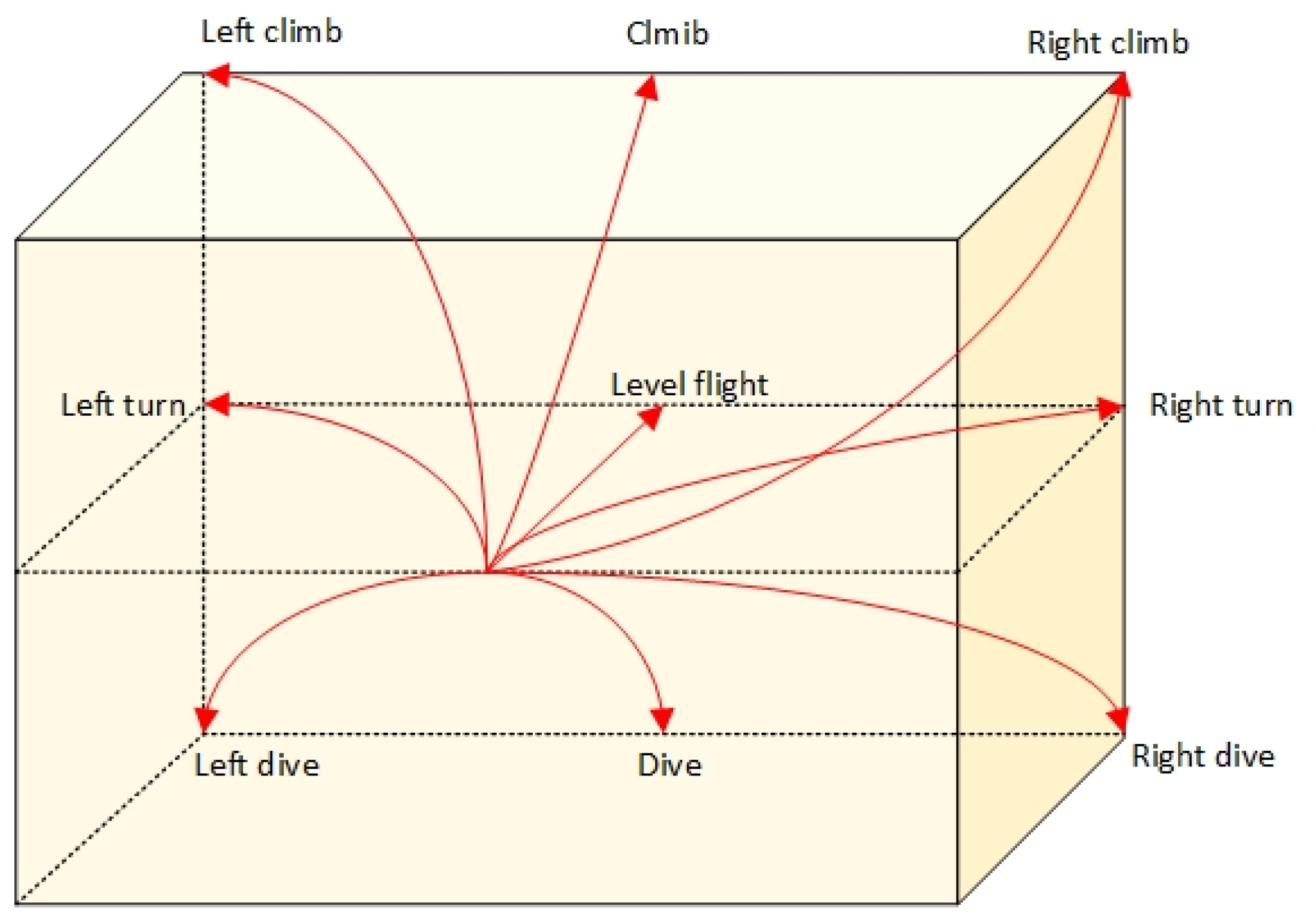
The maneuvering actions of an aerial maneuvering target’s flight path can be classified into maneuvers within the vertical plane, maneuvers within the horizontal plane, and spatial maneuvers. According to the characteristics of spatial maneuvering, 9 basic control maneuvers, including level flight, left turn, right turn, dive, climb, left dive, left climb, right dive, and right climb, can be used to describe the positional changes of an aerial maneuvering target as shown in Figure 1. For length reasons, the equations of motion for the nine actions are given in the Supplementary Materials. By considering the flight path of an aerial maneuvering target as a combination of these basic control maneuvers, arbitrary flight paths in the spatial state of the target can be generated.
The state vector consists of 3-D Cartesian position and velocity. Therefore, the state of the target can be expressed as
x = x x ˙ y y ˙ z z ˙ T
where superscript T, denotes the transpose operator. the equation of target motion is given by
x ( k + 1 ) = F k x ( k ) + u ( k )
where k is the time index, x ( k ) denotes the target state at time k, F ( k ) is the state transition matrix, and u ( k ) is a noise matrix.
Additionally, ω is the angular rotation rate and T is the preset time interval.

3.2. Construction of the Low-to-No Power Scenario

With the continuous advancement of technology and the rapid development of society, the electromagnetic environment in which we live has become increasingly complex. Various tall buildings and natural geographical features profoundly affect the quality of the signals received by sensors. Consequently, this study designs a low-to-no power scenario model that encompasses the following key characteristics:
(1)
One-to-Three-Reception Configuration Based on External Radiation Source Radar.
(2)
Low-to-No Power Scenario.
The following characteristics will be introduced one by one.
First, the model employs passive radars. In the current technological landscape, both active and passive radars have notable drawbacks; thus, the external radiation source radar is gradually gaining attention. This type of radar uses external radiation sources, such as radio stations and broadcasting systems, as the signal source for radar operations.
Suppose that the coordinates of the radar transmitter and receiver are s t = x t y t z t T and s r = x r y r z r T . Let
r ( k ) = x ( k ) y ( k ) z ( k ) T v ( k ) = x ˙ ( k ) y ˙ ( k ) z ˙ ( k ) T
Represent the target position and velocity on the time index k, respectively. For the simplicity of the formula, the time index will be omitted in the case of no ambiguity; then, the measurement of passive radar can be expressed as
z = h r , v , s r , s t + w
Here, h represents the non-linear function and represents the Gaussian white noise of zero mean. For the 3-D passive radar system, the measurement includes bistatic range, bistatic velocity, azimuth, and elevation angle. The specific definitions are as follows:
h r , v , s r , s t r b v b θ φ = r s r + r s t s r r r s r + s t r r s t T · v a t a n 2 x x r , y y r arcsin z z r r s r
Then, regarding the one-to-three reception configuration, the problem of the networking system is not the primary focus of this study. Consequently, we implement a simplified approach by uniformly positioning the receiving sensors around the external radiation source. In subsequent simulation experiments, the external radiation source remains fixed.
Secondly, this article primarily addresses the issue of data inequality within low-to-no power scenarios. In this context, the radar receives target reflection signals with low SNR, resulting in substantial discrepancies in signal quality among different radars, a phenomenon known as data inequality. To construct this scenario, we manipulate the measurement noise of the radar to achieve low SNR conditions. Additionally, we introduce varying levels of noise to the networked radars, thereby simulating the effects of data inequality.
Specifically, a noise coefficient is multiplied in front of the noise term in the measurement model of each sensor.
z 1 = h r , ν , s r 1 , s t + k 1 · w z 2 = h r , ν , s r 2 , s t + k 2 · w z 3 = h r , ν , s r 3 , s t + k 3 · w
In addition to the low SNR, the scenario is characterized by a high clutter rate. This aspect is primarily reflected in the parameter settings used in the subsequent simulation experiments, and therefore, a detailed explanation is not provided here.

4. SMC-PHD Filter Based on DV Fusion Algorithm

4.1. SMC-PHD Filter Algorithm

The particle set approximation of the PHD using the PHD recursion can ultimately be obtained through the following three steps.
(1)
Prediction Step
Based on the measurement set at Z k step k and the weighted particle set at the previous step, the prediction of the weighted particle set at step k is obtained by sampling particles according to the following (13):
x ˜ k i q k ( · | x k 1 i , Z k ) , i = 1 , , L k 1 p k ( · | x k 1 j , Z k ) , i = L k 1 + 1 , , L k 1 + J k
where L k 1 represents the number of particles in step k 1 , and J k represents the number of newly born particles generated during the calculation in step k to account for possible new targets. Given an importance density q k ( · x k 1 i , Z k ) and p k ( · | Z k ) for easy sampling. It can be seen that the computational complexity of this algorithm varies over time as the number of targets changes in multitarget tracking problems.
(2)
Update Step
The essence of the update process is to utilize the measurement z Z k at time k to update the prediction. In the update step of the particle PHD filter recursion, assuming that the prediction step generates a function α k | k 1 represented by a weighted particle set { w k | k 1 i , x k i } i = 1 L k 1 + J k the specific expression is given in (14):
( Ψ k α ^ k | k 1 ) ( x k ) i = 1 L i 1 + J i w k j δ x i ( x k )
(3)
Resampling Step
To calculate the estimated total number of targets, as shown in (15):
N ^ k | k = j = 1 L k 1 + J k w ˜ k j
Resample the weighted particle set { w k i N ^ k | k , x k i } i = 1 L k + J k to obtain a new particle set { w k i N ^ k | k , x k i } i = 1 L k .

4.2. DV Fusion Algorithm

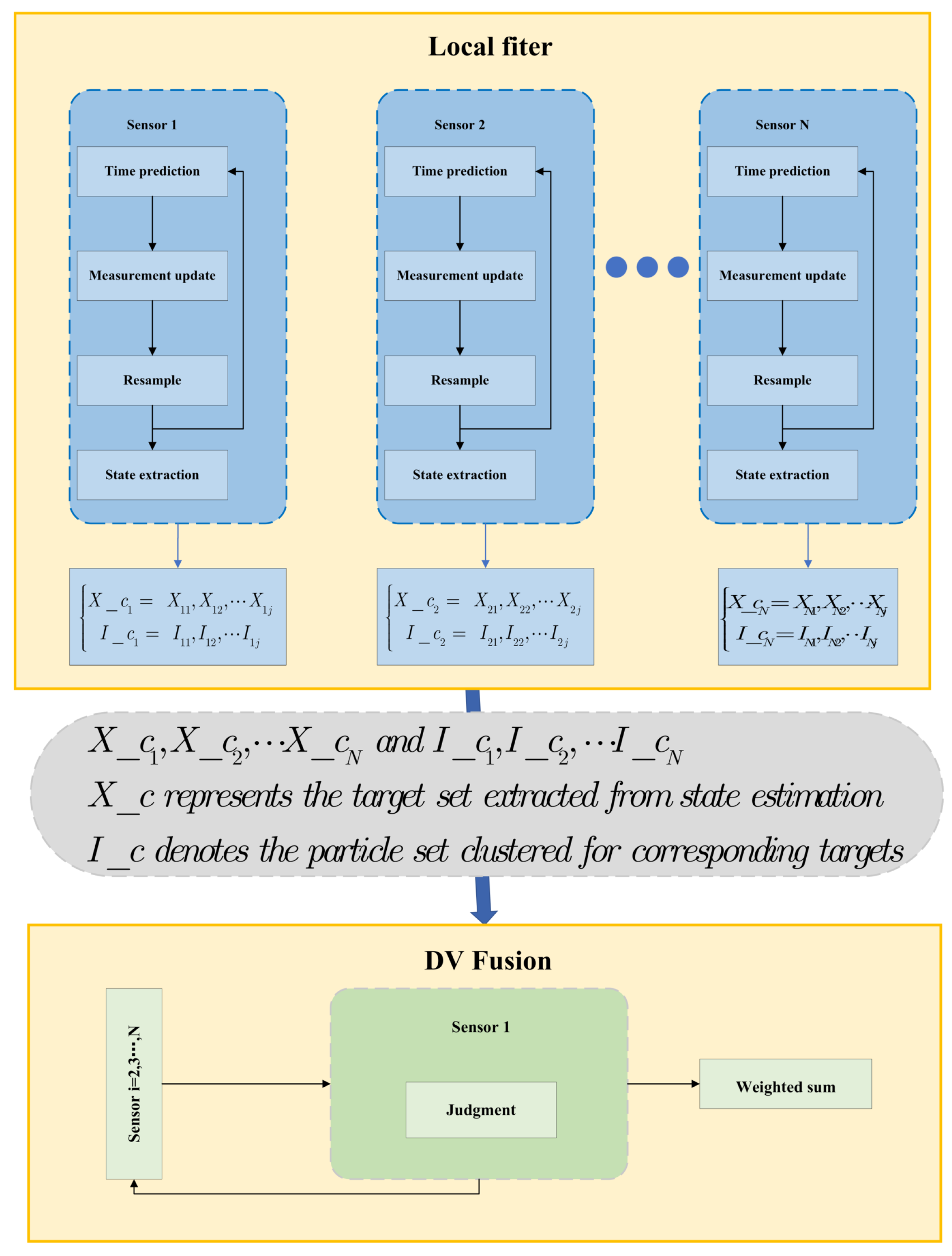
After the prediction, update, and resampling steps in the SMC-PHD filter, comes the state extraction procedure. The key to the DV fusion algorithm lies in determining whether the results extracted from the states of individual filters belong to the same target at the estimation level. From the data level (particle level), the fused state extraction is performed for the same target to obtain more accurate target information. The schematic diagram is shown in Figure 2, specifically:
Suppose that the information contained in the target i is x i = x x ˙ y y ˙ z z ˙ T , The position coordinates and velocities (including magnitude and direction) are represented in three spatial dimensions.
First, we introduce the aforementioned criteria for determination, which serve as a crucial step in this process.
The determination criteria are as follows: 1. The distance between the two targets must be less than a predetermined threshold γ ; 2. The direction of the velocities of the two targets must be consistent. If these criteria are satisfied, the targets will be classified as the same entity; otherwise, they will be classified as different entities. This can be expressed as follows:
x ¯ i x ¯ j < γ x ˙ i · x ˙ j > 0 , y ˙ i · y ˙ j > 0 , z ˙ i · z ˙ j > 0
It is important to note that the selection of the threshold is crucial in this context. If the threshold is set too large, it may result in different targets moving in the same direction being misclassified as a single entity, leading to an underestimation of the actual number of tracked targets. Conversely, if the threshold is set too small, slight differences in estimates from different sensors for the same target at the same moment may result in misclassification as distinct targets, ultimately causing an overestimation of the tracked target count. Therefore, the choice of threshold must be flexible. In practical applications, factors such as the size of the tracked targets, the potential for target formation, and the minimum spacing between targets in formation must be taken into account. A careful consideration of these factors enables the determination of a reasonable judgment threshold.
The following section presents the specific fusion process:

4.2.1. Judgement

The data from each sensor undergoes filter processes, and the outputs after state extraction include a set of target information obtained through clustering (where target information comprises positional coordinates and velocity magnitude and direction) denoted as X c i = X i 1 , X i 2 , X i j , as well as particle groups I c i = I i 1 , I i 2 , I i j representing the positions of each target. Among them X i j = x ¯ x ˙ y ¯ y ˙ z ¯ z ˙ T , The target information X i j is derived from the clustering of the particle set I i j . The particle group I i j not only contains the particles clustered into target information but also includes the weights of each particle, denoted as I i j = P i j , W i j , where P i j represents the set of particles forming the targets, and P i j corresponds to the weights associated with the particles in W i j .
Based on the aforementioned criteria, we define the judgment formula as follows:
J u d g e ( X , Y ) = J u d g e D i s ( X ¯ , Y ¯ ) + J u d g e V e l ( X ˙ , Y ˙ )
where the target X i j = x ¯ x ˙ y ¯ y ˙ z ¯ z ˙ T consists of the position set X ¯ = x ¯ y ¯ z ¯ T and the velocity set X ˙ = x ˙ y ˙ z ˙ T .
Let us examine the two components of the judgment formula separately.
The first term is as follows:
J u d g e D i s ( X ¯ , Y ¯ ) = 1 i f X ¯ Y ¯ < γ 0 e l s e
The second term is as follows:
J u d g e V e l ( X ˙ , Y ˙ ) = i f x ˙ X · x ˙ Y > 0 1 a n d y ˙ X · y ˙ Y > 0 a n d z ˙ X · z ˙ Y > 0 0 e l s e
Next, based on the clustering results of sensor 1, we will assess the clustering results of sensor 2, denoted as X c 2 = X 21 , X 22 , X 2 j , according to the judgment formula. We will sequentially evaluate the clustering results in sensor 1, denoted as X c 1 = X 11 , X 12 , X 1 j .
First, we will perform the judgment on the component X 21 .
Based on the judgment formula:
J u d g e ( X 11 , X 21 ) =   J u d g e D i s ( X ¯ 11 , X ¯ 21 ) +   J u d g e V e l ( X ˙ 11 , X ˙ 21 )
If
J u d g e ( X 11 , X 21 ) = 2
This indicates that the target from sensor 2 is the same as the target X 11 from sensor 1. At this point, a particle set merging operation will be performed:
I 11 = I 11 I 21 = { P 11 P 21 , W 11 W 21 }
If
J u d g e ( X 11 , X 21 ) 2
This indicates that the target X 21 from sensor 2 is not the same as the target X 11 from sensor 1. In this case, we will perform a judgment between the component X 21 from sensor 2 and the component X 12 from sensor 1:
J u d g e ( X 12 , X 21 ) =   J u d g e D i s ( X ¯ 12 , X ¯ 21 ) +   J u d g e V e l ( X ˙ 12 , X ˙ 21 )
Ultimately, there are two possible scenarios for the target X 21 in sensor 2:
(1)
The target X 21 is determined to be the same as a certain target X 1 i from sensor 1;
In this case, a normal particle set merging operation will be carried out.
I 1 i = I 1 i I 21 = P 1 i P 21 , W 1 i W 21
(2)
The target X 21 is determined to be a different target from all targets X 1 i in sensor 1;
In this case, it is considered a new target and will be added to sensor 1.
X c 1 = X c 1 X 21 = X 11 , X 12 , X 1 j , X 21 = X 11 , X 12 , X 1 j , X 1 ( j + 1 ) I c 1 = I c 1 I 21 = I 11 , I 12 , I 1 j , I 21 = I 11 , I 12 , I 1 j , I 1 ( j + 1 )
At this point, the target X 21 in sensor 2 has been fully assessed. Next, we will sequentially evaluate the target X 22 in sensor 2 against the targets such as X 11 in sensor 1. This process will continue until the judgment of all targets X c i across the sensors is completed with respect to the continuously updated targets X 11 in sensor 1. After the judgment phase, we obtain a set of newly identified targets X c 1 = X 11 , X 12 , X 1 k and a corresponding particle set I c 1 = I 11 , I 12 , , I 1 k in sensor 1.

4.2.2. Weighted Sum

Based on the judgment steps, we obtain the particle swarm I c 1 = I 11 , I 12 , , I 1 k , wherein the particle set I 11 = P 11 , W 11 contains particle information P 11 = p 1 , p 2 , , p N and particle weights W 11 = w 1 , , w N . Next, we will calculate the weighted sum of the particle set P 11 , W 11 within I 11 to obtain the new target information:
X 1 = i = 1 N p i · w i j = 1 N w j
Similarly, based on I c 1 = I 11 , I 12 , , I 1 k and the (27), we can derive X c = X 1 , X 2 , X k .

4.2.3. Theoretical Interpretation and Robustness Analysis

While the DV fusion algorithm appears heuristic at first glance, this subsection establishes its theoretical foundations within the Bayesian framework, demonstrates its robustness properties, and provides rigorous justification for the threshold parameter selection.
Bayesian Interpretation of DV Fusion
The DV fusion algorithm can be formally interpreted as a hard-decision approximation of the Maximum A Posteriori (MAP) association rule in multi-sensor multitarget tracking. Consider the posterior probability that two particle sets P i and P j extracted from sensors i and j originate from the same target τ :
p ( same target | P i , P j ) = p ( P i , P j | same target ) p ( same target ) p ( P i , P j ) .
Under the assumption that particle sets represent Gaussian mixtures (as commonly assumed in SMC-PHD implementations), the distance-velocity criteria correspond to evaluating the likelihood ratio:
Λ ( P i , P j ) = N ( x ¯ i x ¯ j ; 0 , Σ pos ) · I ( x ˙ i · x ˙ j > 0 ) N ( x ¯ i x ¯ j ; 0 , γ 2 I ) ,
where Σ pos denotes the positional covariance, and I ( · ) is the indicator function for velocity consistency. The threshold γ serves as the association gate, transforming the continuous likelihood ratio test into a binary decision:
Decision = Merge if x ¯ i x ¯ j < γ and velocity consistent , Separate otherwise .
This formulation reveals that DV fusion effectively approximates the Geometric Average (GA) fusion of PHD densities [13] at the particle level. While GA fusion requires computing the product of multi-target densities (computationally expensive), DV fusion achieves a similar effect by selecting geometrically consistent particles, thereby approximating the Kullback-Leibler Average (KLA) without explicit density multiplication.
Robustness Guarantees via Robust Statistics
The threshold-based association employed in DV fusion can be viewed through the lens of robust statistics. Traditional AA/GA fusion relies on weighted averaging, where the influence of outlier sensors (with poor measurement quality) decays linearly with the weight. However, in scenarios with significant data inequality (e.g., one high-quality sensor and two degraded sensors), even small non-zero weights assigned to poor sensors can bias the fusion result.
The DV fusion algorithm implements an implicit rejection mechanism equivalent to the Huber loss function (or truncated quadratic loss) in robust regression. Define the association cost function:
ρ ( d ) = 1 2 d 2 if d < γ , γ d 1 2 γ 2 if d γ ,
where d = x ¯ i x ¯ j represents the spatial discrepancy. When d γ , the cost becomes linear rather than quadratic, effectively limiting the influence of gross errors (outliers) from low-quality sensors.
This property ensures that DV fusion satisfies the breakdown point criterion: the algorithm remains stable even when up to 50 % of the sensors exhibit severe degradation (as demonstrated in Experiment 2), whereas AA/GA fusion with uniform weights suffers from unbounded bias as the number of degraded sensors increases.
Physical Interpretation and Selection of Threshold γ
The threshold parameter γ is not merely an empirical tuning parameter but possesses clear physical significance as the minimum resolvable distance (MRD) between distinct targets. In the context of passive radar systems, γ should be selected based on the sensor’s intrinsic resolution capabilities:
γ = α · σ r 2 + ( R · σ θ ) 2 + ( R · σ ϕ ) 2 ,
where R represents the typical target range, σ r , σ θ , σ ϕ denote the standard deviations of range, azimuth, and elevation measurements, respectively, and α is a confidence coefficient (typically α = 3 corresponding to the 3 σ rule).
Theoretical Justification: Equation (32) derives from the Cramér-Rao Lower Bound (CRLB) for bistatic radar systems. When γ is set according to (32), the probability of false association (merging two distinct targets) is bounded by:
P fa 2 Φ ( α ) ,
where Φ ( · ) is the standard normal CDF. For α = 3 , P fa 0.27 % , ensuring high reliability in target discrimination.
Furthermore, the analysis in Section 5.3.5 demonstrates that the OSPA metric exhibits a broad minimum in the range γ [ 800 , 2000 ] m, indicating that the algorithm performance is not critically sensitive to the exact value of γ within this physically meaningful interval. This insensitivity arises because the velocity consistency criterion ( x ˙ i · x ˙ j > 0 ) provides additional discrimination power, reducing the reliance on precise spatial thresholding.
In summary, while γ appears as a free parameter, its selection is grounded in the fundamental resolution limits of the radar system, and the algorithm exhibits graceful degradation rather than catastrophic failure when γ deviates from the optimal value.

4.2.4. Assumptions and Limitations

While the DV fusion algorithm provides effective solutions for data inequality scenarios, its operation relies on several key assumptions that should be explicitly stated:
Target State Separability:The algorithm assumes that target states are spatially distinguishable, meaning that the states of different targets can be distinguished by distance and velocity criteria. If the target states are not separable (e.g., dense target formations with inter-target spacing smaller than γ ), the effectiveness of the DV algorithm may be affected, potentially causing distinct targets to be erroneously merged.
Sensor Independence: The DV algorithm assumes that measurements from different sensors are conditionally independent given the target states. If there is a strong correlation between sensor noises (e.g., due to common electromagnetic interference sources or shared clock errors), further adjustments to the algorithm may be necessary to account for these dependencies.
Velocity Consistency: The algorithm assumes that targets do not exhibit abrupt velocity direction changes between consecutive scans. Maneuvers with instantaneous velocity reversals may cause the velocity consistency check ( x ˙ i · x ˙ j > 0 ) to reject valid associations of the same target across sensors.
Computational Resources: The DV algorithm requires particle filtering and particle-level data fusion, demanding sufficient computational resources. While Section 4.3 demonstrates polynomial scalability, real-time applications with extremely large particle counts ( N particle > 5000 ) may require hierarchical processing or parallelization strategies as discussed in Section 4.3.2.
These limitations suggest that the DV fusion is particularly suited for scenarios with moderate target density and independent sensor operation, which align with typical passive radar network deployments in surveillance applications.

4.3. Complexity Analysis

4.3.1. Detailed Derivation of Complexity Terms

Table 1 summarizes the asymptotic complexity expressions. Here we provide the detailed theoretical derivation for each term, particularly explaining the origin of the ( M 1 ) · N particle 2 complexity in DV-SMC-PHD and its implications for algorithm scalability.
Baseline: Local SMC-PHD Filtering ( N particle · N target )
The common term O ( T · N particle · N target ) represents the baseline computational cost for standard SMC-PHD filtering operations at a single sensor. This includes the following:
  • Prediction: Sampling particles from the proposal distribution for existing and newborn targets, requiring O ( N particle ) operations;
  • Update: Computing likelihoods for each particle given the measurement set Z k , requiring O ( N particle · | Z k | ) operations, where | Z k | is the cardinality of the measurement set (typically proportional to N target in moderate clutter);
  • Resampling: Systematic or multinomial resampling of particles, requiring O ( N particle ) operations.
Thus, for a single sensor, the complexity scales linearly with both the number of particles and the number of targets. When considering M sensors, this term scales linearly with M as each sensor performs independent local filtering.
DV Fusion Overhead ( ( M 1 ) · N particle 2 )
The distinctive term ( M 1 ) · N particle 2 represents the computational cost of the Distance-Velocity fusion mechanism at the particle level. This complexity arises from the following operations:
Step 1: Particle-Level Association
Unlike AA or GA fusion, which operates on density functions, DV fusion performs an explicit association between individual particles from different sensors. For each particle set I 1 i from sensor 1 (acting as the reference frame) and particle set I m j from sensor m ( m { 2 , , M } ), the algorithm evaluates the distance-velocity criteria:
Judge ( X 1 i , X m j ) = JudgeDis ( X ¯ 1 i , X ¯ m j ) + JudgeVel ( X ˙ 1 i , X ˙ m j ) .
In the worst case, comparing all particles from sensor 1 with all particles from sensor m requires O ( N particle 2 ) operations. The comparison involves:
  • Euclidean distance computation: X ¯ 1 i X ¯ m j (3D vector subtraction and norm, O ( 1 ) per pair);
  • Velocity consistency check: X ˙ 1 i · X ˙ m j > 0 (dot product, O ( 1 ) per pair).
Step 2: Particle Set Merging
When particles satisfy the association criteria (Judge = 2 ), the algorithm performs set union operations:
I 1 i = I 1 i I m j = { P 1 i P m j , W 1 i W m j } .
In the worst case, where all particles from sensor 1 associate with all particles from sensor m, the union operation involves copying O ( N particle ) particles. However, the dominant cost remains the pairwise comparison ( O ( N particle 2 ) ) rather than the copying operation.
Step 3: Sequential Pairwise Fusion
The DV algorithm fuses sensors sequentially: sensor 1 is fused with sensor 2, then the result is fused with sensor 3, and so on until sensor M. This results in exactly ( M 1 ) pairwise fusion operations. Therefore, the total fusion overhead is O ( ( M 1 ) · N particle 2 ) .
Space Complexity Analysis ( O ( M · N particle 2 ) )
The space complexity for DV-SMC-PHD arises from three memory requirements:
Storage of Local Particle Sets
Each of the M sensors maintains a complete particle set representing the PHD, requiring O ( M · N particle ) storage.
Particle Merge Buffers
During the fusion process, temporary storage is required for particle set unions. In the worst case, when merging large particle sets from multiple sensors, the intermediate representation may require O ( N particle 2 ) storage to hold the Cartesian product of associated particles before normalization.
Association Tracking
The algorithm maintains data structures to track which particles from different sensors have been associated (the judgment matrix), requiring O ( ( M 1 ) · N particle 2 ) storage in the worst-case scenario where all-to-all associations are considered before pruning.
Thus, the dominant term is O ( M · N particle 2 ) , reflecting the need to simultaneously maintain particle sets from all sensors and intermediate merge results.

4.3.2. Scalability Considerations and Acceleration Strategies

While the theoretical complexity includes a quadratic term in N particle , several practical considerations mitigate the computational impact and ensure scalability:
Early Termination via Gating
The distance threshold γ acts as a hard gate that eliminates the majority of particle pairs early in the computation. When X ¯ 1 i X ¯ m j γ , the algorithm immediately rejects the pair without computing velocity consistency. In practice, with appropriate γ selection (Section “Physical Interpretation and Selection of Threshold γ ”), over 90% of particle pairs are rejected in the first step, reducing the average-case complexity significantly below the worst-case O ( N particle 2 ) .
Hierarchical Processing via State Extraction
Although the worst-case analysis assumes direct particle-particle comparison, the actual implementation (Algorithm in Section 4.2) first performs state extraction (clustering particles into target hypotheses). When the number of targets N target N particle (typical scenario: N target 10 , N particle 1000 ), the judgment can be performed at the target level rather than the particle level:
  • Cluster particles into N target hypotheses ( O ( N particle · N target ) );
  • Perform judgment on N target centers rather than N particle particles ( O ( N target 2 ) );
  • Merge only the particle sets of associated targets ( O ( N particle ) per merge).
This hierarchical approach reduces practical complexity to O ( ( M 1 ) · N target · N particle ) , which is significantly lower than O ( N particle 2 ) when N target N particle .
Parallelization Strategies
The ( M 1 ) pairwise fusion operations exhibit significant parallelization potential:
  • Sensor-Level Parallelism: The local SMC-PHD filtering at each sensor (Stage 1) is embarrassingly parallel across M processing units;
  • Fusion Parallelism: While the sequential fusion (1 vs. 2, then result vs. 3, etc.) appears sequential, alternative fusion topologies (tree-structured or star-structured) can reduce the critical path to O ( log M ) fusion stages;
  • Particle-Level Parallelism: The distance-velocity judgments and particle merging operations are independently executable across particle indices, making them suitable for GPU acceleration.
Adaptive Load Balancing via Data Inequality
In scenarios with significant data inequality (Experiment 2), sensors with poor quality (high noise coefficients k i ) produce more diffuse particle distributions with higher uncertainty. The DV fusion naturally identifies and effectively excludes these low-quality sensors early in the process (fewer particles pass the judgment criteria), reducing the effective N particle for subsequent fusion operations.

4.3.3. Comparative Complexity Analysis with AA/GA Fusion

Table 1 provides the asymptotic comparison. Here we analyze the practical implications:
AA-SMC-PHD ( M · N particle )
Arithmetic average fusion computes the weighted sum of PHD densities:
D fused ( x ) = m = 1 M w m · D m ( x ) .
This requires only element-wise addition of particle weights ( O ( N particle ) per sensor) with negligible overhead for normalization. The linear complexity O ( M · N particle ) makes AA fusion the most computationally efficient method. However, as demonstrated in Experiment 2, this efficiency comes at the cost of performance degradation under data inequality when using uniform weights.
GA-SMC-PHD ( M · N particle 2 )
Geometric average fusion computes the product of densities:
D fused ( x ) m = 1 M D m ( x ) w m .
In particle-based implementations, this requires operations proportional to the product of particle counts across sensors, leading to O ( N particle 2 ) complexity when computing pairwise interactions for the geometric mean. The factor M (rather than ( M 1 ) ) arises because GA fusion typically processes all sensors simultaneously in a single consensus step, rather than sequentially.
DV-SMC-PHD ( ( M 1 ) · N particle 2 )
DV fusion operates at an intermediate complexity level. While it shares the N particle 2 scaling with GA fusion, the coefficient ( M 1 ) (sequential pairwise processing) and the early termination mechanisms described above often result in lower practical runtime than GA fusion. More importantly, DV fusion provides superior robustness to data inequality without requiring the weight optimization that GA fusion implicitly assumes.
Comparison with Centralized Fusion
For completeness, we contrast with centralized measurement fusion, where all measurements from M sensors are concatenated and processed by a single filter. This approach suffers from combinatorial complexity O ( | Z k | M ) due to the need to solve the measurement-to-target association problem across the joint measurement space. Both DV, AA, and GA fusion avoid this exponential complexity by performing local filtering first, then fusing densities (or states), making them scalable to larger sensor networks.
In summary, while DV-SMC-PHD introduces non-negligible O ( N particle 2 ) overhead compared to AA fusion, it avoids the performance degradation of simple averaging under data inequality, maintains polynomial scalability, and offers practical acceleration opportunities through hierarchical processing and parallelization.

5. Numerical Experiments

5.1. Parameters Settings

To ensure reproducibility and transparency, the detailed simulation parameters and data generation procedures are provided as follows:
Measurement Model and Noise Characteristics: The measurement vector for each sensor comprises bistatic range r b , bistatic velocity v b , azimuth angle θ , and elevation angle φ . The measurement noise w follows a zero-mean Gaussian distribution with diagonal covariance matrix R = diag ( σ r 2 , σ v 2 , σ θ 2 , σ φ 2 ) , where σ r = 30  m, σ v = 2  m/s, σ θ = σ φ = π / 180  rad. To simulate data inequality in Experiment 2, noise coefficients k i { 1 , 10 } are applied to sensors 1–3, resulting in effective standard deviations of σ r , i = k i · σ r .
Clutter Generation: Clutter measurements are generated according to a Poisson point process with rate λ c = 100 per scan. Clutter positions are uniformly distributed within the surveillance volume defined by x , y [ 5000 , 5000 ]  m and z [ 0 , 3000 ]  m.
Target Motion Parameters: The nine maneuver types (Section 3.1) are parameterized as follows: constant velocity (level flight): v [ 200 , 400 ]  m/s; coordinated turns: turn rate ω [ π / 6 , π / 6 ]  rad/s; acceleration/deceleration: a [ 10 , 10 ] m/s2; dive/climb: vertical rate z ˙ [ 50 , 50 ]  m/s. Target trajectories are generated by concatenating these basic maneuvers with random duration intervals of 5–15 time steps. The number of targets, their initial positions, as well as the times of their emergence and disappearance are detailed in Table 2.
Filter and Simulation Parameters: The target survival probability is set to P s = 0.99 , while the target detection probability is set to P D = 0.9 . Regarding the SMC-PHD filter algorithm, each expected target is assigned a particle count of 1000. Additionally, the lower limit for the total number of particles is set at 600, while the upper limit is set at 100 , 000 . The total duration of the simulation is defined as k = 100 .
Monte Carlo Simulation Protocol: All performance metrics (OSPA, target number estimates) are averaged over N m c = 100 independent Monte Carlo runs. In each run, target birth/death times, initial states, and clutter realizations are independently randomized while maintaining the statistical parameters described above. The OSPA metric parameters are set to p = 1 (order) and c = 1200 (cutoff distance). In order to better reflect the stability of the DV algorithm, this article adopts a Monte Carlo simulation experiment, with 100 trials, so the subsequent target number tracking figure is not an integer.

5.2. Implementation Details

To ensure exact reproducibility of the experimental results, we provide the following implementation specifications derived from our MATLAB R2023b codebase:
Clustering Procedure (State Extraction): Following the SMC-PHD update step, we employ a custom weighted k-means clustering algorithm (our_kmeans) to extract target states from the particle set. The specific implementation details are as follows:
  • Initialization: Cluster centers are initialized by iteratively selecting random particles from the remaining unclustered set. The first center is chosen randomly, and subsequent centers are selected from particles not yet assigned to existing clusters.
  • Weight Constraint: Particles are assigned to the nearest cluster until the cumulative weight of that cluster exceeds 1.0. Once this threshold is reached, a new cluster is initiated. This ensures each extracted target corresponds to approximately one unit of weight (i.e., one target).
  • Maximum Iterations: The algorithm performs 10 iterations of iterative refinement, where cluster centers are recomputed as the weighted mean of assigned particles, and particles are reassigned to the nearest center subject to the weight constraint.
  • Pruning: Clusters with total weight less than 1 are discarded as noise artifacts, corresponding to the condition sum(w_update(I_c{j})) > 1 in the implementation.
Birth Model: Newborn targets are generated according to a multi-component Gaussian birth model with the following exact specifications:
  • Number of Components: L birth = 4 Gaussian components, each corresponding to a potential target birth location.
  • Birth Weights: Each component has weight w birth ( i ) = 0.025 (2.5%), giving a total birth intensity of λ b = 0.1 per scan.
  • Birth Means: The four birth means are located at the following:
    m birth ( 1 ) = [ 2300 , 0 , 2300 , 0 , 2000 , 0 ] T , m birth ( 2 ) = [ 2300 , 0 , 2300 , 0 , 2000 , 0 ] T , m birth ( 3 ) = [ 2300 , 0 , 2300 , 0 , 2000 , 0 ] T , m birth ( 4 ) = [ 2300 , 0 , 2300 , 0 , 2000 , 0 ] T .
  • Birth Covariance: All components share the same covariance matrix P birth = diag ( [ 200 2 , 50 2 , 200 2 , 50 2 , 50 2 , 5 2 ] ) .
  • Particle Generation: For each expected target, J birth = 1000 particles are generated from the birth Gaussian mixture using systematic sampling.
Resampling Method: We employ multinomial resampling (implemented via randsample with replacement):
  • Sample Size: The resampled set size is determined as J rsp = min( N ^ k | k × 1000 , 100,000), where N ^ k | k is the estimated target number.
  • Weight Reset: Following resampling, all particle weights are reset to 1 / J rsp (uniform weights).
Target Existence Thresholds:
  • Single Sensor Extraction: A target is declared present if the total weight sum exceeds 1 (sum(w_update) > 1), and individual clusters are validated if their weight exceeds 1.
  • DV Fusion Validation: After fusing particle sets from multiple sensors, a target is confirmed if the fused weight exceeds 1 (sum(w_update(I_c{j})) > 1), accounting for the combined evidence from multiple sensors.
The simulation comprises six distinct experimental groups, each designed to evaluate specific aspects of the algorithm’s performance. The following sections provide a detailed description of the objectives and specific configurations for each experimental group.
(1)
Experiment 1: The primary objective of the first experiment is to validate that the proposed algorithm maintains superior fusion performance compared to existing AA and GA fusion algorithms under favorable sensor reception conditions. Specifically, the noise coefficients of all three receiving sensors are set to 1.
(2)
Experiment 2: The second experiment is designed to verify the effectiveness of the DV fusion algorithm under conditions of data inequality. Specifically, the noise coefficients of sensor 1 and sensor 3 are set to 10, while the noise coefficient of sensor 2 remains at 1.
(3)
Experiment 3: The third group aims to validate the robustness of the algorithm in dynamic environments. The experiment consists of two parts: dynamic SNR and mobile sensor networks. Dynamic SNR: The noise coefficient of the sensor changes every 5 time steps, with a variation range of 1–3. Mobile sensor networks: The sensors move linearly every 10 time steps, with a displacement of 300 m per movement. The specific movement directions are illustrated in the tracking results.
(4)
Experiment 4: The fourth experiment is conducted to evaluate the algorithm’s performance under simulated electromagnetic interference conditions. To simulate realistic scenarios, we introduce three complex factors to all three sensors: synthetic Rayleigh noise, and synthetic impulse interference. Regarding the Rayleigh noise, the scale parameter is set to 2. For the impulse interference, the noise coefficients of the sensors are randomly set to 15 at irregular time steps.
(5)
Experiment 5: The fifth experiment focuses on the analysis of the threshold parameter γ in the DV fusion algorithm.
(6)
Experiment 6: The sixth set of experiments involves changing the number of particles allocated to each target to analyze the impact on performance.
Essentially, both external radiation source radar and passive radar lack the ability to emit electromagnetic waves; they function solely as receiving devices, making them indistinguishable from sensors. For the sake of convenience and to maintain consistency in the term “sensor” throughout the article, subsequent references to passive radar and external radiation source radar will be denoted as sensors.

5.3. Simulation Results

5.3.1. Experiment 1

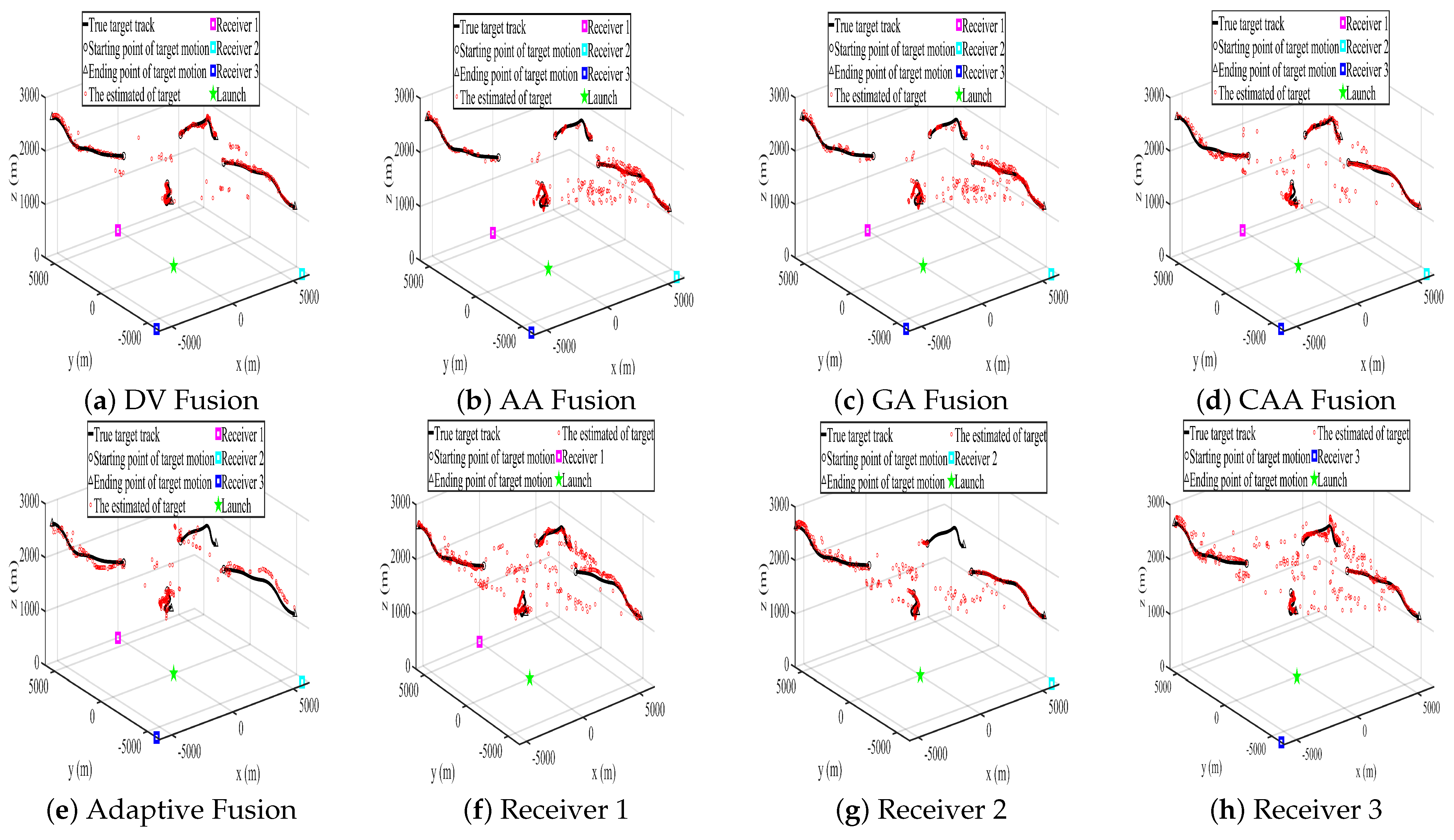
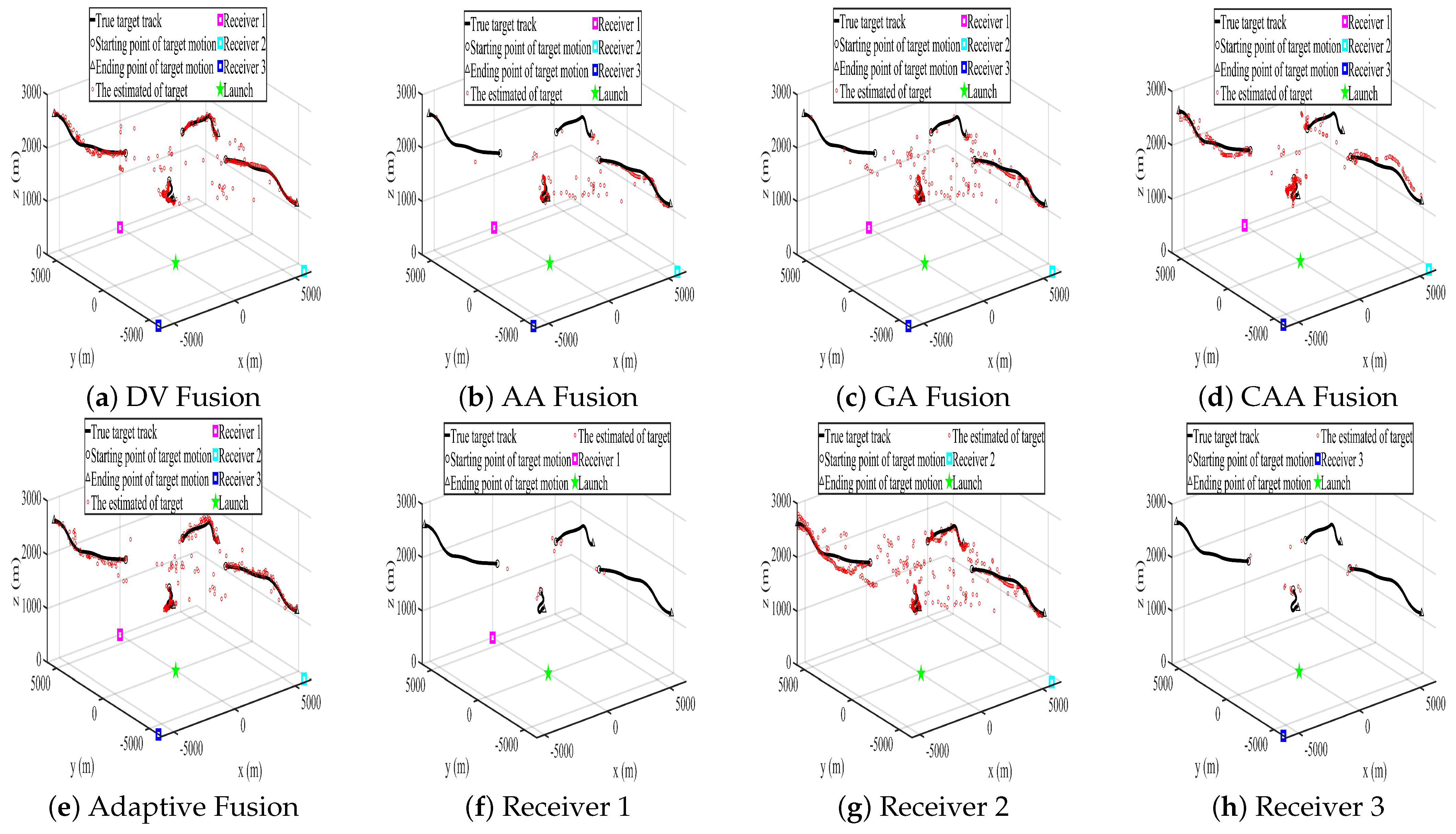
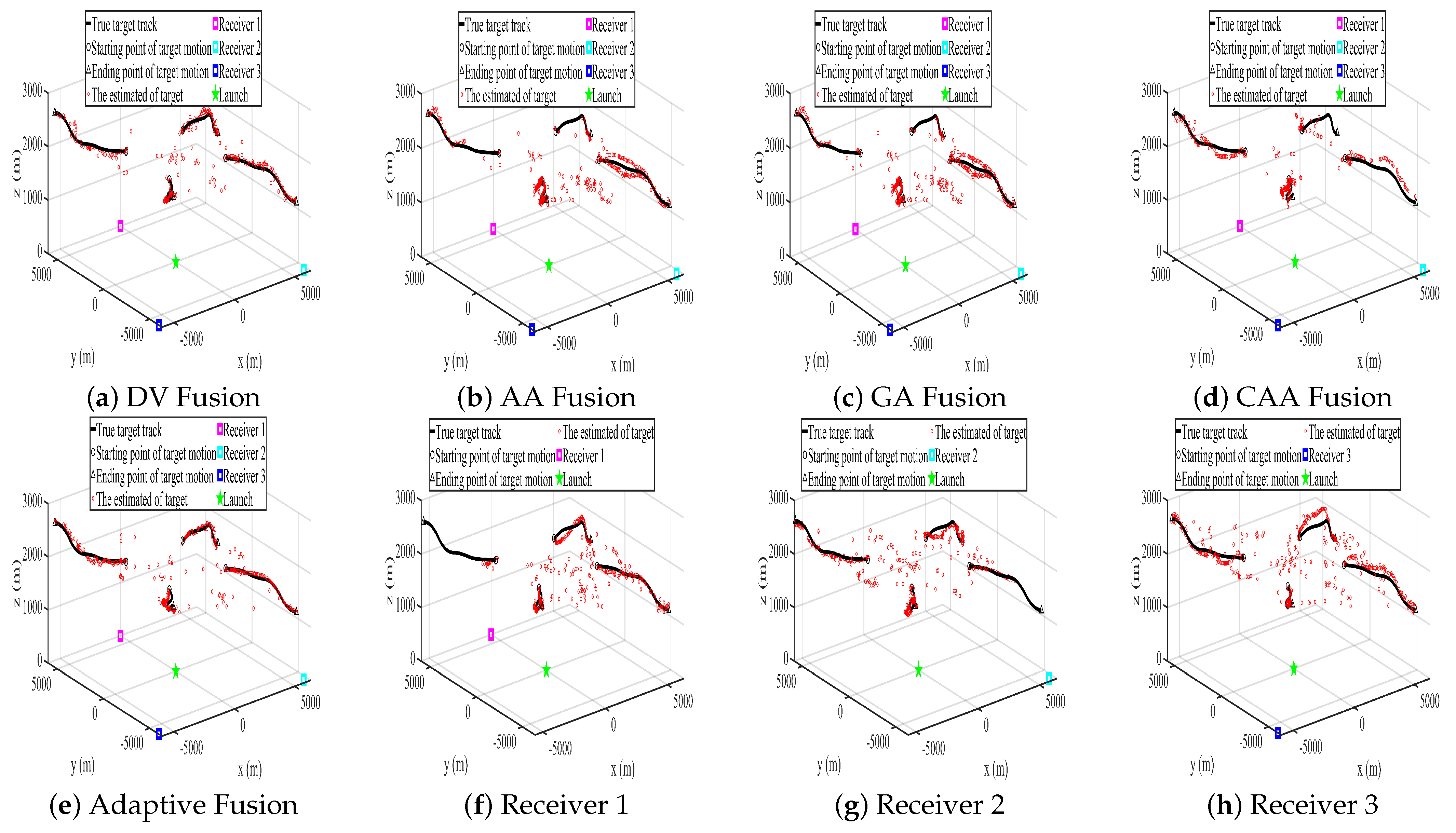
Figure 3 illustrates the trajectory tracking results of the five fusion algorithms (DV, AA, GA, CAA, Adaptive) alongside the outputs from the three sensors. From the results of all fusion strategies, it is evident that DV fusion achieves the optimal tracking performance, followed by CAA fusion and Adaptive fusion, while AA and GA fusion show relatively weaker performance even under the condition where all three sensors are functioning normally. Firstly, the fusion results obtained through DV fusion are superior to the tracking results of the three individual sensors and all other comparison fusion methods, a significant advantage that AA, GA, CAA, and Adaptive fusion cannot fully achieve. Secondly, DV fusion effectively eliminates many spurious tracking targets and repeated estimations of the same target that arise from the clustering algorithm used in the SMC-PHD filter, in contrast to the AA, GA, CAA, and Adaptive fusion approaches.
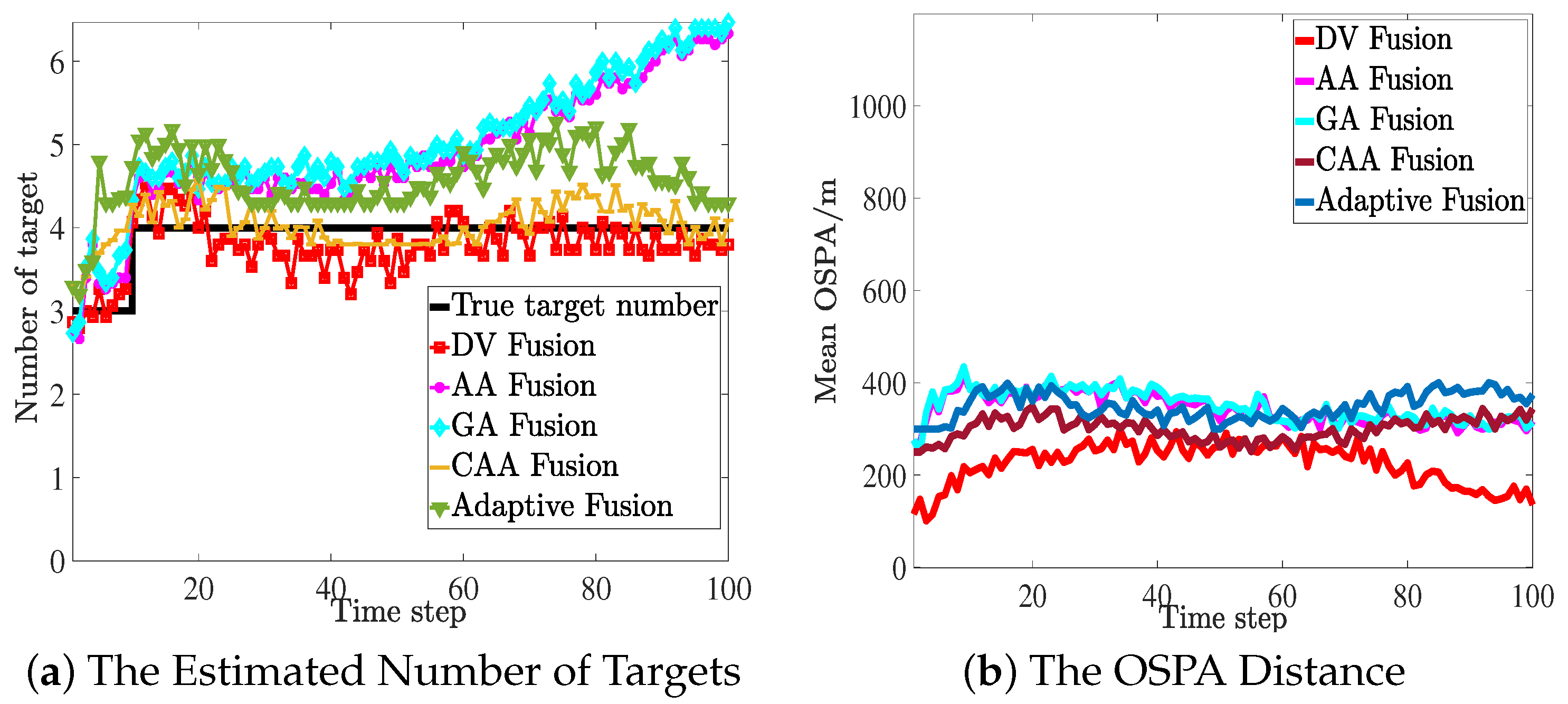
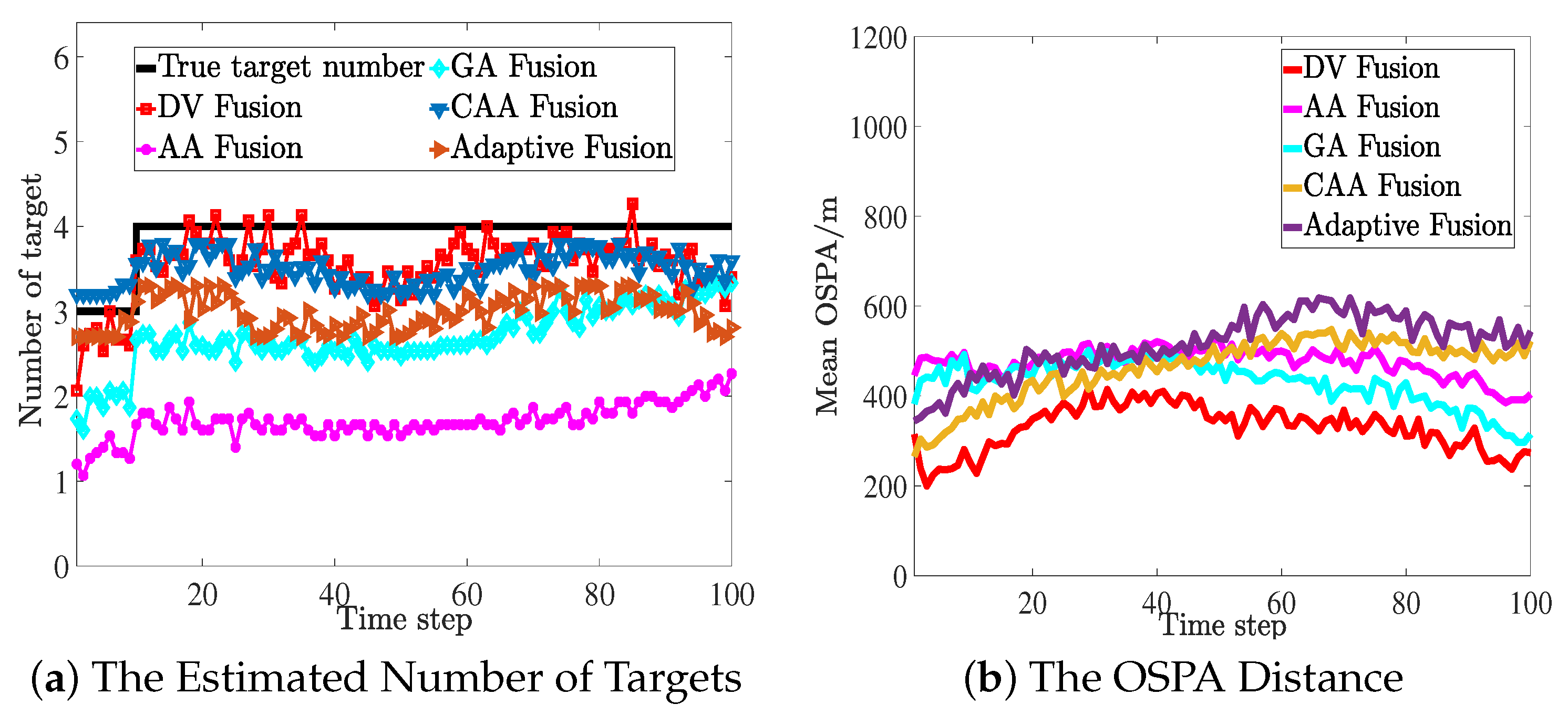
The OSPA plot and the target tracking quantity result graph illustrated in Figure 4a,b demonstrate key findings. The target tracking quantity result graph indicates that the DV fusion algorithm, in comparison to the AA fusion, GA fusion, CAA fusion, Adaptive fusion algorithms, and the three individual sensors, closely approximates the actual number of targets. This advantage lies in the DV algorithm, which evaluates at the estimation level and performs fusion at the particle level, significantly reducing the likelihood of repeated estimations of the same target. Moreover, the threshold applied during the final assessment effectively filters out the varying scattered point estimates obtained from each sensor. In terms of the OSPA value, the DV fusion algorithm yields the lowest OSPA, followed by CAA fusion and Adaptive fusion, while AA and GA fusion algorithms achieve higher OSPA values close to those of individual sensors. This finding illustrates that under these conditions, the DV fusion algorithm integrates the information from the various sensors more effectively, leading to a significant reduction in the OSPA and more accurate target tracking.

5.3.2. Experiment 2

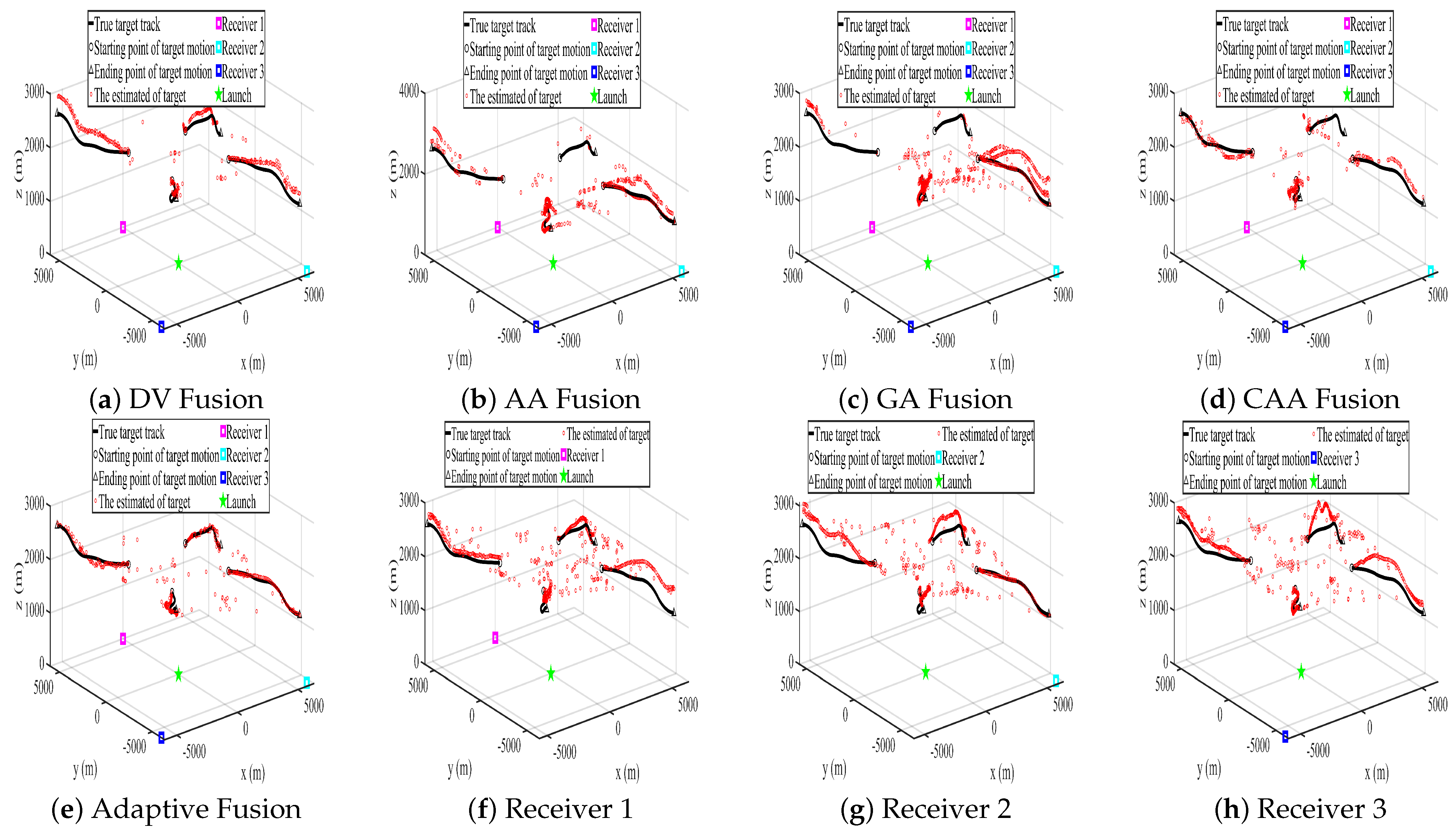
Figure 5 displays the trajectory tracking results of the five fusion algorithms (DV, AA, GA, CAA, Adaptive) alongside the outputs from the three individual sensors. In this experiment, a typical data inequality scenario is constructed, where only sensor 2 works normally while sensors 1 and 3 lose tracking capability, which is used to verify the robustness of the proposed algorithm under unbalanced sensing performance.
It is evident that sensors 1 and 3 lack any tracking capability for the targets, while sensor 2 is able to perform normal tracking, albeit with some scattered points and repeated estimations of the same target. Examining the results of the five fusion algorithms reveals significant differences. When using AA, GA, CAA, and Adaptive fusion, these methods rely on average weighting, consensus strategy, or adaptive weight allocation, which inevitably introduces invalid information from low-quality sensors. As a result, the fused outcomes are severely degraded and even worse than the performance of sensor 2 alone.
In contrast, the DV fusion algorithm does not depend on manual weight assignment or consensus iteration. Therefore, the fused results ensure that the performance will not be worse than that of any of the three sensors and effectively mitigates the negative impact of poorly performing stations. This demonstrates the effectiveness of the DV fusion algorithm under conditions of data inequality, as well as the improvement in tracking accuracy compared to the AA, GA, CAA, Adaptive fusion algorithms, and the individual sensors.
The accompanying OSPA plot and the target tracking quantity result graph further substantiate these conclusions. The DV fusion algorithm achieves the most accurate target number estimation and the lowest OSPA value, while CAA and Adaptive fusion perform better than AA and GA fusion, but still exhibit obvious performance degradation.
From the comparison chart of estimated numbers and OSPA results in Figure 6a,b, the DV algorithm outperforms all comparison methods, demonstrating its effectiveness and superiority in data inequality scenarios.

5.3.3. Experiment 3

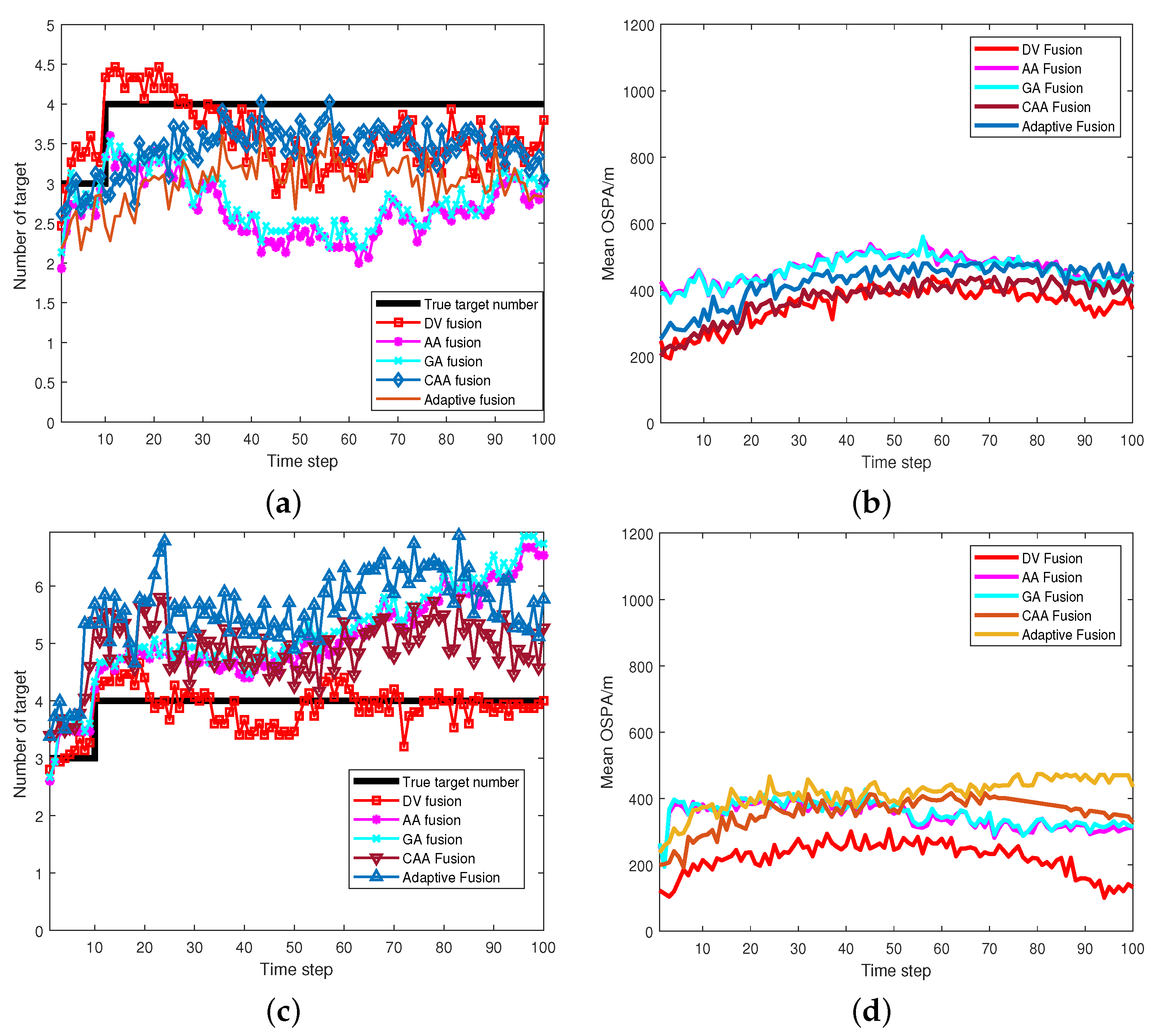
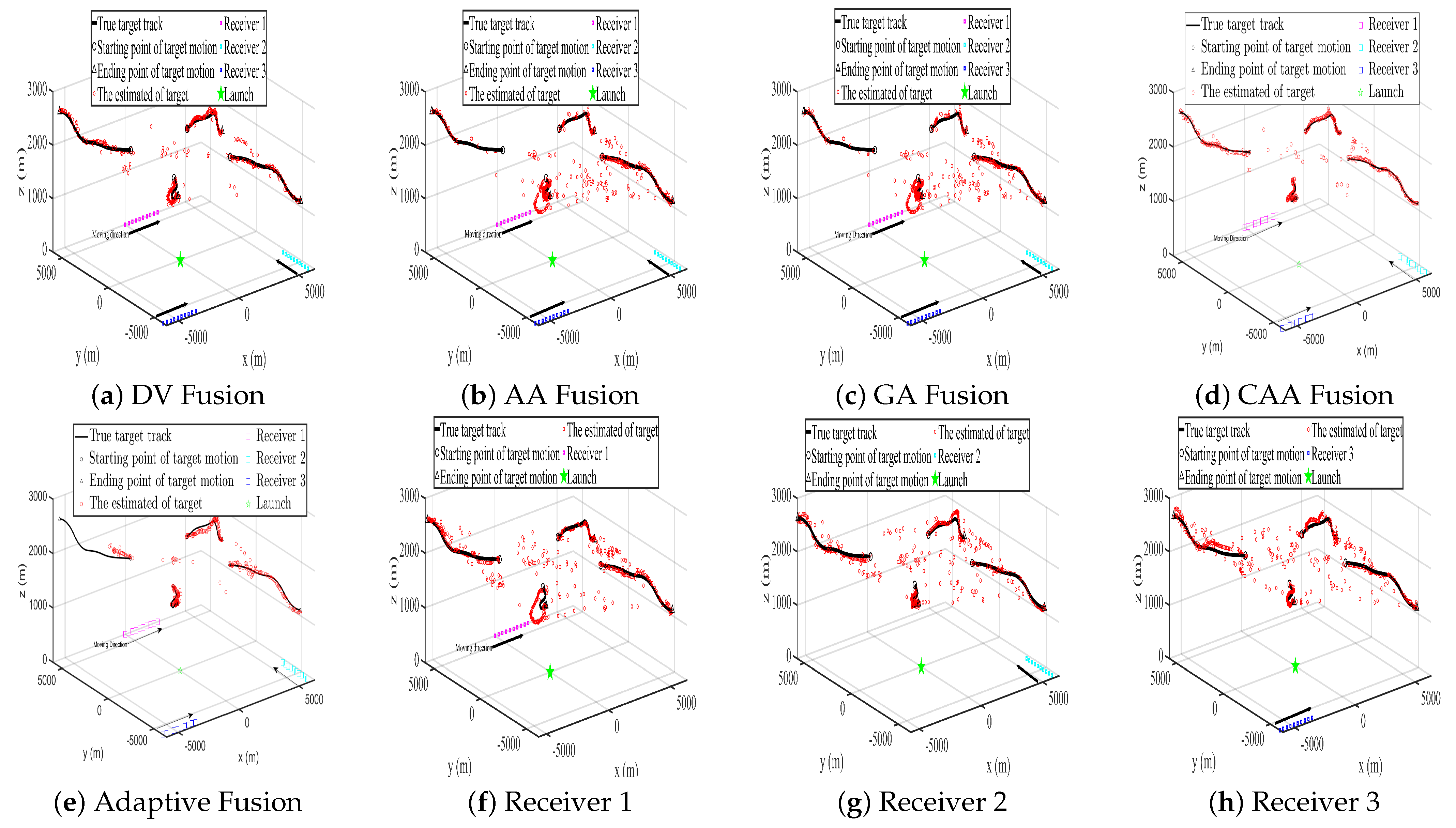
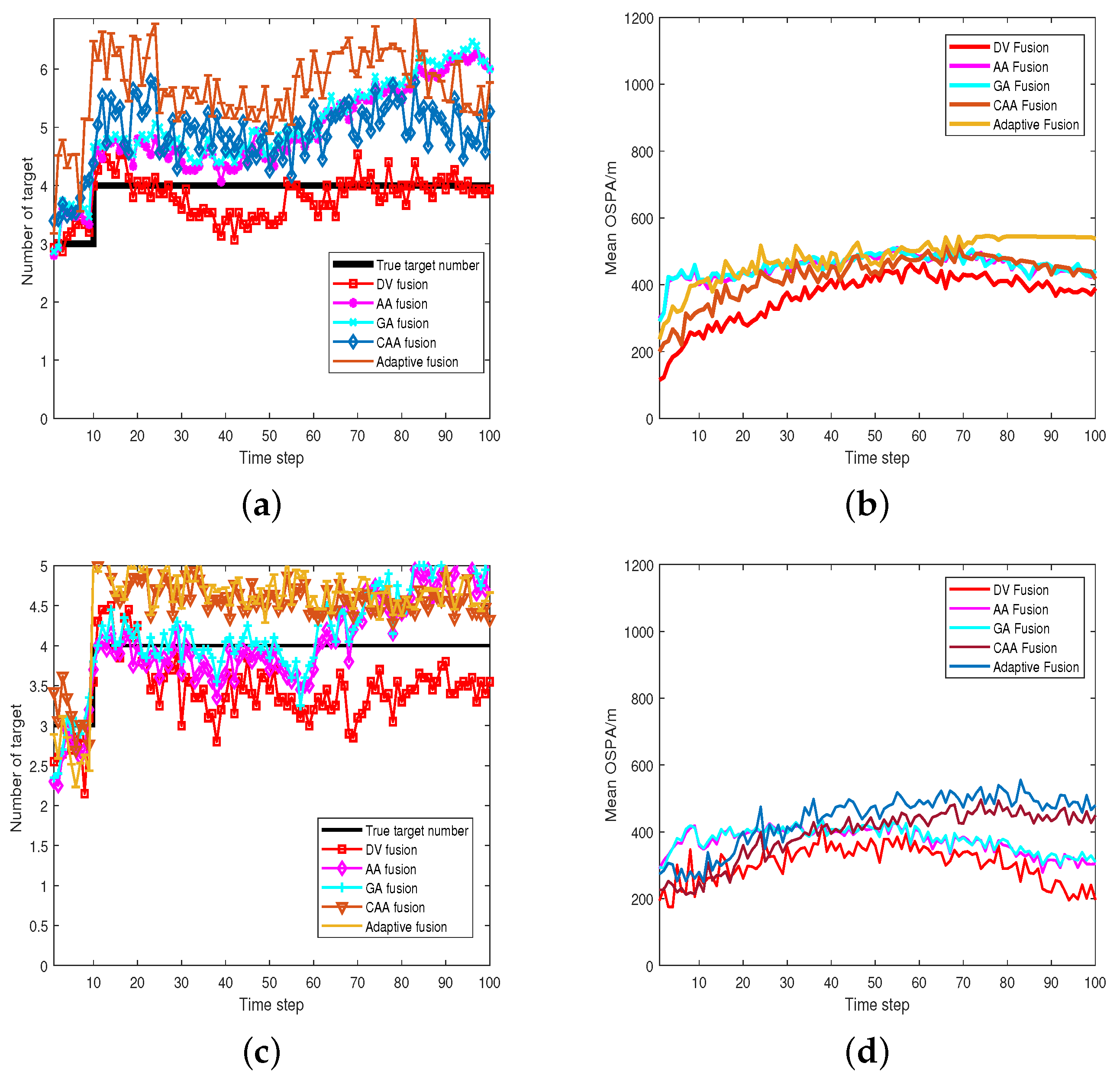
This experiment focuses on the performance verification in dynamic environments, including dynamic SNR and mobile sensor networks, to verify the robustness of the proposed DV fusion algorithm. Figure 7 shows the target number estimation and OSPA results of the five fusion algorithms. Figure 8 and Figure 9 display the trajectory tracking results of the five fusion algorithms (DV, AA, GA, CAA, Adaptive) and three individual sensors under dynamic conditions.
From the experimental results, under dynamic SNR and mobile sensor networks, the tracking performance of all algorithms decreases compared with static scenarios. However, the DV fusion algorithm still maintains the most stable and accurate tracking performance, which is significantly better than AA, GA, CAA, and Adaptive fusion algorithms.
The CAA and Adaptive fusion algorithms can achieve better performance than traditional AA and GA fusion, but they still rely on consensus processes or adaptive weight adjustment, leading to large fluctuations under dynamic changes. In contrast, the DV fusion algorithm uses distance and velocity consistency for target-level fusion, which is less affected by environmental dynamics and maintains strong robustness.
From the target number estimation and OSPA results, DV fusion obtains the closest estimation to the true target number and the lowest OSPA value, followed by CAA fusion and Adaptive fusion. The AA and GA fusion algorithms show the worst performance with large estimation errors. These results fully prove that the proposed DV fusion has stronger adaptability and robustness in dynamic tracking environments.

5.3.4. Experiment 4

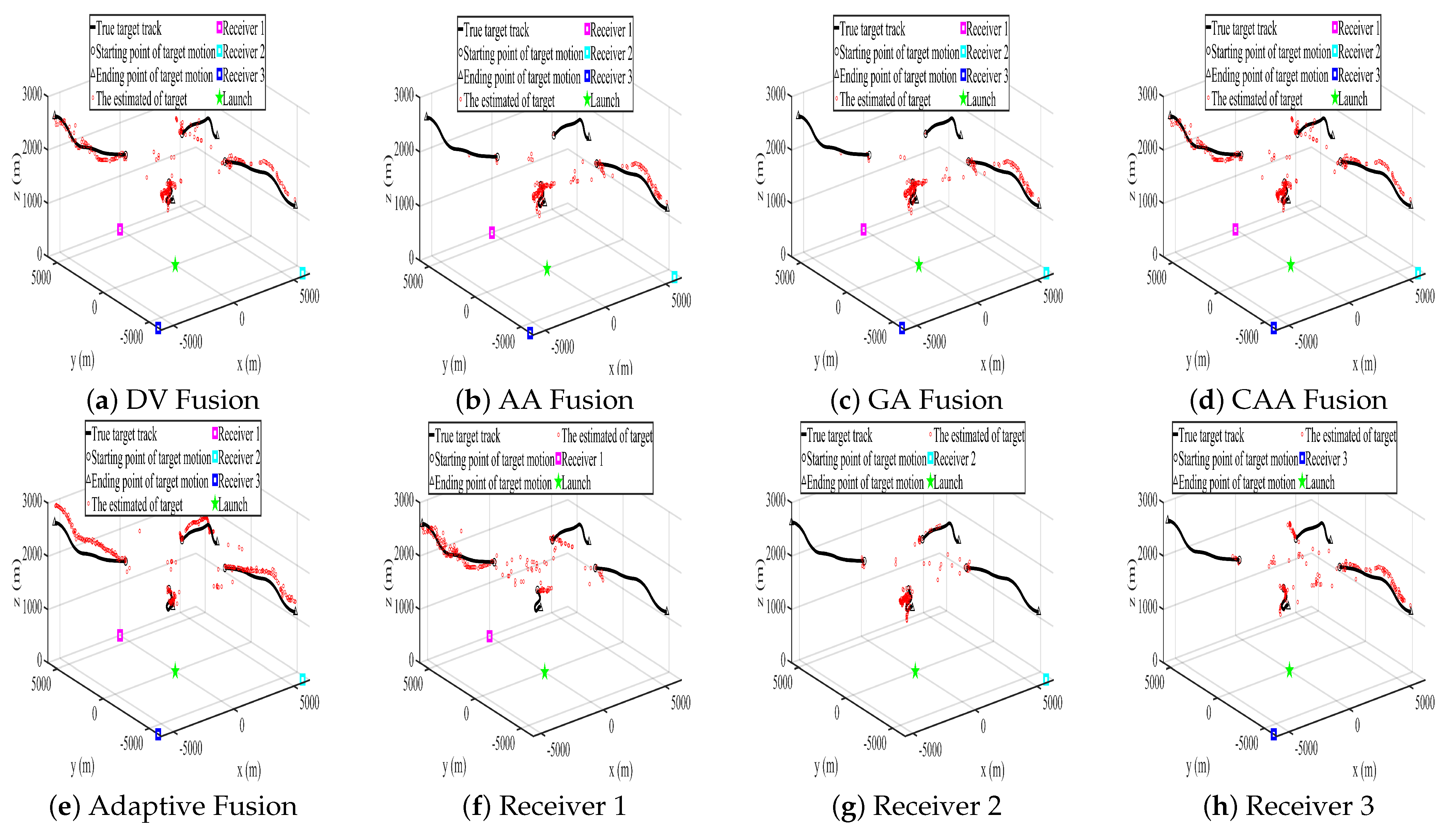
This experiment simulates complex electromagnetic interference environments, including Rayleigh noise and pulse interference, to verify the universality of the DV fusion algorithm. The tracking results of the five fusion algorithms (DV, AA, GA, CAA, Adaptive) and three sensors are illustrated in the corresponding Figure 10, Figure 11 and Figure 12.
Under both Rayleigh noise and pulse interference, the proposed DV fusion algorithm still achieves the best tracking performance. It can effectively suppress the impact of interference, maintain continuous target tracking, and avoid long-term interruption or loss of targets.
The CAA fusion and Adaptive fusion algorithms are superior to AA and GA fusion in anti-interference performance, but they cannot effectively eliminate the impact of invalid measurements like the DV fusion algorithm. The AA and GA fusion algorithms are seriously affected by interference, resulting in a sharp rise in OSPA and large deviations in target number estimation.
From the quantitative evaluation results, the DV fusion algorithm has the lowest OSPA and the most accurate target estimation under both interference types. The performance ranking is consistent with previous experiments: DV > CAA > Adaptive > GA > AA. These results demonstrate that the DV fusion algorithm has strong universality and stability in complex electromagnetic environments.

5.3.5. Experiment 5: Threshold Parameter γ Sensitivity Analysis

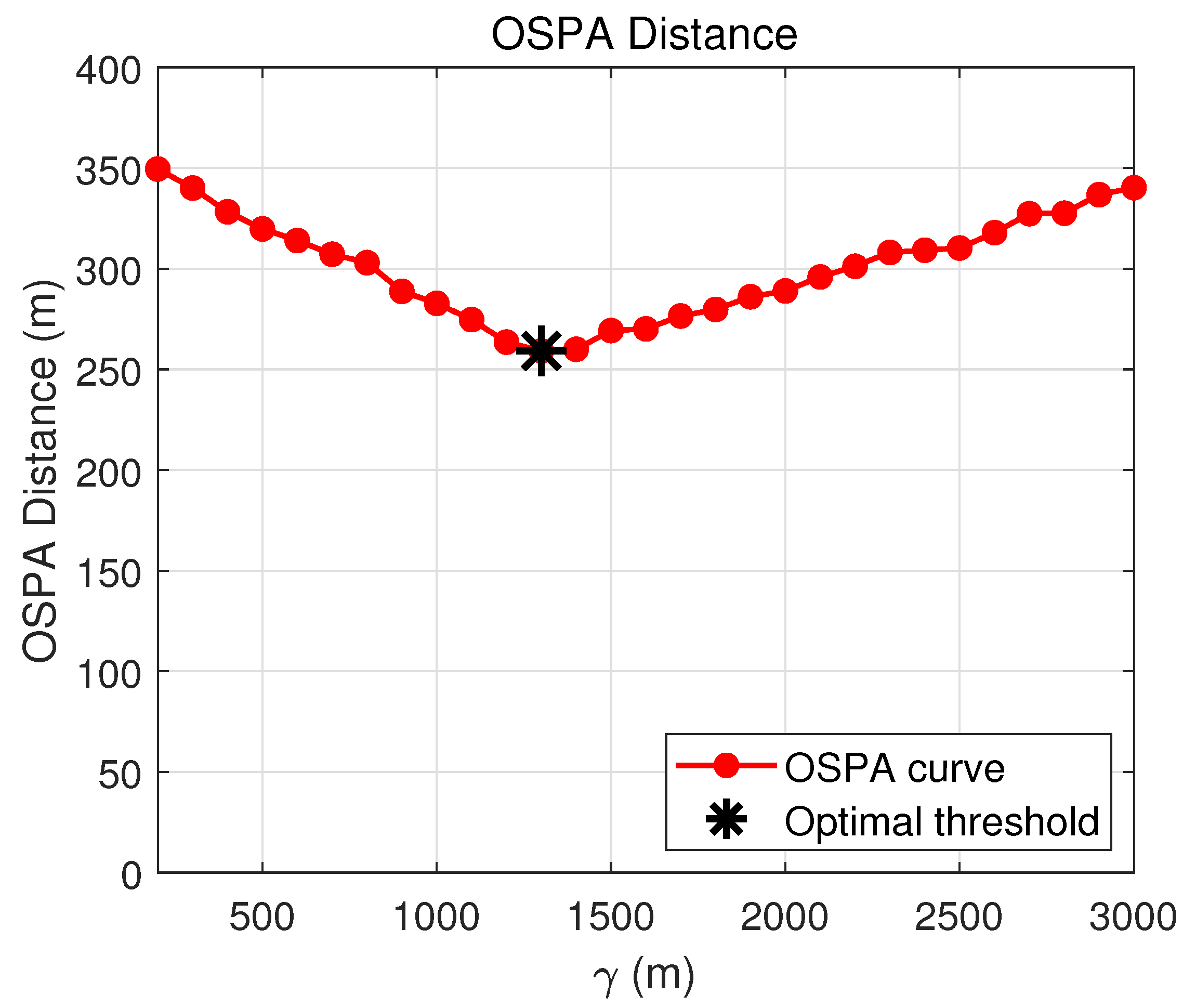
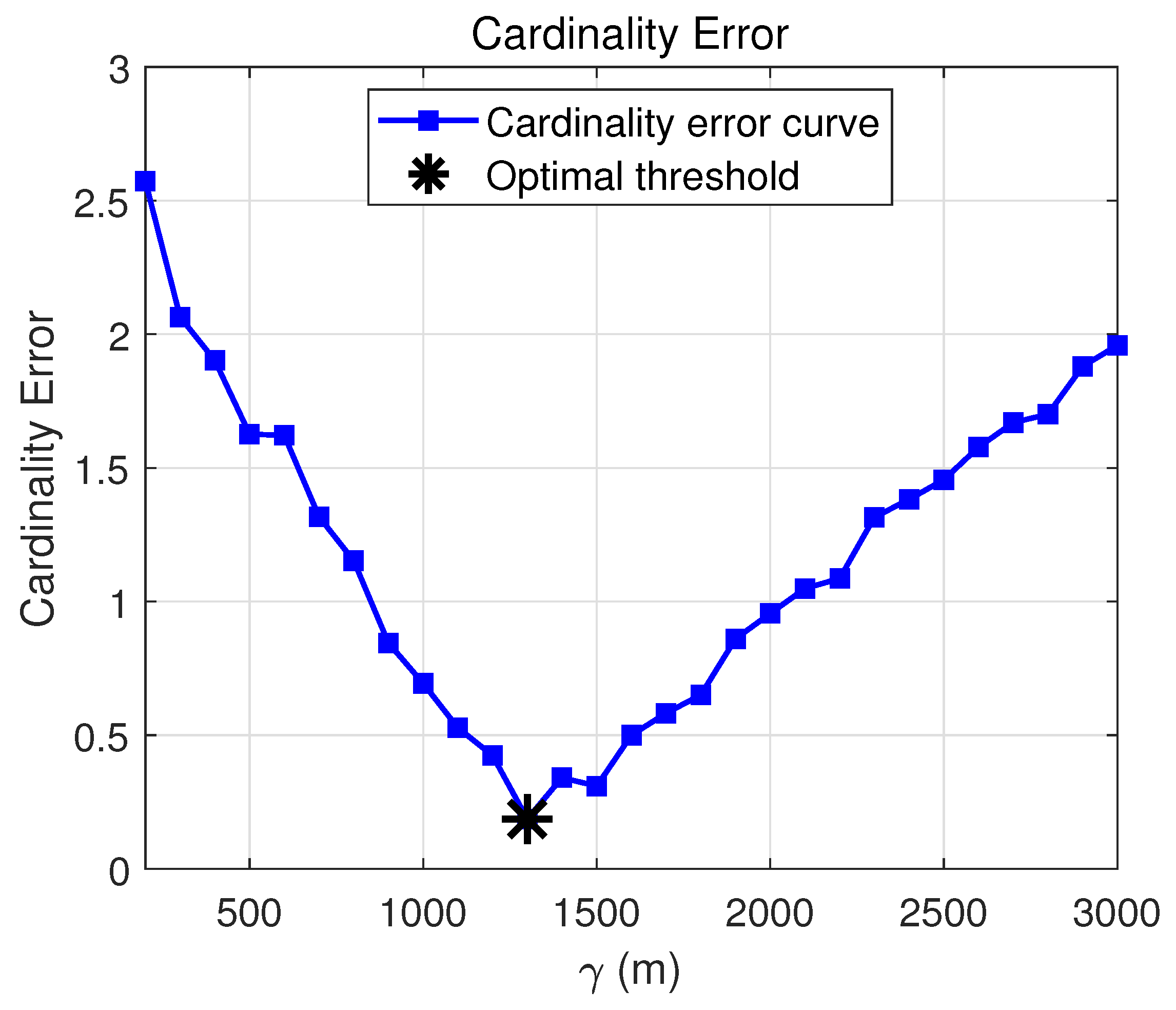
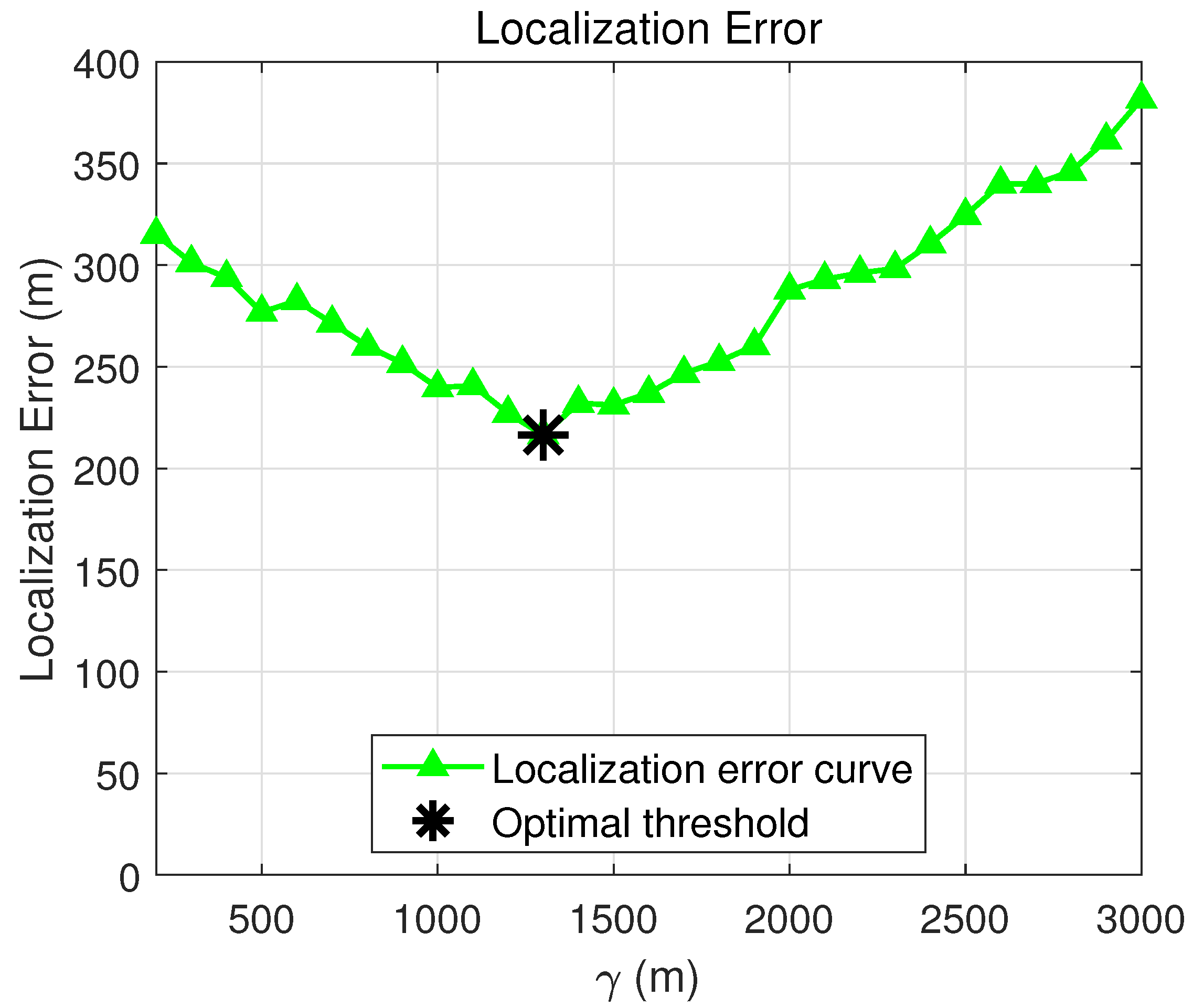
The fifth experiment focuses on the analysis of the threshold parameter γ in the DV fusion algorithm. To comprehensively evaluate the influence of γ , three evaluation metrics are adopted, including OSPA distance, Cardinality Error (CE), and Localization Error (LE).
All three metrics show a convex trend as γ increases from 200 m to 3000 m. The OSPA distance exhibits a trend of first decreasing and then increasing with the γ parameter, as follows: When γ = 200 , the OSPA is approximately 350; as γ increases to 1300, the OSPA drops to its minimum value of around 250; further increasing γ leads to a rebound in OSPA.
This phenomenon stems from the critical role of γ in the DV fusion algorithm—it serves as a threshold parameter determining whether state extractions from different sensors belong to the same target, directly influencing the accuracy of target count estimation. When γ is too small, the strict threshold misclassifies the same target as separate ones, leading to an overestimation of target count and fragmented state estimation, which in turn increases the OSPA. When γ is too large, the lenient threshold causes distinct targets to be erroneously merged, resulting in an underestimation of target count and increased state estimation error. When γ is appropriate, the threshold aligns with the actual target distribution, effectively avoiding both over-merging and false splitting, thereby optimizing the OSPA.
Meanwhile, the Cardinality Error and Localization Error reach the minimum value simultaneously at γ = 1300 m, which further verifies the rationality of the optimal threshold selection. The experimental curve (Figure 13, Figure 14 and Figure 15) confirms the nonlinear relationship between γ and the three metrics, demonstrating the existence of an optimal γ value (1300 in this case) that balances segmentation and merging errors, thereby minimizing the tracking errors.

5.3.6. Experiment 6

This experiment is designed to study the relationship between the number of target particles and tracking performance.
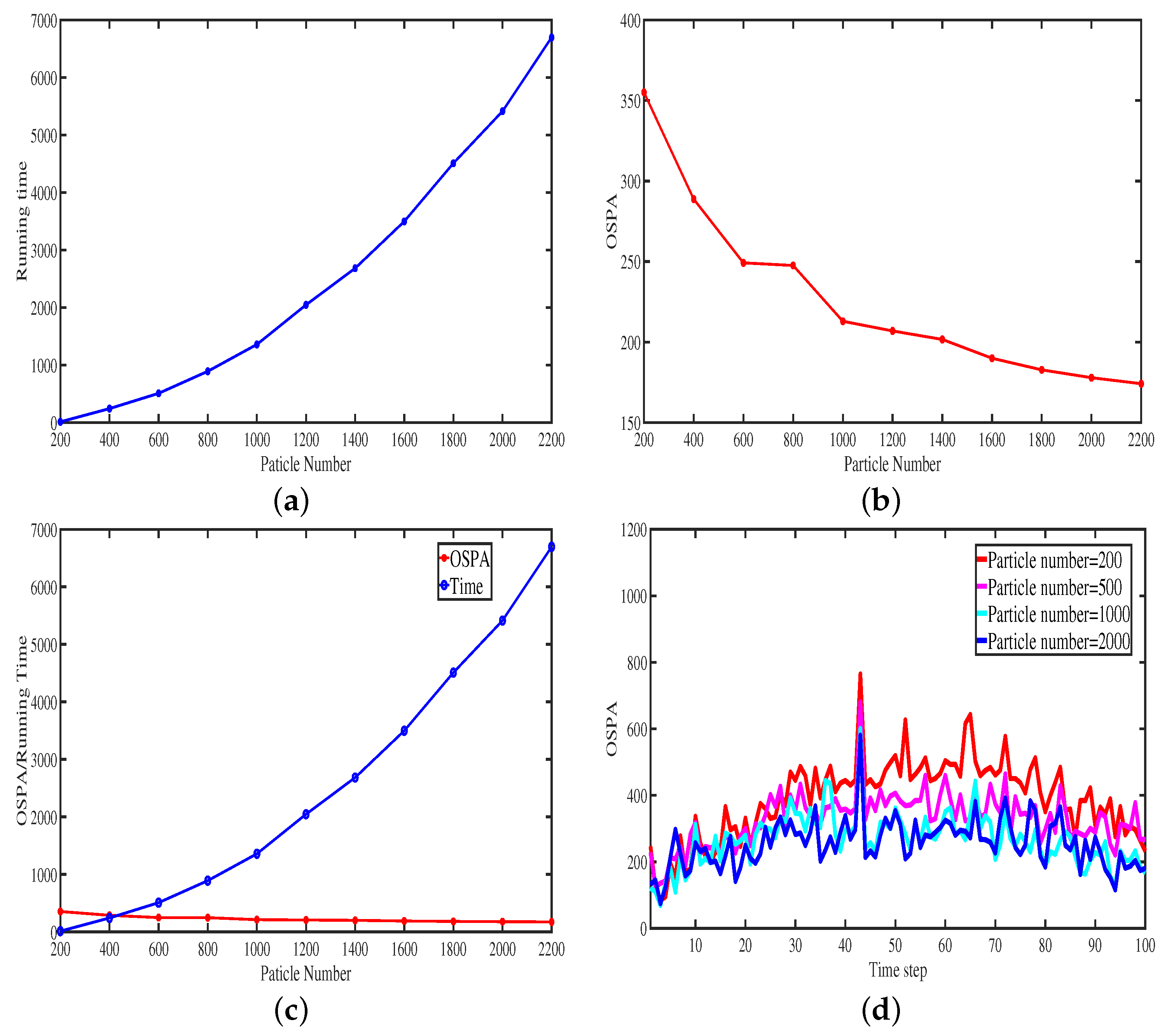
First, DV-SMC-PHD was employed to investigate the relationship between the number of particles and tracking performance. From the Table 3, it can be observed that as the number of particles increases, the running time significantly increases, while the average OSPA decreases. As the number of particles continues to grow, the running time increases exponentially, whereas the reduction in average OSPA is quite limited, resulting in minimal performance improvement and a waste of time and resources. This conclusion is also supported by Figure 16.
Secondly, a comparison of running time was conducted between DV-SMC-PHD, AA-SMC-PHD, and GA-SMC-PHD under identical particle counts. The number of particles is 200. As shown in Table 4, given the same number of particles, the running time of DV-SMC-PHD exceeds that of AA-SMC-PHD but remains shorter than GA-SMC-PHD. This observation aligns with the complexity analysis presented earlier.

5.4. Generalization Capability Analysis

5.4.1. Algorithm-Dependent Features

The DV algorithm mainly relies on the following characteristics. First, state extraction: the DV algorithm operates after the state extraction step of the SMC-PHD filter, so it depends on the filter’s ability to effectively extract target states. Second, particle filtering: the DV algorithm uses particle filtering methods to process target states, so it is suitable for RFS filters based on particle filtering.

5.4.2. Applicable Conditions

First, the separability of target states: the DV algorithm assumes that target states are separable, meaning that the states of different targets can be distinguished by distance and speed. If the target states are not separable, the effectiveness of the DV algorithm may be affected. Second, the independence of sensors: the DV algorithm assumes that measurements from different sensors are independent. If there is a strong correlation between sensors, further adjustments to the algorithm may be necessary. Third, computational resources: the DV algorithm requires particle filtering and data fusion, so sufficient computational resources are needed to support the algorithm’s operation.
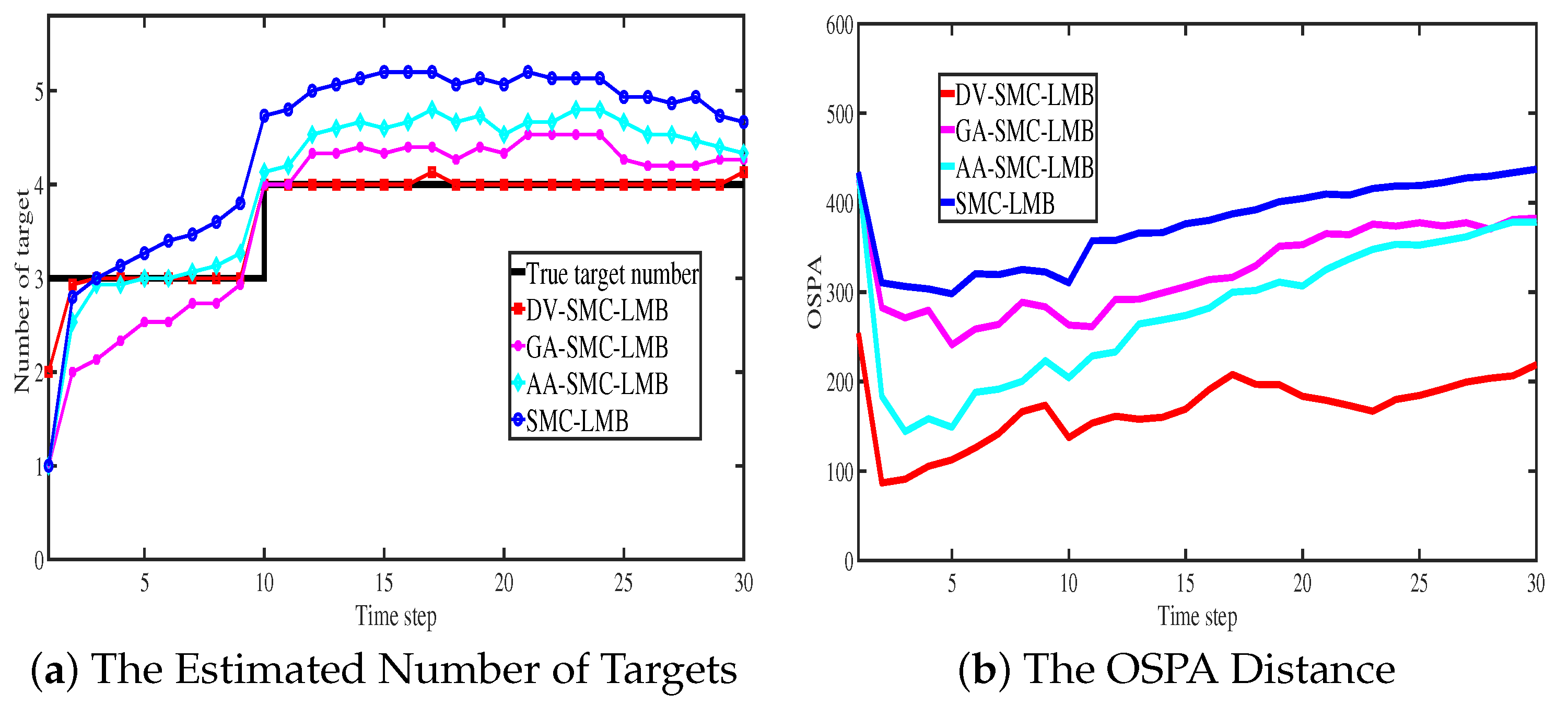
The DV algorithm can be applied to other particle filter-based RFS filters, such as the SMC-CPHD (SMC-Cardinalized PHD) filter and the SMC-LMB (SMC-Labeled Multi-Bernoulli) filter; the application result is shown in Figure 17a,b. These filters also require state extraction and data fusion, so the DV algorithm can naturally be extended to these filters.

6. Conclusions

This paper focuses on the multi-target tracking problem in low-power passive radar networks with data inequality and unknown sensor weights. To address the performance degradation caused by invalid sensor information, a novel Distance-Velocity (DV) fusion algorithm based on the SMC-PHD filter is proposed.
The proposed algorithm realizes target-level information fusion through spatial distance and velocity consistency, which can automatically identify high-quality measurements and suppress invalid information without manual weight assignment or consensus iteration. A series of comparative experiments is conducted with AA fusion, GA fusion, CAA fusion, Adaptive fusion, and single sensors under static, dynamic, data inequality, and electromagnetic interference scenarios.
Experimental results demonstrate that the DV fusion algorithm outperforms all comparison methods in terms of target number estimation accuracy and OSPA distance. In particular, under typical data inequality conditions, the AA, GA, CAA, and Adaptive fusion algorithms are all affected by low-quality sensors, leading to serious performance degradation. In contrast, the proposed DV fusion algorithm maintains stable and optimal performance. In dynamic and complex electromagnetic environments, the DV fusion algorithm also shows stronger robustness and smaller tracking fluctuations.
In summary, the proposed DV fusion algorithm effectively solves the data inequality problem in passive radar multi-sensor networks and significantly improves tracking accuracy and stability without prior information. It provides a practical and effective solution for multi-target tracking in low-power passive radar systems.
Limitations and Future Work: It is important to acknowledge that the current study relies on high-fidelity simulations rather than real-world measurements. While we have incorporated realistic electromagnetic interference models (Rayleigh noise, impulse interference) and geometric configurations typical of passive radar systems, the lack of experimental validation using real external radiation source radar data remains a limitation. This is primarily due to the restricted availability of ground-truth datasets for multistatic passive radar networks, which often involve sensitive military or proprietary civilian applications. Future work will focus on validating the proposed DV-SMC-PHD algorithm using publicly available datasets such as the CELLAR (Cognitive External Illuminator for Passive Radar) or STARnet (Software-Defined Radio-based Passive Radar) experimental data, or through cooperative field trials with broadcast illuminators. Additionally, we plan to extend the current centralized fusion framework to distributed architectures to reduce communication overhead in large-scale sensor networks.


Supplementary Materials

The following supporting information can be downloaded at: https://www.mdpi.com/article/10.3390/electronics15091787/s1, Equations (S1)–(S9): The motion equations of 9 basic actions.
Author Contributions

Conceptualization, W.C.; methodology, W.C. and F.T.; software, H.J.; validation, H.J. and M.Z.; formal analysis, W.C. and Y.L.; investigation, Y.L.; resources, F.Q.; data curation, W.C. and F.Q.; writing—original draft preparation, W.C.; writing—review and editing, F.T. and M.Z.; visualization, Y.L. and M.Z.; supervision, F.T.; project administration, F.T. All authors have read and agreed to the published version of the manuscript.
Funding

This research received no external funding.

Data Availability Statement

The original contributions presented in this study are included in the article/Supplementary Materials. Further inquiries can be directed to the corresponding author.

Conflicts of Interest

The authors declare no conflicts of interest.

References

  1. Mahler, R. The multisensor PHD filter: I. General solution via multitarget calculus. In Signal Processing, Sensor Fusion, and Target Recognition XVIII; Society of Photo Optical: Bellingham, WA, USA, 2009; Volume 7336, pp. 194–205. [Google Scholar]
  2. Papa, G.; Repp, R.; Meyer, F.; Braca, P.; Hlawatsch, F. Distributed Bernoulli filtering using likelihood consensus. IEEE Trans. Signal Inf. Process. Netw. 2018, 5, 218–233. [Google Scholar] [CrossRef]
  3. Hlinka, O.; Slučiak, O.; Hlawatsch, F.; Djurić, P.M.; Rupp, M. Likelihood consensus and its application to distributed particle filtering. IEEE Trans. Signal Process. 2012, 60, 4334–4349. [Google Scholar] [CrossRef]
  4. Nannuru, S.; Blouin, S.; Coates, M.; Rabbat, M. Multisensor CPHD filter. IEEE Trans. Aerosp. Electron. Syst. 2016, 52, 1834–1854. [Google Scholar] [CrossRef]
  5. Delande, E.; Duflos, E.; Heurguier, D.; Vanheeghe, P. Multi-Target PHD Filtering: Proposition of Extensions to the Multi-Sensor Case. Ph.D. Thesis, INRIA, Talence, France, 2010. [Google Scholar]
  6. Saucan, A.A.; Coates, M.J.; Rabbat, M. A multisensor multi-Bernoulli filter. IEEE Trans. Signal Process. 2017, 65, 5495–5509. [Google Scholar] [CrossRef]
  7. Vo, B.N.; Vo, B.T.; Beard, M. Multi-sensor multi-object tracking with the generalized labeled multi-Bernoulli filter. IEEE Trans. Signal Process. 2019, 67, 5952–5967. [Google Scholar] [CrossRef]
  8. Li, T. Heterogeneous unlabeled and labeled RFS filter fusion for scalable multisensor multitarget tracking. arXiv 2023, arXiv:2303.09401. [Google Scholar]
  9. Li, T. Arithmetic Average Density Fusion—Part II: Unified Derivation for Unlabeled and Labeled RFS Fusion. IEEE Trans. Aerosp. Electron. Syst. 2024, 60, 3255–3268. [Google Scholar] [CrossRef]
  10. Li, T.; Song, Y.; Song, E.; Fan, H. Arithmetic average density fusion-Part I: Some statistic and information-theoretic results. Inf. Fusion 2024, 104, 102199. [Google Scholar] [CrossRef]
  11. Li, T.; Liang, H.; Li, G.; Herrero, J.G.; Pan, Q. Arithmetic Average Density Fusion–Part IV: Distributed Heterogeneous Fusion of RFS and LRFS Filters via Variational Approximation. arXiv 2024, arXiv:2402.00080. [Google Scholar] [CrossRef]
  12. Da, K.; Li, T.; Zhu, Y.; Fan, H.; Fu, Q. Recent advances in multisensor multitarget tracking using random finite set. Front. Inf. Technol. Electron. Eng. 2021, 22, 5–24. [Google Scholar] [CrossRef]
  13. Mahler, R.P.S. Optimal/robust distributed data fusion: A unified approach. In Signal Processing, Sensor Fusion, and Target Recognition IX; Society of Photo Optical: Bellingham, WA, USA, 2000; Volume 4052, pp. 128–138. [Google Scholar]
  14. Hurley, M.B. An information theoretic justification for covariance intersection and its generalization. In Proceedings of the Fifth International Conference on Information Fusion (FUSION 2002); IEEE: New York, NY, USA, 2002; Volume 1, pp. 505–511. [Google Scholar]
  15. Clark, D.; Julier, S.; Mahler, R.; Ristić, B. Robust multi-object sensor fusion with unknown correlations. In Proceedings of the Sensor Signal Processing for Defence (SSPD 2010), London, UK, 29–30 September 2010; pp. 1–5. [Google Scholar]
  16. Ueney, M.; Clark, D.E.; Julier, S.J. Distributed fusion of PHD filters via exponential mixture densities. IEEE J. Sel. Top. Signal Process. 2013, 7, 521–531. [Google Scholar] [CrossRef]
  17. Battistelli, G.; Chisci, L.; Fantacci, C.; Farina, A.; Graziano, A. Consensus CPHD filter for distributed multitarget tracking. IEEE J. Sel. Top. Signal Process. 2013, 7, 508–520. [Google Scholar] [CrossRef]
  18. Guldogan, M.B. Consensus Bernoulli filter for distributed detection and tracking using multi-static Doppler shifts. IEEE Signal Process. Lett. 2014, 21, 672–676. [Google Scholar] [CrossRef]
  19. Wang, B.; Yi, W.; Hoseinnezhad, R.; Li, S.; Kong, L.; Yang, X. Distributed fusion with multi-Bernoulli filter based on generalized covariance intersection. IEEE Trans. Signal Process. 2016, 65, 242–255. [Google Scholar] [CrossRef]
  20. Fantacci, C.; Vo, B.N.; Vo, B.T.; Battistelli, G.; Chisci, L. Robust fusion for multisensor multiobject tracking. IEEE Signal Process. Lett. 2018, 25, 640–644. [Google Scholar] [CrossRef]
  21. Li, T.; Hlawatsch, F. A distributed SMC-PHD filter based on arithmetic average PHD fusion. arXiv 2018, arXiv:1712.06128. [Google Scholar]
  22. Li, T.; Corchado, J.M.; Prieto, J. Convergence of distributed flooding and its application for distributed Bayesian filtering. IEEE Trans. Signal Inf. Process. Netw. 2016, 3, 580–591. [Google Scholar] [CrossRef]
  23. Li, T.; Fan, H.; García, J.; Corchado, J.M. Second-order statistics analysis and comparison between arithmetic and geometric average fusion: Application to multi-sensor target tracking. Inf. Fusion 2019, 51, 233–243. [Google Scholar] [CrossRef]
  24. Li, T.; Corchado, J.M.; Sun, S. Partial consensus and conservative fusion of Gaussian mixtures for distributed PHD fusion. IEEE Trans. Aerosp. Electron. Syst. 2018, 55, 2150–2163. [Google Scholar] [CrossRef]
  25. Li, T.; Liu, Z.; Pan, Q. Distributed Bernoulli filtering for target detection and tracking based on arithmetic average fusion. IEEE Signal Process. Lett. 2019, 26, 1812–1816. [Google Scholar] [CrossRef]
  26. Da, K.; Li, T.; Zhu, Y.; Fan, H.; Fu, Q. Kullback-Leibler averaging for multitarget density fusion. In Distributed Computing and Artificial Intelligence, 16th International Conference; Springer: Cham, Switzerland, 2020; pp. 253–261. [Google Scholar]
  27. Gao, L.; Battistelli, G.; Chisci, L. Fusion of labeled RFS densities with minimum information loss. IEEE Trans. Signal Process. 2020, 68, 5855–5868. [Google Scholar] [CrossRef]
  28. Ristić, B.; Vo, B.N.; Clark, D. A note on the reward function for PHD filters with sensor control. IEEE Trans. Aerosp. Electron. Syst. 2011, 47, 1521–1529. [Google Scholar] [CrossRef]
  29. Darvishi, H.; Sebt, M.A.; Ciuonzo, D.; Salvo Rossi, P. Tracking a low-angle isolated target via an elevation-angle estimation algorithm based on extended kalman filter with an array antenna. Remote Sens. 2021, 13, 3938. [Google Scholar] [CrossRef]
  30. Yang, C.; Cao, X.; He, L.; Zhang, H. Distributed multiple attacks detection via consensus AA-GMPHD filter. IEEE Trans. Syst. Man Cybern. Syst. 2023, 53, 7526–7535. [Google Scholar] [CrossRef]
  31. Fu, Z.; Liu, Y.; Si, P.; Tao, F.; Wang, N. Adaptive fusion multi-IMU confidence level location algorithm in the absence of stars. IEEE Sens. J. 2023, 23, 18644–18655. [Google Scholar] [CrossRef]
Figure 1. Basic control maneuvers.
Electronics 15 01787 g001
Figure 2. Schematic of DV fusion algorithm based on the SMC-PHD filter.
Electronics 15 01787 g002
Figure 3. Tracking result of experiment 1.
Electronics 15 01787 g003
Figure 4. Results evaluation of experiment 1.
Electronics 15 01787 g004
Figure 5. Tracking result of experiment 2.
Electronics 15 01787 g005
Figure 6. Results evaluation of experiment 2.
Electronics 15 01787 g006
Figure 7. Results evaluation of experiment 3. (a) The estimated number of targets (dynamic SNR). (b) The OSPA distance (dynamic SNR). (c) The estimated number of targets (mobile sensor network). (d) The OSPA distance (mobile sensor network).
Electronics 15 01787 g007
Figure 8. Tracking result of experiment 3 (dynamic SNR).
Electronics 15 01787 g008
Figure 9. Tracking result of experiment 3 (mobile sensor network).
Electronics 15 01787 g009
Figure 10. Results evaluation of experiment 4. (a) The estimated number of targets (Rayleigh noise). (b) The OSPA distance (Rayleigh noise). (c) The estimated number of targets (impulse interference). (d) The OSPA distance (impulse interference).
Electronics 15 01787 g010
Figure 11. Tracking result of experiment 4 (impulse interference).
Electronics 15 01787 g011
Figure 12. Tracking result of experiment 4 (Rayleigh noise).
Electronics 15 01787 g012
Figure 13. OSPA distance versus threshold γ .
Electronics 15 01787 g013
Figure 14. Cardinality Error versus threshold γ .
Electronics 15 01787 g014
Figure 15. Localization error versus threshold γ .
Electronics 15 01787 g015
Figure 16. Results of experiment 6. (a) The Relationship between running time and particle number. (b) The relationship between OSPA and particle number. (c) The relationship between running time/OSPA and particle number. (d) The OSPA distance.
Electronics 15 01787 g016
Figure 17. Results evaluation.
Electronics 15 01787 g017
Table 1. Algorithm complexity comparison with multi-line formulas.
AlgorithmTime ComplexitySpace Complexity
SMC-PHD O ( T · ( N particle · N target ) ) O ( N particle )
DV-SMC-PHD O ( T · ( N particle · N target +   ( M 1 ) · N particle 2 ) ) O ( M · N particle 2 )
AA-SMC-PHD O ( T · ( N particle · N target +   M · N particle ) ) O ( M · N particle )
GA-SMC-PHD O ( T · ( N particle · N target +   M · N particle 2 ) ) O ( M · N particle 2 )
Note: T: total time steps; N particle : particles per sensor; N target : number of targets; M: number of sensors. The second term in the time complexity represents the fusion overhead specific to each algorithm.
Table 2. Target initial location and time of appearance/disappearance.
Target No.Time of Appearance (s)Time of Disappearance (s)Initial Location (m, m/s, m, m/s, m, m/s)
11100(2300, 20, 2300, 40, 2000, 5)
21100(2300, 30, −2300, −40, 2000, 5)
3180(−2300, −40, −2300, −20, 2000, −5)
410100(−2300, −40, 2300, 40, 2000, −5)
Table 3. Table of the relationship between the particle number and performance.
Number of Particles per TargeRunning Time (s)Mean OSPA (m)
2008.9306389.0344
50064.4353328.4431
1000244.1859265.7814
2000973.4261254.6677
Table 4. Table of fusion algorithm running time comparison.
Fusion AlgorithmRunning Time (s)
DV-SMC-PHD8.9306
AA-SMC-PHD3.8309
GA-SMC-PHD11.6097
Disclaimer/Publisher’s Note: The statements, opinions and data contained in all publications are solely those of the individual author(s) and contributor(s) and not of MDPI and/or the editor(s). MDPI and/or the editor(s) disclaim responsibility for any injury to people or property resulting from any ideas, methods, instructions or products referred to in the content.