Article

Frequency-Output Autogenerator Gas Transducers and FPGA-Based Multichannel Monitoring System for Smart Biogas Plants in Cloud-Integrated Energy Infrastructures

1
Faculty of Information Electronic Systems, Vinnytsia National Technical University, 21021 Vinnytsia, Ukraine
2
Faculty of Computing and Telecommunications, Poznan University of Technology, 60965 Poznan, Poland
3
Faculty of Intelligent Information Technology and Automation, Vinnytsia National Technical University, 21021 Vinnytsia, Ukraine
*
Author to whom correspondence should be addressed.
Electronics 2026, 15(9), 1780; https://doi.org/10.3390/electronics15091780
Submission received: 11 March 2026 / Revised: 18 April 2026 / Accepted: 19 April 2026 / Published: 22 April 2026
(This article belongs to the Special Issue New Trends in Energy Saving, Smart Buildings and Renewable Energy)

Abstract

The rapid development of smart energy infrastructures and renewable energy systems requires advanced sensing solutions that provide high accuracy, expandability, and stability under real operating conditions. However, conventional gas monitoring systems are predominantly based on resistive or voltage-output sensors, which require complex analog front-end circuits and analog-to-digital conversion, leading to increased system complexity, cost, and susceptibility to electromagnetic interference. This paper tackles this limitation by proposing a frequency-domain sensing approach for multichannel monitoring of biogas plant parameters. The objective of this study is to develop and experimentally validate an extendable sensing architecture based on autogenerator microelectronic gas transducers with direct gas concentration–frequency conversion and FPGA-based digital acquisition. The proposed method is grounded in a physical–mathematical model of the space-charge capacitance of gas-sensitive semiconductor structures derived from Poisson’s equation, facilitating analytical formulation of conversion and sensitivity functions. A multichannel FPGA-based measurement system is implemented to process frequency signals without analog conditioning or ADC stages. Experimental validation was performed for CH4 (0–85%), CO2 (0–60%), H2, NH3, and H2S (1–20,000 ppm). The results demonstrate measurement uncertainty within 0.25–0.5%, with sensitivity reaching 350–748 Hz/ppm for H2, 455–750 Hz/ppm for NH3, and 253–375 Hz/ppm for H2S, while methane and carbon dioxide sensitivities reach up to 112 kHz/% and 98.7 kHz/%, respectively. Spectral analysis in the LTE-1800 band confirms improved noise immunity (up to 4.5×) and extended transmission capabilities. A 12-channel FPGA-based monitoring system (RDM-BP-1) with a 1 s sampling interval, IP67 protection, and wireless connectivity is developed and validated. The proposed architecture eliminates analog signal conditioning, reduces hardware complexity, and provides an easily expandable and reliable sensing solution for smart buildings, renewable energy systems, and cloud-integrated energy infrastructures.

1. Introduction

1.1. Background

Biogas is produced via the fermentation of biomass by anaerobic bacteria. Biogas consists of approximately 60% methane (CH4) and 40% carbon dioxide (CO2). The feedstocks for technical biogas production are the following materials:
-
Organic waste (grass, straw, leaves, pine needles, wood chips);
-
Manure;
-
Specially grown so-called energy crops (maize, cereals, rapeseed, clover);
-
Food waste;
-
Fecal sludge in lagoons;
-
Landfills (landfills for the disposal of household waste).
At the same time, the first three types of input products have the greatest potential for biogas in agriculture. The last three types of feedstock have some potential for municipal utilities. Depending on the type of output product, the gas released during fermentation has different names:
-
Lagoon gases or “landfill gas” (lagoons, sewage treatment plants);
-
Putrefactive gases (landfills used for the disposal of various wastes);
-
Biogas (organic waste, manure, energy plants).
The biogas yield per 1 ton of dry matter depends on the raw material used. The manure produces 200–350 m3 of biogas, with a methane content of 60%, and 300–630 m3 of biogas from various plant species, with a methane content of up to 70%. As mentioned above, biogas consists of approximately 60% methane (CH4) and 40% carbon dioxide (CO2) [1]. Now let us take a closer look at the components of biogas, which are shown in Table 1. Today, there are about 60 technological methods of biogas production in the world. The most common method is anaerobic digestion in meta-tanks (bioreactors, anaerobic columns). In the process of anaerobic decomposition of organic matter, there are three main stages, which are influenced by three physiological groups of bacteria. In the first stage, complex multicarbon substances, which are the main classes of organic compounds (proteins, fats, polysaccharides), undergo enzymatic hydrolysis by so-called “primary anaerobes”. At the same time, monosaccharides, organic acids, and alcohols are hydrolyzed by microorganisms.
As a result, hydrogen, carbon dioxide, low-molecular-weight fatty acids, alcohols, and some other compounds are formed. In the second stage, acetogenic microorganisms, such as Syntrophobacter, Syntrophomonas, and Desulfovibrio, ferment more complex substances into low-molecular-weight organic acids, as well as into H2 and CO2. Acetogenic bacteria include both obligate and facultative species. In addition, homoacetogenic bacteria also operate in this stage, fermenting single- and multi-carbon compounds to acetic acid without the formation of hydrogen. In the third stage, the process of further decomposition of organic substances is carried out by methane-forming and sulfate-reducing microorganisms that use metabolites formed in the previous stages to maintain their vital activity [2]. In this stage, in systems with a low sulfate content, CH4 and CO2 and a small amount of H2S are formed.
From a biochemical point of view, methane fermentation is an anaerobic “respiration” in which electrons from organic matter are transferred to carbon dioxide, which is subsequently reduced to methane. In addition to various organic substrates (such as acetic acid), the electron donor for methane-forming bacteria is hydrogen, which is produced by several types of anaerobic bacteria. All methanobacteria are characterized by their ability to grow in the presence of hydrogen and carbon dioxide, as well as high sensitivity to inhibitors of oxygen and methane production. Temperature is one of the most important parameters that determines the speed and productivity of the anaerobic reactor process. Methane fermentation is known to occur in temperature ranges of 0 to 97 degrees Celsius. However, in practice, the following reactor operating modes are used: psychrophilic (20 °C), mesophilic (20–45 °C), and thermophilic (50–65 °C).
The growing exploitation of smart environments, audio, and video streams is driving the massive adoption of complex IoT systems. Information and measurement equipment and sensor networks are deployed to monitor a variety of phenomena, providing many heterogeneous measurements and multimedia data. The data is then stored, sent, and processed for many purposes, such as healthcare, air quality monitoring, and security system management. Over the years, corporate organizations have accumulated growing stockpiles of data, analyzed these data to benefit from large amounts of information, and developed applications only to process these data. However, a new trend is emerging in which measurement data acquisition, information management, and application development are decoupled, thus giving business companies different roles in the marketplace. In such an operational context, flexible solutions are needed to combine measurement devices; systems for processing, transmitting, and storing measurement information; and provide the final product in the form of time-resolved information to the end user. In terms of the Internet of Things (IoT), billions of physical sensors and devices are connected to each other over the Internet to provide a wealth of heterogeneous, complex, and unstructured data. Much effort in the industry and research community has focused on IoT data storage to balance the cost and performance of data maintenance and analysis. Indeed, developing powerful storage systems can effectively handle the demands of big data applications, and cloud computing is expected to play a significant role in the IoT approach. Indeed, cloud storage offers a large number of storage and processing capabilities in an extendable manner. From the Cloud user’s point of view, data collected from the monitoring infrastructure is provided in a uniform way that is designed in accordance with the Sensor Web Enablement (SWE) specifications defined by the Open Geospatial Consortium (OGC). The aforementioned devices that are increasingly present in modern life are robots. Examples such as RobotRoomba, a robot, represent affordable automated tools for everyday life. In addition, Amazon and Google are researching and developing platforms for delivering consumer products using drones. Most of these robots have limited integrated computing power, but still generate large amounts of data. Cloud-based data analysis of such robots poses many challenges due to stringent latency requirements and the large amount of data received.
Instruments for measuring and controlling gas concentration, pressure, humidity, magnetic field induction, optical radiation, and temperature occupy a leading position in measuring technology. The development and improvement in this class of measuring devices is governed by increasing requirements for the accuracy and sensitivity of physical quantities measured by sensors with autonomous decision support for robotic devices, telecontrol systems, and specialized cloud platforms. Today, there are many different devices used for measuring and controlling the gas concentration, pressure, humidity, magnetic field induction, and temperature. Currently, there are practically no devices in the world that simultaneously measure and control pressure, humidity, temperature, optical radiation, magnetic field, and gas composition and concentration in the environment. The Department of Information Radioelectronic Technologies and Systems at Vinnytsia National Technical University has developed the theoretical foundations and patented a number of designs for self-generating microelectronic devices with parametric sensing transducers and circuitry solutions, which makes it possible to develop frequency microelectronic transducers for robotic devices, telecontrol systems, and specialized cloud platforms.

1.2. Research Gap

In the last decade, the most common sensors for measuring physical quantities have been digital converters that provide digital interfaces for obtaining measured values. However, in parallel with them, there are sensors with radio transducers based on reactive properties of negative resistance semiconductor structures, which have frequency outputs with full preservation of information about the quantitative value of the measured value in the output signal due to the provision of functional dependence [3,4,5,6]. The use of such devices excludes analog-to-digital converters from their designs, which reduces the cost of control systems, as well as creates “intelligent” measuring transducers as a result of combining information processing circuits and a primary converter on a single chip [7,8,9,10]. Currently, it is difficult to find widely available solutions that would satisfy the requirements for simultaneous measurement of sensor values with digital and frequency output. Therefore, there is a need to develop theoretical approaches to the creation of such systems, as well as the development of schemes and designs.
The characteristics of gas sensors determine the accuracy and reliability of control and regulation systems for process control devices; the safety of installations in the chemical industry, nuclear power, oil and gas industry; in scientific research; in military equipment, etc. Therefore, strict requirements are imposed on gas sensors. They must be economical, provide high measurement accuracy, have minimal dimensions, weight, and power consumption, be compatible with modern computers and information measurement systems [11] and networks for general and special purposes, and be able to be manufactured using standard integrated technology [3,12,13,14,15,16].
To date, existing semiconductor gas transducers do not meet the above requirements. A promising scientific direction that can eliminate the shortcomings of existing analog gas sensors is the development of auto-generator converters for computer and information-measuring systems and networks of general and special purpose, which implement the “gas concentration-frequency” conversion principle based on semiconductor structures with negative differential resistance.

1.3. Objective

The objective of this study is to develop and validate a frequency-output sensing architecture for multichannel monitoring of biogas plant parameters based on autogenerator gas transducers and FPGA-based digital acquisition, facilitating scalable and noise-tolerant monitoring in cloud-integrated energy systems.

1.4. Main Contribution

The main contributions and novelty of this manuscript lie in the realization of a unified frequency-domain sensing architecture that combines semiconductor structures with negative differential resistance, direct gas-to-frequency conversion, and FPGA-based multichannel digital processing. Unlike conventional gas monitoring systems that rely on voltage or resistance outputs and analog-to-digital conversion, the proposed method preserves measurement information directly in the frequency domain, allowing improved electromagnetic robustness, simplified instrumentation, and extendable deployment in smart energy and IoT-based monitoring infrastructures. Specifically, the manuscript provides the following contributions:
(i)
A physical-mathematical model of gas-sensitive semiconductor structures and autogenerator frequency transducers based on near-surface charge processes and Poisson-equation analysis;
(ii)
The design of frequency-output autogenerator gas transducers enabling direct “gas concentration-frequency” conversion without analog signal conditioning;
(iii)
An adaptable, large-scale deployment FPGA-based multichannel measurement architecture for simultaneous processing of frequency-output and digital environmental sensors;
(iv)
Experimental validation of the proposed sensing architecture through deployment in the RDM-BP-1 monitoring system for time-resolved biogas plant supervision.
The remainder of this paper is organized as follows. Section 2 describes the materials and methods, including the modeling of gas-sensitive semiconductor structures and the architecture of the FPGA-based monitoring system. Section 3 presents experimental results obtained from the developed biogas monitoring platform. Section 4 discusses the advantages of frequency-output sensing for smart energy infrastructures. Finally, Section 5 concludes the paper.

2. Materials and Methods

In order to build multichannel devices for simultaneous measurement and control of environmental characteristics for specialized cloud platforms, in particular, a multichannel system for monitoring the parameters of biogas plants based on autogenerated microelectronic gas concentration transducers, it is necessary to study the influence of the spatial charge capacity on the gas-reactive effect in autogenerated transducers with a frequency output.
As shown in theoretical and experimental studies, when creating autogenerator gas converters with a frequency output signal, it is necessary to know the dependence of the total resistance of primary semiconductor converters on the action of gas, which determines the essence of the gas-reactive effect, since a change in the total resistance of primary semiconductor converters under the action of gas determines the dependence of the output frequency of autogenerator converters on the gas concentration [3,16,17]. In primary semiconductor gas sensors, it is believed that only the resistance changes when gas is exposed. However, for gas autogenerators with frequency output, even a small change in the reactive component of the total resistance of the primary gas sensor leads to a significant change in the output frequency, so it is necessary to consider the physical and mathematical model of the appearance of the spatial charge capacity, which determines the value of the capacity and its dependence on physical processes on the surface.
The semiconductor sample on the basis of which gas sensors are made should be electrically neutral under normal conditions. It follows that the surface charge Q surf must be compensated by an equal and opposite charge in the semiconductor’s near-surface layer. This charge shields the semiconductor volume from the penetration of the electric field. In general, it consists of ionized donors and acceptors and mobile electrons and holes in the semiconductor volume. Thus, the near-surface layer of a semiconductor is a layer of spatial charge that shields the semiconductor volume from the electric field of surface charge, and this shielding is accomplished by the equilibrium concentration of electrons and holes in the layer, which differ from the bulk concentration.
The distribution of electrostatic potential in the space charge layer is determined by Poisson’s equation under appropriate boundary conditions. The most complete and accurate solution of Poisson’s equation was carried out in the works of C. Garrett and W. Brattain, which is presented in the monograph [18]. These papers consider the general case of a semiconductor subjected to an exciting factor. This leads to a violation of thermodynamic equilibrium in such a semiconductor and the appearance of a concentration of n-electrons and p-holes that exceed the thermodynamically equilibrium values i. At any point in the semiconductor, the values of the concentrations i in the absence of degeneracy are determined by the Boltzmann statistics [19]
n = n i e q k T ( ψ φ n ) , p = n i e q k T ( φ p ψ ) ,
where n i is the charge-carrier concentration in an intrinsic semiconductor; q is the electron charge; k is the Boltzmann constant; T is the absolute temperature; φ n and φ p are the quasi-Fermi potentials in n-type and p-type semiconductors, respectively; and ψ is the electrostatic potential in the semiconductor. The quasi-Fermi potentials have the properties of electrochemical potentials. Under thermodynamic equilibrium, φ p = φ n = φ 0 , and the carrier concentrations then take their equilibrium values at all points, including near the surface.
The electrostatic potential ψ is a measure of the potential energy of an electron in the space-charge layer and characterizes the bending of the crystal energy bands in this region. The potential outside the surface space-charge layer, at x , is denoted by ψ 0 , and its value is chosen so that the electron potential energy inside the crystal, q ψ 0 , coincides with the Fermi energy in the intrinsic semiconductor, E i . This quantity is referred to as the mid-gap energy in the bulk and at the surface of the semiconductor. The value of the electrostatic potential inside the near-surface space-charge layer is then characterized by the quantity q ( ψ s ψ 0 ) . The position of the equilibrium Fermi level in the semiconductor bulk is determined by the quantity q φ p = q ( φ 0 ψ 0 ) , by means of which the bulk equilibrium concentrations of holes and electrons are determined [20].
The bulk equilibrium carrier concentrations are expressed as
p 0 = n i e q φ v k T , n 0 = n i e q φ v k T ,
The position of the Fermi level at the semiconductor surface is determined by the quantity q φ s = q ( φ 0 ψ s ) , through which the surface concentrations of charge carriers are defined as
p s = n i e q φ s k T , n s = n i e q φ s k T ,
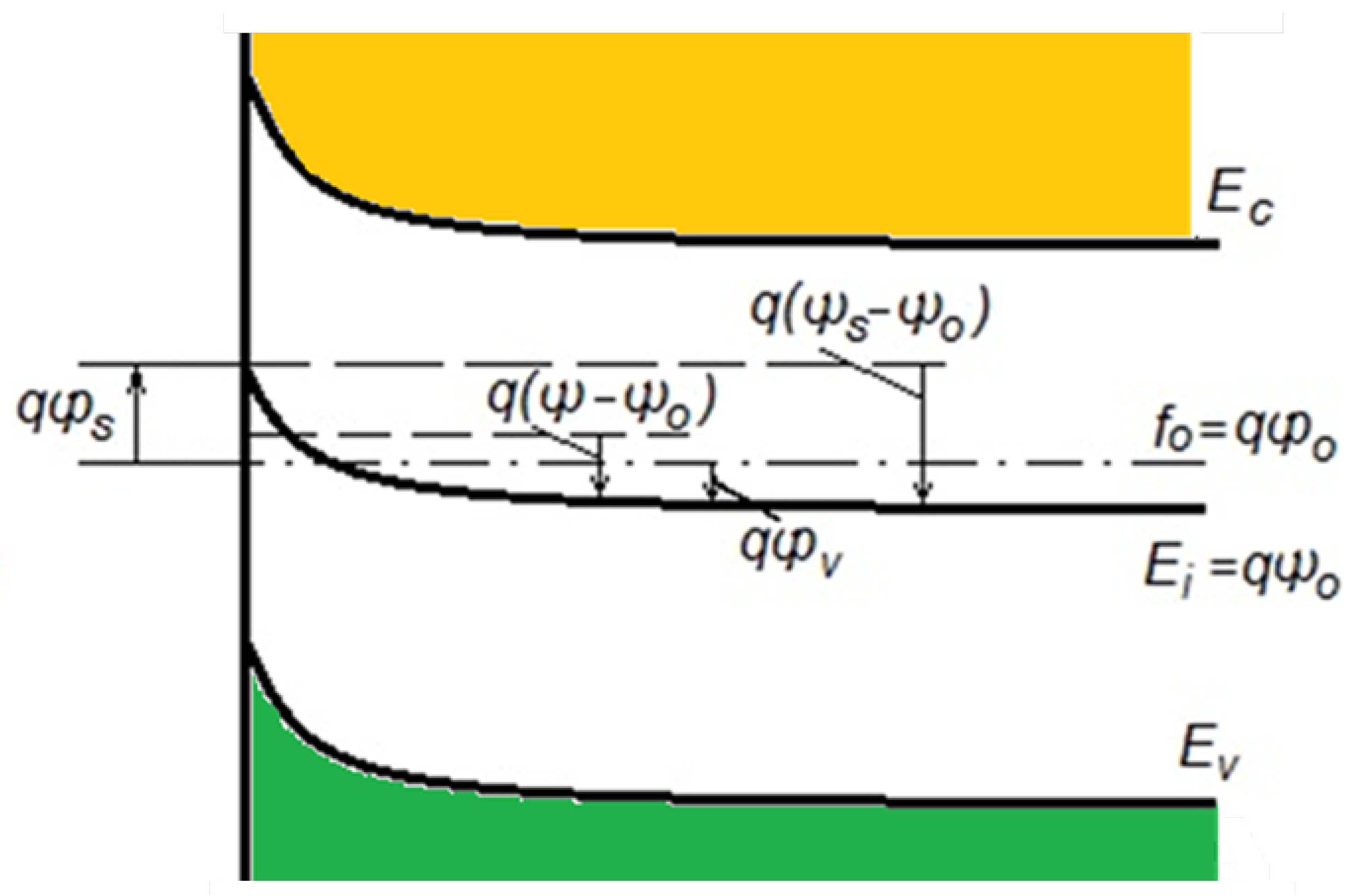
The dimensionless quantity q φ s is called the surface potential, in contrast to the surface electrostatic potential q ( ψ s ψ 0 ) . The sign of the electrostatic potential according to relations (1) and (3) is negative if the energy bands near the surface bend upward and positive if they bend downward. Accordingly, the signs of the potentials φ v and φ s are negative if the Fermi level is located in the upper half of the band gap in the bulk or in the lower half at the surface. Figure 1 corresponds to the case when q ( ψ s ψ 0 ) and q φ v are negative, whereas q φ s is positive.
Let us consider the solution of the Poisson equation for a semi-infinite semiconductor. For the one-dimensional case, it has the form [19,20]
d 2 ψ d x 2 = 4 π ε ε 0 ρ ( x ) ,
where ε is the dielectric constant of the semiconductor; ε 0 is the dielectric constant of vacuum; and ρ ( x ) is the volume charge density at a point in the semiconductor located at a distance x from its surface.
Figure 1 shows the energy diagram of the near-surface space-charge layer.
The boundary conditions for solving the equation are described by the relations
ψ = ψ s , at x = 0 , ψ = ψ 0 , d ψ d x = 0 , at x .
If complete ionization of impurity atoms uniformly distributed throughout the semiconductor volume is assumed, then the charge density at any point of the semiconductor is described by
ρ ( x ) = q N d N a + p n ,
where N d and N a are the concentrations of ionized donors and acceptors. Since the condition of electrical neutrality outside the surface space-charge layer is written as
N d N a + p 0 n 0 = 0 ,
where p 0 and n 0 are the equilibrium bulk concentrations of holes and electrons, Equation (6) takes the form
ρ ( x ) = q p p 0 n n 0 .
Using relations (1)–(3), the volume charge density is expressed in terms of the electrostatic potential, which leads to the following form of the Poisson equation:
d 2 ψ d x 2 = 2 π q n i ε ε 0 e q k T ( φ p ψ ) e q k T ( φ p ψ 0 ) e q k T ( ψ φ n ) + e q k T ( ψ 0 φ n ) .
If it is assumed that the quasi-Fermi levels φ p and φ n change only slightly with the coordinate within the near-surface space-charge region, then Equation (9) contains only the quantity ψ , which depends on the coordinate x. For convenient integration of Equation (9), the following dimensionless quantities are introduced, in particular the electrostatic potential [20]
y = q k T ( ψ ψ 0 ) ,
as well as the dimensionless quantity γ , which characterizes the bulk properties of the semiconductor sample [21]
γ = p 0 n 0 1 2 = p 0 n i = n i n 0 = e q k T ( φ 0 ψ 0 ) = e q k T φ v .
From expression (11), it follows that γ = 1 for an intrinsic semiconductor. Its value exceeds unity as hole conductivity becomes more pronounced in a given semiconductor sample and, consequently, as the equilibrium Fermi level is located lower relative to the potential level ψ 0 . Its value is less than unity as electron conductivity in the semiconductor sample becomes greater and, accordingly, as the equilibrium Fermi level is located higher relative to the potential level ψ 0 .
Let us also introduce a dimensionless quantity characterizing the degree of deviation of the charge-carrier concentration from its equilibrium value in the semiconductor volume. If the processes of excess charge-carrier capture in the semiconductor bulk are absent, then the degree of disturbance of thermodynamic equilibrium in the semiconductor can be determined by the dimensionless injection level, which has the form [22].
α = Δ n n i = Δ p n i ,
where Δ n = Δ p is the excess concentration of charge carriers in the semiconductor bulk outside the near-surface space-charge region. In this case, ψ = ψ 0 and, taking Equation (1) into account, it is possible to establish the relationships between the injection level α and the distances between the quasi-Fermi levels and the Fermi level, ( φ p φ 0 ) and ( φ 0 φ n ) [21]:
e q k T ( φ p φ 0 ) = α γ 1 + 1 = Δ p p 0 + 1 , e q k T ( φ 0 φ n ) = α γ + 1 = Δ n n 0 + 1 .
Using the introduced dimensionless quantities, the Poisson equation takes the form
d 2 y d x 2 = 4 π q 2 n i k T ε ε 0 ( α + γ ) e y ( α + γ 1 ) e y ( γ γ 1 ) .
The first integral of Equation (14) can be obtained if the right-hand and left-hand sides of this equation are multiplied by 2 ( d y / d x ) under the boundary conditions d y / d x = 0 at y = 0 , hence
2 0 d y d x 2 d d y d x 2 = 8 π q 2 n i k T ε ε 0 0 y ( α + γ ) e y ( α + γ 1 ) e y ( γ γ 1 ) d y .
Integration of Equation (15) makes it possible to obtain d y / d x , that is, the electric-field strength at any point in the near-surface space-charge region of the semiconductor:
d y d x = 2 L D f ( y , γ , α ) ,
where L D is the screening length of the surface-charge field in an intrinsic semiconductor and is equal to [22]
L D = k T ε ε 0 2 π q 2 n i 1 / 2 .
Let us denote the function f ( y , γ , α ) by the following expression:
f ( y , γ , α ) = ( α + γ ) ( e y 1 ) + ( α + γ 1 ) ( e y 1 ) + ( γ γ 1 ) y 1 / 2 ,
Under thermodynamic equilibrium conditions, α = 0 ,
f ( y , γ ) = γ ( e y 1 ) + γ 1 ( e y 1 ) + ( γ γ 1 ) y 1 / 2 .
In Equations (18) and (19), the minus sign before the square root corresponds to positive values of the dimensionless electrostatic potential, whereas the plus sign corresponds to negative values of the dimensionless electrostatic potential.
The charge in the near-surface space-charge layer Q sc is uniquely related to the electric-field strength at the layer boundary. In the general case, this relationship is determined by [22]:
Q surf = Q sc = ε ε 0 4 π d ψ d x x = 0 = q n i L D f ( y s , γ , α ) ,
and under thermodynamic equilibrium,
Q surf = Q sc = q n i L D f ( y s , γ ) ,
where y s = q k T ( ψ s ψ 0 ) is the value of the dimensionless electrostatic potential at the semiconductor surface.
In accordance with the adopted conditions, the signs of the functions f ( y s , γ , α ) and f ( y s , γ ) correspond to the sign of the charge in the space-charge layer, Q sc , whereas, on the other hand, the surface charge Q surf is located in the surface states.
In the general case, capacitance is characterized by the change in charge with respect to a change in voltage; therefore, the change in charge in the space-charge layer due to a change in the surface electrostatic potential determines the capacitance of semiconductor gas sensors. The relationship between charge and potential in the near-surface layer is nonlinear; therefore, the differential capacitance of the space-charge layer is determined by the formula [21]:
C sc = q k T Q sc y s .
Substituting Equation (20) into Equation (22), we obtain
C sc = q n i q k T L D f ( y s , γ , α ) y s .
After differentiation, Equation (23) takes the form
C sc = q n i q k T L D ( γ 1 + α ) e y s ( γ + α ) e y s + ( γ γ 1 ) 2 ( α + γ ) ( e y s 1 ) + ( α + γ 1 ) ( e y s 1 ) + ( γ γ 1 ) y s 1 / 2 ,
The relationship (24) is greatly simplified for an intrinsic semiconductor, when γ = 1 , and in the absence of injection processes, when α = 0 . Then,
C sc = q n i q k T L D e y s e y s e y s e y s + 2 1 / 2 .
Analysis of Equation (25) shows that the differential capacitance of the space-charge layer assumes minimum values when y s = 0 . In this case, there is no bending of the energy bands at the semiconductor surface, and C sc increases monotonically for both positive and negative values of the surface potential. For large absolute values of y s , when | y s | 3 , this increase is proportional to exp 1 2 | y s | . For doped semiconductors, the dependence of the differential capacitance of the near-surface layer on y s has a minimum shifted toward negative values for n-type samples and toward positive values of the surface electrostatic potential for p-type samples.
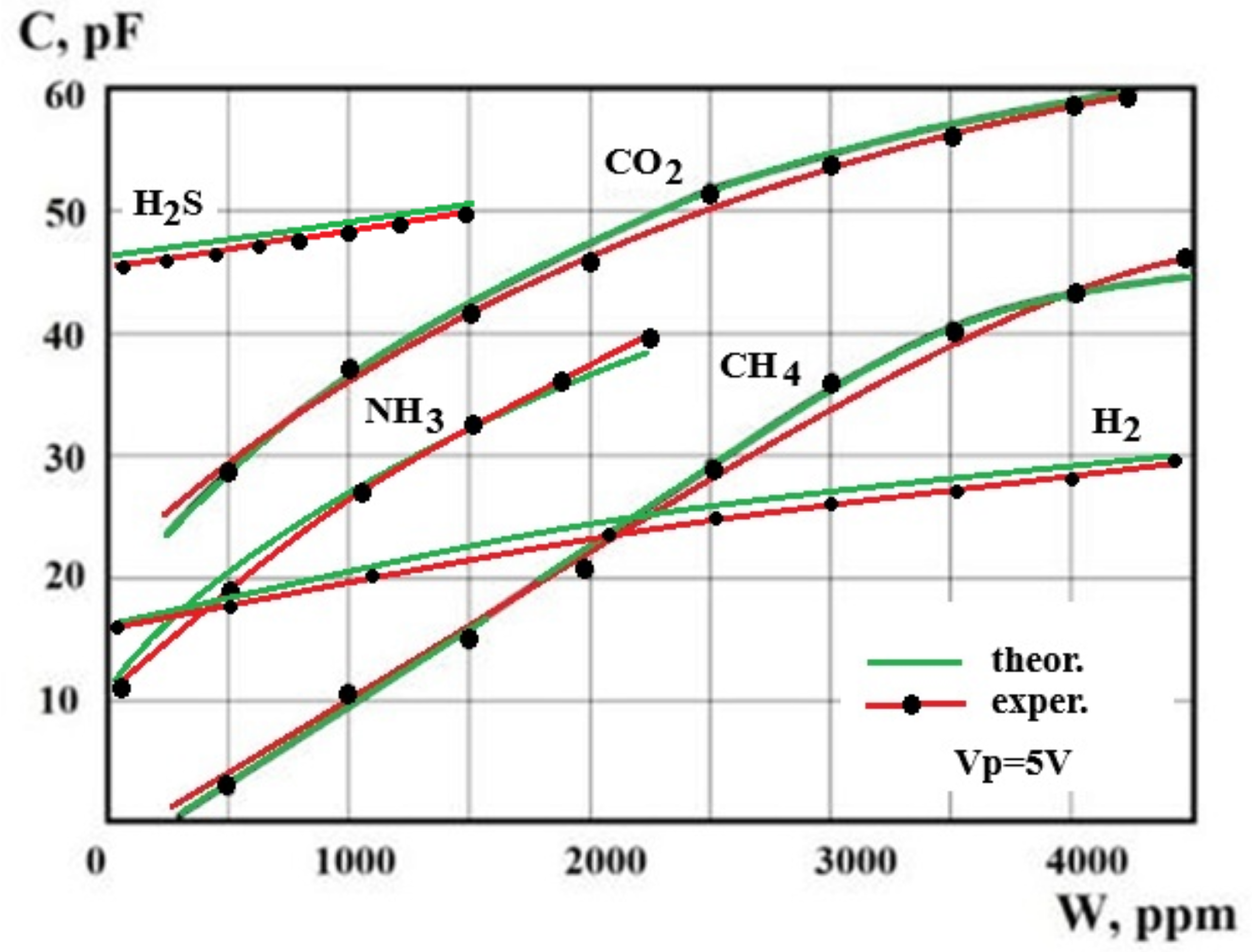
Figure 2 shows the experimental dependences of the capacitance of gas sensors on the concentrations of CH4, CO2, NH3, H2, and H2S at a supply voltage of 5 V for the autogenerator converter.
Figure 2 presents the experimental dependences of the capacitance of gas sensors on the concentrations of CH4, CO2, NH3, H2, and H2S at a supply voltage of 5 V for the autogenerator converter. The study was carried out using the frequency method, in which the gas concentration is converted into a frequency output signal. The primary sensors used were GGS3430T (CH4), MiCS-6814 (CO2), GGS1430T (H2), GGS4430T (NH3), and GM-602B (H2S). As follows from the graph (Figure 2), the experimental dependence of the change in the capacitance of the space-charge layer of the gas sensor on changes in methane concentration acting on the sensor confirms the theoretical behavior of the space-charge capacitance as a function of changes in the surface potential.
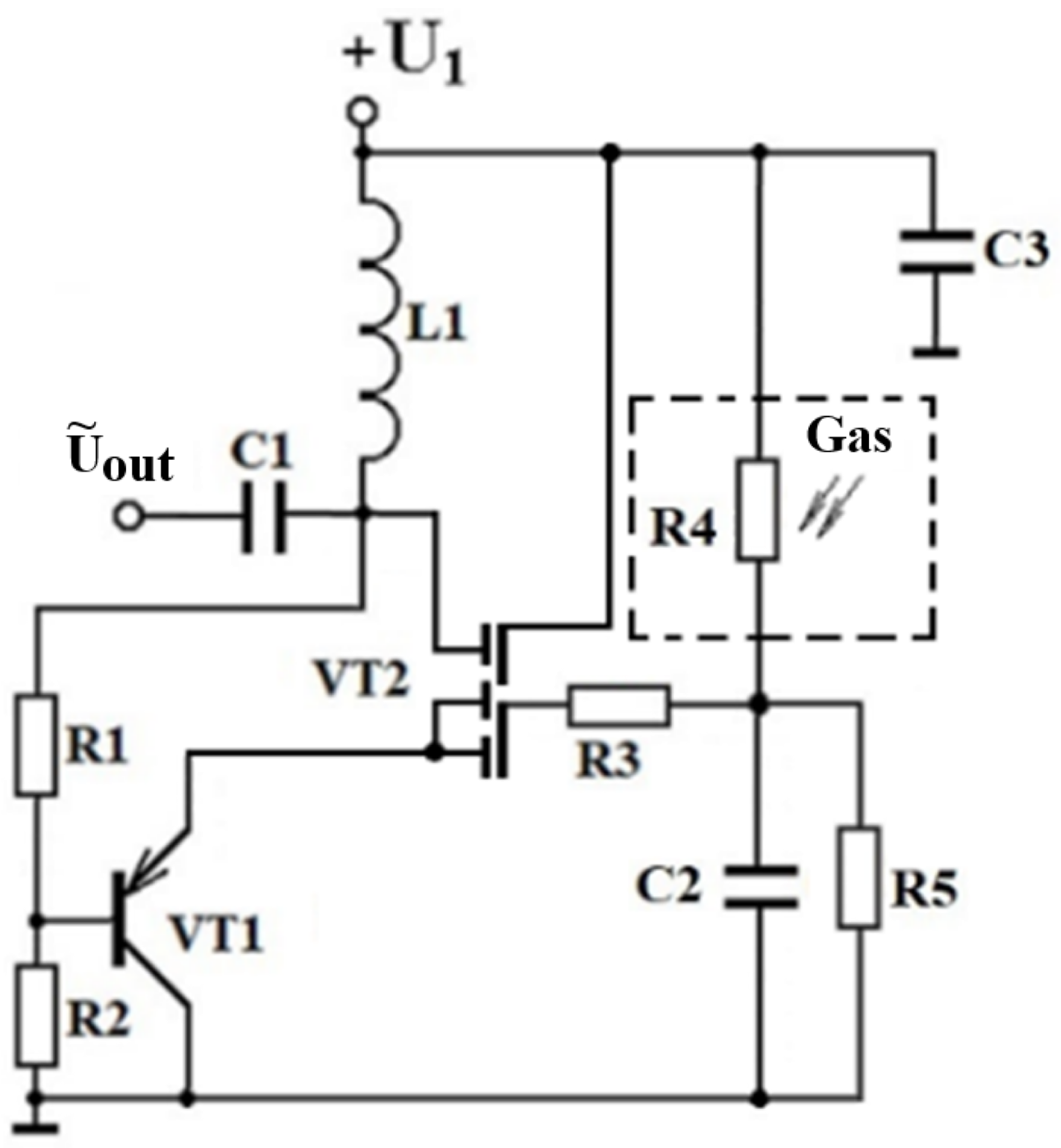
Figure 3 shows the electrical diagram of an autogenerator converter to measure gas concentration based on metal oxide (MOX) with a sensing element for the corresponding gases to be measured in a multichannel system to monitor the parameters of biogas plants based on autogenerator microelectronic gas concentration converters. The primary sensors used as gas detection elements were GGS3430T (CH4), MiCS-6814 (CO2), GGS1430T (H2), GGS4430T (NH3), and GM-602B (H2S).
When the gas concentration changes, the conductivity of the sensing element that adsorbs gas molecules changes, which in turn changes the active and reactive components of the transistor structure impedance. The reactive component of the transistor structure’s impedance is capacitive. This capacitance is part of the total capacitance that occurs in the drain electrodes of a double-gate MOSFET and the collector of a bipolar transistor, which together with the inductance L 1 form an oscillating circuit whose resonant frequency depends on the gas concentration [18]. For experimental verification, a hybrid integrated circuit based on a double-gate MOSFET transistor BF998 and a bipolar transistor MMH81 was developed.
The gas-sensitive resistor R4 is affected by the gas concentration, which leads to a change in both the equivalent capacitance of the oscillating circuit of the gas concentration autogenerator converter and the differential negative resistance at the output of the measuring device, which causes a change in the resonant frequency of the gas concentration parametric autogenerator converter. The energy losses in the oscillating circuit of the parametric oscillator are compensated for by the energy of the differential negative resistance. Resistors R 1 , R 2 , R 3 , and R 5 power the parametric oscillator using a constant voltage source U 1 . The capacitor C 3 prevents the flow of alternating current through the power supply. Let us proceed to calculate the change in the parameters of the gas-sensitive resistor R 4 due to the effect of the gas concentration. The operation of semiconductor gas sensors is based on the phenomenon of gas adsorption on the surface of the semiconductor due to the action of an uncompensated electric field at the gas–solid interface [22]. The adsorption process continues until the semiconductor surface and the gas phase reach equilibrium. During catalytic oxidation by gases such as H2, CH4, NH3, H2S, which act as oxidizing gases, the positive valence of the adsorption complex on the surface of the semiconductor material effectively increases, as electrons are given to the surface of the semiconductor during the reaction. As a result, the concentration of electrons on the surface of the semiconductor increases, which leads to the fact that in semiconductor materials of electronic type of conductivity, the charge arises due to the enrichment process and in semiconductors of hole type of conductivity due to depletion [17].
Depending on what binds the adsorption particles to the surface of the semiconductor material, physical and chemical adsorption takes place. Physical adsorption is determined by electrostatic forces (Van der Waals force, electric image force), and the binding energy in this case is 0.01–0.1 eV. Chemical adsorption occurs when the adsorbed molecules are bound to the semiconductor material by exchange forces. In this case, the binding energy in the semiconductor material during chemisorption is significant and reaches 1 eV. Thus, as a result of gas adsorption, additional surface states appear in the semiconductor material. The energy levels of the surface states in the semiconductor material are located in the forbidden zone well below the bottom of the conduction band or above the valence band [22]. The surface charge in a semiconductor material attracts charge carriers from the semiconductor volume to the near-surface region, which leads to the appearance of a double-charged layer. The presence of a surface charge in a semiconductor material changes its energy pattern in the near-surface region.
Based on the consideration of physical processes in the near-surface region of semiconductors under the influence of external factors, leading to the appearance of excess charge carriers, the value of the near-surface resistance of the semiconductor material was obtained from the solution of the Poisson equation, which is described by the formula for semiconductors of type n conductivity [22]
R s n = 1 2 q n i μ n s L D γ 1 + α 1 / 2 e φ s n ( W ) 2 1 ,
and for p-type semiconductors [22]
R s p = 1 2 q n i μ p s L D γ + α 1 / 2 e φ s p ( W ) 2 1 ,
where μ n s and μ p s are the mobilities of electrons and holes in the bulk semiconductor material; q is the electron charge; n i is the intrinsic carrier concentration in the semiconductor material; α = Δ n / n i = Δ p / n i is the dimensionless carrier-injection level coefficient; L D is the penetration depth of the electric field of charge in the near-surface semiconductor layer; γ = ( p 0 / n 0 ) 1 / 2 = p 0 / n i = n i / n 0 is a dimensionless coefficient characterizing the bulk properties of the semiconductor material; φ s p ( W ) = q ( E F p ψ s ) / k T and φ s n ( W ) = q ( ψ s E F n ) / k T are dimensionless surface electrostatic potentials for p-type and n-type semiconductors, respectively; W is the gas concentration; E F p and E F n are the Fermi levels in p-type and n-type semiconductors; ψ s is the surface potential; k is the Boltzmann constant; and T is the absolute temperature. It should be emphasized that Equations (26) and (27) are valid for large values of surface electrostatic potential, i.e., for excess charge carriers on the semiconductor surface [22,23].
The resistance change of an n-type semiconductor affected by the donor gas W is
Δ R s n ( W ) = d R s n d φ s n ( W ) Δ φ s n ( W )
After differentiating in Formula (3), we obtain the expression
Δ R s n ( W ) = 1 q n i μ n s L D γ 1 + α 1 / 2 e φ s n ( W ) 2 Δ φ s n ( W )
Knowing the dependence of the change in the semiconductor resistance of the gas-sensitive resistor, we can proceed to calculate the mathematical model of the device, i.e., to determine the parametric dependence of the output frequency of the oscillator on the change in gas concentration. In solving this problem, it is necessary to consider the conversion of energy in a gas-sensitive semiconductor resistor when exposed to a gas concentration into the energy of an alternating electric field at the output terminals of an oscillator gas converter. To do this, it is necessary to determine the efficiency of the gas concentration measurement device. In the first stage of device operation, the energy of the concentration of gas particles is converted into the energy of the electric field at the ohmic electrodes of the gas-sensitive resistor, which in the next stage is converted into the energy of the alternating electric field of the parametric oscillator, which is connected to the equivalent capacitance C e k v of the oscillating circuit of the parametric oscillator. Based on the above, the efficiency of the oscillator converter is determined by the formula
η = C e k v U 2 q n i μ n s L D γ 1 + α 1 / 2 e φ s n ( W ) 2 4 t I p 2 ,
where U is the output alternating voltage of the device, t is the oscillation period of the output alternating voltage, and I p is the current through the gas-sensitive resistor of the semiconductor. From Formula (5), the equivalent capacitance of the oscillatory circuit of the parametric autogenerator device is determined.
C e k v = 4 η t I p 2 U 2 q n i μ n s L D γ 1 + α 1 / 2 e φ s n ( W ) 2 ,
On the other hand, the equivalent capacitance C e k v can be determined from the formula for the resonant frequency of the oscillator, which has the form [23]
F 0 = 1 2 π R g C e k v R g 2 C e k v L 1
where R g is the differential capacitive resistance of the oscillatory circuit of the parametric autogenerator sensor, and L is the circuit inductance. From Formula (7), we obtain a quadratic equation, based on which we determine the equivalent capacitance C e k v :
4 π 2 F 0 2 R g 2 L C e k v 2 R g 2 C e k v + L = 0 .
Let us introduce the following notation:
a 1 = 4 π 2 F 0 2 R g 2 L ,
a 2 = R g 2 ,
a 3 = L ,
a 4 = C e k v = 4 η t I p 2 U 2 q n i μ n s L D γ 1 + α 1 / 2 e φ s n ( W ) 2 .
The solution of quadratic Equation (12) has the form
C e k v = a 2 ± a 2 2 4 a 1 a 3 2 a 1 .
By equating Expressions (10) and (13), we obtain an equation from which we determine the parametric dependence of the output frequency of the parametric autogenerator transducer on the effect of gas concentration on the gas-sensitive resistor:
a 1 = a 2 a 4 a 3 a 4 .
Substituting into Equation (14) the value ( a 1 a 4 ) based on Expressions (11)–(14) and solving it, we obtain the conversion function of the parametric autogenerator transducer:
F 0 = 1 2 π U 2 q n i μ n s L D γ 1 + α 1 / 2 e φ s n ( W ) 2 4 η t I p 2 L U 4 q 2 n i 2 μ n s 2 L D 2 γ 1 + α e φ s n ( W ) 16 η 2 t 2 I p 4 R g 2 1 / 2 .
The formula obtained (15) makes it possible to calculate the conversion function of the device in a simpler way than the complex approach using the nonlinear equivalent circuit of the parametric autogenerator transducer based on solving the Kirchhoff equations.
The sensitivity of the device is determined by the derivative of Function (15) with respect to the gas concentration parameter W. As experimental studies have shown, the output alternating voltage U of the parametric autogenerator transducer also depends on the gas concentration. Therefore, the conversion function of the parametric autogenerator transducer, taking into account the dependence of its components on gas concentration, takes the following form:
F 0 = 1 2 π a 5 U 2 ( W ) e φ s n ( W ) 2 a 6 U 4 ( W ) e φ s n ( W ) 1 / 2 .
a 5 = q n i μ n s L D γ 1 + α 1 / 2 4 η t I p 2 L .
a 6 = q 2 n i 2 μ n s 2 L D 2 γ 1 + α 16 η 2 t 2 I p 4 R g 2 .
Taking into account Expressions (41)–(43), the sensitivity function of the parametric autogenerator transducer is described by the formula
S F 0 = 1 4 π a 5 U 2 ( W ) e φ s n ( W ) 2 a 6 U 4 ( W ) e φ s n ( W ) 1 / 2 × [ 2 a 5 U ( W ) d U ( W ) d W e φ s n ( W ) 2 + 1 2 a 5 U 2 ( W ) d φ s n ( W ) d W e φ s n ( W ) 2 4 a 6 U 3 ( W ) e φ s n ( W ) d U ( W ) d W + a 6 U 4 ( W ) e φ s n ( W ) d φ s n ( W ) d W ]
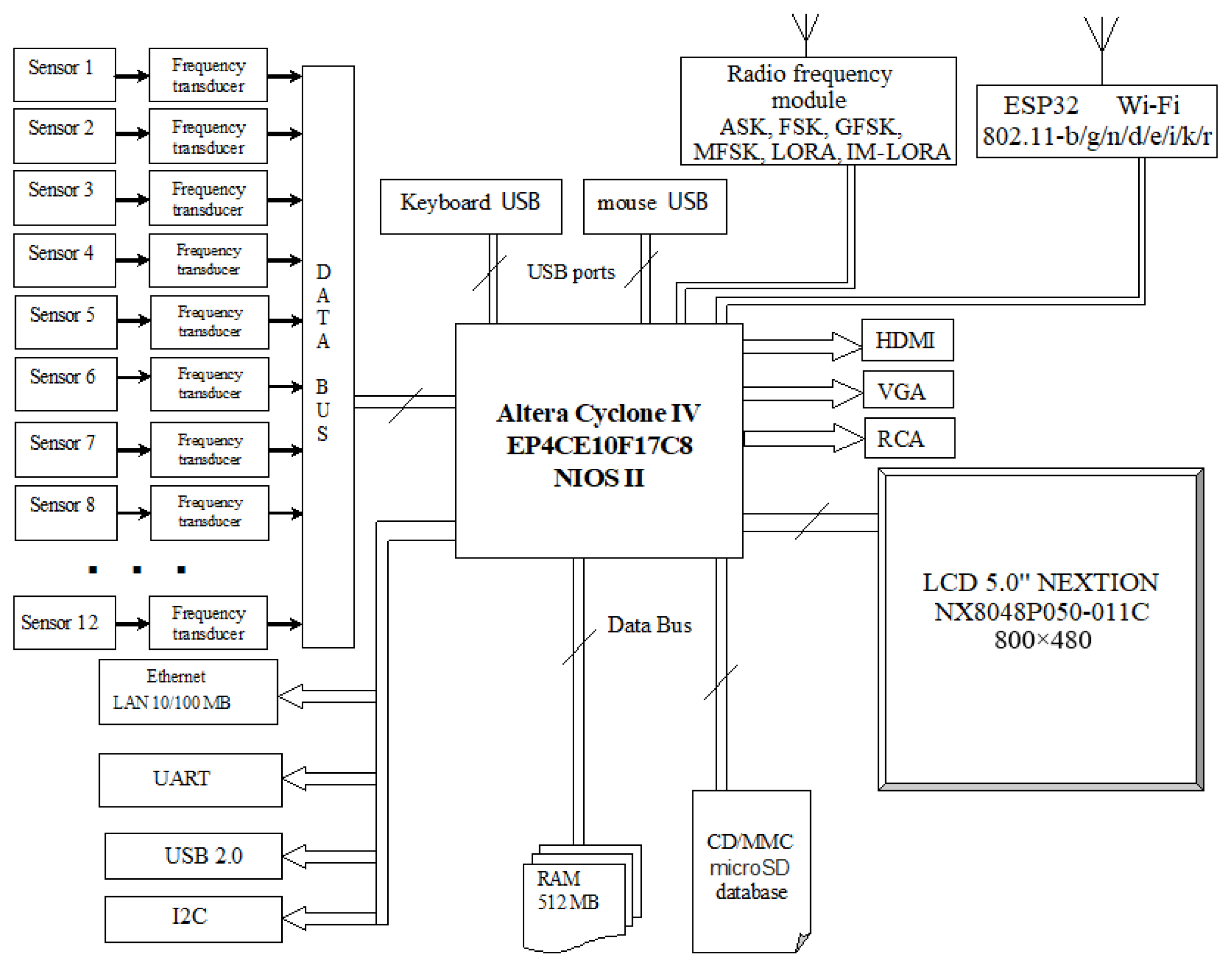
A radio measurement system has been developed to monitor biogas plants (RDM-BP-1) that is designed to analyze and determine the concentration of gases and other parameters (pressure, temperature, and humidity) in real time, built on an FPGA with an operating range of autogenerator converters of physical quantities from 50 kHz to 150 MHz. The choice of FPGA is motivated by the fact that the proposed gas converters generate informative frequency signals over a much wider range than that typically handled by conventional low-cost processor-based monitoring nodes. For low-frequency converters, a microcontroller or ARM processor is a practical and cost-effective solution; however, when the informative parameter is frequency in the tens or hundreds of megahertz range, FPGA-based counting and timing become more cost-efficient because they provide deterministic hardware processing, high-resolution frequency measurement, and parallel acquisition from multiple channels [24,25,26,27,28,29,30]. In this solution, when using the Altera Cyclone IV FPGA (Altera Corporation, San Jose, CA, USA), the number of connected oscillators can reach 64, and when using the Intel Cyclone 10 FPGA (Intel Corporation, Santa Clara, CA, USA), it can reach up to 256 units. The use of frequency as an informative parameter avoids the use of amplifiers and analog-to-digital converters in information processing, which reduces the cost of control and management systems. Figure 4 shows a block diagram of the developed measuring system.
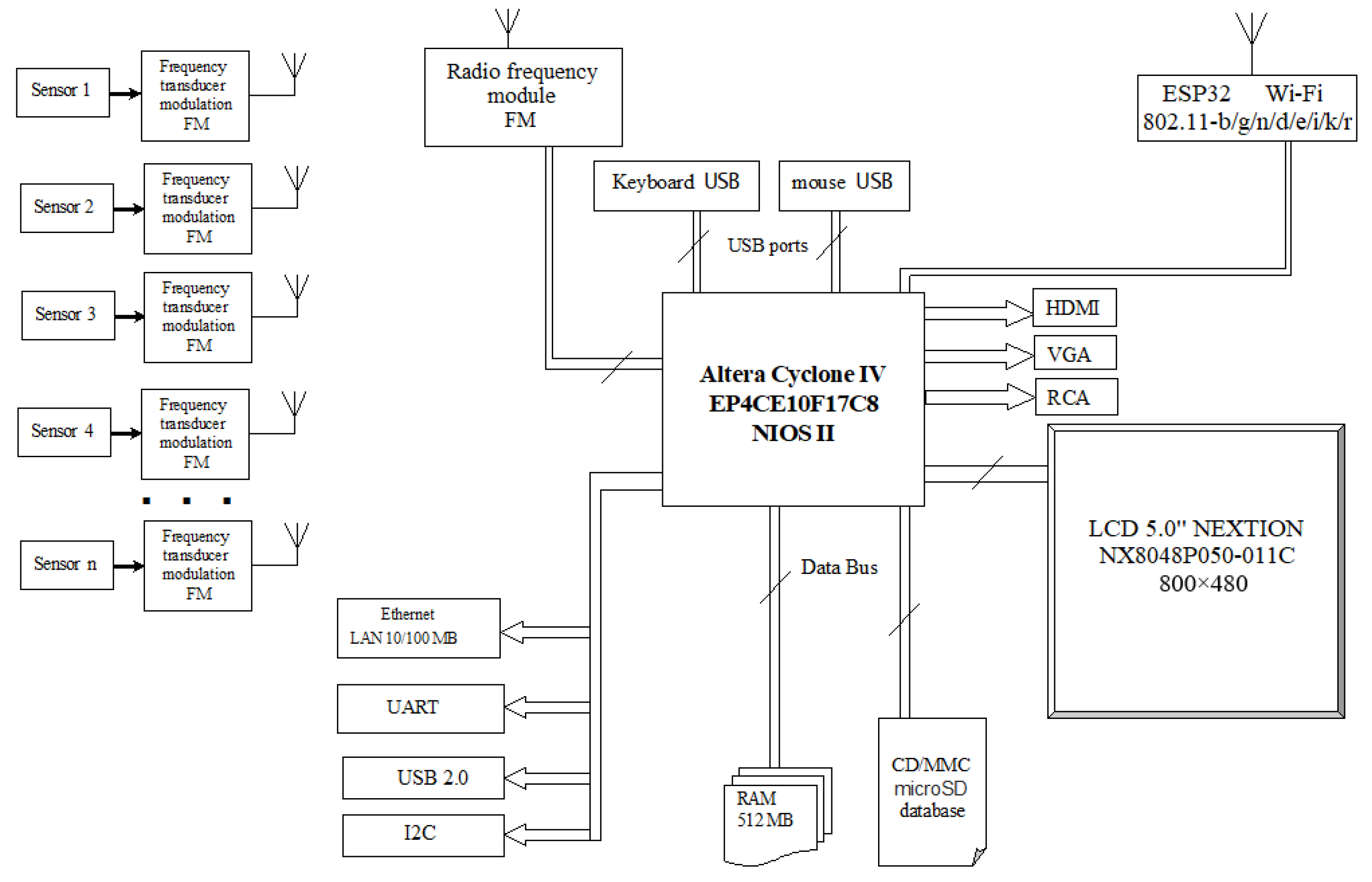
Figure 5 shows a block diagram of a multichannel device for simultaneous measurement and control of the concentration of gases and other parameters (pressure, temperature, and humidity) in real time for specialized cloud platforms, which is built on an FPGA with an operating range of self-oscillator converters of physical quantities from 144 MHz to 6.5 GHz with FM modulation. A second important reason for selecting an FPGA is the need for true parallel simultaneous operation of 12 frequency channels, while preserving the possibility of architectural expansion. In the implemented Cyclone IV version, the NIOS II soft-core coordinates data handling and communication, whereas the time-critical frequency measurement is performed in dedicated programmable logic. This partition makes the platform scalable to more than 100 channels, and with newer Cyclone-family devices, up to 256 channels can be supported in practical implementations. In this solution, using Altera Cyclone IV FPGAs, the number of connected oscillators can reach 127, and when using Intel Cyclone 10 FPGAs, up to 512 units can be reached.
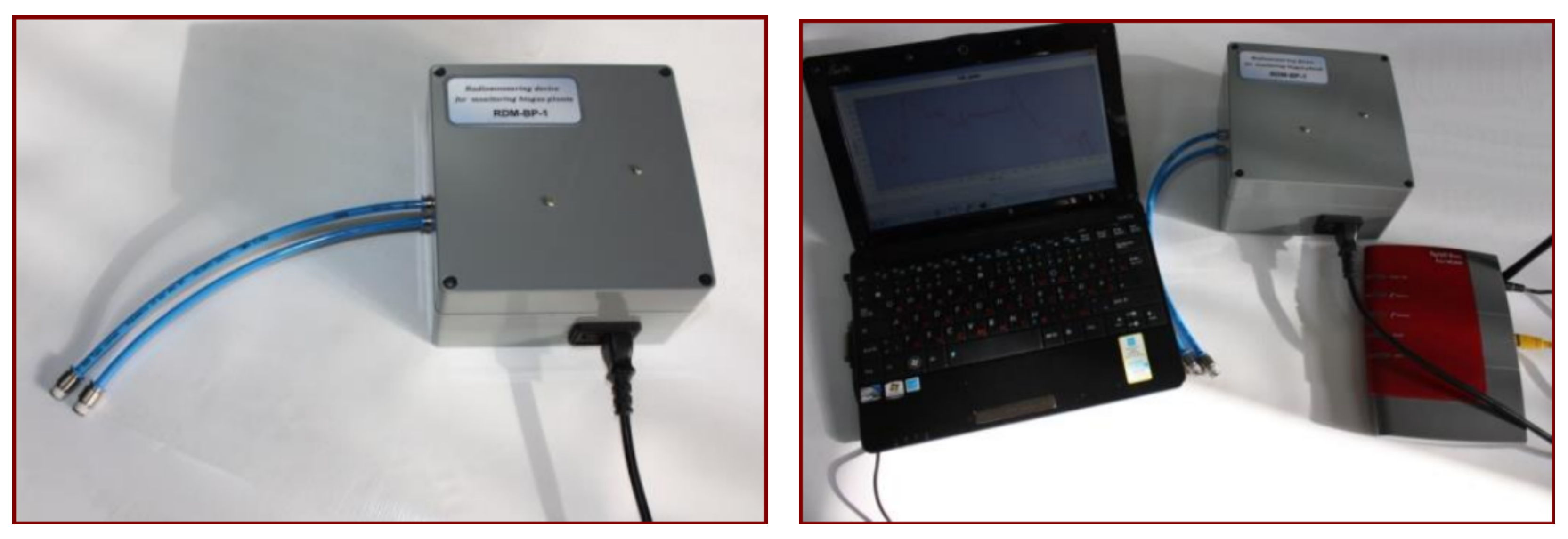
The RDM-BP-1 can be connected to various network resources, both to the 220 V network and using a battery. The 220 V power connector has a European standard. The device is connected to a personal computer through a wireless Wi-Fi network, IEEE 802.11g standard, as well as via a standard USB (USB 2.0) connector. The device has a minimum number of buttons and connectors, which ensures its reliable operation. Figure 6 shows photos of the appearance of the radio measurement system for monitoring biogas plants (RDM-BP-1).
The UBioGas program is easy to use and does not require special training or education. The program runs on various operating systems: Windows 11, 10, Windows 7 (32 bit, 64 bit), Linux. Drivers for connecting the device to a computer are supplied with the device, as well as the UBioGas program, which is an original development. At the request of the customer, Wi-Fi routers are supplied with the RDM-BP-1 device.

3. Results

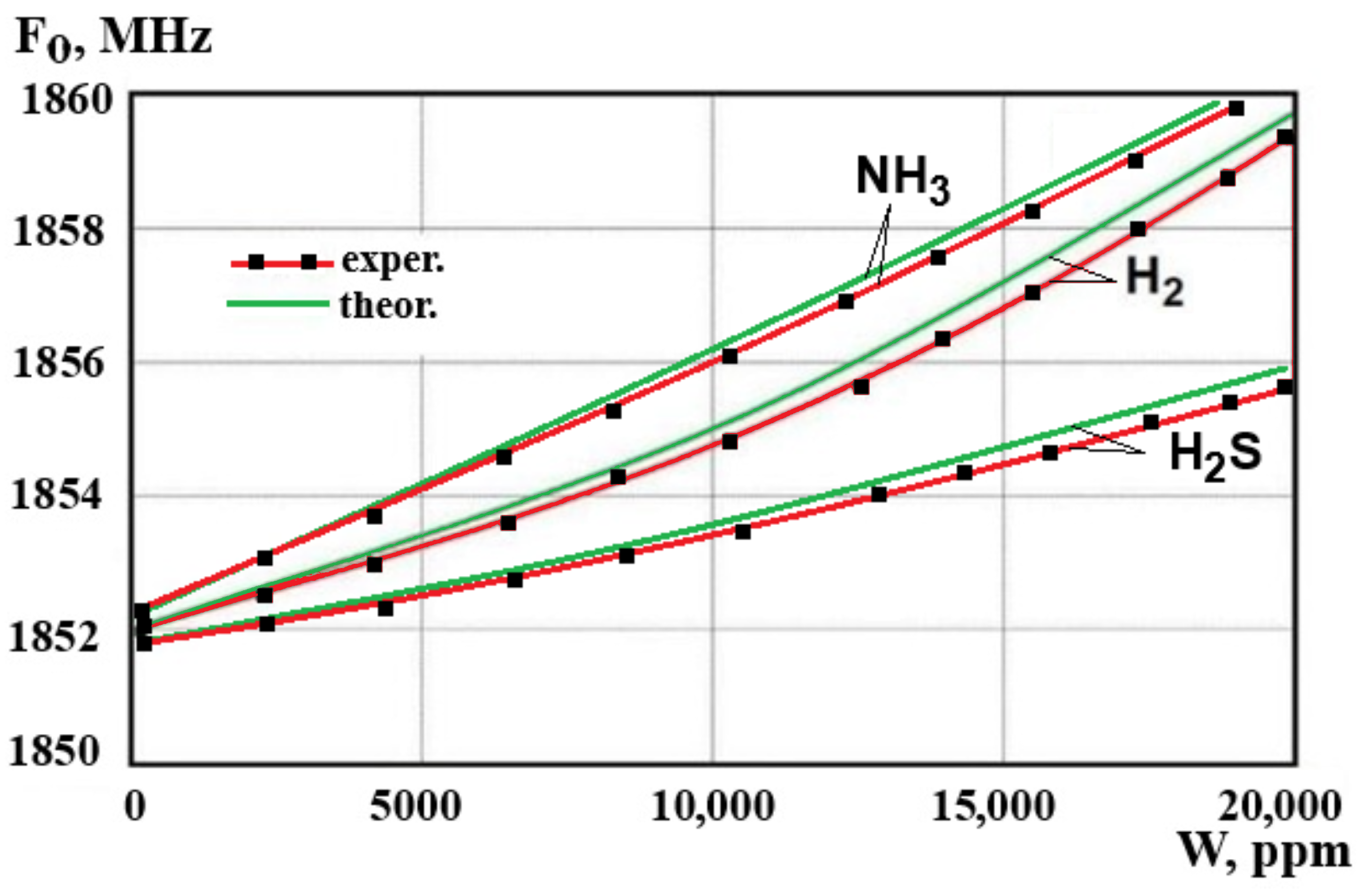
Figure 7 shows the graphical dependence of the calculated and experimental curves of the conversion functions of autogenerated microelectronic transducers when the concentration of hydrogen ( H 2 ), ammonia ( N H 3 ), and hydrogen sulfide ( H 2 S ) of gas sensors changes with the concentration in the range of 0 ppm to 20,000 ppm. For the experimental curves in Figure 7, the measurement uncertainty is within 0.25–0.5%.
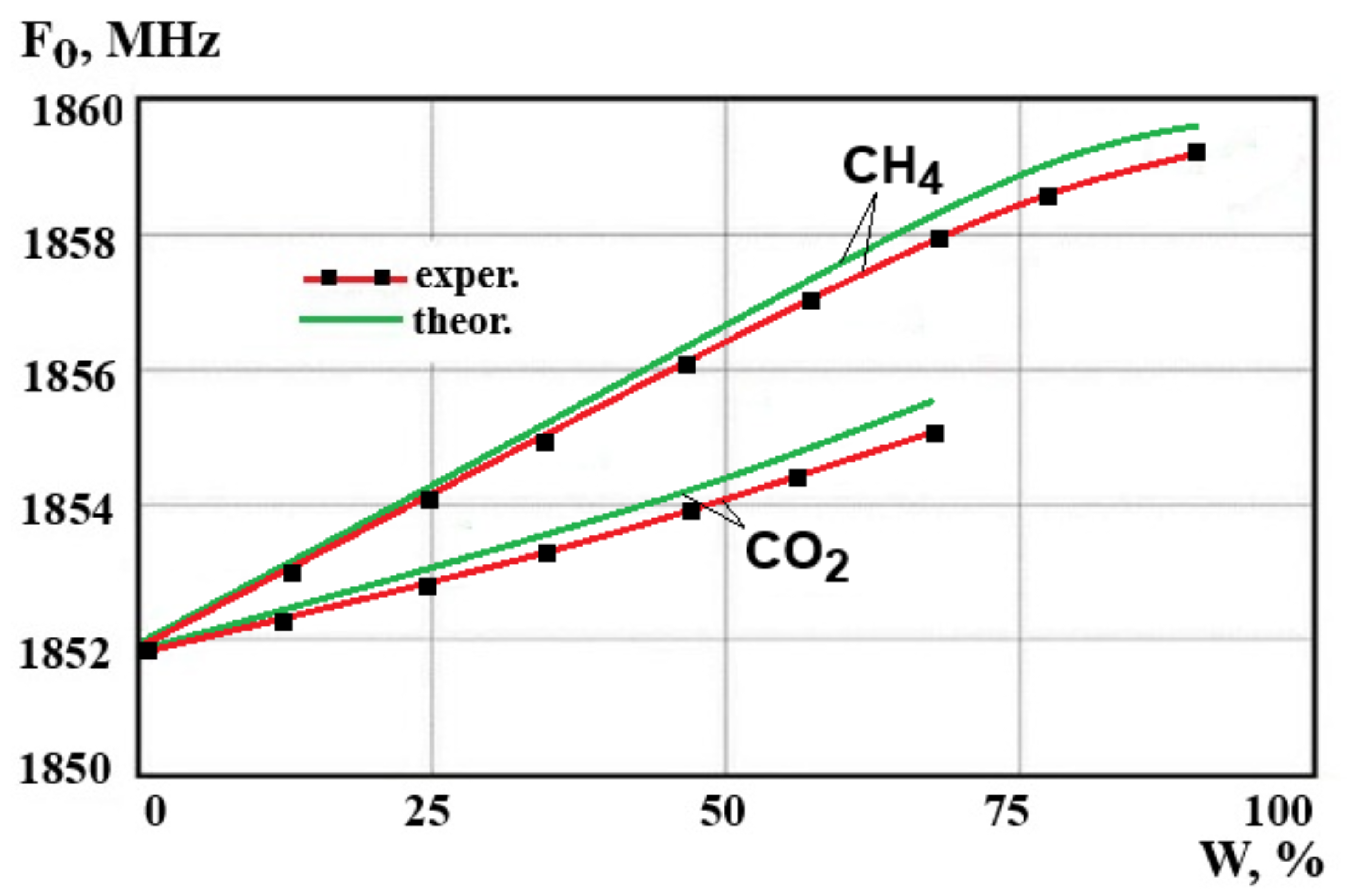
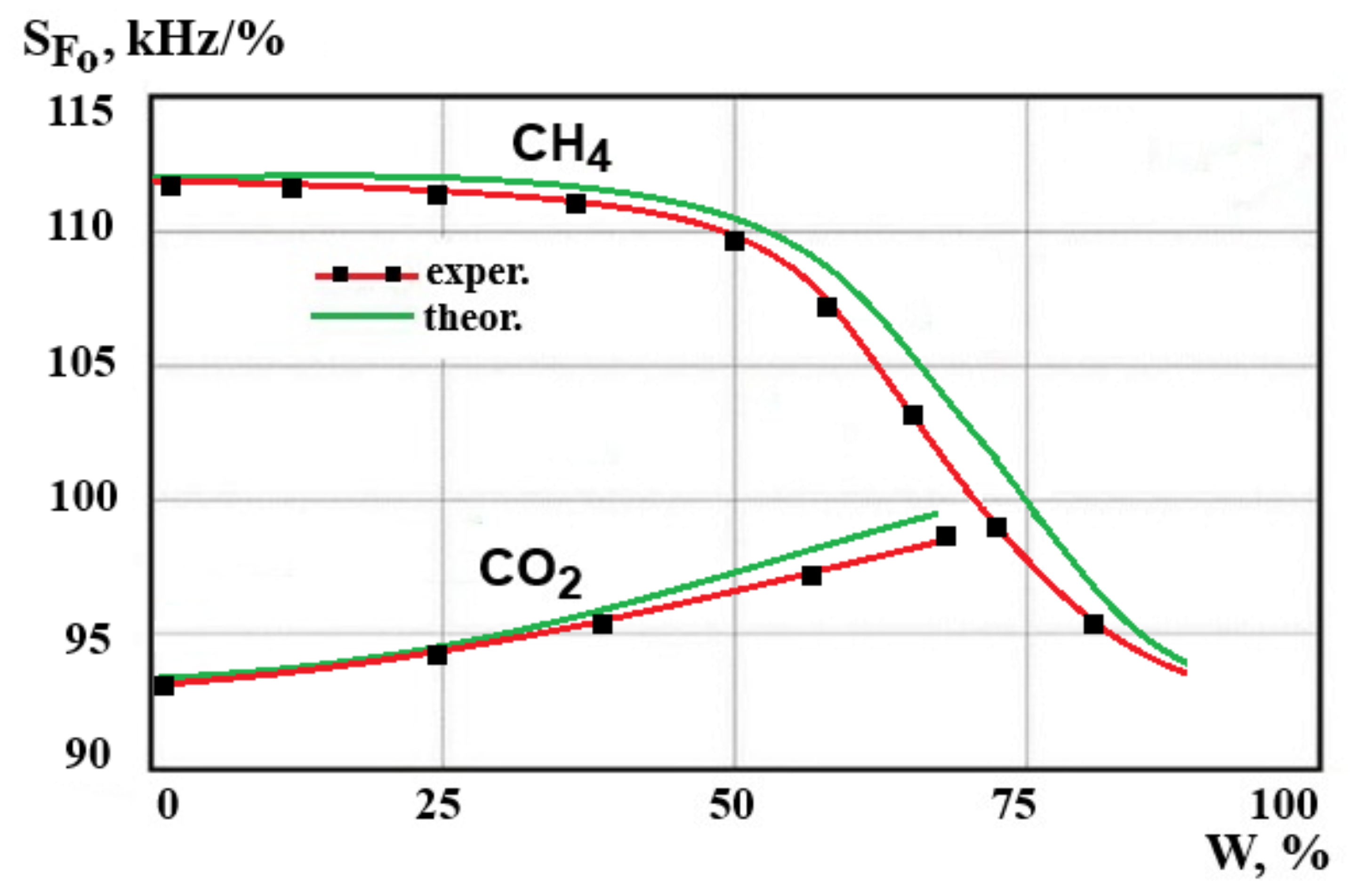
Figure 8 shows the graphical dependence of the calculated and experimental curves of the conversion functions of autogenerated microelectronic transducers when the concentration of methane (CH4) and carbon dioxide (CO2) of gas sensors changes from a change in concentration in the range from 0% to 85% for methane and from 0% to 60% for carbon dioxide. For the experimental curves in Figure 8, the measurement error is 0.5%.
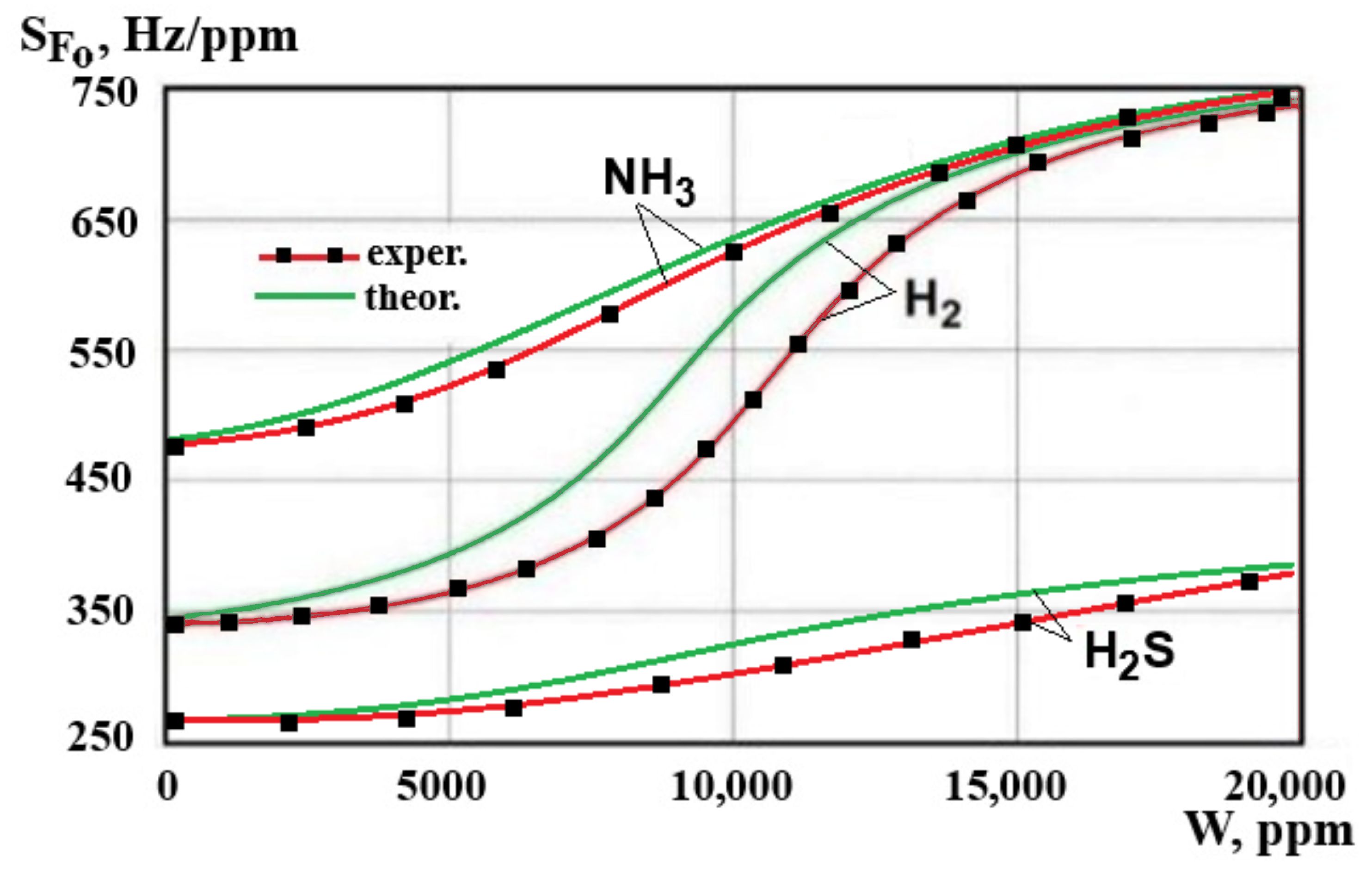
A graph of the calculated and experimental dependence of the sensitivity function of parametric autogenerator converters is shown in Figure 9. The concentration of hydrogen (H2), ammonia (NH3) and hydrogen sulfide (H2S) changes from 0 to 20,000 ppm. As can be seen in the graph (Figure 9), the sensitivity of the parametric autogenerator hydrogen converter varies from 350 Hz/ppm to 748 Hz/ppm, the ammonia converter varies from 455 Hz/ppm to 750 Hz/ppm, and the hydrogen sulfide converter varies from 253 Hz/ppm to 375 Hz/ppm in the frequency range from 1852 to 1860 MHz.
The dependence of the calculated and experimental curves of the sensitivity functions of autogenerator microelectronic transducers when the concentration of methane (CH4) and carbon dioxide (CO2) from gas sensors changes from 0% to 85% for methane and from 0% to 60% for carbon dioxide is shown in Figure 10. For methane, the experimental error is within 0.25–0.5%, while for carbon dioxide the experimental error is 0.5%. The sensitivity of the parametric autogenerator methane converter varies from 112 kHz/% to 94 kHz/%, and the sensitivity of the carbon dioxide converter varies from 93.5 kHz/% to 98.7 kHz/%.
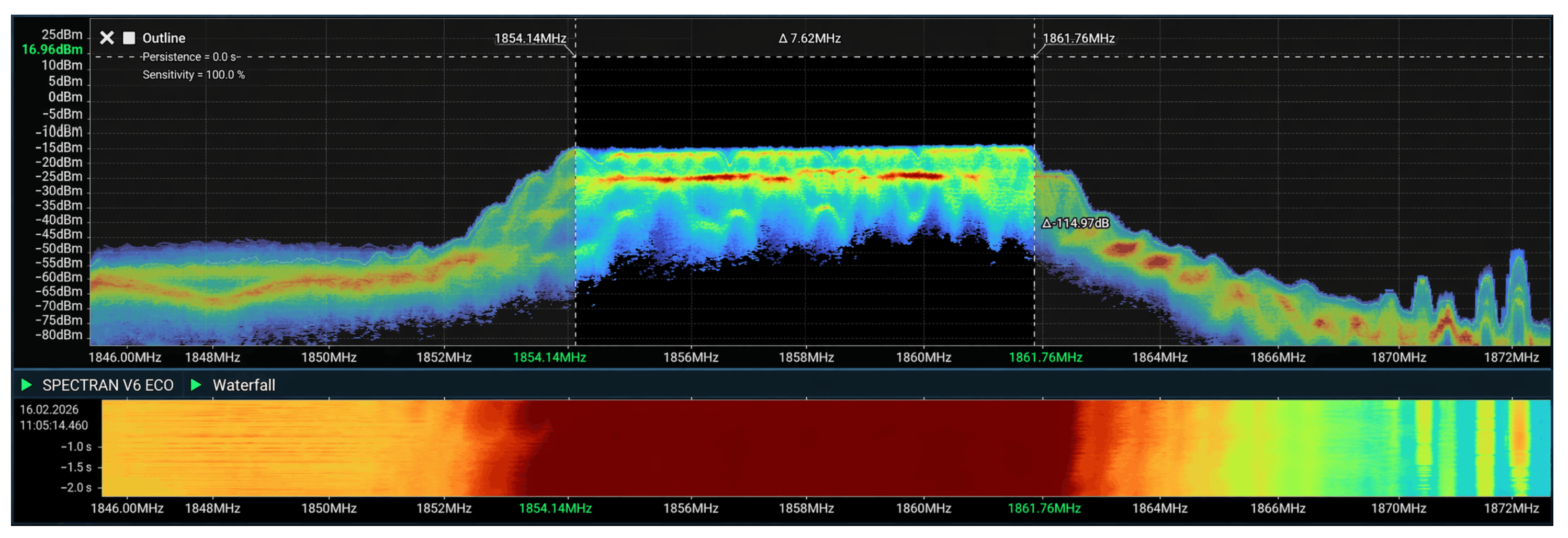
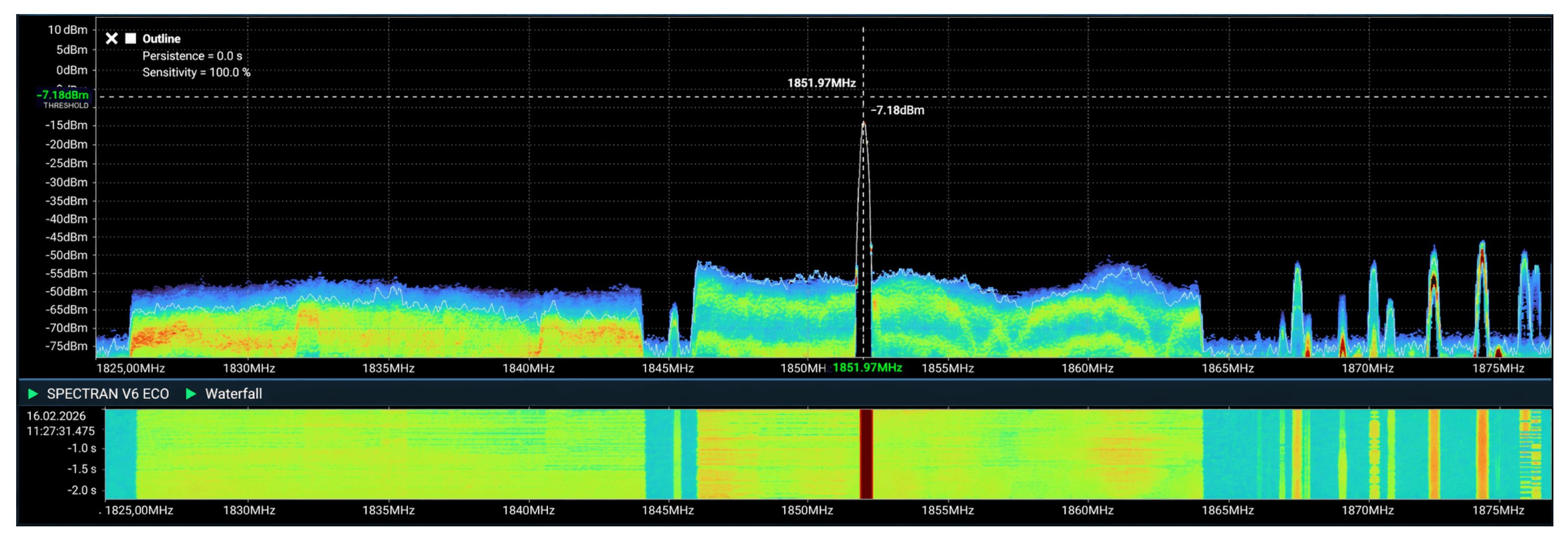
The experimental studies were conducted using the Aaronia SPECTRAN V6 PLUS (Aaronia AG, Strickscheid, Germany) radio frequency spectrum analyzer. Figure 11 shows the experimentally used radio frequency spectrum of a parametric autogenerator converter for measuring gas concentration with a frequency output in the LTE-1800 B3 range, where the transmission frequency is 1851.97 MHz without gas exposure.
Figure 12 shows the signal spectrum of the autogenerator converter to measure the methane ( C H 4 ) concentration of 85% at a frequency of 1851.97 MHz. Figure 12 shows that when the gas concentration changes from 0 to 85%, the width of the transmission frequency spectrum increases to 7.62 MHz. This frequency modulation method makes it possible to increase noise immunity from 3 to 4.5 times and increase the transmission range with minimal transmitting power.
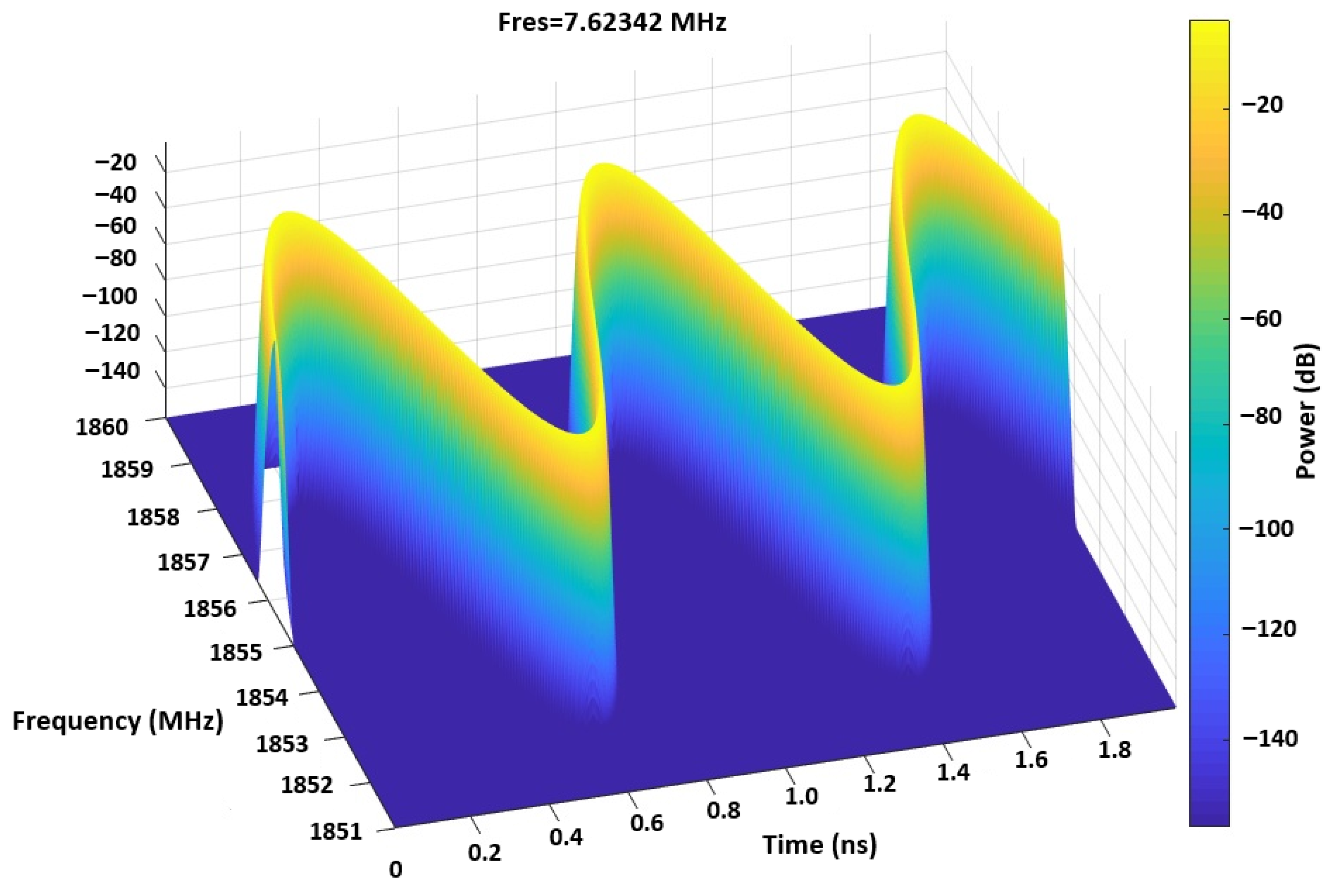
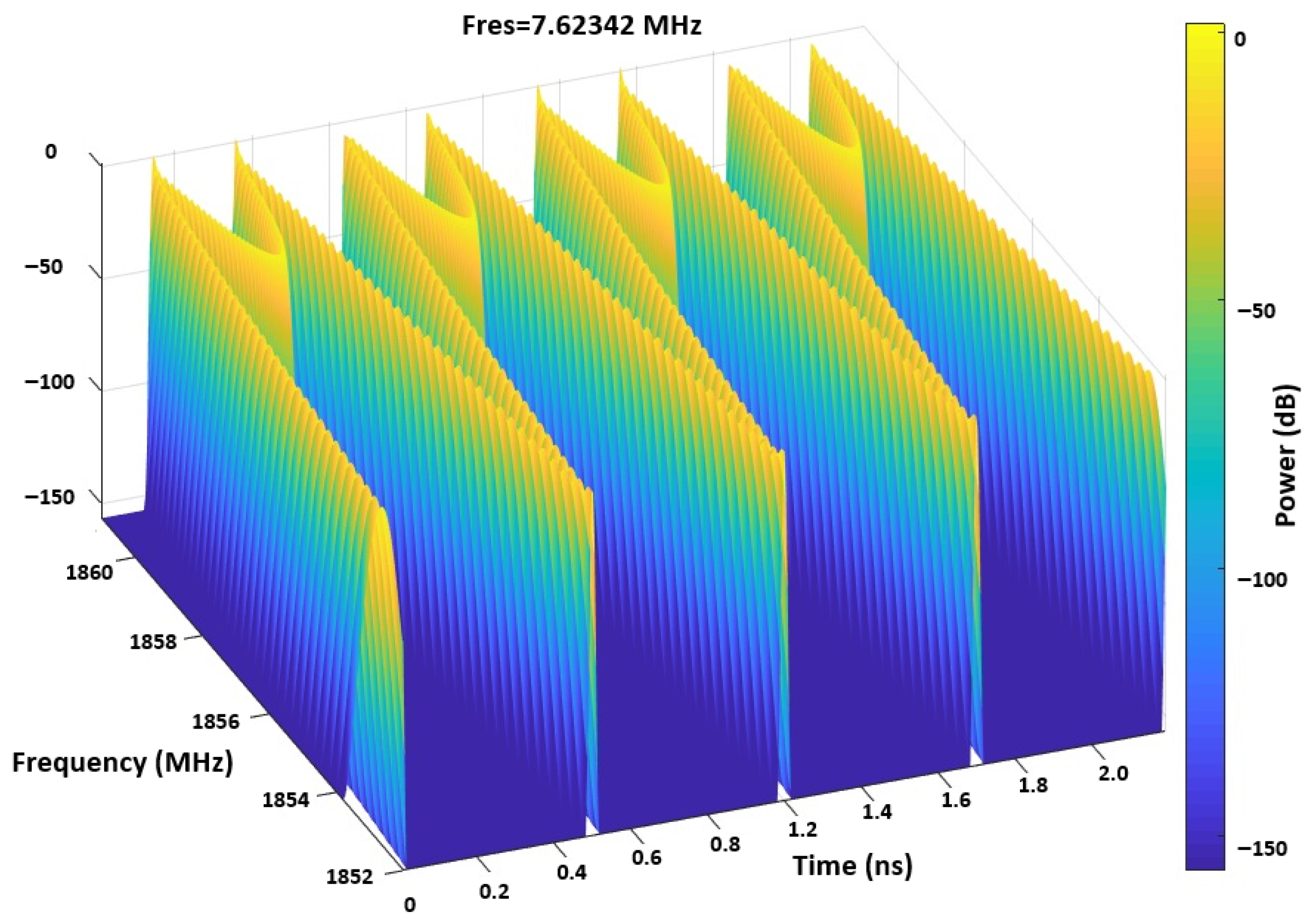
Using the Signal Processing Toolbox [31], we performed a spectral analysis of the developed autogenerated gas concentration transducer, which allows us to characterize the frequency composition of the signal. Non-parametric methods based on the fast Fourier transform, parametric and subspace methods take into account prior knowledge of the signal and describe the behavior of the autogenerator gas concentration converter based on a double-gate field-effect transistor and a bipolar transistor with a gas-sensitive resistive element quite accurately. The spectral power in the time–frequency representation of the signal (Figure 13), instantaneous frequency, instantaneous bandwidth (Figure 14), and signal similarity in the frequency domain were estimated, which allowed us to visualize and compare the time–frequency composition of the output signals under rapid changes in gas concentration acting on the gas-sensitive resistive element.
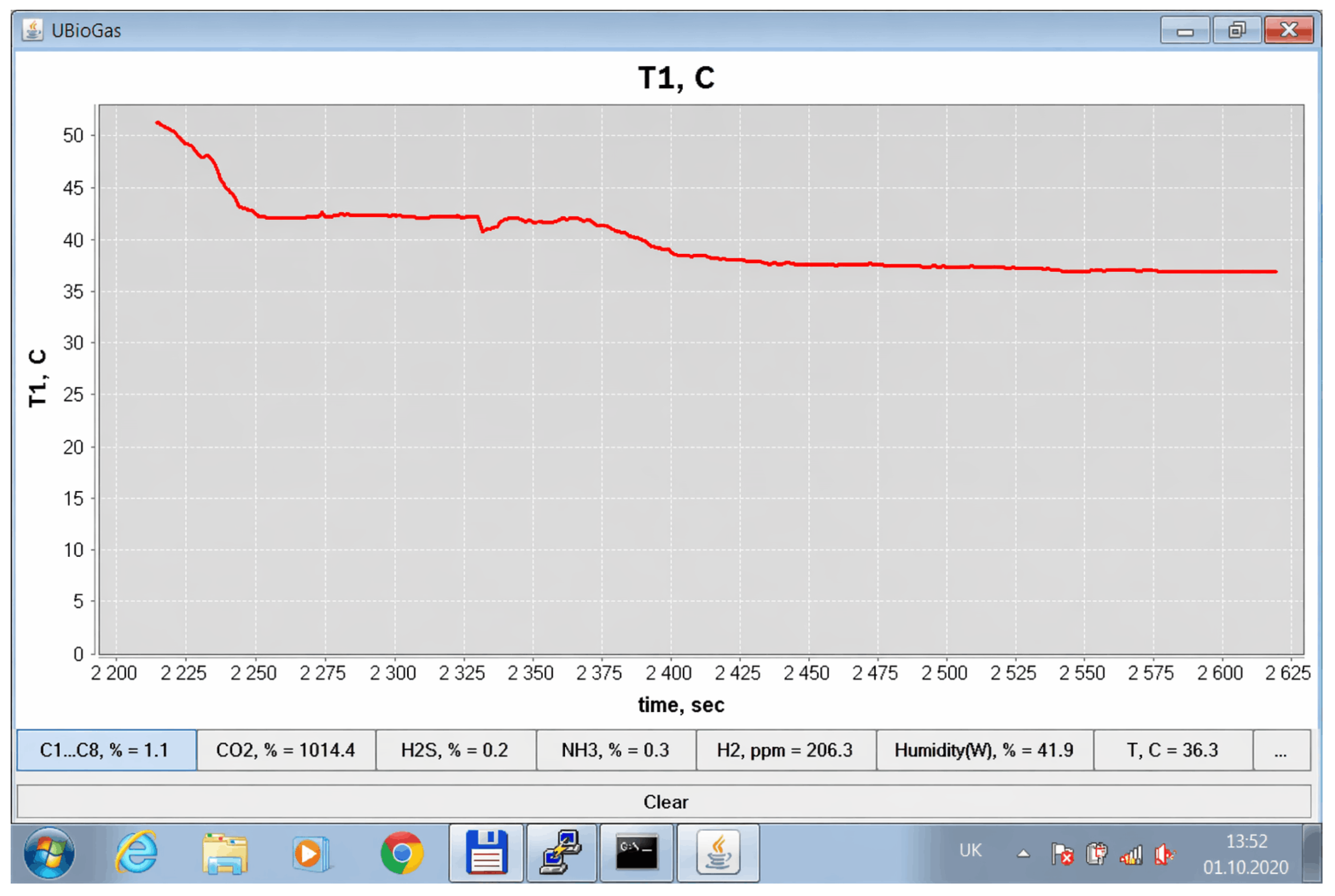
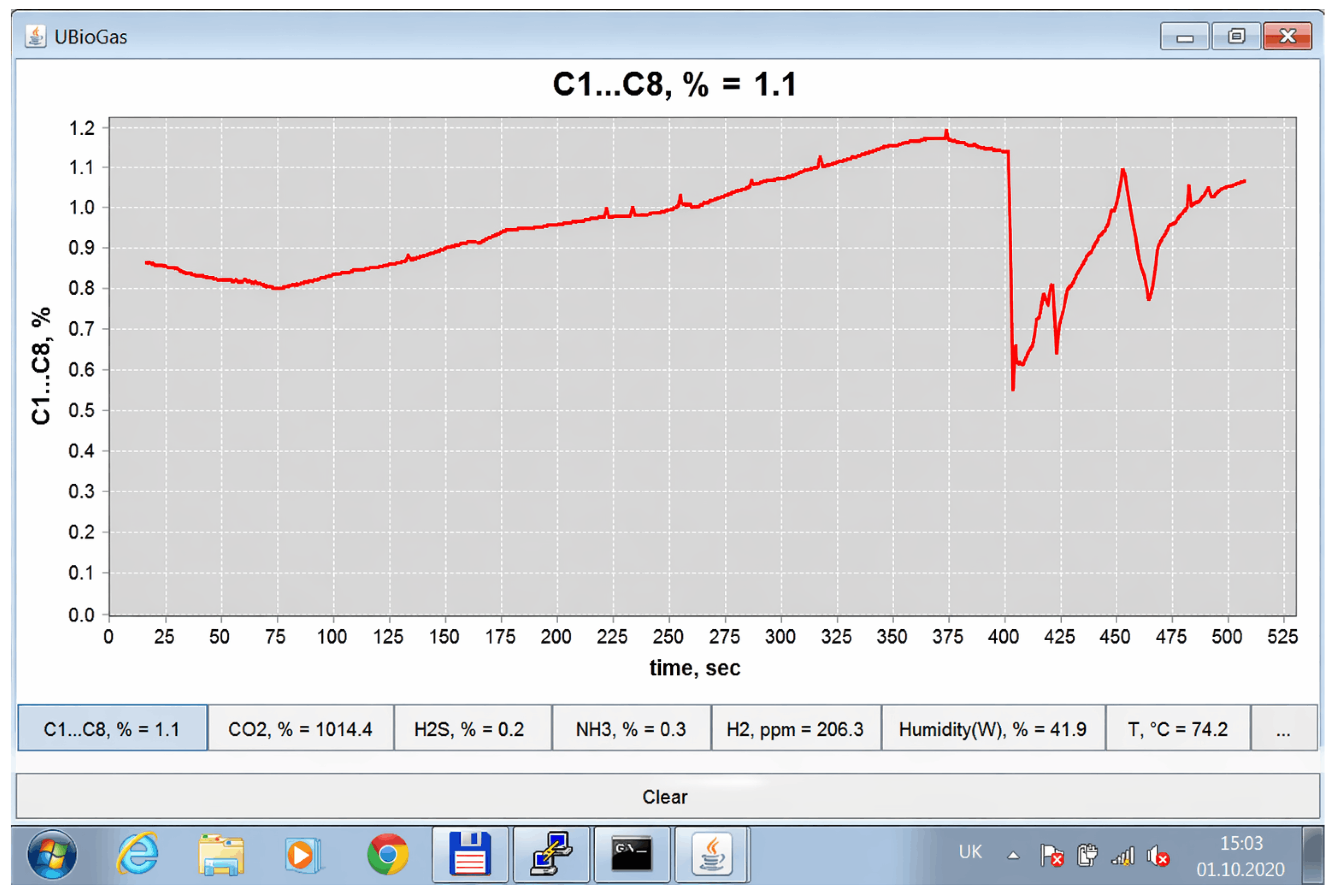
Figure 15 and Figure 16 show screenshots of the output of graphs of changes in measured values in real time from the UBioGas program of the RDM-BP-1 device.
Table 2 shows the technical characteristics of the RDM-BP-1 device.

4. Discussion

The further development of science and technology requires the design of gas concentration measuring instruments based on microelectronic technology, which significantly improves the metrological performance of physical quantities for computer and information-measuring systems and networks of general and special purpose. Gas measuring instruments are used to analyze a wide range of gases in various fields of science, industry, and technology. The main quantity characterizing the concentration of gases is the weight concentration, which is determined by the ratio of the mass of the measured gas to the mass of the entire mixture of gases in which the measured gas is present. The molar concentration of the measured gas is the ratio of the number of moles of this gas to the number of moles of all gases in the mixture. The concentration of gases is also measured as a percentage or in millions of ths, which is characterized by the value ppm, where 1 ppm = 10 6 = 10 4 %. The measured gas concentration is based on the partial pressure. The partial pressure of a gas measured in a mixture is understood as the pressure at which this gas would be if all other gases were removed from the mixture and the volume and temperature remained constant [32,33,34,35,36,37,38].
In analyzing the optimal design of an oscillator transducer for measuring the gas concentration, we concluded that it is advisable to use the frequency method for information conversion. This method increases sensitivity to measuring the controlled parameter, in particular NH3, in diagnostic medical systems, as well as ensuring high noise immunity of the informative signal.
In principle, the transistor analog of the negatron is a self-oscillating transistor structure with negative differential resistance. The frequency response of such structures has a decreasing section corresponding to the negative differential resistance, which is provided by internal feedback and serves to compensate for energy losses on the active resistances of the circuit. The complex resistance of such a structure, depending on the type of its volt-ampere characteristic, is capacitive, and its value depends on the voltage applied to its input [17,18,39]. When such a structure is connected to an inductor, a resonant oscillating circuit is formed. The value of the output voltage and the value of the complex resistance of the transistor structure depend on the value of the measured parameter.
Since self-oscillatory parametric devices for measuring physical quantities are based on transistor structures with negative differential resistance and can operate in a wide frequency range, experimental studies were conducted from low frequencies to microwave frequencies to determine the optimal operating frequencies for various applications of the developed devices. In the range from 50 kHz to 6 MHz, it is possible to work directly with 8-bit microcontrollers, with some losses in measurement accuracy. From 50 kHz to 80 MHz, direct operation with 32-bit microcontrollers is still possible with sufficiently high accuracy of measurement of physical quantities. From 50 kHz to 250 MHz, FPGA implementation becomes preferable because it offers high measurement accuracy together with parallel processing of multiple frequency streams. In the radio-frequency range from hundreds of megahertz to 6 GHz, FPGA-based radio-measuring architectures are the more appropriate choice for accurate extraction of the informative parameter. In this respect, processor-based platforms such as the i.MX6-based remote monitoring architecture reported in [40] are well suited to applications in which the edge device mainly acquires conventional digital or bus data and forwards them to a cloud diagnostic platform. By contrast, the present system must directly measure high-frequency sensor outputs and support simultaneous multichannel counting; therefore, FPGA logic is used for the front-end measurement task, while the embedded NIOS II core performs supervisory processing and communication.
The frequency range of the parametric autogenerator transducers is selected to measure the gas concentration with the frequency output in the LTE-1800 B3 band. Base stations operating at a frequency of 1800 MHz (LTE-1800, Band 3, B3) are installed in both rural areas and in small and large cities. This base station has a coverage area of 13.5 km and a sufficiently large capacity to connect a large number of users simultaneously in a small village or city with a population of millions. The 1800 MHz radio frequency band is the second most popular band used by mobile operators to deploy LTE networks and is also well-suited for wide coverage in regional environments for indoor coverage of IoT technology: NB-IoT (LTE Cat-NB1). The use of the 1800 MHz radio frequency spectrum helps mobile operators to quickly launch LTE services in a specific application and meet market requirements [41,42,43].
To evaluate the technical level of the developed autogenerator gas transducers and compare them with conventional sensing solutions, the analysis follows the generalized-efficiency methodology described in the source assessment methodology. In this approach, the performance of a transducer is not judged by a single characteristic, because optimization with respect to one parameter may worsen other important properties. Instead, a generalized criterion is formed from a set of partial indicators that reflect the metrological, informational, and operational quality of the device. The reference for normalization is an ideal transducer that combines the best attainable characteristics for every parameter considered in the comparison.
For each parameter in Table 3, a dimensionless relative indicator is obtained by comparing the actual value with the corresponding value of the ideal reference device. If an increase in a parameter improves performance, normalization is performed as the ratio of the device parameter to the reference value; if a lower value is preferable, the inverse ratio is used. In this way, all normalized indicators are brought to a common dimensionless form before aggregation. Because the compared devices belong to different structural classes, the final integral technical-level indicator is evaluated for heterogeneous devices by summing the squared deviations of normalized indicators from unity. The comparison therefore includes supply voltage, sensitivity, nonlinearity, repeatability, temperature sensitivity, power consumption, operating frequency range, output-signal level, manufacturability, operating temperature range, and operating concentration range. The results of this comparative evaluation are summarized in Table 3.
The final row of Table 3 reports the integral technical-level indicators obtained after normalization and aggregation of the eleven comparison parameters for each transducer class. These summary values provide a compact measure of the distance between each practical device and the ideal reference transducer. According to the adopted criterion for heterogeneous devices, a smaller integral value corresponds to a higher technical level because it indicates a smaller total deviation from the ideal combination of characteristics.
On this basis, the autogenerator gas transducer exhibits the best overall result among the compared practical solutions, since its summary indicator is the lowest. This conclusion agrees with the physical and circuit-level analysis presented above: the proposed transducer combines low supply voltage, wide operating-frequency capability, high output-signal level, and direct frequency-domain information conversion while avoiding the analog front-end complexity typical of conventional gas sensor interfaces. Therefore, the comparative assessment confirms that the developed autogenerator architecture provides the most favorable overall trade-off between metrological performance, implementation simplicity, and system-level applicability.

5. Conclusions

Parametric autogenerator transducers for measuring gas concentration for computer and information-measuring systems and networks of general and special purpose based on transistor semiconductor structures with differential negative resistance with gas-sensitive elements based on resistors are proposed, wherein gas-sensitive elements are active elements of autogenerator circuits, which helps simplify the hardware architecture of computer and information-measuring systems.
A mathematical model of the capacitance of the near-surface layer of the spatial charge in semiconductor gas sensors has been developed, which depends on the surface potential, the change in which is determined by the action of a given concentration of measured gases on the sensor surface. The change in the total resistance of semiconductor sensors from the concentration of the measured gases (in this case, its reactive component) describes the essence of the gas-reactive effect, which in turn allows us to obtain the dependence of the output frequency on the concentration of the active gases in oscillator converters.
The parametric dependences of the conversion and sensitivity functions obtained show the possibility of obtaining the main characteristics of the devices much easier and take into account the influence of each parameter of the primary converters and parameters of the oscillators on the output frequency compared to the calculations of the conversion and sensitivity functions from equivalent device circuits based on the solution of the Kirchhoff equations, which simplifies the analytical evaluation of such systems in computer and information measurement applications. Gas concentration measuring devices with frequency output do not require analog-to-digital converters and amplifying devices for further processing of information signals, which simplifies the measurement chain in computer and information-measuring systems and networks of general and special purpose and allows the transmission of information over a distance when the devices operate in the ultra-high frequency range.
On the basis of the consideration of the physical processes occurring in gas-sensitive elements and auto-generator converters, mathematical models of gas concentration measuring devices have been developed using the energy conversion method, with the help of which the parametric dependences of the sensitivity and conversion functions have been obtained. It is proven that the main contribution to the change in the conversion and sensitivity functions is made by a change in the gas concentration, which in turn causes a change in the equivalent capacitance and differential negative resistance in the oscillatory system of oscillator converters for measuring the gas concentration, which changes the output frequency of the devices. The sensitivity of the parametric autogenerator hydrogen transducer varies from 350 Hz/ppm to 748 Hz/ppm, the ammonia transducer varies from 455 Hz/ppm to 750 Hz/ppm, and the hydrogen sulfide transducer from 253 Hz/ppm to 375 Hz/ppm in the frequency range from 1852 MHz to 1860 MHz. Studies have shown that the sensitivity of the parametric auto-generator methane converter varies from 112 kHz/% to 94 kHz/%, and the sensitivity for the carbon dioxide converter varies from 93.5 kHz/% to 98.7 kHz/%.
A multi-channel device for simultaneous measurement of frequency and digital information based on Altera Cyclone IV FPGA has been developed, which has 12 measurement channels for devices with frequency output and supports simultaneous operation with 127 digital sensors via an I2C interface. This simultaneous 12-channel operation is one of the key practical advantages of the chosen FPGA architecture, because all channels can be measured in parallel without time-multiplexing penalties. The widely used digital UART protocol, which is supported by a large number of converters, is used as an output interface. Therefore, data can be transferred from the developed device wirelessly, including through external communication nodes when integration with sensor-network infrastructure is required. The developed device can be connected to a personal computer via a UART-USB converter. Specialized software has been developed to test the performance of the multichannel measuring system. For ease of perception, the information received from the measuring device is visualized. A circuit was synthesized for a multichannel device based on Altera Cyclone IV FPGA, which has 12 measuring channels for sensors with frequency output and is based on the NIOS II flexible microprocessor core. The widely used digital UART protocol is used as the output interface. In addition, software was developed for the microprocessor core that allows the processing of data from frequency meters and their transmission to the UART port. A microprocessor system was designed to be flexible and allow one to change the number of input signals from frequency meters without changing the data processing algorithm.
Based on the autogenerator transducers developed to measure physical quantities, the design and block diagram of the information and measuring system to monitor biogas plants (RDM-BP-1) for specialized cloud platforms, which operate in real time, was developed. It is designed to analyze gases and measure their concentrations in transformer oil, as well as the temperature, humidity, and pressure. The interval between measurements is 1 s. The constant supply voltage is 5 V. The software is compatible with Windows 7, 8, and 10, as well as Linux. The weight of the device with the power supply is 1.1 kg.
The calibration of the gas sensing channels was performed using reference gas mixtures with known concentrations, establishing the conversion functions between gas concentration and output frequency for each sensor type. The calibration curves presented in Figure 9 and Figure 10 were obtained under controlled laboratory conditions and demonstrate stable and monotonic frequency responses for CH4 and CO2 within the investigated concentration ranges.
The repeatability of the measurement results was evaluated through multiple experimental runs under identical conditions. The relative deviation of the measured frequency values did not exceed ± 0.25 0.5 % , indicating good stability of the proposed frequency-output sensing approach.
It should be noted that the dynamic characteristics of the sensing system, including response and recovery times, hysteresis, and long-term drift, are primarily determined by the gas-sensitive materials of the employed sensors (GGS and MiCS series), while the proposed frequency-based conversion method preserves these characteristics without introducing additional distortion. Typical response times for the used sensors are on the order of several seconds to tens of seconds, which is consistent with semiconductor gas sensing devices.
Further research should focus on small-series production of the developed sensing modules and monitoring devices in order to evaluate manufacturability, repeatability, and calibration consistency across multiple units. Moreover, extended experimental testing should be carried out under laboratory and real biogas-plant operating conditions to assess long-duration stability, reliability, recalibration requirements, and performance under mixed-gas and varying environmental factors.


Author Contributions

Conceptualization, O.O., I.O. and S.B.; methodology, I.O., O.O. and A.S.; software, S.B. and M.B.; validation, I.O., O.O. and A.S.; formal analysis, I.O. and O.O.; investigation, I.O.; resources, O.O.; data curation, S.B. and M.B.; writing—original draft preparation, I.O., O.O. and S.B.; writing—review and editing, I.O., O.O. and A.S.; visualization, S.B. and O.S.; supervision, O.O. and O.S.; project administration, O.S. and M.B.; funding acquisition, A.S. and S.B. All authors have read and agreed to the published version of the manuscript.

Funding

This research received no external funding.

Data Availability Statement

The original contributions presented in this study are included in the article. Further inquiries can be directed to the corresponding author.

Acknowledgments

The authors are grateful to all colleagues and institutions that contributed to the research and made it possible to publish its results.

Conflicts of Interest

The authors declare no conflicts of interest.

Abbreviations

The following abbreviations are used in this manuscript:
ADCAnalog-to-digital converter.
CH4Methane.
CO2Carbon dioxide.
FPGAField-programmable gate array.
H2Hydrogen.
H2SHydrogen sulfide.
I2CInter-integrated circuit.
IoTInternet of Things.
IP67Ingress protection rating 67.
LTELong-Term Evolution.
NB-IoTNarrowband Internet of Things.
NDRNegative differential resistance.
NH3Ammonia.
NIOS II(Intel/Altera) embedded soft-core processor.
RDM-BP-1Radio-measuring system for monitoring biogas plants.
SWESensor Web Enablement.
UARTUniversal asynchronous receiver–transmitter.

References

  1. Scarlat, N.; Dallemand, J.-F.; Fahl, F. Biogas: Developments and perspectives in Europe. Renew. Energy 2018, 129, 457–472. [Google Scholar] [CrossRef]
  2. Qian, S.; Chen, L.; Xu, S.; Zeng, C.; Lian, X.; Xia, Z.; Zou, J. Research on Methane-Rich Biogas Production Technology by Anaerobic Digestion Under Carbon Neutrality: A Review. Sustainability 2025, 17, 1425. [Google Scholar] [CrossRef]
  3. Gubbi, J.; Buyya, R.; Marusic, S.; Palaniswami, M. Internet of Things (IoT): A vision, architectural elements, and future directions. Future Gener. Comput. Syst. 2013, 29, 1645–1660. [Google Scholar] [CrossRef]
  4. Hotra, Z. (Ed.) Mikroelektronni Sensory Fizychnykh Velychyn, u 3-okh t.; Liha-Pres: Lviv, Ukraine, 2003. [Google Scholar]
  5. Lepikh, Y.I.; Romanov, V.O. (Eds.) Intelektualni Vymiriuvalni Systemy na Osnovi Mikroelektronnykh Datchykiv Novoho Pokolinnia; Astroprint: Odesa, Ukraine, 2011. [Google Scholar]
  6. Nevliudov, I.S.; Tokarieva, O.V. Avtomatychne Upravlinnia Tekhnolohichnymy Obiektamy; NAU: Kyiv, Ukraine, 2018. [Google Scholar]
  7. Al-Turjman, F. Intelligence and Security in Big 5G-oriented IoNT: An Overview. Future Gener. Comput. Syst. 2020, 102, 357–368. [Google Scholar] [CrossRef]
  8. Zhou, Y.; Fang, Y.; Zhang, Y. Securing Wireless Sensor Networks: A Survey. IEEE Commun. Surv. Tutor. 2008, 10, 6–28. [Google Scholar] [CrossRef]
  9. Wang, L.; Jones, R. Big Data Analytics for Network Intrusion Detection: A Survey. Int. J. Netw. Commun. 2017, 7, 24–31. [Google Scholar] [CrossRef]
  10. Kabala, T.; Weremczuk, J. Smart Wireless Transducer Dedicated for Use in Aviation Laboratories. Sensors 2024, 24, 3585. [Google Scholar] [CrossRef]
  11. Semenov, A.; Baraban, S.; Kovtun, V.; Baraban, M.; Arseniuk, I.; Rudyk, A. Development and Validation of a Mathematical Model for Pyroelectric Temperature Measurement Sensors for Application in Mobile Robotic Systems. Electronics 2024, 13, 3173. [Google Scholar] [CrossRef]
  12. Lee, J.-H.; Kim, J.-H.; Kim, J.-Y.; Mirzaei, A.; Kim, H.W.; Kim, S.S. ppb-Level Selective Hydrogen Gas Detection of Pd-Functionalized In2O3-Loaded ZnO Nanofiber Gas Sensors. Sensors 2019, 19, 4276. [Google Scholar] [CrossRef]
  13. Augutis, V.; Balčiūnas, G.; Kuzas, P.; Gailius, D.; Raudienė, E. Smart Capacitive Transducer for High-Frequency Vibration Measurement. Sensors 2025, 25, 1639. [Google Scholar] [CrossRef]
  14. Liu, Z. Smart Sensors for Structural Health Monitoring and Nondestructive Evaluation. Sensors 2024, 24, 603. [Google Scholar] [CrossRef]
  15. Ficili, I.; Giacobbe, M.; Tricomi, G.; Puliafito, A. From Sensors to Data Intelligence: Leveraging IoT, Cloud, and Edge Computing with AI. Sensors 2025, 25, 1763. [Google Scholar] [CrossRef] [PubMed]
  16. Matta, C.; Pinna, S.; Ortu, S.; Parodo, F.; Giusto, D.; Anedda, M. A Survey on IoT-Based Smart Electrical Systems: An Analysis of Standards, Security, and Applications. Energies 2026, 19, 965. [Google Scholar] [CrossRef]
  17. Osadchuk, A.V.; Osadchuk, V.S. Frequency Transducers of Gas Concentration Based on Transistor Structures with Negative Differential Resistance. In Functional Nanostructures and Sensors for CBRN Defence and Environmental Safety and Security; Sidorenko, A., Hahn, H., Eds.; Chapter 12; NATO Science for Peace and Security, Series C: Environmental Security; Springer: Dordrecht, The Netherlands, 2020; pp. 161–184. [Google Scholar] [CrossRef]
  18. Osadchuk, A.V.; Osadchuk, N.I.; Osadchuk, I.A.; Seletska, O.O.; Kobylianskyi, O.V.; Komada, P.; Amirgaliyev, Y. The mathematical model of frequency gas transducer based on transistor structure with NDR for diagnosis of Helicobacter pylori strains. In Photonics Applications in Astronomy, Communications, Industry, and High-Energy Physics Experiments; SPIE: Bellingham, WA, USA, 2019; Volume 11176, pp. 830–837. [Google Scholar] [CrossRef]
  19. Osadchuk, A.V.; Osadchuk, V.S.; Osadchuk, I.A.; Seletska, O.O. Frequency transducer of gas concentration in transistor structure with negative resistance. Radiotekhnika 2017, 191, 195–202. [Google Scholar] [CrossRef]
  20. Heiland, G. Zum Einfluß von adsorbiertem Sauerstoff auf die elektrische Leitfähigkeit von Zinkoxidkristallen. Z. Phys. 1954, 138, 459–464. [Google Scholar] [CrossRef]
  21. Sze, S.M.; Ng, K.K. Physics of Semiconductor Devices; Wiley-Interscience: Hoboken, NJ, USA, 2007. [Google Scholar]
  22. Wolkenstein, T. Electronic Processes on Semiconductor Surfaces During Chemisorption; Springer: New York, NY, USA, 1991. [Google Scholar]
  23. Neamen, D.A. Semiconductor Physics and Devices: Basic Principles; McGraw-Hill: New York, NY, USA, 2003. [Google Scholar]
  24. Intel. Cyclone IV Device Datasheet. Available online: https://www.intel.com/content/dam/www/programmable/us/en/pdfs/literature/hb/cyclone-iv/cyiv-53001.pdf (accessed on 4 March 2026).
  25. Intel. Quartus Prime Standard Edition. Available online: https://fpgasoftware.intel.com/15.1/?edition=standard&platform=windows (accessed on 4 March 2026).
  26. Altera. Nios II Processor Reference Handbook; Altera: San Jose, CA, USA, 2016. [Google Scholar] [CrossRef]
  27. Borgonovo, D.; Heldwein, M.L.; Mussa, S.A. Application of the NIOS II processor-FPGA on the digital control of a single-phase PFC rectifier. In Proceedings of the 2008 11th Workshop on Control and Modeling for Power Electronics, Zurich, Switzerland, 17–20 August 2008; IEEE: Piscataway, NJ, USA, 2008; pp. 1–7. [Google Scholar]
  28. Pandey, P.S.; Chaitanya, D.E.; Minchula, V.K.; Ajith Bosco Raj, T.; Premchandran, V.; Keerthika, T. IoT-Enabled Wireless Sensor Networks for Controlled and Safe Routing. Int. J. Aquat. Sci. 2021, 12, 1712–1718. [Google Scholar]
  29. Ojha, A.; Chanak, P.; Pandey, O.J. Energy-Aware Obstacle Avoidance Data Routing Scheme for IoT-Enabled Wireless Sensor Networks. IEEE Trans. Consum. Electron. 2025, 71, 2644–2653. [Google Scholar] [CrossRef]
  30. Ahmad, W.; Rasool, A.; Javed, D.; Baker, A.R.T.; Jalil, Z. Cyber Security in IoT-Based Cloud Computing: A Comprehensive Survey. Electronics 2022, 11, 16. [Google Scholar] [CrossRef]
  31. MathWorks. Signal Processing Toolbox Documentation. Available online: https://www.mathworks.com/help/signal/index.html (accessed on 4 March 2026).
  32. Brown, P. (Ed.) Sensors and Actuators: Technology and Applications; Library Press: New York, NY, USA, 2017. [Google Scholar]
  33. Hang, L.; Jin, W.; Yoon, H.S.; Hong, Y.G.; Kim, D.H. Design and Implementation of a Sensor-Cloud Platform for Physical Sensor Management on CoT Environments. Electronics 2018, 7, 140. [Google Scholar] [CrossRef]
  34. Soloman, S. Sensors Handbook; McGraw-Hill Companies: New York, NY, USA, 2010. [Google Scholar]
  35. Fraden, J. Handbook of Modern Sensors: Physics, Designs, and Applications; Springer: New York, NY, USA, 2010. [Google Scholar]
  36. Yurish, S.Y. Sensors and Applications in Measuring and Automation Control Systems; Advances in Sensors: Reviews; IFSA Publishing: Barcelona, Spain, 2016; Volume 4. [Google Scholar]
  37. Ferri, G.; Barile, G.; Leoni, A. Electronics for Sensors. Sensors 2021, 21, 2226. [Google Scholar] [CrossRef]
  38. Yurish, S.Y. High-End Sensors: Challenges for the Future. J. Phys. Conf. Ser. 2019, 1379, 012003. [Google Scholar] [CrossRef]
  39. Osadchuk, V.; Osadchuk, A.; Semenov, A.; Osadchuk, I.; Semenova, O.; Baraban, S.; Prytula, M. Radiomeasuring Optical-Frequency Transducers Based on Reactive Properties of Transistor Structures with Negative Differential Resistance. In Data-Centric Business and Applications ICT Systems-Theory, Radio-Electronics, Information Technologies and Cybersecurity; Radivilova, T., Ageyev, D., Kryvinska, N., Eds.; Chapter 12; Springer International Publishing: Cham, Switzerland, 2020; Volume 5, pp. 229–261. [Google Scholar] [CrossRef]
  40. Quan, R.; Zhang, J.; Feng, Z. Remote Fault Diagnosis for the Powertrain System of Fuel Cell Vehicles Based on Random Forest Optimized with a Genetic Algorithm. Sensors 2024, 24, 1138. [Google Scholar] [CrossRef]
  41. Dorave, J.; Sadiwala, R. Uplink and Downlink Variation in Drone Technology for Cloud, Edge, Fog and Smart Dust Integrated IoT Architecture: Demonstrated Over WSNs. J. Phys. Conf. Ser. 2021, 2089, 012023. [Google Scholar] [CrossRef]
  42. Korowajczuk, L. LTE, WIMAX and WLAN Network Design, Optimization and Performance Analysis; John Wiley: Oxford, UK, 2011. [Google Scholar]
  43. di Benedetto, M.-G.; Serra i Lidón, P. Analysis of the NB-IoT Technology towards Massive Machine Type Communication; University Sapienza di Roma: Rome, Italy, 2018. [Google Scholar]
Figure 1. Energy diagram of the near-surface space-charge layer. The yellow and green regions correspond to the conduction band ( E c ) and valence band ( E v ), respectively, while the central region represents the band bending and electrostatic potential distribution near the semiconductor surface.
Electronics 15 01780 g001
Figure 2. Experimental dependences of the capacitance of gas sensors on the concentrations of CH4, CO2, NH3, H2, and H2S at a supply voltage of 5 V for the autogenerator converter.
Electronics 15 01780 g002
Figure 3. Electrical diagram of the autogenerator converter for gas concentration measurement in the multichannel biogas monitoring system.
Electronics 15 01780 g003
Figure 4. Block diagram of the developed radio-measuring system for biogas plant monitoring (RDM-BP-1).
Electronics 15 01780 g004
Figure 5. Block diagram of a multichannel device for simultaneous measurement and control of the concentration of gases and other parameters (pressure, temperature and humidity) with an operating range of auto-generator converters of physical quantities from 144 MHz to 6.5 GHz with FM modulation.
Electronics 15 01780 g005
Figure 6. Photos of the radio-measuring system for biogas plant monitoring (RDM-BP-1).
Electronics 15 01780 g006
Figure 7. Calculated and experimental conversion curves for H2, NH3, and H2S gas sensors in the 0–20,000 ppm concentration range. The experimental error is within 0.25–0.5%.
Electronics 15 01780 g007
Figure 8. Calculated and experimental conversion curves for CH4 and CO2 gas sensors in the 0–85% and 0–60% concentration ranges, respectively. The experimental error is 0.5%.
Electronics 15 01780 g008
Figure 9. Calculated and experimental sensitivity curves for H2, NH3, and H2S parametric autogenerator converters in the 0–20,000 ppm concentration range. The experimental error is 0.25%.
Electronics 15 01780 g009
Figure 10. Calculated and experimental sensitivity curves for CH4 and CO2 parametric autogenerator converters in the 0–85% and 0–60% concentration ranges, respectively. For methane, the experimental error is within 0.25–0.5%, while for carbon dioxide, the experimental error is 0.5%.
Electronics 15 01780 g010
Figure 11. Experimentally measured radio-frequency spectrum of the parametric autogenerator gas concentration converter in the LTE-1800 (Band 3) range at 1851.97 MHz without gas exposure. The color scale represents signal intensity over time and frequency.
Electronics 15 01780 g011
Figure 12. Signal spectrum of the autogenerator methane-concentration converter at a CH4 concentration of 85% and transmission frequency of 1851.97 MHz. The color scale represents signal power intensity over frequency and time.
Electronics 15 01780 g012
Figure 13. Time–frequency representation and spectral power analysis results of the autogenerator gas concentration transducer signal.
Electronics 15 01780 g013
Figure 14. Instantaneous frequency and instantaneous bandwidth analysis of the autogenerator gas concentration transducer signal.
Electronics 15 01780 g014
Figure 15. Screenshots of real-time output graphs from UBioGas software of the RDM-BP-1 system.
Electronics 15 01780 g015
Figure 16. Additional UBioGas interface screenshots illustrating real-time monitoring outputs of the RDM-BP-1 system.
Electronics 15 01780 g016
Table 1. Biogas composition.
Gas TypePercentage Composition
Methane (CH4)40–75%
Carbon dioxide (CO2)25–55%
Water vapor (H2O)0–10%
Nitrogen (N2)0–5%
Oxygen (O2)0–2%
Hydrogen (H2)0–1%
Ammonia (NH3)0–1%
Hydrogen sulfide (H2S)0–1%
Table 2. Technical characteristics of the RDM-BP-1 device.
Parameter NameMeasurement Range
Methane CH4 measurement0–85%
Carbon dioxide CO2 measurement0–60%
Hydrogen H2 measurement1–20,000 ppm
Hydrogen sulfide H2S measurement1–20,000 ppm
Ammonia NH3 measurement1–20,000 ppm
Gas humidity measurement1.5–99.9%
Gas temperature measurement 15 °C to + 125 °C
Gas pressure measurement0.5–1.5 atm
Ambient temperature 25 °C to + 125 °C
Measurement interval1 s
Communication with PCWi-Fi IEEE 802.11g; LAN 10/100 Mbps; USB 2.0; UART
Sensor output signalfrequency 60 kHz–7 MHz
Softwarecompatible with Windows 11, Windows 10, Windows 7, Linux (languages: English, German, Ukrainian)
Supply voltage5 V DC
EnclosureG288. Complies with IP67 (environmental protection) and NEMA 4 (enclosure sealing and dust protection)
Device dimensions160 mm × 160 mm × 85 mm
Device weight with power supply1.1 kg
Table 3. Comparative characteristics of gas-concentration transducers.
No.Gas Concentration
Transducer Parameter
Gas-
Sensitive
Resistor
Gas-
Sensitive
Resistor
Gas-
Sensitive
Electrolyte
Structure
Gas-
Sensitive
MIS
Capacitor
Gas-
Sensitive
MIS
Transistor
Autogenerator
Gas Transducer
Ideal Gas
Concentration
Transducer
M 1 M 2 M 3 M 4 M 5 M 6
1Supply voltage, V3–63.3–98–153.3–122.3–61.8–51.8–5
2Measurement sensitivity,
ppm
10.51010.050.010.01
3Conversion-function
nonlinearity, %
0.550.750.150.350.450.350.15
4Repeatability of
measurement results, ±%
0.250.51.50.30.30.250.25
5Temperature sensitivity
coefficient, %/ppm
0.20.30.50.50.30.40.2
6Power consumption, mW3502802510010010025
7Operating frequency
range, GHz
0.515 10 3 10 6 10 9 10 9
8Output signal level, V0.30.50.050.51.555
9Manufacturability1101111
10Temperature range, °C0 to +85−10 to +1005 to +50−15 to +80−10 to +100−10 to +100−10 to +100
11Operating concentration
range, ppm
0–20000–10,0000–3000–10000–10000–50,0000–50,000
Summary M 1 = 2 . 12 M 2 = 1 . 98 M 3 = 3 . 05 M 4 = 1 . 77 M 5 = 1 . 63 M 6 = 0 . 98
Disclaimer/Publisher’s Note: The statements, opinions and data contained in all publications are solely those of the individual author(s) and contributor(s) and not of MDPI and/or the editor(s). MDPI and/or the editor(s) disclaim responsibility for any injury to people or property resulting from any ideas, methods, instructions or products referred to in the content.