1. Introduction
State estimation (SE) under steady-state conditions plays a central role in the monitoring, control, and secure operation of electrical power systems. SE relies on the availability of heterogeneous data sets, including measurements, pseudo-measurements, network parameters, and topological information, which are related to the system state variables through a mathematical network model. Due to the large scale and complexity of modern power systems, portions of these data sets may be affected by gross errors arising from sensor malfunctions, communication failures, modeling inaccuracies, or parameter uncertainties. The presence of such errors can severely compromise the reliability of state estimation results and, consequently, system operation.
Classical studies on bad data processing in power system SE have predominantly focused on measurement errors, typically assuming perfect knowledge of network parameters. Within this context, the Weighted Least Squares (WLS) estimator has become the most widely adopted technique for steady-state SE [
1]. Despite its optimality under ideal assumptions, WLS is well known to be sensitive to modeling inaccuracies and parameter uncertainty, which are increasingly relevant in practical applications [
2].
To address these limitations, several robust estimation methods have been proposed to explicitly account for network parameter errors [
3,
4,
5,
6]. However, most of these approaches treat parameter errors as isolated gross errors, neglecting the intrinsic uncertainty associated with both measurements and parameters. This simplification limits their ability to consistently process heterogeneous data sources and to distinguish between uncertainty-driven variability and actual gross errors.
A significant step toward overcoming these limitations was introduced in [
7] through the extended Weighted Least Squares (EWLS) formulation. EWLS provides a unified framework for state estimation that explicitly incorporates uncertainty in both measurements and network parameters, ensuring consistent treatment of data derived from physical models and measurement processes. Building on this formulation, refs. [
2,
8] proposed an eigenvalue-based analysis of the EWLS-estimated data error covariance matrix, enabling the identification of dominant error components and clusters of gross errors while accounting for the limited data redundancy inherent in power systems. Alternative approaches based on data-driven and interval-analysis techniques have also been proposed to enhance bad data identification capabilities under limited redundancy conditions [
9].
In this paper, the EWLS formulation is further revisited and interpreted as the unconstrained solution of an equivalent constrained estimation problem, providing additional theoretical insight while preserving the original estimation framework. This reinterpretation enables a more rigorous and transparent formulation of key concepts such as local observability and the number of determinable principal errors, which are directly related to the dimension of the residual subspace analyzed in
Section 3.
While this clustering-based approach allows for the localization of groups of suspect data, it does not, by itself, resolve the fundamental non-uniqueness in identifying the actual sources of gross errors within a cluster. Multiple combinations of single or simultaneous errors may lead to similar observable effects, especially under conditions of limited observability.
Despite extensive research on bad data detection and identification, probabilistic formulations explicitly addressing the selection among multiple competing gross error hypotheses remain relatively limited. Bayesian approaches have been widely adopted in statistical inference for model selection and uncertainty quantification, but their application to bad data identification in power system state estimation is still relatively unexplored.
The main objective of this paper is to address this limitation by introducing a novel Bayesian bad data identification framework that extends the EWLS-based clustering methodology presented in [
8]. The proposed approach formulates alternative bad data models based on hypotheses of single or multiple simultaneous gross errors. It then assigns posterior probabilities to each model using the observed error cluster. This probabilistic formulation enables a systematic and quantitative decision-making process for identifying the most likely sources of gross errors, moving beyond deterministic or heuristic selection criteria. The performance of the proposed EWLS-based Bayesian identification methodology is assessed through Monte Carlo simulations on the IEEE-14 bus test system, considering scenarios characterized by significant measurement and parameter uncertainties. The results demonstrate the effectiveness of the proposed approach in discriminating among competing gross error models and highlight its potential for robust bad data identification in power system state estimation.
In parallel with model-based approaches, recent works have explored machine learning techniques for anomaly detection in power systems, aiming to enhance the identification of inconsistent measurements under complex and uncertain operating conditions [
10,
11]. A recent overview of anomaly detection approaches in power system state estimation is provided in [
12].
While these methods provide increased flexibility in handling large and heterogeneous data sets, they generally do not explicitly model alternative gross error configurations or quantify their associated probabilities. In this context, Bayesian approaches offer a complementary perspective, enabling a structured probabilistic assessment of competing bad data hypotheses and potentially supporting future integration with data-driven techniques.
The remainder of the paper is organized as follows.
Section 2 summarizes the Extended Weighted Least Squares (EWLS) estimation framework.
Section 3 introduces the concept of data principal errors.
Section 4 revisits classical bad data detection methods within the context of principal error analysis.
Section 5 reviews the formulation of bad data identification based on principal error clustering and discusses the inherent non-uniqueness of the associated solutions, leading to the definition of gross error clusters.
Section 6 presents the proposed Bayesian formulation of gross error models and the computation of their posterior probabilities.
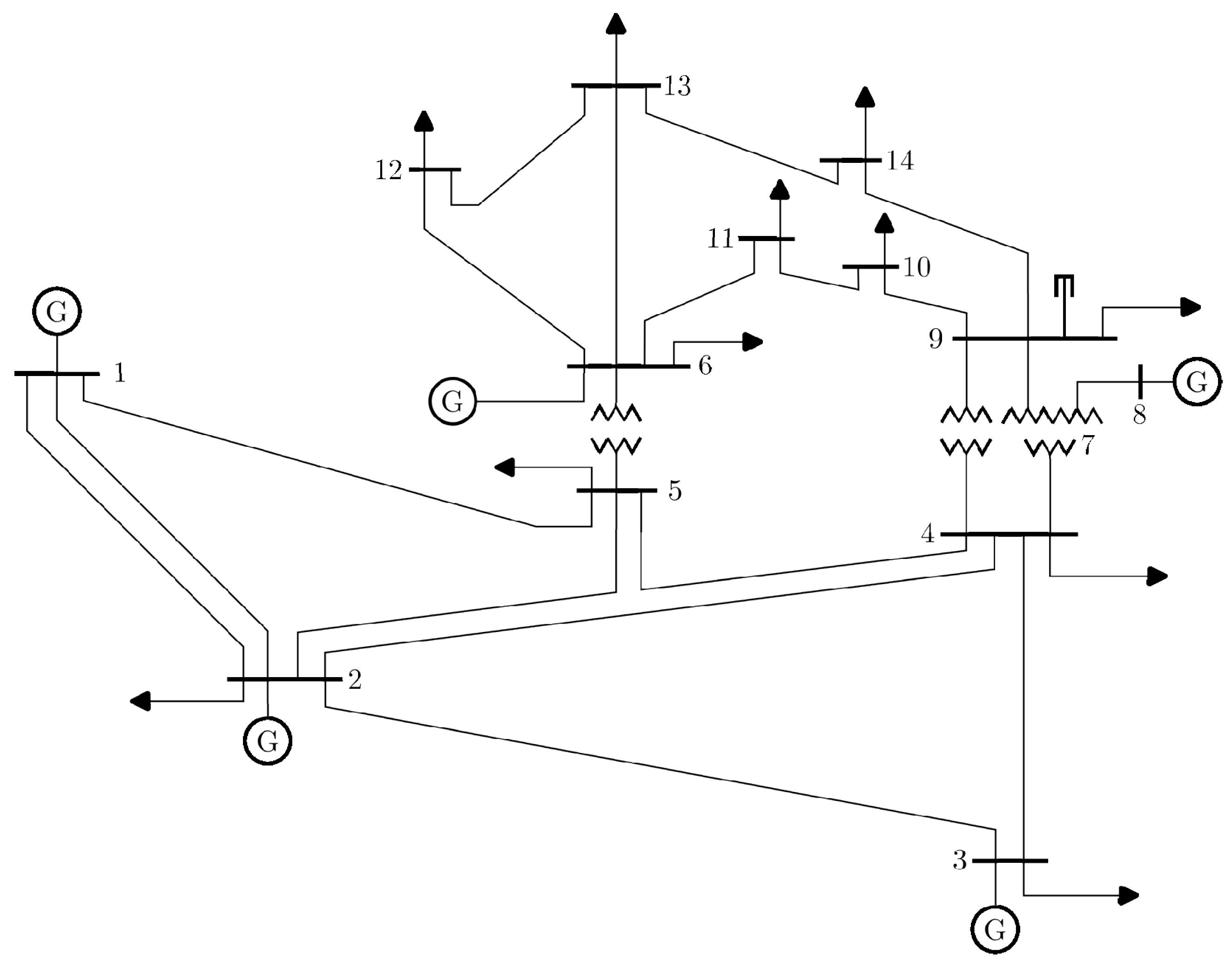
Section 7 describes the test system used for the numerical assessment, while
Section 8 presents the Monte Carlo simulation framework and discusses the results obtained from the selected case studies.
2. EWLS State Estimation Review
In [
7], the Extended Weighted Least Squares (EWLS) method for static power system state estimation is introduced. The main difference between the classical Weighted Least Squares (WLS) estimator and EWLS is that the latter explicitly models uncertainty affecting both the measured data and the network parameters. Although a similar estimate could, in principle, be obtained within a standard WLS framework by redefining the measurement error covariance so as to account for network parameter uncertainty, such a reformulation does not allow gross errors affecting network parameters to be distinguished from those affecting the measured data. Moreover, since in practical power systems the uncertainty associated with network parameters is often significantly larger than that affecting measurements, this approach may reduce the estimator sensitivity to outliers in the measured data.
The key idea of EWLS is to treat both the measured (and pseudo-measured) quantities and the network parameters as data. Let the vector
collect all measurements and pseudo-measurements (e.g., voltages, currents, power injections, and power flows), and let
denote the vector of nominal network parameter values. The overall data vector is therefore defined as
with size
.
Let
be the vector of true (unknown) network parameters and
the corresponding parameter errors. Then,
Similarly, let
denote the vector of system state variables and let
be the (generally nonlinear) measurement function describing the relationship among the system state, the network parameters, and the measured quantities. The measurement model is given by
where
represents the measurement errors. The error vectors
and
are assumed to be zero-mean random vectors.
Combining (
1)–(
3), the overall data model can be written as
where
and
The EWLS state estimation problem proposed in [
7] can be derived by the following unconstrained nonlinear least-squares problem:
where
denotes the covariance matrix of the data error vector
.
Defining the optimal data residual as
the unconstrained problem (
7) can be equivalently rewritten in constrained EWLS form as
Since, for any given pair
, the constraint (
9b) uniquely specifies
, eliminating
from (
9a) yields the same cost function as in (
7), thus proving the equivalence of the two formulations.
When all network parameters are assumed to be perfectly known (i.e., ), the EWLS estimator reduces to the classical WLS estimator.
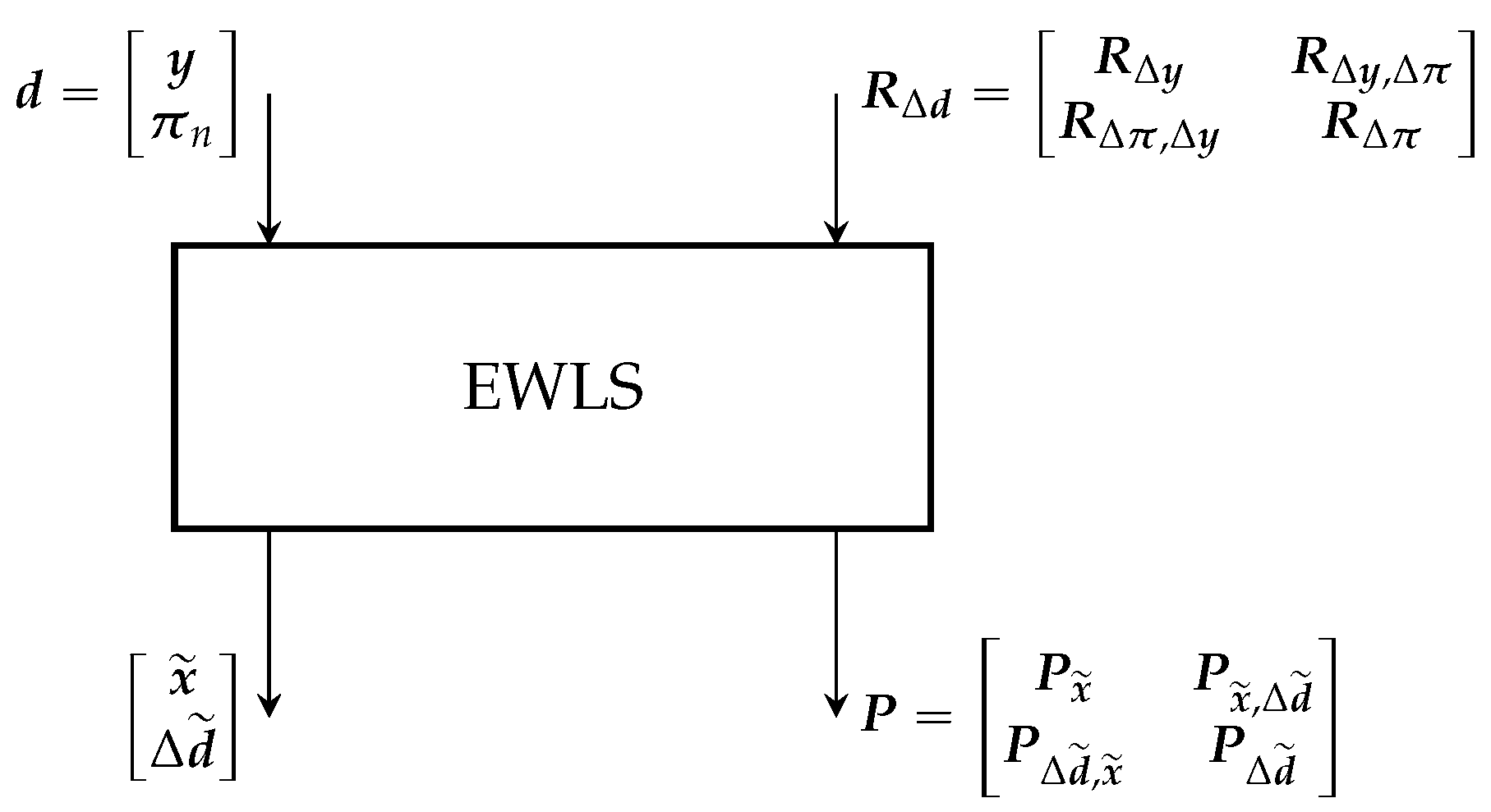
In addition to the estimates of the system state and of the data error vector, the EWLS formulation also provides the covariance matrix of the estimation errors, namely
This is illustrated in
Figure 1, which summarizes the estimator inputs and outputs.
The covariance matrices of the estimation errors associated with the system states and the data errors are given in [
7] as
with
Since the constrained EWLS problem (9) is equivalent to the unconstrained formulation (
7), it can be interpreted as a nonlinear system of
equations in the
unknowns
and
.
The system becomes underdetermined when the number of unknowns exceeds the number of equations, i.e., , which reduces to the condition .
Therefore, a necessary condition for the existence of a locally unique EWLS solution is
meaning that the number of measured (and pseudo-measured) quantities must be at least equal to the number of state variables.
However, the condition
is only necessary, but not sufficient, for the local solvability of the EWLS estimation problem. A stronger necessary condition is obtained by examining the rank of the Jacobian matrix of the model
with respect to the unknown variables. In particular, denoting by
the rank of the Jacobian
evaluated at the solution point, local identifiability of the EWLS estimator requires
Using the model definition in (
5), the Jacobian submatrix with respect to the network parameters can be written explicitly as
Due to the presence of the identity matrix
, the submatrix
has full column rank, that is
As a consequence, the network parameters are locally identifiable by construction, which is consistent with the relation (
2), where nominal parameter values are treated as direct pseudo-measurements.
State observability, on the other hand, depends exclusively on the sensitivity of the measurement function with respect to the state variables. Using again the model definition in (
5), the Jacobian submatrix with respect to the state variables can be written as
Local observability of the system state therefore requires that the Jacobian of the measurement function with respect to
has full column rank, i.e.,
In general, the rank of the full Jacobian matrix satisfies
However, in the EWLS formulation, rank additivity holds provided that the system is locally observable. Indeed, due to the block structure of the Jacobian, the columns associated with the network parameters contain an identity submatrix, whereas the columns associated with the state variables have zero entries in the same rows. As a consequence, no nontrivial linear combination of state-related columns can reproduce parameter-related columns, and vice versa. Therefore, if
the Jacobian has full column rank
In the following analysis, it is assumed that condition (
22) holds and that the power system is therefore locally observable [
13]. This assumption guarantees that both the system state and the network parameters are locally identifiable within the EWLS framework and constitutes a necessary condition for the existence of a locally unique EWLS estimate of the system states and network parameters.
3. Principal Errors
As discussed in the previous section, observability ensures the local identifiability of the system states and network parameters. Data redundancy, on the other hand, concerns the amount of independent information available for assessing data consistency.
Under the linearized EWLS model, the estimation process removes from the data error all components that can be explained by variations of the estimated variables through the model. The residual vector therefore contains only the portion of the data error that cannot be reproduced by the model.
This property directly follows from the optimality conditions of the unconstrained EWLS problem (
7). In particular, the solution satisfies
which states that the weighted inner product between the residual and any direction spanned by the Jacobian is zero. This result corresponds to the normal equations of the weighted least squares problem and has a clear geometric interpretation in terms of orthogonal projection [
14,
15].
As a consequence, the residual is orthogonal (in the weighted sense induced by the covariance matrix) to the column space of the Jacobian matrix
with respect to the unknown variables. Equivalently,
lies in the orthogonal complement of the Jacobian column space, often referred to as the left null space of
[
16,
17].
Since the residual can vary only along directions that are not represented by the model, the rank of its covariance matrix equals the dimension of the subspace in which the residual can vary. In other words, the residual retains only those stochastic directions of the data error that are not explained by the model. The number of such directions is therefore given by the difference between the total number of independent stochastic directions in the data error and the number of independent directions explained by the model. This yields the general identity
In the EWLS formulation, the data error vector is defined as
Assuming that measurement and parameter errors are statistically uncorrelated, the corresponding data error covariance matrix has a block-diagonal structure,
For block-diagonal matrices, the rank equals the sum of the ranks of the diagonal blocks. Moreover, assuming
to be full rank, one obtains
where
denotes the number of statistically independent stochastic directions in the measurement error vector
. The quantity
characterizes the intrinsic stochastic dimension of the measured data prior to state estimation. In the generic case,
is full rank and
, whereas perfectly correlated measurement errors or hard constraints result in
.
Under the local observability assumption established in the previous section, the Jacobian matrix has full column rank,
Substituting the above expressions into the rank identity yields
The quantity represents the residual subspace dimension, i.e., the number of statistically independent components of the residual vector after state estimation. Under Gaussian assumptions, this value coincides with the degrees of freedom of the weighted residual norm employed in -based consistency tests.
Since the residual subspace dimension
is smaller than the dimension of the residual vector
, the latter cannot be uniquely determined in all its components. Consequently, the residual vector can be expressed as a linear combination of only
independent quantities
[
17],
where
is a (non-unique) transformation matrix.
By interpreting
as a vector of
mutually uncorrelated random variables with unit variance, referred to as the principal errors of the EWLS residual, the transformation (
30) can be constructed via the eigenvalue decomposition of the residual covariance matrix [
15,
18],
where the columns of
are the eigenvectors of
, and
is a diagonal matrix containing the positive eigenvalues of
. The matrices
and
in (
31) are square and have size
.
Since
is rank-deficient, only
eigenvalues are non-zero. Accordingly, the eigenvalue matrix in (
31) can be written as
where
is the diagonal matrix containing the non-zero eigenvalues of
.
Letting
denote the matrix collecting the eigenvectors associated with the non-zero eigenvalues, the transformation matrix can be written as
It is worth noting that the transformation differs from a whitening transformation, since it is generally rectangular and performs both decorrelation and dimensionality reduction. In particular, projects the residual vector onto the subspace spanned by the eigenvectors associated with the non-zero eigenvalues of the covariance matrix.
The Moore–Penrose pseudo-inverse of the transformation matrix
[
19] is given by
This pseudo-inverse provides the inverse mapping from the residual vector to the principal error space, namely
which allows the estimation of the
principal errors associated with the EWLS residual.
The principal errors decomposition (
35) provides a minimal and statistically independent representation of the residual vector and constitutes the basis for the subsequent bad data detection and identification procedures.
The results derived in this section can be extended to the more general case in which measurement and parameter errors are statistically correlated. In this situation, the data error covariance matrix is no longer block diagonal and the rank additivity property does not hold in general. Nevertheless, the residual subspace dimension remains given by the general identity
and can therefore be computed directly from the joint error covariance structure. The simplified expression
is recovered as a special case under the assumption of uncorrelated measurement and parameter errors.
6. Bayesian Bad Data Identification
The sensitivity-based cluster identification procedure described in the previous section provides a deterministic indication of which data are most influential in producing the observed principal errors. In particular, the magnitudes of the components of the Jacobian sensitivity vector quantify how strongly individual data contribute to the statistic and, consequently, to the identified principal error cluster.
While this information is invaluable for screening and ranking potential sources of bad data, it does not, by itself, provide a probabilistic assessment of which specific subset of data is responsible for the observed principal errors [
8]. In other words, the sensitivity analysis indicates where gross errors may be located, but it does not provide a probabilistic ranking of alternative explanations.
To bridge this gap, a Bayesian framework for bad data identification is introduced in this section. The proposed approach assigns probabilities to alternative hypotheses describing single or multiple gross error configurations that are consistent with the detected and identified principal errors. This probabilistic formulation enables principled decision-making for instrument diagnostics and data maintenance in complex infrastructures.
Crucially, the sensitivity information encoded in is used to constrain the hypothesis space: only gross error configurations involving data that significantly influence the identified principal error cluster are considered. This strategy drastically reduces the number of admissible bad data combinations while ensuring that all practically relevant scenarios are retained.
6.1. Gross Error Models
A gross error model
is formally defined by specifying which data are affected by gross errors. Specifically,
is defined by a binary activation vector
where each component indicates the presence or absence of a gross error in the corresponding datum:
By construction,
is a binary vector of length
M, i.e.,
. In practice, specific patterns of nonzero entries in
naturally correspond to distinct physical fault sources, such as malfunctioning instruments, erroneous line parameters, or failures of shared components (e.g., voltage transformers) that simultaneously affect multiple data.
The total number of gross errors associated with model
is therefore given by
since
.
A gross error model is defined by the binary activation vector . Here are six examples, numbered from 0 to 5, of gross error models:
: Nominal operating conditions, with no data affected by gross errors,
: All data are affected by gross errors,
: A single gross error affects the measurement of the active power flow between buses
a and
b. Denoting by
the global index of the corresponding datum (i.e.,
),
: A single gross error affects the datum corresponding to the line resistance parameter of the line connecting buses
m and
n. Denoting by
the global index of this datum (i.e.,
),
: Two gross errors affect the measurement of the reactive power flow between buses
c and
d and the voltage magnitude measurement at bus
m. Denoting by
and
the global indices of the corresponding data (i.e.,
and
),
: Gross errors affect all data associated with the voltage transformer (VT) connected to bus
m, representing a common-cause fault. In this case,
Each gross error model is assigned an a priori probability, , reflecting prior knowledge about the reliability of the measurement chain components and the confidence in the network parameter database. The practical assignment of these probabilities is discussed later in the paper.
For a network comprising
M data, the number of possible gross error models grows combinatorially. In particular, the number of distinct models involving exactly
G gross errors, without repetition, is given by the binomial coefficient
where
. Consequently, the total number of admissible gross error models are
As an illustration, for a network with
data, the total number of admissible models becomes
which exceeds 1 × 10
30.
Given the sheer size of this hypothesis space, exhaustive evaluation of all possible gross error configurations is computationally infeasible. More importantly, such an exhaustive analysis is unnecessary for two fundamental reasons:
- 1.
Gross errors typically originate from malfunctioning components in the measurement chain or from erroneous parameter values. The likelihood of multiple independent gross error sources occurring simultaneously decreases rapidly as their number increases.
- 2.
As established in the previous sections, only data contributing significantly to the identified principal error cluster can plausibly explain the observed principal errors. Gross errors affecting data outside this cluster, or associated with negligible sensitivity coefficients, can therefore be safely excluded from consideration.
By restricting the analysis to the most probable and physically meaningful gross error models, the hypothesis space can be drastically reduced, thereby avoiding the computational burden associated with evaluating an infeasibly large number of combinations.
6.2. Gross Error Model a Priori Probability
Gross errors are modeled as random variables that are statistically independent of the data errors. Unlike data errors , which are assumed to be zero-mean, gross errors are not necessarily zero-mean and typically exhibit variances that are significantly larger than those associated with measurement and parameter uncertainties.
Let
denote the
M-dimensional random vector of gross errors associated with the gross error model
. Conditioned on
, the total data error vector is given by the superposition of data errors and gross errors:
Under the assumption that data errors and gross errors are mutually independent, the mean vector and covariance matrix of
are
where
and
denote the mean vector and covariance matrix associated with the gross errors specified by model
, respectively. The data errors are assumed to be zero-mean, i.e.,
.
The vector therefore represents the expected bias in the data errors induced by the gross errors hypothesized in model , while the covariance matrix characterizes the combined uncertainty due to both data errors and gross errors. The structure of and is determined by the activation vector , with nonzero mean components and increased variances only in the entries corresponding to data activated by the model.
Assuming that the conditional distribution of
is Gaussian, the prior probability density function of the data errors (including gross errors), given that the gross error model
holds, is
The Gaussian prior assumption in (
53) is justified by the observation that, in many practical scenarios, only the first- and second-order statistical moments of both data errors and gross errors are available or can be reasonably specified. Under these conditions, the Gaussian distribution represents the maximum entropy choice, providing the least informative model consistent with the available information.
6.3. Principal Error Evidence
Once the principal errors have been estimated and the corresponding error cluster has been identified, the relative plausibility of the competing gross error models can be assessed within a Bayesian framework.
Assuming that the gross error model
holds, the Bayesian evidence of the observed principal errors is defined as
where
denotes the probability density of observing the principal errors
under the assumption that the gross error configuration specified by
is present. The Bayesian evidence therefore quantifies how well a given gross error model explains the observed principal errors.
In (54),
denotes the likelihood function of the principal errors,
Using the linear transformation defined in (
35) and invoking the central limit theorem [
21], the likelihood function is modeled as a multivariate Gaussian distribution with identity covariance matrix and mean vector
,
Under the assumption of Gaussian distributions for both the likelihood function and the prior distribution of the data errors, the multidimensional integral in (
54) admits a closed-form solution. The resulting Bayesian evidence is given by (see
Appendix A)
where the matrix
and the scalar quantity
are defined in
Appendix A, Equations (
A2) and (
A3), respectively.
6.4. Gross Error Model a Posteriori Probability
The posterior probability of each gross error model, conditioned on the observed principal errors, is finally obtained using Bayes’ theorem:
Here,
denotes the
a priori probability assigned to the gross error model
. The summation in the denominator extends over all gross error models retained in the analysis, which are assumed to be mutually exclusive and collectively exhaustive.
6.5. Scalability Considerations and Hypothesis Space Reduction
The Bayesian formulation involves, in principle, the evaluation of posterior probabilities over a hypothesis space whose size grows combinatorially with the number of data, i.e., . However, the proposed framework is not intended to operate on the full set of admissible models. Its practical applicability relies on a structured reduction of the candidate hypothesis space based on physical and statistical considerations.
A first level of reduction is achieved through the sensitivity-based cluster identification described in
Section 5. Only data that significantly contribute to the identified principal error cluster are retained as potential carriers of gross errors, drastically reducing the number of candidate hypotheses.
A second level of reduction is obtained by restricting the admissible hypotheses to physically meaningful configurations, corresponding to plausible failure mechanisms of the measurement chain (e.g., individual instrument failures or common-cause events such as VT-related faults). This replaces the exponential growth of arbitrary combinations with a finite and structured set of candidate models.
Furthermore, the Bayesian formulation incorporates prior probabilities that naturally promote sparsity, since the likelihood of multiple independent failure events decreases rapidly with their number. As a result, complex multi-error hypotheses are penalized unless strongly supported by the observed data.
Consequently, the computational complexity scales with the number of retained candidate models rather than with . In realistic large-scale systems, with on the order of measurements and buses, the total number of admissible combinations would be intractable without pruning. However, after sensitivity-based and structure-based reduction, the number of candidate models typically reduces to a few hundred or at most a few thousand, which can be efficiently evaluated thanks to the closed-form expression of the Bayesian evidence.
In practical transmission-system control centers, state estimation and bad data processing are performed over time windows of the order of minutes. The proposed approach is compatible with these operational constraints, since it operates on a reduced and structured set of candidate models rather than on the full combinatorial space. For very large-scale systems or when the sensitivity-based reduction is less effective, additional strategies such as problem decomposition or heuristic selection of candidate models can be used to further reduce the number of evaluated hypotheses.
8. Case Studies
To exemplify and assess the performance of the proposed Bayesian framework for bad data detection and identification, a set of Monte Carlo case studies was designed.
Although, in general, data errors (measurement and parameter errors) may exhibit statistical correlations and deviate from Gaussian distributions, the proposed framework naturally accommodates such general conditions. The simplified assumptions adopted here are intended to illustrate the effectiveness of the method, while a more comprehensive analysis is beyond the scope of this work.
The errors associated with the network parameters of the IEEE 14-bus system are assumed to be mutually uncorrelated zero-mean, and normally distributed, with standard deviations given by
Parameters with zero nominal value were treated as deterministic. Consequently, all nonzero resistances, reactances, and susceptances of the IEEE 14-bus system were considered uncertain. For simplicity, off-nominal transformer tap ratios were assumed to be exact and were therefore excluded from the set of uncertain parameters. With these assumptions, the total number of network parameters is
.
All test cases were conducted with a redundancy factor of
, corresponding to
measurements. The adopted measurement configuration is reported in
Table 2, where each measurement, corresponding to an element of the vector function
, is identified by a pair of indices
. Here,
and
denote the from- and to-buses associated with the measurement, respectively. For voltage magnitude and power injection measurements,
.
Measurement errors were modeled as mutually uncorrelated zero-mean Gaussian random variables with identical standard deviation for all measurements, set to
As a consequence, the measurement error covariance matrix
is diagonal and full rank. According to (
28), the number of statistically independent stochastic directions is therefore
. Since the system state dimension is
, the number of principal errors
is equal to 42 for all test cases.
The detection and identification level of significance was fixed at % for all case studies. This choice is widely adopted in statistical hypothesis testing and provides a reasonable compromise between false alarm probability and detection sensitivity.
Given the size and complexity of the power system under consideration, a fully exhaustive exploration of all possible gross error configurations was computationally infeasible. In particular, with
data potentially affected by single or multiple gross errors, the total number of admissible gross error models, as given by (
49), is
Therefore, the case studies were selected with the objective of providing maximum insight into the behavior, robustness, and limitations of the proposed procedures, while keeping the overall computational burden manageable.
The first criterion adopted to reduce the number of admissible gross error models was to restrict gross errors exclusively to the measurement data, while assuming network parameters to be free of gross errors. This choice was made to isolate the effect of corrupted measurements and to evaluate the robustness of the identification algorithms specifically with respect to measurement gross errors, since measurement data constitute the most common source of bad data in practical applications.
In practical measurement infrastructures, gross errors may arise either from the malfunction of individual measurement instruments or from failures affecting common components of the measurement chain, such as current transformers (CTs) and voltage transformers (VTs). Multiple VTs may be installed at the same bus, and multiple CTs may be associated with each transmission line, supplying different groups of instruments.
For simplicity, the measurement chain is modeled here by assuming a single VT per bus (for buses where measurements are available), while the probability of CT failures is set to zero. This assumption is introduced solely to simplify the analysis and to provide a clearer interpretation of the results, and is not motivated by computational limitations.
This simplified measurement-chain representation is adopted solely to facilitate the interpretation of the results and is not intended to limit the generality of the approach. More realistic configurations, including multiple VTs per bus and CT-related failures, can be naturally accommodated within the proposed Bayesian framework by defining the corresponding gross error models.
Failure events were assumed to occur independently and with small probability. Under this assumption, the probability of three or more simultaneous failure events was considered negligible. Importantly, this limitation applies to the number of physical failure events, rather than to the number of measurement data affected by gross errors. As a result, the retained gross error models may involve multiple measurement data, provided that they originate from at most two simultaneous failure events (e.g., the failure of one or two VTs, or combinations of VT and individual instrument failures).
Given the above considerations, the gross error models used in the case studies were grouped into five mutually exclusive classes, each corresponding to a specific failure mechanism. These classes are summarized below.
- A:
A single gross error affects one measurement datum. The number of admissible models in this class is
which corresponds to the failure of a single measurement instrument.
Each model in this class is denoted by , where m identifies the m-th measurement.
- B:
Multiple gross errors affect all measurement data (voltages and powers) associated with a single bus. The number of admissible models in this class is
corresponding to the failure of a single voltage transformer (VT) connected to that bus.
Each model in this class is denoted by , where b identifies the b-th bus.
- C:
Two gross errors affect a pair of measurement data. The number of admissible models in this class is
accounting for all possible combinations of two independent measurement instrument failures.
Each model in this class is denoted by , with , representing the simultaneous failure of instruments m and n.
- D:
Multiple gross errors affect all measurement data associated with a pair of buses. The number of admissible models in this class is
corresponding to the simultaneous failure of the two voltage transformers connected to the selected bus pair.
Each model in this class is denoted by , with , representing faults affecting all instruments connected to buses b and c.
- E:
Multiple gross errors affect all measurement data associated with one bus and a single additional measurement datum. The number of admissible models in this class is
corresponding to the combined failure of one voltage transformer and one measurement instrument.
Each model in this class is denoted by , representing the simultaneous failure of instrument m and all instruments connected to bus b.
The assignment of prior probabilities to the gross-error models requires specifying the probability of the physical failure events that generate them. In SCADA-based power system state estimation, such events are relatively rare. Operational experience and the literature on bad data processing indicate that only a very small fraction of measurements is typically affected by gross errors during a measurement scan, often on the order of 1 × 10
−4–1 × 10
−3 [
24,
25].
Based on this empirical evidence, the elementary probability of a single measurement-chain failure event was set to
This value was used to assign consistent
a priori probabilities to all gross error models retained in the analysis. Accordingly, the
a priori probability
associated with each gross error model depends on the number of underlying physical failure events giving rise to
. In particular,
In practical measurement infrastructures, different components of the measurement chain generally exhibit different failure probabilities. For example, the probability of failure of an instrument transformer differs from that of individual measurement instruments.
The proposed Bayesian framework can naturally accommodate such differences by assigning component-specific prior probabilities. In the present study, however, a single representative value of p was adopted for simplicity, since the test cases are intended primarily to illustrate the validity and capabilities of the proposed Bayesian identification approach.
Although the above restrictions significantly reduce the hypothesis space, a fully exhaustive investigation would still involve several thousand distinct gross error models. A comprehensive reporting of all such scenarios is beyond the scope of this paper and would not provide additional methodological insight.
Therefore, a restricted set of representative test cases was defined for each of the five gross error model classes introduced above (class-A to class-E). The selected cases capture the most relevant and structurally distinct configurations within each class. The Monte Carlo analysis was conducted exclusively on these representative scenarios.
The five test cases considered in this section share a common simulation and evaluation protocol. For each representative gross error model considered in the case studies, independent Monte Carlo simulations were performed. In each run, a specific gross error model was applied to the measurement data and the Bayesian framework was used to compute the posterior probability associated with every admissible hypothesis belonging to classes A–E.
The Bayesian evidence (57) for each of the five gross error classes is computed by assuming that the covariance matrix
in (
52) is zero except for the diagonal entries
such that
, where
is the gross error activation vector defined in (
45). For these entries, the variance is set to
, consistent with the assumption that the gross error follows a uniform distribution over the interval between
and 1
. Accordingly, the mean vector
in (
52) is set to zero.
For each Monte Carlo realization, the maximum a posteriori (MAP) probability was determined as
Since multiple hypotheses may attain nearly identical posterior probabilities, the identification outcome was defined through a relative ambiguity criterion. Specifically, all hypotheses satisfying
were considered as jointly identified, where
.
Let denote the resulting set of identified hypotheses for a given Monte Carlo realization. The cardinality of reflects the degree of decisiveness of the identification process. In particular:
if , the identification is unambiguous;
if , the outcome is classified as ambiguous.
The identification outcome is evaluated by comparing the true gross error model with the identified set . For each Monte Carlo run, four situations may arise:
- 1.
Correct identification (unambiguous):
- 2.
Correct but ambiguous identification:
- 3.
Misidentification within the same class:
and all hypotheses in
belong to the same gross error class as
.
- 4.
Misidentification across classes:
and at least one hypothesis in
belongs to a class different from that of
.
To quantitatively assess the performance of the proposed framework, the following empirical metrics are computed over the Monte Carlo runs:
where
,
,
, and
denote, respectively, the number of runs classified in each of the four categories above.
In all Monte Carlo experiments used to compute the performance indices in (70), the gross errors affecting the corrupted measurements were generated independently and uniformly distributed in the interval between and . This range was adopted for all five test cases in order to provide a homogeneous statistical basis for the comparison of the identification performance across the different gross error classes. It is worth noting that this choice differs from the prior model adopted for gross errors, which is Gaussian and, in this section, is specified as zero-mean with variance equal to 1/3. Therefore, both the assumed distribution and the support of the gross errors differ from those used in the simulations, introducing a deliberate model mismatch. The results thus provide an indication of the robustness of the proposed Bayesian identification approach with respect to deviations from the assumed error model.
For the detailed analyses of selected representative scenarios presented in the following subsections, a different Monte Carlo setup was adopted in order to investigate the sensitivity of the identification procedure to the gross error magnitude. In these cases, the injected gross errors were generated independently, with zero mean, and uniformly distributed within the intervals indicated on the horizontal axes of the corresponding figures. This second type of simulation allows one to analyze how the posterior probability associated with the true hypothesis evolves as the gross error magnitude varies.
The following subsections focus on the case-specific aspects and on a limited number of representative examples.
8.1. Test Case 1: Single-Instrument Gross Errors (Class-A)
Test case 1 considers class-A gross errors, corresponding to the failure of a single measurement instrument. In this case, admissible gross error models are considered.
The resulting performance indices are
Therefore, thanks to the additional probabilistic information introduced through the structured prior on failure grouping, 50 out of 69 class-A gross errors are correctly identified, despite the fact that only statistically independent principal error directions are available. This result highlights the benefit of the Bayesian hypothesis modeling in compensating for the limited redundancy of the measurement system.
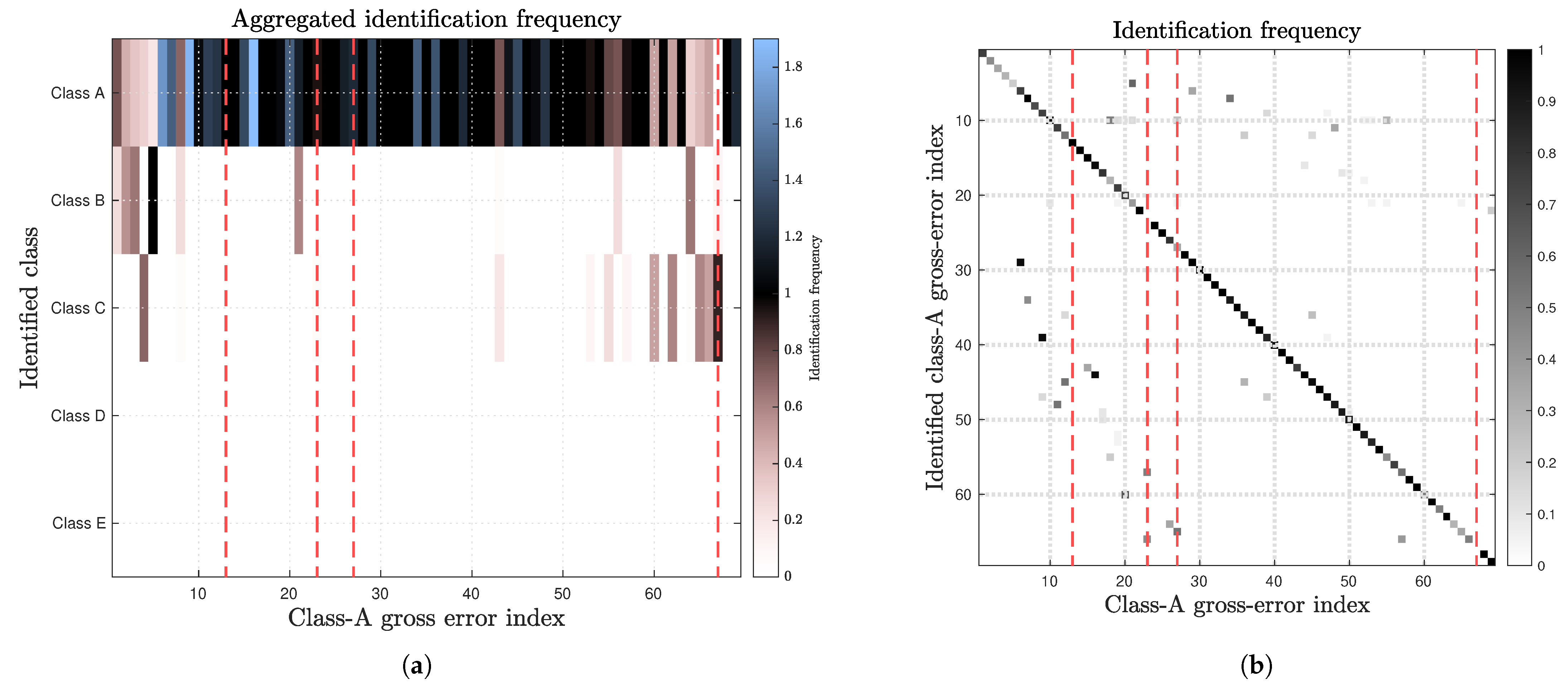
Figure 3a reports the identification frequency aggregated by gross error class, whereas
Figure 3b reports the detailed identification frequency within class-A. Together, the two subfigures show that all four identification outcomes defined above occur in this case study.
Four representative gross-error scenarios are highlighted in
Figure 3 by vertical dashed lines. These correspond to measurement indices illustrating the four identification outcomes defined above: measurement 13 (correct identification, unambiguous), measurement 27 (correct but ambiguous identification), measurement 23 (misidentification within the same class), and measurement 67 (misidentification across classes).
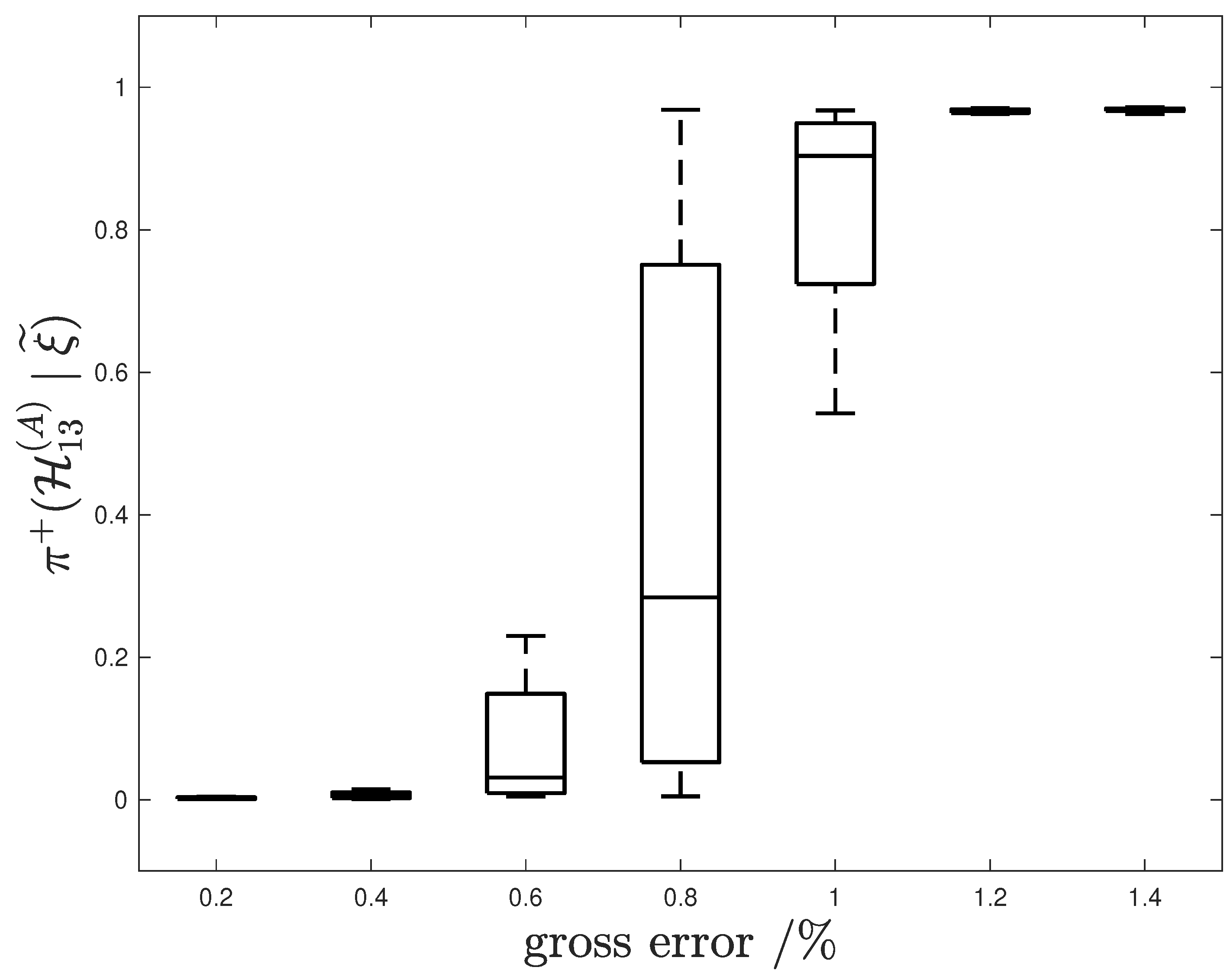
Measurement index 13 (active power injection
at bus 10) illustrates a case of correct and unambiguous identification.
Figure 4 reports the posterior probability
as a function of the bound of the uniform distribution used to model the gross error. For bound values exceeding approximately
, the correct hypothesis is identified with high posterior probability and negligible dispersion across Monte Carlo runs.
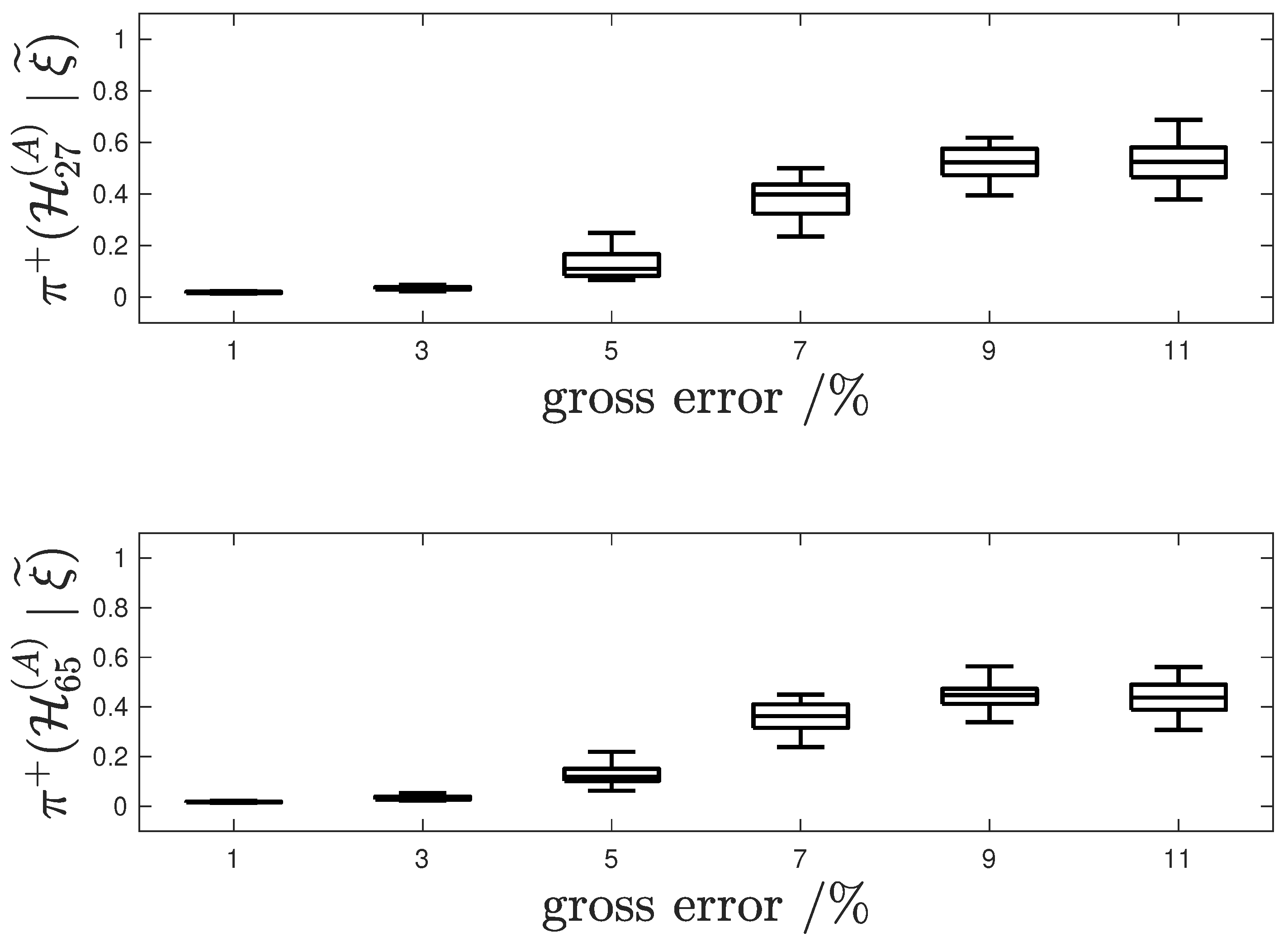
Measurement index 27 (reactive power injection
at bus 14) provides an example of correct but ambiguous identification.
Figure 5 shows the posterior probabilities
and
as functions of the bound of the uniform distribution used to model the gross error. For bound values exceeding approximately 9%, two hypotheses are identified with comparable posterior probability: the true corrupted measurement 27 and measurement 65 (reactive power flow
between buses 13 and 14). It is worth noting that both measurements are physically associated with bus 14, which may contribute to the observed ambiguity.
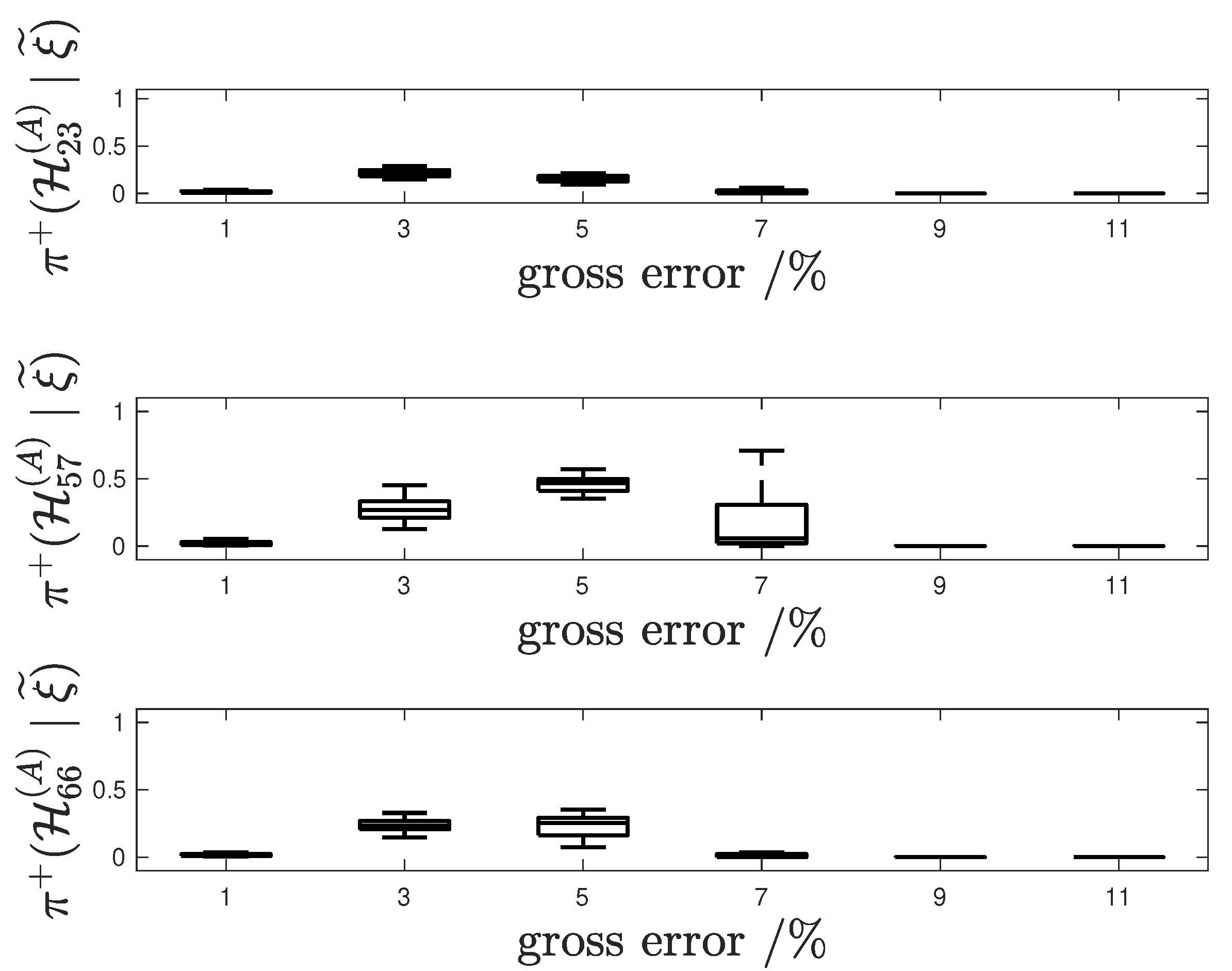
Measurement index 23 (reactive power injection
at bus 4) illustrates a case of misidentification within the same class, as highlighted in
Figure 3. In this case the hypotheses most frequently selected correspond to measurements 57 (reactive power flow
between buses 5 and 4) and 66 (reactive power flow
between buses 4 and 7). Both measurements are connected to the same bus, which may contribute to the observed intra-class confusion.
A more detailed view of this behavior is provided in
Figure 6, which shows the posterior probabilities
,
, and
as functions of the uniform error bound across 20 Monte Carlo repetitions.
Finally, measurement index 67 (reactive power flow measurement between buses 4 and 9) illustrates a case of misidentification across classes. In this scenario the most frequently selected hypothesis belongs to class-C and corresponds to the simultaneous gross errors affecting measurements 23 and 67. Although the true corrupted measurement is included in the identified hypothesis, the Bayesian framework attributes part of the evidence to an additional instrument failure. This outcome may be more appropriately interpreted as a correct but ambiguous identification between a single-instrument failure (class-A) and a two-instrument failure hypothesis (class-C).
8.2. Test Case 2: Single-Bus Gross Errors (Class-B)
Test case 2 considers class-B gross errors, corresponding to the simultaneous failure of all measurement instruments connected to a single bus. In this case, admissible gross error models are considered.
The resulting performance indices are
Thanks to the additional probabilistic information introduced through the structured prior on failure grouping, gross errors affecting 10 out of the 14 buses are correctly identified. This corresponds to the detection of 46 gross errors across 46 measuring instruments, despite the fact that only statistically independent principal error directions are available.
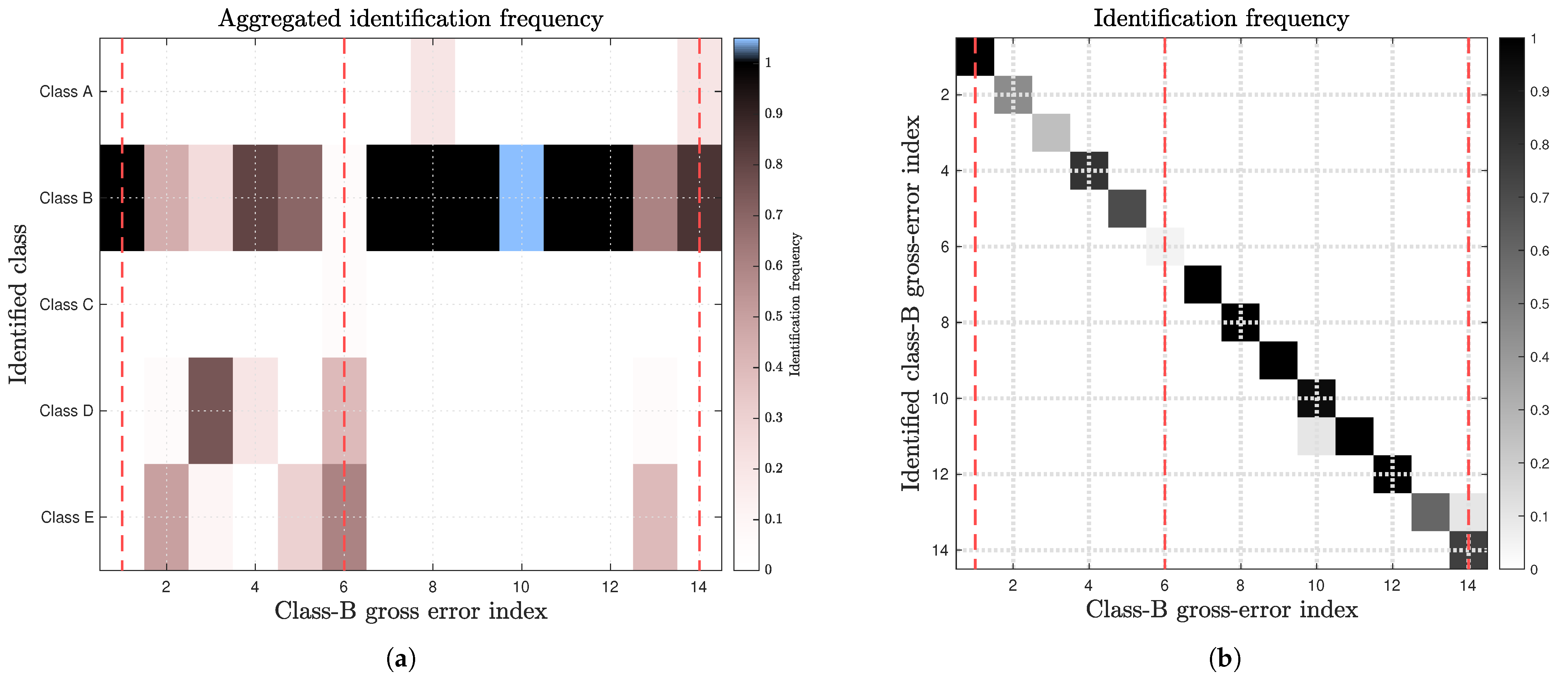
Figure 7a reports the identification frequency aggregated by error class, whereas
Figure 7b reports the detailed identification frequency within class-B.
Three representative gross-error scenarios are highlighted in
Figure 7 by vertical dashed lines: bus 1 (correct and unambiguous identification), bus 14 (correct but ambiguous identification), and bus 6 (misidentification across classes). Intra-class misidentification is statistically negligible in this case and is therefore not considered in the following analysis.
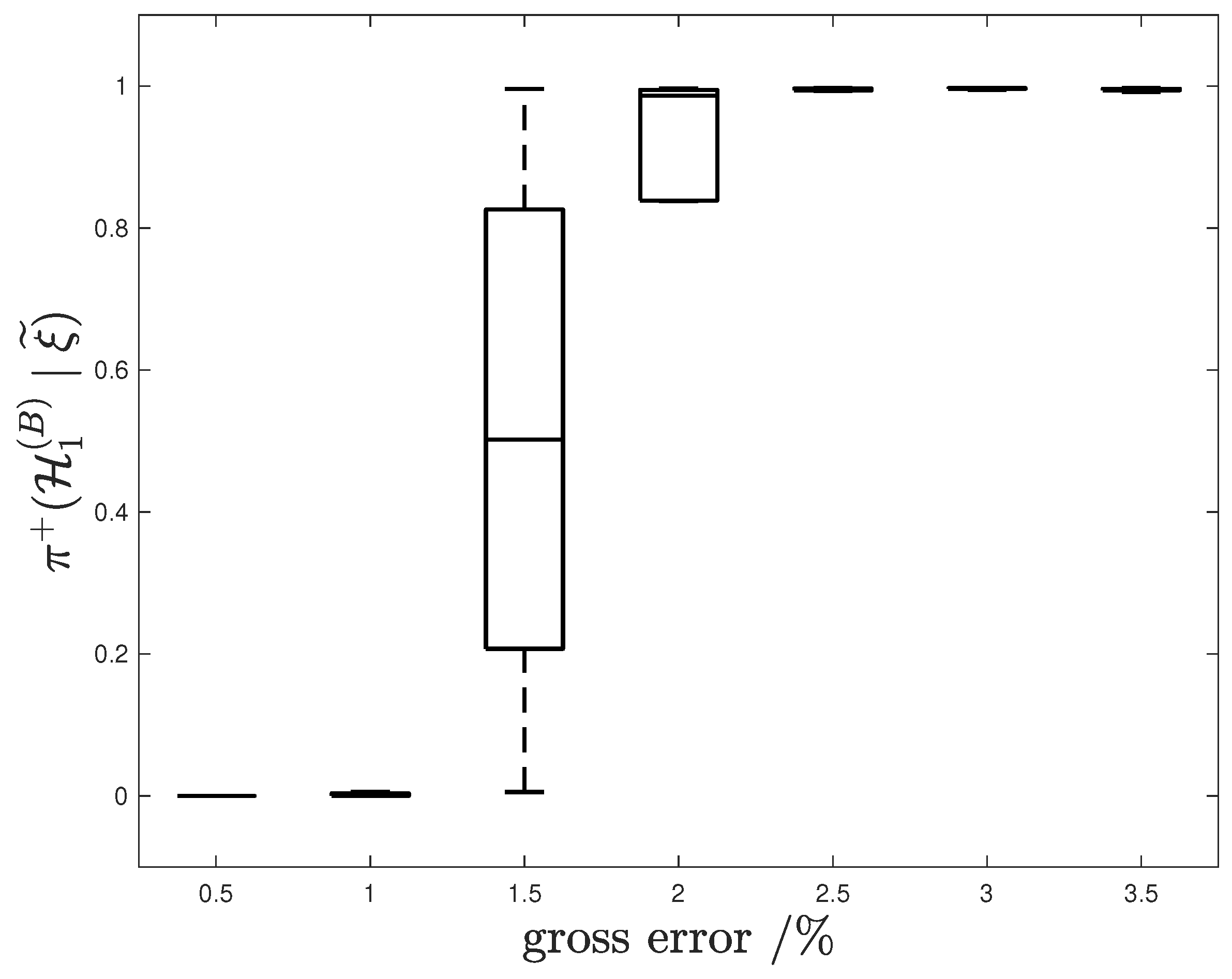
Bus index 1 illustrates a case of correct and unambiguous identification. The injected gross error affects all measurements associated with bus 1, namely , , , , , , and .
Figure 8 reports the posterior probability
as a function of the bound of the uniform distribution used to model the gross error, across the 20 Monte Carlo repetitions. For bound values exceeding approximately
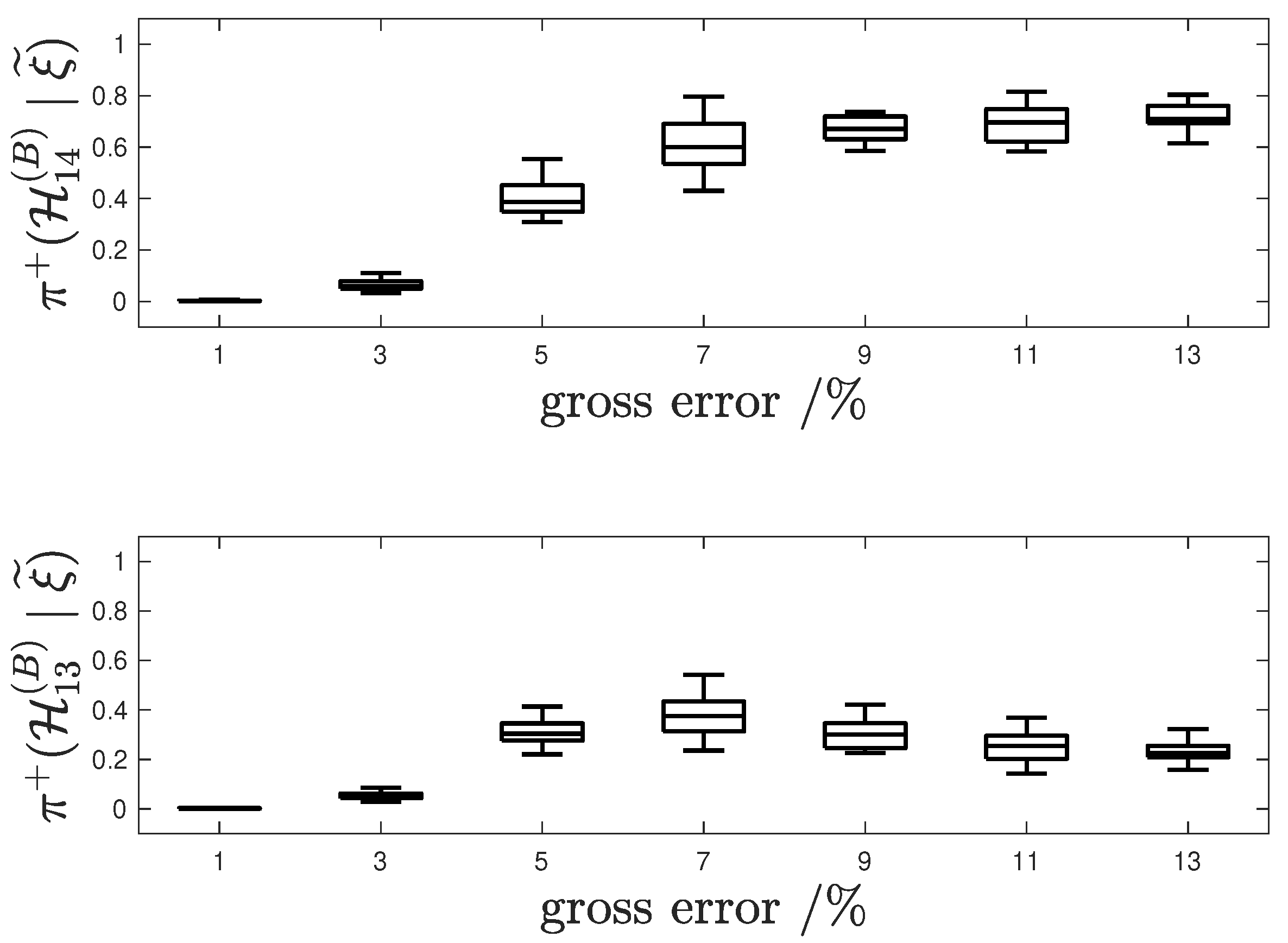
, the correct hypothesis is identified with high posterior probability and negligible dispersion.
Bus index 14 provides an example of correct but ambiguous identification.
Figure 9 shows the posterior probabilities
and
as functions of the uniform error bound applied to all measurements connected to bus 14.
When the gross error bound exceeds approximately %, two hypotheses are simultaneously identified with comparable posterior probabilities. The corresponding models involve buses 14 and 13, whose measurements include and . Since the measurements associated with these buses are physically coupled through the branch connecting buses 13 and 14, this coupling may contribute to the observed ambiguous identification.
Finally, bus index 6 illustrates a case of misidentification across classes. The injected gross error affects all measurements connected to bus 6, namely , , , , , , and .
As shown in
Figure 7a, the most frequently selected hypotheses belong to class-D (two-bus failures) and class-E (combined bus–instrument failures). In particular, the class-E hypothesis corresponds to the simultaneous gross errors affecting measurement 68 (
) and bus 6, while the class-D hypothesis corresponds to simultaneous failures of buses 4 and 6.
Although formally classified as inter-class misidentifications, these cases include the true corrupted bus in the identified set. This outcome may therefore be interpreted as a correct but ambiguous identification between a single-bus failure (class-B) and more complex coupled-failure scenarios involving adjacent buses or instruments.
The first two test cases were analyzed in detail in order to illustrate the four possible identification outcomes introduced above, namely correct identification (unambiguous), correct but ambiguous identification, intra-class misidentification, and inter-class misidentification.
For the remaining test cases (class-C to class-E), the analysis focuses on representative scenarios leading to correct identification. The purpose of these examples is primarily to illustrate the behavior of the proposed Bayesian identification framework under more complex failure mechanisms involving multiple simultaneous gross errors.
A systematic exploration of all possible identification outcomes for these cases would require a significantly larger number of simulations and would considerably increase the length of the paper without providing additional methodological insight.
A more exhaustive statistical analysis of these multiple-failure scenarios is left for future work.
8.3. Test Case 3: Double-Instrument Gross Errors (Class-C)
Test case 3 considers class-C gross errors, corresponding to the simultaneous failure of two measurement instruments. In this case, admissible gross error models are considered.
The resulting performance indices are
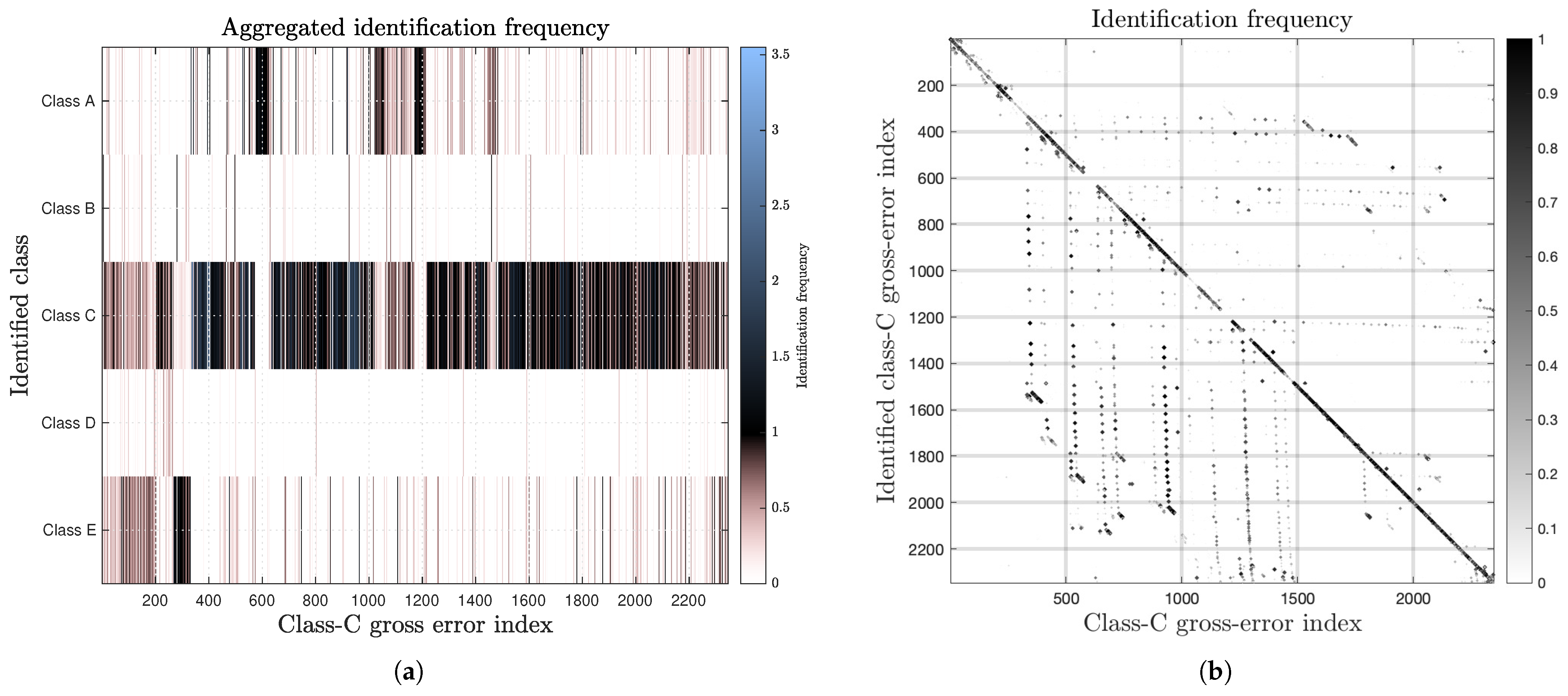
Thus, class-C scenarios are more challenging than classes-A and B, as expected for multiple simultaneous failures. Correct and unambiguous identification is obtained in about of the simulations, while both intra-class and inter-class confusion become more significant.
Figure 10a reports the identification frequency aggregated by error class, whereas
Figure 10b shows the detailed identification frequency within class-C.
Overall, 971 out of the 2346 admissible measurement pairs are correctly identified despite the limited number of statistically independent principal error directions. This result again demonstrates the ability of the Bayesian hypothesis modeling to mitigate the intrinsic redundancy limitations of the measurement configuration.
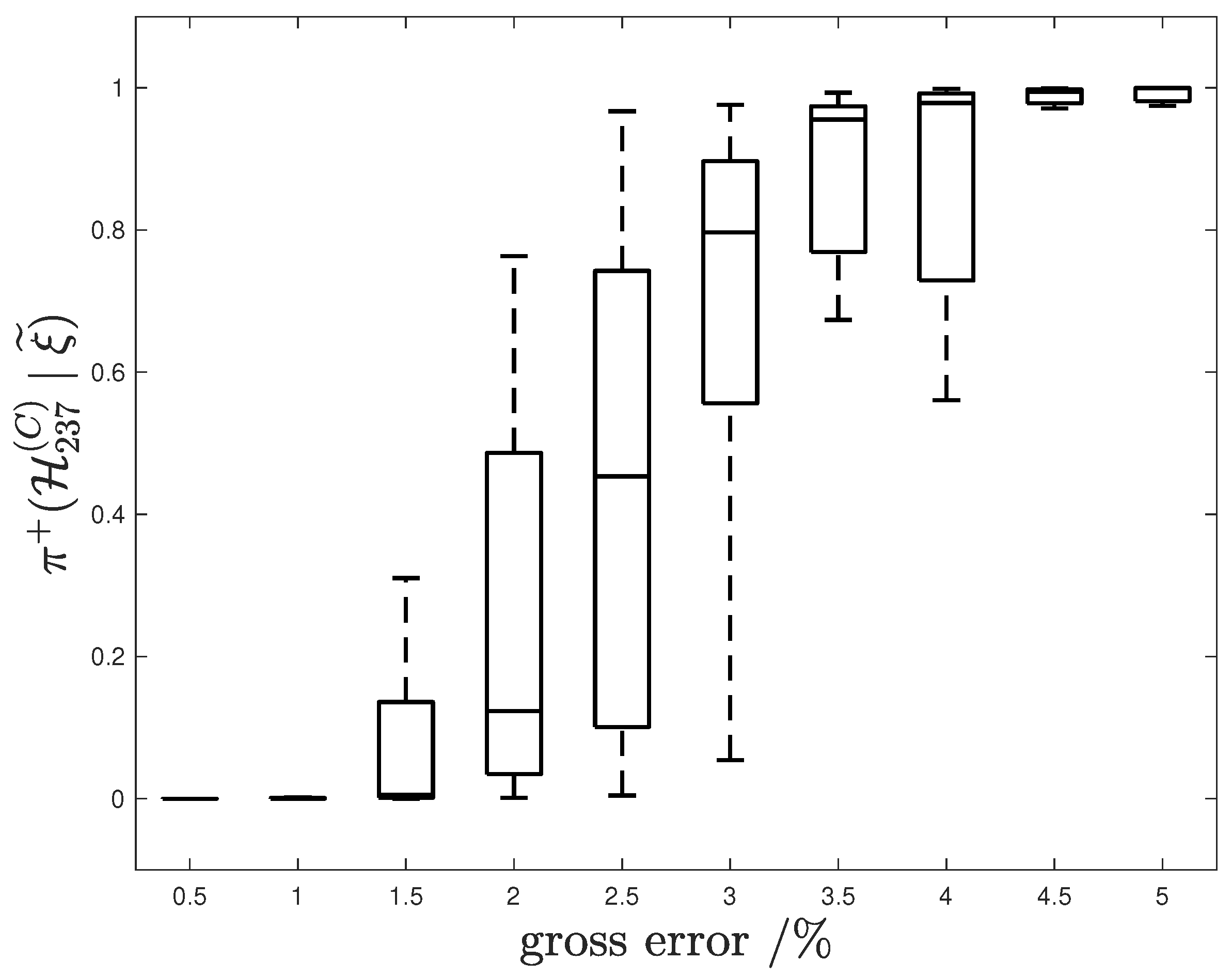
A representative example of correct and unambiguous identification corresponds to hypothesis index 237, associated with simultaneous gross errors affecting measurements 4 (phase voltage at bus 6) and 40 (active power flow between bus 9 and 10).
Figure 11 reports the posterior probability
as a function of the bound of the uniform distribution used to model the gross error, across 20 Monte Carlo repetitions.
It is observed that, for bound values exceeding approximately %, the correct hypothesis is identified with high posterior probability and negligible dispersion across the Monte Carlo runs.
8.4. Test Case 4: Double-Bus Gross Errors (Class-D)
Test case 4 considers class-D gross errors, corresponding to the simultaneous failure of all measurement instruments connected to two distinct buses. In this case, admissible gross error models are considered.
The resulting performance indices are
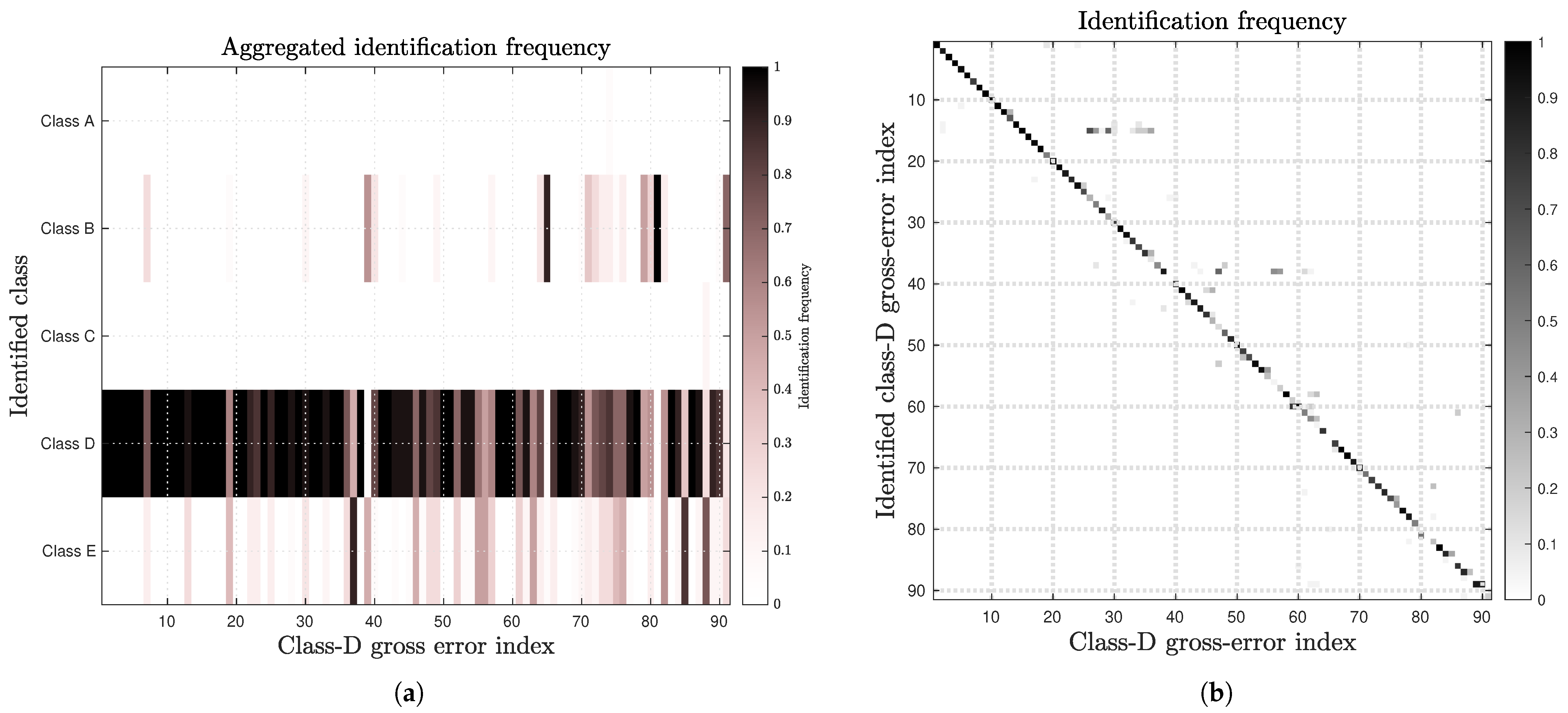
Class-D scenarios show comparatively good performance: correct and unambiguous identification is obtained in about of the simulations, while both ambiguity and inter-class confusion remain limited.
Figure 12a reports the identification frequency aggregated by error class, whereas
Figure 12b shows the detailed identification frequency within class-D.
Overall, 61 out of the 91 admissible bus-pair hypotheses are correctly and unambiguously identified, even though only statistically independent principal error directions are available.
A representative example of correct and unambiguous identification corresponds to hypothesis index 18, which represents gross errors simultaneously affecting all measurements associated with buses 2 and 7.
The measurements connected to bus 2 are , , , , , , , , and , while those connected to bus 7 are and .
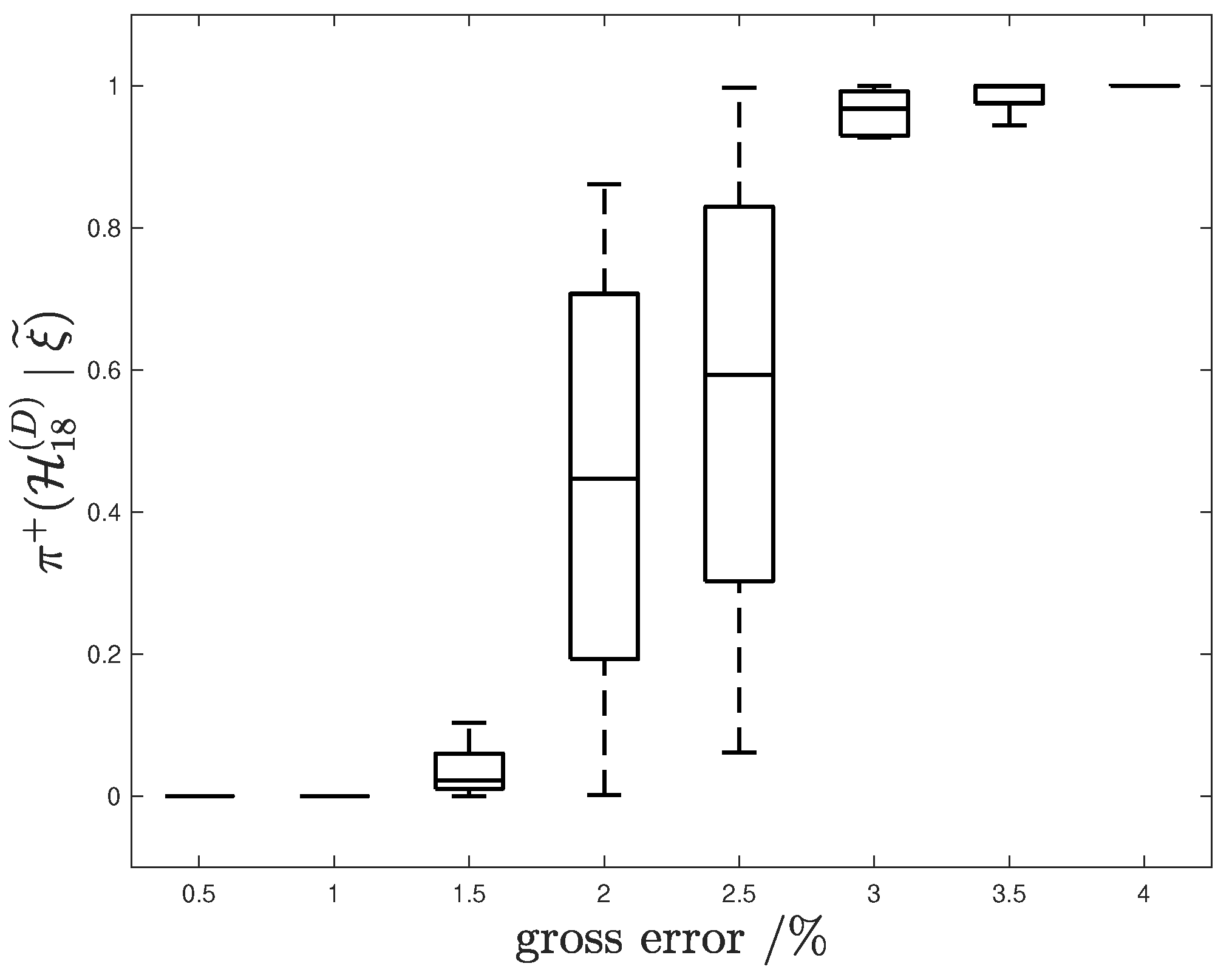
Figure 13 shows the posterior probability
as a function of the bound of the uniform distribution used to model the gross errors across the 20 Monte Carlo repetitions.
The results show excellent identification performance. In particular, the median posterior probability associated with the correct hypothesis exceeds 90% for bound values exceeding approximately 3%, with very limited dispersion across the Monte Carlo runs.
8.5. Test Case 5: Bus–Instrument Combined Gross Errors (Class-E)
Test case 5 considers class-E gross errors, corresponding to the simultaneous failure of all measurement instruments connected to one bus together with one additional measurement instrument. In this case, admissible gross error models are considered.
The resulting performance indices are
Class-E scenarios confirm that the proposed Bayesian framework remains effective even for structured multiple-failure configurations, although the identification task is more demanding than in classes A, B, C, and D.
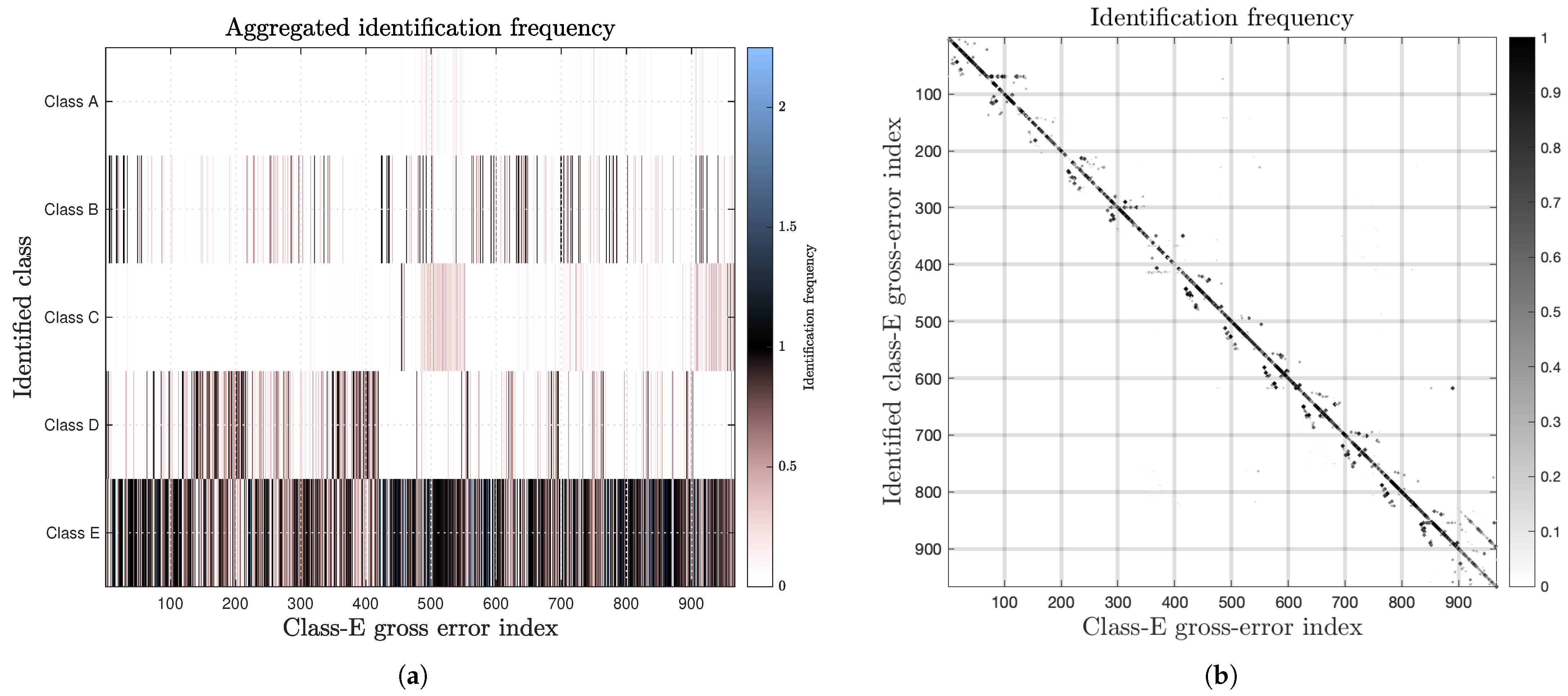
Figure 14a reports the identification frequency aggregated by error class, whereas
Figure 14b shows the detailed identification frequency within class-E.
Overall, 416 out of the 966 admissible measurement–bus pairs are correctly and unambiguously identified despite the limited number of statistically independent principal error directions.
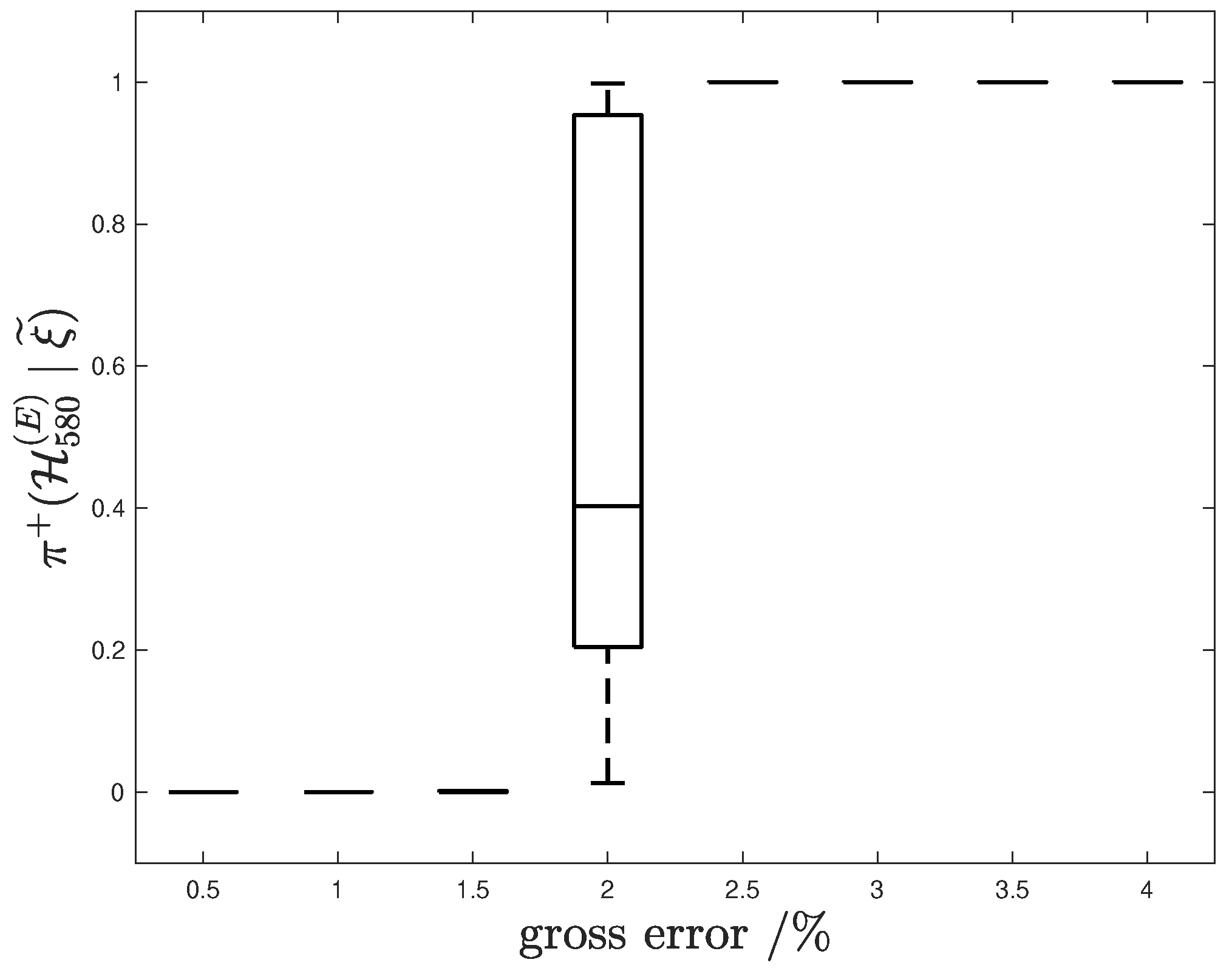
A representative example of correct and unambiguous identification corresponds to hypothesis index 580, associated with gross errors affecting measurement 28 together with all instruments connected to bus 9.
Measurement 28 corresponds to the active power flow , while the measurements connected to bus 9 are , , , , , and .
Figure 15 shows the posterior probability
as a function of the bound of the uniform distribution used to model the gross errors across the 20 Monte Carlo repetitions.
The results again show excellent identification performance. In particular, the median posterior probability associated with the correct hypothesis exceeds 90% for gross error bound exceeding approximately 2%, with very limited dispersion across the Monte Carlo runs.
Despite the very large number of admissible gross-error models considered in the five case studies,
a substantial number of the true gross-error configurations are correctly identified without ambiguity.
In particular, the total number of correctly identified hypotheses can be estimated as
This result is particularly noteworthy given that only statistically independent principal error directions are available.
In other words, the proposed Bayesian identification framework is able to discriminate among more than 1500 admissible single and multiple gross-error hypotheses on the basis of only 42 observable principal-error components, highlighting its ability to effectively exploit the information contained in the principal-error space even under severe limitations in measurement redundancy.
It is also worth noting that the identification performance proved to be only weakly sensitive to the assumed value of the elementary failure probability p. In particular, varying p by one order of magnitude did not produce appreciable changes in the posterior model ranking, indicating that the Bayesian identification process is largely driven by the information contained in the principal-error observations rather than by the specific choice of prior probabilities.
These results confirm that the proposed Bayesian framework provides a practical and computationally feasible approach for gross-error identification even in large hypothesis spaces characterized by limited measurement redundancy.
9. Conclusions
This paper has presented a Bayesian framework for bad data identification in power system state estimation under measurement and network parameter uncertainty. The proposed approach builds upon the Extended Weighted Least Squares (EWLS) estimator and the eigenvalue-based decomposition of the residual covariance matrix, which provides a minimal and statistically independent representation of data inconsistencies through principal errors.
By revisiting the EWLS formulation as the unconstrained solution of an equivalent constrained estimation problem, the paper clarifies the relationship between system observability, residual subspace dimension, and the number of determinable principal errors. This analysis highlights the intrinsic limitations of bad data identification in systems with limited redundancy and motivates the use of probabilistic inference when multiple error configurations produce similar observable effects.
A key feature of the proposed framework is its ability to explicitly account for uncertainty affecting both measurements and network parameters through the EWLS formulation. This allows the identification procedure to remain robust even in the presence of significant parameter uncertainties, avoiding the loss of sensitivity to measurement outliers that may arise when parameter uncertainty is implicitly absorbed into measurement error models. Although the present study focused on gross errors affecting measurement data for simplicity, the proposed framework naturally extends to the identification of bad data affecting network parameters as well.
To address the non-uniqueness inherent in bad data identification, the Bayesian formulation evaluates and ranks alternative gross-error models corresponding to different physical failure mechanisms. By restricting the hypothesis space to physically meaningful and influential data combinations, the method provides a tractable and systematic decision-making procedure for identifying the most likely sources of gross errors.
Monte Carlo simulations conducted on the IEEE-14 bus test system demonstrate the effectiveness and robustness of the proposed methodology under significant measurement and parameter uncertainties. Despite the large number of admissible gross-error models considered in the study (), the framework is able to correctly identify a substantial fraction of the true configurations on the basis of only observable principal-error components. This result highlights the strong inferential capability of the Bayesian identification approach to compensate for the limited redundancy of the measurement configuration by exploiting the probabilistic structure of the hypothesis space even in the presence of complex multiple-failure scenarios. At the same time, the numerical results show that the identification performance is not uniform across all gross-error classes. In particular, some classes, especially those involving multiple simultaneous gross errors, exhibit lower correct identification rates and higher ambiguity or misidentification frequencies. A deeper understanding of the mechanisms underlying these differences remains an open issue and will be addressed in future work.
The results also show that the identification performance is only weakly sensitive to the assumed value of the elementary failure probability p. Varying p by one order of magnitude does not produce appreciable changes in the posterior ranking of the hypotheses, indicating that the Bayesian identification process is largely driven by the information contained in the principal-error observations rather than by the specific choice of prior probabilities.
The proposed framework is particularly suited to situations in which limited measurement redundancy and parameter uncertainty lead to intrinsic ambiguity in bad data localization. In such conditions, deterministic identification strategies may fail to uniquely attribute the observed inconsistencies, whereas the probabilistic ranking provided by the Bayesian formulation enables a systematic and interpretable assessment of the most plausible gross-error sources.
Future research will focus on extending the framework toward more detailed representations of measurement infrastructures, including the modeling of multiple instrument transformers and heterogeneous component reliability, as well as on the adoption of more general error models beyond the Gaussian assumption. In particular, the use of heavy-tailed or non-Gaussian distributions for both measurement and gross errors represents a promising direction to further improve the robustness of the approach under realistic operating conditions.
Furthermore, the explicit modeling and identification of gross errors affecting network parameters, including scenarios involving simultaneous measurement and parameter gross errors, will be investigated, taking into account the associated identifiability challenges.
Another promising direction concerns the integration of the proposed model-based Bayesian identification approach with data-driven techniques. In particular, the principal-error representation derived from the EWLS formulation provides a compact and physically meaningful feature space that could be exploited by learning-based methods while preserving the physical constraints imposed by the network model. Such hybrid model-based and physics-informed approaches may further improve the scalability and adaptability of the methodology when applied to large-scale power systems with evolving measurement infrastructures and heterogeneous measurement technologies.
These results indicate that combining physically grounded estimation models with probabilistic inference provides a powerful paradigm for robust bad data identification in modern power system monitoring environments.