Article

Dynamic DOA Estimation for UAV Arrays Using LEO Satellite Signals of Opportunity via Sparse Reconstruction

1
State Grid Yantai Power Supply Company, Yantai 264000, China
2
State Grid Shandong Electric Power Company, Jinan 250001, China
3
State Grid Laiwu Power Supply Company, Laiwu, Jinan 271100, China
4
State Key Laboratory of Millimeter Waves, Southeast University, Nanjing 210096, China
*
Author to whom correspondence should be addressed.
Electronics 2026, 15(8), 1727; https://doi.org/10.3390/electronics15081727
Submission received: 25 March 2026 / Revised: 9 April 2026 / Accepted: 14 April 2026 / Published: 19 April 2026
(This article belongs to the Special Issue 5G Non-Terrestrial Networks)

Abstract

Signals of opportunity (SoO) enable emission-free passive sensing, but low Earth orbit (LEO) satellite illumination with unmanned aerial vehicle (UAV) array receivers exhibits rapid geometry variation. As a result, the received phase evolves in a space–time coupled manner, and the array snapshots become nonstationary even within one coherent processing interval (CPI), degrading conventional stationary-snapshot direction-of-arrival (DOA) estimators. This paper proposes a decomposition-based sparse reconstruction with successive interference cancellation (D-SR-SIC) framework for dynamic DOA estimation in LEO SoO UAV passive sensing. The proposed estimator leverages a sparse-reconstruction signal model and is implemented via a computationally efficient decomposition-based search-and-cancel procedure. A short-CPI parameterized space–time phase model captures the common motion-induced phase history and the time-varying steering drift; the coupled multi-parameter estimation is decomposed into two low-dimensional correlation searches followed by least-squares amplitude estimation and multi-target peeling. Optional local refinement and multi-beam pre-screening improve robustness to off-grid mismatch, near–far interference, and wide field-of-view operation. Simulations show that the proposed method achieves about 0.11° DOA root-mean-square error (RMSE) at −20 dB signal-to-noise ratio (SNR) in a representative highly dynamic setting.

1. Introduction

Wide-area monitoring and anomaly detection for critical infrastructures (e.g., power transmission corridors) require continuous coverage and fast response under stringent electromagnetic constraints [1]. Passive sensing based on signals of opportunity (SoO) [2,3] is attractive because it reuses third-party transmissions and avoids dedicated emissions, making it suitable for electromagnetically sensitive scenarios. Terrestrial SoO sources (e.g., broadcast and cellular), however, may exhibit coverage holes in mountainous or forested areas and offer limited observation geometries [4]. The ongoing deployment of large-scale low Earth orbit (LEO) satellite constellations provides an alternative illumination layer with wide coverage and predictable orbits [5,6]. When combined with an unmanned aerial vehicle (UAV) receiver carrying a uniform linear array (ULA), LEO SoO enables flexible wide-area passive sensing. The central technical difficulty is that the LEO–UAV–target geometry evolves rapidly: the received phase becomes space–time coupled, and the array snapshots are nonstationary even within a coherent processing interval (CPI).
In this paper, we study dynamic direction-of-arrival (DOA) estimation for a UAV-borne ULA under LEO SoO sensing. Specifically, within one CPI, we aim to estimate, for each target, the DOA and within-CPI steering drift, together with CPI-local equivalent bistatic radial motion parameters (radial velocity and acceleration) that govern the common time-varying phase. These quantities serve as CPI-local phase descriptors for coherent focusing and target separation.
Compared with classical static/quasi-static array models, this setting poses intertwined challenges:
  • Coherent integration versus nonstationarity: Low signal-to-noise ratio (SNR) motivates long coherent integration, but longer CPIs exacerbate motion-induced phase curvature and violate stationarity.
  • Space–time coupling and multi-parameter estimation: Fast motion induces both a common Doppler-like phase history and a time-varying steering vector, violating key assumptions used in covariance-based subspace methods such as multiple signal classification (MUSIC) and estimation of signal parameters via rotational invariance techniques (ESPRIT) [7,8].
  • Near–far interference and off-grid mismatch: Practical targets seldom lie on discrete grids, producing mismatch-induced error floors and amplifying error propagation when successive interference cancellation (SIC) is used.
  • Scalability and field-of-view (FOV): Naive joint search or joint sparse recovery over DOA, steering drift, radial velocity, and radial acceleration is computationally prohibitive, and wide-FOV operation further challenges the stability of radial-parameter estimation when broadside combining suffers coherent-gain loss.
Existing DOA estimators and related techniques relevant to highly dynamic SoO passive sensing typically start from SoO passive radar preprocessing and long-coherent processing. Reference-channel-aided synchronization, direct-path suppression, and coherent integration are standard tools in SoO-based bistatic sensing [9]. Under high mobility, range-walk correction and Doppler compensation are often applied to preserve coherent gain over a CPI [10,11]. However, most such processing primarily targets envelope alignment and range–Doppler focusing; the array manifold is frequently treated as stationary or slowly varying, so within-CPI steering drift and its coupling with the common phase are not explicitly modeled.
Classical subspace approaches such as MUSIC and ESPRIT, together with coarray extensions (e.g., coprime/nested arrays), can offer high angular resolution when quasi-stationary snapshots and reliable sample covariance estimates are available [7,8,12,13,14]. Related rotational-invariance-based multidimensional estimators, such as JADED-RIP for joint angle-delay estimation, further illustrate the effectiveness of exploiting invariance structure to obtain paired parameter estimates when quasi-stationary observations are available [15]. In strongly nonstationary settings, a common workaround is to shorten the integration window (sub-CPI covariance) or to use beamspace processing to reduce dimension, but this inevitably reduces coherent gain and does not directly provide motion-related parameters needed for phase compensation. Dynamic/tracking-oriented DOA methods based on recursive state-space estimation or dynamic sparse inference have also been developed for multi-block observations [16,17]. These methods are effective when an explicit multi-frame evolution model is available, but they address a different regime from the single-CPI, within-CPI nonstationary setting considered here. From a complementary hardware perspective, time-modulated and single-sideband phased-array architectures have also been investigated for reshaping space–time radiation characteristics and enhancing secure communications [18,19,20,21]. In particular, the recently reported distributed split single-sideband time-modulated array architecture in the IEEE Internet of Things Journal [18] provides a representative hardware-level example of how space–time behavior can be reshaped directly at the array architecture. Although these works do not address the same estimation problem considered here, they are still relevant as background. In particular, they highlight that space–time coupling can also be influenced at the array-architecture level, not only at the signal-processing stage.
Sparse recovery has been widely adopted for super-resolution and limited snapshots, including greedy pursuit, covariance-based sparse estimators, and Bayesian learning methods [22,23,24]. Considerable efforts have been devoted to mitigating grid mismatch via dictionary refinement or gridless formulations such as atomic-norm-based DOA estimation [25,26]. Nevertheless, extending these ideas to dynamic space–time models typically leads to large joint dictionaries over angle, steering drift, and radial parameters, or to iterative nonconvex refinement; both can be computationally heavy and sensitive to near–far interference. Deep-learning-based DOA estimators have shown strong performance under task-matched training, especially in low-SNR regimes or in the presence of array imperfections [27,28,29]. Their performance, however, depends on the availability of representative training data and on limited train-test mismatch in geometry, waveform, noise statistics, and motion dynamics. In contrast, this study develops a model-driven single-CPI estimator with explicit physical parameters, requiring no prior training.
For LEO–UAV illumination, the received phase contains a common Doppler-like history shared by sensors and a time-varying steering term across sensors. Methods that estimate angle and Doppler separately can suffer from coupling-induced bias, while fully joint estimation faces a dimensionality barrier. Multi-target scenes further require robust separation (e.g., iterative cancellation) to avoid masking and to handle strong interferers [30], yet cancellation can amplify modeling and discretization errors if the dynamic phase is mismatched. These gaps motivate a dynamic-model-aware yet scalable estimator that explicitly matches the CPI-local space–time phase evolution, avoids prohibitive high-dimensional searches by exploiting structure, and incorporates robust multi-target peeling and wide-FOV stabilization.
In this paper, we propose decomposition-based sparse reconstruction with successive interference cancellation (D-SR-SIC), which explicitly models and compensates for the CPI-local space–time coupled phase while maintaining scalability and robustness to off-grid mismatch. Within one CPI, the received phase is separated into a sensor-common time phase associated with radial motion and a sensor-differential steering phase associated with steering drift. This decomposition reduces the original coupled four-parameter estimation to two successive two-dimensional matched-filter searches, followed by least-squares amplitude estimation, SIC-based target peeling, and optional local refinement. The main contributions are:
  • Parameterized dynamic phase model: a short-CPI parameterization of the bistatic range and direction cosine is developed to yield a tractable dynamic space–time phase model.
  • Structure-exploiting D-SR-SIC: the sparse model provides a unified interpretation of the CPI data. To avoid the dimensionality and runtime burden of generic joint sparse inversion, the estimator is implemented as a structure-exploiting search-and-cancel procedure. The common time phase and the differential steering phase are estimated through two low-dimensional searches, followed by least-squares amplitude estimation, SIC-based multi-target peeling, and optional local refinement.
  • Wide-FOV stabilization via multi-beam pre-screening: a digital multi-beam pre-screening stage is introduced to counteract broadside-sum coherent-gain loss at large off-broadside angles, enabling stable Stage-1 radial-parameter estimation over a wide FOV.
  • Complexity and performance characterization: the computational scaling is analyzed and compared with direct joint solvers, and extensive simulations validate accuracy, conditional super-resolution beyond the Rayleigh proxy when sufficient radial-motion diversity is present, off-grid robustness under near–far interference, wide-FOV robustness, and substantial runtime savings in the tested settings.
The rest of this paper is organized as follows: Section 2 introduces the system and signal models. Section 2.3 derives the parameterized dynamic space–time phase. Section 3 presents the proposed D-SR-SIC algorithm. Section 4 provides simulation results and discussions. Section 5 concludes the paper. Scalars are denoted by italic letters (e.g., t), vectors by bold lowercase letters (e.g., x ), and matrices by bold uppercase letters (e.g., X ). ( · ) T and ( · ) H denote transpose and conjugate transpose, respectively.

2. System Model and Problem Formulation

2.1. System Description and Motion Model

We consider a bistatic passive sensing scenario consisting of (i) a LEO satellite acting as a non-cooperative SoO illuminator, (ii) a UAV platform equipped with an M-element ULA, and (iii) P stationary ground targets. The satellite transmits a narrowband signal with carrier frequency f c and wavelength λ = c / f c , where c denotes the speed of light. A reference channel is assumed to provide a direct-path-dominated observation for synchronization and waveform estimation. During the DOA estimation stage, the baseband SoO waveform within a CPI is estimated from the reference channel and subsequently treated as fixed. In practice, such a reference channel can be obtained by using a dedicated auxiliary antenna/receiver oriented toward the illuminator or by forming a satellite-directed beam or subarray output when a sufficiently strong line-of-sight direct path is available. Standard preprocessing then performs delay/frequency synchronization, direct-path extraction, and waveform estimation or matched filtering on that reference signal [2,10]. If a clean direct-path reference is unavailable, residual waveform-estimation and synchronization errors introduce additional model mismatch; in such cases, the proposed method operates as a downstream estimator following blind or semi-blind preprocessing. After synchronization (and optional direct-path suppression), the remaining dominant intra-CPI nonstationarity is primarily due to the motion-induced carrier phase across time and sensors.
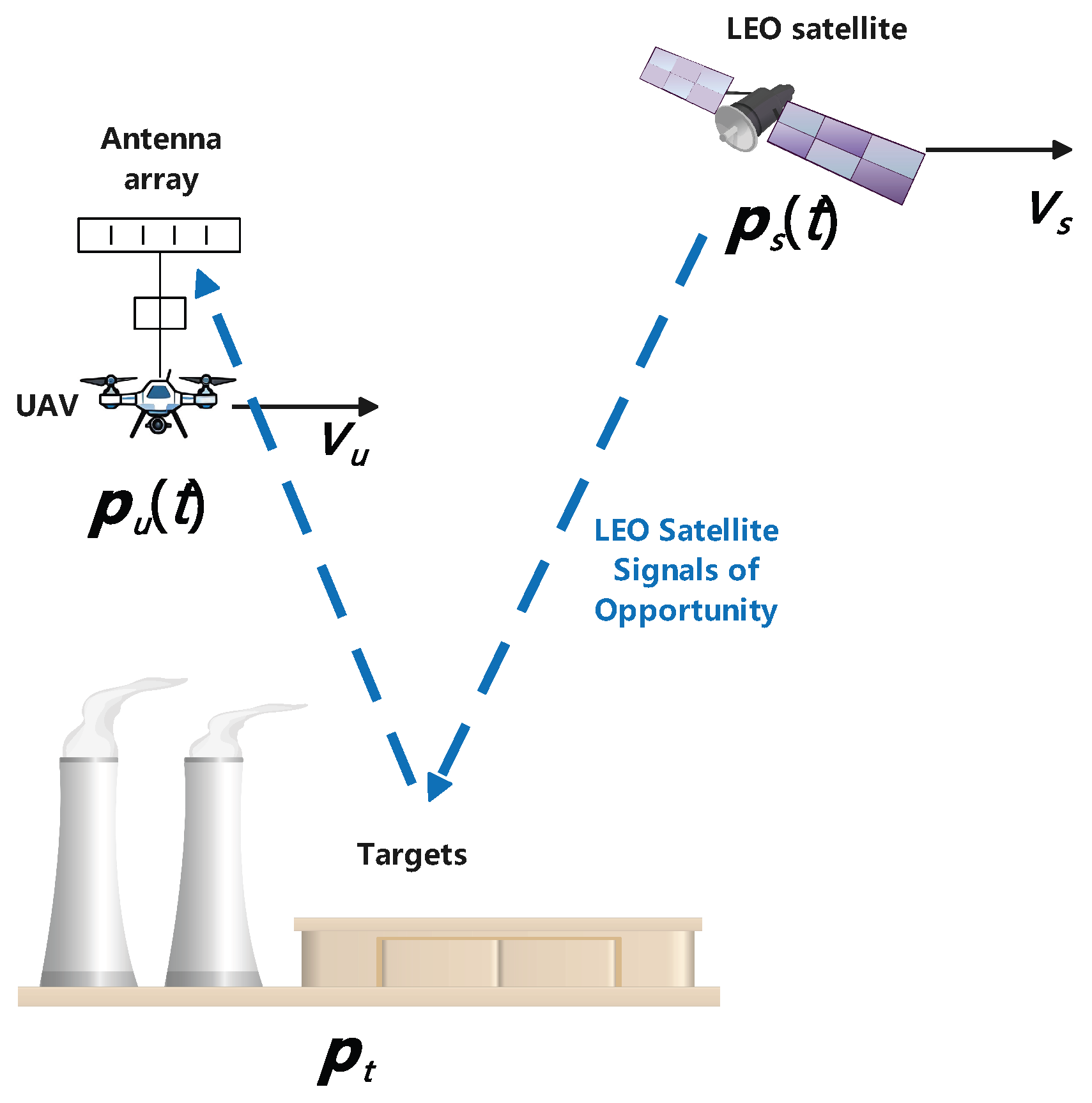
Figure 1 illustrates the bistatic LEO SoO–UAV sensing geometry and the within-CPI linearized motion model used throughout this paper. As shown, an SoO signal transmitted by the LEO satellite illuminates the ground targets and is received by a UAV-borne ULA. The schematic marks the satellite and UAV positions at the CPI start t = 0 and at time t, together with the ULA axis and broadside direction, and the instantaneous DOA angle θ ( t ) . The two-leg bistatic propagation (satellite-to-target and target-to-UAV) naturally decomposes the total path into a sensor-independent bistatic range to the reference element and a sensor-dependent differential path across the array, which, respectively, determine the common carrier-phase history and the instantaneous steering phase in the received-signal model. These geometric quantities will be used in the next subsection and in the CPI-local phase parameterization of Section 2.3.
We focus on a single CPI of duration T CPI and use t to denote the fast-time variable within this CPI. For the later Taylor parameterization of the motion-induced phase, we set the CPI start as the time origin t = 0 . In the 3-D Cartesian coordinate system, let p s ( t ) R 3 and p u ( t ) R 3 denote the positions of the LEO satellite and the UAV reference element (sensor m = 0 ), respectively. Let p t R 3 denote the position of a stationary ground target (for multiple targets, p t can be replaced by p t , p ). The ground targets are assumed stationary within a CPI (thus p t is constant), and the ULA attitude is assumed fixed over one CPI. Since the CPI is short (typically millisecond-level), the satellite and UAV trajectories can be accurately linearized within one CPI as p s ( t ) p s ( 0 ) + v s ( 0 ) t and p u ( t ) p u ( 0 ) + v u ( 0 ) t , where v s ( 0 ) and v u ( 0 ) are the instantaneous velocities at t = 0 . Higher-order motion terms contribute negligible additional displacement (and hence negligible additional carrier-phase error) over such a short interval; therefore, the linear model provides an accurate kinematic approximation for phase modeling. In this paper, we do not explicitly estimate target coordinates p t ; instead, their effects on the received phase evolution over one CPI are captured by a low-dimensional set of CPI-local equivalent parameters introduced in Section 2.3.
For an M-element ULA with inter-element spacing d and array-axis unit vector u a R 3 ( u a = 1 , from element 0 toward increasing m), the m-th element position is
p u , m ( t ) = p u ( t ) + m d u a .
where m { 0 , , M 1 } is the sensor index. This definition fixes sensor m = 0 as the reference element and absorbs the instantaneous array attitude into u a . Under the far-field condition p t p u ( t ) ( M 1 ) d , the wavefront across the array can be approximated as planar. The arrival direction is characterized by the direction cosine along the array axis
μ ( t ) u a T p t p u ( t ) p t p u ( t ) [ 1 , 1 ] .
The sign convention in μ ( t ) is chosen to be consistent with the steering phase in Equation (6) and the differential delay term in Equation (5). We parameterize μ ( t ) by an equivalent DOA angle θ ( t ) measured from the array broadside ( θ = 0 at broadside), such that μ ( t ) = sin θ ( t ) . Even for stationary ground targets, μ ( t ) (and hence θ ( t ) ) generally drifts within a CPI because p u ( t ) changes. This steering-vector drift is a key source of nonstationarity in LEO–UAV passive sensing.

2.2. Received Signal Model

Let x m ( t ) denote the received passband signal at the m-th array element ( m = 0 , , M 1 ). For notational clarity, we start with a single-target echo; the multi-target received signal follows by linear superposition and will be exploited in Section 3. An analytic signal model for the narrowband passband echo can be written as in Equation (3),
x m ( t ) = α s b t τ m ( t ) e j 2 π f c t τ m ( t ) + n m ( t ) ,
where α is the complex scattering coefficient, s b ( t ) is the known baseband SoO waveform, n m ( t ) is additive white Gaussian noise, and  τ m ( t ) is the total propagation delay. The coefficient α absorbs the target reflectivity, bistatic propagation loss, and any time-invariant phase within a CPI. The dependence on t and m is mainly carried by τ m ( t ) and thus by the carrier-induced phase term.
The propagation delay τ m ( t ) is dictated by the bistatic geometry and consists of a satellite–target path and a target–UAV path. Let c denote the speed of light. For a single target, the exact bistatic path length to element m is
c τ m ( t ) = p t p s ( t ) +   p u , m ( t ) p t .
Equation (4) explicitly accounts for the two-leg bistatic propagation: the satellite-to-target term is common to all array elements, while the target-to-UAV term varies slightly across sensors and produces spatial phase differences. Under the far-field planar-wave approximation, the array-dependent differential delay can be expressed via the direction cosine μ ( t ) , yielding
c τ m ( t ) R b ( t ) + m d μ ( t ) = R b ( t ) + m d sin θ ( t ) ,
where R b ( t ) p t p s ( t ) + p u ( t ) p t is the bistatic range to the reference element. Equation (5) separates a sensor-independent component R b ( t ) (driving a common Doppler-like phase history shared by all sensors) and a sensor-dependent component proportional to m μ ( t ) (driving the instantaneous steering phase across the array).
Under a short-CPI narrowband assumption, after reference-channel-assisted synchronization and matched filtering (and, when needed, range-walk correction), we work with waveform-compensated (range-compressed) snapshots so that the known waveform factor is absorbed into a complex amplitude. The baseband array model focusing on carrier-induced phase can be expressed as
x ~ m ( t ) α e j 2 π λ m d   sin θ ( t )     ×   e j 2 π λ R b ( t ) + n ~ m ( t ) .
where x ~ m ( t ) denotes the waveform-compensated complex baseband signal after carrier removal and matched filtering (and optional range-walk correction), and  n ~ m ( t ) is the corresponding complex baseband noise. Stacking M sensors yields x ( t ) = [ x ~ 0 ( t ) , , x ~ M 1 ( t ) ] T . Equation (6) can be viewed as a narrowband array model with a time-varying steering phase and a time-varying common bistatic-range phase. The sensor-dependent term e j 2 π λ m d   sin θ ( t ) encodes the instantaneous DOA through a differential phase slope across the array, while the sensor-independent term e j 2 π λ R b ( t ) captures the bistatic-range phase history (Doppler). In highly dynamic LEO–UAV geometries, both components may vary appreciably within a CPI, which breaks the stationary-snapshot assumption of classical covariance-based methods.
The derivation of Equation (6) implicitly assumes that envelope distortion due to differential delays is negligible (or has been corrected). Let B denote the effective baseband bandwidth after synchronization and matched filtering. Two widely used sufficient conditions are:
  • Spatial narrowband across the array aperture: B Δ τ array 1 , where the maximum differential delay satisfies Δ τ array ( M 1 ) d / c . This ensures s b ( t τ m ( t ) ) s b ( t τ 0 ( t ) ) for all sensors up to a common time shift [31].
  • Negligible range walk within one CPI: B Δ τ motion 1 , where Δ τ motion v r , max T CPI / c , T CPI is the CPI duration, and  v r , max is the maximum magnitude of the effective bistatic radial velocity over the considered search set. Equivalently, the range migration Δ R motion = v r , max T CPI should satisfy Δ R motion c / B [10].
Note that these conditions pertain to the signal envelope; even when they hold, the carrier phase in Equation (6) may still be highly nonstationary due to the small wavelength, which is the primary focus of this paper. When these conditions are not strictly met (e.g., large B or large | v r | ), the target echo may migrate across range cells within a CPI, which breaks coherent integration if untreated. In practice, range-walk correction (e.g., Keystone transform [11] or slow-time resampling) can be applied after matched filtering to align the envelopes before focusing on carrier-induced phase. Treating s b ( t ) as known is therefore a post-preprocessing approximation, the accuracy of which depends on the direct-path SNR and the quality of reference-channel synchronization and waveform reconstruction. In this paper, we focus on carrier-phase nonstationarity and assume that either the above narrowband/short-CPI conditions hold or that range-walk has been compensated by standard preprocessing with the help of the reference channel.
For a representative sense of scale, when B = 10   MHz , T CPI = 1 ms   , and  v r , max 8   km s 1 , we obtain Δ τ motion 26.7   n s and B Δ τ motion 0.27 , indicating that range-walk effects may become non-negligible and motivate Keystone-type preprocessing.

2.3. Problem Challenges and Parameterized Space–Time Phase Model

In LEO–UAV passive sensing, the high relative motion makes the received array snapshots inherently nonstationary: the bistatic range R b ( t ) induces a rapidly time-varying common phase (leading to coherent-integration loss if uncompensated), and the DOA drift renders the steering vector time-varying (causing spectrum smearing and subspace leakage in covariance-based methods such as MUSIC/ESPRIT). These effects motivate an explicit parameterization and compensation of the motion-induced phase within each CPI. We therefore seek a CPI-local parametric phase model that captures the dominant motion-induced phase curvature while keeping the number of unknowns small and the subsequent estimation scalable.
Within a short CPI starting at t = 0 , we approximate the bistatic range by a second-order Taylor expansion
R b ( t ) R 0 + v r t + 1 2 a r t 2 ,
where R 0 = R b ( 0 ) , v r = d R b ( t ) d t t = 0 , and  a r = d 2 R b ( t ) d t 2 t = 0 are the effective bistatic radial velocity and acceleration. The coefficients v r and a r aggregate the contributions from satellite and UAV motion projected onto the bistatic geometry and should be interpreted as CPI-local equivalent kinematic parameters that can vary from CPI to CPI.
Similarly, the direction cosine is approximated by a first-order model
sin θ ( t ) sin θ 0 + ω e t ,
where θ 0 = θ ( 0 ) and ω e = d ( sin θ ( t ) ) d t t = 0 is the effective steering-drift rate on the direction-cosine axis. Modeling sin θ ( t ) is convenient because the ULA steering phase is linear in sin θ ( t ) ; the parameter ω e thus directly characterizes the steering-vector drift over the CPI. The tuple ( θ 0 , ω e , v r , a r ) serves as a local description of the within-CPI phase evolution. Under the single-CPI observation model, distinct target geometries can yield identical direction-cosine values and local derivatives of bistatic range and steering drift, making the mapping from the full geometric state to these local coefficients non-injective.
Using different approximation orders is deliberate. Since the carrier wavelength λ is small, the phase is highly sensitive to the high-order variation of R b ( t ) ; retaining the second-order term mitigates model mismatch over the CPI. In contrast, sin θ ( t ) only affects the inter-element differential phase scaled by d, and its variation over a millisecond-level CPI is typically mild, so a first-order approximation is sufficient while keeping the model tractable. To quantify the impact of neglected higher-order range dynamics, consider a third-order remainder with effective bistatic jerk j r , so that the true range contains an additional term 1 6 j r t 3 . The corresponding residual common-phase mismatch incurred by the second-order model is
Δ Φ mm ( t ) 2 π λ j r t 3 6 ,
which yields a worst-case mismatch magnitude over one CPI of
ε Φ , max ( T CPI ) 2 π λ | j r | T CPI 3 6 .
Hence, the phase-model mismatch caused by neglected jerk grows cubically with the CPI duration, providing a quantitative explanation for why a second-order model can become inaccurate for longer CPI processing. Given an admissible phase-mismatch tolerance ε Φ , tol , a jerk-limited CPI validity bound can be defined as
T CPI , max ( j ) 3 λ ε Φ , tol π | j r | 1 / 3 ,
which follows from enforcing ε Φ , max ( T CPI ) ε Φ , tol . Therefore, there is no universal fixed CPI limit independent of geometry; in practice, the usable CPI should be chosen as the minimum among the jerk-driven bound above, the range-walk/narrowband conditions discussed in Section 2.2, and any steering-linearity requirement. In this work, we therefore focus on millisecond-level CPIs and use Experiment 3 as an empirical stress test for the onset of longer-CPI mismatch.
Substituting Equations (7) and (8) into Equation (6), the phase term at sensor m is parameterized as
Φ m ( t ) 2 π λ v r t + 1 2 a r t 2 2 π λ m d sin θ 0 + ω e t ,
where time- and sensor-independent constant phases are absorbed into α . Equation (12) reveals an intrinsic separability: ( v r , a r ) induces a common time modulation shared by all sensors, while ( θ 0 , ω e ) governs the differential space–time phase slope across the array. This structured separation will be exploited to avoid an exhaustive four-dimensional search and to design a scalable estimator in Section 3.
Given the preprocessed baseband snapshots within one CPI (either { x [ k ] } k = 0 K 1 or X C M × K ), our goal is to estimate the target-dependent dynamic parameters that govern Equation (12) for phase compensation and multi-target separation. Specifically, for each target p, we estimate the parameter tuple
Ψ p { θ 0 , p , ω e , p , v r , p , a r , p } ,
along with a complex coefficient α p that absorbs time- and sensor-independent phases (e.g., the constant bistatic-range phase at t = 0 ) as well as scattering and propagation effects. The number of targets P is assumed known (e.g., provided by a detector or prior information). The absolute range term R 0 is not estimated separately; its constant phase contribution is absorbed into α p . Consequently, the problem addressed in this paper can be summarized as: given low-SNR multi-sensor snapshots over a CPI, estimate { Ψ p , α p } p = 1 P (and possibly P) under high dynamics and near–far interference, while maintaining scalable computational complexity.
We assume that the array geometry and sampling parameters ( M , d , u a , λ , t k ) are known, that a reference channel provides synchronization and an estimate of the SoO waveform s b ( t ) after matched filtering (and, when needed, range-walk correction), and that the satellite ephemeris together with UAV navigation/attitude information is available to set physically plausible search bounds for ( v r , a r , ω e ) . If ephemeris or navigation errors are present, these predicted bounds should be treated as nominal centers and padded by a safety margin when constructing the search ranges. The ground target locations p t , p are generally unknown and are not explicitly estimated; instead, their effects on the received phase evolution are captured by the equivalent parameters Ψ p over the CPI. The estimator recovers a CPI-local signature { α p , Ψ p } sufficient for within-CPI coherent compensation and multi-target separation. Recovering the full geometric state from a single CPI would require additional information, such as multiple CPIs, geometric priors, or a dedicated geolocation formulation linking local signatures across time.

3. Proposed D-SR-SIC Algorithm

This section presents the proposed D-SR-SIC framework. Built upon the CPI-local dynamic phase model in Equation (12), the goal is to estimate the coupled parameter tuple ( θ 0 , ω e , v r , a r ) in a scalable manner under low SNR and multi-target near–far interference. The key idea is to cast the multi-sensor CPI data into a sparse parametric representation and then exploit the separable structure of Equation (12) to replace a prohibitive four-dimensional search with two tractable two-dimensional searches, followed by SIC-based multi-target peeling and an optional local refinement for off-grid robustness. The sparse formulation introduced below provides a unified signal model. To avoid the computational burden of full-dictionary BPDN/LASSO optimization, the D-SR-SIC solver is implemented via decomposition-based matched-filter searches, least-squares amplitude updates, SIC, and optional local refinement.

3.1. Discrete-Time Model and Sparse Representation

We first discretize the CPI data and introduce a sparse representation that provides a unified view of multi-target separation and dynamic-parameter estimation. This formulation also clarifies why direct joint estimation is computationally prohibitive and motivates the subsequent decomposition. Sampling Equation (6) at discrete time instants t k = k T s ( k = 0 , , K 1 ), where T s is the sampling period and K is the number of snapshots (thus T CPI = K T s ), yields the discrete-time array snapshot
x [ k ] [ x ~ 0 ( t k ) , , x ~ M 1 ( t k ) ] T = p = 1 P a θ p [ k ] b p [ k ] + n [ k ] ,
where n [ k ] [ n ~ 0 ( t k ) , , n ~ M 1 ( t k ) ] T is additive noise, θ p [ k ] θ p ( t k ) , and  a ( θ ) = [ 1 , e j 2 π d λ sin θ , , e j 2 π ( M 1 ) d λ sin θ ] T is the conventional ULA steering vector. The sensor-independent term b p [ k ] aggregates the complex scattering coefficient and the common bistatic-range phase, e.g., in Equation (15),
b p [ k ] α p e j 2 π λ R b , p ( t k ) ,
with α p being the complex scattering coefficient of target p (including any range-compression gain and time-invariant phases within one CPI), and  R b , p ( t ) p t , p p s ( t ) + p u ( t ) p t , p .
Equation (14) makes explicit two coupled time variations: the steering vector changes with k through θ p [ k ] , while b p [ k ] carries a rapidly varying common phase through R b , p ( t k ) . Jointly handling these dynamics is crucial for coherent processing over a CPI.
For subsequent analysis, stack the M × K snapshot matrix X = [ x [ 0 ] , , x [ K 1 ] ] into the vector y = vec ( X ) C M K × 1 , where vec ( · ) denotes column-wise vectorization, and write
y = D s + n ,
where D = [ d ( Ψ 1 ) , , d ( Ψ N ) ] C M K × N is an overcomplete dictionary with N atoms, s C N × 1 is a sparse coefficient vector, and  n C M K × 1 is additive noise. Each dictionary atom corresponds to a parameter tuple Ψ = { θ 0 , ω e , v r , a r } as implied by Equation (12). Specifically, an atom is generated by d ( Ψ ) = vec ( A ( Ψ ) ) , where
[ A ( Ψ ) ] m , k = e j 2 π λ m d ( sin θ 0 + ω e t k ) ×   e j 2 π λ v r t k + 1 2 a r t k 2 ,
and the constant phase term (e.g., 2 π λ R 0 ) is absorbed into the corresponding complex coefficient in s . A direct construction of D over a four-dimensional grid is, however, computationally prohibitive.
From a sparse-recovery viewpoint, Equation (16) states that the M K -dimensional super-snapshot is a superposition of a few atoms associated with the active targets, so the support of s encodes the desired parameters. In practice, the prohibitive size of a four-dimensional dictionary motivates exploiting the separability in Equation (12) to work with low-dimensional sub-dictionaries and correlation-based peak search.
Given Equation (16), one can estimate the sparse coefficient vector s via basis pursuit denoising (BPDN) [32] as
min s s 1 s . t . y D s 2 ε ,
where · 1 and · 2 denote the 1 and 2 norms, respectively, and  ε is an error tolerance tied to the noise energy. Alternatively, one can solve the unconstrained least absolute shrinkage and selection operator (LASSO) [33] formulation:
s ^ = arg min s 1 2 y D s 2 2 + γ s 1 ,
where γ > 0 is a regularization parameter that balances data fidelity and sparsity (we use γ to avoid confusion with the carrier wavelength λ ). Assuming zero-mean circularly symmetric complex Gaussian noise n CN ( 0 , σ 2 I M K ) , where σ 2 is the noise variance and I M K is the M K × M K identity matrix, and letting N denote the number of dictionary atoms, a common guideline is γ σ 2 log N [34]. Alternatively, γ can be chosen by cross-validation, L-curve, or the discrepancy principle y D s ^ 2 2 M K σ 2 . While Equations (18) and (19) establish the underlying four-dimensional sparse model, direct recovery is computationally demanding. The proposed algorithm instead performs two low-dimensional matched-filter peak searches on the corresponding sub-dictionaries, followed by LS-SIC and optional local refinement. This avoids solving a large-scale convex program while retaining the sparse-model interpretation.

3.2. D-SR-SIC Procedure

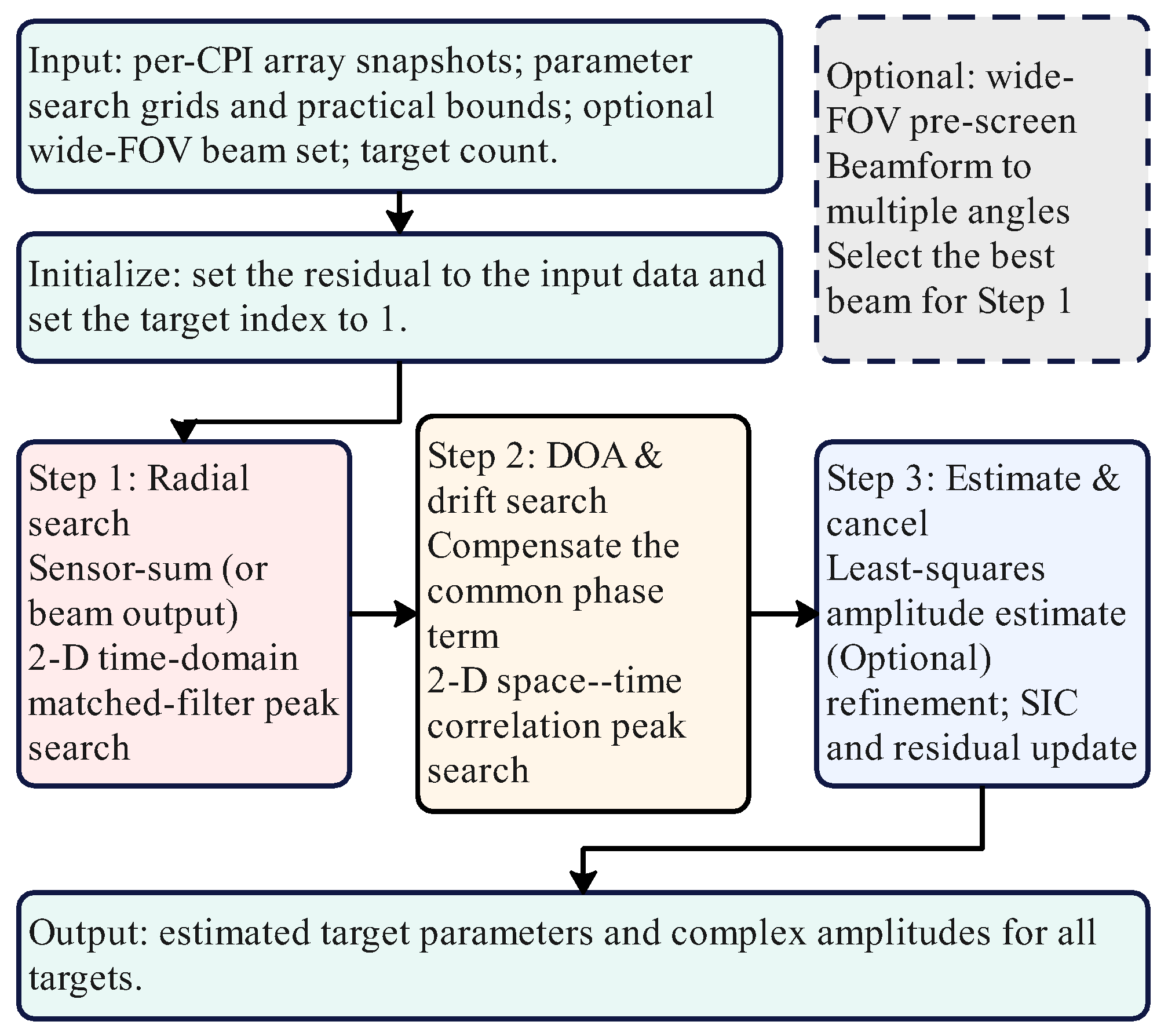
Motivated by the separability in Equation (12), we decompose the original four-parameter estimation into two tractable 2-D searches and integrate SIC to handle multiple targets under near–far conditions. Specifically, Step 1 estimates the common time-domain phase parameters ( v r , a r ) , Step 2 estimates the differential space–time steering parameters ( θ 0 , ω e ) after common-phase compensation, and Step 3 refines the complex amplitude and performs cancellation to peel off strong targets and expose weak ones. We initialize the residual as y ( 1 ) = vec ( X ) (equivalently, X ( 1 ) = X ). At the p-th iteration, y ( p ) (or X ( p ) ) denotes the current residual after canceling the previously estimated ( p 1 ) targets. Figure 2 provides an overview of the proposed D-SR-SIC procedure within one CPI.
For clarity, X ( p ) = [ x ( p ) [ 0 ] , , x ( p ) [ K 1 ] ] C M × K collects the residual snapshots within the CPI at iteration p, and  y ( p ) = vec ( X ( p ) ) is simply its vectorized form. Hence, x ( p ) [ k ] and y ( p ) carry the same information; we switch between matrix and vector forms for notational and computational convenience.
Let S v a R 2 denote the discrete search set (grid) for the radial-parameter pair ( v r , a r ) in Step 1, and let S θ ω R 2 denote the discrete search set (grid) for the steering-parameter pair ( θ 0 , ω e ) in Step 2. Their bounds can be set using available satellite ephemeris and UAV navigation/attitude information, while their grid resolutions determine the accuracy–complexity tradeoff. In practice, ephemeris or navigation errors perturb the nominal predicted values of ( v r , a r , ω e ) ; therefore, the search bounds should be padded by an uncertainty margin obtained from the projected state error. If this margin is too small, the true parameter can fall outside the search region; if it is too large, the grid expands and the computational burden increases.
Wide-FOV processing (optional). The broadside sensor-sum operation below is a special case of digital beamforming. To stabilize the first-step radial search at large off-broadside angles, we form N b beams with steering directions { θ b } b = 1 N b . Using weights w ( θ b ) = 1 M a ( θ b ) , the b-th beam output is
y b ( p ) [ k ] = w H ( θ b ) x ( p ) [ k ] , b = 1 , , N b ,
where x ( p ) [ k ] denotes the k-th residual snapshot vector (the k-th column of X ( p ) ). Collecting k = 0 , , K 1 yields the beam-output sequence y b ( p ) = [ y b ( p ) [ 0 ] , , y b ( p ) [ K 1 ] ] T C K . This reduces to broadside summation up to a constant scale factor when θ b = 0 (since a ( 0 ) = 1 M , where 1 M denotes the M × 1 all-ones vector). We select the beam b that yields the largest radial matched-filter peak over S v a , and then proceed with y in ( p ) = y b ( p ) . When wide-FOV beamforming is disabled, we simply use the broadside-sum input y in ( p ) = y sum ( p ) . A practical beam-spacing rule is to choose the coarsest beam grid that still guarantees an acceptable worst-case coherent gain over the target FOV. Let the beam spacing be Δ , let the covered angular span be Θ FOV , and define the worst-case normalized beam gain
η min ( Δ ) min θ F max b w H ( θ b ) a ( θ ) ,
where F denotes the target FOV, D denotes a discrete candidate set of admissible beam spacings, and the number of beams satisfies N b Θ FOV / Δ + 1 . One may then select
Δ = max Δ D { Δ : η min ( Δ ) η 0 } ,
with η 0 a prescribed minimum-gain requirement. This criterion chooses the largest spacing that still satisfies a worst-case gain constraint, thereby balancing robustness and complexity. In practice, wider FOVs, lower SNRs, or stricter robustness requirements call for smaller Δ , whereas narrower FOVs or tighter complexity budgets permit larger Δ .
(Step 1) Radial-parameter estimation ( v r , a r ) . Using the matrix-form residual X ( p ) (equivalently, y ( p ) = vec ( X ( p ) ) ), we obtain a single-channel input by summing across sensors as
y sum ( p ) [ k ] = m = 0 M 1 x ~ m ( p ) [ k ] .
Collecting k = 0 , , K 1 yields y sum ( p ) = [ y sum ( p ) [ 0 ] , , y sum ( p ) [ K 1 ] ] T C K , where x ~ m ( p ) [ k ] denotes the ( m , k ) -th entry of the residual snapshot matrix X ( p ) . For the broadside-sum case, targets near broadside receive the largest coherent gain; for the beamformed case, the gain is largest for targets near the selected beam. Hence, under the exact multi-target residual model, Step 1 operates on a weighted mixture rather than on a single-target signal. If  P ( p ) denotes the set of uncanceled targets at iteration p, the Step-1 input can be written as
y in ( p ) [ k ] = q P ( p ) g q ( p ) [ k ] α q e j 2 π λ v r , q t k + 1 2 a r , q t k 2 + η ( p ) [ k ] ,
where g q ( p ) [ k ] is the steering-dependent beam/sum gain of target q (e.g., g q ( p ) [ k ] = w H ( θ b ) a ( θ q [ k ] ) for the selected beam, and  g q ( p ) [ k ] = 1 M T a ( θ q [ k ] ) for broadside summation), and  η ( p ) [ k ] collects noise and residual cancellation error. Over a short CPI, g q ( p ) [ k ] acts mainly as a slowly varying weighting term relative to the rapidly varying common time phase. We then estimate ( v r , a r ) via a 2-D matched-filter (correlation) search using the time-domain atom d T A ( v r , a r ) , where the subscript T A denotes the time-domain atom,
d T A ( v r , a r ) k = e j 2 π λ v r t k + 1 2 a r t k 2 .
Over a search set S v a for ( v r , a r ) , we select
( v ^ r , p , a ^ r , p ) = arg max ( v r , a r ) S v a | d T A H ( v r , a r ) y in ( p ) | 2 d T A ( v r , a r ) 2 2 .
Step 1 performs a greedy selection of the dominant beam-weighted matched-filter peak in the current residual. Reliable selection requires that at least one beam (or the broadside sum) provide a sufficiently strong effective response for the target of interest relative to the remaining uncanceled targets. This condition is facilitated by radial-parameter separation, beam selectivity, and prior SIC stages. If multiple targets share nearly identical ( v r , a r ) and comparable beam-weighted amplitudes, the peak may become ambiguous, necessitating finer beams, tighter prior bounds, or additional refinement.
(Step 2) DOA and steering-drift estimation ( θ 0 , ω e ) . Given ( v ^ r , p , a ^ r , p ) , we compensate the common time modulation across snapshots by
X c ( p ) = X ( p ) diag d T A ( v ^ r , p , a ^ r , p ) ,
where diag ( · ) forms a diagonal matrix from its vector argument and ( · ) denotes complex conjugation. Equivalently, [ X c ( p ) ] : , k = x ( p ) [ k ] · d T A ( v ^ r , p , a ^ r , p ) [ k ] . We then search ( θ 0 , ω e ) using a 2-D space–time steering atom A S A ( θ 0 , ω e ) , where the subscript S A denotes the steering atom,
[ A S A ( θ 0 , ω e ) ] m , k = e j 2 π λ m d sin θ 0 + ω e t k ,
and select
( θ ^ 0 , p , ω ^ e , p ) = arg max ( θ 0 , ω e ) S θ ω | A S A ( θ 0 , ω e ) , X c ( p ) F | 2 A S A ( θ 0 , ω e ) F 2 ,
where S θ ω is the search set, Tr ( · ) denotes the trace operator, · F denotes the Frobenius norm, and  A , B F Tr ( A H B ) denotes the Frobenius inner product (equivalently, A , B F = vec ( A ) H vec ( B ) ).
(Step 3) Amplitude estimation, refinement, and SIC. After obtaining Ψ ^ p = { θ ^ 0 , p , ω ^ e , p , v ^ r , p , a ^ r , p } , we form the corresponding full atom d Ψ ^ p = vec ( A ( Ψ ^ p ) ) using Equation (17). The complex amplitude is refined by a least-squares (LS) projection
s ^ p = d H Ψ ^ p y ( p ) d H Ψ ^ p d Ψ ^ p ,
Equation (30) corresponds to an orthogonal projection of the current residual onto the selected atom and typically yields a more accurate amplitude than a raw peak value, thereby improving cancellation in the subsequent SIC update. The residual is then updated via SIC as
y ( p + 1 ) = y ( p ) s ^ p d Ψ ^ p ,
Equations (30) and (31) together form a least-squares-based successive interference cancellation (LS-SIC) update.
Refinement. In off-grid or near–far scenarios, a biased estimate for a strong target may leave a structured residual and cause error propagation in SIC. To mitigate this, we adopt a coarse-to-fine strategy: after the coarse-grid maximization in Equations (26) and (29), we optionally perform a small local refinement around the peak (e.g., on a finer grid or via a few coordinate-descent steps) before cancellation. We do not include a global backfitting loop in the reported implementation. The reason is that D-SR-SIC is designed to retain the complexity advantage of the decomposition-based procedure: once a target is selected, we only perform a lightweight LS amplitude update and optional local refinement before cancellation, whereas repeated backfitting would require revisiting previously extracted targets and partially offset the low-complexity benefit. In the tested scenarios, this lightweight correction already captures the dominant first-order mismatch at a much lower cost. Nevertheless, backfitting could further reduce residual coupling in difficult cases such as severe off-grid mismatch or nearly coherent targets, so it should be regarded as a useful extension rather than a component of the current baseline.
The above Steps 1–3 form a per-CPI iterative loop that extracts one target at a time and updates the residual for the next iteration. Depending on the operating regime, wide-FOV pre-screening in Equation (20) and the optional local refinement can be enabled to improve robustness under large off-broadside angles and grid mismatch. In the fixed-P version considered for the core simulations, the loop is run for p = 1 , , P . In practical operation when P is unknown, one may terminate the loop when the strongest normalized matched-filter peak in the current iteration falls below a threshold tied to the estimated noise floor or when the residual-energy reduction after cancellation becomes smaller than a preset fraction. Detector outputs or model-order criteria such as MDL/BIC can also be used to initialize or validate the target count. If P is underestimated, some targets remain in the residual and their parameters are missed; if P is overestimated, extra iterations may start fitting sidelobes or noise-dominated residual structure. Algorithm 1 provides an implementation-oriented summary and maps the loop to Equations (26) and (31). We next discuss computational complexity and practical remarks.
Algorithm 1 D-SR-SIC for Dynamic DOA Estimation
  • Require: Snapshots X C M × K ; search sets S v a and S θ ω ; beam set { θ b } b = 1 N b (optional, N b = 1 for broadside); target count P or stopping-rule parameters.
  • Ensure: Estimated target parameters { Ψ ^ p } and amplitudes { s ^ p } .
1:
Initialize X ( 1 ) X , y ( 1 ) vec ( X ( 1 ) ) .
2:
for  p = 1 , 2 , , P   do
3:
    Reshape y ( p ) into X ( p ) C M × K .
4:
    Form beam outputs { y b ( p ) } b = 1 N b using Equation (20) (or broadside sum y sum ( p ) using Equation (23)). Select b that yields the largest radial matched-filter peak and set y in ( p ) y b ( p ) .
5:
    Estimate ( v ^ r , p , a ^ r , p ) via Equation (26) using y in ( p ) and the time atom in Equation (25).
6:
    Compensate common phase via Equation (27): X c ( p ) X ( p ) diag ( d T A ( v ^ r , p , a ^ r , p ) ) .
7:
    Estimate ( θ ^ 0 , p , ω ^ e , p ) via Equation (29) using X c ( p ) and the steering atom in Equation (28).
8:
    (Optional) Local refinement around the coarse peak(s).
9:
    Compute s ^ p via Equation (30) and update residual y ( p + 1 ) via Equation (31).
10:
end for

3.3. Complexity and Practical Remarks

Let N θ , N ω , N v , N a denote the grid sizes for ( θ 0 , ω e , v r , a r ) . Consider a direct joint (4-D) search over the full grid of size N N θ N ω N v N a . A single-pass matched-filter evaluation requires N inner products between an M K -length atom and the data vector, leading to a computational cost on the order of O ( M K N θ N ω N v N a ) . If SIC/backfitting is further applied to iteratively extract P targets, the worst-case complexity scales as O ( P M K N θ N ω N v N a ) . Moreover, explicitly forming/storing the corresponding 4-D dictionary incurs a memory cost of O ( M K N θ N ω N v N a ) ; on-the-fly atom generation reduces memory but not the dominant correlation cost. If one instead solves the full LASSO in Equation (19) with an N-atom dictionary using a first-order method (e.g., iterative shrinkage [35]), each iteration costs O ( M K N ) , yielding O ( I M K N ) for I iterations. In contrast, D-SR-SIC performs a time-domain search for ( v r , a r ) after sensor/beam combining and a space–time search for ( θ 0 , ω e ) , leading to
O K N v N a + O M K N θ N ω
The first term corresponds to the time-domain correlation over ( v r , a r ) after sensor/beam combining, while the second term corresponds to the space–time correlation over ( θ 0 , ω e ) on the compensated data. Both steps are dominated by inner products and can be efficiently implemented with precomputed atoms and straightforward parallelization. These costs are per target. If multi-beam pre-screening is used, we form N b beam outputs and evaluate the Step-1 radial matched filter over these beams to select b , which adds a linear-in- N b cost on the order of O ( N b M K ) + O ( N b K N v N a ) . Hence, the overall complexity scales quadratically with grid resolution rather than quartically. In our implementation, each step is carried out by correlation peak search (matched filtering) followed by a small local refinement around the coarse peak to mitigate off-grid mismatch, which preserves the model structure in Equation (16) while greatly reducing runtime. A full backfitting stage is not included in this complexity count; adding repeated re-estimation of previously extracted targets would introduce an additional outer loop and weaken the main computational advantage of the present decomposition-based implementation.

4. Simulation Results

4.1. Simulation Setup

Unless otherwise specified, simulations are conducted in MATLAB R2025b using Monte Carlo trials. The key parameters are: carrier frequency f c = 1.5   GHz ( λ = 0.2   m ), ULA size M = 16 with half-wavelength spacing d = λ / 2 , sampling rate F s = 25   MHz (thus T s = 1 / F s ), and CPI length T CPI = 1   m s with K = 25 , 000 snapshots (thus T CPI = K T s ). Unless otherwise stated, the synthetic baseband data follow the parameterized phase model in Equation (12), and additive noise is modeled as circularly symmetric complex Gaussian. The SNR refers to the per-sensor average echo power to noise power ratio for a single target. The results are produced by Monte Carlo simulation under the model and parameters described above. Unless otherwise stated, the number of targets P is assumed known in the simulations, so the SIC loop is run for exactly P iterations. This setting is used to isolate parameter-estimation performance from target-number selection errors.
For baselines that rely on quasi-stationary snapshots, Experiments 2 and 4 use a short sub-CPI segment with K sub = K / 10 snapshots: MUSIC uses the corresponding sub-CPI sample covariance, while conventional beamforming coherently averages the same sub-CPI snapshots. In Experiment 1, MUSIC is applied on the full CPI to illustrate the stationarity violation analyzed in Section 2.3. To reduce runtime in wide-FOV and off-grid sweeps, Experiments 6 and 7 uniformly decimate the fast-time snapshots (reducing K while keeping T CPI fixed). The current baseline set is chosen to represent three comparison axes relevant to the present problem: (i) quasi-stationary covariance processing (sub-CPI MUSIC and CBF), (ii) direct matched dynamic search over the full parameter grid (4-D search), and (iii) joint sparse/grid-based baselines (Joint-OMP and Joint-SPICE). We do not include direct numerical comparisons with recursive tracking-oriented dynamic DOA methods such as Kalman-filter-based or dynamic sparse tracking schemes [16,17]. Those methods typically assume multiple consecutive blocks together with an explicit temporal state-evolution model, whereas the present work addresses single-CPI local estimation and compensation under within-CPI nonstationarity. A broader cross-model benchmark is left for future work. For a similar reason, we do not include a direct numerical comparison with deep-learning-based DOA estimators in the present manuscript. A fair comparison would require a dedicated train/validation/test protocol matched to the same LEO–UAV dynamic geometry, waveform assumptions, and distribution shifts considered here. Constructing such a benchmark is beyond the current scope and is left for future work.
Regarding the steering-drift parameterization, the paper model uses the direction-cosine expansion in Equation (8). In our simulations, the DOA drift is sometimes generated as θ ( t ) θ 0 + ω 0 t and then mapped through sin θ ( t ) ; under the short-CPI assumption, these parameterizations are consistent because sin ( θ 0 + ω 0 t ) sin θ 0 + ( ω 0 cos θ 0 ) t , i.e., ω e ω 0 cos θ 0 .
Table 1 summarizes a representative four-target configuration that combines near–far interference, deep sub-Rayleigh angular separation, and wide-FOV operation. This setting is used in Experiment 1 to provide a spectrum-level illustration of the above challenges.
Table 1 defines a representative four-target setting. Target 1 is a strong and highly dynamic interferer, included to evaluate SIC robustness and potential error propagation. Targets 2 and 3 form a closely spaced pair with Δ θ = 2 , well below the Rayleigh proxy for M = 16 , to assess super-resolution capability. Target 4 is weak and far from broadside, included to assess resolution under masking and the stability of Step 1 when the broadside sum suffers coherent-gain loss.

4.2. Accuracy and Resolution Performance

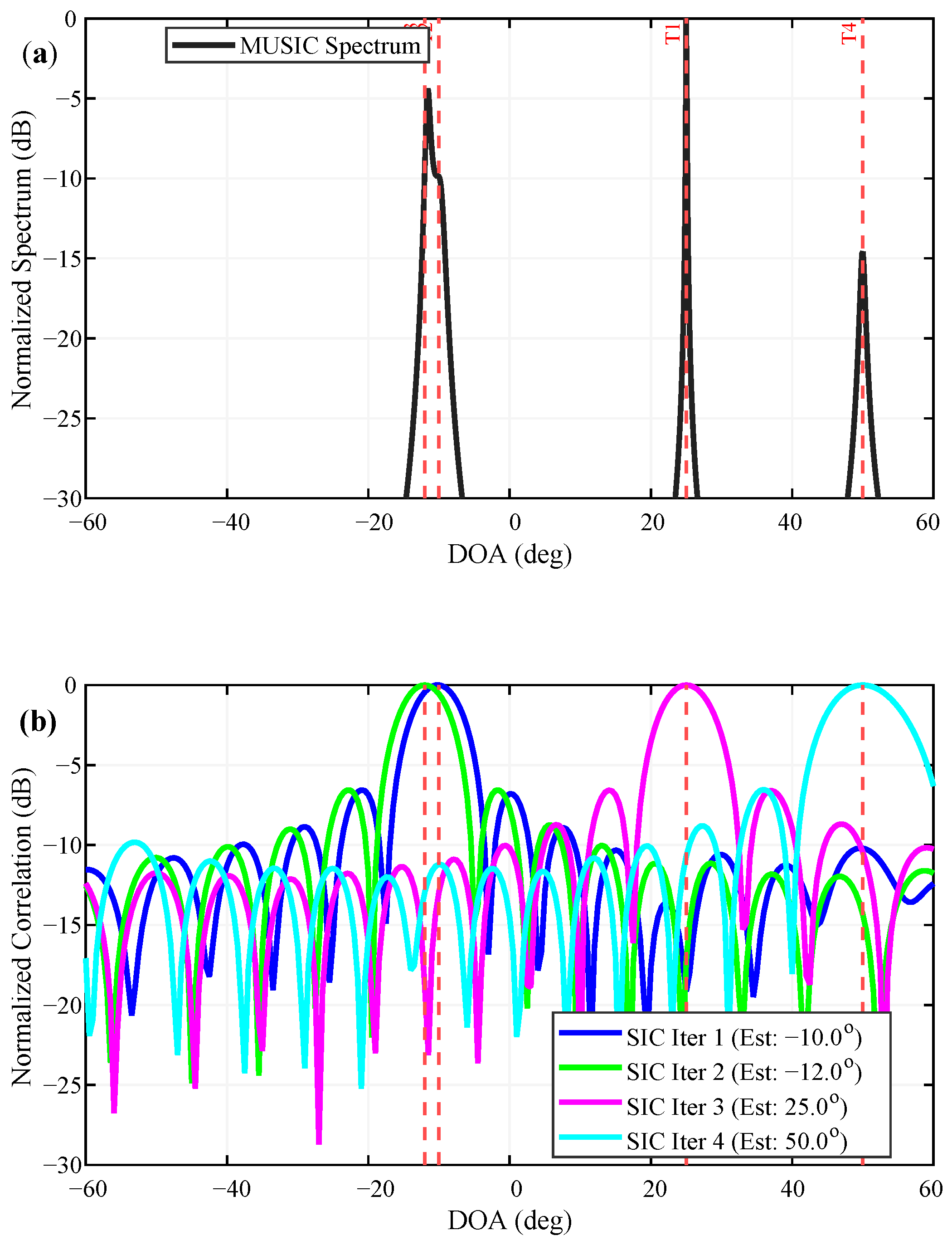
Experiment 1 (Spectrum comparison under high dynamics). This experiment provides a spectrum-level illustration of the key nonstationarity effect. We use the four-target configuration in Table 1, which contains a strong interferer (Target 1, SNR 5 dB), a closely spaced pair (Targets 2 and 3 with Δ θ = 2 and SNR 10 dB), and a weak target (Target 4, SNR 15 dB) located far from broadside.
For the MUSIC baseline, the sample covariance is formed over the full CPI, and a conventional stationary-snapshot spatial spectrum is computed. As expected from the analysis in Section 2.3, the time-varying steering drift and common Doppler-like phase violate the stationarity assumption, leading to peak broadening and subspace leakage. In Figure 3a, the broadened lobes and elevated sidelobes cause subspace leakage, so the closely spaced pair (Targets 2 and 3) is poorly separated and the weak far-angle target is prone to being masked.
In contrast, D-SR-SIC explicitly matches the dynamic phase evolution. Wide-FOV multi-beam pre-screening based on Equation (20) is enabled (with a 10° beam spacing) to stabilize the Step-1 radial search, then ( v ^ r , p , a ^ r , p ) and ( θ ^ 0 , p , ω ^ e , p ) are estimated via Equations (26) and (29), and the LS-SIC update in Equations (30) and (31) progressively peels off strong targets. In Figure 3b, after cancellation, the spectrum exhibits sharp peaks at the true DOAs, resolves the Δ θ = 2 pair, and reveals the 15 dB target that is otherwise masked by sidelobes and noise. This experiment highlights that stationary-covariance processing is sensitive to high dynamics, whereas dynamic phase matching restores coherent focusing.
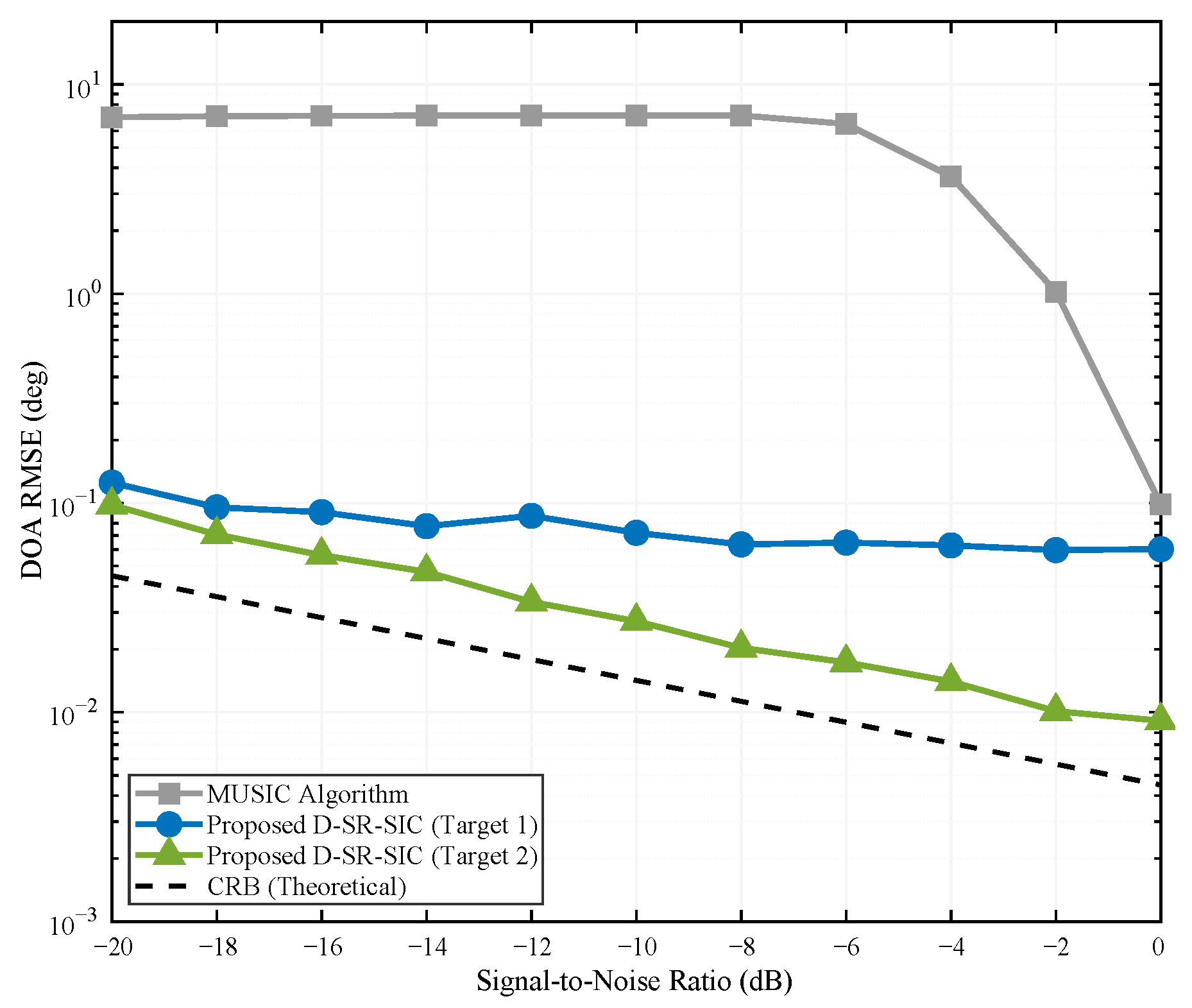
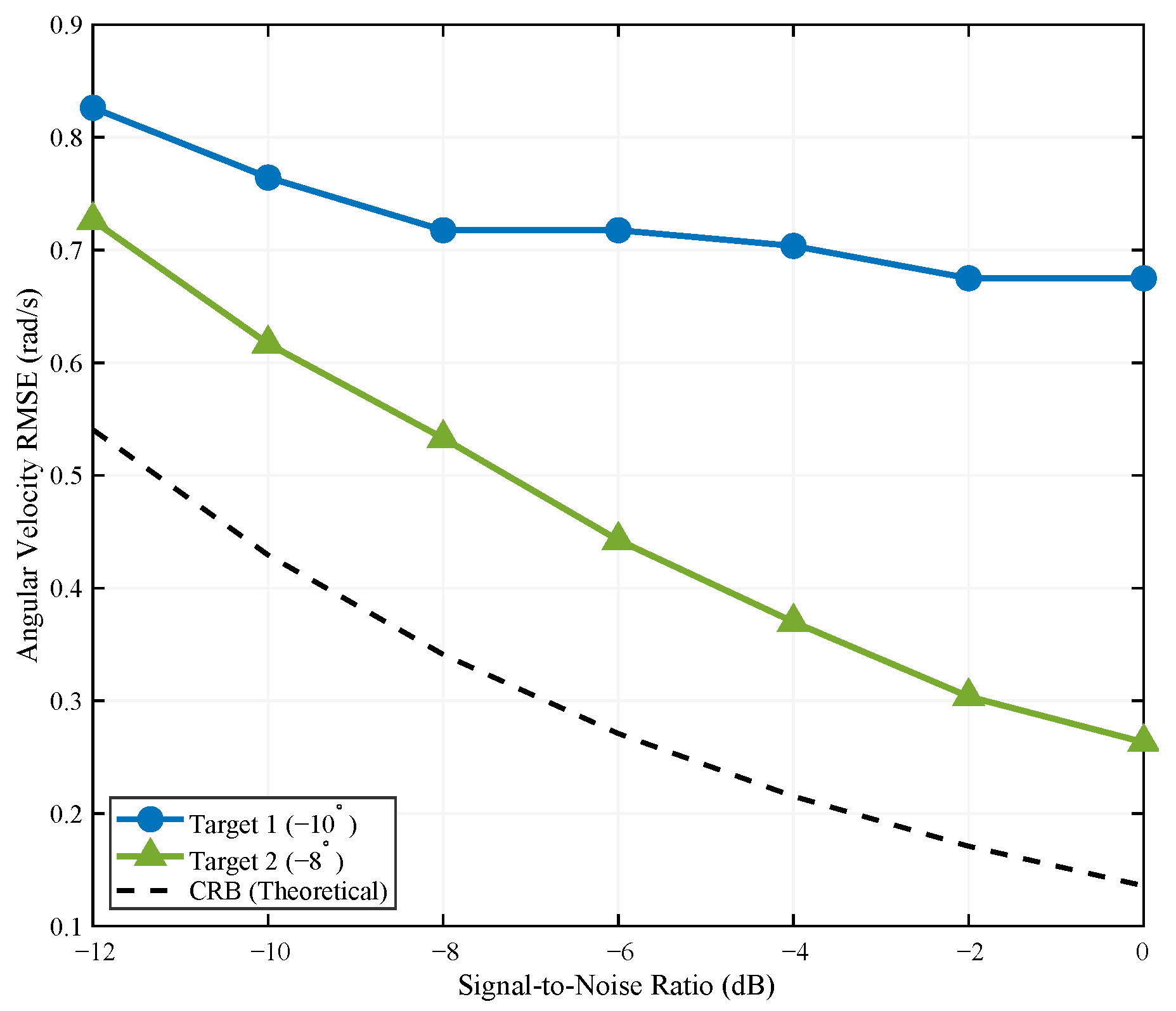
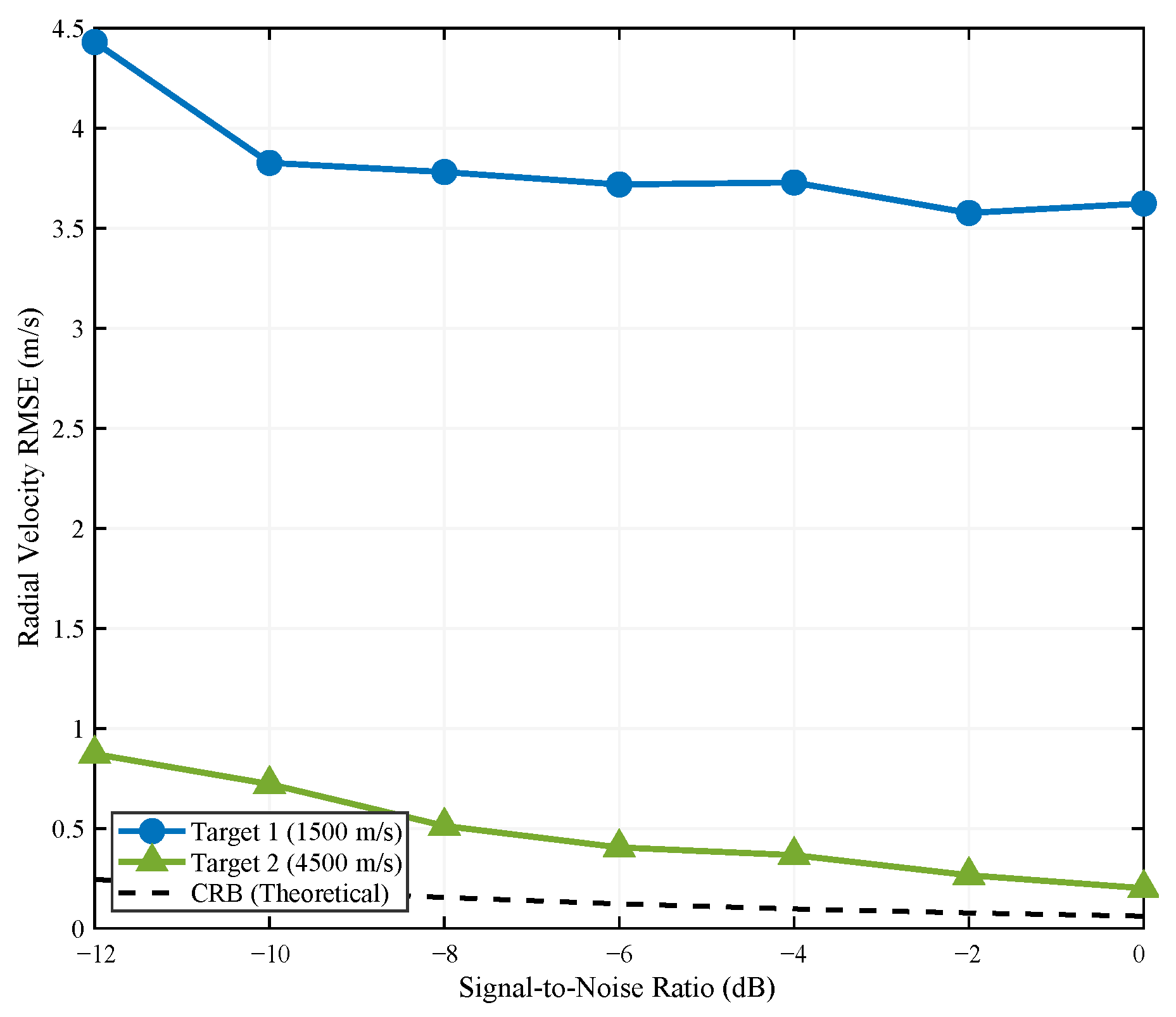
Experiment 2 (Root-mean-square error (RMSE) versus SNR). Figure 4, Figure 5 and Figure 6 quantify estimation accuracy versus SNR in a two-target highly dynamic scenario. The two targets are closely spaced with Δ θ = 2 (targets at 10 and 8 ), and exhibit distinct radial velocities ( v r = 1500   m s 1 and 4500   m s 1 ). In the simulation signal generation, the DOA drift is synthesized as θ ( t ) θ 0 + ω 0 t with ω 0 = 0.1 and 0.15 rad/s. We set a r = 0 . We sweep SNR from 20 to 0 dB with 100 Monte Carlo trials per SNR.
Figure 4 reports DOA RMSE. For the MUSIC baseline, we form the sample covariance over a short sub-CPI segment with K sub K / 10 snapshots to partially alleviate nonstationarity. Under this configuration, MUSIC exhibits a noticeable low-SNR error floor (several degrees in Figure 4) and improves only at high SNR, where the sub-CPI covariance estimate becomes reliable. In contrast, D-SR-SIC explicitly compensates for the common phase and steering drift, maintaining sharp correlation peaks and enabling accurate DOA estimates at very low SNR. As shown in Figure 4, at SNR = 20 dB, the proposed method achieves a DOA RMSE of about 0.11 across the two targets (about 62 × lower than MUSIC); over the entire SNR range, the RMSE of each target remains below 0.13 .
Figure 5 and Figure 6 show the RMSE of the estimated steering-drift-rate parameter and radial velocity, respectively. These motion parameters are not directly provided by MUSIC but are a by-product of D-SR-SIC via the two-stage searches in Section 3. For readability, the motion-parameter RMSE curves are shown for SNR 12 dB, where the estimates become meaningful. Figure 6 indicates that radial-velocity estimation benefits from the strong observability of the common phase term: the proposed method achieves sub-5 ms−1 RMSE in this regime. In contrast, Figure 5 indicates that the steering-drift rate is less observable because the within-CPI steering drift is relatively mild for millisecond-level CPIs; consequently, a plateau can appear for one target, reflecting residual coupling and SIC ordering effects under closely spaced conditions. The Cramér–Rao bound (CRB) curves provide the achievable scaling with SNR under the matched model. The CRB is numerically evaluated based on the exact Fisher Information Matrix (FIM) of the parameterized space–time signal model in Equation (14). In the nominal short-CPI setting of Experiment 2, the generated data follow the local phase model to the intended approximation order, so the remaining high-SNR gap mainly reflects grid discretization, local-search approximation, and residual interference after cancellation. More generally, the CRB provides a reference under the matched model rather than a strict lower bound in the presence of model mismatch.
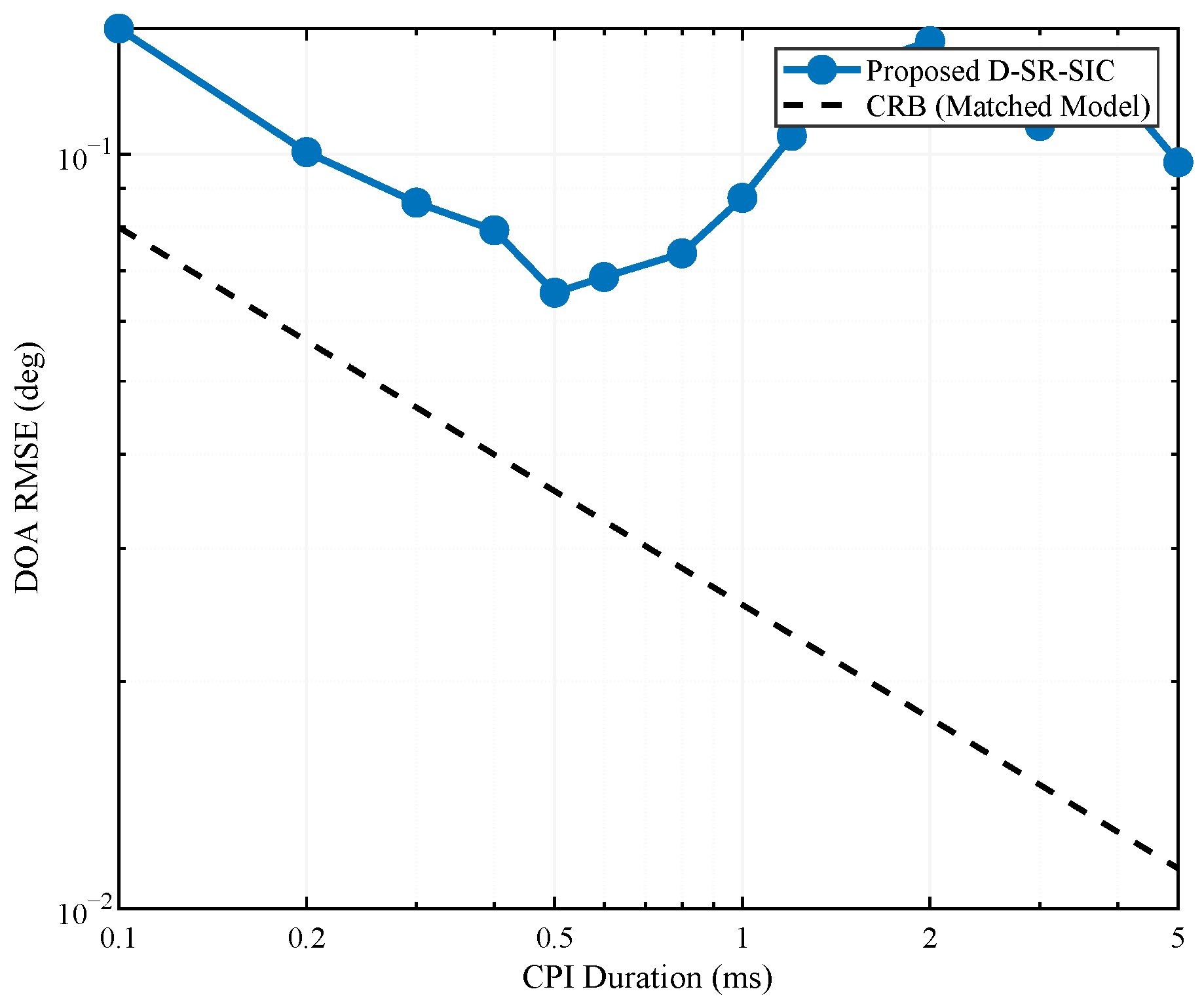
Experiment 3 (CPI length and model mismatch). Figure 7 investigates the effect of CPI length under intentional model mismatch. We fix SNR to 15 dB and sweep T CPI from 0.1   m s to 5 m s (200 Monte Carlo trials per CPI). To emulate high-order dynamics beyond the assumed model order, the synthetic signal includes a third-order range term (nonzero jerk) in the common phase, whereas the estimator still adopts the second-order range model in Equation (7). In this controlled stress test, the effective jerk is set to j r = 8000   m s 3 , so the mismatch is quantified both by the phase metric in Equation (10) and by the observed RMSE degradation as the CPI increases. Experiment 3 thus complements the analytical jerk-limited CPI rule in Equation (11): it shows how the usable CPI window shrinks once higher-order dynamics become non-negligible for the adopted local model.
The results are nonmonotonic in Figure 7. For short CPIs, increasing T CPI improves accuracy due to coherent gain and stronger parameter observability, and the RMSE drops from about 0.15 at T CPI = 0.1   m s to around 0.07 near T CPI 0.5   m s . Beyond this intermediate regime, the unmodeled high-order phase curvature accumulates and becomes dominant, which increases the RMSE and causes a widening gap to the matched-model CRB (dashed curve), whose monotone decrease with T CPI no longer describes the mismatched setting. This experiment shows that the gap to the plotted CRB is not purely an estimator issue: once the assumed phase model is mismatched, the CRB remains tied to the nominal model and becomes an optimistic reference rather than an attainable lower bound for the actual data-generating process.
From a phase-error viewpoint, the unmodeled jerk term introduces a residual phase that grows roughly cubically with time, so extending T CPI without increasing the phase-model order can eventually degrade coherent processing. From an engineering perspective, Figure 7 suggests an optimal CPI window: one should either (i) select a CPI short enough that high-order phase errors remain small or (ii) increase the model order or incorporate refinement when long-CPI processing is required.
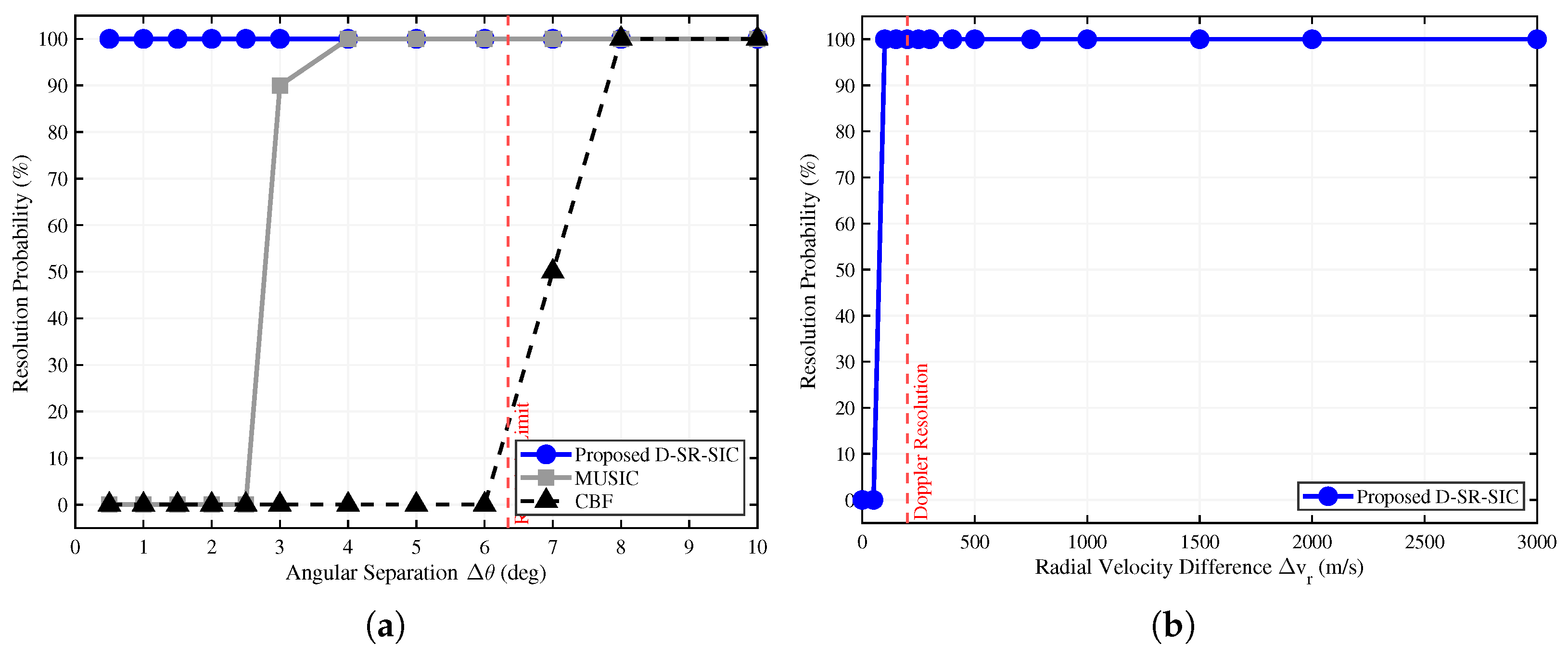
Experiment 4 (Conditional super-resolution beyond the Rayleigh limit). For a uniformly weighted half-wavelength ULA, a commonly used Rayleigh-limit proxy is the 3 dB beamwidth θ R 0.886 · 2 M (radians), which gives θ R 6 . 4 when M = 16 . Figure 8 evaluates the two-target resolution probability at a fixed SNR of 10 dB (100 Monte Carlo trials per setting). A trial is counted as a successful resolution if both DOA errors are below min ( 1 , Δ θ / 2 ) , consistent with the evaluation rule in the simulation code.
Figure 8a plots resolution probability versus angular separation. The conventional beamforming (CBF) and MUSIC baselines are computed using a short sub-CPI segment with K sub K / 10 snapshots to partially alleviate motion-induced nonstationarity; MUSIC uses the corresponding sub-CPI covariance. The results in Figure 8a show a pronounced sub-Rayleigh breakdown for the baselines: CBF remains near 0 % up to about 6° and requires Δ θ 8 to reach 100 % resolution, consistent with the Rayleigh proxy. MUSIC improves once Δ θ exceeds roughly 3° and reaches 100 % at Δ θ 4 in this setting, but still fails in the deep sub-Rayleigh region. In contrast, D-SR-SIC achieves 100 % resolution over the tested separations down to Δ θ = 0.5 , demonstrating strong super-resolution in the dynamic model. However, this result should not be interpreted as a universal sub-Rayleigh guarantee, because the resolution gain depends on whether the targets remain separable in the common-phase domain.
Figure 8b illustrates the role of Doppler diversity by fixing Δ θ = 3 and sweeping the radial-velocity difference. When Δ v r is near zero, the targets become hard to separate in the common-phase domain, and the resolution probability collapses. As Δ v r increases, the probability transitions sharply to 100 % once Δ v r reaches about 100 m / s , which is on the order of the Doppler resolution scale λ / T CPI 200   m s 1 for T CPI = 1   m s and reflects the Doppler-diversity mechanism. This experiment explains why the proposed decomposition can trade time-domain diversity for improved angular separability. Therefore, the super-resolution claim in this paper is conditional rather than universal: when targets share almost the same radial motion, D-SR-SIC loses the time-domain diversity that separates their common phases, so sub-Rayleigh resolution is no longer guaranteed and can degrade sharply.

4.3. Robustness and Computational Efficiency

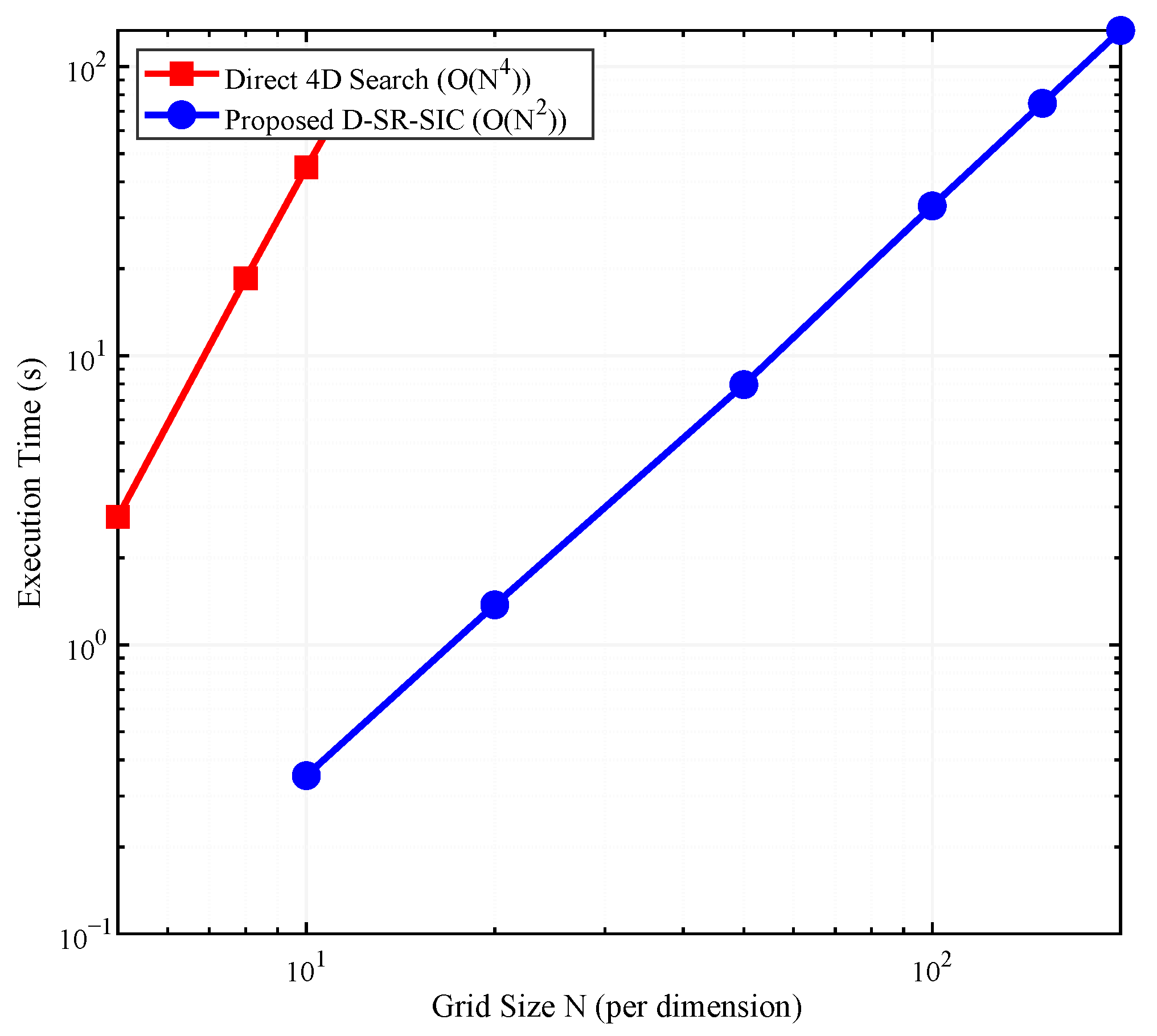
Experiment 5 (Computational efficiency). Figure 9 validates the computational advantage of the decomposition strategy by measuring runtime scaling versus grid size. We compare a direct 4-D matched-filter search over ( θ 0 , ω e , v r , a r ) with the proposed two-stage D-SR-SIC search (Step 1 over ( v r , a r ) and Step 2 over ( θ 0 , ω e ) ). In the implementation, the same per-dimension grid size N g is used for all four parameters to highlight the asymptotic scaling.
The direct 4-D search exhibits the expected O ( M K N g 4 ) growth and is therefore only evaluated for small grids (up to N g = 12 ) to keep runtime finite. In contrast, the proposed method scales approximately as O ( K N g 2 ) + O ( M K N g 2 ) per target and remains practical for much finer grids (tested up to N g = 200 ). The log–log curves in Figure 9 follow the reference slopes (fourth order versus second order), consistent with the complexity discussion in Section 3.
Beyond the slope comparison, Figure 9 provides concrete runtime implications. At N g = 10 , the direct 4-D search takes about 45 s , whereas D-SR-SIC takes about 0.35   s . As N g increases, the gap widens rapidly (quartic versus quadratic scaling), which explains why direct joint search/sparse recovery becomes impractical in dynamic 4-D models, while the decomposition-based procedure supports high-resolution grids under realistic runtime budgets.
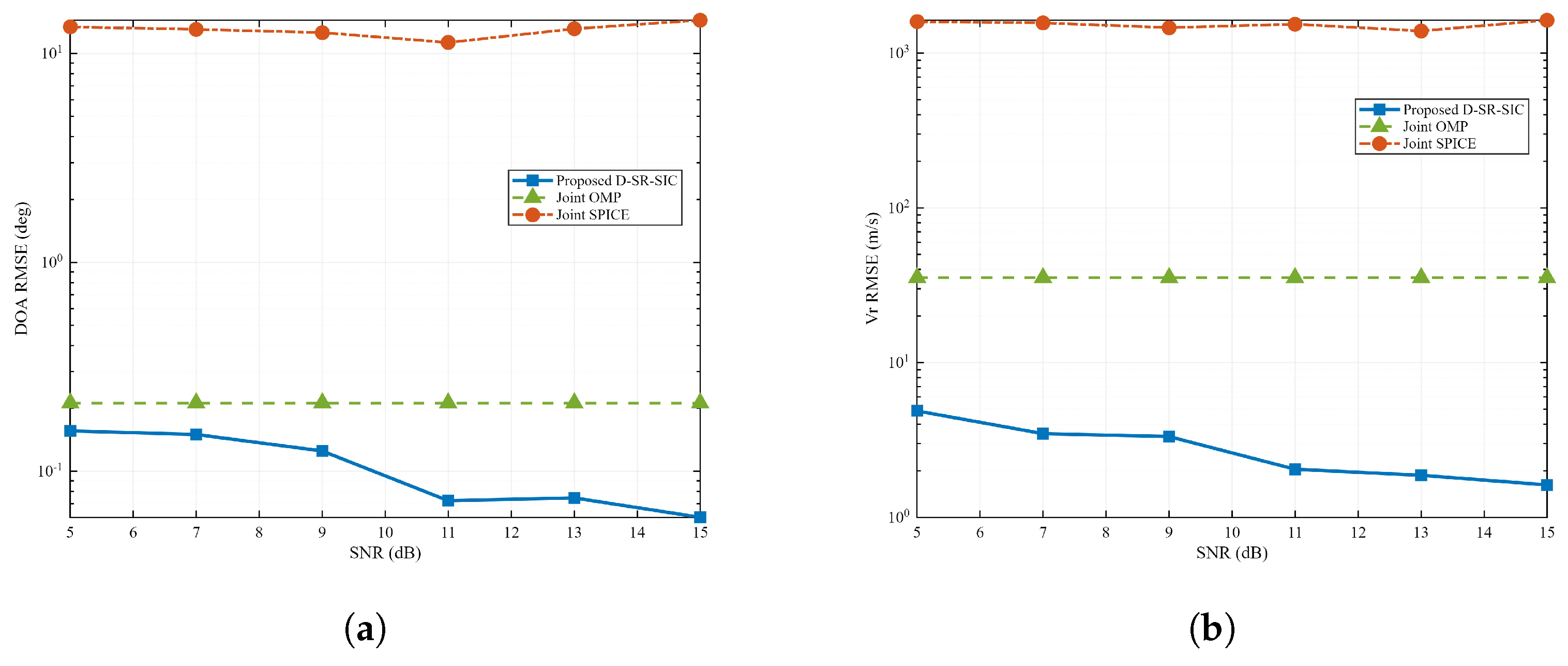
Experiment 6 (Off-grid robustness). Figure 10 studies off-grid robustness under a strong near–far condition. We consider two targets: a strong on-grid interferer at ( θ 0 , v r ) = ( 10 , 3000   m s 1 ) and a weak off-grid target at ( θ 0 , v r ) = ( 5 . 7 , 1750   m s 1 ) . The weak target amplitude is 10 × smaller (about 20 dB power difference), which stresses SIC and exposes error-propagation risks. To emphasize gridding effects, a coarse joint grid with Δ θ = 2 and Δ v r = 400   m s 1 is used for the joint baselines. The SNR is swept from 5 dB to 15 dB (defined with respect to the strong target), and the fast-time snapshots are uniformly decimated to keep runtime manageable while preserving T CPI .
Figure 10 highlights off-grid error floors for grid-based joint estimators. Joint orthogonal matching pursuit (Joint-OMP) [36] exhibits nearly flat RMSE curves versus SNR in both DOA and v r , indicating that increasing SNR cannot overcome the discretization mismatch when the target lies between grid points. Joint sparse iterative covariance-based estimation (Joint-SPICE) [23] exhibits severe degradation in this coarse-grid near–far setting, yielding DOA errors on the order of 10 and v r errors on the order of 10 3 m/s, which can be attributed to coarse-grid mismatch under strong interference.
In contrast, D-SR-SIC reduces the mismatch impact by combining coarse localization with local refinement and LS-SIC. In Figure 10, the DOA RMSE decreases from about 0.15 at SNR = 5   dB to roughly 0.06° at SNR = 15 dB, and the v r RMSE decreases from about 5   m s 1 to around 1.5   m s 1 . This monotone improvement indicates that, after refinement, the residual error is dominated by noise rather than by gridding. To further probe SIC error propagation beyond the 20 dB power-gap case plotted in Figure 10, we conducted an additional fixed-SNR stress test using the same two-target off-grid geometry, the same coarse grid, and SNR = 10 dB defined with respect to the strong target. As the strong-to-weak power difference increases from 20 dB to 30 dB and 40 dB, the weak-target DOA RMSE increases from about 0.15° to 7.07 and 11 . 29 , while the weak-target v r RMSE increases from about 4.2 ms−1   to 899 ms−1 and 1514 ms−1, respectively. Using a practical weak-target success criterion | θ ^ θ | 1 and | v ^ r v r |   100   m s 1 , the success rate drops from 100 % to 68 % and 2 % . These results confirm that SIC error propagation becomes substantial under more extreme near–far conditions, especially beyond a 30 dB power gap, even with LS amplitude refinement and local peak refinement.
Table 2 reports the average runtime in this off-grid scenario. Joint-SPICE is orders of magnitude slower due to the large joint dictionary, whereas D-SR-SIC achieves a 6.5 ms average runtime and provides a 4.92 × 10 3 speedup over Joint-SPICE while significantly improving accuracy. Joint-OMP is faster but suffers from pronounced error floors, illustrating the practical accuracy–complexity tradeoff.
Experiment 7 (Wide-FOV robustness and multi-beam necessity). This experiment validates the wide-FOV limitation of the broadside-sum Step 1 and the necessity of multi-beam pre-screening. Recall that the sensor-sum operation in Equation (23) is equivalent to broadside beamforming. When the true DOA is far from broadside, the array factor introduces severe coherent-gain loss, which degrades the effective SNR of the time-domain signal used in the ( v r , a r ) search and can cause a cascade failure in subsequent steps. Multi-beam pre-screening based on Equation (20) mitigates this issue by steering a set of beams and selecting the beam that maximizes the Stage-1 radial matched-filter peak.
We consider a single target with v r = 3000   m s 1 at a very low per sensor SNR of 30 dB and sweep θ 0 [ 60 , 60 ] (excluding θ 0 = 0 ). For each scanned θ 0 , we run repeated trials and compute the success probabilities of the Stage-1 radial-velocity estimate and the final DOA estimate, using practical tolerances | v ^ r v r |   100   m s 1 and | θ ^ 0 θ 0 |   1 , respectively. Table 3 reports (i) the mean and worst-case success probabilities over the scanned angles and (ii) the coverage, defined as the percentage of scanned angles whose success probability is at least 50 % . For multi-beam pre-screening, Δ denotes the angular spacing between adjacent digital beams in the pre-screening set.
Table 3 confirms a pronounced FOV boundary for the broadside-sum baseline: both v r and DOA success rates are low (mean/worst below 10 % ), and the coverage drops to 0 % , indicating that the Stage-1 radial-parameter estimation fails almost everywhere once the coherent gain collapses. Multi-beam pre-screening improves both the mean and worst-case statistics and expands the coverage. In particular, with Δ = 20 , the v r mean success rises to 55.0 % (worst 7.0 % ) and the DOA mean success rises to 46.6 % (worst 5.5 % ), while Δ = 10 further improves these to 82.4 % (worst 24.5 % ) for v r and 69.0 % (worst 19.0 % ) for DOA. This illustrates the robustness–complexity tradeoff: smaller Δ increases the number of beams and, thus, computation but provides denser angular coverage and mitigates the Stage-1 coherent-gain loss. For the tested [ 60 , 60 ] FOV with M = 16 , Δ = 20 corresponds to N b = 7 beams and yields a worst-case normalized beam gain of about 0.10 over the scanned FOV, whereas Δ = 10 corresponds to N b = 13 beams and raises this worst-case gain to about 0.38 . This explains why Δ = 10 is preferable in the present wide-FOV low-SNR setting, while not being claimed as a universal optimum for all array sizes or FOV ranges. We also evaluated the computational overhead under the same Experiment 7 setting. The measured average runtime per trial is about 0.261 ms for broadside-sum, 0.452 ms for Δ = 20 , and 0.450 ms for Δ = 10 , i.e., about 1.73 × overhead for multi-beam pre-screening relative to broadside-sum in this vectorized implementation. Compared with this modest runtime increase, the low-SNR wide-FOV performance gain is substantial: the mean v r success rises from 9.3 % to 55.0 % and 82.4 % , while the mean DOA success rises from 9.9 % to 46.6 % and 69.0 % , for Δ = 20 and 10 , respectively.

5. Conclusions

This paper has investigated dynamic DOA estimation for UAV array passive sensing under LEO satellite SoO illumination, where within-CPI nonstationarity produces coupled common-phase evolution and steering drift that degrade conventional stationary-snapshot processing. To address this issue, we derived a short-CPI local phase model and developed the D-SR-SIC procedure, which exploits phase-structure separability to replace a high-dimensional joint estimation problem with two low-dimensional searches, followed by LS-SIC, optional local refinement, and optional multi-beam pre-screening. In the tested synthetic settings, the proposed method provides accurate low-SNR dynamic DOA estimation, substantially reduced runtime relative to direct 4-D search, improved robustness to off-grid mismatch and wide-FOV operation, and strong super-resolution for closely spaced targets when sufficient radial-motion diversity is present. The results show that this sub-Rayleigh advantage is conditional rather than universal. The CRB curves serve as a reference for the assumed matched local model, and model mismatch can widen the observed gap under long-CPI or higher-order dynamics. The method functions as a CPI-local dynamic focusing and target-separation tool rather than a full geometric-state recovery method from a single CPI. Future work will investigate tighter integration with wideband preprocessing (e.g., residual range-walk correction), higher-order motion/phase modeling for longer-CPI operation, joint re-estimation/backfitting strategies for difficult multi-target cases, automatic target-number selection and statistically grounded stopping rules, and validation on real LEO SoO measurements and hardware experiments, including multi-illuminator and three-dimensional array geometries.

Author Contributions

Conceptualization, L.Z.; Software, Y.H.; Validation, T.L.; Investigation, Y.D.; Data curation, T.L.; Writing—original draft, W.L.; Supervision, P.C.; Project administration, T.G. and P.C. All authors have read and agreed to the published version of the manuscript.

Funding

This research was funded by the State Grid Shandong Electric Power Company’s Sci-Tech Project (Research and Application of Key Communication Technologies for Intelligent Early Warning and Emergency Response in Electric Power Safe Production, ERP No. 520605250006).

Data Availability Statement

The original contributions presented in this study are included in the article. Further inquiries can be directed to the corresponding author.

Conflicts of Interest

Authors Wei Liu, Tian Liang and Yuanke Du were employed by State Grid Yantai Power Supply Company. Author Ti Guan was employed by State Grid Shandong Electric Power Company. Author Lianzhen Zheng was employed by State Grid Laiwu Power Supply Company. The remaining authors declare that the research was conducted in the absence of any commercial or financial relationships that could be construed as a potential conflict of interest.

References

  1. Terzija, V.; Valverde, G.; Cai, D.; Regulski, P.; Madani, V.; Fitch, J.; Skok, S.; Begovic, M.M.; Phadke, A. Wide-area monitoring, protection, and control of future electric power networks. Proc. IEEE 2011, 99, 80–93. [Google Scholar] [CrossRef]
  2. Wang, Z.; He, Q.; Blum, R.S. Exploiting information about the structure of signals of opportunity for passive radar performance increase. IEEE Trans. Signal Process. 2021, 69, 6083–6100. [Google Scholar] [CrossRef]
  3. Chen, P.; Zhou, T.; Chen, Z.; Meng, F.; Liu, J. BFP-Net: A DL-based ISAC beamforming prediction method for extended vehicle. Veh. Commun. 2025, 55, 100945. [Google Scholar] [CrossRef]
  4. Kuang, L.; Chen, X.; Jiang, C.; Zhang, H.; Wu, S. Radio resource management in future terrestrial-satellite communication networks. IEEE Wirel. Commun. 2017, 24, 81–87. [Google Scholar] [CrossRef]
  5. Yue, P.; An, J.; Zhang, J.; Ye, J.; Pan, G.; Wang, S.; Xiao, P.; Hanzo, L. Low Earth orbit satellite security and reliability: Issues, solutions, and the road ahead. IEEE Commun. Surv. Tutor. 2023, 25, 1604–1652. [Google Scholar] [CrossRef]
  6. Leyva-Mayorga, I.; Soret, B.; Röper, M.; Wübben, D.; Matthiesen, B.; Dekorsy, A.; Popovski, P. LEO small-satellite constellations for 5G and beyond-5G communications. IEEE Access 2020, 8, 184955–184964. [Google Scholar] [CrossRef]
  7. Gardner, W. Simplification of MUSIC and ESPRIT by exploitation of cyclostationarity. Proc. IEEE 1988, 76, 845–847. [Google Scholar] [CrossRef]
  8. Besson, O.; Stoica, P. Analysis of MUSIC and ESPRIT frequency estimates for sinusoidal signals with lowpass envelopes. IEEE Trans. Signal Process. 1996, 44, 2359–2364. [Google Scholar] [CrossRef]
  9. Kang, M.S.; Lee, S.H.; Kim, K.T.; Bae, J.H. Bistatic ISAR Imaging and Scaling of Highly Maneuvering Target with Complex Motion via Compressive Sensing. IEEE Trans. Aerosp. Electron. Syst. 2018, 54, 2809–2826. [Google Scholar] [CrossRef]
  10. Filippini, F.; Martelli, T.; Colone, F.; Cardinali, R. Exploiting long coherent integration times in DVB-T-based passive radar systems. In Proceedings of the 2019 IEEE Radar Conference (RadarConf), Boston, MA, USA, 22–26 April 2019; pp. 1–6. [Google Scholar]
  11. ÇUlha, O.; Tanik, Y. Low-complexity keystone transform and Radon Fourier transform utilizing Chirp-Z transform. IEEE Access 2020, 8, 105535–105541. [Google Scholar] [CrossRef]
  12. Chen, K.; Li, J.; Zhang, X. Nested array processing for quasi-stationary distributed sources with reduced-dimension generalized ESPRIT. Circuits Syst. Signal Process. 2025, 44, 9570–9591. [Google Scholar] [CrossRef]
  13. Li, J.; Zhang, X. Direction-of-arrival estimation of quasi-stationary signals using unfolded coprime array. IEEE Access 2017, 5, 6538–6545. [Google Scholar] [CrossRef]
  14. Zhou, C.; Zhou, J. Direction-of-arrival estimation with coarray ESPRIT for coprime array. Sensors 2017, 17, 1779. [Google Scholar] [CrossRef] [PubMed]
  15. Bazzi, A.; Slock, D.T.M.; Meilhac, L. JADED-RIP: Joint Angle and Delay Estimator and Detector via Rotational Invariance Properties. In Proceedings of the 2016 IEEE International Symposium on Signal Processing and Information Technology (ISSPIT), Limassol, Cyprus, 12–14 December 2016; pp. 160–165. [Google Scholar] [CrossRef]
  16. Gu, J.F.; Chan, S.C.; Zhu, W.P.; Swamy, M.N.S. Joint DOA Estimation and Source Signal Tracking with Kalman Filtering and Regularized QRD-RLS Algorithm. IEEE Trans. Circuits Syst. II Express Briefs 2013, 60, 46–50. [Google Scholar] [CrossRef]
  17. Jia, J.; Yu, L.; Sun, H.; Zhang, L. Dynamic DOA Estimation via Locally Competitive Algorithm. In Proceedings of the 2014 12th International Conference on Signal Processing (ICSP), Hangzhou, China, 19–23 October 2014; pp. 336–340. [Google Scholar] [CrossRef]
  18. Ma, Y.; Ma, R.; Lin, Z.; Miao, C.; Zhang, R.; Long, W.; Wu, W.; Wang, J. Distributed Split Single-Sideband Time-Modulated Arrays for Secure Communications. IEEE Internet Things J. 2026, 1. [Google Scholar] [CrossRef]
  19. Guo, J.; Poli, L.; Hannan, M.A.; Rocca, P.; Yang, S.; Massa, A. Time-Modulated Arrays for Physical Layer Secure Communications: Optimization-Based Synthesis and Experimental Assessment. IEEE Trans. Antennas Propag. 2018, 66, 6939–6949. [Google Scholar] [CrossRef]
  20. Yao, A.M.; Wu, W.; Fang, D.G. Single-Sideband Time-Modulated Phased Array. IEEE Trans. Antennas Propag. 2015, 63, 1957–1968. [Google Scholar] [CrossRef]
  21. Chen, Q.; Zhang, J.D.; Wu, W.; Fang, D.G. Enhanced Single-Sideband Time-Modulated Phased Array with Lower Sideband Level and Loss. IEEE Trans. Antennas Propag. 2020, 68, 275–286. [Google Scholar] [CrossRef]
  22. Pali, M.C.; Ruetz, S.; Schnass, K. Average performance of OMP and thresholding under dictionary mismatch. IEEE Signal Process. Lett. 2022, 29, 1077–1081. [Google Scholar] [CrossRef]
  23. Stoica, P.; Babu, P.; Li, J. SPICE: A sparse covariance-based estimation method for array processing. IEEE Trans. Signal Process. 2011, 59, 629–638. [Google Scholar] [CrossRef]
  24. Gerstoft, P.; Mecklenbräuker, C.F.; Xenaki, A.; Nannuru, S. Multisnapshot sparse Bayesian learning for DOA. IEEE Signal Process. Lett. 2016, 23, 1469–1473. [Google Scholar] [CrossRef]
  25. Chen, P.; Chen, Z.; Cao, Z.; Wang, X. A New Atomic Norm for DOA Estimation with Gain-Phase Errors. IEEE Trans. Signal Process. 2020, 68, 4293–4306. [Google Scholar] [CrossRef]
  26. Chen, Z.; Chen, P.; Guo, Z.; Zhang, Y.; Wang, X. A RIS-Based Vehicle DOA Estimation Method with Integrated Sensing and Communication System. IEEE Trans. Intell. Transp. Syst. 2024, 25, 5554–5566. [Google Scholar] [CrossRef]
  27. Ge, S.; Li, K.; Rum, S.N.B.M. Deep Learning Approach in DOA Estimation: A Systematic Literature Review. Mob. Inf. Syst. 2021, 2021, 6392875. [Google Scholar] [CrossRef]
  28. Papageorgiou, G.; Sellathurai, M.; Eldar, Y. Deep Networks for Direction-of-Arrival Estimation in Low SNR. IEEE Trans. Signal Process. 2021, 69, 3714–3729. [Google Scholar] [CrossRef]
  29. Elbir, A.M. DeepMUSIC: Multiple Signal Classification via Deep Learning. IEEE Sens. Lett. 2020, 4, 7001004. [Google Scholar] [CrossRef]
  30. Duan, C.; Li, Y.; Wang, W.; Li, J. LEO-Based Satellite Constellation for Moving Target Detection. Remote Sens. 2022, 14, 403. [Google Scholar] [CrossRef]
  31. Chambers, C.; Tozer, T.; Sharman, K.; Durrani, T. Temporal and spatial sampling influence on the estimates of superimposed narrowband signals: When less can mean more. IEEE Trans. Signal Process. 1996, 44, 3085–3098. [Google Scholar] [CrossRef]
  32. Lu, W.; Vaswani, N. Regularized modified BPDN for noisy sparse reconstruction with partial erroneous support and signal value knowledge. IEEE Trans. Signal Process. 2012, 60, 182–196. [Google Scholar] [CrossRef]
  33. Bonnefoy, A.; Emiya, V.; Ralaivola, L.; Gribonval, R. Dynamic screening: Accelerating first-order algorithms for the lasso and group-lasso. IEEE Trans. Signal Process. 2015, 63, 5121–5132. [Google Scholar] [CrossRef]
  34. Nobari, K.S.; Gibberd, A. 1-regularized generalized least squares. arXiv 2025, arXiv:2405.10719. [Google Scholar] [CrossRef]
  35. Chen, Z.; Fu, Y.; Xiang, Y.; Rong, R. A novel iterative shrinkage algorithm for CS-MRI via adaptive regularization. IEEE Signal Process. Lett. 2017, 24, 1443–1447. [Google Scholar] [CrossRef]
  36. Li, J.; Yuan, Q.; Shen, H.; Zhang, L. Noise removal from hyperspectral image with joint spectral–spatial distributed sparse representation. IEEE Trans. Geosci. Remote Sens. 2016, 54, 5425–5439. [Google Scholar] [CrossRef]
Figure 1. Bistatic LEO SoO–UAV passive sensing geometry and within-CPI linearized motion model (2-D schematic): a SoO signal from the LEO satellite illuminates ground targets and is received by a UAV-borne ULA; the satellite/UAV positions at t = 0 and t are indicated.
Electronics 15 01727 g001
Figure 2. Flowchart of the proposed D-SR-SIC procedure (per CPI). The loop repeats Steps 1–3 for p = 1 , , P .
Electronics 15 01727 g002
Figure 3. Spatial spectrum comparison under high dynamics for the four-target setting in Table 1. (a) MUSIC (full-CPI covariance) exhibits peak broadening and subspace leakage. (b) D-SR-SIC resolves the Δ θ = 2 pair (Targets 2 and 3) and reveals the 15 dB target after SIC.
Electronics 15 01727 g003
Figure 4. DOA RMSE versus SNR in a two-target highly dynamic scenario. Curves include MUSIC (short sub-CPI covariance), D-SR-SIC for each target, and the CRB for reference.
Electronics 15 01727 g004
Figure 5. DOA drift-rate RMSE versus SNR in a two-target highly dynamic scenario. Curves show D-SR-SIC for each target and the CRB for reference.
Electronics 15 01727 g005
Figure 6. Radial-velocity RMSE versus SNR in a two-target highly dynamic scenario. Curves show D-SR-SIC for each target and the CRB for reference.
Electronics 15 01727 g006
Figure 7. DOA RMSE versus CPI length under model mismatch (synthetic data include a third-order range term, while the estimator uses a second-order model).
Electronics 15 01727 g007
Figure 8. Conditional super-resolution beyond the Rayleigh limit enabled by Doppler diversity. (a) Resolution probability versus angular separation, comparing D-SR-SIC with CBF and MUSIC baselines (short sub-CPI covariance for fairness). (b) Resolution probability versus radial-velocity difference for D-SR-SIC at fixed Δ θ = 3 .
Electronics 15 01727 g008
Figure 9. Runtime versus grid size N g (log–log). Direct 4-D search grows approximately as N g 4 , while the proposed decomposition-based search grows approximately as N g 2 , consistent with Section 3.
Electronics 15 01727 g009
Figure 10. Off-grid robustness under a strong near–far condition, comparing D-SR-SIC with Joint-OMP and Joint-SPICE on a coarse joint grid. (a) Off-grid DOA RMSE; (b) Off-grid radial-velocity RMSE.
Electronics 15 01727 g010
Table 1. Multi-target simulation scenario.
Target θ 0 (deg) ω e (s−1) v r (m/s) a r (m/s2)SNR (dB)Description
1250.2450085−5Strong interferer (high SNR, high dynamics)
2−10−0.12000−40−10Typical target (moderate SNR)
3−120.15250010−10Closely spaced target to Target 2
4500.0515005−15Weak target (low SNR)
Table 2. Average runtime in the off-grid scenario.
MethodAvg. Runtime (s)Speedup vs. Joint-SPICE
D-SR-SIC0.0065 4.92 × 10 3
Joint-OMP0.0006 5.33 × 10 4
Joint-SPICE32.02241
Table 3. Wide-FOV robustness statistics (SNR = 30 dB, excluding θ 0 = 0 ). Here, Δ denotes the beam spacing in multi-beam pre-screening.
Method v r Success
(Mean/Worst, %)
v r Coverage
(≥50%, %)
DOA Success
(Mean/Worst, %)
DOA Coverage
(≥50%, %)
Broadside-sum9.3/2.50.09.9/1.50.0
Multi-beam ( Δ = 20 )55.0/7.050.046.6/5.550.0
Multi-beam ( Δ = 10 )82.4/24.583.369.0/19.075.0
Disclaimer/Publisher’s Note: The statements, opinions and data contained in all publications are solely those of the individual author(s) and contributor(s) and not of MDPI and/or the editor(s). MDPI and/or the editor(s) disclaim responsibility for any injury to people or property resulting from any ideas, methods, instructions or products referred to in the content.