1. Introduction
The rapid increase of cloud-based communication services is significantly shaping the digital transformation of the global economy. Small, medium, and large enterprises rely on cloud-based call centers to handle customer interactions, telemarketing campaigns, and distributed support services [
1]. Internet-based remote work and cloud call centers are growing steadily. Businesses adopt them to reduce infrastructure costs and enhance operational flexibility [
2]. The characteristics of scalability, deployment simplicity, and geographic distribution are benefiting the legitimate businesses who adopt cloud telephony.
However, opportunities for actors with malevolent intentions are inadvertently created by these characteristics. As more entities and individuals depend on these platforms for services in finance, healthcare, and governance, criminal fraud exploitation has increased substantially [
3]. Evidence of this happening in cloud call centers is seen in various, distinct attack types. These include subscription fraud carried out with fabricated or stolen credentials [
4]. Impersonation of valid identities by voice phishing is also carried out to extract confidential data from the recipients of the calls. Unfortunately, this results in operations where accounts are controlled illegally and system vulnerabilities are exploited.
Beyond immediate financial losses, the impact of fraud in cloud call centers extends to the unintentional enablement of fraudulent call operations by service providers. Major regulatory penalties follow, as telecommunications authorities enforce compliance requirements. In addition, the credibility of these businesses in the market is weakened [
5].
Cloud telephony environments consist of fraud detection systems with limitations that can be characterized with three critical gaps. The first gap is the reliance of these systems on CDR-based and rule-based approaches [
6,
7], which inherently lack the capability to detect voice-driven fraud. This limitation stems from where fraud is encoded: in call content rather than call volume or routing. Voice-driven fraud is typically encoded in speech [
8,
9,
10] and systems operating only on metadata fail to detect these types of attack.
The second gap is the failure in the scope of the testing of the approaches of the content-aware natural language processing [
11,
12] which focuses on single-language datasets but is not directly applicable to the morphologically complex Arabic telephony. A third gap: prior systems lack an explicit security threat model or production validation. These gaps are compounded by the inherent difficulty of processing Arabic speech at scale. Conversational fraud detection in Arabic faces linguistic obstacles absent in well-resourced languages: a wide dialect continuum (Egyptian, Levantine, Gulf, and Maghrebi), pervasive code-switching with Modern Standard Arabic (MSA), and rich morphology that degrades ASR quality—the foundational step for all downstream analytics.
Section 2 surveys both the fraud detection and Arabic NLP literature in detail.
We address the gap between isolated research contributions and operational security deployment by presenting a security-by-design, end-to-end fraud detection architecture for Arabic cloud call centers. Specifically, the contributions of this work are threefold:
- 1.
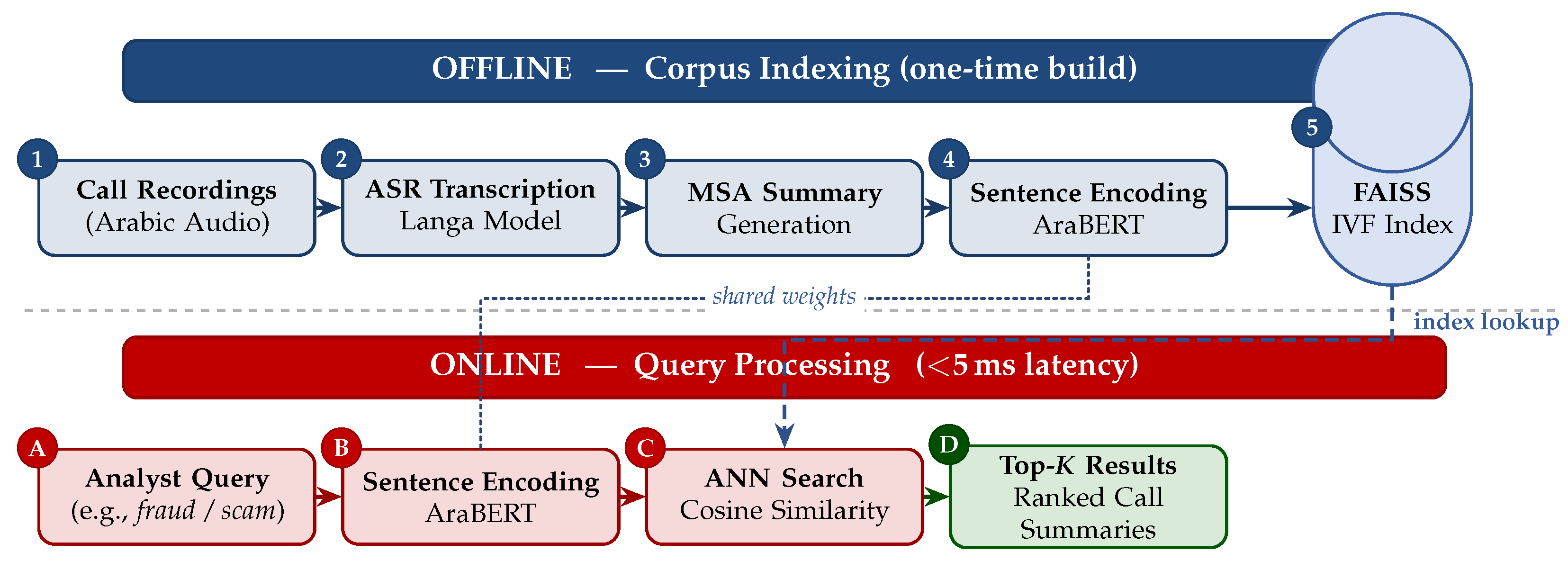
Detection of fraud attacks using a hybrid approach: A two-phase transcript pipeline is proposed to detect fraud-related conversational intent in summaries of standardized calls, addressing variation in Arabic dialect and morphology. The pipeline consolidates rule-based precise keyword search with neural embedding-based semantic retrieval to improve detection coverage.
- 2.
Statistical rigor applied to LLM-based behavioral and entity verification: GPT-3.5, GPT-4, and the Arabic-centric Jais model are systematically studied experimentally for agent and company-name extraction, including multi-call consensus and log-probability confidence filtering. Findings (end-to-end) include precision, confidence intervals, confusion matrix analysis, and recall estimation.
- 3.
End-to-end production validation: The pipeline was tested on production data from a MENA-region provider (1024 accounts; ∼38,000 calls). Reported metrics include precision with Wilson score confidence intervals, conservative recall bounds accounting for the metadata escalation funnel, a confusion matrix, and per-layer reasoned security analysis across all four identified attack surfaces (
Section 3 and
Section 6).
To the best of our knowledge, this work is among the first to present an operationally validated, end-to-end fraud detection architecture specifically designed for Arabic cloud telephony, distinguished by integrating the following: (i) a threat-model-driven security design covering four explicitly defined attack surfaces; (ii) a domain-adapted ASR model benchmarked against five commercial systems on real production telephony speech; (iii) a systematic LLM ablation quantifying the accuracy–cost trade-off for entity verification in noisy low-resource transcripts; and (iv) production validation on real subscriber data from a MENA-region provider with statistical confidence intervals. Prior work addresses at most one or two of these dimensions in isolation; none, to our knowledge, combines all four with explicit adversarial threat modeling and production-scale evaluation.
This paper is organized as follows.
Section 2 reviews related work critically.
Section 3 presents the threat model and security assumptions.
Section 4 describes the proposed architecture.
Section 5 presents experimental results.
Section 6 provides the security analysis.
Section 7 discusses implications and limitations.
Section 8 concludes this paper.
2. Related Work
Fraud detection has been extensively explored in cloud-based communication from various angles, but typically each approach offers limited insight by scrutinizing only a particular component of the overall problem. For instance, some have addressed financial fraud detection techniques for structured transaction data [
13,
14,
15,
16] and others have targeted telecom call records [
6,
7,
17] or spoken conversations [
8,
11,
12,
18] as separate standalone problems. However, fraud in cloud telephony is a complex problem and typically requires an integrated view across all these dimensions simultaneously. For example, financial fraud detection methods are effective for structured data but fail to capture language patterns and behavioral trends in spoken conversations [
13,
14,
16]. Further, call-record analysis techniques are very effective at capturing unusual behavior in calling patterns but ineffective at capturing the underlying substance of conversations [
6,
7,
17,
19]. Currently, no study exists in this domain that can fully address the complex needs of cloud telephony fraud detection particularly for Arabic language processing, dealing with adversarial behavior and practical system design [
11,
12,
18,
20].
Financial fraud detection is an important problem that has been widely studied in the literature. Rule-based methods, ensemble learning approaches, and graph neural networks have all been used to address problems such as credit card fraud, money laundering, and loan fraud [
13,
14,
15,
16]. Some studies have also proposed real-time detection pipelines based on big data processing frameworks such as Apache Spark and Kafka, combined with anomaly detection techniques such as Isolation Forest [
21]. However, these approaches are
architecturally incompatible with cloud telephony fraud. Transactional fraud leaves structured digital traces (amounts, merchants, and timestamps) amenable to statistical modeling; telephony fraud is primarily a social-engineering phenomenon whose evidence is embedded in natural language utterances. Applying financial fraud detectors to call-center fraud detection therefore addresses the wrong threat model.
Within telecommunications, CDR analytics remains the dominant fraud detection approach [
6,
7,
17]. FrauDetector [
19] applies a weighted Hyperlink-Induced Topic Search (HITS) algorithm to call graphs to propagate phone trust values—effective for Subscriber Identity Module (SIM)-box fraud, toll bypass, and infrastructure-level abuse, but fundamentally incapable of detecting impersonation: a fraudulent agent who makes calls at normal volume, frequency, and routing pattern is completely invisible to any CDR-based system. Latent Dirichlet Allocation (LDA)-based user profiling [
22] and Support Vector Machine (SVM)/Artificial Neural Network approaches applied to CDR features [
23] share this limitation. The critical insight missing from this body of work is that
cloud telephony fraud is intentionally designed to mimic legitimate calling behavior at the metadata level—subscription fraud accounts pass CDR screening by design, making conversational intelligence architecturally necessary, not optional.
While conversational and NLP-based approaches have gained traction in recent years, as they can incorporate semantic signals to improve the accuracy of fraud detection, all current solutions that operate solely on transcript input have three fundamental limitations. First, spoken language is much more dynamic than static text and unfolds in real time. Current solutions have not developed adequate methods to handle the variability found in spoken language, including variation in word choice, insertions, deletions, and recognition errors [
12,
18]. Second, most current approaches either rely on large amounts of resources from high-resource languages or do not directly target the problem of fraud detection [
11,
18,
20]. Finally, while many approaches have been prototyped, explored, and evaluated on large datasets [
11,
12,
18,
20], there is still no current solution that has been deployed in production and statistically validated in real-world usage scenarios.
On the Arabic NLP side, well-documented ASR challenges include dialectal diversity, morphological richness, code-switching behavior, and telephony channel noise [
24,
25]. Recent studies show that fine-tuning multilingual models on domain-specific speech data yields real transcription gains [
26,
27], and that improved transcription propagates directly to better downstream NLP accuracy [
28]. Semantic embedding and transformer-based retrieval enable cross-dialectal similarity search at scale [
29,
30]. Yet no prior work integrates these capabilities into a deployed security architecture with explicit threat modeling.
Table 1 summarizes how the present work extends the state of the art across five dimensions critical to operational security deployment; ✓ indicates fully addressed, ∘ partially addressed, and × not addressed.
3. Threat Model and Security Assumptions
Security-oriented fraud detection systems must be designed against an explicit adversary model. We define the threat model for cloud telephony fraud detection following standard security analysis conventions.
3.1. Adversary Goals
We consider adversaries with two primary operational goals:
Goal G1—Financial exploitation: The adversary aims to provision and operate cloud telephony services (Direct Inward Dialing (DID) numbers; trunk capacity) without legitimate payment, exploiting stolen payment instruments, free trials, or refund mechanisms.
Goal G2—Vishing and impersonation: The adversary aims to conduct outbound calling campaigns in which agents falsely represent themselves as employees of legitimate organizations to solicit sensitive information, financial transactions, or behavioral compliance from call recipients.
3.2. Adversary Capabilities
What the adversary controls:
Account registration data: The adversary can fabricate or steal business credentials, email addresses, company registrations, and payment instruments used during onboarding.
Agent speech content: The adversary fully controls what agents say during calls, including the organizational identity they claim, the scripts they use, and the urgency or authority cues they deploy.
Call metadata: The adversary can control call volume, call timing, and callee selection to mimic legitimate calling patterns, partially evading CDR-based detectors.
Multiple accounts: The adversary can operate multiple subscriber accounts, potentially using shared or rotating payment instruments, to distribute calling activity and reduce per-account anomaly scores.
3.3. Attack Surface Definition
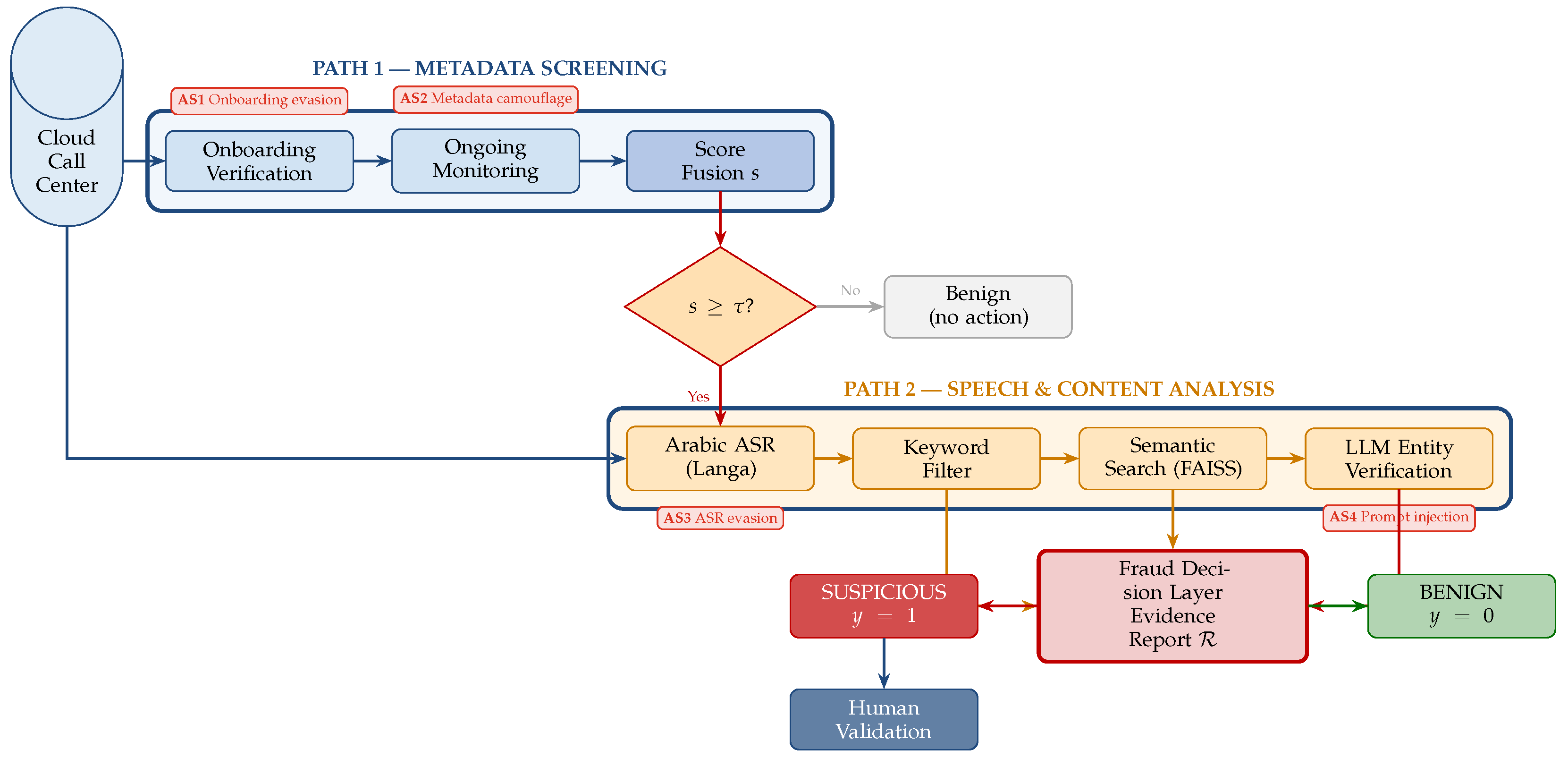
We identify four primary attack surfaces in the proposed architecture:
AS1—Onboarding evasion: The adversary provides plausible but fabricated documentation to pass onboarding verification. Countermeasure: multi-source cross-field validation and behavioral urgency signals (see
Section 4.2).
AS2—Metadata camouflage: The adversary patterns calling behavior to resemble legitimate accounts, suppressing CDR-level anomaly signals. Countermeasure: the architecture’s cascade design means metadata evasion alone is insufficient; accounts must also pass conversational verification.
AS3—ASR evasion: The adversary attempts to degrade ASR accuracy by introducing noise, accents, or obfuscated speech patterns to prevent keyword and entity extraction. Countermeasure: embedding-based semantic search is robust to ASR errors (operates on summary-level semantics, not exact transcript tokens); the domain-adapted Langa model is explicitly trained on telephony-condition speech.
AS4—LLM prompt injection: In this attack the goal is to use normal conversation to extract information by injecting maliciously crafted content into the conversation in order to manipulate the output of the LLM for information extraction [
31]. Examples of such content could be asking an entity recognition model to extract entity names that are not there, or making comments in conversation that cause the LLM to misinterpret normal language in order to extract additional information. Mitigation: We mitigate this attack in several ways. We apply the LLM prompts to very short, structured pieces of conversation as opposed to longer, free-form conversation. In addition, we use a multi-call consensus approach where the same conversation segment is queried multiple times at different temperatures. Finally, we apply log-probability filtering to favor the highest confidence extractions.
6. Security Analysis
We present a
reasoned security analysis of each attack surface identified in
Section 3.3. Each subsection characterizes the countermeasures in place, the adversary cost required for evasion, and residual vulnerabilities. These are analytical assessments informed by system design; they are
not empirically demonstrated robustness results. Dedicated adversarial red-team evaluation is recommended as future work.
6.1. Countermeasures Against Onboarding Evasion (AS1)
An adversary attempting to pass onboarding verification must simultaneously fabricate or steal the following: (a) business registration documents, (b) consistent email and domain attribution, (c) a plausible website, (d) consistent cross-field registration data, and (e) payment instruments without prior flagging. Each requirement independently adds adversary cost and risk. The multi-signal aggregation in Algorithm 1 means that partial evasion of one check (e.g., using a legitimate email provider) is insufficient if other signals (e.g., website placeholder text; cross-field inconsistencies) remain anomalous.
Residual vulnerability: A sufficiently resourced adversary who acquires a complete legitimate business identity (full credential set) may pass onboarding. This scenario underscores the necessity of continuous monitoring and conversational analysis as downstream detection layers.
6.2. Countermeasures Against Metadata Camouflage (AS2)
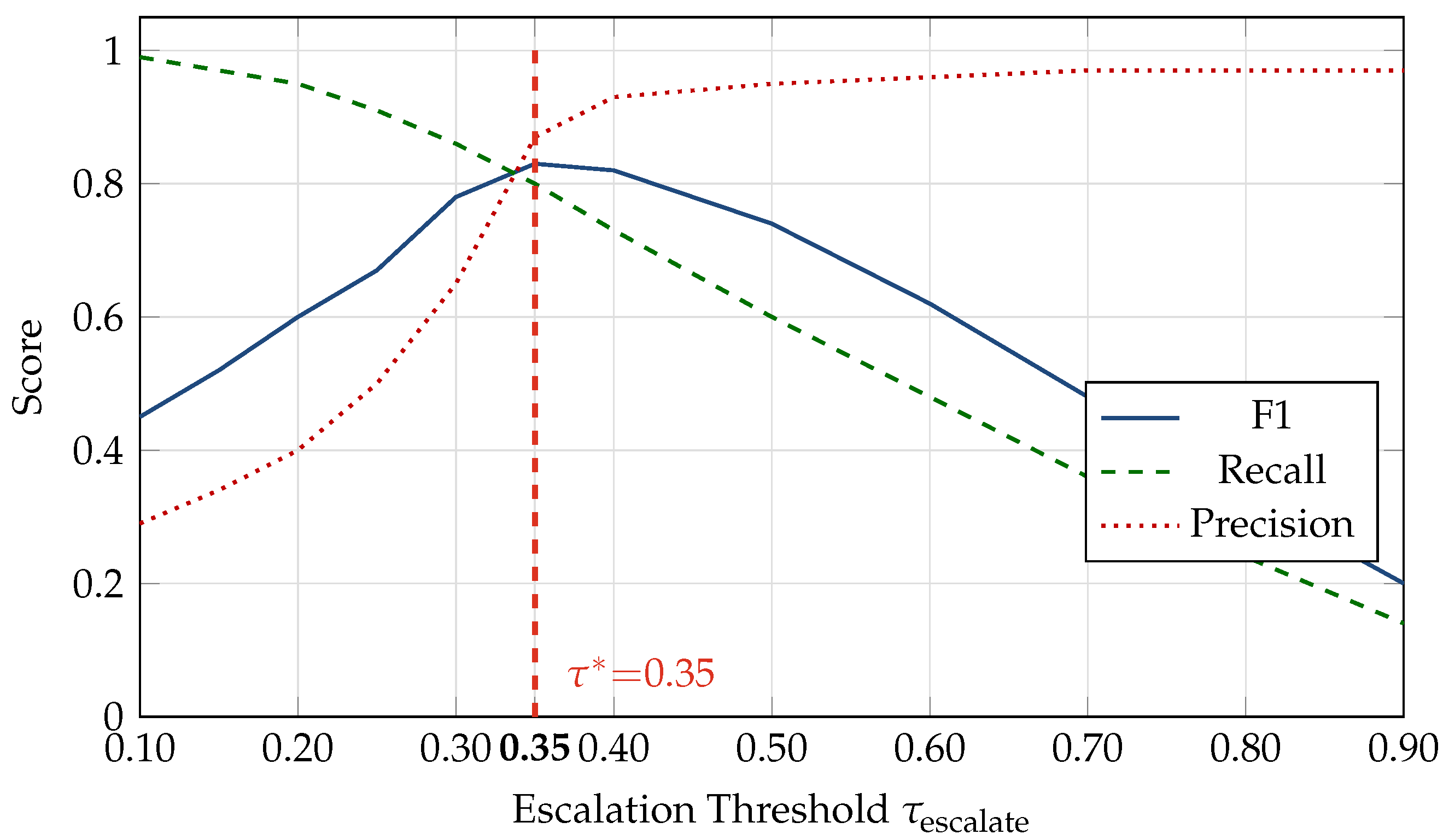
The cascade design of the architecture explicitly anticipates that more sophisticated adversaries will attempt to mimic legitimate calling patterns at the metadata level. However, metadata evasion alone is insufficient: any account exceeding the escalation threshold still undergoes conversational-level verification regardless of its CDR profile. In the deployed system, the 15–20% escalation rate reflects an empirical calibration that balances the computational cost of false escalations against detection coverage.
Residual vulnerability: Adversaries operating at extremely low call volume or maintaining highly diverse callees may suppress metadata anomaly scores below the escalation threshold. This is the primary source of false negatives in the current deployment, as discussed in the recall estimation (
Section 5.4). No formal adversarial evaluation of the escalation gate has been performed; this is a recognized limitation. Two partial mitigations exist: (i) the onboarding verification path (AS1) is independent of call volume, so stealth operators must still pass document, email, website, and cross-field consistency checks; (ii) the monitoring component tracks payment instrument sharing and callee overlap across accounts, which can surface stealth operators through shared infrastructure even at low individual volume. Dedicated adversarial evaluation of low-volume stealth fraud patterns is recommended as a priority for future work.
6.3. Countermeasures Against ASR Evasion (AS3)
Two countermeasures address ASR evasion. First, the domain-adapted Langa model is trained on telephony speech under noisy and dialectally diverse conditions, yielding a WER of 41.0% versus 83.8% for the general-purpose Whisper baseline. Second, semantic retrieval operates over MSA-normalized call summaries rather than raw transcript tokens, making detection robust to token-level ASR errors: while ASR errors corrupt individual word boundaries, sentence-level semantic meaning is typically preserved in the summary.
Residual vulnerability: Severely degraded ASR quality—such as agents speaking in heavily code-switched dialects or deliberately obscuring speech—reduces entity extraction quality. The baseline 41% WER indicates some information loss is unavoidable; further gains require continued telephony domain adaptation.
6.4. Countermeasures Against LLM Prompt Injection (AS4)
The multi-call consensus approach (Algorithm 3) is a principled defense against prompt injection. For an adversary to successfully manipulate entity extraction, adversarial text embedded in a call must produce a consistent, identical false extraction across all N independent LLM calls with temperature variation—since consensus requires agreement. The probability of a single successful injection is far higher than the probability of consistent injections across N independent queries. Adversarially manipulated extractions also tend to produce lower log-probability scores, which the logprob threshold rejects as low-confidence outputs.
Residual vulnerability: A well-informed adversary with knowledge of the precise LLM prompt structure could craft persistent adversarial inputs that survive temperature variation. Maintaining confidentiality of prompt structures and rotating prompts periodically are therefore recommended operational practices. A second residual vulnerability concerns the 200-character input window: a sophisticated adversary who deliberately delays organizational identity claims beyond the agent introduction segment may reduce extraction effectiveness. This is partially mitigated by the segment selection strategy, which also includes call-closing segments (
Table 10); however, adaptive segment identification that dynamically locates the most identity-informative regions remains a recommended direction for future hardening.
Overall Security Posture
The architecture is consistent with a security-in-depth design principle: no single evasion strategy defeats all layers simultaneously. To remain undetected, an adversary must pass onboarding checks (AS1), maintain metadata camouflage (AS2), defeat semantic retrieval (AS3), and defeat LLM verification (AS4). The attack surfaces are not fully independent: a well-resourced adversary capable of passing onboarding (AS1) may also have the means to maintain metadata camouflage (AS2), and joint exploitation of ASR evasion (AS3) with prompt injection (AS4) is plausible. The security-in-depth property holds under the weaker condition that the joint evasion probability across all layers is far lower than that of any individual layer, even with positive correlation. Dedicated empirical evaluation of joint attack scenarios—including red-team testing of the escalation gate and LLM injection under degraded ASR conditions—is recommended as future work. Human-in-the-loop final validation provides an additional layer that cannot be automated and is robust to any fully automated evasion strategy, since human analysts apply contextual judgment that no single algorithmic signal can replicate.
7. Discussion
7.1. Cross-Cutting Observations
Our results point to several cross-cutting implications for system design. Domain adaptation is not merely a performance optimization but a security necessity: the 17.9 percentage-point WER gap between Langa and Chirp propagates directly into downstream entity extraction errors, and a higher WER would likely push end-to-end precision below operationally acceptable levels. A less obvious finding concerns keyword filtering and semantic retrieval, which turned out complementary rather than interchangeable: high-precision lexical matching and high-recall semantic search each cover distinct failure modes of Arabic’s dialectal variability, and neither alone is sufficient. Ablation observations confirm this complementarity: in operational deployment, removing the semantic retrieval stage drove up false positives from keyword matches alone, as legitimate calls containing fraud-adjacent vocabulary (e.g., financial services terminology) were incorrectly flagged without the semantic context check. The six false positives reported in
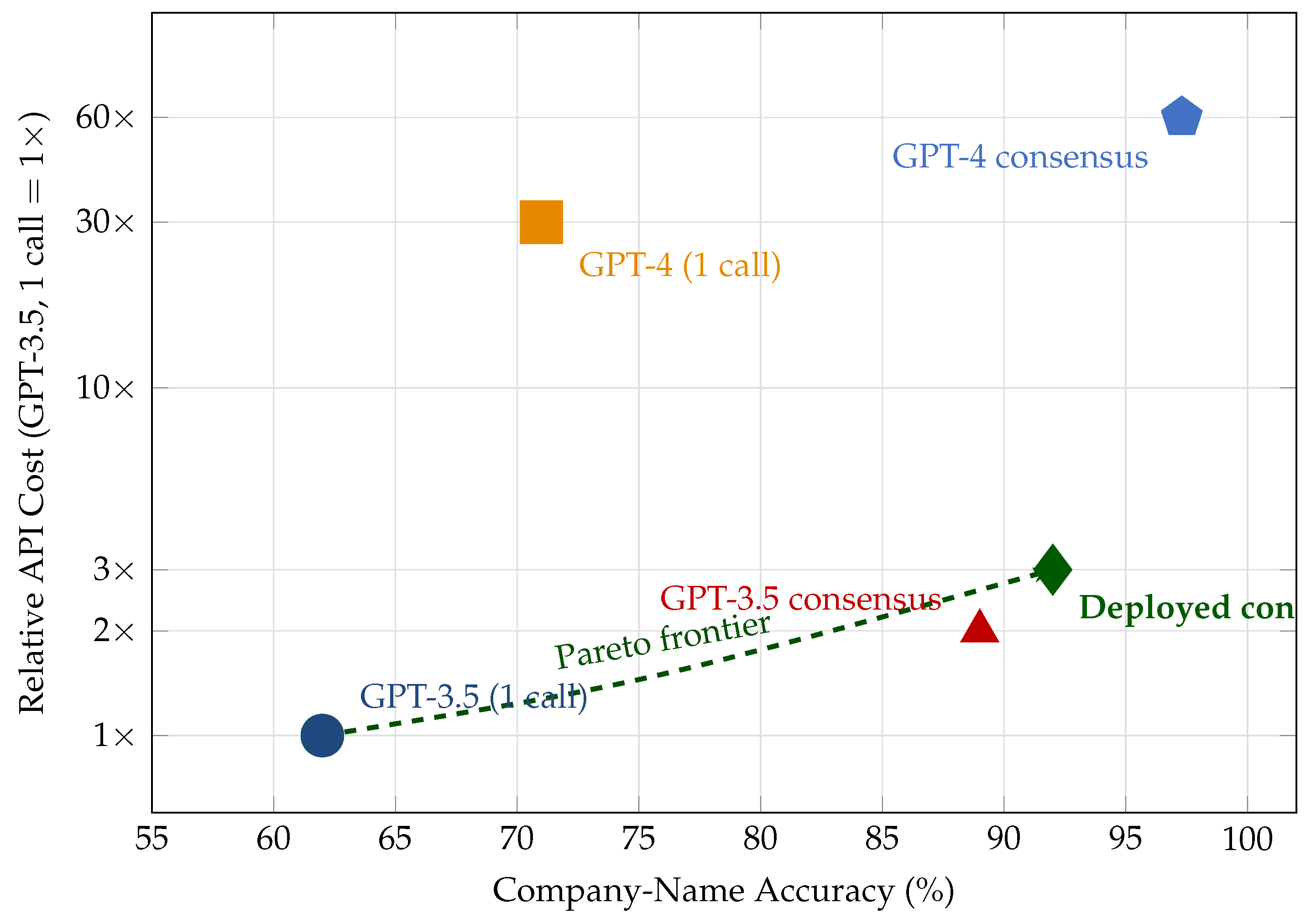
Table 15 exemplify this pattern. The gap between NER and LLM-based extraction (24.7% vs. up to 97.3% company-name accuracy) was larger than we expected, suggesting that for noisy short ASR transcripts, general instruction-following capability outweighs task-specific fine-tuning. Jais deserves mention separately: it matches GPT-3.5 accuracy while offering a self-hostable, Arabic-native alternative that avoids third-party data exposure—a practical advantage for privacy-sensitive MENA-region deployments.
Figure 4 plots all evaluated configurations on the cost-accuracy plane; the deployed configuration (GPT-3.5; three calls; log-probability filtering) achieves 92.0% accuracy at only
the cost of a single GPT-3.5 call, placing it on the Pareto frontier.
Operational implications of 13% high-confidence coverage. The logprob filtering step yields high-confidence company-name extractions for only 13% of individual calls, with the remainder escalated as UNKNOWN. This per-call rate does not mean 87% of accounts are unresolved: because signals are aggregated across all calls for an account (mean 37 calls), the account-level resolution rate is well above 13%. Under the deployed configuration, approximately 720–960 calls from the 150–200 escalated accounts yield confident extractions—sufficient to make an organizational identity determination for most accounts. UNKNOWN accounts (those where no call yields a high-confidence extraction) are routed directly to human review. Future work on calibrated confidence models could support autonomous enforcement for the highest-confidence cases.
Analyst workload analysis. In the current deployment, 47 accounts were flagged as suspicious over a six-month monitoring period. Based on operational experience, reviewing one account (3–5 top evidence calls plus report ) requires approximately 20–30 min. Total analyst workload for 47 accounts is therefore approximately 16–24 h—manageable for a single fraud analyst per cycle. If fraud volume scales to (approximately 400 flagged accounts), workload would increase to 130–200 h per six-month period, requiring a small dedicated team. Integration of calibrated confidence models for autonomous enforcement of high-confidence cases would reduce this workload proportionally.
7.2. Limitations and Future Directions
Recall measurement. In this paper, precision is a directly computed from confirmed fraud cases in this production system. Recall and F1, by contrast, are bounded estimates derived under explicit assumptions and should be interpreted as a scenario analysis rather than measured outcomes. Because the true number of fraudulent accounts is unknown, measuring recall is challenging. For now, recall cannot be measured directly but can be estimated under different assumptions, yielding an estimated range of 51–82%. Better measurement of recall will require further research. A notable deficiency in the current literature is the lack of controlled experiments conducted under normal operating conditions to test recall [
17,
44].
ASR quality dependency. Despite advances in entity extraction quality, the process is still strongly influenced by the quality of the transcripts. A 41% WER results in some extraction errors that are unlikely to be eliminated through further domain adaptation or improved speech segmentation. While 41% appears high compared to typical results reported on clean-speech benchmarks for standard languages, spoken Arabic in a telephony setting can be particularly difficult to recognize, including in this collection, due to dialectal variation, adverse recording conditions, and code-switching. Typical benchmarks do not capture these factors well, as shown in
Table 8, indicating that the system has only partial robustness to ASR noise errors.
Metadata threshold calibration. The current threshold for escalating cases (15–20%) was chosen based on experience rather than a formal process. Future work should systematically characterize the precision–recall trade-off as a function of the escalation threshold to enable principled threshold selection.
Human validation protocol. The human validation protocol is given in
Section 4.4, including analyst qualifications, predefined review criteria, and disagreement resolution procedure. Formal inter-rater agreement was not computed; future studies should include pre-registered criteria and blinded assessment.
Generalization. A single provider in the MENA region has been used for the evaluation of this work. Extending the system to support additional dialects, languages, and regulatory settings remains an important challenge for future work. The keyword set was intentionally kept small and domain-general (8 terms) in order to reduce the recalibration burden. For each new provider deployment, threshold recalibration is recommended using a locally labeled subset of approximately 80–120 accounts.
Prompt injection hardening. The system has not been evaluated against prompt injection attacks in the LLM-based extraction stage, and the current design does not preclude such attacks. Dedicated adversarial testing and red-teaming exercises are therefore needed in future work to verify robustness under realistic attack conditions. These evaluations should also cover joint attack scenarios targeting AS3 and AS4 concurrently, since real-world attackers typically exploit multiple vulnerabilities rather than a single weakness.
Autonomous decision-making. Further work on improving the system’s trust and calibration could allow clear cases to be flagged automatically, freeing analysts to review uncertain or difficult cases.
8. Conclusions
This work provides an operationally verified architecture for fraudulent activity detection and addresses an important gap in the literature, namely the lack of production deployment studies on fraud detection for Arabic cloud telephony. Our results show that fraudulent conversations can be detected in production for low-resource languages by combining domain-adapted automatic speech recognition, hybrid semantic transcript retrieval, and LLM-based behavioral verification, without requiring labeled training data or domain-specific model pre-training. This work formalizes a threat model, develops a domain-adapted ASR component, introduces a hybrid semantic transcript retrieval component, and implements an LLM-based behavioral verification component, all evaluated on large-scale production data.
The domain-adapted Langa ASR model achieved a WER of 41.0% and CER of 18.2%, outperforming all evaluated commercial and open-source baselines, with a real-time factor of 0.03–0.06 suitable for high-volume production deployment. For entity verification, LLM-based extraction with multi-call consensus achieved up to 97.3% company-name accuracy (GPT-4, 68% agreement rate) and 92.0% in the cost-effective operational configuration (GPT-3.5; three calls; log-probability filtering). The complete pipeline was validated on production cloud telephony data in the MENA region: of 47 flagged accounts, 41 were confirmed fraudulent after human review, yielding a directly observed precision of 87.2% (95% CI: 74.3–95.2%) and an estimated (not directly measured) recall of 51–82% under conservative base-rate assumptions.
The security analysis (
Section 6) is consistent with a security-in-depth design principle: the architecture is designed such that simultaneous evasion of all four attack surfaces requires far more adversary capability than bypassing any individual layer—a design property consistent with security-in-depth, though not empirically demonstrated via red-team testing. The privacy-by-design principles and human-in-the-loop enforcement model make the architecture well-suited to the regulatory environments of the MENA region.
The most pressing next step is direct recall measurement via controlled injection experiments or retrospective sampling of non-escalated accounts; without it, the 51–82% recall range remains a scenario estimate, not a measured outcome. The proposed framework can be extended to other low-resource languages used in telephony and its performance can be evaluated and verified under a different set of operational challenges. Additionally, adaptive thresholds represent a promising direction for dynamically tracking evolving fraud patterns without requiring a full retuning cycle.