1. Introduction
In recent years, data centers have emerged as the backbone of the modern digital economy, hosting critical infrastructure for cloud computing, artificial intelligence (AI), big data analytics, and the Internet of Things (IoT). These facilities have expanded in both size and complexity to accommodate the exponential growth of data-driven services [
1,
2]. The operational stability of data centers is non-negotiable, since even brief disruptions in power supply can lead to substantial downtime, data loss, and degraded service reliability [
3].
However, the power demands of data centers are rapidly outpacing the capabilities of traditional power systems [
2]. In response, power system designers and data-center operators face the dual challenge of managing increased load while ensuring power transfer capacity, voltage stability, and energy efficiency [
4]. First, power quality issues such as voltage drops and fluctuations become more pronounced when power is transmitted over long distances or shared across multiple loads, and these irregularities may damage sensitive electronics or reduce system reliability [
3,
4]. Second, the typical low power factor encountered in data-center loads leads to increased reactive power, elevated losses, and higher operational costs [
4]. Finally, thermal management and cooling compulsion add layers of complexity as equipment density increases, which in turn places more stringent demands on the electrical infrastructure and increases both capital and operational expenditures [
5]. These constraints point toward an urgent need for innovative solutions in power delivery systems to support the next generation of data-center growth [
6].
To address these challenges in data centers, several solutions have been implemented. Uninterruptible Power Supplies (UPS) and backup generators ensure continuity during power outages but do not address power delivery and efficiency issues [
5,
7]. Power factor correction using capacitor banks and synchronous condensers [
8] helps reduce energy losses but is limited in high-density environments where voltage drops and transmission inefficiencies persist [
4]. Additionally, dynamic voltage restoration (DVR) systems provide short-term voltage stabilization during fluctuations but fail to offer long-term solutions for large-scale power delivery challenges in expanding data centers [
9,
10]. These existing solutions highlight the need for more efficient and scalable technologies to meet the growing energy demands of modern data centers.
In the existing literature, data-center power system studies have primarily focused on facility architecture, reliability, backup power design, conversion efficiency, cooling, and microgrid-oriented operation [
11,
12], while transmission studies on series compensation have mainly addressed generic improvements in transfer capability, voltage regulation, and line performance [
13]. Comparatively fewer studies have examined how conventional series compensation should be evaluated specifically for large data-center interconnections supplied through long transmission corridors, where concentrated demand, strict voltage quality requirements, and rapidly changing operating conditions must be considered together. This gap motivates the present study, which focuses on the transmission interface supplying a large data center rather than on the internal electrical distribution details of the facility.
Recent technological advancements have demonstrated the potential of high levels of series compensation in transmission applications [
14,
15]. In this work, the paper develops a data-center-oriented framework for evaluating and applying conventional series compensation at the transmission interface of a large data center. Large and hyperscale data centers are supplied through high-voltage interconnections and long transmission corridors, where power transfer capability, voltage regulation, reactive power support, and transmission efficiency become critical operational concerns. From this perspective, the paper develops a data-center-oriented steady-state analytical and simulation framework to quantify how the degree of series compensation affects these transmission-level performance metrics.
The study examines two analysis scenarios. The first is an unconstrained voltage scenario, in which the sending-end voltage is specified while the receiving-end voltage is allowed to vary naturally with load and compensation level. The second is a constrained-voltage scenario, in which the sending-end and receiving-end bus voltages are regulated near prescribed nominal values to represent practical operation of the data-center transmission interface. Comparing these two scenarios shows that the benefit of increasing series compensation is not always monotonic under practical voltage constraints and that coordinated regulation of voltage magnitude and angle becomes increasingly important as the compensation level approaches 100%. The main contributions of this work are as follows:
- (1)
It develops transmission-line models for a data-center interconnection without and with series capacitor compensation and uses them to evaluate transmission-level performance metrics, including power transfer capability, voltage regulation, reactive power requirement, and efficiency.
- (2)
It distinguishes between two practically important analysis scenarios for data-center supply: an unconstrained voltage scenario and a constrained-voltage scenario.
- (3)
It shows that, under constrained terminal-voltage operation, the benefit of increasing series compensation is not monotonic; instead, an application-dependent favorable compensation region exists, beyond which further compensation reduces controllable power transfer capability and increases the need for reactive support.
- (4)
It identifies that, as the degree of series compensation approaches 100%, angle-only regulation becomes insufficient for effective power transfer control, and coordinated regulation of voltage magnitude and angle becomes necessary.
The remainder of this paper is organized as follows.
Section 2 briefly reviews the portions of data-center power architecture that motivate the transmission-interface problem considered in this study.
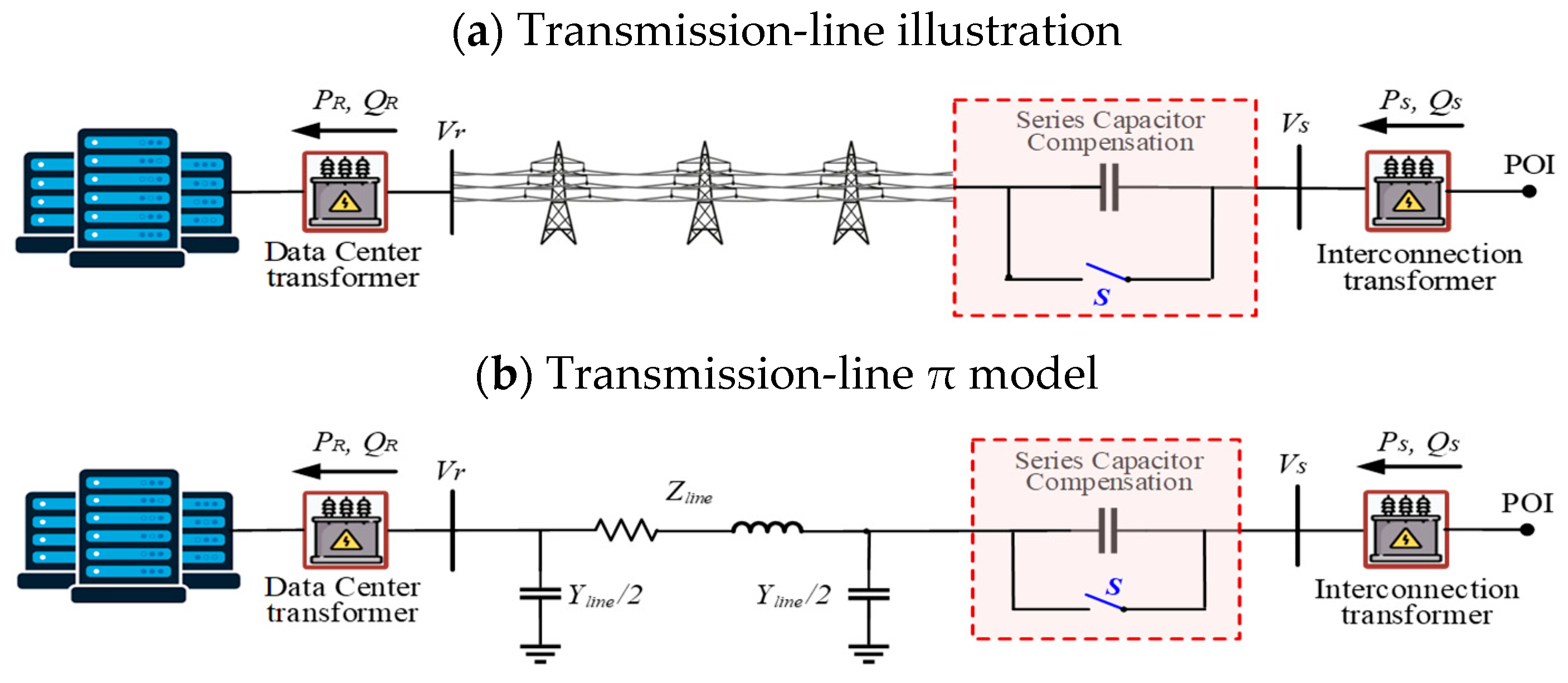
Section 3 develops the transmission-line models for the data-center interconnection without and with series capacitor compensation.
Section 4 evaluates power transfer performance when the sending-end voltage is specified, and the receiving-end data-center voltage is allowed to vary with operating conditions.
Section 5 investigates the case in which both terminal bus voltages are regulated near nominal values and analyzes the corresponding power transfer limits. Finally,
Section 6 summarizes the main findings.
2. Data-Center Power Architecture
Modern data centers function as miniature power grids, receiving electricity at high voltages and distributing it through multiple stepped-down layers to the IT equipment [
16,
17]. Utility power typically arrives at the transmission level 115–230 kV via dedicated feeders and is first stepped down at an onsite substation [
17,
18]. In large hyperscale campuses, planners even interconnect at 230–500 kV with massive yard transformers, and recent switchgear designs include 26-acre substations dropping 500/230 kV lines into on-campus medium voltage loops [
18]. The incoming high-voltage feed terminates at a main switchyard where circuit breakers, busbars, and power quality gear condition and regulate the supply before distribution [
3,
7]. From this high-medium voltage bus, transformers reduce the distribution voltage to 13.2–34.5 kV, and large auxiliary loads like chillers are often fed at this stage [
3,
7]. The medium voltage (MV) supply is then distributed across the facility in a redundant ring or radial network to numerous MV/LV transformers that further step-down power to low voltage (LV) for IT use. Finally, a network of Power Distribution Units (PDUs) or busways delivers three-phase AC (400–480 V) to server racks [
3,
7]. Notably, many North American facilities have shifted from the traditional 480/277 V to 208/120 V arrangement toward a 415/240 V AC distribution at the rack level to reduce conversion steps and losses [
19]. Each server rack’s power is thus supplied with a convenient AC voltage and last converted by the servers’ power supplies to the DC voltages required by the electronics [
20].
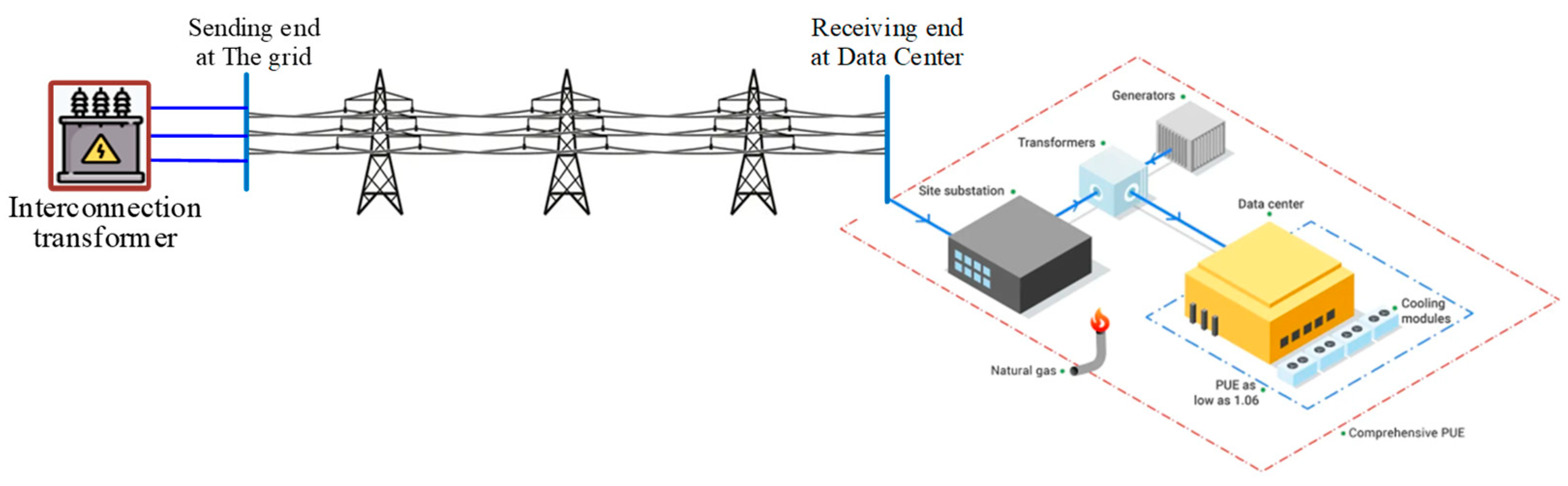
Figure 1 illustrates the transmission-interface viewpoint adopted in this study, where a large data center is represented as a single, concentrated load supplied from the bulk grid through a long high-voltage transmission corridor. The figure emphasizes that the key study focus is the grid-to-data-center interconnection point, where series compensation can influence power transfer capability, voltage regulation, reactive power support, and controllability.
Reliability and scalability are paramount in these power architectures, prompting redundant designs and robust capacity planning. To achieve near continuous uptime, data centers employ redundancy at every layer: utility substations often provide dual independent feeds, and the onsite electrical topology mirrors this with two parallel A and B power paths all the way to the server rows [
7]. Critical IT racks typically have dual corded power supplies, each cord tied to a separate UPS-backed PDU, so that a failure in one path can be isolated without interrupting the load. Banks of Uninterruptible Power Supply (UPS) units with batteries or flywheels are integrated to condition the power and ride through outages, while diesel generators (e.g., N + 1 or 2N configured) stand by to quickly take over during prolonged loss of electric utility [
6,
7]. This layered approach yields the high availability associated with Tier III/IV facilities, often targeting 99.99% uptime. The power delivery chain is also scaled to the facility’s size: a small enterprise data center of a few megawatts might tap a 13 kV feeder via modest 2–3 MVA transformers, whereas a 100+ MW hyperscale campus demands multiple 115–230 kV feeds and a fleet of large MV/LV transformers operating in parallel [
18]. Accordingly, the distribution infrastructure has grown to handle rising loads. Ten years ago, a typical rack drew 5–10 kW, whereas today, 15–30 kW per rack is common, and specialized AI racks can exceed 80–100 kW each [
21,
22,
23]. These escalating rack-level densities drive the adoption of higher capacity busways, 48 V DC busbars, and enhanced cooling and fault-protection schemes, ensuring that even as facilities scale from small server rooms to hyperscale campuses, their electrical power configurations remain efficient, redundant, and resilient [
7,
20,
23].
From the viewpoint of transmission planning and operation, these architectural characteristics make the grid-to-data center interface a distinct and important study target. Large data centers behave as concentrated loads with stringent reliability and voltage quality requirements, and their continuing expansion can require substantial power delivery over high-voltage transmission corridors. Therefore, the transmission link feeding the data center must be evaluated not only for steady active power delivery, but also for voltage regulation, reactive power support, and transfer capability under changing operating conditions. This is the specific system-level problem addressed in the remainder of this paper.
4. Performance and Power Transfer Assessment Under the Unconstrained Voltage at Data Center
This section considers the unconstrained voltage scenario. In this scenario, the sending-end voltage is fixed at its specified value, while the receiving-end voltage at the data center bus is not directly regulated and is allowed to vary according to the transmission-line condition, load level, and degree of series compensation. This case is used to reveal the natural power transfer behavior of the grid to the data-center transmission interface as the degree of series compensation varies, before enforcing practical voltage regulation requirements.
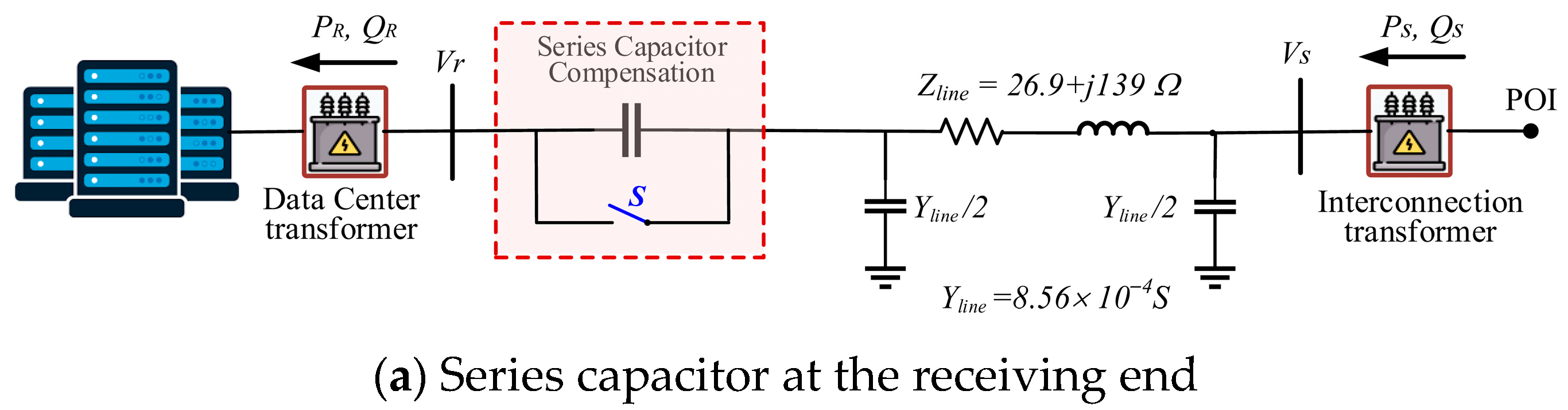
A 3-phase, 60 Hz overhead transmission line, with Rook ACSR conductors arranged in flat horizontal spacing of 7.25 m between conductors, is considered. The total line length is 270 km. Thus, the total line impedance is Z_line = 26.9 + j139 Ω, and line admittance is Y_line = 8.56 × 10
−4 S.
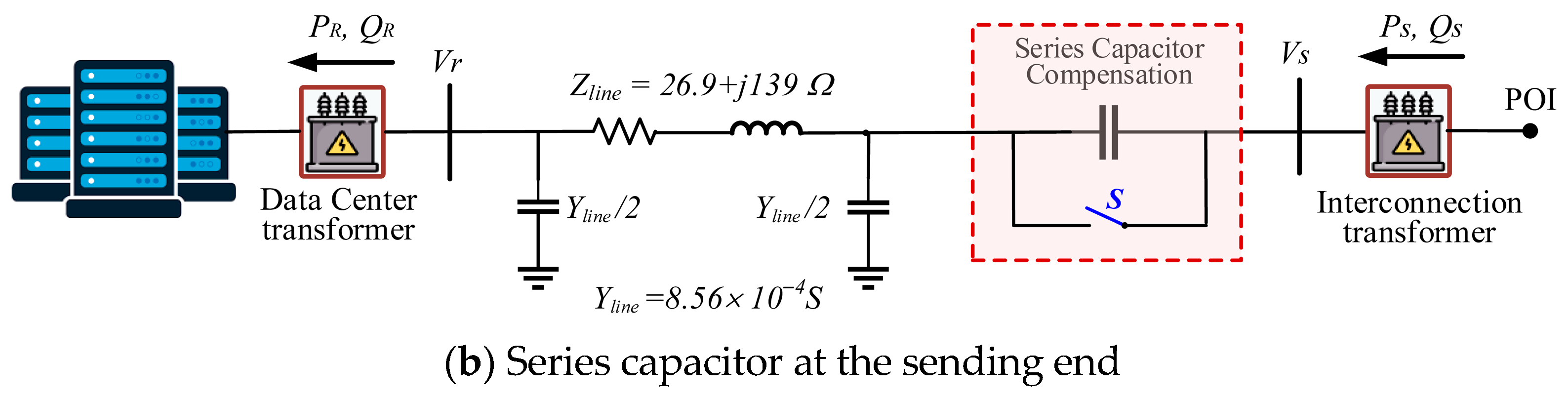
Figure 2 shows the transmission line connecting the data center with the series capacitor installed at the receiving-end (
Figure 3a) and at the sending-end (
Figure 3b). Assume that the data center consumes up to 250 MW at unity power factor during the learning/training phase, with a nominal sending-end line-to-line voltage of 215 kV. During the idle phase, the power consumption of the data center is considered negligible. These assumptions are adopted to establish a representative planning case for the transmission interface, thereby providing a controlled basis for evaluating the influence of series compensation on transferable power, voltage regulation, reactive power requirements, and overall transmission efficiency.
The adopted transmission voltage and power level are intended to represent a realistic planning-level case for a large data-center interconnection rather than a single site-specific utility project. As discussed in
Section 2, large data centers commonly interconnect at transmission-level voltages in the range of approximately 115–230 kV, while hyperscale campuses can require 100+ MW of power and continue to grow as AI-oriented demand increases [
17,
18,
21,
22,
23,
24]. In the United States, typical sub-transmission voltages include 34 kV, 46 kV, and 69 kV, while common transmission voltages include 115 kV, 138 kV, and 230 kV and above; therefore, the selected 215 kV level is consistent with a realistic high-voltage interconnection case for a large data-center supply. From this perspective, the selected 215 kV and 250 MW values represent a plausible large interconnection case, and the 270 km transmission distance is chosen to highlight the voltage drop, reactive power, and transfer capability issues that become especially important for long-distance supply to large data-center loads. At the same time, the unity power factor and negligible idle load assumptions are used here as simplifying steady-state assumptions rather than as exact representations of all practical data-center operating conditions. In practice, data-center loads may operate at non-unity power factor and may retain non-negligible partial load demand during serving or idle conditions. These effects are important and can be incorporated in more detailed future studies, but the present assumptions are suitable for clarifying the steady-state transmission-interface trends that are the focus of this paper.
To evaluate the system performance and power transfer capability, a power flow study is conducted for different load levels and different degrees of series compensation. A three-bus system based on the
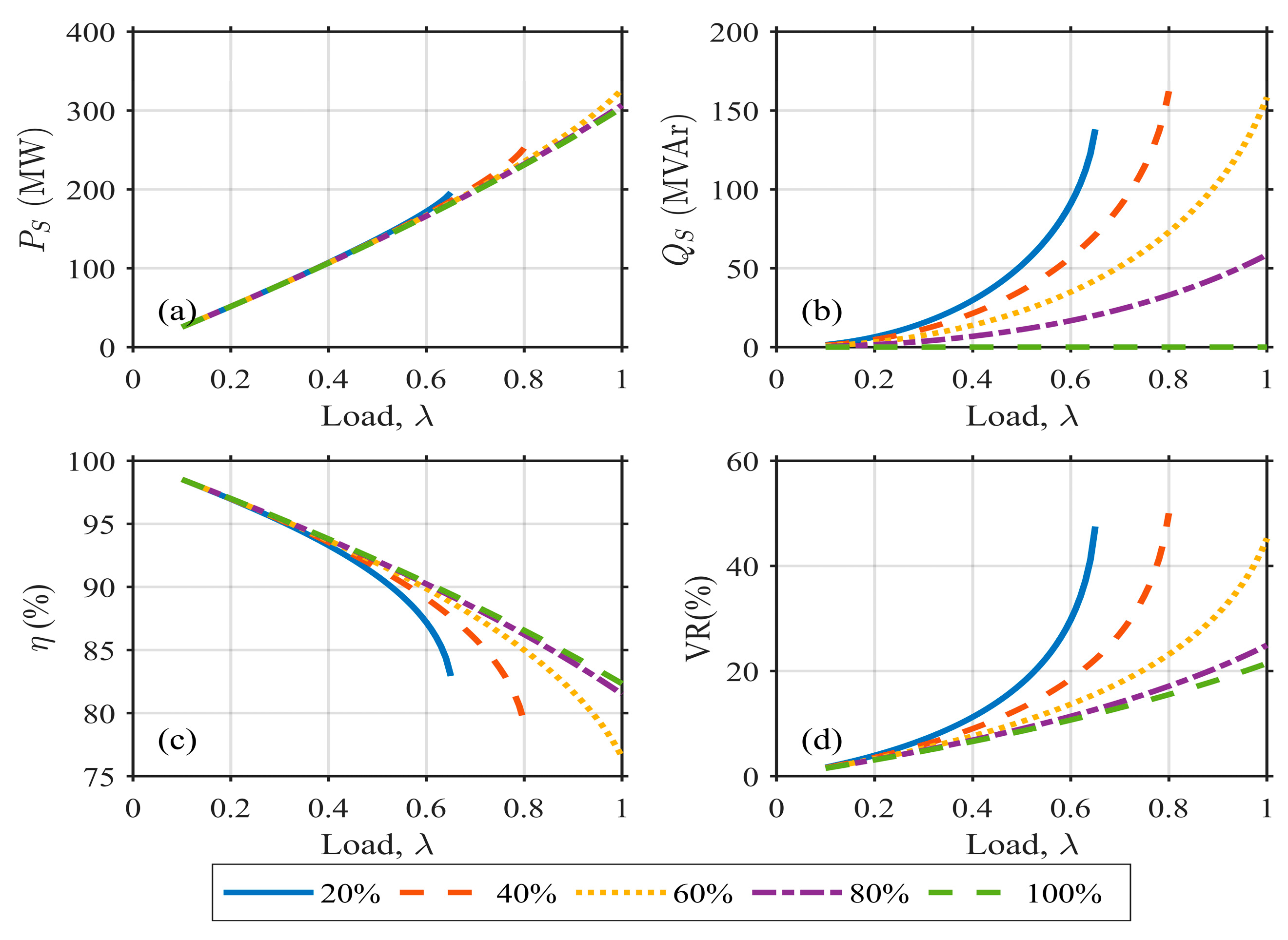
-line model, with a series capacitor installed at either the sending or receiving end, is developed to assess the impact of series compensation. To make the performance improvement claims explicit, the revised manuscript provides both a same-load numerical comparison and a maximum transfer comparison in addition to the graphical results in
Figure 4. In the following comparisons, the uncompensated case (k = 0%) is used as the baseline to quantify the improvement in power transfer capability, voltage regulation, and transmission efficiency obtained with series compensation.
If the series capacitor is installed at the receiving end as shown in
Figure 3a, Bus 1 (sending-end bus) is modeled as the slack bus, Bus 2 represents the interconnection bus between the transmission line and series capacitor, and Bus 3 corresponds to the receiving-end bus at the data center. The slack-bus voltage magnitude was determined from the specified sending-end nominal operating condition (
kV). The load was parameterized using a load factor
, such that
MW with
MWAr. The physical values of the series capacitors corresponding to each degree of the series compensation were calculated from the uncompensated line reactance at the system frequency of 60 Hz.
Table 1 summarizes the resulting capacitive reactance and equivalent per-phase capacitance values for compensation levels of k = 20%, 40%, 60%, 80%, and 100%. As expected, increasing the compensation ratio requires smaller capacitance values.
To further quantify the observed trends in voltage regulation, reactive power requirement, transmission efficiency, and transferable power, two additional numerical comparisons are presented.
Table 2 compares the compensated cases at a common feasible operating point of λ = 0.60.
Table 3 compares the maximum transferable power under the unconstrained receiving-end voltage condition and includes the uncompensated baseline case.
Figure 4, together with
Table 2 and
Table 3, provides both graphical and numerical comparisons of the effect of series compensation on the data-center transmission interface. From these results, the following observations can be made:
- (1)
As shown in
Figure 3a and summarized in
Table 3, series capacitor compensation leads to a substantial increase in the maximum transferable power to the data center. For the uncompensated case, the transmission line sustains a maximum transferable power of 142.5 MW at λ = 0.57. With increasing compensation, this limit rises progressively to 167.5 MW at 20% compensation, λ = 0.67; 205.0 MW at 40% compensation, λ = 0.82; and 227.5 MW at 50% compensation, λ = 0.91. At 60% series compensation, the line reaches λ = 1.00, corresponding to a maximum transferable power of 250 MW, which matches the full demand assumed for the learning and training phase. These results demonstrate that increasing the degree of series compensation systematically enhances the power transfer capability of the transmission corridor and enables the interface to accommodate progressively higher loading levels.
- (2)
As shown in
Figure 4b and quantified in
Table 2, the sending-end reactive power requirement decreases markedly as the compensation level increases. At the common feasible operating point of λ = 0.60, Q
S decreases from 45.673 MVAr at 20% compensation to 18.259 MVAr at 40%, becomes nearly zero at 60%, and becomes negative at 80% and 100%, indicating that the series capacitor progressively offsets the inductive reactive power demand of the transmission line.
- (3)
As shown in
Figure 4c and summarized in
Table 2, transmission efficiency improves as the compensation level increases. At λ = 0.60, the efficiency rises from 88.685% at 20% compensation to 89.775% at 40%, 90.202% at 60%, and 90.337% at 80%, remaining above 90% at high compensation levels. This confirms that reducing the effective series reactance lowers the reactive current component and therefore improves power transfer efficiency.
- (4)
As shown in
Figure 4d and quantified in
Table 2, voltage regulation decreases significantly as the degree of series compensation increases. At λ = 0.60, the voltage regulation is reduced from 26.499% at 20% compensation to 17.990% at 40%, 13.819% at 60%, 11.627% at 80%, and 10.742% at 100%. This result is consistent with the fact that the inductive reactance of the transmission line is the dominant contributor to the voltage drop between the sending and receiving buses, and compensating this reactance directly alleviates the voltage regulation burden at the data center receiving bus.
Therefore, the results provide explicit numerical evidence that series compensation increases transferable power, reduces voltage regulation, and improves transmission efficiency for the studied data-center transmission interface.
If the series capacitor is installed at the sending end as shown in
Figure 3b, the results are similar to those of having the series capacitor at the receiving end. However, a closer look shows that, under the same load demand and series compensation degree, the sending-end installation can cause more sending-end active and reactive power, lower transmission efficiency, and higher voltage regulation. This phenomenon can be properly validated via phasor diagram illustration, evaluation, and comparison for both scenarios.
5. Performance and Power Transfer Assessment Under the Constrained Voltage at the Data Center
This section considers the constrained-voltage scenario. In this scenario, the voltages at the sending-end and receiving-end buses are regulated to remain at or near prescribed nominal values, which represents practical operation when the data-center transmission interface must satisfy voltage quality requirements. This case is used to evaluate power transfer performance and limits when acceptable bus voltage levels must be maintained while delivering power to the data center.
To represent this operating condition, the bus voltages at both the sending and receiving ends are prescribed at or near 1 per unit, in accordance with typical industry practice. Under these conditions, reactive power support is required at one or both buses, depending on the degree of series compensation and the operating point. The results presented in this section are obtained by numerically evaluating the constrained-voltage operating conditions using the transmission line models developed in
Section 3. For each selected degree of series compensation, the sending-end and receiving-end bus voltages are specified according to the scenario under study, and the corresponding sending-end and receiving-end active and reactive powers are calculated from the analytical expressions derived from the transmission-line ABCD model.
Two types of studies are carried out. In
Section 5.1, a fixed data-center demand of 250 MW is assumed, and the required power quantities, transmission efficiency, and sending-end voltage angle are evaluated as the degree of series compensation varies. In
Section 5.2, the maximum transferable power is determined by identifying the operating condition that yields the largest receiving-end active power under the imposed terminal-voltage constraints. The analytical trends are evaluated numerically for the same system parameters used in
Section 4.
5.1. Performance Evaluation Under a Fix Load Demand
Assume that the power demand of the data center during the training phase is 250 MW and take the receiving bus voltage as the reference (i.e.,
). Then, the active and reactive power at the sending and receiving buses can be determined from Equations (4) and (5).
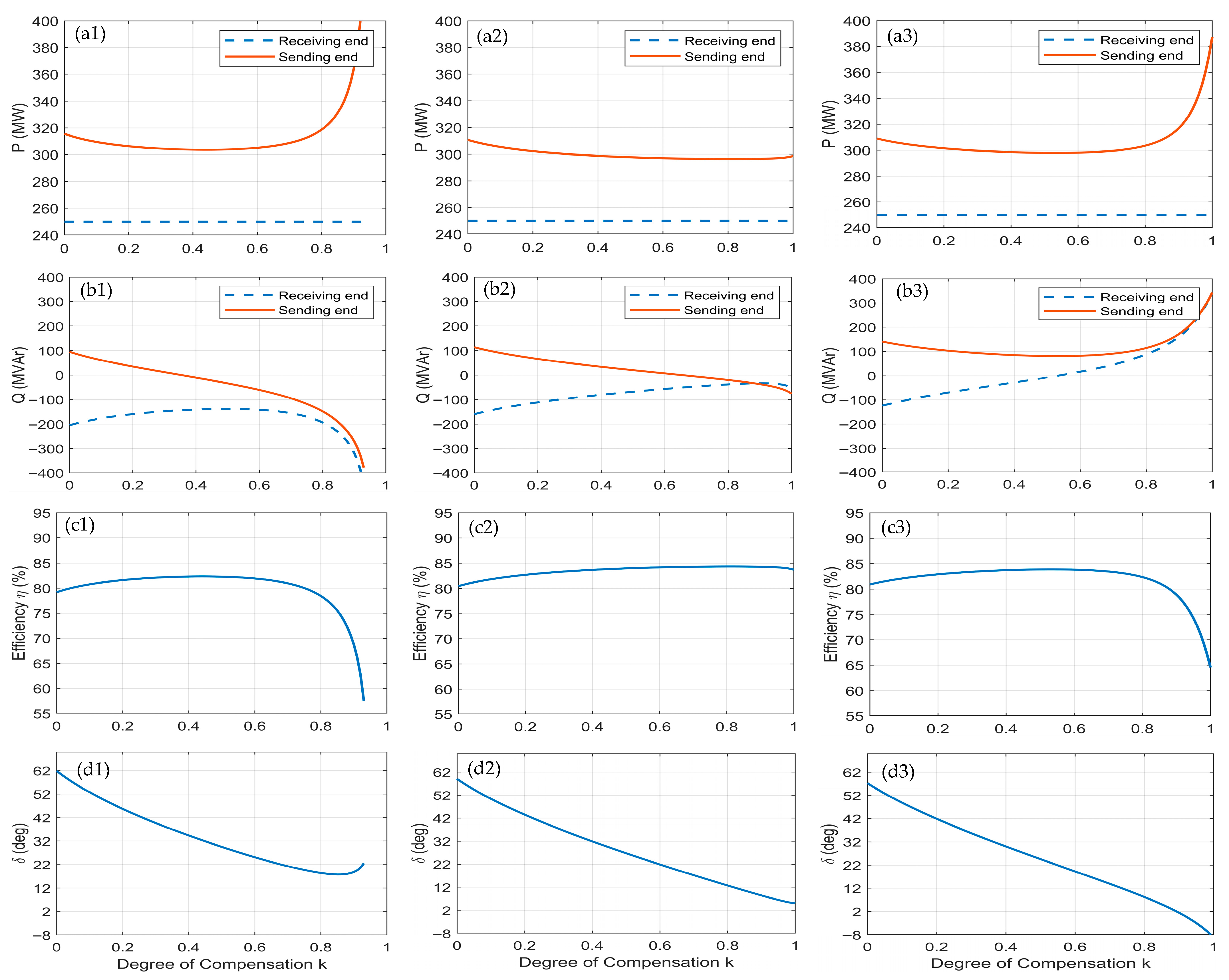
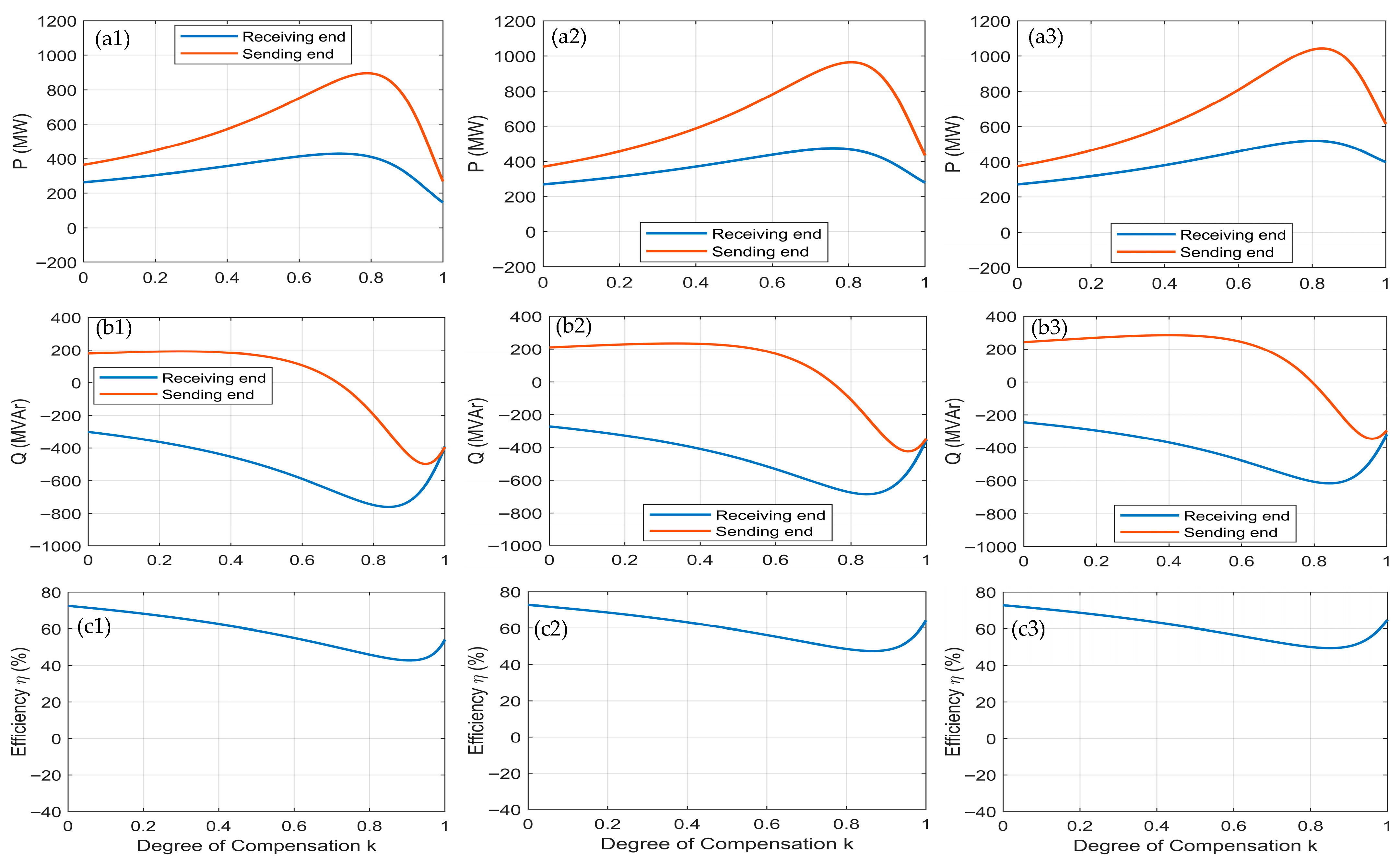
Figure 5 shows a performance evaluation for the series capacitor placed at the receiving end. We considered three-bus voltage scenarios: (1) the voltage at the sending and receiving buses is required to maintain at 1 per unit (
Figure 5(a1,b1,c1,d1)), (2) the voltage at the sending bus is required to maintain at 1.05 per unit while the voltage at the receiving bus is required to maintain at 0.95 per unit (
Figure 5(a2,b2,c2,d2)), and (3) the voltage at the sending bus is required to maintain at 1.10 per unit while the voltage at the receiving bus is required to maintain at 0.90 per unit (
Figure 5(a3,b3,c3,d3)). Based on these results, the following observations can be made:
- (1)
Under the constrained bus voltage condition, reactive power generation is required at both the sending and receiving buses to maintain the voltage stability. Series compensation can help reduce the reactive power demand at both the sending and receiving buses, potentially allowing for the use of a smaller STATCOM device to supply the required reactive power.
- (2)
Unlike the traditional bus voltage-angle regulation for active power control, the angle regulation strategy becomes ineffective for the active power regulation as the degree of series compensation approaches 100%, and the transmission-line behavior becomes primarily resistive. Under such conditions, an excessively high level of series compensation can substantially increase the reactive power demand at the receiving bus (
Figure 5(b1)) and raises the additional active power required at the sending bus to offset transmission losses caused by the elevated reactive power flow until the angle regulation strategy becomes infeasible to support the data-center power demand (
Figure 5(a1,b1,c1,d1)).
- (3)
Depending on the transmission-line impedance and load demand, there exists a favorable degree or range of series compensation. Within this region, transmission efficiency is improved, and the reactive power requirement at the sending and receiving buses decreases noticeably. Prior to this region, increasing the degree of compensation enhances performance; however, beyond it, further compensation diminishes the benefit and increases the associated costs.
- (4)
As the degree of series compensation increases from 0% to 100%, the effective series reactance of the transmission line decreases, and the line behavior shifts from predominantly inductive toward more resistive characteristics. At low and moderate compensation levels, active power transfer is mainly influenced by the bus voltage-angle difference, as in a conventional inductive transmission line. However, as the compensation level approaches 100%, angle-only regulation becomes progressively less effective for controlling the transmitted active power. Under this condition, the voltage magnitudes at the sending and receiving buses must also be coordinated with the angle difference so that the required power can be delivered while maintaining acceptable reactive power demand and transmission efficiency. Therefore, the control variables |Vs|, |Vr|, and δ should be selected jointly according to the degree of series compensation and the required operating point.
From an operational point of view, coordinated voltage magnitude and angle regulation means that the sending-end voltage magnitude, receiving-end voltage magnitude, and their phase angle difference are not adjusted independently. Instead, they are selected together to satisfy the desired active power transfer while keeping both bus voltages within acceptable limits and reducing unnecessary reactive power circulation. In general, for lower compensation levels, adjusting the angle difference remains the primary means of controlling active power transfer. As the compensation level increases and the line reactance is progressively canceled, voltage-magnitude adjustment becomes increasingly important for maintaining controllable and efficient operation. Thus, the appropriate balance between angle regulation and magnitude regulation depends on the compensation level and the target power transfer operating point.
5.2. Maximum Power Transfer Evaluation
The data-center load can vary significantly between idle and training phases or evolve as the data center expands. Thus, it is essential to evaluate the maximum power transfer capability of the data center’s transmission line, or equivalently, the maximum power that can be delivered to the receiving end. According to Equation (5), the maximum power transfer occurs when the angle of the sending-end voltage matches the angle of the line impedance. Under this condition, the sending-end and receiving-end active and reactive power can be calculated using Equations (4) and (5), respectively. These maximum transfer results further illustrate that the relative roles of voltage-angle regulation and voltage-magnitude regulation change with the degree of series compensation, and that both must be coordinated to maintain controllable power delivery under constrained-voltage operation.
The results are presented in
Figure 6, and the following observations are made:
- (1)
Maximum power transfer through the transmission line is always accompanied by reactive power requirements at both the sending and receiving buses. As the active power demand of the data center increases, a greater amount of reactive power is needed to maintain constant bus voltages, particularly at the receiving bus (
Figure 6).
- (2)
As the degree of compensation increases, the maximum power that can be delivered to the data center also rises, reaching a peak transfer capability before dropping sharply (
Figure 6). Meanwhile, the sending-end active power, which includes both the power received by the data center and the transmission-line losses, rises further due to the substantially increased reactive power demand at the receiving bus and line losses. Hence, the efficiency of maximum power transfer decreases as the degree of compensation continues to rise.
- (3)
As the degree of compensation approaches 100%, the maximum power transferable to the data center drops to zero if maintaining the sending-end and receiving-end bus voltages at 1 p.u. is required. This happens because, at full compensation, the line impedance becomes purely resistive, making it impossible to adjust active power solely by regulating the bus voltage angle (
Figure 6). In this scenario, controlling the bus voltage amplitude becomes an effective and efficient method for adjusting power transfer to the data center.
- (4)
As the degree of series compensation varies from 0% to 100%, both the voltage angle and magnitude must be regulated to control the power transferred from the sending end to the receiving end. Depending on the load demand and the level of series compensation, a favorable operating point exists under a coordinated angle-magnitude control strategy to maximize transfer capability while retaining transmission efficiency.
These observations also provide a practical basis for selecting the compensation level and the associated bus voltage control strategy, as discussed in the following subsection. In addition, the consistency of these trends across multiple operating scenarios provides numerical support for the robustness of the analytical conclusions. Specifically, the transmission behavior is evaluated over a wide range of load factors and compensation levels in
Section 4, and under three different constrained-voltage scenarios in
Section 5.1. Across these operating conditions, the same qualitative trends are consistently observed: series compensation increases transferable power under unconstrained voltage operation, while under constrained-voltage operation, there exists a favorable compensation region beyond which further compensation reduces controllability and increases the importance of coordinated voltage magnitude and angle regulation. These consistent trends across multiple operating scenarios provide numerical support for the proposed analytical interpretation and are also aligned with the theoretical evaluation.
5.3. Design Implications for Series Compensation and Transmission Control
The results presented in
Section 4 and
Section 5 can be used as a practical planning and design framework for selecting the degree of series compensation and the associated transmission control strategy for a data-center interconnection. In this paper, the term favorable compensation region refers to the range of compensation levels that provides the best practical tradeoff among transferable power, voltage regulation, reactive power requirement, transmission efficiency, and controllability for the operating scenario under consideration. From a transmission control perspective, operation of a series compensated over transmission line can be formulated as a multi-objective optimization problem; in the present study, however, the objective is to identify a practically favorable operating region that improves power transfer capability and voltage regulation while limiting reactive power demand and preserving controllability.
A practical design procedure can be summarized as follows. First, the expected operating range of the data center should be identified, including both lighter operating conditions and the higher demand training/full-load condition. Second, the transmission-line parameters and acceptable voltage limits at the sending-end and receiving-end buses should be specified. Third, the degree of series compensation should be swept over the practical design range and evaluated in terms of transferable power, reactive power requirement, transmission efficiency, and voltage regulation. Fourth, the compensation level should be selected within the range that provides meaningful improvement in transfer capability and voltage regulation without entering an overcompensated region in which the benefit diminishes, and controllability becomes more dependent on voltage-magnitude adjustment. Finally, for the selected compensation level, the sending-end voltage magnitude, receiving-end voltage magnitude, and voltage-angle difference should be coordinated to satisfy the required power transfer while maintaining acceptable voltage profiles and reactive power support.
From the present case study, the results indicate that increasing the compensation level is beneficial up to an application-dependent favorable region, but that excessive compensation does not necessarily produce the best practical operating condition. Therefore, the design of series compensation for data-center transmission supply should be based on the combined consideration of transfer capability, efficiency, voltage regulation, and controllability, rather than on compensation level alone. In practical implementation, the required terminal-voltage support may be provided by existing grid-side voltage control resources or by dedicated reactive power support devices, depending on the interconnection design.
5.4. Discussion on Voltage Stability Scope, Protection Considerations, and Model Limitations
The present work focuses on the steady-state transmission-interface behavior of a large data-center interconnection and, in this sense, evaluates voltage regulation, transferable power, reactive power requirement, and controllability under different levels of series compensation. The results provide useful insight into how terminal-voltage constraints affect the practical benefit of series compensation and when coordinated regulation of voltage magnitude and angle becomes necessary. The present study provides a steady-state perspective on voltage controllability and transfer capability at the data-center transmission interface. In this framework, the results clarify how terminal-voltage constraints influence the practical benefit of series compensation and when coordinated regulation of voltage magnitude and angle becomes necessary. The term voltage stability in this paper is therefore used in the context of steady-state voltage controllability and transfer capability at the data-center transmission interface.
In practical implementation, series compensation traditionally introduces protection and operational considerations that go beyond the steady-state focus of the present study. These include the protection of the series capacitor itself, such as MOV protection and bypass switching, possible impacts on distance protection behavior, and the broader coordination of relays under compensated line conditions. In addition, depending on the degree of compensation and system characteristics, practical deployment may require attention to overvoltage occurrences in series capacitors, sub-synchronous resonance, sub-synchronous oscillation, and related dynamic interactions. Recent patent literature has also highlighted implementation-oriented mitigation approaches [
25] for series-compensated transmission grids, including passive devices connected in parallel with the series capacitor to mitigate sub-synchronous oscillation, overvoltage, and protection challenges associated with series capacitor compensation. These approaches enable effective and reliable operation at compensation levels of up to 100%, which is an important driver for the research conducted in this paper. Overall, these issues do not invalidate the steady-state findings presented here, but they should be considered in detailed engineering design before field implementation of high compensation data-center transmission supply.
The transmission-line models adopted in this paper are formulated to highlight the steady-state behavior of the grid at the data-center transmission interface. In this sense, the model provides a planning-level and interpretation-oriented framework for examining how series compensation influences transferable power, voltage regulation, reactive power support, transmission efficiency, and coordinated voltage-angle control. This formulation captures the key steady-state relationships needed for transmission-interface assessment and provides a useful basis for design insight and future extensions toward more detailed dynamic, protection, and converter-level studies. Therefore, the adopted model remains appropriate for the objective of this paper because it directly captures the steady-state relationship among compensation level, voltage constraints, reactive power support, transfer capability, and coordinated voltage-angle control at the transmission interface. Therefore, the results should be interpreted as providing steady-state design and planning insight for large data-center interconnections, while more detailed dynamic and protection-oriented studies remain an important direction for future work.
6. Conclusions
This paper has presented a data-center-oriented steady-state analytical and simulation framework for evaluating series capacitor compensation at the transmission interface supplying a large data center. The main contribution of this paper is the development of a data-center-oriented framework for evaluating how series compensation affects power transfer capability, voltage regulation, reactive power requirement, and transmission efficiency under practically relevant operating scenarios. In addition to quantifying the benefit of compensation, the study distinguishes between unconstrained voltage and constrained-voltage operation and identifies the transition from angle-dominated power transfer control to coordinated voltage-angle and voltage-magnitude control as the compensation level increases.
When no strict constraints are imposed on the sending-end and receiving-end bus voltages, series capacitor compensation can significantly enhance power transfer capacity to data centers, improve power transmission efficiency, and reduce voltage regulation. However, when the bus voltages at both ends are constrained to remain at or near 1 per unit, transmission efficiency improves, and reactive power demand decreases with increasing compensation only up to a favorable compensation level or region, beyond which the incremental benefits diminish and associated costs increase.
The paper also finds that as the degree of series compensation varies from 0% to 100%, both the voltage angle and magnitude should be regulated to control the power transferred from the sending end to the receiving end. Depending on the load demand and the level of series compensation, a favorable operating point exists under a coordinated angle-magnitude control strategy to maximize transfer capability while retaining transmission efficiency. These results also suggest a practical planning approach in which the compensation level and the coordinated bus voltage control strategy are selected jointly based on the desired operating range, voltage constraints, and acceptable reactive power support requirement of the data-center interconnection. The consistency of the results across multiple load levels, compensation levels, and constrained-voltage scenarios also provides a numerical robustness check for the analytical conclusions presented in this study. Experimental, hardware-in-the-loop, or field validation of the proposed framework remains an important direction for future work.