Article

Proposal for the Sixth Error Type for Cyberattack Detection and Defense in CAN Protocol

1
Department of Computer Science, Dankook University, Yongin 16890, Republic of Korea
2
Synergytion Co., Ltd., Cheonan 31156, Republic of Korea
3
Department of Information Security, Soonchunhyang University, Asan 31538, Republic of Korea
4
Department of Software Science, Dankook University, Yongin 16890, Republic of Korea
*
Authors to whom correspondence should be addressed.
Electronics 2026, 15(8), 1695; https://doi.org/10.3390/electronics15081695

Submission received: 11 March 2026 / Revised: 6 April 2026 / Accepted: 14 April 2026 / Published: 17 April 2026

Abstract

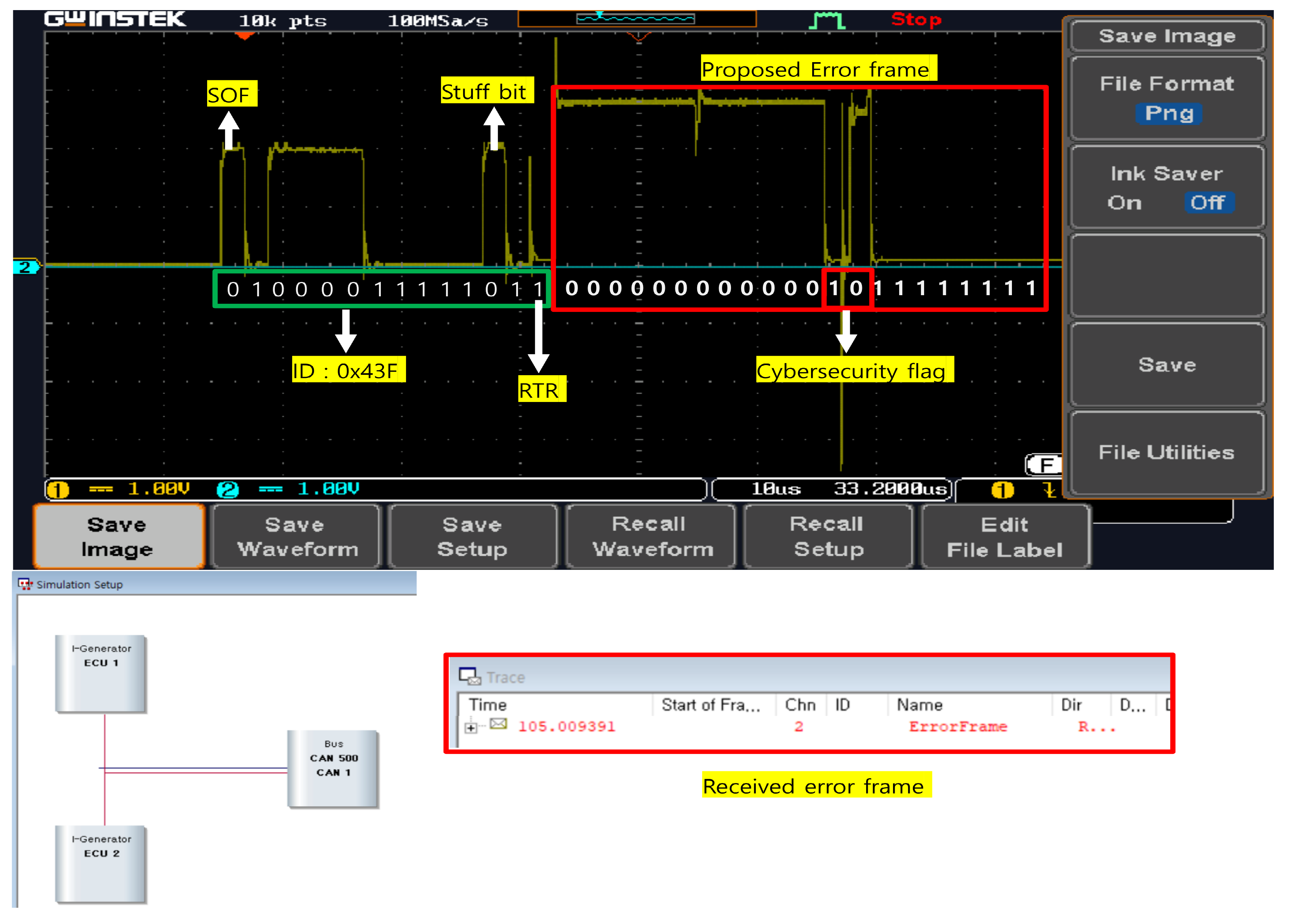
Having long served as the backbone of automotive communication, the Controller Area Network utilizes error handling mechanisms under the ISO 11898 standard for communication reliability. However, these legacy error types do not explicitly distinguish between simple electrical noise and malicious intent. To address this structural limitation, we propose a sixth error type as a specialized protocol extension considering cybersecurity along with an error frame designed to notify other controllers and the driver of cybersecurity attacks. By defining a specific detection logic capable of identifying impersonation and replay attacks and introducing a specialized frame structure, this study enables the data link layer to take immediate defensive action without complex cryptographic overhead. Through FPGA based prototyping and Vector CANoe testing, we demonstrated that this mechanism successfully invalidates malicious attempts while preserving compatibility with the existing CAN error-handling mechanism. This research argues that cybersecurity can no longer be treated as an add-on but should be embedded within the protocol itself. Our findings provide a technical foundation for the next evolution of the ISO 11898 standard and toward security integrated CAN communication.
Keywords: Controller Area Network (CAN); error frame; cybersecurity; in-vehicle network (IVN); real-time invalidation Controller Area Network (CAN); error frame; cybersecurity; in-vehicle network (IVN); real-time invalidation