Article

Performance Analysis of a 100 Gbps Long-Reach PON for Ultra-Wideband Rural Connectivity: A Case Study in Ecuador

by
Edison Tatayo
1,
Adrián Carrera
2,
Christian García
1,
Germán V. Arévalo
2 and
Christian Tipantuña
1,*
1
Department of Electronics, Telecommunications and Information Networks, Escuela Politécnica Nacional, Quito 170525, Ecuador
2
Telecommunications Engineering Program, Universidad Politécnica Salesiana, Quito 170517, Ecuador
*
Author to whom correspondence should be addressed.
Electronics 2026, 15(7), 1502; https://doi.org/10.3390/electronics15071502
Submission received: 21 February 2026 / Revised: 27 March 2026 / Accepted: 31 March 2026 / Published: 3 April 2026

Abstract

This paper presents the performance analysis of a 100 Gbps long-reach passive optical network (LR-PON) based on intensity modulation and direct detection (IM-DD). The LR-PON is designed for low-complexity environments that reuse previously deployed infrastructure and extend coverage to rural areas. It features a point-to-multipoint PON topology with a 1:64 split and links up to 100 km long. The paper analyzes the impact of the booster amplifier, preamplifier, and chromatic-dispersion-compensating module on the bit error rate (BER) using OptSim simulations. The results demonstrate that the LR-PON, operating at 100 Gbps over a 100 km link and with losses over 3 dB over a legacy network, maintains acceptable BER levels in the order of 10 6 , validating its viability as a scalable, efficient, and economical solution for optical access networks in suburban or rural areas in locations such as Quito city (Ecuador).

1. Introduction

The digital ecosystem in Ecuador has undergone a structural transformation over the last decade, accelerated further by the COVID-19 pandemic. According to [1], traffic through the Internet Exchange Point (NAP.EC) showed sustained growth, doubling bandwidth demand during critical periods (2020–2021) to support teleworking and online education, in addition to the massive increase in consumption of streaming services, videoconferencing, and collaborative platforms. This exponential increase in traffic was not a temporary phenomenon but established a new baseline for post-COVID-19 consumption. During 2021–2023, traffic and bandwidth demand remained high, straining conventional infrastructure capacity due to the proliferation of ultra-high-definition services (4K/8K), cloud computing, and the integration of emerging technologies such as the Internet of Things (IoT).
This transition to high-capacity infrastructure has been driven by the Association of Internet Service Providers (AEPROVI), which manages Internet traffic exchange in Ecuador [1,2]. In this scenario, fiber optics has become the dominant technological enabler across all network segments. At the transport level, the optical transport network (OTN) performs deterministic aggregation and switching, ensuring efficient management of massive traffic flows through protection mechanisms and high availability at the backbone and metropolitan levels [3]. Beyond the transport segments, fiber optics has extended to the last mile via passive optical networks (PONs), displacing copper-based access technologies and mitigating high latency and critical channel capacity asymmetry. This comprehensive infrastructure enables the management of traffic peaks of several Gbps at aggregation nodes, thereby optimizing the distribution of local content and access to advanced digital services. However, the Gigabit passive optical network (GPON) standard has inherent structural limitations, particularly a maximum reach of 20 km and a transmission capacity of 2.5 Gbps, which severely restrict its ability to scale with sustained traffic growth and coverage requirements across large geographic areas. As illustrated in Figure 1, these restrictions force GPON deployment to be concentrated in dense urban environments, where proximity to the central office and high user concentration justify the traditional access model. Although fiber optic Internet penetration reaches 88.3%, its territorial distribution is markedly uneven: the provinces of Guayas and Pichincha account for 54.36% of total connections [4,5]. This concentration, shown in the upper part of Figure 1, highlights a structural digital divide that predominantly affects rural and peripheral areas, where reach limitations, population dispersion, and deployment costs hinder the expansion of conventional GPON networks.
Given this scenario of geographical asymmetry and growing demand, long-reach passive optical networks are emerging as a disruptive alternative. By enabling link lengths exceeding 100 km and ultra broadband transmission capabilities, LR-PONs not only overcome the distance limitations of traditional access schemes but also facilitate the consolidation of network nodes, reducing the need for intermediate central offices [6]. Under this approach, large-scale experimental initiatives, such as the DISCUS project, have demonstrated the technical viability of LR-PON architectures, achieving coverage distances of up to 100 km, split ratios of 512 users or higher, and enabling the integration of access and metro networks into a unified infrastructure [7]. From a network architecture perspective, LR-PONs act as a functional bridge between the access and transport layers, preventing the direct extension of OTN complexity to the network edge.
Likewise, from a research perspective, passive optical network technologies have experienced sustained growth over the last decade. Bibliometric analyses of large-scale datasets indicate that PON research has entered a steady expansion phase, with increasing focus on next-generation architectures, such as time-and-wavelength-division multiplexed PON and software-defined optical networks. These trends highlight the growing importance of scalable and high-capacity optical access solutions to meet future connectivity demands [8].
As shown in the lower section of Figure 1, this architecture is particularly well suited for rural environments, where the combination of optical amplification to compensate for prolonged signal attenuation, dispersion compensating fibers (DFC), and the use of wavelength division multiplexing (WDM) ensures efficient spectrum segmentation and multi service coexistence on the existing optical infrastructure [9]. Despite the technological maturity and growing research interest in PON systems, most studies have primarily focused on urban deployments or generic scenarios, with limited attention to rural environments in developing countries. In this way, LR-PONs facilitate traffic aggregation at points closer to the end user, enabling efficient interconnection with the OTN at higher layers without introducing complex transport equipment into the access network, thereby positioning them as a technically and economically viable solution to advance towards a more equitable digital integration in Ecuador.
Compared with next-generation schemes such as NG-PON2 and 50-GPON, which combine WDM and TDM to achieve transmission speeds of up to 50 Gbps [10], LR-PON has the potential to support complex modulation schemes, such as M-PSK and M-QAM, as well as orthogonal frequency-division multiplexing (OFDM). These techniques not only maximize spectral efficiency but also increase signal robustness against dispersion and attenuation. In this regard, advanced signal processing techniques have been proposed to mitigate nonlinear impairments in long-reach optical systems. Histogram-based clustering methods have proven effective for compensating for nonlinear distortions in coherent LR-PON architectures. However, achieving this optimal performance requires the insertion of coherent detection systems and advanced digital signal processing (DSP) techniques for adaptive equalization and compensation of linear and nonlinear degradation [11,12,13]. Table 1 summarizes the key characteristics of the technologies discussed above.
Although complex modulation formats, in conjunction with coherent detection, maximize range, capacity, and spectral efficiency, their deployment in access networks, especially in rural environments, is severely limited by the technical complexity of optical network terminals (ONTs), incremental energy consumption, and high investment costs [18,19]. These constraints are critical in regions where cost-effectiveness, energy availability, and reuse of existing infrastructure are fundamental to network design [20]. Table 2 presents a comparative analysis of LR-PON architectures based on intensity modulation and direct detection (IM-DD) and coherent detection, highlighting the viability of IM-DD solutions in scenarios where operational simplicity and economic efficiency are paramount. In this context, IM-DD architectures represent a pragmatic technical solution that significantly reduces hardware complexity while ensuring interoperability with existing PON infrastructure.
Table 3 compares the proposed system with representative LR-PON architectures reported in recent literature. Contrary to existing IM-DD LR-PON studies that often focus on theoretical limits or the need for digital compensation, the novelty of this work lies in the systematic optimization of a 100 Gbps architecture that achieves 100 km reach and a 1:64 split ratio using a purely non-coherent scheme without any digital processing at the ONT. This approach is tailored to the socio-economic constraints of rural connectivity in developing regions such as Ecuador, providing a low-complexity roadmap for ultra-wideband expansion that prioritizes infrastructure reuse and cost-effectiveness. Consequently, this work focuses specifically on an IM-DD-based LR-PON architecture designed as a long-range access solution. It is geared toward scenarios where cost-effectiveness, infrastructure reuse, and implementation simplicity are prioritized over maximum spectral efficiency, and it offers a more pragmatic solution for regions that must modernize gradually.
In general, the main competitive advantage of LR-PON lies in its ability to efficiently integrate access and metropolitan networks, complementing OTN and extending coverage without requiring the integration of complex multiplexers, ROADMs, or optical-electric regenerators into the optical distribution network (ODN). This topological simplification significantly reduces the number of intermediate nodes, active equipment, local exchanges, and extensive cabling installations. Such solutions are attractive to Internet service providers because network simplification results in substantial reductions in capital expenditures (CAPEX) and operating expenses (OPEX) [21]. However, eliminating intermediate nodes shifts the technical challenge to managing signal attenuation and chromatic dispersion (CD), as well as the imperative to use optical amplifiers.
This article evaluates, through exhaustive simulations in the OptSim environment, the performance of an IM-DD-based LR-PON network at 100 Gbps over 100 km links. The interdependence among optical amplification, dispersion compensation, and excess loss is rigorously analyzed as a function of bit error rate (BER). The results validate this architecture as a scalable, efficient, and cost-effective solution for optical access networks in rural scenarios.
The remainder of this paper is organized as follows. Section 2 outlines the system requirements considered for the PON deployment scenario. Section 3 describes the experimental setup and its corresponding configurations. Section 4 presents the results of parameterizing the optical components. Section 5 provides a deployment cost analysis for feeder installation in a 100 km network. Finally, Section 6 concludes this paper.

2. System Requirements

For the deployment and evaluation of an IM-DD-based LR-PON that guarantees operation over long-distance links while maintaining architectural simplicity and compatibility with existing PON infrastructure, a structure organized into three functional blocks is presented: (i) transmitter, (ii) the ODN, and (iii) the receiver. Unlike conventional PON networks, this configuration integrates active optical amplification components. These include specifically a booster amplifier at the transmitter output and a preamplifier at the end-user terminal, as illustrated in Figure 2. These components compensate for accumulated attenuation and significantly extend the link range, enabling long-range connectivity scenarios without intermediate optical–electrical regeneration or coherent detection.
  • The transmitter block implements wavelength division multiplexing (WDM) using four C-band carriers with 100 GHz spectral spacing, conforming to the ITU-T G.694.1 grid [22]. Each of these carriers emulates the behavior of an individual commercial 25 G SFP28 DWDM transceiver module integrated into the OLT. Each channel transmits a PAM2-NRZ binary intensity-modulated signal, compliant with the IEEE 802.3 by standard for 25 Gigabit Ethernet [23], ensuring interoperability with existing optical infrastructure. Finally, aggregating four wavelengths yields a total capacity of 100 Gbps while maintaining the energy efficiency and hardware simplicity of the proposed IM-DD architecture.
  • The ODN is modeled using a standard ITU-T G. 652.D single-mode fiber, commonly used in FTTx deployments, both aerial and underground. In long-range, high-capacity networks, chromatic dispersion is no longer negligible. The accumulated temporal broadening induces intersymbol interference (ISI) as adjacent pulses overlap, compromising signal integrity and increasing the bit error rate at the receiver. To mitigate this effect, a dispersion-compensating fiber (DCF) is incorporated. The DCF introduces a negative dispersion coefficient that counteracts the accumulated effect in the transport fiber, restoring the temporal shape of the optical pulses without requiring intermediate optical–electrical regeneration or complex coherent processing, thus facilitating transmission over longer distances without significant degradation. For the user distribution, the proposed architecture employs a single optical division level with a 1:64 splitter, widely used in GPON class B+/C+ deployments [24]. However, from a structural perspective of an access network, this splitter can be modeled as a two-stage hierarchy, for example, a 1:8 splitter followed by a 1:8 splitter, or alternatively a 1:4 splitter followed by a 1:16 splitter, maintaining a connection capacity of up to 64 end users.
  • The receiver block includes a selective optical filter per channel, followed by an SOA-type optical preamplifier to improve receiver sensitivity by compensating for accumulated attenuation in long-range links and raising the signal power above the detector’s sensitivity threshold. After preamplification, an APD (Avalanche Photodiode) photodetector is used for its intrinsic gain, which provides greater robustness to thermal noise compared to conventional PIN detectors [25]. Following optoelectronic conversion, the signal is processed by a fourth-order Bessel low-pass filter to minimize phase distortion in the time domain.

3. Simulation Parameters and Configuration Setup

The proposed solution was developed using the OptSim simulation tool, which is known for its accuracy in modeling optical systems in the time and spectral domains under realistic transmission conditions [26].

3.1. Transmitter Parameterization

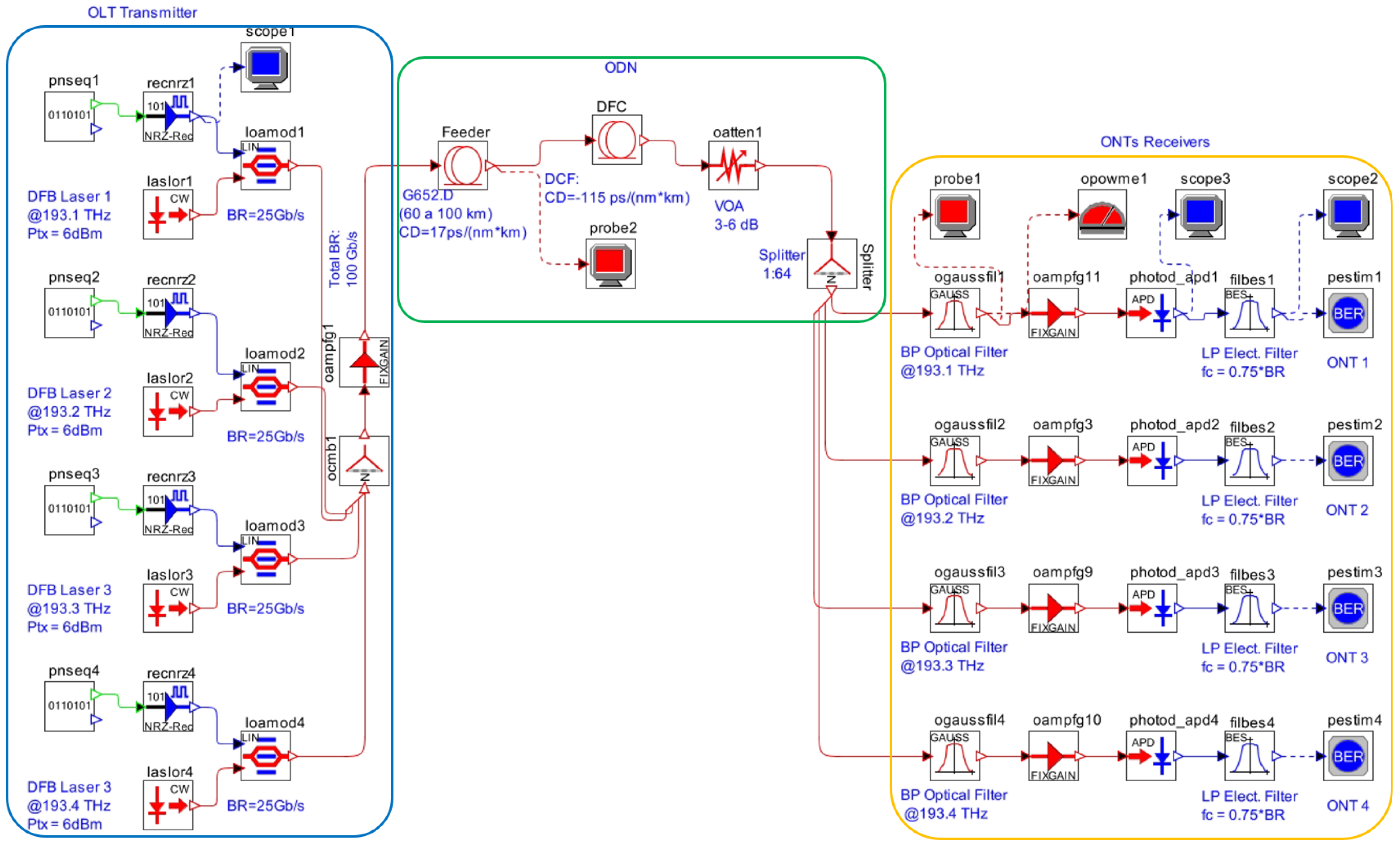
This consists of a 25 Gbps pseudo-random sequence generator and an NRZ electrical controller, which converts the binary input signal into an electrical signal. The electro-optical conversion is performed using a continuous-wave (CW) distributed feedback (DFB) laser and a Mach–Zehnder modulator (MZM). This process generates a 25 Gbps PAM2-NRZ signal. To achieve the proposed transmission speed, the four signals are multiplexed, reaching 100 Gbps. In Figure 3, the blue box represents the components used in the transmission block. The optical transmission power per channel is set to 6 dBm, which is compatible with industrial SFP28 DWDM transceivers. Likewise, to compensate for modulator and multiplexer insertion losses and to normalize power levels before fiber propagation, the SOA booster amplifier operates with a variable gain of 6–13 dB. The SOA amplifier was selected based on its high energy efficiency, compact dimensions, and ease of integration into high-density OLTs. Compared with erbium-doped fiber amplifiers (EDFAs), SOAs are a more suitable solution for access networks, offering lower operating costs and a simpler architecture.

3.2. OND Characterization

The network is modeled with G.652.D single-mode fiber, representing the feeder and distribution network (Figure 3 green box), with an attenuation of 0.2 dB/km in the C-band and a chromatic dispersion of 17 ps/(nm·km) [27], with a variable length between 60 and 100 km. The integrated DCF has a chromatic dispersion of −115 ps/(nm·km). Its length is adjusted proportionally to the transport segment according to Equation (1) [28].
L DCF = k · C D SMF C D DCF · L SMF
A compensation factor k is introduced to account for partial dispersion compensation. In this work, a value of k = 0.9 is adopted, which corresponds to 90% compensation of the accumulated chromatic dispersion. This approach avoids overcompensation in short links and provides a more robust design in multi-branch PON scenarios, where the distances between ONTs vary and they experience different levels of accumulated dispersion. The resulting residual chromatic dispersion is defined by Equation (2).
C D res = ( 1 k ) C D SMF L SMF
For the maximum transmission distance considered in this study, the residual chromatic dispersion remains within the receiver’s tolerance limits, preventing severe degradation of the quality factor. In IM-DD systems, a moderate level of residual dispersion is not only tolerable but can also improve system stability against thermal fluctuations and variations in the transmitter spectrum, mitigating penalties for nonlinear distortion in high-power fibers [25].
Furthermore, a variable optical attenuator (VOA) with a range of 3 to 6 dB is incorporated to simulate additional uncontrolled losses during network deployment. These include losses due to macrobending, connectors, splices, and variations in installation quality. Finally, a 1:64 splitter with an insertion loss of −21 dB is used. Note that the distribution network is not explicitly simulated because its typical lengths do not exceed 500 m [14], and thus do not result in significant attenuation within the total power budget.

3.3. Receiver Parameterization

Each ONT incorporates a selective optical filter centered at 100 GHz and an SOA optical preamplifier with a gain of 6–20 dB and a noise figure of 4.5 dB. The APD photodetector is then parameterized with a responsivity of 0.8 A/W, a dark current of 10 nA, and a sensitivity of −31 dBm. The electrical signal is processed by a fourth-order Bessel low-pass filter with a cutoff frequency tuned to 75% of the symbol rate. Table 4 summarizes the configuration values of the IM-DD network components, based on commercial equipment specifications to ensure simulation accuracy. For performance evaluation, the BER Estimator block in OptSim is employed. This block utilizes a semi-analytical Gaussian estimation algorithm that derives BER from the Q-factor and eye-diagram statistics (mean and standard deviation of signal levels), rather than through a direct bit count [29]. This methodology is a standard industry practice for characterizing the robustness of high-speed physical layers against noise and chromatic dispersion, providing a reliable estimation of the system’s operational margins.

4. Simulation Results and Analysis

The network has several key configuration parameters, including booster amplifier gain, preamplifier gain, chromatic dispersion compensation value, VOA attenuation, and fiber length. To identify the optimal configuration, a systematic scan of these parameters is performed to assess their direct impact on BER.

4.1. Booster Amplifier Gain

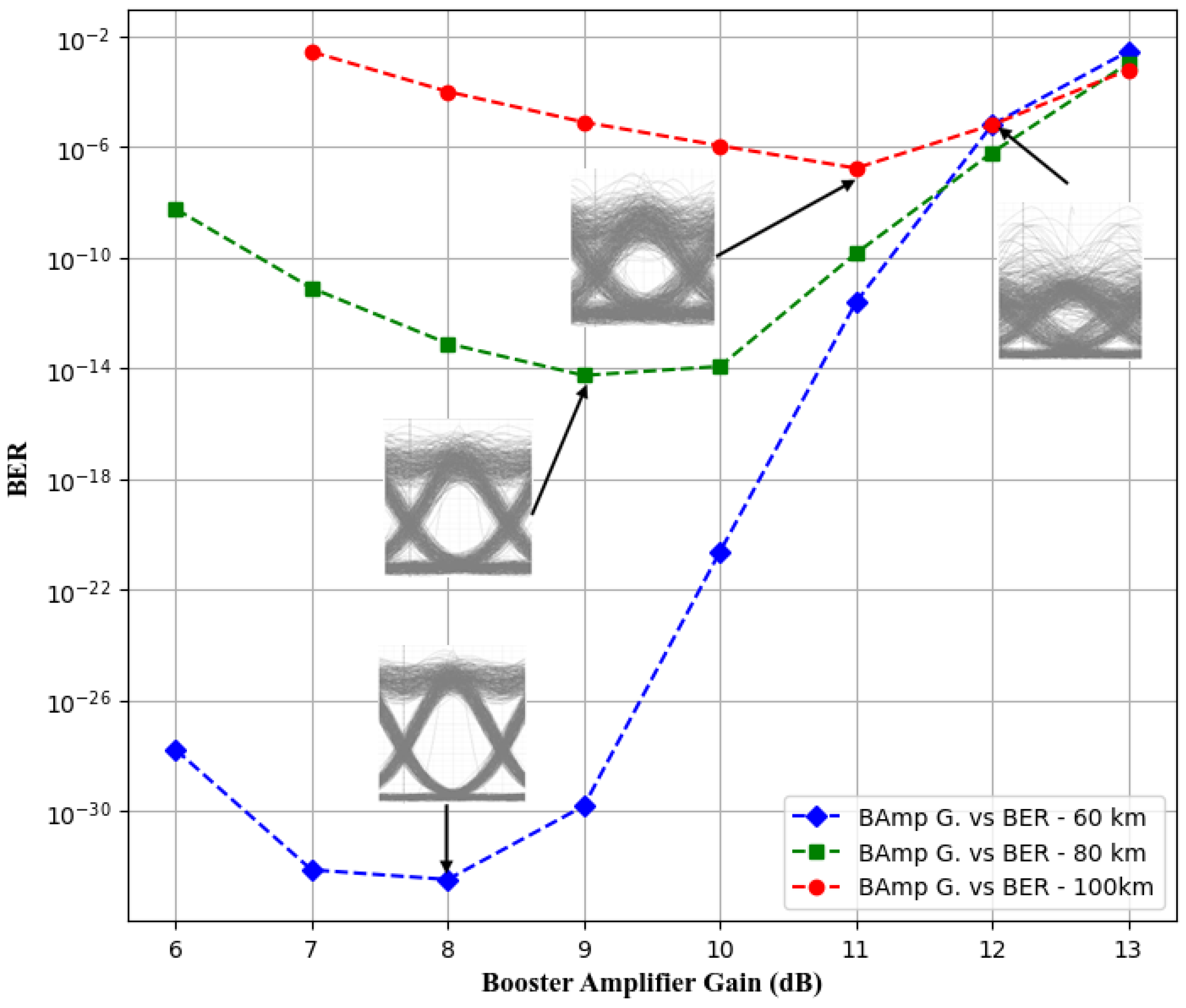
The optical gain of the BA is swept from 5 to 15 dB, and the network BER is evaluated for transmission distances of 60, 80, and 100 km. These results are presented in Figure 4, demonstrating a high sensitivity of network performance to the applied optical gain. For 60 km links, extremely low BER values, on the order of 10 32 , are achieved within the gain range of 6 to 10 dB. At 80 km, a higher gain of between 8 and 11 dB is required to obtain BER levels close to 10 14 . Over a distance of 100 km, the optimal gain is 11 dB, yielding a BER of approximately 10 7 .
Figure 4 shows that as the BA gain increases, the eye diagrams show the degradation in signal quality due to amplified spontaneous emission. This relationship between gain and signal degradation underscores the importance of optimizing booster amplifier configuration, particularly in long-distance links [35]. While advanced techniques such as DSP, complex modulation schemes, or coherent detection can improve performance beyond 80 km, their implementation significantly increases the complexity and cost of terminal equipment. Consequently, for typical access scenarios requiring high transmission capacity, such as FTTx deployments in rural or suburban areas, the results remain within operating margins, ensuring adequate quality of service without requiring expensive network architectures.

4.2. Dispersion Compensation Fiber

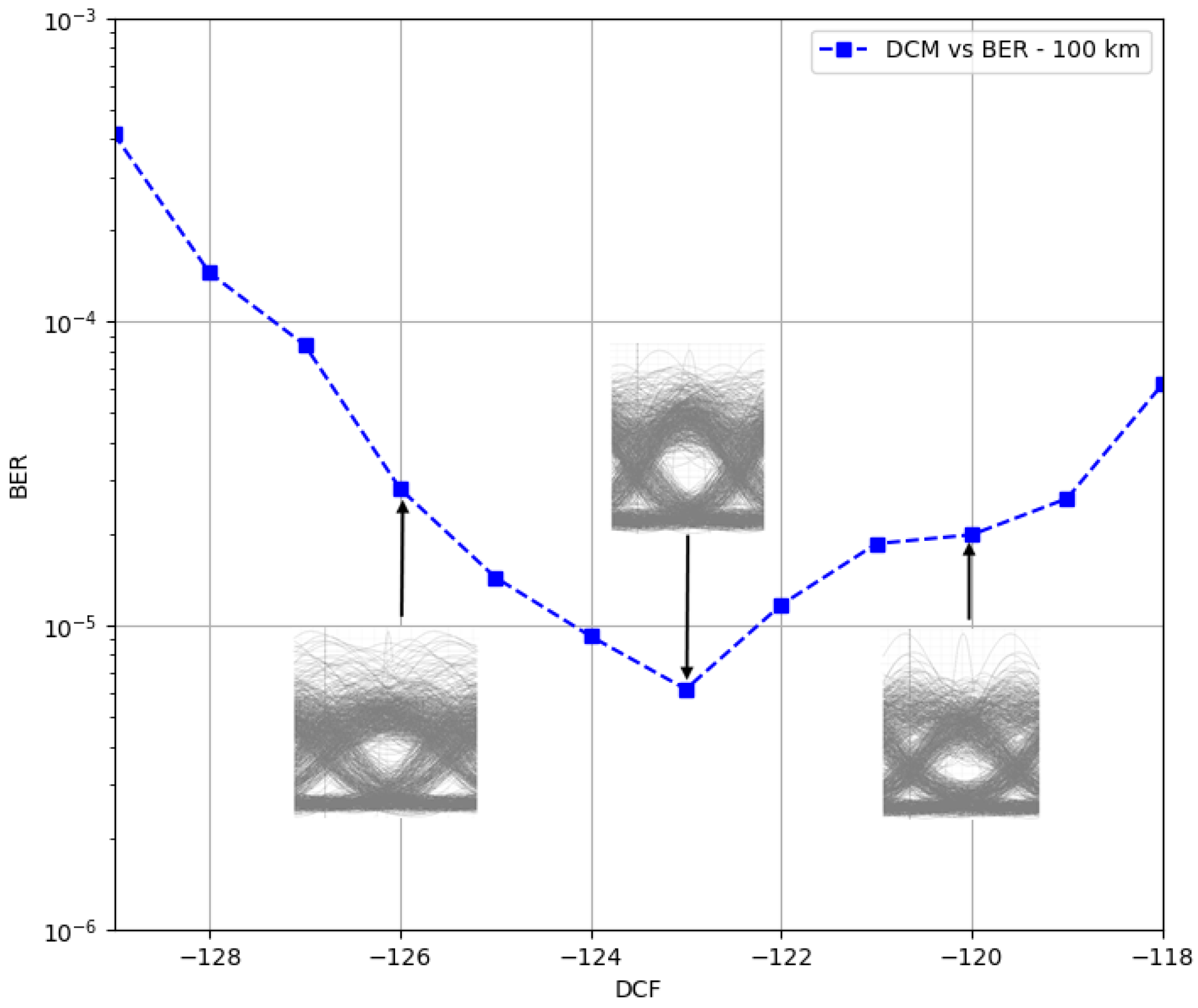
DCF is a type of optical fiber with a negative dispersion coefficient, typically in the range of −100 to −130 ps/(nm·km), that compensates for the dispersion accumulated by single-mode fiber. Figure 5 indicates that as the dispersion coefficient deviates from its optimal point for this case of −123 ps/(nm·km), both towards undercompensation and overcompensation, the BER increases significantly. This deterioration is associated with temporal broadening of the optical pulses, which increases intersymbol interference (ISI), as evidenced by the progressive closure of the eye diagrams and reductions in both the vertical and horizontal apertures. Unlike DSP techniques used in complex schemes, this solution does not introduce additional latency or electro-optical conversions. Instead, it relies on a passive optical compensation approach with controlled power amplification, which effectively mitigates the problem. Therefore, this approach is an efficient, cost-effective strategy, particularly suitable for legacy-compatible systems.

4.3. Excess Losses

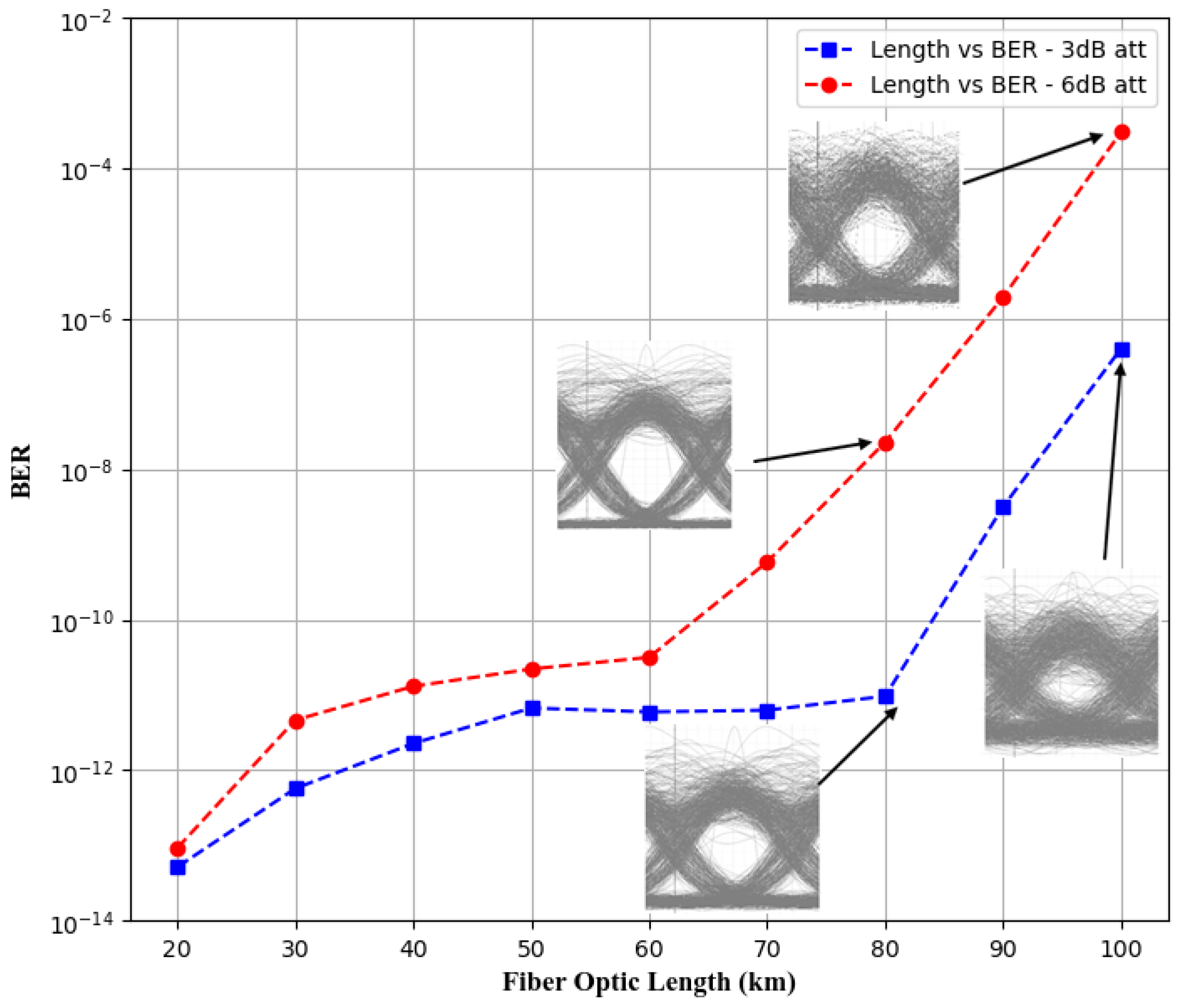
The effects of accumulated attenuation caused by intermediate passive network elements, such as splices, connectors, macrobends, and low-scalability optical splitters, have been considered. These factors are especially relevant when using legacy hardware, i.e., existing infrastructure built with older technologies that remain operational despite technological advancements. It is important to note that such equipment may have technical limitations, including reduced optical range, greater susceptibility to optical losses, and limited scalability in the ODN. Figure 6 presents the comparative analysis of two scenarios considering 3 and 6 dB of attenuation in the VOA. In the first case, an LR-PON operating at 100 Gbps over 100 km achieves a BER of the order of 10 7 , which is considered acceptable for IM-DD optical systems. However, increasing the attenuation to 6 dB significantly degrades system performance, requiring FEC techniques such as Reed–Solomon or interleaving [36] to maintain signal integrity and ensure reliable recovery and, consequently, quality of service.
It should be noted that the BER values reported in this work correspond to pre-FEC performance, reflecting the intrinsic behavior of the optical link’s physical layer. At this stage, a BER of 10 6 is considered a viable operational threshold. Nevertheless, in practical passive optical network deployments, the final quality of service is defined by the post-FEC BER, which is typically required to remain below 10 9 [36]. Consequently, the obtained results are consistent with standard system-level requirements once FEC overhead is accounted for.
Additionally, Figure 6 shows that to achieve a BER of the order of 10 9 typically accepted in PON systems [36], the penalty induced by an additional 3 dB attenuation between the two scenarios analyzed translates into an approximate 20 km reduction in the maximum link length (100 km). This difference demonstrates the significant impact of accumulated excess losses on effective network reach.

4.4. Preamplifier Gain

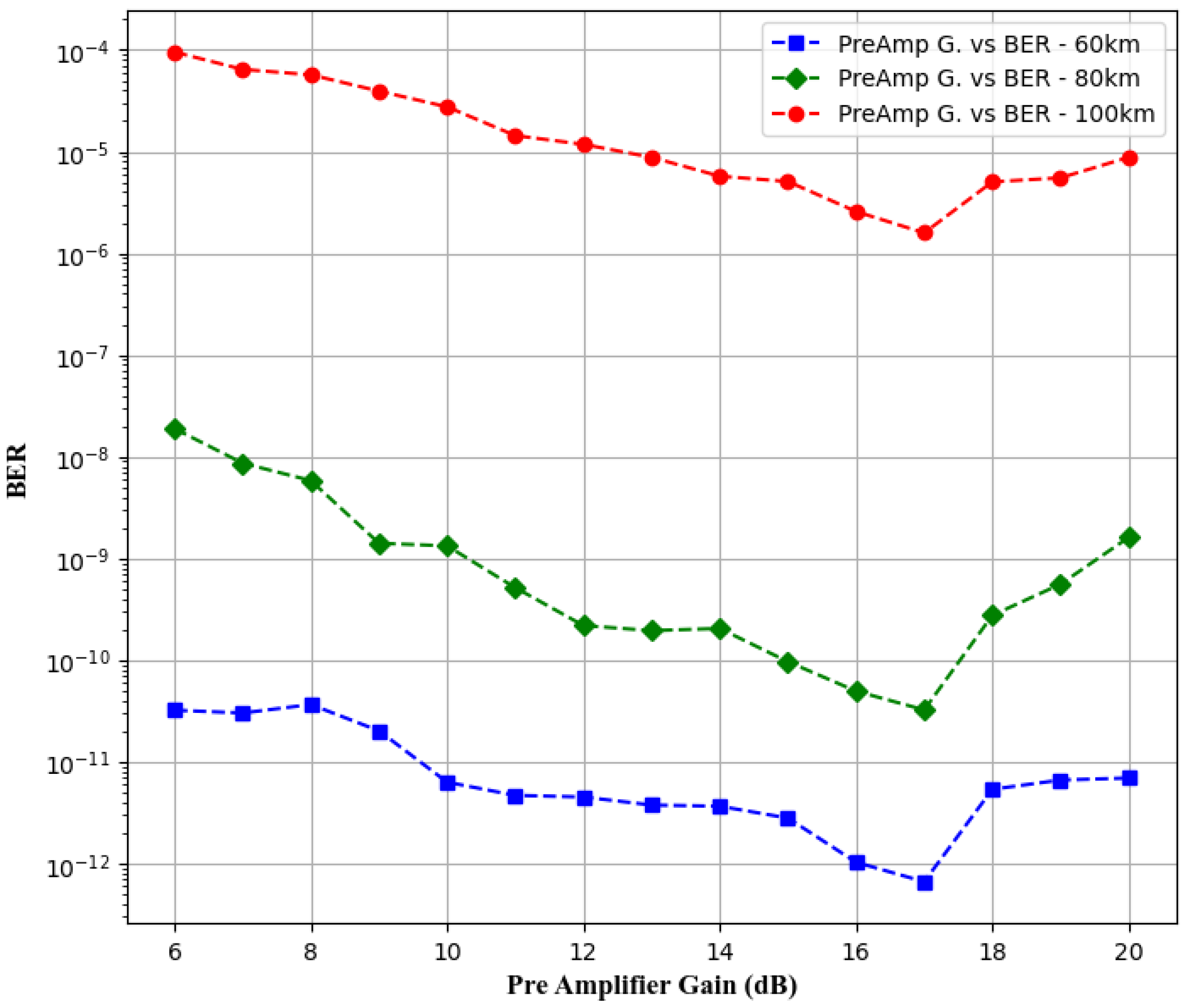
The preamplifier enhances receiver sensitivity by amplifying the received optical power before electro-optical conversion, enabling weaker signals to be detected without requiring regeneration or advanced DSP. Figure 7 shows that the optimal operating point of the preamplifier, for the three simulation scenarios at 60, 80, and 100 km link lengths and 100 Gbps transmission rate, is located at 17 dB of gain, where the best performance in terms of BER is achieved. For 60 km links, the BER remains below 10 11 across the entire range of gains analyzed. In contrast, at 80 km, there is a need to apply gains greater than 12 dB to achieve acceptable BER levels in the order of 10 9 . Additionally, for networks between 60 and 80 km, a 9 dB pre-amplification gain penalty is required to achieve the same BER of around 10 11 . Meanwhile, for distances of 100 km, operating at the optimal point (17 dB) is essential to achieve a BER of around 10 6 , underscoring the critical importance of amplifiers in extended links with high accumulated losses.

5. Deployment Cost Analysis

In addition to analyzing network performance in terms of BER and relevant parameters such as distance, dispersion compensation, optical amplification, and the use of a VOA, this study presents a cost estimate for deploying the feeder segment for a 100-km link. The two most common scenarios in Ecuador are considered: (i) aerial installation and (ii) underground installation. The estimate includes costs for materials, labor, and fees for the use of poles and ducts, in accordance with Ministerial Agreement No. 017-2017 [37].
Table 5 and Table 6 show that underground deployment represents an investment of USD 382,416.40, while the aerial alternative amounts to USD 498,429.62. Although the latter option entails a 30% increase in the total cost, its applicability in rural areas offers significant operational advantages. In rural areas, underground infrastructure, such as pipelines and manholes, is often nonexistent, requiring additional investments in civil engineering construction, excavation permits, and technical expertise, thereby increasing deployment costs and time. In contrast, aerial deployment leverages existing infrastructure. This primarily comprises utility poles in rural areas. This availability enables faster, more modular installation, which is important for covering long distances.
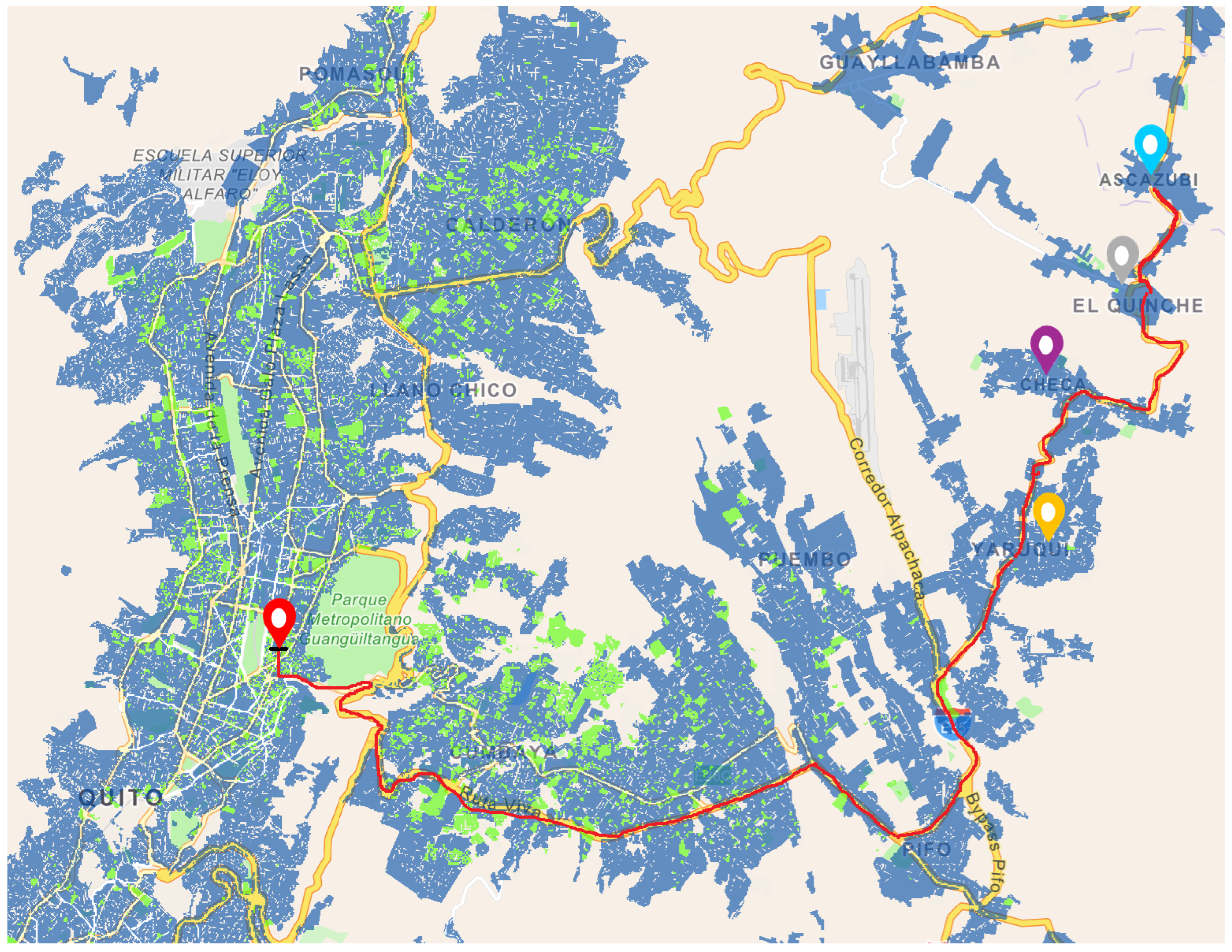
Figure 8 shows the geographic distribution of fiber optic internet service penetration in the province of Pichincha, Ecuador. The areas highlighted in green indicate a high concentration of FTTx deployments in densely populated urban areas, particularly in the Quito metropolitan area. In contrast, the peripheral rural areas show limited coverage, despite being within a technically reachable geographic radius from the main internet service provider (ISP) node, indicated in red.
To validate the applicability of the proposed LR-PON IM-DD architecture, a connectivity analysis is presented, running from a centralized node in the Metropolitan District of Quito to four strategic points in rural areas with a digital infrastructure deficit: Yaruquí (34.3 km), Checa (39.9 km), El Quinche (46.2 km), and Ascázubi (50.4 km). The deployment of conventional GPON access networks has a limited range of 20 km, requiring the installation of multiple intermediate central offices or active regenerators, which increases CAPEX by 30% and operational complexity.
Under the evaluated architecture, the most critical path to Ascázubi (50.4 km) exhibits an intrinsic fiber attenuation of 10.08 dB. By integrating the BA gain in the OLT and the SOA preamplifier in the ONT, the system effectively compensates for these losses, along with the −21 dB penalty introduced by the 1:64 optical splitter in the dispersion stage. The power budget results indicate that at the most distant point, the received power is approximately −26.3 dBm, providing a safety margin of 4.7 dB with respect to the APD photodetector’s sensitivity (−31 dBm). This buffer in the power budget ensures the link’s operability even in the presence of additional uncontrolled losses from splices or connectors in the outside plant. From a signal integrity perspective, the cumulative DCF reaches 856 ps/nm, which, without DCF, would cause the eye diagram to close completely due to ISI. However, DCF guarantees signal integrity with BER values on the order of 10 9 . It is important to note that this strategy does not replace OTN but rather serves as an efficient extension of the access layer, avoiding the need to move transport complexity, such as high-capacity DWDM multiplexers, ROADMs, or regenerators, to low-population-density areas.

6. Conclusions

LR-PON represents a strategic alternative to technologies such as GPON, NG-PON2, and 50G-PON, offering a scalable, low-cost solution compatible with legacy infrastructures. Their ability to extend reach up to 100 km, combined with optical multiplexing and amplification, enables the deployment of high-capacity services in rural areas without requiring additional intermediate nodes or central offices. Compared with next-generation technologies that entail high equipment costs and operational complexity, LR-PON enables the reuse of existing ODNs, integrates efficiently with transport networks, and significantly reduces investment and maintenance costs. For these reasons, this architecture is presented as a technically viable and economically sustainable option to accelerate connectivity expansion and close the digital divide in rural regions of Ecuador.
The combination of booster amplifiers, preamplifiers, and dispersion-compensating techniques provides a practical solution for deploying 100 Gbps LR-PON networks, particularly over existing infrastructure and in low-complexity systems. These components work together to optimize the end-to-end power budget, reduce dispersion effects and cumulative losses, and maintain acceptable BER levels, without requiring complex modulation schemes or coherent detection.
The analysis of costs associated with feeder network deployment shows that, while overhead installation is technically viable, it entails an investment approximately 30% higher than underground installation. However, in rural areas, access to underground infrastructure is often limited or nonexistent, resulting in additional costs for civil works, permits, and site adaptation. In this context, these conditions must be carefully evaluated during the strategic planning for the deployment of long-reach optical networks. Therefore, aerial installations are emerging as the most appropriate option for expanding connectivity and helping close the digital divide in rural Ecuador.
As future work, we propose extrapolating OptSim simulation results to real-world experimental scenarios through practical demonstrations to validate the system’s behavior under physical conditions. In addition to analyzing BER, these tests will enable more precise identification of the receiver’s optical sensitivity, accounting for ASE noise and real-world losses in connectors and splices. This experimental validation would be essential to strengthen the viability of the proposed scheme in operational environments, particularly in rural networks with legacy infrastructure.

Author Contributions

Conceptualization, E.T., A.C., C.G., G.V.A., and C.T.; methodology, E.T., A.C., C.G., G.V.A., and C.T.; software, E.T., A.C., and G.V.A.; validation, E.T., A.C., C.G., G.V.A., and C.T.; formal analysis, E.T., G.V.A., and C.T.; investigation, E.T., A.C., C.G., G.V.A., and C.T.; resources, E.T., G.V.A., and C.T.; data curation, E.T., G.V.A., and C.T.; writing—original draft preparation, E.T., A.C., and C.G.; writing—review and editing, G.V.A., and C.T.; visualization, E.T., and C.T.; supervision, G.V.A., and C.T.; project administration, E.T., and C.T.; funding acquisition, C.T. All authors have read and agreed to the published version of the manuscript.

Funding

This work has been supported by Escuela Politécnica Nacional.

Institutional Review Board Statement

Not applicable.

Informed Consent Statement

Not applicable.

Data Availability Statement

Data are contained within the article.

Acknowledgments

The authors acknowledge the support provided by the Escuela Politécnica Nacional.

Conflicts of Interest

The authors declare no conflicts of interest.

Abbreviations

The following abbreviations are used in this manuscript:
APDAvalanche Photodiode
ASEAmplified Spontaneous Emission
BABooster Amplifier
BERBit error rate
CAPEXCapital Expenditure
CDChromatic dispersion
CWContinuous Wave
CWDMCoarse Wavelength Division Multiplexing
DCFDispersion-compensating fiber
DFBDistributed Feedback Laser
DSDownstream
DSPDigital Signal Processing
DWDMDense Wavelength Division Multiplexing
EDFAErbium-Doped Fiber Amplifier
FECForward Error Correction
FTTxFiber to the x (Home, Building, Cabinet, etc.)
GPONGigabit Passive Optical Network
IM-DDIntensity Modulation and Direct Detection
ISPInternet Service Provider
ISIIntersymbol Interference
LR-PONLong reach passive optical network
M-PAMM-level Pulse Amplitude Modulation
M-PSKM-ary Phase Shift Keying
M-QAMM-ary Quadrature Amplitude Modulation
MZMMach–Zehnder Modulator
NRZNon-Return-to-Zero
ODNOptical distribution network
OFDMOrthogonal Frequency Division Multiplexing
OLTOptical Line Terminal
ONTOptical Network Terminal
OPEXOperating Expenditure
OTNOptical Transport Network
PAMPulse Amplitude Modulation
PONPassive Optical Network
QoSQuality of Service
SOASemiconductor optical amplifier
TDMTime Division Multiplexing
TWDMTime and Wavelength Division Multiplexing
USUpstream
VOAVariable optical attenuator
WDMWavelength Division Multiplexing

References

  1. Ponce, D.; Tipantuña, C.; Espinosa, C. Analysis of Internet Traffic in Ecuador. IEEE Access 2023, 11, 126365–126385. [Google Scholar] [CrossRef]
  2. Association of Internet Service Providers, Value Added, Carriers and IT Companies. NAP.EC: Presentation and History. 2021. Available online: https://aeprovi.org.ec/ixp/presentacion-e-historia/ (accessed on 1 February 2026).
  3. ITU-T Recommendation G.709/Y.1331; Recommendation ITU-T G.709/Y.1331 (06/2020): Interfaces for the Optical Transport Network. International Telecommunication Union: Geneva, Switzerland, 2020. Available online: https://www.itu.int/rec/T-REC-G.709/en (accessed on 18 February 2026).
  4. ARCOTEL. Statistical Bulletin of the Telecommunications Sector 2024; ARCOTEL: Vienna, Austria, 2025; Available online: https://www.arcotel.gob.ec/wp-content/uploads/2015/01/Boletin-cierre-2024_compressed-1.pdf (accessed on 6 January 2026).
  5. Puntonet. Connectivity Drives Digital Transformation and Reduces Gaps in Ecuador; Puntonet: Quito, Ecuador, 2026; Available online: https://www.puntonet.ec/la-conectividad-impulsa-la-transformacion-digital-y-reduce-brechas-en-ecuador/ (accessed on 12 January 2026).
  6. Carrera Tobar, A.A. Estudio y Simulación de Una Red Óptica Long-Reach 100 G-PON Para Proveer Servicios de Acceso a Internet Con Banda Ultra-Ancha a Sectores Rurales. Master’s Thesis, Universidad Politécnica Salesiana, Quito, Ecuador, 2025. Available online: https://dspace.ups.edu.ec/handle/123456789/30510 (accessed on 21 May 2025).
  7. Payne, D.B.; Arbelaez, A.; Bonk, R.; Doran, N.J.; Furdek, M.; Jensen, R.; Parsons, N.; Pfeiffer, T.; Quesada, L.; Raack, C.; et al. End-to-End Network Design and Experimentation in the DISCUS Project. In Proceedings of the International Conference on Transparent Optical Networks (ICTON), Girona, Spain, 2–6 July 2017; pp. 1–6. [Google Scholar] [CrossRef]
  8. Memon, K.A.; Zhang, Q.; Butt, R.A.; Mohammadani, K.H.; Faheem, M. Bibliometric analysis of passive optical network (PON) research using CiteSpace. Opt. Switch. Netw. 2020, 39, 100586. [Google Scholar] [CrossRef]
  9. Rannello, M.; Artiglia, M.; Presi, M.; Ciaramella, E. 10 Gb/s long-reach PON system based on directly modulated transmitters and simple polarization independent coherent receiver. Opt. Express 2017, 25, 17841–17846. [Google Scholar] [CrossRef] [PubMed]
  10. Du, L.B.; Zhao, X.; Yin, S.; Zhang, T.; Barratt, A.E.T.; Jiang, J.; Wang, D.; Geng, J.; DeSanti, C.; Lam, C.F. Long-Reach Wavelength-Routed TWDM PON: Technology and Deployment. J. Light. Technol. 2019, 37, 688–697. [Google Scholar] [CrossRef]
  11. Saliou, F.; Simon, G.; Huérou, S.L.; Vu-Brugier, G.; Cano, I.; Nesset, D.; Hong, Z.; Rosales, R.; Bideau, M.; Potet, J.; et al. Two approaches for triple coexistence of G-PON, XGS-PON, and 50G-PON systems with extended reach and a class-D ODN. J. Opt. Commun. Netw. 2024, 16, C97–C105. [Google Scholar] [CrossRef]
  12. Kumari, M.; Arya, V.; Al-Khafaji, H.M.R. Simulation Investigation of Symmetric 8 × 25 Gbps Hybrid TWDM-DFMA PON for Long-Reach Applications. IEEE Access 2023, 11, 43360–43369. [Google Scholar] [CrossRef]
  13. Aldaya, I.; Giacoumidis, E.; de Oliveira, G.; Wei, J.; Pita, J.L.; Marconi, J.D.; Fagotto, E.A.M.; Barry, L.; Abbade, M.L.F. Histogram Based Clustering for Nonlinear Compensation in Long Reach Coherent Passive Optical Networks. Appl. Sci. 2020, 10, 152. [Google Scholar] [CrossRef]
  14. Recommendation ITU-T G.984.1; Gigabit-Capable Passive Optical Networks (GPON): General Characteristics. International Telecommunication Union (ITU-T): Geneva, Switzerland, 2008.
  15. Recommendation ITU-T G.989; 40-Gigabit-Capable Passive Optical Networks (NG-PON2): Definitions, Abbreviations and Acronyms. International Telecommunication Union (ITU-T): Geneva, Switzerland, 2015.
  16. Recommendation ITU-T G.9804.3; 50-Gigabit-Capable Passive Optical Networks (50G-PON): Physical Media Dependent (PMD) Layer Specification. International Telecommunication Union (ITU-T): Geneva, Switzerland, 2021.
  17. Recommendation ITU-T G.984.6; Gigabit-Capable Passive Optical Networks (GPON): Reach Extension. International Telecommunication Union (ITU-T): Geneva, Switzerland, 2008.
  18. Zhang, J.; Li, G.; Xing, S.; Chi, N. Flexible and Adaptive Coherent PON for Next-Generation Optical Access Network [Invited]. Opt. Fiber Technol. 2023, 75, 103190. [Google Scholar] [CrossRef]
  19. Yang, G.; Zhu, Y.; Zhang, Z.; Man, L.; Huang, X.; Huang, X.; Hu, W. Coherent Optics for Passive Optical Networks: Flexible Access, Rapid Burst Detection, and Simplified Structure. Photonics 2025, 12, 68. [Google Scholar] [CrossRef]
  20. Xing, S.; Zhang, J.; Shen, W.; Yan, A.; Li, G.; Sun, A.; Zhou, J.; Guo, D.; Shi, J.; Li, Z.; et al. Low-Cost, Large-Coverage, and High-Flexibility Coherent PON for Next-Generation Access Networks: Advances, Challenges, and Prospects [Invited]. Chin. Opt. Lett. 2024, 22, 040604. [Google Scholar] [CrossRef]
  21. Song, H.; Kim, B.W.; Mukherjee, B. Long-reach optical access networks: A survey of research challenges, demonstrations, and bandwidth assignment mechanisms. IEEE Commun. Surv. Tutor. 2010, 12, 112–123. [Google Scholar] [CrossRef]
  22. Recommendation G.694.1; Recommendation ITU-T G.694.1: Spectral Grids for WDM Applications: DWDM Frequency Grid. International Telecommunication Union (ITU-T): Geneva, Switzerland, 2020.
  23. Technical Standard IEEE Std 802.3 by-2016; IEEE Standard for Ethernet–Amendment 2: Media Access Control Parameters, Physical Layers, and Management Parameters for 25 Gb/s Operation. Institute of Electrical and Electronics Engineers: New York, NY, USA, 2016. Available online: https://standards.ieee.org/ieee/802.3by/6024/ (accessed on 30 March 2026).
  24. Recommendation ITU-T G.984.2; Gigabit-Capable Passive Optical Networks (GPON): Physical Media Dependent (PMD) Layer Specification. International Telecommunication Union (ITU-T): Geneva, Switzerland, 2019.
  25. Agrawal, G.P. Fiber-Optic Communication Systems, 4th ed.; John Wiley & Sons, Inc.: Hoboken, NJ, USA, 2010. [Google Scholar] [CrossRef]
  26. Synopsys OptSim for Optical Communication|Synopsys Photonic Solutions. Available online: https://www.synopsys.com/photonic-solutions/optsim.html (accessed on 7 February 2026).
  27. Corning Incorporated. Corning® SMF-28e+® Optical Fiber: Product Information; Product Information Datasheet PI1463; Corning Incorporated: Corning, NY, USA, 2025; Available online: https://www.corning.com/media/worldwide/coc/documents/Fiber/product-information-sheets/PI-1463-AEN.pdf (accessed on 18 February 2026).
  28. Manosalvas, D.; Arguero, B.; Arévalo, G.V.; Tipantuna, C.; Tatayo, E. Pre and Post Compensation of Chromatic Dispersion in a High-Speed PON. In Proceedings of the 2023 IEEE Seventh Ecuador Technical Chapters Meeting (ETCM); IEEE: New York, NY, USA, 2023; pp. 1–6. [Google Scholar] [CrossRef]
  29. Synopsys, Inc. Receiver Sensitivity. OptSim Application Example; Synopsys, Inc.: Mumbai, India, 2024; Available online: https://www.synopsys.com/photonic-solutions/product-applications/performance-estimation/optsim-receiver-sensitivity.html (accessed on 24 March 2026).
  30. C-Band Optical Amplifiers (BOAs and SOAs), 1550 nm. Available online: https://www.thorlabs.com/c-band-optical-amplifiers-boas-and-soas-1550-nm (accessed on 29 January 2026).
  31. Thorlabs—LNA6213 40 GHz Intensity Modulator, Z-Cut, FC/PC Connectors, 1260 nm–1625 nm. Available online: https://www.thorlabs.com/item/LNA6213 (accessed on 3 February 2026).
  32. QDFBLD-1550-50—QPhotonics|Laser Diode. Available online: https://www.gophotonics.com/products/laser-diodes/q-photonics/30-147-qdfbld-1550-50 (accessed on 3 February 2026).
  33. Handheld Fiber Test Attenuator|Kingfisher International. Available online: https://kingfisherfiber.com/products/variable-optical-attenuators/variable-optical-attenuator-ki-7000-series/ki7030b/ (accessed on 1 February 2026).
  34. 10 Gb/s High-Sensitivity High-Gain Limiting APD Optical Receiver. Available online: https://www.discoverysemi.com/Product_Pages/DSCR604APD.php (accessed on 3 February 2026).
  35. Baveja, P.P.; Maywar, D.N.; Kaplan, A.M.; Agrawal, G.P. Self-Phase Modulation in Semiconductor Optical Amplifiers: Impact of Amplified Spontaneous Emission. IEEE J. Quantum Electron. 2010, 46, 1396–1403. [Google Scholar] [CrossRef]
  36. Recommendation ITU-T G.984.3; Gigabit-Capable Passive Optical Networks (GPON): Transmission Convergence Layer Specification. International Telecommunication Union (ITU-T): Geneva, Switzerland, 2008.
  37. Agency for Regulation and Control of Telecommunications. Management of Aerial Physical Networks. 2021. Available online: https://www.arcotel.gob.ec/ordenamiento-de-redes-fisicas-aereas/ (accessed on 1 February 2026).
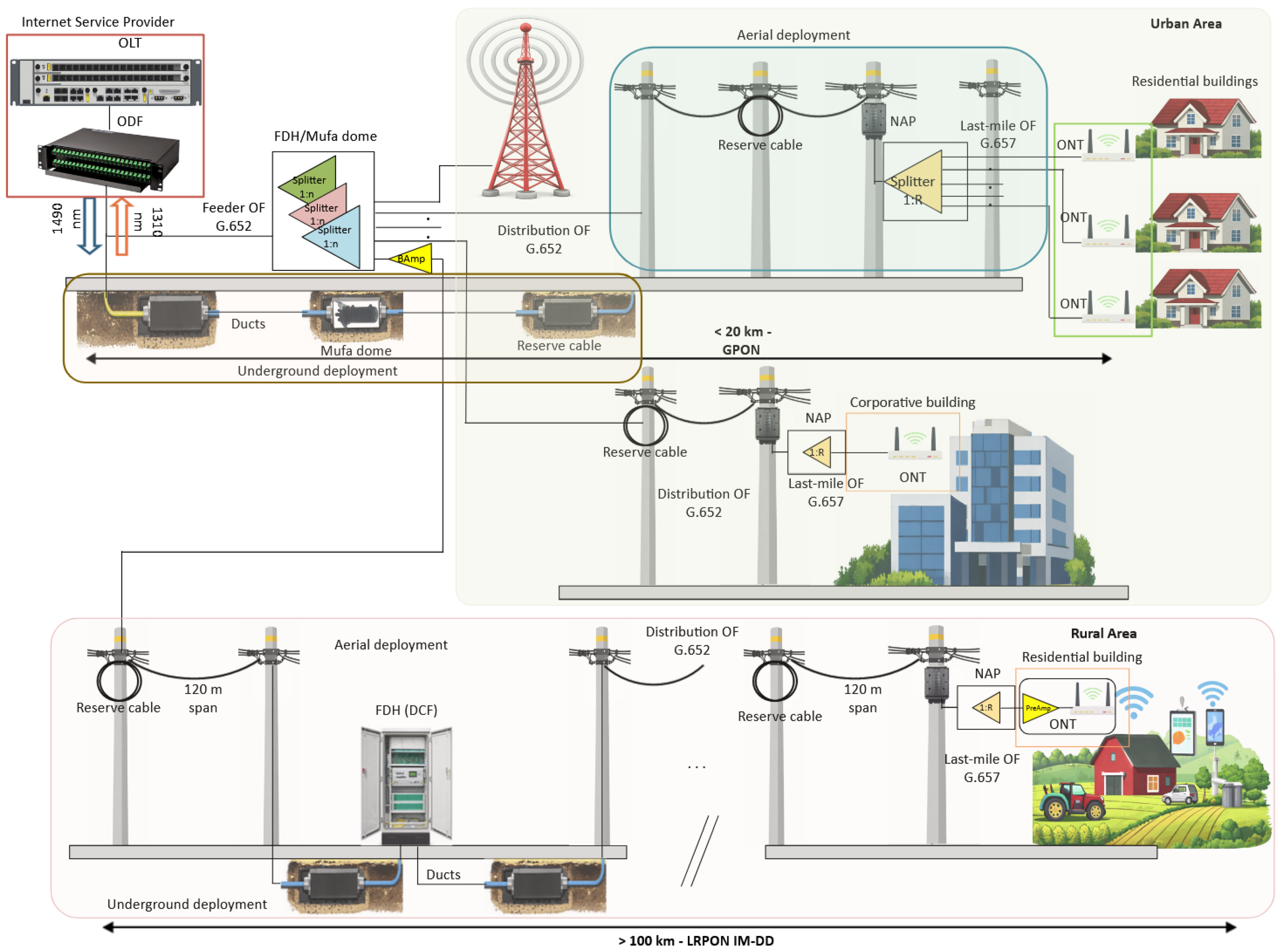
Figure 1. Schematic representation of GPON and LR-PON implementations for providing connectivity in urban and rural areas.
Electronics 15 01502 g001
Figure 2. Block diagram of an IM-DD based LR-PON network.
Electronics 15 01502 g002
Figure 3. Simulation-based system architecture of the IM-DD LR-PON network.
Electronics 15 01502 g003
Figure 4. BER vs. booster amplifier.
Electronics 15 01502 g004
Figure 5. BER vs. DCF, 100 km length.
Electronics 15 01502 g005
Figure 6. BER vs. fiber optic length at 3 and 6 dB attenuation.
Electronics 15 01502 g006
Figure 7. BER vs. SOA-based preamplifier in the receiver.
Electronics 15 01502 g007
Figure 8. Map of broadband service penetration in the province of Pichincha and location of the rural nodes (Yaruquí (orange marker), Checa (purple marker), El Quinche (gray marker.), and Ascázubi (Light blue marker)) with potential application of LR-PONs. The green marks on the map represent the concentration of users served by the internet service provider.
Electronics 15 01502 g008
Table 1. Comparative analysis of GPON, NG-PON2, 50G-PON, and LR-PON technologies [14,15,16,17].
FeaturesGPONNG-PON250G-PONLR-PON
StandardITU-T G.984ITU-T G.989ITU-T G.9804Based on ITU-T G.984.6/G.9807
/G.9804
Transmission RateDS: 2.5 Gbps/
US: 1.25 Gbps
DS: 40 Gbps/
US: 10 Gbps
DS: 50 Gbps/
US: 12.5, 25, 50 Gbps
DS: Up to 100 Gbps/
US: variable
Modulation SchemeOOK/PAM-2OOK, M-PAM, M-PSKM-PSK, M-QAM, OFDMM-PSK, M-QAM
Multiplexing
Technology
TDMTWDMTDM, WDM-TDMTDM, DWDM
User Split Ratio1:641:1281:1281:128 or higher
Typical Distance20 km40 km40 km60–100 km
Optical Amplification-EDFAEDFASOA, EDFA
ApplicationsResidential broadbandSmart cities, 5G backhaulHigh density access, business connectivityRural broadband, Metro-backbone
Legacy Infrastructure CompatibilityHighMediumMediumHigh
Table 2. Comparison between IM-DD-based and coherent LR-PON architectures.
FeatureIM-DD LR-PONCoherent LR-PON
Detection schemeDirect detectionCoherent detection
Modulation formatsOOK, M-PAMM-PSK, M-QAM
DSP requirementsNone/minimalExtensive (CD, equalization)
Terminal complexityLowHigh
Power consumptionLowHigh
Cost per ONTLowHigh
Legacy infrastructures compatibilityHighMedium
Suitability for rural accessHighLimited
Table 3. Comparison of representative LR-PON systems reported in the literature.
ReferenceReach (km)Split RatioBERModulationDetectionKey Components
Proposed Work60–1001:64 10 6 (pre-FEC)OOKIM-DDSOA + DCF, no DSP
[7]1001:512< 10 9 (post-FEC)OOK/PAMIM-DDOptical amplifiers, centralized architecture
[10]501:768 10 3 10 6 (pre-FEC)OOKIM-DDEDFA, Arrayed waveguide grating, no DSP
[13]80-1001:64< 10 3 16-QAMCoherentDSP + coherent receiver
Table 4. Parameter configuration [30,31,32,33,34].
ParameterValue
OLT [30,31,32]
DFB LaserPower: 6 dBm
Intensity Modulator MZM λ : 193.1–193.4 THz
Bandwidth: 40 GHz
BIAS voltage: 2.5 V
Insertion loss: 3.5 dB
Line codePseudo-random NRZ
Nominal rate for λ 25 Gbps
Mux CWDM 4 ch λ : 193.1–193.4 THz
Insertion loss: 1.5 dB
SOA Booster amplifierSmall Signal Gain range: 6–13 dB
Noise Figure: 8.5 dB
ODN [33]
Optical FiberType: Rec. ITU-T G.652.D
Attenuation: 0.2 dB/km
CD: 17 ps/(nm·km)
Length: 20–100 km
Dispersion Statistical Distribution: Uniform
DCFCD: −115 to −130 ps/(nm·km)
Variable Optical AttenuatorAttenuation range: 3–6 dB
ONT [34]
Gaussian Optical FiberBandwith: 50 GHz
SOA PreamplifierGain range: 6–20 dB
Noise Figure: 4.5 dB
APD ReceiverSensitivity: −31 dBm
Gain: 6 dB
Responsivity: 0.8 A/W
Dark current: 10 nA
BER EstimatorStatistical Model: Guassian
Table 5. Underground deployment budget.
DescriptionEstimated UnitsCost (USD)
Materials
Ducted 48-core SM fiber optic cable (Condumex)100,000 m353,000
Duct splice closure 48F, 3M brand243240
Mufa dome type 48 fibers (includes connectors, pigtails, patchcords)1740
Acrylic identifier 12.5 cm × 6 cm20003040
Plastic ties 15 cm4000200
Plastic ties 35 cm5000350
Sleeve (62 mm)1152806.40
Labor and Installation
FO cable fixing in new/existing chambers1000442
Splicing of FO cable (per fiber)230414,976
Reserve cable installation2001600
ODF installation with splicing and tray organization1312
Annual Rental
Annual chamber lease10003710
Total (USD) 382,416.40
Table 6. Aerial deployment budget.
DescriptionEstimated UnitsCost (USD)
Materials
Aerial 48-core optical fiber cable100,000 m386,000
Duct splice closure 48F, 3M243240
NAP 48 fibers (includes connectors, pigtails, patchcords)1740
Acrylic identifier 12.5 cm × 6 cm42006384
Plastic ties 15 cm8400420
Plastic ties 35 cm5000350
Sleeve (62 mm)1152806.40
ADSS retention hardware (120 m span, 2 extensions)20009660
Thimble clevis400017,680
Eriban tape ¾” (30 m roll)1343729.22
Buckles for Eriban tape (¾”)40001320
Helical preformed (up to 120 m span)400018,400
Labor and Installation
FO cable fixing on new/existing poles20001852
Splicing of FO cable (per fiber)230414,976
Reserve cable installation2001600
ODF installation with splicing and tray organization1312
Installation of ADSS retention hardware20006940
Installation of thimble clevis40003160
Installation of preformed accessories40003200
Annual Rental
Annual pole lease200017,660
Total (USD) 498,429.62
Disclaimer/Publisher’s Note: The statements, opinions and data contained in all publications are solely those of the individual author(s) and contributor(s) and not of MDPI and/or the editor(s). MDPI and/or the editor(s) disclaim responsibility for any injury to people or property resulting from any ideas, methods, instructions or products referred to in the content.