Article

Adaptive Robust Tracking Control Based on Real-Time Iterative Compensation

1
Hangzhou Institute for Advanced Study, University of Chinese Academy of Sciences, Hangzhou 310024, China
2
School of Physics and Optoelectronic Engineering, Hangzhou Institute for Advanced Study, University of Chinese Academy of Sciences, Beijing 100049, China
3
Shanghai Institute of Technical Physics, Chinese Academy of Sciences, Shanghai 200083, China
*
Author to whom correspondence should be addressed.
Electronics 2026, 15(7), 1471; https://doi.org/10.3390/electronics15071471
Submission received: 27 February 2026 / Revised: 27 March 2026 / Accepted: 30 March 2026 / Published: 1 April 2026

Abstract

In nanoscale wafer defect inspection, raster scan imaging imposes sub-micrometer requirements on motion stage tracking accuracy, while trajectory changes and load variations pose significant challenges to traditional control methods. This paper proposes a Real-time Iterative Compensation based Adaptive Robust Control (RICARC) strategy. Within this framework, the ARC module incorporates RLS-based online parameter estimation, a PID-type feedback control term, and a robust control term to suppress lumped disturbances. On this basis, the RIC module establishes a discrete prediction model based on the ARC closed-loop system and iteratively generates optimal feedforward compensation signals at each sampling instant to further suppress residual tracking errors. Experimental results across five operating scenarios, including periodic, dual-frequency, and S-curve trajectories, as well as payload variation, and strong external disturbances, demonstrate that RICARC consistently achieves sub-micrometer RMS accuracy ranging from 0.120 to 0.240 μm, reducing RMS errors by over 75% compared with conventional ARC, effectively enhancing imaging quality in nanoscale wafer defect detection systems.

1. Introduction

Wafer defect inspection is a critical step in semiconductor manufacturing, and its detection performance directly affects product quality [1]. At advanced technology nodes (e.g., 3 nm and 5 nm), the critical defects targeted during inspection can be as small as tens to hundreds of nanometers, imposing stringent sub-micrometer requirements on stage tracking accuracy. During image acquisition, the wafer stage must precisely track a specified trajectory while coordinating with a line-scan camera to complete row-by-row scanning imaging. However, minor trajectory tracking errors in the axis orthogonal to the scanning direction can result in row or block misalignment, leading to image stitching errors and degrading detection accuracy. Specifically, when the stage tracking error approaches or exceeds the sub-micrometer level, it becomes comparable in magnitude to the target defect size, rendering critical defects undetectable or causing false alarms that directly compromise inspection reliability. Therefore, achieving high-precision trajectory tracking of the wafer stage is essential, and has attracted considerable research attention [2,3,4].
Precision motion control algorithms typically employ a two-degree-of-freedom control structure combining feedforward and feedback. The feedback component ensures system stability and disturbance rejection, while feedforward compensation enhances system performance [5]. In terms of feedforward strategies, the control performance of inverse-model-based feedforward control algorithms is limited by model uncertainty and non-minimum phase zeros, thereby constraining high-precision trajectory tracking [6]. Parameterized feedforward control algorithms (such as Finite Impulse Response (FIR) filters and Infinite Impulse Response (IIR) filters) use polynomials or rational basis functions to approximate the system inverse model. Although they offer some robustness to trajectory variations, their fixed controller structure limits further improvement in tracking accuracy [7,8,9].
Iterative Learning Control (ILC) is another essential approach for precision motion control. By iteratively updating the feedforward control output through repeated experiments, ILC can achieve asymptotic convergence of tracking errors in the iteration domain under repetitive tasks and stable disturbance conditions, without requiring high model accuracy. However, ILC lacks generalization capability for non-strictly repetitive motion control systems; trajectory variations, non-repetitive disturbances, and measurement noise can all lead to degraded tracking accuracy [10,11,12]. To address these limitations, researchers have proposed various improvement schemes. A Kalman filter-based iterative learning control algorithm was proposed in [13] that uses iteration-varying parameters to reduce the cumulative effect of noise. In [14], a Disturbance Observer (DOB) was introduced to improve the robustness of ILC against external disturbances. Nevertheless, these improved schemes still operate within the ILC framework and fundamentally rely on task repetitiveness. When trajectories vary across trials or disturbances are non-repetitive, the tracking performance of ILC-based methods inevitably degrades.
In contrast to ILC, Real-Time Iterative Compensation (RIC) performs iterative feedforward computation within a single trial in real time, generating optimal compensation signals via an online predictive model without relying on task repetitiveness [15,16,17]. However, its prediction accuracy inherently depends on the system model parameters; when these parameters vary, the compensation performance inevitably degrades. Another approach to enhance robustness in predictive frameworks is to augment the predictor with an integrator for steady-state disturbance rejection [18]; however, this strategy is primarily effective for slowly varying disturbances and does not address time-varying parameter uncertainties.
The aforementioned feedforward methods, including RIC, are all designed based on parameter-invariant models, lacking adaptability to model parameter variations such as payload changes or operating condition fluctuations. Adaptive Robust Control (ARC) possesses excellent parameter adaptation capability and good robustness against external disturbances [19,20,21]. In current research, composite control strategies integrating ARC with other advanced methods have been proposed, such as ILC-type Learning Adaptive Robust Control (LARC) and Gated Recurrent Unit (GRU)-type LARC [22,23,24]. To improve parameter estimation accuracy, indirect adaptive control based on the Recursive Least Squares (RLS) algorithm helps parameters converge to true values [25,26]. In Ref. [27], an indirect adaptive algorithm was combined with ILC in a composite control strategy that reduced system sensitivity to parameter variations during the iterative learning process and achieved high-precision parameter estimation and model compensation. However, it is worth noting that the existing ARC-based composite strategies predominantly employ ILC as their feedforward component, thereby inheriting its fundamental limitation, the reliance on task repetitiveness. Although standalone RIC addresses this limitation by performing iterative compensation within a single trial, its prediction accuracy depends on parameter-invariant models and degrades under payload variations or changing operating conditions. This motivates the integration of ARC with RIC, which performs iterative compensation in real time without requiring task repetitiveness.
Based on the above analysis, this paper proposes the RICARC strategy. The main contributions are summarized as follows:
  • An adaptive robust control module is proposed, which incorporates RLS-based online parameter estimation for adaptive model compensation, a PID-type feedback control term, and a robust control term for lumped disturbance suppression. The three terms work together to ensure closed-loop UUB stability, improve system robustness against parameter variations, and provide a more accurate prediction basis for the RIC module.
  • A real-time iterative compensation module is integrated into the adaptive robust control framework as a plant-injection feedforward term, which establishes a discrete prediction model based on the adaptively compensated closed-loop system and iteratively generates feedforward compensation signals at each sampling instant, effectively suppressing residual tracking errors without relying on task repetitiveness.
  • Through Lyapunov-based stability analysis, the closed-loop system is rigorously proven to achieve uniform ultimate boundedness (UUB) under lumped disturbances, with a tighter stability bound established under persistent excitation conditions.
  • The proposed integrated strategy consistently achieves sub-micrometer RMS accuracy under diverse operating conditions, demonstrating strong robustness and tracking precision.

2. Problem Description

In wafer defect inspection systems, the wafer stage is directly driven by a Permanent Magnet Linear Synchronous Motor (PMLSM) without intermediate mechanical transmission mechanisms, thereby avoiding backlash and elastic transmission errors, and offering advantages such as high positioning accuracy and fast dynamic response.
The current equations of the PMLSM in the d-q coordinate system can be expressed as:
d i q d t = 1 L q u q R L q i q π L d τ L q v i d π τ ϕ L q v d i d d t = 1 L d u d R L d i d + π L q τ L d v i q
where   i d   ,   i q   ,   u d   , and u q are the d-axis and q-axis drive currents and voltages, respectively; v is the motor velocity; L d and L q are the d-axis and q-axis inductances; R is the phase resistance; τ is the motor pole pitch; and ϕ is the permanent magnet flux linkage.
According to the Field-Oriented Control (FOC) vector control principle, setting i d = 0 achieves orthogonality between the excitation magnetic field and the armature magnetic field. From this, the electromagnetic thrust of the motor can be derived:
F e = 3 π ϕ 2 τ i q = K f i q
where K f is the linear motor thrust constant.
In practice, the current loop is internally regulated by the servo driver with sufficiently high bandwidth. Therefore, the servo driver and the current loop are treated as a unified actuator, and the q-axis current command i q is directly used as the control input to the mechanical subsystem. The electrical dynamics in Equation (1) are thus encapsulated within the drive system and need not be explicitly considered in the controller design. Accordingly, the PMLSM-driven wafer stage is modeled as a generalized plant governed by the following mechanical dynamics. Specifically, the dynamic behavior can be approximated as a spring-mass-damper second-order system. The viscous friction of the linear guide dominates the damping effect, while the combined effect of mechanical structural compliance and magnetic reluctance forces introduces an equivalent stiffness. Applying Newton’s second law, the mechanical dynamic equation is:
y ¨ = 1 M F e B y ˙ K y F n l F r i p F e x t F u = 1 M K f i q B y ˙ K y F n l F r i p F e x t F u
where M represents the mass; y represents the displacement, y ˙ the velocity, and y ¨ denotes its acceleration; B is the viscous friction coefficient; K denotes the equivalent stiffness coefficient; F n l represents the nonlinear friction force; F r i p represents the thrust ripple; F u represents the unmodeled dynamic force; F e x t represents the external disturbance.
Taking the drive current as the control input u , i.e., u = i q , the mechanical dynamics of the system can be described as:
M y ¨ + B y ˙ + K y = K f u F s u m F s u m = F n l + F r i p + F e x t + F u
Dividing both sides of (4) by K f leads to
M K f y ¨ + B K f y ˙ + K K f y = u 1 K f F s u m
Define the unknown constant parameters
θ 1 = M K f , θ 2 = B K f , θ 3 = K K f
where θ 1 > 0 .
Let the lumped disturbance be defined as follows:
Δ ( y , t ) = 1 K f F s u m
Therefore, the control-oriented model used for adaptive control can be written as
θ 1 y ¨ = u θ 2 y ˙ θ 3 y + Δ ( y , t )
Regarding the constraints on the lumped disturbance in Equation (8), different assumptions have been adopted in the literature. For example, Cui et al. assumed that the disturbance energy is finite [28], while Wang et al. imposed boundedness conditions on both the disturbance and its time derivative [3]. In practical engineering systems, although the exact values of system parameters and disturbances are unknown, they are generally bounded due to physical limitations. Therefore, the following boundedness assumption is introduced.
Assumption 1.
θ Ω θ { θ : θ min θ θ max } Δ Ω Δ { Δ : | | Δ ( y , t ) | | Δ ¯ }
where   θ min   and   θ max   are known constant vectors defining the bounds of the unknown parameters, Δ ¯ is a known bounding function , and Ω is a bounded set.

3. RICARC Framework

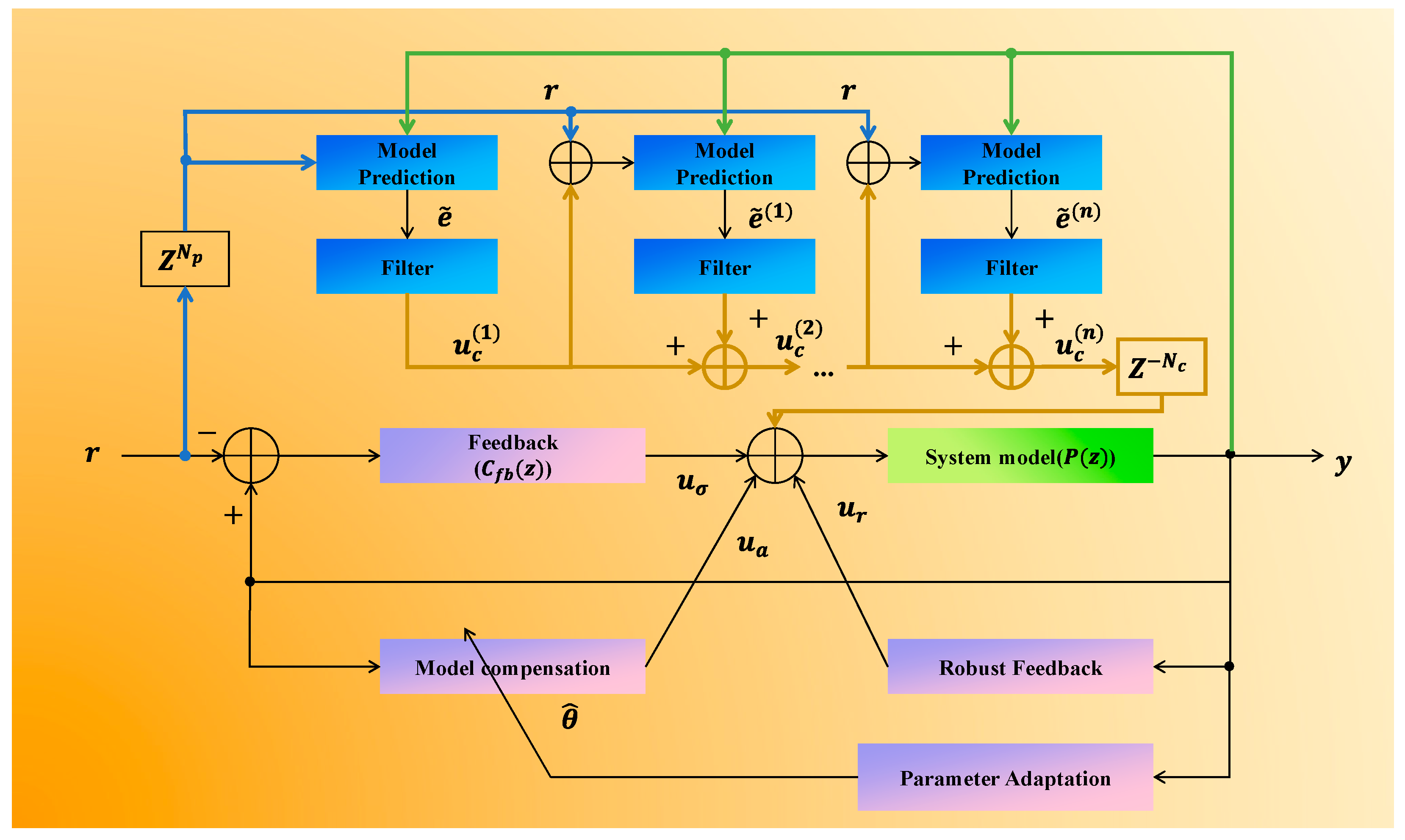
The overall architecture of the proposed Real-time Iterative Compensation based Adaptive Robust Control (RICARC) framework is illustrated in Figure 1. In the figure, P ( z ) denotes the plant model, r is the desired reference trajectory, and y represents the actual system output. The tracking error is defined e   =   y   -   r , which is the quantity to be minimized. In the proposed framework, the control input u consists of four components: an adaptive model compensation term u a , a feedback control term u σ , a robust control term u r , and a real-time iterative compensation term u c .
The detailed design of the adaptive robust controller and the real-time iterative compensation module will be presented in the following subsections.

3.1. Robust Feedback with Adaptive Feedforward

This section presents the adaptive feedback controller design. Nonlinear adaptive robust control combines parameter adaptation with robust compensation to enhance system robustness against parameter uncertainties and external disturbances. To design the parameter adaptation law, consider the nominal system with Δ ( y , t ) = 0 in Equation (8). Defining φ = [ y ¨ y ˙ y ] T , θ = [ θ 1 θ 2 θ 3 ] T , the system equation takes the form of a linear regression model:
u = φ T θ
Based on the regression model, a parameter-adaptive law is constructed to enable online estimation and parameter update. In this paper, a forgetting-factor weighted least-squares algorithm is adopted to update the parameter estimates in real time. By assigning larger weights to recent data, the proposed method improves tracking performance and robustness under varying operating conditions.
To avoid direct differentiation of noisy measurement signals, a Butterworth low-pass filter of at least third order F [ ] is designed to filter the system input and output signals and reconstruct the parameter regression model.
y ¨ f = F [ y ¨ ] y ˙ f = F [ y ˙ ] y f = F [ y ] u f = F [ u ]
where y ¨ f , y ˙ f , y f and u f denote the filtered acceleration, velocity, position, and control input signals, respectively. After filtering, the system is reformulated as:
θ 1 y ¨ f = u f θ 2 y ˙ f θ 3 y f
The linear regression vector is defined as φ f = [ y ¨ f y ˙ f y f ] T , Accordingly, the linear regression model is expressed as:
u f = φ f T θ
Based on the estimated model parameters, the estimated filtered control input is given by:
u ^ f = φ f T θ ^
Define the parameter estimation error as θ ˜ = θ ^ θ . Let the control input estimation error be u ˜ f = u ^ f u f = φ f T θ ^ φ f T θ = φ f T θ ˜ .
Based on the filtered system model and linear regression model above, the recursive least squares algorithm with a forgetting factor is used as the model parameter estimator. The adaptive function ζ and the positive symmetric matrix of adaptive gain Γ ( t ) can be expressed as:
ζ = φ f u ˜ f 1 + ν φ f T Γ φ f
Γ ˙ = α Γ Γ φ f φ f T Γ 1 + ν φ f T Γ φ f , i f λ max ( Γ ( t ) ) ρ max 0 , o t h e r w i s e
where ν 0 is the normalization factor. When ν = 0 it reduces to the unnormalized algorithm; When ν = 1 , it becomes the standard normalized least squares algorithm. The forgetting factor satisfies α > 0 , λ max ( Γ ( t ) ) denotes the maximum eigenvalue of Γ ( t ) , and ρ max is a prescribed upper bound of | | Γ ( t ) | | .
The adaptive law with saturation projection is designed to obtain system parameter estimates:
θ ^ ˙ = s a t θ ^ ˙ max ( Proj θ ^ ( Γ ζ ) ) , θ ^ ( 0 ) Ω θ
θ ^ ˙ max is the predefined upper bound of the parameter update rate. Within the known bounded set Ω θ , the following projection mapping is designed to ensure bounded parameter estimation is:
Proj θ ^ ( i ) = ,     i f θ ^ Ω ¯ θ o r   η θ ^ T 0 ( I Γ η θ ^ η θ ^ T η θ ^ T Γ η θ ^ )     , i f θ ^ Ω θ a n d η θ ^ T 0
where Ω ¯ θ and Ω θ represent the interior and boundary of Ω θ , and η θ ^ represents the outward unit normal vector at θ ^ Ω θ .
The saturation function s a t θ ^ ˙ max ( ) enforces a predefined limit on the parameter update rate to achieve complete separation between parameter adaptation and controller design.
s a t θ ^ ˙ max ( ) = , i f | | | | θ ^ ˙ max θ ^ ˙ max | | | | , i f | | | | > θ ^ ˙ max
Lemma 1
[25,27]. The saturation projection parameter adaptive law of the adaptive robust algorithm based on recursive least squares uses RLS to design the adaptive function and adaptive gain, which guarantees u ^ f L 2 ( 0 , ) L [ 0 , ) and θ ^ ˙ L 2 ( 0 , ) L [ 0 , ) .
To facilitate subsequent controller design and system stability analysis, a tracking error-like variable σ is defined as:
σ ( t ) = e ˙ ( t ) + b 1 e ( t ) + b 2 0 t e ( τ ) d τ
where the tracking error e ( t ) = y ( t ) r ( t ) , b 1 and b 2 are two tuning parameters. By designing b 1 and b 2 to ensure system stability, Note that in this subsection, only the feedback control input is considered, i.e., u = u A R C , as the real-time iterative compensation term u c will be introduced in Section 3.2 as a plant-injection feedforward signal that does not alter the closed-loop feedback dynamics. Substituting Equation (20) into Equation (8):
θ 1 σ ˙ = u A R C θ 2 y ˙ θ 3 y θ 1 r ¨ + θ 1 b 1 e ˙ + θ 1 b 2 e + Δ
Reconstructing the regression vector ψ = [ r ¨ + b 1 e ˙ + b 2 e y ˙ y ] T , the composite controller is designed as:
u A R C = u a + u σ + u r
The ARC controller consists of three terms: u a = ψ T θ ^ is the model compensation term based on parameter estimation, u σ = k σ σ ( k σ > 0 ) is the PID-type feedback control term, u r is the robust controller output.
Let u r = S ( t ) be the robust controller output, and S ( t ) be a designed smooth function satisfying the following conditions:
C 1 : σ S ( t ) 0 ; C 2 : 0 | g ( t ) σ | σ S ( t ) ε
where ε > 0 is an arbitrarily small positive constant, S ( t ) = g ( t ) tanh ( g ( t ) σ ε ) , and g ( t ) | | ψ | | | | θ M | | + Δ ¯ max , θ M = θ max θ min .

3.2. Real-Time Iterative Compensation

The adaptive robust controller designed in Section 3.1 is essentially a feedback-dominant disturbance suppression mechanism: tracking errors can only be detected and compensated by the feedback loop after they have already occurred. This inherent dynamic lag causes residual errors to persist, particularly under high-dynamic trajectories. To overcome this limitation, RIC module is introduced in this subsection, which adds a feedforward compensation signal u c as an external plant-injection feedforward term, yielding the complete composite controller:
u = u A R C + u c = u a + u σ + u r + u c
In this subsection, the RIC part in the proposed adaptive RIC framework is synthesized via system model prediction and optimal feedforward signal generation.
Since real-time iterative compensation (RIC) module operates at the discrete sampling level, the closed-loop model is established in the discrete Z-domain for predictive compensation design. In practical digital implementation, the adaptive robust controller developed in Section 3.1 is discretized with a zero-order hold at sampling period T s . Although the adaptive controller is inherently time-varying due to online parameter updates, the adaptation dynamics are typically much slower than the system sampling rate. Therefore, within each sampling interval, the adaptive parameters can be considered constant. Under this assumption, the closed-loop system can be locally approximated as a linear time-invariant (LTI) system in the Z-domain for predictive analysis. This approximation is refreshed at every sampling instant and only needs to hold within the short prediction horizon of N p sampling periods, ensuring its validity even during transient parameter variations.
From a structural perspective, the feedback component of the adaptive robust controller can be equivalently represented as a discrete-time PID-type feedback controller C f b ( z ) , The robust control term u r , which handles lumped disturbances, is omitted in this linear transfer function analysis, as its magnitude is substantially smaller than that of u a and u σ after parameter convergence, and its residual effect is absorbed into the lumped disturbance term D ( z ) . F ( z ) denotes the adaptive model-based feedforward compensation signal. Consequently, the resulting discrete-time closed-loop system can be expressed as:
Y ( z ) = C f b ( z ) P ( z ) 1 + C f b ( z ) P ( z ) R ( z ) F e e d b a c k   c o n t r o l   t e r m + P ( z ) 1 + C f b ( z ) P ( z ) F ( z ) F e e d f o r w a r d   c o n t r o l   t e r m + P ( z ) 1 + C f b ( z ) P ( z ) D ( z ) d i s t u r b a n c e   t e r m C f b ( z ) = K p + K i T s z z 1 + K d z 1 T s z F ( z ) = u a ( z )
where R ( z ) is the input reference trajectory; Y ( z ) is the actual position output; C f b is the adaptive control analogous PID-type feedback controller; F ( z ) is the feedforward compensation signal; D ( z ) is the lumped disturbance signal; K p , K i , K d are the PID controller gains; and T s is the system sampling time.
For generality, Equation (25) is rewritten in polynomial form:
[ D f b ( z ) D p ( z ) + N f b ( z ) N p ( z ) ] Y ( z ) = N f b ( z ) N p ( z ) R ( z ) + N p ( z ) D f b ( z ) F ( z ) + N p ( z ) D f b ( z ) D ( z )
where D f b , N f b , D p , and N p are the denominator and numerator polynomials of C f b and P , respectively.
Therefore, the actual position output of the system can be represented by a discrete-time domain difference equation:
y ( k ) = i = 1 4 α i y ( k i ) + i = 1 4 β i r ( k i ) + i = 1 4 γ i f ( k i ) + δ ( k ) L u m p e d   d i s t u r b a n c e
where k represents the time instant, and α i , β i , γ i ( i = 1 , 2 , , 4 ) represent coefficients related to the feedback controller parameters and plant model.
Therefore, the discrete state-space equation of the system can be expressed as:
x ( k + 1 ) = A x ( k ) + B r r ( k ) + B f f ( k ) + δ ( k + 1 ) y ( k ) = C x ( k )
where x 4 is the state vector, A 4 × 4 is the state matrix, B r , B f 4 × 1 are the input matrix, C 1 × 4 is the output matrix, and δ 4 is the disturbance vector.
The matrices A , B r , and B f are solved as follows:
The state vector x is defined as:
x ( k ) = [ x 1 ( k ) x 2 ( k ) x 3 ( k ) x 4 ( k ) ] x 1 ( k ) = y ( k ) x j ( k ) = x j 1 ( k ) + g j r ( k 1 ) + h j f ( k 1 )
where g 1 = β 1 , and h 1 = θ 1 . The remaining coefficients g j and h j can be computed recursively as follows:
α 2 α 3 α 4 α 3 α 4 0 α 4 0 0 g 2 g 3 g 4 = β 2 β 3 β 4 , α 2 α 3 α 4 α 3 α 4 0 α 4 0 0 h 2 h 3 h 4 = θ 2 θ 3 θ 4 ,
The state matrix, input matrices, and output matrix are:
A = α 1 α 2 α 3 α 4 1 0 0 0 0 1 0 0 0 0 1 0 B r = g 1 g 2 g 3 g 4 T B f = [ h 1 h 2 h 3 h 4 ] T C = 1 0 0 0
Given the state at time k , the system state from time k to k + N p can be recursively predicted:
x ˜ ( k + 1 ) = A x ˜ ( k ) + B r r ( k ) + B f f ( k ) + δ ˜ ( k + 1 ) y ˜ ( k ) = C x ˜ ( k )
x ˜ ( k ) is the predicted system state vector. Through recursive computation, the position output at time k + N p is:
y ˜ ( k + N p ) = C A N p x ( k ) + i = 0 N p 1 C A N p i 1 B r r ( k + i ) + i = 0 N p 1 C A N p i 1 B f   f ( k + i ) + C i = 1 N p A N p i δ ˜ ( k + i )
Within one prediction horizon, only the adaptive model-based compensation signal is assumed to remain constant, i.e., u a ( k + i ) = u a ( k ) , i = 1 , 2 , , N p . This assumption is justified since the adaptive parameter update dynamics evolve at a much slower time scale compared with the prediction horizon. For the design of the real-time iterative compensation, a single compensation signal u c ( k + N c ) within the prediction horizon is selected as the design variable to regulate the predicted output.
The changes in system control output caused by parameter variations and other disturbances within the prediction interval are assumed to be lumped disturbances. According to Assumption 1, the lumped disturbance and its derivative are bounded. Given that the prediction horizon N p is finite and the sampling period T s is sufficiently small, the disturbance variation within the prediction interval is limited. This slow-variation assumption within a short prediction window is commonly adopted in predictive compensation frameworks for precision motion systems [15]. Since future system disturbances are unavailable, the lumped disturbance is assumed to remain approximately constant within the prediction horizon k k + N p , and is approximated as:
δ ˜ ( k + i ) δ ( k ) , i = 1 , 2 , N p
where the current disturbance estimate is computed as
δ ( k ) = x ( k ) A x ( k 1 ) B r r ( k 1 ) B f   f ( k 1 )
According to Equation (32), the output at time k + N p can be recursively predicted. Changes in the future feedforward control signal f ( k + i ) affect predicted position output. Therefore, real-time iterative feedforward compensation signal is introduced to regulate the control output.
The position output Equation (27) can be rewritten using polynomial operators as:
y ( k + N p ) = A ( z ) y ( k + N p 1 ) + B r r ( k + N p 1 ) + B f f ( k + N p 1 ) + δ ( k + N p )
where A ( z ) , B r ( z ) , and B f ( z ) denote polynomial operators in z 1 , defined as
A ( z ) = α 1 + α 2 z 1 + α 3 z 2 + α 4 z 3 B r ( z ) = β 1 + β 2 z 1 + β 3 z 2 + β 4 z 3 B f ( z ) = γ 1 + γ 2 z 1 + γ 3 z 2 + γ 4 z 3
At times k + N c ( 0 < N c N p 1 ) , the feedforward compensation input u c is added. The increase in the position output signal Δ y ( k + N p ) at time k + N p introduced by u c can be expressed as:
Δ y ( k + N p ) = A ( z ) Δ y ( k + N p 1 ) + B ^ f ( z ) u c ( k + N c )
where B ^ f ( z ) = γ N p N c + γ N p N c + 1 z 1 + + γ 4 z [ 4 ( N p N c ) ] . Therefore, Equation (38) the increase in the position output signal Δ y ( k + N p ) at time k + N p can be modified as:
Δ y ( k + N p ) = B ^ f ( z ) 1 z 1 A ( z ) u c ( k + N c ) W ( z ) u c ( k + N c )
where W ( z ) denotes the equivalent closed-loop transfer function from the feedforward compensation signal to the output increment.
Equation (39) describes the relationship between the position increment and the feedforward compensation signal uc. Without feedforward compensation u c , the trajectory tracking error of the system at time k + Np is:
e ( k + N p ) = r ( k + N p ) y ( k + N p ) = e ( k + N p )
At the time k + N c , adding feedforward compensation u c ( k + N c ) , the system tracking error after compensation is:
e ^ ( k + N p ) = r ( k + N p ) y ( k + N p ) Δ y ( k + N p ) = e ( k + N p ) W ( z ) u c ( k + N c )
Assuming perfect prediction accuracy, i.e., e ˜ ( k + N p ) = e ( k + N p ) , the prediction error can be used to construct the first iterative compensation signal:
u c 1 ( k + N c ) = γ Q ( z ) L ( z ) e ˜ ( k + N p )
γ is the constant compensation gain, Q ( z ) is the robust filter, and L ( z ) is the learning filter. After adding the initial feedforward real-time iterative compensation u c 1 , the system predicted tracking error is:
e ^ 1 ( k + N p ) = e ( k + N p ) γ W ( z ) L ( z ) Q ( z ) e ˜ ( k + N p ) ( 1 γ W ( z ) L ( z ) Q ( z ) ) e ( k + N p )
Ideally, if the learning filter L ( z ) = W 1 ( z ) , the tracking errors could be completely eliminated. However, due to non-minimum phase effects, u c 1 cannot completely compensate for tracking errors. The second iterative compensation signal is then given by:
u c 2 ( k + N c ) = u c 1 ( k + N c ) + γ Q ( z ) L ( z ) e ˜ 1 ( k + N p )
The tracking error after compensation is:
e ^ 2 ( k + N p ) = e ^ 1 ( k + N p ) γ W ( z ) Q ( z ) L ( z ) e ˜ 1 ( k + N p ) = ( 1 γ W ( z ) Q ( z ) L ( z ) ) 2 e ( k + N p )
Following this recursion, the n t h feedforward real-time iterative compensation signal is:
u c n ( k + N c ) = u c n 1 ( k + N c ) + γ Q ( z ) L ( z ) e ˜ n 1 ( k + N p )
The n t h tracking error is:
e ^ n ( k + N p ) = e ^ n 1 ( k + N p ) γ W ( z ) Q ( z ) L ( z ) e ˜ n 1 ( k + N p ) = ( 1 γ W ( z ) Q ( z ) L ( z ) ) n e ( k + N p )
According to the monotone convergence theorem | | 1 γ W ( z ) Q ( z ) L ( z ) | | < 1 [29], the learning filter L ( z ) is designed as a stable approximate inverse of W ( z ) , using the Zero Phase Error Tracking Controller (ZPETC) method, this approach e inverts the minimum-phase part and mirrors the non-minimum-phase zeros to ensure the stability of the inverse model. To avoid high-frequency noise amplification in the compensation signal, L ( z ) is cascaded with a low-pass robust filter Q ( z ) , whose cutoff frequency is selected based on a trade-off between compensation performance and noise attenuation. The compensation gain γ is tuned within the range permitted by the stability condition to adjust the convergence rate of the online iterative process.

3.3. Closed-Loop Stability Analysis

The stability analysis of the proposed RICARC framework proceeds in four steps. Step 1 establishes UUB of the ARC closed-loop and determines the parameter design conditions. Step 2 verifies the validity of the equivalent decomposition assumption and the closed-loop stability of the feedback part, establishing the discrete prediction model. Step 3 proves RIC convergence in the discrete domain and establishes the boundedness of un. Step 4 proves UUB of the complete RICARC system.
  • Step 1: UUB of ARC Closed-Loop
Consider the ARC law alone, i.e., u = u A R C = u a + u σ + u r . For ∀t ≥ 0, define the Lyapunov function:
V 1 = 1 2 θ 1 σ 2
Substituting u = u A R C into Equation (21),
V ˙ 1 = σ ( u + ψ T θ ^ + Δ ) = k σ σ 2 + σ ( ψ T θ ˜ + Δ S ( t ) )
Since g ( t ) | | ψ | | | | θ M | | + Δ ¯ max , it follows that:
ψ T θ ˜ + Δ | | ψ | |       | | θ M | | + Δ ¯ max g ( t )
Therefore σ ( ψ T θ ˜ + Δ ) | g ( t ) σ | . By the hyperbolic tangent inequality [30]:
0 | g ( t ) σ g ( t ) σ tanh ( g ( t ) σ ε ) | k 1 ε
where k 1 is the solution of k 1 = e ( k 1 + 1 ) , which gives k 1 = 0.2785 , and ε 1 = k 1 ε .
V ˙ 1 k σ σ 2 + g ( t ) σ g ( t ) σ tanh g ( t ) σ ε k σ σ 2 + ε 1
Let k = k σ θ 1 , max > 0 . Since θ 1 θ 1 , max , we have V a 1 2 θ 1 , max σ 2 , Equation (52) becomes:
V ˙ 1 k V 1 + ε 1
By designing k σ > 0 , b 1 > 0 and b 2 > 0 to ensure k > 0 , V ˙ 1 < 0 whenever V 1 > ε 1 / k , which implies UUB of σ . With appropriate b 1 and b 2 , e is also ultimately bounded:
lim sup t | σ ( t ) | 2 ε 1 θ 1 , max k σ θ 1 , min
lim sup t | e ( t ) | e ¯
All signals including σ ,   e ,   y ˙ ,   y ,   ψ ,   u r ,   u σ ,   u a are bounded. In particular, the robust term satisfies:
| u r ( t ) | = | S ( t ) | g ( t ) ψ θ M + Δ ¯ max <
  • Step 2: Validity of the Discrete Prediction Model
The discrete prediction model (Equations (25)–(28)) is built upon the following equivalent decomposition of the ARC law:
u A R C = u σ feedback   C f b ( z ) + u a feedforward   F ( z ) + u r absorbed   into   δ ( k )
This step verifies two things: (i) the validity of this decomposition assumption; (ii) the closed-loop stability of the feedback part under this assumption.
(i) Validity of the assumption:
From Step 1, u r is bounded (Equation (56)). Therefore u r can be legitimately treated as a bounded disturbance input and absorbed into the lumped disturbance term δ ( k ) in the discrete state-space model (Equation (28)), which remains bounded:
δ ( k ) δ ¯ <
The adaptive feedforward u a = ψ T θ ^ compensates the known model dynamics, and its contribution is captured in the feedforward term F ( z ) = u a ( z ) of the discrete model (Equation (25)). The equivalent decomposition assumption is therefore valid.
(ii) Closed-loop stability of the feedback part:
Under this decomposition, u r is treated as a bounded disturbance input d ( t ) = ψ T θ ˜ + Δ S ( t ) , and the feedback system driven by u σ alone satisfies:
θ 1 σ ˙ = k σ σ + d ( t )
With k σ > 0 , the homogeneous system θ 1 σ ˙ = k σ σ is exponentially stable. Since d ( t ) is bounded, the bounded-input bounded-output property
Guarantees σ is bounded. Combined with b 1 > 0 , b 2 > 0 , the error dynamics:
e ¨ + b 1 e ˙ + b 2 e = σ ˙
with bounded input σ ˙ yields bounded e This corresponds to all poles of 1 + C f b ( z ) P ( z ) lying inside the unit circle under ZOH discretization, making the process sensitivity function:
S p ( z ) = P ( z ) 1 + C f b ( z ) P ( z )
well-defined and stable.
Remark 1.
Since u c is a plant-injection feedforward signal, it enters only the numerator of the closed-loop response and does not appear in the characteristic equation 1 + C f b ( z ) P ( z ) = 0 . Therefore, u c does not alter the closed-loop stability established here, and S p ( z ) remains stable in the presence of u c .
  • Step 3: Discrete-Time RIC Convergence and Boundedness of u c
Based on the stable S p ( z ) established in Step 2, the RIC convergence is analyzed entirely in the discrete-time domain, following the framework of Zhou et al. [16]. With N p = 2 , N c = 1 , W ( z ) = S p ( z ) as derived in Equation (39). The tracking error after RIC satisfies:
e ^ = e S p u c
The iterative compensation relation gives:
u c ( n ) = u c ( n 1 ) + γ Q ( z ) L ( z ) e ˜ ( n 1 ) = u c ( n 1 ) + γ Q ( z ) L ( z ) e ^ ( n 1 ) Δ ( n 1 )
where Δ = e ^ e ˜ is the prediction deviation. Substituting into Equation (62):
e ^ ( n ) = ( I γ S p L ) e ^ ( n 1 ) + γ S p L Δ ( n 1 )
Since the prediction deviation is bounded by Δ 2 ε under the slow-varying disturbance assumption, under the convergence condition σ ¯ = σ max ( I γ S p L ) < 1 :
e ^ ( n ) 2 σ ¯ n e ^ ( 0 ) 2 + 1 + σ ¯ 1 σ ¯ ε
The tracking error sequence converges to a bounded residual set.
Boundedness of u c : From the iterative relation, the final compensation signal satisfies u c ( n ) ( k + N c ) = F e ( k + N p ) , where F = γ L Q i = 0 n 1 ( 1 γ L Q W ) i . Under the convergence condition, F is bounded.
Since the RIC module is designed to reduce tracking error, under the convergence condition σ ¯ < 1 :
| e with   u c ( k ) | | e without   u c ( k ) | e ¯
Therefore, the error bound e ¯ established in Step 1 remains a valid conservative upper bound for the complete system. It follows that:
| u c ( k T s ) | F e ¯ u ¯ c , k
This bound depends only on the RIC design parameters and e ¯ from Step 1, established independently of the Lyapunov analysis in Step 4, thus avoiding circular reasoning. Specifically, e ¯ is determined by Equations (54) and (55), which depends only on   k σ ,   ε ,   θ 1 , min ,   θ 1 , max ,   b 1 ,   b 2 , all ARC design parameters established in Step 1, prior to and independent of the Lyapunov analysis in Step 4. Via ZOH, u c ( t ) = u c ( k T s ) for t [ k T s , ( k + 1 ) T s ) , hence:
| u c ( t ) | u ¯ c , t 0
  • Step 4: UUB of Complete RICARC System
With | u c ( t ) | u ¯ c established independently in Step 3, the complete system u = u A R C + u c is now analyzed using the Lyapunov function
V a = 1 2 θ 1 σ 2
The validity of this continuous-time analysis for the hybrid implementation rests on the following observation: since | u c ( t ) | u ¯ c holds for all t 0 regardless of the discrete nature of u c it enters the stability analysis solely as a known bounded external input. No discrete signal is substituted directly into the continuous differential equation. Consequently, V ˙ a is well-defined on each open interval [ k T s , ( k + 1 ) T s ) , and the inequality derived below holds almost everywhere, rendering the UUB conclusion rigorous.
The time derivative under the complete control law is:
V ˙ a = σ ( u + ψ T θ ^ + Δ ) = k σ σ 2 + σ ( ψ T θ ˜ + Δ S ( t ) ) + σ u c
From Step 1, the first two terms satisfy:
k σ σ 2 + σ ψ T θ ˜ + Δ S ( t ) k σ σ 2 + ε 1
Since | u c ( t ) | u ¯ c is established in Step 3, applying Young’s inequality to the cross term σ u c :
| σ u c | | σ | u ¯ c k σ 2 σ 2 + u ¯ c 2 2 k σ
Combining Equations (71) and (72):
V ˙ a k σ σ 2 + g ( t ) σ g ( t ) σ tanh g ( t ) σ ε + k σ 2 σ 2 + u ¯ c 2 2 k σ k σ 2 σ 2 + ε 1 + u ¯ c 2 2 k σ
Equation (73) becomes:
V ˙ a k V a + ε 2
where ε 2 = ε 1 + u ¯ c 2 2 k σ . By properly designing k σ such that k > 0 is positive, V ˙ a < 0 whenever V a > ε 2 / k , which implies the boundedness of σ . Designing appropriate b 1 and b 2 can achieve bounded e . Therefore, the overall RICARC closed-loop system is uniformly ultimately bounded, with the ultimate bound determined by both the lumped disturbance magnitude and the feedforward compensation amplitude.
Similarly, when only parameter uncertainty exists, i.e., Δ ( y , t ) = 0 , redefine the Lyapunov function:
V 2 = V a + 1 2 Δ θ ˜ T Γ 1 Δ θ ˜
V ˙ 2 = k σ σ 2 + σ ( ψ T θ ˜ + u c S ( t ) ) + θ ˜ T Γ 1 θ ˜ ˙
which gives:
V ˙ 2 k σ 2 σ 2 σ ψ T θ ˜ + θ ˜ T Γ 1 θ ˜ ˙ + u ¯ c 2 2 k σ
Applying Young’s inequality again to the cross term σ ψ T θ ˜ :
| σ ψ T θ ˜ | k σ 4 σ 2 + ( ψ T θ ˜ ) 2 k σ
By the property of the projection operator (Lemma 1), one has θ ˜ T Γ 1 θ ˜ ˙ θ ˜ T ζ 0 . Under the PE condition, the RLS adaptive law guarantees θ ˜ 0 as t , and by the C1 condition σ S ( t ) 0 , then:
V ˙ 2 k σ 4 σ 2 + u ¯ c 2 2 k σ
This yields a strictly tighter ultimate bound than Part 1. Since V 2 1 2 θ 1 , min σ 2 , the condition V 2 u ¯ c 2 k σ 2 · 2 k σ 2 = u ¯ c 2 θ 1 , max k σ 2 implies | σ | u ¯ c 2 θ 1 , max k σ 2 θ 1 , min . Noting that θ 1 , min and θ 1 , max are known constants from Assumption 1, taking the limsup gives:
lim sup t | σ ( t ) | u ¯ c 2 θ 1 , max k σ θ 1 , max
By designing k σ sufficiently large, this residual bound can be made arbitrarily small. By Designing appropriate b 1 and b 2 , e is also ultimately bounded within an arbitrarily small neighborhood of zero. Therefore, under parametric uncertainty only with the PE condition satisfied, the system achieves a tighter UUB.
Remark 2.
The stability analysis establishes a hierarchical guarantee for RICARC. In the general case with both parametric uncertainties and external disturbances, the system achieves UUB with the error variable ultimately satisfying:
lim sup t | σ ( t ) | 2 ϵ 2 θ 1 , max k σ θ 1 , min , ε 2 = ε 1 + u ¯ c 2 2 k σ
where ε 1 reflects the lumped disturbance magnitude and u ¯ c , the feedforward compensation amplitude. When external disturbances vanish and the PE condition is satisfied, ε 1 is eliminated and Equation (80) yields the tighter UUB. Although asymptotic stability is not established, the residual bound can be made arbitrarily small by increasing k σ , approaching asymptotic behavior in practice. Beyond these guarantees, the two modules reinforce each other: RLS convergence θ ˜ 0 improves RIC prediction fidelity and reduces u ¯ c , which in turn tightens the bound; conversely, RIC reduces the tracking error e further improves the slow-varying property of δ ( k ) . This convergent feedback loop between the two modules, rather than simple superposition, explains the substantially lower tracking errors of RICARC compared to ARC or RIC alone, particularly under payload variation where parametric adaptation is most critical. It is worth noting that the persistent excitation condition is generally satisfied in practice when the reference trajectory contains sufficiently rich frequency content [25,27].

4. Experimental Results and Analysis

4.1. Experimental Setup and Model Identification

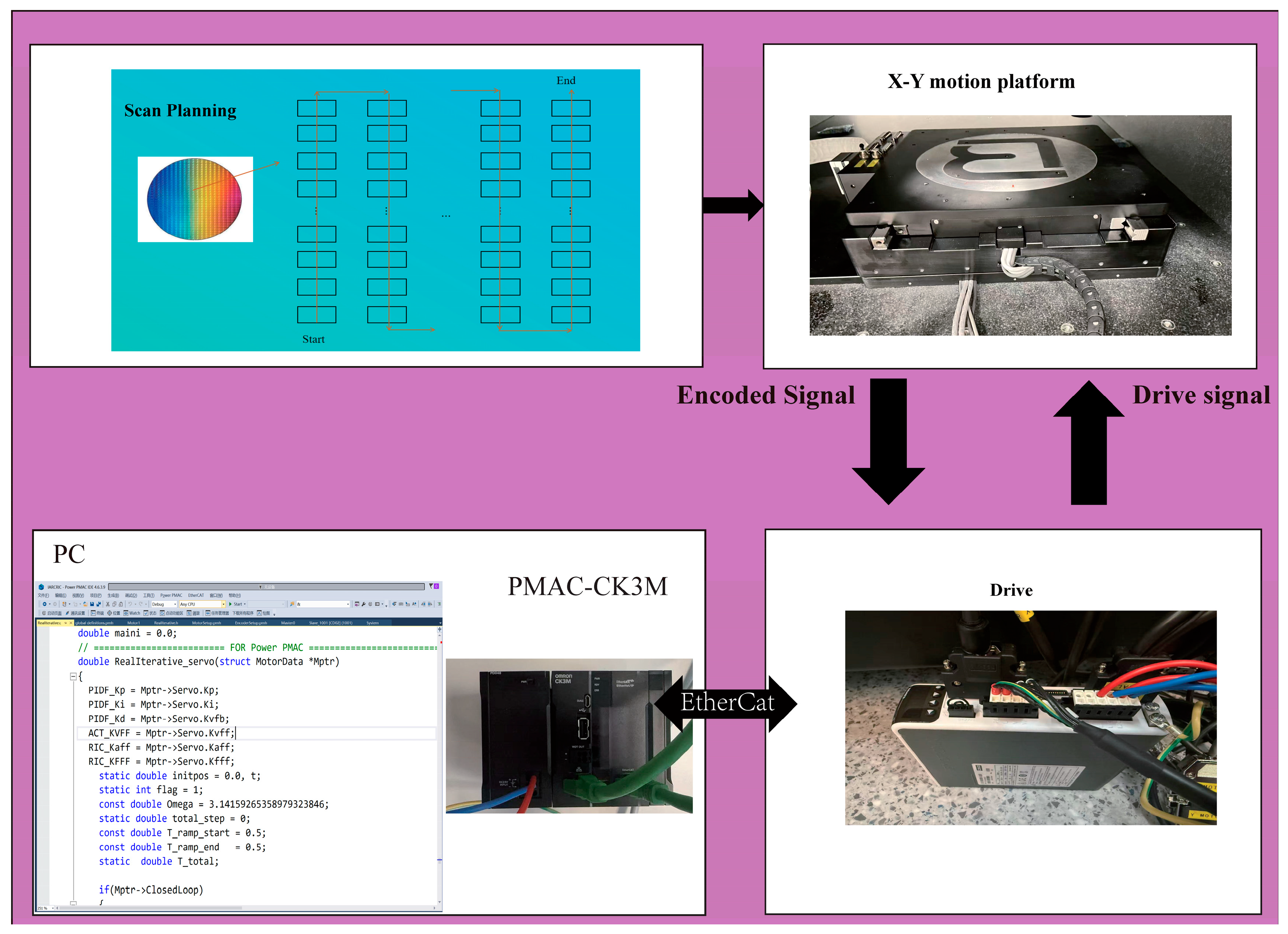
To validate the effectiveness of the proposed RICARC strategy, experimental verification is conducted on a wafer defect detection motion platform. The experimental system structure is shown in Figure 2. The platform consists of an X-Y precision motion stage driven by dual-axis PMSLMs, with the Y-axis used for high-speed scanning and the X-axis used for stepwise positioning. This paper focuses on the verification of the Y-axis control performance, with the X-axis kept stationary during the experiments. The control system adopts a master-slave architecture, with the master controller being the Omron Power-CK3M (Omron Corporation, Kyoto, Japan) and the slave being the Y-axis PMSLM servo driver. High-speed real-time communication between the master and slave is conducted via the EtherCAT bus. The controller executes the RICARC algorithm in each sampling period, and the calculated current command signals are sent to the servo driver via the EtherCAT bus. The driver operates in cyclic synchronous torque (CST) mode, converting the commands into motor thrust to achieve closed-loop position control of the Y-axis. Unlike soft real-time asynchronous implementations [31], the Power PMAC real-time program provides a hard real-time, deterministic execution environment, ensuring that all algorithm modules complete synchronously within each servo cycle, thereby guaranteeing the real-time performance of the closed-loop control.
A swept-frequency-based frequency response identification method is employed to obtain the system Bode plot, from which the following linear transfer function model from servo output to position is fitted:
G P ( s ) = 1.62 s 2 + 2.04 s + 2.625
Through dynamic analysis and model pre-identification of the wafer stage, the initial values of model parameters are obtained as θ 0 = [ 0.4 1.3 1 ] ; the lower bound is θ min = [ 0.3 0.8 0 ] ; and the upper bound is θ max = [ 2 1.4 5 ] . The sampling frequency is f s = 4 kHz .

4.2. Experimental Design

To comprehensively evaluate the control performance of the proposed method, the following four controllers are selected for comparative experiments:
  • RICARC: The proposed Recursive Least Squares-based Adaptive Robust Control with Real-time Iterative Compensation algorithm proposed in this paper. It combines the indirect adaptive strategy with a real-time iterative compensation mechanism. Adaptive controller parameters are designed as: b 1 = 20218 , b 2 = 56000 , k σ = 300 , θ ^ ˙ max = 5000 , forgetting factor α = 0.95 , normalization factor ν = 0.1 , and the maximum eigenvalue of adaptive gain Γ is ρ max = 50000 , ε = 0.01 . Parameters g ( t ) and S ( t ) are designed according to Equation (23) in Section 3.1. The model parameter estimation uses measured position signals, which inevitably contain measurement noise. Therefore, the filter F [ ] is designed as a fourth-order Butterworth low-pass filter with a cutoff frequency of 100 Hz, selected based on a trade-off among system dynamics, measurement noise, and sampling frequency. Its transfer function is:
    F [ s ] = w c 4 s 4 + h 1 w c s 3 + h 2 w c 2 s 2 + h 3 w c 3 s 1 + w c 4
    where h 1 = 2.613 , h 2 = 3.4142 , and h 3 = 2.613 . The real-time iterative compensation parameters are configured as follows: in order to guarantee the optimal prediction performance the model prediction horizon is N p = 2 , N c = 1 , the compensation signal passes through a low-pass filter Q c with a cutoff frequency of 100 Hz, the compensation gain is tuned as γ = 2.3 , and the iteration step is n = 4 for error convergence. The iteration number n is deliberately kept small to limit the computational load within each sampling period, ensuring that all algorithm modules complete synchronously within the servo cycle of the Power PMAC hard real-time platform.
  • PIDFF: Model-based PID feedforward control algorithm. The controller parameters are tuned using MATLAB R2022a’s PID tuning tool. The PID gains are: K p = 20 , 218 , K i = 56 , 000 , K d = 300 . The model-based feedforward gains are tuned as: θ 1 = 0.4 , θ 2 = 1.3 .
  • RIC: Real-time Iterative Compensation control algorithm. This controller employs a fixed-parameter PID-type feedback controller as the base closed-loop system, upon which the real-time iterative compensation mechanism is applied as a plant-injection feedforward term.
  • ARC: Adaptive Robust Control based on Recursive Least Squares with forgetting factor. Its parameter configuration is consistent with the adaptive robust control part in RICARC.
The control parameters of the four control algorithms are adjusted according to their respective parameter tuning rules. The maximum absolute tracking error and the root mean square (RMS) of the tracking error are adopted as quantitative evaluation metrics for assessing control strategy performance:
e max = max 1 i N ( | e i | )
e r m s = 1 N i = 1 n e i 2
where e i represents the tracking error at i th sampling instant, N is the total number of sampling points, e max characterizes the worst-case tracking performance, and e r m s reflects the overall tracking accuracy throughout the motion process.

4.3. Experimental Results

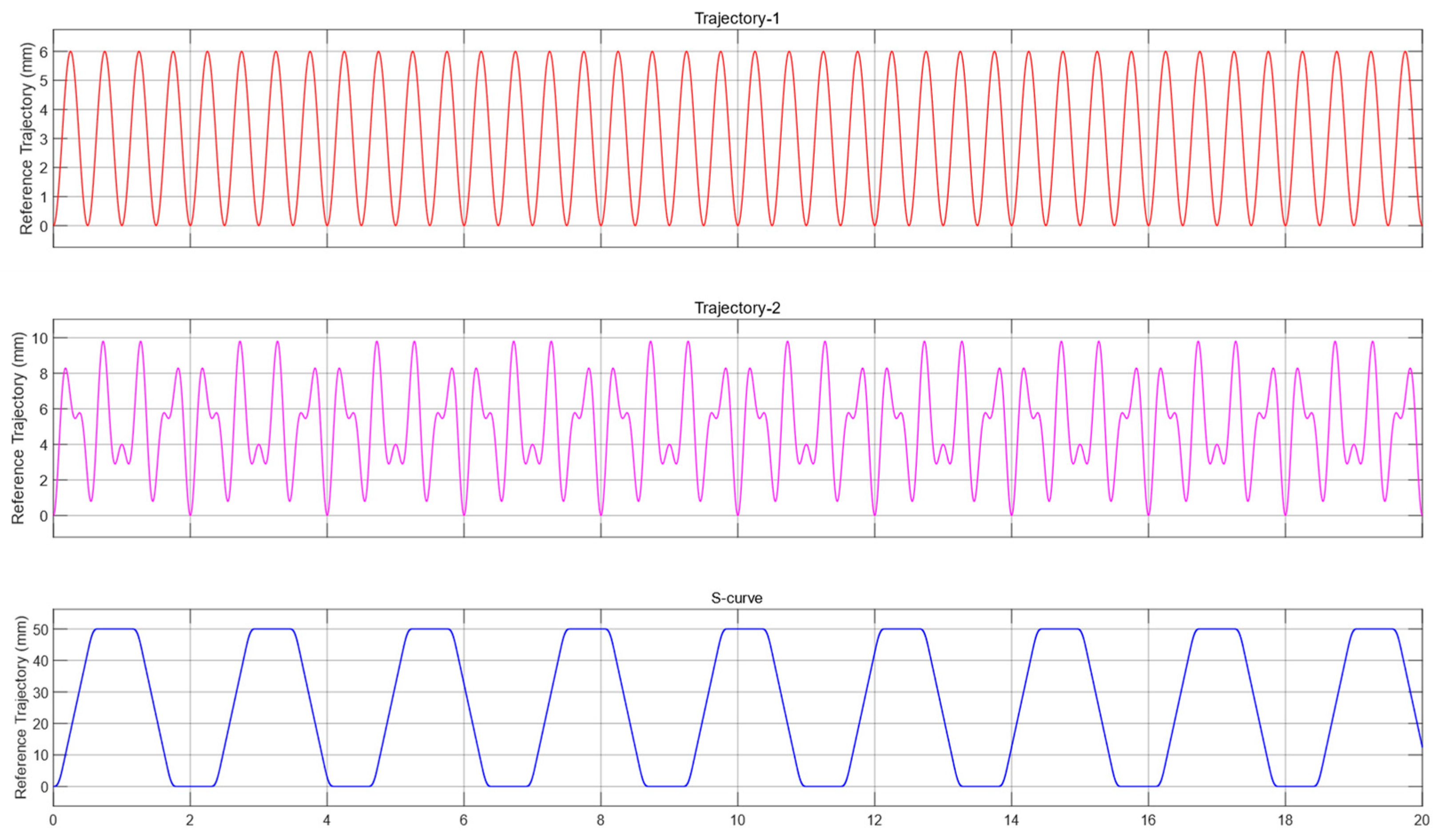
To comprehensively evaluate the performance of the proposed RICARC algorithm, four tracking experiments are designed. Cases 1–3 test the motion stage under three different reference trajectories, as shown in Figure 3: a single-frequency periodic trajectory (Trajectory 1), a dual-frequency periodic trajectory (Trajectory 2), and a fourth-order S-curve trajectory (Trajectory 3). Case 4 verified the adaptive capability under payload variations by adding additional mass blocks to the wafer stage.
  • Trajectory 1:
r ( t ) =   3 ( 1     cos ( 4 π t ) )   ( mm )
  • Trajectory 2:
r ( t ) =   3 ( 1     cos ( 4 π t ) ) + 2 ( 1     cos ( 7 π t ) )   ( mm )
  • Trajectory 3: S-curve
A fourth-order S-curve trajectory is selected as the reference input, with a reciprocating motion range of 0–50 mm, a maximum velocity of 100 mm/s, and a maximum acceleration of 1000 mm/s2.
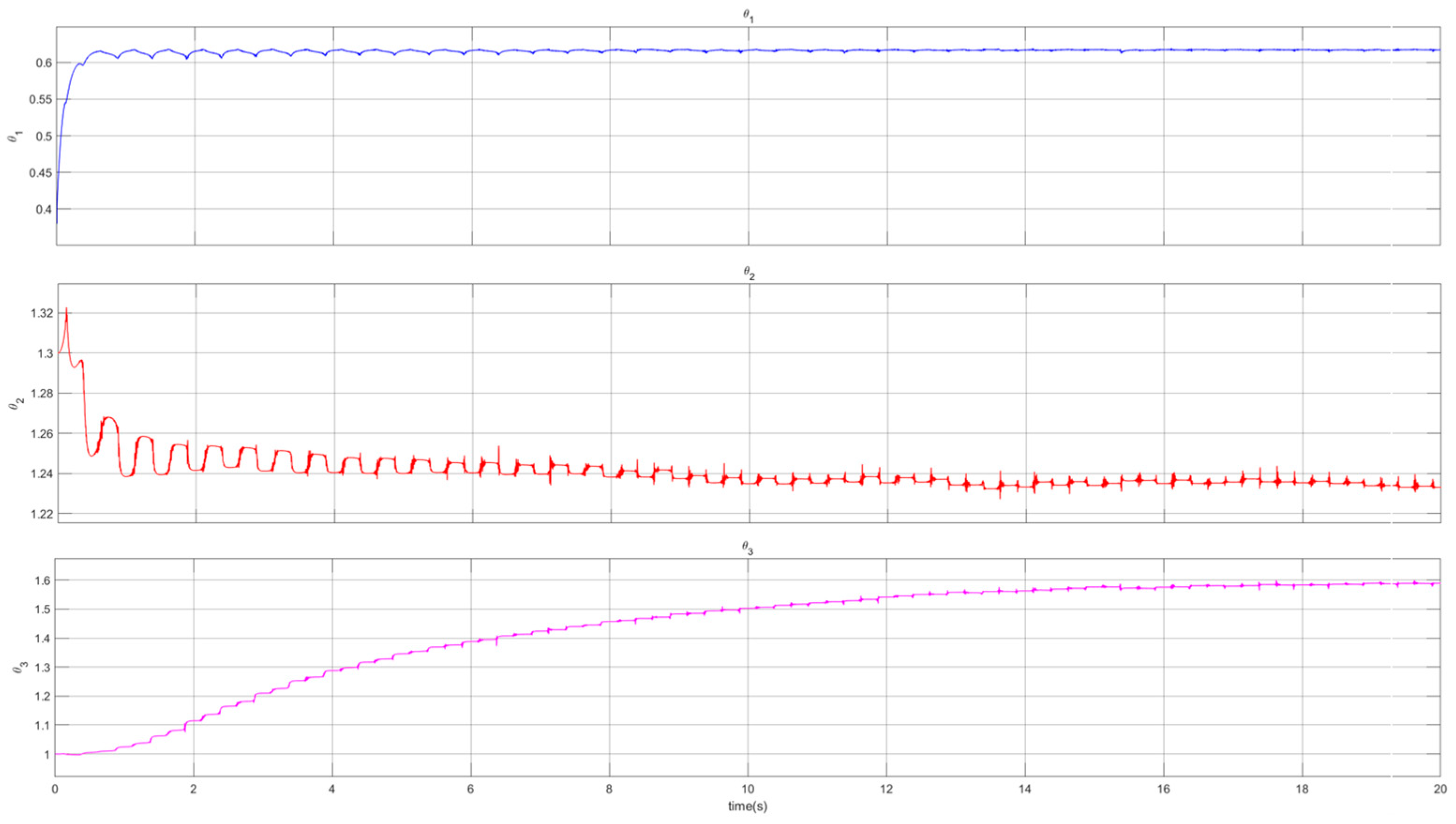
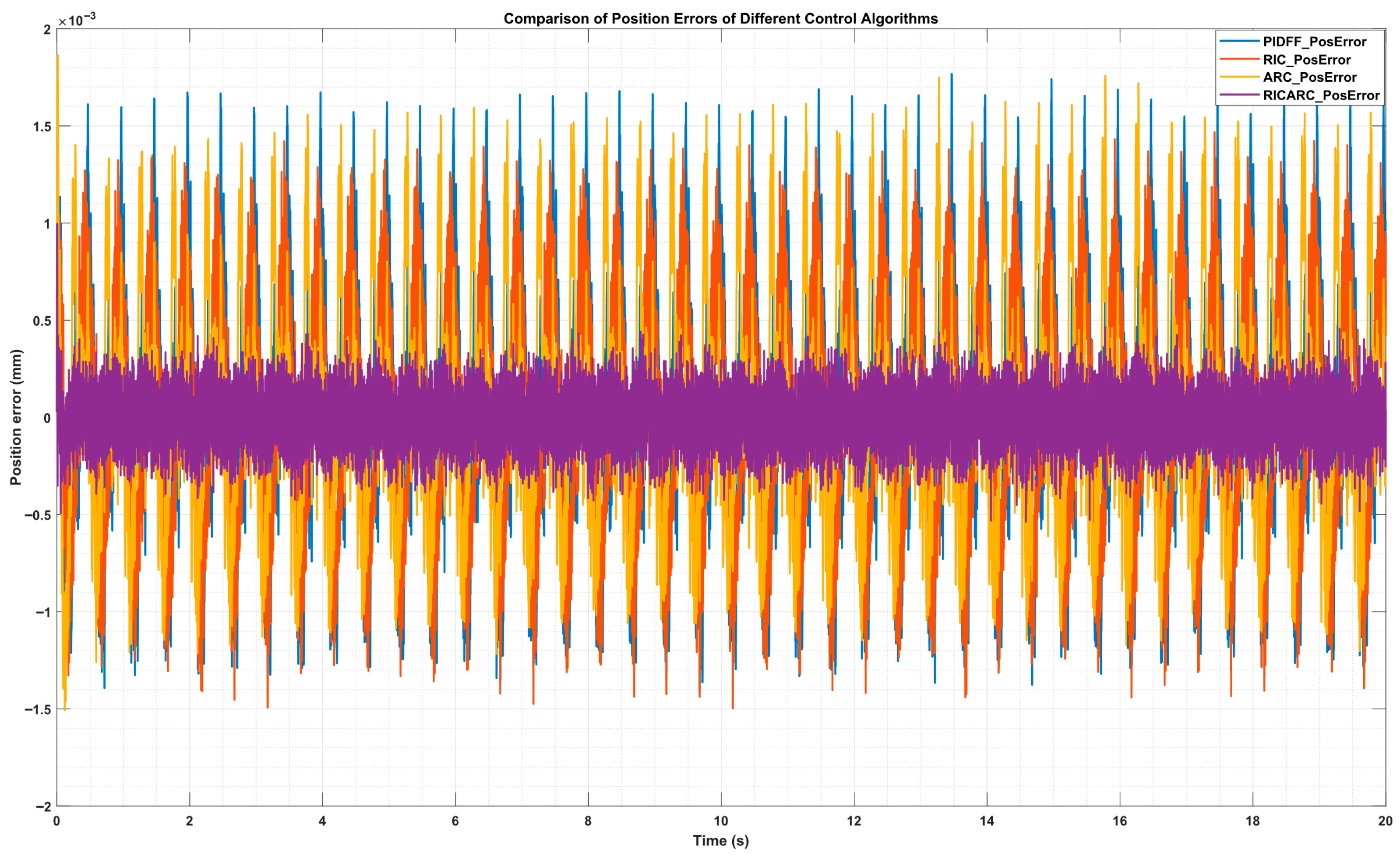
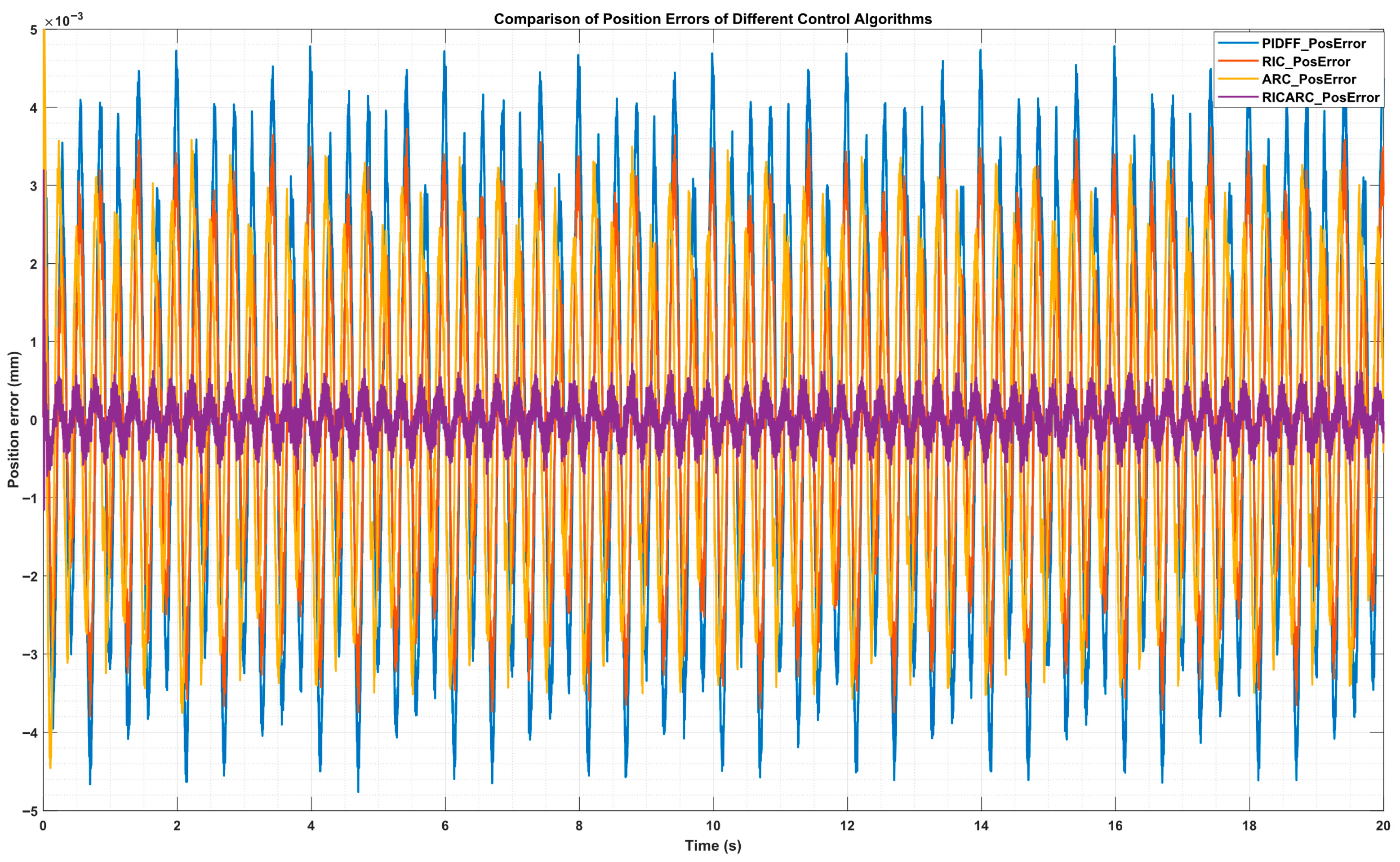
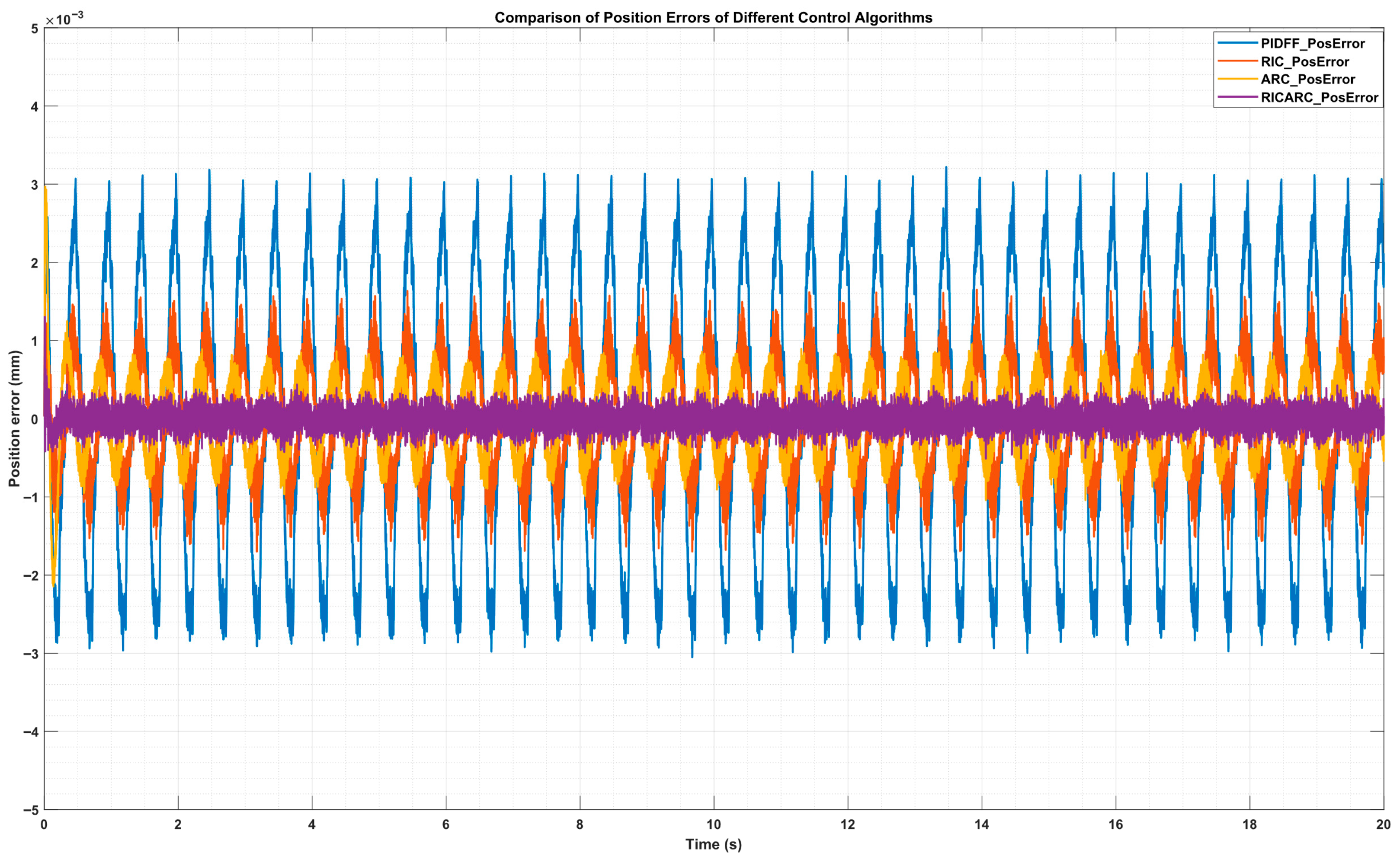
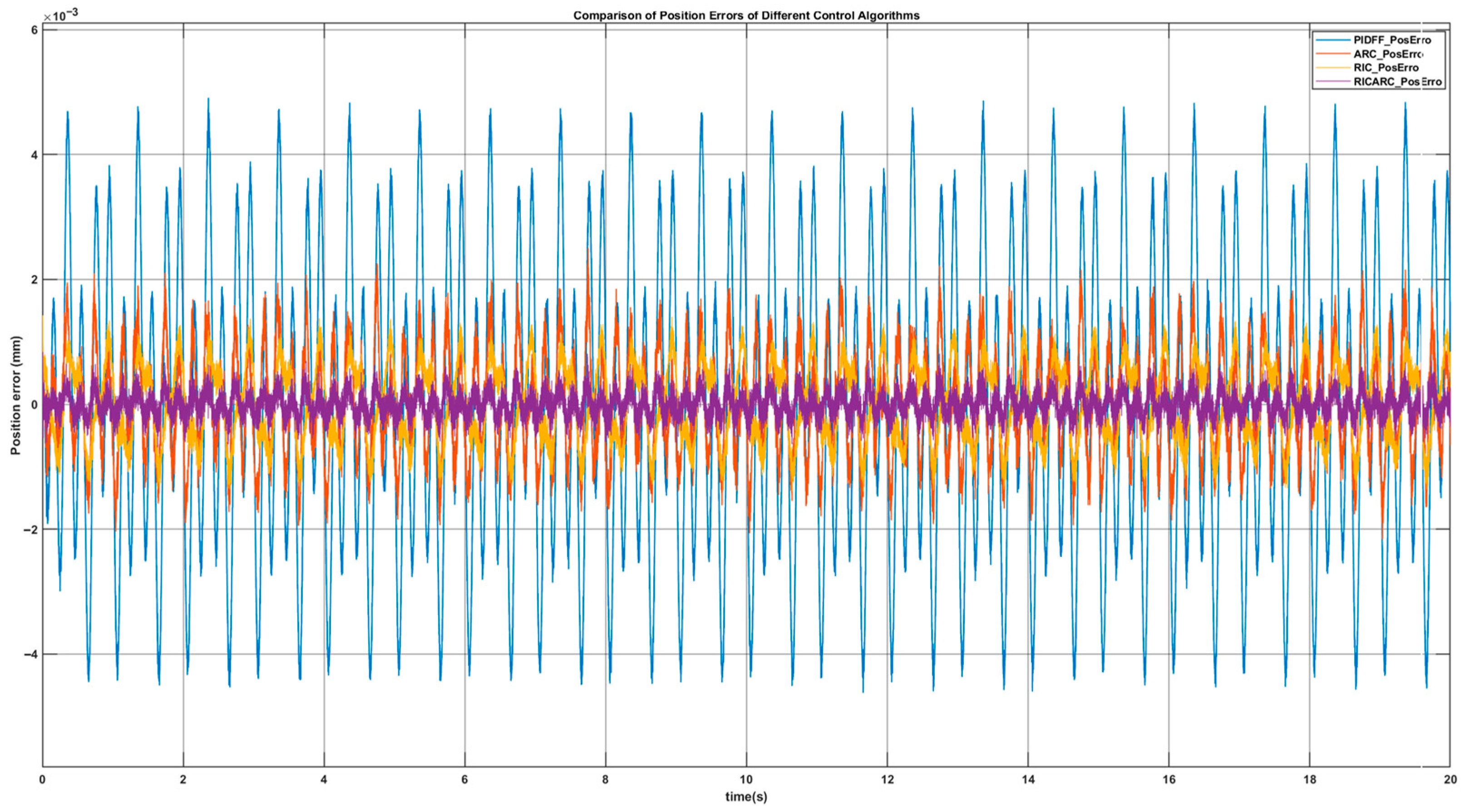
In Cases 1 and 2, Trajectory 1 and Trajectory 2 are adopted as reference inputs, respectively, each with an experimental duration of 20 s, to evaluate the tracking performance under periodic motion conditions. Figure 4 presents the parameter estimation results of the RLS-based adaptive algorithm under Trajectory 1. As shown in the figure, all three estimated parameters θ ^ converge to stable values within a short period, demonstrating that the RLS algorithm with a forgetting factor can effectively track system parameter variations, providing accurate model compensation for the adaptive controller. Figure 5 and Figure 6 show the tracking error comparisons under the two trajectories, respectively. The tracking performance is shown in Table 1.
Under Trajectory 1, the PIDFF algorithm exhibits a peak error of 1.767 μm and an RMS error of 0.667 μm, showing limited tracking capability under periodic motion. The RIC algorithm reduces the peak error ( e max ) to 1.497 μm and the RMS error ( e r m s ) to 0.582 μm, indicating that the real-time iterative compensation mechanism provides effective feedforward compensation in the practical system. The ARC algorithm shows a peak error of 1.863 μm and an RMS error of 0.547 μm; while the adaptive robust mechanism offers good RMS performance through online parameter estimation, its peak error is slightly larger than that of PIDFF due to the absence of feedforward compensation. The proposed RICARC algorithm achieves the best tracking performance with a peak error of only 0.996 μm and an RMS error of 0.122 μm, representing reductions of 43.6% and 81.7% compared to PIDFF, 46.6% and 77.7% compared to ARC, and 82.9% and 79.0% compared to RIC, respectively, achieving sub-micrometer peak tracking accuracy.
Under the more challenging dual-frequency Trajectory 2, the superposition of the 2 Hz and 3.5 Hz frequency components produces a more complex acceleration profile with a peak acceleration of approximately 1443 mm/s2, imposing greater demands on feedforward compensation precision due to the simultaneous presence of multiple frequency components. As shown in Table 1, the RMS errors of PIDFF, RIC, and ARC increased significantly compared to Case 1, with RMS errors increasing by factors of 3 to 4. In contrast, the RMS error of RICARC only increased from 0.122 μm to 0.240 μm, still achieving sub-micrometer tracking accuracy, representing an 87.7% RMS error reduction compared to ARC (1.944 μm). This demonstrates the excellent trajectory robustness of the proposed algorithm, whose tracking performance is significantly less sensitive to trajectory complexity than the other three methods.
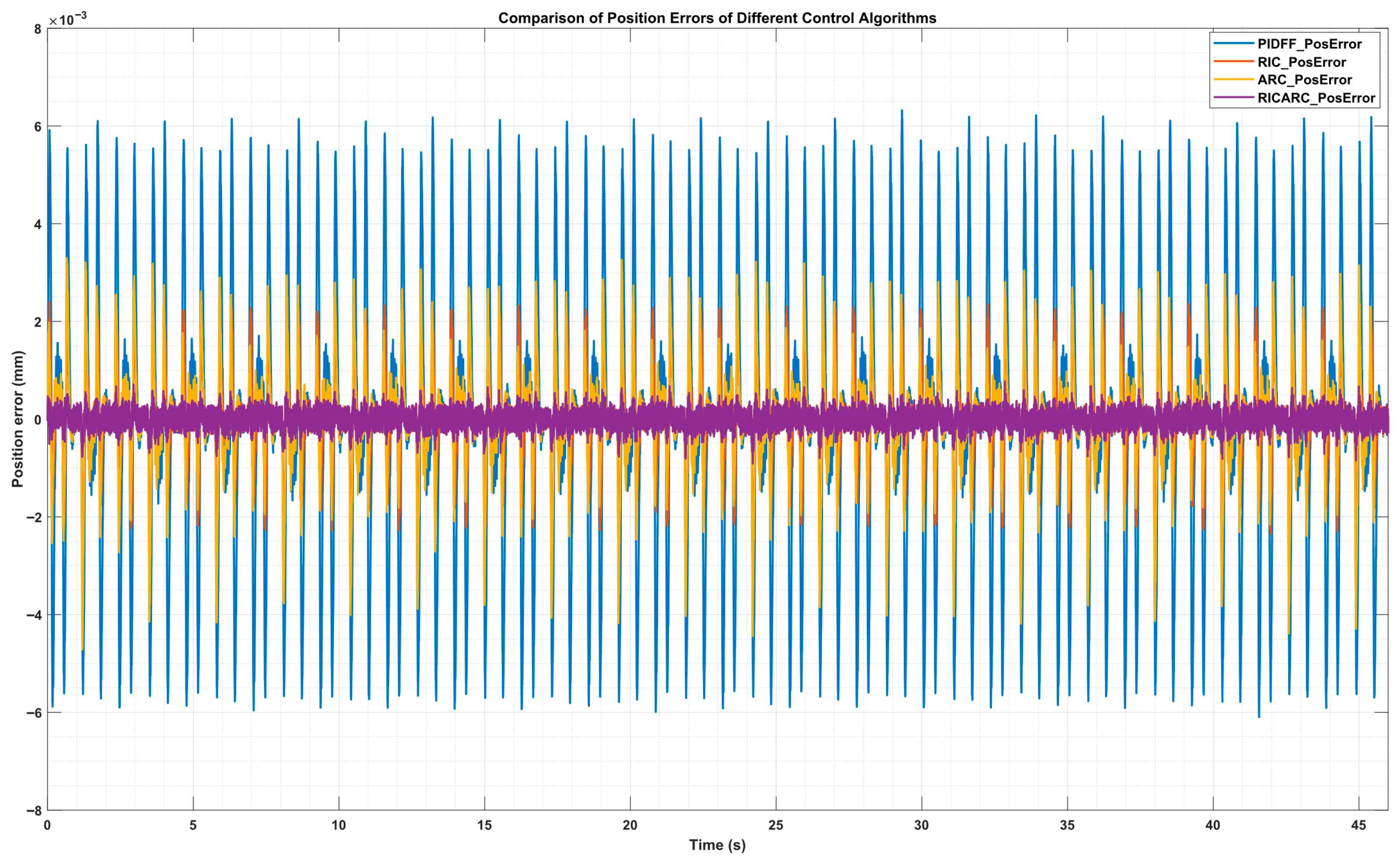
In Case 3, the S-curve trajectory introduces high-acceleration transient phases that are absent in the periodic trajectories. During these phases, the large acceleration amplitude amplifies the effect of model parameter errors, while the velocity reversals intensify the nonlinear friction behavior that cannot be captured by the linear viscous friction model, collectively rendering the nominal model compensation insufficient under high-dynamic conditions. Figure 7 shows the tracking error comparison. Due to the high-dynamic characteristics of the S-curve trajectory, PIDFF, RIC, and ARC exhibit peak errors of 6.323 μm, 2.429 μm, and 4.718 μm, respectively, indicating that conventional model-based feedforward, standalone iterative compensation, and feedback-only adaptive control are all insufficient to handle rapid acceleration and deceleration phases. RICARC achieves a peak error of only 0.912 μm, representing reductions of 85.6% and 80.7% compared to PIDFF and ARC, respectively, with RMS error of only 0.164 μm, representing an 84.0% RMS error reduction compared to ARC (1.026 μm).
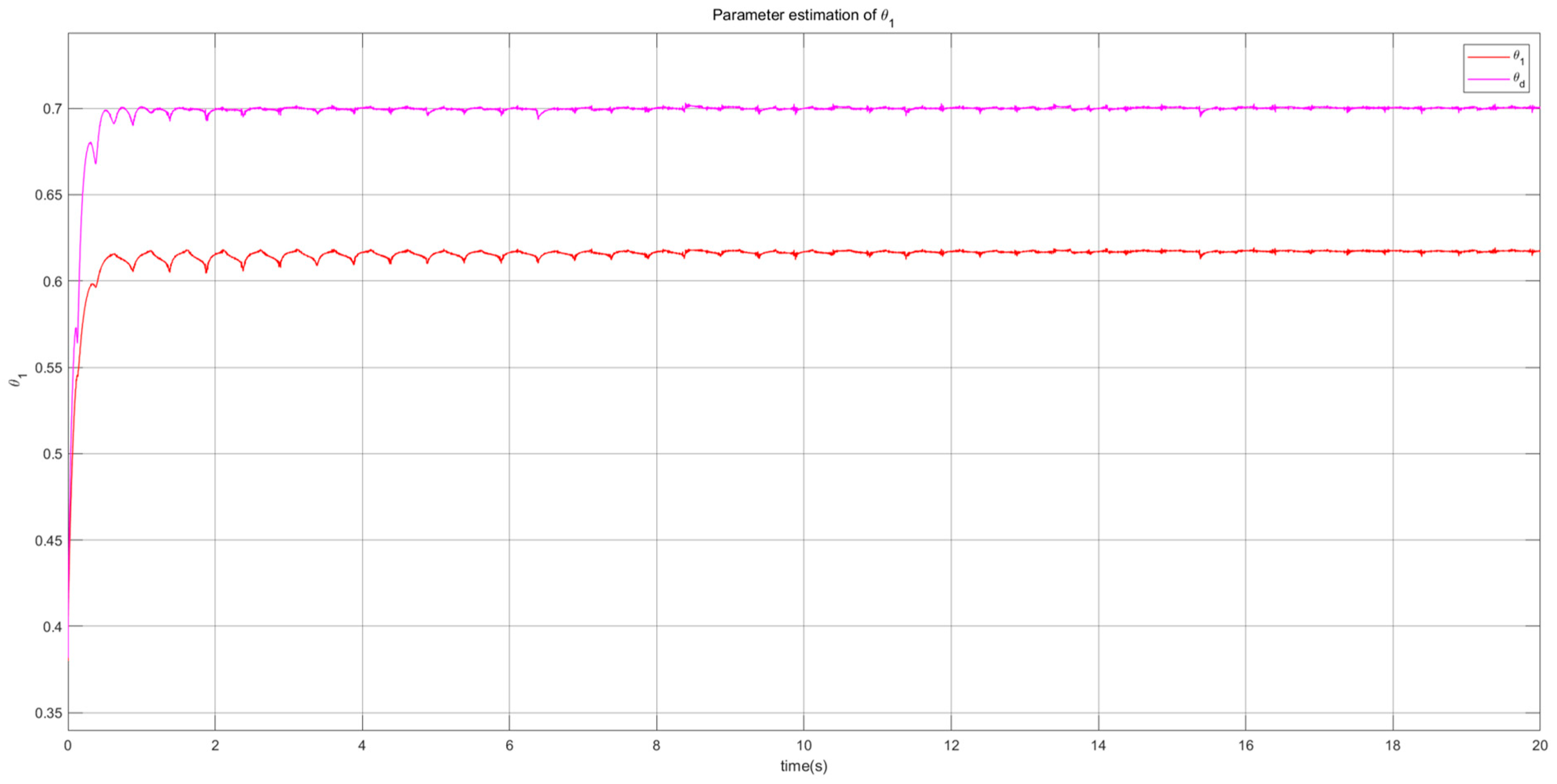
In Case 4, an additional fixture with a mass of 3 kg is mounted on the wafer stage to simulate payload variation, and Trajectory 1 is adopted as the reference input. Figure 8 presents the estimation results of θ1 under both operating conditions. The estimated parameter shifts from approximately 0.617 to approximately 0.701 after the payload is added, confirming that the RLS-based adaptive algorithm effectively detects and tracks the change in system mass.
Figure 9 shows the tracking error comparison under payload variation. The RIC algorithm, lacking parameter adaptation, shows degraded RMS performance compared to Case 1 (0.707 μm vs. 0.582 μm), as its predictive model becomes inaccurate after the payload change; the ARC algorithm partially compensates through online estimation (RMS: 0.480 μm), but without feedforward compensation, its peak error remains large. In contrast, RICARC maintains nearly identical RMS accuracy to Case 1 (0.120 μm vs. 0.122 μm), representing a 75.0% RMS error reduction compared to ARC (0.480 μm), demonstrating that the RLS-based parameter adaptation continuously updates the prediction model of RIC, ensuring accurate feedforward compensation even under varying payload conditions.
In Case 5, an external disturbance signal is injected at the force input of the system to evaluate the disturbance rejection capability of the proposed algorithm. The disturbance is designed as a multi-frequency sinusoidal signal:
d ( t ) = 40 sin ( 4 π t ) + 60 sin ( 10 π t )
with a peak amplitude of 100, corresponding to 10% of the servo output limit, applied throughout the entire experiment. This disturbance is superimposed on the inherent system disturbances, representing a significantly more challenging operating condition. Trajectory 1 is adopted as the reference input to enable direct comparison with Case 1.
The tracking error curves under strong persistent external disturbance are shown in Figure 10. PIDFF exhibits the most severe degradation with an RMS error of 2.348 μm (252% increase over Case 1), confirming the limited disturbance rejection capability of conventional feedforward control. ARC reduces the RMS error to 0.835 μm through its robust feedback term, but can only react after errors have already developed. RIC further improves to 0.607 μm by generating predictive feedforward compensation at every sampling instant. In contrast, RICARC achieves an RMS error of 0.201 μm and a peak error of 0.973 μm, remaining the only controller to maintain sub-micrometer accuracy, with RMS error reductions of 91.4% and 75.9% compared to PIDFF and ARC, respectively.
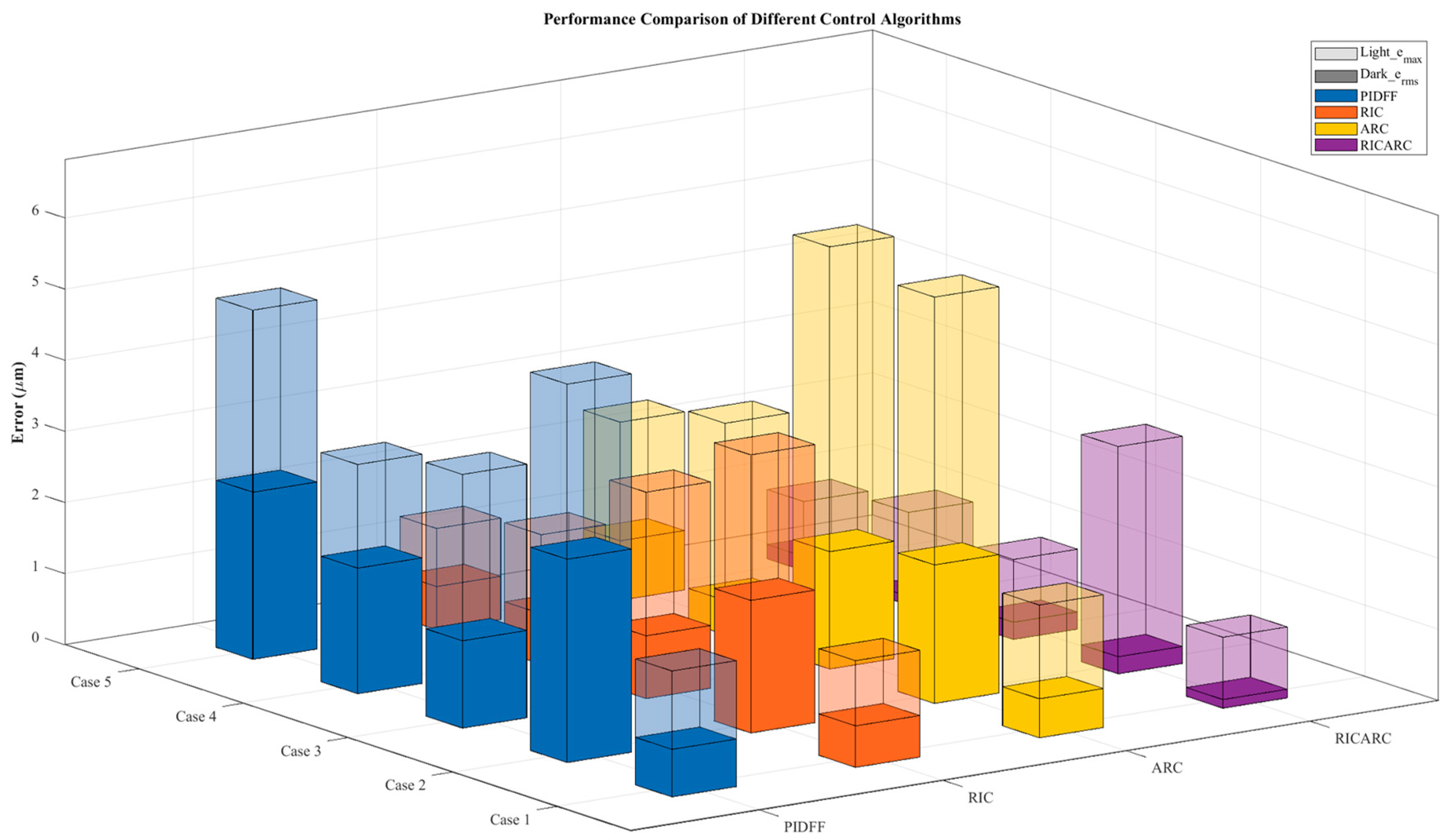
Figure 11 visually demonstrates the superior control performance of the proposed RICARC framework compared to other controllers. The results further validate the effectiveness of combining ARC and RIC for high-precision tracking.

5. Conclusions

High-precision trajectory tracking is a critical technology in wafer defect detection systems, directly affecting inspection accuracy and production efficiency. To achieve high-precision control under complex operating conditions, this paper proposes a unified RICARC framework. Within this framework, the ARC module achieves adaptive model compensation through RLS-based online parameter estimation, combined with a PID-type feedback control term and a robust control term to suppress lumped disturbances, ensuring the uniform ultimate boundedness (UUB) of the closed-loop system. Building upon this stable closed-loop foundation, the RIC module establishes a discrete prediction model based on the adaptively compensated closed-loop system, and iteratively generates optimal feedforward compensation signals online at each sampling instant, which are injected into the control input to further suppress residual tracking errors. The two modules work synergistically to achieve high-precision tracking while guaranteeing closed-loop stability.
Five comparative experiments were conducted on an actual wafer inspection motion platform to validate the effectiveness of the proposed method, with comparisons against conventional PIDFF, standalone Real-Time Iterative Compensation (RIC), and Adaptive Robust Control (ARC) schemes. Experimental results demonstrate that under trajectories of varying complexity (single-frequency periodic, dual-frequency periodic, and high-acceleration S-curve), parameter perturbations (payload variation), and strong external disturbances, RICARC consistently achieves sub-micrometer RMS accuracy ranging from 0.120 to 0.240 μm, with RMS error reductions of over 75% compared to ARC. The payload variation experiment demonstrates that RICARC maintains high-precision tracking performance under parameter perturbations, while both RIC and ARC exhibit significant degradation when used alone. Furthermore, under strong persistent external disturbances, RICARC remains the only controller to maintain sub-micrometer accuracy. These results validate the robustness and effectiveness of the proposed strategy.

Author Contributions

Conceptualization, methodology, and design: Q.G., T.Z.; experiment, Q.G.; writing—original draft preparation, Q.G., X.G.; writing—review and editing, M.M., T.Y. All authors have read and agreed to the published version of the manuscript.

Funding

This work was supported by the Innovation Project of HIAS (NO.2023HIAS-V001).

Data Availability Statement

The original contributions presented in this study are included in the article. Further inquiries can be directed to the corresponding author.

Conflicts of Interest

The authors declare no conflicts of interest.

References

  1. Liu, J.; Zhao, H.; Wu, Q.; Feng, X.; Zhao, X.; Zhang, Z.; Zhang, C.; Huang, T.; Zhu, J.; Liu, S. Patterned wafer defect inspection at advanced technology nodes. Laser Optoelectron. Prog. 2023, 60, 0312003. [Google Scholar]
  2. Steinbuch, M.; Oomen, T.; Vermeulen, H. Motion control, mechatronics design, and Moore’s law. IEEJ J. Ind. Appl. 2022, 11, 245–255. [Google Scholar] [CrossRef]
  3. Kuang, Z.; Sun, L.; Gao, H.; Tomizuka, M. Precise motion control of wafer stages via adaptive neural network and fractional-order super-twisting algorithm. IFAC-PapersOnLine 2020, 53, 8315–8320. [Google Scholar] [CrossRef]
  4. Kuang, Z.; Sun, L.; Gao, H.; Tomizuka, M. Practical fractional-order variable-gain supertwisting control with application to wafer stages of photolithography systems. IEEE/ASME Trans. Mechatron. 2021, 27, 214–224. [Google Scholar] [CrossRef]
  5. Liu, Y.; Li, L.; Chen, S. Ultra-precision motion stage control technology for IC lithography. Laser Optoelectron. Prog. 2022, 59, 0922013. [Google Scholar]
  6. Butterworth, J.A.; Pao, L.Y.; Abramovitch, D.Y. Analysis and comparison of three discrete-time feedforward model-inverse control techniques for nonminimum-phase systems. Mechatronics 2012, 22, 577–587. [Google Scholar] [CrossRef]
  7. Li, M.; Zhu, Y.; Yang, K.; Hu, C.; Mu, H. An integrated model-data-based zero-phase error tracking feedforward control strategy with application to an ultraprecision wafer stage. IEEE Trans. Ind. Electron. 2016, 64, 4139–4149. [Google Scholar] [CrossRef]
  8. Dai, L.; Li, X.; Zhu, Y.; Zhang, M. Auto-tuning of model-based feedforward controller by feedback control signal in ultraprecision motion systems. Mech. Syst. Signal Process. 2020, 142, 106764. [Google Scholar] [CrossRef]
  9. Dai, L.; Li, X.; Zhu, Y.; Zhang, M. Feedforward tuning by fitting iterative learning control signal for precision motion systems. IEEE Trans. Ind. Electron. 2020, 68, 8412–8421. [Google Scholar] [CrossRef]
  10. Li, M.; Chen, T.; Cheng, R.; Yang, K.; Zhu, Y.; Mao, C. Dual-loop iterative learning control with application to an ultraprecision wafer stage. IEEE Trans. Ind. Electron. 2021, 69, 11590–11599. [Google Scholar] [CrossRef]
  11. Oomen, T. Learning for advanced motion control. In Proceedings of the 2020 IEEE 16th International Workshop on Advanced Motion Control (AMC), Online, 14–16 September 2020; pp. 65–72. [Google Scholar]
  12. Bolder, J.; Oomen, T. Rational basis functions in iterative learning control—With experimental verification on a motion system. IEEE Trans. Control Syst. Technol. 2014, 23, 722–729. [Google Scholar] [CrossRef]
  13. Liu, Y.; Li, L.; Yang, X.; Tan, J. Enhanced kalman-filtering iterative learning control with application to a wafer scanner. Inf. Sci. 2020, 541, 152–165. [Google Scholar] [CrossRef]
  14. Li, M.; Yan, T.; Mao, C.; Wen, L.; Zhang, X.; Huang, T. Performance-enhanced iterative learning control using a model-free disturbance observer. IET Control Theory Appl. 2021, 15, 978–988. [Google Scholar] [CrossRef]
  15. Hu, C.; Zhou, R.; Wang, Z.; Zhu, Y.; Tomizuka, M. Real-time iterative compensation framework for precision mechatronic motion control systems. IEEE/CAA J. Autom. Sin. 2022, 9, 1218–1232. [Google Scholar] [CrossRef]
  16. Zhou, R.; Hu, C.; Wang, Z.; Zhu, Y.; Tomizuka, M. Real-time iterative compensation control using plant-injection feedforward architecture with application to ultraprecision wafer stages. IEEE Trans. Ind. Inform. 2024, 20, 11708–11719. [Google Scholar] [CrossRef]
  17. Wang, Z.; Zhou, R.; Hu, C.; Zhu, Y. Online iterative learning compensation method based on model prediction for trajectory tracking control systems. IEEE Trans. Ind. Inform. 2021, 18, 415–425. [Google Scholar] [CrossRef]
  18. Radac, M.-B.; Muller, V.-D.; Ciucuriță, S. Control of high-power slip ring induction generator wind turbines at variable wind speeds in optimal and reliable modes. Algorithms 2025, 18, 162. [Google Scholar] [CrossRef]
  19. Ding, R.; Ding, C.; Xu, Y.; Yang, X. Neural-network-based adaptive robust precision motion control of linear motors with asymptotic tracking performance. Nonlinear Dyn. 2022, 108, 1339–1356. [Google Scholar] [CrossRef]
  20. Yao, B.; Hu, C.; Lu, L.; Wang, Q. Adaptive robust precision motion control of a high-speed industrial gantry with cogging force compensations. IEEE Trans. Control Syst. Technol. 2011, 19, 1149–1159. [Google Scholar] [CrossRef]
  21. Chen, Z.; Yao, B.; Wang, Q. Adaptive robust precision motion control of linear motors with integrated compensation of nonlinearities and bearing flexible modes. IEEE Trans. Ind. Inform. 2012, 9, 965–973. [Google Scholar] [CrossRef]
  22. Hu, C.; Hu, Z.; Zhu, Y.; Wang, Z.; He, S. Model-data driven learning adaptive robust control of precision mechatronic motion systems with comparative experiments. IEEE Access 2018, 6, 78286–78296. [Google Scholar] [CrossRef]
  23. Hu, C.; Ou, T.; Zhu, Y.; Zhu, L. GRU-type LARC strategy for precision motion control with accurate tracking error prediction. IEEE Trans. Ind. Electron. 2020, 68, 812–820. [Google Scholar] [CrossRef]
  24. Hu, C.; Wang, Z.; Zhu, Y.; Zhang, M.; Liu, H. Performance-oriented precision LARC tracking motion control of a magnetically levitated planar motor with comparative experiments. IEEE Trans. Ind. Electron. 2016, 63, 5763–5773. [Google Scholar] [CrossRef]
  25. Mohanty, A.; Yao, B. Indirect adaptive robust control of hydraulic manipulators with accurate parameter estimates. IEEE Trans. Control Syst. Technol. 2010, 19, 567–575. [Google Scholar] [CrossRef]
  26. Liu, Z.; Gao, H.; Yu, X.; Lin, W.; Qiu, J.; Rodríguez-Andina, J.J.; Qu, D. B-Spline Wavelet Neural-Network-Based Adaptive Control for Linear-Motor-Driven Systems via a Novel Gradient Descent Algorithm. IEEE Trans. Ind. Electron. 2024, 71, 1896–1905. [Google Scholar] [CrossRef]
  27. Liu, Z.; Yu, X.; Lin, W.; Rodríguez-Andina, J.J. Iterative learning observer-based high-precision motion control for repetitive motion tasks of linear motor-driven systems. IEEE Open J. Ind. Electron. Soc. 2024, 5, 54–66. [Google Scholar] [CrossRef]
  28. Cui, H.; Teng, Q.; Xu, R. Adaptive Super-Twisting Speed Control for PMLSM system Using Generalized Proportional Integral Observer. In Proceedings of the 2021 13th International Symposium on Linear Drives for Industry Applications (LDIA), Wuhan, China, 1–3 July 2021; pp. 1–6. [Google Scholar]
  29. Boeren, F.; Bareja, A.; Kok, T.; Oomen, T. Frequency-domain ILC approach for repeating and varying tasks: With application to semiconductor bonding equipment. IEEE/ASME Trans. Mechatron. 2016, 21, 2716–2727. [Google Scholar] [CrossRef]
  30. Polycarpou, M.M.; Ioannou, P.A. A robust adaptive nonlinear control design. In Proceedings of the 1993 American Control Conference, San Francisco, CA, USA, 2–4 June 1993; pp. 1365–1369. [Google Scholar]
  31. Radac, M.-B. Soft Real-Time Asynchronous Online Learning from Input–Output Data for UAV Model Reference Control Under Uncertain Dynamics and Faulty Actuation. Drones 2026, 10, 137. [Google Scholar] [CrossRef]
Figure 1. Framework of the Real-time Iterative Compensation based Adaptive Robust Control (RICARC) Algorithm.
Electronics 15 01471 g001
Figure 2. Schematic diagram of the experimental system structure of the wafer defect detection motion platform.
Electronics 15 01471 g002
Figure 3. Reference trajectories: Trajectory 1, Trajectory 2, and S-curve.
Electronics 15 01471 g003
Figure 4. Estimation results of system model parameters. θ 1 , θ 2 , and θ 3 under Trajectory 1.
Electronics 15 01471 g004
Figure 5. Tracking errors of different control algorithms under case 1.
Electronics 15 01471 g005
Figure 6. Tracking errors of different control algorithms under case 2.
Electronics 15 01471 g006
Figure 7. Tracking errors of different control algorithms under case 3.
Electronics 15 01471 g007
Figure 8. Comparison of θ1 estimation results without payload (θ1) and with payload (θ1d).
Electronics 15 01471 g008
Figure 9. Tracking errors of different control algorithms under case 4.
Electronics 15 01471 g009
Figure 10. Tracking errors of different control algorithms under case 5.
Electronics 15 01471 g010
Figure 11. Performance Comparison of Different Control Algorithms.
Electronics 15 01471 g011
Table 1. Performance metrics of different controllers across various tracking tasks (μm).
Case 1Case 2Case 3Case 4Case 5
e r m s e m a x e r m s e m a x e r m s e m a x e r m s e m a x e r m s e m a x
PIDFF0.6671.7672.8535.3151.2256.3231.7633.2202.3484.907
RIC0.5821.4971.8603.9060.8802.4290.7071.8180.6071.424
ARC0.5471.8631.9445.7091.0264.7180.4802.9700.8352.503
RICARC0.1220.9960.2403.1940.1640.9120.1201.3030.2010.973
Disclaimer/Publisher’s Note: The statements, opinions and data contained in all publications are solely those of the individual author(s) and contributor(s) and not of MDPI and/or the editor(s). MDPI and/or the editor(s) disclaim responsibility for any injury to people or property resulting from any ideas, methods, instructions or products referred to in the content.