A Localization Method Based on Nonlinear Batch Processing for Non-Cooperative Underwater Acoustic Pulse Source


Abstract
1. Introduction
2. System Model and PLE Algorithm
2.1. State Model and Measurement Model
2.2. PLE Algorithm for Target Localization
3. Multi-Start Trust Region-Based Localization Algorithm for Non-Cooperative Underwater Pulse Source
3.1. Nonlinear Weighted Localization Model for Non-Cooperative Underwater Pulse Source
3.2. Multi-Start Trust-Region Solution to the Nonlinear Weighted Localization Model
- 1.
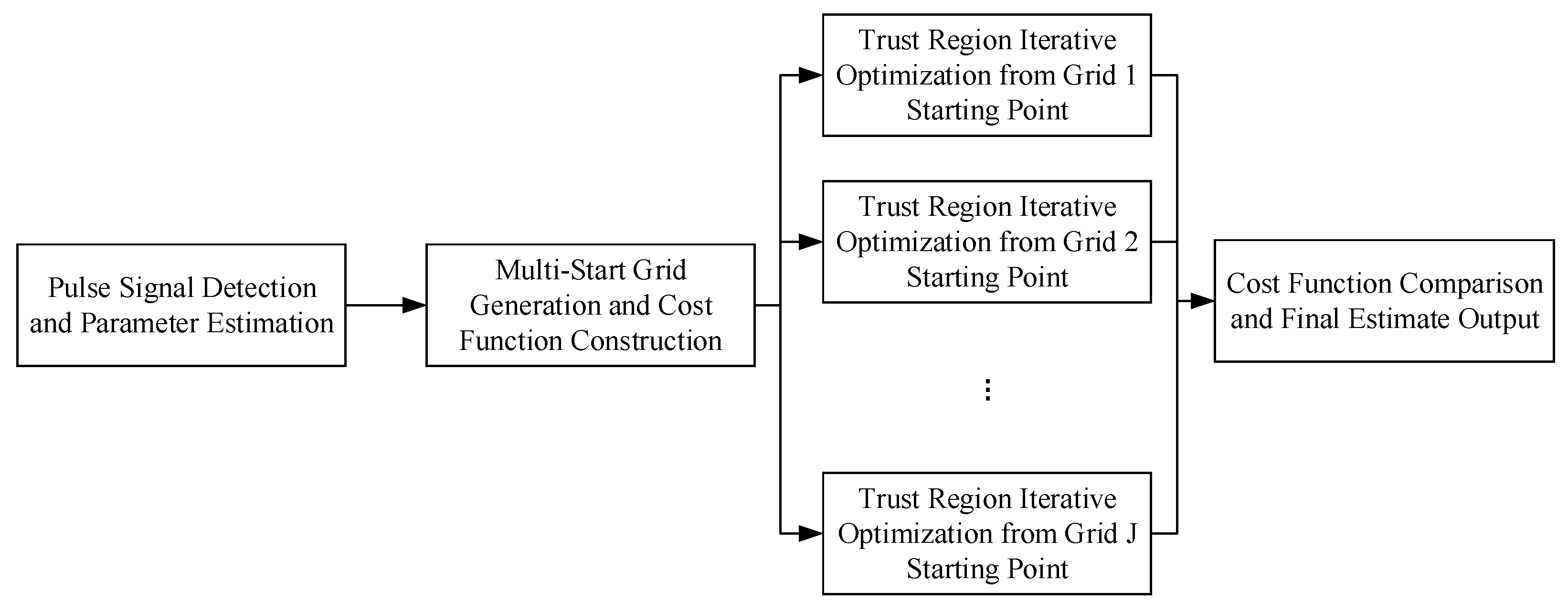
- First, a predefined search space is partitioned into a grid to generate a set of starting points, denoted as . Here, is the index for the starting points, with being their total number. The subscript i in (where ) represents the iteration count, so is the initial position for the j-th starting point.
- 2.
- Second, starting from each of these points, a TR optimization is performed iteratively. The final solution is then selected as the one that yields the minimum objective function value among all starting points.
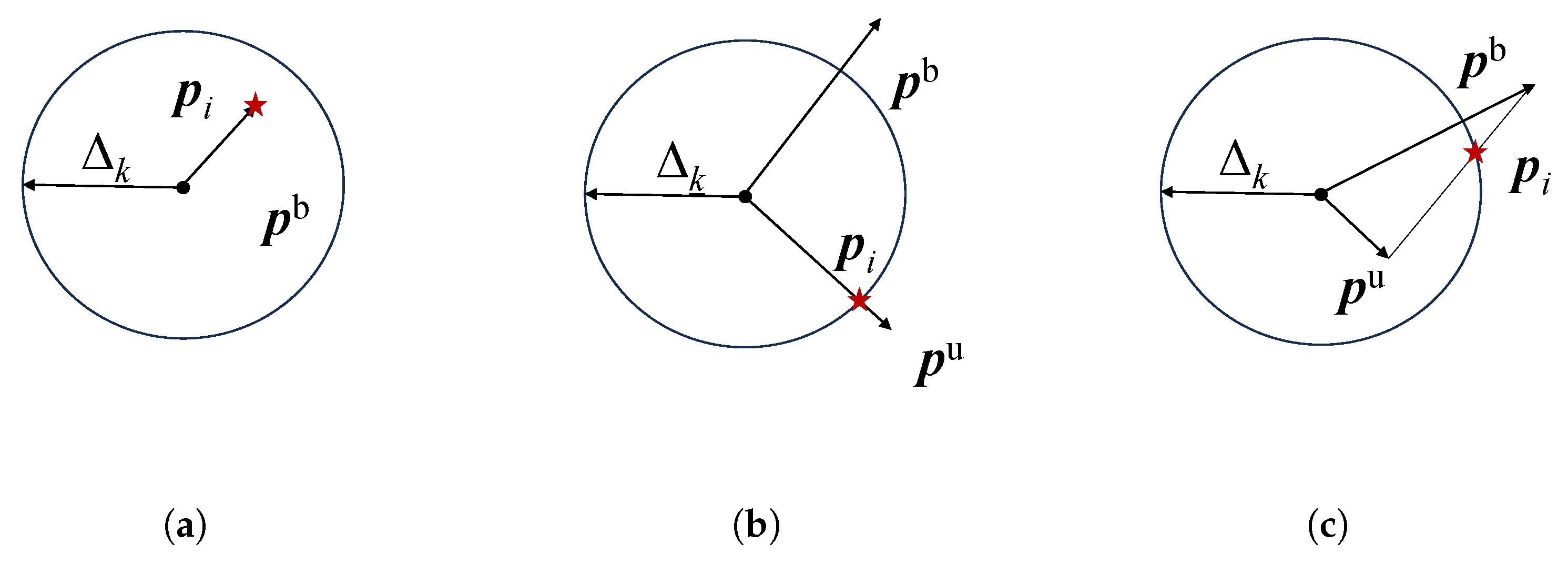
- Case 1: If the GN step is within the trust region (i.e., ), then the trial step is the GN step itself: .
- Case 2: If the path along the steepest descent direction intersects the TR boundary before the full step is reached (i.e., ), then the trial step is a scaled version of the steepest descent step: .
- Case 3: If the steepest descent step is within the trust region but the GN step is outside, then the trial step is the intersection of the dogleg path (the line segment from to ) and the TR boundary.
| Algorithm 1 Multi-start trust-region-based localization algorithm. |
| Input: Grid division intervals , , step sizes , , pulse observations , . |
| Output: Optimal target position estimate . |
| Start |
| 1: Initialize maximum iterations , gradient tolerance , step tolerance , and trust-region radius . |
| 2: Construct the global objective function using Equation (20). |
| 3: Generate J initial starting points by grid division using Equation (23). |
| 4: fordo |
| 5: Initialize trust-region radius , and iteration counter . |
| 6: repeat |
| 7: Compute gradient and approximate Hessian at . |
| 8: Solve trust-region subproblem in Equation (24) for trial step . |
| 9: Evaluate gain ratio using Equation (29). |
| 10: Update trust-region radius in Equation (30). |
| 11: Update iteration point . |
| 12: . |
| 13: until or or |
| 14: Store the converged solution for the j-th starting point as . |
| 15: end for |
| 16: Select the final target position estimate: . |
| End |
4. Numerical Simulation
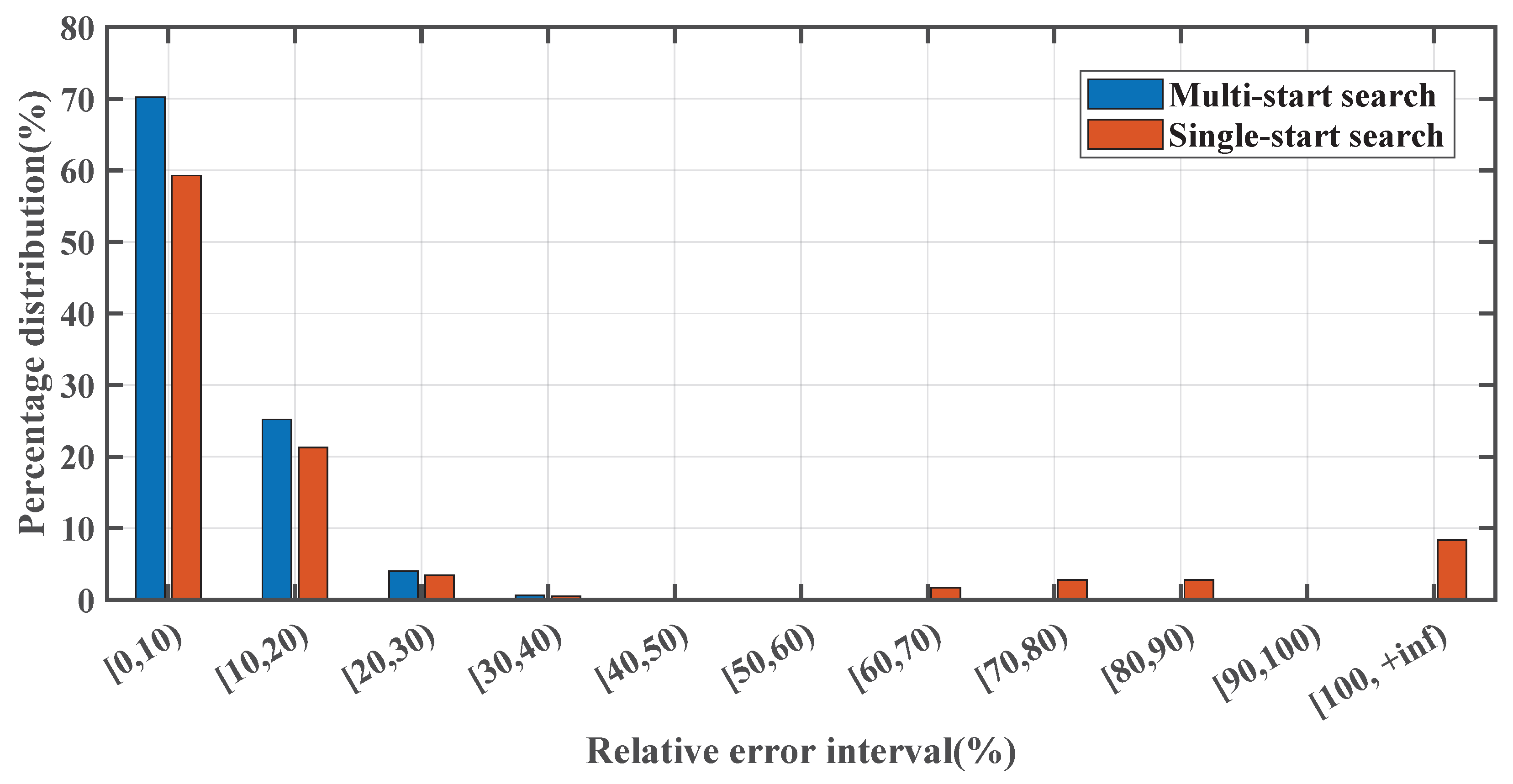
4.1. Multi-Starting Grid Search Effectiveness Verification
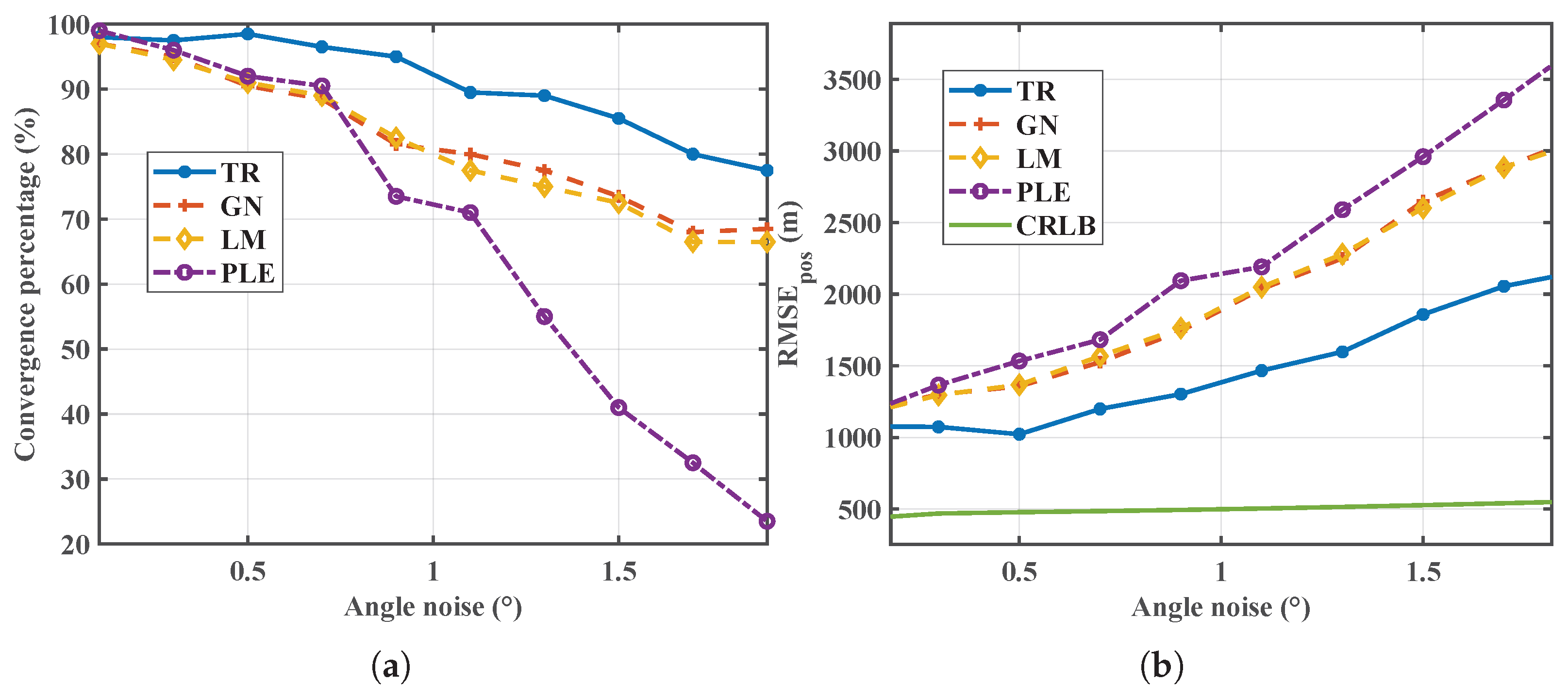
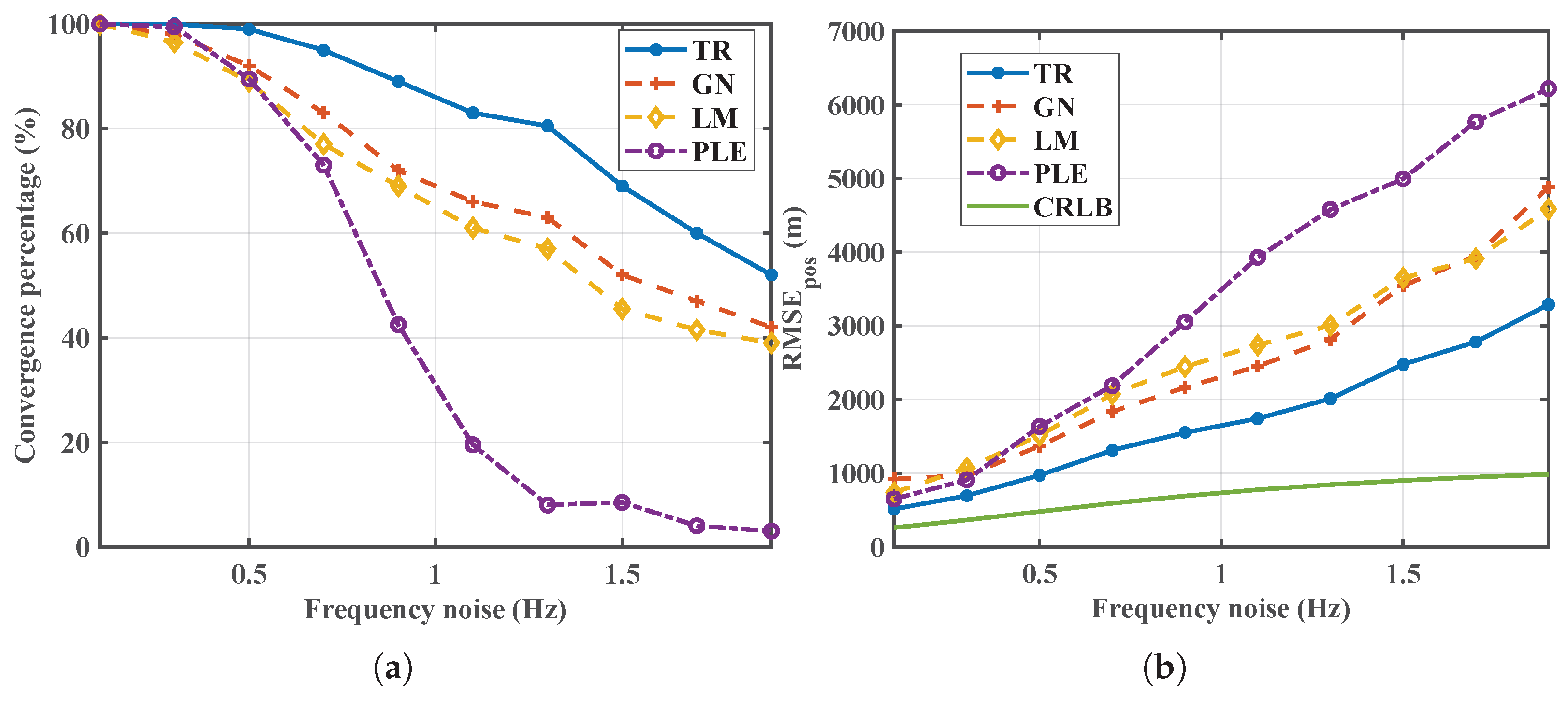
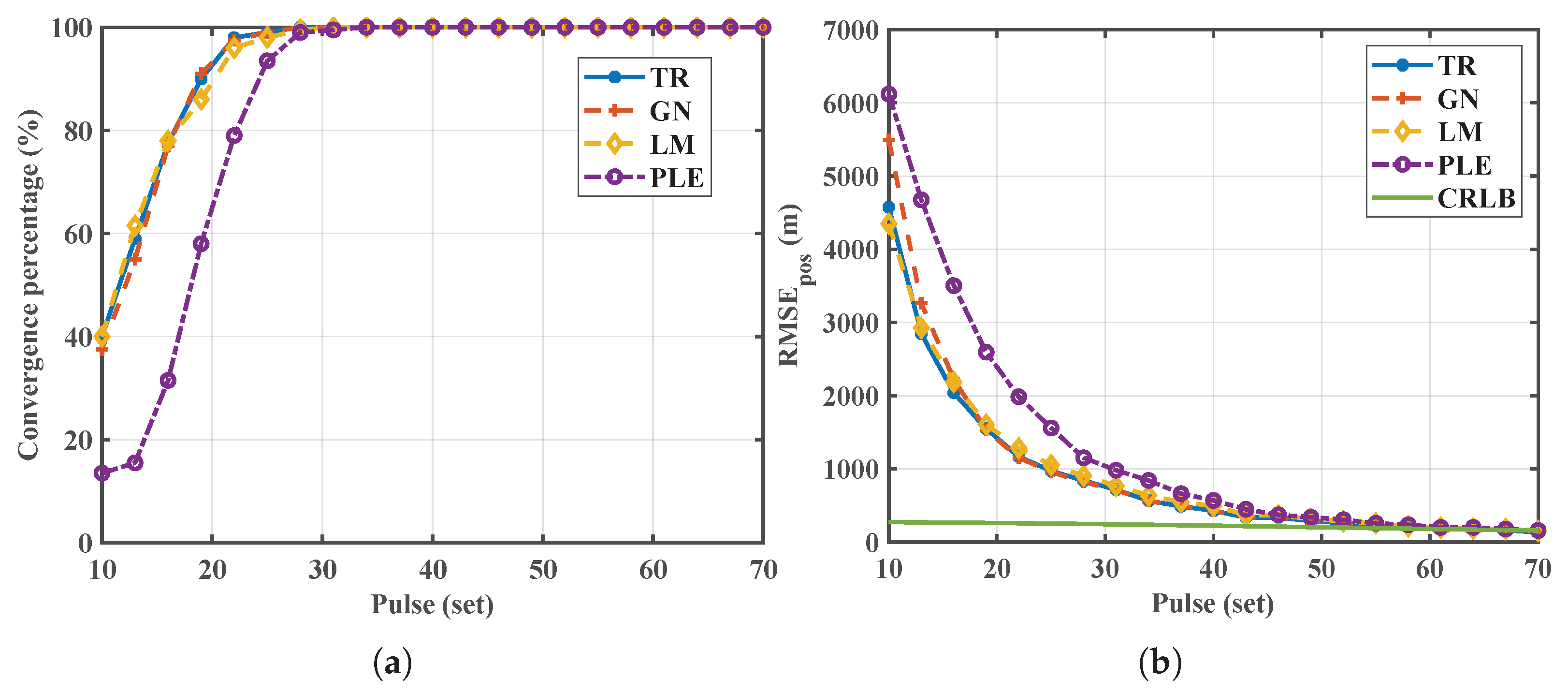
4.2. Effects of Observation Noise and Received Pulse Number on Algorithm Performance
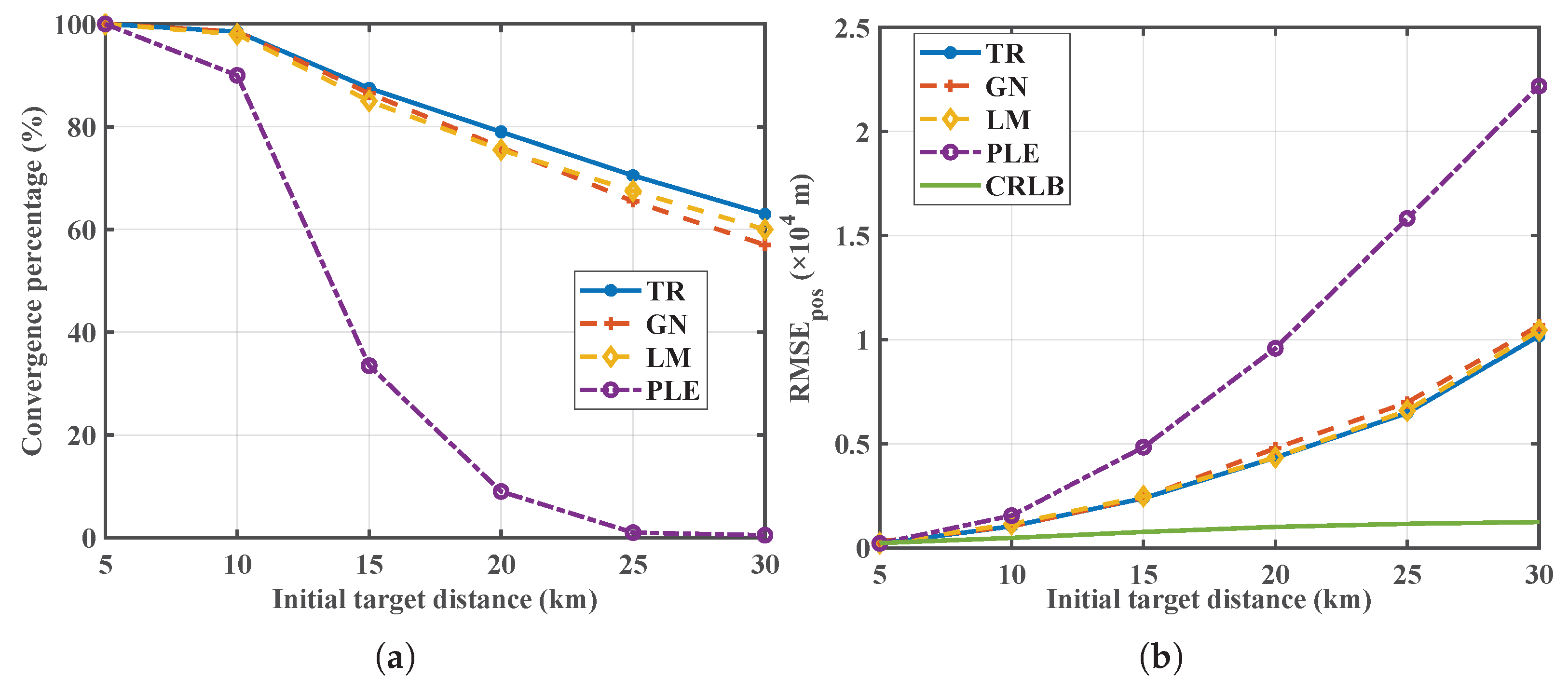
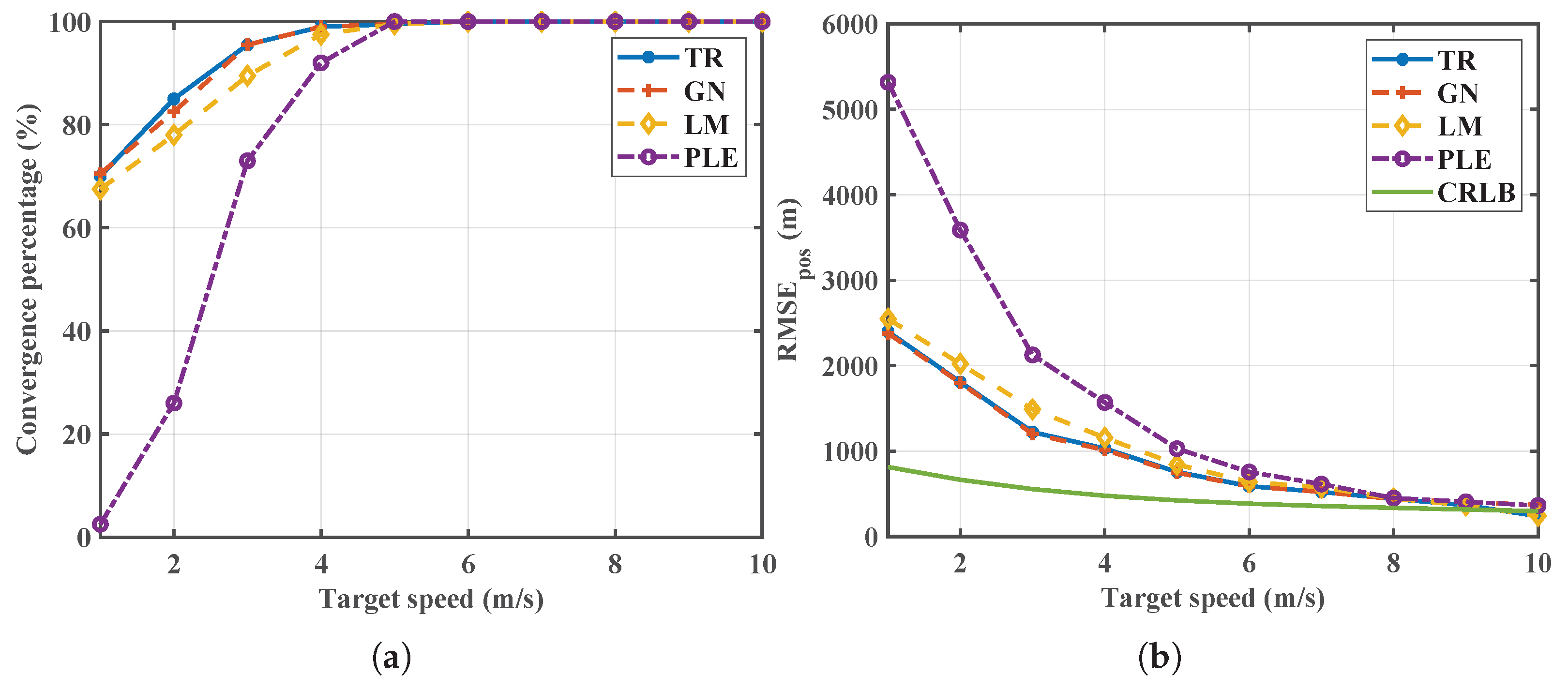
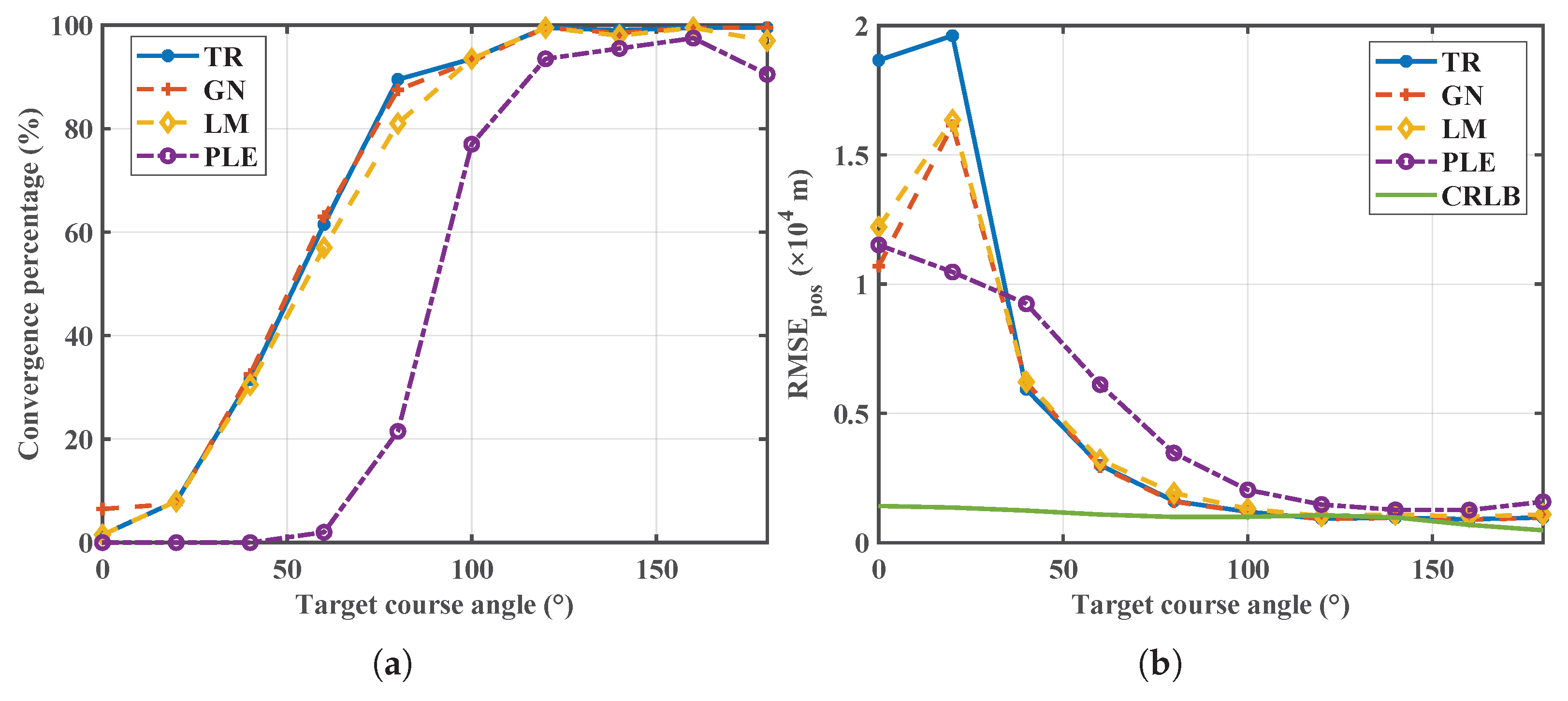
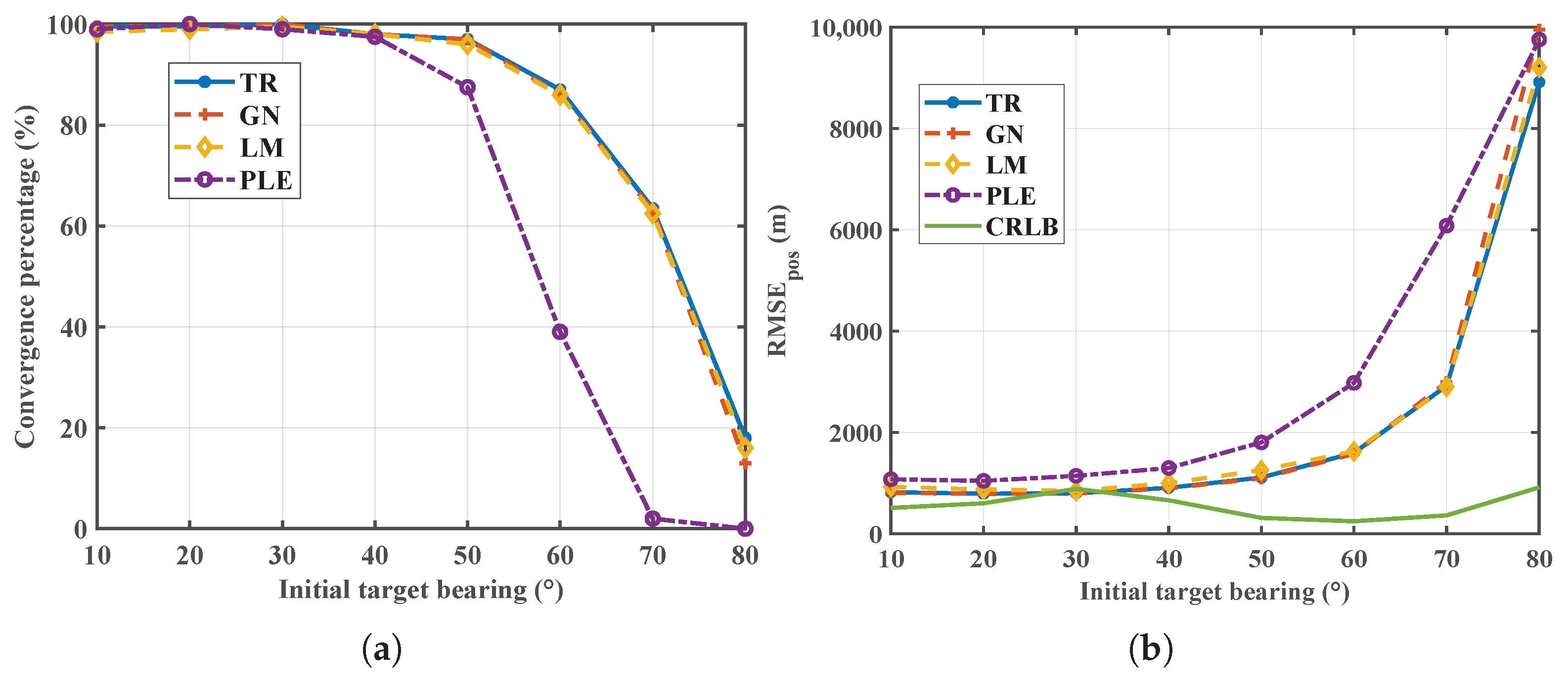
4.3. Effects of Motion Scenarios on Algorithm Performance
4.4. Discussion on Algorithmic Synergy and Component Contributions
5. Sea Trial Data
6. Conclusions
Author Contributions
Funding
Data Availability Statement
Conflicts of Interest
References
- Ken, C.; Fangyong, W.; Shuanping, D. Passive Detection Method Based on Non-Cooperative Underwater Acoustic Pulse Signal. In Proceedings of the 2022 5th International Conference on Information Communication and Signal Processing (ICICSP), Shenzhen, China, 26–28 November 2022; pp. 584–588. [Google Scholar]
- Qin, Y.; Liu, H.; Yin, R.; Zhao, S.; Dong, M. Non-Cooperative Target Tracking Method Based on Underwater Acoustic Sensor Networks. J. Supercomput. 2023, 79, 19227–19253. [Google Scholar] [CrossRef]
- Sun, D.; Zhang, Y.; Teng, T.; Gao, L. Underwater Doppler-bearing Maneuvering Target Motion Analysis Based on Joint Estimated Adaptive Unscented Kalman Filter. J. Acoust. Soc. Am. 2023, 154, 2843–2857. [Google Scholar] [CrossRef]
- Fan, R.; Jin, Z.; Su, Y. A Novel Passive Localization Scheme of Underwater Non-Cooperative Targets Based on Weak-Control AUVs. IEEE Trans. Wirel. Commun. 2024, 23, 9129–9143. [Google Scholar] [CrossRef]
- Tomic, S.; Beko, M.; Dinis, R. 3-D Target Localization in Wireless Sensor Networks Using RSS and AoA Measurements. IEEE Trans. Veh. Technol. 2017, 66, 3197–3210. [Google Scholar] [CrossRef]
- Zhou, T.; Yi, W.; Kong, L. Non-Cooperative Passive Direct Localization Based on Waveform Estimation. Remote Sens. 2021, 13, 264. [Google Scholar] [CrossRef]
- Li, L.; Yin, J.; Han, X.; Ge, W. Frequency Estimation for Underwater CW Pulse by Interpolation on Fractional Fourier Coefficients Based on Amplitude Ratio Method. EURASIP J. Adv. Signal Process. 2023, 2023, 61. [Google Scholar] [CrossRef]
- Peng, X.Y.; Liu, R.D.; Liu, N.; Chang, K.; Wan, Q. Joint Pulse Signal Detection and DOA Estimation Algorithm Based on Eigenvalue Distribution of Sample Autocorrelation Matrix. In Proceedings of the IET International Radar Conference (IRC 2023), Chongqing, China, 3–5 December 2023; Volume 2023, pp. 2599–2604. [Google Scholar]
- Nair, N.R.; Jacob, R. Observed Spectral Broadening of Acoustic Pulse in an Underwater Channel. In Proceedings of the 2013 Ocean Electronics (SYMPOL), Kochi, India, 23–25 October 2013; pp. 1–5. [Google Scholar]
- Oh, R.; Gu, B.S.; Kim, S.; Song, T.L.; Choi, J.W.; Son, S.U.; Kim, W.K.; Bae, H.S. Estimation of bearing error of line array sonar system caused by bottom bounced path. J. Acoust. Soc. Korea 2018, 37, 412–421. [Google Scholar]
- Alexandri, T.; Walter, M.; Diamant, R. A Time Difference of Arrival Based Target Motion Analysis for Localization of Underwater Vehicles. IEEE Trans. Veh. Technol. 2022, 71, 326–338. [Google Scholar] [CrossRef]
- Alexandri, T.; Diamant, R. A Reverse Bearings Only Target Motion Analysis for Autonomous Underwater Vehicle Navigation. IEEE Trans. Mob. Comput. 2019, 18, 494–506. [Google Scholar] [CrossRef]
- Ma, H.; Yan, L.; Xia, Y.; Fu, M. Kalman Filter with Recursive Process Noise Covariance Estimation. In Kalman Filtering and Information Fusion; Ma, H., Yan, L., Xia, Y., Fu, M., Eds.; Springer: Singapore, 2020; pp. 21–49. [Google Scholar]
- Oh, R.; Song, T.L.; Choi, J.W. Batch Processing through Particle Swarm Optimization for Target Motion Analysis with Bottom Bounce Underwater Acoustic Signals. Sensors 2020, 20, 1234. [Google Scholar] [CrossRef] [PubMed]
- Lingren, A.G.; Gong, K.F. Position and Velocity Estimation Via Bearing Observations. IEEE Trans. Aerosp. Electron. Syst. 1978, AES-14, 564–577. [Google Scholar] [CrossRef]
- Nguyen, N.H.; Doğançay, K. Single-Platform Passive Emitter Localization with Bearing and Doppler-shift Measurements Using Pseudolinear Estimation Techniques. Signal Process. 2016, 125, 336–348. [Google Scholar] [CrossRef]
- Chan, Y.T.; Rudnicki, S.W. Bearings-Only and Doppler-bearing Tracking Using Instrumental Variables. IEEE Trans. Aerosp. Electron. Syst. 1992, 28, 1076–1083. [Google Scholar] [CrossRef]
- Badriasl, L.; Dogancay, K. Three-Dimensional Target Motion Analysis Using Azimuth/Elevation Angles. IEEE Trans. Aerosp. Electron. Syst. 2014, 50, 3178–3194. [Google Scholar] [CrossRef]
- Doğançay, K. 3D Pseudolinear Target Motion Analysis From Angle Measurements. IEEE Trans. Signal Process. 2015, 63, 1570–1580. [Google Scholar] [CrossRef]
- Badriasl, L.; Arulampalam, S.; Finn, A. A Novel Batch Bayesian WIV Estimator for Three-Dimensional TMA Using Bearing and Elevation Measurements. IEEE Trans. Signal Process. 2018, 66, 1023–1036. [Google Scholar] [CrossRef]
- Nardone, S.; Lindgren, A.; Gong, K. Fundamental Properties and Performance of Conventional Bearings-Only Target Motion Analysis. IEEE Trans. Autom. Control 1984, 29, 775–787. [Google Scholar] [CrossRef]
- Ho, K.C.; Chan, Y.T. An Asymptotically Unbiased Estimator for Bearings-Only and Doppler-bearing Target Motion Analysis. IEEE Trans. Signal Process. 2006, 54, 809–822. [Google Scholar] [CrossRef]
- Ahmed, M.M.; Ho, K.C.; Wang, G. Localization of a Moving Source by Frequency Measurements. IEEE Trans. Signal Process. 2020, 68, 4839–4854. [Google Scholar] [CrossRef]
- Gonçalves, M.L.N.; Menezes, T.C. Gauss–Newton Methods with Approximate Projections for Solving Constrained Nonlinear Least Squares Problems. J. Complex. 2020, 58, 101459. [Google Scholar] [CrossRef]
- Marquardt, D.W. An Algorithm for Least-Squares Estimation of Nonlinear Parameters. J. Soc. Ind. Appl. Math. 1963, 11, 431–441. [Google Scholar] [CrossRef]
- Moré, J.J.; Sorensen, D.C. Computing a Trust Region Step. SIAM J. Sci. Stat. Comput. 1983, 4, 553–572. [Google Scholar] [CrossRef]
- Doğançay, K. On the Efficiency of a Bearings-Only Instrumental Variable Estimator for Target Motion Analysis. Signal Process. 2005, 85, 481–490. [Google Scholar] [CrossRef]
- Branch, M.A.; Coleman, T.F.; Li, Y. A Subspace, Interior, and Conjugate Gradient Method for Large-Scale Bound-Constrained Minimization Problems. SIAM J. Sci. Comput. 1999, 21, 1–23. [Google Scholar] [CrossRef]
- Yuan, Y. Recent Advances in Trust Region Algorithms. Math. Program. 2015, 151, 249–281. [Google Scholar] [CrossRef]
- Specht, M. Statistical Distribution Analysis of Navigation Positioning System Errors—Issue of the Empirical Sample Size. Sensors 2020, 20, 7144. [Google Scholar] [CrossRef] [PubMed]



| Initialization Strategy | Start Points | Convergence | Mean Rel. Error | Mean Runtime |
|---|---|---|---|---|
| Random Single Start | 1 | 31.50% | 99.36% | 8.88 ms |
| Fixed Single Start | 1 | 81.00% | 30.49% | 5.51 ms |
| Coarse Grid () | 25 | 99.50% | 7.76% | 195.37 ms |
| Medium Grid () | 49 | 99.50% | 7.79% | 371.80 ms |
| Fine Grid () | 121 | 99.50% | 7.78% | 974.04 ms |
| Method | TR | GN | LM | PLE |
|---|---|---|---|---|
| Convergence | 93.18% | 90.90% | 90.90% | 50.00% |
Disclaimer/Publisher’s Note: The statements, opinions and data contained in all publications are solely those of the individual author(s) and contributor(s) and not of MDPI and/or the editor(s). MDPI and/or the editor(s) disclaim responsibility for any injury to people or property resulting from any ideas, methods, instructions or products referred to in the content. |
© 2026 by the authors. Licensee MDPI, Basel, Switzerland. This article is an open access article distributed under the terms and conditions of the Creative Commons Attribution (CC BY) license.
Share and Cite
Wang, X.; Ye, Y.; Deng, H.; Ji, Y.; Cao, H.; An, L. A Localization Method Based on Nonlinear Batch Processing for Non-Cooperative Underwater Acoustic Pulse Source. Electronics 2026, 15, 1452. https://doi.org/10.3390/electronics15071452
Wang X, Ye Y, Deng H, Ji Y, Cao H, An L. A Localization Method Based on Nonlinear Batch Processing for Non-Cooperative Underwater Acoustic Pulse Source. Electronics. 2026; 15(7):1452. https://doi.org/10.3390/electronics15071452
Chicago/Turabian StyleWang, Xiaoyan, Yang Ye, Haopeng Deng, Yuntian Ji, Hongli Cao, and Liang An. 2026. "A Localization Method Based on Nonlinear Batch Processing for Non-Cooperative Underwater Acoustic Pulse Source" Electronics 15, no. 7: 1452. https://doi.org/10.3390/electronics15071452
APA StyleWang, X., Ye, Y., Deng, H., Ji, Y., Cao, H., & An, L. (2026). A Localization Method Based on Nonlinear Batch Processing for Non-Cooperative Underwater Acoustic Pulse Source. Electronics, 15(7), 1452. https://doi.org/10.3390/electronics15071452