Article

Robust Trajectory Tracking Control of Underactuated Overhead Cranes via Time Delay Estimation and the Sliding Mode Technique

School of Information Science and Engineering, Zhejiang Sci-Tech University, Hangzhou 310018, China
*
Author to whom correspondence should be addressed.
Electronics 2026, 15(7), 1407; https://doi.org/10.3390/electronics15071407
Submission received: 12 March 2026 / Revised: 25 March 2026 / Accepted: 26 March 2026 / Published: 27 March 2026

Abstract

As typical underactuated systems, overhead cranes are widely utilized in heavy-load transportation. However, their strong nonlinear coupling and underactuated characteristics complicate precise positioning and payload swing suppression. Furthermore, model uncertainties and external disturbances in practical environments increase control complexity and degrade system performance. To address these issues, this paper develops a trajectory tracking control scheme based on time delay estimation (TDE). Specifically, some transformations are made for the dynamic model and the TDE mechanism is used to estimate unknown nonlinear dynamics and external disturbances. Then, a sliding mode trajectory tracking controller, along with the TDE mechanism, is proposed for the trajectory tracking control and uncertainties estimation of the overhead crane system. Rigorous mathematical analysis is provided to demonstrate the asymptotic stability of the closed-loop system. Finally, simulation results verify the effectiveness of the proposed method in comparison with the existing control methods.

1. Introduction

Underactuated mechanical systems are characterized by having fewer control inputs than their degrees of freedom. These systems are widely used in various practical applications, such as autonomous vehicles and industrial robotics [1,2,3,4]. As a representative class of such systems, overhead cranes serve as essential equipment for heavy-load transfer in logistics, port operations, the construction industry, and so on. The primary control objective for the overhead crane is to simultaneously achieve precise cart positioning and rapid payload swing suppression. However, their inherent underactuated nature renders the control design highly challenging. This difficulty is further exacerbated in practical operating environments, which frequently introduce internal uncertainties (e.g., mechanical friction variations and payload mass fluctuations) along with external disturbances (e.g., wind gusts and ground vibrations). These factors can severely degrade the performance of traditional control methods and pose potential safety risks [5,6]. Therefore, developing robust control strategies that ensure high-precision positioning and rapid anti-sway performance is crucial for enhancing operational safety and efficiency.
In recent years, extensive research has been devoted to the control of crane systems. Traditional linear methods, such as Proportional–Integral–Derivative (PID) and Linear Quadratic Regulator (LQR), typically design controllers by linearizing the system around equilibrium points [7,8,9]. While easy to implement, these controllers are highly sensitive to parameter variations and significant payload swings, resulting in inadequate robustness. As an alternative to deal with these severe payload oscillations, open-loop strategies such as input shaping and trajectory planning have been proposed [10,11,12,13,14]. Although effective for vibration reduction, these methods lack feedback mechanisms and the control performance is easily affected by external disturbances [15].
To overcome these limitations, a variety of nonlinear control strategies have been investigated for overhead crane systems. Early efforts mainly focused on model-based nonlinear designs. For example, the backstepping technique has been applied to overhead crane control through a recursive design process [16,17]. To better handle nonlinear dynamics and uncertainty, intelligent methods, including neural-network-based and fuzzy-based control, were then introduced [18,19,20]. Recent studies have further shown that fuzzy-based control remains effective for nonlinear mechatronic systems under uncertainty and disturbance, such as in boom stabilization and related motion-control problems [21]. Robust control of electro-hydraulic systems under parametric uncertainty has also been studied in related nonlinear mechatronic systems [22], which further indicates the continued interest in practical robust control under uncertain operating conditions.
Adaptive control has also received increasing attention in overhead crane research, especially for handling parameter uncertainties and varying payload conditions. Representative studies have investigated model-free adaptive designs based on extended state observers, adaptive TDE-based prescribed-performance control, and adaptive time-varying sliding mode control for underactuated overhead cranes [23,24,25]. In addition, disturbance-observer-based methods have been designed to actively compensate for unmodeled forces [26,27,28,29,30]. More recently, some advanced disturbance-rejection and learning-based approaches have also been reported for disturbed nonlinear systems. Representative examples include state filtered disturbance rejection control and multilayer neuroadaptive reinforcement learning via actor–critic mechanisms [31,32]. These methods show strong disturbance-handling and adaptation capability, but they usually involve more elaborate controller structures, online learning or filtering mechanisms, and higher tuning complexity. Although these nonlinear methods generally provide better performance than linear ones, they often require more complicated parameter tuning or more prior knowledge of the system structure [33].
Among these nonlinear strategies, sliding mode control (SMC) has gained widespread application due to its inherent robustness against nonlinearities and uncertain disturbances [34,35,36,37,38]. In recent studies, Tuan et al. [39] designed a SMC controller for 3D overhead cranes by integrating SMC with partial feedback linearization. However, this technique depends on an exact dynamic model, making it highly sensitive to changes in payload mass or cable length. To handle unknown parameters, Ngo and Hong [40] developed adaptive SMC schemes. Yet, their designs mostly compensate for frictions on the cart, failing to actively reject mismatched disturbances acting directly on the payload. Additionally, Zhang et al. [41] proposed a hybrid PD-SMC to reduce the chattering effect. Even with this improvement, their controller still needs to know the maximum bounds of uncertainties in advance to ensure stability.
Overall, most current SMC-based research still faces three major deficiencies. First, many methods rely heavily on accurate dynamic models, requiring precise knowledge of mass and cable length, which limits their adaptability to varying payloads. Second, existing designs often focus solely on matched disturbances, neglecting the mismatched disturbances acting on the payload swing, which results in insufficient anti-sway performance [42]. Third, conventional robust controllers typically impose restrictive assumptions on disturbance characteristics, such as demanding prior knowledge of the uncertainty upper bounds or assuming that disturbances follow specific structural models.
Time Delay Estimation (TDE) technology provides an efficient and “model-free” solution to these issues [43,44]. TDE uses the control input and system state from the immediate past to estimate lumped disturbances in real-time without requiring complex analytical modeling [45]. It has demonstrated remarkable compensation capabilities in the control of complex nonlinear systems [46,47]. However, existing crane-related studies are mainly focused on regulation problems or simplified model settings, and relatively less attention has been paid to active trajectory tracking for underactuated overhead cranes under both matched and mismatched disturbances. Moreover, the integration of active trajectory planning with a TDE-SMC framework still deserves further investigation in this context.
In addition to algorithmic developments, several recent studies have also examined the practical implementation of anti-sway control through hardware-in-the-loop platforms, semi-physical experiments, and scaled crane tests [48,49,50]. These studies show that anti-sway performance in real applications depends not only on the control law itself, but also on sensing, real-time computation, and implementation structure. At the same time, they also suggest that good control performance may come at the cost of a more complex implementation and higher real-time demand. For this reason, besides control accuracy and swing suppression, maintaining a relatively simple feedback structure is also important in overhead crane control design.
Motivated by these challenges, this paper proposes a sliding mode trajectory tracking controller, along with the TDE mechanism. The main contributions are summarized as follows:
  • Free of any plant parameters. Unlike traditional model-based control methods that require exact values for the payload and the cable, the proposed scheme does not require detailed knowledge of the system’s physical parameters, enhancing its adaptability to varying payloads in practical engineering.
  • Simultaneous consideration of matched and mismatched disturbances. Rather than treating only matched disturbances in the actuated channel, the proposed formulation incorporates both matched and mismatched disturbances into a unified lumped uncertainty term, which is then estimated through the TDE mechanism and used in the controller design.
  • Relaxation of prior assumptions on disturbance characteristics. A key theoretical contribution of this work is that it removes the stringent requirements typically imposed on unknown dynamics. It not only relaxes the common assumption that the strict upper bounds of disturbances must be known a priori, but also frees the controller from relying on specific structural models (e.g., exact friction models) or slowly-varying conditions. This allows the controller to handle complex, fast-varying environments without over-conservative gain tuning.
The remainder of this paper is organized as follows. In Section 2, the dynamic model of the overhead crane system is given and some necessary model transformations are made. Section 3 details the design of the TDE-based sliding mode trajectory tracking controller. In Section 4, we provide a rigorous stability analysis of the closed-loop system using Lyapunov theory. Section 5 presents the active anti-sway trajectory planning mechanism. In Section 6, we provide comparative simulation results under various operating conditions to demonstrate the effectiveness of the proposed scheme. Finally, the conclusions of this paper are presented in Section 7.

2. System Modeling

2.1. Physical Description

This paper considers an overhead crane system consisting of a cart and a suspended payload. The physical configuration of the system is illustrated in Figure 1.
In this system, M and m represent the cart mass and the payload mass, respectively; x t and θ t denote the horizontal cart displacement and the payload swing angle, respectively; L stands for the constant cable length; F x t is the horizontal driving force applied to the cart; and g is the gravitational acceleration.

2.2. Dynamic Model

In this subsection, we introduce the establishment and transformation of the dynamic model, and subsequently present the TDE technique. First, the dynamic equations for the overhead crane are given by the following [35,42]:
M + m x ¨ + m cos θ L θ ¨ m L θ ˙ 2 sin θ = F x + d 1
m L cos θ x ¨ + m L 2 θ ¨ + m g L sin θ = d 2
where d 1 and d 2 denote the lumped disturbances acting on the cart and the payload, respectively. Specifically, d 1 represents the matched disturbance, whereas d 2 represents the mismatched disturbance. It should be emphasized that while most existing control methods address matched disturbances, they frequently neglect the mismatched disturbance d 2 , which inherently limits their anti-sway performance.
To facilitate the controller design, some transformations need to be made for the dynamic models (1) and (2). From Equation (2), the angular acceleration can be expressed as follows:
θ ¨ = 1 L d 2 m L + cos θ x ¨ + g sin θ
In order to eliminate θ ¨ t in Equation (1), based on the expression of θ ¨ t in Equation (3), the dynamic Equation (1) can be rewritten as follows:
M + m sin 2 θ x ¨ + cos θ d 2 L m g sin θ cos θ m L θ ˙ 2 sin θ d 1 = F x
By introducing a positive constant Λ + and defining the auxiliary variable M a c t = M + m sin 2 θ , Equation (4) can be rewritten as follows:
Λ x ¨ + M a c t Λ x ¨ + cos θ d 2 L m g sin θ cos θ m L θ ˙ 2 sin θ d 1 = F x
To simplify expressions in the forthcoming developments, let N t denote the unknown uncertainties and external disturbances, that is, the expression for the variable N is as follows:
N = M a c t Λ x ¨ + cos θ d 2 L m g sin θ cos θ m L θ ˙ 2 sin θ d 1
Consequently, based on Equations (5) and (6) becomes
Λ x ¨ + N = F x
At this stage, the crane dynamics are rewritten into a compact form that is convenient for subsequent TDE-based estimation and controller design.
In order to deal with the unknown term N t , inspired by the development of the TDE technique reported in [45], a time delay estimator N ˜ t is introduced as follows:
N N ˜ = F x ( t h ) Λ x ¨ ( t h )
where h is a sufficiently small time delay, which is typically set as the sampling interval. The estimation error is defined as follows:
ε = N ˜ N
Although the error exists, it remains bounded and is handled in the subsequent sliding-mode-based controller design.
Lemma 1
([43]). When the introduced parameter  Λ  satisfies  1 Λ M a c t < 1 , the TDE error ε  is bounded.

3. Controller Design

This section presents the detailed design of the sliding mode trajectory tracking controller. First, a sliding surface incorporating the movement error is designed; then, TDE technology is employed to estimate the lumped unknown term of the entire system. By integrating sliding mode control with the time delay estimator, the final tracking controller is constructed.
Let x r t be the desired displacement trajectory. The displacement tracking error e t is defined as follows:
e = x x r
Based on the displacement tracking error, a sliding surface is designed as follows:
s = e ˙ + k x e
where k x is a positive gain constant. The time derivative of the sliding surface is as follows:
s ˙ = e ¨ + k x e ˙
Then, a classical exponential reaching law can be designed to ensure that the sliding variable s t converges to zero in finite time, which is expressed as follows [7,8]:
s ˙ = η sgn s k s
where η is the robust switching gain, k is the reaching law gain. In Equation (13), the gain η mainly affects the controller’s ability to reject disturbances and estimation errors during the reaching phase, while the gain k mainly affects the convergence speed of the sliding variable. Their effects on the closed-loop response are discussed in Section 6. In addition, sgn denotes the standard signum function defined as follows:
sgn =     1 ,     > 0     0 ,     = 0   1 ,    < 0
Substituting e ¨ = x ¨ x ¨ r into Equation (13), we can obtain the following:
x ¨ x ¨ r + k x e ˙ = η sgn s k s
Then, based on Equation (7), the acceleration term can be expressed as follows:
x ¨ = 1 Λ F x N
By substituting this expression into Equation (15), it can be rewritten as follows:
1 Λ ( F x N ) x ¨ r + k x e ˙ = η sgn s k s
From Equation (17), we can obtain the ideal equivalent control input F x t . However, since the lumped disturbance N t is unavailable for measurement, we replace it with the estimated value N ˜ t . Consequently, the final robust sliding mode trajectory tracking controller is designed as follows:
F x = N ˜ + Λ x ¨ r k x e ˙ η sgn s k s
By substituting Equation (18) into Equation (7), and utilizing the sliding surface derivative along with the TDE error definition ε = N ˜ N , we can obtain the following:
s ˙ = 1 Λ ε η sgn s k s
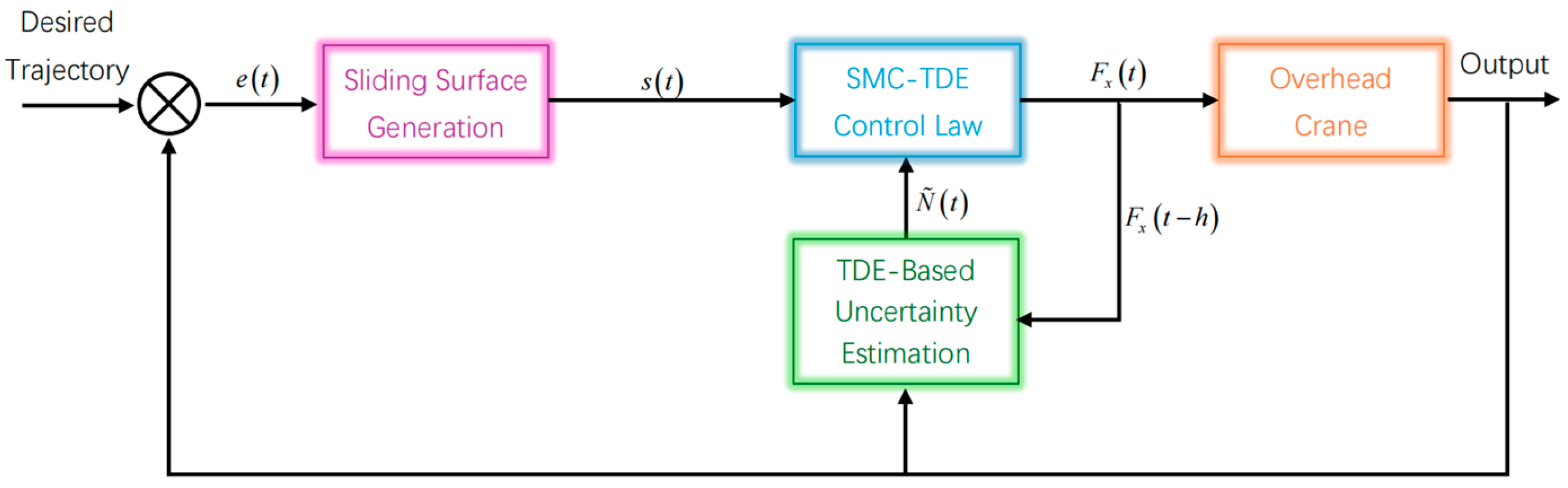
Based on the aforementioned derivations, the overall control block diagram of the proposed TDE-SMC strategy is illustrated in Figure 2.

4. Stability Analysis

In this section, we present the stability analysis of the designed sliding mode trajectory tracking controller. Based on Lyapunov stability theory, it is proven that the sliding surface ultimately converges to zero, thereby guaranteeing the asymptotic convergence of the tracking error.
Based on Lemma 1, we can derive that the TDE error ε is bounded. Let us define the normalized error Δ = 1 Λ ε . Consequently, Δ t is also bounded by a positive constant Δ ¯ t (i.e., Δ Δ ¯ ).
In practice, the exact upper bound Δ ¯ t of the normalized TDE error is usually not available in advance, because the lumped term N t is unknown and the TDE error ε cannot be measured directly online. Therefore, Δ ¯ t should be interpreted as a conservative design bound used in the stability analysis, rather than an exactly known physical constant. In real applications, this bound is usually chosen based on prior knowledge of the operating range, offline simulation, and experimental observations of the closed-loop response.
As a result, some mismatch between the chosen bound and the actual error level is unavoidable. A moderate overestimate mainly leads to a more conservative choice of η , which may increase switching and chattering, while an underestimate may reduce the robustness margin and weaken convergence and disturbance rejection. For this reason, η is selected with sufficient margin in practice.
Theorem 1.
When the controller parameters of the proposed control method (18) satisfy the following conditions:
k x > 0 , k > 0 , η > Δ ¯ , 1 Λ M a c t < 1
the sliding variable s(t) converges to zero in finite time and the trajectory tracking control objective is achieved.
Proof of Theorem 1.
Choose a Lyapunov function candidate as follows:
V = 1 2 s 2
Taking the time derivative of V , we can obtain the following:
V ˙ = s s ˙ = s 1 Λ ε η sgn s k s = s 1 Λ ε s η sgn s k s 2 Δ s η s k s 2 η Δ ¯ s k s 2 k s 2 0
Therefore, we can conclude that V t is positive definite and V ˙ t is negative definite. According to Lyapunov stability theory, the variable s t asymptotically converges to zero, ensuring that the tracking error e t also converges to zero. □
Theorem 1 provides several direct design requirements. The gains k x and k should be positive, which are the basic conditions for constructing the sliding surface and the reaching law. The gain η should be chosen to exceed the upper bound of the TDE error by a sufficient margin. In addition, Λ should satisfy 1 Λ M a c t < 1 , which requires Λ to be chosen in a range consistent with the effective inertia of the system. These conditions provide the basic design guideline implied by the stability analysis.

5. Trajectory Selection

While the previously designed TDE-SMC scheme guarantees precise positioning, it lacks an explicit mechanism for payload swing suppression. Consequently, applying an abrupt step reference signal would inevitably excite severe initial sway. To proactively suppress payload oscillations and reduce the feedback control effort, an active anti-sway trajectory is employed. On the basis of the trajectory smoothing technique in [14], the desired reference trajectory is formulated as follows:
x r = P d 2 + k v 2 4 k a ln cosh 2 k a t / k v ϵ cosh 2 k a t / k v ϵ 2 P d k a / k v 2 + k θ 0 t θ d τ
where P d is the target position of the cart. In Equation (23), k v and k a denote the trajectory velocity and acceleration coefficients, respectively; ϵ is a small positive constant introduced to adjust the initial state; and k θ represents the gain coefficient for the swing-angle integral term [14].
The desired trajectory consists of two components: the first is a smooth step signal based on hyperbolic functions, ensuring the cart moves smoothly without impact; the second component, k θ 0 t θ τ d τ , is the critical anti-sway term. During payload swings, this term proactively adjusts the cart reference to generate counteracting inertial forces, thereby dissipating oscillation energy. By embedding the anti-sway mechanism directly into the reference trajectory, this method avoids the slow response inherent in pure feedback damping.
Applying the control law (18) to track the reference trajectory in (23) yields the overall control scheme studied in this paper. In this scheme, the anti-sway effect is mainly introduced by the planned reference trajectory, while the feedback controller is responsible for tracking this trajectory in the presence of uncertainty and disturbance. Therefore, the final closed-loop performance depends on the interaction between trajectory planning and feedback control rather than on the feedback law alone.
In practice, the trajectory parameters k v , k a , ϵ , and k θ are selected to balance transition speed, trajectory smoothness, and anti-sway effectiveness. Interested readers may refer to [14] for the detailed tuning procedure.

6. Simulation Results

In this section, we validate the effectiveness and robustness of the proposed control scheme through MATLAB R2024b simulations. The study evaluates the precise positioning and anti-sway performance under various physical conditions and external disturbances.
All simulations were carried out in MATLAB/Simulink R2024b. The simulations were performed in Simulink with automatic solver selection under a fixed-step setting and a step size of 0.001 s. The total simulation time was 20 s. In the time-delay scheme, the parameter was set to h = 0.001 s , corresponding to one sampling interval. The initial conditions were set as x 0 = 0 , x ˙ 0 = 0 , θ 0 = 0 , θ ˙ 0 = 0 . These numerical conditions were kept unchanged throughout the comparative simulations to ensure a fair comparison.
To provide a more comprehensive comparison, two comparison methods are considered in this section. In addition to the method of Wu et al. [42], the disturbance-observer-based nonlinear controller of Lei et al. [29] is also included for comparison. For fairness, all methods are tested under the same physical parameters, initial conditions, reference command, and disturbance settings. Unless otherwise stated, the nominal physical parameters in the simulations are chosen as follows:
M = 24   kg , m = 8   kg , L = 1.2   m , g = 9.8     m / s 2
For the proposed method, the control gains and trajectory-planning parameters are selected as follows:
Λ = 35 , k x = 10 , η = 2 , k = 40
k v = 1.2 , k a = 0.8 , ϵ = 0.1 , k θ = 3.5
The parameters were selected according to their effects on the closed-loop performance. The coefficient Λ mainly affects the effectiveness of the TDE-based compensation and thus influences the overall closed-loop response; k x mainly affects the damping of the tracking error on the sliding surface; η mainly improves robustness against disturbances and estimation errors, but an excessively large value may increase switching activity and chattering; k mainly affects the convergence rate of the sliding variable and the settling time, while an overly large value may make the transient response too aggressive.
The control law of Wu et al. [42] is given by the following:
F = M + m sin 2 θ k d k p x ˙ λ sin θ k E θ ˙ cos θ k p x p d λ 0 t sin θ τ d τ k E sin θ + λ θ ˙ cos θ m sin θ g cos θ + L θ ˙ 2
To ensure a fair implementation of the method of Wu et al. [42], we select the control parameters to be consistent with those in [42]:
k d = 3.2 , k E = 1.4 , k p = 0.3 , λ = 1.8
The disturbance-observer-based nonlinear controller of Lei et al. [29] is also implemented for comparison. Its final control input can be written as follows:
F a = M + m sin 2 q 2 k p α 1 q 1 α 2 α 1 L sin q 2 k d α 1 p 1 α 2 L p 2 cos q 2 m sin q 2 g cos q 2 + L p 2 2 k 1 sgn s s k 2 0 t sgn s d τ
Since the physical parameters in this study differ from those in [29], the controller parameters are re-tuned for the present simulation setup. The parameter values are given by the following:
k 1 = 1.35 , k 2 = 1.3 , k p = 1.4 , k d = 2.65 , α 1 = 1.0 , α 2 = 3.2
The comparative evaluation is divided into three scenarios: nominal conditions, light-load/short-cable conditions, and heavy-load/long-cable conditions. To examine the robustness of the compared methods to physical variations, the controller parameters of all methods are kept unchanged across these tests.

6.1. Tracking Performance Under Nominal Conditions

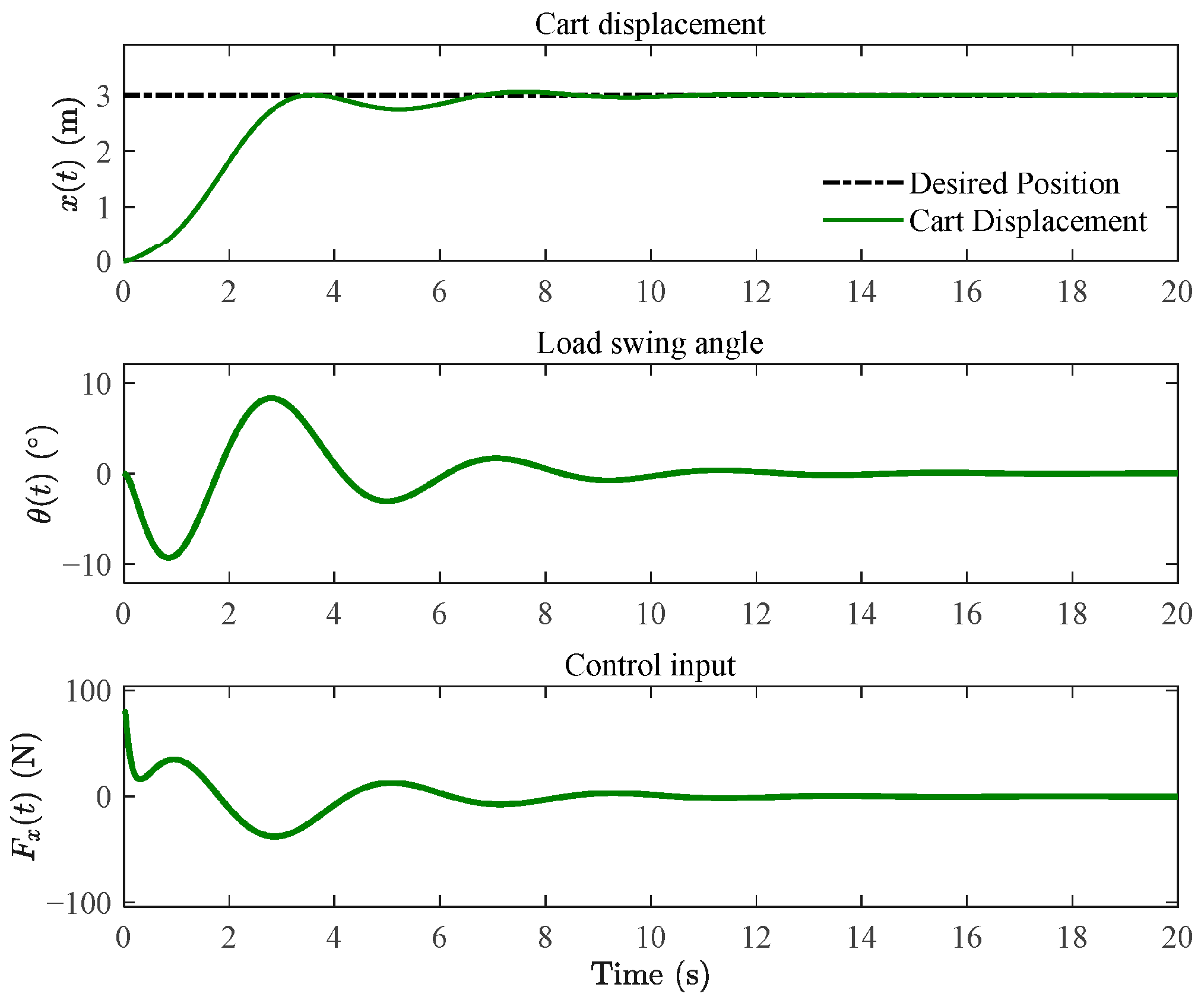
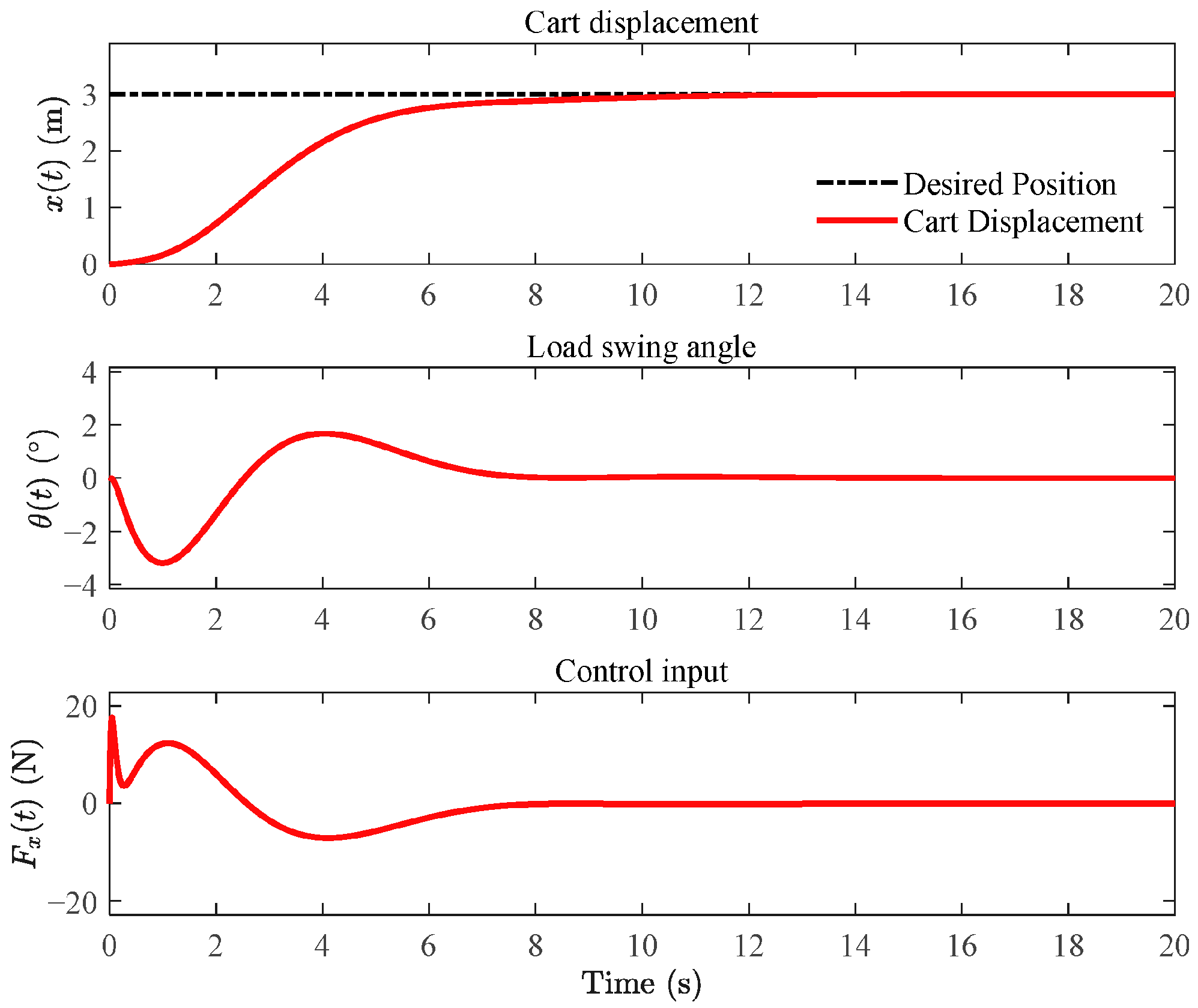
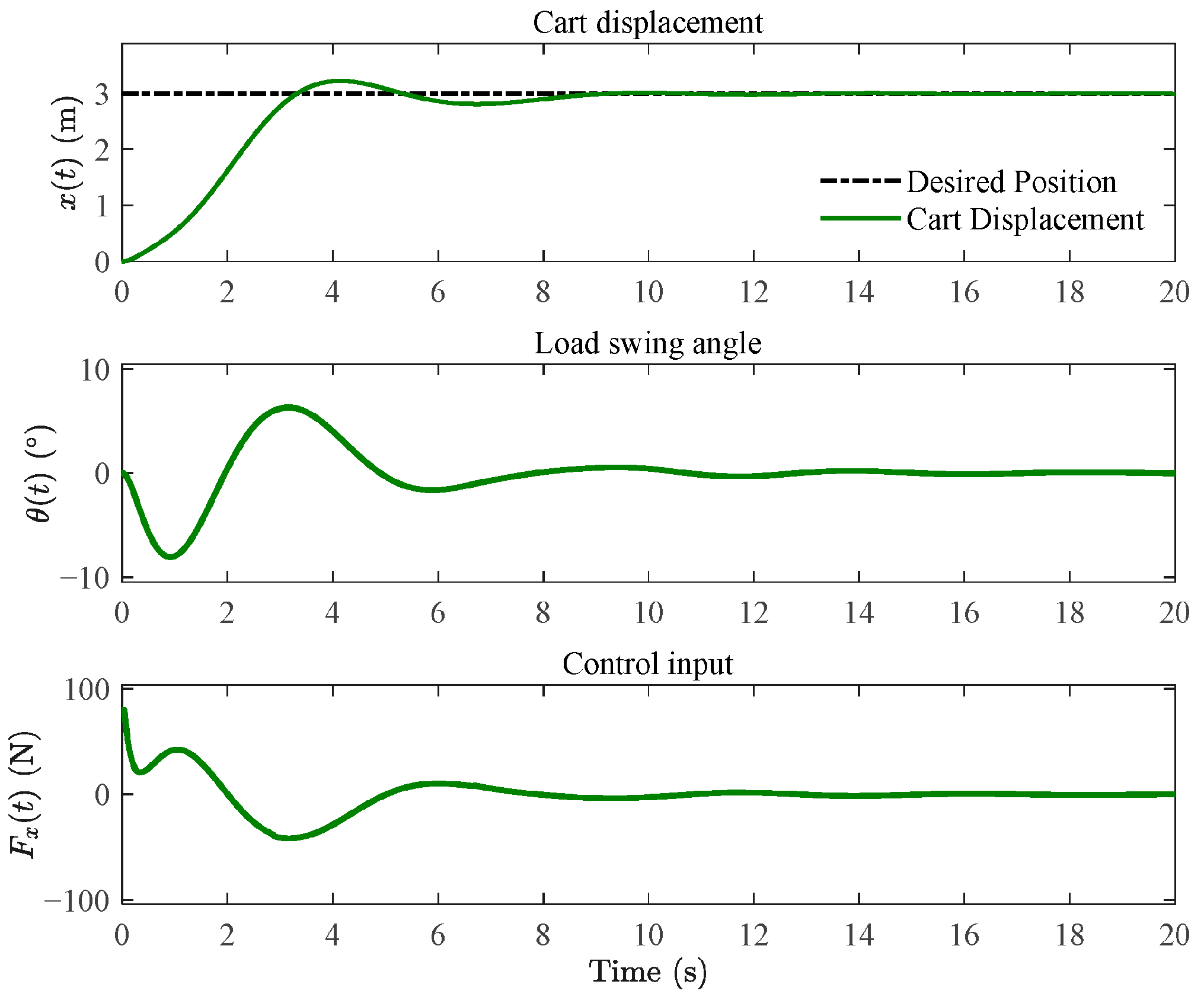
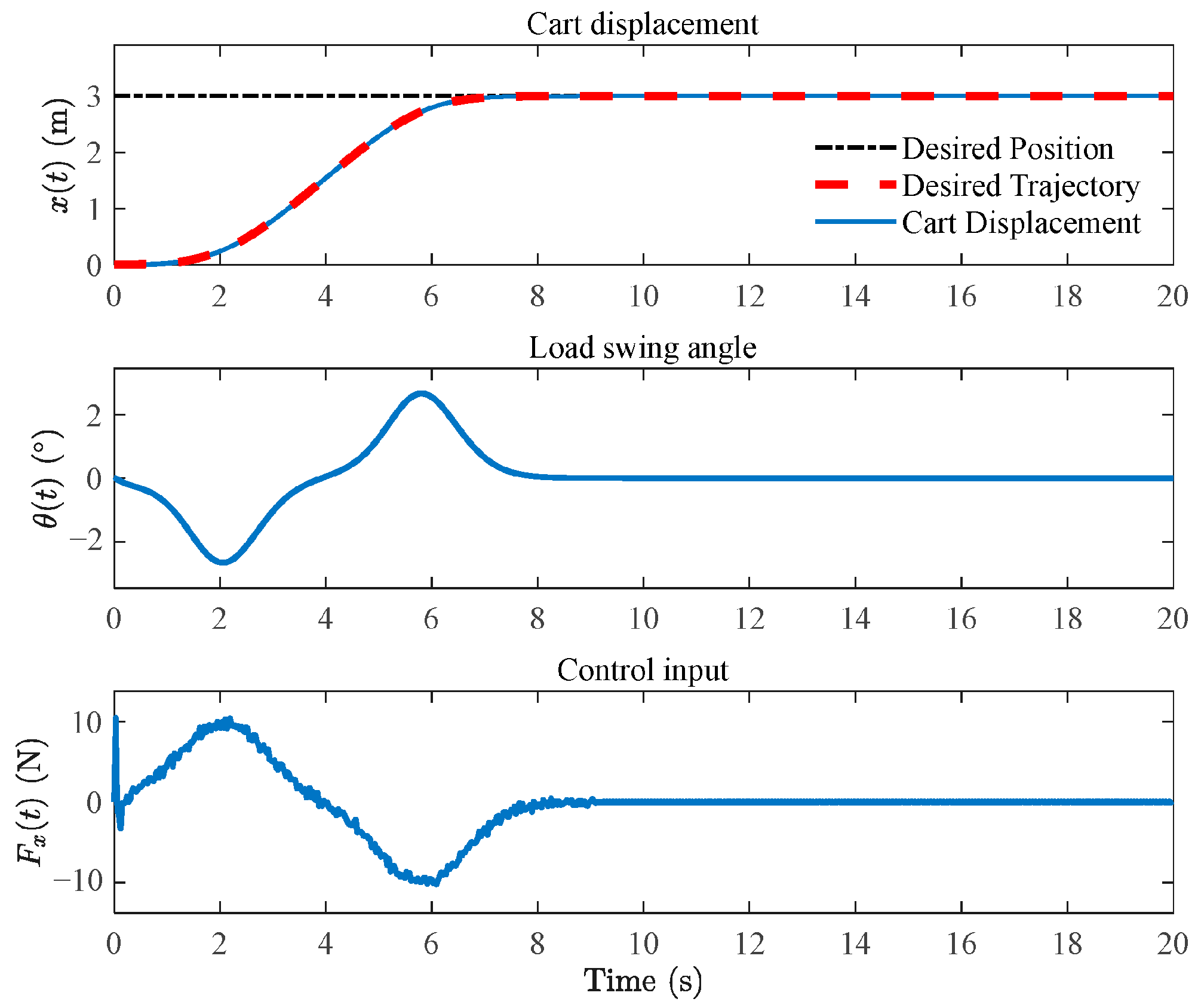
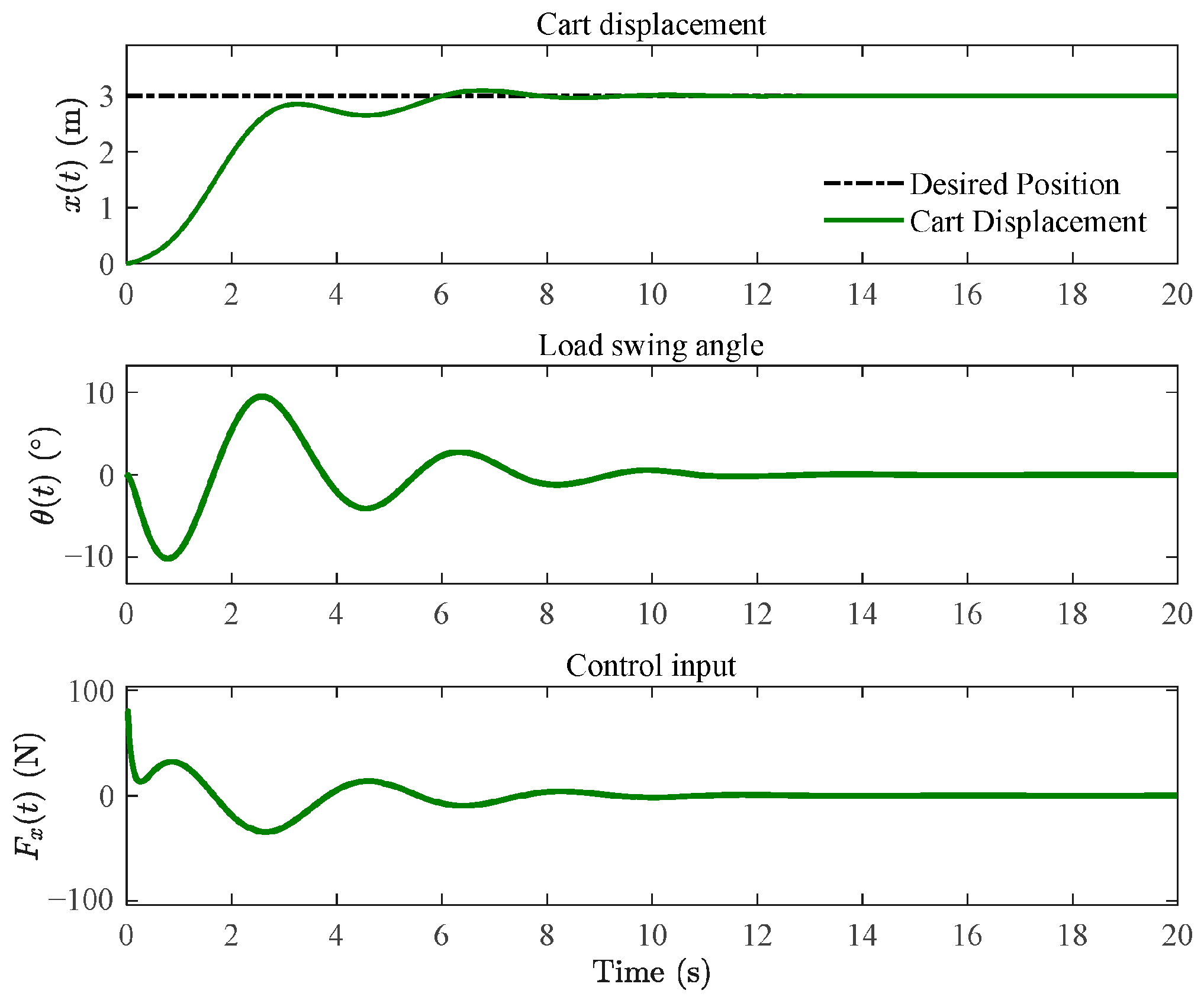
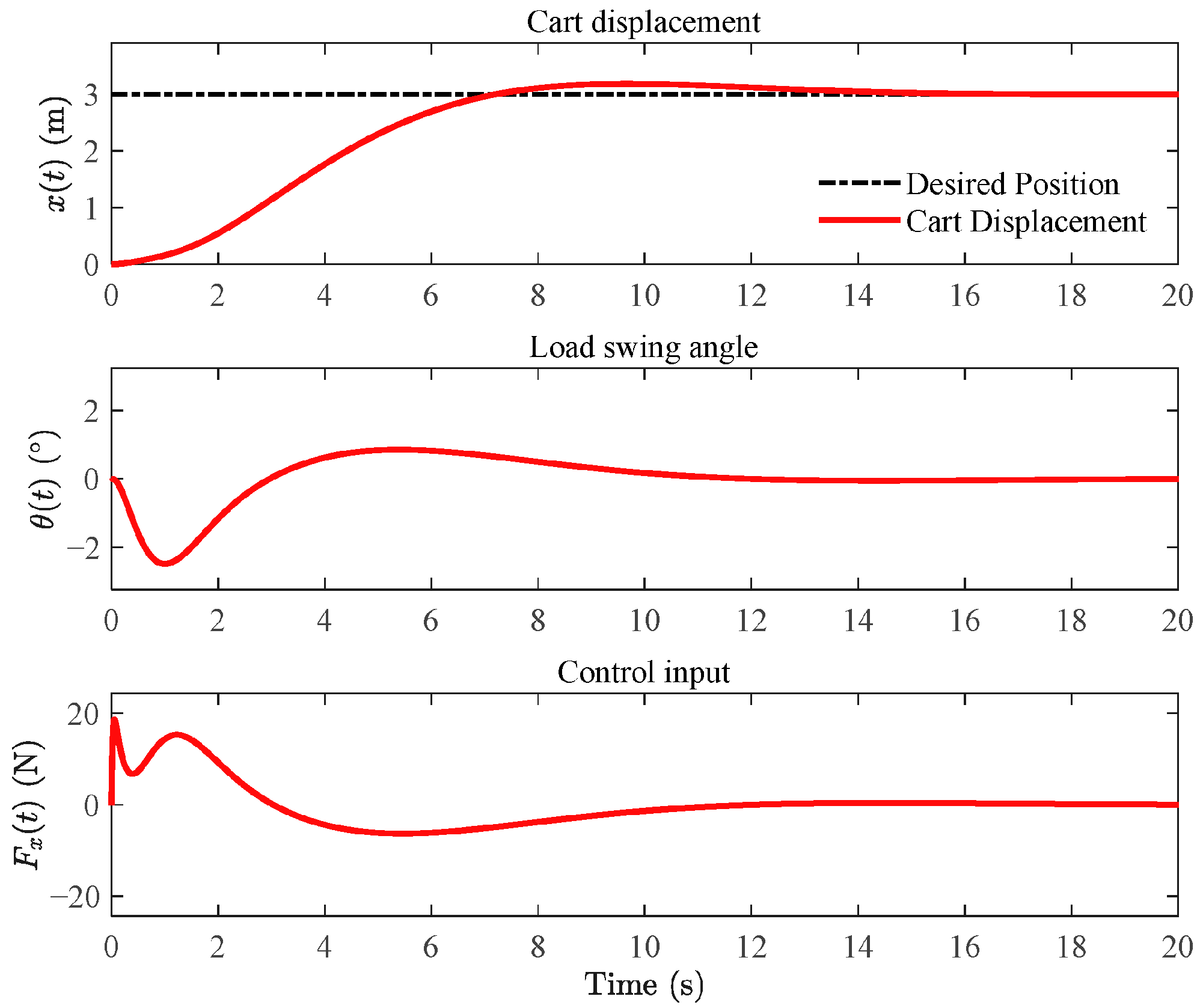
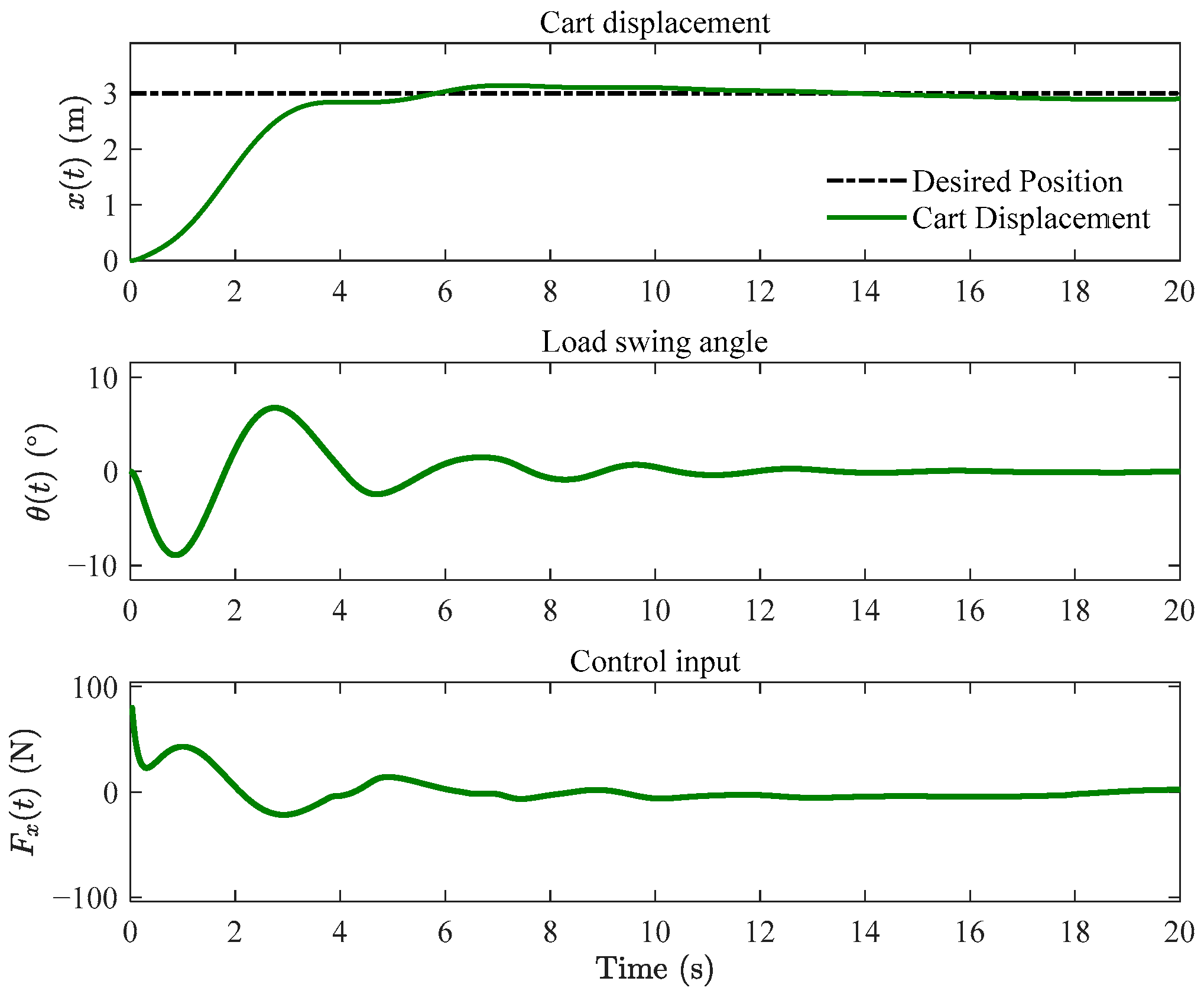
In this subsection, we evaluate the system under nominal physical parameters. Figure 3, Figure 4 and Figure 5 show the transient responses of the proposed method, Wu et al. [42], and Lei et al. [29]. Under these nominal conditions, all three methods drive the cart to the 3 m target while dampening the payload swing.
However, their transient behaviors are different. As Table 1 shows, the proposed method settles in 6.64 s with zero overshoot, and its maximum swing angle is 2.74°. The method of Wu et al. [42] is slightly slower, with a settling time of 7.23 s, and it shows a small overshoot of 0.23%. The method of Lei et al. [29] reaches the target slightly faster, with a settling time of 6.49 s, but it produces a much larger overshoot and a much larger swing angle. These results show that, under nominal conditions, the proposed method gives a smoother response and better swing suppression.

6.2. Tracking Performance Under Light-Load and Short-Cable Conditions

In this test, we change the physical parameters to m = 2 kg and L = 0.8 m , while keeping the control parameters unchanged. Figure 6, Figure 7 and Figure 8 show the system responses. The proposed method still maintains precise positioning. As shown in Table 1, its settling time is 6.68 s, the overshoot is zero, and the maximum swing angle is 2.66°. This result is very close to the nominal case. The method of Wu et al. [42] becomes slower, with a settling time of 9.87 s, although its overshoot remains zero. The method of Lei et al. [29] also degrades under this condition. Its settling time increases to 7.31 s, the overshoot rises to 3.18%, and the maximum swing angle reaches 10.15°. These results indicate that the proposed method is less sensitive to this parameter change and preserves better tracking and anti-sway performance.

6.3. Tracking Performance Under Heavy-Load and Long-Cable Conditions

Next, we evaluate a heavy-load and long-cable scenario by increasing the parameters to m = 20 kg and L = 1.8 m . Figure 9, Figure 10 and Figure 11 present the results. Under this condition, the proposed method remains stable and fast. It settles in 6.62 s with only 0.13% overshoot, and the maximum swing angle is 2.82°. By contrast, the method of Wu et al. [42] becomes much slower. Its settling time increases to 13.46 s, and the overshoot rises to 5.90%. The method of Lei et al. [29] also shows a clear performance drop. Its settling time is 8.40 s, the overshoot reaches 7.55%, and the swing angle is much larger than that of the proposed method. Table 1 summarizes these results. When the payload mass and cable length vary widely, the proposed method keeps nearly the same settling time and a very small overshoot. These results show that it is less sensitive to such physical variations.

6.4. Disturbance Rejection Performance

In order to further evaluate the robustness of the proposed method, complex physical disturbances are introduced into the simulation. Unlike simple mathematical signals, these disturbances are constructed based on realistic mechanics, including viscous friction, Coulomb friction, and the aerodynamic drag acting on the payload.
Expressed in terms of the basic system states x , θ , the lumped disturbances acting on the cart and the payload are designed as follows:
d 1 = 5.5 x ˙ + 5 tanh 50 x ˙ + 2 x ˙ x ˙ + 0.5 L θ ˙ cos θ
d 2 = 0.5 L x ˙ cos θ + L θ ˙
It should be emphasized that these highly nonlinear and coupled terms are completely unknown to the proposed controller. The controller does not rely on an explicit disturbance model. Instead, the lumped disturbance term is estimated through the TDE mechanism and incorporated into the control law.
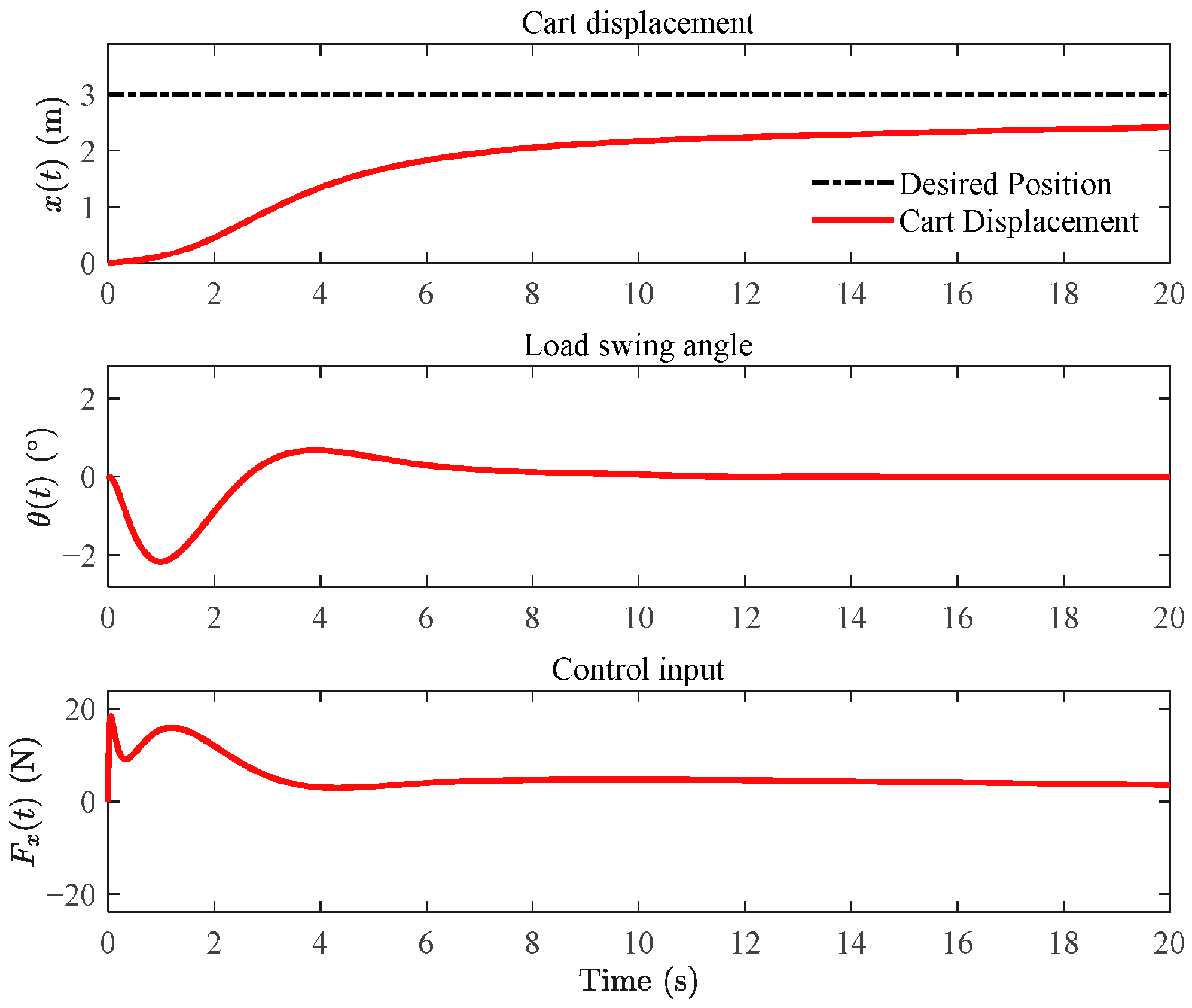
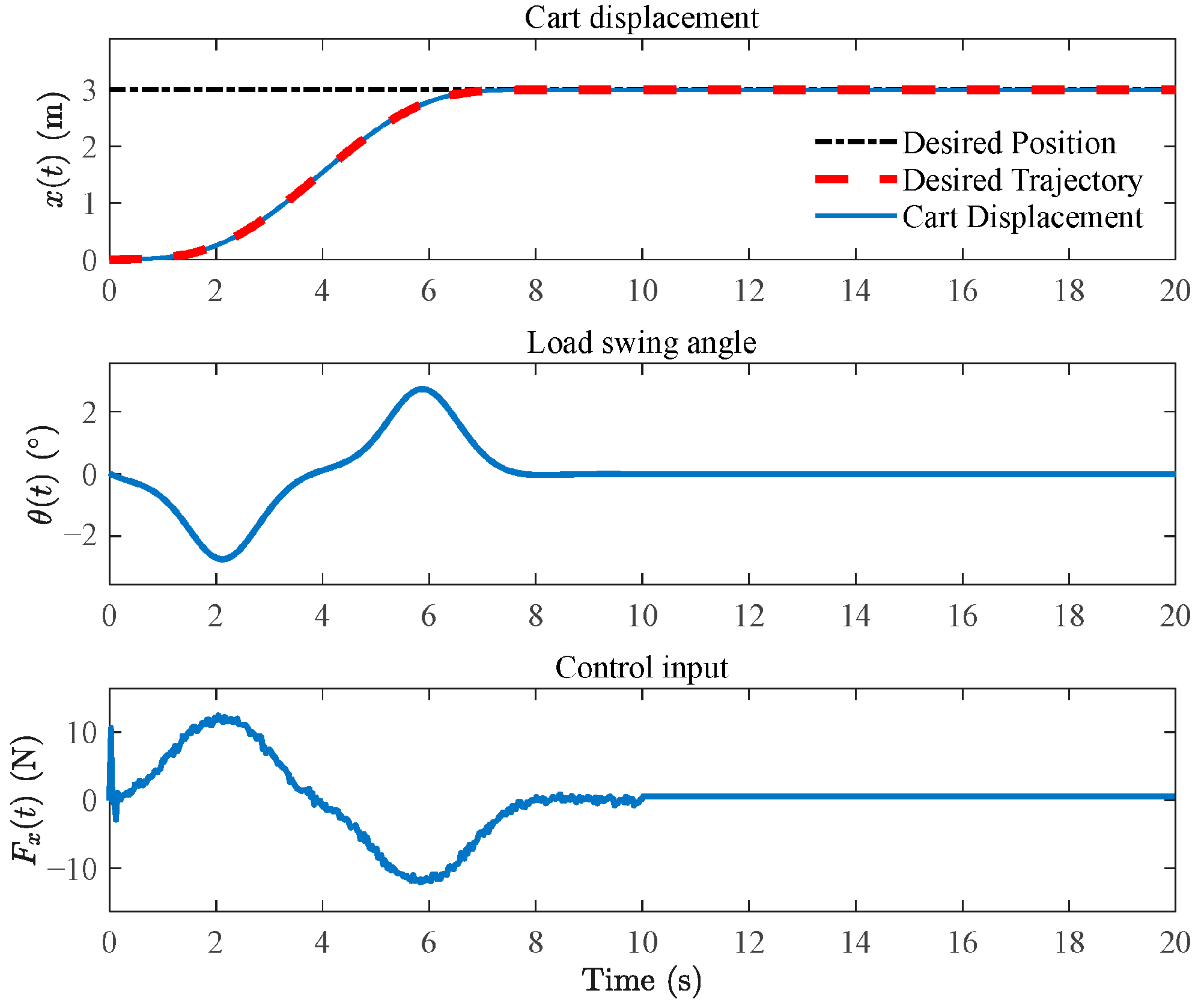
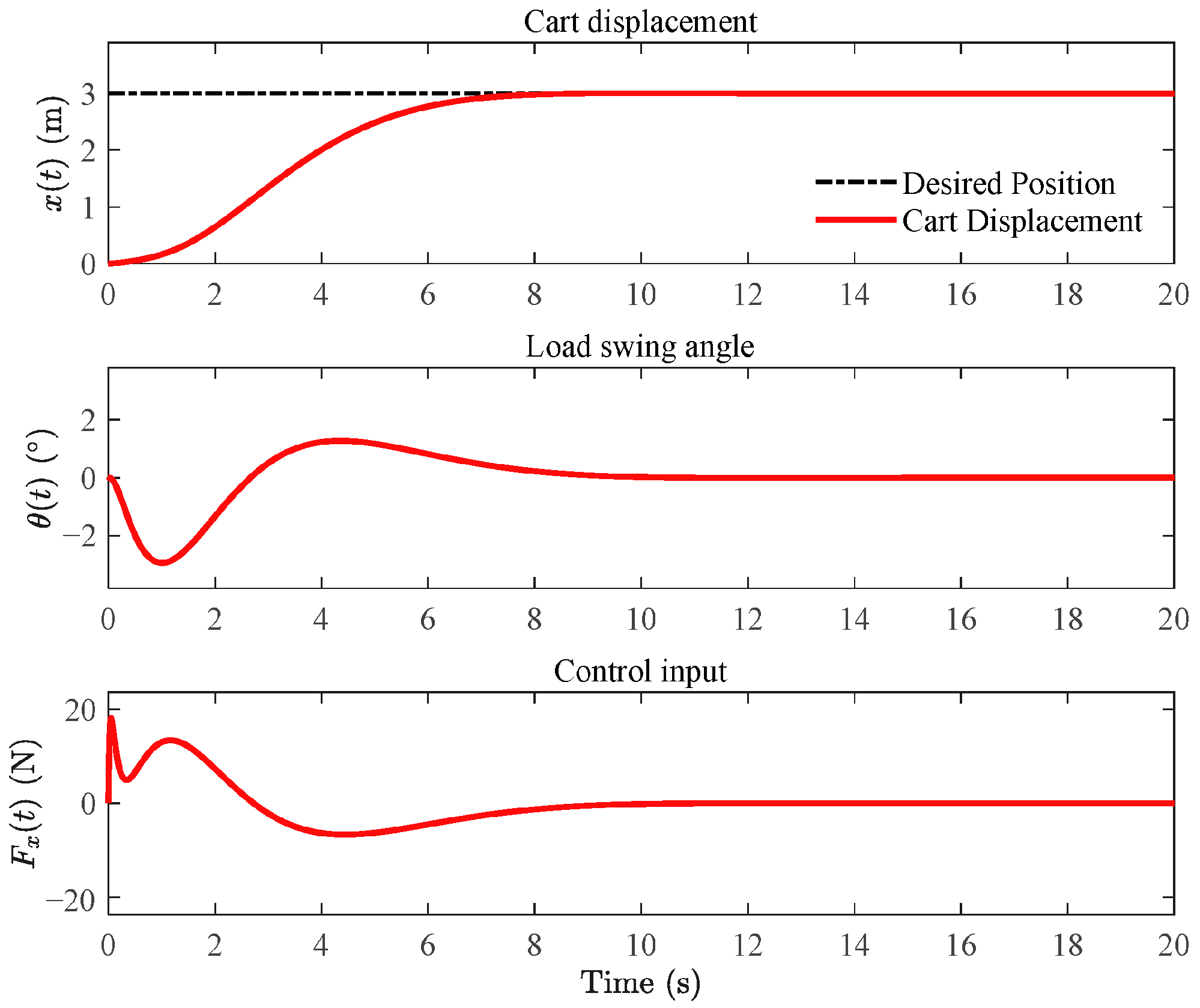
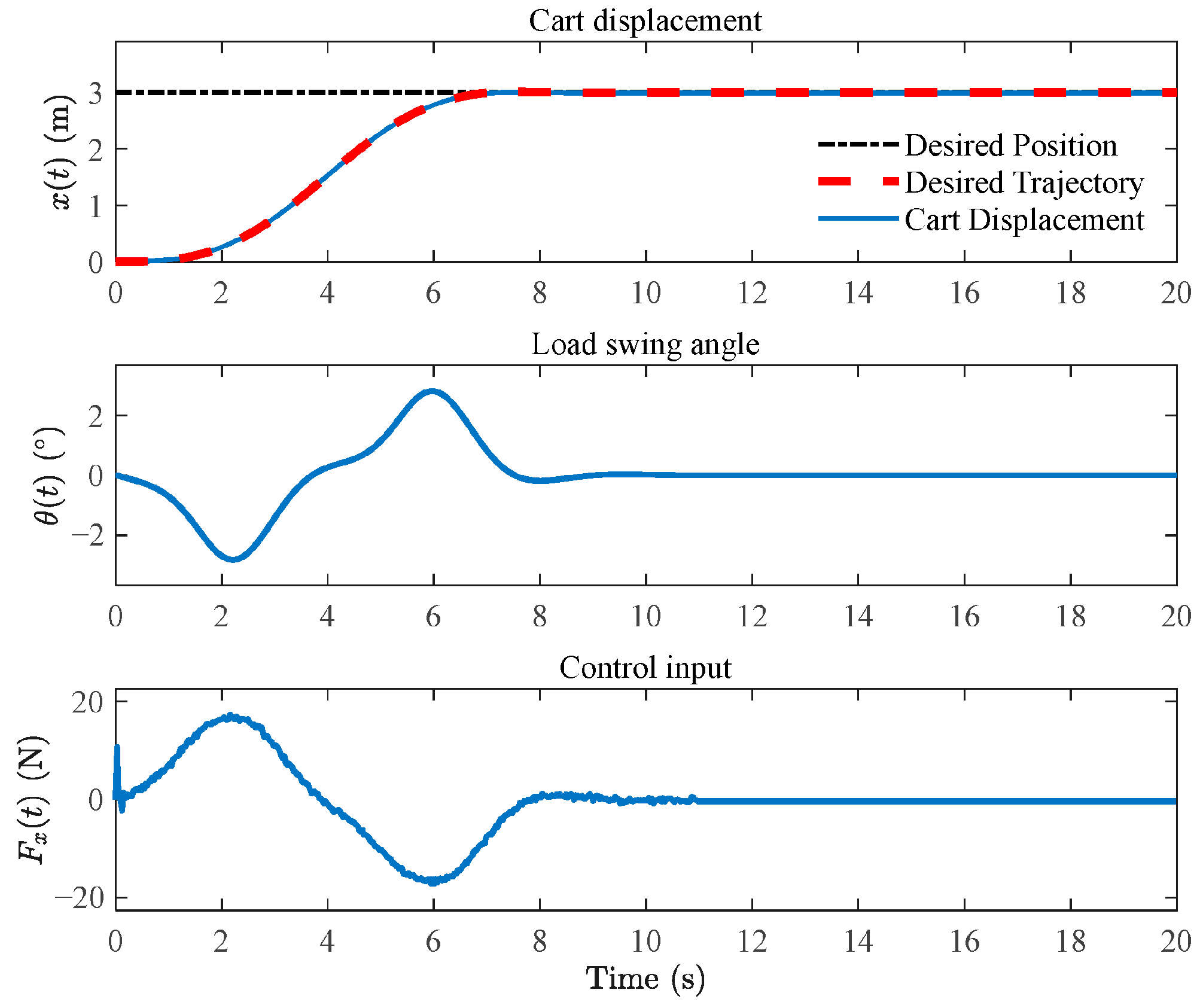
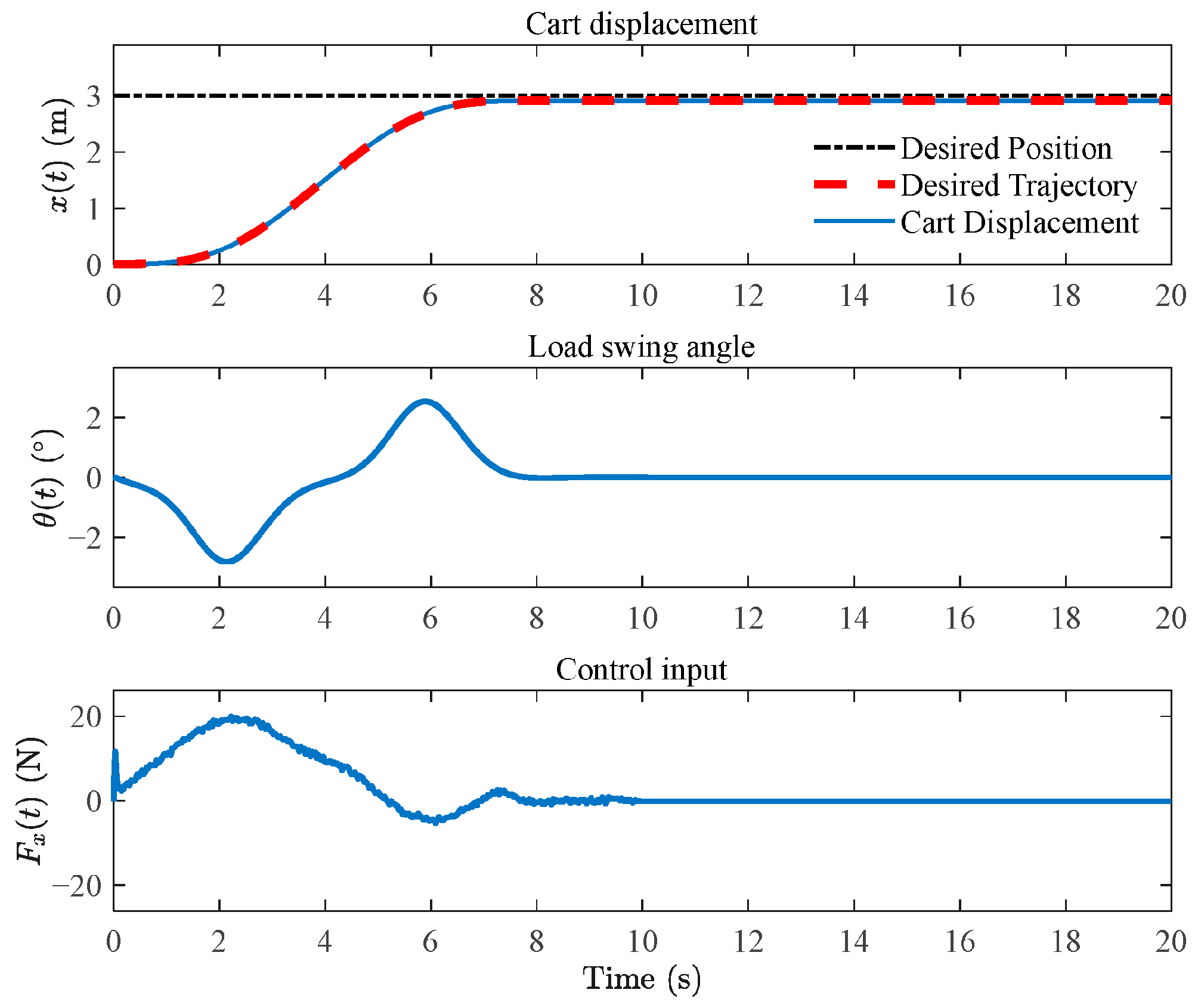
Figure 12, Figure 13 and Figure 14 illustrate the system responses under these harsh conditions, and the corresponding quantitative metrics are summarized in Table 2. The results reveal a clear difference among these control strategies.
As shown in Figure 9, the proposed method still maintains satisfactory performance under the imposed nonlinear disturbances. The cart reaches the target with a settling time of 6.58 s under the 5% error-band criterion. The final steady-state error is 0.09 m, and the maximum swing angle is 2.81°. These results indicate that the proposed method can still provide stable trajectory tracking and limited swing under strong nonlinear disturbances.
By contrast, the method of Wu et al. [42] fails to complete the positioning task. Without an explicit disturbance-handling mechanism, it cannot generate enough force to overcome the static friction. As a result, the cart stops at about 2.4 m, and the steady-state error reaches 0.58 m.
The method of Lei et al. [29] shows a different behavior. It reaches the neighborhood of the target faster, with a settling time of 4.84 s, and its final steady-state error is 0.10 m. However, this faster response is accompanied by a much larger swing angle of 8.89°. Therefore, under the considered nonlinear disturbances, the proposed method provides a better balance among tracking accuracy, swing suppression, and robustness.

7. Conclusions

In this paper, a sliding mode trajectory tracking control scheme, along with the TDE mechanism, is proposed for underactuated overhead crane systems. Overhead crane systems suffer from strong nonlinear coupling and are easily influenced by uncertainties. To tackle these challenges, some transformations are applied to the dynamics. Then, a TDE mechanism is employed to estimate and compensate for the matched and mismatched disturbances in real-time. These estimates are then incorporated into a sliding mode controller to ensure robust trajectory tracking. By applying this approach, the controller no longer relies on precise physical parameters, such as payload mass and cable length. Furthermore, the proposed design reduces the dependence on restrictive prior assumptions on disturbance information.
Based on Lyapunov stability theory, the asymptotic convergence of the closed-loop system is rigorously proven. Comparative simulations show that the proposed scheme maintains satisfactory trajectory-tracking performance under payload and cable-length variations, without retuning the controller parameters. The results also indicate improved robustness under the considered nonlinear disturbance conditions, including friction and aerodynamic drag.

Author Contributions

Z.L.: Conceptualization, methodology, software, validation, formal analysis, writing—original draft preparation. X.W.: Conceptualization, writing—review and editing, supervision. All authors have read and agreed to the published version of the manuscript.

Funding

This research received no external funding.

Data Availability Statement

There were no new data created.

Conflicts of Interest

The authors declare no conflicts of interest.

References

  1. Sun, N.; Fang, Y. New energy analytical results for the regulation of underactuated overhead cranes: An end-effector motion-based approach. IEEE Trans. Ind. Electron. 2012, 59, 4723–4734. [Google Scholar] [CrossRef]
  2. Yu, H.; Liang, X.; Han, J.; Fang, Y. Adaptive trajectory tracking control for the quadrotor aerial transportation system landing a payload onto the mobile platform. IEEE Trans. Ind. Inform. 2024, 20, 23–37. [Google Scholar] [CrossRef]
  3. Heidari, H.; Saska, M. Collision-free trajectory planning of multi-rotor UAVs in a wind condition based on modified potential field. Mech. Mach. Theory 2021, 156, 104140. [Google Scholar] [CrossRef]
  4. Acosta, J.A.; Ortega, R.; Astolfi, A.; Mahindrakar, A.D. Interconnection and damping assignment passivity-based control of mechanical systems with underactuation degree one. IEEE Trans. Autom. Control 2005, 50, 1936–1955. [Google Scholar] [CrossRef]
  5. Dezman, M.; Asfour, T.; Ude, A.; Gams, A. Mechanical design and friction modelling of a cable-driven upper-limb exoskeleton. Mech. Mach. Theory 2022, 171, 104746. [Google Scholar] [CrossRef]
  6. Bhat, S.P.; Bernstein, D.S. Continuous finite-time stabilization of the translational and rotational double integrators. IEEE Trans. Autom. Control 1998, 43, 678–682. [Google Scholar] [CrossRef]
  7. Slotine, J.-J.E.; Li, W. Applied Nonlinear Control; Prentice Hall: Englewood Cliffs, NJ, USA, 1991. [Google Scholar]
  8. Khalil, H.K. Nonlinear Systems, 3rd ed.; Prentice Hall: Upper Saddle River, NJ, USA, 2002. [Google Scholar]
  9. Wu, Z.; Xia, X. Optimal motion planning for overhead cranes. IET Control Theory Appl. 2014, 8, 1833–1842. [Google Scholar] [CrossRef]
  10. Singhose, W.; Seering, W.; Singer, N. Residual vibration reduction using vector diagrams to generate shaped inputs. J. Mech. Des. 1994, 116, 654–659. [Google Scholar] [CrossRef]
  11. Blackburn, D.; Singhose, W.; Kitchen, J.; Patrangenaru, V.; Lawrence, J.; Kamoi, T.; Taura, A. Command shaping for nonlinear crane dynamics. J. Vib. Control 2010, 16, 477–501. [Google Scholar] [CrossRef]
  12. Maghsoudi, M.J.; Ramli, L.; Sudin, S.; Mohamed, Z. Improved unity magnitude input shaping scheme for sway control of an underactuated 3D overhead crane with hoisting. Mech. Syst. Signal Process. 2019, 123, 466–482. [Google Scholar] [CrossRef]
  13. Sun, N.; Fang, Y.; Zhang, X.; Yuan, Y. Transportation task-oriented trajectory planning for underactuated overhead cranes using geometric analysis. IET Control Theory Appl. 2012, 6, 1410–1423. [Google Scholar] [CrossRef]
  14. Sun, N.; Fang, Y. An efficient online trajectory generating method for underactuated crane systems. Int. J. Robust Nonlinear Control 2014, 24, 1653–1663. [Google Scholar] [CrossRef]
  15. Park, M.S.; Chwa, D.; Hong, S.K. Antisway tracking control of overhead cranes with system uncertainty and actuator nonlinearity using an adaptive fuzzy sliding-mode control. IEEE Trans. Ind. Electron. 2008, 55, 3972–3984. [Google Scholar] [CrossRef]
  16. Jiang, J.; Astolfi, A. Stabilization of a class of underactuated nonlinear systems via underactuated backstepping. IEEE Trans. Autom. Control 2020, 66, 5429–5435. [Google Scholar] [CrossRef]
  17. Sun, N.; Yang, T.; Chen, H.; Fang, Y.; Qian, Y. Adaptive anti-swing and positioning control for 4-DOF rotary cranes subject to uncertain/unknown parameters with hardware experiments. IEEE Trans. Syst. Man Cybern. Syst. 2019, 49, 1309–1321. [Google Scholar] [CrossRef]
  18. Yang, T.; Sun, N.; Chen, H.; Fang, Y. Neural network-based adaptive antiswing control of an underactuated ship-mounted crane with roll motions and input dead zones. IEEE Trans. Neural Netw. Learn. Syst. 2020, 31, 901–914. [Google Scholar] [CrossRef]
  19. Zhang, M.; Jing, X.; Huang, W.; Lu, Q.; Chen, J.; Chen, Z. Robust fault accommodation approach for double-pendulum tower cranes via adaptive neural network-triggered control. Nonlinear Dyn. 2023, 111, 19993–20013. [Google Scholar] [CrossRef]
  20. Bartolini, G.; Pisano, A.; Usai, E. Second-order sliding-mode control of container cranes. Automatica 2002, 38, 1783–1790. [Google Scholar] [CrossRef]
  21. Jose, J.T.; Wrat, G.; Mishra, S.K.; Ranjan, P.; Das, J. Fuzzy PD-Based Control for Excavator Boom Stabilization Using Work Port Pressure Feedback. Actuators 2025, 14, 336. [Google Scholar] [CrossRef]
  22. Mishra, S.K.; Wrat, G.; Ranjan, P.; Jose, J.T.; Das, J. Precision and Stability in Hydrostatic Transmissions with Robust H∞ Control Under Parametric Uncertainties. J. Exp. Theor. Anal. 2025, 3, 14. [Google Scholar] [CrossRef]
  23. Tang, W.; Liu, Z.; Wang, W.; Gao, H. Design of model-free adaptive controller for overhead cranes based on extended state observer. Int. J. Dyn. Control 2025, 13, 341. [Google Scholar] [CrossRef]
  24. Yang, M.; Xu, W. Adaptive time delay estimation and dynamic residual-assisted prescribed performance control of overhead crane systems based on a fractional-order ultra-local model. J. Frankl. Inst. 2025, 362, 108203. [Google Scholar] [CrossRef]
  25. Wang, T.; Zhou, J.; Zhang, Q.; Lin, C.; Liang, Y. Design of Adaptive Time-Varying Sliding Mode Controller for Underactuated Overhead Crane Optimized via Improved Honey Badger Algorithm. J. Intell. Robot. Syst. 2023, 108, 39. [Google Scholar] [CrossRef]
  26. Zhang, Y.; Dai, C.; Wu, X. Finite-time plant-parameter-free trajectory tracking control for overhead cranes with double-pendulum dynamics and uncertain disturbances. Trans. Inst. Meas. Control 2024, 01423312241295579. [Google Scholar] [CrossRef]
  27. Wu, X.; Xu, K.; Lei, M.; He, X. Disturbance-compensation-based continuous sliding mode control for overhead cranes with disturbances. IEEE Trans. Autom. Sci. Eng. 2020, 17, 2182–2189. [Google Scholar] [CrossRef]
  28. Qian, Y.; Fang, Y. Switching logic-based nonlinear feedback control of offshore ship-mounted tower cranes: A disturbance observer-based approach. IEEE Trans. Autom. Sci. Eng. 2019, 16, 1125–1136. [Google Scholar] [CrossRef]
  29. Lei, M.; Wu, X.; Zhang, Y.; Ke, L. Super-twisting disturbance-observer-based nonlinear control of the overhead crane system. Nonlinear Dyn. 2023, 111, 14015–14025. [Google Scholar] [CrossRef]
  30. Sun, H.; Lei, M.; Wu, X. Output feedback control of overhead cranes based on disturbance compensation. Electronics 2023, 12, 4474. [Google Scholar] [CrossRef]
  31. Yang, G. State filtered disturbance rejection control. Nonlinear Dyn. 2024, 113, 6739–6755. [Google Scholar] [CrossRef]
  32. Yang, G. Multilayer Neuroadaptive Reinforcement Learning of Disturbed Nonlinear Systems via Actor-Critic Mechanism. IEEE Trans. Autom. Sci. Eng. 2026, 23, 1372–1381. [Google Scholar] [CrossRef]
  33. Wu, Q.; Ouyang, H.; Xi, H. Adaptive nonlinear control for 4-DOF ship-mounted rotary cranes. Int. J. Robust Nonlinear Control 2023, 33, 1957–1972. [Google Scholar] [CrossRef]
  34. Le, A.T.; Moon, S.C.; Lee, W.G.; Lee, S.G. Adaptive sliding mode control of overhead cranes with varying cable length. J. Mech. Sci. Technol. 2013, 27, 885–893. [Google Scholar] [CrossRef]
  35. Lu, B.; Fang, Y.; Sun, N. Sliding mode control for underactuated overhead cranes suffering from both matched and unmatched disturbances. Mechatronics 2017, 47, 116–125. [Google Scholar] [CrossRef]
  36. Moreno, J.A.; Osorio, M. Strict Lyapunov functions for the super-twisting algorithm. IEEE Trans. Autom. Control 2012, 57, 1035–1040. [Google Scholar] [CrossRef]
  37. Yao, X.Y.; Chen, H.; Liu, Y.; Dong, Y. Tracking approach of double pendulum cranes with variable rope lengths using sliding mode technique. ISA Trans. 2023, 136, 152–161. [Google Scholar] [CrossRef]
  38. Feng, Y.; Zhang, H.; Gu, C. The prescribed-time sliding mode control for underactuated bridge crane. Electronics 2024, 13, 219. [Google Scholar] [CrossRef]
  39. Tuan, L.A.; Lee, S.G.; Ko, D.H.; Nho, L.C. Combined control with sliding mode and partial feedback linearization for 3D overhead cranes. Int. J. Robust Nonlinear Control 2014, 24, 3372–3386. [Google Scholar] [CrossRef]
  40. Ngo, Q.H.; Hong, K.S. Adaptive sliding mode control of container cranes. IET Control Theory Appl. 2012, 6, 662–668. [Google Scholar] [CrossRef]
  41. Zhang, M.; Zhang, Y.; Chen, H.; Cheng, X. Model-independent PD-SMC method with payload swing suppression for 3D overhead crane systems. Mech. Syst. Signal Process. 2019, 129, 381–393. [Google Scholar] [CrossRef]
  42. Wu, X.; He, X.; Wang, M. A new anti-swing control law for overhead crane systems. In Proceedings of the 2014 9th IEEE Conference on Industrial Electronics and Applications (ICIEA), Hangzhou, China, 9–11 June 2014; pp. 678–683. [Google Scholar] [CrossRef]
  43. Jung, S.; Hsia, T.C.; Bonitz, R.G. Force tracking impedance control of robot manipulators under unknown environment. IEEE Trans. Control Syst. Technol. 2004, 12, 474–483. [Google Scholar] [CrossRef]
  44. Baek, J.; Jin, M.; Han, S. A new adaptive sliding-mode control scheme for application to robot manipulators. IEEE Trans. Ind. Electron. 2016, 63, 3628–3637. [Google Scholar] [CrossRef]
  45. Lee, J.; Chang, P.; Jin, M. Adaptive integral sliding mode control with time-delay estimation for robot manipulators. IEEE Trans. Ind. Electron. 2017, 64, 6796–6804. [Google Scholar] [CrossRef]
  46. Liu, S.; Xu, W. Model-free robust adaptive control of overhead cranes with finite-time convergence based on time-delay control. Trans. Inst. Meas. Control 2023, 45, 1037–1051. [Google Scholar] [CrossRef]
  47. Li, G.; Ma, X.; Li, Y. Adaptive sliding mode control based on time-delay estimation for underactuated 7-DOF tower crane. IEEE Trans. Syst. Man Cybern. Syst. 2025, 55, 2277–2288. [Google Scholar] [CrossRef]
  48. Wang, X.; He, Z.; Liu, C.; Du, W. Anti-Sway Adaptive Fast Terminal Sliding Mode Control Based on the Finite-Time State Observer for the Overhead Crane System. Electronics 2024, 13, 4709. [Google Scholar] [CrossRef]
  49. Qiang, H.; Sun, Y.; Lyu, J.; Dong, D. Anti-Sway and Positioning Adaptive Control of a Double-Pendulum Effect Crane System with Neural Network Compensation. Front. Robot. AI 2021, 8, 639734. [Google Scholar] [CrossRef]
  50. Huang, W.; Lu, B.; Weng, C.; Niu, W. Improved Waveform Command Shaping Anti-Sway Control for Arbitrary Initial and Terminal Conditions. Mech. Syst. Signal Process. 2025, 241, 113547. [Google Scholar] [CrossRef]
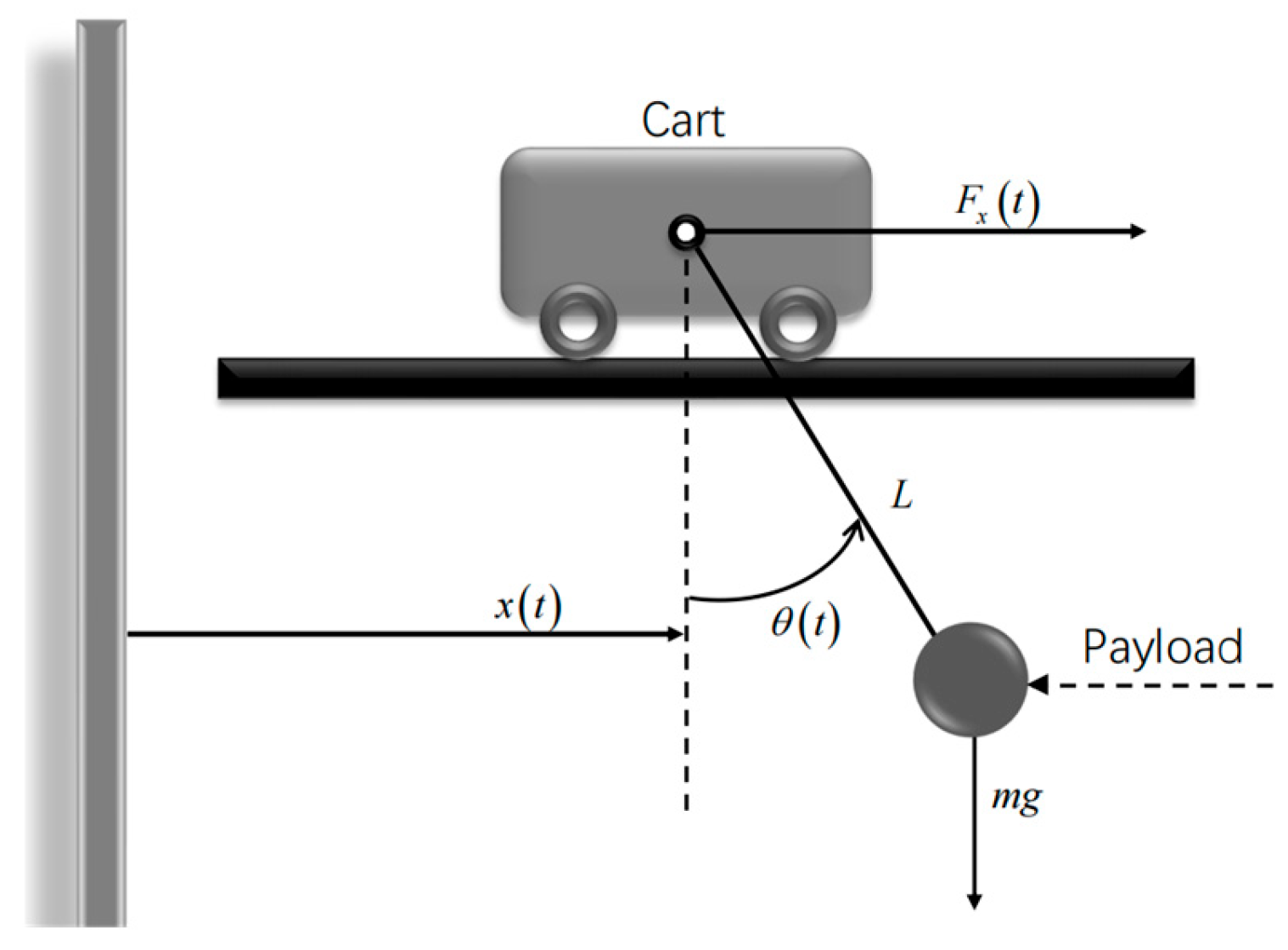
Figure 1. Schematic of the overhead crane system.
Electronics 15 01407 g001
Figure 2. Control block diagram.
Electronics 15 01407 g002
Figure 3. System responses of the proposed method under nominal conditions.
Electronics 15 01407 g003
Figure 4. System responses of the Wu et al. [42] method under nominal conditions.
Electronics 15 01407 g004
Figure 5. System responses of the Lei et al. [29] method under nominal conditions.
Electronics 15 01407 g005
Figure 6. System responses of the proposed method under light-short conditions.
Electronics 15 01407 g006
Figure 7. System responses of the Wu et al. [42] method under light-short conditions.
Electronics 15 01407 g007
Figure 8. System responses of the Lei et al. [29] method under light-short conditions.
Electronics 15 01407 g008
Figure 9. System responses of the proposed method under heavy-long conditions.
Electronics 15 01407 g009
Figure 10. System responses of the Wu et al. [42] method under heavy-long conditions.
Electronics 15 01407 g010
Figure 11. System responses of the Lei et al. [29] method under heavy-long conditions.
Electronics 15 01407 g011
Figure 12. System responses of the proposed method under complex nonlinear disturbances.
Electronics 15 01407 g012
Figure 13. System responses of the Wu et al. [42] method under complex nonlinear disturbances.
Electronics 15 01407 g013
Figure 14. System responses of the Lei et al. [29] method under complex nonlinear disturbances.
Electronics 15 01407 g014
Table 1. Quantitative performance comparison under different physical parameters.
CaseMethod t s s M p % θ m a x °
Nominal   m = 8 kg , L = 1.2 m Proposed6.640.002.74
Wu et al. [42]7.230.232.93
Lei et al. [29]6.491.929.32
Light - short   m = 2 kg , L = 0.8 m Proposed6.680.002.66
Wu et al. [42]9.870.003.20
Lei et al. [29]7.313.1810.15
Heavy - long   m = 20 kg , L = 1.8 m Proposed6.620.132.82
Wu et al. [42]13.465.902.49
Lei et al. [29]8.407.558.05
Note: t s is the settling time (2% criterion), M p is the maximum overshoot of cart displacement, and θ max is the maximum payload swing angle.
Table 2. Quantitative performance comparison under complex nonlinear disturbances.
Method t s s E s s m θ m a x °
Proposed6.580.092.81
Wu et al. [42]N/A0.582.17
Lei et al. [29]4.840.108.89
Disclaimer/Publisher’s Note: The statements, opinions and data contained in all publications are solely those of the individual author(s) and contributor(s) and not of MDPI and/or the editor(s). MDPI and/or the editor(s) disclaim responsibility for any injury to people or property resulting from any ideas, methods, instructions or products referred to in the content.