Causal Representation Learning for Joint Modeling and Mitigation of Coupled RF Impairments in MIMO Systems


Abstract
1. Introduction
2. Proposed Method
2.1. System Model and Causal Problem Formulation
2.1.1. Imperfect Channel State Information
2.1.2. Nonlinear Distortion as the Primary Hardware-Dependent Impairment
2.1.3. Phase Noise as an Oscillator-Driven but Amplitude-Sensitive Process
2.1.4. Effective Thermal Noise as a Post-Phase Perturbation Process
2.1.5. Resulting Structural Dependency
- Nonlinearity alters amplitude and phase characteristics.
- Phase noise accumulates on the already distorted signal.
- Thermal noise interacts with phase-rotated symbols, producing effective distortion.
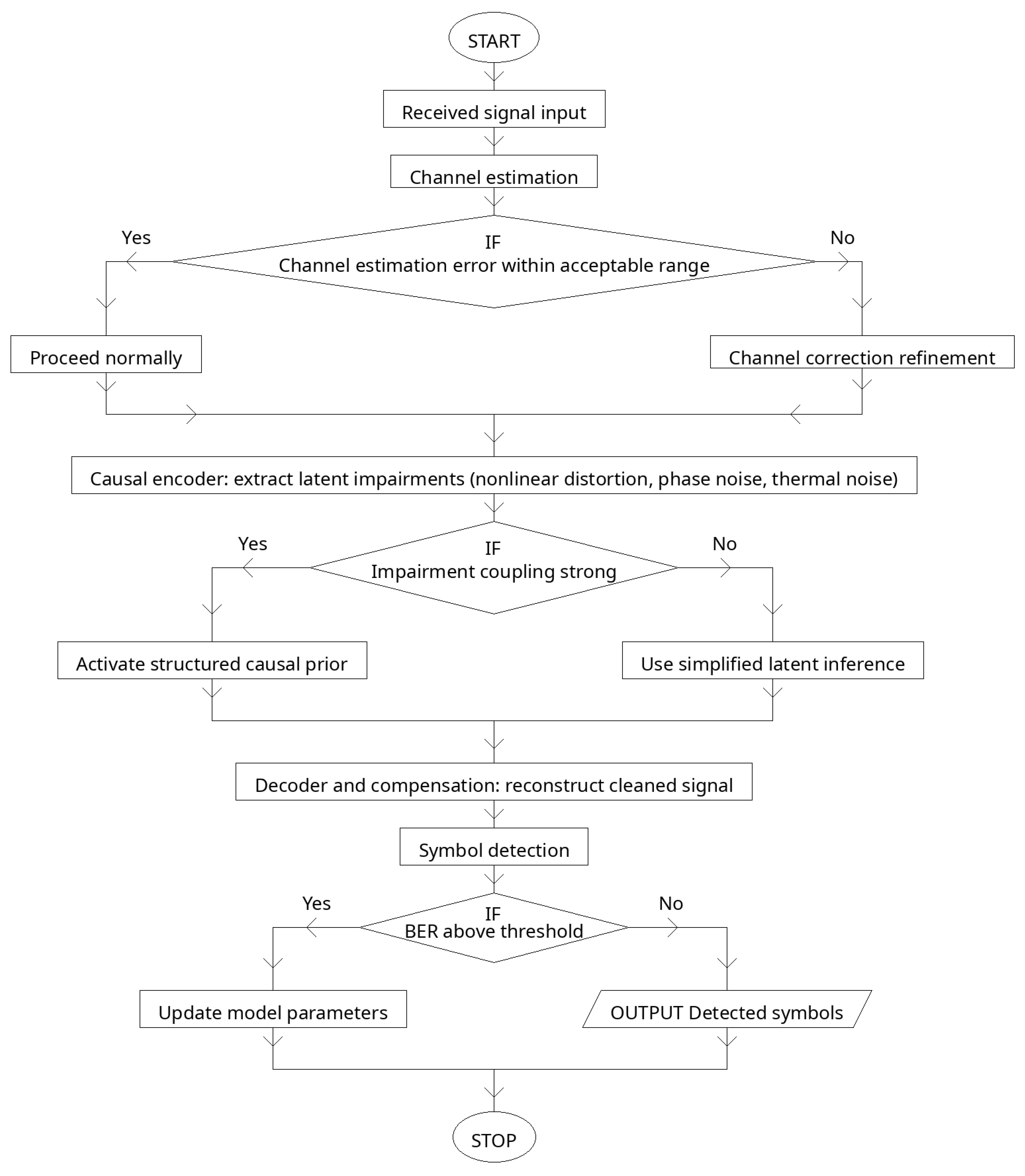
2.2. Causal Representation Learning Architecture
2.3. Training Objective and Causal Optimization Strategy
| Algorithm 1: Training Optimization Process of the Proposed Causal Representation Learning Model |
| Inputs: - Simulated dataset D = {(x, H, y)} generated under coupled RF impairments - Encoder network qφ(z | y) with parameters φ - Decoder network pθ(y | x, H, z) with parameters θ - Structured causal prior p(z) = p(znl) p(zpn | znl) p(ztn | zpn) - Causal edge set E defining directed dependencies among {ztn, zpn, znl} - Causal regularization weight λc - Learning rate η, number of epochs E, mini batch size B Outputs: - Trained parameters φ*, θ* 1: Initialize encoder parameters φ and decoder parameters θ 2: for epoch = 1 to E do 3: Shuffle dataset D 4: Partition D into mini batches of size B 5: for each mini batch Mb = {(x, H, y)} do 6: Forward pass through encoder: 7: Compute {μk(y), σk^2(y)} for k ∈ {tn, pn, nl} 8: Sample latent variables using reparameterization: 9: zk = μk(y) + σk(y) ⊙ εk, where εk ~ N(0, I) 10: Forward pass through decoder: 11: Reconstruct received signal: 12: = gθ(x, H, z) 13: Compute reconstruction loss: 14: Lrec = − log pθ(y | x, H, z) 15: Compute KL divergence with structured causal prior: 16: Lkl = KL(qφ(z | y) || p(z)) 17: Compute causal regularization using non edges: 18: Lcausal = Σ(i,j)∉E |Cov(zi, zj)| 19: Combine total loss: 20: Ltotal = Lrec + Lkl + λc Lcausal 21: Backpropagate gradients of Ltotal w.r.t. φ and θ 22: Update parameters: 23: φ ← φ − η ∇φ Ltotal 24: θ ← θ − η ∇θ Ltotal 25: end for 26: end for 27: Return trained parameters φ*, θ* |
3. Implementation and Results
3.1. Simulation Environment and Dataset Generation
3.2. Baseline Methods and Evaluation Metrics
3.3. Performance Results and Analysis
4. Discussion
5. Conclusions
Author Contributions
Funding
Data Availability Statement
Acknowledgments
Conflicts of Interest
References
- Merkli, K.; Prukner, P.; Nagy, S. The Relationship Between EMF Exposure and MIMO Systems, and the Exposure Advantages of Lowband Massive MIMO System. Telecom 2025, 6, 63. [Google Scholar] [CrossRef]
- Rivero-Ángeles, M.E.; Orea-Flores, I.Y. Recent Advances in Applications and Performance Improvement Schemes in Wireless Communication. Telecom 2026, 7, 12. [Google Scholar] [CrossRef]
- Alzubaidi, O.T.H.; Alheejawi, S.; Hindia, M.N.; Dimyati, K.; Noordin, K.A. Interference Mitigation Strategies in Beyond 5G Wireless Systems: A Review. Electronics 2025, 14, 2237. [Google Scholar] [CrossRef]
- Karimi Mamaghan, A.M.; Dittadi, A.; Bauer, S.; Johansson, K.H.; Quinzan, F. Diffusion-Based Causal Representation Learning. Entropy 2024, 26, 556. [Google Scholar] [CrossRef] [PubMed]
- Lin, C.; Han, G.; Wu, Q.; Wang, B.; Zhuang, J.; Li, W.; Hao, Z.; Fan, Z. Improving Generalization in Collision Avoidance for Multiple Unmanned Aerial Vehicles via Causal Representation Learning. Sensors 2025, 25, 3303. [Google Scholar] [CrossRef] [PubMed]
- Cai, S.; Zhou, L.; Li, T.; Yu, J. A Deep Learning Phase Noise Compensation Network for Photonic Terahertz OFDM System. Electronics 2026, 15, 647. [Google Scholar] [CrossRef]
- Feng, Q.; Zhang, J.; Li, Q.; Li, M.; Chen, L. ResDiff: Hardware-Aware Physical-Layer Covert Communication via Diffusion-Based Residual Perturbation. Electronics 2026, 15, 635. [Google Scholar] [CrossRef]
- Yu, H.; Yu, J.; Liu, J.; Li, Y.; Ye, N.; Yang, K.; An, J. Covert Satellite Communication over Overt Channel: A Randomized Gaussian Signalling Approach. IEEE Trans. Aerosp. Electron. Syst. 2024, 61, 2355–2368. [Google Scholar] [CrossRef]
- Abd El-Mottaleb, S.A.; Atieh, A. Real-Time Signal Quality Assessment and Power Adaptation of FSO Links Operating Under All-Weather Conditions Using Deep Learning Exploiting Eye Diagrams. Photonics 2025, 12, 789. [Google Scholar] [CrossRef]
- Armghan, A.; Alsharari, M.; Aliqab, K.; Singh, M.; Abd El-Mottaleb, S.A. Performance Analysis of Hybrid PDM-SAC-OCDMA-Enabled FSO Transmission Using ZCC Codes. Appl. Sci. 2023, 13, 2860. [Google Scholar] [CrossRef]
- Bart, M.P.; Savino, N.J.; Regmi, P.; Cohen, L.; Safavi, H.; Shaw, H.C.; Lohani, S.; Searles, T.A.; Kirby, B.T.; Lee, H.; et al. Deep Learning for Enhanced Free-Space Optical Communications. Mach. Learn. Sci. Technol. 2023, 4, 045046. [Google Scholar] [CrossRef]
- Ahmed, H.Y.; Zeghid, M.; Khan, A.N.; Abd El-Mottaleb, S.A. Fuzzy Logic-Based Performance Enhancement of FSO Systems Under Adverse Weather Conditions. Photonics 2025, 12, 495. [Google Scholar] [CrossRef]
- Azizi, S.P.; Nafei, A.; Chen, S.-C.; Lin, R.-H. Deep Learning-Enhanced Hybrid Beamforming Design with Regularized SVD Under Imperfect Channel Information. Mathematics 2026, 14, 509. [Google Scholar] [CrossRef]
- Nie, Y.; Ma, Z.; Jing, L. Model-Data Hybrid-Driven Wideband Channel Estimation for Beamspace Massive MIMO Systems. Entropy 2026, 28, 154. [Google Scholar] [CrossRef] [PubMed]
- Alkharsan, A.; Ata, O. HawkFish Optimization Algorithm: A Gender-Bending Approach for Solving Complex Optimization Problems. Electronics 2025, 14, 611. [Google Scholar] [CrossRef]
- Zhang, X.; Vaezi, M. Deep Autoencoder-Based Z-Interference Channels with Perfect and Imperfect CSI. arXiv 2023, arXiv:2310.15027. [Google Scholar]
- Srivastava, S.; Banerjee, A. DeepPolar+: Breaking the BER–BLER Trade-Off with Self-Attention and SMART (SNR-MAtched Redundancy Technique) Decoding. arXiv 2025, arXiv:2506.10166. [Google Scholar]
- Omondi, G.; Olwal, T.O. Variational Autoencoder-Enhanced Deep Neural Network-Based Detection for MIMO Systems. e-Prime-Adv. Electr. Eng. Electron. Energy 2023, 6, 100335. [Google Scholar] [CrossRef]
- Hirsch, R.; Aharoni, Z.A.; Pfister, H.D.; Permuter, H.H. A Study of Neural Polar Decoders for Communication. arXiv 2025, arXiv:2510.03069. [Google Scholar] [CrossRef]
- Daha, M.Y.; Sudhakaran, A.; Babu, B.; Hadi, M.U. Enabling Intelligent 6G Communications: A Scalable Deep Learning Framework for MIMO Detection. Telecom 2025, 6, 58. [Google Scholar] [CrossRef]



| Ref. | Study Focus | System/Domain | Methodology | Learning Technique | Considered Impairments | Main Limitation |
|---|---|---|---|---|---|---|
| [4] | Causal factor disentanglement in high-dimensional data | General machine learning systems | Diffusion-based causal representation learning framework | Diffusion generative models with causal latent structure | Not focused on communication impairments | Does not address wireless communication systems or RF impairment mitigation |
| [5] | Improving generalization in autonomous decision-making | Multi-UAV collision avoidance systems | Causal representation learning for policy generalization | Deep neural networks with causal feature extraction | No RF or communication impairments considered | Application limited to robotics control tasks rather than communication systems |
| [6] | Phase noise compensation | Photonic THz OFDM | Data-driven compensation | Deep neural network | Phase noise only | Single impairment focus and correlation-based learning |
| [7] | Hardware-aware covert communication | Physical layer security | Generative perturbation modeling | Diffusion model | Hardware residual distortions | Not designed for MIMO impairment mitigation |
| [8] | Covert satellite communication | Satellite links | Analytical and experimental analysis | None | Noise and signaling uncertainty | Focus on security rather than impairment modeling |
| [9] | Signal quality assessment and power adaptation | Free space optical systems | Real-time adaptive control | Deep learning | Atmospheric and channel effects | Optical domain only and no RF coupling |
| [10] | Hybrid OCDMA-enabled transmission | Free space optical systems | Performance analysis | None | Channel-induced distortions | No learning or adaptive mitigation |
| [11] | Performance enhancement in optical links | Free space optical communication | Data-driven modeling | Deep learning | Channel turbulence effects | Lacks interpretability and causal modeling |
| [12] | Rule-based performance enhancement | Free space optical systems | Heuristic control | Fuzzy logic | Weather-induced impairments | Limited scalability and heuristic nature |
| [13] | Hybrid beamforming under imperfect CSI | Massive MIMO | Optimization with learning assistance | Deep learning | Channel estimation errors | Does not address RF impairment causality |
| [14] | Wideband channel estimation | Beamspace massive MIMO | Model data hybrid approach | Deep learning | Channel modeling errors | No joint RF impairment modeling or mitigation |
| Component | Layer Type | Neurons | Activation |
|---|---|---|---|
| Encoder Input | Concatenated signal vector (y), transmitted symbols (x), channel matrix (H) | — | — |
| Encoder Layer 1 | Fully Connected | 128 | ReLU |
| Encoder Layer 2 | Fully Connected | 64 | ReLU |
| Latent Mean Layer | Fully Connected | 3 | Linear |
| Latent Variance Layer | Fully Connected | 3 | Softplus |
| Decoder Layer 1 | Fully Connected | 64 | ReLU |
| Decoder Layer 2 | Fully Connected | 128 | ReLU |
| Output Layer | Fully Connected | Signal dimension | Linear |
| Parameter | Value | Description |
|---|---|---|
| MIMO configuration | (2\times 2) | Number of transmit and receive antennas |
| Modulation scheme | 16-QAM | Normalized complex symbol constellation |
| Channel model | Rayleigh fading | Independent flat fading channel |
| SNR range | 0 to 30 dB | Covers low to high quality links |
| Phase noise variance (\sigma_{\phi}^2) | 10−4 to 10−2 | Mild to severe oscillator instability |
| Nonlinearity coefficient (\alpha_3) | 0.05 to 0.25 | Weak to strong amplifier distortion |
| Dataset size | 100,000 samples | Total simulated signal realizations |
| Train validation test split | 70% 15% 15% | Ensures unbiased evaluation |
| Specification | Value | Description |
|---|---|---|
| Data type | Synthetic complex baseband signals | Generated through controlled MIMO simulation |
| Sample format | Complex-valued vectors | In phase and quadrature components |
| Input features | (\mathbf{y}) | Received MIMO signal |
| Conditioning variables | (\mathbf{x},\mathbf{H}) | Transmitted symbols and channel matrix |
| Latent labels | (\sigma_n^2,\sigma_\phi^2,\alpha_3) | Noise, phase noise, and nonlinearity parameters |
| Number of samples | 100,000 | Total generated signal realizations |
| Training samples | 70,000 | Used for model optimization |
| Validation samples | 15,000 | Used for hyperparameter tuning |
| Test samples | 15,000 | Used for final performance evaluation |
| SNR coverage | 0 to 30 dB | Ensures diverse channel quality conditions |
| Impairment combinations | Joint and coupled | Thermal noise, phase noise, and nonlinearity |
| Impairment Coupling Level | Classical Receiver | Correlation-Based DNN | Standard VAE | Proposed Causal Model |
|---|---|---|---|---|
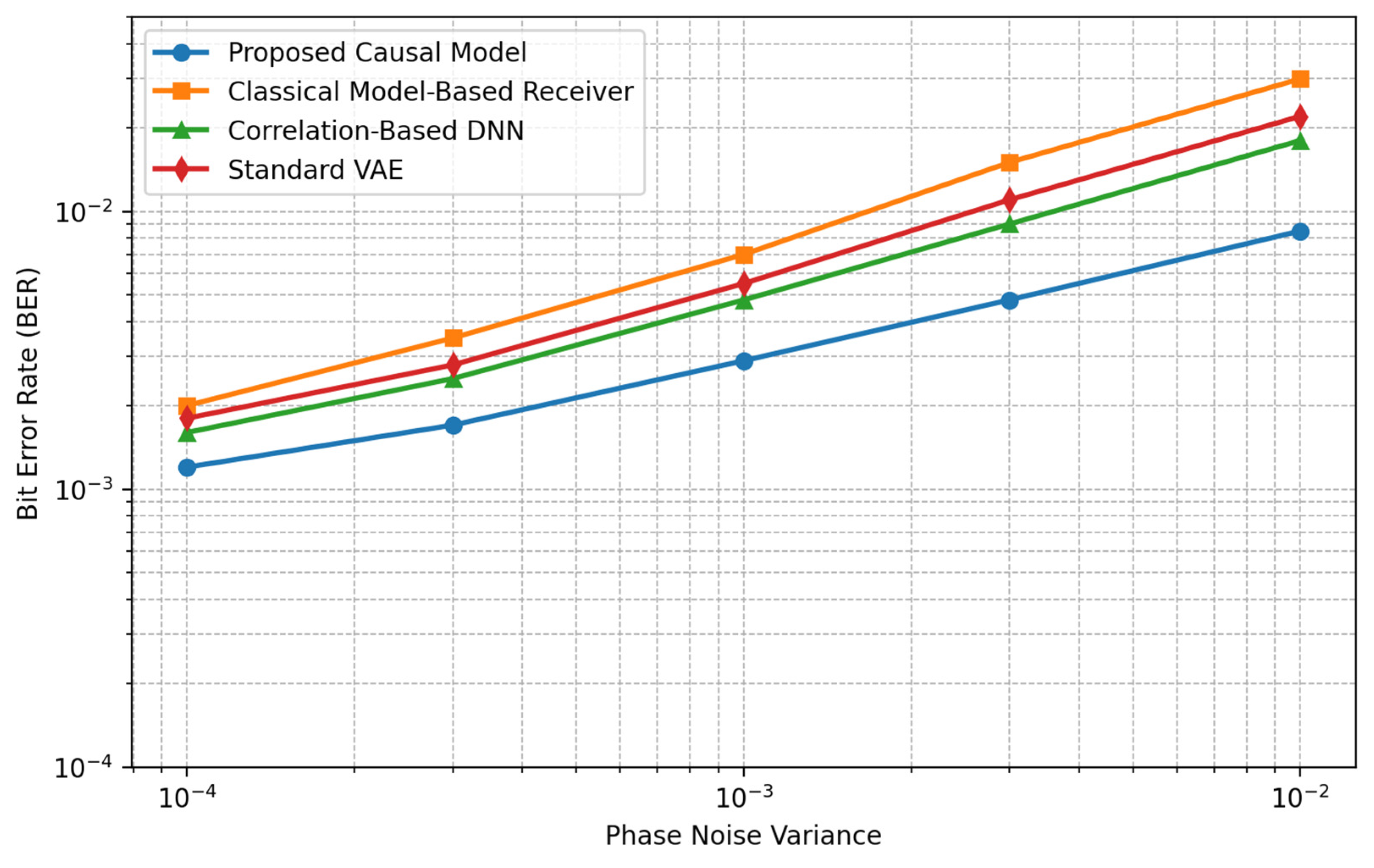
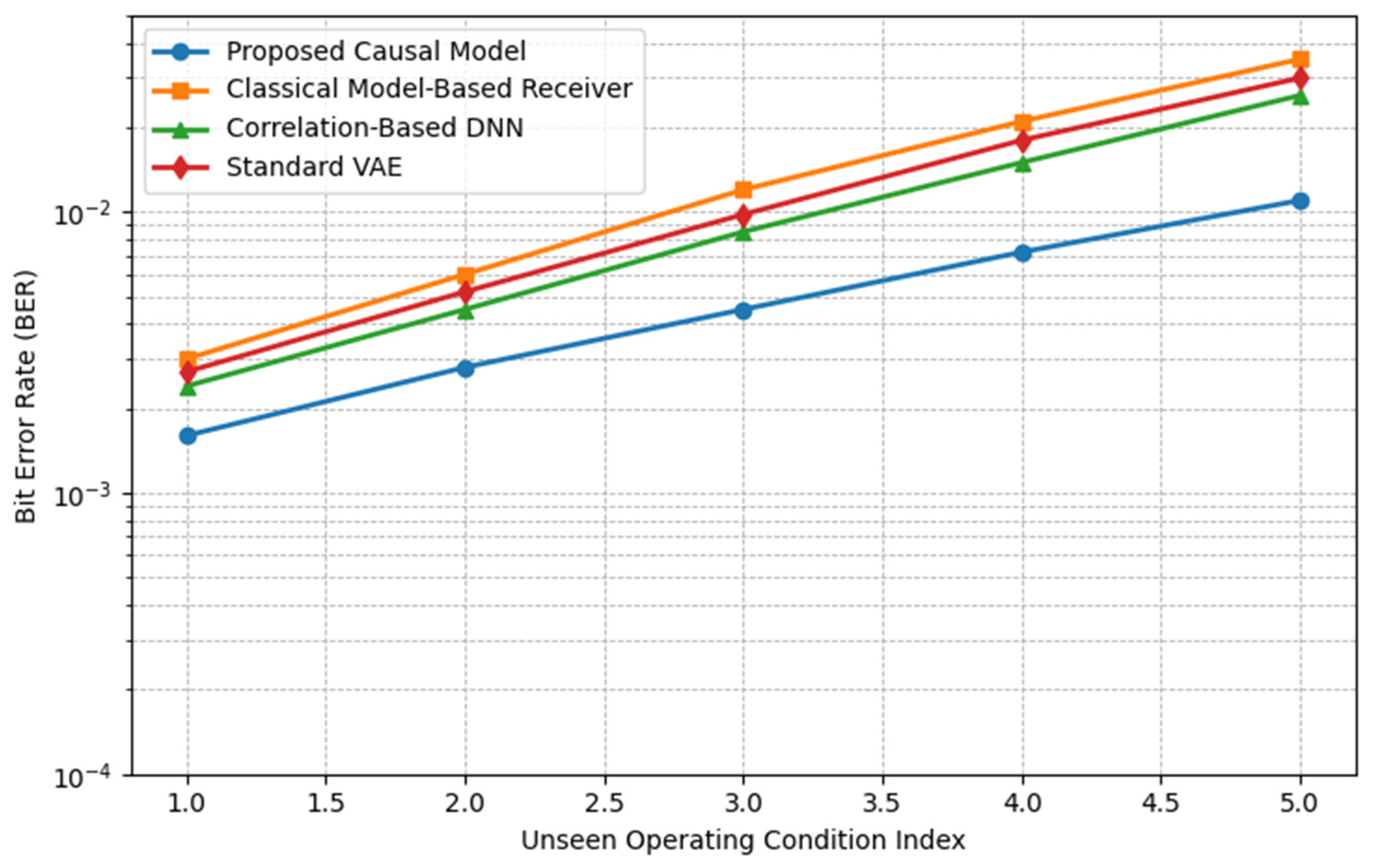
| Low coupling | (2.4 ± 0.1) × 10−3 | (1.9 ± 0.08) × 10−3 | (2.1 ± 0.09) × 10−3 | (1.3 ± 0.04) × 10−3 |
| Moderate coupling | (7.8 ± 0.3) × 10−3 | (5.4 ± 0.2) × 10−3 | (6.1 ± 0.25) × 10−3 | (2.9 ± 0.09) × 10−3 |
| Strong coupling | (1.9 ± 0.7) × 10−2 | (1.2 ± 0.5) × 10−2 | (1.4 ± 0.6) × 10−2 | (5.1 ± 0.2) × 10−3 |
| Latent Variable | Relative Change (%) |
|---|---|
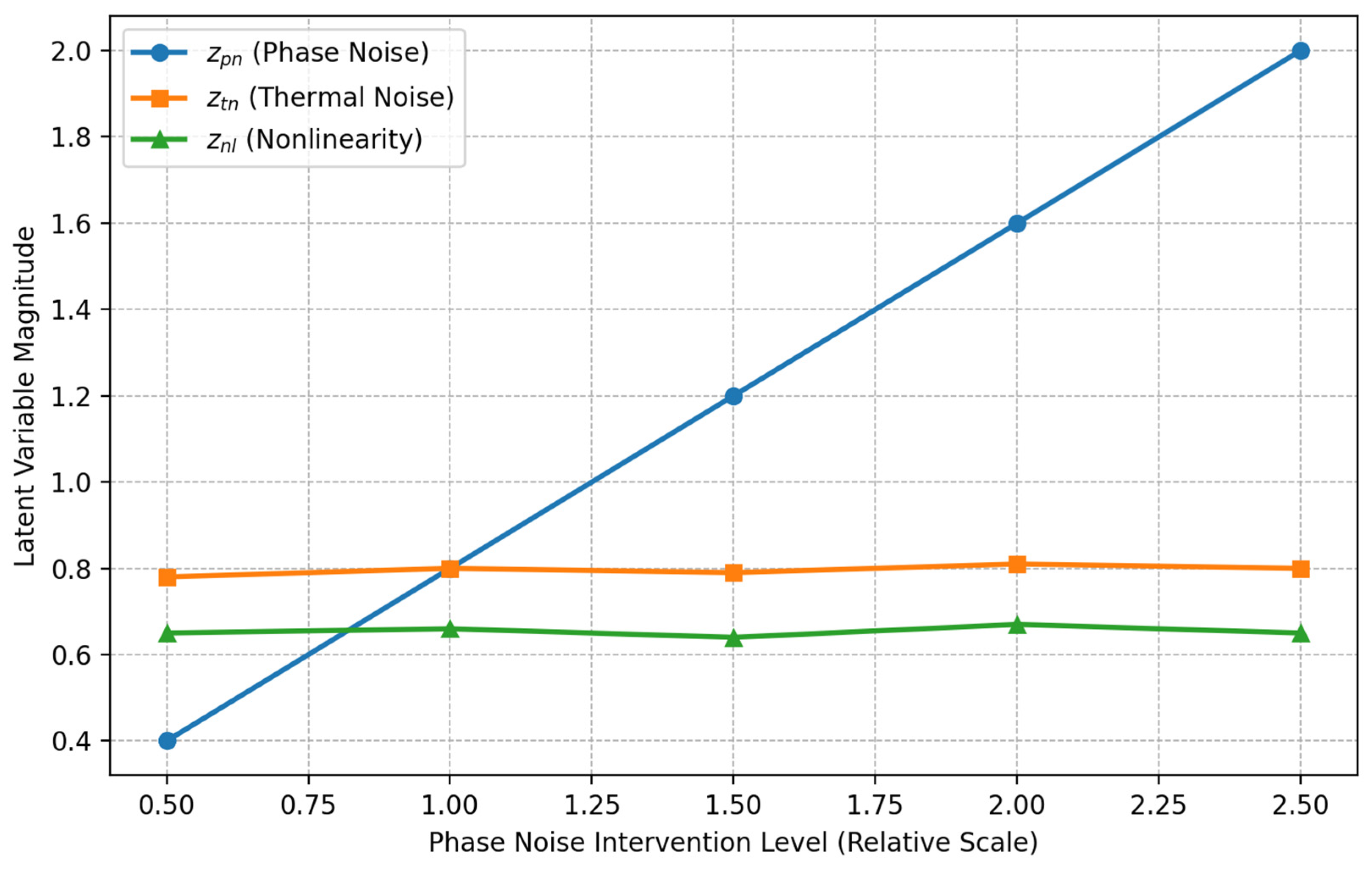
| Phase noise latent variable | 48.7 |
| Nonlinear distortion latent variable | 2.9 |
| Thermal noise latent variable | 1.8 |
| Metric | Classical Model-Based Receiver | Correlation-Based DNN | Standard VAE | Proposed Causal Model |
|---|---|---|---|---|
| Average BER reduction | Reference | 24% | 19% | 57% |
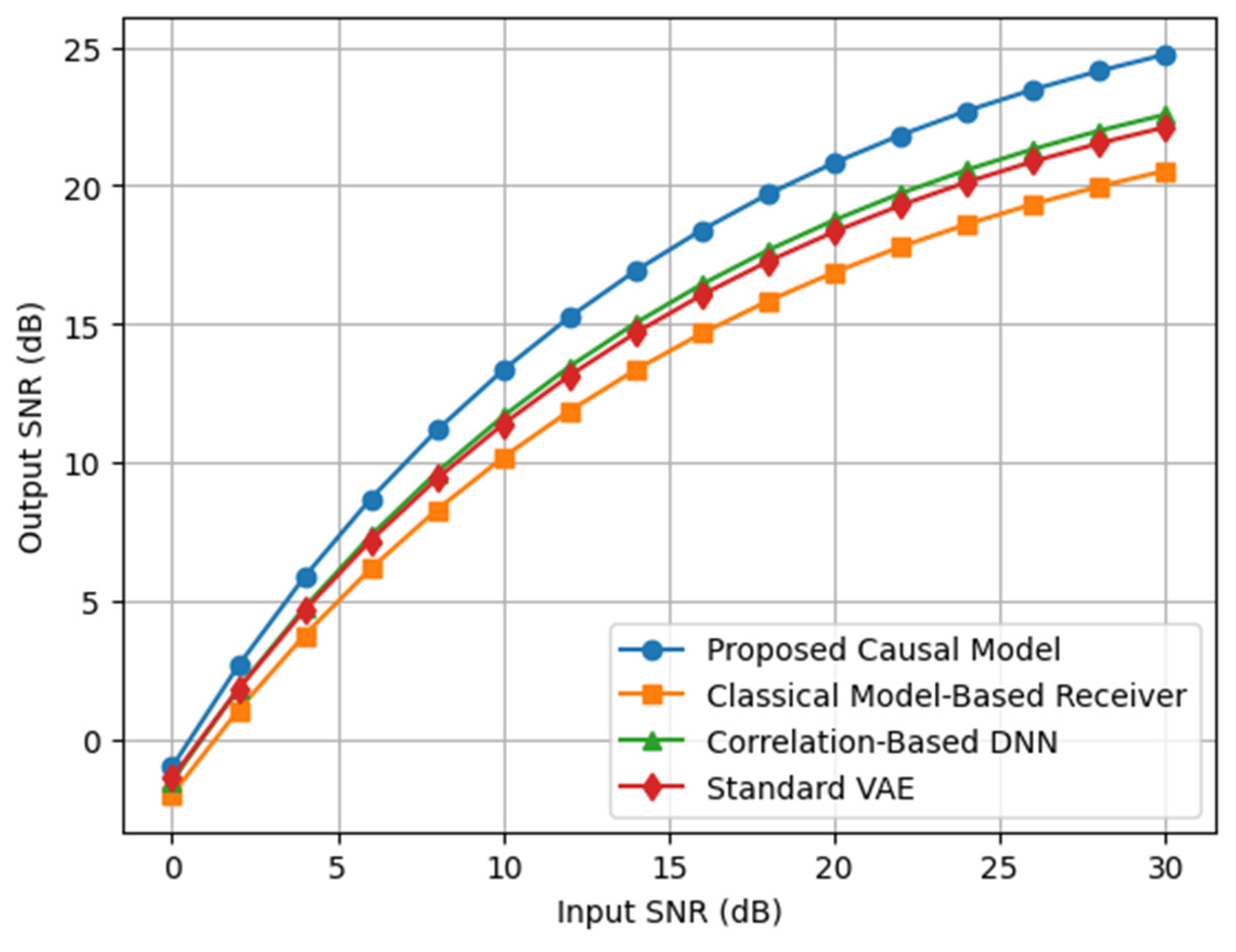
| Average output SNR gain (dB) | Reference | +1.0 | +0.8 | +2.2 |
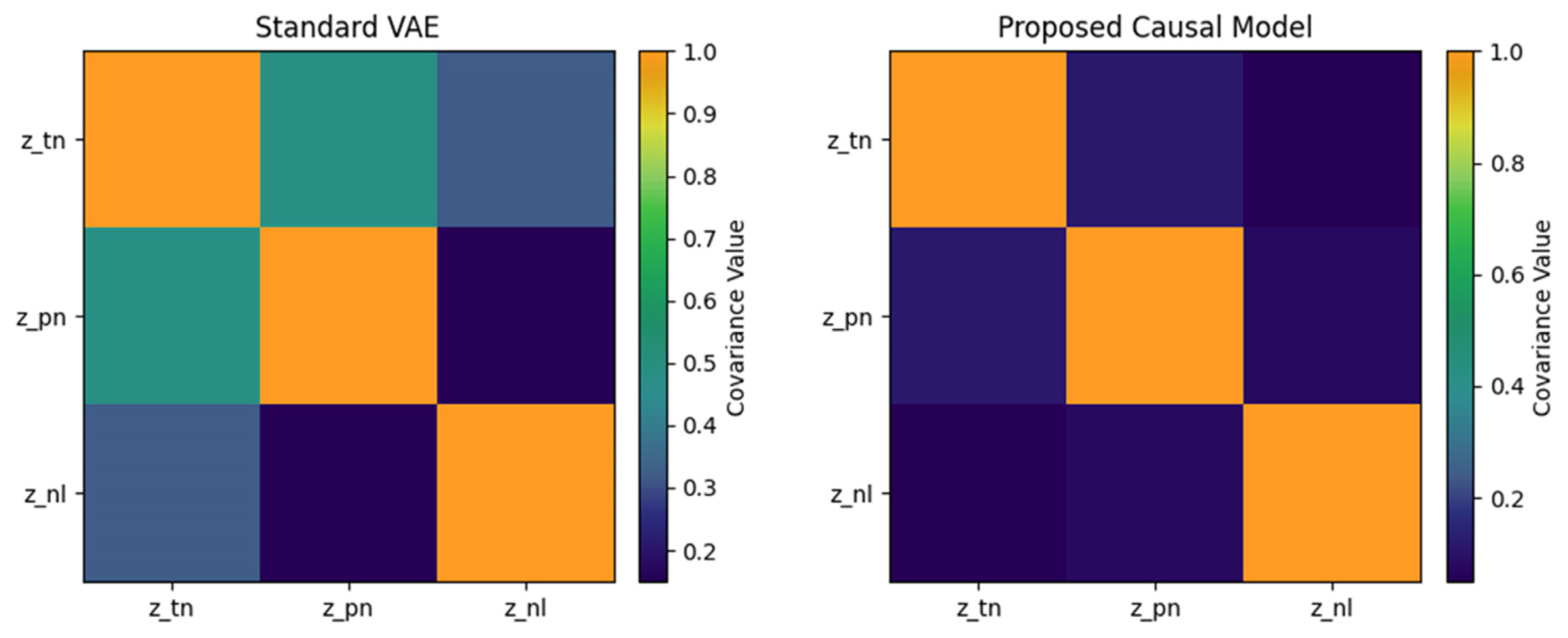
| Disentanglement score | 0.91 | 0.48 | 0.52 | 0.12 |
| Robustness score | 0.62 | 0.71 | 0.69 | 0.86 |
| Latent Structure Assumption | Average BER (×10−3) | Alignment with True Impairment Parameters (R2) | Interventional Error | Robustness Score |
|---|---|---|---|---|
| Independent Prior (No Edges) | 6.4 | 0.58 | 0.31 | 0.72 |
| Fully Connected Prior | 5.9 | 0.63 | 0.27 | 0.75 |
| Reversed Graph (ztn → zpn → znl) | 5.6 | 0.66 | 0.24 | 0.78 |
| Proposed Graph (ztn → zpn → znl) | 3.1 | 0.84 | 0.11 | 0.86 |
| Reference | System Type | Method Type | BER at 15 dB | SNR Gain at BER = 10−3 | Notes |
|---|---|---|---|---|---|
| DAE-ZIC (Autoencoder Z-Interference Channel) [16] | Interference Channel | End-to-End Autoencoder | ~4.5 × 10⁻³ | ~0.8 dB | Performance improves mainly at high SNR regimes |
| DeepPolar+ [17] | Channel Coding | Neural Polar Coding | ~3.9 × 10⁻³ | ~0.4 dB | Coding gain under SC decoding framework |
| VAE-Based MIMO Detector [18] | MIMO Detection | Variational Deep Learning | ~3.5 × 10⁻³ | ~1.0 dB | Improves over linear MMSE baseline |
| SICNet (DL-SIC Receiver) [19] | Interference Channel | Deep Interference Cancelation | ~3.2 × 10⁻³ | ~1.1 dB | Robust under imperfect CSI |
| MMSE-CPE Compensation (mmWave) [20] | 5G mmWave | Model-Based Phase Noise Compensation | ~2.8 × 10⁻³ | ~1.3 dB | Focused on phase noise only |
| Proposed Causal Representation Model | 2 × 2 MIMO | Structured Causal VAE | 1.9 × 10⁻³ | 2.2 dB | Joint modeling of nonlinear distortion, phase noise, and thermal noise |
| Channel Estimation Error Variance (σe2) | Classical Receiver BER (×10−3) | Correlation-Based DNN BER (×10−3) | Standard VAE BER (×10−3) | Proposed Causal Model BER (×10−3) | Classical Degradation (%) | DNN Degradation (%) | VAE Degradation (%) | Proposed Degradation (%) |
|---|---|---|---|---|---|---|---|---|
| 0 (Perfect CSI) | 2.4 | 1.9 | 2.1 | 1.3 | — | — | — | — |
| 10−4 | 3.1 | 2.5 | 2.7 | 1.6 | +29% | +32% | +29% | +23% |
| 5 × 10⁻⁴ | 4.6 | 3.4 | 3.9 | 2.1 | +92% | +79% | +86% | +62% |
| 10−3 | 6.8 | 4.9 | 5.6 | 2.9 | +183% | +158% | +167% | +123% |
| 5 × 10⁻³ | 11.2 | 8.3 | 9.4 | 4.8 | +367% | +337% | +348% | +269% |
| System Configuration | Input Dimension | Encoder Parameters | Decoder Parameters | Training Time per Epoch | Inference Time |
|---|---|---|---|---|---|
| 2 × 2 MIMO (baseline) | 4 complex samples | 1.0× | 1.0× | 1.0× | 1.0× |
| 4 × 4 MIMO | 16 complex samples | ~1.8× | ~1.9× | ~1.7× | ~1.6× |
| 8 × 8 MIMO | 64 complex samples | ~3.5× | ~3.6× | ~3.1× | ~2.9× |
| 16 × 16 Massive MIMO | 256 complex samples | ~6.8× | ~7.2× | ~5.9× | ~5.1× |
| Method | Supports Large MIMO | Handles Coupled RF Impairments | OFDM Compatible | Latent Interpretability |
|---|---|---|---|---|
| Correlation-based DNN | Limited | No | Yes | No |
| Standard VAE Receiver | Moderate | Partial | Yes | Limited |
| Deep Autoencoder Receiver | Moderate | No | Yes | No |
| Proposed Causal Representation Model | Yes | Yes | Extendable | Yes |
| Model Parameters | Approximate FLOPs per Inference | Inference Latency (ms) | Remarks | |
|---|---|---|---|---|
| Classical Model-Based Receiver | N/A | Low | 0.12 | Linear equalization and carrier recovery |
| Correlation-Based DNN | ~0.45 M | ~3.1 M | 1.8 | Fully connected compensation network |
| Standard VAE | ~0.62 M | ~4.6 M | 2.3 | Variational latent representation |
| Proposed Causal Representation Model | ~0.68 M | ~5.2 M | 2.7 | Structured causal latent modeling |
Disclaimer/Publisher’s Note: The statements, opinions and data contained in all publications are solely those of the individual author(s) and contributor(s) and not of MDPI and/or the editor(s). MDPI and/or the editor(s) disclaim responsibility for any injury to people or property resulting from any ideas, methods, instructions or products referred to in the content. |
© 2026 by the authors. Licensee MDPI, Basel, Switzerland. This article is an open access article distributed under the terms and conditions of the Creative Commons Attribution (CC BY) license.
Share and Cite
Al-Dulaimi, M.W.M.; Ucan, O.N. Causal Representation Learning for Joint Modeling and Mitigation of Coupled RF Impairments in MIMO Systems. Electronics 2026, 15, 1289. https://doi.org/10.3390/electronics15061289
Al-Dulaimi MWM, Ucan ON. Causal Representation Learning for Joint Modeling and Mitigation of Coupled RF Impairments in MIMO Systems. Electronics. 2026; 15(6):1289. https://doi.org/10.3390/electronics15061289
Chicago/Turabian StyleAl-Dulaimi, Mohammed Waleed Majeed, and Osman Nuri Ucan. 2026. "Causal Representation Learning for Joint Modeling and Mitigation of Coupled RF Impairments in MIMO Systems" Electronics 15, no. 6: 1289. https://doi.org/10.3390/electronics15061289
APA StyleAl-Dulaimi, M. W. M., & Ucan, O. N. (2026). Causal Representation Learning for Joint Modeling and Mitigation of Coupled RF Impairments in MIMO Systems. Electronics, 15(6), 1289. https://doi.org/10.3390/electronics15061289