Joint Denoising and Motion-Correction for Low-Dose CT Myocardial Perfusion Imaging Using Deep Learning


Abstract
1. Introduction
1.1. Noise in Low-Dose Myocardial CTP
1.2. Motion in Dynamic Myocardial CTP
1.3. Motivation for Noise and Motion Correction
- Noise correction followed by motion correction,
- Motion correction followed by noise correction,
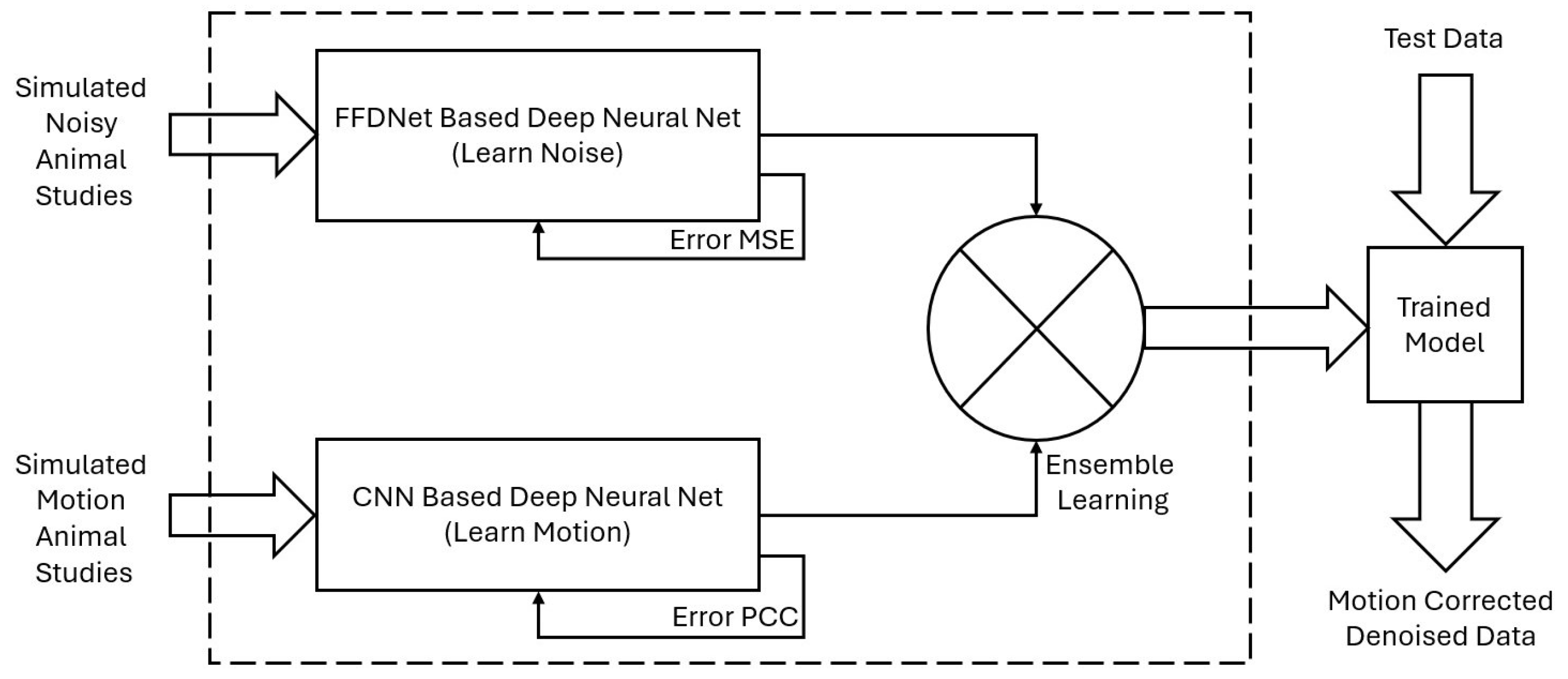
- Unified compound correction (proposed).
2. Related Work
2.1. Noise Suppression in Low-Dose CT and Myocardial CTP
2.2. Motion Correction and Deformable Registration in Dynamic Perfusion Imaging
2.3. Other Approaches
3. Problem Statement
3.1. Informal Problem Description
3.2. Formal Problem Definition
3.3. Learning Objective
- are the learnable parameters of the motion correction network ,
- are the learnable parameters of the noise correction network ,
- w are the ensemble fusion weights that combine the outputs of the two models,
- are hyperparameters that control the relative influence of motion-regularization and structural-preservation penalties during training.
- promotes fidelity between the final output and the ideal target .
- encourages temporal coherence and smooth, physically plausible deformations in the motion-corrected candidate .
- penalizes the loss of fine anatomical details, ensuring that diagnostically relevant edges and myocardial features are retained in .
3.4. Scope and Assumptions
- Low-dose noise after standard CT reconstruction can be approximated by a mixed Poisson–Gaussian model, which is handled via variance-stabilizing transformations and learned denoising, as demonstrated in [59].
- Deformations between cardiac phases are smooth and invertible within the myocardium, allowing representation by a 4D deformation field with physiologically plausible regularity [72].
- Scanner-specific reconstruction algorithms are treated as fixed; variations in dose, heart rate, and acquisition protocol are addressed through data augmentation and appropriately designed loss terms.
4. Proposed Method
4.1. Noise Correction Model (Prior Work)
4.2. Motion Correction Model (Prior Work)
4.3. Combined Artifact Correction
4.4. Training and Testing
4.5. Implementation and Integration Details
5. Experimental Setup and Results
5.1. Datasets
5.2. Image Quality Assessment (IQA) Metrics
5.2.1. Simulated Studies (Reference-Based)
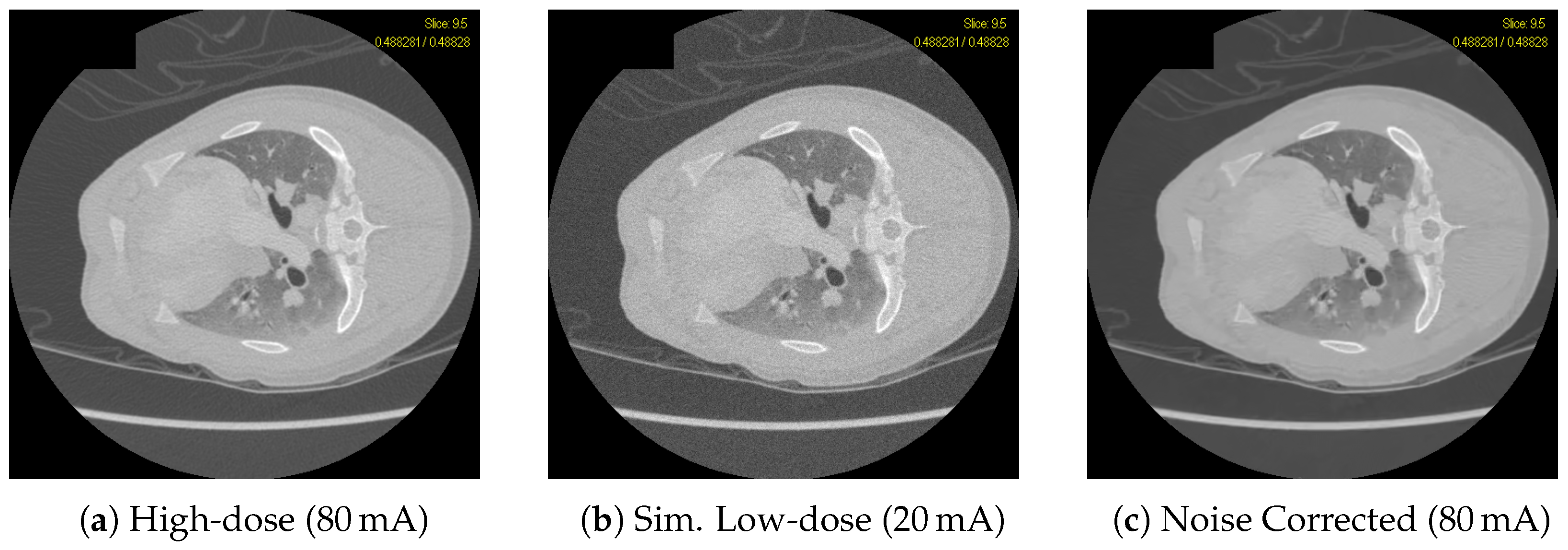
- Denoising:Poisson–Gaussian noise is applied to 80 mA images to emulate 20 mA acquisitions. The proposed denoising network reconstructs high-quality images, and evaluated by MSE, PSNR, and SSIM scores.
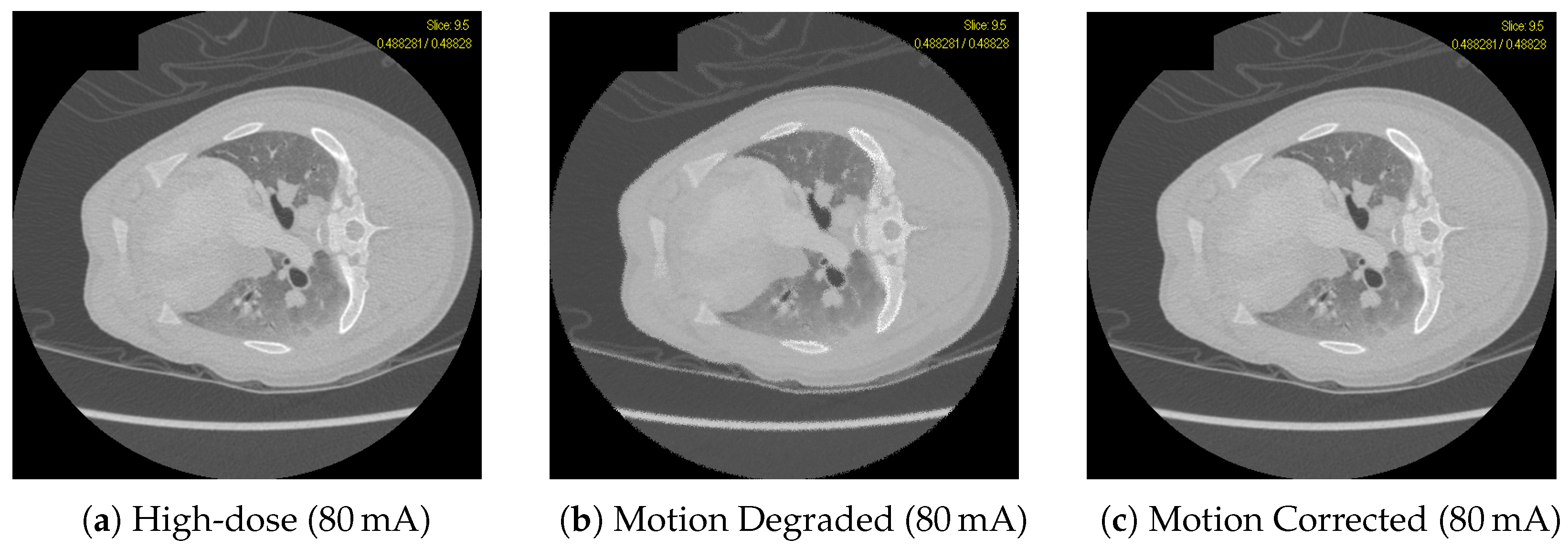
- Motion Correction: Known non-rigid deformations (up to 3 pixels) are applied to simulate cardiac/respiratory motion. The motion network registers deformed images back to the reference, primarily evaluated by Target Registration Error (TRE) and the correlation of Time Enhancement Curves (TECs).
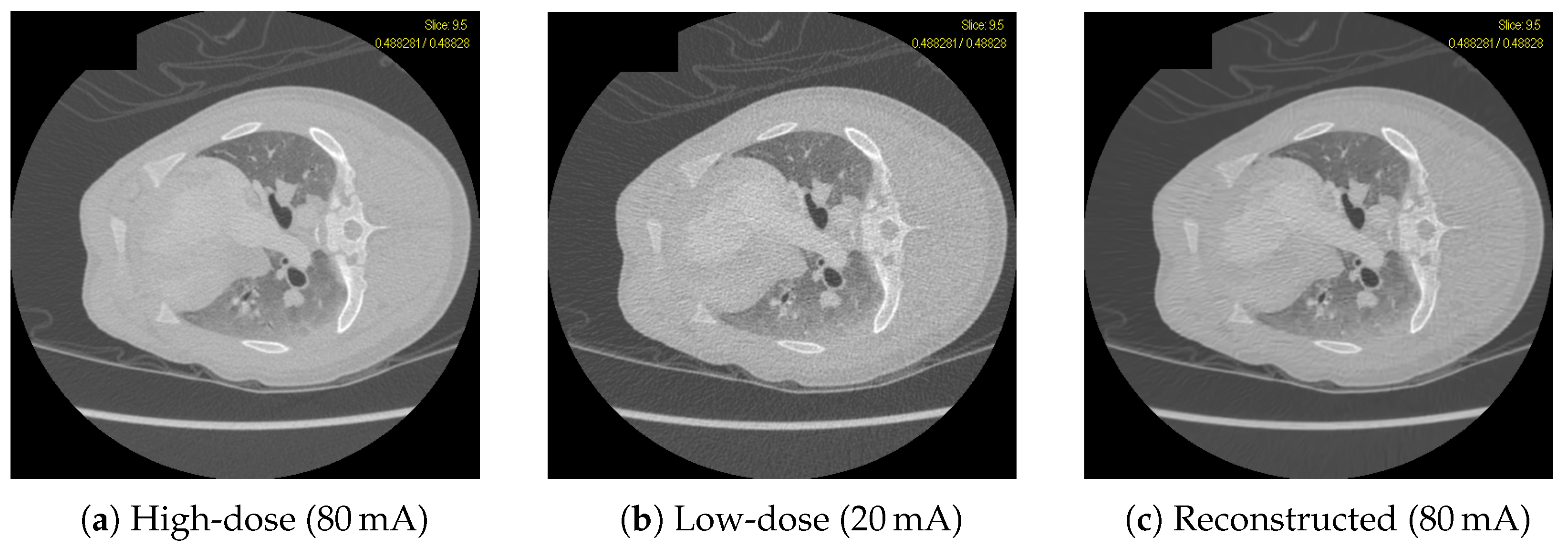
- Combined Degradation: Both noise and motion are applied sequentially to the reference images. The complete unified model (motion and noise branches with ensemble fusion) is evaluated using MSE, PSNR, SSIM, TRE and no-reference metrics (FID, KID, NIQE).
5.2.2. Real Low-Dose Studies (No-Reference)
- No-reference metrics (FID, KID, NIQE and noise variance),
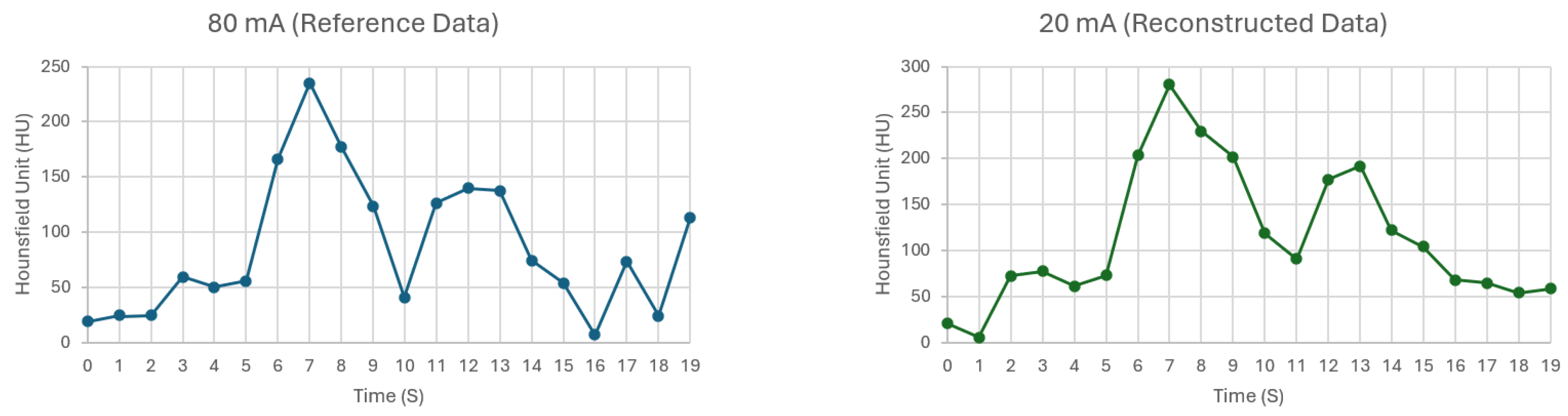
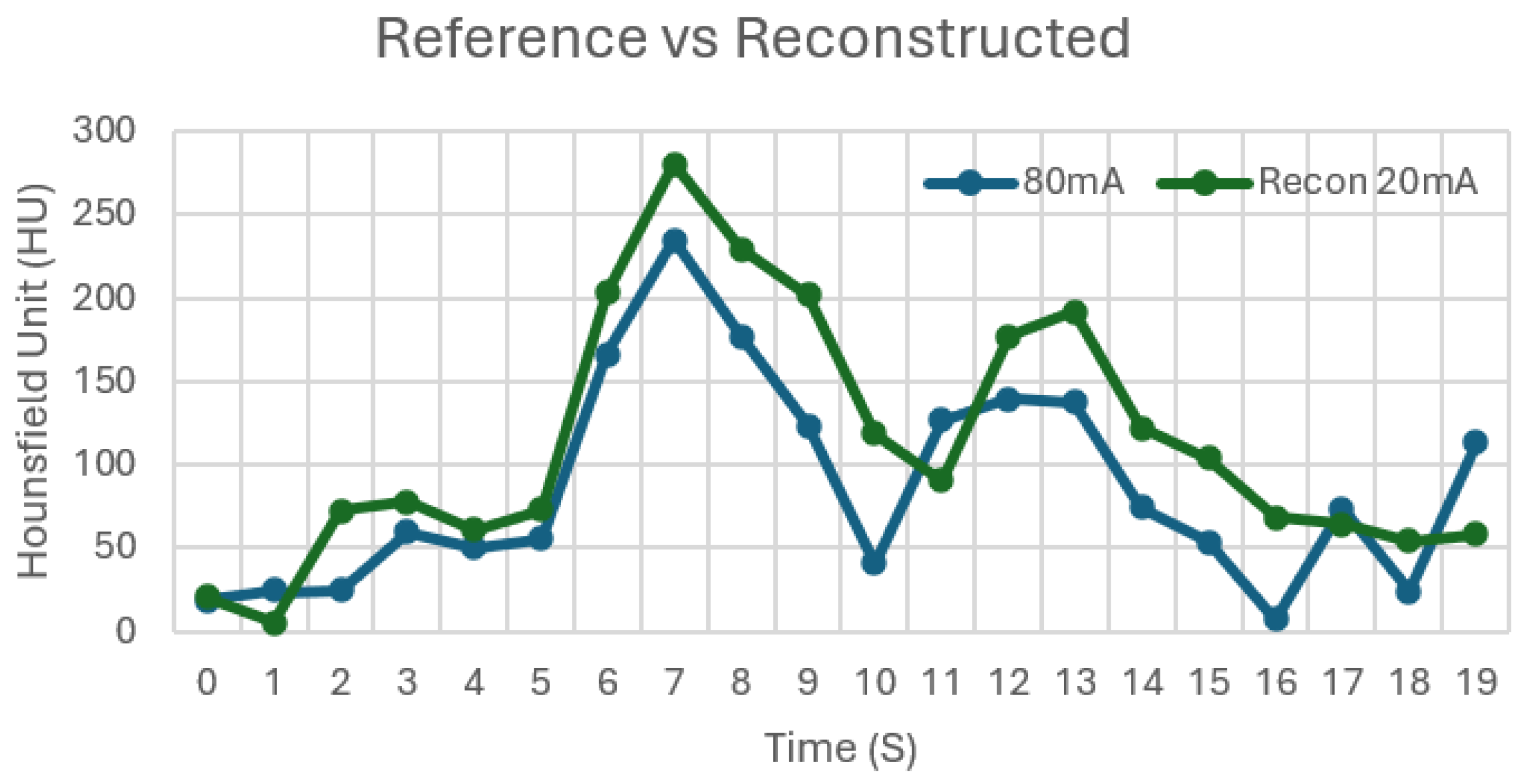
- Quantitative functional consistency (AUC and Pearson correlation of TECs),
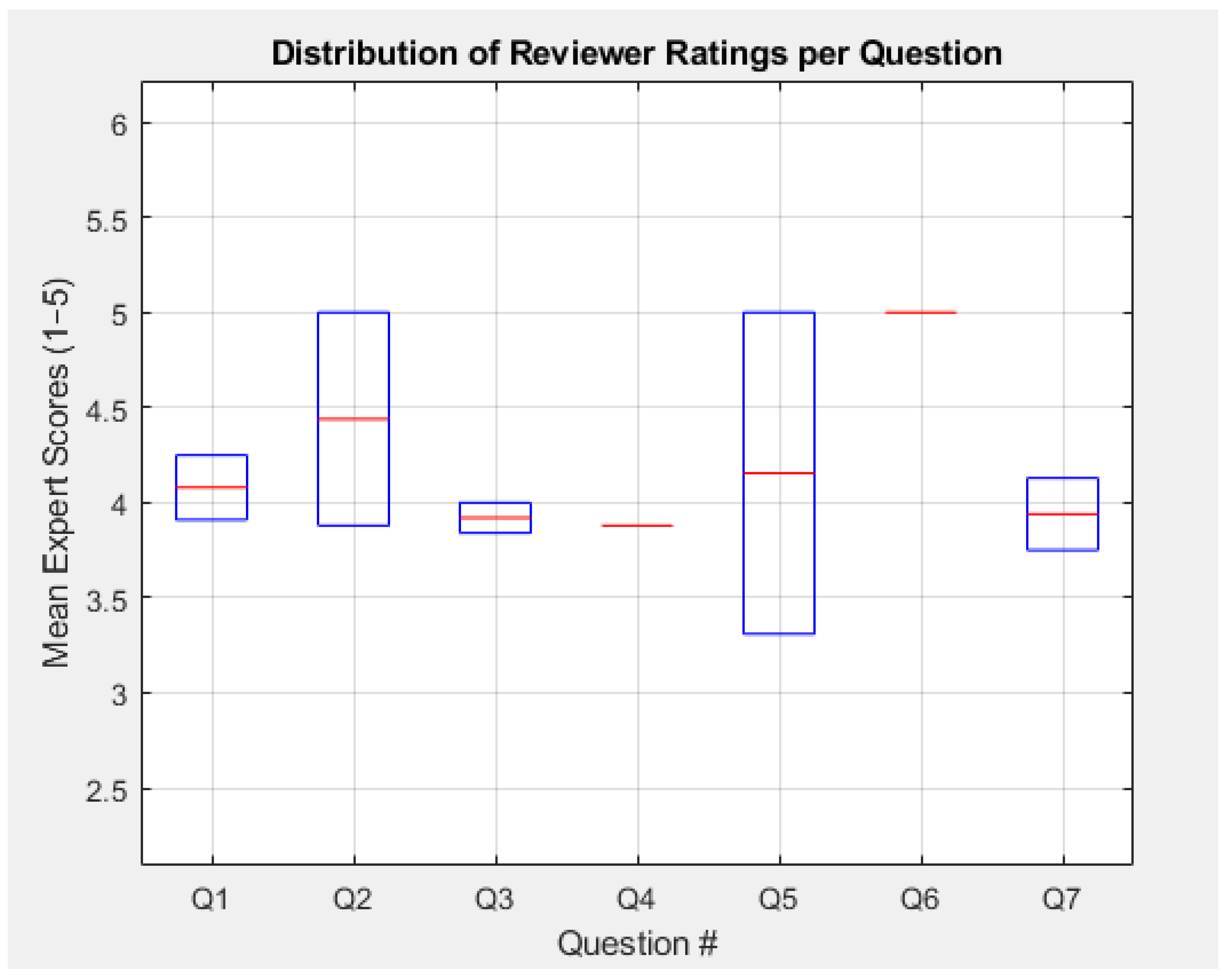
- Comprehensive subjective ratings by experts.
5.3. Objective Image Quality Assessment
5.3.1. Evaluating Noise Correction Model (Prior Work)
5.3.2. Evaluating Motion Correction Model (Prior Work)
5.3.3. Compound Noise and Motion Correction
5.3.4. No Reference Image Quality Assessments
5.4. Quantitative Image Quality Assessment
5.5. Subjective Image Quality Assessment
5.6. Visual Image Quality Assessment
6. Contributions
7. Limitations
8. Conclusions
9. Future Work
Author Contributions
Funding
Institutional Review Board Statement
Informed Consent Statement
Data Availability Statement
Acknowledgments
Conflicts of Interest
Abbreviations
| AUC | Area Under the Curve |
| CNN | Convolutional Neural Network |
| CT | Computed Tomography |
| CTP | Computed Tomography Perfusion |
| DnCNN | Denoising Convolutional Neural Network |
| DVF | Deformation Vector Field |
| FFDNet | Fast and Flexible Denoising Network |
| FID | Fréchet Inception Distance |
| GAT | Generalized Anscombe Transform |
| IQA | Image Quality Assessment |
| KID | Kernel Inception Distance |
| MBF | Myocardial Blood Flow |
| MMD | Maximum Mean Discrepancy |
| MRI | Magnetic Resonance Imaging |
| MSE | Mean Squared Error |
| NIQE | Naturalness Image Quality Evaluator |
| PCC | Pearson Correlation Coefficient |
| PSNR | Peak Signal-to-Noise Ratio |
| ROC | Receiver Operating Characteristic |
| SSIM | Structural Similarity Index |
| TEC | Time Enhancement Curve |
| TRE | Target Registration Error |
| 4DCT | 4 Dimensional CT |
References
- Enjilela, E.; Lee, T.Y.; Hsieh, J.; Wisenberg, G.; Teefy, P.; Yadegari, A.; Bagur, R.; Islam, A.; Branch, K.; So, A. Ultra-low dose quantitative CT myocardial perfusion imaging with sparse-view dynamic acquisition and image reconstruction: A feasibility study. Int. J. Cardiol. 2018, 254, 272–281. [Google Scholar] [CrossRef]
- Nous, F.M.A.; Geisler, T.; Kruk, M.B.P.; Alkadhi, H.; Kitagawa, K.; Vliegenthart, R.; Hell, M.M.; Hausleiter, J.; Nguyen, P.K.; Budde, R.P.J.; et al. Dynamic Myocardial Perfusion CT for the Detection of Hemodynamically Significant Coronary Artery Disease. JACC Cardiovasc. Imaging 2022, 15, 75–87. [Google Scholar] [CrossRef]
- Sliwicka, O.; Sechopoulos, I.; Baggiano, A.; Pontone, G.; Nijveldt, R.; Habets, J. Dynamic Myocardial CT Perfusion Imaging—State of the Art. Eur. Radiol. 2023, 33, 5509–5525. [Google Scholar] [CrossRef]
- Muscogiuri, G.; Palumbo, P.; Kitagawa, K.; Nakamura, S.; Senatieri, A.; De Cecco, C.N.; Gershon, G.; Chierchia, G.; Usai, J.; Sferratore, D.; et al. State of the Art of CT Myocardial Perfusion. Radiol. Med. 2025, 130, 438–452. [Google Scholar] [CrossRef]
- Narula, J.; Chandrashekhar, Y.; Ahmadi, A.; Abbara, S.; Berman, D.S.; Blankstein, R.; Leipsic, J.; Newby, D.; Nicol, E.D.; Nieman, K.; et al. SCCT 2021 Expert Consensus Document on Coronary CT Angiography: A Report of the Society of Cardiovascular Computed Tomography. J. Cardiovasc. Comput. Tomogr. 2021, 15, 192–217. [Google Scholar] [CrossRef]
- Koetzier, L.R.; Mastrodicasa, D.; Szczykutowicz, T.P.; Willemink, M.J.; Noël, P.B. Deep Learning Image Reconstruction for CT: Technical Principles and Clinical Prospects. Radiology 2023, 306, e221257. [Google Scholar] [CrossRef]
- Zdanowicz, A.; Guziński, M.; Puła, M.; Witkowska, A.; Reczuch, K. Dynamic CT Myocardial Perfusion: The Role of Functional Evaluation in the Diagnosis of Coronary Artery Disease. J. Clin. Med. 2023, 12, 7062. [Google Scholar] [CrossRef] [PubMed]
- Nagayama, Y.; Sakabe, D.; Goto, M.; Emoto, T.; Oda, S.; Nakaura, T.; Kidoh, M.; Uetani, H.; Funama, Y.; Hirai, T. Deep Learning-Based Reconstruction for Lower-Dose Pediatric CT: Technical Principles, Image Characteristics, and Clinical Implementations. RadioGraphics 2021, 41, 1936–1953. [Google Scholar] [CrossRef] [PubMed]
- Benz, D.C.; Ersözlü, S.; Mojon, F.L.; Messerli, M.; Mitulla, A.K.; Ciancone, D.; Kenkel, D.; Schaab, J.A.; Gebhard, C.; Pazhenkottil, A.P.; et al. Radiation Dose Reduction with Deep-Learning Image Reconstruction for Coronary Computed Tomography Angiography. Eur. Radiol. 2022, 32, 2620–2628. [Google Scholar] [CrossRef]
- Kamilov, U.S.; Bouman, C.A.; Buzzard, G.T.; Wohlberg, B. Plug-and-Play Methods for Integrating Physical and Learned Models in Computational Imaging: Theory, Algorithms, and Applications. IEEE Signal Process. Mag. 2023, 40, 85–97. [Google Scholar] [CrossRef]
- Li, Z.; Sun, Z.; Lv, L.; Liu, Y.; Wang, X.; Xu, J.; Xing, J.; Babyn, P.; Sun, F.R. Ultra-Sparse View Lung CT Image Reconstruction Using Generative Adversarial Networks and Compressed Sensing. J. X-Ray Sci. Technol. 2025, 33, 803–816. [Google Scholar] [CrossRef]
- Jensen, C.T.; Gupta, S.; Saleh, M.M.; Liu, X.; Wong, V.K.; Salem, U.; Qiao, W.; Samei, E.; Wagner-Bartak, N.A. Reduced-Dose Deep Learning Reconstruction for Abdominal CT of Liver Metastases. Radiology 2022, 303, 620–631. [Google Scholar] [CrossRef]
- Greffier, J.; Hamard, A.; Pereira, F.; Barrau, C.; Pasquier, H.; Beregi, J.P.; Frandon, J. Image Quality and Dose Reduction Opportunity of Deep Learning Image Reconstruction Algorithm for CT: A Phantom Study. Eur. Radiol. 2020, 30, 3951–3959. [Google Scholar] [CrossRef] [PubMed]
- Zhang, K.; Zuo, W.; Chen, Y.; Meng, D.; Zhang, L. Beyond a Gaussian Denoiser: Residual Learning of Deep CNN for Image Denoising. IEEE Trans. Image Process. 2017, 26, 3142–3155. [Google Scholar] [CrossRef]
- Chen, H.; Zhang, Y.; Zhang, W.; Liao, P.; Li, K.; Zhou, J.; Wang, G. Low-Dose CT via Convolutional Neural Network. Biomed. Opt. Express 2017, 8, 679–694. [Google Scholar] [CrossRef] [PubMed]
- Wang, J.; Nur, I.R.R.; Fu, P. A Comprehensive Review of U-Net and Its Variants: Advances and Applications in Medical Image Segmentation. IET Image Process. 2025, 19, 1751–9659. [Google Scholar] [CrossRef]
- Yang, Q.; Yan, P.; Zhang, Y.; Yu, H.; Shi, Y.; Mou, X.; Kalra, M.K.; Zhang, L.; Sun, L.; Wang, G. Low-Dose CT Image Denoising Using a Generative Adversarial Network with Wasserstein Distance and Perceptual Loss. IEEE Trans. Med Imaging 2018, 37, 1348–1357. [Google Scholar] [CrossRef]
- Patel, A.R.; Bamberg, F.; Branch, K.R.; Carrascosa, P.; De Cecco, C.N.; Einstein, A.J.; Fuld, M.K.; George, B.T.; Grizzard, J.D.; Han, B.K.; et al. Society of Cardiovascular Computed Tomography Expert Consensus Document on Myocardial Computed Tomography Perfusion Imaging. J. Cardiovasc. Comput. Tomogr. 2020, 14, 87–100. [Google Scholar] [CrossRef]
- Otaki, Y.; Van Kriekinge, S.D.; Wei, C.C.; Kavanagh, P.; Singh, A.; Parekh, T.; Di Carli, M.; Maddahi, J.; Sitek, A.; Buckley, C.; et al. Improved Myocardial Blood Flow Estimation with Residual Activity Correction and Motion Correction in 18F-Flurpiridaz PET Myocardial Perfusion Imaging. Eur. J. Nucl. Med. Mol. Imaging 2022, 49, 1881–1893. [Google Scholar] [CrossRef] [PubMed]
- Mooiweer, R.; Neji, R.; McElroy, S.; Nazir, M.S.; Razavi, R.; Chiribiri, A.; Roujol, S. A Fast Navigator (fastNAV) for Prospective Respiratory Motion Correction in First-Pass Myocardial Perfusion Imaging. Magn. Reson. Med. 2021, 85, 2661–2671. [Google Scholar] [CrossRef]
- Hubbard, L.; Malkasian, S.; Molloi, S. Dynamic CT myocardial perfusion without image registration. Sci. Rep. 2022, 12, 12608. [Google Scholar] [CrossRef]
- Nenoff, L.; Amstutz, F.; Murr, M.; Archibald-Heeren, B.; Fusella, M.; Hussein, M.; Lechner, W.; Zhang, Y.; Sharp, G.; Vasquez Osorio, E. Review and Recommendations on Deformable Image Registration Uncertainties for Radiotherapy Applications. Phys. Med. Biol. 2023, 68, 24TR01. [Google Scholar] [CrossRef]
- Benovoy, M.; Jacobs, M.; Cheriet, F.; Dahdah, N.; Arai, A.E.; Hsu, L.Y. Robust Universal Nonrigid Motion Correction Framework for First-Pass Cardiac MR Perfusion Imaging. J. Magn. Reson. Imaging 2017, 46, 1060–1072. [Google Scholar] [CrossRef] [PubMed]
- Haskins, G.; Kruger, U.; Yan, P. Deep Learning in Medical Image Registration: A Survey. Mach. Vis. Appl. 2020, 31, 8. [Google Scholar] [CrossRef]
- Han, R.; Jones, C.K.; Lee, J.; Wu, P.; Vagdargi, P.; Uneri, A.; Helm, P.A.; Luciano, M.; Anderson, W.S.; Siewerdsen, J.H. Deformable MR–CT Image Registration Using an Unsupervised, Dual-Channel Network for Neurosurgical Guidance. Med Image Anal. 2022, 75, 102292. [Google Scholar] [CrossRef] [PubMed]
- Xu, X.; Wang, P.; Zhao, L.; Quan, G. CT-Value Conservation Based Spatial Transformer Network for Cardiac Motion Correction. X-Ray Spectrom. 2024, 53, 382–391. [Google Scholar] [CrossRef]
- Zhang, X.; Yang, Y.; Pretorius, P.H.; Slomka, P.J.; King, M.A. Cardiac Motion Correction with a Deep Learning Network for Perfusion Defect Assessment in Single-Photon Emission Computed Tomography Myocardial Perfusion Imaging. JACC Nucl. Cardiol. 2025, 43, 102071. [Google Scholar] [CrossRef]
- Kuronuma, K.; Wei, C.C.; Singh, A.; Lemley, M.; Hayes, S.W.; Otaki, Y.; Hyun, M.C.; Van Kriekinge, S.D.; Kavanagh, P.; Huang, C.; et al. Automated Motion Correction for Myocardial Blood Flow Measurements and Diagnostic Performance of 82Rb PET Myocardial Perfusion Imaging. J. Nucl. Med. 2024, 65, 139–146. [Google Scholar] [CrossRef]
- Zhu, S.; Zhang, B.; Tian, Q.; Li, A.; Liu, Z.; Hou, W.; Zhao, W.; Huang, X.; Xiao, Y.; Wang, Y.; et al. Reduced-Dose Deep Learning Iterative Reconstruction for Abdominal CT with Low Tube Voltage and Tube Current: A Prospective Study. BMC Med Inform. Decis. Mak. 2024, 24, 389. [Google Scholar] [CrossRef]
- Willemink, M.J.; Noël, P.B. The Evolution of Image Reconstruction for CT—From Filtered Back Projection to Artificial Intelligence. Eur. Radiol. 2019, 29, 2185–2195. [Google Scholar] [CrossRef]
- Kang, H.J.; Lee, J.M.; Park, S.J.; Lee, S.M.; Joo, I.; Yoon, J.H. Image Quality Improvement of Low-Dose Abdominal CT Using Deep Learning Image Reconstruction Compared with the Second Generation Iterative Reconstruction. Curr. Med. Imaging 2024, 20, e250523217310. [Google Scholar] [CrossRef] [PubMed]
- De Santis, D.; Polidori, T.; Tremamunno, G.; Rucci, C.; Piccinni, G.; Zerunian, M.; Pugliese, L.; Del Gaudio, A.; Guido, G.; Barbato, L.; et al. Deep Learning Image Reconstruction Algorithm: Impact on Image Quality in Coronary CT Angiography. Radiol. Med. 2023, 128, 434–444. [Google Scholar] [CrossRef] [PubMed]
- Laurent, G.; Villani, N.; Hossu, G.; Rauch, A.; Noël, A.; Blum, A.; Gondim Teixeira, P.A. Full Model-Based Iterative Reconstruction (MBIR) in Abdominal CT Increases Objective Image Quality, but Decreases Subjective Acceptance. Eur. Radiol. 2019, 29, 4016–4025. [Google Scholar] [CrossRef] [PubMed]
- Dudhe, S.S.; Mishra, G.; Parihar, P.; Nimodia, D.; Kumari, A.; Mishra, G.V. Radiation Dose Optimization in Radiology: A Comprehensive Review of Safeguarding Patients and Preserving Image Fidelity. Cureus 2024, 16, e60846. [Google Scholar] [CrossRef]
- Greffier, J.; Frandon, J.; Larbi, A.; Beregi, J.P.; Hamard, A.; Pereira, F.; Pasquier, H. CT Iterative Reconstruction Algorithms: A Task-Based Image Quality Assessment. Eur. Radiol. 2020, 30, 487–500. [Google Scholar] [CrossRef]
- Lustig, M.; Donoho, D.L.; Pauly, J.M. Sparse MRI: The application of compressed sensing for rapid MR imaging. Magn. Reson. Med. 2007, 58, 1182–1195. [Google Scholar] [CrossRef]
- Szczykutowicz, T.P.; Toia, G.V.; Dhanantwari, A.; Nett, B. A Review of Deep Learning CT Reconstruction: Concepts, Limitations, and Promise in Clinical Practice. Curr. Radiol. Rep. 2022, 10, 101–115. [Google Scholar] [CrossRef]
- Yuan, H.; Jia, J.; Zhu, Z. SIPID: A Deep Learning Framework for Sinogram Interpolation and Image Denoising in Low-Dose CT Reconstruction. In Proceedings of the 2018 IEEE 15th International Symposium on Biomedical Imaging (ISBI 2018), Washington, DC, USA, 4–7 April 2018; pp. 1521–1524. [Google Scholar] [CrossRef]
- Yin, X.; Yu, L.; Zhou, Z.; Xie, T.; Wang, J.; Chen, W.; Zhou, Z. Domain Progressive 3D Residual Convolution Network to Improve Low-Dose CT Imaging. IEEE Trans. Med. Imaging 2019, 38, 2903–2913. [Google Scholar] [CrossRef]
- Ernst, P.; Chatterjee, S.; Rose, G.; Speck, O.; Nürnberger, A. Sinogram Upsampling Using Primal–Dual U-Net for Undersampled CT and Radial MRI Reconstruction. Neural Netw. 2023, 166, 704–721. [Google Scholar] [CrossRef]
- Chen, H.; Zhang, Y.; Kalra, M.K.; Lin, F.; Chen, Y.; Liao, P.; Zhou, J.; Wang, G. Low-Dose CT with a Residual Encoder-Decoder Convolutional Neural Network. IEEE Trans. Med. Imaging 2017, 36, 2524–2535. [Google Scholar] [CrossRef]
- Kang, E.Y.; Min, J.C.; Ye, J.C. A Deep Convolutional Neural Network Using Directional Wavelets for Low-Dose X-Ray CT Reconstruction. Med. Phys. 2017, 44, e360–e375. [Google Scholar] [CrossRef]
- You, C.; Yang, Q.; Gao, Y.; Mou, X.; Wang, G. Structurally-Sensitive Multi-Scale Deep Neural Network for Low-Dose CT Denoising. IEEE Access 2018, 6, 41839–41855. [Google Scholar] [CrossRef]
- Gholizadeh-Ansari, M.; Alirezaie, J.; Babyn, P. Deep Learning for Low-Dose CT Denoising Using Perceptual Loss and Edge Detection Layer. J. Digit. Imaging 2020, 33, 504–515. [Google Scholar] [CrossRef]
- Marcos, L.; Alirezaie, J.; Babyn, P. Low-Dose CT Denoising by ResNet with Fused Attention Modules and Integrated Loss Functions. Front. Signal Process. 2022, 1, 812193. [Google Scholar] [CrossRef]
- Ma, Y.; Wei, B.; Feng, P.; He, P.; Guo, X.; Wang, G. Low-Dose CT Image Denoising Using a Generative Adversarial Network with a Hybrid Loss Function for Noise Learning. IEEE Access 2020, 8, 67519–67529. [Google Scholar] [CrossRef]
- Zhao, T.; McNitt-Gray, M.F.; Ruan, D. A Convolutional Neural Network for Ultra-Low-Dose CT Denoising and Emphysema Screening. Med. Phys. 2019, 46, 3941–3950. [Google Scholar] [CrossRef]
- Usui, K.; Ogawa, K.; Goto, M.; Sakano, Y.; Kyougoku, S.; Daida, H. Quantitative Evaluation of Deep Convolutional Neural Network-Based Image Denoising for Low-Dose Computed Tomography. Vis. Comput. Ind. Biomed. Art 2021, 4, 21. [Google Scholar] [CrossRef]
- Immonen, E.; Wong, J.; Nieminen, M.; Kekkonen, L.; Roine, S.; Törnroos, S.; Metsälä, E. The Use of Deep Learning towards Dose Optimization in Low-Dose Computed Tomography: A Scoping Review. Radiography 2022, 28, 208–214. [Google Scholar] [CrossRef] [PubMed]
- Zhang, K.; Zuo, W.; Zhang, L. FFDNet: Toward a Fast and Flexible Solution for CNN-Based Image Denoising. IEEE Trans. Image Process. 2018, 27, 4608–4622. [Google Scholar] [CrossRef] [PubMed]
- Zhang, S.; Wang, Z.; Yang, H.; Chen, Y.; Li, Y.; Pan, Q.; Wang, H.; Zhao, C. Hformer: Highly Efficient Vision Transformer for Low-Dose CT Denoising. Nucl. Sci. Tech. 2023, 34, 61. [Google Scholar] [CrossRef]
- Zhang, J.; Ye, L.; Gong, W.; Chen, M.; Liu, G.; Cheng, Y. A Novel Network for Low-Dose CT Denoising Based on Dual-Branch Structure and Multi-Scale Residual Attention. J. Imaging Inform. Med. 2025, 38, 1245–1264. [Google Scholar] [CrossRef]
- Diwakar, M.; Kumar, M. A Review on CT Image Noise and Its Denoising. Biomed. Signal Process. Control 2018, 42, 73–88. [Google Scholar] [CrossRef]
- Lee, J.Y.; Kim, W.; Lee, Y.; Lee, J.Y.; Ko, E.; Choi, J.H. Unsupervised Domain Adaptation for Low-Dose CT Image Denoising. IEEE Access 2022, 10, 126580–126592. [Google Scholar] [CrossRef]
- Jing, J.; Xia, W.; Hou, M.; Chen, H.; Liu, Y.; Zhou, J.; Zhang, Y. Training Low Dose CT Denoising Network without High Quality Reference Data. Phys. Med. Biol. 2022, 67, 084002. [Google Scholar] [CrossRef]
- Greffier, J.; Hamard, A.; Pereira, F.; Barrau, C.; Pasquier, H.; Beregi, J.P.; Frandon, J. Effect of a new deep learning image reconstruction algorithm for abdominal computed tomography imaging on image quality and dose reduction compared with two iterative reconstruction algorithms: A phantom study. Quant. Imaging Med. Surg. 2022, 12, 229–243. [Google Scholar] [CrossRef]
- Kadimesetty, V.; Aradhya, A.K.R.; Prasad, S.S.; Raghavendra, M.S. Convolutional Neural Network-Based Robust Denoising of Low-Dose Computed Tomography Perfusion Maps. IEEE Trans. Radiat. Plasma Med. Sci. 2018, 3, 137–152. [Google Scholar] [CrossRef]
- Ramon, A.J.; Yang, Y.; Pretorius, P.H.; Johnson, K.L.; King, M.A.; Wernick, M.N. Improving Diagnostic Accuracy in Low-Dose SPECT Myocardial Perfusion Imaging with Convolutional Denoising Networks. IEEE Trans. Med. Imaging 2020, 39, 2893–2903. [Google Scholar] [CrossRef] [PubMed]
- Hasan, M.; So, A.; El-Sakka, M.R. DnCNN-Based Denoising Model for Low-Dose Myocardial CT Perfusion Imaging. Electronics 2026, 15, 124. [Google Scholar] [CrossRef]
- Sotiras, A.; Davatzikos, C.; Paragios, N. Deformable medical image registration: A survey. IEEE Trans. Med. Imaging 2013, 32, 1153–1190. [Google Scholar] [CrossRef] [PubMed]
- Chen, X.; Diaz-Pinto, A.; Ravikumar, N.; Frangi, A.F. Deep Learning in Medical Image Registration. Prog. Biomed. Eng. 2021, 3, 012003. [Google Scholar] [CrossRef]
- Jiang, Z.; Yin, F.F.; Ge, Y.; Ren, L. A Multi-Scale Framework with Unsupervised Joint Training of Convolutional Neural Networks for Pulmonary Deformable Image Registration. Phys. Med. Biol. 2020, 65, 015011. [Google Scholar] [CrossRef] [PubMed]
- Criscuolo, E.R.; Fu, Y.; Hao, Y.; Zhang, Z.; Yang, D. A Comprehensive Lung CT Landmark Pair Dataset for Evaluating Deformable Image Registration Algorithms. Med. Phys. 2024, 51, 3806–3817. [Google Scholar] [CrossRef] [PubMed]
- Huang, H.; Siewerdsen, J.H.; Zbijewski, W.; Weiss, C.R.; Unberath, M.; Ehtiati, T.; Sisniega, A. Reference-Free Learning-Based Similarity Metric for Motion Compensation in Cone-Beam CT. Phys. Med. Biol. 2022, 67, 125020. [Google Scholar] [CrossRef]
- Balakrishnan, G.; Zhao, A.; Sabuncu, M.R.; Guttag, J.; Dalca, A.V. VoxelMorph: A Learning Framework for Deformable Medical Image Registration. IEEE Trans. Med. Imaging 2019, 38, 1788–1800. [Google Scholar] [CrossRef]
- Lei, Y.; Fu, Y.; Wang, T.; Momin, S.; Roper, J.; Patel, P.; Curran, W.J.; Liu, T.; Yang, X. 4D-CT Deformable Image Registration Using Multiscale Unsupervised Deep Learning. Phys. Med. Biol. 2020, 65, 085003. [Google Scholar] [CrossRef]
- Hering, A.; Häger, S.; Moltz, J.; Lessmann, N.; Heldmann, S.; van Ginneken, B. CNN-Based Lung CT Registration with Multiple Anatomical Constraints. Med. Image Anal. 2021, 72, 102139. [Google Scholar] [CrossRef]
- Fechter, T.; Baltas, D. One shot learning for deformable medical image registration and periodic motion tracking. IEEE Trans. Med Imaging 2020, 39, 2506–2517. [Google Scholar] [CrossRef]
- Lara-Hernandez, A.; Rienmüller, T.; Juárez, I.; Pérez, M.; Reyna, F.; Baumgartner, D.; Makarenko, V.N.; Bockeria, O.L.; Maksudov, M.; Rienmüller, R.; et al. Deep Learning-Based Image Registration in Dynamic Myocardial Perfusion CT Imaging. IEEE Trans. Med Imaging 2022, 42, 684–696. [Google Scholar] [CrossRef]
- Urs, M.; Killekar, A.; Builoff, V.; Lemley, M.; Wei, C.C.; Kavanagh, P.; Slomka, P.J. Deep-Learning-Based Automatic Patient Motion Correction for 18F-Flurpiridaz PET-MPI. Med. Imaging 2025 Image Process. (SPIE) 2025, 13406, 732–738. [Google Scholar] [CrossRef]
- Chen, J.; Liu, Y.; Wei, S.; Bian, Z.; Subramanian, S.; Carass, A.; Prince, J.L.; Du, Y. A Survey on Deep Learning in Medical Image Registration: New Technologies, Uncertainty, Evaluation Metrics, and Beyond. Med. Image Anal. 2025, 100, 103385. [Google Scholar] [CrossRef] [PubMed]
- Hasan, M.; So, A.; El-Sakka, M.R. Residual Motion Correction in Low-Dose Myocardial CT Perfusion using CNN-based Deformable Registration. Electronics 2026, 15, 450. [Google Scholar] [CrossRef]
- Lukas, S.; Feger, S.; Rief, M.; Zimmermann, E.; Dewey, M. Noise reduction and motion elimination in low-dose 4D myocardial computed tomography perfusion (CTP): Preliminary clinical evaluation of the ASTRA4D algorithm. Eur. Radiol. 2019, 29, 4572–4582. [Google Scholar] [CrossRef]
- Zheng, M.; Zhi, K.; Zeng, J.; Tian, C.; You, L. A Hybrid CNN for Image Denoising. J. Artif. Intell. Technol. 2022, 2, 93–99. [Google Scholar] [CrossRef]
- Jian, M.; Yu, X.; Zhang, H.; Yang, C. SwinCT: Feature enhancement based low-dose CT images denoising with Swin Transformer. Multimed. Syst. 2024, 30, 1. [Google Scholar] [CrossRef]
- Jiang, G.; Luo, T.; Xu, H.; Nie, S.; Song, Y.; He, Z. GDAFormer: Gradient-guided Dual Attention Transformer for Low-Dose CT image denoising. Biomed. Signal Process. Control. 2024, 94, 106260. [Google Scholar] [CrossRef]
- Liu, X.; Xie, Y.; Liu, C.; Cheng, J.; Diao, S.; Tan, S.; Liang, X. Diffusion probabilistic priors for zero-shot low-dose CT image denoising. Med. Phys. 2025, 52, 329–345. [Google Scholar] [CrossRef]
- Kim, S.; Kim, B.; Baek, J. Dose-aware denoising diffusion model for low-dose CT. Phys. Med. Biol. 2025, 70, 145019. [Google Scholar] [CrossRef]
- Zhou, B.; Tsai, Y.J.; Chen, X.; Duncan, J.S.; Liu, C. MDPET: A Unified Motion Correction and Denoising Adversarial Network for Low-Dose Gated PET. IEEE Trans. Med. Imaging 2021, 40, 3154–3164. [Google Scholar] [CrossRef]
- Wu, D.; Ren, H.; Li, Q. Self-Supervised Dynamic CT Perfusion Image Denoising with Deep Neural Networks. IEEE Trans. Radiat. Plasma Med. Sci. 2021, 5, 350–361. [Google Scholar] [CrossRef]
- Mossa-Basha, M.; Zhu, C.; Pandhi, T.; Mendoza, S.; Azadbakht, J.; Safwat, A.; Homen, D.; Zamora, C.; Gnanasekaran, D.K.; Peng, R.; et al. Deep Learning Denoising Improves CT Perfusion Image Quality in the Setting of Lower Contrast Dosing: A Feasibility Study. Am. J. Neuroradiol. 2024, 45, 1468–1474. [Google Scholar] [CrossRef]
- Zhang, L.; Wu, M.; Wang, L.; Steffens, D.C.; Potter, G.G.; Liu, M. Iterative Learning for Joint Image Denoising and Motion Artifact Correction of 3D Brain MRI. arXiv 2024, arXiv:2403.08162. [Google Scholar] [CrossRef] [PubMed]
- Vannier, M.; Wang, G. Deep Learning Denoising for Myocardial Perfusion CT with a Residual Dense Network. Radiology 2022, 305, 1–246. [Google Scholar] [CrossRef] [PubMed]
- Yao, X.; Zhong, S.; Xu, M.; Zhang, G.; Yuan, Y.; Shuai, T.; Li, Z. Deep learning-based motion correction algorithm for coronary CT angiography: Lowering the phase requirement for morphological and functional evaluation. J. Appl. Clin. Med. Phys. 2023, 24, e14104. [Google Scholar] [CrossRef]
- Eulig, E.; Ommer, B.; Kachelrieß, M. Benchmarking deep learning-based low-dose CT image denoising algorithms. Med. Phys. 2024, 51, 8776–8788. [Google Scholar] [CrossRef]
- Mäkitalo, M.; Foi, A. Optimal Inversion of the Generalized Anscombe Transformation for Poisson–Gaussian Noise. IEEE Trans. Image Process. 2012, 22, 91–103. [Google Scholar] [CrossRef]
- Rueckert, D.; Sonoda, L.I.; Hayes, C.; Hill, D.L.G.; Leach, M.O.; Hawkes, D.J. Nonrigid registration using free-form deformations: Application to breast MR images. IEEE Trans. Med. Imaging 1999, 18, 712–721. [Google Scholar] [CrossRef] [PubMed]



| Test Case | MSE | PSNR | SSIM | |||||||||||||||
|---|---|---|---|---|---|---|---|---|---|---|---|---|---|---|---|---|---|---|
|
Noise/ Motion Corr. |
Motion/ Noise Corr. |
Comp. Correction |
Noise/ Motion Corr. |
Motion/ Noise Corr. |
Comp. Correction |
Noise/ Motion Corr. |
Motion/ Noise Corr. |
Comp. Correction | ||||||||||
| STC1 | 8.66 | 3.41 | 8.73 | 4.14 | 6.79 | 3.35 | 38.76 | 1.84 | 38.72 | 1.87 | 40.30 | 2.05 | 0.90 | 0.00 | 0.90 | 0.00 | 0.91 | 0.00 |
| STC2 | 7.30 | 3.14 | 7.41 | 3.82 | 5.62 | 3.25 | 39.50 | 2.03 | 39.43 | 2.06 | 41.22 | 2.19 | 0.90 | 0.00 | 0.90 | 0.00 | 0.91 | 0.00 |
| STC3 | 8.56 | 3.87 | 8.70 | 4.64 | 6.78 | 4.16 | 38.80 | 2.05 | 38.74 | 2.08 | 40.43 | 2.23 | 0.90 | 0.00 | 0.90 | 0.00 | 0.91 | 0.00 |
| STC4 | 8.22 | 3.23 | 8.32 | 3.91 | 6.41 | 3.28 | 38.98 | 1.94 | 38.93 | 1.97 | 40.58 | 2.11 | 0.90 | 0.00 | 0.90 | 0.00 | 0.91 | 0.00 |
| STC5 | 6.88 | 2.04 | 6.97 | 2.49 | 5.31 | 2.05 | 39.75 | 1.26 | 39.70 | 1.28 | 41.13 | 1.41 | 0.89 | 0.00 | 0.89 | 0.00 | 0.90 | 0.00 |
| STC6 | 8.64 | 2.47 | 8.77 | 2.98 | 6.78 | 2.66 | 38.77 | 1.22 | 38.70 | 1.25 | 40.07 | 1.40 | 0.88 | 0.00 | 0.88 | 0.00 | 0.89 | 0.00 |
| STC7 | 7.12 | 2.18 | 7.23 | 2.67 | 5.39 | 2.36 | 39.61 | 1.39 | 39.54 | 1.41 | 41.11 | 1.51 | 0.89 | 0.00 | 0.89 | 0.00 | 0.90 | 0.00 |
| STC8 | 9.10 | 2.76 | 9.24 | 3.34 | 7.07 | 2.90 | 38.54 | 1.30 | 38.48 | 1.33 | 39.90 | 1.42 | 0.88 | 0.00 | 0.88 | 0.00 | 0.89 | 0.00 |
| Study Identifier | Dose | Number of Images |
|---|---|---|
| STC1 | 80 mA | 2376 |
| STC2 | 80 mA | 304 |
| STC3 | 80 mA | 392 |
| STC4 | 80 mA | 176 |
| STC5 | 80 mA | 1120 |
| STC6 | 40 mA | 1120 |
| STC7 | 80 mA | 1120 |
| STC8 | 40 mA | 1120 |
| RTC1 | 20 mA | 2376 |
| RTC2 | 20 mA | 368 |
| RTC3 | 20 mA | 400 |
| RTC4 | 20 mA | 176 |
| RTC5 | 20 mA | 1120 |
| RTC6 | 20 mA | 1120 |
| RTC7 | 15 mA | 1120 |
| RTC8 | 10 mA | 1120 |
| Testing Type | Task | Evaluation Process & Metrics |
|---|---|---|
| Simulated Testing | Denoising | Add known noise; measure MSE, PSNR and SSIM after denoising. |
| Motion Correction | Add known deformation; measure TRE and Correlation Coefficient. | |
| Combined | Add both noise and deformation; Calculate MSE, PSNR, SSIM, FID, KID, and NIQE. | |
| Real Testing | Combined | Calculate FID, KID, Noise Variance and NIQE; Analyze AUC and Correlation Coefficients; Obtain radiologists’ scoring. |
| Test Case | Scan Dose/ Sim. Dose | Low Dose Scan | Low Dose Simulation | ||||
|---|---|---|---|---|---|---|---|
| KID | KID | ||||||
| FID | Mean | Std. Dev. | FID | Mean | Std. Dev. | ||
| RTC1/STC1 | 20/20 mA | 1.0670 | 1.0050 | 0.9504 | 1.4841 | 1.1614 | 0.4205 |
| RTC2/STC2 | 20/20 mA | 1.1794 | 1.0852 | 0.9477 | 1.5997 | 1.3145 | 0.6425 |
| RTC3/STC3 | 20/20 mA | 1.1763 | 1.1542 | 1.1247 | 1.5973 | 1.2368 | 0.5226 |
| RTC4/STC4 | 20/20 mA | 1.1545 | 1.1293 | 1.0323 | 1.4461 | 1.2320 | 0.5512 |
| RTC5/STC5 | 20/20 mA | 2.6024 | 4.6036 | 2.6247 | 1.7506 | 1.5137 | 0.5176 |
| RTC6/STC6 | 20/20 mA | 3.1834 | 5.9372 | 3.5163 | 2.2662 | 2.4250 | 0.7242 |
| RTC7/STC7 | 15/20 mA | 5.3388 | 10.1893 | 5.4318 | 2.2332 | 2.1443 | 0.7737 |
| RTC8/STC8 | 10/20 mA | 10.9367 | 21.8039 | 8.9176 | 3.0284 | 3.8554 | 1.5322 |
| Test Case | MSE Noisy | MSE Recon. (80 mA) | |||||||
|---|---|---|---|---|---|---|---|---|---|
| Mean | Min | Max | Std. Dev. | Mean | Min | Max | Std. Dev. | 95% CI (±) | |
| STC1 | 44.13 | 35.76 | 584.13 | 12.97 | 6.79 | 2.31 | 23.93 | 3.35 | 0.14 |
| STC2 | 43.36 | 35.49 | 544.40 | 31.03 | 5.62 | 2.16 | 22.18 | 3.25 | 0.37 |
| STC3 | 44.24 | 37.13 | 582.06 | 29.25 | 6.78 | 2.51 | 32.60 | 4.16 | 0.41 |
| STC4 | 41.97 | 33.85 | 532.91 | 39.74 | 6.41 | 2.49 | 16.85 | 3.28 | 0.49 |
| STC5 | 36.31 | 29.91 | 519.41 | 15.83 | 5.31 | 3.20 | 19.93 | 2.05 | 0.12 |
| STC6 | 35.52 | 30.43 | 521.11 | 15.94 | 6.78 | 4.07 | 27.24 | 2.66 | 0.16 |
| STC7 | 33.61 | 27.30 | 497.45 | 15.40 | 5.39 | 3.26 | 22.16 | 2.36 | 0.14 |
| STC8 | 35.31 | 27.36 | 483.94 | 15.33 | 7.07 | 4.31 | 30.90 | 2.90 | 0.17 |
| Test Case | PSNR Noisy | PSNR Recon. (80 mA) | |||||||
|---|---|---|---|---|---|---|---|---|---|
| Mean | Min | Max | Std. Dev. | Mean | Min | Max | Std. Dev. | 95% CI (±) | |
| STC1 | 31.74 | 20.47 | 32.60 | 0.58 | 40.30 | 34.34 | 44.50 | 2.05 | 0.08 |
| STC2 | 31.96 | 20.77 | 32.63 | 0.90 | 41.22 | 34.67 | 44.78 | 2.19 | 0.25 |
| STC3 | 31.83 | 20.48 | 32.43 | 0.81 | 40.43 | 33.00 | 44.14 | 2.23 | 0.22 |
| STC4 | 32.23 | 20.86 | 32.83 | 1.12 | 40.58 | 35.86 | 44.16 | 2.11 | 0.31 |
| STC5 | 32.53 | 20.98 | 33.37 | 0.58 | 41.13 | 35.13 | 43.08 | 1.41 | 0.08 |
| STC6 | 32.62 | 20.96 | 33.30 | 0.59 | 40.07 | 33.78 | 42.03 | 1.40 | 0.08 |
| STC7 | 32.96 | 21.16 | 33.77 | 0.67 | 41.11 | 34.67 | 43.00 | 1.51 | 0.09 |
| STC8 | 32.75 | 21.28 | 33.76 | 0.74 | 39.90 | 33.23 | 41.79 | 1.42 | 0.08 |
| Test Case | SSIM Noisy | SSIM Recon. (80 mA) | |||||||
|---|---|---|---|---|---|---|---|---|---|
| Mean | Min | Max | Std. Dev. | Mean | Min | Max | Std. Dev. | 95% CI (±) | |
| STC1 | 0.54 | 0.29 | 0.58 | 0.02 | 0.91 | 0.91 | 0.91 | 0.00 | 0.00008 |
| STC2 | 0.55 | 0.31 | 0.57 | 0.02 | 0.91 | 0.91 | 0.92 | 0.00 | 0.00023 |
| STC3 | 0.54 | 0.27 | 0.56 | 0.02 | 0.91 | 0.91 | 0.91 | 0.00 | 0.00020 |
| STC4 | 0.57 | 0.31 | 0.59 | 0.03 | 0.91 | 0.91 | 0.91 | 0.00 | 0.00030 |
| STC5 | 0.58 | 0.26 | 0.60 | 0.02 | 0.90 | 0.90 | 0.90 | 0.00 | 0.00012 |
| STC6 | 0.57 | 0.26 | 0.59 | 0.02 | 0.89 | 0.89 | 0.90 | 0.00 | 0.00012 |
| STC7 | 0.59 | 0.28 | 0.62 | 0.02 | 0.90 | 0.89 | 0.91 | 0.00 | 0.00018 |
| STC8 | 0.58 | 0.28 | 0.61 | 0.02 | 0.89 | 0.88 | 0.89 | 0.00 | 0.00018 |
| Test Case | Target Reg. Error | |||
|---|---|---|---|---|
| Mean | Min | Max | Std. Dev. | |
| STC1 | 3.13 | 0.00 | 8.06 | 3.35 |
| STC2 | 2.17 | 1.00 | 4.12 | 1.23 |
| STC3 | 1.89 | 1.00 | 4.24 | 1.29 |
| STC4 | 2.80 | 0.00 | 8.06 | 3.00 |
| STC5 | 2.29 | 1.00 | 3.61 | 1.18 |
| STC6 | 2.80 | 1.41 | 4.24 | 1.02 |
| STC7 | 2.24 | 1.00 | 6.40 | 1.90 |
| STC8 | 2.06 | 0.00 | 5.10 | 1.55 |
| Test Case | Dose/ Tube Current | FID | |
|---|---|---|---|
| Noisy | Recon. (80 mA) | ||
| RTC1 | 20 mA | 1.0670 | 0.8699 |
| RTC2 | 20 mA | 1.1794 | 0.9450 |
| RTC3 | 20 mA | 1.1763 | 1.0243 |
| RTC4 | 20 mA | 1.1545 | 0.8134 |
| RTC5 | 20 mA | 2.6024 | 1.9191 |
| RTC6 | 20 mA | 3.1834 | 2.4254 |
| RTC7 | 15 mA | 5.3388 | 3.4156 |
| RTC8 | 10 mA | 10.9367 | 7.3260 |
| Test Case | Dose/ Tube Current | KID | ||||
|---|---|---|---|---|---|---|
| Noisy | Recon. (80 mA) | |||||
| Mean | Std. Dev. | Mean | Std. Dev. | 95% CI (±) | ||
| RTC1 | 20 mA | 1.0050 | 0.9504 | 0.9221 | 0.5529 | 0.0222 |
| RTC2 | 20 mA | 1.0852 | 0.9477 | 0.7501 | 0.4699 | 0.0480 |
| RTC3 | 20 mA | 1.1542 | 1.1247 | 0.9402 | 0.5423 | 0.0531 |
| RTC4 | 20 mA | 1.1293 | 1.0323 | 0.8289 | 0.4932 | 0.0729 |
| RTC5 | 20 mA | 4.6036 | 2.6247 | 1.7812 | 1.0626 | 0.0622 |
| RTC6 | 20 mA | 5.9372 | 3.5163 | 2.1289 | 1.1979 | 0.0702 |
| RTC7 | 15 mA | 10.1893 | 5.4318 | 4.0789 | 2.7578 | 0.1615 |
| RTC8 | 10 mA | 21.8039 | 8.9176 | 10.4164 | 5.4939 | 0.3218 |
| Test Case | Noisy | Recon. (80 mA) | |||||||
|---|---|---|---|---|---|---|---|---|---|
| Mean | Min | Max | Std. Dev. | Mean | Min | Max | Std. Dev. | 95% CI (±) | |
| RTC1 | 9.40 | 8.71 | 9.86 | 0.22 | 5.74 | 4.79 | 6.71 | 0.36 | 0.015 |
| RTC2 | 9.52 | 9.08 | 9.91 | 0.16 | 6.17 | 5.36 | 7.01 | 0.32 | 0.033 |
| RTC3 | 8.73 | 8.03 | 9.20 | 0.21 | 5.21 | 4.73 | 5.93 | 0.22 | 0.022 |
| RTC4 | 9.19 | 8.58 | 9.59 | 0.20 | 5.37 | 4.81 | 6.33 | 0.32 | 0.047 |
| RTC5 | 6.36 | 5.72 | 7.28 | 0.24 | 4.32 | 3.99 | 4.81 | 0.13 | 0.008 |
| RTC6 | 6.76 | 5.90 | 7.83 | 0.33 | 4.85 | 4.11 | 5.98 | 0.32 | 0.019 |
| RTC7 | 6.92 | 5.95 | 8.01 | 0.37 | 5.05 | 4.18 | 6.49 | 0.34 | 0.020 |
| RTC8 | 7.06 | 6.05 | 7.74 | 0.25 | 4.60 | 4.01 | 5.30 | 0.22 | 0.013 |
| Test Case | Dose/ Tube Current | Noise Variance | |
|---|---|---|---|
| Noisy | Recon. (80 mA) | ||
| RTC1 | 20 mA | 11.9385 | 8.8873 |
| RTC2 | 20 mA | 12.4323 | 8.7430 |
| RTC3 | 20 mA | 13.4390 | 9.0352 |
| RTC4 | 20 mA | 12.3812 | 8.9901 |
| RTC5 | 20 mA | 13.5279 | 8.5505 |
| RTC6 | 20 mA | 17.5892 | 8.7107 |
| RTC7 | 15 mA | 19.7846 | 9.3980 |
| RTC8 | 10 mA | 24.4319 | 11.4037 |
| Test Case | Area Under the Curve (AUC) | ||
|---|---|---|---|
| Reconstructed | Reference | Relative Error | |
| RTC1 | 1478 | 1562 | 5.37% |
| RTC2 | 1658 | 1742 | 4.82% |
| RTC3 | 3868 | 3601 | 7.41% |
| RTC4 | 1296 | 1286 | 0.78% |
| RTC5 | 1660 | 1786 | 7.05% |
| RTC6 | 2287 | 2151 | 6.32% |
| RTC7 | 1824 | 2151 | 15.20% |
| RTC8 | 1381 | 2151 | 35.79% |
| Test Case | Area Under the Curve (AUC) | ||
|---|---|---|---|
| Reconstructed | Reference | Relative Error | |
| RTC1 | 1537 | 1484 | 3.57% |
| RTC2 | 1955 | 2110 | 7.35% |
| RTC3 | 2715 | 2555 | 6.26% |
| RTC4 | 1278 | 1235 | 3.48% |
| RTC5 | 1874 | 1812 | 3.42% |
| RTC6 | 2285 | 2210 | 3.39% |
| RTC7 | 2394 | 2210 | 8.33% |
| RTC8 | 2518 | 2210 | 13.94% |
| Test Case | Dose/Tube Current | Correlation Coefficient |
|---|---|---|
| RTC1 | 20 mA | 0.9336 |
| RTC2 | 20 mA | 0.8807 |
| RTC3 | 20 mA | 0.7533 |
| RTC4 | 20 mA | 0.8275 |
| RTC5 | 20 mA | 0.9022 |
| RTC6 | 20 mA | 0.7947 |
| RTC7 | 15 mA | 0.7641 |
| RTC8 | 10 mA | 0.7429 |
| Test Case | Dose/Tube Current | Correlation Coefficient |
|---|---|---|
| RTC1 | 20 mA | 0.9506 |
| RTC2 | 20 mA | 0.7342 |
| RTC3 | 20 mA | 0.7037 |
| RTC4 | 20 mA | 0.9386 |
| RTC5 | 20 mA | 0.8152 |
| RTC6 | 20 mA | 0.8033 |
| RTC7 | 15 mA | 0.6817 |
| RTC8 | 10 mA | 0.6033 |
| Cat# | Category | Q# | Question | Rating |
|---|---|---|---|---|
| C1 | Overall Image Quality | Q1 | How would you rate the overall image quality? | 1 = Very poor 5 = Excellent |
| C2 | Anatomical Detail and Sharpness | Q2 | Are anatomical structures well delineated with respect to high-dose (80 mA) images? | 1 = Not at all visible 5 = Very clear |
| C3 | Diagnostic Confidence | Q3 | Does the image provide sufficient detail to support diagnosis confidently? | 1 = Not at all confident 5 = Very confident |
| Q4 | Would you consider this image diagnostically equivalent to a high-dose (80 mA) scan? | 1 = Not at all 5 = Fully equivalent | ||
| C4 | Artifacts and Distortions | Q5 | Are there any visible artifacts introduced by the reconstruction process (e.g., unnatural textures, streaks)? | 1 = Severe artifacts 5 = No artifacts |
| Q6 | Do you notice any distortion or deformation in anatomical regions? | 1 = Severe distortion 5 = No distortion | ||
| C5 | Temporal Consistency | Q7 | Do the reconstructed time frames demonstrate realistic motion and changes in perfusion over time? | 1 = Inconsistent 5 = Fully consistent |
| Q# | Assessor # 1 | Assessor # 2 | Mean Score |
|---|---|---|---|
| Q1 | 3.91 | 4.25 | 4.08 |
| Q2 | 5.00 | 3.88 | 4.44 |
| Q3 | 3.84 | 4.00 | 3.92 |
| Q4 | 3.88 | 3.88 | 3.88 |
| Q5 | 3.31 | 5.00 | 4.16 |
| Q6 | 5.00 | 5.00 | 5.00 |
| Q7 | 3.75 | 4.13 | 3.94 |
Disclaimer/Publisher’s Note: The statements, opinions and data contained in all publications are solely those of the individual author(s) and contributor(s) and not of MDPI and/or the editor(s). MDPI and/or the editor(s) disclaim responsibility for any injury to people or property resulting from any ideas, methods, instructions or products referred to in the content. |
© 2026 by the authors. Licensee MDPI, Basel, Switzerland. This article is an open access article distributed under the terms and conditions of the Creative Commons Attribution (CC BY) license.
Share and Cite
Hasan, M.; So, A.; El-Sakka, M.R. Joint Denoising and Motion-Correction for Low-Dose CT Myocardial Perfusion Imaging Using Deep Learning. Electronics 2026, 15, 1286. https://doi.org/10.3390/electronics15061286
Hasan M, So A, El-Sakka MR. Joint Denoising and Motion-Correction for Low-Dose CT Myocardial Perfusion Imaging Using Deep Learning. Electronics. 2026; 15(6):1286. https://doi.org/10.3390/electronics15061286
Chicago/Turabian StyleHasan, Mahmud, Aaron So, and Mahmoud R. El-Sakka. 2026. "Joint Denoising and Motion-Correction for Low-Dose CT Myocardial Perfusion Imaging Using Deep Learning" Electronics 15, no. 6: 1286. https://doi.org/10.3390/electronics15061286
APA StyleHasan, M., So, A., & El-Sakka, M. R. (2026). Joint Denoising and Motion-Correction for Low-Dose CT Myocardial Perfusion Imaging Using Deep Learning. Electronics, 15(6), 1286. https://doi.org/10.3390/electronics15061286