1. Introduction
Skin cancer is the most prevalent type of cancer, with increasing incidence worldwide. In Brazil, it accounts for approximately 30% of malignant tumors [
1]. Non-melanoma skin cancer is the most common, with low lethality but high incidence, whereas melanoma, although less frequent, has high lethality [
2]. In the 2018–2019 period, Brazil reported an estimated 85,170 new non-melanoma skin cancer cases in men and 80,410 in women. Melanoma accounted for 2920 new cases in men and 3340 in women, with a higher incidence in the southern region [
1].
Exposure to ultraviolet radiation (UVR) is the primary cause of skin cancer, damaging cellular DNA [
3]. Risk factors include light skin, hair, and eye color, sun sensitivity, family history, childhood sunburns, and prolonged outdoor work, which can result in UVR doses up to eight times higher than for indoor workers [
3,
4]. Eyes are also vulnerable to UVR, which can cause photokeratitis, cataracts, and even ocular cancer [
5].
To inform the public about UVR risks, the World Health Organization (WHO) developed the Ultraviolet Index (UVI), a numerical scale that categorizes risk levels as Low (UVI ≤ 2), Moderate (3 ≤ UVI ≤ 5), High (6 ≤ UVI ≤ 7), Very High (8 ≤ UVI ≤ 10), and Extreme (UVI ≥ 11) [
6].
However, the technical and scientific literature addressing the development of devices for measuring and disseminating UVI remains scarce, and when it comes to their educational role, it becomes virtually nonexistent. Existing patents present different approaches to UV measurement but exhibit several limitations when compared to the device developed in this work. Gat [
7] describes a portable personal dosimeter that measures cumulative UV dose and direction; however, it requires manual orientation, lacks connectivity, and does not provide user-friendly communication. Pereira [
8] proposed a public totem with color-rotating plates indicating UVI levels, but its electromechanical system is prone to failure, has no cloud integration, and provides limited information.
Furthermore, other patented systems, while more technologically advanced, still fail to meet the requirements for accessibility, cost-effectiveness, and public engagement. Koh [
9] patented an advanced personal UV meter equipped with UV-A and UV-B sensors, alarms, and safe exposure time estimation, but it is complex, costly, and restricted to individual use. Pelizzo et al. [
10] developed a radiometer with a spectral response adjusted to the erythemal curve, efficient for artificial UV sources but limited to laboratory and industrial contexts, lacking a public interface and connectivity. Oliveira and Santos [
11] proposed an electronic system for measuring accumulated UV dose with LCD display and USB/wireless communication, applicable to personal items such as badges or helmets; however, it does not include a public display and focuses on cumulative dose rather than real-time UVI. Finally, Tiwari et al. [
12] presented a method implemented in smartphones and smartwatches to estimate UV dose based on ambient light sensors and correlation models, but it does not directly measure UV radiation, resulting in reduced accuracy and limited applicability to individual use.
In addition to patented systems and predictive approaches, recent scientific literature has investigated the feasibility of low-cost ultraviolet sensors for environmental monitoring. Serrano et al. [
13] evaluated commercially available low-cost UV sensors, including the UVM30A, ML8511, and VEML6075, comparing their spectral and angular responses with measurements from a reference radiometric station in Spain. Their results highlighted significant limitations related to angular dependence and inter-sensor variability, emphasizing the need for individual calibration when using low-cost devices in field applications. Similarly, Park et al. [
14] developed a portable UVI measurement device and validated its performance against a spectroradiometer CAS 140 CT, reporting a low average UVI error of 0.045, demonstrating that affordable hardware can achieve satisfactory accuracy when properly calibrated. While these studies confirm the technical feasibility of low-cost UV sensing, they were conducted under temperate climatic conditions, where irradiance levels and atmospheric composition differ from high-irradiance tropical environments.
Moreover, although forecasting studies such as Prasad et al. [
15] have reported high correlation coefficients (r), between 0.90 and 0.96, using hybrid deep learning models for UVI prediction in Australia, such approaches rely on satellite-derived and auxiliary meteorological data rather than direct real-time measurement. Gowda et al. [
16] proposed an IoT-based cloud system for remote and real-time UV exposure monitoring; however, its focus lies on remote tracking rather than local educational display, thus limiting its awareness and outreach potential. Therefore, despite advances in predictive modeling and sensor prototyping, there remains a limited number of experimental validation studies assessing the field performance of low-cost UVI monitoring systems under real tropical conditions characterized by elevated solar irradiance. This gap reinforces the relevance of conducting systematic calibration and validation studies in tropical regions to determine the practical reliability of accessible UV monitoring technologies.
This study presents an experimental validation of a low-cost UV monitoring system calibrated against a professional radiometer under real tropical environmental conditions. Rather than proposing a novel IoT architecture, the work focuses on evaluating the measurement performance, spectral limitations, and operational reliability of an accessible device when compared to a reference-grade instrument. The system was deployed in the Campina Grande microregion, located in the northeastern part of Brazil, characterized by a tropical climate with a dry summer season, allowing its performance to be examined under representative high-irradiance conditions. Therefore, the main objective of this work is to develop, calibrate, and experimentally validate a low-cost wireless UVI monitoring device, assessing its accuracy and practical applicability for real-time environmental monitoring and public health awareness in tropical regions.
2. Materials and Methods
2.1. Conceptual Design
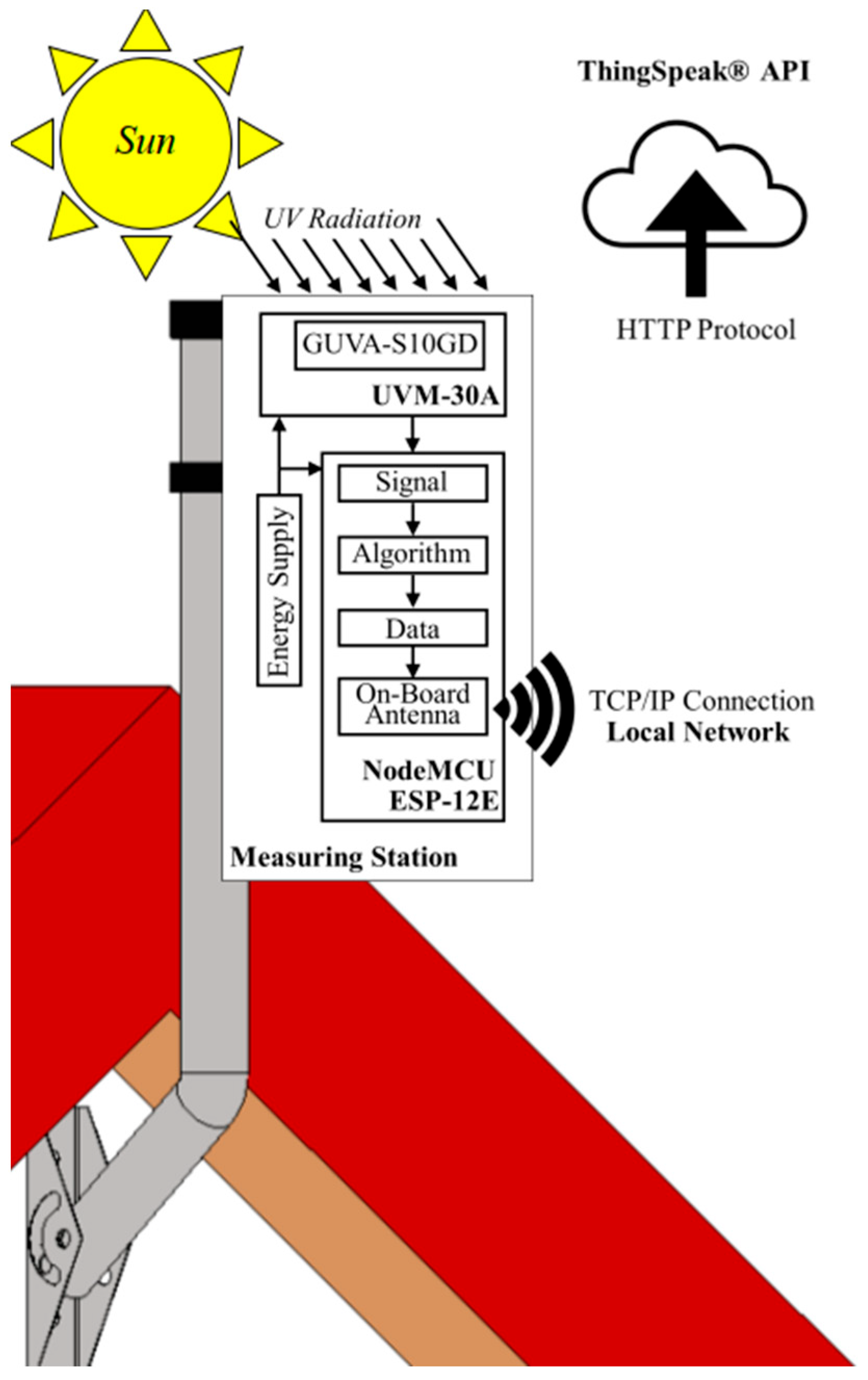
The system was conceived as a low-cost, autonomous, and modular platform designed for the real-time acquisition, processing, storage, and dissemination of ultraviolet radiation (UVR) data. The project was structured into three main functional layers, seamlessly integrated through a cloud-based storage platform.
As illustrated in
Figure 1, the system’s core concept emphasizes accessibility, scalability, and educational value. Its modular architecture ensures adaptability to different operational scenarios, enabling deployment in academic monitoring networks as well as in public installations such as parks and beaches. Since each unit operates independently, the system can be easily expanded to form a wide and effective network for UVR surveillance and public health protection.
2.2. System Architecture
2.2.1. Sensing and Acquisition Layer
This layer forms the foundation of the system and is represented by the measurement station. Its core component is a factory-calibrated UVM-30A ultraviolet sensor responsible for UV radiation detection. To ensure reliable measurements, the sensor employs a GUVA-S10GD photodiode, manufactured by Genicom Co., Ltd. from Daejeon, South Korea, selected for its low sensitivity to visible light. Its spectral coverage is as follows:
64.7% of the UV-A range (315–400 nm)
100% of the UV-B range (280–315 nm)
44.4% of the UV-C range (100–280 nm)
With an accuracy of ±1 UVI and a response time below 0.5 s, the sensor enables continuous real-time UVI measurement, managed by a low-power microcontroller.
2.2.2. Data Transmission and Storage Layer
After acquisition, data is transmitted wirelessly to the cloud using HTTP-based communication protocols. This layer ensures secure and efficient data transmission, forming a distributed IoT network.
2.2.3. Visualization and Information Dissemination Layer
The final layer provides real-time public access to processed data through a mobile application and a physical display. This transforms technical measurements into clear, educational information for public awareness and UV risk prevention.
2.3. Hardware
The hardware architecture consists of three main components: the UV radiation sensor with its signal-conditioning circuit, the microcontroller, and the data storage/transmission module. Each element was designed to maximize measurement fidelity while minimizing cost and power consumption.
The system employs the UVM-30A sensor, chosen for its wide spectral range (280–400 nm), low cost, and robustness in outdoor environments. The GUVA-S10GD photodiode provides high sensitivity within the UV-B range (100% response between 280 and 315 nm) and partial sensitivity in UV-A (~65%). Its spectral response closely matches the erythemal action curve, allowing the output voltage (0–1 V) to be directly proportional to incident radiation intensity and easily converted into UVI.
The sensor enclosure was designed to protect against dust and humidity while ensuring adequate ventilation and solar exposure. Geometry was adopted to minimize self-shading and ensure a cosine response under natural light.
2.3.1. Signal Conditioning Circuit
The output voltage of the UVM-30A sensor is directly read by the analog-to-digital converter (ADC) input of the microcontroller. The use of the internal reference calibration ensures that the sensor’s output voltage is compatible with the input reading range of the microcontroller, allowing the signal to be properly mapped within the ADC voltage range while preserving the full resolution of the 10-bit conversion (210 levels) for accurate signal digitization.
In this context, internal reference calibration refers to the use of the ESP8266′s internal analog reference voltage during the ADC conversion process. The ADC operates with a fixed internal reference level, allowing the voltage measured by the sensor to be consistently converted into digital values without requiring an external voltage reference circuit.
This approach ensures stable conversion of the analog signal produced by the UVM-30A sensor while maintaining a simplified hardware architecture. Any residual offset or scaling deviation is subsequently corrected during the calibration stage through linear regression against the measurements obtained from the reference radiometer, as described in
Section 2.4.4.
2.3.2. Microcontroller
The system’s control and communication core is the ESP-12E module, based on the ESP8266 chip. It was selected for its combination of low power consumption, built-in Wi-Fi connectivity, and adequate processing capacity. The module features a 32-bit Tensilica processor operating at 80 MHz, 4 MB of flash memory, and a 10-bit ADC, providing sufficient resolution for precise analog readings. Its TCP/IP stack and integrated antenna enable connection to local Wi-Fi networks, whether private or public.
2.3.3. Data Storage
Data is stored in the cloud using the ThingSpeakTM platform, which provides dedicated channels for receiving, storing, and visualizing time-series data through a RESTful API. Each unit transmits UVI readings via HTTP POST requests containing metadata such as timestamp, device ID, and calibration coefficient.
Additionally, a local buffer within the ESP8266’s flash memory temporarily stores data during network failures, automatically resending it once the connection is restored to ensure database continuity and integrity.
In distributed IoT monitoring systems, ensuring the integrity and transparency of stored data is an important consideration, particularly when environmental information is made publicly available. A recent study of Pawar et al. [
17] has proposed blockchain-based IoT architectures to enhance data security, transparency, and traceability in sensor networks by using distributed ledgers and cryptographic verification mechanisms. While the present system relies on conventional cloud-based storage architecture, such approaches highlight potential directions for strengthening data trustworthiness in large-scale deployments.
2.3.4. Cost of Materials
To support reproducibility and demonstrate the affordability of the proposed system,
Table 1 and
Table 2 summarize the bill of materials and approximate component costs used in the construction of the monitoring station and the public display unit, respectively.
The total hardware cost of the monitoring station and the public display unit was approximately USD 99.00, considering the exchange rate of 1 USD ≈ 3.90 BRL in September 2018, demonstrating the affordability of the proposed system compared to professional radiometric monitoring equipment.
2.4. Firmware
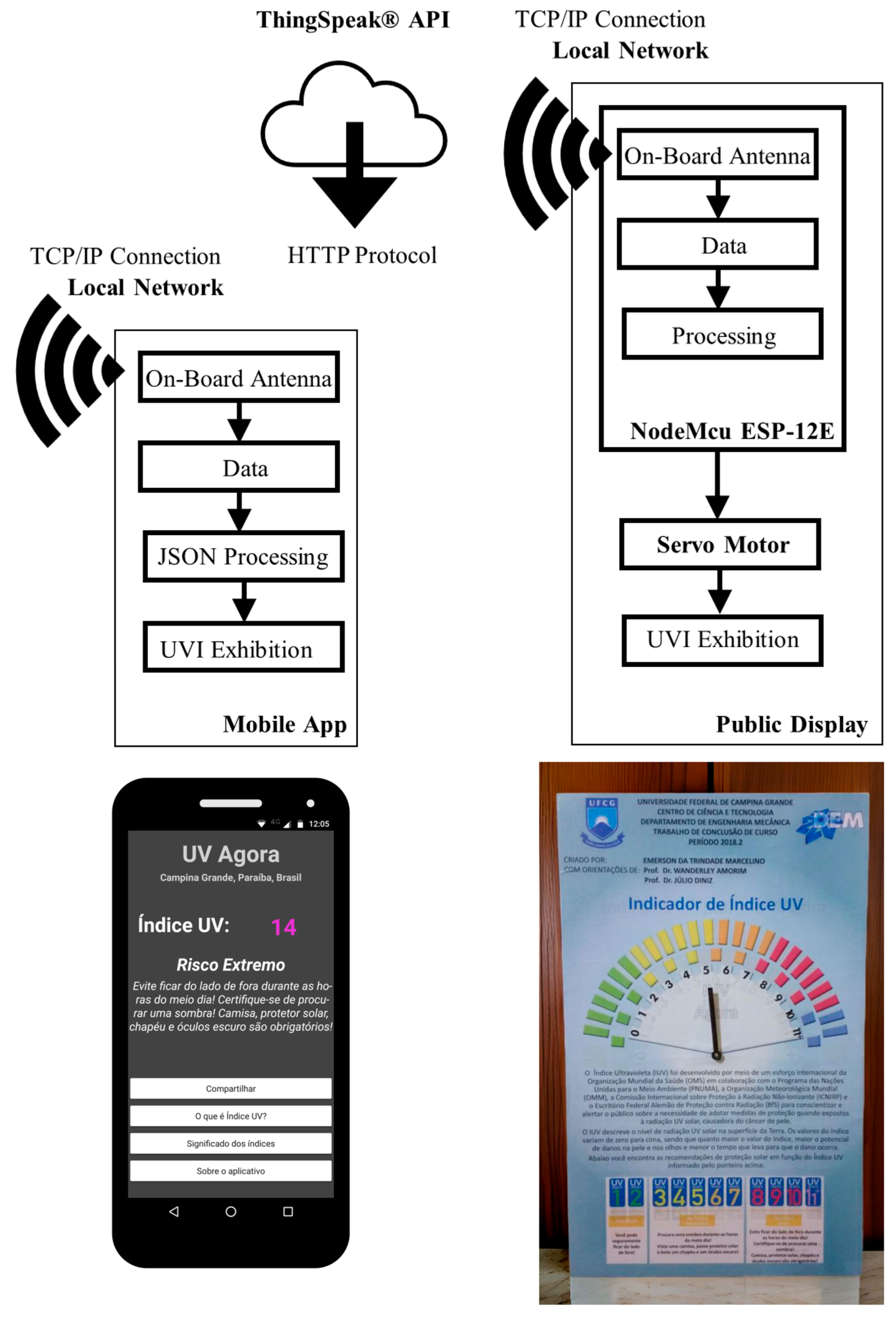
The embedded firmware was designed to autonomously manage the entire data acquisition, processing, and transmission workflow. Following a modular programming paradigm, it organizes routines into independent functional blocks, facilitating maintenance, scalability, and energy optimization.
Figure 2 illustrates the system’s logical flow.
2.4.1. Modular Architecture and Data Flow
The firmware consists of interdependent specialized modules:
Acquisition Module (UVM-30A Sensor): Performs analog signal readings induced by UV radiation on the GUVA-S10GD photodiode.
Processing Module (UVI Calculation): Converts analog voltage into UVI. The firmware collects 60 readings at 5 s intervals, computing an arithmetic mean to minimize noise and transient fluctuations [
18,
19,
20].
Communication Module (Wi-Fi/TCP-IP): Manages network connections using the TCP/IP protocol via the ESP-12E. It automatically reconnects in case of network failure and transmits data through HTTP POST requests.
Transmission Module (ThingSpeakTM API Integration): Formats and uploads processed data to the ThingSpeakTM cloud using a unique Write API Key for authentication.
Power Management and Error Handling Module: Implements low-power modes between transmissions and manages communication or acquisition exceptions to ensure continuous operation.
2.4.2. Operating Logic and Cloud Integration
The firmware operates in continuous cycles:
Initialization: The microcontroller boots, connects to Wi-Fi, and initializes all interfaces (ADC, servo display, etc.).
Acquisition and Processing: The sensor collects 60 samples, and the average UVI is computed.
Transmission: The processed data are sent to ThingSpeakTM via HTTP POST.
Peripheral Update: Units equipped with physical displays use a servo motor to move an analog pointer on a color-coded UVI scale.
Sleep and Repeat: The system enters a short low-power mode before restarting the cycle.
To mitigate rapid atmospheric fluctuations (e.g., passing clouds), a moving average filter smooths the readings, effectively acting as a low-pass digital filter to suppress high-frequency noise and ensure stable UVI values.
This architecture guarantees functionality, robustness, and adaptability for continuous outdoor operation.
2.4.3. Data Transmission Protocol
The communication protocol follows a simplified IoT model based on HTTP requests, chosen for its interoperability with cloud services and compatibility with resource-limited microcontrollers. Measurements are sent in JSON format to the ThingSpeak
TM API. Each packet includes a timestamp from the internal RTC and a device identifier. An exponential backoff retransmission algorithm, as suggested by Rocha et al. [
21], prevents data loss during network instability.
As in any distributed sensor network, basic cybersecurity considerations are necessary to ensure the reliability and integrity of the measured environmental data. Communication between the device and the cloud platform is performed through HTTP/HTTPS requests using authenticated private API keys provided by the ThingSpeak™ platform. This mechanism ensures that only authorized devices can access and write data to the designated communication channel, rejecting any device whose API key is not authenticated.
In practical large-scale deployments, additional security measures may be implemented to further protect transmitted data. These include encrypted communication via HTTPS, integrity verification through checksums, hash-based message authentication code, and consistency filters implemented at the firmware level. Such strategies can mitigate risks of data injection attacks or packet manipulation during transmission. In more advanced IoT infrastructures, decentralized frameworks based on blockchain have been proposed by Pawar et al. [
17] to ensure secure, transparent, and tamper-resistant data exchange between connected devices and cloud services.
2.4.4. Radiation Sensor Output Adjustment
Sensor calibration is performed by comparing prototype readings with those from a reference radiometer, using linear regression to determine adjustment coefficients:
where a and b are obtained experimentally. Temporal averaging of readings reduces noise and enhances signal stability under variable atmospheric conditions.
2.4.5. Digital Signal Processing
To minimize the effects of transient fluctuations caused by short-term atmospheric variability, the firmware implements a moving average filter applied to the UV sensor readings. As described in
Section 2.4.1, the acquisition module collects 60 samples at 5 s intervals, resulting in a total temporal window of 5 min. These samples are stored in a buffer, and at the end of the acquisition period, the arithmetic mean is computed and used to determine the Ultraviolet Index (UVI).
The adoption of a fixed temporal window for UVI estimation balances signal stability and system responsiveness, attenuating high-frequency components while preserving the ability to detect meaningful variations in the environmental variable of interest [
22].
This signal processing stage effectively acts as a digital low-pass filter, reducing measurement noise and ensuring that the transmitted values accurately represent the average exposure conditions. Such an approach is consistent with the recommendations of the World Health Organization (WHO), which considers the UV Index as a quantity that should be interpreted as a temporally integrated indicator for photoprotection purposes [
6].
2.5. Data Visualization System
The data visualization and dissemination layer was designed to make UVI information accessible to the public through two complementary interfaces: a mobile application and a physical public display. This dual-channel approach ensures that information is available both in personal/digital contexts and in public spaces.
Both systems operate synchronously, automatically updating at predefined intervals to ensure full consistency between displayed values and cloud-stored data. The combination of an interactive digital interface with a permanent analog display significantly broadens public outreach, reinforcing the system’s educational purpose and promoting awareness of UV exposure risks.
2.5.1. Mobile Application
The mobile interface retrieves the latest data from the ThingSpeakTM platform through HTTP GET requests. The JSON response is processed to display not only the real-time UVI value but also the corresponding WHO risk classification (e.g., Low, Moderate, High, Extreme) along with photoprotection recommendations.
2.5.2. Public Display
To engage communities in public spaces, an analog display was developed, operated by a secondary ESP-12E module that independently retrieves the UVI from the cloud. The processed value drives a servo motor that positions a pointer on a color-coded scale reflecting standard risk categories. This visual and intuitive design allows immediate understanding of solar exposure risk regardless of age or technological familiarity.
2.6. Prototype Construction
A single prototype version, designated Type I, was developed. The Type I integrates the UV sensor and ESP-12E module within a sealed enclosure designed for fixed outdoor installation and includes a servo-driven display for public demonstrations.
The enclosure was made of weather-resistant ABS plastic with a transparent polycarbonate window to ensure spectral stability. Its modular design allows for easy component replacement and replication across multiple monitoring points. Such modularity is particularly advantageous for future deployments involving distributed IoT sensing networks composed of multiple monitoring nodes. As the number of interconnected devices increases, IoT infrastructures become more complex and potentially more vulnerable to cyber threats. Yenugula et al. [
23] highlighted that large-scale IoT systems require mechanisms capable of analyzing relationships among devices and identifying anomalous behaviors in network activity to detect Sophisticated Persistent Threats in distributed environments.
2.7. Calibration
Calibration was performed by comparing prototype readings with data from an automatic meteorological station equipped with a calibrated broadband UV radiometer. Measurements were averaged hourly for direct comparison. Performance parameters—Pearson’s correlation coefficient (r) and confidence index (c)—were estimated as described in
Section 2.11.
2.8. Operational Performance
The prototype was designed to operate with low-voltage power sources (5 V), allowing it to be supplied by a variety of energy options, including a 5 W solar panel, a 5 V battery pack with a nominal capacity of 2500 mAh, or a conventional 5 V USB charger with a minimum power rating of 5 W. This flexibility enables autonomous deployment in outdoor environments while maintaining a simple and low-cost power architecture.
Based on this configuration, the experimental characterization of operational performance was conducted by analyzing the average current consumption and processing time associated with each operational phase. During the acquisition stage, the device exhibited an average current consumption of approximately 88 mA. Considering an average duration of 298 s for this stage, the corresponding charge consumption is approximately 26,224 mA·s.
During the idle data-processing stage, which has an average duration of approximately 3 s, the mean current consumption decreases to 55 mA, corresponding to a charge consumption of approximately 165 mA·s. The transmission phase represents one of the most critical stages in terms of energy demand. This phase has an average duration of approximately 5 s and an average current consumption of 250 mA, resulting in a peak charge consumption of approximately 1250 mA·s.
Considering the complete acquisition–processing–transmission cycle, the total operating time varies between approximately 300 and 308 s, depending primarily on the time required to transmit the data between the prototype and the remote server. The resulting charge consumption per cycle is approximately 7.68 mAh, corresponding to an estimated average hourly consumption of about 90 mA.
The firmware incorporates energy management routines between operational cycles, reducing unnecessary processing and stabilizing the system’s average power consumption (
Section 2.4.1). Although a full deep-sleep mode is not implemented due to the requirement for continuous periodic acquisition, the system maintains efficient control over active and idle periods.
2.9. Power Supply System
The prototype was designed for continuous outdoor operation and can be powered using a hybrid supply configuration. The hybrid operating concept considers two main scenarios:
Scenario 1—Grid-assisted operation: In environments where electrical power is available, the system can be powered using a conventional 5 V USB charger, ensuring uninterrupted operation without autonomy limitations.
Scenario 2—Fully autonomous operation: In the absence of solar generation or external power sources, the system operates exclusively from the battery pack. Under these conditions, the theoretical autonomy is estimated at approximately 27 h of continuous operation.
Under typical solar irradiation conditions in the Campina Grande region, Paraíba, Brazil (latitude 7°13′ S), where the device was experimentally validated between September and December 2018 (
Section 2.10), the daily solar energy generation exceeds the system’s daily energy consumption. Considering an average of approximately 5 h of effective sunlight, the solar panel can generate up to approximately 25 Wh per day. This energy balance confirms the prototype’s capacity for energy self-sufficiency during continuous field operation, eliminating the need for frequent manual intervention for battery recharging or replacement.
2.10. Experimental Area
Additional considerations support the selection of the reference station used in this study. Despite the increasing availability of automatic meteorological stations and digital data acquisition systems [
24], continuous monitoring of solar radiation at the surface remains relatively limited due to the high cost of specialized radiometric sensors and the need for frequent calibration and maintenance [
25,
26]. Consequently, the number of stations equipped with reliable solar radiation measurements is significantly smaller than that of stations monitoring conventional meteorological variables such as air temperature and precipitation [
27,
28]. For example, only about 4% of the stations in the Chinese national meteorological observation network measure solar radiation [
27].
The present research is located in the Agreste region of the state of Paraíba, in Brazil, specifically within the Campina Grande microregion. This region represents a climatic transition zone between the humid coastal zone and the semi-arid interior, presenting intermediate atmospheric characteristics influenced by both environments [
29]. The device developed in this study was installed in the municipality of Campina Grande (7°13′ S; 35°52′ W; 555 m), primarily due to logistical advantages that allowed efficient installation, monitoring, and maintenance during the experimental campaign.
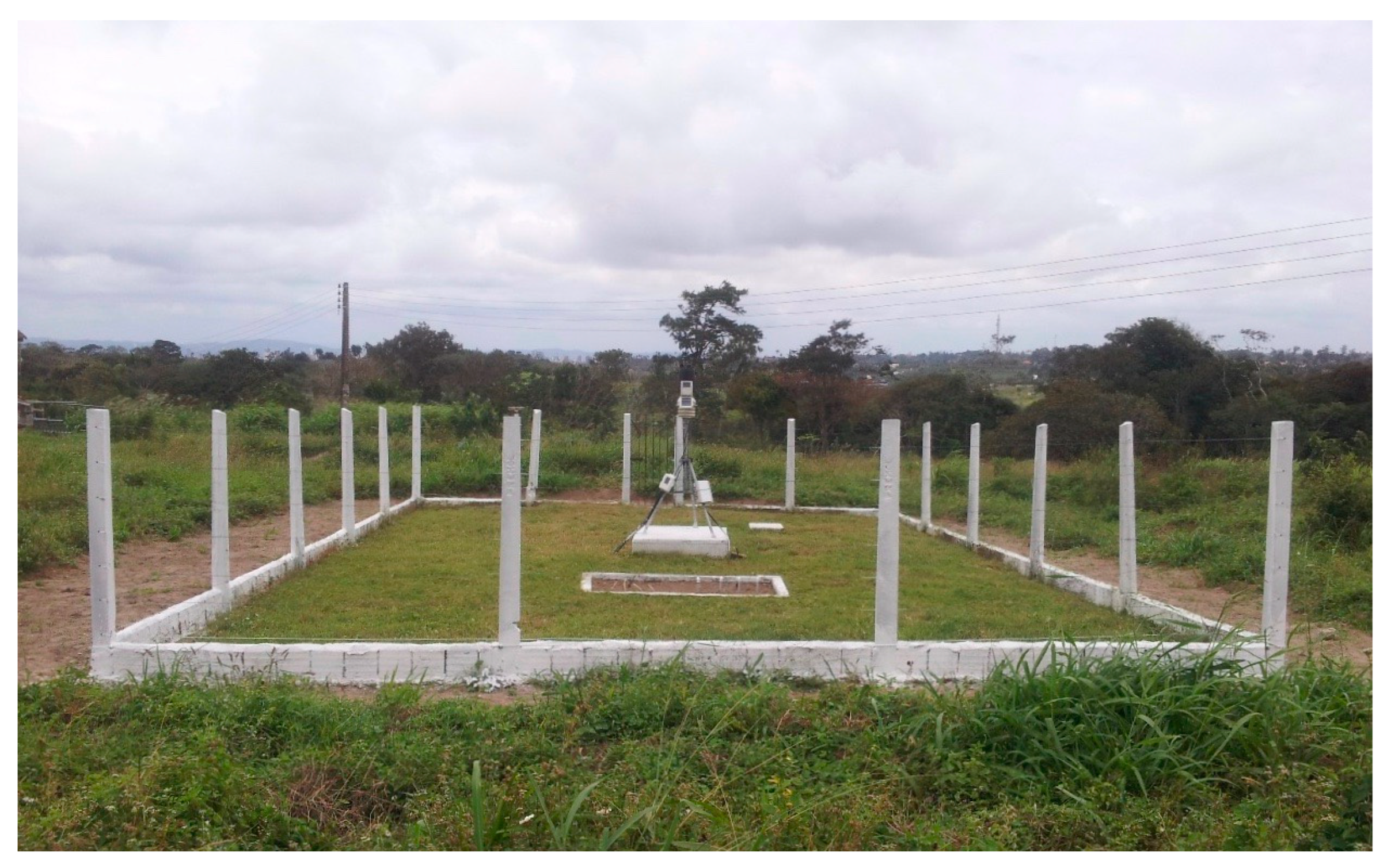
The closest meteorological station providing reliable UV radiation data was the station operated by the Paraíba State Agricultural Research Corporation (EMEPA-PB), shown in
Figure 3, located in the neighboring municipality of Lagoa Seca (7°10′ S; 35°51′ W; 634 m). The distance between the two sites is approximately 2.5 km, and both locations are situated within the same microclimatic zone of the Campina Grande microregion. Given this short distance and the absence of significant topographic barriers, it is reasonable to assume that both sites experience very similar atmospheric conditions during the measurement period.
2.11. Data and Analysis
Two datasets were used in this study. The first consisted of reference UVI measurements collected between 2009 and 2013 by a Davis automatic meteorological station installed at the EMEPA-PB, in Campina Grande, Brazil. This station was equipped with a calibrated broadband UV radiometer and provided hourly averages. The second dataset comprised UVI measurements from the developed device, recorded between 05 September and 24 December 2018, at a location 2.5 km from the reference station, with 5 min sampling intervals.
To allow direct comparison, the prototype dataset was temporally resampled to hourly averages. Statistical metrics, including the Pearson correlation coefficient and confidence index, were then computed to assess agreement between the two data sources.
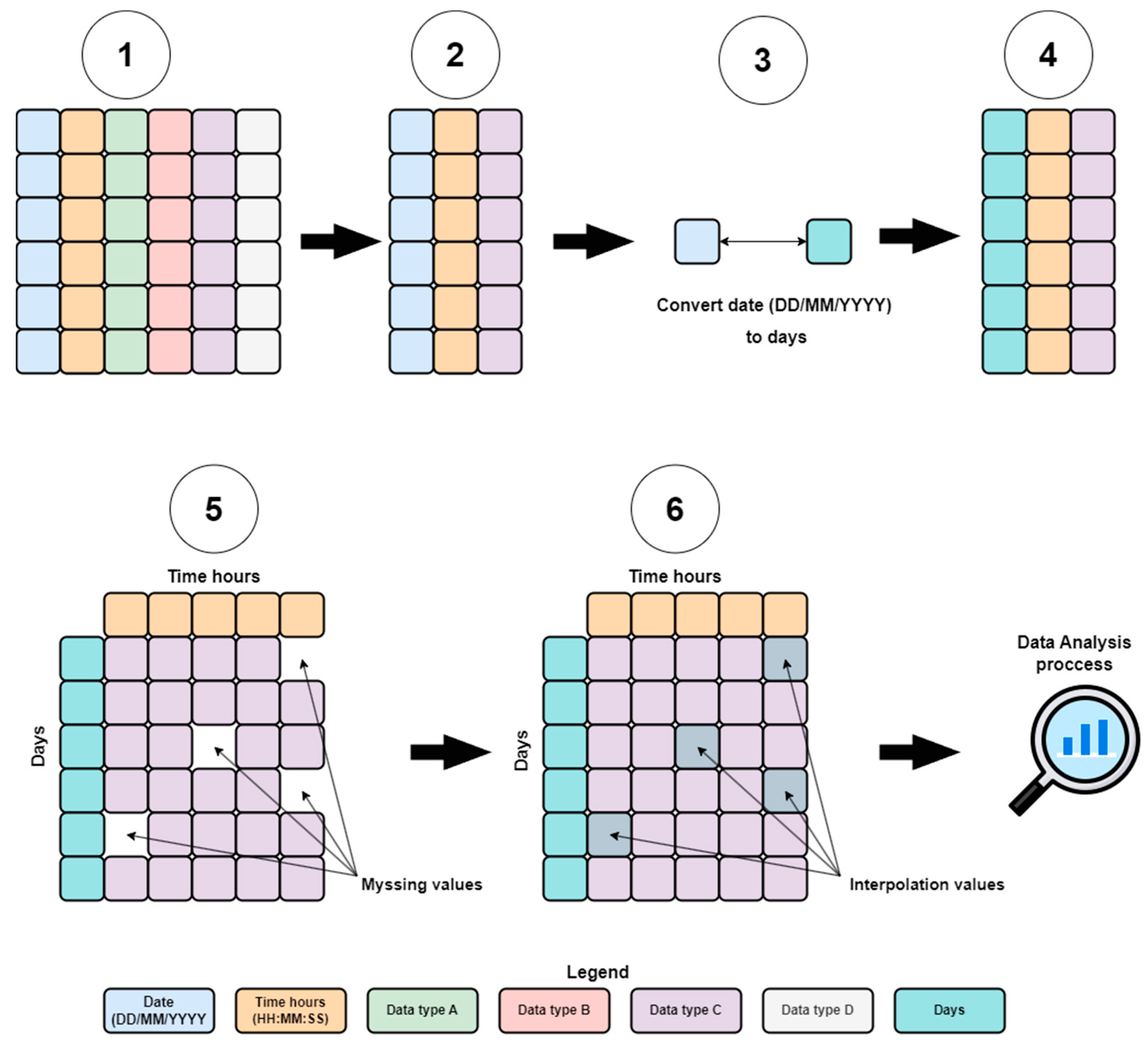
For the temporal variability analysis, the five-year reference dataset underwent preprocessing to correct technical inconsistencies and organize the data for efficient handling. The procedure, illustrated in
Figure 4, involved: (1) grouping raw variables by date and time; (2) isolating UVI measurements; (3) converting calendar dates to day-of-year format; (4) restructuring the data into a matrix layout; and (5–6) applying linear interpolation to fill missing values.
Following preprocessing, temporal variability was evaluated through graphical analysis and descriptive statistical metrics, applying the statistical procedures proposed by [
21]. Data processing followed the statistical parameters of agreement index (d) of [
31] and confidence index (c), defined as the product of Pearson’s correlation coefficient (r) and Willmott’s concordance index (d). To classify the performance of Pearson correlation coefficients (r), the confidence index (c) will be used in
Table 3 and
Table 4, respectively.
In addition to the establishment of statistical parameters, the behavior of the relative frequencies of radiometric divergences was analyzed, which were presented in the form of histograms and Probability Density Function (PDF).
3. Results and Discussion
3.1. Calibration
The calibration of the UV sensor was performed through a direct comparison between the measurements obtained from the developed prototype and the reference values provided by a standard instrument installed at an automatic meteorological station (EMEPA-PB). The procedure followed a methodology adapted from Rocha et al. [
21], based on simultaneous measurements obtained under clear-sky conditions and assuming a high atmospheric transmittance model.
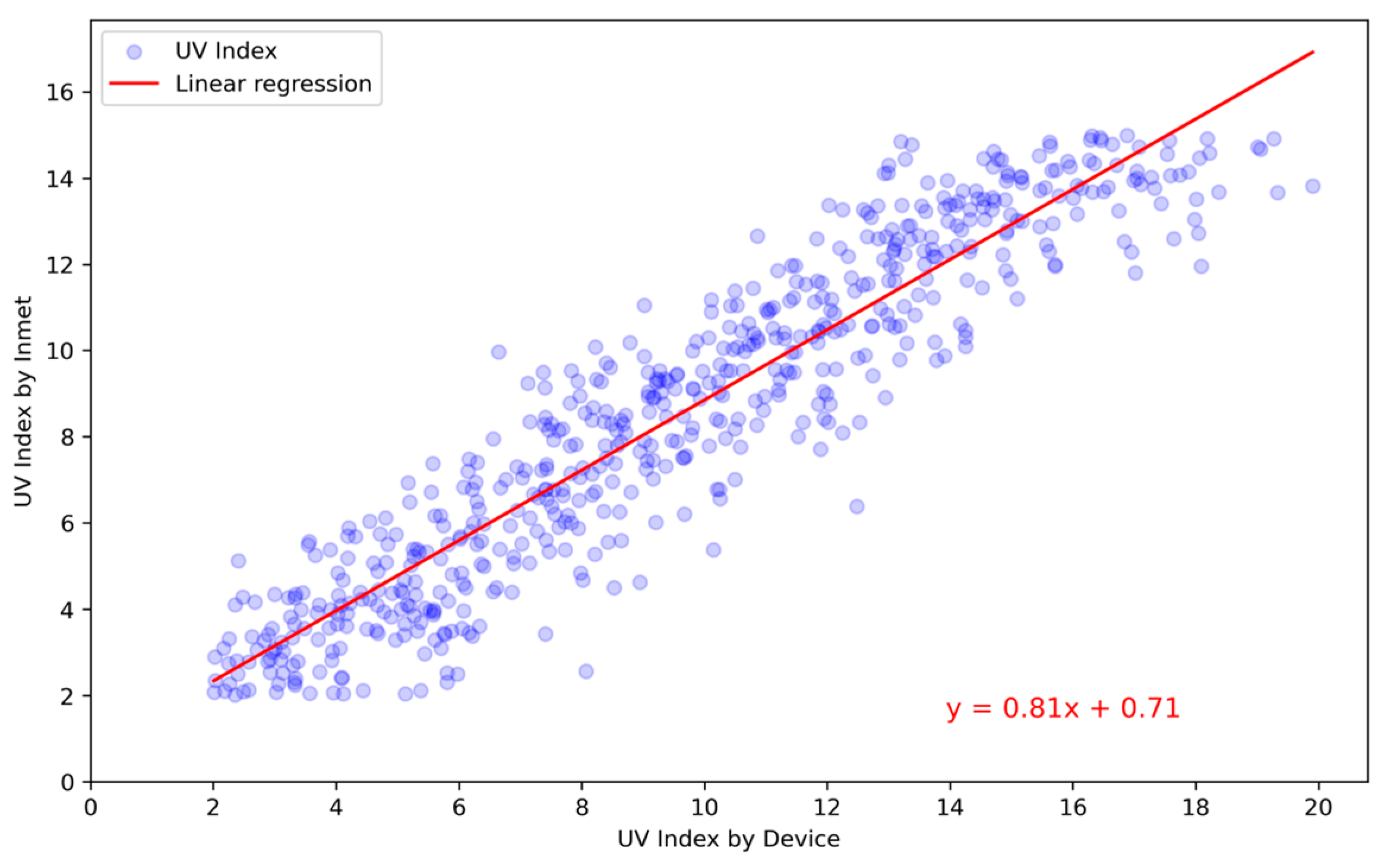
For the linear adjustment, a total of 596 (n) pairs of hourly observations were used, covering a UV Index (UVI) range from 2.01 to 14.98. The data were projected onto a Cartesian plane in which the prototype response, expressed as the corrected sensor voltage, was plotted along the x-axis, while the reference irradiance values were plotted along the y-axis.
The linear regression analysis resulted in the following calibration equation:
The slope coefficient (a) was estimated as 0.8144 (95% CI: 0.7895–0.8394), and the intercept (b) as 0.7072 (95% CI: 0.7047–0.7097). A 95% confidence interval was adopted in order to provide a conservative estimate of the uncertainty associated with the calibration coefficients.
The Pearson correlation coefficient (r = 0.849) indicates a strong positive linear relationship between the prototype measurements and the reference values. The linear regression model yielded a coefficient of determination (R2) of 0.721, indicating that approximately 72% of the variance in the reference UVI values is explained by the proposed linear model.
Additionally, a confidence index (c = 0.917) was calculated, indicating, according to this complementary metric, a performance classified as “very good” in terms of agreement between the two systems.
Although the prototype slightly underestimated the UVI when compared with the reference station (mean difference of 0.01), the root mean square error (RMSE) of 1.26 UVI units and the standard error of estimate (SEE) of 1.400 indicate a moderate level of dispersion. This variability can be attributed to environmental influences or differences in the spectral response of the instruments.
Similar validation studies using low-cost UV sensors report comparable levels of agreement with reference instruments. For example, Park et al. [
14] developed a portable UVI measurement device validated against a spectroradiometer and reported an average UVI error of only 0.045 units under controlled conditions, demonstrating the feasibility of low-cost UV monitoring technologies.
Likewise, Serrano et al. [
13] evaluated three commercial low-cost UV sensors: ML8511, UVM30A and VEML6075, and highlighted that, although such sensors require calibration and may present angular response limitations, they can provide reliable UV measurements when properly characterized and calibrated against reference instrumentation.
Nevertheless, considering the WHO [
6] UV risk classification scale, the observed error level remains acceptable for public health alert applications, confirming the reliability and consistent performance of the device for UVI monitoring.
Figure 5 illustrates the relationship between the hourly mean UVI values obtained by the prototype and those reported by the EMEPA-PB station.
3.2. Considerations on the Sensor Spectral Response
The GUVA-S10GD photodiode used in the device exhibits a partial spectral response within the ultraviolet range, covering approximately 64.7% of the UV-A region (315–400 nm), 100% of the UV-B region (280–315 nm), and 44.4% of the UV-C region (100–280 nm). Under natural atmospheric conditions, solar UV-C radiation is completely absorbed by atmospheric oxygen and stratospheric ozone and therefore does not reach the Earth’s surface. Consequently, the partial sensor coverage within the UV-C range is irrelevant for estimating the Ultraviolet Index (UVI) at ground level.
The UVI is defined from spectrally weighted irradiance based on the erythemal action spectrum standardized by ISO 17166 [
32], covering wavelengths between 250 and 400 nm. This weighting function assigns greater biological effectiveness to UV-B radiation and progressively lower weight to UV-A radiation. Under typical clear-sky conditions, the UV-B component accounts for approximately 85–95% of the total erythemally weighted irradiance, while UV-A contributes approximately 5–15%, depending on the solar zenith angle and atmospheric conditions.
Considering that the sensor fully covers the UV-B range but only 64.7% of the UV-A range, the potentially undetected fraction corresponds to 35.3% of the UV-A contribution. Assuming that UV-A represents between 5% and 15% of the total erythemally weighted irradiance, the theoretical maximum underestimation of the UVI can be estimated to lie between approximately 2% and 5%, depending on local spectral conditions.
It is important to emphasize that, as discussed by Moshammer et al. [
33], any spectrally weighted index represents a simplification of physical reality, since the spectral composition of solar radiation varies spatially and temporally, and different biological effects exhibit distinct spectral dependencies. Therefore, limitations associated with the spectral response of a detector should be interpreted within the broader context of uncertainties inherent to the definition of the index itself.
Although the sensor does not exhibit complete correspondence with the erythemal action spectrum defined by ISO 17166 [
32], the predominance of UV-B radiation in erythemal response, whose wavelength range is fully covered by the device, significantly reduces the impact of this limitation. Furthermore, the calibration performed against the reference radiometer, presented in
Section 3.1, helps partially compensate for potential systematic deviations within the evaluated operational range.
Therefore, the non-ideal spectral response of the sensor should be recognized as a technical limitation that may introduce systematic errors depending on atmospheric conditions. Nevertheless, as highlighted in the literature on UV indices, the use of spectrally weighted metrics remains a widely accepted approach for environmental monitoring and public health communication [
33]. The experimental results indicate that, within the evaluated UVI range, the system demonstrates statistically consistent performance and is suitable for practical applications involving real-time monitoring and public health alert systems.
3.3. Analysis of Meteorological Station Data
The UVI was continuously monitored by the automatic meteorological station, allowing the temporal variability of UV exposure to be assessed for the Campina Grande Microregion.
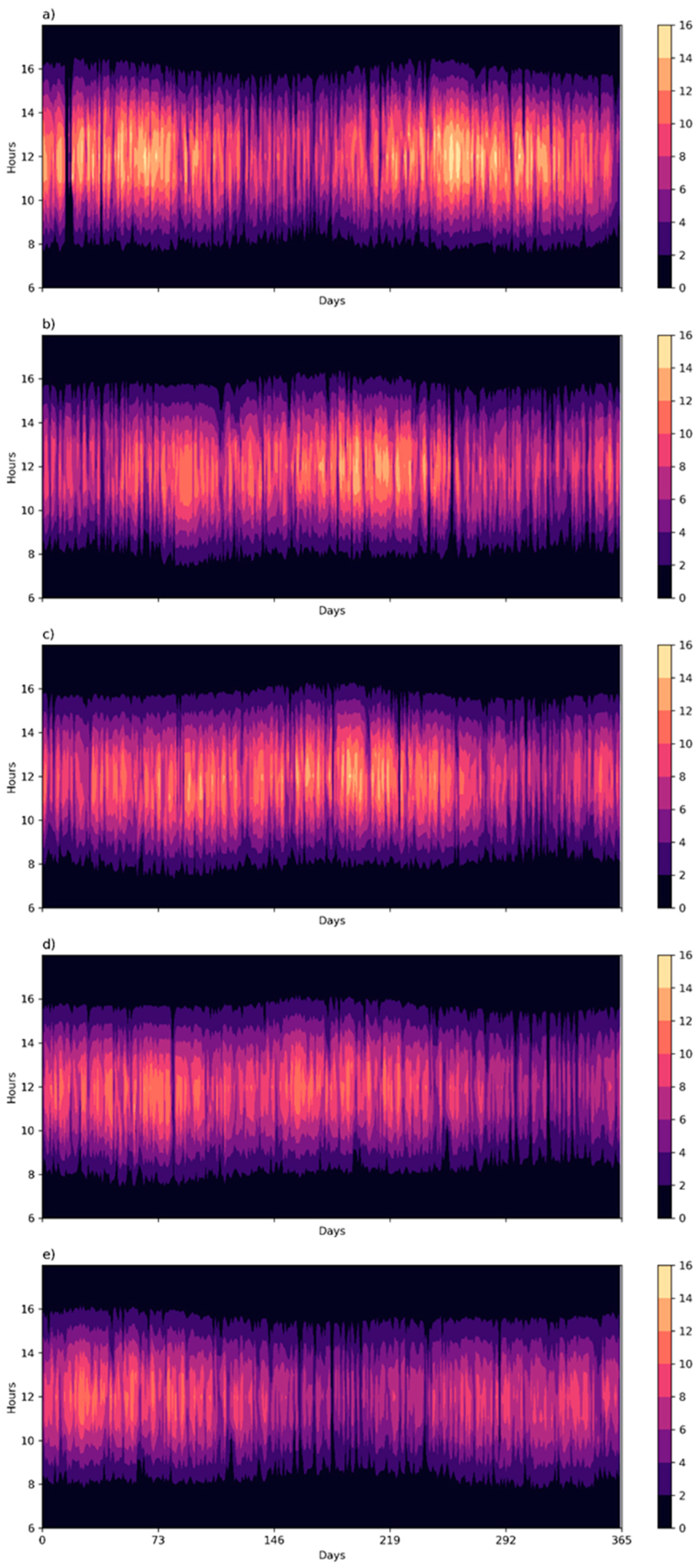
Figure 6 shows the UVI magnitudes recorded between 1 January 2009 and 31 December 2013.
The contour plot in
Figure 6 enables simultaneous visualization of intra-daily, intra-annual, and interannual variability. The data reveal clearly defined cyclical patterns. On a daily scale, the UVI gradually increases during the morning hours, typically reaching “extreme” risk levels, as classified by the WHO, around solar noon, followed by a steady decrease in the afternoon, dropping to “low” risk levels after 16:00. This pattern is directly related to the solar zenith angle, which continuously changes throughout the day due to the Earth’s rotation. Around noon, solar rays strike the surface more perpendicularly, resulting in peak radiation intensity.
The intra-annual variability indicates maximum UVI levels during summer and minimum levels during winter. However, the amplitude of this seasonal cycle is less pronounced due to the proximity of the study area to the equator. Consequently, even during winter, “high” and “very high” risk categories are recorded, reinforcing the need for photoprotection throughout the year. Interannual analysis suggests a slight decline in maximum daily values over the five-year period, possibly associated with variability in cloud cover or long-term atmospheric effects.
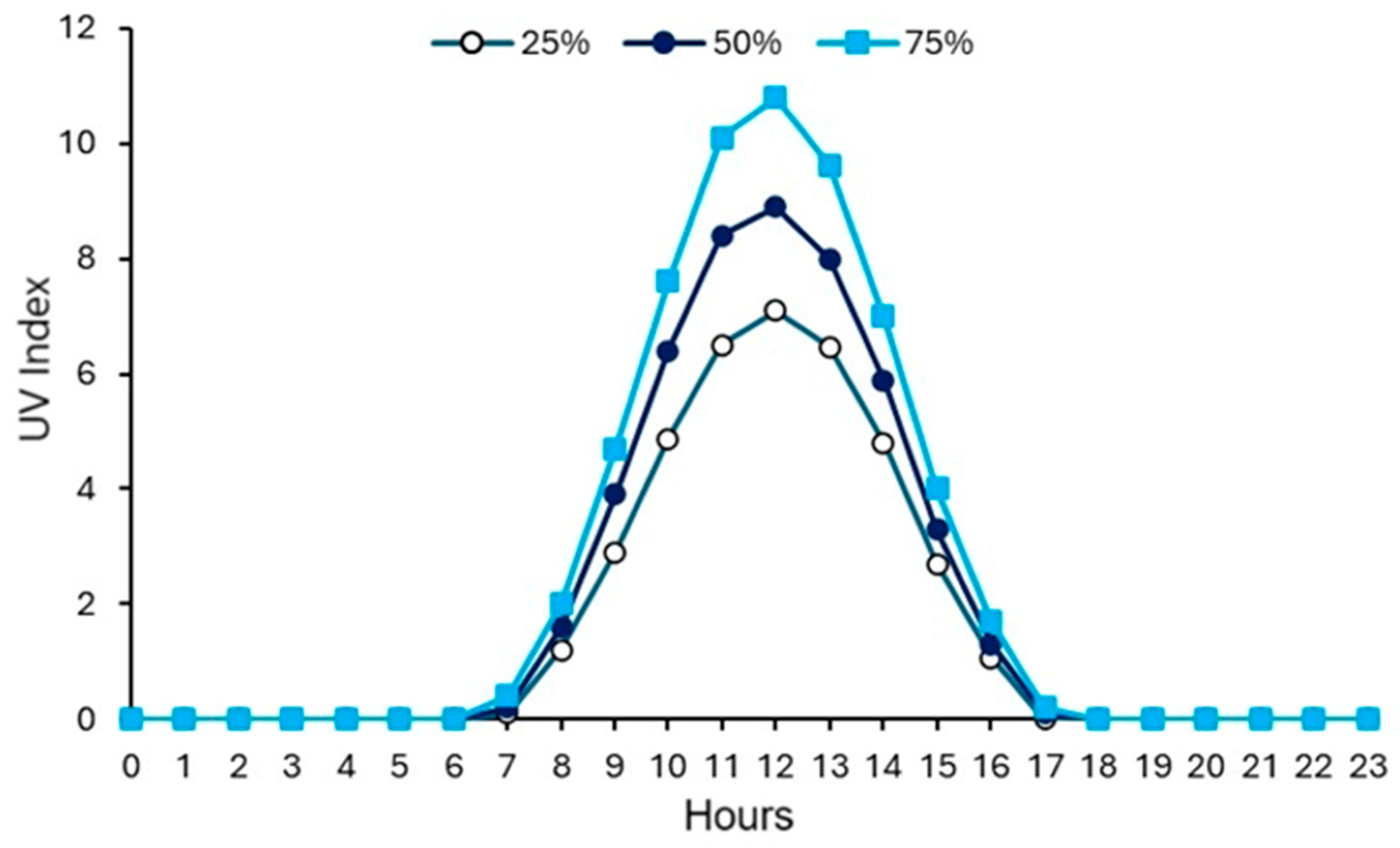
Identifying critical hours for UV exposure is essential for supporting public health guidelines and awareness campaigns.
Figure 7 presents the average daily UVI cycle over the period analyzed.
As shown in
Figure 7, “low” risk levels, according to WHO classification, occur before 08:00 and after 16:00. Between 11:00 and 13:00, values commonly reach the “very high” category and may escalate to “extreme,” depending on atmospheric conditions. Continuous monitoring is therefore crucial to inform photoprotection strategies. However, the high cost and maintenance requirements of professional-grade instruments hinder the establishment of widespread ground-based monitoring networks, particularly in high-exposure areas such as beaches and public parks. In this context, the present study proposes a low-cost UVI monitoring and dissemination device.
3.4. Analysis of Data Collected by the Developed Device
The developed device performed automatic and continuous UVI measurements at 5 min intervals throughout the day, distributing the readings through both the mobile application and the public display.
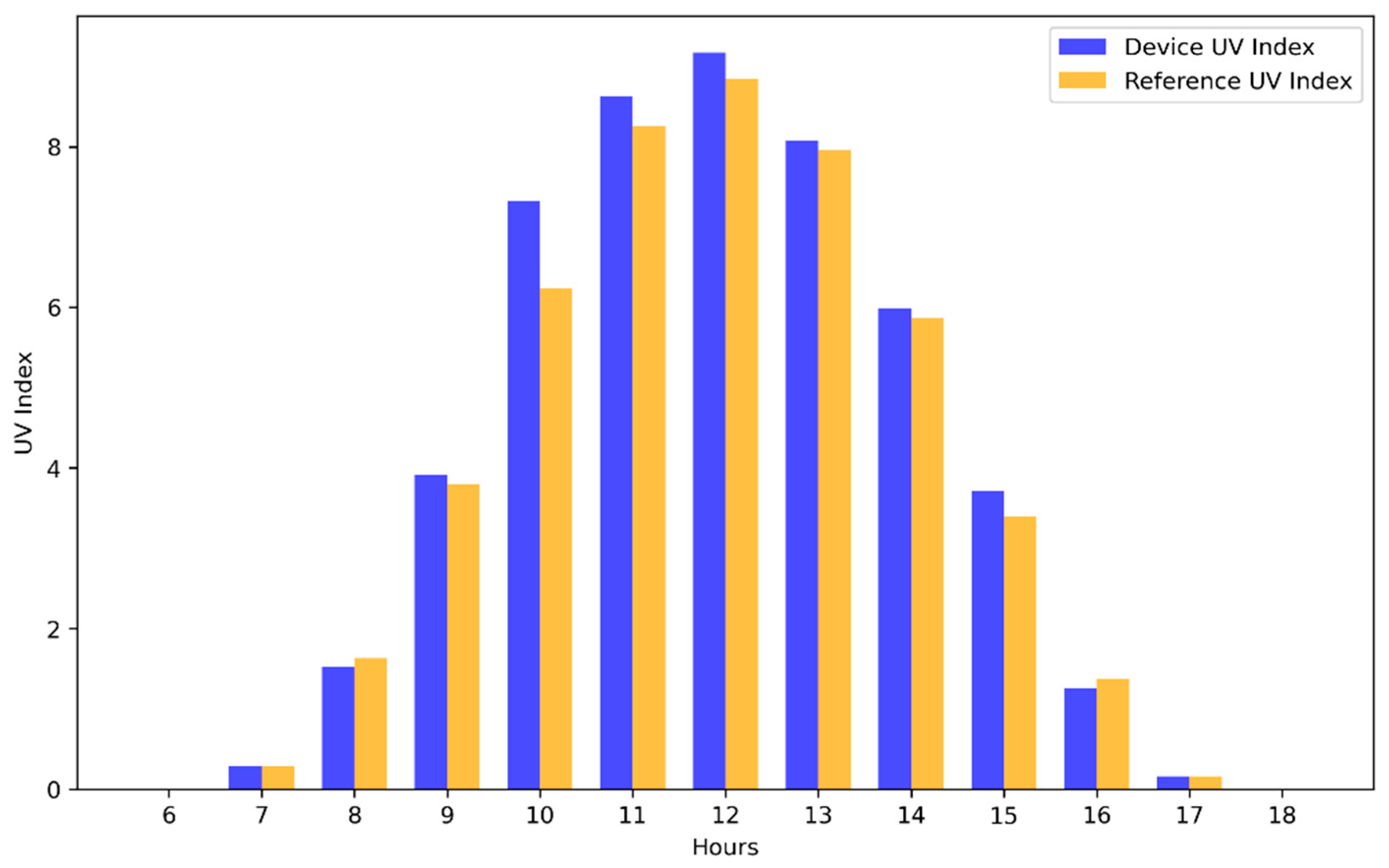
Figure 8 compares the mean UVI values obtained by the prototype with the reference dataset from the meteorological station. Although the two systems did not operate simultaneously, temporal alignment was applied to enable cross-analysis. The results demonstrate that the device successfully captured daily UVI variation patterns and effectively identified periods of critical exposure, serving as an important tool for alerting the population to hazardous radiation levels.
The performance obtained is consistent with recent developments in low-cost environmental monitoring networks. For instance, Tahat et al. [
34] demonstrated that low-cost UV sensing units integrated within IoT-based environmental monitoring systems can provide practical real-time measurements for urban monitoring applications when combined with cloud data processing and communication platforms.
The results confirm that the proposed device is a reliable and low-cost alternative for real-time UVI monitoring. Its implementation can support the identification of hazardous exposure periods and encourage preventive behaviors among the population, contributing to the reduction in UV-related health risks. A more detailed analysis of the experimental error was carried out using the WHO risk segmentation. Based on this classification, the precision of the low-cost sensor was found to vary according to ultraviolet radiation intensity. The device showed its best performance in the “High” (6–7) and “Very High” (8–10) UVI ranges, with a confidence index (c) greater than 0.90. Under these conditions, typically associated with clear skies and high solar altitude, the spectral response of the GUVA-S10GD photodiode aligns more consistently with the erythemally weighted action spectrum.
Conversely, the experimental error for the “Low” (UVI ≤ 2) and “Moderate” (3–5) categories could not be reliably determined due to the reduced signal-to-noise ratio of the sensor at low irradiance levels. The device demonstrates reliable performance for UVI values ≥ 5, where the sensor output is sufficiently above the noise floor. Below this threshold, the reduced signal amplitude relative to measurement noise limits the precision of the readings.
Under such conditions, the sensor response becomes less stable, introducing greater uncertainty in the measurements. This limitation should therefore be considered when interpreting data obtained under low-insolation conditions. However, it does not compromise the primary purpose of the device, which is to identify and communicate periods of elevated UV exposure relevant to public health alerts. Overall, the results indicate consistent performance in data acquisition, processing, and visualization. Minor discrepancies between the displayed values and the reference measurements may occur due to the inherent accuracy limits of the low-cost UV sensor employed in the prototype, particularly under low irradiance conditions. Nevertheless, these deviations remain within the expected performance range of low-cost photodiode-based sensors and do not significantly affect the system’s ability to capture the temporal variability of the UV Index. Consequently, the proposed device demonstrates adequate reliability for real-time environmental monitoring and public health awareness applications.
3.5. Cost-Performance Comparison Between the Proposed Device and the Reference Radiometer
Table 5 presents a comparison between the developed prototype and the reference instrument. The results shown in
Table 5 highlight the potential of the proposed low-cost device as a viable alternative for expanding ultraviolet monitoring networks. Although professional radiometers provide superior spectral accuracy, their high cost and operational complexity limit their large-scale deployment.
In contrast, the developed prototype presents significantly lower cost, reduced energy consumption, and simplified installation, making it suitable for the deployment of distributed monitoring networks. This characteristic is particularly relevant for large countries such as Brazil, where continental-scale territory limits the spatial density of professional monitoring stations. The use of low-cost, low-power devices can therefore enable the creation and expansion of meteorological observation networks, as well as support applications in smart cities. By increasing spatial coverage, such systems can contribute to public health initiatives related to exposure to solar ultraviolet radiation.
4. Conclusions
The developed low-cost device demonstrated an adequate spectral response for erythemally weighted UV monitoring, covering most of the UV spectrum and operating autonomously at fixed elevated locations to minimize environmental interferences. Automated measurements were performed throughout daylight hours, with seamless integration into both a mobile application and a public display via a cloud-based API. Data was securely transmitted using HTTP POST and made available for real-time access through HTTP GET requests. The strong correlation between the device’s measurements and reference values confirms its suitability for real-time UVI monitoring, particularly in high-exposure environments such as beaches, parks, and outdoor recreational areas. Beyond its technical performance, the system also provides an effective communication platform, enabling users to access up-to-date UVI information and make informed decisions regarding sun exposure.
The prototype validation period (September to December) coincided with spring and early summer in the Southern Hemisphere, when the highest annual UV radiation levels occur in the Campina Grande region. This strategic choice ensured validation under the most critical and challenging operating conditions, demonstrating the device’s robustness and accuracy precisely when health risks are at their peak.
Building on this success, the proposed low-cost IoT architecture paves the way for broader applications through the deployment of dense networks of sensors, or “micro-stations,” capable of delivering hyperlocal UVI data at sites of public interest such as beaches, parks, swimming pools, and schools. While official meteorological stations typically provide representative data for large areas, a network based on this prototype can capture microclimatic variability in UVI influenced by local factors such as cloud cover, topography, and surface reflectivity. However, as distributed IoT monitoring infrastructures expand, maintaining system integrity and data security becomes increasingly important. The growing complexity of interconnected IoT devices may expose monitoring networks to sophisticated persistent threats, requiring advanced approaches capable of identifying anomalous relationships among devices and system logs [
23].
By facilitating widespread access to localized UV radiation data, the system contributes to public health by raising awareness of UVR-related risks and promoting protective behaviors. Ultimately, the proposed solution offers a practical, scalable, and impactful tool to support preventive strategies and reduce the health impacts associated with excessive solar radiation.




 ,
,