Review

An Overview of Recent Advances in the Online Temperature Estimation of PMSM in Electric Vehicle Applications


1
Aerospace Information Research Institute, Chinese Academy of Sciences, Beijing 100094, China
2
University of Chinese Academy of Sciences, Beijing 100190, China
3
Qilu Aerospace Information Research Institute, Chinese Academy of Sciences, Jinan 250000, China
*
Author to whom correspondence should be addressed.
Electronics 2026, 15(6), 1249; https://doi.org/10.3390/electronics15061249
Submission received: 17 February 2026 / Revised: 13 March 2026 / Accepted: 13 March 2026 / Published: 17 March 2026
(This article belongs to the Special Issue Advances in Electric Vehicle Technology)

Abstract

Online temperature estimation of key components (windings and magnets) in permanent magnet synchronous motors (PMSMs) has emerged as a critical technology for ensuring the safe operation of PMSMs, preventing insulation degradation, and avoiding the demagnetization of magnets. Because of such advantages, online temperature estimation is attracting growing attention from fields with stringent reliability requirements, such as electric vehicles, as well as electrified railway transportation and more/all-electric aircraft, where similar high-reliability demands exist. This paper gives a comprehensive review of the latest and most effective solutions in the online temperature estimation methods for PMSMs. It analyzes the principles, application progress, and limitations of existing methods, including electrical model-based approaches, thermal model-based approaches, and data-driven approaches, in which process the advantages and challenges of different methods are compared. And an outlook on the future application of this technology are summarized.

1. Introduction

The gradual depletion of oil energy and the worsening of climate change are profoundly reshaping the global energy structure. As a key source of carbon emissions, the transportation sector’s transition toward green and low-carbon solutions has become an international consensus [1,2]. Based on this background, the electrification of transportation, as a core solution for carbon reduction, is under rapid development. From electric vehicles (EVs) on the roads to electric regional aircraft in the skies, electric propulsion is progressively replacing traditional fossil fuel power, driving a profound revolution [3,4,5,6].
As the “heart” of electric transportation vehicles, permanent magnet synchronous motors (PMSMs) have demonstrated remarkable advantages such as high power density, superior efficiency, high torque density, and excellent speed regulation performance [7,8,9]. As a result, PMSMs have become the indisputable core power component in high-end application scenarios such as electric vehicle drive systems and advanced electric aircraft propulsion units. The performance of PMSM directly determines the electric vehicle’s power output, driving range, and driving experience. Therefore, ensuring the high reliability, long lifespan, and operational safety of PMSMs under various complex and demanding operating conditions is the primary concern and most significant design objective in the development of electrified transportation.
However, the critical components within PMSMs, rare earth permanent magnets and stator windings, are their thermal reliability weak points [10]. During the actual operation of electric vehicles, PMSMs face highly variable and extreme conditions, including starts and stops, sustained high-load climbing, high-speed cruising, and temperature distributions. These conditions cause significant heat accumulation within the PMSM. For magnets, excessively high temperatures can cause irreversible demagnetization risks. At the very least, it can lead to a decrease in torque output and efficiency. At worst, it can result in sudden failure, endangering driving safety. For winding insulation, continuous high temperatures can aggravate the aging and deterioration of insulating materials, and ultimately it may cause catastrophic consequences such as insulation breakdown and short circuits [11,12,13]. Therefore, the temperature of key components in PMSMs is a core physical quantity for evaluating its operational status, predicting its remaining lifespan, and ensuring its safety and reliability.
For PMSMs in high-end applications such as EVs, directly measuring the internal temperature of magnets and the hotspots of windings is subject to many constraints. These PMSMs have characteristics such as high power density, compact structures, and complex forms. Directly implanting temperature sensors, such as thermocouples and thermistors, on the high-speed rotating magnet rotors and hotspots of the narrow windings is not feasible. Consequently, the research of online temperature estimation technology for PMSMs has drawn lots of attention. Current researches for the online temperature estimation of PMSMs can be categorized into the three classes below,
  • Thermal Model-Based Methods
Thermal model-based methods establish a low-order lumped-parameter thermal network (LPTN) model. By calculating motor losses online or measuring readily accessible temperature points, they extrapolate target temperatures (winding temperature or magnet temperature) through the LPTN model.
  • Electrical Model-Based Methods
Electrical model-based methods typically employ online parameter identification or observer-based techniques to compute and extract the winding resistance or the permanent magnet flux linkage of the PMSM. The winding temperature or magnet temperature is subsequently derived via the material temperature coefficient.
  • Data-Driven Methods
Data-driven methods are particularly suited for PMSMs with complex structural designs or hybrid cooling strategies, where building a physics-based thermal network is challenging and model-order reduction is impractical. Utilizing data-driven methods, artificial neural networks are trained on experimental data gathered under diverse operating conditions. The trained models are then deployed on embedded platforms to achieve online temperature estimation. Based on the rapid development of the various methods above, the online temperature estimation of PMSMs has emerged as a significant enabler for enhancing the reliability, criticality, and durability of EVs. Therefore, a comprehensive analysis and comparison of these methods are urgently needed.
While existing reviews [14,15] primarily focus on classical thermal networks or electrical parameter identification, this paper establishes a more comprehensive framework by categorizing methodologies into three distinct pillars as follows: electrical model-based, thermal model-based, and data-driven approaches. A key distinction of this work is its systematic inclusion of the most recent literature (up to 2026) across all three categories. In particular, it captures the rapid advancements in emerging deep learning techniques that are often overlooked in previous surveys. This work offers a timely and holistic perspective on the online temperature estimation of PMSM in EVs’ application.

2. Thermal Model-Based Methods

2.1. Basic Principles of the LPTN

The LPTN methods have played important roles in thermal design optimization for PMSMs of both EVs. This stems from its advantageous balance of relatively high computational accuracy and significantly reduced computation time compared to Computational Fluid Dynamics (CFD), thereby enabling rapid design iteration cycles for the PMSM development. The LPTN is built as a traditional electrical circuit. The temperatures, the losses, the thermal resistances, and capacitances function as the voltages, the currents, the electrical resistances, and the capacitances, respectively. All three main types of heat transfer ways, convection, conduction, and radiation, can be represented in the LPTN and expressed by three different types of thermal resistances. To calculate the thermal performance of the PMSM by the LPTN, the well-known node potential method can be utilized. And the LPTN can be represented by a group of first-order differential equations.
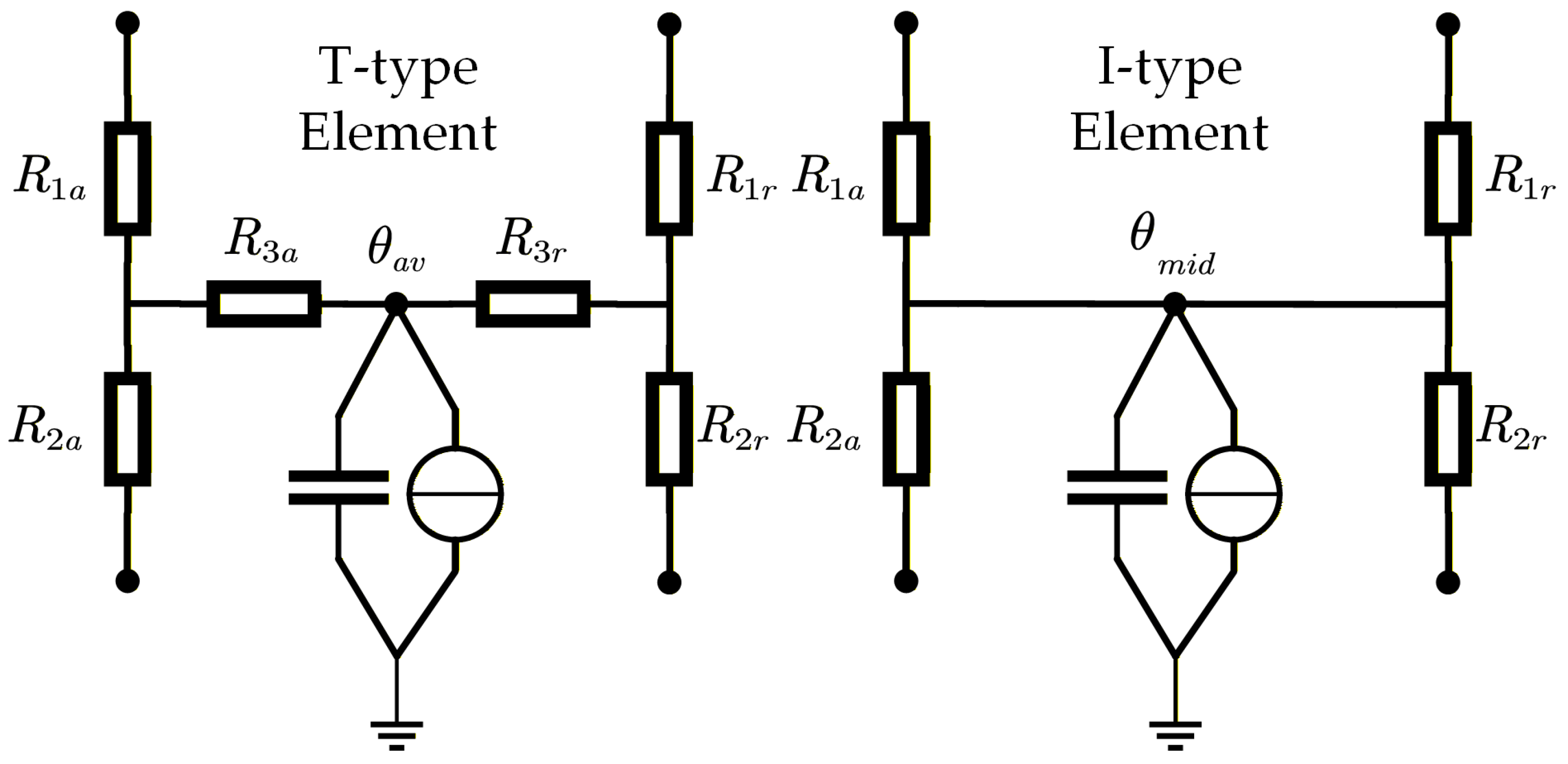
Based on different thinking in modeling the heat conduction of a component in the PMSM, the fundamental conductive thermal resistance can be abstracted into two distinct forms, the I-type [16,17,18] and T-type [19,20,21,22], which are shown in Figure 1. For the LPTN utilizing the “I-type” thermal resistance, it is built on the assumption that the loss of the built component is generated on the mid-point, not distributed, even through the component. Thus, the “I-type” LPTN tends to overestimate the temperature of the mid-point because of its concentrated loss feature and induces some estimation error. On the contrary, the “T-type” LPTN contains a negative resistance that restrict the overestimation and the node temperature represents the average temperature of the component built. Comparatively, it can be seen that the computation consumption of the “T-type” model is larger, but it is more accurate than using the “I-type”.

2.2. Four Types of the LPTN

Besides two types of the fundamental thermal resistance, “I-type” and “T-type”, the LPTN can also be classified into the four categories below based on the size of the model,
  • Detailed LPTN.
  • General LPTN.
  • Simplified LPTN.
  • Highly Simplified LPTN.
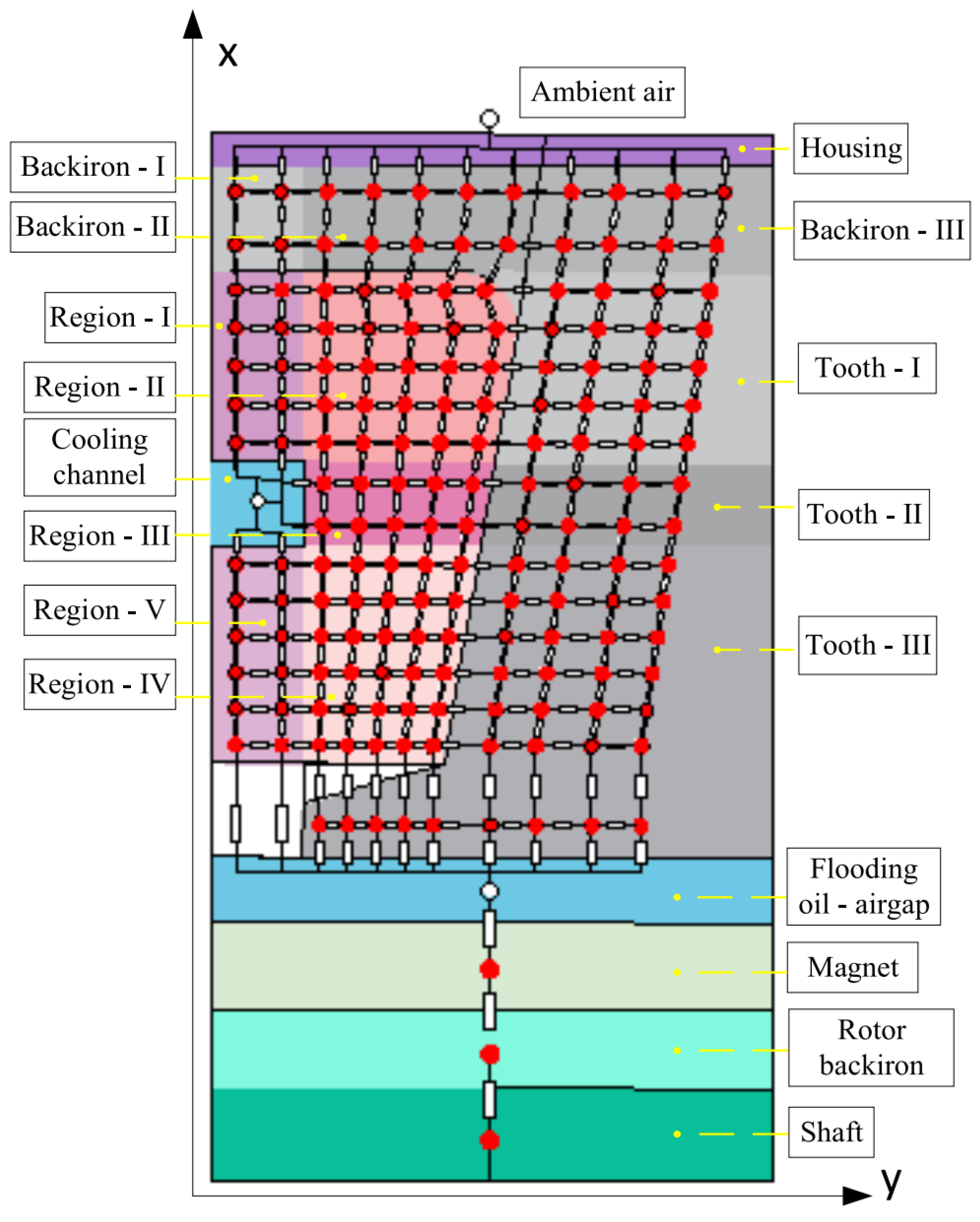
Among the thermal modeling methods above, the detailed LPTN [23,24,25,26,27] is the one with the largest model size. For the detailed LPTN, all components of the PMSM are divided and modeled along the spatial direction particularly. Thus, the temperature distribution within a component, especially the temperature hotspot, can be obtained. In [23], Kylander laid the foundation for this field by developing comprehensive thermal networks for TEFC induction motors. Subsequent research has applied these detailed thermal modeling principles to advanced cooling scenarios. In [24], Zhang et al. analyzed slot thermal conditions in electrical machines. In [25], Zhang et al. validated thermal models for oil-flooded machines with slot-channel cooling. In [26], Dong et al. corrected hotspot movement detection in high-frequency machine windings. In [27], Liu et al. carried out fundamental thermal analysis of permanent magnet machines. However, the computation consumption is also the largest because of its excessive model scale and intricate modeling process. The node number of the detailed LPTN is always over 100, as shown in Figure 2, and therefore, the advantage of easy implementation and calculation is not obvious compared with other numerical computation methods.
For the general LPTN [28,29,30,31,32], the scale of the thermal network is determined based on the importance of different components with the PMSM. For example, temperatures of the windings and magnets need to be paid attention to all the time; thus, the thermal modeling of the windings and magnets is conducted in detail with more nodes. Recent studies have applied this approach to a variety of applications as follows: Li et al. [28] designed heat dissipation structures for motors integrated with three-dimensional magnetic circuits using this method. In [29], Xu et al. optimized fault-tolerant control strategies for aerospace actuators based on the same detailed thermal modeling principle. In [30], Jin et al. developed transient thermal models for wet-type fault-tolerant permanent magnet synchronous motors by adopting this approach. In [31], Cai et al. effectively combined the method with the considerations of anisotropic conductivity and thermal contact resistance to conduct thermal modeling of flux-switching permanent-magnet machines. In [32], Zhang et al. applied the detailed thermal modeling strategy to the thermal analysis of water-cooled traction permanent-magnet synchronous machines for electric vehicle applications. For the shaft and the iron with almost no losses, their thermal modeling is simplified with only a single node.
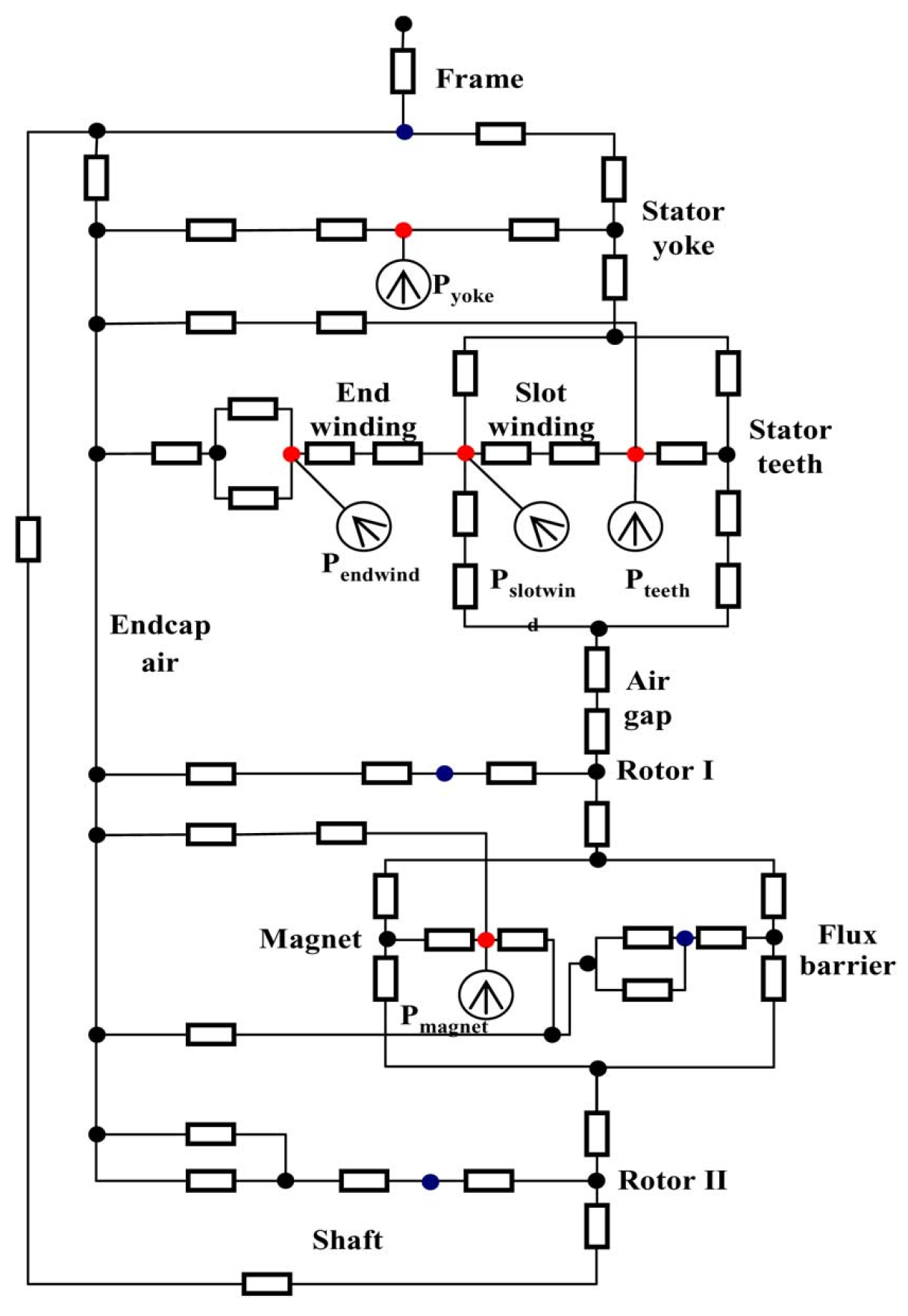
The simplified LPTN [33,34,35] is the most common thermal calculation method used in PMSM design. It treats the components in the PMSM that have similar temperatures as a single node, as shown in Figure 3. For example, the front and rear end covers and the housing of the PMSM. Thus, using the simplified LPTN significantly reduces the computational load for the PMSM thermal design, and it can be utilized for the rapid iterative process of the PMSM optimization.
Even as the simplified LPTN has already lessened the computational load, it is still not fast enough to be used in online temperature estimation. The model scale of the highly simplified LPTN is the smallest compared with the other three types of methods. It only has two to five nodes where the most concerned components being considered. Thus, how to appropriately and coordinately reduce the size of the thermal network varies on the different application fields.
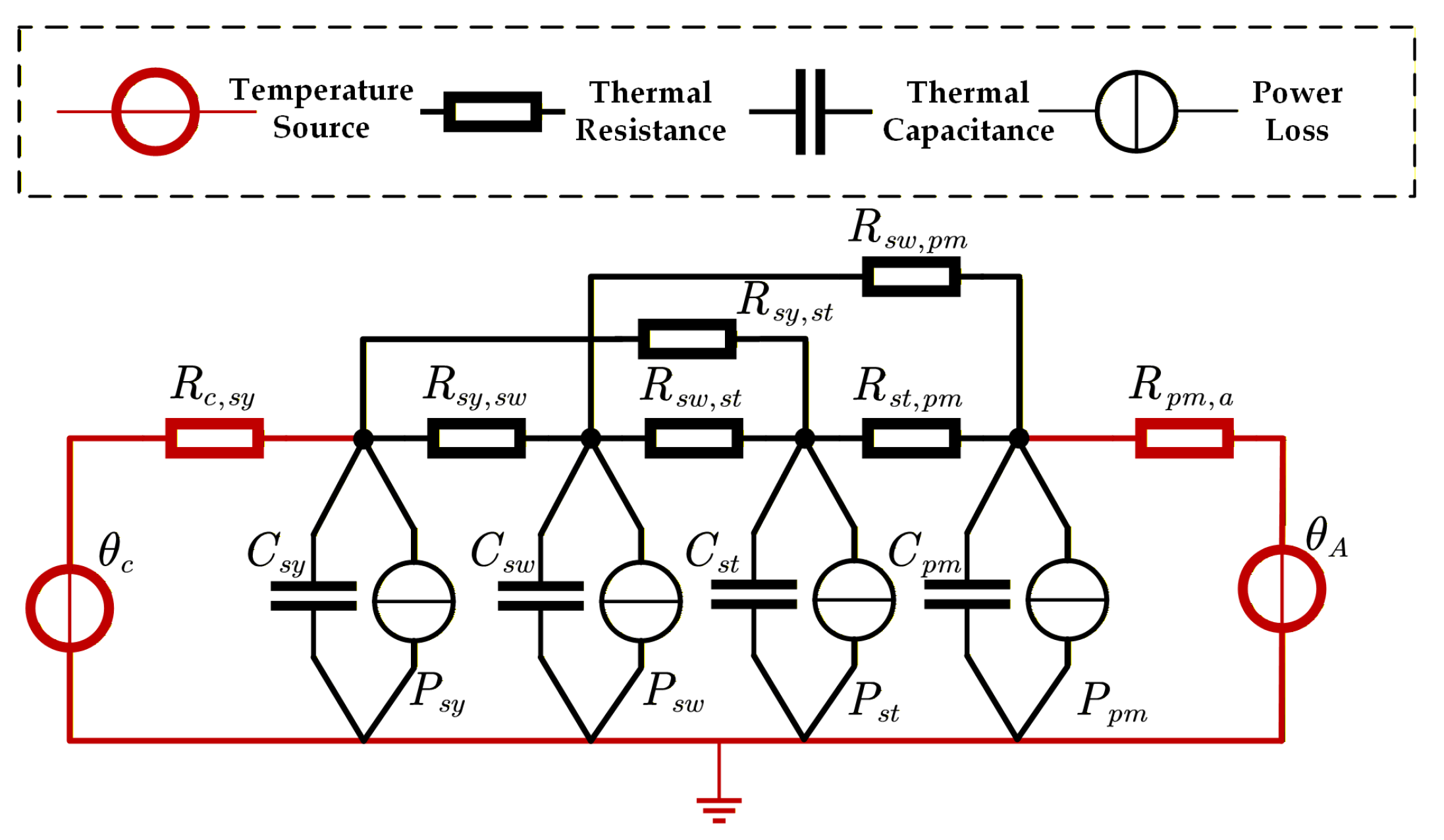
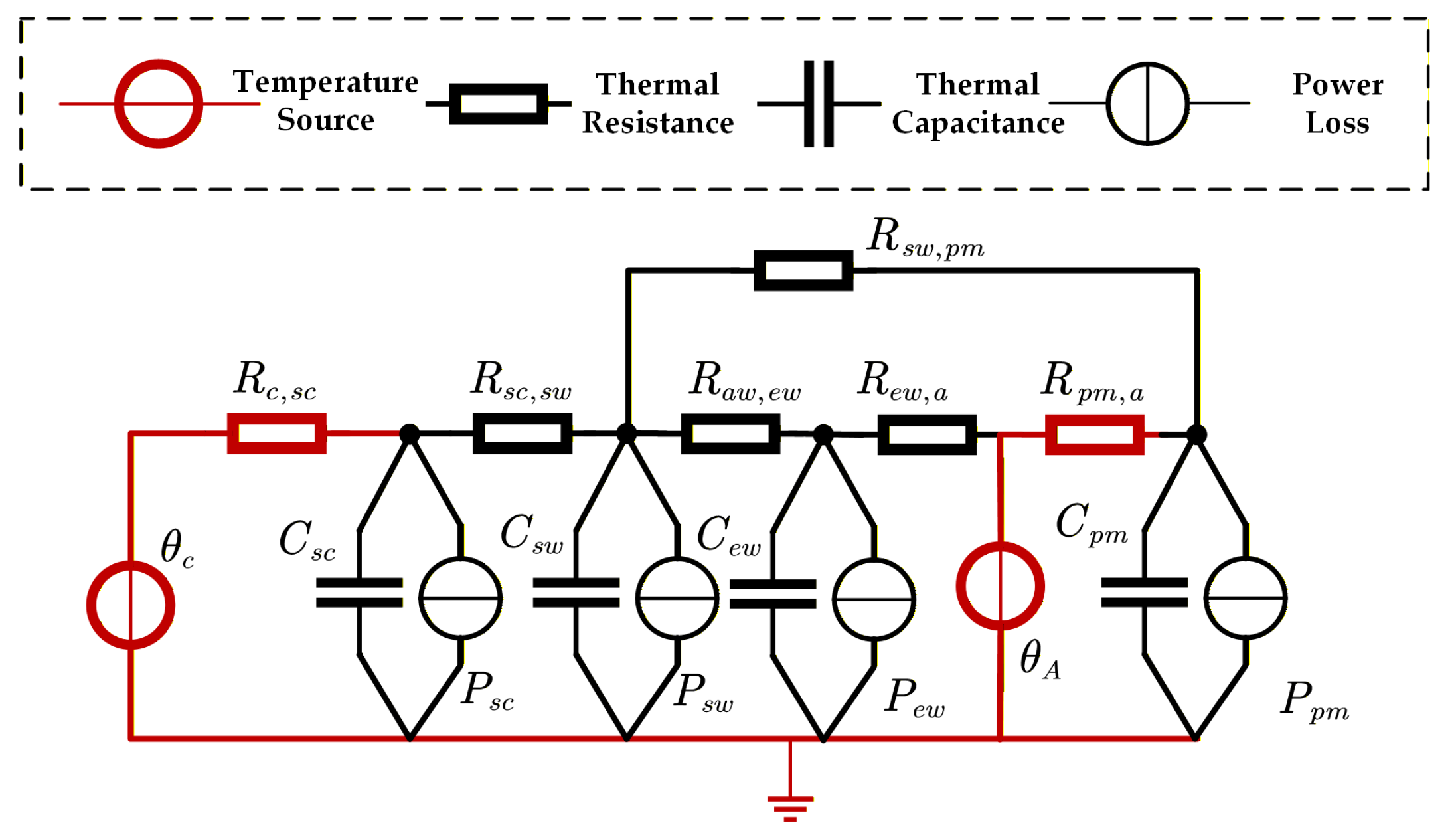
In [36], Oliver et al. proposed a four-node highly simplified LPTN with the influence of the stator yoke, the stator tooth, the winding, and the magnets all being considered. It utilizes a simple model structure with only four thermal capacitances and five thermal resistances included, which is presented in Figure 4. The red part in the model represents the influence of coolant and ambient heat dissipation on the PMSM. And the black part models the main components of the PMSM. This four-node highly simplified LPTN obtains all important temperature information with a certain accuracy, which can be used as a basic template for further specific temperature online estimation.
For specific scenarios and operating conditions of the PMSMs, the four-node highly simplified LPTN template can undergo further simplification. For instance, when convective heat dissipation on the housing surface is not obvious, such as natural convection, and no significant temperature gradient exists across the stator, the stator teeth and yoke can be merged as a single thermal entity within the LPTN model and treated as a single node. This deliberate simplification includes omitting the thermal resistance between stator teeth and yoke, as well as the thermal resistance between stator yoke and windings, which is shown in Figure 5. It can be seen that the size and calculation burden of the highly simplified LPTN is reduced.
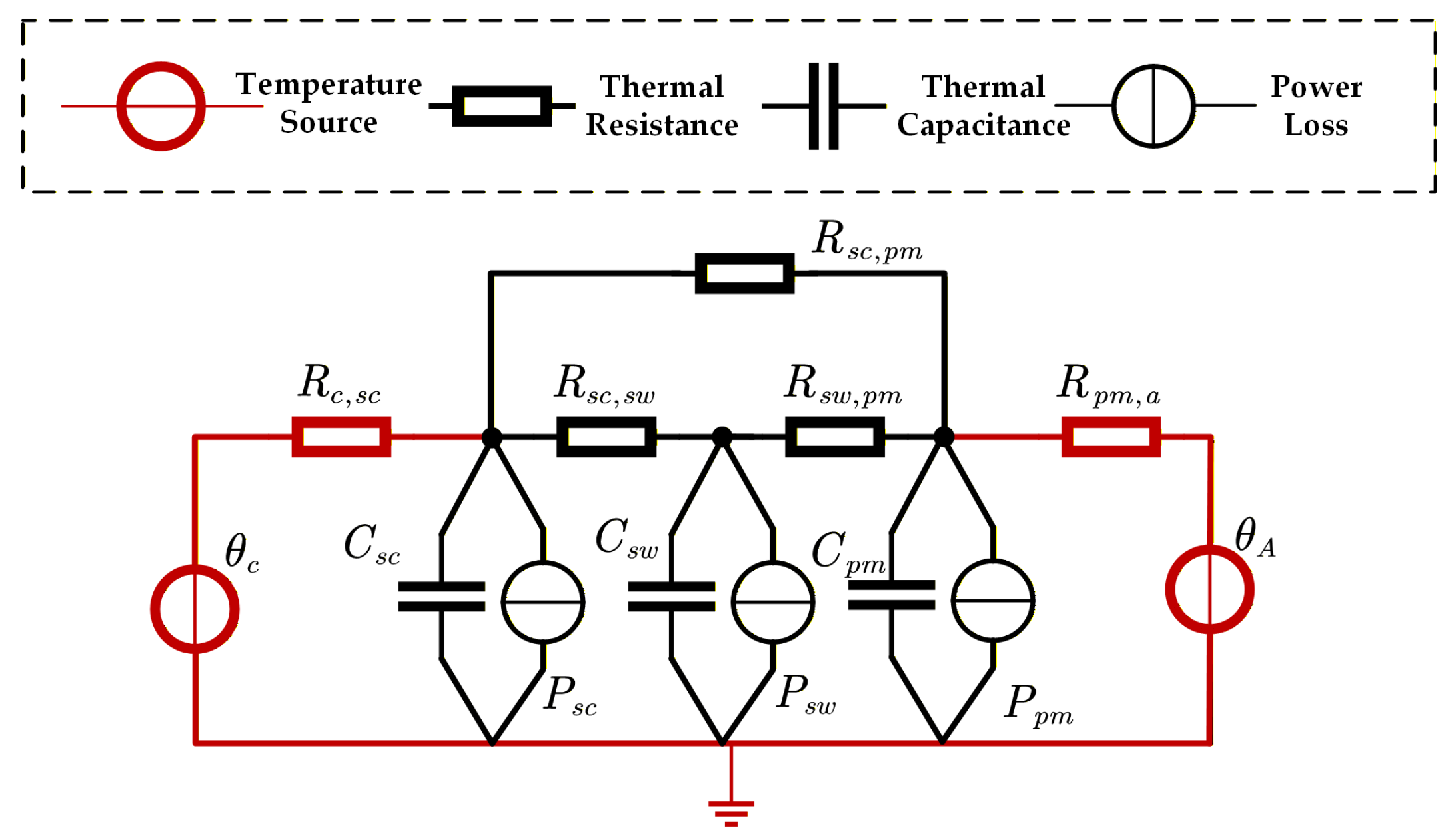
For distributed-winding PMSMs, where extended end winding exhibits significant temperature differentials and thermal impedance relative to slot-embedded portions, additional thermal nodes must be deliberately incorporated beyond the primary winding node to capture this phenomenon. This refinement distinctively characterizes end-winding thermal properties. Furthermore, under enhanced end-winding convective regimes, including high rotational speeds, rotor-mounted fan blades, or liquid spraying systems, where end-winding convective dissipation is substantially intensified, extra thermal paths to ambient temperature must be modeled via supplemental convective thermal resistances at the end-winding nodes. In [37], Feng et al. proposed a four-node highly simplified LPTN with the temperature of the end-winding being further considered, which is shown in Figure 6. An extra heat transfer path is built between the slot-winding part and the end-winding part. In addition, since the heat generation and thermal conduction of the stator core is ignored in its modeling process for simplification, the estimation accuracy will also be influenced. Conversely, for concentrated-winding machines, the abbreviated end-turn geometry and proximal adjacency to the stator core render such dedicated nodes and associated ambient thermal resistances functionally redundant.
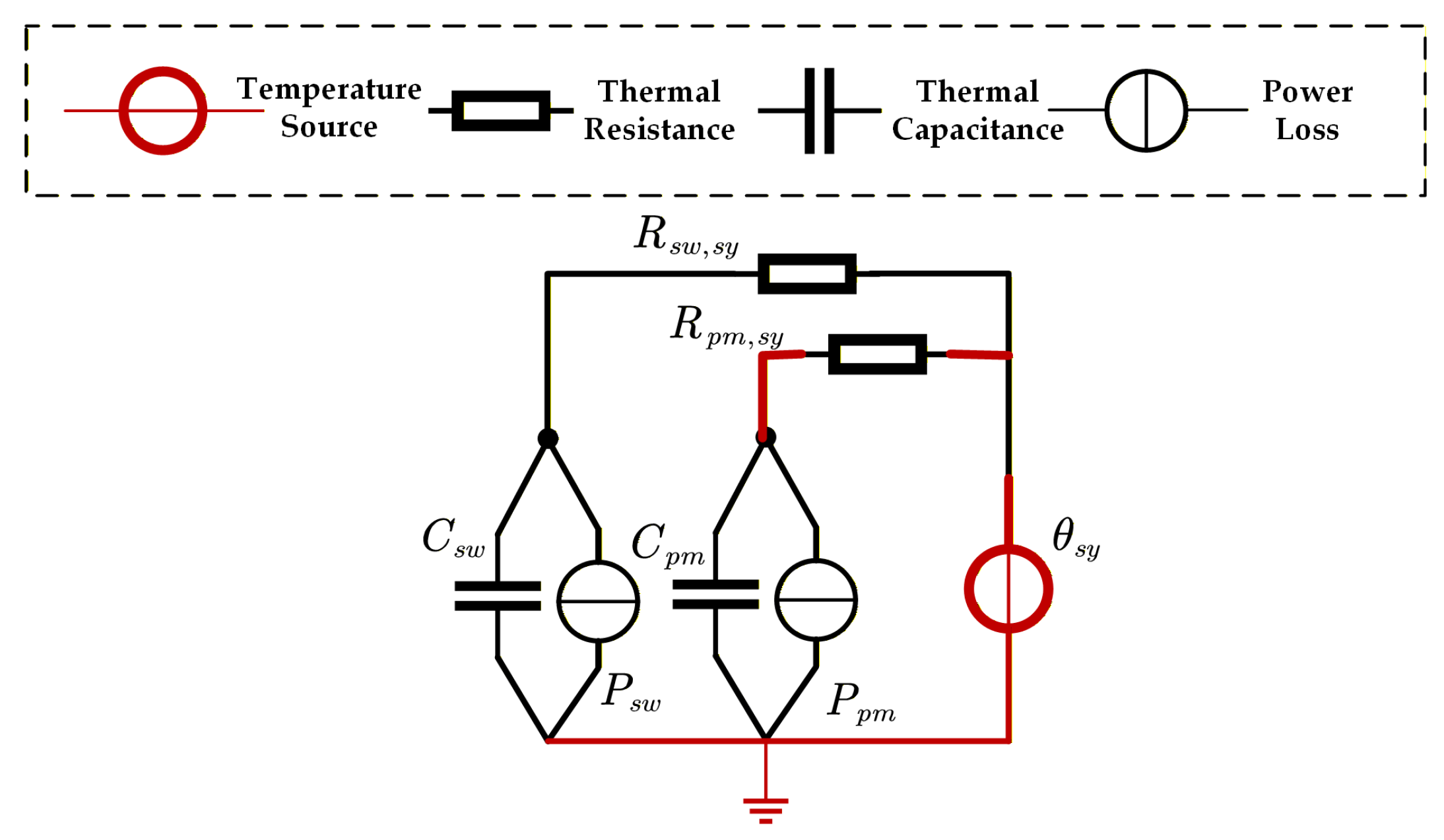
For online temperature estimation in PMSMs, temperature reference nodes will not be restricted to only ambient/coolant temperatures. When thermal sensors exist internally, these can be deliberately utilized as reference points within the highly simplification LPTN model. In [38], Kral et al. proposed a two-node highly simplified LPTN, which is presented in Figure 7. Both the temperatures of permanent magnets and windings can be estimated online with its simple structure. Getting rid of calculating the iron loss, which cannot be precisely obtained online in an easy way, a thermal sensor is installed on the stator yoke to measure the temperature of the stator core directly. Then the temperatures of the permanent magnet and winding can be estimated based on their heat transfer path, respectively. Only four parameters need to be identified in this process, the thermal capacitance of the winding and magnets and the thermal resistance between the winding, the magnet, and the stator yoke.
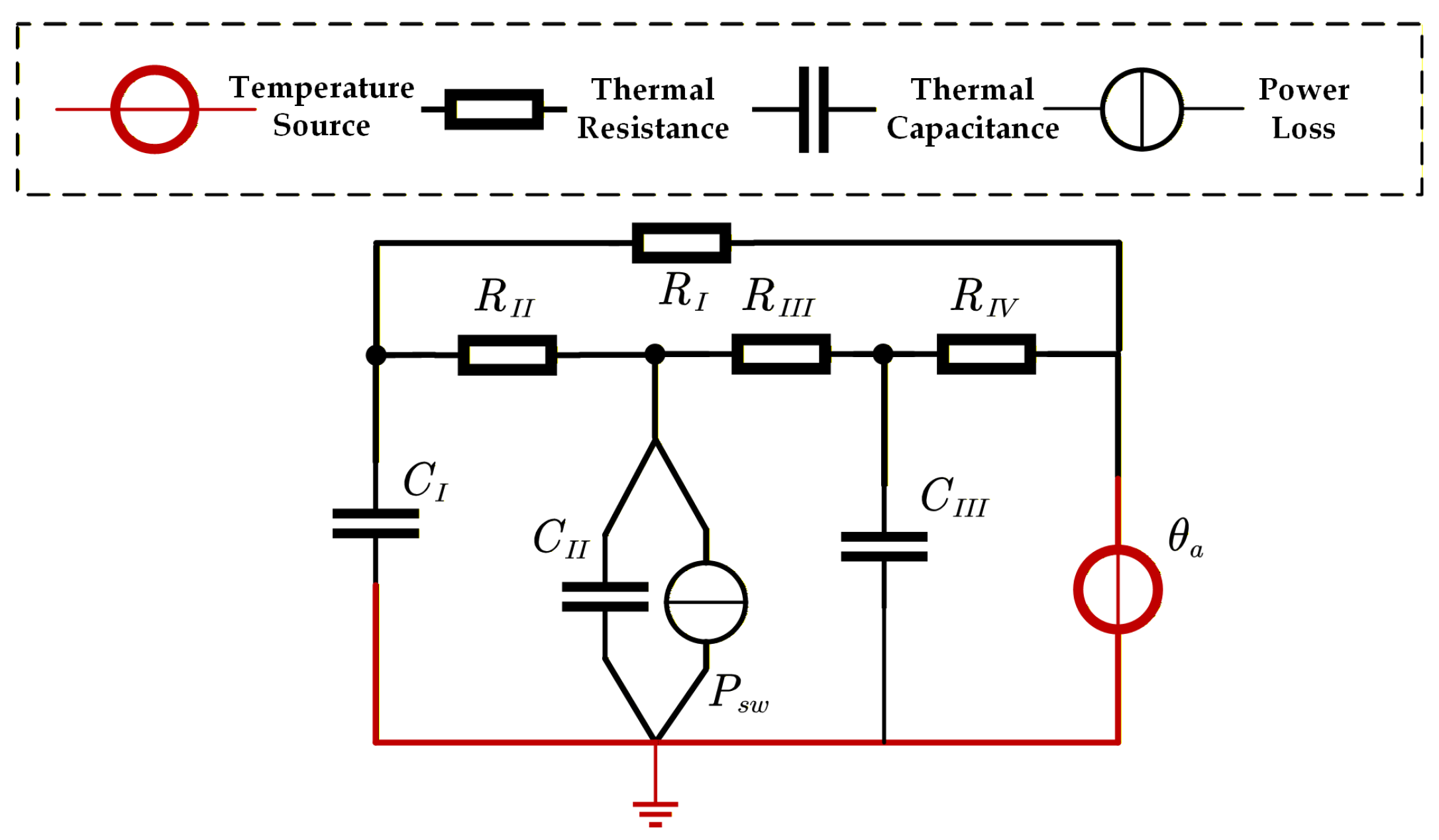
For PMSMs in high-dynamic servo actuators, which are always subject to transient overload events, their operational scenarios shift abruptly. These PMSMs often output overload power for several seconds and suddenly return to an idle state. Thus, for them, the winding temperature online monitoring becomes critical, which imposes stringent dynamic responsiveness demands on the online thermal estimation. For such transient-dominant scenarios, a minimal-node highly simplified LPTN only regarding the copper loss as heat generation source suffices to deliver both instantaneous thermal estimation fidelity and computational real-time performance. In [39], Sciascera et al. proposes a three-node highly simplified LPTN model to quickly estimate the winding temperature of the PMSM in an electromechanical actuator, which is shown in Figure 8. The proposed highly simplified LPTN model only contains three thermal capacitances and four thermal resistances, of which the computational scale is reduced to a very low level. And for this reason, the parameters C I to C I I I and R I to R I V are defined in a relatively abstract way and are not specific for only one component in the PMSM. To further elevate the computational efficiency of this three-node highly simplified LPTN model, Sciascera et al. propose a matrix inversion bypass method. It performs polynomial fitting for each element of the inverted matrix within a pre-determined current range. Utilizing this method during online calculations, matrix inversion is avoided and the computing speed is significantly accelerated.
It can be seen that, for online temperature estimation, parameter tuning and coefficient matrix identification are also critical for precise calculation. For a highly simplified LPTN with only two to six nodes, their parameters in the model are strongly abstracted, and they are not defined in specific heat transfer processes. These parameters are always obtained through the experimental training data.
In [37], to obtain the abstract thermal parameters in the LPTN, a dynamic quasi-linear model method is proposed. The speed varying thermal resistance, which reflects the influence of rotating thermal convection, is written in a piecewise linear form, which is as
R i j , n = a i j , n n n m a x + b i = j , n ,
of which a i j , n and b i j , n have the relationship
a i j , n , b i j , n > 0
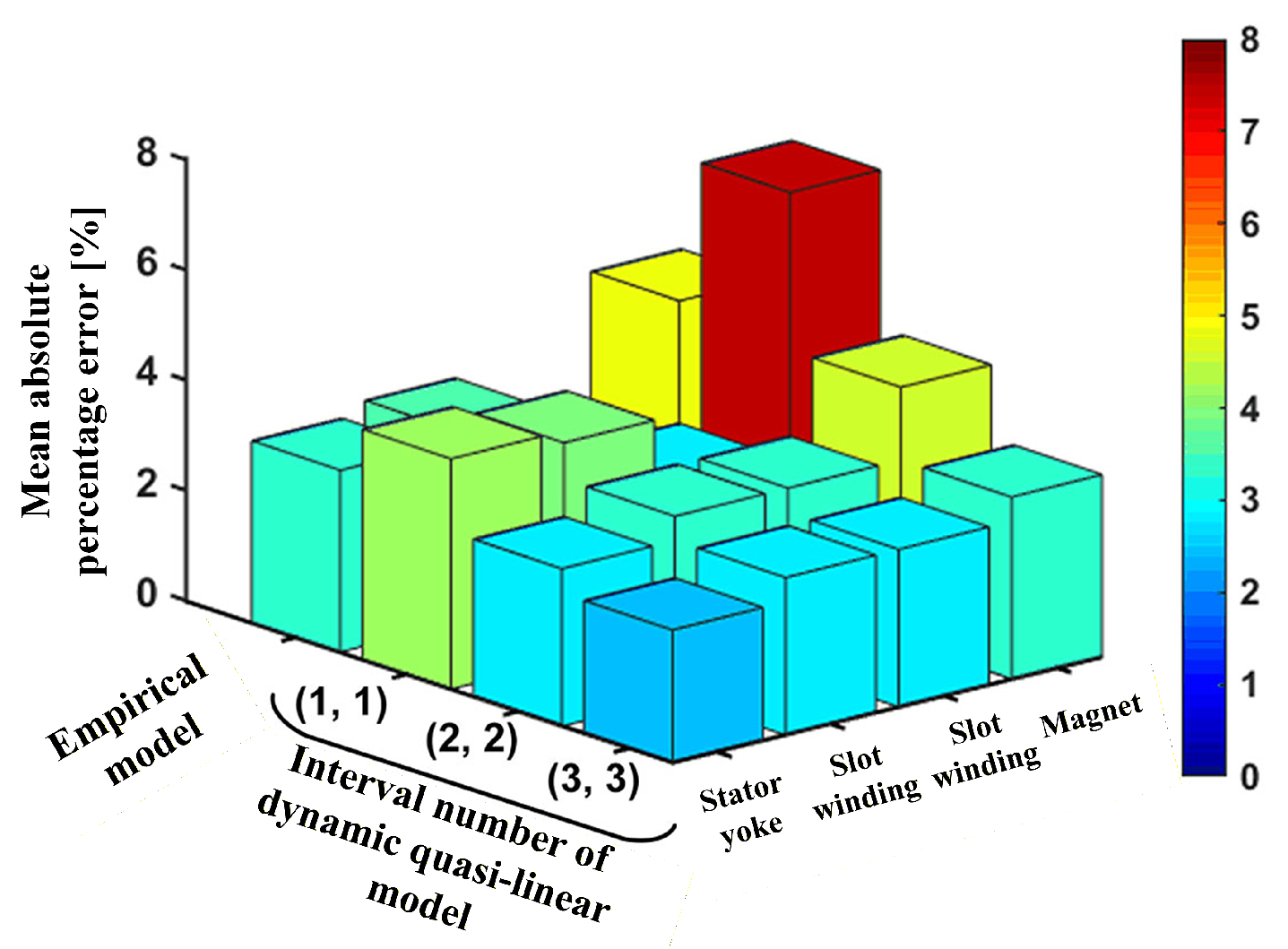
In this equation, the constant term and the speed-related term represent the influence of the natural convection and the forced convection, respectively. a i j , n and b i j , n are the coefficients for the i t h quasi-linear model in the i t h speed interval n i n n i + 1 , and n m a x is the maximum speed. One more speed interval in each quasi-linear equation can reduce the estimation error, which is shown in Figure 9. Meanwhile, one more speed interval will also introduce one more degree of freedom in the parameter identification process. This parameter identification flowchart is shown in, and the objective function which is as
J = k = 1 i = 1 ω i ( θ i , m [ k ] θ i , p [ k ] θ i , m [ k ] ) 2
where θ i , m and θ i , p are the measured and predicted temperatures. And the weighting factor ω i is used to impose the importance of predicted temperatures in different components. In [37], the method achieves temperature errors within 2 °C and 3 °C under intermittent and varying load conditions, respectively.
In [36], a four-node highly simplified LPTN is proposed by Oliver et al. for a 24-slot 16-pole PMSM, of which the concentrated winding structure is utilized. Because of the relatively small size of the end-winding part, no extra node for the temperature estimation of the end winding is needed. In [36], besides identifying the abstract thermal capacitance and thermal resistance, the power heat sources in the four-node highly simplified LPTN are also trained through the experimental data. For copper losses, the temperature variation f 1 ( θ S W ) , when the skin-effect and the proximity-effect f 2 ( n ) are considered, is written as,
P v , C u = P v , S W = 3 I 2 R s ( θ S W , n ) R s ( θ S W , n ) = R s , 0 f 1 ( θ S W ) f 2 ( n ) f 1 ( θ S W ) = 1 + α C u ( θ S W θ S W , 0 ) f 2 ( n ) = 1 + β C u , 1 n n m a x + β C u , 2 ( n n m a x ) 2
where R s , 0 represents the reference resistance at idle state known in advance. And β n , 1 and β n , 2 will be determined by the identification process.
Meanwhile, the iron losses in the stator and rotor parts are also built by experimental data, of which the influences of the steel sheet saturation and different running speed and component temperatures are considered. The iron losses are written as
P v , s = k 1 ( I , n ) P v , F e P v , r = [ 1 k 1 ( I , n ) ] P v , F e P v , s y = k 2 ( I , n ) P v , s P v , s t = [ 1 k 2 ( I , n ) ] P v , s
Here, P v , F e represents the total iron loss, and the v in the subscript means the iron loss is a varying input for the highly simplified LPTN. k 1 ( I , n ) is a coefficient that splits the iron loss into two portions, the stator portion P v , s and the rotor portion P v , r . And k 2 ( I , n ) is a coefficient that still splits the stator iron loss into two portions, the yoke portion P v , s y and the tooth portion P v , s t . These two coefficients, k 1 ( I , n ) and k 2 ( I , n ) , are designed as a bivariate first-order polynomial function that represents the iron loss is varying with the motor speed n and phase current I, which is as
k 1 ( I , n ) = k 1 , 0 + k 1 , 1 I + k 1 , 2 n + k 1 , 3 I n k 2 ( I , n ) = k 2 , 0 + k 2 , 1 I + k 2 , 2 n + k 2 , 3 I n
Here, the coefficients k 1 , 0 , k 1 , 1 , k 1 , 2 , k 1 , 3 , k 2 , 0 , k 2 , 1 , k 2 , 2 , k 2 , 3 are all needed to be identified by experimental running data. In [36], to find the most fitted value for the parameters above, the particle swarm algorithm (PSO) combined with the sequential quadratic programming method is utilized, of which the temperature estimation error is realized under 8 °C, finally.
Liang et al. [40] raises a critical problem that influences most online temperature estimations in real-world application. This critical problem is that, in laboratory environments, the experimental motor is heated from the ambient temperature, which is the same for all components. However, under real-world conditions, because the thermal environments and intermittent load vary a lot, the initial temperatures of various components differ from each other. And inaccurate initial temperatures will deteriorate the transient temperature estimation in a large scale, which is not acceptable. Considering this, ref. [40] proposes an initial temperature estimation method, which can be used to correct the initial temperatures for different components within several sampling steps.
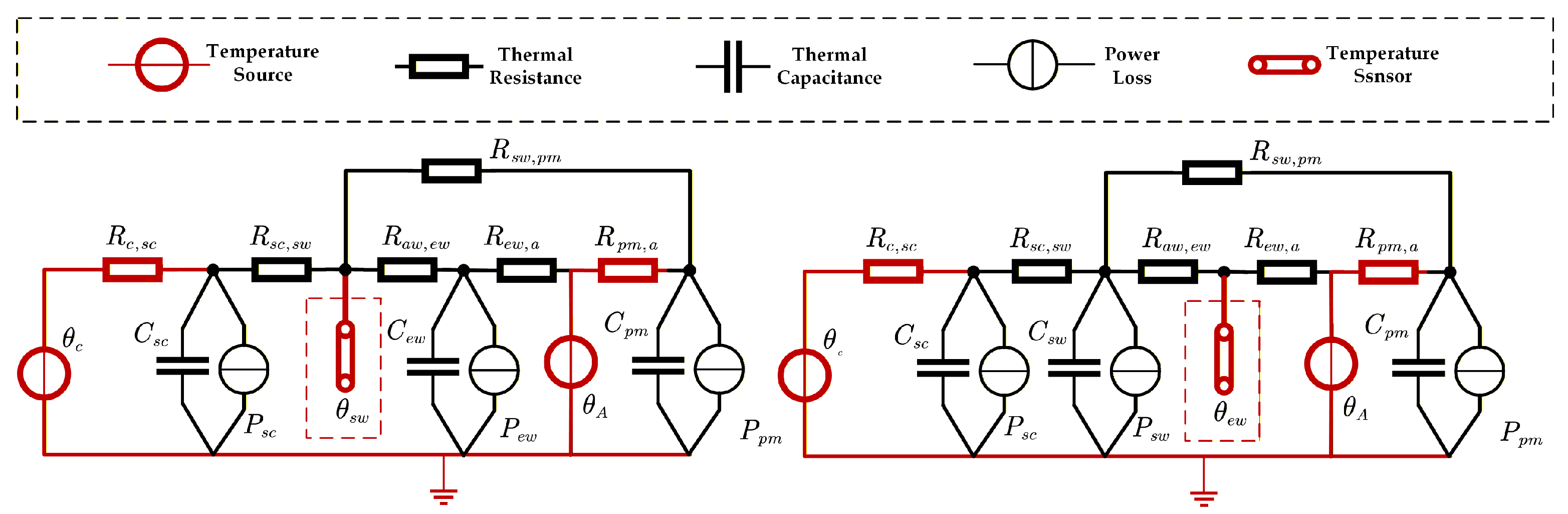
The prototype machine of [40] is a 12-slot 10-pole PMSM, which is used in the EVs and the transient temperature variation is dominant in its entire operation period. To estimate the thermal performance of this PMSM online, a four-node highly simplified LPTN is built the same as [37]. Foremost, to correct the initial temperatures, a thermal sensor is installed on the slot-winding or the end-winding, which is as Figure 10. Then the temperature diviations in the slot-winding or the end-winding part between the estimated and measured values can be used to calculate the initial temperatures for other parts, which are written as,
θ i k + 1 θ ^ i k + 1 = t p ( j i 4 A r j Δ θ j k ^ + A r i Δ θ e r )
It can be seen that the temperature deviation between the measured θ i k + 1 and the predicted θ ^ i k + 1 contains information of initial temperatures θ j i n for all other parts. For example, the slot winding temperature deviation Δ θ A W k at time step k can be expressed as
Δ θ A W k = t p [ a 21 F S C k 2 Δ θ S C i n + a 22 Δ θ A W , e r k 2 + a 23 F E W k 2 Δ θ E W i n + a 24 F P M k 2 Δ θ P M i n ]
Then, within four time steps, the initial temperature error of the other three parts can be calculated as (9). And to overcome the measurement errors, redundant measurement can be conducted, which at least ensures that the data length of the temperature states is larger than four to satisfy a full-rank in the estimation of the initial temperatures. The proposed method in [40] achieves estimation performance with maximum initial temperature errors confined within ±3 °C.
Δ θ A W 3 = t p ( a 21 F S C 1 Δ θ S C i n + a 22 Δ θ A W , e r + a 23 F E W 1 Δ θ E W i n + a 24 F P M 1 Δ θ P M i n ) Δ θ A W 4 = t p ( a 21 F S C 2 Δ θ S C i n + a 22 Δ θ A W , e r + a 23 F E W 2 Δ θ E W i n + a 24 F P M 2 Δ θ P M i n ) Δ θ A W 5 = t p ( a 21 F S C 3 Δ θ S C i n + a 22 Δ θ A W , e r + a 23 F E W 3 Δ θ E W i n + a 24 F P M 3 Δ θ P M i n ) Δ θ A W 4 = t p ( a 21 F S C 4 Δ θ S C i n + a 22 Δ θ A W , e r + a 23 F E W 4 Δ θ E W i n + a 24 F P M 4 Δ θ P M i n )
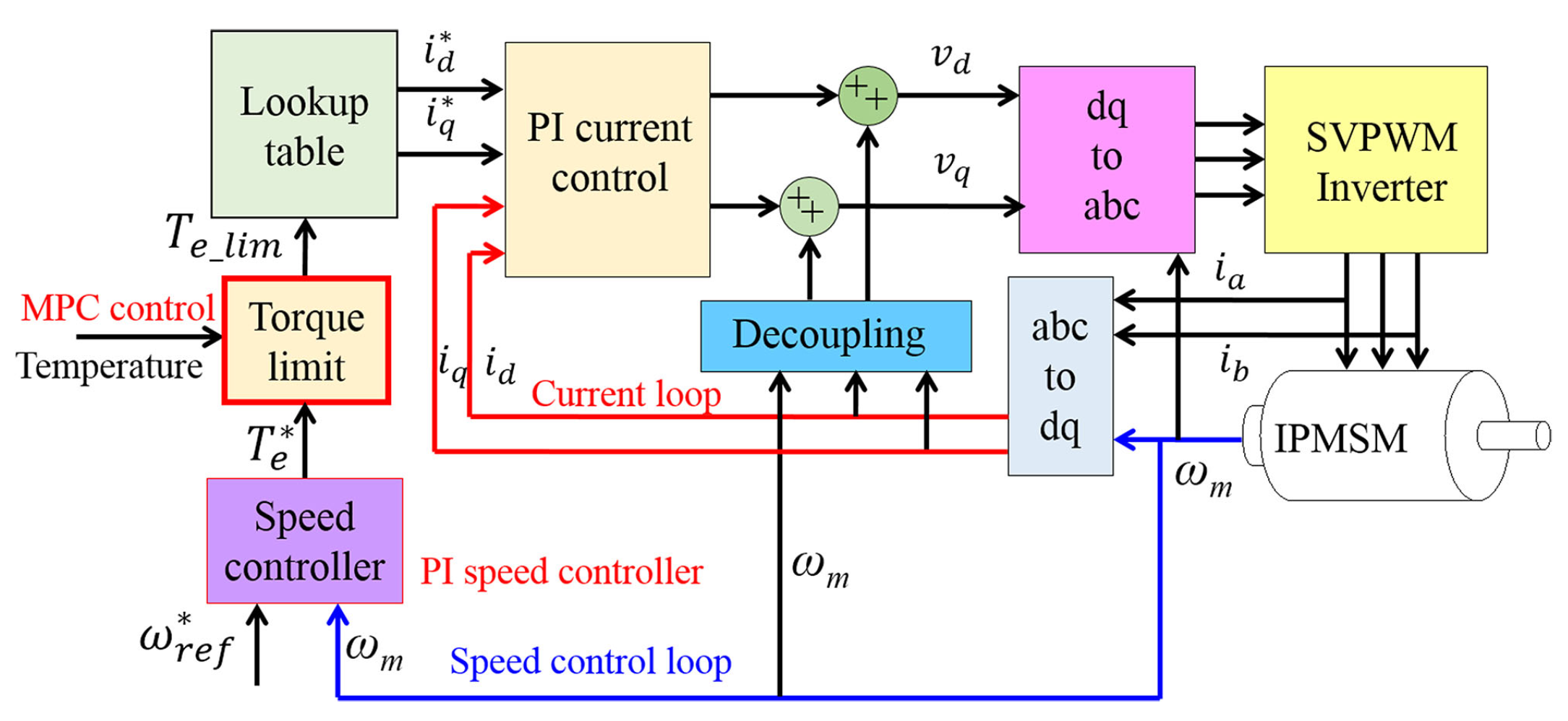
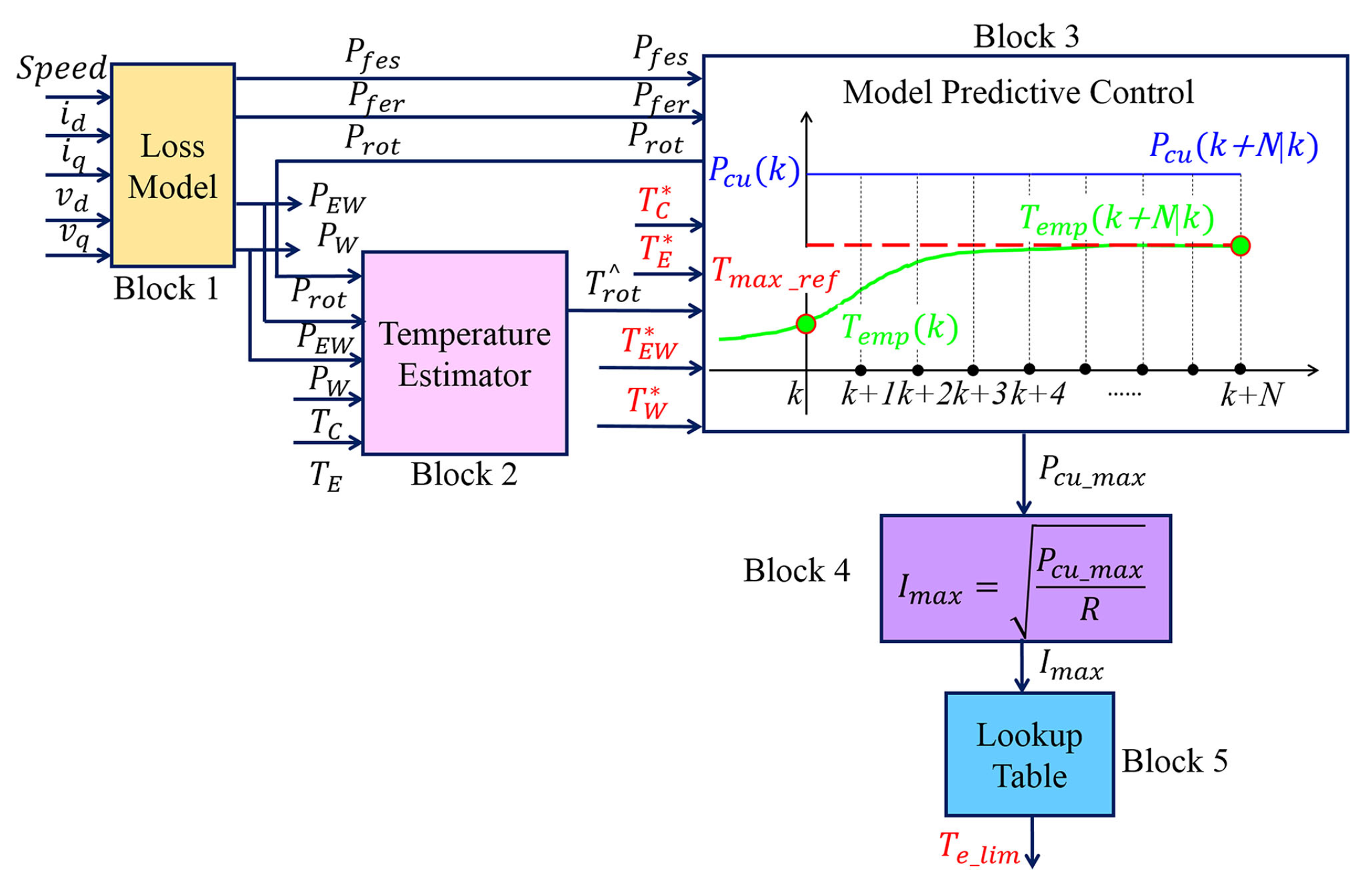
In [41], Sun et al. proposed an active thermal management method via a three-node highly simplified LPTN, which is combined with the model predictive control to adaptively control the torque limit. The entire motor control diagram is shown in Figure 11. The innermost are two PI current controllers, where the d- and q-axis currents are regulated. The outer loop is a PI speed control loop, where the reference speed and the measured speed are fed and generate a reference torque command T e * . The core of this control method is MPC-based active thermal management, which is shown in Figure 12. It contains five blocks. The first block is a loss model, which can estimate the slot-winding copper loss, the end-winding copper loss, the rotor loss, and the iron loss. The second block is the three-node highly simplified LPTN, which is used to estimate the winding temperature and magnet temperature based on the the ambient temperature, coolant temperature, and power losses from the loss model. The third block is the MPC, which plays a significant role. The third block calculates the maximum copper loss to prevent the motor temperature from exceeding the maximum reference temperature. An obvious advantage of the third block MPC is that it is possible to predict the temperatures over a number of steps. After the N steps, the future thermal state can be expressed as,
T ( k + N ) = X + Y p
X = A d N T ( k ) + j = 0 N 1 A d N j 1 B c o n d P ( k + j )
Y p = j = 0 N 1 A d N j 1 B v a r d P c u ( k + j )
Then the obtained maximum copper loss can be used to generate the allowable maximum phase current I m a x , which is
I m a x = P C u m a x R p h a s e
where R p h a s e is the phase resistance. The allowable maximum phase current I m a x will output to block 5, which is a look-up table used to generate torque limit T e l i m and the d-axis i d * and q-axis i q * current demand for current loop control.

3. Electrical Model-Based Methods

3.1. Basis of PMSM and Temperature Correlation Formula

The establishment of the PMSM electrical model and the clear correlation between motor electrical parameters and temperature constitute the theoretical foundation of the electrical model-based online temperature estimation methods discussed in this section.
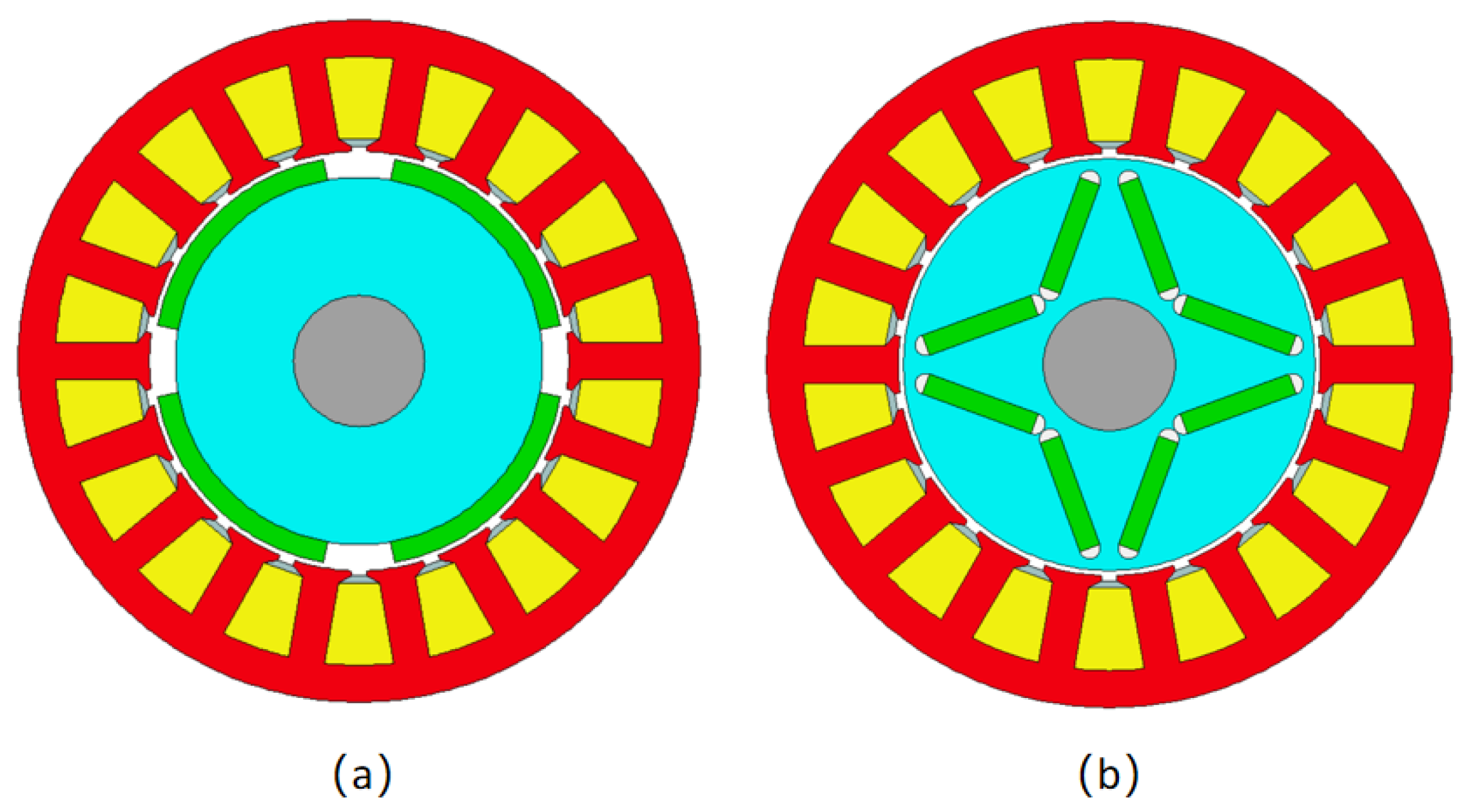
Over the past few decades, numerous PMSM topologies have been developed [42], with common configurations illustrated in Figure 13. The surface-mounted PMSM (SPMSM), shown in Figure 13a, features a simple structure and high power density, which is suitable for some low-to-medium load EV application scenarios. However, due to its non-salient pole rotor, it can only generate permanent magnet (PM) torque, and the magnets are directly exposed to the armature reaction field. Consequently, the stator inductance is relatively low and nearly identical on the d q -axes, and its temperature-sensitive electrical parameters exhibit a relatively straightforward thermal characteristic. In contrast, the interior PMSM (IPMSM) in Figure 13b is constructed with magnets embedded in the rotor core and exhibits a high saliency ratio, which is widely applied in high-performance EV systems due to its high torque density and wide speed regulation range. Thus, the q-axis inductance is larger than the d-axis inductance, and such IPMSMs are capable of utilizing the reluctance torque. Meanwhile, its embedded magnet structure makes the temperature sensitivity of magnetic and electrical parameters more complex, imposing more stringent requirements for temperature estimation based on electrical parameter identification.
Under field-oriented control (FOC), the d q -axis voltage equations of a PMSM can be expressed as
u d u q = R + p L d ω r L q ω r L d R + p L q i d i q + 0 ω r ψ m
where R, L d , L q , and ψ p m denote the stator resistance, d q -axis inductances, and PM flux linkage, respectively. p is the differential operator. i d , i q , u d , and u q are the d q -axis currents and d q -axis voltages, and ω r is the electrical angular velocity.
In the scheme of the FOC system, the Clarke–Park transformation from three-phase currents to d q -axis currents is expressed as
i d i q = 2 3 T a b c i a i b i c , T a b c = cos ( θ r ) cos θ r 2 π 3 cos θ r + 2 π 3 sin ( θ r ) sin θ r 2 π 3 sin θ r + 2 π 3 ,
where θ r is the electrical angular position.
Then the electromagnetic torque can be obtained as
T e = 3 2 n p ψ p m i q + L d L q i d i q ,
where n p is the number of pole-pairs.
The mechanical equation is described as
J d ω r d t = p T e T L B p ω r ,
The temperatures of the PMSM have a significant impact on stator resistance and rotor flux linkage. The temperature dependencies of stator resistances R s and main magnet flux ψ m are [43]
R s ( T s ) = R s ( T 0 ) 1 + α ( T s T 0 ) ,
ψ m ( T r ) = ψ m ( T 0 ) 1 + β ( T r T 0 ) ,
Accordingly, R s is directly adopted as the core indicator for monitoring the thermal state of the stator windings, while ψ m serves as the key metric for assessing the thermal condition of the permanent magnets. Given the strong correlation between ψ m and magnet temperature, it represents an optimal proxy for indirect temperature estimation. The aforementioned temperature-related formula establishes a direct mathematical bridge between easily measurable electrical parameters and the difficult-to-detect internal temperature of the PMSM, laying a solid theoretical foundation for subsequent online temperature estimation methods based on electrical models that are applicable to EV application scenarios.

3.2. Fundamental Model-Based Temperature Estimation

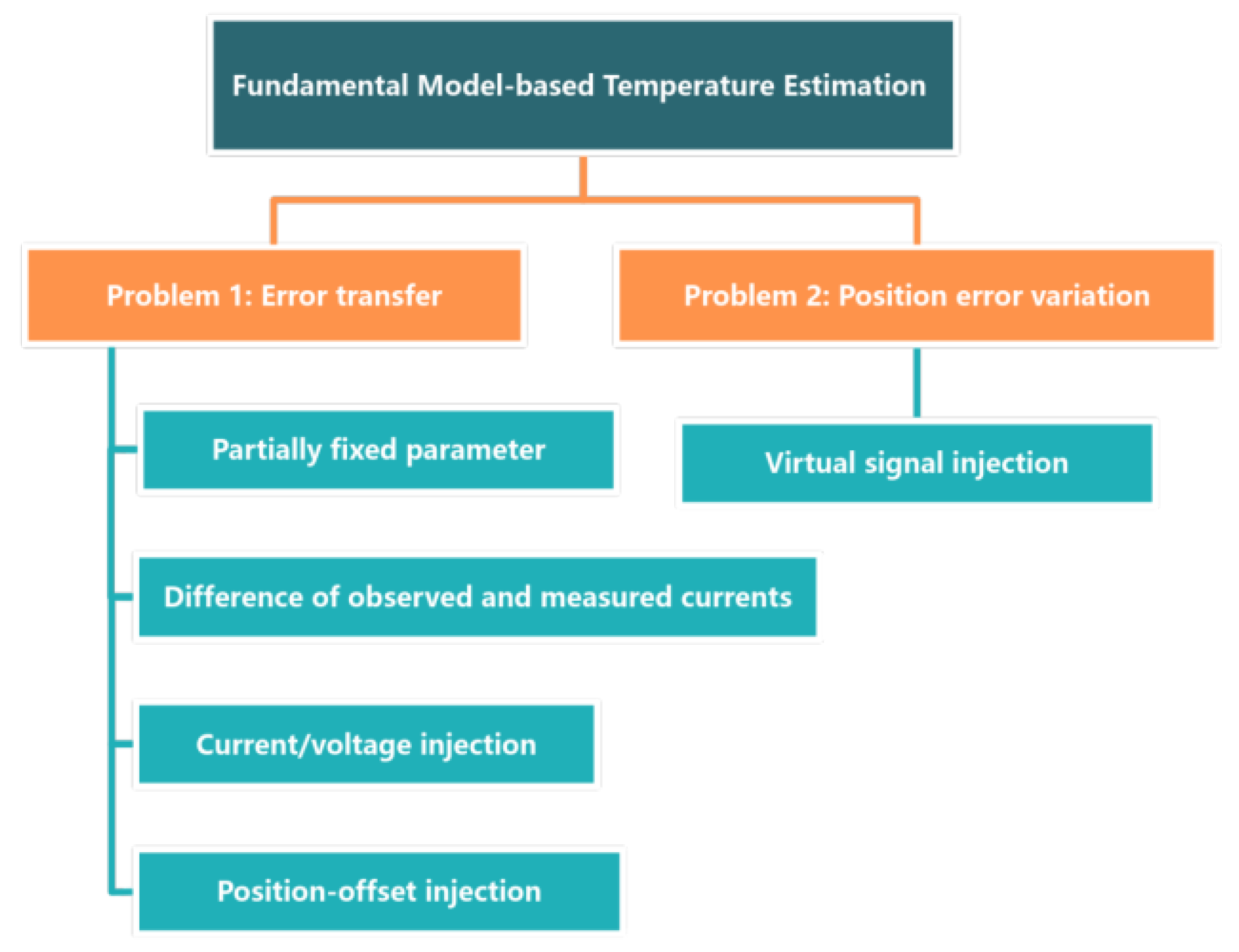
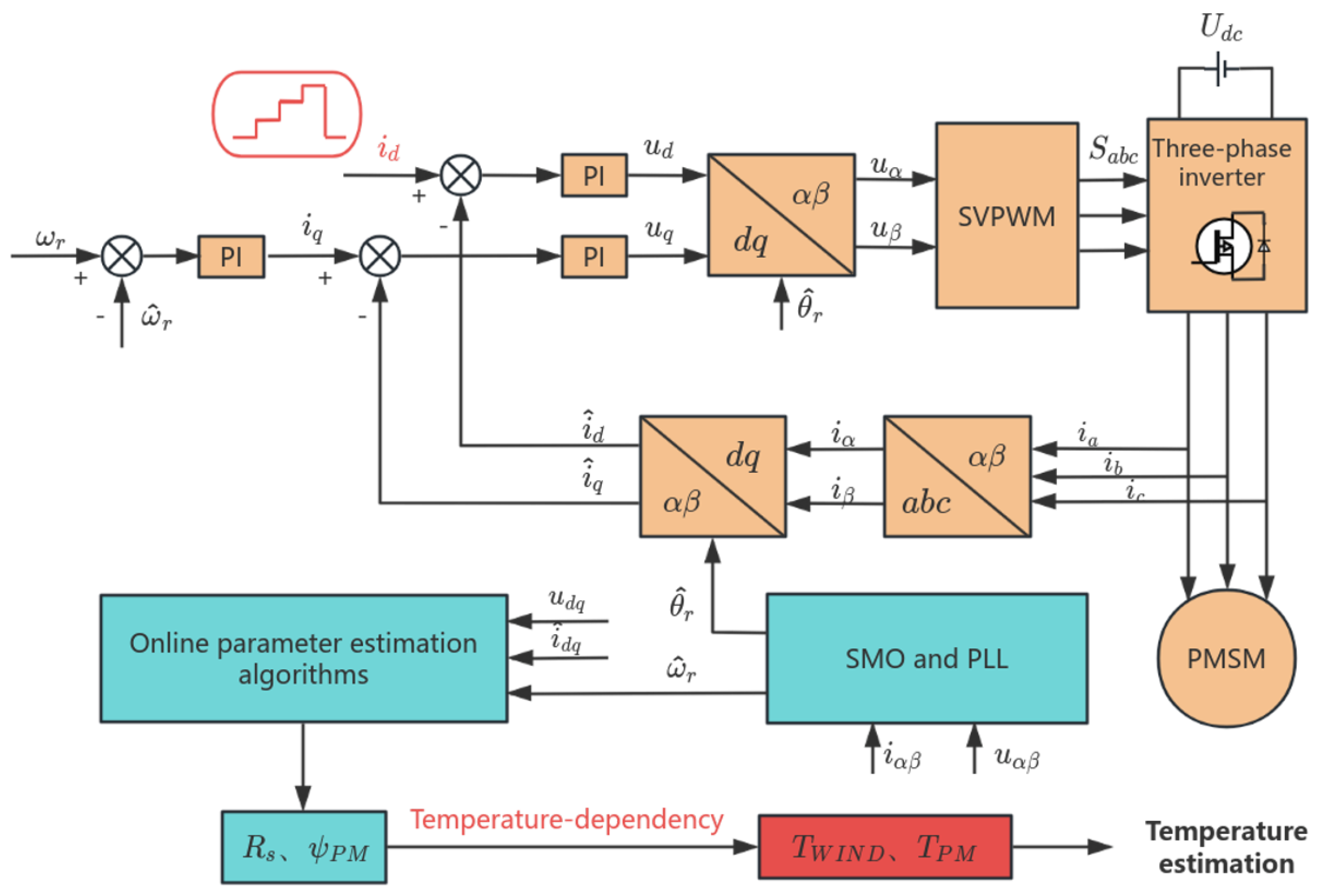
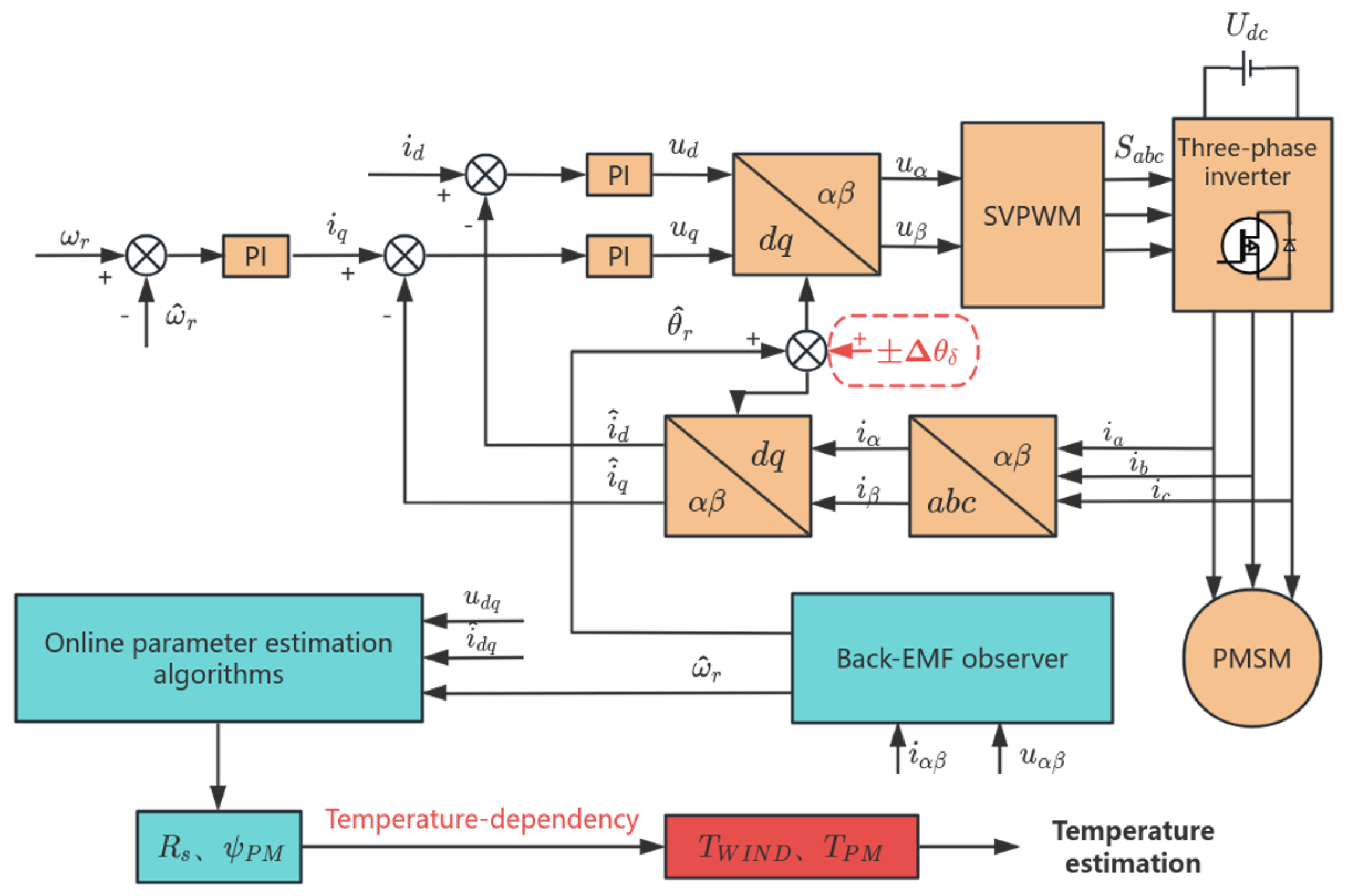
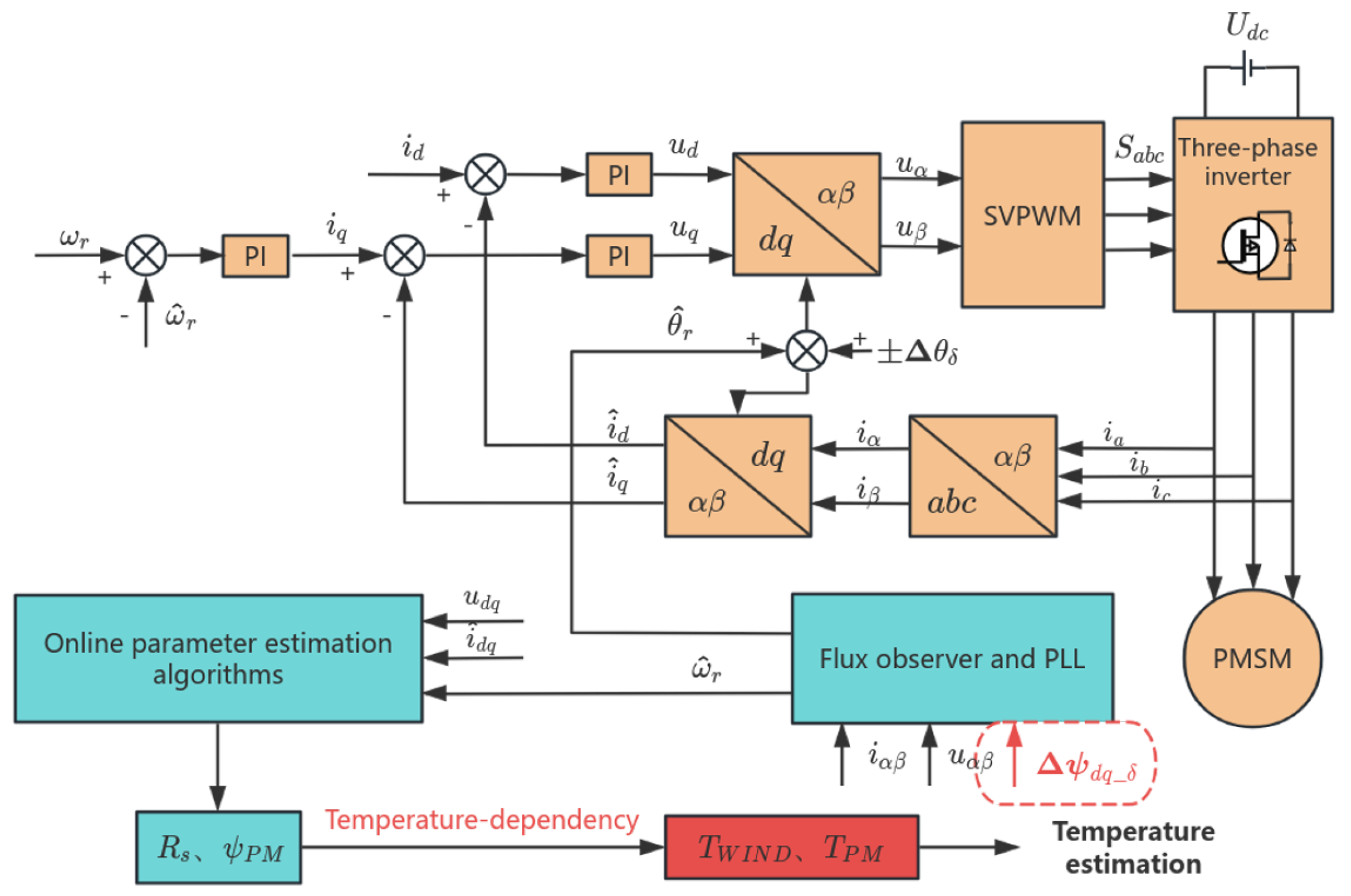
For the fundamental model-based temperature estimation, there is an error transfer issue in the parameter identification process. Different methods are proposed and mainly concentrate on this issue, including the partially fixed parameter, current/voltage injection, position-offset injection, and virtual signal injection, as shown in Figure 14.
For the PMSM with position sensorless control, this error transferring problem appears more obviously. The online parameter identification and position sensorless control are interactive. The error of position estimation will worsen the precision of the parameter identification, which influences the temperature estimation deeply. And meanwhile, the parameter identification error will also deteriorate the position estimation.

3.2.1. Partially Fixing Parameter Method

The partially fixing parameter method is mainly used to solve the rank deficiency problem, which frequently arises in equation systems due to excessive unknowns. The partially fixing parameter method usually imposes a priori constraints on selecting parameters, which eliminates rank deficiency to ensure solvability conditions. Then the parameter identification can be conducted [44,45,46].
Recursive least squares (RLS) [45] and extended Kalman filter (EKF) approaches typically fix one or two parameters that are either known a priori or exhibit slow variations, thereby reducing the number of unknowns before identifying R s for stator temperature estimation. The RLS method is simple and computationally efficient, yet it remains susceptible to system noise [47].
The estimation process of the Kalman/extended Kalman filter(KF/EKF) is similar to the RLS. The RLS updates the estimation value of a static parameter, while KF is able to update and estimate an evolving state. Its main feature is the recursive processing of the noise measurement risk [48,49]. Since the conventional KF cannot directly estimate the states for nonlinear systems, it extends to EKF by utilizing the first-order Taylor series for linearization.
In the discrete-time domain, the state space can be expressed as,
x k = f ( x k 1 , u k 1 ) + w k 1 y k = h ( x k ) + v k
where k is the index of the sampling instant. w k 1 and u k 1 are the model and measurement white noises with the covariances Q and R, respectively. x k and x k 1 represents the state vectors of current and previous instants, respectively. v k and y k are the input and output vectors, respectively.
The identification process with EKF can be divided with two steps. The first step is estimation, which utilizes the previous state vector x k 1 and input vector u k 1 , as follows:
x ^ k | k 1 = f ( x ^ k 1 | k 1 , u k 1 ) P k | k 1 = F k 1 P k 1 | k 1 F k 1 T + Q
where P is the corresponding covariance and F k 1 : = f ( x ^ k 1 | k 1 , u k 1 ) x ^ . x ^ represents the estimation values.
The second step is the recursive process to correct the estimation value, as follows:
K k = P k | k 1 H k T ( H k P k | k 1 H k T + R ) 1 x ^ k | k = x ^ k | k 1 + K k ( y k h ( x ^ k | k 1 ) ) P k | k = ( I K k H k ) P k | k 1
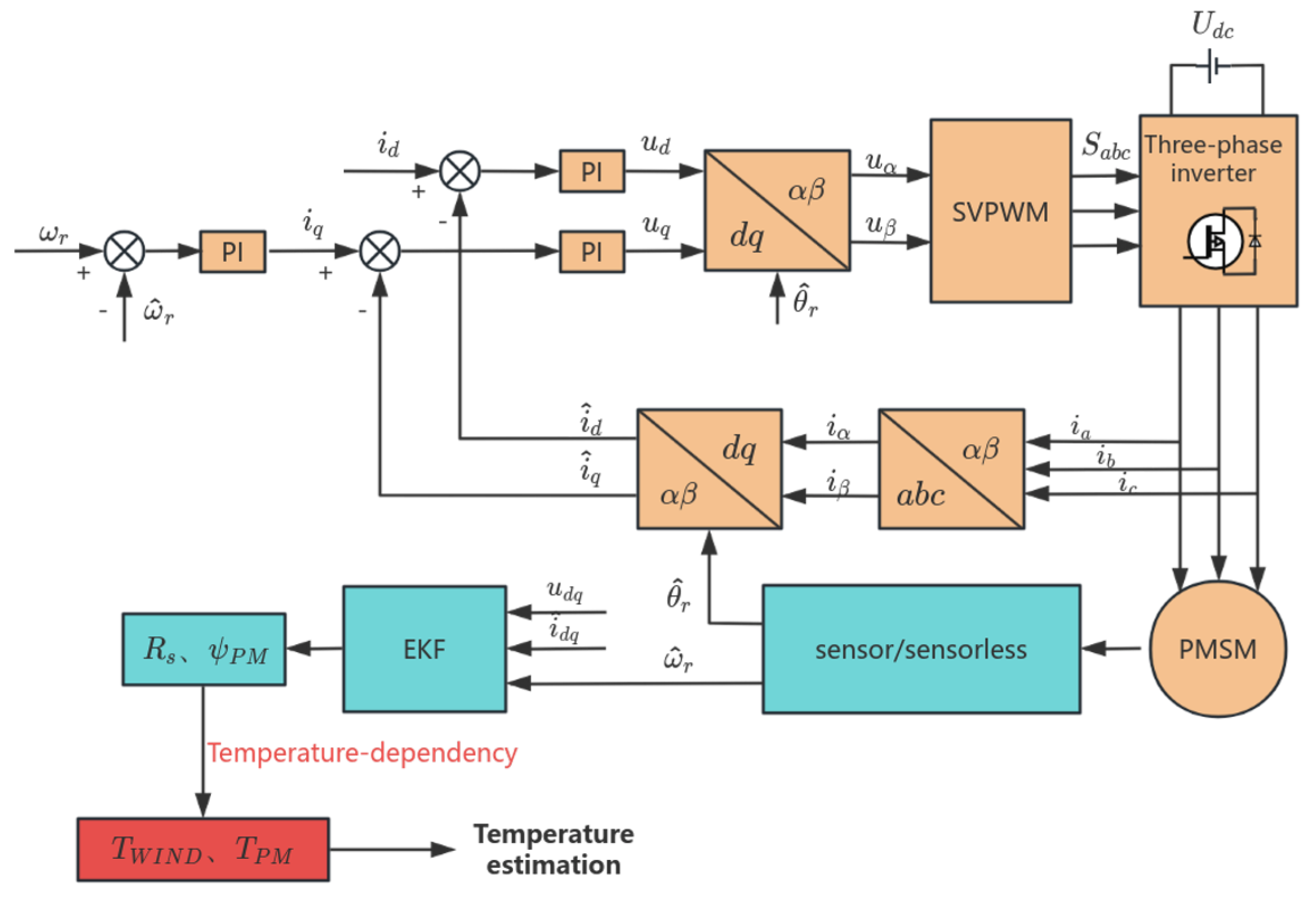
In [45], stator resistance is estimated for stator winding temperature monitoring in the PMSM. The control diagram of the PMSM with the EKF for temperature estimation is shown in Figure 15. However, the fixed stator inductances and PM flux linkage may change with the variation of magnetic saturation and PM temperature.

3.2.2. Model Reference Adaptive System

The adaptive MRAS method is widely used in online temperature estimation due to its guaranteed convergence and simple form with less computation burden [50].
The MRAS estimator includes the reference model, the independent adjustable model, and the adaptive law, in which the estimation error ε between the reference model x and the adjustable model x ^ is calculated, and it is then fedback to the proper adaptive law to adjust the values of the estimated parameters.
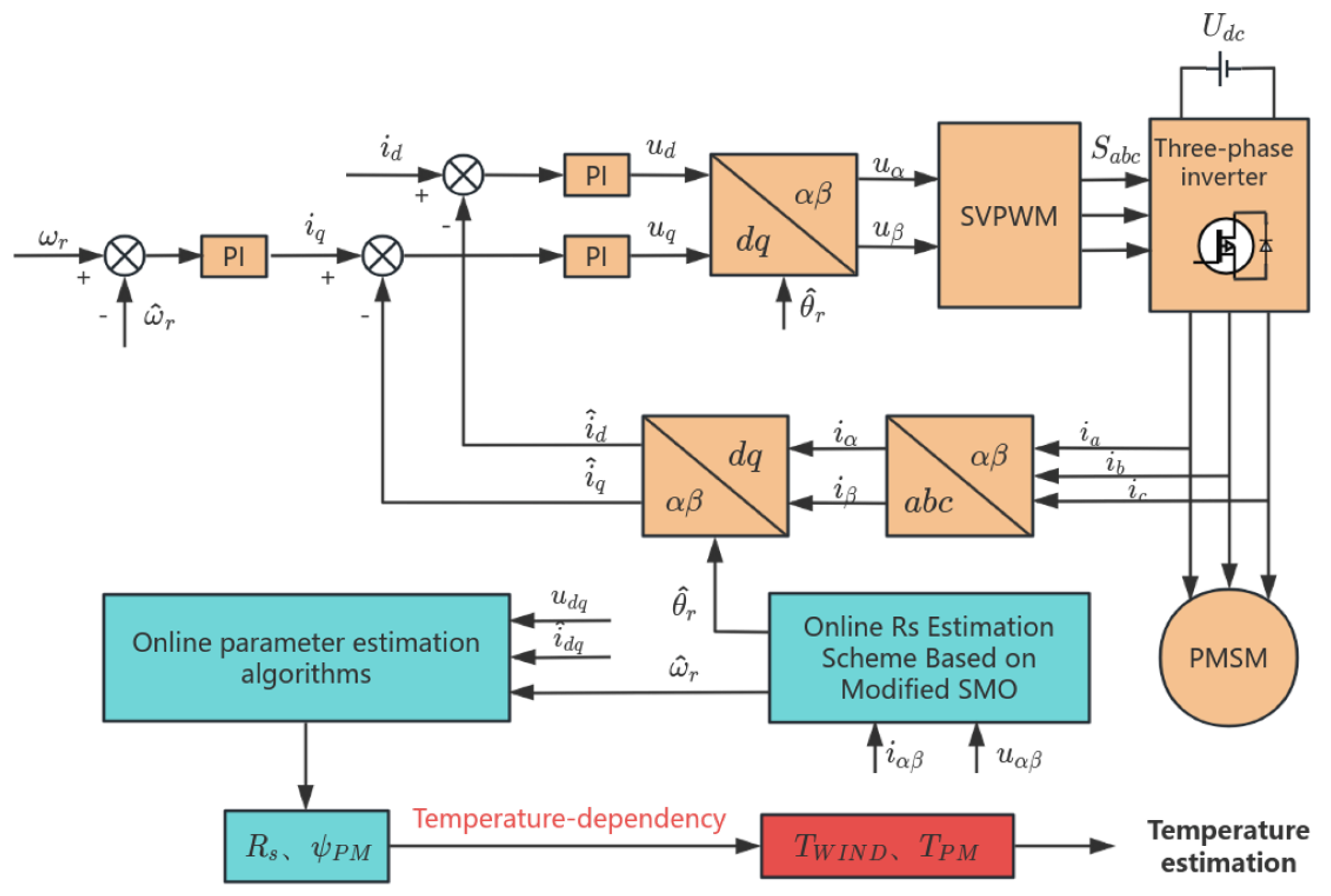
A full-order state observer is often utilized for position observation, which includes the observed current term. The difference in observed and measured currents is often adopted for the identification of other parameters. A whole control diagram of the PMSM with MRAS for the online temperature estimation is shown in Figure 16. Refs. [51,52] are the dq-axis voltage equations, which are similar to (14). The modified stator current observers in it can be constructed as follows [53,54]:
d i ^ d d t = u d L s + ω ^ r i q k R sign ( i ^ d i d ) L s i d ,
d i ^ q d t = u q L s ω ^ r i d ω ^ r ψ m L s k R sign ( i ^ q i q ) L s i q ,
where k R is the sliding-mode coefficient of the proposed R s observer.
In order to avoid the unidentifiability of R s under i d = 0 control, the q-axis voltage equations in (23) and (24) are utilized for R s identification. The state equation of the estimation errors Δ i q Δ i q = i ^ q i q can be derived by subtracting (23) from (24):
d Δ i q d t = R s L s i q k R sign ( Δ i q ) L s i q
When the sliding mode is reached, the estimated error is on the sliding surface, which means the estimated value is close to the actual value ( Δ i q 0 ). The estimated R s can be obtained by an equivalent control method. It can be seen that R s is equivalent to k R sign ( Δ i q ) . The estimated stator resistance R ^ s can be derived by a first-order LPF as follows:
R ^ s = LPF ( k R sign ( Δ i q ) )
As can be seen, R ^ s can be estimated from the difference between q-axis observed current and q-axis measured current.
However, the observed current only exists in full-order state observer which often contains a complicated structure. For the reduced-order position observer, its simple structure makes it more widely used in industrial applications. The method utilizing the difference in the observed and measured currents for parameter identification cannot be applicable for a reduced-order position observer. For example, in (23) and (24), the stator inductance and PM flux linkage are considered as known parameters, which may limit the application of this method. PM flux linkage is essential for the magnet temperature estimation. Therefore, in order to estimate multi-parameters, it is necessary to utilize the signal injection method and extract these parameters from information.

3.2.3. Current/Voltage Injection

Signal injection is mainly used to increase the number of equations while ensuring that the identified parameters do not change during the injection process. The assumption that parameter variations are ignored under position-sensored control is widely accepted as long as the amplitude of the injected signal is small [55,56,57].
However, when an encoder is not installed and position sensorless control is utilized. The observed error of rotating angle Δ θ r is easily changed after current injection, which will cause the increase in unknown parameters. For example, when injecting the n step d-axis currents, there are 2 n + 2 voltage equations for parameter identification with 2 n + 5 unknown parameters. Therefore, it is difficult to develop a full-rank parameter identification model with conventional current/voltage injection under sensorless control.
The issue of this position error can be solved by the following:
  • Identification model without position error [58,59,60].
  • Estimate position error [61,62,63,64].
  • Minimizing parameter indicator [65].
  • dc voltage pulse injection [66,67].
In [59], an online parameter identification method is developed for SPMSMs. Utilizing the identical equation of sin 2 ( Δ θ r ) + cos 2 ( Δ θ r ) = 1 , the parameter identification model is built as
u d e R i d e + ω ^ r L s i q e 2 + u q e R i q e ω ^ r L s i d e 2 = ω ^ r 2 ψ m 2
Then, three d-axis current pulses are injected to construct the full-rank model, as shown in Figure 17. Because of this d-axis current injection, the position error term has been eliminated. However, this method is only applicable to SPMSM, and the identification model in (27) can easily lead to an ill-condition issue. It can be concluded that the variation in position error caused by the current or voltage injections brings challenges to the parameter identification, and thus influences the precision of the online temperature estimation.

3.2.4. Position-Offset Injection

The position offset can be used as a disturbance to be injected into the estimated position. However, the injection still leads to changes in position error, which causes an increased number of unknown parameters. Under maximum torque per ampere (MTPA) control, the constant torque reference will generate constant d q -axis currents during position-offset Δ θ δ injection. However, the constant d q -axis currents are controlled to the estimated synchronous reference frame by shifting an angle Δ θ δ as shown in Figure 18. Therefore, after the position-offset injection, the projections of d q -axis currents in the estimated synchronous reference frame are
i d e = i d e cos ( Δ θ δ ) i q e sin ( Δ θ δ ) i d e i q e = i q e cos ( Δ θ δ ) + i d e sin ( Δ θ δ ) i q e
Similar to d-axis current injection, the rank-deficiency problem still exists under sensorless control, which leads to the coupling between the parameter identification and the position sensorless control.
Therefore, the parameters can be estimated by minimizing the parameter indicator during position-offset injection. In [68,69], the square wave rotor position offsets (SWRPOs) with the same amplitude of Δ θ r and Δ θ r are injected to the estimated position under sensorless control. During the period of square wave rotor position offset injection, it is found that the amplitude response of q-axis voltage fluctuation decreases with an increase in the accuracy of parameters, and thus, stator inductance L s and resistance R s can be estimated by controlling the q-axis voltage fluctuation. After L s and R s identifications are completed, the position error due to parameter errors is reduced, and the PM flux linkage ψ m is subsequently obtained from the back-EMF observation. Finally, the temperature dependencies of the stator resistance R s and the main flux linkage ψ m are used to determine the slot winding temperature and the permanent magnet temperature.

3.2.5. Virtual Signal Injection

The main magnetic flux linkage ψ m is easily influenced when the current or the position-offset injection occurs, which will cause more unknown parameters.
Considering this, the virtual signal injection method is proposed to keep the position error caused by the parameter mismatches and the inverter nonlinearity unchanged. When the virtual signal injection is used, the independent equations increases, but the unknown parameters do not increase, which can easily solve the rank deficiency problem in the parameter identification process.
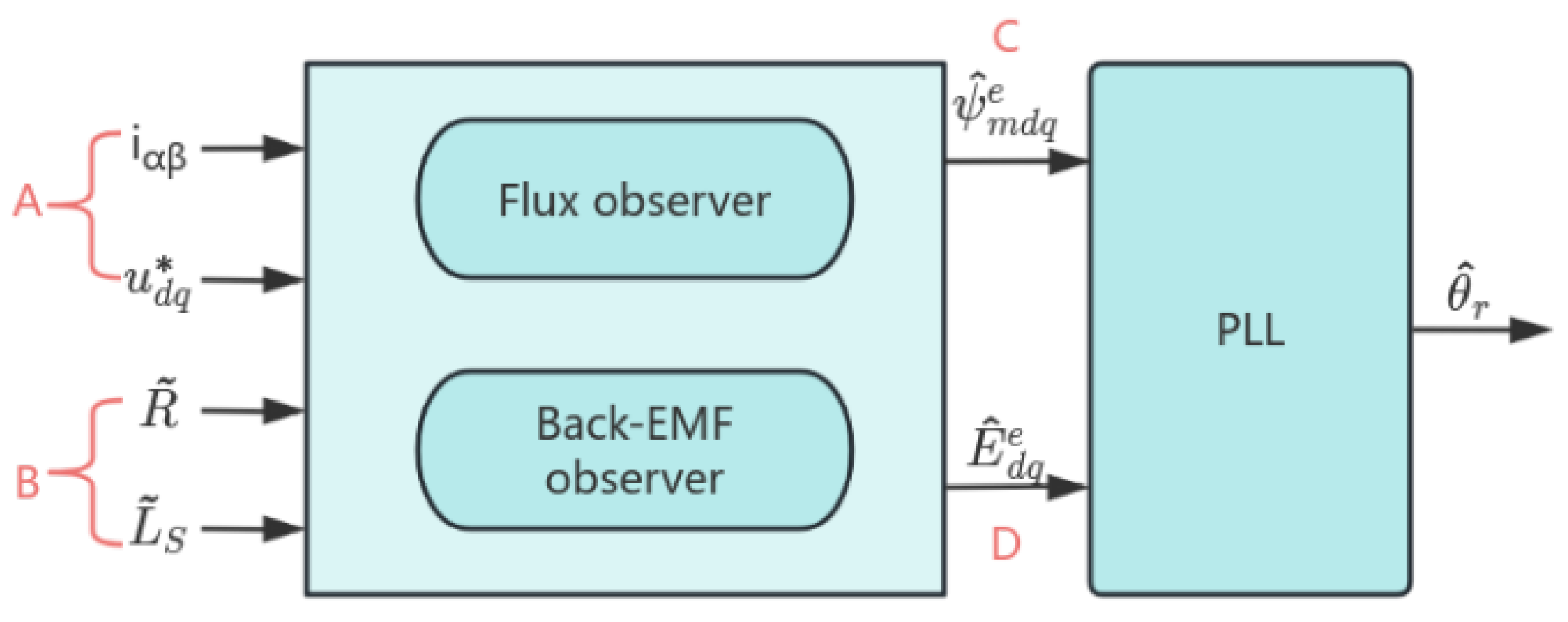
The method is named the virtual signal injection because the signals are injected into the flux observer rather than the drive system directly. According to the different injection parts (A, B, C, and D) in the position observer as shown in Figure 19, virtual signals can be categorized as the virtual voltage injection, the current injection, the virtual parameter injection, the virtual back-EMF injection, and virtual flux-linkage injection, respectively.
For example, a virtual flux linkage Δ ψ d q _ δ = 0 , ± ψ q _ δ T is injected to the estimated d q -axis rotor flux vector in flux observer. Then, the position-offset response caused by virtual flux-linkage injection can be obtained as [70]
Δ θ r _ Δ ψ q δ = sin 1 Δ ψ m q e ψ m = ± sin 1 Δ ψ q _ δ ψ m
where Δ θ r _ Δ ψ q δ is the position-offset response caused by virtual flux linkage injection, as shown in Figure 20. As can be seen from (29), the opposite virtual flux-linkage injection will lead to a corresponding opposite position-offset response with equal amplitude. Similarly, other opposite virtual signal injections will also lead to an opposite position-offset response as well.
Virtual signal injection fundamentally eliminates disturbances from position errors and inverter nonlinearities, maintaining minimal parameter estimation deviation regardless of position estimation error or inverter dead time. For interior PMSMs (IPMSMs) with proper position error correction, the estimation errors of d-axis inductance, q-axis inductance, winding resistance, and PM flux linkage reach 2.6%, 2.1%, 1.7%, and 1.1%, respectively.
Among virtual signal types, virtual flux linkage injection has unique superiority. Unlike virtual resistance, inductance, voltage/current, or back-EMF injection—of which position-offset responses depend heavily on rotor speed or current states—its response is fully independent of these variables. This enables accurate parameter estimation at an ultra-low speed of 2% rated speed, while virtual back-EMF injection is typically limited to a minimum of 10% rated speed due to harmonic disturbances.
The accurately identified winding resistance R and PM flux linkage ψ m enable reliable online temperature tracking. Based on the 0.36%/°C thermal coefficient of copper stator windings and −0.12%/°C thermal coefficient of NdFeB permanent magnets, component temperatures can be derived from parameter variations. Practical tests confirm the estimated temperatures match well with thermocouple and infrared measurements, with maximum estimation error for both windings and magnets strictly within 5 °C

3.2.6. Summary of the Fundamental Model-Based Temperature Estimation

The description about the five methods above systematically summarizes how to online identify the electric parameters of the PMSM, especially the phase resistance R s and the main flux linkage of ψ m . And the temperature of the slot winding and the magnet can be obtained via the indirect relationships in (18) and (19). Here, the pros and cons are compared and summarized in detail as shown in the Table 1 and Table 2 below.
Table 1 shows the summary of online slot winding temperature identification by R s identification. R S identification can be implemented by fixing other parameters, utilizing the difference of observed and measured currents, current injection, position-offset injection, and virtual signal injection.
Table 2 shows the summary of online PM temperature identification by PM flux linkage identification. As can be seen, PM temperature identification can be implemented by the current injection, the DC voltage pulse injection, the position offset injection, and the virtual signal injection.

3.3. High Frequency Model-Based Method

Besides the traditional application of position sensorless control, high-frequency (HF) carrier injection techniques can also be used to estimate the PM temperature online and to further achieve inductance and torque estimation. For instance, Reigosa et al. [74] established the correlation between high-frequency (HF) inductance and permanent magnet (PM) temperature. They used the d-axis HF inductance—a function of magnetic saturation and temperature-dependent remanent flux—to estimate magnet temperature while avoiding the magnetoresistive effect. In [75], Martínez et al. refined this approach by injecting HF current to enhance torque estimation accuracy via online parameter identification. In [76], Zhou et al. proposed the use of HF rotating square wave voltage injection for inductance parameter identification, and demonstrated its effectiveness under both stationary and on-load conditions. In [77], El-Murr et al. analyzed the influence of cross-saturation on HF-based estimation, and achieved online determination of cross-coupling and self-incremental inductances using the Goertzel algorithm. Fernández et al. [78] and Reigosa et al. [79] further explored the scalability and practical applications of HF methods. Shuang et al. [80] and Xu et al. [81] investigated how HF signal injection impacts sensorless control performance and parameter sensitivity, respectively.
In [43,71], HF signal injection methods are proposed to estimate the magnet temperature based on its correlation with the HF stator resistance or inductance. The HF signal injection-based estimation model is expressed as
v d h f r v q h f r = R d h f 0 0 R q h f i d h f r i q h f r + ρ L d h f 0 0 L q h f i d h f r i q h f r + 0 ω r L q h f ω r L d h f 0 i d h f r i q h f r ,
where v d h f r , v q h f r , i d h f r , and i q h f r are the d q -axis HF voltages and currents, respectively. R d h f , R q h f , L d h f , and L q h f are the d q -axis HF resistances and inductances, respectively.
After measuring the stator temperature and subtracting the stator resistive term from the HF induced resistance, the PM temperature can be determined by using (18) and (19) [43]. More recently, in order to avoid the influence of the magnetoresistive effect on estimation accuracy, d-axis HF inductance is used in [71] to estimate PM temperature, since L d h f is a function of d-axis magnetic saturation and temperature-dependent magnet remnant flux (19).
In contrast, methods based on HF signal injection typically suffer from limited scalability in high-power applications, as they rely on high switching frequencies, precise synchronization, and intensive signal processing—requirements that become increasingly challenging as the machine power rating increases.
Virtual signal injection and position offset injection methods offer a favorable trade-off between scalability and computational burden, as they circumvent direct high-frequency excitation of the machine while retaining robustness against position estimation errors. Consequently, these methods are better suited for industrial PMSM drives with medium to high power ratings, whereas HF injection-based techniques remain more appropriate for low-power systems or laboratory settings.

3.4. Online Parameter Identification of Multi-Phase PMSMs

Among various multi-phase PMSMs, dual three-phase PMSMs (DTP-PMSMs) are the most typical configuration and have attracted significant attention due to low per-phase current rating, low torque ripple, and excellent fault tolerance [82]. They consist of two three-phase windings, ABC and XYZ, with isolated neutral points, driven by separate three-phase voltage source inverters. Typically, there is a 30° phase shift between ABC and XYZ windings, a configuration that has been extensively studied for its control and estimation capabilities. For example, Yang et al. [82] proposed an improved rotor flux observer-based sensorless control strategy for three-phase axial flux PMSMs, which enhances the accuracy of rotor position estimation and robustness against parameter variations, laying a foundation for subsequent multi-phase PMSM sensorless control research. In [83], Liu et al. proposed a simple sensorless position error correction method for DTP-PMSMs by utilizing the difference in estimated positions from two sets of windings. Building on this, Liu et al. [84] developed a position error correction method based on the same principle, validated experimentally. Advanced signal injection techniques have also been applied. In [85], Wang et al. introduced a virtual back-EMF injection method for full-parameter estimation in DTP-SPMSMs under sensorless control, while Wang et al. [86] proposed a novel virtual flux linkage injection method for online monitoring of PM flux linkage and temperature. Most recently, Wang et al. [87] presented a virtual active flux injection-based method for position error adaptive correction in DTP-IPMSMs, demonstrating the collective correction of errors caused by parameter mismatches and inverter nonlinearity.
For the online parameter identification in DTP-PMSMs, since there are two sets of three-phase windings, more degrees of freedom can be utilized. By utilizing the features of DTP-PMSMs, some advantages can be achieved. There are mainly two models for parameter identification, i.e., the double d q model and vector space decomposition (VSD) model.
For DTP-SPMSMs, two individual current control strategies based on double d q synchronous reference frames (SRFs) are often adopted. Another popular control method for a dual three-phase PMSMs is based on the VSD model. By employing VSD coordinate transformation, the variables of the dual three-phase PMSM are identified, thereby obtaining the corresponding control parameters.

3.5. Summary of the Electrical Model-Based Methods

The electrical model-based temperature estimation methods exploit the inherent correlation between temperature-sensitive electrical parameters (stator winding resistance R s and permanent magnet flux linkage ψ m ) and the thermal conditions of the PMSM. These methods do not require detailed thermal network modeling or extensive experimental training datasets, offering a conceptually straightforward implementation path. However, several fundamental challenges must be addressed to ensure reliable parameter identification under the highly dynamic and variable operating conditions encountered in EV applications. These challenges can be classified into five categories as follows:
  • Rank Deficient Problem.
  • Ill-Condition Problem.
  • Inverter Nonlinearity.
  • Error Transfer.
  • Position Error Variation.
The rank-deficient problem in the parameter identification of PMSMs is systematically investigated in [55], which reveals that accurate parameter estimation relies on the full-rank reference/variable system. As can be seen from (14), the rank of the electrical model of the PMSM is two, and thus, only two parameters can be estimated simultaneously. If the number of unknown parameters is more than the rank of the system, the estimated results may not converge to the correct values [61,88].
The uncertainties of the PMSM model and measurement noises may also deteriorate the performances of parameter estimation, which is called ill-condition mathematically [89]. The ill condition implies that the estimated parameters are very sensitive to perturbations in the input and output data due to sensor noise and the computation process.
In real applications, voltage source inverters are usually employed to feed the PMSMs. There are nonlinearities such as switch on/off time delay, dead time, voltage drop in switching devices and diodes. Thus, there will be a difference between the reference and real voltages. Since it is difficult to measure the terminal voltage directly, the reference voltage is usually employed for parameter identification in real applications, leading to a deteriorated accuracy in parameter identification [90].
In the sensorless control of PMSMs, there exists an inherent bidirectional error propagation effect between position estimation and parameter identification. The error of position estimation will cause the parameter identification error, and, in turn, the parameter identification error also deteriorates the position estimation. Finally, the estimated parameters will either converge to true values or diverge to false solutions, and it is difficult to guarantee the convergence of the designed estimator under sensorless control [68].
In addition to the issue of error transfer, signal injection methods can also lead to position error variation. The characteristic of the unknown θ r term is quite different from that of other unknown electromagnetic parameters R, L d , L q , and ψ m . The θ r term is easily changed after current/position-offset injection, which will cause the increase of unknown parameters when the number of equations is expected to increase by signal injection [71].
These five fundamental challenges have driven the development of various electrical model-based methods discussed in the preceding subsections. To provide a clear engineering-oriented comparison, Table 3 summarizes the six categories of electrical model-based methods in terms of their adaptability to typical EV driving cycles.
The following selection guidelines can be drawn:
  • For EVs operating primarily under steady-state cruising conditions, the fixed other parameters method offers the simplest implementation with minimal computational burden. However, its poor dynamic tracking capability limits its applicability to scenarios with infrequent load transients.
  • For EVs where moderate dynamic response is required, the MRAS method provides a favorable balance between estimation accuracy and computational cost. Its main limitation lies in the dependence on a full-order observer structure, which restricts its applicability in drives utilizing reduced-order observers.
  • For EVs operating under demanding conditions such as high-speed climbing and frequent overtaking, the current/voltage injection method enables full-parameter identification with high dynamic adaptability. Nevertheless, its relatively high computational burden should be considered when selecting the embedded platform.
  • For EVs equipped with SPMSMs, the position-offset injection method can achieve satisfactory temperature estimation performance with moderate computational cost. However, its limited applicability to IPMSMs restricts its use in high-performance traction systems.
  • For EVs where IPMSM configurations may be employed, the virtual signal injection method offers the most versatile solution. It is independent of position error and adaptable to full operating conditions, making it well-suited for the complex and variable driving profiles encountered in these applications.
  • The high-frequency signal injection method is primarily applicable as a supplementary technique at low-speed and light-load conditions. Its requirement for high computational burden limits its standalone deployment in most EV traction applications. However, it can be combined with other methods to achieve joint temperature and position estimation during low-speed operation phases.
In summary, the selection of an appropriate electrical model-based temperature estimation method for EV applications depends on a comprehensive consideration of the motor topology (SPMSM or IPMSM), the dominant operating conditions (steady-state, urban cycle, or high-dynamic), the available computational resources on the embedded platform, and whether additional hardware (such as high-frequency sampling circuits) can be accommodated. For most mainstream EV traction applications employing IPMSMs under variable driving conditions, the virtual signal injection method and the current/voltage injection method represent the most promising candidates due to their broad adaptability and independence from specific motor topologies. For cost-sensitive or computationally constrained applications, the fixed other parameters method and the MRAS method provide simpler alternatives at the expense of dynamic performance.

4. Data-Driven Methods

Data-driven machine learning methods, leveraging their powerful nonlinear modeling capabilities and the ability to learn the mapping function from the input features to the target temperature, offer advantages such as fast computation speed and high estimation accuracy. These approaches can effectively bypass complex modeling processes and reduce reliance on manual expertise, making them a viable solution for online temperature estimation in PMSM. Meanwhile, in model selection and hyperparameters optimization, various automated algorithms enable intelligent adjustment of hyperparameters, further minimizing the need for manual intervention. In the evaluation of predictive model performance, the commonly used metrics include Mean Squared Error (MSE), Mean Absolute Error (MAE), and Root Mean Squared Error (RMSE).
Currently, data-driven methods can be broadly categorized into two types based on their algorithms as follows: traditional machine learning methods and deep learning methods.

4.1. Traditional ML Methods

In the field of online PMSM temperature estimation, traditional machine learning methods—primarily regression models—offer advantages over deep learning in terms of model size and data demand, making them well-suited for embedded systems. Commonly used methods include the following:
  • Ordinary Least Squares (OLS).
  • Support Vector Regression (SVR).
  • k-Nearest Neighbors (k-NN).
  • Random Forests (RF).
  • Artificial Neural Networks (ANN, layers 2 ).
  • Extremely Randomized Trees (ET).
Guo et al. [91] applied three machine learning models such as Naive Bayes, SVM, and ANN to a refined dataset, showing that ANN outperformed SVM (0.79) and Naive Bayes (0.76) with an accuracy of 0.84.
Optimized traditional machine learning methods have also demonstrated good performance. Hao et al. [92] proposed a gradient boosting decision tree (GBDT) model for estimating the rotor temperature in PMSM. The only base learner employed is the classification and regression tree (CART) model, which can be demonstrated as follow
f ( x ) = m = 1 M c m I ( x R m )
c m = 1 N x i R m y i , x R m , m = 1 , 2
where c m stands for the output estimated temperature of the ith leaf nodes in the CART and each leaf node contains R m , which is the set of samples in this node. y i is the real measured temperature that corresponds to the independent variable x i , including the dq-frame voltage and current, torque, speed, and temperature variables from the ST, yoke, and winding sensors. Finally, an output layer with a first-order low-pass filtering structure is introduced to improve the final estimate performance. GBDT forms a strong model that attains an average test MAE below 0.4 °C in the actual experimental dataset, thereby accurately estimating PM temperature.
In addition, Kirchgassner et al. [93] evaluated the estimation accuracy of multiple machine learning models for predicting the latent high-dynamic magnet temperature profile, including traditional ML methods and neural networks, namely, Multi-Layer Perceptron (MLP), Convolutional Neural Networks (CNNs), and Recurrent Neural Networks (RNNs). The comparison results are shown as follows, where Norm. inference duration denotes the inference time normalized to that of OLS (set to 1), and the values for other models represent multiples relative to OLS.
Table 4 indicates that CNN-based black-box models achieve the lowest MSE, while simpler methods such as OLS, ET, and MLP deliver competitive accuracy with significantly fewer parameters and lower computational demand. In particular, OLS offers a favorable trade-off among estimation accuracy, model size, and inference efficiency. Although deep learning models can attain the highest precision, their large parameter counts may limit practicality in resource-constrained applications such as automotive systems. The authors further demonstrated that OLS is preferable among machine learning approaches when no hand-designed LPTN is available, as the marginal accuracy gains of deep models (e.g., >67k parameters) are often difficult to justify under such constraints.

4.2. Deep Learning Methods

Deep learning methods offer distinct advantages for temperature estimation in PMSM, owing to their powerful nonlinear modeling capacity. Compared to traditional ML approaches, deep learning models achieve superior estimation accuracy and provide precise temperature estimates through a purely data-driven framework, eliminating the need for expert knowledge or complex physical modeling. However, training neural networks presents notable challenges as follows: hyperparameter optimization often demands extensive labeled data and considerable computational resources. Moreover, the “black-box” nature of deep learning models inherently limits their interpretability, leaving the physical reasoning behind estimations often unclear. Generalization to unseen operating conditions remains an area requiring further research. Currently, common deep learning architectures applied to online PMSM temperature estimation could be divided in two parts as follows:
  • Classic Deep Learning Networks.
  • Physics-Integrated Networks.
Classic deep learning architectures include Recurrent Neural Networks (RNNs), Deep Neural Networks (DNNs), Convolutional Neural Networks (CNNs), and others. These networks have achieved significant breakthroughs in fields such as image recognition and pattern recognition. Physics-Integrated Networks mainly refer to Thermal Neural Networks (TNNs).

4.2.1. Classic Deep Learning Networks

In [94], El Bazi et al. evaluate the effectiveness of popular deep learning methods in predicting the temperature of the permanent magnet. The comparison results are shown as follows.
The results reported in Table 5 indicate that deep learning-based methods generally exhibit strong predictive performance. In particular, the MLP demonstrates high performance in terms of both estimation accuracy and computational efficiency. However, since the selection of hyperparameters has a significant impact on model performance, and the hyperparameters used in the study were not optimally tuned, the results cannot effectively reflect the relative merits of each method.
  • RNN-based approaches
Recurrent neural networks (RNNs) are widely used for time-series modeling due to their ability to capture temporal dependencies. Common variants include LSTM, BiLSTM, and GRU, which enhance sequence learning through gated memory mechanisms and bidirectional context extraction. In practical applications, these RNN-based models are often employed as black-box predictors for sequential data.
It should be noted that standalone RNN-based methods struggle to accurately capture thermal dynamics when training data are limited, often yielding high MSE for both shallow and deep architectures. Additionally, their strong reliance on temperature measurements as input restricts generalizability and scalability to other motor components [95].
Thereby, RNNs are often integrated with other modules, most commonly CNNs, where convolutional architectures enlarge the receptive field to improve estimation accuracy. Latif et al. [96] proposed an EROA-SBiLSTM method for estimating stator temperature across key components including the yoke, tooth, and winding. Cheng et al. [97] introduced a 1DCNN-BiLSTM model dedicated to stator temperature estimation. Wang et al. [98] noted that RNN-based models struggle to retain early fault-related information over long sequences, leading to large deviations when abrupt temperature changes occur. Although gated variants such as GRU has improved the ability to process long sequences, they remain inadequate for simultaneously capturing short-term transients and long-term fault-induced trends under highly nonlinear and time-varying conditions. To address these limitations, they enhanced the GRU unit and proposed a CNN-Bi-GTU-WAVE model for traction motor temperature estimation.
  • DNN-based approaches
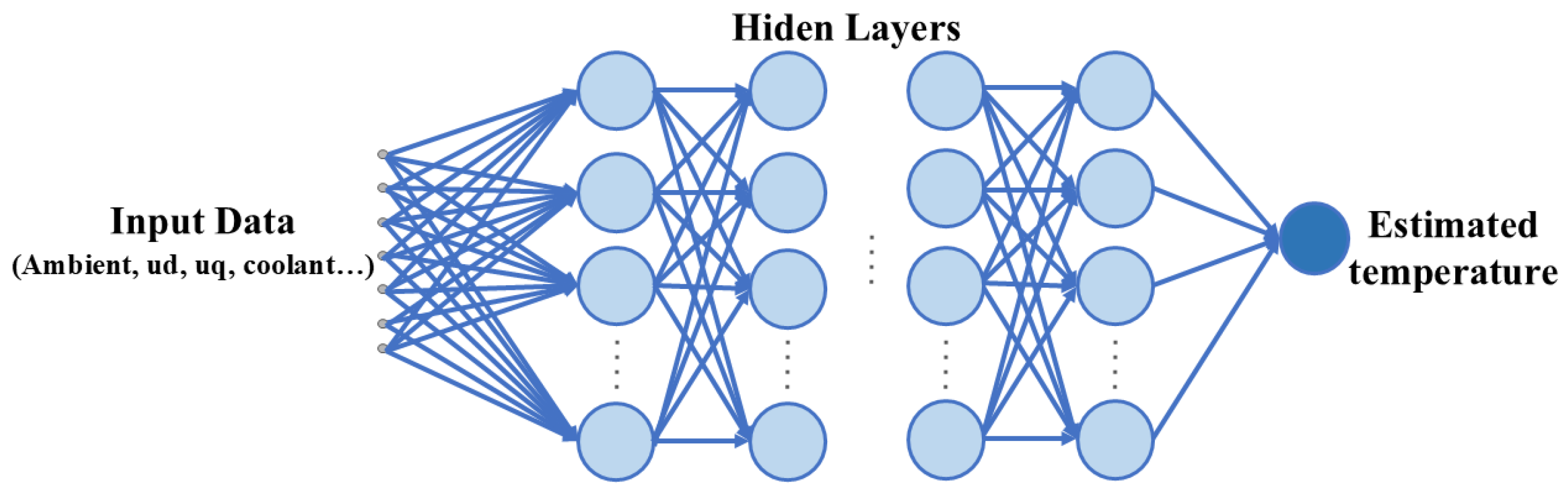
Deep Neural Networks are primarily composed of multiple hidden layers, typically containing multiple layers (≥2). While DNNs share structural similarities with ANNs, DNNs are distinguished by their deeper, more complex hierarchical architecture and are considered a core architecture of deep learning. A typical DNN could be demonstrated as Figure 21.
Guo et al. [99] developed a PMSM stator winding temperature estimation model using a deep neural network with seven hidden layers. Lee et al. [100] proposed a DFNN-based method to predict the temperatures of the permanent magnet and four winding regions.
  • CNN-based approaches
In previous research, sequence modeling was often regarded as synonymous with recurrent networks. However, with architectural advancements such as dilated convolutions and residual connections, convolutional architectures have demonstrated strong effectiveness in these tasks [101]. CNN can efficiently capture local temporal correlations and cross-channel interactions in multivariate motor signals while maintaining relatively low computational complexity.
The Temporal Convolutional Network (TCN) is a CNN-based architecture for sequence modeling originally proposed in [101]. The receptive field of a TCN can be expanded in two ways as follows: increasing the filter size or increasing the dilation factor. Larger dilation allows top-level outputs to cover a wider range of inputs, thereby enlarging the receptive field.
Kirchgassner et al. [102] evaluated the performance of the TCN in predicting the temperatures of motor components, including the stator teeth, winding, yoke, and the rotor permanent magnets.
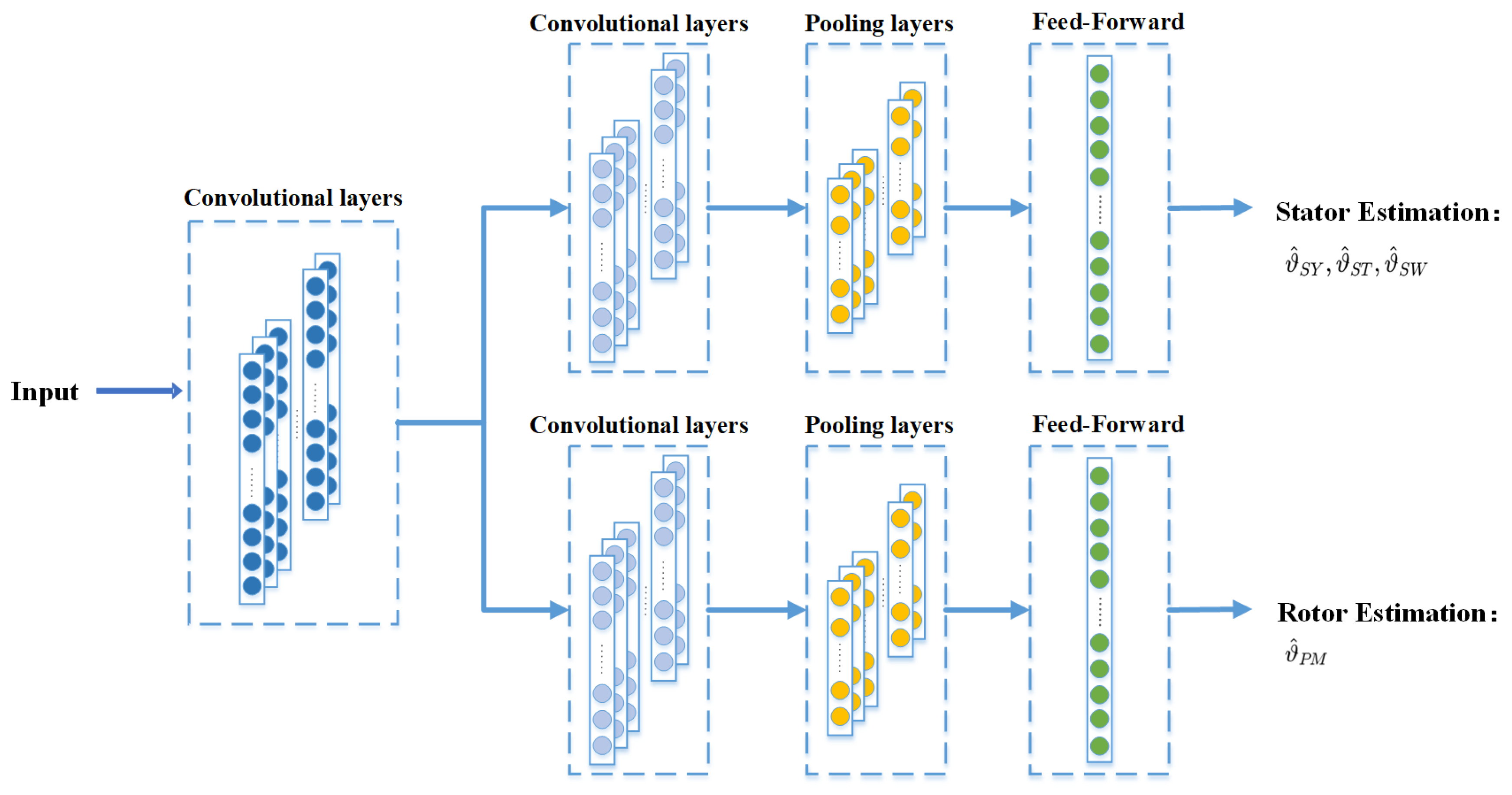
Kirchgassner et al. [102] evaluated the performance of the TCN in predicting the temperatures of motor components, including the stator teeth, winding, yoke, and the rotor permanent magnets. As shown in Figure 22, a shared convolutional block is first applied to extract features from the input signals, followed by two separate dilated convolutional blocks dedicated to the stator and rotor branches. Each branch is then completed with corresponding output layers for the respective signals. Aiming to measure runtime during inference, the model was employed into a Raspberry Pi 3 Model B+ with Raspbian Stretch 9.8. The median inference time on the stator and rotor targets are 27.2 and 12.4 ms, respectively, which are better than RNNs.
  • Combined with Transfer Learning Strategies
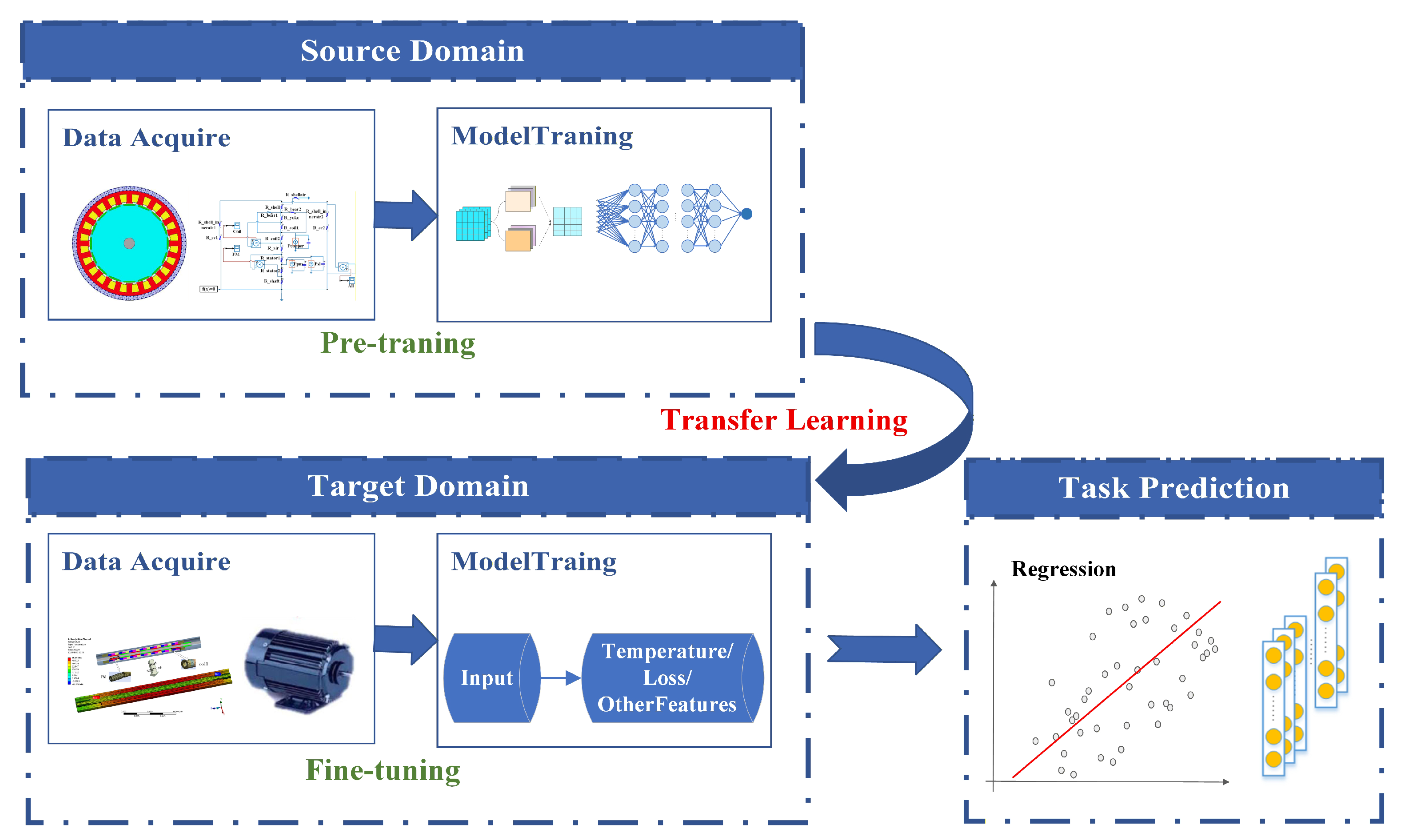
In online PMSM temperature estimation, transfer learning is increasingly integrated with deep learning to mitigate the scarcity of labeled real-motor data. Simulation or mechanistic thermal models are typically employed to generate source-domain data for pre-training, allowing deep networks to learn fundamental thermal dynamics. The learned representations are then adapted to real motor data through fine-tuning or domain adaptation, reducing the discrepancy between simulated and practical operating conditions.
Although such models are conceptually generalizable to different PMSMs, they still require motor-specific reconfiguration and retraining when deployed on a new target machine. This limitation is common in transfer learning–based approaches, where cross-motor adaptability exists, but fine-tuning remains necessary to preserve estimation accuracy, thereby restricting direct portability in practical applications. The technical path could be demonstrated as Figure 23.
Wu et al. [103] introduced a transfer learning–based DNN framework that combines mechanistic thermal modeling with data-driven learning for small-sample thermal analysis. Source-domain data are generated from finite element simulations including loss information, while target-domain data are obtained from a thermal network model. The network is pre-trained on simulation data and fine-tuned on target-domain data, enabling accurate temperature estimation under limited real measurements.Experimental results show that the method significantly improves performance with small training sets, reducing RMSE by 0.901 and 1.726 under 5:5 and 2:8 training/testing splits, respectively.
Zhang et al. [104] proposed a simulation-driven unsupervised transfer learning method termed DAAR, extending the Domain-Adversarial Neural Network paradigm to regression tasks for PM temperature estimation. The framework employs a shared feature extractor and domain classifier with domain-specific predictors, allowing knowledge learned from simulation data to be effectively transferred to real motor data through feature-level alignment. Simulation data for pre-training are generated using coupled electromagnetic–thermal models in Motor-CAD, and a modified transformer-based long-sequence time-series model is adopted as the backbone predictor. During adaptation, domain discrepancies are reduced through distribution alignment constraints, enabling robust temperature estimation across domains without requiring labeled target data.
Jing et al. [105] proposed a multi-task learning framework based on a lightweight encoder–GRU architecture to simultaneously predict temperatures at multiple stator locations, improving computational efficiency while preserving estimation accuracy.

4.2.2. Physics-Integrated Networks

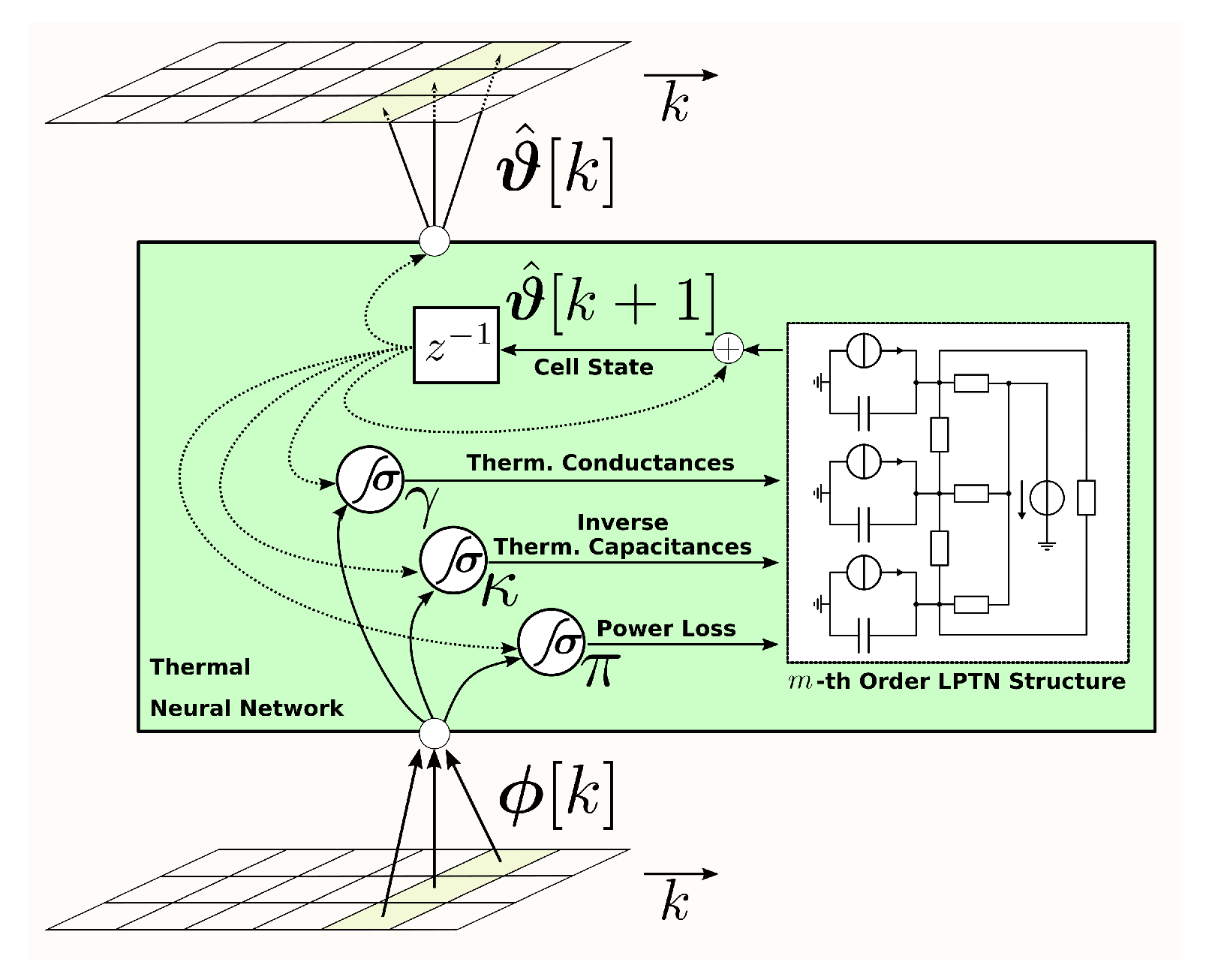
The Thermal Neural Networks were first introduced by Kirchgässner et al. [106], integrating the physics-informed knowledge derived from LPTNs with data-driven nonlinear function approximation via supervised machine learning. TNN combines physical interpretability with data-driven flexibility, supports end-to-end differentiability and efficient training, and operates without reliance on expert knowledge or prior geometric information. It could be demonstrated as follows. Figure 24 is the topology of TNN.
ϑ i [ k + 1 ] = ϑ i [ k ] + T s κ i [ k ] π i [ k ] + j M i ( ϑ j [ k ] ϑ i [ k ] ) γ i , j [ k ] + j = 1 n ( ϑ j [ k ] ϑ i [ k ] ) γ i , j [ k ]
where ϑ ^ i [ k ] denotes the ith node’s normalized temperature estimate at discrete time k, T s is the sample time, and κ i , π i , and γ i , j denote arbitrary feed-forward artificial neural network (ANN) outputs dependent on ξ [ k ] = [ ϑ ^ T ϑ ^ T ξ T ] T . This vector, in turn, consists of the ancillary temperatures ϑ ˜ [ k ] , the temperature estimates ϑ ^ [ k ] , and additional observables ξ [ k ] R o . More specifically, γ ( ζ ) approximates all thermal conductances between components of interest, π ( ζ ) all power losses within these components, and κ ( ζ ) determines all inverse thermal capacitances [106].
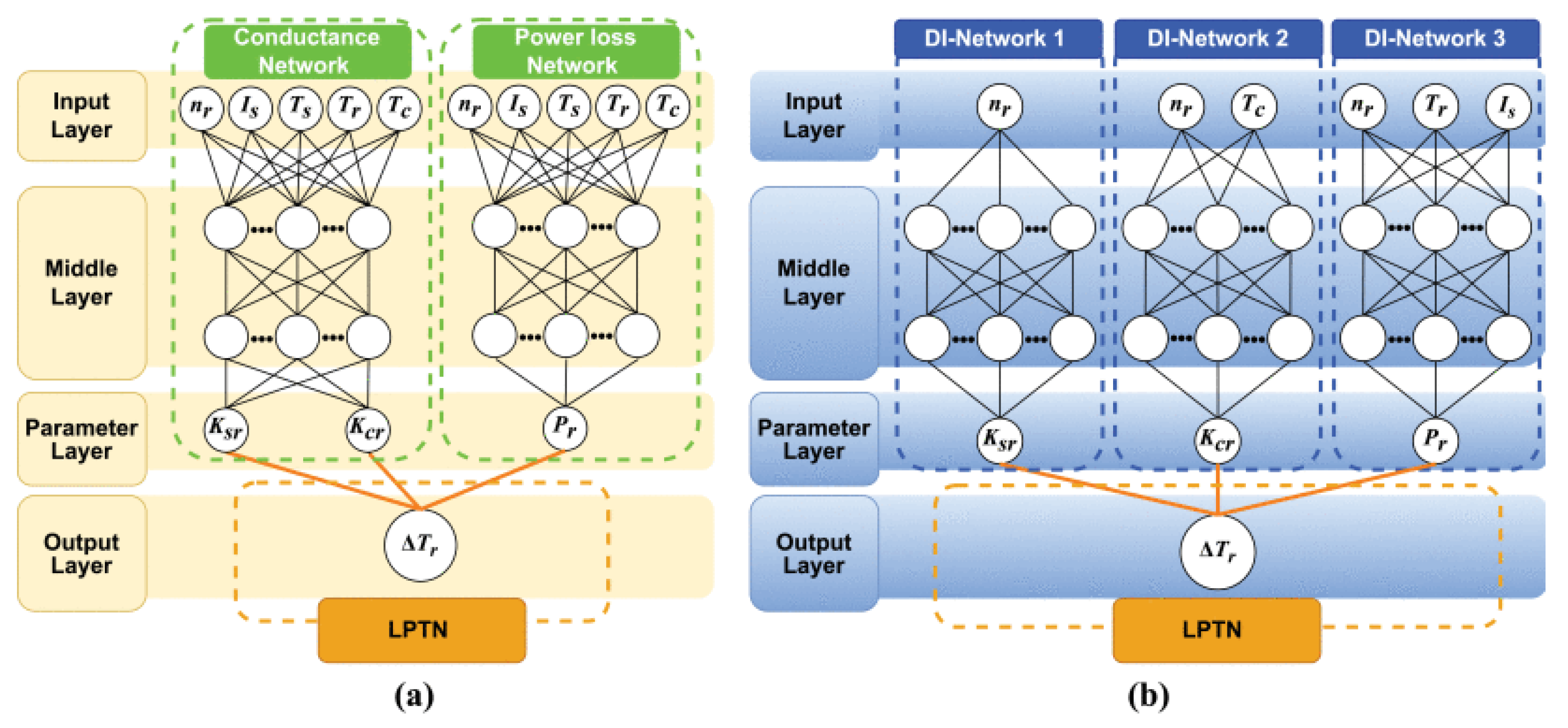
The TNN architecture consists of the following four layers: input, middle, parameter, and output. The input layer receives electromechanical variables from the motor, while the middle layer integrates these data, extracts features, and maps them into a higher-dimensional feature space. The parameter layer then takes the extracted features and outputs the identified thermal parameters. Finally, based on the LPTN model in (1), the output layer uses these identified parameters to estimate the rotor temperature variation.
Kirchgässner et al. [106] demonstrated that TNNs achieve better temperature estimation accuracy than previous white-/gray- or black-box models, with a mean squared error of 3.18 K2, based on experiments conducted on an electric motor data set. Wiese et al. [107] applied the TNN into electric drives with an oil spray cooling, based on the validation dataset.
Jiang et al. [108] proposed a differentiated input TNN (DI-TNN). Unlike TNNs, which rely on a unified input set and a single network to identify all thermal parameters simultaneously, DI-TNN adopts parameter-specific inputs and employs dedicated DI-Networks to identify each thermal parameter independently, without interconnections among parallel paths. In addition, the intermediate layers utilize fully connected neural networks (FCNNs) for feature extraction. These architectural differences are illustrated in Figure 25.
By adopting an offline precomputation and online lookup strategy, the DI-TNN model was integrated into an automotive inverter control system on the Aurix TC275 MCU, enabling online rotor temperature estimation with minimal computational overhead. It demonstrates higher estimation accuracy than the TNN while achieving an inference latency of only 13 µs on the embedded platform, thereby fully meeting the requirements for real-time temperature estimation.

4.2.3. Summary of the Deep Learning Methods in Online Temperature Estimation

While these deep learning methods demonstrate promising performance in PMSM online temperature estimation, their generalization across heterogeneous datasets remains a significant challenge. This limitation primarily stems from domain shifts induced by varying operating conditions, sensor discrepancies (e.g., noise characteristics and placement), and the distribution mismatch between training and deployment environments. To assess robustness, common validation settings include cross-condition validation (e.g., training on low-speed data and testing on high-speed profiles) and cross-source validation (e.g., training on laboratory data and testing on real-world operational data). Addressing these generalization gaps is crucial for ensuring model reliability in practical applications.

4.3. Hybrid Methods

Hybrid methods that combine Lumped Parameter Thermal Networks (LPTNs) with deep learning have emerged as an effective strategy for PMSM temperature estimation. In these approaches, the LPTN provides a physics-informed thermal structure that captures the dominant heat-transfer paths, while neural networks compensate for modeling inaccuracies, unmodeled dynamics, or complex nonlinear effects. By embedding thermal topology, loss mechanisms, or equivalent node information into data-driven models, these methods improve estimation accuracy, robustness, and real-time applicability compared with purely black-box or purely mechanistic models.
Liu et al. [95] developed an LPTN-informed LSTM framework for multi-node temperature estimation in PMSMs, where a simplified third-order LPTN captures the primary heat-transfer dynamics and an LSTM compensates for model uncertainties to enhance estimation accuracy beyond the equivalent LPTN nodes. Furthermore, the ability of LSTM to adaptively learn and estimate unmodeled dynamics improves the model’s scalability to additional temperature estimation nodes, such as the end winding and bearing, thereby extending the coverage of thermal monitoring within the motor. The model achieves the estimation error with an MSE of 2.04 C 2 using a dataset of 23.8 h.
Tang et al. [109] proposed a hybrid OLS–FRGCN method that combines a static LPTN with a dynamic graph neural network. Sensor data are mapped into both models via OLS, and graph convolutions are performed on predefined static and adaptive dynamic graphs, with the fused features further processed by a GRU for multi-step temperature estimation.
Jin et al. [110] proposed a hybrid framework combining a simplified LPTN and a small-scale ANN for accurate rotor and stator temperature estimation. The simplified LPTN model, with 11 parameters optimized via a global search algorithm, captures the general tendency of temperature variations and provides prior estimations. To correct its bias, the ANN serves as an uncertainty compensator, taking LPTN outputs—including temperature, losses, speed, torque, and d/q-axis currents/voltages—as inputs. The final temperatures are obtained by subtracting the ANN compensation from the LPTN estimations. Online tests on a TMS320F28335 DSP demonstrate accurate estimation with a latency of approximately 0.4 ms per estimation, and the estimated stator and rotor temperatures match their respective measured values excellently, with maximum estimation errors within 1 °C.
Sharifi et al. [111] proposed a hybrid LPTN–DNN approach for temperature monitoring, where the LPTN characterizes the thermal structure while the DNN performs online estimation of core and permanent magnet eddy current losses. And they have proven that, while using a DNN model for loss estimation, the magnitude of the input current and the rotational speed are the only determinant parameters for power losses. And the casing temperature can enable accurate temperature estimation of the windings and permanent magnets without increasing the size of the deep learning model.
Tang et al. [112] proposed a short-term temperature trend forecasting method that integrates LPTN-derived thermal network topology with a relational graph convolutional network. The thermal topology is modeled as a spatio-temporal graph for estimation. Under a 10 s prediction horizon, the method controls global temperature error from 4.14 °C to 5.85 °C, achieves a maximum RMSE of only 1.24 °C, and reduces errors from 5.99% to 46.56% compared to other methods.
Tang et al. [112] proposed a short-term time-to-failure prediction method for PMSM by integrating LPTN-derived thermal network topology with a relational graph convolutional network (OLS-RGCN), which models thermal topology as a spatio–temporal graph and achieves accuracy with global temperature errors within 5.88 °C and 2.6 °C for 10-s predictions on water-cooled and oil-cooled datasets, respectively.

5. Conclusions and Future Trends

Online temperature estimation for PMSMs holds critical importance in safety-centric applications such as EVs, where the PMSMs are their power cores. Overheating within the PMSM can cause severe issues, including magnet demagnetization, insulation degradation, and motor burnout, directly compromising the vehicle propulsion performance, safety, and operational lifespan. An accurate online temperature estimation method enables the prompt detection of health risks within the PMSMs. This capability not only facilitates immediate adjustments such as power limitation or active cooling to prevent thermal damage, but it also establishes foundational data for long-term health management of EVs. Thus, online temperature estimation significantly enhances operational reliability for EVs, reducing the probability of temperature-induced failures while simultaneously cutting maintenance costs and boosting system maintainability.
The current research of the online temperature estimation for the PMSMs can be categorized intro three classes, the thermal model-based methods, the electrical model-based methods, and the data-driven methods. Here, the research trends of these methods are summarized below.
  • Thermal Model-Based Methods
For various types of the LPTN, the highly simplified LPTN becomes the main stream method for the online temperature estimation for PMSMs. Compared with other types, it has the smallest model size and fastest computing speed. The highly simplified LPTN can appropriately reduce the size of the LPTN depending on the specific application fields and structural features of the PMSM. And because of this high simplification, its parameters are defined in relatively abstract ways and this deeply influences the precision of the estimated temperature. Thus, the parameter identification of the highly simplified LPTN is worth researching in the future.
  • Electrical Model-Based Methods
The electrical model-based temperature estimation method exploits the inherent relationship between temperature-sensitive electrical parameters (such as stator winding resistance R s and permanent magnet flux linkage ψ m ) and thermal conditions. By performing online identification of the electrical parameters, these approaches indirectly estimate temperatures at target locations. There contain six types of the electrical model-based methods, such as the fixing other parameters method, the MRAS method, the current injection method, the position-offset injection method, the virtual signal injection method, and the HF signal method. These methods offer a conceptually straightforward implementation path with potentially advantageous dynamic response characteristics and relatively low implementational complexity. And differing from the LPTN approaches, the electrical model-based temperature estimation method requires no preliminary identification through extensive experimental datasets.
  • Data-Driven Methods
The data-driven temperature estimation method avoids the detailed physical modeling process. Instead, it utilizes extensive experimental data collected from PMSM running for training, including current, voltage, rotational speed, coolant temperature, and even directly/indirectly measured temperatures. In this process, different types of machine learning or deep learning algorithms can be employed to construct the complex mapping relationship between the operational input states and output temperatures. Specifically, a combined utilization of different deep learning networks generally outperforms one single model. Consequently, these models exhibit an inherent black-box nature, limiting their interpretability. To solve this issue, hybrid methods that combine LPTNs with data-driven methods have emerged as an effective strategy for PMSM temperature estimation. The LPTN part provides a physics-informed thermal structure that captures the dominant heat-transfer paths, while the data-driven model part compensates for modeling inaccuracies or complex nonlinear effects, which is worth researching in future.
Based on the current state of research, the future advancement of online temperature estimation for PMSMs in electric vehicle applications is expected to concentrate on the following two strategic dimensions:
  • From One Component to Everywhere Thermal Monitoring
Current methods for online temperature estimation in EVs mainly focus on one main critical component, like the windings or magnets. However, as PMSMs in EVs become more powerful and complex inside, a comprehensive approach that maps how heat builds up everywhere within the machine is needed. Tracking only the known problem areas is not enough because hidden overheating can conceal possible malfunctions of the PMSM in EVs. For example, unnoticed heat in the rotor core or bearings could weaken permanent magnets gradually, risking a sudden loss of power during something critical like overtaking on the highway. Undetected hotspots might also damage internal insulation over time or potentially shortening the entire motor’s usable life. Furthermore, if the motor’s control system only has partial heat data, it might unnecessarily limit power output too early on steep climbs or in hot weather, needlessly draining the battery and reducing the car’s practical range. By contrast, building a detailed online temperature estimation for the PMSM allows engineers to create a smarter EV that stay reliably safe and operate efficiently across all driving conditions. And EV owners also benefit from a longer-lasting performance from their vehicles.
  • Hybrid Modeling: Blending Different Approaches for Better Motor Estimations
Choosing the right method to estimate the PMSM temperatures is not simple. The electrical model-based methods react too much to tiny perturbations, making them unreliable. Figuring out exactly how heat moves through the whole system using the LPTN alone is also difficult. On the other hand, purely “black box” models that learn from data might give answers, but they cannot explain why. The data-driven method cannot reveal the real heat-related physics happening inside. The advanced hybrid modeling is coming to the forefront. It combines the physics of heat generation and flow with powerful computer learning based on actual motor data. Blending different approaches better manages tough problems, like irregular power flow from the motor controller and strong electrical noise. This teamwork between physics and data science will move temperature estimations forward.

Author Contributions

Conceptualization, Y.S. and W.J.; formal analysis, Y.S., J.Z., G.A. and S.L.; investigation, Y.S. and W.J.; resources, J.Z., G.A. and S.L.; writing—original draft preparation, Y.S. and J.Z.; writing—review and editing, W.J.; visualization, G.A.; supervision, W.J.; project administration, W.J., Y.N. and G.X.; funding acquisition, G.X. All authors have read and agreed to the published version of the manuscript.

Funding

The research is funded by a National Science and Technology Major Project of China, 2025ZD0805800, and the National Natural Science Foundation of China, 5243700. The article processing charge was funded by the Aerospace Information Research Institute, Chinese Academy of Sciences.

Data Availability Statement

The original contributions presented in this study are included in the article. Further inquiries can be directed to the corresponding author.

Conflicts of Interest

The authors declare no conflicts of interest.

References

  1. Galioto, G.; Vitale, G.; Sferlazza, A.; Lullo, G.; Giaconia, G.C. Wide and Ultrawide Bandgap Power Semiconductors: A Comprehensive System-Level Review. Electronics 2026, 15, 835. [Google Scholar] [CrossRef]
  2. Medinceanu, P.-C.; Antonescu, A.M.; Enachescu, M. Is GaN the Enabler of High-Power-Density Converters? An Overview of the Technology, Devices, Circuits, and Applications. Electronics 2026, 15, 510. [Google Scholar] [CrossRef]
  3. Ye, X.; Sun, X.; Liang, Z.; Tian, R.; Wei, M.; Song, P.; Shen, L. Heat Transfer and Mechanical Performance Analysis and Optimization of Lattice Structure for Electric Vehicle Thermal Management. Electronics 2026, 15, 347. [Google Scholar] [CrossRef]
  4. Dini, P.; Saponara, S.; Chakraborty, S.; Hegazy, O. Modeling, Control and Monitoring of Automotive Electric Drives. Electronics 2025, 14, 3950. [Google Scholar] [CrossRef]
  5. Liu, H.-c.; Lee, M. Design Analysis of an Interior Permanent Magnet Synchronous Motor with Hybrid Hair-Pin and Litz Wire Windings. Electronics 2025, 14, 3350. [Google Scholar] [CrossRef]
  6. Hussein, H.M.; Ibrahim, A.M.; Taha, R.A.; Rafin, S.M.S.H.; Abdelrahman, M.S.; Kharchouf, I.; Mohammed, O.A. State-of-the-Art Electric Vehicle Modeling: Architectures, Control, and Regulations. Electronics 2024, 13, 3578. [Google Scholar] [CrossRef]
  7. Nory, H.; Yildiz, A.; Aksun, S.; Aksoy, C. Design and Analysis of an IE6 Hyper-Efficiency Permanent Magnet Synchronous Motor for Electric Vehicle Applications. Energies 2025, 18, 4684. [Google Scholar] [CrossRef]
  8. Yang, Y.; He, Q.; Fu, C.; Liao, S.; Tan, P. Efficiency Improvement of Permanent Magnet Synchronous Motor for Electric Vehicles. Energies 2020, 213, 118859. [Google Scholar]
  9. Agamloh, E.; von Jouanne, A.; Yokochi, A. An Overview of Electric Machine Trends in Modern Electric Vehicles. Machines 2020, 8, 20. [Google Scholar] [CrossRef]
  10. Yi, Y.; Ma, S.; Zhang, B.; Feng, W. Application of High Efficiency and High Precision Network Algorithm in Thermal Capacity Design of Modular Permanent Magnet Fault-Tolerant Motor. Energies 2025, 18, 3967. [Google Scholar] [CrossRef]
  11. Zsuga, Á.; Dineva, A. Early Detection of ITSC Faults in PMSMs Using Transformer Model and Transient Time-Frequency Features. Energies 2025, 18, 4048. [Google Scholar] [CrossRef]
  12. Xu, J.Q.; Tian, X.; Jin, W.B.; Guo, H. PWM Harmonic-Current-Based Interturn Short-Circuit Fault Diagnosis for the Aerospace FTPMSM System Even in the Fault-Tolerant Operation Condition. IEEE Trans. Power Electr. 2023, 38, 5432–5441. [Google Scholar]
  13. Xu, J.Q.; Jin, W.B.; Guo, H.; Zhang, B. Improved Optimal Fault-Tolerant Control Considering Reluctance Torque for Five-Phase IPMSM in Aerospace Electric Actuation Application. IEEE Trans. Ind. Electr. 2024, 710, 1785–11795. [Google Scholar] [CrossRef]
  14. Meng, T.; Zhang, P. A Review of Thermal Monitoring Techniques for Radial Permanent Magnet Machines. Machines 2021, 10, 18. [Google Scholar] [CrossRef]
  15. Xu, Z.; Xu, Y.; Gai, Y.; Liu, W. Thermal Management of Drive Motor for Transportation: Analysis Methods, Key Factors in Thermal Analysis, and Cooling Methods—A Review. IEEE Trans. Transp. Electrif. 2023, 9, 4751–4774. [Google Scholar] [CrossRef]
  16. Lindström, J. Thermal Model of a Permanent-Magnet Motor for a Hybrid Electric Vehicle. Ph.D. Thesis, Department of Electric Power Engineering, Chalmers University of Technology, Göteborg, Sweden, April 1999. [Google Scholar]
  17. Fan, X.; Li, D.; Qu, R.; Wang, C. A dynamic multilayer winding thermal model for electrical machines with concentrated windings. IEEE Trans. Industr. Elec. 2019, 66, 6189–6199. [Google Scholar] [CrossRef]
  18. Chen, Q.; Wu, D.; Li, G.; Cao, W.; Qian, Z.; Wang, Q. Development of a fast thermal model for calculating the temperature of the interior PMSM. Energies 2021, 14, 7455. [Google Scholar] [CrossRef]
  19. Mellor, P.H.; Roberts, D.; Turner, D. Lumped parameter thermal model for electrical machines of TEFC design. IEE Proc. B Eletr. Power Appl. 1991, 138, 205–218. [Google Scholar]
  20. Liang, D.; Zhu, Z.Q.; Feng, J.H.; Guo, S.Y.; Li, Y.F.; Zhao, A.F. Estimation of 3-D magnet temperature distribution based on lumped-parameter and analytical hybrid thermal model for SPMSM. IEEE Trans. Energy Convers. 2022, 37, 515–525. [Google Scholar] [CrossRef]
  21. Liang, D.; Zhu, Z.; Shao, B.; Feng, J.; Guo, S.; Li, Y.; Zhao, A.F. Estimation of two- and three-dimensional spatial magnet temperature distributions for interior PMSMs based on hybrid thermal model. IEEE Trans. Energy Convers. 2022, 37, 2175–2189. [Google Scholar] [CrossRef]
  22. Liang, D.; Zhu, Z.Q.; Feng, J.; Guo, S.; Li, Y.; Zhao, A. Simplified 3-D hybrid analytical modeling of magnet temperature distribution for surface mounted PMSM with segmented magnets. IEEE Trans. Ind. Appl. 2022, 58, 4474–4487. [Google Scholar] [CrossRef]
  23. Kylander, G. Thermal Modelling of Small Cage Induction Motors. Ph.D. Thesis, Department of Electric Power Engineering, Chalmers University of Technology, Gothenburg, Sweden, April 1995. [Google Scholar]
  24. Zhang, F.; Gerada, D.; Xu, Z.; Tighe, C.; Zhang, H.; Yan, L. Electrical machine slot thermal condition effects on back iron extension thermal benefits. IEEE Trans. Transp. Electr. 2021, 7, 2927–2938. [Google Scholar] [CrossRef]
  25. Zhang, F.; Gerada, D.; Xu, Z.; Zhang, X.; Zhang, H.; Gerada, C. Improved thermal modeling and experimental validation of oil-flooded high-performance machines with slot-channel cooling. IEEE Trans. Transp. Electr. 2022, 8, 312–324. [Google Scholar] [CrossRef]
  26. Dong, T.; Zhang, X.; Zhou, F.; Zhao, B. Correction of winding peak temperature detection in high-frequency automotive electric machines. IEEE Trans. Ind. Electron. 2020, 67, 5615–5625. [Google Scholar] [CrossRef]
  27. Liu, Z.J.; Howe, D.; Mellor, P.H.; Jenkins, M.K. Thermal analysis of permanent magnet machines. In Proceedings of the Sixth International Conference on Electrical Machines and Drives, Oxford, UK, 8–10 September 1993; pp. 359–364. [Google Scholar]
  28. Li, X.; Guo, H.; Xu, J. Heat dissipation structure design for a high torque density three-dimensional magnetic circuit permanent magnet motor in aircraft electrical propulsion applications. In Proceedings of the 2025 28th International Conference on Electrical Machines and Systems (ICEMS), Busan, Republic of Korea, 16–19 November 2025; pp. 191–196. [Google Scholar]
  29. Xu, J.; Jin, W.; Lin, H.; Zhang, B.; Guo, H. Multiobjective optimization method to maximize power density and efficiency of an electric propulsion motor in UAV applications. IEEE Trans. Transport. Electr. 2024, 10, 5484–5494. [Google Scholar] [CrossRef]
  30. Jin, W.B.; Xu, J.Q.; Guo, H. Thermal Modeling and Analysis of a Wet-type Fault-tolerant Permanent Magnet Synchronous Motor. In Proceedings of the 2023 26th International Conference on Electrical Machines and Systems (ICEMS), Zhuhai, China, 5–8 November 2023; pp. 2010–2015. [Google Scholar]
  31. Cai, X.; Cheng, M.; Zhu, S.; Zhang, J. Thermal modeling of flux-switching permanent-magnet machines considering anisotropic conductivity and thermal contact resistance. IEEE Trans. Ind. Electron. 2016, 63, 3355–3365. [Google Scholar] [CrossRef]
  32. Zhang, B.; Qu, R.; Wang, J.; Xu, W.; Fan, X.; Chen, Y. Thermal model of totally enclosed water-cooled permanent-magnet synchronous machines for electric vehicle application. IEEE Trans. Ind. Appl. 2015, 51, 3020–3029. [Google Scholar] [CrossRef]
  33. Boglietti, A.; Cavagnino, A.; Lazzari, M.; Pastorelli, A. A simplified thermal model for variable-speed self-cooled industrial induction motor. IEEE Trans. Ind. Appl. 2003, 39, 945–952. [Google Scholar] [CrossRef]
  34. Chen, Q.; Liang, D.; Gao, L.; Wang, Q.; Liu, Y. Hierarchical thermal network analysis of axial-flux permanent-magnet synchronous machine for electric motorcycle. IET Electr. Power Appl. 2018, 12, 859–866. [Google Scholar] [CrossRef]
  35. Lee, B.; Kim, K.; Jung, J.; Hong, J.; Kim, Y. Temperature estimation of IPMSM using thermal equivalent circuit. IEEE Trans. Magn. 2012, 48, 2949–2952. [Google Scholar] [CrossRef]
  36. Oliver, W.; Joachim, B. Global identification of a low-order lumped-parameter thermal network for permanent magnet synchronous motors. IEEE Trans. Energy Convers. 2016, 31, 354–365. [Google Scholar]
  37. Feng, J.H.; Liang, D.W.; Zhu, Z.Q. Improved Low-order themral model for critical temperature estimation of PMSM. IEEE Trans. Energy Convers. 2022, 37, 413–423. [Google Scholar] [CrossRef]
  38. Kral, C.; Haumer, A.; Lee, S.B. A practical thermal model for the estimation of permanent magnet and stator winding temperatures. IEEE Trans. Power Electron. 2014, 28, 455–464. [Google Scholar] [CrossRef]
  39. Sciascera, C.; Giangrande, P.; Papini, L.; Gerada, C.; Galea, M. Analytical thermal model for fast stator winding temperature prediction. IEEE Trans. Industr. Elec. 2017, 64, 6116–6126. [Google Scholar] [CrossRef]
  40. Liang, D.; Zhu, Z.Q.; Feng, J.; Li, Y.; Guo, S. Initial temperature determination for real-time thermal models in permanent magnet synchronous machines. IEEE Trans. Transport. Electr. 2025, 11, 2204–2218. [Google Scholar] [CrossRef]
  41. Sun, T.; Wang, J.; Griffo, A.; Sen, B. Active thermal management for interior permanent magnet synchronous machine (IPMSM) drives based on model predictive control. IEEE Trans. Industr. Appl. 2018, 54, 4506–4515. [Google Scholar] [CrossRef]
  42. Zhu, Z.Q.; Howe, D. Electrical machines and drives for electric, hybrid, and fuel cell vehicles. Proc. IEEE 2010, 95, 746–765. [Google Scholar] [CrossRef]
  43. Reigosa, D.D.; Garcia, P.; Briz, F.; Raca, D.; Lorenz, R.D. Modeling and adaptive decoupling of high-frequency resistance and temperature effects in carrier-based sensorless control of PM synchronous machines. IEEE Trans. Ind. Appl. 2010, 46, 139–149. [Google Scholar] [CrossRef]
  44. Inoue, Y.; Kawaguchi, Y.; Morimoto, S.; Sanada, M. Performance improvement of sensorless IPMSM drives in a low-speed region using online parameter identification. IEEE Trans. Ind. Appl. 2011, 47, 798–804. [Google Scholar] [CrossRef]
  45. Liu, S.; Wang, Q.; Zhang, G.; Wang, G.; Xu, D. Online temperature identification strategy for position sensorless PMSM drives with position error adaptive compensation. IEEE Trans. Power Electron. 2022, 37, 8502–8512. [Google Scholar] [CrossRef]
  46. Piippo, A.; Hinkkanen, M.; Luomi, J. Adaptation of motor parameters in sensorless PMSM drives. IEEE Trans. Ind. Appl. 2009, 45, 203–212. [Google Scholar] [CrossRef]
  47. Wang, P.; Lin, K.; Zhang, X.; Wang, S.; Ai, J.; Lin, M. An online estimation method for both stator inductance and rotor flux linkage of SPMSM without dead-time influence. IEEE J. Emerg. Sel. Top. Power Electron. 2022, 10, 1627–1638. [Google Scholar] [CrossRef]
  48. Sayed, A.H.; Kailath, T. A state-space approach to adaptive RLS filtering. IEEE Signal Process. Mag. 1994, 11, 18–60. [Google Scholar] [CrossRef]
  49. Li, X.; Kennel, R. General formulation of Kalman-filter-based online parameter identification methods for VSI-fed PMSM. IEEE Trans. Ind. Electron. 2021, 68, 2856–2864. [Google Scholar] [CrossRef]
  50. Boileau, T.; Nahid-Mobarakeh, B.; Meibody-Tabar, F. On-line identification of PMSM parameters: Model-reference vs EKF. In Proceedings of the 2008 IEEE Industry Applications Society Annual Meeting, Edmonton, AB, Canada, 5–9 October 2008; pp. 1–8. [Google Scholar]
  51. Morimoto, S.; Kawamoto, K.; Sanada, M.; Takeda, Y. Sensorless control strategy for salient-pole PMSM based on extended EMF in rotating reference frame. IEEE Trans. Ind. Appl. 2002, 38, 1054–1061. [Google Scholar] [CrossRef]
  52. Chen, Z.; Tomita, M.; Doki, S.; Okuma, S. An extended electromotive force model for sensorless control of interior permanent-magnet synchronous motors. IEEE Trans. Ind. Electron 2003, 50, 288–295. [Google Scholar] [CrossRef]
  53. Zhou, C.; Zhou, Z.; Tang, W.; Yu, Z.; Sun, X. Improved sliding-mode observer for position sensorless control of PMSM. In Proceedings of the 2018 Chinese Automation Congress (CAC), Xi’an, China, 30 November–2 December 2018; pp. 2374–2378. [Google Scholar]
  54. Liang, D.; Li, J.; Qu, R. Sensorless control of permanent magnet synchronous machine based on second-order sliding-mode observer with online resistance estimation. IEEE Trans. Ind. Appl. 2017, 53, 3672–3682. [Google Scholar] [CrossRef]
  55. Liu, K.; Zhang, Q.; Chen, J.; Zhu, Z.Q.; Zhang, J. Online multiparameter estimation of nonsalient-pole PM synchronous machines with temperature variation tracking. IEEE Trans. Ind. Electron. 2011, 58, 1776–1788. [Google Scholar] [CrossRef]
  56. Underwood, S.J.; Husain, I. Online parameter estimation and adaptive control of permanent-magnet synchronous machines. IEEE Trans. Ind. Electron. 2010, 57, 2435–2443. [Google Scholar] [CrossRef]
  57. Feng, G.; Lai, C.; Mukherjee, K.; Kar, N.C. Current injection-based online parameter and VSI nonlinearity estimation for PMSM drives using current and voltage DC components. IEEE Trans. Transport. Electrif. 2016, 2, 119–128. [Google Scholar] [CrossRef]
  58. Hu, Y.; Hua, W.; Hu, M.; Wang, Y. Inductance–resistance online identification for sensorless high-speed PMSM considering resistive characteristic of invertor nonlinearity. IEEE Trans. Ind. Electron. 2024, 71, 2343–2355. [Google Scholar] [CrossRef]
  59. Wang, Y.; Xu, Y.; Zou, J. Online multiparameter identification method for sensorless control of SPMSM. IEEE Trans. Power Electron. 2020, 35, 10601–10613. [Google Scholar] [CrossRef]
  60. Hu, Y.; Liu, K.; Hua, W.; Hu, M. First-order model based inductance identification with least square method for high-speed sensorless control of permanent magnet synchronous machines. IEEE Trans. Power Electron. 2023, 38, 8719–8729. [Google Scholar] [CrossRef]
  61. Ichikawa, S.; Tomita, M.; Doki, S.; Okuma, S. Sensorless control of permanent-magnet synchronous motors using online parameter identification based on system identification theory. IEEE Trans. Ind. Electron. 2006, 53, 363–372. [Google Scholar] [CrossRef]
  62. Ichikawa, S.; Tomita, M.; Doki, S.; Okuma, S. Sensorless control of synchronous reluctance motors based on extended EMF models considering magnetic saturation with online parameter identification. IEEE Trans. Ind. Appl. 2006, 42, 1264–1274. [Google Scholar] [CrossRef]
  63. Taniguchi, S.; Yasui, K.; Yuki, K. Noise reduction method by injected frequency control for position sensorless control of permanent magnet synchronous motor. In Proceedings of the 2014 International Power Electronics Conference, Hiroshima, Japan, 18–21 May 2014; pp. 2465–2469. [Google Scholar]
  64. Sakamoto, K.; Iwaji, Y.; Endo, T.; Takakura, T. Position and speed sensorless control for PMSM drive using direct position error estimation. In Proceedings of the 27th Annual Conference of the IEEE Industrial Electronics Society, Denver, CO, USA, 29 November–2 December 2001; pp. 1680–1685. [Google Scholar]
  65. Liu, T.Y.; Zhu, Z.Q.; Shuang, B.; Wu, Z.Y.; Stone, D.A.; Foster, M.P. An online position error correction method for sensorless control of permanent magnet synchronous machine with parameter mismatch. IEEE Access 2021, 9, 135708–135722. [Google Scholar] [CrossRef]
  66. Ganchev, M.; Kral, C.; Oberguggenberger, H.; Wolbank, T. Sensorless rotor temperature estimation of permanent magnet synchronous motor. In Proceedings of the IECON 2012—38th Annual Conference on IEEE Industrial Electronics Society, Melbourne, VIC, Australia, 25–28 October 2012; pp. 2018–2023. [Google Scholar]
  67. Ganchev, M.; Kral, C.; Wolbank, T.M. Compensation of speed dependence in sensorless rotor temperature estimation for permanent-magnet synchronous motor. IEEE Trans. Ind. Appl. 2013, 49, 2487–2495. [Google Scholar] [CrossRef]
  68. Zhu, Z.Q.; Wang, P.; Freire, N.M.A.; Azar, Z.; Wu, X. A novel rotor position-offset injection-based online parameter estimation of sensorless controlled surface-mounted PMSMs. IEEE Trans. Energy Convers. 2024, 39, 1930–1946. [Google Scholar] [CrossRef]
  69. Wang, P.; Zhu, Z.Q.; Liang, D.; Freire, N.M.A.; Azar, Z. Dual signal injection-based online parameter estimation of surface-mounted PMSMs under sensorless control. IEEE Trans. Ind. Appl. 2025, 61, 9359–9371. [Google Scholar] [CrossRef]
  70. Wang, P.; Zhu, Z.Q.; Liang, D. Virtual signal injection-based online full-parameter estimation of surface-mounted PMSMs without influence of position error and inverter nonlinearity. IEEE J. Emerg. Sel. Top. Power Electron. 2025, 13, 2341–2357. [Google Scholar] [CrossRef]
  71. Liu, K.; Zhu, Z.Q.; Zhang, Q.; Zhang, J. Influence of nonideal voltage measurement on parameter estimation in permanent-magnet synchronous machines. IEEE Ind. Electron. 2012, 59, 2438–2447. [Google Scholar] [CrossRef]
  72. Wang, P.; Zhu, Z.Q.; Liang, D. Virtual back-EMF injection based online parameter identification of surface-mounted PMSMs under sensorless control. IEEE Trans. Ind. Electron. 2025, 72, 5579–5590. [Google Scholar] [CrossRef]
  73. Wang, P.; Zhu, Z.Q.; Liang, D. Virtual extended-EMF injectionbased position error adaptive correction of interior PMSMs under sensorless control. IEEE J. Emerg. Sel. Top. Power Electron. 2025, 13, 2211–2223. [Google Scholar] [CrossRef]
  74. Reigosa, D.; FernÆndez, D.; Martínez, M.; Guerrero, J.M.; Diez, A.B.; Briz, F. Magnet temperature estimation in permanent magnet synchronous machines using the high frequency inductance. IEEE Trans. Ind. Appl. 2019, 55, 2750–2757. [Google Scholar] [CrossRef]
  75. Martinez, M.; Reigosa, D.; Fernandez, D.; Guerrero, J.M.; Briz, F. Enhancement of permanent-magnet synchronous machines torque estimation using pulsating high-frequency current injection. IEEE Trans. Ind. Appl. 2020, 56, 358–366. [Google Scholar] [CrossRef]
  76. Zhou, J.; Huang, K.; Huang, S.; Liu, S.; Zhao, H.; Shen, M. Inductance parameter identification method of permanent magnet synchronous motor based on the HF rotating square wave voltage injection. In Proceedings of the 22nd International Conference on Electrical Machines and Systems (ICEMS), Harbin, China, 11–14 August 2019; pp. 1–4. [Google Scholar]
  77. El-Murr, G.; Giaouris, D.; Finch, J.W. Online cross-coupling and self incremental inductances determination of salient permanent magnet synchronous machines. In Proceedings of the 5th IET International Conference on Power Electronics, Machines and Drives (PEMD 2010), Brighton, UK, 19–21 April 2010; pp. 1–4. [Google Scholar]
  78. Fernandez, D.; Reigosa, D.; Tanimoto, T.; Kato, T.; Briz, F. Wireless permanent magnet temperature & field distribution measurement system for IPMSMs. In Proceedings of the IEEE Energy Conversion Congress and Exposition (ECCE 2015), Montreal, QC, Canada, 20–24 September 2015; pp. 3996–4003. [Google Scholar]
  79. Reigosa, D.D.; Briz, F.; García, P.; Guerrero, J.M.; Degner, M.W. Magnet temperature estimation in surface PM machines using high-frequency signal injection. IEEE Trans. Ind. Appl. 2010, 46, 1468–1475. [Google Scholar] [CrossRef]
  80. Shuang, B.; Zhu, Z.Q. A novel method for measuring high frequency DQ-axis and cross-coupling inductances in interior permanent magnet synchronous machines. In Proceedings of the 2020 IEEE Energy Conversion Congress and Exposition (ECCE), Detroit, MI, USA, 11–15 October 2020; pp. 6096–6103. [Google Scholar]
  81. Xu, W.; Lorenz, R.D. High-frequency injection-based stator flux linkage and torque estimation for DB-DTFC implementation on IPMSMs considering cross-saturation effects. IEEE Trans. Ind. Appl. 2014, 50, 3805–3815. [Google Scholar] [CrossRef]
  82. Yang, A.; Lin, M.; Tu, Y.; Jia, L.; Lin, K.; Wang, P. An improved rotor flux observer-based sensorless control method for dual three-phase axial flux PMSM. IET Electr. Power Appl. 2025, 19, e70079. [Google Scholar] [CrossRef]
  83. Liu, T.; Zhu, Z.Q.; Wu, Z.-Y.; Stone, D.; Foster, M. A simple sensorless position error correction method for dual three-phase permanent magnet synchronous machines. IEEE Trans. Energy Convers. 2021, 36, 895–906. [Google Scholar] [CrossRef]
  84. Liu, T.; Zhu, Z.Q.; Wu, X.; Wu, Z.; Stone, D.A.; Foster, M.P. A position error correction method for sensorless control of dual three-phase permanent magnet synchronous machines. IEEE Trans. Ind. Appl. 2022, 58, 3589–3601. [Google Scholar] [CrossRef]
  85. Wang, P.; Zhu, Z.Q.; Feng, Z. Virtual back EMF injection-based online full-parameter estimation of DTP-SPMSMs under sensorless control. IEEE Trans. Transport. Electrif. 2025, 11, 9823–9837. [Google Scholar] [CrossRef]
  86. Wang, P.; Zhu, Z.Q.; Liang, D. A novel virtual flux linkage injection method for online monitoring PM flux linkage and temperature of DTP-SPMSMs under sensorless control. IEEE Trans. Ind. Electron. 2025, 72, 12529–12543. [Google Scholar] [CrossRef]
  87. Wang, P.; Zhu, Z.Q.; Feng, Z. Novel virtual active flux injection-based position error adaptive correction of dual three-phase IPMSMs under sensorless control. IEEE Trans. Transport. Electrif. 2025, 11, 11728–11742. [Google Scholar] [CrossRef]
  88. Moreau, S.; Kahoul, R.; Louis, J.P. Parameters estimation of permanent magnet synchronous machine without adding extra-signal as input excitation. IEEE Int. Symp. Ind. Electron. 2004, 1, 371–376. [Google Scholar]
  89. Burth, M.; Verghese, G.C.; Velez-Reyes, M. Subset selection for improved parameter estimation in on-line identification of a synchronous generator. IEEE Trans. Power Syst. 1999, 14, 218–225. [Google Scholar] [CrossRef]
  90. Nino, C.E.; Velez-Reyes, M. Dealing with ill conditioning in recursive parameter estimation for a synchronous generator. In Proceedings of the IECON 2006—32nd Annual Conference on IEEE Industrial Electronics, Paris, France, 6–10 November 2006; pp. 1089–1094. [Google Scholar]
  91. Guo, D.; Yang, T.; Zhang, D. On the implications of artificial intelligence methods for feature engineering in reliability sector. Alex. Eng. J. 2025, 117, 463–471. [Google Scholar] [CrossRef]
  92. Jing, H.; Chen, Z.; Wang, X.; Wang, X.; Ge, L.; Fang, G.; Xiao, D. Gradient Boosting Decision Tree for Rotor Temperature Estimation in Permanent Magnet Synchronous Motors. IEEE Trans. Power Electron. 2023, 38, 10617–10622. [Google Scholar] [CrossRef]
  93. Kirchgassner, W.; Wallscheid, O.; Bocker, J. Data-Driven Permanent Magnet Temperature Estimation in Synchronous Motors with Supervised Machine Learning: A Benchmark. IEEE Trans. Energy Convers. 2021, 36, 2059–2067. [Google Scholar] [CrossRef]
  94. El Bazi, N.; Guennouni, N.; Mekhfioui, M.; Goudzi, A.; Chebak, A.; Mabrouki, M. Predicting the Temperature of a Permanent Magnet Synchronous Motor: A Comparative Study of Artificial Neural Network Algorithms. Technologies 2025, 13, 120. [Google Scholar] [CrossRef]
  95. Liu, Z.; Kong, W.; Fan, X.; Li, Z.; Peng, K.; Qu, R. Hybrid Thermal Modeling With LPTN-Informed Neural Network for Multinode Temperature Estimation in PMSM. IEEE Trans. Power Electron. 2024, 39, 10897–10909. [Google Scholar] [CrossRef]
  96. Latif, A.; Mehedi, I.M.; Vellingiri, M.T.; Meem, R.J.; Palaniswamy, T. Enhanced Remora Optimization with Deep Learning Model for Intelligent PMSM Drives Temperature Prediction in Electric Vehicles. Axioms 2023, 12, 852. [Google Scholar] [CrossRef]
  97. Cheng, J.; Ji, F.; Huang, C.; Wang, T.; Liu, Y.; Li, Y. 1DCNN-Residual Bidirectional LSTM for Permanent Magnet Synchronous Motor Temperature Prediction Based on Operating Condition Clustering. IEEE Access 2025, 13, 49567–49583. [Google Scholar] [CrossRef]
  98. Wang, Y.; Tang, J.; Chen, M.; Chu, X. A high-speed train traction motor temperature prediction model based on improved Bi-GTU. J. Supercomput. 2025, 81, 1368. [Google Scholar] [CrossRef]
  99. Guo, H.; Ding, Q.; Song, Y.; Tang, H.; Wang, L.; Zhao, J. Predicting Temperature of Permanent Magnet Synchronous Motor Based on Deep Neural Network. Energies 2020, 13, 4782. [Google Scholar] [CrossRef]
  100. Lee, J.; Ha, J.-I. Temperature Estimation of PMSM Using a Difference-Estimating Feedforward Neural Network. IEEE Access 2020, 8, 130855–130865. [Google Scholar] [CrossRef]
  101. Heimbach, K. An Empirical Evaluation of Convolutional and Recurrent Neural Networks for Lip Reading. IEEE Access 2018, 6, 1–10. [Google Scholar]
  102. Kirchgassner, W.; Wallscheid, O.; Bocker, J. Estimating Electric Motor Temperatures With Deep Residual Machine Learning. IEEE Trans. Power Electron. 2021, 36, 7480–7488. [Google Scholar]
  103. Wu, T.; Dai, P.; Xue, G.; Guo, Y.; Lei, G.; Zhu, J.; Wang, Y. A Novel Thermal Analysis Method for Tubular PM Linear Motors Based on Transfer Learning. IEEE Trans. Transp. Electrif. 2025, 11, 7379–7388. [Google Scholar] [CrossRef]
  104. Zhang, X.; Hu, Y.; Zhang, J.; Xu, H.; Sun, J.; Li, S. Domain-Adversarial Adaptation Regression Model for IPMSM Permanent Magnet Temperature Estimation. IEEE Trans. Transp. Electrif. 2025, 11, 4383–4394. [Google Scholar] [CrossRef]
  105. Jing, H.; Chen, Z.; Ge, L.; Wang, X.; Xiao, D. Attention-Based Deep Learning Method for Rotor Temperature Estimation in Permanent Magnet Synchronous Motors. IEEE Trans. Power Electron. 2026, 41, 3481–3492. [Google Scholar]
  106. Kirchgässner, W.; Wallscheid, O.; Böcker, J. Thermal neural networks: Lumped-parameter thermal modeling with state-space machine learning. Eng. Appl. Artif. Intell. 2023, 117, 105537. [Google Scholar] [CrossRef]
  107. Wiese, N.; Etzold, K.; Reinhardt, R.; Henke, M. Thermal Neural Networks for High-Resolution Temperature Modeling of Electric Traction Machines With Oil Spray Cooling. IEEE Trans. Transp. Electrif. 2025, 11, 870–879. [Google Scholar] [CrossRef]
  108. Jiang, S.; Sun, Z.; Zhu, X.; Hu, Z.; Du, Y. Real-Time Rotor Temperature Estimation of Induction Machines Using a Differentiated Input Thermal Neural Network. IEEE Trans. Transp. Electrif. 2025, 11, 14009–14022. [Google Scholar] [CrossRef]
  109. Tang, P.; Zhao, Z.; Li, H. Early Prediction of Thermal Performance for the Electric Drive Assembly Based on Mechanism and Data-Driven Modeling. IEEE Trans. Transp. Electrif. 2025, 11, 3169–3181. [Google Scholar] [CrossRef]
  110. Jin, L.; Mao, Y.; Wang, X.; Lu, L.; Wang, Z. A Model-Based and Data-Driven Integrated Temperature Estimation Method for PMSM. IEEE Trans. Power Electron. 2024, 39, 8553–8561. [Google Scholar] [CrossRef]
  111. Sharifi, T.; Eikani, A.; Mirsalim, M. Heat transfer study on a stator-permanent magnet electric motor: A hybrid estimation model for real-time temperature monitoring and predictive maintenance. Case Stud. Therm. Eng. 2024, 63, 105286. [Google Scholar] [CrossRef]
  112. Tang, P.; Zhao, Z.; Li, H. Short-Term Prediction Method of Transient Temperature Field Variation for PMSM in Electric Drive Gearbox Using Spatial-Temporal Relational Graph Convolutional Thermal Neural Network. IEEE Trans. Ind. Electron. 2024, 71, 7839–7852. [Google Scholar] [CrossRef]
Figure 1. T-type and I-type thermal element.
Electronics 15 01249 g001
Figure 2. The detailed LPTN.
Electronics 15 01249 g002
Figure 3. The Simple LPTN.
Electronics 15 01249 g003
Figure 4. Four-node highly simplified LPTN template.
Electronics 15 01249 g004
Figure 5. Three-node highly simplified LPTN.
Electronics 15 01249 g005
Figure 6. Highly simplified LPTN considering the end-winding part.
Electronics 15 01249 g006
Figure 7. 2-node highly simplified LPTN.
Electronics 15 01249 g007
Figure 8. Highly simplified LPTN specifically for winding monitoring.
Electronics 15 01249 g008
Figure 9. Mean absolute percentage errors based on the speed intervals of the dynamic quasi-linear model.
Electronics 15 01249 g009
Figure 10. Highly simplified LPTN with thermal sensor.
Electronics 15 01249 g010
Figure 11. MPC-based active thermal management.
Electronics 15 01249 g011
Figure 12. Active thermal management PMSM control.
Electronics 15 01249 g012
Figure 13. Common configurations of PMSMs. (a) SPMSM. (b) IPMSM.
Electronics 15 01249 g013
Figure 14. Existing methods for parameter identification based on the fundamental model of temperature estimation.
Electronics 15 01249 g014
Figure 15. Block diagram of field-oriented control for PMSM with EKF.
Electronics 15 01249 g015
Figure 16. Block diagram of field-oriented control for PMSM with MRAS.
Electronics 15 01249 g016
Figure 17. Block diagram of field-oriented control for PMSM with current injection.
Electronics 15 01249 g017
Figure 18. Block diagram of field-oriented control for PMSM with position-offset injection.
Electronics 15 01249 g018
Figure 19. Diagram of the virtual signal injection.
Electronics 15 01249 g019
Figure 20. Block diagram of field-oriented control for PMSM with virtual signal injection.
Electronics 15 01249 g020
Figure 21. Topology of DNN.
Electronics 15 01249 g021
Figure 22. Multihead TCN with two heads.
Electronics 15 01249 g022
Figure 23. Technical path for online PMSM temperature estimation using Transfer Learning and Deep Learning.
Electronics 15 01249 g023
Figure 24. Topology of TNN [106].
Electronics 15 01249 g024
Figure 25. Comparison between network structures. (a) TNN and (b) DI-TNN [108].
Electronics 15 01249 g025
Table 1. Comparison of online stator winding temperature estimation by R s estimation under different electrical models.
MethodsReferenceFeaturesAdvantagesDisadvantages
Fix other parameters[45,46]Fix some parameters to reduce unknown parameters+ Easy implementation- Parameter coupling influence
Model reference adaptive system[53,54]Minimize difference of observed and measured currents+ Utilize characteristic of full-order observer- Fix other parameters; - Only applicable to full-order observer
Current injection[59]Combine dq-axis equations to eliminate position error term+ Eliminate position error influence- Ill-condition [71]
[61,62,63,64]Estimate position error+ Consider position error influence- Ignore position error variation [71]
[65]Minimizing speed harmonic+ Independent estimation- Influence by mechanical system
Position-offset injection[68,69]Minimizing q-axis voltage/current fluctuation+ Consider position error influence- Only applicable to SPMSMs
Virtual signal injection[70,71,72]Virtual back-EMF and flux linkage injection+ Independent of position error- Only applicable to SPMSMs
[73]Virtual Extended-EMF and active flux injection+ Independent of position error+ Applicable to IPMSMs
Table 2. Comparison of online PM temperature estimation by PM flux linkage estimation under different electrical models.
MethodsReferenceFeaturesAdvantagesDisadvantages
Current injection[59]Combine dq-axis equations to eliminate position error term+ Eliminate position error influence- Ill-condition
[61,62]Estimate position error+ Consider position error influence- Ignore position error variation caused by injection
DC voltage pulse injection[66,67]Transient current response reflects PM temperature+ Independent of position error- No load condition
Position-offset injection[68,69]PM flux linkage is estimation from observed back-EMF+ Consider position error influence- Only applicable to SPMSMs
Virtual signal injection[70,71,72]Virtual back-EMF and flux linkage injection+ Independent of position error- Only applicable to SPMSMs
[73]Virtual Extended-EMF and active flux injection+ Independent of position error+ Applicable to IPMSMs
Table 3. Comparison of electrical model methods for PMSM temperature estimation in EV applications.
MethodsReferenceTypical EV Driving Cycle AdaptabilityEngineering Implementation Cost
Fixed Other Parameters Method[45,46]Primarily suited for steady-state or quasi-steady-state conditions; limited dynamic tracking capability.low computational burden
MRAS Method[53,54]Medium–low dynamics, dependent on full-order observermedium computational burden
Current/Voltage Injection Method[59,66]High-speed heavy load, full-parameter identificationrelatively high computational burden
Position Offset Injection Method[68,69]Adaptable to SPMSM, limited for IPMSMmedium computational burden
Virtual Signal Injection Method[70,71,72,73]Full operating conditions, adaptable to both IPMSM/SPMSMmedium–high computational burden
High-Frequency (HF) Signal Injection Method[74]Only low-speed light load, impractical at medium-to-high speed due to signal-to-noise degradationhigh computational burden
Table 4. Comparison between traditional machine learning and deep learning methods for magnet temperature estimation [93].
ModelMSE (°C2)MAE (°C) R 2 -Norm (°C)Model SizeNorm. Inference Duration
OLS3.11.460.987.47109k1
k-NN26.14.240.8712.86221k5595
RF16.263.090.9210.91.1 M4.9
SVR13.422.750.9331.99209k37
ET6.511.770.978.295.5 M12.1
RNN3.261.290.989.11.9k60
MLP3.21.320.988.341.8k14.8
CNN1.520.850.997.0467k115
Table 5. Performance comparison of deep learning models [94].
MethodMAEMSERMSEExecution Time (s)
MLP0.8893 1.64971.2844248.46
RNN1.58385.14752.2688264.69
LSTM1.17402.95981.7204436.51
CNN1.73255.31122.3047259.43
Disclaimer/Publisher’s Note: The statements, opinions and data contained in all publications are solely those of the individual author(s) and contributor(s) and not of MDPI and/or the editor(s). MDPI and/or the editor(s) disclaim responsibility for any injury to people or property resulting from any ideas, methods, instructions or products referred to in the content.