


Multi-Flow Hybrid Task Offloading Scheme for Multimodal High-Load V2I Services


Abstract
1. Introduction
1.1. Related Work
1.1.1. Reinforcement Learning-Based Task Offloading
1.1.2. Privacy-Preserving Techniques in Vehicular Networks
1.1.3. Incentive Mechanisms for Idle Resource Utilization
1.2. Contributions of Our Work
- We formulate a joint optimization modeling approach for high-load perception tasks in IoV, focusing on reducing task service latency and enhancing privacy protection, and decompose the overall objective into two subproblems that are addressed by the algorithms proposed in this paper.
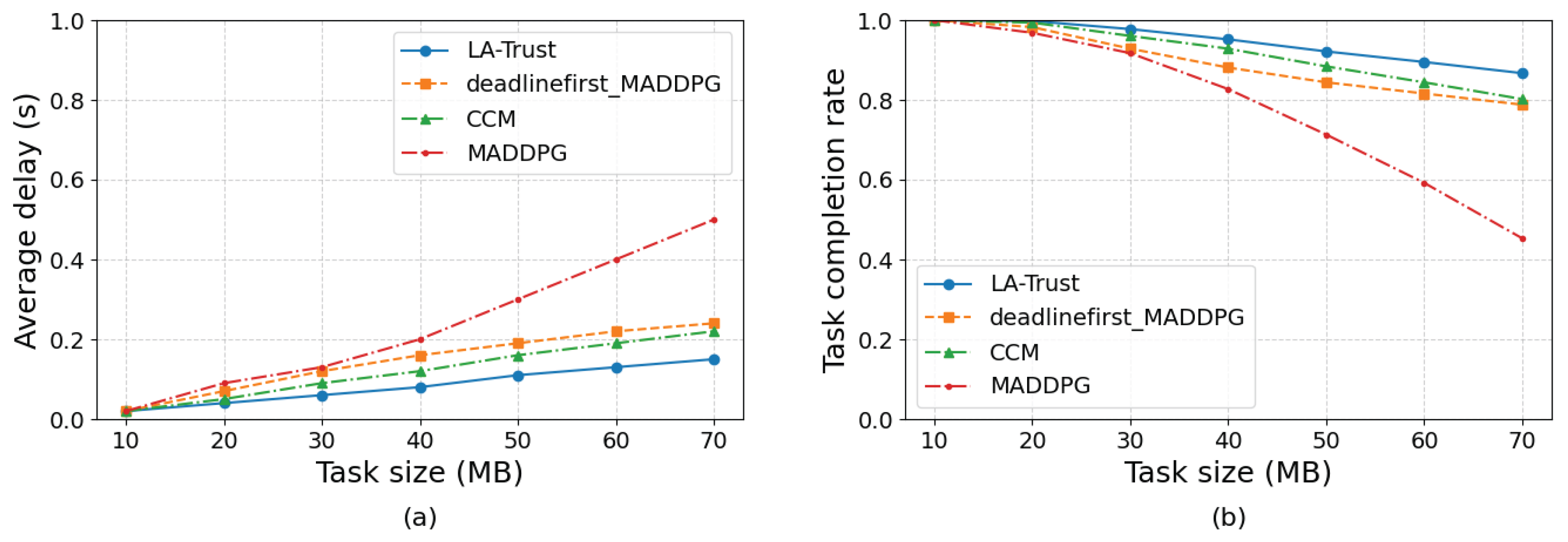
- We design the LA-Trust algorithm, a dual-node task offloading scheme built on DRL. It is developed on top of the conventional multi-agent deep deterministic policy gradient (MADDPG) framework, treating the partitioned subtasks as parallel flows, allowing concurrent uploading and processing across neighboring nodes, and incorporates node security into offloading decisions. This mechanism reduces latency and enhances offloading security compared with conventional MADDPG offloading algorithms.
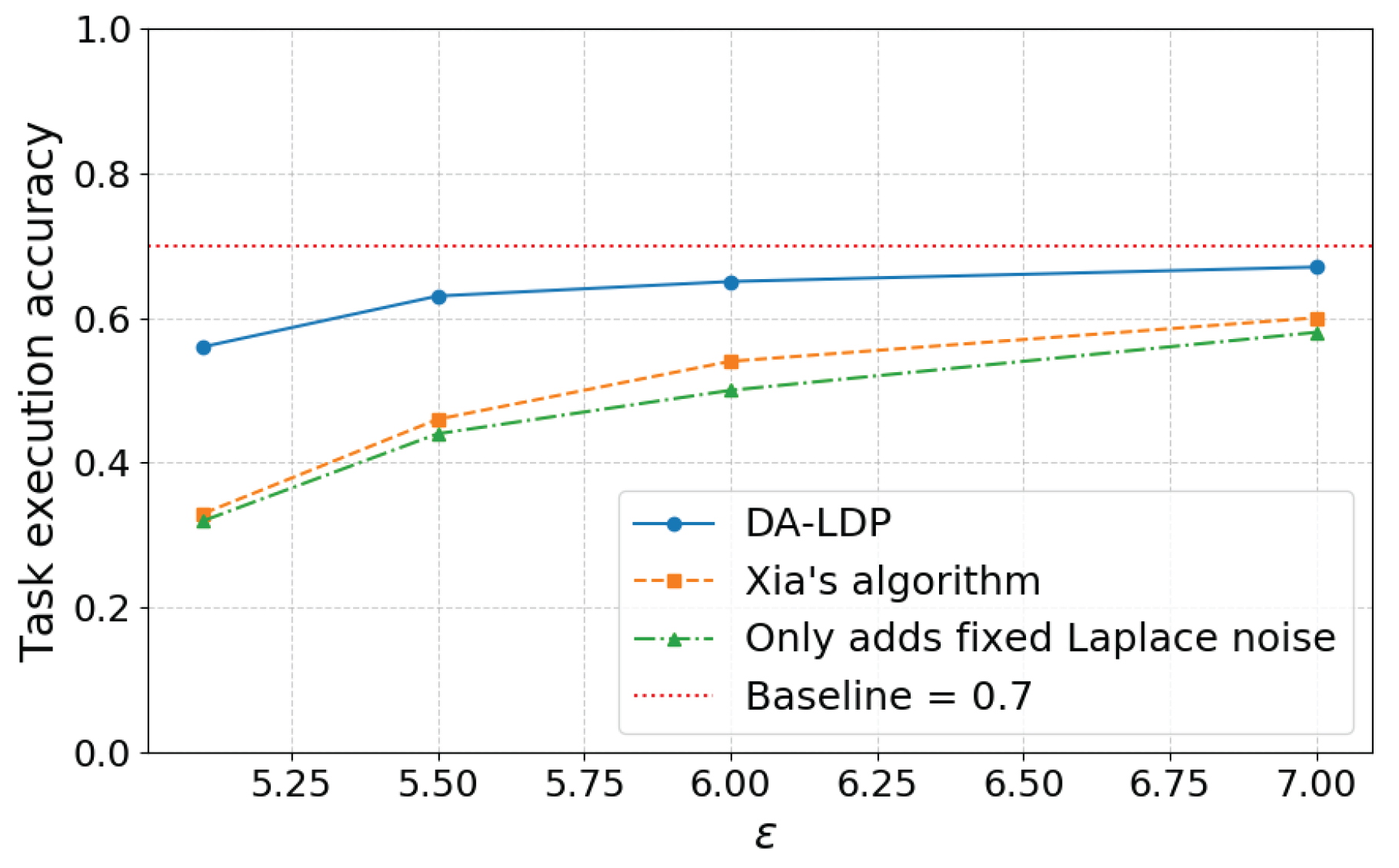
- We propose the DA-LDP algorithm, which leverages the Randomized Response (RR) mechanism to select perturbed data and applies Gaussian noise, and adaptively adjusts the perturbation level according to data heterogeneity. The design preserves formal privacy guarantees while mitigating the impact of data perturbation on task execution accuracy, outperforming traditional fixed-noise approaches in task execution accuracy.
- We develop the DC-RA algorithm, which builds upon conventional cost-minimization resource auction mechanisms and incorporates data transmission latency into the optimization function. By assigning higher rewards to idle vehicles closer to the edge node, the algorithm reduces communication latency, achieving better performance than conventional bidding schemes.
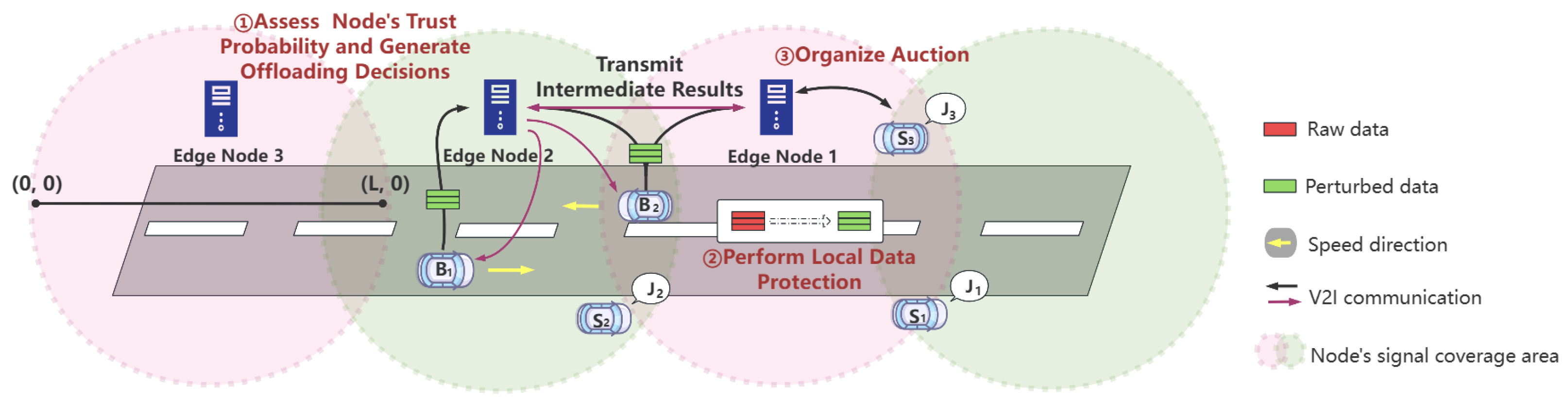
2. System Model
Modeling Assumptions and Applicability
3. Problem Formulation and Solution Approach
3.1. Joint Optimization Problem
3.2. Optimization Problem Decomposition
- Task Service Latency Minimization: This subproblem aims to reduce by efficiently scheduling and executing tasks across edge nodes, as well as by minimizing the communication latency incurred during the idle resource auction. This objective is collaboratively addressed by:
- LA-Trust: A dual-node task offloading algorithm based on a DRL framework. It reduces offloading delay by enabling parallel processing of task uploading and execution.
- DC-RA: A reverse auction based incentive mechanism. It reduces data transmission latency by incorporating the physical distance between edge nodes and idle vehicles into the incentive function.
Since these two latency components occur sequentially and are independent, their sum provides a reasonable approximation of the total system latency:where Z and denote the latency components computed by the LA-Trust and DC-RA algorithms, respectively. - Privacy Protection Maximization: This subproblem focuses on protecting vehicle privacy during task offloading. It considers both the security of task execution nodes and the data transmission process. This objective is collaboratively addressed by:
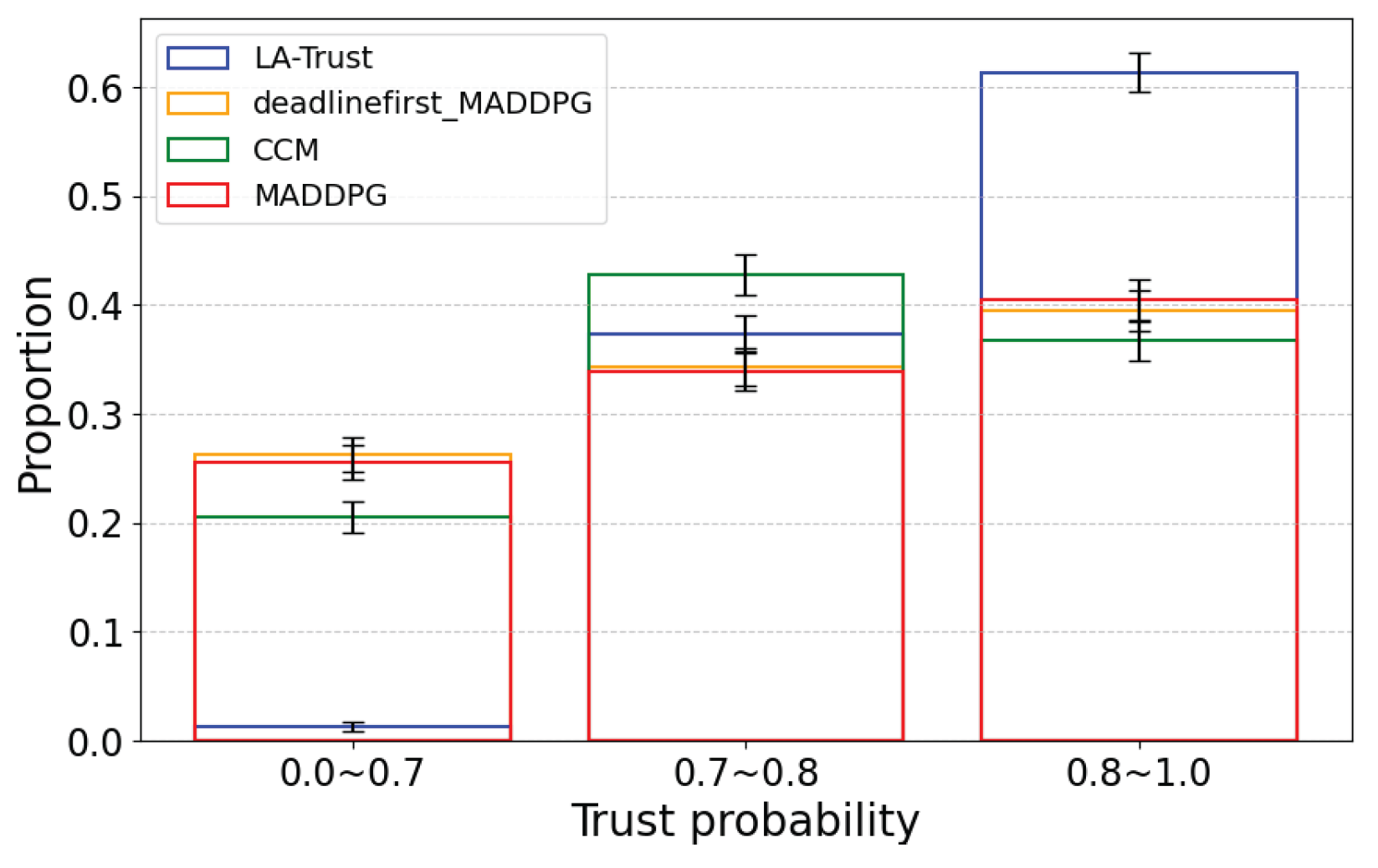
- LA-Trust: Updates the trust probability of edge nodes using Bayesian inference. This trust value directly affects offloading decisions.
- DA-LDP: Applies a RR mechanism to select data points for perturbation (hereafter referred to as the RR step) and applies adaptive Gaussian noise to locally perturb sensitive vehicle data. The noise level is adjusted according to data heterogeneity, ensuring task execution accuracy while maintaining the total privacy budget .
4. Location-Aware and Trust-Based Task Offloading Algorithm
4.1. Task Offloading Strategy
4.1.1. Processing Task Locally
4.1.2. Offloading Task to a Single Edge Node
4.1.3. Offloading Task to Two Neighboring Edge Nodes
- The transmission time of subtask A to edge node 1 is .
- The transmission time of subtask B to edge node 2 is .
- The processing time of subtask A at edge node 1 is .
- The processing time of subtask B at edge node 2 is .
4.1.4. Local and Single-Edge Collaborative Processing
4.2. Problem Formulation
4.3. Algorithm Design
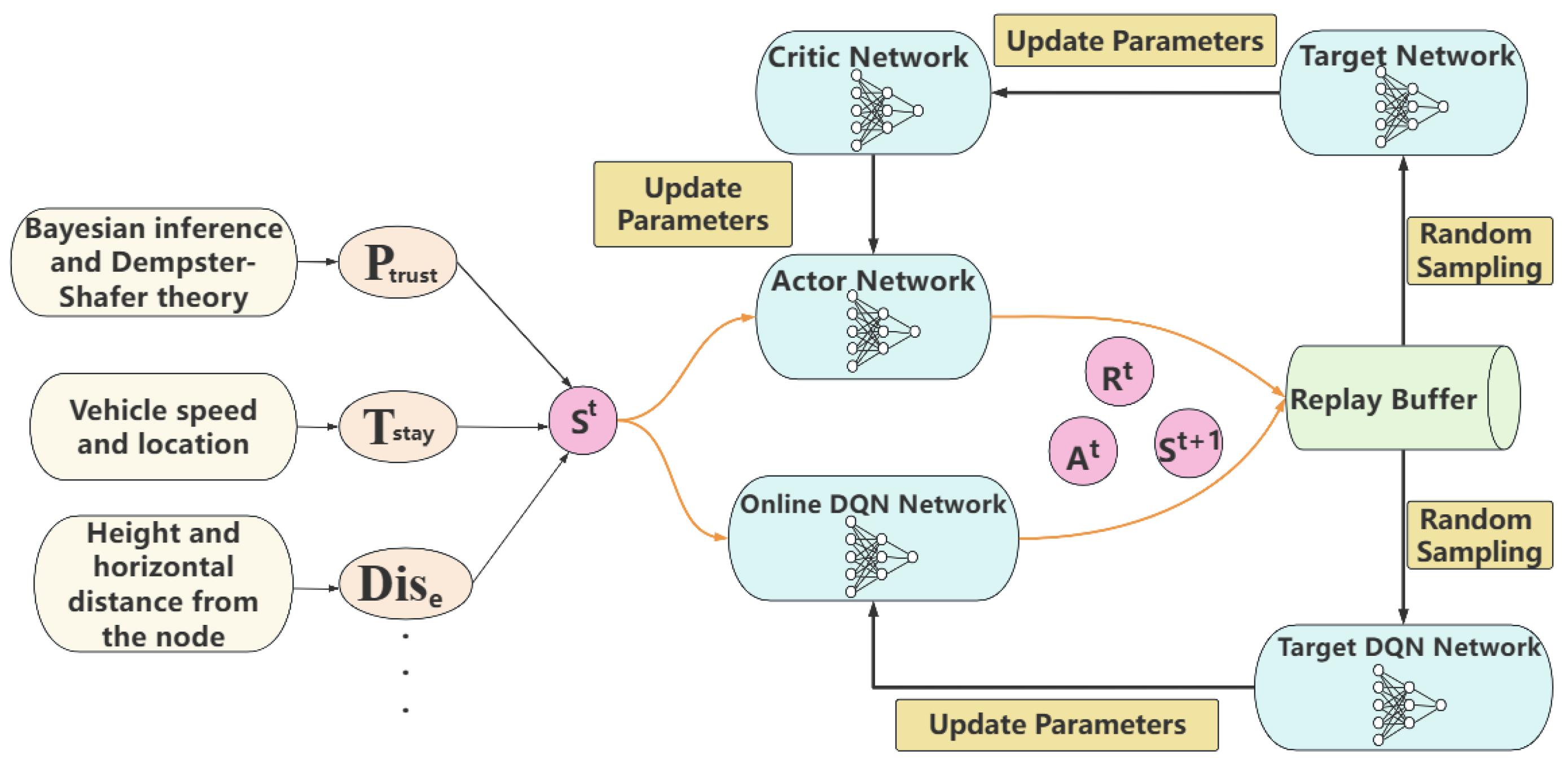
- System state: The system state observed by edge node e at time t is denoted as:Here, is the set of distances between vehicles and edge node e, K is the set of vehicle task information, is the set of dwell times within the coverage of edge node e, and is the set of trust probabilities of nodes. The overall system state at time t is represented as .
- Action space: The action space is defined by the offloading ratio r and the edge node index e, where r denotes the proportion of subtask i. The action space contains both continuous and discrete variables.The set of actions for all edge nodes at time t is denoted as .
- Reward function: The objective is to minimize the cost function f and enhance security. The reward for edge node e at time t is defined as:The set of rewards for all edge nodes at time t is .
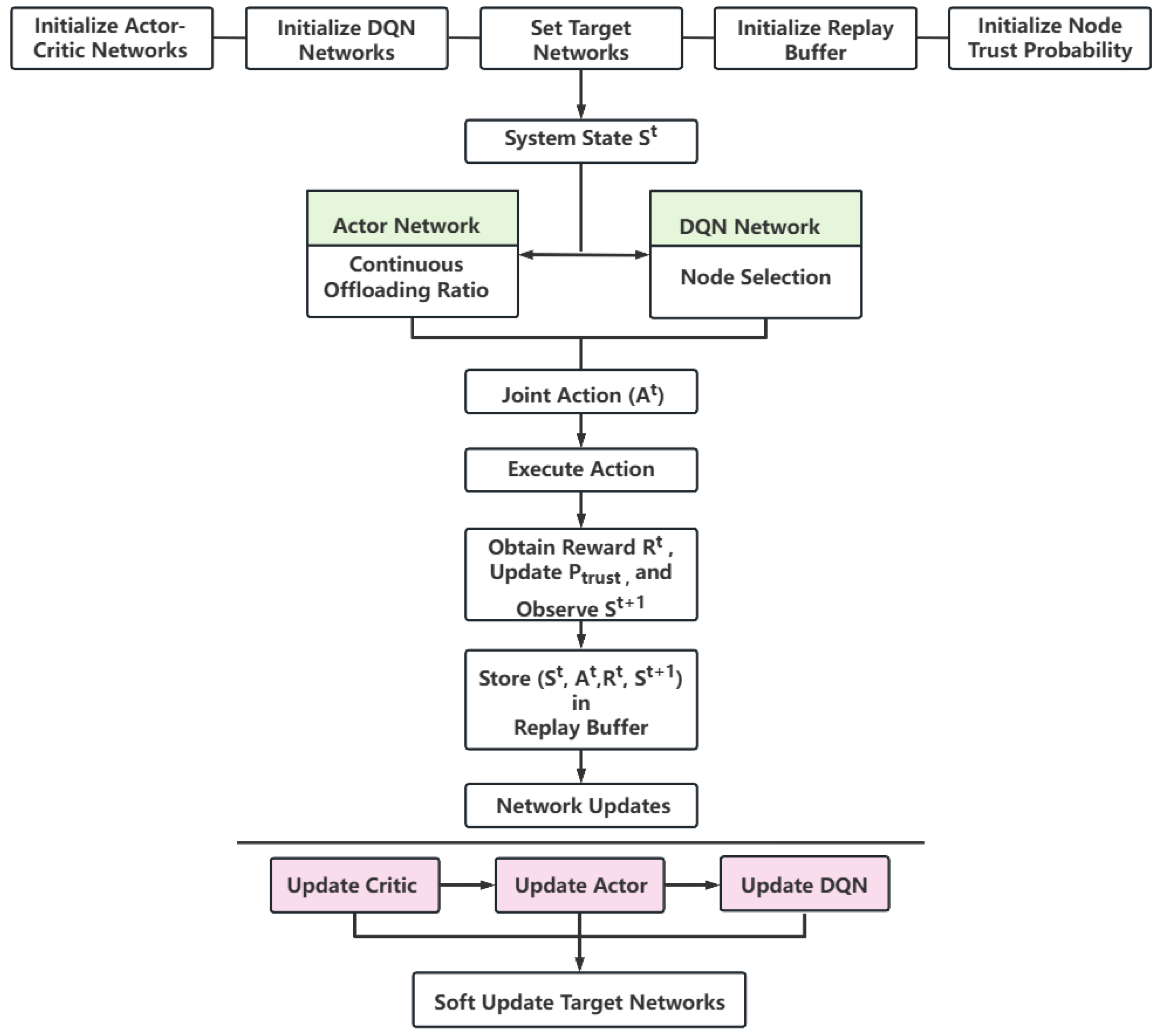
| Algorithm 1 LA-Trust Algorithm | |
| 1: | Initialize Actor network , Critic network , and DQN network |
| 2: | Initialize target networks: |
| 3: | Initialize replay buffer B |
| 4: | Set exploration noise |
| 5: | for each episode do |
| 6: | for to T do |
| 7: | Reset environment and obtain initial state |
| 8: | Initialize node trust probabilities |
| 9: | for each task to E do |
| 10: | Compute vehicle metrics: staying time and distance |
| 11: | Actor: generate continuous offloading ratios |
| 12: | DQN: select discrete offloading node |
| 13: | Execute hybrid action |
| 14: | Obtain reward , Update trust probability , and observe next state |
| 15: | end for |
| 16: | Store transition in buffer B |
| 17: | Sample mini-batch from B |
| 18: | Critic update: compute and update using Equations (15) and (16) |
| 19: | Actor update: compute and update using Equation (17) |
| 20: | DQN update: compute and update using Equations (20) and (21) |
| 21: | Soft update all target networks: |
| 22: | end for |
| 23: | end for |
5. Distribution-Aware Local Differential Privacy Algorithm
5.1. Data Perturbation Strategy
5.2. Threat Model
5.3. Problem Formulation
5.4. Algorithm Design
| Algorithm 2 DA-LDP algorithm | |
| 1: | Input: Original dataset D, , , , , |
| 2: | Output: Perturbed dataset |
| 3: | Compute the minimum variance according to |
| 4: | Obtain the dataset size U and set |
| 5: | Calculate the kernel according to Equation (24), and generate Gaussian noise according to Equation (27) |
| 6: | Use probability to select data points |
| 7: | Add the generated Gaussian noise to the chosen data |
6. Delay-Cost Reverse Auction Algorithm for Resource Incentive
6.1. Resource Auction Strategy
6.2. Problem Formulation
6.3. Algorithm Design
| Algorithm 3 DC-RA Algorithm | |
| 1: | Input: C |
| 2: | Output: |
| 3: | Initialize , , F, |
| 4: | for in do |
| 5: | Compute the cost using Equations (31) and (32), store the result in list F |
| 6: | end |
| 7: | Sort the list F in ascending order |
| 8: | for each element in F do |
| 9: | If |
| 10: | Add vehicle s to and update |
| 11: | end |
7. Experiment Results and Discussion
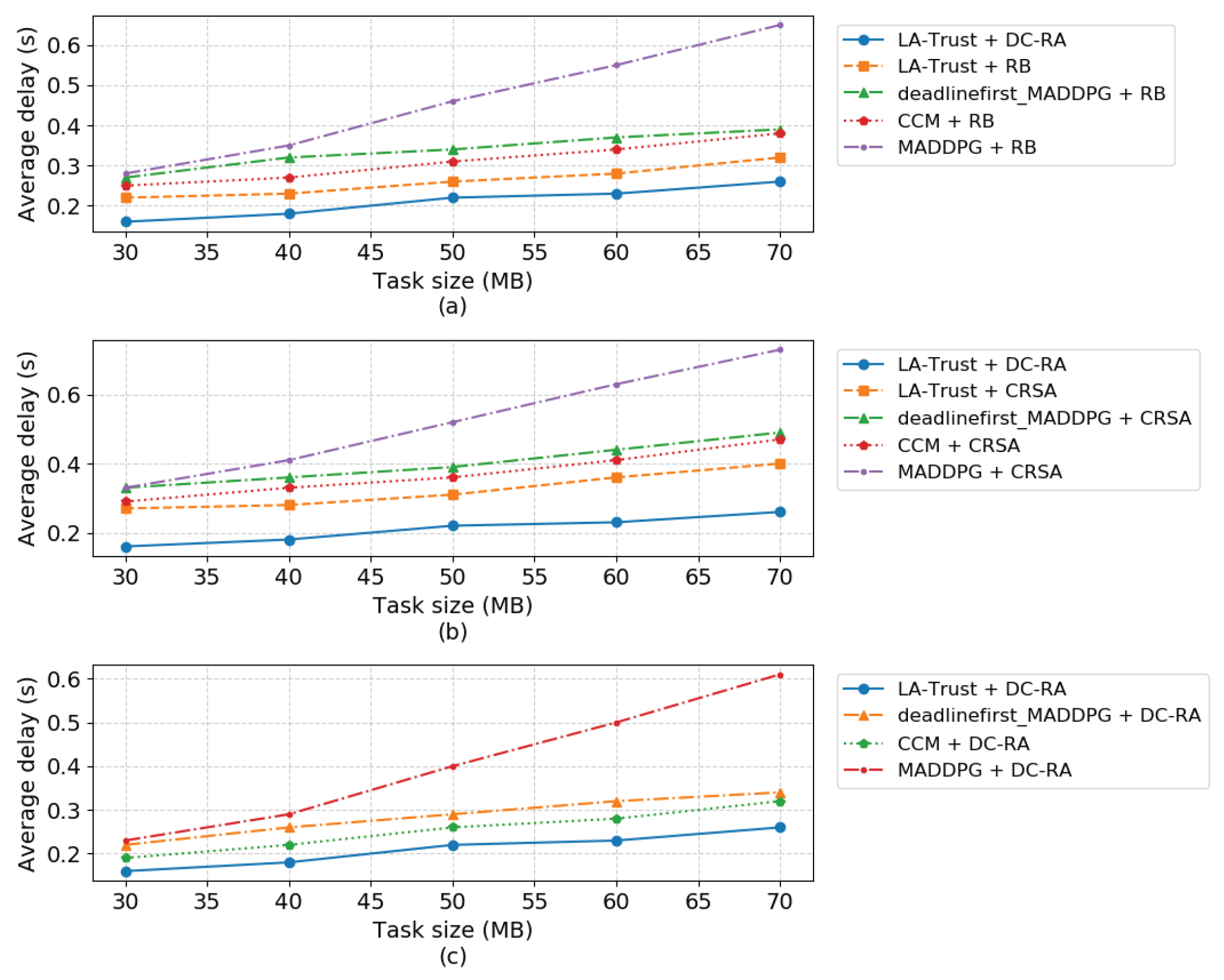
7.1. Evaluation of LA-Trust Algorithm
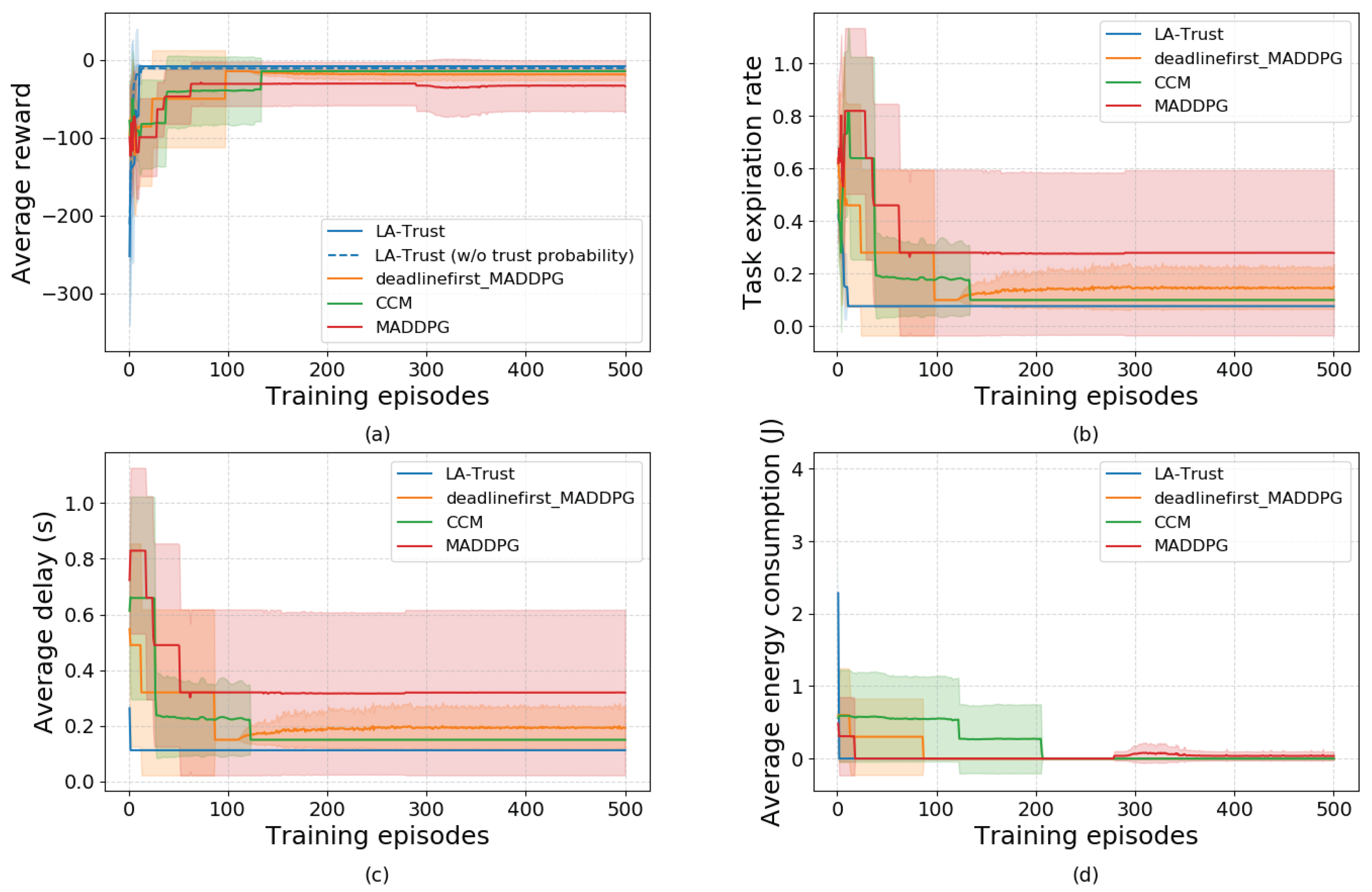
- MADDPG: The baseline algorithm on which the proposed method is built.
- Deadline-MADDPG: Based on MADDPG, vehicle tasks are sorted in ascending order according to their deadlines and offloaded to edge nodes sequentially.
- CCM [54]: A hybrid MADDPG algorithm introducing hybrid strategies.
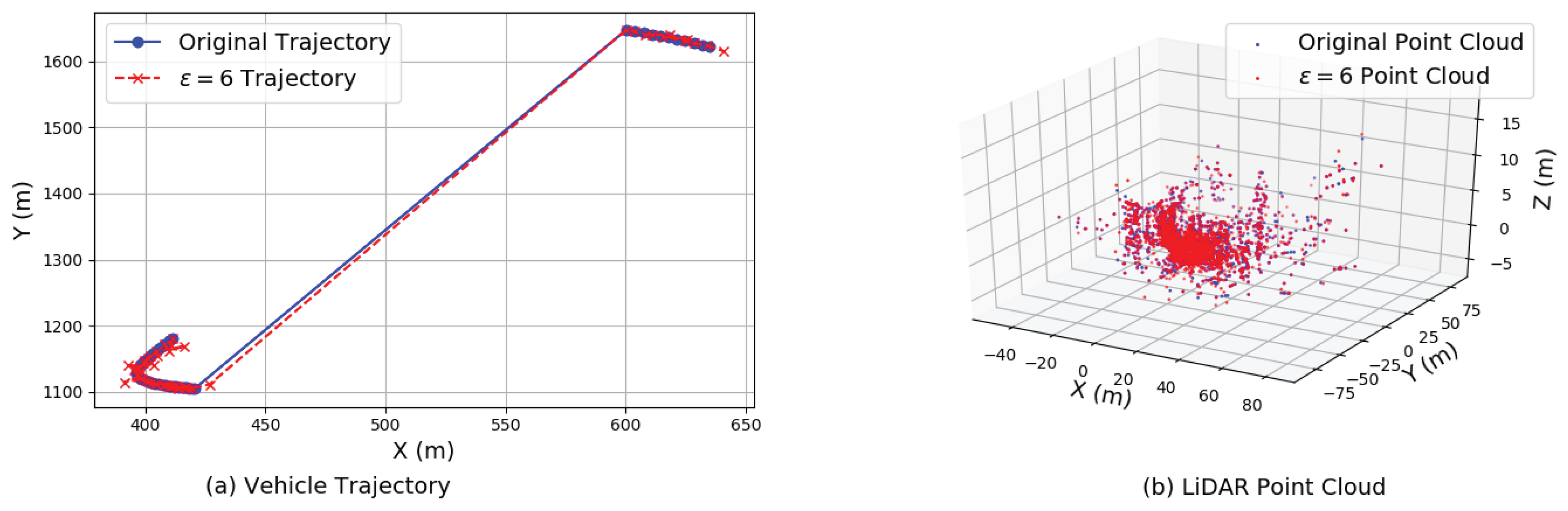
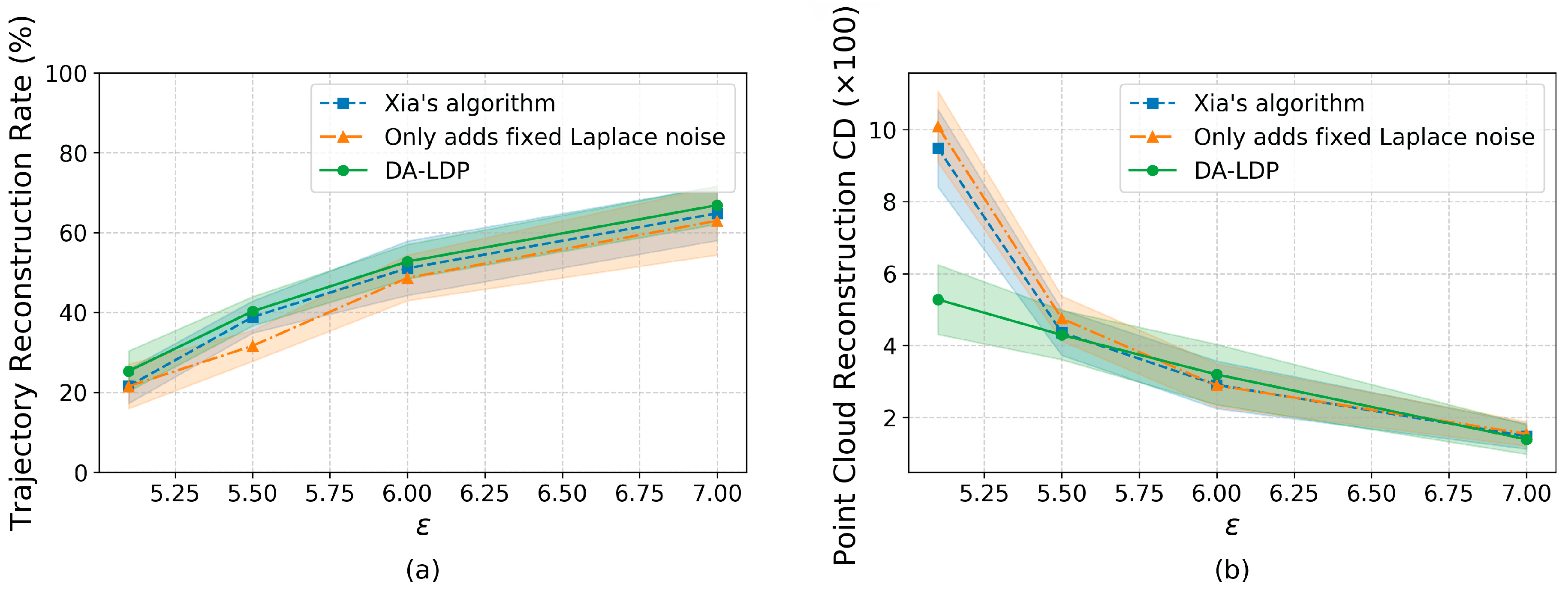
7.2. Evaluation of DA-LDP Algorithm
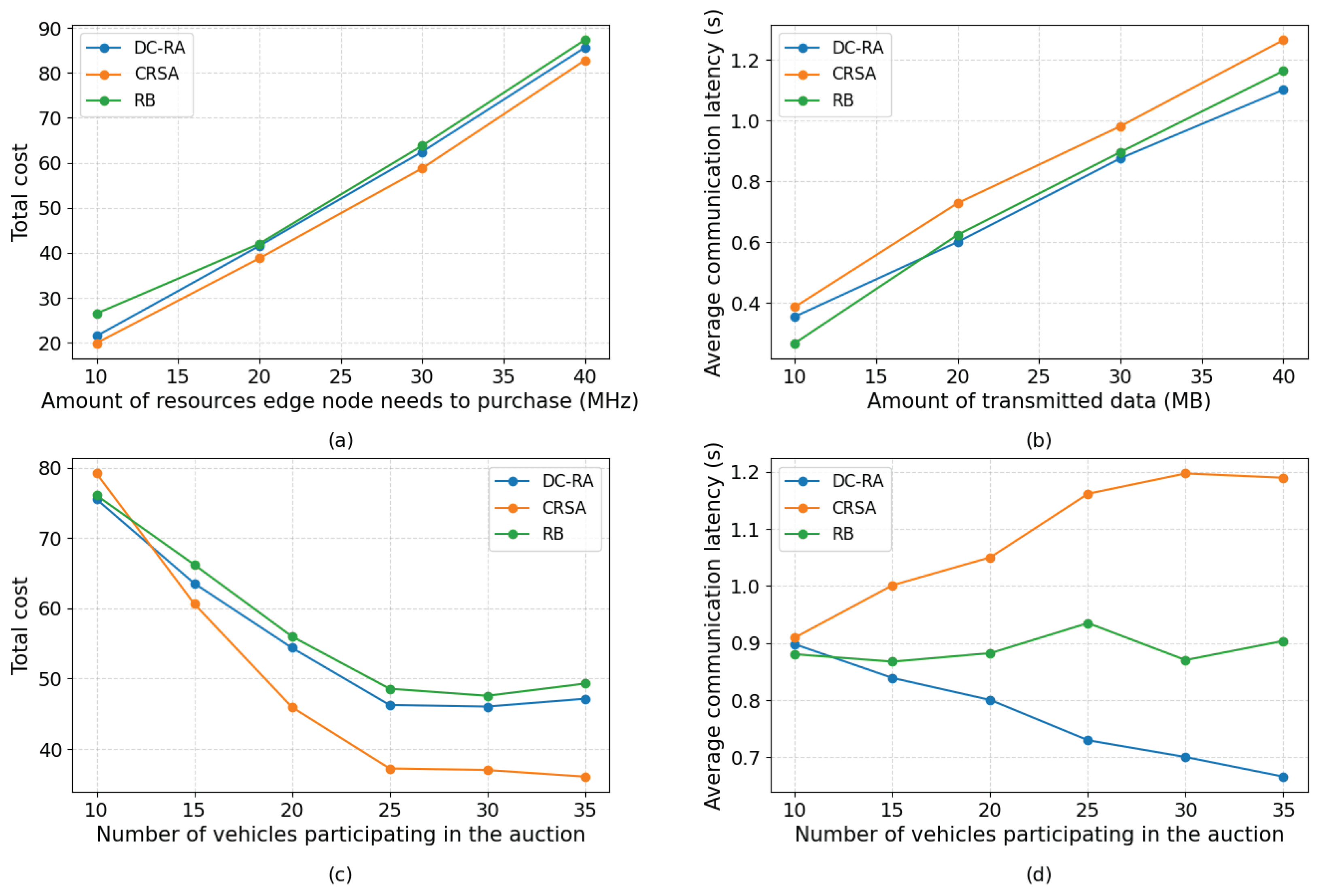
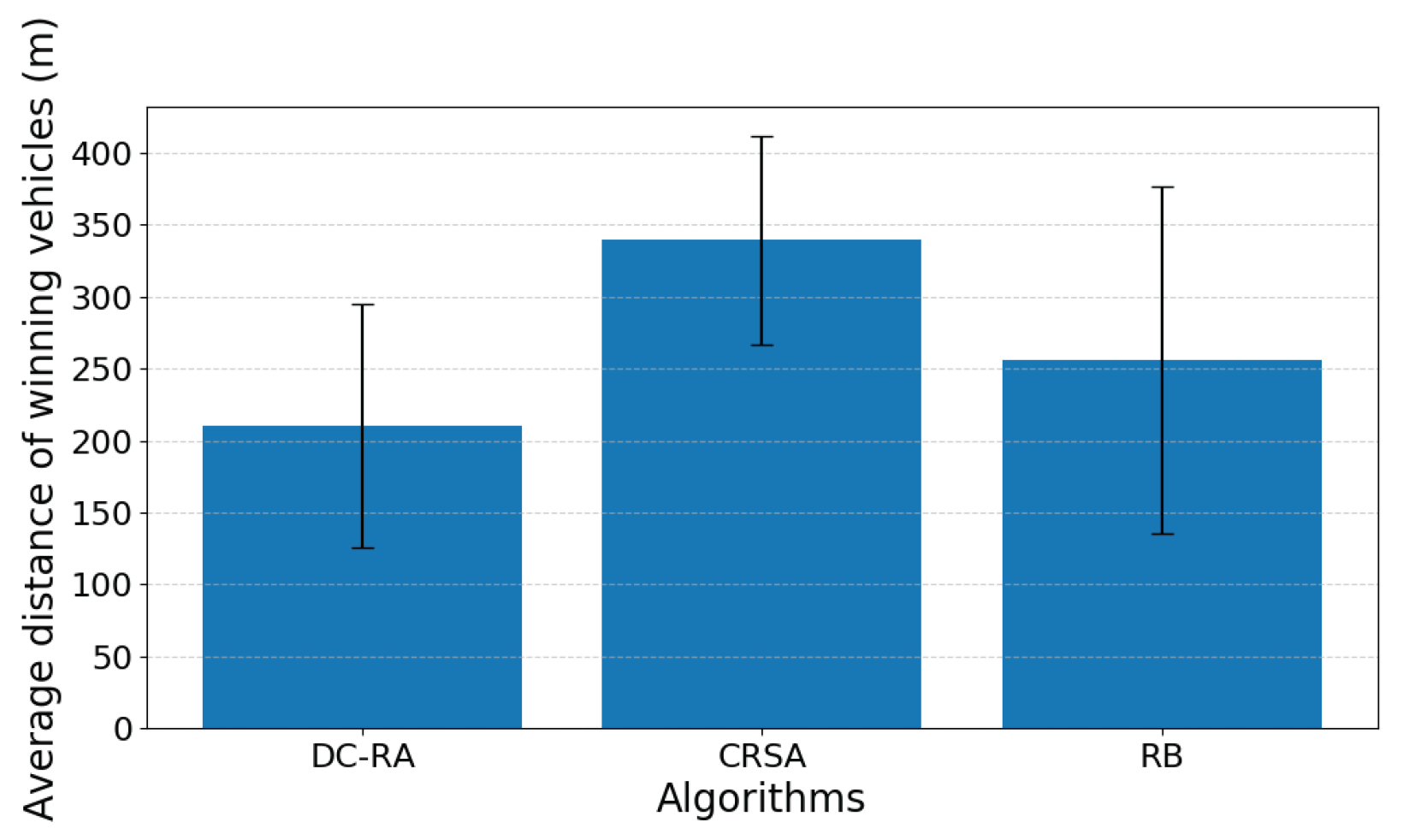
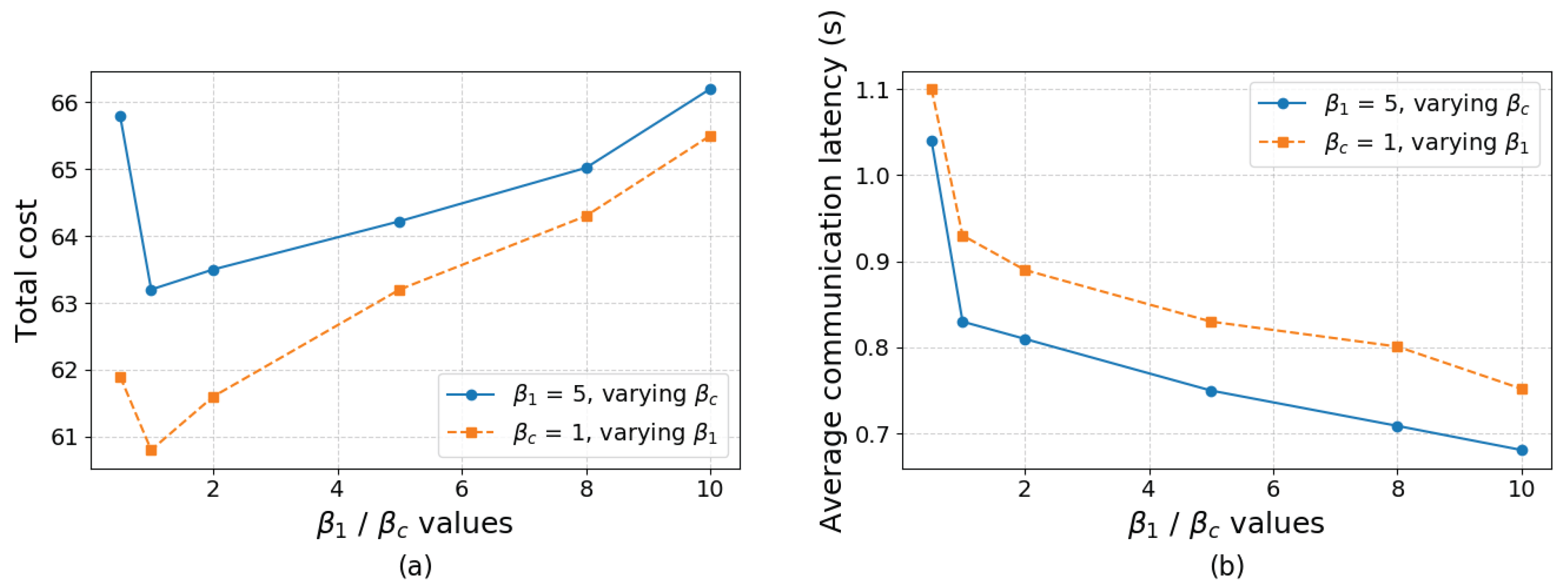
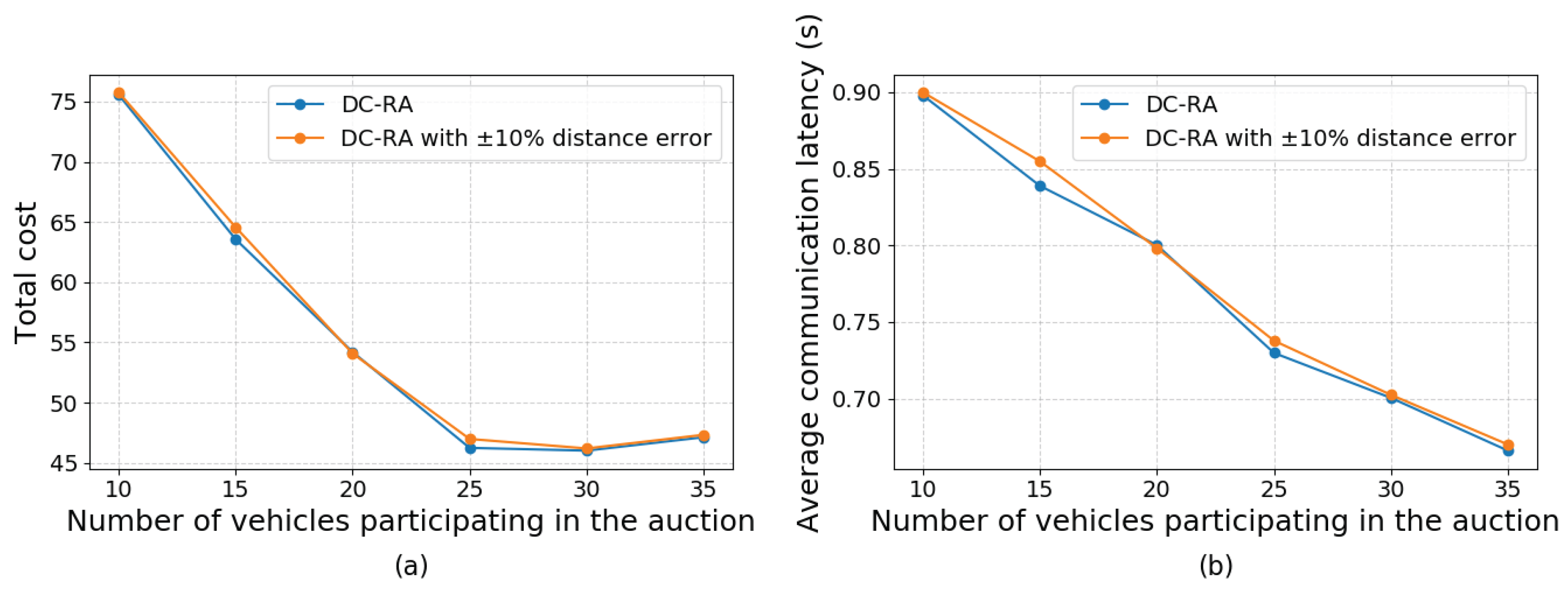
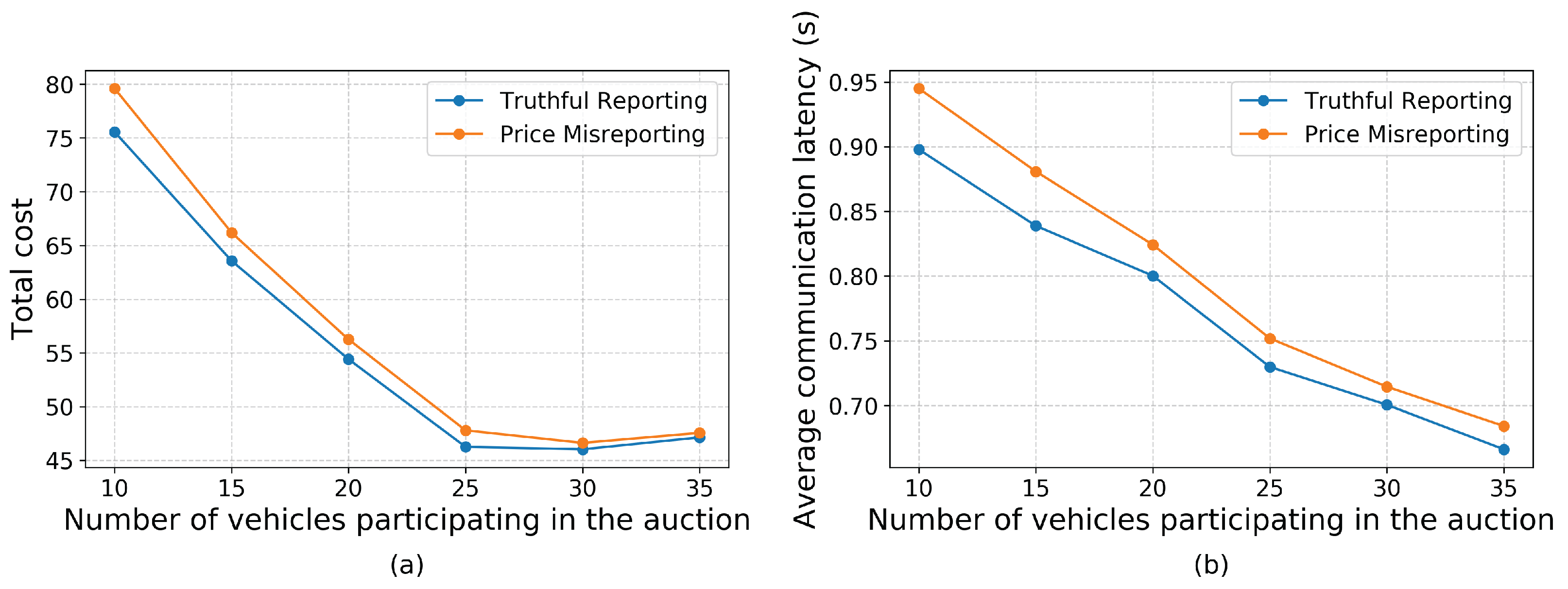
7.3. Evaluation of DC-RA Algorithm
7.4. End-to-End Latency Evaluation of the Framework
7.5. End-to-End Privacy Risk Evaluation of the Framework
8. Conclusions
8.1. Concluding Remarks
8.2. Future Work
Author Contributions
Funding
Institutional Review Board Statement
Informed Consent Statement
Data Availability Statement
Acknowledgments
Conflicts of Interest
Appendix A. Time and Space Complexity Analysis of LA-Trust Algorithm
Appendix A.1. Symbol Definition and Step Analysis
- B: number of busy vehicles
- : number of tasks per vehicle
- E: number of edge nodes
- , , : number of parameters in Actor, Critic, DQN networks
- N: mini-batch size
- : number of experts used for initialization of node trust
- : number of evidences used for Bayesian update of node trust
- : replay buffer size

| Module | Time Complexity | Space Complexity |
|---|---|---|
| Vehicle information computation | ||
| Actor forward pass | ||
| DQN forward pass | ||
| Node trust evaluation |
| Module | Time Complexity | Space Complexity |
|---|---|---|
| Vehicle information computation | ||
| Actor forward pass | ||
| DQN forward pass | ||
| Node trust evaluation | ||
| Critic update | ||
| Actor update | ||
| DQN update | ||
| Soft target update | ||
| Replay buffer storage |
Appendix A.2. Overall Complexity Summary
- Inference:
- -
- Time Complexity:
- -
- Space Complexity:
- Training:
- -
- Time Complexity:
- -
- Space Complexity:
Appendix B. Time and Space Complexity Analysis of DA-LDP Algorithm
Appendix B.1. Symbol Definition and Step Analysis
- U: total number of data points in the dataset
- w: dimensionality of each data point
- k: number of neighbors used in k-NN calculation ( in the algorithm)
- p: probability of selecting a data point for perturbation under the RR step
| Module | Time Complexity | Space Complexity |
|---|---|---|
| Minimum Gaussian variance computation | ||
| k-NN distance and kernel computation | ||
| Randomized Response selection | ||
| Gaussian noise generation and addition |
Appendix B.2. Overall Complexity Summary
- Time Complexity:
- Space Complexity:
Appendix C. Illustrative Example of Node Trust Initialization and Evolution
Appendix C.1. Initialization via DST
Appendix C.2. Bayesian Update with Three Trust States
- Model with:
- Model with:
Example:
References
- Rajashekara, K.; Koppera, S. Data and energy impacts of intelligent transportation—A review. World Electr. Veh. J. 2024, 15, 262. [Google Scholar] [CrossRef]
- Liu, L.; Lu, S.; Zhong, R.; Wu, B.; Yao, Y.; Zhang, Q.; Shi, W. Computing Systems for Autonomous Driving: State of the Art and Challenges. IEEE Internet Things J. 2021, 8, 6469–6486. [Google Scholar] [CrossRef]
- Gu, J.; Lind, A.; Chhetri, T.R.; Bellone, M.; Sell, R. End-to-End Multimodal Sensor Dataset Collection Framework for Autonomous Vehicles. Sensors 2023, 23, 6783. [Google Scholar] [CrossRef]
- Wang, X.; Zhu, Z.; Zhang, Y.; Huang, G.; Ye, Y.; Xu, W.; Chen, Z.; Wang, X. Are We Ready for Vision-Centric Driving Streaming Perception? The ASAP Benchmark. In Proceedings of the 2023 IEEE/CVF Conference on Computer Vision and Pattern Recognition (CVPR); IEEE: Piscataway, NJ, USA, 2023; pp. 9600–9610. [Google Scholar] [CrossRef]
- Zhao, L.; Zhang, E.; Wan, S.; Hawbani, A.; Al-Dubai, A.Y.; Min, G.; Zomaya, A.Y. MESON: A mobility-aware dependent task offloading scheme for urban vehicular edge computing. IEEE Trans. Mob. Comput. 2023, 23, 4259–4272. [Google Scholar] [CrossRef]
- Zhou, Z.; Memedi, A.; Lee, C.; Ucar, S.; Altintas, O.; Dressler, F. Task migration with deadlines using machine learning-based dwell time prediction in vehicular micro clouds. High-Confid. Comput. 2025, 5, 100314. [Google Scholar] [CrossRef]
- Cha, N.; Wu, C.; Yoshinaga, T.; Ji, Y.; Yau, K.L.A. Virtual Edge: Exploring Computation Offloading in Collaborative Vehicular Edge Computing. IEEE Access 2021, 9, 37739–37751. [Google Scholar] [CrossRef]
- Zhang, S.; Guo, P.; Jin, H. Reducing Latency in NOMA-aided MEC Networks: A Deep Reinforcement Learning Approach. In Proceedings of the 2024 22nd International Symposium on Modeling and Optimization in Mobile, Ad Hoc, and Wireless Networks (WiOpt); IEEE: Piscataway, NJ, USA, 2024; pp. 105–110. [Google Scholar]
- Ahmadi, A.; Høst-Madsen, A.; Xiong, Z. Latency and energy minimization in NOMA-assisted MEC network: A federated deep reinforcement learning approach. In Proceedings of the 2024 IEEE Symposium on Computers and Communications (ISCC); IEEE: Piscataway, NJ, USA, 2024; pp. 1–6. [Google Scholar]
- Yakubu, A.B.; Abd El-Malek, A.H.; Abo-Zahhad, M.; Muta, O.; Elsabrouty, M.M. Task offloading and resource allocation in an RIS-assisted NOMA-based vehicular edge computing. IEEE Access 2024, 12, 124330–124348. [Google Scholar] [CrossRef]
- Xue, J.; Yu, Q.; Wang, L.; Fan, C. Vehicle task offloading strategy based on DRL in communication and sensing scenarios. Ad Hoc Netw. 2024, 159, 103497. [Google Scholar] [CrossRef]
- Jiang, Q.; Xu, X.; He, Q.; Zhang, X.; Dai, F.; Qi, L.; Dou, W. Game theory-based task offloading and resource allocation for vehicular networks in edge-cloud computing. In Proceedings of the 2021 IEEE International Conference on Web Services (ICWS); IEEE: Piscataway, NJ, USA, 2021; pp. 341–346. [Google Scholar]
- Chen, T.; Wang, X.; Hua, M.; Tang, Q. Incentive-based task offloading for digital twins in 6G native artificial intelligence networks: A learning approach. Front. Inf. Technol. Electron. Eng. 2025, 26, 214–229. [Google Scholar] [CrossRef]
- Mohanapriya, M.; Anusuya, V.; Aravindhan, K.; Krishnaveni, N.; Santhosh, R.; Gowthami, D. Optimizing Task Offloading in Vehicular Network (OTO): A Game Theory Approach Integrating Hybrid Edge and Cloud Computing. J. Cybersecur. Inf. Manag. 2025, 15, 115–132. [Google Scholar] [CrossRef]
- Liu, Z.; Jia, Z.; Pang, X. DRL-Based Hybrid Task Offloading and Resource Allocation in Vehicular Networks. Electronics 2023, 12, 4392. [Google Scholar] [CrossRef]
- Chen, Y.; Hu, X.; Chai, H.; Zhang, K.; Wu, F.; Gu, L. Deep Reinforcement Learning-Based Joint Task Offloading and Radio Resource Allocation for Platoon-Assisted Vehicular Edge Computing. In International Conference on 5G for Future Wireless Networks; Springer International Publishing: Cham, Switzerland, 2021. [Google Scholar] [CrossRef]
- Wu, Q.; Wang, S.; Ge, H.; Fan, P.; Fan, Q.; Letaief, K.B. Delay-Sensitive Task Offloading in Vehicular Fog Computing-Assisted Platoons. IEEE Trans. Netw. Serv. Manag. 2024, 21, 2012–2026. [Google Scholar] [CrossRef]
- Chen, R.; Fan, Y.; Yuan, S.; Hao, Y. Vehicle Collaborative Partial Offloading Strategy in Vehicular Edge Computing. Mathematics 2024, 12, 1466. [Google Scholar] [CrossRef]
- Pan, J.; Cui, J.; Wei, L.; Xu, Y.; Zhong, H. Secure data sharing scheme for VANETs based on edge computing. EURASIP J. Wirel. Commun. Netw. 2019, 2019, 169. [Google Scholar] [CrossRef]
- Zhou, Z.; Wang, N.; Liu, J.; Zhou, W.; Fu, J.; Deng, L. Conditional privacy-preserving and efficient distributed IoV data sharing scheme based on a hierarchical and zonal blockchain. Veh. Commun. 2024, 49, 100832. [Google Scholar] [CrossRef]
- Yao, Y.; Chang, X.; Mišić, J.; Mišić, V.B. Lightweight and Privacy-Preserving ID-as-a-Service Provisioning in Vehicular Cloud Computing. IEEE Trans. Veh. Technol. 2020, 69, 2185–2194. [Google Scholar] [CrossRef]
- Safi Ibrahim, M.H.; Shaaban, E. Towards an Optimum Authentication Service Allocation and Availability in VANETs. Int. J. Netw. Secur. 2005, 19, 955–965. [Google Scholar]
- Dwork, C. Differential privacy. In Proceedings of the International Colloquium on Automata, Languages, and Programming; Springer: Berlin/Heidelberg, Germany, 2006; pp. 1–12. [Google Scholar]
- Firdaus, M.; Rhee, K.H. A Joint Framework to Privacy-Preserving Edge Intelligence in Vehicular Networks. In Proceedings of the Information Security Applications; You, I., Youn, T.Y., Eds.; Springer: Cham, Switzerland, 2023; pp. 156–167. [Google Scholar]
- Firdaus, M.; Larasati, H.T.; Rhee, K.-H. A Blockchain-Assisted Distributed Edge Intelligence for Privacy-Preserving Vehicular Networks. Comput. Mater. Contin. 2023, 76, 2959–2978. [Google Scholar] [CrossRef]
- Xia, F.; Chen, Y.; Huang, J. Privacy-preserving task offloading in mobile edge computing: A deep reinforcement learning approach. Softw. Pract. Exp. 2024, 54, 1774–1792. [Google Scholar] [CrossRef]
- Li, Y.; Yang, B.; Wu, H.; Han, Q.; Chen, C.; Guan, X. Joint offloading decision and resource allocation for vehicular fog-edge computing networks: A contract-stackelberg approach. IEEE Internet Things J. 2022, 9, 15969–15982. [Google Scholar] [CrossRef]
- Thi Le, T.H.; Tran, N.H.; Tun, Y.K.; Tran Thi Kim, O.; Kim, K.; Hong, C.S. Sharing Incentive Mechanism, Task Assignment and Resource Allocation for Task Offloading in Vehicular Mobile Edge Computing. In Proceedings of the NOMS 2020—2020 IEEE/IFIP Network Operations and Management Symposium; IEEE: Piscataway, NJ, USA, 2020; pp. 1–8. [Google Scholar] [CrossRef]
- Liwang, M.; Dai, S.; Gao, Z.; Tang, Y.; Dai, H. A truthful reverse-auction mechanism for computation offloading in cloud-enabled vehicular network. IEEE Internet Things J. 2018, 6, 4214–4227. [Google Scholar] [CrossRef]
- Liu, X.; Liu, J.; Du, C.; Zeng, X.; Li, W. Budget-feasible truthful mechanism for resource allocation and pricing in vehicle computing. J. Commun. Netw. 2025, 27, 103–118. [Google Scholar] [CrossRef]
- Pu, X.; Lei, T.; Wen, W.; Feng, W.; Wang, Z.; Chen, Q.; Jin, S. Incentive mechanism and resource allocation for collaborative task offloading in energy-efficient mobile edge computing. IEEE Trans. Veh. Technol. 2023, 72, 13775–13780. [Google Scholar] [CrossRef]
- Zhang, H.; Guo, F.; Ji, H.; Zhu, C. Combinational Auction-Based Service Provider Selection in Mobile Edge Computing Networks. IEEE Access 2017, 5, 13455–13464. [Google Scholar] [CrossRef]
- Peng, X.; Zhang, Y.; Zhang, X.; Zhang, C.; Yang, W. Collaborative Optimization Strategy for Dependent Task Offloading in Vehicular Edge Computing. Mathematics 2024, 12, 3820. [Google Scholar] [CrossRef]
- Yang, C.; Liu, Y.; Chen, X.; Zhong, W.; Xie, S. Efficient mobility-aware task offloading for vehicular edge computing networks. IEEE Access 2019, 7, 26652–26664. [Google Scholar] [CrossRef]
- Pang, S.; Hou, L.; Gui, H.; He, X.; Wang, T.; Zhao, Y. Multi-mobile vehicles task offloading for vehicle-edge-cloud collaboration: A dependency-aware and deep reinforcement learning approach. Comput. Commun. 2024, 213, 359–371. [Google Scholar] [CrossRef]
- Jang, Y.; Jeong, S.; Kang, J. Energy-efficient vehicular edge computing with one-by-one access scheme. IEEE Wirel. Commun. Lett. 2023, 13, 39–43. [Google Scholar] [CrossRef]
- Raza, S.; Liu, W.; Ahmed, M.; Anwar, M.R.; Mirza, M.A.; Sun, Q.; Wang, S. An efficient task offloading scheme in vehicular edge computing. J. Cloud Comput. 2020, 9, 28. [Google Scholar] [CrossRef]
- Mohammadi, H.; Mohammadkhani, R. Beam switching techniques for millimeter wave vehicle to infrastructure communications. In Proceedings of the 2017 7th International Conference on Computer and Knowledge Engineering (ICCKE); IEEE: Piscataway, NJ, USA, 2017; pp. 333–338. [Google Scholar]
- Xia, Y.; Zhang, H.; Zhou, X.; Yuan, D. Location-aware and delay-minimizing task offloading in vehicular edge computing networks. IEEE Trans. Veh. Technol. 2023, 72, 16266–16279. [Google Scholar] [CrossRef]
- Lin, Q.; Ren, D. Quantitative trust assessment method based on Bayesian network. In Proceedings of the 2016 IEEE Advanced Information Management, Communicates, Electronic and Automation Control Conference (IMCEC); IEEE: Piscataway, NJ, USA, 2016; pp. 1861–1864. [Google Scholar]
- Bayes, T. An essay towards solving a problem in the doctrine of chances. Biometrika 1958, 45, 296–315. [Google Scholar] [CrossRef]
- Coventry, B.S.; Bartlett, E.L. Practical Bayesian Inference in Neuroscience: Or How I Learned To Stop Worrying and Embrace the Distribution. Eneuro 2024, 11, 1–28. [Google Scholar] [CrossRef]
- Erlingsson, U.; Pihur, V.; Korolova, A. RAPPOR: Randomized Aggregatable Privacy-Preserving Ordinal Response. In Proceedings of the Proceedings of the 2014 ACM SIGSAC Conference on Computer and Communications Security (CCS ’14); ACM: New York, NY, USA, 2014; pp. 1054–1067. [Google Scholar] [CrossRef]
- Wang, T.; Zhang, X.; Feng, J.; Yang, X. A comprehensive survey on local differential privacy toward data statistics and analysis. Sensors 2020, 20, 7030. [Google Scholar] [CrossRef] [PubMed]
- Dwork, C.; Roth, A. The algorithmic foundations of differential privacy. Found. Trends® Theor. Comput. Sci. 2014, 9, 211–407. [Google Scholar] [CrossRef]
- Bun, M. A Teaser for Differential Privacy. 2017. Available online: https://www.cs.princeton.edu/~smattw/Teaching/521fa17lec22.pdf (accessed on 8 March 2024).
- Von Brünken, J.; Houle, M.E.; Zimek, A. Intrinsic dimensional outlier detection in high-dimensional data. NII Tech. Rep. 2015, 2015, 1–12. [Google Scholar]
- Hu, W.; Gao, J.; Li, B.; Wu, O.; Du, J.; Maybank, S. Anomaly detection using local kernel density estimation and context-based regression. IEEE Trans. Knowl. Data Eng. 2018, 32, 218–233. [Google Scholar] [CrossRef]
- Kairouz, P.; Oh, S.; Viswanath, P. The composition theorem for differential privacy. In Proceedings of the International Conference on Machine Learning; PMLR: New York, NY, USA, 2015; pp. 1376–1385. [Google Scholar]
- Guo, J.; Ding, X.; Wang, T.; Jia, W. Combinatorial resources auction in decentralized edge-thing systems using blockchain and differential privacy. Inf. Sci. 2022, 607, 211–229. [Google Scholar] [CrossRef]
- Balcan, M.F.; Sandholm, T.; Vitercik, E. Estimating Approximate Incentive Compatibility. In Proceedings of the 2019 ACM Conference on Economics and Computation (EC ’19); ACM: New York, NY, USA, 2019; p. 867. [Google Scholar] [CrossRef]
- Zhang, J.; Du, J.; Shen, Y.; Wang, J. Dynamic computation offloading with energy harvesting devices: A hybrid-decision-based deep reinforcement learning approach. IEEE Internet Things J. 2020, 7, 9303–9317. [Google Scholar] [CrossRef]
- Nguyen, D.C.; Ding, M.; Pathirana, P.N.; Seneviratne, A.; Li, J.; Poor, H.V. Cooperative task offloading and block mining in blockchain-based edge computing with multi-agent deep reinforcement learning. IEEE Trans. Mob. Comput. 2021, 22, 2021–2037. [Google Scholar] [CrossRef]
- Gebrekidan, T.Z.; Stein, S.; Norman, T.J. Combinatorial Client-Master Multiagent Deep Reinforcement Learning for Task Offloading in Mobile Edge Computing. In Proceedings of the 23rd International Conference on Autonomous Agents and Multiagent Systems (AAMAS ’24); IFAAMAS: Richland, SC, USA, 2024; pp. 2273–2275. [Google Scholar]
- Caesar, H.; Bankiti, V.; Lang, A.H.; Vora, S.; Liong, V.E.; Xu, Q.; Krishnan, A.; Pan, Y.; Baldan, G.; Beijbom, O. nuScenes: A Multimodal Dataset for Autonomous Driving. In Proceedings of the IEEE/CVF Conference on Computer Vision and Pattern Recognition (CVPR); IEEE: Piscataway, NJ, USA, 2020. [Google Scholar]
- Li, G.; Cai, J. An online incentive mechanism for collaborative task offloading in mobile edge computing. IEEE Trans. Wirel. Commun. 2019, 19, 624–636. [Google Scholar] [CrossRef]
- Jirina, M. Using singularity exponent in distance based classifier. In Proceedings of the 2010 10th International Conference on Intelligent Systems Design and Applications; IEEE: Piscataway, NJ, USA, 2010; pp. 220–224. [Google Scholar]
- Jirina, M.; Jirina, M.; Funatsu, K. Classifiers based on inverted distances. New Fundam. Technol. Data Min. 2011, 1, 369–387. [Google Scholar]
- Hassanat, A.B.; Abbadi, M.A.; Altarawneh, G.A.; Alhasanat, A.A. Solving the problem of the K parameter in the KNN classifier using an ensemble learning approach. arXiv 2014, arXiv:1409.0919. [Google Scholar] [CrossRef]
- Li, Y.; Peng, F.; Dou, F.; Xiao, Y.; Li, Y. PCCDiff: Point Cloud Completion with Conditional Denoising Diffusion Probabilistic Models. Symmetry 2024, 16, 1680. [Google Scholar] [CrossRef]
| Notations | Descriptions |
|---|---|
| T | Set of discrete time slots |
| E | Set of edge nodes |
| B | Set of busy vehicles |
| S | Set of idle vehicles |
| Bid submitted by idle vehicle s | |
| Task of busy vehicle b at time t | |
| Unit price of resources supplied by vehicle s | |
| Amount of resources supplied by vehicle s | |
| Distance between edge node and vehicle s | |
| d | Task data size |
| c | Number of CPU cycles required to process one bit of data |
| Task deadline | |
| Tendency of achieving high completion rates for trust state | |
| Expected number of abnormal events under trust state | |
| Offloading decision of vehicle b’s i-th subtask | |
| Offloading ratio of subtask i of vehicle b | |
| Selected target edge node for subtask i of vehicle b | |
| System state at time t | |
| Task offloading decisions at time t | |
| System reward at time t | |
| C | Resources required by the edge node |
| Resources purchased by the edge node |
| Parameter | Value |
|---|---|
| Actor hidden layers | 2 layers with 64 and 32 units |
| DQN hidden layers | 2 layers with 64 and 32 units |
| Critic hidden layers | 2 layers with 512 and 128 units |
| Optimizer | Adam |
| Activation function | ReLU |
| Max episode | 500 |
| Random seed | 37 |
| Number of agents | 16 |
| Bandwidth | 40 MHz |
| Channel | 10 |
| 0.59 | |
| 0.39 | |
| 0.02 | |
| : 0.30, : 0.60, : 0.90 | |
| : 3.0, : 1.0, : 0.2 | |
| 0.5 | |
| Discount factor | 0.99 |
| Target network update rate | 1 |
| Replay buffer capacity | 10,000 |
| Batch size | 64 |
| Number of experts | 3 |
| Expert knowledge | [0.5–0.9] |
| Task size | [30–70] MB |
| Task deadline | [0.1–1] s |
| Vehicle location | [1–100] m |
| Distance between vehicle and edge node | [1–100] m |
| The height of edge node | 3 m |
| Actor network learning rate | 0.0001 |
| Critic network learning rate | 0.001 |
| CPU cycles for processing one bit of data | [300–737.5] cycles |
| Parameter | Value | |
|---|---|---|
| Downstream Task Network Settings | Hidden layers | 2 layers with 128 units per hidden layer |
| Optimizer | Adam | |
| Activation function | ReLU | |
| Dropout rate (hidden layer 1) | 0 | |
| Dropout rate (hidden layer 2) | 0.1 | |
| Learning rate | 0.0015 | |
| Batch size | 64 | |
| Training epochs | 500 | |
| LDP Parameters | Random seed | 12 |
| 5 | ||
| 20 | ||
| [0.1–2] | ||
| Sensitivity | 10 | |
| k |
Disclaimer/Publisher’s Note: The statements, opinions and data contained in all publications are solely those of the individual author(s) and contributor(s) and not of MDPI and/or the editor(s). MDPI and/or the editor(s) disclaim responsibility for any injury to people or property resulting from any ideas, methods, instructions or products referred to in the content. |
© 2026 by the authors. Licensee MDPI, Basel, Switzerland. This article is an open access article distributed under the terms and conditions of the Creative Commons Attribution (CC BY) license.
Share and Cite
Luo, W.; Hu, Y.; Wu, M.; Zhou, Y.; Yu, R.; Qin, J. Multi-Flow Hybrid Task Offloading Scheme for Multimodal High-Load V2I Services. Electronics 2026, 15, 1229. https://doi.org/10.3390/electronics15061229
Luo W, Hu Y, Wu M, Zhou Y, Yu R, Qin J. Multi-Flow Hybrid Task Offloading Scheme for Multimodal High-Load V2I Services. Electronics. 2026; 15(6):1229. https://doi.org/10.3390/electronics15061229
Chicago/Turabian StyleLuo, Weiqi, Yaqi Hu, Maoqiang Wu, Yijie Zhou, Rong Yu, and Junbin Qin. 2026. "Multi-Flow Hybrid Task Offloading Scheme for Multimodal High-Load V2I Services" Electronics 15, no. 6: 1229. https://doi.org/10.3390/electronics15061229
APA StyleLuo, W., Hu, Y., Wu, M., Zhou, Y., Yu, R., & Qin, J. (2026). Multi-Flow Hybrid Task Offloading Scheme for Multimodal High-Load V2I Services. Electronics, 15(6), 1229. https://doi.org/10.3390/electronics15061229

