Article

Low-Carbon Optimal Scheduling of IES Considering Dynamic Carbon-Green Certificate Coupling and CCS Multi-Source Energy Supply

College of Electrical Engineering and New Energy, China Three Gorges University, Yichang 443000, China
*
Author to whom correspondence should be addressed.
Electronics 2026, 15(5), 999; https://doi.org/10.3390/electronics15050999
Submission received: 11 January 2026 / Revised: 24 February 2026 / Accepted: 25 February 2026 / Published: 27 February 2026

Abstract

With the sharp increase in winter heating demand in northern China, the carbon emissions of combined heat and power (CHP) units remain high. This paper proposes a low-carbon optimal scheduling model for the system, considering the dynamic carbon-green certificate coupling and the multi-source energy supply of carbon capture and storage (CCS). Firstly, we analyze the thermal and electrical demand characteristics of the installed CCS and optimize its supply mode, and propose the corresponding low-carbon operation strategy for the CHP-CCS unit. Secondly, a dynamic coupling mechanism of carbon-green certificates with the acquisition volume of green certificates and the trading volume of carbon emission rights as the interaction medium should be constructed. The transmission effect of the historical trading volume on the current period should be achieved through dynamic prices, and a low-carbon economic scheduling model with the goal of minimizing operating costs should be established. Again, for the source-load uncertainty, by integrating the entropy weight method and the information gap decision theory, an IES optimization scheduling model based on the information gap decision theory method (IGDT) is established. Finally, through multi-scenario case simulation verification, the results confirmed that the proposed model can effectively improve the economy and low-carbon performance of the system.

1. Introduction

The sharp increase in heating demand in northern China during winter has led to persistently high carbon emissions from cogeneration units, which has become a prominent bottleneck for regional low-carbon transformation [1]. The Integrated Energy System (IES) can significantly improve energy utilization efficiency by coupling multiple forms of energy and is an important technical path to break through this bottleneck. CHP units equipped with carbon capture devices can significantly reduce the carbon emission intensity by capturing CO2. The carbon-green certificate interaction mechanism guides the system’s emission reduction investment and operational optimization through price signals and incentive measures. Therefore, taking the integrated energy system as the scenario, studying the synergy of carbon capture and the mechanism for carbon reduction has significant theoretical and engineering value.
The technical path for carbon reduction in integrated energy systems can mainly be advanced in a coordinated manner by enhancing the energy utilization efficiency and capturing carbon dioxide. In terms of improving energy utilization efficiency, WANG et al. [2] combined thermal power plants with heat storage devices and wind farms into a power generation benefit collective, verifying that the introduction of heat storage devices can enhance the peak shaving capacity of thermal power units, thereby further increasing the consumption of wind power and overall revenue. HUANG et al. [3] adds an electric boiler equipment model on the basis of the CHP unit model with heat storage equipment to increase the wind power consumption capacity of the system. WU et al. [4] verified that HFCs and CHPs with variable thermoelectric ratios can optimize their thermoelectric efficiency according to the changes in load demand, thereby enhancing the energy utilization efficiency. The above literature verifies that when the system incorporates heat storage, electric boilers and hydrogen fuel cells, it can optimize the energy efficiency and decouple the “heat determining electricity” constraint of cogeneration units. In terms of carbon dioxide capture, Wang et al. [5] constructed a two-layer optimization model of the integrated energy system in the park with CCS, combined with carbon trading based on rewards and punishments, to achieve low-carbon economic dispatching. Yang et al. [6] proposed a collaborative dispatching model of the integrated energy system in the park, based on the CCS-P2G-HFC technology chain and two-dimensional demand response. Li et al.’s [7] paper proposes a point-to-point trading mechanism based on Nash bargaining and hydrogen–methanol conversion, combined with a carbon capture system to supply carbon for methanol synthesis, to achieve the carbon cycle and economic operation of a multi-microgrid system. The above-mentioned literature verified the applicability and effectiveness of carbon capture technology from different scenarios, but at the energy consumption modeling level of carbon capture, only the consumption of electric energy was considered. In practical engineering applications, in the regeneration stage of carbon capture solutions, a portion of steam needs to be extracted from the boiler to heat the rich solution in order to separate CO2. Guo et al. [8] proposed the use of solar energy to supply power for the carbon capture process to reduce energy consumption. The excess thermal energy can be stored in a heat storage device, providing continuous support for the carbon capture operation at night or during periods when solar energy is scarce. Huang et al. [9] constructed a carbon capture auxiliary heating model, based on electric boilers and heat storage equipment. However, the above-mentioned literature only focuses on the thermal energy consumption of CCS and does not conduct a collaborative modeling of its electrical and thermal energy consumption, which deviates from the actual engineering situation. In conclusion, the existing research in the modeling of CCS often only considers single energy consumption. The heat energy supply path of CCS is relatively single, and the reuse path of CO2 has not been fully considered. There are deficiencies in the low-carbon and economic aspects of the system.
In promoting the operation of the IES low-carbon economy, the carbon emission trading (CET) mechanism and the green certificate trading (GCT) mechanism play a key role, and their design and optimization also require in-depth research. Qiu et al. [10] analyzed the core scientific challenges such as the dynamic evolution mechanism and market coupling mechanism faced by CET in the low-carbon transformation process of the new power system. CET is widely applied in promoting the low-carbon economic operation of IES. Previous studies have introduced CET into power system dispatching, which can effectively constrain carbon emissions [11,12,13]. However, such studies usually only consider the individual role of CET and lack collaborative analysis with other market mechanisms. Zhang et al. [14] proposed an optimized dispatching model for virtual power plants, based on carbon trading and green certificate trading (GCT), which ensures economic benefits while enhancing the utilization rate of renewable energy and reducing carbon emissions. Zhang et al. [15] adopts the carbon trading and green certificate trading mechanism, putting the surplus carbon emission rights and green certificates of the system into the market for trading. Although the above-mentioned literature has explored the environmental and economic effects of CET and GCT from multiple dimensions, they are all limited to the analysis of the impact of a single mechanism on the system and lack in-depth exploration of the combined operation mechanism of the two. Chen et al. [16,17] further considered the direct carbon reduction effect of green certificates, quantified the carbon reduction benefits of the quota portion and deducted them in the carbon trading mechanism, significantly enhancing the low-carbon nature of the system. The above-mentioned literature combines the emission reduction in green certificates with GCT and CET, but only considers the one-way impact of GCT on CET. Hao et al. [18] proposed to use the amount of green certificates obtained and the trading volume of carbon emission rights as interactive media to combine the GCT and CET mechanisms, verifying that this mechanism can effectively release the intrinsic potential of the green certificate market and the carbon market, and limit the output of high-carbon emission thermal power units. However, the literature sets the transaction price at a fixed value and assumes that each assessment period is independent of the others by default. This approach has limitations: in terms of the market dimension, static prices cannot reflect the changes in trading volume during the cycle, weakening the mechanism’s ability to constrain the system’s carbon emission behavior. In terms of the time dimension, independent periodic assessment limits the guiding role of the mechanism in long-term emission reduction. Zhao et al. [19] proposes a bidirectional interaction mechanism based on the equivalence between green certificates and carbon allowances, and enhances the adaptive regulation capability of virtual power plants in the carbon/green certificate markets through dynamic pricing. However, this approach does not incorporate deviations in trading volume as the price-updating signal within the dynamic pricing framework. Therefore, it is necessary to establish an interaction mechanism that integrates inter-period correlations and dynamic price updating, so as to improve the sustainability and practical applicability of the coordinated effect between carbon trading and green certificates.
With the expansion of the grid connection scale of renewable energy, the dual uncertainties of wind and solar output and load pose challenges to the optimization of the power system. Traditional methods such as stochastic programming rely on probability distributions and are computationally complex, while robust optimization is overly conservative. As a non-probabilistic approach, IGDT does not rely on prior information such as probability distributions. It describes fluctuations through uncertain sets and can flexibly balance between risk aversion and opportunity-seeking strategies, providing a new way to handle such uncertainties [20]. Ji et al. [21] proposed an information gap decision-making method based on an integrated risk strategy to optimize the dispatching of the integrated energy system in the park and deal with multiple uncertainties at a lower cost. Xu et al. [22] proposed a low-carbon dispatching strategy for an integrated energy system based on carbon-green certificate interaction and diversified utilization of hydro-gen energy, combined with IGDT to address uncertainties, significantly reducing carbon emissions and system costs. Most of the existing studies preset the weight coefficients of each uncertain variable when dealing with optimization problems containing multiple uncertain factors. This method is highly subjective. Therefore, in this paper, the entropy weight method is introduced to objectively assign weights to each uncertain factor, based on the data dispersion, and then the weights are mapped to the uncertainty levels of each variable.
To sum up, the main work and innovation points of this article lie in the following:
(1)
For the electrical and thermal energy required by CCS, a low-carbon operation strategy for CHP-CCS units based on the optimization of the supply mode of thermoelectric demand is proposed. In this strategy, electric boilers, thermal storage and hydrogen fuel cells work in coordination to address the issues of increased additional energy consumption, limited thermoelectric coupling and insufficient system flexibility, which are prone to occur in traditional CCS strategies. Subsequently, the CO2 captured by CCS was made into methanol for sale, achieving a closed-loop utilization of carbon resources.
(2)
Based on the interactive characteristics of the carbon trading mechanism and the green certificate trading mechanism, a dynamic carbon-green certificate coupling mechanism is constructed. In this mechanism, not only the interaction between the two mechanisms in the current cycle is considered, but also the transmission effect of the historical trading volume on the current trading price is incorporated into the pricing mechanism, achieving a dynamic reward and punishment system that can be fed back and adjusted, enabling market signals to immediately act on the dispatching of units. Based on this, an IES low-carbon economic scheduling model aimed at minimizing the comprehensive operating cost of the system is established, and the validity of the model is verified through multi-scenario simulation examples. A sensitivity analysis was conducted on the dynamic price adjustment coefficient to evaluate the impact of different coefficients on the operation strategy of the system.
(3)
To address the uncertainty issues of the output on the source side and the demand on the load side of IES, this paper introduces the entropy weight method to quantify the weight coefficients of each uncertain variable, and constructs an integrated energy system optimization scheduling model that combines the entropy weight method and IGDT, covering two types of decision-making strategies: risk aversion (RA) and opportunity seeking (OS). By deeply analyzing the differences in scheduling results between RA and OS strategies under the IGDT framework and conducting a sensitivity analysis of system risk preferences, a reliable basis was ultimately provided for the scientific decision-making of IES in uncertain scenarios.

2. Low-Carbon Operation Strategy of CHP-CCS Units Based on the Optimization of Heat Demand and Electricity Demand Supply Modes

2.1. Introduction to the Structure of the Integrated Energy System

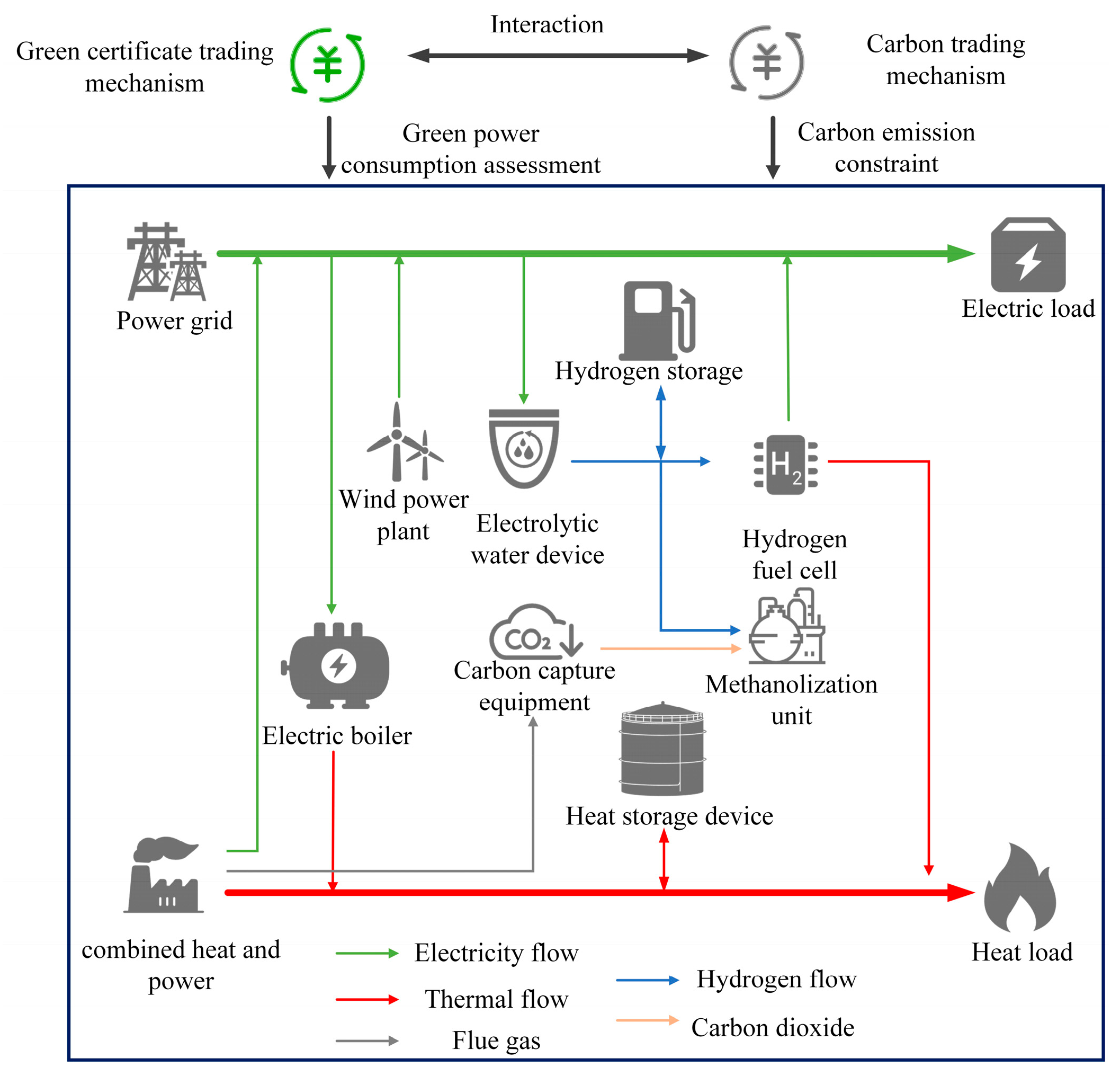
On the power side, wind power is given the priority for output. CHP-CCS is responsible for providing support and peak regulation. Besides supplying power to the load, the power is also used for hydrogen electrolysis and carbon capture. When there is excess power, hydrogen is produced and stored. When power is in short supply, the “hydrogen storage—fuel cell” system generates electricity to form an electricity–hydrogen–electricity regulation link. On the thermal side, CHP-CCS provides the main heating, supplemented by electric boilers, and achieves cross-period balance through heat storage. Fuel cells can serve as an auxiliary heat source. On the carbon side, a portion of the captured CO2 is combined with the produced hydrogen to synthesize methanol, achieving carbon utilization and obtaining product revenue.
The integrated energy system studied in this paper is shown in Figure 1. The system includes CHP units with CCS installed (i.e., CHP-CCS), wind farms, electrolytic cells of the water electrolyzer (EL), a hydrogen fuel cell (HFC), a methanolization unit, an electric boiler (EB), heat energy storage (HES) and a hydrogen storage unit. It is worth noting that the purpose of the EL/HFC models in this paper is to ensure the physical feasibility of the day-ahead scheduling. Therefore, EL/HFC is represented by steady-state conversion efficiency and necessary operational constraints, which is consistent with typical research on integrated energy systems that is oriented towards scheduling [23,24].

2.2. Analysis of the Thermal and Electrical Demand Mechanisms of Carbon Capture Devices

The dependence of carbon capture devices on energy during operation is reflected in two aspects: the simultaneous supply of electrical energy and thermal energy.
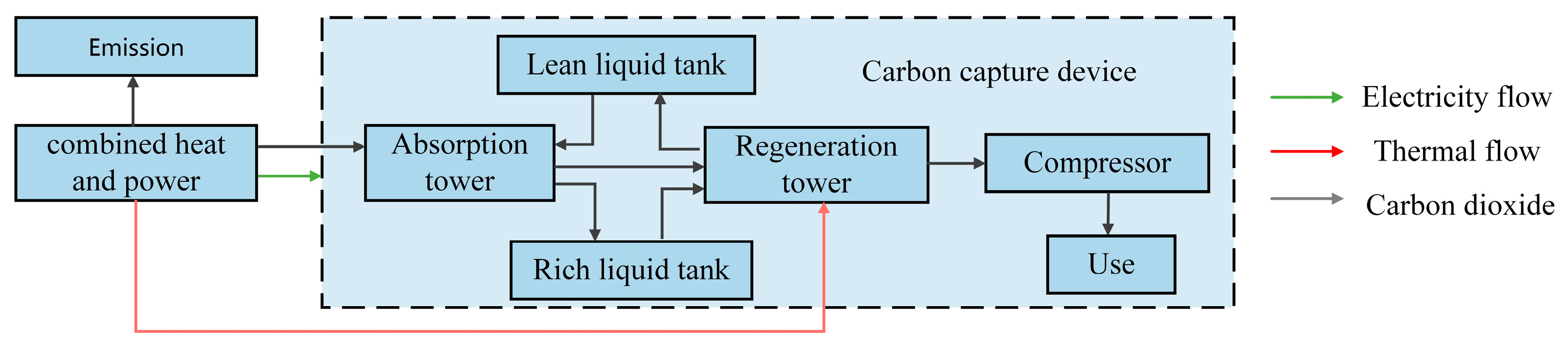
The energy flow of the carbon capture device is shown in Figure 2. A continuous power supply is required for the carbon capture device to drive the gas delivery, solution circulation and control system. Among them, the absorption tower solution pump needs to operate efficiently for a long time to ensure the CO2 capture efficiency.
Meanwhile, the demand for thermal energy is particularly prominent in the regeneration stage: the amine solution that is rich in CO2 needs to be heated to release CO2 and complete the regeneration. This process typically involves extracting low-pressure steam from a medium-pressure steam turbine, which is then cooled to approximately 120 °C and 0.2 MPa before being delivered to the reboiler to provide stable heat for the regeneration tower. It is the most energy-consuming stage in carbon capture.
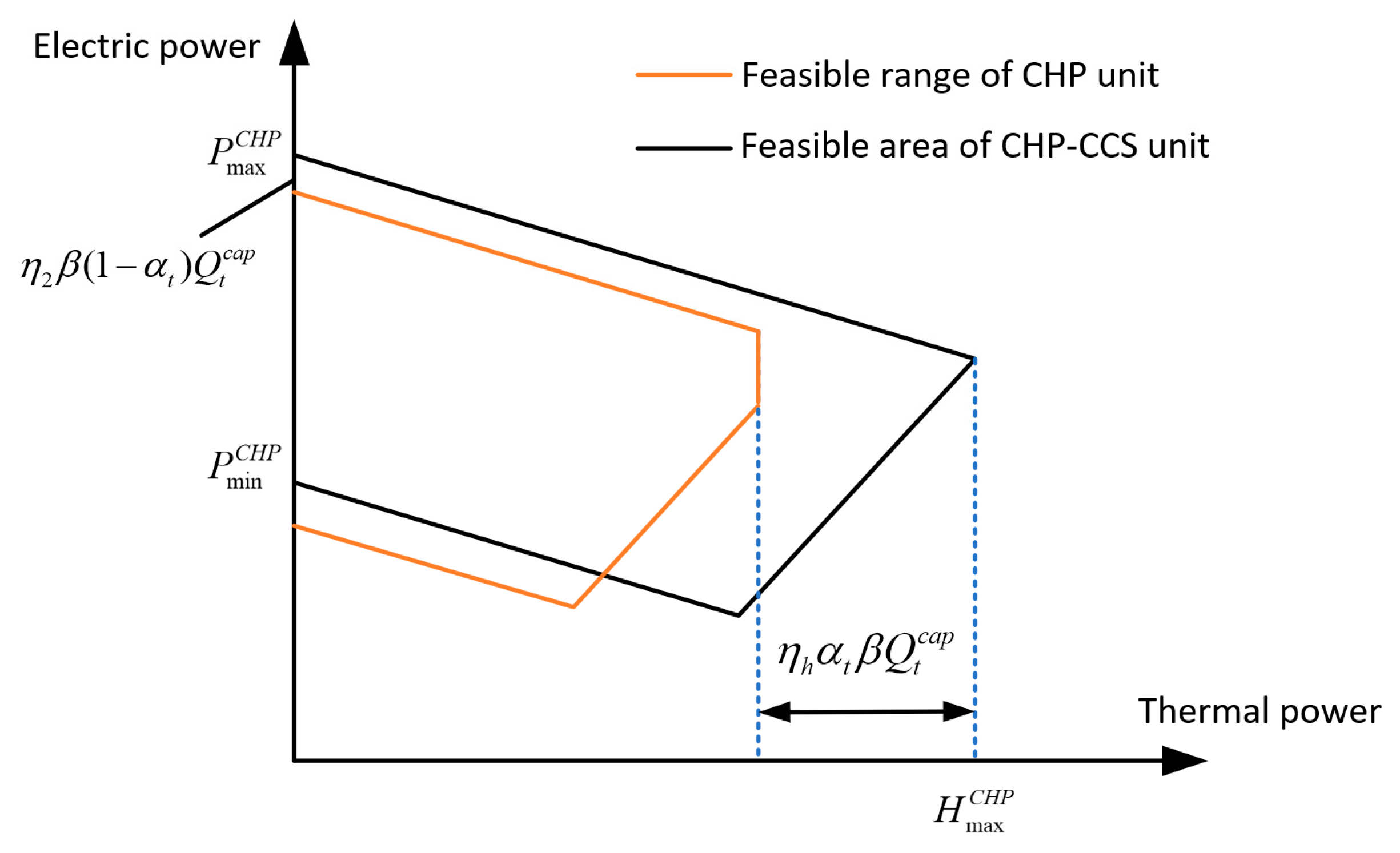
During the process of providing thermal energy to the carbon capture system by the cogeneration unit, both its electrical power and thermal power output are affected, further intensifying the electric–thermal coupling characteristics of the unit. The output loss diagram of the cogeneration unit is shown in Figure A1 of Appendix A.
The electric heat output model of the traditional CHP unit is shown in Appendix A (A1) and (A2).
The electric heating power output of the CHP-CCS unit can be expressed as follows:
P m , t CHP-CSS = η 1 H m , t boiler + η 2 ( 1 α m , t ) ( H m , t boiler β Q m , t cap )
H m , t CHP-CSS = η h α m , t ( H m , t boiler β Q m , t cap )
where t represents the hour ordinal number; P m , t CHP-CSS and H m , t CHP-CSS are the net electrical and thermal power outputs of CHP unit m after installing CCS at time t; β is the thermal power required to capture a unit mass of CO2; Q m , t cap is the mass of CO2 captured by CCS at time t; H m , t boiler is the thermal power generated by the boiler; α m , t is the proportion of low-pressure steam entering the heating network at time t; η 1 and η 2 are the power generation efficiencies of the high/intermediate-pressure turbine and the low-pressure turbine, respectively; η h is the heat exchange efficiency; and α m , t is the proportion of low-pressure steam entering the heating network at time t.

2.3. CHP-CCS Model Considering the Comprehensive Supply Mode of Thermoelectric Demand

2.3.1. Heat Demand Supply Model

Given the significant thermal energy consumption in the CCS regeneration process, this paper introduces heat storage devices, electric boilers, and hydrogen fuel cells as auxiliary heat sources for the CHP unit. This solution can reduce the steam extraction from the CHP turbine for CCS, thereby enhancing the CHP unit’s electrical and thermal output capability. Leveraging the pollution-free characteristic of hydrogen combustion, consuming hydrogen through a hydrogen fuel cell (HFC) with a variable heat-to-power ratio for electricity and heat conversion to supply the carbon capture equipment is cleaner and more efficient.
The thermal power generated by an electric boiler is as follows:
H e , t eb = η EB P e , t eb
H e , t eb = H e , t eb , L + H e , t eb , CCS
where H e , t eb is the thermal power generated by electric boiler e; P e , t eb is the electrical power input to electric boiler e; η E B is the efficiency of the electric boiler; and H e , t eb , L and H e , t eb , CCS are the thermal power supplied by electric boiler e to the heat load and CCS, respectively, at time t.
The heat storage device model is as follows:
E s , t TES = E s , t 1 TES + η TES H s , t cha H s , t dis / η TES
0 H s , t cha H s , max cha
0 H s , t dis = H s , t dis , CCS + H s , t dis , L H s , max dis
where H s , t cha , H s , t dis , H s , max cha and H s , max dis are the total heat storage power, heat release power, and maximum heat storage and release power of heat storage device s at time t, respectively; E s , t TES is the stored thermal energy of heat storage device s at time t; η TES are the charging and discharging efficiencies of the heat storage device; and H s , t dis , CCS and H s , t dis , L are the thermal power supplied by heat storage device s to CCS and the heat load, respectively, at time t.
The thermal power generated by a hydrogen fuel cell is as follows:
P h , t HFC = η h e Q h , t HFC , H 2
H h , t HFC = η h h Q h , t HFC , H 2
η min η h h / η h e η max
H h , t HFC = H h , t HFC , L + H h , t HFC , CCS
where P h , t HFC and H h , t HFC are the electrical and thermal power generated by hydrogen fuel cell h at time t, respectively; η h e and η h h are the electrical and thermal conversion efficiencies, respectively; η max and η min are the lower and upper limits of the heat-to-power ratio for the hydrogen fuel cell; H h , t HFC , CCS and H h , t HFC , L are the thermal power supplied by hydrogen fuel cell h to CCS and the heat load, respectively, at time t.
After considering heat storage devices, electric boilers, and hydrogen fuel cells providing auxiliary heating for the CHP-CCS unit, the net output electrical and thermal power of the CHP-CCS unit are as follows:
P m , t N = η 1 H m , t boiler + η 2 ( 1 α j , t ) ( H m , t boiler β Q m , t cap + H e , t eb , CCS + H s , t dis , CCS + H h , t HFC , CCS )
H m , t N = η h α j , t ( H m , t boiler β Q m , t cap + H e , t eb , CCS + H d , t dis , CCS + H h , t HFC , CCS )
The ramp-up/down constraints for the electrical and thermal output of the CHP-CCS unit are as follows:
P m , d o w n N P m , t N P m , t 1 N P m , u p N
H m , d o w n N H m , t N H m , t 1 N H m , u p N
where P m , t N is the output electrical power of CCS-CHP unit m after considering comprehensive heating for carbon capture; H m , t N is the output thermal power of CCS-CHP unit m after considering comprehensive heating for carbon capture; P m , d o w n N and P m , u p N are the maximum down-ramp and up-ramp rates for the electrical output of CHP-CCS unit m; H m , d o w n N and H m , u p N are the maximum down-ramp and up-ramp rates for the thermal output of CHP-CCS unit m; and H e , t eb , CCS , H d , t dis , CCS and H h , t HFC , CCS are the thermal power supplied to the carbon capture equipment by electric boiler e, heat storage device s, and hydrogen fuel cell h, respectively.

2.3.2. Electrical Demand Supply Model

The electrical energy consumption of the CCS equipment is supplied by the integrated system. The electrical energy consumption function of the carbon capture equipment is as follows:
P m , t CCS = P m B + P m , t CCS , o
P m , t CCS , o = W c Q m , t cap
Q m , t cap = η c a p ϖ t Q m , t CHP + Q m , t CY
Q m , t CHP = σ e P m , t CHP
0 ϖ t ϖ max
0 Q m , t cap τ η c a p σ e P m , max CHP
where P m , t CCS is the electrical energy consumption of the CCS equipment in period t; P m B is the fixed energy consumption of the CCS equipment; Q m , t cap is the amount of CO2 captured by CCS at time t; P m , t CCS , o is the operational energy consumption of CCS; W c is the operational energy consumption required to capture a unit of CO2; η c a p is the efficiency of CCS; ϖ t is the flue gas split ratio at time t; Q m , t CHP is the amount of CO2 emitted by CHP unit m at time t; and σ e is the carbon emission intensity of the CHP. τ is the maximum working state coefficient for the regenerator and compressor; ϖ max is the upper limit of the flue gas split ratio, taken as 0.9 in this paper; Q m , t CY is the amount of CO2 to be captured contained in the solution flowing into or out of the rich solution tank at time t; and P m , t CHP is the electrical output of the CHP unit without steam extraction for the carbon capture equipment.

3. IES Low-Carbon Dispatch Model Based on Dynamic Carbon-Green Certificate Coupling Mechanism and CCS Optimization

3.1. Dynamic Carbon-Green Certificate Coupling Mechanism

3.1.1. Dynamic Market Synergy Mechanism

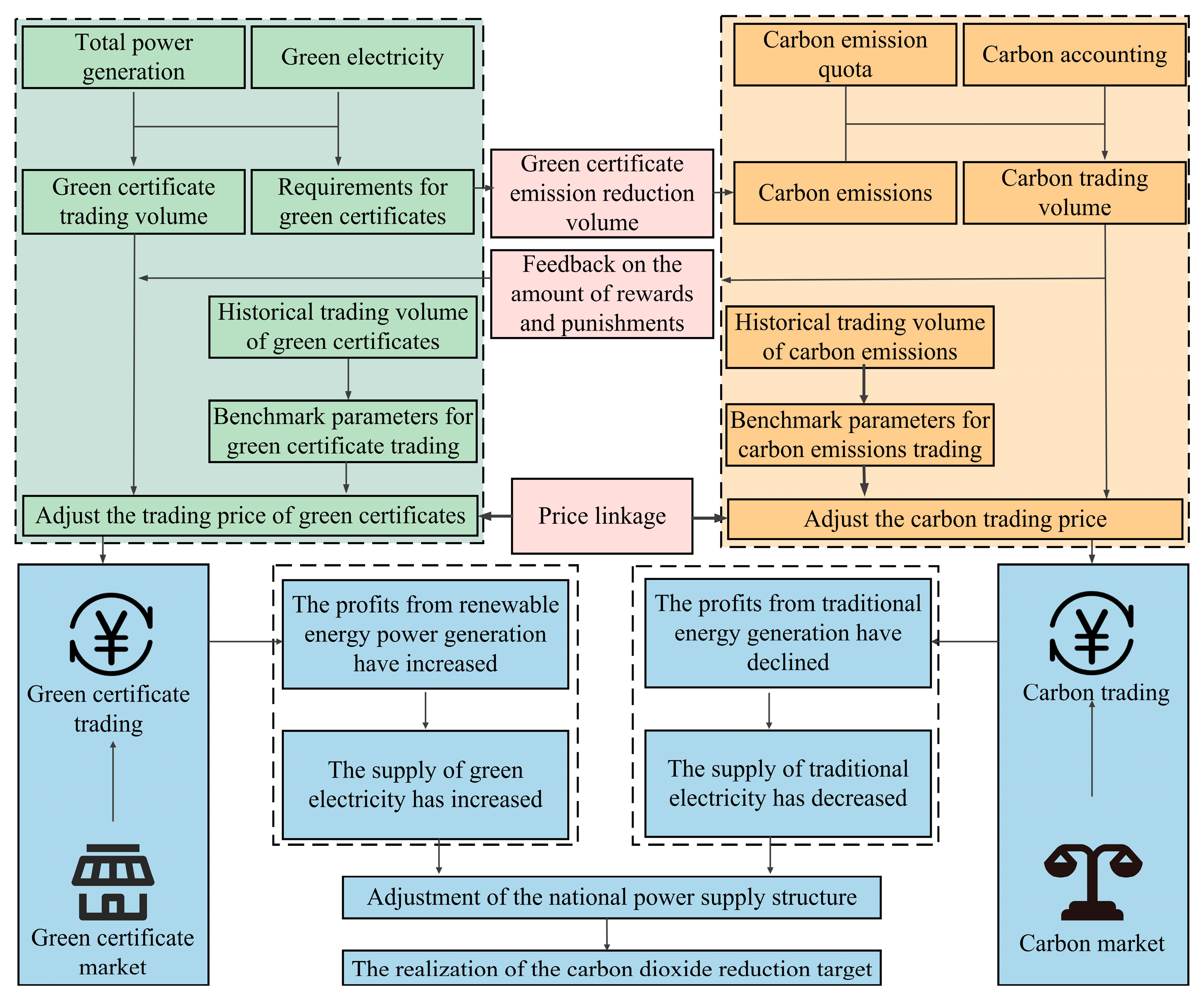
The green certificate market promotes renewable energy production and consumption through a quota incentive mechanism. The carbon market, relying on carbon quota allocation and trading, imposes constraints on high-carbon emission entities and promotes their emission reduction implementation. These two types of markets have bidirectional feedback relationships at the price and trading volume levels. On one hand, fluctuations in green certificate or carbon allowance prices affect market entities’ transaction costs and incentives, thereby changing trading volumes. On the other hand, the completion of trading volumes in turn influences price adjustments, gradually forming a dynamic closed loop. The green certificate market and the carbon trading market do not operate in isolation. They interact through mechanisms such as emission reduction conversion and reward-penalty rules, allowing price or trading behavior in one market to transmit to the other, forming a system-level dynamic coupling structure.
The carbon-green certificate synergistic trading process is shown in Figure 3.

3.1.2. Dynamic Carbon-Green Certificate Coupling Mechanism Model

When the actual carbon emissions of the IES operating entity are lower than the allocated carbon quota, the economic revenue can be obtained by selling surplus quotas in the carbon market; otherwise, the entity needs to purchase the deficit quota from the carbon market to meet the regulatory requirements. The carbon trading cost model is presented in Equation (A3) of Appendix A.
When the number of green certificates obtained from the National Renewable Energy Information Management Center exceeds the quota requirement, surplus certificates can be sold for revenue; if insufficient, certificates must be purchased to meet the assessment requirements. The cost model of the green certificates is presented in Appendix A, Formula (A4).
Based on the above mechanism principles, this study constructs a dynamic carbon-green certificate coupling mechanism model. First, the system uses the difference between the carbon emission equivalent of fossil energy and that of green electricity as the measurement basis for the carbon reduction equivalent per green certificate. Second, combined with real-time carbon quota trading data, reward-penalty adjustments are implemented on the green certificate trading volume. Then, by comparing the current period’s trading volume with the historical benchmark trading volume, the current period’s green certificate trading price is dynamically determined. Finally, the market trading closed loop is completed. Based on this mechanism, the model construction and implementation process are detailed below.
(1)
Analysis of Carbon Reduction Amount per Green Certificate
The carbon reduction amount behind a green certificate is obtained by comparing the carbon emissions of fossil energy and green electricity:
Q g = Q t Q r Q GCT = Q g N q
where Q g represents the reduced carbon emissions per green certificate; Q t and Q r represent the carbon emission equivalents produced by fossil energy and renewable energy units, respectively; and Q GCT represents the emission reduction amount behind the green certificates.
(2)
Interaction Analysis Between Mechanisms
Then, the required carbon emission rights for the VPP are calculated based on carbon emissions, the carbon quota, and the actual emission reduction amount of green certificates, and rewards or penalties are applied to green certificates, based on the carbon emission right amount:
E buy = E d E q Q GCT C buy = N vppb N vppe E buy
where E buy represents the carbon emission allowances that need to be purchased; C buy indicates the quantity of green certificates that need to be purchased; and is the reward-penalty coefficient of carbon emission rights on green certificates.
(3)
Determining Dynamic Prices
In this model, based on the system’s historical assessment period trading situation, we dynamically adjust the current period’s green certificate and carbon allowance trading prices. When the current period’s green certificate (or carbon allowance) trading volume exceeds the period benchmark (i.e., purchase or sales volume increases), the system will correspondingly increase the transaction price to increase the operating costs or revenue; conversely, it will decrease the transaction price. The benchmarks for historical carbon emission trading and green certificate trading volumes are determined using the weighted moving average method. This method is used to depict the historical normal level of the market. The weight of historical trading volume is shown in Table A1 of Appendix A (the more recent, the higher the weight), specifically as follows:
E baseline = z = k 7 k 1 ( E z buy w s ) C baseline = z = k 7 k 1 ( C z buy w s )
where E z buy and C z buy are the carbon trading volume and green certificate trading volume in historical periods, respectively, and w s is the weight of the historical trading volume. E baseline and C baseline represent the historical benchmark transaction volumes of the carbon trading mechanism and the green certificate trading mechanism, respectively.
The method for determining dynamic prices for the carbon trading mechanism and green certificate mechanism is as follows:
(1)
If the transaction volume of this cycle is in the same direction as the historical cycle benchmark transaction volume (either both being purchases or both being sales), then the transaction price for this cycle is as follows:
P k CET = P k 1 CET 1 + λ C E buy E baseline ) E baseline P k GCT = P k 1 GCT 1 + λ G C buy C baseline ) C baseline
where k represents the cycle number of carbon trading and green certificate trading (set as days in this article); P k CET represents the carbon emission trading price of the kth cycle (the current cycle); P k 1 CET represents the carbon emission trading price of the (k−1)th cycle (the previous cycle); λ C is the dynamic adjustment coefficient for the carbon price; P k GCT represents the green certificate trading price of the kth cycle (the current cycle); P k 1 GCT represents the green certificate trading price of the (k−1)th cycle (the previous cycle); and λ G is the dynamic adjustment coefficient for the green certificate price.
(2)
When the transaction volume of this cycle is of the opposite sign to the cycle benchmark, the k-cycle transaction price is as follows:
P k CET = P k 1 CET 1 λ C E buy E baseline ) E baseline P k GCT = P k 1 GCT 1 λ G C buy C baseline ) C baseline
(3)
Participating in Market Trading
Finally, the prices of the two markets are linked, with the goal of minimizing the total transaction cost, to determine the green certificate conversion coefficient and conversion quantity.
F cn = P k CET E buy
F gn = P k GCT C buy
where F cn and F g n are the carbon trading cost and green certificate trading cost under the joint trading mechanism, respectively.

3.2. Objective Function

To achieve the synergistic operation goal of economy and low-carbon, this paper takes the minimum comprehensive operating cost of the IES as the objective function, which includes the fuel cost, carbon trading cost, green certificate trading cost, daily depreciation cost of carbon capture equipment, electricity purchase cost, equipment maintenance cost, and methanol sales revenue:
F = min ( F coal + F e + F cn + F gn + F z j + F y w I M )
where F is the comprehensive operating cost of the electro-thermal system; F e is the electricity purchase cost; F coal is the system fuel cost; F y w is the equipment maintenance cost; and I M is the methanol sales revenue.

3.2.1. Fuel Cost

The fuel cost consists of the fuel cost of CHP-CCS units:
F coal = λ coal t = 1 T m = 1 N C H P F m , t CHP-CCS
where λ coal is the coal price; T is the number of dispatch periods; and F m , t CHP-CCS is the coal consumption of CHP-CCS unit m at time t.
The coal consumption of CHP-CCS unit m at time t is as follows:
F m , t CHP-CCS = a j ( P m , t CHP ) 2 + b j P m , t CHP + c j ( H m , t CHP ) 2 + d j H m , t CHP + e j P m , t CHP H m , t CHP + f j
where a j , b j , c j , d j , e j , and f j are the coal consumption characteristic coefficients of CHP-CCS unit m, and H m , t CHP is the thermal output of the CHP unit without steam extraction for the carbon capture equipment.

3.2.2. Electricity Purchase Cost

F e = t = 1 T μ t grid P t grid
where μ t grid is the electricity price at time t and P t grid is the electrical power purchased from the upper-level grid at time t.

3.2.3. Methanol Sales Revenue

The methanol sales profit is mainly the difference between the total methanol sales revenue and the cost of converting hydrogen to methanol.
I M = ( ε M k ) c = 1 N C H 3 O H Q c , t CH 3 OH k c b u y ( Q t CO 2 m = 1 N C H P Q m , t cap )
where k is the hydrogen-to-methanol conversion cost coefficient; k c b u y is the purchase price per unit mass of CO2; ε M is the selling price per unit mass of methanol; Q c , t CH 3 OH is the amount of methanol synthesized in period t, kg; and Q t CO 2 is the amount of CO2 purchased at time t.

3.2.4. Equipment Maintenance Cost

F y w = t = 1 T i ζ i P t i + j z j P j , t cha + P j , t dis
where ζ i is the operation and maintenance cost per unit power of the i-th type of energy supply device; P t i is the operating power of the i-th type of energy supply device at time t; z j is the operation and maintenance cost per unit power of the j-th type of energy supply device; and P j , t cha and P j , t dis are the charging and discharging power of the j-th type of energy storage device at time t, respectively.

3.3. Constraints

3.3.1. Electric Boiler Operation Constraints

The electric boiler operation power constraints are as follows:
0 P e , t eb P e , max eb
where P e , max eb is the maximum operating electrical power of electric boiler e.

3.3.2. Heat Storage Device Constraints

E s , min TES E s , t TES E s , max TES E s , 0 TES = E s , T TES H s , t cha H s , t dis = 0
where E s , min TES and E s , max TES are the lower and upper limits of heat storage, respectively.

3.3.3. Hydrogen Fuel Cell

Q h , min HFC , H 2 Q h , t HFC , H 2 Q h , max HFC , H 2
Δ Q h , min HFC , H 2 Q h , t + 1 HFC , H 2 Q h , t HFC , H 2 Δ Q h , max HFC , H 2
where Q h , min HFC , H 2 and Q h , max HFC , H 2 are the minimum and maximum hydrogen power consumption, respectively. Δ Q h , min HFC , H 2 and Δ Q h , max HFC , H 2 are the maximum down-ramp and up-ramp rates for the hydrogen power input to the HFC and Q h , t HFC , H 2 is the amount of hydrogen input to the hydrogen fuel cell.

3.3.4. Hydrogen Storage Device Constraints

The hydrogen storage device model is similar to the heat storage device and will not be repeated here.

3.3.5. Wind Farm Constraint

0 P w , t wp P w , max wp
where P max wp is the upper limit of wind power output at time t.

3.3.6. Methanol Synthesis System

After water is decomposed by the electrolyzer into hydrogen and oxygen, the hydrogen is split into two streams. One part is supplied to the fuel cell for power generation, and the other part reacts with the captured carbon dioxide in a catalytic reaction unit to generate methanol. The model is as follows:
Q l , t H 2 = η E L P l , t EL
Q c , t CH 3 OH = η C H 3 O H Q c , t CH 3 OH , H 2
Q c , t CO 2 = m Q c , t CH 3 OH , H 2
where Q l , t H 2 is the amount of hydrogen produced by water electrolysis in period t, m3; η E L and η C H 3 O H are the efficiencies of the electrolyzer and methanol synthesis device, respectively; λ C is the catalyst reaction rate; P l , t EL and Q c , t CH 3 OH , H 2 are the electrical power supplied to the EL and the amount of hydrogen supplied to methanol synthesis device c in period t, respectively; Q c , t CO 2 is the amount of CO2 required by methanol synthesis device c in period t; and m is the conversion ratio of the CO2 amount required per unit of H2 consumed.

3.3.7. Electrolyzer Constraint

P l , min EL P l , t EL P l , max EL
where P min EL and P max EL are the lower and upper limits of power consumption at time t, respectively.

3.3.8. CHP Unit Operation Constraints

The feasible region of the CHP unit is shown in Equations (A5)–(A8) in Appendix A.

3.3.9. Solution Storage Tank

The solution storage tank model is shown in Appendix A, Equation (A9).

3.3.10. System Power Balance Constraints

w = 1 N w p P w , t wp + P t grid + h = 1 N H F C P h , t HFC + m = 1 N C H P P m , t N = l = 1 N E L P l , t EL + m = 1 N C H P P m , t CCS + e = 1 N e b P e , t eb + P t L
m = 1 N C H P H m , t N + h = 1 N H F C H h , t HFC + e = 1 N e b H e , t eb + s = 1 N T E S H s , t dis = e = 1 N e b H e , t eb , CCS + h = 1 N H F C H h , t HFC , CCS + s = 1 N T E S H s , t cha , CCS + H t L + m = 1 N C H P H m , t N , cha
l = 1 N E L Q l , t H 2 + u = 1 N H S Q u , t dis , H 2 = h = 1 N H F C Q h , t HFC , H 2 + c = 1 N M Q c , t CH 3 OH , H 2 + u = 1 N H S Q u , t cha , H 2
where Q t dis , H 2 and Q t cha , H 2 are the total hydrogen discharge power and hydrogen storage power of hydrogen storage device h′ at time t, respectively; N w p , N H F C , N E L , N e b , N T E S , N H S and N M are the sets of wind farms, hydrogen fuel cells, electrolyzers, electric boilers, heat storage devices, hydrogen storage devices, and methanol synthesis devices, respectively.

4. IES Optimization Scheduling Model Based on IGDT

This section considers the IGDT method to quantify system uncertainty. Compared with traditional stochastic optimization and robust optimization, IGDT studies the impact of uncertain parameter fluctuations in the system economy under the premise of meeting preset system objectives, including risk-averse and opportunity-seeking models [25].

4.1. Interval Uncertainty Modeling

This section uses the envelope-bound model to model the system’s uncertain parameters. The envelope-bound model can describe the uncertainty of uncertain parameters in the system through a non-probabilistic set. The set of key uncertain variables considered in this paper is n { WT , E , Q } , which respectively corresponds to the wind power output, electricity load and heat load. An envelope-type uncertain set is constructed based on the predicted value x ˜ n , t as the benchmark, and its expression is as follows:
U φ n ,   x ˜ n , t n { WT , E , Q } = x n , t : x n , t x ˜ n , t x ˜ n , t φ n
where x n , t and x ˜ n , t are the actual and predicted values of wind power and electric heat loads in period t, respectively and φ n is their uncertainty levels.
The model constructed in this paper is an optimization problem with multiple uncertain factors. When using traditional IGDT, the uncertainty levels of each uncertain parameter are generally weighted and summed as the optimization objective. To eliminate the subjectivity brought by the weights of uncertainty levels, this paper uses the entropy weight method [26] to calculate the weight of each uncertainty level, i.e., to evaluate the importance of each uncertainty factor. Given a data sequence composed of x ˜ n , t as the input, we perform normalization, calculation of proportion coefficients, and determination of entropy value H n and weight W n , according to Equation (48). The more significant the fluctuation of the predicted sequence and the greater the information difference, the smaller the corresponding H n value and the larger the weight W n value. Thus, it objectively reflects the contribution degree of each uncertain factor to the overall uncertainty of the system. Its mathematical expression is as follows:
u ^ n , t = x ˜ n , t min { x ˜ n , 1 , x ˜ n , 2 , , x ˜ n , T } max { x ˜ n , 1 , x ˜ n , 2 , , x ˜ n , T } min { x ˜ n , 1 , x ˜ n , 2 , , x ˜ n , T } v n , t = u ^ n , t t = 1 T u ^ n , t H n = 1 ln N t = 1 T v n , t ln v n , t W n = 1 H n N n = 1 N H n
After obtaining W n , the overall uncertainty level φ is allocated to each variable, using Equation (49). Meanwhile, the weights satisfy Formula (50) in the original text.
φ n = W n φ
W W T + W E + W Q = 1

4.2. Scheduling Model Under Risk-Averse Strategy

Under the risk-averse strategy, decision-makers must ensure that the system’s total operating cost does not exceed the expected dispatch cost while avoiding the impact of uncertainty on system optimal dispatch. That is, under the risk-averse strategy, the system takes maximizing the uncertainty level as the optimization objective. The larger the obtained uncertainty level, the stronger the system’s risk-bearing capacity, but the corresponding operating cost is also higher. Its mathematical model is as follows:
max φ max F ( 1 + β 1 ) F 0 x n , t U φ n , x ˜ n , t n { WT , E , Q } Equation ( 1 ) Equation ( 21 ) ,   Equation ( 29 ) Equation ( 46 ) , Equation ( A 5 ) Equation ( A 9 ) in   Appendix   A
where F 0 is the optimal operating cost of the system under the deterministic optimization scheduling model and β 1 is the cost deviation coefficient under the risk-averse strategy.
Analysis of Equation (51) shows that the optimization model constructed based on IGDT is a bi-level structure, and its operating cost increases with uncertainty. When the uncertainty level φ is given, the system’s maximum operating cost corresponds to the situation where the parameter uncertainty level reaches the upper limit of that level. At this point, this bi-level model can be equivalently transformed into the following single-level model:
max φ s . t .   F ( 1 + β 1 ) F 0 x n , t n { WT } = ( 1 φ n ) x ˜ n , t x n , t n { E , Q } = ( 1 + φ n ) x ˜ n , t φ n 0 Equation ( 1 ) Equation ( 21 ) ,   Equation ( 29 ) Equation ( 46 ) , Equation ( A 5 ) Equation ( A 9 ) in   Appendix   A

4.3. Scheduling Model Under Opportunity-Seeking Strategy

Similarly, for the opportunity-seeking strategy, the system takes minimizing the uncertainty level as the optimization objective. Its mathematical model is as follows:
        min φ F ( 1 β 2 ) F 0 x n , t n { WT } = ( 1 + φ n ) x ˜ n , t x n , t n { E , Q } = ( 1 φ n ) x ˜ n , t φ n 0 Equation ( 1 ) Equation ( 21 ) ,   Equation ( 29 ) Equation ( 46 ) , Equation ( A 5 ) Equation ( A 9 ) in   Appendix   A
where β 2 is the cost deviation coefficient for the opportunity-seeking strategy.

5. Case Study Analysis

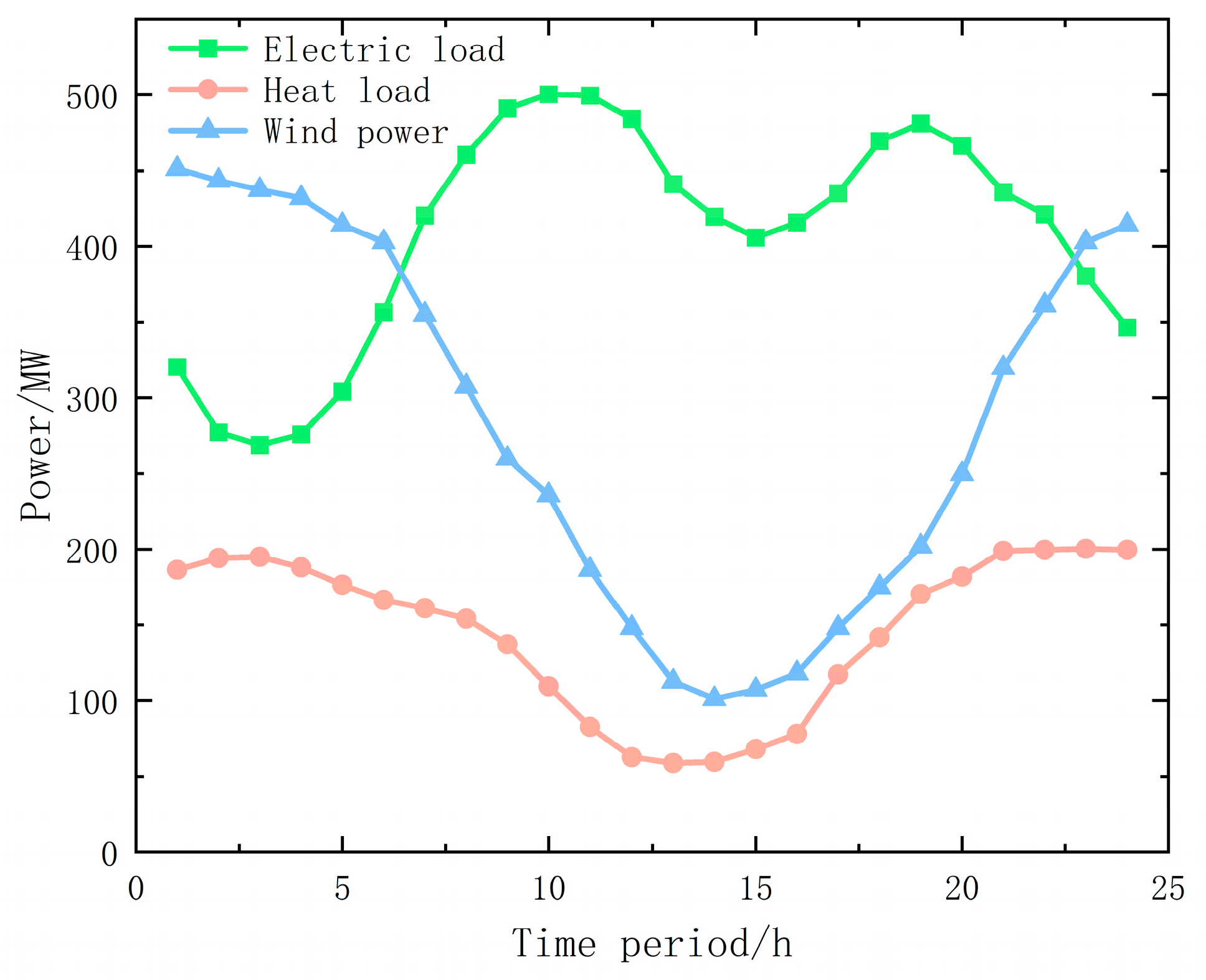
This paper takes T = 24 h as the dispatch cycle and analyzes the case of a regional integrated energy system, shown in Figure 1. The system forecast power is shown in Figure 4 [27]. Historical trading volume weights are shown in Appendix A, Table A1; time-of-use grid electricity prices in Appendix A, Table A2; main equipment parameters in Appendix A, Table A3; and GCT mechanism- and CET mechanism-related parameters in Appendix A, Table A4.
The IES low-carbon economic scheduling model constructed in this paper is a nonlinear programming problem. It was modeled using MATLAB 2018 and the IPOPT v3.12.9 nonlinear programming solver was called to optimize and solve this model.

5.1. Deterministic Scenario Settings and Analysis

5.1.1. Analysis of CHP-CCS Thermoelectric Consumption in IES

In the IES shown in Figure 1, based on whether electric boilers, heat storage devices, and hydrogen fuel cells are added for auxiliary heating, the following four operating scenarios are set. The costs, carbon emissions, and other indicators of each scenario are compared to verify the effectiveness of the proposed carbon capture thermoelectric demand supply optimization strategy:
Scenario 1: The carbon capture equipment directly extracts thermal power from the CHP, without considering auxiliary heating.
Scenario 2: Based on Scenario 1, we consider heat storage providing auxiliary heating to the carbon capture equipment.
Scenario 3: Based on Scenario 2, we consider electric boilers providing auxiliary heating to the carbon capture equipment.
Scenario 4: Based on Scenario 3, we consider adding hydrogen fuel cells consuming hydrogen to provide auxiliary heating to the carbon capture equipment.
From the data in Table 1, compared with Scenario 1, Scenario 2 reduces carbon emissions by 79.2 tons and the total cost by 33,500 CNY. The main reason for this is that Scenario 1 did not adopt an auxiliary heating scheme, causing the thermal energy required by the carbon capture system to rely entirely on steam extracted from the CHP unit. This heating method significantly restricts the CHP unit’s electrical and thermal power output capability. To meet the system’s predetermined electrical and thermal load demands, the amount of steam available for the CCS system from the CHP unit is forced to decrease, thereby reducing the amount of carbon dioxide captured and ultimately leading to an increase in the system’s total carbon emissions. Furthermore, since Scenario 1 considers the carbon trading mechanism, its lower carbon capture efficiency further increases the carbon trading costs. Scenario 2 introduces a heat storage device for auxiliary heating. At night, the electric boiler uses excess wind power to generate heat and stores it in TES; during the daytime when CHP unit carbon emissions peak, TES releases thermal energy to assist CCS heating. This synergistic solution significantly reduces the additional electrical and thermal energy consumption generated by the CHP unit to meet the CCS heating demand, thereby achieving a reduction in carbon emissions and a decrease in the total system cost.
Scenario 3 achieves a further reduction of 45.7 tons compared to Scenario 2. Its advantage lies in the coincidence of nighttime wind power output peaks and heat load peak periods, allowing electric boilers to directly provide auxiliary heating to CCS, thereby significantly reducing CHP unit carbon emissions during those periods.
Scenario 4 reduces carbon emissions by another 4.4 tons compared to Scenario 3, while reducing the total cost by 25,600 CNY. This solution uses hydrogen from the hydrogen storage tank through hydrogen fuel cells to meet system electrical and thermal load demands simultaneously during carbon emission peak periods and to provide auxiliary heating to CCS. This strategy effectively shares the heating pressure on electric boilers and heat storage devices, improving the overall system operating efficiency.
Based on the above analysis, Scenario 4 achieves optimal values across all the evaluation indicators. Compared with Scenario 1, the system carbon emissions are reduced by 129.3 t, and the total cost is reduced by 62,700 CNY. These results collectively indicate that the low-carbon operation strategy for CHP-CCS units based on the optimization of thermoelectric demand and supply methods has low-carbon economic benefits.
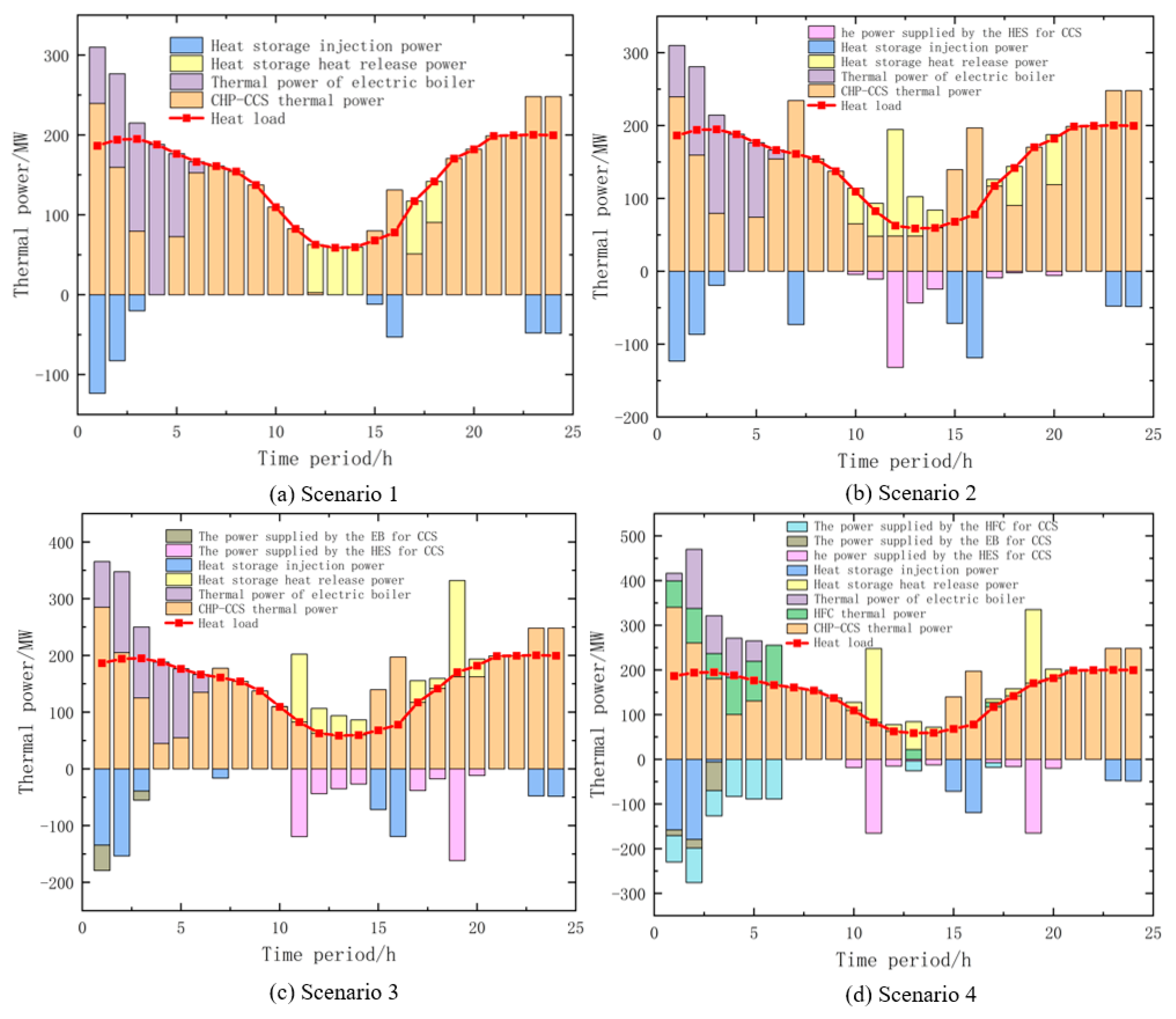
Figure 5 shows the thermal power balance diagram. Among them, Figure 5a–d are the thermal balance power diagrams for Scenarios 1–4 set in this paper. In Scenarios 2 to 4, the heat storage device stores heat during the night and some daytime heat load valley periods. During some daytime periods, TES releases stored heat to supply the heat load, effectively reducing the thermal output of the CHP unit. This not only alleviates the “heat-determined power” constraint of the CHP unit but also effectively reduces its carbon emissions. Meanwhile, during some nighttime periods, electric boilers use excess wind power to directly meet part of the heat load demand. This strategy reduces the proportion of direct heat supply from TES during that period, allowing for more of its stored thermal energy to be used for the auxiliary heating of the carbon capture system during the day. In addition, excess wind power at night is also used to drive the electrolyzer to produce hydrogen, which is stored in hydrogen storage tanks. When the system is in a heat load peak period, hydrogen fuel cells with variable ratio adjustment can directly meet part of the electrical load demand while releasing thermal energy for use by CCS equipment. In the CHP-CCS unit low-carbon operation strategy, based on the optimization of thermoelectric demand supply methods proposed in this paper, hydrogen fuel cells and electric boilers can consume excess wind power from 1 to 4 a.m to provide auxiliary heating for the carbon capture equipment, while energy storage provides auxiliary heating for the carbon capture equipment from 10 a.m. to 2 p.m. and 5 to 8 p.m. during the day, using heat stored at night.
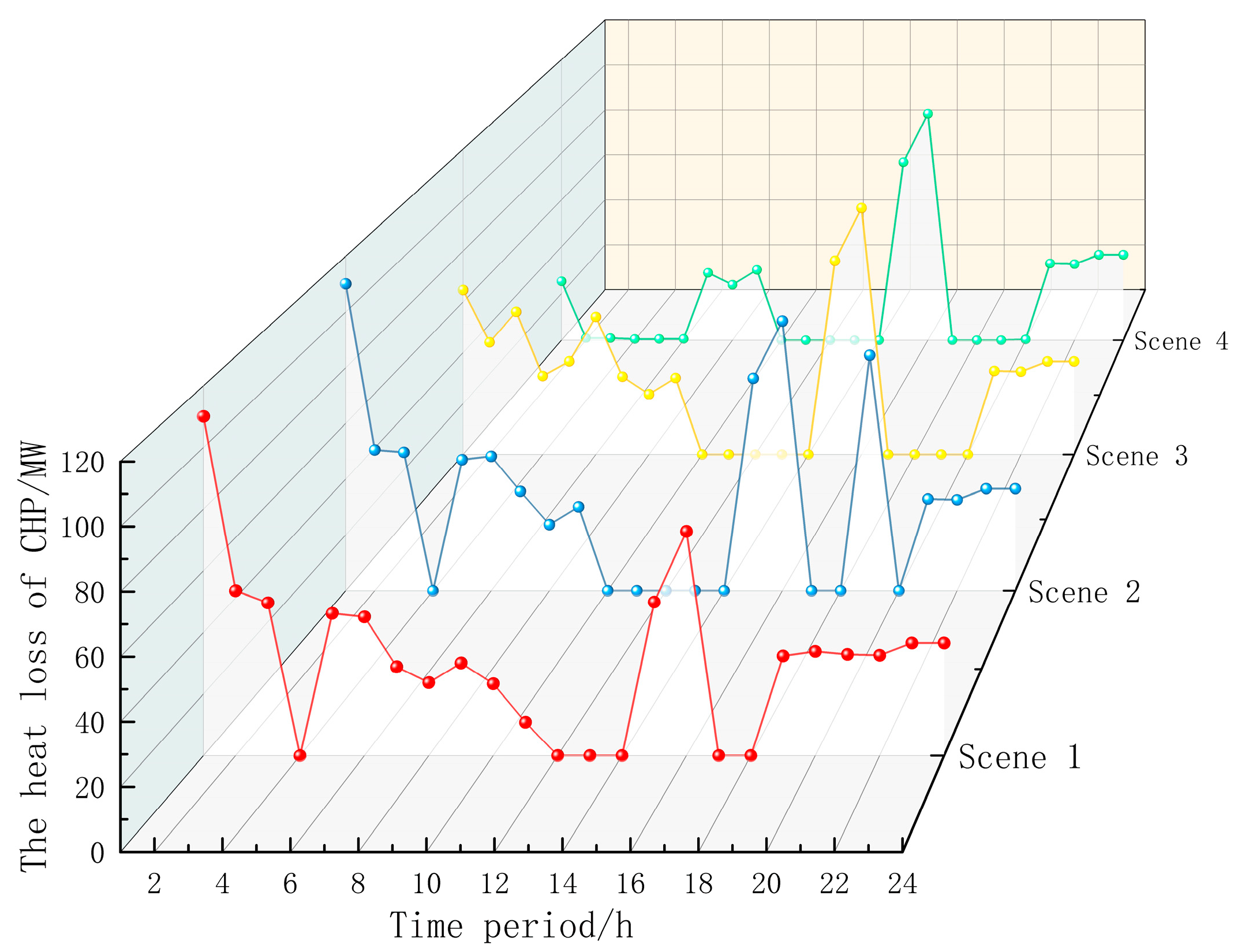
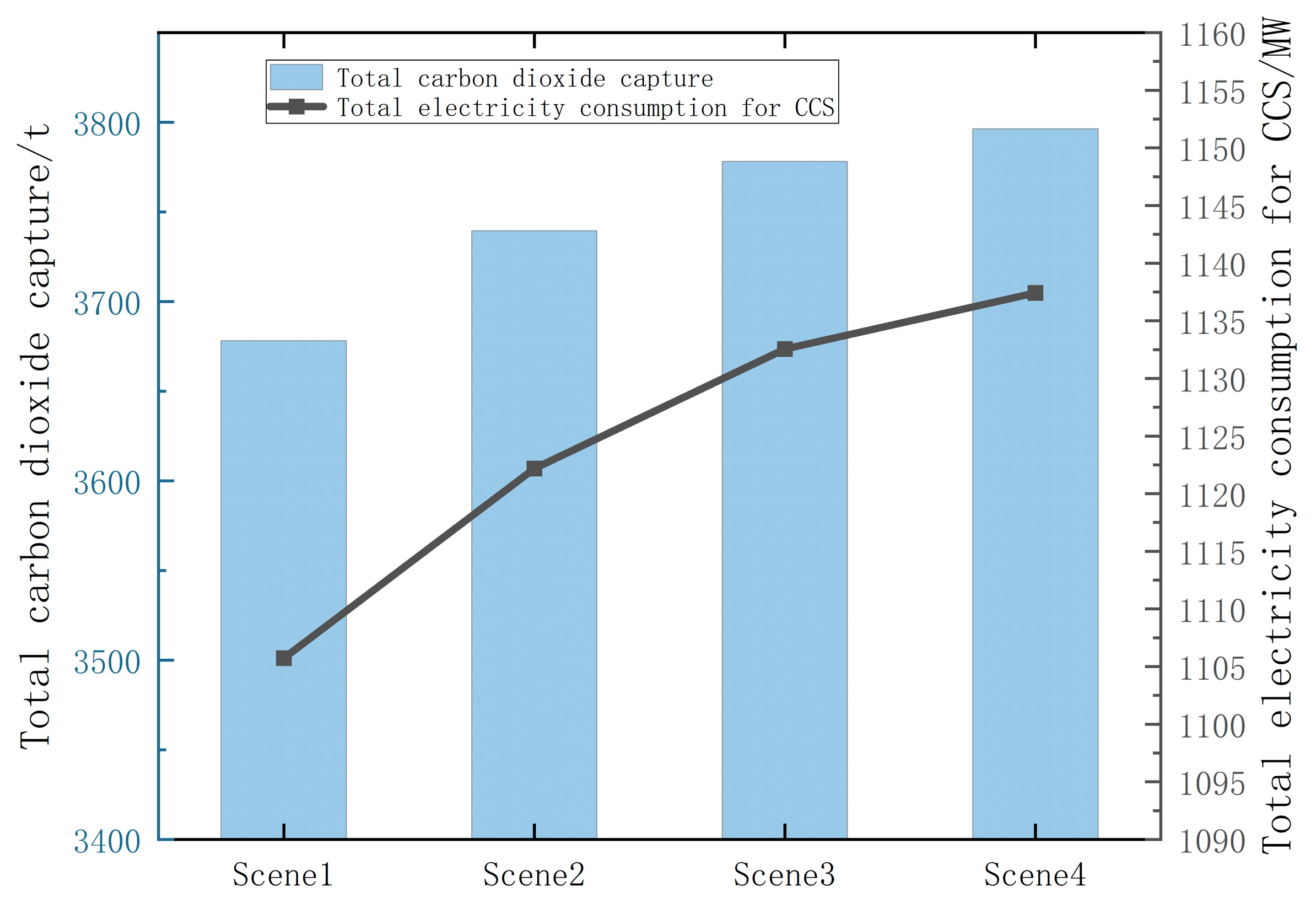
As shown in Figure 6, in Scenario 4, the thermal loss accompanying the provision of thermal energy by the CHP unit to the carbon capture system is significantly lower than in the other three scenarios. Therefore, the output level of the CHP unit can be appropriately increased in this scenario. Although this leads to a slight increase in fuel cost, it can effectively reduce the system’s dependence on external electricity purchases, thereby significantly reducing external electricity purchase costs and their accompanying carbon emissions. Further analysis of Figure 7 data shows that Scenario 4 achieves the highest total carbon dioxide capture amount, fully verifying the effectiveness of the comprehensive auxiliary heating method proposed in this paper.
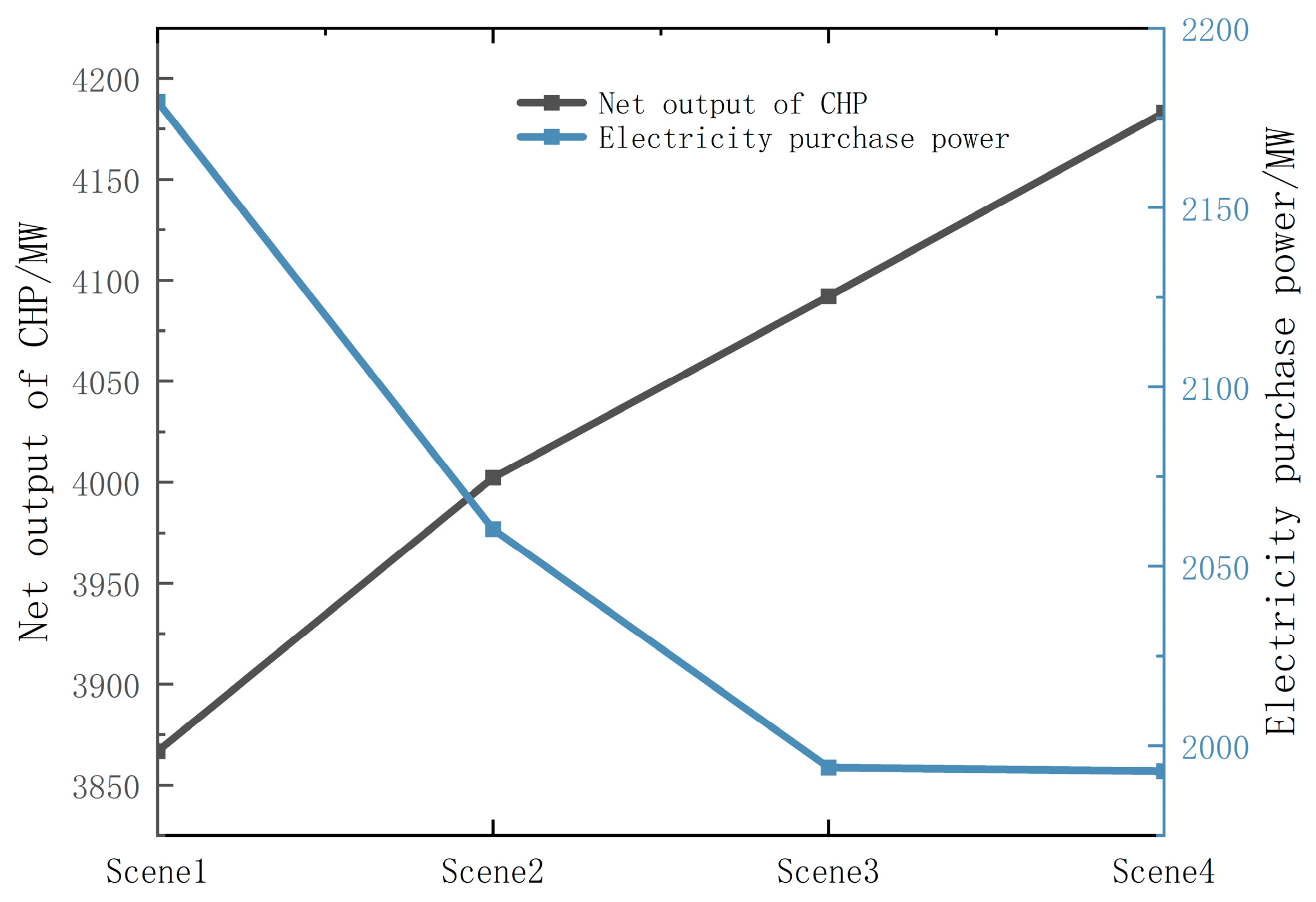
As shown in Figure 8, compared with Scenario 1, the net output of the CHP unit in Scenarios 2, 3, and 4 increased by 135.46 MW, 225.27 MW, and 316.39 MW, respectively. Correspondingly, the system’s external power purchase also decreased by 119.28 MW, 185.46 MW, and 186.63 MW, respectively. This phenomenon is mainly attributed to the implementation of the CHP-CCS unit low-carbon operation strategy, based on the optimization of thermoelectric demand supply methods, significantly improving the operating efficiency of the CHP unit. The CHP unit with improved efficiency is superior to external electricity purchases in terms of both low-carbon performance and economy, so its net output is significantly increased.

5.1.2. Verification of the Effectiveness of the Dynamic Carbon-Green Certificate Coupling Mechanism Model

In the IES shown in Figure 1, based on whether to consider GCT, CET, interaction between mechanisms, and dynamic prices, the following four operating scenarios are set. The costs, carbon emissions, and other indicators of each scenario are compared to verify the effectiveness of the proposed dynamic carbon-green certificate coupling mechanism:
Scenario 5: Based on Scenario 4, we consider CET and GCT mechanisms.
Scenario 6: Based on Scenario 5, we consider the direct carbon reduction effect of green certificates.
Scenario 7: Based on Scenario 6, we use the acquisition volume of green certificates and the trading volume of carbon emission rights as interaction media.
Scenario 8: Based on Scenario 7, we consider the impact across periods and adjust transaction prices accordingly.
According to the data in Table 2, compared with Scenario 4, Scenario 5’s carbon emissions increased by 249.9 tons and the carbon trading costs increased by 46,000 CNY, while green certificate trading revenue was 144,200 CNY. This phenomenon stems from the potential conflict between the green certificate trading mechanism and the carbon trading mechanism at specific points after the former is introduced. Specifically, the calculation benchmark for the system’s green certificate quota is the total power generation, which includes the contribution of CHP units. Although the previous four scenarios confirmed that CHP units equipped with CCS have higher carbon emission efficiency and lower carbon trading costs, their increased output raises the system’s total power generation, leading to a corresponding increase in the green certificate quota, thereby weakening the actual revenue from green certificate trading. Therefore, the results of Scenario 5 indicate that relying solely on a single carbon trading mechanism cannot effectively synergistically optimize the system’s economy and low-carbon performance.
Scenario 6 reduces carbon emissions by 156.3 tons and total cost by 414,300 CNY compared to Scenario 5, and its system comprehensive operating cost is significantly better. This shows that considering the one-way interaction mode between green certificate trading and stepped carbon trading can achieve better comprehensive economic and environmental benefits compared to their simple parallel operation.
Furthermore, Scenario 7 reduces carbon emissions by 67.9 tons compared to Scenario 6, and the carbon trading revenue and green certificate trading revenue increase by 10,600 CNY and 14,900 CNY, respectively. This improvement benefits from the feedback reward–penalty effect of carbon emission trading volume on green certificate trading volume in the bidirectional interaction mechanism, thereby more efficiently synergistically optimizing the system’s low-carbon performance and economy.
Scenario 8’s overall benefits are better than Scenario 7. The fundamental reason is that under the dynamic bidirectional interaction mechanism, the carbon trading volume and green certificate trading volume in the current period are both better than the historical benchmark parameters, thereby triggering adaptive adjustments of the current period’s carbon trading price and green certificate trading price, ultimately achieving higher profits.
All indicators of Scenario 8 are optimal: the system comprehensive operating cost and carbon emissions are the lowest, and the total revenue from green certificate and carbon trading is the highest. Compared with Scenario 4, its total cost and carbon emissions are significantly reduced by 524,000 CNY and 55.7 t, respectively. Compared with the static mechanism Scenario 7, the system total cost and carbon emissions are reduced by 31,900 CNY and 81.4 t, respectively. The above results fully prove that the dynamic carbon-green certificate coupling mechanism proposed in this paper can effectively synergize the institutional advantages of GCT and CET, achieving significant low-carbon economic benefits.

5.1.3. Sensitivity Analysis of Transaction Period Benchmark

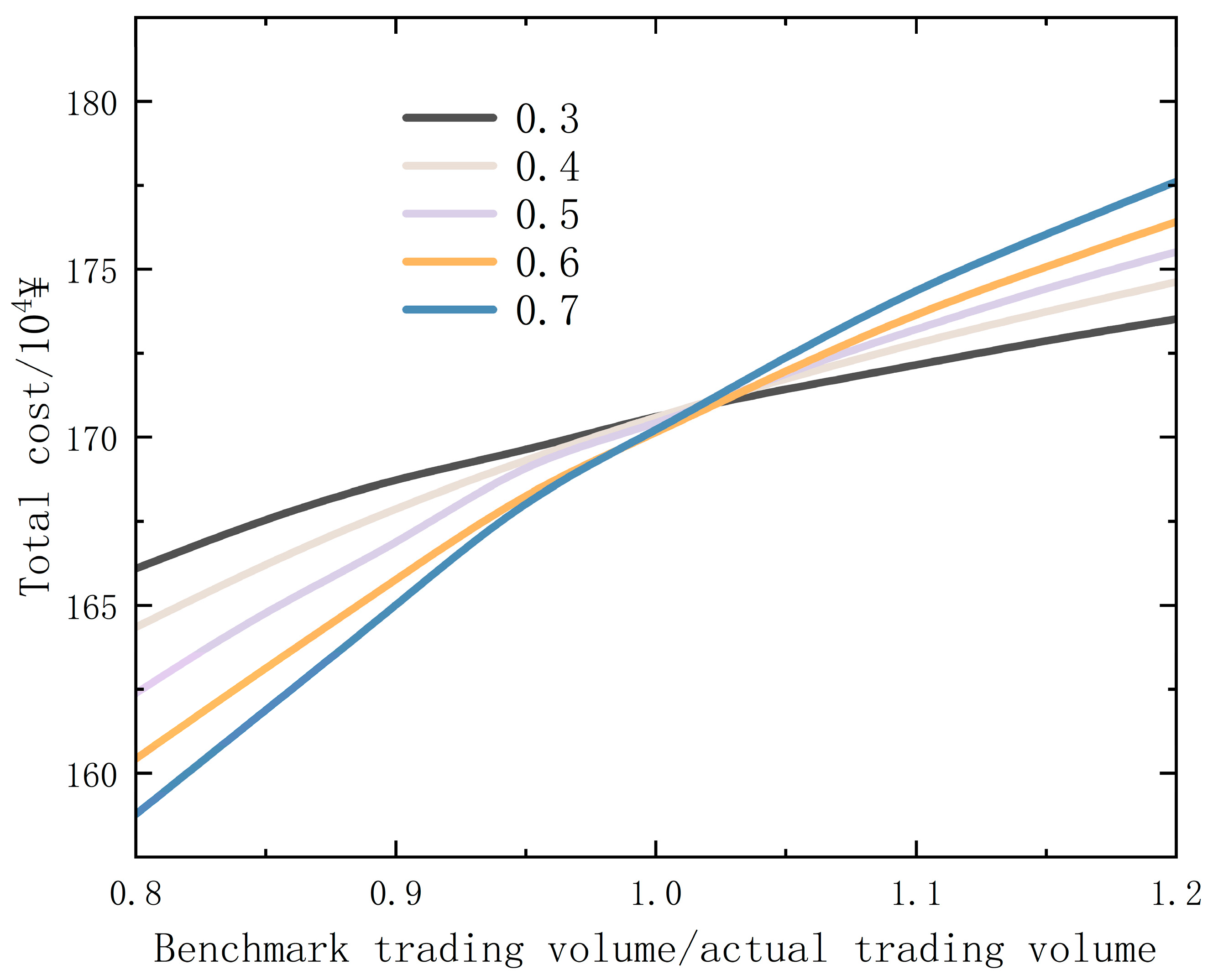
Figure 9 shows the system cost curve under different dynamic price coefficients. Data analysis shows that when the dynamic price coefficient increases, if the actual carbon quota completion degree and green certificate sales volume in the current period exceed the set benchmark value, the system cost reduction is more significant; conversely, if the benchmark is not met, the cost increase will be significantly greater. In the 0.7 scenario, the curve steepness increases significantly. In the interval shown in Figure A1, the cost fluctuation amount is too large compared to the static scenario cost deviation, exceeding 10%, which amplifies the cost risk due to excessive incentives. In the 0.3 scenario, the cost curve is relatively flat, indicating insufficient incentives. Based on the above comprehensive judgment, we believe that a coefficient in the range of 0.3–0.5 can better balance incentive effectiveness and operational stability.
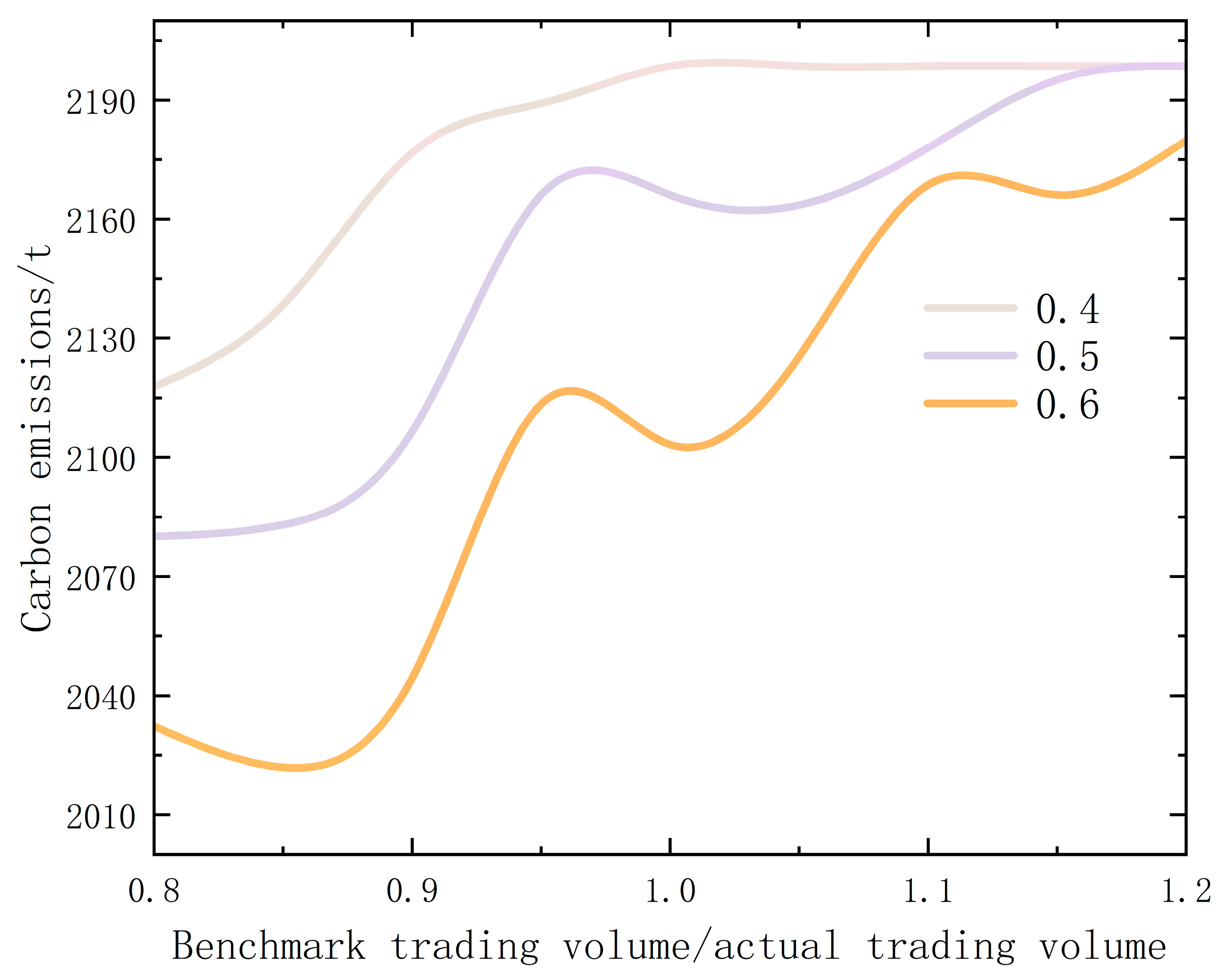
Therefore, this study selects 0.4, 0.5, and 0.6 as representative values for sensitivity analysis, corresponding to medium feedback, medium–high feedback, and strong feedback scenarios, respectively, to comprehensively assess the impact of mechanism strength changes on carbon emission results. Figure 10 shows the carbon emission change curves corresponding to dynamic price coefficients of 0.4, 0.5, and 0.6, respectively. The analysis shows that while a larger coefficient enhances emission reduction efforts in terms of carbon emissions, Figure 10 shows that the emission curve for the 0.6 scenario exhibits obvious fluctuations, indicating that the system is more sensitive to deviations, easily leading to uncertainty in carbon emissions and the excessive response of operation strategies.
Considering cost stability, emission reduction benefits, and result stability, a coefficient of 0.5 achieves the optimal compromise between the incentive effect and operational stability: its cost and emissions are significantly better than 0.4, but it does not exhibit the risk amplification and curve fluctuations brought by 0.6.

5.2. IES Optimization Dispatch Results and Analysis Considering Source-Load Uncertainty

In reality, wind power output and load demand often have uncertainty. To consider the impact of uncertainty on IES operating costs, Scenarios 9 and 10 for VPP optimal dispatch under two uncertainty schemes are set based on IGDT. According to the entropy weight method calculation, the weight coefficients for the wind power, electrical load, and thermal load are 0.343, 0.331, and 0.326, respectively.
Scenario 9: Based on the operation of Scenario 8, adopt a risk-averse strategy.
Scenario 10: Based on the operation of Scenario 8, adopt an opportunity-seeking strategy.
In the above schemes, the cost deviation coefficients for the risk-averse and opportunity-seeking strategies are set to 0.1.

5.2.1. Analysis of VPP Optimal Dispatch Results Under Uncertainty

Under uncertain conditions, the costs corresponding to Scenarios 9 and 10 are shown in Table 3.
As shown in Table 3, in the risk-averse strategy Scenario 9, the system’s actual wind power output is lower than predicted, while the required electrical and thermal load power is higher than predicted. Compared with Scenario 8, the electricity purchase cost increased by 12.4%, carbon emissions increased by 6%, carbon trading cost increased by 37,700 CNY, and the green certificate trading cost increased by 12,000 CNY. This scheme reduces the impact of wind power and load forecast errors on the system, improving system stability. However, to meet electricity demand, the system purchases more electricity externally, which increases the system’s carbon emissions, thereby increasing carbon trading costs and green certificate trading costs.
In the opportunity-seeking strategy, the system’s actual wind power output is higher than predicted, while the required electrical and thermal load power is lower than predicted. Compared with Scenario 8, the electricity purchase cost in Scenario 10 decreased by 12.7%, carbon emissions decreased by 8.2%, the carbon trading cost decreased by 20,500 CNY, and the green certificate trading cost decreased by 13,800 CNY. Scenario 10 fully utilizes the economic benefits brought by uncertainty. The system reduces external electricity purchases, and excess electrical and thermal energy can be stored through energy storage or converted into methanol for sale, making the overall economy and low-carbon performance better. However, this scenario relies too heavily on the accuracy of forecast results, and forecast deviations can affect system stability.
In summary, when IES uses the IGDT method, it needs to weigh different dispatch strategies based on the overall system situation and risk coefficients. If the IES operating cost is not expected to exceed the expected value, the risk-averse strategy can be chosen. Overall, the risk-averse strategy mainly ensures system stability and energy supply reliability by increasing operating costs. Conversely, if decision-makers want to fully utilize the economic benefits brought by source-load uncertainty and reduce the system’s actual carbon emissions, they can choose the opportunity-seeking strategy.

5.2.2. Risk Preference Sensitivity Analysis

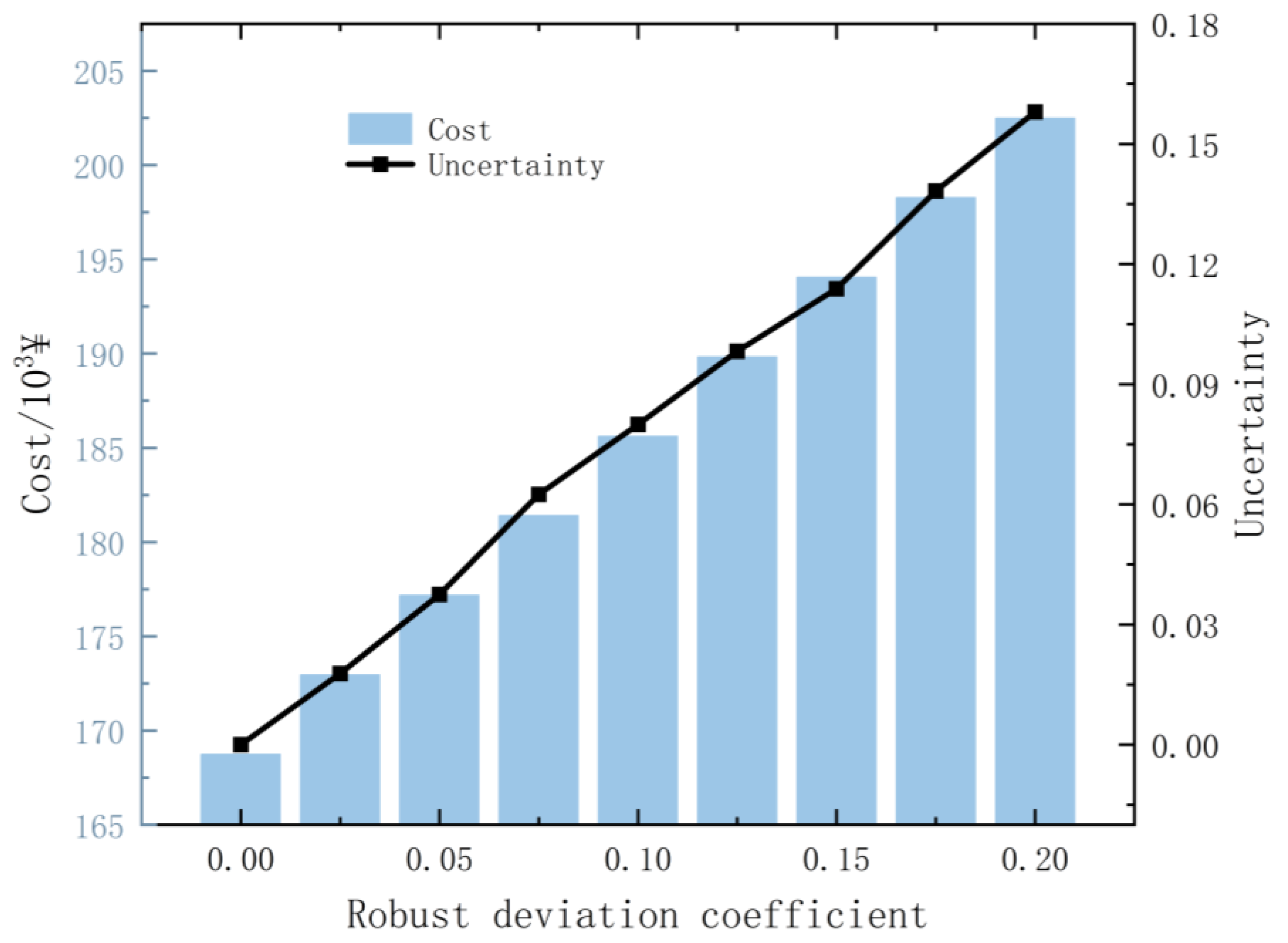
Different risk attitudes directly affect the system’s dispatch decision logic. This section focuses on the effect pattern of the deviation factor on the system’s total cost and deviation coefficient. Taking 0.025 as the step size, adjusting the deviation factor from 0 to 0.2 yields the change trend of the system deviation coefficient and total cost (as shown in Figure 11 and Figure 12). As shown in Figure 11, from the change in trend corresponding to the risk-averse strategy, it can be seen that the robustness deviation coefficient is positively correlated with the system cost and uncertainty. This is because in the risk-avoidance scenario, the increase in the deviation factor means that the actual output of wind power remains persistently lower than the predicted level, while the demand for thermal and heat loads has relatively increased compared to the predicted value. This leads to dual risks on both the supply and demand sides, forcing the system to increase the scale of energy purchase and enhance the operating output of energy supply equipment. The superimposed effect of energy purchase costs and equipment operating costs means that the total cost of the driving system increases with the increase in the robust deviation coefficient.
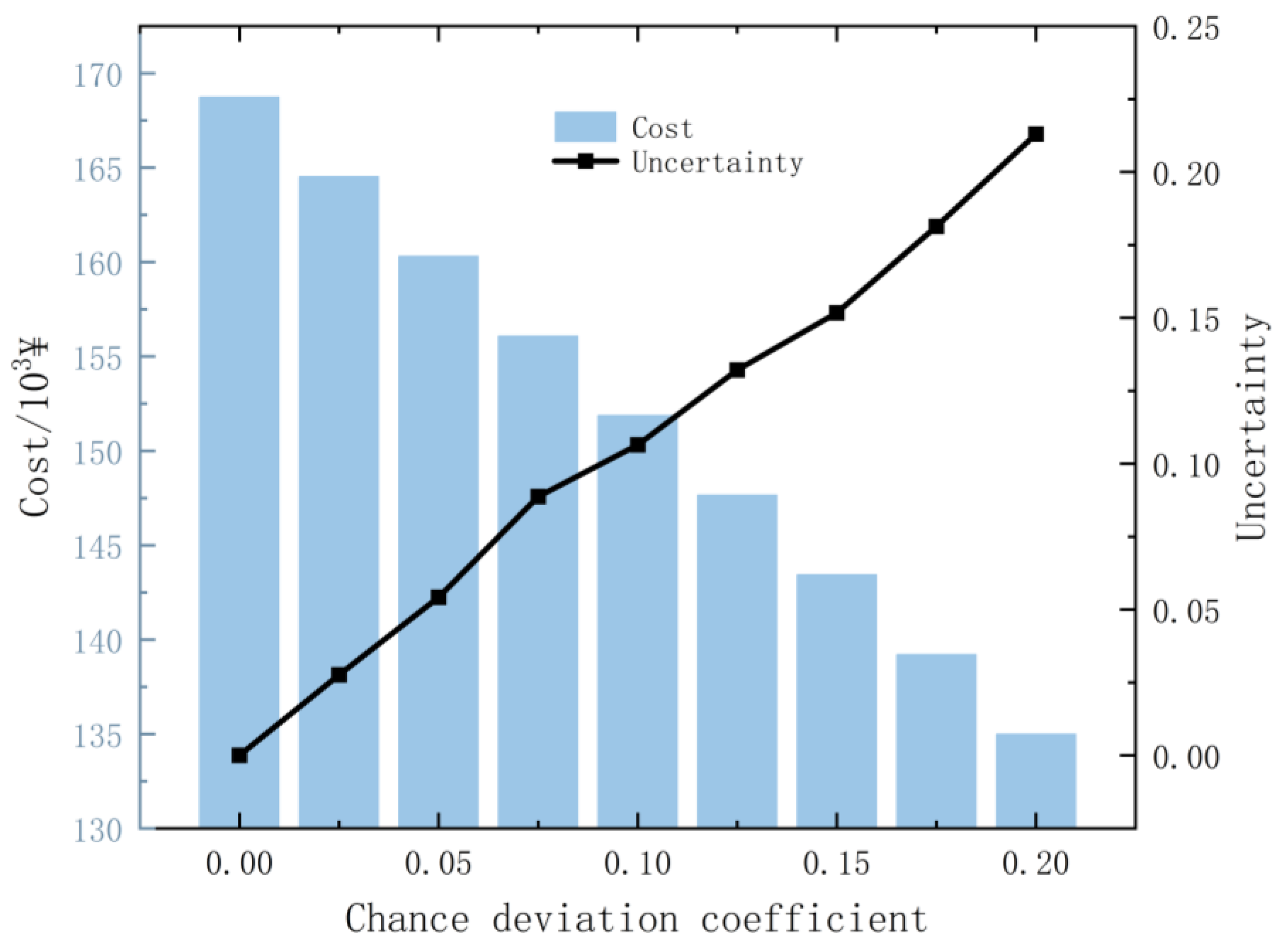
As shown in Figure 12, in the opportunity-seeking strategy, the opportunity deviation coefficient is negatively correlated with the system cost and positively correlated with uncertainty. The core reason is that when the deviation factor increases, the actual wind power output will be higher than the forecast value, while the electrical and thermal load demand is reduced. The system’s energy purchase demand and the operating pressure on energy supply equipment are simultaneously reduced. Both the energy purchase costs and equipment output costs decrease, causing the system’s total cost to gradually decrease as the opportunity deviation coefficient increases.
In summary, the impact of the deviation coefficient on system operation presents differentiated characteristics, depending on risk preference. Decision-makers need to reasonably select the deviation factor based on the actual scenario’s tolerance for uncertainty and economic goals to balance the system’s operating economy and risk response capability.

6. Conclusions

To improve the low-carbon economy of integrated energy systems, this paper, based on the thermoelectric demand characteristics of CCS and the interactive characteristics of the carbon trading and green certificate trading mechanisms, proposes a low-carbon dispatch model for integrated energy systems, considering dynamic carbon-green certificate coupling and CCS optimization. The main conclusions are as follows:
(1)
Optimizing the CCS thermoelectric demand supply method can improve the operating efficiency of CHP-CCS units and effectively reduce carbon emissions. Compared with the baseline scenario, the system’s total cost and carbon emissions decreased by 62,700 CNY and 129.3 t, respectively.
(2)
The dynamic coupling mechanism of carbon-green certificates can fully stimulate the low-carbon economic potential of the system, effectively solve the problem of sudden emission reduction and cyclical rebound in some systems, and optimize the energy consumption structure of the system. Reasonable setting of the dynamic price coefficient of this mechanism can effectively enhance its anti-shock emission reduction efficiency and guide the park to achieve continuous emission reduction through price incentives. This mechanism has significant low-carbon economic benefits. Compared with the static mechanism, the total system cost and carbon emissions have decreased by 31,900 yuan and 81.4 tons, respectively.
(3)
The constructed IGDT-based IES optimization dispatch model achieves optimal coordination between the risk preference and operating cost. The risk-averse strategy ensures system robustness at a higher cost, while the opportunity-seeking strategy utilizes uncertainty to improve the economy.
φ n = W n φ

Author Contributions

Conceptualization, L.Z.; methodology, L.Z. and Q.L.; software, Q.L.; investigation, X.G.; writing—original draft preparation, Q.L.; writing—review and editing, L.Z. and Q.L. All authors have read and agreed to the published version of the manuscript.

Funding

This research received no external funding.

Data Availability Statement

Data are contained within the article.

Conflicts of Interest

The authors declare no conflicts of interest.

Abbreviations

The following abbreviations are used in this manuscript:
CHPcombined heat and power
CCScap capture and storage
IGDTinformation gap decision theory method
IESIntegrated Energy System
CETcarbon emission trading
GCTgreen certificate trading
RArisk aversion
OSopportunity seeking
ELelectrolyzer
CHP-CCSCHP units with CCS installed
HFChydrogen fuel cell
EBelectric boiler
HESheat energy storage

Appendix A

The relationship between the electrical and thermal output of the CHP unit at time t and the thermal power generated by the boiler can be expressed as follows:
P m , t C H P = η 1 H m , t boiler + η 2 ( 1 α m , t ) H m , t boiler
H m , t C H P = η h α m , t H m , t boiler
where P m , t C H P is the electrical output of the CHP unit without steam extraction for carbon capture equipment. H m , t C H P is the thermal output of CHP unit m without steam extraction for carbon capture equipment. H m , t boiler is the thermal power generated by the boiler of CHP unit m; η 1 are the power generation efficiencies of the high/intermediate-pressure turbine and the low-pressure turbine, respectively; η h is the heat exchange efficiency; and α m , t is the proportion of low-pressure steam entering the heating network at time t.
E q = λ t = 1 T m = 1 N C H P P m , t CHP + χ t = 1 T m = 1 N C H P H m , t CHP + μ t = 1 T P t grid E d = t = 1 T m = 1 N CHP Q m , t CHP + β 1 t = 1 T P t grid t = 1 T m = 1 N C H P Q m , t cap F c = μ c ( E d E q )
where E q and E d are the carbon quota and actual carbon emissions of the VPP, respectively; P t grid is the power purchased from the grid at time t; λ and χ are the carbon emission quotas per unit of electricity generation and heat generation for CHP units, respectively; μ is the carbon emission quota per unit of purchased power; β 1 is the electricity emission factor; F c is the carbon trading cost; μ c is the fixed carbon price; and N C H P is the set of CHP units.
N d = t = 1 T P t gre N q = σ t = 1 T P t sum F g = μ g ( N q N d )
where N d and N q are the number of green certificates obtained by the VPP and the number required to meet the quota requirement, respectively; P t gre and P t sum are the actual renewable energy generation power and the total actual system generation power at time t, respectively; σ is the renewable energy generation quota proportion, taken as 0.52; and μ g and F g are the green certificate price and green certificate trading revenue/cost, respectively.
0 H m , t CHP-CSS H m , max CHP η h α t β Q m , t cap
P m , min CHP-CSS P m , t CHP-CSS P m , max CHP-CSS
P m , min CHP-CSS = max P m , min CHP c V H m , t CHP-CSS η 2 β ( 1 α t ) Q m , t cap , c M H m , t CHP-CSS + K
P m , max CHP-CSS = P m , max CHP c V H m , t CHP-CSS η 2 β ( 1 α t ) Q m , t cap
where P m , min CHP and P m , max CHP are the lower and upper limits of electrical power output for the CHP unit before adding CCS; P m , min CHP-CSS and P m , max CHP-CSS are the lower and upper limits of electrical power output for the CHP unit after adding CCS; H m , max CHP is the upper limit of thermal power output for the CHP unit before adding CCS; and K, c V and c V are the operating characteristic parameters of the CHP unit.
Q t r i c h = Q t 1 r i c h L t r i c h Q t p o o r = Q t 1 p o o r L t p o o r L t r i c h + L t p o o r = 0 L t r i c h = M M E A Q t C Y M C O 2 r φ θ Q 0 r i c h = Q T r i c h Q 0 p o o r = Q T p o o r 0 Q t r i c h Q m a x r i c h 0 Q t p o o r Q max p o o r
where Q t p o o r and Q t r i c h are the liquid storage amounts in the rich solution tank and lean solution tank at time t, respectively. L t r i c h and L t p o o r are the outflow rates of MEA solution from the rich solution tank and lean solution tank at time t, respectively. A positive value indicates MEA solution outflow and a negative value indicates MEA solution inflow. The outflow from the rich tank and inflow to the lean tank must be balanced at the same moment. Q t C Y is the amount of CO2 to be captured contained in the MEA solution flowing into or out of the rich solution tank at time t. M M E A and M C O 2 are the molar masses of MEA and CO2, respectively. φ is the desorption amount from the regenerator. r is the density of the MEA solution; θ is the concentration of the MEA solution; and Q 0 r i c h and Q 0 p o o r , and Q T r i c h and Q T p o o r , are the liquid storage amounts in the rich and lean solution tanks at the initial and final moments of the scheduling cycle, respectively. Q m a x r i c h and Q max p o o r are the maximum storage capacities of the rich and lean solution tanks, respectively.
Figure A1. The output loss diagram of the cogeneration unit.
Electronics 15 00999 g0a1
Table A1. Weights for historical trading volume calculation.
PeriodValue
w k 1 0.4
w k 2 0.2
w k 3 0.1
w k 4 0.1
w k 5 0.1
w k 6 0.05
w k 7 0.05
Table A2. Grid electricity purchase price.
Time PeriodPrice TypePrice/[¥·(MW·h)−1]
01:00–07:00, 23:00–24:00Off-peak310
08:00–9:00, 15:00–16:00, 21:00–22:00Mid-peak490
10:00–14:00, 17:00–20:00Peak840
Table A3. Dynamic carbon-green certificate mechanism parameters.
SymbolMeaningReference ValueOrganizationSource
λ The carbon emission quota per unit of electricity generated by the cogeneration unit0.2201t/MW[28]
χ The carbon emission quota per unit of heat generated by the cogeneration unit0.0557t/MW[28]
μ Carbon emission quota for the power purchased by the unit0.021t/MW[28]
β 1 Electricity emission factor0.788t/MW[28]
μ c Fixed carbon price100Yuan[29]
σ The proportion of renewable energy power generation quotas0.52 [29]
μ g Green certificate price100Yuan[29]
Q g The reduction in carbon emissions resulting from the unit’s green certificate program0.764t[29]
Table A4. Main equipment parameters.
NameRef. ValueNameRef. ValueNameRef. ValueNameRef. Value
η 1 0.15 H m , max C H P 450 MW η E B 0.98 P l , min E L 0
η 2 0.25 P m , min C H P 175 MW P e , max e b 200 MW P l , max E L 200 MW
η h 0.8 P m , max C H P 350 MW P m B 5 M M E A 61.08
β 0.64 c V 0.15 W c 0.268 M C O 2 44
P m , u p N 100 MW c M 0.75 η c a p 0.9 φ 0.3
P m , d o w n N 100 MW K −55 ϖ max 0.9 r 1.01
H m , u p N 80 MW e j 0.000253 σ e 1.02 θ 0.3
H m , d o w n N 80 MW f j 220.32 τ 1.2 Q m a x r i c h 10,000
λ coal 420 Yuan η T E S 0.98 k 500 Yuan Q max p o o r 10,000

References

  1. Yin, G.; Wang, B.; Zhao, H.; Guo, Q.; Sun, H. On the real-time quantification of flexibility provided by district heating networks considering dynamic temperature distribution. IEEE Trans. Sustain. Energy 2022, 13, 1666–1680. [Google Scholar] [CrossRef]
  2. Wang, L.; Liu, Y.; Pang, X.; Wang, X.; Wang, H. Flexible Retrofitting and Optimal Scheduling of Cogeneration System Based on Improved Memetic Algorithm. Acta Energiae Solaris Sin. 2020, 46, 410–419. [Google Scholar]
  3. Huang, Y.; Chen, Q.; Zhang, Z.; Liu, X.; Tu, J.; Zhang, L. Optimal scheduling of combined electric and heating considering the control process of CHP unit and electric boiler. Processes 2023, 11, 753. [Google Scholar] [CrossRef]
  4. Wu, H.; Liu, Z.; He, Y.; Ding, M.; Xu, B.; Zhang, M. Two-layer optimal scheduling method for regional integrated energy system considering flexibility characteristics of CHP system. Energy 2024, 308, 132970. [Google Scholar] [CrossRef]
  5. Wang, L.; Cheng, J.; Luo, X. Optimal scheduling model using the IGDT method for park integrated energy systems considering P2G–CCS and cloud energy storage. Sci. Rep. 2024, 14, 17580. [Google Scholar] [CrossRef]
  6. Yang, J.; Liang, T.; Mi, D.; Jing, Y.; Huang, Z.; Wu, H. Low-carbon optimization scheduling of a CCS-P2G-HFC integrated energy system with 2D-DR under multi-mechanism collaboration. Energy 2025, 336, 138348. [Google Scholar] [CrossRef]
  7. Li, J.; Bo, Y.; Zhou, Y.; Shu, H.; Li, H.; Gao, D.; Jiang, L. Coordinated Low-Carbon Scheduling of Integrated Electricity-Heat-Gas-Hydrogen-Methanol Multi-Microgrids Considering Electricity-Methanol Trading. Expert Syst. Appl. 2026, 298, 129701. [Google Scholar] [CrossRef]
  8. Guo, X.; Lou, S.; Wu, Y.; Wang, Y. Low-carbon Operation of Combined Heat and Power Integrated Plants Based on Solar-assisted Carbon Capture. J. Mod. Power Syst. Clean Energy 2022, 10, 1138–1151. [Google Scholar] [CrossRef]
  9. Huang, Y.; Zhou, M.; Huang, Y.; Rong, J.; Li, P. Low Carbon Scheduling of Electricity-heat Energy System Considering Carbon Capture Power Plant with Electric Boiler Assisted Heating. Power Syst. Technol. 2024, 48, 1907–1917. [Google Scholar]
  10. Qiu, J.; Zhao, J.; Wen, F.; Zhao, J.; Gao, C.; Zhou, Y.; Tao, Y.; Lai, S. Challenges and pathways of low-carbon oriented energy transition and power system planning strategy: A review. IEEE Trans. Netw. Sci. Eng. 2023, 11, 5396–5416. [Google Scholar] [CrossRef]
  11. Dai, Y.; Huang, Z.; Li, Y.; Lv, R. Robust optimal scheduling of multi-energy virtual power plants with incentive demand response and ladder carbon trading: A hybrid intelligence-inspired approach. Energies 2025, 18, 4844. [Google Scholar] [CrossRef]
  12. Zhou, Z.; Lin, W.; Bian, J.; Ren, X. Day-Ahead Optimal Scheduling of an Integrated Electricity-Heat-Gas-Cooling-Hydrogen Energy System Considering Stepped Carbon Trading. Energies 2025, 18, 2249. [Google Scholar] [CrossRef]
  13. Gao, L.; Yang, S.; Chen, N.; Gao, J. Integrated Energy System Dispatch Considering Carbon Trading Mechanisms and Refined Demand Response for Electricity, Heat, and Gas. Energies 2024, 17, 4705. [Google Scholar] [CrossRef]
  14. Zhang, L.; Liu, D.; Cai, G.; Lyu, L.; Koh, L.H.; Wang, T. An optimal dispatch model for virtual power plant that incorporates carbon trading and green certificate trading. Int. J. Electr. Power Energy Syst. 2023, 144, 108558. [Google Scholar] [CrossRef]
  15. Zhang, J.; Liu, Z. Low carbon economic dispatching model for a virtual power plant connected to carbon capture system considering green certificates-carbon trading mechanism. Sustain. Energy Technol. Assess. 2023, 60, 103575. [Google Scholar] [CrossRef]
  16. Chen, H.; Wu, H.; Li, H.; Chen, F.; Shui, S.; Li, Z. Bi-level optimal scheduling of integrated energy systems considering incentive-based demand response and green certificate-carbon trading mechanisms. Energy Rep. 2025, 13, 330–344. [Google Scholar] [CrossRef]
  17. Tong, X.; Zhao, S.; Chen, H.; Wang, X.; Liu, W.; Sun, Y.; Zhang, L. Optimal dispatch of a multi-energy complementary system containing energy storage considering the trading of carbon emission and green certificate in China. Energy 2025, 314, 134215. [Google Scholar] [CrossRef]
  18. Hao, D.; Hu, Z.; Tan, Z.; Li, T.; Wang, Y.; Hu, H.; Deng, Z. Low-carbon economic scheduling of integrated energy system considering bidirectional interaction of green certificate-ladder carbon and carbon capture. Electr. Power Autom. Equip. 2025, 45, 69–77. [Google Scholar]
  19. Zhao, C.; Peng, S.; He, P.; Wang, S.; Wu, X.; Fan, J. Dynamic Pricing Model and Game Analysis of Multiple Virtual PowerPlants Under Electricity-Carbon-Green Certificate Trading Coupling. Autom. Electr. Power Syst. 2026, 50, 188–198. [Google Scholar]
  20. Yin, Z.; Zhu, R.; Cui, S.; Li, T.; Zhang, Y.; Zhang, Z. Optimisation Scheduling of Integrated Electricity-Heat-Oxygen Energy Systems Considering Demand Response and Carbon Trading Based on IGDT. IET Gener. Transm. Distrib. 2025, 19, e70126. [Google Scholar] [CrossRef]
  21. Ji, Z.; Tian, J.; Liu, S.; Yang, L.; Dai, Y.; Banerjee, A. Optimal scheduling of park-level integrated energy system considering multiple uncertainties: A comprehensive risk strategy-information gap decision theory method. Appl. Energy 2025, 377, 124700. [Google Scholar] [CrossRef]
  22. Xu, R.; Ren, Y.; Zhang, Y.; Meng, Z.; Yue, C.; Zhao, F. An optimal scheduling method for integrated energy system considering green certificate-carbon trading interactive operation with source-load uncertainty. Electr. Power Syst. Res. 2025, 245, 111576. [Google Scholar] [CrossRef]
  23. Xu, W.; Liu, Z.; Li, Z.; Zhang, Z. Low carbon oriented electric-hydrogen system multi-time scale collaborative optimal scheduling strategy considering hybrid energy storage. Energy Rep. 2024, 12, 4295–4305. [Google Scholar] [CrossRef]
  24. Li, Q.; Xiao, X.; Pu, Y.; Luo, S.; Liu, H.; Chen, W. Hierarchical optimal scheduling method for regional integrated energy systems considering electricity-hydrogen shared energy. Appl. Energy 2023, 349, 121670. [Google Scholar] [CrossRef]
  25. Gao, L.; Yi, W. Economic Optimal Scheduling of Virtual Power Plants with Vehicle-to-Grid Integration Considering Uncertainty. Processes 2025, 13, 2755. [Google Scholar] [CrossRef]
  26. Wang, J.; Gu, C.; Liu, K. Anomaly electricity detection method based on entropy weight method and isolated forest algorithm. Front. Energy Res. 2022, 10, 984473. [Google Scholar] [CrossRef]
  27. Liu, Y.; Hu, Z.; Chen, J.; Weng, C.; Gao, M.; Liu, S. Low-carbon Economic Dispatch of Integrated Energy System Considering Carbon Capture Power Plant and Multi-utilization of Hydrogen Energy. Power Syst. Autom. 2024, 48, 31–40. [Google Scholar]
  28. Shanghai Municipal Environmental Protection Bureau. Shanghai’s 2023 Annual Carbon Emission Quota Allocation Plan. Available online: https://news.bjx.com.cn/html/20240218/1361316.shtml (accessed on 28 February 2024).
  29. Wang, Y.; Li, Y.; Song, M.; Liu, C.; Li, B.-K.; Li, B.; Xue, X. Optimal Scheduling of Virtual Power Plants Considering Multiple Uncertainties and Time Correlation for Carbon-Green Certificate Synergistic Trading. Power Syst. Technol. 2024, 48, 4938–4947. [Google Scholar] [CrossRef]
Figure 1. System structure diagram.
Electronics 15 00999 g001
Figure 2. Carbon capture device energy flow diagram.
Electronics 15 00999 g002
Figure 3. Carbon-green certificate synergistic market dynamics interaction mechanism diagram.
Electronics 15 00999 g003
Figure 4. Projection curves.
Electronics 15 00999 g004
Figure 5. Thermal power balance diagram.
Electronics 15 00999 g005
Figure 6. Heat loss diagram for CHP auxiliary heating.
Electronics 15 00999 g006
Figure 7. Carbon capture energy consumption.
Electronics 15 00999 g007
Figure 8. Comparison of net output and purchased power for the four scenarios.
Electronics 15 00999 g008
Figure 9. Impact of different dynamic price coefficients on costs.
Electronics 15 00999 g009
Figure 10. Impact of different dynamic price coefficients on carbon emissions generators.
Electronics 15 00999 g010
Figure 11. Impact of different dynamic price coefficients on carbon emission generators.
Electronics 15 00999 g011
Figure 12. Impact of different dynamic price coefficients on carbon emission generators.
Electronics 15 00999 g012
Table 1. Optimization results of Scenarios 1–4.
ScenarioCarbon Emissions/tCarbon Trading Cost/104 ¥Fuel Cost/104 ¥Electricity Purchase Cost/104 ¥Methanol Sales Profit/104 ¥Total Cost/104 ¥
12347.414.11747.87141.14701.42227.42
22268.211.61763.68129.68706.87224.07
32222.510.83773.02122.69709.17223.71
42218.110.23772.89122.31711.28221.15
Table 2. Optimization results of Scenarios 5–8.
ScenarioCarbon Emissions/tCarbon Trading Cost/104 ¥Green Cert. Trading Cost/104 ¥Electricity Purchase Cost/104 ¥Total Cost/104 ¥
Scenario 52468.014.83−14.42162.57214.62
Scenario 62311.7−30.18−12.34135.73173.19
Scenario 72243.8−31.24−13.83132.18171.94
Scenario 82162.4−37.27−14.02111.51168.75
Table 3. Optimization results of Scenarios 9–10.
Scenario 9Scenario 10
Carbon Emissions/t2292.51984.2
Carbon Trading Cost/104 ¥−33.5−39.32
Green Cert. Trading Cost/104 ¥−12.82−15.4
Electricity Purchase Cost/104 ¥125.3697.36
Total Cost/104 ¥185.63151.88
Disclaimer/Publisher’s Note: The statements, opinions and data contained in all publications are solely those of the individual author(s) and contributor(s) and not of MDPI and/or the editor(s). MDPI and/or the editor(s) disclaim responsibility for any injury to people or property resulting from any ideas, methods, instructions or products referred to in the content.