1. Introduction
SCARA robots are widely used in point-to-point motion applications such as material handling and part assembly. In particular, owing to their rapid motion and compliance characteristics, cornering applications of SCARA robots have attracted significant attention in manufacturing and machining industries. However, because of the inherent mechanical structure of a SCARA robot, when its end effector performs cornering, the residual vibration and cornering accuracy of the end effector become critical issues. With the increasing demand from industry for higher motion speed and accuracy, residual vibration suppression and cornering control of the end effector have become important topics in the cornering control of SCARA robots.
Input shaping is a feedforward control technique that is widely used to reduce residual vibrations in robotic systems. The core principle involves convolving a command signal with a sequence of impulses known as an input shaper. This process creates a shaped command that guides the robot to its desired position by reducing the residual vibrations after the movement is complete. The simplest form is the zero-vibration (ZV) shaper. Additionally, a more robust version—the zero-vibration-derivative (ZVD) shaper—has been developed to handle uncertainties in the system’s residual vibration properties. Although input shaping is effective, it faces challenges in systems with complex, time-varying, and multimodal vibrations. For example, for robots whose dynamic properties depend significantly on their configuration, a fixed-input shaper is suboptimal. Thomsen et al. [
1] presented a method for identifying and mapping the dominant vibration modes of a robot and then applied a multimode fractional-delay time-varying input-shaping technique. This allows the shaper parameters to be updated in real time based on the configuration of the robot, reducing residual vibration. Pham et al. [
2] implemented a time-varying input shaper in a two-stage controller, where a recursive Newton–Euler algorithm updated the feedforward link inertia during motion.
To address highly complex and time-varying dynamics that are difficult to model analytically, several studies have proposed combining input shaping with machine learning. For instance, İlman et al. [
3] use a C4.5 decision-tree algorithm to generalize the parameter tuning for a multi-link manipulator, accurately predicting vibration levels. Newman et al. [
4] employed an artificial neural network and transfer learning to predict a robot’s natural frequency in any pose, even with varying payloads, experimentally achieving vibration reduction. Zhang et al. [
5] proposed a deep reinforcement learning-based method to optimize the input-shaper parameters by interacting directly with a robot, thereby avoiding complex modeling. Input shaping is often integrated directly into the trajectory planning stage. Zhang et al. [
6] proposed a time-optimal and smooth trajectory planning algorithm that uses input shaping to smooth the trajectory and suppress vibrations while compensating for the inherent signal delay. Zhang et al. [
7] adopted input shaping with a time-delay compensation strategy for a 3-CRU parallel robot, improving positioning accuracy while ensuring a fixed running time. Zou et al. [
8] proposed a learning exponential jerk trajectory planning method that uses an iterative learning strategy to adjust the parameters of an exponential filter online, achieving superior residual vibration suppression compared with standard ZV and ZVD shapers. Although input shaping is a feedforward technique, it can be combined with feedback controllers. Kumar et al. [
9] designed a hybrid controller that integrated command shaping with a proportional–derivative (PD) feedback controller for a two-link flexible manipulator. The PD controller ensured accurate trajectory tracking, whereas the input shaper suppressed vibrations. Pham et al. [
2] used a two-stage controller, where input shaping functioned as the feedforward component and a generalized Smith predictor, proportional–integral–derivative compensator, and feedback low-pass filter were used in the second stage to improve disturbance rejection. Although numerous studies indicate that input shapers can effectively suppress residual vibration of the end effector, few have addressed the cornering errors that arise during continuous-path corner motions. In other words, while input shaping reduces residual vibration, it does not affect the variation in cornering error, which can limit the cornering accuracy of the end effector.
Cornering control is critical for the contour motions of mechanical systems because it balances motion speed with accuracy. A machine must decelerate to a complete stop at sharp corners to maintain accuracy, which significantly increases the motion time. However, maintaining high speed causes cornering errors and induces residual vibrations, degrading the motion accuracy. Therefore, effective cornering control smooths the motion path, allowing the machine to navigate corners quickly while minimizing cornering errors and residual vibrations. Diverse cornering control methods have been developed for CNC machine tools; for instance, several advanced interpolation algorithms have been developed to improve cornering performance using finite impulse response (FIR) filters [
10,
11,
12,
13,
14,
15]. However, few methods have focused on robotic systems to address discontinuities at the corners of motion paths, which can cause residual vibrations and degrade motion performance.
Several studies have been conducted on the development of algorithms to smooth the motion paths of robotic manipulators. Sun et al. [
16] introduced an online tool-path smoothing algorithm for 6R robot manipulators that uses an FIR filter interpolation method. This approach achieved geometric smoothness and motion interpolation in a single step. A key contribution of this study is a simplified method to constrain the joint velocity and acceleration by directly establishing the relationship between the joint motion and tool motion, thus avoiding complex inverse kinematics. A tool-path smoothing algorithm for a 6R manipulator was proposed by Sun et al. [
17], which considers pose-dependent dynamics by designing asymmetric FIR filters. This method aims to fully utilize the joint drive capability by establishing a simplified dynamic model that accounts for both tangential and joint dynamic constraints. In contrast to FIR filter-based methods, Peng et al. [
18] presented an analytical method for the decoupled local smoothing of linear paths. This method smooths the tool position path in the reference frame and the tool orientation in the rotation parameter space using quintic B-splines to achieve G3 continuity. A notable feature is that the orientation smoothing error is analytically constrained, and the resulting smooth-orientation path is invariant with the selection of the reference frame. Zhang et al. [
19] proposed a transition method based on Bezier curves for trajectory planning in the Cartesian space to smooth the trajectory between two adjacent curves. This method guarantees G2 continuity and uses cubic and quartic Bezier curves to minimize calculations. The paper discusses transitions between lines, a line and a circle, and two circles. Zhu et al. [
20] proposed a trajectory planning method for delta parallel robots that combines Cartesian and joint spaces. The trajectory of the end effector is planned in the Cartesian space and then mapped to the joint space, where a fifth-order B-spline curve is used for smoothing. This approach was shown to reduce the peak trajectory tracking error and peak torque change.
Several studies have focused on interpolation techniques and corner smoothing to ensure continuous and smooth motion. Li et al. [
21] presented an interpolation design using the velocity-profile overlap (VPO) method, with an S-shaped profile for each line segment. This approach allows specified corner-tolerance constraints to be satisfied by defining an overlapping time parameter. The proposed VPO method demonstrated higher accuracy and lower cycle time than conventional methods involving acceleration and deceleration (ACC/DEC) after interpolation. Tajima et al. [
22] proposed a kinematic tool-path smoothing algorithm for six-axis industrial machining robots. Their approach achieved linear interpolation in the workspace by decoupling the position commands into Cartesian coordinates and the orientation commands into spherical coordinates. The kinematic local corner smoothing method generates smooth trajectories at the corners using a three-segment constant-jerk profile. Although numerous studies have indicated that existing cornering control methods can effectively limit the cornering error by considering the motion characteristics of the manipulator, the prevalent use of symmetric trajectory planning and filter-parameter design constrains the cornering motion of the end effector. Furthermore, the significant residual vibrations induced during cornering have received little attention in the literature. Thus, the development of cornering control methods capable of suppressing residual vibrations in the end effector during high-speed cornering is necessary.
When a SCARA robot performs cornering, a change in the direction of motion is often required. This produces an impact-like effect on the mechanical structure of the robot, and the end effector generates residual vibrations after the cornering motion. Although an input shaper can effectively suppress residual vibration, it produces a discontinuous and asymmetric cornering acceleration and deceleration process, and the cornering motion is prone to generating a cornering error due to an inappropriate cornering speed. Therefore, the residual vibration suppression and cornering-error constraint for the cornering motion of a SCARA robot’s end effector are not independent problems but are intrinsically related. Accordingly, this study integrates residual vibration suppression and cornering-error constraint to develop a hybrid prefilter design and corner trajectory planning method applicable to the cornering of a SCARA robot’s end effector.
In this study, a hybrid prefilter that integrates the advantages of an input shaper and an FIR filter is proposed, which enables the end effector of the SCARA robot to more effectively suppress residual vibration when performing cornering. The step response, frequency response, and sensitivity curves of the undamped natural frequency and damping ratio for the input shaper, FIR filter, and hybrid prefilter were compared and analyzed. It was concluded that the hybrid prefilter achieves the best balance among suppressing residual vibration, improving system response, and improving robustness. Moreover, this study designed a corner trajectory planning method that considers the asymmetric cornering acceleration and deceleration processes caused by a hybrid prefilter. A systematic approach was employed to analyze the relationship between the cornering time and cornering error and to design cornering trajectory parameters, such as the cornering time and delay time, for restricting the cornering error and balancing the performance and accuracy of the cornering motion. Therefore, by integrating the hybrid prefilter design and corner trajectory planning method developed in this study, it is possible to not only suppress residual vibration but also restrict the cornering error when a SCARA robot’s end effector performs cornering. Experiments were performed on a SCARA robot test bench, and the input shaper, FIR filter, and hybrid prefilter were compared. Regardless of whether the cornering error was restricted to 0 or 500 µm, the hybrid prefilter exhibited excellent end effector residual vibration-suppression performance, with reduction rates of >85% for both the maximum amplitude and the root-mean-square (RMS) value of the residual vibration.
The remainder of this paper is organized as follows:
Section 2 presents the preliminary work of this study, including the designs of the input shaper and FIR filter, trajectory planning method for the SCARA robot, and definitions of corner trajectory planning and cornering errors.
Section 3 details the design of the hybrid prefilter and compares and analyzes the step response, frequency response, and sensitivity curves of the undamped natural frequency and damping ratio for different input shapers, FIR filters, and hybrid prefilters.
Section 4 describes the causes of the cornering error, analyzes the relationship between the cornering error and the cornering trajectory parameters, and develops design steps for the cornering trajectory parameters to restrict the cornering error. End effector cornering experiments were performed on a SCARA robot test bench to quantitatively compare and analyze the residual vibration-suppression performance of different input shapers, FIR filters, and hybrid prefilters under different restricted cornering errors. The results are discussed in
Section 5. Finally,
Section 6 concludes the paper.
2. Preliminary Work
2.1. Input-Shaper Design
The design goal of an input shaper is to reduce the residual vibration in a flexible system and improve the settling time and positioning accuracy of the system. This feedforward open-loop control operates by performing a convolution of a series of impulse signals with different amplitudes and time delays with the system’s input command to generate a shaped command, which is then input to the system to actuate its motion. Here, the input shaper only needs to identify the undamped natural frequency and damping ratio of the residual vibration of the system and does not require an accurate system model. Therefore, this design has the advantage of not requiring the installation of a feedback sensor, does not cause a stability problem, and is suitable for systems for which accurate modeling is difficult.
Common input-shaper designs include ZV and ZVD. If the transfer function of the controlled system is given by Equation (1), the ZV input-shaper design can be expressed by Equation (2) [
23,
24]:
where
denotes the undamped natural frequency and
denotes the damping ratio.
and
. The ZVD input-shaper design
is expressed by Equation (3) [
23,
24]:
The ZV input shaper generates a shaped command to the controlled system in two stages, and the delay time of the second-stage command is half the vibration period. Therefore, although the ZV input shaper can effectively suppress residual vibration, it has a delay time of half the vibration period. Compared to the ZV input shaper, the ZVD input shaper has superior robustness owing to additional zero-derivative restrictions, implying that its vibration-suppression effect is less influenced by the parameter uncertainty of the controlled system. However, because the input command is input to the controlled system in three stages, the ZVD input shaper has a longer delay time, and its delay time is equal to the vibration period. Input shapers often exhibit a tradeoff between robustness and time delay.
2.2. FIR-Filter Design
For the motion control of mechatronic systems, an FIR filter is often applied to trajectory planning, smoothing position and velocity commands to enable the mechatronic system to have smooth motion [
15,
25]. In addition, for flexible systems, the filtered command generated by the convolution operation of an FIR filter with the input command of the controlled system can effectively suppress residual vibration [
26].
If the transfer function of the controlled system is given by Equation (1), the FIR-filter design
is expressed by Equation (4) [
15]:
Clearly, in the time domain, the unit impulse response of the FIR filter, as given by Equation (4), is a rectangular pulse with a unit area, and the FIR-filter design can be based on the residual vibration period of the controlled system. Therefore, the delay time is equal to the vibration period. In addition, from the frequency response of the FIR filter, it is known that the FIR filter not only has low-pass characteristics but also can suppress the dominant and harmonic frequency components of the residual vibration and attenuate the input command that induces high-frequency residual vibration. Nevertheless, the residual vibration-suppression performance of the FIR filter is affected by the uncertainty of the system parameters (i.e., the undamped natural frequency and damping ratio).
2.3. Trajectory Planning
SCARA robot trajectory planning can be performed in the task and joint spaces [
27]. Task-space trajectory planning refers to designing the motion trajectory of the SCARA robot’s end effector in the workspace. Then, through inverse kinematics, this planned trajectory is converted into the motion trajectories for the robot joints, which actuate the robot to follow the desired path. Because the trajectory planning is performed in the task space, a prefilter can be used, enabling the SCARA robot’s end effector to have appropriate motion characteristics in the task space.
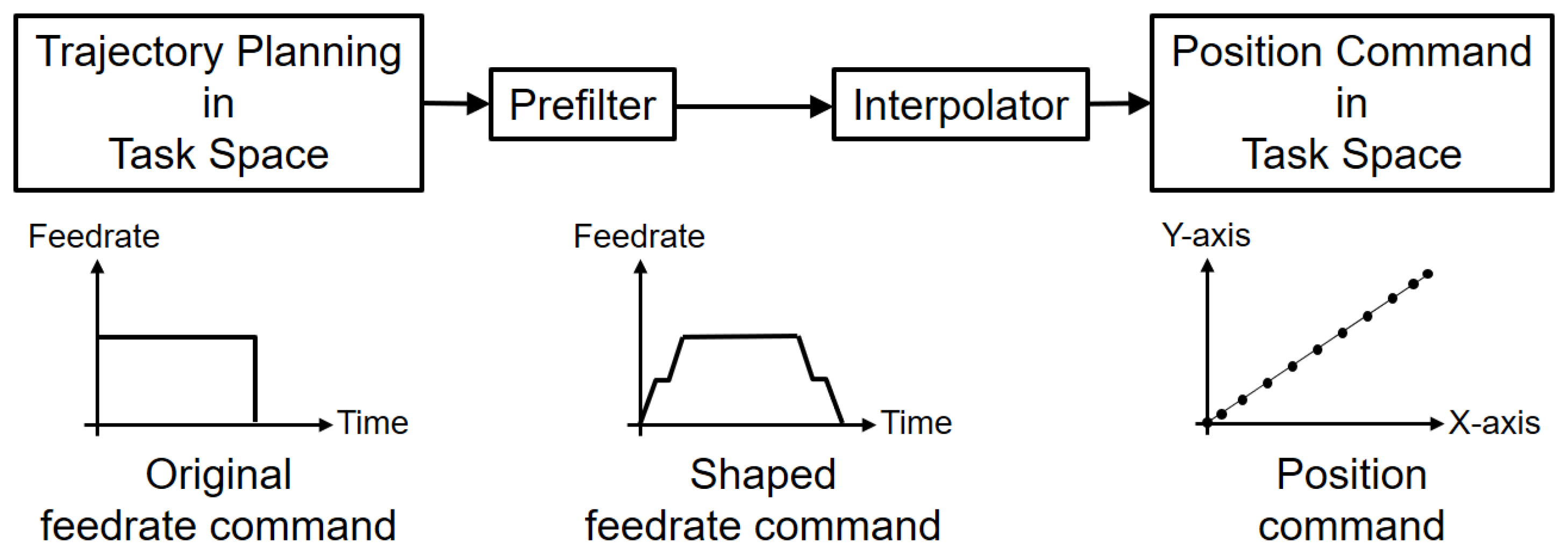
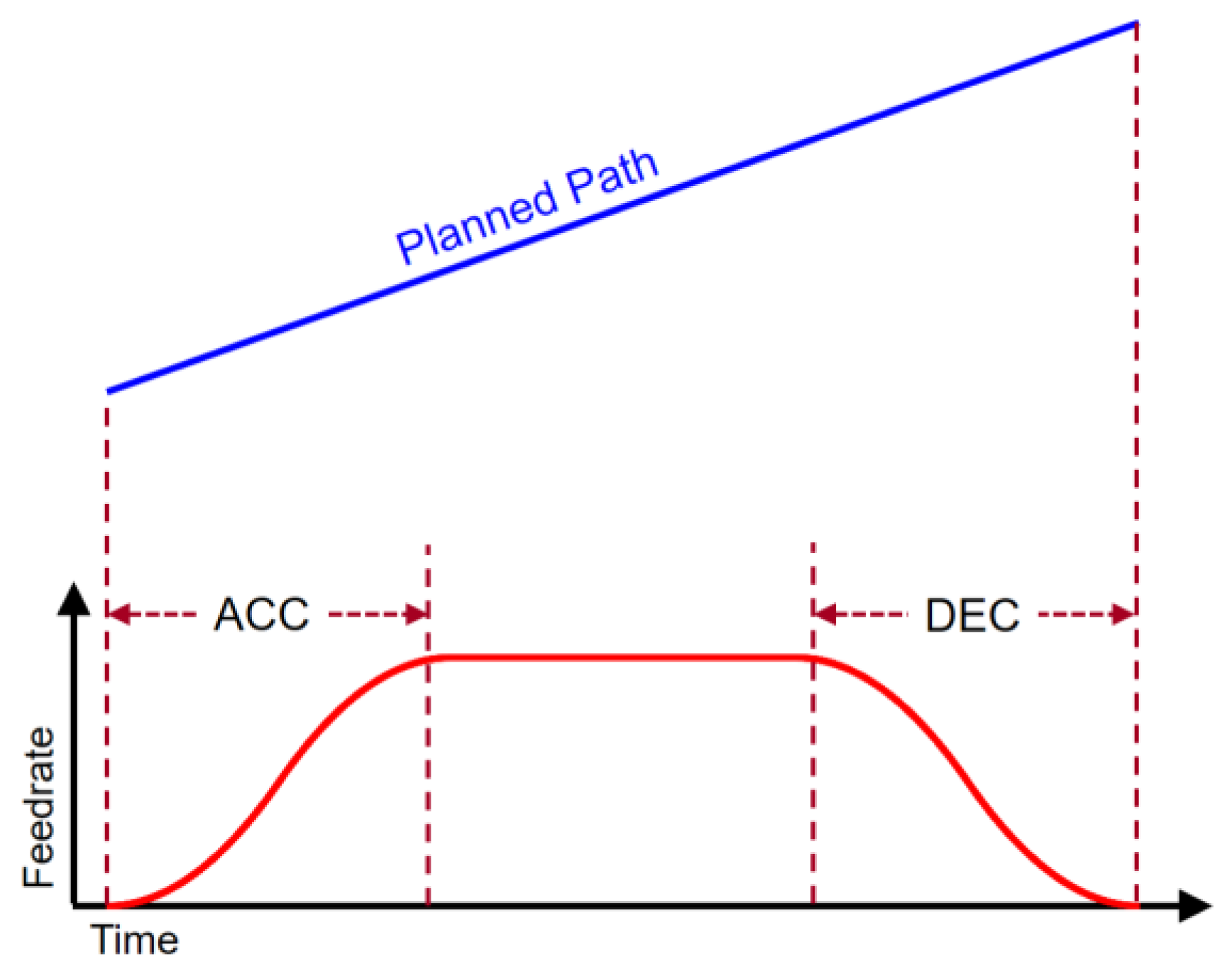
Task-space trajectory planning can provide the SCARA robot with higher motion accuracy; therefore, it was adopted in this study, as shown in
Figure 1. Task-space trajectory planning can plan a feedrate command for the motion of the SCARA robot’s end effector in the task space, as shown in
Figure 1. A prefilter can process the feedrate command, enabling the end effector’s motion to have different acceleration and deceleration processes; as shown in
Figure 1, designing the prefilter as a ZV input shaper can shape the constant feedrate command into a shaped feedrate command with segmented acceleration and deceleration processes to suppress the residual vibration of the end effector’s motion. An interpolator can refer to the shaped feedrate command to generate position commands in the task space for the end effector’s motion path. As shown in
Figure 1, the interpolator references the shaped feedrate command to generate position commands for the end effector’s linear path motion in the task space, which has acceleration and deceleration processes to suppress the end effector’s residual vibration. Using inverse kinematics, the task-space position commands generated by the interpolator can be converted into joint-space position commands to actuate the motion of the end effector of the SCARA robot in the task space.
2.4. Cornering Error
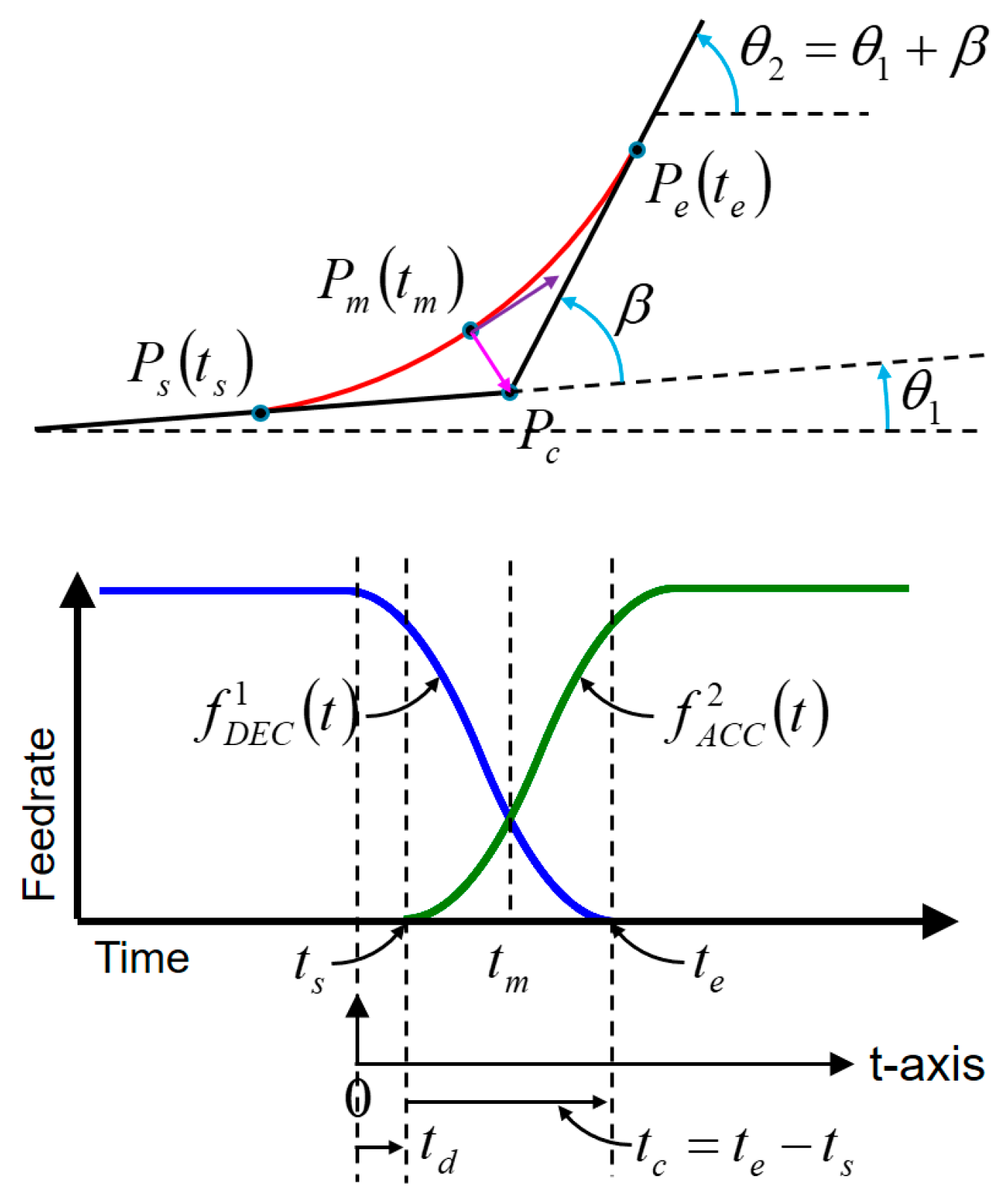
This study discusses corner trajectory planning and the definition of cornering error, as shown in
Figure 2, where,
,
, and
denote the angle of the first path, the angle of the second path, and the change angle, respectively;
and
denote the start position and time of the cornering, respectively;
and
denote the end position and time of the cornering, respectively;
denotes the corner position between the first path and the second path; and
denotes the position on the corner path, where the vector
is perpendicular to the tangent vector
at time
. In addition,
denotes the position at which cornering motion fully transitions onto the second path, whereas
denotes the intersection point of the first and second paths.
and
denote the deceleration function of the first path and the acceleration function of the second path, respectively.
denotes the cornering time, and
denotes the delay time of the acceleration function for the second path. Therefore, the time for the first-path deceleration function
(i.e., the time for the first-path deceleration process) is the sum of the cornering time
and the delay time
(i.e.,
). The time for the first-path deceleration function
is generally known in advance (owing to the deceleration function
being predesigned). Thus, the cornering error
is defined as the Euclidean norm of vector
(i.e.,
), and the cornering time
and delay time
are the corner trajectory planning parameters to be designed in this study (owing to the acceleration function
also being predesigned).
3. Hybrid Prefilter Design
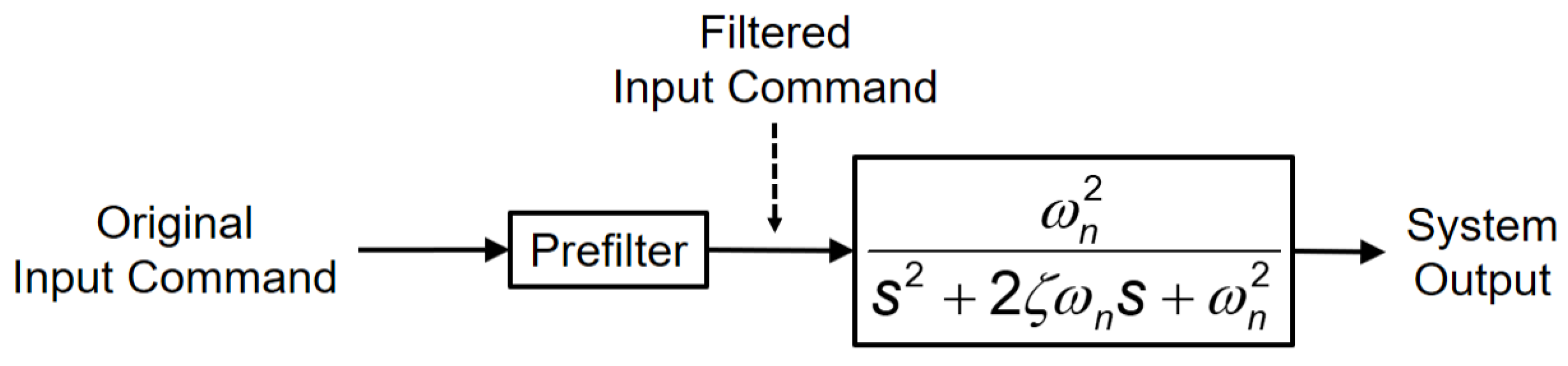
An input shaper convolutes the input command of the system using a series of impulse signals with different amplitudes and time delays to produce a shaped input command. The FIR filter convolutes the input command of the system using a unit-area rectangular pulse signal to produce a filtered input command. Both the shaped and filtered input commands can reduce the residual vibration and shorten the system’s settling time; however, the input shaper and FIR filter have different characteristics and each influence the suppression of the system’s residual vibration. To clarify the influence of the input shaper and the FIR filter on the system’s output vibration, this study considers a control structure with a prefilter and a second-order system, as shown in
Figure 3. The prefilter can be an input shaper or an FIR filter, and the damping ratio
and undamped natural frequency
are the parameters of the second-order system. After performing a convolution operation on the original input command, the prefilter produces a filtered input command, which is then input to the second-order system to suppress the vibration of the system output.
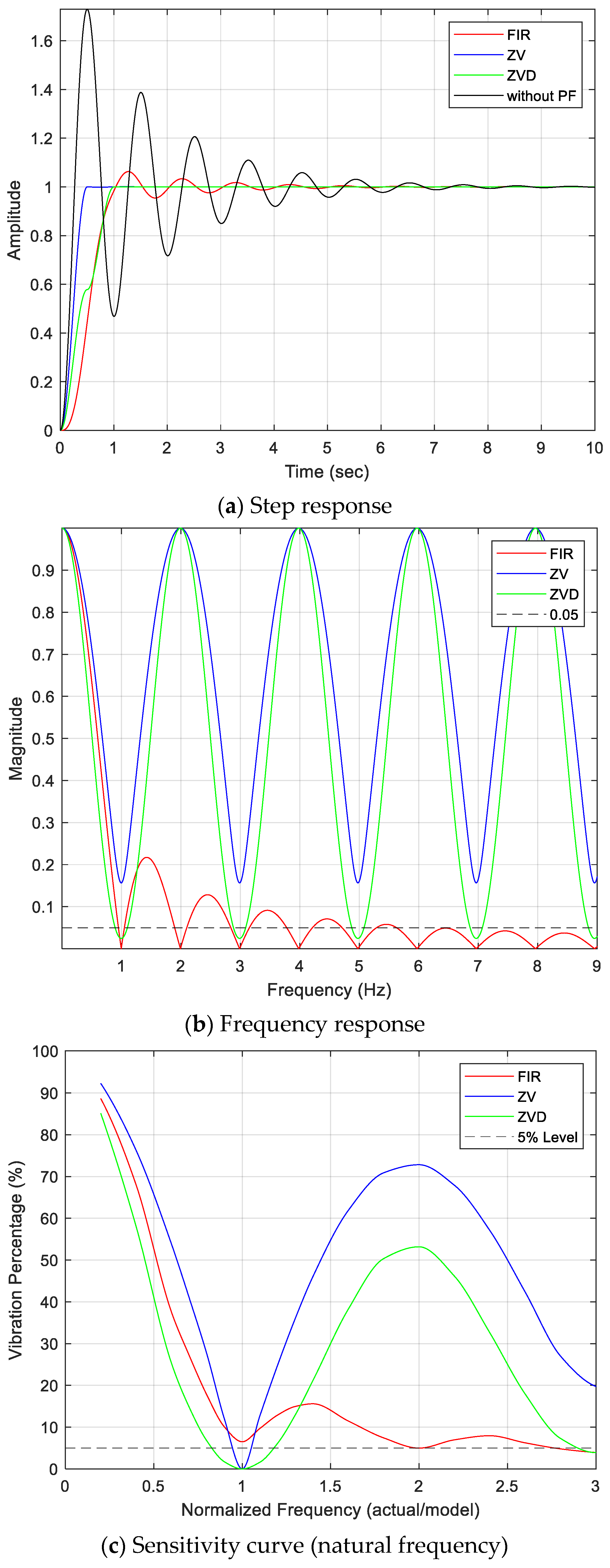
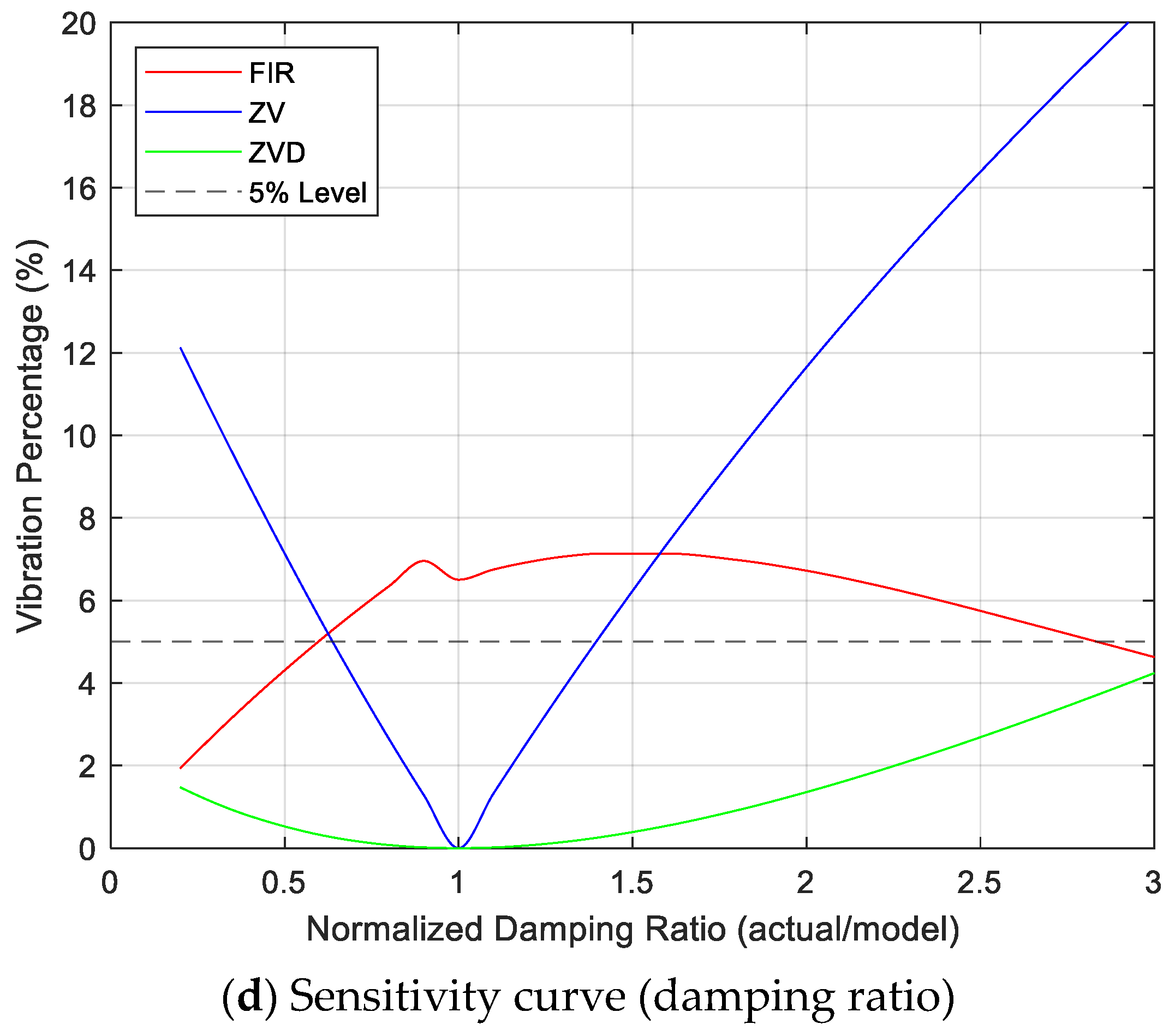
Figure 4 shows the simulation results for the step response, frequency response, and sensitivity curve of the control structure, where the damping ratio is 0.1 and the undamped natural frequency is 1.0 Hz. “Without PF” indicates that the control structure does not use a prefilter, and “ZV,” “ZVD,” and “FIR” indicate that the prefilter is a ZV input shaper, a ZVD input shaper, and an FIR filter, respectively. In terms of the step response, “without PF” has the fastest starting response; however, it also has the largest overshoot and longest settling time. ZV provides a smooth starting response, has a slight overshoot, and has the shortest settling time; however, its response time is longer than that “without PF.” Although ZVD has the smallest overshoot, its response time is long, and its settling time is longer than that of ZV. The response time of FIR is between that of ZV and ZVD but is accompanied by more significant overshoot and oscillation; although the settling time is shorter than that of “without PF,” it is longer than those of ZV and ZVD. In terms of the frequency response, for ZV and ZVD, the magnitude crests occur at even multiples of the fundamental frequency and remain at a constant and high value of 1.0 throughout the frequency range. However, the magnitude crests of FIR occur between zero frequency and integer multiples of the fundamental frequency, and they decrease significantly as the frequency increases. Although the magnitude values for all three prefilters are close to zero, the magnitude trough of ZV is higher than that of ZVD, and both occur at odd multiples of the fundamental frequency. Meanwhile, the magnitude trough value for FIR is zero, and its troughs occur at integer multiples of the fundamental frequency. Moreover, at the magnitude troughs, ZV and ZVD exhibit a flatter magnitude change than FIR, indicating that they have a higher selection margin for the suppression frequency. In terms of the sensitivity curve, when the actual value is close to the model value, ZVD has the best robustness for both the undamped natural frequency and damping ratio. In other words, when there is a deviation between the actual value and the model value, ZVD can suppress vibration over the widest variation ranges of the damping ratio and undamped natural frequency and maintain the lowest vibration percentage. When the actual undamped natural frequency is higher than the model undamped natural frequency, FIR exhibits better robustness for the undamped natural frequency and can still effectively suppress vibration, whereas the robustness of ZV and ZVD deteriorates, and their vibration-suppression effect rapidly worsens. Moreover, when the actual damping ratio is higher than the model damping ratio, ZV is more sensitive to changes in the damping ratio. In other words, when the model damping ratio changes, the vibration-suppression effect deteriorates rapidly, becoming even worse than that of FIR. For both the undamped natural frequency and damping ratio, when the actual value is lower than the model value, the vibration-suppression effect of FIR is between those of ZV and ZVD.
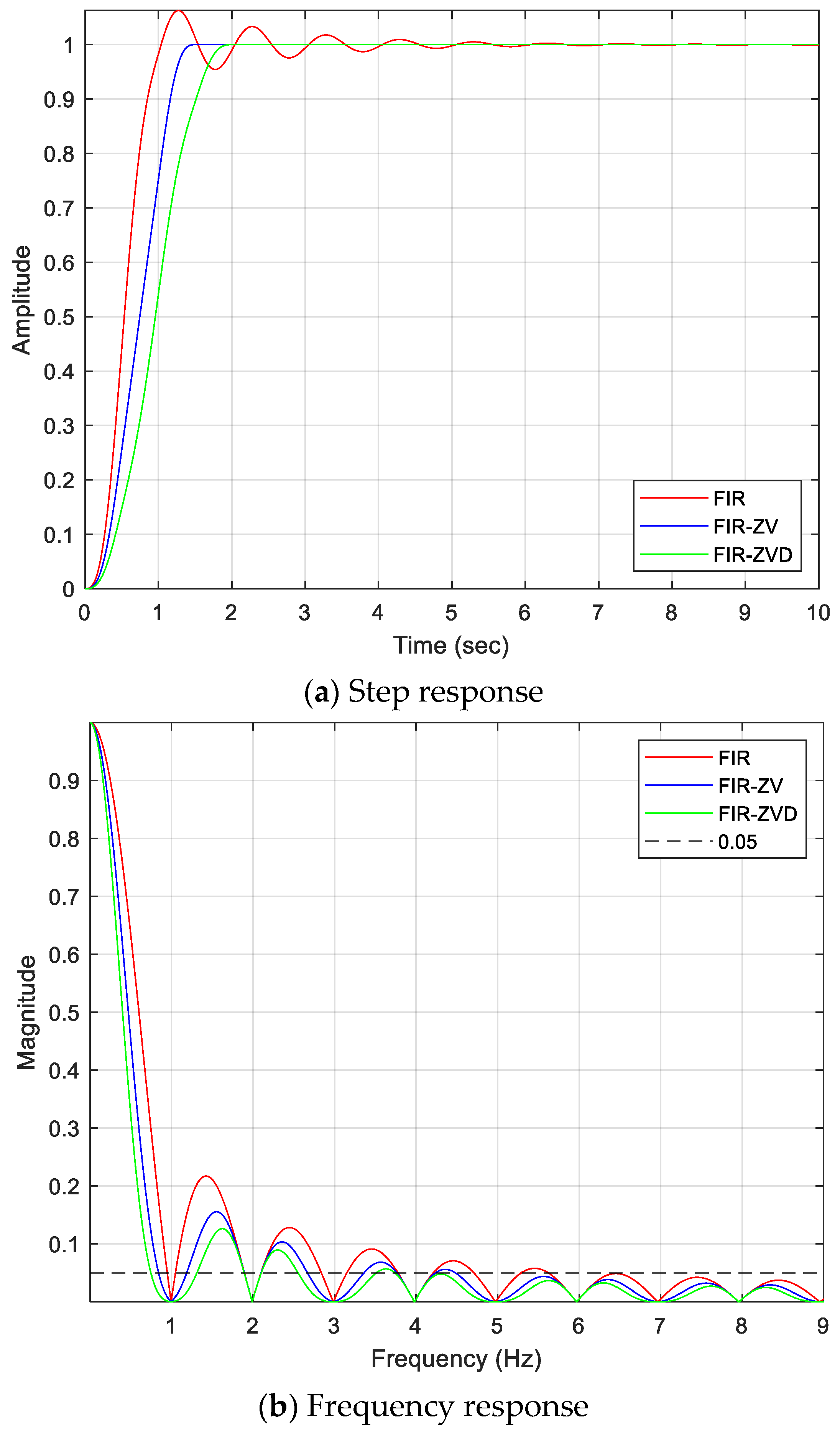
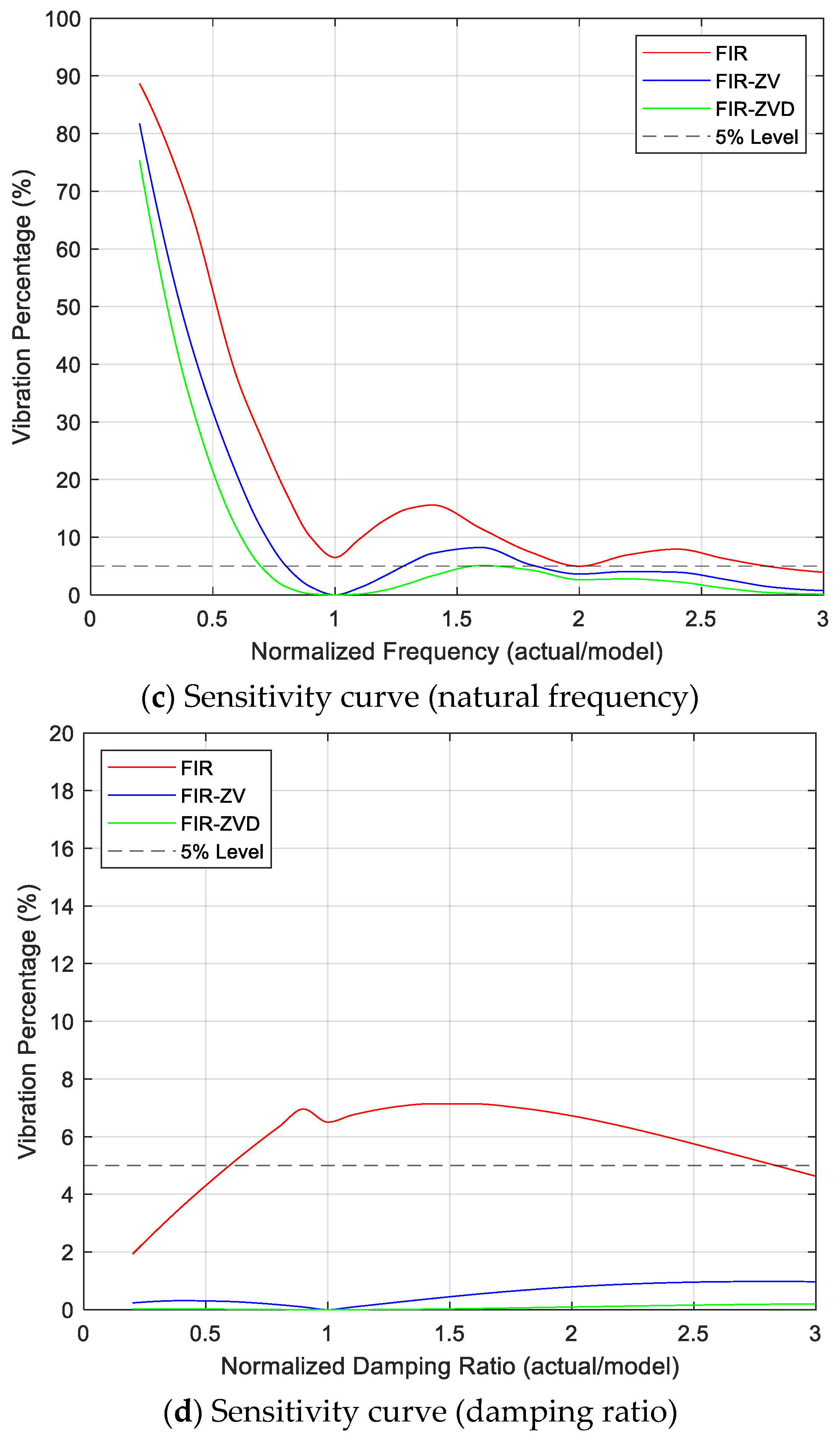
The ZV input shaper has a rapid response but exhibits poor robustness to system parameters, and it is suitable for systems with a narrow vibration frequency band. The ZVD input shaper is more robust than the ZV input shaper but has a longer delay time; therefore, a tradeoff between robustness and time delay is often necessary in its application. In addition to suppressing the main frequency vibration, the FIR filter has low-pass filter characteristics that attenuate the input commands that induce high-frequency vibrations. A hybrid prefilter convolutes an input shaper and an FIR filter to integrate the characteristics of the input shaper and the FIR filter, thereby providing diverse vibration-suppression effects and parameter robustness.
Figure 5 indicates the simulation results for the step response, frequency response, and sensitivity curve of different prefilters; here, the prefilters are the FIR filter (FIR), a hybrid prefilter formed by the convolution of an FIR filter and a ZV input shaper (FIR-ZV), and a hybrid prefilter formed by the convolution of an FIR filter and a ZVD input shaper (FIR-ZVD).
In terms of the step response, compared to FIR, FIR-ZV and FIR-ZVD have longer rise and delay times but have nearly zero overshoot, and FIR-ZV has the shortest settling time. In terms of the frequency response, the magnitude crests of both FIR-ZV and FIR-ZVD occur between the zero frequency and integer multiples of the fundamental frequency and decrease as the frequency increases. Although the magnitude values for both FIR-ZV and FIR-ZVD are close to zero, the magnitude troughs at odd multiples of the fundamental frequency have flatter magnitude changes, and FIR-ZVD has the widest magnitude trough, as well as a higher selection margin for the suppression frequency. Regarding the sensitivity curve, when the actual value is close to the model value, both the FIR-ZV and FIR-ZVD have good robustness for both the undamped natural frequency and damping ratio. When the actual undamped natural frequency is lower than the model undamped natural frequency, the robustness of FIR-ZV and FIR-ZVD deteriorates, and the vibration-suppression effect also rapidly deteriorates. However, when the actual undamped natural frequency is higher than the model undamped natural frequency, FIR-ZV and FIR-ZVD can still effectively suppress vibration, and FIR-ZVD has a better vibration-suppression effect. FIR-ZVD also has better damping ratio robustness. Although FIR-ZV has a slightly inferior vibration-suppression effect to FIR-ZVD when the damping ratio deviates, it can still effectively suppress the vibration, and the vibration-suppression effect does not deteriorate rapidly.
The design purpose of the hybrid prefilter is to combine the characteristics of the input shaper and FIR filter to achieve a better balance between reducing residual vibration, shortening the system response time, and enhancing robustness. Compared to the input shaper and the FIR filter, the hybrid prefilter is generally less sensitive to changes in system parameters, such as the undamped natural frequency and damping ratio, and can effectively suppress vibration even when there are discrepancies between the actual parameters and the model parameters. However, for applications that are more sensitive to parameter uncertainty, a hybrid prefilter can be selected with an input shaper that has better robustness. The hybrid prefilter still induces a time delay, which originates from both the input shaper and the FIR filter. Therefore, when designing a hybrid prefilter, a tradeoff between the time delay and the vibration-suppression effect is necessary.
4. Corner Trajectory Planning
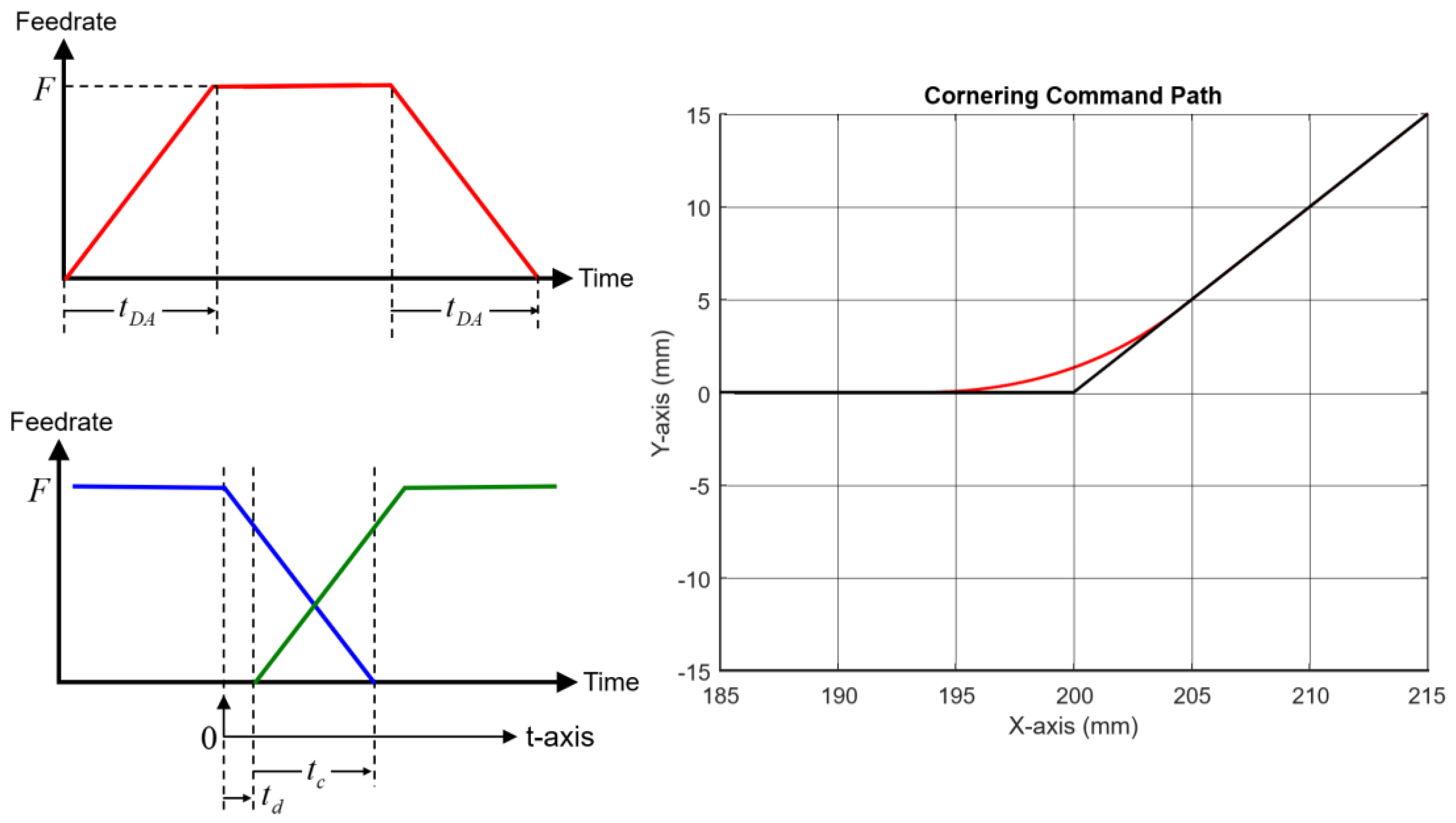
Figure 6 shows the feedrate command for the end effector of the SCARA robot along the planned path. In the acceleration process (ACC), the feedrate increases smoothly from zero to a constant value and can be represented by an acceleration function. In the deceleration process (DEC), the feedrate smoothly decreases from a constant value to zero and can be represented by a deceleration function. If the acceleration and deceleration functions exhibit mirror symmetry, they are referred to as symmetric ACC/DECs, and if they do not, they are referred to as asymmetric ACC/DECs. When the feedrate has an appropriate ACC/DEC ratio, the end effector can move smoothly along the planned path and reach the target position accurately. However, as shown in
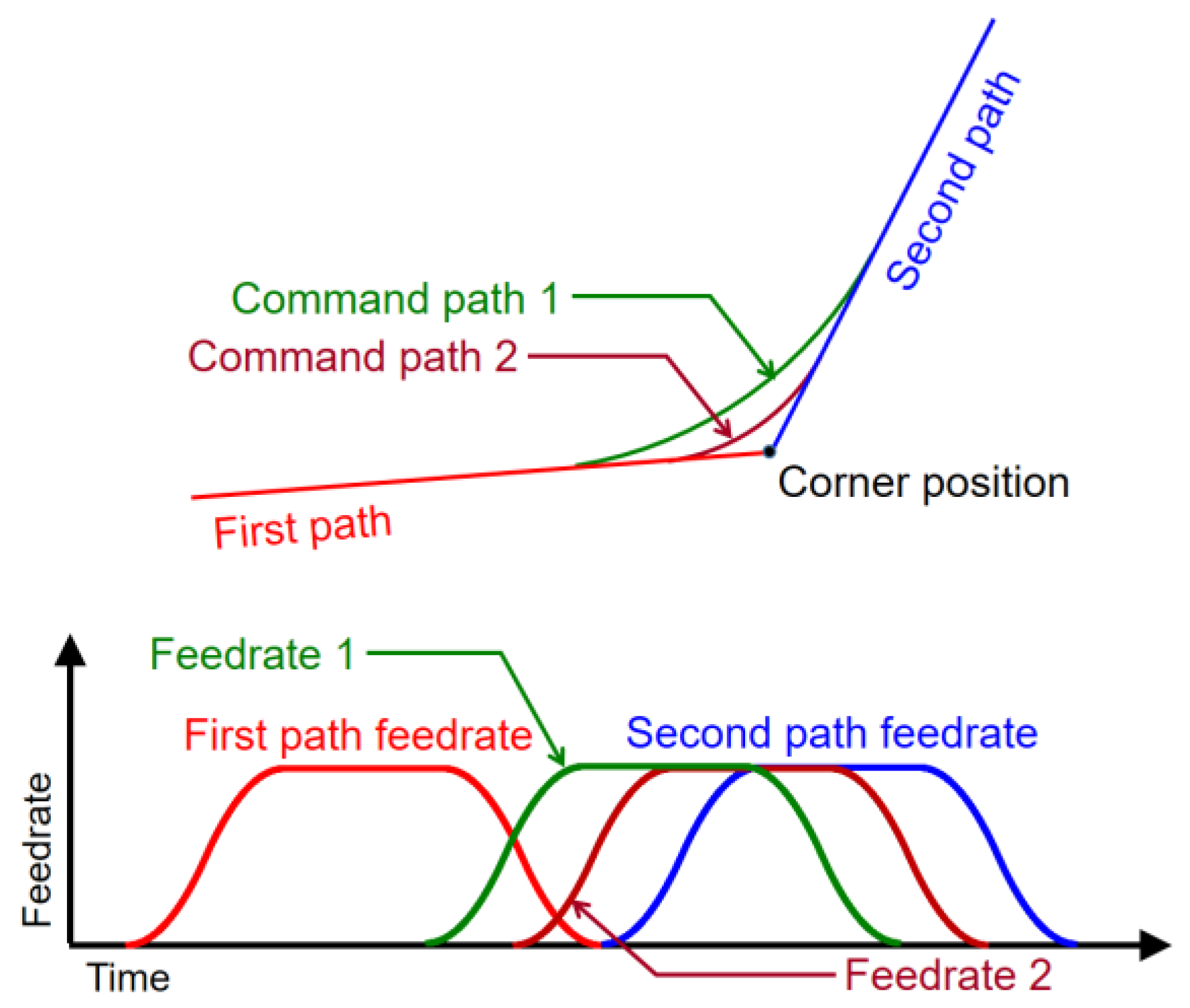
Figure 2, when the planned path contains a corner, the ACC/DEC feedrate causes the corner path to generate a cornering error.
Figure 7 presents the influence of the ACC/DEC feedrate on the cornering error for a corner path, which is composed of the first and second paths; the position where the paths connect is the corner position. When the second path presents the blue feedrate, the cornering error is zero because the deceleration of the first path’s feedrate is completed before the acceleration of the second path’s feedrate begins. However, when the second path presents the maroon feedrate, a cornering error is generated because the acceleration of the second path’s feedrate starts before the deceleration of the first path’s feedrate is completed. Moreover, when the second path presents the green feedrate, the acceleration of the feedrate of the second path begins even earlier, causing a larger cornering error. In other words, if the SCARA robot’s end effector performs the cornering at a lower feedrate, it has a smaller cornering error, and the cornering motion time is extended. Conversely, if the cornering is performed at a higher feedrate, although the cornering motion time is shortened, a larger cornering error occurs at the corner position. Therefore, the feedrate ACC/DEC planning for the first and second paths should consider restricting the cornering error to balance the performance and accuracy of the cornering motion.
Referring to the variables shown in
Figure 2, the first and second paths form a corner path in the XY plane. Therefore, during the cornering motion of the SCARA robot’s end effector, the motion velocities of the X-axis and Y-axis are given by Equations (5) and (6), respectively:
Furthermore, the relationship between the start position
and the position
can be expressed as given by Equations (7) and (8):
The corner position
can be calculated using Equations (9) and (10):
The vector
can then be calculated using Equation (11):
The tangent vector
can be calculated using Equation (12):
The vector
must be perpendicular to the tangent vector
at time
(i.e., the inner product of
and
must be zero), as given by Equation (13):
where
. Therefore, Equation (13) can be used to calculate the time
. By substituting the calculated time
into Equation (11) to calculate the vector
and its Euclidean norm, the cornering error
can be obtained as follows:
Here, . In other words, , and ; however, when , and .
As shown in
Figure 2, this study uses a local time axis (t-axis) and places the zero of the local time axis at the start time of the first path’s deceleration process (i.e., the start time of the first path’s deceleration function is set to zero). Therefore,
,
, and the time
are calculated from the zero of the local time axis to simplify calculations. In other words, Equation (13) can be rewritten as Equation (15), and Equation (14) can be rewritten as Equation (16):
Moreover, because the time for the deceleration function of the first path
is known in advance and
, the cornering time
, and the delay time
are dependent variables, the cornering error
can be expressed as a function of
. Therefore, by setting a restricted value for the cornering error, the corresponding
can be calculated. Using the result,
can be calculated to complete the design of the cornering trajectory parameters that restrict the cornering error. Algorithm 1 outlines the steps for computing the cornering trajectory parameters.
| Algorithm 1. Computation of Cornering Trajectory Parameters |
Input: First path, second path, deceleration function for the first path , acceleration function for the second path , and restricted cornering error.
Output: Cornering time and delay time .
1: Determine the change angle between the first and second paths.
2: Determine the deceleration time from the given .
3: Define a local time axis starting at the initiation of the deceleration function.
4: Use Equation (15) to calculate the error time .
5: Substitute the error time into Equation (16) to calculate the cornering error .
6: Set the cornering error to the restricted value, and calculate the cornering time .
7: Calculate the delay time using the relationship . |
Because the deceleration function for the first path and the acceleration function for the second path are not restricted to be symmetric, the foregoing design steps for the cornering trajectory parameters are applicable to both symmetric and asymmetric ACC/DEC functions. Furthermore, the method is not limited to linear corner paths. Although is simply defined as the change angle between two intersecting lines, this study extends its definition to accommodate corners formed by linear and circular paths. For any corner, is defined as the change angle between the tangent vectors of the path at the corner. For example, for an arc-to-line corner, this corresponds to the angle between the tangent of the arc at the corner and the direction of the line.
By applying the corner trajectory parameter design of this study to the trapezoidal ACC/DEC corner trajectory planning shown in
Figure 8, a symmetric ACC/DEC function was used, where the time for the deceleration function of the first path
was equal to the time for the acceleration function of the second path
, and both were equal to the time
.
denotes the constant feedrate value. The error time
and cornering error
can be derived by applying the cornering trajectory parameter design of this study, and the result is the same as that published by Sencer et al. [
15]. By setting restricted value
for the cornering error and
, the cornering time
and the delay time
can be determined. The corner trajectory planning method developed in this section is intended to operate in conjunction with the hybrid prefilter described in
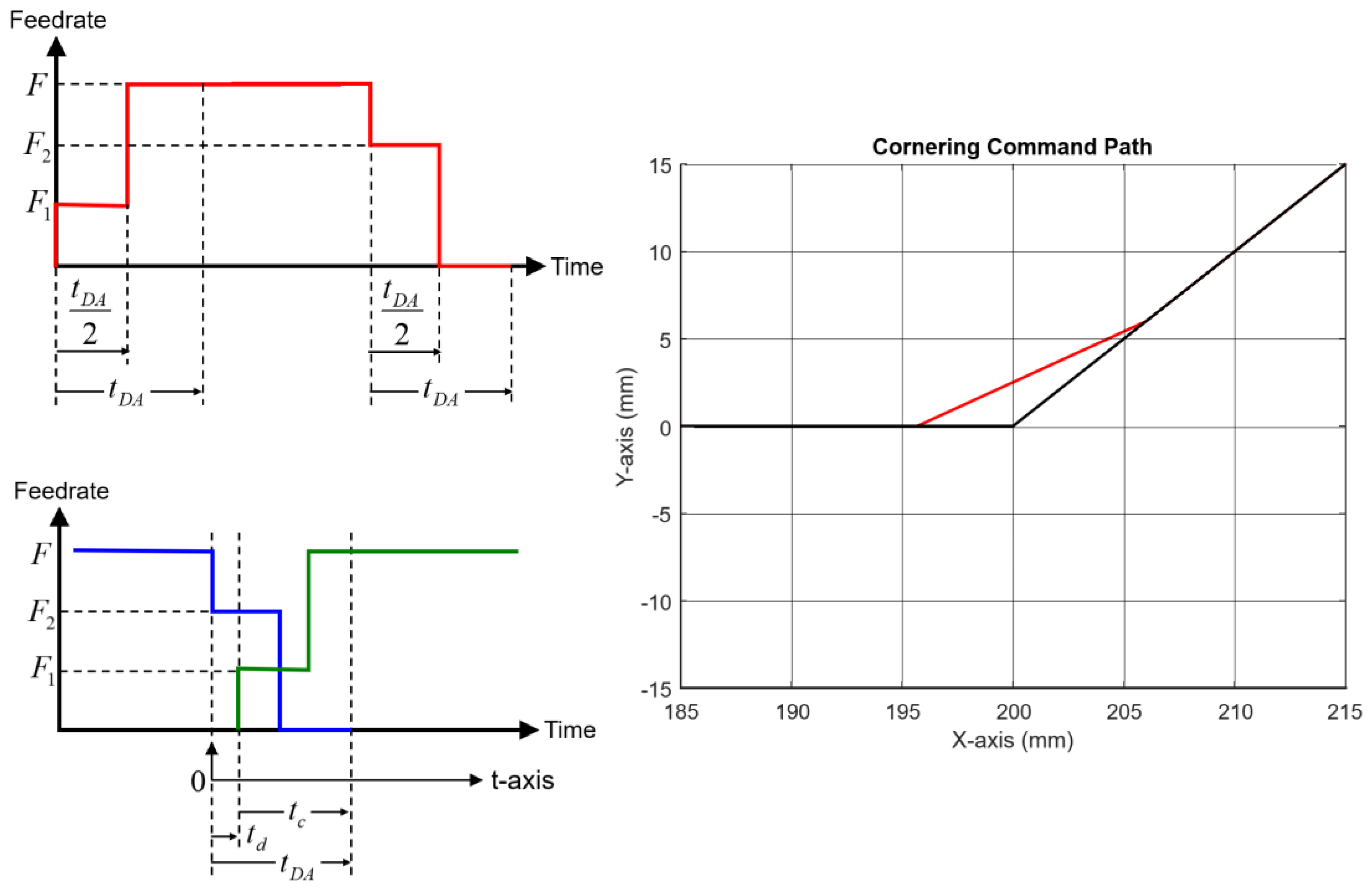
Section 3. Although the deceleration and acceleration functions used in the derivation are assumed to be standard and symmetric, the actual profiles generated when the hybrid prefilter processes a feedrate command are often asymmetric. The cornering trajectory parameter design of this study can also be applied to the asymmetric ACC/DEC shown in
Figure 9, where the corner trajectory planning adopts a ZV input shaper to suppress the residual vibration of the end effector cornering motion of the SCARA robot.
5. Experimental Results
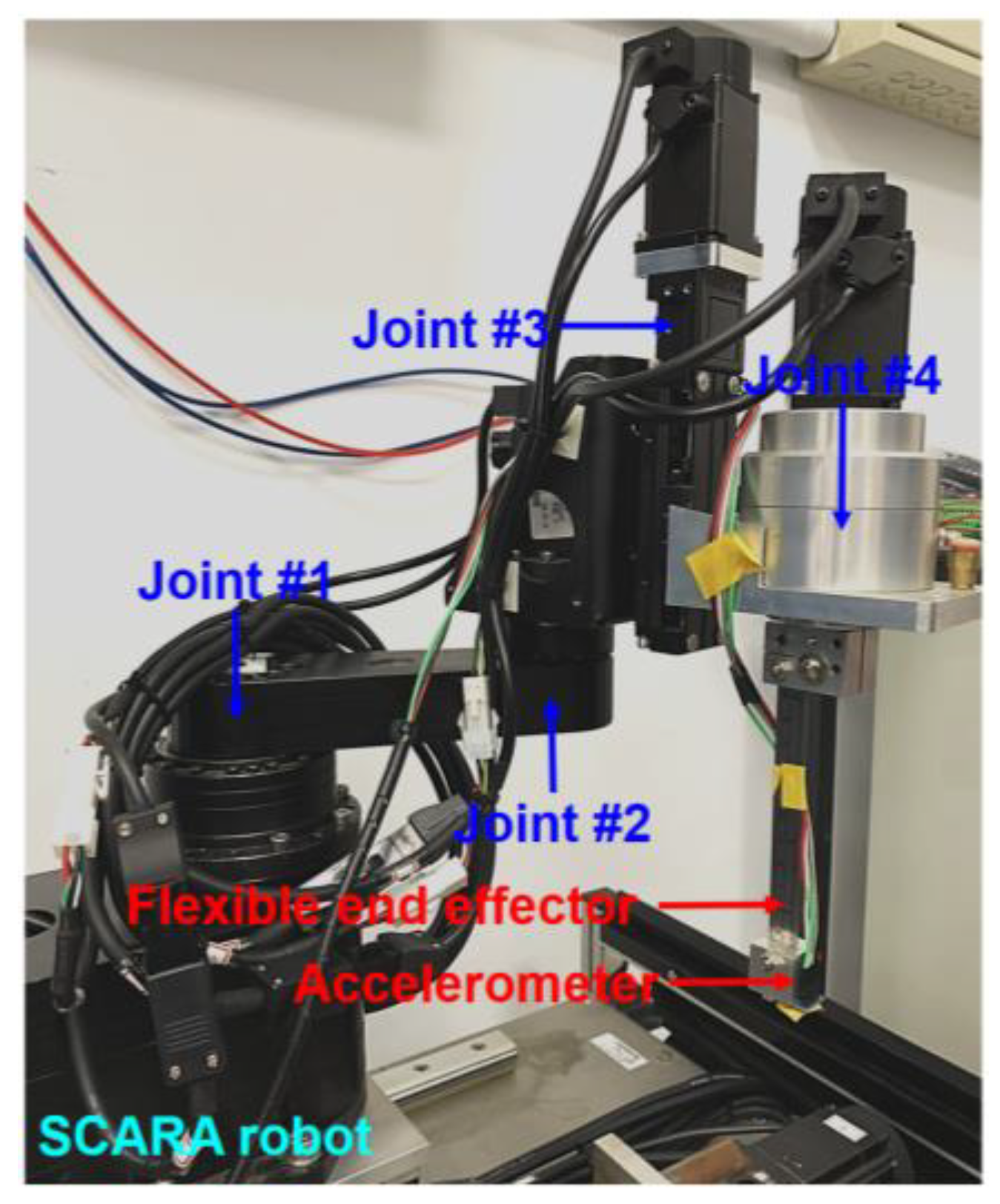
This study performed cornering control experiments using the SCARA robot test bench shown in
Figure 10 and the test path shown in
Figure 11 to evaluate the feasibility and performance of the integrated hybrid prefilter and corner trajectory planning developed in this study as applied to the SCARA robot’s cornering control. The SCARA robot was primarily composed of four joints: joints #1, #2, and #4 were revolute joints, and joint #3 was a prismatic joint. All joints were actuated by servomotors, enabling the flexible end effector installed on the SCARA to perform vertical (Z-axis) and planar (X-axis and Y-axis) motions. An FPGA-based cRIO control console developed by the National Instruments Corporation (NI) controlled the servomotors installed on the SCARA robot’s joints via EtherCAT, and NI LabVIEW 2016 software was applied to design and realize the SCARA robot’s motion-control system, including the operating interface and signal measurement. An ADXL335 accelerometer developed by Analog Devices, Inc. (ADI, Wilmington, United States) was installed on the SCARA robot’s end effector and measured the vibration of the end effector during cornering to evaluate the vibration-suppression performance of the hybrid prefilter designed in this study. An NI-9215 analog input module with a 16-bit A/D converter was installed on the FPGA-based cRIO control console to receive the measured signal. The FPGA-based cRIO control console, integrated with the interface modules, sent motion commands to and received measured signals from the joint servomotors with a sampling period of 1.0 ms.
Real-time computational burden is mitigated by dividing the proposed method into two stages: offline corner trajectory planning and real-time interpolation. In the offline corner trajectory planning stage, the hybrid prefilter is applied to the original feedrate command. The convolution operation generates the filtered feedrate command such that the cornering trajectory parameters can be determined using the computational steps described in
Section 4. The planned feedrate is finally generated by referring to the cornering trajectory parameters. In the real-time interpolation stage, the interpolator generates position commands based on the planned feedrate profile at each sampling interval. The NI FPGA-based cRIO controller leverages both a real-time processor and an FPGA to achieve deterministic performance. Therefore, in this study, the FPGA functions as a high-speed and deterministic input/output (I/O) bridge. Its primary role is to handle low-level data acquisition from interface modules with precise timing, ensuring that there is no jitter in the sampling. The acquired raw data are then passed to a real-time processor, which executes the main 1.0 ms control loop. This includes interpolation and managing communication with the servomotor drives over EtherCAT.
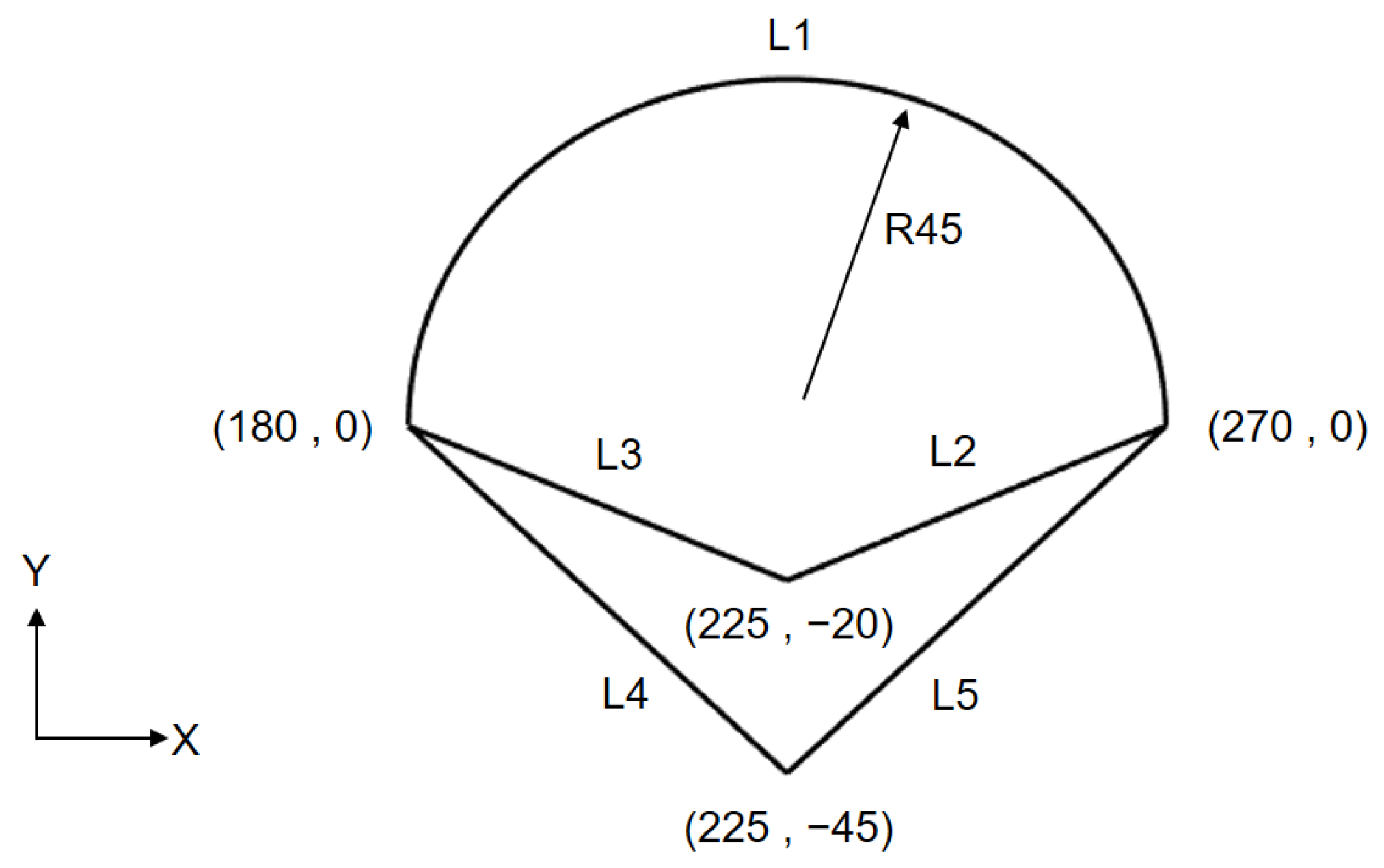
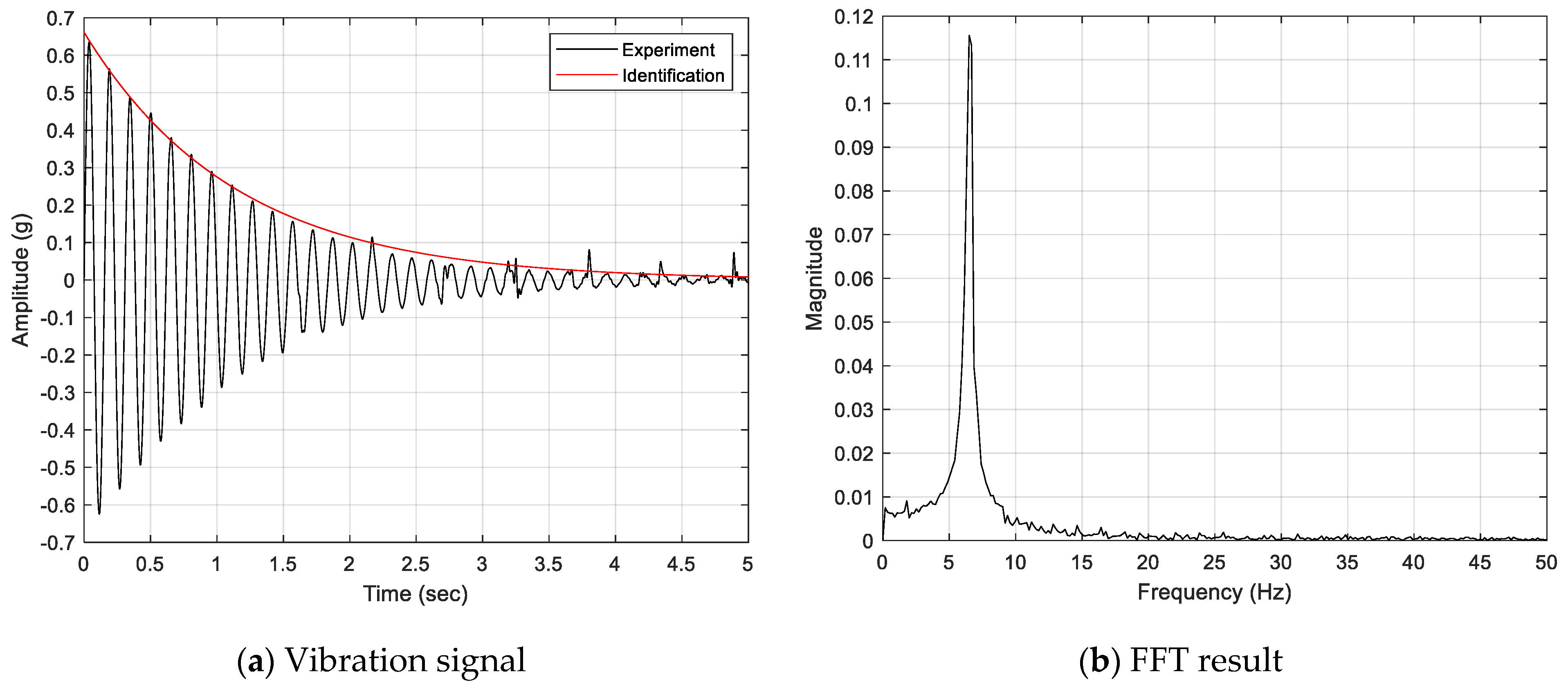
The cornering control experiment in this study used a test path with line and arc connections as well as obtuse and acute angle geometric features. The test path started at position (180, 0) mm, sequentially passed through L1 (an arc), L2 (a line), L3 (a line), L4 (a line), and L5 (a line), and finally reached the position (270, 0) mm. The end effector preset feedrate of the SCARA robot was 9600 mm/min. The residual vibration of the end effector measured by the accelerometer when the SCARA robot stopped after the cornering is shown in
Figure 12a, and the corresponding fast Fourier transform (FFT) result is shown in
Figure 12b. This study employed the identification method proposed by Aribowo et al. [
28] to estimate a dominant vibration frequency of 6.340 Hz and a damping ratio of 0.022.
Based on the estimated vibration frequency and damping ratio, a ZV input shaper (ZV), ZVD input shaper (ZVD), FIR filter (FIR), and hybrid prefilters (FIR-ZV and FIR-ZVD) were designed.
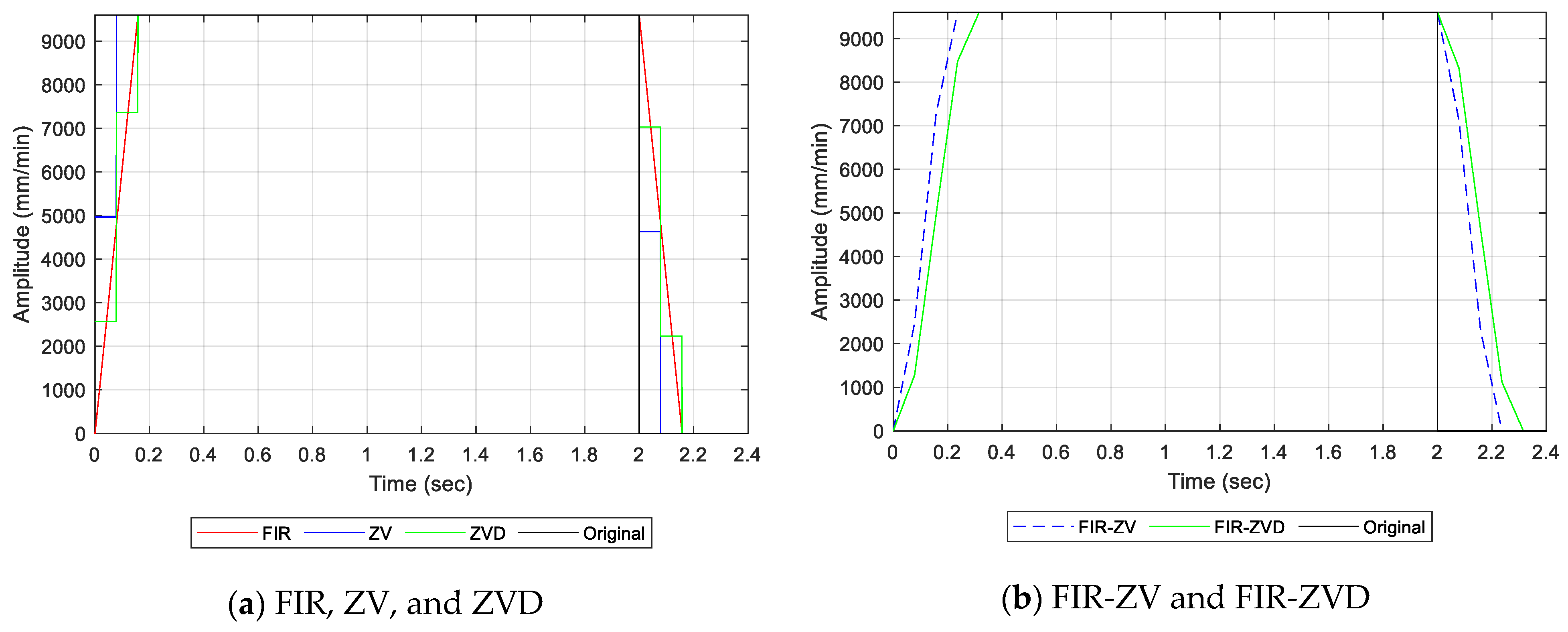
Figure 13 shows the original and filtered feedrate commands, where the prefilters clearly generate an asymmetric ACC/DEC. Therefore, this study referred to the test path presented in
Figure 11 and designed the cornering trajectory parameters as shown in
Table 1 and
Table 2 to satisfy the cornering-error conditions of 0 and 500 μm, respectively. Here, cornering-error values of 0 and 500 µm were selected to represent maximum-precision and high-throughput scenarios, respectively, to validate the performance of the proposed method across a range of operational demands. The different prefilter designs had different deceleration times; ZV and FIR-ZVD had the shortest and longest deceleration times, respectively. ZVD and FIR had the same deceleration times. To achieve a 0 μm cornering error, for all prefilter designs, the delay time was the same as the deceleration time, despite different change angles. In other words, the cornering time was zero, and the error time was the same as the deceleration time. However, when the cornering error was restricted to 500 μm, the error time, cornering time, and delay time all depended on the change angle. For all prefilter designs, a larger change angle resulted in a shorter cornering time; moreover, ZV had a shorter cornering time than FIR-ZVD.
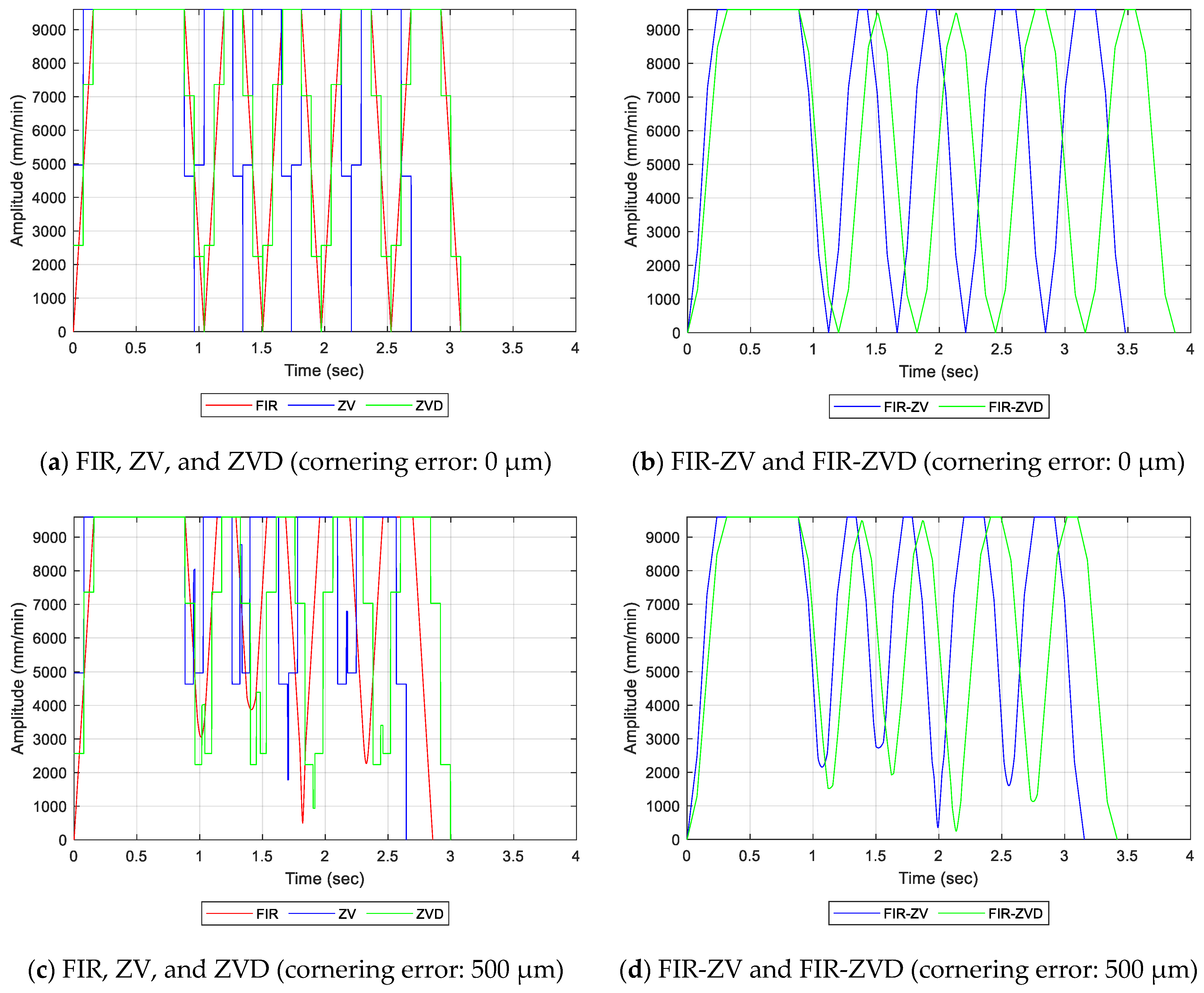
This study applies different prefilters to the task-space trajectory planning for the SCARA robot’s motion along the test path, which can generate the planned feedrate shown in
Figure 14. Here,
Figure 14a,b present the planned feedrates for a 0 μm cornering error, and
Figure 14c,d present the planned feedrates for a 500 μm cornering error. Because FIR-ZVD has the longest deceleration time, it also has the longest planned feedrate time; i.e., the SCARA robot motion control using FIR-ZVD requires the longest time to perform and complete the test path motion. Because ZV has the shortest deceleration time, it has the shortest planned feedrate time, and it also has the shortest time required for the SCARA robot to complete the test path motion. From the planned feedrates for FIR, as well as FIR-ZV and FIR-ZVD, it can be clearly observed that to achieve a 0 μm cornering error, the cornering feedrate of the test path must be zero; however, for the 500 μm cornering-error restriction, the cornering feedrate of the test path decreases and is not required to be zero; therefore, the planned feedrate time is shorter than that for the 0 μm cornering-error restriction. Moreover, for a test path with an acute angle geometric feature, because the change angle is larger, the cornering feedrate is lower to restrict the cornering error.
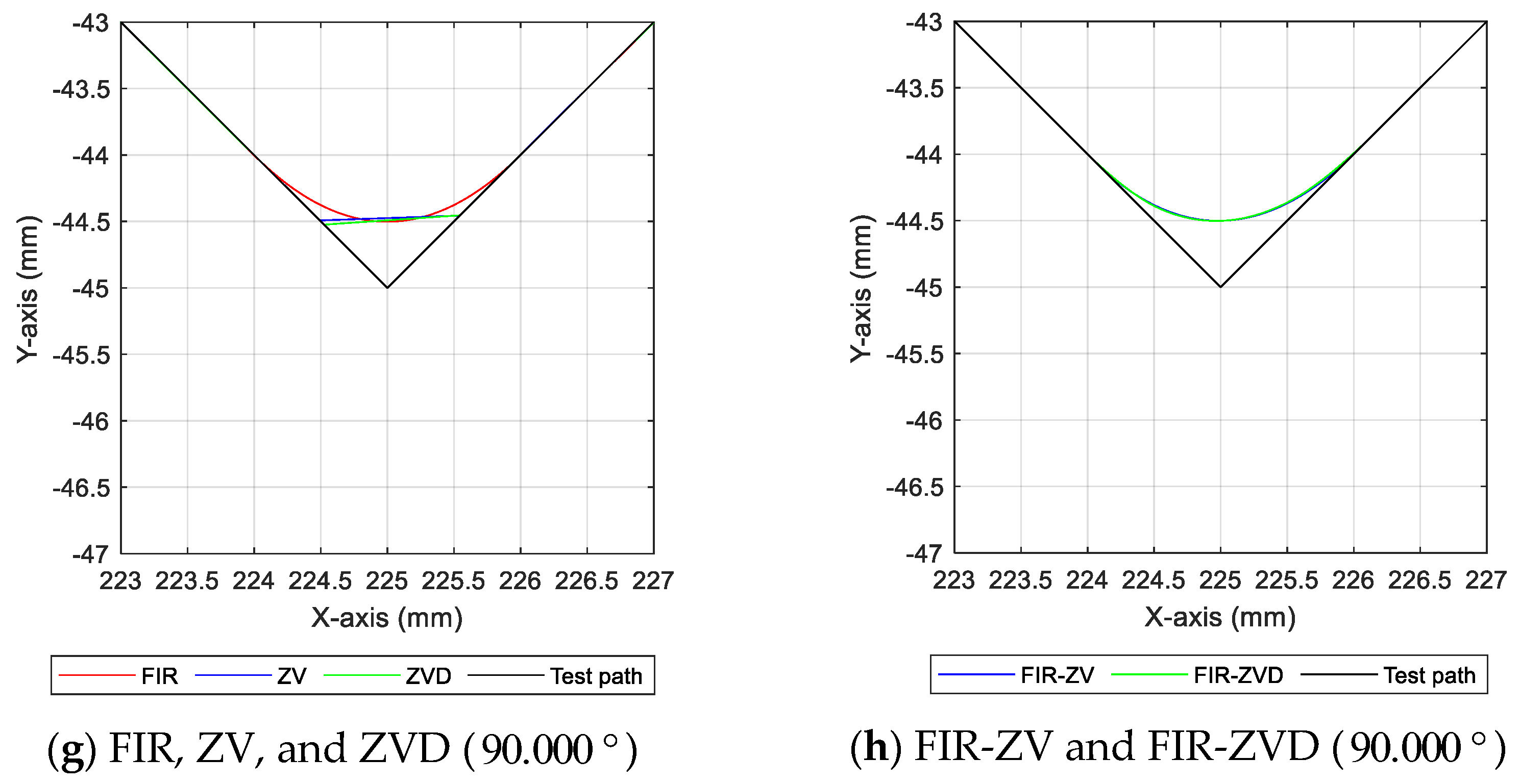
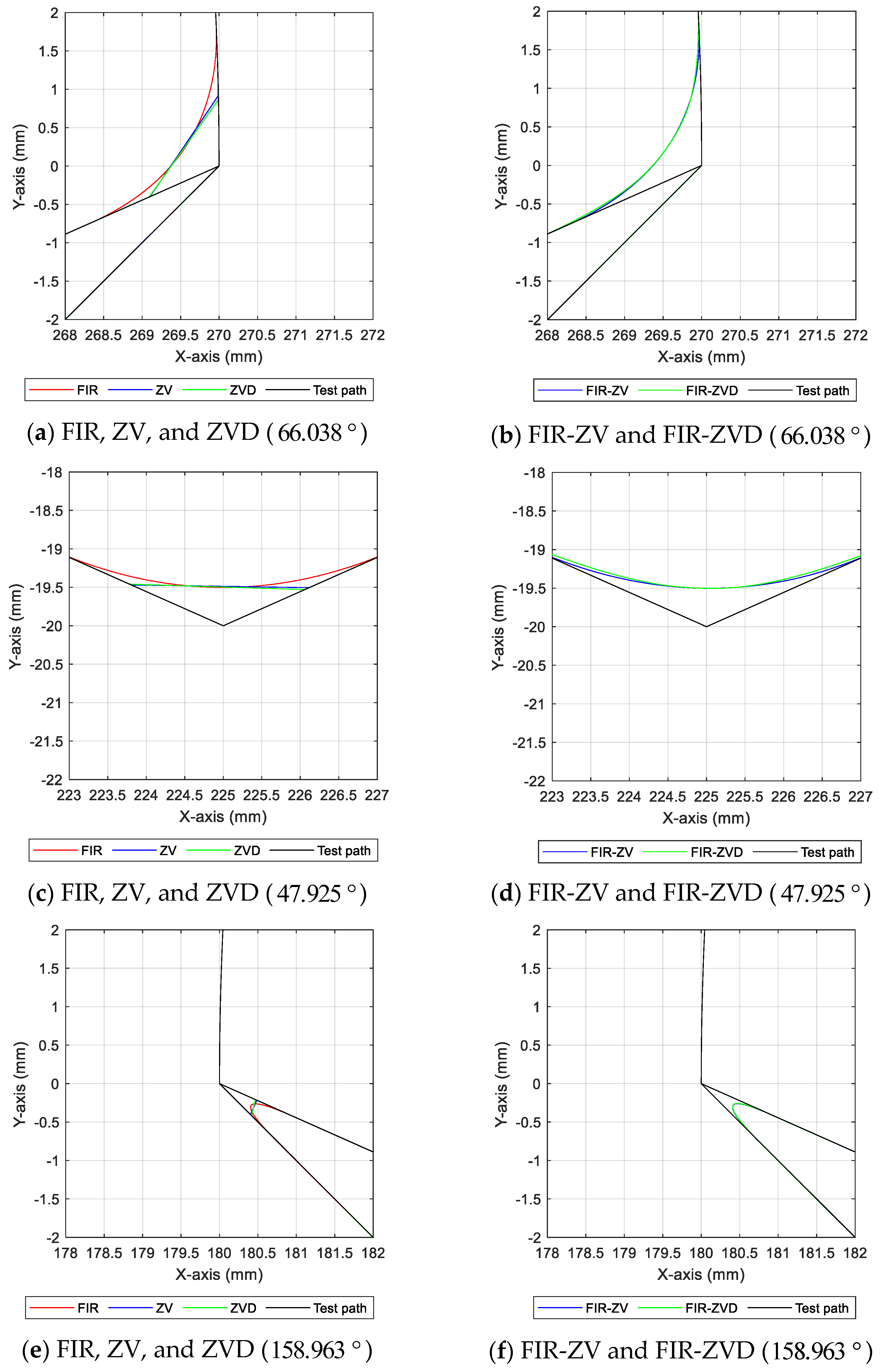
Referring to the planned feedrate, the interpolator can generate a position command for the task space motion path of the end effector, as shown in
Figure 15. Here, to emphasize the influence of different planned feedrates,
Figure 15 indicates the corner path referring to the planned feedrates in
Figure 14c,d, with a 500 μm cornering error as the restriction.
Figure 15 clearly indicates that with the planned feedrates of FIR, as well as FIR-ZV and FIR-ZVD, the interpolated corner path is smoother than those for ZV and ZVD, even though all corner paths conform to the 500 μm cornering-error restriction. Because the input shaper attempts to suppress residual vibration through a destructive interference approach, ZV and ZVD produce a relatively discontinuous corner path, although they also conform to the 500 μm cornering-error restriction.
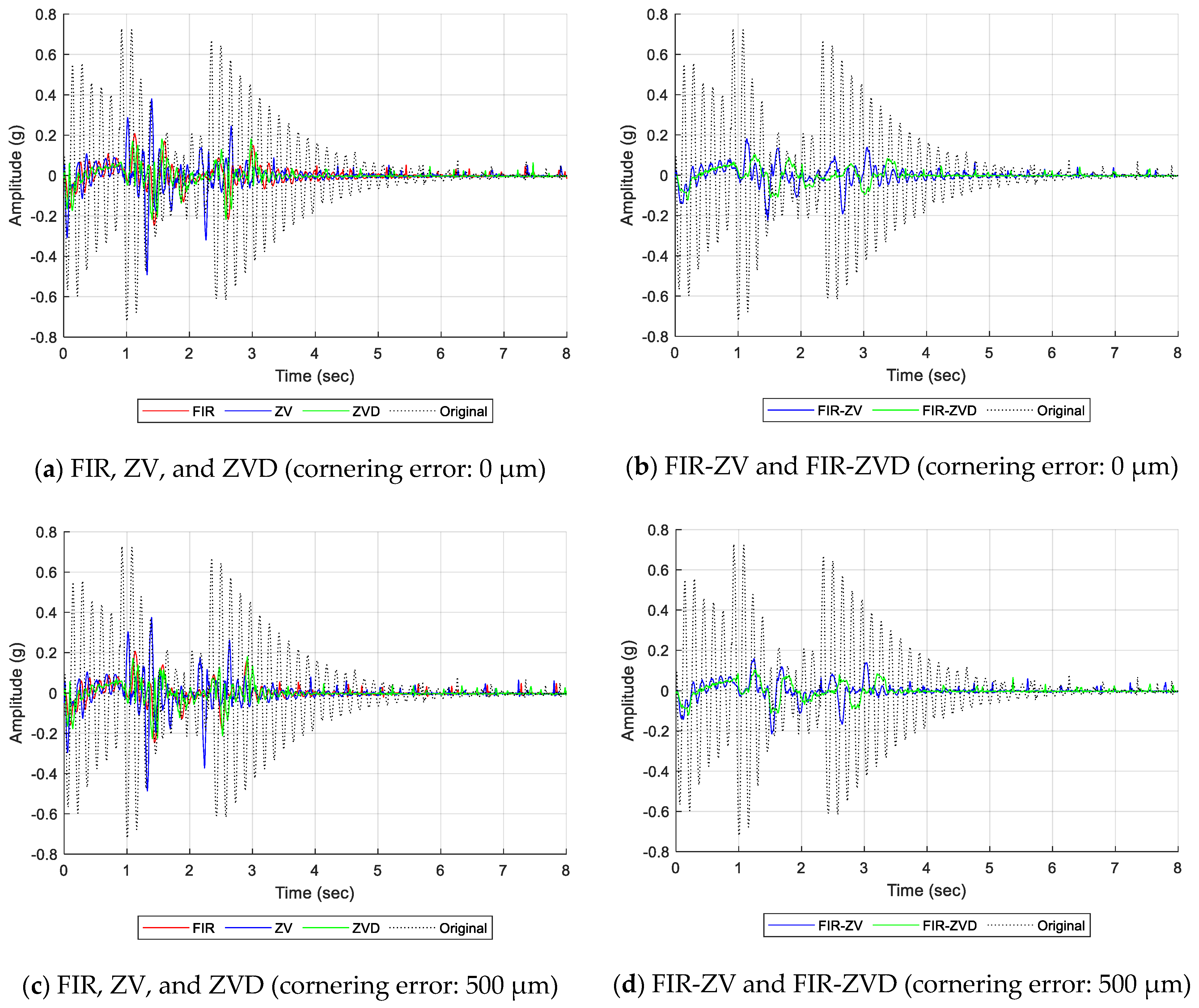
Figure 16 presents the vibration signal measured by the accelerometer during the test path motion of the end effector, which can be used to evaluate the vibration-suppression performance of the different prefilters. The experimental results indicated that without a prefilter, the accelerometer measured significant vibration, with a maximum amplitude of
and an RMS value of
; in comparison, the planned feedrate generated using the prefilters exhibited significant vibration-suppression performance under both the 0 and 500 µm cornering-error restrictions.
Regarding the maximum vibration amplitude, FIR-ZVD exhibited the best performance. At a cornering error of 0 µm, its maximum amplitude was , and even at a cornering error of 500 µm, its maximum amplitude was , with its vibration-suppression performance remaining the best. Therefore, FIR-ZVD can effectively suppress the maximum amplitude of vibration under different cornering-error restrictions. ZVD, FIR, and FIR-ZV also significantly suppressed the maximum vibration amplitude; at a cornering error of 0 µm, ZVD and FIR-ZV had similar and smaller maximum amplitudes of approximately , and at a cornering error of 500 µm, FIR-ZV had a smaller maximum amplitude of . Although ZV can also effectively suppress vibration, it exhibited poorer vibration suppression under both the 0 and 500 µm cornering-error restrictions; when the cornering error was 0 and 500 µm, its maximum amplitudes were and , respectively. Thus, the hybrid prefilter exhibited better vibration suppression than ZVD and FIR.
Regarding the RMS value of the vibration, FIR-ZVD similarly performed best, effectively suppressing the end effector’s vibration. For both 0 and 500 µm cornering errors, its RMS value was approximately . ZVD, FIR, and FIR-ZV also effectively suppressed vibrations. For both the 0 and 500 µm cornering-error restrictions, FIR-ZV exhibited smaller RMS values of and , respectively. However, FIR exhibited larger RMS values of and , respectively. ZV had the largest RMS values of and , respectively, indicating that its vibration-suppression performance was inferior to that of the other prefilters in both cases. Therefore, the hybrid prefilter outperformed the individual prefilters in suppressing vibrations.
Overall, the experimental results confirm that the hybrid prefilter can combine the advantages of different prefilters to achieve better residual vibration suppression and that FIR-ZVD can achieve the best vibration-suppression performance. Moreover, because the hybrid prefilter produces asymmetric ACC/DEC, the cornering trajectory parameters designed in this study can generate a planned feedrate, such that the interpolated corner path can restrict the cornering error.
6. Conclusions
The cornering performance of a SCARA robot is often influenced by two significant factors: the residual vibration, which prolongs the settling time, and the cornering error, which influences the motion speed and accuracy. Conventional methods often address these two problems independently, ignoring their interrelationships. Therefore, this study developed an integrated control strategy to simultaneously mitigate these two core problems—residual vibration and cornering error—for improving the cornering performance of the SCARA robot.
To effectively suppress residual vibration, a hybrid prefilter design was developed, with the aim of overcoming the limitations of a single prefilter. Conventional input shapers, such as ZV and ZVD, which are capable of suppressing residual vibration, are sensitive to deviations between the actual and model values of the vibration parameters. However, the FIR filter, which possesses good robustness and high-frequency noise attenuation capability, has inferior residual vibration-suppression performance to input shapers. Therefore, this study integrated an input shaper and an FIR filter and designed a hybrid prefilter that combines the advantages of both, which can simultaneously realize vibration suppression and enhance robustness.
The application of a hybrid prefilter to trajectory planning often generates asymmetric ACC/DEC, which poses a challenge to cornering control. Therefore, this study further developed a corner trajectory planning method such that when a SCARA robot performs cornering, it can not only suppress the residual vibration but also restrict the cornering error, even with the asymmetric ACC/DEC generated by trajectory planning. This study established design steps for the cornering trajectory parameters that can calculate the cornering time and delay time based on the ACC/DEC functions, the change angle of the corner path, and a preset allowable value for the cornering error. The advantage of this method is its ability to ensure that the hybrid prefilter can fully exert its vibration-suppression function without compromising cornering accuracy.
Experimental results from the SCARA robot test bench indicated that in the absence of a prefilter, the SCARA robot’s end effector exhibited significant residual vibration, achieving a maximum amplitude of and an RMS value of . In comparison, the developed FIR-ZVD hybrid prefilter demonstrated excellent vibration-suppression performance; under the cornering-error restriction, the maximum amplitude of the vibration was reduced to (by ), and the RMS value was reduced to (by ). Moreover, the corner trajectory planning and cornering trajectory parameter design established in this study can ensure that the cornering error is restricted to the preset value. Thus, the experimental results confirm that the developed methods can effectively suppress the residual vibration of the cornering of SCARA robots without degrading the cornering accuracy.
The primary focus of this study is the development of an integrated trajectory planning method. Therefore, the cornering error is constrained at the reference trajectory level. The experimental validation using an accelerometer was designed to confirm that the hybrid prefilter suppressed the residual vibration when executing these carefully planned trajectories. Direct measurement of the end effector path using external metrology would provide more complete validation of the motion performance of the SCARA robot. However, this is beyond the scope of the present study, which focuses on precise command trajectory generation with residual vibration suppression. Such validation of the robot’s actual motion accuracy remains a compelling direction for future research. Moreover, although the experimental validation in this study focused on suppressing a single dominant vibration mode for a specific feedrate, the proposed integrated framework is inherently modular. For systems exhibiting significant multimode vibrations, the single-mode prefilter can be replaced with more advanced multimode designs. The corner trajectory planning method presented herein remains directly applicable, because it systematically determines the necessary cornering trajectory parameters based on the filtered feedrate commands generated by any given prefilter.