Article

Geometrical-Based Modeling for Aerial Intelligent Reflecting Surface-Based MIMO Channels

1
Provincial Key Laboratory of Informational Service for Rural Area of Southwestern Hunan, School of Information Science and Engineering, Shaoyang University, Shaoyang 422000, China
2
School of Mechanical and Energy Engineering, Shaoyang University, Shaoyang 422000, China
3
School of Electrical Engineering, Shaoyang University, Shaoyang 422000, China
*
Author to whom correspondence should be addressed.
Electronics 2026, 15(4), 875; https://doi.org/10.3390/electronics15040875
Submission received: 4 January 2026 / Revised: 12 February 2026 / Accepted: 18 February 2026 / Published: 19 February 2026

Abstract

Traditional multiple-input multiple-output (MIMO) systems are confronted with significant challenges in realizing ubiquitous connectivity for sixth-generation (6G) networks, particularly in environments characterized by severe signal blockage and dynamic co-mobility. While aerial intelligent reflecting surfaces (AIRS) offer a promising paradigm to address these difficulties, the existing channel models often fail to capture fast channel changes, thereby leading to inefficient phase optimization in time-varying scenarios. To address these limitations, a geometric MIMO channel model is proposed for AIRS-assisted communications. This model comprises an indirect link from the base station (BS) via the AIRS to the receiver (Rx) and a direct BS-Rx link, whose direct propagation environment is rigorously characterized by a one-cylinder model specifically designed to tackle the complexities of dynamic co-mobility and intricate propagation. A joint optimization problem is formulated to maximize the achievable rate by optimizing the transmitted signal’s covariance matrix and the AIRS phase shift. Subsequently, an iterative algorithm employing the projected gradient method (PGM) is proposed for its solution, which is tailored for efficient operation in time-varying environments. Furthermore, expressions for the space–time correlation function and Doppler power spectrum are derived to evaluate the overall channel properties. Significant enhancements in achievable rates are demonstrated by AIRS, with substantial gains being observed even for a small number of reflecting elements. Consequently, crucial guidance for the design of robust AIRS-assisted MIMO systems is provided by these findings, and the broad applicability of the proposed algorithm is thereby confirmed.

1. Introduction

In recent years, driven by the ambitious vision for ubiquitous connectivity and rapidly increasing demands for high data rates, the paradigm of non-terrestrial networks (NTNs) has undergone significant development [1]. These networks are increasingly recognized as crucial enablers for next-generation communication systems, extending coverage and enhancing capacity in diverse scenarios. The initial applications of NTNs have encompassed wide-area coverage in remote regions, emergency communications, large-scale Internet of Things (IoT) connectivity, and advanced data services via high-altitude platforms [2,3,4,5,6,7,8]. This evolution underscores the pivotal role of NTNs in achieving ubiquitous connectivity, which is essential for supporting future intelligent transportation and Internet of Everything systems that demand high-reliability and low-latency air-to-ground (A2G) communication links for massive sensor integration and efficient data transmission [9].
Despite these promising prospects, the realization of ubiquitous connectivity via NTNs is fundamentally challenged by the intricate complexity of A2G link propagation environments. Specifically, in dense urban settings, severe signal blockages not only impair basic link connectivity but also drastically reduce the spatial multiplexing gains achievable by multiple-input multiple-output (MIMO) systems. To effectively counteract these issues, aerial intelligent reflecting surfaces (AIRS), which integrate intelligent reflecting surfaces (IRS) with unmanned aerial vehicle (UAV) technology, have emerged as a novel and potent remedy. AIRS operates by actively optimizing the propagation channel through the intelligent reconfiguration of signal paths, thereby enabling the establishment of high-quality line-of-sight (LoS) links [10,11,12,13,14]. This emerging technology thus provides new pathways for addressing physical layer bottlenecks in future terrestrial networks. However, the effective development of any wireless communication technology is predicated on an accurate understanding of its propagation channel characteristics [15,16,17,18].
While AIRS-assisted communication systems hold immense potential, their practical implementation is hindered by several critical limitations and challenges. Unlike conventional A2G communication systems, AIRS-assisted systems present unique complexities, primarily driven by the dynamic co-mobility of the AIRS and the receiver (Rx). This inherent co-mobility leads to rapid and drastic channel changes, often compounded by severe blocking effects, which significantly degrade communication performance. Existing research on channel modeling [19,20] predominantly addresses traditional communication scenarios and thus largely overlooks the unique, complex dynamic characteristics introduced by co-moving AIRS and Rx. Consequently, a comprehensive channel model capable of dynamically adapting to and optimizing AIRS-assisted systems under such stringent co-mobility conditions remains largely uninvestigated. Furthermore, such mobility poses a core challenge for phase optimization, as it necessitates rapid and effective phase updates to cope with highly dynamic channel conditions. Current approaches, which primarily focus on static IRS configurations in traditional cellular communication [21,22], are ill-suited to manage the complexities of co-mobility. For mobile applications leveraging AIRS, real-time and efficient phase updates are paramount for sustaining connectivity and enhancing data transmission. Therefore, the development of an efficient IRS phase optimization algorithm capable of addressing the dynamic challenges of AIRS/Rx co-mobility is an imperative.
Regarding AIRS-assisted MIMO channel modeling, a number of studies have been conducted. For instance, in [23], a 3D one-cylinder scattering channel model was proposed for narrowband communications, characterizing its basic properties and exploring IRS phase shift designs. This initial work laid the groundwork for understanding scattering mechanisms but did not fully address dynamic co-mobility effects. Subsequently, in [24], mobile-to-mobile scenarios were specifically investigated through a novel beam channel model that uniquely incorporated UAV wobbles and their impact on power scaling laws and correlation properties. While relevant to mobility, this model did not focus on the intricate interaction between AIRS and Rx co-mobility within a comprehensive channel framework. Building upon these studies, a 3D geometric channel model was proposed, which was then applied to analyze outage probability and to devise real-time phase shift designs for maximizing received signal strength [25]. Although addressing real-time aspects, the time-varying channel characteristics were not fully explored. Furthermore, in [26,27], a 3D wideband non-stationary channel model was developed that considered arbitrary UAV trajectories and environmental effects. These contributions offered insights into non-stationary behavior yet often oversimplified scatterer distributions or assumed persistent LoS, which are often unrealistic in practical dynamic environments. Furthermore, in [28], the impact of UAV fluctuations on channel statistics, achievable rates, and performance degradation stemming from phase imperfections was analyzed. Despite these foundational contributions, significant gaps persist in characterizing the intricate interplay of co-mobility, dynamic scattering, and complex blocking effects in real-world environments. This is largely due to existing static or A2G models that oversimplify propagation assumptions, thereby proving inadequate for stringent AIRS-assisted dynamic systems. Moreover, current IRS phase optimization algorithms often suffer from severe algorithmic bottlenecks due to the slow convergence of iterative methods, particularly under highly dynamic conditions with a large number of IRS units.
To elaborate, we contrast this work with related AIRS-based channel models research at the time of writing in Table 1.
To address these shortcomings and the urgent need for effective approaches, this paper proposes a novel 3D one-cylinder scattering model for AIRS-assisted MIMO channels. The primary motivations and novel contributions of this work are summarized as follows:
  • A novel geometric narrowband MIMO channel model is proposed for AIRS-assisted communication. This model is uniquely capable of rigorously characterizing diverse and dynamic channel conditions, being configurable through parameters encompassing AIRS height, AIRS velocity, and the Rx scattering environment. This directly addresses the deficiency of existing models in handling co-mobility and dynamic environments.
  • To maximize the achievable rate, a joint optimization problem is formulated, involving the optimization of the transmitted signal’s covariance matrix and the IRS phase shifts. An iterative projected gradient method (PGM) is proposed to tackle this challenging non-convex problem. This algorithm is distinguished by its meticulously derived exact closed-form expressions for the gradient and projection, and notably, it guarantees provable convergence to a critical point of the considered problem, thereby overcoming the limitations of slow convergence in dynamic scenarios.
  • Key channel statistical properties, including the space–time correlation function and Doppler power spectrum, are derived and extensively investigated to characterize channel behavior. This analysis specifically addresses the impact of parameters such as Rician factor, carrier frequency, and Rx velocity, providing a deeper understanding of the complex channel dynamics under AIRS assistance. Furthermore, the achievable rate of the entire link is evaluated.
This paper is organized as follows. Section 2 describes the simulation model for AIRS-assisted MIMO channels. Section 3 formulates an optimization problem for maximizing the achievable rate of the proposed system, for which the PGM algorithm is subsequently proposed and derived. Section 4 presents the derivation of the space-time correlation function and Doppler power spectrum. Section 5 discusses the numerical results and analysis. Finally, Section 6 concludes the paper.

2. Three-Dimensional Simulation Model

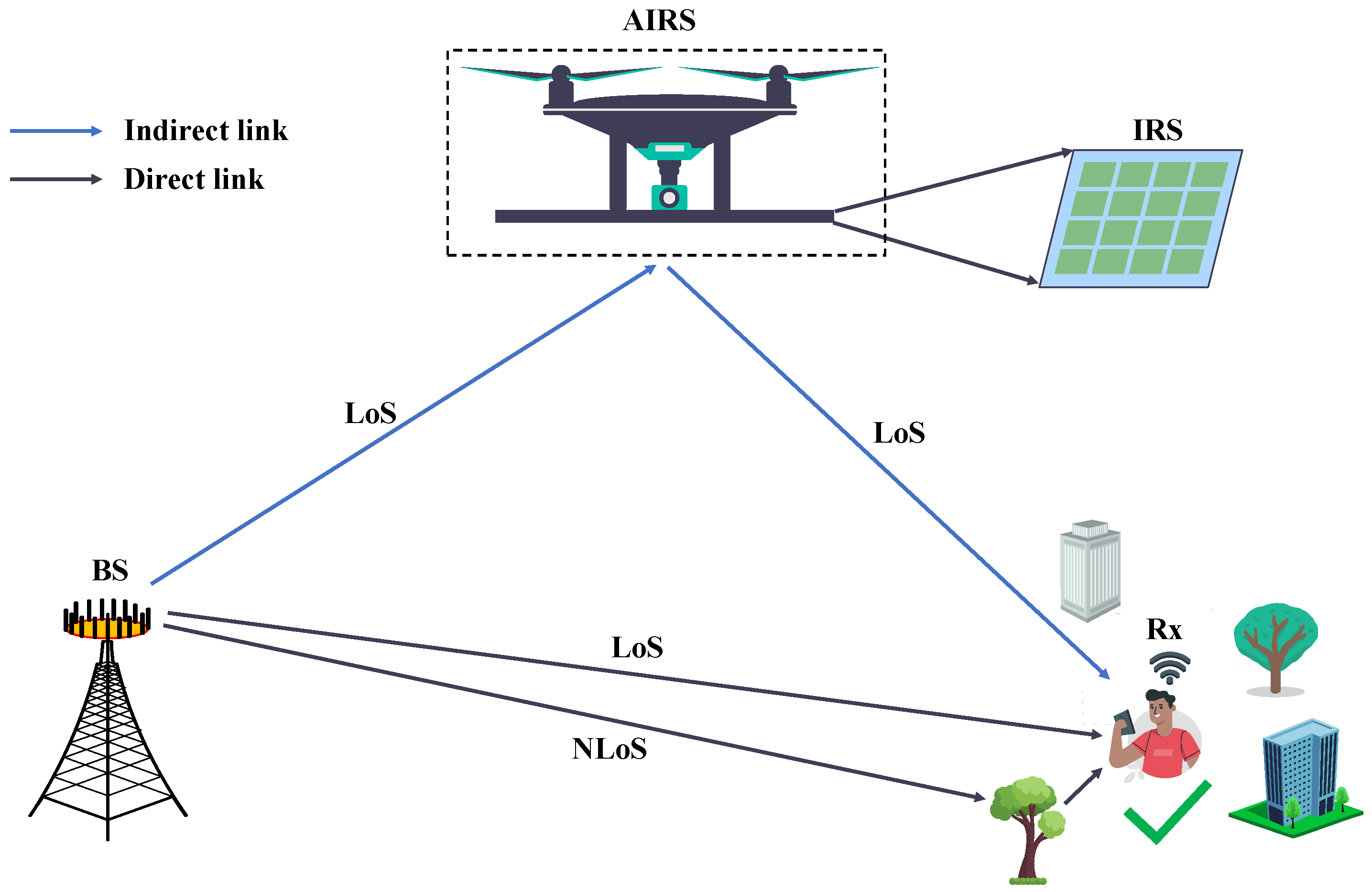
In this paper, a propagation environment comprising a Tx, a Rx, and an AIRS is considered. Virtual LoS paths are introduced by the AIRS, serving to combat multipath fading and enhance communication performance between the Tx and Rx. As illustrated in Figure 1, the overall channel is characterized by two main link types: direct link components and an indirect link component. Specifically, the direct link components encompass a LoS mode, with waves directly transmitted from the Tx to the Rx, and a single-bounced mode at the Rx side, where waves are scattered from local scatterers near the Rx before reception. Conversely, the indirect link component involves a single-bounced mode at the AIRS side, with waves scattered from the AIRS itself before reception.

2.1. One-Cylinder Scattering Model

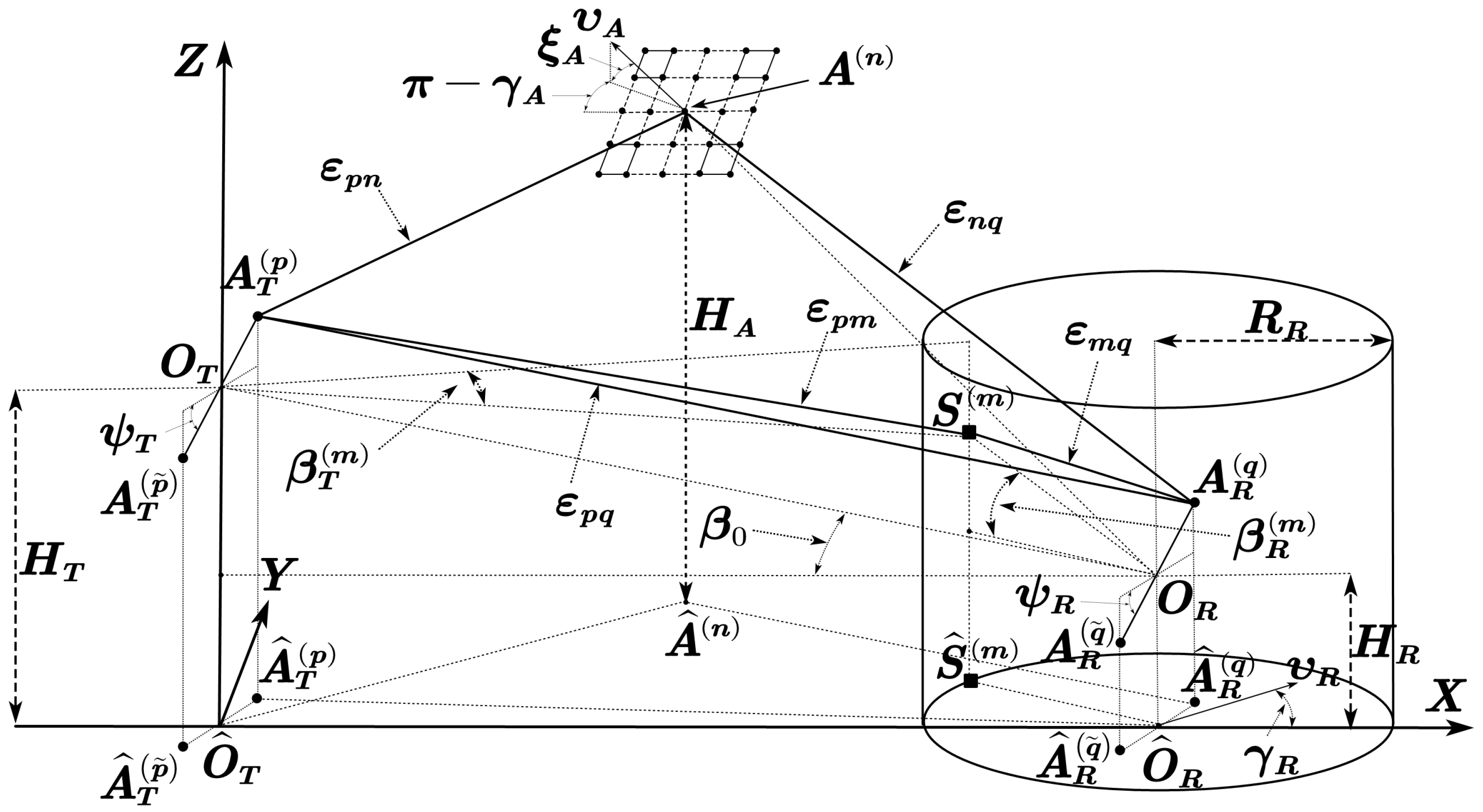
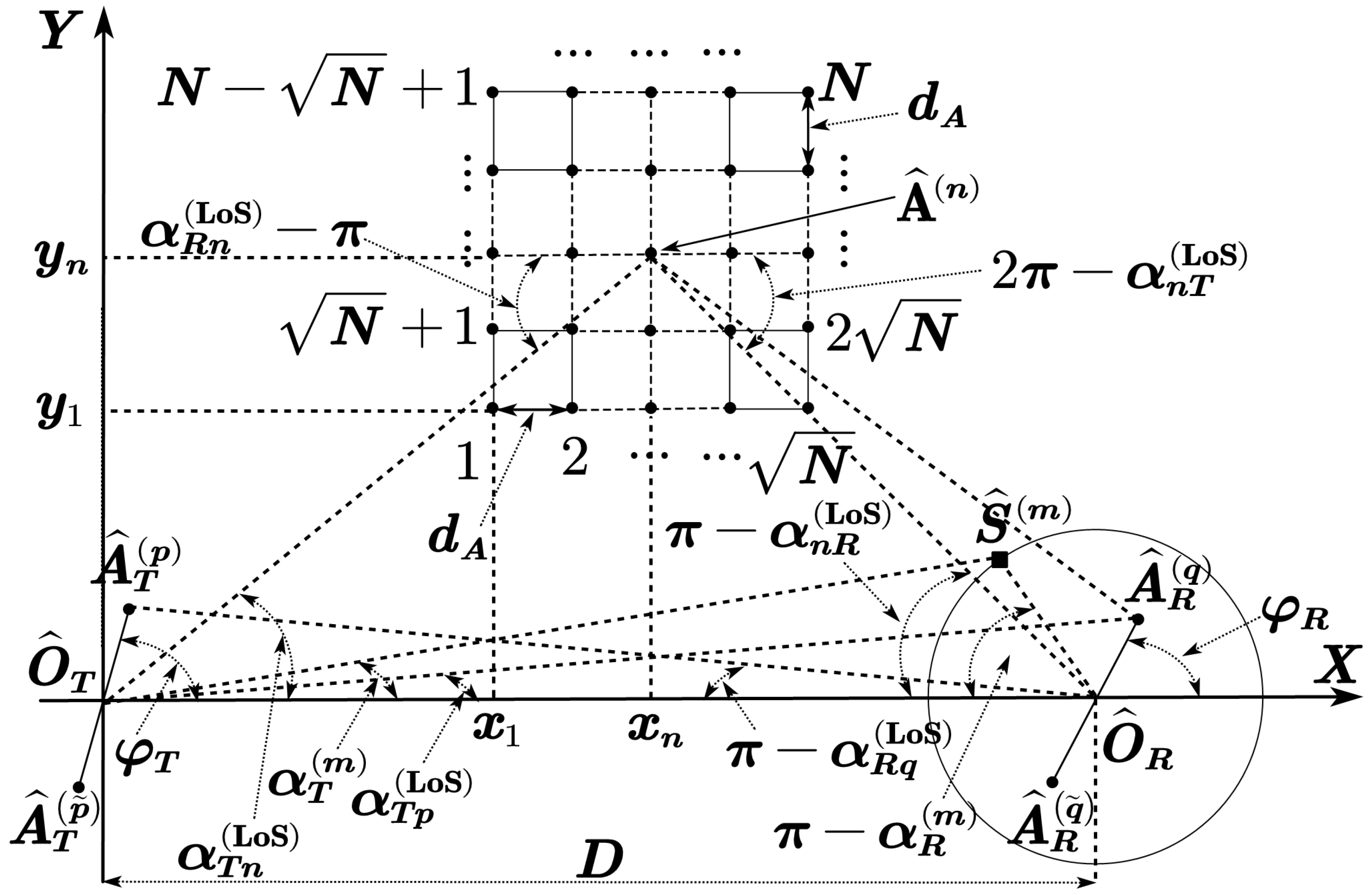
A one-cylinder channel model is introduced for the design of AIRS-assisted MIMO communications. For clarity, the 3D structure illustrating the LoS and Non-LoS (NLoS) paths for the MIMO channel is presented in Figure 2, with its projection onto the x y -plane shown in Figure 3. The system configuration parameters are defined as follows: The Tx and Rx are equipped with N t and N r omnidirectional antennas, respectively, featuring inter-element separation distances of d t and d r . The AIRS is realized using a uniform square array comprising N IRS passive reflecting elements, spaced by a distance d a . Array orientations at the Tx and Rx are defined by azimuth angles φ T , φ R (relative to the x-axis) and elevation angles ψ T , ψ R (relative to the x y -plane), respectively. Given that the AIRS operates in 3D space, its movement direction is captured by the azimuth movement angle γ A and the elevation movement angle ξ A . In contrast, the Rx movement is described by an azimuth movement angle γ R . The velocities of the AIRS and Rx are denoted as υ A and υ R , respectively. The distance between the BS and Rx is D, and their respective heights, along with the AIRS height, are H T , H A , and H R . Since H T H R (as in most cases), the elevation angle β 0 between the Tx and Rx is approximated as β 0 arctan H T / D . The scattering environment at the Rx side is characterized by a one-cylinder geometrical model. Within this framework, M omnidirectional scatterers (e.g., local buildings, vegetation) are assumed to be positioned on the surface of a cylinder with radius R R . Let S m represent the m-th scatterer m = 1 , , M . For waves impinging upon S m , the azimuth and elevation angles of departure (AAoD/EAoD) are α T m and β T m , respectively. Conversely, after scattering from S m , the corresponding azimuth and elevation angles of arrival (AAoA/EAoA) at the Rx are α R m and β R m , respectively. Table 2 defines some important symbols necessary for the proposed model.

2.2. Derivation of the Channel Model

The overall channel matrix H t can be expressed as
H t = H DIR t + H INDIR t ,
where H DIR t = h p q DIR t N r × N t denotes the direct link channel matrix, whose elements h p q DIR t represent the channel impulse response (CIR) from the p-th transmit antenna to the q-th receive antenna, and are defined as
h p q DIR t = PL DIR 1 K K + 1 h p q LoS t + 1 K + 1 h p q NLoS t ,
where K is the Rician K-factor, and P L DIR is the free-space path loss of the direct link between the BS and Rx, calculated as
P L DIR = 4 π λ 2 D cos β 0 α DIR ,
where λ = c 0 / f is wavelength, f denotes the carrier frequency, c 0 is the speed of light, and α DIR is the path loss exponent. The terms h p q LoS t and h p q NLoS t are expressed as
h p q LoS t = e j k 0 ε p q e j 2 π t f D , LoS ,
h p q NLoS t = 1 M m = 1 M e j ϕ m j k 0 ε p m + ε m q e j 2 π t f D , m ,
where k 0 = 2 π / λ is the free-space wave number, and ϕ m is a uniformly distributed random phase over π , π . The indirect link channel matrix H INDIR t between the BS and the Rx (i.e., via the AIRS) is represented as H INDIR t = H 2 t F Θ t H 1 t . Here, the signal reflection from the IRS is modeled by the diagonal matrix F Θ t = diag θ t with θ t = e j θ 1 t , , e j θ n t , , e j θ N IRS t . Notably, a strong LoS path is assumed to be maintained between the AIRS and both the BS and the Rx, attributed to the AIRS’s sufficiently high altitude. The elements of H INDIR t , denoted as h p q INDIR t , represent the CIR for the path via the AIRS, and are expressed as
h p q INDIR t = PL INDIR 1 n = 1 N IRS h p n T A t e j θ n t h n q A R t ,
where P L INDIR is the free-space path loss of the indirect link (via the AIRS) between the BS and Rx, determined by
P L INDIR = 16 π λ 2 2 ε 1 ε 2 2 ε 2 H A H T + ε 1 H A H R 2 ,
where ε 1 = H A H T 2 + x 1 2 + y 1 2 and ε 2 = H A H T 2 + D x 1 2 + y 1 2 , with x 1 and y 1 denoting the coordinates of the first AIRS element in the x y -plane. The channel coefficients H 1 t = h p n T A t N IRS × N t and H 2 t = h n q A R t N r × N IRS are respectively expressed as
h p n T A t = e j k 0 ε p n e j 2 π t f D , n T A ,
h n q A R t = e j k 0 ε n q e j 2 π t f D , n A R .
where the terms ε p q , ε p m , ε m q , ε p n , ε n q denote the propagation distances between A T p A R q , A T p S m , S m A R q , A T p A n , A n A R q , respectively. Applying the approximation 1 + x 1 + x / 2 for small x and the law of cosines, the respective propagation distances can be approximated as
ε p q D Δ T cos ψ T cos φ T + Δ R cos ψ R cos φ R cos β 0 ,
ε p m D cos β 0 sin β 0 R R tan β R m Δ T sin ψ T Δ T cos β 0 cos ψ T cos α T m φ T ,
ε m q R R cos β R m Δ R sin ψ R sin β R m Δ R cos ψ R cos β R m cos α R m φ R ,
ε p n ε O ^ T A ^ n cos β T n LoS Δ T sin ψ T sin β T n LoS Δ T cos ψ T cos β T n LoS cos α T n LoS φ T ,
ε n q ε O ^ R A ^ n cos β n R LoS Δ R sin ψ R sin β n R LoS Δ R cos ψ R cos β n R LoS cos α n R LoS φ R ,
where Δ T is the distance from the p-th transmit antenna element to the transmit antenna array’s central point, and Δ R is the corresponding distance for the q-th receive antenna element to the receive antenna array’s center. For uniform linear arrays, these are described by
Δ T = N t 2 p + 1 2 ϖ t , Δ R = N r 2 q + 1 2 ϖ r .
where the terms ε O ^ T A ˜ n and ε O ^ R A ^ n denote the distances between O ^ T A ^ n and O ^ R A ^ n links, respectively. Based on the geometrical configuration, these distances are determined through the following relationships;
ε O ^ T A ^ n = x n 2 + y n 2 , ε O ^ R A ^ n = D x n 2 + y n 2 .
Here, the coordinates of the n-th AIRS element are x n = x 1 + n 1 a n N IRS ϖ a and y n = y 1 + a n ϖ a , where a n = n 1 / N IRS and · denotes the floor function. Note that N IRS is the total number of IRS elements. Assuming N t ϖ t ε O ^ T A ^ n and H R H A , the AAoD, AAoA, EAoD, and EAoA for the LoS path of the BS-AIRS link are given by
α T n LoS arcsin y n / ε O ^ T A ^ n ,
α R n LoS π + α T n LoS ,
β T n LoS = β R n LoS arctan H A H T / ε O ^ T A ^ n .
Similarly, the AAoD, AAoA, EAoD, and EAoA for the LoS path of the AIRS-Rx link are obtained as
α n T LoS π + α n R LoS ,
α n R LoS arcsin y n / ε O ^ R A ^ n ,
β n T LoS = β n R LoS arctan H A / ε O ^ R A ^ n .
The corresponding Doppler frequencies are given by
f D , LoS = υ R λ cos α R q LoS γ R cos β R q LoS ,
f D , m = υ R λ cos α R m γ R cos β R m ,
f D , n T A = υ A λ cos α R n LoS γ A cos β R n LoS cos ξ A + sin β R n LoS sin ξ A ,
f D , n A R = υ A λ cos α n T LoS γ A cos β n T LoS cos ξ A + sin β n T LoS sin ξ A + υ R λ cos α n R LoS γ R cos β n R LoS ,
where α R q LoS π , β R q LoS β 0 . By inspecting the geometry in Figure 2 and Figure 3, it is evident that the AoAs and AoDs of the direct link possess specific geometric relationships that enable their mutual conversion. These relationships are described by
sin α T m R R D sin α R m 1 + R R D cos α R m ,
cos α T m 1 ,
sin β T m sin β 0 R R D cos 2 β 0 · a m ,
cos β T m cos β 0 + R R D sin β 0 cos β 0 · a m .
Notably, as the number of scatterers approaches infinity ( M ), the discrete azimuth angle α R m and elevation angle β R m are replaced by continuous random variables, α R and β R , respectively. For the azimuth distribution, the widely used von Mises distribution is adopted, with its probability density function (PDF) defined as
g 1 α R = e η R cos α R α ι 2 π I 0 η R ,
where α R π , π , α ι π , π is the mean angle of scatterer distribution in the horizontal plane, and η R is the concentration parameter. Here, I 0 · denotes the zeroth-order modified Bessel function of the first kind. The elevation distribution is described by the cosine PDF as follows:
g 2 β R = π 4 β m cos π 2 β R β ι β max ,
where β R β ι β max π 2 . The parameters β m and β ι denote the maximum and mean elevation angles, respectively. The CIR associated with the NLoS component depends on the discrete angular parameters α R m and β R m . In this paper, the modified method of equal areas (MMEA) is utilized to derive these discrete sets. By employing numerical root-finding techniques, the discrete expressions for the AAoAs α R m m = 1 M and the EAoAs β R m m = 1 M are obtained through the following expressions:
m 1 / 2 M α μ π α R m g 1 α R d α R = 0 ,
m 1 / 2 M β μ β m β R m g 2 β R d β R = 0 .

3. Phase Shifts Optimization

3.1. Problem Formulation

Consider a downlink AIRS-assisted MIMO communication system. The signal vector received at the Rx is modeled as
y t = H t x t + n t ,
where x t C N t × 1 is the transmit signal vector, and n t C N r × 1 is the noise vector, assumed to follow C N 0 , N 0 I . Our objective is to maximize the achievable rate of the considered AIRS-assisted wireless communication system. For a MIMO channel, Gaussian signaling is known to achieve the maximum rate. When H is known perfectly at both BS and Rx, the achievable rate for a given input covariance matrix Q is expressed as
C t = log 2 det I + 1 N 0 H t Q t H t H .
Since the channel matrix H t also depends on the IRS phase shifts θ t , the achievable rate maximization problem for the considered system is formulated as
maximize θ , Q f ( θ , Q ) = ln det I N r + Z ( θ ) Q Z H ( θ ) subject to Tr ( Q ) P t , Q 0 , | θ n | = 1 , n = 1 , , N IRS ,
where P t is the maximum transmit power, and Z ( θ ) H ¯ DIR + H 2 F ( θ ) H ¯ 1 is the effective normalized channel, with H ¯ DIR H DIR H DIR N 0 N 0 and H ¯ 1 H 1 PL INDIR 1 PL INDIR 1 N 0 N 0 .

3.2. Algorithm Design

The optimization problem in (37) poses significant challenges due to the non-convex unit-modulus constraints and the strong coupling between θ and Q in the objective function. To tackle this, we employ the PGM. Unlike conventional alternating optimization schemes, PGM updates all variables simultaneously in the direction of the complex gradient, followed by a Euclidean projection onto the feasible set. This method is particularly attractive here because the projection onto the non-convex unit-modulus set admits a computationally efficient closed-form solution.

3.2.1. PGM Framework

Let ( θ ( l ) , Q ( l ) ) denote the optimization variables at the l-th iteration, where l = 0 , 1 , , I max . The proposed PGM updates the variables by moving in the direction of the complex gradient of the objective function, followed by a projection onto the feasible set to ensure constraint satisfaction. Specifically, in the l-th iteration, we first perform an unconstrained gradient ascent step. The intermediate variables, denoted by θ ˜ ( l + 1 ) and Q ˜ ( l + 1 ) , are computed as
θ ˜ ( l + 1 ) = θ ( l ) + μ ( l ) θ f ( θ ( l ) , Q ( l ) ) ,
Q ˜ ( l + 1 ) = Q ( l ) + μ ( l ) Q f ( θ ( l ) , Q ( l ) ) ,
where μ ( l ) represents the step size at the current iteration, which can be determined via backtracking line search to guarantee convergence. Since the intermediate updates in (38) and (39) may not belong to the feasible sets, a projection step is required. The valid variables for the next iteration ( l + 1 ) are obtained by solving the following closest-point problems, i.e.,
θ ( l + 1 ) = P Ω θ ˜ ( l + 1 ) arg min θ Ω θ θ ˜ ( l + 1 ) 2 ,
Q ( l + 1 ) = P Q Q ˜ ( l + 1 ) arg min Q Q Q Q ˜ ( l + 1 ) 2 ,
where the feasible sets are rigorously defined as
Ω = θ C N IRS × 1 : | θ n | = 1 , n = 1 , , N IRS ,
Q = Q C N t × N t : Q 0 , Tr ( Q ) P t .

3.2.2. Gradient Computation and Projection Operations

To execute the PGM, explicit expressions for the complex gradients and projection operators are essential. We start by defining the auxiliary matrix K I N r + Z ( θ ) Q Z H ( θ ) 1 . Using the differential identity d ln det ( A ) = Tr ( A 1 d A ) , the differential of the objective function f with respect to Q is given by
d f = Tr K Z ( θ ) ( d Q ) Z H ( θ ) = Tr Z H ( θ ) K Z ( θ ) d Q .
Thus, the gradient with respect to Q * is identified as
Q f ( θ , Q ) = Z H ( θ ) K ( θ , Q ) Z ( θ ) .
Similarly, exploiting the structure Z ( θ ) = H ¯ DIR + H 2 diag ( θ ) H ¯ 1 , the differential with respect to θ involves the term H 2 ( d diag ( θ ) ) H ¯ 1 . By applying the trace property Tr ( A T B ) = vec ( A ) T vec ( B ) and the identity involving diagonal matrices, the gradient is derived as
θ f ( θ , Q ) = vec d H 2 H K ( θ , Q ) Z ( θ ) Q H ¯ 1 H ,
where vec d ( · ) extracts the main diagonal of a matrix into a column vector. The projection operators admit closed-form solutions, which significantly reduces computational complexity. For the unit-modulus set Ω , the projection operates element-wise. For the n-th element of the vector u C N IRS × 1 :
P Ω ( u ) n = u n | u n | , if u n 0 , 1 , if u n = 0 .
For the covariance matrix set Q , the projection is equivalent to the water-filling power allocation. Let the eigenvalue decomposition of the intermediate matrix be Q ˜ = U Σ U H , where Σ = diag ( σ 1 , , σ N t ) . The projected matrix is given by
P Q ( Q ˜ ) = U diag ( σ 1 ν ) + , , ( σ N t ν ) + U H ,
where ( x ) + = max ( 0 , x ) , and ν 0 is the Lagrange multiplier chosen to satisfy i = 1 N t ( σ i ν ) + P t .

3.2.3. Convergence Acceleration via Data Scaling

A critical challenge in RIS-aided MIMO systems is the potentially vast difference in path loss between the direct link and the reflected link. This creates an ill-conditioned optimization landscape where the gradient norms satisfy θ f Q f , leading to slow convergence. To address this, we introduce a scaling factor κ to balance the gradients. We define the scaled variables as Q ¯ = κ 2 Q and θ ¯ = κ 1 θ . The optimization is performed over these scaled variables. The scaling factor κ is heuristically determined by the ratio of the channel norms, balanced by the transmit power. Following the methodology in [23], we set the following:
κ = 10 max 1 , 1 P t H DIR PL INDIR 1 / 2 H 2 H 1 , if H DIR 0 , 10 , otherwise .
This scaling effectively preconditions the problem, ensuring that the gradients with respect to both variables are of comparable magnitude, and thereby accelerating the convergence of the PGM. Finally, Algorithm 1 summarizes the complete PGM procedure incorporating this scaling strategy.

3.2.4. Computational Complexity Analysis

The per-iteration computational complexity of our proposed PGM, as detailed in Algorithm 1, is evaluated in terms of complex multiplications for a system with antenna and IRS dimensions of N t , N r , and N IRS , respectively. The analysis is governed by three steps: (1) computing the effective channel matrix, (2) calculating the gradients with respect to the phase-shift vector θ and the covariance matrix Q , and (3) projecting the updated variables onto their respective feasible sets.
  • Effective Channel Matrix Computation: The formation of the effective channel matrix Z ( θ ) H ¯ DIR + H 2 F ( θ ) H ¯ 1 is dominated by the matrix multiplication H 2 diag ( θ ) H 1 . This step requires approximately O ( N r N t N IRS ) operations. The computation of the auxiliary matrix K = ( I + Z Q Z H ) 1 involves forming Z Q Z H and a subsequent matrix inversion. This has a complexity of O ( N r N t 2 + N r 2 N t ) for the multiplications and O ( N r 3 ) for the inversion of the N r × N r matrix.
  • Gradient Calculation: The gradient with respect to Q , Q f = Z H K Z , requires matrix multiplications of the order O ( N t N r 2 + N t 2 N r ) ; The gradient with respect to θ , θ f = vecd ( H 1 Q Z H K H 2 ) T , involves a chain of matrix multiplications with a dominant complexity of approximately O ( N IRS N t N r + N IRS N r 2 ) .
  • Projection Operations: The projection of the phase-shift vector onto the unit-modulus set is an element-wise operation, requiring only O ( N IRS ) operations, which is computationally inexpensive. The projection of the covariance matrix Q onto the positive semi-definite cone with a power constraint is equivalent to a water-filling procedure. This is dominated by the eigenvalue decomposition of the N t × N t matrix, which has a complexity of O ( N t 3 ) .
By combining these steps, the total computational complexity per iteration of the proposed PGM algorithm is given by O ( N r N t N IRS + N r 3 + N t 3 + N r 2 N t + N r N t 2 ) .
Algorithm 1 Proposed PGM with data scaling
Input:  H DIR , H 1 , H 2 , P t , N 0 , μ ( 0 ) , κ , I max , θ ( 0 ) , Q ( 0 ) .
Output:  θ * = κ θ ¯ ( I max ) , Q * = κ 2 Q ¯ ( I max ) .
  1:
Data Scaling: Transform initial variables to the scaled domain:
  2:
    θ ¯ ( 0 ) κ 1 θ ( 0 ) ;
  3:
    Q ¯ ( 0 ) κ 2 Q ( 0 ) ;
  4:
    P ¯ t κ 2 P t .
  5:
for  l = 0 to  I max 1   do
  6:
   // Step 1: Gradient Computation
  7:
   Compute gradients θ ¯ f ¯ and Q ¯ f ¯ at point ( θ ¯ ( l ) , Q ¯ ( l ) ) .
  8:
   // Step 2: Unconstrained Gradient Ascent
  9:
   Update intermediate variables:
10:
         θ ¯ ˜ ( l + 1 ) θ ¯ ( l ) + μ ( l ) θ ¯ f ¯
11:
         Q ¯ ˜ ( l + 1 ) Q ¯ ( l ) + μ ( l ) Q ¯ f ¯
12:
   // Step 3: Projection onto Feasible Sets
13:
   Project θ ¯ ˜ ( l + 1 ) onto the scaled unit-modulus set:
14:
         [ θ ¯ ( l + 1 ) ] n 1 κ [ θ ¯ ˜ ( l + 1 ) ] n | [ θ ¯ ˜ ( l + 1 ) ] n | , n = 1 , , N IRS .
15:
   Project Q ¯ ˜ ( l + 1 ) onto the scaled power constraint set Q :
16:
         Q ¯ ( l + 1 ) P Q ( Q ¯ ˜ ( l + 1 ) ) with power budget P ¯ t .
17:
end for

4. Statistical Characteristics of the AIRS-Assisted MIMO Channel

4.1. Space–Time Correlation Function

Assuming a wide-sense stationary and 3D non-isotropic scattering environment, and given that the CIR components (for both direct and indirect links) are independent, zero-mean complex Gaussian processes, the space–time correlation function for a time delay Δ t can be derived as
R p q , p ˜ q ˜ ϖ t , ϖ r , ϖ a , t , Δ t = R p q , p ˜ q ˜ DIR ϖ t , ϖ r , Δ t + R p q , p ˜ q ˜ INDIR ϖ t , ϖ r , ϖ a , t , Δ t = R p q , p ˜ q ˜ LoS ϖ t , ϖ r , Δ t + R p q , p ˜ q ˜ NLoS ϖ t , ϖ r , Δ t + R p q , p ˜ q ˜ INDIR ϖ t , ϖ r , ϖ a , t , Δ t ,
where p , p ˜ 1 , , N t and q , q ˜ 1 , , N r . The terms in (50) are expressed as follows:
R p q , p ˜ q ˜ LoS ϖ t , ϖ r , Δ t = E h p q LoS t * · h p ˜ q ˜ LoS t + Δ t = K K + 1 e j k 0 ε p q j 2 π t f D , LoS e j k 0 ε p ˜ q ˜ + j 2 π t + Δ t f D , LoS = K K + 1 e j k 0 ε p q ε p ˜ q ˜ e j 2 π Δ t f D , LoS ,
R p q , p ˜ q ˜ NLoS ϖ t , ϖ r , Δ t = E h p q NLoS t * · h p ˜ q ˜ NLoS t + Δ t = 1 K + 1 1 M m = 1 M E e j k 0 ε p m + ε m q e j 2 π t f D , m e j k 0 ε p ˜ m + ε m q ˜ e j 2 π t + Δ t f D , m = 1 K + 1 1 M m = 1 M E e j k 0 ε p m ε p ˜ m + ε m q ε m q ˜ e j 2 π Δ t f D , m ,
R p q , p ˜ q ˜ INDIR ϖ t , ϖ r , ϖ a , t , Δ t = E h p q INDIR t * · h p ˜ q ˜ INDIR t + Δ t = 1 N IRS n = 1 N IRS E e j k 0 ε p n + ε n q e j 2 π t f D , n T A + f D , n A R e j θ n t × e j k 0 ε p ˜ n + ε n q ˜ e j 2 π t + Δ t f D , n T A + f D , n A R e j θ n t + Δ t = 1 N IRS n = 1 N IRS E e j k 0 ε p n ε p ˜ n + ε n q ε n q ˜ e j 2 π Δ t f D , n T A + f D , n A R e j θ n t + Δ t θ n t ,
where · * denotes the complex conjugate, and E · represents the expectation operator.

4.2. Doppler Power Spectrum

Subsequently, the Doppler power spectrum is defined as the Fourier transform of the time correlation function, i.e.,
S p q , p ˜ q ˜ f D = + R p q , p ˜ q ˜ d t = 0 , d r = 0 , d a = 0 , t , Δ t e j 2 π f D Δ t d Δ t ,
where f D is the Doppler frequency.

5. Numerical Results

In this section, the achievable rate of the AIRS-assisted MIMO system is analyzed using the proposed algorithms. Subsequently, the numerical results are presented to evaluate the system’s performance and investigate the impact of various model parameters on channel characteristics. In the following simulation setup, the parameters are t = 0 s, ϖ t = ϖ r = 0.5 λ , ϖ a = 0.1 λ , η R = 2, x 1 = 40 m, y 1 = 40 m, D = 500 m, H T = 25 m, H R = 1.5 m, R R = 10 m, N 0 = −90 dBm, α DIR = 3 , M = 40, α ι = 0 , β ι = 45 , β max = 90 , ψ T = 30 , φ T = 45 , ψ R = 30 , φ R = 45 , υ A = 1  m/s, γ R = 0 , γ A = 180 , ξ A = 180 , I max = 100 , θ 0 = 1 , , 1 T , μ ( 0 ) = 10 4 , Q 0 = P t P t N t N t I .
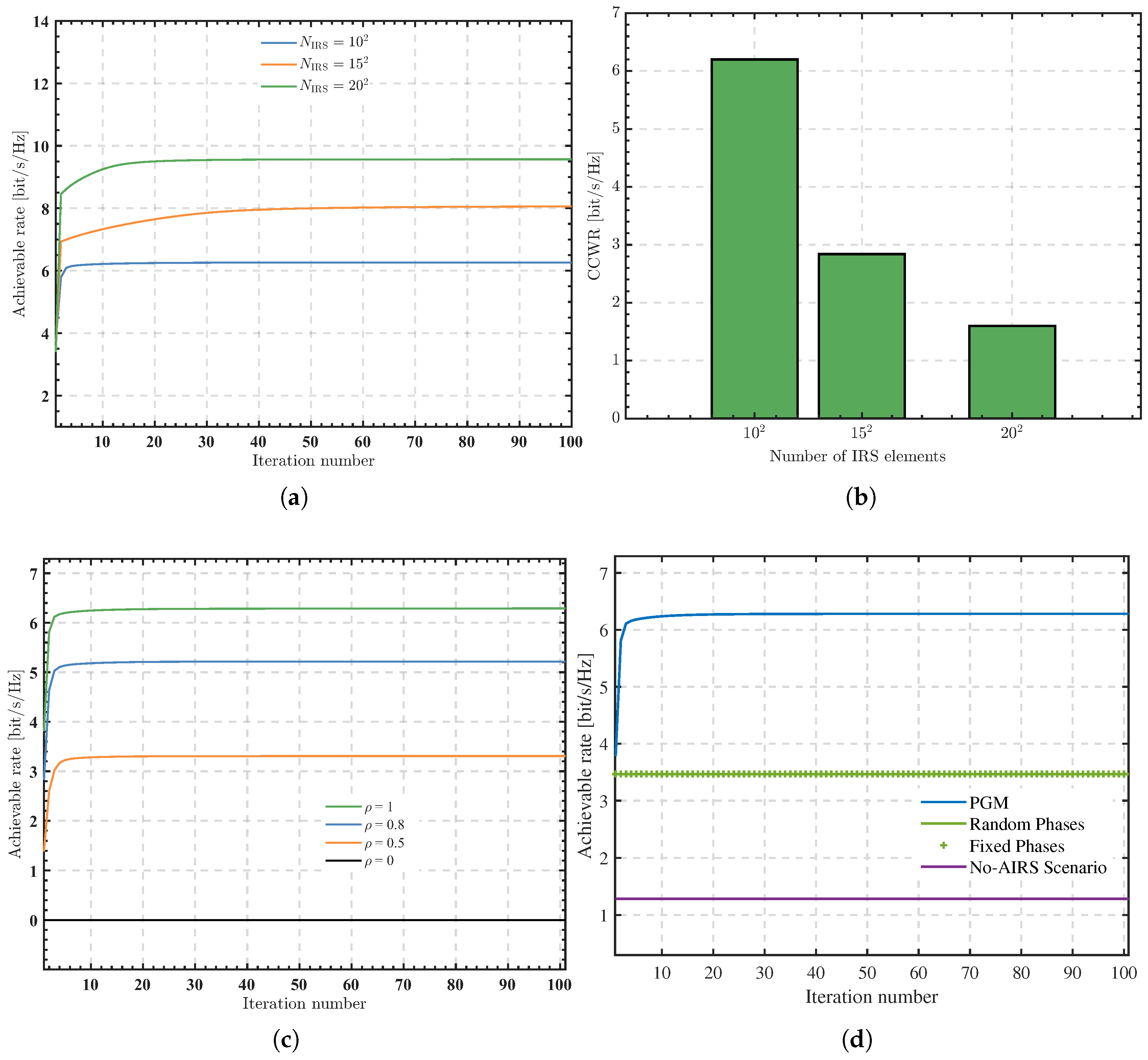
Figure 4a shows the convergence behavior of the proposed PGM algorithm with different numbers of IRS elements, where the achievable rate is plotted against the iteration index. When N IRS = 10 2 , the algorithm rapidly converges to a stable value of approximately 6.2 bit/s/Hz, whereas for the cases of N IRS = 15 2 and N IRS = 20 2 , the saturation level of the achievable rate is substantially elevated to around 8.1 and 9.6 bit/s/Hz, respectively, which is caused by the enhanced passive beamforming gain and the increased spatial degrees of freedom offered by a larger AIRS aperture. Similar to the fast convergence observed in lower-dimensional cases, it is found that even when increases significantly, the proposed algorithm requires only a few iterations (i.e., less than 50) to reach the optimum. This again confirms that the proposed data-scaling-enhanced PGM effectively mitigates the ill-conditioning of the optimization problem, thereby guaranteeing robust scalability and low computational latency for large-scale AIRS systems.
To evaluate the fundamental trade-off between system performance and computational overhead, we introduce the convergence-cost-weighted rate (CCWR) as a function of the IRS elements N IRS [29]. Specifically, the CCWR is defined as the ratio of the converged achievable rate R final N IRS to the normalized computational effort, i.e., CCWR N IRS = R final N IRS T total N IRS / T total N IRS = 100 . Here, the total cost T total N IRS is the product of the iteration count and the per-iteration complexity derived in Section 3.2.4. Figure 4b shows the CCWR versus the number of AIRS elements by setting the converged achievable rate as the performance metric. It is observed that the CCWR decreases significantly with an increasing number of AIRS elements, and in contrast to the achievable rate, which always increases, the N IRS = 10 2 configuration has a higher CCWR, and it thus represents a more computationally efficient design. This implies that larger AIRS configurations lead to a lower spectral efficiency gain per unit of computational cost. Since in our optimization problem, the total computational cost grows polynomially with the system dimensions while the achievable rate increases only logarithmically, a low CCWR for large AIRS means that when the system performance is improved by adding more elements, the required computational budget increases disproportionately, which makes larger AIRS configurations less attractive for latency-sensitive and power-constrained practical deployments. It is also noted that, compared with the baseline configuration N IRS = 10 2 , the CCWR of the N IRS = 20 2 configuration is 74.2% lower, due to the six-fold increase in its normalized computational cost.
To facilitate this analysis, we first model the imperfect CSI. While the optimization is performed using the estimated channel H ˜ , the performance is evaluated using the true physical channel H true . We adopt a widely-used correlation-based error model to relate these two: H true = ρ · H ˜ + 1 ρ 2 · E , where ρ [ 0 , 1 ] is the CSI quality parameter, representing the correlation between the estimated and true channels. A value of ρ = 1 corresponds to perfect CSI, while ρ = 0 indicates completely uncorrelated (useless) CSI. The term E C N r × N t is a random error matrix with i.i.d. entries drawn from CN ( 0 , σ E 2 ) , where the error variance σ E 2 = PL DIR 1 PL INDIR 1 is appropriately scaled relative to the channel power. In Figure 4c, we show the achievable rate versus the iteration number to evaluate the robustness of our algorithm under varying levels of CSI quality ρ . It is observed that the proposed PGM algorithm offers robust performance and maintains significant gains even with imperfect CSI. However, the achievable rate is naturally degraded as the CSI quality decreases. When the CSI is perfect, i.e., with ρ = 1 , the proposed algorithm offers a very significant achievable rate of approximately 6.2 bit/s/Hz. For example, with imperfect CSI quality levels of ρ = 0.8 , 0.5 , the algorithm achieves rates of 5.2 , 3.2 bit/s/Hz, which represents a performance degradation of only 16.1 % , 48.4 % compared to the ideal case, respectively. Specifically, the robustness of the proposed algorithm is more significant at moderate CSI quality levels, which generally occurs in practice due to the inherent challenges in channel estimation for dynamic AIRS environments.
Figure 4d illustrates the achievable rate as a function of the iteration number, comparing various optimization algorithms and baseline scenarios. From the figure, it can be observed that the proposed PGM algorithm exhibits remarkably rapid convergence, achieving its near-optimal achievable rate of approximately 6.1–6.2 bit/s/Hz within just 5–10 iterations. Furthermore, it is seen that baseline configurations, such as “Random Phases” and “Fixed Phases” (both yielding approximately 3.4–3.5 bit/s/Hz), consistently achieve much lower rates. The “No-AIRS Scenario” provides the lowest benchmark, with a rate of approximately 1.2 bit/s/Hz. This unequivocally demonstrates the indispensable role of AIRS in enhancing spectral efficiency, and further emphasizes that substantial performance gains are realized only when AIRS is coupled with efficient optimization, rather than with static or unoptimized phase configurations.
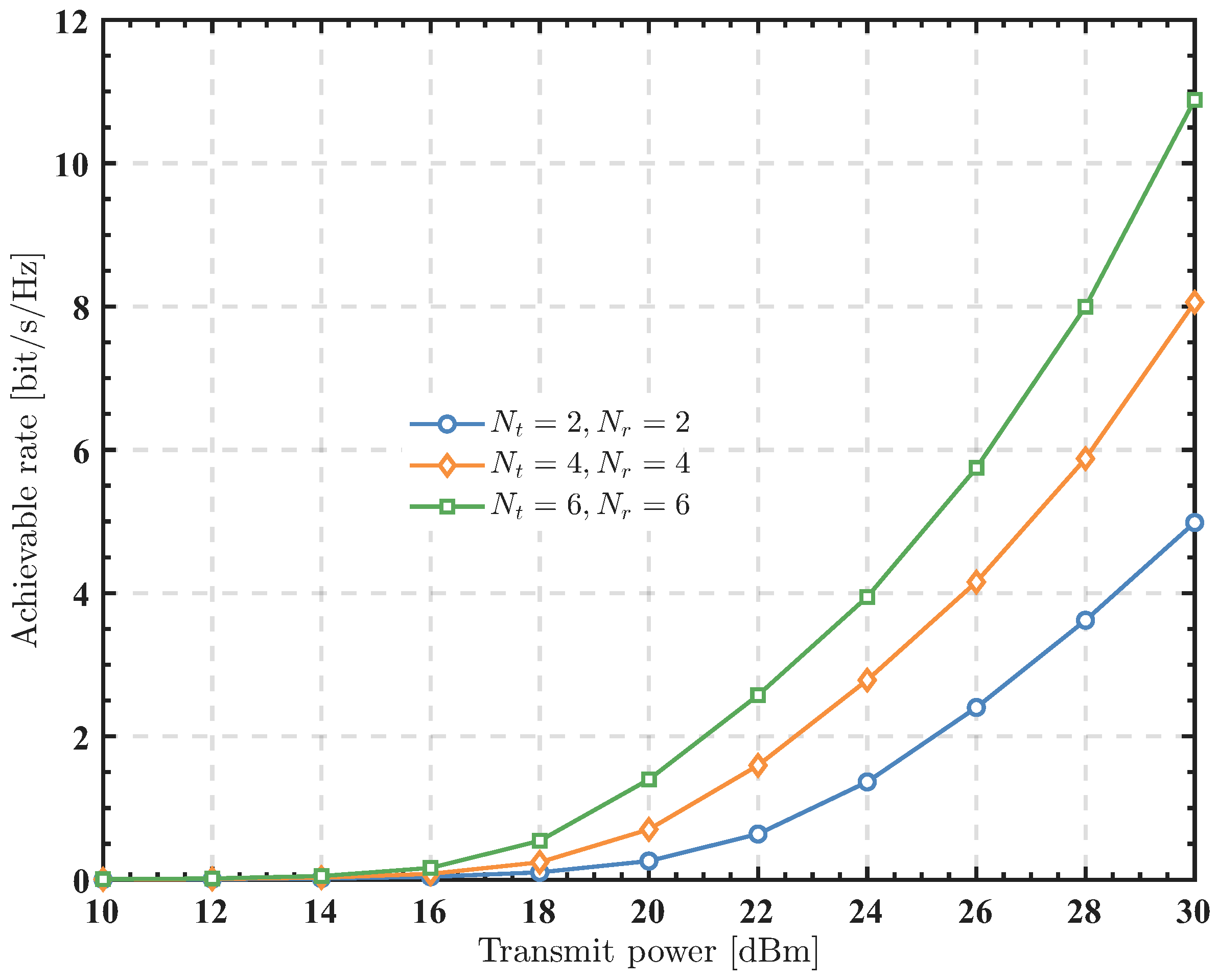
Figure 5 illustrates the achievable rate as a function of the transmit power for different transceiver antenna configurations N t , N r . When the system operates with a minimal antenna setup (i.e., N t = N r = 2 ), the achievable rate exhibits a moderate increase, reaching approximately 5 bit/s/Hz at P t = 30 dBm, whereas for the larger array configuration of N t = N r = 6 , the performance curve is significantly steeper, culminating in a peak rate of nearly 11 bit/s/Hz under the same power budget, which is caused by the simultaneous improvement in array gain and the increased spatial multiplexing gain inherent to higher-order MIMO systems. This again confirms that increasing the number of transceiver antennas in AIRS-assisted networks can effectively exploit spatial degrees of freedom to compensate for propagation loss, thereby converting transmit power into spectral efficiency more efficiently.
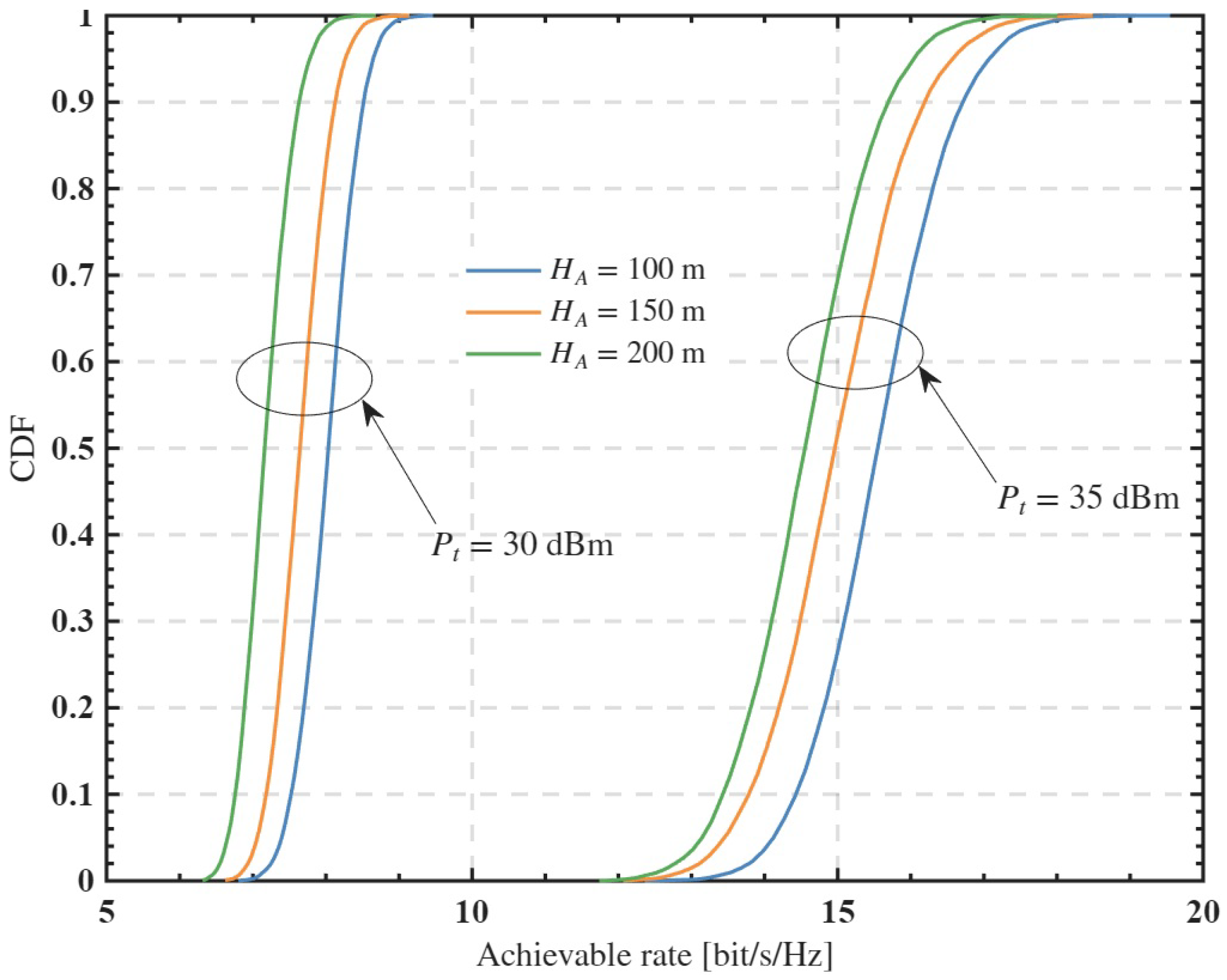
Figure 6 depicts the cumulative distribution function (CDF) of the achievable rate for different AIRS altitudes H A and transmit power levels P t . When the AIRS is deployed at a lower altitude of H A = 100 m with P t = 30 dBm, the median achievable rate reaches approximately 8 bit/s/Hz; whereas increasing the altitude to H A = 200 m results in a noticeable performance degradation, shifting the median rate down to around 7.2 bit/s/Hz, which is caused by the increased propagation path loss of the reflection link, which outweighs the potential benefits of improved LoS probabilities at higher altitudes. This again confirms that while deploying AIRS provides coverage enhancement, a careful optimization of its hovering altitude is essential to balance the trade-off between geometric coverage and signal attenuation in practical 3D network planning.
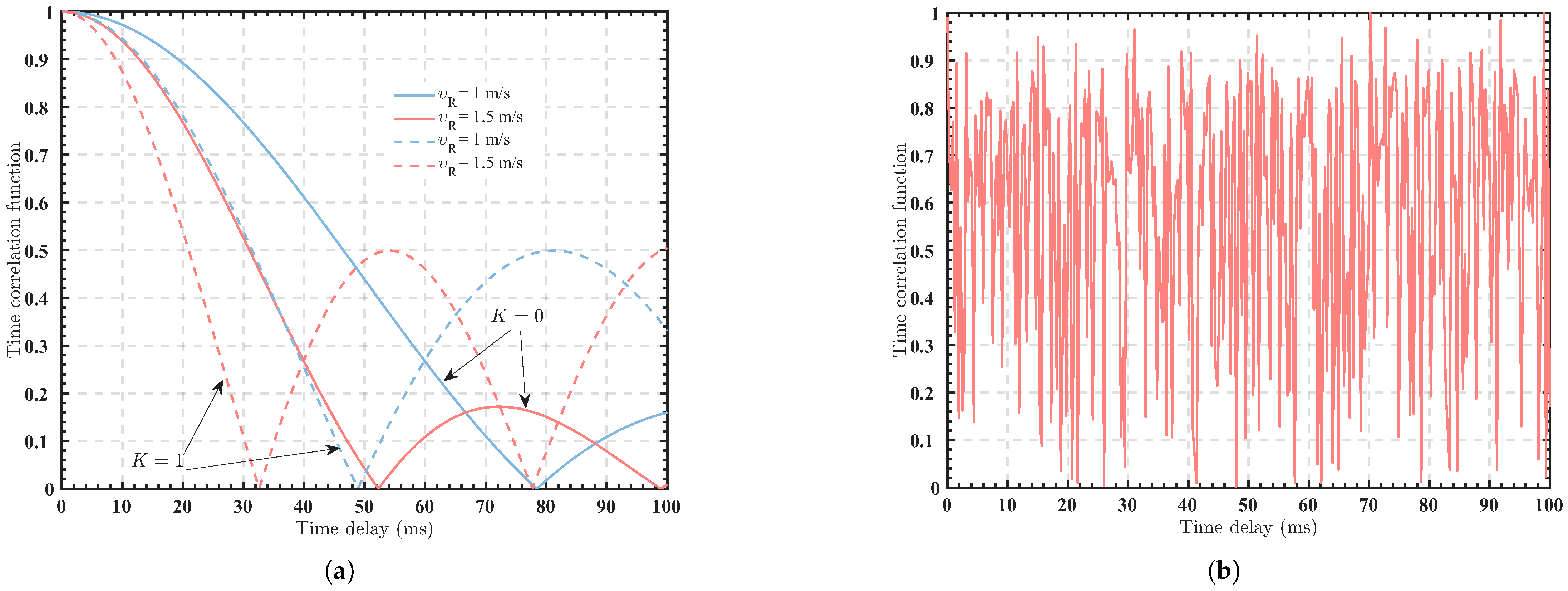
Figure 7 presents the time correlation functions for the direct and indirect links under different mobility conditions and Rician factors. When examining the direct link in Figure 7a, the correlation function exhibits a smooth, monotonic decay over time, where a higher receiver velocity of υ R = 1.5 m m s s leads to a faster decorrelation compared to the case of υ R = 1 m m s s ; whereas for the indirect link via the AIRS shown in Figure 7b, the time correlation function of the AIRS-assisted indirect link demonstrates severe fluctuations and rapid decorrelation, manifesting distinct time-non-stationary characteristics, which is caused by the highly dynamic topology changes induced by the AIRS-Rx co-mobility and the complex superposition of Doppler shifts across the cascaded channel. It is noteworthy that although the proposed PGM algorithm optimizes the IRS phase shifts to maximize the instantaneous rate, the underlying physical channel remains intrinsically non-stationary with extremely short coherence intervals. This again confirms that AIRS-assisted communications operate in a fast-fading regime where channel non-stationarity cannot be ignored, highlighting the necessity of the proposed low-complexity PGM algorithm enabling rapid phase updates that can keep pace with such fast time-varying channel dynamics.
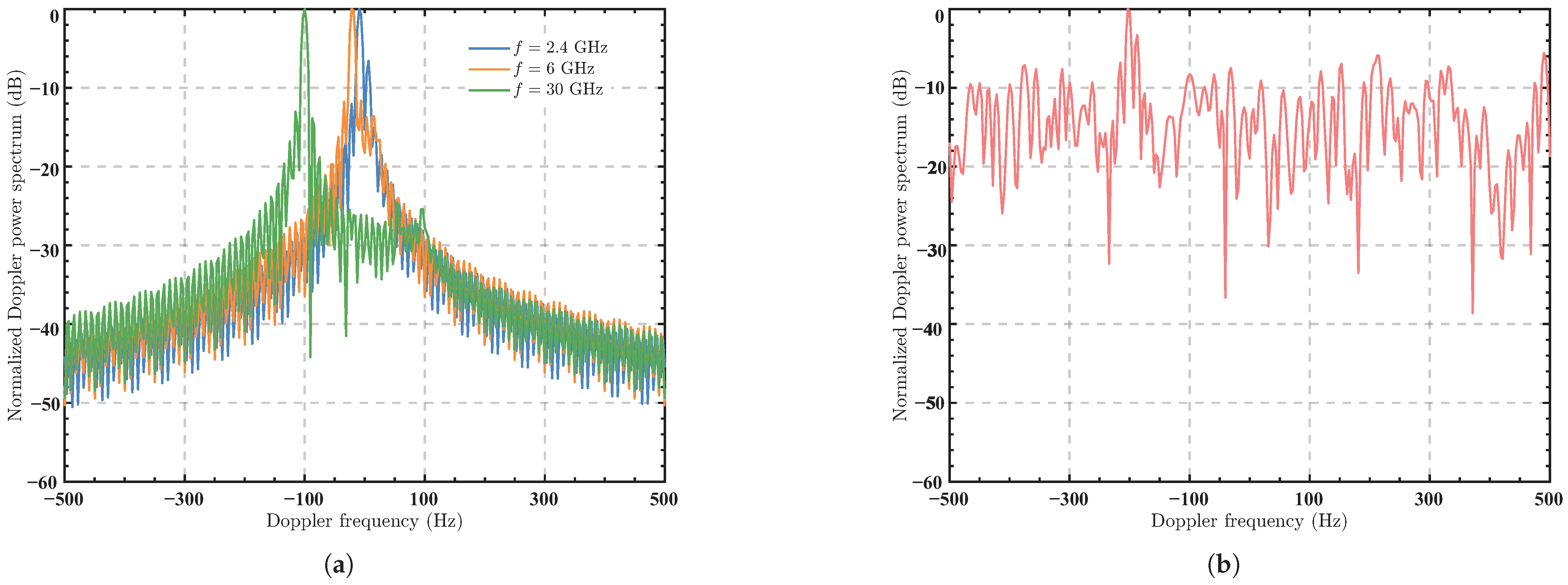
Figure 8 presents the normalized Doppler power spectrum of the direct and indirect links under different carrier frequencies. When the carrier frequency increases to f = 30 GHz in the direct link shown in Figure 8a, the dominant Doppler peak exhibits a significant frequency shift and spectral broadening compared to the lower-frequency cases (e.g., f = 2.4 GHz); whereas in Figure 8b, the Doppler power spectrum of the indirect link manifests as a noise-like continuum distributed almost uniformly across the entire observed frequency range, which is caused by the linear scaling of Doppler shifts with carrier frequency and, more critically, the severe frequency dispersion resulting from the superposition of cascaded Doppler shifts via the large number of AIRS reflecting elements. This again confirms that AIRS-assisted communications, particularly in high-frequency bands, suffer from substantial Doppler spreading and fast time-variance, thereby necessitating robust Doppler compensation and inter-carrier interference mitigation techniques.

6. Conclusions

In this paper, we proposed an AIRS-based 3D channel model for non-isotropic scattering environments. Furthermore, MMEA, a parameter computation method, was developed to jointly calculate the azimuth and elevation angles. Based on the proposed model, a joint optimization problem was formulated to maximize the achievable rate by jointly optimizing the transmitted signal’s covariance matrix and the IRS phase shifts. Subsequently, iterative PGM was introduced to solve this problem. General expressions for the space–time correlation function and Doppler power spectrum were also derived from the proposed model. The numerical simulation results demonstrated the following: (i) the number of elements and height of the AIRS strongly impact the achievable rate; (ii) our proposed AIRS-assisted MIMO channel exhibits significant time-non-stationarity; and (iii) AIRS deployed at lower velocities achieves superior performance. These findings offer valuable insights into AIRS-assisted system analysis and practical deployment.
Future research will focus on several critical avenues. First, the experimental validation of the established theoretical framework will be pursued through comprehensive comparisons with sophisticated ray-tracing models. Second, the proposed geometric channel model is planned to be extended from conventional multi-antenna systems to large-scale antenna configurations, such as pinching-antenna arrays [30,31,32]. This expanded framework will then be integrated with artificial intelligence (AI) technologies, enabling the real-time optimization of RIS phase shifts [33,34] and anticipating significant performance enhancements in A2G communication networks.

Author Contributions

Z.M. and S.L. were responsible for the methodology design, simulation, and writing of the original draft. Y.P. and J.Z. contributed to conceptualization of the problem, validation, and participated in the writing and revision of the manuscript. J.X., G.L. and M.L. provided supervision and critical review of the manuscript. All authors have read and agreed to the published version of the manuscript.

Funding

This work was supported in part by the Research and Innovation Grant for Graduate Students, Shaoyang University (Project No. CX2024SY040); in part by the Shaoyang Sci&Tech Program under Grants 2024PT4040; in part by the Natural Science Foundation of Hunan Province under Grants 2025JJ70244 and 2024JJ7496; and in part by the Scientific Research Foundation of Hunan Provincial Education Department under Grants 22A0530, 23A0544 and 23C0278.

Data Availability Statement

The data presented in this study are available on reasonable request from the corresponding author. The data are not publicly available due to ongoing research projects.

Conflicts of Interest

The authors declare no conflicts of interest.

References

  1. Saleh, S.; Zheng, P.; Liu, X.; Chen, H.; Keskin, M.F.; Priyanto, B.; Beale, M.; Ettefagh, Y.; Seco-Granados, G.; Al-Naffouri, T.Y.; et al. Integrated 6G TN and NTN localization: Challenges, opportunities, and advancements. IEEE Commun. Stand. Mag. 2025, 9, 63–71. [Google Scholar] [CrossRef]
  2. Liu, Z.; Zhang, J.; Liu, Z.; Du, H.; Wang, Z.; Niyato, D.; Guizani, M.; Ai, B. Cell-free XL-MIMO meets multi-agent reinforcement learning: Architectures, challenges, and future Directions. IEEE Wirel. Commun. 2024, 31, 155–162. [Google Scholar] [CrossRef]
  3. Giambene, G.; Addo, E.O.; Chen, Q.; Kota, S. Design and analysis of low-power IoT in remote areas with NTN opportunistic connectivity. IEEE Trans. Aerosp. Electron. Syst. 2025, 61, 2309–2328. [Google Scholar] [CrossRef]
  4. Zheng, J.; Zhang, J.; Cheng, J.; Leung, V.C.; Ng, D.W.K.; Ai, B. Asynchronous cell-free massive MIMO with rate-splitting. IEEE J. Sel. Areas Commun. 2023, 41, 1366–1382. [Google Scholar] [CrossRef]
  5. Wang, H.; Zhang, J.; Hu, Z.; Zhang, Z.; Tian, L.; Niu, K.; Wang, F.; Zhang, X. Achieving wireless cable testing for MIMO devices with a novel condition number reduction method. IEEE Trans. Antennas Propag. 2025, 73, 10613–10623. [Google Scholar] [CrossRef]
  6. Wang, H.; Zhang, J.; Hu, Z.; Zhang, Z.; Niu, K.; Zhang, X.; Wang, F.; Fan, W. A novel wireless cable method for high-order MIMO device testing based on maximum RSRP measurement. IEEE Trans. Antennas Propag. 2025, 73, 10650–10664. [Google Scholar] [CrossRef]
  7. Shi, E.; Zhang, J.; An, J.; Zhang, G.; Liu, Z.; Yuen, C.; Ai, B. Joint AP-UE association and precoding for SIM-aided cell-free massive MIMO systems. IEEE Trans. Wirel. Commun. 2025, 24, 5352–5367. [Google Scholar] [CrossRef]
  8. Xu, Y.; Wang, S. Efficient federated learning algorithm design for distributed channel estimation in cell-free massive MIMO systems. IEEE Trans. Commun. 2025, 73, 7899–7913. [Google Scholar] [CrossRef]
  9. Pei, J.; Dai, M.; Al-Dulaimi, A.; Al-Rubaye, S.; Mumtaz, S. Task-oriented communication and optimization framework for 6G non-terrestrial networks: Challenges and solutions. IEEE Commun. Mag. 2025, 63, 138–144. [Google Scholar] [CrossRef]
  10. Chen, W.; Wen, C.K.; Li, X.; Jin, S. Channel customization for joint Tx-RISs-Rx design in hybrid mmWave systems. IEEE Trans. Wirel. Commun. 2023, 22, 8304–8319. [Google Scholar] [CrossRef]
  11. Chen, W.; Wen, C.K.; Tang, W.; Li, X.; Jin, S. Joint spatial division and multiplexing with customized orthogonal group channels in multi-RIS-assisted systems. IEEE Trans. Wirel. Commun. 2025, 24, 10675–10690. [Google Scholar] [CrossRef]
  12. Chen, W.; Han, Y.; Wen, C.K.; Li, X.; Jin, S. Channel customization for low-complexity CSI acquisition in multi-RIS-assisted MIMO systems. IEEE J. Sel. Areas Commun. 2025, 43, 851–866. [Google Scholar] [CrossRef]
  13. Ma, Z.; Liang, Y.; Zhu, Q.; Zheng, J.; Lian, Z.; Zeng, L.; Fu, C.; Peng, Y.; Ai, B. Hybrid-RIS-assisted cellular ISAC networks for UAV-enabled low-altitude economy via deep reinforcement learning with mixture-of-experts. IEEE Trans. Cognit. Commun. Netw. 2026, 12, 3875–3888. [Google Scholar] [CrossRef]
  14. Peng, Y.; Song, X.; Shen, R.; Song, T.; Gui, Z.; Yang, Y. SAAC: Soft-attention-actor-critic framework for deployment and beamforming of aerial intelligent reflecting surfaces. IEEE Trans. Mob. Comput. 2025. [Google Scholar] [CrossRef]
  15. Lyu, Y.; Yuan, Z.; Zhang, P.; Huang, Z.; Kyösti, P.; Fan, W. Large virtual antenna array-based empirical channel characterization for sub-THz indoor hall scenarios. IEEE Trans. Antennas Propag. 2025, 73, 2000–2011. [Google Scholar] [CrossRef]
  16. Jing, G.; Hong, J.; Yin, X.; José, R.-P.; Tong, Y.; Yu, Y.; Yu, Z. Measurement-based channel modeling for spatial non-stationarity with multipath components. IEEE Trans. Wirel. Commun. 2026, 25, 4530–4546. [Google Scholar] [CrossRef]
  17. Jing, G.; Hong, J.; Yin, X.; Rodríguez-Piñeiro, J.; Yu, Z. Measurement-based 3-d channel modeling with cluster-of-scatterers estimated under spherical-wave assumption. IEEE Trans. Wirel. Commun. 2023, 22, 5828–5843. [Google Scholar] [CrossRef]
  18. Lyu, Y.; Huang, Z.; Schwarz, S.; Han, C. Hybrid channel modeling and environment reconstruction for terahertz monostatic sensing. IEEE Trans. Wirel. Commun. 2025, 24, 8492–8504. [Google Scholar] [CrossRef]
  19. Lian, Z.; Zhang, W.; Wang, Y.; Su, Y.; Zhang, B.; Jin, B.; Wang, B. Physics-based channel modeling for IRS-assisted mmWave communication systems. IEEE Trans. Commun. 2024, 72, 2687–2700. [Google Scholar] [CrossRef]
  20. Huang, C.; Lian, Z.; Zhang, B.; Wang, Y.; Wang, B. A General Physics-Based IRS Auxiliary Channel Model for Wireless Communications. IEEE Wirel. Commun. Lett. 2024, 13, 796–800. [Google Scholar] [CrossRef]
  21. Sun, G.; He, R.; Song, Y.; Ai, B.; Cui, S.; Niu, Y.; Zhang, H.; Ma, Z.; Yuen, C. Analysis and comparison of narrowband channels with different phase shifts in RIS-aided communication systems. IEEE Antennas Wirel. Propag. Lett. 2023, 22, 2497–2501. [Google Scholar] [CrossRef]
  22. Sun, G.; He, R.; Ai, B.; Ma, Z.; Li, P.; Niu, Y.; Ding, J.; Fei, D.; Zhong, Z. A 3d wideband channel model for RIS-assisted MIMO communications. IEEE Trans. Veh. Technol. 2022, 71, 8016–8029. [Google Scholar] [CrossRef]
  23. Ma, Z.; Ai, B.; He, R.; Mi, H.; Yang, M.; Wang, N.; Zhong, Z.; Fan, W. Modeling and analysis of MIMO multipath channels with aerial intelligent reflecting surface. IEEE J. Sel. Areas Commun. 2022, 40, 3027–3040. [Google Scholar] [CrossRef]
  24. Ma, Z.; Ai, B.; He, R.; Yang, L.; Ma, S.; Sun, G.; Mi, H.; Luo, G. Outage analysis of aerial IRS aided MIMO systems under 3d geometrical MIMO channels. In Proceedings of the IEEE 98th Vehicular Technology Conference (VTC2023-Fall), Hong Kong, China, 10–13 October 2023; pp. 1–5. [Google Scholar]
  25. Lian, Z.; Lin, Z.; Wang, Y.; Su, Y.; Ling, L.; Luo, H. A novel beam channel model for AIRS-assisted mobile-to-mobile communication systems. IEEE IoT J. 2024, 11, 12307–12318. [Google Scholar] [CrossRef]
  26. Ma, N.; Liu, S.; Chen, J.; Qin, X.; Peng, K.; Zhang, K. A non-stationary channel model for aerial intelligent reflecting surface with 3D continuously arbitrary trajectory. IEEE Trans. Veh. Technol. 2025, 74, 2261–2275. [Google Scholar] [CrossRef]
  27. Wang, Z.; Bian, J.; Wang, C.-X.; Liu, Y.; Zhu, Q.; Mao, K. A novel aerial reconfigurable intelligent surface-assisted channel model incorporating the environmental effects. IEEE Trans. Veh. Technol. 2025. [Google Scholar] [CrossRef]
  28. Wang, Z.; Bian, J.; Wang, C.-X.; Liu, Y.; Tian, J. Aerial reconfigurable intelligent surface-assisted channel modeling incorporating the effect of UAV fluctuations. IEEE Commun. Lett. 2024, 28, 1599–1603. [Google Scholar] [CrossRef]
  29. Le, Y.; Lian, Z.; Wang, Y.; Ling, L.; Zu, C.; Zhang, B.; Hua, X. Performance analysis for extremely large-scale MIMO communication systems. IEEE Commun. Lett. 2026, 30, 917–921. [Google Scholar] [CrossRef]
  30. Miuccio, L.; Panno, D.; Riolo, S. A flexible encoding/decoding procedure for 6G SCMA wireless networks via adversarial machine learning techniques. IEEE Trans. Veh. Technol. 2023, 72, 1599–1603. [Google Scholar] [CrossRef]
  31. Zheng, J.; Zhang, J.; Du, H.; Zhang, R.; Niyato, D.; Dobre, O.A.; Ai, B. Rate-splitting for cell-free massive MIMO: Performance analysis and generative AI approach. IEEE Trans. Commun. 2025, 73, 2431–2447. [Google Scholar] [CrossRef]
  32. Xu, Y.; Ding, Z.; Cai, D.; Wong, V.W. QoS-aware NOMA design for downlink pinching-antenna systems. IEEE Trans. Commun. 2025, 73, 13611–13625. [Google Scholar] [CrossRef]
  33. Liu, Y.; Du, H.; Niyato, D.; Kang, J.; Xiong, Z.; Mao, S.; Zhang, P.; Shen, X. Cross-modal generative semantic communications for mobile AIGC: Joint semantic encoding and prompt engineering. IEEE Trans. Mob. Comput. 2024, 23, 14871–14888. [Google Scholar] [CrossRef]
  34. Liu, Y.; Liu, G.; Zhang, R.; Niyato, D.; Xiong, Z.; Kim, D.I.; Huang, K.; Du, H. Hallucination-aware optimization for large language model-empowered communications. IEEE Commun. Mag. 2026. [Google Scholar] [CrossRef]
Figure 1. Schematic representation of an AIRS-assisted MIMO system.
Electronics 15 00875 g001
Figure 2. LoS and NLoS paths of the one-cylinder scattering model for an AIRS-assisted MIMO channel.
Electronics 15 00875 g002
Figure 3. Projection of the one-cylinder scattering model on the x y plane for an AIRS-assisted MIMO channel.
Electronics 15 00875 g003
Figure 4. (a) Convergence of the PGM scheme. (b) CCWR for different numbers of IRS elements. (c) Achievable rate for different CSI quality parameters. (d) Achievable rate for different schemes.
Electronics 15 00875 g004
Figure 5. Achievable rates versus transmit power, f = 2 GHz, υ R = 1  m/s, K = 1 , N IRS = 15 2 , H A = 100 m, N t = 2 , 4 , 6 , and N r = 2 , 4 , 6 .
Electronics 15 00875 g005
Figure 6. CDF versus achievable rates, f = 2 GHz, υ R = 1  m/s, K = 1 , N IRS = 15 2 , H A = 100 , 150 , 200 m, N t = 4 , N r = 4 , P t = 30 , 35 dBm.
Electronics 15 00875 g006
Figure 7. Time correlation function versus time delay, f = 2 GHz, K = 0 , 1 , N IRS = 15 2 , N t = 4 , N r = 4 , P t = 30 , 35 dBm. (a) Direct link. (b) Indirect link.
Electronics 15 00875 g007
Figure 8. Doppler power spectrum versus Doppler frequency, f = 2.4 , 6 , 30 GHz, υ R = 1  m/s, K = 1 , N IRS = 15 2 , N t = 4 , N r = 4 , P t = 30 dBm. (a) Direct link. (b) Indirect link.
Electronics 15 00875 g008
Table 1. A survey of AIRS-based channel models.
ReferenceModel TypeOptimization ObjectiveOptimization MethodPrecoding Design
[23]Geometry-Based Stochastic ModelReceived SignalPhase Compensation×
[24]Geometry-Based Stochastic ModelReceived SignalPhase Compensation×
[25]Geometry-Based Stochastic ModelReceived SignalPhase Compensation×
[26]Cluster-Based Stochastic ModelReceived SignalPhase Compensation×
[27]Cluster-Based Stochastic ModelReceived SignalPhase Compensation×
[28]Cluster-Based Stochastic ModelReceived SignalPhase Compensation×
This WorkGeometry-Based Stochastic ModelAchievable RateConvex Optimization
Table 2. Definition of the channel model parameters.
SymbolDefinition
DThe horizontal distance from Tx to Rx.
β 0 The elevation angle from Tx to Rx.
H T , H R , H A Height of Tx, Rx, AIRS, respectively.
N t , N r The number of antenna elements at Tx/Rx.
R R The radius of the cylinder which around Rx.
ε a b The 3D distance from point a to point b.
γ A The elevation angle of AIRS.
d T , d R The distance of two adjacent antenna element at Tx/Rx.
d A The distance of two adjacent antenna element at AIRS.
φ T , φ R The azimuth angles between the antenna elements at Tx/Rx.
ψ T , ψ R The elevation angles between the antenna elements at Tx/Rx.
υ A , υ R The velocity of AIRS/Rx.
ξ A The elevation angle of AIRS moving direction.
γ A , γ R The azimuth angle of AIRS’s/Rx’s moving direction.
α T m , β T m The AAoD/EAoD of the m-th scatterer.
α R m , β R m The AAoA/EAoA of the m-th scatterer.
α T n LoS , β R n LoS The AAoA/EAoA of the Tx–AIRS path.
α n T LoS , β n R LoS The AAoD and AAoA of the AIRS–Rx path, respectively.
ϕ m The random phase caused by the m-th scatterer.
Disclaimer/Publisher’s Note: The statements, opinions and data contained in all publications are solely those of the individual author(s) and contributor(s) and not of MDPI and/or the editor(s). MDPI and/or the editor(s) disclaim responsibility for any injury to people or property resulting from any ideas, methods, instructions or products referred to in the content.