


An Intelligent Deep Learning Framework for Identifying and Profiling Darknet Traffic



Abstract
1. Introduction
- Unified encrypted traffic dataset design: This study integrates ISCXVPN2016 and ISCXTor2017 into a single, coherent dataset that jointly represents VPN and Tor-based communication, enabling a more comprehensive evaluation of encrypted darknet traffic under diverse anonymity mechanisms.
- Hybrid spatial–temporal learning architecture: An image-based CNN–BiLSTM framework is proposed to capture both local feature correlations and sequential traffic dynamics, allowing the model to learn richer behavioral patterns than approaches relying solely on 1D feature vectors or standalone CNN–LSTM architectures.
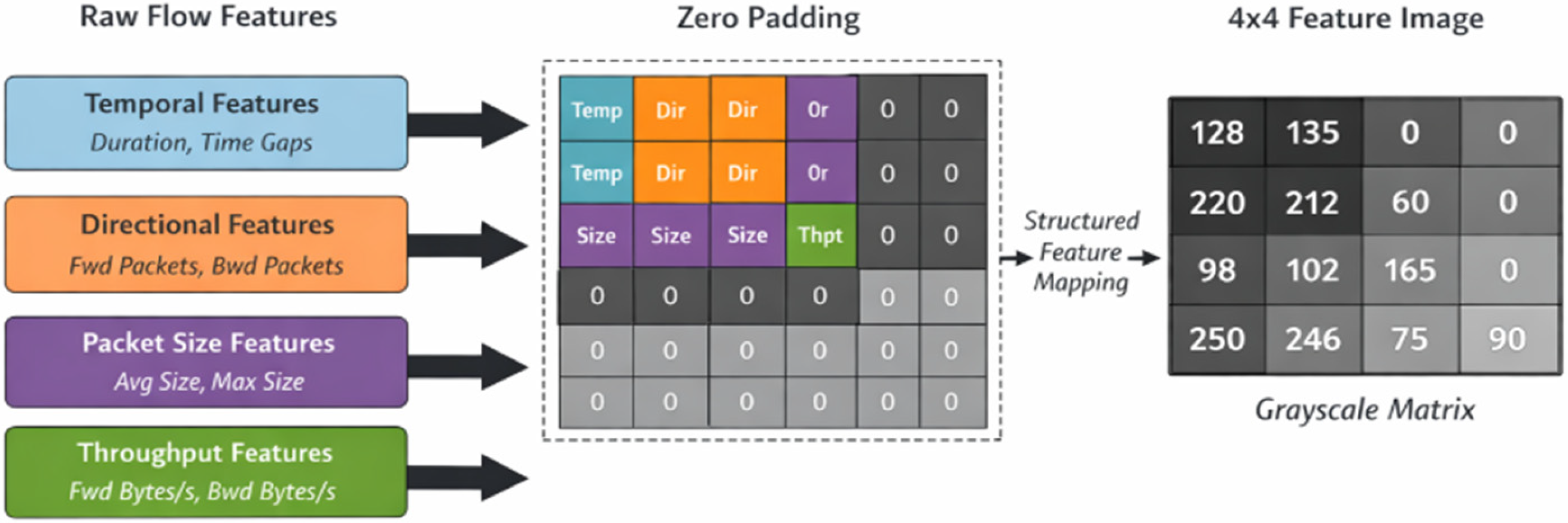
- Behavioral analysis of encrypted applications: By transforming flow-level features into two-dimensional representations, the proposed method provides improved discrimination between encrypted application categories, highlighting the feasibility of traffic behavior analysis even under strong encryption.
2. Related Work
3. Analysis of Existing Traffic Datasets with Dataset Curation and Composition
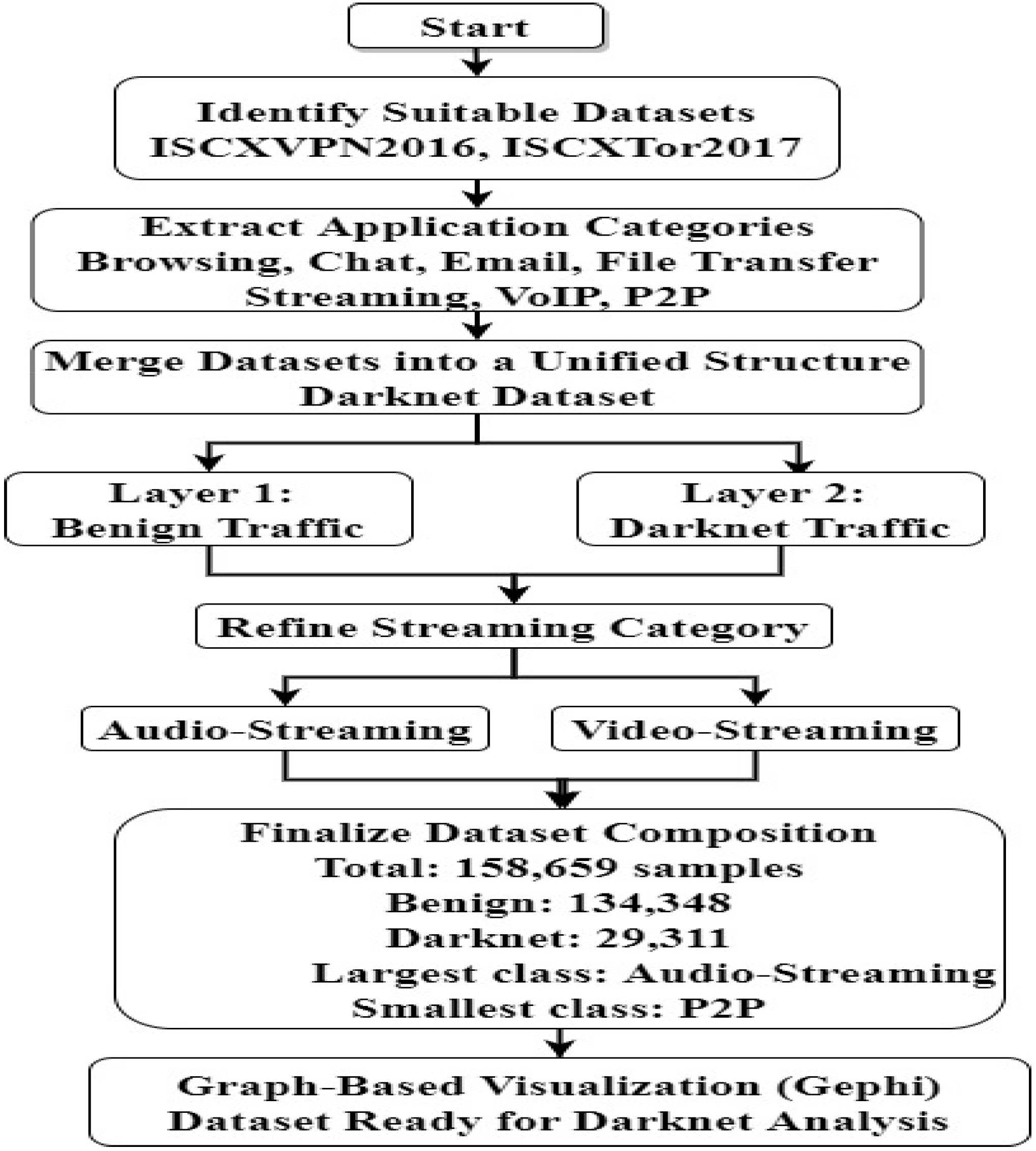
| Algorithm 1: Process Flow of Dataset curation and composition. |
| Start: Identify Suitable Datasets. From the evaluation stage, ISCXVPN2016 and ISCXTor2017 are selected as the most complete datasets for encrypted and anonymized traffic. Extract Application Categories. Seven main traffic types are collected from both datasets: Browsing, Chat, Email, File Transfer, Streaming, VoIP, and P2P. Merge Datasets into a Unified Structure. Combine all traffic samples into a new two-layer dataset named Darknet Dataset. Layer 1: Benign Traffic.
|
| End: Dataset Ready for Darknet Analysis. |
4. Methodology
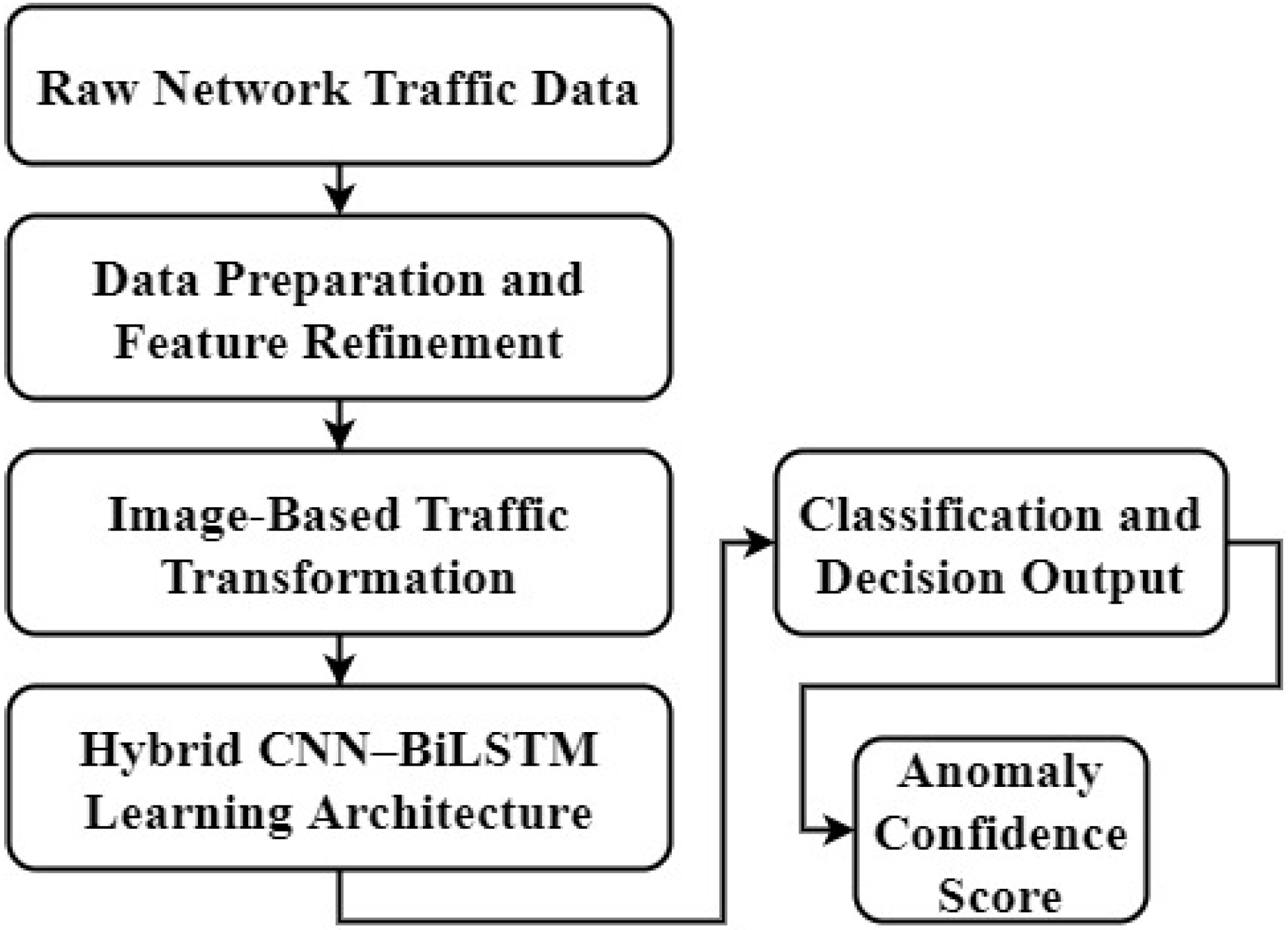
| Algorithm 2: CNN–BiLSTM-based Encrypted Traffic Classification (Python-Style Pseudocode). |
| Input: D—Raw traffic flow dataset. k—Number of selected features. Output: M—Trained CNN–BiLSTM model. ŷ—Predicted class label. Cs—Confidence score. Begin. Stage 1: Data Preparation and Feature Refinement: 1: D ← Load(D). 2: D ← RemoveInconsistentFlows(D). 3: D ← NormalizeNumericalFeatures(D). 4: R_RF ← RandomForest_Gini_Ranking(D). 5: R_MI ← MutualInformation_Ranking(D). 6: R ← AggregateRankings(R_RF, R_MI). 7: F_selected ← SelectTopFeatures(R, threshold ≥ 85%). 8: D_refined ← Project(D, F_selected). Stage 2: Feature-to-Image Transformation: 9: Initialize ImageSet ← ∅. 10: For each flow fi in D_refined, do: 11: v ← ScaleToGrayscale(fi). 12: G ← MapTo2DGrid(v). 13: G ← Resize(G, fixed_dimension). 14: ImageSet ← ImageSet ∪ {G}. 15: End for. Stage 3: Hybrid CNN–BiLSTM Learning: 16: SpatialMaps ← CNN(ImageSet). 17: SequenceInput ← ReshapeToSequence(SpatialMaps). 18: TemporalFeatures ← BiLSTM(SequenceInput). 19: Z ← FullyConnected(TemporalFeatures). Stage 4: Classification and Decision: 20: P ← Softmax(Z). 21: ŷ ← Argmax(P). 22: Cs ← Max(P). 23: return ŷ, Cs. |
| End. |
4.1. Stage1: Data Preparation and Feature Refinement
4.2. Stage2: Image-Based Traffic Transformation
- A pixel intensity is given to each feature value, which is normalized.
- These features are organized into a 2D grid.
- With each network occurrence (iteration), a different visual pattern is created.
4.3. Stage3: Hybrid CNN–BiLSTM Learning Architecture
4.4. Stage 4: The Classification and Decision Outcome
5. Experiments
5.1. Experiments and Hyperparameter Configuration
5.2. Experimental Validation and Comparative Evaluation
6. Analysis and Discussion
6.1. Feature Importance Insights
6.2. Accuracy and Loss Evaluation
6.3. Competitor Algorithm Benchmarking
6.4. Multi-Class Darknet Recognition Capability
6.5. Behavioral Patterns in Darknet Traffic
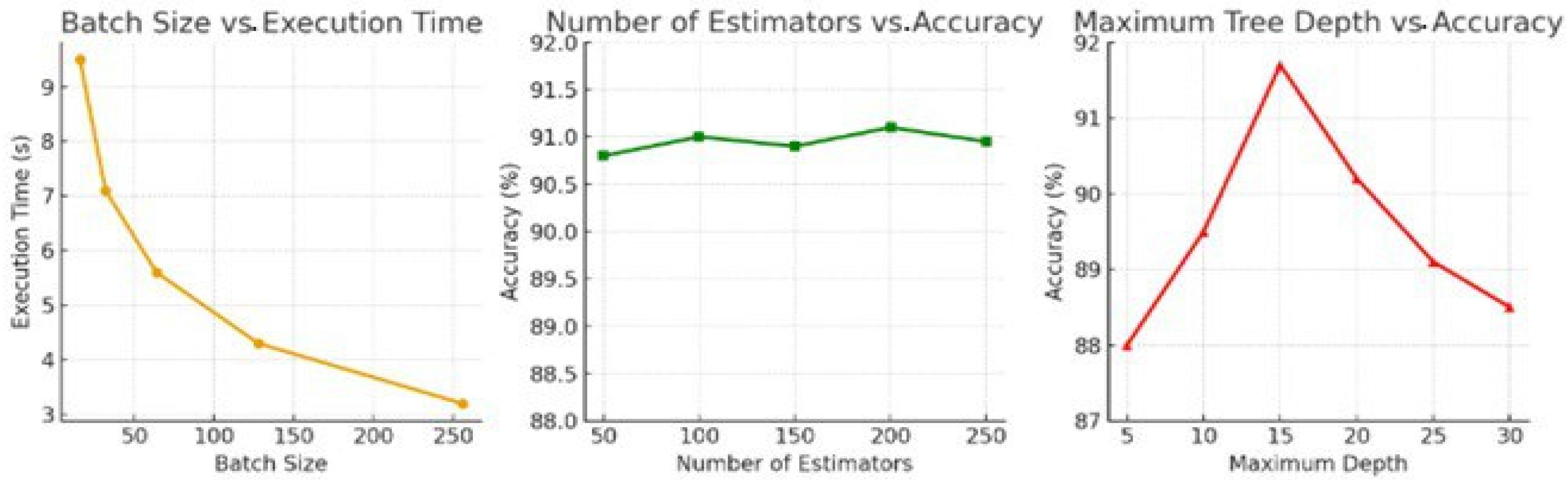
6.6. Impact of Hyperparameter Tuning
6.7. Generalization Behavior and Overfitting Impacts Analysis
7. Limitations
8. Comparison with Other Related Studies
9. Conclusions and Future Directions
Author Contributions
Funding
Data Availability Statement
Conflicts of Interest
References
- Mirea, M.; Wang, V.; Jung, J. The not so dark side of the darknet: A qualitative study. Secur. J. 2019, 32, 102–118. [Google Scholar] [CrossRef]
- Svilicic, B.; Kamahara, J.; Rooks, M.; Yano, Y. Maritime Cyber Risk Management: An Experimental Ship Assessment. J. Navig. 2019, 72, 1108–1120. [Google Scholar] [CrossRef]
- Cynthia, J. A Survey on Deep Learning Techniques for Darknet Traffic Malware Detection. Int. J. Sci. Res. Eng. Manag. 2023, 7, 24715. [Google Scholar] [CrossRef]
- Niranjana, R.; Kumar, V.A.; Sheen, S. Darknet Traffic Analysis and Classification Using Numerical AGM and Mean Shift Clustering Algorithm. SN Comput. Sci. 2020, 1, 16. [Google Scholar] [CrossRef]
- Safaei Pour, M.; Mangino, A.; Friday, K.; Rathbun, M.; Bou-Harb, E.; Iqbal, F.; Samtani, S.; Crichigno, J.; Ghani, N. On data-driven curation, learning, and analysis for inferring evolving internet-of-Things (IoT) botnets in the wild. Comput. Secur. 2020, 91, 101707. [Google Scholar] [CrossRef]
- Cabana, O.; Youssef, A.M.; Debbabi, M.; Lebel, B.; Kassouf, M.; Atallah, R.; Agba, B.L. Threat Intelligence Generation Using Network Telescope Data for Industrial Control Systems. IEEE Trans. Inf. Forensics Secur. 2021, 16, 3355–3370. [Google Scholar] [CrossRef]
- Spitters, M.; Verbruggen, S.; Staalduinen, M. Van Towards a comprehensive insight into the thematic organization of the tor hidden services. In Proceedings of the 2014 IEEE Joint Intelligence and Security Informatics Conference, JISIC 2014, The Hague, The Netherlands, 24–26 September 2014; pp. 220–223. [Google Scholar]
- Li, R.; Chen, S.; Yang, J.; Luo, E. Edge-based detection and classification of malicious contents in tor darknet using machine learning. Mob. Inf. Syst. 2021, 2021, 8072779. [Google Scholar] [CrossRef]
- Beshiri, A.S.; Susuri, A. Dark Web and Its Impact in Online Anonymity and Privacy: A Critical Analysis and Review. J. Comput. Commun. 2019, 7, 30–43. [Google Scholar] [CrossRef]
- Al-Nabki, M.W.; Fidalgo, E.; Alegre, E.; Fernández-Robles, L. ToRank: Identifying the most influential suspicious domains in the Tor network. Expert. Syst. Appl. 2019, 123, 212–226. [Google Scholar] [CrossRef]
- Hashimoto, N.; Ozawa, S.; Ban, T.; Nakazato, J.; Shimamura, J. A Darknet Traffic Analysis for IoT Malwares Using Association Rule Learning. Procedia Comput. Sci. 2018, 144, 118–123. [Google Scholar] [CrossRef]
- Kanemura, K.; Toyoda, K.; Ohtsuki, T. Identification of Darknet Markets’ Bitcoin Addresses by Voting Per-Address Classification Results. In Proceedings of the ICBC 2019—IEEE International Conference on Blockchain and Cryptocurrency, Seoul, Republic of Korea, 14–17 May 2019; pp. 154–158. [Google Scholar]
- Habibi Lashkari, A.; Kaur, G.; Rahali, A. DIDarknet: A contemporary approach to detect and characterize the darknet traffic using deep image learning. In Proceedings of the 15th International Conference on Availability, Reliability and Security (ARES), Dublin, Ireland, 25–28 August 2020; pp. 1–13. [Google Scholar] [CrossRef]
- Acar, A.; Liu, W.; Beyah, R.; Akkaya, K.; Uluagac, A.S. A privacy-preserving multifactor authentication system. Secur. Priv. 2019, 2, e88. [Google Scholar] [CrossRef]
- Nishikaze, H.; Ozawa, S.; Kitazono, J.; Ban, T.; Nakazato, J.; Shimamura, J. Large-scale monitoring for cyber attacks by using cluster information on darknet traffic features. Procedia Comput. Sci. 2015, 53, 175–182. [Google Scholar] [CrossRef]
- Dong, F.; Yuan, S.; Ou, H.; Liu, L. New Cyber Threat Discovery from Darknet Marketplaces. In Proceedings of the 2018 IEEE Conference on Big Data and Analytics, ICBDA 2018, Langkawi, Malaysia, 21–22 November 2018; pp. 62–67. [Google Scholar]
- Choudhary, M.; Tiwari, V.; Uduthalapally, V. Iris presentation attack detection based on best-k feature selection from YOLO inspired RoI. Neural Comput. Appl. 2021, 33, 5609–5629. [Google Scholar] [CrossRef]
- Saleem, J.; Islam, R.; Islam, M.Z. Darknet Traffic Analysis: A Systematic Literature Review. IEEE Access 2024, 12, 42423–42452. [Google Scholar] [CrossRef]
- Ji, I.H.; Lee, J.H.; Kang, M.J.; Park, W.J.; Jeon, S.H.; Seo, J.T. Artificial Intelligence-Based Anomaly Detection Technology over Encrypted Traffic: A Systematic Literature Review. Sensors 2024, 24, 898. [Google Scholar] [CrossRef]
- Gadhia, F.; Choi, J.; Cho, B.; Song, J. Comparative analysis of darknet traffic characteristics between darknet sensors. In Proceedings of the International Conference on Advanced Communication Technology, ICACT, PyeongChang, Republic of Korea, 1–3 July 2015; pp. 59–64. [Google Scholar]
- Akiyoshi, R.; Kotani, D.; Okabe, Y. Detecting Emerging Large-Scale Vulnerability Scanning Activities by Correlating Low-Interaction Honeypots with Darknet. In Proceedings of the International Computer Software and Applications Conference, Tokyo, Japan, 23–27 July 2018; IEEE: New York, NY, USA, 2018; Volume 2, pp. 658–663. [Google Scholar]
- Safaei Pour, M.; Bou-Harb, E. Theoretic derivations of scan detection operating on darknet traffic. Comput. Commun. 2019, 147, 111–121. [Google Scholar] [CrossRef]
- Fachkha, C.; Bou-Harb, E.; Debbabi, M. Inferring distributed reflection denial of service attacks from darknet. Comput. Commun. 2015, 62, 59–71. [Google Scholar] [CrossRef]
- Wang, M.; Wang, X.; Shi, J.; Tan, Q.; Gao, Y.; Chen, M.; Jiang, X. Who are in the darknet? Measurement and analysis of Darknet person attributes. In Proceedings of the 2018 IEEE 3rd International Conference on Data Science in Cyberspace, DSC 2018, Guangzhou, China, 18–21 June 2018; pp. 948–955. [Google Scholar]
- Georgoulias, D.; Yaben, R.; Vasilomanolakis, E. Cheaper than you thought? A dive into the darkweb market of cyber-crime products. In Proceedings of the ACM International Conference Proceeding Series; Association for Computing Machinery (ACM): New York, NY, USA, 2023. [Google Scholar]
- Fachkha, C.; Debbabi, M. Darknet as a Source of Cyber Intelligence: Survey, Taxonomy, and Characterization. IEEE Commun. Surv. Tutor. 2016, 18, 1197–1227. [Google Scholar] [CrossRef]
- Alshammari, R.; Zincir-Heywood, A.N. Can encrypted traffic be identified without port numbers, IP addresses and payload inspection? Comput. Netw. 2011, 55, 1326–1350. [Google Scholar] [CrossRef]
- Gu, C.; Zhang, S.; Sun, Y. Real-time encrypted traffic identification using machine learning. J. Softw. 2011, 6, 1009–1016. [Google Scholar] [CrossRef]
- Alzahrani, A.O.; Alenazi, M.J.F. Designing a network intrusion detection system based on machine learning for software defined networks. Future Internet 2021, 13, 111. [Google Scholar] [CrossRef]
- Sherry, J.; Lan, C.; Popa, R.A.; Ratnasamy, S. BlindBox: Deep Packet Inspection over Encrypted Traffic. Comput. Commun. Rev. 2015, 45, 213–226. [Google Scholar] [CrossRef]
- Shen, M.; Wei, M.; Zhu, L.; Wang, M. Classification of Encrypted Traffic with Second-Order Markov Chains and Application Attribute Bigrams. IEEE Trans. Inf. Forensics Secur. 2017, 12, 1830–1843. [Google Scholar] [CrossRef]
- Wang, W.; Zhu, M.; Wang, J.; Zeng, X.; Yang, Z. End-To-end encrypted traffic classification with one-dimensional convolution neural networks. In Proceedings of the 2017 IEEE International Conference on Intelligence and Security Informatics: Security and Big Data, ISI 2017, Beijing, China, 22–24 July 2017; pp. 43–48. [Google Scholar]
- Shekhawat, A.S.; Di Troia, F.; Stamp, M. Feature analysis of encrypted malicious traffic. Expert Syst. Appl. 2019, 125, 130–141. [Google Scholar] [CrossRef]
- Lotfollahi, M.; Jafari Siavoshani, M.; Shirali Hossein Zade, R.; Saberian, M. Deep packet: A novel approach for encrypted traffic classification using deep learning. Soft Comput. 2020, 24, 1999–2012. [Google Scholar] [CrossRef]
- Javanmardi, E.; Liu, S. Exploring grey systems theory-based methods and applications in analyzing socio-economic systems. Sustainability 2019, 11, 4192. [Google Scholar] [CrossRef]
- Islam, F.U.; Liu, G.; Liu, W.; ul Haq, Q.M. A deep learning-based framework to identify and characterise heterogeneous secure network traffic. IET Inf. Secur. 2023, 17, 294–308. [Google Scholar] [CrossRef]
- Balachandran, A.; Amritha, P.P. VPN Network Traffic Classification Using Entropy Estimation and Time-Related Features. In Proceedings of the Smart Innovation, Systems and Technologies; Springer Nature: Singapore, 2022; Volume 251, pp. 509–520. [Google Scholar]
- Bagui, S.; Fang, X.; Kalaimannan, E.; Bagui, S.C.; Sheehan, J. Comparison of machine-learning algorithms for classification of VPN network traffic flow using time-related features. J. Cyber Secur. Technol. 2017, 1, 108–126. [Google Scholar] [CrossRef]
- Miller, S.; Curran, K.; Lunney, T. Multilayer perceptron neural network for detection of encrypted VPN network traffic. In Proceedings of the 2018 International Conference on Cyber Situational Awareness, Data Analytics and Assessment, CyberSA 2018, Glasgow, UK, 11–12 June 2018. [Google Scholar]
- Caicedo-Muñoz, J.A.; Ledezma Espino, A.; Corrales, J.C.; Rendón, A. QoS-Classifier for VPN and Non-VPN traffic based on time-related features. Comput. Netw. 2018, 144, 271–279. [Google Scholar] [CrossRef]
- Rezaei, S.; Liu, X. Deep Learning for Encrypted Traffic Classification: An Overview. IEEE Commun. Mag. 2019, 57, 76–81. [Google Scholar] [CrossRef]
- Draper-Gil, G.; Lashkari, A.H.; Mamun, M.S.I.; Ghorbani, A.A. Characterization of encrypted and VPN traffic using time-related features. In Proceedings of the ICISSP 2016—Proceedings of the 2nd International Conference on Information Systems Security and Privacy; SciTePress: Setúbal, Portugal, 2016; pp. 407–414. [Google Scholar]
- Lashkari, A.H.; Gil, G.D.; Mamun, M.S.I.; Ghorbani, A.A. Characterization of tor traffic using time based features. In Proceedings of the ICISSP 2017—Proceedings of the 3rd International Conference on Information Systems Security and Privacy; 2017; SciTePress: Setúbal, Portugal, 2017; pp. 253–262. [Google Scholar]
- Mhawi, D.N.; Oleiwi, H.W.; Al-Taie, H.L. Generating Encrypted Document Index Structure Using Tree Browser. J. Tech. 2023, 5, 114–122. [Google Scholar] [CrossRef]
- Ferreira, E.W.T.; Shinoda, A.A. The development and evaluation of a dataset for testing of IDS for wireless networks. IEEE Lat. Am. Trans. 2016, 14, 404–410. [Google Scholar] [CrossRef]
- Cermak, M.; Jirsik, T.; Velan, P.; Komarkova, J.; Spacek, S.; Drasar, M.; Plesnik, T. Towards Provable Network Traffic Measurement and Analysis via Semi-Labeled Trace Datasets. In Proceedings of the TMA 2018—Proceedings of the 2nd Network Traffic Measurement and Analysis Conference, Vienna, Austria, 26–29 June 2018. [Google Scholar]
- Sharafaldin, I.; Lashkari, A.H.; Ghorbani, A.A. Toward generating a new intrusion detection dataset and intrusion traffic characterization. In Proceedings of the ICISSP 2018—Proceedings of the 4th International Conference on Information Systems Security and Privacy; SciTePress: Setúbal, Portugal, 2018; pp. 108–116. [Google Scholar]
- Wang, Y.; Yan, W.; Oates, T. Time Series Classification from Scratch with Deep Neural Networks: A Strong Baseline. In Proceedings of the 2017 International Joint Conference on Neural Networks (IJCNN), Anchorage, AK, USA, 14–19 May 2017; pp. 1578–1585. [Google Scholar] [CrossRef]
- Lashkari, H.; Draper-Gil, A.; Joshi, L.; Ghorbani, R. DIDarknet: A Deep Learning-Based Network Intrusion Detection System for Darknet Traffic. arXiv 2020, arXiv:2004.03065. [Google Scholar]
- Ghanem, M.C.; Mulvihill, P.; Ouazzane, K.; Djemai, R.; Dunsin, D. D2WFP: A Novel Protocol for Forensically Identifying, Extracting, and Analysing Deep and Dark Web Browsing Activities. J. Cybersecur. Priv. 2023, 3, 808–829. [Google Scholar] [CrossRef]
- Wang, X.; Luo, J.; Yang, M.; Ling, Z. A potential HTTP-based application-level attack against Tor. Future Gener. Comput. Syst. 2011, 27, 67–77. [Google Scholar] [CrossRef]
- Ling, Z.; Luo, J.; Yu, W.; Fu, X.; Jia, W.; Zhao, W. Protocol-level attacks against Tor. Comput. Netw. 2013, 57, 869–886. [Google Scholar] [CrossRef]
- Liška, T.; Sochor, T.; Sochorová, H. Comparison between normal and TOR-anonymized web client traffic. Procedia Comput. Sci. 2011, 3, 888–892. [Google Scholar] [CrossRef][Green Version]
- Shahbar, K.; Zincir-Heywood, A.N. Benchmarking two techniques for Tor classification: Flow level and circuit level classification. In Proceedings of the IEEE SSCI 2014: 2014 IEEE Symposium Series on Computational Intelligence—CICS 2014: 2014 IEEE Symposium on Computational Intelligence in Cyber Security, Proceedings, Orlando, FL, USA, 9–12 December 2014. [Google Scholar]
- He, G.; Yang, M.; Luo, J.; Gu, X. Inferring Application Type Information from Tor Encrypted Traffic. In Proceedings of the 2014 2nd International Conference on Advanced Cloud and Big Data, CBD 2014, Huangshan, China, 20–22 November 2014; pp. 220–227. [Google Scholar]
- Ling, Z.; Luo, J.; Wu, K.; Yu, W.; Fu, X. TorWard: Discovery, Blocking, and Traceback of Malicious Traffic over Tor. IEEE Trans. Inf. Forensics Secur. 2015, 10, 2515–2530. [Google Scholar] [CrossRef]
- Montieri, A.; Ciuonzo, D.; Aceto, G.; Pescape, A. Anonymity Services Tor, I2P, JonDonym: Classifying in the Dark (Web). IEEE Trans. Dependable Secur. Comput. 2020, 17, 662–675. [Google Scholar] [CrossRef]
- Saleh, S.; Qadir, J.; Ilyas, M.U. Shedding Light on the Dark Corners of the Internet: A Survey of Tor Research. J. Netw. Comput. Appl. 2018, 114, 1–28. [Google Scholar] [CrossRef]
- Attarian, R.; Abdi, L.; Hashemi, S. AdaWFPA: Adaptive Online Website Fingerprinting Attack for Tor Anonymous Network: A Stream-wise Paradigm. Comput. Commun. 2019, 148, 74–85. [Google Scholar] [CrossRef]
- Yang, Q.; Gasti, P.; Balagani, K.; Li, Y.; Zhou, G. USB side-channel attack on Tor. Comput. Netw. 2018, 141, 57–66. [Google Scholar] [CrossRef]
- Fidalgo, E.; Alegre, E.; Fernández-Robles, L.; González-Castro, V. Classifying suspicious content in tor darknet through Semantic Attention Keypoint Filtering. Digit. Investig. 2019, 30, 12–22. [Google Scholar] [CrossRef]
- Al Jawaheri, H.; Al Sabah, M.; Boshmaf, Y.; Erbad, A. Deanonymizing Tor hidden service users through Bitcoin transactions analysis. Comput. Secur. 2020, 89, 101684. [Google Scholar] [CrossRef]
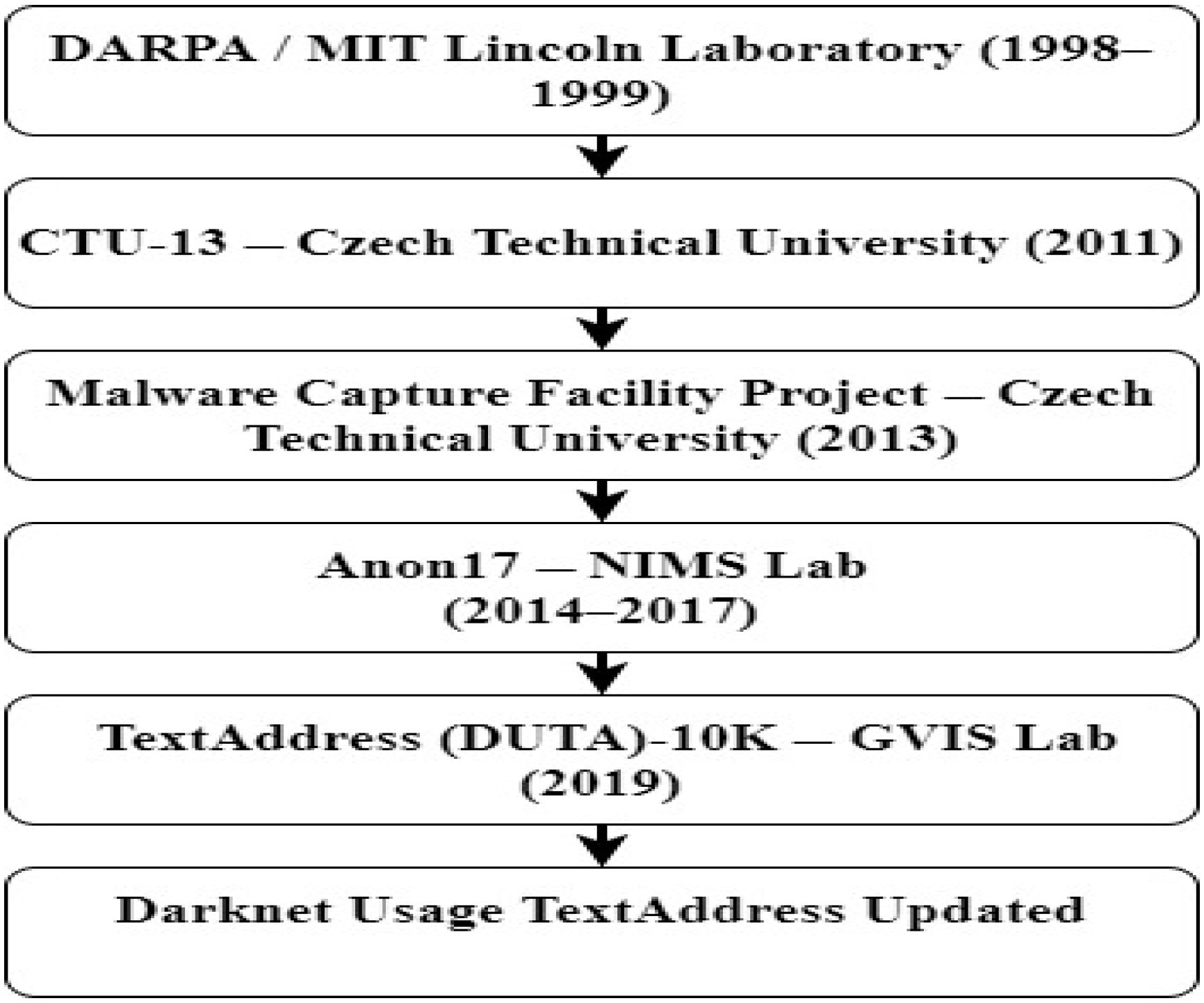
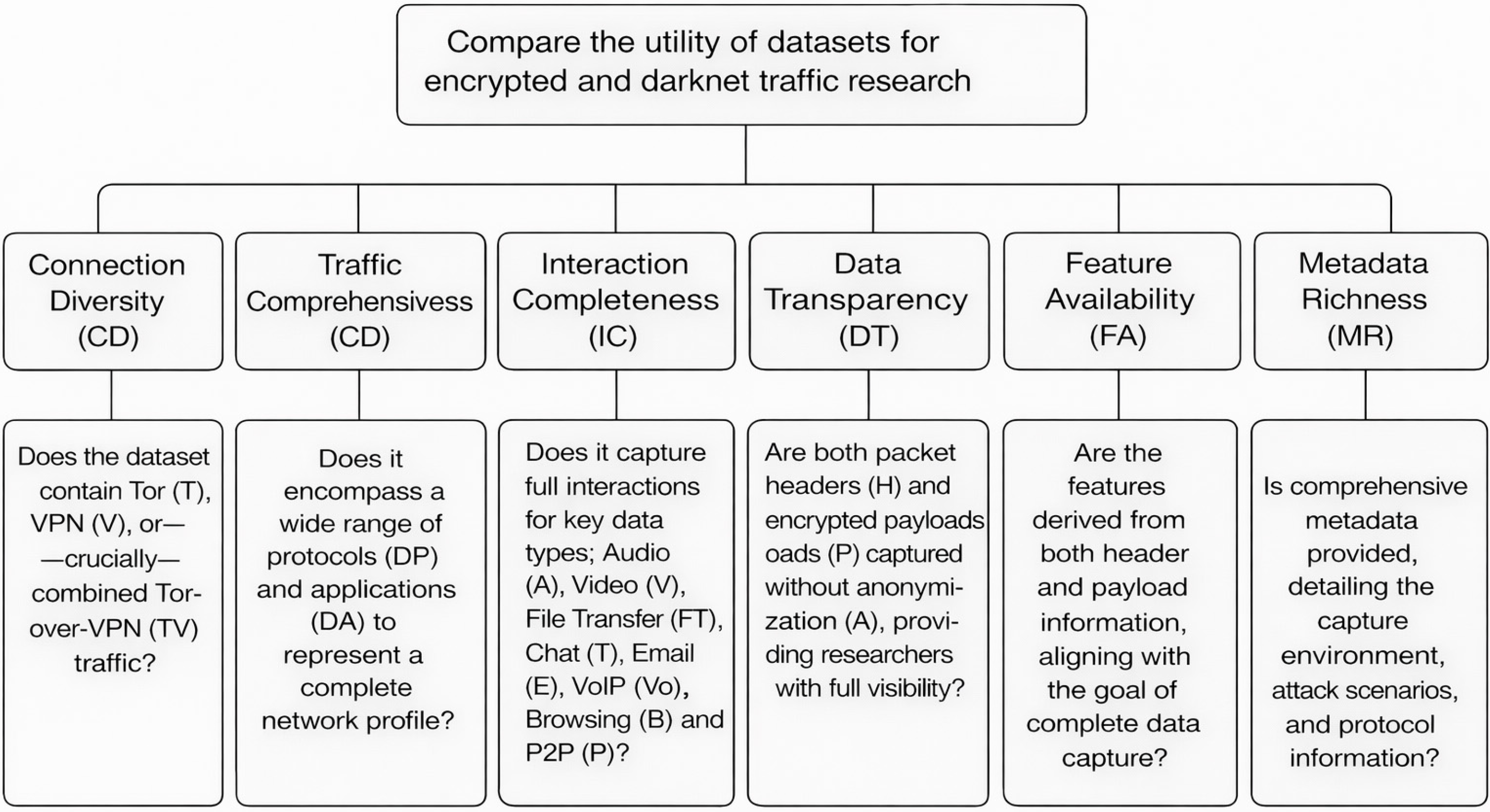

| Category | Focus of Previous Studies | Methods Used | Key Limitations | Representative References |
|---|---|---|---|---|
| Darknet Traffic Analysis | Detect scanning, probing, and malicious activity; classify anonymization networks (Tor/I2P). | Packet-level inspection, flow statistics, decision trees, behavioral models, probabilistic analysis, hierarchical classifiers. | Sensitive to feature obfuscation and padding; poor scalability to large, encrypted traffic; limited precision for multi-flow attacks. | [13,14,15,16,17,18,19,20,21,22,23,24,25,26] |
| Encrypted Traffic Classification | Identify encrypted SSH, Skype, SSL/TLS, and general encrypted applications. | ML models (SVM, AdaBoost, Decision Trees), CNN-based DL, and autoencoders. | Limited generalization to new apps; requires large datasets; high computational cost; and dataset dependency. | [27,28,29,30,31,32,33,34] |
| VPN Traffic Detection | Detect VPN services, classify VPN protocols (e.g., OpenVPN), and monitor traffic under QoS variations. | Flow-labeling, policy-driven routers, ML models, ensemble learning, DNNs. | Protocol-specific; relies on handcrafted features; weak behavioral modeling; limited coverage of diverse VPN apps. | [35,36,37,38,39,40] |
| Tor Traffic and Anonymity Analysis | Analyze Tor anonymity; detect timing leaks, fingerprint services, and infer traffic patterns. | Memory forensics, latency analysis, MITM attacks, burst pattern analysis, timing inference, multi-tool classification, and fingerprinting. | Attack-centric focus; limited defender-side analysis; no unified behavior modeling; inability to detect hidden services effectively. | |
| Identified Research Gaps | Unified anonymized-traffic analysis; behavioral modeling; mixed VPN–Tor environments; hidden-service detection. | — | Lack of models that combine VPN + Tor datasets; shallow features; limited dataset diversity; absence of unified, DL-based systems. | Derived from all studies above |
| Motivation for Proposed Work | Need for robust, unified detection of anonymized traffic using DL. | 2D CNN + hybrid modeling (CNN–BiLSTM in this work). | Existing approaches cannot detect hidden-service patterns or generalize across encrypted networks. | — |
| No. | Feature Name | Category/Type | Semantic Meaning (What it Represents) | Relevance to Darknet Behavior |
|---|---|---|---|---|
| 1 | Flow Duration | Temporal | Total time span of the network flow | Long or irregular durations may indicate anonymized or relayed traffic |
| 2 | Forward Packets per Second | Directional Packet Rate | Rate of packets sent from source to destination | Captures upload behavior and burst patterns common in Tor/VPN traffic |
| 3 | Backward Packets per Second | Directional Packet Rate | Rate of packets sent from the destination to the source | Reflects response behavior and relay-driven communication |
| 4 | Minimum Forward Segment Size | Packet Size Statistic | Smallest payload size in the forward direction | Indicative of control or signaling packets in encrypted tunnels |
| 5 | Minimum Backward Packet Length | Packet Size Statistic | Smallest packet received from the destination | Helps identify protocol-level padding behavior |
| 6 | Maximum Idle Time | Temporal/Idle Behavior | Longest silent interval within a flow | Suggests onion routing delays or relay scheduling effects |
| 7 | Mean Inter-Arrival Time | Timing Statistic | Average time gap between consecutive packets | Reveals timing obfuscation and traffic shaping |
| 8 | Forward–Backward Packet Ratio | Directional Balance | Ratio between outgoing and incoming packets | Distinguishes interactive vs. bulk-transfer darknet services |
| 9 | Average Packet Length | Packet Size Statistic | Mean packet size across the flow | Helps differentiate browsing, streaming, and P2P behaviors |
| 10 | Flow Bytes per Second | Throughput | Data transmission rate over the flow | Identifies high-volume encrypted transfers |
| Layer No. | Layer Type | Filters/Units | Kernel Size | Activation | Dropout | Input → Output Dimension |
|---|---|---|---|---|---|---|
| 1 | Input Layer | – | – | – | – | H × W × 1 |
| 2 | 2D Convolution | 32 | 3 × 3 | ReLU | – | H × W × 32 |
| 3 | Max Pooling | – | 2 × 2 | – | – | (H/2) × (W/2) × 32 |
| 4 | 2D Convolution | 64 | 3 × 3 | ReLU | – | (H/2) × (W/2) × 64 |
| 5 | Max Pooling | – | 2 × 2 | – | – | (H/4) × (W/4) × 64 |
| 6 | Flatten | – | – | – | – | N |
| 7 | BiLSTM | 128 | – | tanh | 0.5 | 128 |
| 8 | Fully Connected | 64 | – | ReLU | 0.5 | 64 |
| 9 | Output Layer | C | – | SoftMax | – | C |
| Parameter Name | Value Description |
|---|---|
| Optimizer | Adam |
| Activation function (hidden layers) | ReLU |
| Epochs | 1500 |
| Loss-function | Cross-entropy |
| Early stopping | patience = 3 |
| Maximum tree depth | 16 |
| The batch size | 32 |
| Activation function (output layer) | SoftMax |
| Estimator’s number | 250 |
| Deployment Context | Detected Activity | Relevant Classes | Observed Performance |
|---|---|---|---|
| Enterprise Network | Suspicious encrypted browsing | Browsing | Moderate recall due to behavioral overlap |
| Enterprise Network | P2P-based covert communication | P2P | High detection reliability |
| ISP Monitoring | Darknet access via Tor | Tor-based traffic | High binary detection accuracy |
| ISP Monitoring | Encrypted streaming vs. darknet | Streaming | Stable classification |
| Aspect | Limitation |
|---|---|
| Dataset Scope | Restricted to specific time periods and services. |
| Generalization | Not yet validated on emerging protocols. |
| Traffic Obfuscation | Performance may degrade under advanced padding or morphing. |
| Class Similarity | Browsing and P2P remain challenging. |
| Model/Reference | Dataset | Architecture Type | Accuracy (%) | Precision | Recall | F1-Score | Key Strength | Limitation |
|---|---|---|---|---|---|---|---|---|
| 1D CNN [48] | Unified Dataset | Deep CNN | 82.1 | 0.81 | 0.79 | 0.80 | Automatic feature learning | Ignores sequential dependencies |
| DeepPacket [49] | ISCXVPN2016 | 1D CNN + SAE | 85 * | – | – | – | Raw encrypted traffic modeling | Dataset-specific |
| DIDarknet [50] | Darknet Image Dataset | 2D CNN | 86.5 | 0.85 | 0.84 | 0.84 | Image-based representation | No hybrid temporal modeling |
| Proposed CNN–BiLSTM | Unified VPN–Tor Dataset | 2D CNN + BiLSTM | 89.0 | 0.88 | 0.86 | 0.87 | Unified dataset + spatial–temporal modeling | Higher computational cost |
| Ref. No. | Dataset Used | Techniques/Algorithms | Measurements/Evaluation | Pros | Cons | Limitations |
|---|---|---|---|---|---|---|
| [13] | Not specified (early darknet traces) | Initial-packet-based detection using packet size, direction, and early connection features | Early-phase packet analysis | Low overhead; fast screening | Vulnerable to packet padding and spoofing | Works only on initial packet phases; limited scalability |
| [14] | Early darknet datasets | Decision trees | Classification accuracy | Easy to interpret; baseline method | Limited robustness vs. evolving attacks | Struggles with encrypted or modern anonymized traffic |
| [19] | Single-flow datasets | Single-flow behavioral analysis | Flow-level detection | Fast, computationally lightweight | Ignores multi-flow behavior | Ineffective for coordinated/complex attacks |
| [18] | Session-level darknet traces | Multi-packet/session flow modeling | Temporal pattern extraction | Captures richer temporal behavior | More resource-intensive | Requires full session data, often unavailable |
| Rule-based classification datasets | Rule-based threat categorization | Threat grouping | Easy to apply; structured | Static rules degrade | Cannot detect novel or hybrid attacks | |
| [51] | Forensic artefacts generated from controlled deep and dark web browsing scenarios across multiple platforms (Windows, Linux, Android, iOS) using TOR and privacy-preserving browsers | Proposed D2WFP protocol combining host-based digital forensics, memory forensics, browser artifact analysis, network traffic inspection, and artefact correlation | Quantitative comparison of artifacts recovered using D2WFP versus standard automated forensic tools; qualitative validation across multiple scenarios and operating systems | Provides a structured and comprehensive forensic protocol; improves artefact recovery compared to conventional tools; supports cross-validation and timeline reconstruction; applicable across different OS platforms | Not designed for real-time detection; relies on post-incident forensic acquisition; focuses primarily on host-side evidence rather than live network monitoring | Limited generalization to large-scale operational environments; evaluation conducted on simulated scenarios; does not integrate machine learning or automated classification for traffic analysis |
| [15] | Large-scale darknet packet captures | 2D features; clustering; signature matching | Accuracy for known malware | High precision for known threats | Fails vs. new malware | Localized dataset; poor generalization |
| [20] | Aggregate darknet traffic | Packet freq., unique IP counts | Anomaly spotting | Good for mass scans | Low precision for low traffic | Cannot separate benign vs. malicious anomalies |
| [17] | Time series darknet logs | Attack clustering; temporal modeling | Pattern periodicity | Detects repeated attack waves | Poor with irregular attacks | Needs continuous and stable data |
| [26] | Survey (no dataset) | Honeyd environments; time series overview | Conceptual mapping | Broad methodological overview | No experiments | No new detection models |
| [24] | Leaked darknet data | Identifier extraction (names, domains) | Profile extraction | Strong malicious-user insights | Privacy concerns | Dependent on the availability of leaked data |
| [16] | Darknet market text | Text mining: threat dictionary | Threat discovery | Detects emerging threats | Heavy noise in text | Fails when markets disappear/migrate |
| [22] | Attacker behavior logs | Stochastic/probabilistic modeling | Attack likelihood estimation | Quantitative attacker modeling | Inefficient for distributed attacks | Cannot model large-scale probing reliably |
| [25] | Tor/I2P/JonDonym datasets | Hierarchical classification | F-score ≈ 75.56% | Good cross-network separation | Moderate accuracy | Overlaps due to encryption uniformity |
| [27] | SSH/Skype encrypted traffic | AdaBoost, GP, C4.5 | Protocol recognition | Accurate without payloads | Algorithms vary by traffic type | Limited to older protocols |
| [28] | Skype flows | Lightweight online classification | Real-time detection | High accuracy, low cost | Single-application focus | Not general-purpose |
| [29] | SSL traffic | SSL decryption | Content-based visibility | High inspection accuracy | Breaks privacy | Not scalable; heavy overhead |
| [30] | Encrypted traffic | Blind-box metadata analysis | Non-decryption classification | Protects privacy; no crypto overhead | Weak vs. heavy obfuscation | Fails when metadata is restricted |
| [31] | SSL/TLS | Certificate-based bigram model; Markov chain | TPR↑ 29%, FPR↓ 25% | High detection accuracy | Complex; preprocessing heavy | Depends on certificate visibility |
| [32] | ISCXVPN2016 | 1D and 2D CNN, C4.5 | VPN vs. non-VPN accuracy (92%/85%) | Strong feature learning | Computationally expensive | Dataset-specific tuning needed |
| [33] | Encrypted traffic | Feature elimination: SVM, RF, XGBoost | Reduced model complexity | Efficient; low overhead | May lose fine-grained patterns | Poor with unseen traffic |
| [34] | Raw encrypted traffic | DeepPacket (1D CNN + SAE) | App ID (98%), Traffic type (93%) | Automatic feature extraction | Requires large training sets | Sensitive to encryption updates |
| [35] | Policy-driven filtering | Device-level identification rules | Access control | Fine-grained control | Requires endpoint integration | Not scalable for large networks |
| [36] | VPN traffic | Dual-certificate VPN handshake | Key-exchange-based classification | Maintains encryption security | Complex deployment | Requires endpoint cooperation |
| [37] | ISCXVPN2016 | Time-based flow features; C4.5; kNN | ~80% accuracy | Benchmark dataset | Basic ML only | Dataset aging; limited apps |
| [38] | ISCXVPN2016 | Ensemble models (RF, GBT) | Higher VPN discrimination | Better accuracy | Higher computational cost | Depends on hand-crafted features |
| [39] | OpenVPN traces | MLP neural network | >92% accuracy | Effective for OpenVPN | Not multi-protocol | Retraining is needed for new protocols |
| [40] | QoS-marked VPN | PHB/QoS classification | 94% non-VPN, 92% VPN | Very high accuracy | Requires QoS integration | Breaks under traffic shaping |
| [1] | Device memory | Forensic memory analysis | Tor trace extraction | Reveals sensitive metadata | Requires device seizure | Not remote-applicable |
| [2] | Tor routing | LASTor modified path selection | Latency leakage mitigation | Reduces timing attacks | Partial protection | Not universal vs. timing threats |
| [52] | Tor HTTP | MITM attack via the exit node | Real-world feasibility | Demonstrates attack paths | Requires exit-node control | Only non-HTTPS traffic |
| [53] | Tor protocol | Malformed Tor cells | Protocol weakness exposure | Insights into Tor internals | Disruptive, detectable | Applies to older versions |
| [49] | Tor circuits | Latency-based side-channel | Traffic and circuit inference | Non-invasive | Noise-sensitive | Accuracy drops with congestion |
| [54,55] | Tor circuits | Burst/timing features | App inference | Effective on burst patterns | Padding defeats it | Weak vs. uniform encrypted traffic |
| [56] | Tor exit nodes | TorWard IDS | Large-scale malicious detection | Captures botnets, spam | Deployment overhead | Exit-node only; cannot see onion layers |
| [57] | Tor/I2P/JonDonym | Feature-based hierarchical model | Cross-anonymity classification | Good multi-tool recognition | Dataset reliance | Not robust to new tools |
| [58] | Literature survey | Systematic Tor review | Research landscape mapping | Comprehensive | No new detection | Limited experimental insights |
| [59] | Tor website traffic | Adaptive stream mining | Website fingerprinting | High accuracy | Privacy-invasive | Breakable with defenses |
| [60] | Mobile devices | Battery consumption analysis | Traffic inference | Works without network access | Device-dependent | Not generalizable |
| [61] | Tor traces + image leaks | Image deanonymization | Multimedia identification | Shows privacy leakage | Needs leaked images | Limited to image-heavy traffic |
| [62] | Bitcoin + Tor | Blockchain correlation | Hidden service deanonymization | Financial linkage detection | Requires blockchain visibility | Fails with mixers/privacy coins |
| Proposed System | Merged ISCXVPN2016 + ISCXTor2017 (Unified Dataset) | Hybrid 2D CNN + feature refinement + behavior analysis | Binary: 94% acc.; multi-class: 86%; Loss: 0.17/0.50; Statistical behavior analysis | Unified VPN + Tor + Darknet detection; deep feature extraction; hidden-service behavior discovery; robust generalization | Requires image transformation; higher computational load than classic ML | Results depend on dataset diversity, browsing category is still weaker (≈47% recall) |
Disclaimer/Publisher’s Note: The statements, opinions and data contained in all publications are solely those of the individual author(s) and contributor(s) and not of MDPI and/or the editor(s). MDPI and/or the editor(s) disclaim responsibility for any injury to people or property resulting from any ideas, methods, instructions or products referred to in the content. |
© 2026 by the authors. Licensee MDPI, Basel, Switzerland. This article is an open access article distributed under the terms and conditions of the Creative Commons Attribution (CC BY) license.
Share and Cite
Mhawi, D.N.; Oleiwi, H.W.; Al-Raweshidy, H. An Intelligent Deep Learning Framework for Identifying and Profiling Darknet Traffic. Electronics 2026, 15, 863. https://doi.org/10.3390/electronics15040863
Mhawi DN, Oleiwi HW, Al-Raweshidy H. An Intelligent Deep Learning Framework for Identifying and Profiling Darknet Traffic. Electronics. 2026; 15(4):863. https://doi.org/10.3390/electronics15040863
Chicago/Turabian StyleMhawi, Doaa N., Haider W. Oleiwi, and Hamed Al-Raweshidy. 2026. "An Intelligent Deep Learning Framework for Identifying and Profiling Darknet Traffic" Electronics 15, no. 4: 863. https://doi.org/10.3390/electronics15040863
APA StyleMhawi, D. N., Oleiwi, H. W., & Al-Raweshidy, H. (2026). An Intelligent Deep Learning Framework for Identifying and Profiling Darknet Traffic. Electronics, 15(4), 863. https://doi.org/10.3390/electronics15040863

