Article

The Role of AI in Revolutionising Cryptocurrency Trading

by
Georgiana-Iulia Lazea
1,*,
Cristian Lungu
2,* and
Ovidiu-Constantin Bunget
2
1
Doctoral School of Economics and Business Administration, West University of Timisoara, 300115 Timisoara, Romania
2
Department of Accounting and Audit, Faculty of Economics and Business Administration, West University of Timisoara, 300115 Timisoara, Romania
*
Authors to whom correspondence should be addressed.
Electronics 2026, 15(4), 742; https://doi.org/10.3390/electronics15040742
Submission received: 30 December 2025 / Revised: 5 February 2026 / Accepted: 6 February 2026 / Published: 10 February 2026

Abstract

This article examines the revolutionary impact of Artificial Intelligence (AI) on transforming cryptocurrency trading, a sector characterised by extreme volatility, dynamism, and nonlinear data. Through a rigorous bibliometric analysis based on the Web of Science database, this study examines a sample of 555 scientific papers published between 2016 and 2025, utilising the PRISMA protocol for systematic selection, and tools such as VOSviewer and MS Excel. The analysis identifies five major thematic clusters: (1) blockchain infrastructure and AI integration in decentralised ecosystems, (2) data analysis and practical applicability in crypto markets, (3) financial and social data analysis—machine learning algorithms, (4) algorithmic trading and automation, and (5) prediction and modelling of crypto market developments. The originality of this study lies in providing an overview of the implementation stage of these technologies by integrating the results into a map of Technology Readiness Levels (TRLs). The findings highlight a clear transition from traditional statistical methods to autonomous decision-making systems capable of processing massive volumes of data for portfolio optimisation. This study’s limitation is that it may require periodic updates, as the AI and cryptocurrency landscape are constantly evolving.

1. Introduction

One of the major contributors to the rapid development of Artificial Intelligence (AI) is the integration of advanced machine learning (ML) and deep learning (DL) techniques, which has led to the adoption of AI in various sectors, including finance, as mentioned by Mudassir et al. [1]. Alongside this, the cryptocurrency market, following the invention of Bitcoin in 2008, has changed its character from a technological experiment to a global financial phenomenon [2]. Digital assets have experienced a meteoric rise in popularity and have become widely accepted in a very short span of time [3]. The aforementioned developments are attracting investors, researchers, and regulators, thereby highlighting the background in which both technologies are developing new ways to innovate the crypto trading system.
In contrast to the superior returns, the cryptocurrency market is known for its high volatility, dynamism, and nonlinearity in data [4,5,6]. These characteristics make price forecasting quite complex [5]. Traditional methods, such as time series, have a limited success rate [7,8] and often impose unrealistic statistical assumptions, as apparent seasonal effects cannot be identified in the cryptocurrency market [9].
Given the above, AI, along with ML and DL, has been regarded as a revolutionary instrument that constitutes the core concepts for creating algorithmic portfolio systems and advancing algorithmic trading structures [10,11,12]. The employment of these cutting-edge methods permits the processing of vast amounts of past and present data sources, revealing intricate patterns and relationships that are beyond the capabilities of human cognition [13]. Simultaneously, AI may even “look” at the market behaviour by gauging the investors’ confidence in the virtual world and can therefore be in a position to undertake the necessary steps without much delay if an important issue comes up, resulting in forecast correctness and trading strategies efficiency [14,15].
Academic interest in the field of AI application in crypto trading can be traced back to a steadily increasing number of publications. Several scientific papers have shown that the performance of long short-term memory (LSTM) and gated recurrent unit (GRU) recurrent neural networks (RNNs) for stock price and movement prediction is better than that of traditional models and often goes beyond their capabilities [16,17]. Other approaches combine AI with deep reinforcement learning (DRL) methods to create dynamic trading strategies that adjust market exposure and generate superior returns to passive strategies such as “Buy and Hold” [18,19]. ML models have also been applied to integrate diverse data sets, not only technical indicators and historical prices, but also contextual information, such as on-chain metrics [20], macroeconomic factors [21], and investor sentiment [22].
However, there are clear elements of dissonance between the theoretical potential and practical performance in cryptocurrency trading that utilises AI. Critical research has highlighted that in some cases, seemingly complex AI strategies: (1) have high accuracy and, at the same time, variable profitability [23]; (2) perform poorly in regression tasks [16]; and (3) in some cases, fail to outperform the simple “Buy and Hold” strategy [24]. (4) ML/DL methods require complex and expensive hyper-parameter calibration, without which the performance of the models decreases [25].
In this sense, the development of a thematic analysis becomes particularly relevant for mapping this expanding landscape, allowing the identification of publication trends, authors, geographic markets, predominant research themes, and papers with significant impact. By synthesising this information, the evolution of the field and its knowledge gaps can be highlighted, thereby guiding future research directions.
Thus, the first and foremost scientific investigation point of the presented approach is to conduct a rigorous bibliometric analysis of the specialised literature on the use of AI in cryptocurrency trading. The objective of this research is not limited to a simple descriptive overview of the thematic evolution of this emerging field but rather aims to provide a systematic assessment of the degree of development and maturation of its main research directions. In this regard, this study’s originality lies in integrating the Technology Readiness Level (TRL) framework as an analytical tool for evaluating the technological preparedness of AI applications for cryptocurrency trading. This approach enables a clearer differentiation between predominantly experimental contributions and those that have reached a more advanced stage closer to operational implementation, thereby offering a distinct perspective compared to conventional narrative reviews.
More specifically, the study aims to: (1) uncover the main thematic directions and approaches that have been changed and explored over time that, in turn, lead to understanding the development of the field at the intersection of AI and cryptocurrency trading; (2) by academic impact and conceptual relevance analysis, reflect on the scientific literature’s contribution in influencing and furthering the development of knowledge dissemination in the crypto field; (3) map the technological maturity (TRL) of the literature on AI in cryptocurrency trading in order to highlight advanced domains, emerging areas, and the maturity gaps between them; and (4) identify research gaps and decide on investigation areas pointing to different bibliometric trends that guide the opening of new directions and form an integrated perspective for the existent advances and challenges.
Structurally, this manuscript is logically divided into five core parts. The first section presents the study background and theoretical foundations, thereby providing the essential framework for understanding the study objectives and their importance. In the second part of this paper, the authors describe the research method and detail the instruments and strategies for data collection and analysis. The third part of this paper depicts a descriptive bibliometric analysis of manuscripts retrieved from the database, focusing on the significant trends and thematic spread of research in the chosen area. The fourth part of this paper positions the extensive bibliometric analyses in relation to the major themes identified, which are combined with thematic interpretations, results, and discussion. Section five provides an overview of the implementation stage of these technologies by integrating the results into a TRL map. Finally, the discussion and conclusion sections synthesise the main bibliometric and thematic insights, highlight this study’s contributions and limitations, and propose directions for future investigations into AI-driven cryptocurrency trading.

2. Research Methodology

2.1. Keywords and Data Selection

To develop a scientific approach, a search strategy was created that integrated specific keywords into the Web of Science (WoS) database to identify the relevant literature in the analysed field. Through its multidisciplinary coverage and demanding selection criteria, WoS provides superior data quality and significant representativeness of the scientific literature, a mandatory aspect for any article based on a robust bibliometric analysis. Unlike other databases with less controlled coverage, WoS ensures rigorous metadata standardisation, thereby enhancing the comparability and accuracy of analyses across fields and time intervals.
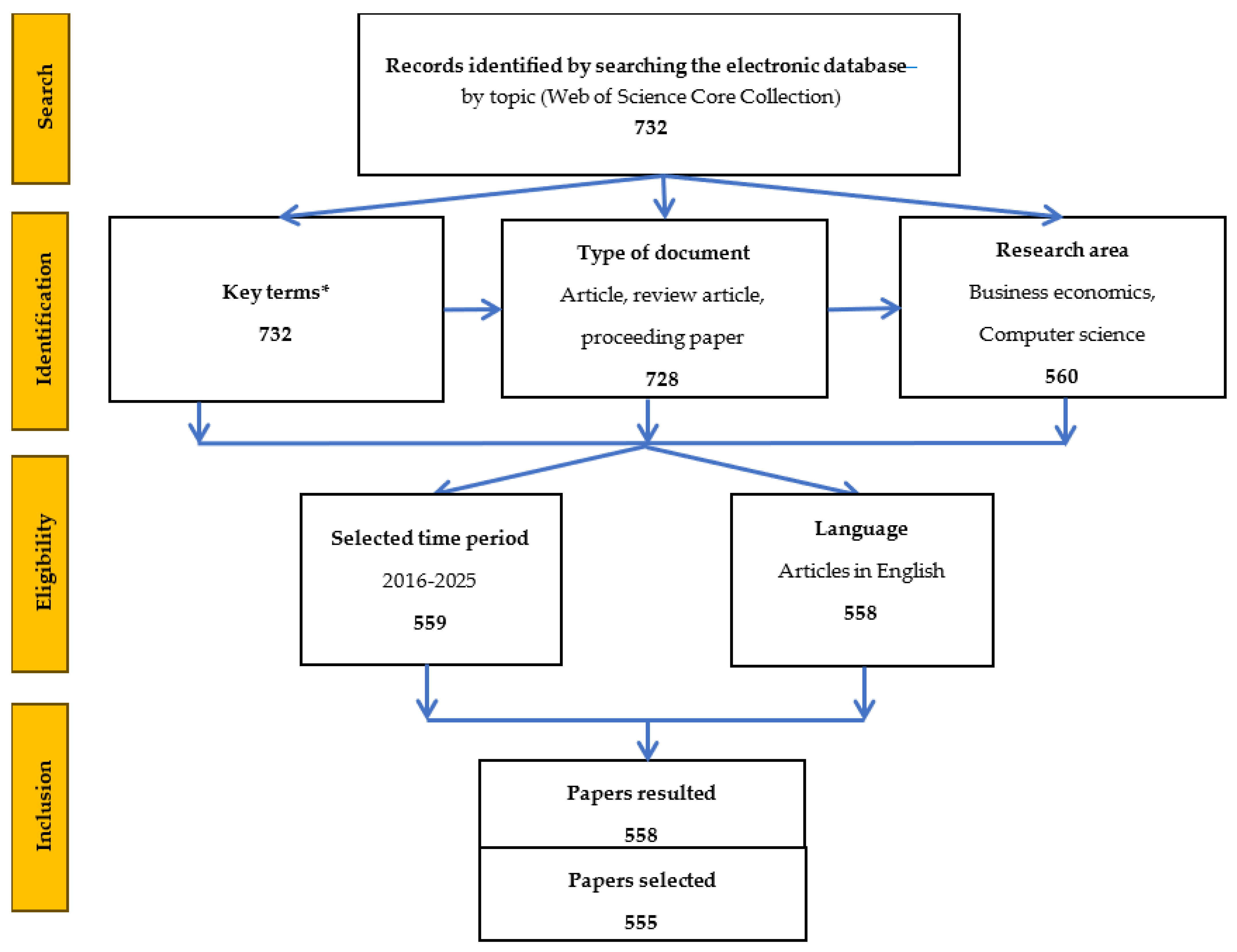
This research was based on the following set of key terms: (“artificial intelligence” OR “AI” OR “machine learning” OR “deep learning” OR “neural network*” OR “algorithmic trading” OR “intelligent system*”) AND (“cryptocurrenc*” OR “crypto*” OR “bitcoin” OR “ethereum” OR “digital currenc*” OR “virtual currenc*” OR “blockchain-based currenc*”) AND (“trading” OR “investment” OR “market analysis” OR “financial prediction” OR “price forecasting” OR “automated trading” OR “portfolio management”). Once the set of keywords was established, the paper selection flow followed, illustrated in Figure 1. The rationale for choosing this key term’s architecture reflected a three-dimensional search strategy designed to capture the intersection of AI technology (the first block of the string: machine learning, neural networks, deep learning), cryptocurrency (the middle block: cryptocurrency, bitcoin, blockchain-based currencies), and trading (the last block: trading, investment, portfolio management). This Boolean string was used to query the WoS database to identify relevant studies at the intersection of artificial intelligence and cryptocurrency trading, deliberately bridging three distinct domains. Also, it acknowledged that meaningful contributions may originate from computer scientists developing novel algorithms, financial researchers applying AI to crypto markets, or interdisciplinary teams integrating perspectives. The use of synonyms or inclusive variations accounted for the terminological heterogeneity that inevitably arises when multiple academic communities converge on a shared problem space. Therefore, by combining terms, the search strategy ensured comprehensive coverage of the subject’s interdisciplinary character.
The data were extracted from the Web of Science on 16 October 2025, through a rigorous process based on relevant keywords. The time interval covered 2016 to 2025 Q3, a period that captures the dynamics of research in a field characterised by accelerated development and expansion, yielding 559 manuscripts. The bibliometric analysis was applied to the three main types of scientific documents: articles, review articles, and proceedings papers. To maintain the consistency and accessibility of the created sample, the selection included only publications written in English, considering the dominant role of this language in international scientific communication. Therefore, 558 papers resulted, of which three were eliminated due to duplication and the unavailability of one of the articles.
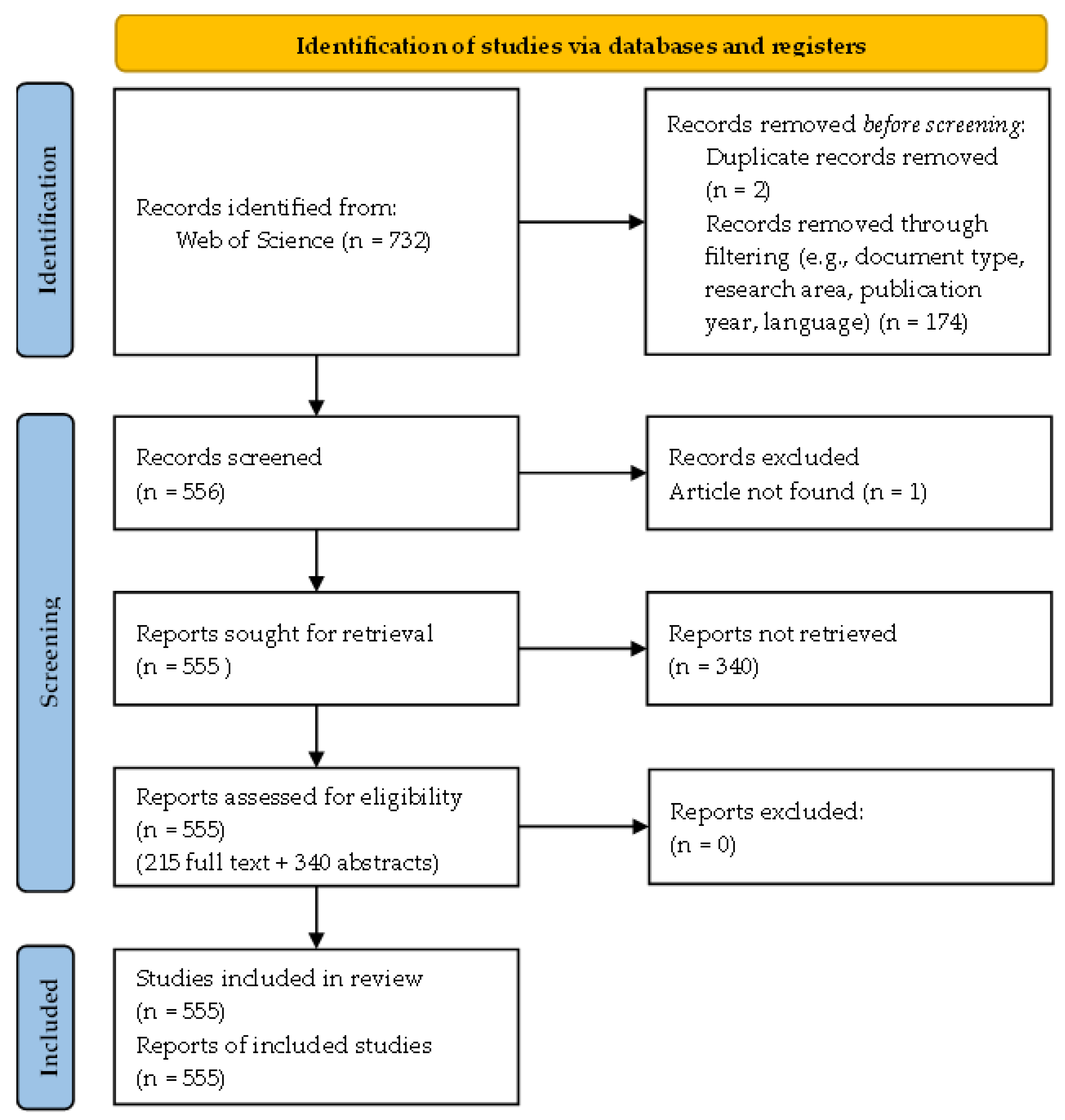
The PRISMA (Preferred Reporting Items for Systematic Reviews and Meta-Analyses) scheme outlines the steps involved in the systematic review process, including identifying, selecting, and including studies. Each block illustrates the step-by-step process of article filtering, from identification to final inclusion (Figure 2).
The process began with the identification of 732 records in the Web of Science database using the aforementioned keywords. Before the screening stage, 176 papers were eliminated: 2 duplicates and 174 articles were automatically eliminated following filtering by criteria such as document type, research field, publication year, or language. After this initial filtering, 556 articles remained for the screening stage, in which the titles and abstracts of the articles were evaluated for relevance, excluding only one article that could not be found. Thus, for 555 papers, an attempt was made to obtain the full text. At this stage, only abstracts were available for 340 articles, either due to access limitations or unavailability of the full text. However, full texts were available for 215 of the studies for analysis.
In the eligibility assessment stage, all 555 available records (full texts and abstracts) were reviewed to verify compliance with the inclusion criteria, including the use of artificial intelligence and relevance to the field of cryptocurrency transactions. No articles were excluded at this stage, indicating that all retrieved papers were relevant according to the established criteria.
Ultimately, 555 studies were included in the systematic review. Thus, the PRISMA scheme demonstrated a rigorous selection process that enabled the establishment of a large, representative database of articles on the use of AI in the analysis, prediction, and security of crypto transactions.

2.2. Data Refinement Method and Relevance Assessment

The database refinement method involved merging specific keywords from the Excel database. In this way, singular and plural forms were unified into a single term, like in the list below. Also, for simplification, the abbreviated form or the general term was kept, which could include certain variations.
Consolidation RuleUnified Key TermMerged Variants
  • Singular and plural
cryptocurrencycryptocurrencies, crypto-currencies
blockchainblockchains
  • Abbreviated forms
IoTinternet of things
GRUgated recurrent unit
LSTMlong-short term memory, long short-term memory, long short term memory
LLMLarge Language Models
DeFiDecentralised finance
  • General terms
reinforcement learning (deep reinforcement learning)—DRL is a subset of RL
artificial neural network recurrent artificial neural network, neural network, neural networks, convolutional neural network—all are subsets of ANN
tradingtrading strategy, quantitative trading
bitcoinbitcoin price, bitcoin price forecasting, bitcoin prediction
cryptocurrency market cryptocurrency prediction, cryptocurrency price prediction
deep learning deep reinforcement learning
feature selection feature extraction
financial trading financial forecasting
sentiment analysis sentiment
time series forecastingtime series analysis, time series
social media social networking (online), twitter
predictionprice prediction
This process was carried out to standardise and simplify the database, thereby streamlining the thematic analysis and ensuring a uniform, consistent count of the frequency of occurrence of each central concept, regardless of its form of expression (singular, plural, abbreviation, or extended version). As a result, thematic trends regarding the implications of AI on cryptocurrency transactions can be more clearly visualised through descriptive bibliometric analysis.

2.3. TRL-Based Maturity Assessment

To assess the technological maturity of the literature on the use of artificial intelligence in cryptocurrency trading, the study used the Technology Readiness Level (TRL) framework. TRL is a standardised scale for assessing the level of readiness of a technology for implementation, starting from the early stages of conceptualisation and experimental validation to fully integrated systems used in real-world conditions [26,27]. In the context of this study, TRL was employed as a maturity-mapping tool to distinguish between contributions that were predominantly conceptual or modelling-oriented and those with a high level of integration, validation, and practical applicability.
The TRL coding was carried out using a qualitative and interpretive approach (Appendix A), based on the information available in the title and abstract, as many papers did not explicitly report the level of readiness or provide full details of the implementation. The TRL assignment process aimed to identify three main dimensions of maturity:
  • Type of contribution and level of technological integration—whether the paper proposed a concept, a model, a functional prototype, or a fully integrated system (e.g., operational pipeline, application, decentralised application (dApp), smart contracts/oracles).
  • Type of validation reported—theoretical validation, experimental validation on historical data, backtesting/trading simulation, validation under relevant conditions (e.g., live data streams, integration with application programming interfaces (APIs), testing in contexts close to the real market).
  • Orientation towards practical applicability—the existence of elements of implementation, replicability, and use (e.g., software tools, dashboards, decision support systems, automatic execution mechanisms, integration into decentralised finance (DeFi) ecosystems).
Instead of a point value, TRL was assigned as a range to reflect the internal heterogeneity of contributions and the variable level of detail reported in abstracts. The lower end of the range was set as the minimum clearly demonstrated level (e.g., offline or conceptual validation) and the upper end reflected the most advanced level suggested or indicated (e.g., integrated prototype, functional application, real-time implementation). This approach mitigates the risk of overly precise classification and is particularly suitable for emerging and interdisciplinary domains, where the gap between model maturity and system maturity is substantial.
After classifying papers into thematic clusters (previously established based on keyword co-occurrence analysis), TRL ranges were aggregated at the cluster level to construct a comparative map of technological maturity. For each cluster, the following were calculated: (i) the number of papers (n), (ii) the median TRL as an indicator of the prevailing maturity level, and (iii) the range (min–max) as an indicator of internal diversity. Thus, the maturity map enabled comparison of clusters by their degree of readiness, as well as identifying areas where the literature remains predominantly conceptual or limited to offline validation.
To increase the transparency and robustness of the assessment, the TRL ranges assigned to each cluster were supported by selecting anchor papers that represented the lower and upper ends of maturity within the cluster. These examples were extracted from the dataset and used to empirically justify the TRL range, demonstrating the difference between review/framework or proof-of-concept contributions and those that describe prototypes, integrated systems, and implementation-oriented applications.

3. Descriptive Bibliometric Analysis

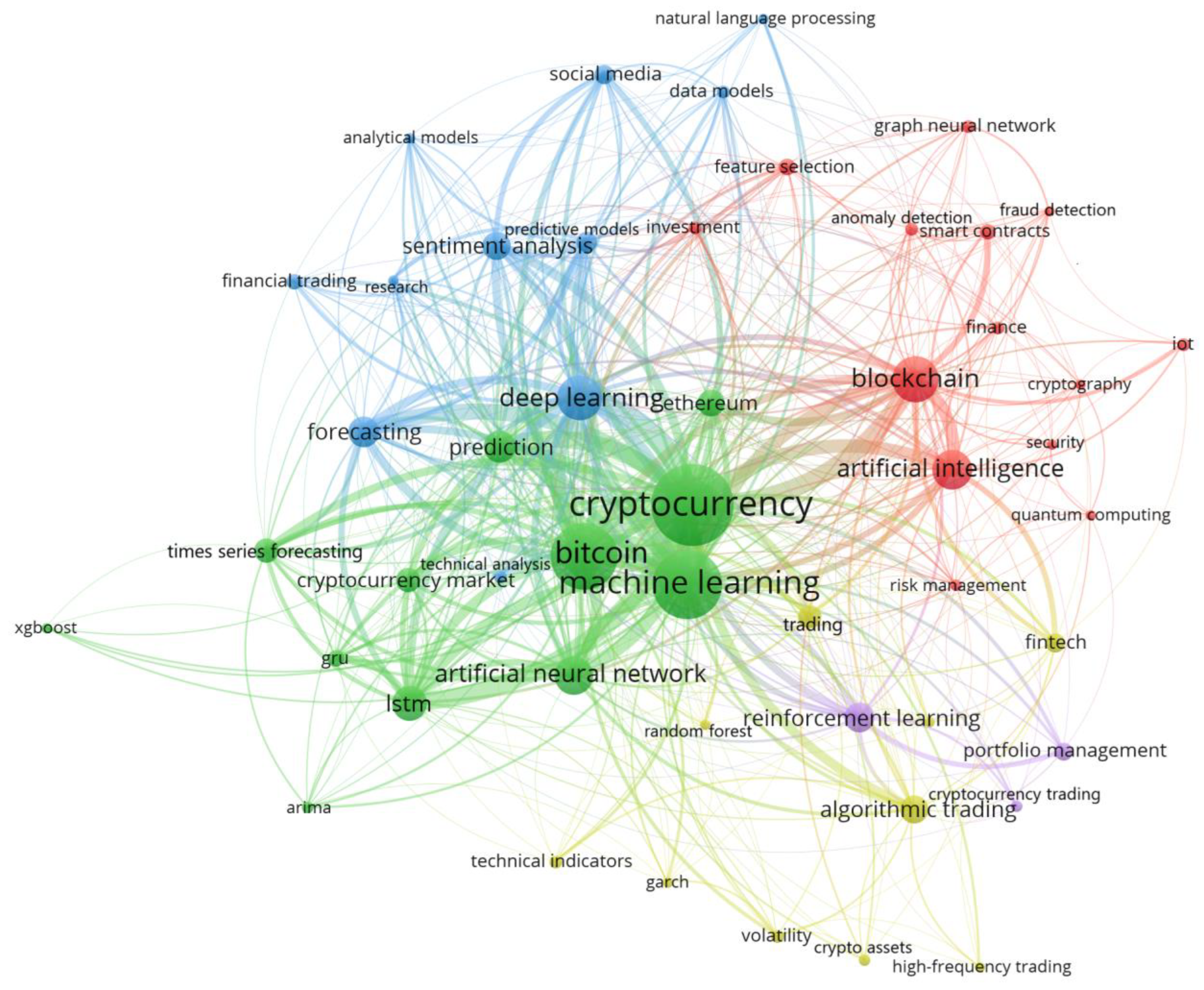
Descriptive bibliometric analysis was based on the results generated by VOSviewer and Microsoft Excel. Terminological analysis is the method by which the essential concepts and terms associated with a specific topic are identified and defined. Through this approach, the most important keywords were highlighted. Therefore, the keywords cluster (Figure 3) generated in VOSviewer is based on the co-occurrence of author keywords, using the full counting method. The minimum threshold for selection was six occurrences per keyword, a decision justified by the large number of studies in the field. After processing the database with VOSviewer, 50 of the 1392 terms identified met the minimum occurrence threshold. For these, the intensities of the connections between coexisting terms, as reported in the specialised literature, were calculated, with each link represented by a different thickness depending on the strength of the association and the strength of occurrences. In other words, the normalisation method was based on the strength of the association between keywords.
Therefore, Figure 3 presents the main relevant terms, selected based on the established criteria and represented as nodes in the graph. The size of each node reflects the frequency with which the respective keyword appears. The connections between the nodes show the relationships between the terms: the closer the connection, the thicker and shorter the line. The intensity of the connection indicates the number of publications in which two terms appear simultaneously. In this way, networks or clusters with the same colour are formed. According to the VOSviewer 1.6.20 Manual, each cluster is identified by a distinct colour and number [28].
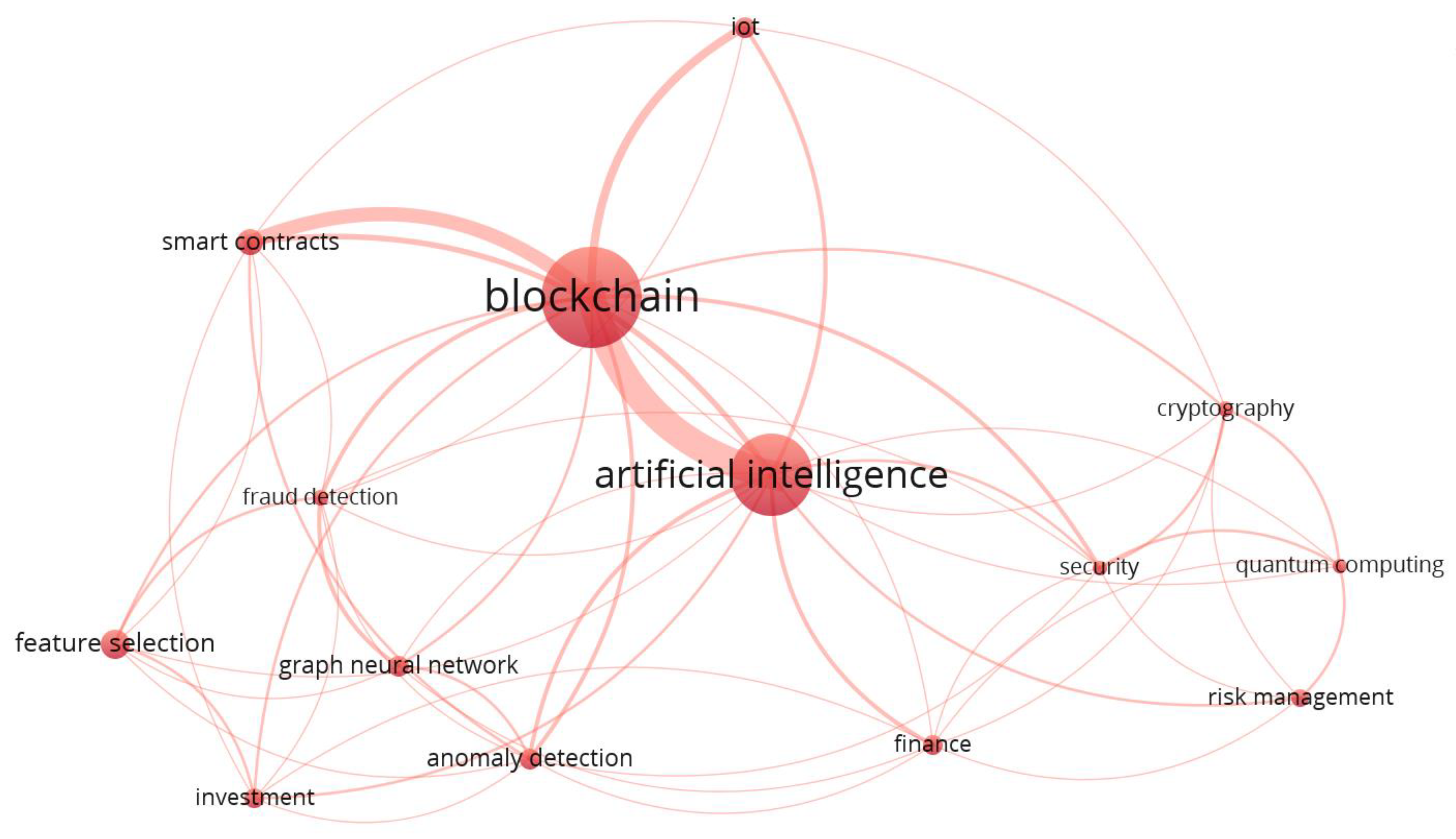
Analysing Figure 3 and Table 1, we can deduce that Cluster 1, in red, includes the word “blockchain” as a dominant node, and in its proximity are the terms “artificial intelligence”, “smart contracts”, “cryptography”, “finance”, and “graph neural network”. The concept of “quantum computing” suggests cutting-edge research on future computational capabilities that could revolutionise financial analysis and high-speed trading strategies. These terms highlight blockchain applications in security, finance, and smart contracts; therefore, the topic we will develop in this article is blockchain infrastructure and AI integration in decentralised ecosystems.
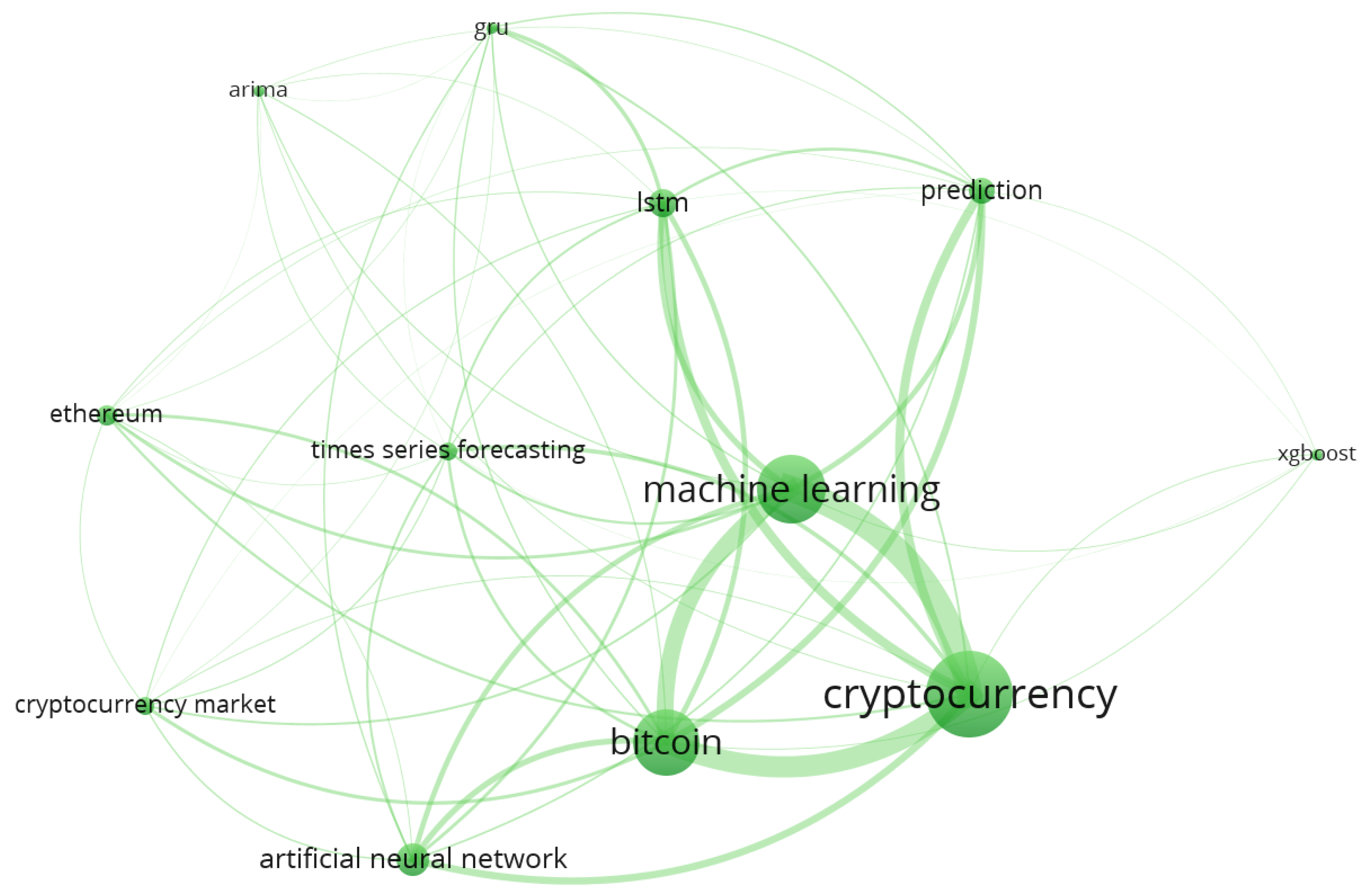
Secondly, Cluster 2, in shades of green, has as its major central nodes the words “cryptocurrency”, “Bitcoin”, and “machine learning”. Around these words gravitate terms such as: “deep learning”, “prediction”, “ethereum”, “cryptocurrency market”, “artificial neural network”, “time series forecasting”, “lstm”, “arima”, and “xgboost”, terms that converge towards the area of predictive modelling of crypto markets using advanced machine learning algorithms. Therefore, the theme to be discussed, related to this cluster, is data analysis and its practical applicability in cryptocurrency markets.
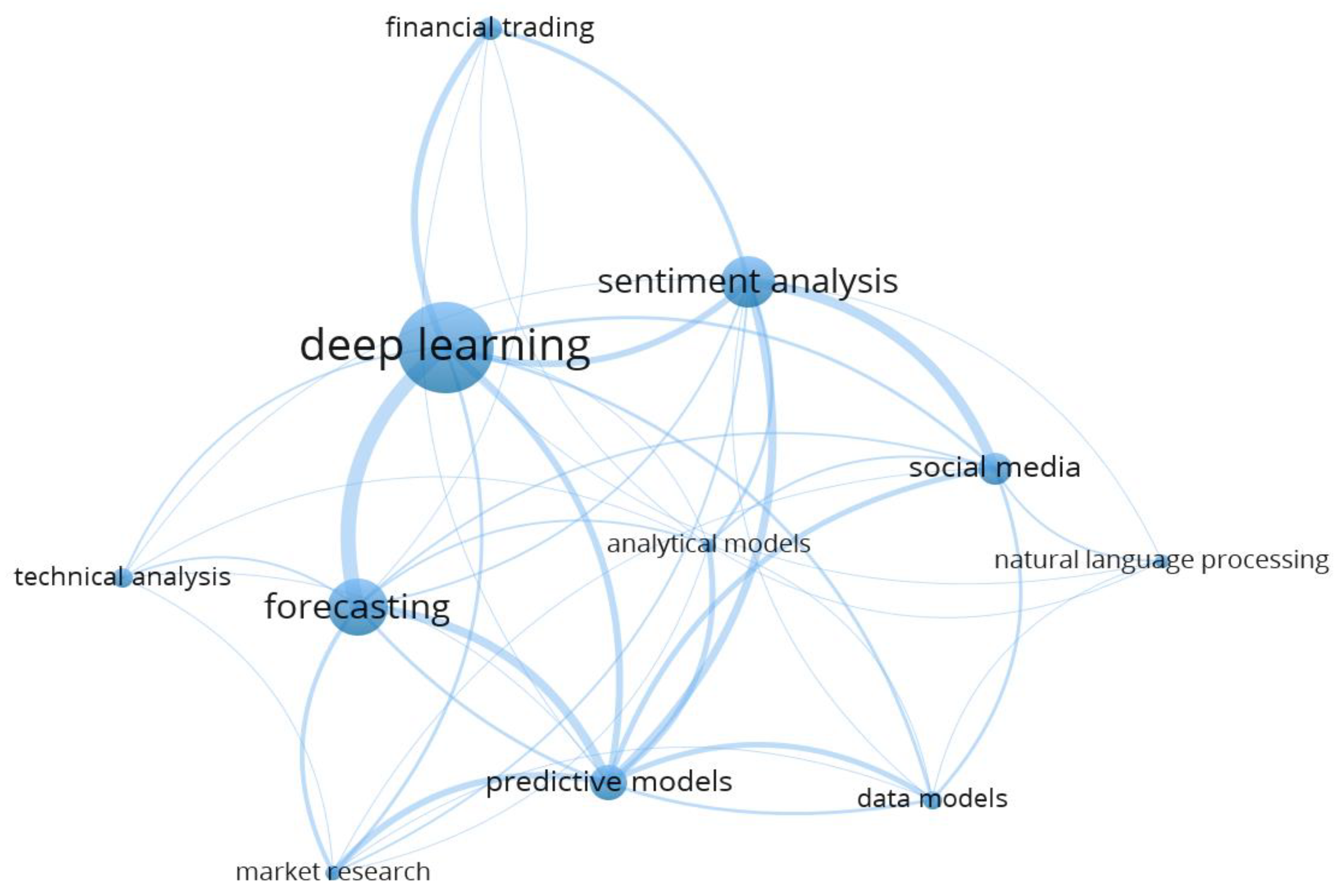
Thirdly, Cluster 3, blue, is dominated by “deep learning” as a central node, with several important satellites: “sentiment analysis”, “forecasting”, “financial trading”, “social media”, “natural language processing”, “data models”. This cluster reflects the applications of financial and social data analysis through natural language processing techniques. Thus, the analysed theme focuses on machine learning algorithms.
Fourth, Cluster 4, in yellow, focuses on automated trading and portfolio management strategies. The most suggestive keywords are: “algorithmic trading”, “trading”, “risk management”, “technical indicators”, “volatility”, and “fintech”. These words lead to the topic of algorithmic trading and automation.
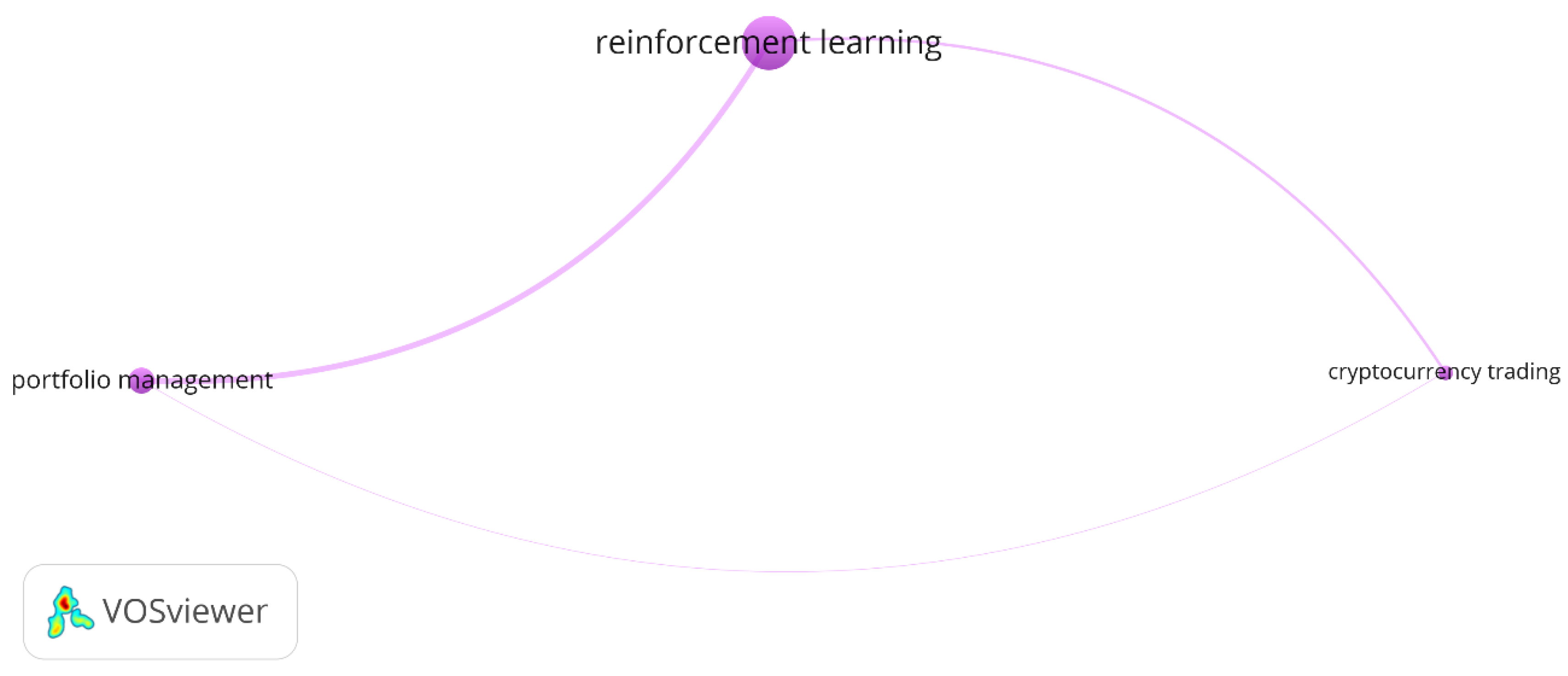
Finally, in purple, number 5 includes “reinforcement learning”, “portfolio management”, and “cryptocurrency trading”, terms that emphasise the prediction and modelling of crypto market developments.
The strong interconnectivity between the clusters suggests the interdisciplinary nature of the field, and the combination of technical concepts (LSTM, neural networks, and quantum computing) and practical applications (trading, investment, and portfolio management) demonstrates the field’s practical orientation in this constantly evolving ecosystem.

4. Thematic Analysis

4.1. Cluster 1 Red—Blockchain Infrastructure and AI Integration in Decentralised Ecosystems

The analysis of specialised literature reveals that decentralised blockchain technology represents one of the pillars on which artificial intelligence applications are developed in the crypto asset and digital finance markets. Also, this field is highlighted by a complex technological convergence, which involves the optimisation of security, transparency, and efficiency in decentralised ecosystems, in financial technology (FinTech), in the IoT, and, more recently, in the Metaverse concept [29,30,31]. Recent scientific efforts confirm that synergy not only amplifies the capacity of individual technologies but also lays the groundwork for the subsequent development of new services and markets, such as “knowledge-as-a-service” [32].
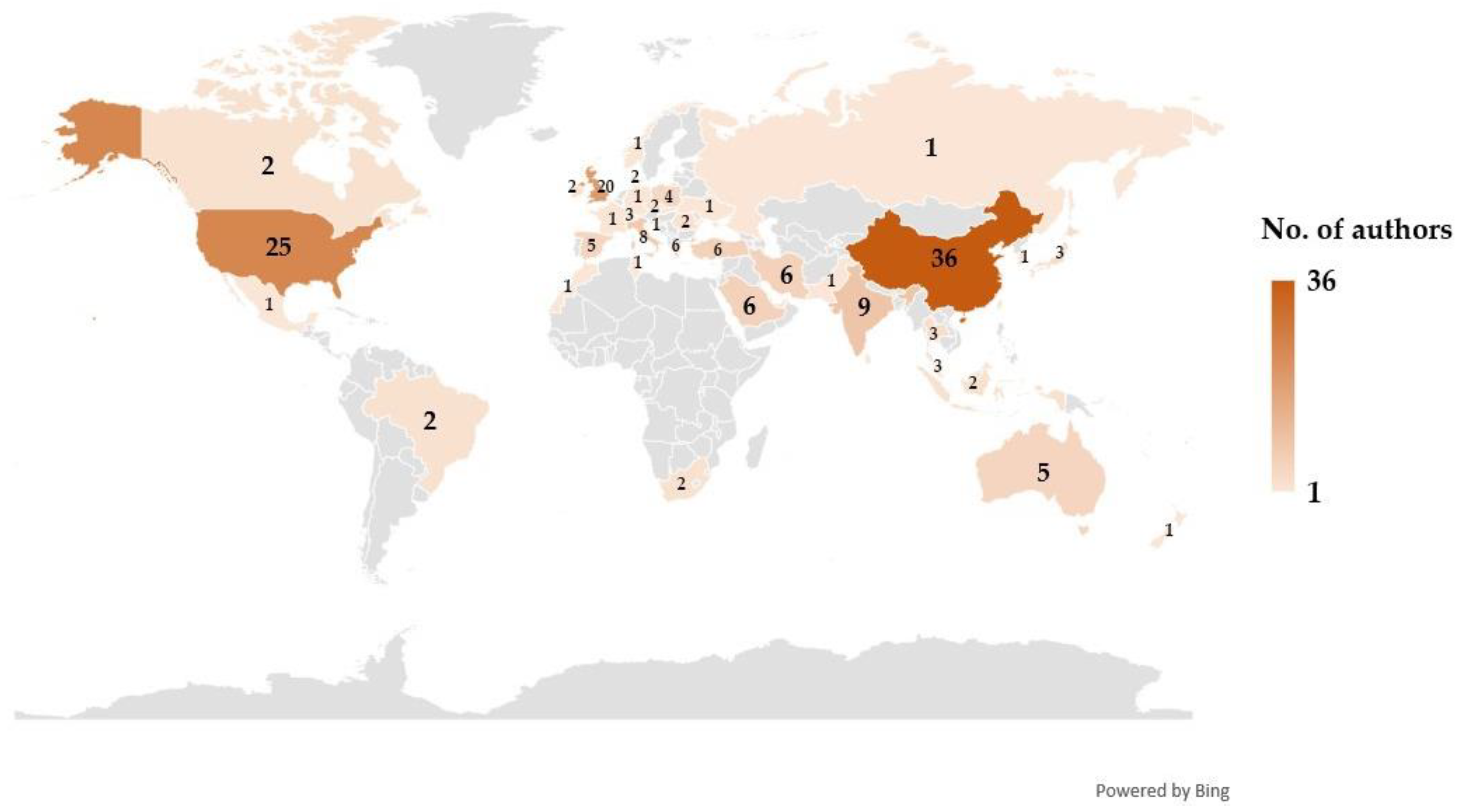
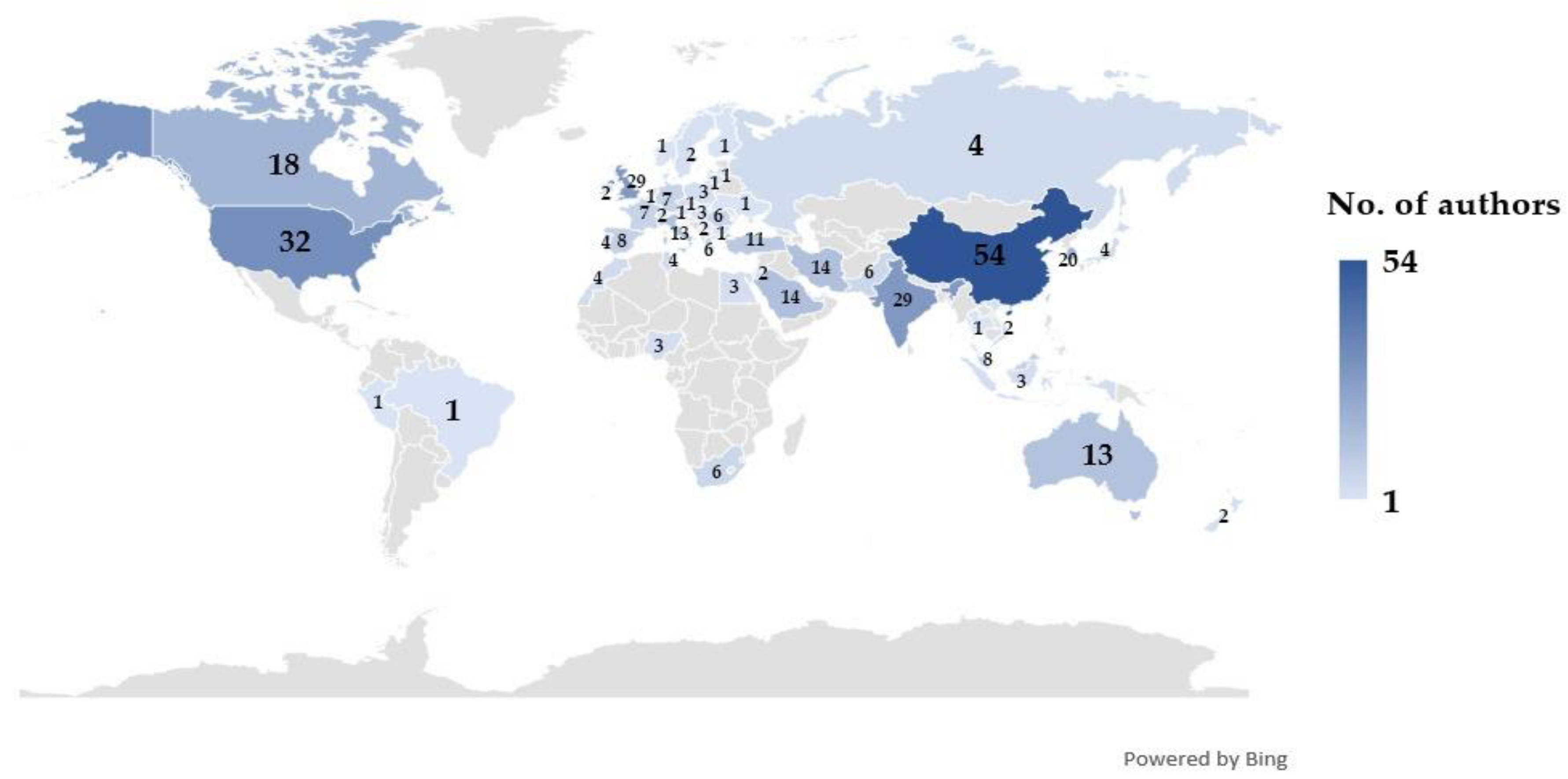
Geographically, research on AI integration with blockchain shows a disproportionate distribution, with a significant concentration in Asia and North America (Figure 4). Bibliometric data indicate that China is the most significant contributor (36 authors), followed by the United States of America (USA) (25 authors) and India (9 authors). This highlights an intensity of research in these regions. It is also noted that research interventions are infrequent in countries such as Canada, Australia, the UAE, and Russia, indicating a gradual globalisation of research.
The research directions are not isolated; they emerge as interconnected elements within a broader innovation landscape at the intersection of blockchain and AI technologies. A keyword cluster analysis highlights the centrality of the terms “blockchain” and “artificial intelligence” (Figure 5) in the specialised literature. The existing connections emphasise the applicability of AI in the development and optimisation of the intrinsic functions of emerging AI technology, such as:
  • Security and compliance: security, cryptography, fraud detection, anomaly detection, and risk management;
  • Integration of emerging technologies: feature selection, smart contracts, IoT, and graph neural networks.
One of the major reasons for utilising AI technologies in the blockchain system is to enhance security and make the system more reliable. Innovative mechanisms, such as proof-of-stake (PoS) or Byzantine Fault Tolerance (BFT), are important elements for the integrity of distributed networks [33], and the present attempts focus on solutions that address scalability and security problems [34]. Cognitive cloud computing and blockchain-based system (BC-CCC) proposals depict how AI can use edge computing in IoT for classification, identification, and prediction based on sensory data [31]. In these cases, the safety level and information transmission speed are some of the areas where these systems have made remarkable progress [35].
Smart contracts on digital currency platforms are the primary agents for automating transactions and for verification and validation (V&V) procedures associated with the project information model (PIM) [36]. AI, together with natural language processing (NLP), is employed in these V&V processes to enhance the quality of information and facilitate a decentralised approach, where each stakeholder is the owner and manager of their data [37,38]. Simultaneously, Web 3.0, which represents technology based on computing and storage networks, is being investigated through the implementation of AI and blockchain innovations to provide advanced data security for financial transactions in trading markets [39].
A prominently featured sub-topic is the deployment of AI to detect fraudulent activities in blockchain networks. This obligation arises from regulatory difficulties caused by decentralisation and confidentiality [40,41,42]. Hence, systems have been designed that integrate AI and blockchain technology (BT) to track and protect users against dishonest crypto operations. These systems make use of ML classifiers, such as random forest, which is a method that has the highest accuracy rate [43]. Upon fraud detection, the most pertinent information is being kept in safety via systems, for instance, the InterPlanetary File System (IPFS), while recording the file hash on the blockchain via smart contracts, thus granting informational support to law enforcement in crypto fraud transactions [44,45].
Additionally, studies have advanced the use of Graph Neural Networks (GNNs) in identifying phishing crimes and abnormal transactions that may occur on leading trading platforms [46,47]. The identified research works suggest adopting a more complex method, such as graph convolutional networks [48], for this task.
A related area of security is money laundering in crypto markets, where the anonymity and speed of trading order execution complicate state regulation [45]. In this case, the synergy between BT and AI can provide effective solutions. Li et al. [42] introduce the BELFAL system (Blockchain-based Ensemble Learning Framework for Anti-Money Laundering), which integrates multiple ML models that are coordinated by a blockchain smart contract. On the one hand, the classifiers vote on suspicious transactions. On the other hand, decision rules can be dynamically changed, thereby providing both transparency and adaptability to the process of identifying illegal activities.
In this way, AI serves as a cognitive and analytical factor that complements the trustworthiness of BT. As a result of this merger, decentralised features are not only deepened, but also innovated, and the risk identification is made more efficient [49]. Anomaly detection (e.g., pump-and-dump schemes) [50] and regulatory compliance are implemented, contributing to the trust of decentralised ecosystems and their sustainable adoption in the face of more complex challenges [51].

4.2. Cluster 2 Green—Data Analysis and Practical Applicability in Crypto Markets

Data analysis has become an indispensable tool for constructing predictive models and developing algorithm-based trading strategies in the evolving cryptocurrency market [52,53]. The transition from conventional statistical methods to AI-driven approaches is a manifestation of users’ primary need for versatile tools that can cope with the large volume of unstructured data typical for volatile markets [54]. According to the visual map of the VOSviewer cluster, the main concepts, such as cryptocurrency, machine learning, Bitcoin, and prediction, are highlighted as nodal points in the specialised literature (Figure 6). These concepts are frequently supported by the mention of deep learning models, such as LSTMs and GRUs, and artificial neural networks, which are extensively employed in tasks such as time series forecasting and cryptocurrency market analysis. This set of technologies is crucial for addressing the challenges inherent in financial markets, which have undergone radical transformations in software and data analysis [55].
The rapid technological progress highlights the shift from mere price prediction to the direct optimisation of trading actions through the use of Reinforcement Learning (RL) [56]. RL plays an important role in achieving the aims of portfolio optimisation, contributing to the maximisation of financial returns. At the same time, the decision-making process and risk management in the trading process can be effectively handled [53]. Moreover, trading systems that are based on RL have been able to attain incredible returns and substantially improve Sharpe ratios; thus, they have recorded risk indices that are lower than those of traditional algorithms for a short-term time interval [57]. The winning of these newly emerging tools is also certified by the example of the successful union of the Double Q network and the unsupervised pre-training by Deep Boltz Machine (DBM) to create and perfect the optimal Q function; at the same time, it produces as much as 2.686% of cryptocurrency trading even in the periods of significant market falling [56].
Apart from performance optimisation, a major role for AI is that of risk management and portfolio diversification in volatile environments [58]. The research examines the tail connectedness between AI tokens, AI ETFs (exchange-traded funds), and traditional asset classes, concluding that AI tokens may be beneficial for diversification but are vulnerable to extreme shocks, even when the market is stable [59]. Besides that, the examination of bitcoin, as the most valuable cryptocurrency at the present moment, and gold-backed cryptocurrencies (like PAX Gold—PAXG), as safe havens in portfolios that are concentrated on AI entities, reflects the phenomenon that both digital currencies and the natural resource (gold) have low dynamic correlations with AI firms. Therefore, they can be regarded as the most trustworthy hedging instruments during times of social, political, or economic turmoil [52]. The AI applications have been extended to the market structure level as well, where they make use of GNN-based methods, which expose the centralised character of the investor network and facilitate the investor ratings and types classification [60].
Another important practical direction is integrating trading models with unconventional data, such as public sentiment. Habek et al. [61] present a hybrid convolutional and recurrent neural network (CNN-RNN) structure with memory and attention mechanisms, demonstrating that Twitter-based sentiment analysis can be used for predicting crypto market trends with an accuracy of 93.77%. LLMs enhanced by Retrieval-Augmented Generation (RAG) are expected to similarly reshape AI-based financial decision-making processes, with real-time sentiment analysis and automated trading among the potential applications [62].
In addition, Baek et al. [63] analysed the relationship between the tone of Reddit messages and anomalies in the cryptocurrency market, particularly those involving Bitcoin. The results showed that text analysis, performed with deep learning techniques, can provide a higher level of accuracy than traditional bag-of-words approaches in terms of price volatility and trading volume. This finding, together with the previously stated ones, confirms the hypothesis that integrating behavioural and emotional data can significantly improve the accuracy of AI-based automated decision-making systems.
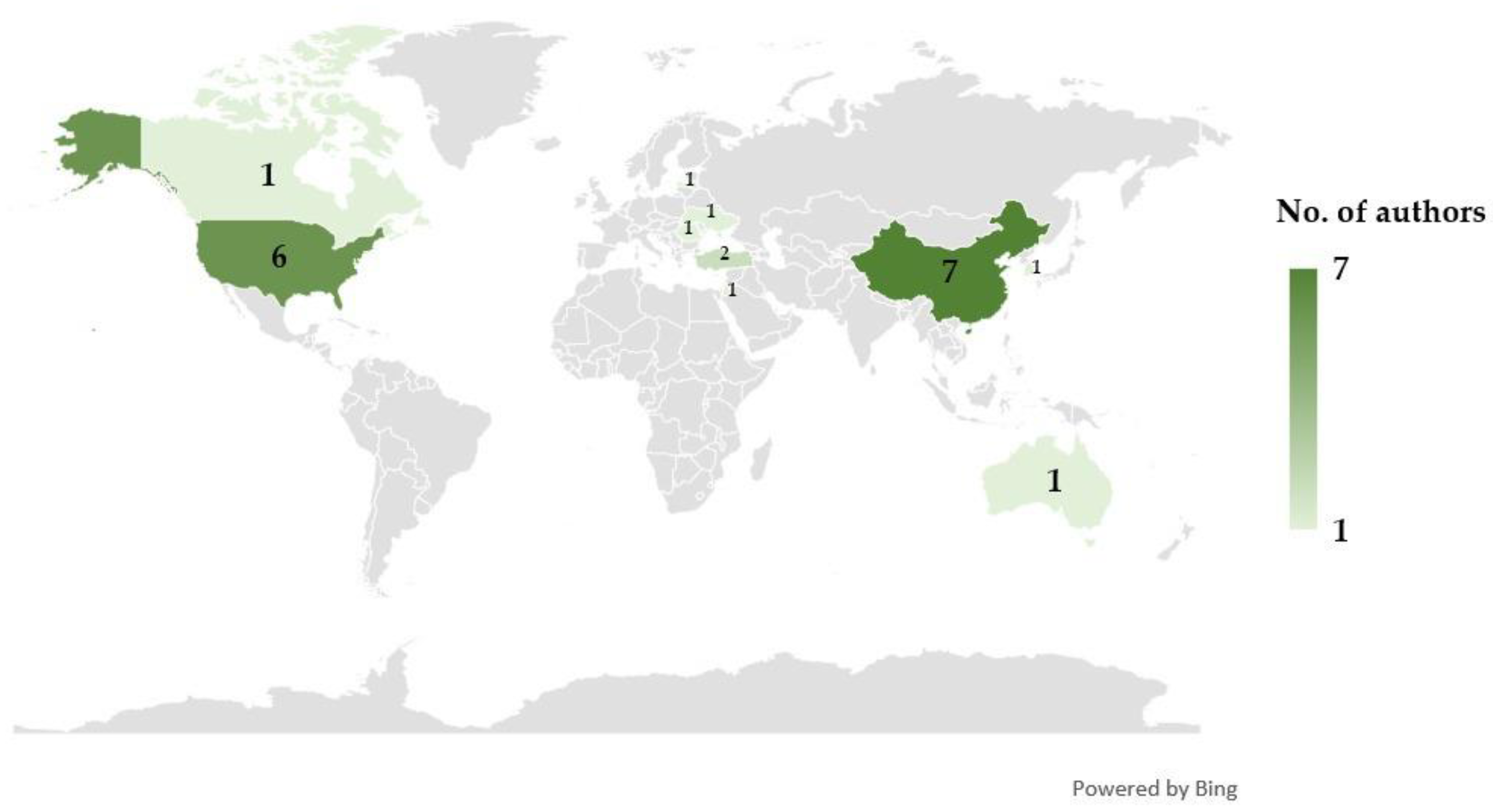
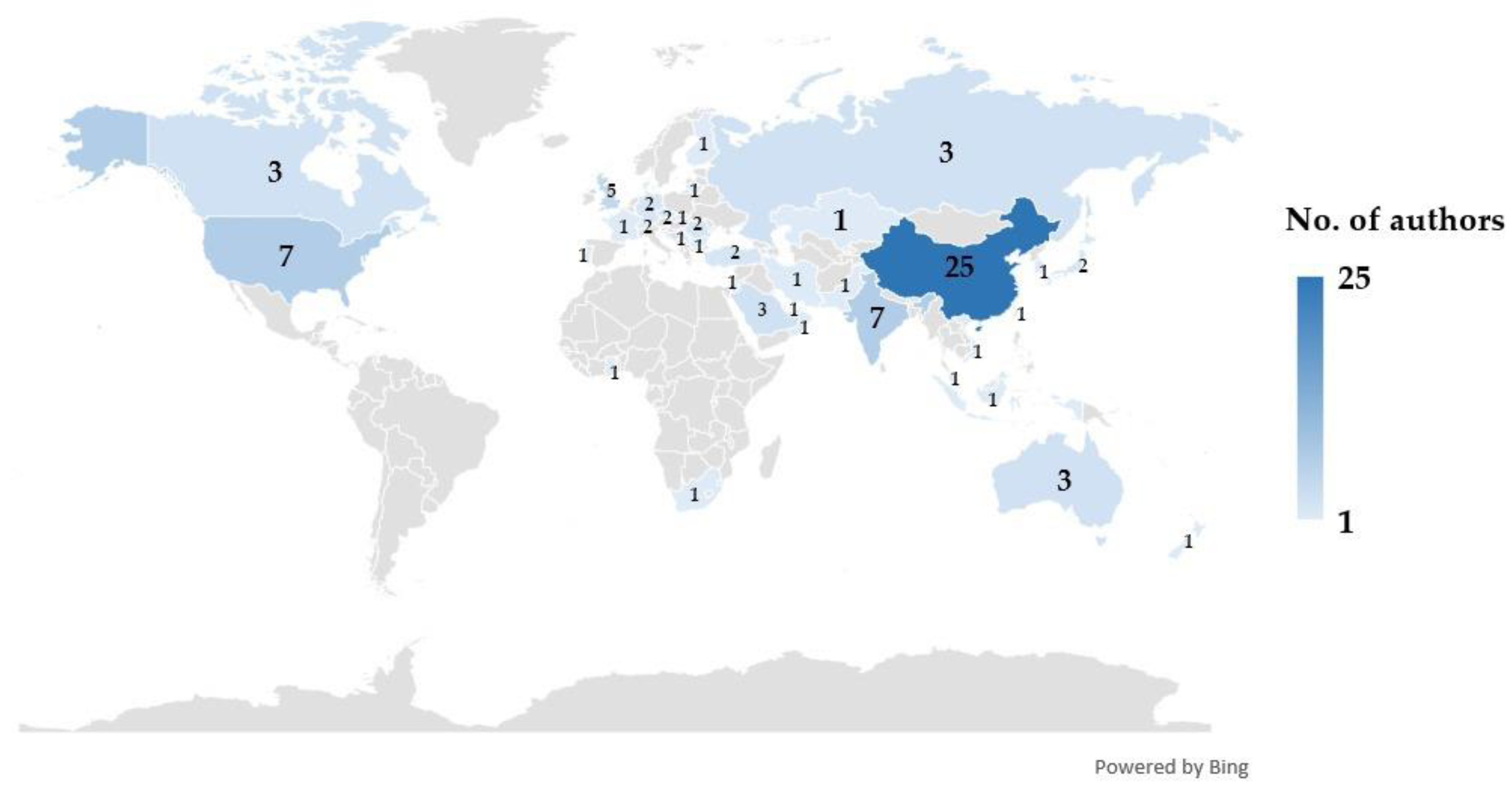
From a geographical perspective, the results obtained (Figure 7) reveal an asymmetric, highly centralised distribution of scientific contribution in the examined sample. The map shows a marked predominance of researchers originating from China, with seven authors, followed by the USA, with six researchers, and Canada and Australia, each with one author. This distribution underscores the transnational scope of research within this cluster, indicating that the topic is investigated across a wide range of academic contexts and geographical regions.
The low or absent contributions from other regions of the world, such as Europe, South America, Africa, or the Middle East, may indicate an asymmetry in research capacity in the field. This uneven distribution confirms that the advancement of AI applications in cryptocurrency is currently driven primarily by research centres in North America and Asia.
Looking ahead, AI will be a key driving force behind the efficiency of cryptocurrency trading, evolving from a predictive tool to an autonomous decision-making and yield-optimisation system. However, the practical and responsible use of these technologies requires anchoring them in a clear and adaptable regulatory framework. In parallel, the geographical concentration of research in a few key regions highlights the need to promote international collaborations and the transfer of expertise to encourage balanced scientific participation and the global dissemination of innovation in this emerging field.

4.3. Cluster 3 Blue—Financial and Social Data Analysis—Machine Learning Algorithms

A growing area of research in the scientific literature is the integration of machine learning algorithms for the simultaneous analysis of financial and social data. Scientific efforts in this field focus on developing predictive models that overcome the limitations of econometric methods [11]. The VOSviewer cluster confirms that research is dominated by the interconnection of “deep learning”, “forecasting”, “sentiment analysis”, “social media”, and “technical analysis”, all oriented towards designing efficient “predictive models” for trading on the cryptocurrency market (Figure 8).
The literature has paid increasing attention to evaluating different deep learning architectures for predicting the price and volatility of crypto assets [64,65]. RNN models, especially LSTM and GRU, have been shown to outperform traditional cryptocurrency price forecasting models [66,67]. For example, scientific approaches using the GRU model have demonstrated a higher prediction level for Bitcoin, Litecoin, and Ethereum compared to LSTM or bi-LSTM [3,10]. However, the choice of the optimal model depends on the specific task at hand. While Support Vector Machine (SVM) models have achieved the best performance (83% accuracy), DL models have offered remarkable performance for classification tasks [16]. At the same time, by applying feature engineering steps on the features and selecting them using methods such as Boruta or random forest, the performance of predictive models can be substantially improved [68,69].
A significant step towards the evolution of forecasting has been made by integrating non-financial data, particularly social sentiment, into the system [15]. Comprehensive research has found that combining financial and non-financial data, such as user sentiment, can improve the accuracy of forecasts from 51–55% to 67–84%, regardless of the DL algorithm used [70]. In addition, Hamadou et al. [71] emphasise that investor sentiment can be a direct factor affecting Bitcoin returns, and information obtained from online sources may be a better predictor of Bitcoin price than the price time series itself [15]. Meanwhile, an analysis of investor opinions revealed that most stakeholders hold positive or neutral views of cryptocurrencies, and both positive and negative perceptions have statistically significant effects on prices [2].
In addition to prediction, ML algorithms play a crucial role in managing crypto asset portfolios. DL models are utilised to optimise portfolios, aiming to mitigate exposure to financial risks and achieve a superior return [72,73]. One more significant area is Explainable AI (XAI), which deals with the issue of understanding the “black box” of complex models [74]. Investors’ decision-making can be significantly explained by the factors identified through the usage of XAI, such as their knowledge of cryptocurrencies, risk perceptions, and benefits [75,76]. These innovations in the supply of financial and non-financial information open the way for the financial sector to redesign its strategies more efficiently and increase investor commitment [77].
The range of algorithmic architectures for processing financial and social data, which reveals the complexity of the models used, is also mirrored in the authors’ locations for their scientific works. The contributions illustrated in Figure 9 originate from a range of diverse academic contexts, with a more pronounced representation of authors institutionally affiliated in China. Besides that, India and the USA, each with seven authors, show vibrant academic ecosystems and strong, active cooperation between academia and industry. There are also several papers from Russia, Australia, and Canada (three authors each), which indicate that this is an international research topic. On the other hand, the scarcity of scientific knowledge in Central Europe, Latin America, and Africa implies that the flow of scientific knowledge is uneven, raising the possibility of facilitating international collaborations to democratically develop the application of AI in crypto asset trading.
The scientific literature charts the gradual development of a mature research field that integrates ML algorithms into the analysis of financial and social data related to cryptocurrencies. Contemporary models, such as neural networks, hybrid architectures, and NLP techniques, have been instrumental in understanding market dynamics and forecasting investor behaviour. In addition, the location of the research contributions reveals the concentration of the knowledge in some strategically important regions. It also shows the potential of opening up research to a more balanced international engagement. The convergence of technological innovation and global research activity at this time, therefore, provides a firm basis for the emergence of autonomous trading systems that will be more accurate, adaptive, and transparent.

4.4. Cluster 4 Yellow—Algorithmic Trading and Automation

Algorithmic trading has become one of the most vibrant and eclectic research areas in the recently published literature on cryptocurrencies. As algorithmic trading directly caters to the peculiarities of crypto markets, it presents the following extreme characteristics: high volatility, continuous operation (24/7), and structural complexity due to the fragmentation of exchanges and speculative behaviours. These features make cryptocurrencies an ideal laboratory for automation, where traditional strategies can be tested and optimised, and AI models can be trained in a rapidly changing market regime context.
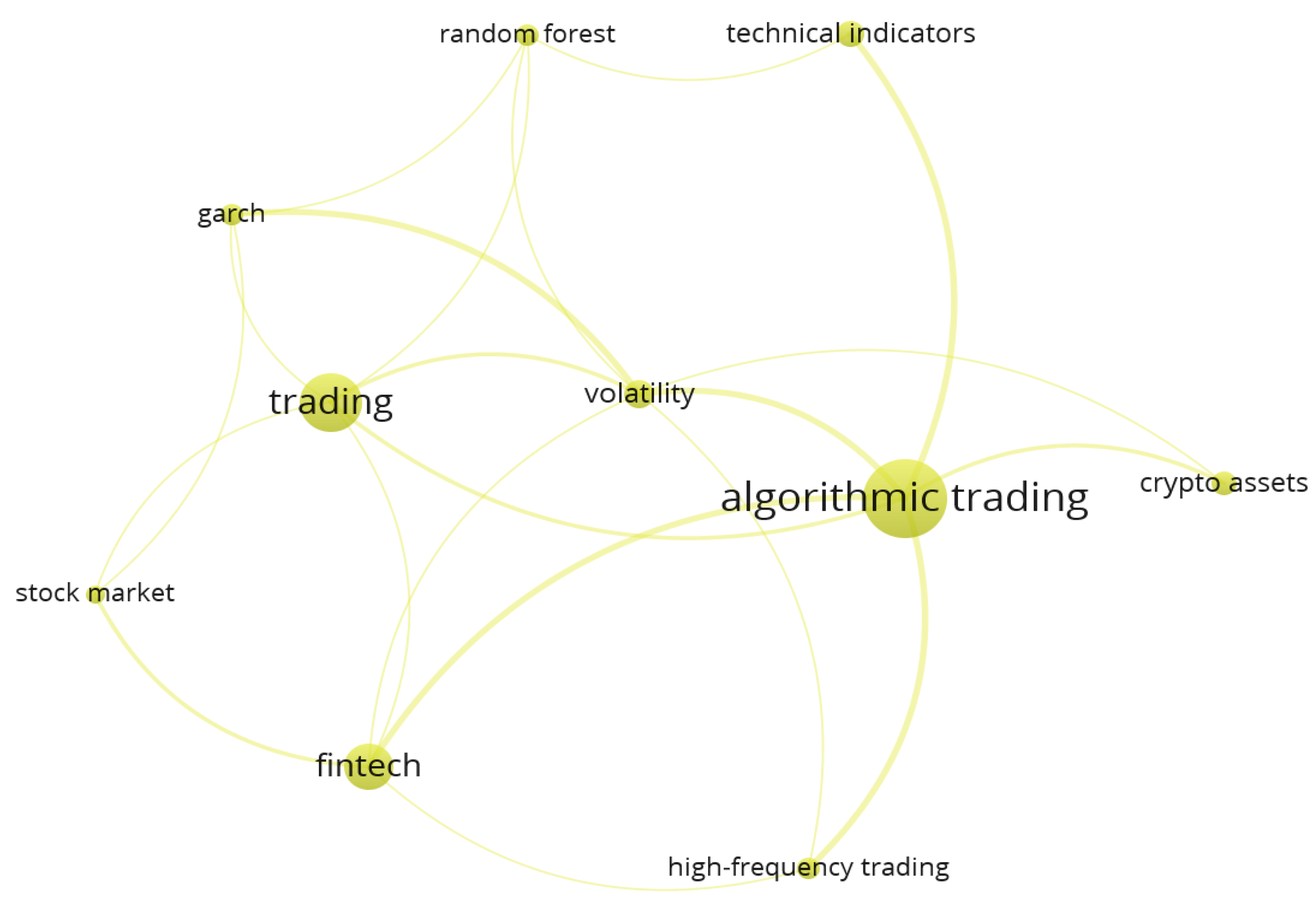
Suggestively, the co-occurrence analysis of the keywords (Figure 10) related to the analysed cluster indicates that “algorithmic trading” is the network’s central node which is, at the same time, connected to the words “trading”, “volatility”, “technical indicators” and to the advanced methods like “random forest”, “garch” and “high-frequency trading”. This semantic architecture lays the foundation for a continuum in the literature, covering automated trading from rule-based automation and technical indicators to learning-based automation (ML/DL/RL), primarily for high-frequency trading.
A consistent part of the research begins from the premise that traditional technical indicators remain relevant in crypto trading, provided they are appropriately tailored to market-specific features. For example, Özdemir & Bogosyan [78] propose a framework for generating trading signals using neural networks fed with technical indicators and optimised on crypto data aggregated at five-minute intervals, concluding that the results are promising but require refinement for high profitability in real trading environments. Cohen [79] demonstrates a series of empirical contributions, fully supporting this point of view: they show that intraday trading performance can be robustly generated by such indicators as RSI (Relative Strength Index), MACD (Moving Average Convergence Divergence) or Keltner Channels, thus outperforming “Buy and Hold” strategies for significant assets (Bitcoin, Ethereum, BNB, Cardano, XRP), especially when they are calibrated on longer time frames (60–120 min), which implies that crypto markets, although volatile, are still capable of rewarding strategies that can lessen random micro-fluctuations and follow more stable trends. Besides rule-based system optimisation, Cohen [80] also experiments with an average true range (ATR)-based strategy, proving that systems optimised across multiple objectives (profit, profit factor, and percentage of profitable transactions) can significantly enhance the ability to predict trends, and the integration of Keltner Channels can amplify the performance of the ATR system.
Nevertheless, the literature converges on the idea that technical indicators, when used in isolation, face structural limitations in a market characterised by extreme volatility and speculative behaviour. This is the reason why “volatility” is depicted as a hub in the co-occurrence network, which connects intraday strategies and advanced research, such as GARCH (Generalised Autoregressive Conditional Heteroskedasticity) and reinforcement learning, on either side. Volatility acts as both a source of opportunity and risk simultaneously. While it is true that oscillations created by it are at the disposal of algorithms, the chances for sudden drawdowns and instability of strategies during backtesting are also increased. The studies suggest that volatility is not only a control variable issue but also an integrated mechanism in the automated strategy architecture. For instance, Wei et al. [81] recommend a variable-leverage strategy that combines sentiment and volatility narratives to support hybrid strategies, producing continuous, superior returns through constant market context adaptation. Moreover, in an econometric and risk modelling framework, other studies apply GARCH and conditional volatility instruments to comprehend market connectivity and model risk transfer—a direction that also appears in the analysis through the keyword “garch”, connected with “trading” and “volatility” [82].
Such a move toward adaptive models is the reason why the reviewed literature’s most innovative direction is DRL, which treats trading as a sequential decision problem. In this type of research, prices and indicators are “states”, buy/sell decisions are “actions”, and returns are “rewards”—thereby modelling an agent learning optimised trading policies. A relevant example is the framework proposed by Liu et al. [83], who built a high-frequency strategy for Bitcoin using PPO (Proximal Policy Optimisation) and an LSTM basis, demonstrating that the agent can achieve significantly higher returns than benchmark strategies in a simulated environment synchronised with real data. Ghadiri & Hajizadeh [84], correspondingly, propose a two-step crypto trading system: automatic feature selection using XGBoost (Extreme Gradient Boosting—including blockchain-specific data), followed by a DDQN (Double Deep Q-Network) agent with LSTM/bi-LSTM/GRU layers for generating buy/hold/sell instructions, highlighting that the integration of on-chain variables can add crucial information for performance. Besides that, the literature also points out that when volatility is high, RL agents can suffer from instability (overfitting, extreme degradation); thus, stabilising and distillation-type solutions are suggested. Along these lines, Moustakidis et al. [85] propose an online probabilistic distillation method for DRL agents, with the explicit goal of enhancing training stability and performance in a volatile financial environment.
The natural transition from “automated trading” and “ultra-fast automated trading” is the subfield of high-frequency trading (HFT), which can be viewed both as a separate node in the co-occurrence analysis and as a significant topic in the literature. HFT in crypto is a subject of research not only as a practice but also as a market phenomenon that affects trading quality. Petukhina et al. [86] analyse intraday patterns and the impact of automated algorithms on the European crypto market, concluding that fast automated trading creates repetitive structures and thus provides a basis for discussing the predictability of economic value in this market. In a more practical tone, Vo & Yost-Bremm [87] develop a high-frequency strategy for Bitcoin at the minute level, employing financial indicators and an ML algorithm to evaluate performance relative to other ML methods and assess economic benefits in out-of-sample contexts. However, the literature shows that simply increasing the frequency does not guarantee improved performance; the central problem remains the ability to adapt to rapid regime changes and avoid decision bias in extreme conditions. This explains why multi-agent architectures are being proposed and emerging. Zong et al. [88] propose MacroHFT, an augmented memory and context-aware RL method that combines specialised sub-agents (for trend and volatility) with a meta-agent (hyper-agent) that produces a consistently profitable meta-policy in minute-level trading, thus overcoming the limitations of individual agents.
As automation becomes increasingly complex, a new issue arises: the need for decision transparency. “Black box” AI strategies may be perceived as risky or difficult to monitor, especially in the cryptocurrency space, which is characterised by volatility and manipulation. Hence, the literature is increasingly developing components of Explainable AI (XAI). Fior et al. [12] propose a visual analytics tool that utilises (Shapley Additive Explanations) to explain AI models employed in cryptocurrency trading, thereby enabling experts to identify the most impactful features and comprehend the basis of automated decision-making. Han et al. [89] developed the FIDR-SCAN (Feature-Interpolation-based Dimension Reduction Scan) method in an HFT-oriented approach for discovering trading markers from HFT data, constructing an interpretable “trading map” and reusing the markers to design AI algorithms applicable to both equity and cryptocurrency markets. Thus, automation is no longer defined solely by “profit”, but by the ability of a system to be explainable, auditable, and adaptable.
Furthermore, automation in crypto is no longer an isolated issue; it is rather a part of broader transformations in FinTech and the financial markets. The Carè & Cumming [90] bibliometric study demonstrates that the literature on automation and trading technologies grew steadily between 1984 and 2022, and the present research is converging on clusters such as ML, HFT, systemic risks, and emerging applications in cryptocurrencies, which is a confirmation of crypto being at the centre of the primary research agenda of automated markets. Correspondingly, Das [91] presents FinTech as a math-data-tech-disintermediation force created by the convergence of mathematics, big data, econometrics, cryptography, and computing, and he emphasises that the rapid expansion of automated systems is due to the accelerated progress in these fields. This macro perspective provides a relevant framework for interpreting the result of the Miller map (Figure 11), which suggests a concentration of authors in countries with strong ecosystems in AI and FinTech (especially the US and China), complemented by smaller contributions from Canada and Australia. This distribution highlights that the development of automation in crypto trading is closely linked to the technological, capital, and research infrastructures of the main global poles.
Therefore, the literature in the category “Algorithmic Trading and Automation” confirms the transition of crypto markets from deterministic, indicator-driven strategies to ML and DRL-based systems, which are capable of contextual adaptation and continuous optimisation. At the same time, the research highlights several still open challenges: the instability of DRL agents in volatile environments, the difficulty of out-of-sample generalisation, the impact of real trading costs on profitability, and the need for explainable mechanisms for risk control and auditability. Consequently, crypto trading automation is not just an extension of technical analysis but a structural transformation, powered by AI, that reconfigures how investment decisions in digital assets are generated.

4.5. Cluster 5 Purple—Prediction and Modelling of Crypto Market Developments

Prediction and modelling of cryptocurrency market developments is currently one of the most active research directions at the intersection of finance and AI, and this interest is justified by the deeply atypical specificity of crypto markets: high volatility, nonlinearity, sudden regime changes, and exogenous influences difficult to quantify [92]. The literature consistently emphasises that traditional forecasting and econometric methods offer limited results when confronted with the unstable structure and stochastic behaviour of cryptocurrencies, which explains the progressive migration towards ML and DL models, capable of learning complex relationships from historical data, technical indicators, and alternative variables [1].
From a bibliometric perspective, the co-occurrence of keywords (Figure 12) performed in VOSviewer highlights a suggestive conceptual configuration: “reinforcement learning” appears as a central node, directly connected to “cryptocurrency trading” and “portfolio management”. This structure signals a paradigm shift in research: price forecasting is no longer treated as a mere statistical exercise but as a tool for optimising financial decisions, integrated into automated trading and portfolio management systems [93,94].
The fusion of prediction and decision, to some extent, is also the reason why DL models dominate pricing and trend-direction forecasting. Studies on sequential architectures, such as LSTMs and GRUs, reveal that these networks can effectively model both short-term and long-term dependencies in volatile time series. In some instances, their performance surpasses that of traditional econometric models [95]. For example, the study of Bitcoin and Ethereum price forecasting reveals that LSTM can even outperform new models like Transformer, and sentiment integration can bring performance enhancements in some cases, albeit with effects that are asset- and model-dependent [96].
Meanwhile, researchers have been suggesting an increasing number of hybrid architectures that merge the characteristics of neural networks with those of econometric models or ensemble methods. One of the main focuses is volatility prediction, where GARCH models provide estimates of the conditional volatility structure, while LSTM networks bring robustness to extreme shocks and regime changes. An eloquent example demonstrates that merging GARCH model-generated observations with an LSTM automated prediction system yields substantial improvements, both in-sample and out-of-sample, thereby demonstrating better adaptability under market turbulence conditions [97].
In the same vein of performance optimisation, the latest publications also feature the ensemble model, which is a combined CNN and bi-LSTM model that can concurrently extract local patterns and temporal dependencies. This model was found to yield lower errors than MLP (Multi-Layer Perceptron), CNN, LSTM, or GRU when applied separately, both on historical datasets and live data [98].
Additionally, a growing body of research highlights the importance of selecting explanatory variables. Besides price and volume, more sophisticated technical indicators (macro-financial indicators, media attention variables, and frequency-domain decompositions) are being used. A relevant example proposes CEEMDAN (Complete Ensemble Empirical Mode Decomposition with Adaptive Noise) decomposition and predictor selection via random forest, followed by LSTM/GRU prediction, with results showing not only statistical improvements but also higher returns in simulated trading scenarios [99].
An increasingly important direction in prediction is the integration of alternative data, especially sentiment extracted from social media and textual signals. As narratives, news, and collective behaviours deeply influence crypto markets, sentiment becomes a relevant predictor, and the literature explores multiple NLP strategies. For example, some works combine bi-LSTM/GRU with advanced sentiment models (BERT and VADER) and propose “sentimental cautioning” mechanisms, designed to mark predictions as “trustworthy” or “uncertain”, thus contributing not only to forecasting but also to risk management [100,101].
In the same area, studies have integrated sentiment analysis with FinBERT (Financial Bidirectional Encoder Representations from Transformers) and combined it with hybrid LSTM–GRU models for predicting price movements, concluding that the inclusion of emotional signals improves performance compared to benchmarks [102].
Nevertheless, the importance of prediction increasingly depends on its integration into decision-making systems. This aligns with both the co-occurrence network (reinforcement learning-portfolio management) and the literature, which considers prediction as one of the inputs to an automated trading system. Studies on RL propose setups in which the agent learns to maximise reward by utilising predictions to optimise actions. The outcomes indicate a comparative improvement over conventional methods [94].
In addition, portfolio-oriented research employs DRL in conjunction with risk measures such as CvaR (Conditional Value at Risk), demonstrating that AI strategies can capture the nonlinear effects of multiple shocks on the risk distribution and outperform classical portfolio construction techniques [93].
Similarly, there is a growing concern about bridging the gap between prediction and implementation. Some studies propose stop-loss-adjusted labelling schemes to reduce the inconsistency between the predictive signal and the trading decision, demonstrating a significant risk reduction in experiments applied to cryptocurrencies [103].
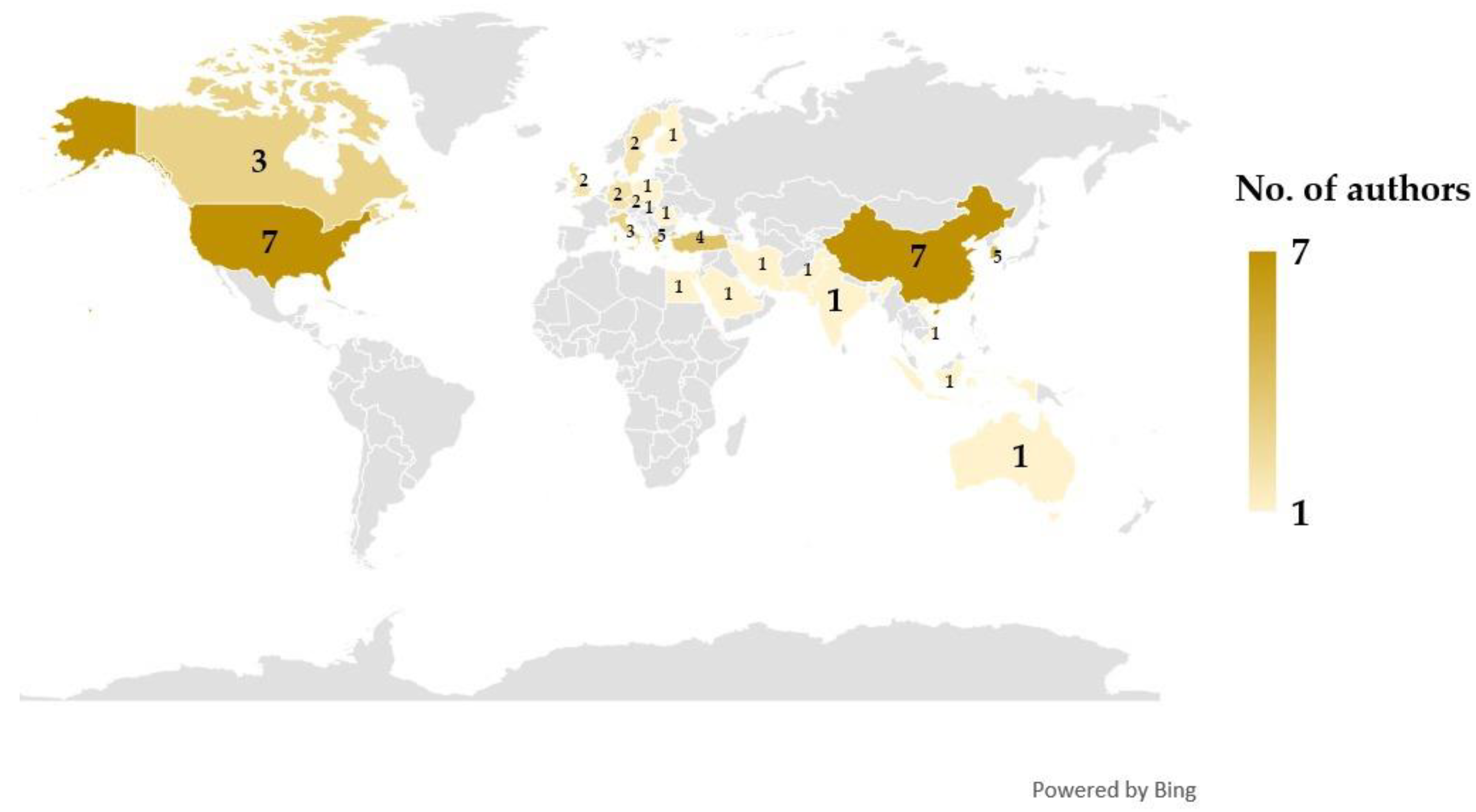
With regard to the geographical distribution of scientific output, the Miller map (Figure 13) highlights a concentration of authors in specific regions, with a more pronounced representation of contributions originating from Asia—particularly China—followed by North America and Europe. This distribution reflects the way in which the analysed literature is geographically structured within the selected corpus and indicates the regions in which research on advanced predictive models in cryptocurrency markets is more frequently represented.
Despite the accelerated progress, the literature also signals consistent methodological limitations. Some studies remain focused almost exclusively on statistical metrics, without rigorously integrating trading realism (fees, slippage, liquidity); this gap can lead to “optimistic” results that do not transfer to real-world applications. That is why recent directions are moving towards integrated frameworks, where predictions are validated through backtesting and are directly connected to trading rules and risk control mechanisms [104,105]. A relevant example is a methodology that combines ML, text analysis, and DL to develop a trading recommendation algorithm, which yields high returns even after accounting for trading fees. This strengthens the argument for the need for economic validation [106].
Overall, the literature on cryptocurrency market prediction and modelling reflects a clear transformation: from forecasting as an end in itself to forecasting as a component in an automated decision-making ecosystem. The dominance of RL in the co-occurrence network confirms that predicting market developments is closely linked to optimising trading strategies and portfolio management. This convergence justifies the central role of AI in revolutionising crypto trading.

5. Technology Readiness Level Assessment

The technological maturity analysis, based on the 555 papers included in the dataset, highlights significant differences between clusters in the degree of development and operationalisation of AI-based solutions for cryptocurrency trading. The TRL intervals allocated to different clusters not only illustrate the predominant maturity levels but also reflect internal fluctuations in contributions, thereby showing the progression from concept and experimental validation to solution application in a real environment.
Thus, the TRL range (min–max) for each cluster was established by identifying the lower and upper bounds of technological maturity, using the type of contribution and the reported level of validation as criteria. The lower part of the range comprises systematic literature review (SLR)-type papers, surveys, and models, mainly developed at a theoretical level or validated in controlled environments and thus not fully integrated into an operational system. The upper part of the range comprises contributions that describe the development of functional prototypes, the integration of systems, the application of tools (toolkits/dashboards), real-time applications, or architectures that manifest a high readiness level for practical use.
These ranges are supported by empirical evidence and exemplified in Table 2. It provides tangible examples of articles that can be linked to the lower and upper ends of the TRL range for each cluster. Those examples serve as evidence of the internal heterogeneity of each cluster and the gradual nature of the field’s maturation, which is moving from model-centric contributions towards system and implementation-oriented research.
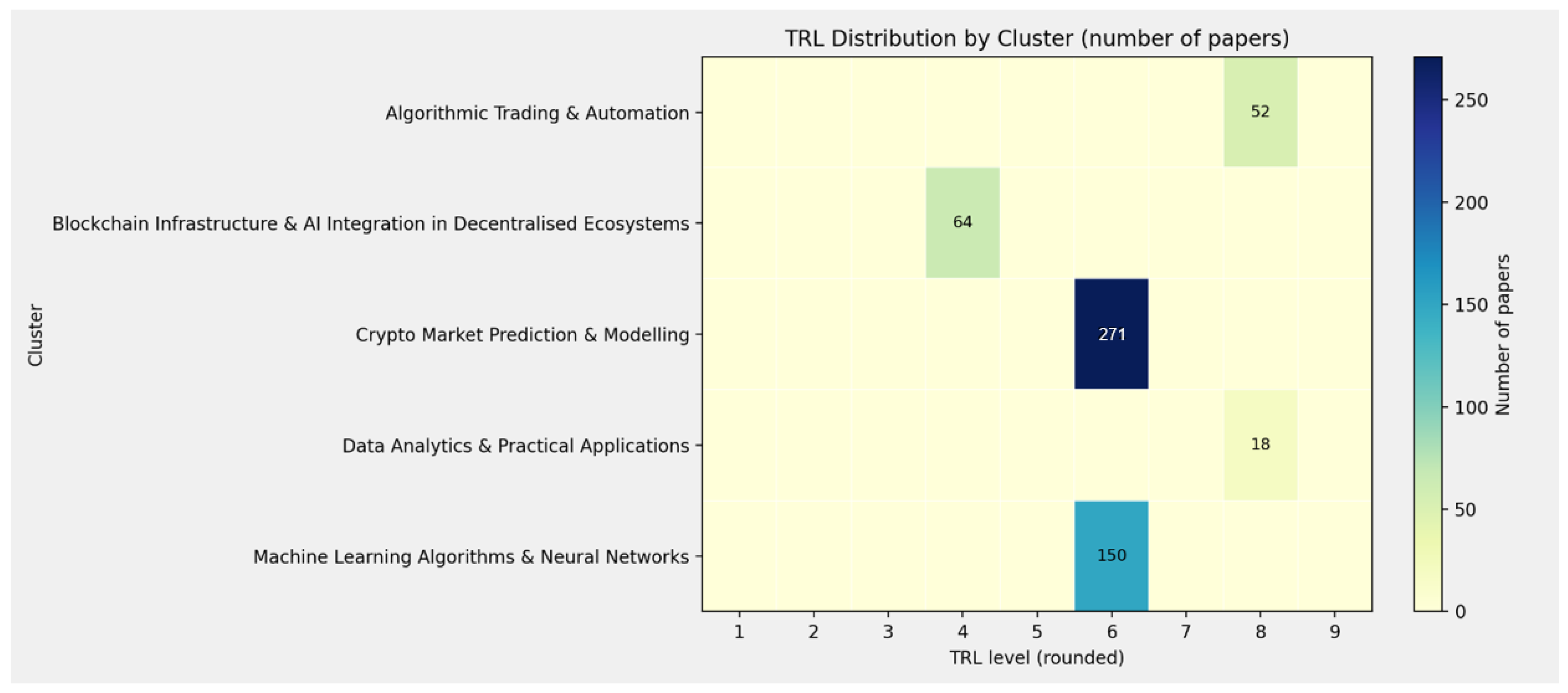
The assessment of TRL (Figure 14) conducted in EViews reveals that the literature on the application of AI in cryptocurrency trading exhibits an uneven maturity profile, distributed across clusters, with a dominant presence of works in the TRL 6–8 range. Such a spread indicates that the area has gone mainly beyond the conceptual stages (TRL 1–3) and moved towards solutions that have been experimentally validated. This validation is typically done by backtesting, market simulations, and the creation of functional prototypes.
At the cluster level, the TRL highlights an explicit ranking of the AI field for cryptocurrency trading, based on how closely the contributions align with implementation and practical use in real-world settings. By presenting the median TRL and the range (minimum–maximum) for each cluster, the research reflects not only the maturity level that is most prevalent but also the degree of internal variation within works in the same thematic area. This comparative structure is summarised in Table 3, allowing the delimitation between clusters with high maturity, characterised by operational systems and applicable tools, clusters in an intermediate stage of consolidation, dominated by model-oriented research and validated mainly through backtesting, as well as emerging clusters, in which the integration of AI remains limited by technical and security constraints specific to decentralised infrastructures.
Overall, the TRL evaluation of the AI field in cryptocurrency trading reveals that the domain is mature, with clusters that are system- and application-oriented (automated trading and data analytics), with maturity often reaching TRL 8–9. On the other hand, the blockchain–AI cluster is depicted as an emerging area (TRL 3–6), indicating that one of the primary forthcoming directions is the robust on-chain implementation. Moreover, the prediction model and neural network clusters are at medium to high levels of maturity; however, generalisation and reproducibility challenges still limit them, emphasising the need to shift from model-centric to system-centric research.

6. Comparative Discussion Across Clusters: Convergences, Contradictions, and Limitations of the Existing Literature

While the five thematic clusters identified through the bibliometric mapping provide a structured overview of the main research streams at the intersection of AI and cryptocurrency trading, a more explicit comparative perspective reveals several overarching patterns, methodological inconsistencies, and unresolved limitations across the field.
A first major distinction emerges between research primarily oriented toward predictive modeling (Cluster 5: Prediction and Market Development Modelling) and work focused on execution-oriented automation (Cluster 1: Algorithmic Trading and Automation). Forecasting-driven studies remain quantitatively dominant in the corpus, frequently proposing advanced ML architectures for price prediction under controlled offline experimental settings. However, despite strong statistical performance metrics, a persistent limitation lies in the incomplete translation of predictive accuracy into actionable trading utility. Many contributions to predictive clustering evaluation models evaluate solely on historical datasets, without incorporating realistic market frictions such as transaction costs, liquidity constraints, bid–ask spreads, or execution latency. Consequently, an implicit contradiction arises: although prediction is often framed as the core objective, the operational relevance of these models for real trading decision-making is not always substantiated. In contrast, automation-focused research more directly addresses trading feasibility through backtesting frameworks, portfolio allocation mechanisms, and RL agents optimised for dynamic execution. Yet, this cluster often relies on stylised assumptions and narrowly tuned strategies, raising concerns about generalisability across shifting crypto market regimes.
A second cross-cluster tension concerns methodological sophistication versus robustness. Cluster 3 (Machine Learning Algorithms and Neural Networks) emphasizes increasingly complex DL architectures, including LSTM variants, attention-based models, and hybrid neural frameworks. While such approaches are frequently presented as superior for capturing nonlinear crypto dynamics, the literature remains divided on the extent to which complexity translates into stable performance. Several studies highlight the vulnerability of deep models to overfitting, regime dependency, and reproducibility challenges, particularly in environments characterised by extreme volatility and structural breaks. Thus, the field exhibits an unresolved methodological contradiction: the pursuit of higher predictive capacity often comes at the expense of interpretability, robustness, and consistent out-of-sample reliability.
Cluster 2 (Blockchain Infrastructure and AI Integration in Decentralised Ecosystems) further exposes a gap between conceptual innovation and technological maturity. This research stream is characterised by architectural proposals for embedding AI into DeFi, smart contracts, and blockchain-enabled execution systems. Although these contributions signal an important frontier for the future of autonomous trading ecosystems, much of the literature remains at proof-of-concept or prototype stages. Practical implementation is constrained by persistent challenges related to scalability, security vulnerabilities, governance constraints, and interoperability across decentralised infrastructures. As such, this cluster illustrates an imbalance between visionary integration frameworks and the limited availability of operational deployments within the current state of research.
In contrast, Cluster 4 (Data Analytics and Practical Applicability) is among the most operationally mature research directions, despite its smaller volume. Contributions in this stream emphasise scalable data pipelines, feature engineering, sentiment analytics, and on-chain indicators directly usable within applied trading environments. The comparatively high TRL levels associated with this cluster reflect stronger industry alignment with data-centric research. Nonetheless, even within this cluster, evaluation practices remain heterogeneous, and standardisation of benchmarks across datasets and exchanges is still lacking.
Taken together, the comparative analysis of clusters reveals a broader maturity imbalance in the AI-driven cryptocurrency trading literature. The field is currently characterised by a substantial methodological expansion—particularly in forecasting and DL—yet a more limited progression toward reproducible, integrated, and operationally validated trading infrastructures. High-maturity domains (Clusters 1 and 4) are less represented in volume, whereas the dominant predictive literature (Cluster 5) often remains constrained to intermediate readiness levels, reinforcing the gap between academic experimentation and real-world implementation.
In addition, several overarching limitations persist across clusters, including heavy reliance on historical data, inconsistent treatment of transaction realism, limited transparency in reporting, and the absence of unified evaluation standards for deployment readiness. Addressing these challenges will require future research to move beyond isolated algorithmic improvements toward robust, standardised, and auditable AI trading systems capable of operating reliably under the distinctive complexities of cryptocurrency markets.

7. Conclusions

Finally, this study has a significant impact on three main levels: academic, professional, and social, offering an integrated perspective of how AI is reconfiguring digital asset trading.
At the academic level, this study contributes to the specialised literature in several fundamental directions. First, it aims to systematise knowledge, using the PRISMA protocol and bibliometric analysis. The sources highlight five primary research directions, ranging from blockchain infrastructure to predictive modelling, which facilitate an understanding of the interdependencies between these technologies.
Furthermore, based on the bibliometric study of the specialised literature, the conclusions highlight the profound transformation of cryptocurrency trading under the influence of AI. The results highlight a clear transition from traditional statistical methods to autonomous decision-making systems capable of processing massive volumes of data for portfolio optimisation. AI has evolved beyond being just a forecasting tool, becoming the core of integrated portfolio management ecosystems that can process massive volumes of data that the human mind cannot handle.
The originality of this study lies in the classification of the technological maturity of AI solutions, allowing researchers to identify which areas are purely theoretical and which are ready for implementation. Thus, to provide an overview of the implementation stage of these technologies, this study proposes integrating the results into a map of technological maturity levels. The TRL assessment reveals an uneven maturity profile between the different sub-domains of research. High maturity is evident in areas such as algorithmic trading and automation, data analysis, and practical applications, offering solutions that are close to the operational or commercial stage. The average maturity is achieved through machine learning algorithms and market evolution modelling, which are currently undergoing rigorous experimental validation (backtesting) but still face challenges related to reproducibility. The youngest field, in the emerging maturity phase, is the integration of AI into blockchain infrastructure, which is limited by scalability, security, and on-chain execution costs.
A geographical concentration of research in China and the US is also highlighted, indicating an asymmetry in the global innovation capacity. This asymmetry underscores the need for international collaboration to democratise access to FinTech innovations across regions such as Europe, Africa, and South America.
At the professional level, for financial and technology practitioners, this study offers applied perspectives such as portfolio optimisation and algorithmic trading. Sources indicate that the use of DRL algorithms enables dynamic strategies that outperform passive “Buy and Hold” methods.
Cybersecurity professionals can also implement systems to prevent money laundering and use GNN to detect phishing attempts. Furthermore, risk can be reduced by alternative data, such as the integration of sentiment analysis (from social networks), which increases the accuracy of forecasts from approximately 50% to over 80%, giving traders a significant competitive advantage. This study highlights the need for explainable AI, which is essential for experts to audit and understand algorithms’ decisions in volatile markets.
At the societal level, this study addresses themes in security and the democratisation of finance, such as protecting users by developing better fraud-detection systems and combating pump-and-dump schemes. In the context of Web 3.0, integrating AI enables a decentralised approach, where users become the owners and managers of their own financial data, leading to the democratisation of data and increased trust in ecosystems. This reduces the “black box” nature of algorithms and increases individual investors’ trust in automated systems, facilitating the sustainable adoption of digital assets.
However, sources suggest that a clear regulatory framework must accompany technological progress to ensure the responsible use of these powerful tools.
Although AI’s potential is vast, a dissonance exists between academic theory and practical performance. Therefore, remaining research challenges include the need for explainable AI to eliminate the “black box” nature of complex models and increase investor confidence. Another challenge may be related to the stability of algorithms under extreme market stress.

Author Contributions

Conceptualisation, G.-I.L. and C.L.; methodology, G.-I.L. and C.L.; software, G.-I.L. and C.L.; validation, G.-I.L. and C.L.; formal analysis, G.-I.L. and C.L.; investigation, G.-I.L. and C.L.; resources, G.-I.L. and C.L.; data curation, G.-I.L. and C.L.; writing—original draft preparation, G.-I.L. and C.L.; writing—review and editing, G.-I.L. and C.L.; visualisation, G.-I.L. and C.L.; supervision, O.-C.B.; project administration, G.-I.L., O.-C.B. and C.L.; funding acquisition, G.-I.L., O.-C.B. and C.L. All authors have read and agreed to the published version of the manuscript.

Funding

The APC was funded by the West University of Timisoara, Romania.

Data Availability Statement

The data presented in this study are available on the Web of Science Core Collection or upon request from the corresponding author.

Conflicts of Interest

The authors declare no conflicts of interest.

Abbreviations

The following abbreviations are used in this manuscript:
AIArtificial Intelligence
ANNArtificial Neural Network
ARIMAAutoregressive Integrated Moving Average
ATRAverage True Range
BC-CCCCognitive Cloud Computing and Blockchain-Based Systems
BELFALBlockchain-based Ensemble Learning Framework for Anti-Money Laundering
BFTByzantine Fault Tolerance
BNBNative token of Binance
BTBlockchain Technology
CEEMDANComplete Ensemble Empirical Mode Decomposition with Adaptive Noise
CNNConvolutional Neural Network
CNN-RNNConvolutional and Recurrent Neural Network
CVaRConditional Value at Risk
DBMDeep Boltz Machine
DDQNDouble Deep Q-Network
DeFiDecentralised Finance
DLDeep Learning
DRLDeep Reinforcement Learning
FIDR-SCANFeature-Interpolation-based Dimension Reduction Scan
FinBERTFinancial Bidirectional Encoder Representations from Transformers
FinTechFinancial Technology
GARCHGeneralised Autoregressive Conditional Heteroskedasticity
GNNGraph Neural Network
GRUGated Recurrent Unit
HFTHigh-Frequency Trading
IoTInternet of Things
IPFSInterPlanetary File System
LLM Large Language Model
LSTMLong Short-Term Memory
MACDMoving Average Convergence Divergence
MLMachine Learning
MLPMulti-Layer Perceptron
NLPNatural Language Processing
PIMProject Information Model
PPOProximal Policy Optimisation
PRISMAPreferred Reporting Items for Systematic Reviews and Meta-Analyses
RAGRetrieval-Augmented Generation
RLReinforcement Learning
RNNRecurrent Neural Network
RSIRelative Strength Index
SHAPShapley Additive Explanations
SLRSystematic Literature Review
SVMSupport Vector Machine
TRLTechnology Readiness Level
UAEUnited Arab Emirates
USAUnited States of America
V&VVerification and Validation
WoSWeb of Science
XAIExplainable AI
XGBoostExtreme Gradient Boosting
XRPNative token of Ripple

Appendix A. Replicable Protocol for Coding TRL in the Literature on AI Applied to Cryptocurrency Trading

Technology Readiness Levels are widely employed in engineering and applied sciences to evaluate the maturity of a technology as it progresses from initial conceptualisation to full operational deployment. Within the context of academic research, however, the meaningful application of TRLs requires clearly defined operational criteria and a transparent, reproducible coding procedure.
Accordingly, the TRL framework was adapted to the domain of AI-driven cryptocurrency trading research in order to systematically differentiate between contributions that remain primarily experimental or proof-of-concept in nature and those that exhibit a higher degree of technological maturity, approaching practical implementability in real-world trading environments.
Table A1 presents the operational definitions employed in this study to adapt the TRL framework to the context of AI-assisted cryptocurrency trading
Table A1. TRL coding rubric for AI applications in cryptocurrency trading.
TRL LevelOperational Definition in the Context of AI-Driven Cryptocurrency Trading
TRL 1–2Conceptual or theoretical contributions without empirical validation (general frameworks, proposed architectures).
TRL 3Proof-of-concept demonstrated using limited data or preliminary scenarios.
TRL 4Prototype tested offline on historical cryptocurrency price series or experimental datasets.
TRL 5Rigorous predictive validation through standard metrics and benchmark comparisons (e.g., RMSE, MAPE, baseline models).
TRL 6Extended validation: robustness across multiple market regimes and multimodal integration (e.g., sentiment, on-chain data).
TRL 7Trading-oriented evaluation: realistic backtesting incorporating transaction fees, portfolio constraints, and risk management mechanisms.
TRL 8Near-operational simulation: real-time testing or integration via exchange APIs.
TRL 9Fully operational implementation in real trading systems or functional DeFi applications.
Source: adapted by the authors.
In order to strengthen the transparency and reproducibility of the classification procedure, the coding was grounded in observable indicators extracted from article titles and abstracts. Such indicators reflect the extent of implementation, validation, and practical integration claimed by the respective authors.
Table A2. Decision indicators for TRL level assignment.
Observable Indicator in Title/AbstractTRL Interpretation
“conceptual framework”, “architecture”, “proposal”TRL 1–3
“prototype”, “proof-of-concept”, “simulation study”TRL 3–4
“benchmark”, “RMSE/MAPE”, “forecasting accuracy”TRL 5
“robustness”, “multi-regime”, “on-chain + sentiment integration”TRL 6
“backtesting”, “transaction costs”, “risk management”TRL 7
“real-time trading”, “exchange API testing”TRL 8
“deployment”, “operational system”, “DeFi implementation”TRL 9
Source: adapted by the authors.
The subsequent stage involved assigning TRL ranges according to the following standardised rules:
  • Identification of the study’s dominant function (e.g., prediction, automated execution, or blockchain integration);
  • Coding based on the most advanced methodological element explicitly reported (for example, backtesting including transaction costs → TRL ≥ 7);
  • Assignment of the score at the cluster level, in order to reflect the overall maturity of the thematic research direction;
  • Definition of cluster TRL intervals as follows:
    • TRL 3–6: emerging integration and conceptual prototyping;
    • TRL 5–7: robust academic validation with partial implementation;
    • TRL 7–9: proximity to operational applications and automated execution.
To mitigate the potential subjectivity inherent in classifications based solely on titles and abstracts, TRL coding was conducted by two independent evaluators (two of the three authors), both of whom were trained in accordance with the standardized guidelines outlined above. The coding procedure followed these steps:
1.
Initial training on a pilot sample using the rubrics presented in Table A1 and Table A2.
2.
Independent coding. Each evaluator assigned TRL levels separately, without mutual consultation.
3.
Assessment of inter-rater agreement. Consistency between evaluators was quantified using Cohen’s κ (kappa) coefficient, which is widely applied to evaluate the reliability of qualitative coding procedures.
Note: In the present study, inter-rater agreement was high (κ = 0.82), indicating excellent reliability of the TRL coding and supporting the methodological robustness of the proposed approach.
4.
Resolution of disagreements. In cases of discrepancy between evaluators, disagreements were resolved through:
  • Discussion between evaluators to clarify the rubric criteria;
  • Consultation of the full-text methodological sections in ambiguous cases;
  • Establishment of a final TRL value through consensus;
  • Consultation with the third author when consensus could not be reached.
Additionally, the replicable coding protocol included a step based on the identification of anchor documents. These anchor documents were selected from the analysed corpus to explicitly illustrate the lower and upper boundaries of the TRL ranges assigned to each cluster, in accordance with the criteria specified in Table A3.
Table A3. Cluster-specific anchor documents for TRL range justification.
Cluster (TRL Range)TRL BoundaryAnchor Document DescriptionJustification
(Chain of Evidence)
Cluster 1. Algorithmic trading and automation (TRL 7–9)Lower bound (≈TRL 7)Studies reporting automated trading strategies validated through realistic backtesting, including transaction fees and portfolio constraints.Corresponds to TRL 7 as it reflects the transition from offline forecasting to decision-making under realistic trading conditions.
Upper bound (≈TRL 9)Studies describing the integration of reinforcement learning agents into near-operational execution systems or deployable trading bots.Indicates TRL 8–9 due to the proximity to deployment within real trading infrastructures.
Cluster 2. Blockchain infrastructure and AI integration in decentralized ecosystems (TRL 3–6)Lower bound (≈TRL 3)Works proposing AI–blockchain architectural frameworks without extensive testing, remaining at the conceptual or preliminary simulation stage.Anchors TRL 3, characteristic of early-stage emerging prototypes.
Upper bound (≈TRL 6)Studies demonstrating AI mechanisms integrated into smart contracts or pilot DeFi applications, without full operational implementation.Reflects TRL 5–6 through extended validation, but incomplete infrastructure integration.
Cluster 3. Machine learning algorithms and neural networks (TRL 5–8)Lower bound (≈TRL 5)Articles employing LSTM/GRU/CNN models for cryptocurrency price forecasting, validated through RMSE/MAPE metrics and baseline comparisons.Corresponds to TRL 5, representing rigorous academic predictive benchmarking.
Upper bound (≈TRL 8)Studies combining deep learning with execution-oriented backtesting or API integration within exchange platforms.Justifies TRL 7–8 due to proximity to real-time trading integration.
Cluster 4. Data analytics and practical applicability (TRL 7–9)Lower bound (≈TRL 7)Studies developing feature engineering systems and on-chain analytics directly applicable to prediction and trading pipelines.Reflects TRL 7 due to practical applicability and integration into scalable workflows.
Upper bound (≈TRL 9)Works describing robust big-data analytics implementations embedded in automated decision-making systems.Justifies TRL 8–9 through alignment with industrial deployment and production-ready infrastructures.
Cluster 5. Prediction and modeling of crypto market developments (TRL 5–7)Lower bound (≈TRL 5)Articles developing deep learning–based predictive models validated through standard forecasting metrics.Corresponds to TRL 5, characteristic of robust offline academic forecasting.
Upper bound (≈TRL 7)Studies extending forecasting toward backtesting and portfolio management, without full live deployment.Justifies the upper bound TRL 7 through integration of prediction into trading decision frameworks.
Source: adapted by the authors.

References

  1. Mudassir, M.; Bennbaia, S.; Unal, D.; Hammoudeh, M. Time-Series Forecasting of Bitcoin Prices Using High-Dimensional Features: A Machine Learning Approach. Neural Comput. Appl. 2025, 37, 22979–22993. [Google Scholar] [CrossRef]
  2. Jayawardhana, A.; Colombage, S. Will the Cryptocurrency Exuberance Last? An Empirical Assessment Using AI and the ARDL Approach. Borsa Istanb. Rev. 2025, 25, 568–586. [Google Scholar] [CrossRef]
  3. Hamayel, M.J.J.; Owda, A.Y. A Novel Cryptocurrency Price Prediction Model Using GRU, LSTM and Bi-LSTM Machine Learning Algorithms. AI 2021, 2, 477–496. [Google Scholar] [CrossRef]
  4. Celik, P.; Sefer, E. Analyzing Transaction Graphs via Motif-Based Graph Representation Learning for Cryptocurrency Price Prediction. Comput. Econ. 2025, 1–22. [Google Scholar] [CrossRef]
  5. Chaudhary, D.; Saroj, S.K. Cryptocurrency Price Prediction Using Supervised Machine Learning Algorithms. ADCAIJ Adv. Distrib. Comput. Artif. Intell. J. 2023, 12, e31490. [Google Scholar] [CrossRef]
  6. Enco, L.; Mederos, A.; Paipay, A.; Pizarro, D.; Marecos, H.; Ticona, W. Cryptocurrency Investments Forecasting Model Using Deep Learning Algorithms. In Computer Science On-line Conference; Springer Nature: Cham, Switzerland, 2024; Volume 1120, pp. 202–217. [Google Scholar] [CrossRef]
  7. Bouteska, A.; Abedin, M.Z.; Hajek, P.; Yuan, K. Cryptocurrency Price Forecasting—A Comparative Analysis of Ensemble Learning and Deep Learning Methods. Int. Rev. Financ. Anal. 2024, 92, 103055. [Google Scholar] [CrossRef]
  8. Gao, Z.; He, Y.; Kuruoglu, E.E. A Hybrid Model Integrating Lstm and Garch for Bitcoin Price Prediction. In Proceedings of the 2021 IEEE 31st International Workshop on Machine Learning for Signal Processing (MLSP), Gold Coast, Australia, 25–28 October 2021. [Google Scholar] [CrossRef]
  9. Khedr, A.M.; Arif, I.; Raj, P.P.V.; El-Bannany, M.; Alhashmi, S.M.; Sreedharan, M. Cryptocurrency Price Prediction Using Traditional Statistical and Machine-Learning Techniques: A Survey. Intell. Syst. Account. Financ. Manag. 2021, 28, 3–34. [Google Scholar] [CrossRef]
  10. Demirci, E.; Karaatli, M. Prediction of Cryptocurrency Prices with Lstm and Gru Models. J. Mehmet Akif Ersoy Univ. Econ. Adm. Sci. Fac. 2023, 10, 134–157. [Google Scholar] [CrossRef]
  11. Dutta, A.; Kumar, S.; Basu, M. A Gated Recurrent Unit Approach to Bitcoin Price Prediction. J. Risk Financ. Manag. 2020, 13, 23. [Google Scholar] [CrossRef]
  12. Fior, J.; Cagliero, L.; Garza, P. Leveraging Explainable AI to Support Cryptocurrency Investors. Future Internet 2022, 14, 251. [Google Scholar] [CrossRef]
  13. El Mahjouby, M.; Bennani, M.T.; Lamrini, M.; Bossoufi, B.; Alghamdi, T.A.H.; El Far, M. Predicting Market Performance Using Machine and Deep Learning Techniques. IEEE Access 2024, 12, 82033–82040. [Google Scholar] [CrossRef]
  14. Jakubik, J.; Nazemi, A.; Geyer-Schulz, A.; Fabozzi, F.J. Incorporating Financial News for Forecasting Bitcoin Prices Based on Long Short-Term Memory Networks. Quant. Financ. 2023, 23, 335–349. [Google Scholar] [CrossRef]
  15. Passalis, N.; Seficha, S.; Tsantekidis, A.; Tefas, A. Learning Sentiment-Aware Trading Strategies for Bitcoin Leveraging Deep Learning-Based Financial News Analysis. In International Conference on Artificial Intelligence Applications and Innovations; Springer Nature: Cham, Switzerland, 2021; Volume 627, pp. 757–766. [Google Scholar] [CrossRef]
  16. Omole, O.; Enke, D. Using Machine and Deep Learning Models, on-Chain Data, and Technical Analysis for Predicting Bitcoin Price Direction and Magnitude. Eng. Appl. Artif. Intell. 2025, 154, 111086. [Google Scholar] [CrossRef]
  17. Raza, M.R.; Varol, A. Digital Currency Price Analysis Via Deep Forecasting Approaches for Business Risk Mitigation. In Proceedings of the 2nd International Informatics and Software Engineering Conference (IISEC), Ankara, Turkey, 16–17 December 2021. [Google Scholar] [CrossRef]
  18. Cohen, G.; Aiche, A. Predicting the Bitcoin’s Price Using AI. Front. Artif. Telligence 2025, 8, 1519805. [Google Scholar] [CrossRef]
  19. Felizardo, L.K.; Lima Paiva, F.C.; de Vita Graves, C.; Matsumoto, E.Y.; Reali Costa, A.H.; Del-Moral-Hernandez, E.; Brandimarte, P. Outperforming Algorithmic Trading Reinforcement Learning Systems: A Supervised Approach to the Cryptocurrency Market. Expert Syst. Appl. 2022, 202, 117259. [Google Scholar] [CrossRef]
  20. Kim, G.; Shin, D.-H.; Choi, J.G.; Lim, S. A Deep Learning-Based Cryptocurrency Price Prediction Model That Uses On-Chain Data. IEEE Access 2022, 10, 56232–56248. [Google Scholar] [CrossRef]
  21. Wang, H.; Rajakumar, V.S.; Golec, M.; Gill, S.S.; Uhlig, S. StockAICloud: AI-Based Sustainable and Scalable Stock Price Prediction Framework Using Serverless Cloud Computing. J. Supercomput. 2025, 81, 527. [Google Scholar] [CrossRef]
  22. Boukhers, Z.; Bouabdellah, A.; Yang, C.; Juerjens, J. Beyond Trading Data: The Hidden Influence of Public Awareness and Interest on Cryptocurrency Volatility. In Proceedings of the 32nd ACM International Conference on Information and Knowledge Management, CIKM, Birmingham, UK, 21–25 October 2023; Volume 2023, pp. 142–151. [Google Scholar] [CrossRef]
  23. Zanc, R.; Cioara, T.; Anghel, I. Forecasting Financial Markets Using Deep Learning. In Proceedings of the 2019 IEEE 15th International Conference on in Telligent Computer Communication and Processing (ICCP 2019), Cluj-Napoca, Romania, 5–7 September 2019; pp. 459–466. [Google Scholar] [CrossRef]
  24. Shintate, T.; Pichl, L. Trend Prediction Classification for High Frequency Bitcoin Time Series with Deep Learning. J. Risk Financ. Manag. 2019, 12, 17. [Google Scholar] [CrossRef]
  25. Zhang, W.; Tao, K.; Li, J.; Zhu, Y.; Li, J. Modeling and Prediction of Stock Price with Convolutional Neural Network Based on Blockchain Interactive Information. Wirel. Commun. Mob. Comput. 2020, 2020, 6686181. [Google Scholar] [CrossRef]
  26. Mankins, J.C. Technology Readiness Assessments: A Retrospective. Acta Astronaut. 2009, 65, 1216–1223. [Google Scholar] [CrossRef]
  27. Yfanti, S.; Sakkas, N. Technology Readiness Levels (TRLs) in the Era of Co-Creation. Appl. Syst. Innov. 2024, 7, 32. [Google Scholar] [CrossRef]
  28. van Eck, N.J.; Waltman, L. VOSviewer Manual; Universiteit Leiden: Leiden, The Netherlands, 2023. [Google Scholar]
  29. Kliestik, T.; Dragomir, R.; Baluta, A.V.; Grecu, I.; Durana, P.; Karabolevski, O.L.; Kral, P.; Balica, R.; Suler, P.; Busu, O.V.; et al. Enterprise Generative Artificial Intelligence Technologies, Internet of Things and Blockchain-Based Fintech Management, and Digital Twin Industrial Metaverse in the Cognitive Algorithmic Economy. Oeconomia Copernic. 2024, 15, 1183–1221. [Google Scholar] [CrossRef]
  30. Yang, Q.; Zhao, Y.; Huang, H.; Xiong, Z.; Kang, J.; Zheng, Z. Fusing Blockchain and AI With Metaverse: A Survey. IEEE Open J. Comput. Soc. 2022, 3, 122–136. [Google Scholar] [CrossRef]
  31. Zhang, H.; Zang, Z.; Muthu, B. Knowledge-Based Systems for Blockchain-Based Cognitive Cloud Computing Model for Security Purposes. Int. J. Model. Simul. Sci. Comput. 2022, 13, 2241002. [Google Scholar] [CrossRef]
  32. Xu, Y.; Shao, J.; Liu, J.; Shen, Y.; Taleb, T.; Shiratori, N. BWKA: A Blockchain-Based Wide-Area Knowledge Acquisition Ecosystem. IEEE Trans. Dependable Secur. Comput. 2024, 21, 5617–5634. [Google Scholar] [CrossRef]
  33. Ahn, J.; Yi, E.; Kim, M. Blockchain Consensus Mechanisms: A Bibliometric Analysis (2014-2024) Using VOSviewer and R Bibliometrix. Information 2024, 15, 644. [Google Scholar] [CrossRef]
  34. Sun, R.; Jiang, Z.; Su, J. A Deep Residual Shrinkage Neural Network-Based Deep Reinforcement Learning Strategy in Financial Portfolio Management. In Proceedings of the 2021 IEEE 6th International Conference on Big Data Analytics (ICBDA 2021), Xiamen, China, 5–8 March 2021; pp. 76–86. [Google Scholar] [CrossRef]
  35. Fan, H.; Fan, X.; Wei, W.; Hao, T.; Chen, K.; Wang, G.; Xu, W. Privacy Preserving Ultra-Short-Term Prediction in Clustered Wind Farms with Encrypted Data Sharing: A Secure Multi-Party Computation Approach. Expert Syst. Appl. 2025, 278, 127218. [Google Scholar] [CrossRef]
  36. Serrano, W.; Barnett, J. Verification and Validation for a Project Information Model Based on a Blockchain. In Proceedings of the Seventh International Congress on Information and Communication Technology, ICICT 2022, VOL. 2, London, UK, 21–24 February 2023; Volume 448, pp. 219–233. [Google Scholar] [CrossRef]
  37. Qian, C.; Mathur, N.; Zakaria, N.H.; Arora, R.; Gupta, V.; Ali, M. Understanding Public Opinions on Social Media for Financial Sentiment Analysis Using AI-Based Techniques. Inf. Process. Manag. 2022, 59, 103098. [Google Scholar] [CrossRef]
  38. Sundarasen, S.; Saleem, F. From Tweets to Trades: A Bibliometric and Systematic Review of Social Media’s Influence on Cryptocurrency. Int. J. Financ. Stud. 2025, 13, 87. [Google Scholar] [CrossRef]
  39. Xu, M.; Ren, X.; Niyato, D.; Kang, J.; Qiu, C.; Xiong, Z.; Wang, X.; Leung, V.C.M. When Quantum Information Technologies Meet Blockchain in Web 3.0. IEEE Netw. 2024, 38, 255–263. [Google Scholar] [CrossRef]
  40. Camino, R.D.; State, R.; Montero, L.; Valtchev, P. Finding Suspicious Activities in Financial Transactions and Distributed Ledgers. In 2017 IEEE International Conference on Data Mining Workshops (ICDMW); IEEE: New Orleans, LA, USA, 2017; pp. 787–796. [Google Scholar] [CrossRef]
  41. Kayani, U.N. Exploring Prospects of Blockchain and Fintech: Using SLR Approach. J. Sci. Technol. Policy Manag. 2025, 16, 5–41. [Google Scholar] [CrossRef]
  42. Li, Z.; Yao, R.; Yang, D.; Zhang, Y.; Mao, H.; Yuan, Y. BELFAL: A Blockchain-Based Ensemble Learning Framework for Anti-Money Laundering in Crypto-Currency Markets. In Proceedings of the 2024 IEEE 30th International Conference on Parallel and Distributed Systems (ICPADS), Belgrade, Serbia, 10–14 October 2024; IEEE: New York, NY, USA, 2024; pp. 520–527. [Google Scholar] [CrossRef]
  43. Li, M.; Jiang, D.; Xu, S.; Liu, Y.; Gao, X.; Guo, S.; Qi, F. A Multi-Factor Real-Time Monitoring Mechanism for the “Mining” Behavior of Blockchain Networks. In Proceedings of the 2024 IEEE International Symposium on Broadband Multimedia Systems and Broadcasting (BMSB), Toronto, ON, Canada, 19–21 June 2024; IEEE: New York, NY, USA, 2024; pp. 1–6. [Google Scholar] [CrossRef]
  44. Agarwal, U.; Rishiwal, V.; Tanwar, S.; Yadav, M. Blockchain and Crypto Forensics: Investigating Crypto Frauds. Int. J. Netw. Manag. 2024, 34, e2255. [Google Scholar] [CrossRef]
  45. Tubaishat, A.; Aljouhi, M.; Maramara, A. Unveiling Challenges and Solutions with Intelligence in the Dark and Deep Web. In Intelligent and Fuzzy Systems, Infus 2024 Conference, Vol 1; Springer Nature: Cham, Switzerland, 2024; Volume 1088, pp. 372–380. [Google Scholar] [CrossRef]
  46. Li, S.; Gou, G.; Liu, C.; Hou, C.; Li, Z.; Xiong, G. TTAGN: Temporal Transaction Aggregation Graph Network for Ethereum Phishing Scams Detection. In Proceedings of the ACM Web Conference 2022, Virtual, 25–29 April 2022; ACM: Lyon, France, 2022; pp. 661–669. [Google Scholar] [CrossRef]
  47. Wang, R.; Zhang, Z.; Wang, Y.; Zhang, Y. Minimal Substitution-Based Label Propagation for Anomalous Blockchain Detection. In Proceedings of the 2023 19th International Conference on Mobility, Sensing and Networking (MSN), Nanjing, China, 14–16 December 2023; IEEE: New York, NY, USA, 2023; pp. 685–692. [Google Scholar] [CrossRef]
  48. Chen, Z.; Huang, J.; Liu, S.; Long, H. Multiscale Feature Fusion and Graph Convolutional Network for Detecting Ethereum Phishing Scams. Electronics 2024, 13, 1012. [Google Scholar] [CrossRef]
  49. Almeida, J.; Gonçalves, T.C. A Systematic Literature Review of Volatility and Risk Management on Cryptocurrency Investment: A Methodological Point of View. Risks 2022, 10, 107. [Google Scholar] [CrossRef]
  50. Nghiem, H.; Muric, G.; Morstatter, F.; Ferrara, E. Detecting Cryptocurrency Pump-and-Dump Frauds Using Market and Social Signals. Expert Syst. Appl. 2021, 182, 115284. [Google Scholar] [CrossRef]
  51. Alam, T. Blockchain-Based Internet of Things: Review, Current Trends, Applications, and Future Challenges. Computers 2022, 12, 6. [Google Scholar] [CrossRef]
  52. Dammak, W.; Gokgoz, H.; Jeribi, A. Analysis of Gold, Bitcoin, and Gold-Backed Cryptocurrencies as Safe Havens during Global Crises: A Focus on Artificial Intelligence Companies. Comput. Econ. 2025, 66, 2843–2872. [Google Scholar] [CrossRef]
  53. Song, G.; Zhao, T.; Ma, X.; Lin, P.; Cui, C. Reinforcement Learning-Based Portfolio Optimization with Deterministic State Transition. Inf. Sci. 2025, 690, 121538. [Google Scholar] [CrossRef]
  54. Chamma, E.; Mcgee, A.; Gillmann, A.; McNallan, I.; Mahmoud, M. Feasible applications of quantum computing in varying fields. In Proceedings of the 2023 International Conference on Computational Science and Computational Intelligence, CSCI, Las Vegas, NV, USA, 13–15 December 2023; Volume 2023, pp. 454–459. [Google Scholar] [CrossRef]
  55. Claudiu, B.; Cosmin, E.; Otniel, D.; Andrei, A. Enhancing the Financial Sector with Quantum Computing: A Comprehensive Review of Current and Future Applications. In International Conference on Informatics in Economy; Springer Nature: Cham, Switzerland, 2024; Volume 367, pp. 195–203. [Google Scholar] [CrossRef]
  56. Bu, S.-J.; Cho, S.-B. Learning Optimal Q-Function Using Deep Boltzmann Machine for Reliable Trading of Cryptocurrency. In International Conference on Intelligent Data Engineering and Automated Learning; Springer Nature: Cham, Switzerland, 2018; Volume 11314, pp. 468–480. [Google Scholar] [CrossRef]
  57. Weng, L.; Sun, X.; Xia, M.; Liu, J.; Xu, Y. Portfolio Trading System of Digital Currencies: A Deep Reinforcement Learning with Multidimensional Attention Gating Mechanism. Neurocomputing 2020, 402, 171–182. [Google Scholar] [CrossRef]
  58. Lo, A.W.; Meng, X.-L.; Vittert, L. From Financial Markets to ChatGPT: A Conversation With Andrew Lo. Harv. Data Sci. Rev. 2023, 5, 1–15. [Google Scholar] [CrossRef]
  59. Yousaf, I.; Youssef, M.; Goodell, J.W. Tail Connectedness between Artificial Intelligence Tokens, Artificial Intelligence ETFs, and Traditional Asset Classes. J. Int. Financ. Mark. Inst. Money 2024, 91, 101929. [Google Scholar] [CrossRef]
  60. Zhang, J.; Zhou, C.; Cai, W. Decentralization Funded by Centralization: Understanding Crypto Joint-Investment Network. In Proceedings of the 17th ACM Web Science Conference 2025, New Brunswick, NJ, USA, 20–24 May 2025; ACM: Gosford, Australia, 2025; pp. 86–95. [Google Scholar] [CrossRef]
  61. Habek, G.C.; Tocoglu, M.A.; Onan, A. Bi-Directional CNN-RNN Architecture with Group-Wise Enhancement and Attention Mechanisms for Cryptocurrency Sentiment Analysis. Appl. Artif. Intell. 2022, 36, 2145641. [Google Scholar] [CrossRef]
  62. Hajaghaie, A.; Thulasiram, R.K. Leveraging Large Language Models and Retrieval-Augmented Generation for Enhanced Multi-Asset Portfolio Construction. In Proceedings of the 2025 IEEE Symposium on Computational Intelligence for Financial Engineering and Economics (CiFer), Trondheim, Norway, 17–20 March 2025. [Google Scholar] [CrossRef]
  63. Baek, S.; Song, M.; Kang, M. Textual Mining, Investment Sentiment, and Bitcoin Anomalies. J. Investig. 2025, 34, 49–67. [Google Scholar] [CrossRef]
  64. Livieris, I.E.; Pintelas, E.; Stavroyiannis, S.; Pintelas, P. Ensemble Deep Learning Models for Forecasting Cryptocurrency Time-Series. Algorithms 2020, 13, 121. [Google Scholar] [CrossRef]
  65. Shen, Y.; Qi, Z.; Martinez, F.; Rahouti, M.; Hsu, D.F.; Oliveira, D. Comparative Analysis of Machine Learning and Traditional Forecasting Methods in Bitcoin Price Prediction. In Proceedings of the 2024 6th International Conference on Blockchain Computing and Applications, BCCA, Dubai, United Arab Emirates, 26–29 November 2024; pp. 8–15. [Google Scholar] [CrossRef]
  66. Goutte, S.; Le, H.-V.; Liu, F.; von Mettenheim, H.-J. Deep Learning and Technical Analysis in Cryptocurrency Market. Financ. Res. Lett. 2023, 54, 103809. [Google Scholar] [CrossRef]
  67. Yao, J.; Li, Z.; Cui, T.; Xi, H. Quantitative Investment Trading Model Based on Model Recognition Strategy with Deep Learning Method. Wirel. Commun. Mob. Comput. 2022, 2022, 8856215. [Google Scholar] [CrossRef]
  68. Tang, X.; Song, Y.; Jiao, X.; Sun, Y. On Forecasting Realized Volatility for Bitcoin Based on Deep Learning PSO–GRU Model. Comput. Econ. 2024, 63, 2011–2033. [Google Scholar] [CrossRef]
  69. Wang, H.; Zhou, X. Less Is More: Bitcoin Volatility Forecast Using Feature Selection and Deep Learning Models. In Proceedings of the 2022 IEEE 20th International Conference on Industrial Informatics (INDIN), Perth, Australia, 25–28 July 2022; IEEE: New York, NY, USA, 2022; pp. 681–688. [Google Scholar] [CrossRef]
  70. Ortu, M.; Uras, N.; Conversano, C.; Bartolucci, S.; Destefanis, G. On Technical Trading and Social Media Indicators for Cryptocurrency Price Classification through Deep Learning. Expert Syst. Appl. 2022, 198, 116804. [Google Scholar] [CrossRef]
  71. Ben Hamadou, F.; Mezghani, T.; Zouari, R.; Boujelbene-Abbes, M. Forecasting Bitcoin Returns Using Machine Learning Algorithms: Impact of Investor Sentiment. Euromed J. Bus. 2025, 20, 179–200. [Google Scholar] [CrossRef]
  72. Chen, W.; Zheng, H. Cryptocurrency Price Prediction and Portfolio Optimization Based on LSTM and Multi-Task Neural Network. Quant. Financ. Econ. 2025, 9, 658–681. [Google Scholar] [CrossRef]
  73. Gu, F.; Jiang, Z.; Su, J. Application of Features and Neural Network to Enhance the Performance of Deep Reinforcement Learning in Portfolio Management. In Proceedings of the 2021 IEEE 6th International Conference on Big Data Analytics (ICBDA), Xiamen, China, 5–8 March 2021; IEEE: New York, NY, USA, 2021; pp. 92–97. [Google Scholar] [CrossRef]
  74. Li, L. Investigating Risk Assessment in Post-Pandemic Household Cryptocurrency Investments: An Explainable Machine Learning Approach. J. Asset. Manag. 2023, 24, 255–267. [Google Scholar] [CrossRef]
  75. Carbo, J.M.; Gorjon, S. Determinants of the Price of Bitcoin: An Analysis with Machine Learning and Interpretability Techniques. Int. Rev. Econ. Financ. 2024, 92, 123–140. [Google Scholar] [CrossRef]
  76. Jagric, T.; Luetic, D.; Mumel, D.; Herman, A. Detecting Potential Investors in Crypto Assets: Insights from Machine Learning Models and Explainable AI. Information 2025, 16, 269. [Google Scholar] [CrossRef]
  77. Park, S.; Yang, J.-S. Machine Learning Models Based on Bubble Analysis for Bitcoin Market Crash Prediction. Eng. Appl. Artif. Intell. 2024, 135, 108857. [Google Scholar] [CrossRef]
  78. Ozdemir, A.; Bogosyan, S. Neural Network Based Trading Signal Generation in Cypto-Currency Markets. In Proceedings of the 2018 International Conference on Artificial Intelligence and Data Processing (IDAP), Malatya, Turkey, 28–30 September 2018. [Google Scholar]
  79. Cohen, G. Intraday Algorithmic Trading Strategies for Cryptocurrencies. Rev. Quant. Finan. Acc. 2023, 61, 395–409. [Google Scholar] [CrossRef]
  80. Cohen, G. Trading Cryptocurrencies Using Algorithmic Average True Range Systems. J. Forecast. 2023, 42, 212–222. [Google Scholar] [CrossRef]
  81. Wei, M.; Sermpinis, G.; Stasinakis, C. Forecasting and Trading Bitcoin with Machine Learning Techniques and a Hybrid Volatility/Sentiment Leverage. J. Forecast. 2023, 42, 852–871. [Google Scholar] [CrossRef]
  82. Ha, L.T. Gauging the Dynamic Interlinkage among Robotics, Artificial Intelligence, and Green Crypto Investment: A Quantile VAR Approach. Borsa Istanb. Rev. 2024, 24, 22–31. [Google Scholar] [CrossRef]
  83. Liu, F.; Li, Y.; Li, B.; Li, J.; Xie, H. Bitcoin Transaction Strategy Construction Based on Deep Reinforcement Learning. Appl. Soft Comput. 2021, 113, 107952. [Google Scholar] [CrossRef]
  84. Ghadiri, H.; Hajizadeh, E. Designing a Cryptocurrency Trading System with Deep Reinforcement Learning Utilizing LSTM Neural Networks and XGBoost Feature Selection. Appl. Soft Comput. 2025, 175, 113029. [Google Scholar] [CrossRef]
  85. Moustakidis, V.; Passalis, N.; Tefas, A. Online Probabilistic Knowledge Distillation on Cryptocurrency Trading Using Deep Reinforcement Learning. Pattern Recognit. Lett. 2024, 186, 243–249. [Google Scholar] [CrossRef]
  86. Petukhina, A.A.; Reule, R.C.G.; Haerdle, W.K. Rise of the Machines? Intraday High-Frequency Trading Patterns of Cryptocurrencies. Eur. J. Financ. 2021, 27, 8–30. [Google Scholar] [CrossRef]
  87. Vo, A.; Yost-Bremm, C. A High-Frequency Algorithmic Trading Strategy for Cryptocurrency. J. Comput. Inf. Syst. 2020, 60, 555–568. [Google Scholar] [CrossRef]
  88. Zong, C.; Wang, C.; Qin, M.; Feng, L.; Wang, X.; An, B. MacroHFT: Memory Augmented Context-Aware Reinforcement Learning On High Frequency Trading. In Proceedings of the 30th ACM SIGKDD Conference on Knowledge Discovery and Data Mining, Barcelona, Spain, 25–29 August 2024; Volume 2024, pp. 4712–4721. [Google Scholar] [CrossRef]
  89. Han, H.; Yi-Lin Forrest, J.; Wang, J.; Yuan, S.; Han, F.; Li, D. Explainable Machine Learning for High Frequency Trading Dynamics Discovery. Inf. Sci. 2024, 684, 121286. [Google Scholar] [CrossRef]
  90. Care, R.; Cumming, D. Technology and Automation in Financial Trading: A Bibliometric Review. Res. Int. Bus. Financ. 2024, 71, 102471. [Google Scholar] [CrossRef]
  91. Das, S.R. The Future of Fintech. Financ. Manag. 2019, 48, 981–1007. [Google Scholar] [CrossRef]
  92. Rodrigues, F.; Machado, M. High-Frequency Cryptocurrency Price Forecasting Using Machine Learning Models: A Comparative Study. Information 2025, 16, 300. [Google Scholar] [CrossRef]
  93. Cui, T.; Ding, S.; Jin, H.; Zhang, Y. Portfolio Constructions in Cryptocurrency Market: A CVaR-Based Deep Reinforcement Learning Approach. Econ. Model. 2023, 119, 106078. [Google Scholar] [CrossRef]
  94. Shahbazi, Z.; Byun, Y.-C. Improving the Cryptocurrency Price Prediction Performance Based on Reinforcement Learning. IEEE Access 2021, 9, 162651–162659. [Google Scholar] [CrossRef]
  95. Lua, Z.Z.; Seow, C.K.; Chan, R.C.B.; Cai, Y.; Cao, Q. Automated Bitcoin Trading dApp Using Price Prediction from a Deep Learning Model. Risks 2025, 13, 17. [Google Scholar] [CrossRef]
  96. Zhao, H.; Crane, M.; Bezbradica, M. Attention! Transformer with Sentiment on Cryptocurrencies Price Prediction. In Proceedings of the 7th International Conference on Complexity, Future Information Systems and Risk, Virtual, 23–24 April 2022; pp. 98–104. [Google Scholar] [CrossRef]
  97. Han, B.; Liu, A.; Chen, J.; Knottenbelt, W. Can Machine Learning Models Better Volatility Forecasting? A Combined Method. Eur. J. Financ. 2025, 1–22. [Google Scholar] [CrossRef]
  98. Rathee, N.; Singh, A.; Sharda, T.; Goel, N.; Aggarwal, M.; Dudeja, S. Analysis and Price Prediction of Cryptocurrencies for Historical and Live Data Using Ensemble-Based Neural Networks. Knowl. Inf. Syst. 2023, 65, 4055–4084. [Google Scholar] [CrossRef]
  99. Wang, J.; Feng, K.; Qiao, G. A Hybrid Deep Learning Model for Bitcoin Price Prediction: Data Decomposition and Feature Selection. Appl. Econ. 2024, 56, 6890–6905. [Google Scholar] [CrossRef]
  100. Dikovitsky, V. Short-Term Cryptocurrency Price Forecasting Based on News Headline Analysis. Front. Blockchain 2025, 8, 1627769. [Google Scholar] [CrossRef]
  101. Zubair, M.; Ali, J.; Alhussein, M.; Hassan, S.; Aurangzeb, K.; Umair, M. An Improved Machine Learning-Driven Framework for Cryptocurrencies Price Prediction With Sentimental Cautioning. IEEE Access 2024, 12, 51395–51418. [Google Scholar] [CrossRef]
  102. Girsang, A.S. Hybrid LSTM and GRU for Cryptocurrency Price Forecasting Based on Social Network Sentiment Analysis Using FinBERT. IEEE Access 2023, 11, 120530–120540. [Google Scholar] [CrossRef]
  103. Hwang, Y.; Park, J.; Lee, Y.; Lim, D.-Y. Stop-Loss Adjusted Labels for Machine Learning-Based Trading of Risky Assets. Financ. Res. Lett. 2023, 58, 104285. [Google Scholar] [CrossRef]
  104. Hafid, A.; Ebrahim, M.; Rahouti, M.; Oliveira, D. Cryptocurrency Price Forecasting Using XGBoost Regressor and Technical Indicators. In Proceedings of the 2024 IEEE International Performance, Computing, and Communications Conference, IPCCC, Orlando, FL, USA, 22–24 November 2024; pp. 456–461. [Google Scholar] [CrossRef]
  105. Omole, O.; Enke, D. Deep Learning for Bitcoin Price Direction Prediction: Models and Trading Strategies Empirically Compared. Financ. Innov. 2024, 10, 117. [Google Scholar] [CrossRef]
  106. Belcastro, L.; Carbone, D.; Cosentino, C.; Marozzo, F.; Trunfio, P. Enhancing Cryptocurrency Price Forecasting by Integrating Machine Learning with Social Media and Market Data. Algorithms 2023, 16, 542. [Google Scholar] [CrossRef]
  107. Fang, F.; Ventre, C.; Basios, M.; Kanthan, L.; Martinez-Rego, D.; Wu, F.; Li, L. Cryptocurrency Trading: A Comprehensive Survey. Financ. Innov. 2022, 8, 13. [Google Scholar] [CrossRef]
  108. Knewtson, H.S.; Rosenbaum, Z.A. Toward Understanding FinTech and Its Industry. Manag. Financ. 2020, 46, 1043–1060. [Google Scholar] [CrossRef]
  109. Kochliaridis, V.; Kouloumpris, E.; Vlahavas, I. TraderNet-CR: Cryptocurrency Trading with Deep Reinforcement Learning. In Artificial Intelligence Applications and Innovations; Maglogiannis, I., Iliadis, L., Macintyre, J., Cortez, P., Eds.; Springer International Publishing: Cham, Switzerland, 2022; Volume 646, pp. 304–315. [Google Scholar] [CrossRef]
  110. Liu, J.-C.; Ma, J.-C.; Jiang, Z.-Q. AlphaSeek FinRL: A Hybrid Deep Learning Architecture for High-Frequency Cryptocurrency Trading. In Proceedings of the 2025 IEEE 11th International Conference on Intelligent Data and Security (IDS), New York, NY, USA, 9–11 May 2025; IEEE: New York, NY, USA, 2025; pp. 55–57. [Google Scholar] [CrossRef]
  111. Mahayana, D.; Shan, E.; Fadhl’Abbas, M. Deep Reinforcement Learning to Automate Cryptocurrency Trading. In Proceedings of the 2022 12th International Conference on System Engineering and Technology (ICSET), Bandung, Indonesia, 3–4 October 2022; IEEE: New York, NY, USA, 2022; pp. 36–41. [Google Scholar] [CrossRef]
  112. Raheman, A.; Kolonin, A.; Ansari, I. Adaptive Multi-Strategy Market Making Agent. In Artificial General Intelligence; Goertzel, B., Iklé, M., Potapov, A., Eds.; Springer International Publishing: Cham, Switzerland, 2022; Volume 13154, pp. 204–209. [Google Scholar] [CrossRef]
  113. Zhang, W.; Zhao, L.; Xia, H.; Sun, S.; Sun, J.; Qin, M.; Li, X.; Zhao, Y.; Zhao, Y.; Cai, X.; et al. A Multimodal Foundation Agent for Financial Trading: Tool-Augmented, Diversified, and Generalist. In Proceedings of the 30th ACM SIGKDD Conference on Knowledge Discovery and Data Mining, Barcelona, Spain, 25–29 August 2024; ACM: Gosford, Australia, 2024; pp. 4314–4325. [Google Scholar] [CrossRef]
  114. Amiram, D.; Jørgensen, B.N.; Rabetti, D. Coins for Bombs: The Predictive Ability of On-Chain Transfers for Terrorist Attacks. J. Account. Res. 2022, 60, 427–466. [Google Scholar] [CrossRef]
  115. Tan, R.; Tan, Q.; Zhang, Q.; Zhang, P.; Xie, Y.; Li, Z. Ethereum Fraud Behavior Detection Based on Graph Neural Networks. Computing 2023, 105, 2143–2170. [Google Scholar] [CrossRef]
  116. Zhou, J. Quantum Finance: Exploring the Implications of Quantum Computing on Financial Models. Comput. Econ. 2025, 1–30. [Google Scholar] [CrossRef]
  117. Cocco, L.; Tonelli, R.; Marchesi, M. Predictions of Bitcoin Prices through Machine Learning Based Frameworks. PeerJ Comput. Sci. 2021, 7, e413. [Google Scholar] [CrossRef] [PubMed]
  118. Coelho, E.; Silva, L.; Fonseca, G.D.F.; Castro, P.A.L. Transformers and Attention-Based Networks in Quantitative Trading: A Comprehensive Survey. In Proceedings of the 5th ACM International Conference on AI in Finance, Brooklyn, NY, USA, 14–17 November 2024; ACM: Gosford, Australia, 2024; pp. 822–830. [Google Scholar] [CrossRef]
  119. Jafari, S.M.; Dinarvand, S.; Zand, M.; Hwang, Y.; Hwang, E. Identification and Prioritization of Artificial Intelligence Applications in FinTech. J. Econ. Stud. 2025, 1–18. [Google Scholar] [CrossRef]
  120. Lahmiri, S.; Bekiros, S. Deep Learning Forecasting in Cryptocurrency High-Frequency Trading. Cogn. Comput. 2021, 13, 485–487. [Google Scholar] [CrossRef]
  121. Lim, Y.-S.; Gorse, D. Deep Probabilistic Modelling of Price Movements for High-Frequency Trading. In Proceedings of the 2020 International Joint Conference on Neural Networks (IJCNN), Glasgow, UK, 19–24 July 2020; IEEE: New York, NY, USA, 2020; pp. 1–8. [Google Scholar] [CrossRef]
  122. Suliman, U.; Van Zyl, T.L.; Paskaramoorthy, A. Cryptocurrency Trading Agent Using Deep Reinforcement Learning. In Proceedings of the 2022 9th International Conference on Soft Computing & Machine Intelligence (ISCMI), Toronto, ON, Canada, 26–27 November 2022; IEEE: New York, NY, USA, 2022; pp. 6–10. [Google Scholar] [CrossRef]
  123. Zhao, L.; Mollica, V.; Shen, Y.; Liang, Q. Liquidity, Informational Efficiency and Firm Default Risk: A Systematic Literature Review. J. Account. Lit. 2024, 46, 321–342. [Google Scholar] [CrossRef]
  124. Ahmad, I.; Ahmad, M.O.; Alqarni, M.A.; Almazroi, A.A.; Khalil, M.I.K. Using Algorithmic Trading to Analyze Short Term Profitability of Bitcoin. PeerJ Comput. Sci. 2021, 7, e337. [Google Scholar] [CrossRef] [PubMed]
  125. De Rosa, P.; Felber, P.; Schiavoni, V. CryptoAnalytics: Cryptocoins Price Forecasting with Machine Learning Techniques. SoftwareX 2024, 26, 101663. [Google Scholar] [CrossRef]
  126. Lorenzo, L.; Arroyo, J. Online Risk-Based Portfolio Allocation on Subsets of Crypto Assets Applying a Prototype-Based Clustering Algorithm. Financ. Innov. 2023, 9, 25. [Google Scholar] [CrossRef]
  127. Nazareth, N.; Ramana Reddy, Y.V. Financial Applications of Machine Learning: A Literature Review. Expert Syst. Appl. 2023, 219, 119640. [Google Scholar] [CrossRef]
  128. Rajaei, M.J.; Mahmoud, Q.H. A Survey on Pump and Dump Detection in the Cryptocurrency Market Using Machine Learning. Future Internet 2023, 15, 267. [Google Scholar] [CrossRef]
  129. Saâdaoui, F.; Rabbouch, H. Structured Multifractal Scaling of the Principal Cryptocurrencies: Examination Using a Self-explainable Machine Learning. J. Forecast. 2024, 43, 2917–2934. [Google Scholar] [CrossRef]
  130. Chavan, S.; Gundakaram, J.; Dyuti Vaishnavi, S.; Prasad, S.; Deepa, K. Real-Time Data Extraction and Prediction of Cryptocurrency. IEEE Access 2024, 12, 186703–186709. [Google Scholar] [CrossRef]
  131. Parente, M.; Rizzuti, L.; Trerotola, M. A Profitable Trading Algorithm for Cryptocurrencies Using a Neural Network Model. Expert Syst. Appl. 2024, 238, 121806. [Google Scholar] [CrossRef]
Figure 1. Flowchart of the systematic selection of studies from WoS in the analysed field. Source: processed by the authors. * Key terms: (“artificial intelligence” OR “AI” OR “machine learning” OR “deep learning” OR “neural network*” OR “algorithmic trading” OR “intelligent system*”) AND (“cryptocurrenc*” OR “crypto*” OR “bitcoin” OR “ethereum” OR “digital currenc*” OR “virtual currenc*” OR “block-chain-based currenc*”) AND (“trading” OR “investment” OR “market analysis” OR “financial pre-diction” OR “price forecasting” OR “automated trading” OR “portfolio management”).
Electronics 15 00742 g001
Figure 2. PRISMA keyword selection flow from WoS. Source: processed by the authors.
Electronics 15 00742 g002
Figure 3. Keyword co-occurrence cluster. Source: processed by the authors with VOSviewer.
Electronics 15 00742 g003
Figure 4. Miller’s map of countries: authors addressing theme one. Source: processed by the authors with MS Excel.
Electronics 15 00742 g004
Figure 5. Keyword co-occurrence cluster one. Source: processed by the authors with VOSviewer.
Electronics 15 00742 g005
Figure 6. Keyword co-occurrence cluster two. Source: processed by the authors with VOSviewer.
Electronics 15 00742 g006
Figure 7. Miller’s map of countries: authors addressing theme two. Source: processed by the authors with MS Excel.
Electronics 15 00742 g007
Figure 8. Keyword co-occurrence cluster three. Source: processed by the authors with VOSviewer.
Electronics 15 00742 g008
Figure 9. Miller’s map of countries: authors addressing theme three. Source: processed by the authors with MS Excel.
Electronics 15 00742 g009
Figure 10. Keyword co-occurrence cluster four. Source: processed by the authors with VOSviewer.
Electronics 15 00742 g010
Figure 11. Miller’s map of countries: authors addressing theme four. Source: processed by the authors with MS Excel.
Electronics 15 00742 g011
Figure 12. Keyword co-occurrence cluster five. Source: processed by the authors with VOSviewer.
Electronics 15 00742 g012
Figure 13. Miller’s map of countries: authors addressing theme five. Source: processed by the authors with MS Excel.
Electronics 15 00742 g013
Figure 14. Assessment of Technology Readiness Levels. Source: processed by the authors in Eviews 10.
Electronics 15 00742 g014
Table 1. Keyword clusters with more than six items on the AI impact on cryptocurrency.
ClustersKey TermsOccurrencesTotal Link StrengthMain Topic
Cluster 1 red
(14 items)
anomaly detection1027Blockchain infrastructure and AI integration in decentralised ecosystems
artificial intelligence60132
blockchain78204
cryptography722
feature selection1542
finance925
fraud detection724
graph neural network1023
investment942
IoT1017
quantum computing615
risk management828
security619
smart contracts1331
Cluster 2 green
(12 items)
ARIMA825Data analysis and practical applicability in crypto markets
artificial neural network59157
bitcoin149383
cryptocurrency211526
cryptocurrency market2760
ethereum3278
GRU1562
LSTM49168
machine learning156396
prediction43156
time series forecasting2687
xgboost713
Cluster 3 blue
(11 items)
analytical models641Financial and social data analysis—machine learning algorithms
data models948
deep learning75214
financial trading1231
forecasting40139
market research746
natural language process624
predictive models21117
sentiment analysis35111
social media1966
technical analysis1032
Cluster 4 yellow (10 items)algorithmic trading3477Algorithmic trading and automation
crypto assets816
fintech1841
garch721
high-frequency trading712
random forest721
stock market614
technical indicators918
trading2468
volatility1027
Cluster 5 purple
(3 items)
cryptocurrency trading816Predicting and modelling crypto market developments
portfolio management1629
reinforcement learning3887
Source: processed by the authors from VOSviewer.
Table 2. TRL range justification for thematic clusters.
No.Cluster/
Theme
TRL
Interval
Lower-Bound
Evidence
Upper-Bound
Evidence
Why is This Interval Justified?
1Algorithmic trading &
automation
7–9[53,57,107,108][109,110,111,112,113]The interval is high because the cluster includes both field-shaping surveys/framework contributions supporting automation (TRL ~7) and system-oriented, near-deployable trading architectures, such as multimodal agents and high-frequency trading pipelines (TRL 8–9).
2Blockchain & AI in
decentralised ecosystems
3–6[40,41,47,114][74,115,116]The interval reflects an emerging and heterogeneous domain: the lower bound is driven by conceptual/systematic reviews and early proofs-of-concept (TRL 3–4), while the upper bound is reached by ledger-based detection systems and smart contract architectures validated in relevant environments (TRL 6). Full on-chain deployment remains limited by scalability, security, auditability, and cost constraints.
3Machine
learning &
neural
networks
5–8[11,117,118,119][95,120,121,122]The interval indicates that the cluster spans from offline validated, model-centric ML/DL studies (TRL 5–6) to integrated pipelines and advanced systems (e.g., RL + smart contracts, decision-support architectures, real-time inference), reaching TRL 7–8. Remaining challenges include generalisation, robustness, and reproducibility.
4Data analytics & practical
applications
7–9[58,123][12,124,125,126]The interval is high because the cluster is dominated by applied tools and operational analytics pipelines, ranging from functional prototypes (toolkits, dashboards, analytics systems) at TRL 7 to solutions with near-industrial integration and real-time applicability at TRL 8–9.
5Crypto market prediction & modelling5–7[127,128,129][121,130,131]The interval is moderate: most studies focus on offline forecasting and statistical validation (TRL 5–6), while a smaller subset provides functional prototypes (real-time prediction tools, dApps, live pipelines), justifying TRL 7. Limited evidence of stable production deployment prevents a higher upper bound (TRL 8–9).
Source: processed by the authors.
Table 3. Maturity category of thematic clusters.
Maturity CategoryClusternTRL
Median
TRL Range (Min–Max)
High maturity(1) Algorithmic trading & automation528.07–9
High maturity(4) Data analytics & practical applications188.07–9
Medium-to-high maturity(3) Machine learning algorithms & neural networks1506.55–8
Medium maturity(5) Crypto market prediction & modelling2716.05–7
Emergent consolidation stage(2) Blockchain infrastructure & AI integration in decentralised ecosystems644.53–6
Source: processed by the authors from EViews.
Disclaimer/Publisher’s Note: The statements, opinions and data contained in all publications are solely those of the individual author(s) and contributor(s) and not of MDPI and/or the editor(s). MDPI and/or the editor(s) disclaim responsibility for any injury to people or property resulting from any ideas, methods, instructions or products referred to in the content.