Article

Millimeter-Wave Radar-Based Weak Neonatal Heart Rate Detection Using an Adaptive Subband Variable Step-Size LMS Filtering Algorithm

1
National Key Laboratory of Microwave Imaging, Aerospace Information Research Institute, Chinese Academy of Sciences, Beijing 100190, China
2
School of Electronic, Electrical and Communication Engineering, University of Chinese Academy of Sciences, Beijing 100049, China
3
Department of Pediatrics, Peking University Third Hospital, Beijing 100191, China
4
School of Artificial Intelligence and Computer Science, North China University of Technology, Beijing 100144, China
*
Author to whom correspondence should be addressed.
Electronics 2026, 15(4), 731; https://doi.org/10.3390/electronics15040731
Submission received: 9 January 2026 / Revised: 30 January 2026 / Accepted: 5 February 2026 / Published: 9 February 2026

Abstract

Non-contact measurement plays a crucial role in monitoring the heart rate of preterm and low birth weight infants in the neonatal intensive care unit (NICU). Addressing the challenges of weak heartbeat signals easily overwhelmed by noise in non-contact heart rate detection for these neonates, this paper proposes a millimeter-wave radar-based heart rate detection method using adaptive subband variable step-size least mean square (LMS) filtering. The innovative approach divides the chest echo signal into multiple subbands, employing an error-based variable step-size update strategy in each subband. By utilizing the abdominal signal as a reference, the heartbeat information is enhanced through adaptive filtering, and the results from various subbands are fused. The heart rate estimation is achieved by combining the fused results with time-frequency analysis using wavelet transform. Experimental results on data collected from multiple preterm infants in the NICU demonstrate that the proposed algorithm can reduce the root mean square error (RMSE) of preterm infant heart rate estimation to below 5 Beats Per Minute (BPM), providing a novel solution for the application of millimeter-wave radar in NICU heart rate monitoring.

1. Introduction

The health and survival of neonates are of utmost importance to every family and society as a whole. However, a significant number of neonates worldwide still die during the early stages after birth, particularly in developing countries and underdeveloped regions, where this problem is especially severe. According to the World Health Organization, the number of global neonatal deaths reached a staggering 2.4 million in 2019, with the majority of these deaths occurring within the first 28 days of life [1]. Among these early neonatal deaths, preterm infants and low birth weight infants account for a higher proportion. According to the World Health Organization, preterm infants are defined as those born before 37 weeks of gestation [2], and low birth weight infants are defined as neonates with a birth weight of less than 2500 g. Very low birth weight refers to infants weighing less than 1500 g, while extremely low birth weight refers to those below 1000 g [3].
Preterm infants are more susceptible to severe complications such as respiratory distress syndrome and neonatal sepsis due to their immature organ development and weakened immune system function [4]. Low birth weight infants also face similar health challenges, with their mortality risk being significantly higher than that of normal-weight infants [3].
To reduce neonatal mortality and improve neonatal health outcomes, timely and accurate monitoring of vital signs is crucial, especially for high-risk neonates in the NICU. As one of the key indicators for assessing neonatal physiological status, heart rate can reflect information about multiple aspects, such as cardiac function, autonomic nervous system maturity, and stress response [5]. Abnormal heart rate patterns, such as decreased heart rate variability, are important indicators of potential health risks in newborns. For instance, decreased heart rate variability has been proven to be closely related to the occurrence of sepsis. Monitoring of this parameter can effectively alert to the risk of infection and reduce the associated mortality rate [6]. Through continuous heart rate monitoring, healthcare professionals can promptly detect changes in neonatal conditions and implement appropriate diagnostic and therapeutic measures, such as oxygen therapy, pharmacological treatment, and mechanical ventilation, to improve neonatal outcomes and reduce the risk of mortality and disability [7].
Currently, the most common heart rate monitoring methods in the NICU include electrocardiography (ECG) and pulse oximetry. ECG measures heart rate by recording the electrical activity of the heart and is considered the gold standard for assessing arrhythmias [8]. Pulse oximetry, on the other hand, utilizes photoplethysmography, estimating heart rate by detecting changes in arterial blood oxygen saturation [9]. Although both methods have high accuracy, they are contact-based monitoring techniques that require electrodes or sensors to be directly attached to the delicate skin of neonates, potentially causing complications such as skin irritation and pressure injuries, which can affect neonatal comfort and sleep quality [10]. Moreover, these attached electrodes and sensors restrict the free movement of neonates, increasing the risk of electrode detachment and wire entanglement, thereby causing inconvenience in nursing care [11]. Therefore, developing a non-contact heart rate detection technology suitable for neonates in the NICU is of great significance for improving the prognosis of high-risk neonates, reducing the mortality of preterm and low birth weight infants, and promoting neonatal health development.
In recent years, radar technology has garnered widespread attention in the field of vital sign monitoring due to its advantages of being non-contact, non-invasive, and highly penetrating [12,13]. Millimeter-wave radar, in particular, with its short wavelength and high sensitivity, is capable of detecting the minute mechanical movements of the human heart, thereby enabling remote and continuous heart rate monitoring [14,15]. Numerous studies have demonstrated that millimeter-wave radar achieves favorable results in adult heart rate detection, exhibiting high consistency with ECG [16,17]. Currently, researchers worldwide have conducted extensive studies on heart rate detection using millimeter-wave radar. In the research on utilizing millimeter-wave radar for sensing vital signs, Lin et al. laid the groundwork. They pioneered the development of a dual-antenna CW radar prototype system and confirmed the feasibility of telemetering heart rate and respiratory rate within a distance of 0.5–1.5 m [18]. Subsequently, Droitcour et al. proposed an innovative algorithm based on arctangent demodulation and DC offset compensation to address the issues of I/Q imbalance and signal distortion in quadrature Doppler radar receivers. This algorithm significantly enhanced the robustness of the radar system in practical scenarios [19]. Ling et al. introduced a heartbeat signal extraction algorithm based on adaptive notch filtering (ANF) and empirical wavelet transform (EWT) to suppress respiratory harmonic interference and isolate the heartbeat signal. By employing a heart rate estimation method with weighted harmonic relationships, this algorithm achieved an average absolute error of less than 4 BPM in experiments involving 20 subjects [20]. Wang et al. developed a low-power millimeter-wave radar heartbeat signal reconstruction method based on variational mode decomposition (VMD) and deep learning. By detecting heartbeat patterns using neural networks and integrating historical data for frequency estimation, this method attained an accuracy of 97.5% and supported a maximum monitoring distance of 1.8 m [21].
Millimeter-wave radar heart rate detection has achieved favorable results in adults, but its application in NICU neonatal heart rate monitoring still faces several challenges. First, compared to adults, the cardiac anatomical structure and physiological functions of neonates, especially preterm and low birth weight infants, are not yet fully developed [22]. They have weaker myocardial contractility and smaller stroke volume, resulting in a much smaller cardiac vibration amplitude than adults, which leads to weak radar echo signals and low signal-to-noise ratio. Moreover, due to the high chest wall compliance, horizontal ribs, and diaphragm-dominated breathing in neonates [23], the chest displacement caused by their respiration and heartbeat is much smaller than that of adults, imposing higher requirements on the sensitivity and dynamic range of radar hardware. Second, neonates have a higher heart rate than adults, with a normal range of 100–180 bpm, and exhibit greater heart rate variability. Their time-domain and frequency-domain characteristics differ significantly from those of adults, and the applicability of traditional heart rate extraction algorithms trained on adult data needs to be validated in neonates [24]. Furthermore, neonates who are in incubators for extended periods often experience frequent random body movements (RBM), such as spontaneous limb activity, trunk twisting, and crying. These movements cause phase modulations that are much larger than those caused by cardiac vibrations, creating numerous motion artifacts that severely interfere with the extraction of heart rate signals [25]. In non-contact heart rate monitoring, particularly among populations such as newborns who have difficulty remaining still, traditional frequency-domain analysis methods, like the Fourier transform, struggle to effectively distinguish between the mixed micro-motion signals caused by gross body movements and cardiac pulsations. This leads to a decrease in the accuracy of heart rate detection [26].
To address the aforementioned challenges, researchers worldwide have conducted some exploratory studies, but these are still in the initial stages. Edanami et al. proposed a heart rate peak extraction and adaptive peak detection algorithm based on radar time-series signals. They validated the method’s performance in healthy adults and neonates, demonstrating the potential of radar technology in continuous neonatal vital sign monitoring [27]. However, although this study exhibited some robustness against motion interference, its performance under continuous body movements has not been systematically evaluated. Moreover, the clinical validation sample did not include high-risk groups with weaker signals, such as preterm or low-birth-weight infants in the NICU. Lee et al. utilized impulse radio ultra-wideband radar to perform heart rate variability analysis on term neonates, verifying the feasibility and effectiveness of the radar system for neonatal heart rate monitoring. However, this study was based on a single case and short-term (approximately 4 min) data, did not involve preterm or low birth weight infants, and did not systematically assess its robustness under motion interference. Therefore, its application efficacy in a broader NICU clinical environment requires further validation [28]. Furthermore, Yang et al. addressed the issue of motion interference in neonatal heartbeat detection using millimeter-wave radar by proposing an adaptive motion artifact filtering (AMF) method. This method can attenuate the impact of random body movements on signals and improve the accuracy of heart rate detection, but the algorithm does not consider the weak heartbeat signal problem in preterm infants [29]. Jiang et al. have recently proposed a novel method for separating neonatal chest and abdominal measurements based on radar-vision fusion. By combining camera-guided radar beam localization and utilizing the respiratory frequency information contained in the abdominal signal, respiratory monitoring is achieved. This method effectively improves the signal-to-noise ratio of respiratory frequency measurements and enhances the system’s robustness under clinical motion interference. However, their core contribution lies in the optimization of respiratory signals and motion compensation. Similarly, no specific enhancement detection strategies have been proposed to address the unique challenge of weak heartbeat signals in preterm infants [30]. Anton et al.’s systematic review further pointed out that existing non-contact neonatal heart rate monitoring technologies still face challenges such as random motion interference and low signal-to-noise ratio in clinical applications, highlighting the need for further research on existing technologies in practical applications [31].
Although millimeter-wave radar heart rate detection technology has made significant progress in adults, its application in NICU neonatal heart rate detection still faces numerous challenges, such as low-amplitude cardiac signals. The existing exploratory studies are insufficient and have considerable room for improvement in terms of their effectiveness and robustness in addressing the aforementioned challenges. Moreover, these studies lack the necessary clinical validation.
To overcome the challenge of weak heart rate signals in preterm and low birth weight infants, this paper proposes a novel neonatal heart rate detection method that combines subband processing and variable step-size LMS filtering. The heart rate signals of preterm infants are often extremely weak and easily overwhelmed by respiratory signals, random body movements, and environmental noise. By dividing the signal into subbands, these different interference signals can be separated into different frequency ranges, reducing their impact on the heart rate signal. Subsequently, a variable step-size LMS adaptive filter is applied to enhance the signal in each subband. Unlike the classic LMS algorithm, which uses a fixed step size, the variable step-size LMS algorithm dynamically adjusts the update step size of the filter weight coefficients to adapt to the instantaneous statistical characteristics of the signal, exhibiting stronger adaptability and convergence speed under non-stationary conditions introduced by motion interference. The variable step-size LMS algorithm employed in this paper incorporates an error-based dynamic step-size update formula in the weight coefficient update process, adaptively adjusting the step size to strike a balance between rapid convergence and steady-state error, thereby achieving robust extraction of the weak heart rate signal. Finally, the filtered results from each subband are fused to obtain a heart rate signal with enhanced signal-to-noise ratio. Compared to traditional methods, this algorithm can more accurately and robustly extract the faint heartbeat signals of neonates, providing a new solution for heart rate detection in the NICU.
It should be noted that while subband processing and variable step-size LMS algorithms are individually well-established techniques, the novelty of our approach lies in their problem-specific integration for the detection of weak neonatal heart rates. Moreover, our method innovatively exploits the abdominal signal as a reference for cardiac signal enhancement. Conventional fixed step-size LMS algorithms cannot balance convergence speed and steady-state accuracy under non-stationary conditions. Time-frequency methods such as Continuous Wavelet Transform (CWT) and the AMF algorithm [29] can track time-varying heart rates but are susceptible to errors when the cardiac SNR is very low. Our proposed method addresses these limitations through a two-stage complementary architecture: the VSS-LMS filtering exploits neonatal abdominal breathing characteristics for reference signal selection and serves as a signal enhancement preprocessing stage, while the subsequent CWT-AMF analysis provides robust heart rate extraction from the enhanced signal.
The main contributions of this paper are as follows:
(1)
A novel adaptive subband variable step-size LMS filtering algorithm is proposed for detecting weak heart rates in premature infants, enhancing the accuracy of their heart rate detection;
(2)
The effectiveness of the proposed method is demonstrated through validation on real preterm infant radar data collected in the NICU, providing the possibility for clinical application.
The structure of this paper is organized as follows: Section 2 introduces the basic principles of millimeter-wave radar heart rate detection, analyzes the performance of the traditional adaptive filtering LMS method in detail, and elaborates on the proposed adaptive subband variable step-size LMS filtering algorithm; Section 3 analyzes the performance of the algorithm through experimental results and compares it with other methods; Section 4 summarizes the entire paper and discusses the prospects for future work.

2. Materials and Methods

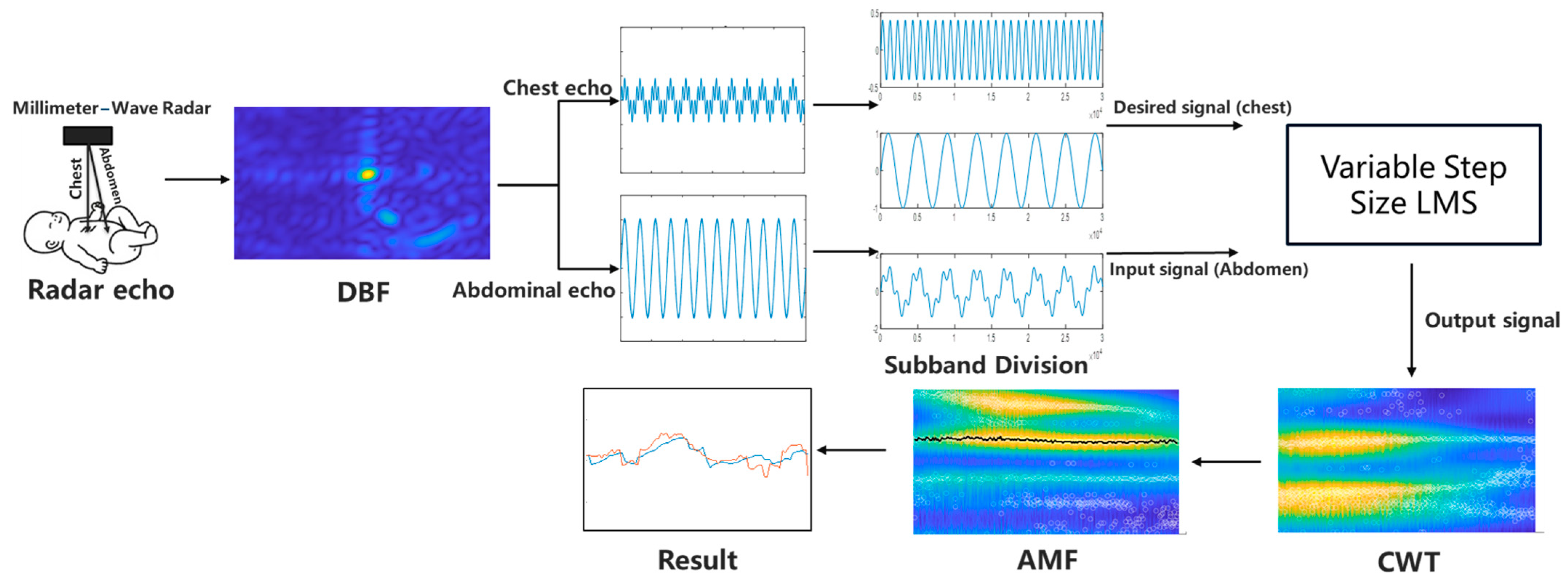
To address the challenge of detecting the relatively weak heartbeat of preterm infants in the NICU, and considering that neonates primarily exhibit abdominal breathing, this paper proposes a novel neonatal heart rate detection method that combines subband processing and variable step-size LMS filtering. The algorithm workflow is illustrated in Figure 1. The radar illuminates the neonate, and the chest and abdomen echo signals are simultaneously acquired through digital beamforming (DBF). Subsequently, the echo signals are divided into subbands using bandpass filters. Next, a step-size update formula based on dynamic error adjustment is designed, and a variable step-size LMS adaptive filter is applied to each subband, using the abdominal signal as the input signal and the chest signal as the desired signal. By adaptively adjusting the filter coefficients, the correlated signals between the chest and abdomen are subtracted, making the filter output more closely resemble the heartbeat signal, thereby enhancing the heartbeat signal. Finally, the filtered results from each subband are fused, and time-frequency analysis is performed using continuous wavelet transform (CWT). The heart rate is then estimated using the adaptive motion artifact filtering (AMF) method [29].

2.1. Principle of Millimeter-Wave Radar Vital Sign Detection

Millimeter-wave radar enables non-contact detection of human vital signs by transmitting high-frequency electromagnetic waves and receiving the target’s reflected echoes. This paper employs a stepped-frequency continuous wave (SFCW) radar. When the radar signal illuminates a human target, the echo signal within the target’s range gate can be expressed as:
B m t = A m e x p j 4 π d 0 λ e x p j 4 π x h t λ e x p j 4 π x r t λ
where A m is the echo amplitude, d 0 is the target distance, λ is the wavelength, and x r t and x h t represent the chest wall displacements caused by respiration and heartbeat, respectively. Since the heartbeat displacement amplitude is much smaller than that of respiration ( x h t x r t ), the demodulated phase signal can be approximated as:
φ t ϕ 0 + 4 π A r λ s i n 2 π f r t + θ r + 4 π A h λ s i n 2 π f h t + θ h
where ϕ 0 is the initial phase, A r and A h are the displacement amplitudes of respiration and heartbeat respectively, f r and f h are their corresponding frequencies, and θ r and θ h are the initial phases. Due to the weak myocardial contractility in preterm infants, the cardiac vibration amplitude A h is much smaller than that of adults, leading to a lower signal-to-noise ratio and making the heartbeat signal easily overwhelmed by noise.
To achieve regional signal extraction from the small body of neonates, a multiple-input multiple-output (MIMO) array radar with digital beamforming (DBF) is employed. The radar system is equipped with M transmit and N receive array elements, forming an MN-element virtual array with improved spatial resolution. Assuming the neonate’s body is located at angle θ relative to the radar, the array steering vector can be constructed as:
ω =   [ 1 , e x p ( j 2 π d s i n θ λ ) e x p ( j 2 π d ( N 1 ) s i n θ λ ) ]
where d is the spacing between adjacent receiving antennas and λ is the wavelength of the transmitted signal. The beamformed output is obtained by multiplying the conjugate transpose of the steering vector with the received signals from the array elements:
S = ω H X = n = 1 N X n e j 2 π ( n     1 ) d λ s i n θ
where X   =   X ( t )   =   [   X 1 ( t ) ,   X 2 ( t ) , , X N ( t ) ] T is the data matrix of the received signals. If a target exists at angle θ , S will exhibit a larger amplitude. By discretizing the azimuth and elevation angles into different θ and φ values and processing according to the above method, a two-dimensional spatial spectrum S θ , φ is obtained [29], representing the angular distribution of scattering intensity within the radar’s field of view.
In practice, the chest region is first identified in the spatial spectrum based on the radar antenna alignment during data acquisition. With the radar positioned 50 cm above the neonate, the angular separation between the chest and abdomen is approximately arctan(10/50) ≈ 11.3°, which exceeds the system’s angular resolution of 6.7°. The abdominal region is then selected by shifting approximately 10° from the chest direction in either azimuth or elevation. Beams are steered toward these identified directions to extract signals with different motion characteristics for subsequent adaptive filtering.
The beamforming process serves two main purposes in this study. First, it enhances the signal-to-noise ratio by coherently combining signals from multiple array elements toward the direction of interest. Second, it provides regional selectivity by steering beams toward different parts of the neonate’s body surface to extract signals with different motion characteristics.

2.2. Low Signal-to-Noise Ratio Problem

In the NICU, preterm and low-birth-weight infants have immature cardiac development and weaker myocardial contractility, resulting in significantly lower heartbeat signal amplitudes compared to adults. According to the radar echo signal model, the phase modulation amplitude ϕ h t induced by the heart is proportional to the cardiac vibration displacement amplitude A h , i.e., ϕ h t = 4 π λ A h s i n 2 π f h t + θ h . Due to the weak myocardial contractility in preterm infants, the cardiac vibration amplitude A h is much smaller than that of adults, leading to a smaller phase modulation amplitude. Consequently, the heart echo signal of preterm infants has a lower signal-to-noise ratio (SNR) and is more easily overwhelmed by noise.
To quantitatively analyze the weakness of the heartbeat signal in preterm infants, the power ratio between the heart echo signal and the interfering noise, i.e., the SNR, can be examined. Assuming the heart echo signal is denoted as s t and the environmental noise is represented by n t , the SNR can be expressed as:
S N R = 10 log 10 P s P n
where P s and P n represent the average power of the heart echo signal and the environmental noise, respectively.
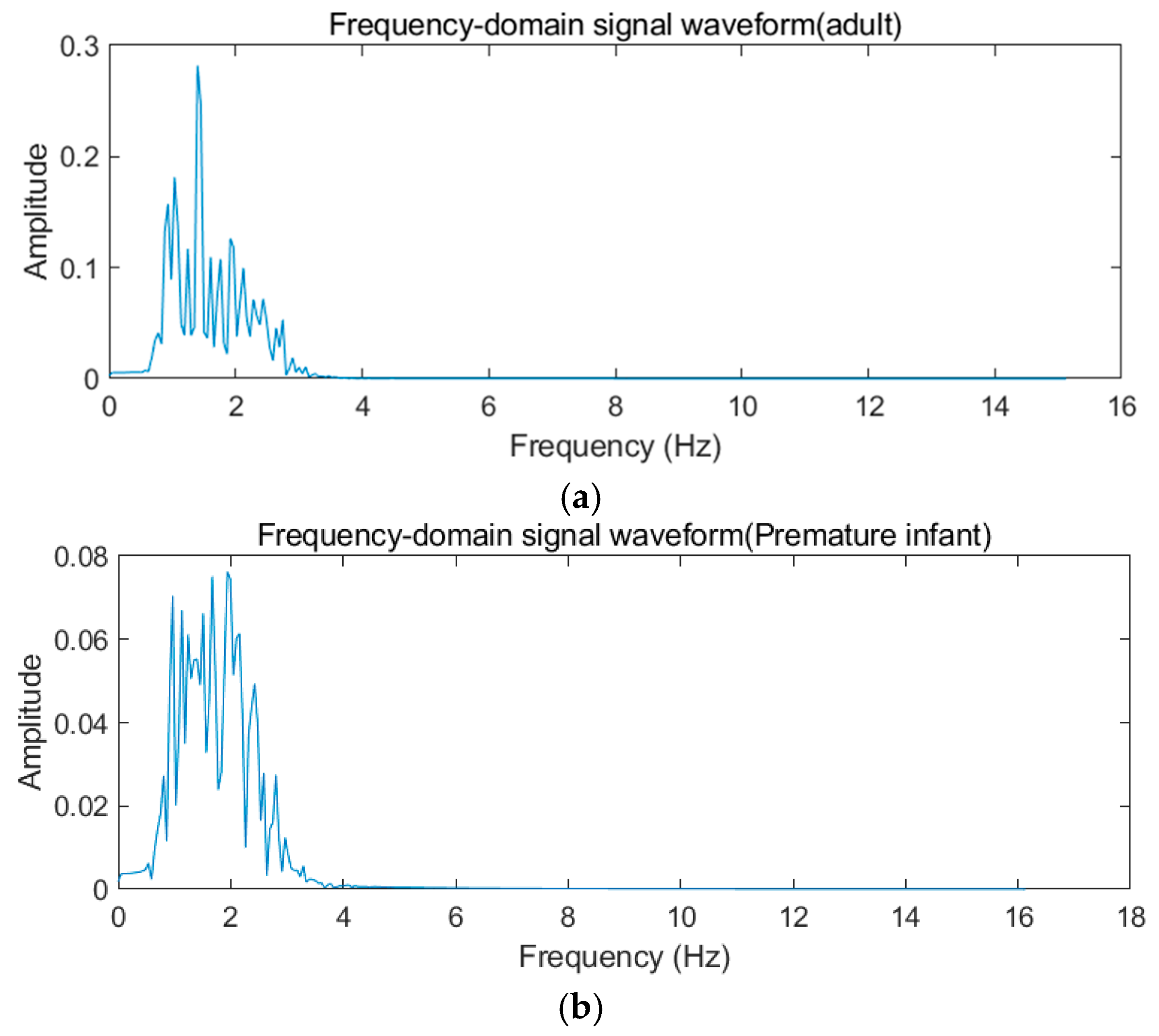
To compare the SNR differences between adult and preterm infant heartbeat signals, we conducted data collection using a millimeter-wave radar on an adult volunteer and a preterm infant, followed by bandpass filtering between 0.8–3.5 Hz. Figure 2 presents the phase spectra of the chest echo signals for both the adult and the preterm infant.
In Figure 2, the true heart rate of the adult is 1.4 Hz, while the true heart rate of the preterm infant is 2.5 Hz. The adult heartbeat signal can be clearly observed as the highest peak in the corresponding spectrum (a), whereas the preterm infant’s heart rate is obscured by noise in spectrum (b). The adult’s heart echo signal exhibits a higher SNR compared to that of the preterm infant. After excluding the respiratory interference and estimating using Equation (5), the SNR of the adult’s heart echo signal is approximately 2 dB, while the preterm infant’s SNR is only around −8 dB. This implies that the preterm infant’s heartbeat signal is nearly overwhelmed by interfering noise, making it challenging to directly extract from the echo signal.
To visually demonstrate the weak heartbeat signal issue in preterm infants, we collected data from newborns with different body weights in the same environment and observed the magnitude of their chest vibration displacements. According to Equation (1), the relationship between the radar phase and the vibration displacement magnitude can be described as:
Δ φ = 4 π λ Δ R
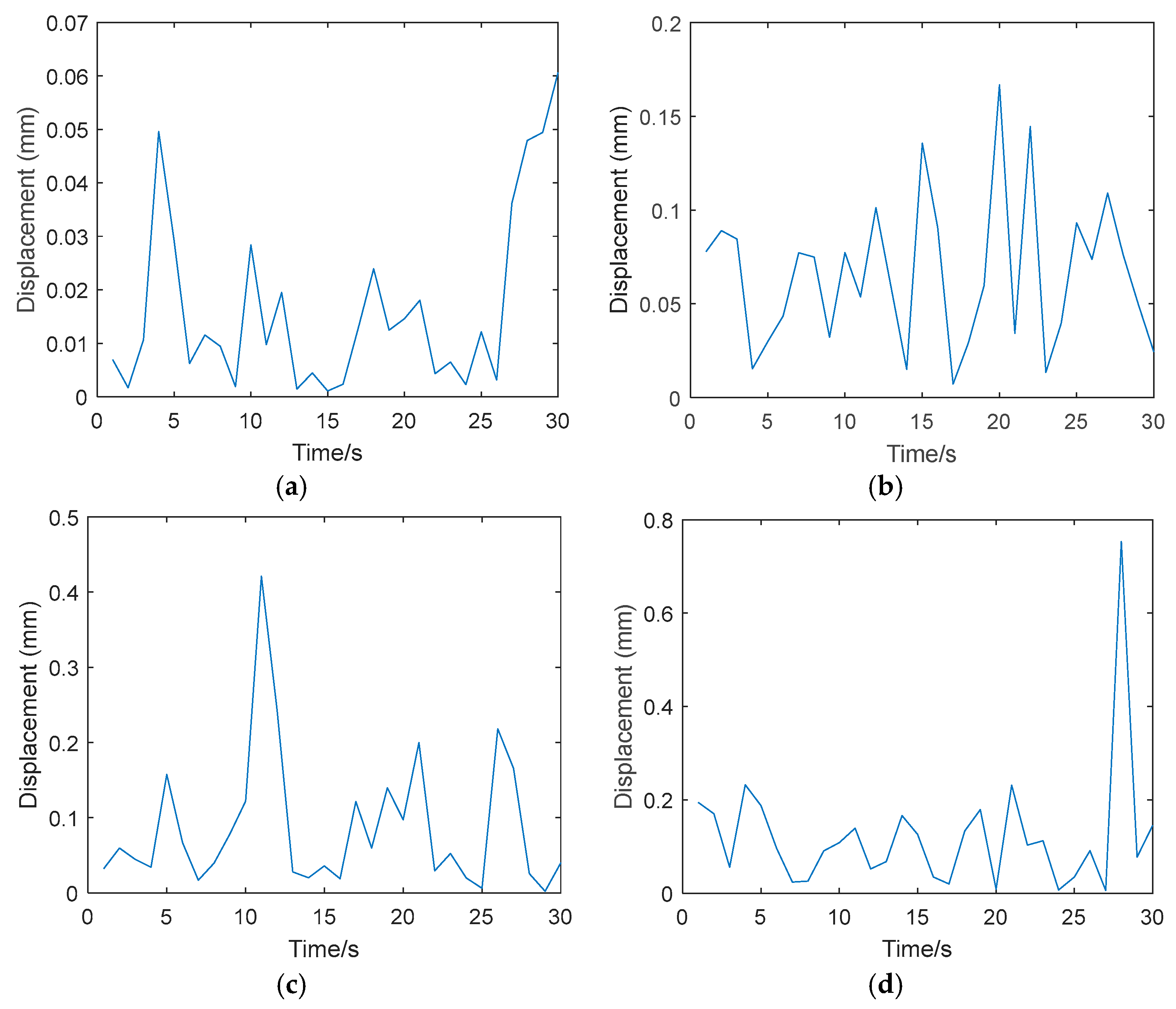
The magnitude of the target’s chest vibration displacement during radar data acquisition can be calculated using Equation (6). Figure 3 illustrates this, where (a), (b), (c), and (d) correspond to newborns with body weights of 1370 g, 1580 g, 1930 g, and 2920 g, respectively. By comparing newborns with different body weights, it can be observed that for newborns in the NICU with very low body weights, the heartbeat vibrations are relatively weak. Particularly when the heartbeat vibration is less than 0.1 mm, the phase signal is easily overwhelmed by noise, making it challenging to accurately and consistently estimate the heart rate. Therefore, it is necessary to further design algorithms to improve the SNR of the heartbeat signal for reliable detection.
By analyzing the factors influencing the heart noise level and conducting experiments on newborns with different body weights, we quantitatively assessed the extent of signal quality degradation in the heartbeat signals of preterm infants. Consequently, the proposed method based on adaptive subband variable step-size LMS filtering is specifically designed to address the challenge of weak heartbeat signals in preterm infants. This approach is expected to achieve robust heart rate estimation under low SNR conditions.

2.3. Adaptive Filtering

Newborns, particularly preterm infants, have weak heartbeat signals that are easily obscured by strong interferences such as respiratory harmonics and body movements, posing challenges to heartbeat signal detection. However, in the chest echo signals received by the radar, the heartbeat signal and various types of noise exhibit a certain degree of overlap in both the time and frequency domains, making it difficult for traditional bandpass filtering methods to effectively separate them. To address these issues, this paper considers employing adaptive filtering techniques to filter the echo signals and subsequently enhance the heartbeat signal.
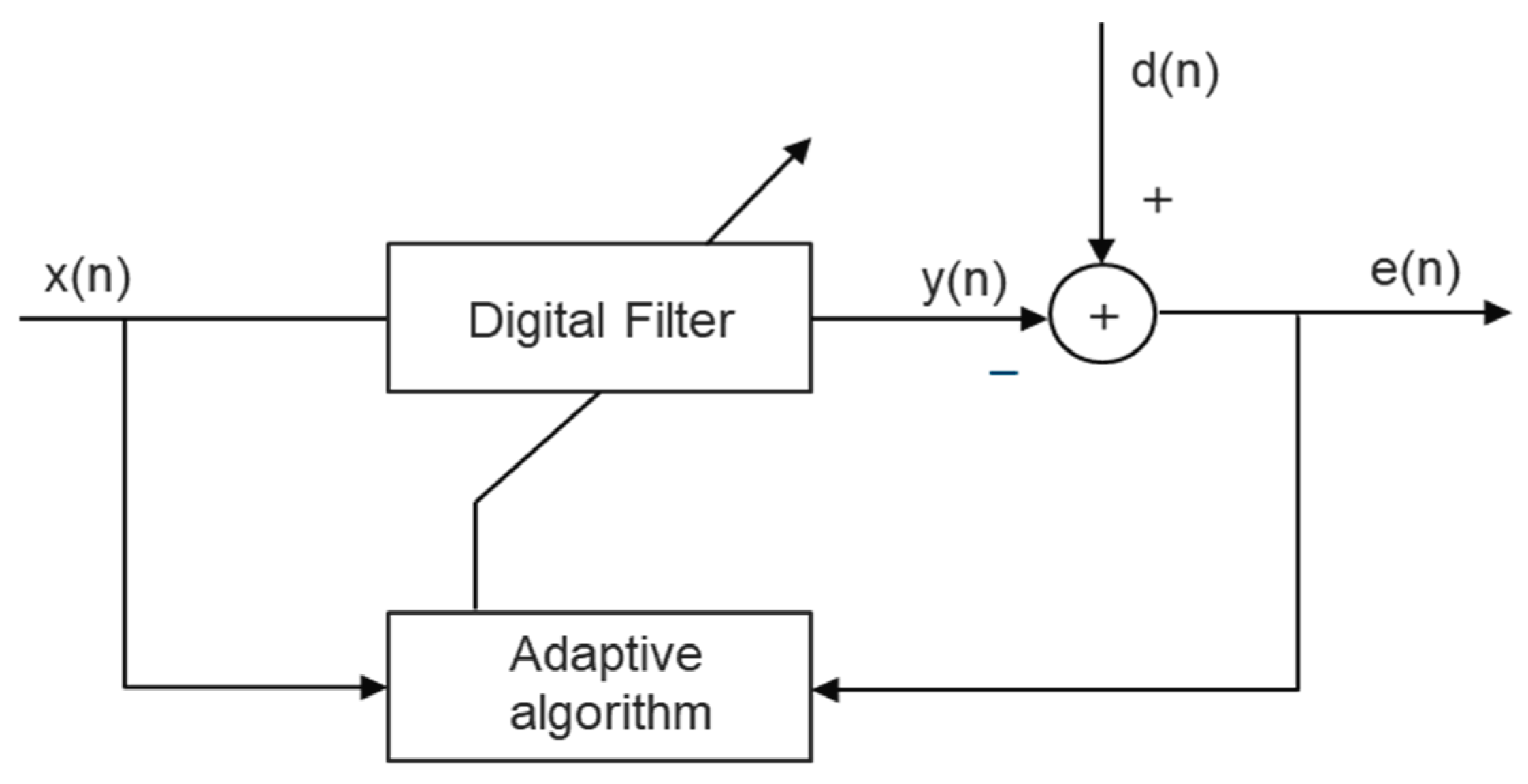
The LMS algorithm is a classic adaptive filtering algorithm. Its fundamental principle involves using a noise reference signal as the input to an adaptive filter and continuously adjusting the filter weights to minimize the mean square error of the output signal. By doing so, the noise component is estimated and subtracted from the original signal, achieving the purpose of noise reduction and signal enhancement. The schematic diagram of the LMS algorithm is illustrated in Figure 4.
In heart rate detection, noise reference-based adaptive filtering is employed to adaptively adjust the filter parameters according to the statistical characteristics of the signal and noise, achieving signal enhancement and noise suppression within a specific frequency range. The noise signal from the abdomen, which is uncorrelated with the heartbeat signal, is used as the filter input signal. This signal is correlated with the noise component in the radar echo signal. By using the abdominal signal as the input to the adaptive filter and adjusting the filter weights to minimize the power of the output signal, the noise component is estimated by the filter and subtracted from the echo signal at the heart location, thereby enhancing the signal-to-noise ratio of the heartbeat signal.
Let the weight vector of the adaptive filter be denoted as w n = w 0 n , w 1 n , , w L 1 n T , where L represents the filter order. The input vector of the abdominal signal (filter input) is given by n n = n n , n n 1 , , n n L + 1 T , and x n represents the radar echo signal from the chest.
The output of the adaptive filter can be expressed as:
y n = w T n n n
By adjusting the filter weights w n , the output signal y n is made to closely approximate the noise component in the radar echo signal x n . To achieve this, the following cost function is minimized:
J n = E x n y n 2 = E x n w T n n n 2
where E denotes the statistical expectation.
To achieve the adaptive update of the filter weights, we employ the LMS algorithm, whose iterative formula is given by:
e n = x n y n = x n w T n n n
w n + 1 = w n + μ e n n n
where e n represents the estimated error signal, and μ denotes the step size factor that controls the convergence speed and stability.
By iteratively updating the filter weights, the adaptive filter can continuously adjust its frequency response to closely match the noise component in the radar echo signal. Once the filter converges, the enhanced echo signal from the chest can be obtained using the following formula:
s ^ n = x n y n = x n w T n n n
where s ^ n represents the enhanced echo signal.
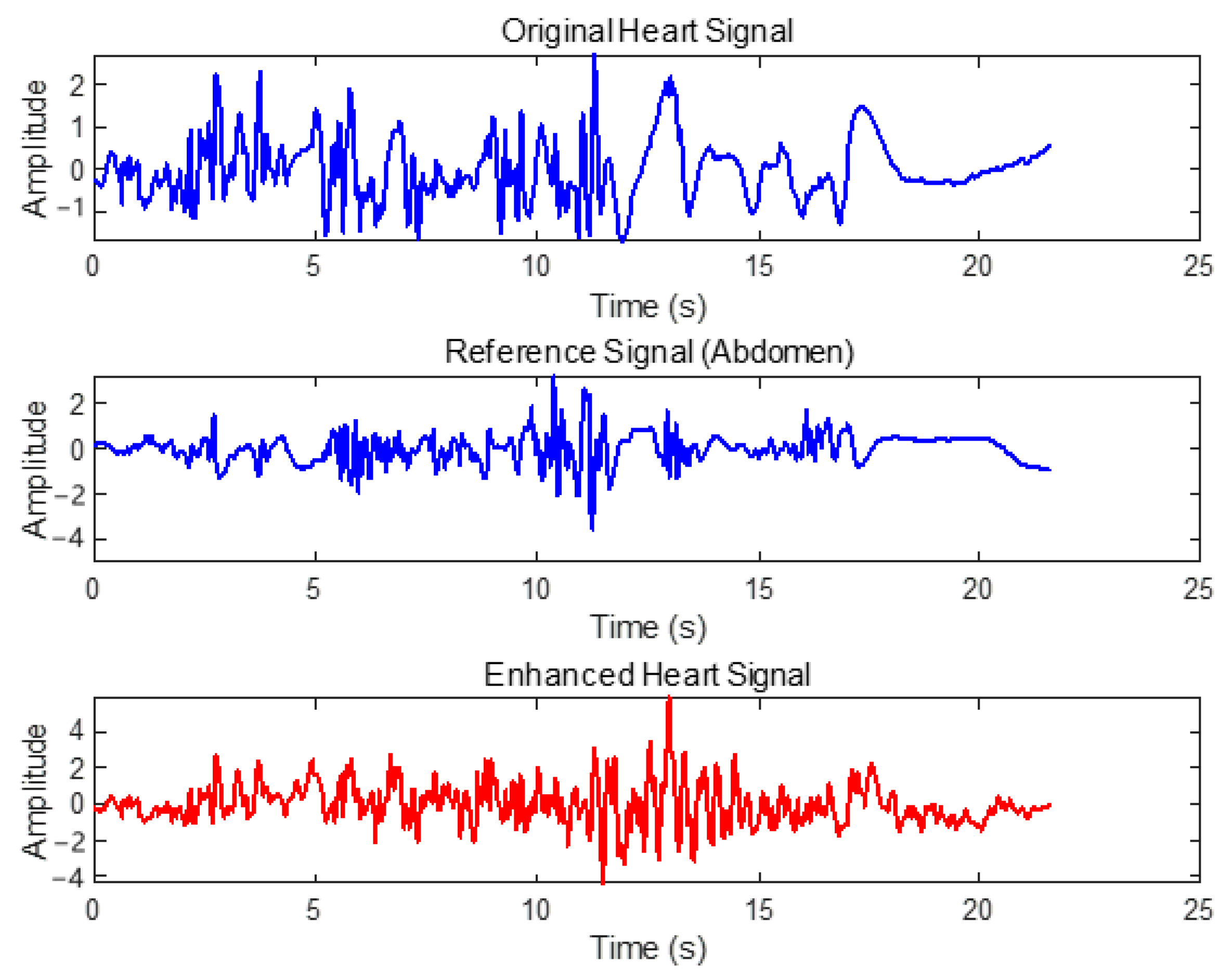
To analyze the adaptive filter’s performance, radar data is collected over a period of time. The LMS adaptive filter is applied to the echo signal from the target’s chest location, using the raw data from the abdominal location as the noise signal. By inputting the noisy echo signal and the noise signal into the LMS adaptive filter, the filtered heartbeat signal can be obtained. Figure 5 shows the time-domain waveforms of the beamformed chest, abdominal, and filtered phase signals.
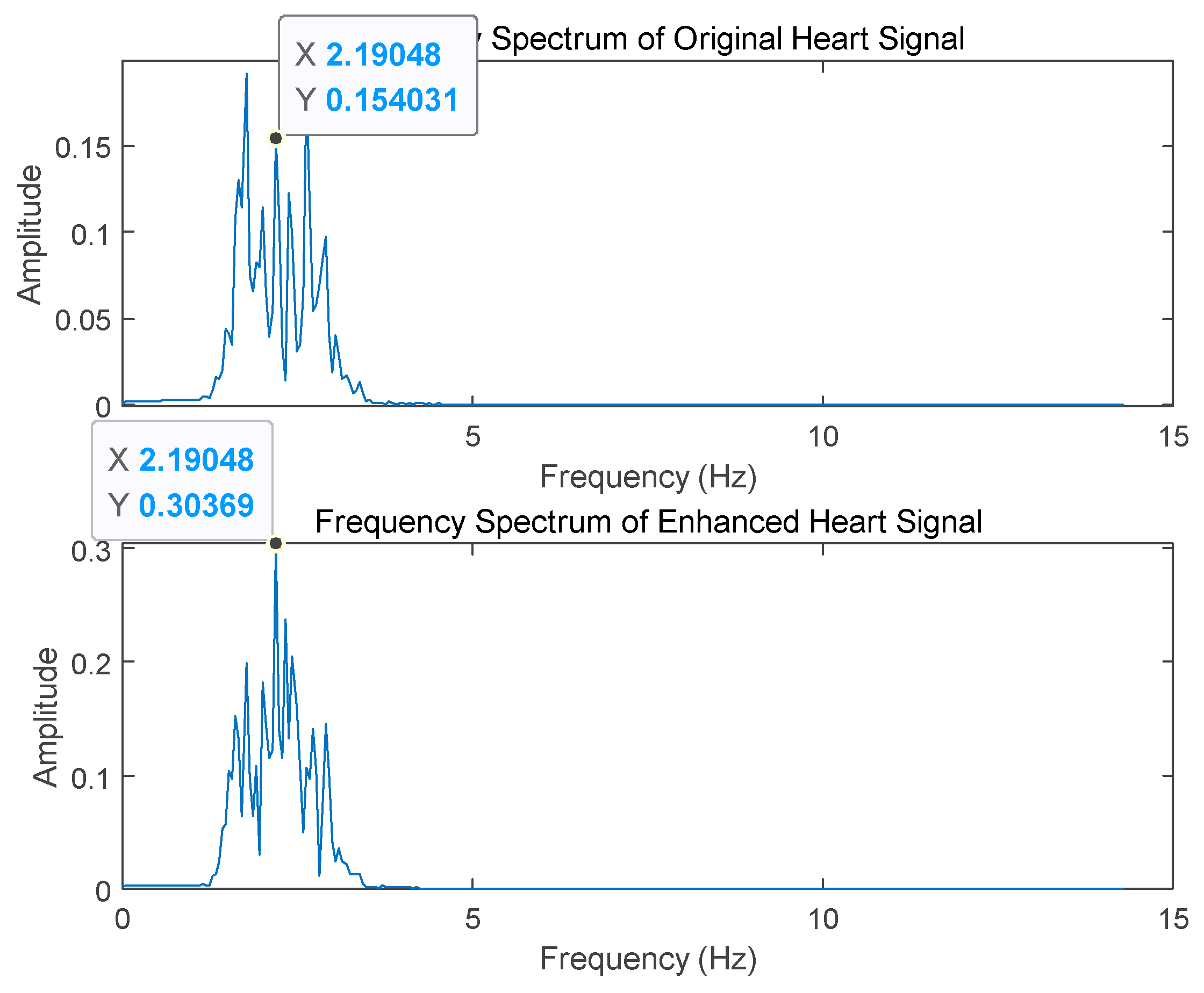
From the spectrum of the echo signal after adaptive filtering in Figure 6, it is evident that the quality of the heartbeat signal is significantly improved, and the noise is effectively suppressed. This indicates that the adaptive filter can adaptively adjust its weights based on the reference noise signal, thereby obtaining an enhanced target signal at the output.
However, the respiratory activity, body movements, and environmental noise of newborns, especially preterm infants, are often non-stationary, with their statistical characteristics varying over time. The fixed step-size LMS algorithm may not be able to track these changes promptly, resulting in delayed adjustments of the filter weights and affecting the accuracy of heart rate estimation.
To overcome the limitations of the traditional LMS algorithm, this paper proposes an adaptive filtering algorithm that combines subband decomposition and variable step-size LMS (VSS-LMS). The basic idea is to first divide the input signal into multiple frequency subbands, then independently apply the variable step-size LMS algorithm within each subband, and finally synthesize the filtering results from all subbands. The specific algorithm steps are as follows:
First, the input signal is divided into subbands. Different interference signals are usually concentrated in different frequency ranges. For example, respiratory signals are mainly distributed in the 0.2–0.5 Hz range, while body movement interference may be distributed in higher frequency bands. By dividing the input signal into multiple frequency subbands, these interferences can be separated into different subbands, reducing their mutual influence. Let the frequency range of the input signal x n be 0 , f s / 2 , and divide it into M equal-width subbands, with each subband having a bandwidth of Δ f = f s / 2 M . Denote x i n as the signal within the i-th subband, then:
x i n = k = 0 L 1 h i k x n k , i = 1 , 2 , , M
where h i k is the bandpass filter impulse response of the i-th subband.
Within each subband, the LMS adaptive filtering algorithm is applied independently. Let w i n and y i n denote the weight vector and output signal of the adaptive filter in the i-th subband, respectively. Then:
y i n = w i T n n i n
e i n = x i n y i n
w i n + 1 = w i n + μ i e i n n i n
where n i n is the reference noise signal within the i-th subband, and μ i is the step size factor of the i-th subband. By separating different interference signals into different subbands, their mutual influence can be reduced, which is beneficial for improving the filtering performance. The step size factors can be set differently according to the characteristics of the signals within each subband (such as frequency range and degree of non-stationarity). Executing the LMS algorithm in parallel within each subband can accelerate the convergence speed of the algorithm and enhance real-time processing capabilities.
To further enhance the algorithm’s adaptability, a variable step size strategy is introduced within each subband. The traditional LMS algorithm employs a fixed step size, making it difficult to adapt to dynamic changes in signal statistical characteristics. On the other hand, the variable step size LMS algorithm can adaptively adjust the step size factor based on the magnitude of the error signal, achieving a balance between convergence speed and steady-state error.
This paper designs an error-based variable step size update strategy:
μ i n = max μ m i n , min μ m a x , μ m a x exp γ e i 2 n
where μ m i n and μ m a x are the minimum and maximum step size limits, respectively, γ is the step size adjustment factor, and e i n is the error signal of the i-th subband. When the error is large, the step size factor decays exponentially, allowing the algorithm to converge quickly. When the error is small, the step size factor approaches μ m i n , ensuring steady-state performance.
For the proposed algorithm to converge, the step size in each subband must satisfy the standard LMS convergence condition:
0 < μ i n < 2 λ m a x , i
where λ m a x , i the maximum eigenvalue of the input signal autocorrelation matrix R n i = E n i n n i T n in the i-th subband. This condition can be approximated in practice as:
0 < μ i n < 2 L P n i
where P n i = E n i 2 n is the input signal power in the i-th subband. Since the step size is bounded within the range μ m i n , μ m a x ergence is guaranteed when μ m a x < 2 / L max i P n i . In our implementation, μ m a x = 0.1 and L   =   100 , and the input signals are normalized before processing, ensuring that this convergence condition is satisfied.
The stability of the multi-subband system is ensured by the independent operation of each subband filter and the bounded step size. Each subband filter converges to its respective Wiener solution when the convergence condition is met, and the final output is obtained by synthesizing the stable outputs from all subbands.
By combining subband decomposition and the variable step size strategy, the weight update formula for the i-th subband can be obtained:
w i n + 1 = w i n + max μ m i n , min μ m a x , μ m a x exp γ e i 2 n e i n x i n
Finally, the filtering results from each subband are synthesized to obtain the final output signal:
y n = i = 1 M y i n
The key parameters of the proposed algorithm include the number of subbands M , the step size limits ( μ m i n and μ m a x ), the step size adjustment factor γ , and the filter order L . In this study, these parameters are set as follows: M = 3, μ m i n = 0.00001, μ m a x = 0.1, γ = 0.1, and L = 100.
The number of subbands M is set to 3 based on the frequency characteristics of the signals involved in neonatal vital sign monitoring. The three subbands are designed to cover the frequency ranges of 0–1.5 Hz, 1.5–2.5 Hz, and 2.5–3.5 Hz, respectively. The first subband primarily captures the respiratory signal and its harmonics, the second subband covers the lower range of neonatal heart rates, and the third subband covers the higher range of neonatal heart rates. This division allows the algorithm to separately process interference and heart rate signals in different frequency bands.
The step size limits μ m i n and μ m a x control the convergence behavior of the adaptive filter. A larger μ m a x enables fast initial convergence when the error is small, while a smaller μ m i n ensures stable steady-state performance after convergence. The step size adjustment factor γ determines the sensitivity of the step size to changes in the error signal. The filter order L is set to 100 to provide sufficient degrees of freedom for modeling the correlation between the chest and abdominal signals while maintaining computational efficiency.
After applying the subband variable step size LMS algorithm for adaptive filtering of the heart echo signal, an echo signal with relatively enhanced heartbeat components can be obtained.
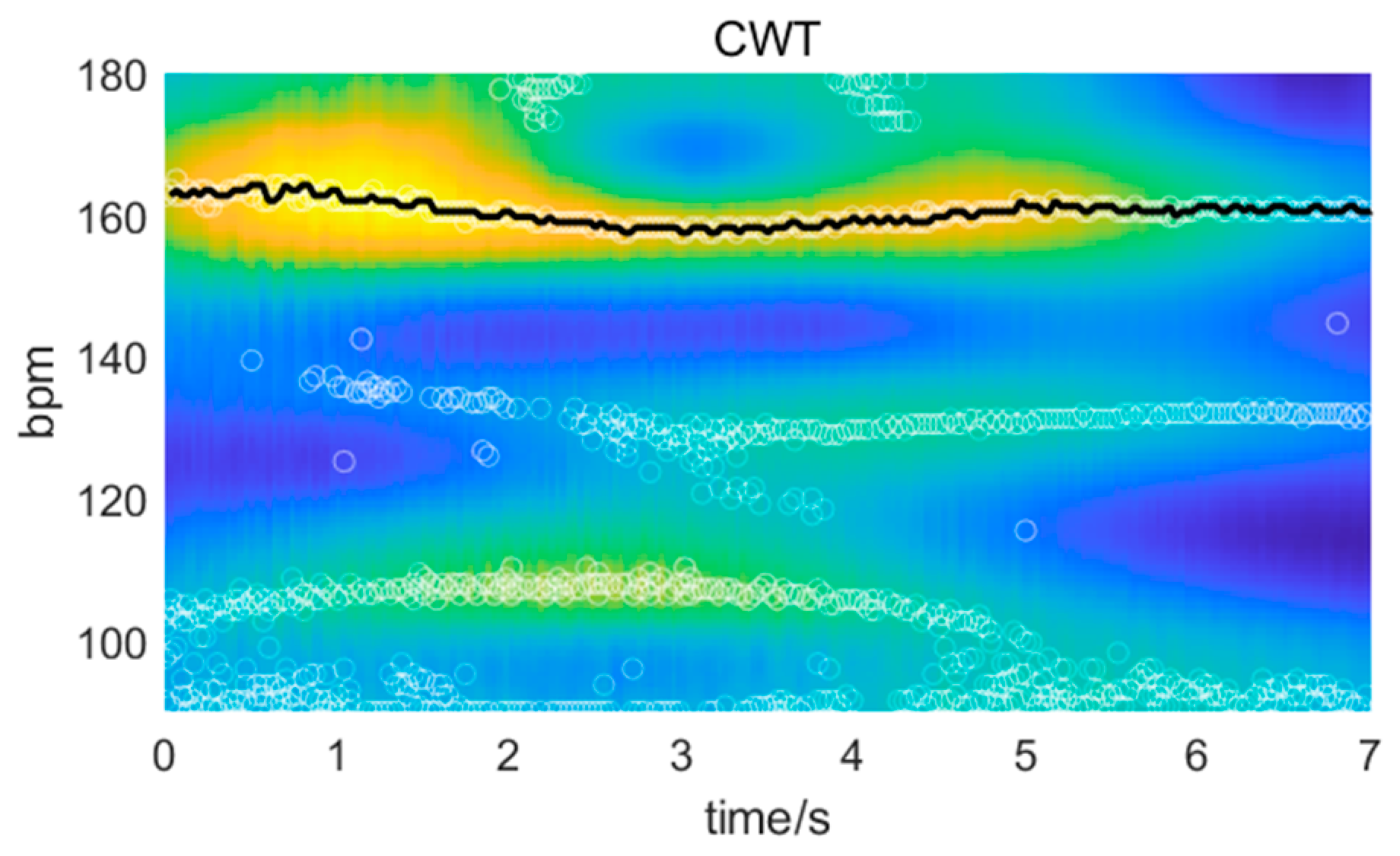
To accurately estimate the heart rate from this signal, CWT is employed in this paper to perform time-frequency analysis on the filtered signal. The Morlet wavelet is selected as the mother wavelet due to its good time-frequency localization properties and its suitability for analyzing quasi-periodic physiological signals. The scale range of the CWT is configured to correspond to frequencies between 1.5 Hz and 3 Hz, covering the typical heart rate range of preterm infants. The CWT generates a time-frequency representation (scalogram) of the filtered signal, from which the instantaneous heart rate can be extracted. Then, using the adaptive motion artifact filtering (AMF) method from [29], as shown in Figure 7, the frequency peak with the highest intensity and best continuity in the time-frequency spectrogram is identified and tracked as the heart rate component. The average frequency of this tracked peak trajectory is then calculated as the final heart rate estimate.

3. Results

To evaluate the performance of the proposed algorithm, an SFCW radar system was set up for data collection in the NICU ward of a hospital, targeting 5 preterm infants born before 37 weeks of gestation, less than 28 days old, and weighing less than 1500 g. It should be noted that recruiting preterm infants in the NICU for research purposes is particularly challenging. These vulnerable neonates require strict clinical care, and any research intervention must undergo rigorous ethical review. Additionally, obtaining informed consent from the guardians of critically ill newborns is a time-intensive process, as families are often under significant emotional stress. Despite these constraints, the five participants in this study represent a clinically meaningful cohort of very low birth weight preterm infants, which is the primary target population for our proposed method.
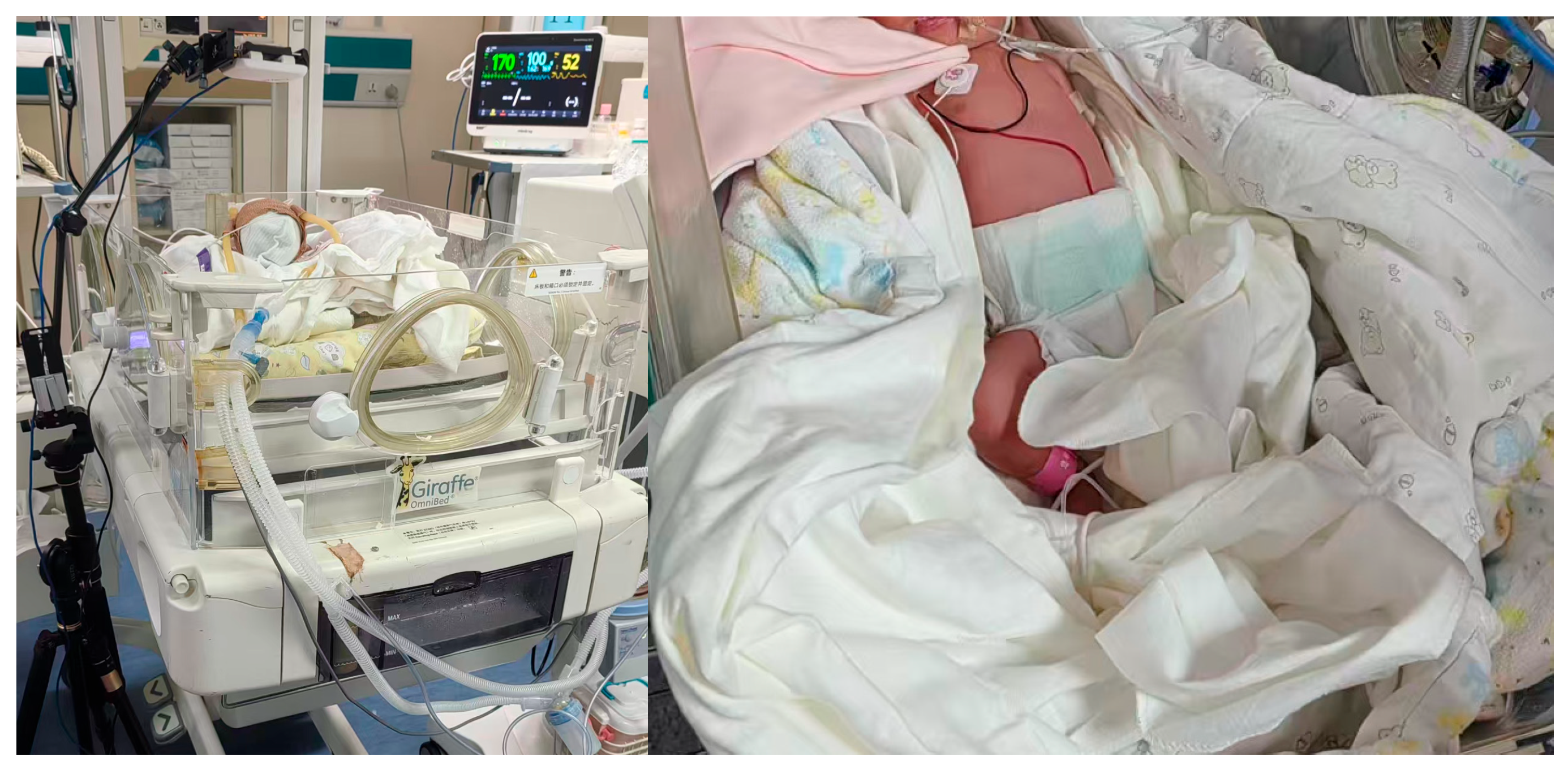
The details of the participating newborns are shown in Table 1, and the experimental setup is illustrated in Figure 8. Gestational age refers to the time elapsed between the first day of the last menstrual period and the day of delivery. Postnatal age refers to the chronological age of the infant after birth. During data acquisition, the radar was placed 50 cm above the baby’s crib, directly above the newborn’s chest. Simultaneously, standard 3-lead ECG electrodes were used to collect synchronous reference heart rate data. The collected radar echo data was processed to assess the heart rate estimation performance of the proposed algorithm. The study was conducted in accordance with the guiding principles of the “Declaration of Helsinki” and received ethical review approval from the Medical Research Ethics Committee of Peking University Third Hospital (Medical Ethics Approval No.: 062-02(2024)). Informed consent was provided by the legal guardians of all participants.
The data acquisition and heart rate estimation parameters are summarized as follows. Each recording session lasted approximately 30 s per infant. The radar frame rate was set to 30 Hz, providing 30 phase measurements per second. For heart rate estimation, a sliding window approach was employed with a window length of 10 s and a step size of 1 s. This configuration results in a heart rate update rate of 1 Hz (i.e., one heart rate estimate per second), which is consistent with the temporal resolution of the reference ECG heart rate values provided by the clinical monitoring system.
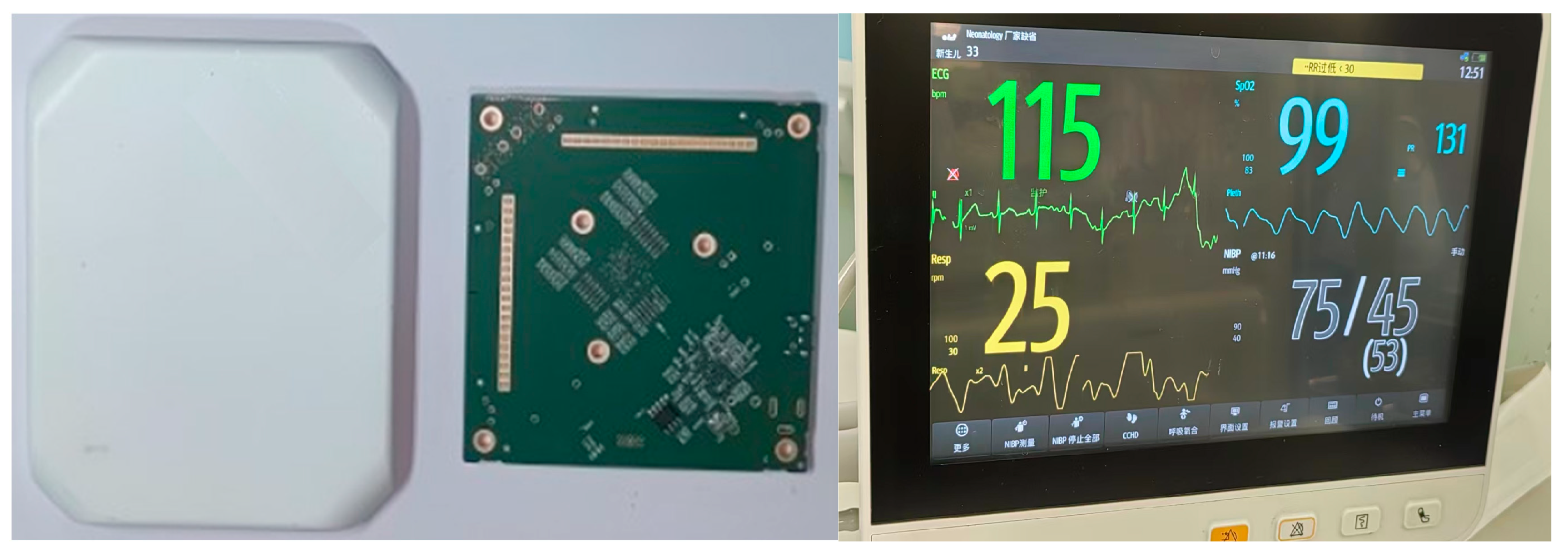
Figure 9 shows the radar and ECG equipment used in the experiment. The millimeter-wave radar employed in this study is equipped with 20 transmitting and 16 receiving on-board antennas, capable of transmitting SFCW signals with frequencies ranging from 62 to 69 GHz. The application of electronic devices in clinical environments requires careful consideration of safety and electromagnetic compatibility [32]. The radar system used in this study has obtained Federal Communications Commission (FCC) certification, ensuring compliance with electromagnetic compatibility standards. The power of the radio signals emitted by the radar is less than −10 dBm, which is significantly lower than the radio power levels of mobile phones or WiFi devices, ensuring no harm to neonates and no interference with other medical equipment in the NICU environment. Table 2 lists the important parameters related to the radar signal in detail. In the subsequent experiments, the bandwidth is set to 1.6 GHz, and the frame rate is 30 Hz. The heart rate values obtained in real-time by the hospital’s ECG machine are used as the reference heart rate values.
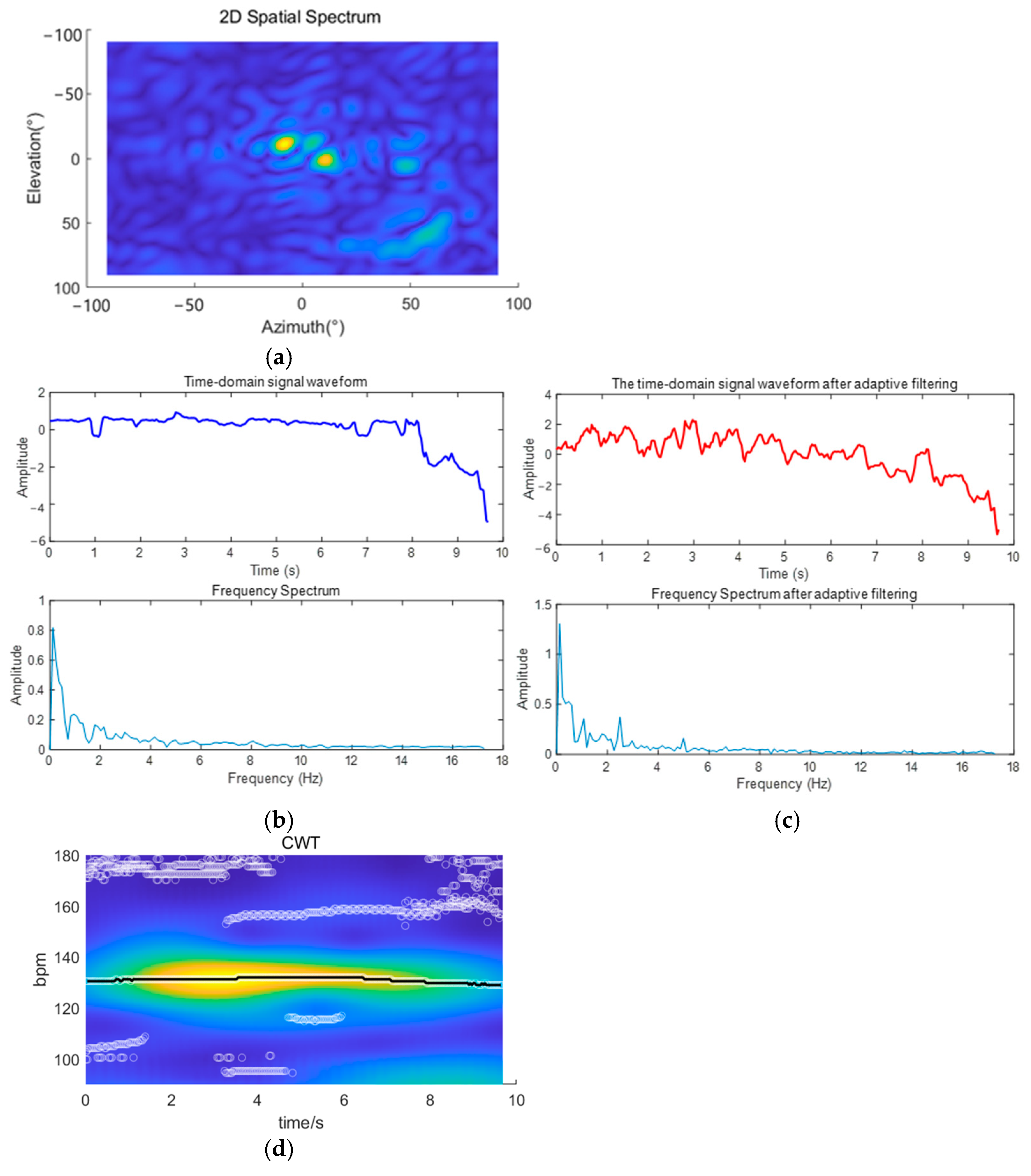
Figure 10 presents the estimation results of the proposed algorithm for a segment of a newborn’s heart rate signal. Figure 10a shows the two-dimensional spatial spectrum generated by the digital beamforming algorithm, representing the angular distribution of scattering intensity from the neonate’s body surface. The peaks in the spatial spectrum correspond to dominant scattering regions with different motion characteristics. Beams are steered toward these regions to extract signals for subsequent adaptive filtering. Figure 10b provides the phase signal and spectrum of the chest signal obtained using beamforming. It can be observed that the heartbeat signal is very weak and almost overwhelmed. Figure 10c shows the chest phase signal after subband variable step size LMS filtering. The quality of the filtered signal is significantly improved, with noise and interference components effectively suppressed, making the heartbeat signal more prominent. The phase signal clearly reflects the periodic changes in the heart rhythm. Finally, the heart rate estimation result is obtained through wavelet transform time-frequency analysis, as shown in Figure 10d.
To quantitatively evaluate the heart rate estimation performance of the proposed algorithm, multiple performance metrics are adopted, including Root Mean Square Error (RMSE), Mean Absolute Error (MAE), and Mean Absolute Percentage Error (MAPE). These metrics are defined as follows:
R M S E = 1 N n = 1 N H R e s t n H R r e f n 2
M A E = 1 N n = 1 N H R e s t n H R r e f n
M A P E = 1 N n = 1 N H R e s t n H R r e f n H R r e f n × 100 %
where H R e s t n and H R r e f n represent the estimated heart rate value and the ECG reference heart rate value at the n-th time step, respectively, and N is the total number of time steps. RMSE measures the standard deviation of the estimation errors, MAE represents the average magnitude of the errors, and MAPE provides a percentage-based measure of estimation accuracy relative to the reference values.
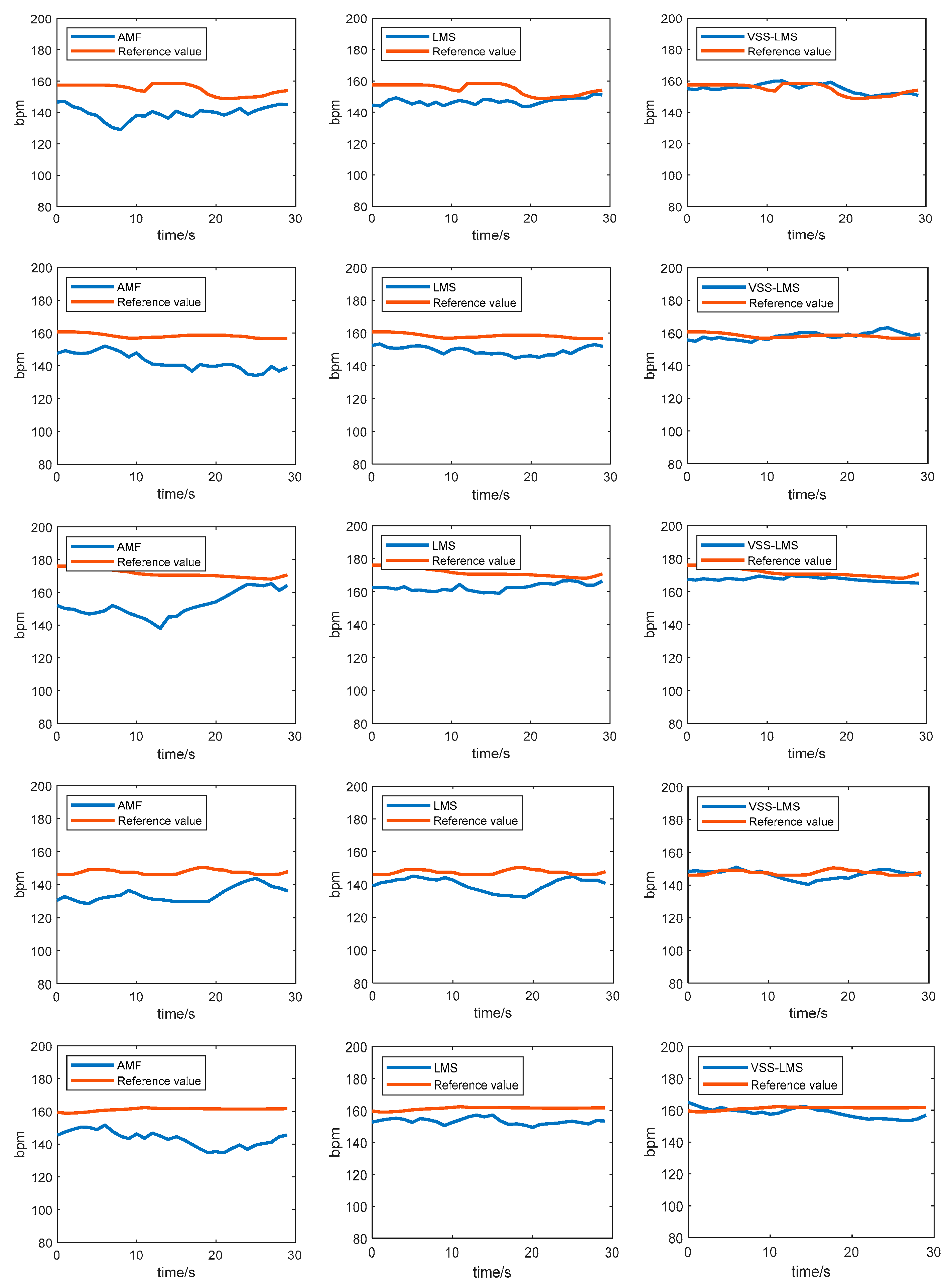
The proposed algorithm is compared with the traditional fixed step size LMS and the AMF algorithm, as shown in Figure 11, where the first to fifth rows correspond to newborns 1 to 5, respectively. The first column represents the AMF algorithm, the second column corresponds to the LMS algorithm, and the third column corresponds to the subband variable step size LMS algorithm. It can be observed that the heart rate estimation performance of the proposed algorithm is significantly better than the other two methods across all five datasets. Although the AMF algorithm has some suppression of random body motion interference by identifying continuous heart rates in the time-frequency spectrum, it struggles to accurately identify heart rates in the low signal-to-noise ratio environment where the heartbeat signal of preterm infants is relatively weak. The traditional LMS algorithm, while providing some enhancement to the heart rate, suffers from slow convergence speed and large steady-state errors, resulting in significant estimation deviations and leaving room for improvement in heart rate estimation accuracy. The results demonstrate that the proposed adaptive subband variable step size LMS algorithm, through subband decomposition and variable step size strategy, can better adapt to the time-varying characteristics of the preterm infant’s heart rate signal, achieving good performance in terms of heart rate estimation accuracy.
To further quantitatively evaluate the performance of the proposed algorithm, Table 3 provides a detailed comparison of the heart rate estimation performance among the three algorithms using RMSE, MAE, and MAPE metrics. The results demonstrate that the proposed VSS-LMS algorithm consistently outperforms both the AMF algorithm and the traditional LMS algorithm across all participants and all evaluation metrics. The proposed algorithm enhances the adaptability of the LMS filter through the variable step size strategy and employs subband processing to more effectively suppress noise in different frequency bands. As a result, it achieves superior estimation performance compared to the other methods, reducing the RMSE to below 5 BPM for all participants.
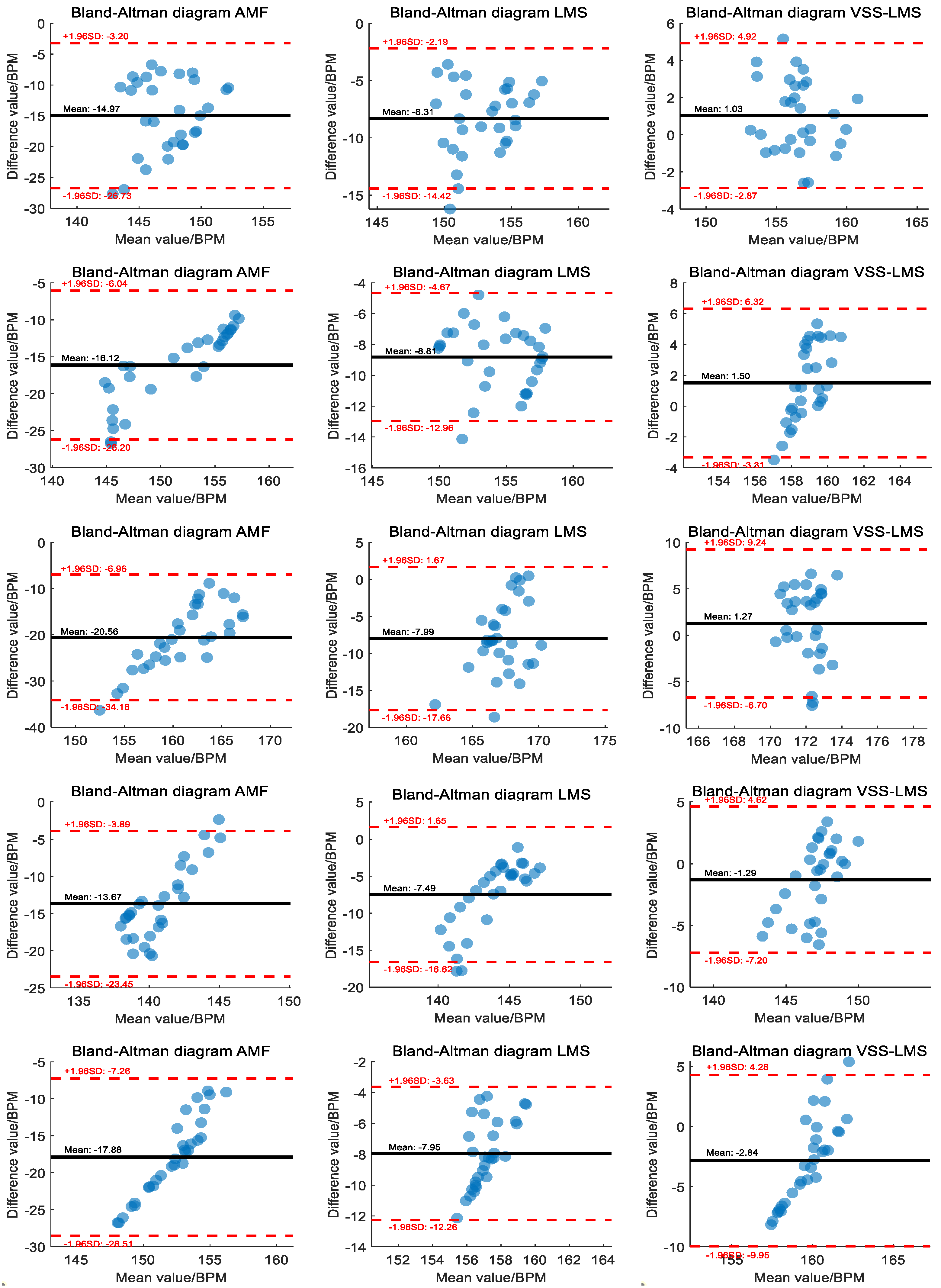
To further assess the agreement between the radar-based heart rate estimates and the ECG reference values, Bland–Altman analysis was performed for the proposed VSS-LMS algorithm. Figure 12 presents the Bland–Altman plots for all participants.
The Bland–Altman plots demonstrate the agreement between radar-based estimates and ECG reference values for three algorithms. For the AMF algorithm (column 1), the mean bias ranges from −13.67 to −20.56 BPM, indicating significant systematic underestimation. The LMS algorithm (column 2) shows improved performance with mean bias ranging from −7.49 to −8.81 BPM. In contrast, the proposed algorithm (column 3) achieves mean bias close to zero (1.03 to −2.84 BPM) for all five babies, with narrower 95% limits of agreement. These results indicate that the proposed algorithm demonstrates better agreement with the reference values compared to the other two methods.
To investigate the influence of key parameters on the algorithm performance, we conducted a sensitivity analysis using the data from Baby 1. Among all the parameters, the number of subbands M and the maximum step size μ m a x are the two most critical factors affecting algorithm performance: M determines the frequency resolution of subband decomposition, while μ m a x controls the convergence speed of the adaptive filter. Other parameters, such as μ m i n and the filter order L , primarily affect steady-state behavior and computational cost, and are less sensitive to performance variations as long as they are set within reasonable ranges. Therefore, we focus on analyzing M and μ m a x in this study. By varying these two parameters while keeping others fixed, we evaluated the RMSE under different configurations. Table 4 presents the results of this parameter sensitivity analysis.
The results indicate that increasing the number of subbands from 1 to 3 significantly improves the performance, as it allows for more targeted processing of different frequency components. However, further increasing M to 4 does not yield additional improvement, possibly due to the narrower bandwidth of each subband reducing the effective signal energy. Regarding the maximum step size, μ m a x = 0.1 provides the best balance between convergence speed and steady-state accuracy. A smaller μ m a x (0.01) results in slower convergence and insufficient noise suppression, while a larger μ m a x (0.2) may cause instability in the weight updates, leading to increased estimation error.
To assess the real-time processing potential of the proposed algorithm, we measured the computation time of different algorithms on a laptop computer (Lenovo Legion R7000, manufactured by Lenovo, Beijing, China, with AMD Ryzen 7 7735H @ 3.20 GHz, 8 cores, 32 GB RAM, Windows 11) using MATLAB R2022a. Table 5 presents the average computation time per heart rate estimate (10-s window) for each algorithm.
The results show that all three algorithms can achieve real-time processing. The proposed VSS-LMS algorithm requires approximately 0.88 s to process a 10-s data segment. Although the proposed algorithm has slightly higher computational complexity than the AMF and traditional LMS methods due to the subband decomposition and variable step-size updates, its processing speed remains sufficient for real-time operation. The additional computational overhead is justified by the significant improvement in heart rate estimation accuracy demonstrated in Table 3.

4. Discussion

This paper primarily addresses the challenge of detecting weak heartbeat signals in preterm and low birth weight infants in the NICU. A millimeter-wave radar heart rate detection method based on adaptive subband variable step size LMS filtering is proposed. This method employs subband processing to specifically suppress interference in different frequency bands and enhances the convergence performance of the adaptive filter through a variable step size strategy, thereby improving the detection accuracy of weak heartbeat signals. Experimental results on actual data collected from preterm infants demonstrate that, compared to the traditional LMS method and the AMF algorithm from [29], the proposed method can significantly improve the accuracy of newborn heart rate estimation, providing a new perspective for the application of millimeter-wave radar in NICU heart rate monitoring.
Despite the promising results, several limitations should be acknowledged. First, sustained large-amplitude movements such as prolonged crying may exceed the adaptive filter’s tracking capability. Second, the current validation was conducted with infants in the supine position; significant posture changes may alter the chest-abdomen signal relationship and affect the algorithm performance. Third, while the method was validated on very low birth weight infants (<1500 g), its performance on extremely low birth weight infants (<1000 g) remains to be investigated.
Beyond these limitations, the proposed VSS-LMS algorithm has potential for extension to multimodal vital sign monitoring. Recent advances in intelligent physiological monitoring have demonstrated the value of integrated sensor and IoT-based approaches for comprehensive health assessment [33]. Our radar-based method can serve as a non-contact sensing component within such larger monitoring architectures. Future work could explore the integration of our approach with other sensing modalities to achieve comprehensive neonatal health monitoring in the NICU.
In summary, the algorithm proposed in this paper provides a new technical approach for newborn heart rate detection, which is expected to promote the application of millimeter-wave radar in NICU clinical settings. Due to the challenges of recruiting vulnerable preterm infants in the NICU, which requires rigorous ethical review and obtaining informed consent from families under significant emotional stress, the current study with five participants serves as a valuable preliminary study demonstrating the feasibility and effectiveness of the proposed method. Future work will focus on expanding the sample size through multi-center collaboration and conducting longer-term monitoring studies to further validate the generalizability of the proposed method. Therefore, more work is needed to translate this technology from the laboratory to clinical practice, including large-scale multi-center clinical validation, product design, and medical device certification. In the future, radar heart rate detection can be combined with other vital sign sensing, such as respiration and blood oxygen, to achieve comprehensive newborn health monitoring, contributing to the improvement of neonatal survival rates and prognosis. Moreover, millimeter-wave radar heart rate detection technology can also be extended to other populations and application scenarios, such as home baby monitoring and sleep monitoring, promoting the development of non-contact and non-invasive vital sign sensing towards a more intelligent and convenient direction.

Author Contributions

Conceptualization, J.C. and X.L.; methodology, J.C. and Y.L.; software, J.C.; validation, J.C. and N.J.; formal analysis, Y.L. and J.C.; investigation, J.C., X.L. and N.J.; resources, X.L. and X.D.; data curation, X.L. and X.D.; writing—original draft preparation, J.C.; writing—review and editing, J.C., Y.L. and X.D.; visualization, J.C.; supervision, Y.L.; project administration, X.D.; funding acquisition, Y.L. All authors have read and agreed to the published version of the manuscript.

Funding

This research was funded by the National Natural Science Foundation of China (Grant No. 62271471).

Institutional Review Board Statement

The study was conducted according to the guidelines of the Declaration of Helsinki and approved by the Ethics Committee of Peking University Third Hospital Medical Science Research Ethics Committee (Medical Ethics Approval No. 062-02(2024)).

Informed Consent Statement

Informed consent was obtained from the legal guardians of all subjects involved in the study.

Data Availability Statement

The data can be shared up on request.

Conflicts of Interest

The authors declare no conflicts of interest.

Abbreviations

The following abbreviations are used in this manuscript:
NICUNeonatal intensive care unit
LMSLeast mean square
RMSERoot mean square error
MAEMean absolute error
MAPEMean absolute percentage error
BPMBeats per minute
ECGElectrocardiography
ANFAdaptive notch filtering
EWTEmpirical wavelet transform
VMDVariational mode decomposition
RBMRandom body movements
DBFDigital beamforming
CWTContinuous wavelet transform
SFCWStepped-frequency continuous wave
MIMOMultiple-input multiple-output
SNRSignal-to-noise ratio
AMFadaptive motion artifact filtering (AMF)
VSS-LMSVariable step size Least mean square

References

  1. United Nations Inter-Agency Group for Child Mortality Estimation (UN IGME). Levels & Trends in Child Mortality: Report 2020; Estimates developed by the United Nations Inter-agency Group for Child Mortality Estimation; United Nations Children’s Fund: New York, NY, USA, 2020. [Google Scholar]
  2. World Health Organization. Born Too Soon: The Global Action Report on Preterm Birth; World Health Organization: Geneva, Switzerland, 2012. [Google Scholar]
  3. Blencowe, H.; Krasevec, J.; de Onis, M.; Black, R.E.; An, X.; Stevens, G.A.; Borghi, E.; Hayashi, C.; Estevez, D.; Cegolon, L.; et al. National, regional, and worldwide estimates of low birthweight in 2015, with trends from 2000: A systematic analysis. Lancet Glob. Health 2019, 7, e849–e860. [Google Scholar] [CrossRef]
  4. Lawn, J.E.; Davidge, R.; Paul, V.K.; von Xylander, S.; de Graft Johnson, J.; Costello, A.; Molyneux, L. Born too soon: Care for the preterm baby. Reprod. Health 2013, 10, S5. [Google Scholar] [CrossRef]
  5. Fairchild, K.D.; O’Shea, T.M. Heart rate characteristics: Physiomarkers for detection of late-onset neonatal sepsis. Clin. Perinatol. 2010, 37, 581–598. [Google Scholar] [CrossRef]
  6. Fairchild, K.D.; Schelonka, R.L.; Kaufman, D.A.; Carlo, W.A.; Kattwinkel, J.; Porcelli, P.J.; Lake, D.E. Septicemia mortality reduction in neonates in a heart rate characteristics monitoring trial. Pediatr. Res. 2013, 74, 570–575. [Google Scholar] [CrossRef]
  7. Schwartz, P.J.; Garson, A.; Paul, T.; Stramba-Badiale, M.; Vetter, V.L.; Wren, C.; Martin, R.P. Guidelines for the interpretation of the neonatal electrocardiogram. Eur. Heart J. 2002, 23, 1329–1344. [Google Scholar] [CrossRef]
  8. Sandau, K.E.; Funk, M.; Auerbach, A.; Barsness, G.W.; Blum, K.; Cvach, M.; Lampert, R.; May, J.L.; McDaniel, G.M.; Perez, M.V.; et al. Update to Practice Standards for Electrocardiographic Monitoring in Hospital Settings: A Scientific Statement from the American Heart Association. Circulation 2017, 136, e273–e344. [Google Scholar] [CrossRef]
  9. Sahni, R.; Gupta, A.; Ohira-Kist, K.; Rosen, T.S. Motion resistant pulse oximetry in neonates. Arch. Dis. Child. Fetal Neonatal Ed. 2003, 88, F505–F508. [Google Scholar] [CrossRef]
  10. Lund, C.H.; Osborne, J.W.; Kuller, J.; Lane, A.T.; Lott, J.W.; Raines, D.A. Neonatal skin care: Clinical outcomes of the AWHONN/NANN evidence-based clinical practice guideline. J. Obstet. Gynecol. Neonatal Nurs. 2001, 30, 41–51. [Google Scholar] [CrossRef] [PubMed]
  11. Rhee, I.; Ryu, B.-H.; Kang, M.-G.; Kim, C.-J.; Chang, H.-J.; Kim, E.-S.; Yoo, S.-K. A Wireless PDA-Based Physiological Monitoring System for Patient Transport. IEEE Trans. Inf. Technol. Biomed. 2004, 8, 439–447. [Google Scholar] [CrossRef] [PubMed]
  12. Li, C.; Lubecke, V.M.; Boric-Lubecke, O.; Lin, J. A review on recent advances in Doppler radar sensors for noncontact healthcare monitoring. IEEE Trans. Microw. Theory Tech. 2013, 61, 2046–2060. [Google Scholar] [CrossRef]
  13. Khan, F.; Cho, S.H.; Yong, H.S. A detailed algorithm for vital sign monitoring of a stationary/non-stationary human through IR-UWB radar. Sensors 2017, 17, 290. [Google Scholar] [CrossRef]
  14. Gu, C. Short-range noncontact sensors for healthcare and other emerging applications: A review. Sensors 2016, 16, 1169. [Google Scholar] [CrossRef]
  15. Gao, Z.; Ali, L.; Wang, C.; Liu, R.; Wang, C.; Qian, C.; Sung, H.; Meng, F. Real-Time Non-Contact Millimeter Wave Radar-Based Vital Sign Detection. Sensors 2022, 22, 7560. [Google Scholar] [CrossRef]
  16. Chen, J.; Zhang, D.; Wu, Z.; Zhou, F.; Sun, Q.; Chen, Y. Contactless Electrocardiogram Monitoring with Millimeter Wave Radar. IEEE Trans. Mob. Comput. 2024, 23, 270–285. [Google Scholar] [CrossRef]
  17. Al-Masri, E.; Momin, M. Detecting Heart Rate Variability using Millimeter-Wave Radar Technology. In Proceedings of the 2018 IEEE International Conference on Big Data (Big Data), Seattle, WA, USA, 10–13 December 2018; pp. 5282–5284. [Google Scholar]
  18. Lin, J.C.; Kiernicki, J.; Kiernicki, M.; Wollschlaeger, P.B. Microwave Apexcardiography. IEEE Trans. Microw. Theory Tech. 1979, 27, 618–620. [Google Scholar] [CrossRef]
  19. Droitcour, A.D.; Boric-Lubecke, O.; Lubecke, V.M.; Lin, J.; Kovacs, G.T. Range correlation and I/Q performance benefits in single-chip silicon Doppler radars for noncontact cardiopulmonary monitoring. IEEE Trans. Microw. Theory Tech. 2004, 52, 838–848. [Google Scholar] [CrossRef]
  20. Ling, Z.; Zhou, W.; Ren, Y.; Wang, J.; Guo, L. Non-Contact Heart Rate Monitoring Based on Millimeter Wave Radar. IEEE Access 2022, 10, 74033–74044. [Google Scholar] [CrossRef]
  21. Wang, H.; Du, F.; Zhu, H.; Zhang, Z.; Wang, Y.; Cao, Q.; Zhu, X. HeRe: Heartbeat Signal Reconstruction for Low-Power Millimeter-Wave Radar Based on Deep Learning. IEEE Trans. Instrum. Meas. 2023, 72, 4004515. [Google Scholar] [CrossRef]
  22. Kluckow, M.; Seri, I. Pathophysiology of Neonatal Shock. In Hemodynamics and Cardiology: Neonatology Questions and Controversies, 2nd ed.; Polin, R.A., Fox, W.W., Eds.; Saunders Elsevier: Philadelphia, PA, USA, 2012. [Google Scholar]
  23. Saikia, D.; Mahanta, B. Cardiovascular and respiratory physiology in children. Indian J. Anaesth. 2019, 63, 690–697. [Google Scholar] [CrossRef]
  24. Aarts, L.A.; Jeanne, V.; Cleary, J.P.; Lieber, C.; Nelson, J.S.; Bambang Oetomo, S.; Verkruysse, W. Non-contact heart rate monitoring utilizing camera photoplethysmography in the neonatal intensive care unit-a pilot study. Early Hum. Dev. 2013, 89, 943–948. [Google Scholar] [CrossRef]
  25. Villarroel, M.; Chaichulee, S.; Jorge, J. Non-contact physiological monitoring of preterm infants in the Neonatal Intensive Care Unit. npj Digit. Med. 2019, 2, 128. [Google Scholar] [CrossRef] [PubMed]
  26. Liu, C.; Zhang, H.; Geng, F.; Bai, Z.; Wang, P.; Li, Z.; Du, L.; Chen, X.; Fang, Z. Dynamic demodulation algorithm for bio-radar sensors based on range tapper. J. Radars 2025, 14, 135–150. [Google Scholar]
  27. Edanami, K.; Kurosawa, M.; Yen, H.; Kanazawa, T.; Abe, Y.; Kirimoto, T.; Yao, Y.; Matsui, T.; Sun, G. Remote sensing of vital signs by medical radar time-series signal using cardiac peak extraction and adaptive peak detection algorithm: Performance validation on healthy adults and application to neonatal monitoring at an NICU. Comput. Methods Programs Biomed. 2022, 226, 107163. [Google Scholar] [CrossRef]
  28. Lee, W.H.; Na, J.Y.; Lee, H.J.; Kim, S.H.; Lim, Y.-H.; Cho, S.-H.; Park, H.-K.; Cho, S.H. Analysis of Heart Rate Variability Using Impulse Radio Ultra-wideband Radar in Neonatal Intensive Care Unit. In Proceedings of the 2019 IEEE SENSORS, Montreal, QC, Canada, 27–30 October 2019; pp. 1–4. [Google Scholar]
  29. Yang, S.; Liang, X.; Dang, X.; Jiang, N.; Cao, J.; Zeng, Z.; Li, Y. Random Body Movement Removal Using Adaptive Motion Artifact Filtering in mmWave Radar-Based Neonatal Heartbeat Sensing. Electronics 2024, 13, 1471. [Google Scholar] [CrossRef]
  30. Jiang, N.; Liang, X.; Dang, X.; Yang, S.; Cao, J.; Zeng, Z.; Li, Y. Separation of thoracic and abdominal measurements in neonatal vital sign monitoring using radar vision fusion system. Sci. Rep. 2025, 15, 11800. [Google Scholar] [CrossRef]
  31. Anton, O.; Fernandez, R.; Rendon-Morales, E.; Aviles-Espinosa, R.; Jordan, H.; Rabe, H. Heart Rate Monitoring in Newborn Babies: A Systematic Review. Neonatology 2019, 116, 199–210. [Google Scholar] [CrossRef] [PubMed]
  32. Coluccio, M.L.; Pullano, S.A.; Vismara, M.F.M.; Coppedè, N.; Perozziello, G.; Candeloro, P.; Gentile, F.; Malara, N. Emerging Designs of Electronic Devices in Biomedicine. Micromachines 2020, 11, 123. [Google Scholar] [CrossRef]
  33. Bibbò, L.; Angiulli, G.; Laganà, F.; Pratticò, D.; Cotroneo, F.; La Foresta, F.; Versaci, M. MEMS and IoT in HAR: Effective Monitoring for the Health of Older People. Appl. Sci. 2025, 15, 4306. [Google Scholar] [CrossRef]
Figure 1. Schematic diagram of the adaptive subband variable step-size LMS filtering algorithm workflow, where the AMF design is based on [29].
Electronics 15 00731 g001
Figure 2. Phase spectra of the heart echo signals for an adult and a preterm infant. (a) Phase spectrum of the adult; (b) Phase spectrum of the preterm infant.
Electronics 15 00731 g002
Figure 3. Chest vibration displacement curves for newborns with different body weights: (a) 1370 g; (b) 1580 g; (c) 1930 g; (d) 2920 g.
Electronics 15 00731 g003
Figure 4. Schematic diagram of the adaptive filtering principle.
Electronics 15 00731 g004
Figure 5. Time-domain waveforms of the adaptive filtering process.
Electronics 15 00731 g005
Figure 6. Comparison of the frequency spectra before and after adaptive filtering.
Electronics 15 00731 g006
Figure 7. Schematic diagram of heart rate estimation using CWT time-frequency analysis and AMF method.
Electronics 15 00731 g007
Figure 8. Schematic representation of the experimental setup.
Electronics 15 00731 g008
Figure 9. Millimeter-wave radar and ECG machine.
Electronics 15 00731 g009
Figure 10. Estimation results of the newborn’s heart rate signal using the proposed algorithm: (a) Two-dimensional spatial spectrum generated by DBF, showing the angular distribution of scattering intensity from the neonate’s body surface. The chest region and abdominal region are identified based on radar antenna alignment and angular offset of approximately 10°; (b) Time-domain and spectrum of the chest phase signal after beamforming, before filtering; (c) Time-domain and spectrum of the chest phase signal after subband variable step size LMS filtering; (d) Heart rate estimation result using wavelet time-frequency analysis.
Electronics 15 00731 g010
Figure 11. Comparison of the subband variable step size LMS (VSS-LMS) method with the AMF algorithm and the traditional LMS method. The first to fifth rows correspond to Baby 1 to 5, respectively. Column 1 corresponds to the AMF algorithm, column 2 corresponds to the LMS algorithm, and column 3 corresponds to the VSS-LMS algorithm.
Electronics 15 00731 g011
Figure 12. Bland–Altman plots showing the agreement between radar-estimated heart rate and ECG reference. Rows 1 to 5 correspond to babies 1 to 5. Column 1 corresponds to the AMF algorithm, column 2 corresponds to the LMS algorithm, and column 3 corresponds to the VSS-LMS algorithm.
Electronics 15 00731 g012
Table 1. Details of the newborns participating in the study.
Study ParticipantsGestational AgeWeightPostnatal Age
Baby 136 weeks and 5 days1470 g4 days
Baby 236 weeks and 2 days1410 g12 days
Baby 334 weeks and 5 days1370 g10 days
Baby 435 weeks and 6 days1450 g16 days
Baby 536 weeks and 6 days1480 g12 days
Table 2. Radar parameters.
ParametersValue
Frequency Band62–69 GHz
ADC Samples151
Stop–Start Min Step150 MHz
EIRP (Effective Isotropic Radiated Power)−5 dBm
Max Range Resolution2.14 cm
Max Angular Resolution6.7°
Table 3. Comparison of heart rate estimation performance among the three algorithms.
ParticipantsRMSE (BPM)MAE (BPM)MAPE (%)
AMFLMSVSS-LMSAMFLMSVSS-LMSAMFLMSVSS-LMS
Baby 116.088.912.0814.978.311.759.625.281.12
Baby 216.319.422.9816.128.812.3010.135.541.46
Baby 321.239.884.8220.568.043.9312.004.672.29
Baby 414.528.783.1413.677.492.469.255.061.66
Baby 518.668.234.5617.887.953.8311.094.932.37
Table 4. Parameter sensitivity analysis results.
ParameterValueRMSE (BPM)
Number of subbands M = 1 (no subband)8.15
M = 24.82
M = 32.08
M = 42.45
Maximum step size μ m a x = 0.015.21
μ m a x = 0.053.86
μ m a x = 0.12.08
μ m a x = 0.24.12
Note: When varying M , μ m a x is fixed at 0.1; when varying μ m a x , M is fixed at 3.
Table 5. Computation time comparison of different algorithms.
AlgorithmAverage Computation Time per Estimate (s)
AMF0.15
LMS0.36
VSS-LMS0.88
Disclaimer/Publisher’s Note: The statements, opinions and data contained in all publications are solely those of the individual author(s) and contributor(s) and not of MDPI and/or the editor(s). MDPI and/or the editor(s) disclaim responsibility for any injury to people or property resulting from any ideas, methods, instructions or products referred to in the content.