Article

A Novel Intersection-Statistics-Based Indoor TOA Localization Algorithm with Adaptive Error Correction for NLOS Environments

1
China Satellite Network Digital Technology Co., Ltd., Xiong’an New Area 071700, China
2
College of Information Science & Electronic Engineering, Zhejiang University, Hangzhou 310007, China
3
College of Social Sciences, University of Birmingham, Edgbaston, Birmingham B15 2TT, UK
*
Authors to whom correspondence should be addressed.
Electronics 2026, 15(3), 639; https://doi.org/10.3390/electronics15030639
Submission received: 25 December 2025 / Revised: 20 January 2026 / Accepted: 26 January 2026 / Published: 2 February 2026
(This article belongs to the Topic Challenges and Future Trends of Wireless Networks)

Abstract

To address the performance degradation of existing base station-based indoor localization algorithms in non-line-of-sight (NLOS) environments, we propose a novel intersection-statistics-based localization method. The proposed algorithm introduces an adaptive error-correction mechanism that mitigates the aggregated effects of multipath interference and environmentally induced variations in TOA measurements. The core innovation lies in establishing a statistical framework that utilizes intersection density within minimum bounding circles to optimize correction parameters. Subsequent refinement employs standard deviation analysis to eliminate spatial outliers before final coordinate estimation. Comparative experimental results demonstrate significant improvements over conventional least squares (LS) and Nano algorithms across three key metrics: mean positioning error (reduced by 38.7%), maximum error (decreased by 42.1%), and error variance (improved by 57.3%). Empirical validation shows that the algorithm achieves 97.36% of absolute positioning errors within 1 m precision under optimized parameters, while maintaining 85.82% sub-meter accuracy using universal correction factors. These performance characteristics satisfy rigorous requirements for commercial indoor positioning systems while providing practical implementation advantages through adaptive parameter tuning.

1. Introduction

The rapid advancement of wireless communication networks and mobile internet technologies has propelled Location-Based Services (LBSs) (including target tracking, security alerts, and location-based advertising) to become one of the most promising and rapidly growing sectors in the digital economy [1,2,3,4,5]. While the Global Positioning System (GPS) remains the dominant technology for outdoor positioning [6], its performance is significantly compromised in environments such as indoor spaces, underground facilities, tunnels, and urban canyons with dense high-rise buildings [3]. These limitations primarily stem from signal attenuation and the inability of satellite signals to penetrate structural barriers, rendering GPS ineffective in such scenarios.
To address these challenges, indoor positioning technologies have emerged as a viable solution. Current approaches predominantly rely on Wireless Fidelity (Wi-Fi) [7,8,9,10], Bluetooth devices [11], or optical sensors [12,13], which are typically densely deployed in indoor environments. However, these methods face inherent limitations, including restricted coverage, susceptibility to signal interference, high implementation costs, and uncertain business models. In contrast, positioning systems based on wireless communication base stations offer a more robust alternative by leveraging existing infrastructure.
The primary challenge in base station-based positioning is the susceptibility of signals to environmental obstructions and multipath effects, which introduce significant measurement noise. Accurate position estimation under these conditions remains a critical research problem. Despite extensive investigations over the past two decades, achieving efficient and precise location estimation in cluttered non-line of sight (NLOS) environments is substantially challenging [14]. NLOS conditions are ubiquitous in modern urban landscapes, affecting both indoor (e.g., basements, shopping malls) and outdoor (e.g., high-rise urban areas) environments.
In complex indoor environments, signal propagation is influenced not only by shadow fading and multipath effects but also by other environmental parameters such as temperature, humidity, and electromagnetic interference. Variations in temperature and humidity can affect the refractive index of the air and walls, leading to subtle changes in signal speed and attenuation [14,15]. Additionally, electromagnetic interference from nearby electronic equipment or infrastructure may introduce additional noise or distortion in positioning signals. These factors can cause spatial and temporal fluctuations in time-of-arrival (TOA) measurements and further complicate NLOS error characteristics.
Recent advances in wireless indoor localization have expanded beyond classical RFID, Wi-Fi, and Bluetooth solutions, incorporating emerging technologies and more sophisticated algorithmic paradigms. For example, Long Range (LoRa) technology—initially targeted at outdoor Internet of Things (IoT)—has been shown feasible for precise indoor localization using received signal strength indication (RSSI), with suitable tuning of path loss models and filtering algorithms substantially reducing positioning error [16,17]. Machine learning and deep learning approaches, such as convolutional and recurrent networks, are now widely applied, improving the robustness of Wi-Fi-based localization and enabling new functionalities such as occupancy estimation and behavior analysis via existing network infrastructure [18]. These trends point towards a convergence of wireless sensing and intelligent data analysis, leveraging both traditional and emerging Low-Power Wide-Area Network (LPWAN, e.g., LoRa) and Wi-Fi-based platforms for accurate and cost-effective indoor positioning.
Current localization algorithms can be broadly categorized into range-based and range-free approaches. Range-based algorithms, which generally offer superior accuracy, include techniques such as TOA [19], time difference of arrival (TDOA) [20,21,22], angle of arrival (AOA) [23,24], and RSSI [25,26]. This study focuses on TOA-based localization algorithms, which include the least squares (LS) method [23,27], weighted least squares (WLS) [28], the Nano algorithm [29], neural network-based approaches [30,31], and the ranging error classification (REC) algorithm [32].
The LS algorithm, while widely used, suffers from several limitations: it lacks systematic error analysis, relies heavily on iterative approximation, and demonstrates sensitivity to initial value selection, particularly in complex environments. WLS, Nano, and REC algorithms require prior identification of NLOS propagation measurements, followed by directional correction or weighted observation values. Recently, Nguyen et al. [31] employed a deep learning architecture combining long short-term memory (LSTM) with convolutional neural networks (CNNs) for NLOS identification in wireless local area networks (WLANs) based on RSSI measurements. While effective in controlled environments, this approach faces challenges in real-world scenarios where TOA measurements alone are insufficient for reliable NLOS identification.
Recent advancements in artificial intelligence have facilitated the integration of deep learning methodologies into indoor positioning systems [31]. Wu et al. [33] proposed an artificial neural network (ANN)-based localization algorithm utilizing TOA measurements through error learning and matching. Although simulation results demonstrate its effectiveness, practical validation remains necessary.
The REC algorithm, grounded in maximum likelihood estimation principles, exhibits enhanced robustness through probabilistic noise modeling [32]. However, this method necessitates homogeneous base station deployment geometries to maintain sub-meter positioning accuracy, which limits its adaptability in heterogeneous indoor environments.
The aim of this work is to develop a simple and efficient method for rapidly determining the location of mobile stations based on TOA measurements. To this end, we propose a novel TOA localization algorithm that addresses the underlying causes of positioning errors through intersection statistical modeling. Previous approaches have primarily focused on improving location accuracy or enhancing robustness under conventional multipath and NLOS conditions—typically relying on iterative optimization or specific signal models [23,27,28,29,32]. In contrast, this study introduces two innovations. First, we propose a statistical mechanism that compensates for the combined impact of multipath and environmentally induced variations on TOA measurements. These factors—including temperature, humidity, and electromagnetic interference—affect propagation delays indirectly, and their joint influence is captured through the adaptive correction factor rather than modeled explicitly. Second, by incorporating a location-dependent statistical metric and leveraging large-scale intersection statistical analysis for error parameter calibration, the proposed method achieves highly precise and adaptive corrections on the experimental datasets without relying on iterative processing. Experimental results demonstrate that our approach maintains high accuracy while offering notable computational efficiency, thereby having the potential to meet the requirements for general indoor positioning applications.
The remainder of this paper is structured as follows: Section 2 provides a detailed description of the indoor localization environment and the experimental dataset collected from wireless communication base stations. Section 3 introduces the statistical framework underlying the proposed TOA localization algorithm. Section 4 presents a comprehensive performance analysis based on experimental results, including comparative evaluations with existing methods. Finally, Section 5 concludes the study and outlines potential directions for future research in this domain.

2. Indoor Localization Environment and Experimental Data

The electromagnetic signals in wireless communication base stations are inherently complex, primarily characterized by two distinct propagation conditions: line of sight (LOS) and NLOS [31]. Signal propagation is susceptible to various interference factors, including shadow fading and multipath effects, which introduce significant noise into the measured values. Traditional localization methods typically require two sequential steps to achieve accurate position estimation: (1) classification of LOS and NLOS measurements and (2) iterative noise reduction using least squares optimization to determine the receiver’s precise location.
To evaluate the performance of the proposed algorithm against existing methods, this study utilized an experimental dataset from the publicly available “Huawei Cup Indoor Positioning Challenge Based on Wireless Communication Base Stations,” an open data processing competition focused on realistic indoor wireless localization scenarios. The dataset, provided by HUAWEI Technology Co., Ltd. (Shenzhen, China), comprises 35 distinct experimental cases, including 5 cases with known mobile station (MS) coordinates and 30 cases without coordinate information. Each MS is equipped with a wireless communication module compliant with 4G and was tested under both static and dynamic movement scenarios. The five fully labeled cases were collected in environments with 20, 30, 40, 50, and 60 base stations (BASs), respectively. For each of these, TOA measurements, base station coordinates, and mobile station coordinates are provided, enabling direct verification of localization accuracy. The remaining 30 cases contain only TOA measurements and base station coordinates, serving as validation data for algorithm robustness. A representative subset of the experimental data is presented in Table 1. All data used in the competition were open-sourced for research purposes during the event and remain obtainable by contacting the organizers or through their official channels, ensuring transparency and the potential for independent verification.
We note that the publicly available competition dataset provides TOA measurements and BAS/MS coordinates but does not disclose radio frequency (RF) band information, antenna specifications, transmission power, or detailed channel conditions. This limitation originates from the dataset itself and is common among competition-oriented indoor positioning datasets. While such information is not required for TOA-based statistical algorithm development, it restricts full physical reproducibility. This limitation has been explicitly acknowledged, and future work will include experiments conducted in environments where all RF and environmental parameters are fully documented.
In practical localization environments, TOA measurements are subject to errors due to multiple influencing factors, including equipment bandwidth limitations, signal-to-noise ratio (SNR) fluctuations, clock synchronization inaccuracies, and NLOS propagation conditions. Empirical studies on TOA-based indoor localization systems indicate that clock synchronization uncertainty is typically on the order of tens to hundreds of nanoseconds, whereas NLOS-induced excess propagation delays may reach several hundred nanoseconds under strong multipath conditions [4,14,22]. To address these challenges, this study proposes a systematic approach that leverages the distinct characteristics of each error type to either eliminate or mitigate their impact, thereby enabling accurate calculation of MS coordinates.

3. Indoor Time-of-Arrival Localization Algorithm Based on Statistics

Traditional localization algorithms face three critical technical challenges: (1) accurately distinguishing between LOS and NLOS measurements, (2) ensuring rapid algorithm convergence, and (3) enhancing algorithm robustness. In this study, we address these issues by analyzing the noise distribution of measurements under natural environmental conditions (including both LOS and NLOS scenarios) and employing statistical analysis methods to efficiently estimate the MS coordinates.
The proposed algorithm’s framework (Figure 1) consists of the following steps: First, the nearest BAS to the MS is identified. Second, a circular range, termed the minimum circle, is established using the BAS as the center and the TOA-derived measured distance as the radius. Third, dynamic correction is applied to the measured values. The number of intersection points within the minimum circle is then counted to determine the optimal error correction parameters. Finally, these parameters are utilized to calculate the MS coordinates with high precision.

3.1. The Principle of Minimum Circle

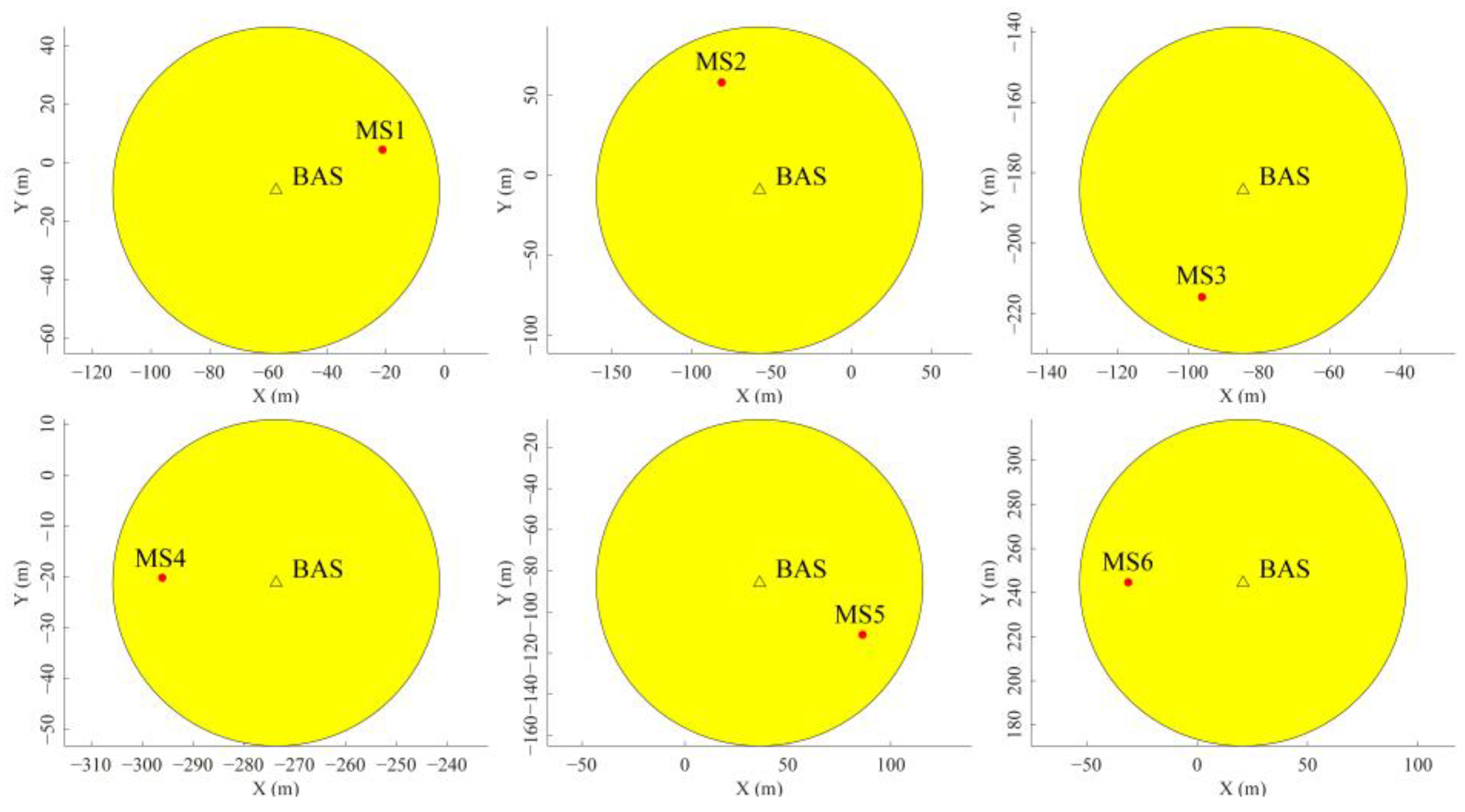
For a given MS, the time-delay difference E i is a systematic positive bias that is significantly greater than the measurement error e i caused by clock asynchronization. Consequently, the MS must be located within a circular region centered at the BAS with a radius equal to the measured distance d i ( w h e r e   d i = v × t i , v represents the speed of light, and t i is TOA measurement between BAS and MSi). Furthermore, the MS position is confined to the minimum bounding circle defined by m i n ( d i ) . We calculate the MS coordinates based on this minimum circle, and all 1100 MS datasets were verified to lie within the m i n ( d i ) -radius circle. Figure 2 displays 6 random representative datasets, where the yellow region denotes the m i n ( d i ) -radius circle, the red point represents the ground-truth position of the MS, and the triangle marker indicates the nearest BAS.

3.2. Indoor Time-of-Arrival Localization Algorithm and Model

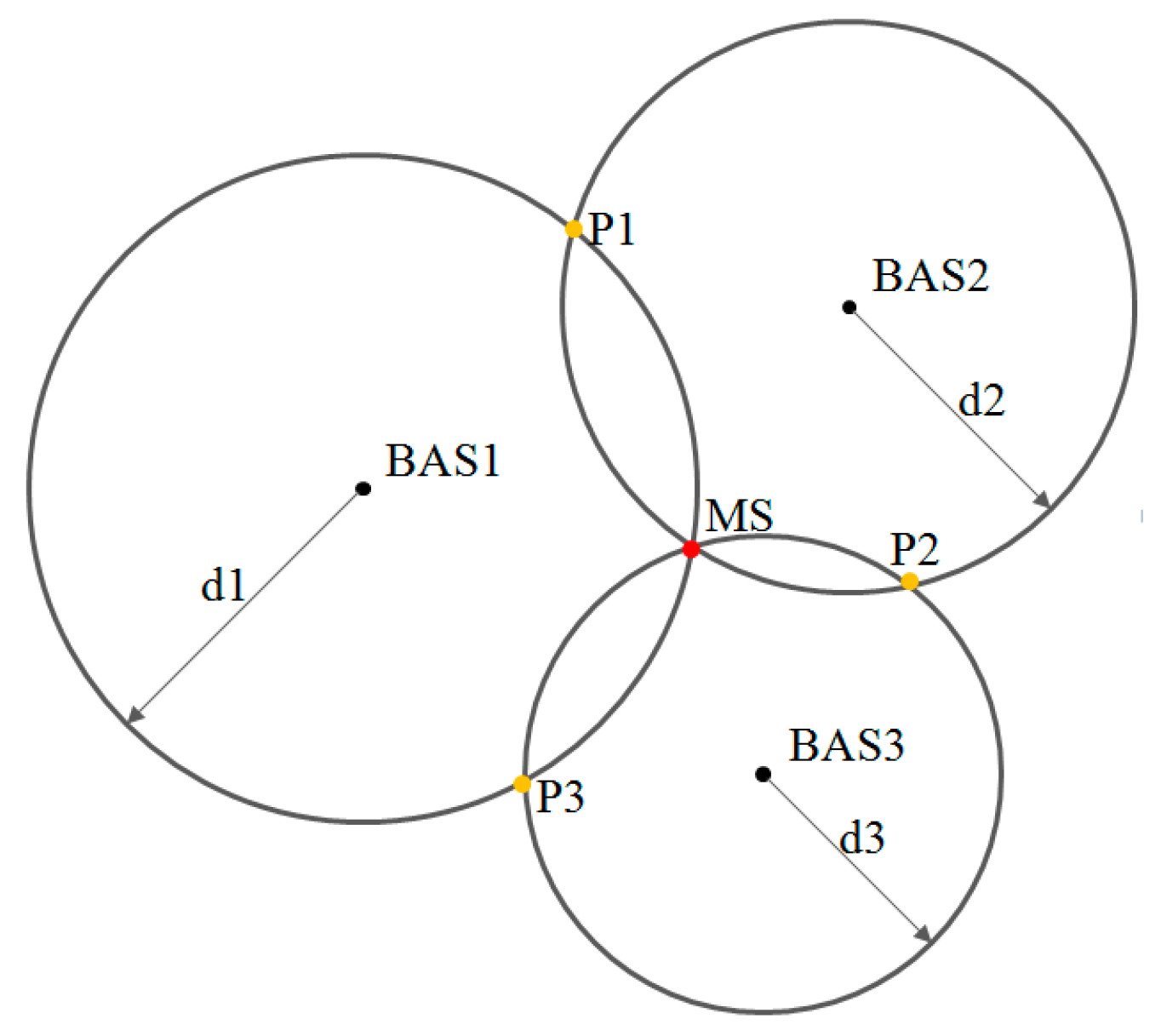
As shown in Figure 3, under ideal error-free conditions, all circles converge at a single point corresponding to the MS location, which is defined as a true intersection. Additionally, pairwise circle intersections generate discrete points (labeled P1, P2, and P3) that deviate from the true intersection; these are classified as false intersections.
In practice, two error sources affect localization accuracy: (1) the time-delay error E i induced by the NLOS environment and (2) the measurement error e i arising from clock asynchronization. Notably, the elevation differences between BASs are negligible compared with their horizontal separation distances. When elevation is disregarded, the geometric circles derived from TOA measurements fail to intersect at a single point; however, their intersection points exhibit a statistically significant clustering tendency around the true MS position.
With advancements in mobile network synchronization technologies, high-precision network time services are now ubiquitously implemented between BASs and MSs. Under this paradigm, e i is orders of magnitude smaller than E i ( E i e i ). For any BAS-MS group, e i manifests as a minor systematic bias. Crucially, the ensemble of e i errors from multiple BASs is distributed symmetrically around the MS and can be mitigated through spatial averaging. The error e i compensation model is formulated as follows:
lim n i = 1 n e i = 0
Next, we statistically analyze and correct the time-delay error E i in TOA-measured values caused by the NLOS localization environment. Based on previous studies [3,4,15], there is a positive correlation between the distance d i between BAS and MS and the time-delay error E i caused by the NLOS localization environment. That is, the longer the distance between BAS and MS, the larger the delay error; the shorter the distance between BAS and MS, the smaller the delay error. When the distance is less than a specific value, the time-delay error will be close to zero. Moreover, it is well-known that the delay error E i is positive.
The propagation time-delay error E i exhibits a specific functional relationship with the TOA measurement data, expressed as follows:
E i = T O A = f ( T O A )
To simplify the model, we introduce an error correction factor K to describe the relationship between the time-delay error E i and TOA-measured data.
T O A = T O A × k
T O A 0 = T O A T O A = T O A × 1 k = T O A × K
In the formula, k is the time-delay error ratio, T O A 0 is the corrected measured time, and K is the correction factor.
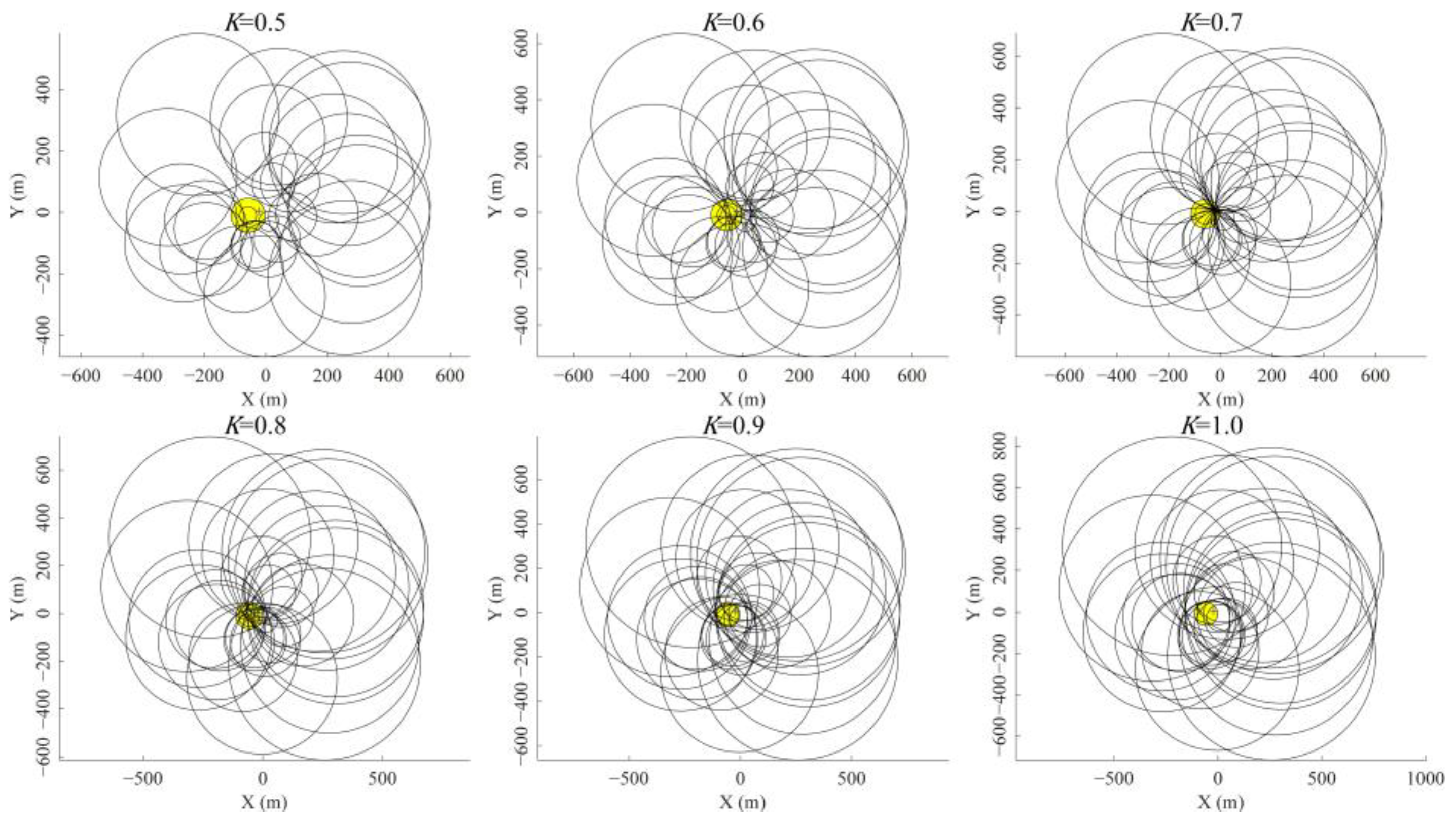
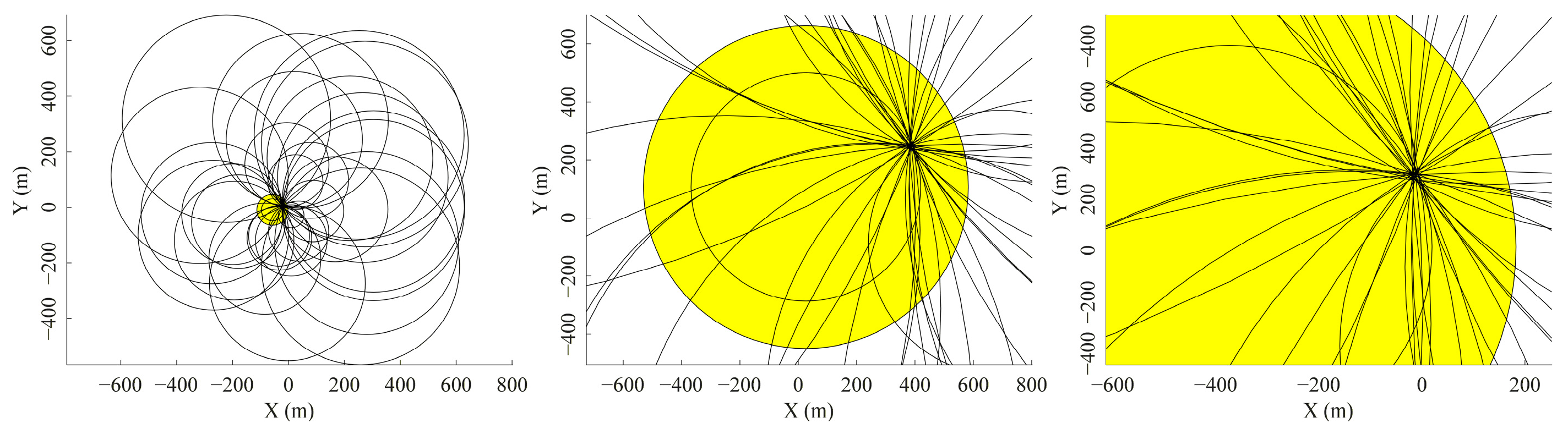
Based on the analysis of experimental data, too large or too small a K value is not conducive to eliminating or reducing the influence of time-delay errors. Therefore, this paper limits the value of K to a reasonable region of 0.5 to 1. Using the TOA-measured data of 30 BASs as an example, K takes a value from 0.5 to 1 with increments of 0.1 as a step to correct the TOA-measured data. Then, the corrected TOA-measured data are transformed into distance d i . We drew 30 distance circles, which took the BAS as the center and the corresponding distance d i as the radius. As shown in Figure 4, the yellow area is the distance circle with the minimum radius. As K changes from 0.5 to 1, the number of intersections between any two circles in the minimum circle increases and then decreases. When the value of K is too small, the circles tend to be separated. When the value of K is close to 1, the intersections between circles are dispersed. When K = 0.7 , the true intersections concentrate on one point; therefore, this K value has the best correction effect on the time-delay error.
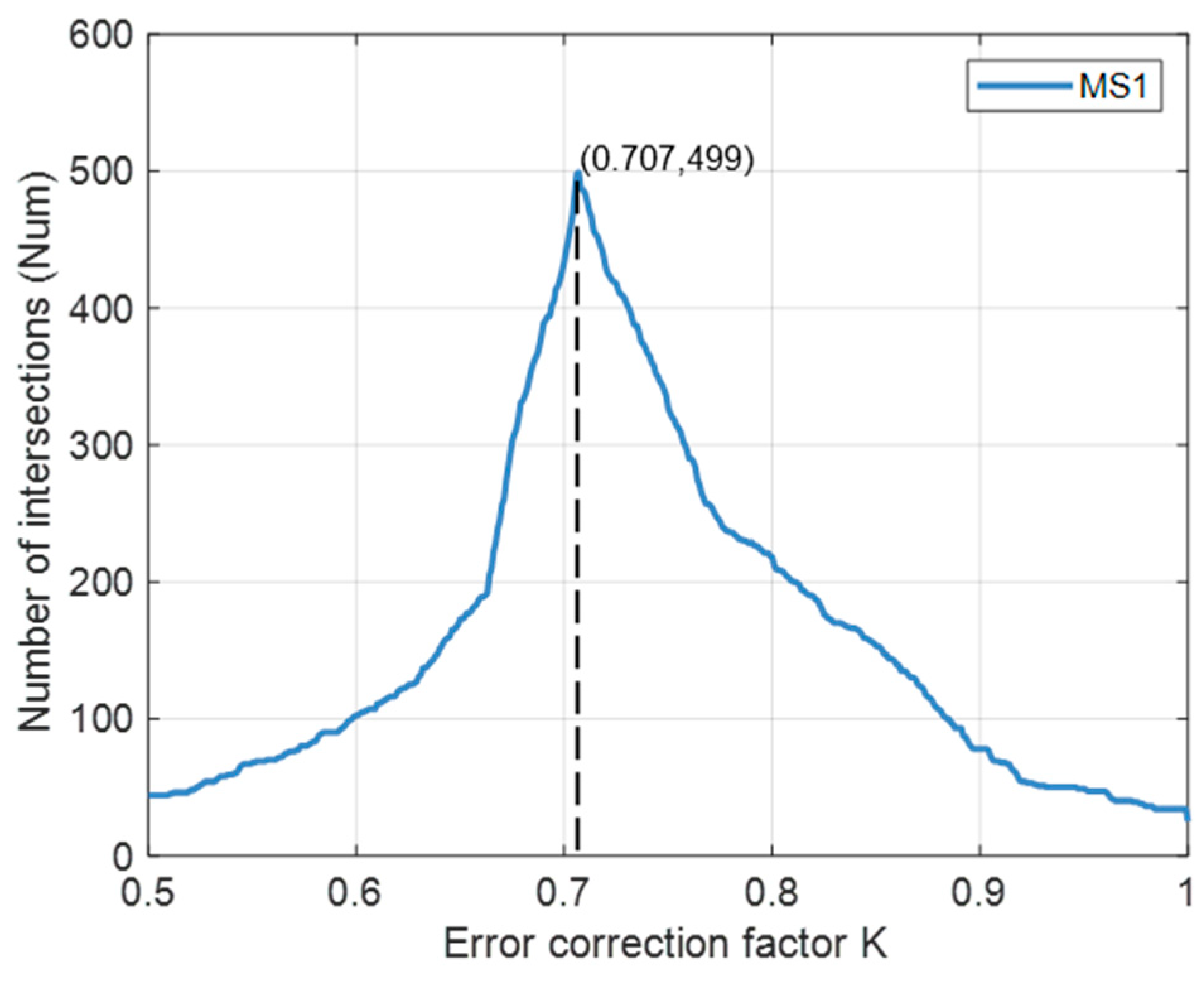
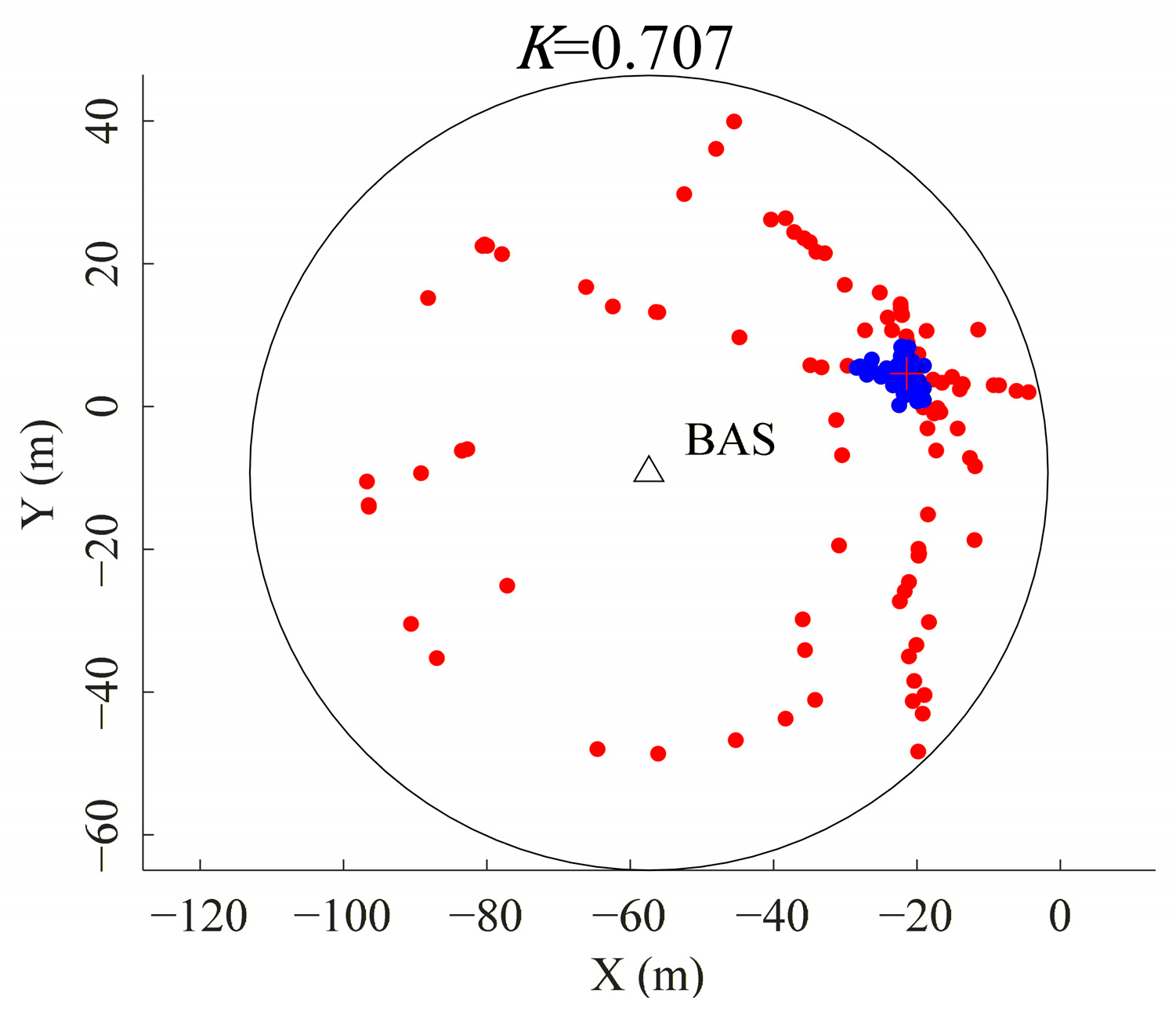
To obtain the optimal K value, we took the number of total intersections in the minimum circle as a statistical index recorded as N u m . We assigned values to K with a smaller step and conducted a frequency statistical analysis on N u m . As shown in Figure 5 and Figure 6 below, when K is 0.707, N u m reaches a peak of 499, and the partial intersections of 30 distance circles approach the real position of MS.
The selection of the correction factor K in the range [0.5, 1] is based on extensive empirical testing of the experimental data. Although a direct theoretical derivation for this range is not readily available, the lower bound ensures that the propagation correction remains physically reasonable, and the upper bound is constrained by the fact that actual signal propagation time cannot exceed the measured value. In addition, the algorithm’s use of intersection statistics leverages geometric properties, whereby clusters of intersections indicate accurate multipath compensation.
To further justify the selection criterion, the process of maximizing the number of intersection points within the minimum enclosing circle can be interpreted as a geometric surrogate for likelihood maximization. When the correction factor K is appropriately chosen, the corrected TOA-derived radii become geometrically consistent, and the corresponding distance circles intersect more frequently and more tightly around the true MS location. Under the assumption that TOA errors are independent and dominated by positive NLOS bias, each valid circle intersection represents a pairwise constraint satisfied by the underlying geometry. Therefore, maximizing the total number of intersections in the feasible region effectively identifies the K value that maximizes the spatial agreement among all BAS–MS distance measurements. Although this approach does not constitute an explicit analytical maximum likelihood (ML) or maximum a posteriori (MAP) estimator, it serves as a computationally efficient mechanism that approximates likelihood maximization by leveraging the clustering characteristics of intersection points under the correct error-correction factor.
In summary, the influence of time-delay error can be effectively reduced by adjusting the K value. The greater the value of N u m , the better the correction effect on time-delay error. In this paper, the K value corresponding to the maximum N u m is the optimal correction factor.

3.3. Calculation of Mobile Station Coordinate

Based on the optimal K value solution, all intersections in the minimum circle are filtered out and recorded as intersection set A 1 . False intersections are filtered out by the criterion of three times the standard deviation, and we obtain a new intersection set B whose positions are more concentrated.
The specific operations are as follows:
(1)
Calculate the centroid coordinate ( X 0 , Y 0 ) of the intersection set A 1 ;
(2)
Calculate the distance L i from each point in the intersection set A 1 to the centroid, eliminate the intersections whose distance is greater than the mean of L i , and obtain the intersection set A 2 .
(3)
Calculate the mean L and standard deviation σ of the corresponding distance L i of the intersection set A 2 , eliminate the intersections whose distance is greater than L + 3 σ , and obtain the intersection set B .
(4)
The coordinates of each point in the intersection set B are X i , Y i , i = 1,2 , , n , and the MS coordinate X M S , Y M S is calculated as follows:
X M S = X i / n
Y M S = Y i / n
As shown in Figure 7, the red points are the intersection set A 1 , the blue points are the intersection set B , and the red “+” is the MS location.

3.4. Time Complexity Analysis

The overall time complexity of the proposed intersection-statistics-based TOA localization algorithm can be evaluated by analyzing its main computational phases, including circle intersection calculation, error correction parameter search, and coordinate estimation.
Assume there are N base stations. In the intersection calculation stage, each BAS defines a circle centered at its location with the TOA-derived distance as the radius. Pairwise intersections between circles are computed to identify candidate mobile station positions. For N circles, a total of ( N ( N 1 ) ) 2 unique pairs exist, and each pair yields up to two intersection points, resulting in time complexity O ( N 2 ) per parameter search.
To determine the optimal error correction factor K , an intersection frequency statistical analysis is performed over a parameter range with P candidate values. For each K , all circle intersections are recalculated and statistical features are collected. Thus, the search procedure incurs a total computational complexity of O ( P × N 2 ) .
Finally, outlier filtering and coordinate averaging, based on the intersection set, are simple linear operations applied to all intersection points, retaining the overall polynomial complexity.
Compared with iterative and model-based optimization approaches, the proposed algorithm eliminates multi-dimensional iterative adjustment and has the potential to achieve fast processing in real-world scenarios.

4. Experimental Analysis

4.1. Analysis of Localization Error

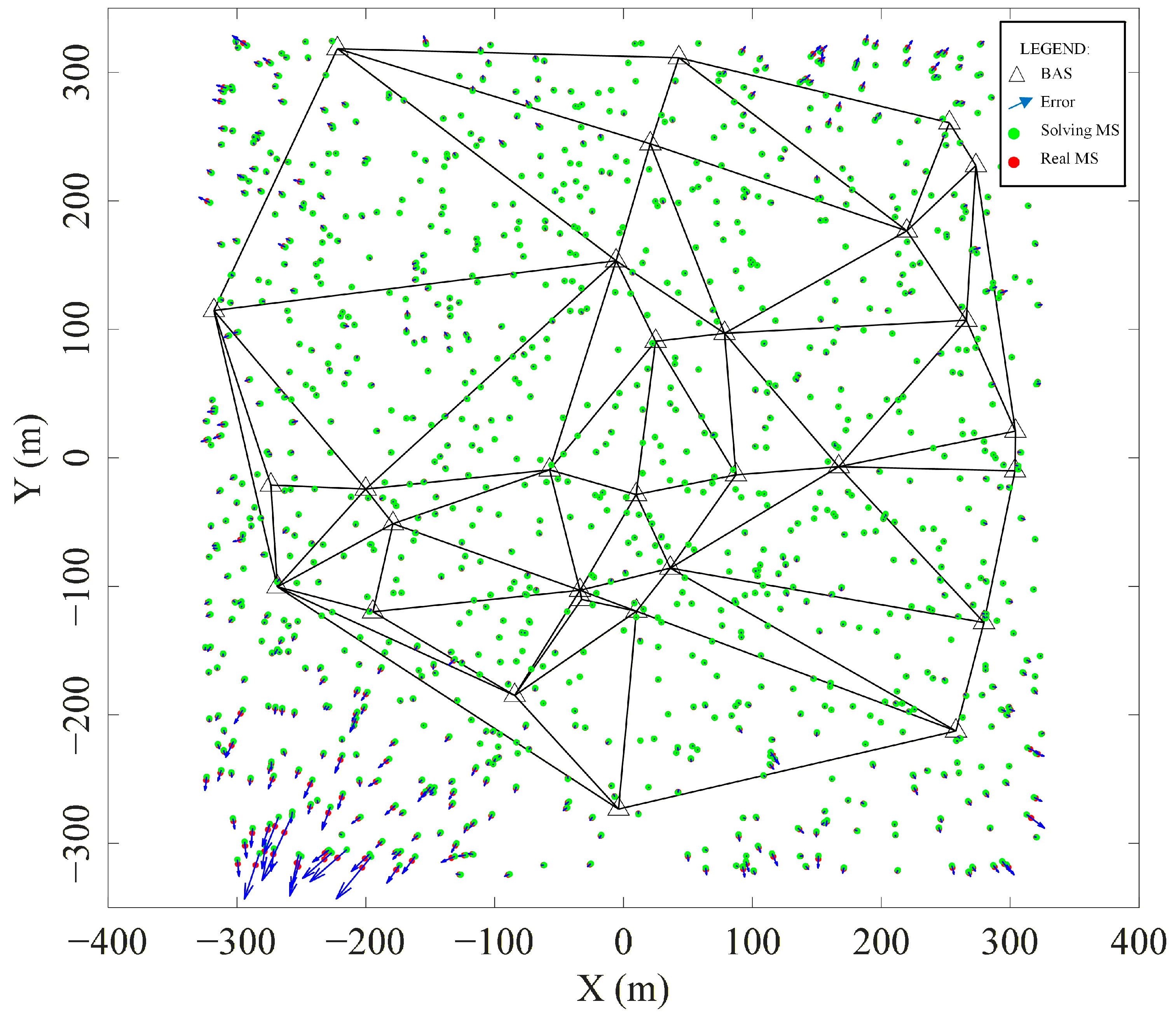
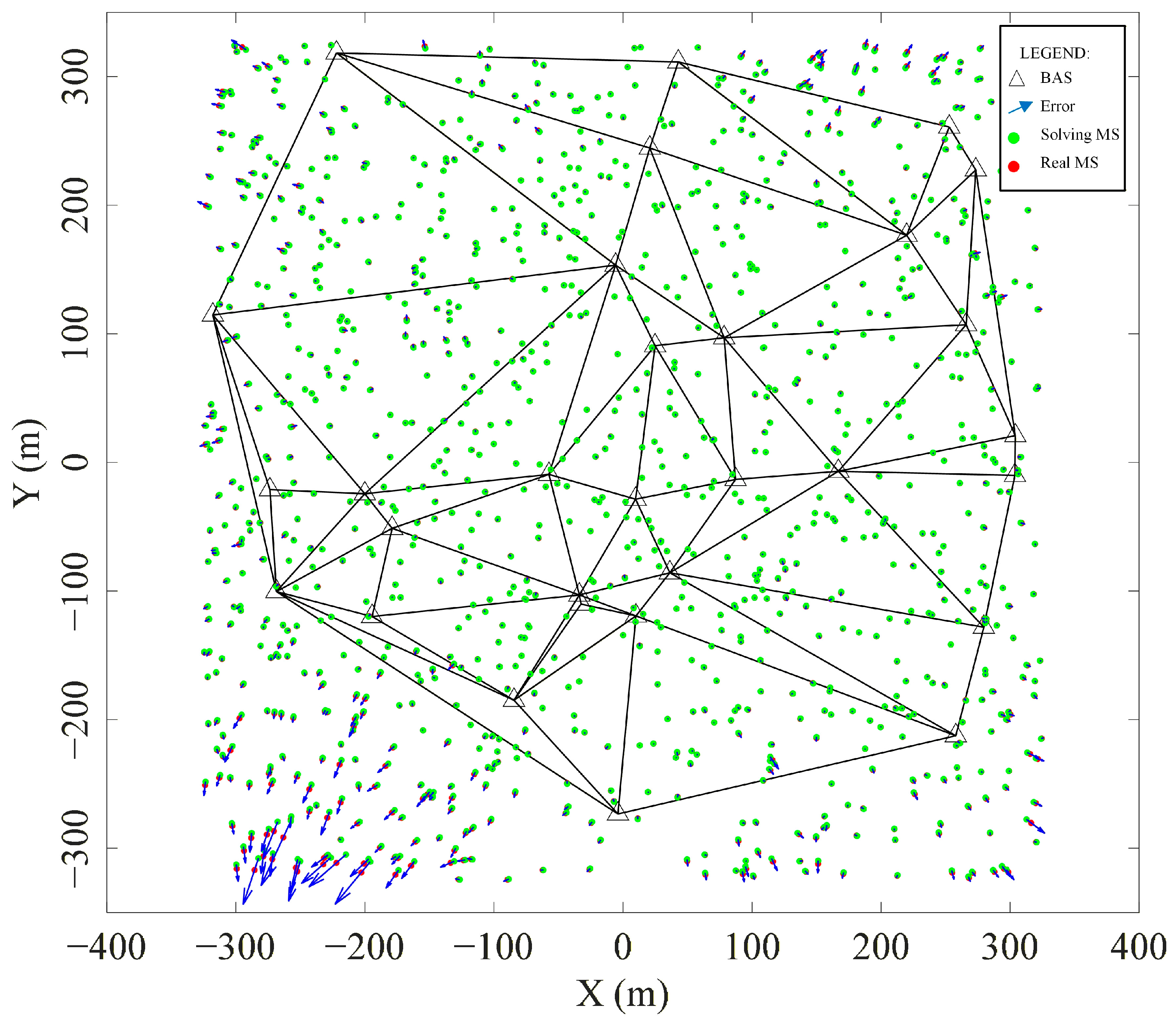
In the 30-BAS localization environment, we obtained 1100 TOA-measured data. Then, we calculated the MS coordinates using the above method, and the error vectors ( X , Y ) were calculated based on the real coordinates of MS. The error distribution is shown in Figure 8. A Delaunay triangulation network was constructed based on 30 BASs to analyze the error distribution better. The arrows’ direction indicates the direction of the errors, and the arrows’ length shows the errors’ size. Note that because the errors are too small, all errors are magnified two times in the figure. The localization accuracy of the MS is higher inside the BAS network. In contrast, outside the BAS network, the localization accuracy is relatively poor and the directions of errors are mostly away from the BAS network.
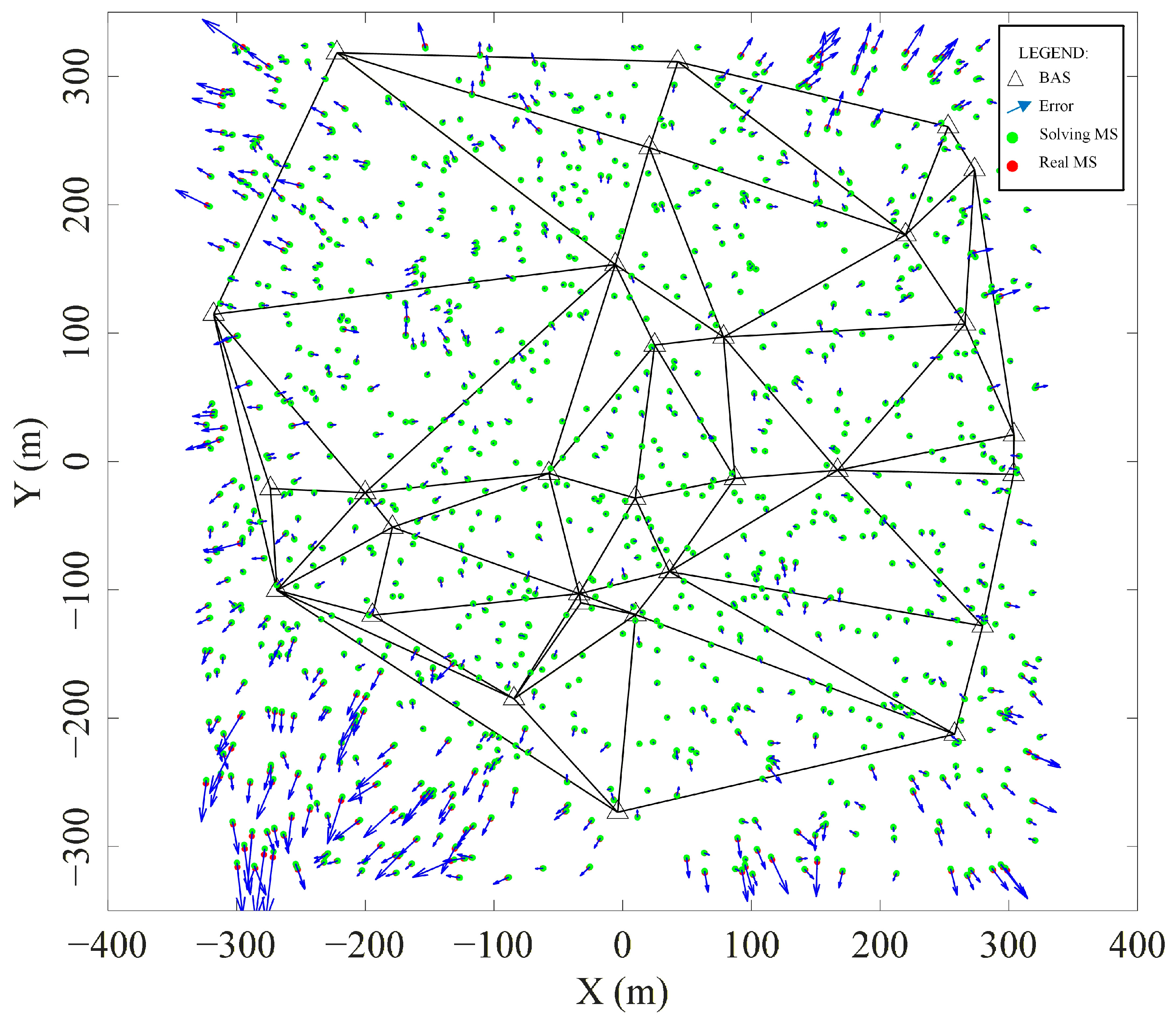
Considering the differences in data input requirements among various algorithms, the same dataset was only applied to the LS algorithm and the Nano algorithm separately, and their results were compared with those of this study. We calculated 1100 TOA-measured data in the 30-BAS localization environment. The results of experimental error analysis and a performance comparison of different algorithms are shown in Table 2 and Table 3, respectively. The average absolute error in the 30-BAS localization environment is 0.416 m, the maximum error is 7.187 m, and the minimum error is 0.004 m, and 97.64% of the localization errors are less than 1 m. Our algorithm’s results are better than those of the LS and Nano algorithms, as evidenced by the Nano algorithm’s error distribution shown in Figure 9. In a word, our algorithm’s results are ideal, meeting the accuracy requirements of general applications.
To further evaluate the characteristics of the proposed algorithm in the context of state-of-the-art solutions, we additionally compared our method with a representative neural-network-based TOA localization approach. Specifically, Pu and Chen proposed a hybrid least-squares and BP neural network model designed to compensate for nonlinear TOA errors and improve robustness in complex indoor environments [34]. Using the same open competition dataset, their method achieved average errors ranging from approximately 0.406 m to 0.638 m across multiple experimental scenarios. These results are comparable to, but generally slightly inferior to, the performance of our intersection-statistics-based approach under the same 30-BAS test case. More importantly, unlike neural-network-based models, which require supervised training, hyperparameter tuning, and environment-specific generalization, our method operates in a fully data-driven and training-free manner with significantly lower computational overhead.
Taken together, these comparisons indicate that the proposed framework performs competitively with classical geometric algorithms (LS, Nano) and achieves accuracy comparable to state-of-the-art learning-based TOA localization methods, while maintaining advantages in simplicity, environment independence, and general applicability.
The performance improvement achieved by the proposed intersection-statistics-based TOA localization algorithm can be explained by several factors. First, unlike LS and Nano, which operate directly on raw TOA measurements and are therefore more sensitive to NLOS-induced positive biases, the proposed method adaptively adjusts the TOA-derived radii by identifying the correction factor K that maximizes geometric consistency among all BAS–MS constraints. This allows the algorithm to better suppress the systematic bias that often affects classical geometric approaches. Second, by leveraging the spatial clustering behavior of circle intersections rather than relying on iterative minimization procedures, the proposed method avoids potential convergence instability and error-propagation issues that may arise in LS-type solvers under strong multipath or asymmetric NLOS conditions. Third, compared with the neural-network-based method in reference [34], the proposed approach does not depend on supervised training or environment-specific generalization capability, and therefore maintains more stable performance when the statistical characteristics of the environment differ from those seen during model training. These factors contribute to the observed improvements in positioning accuracy, variance reduction, and robustness across the tested scenarios.

4.2. Analysis of K Value Changes in the Same BAS Localization Environment

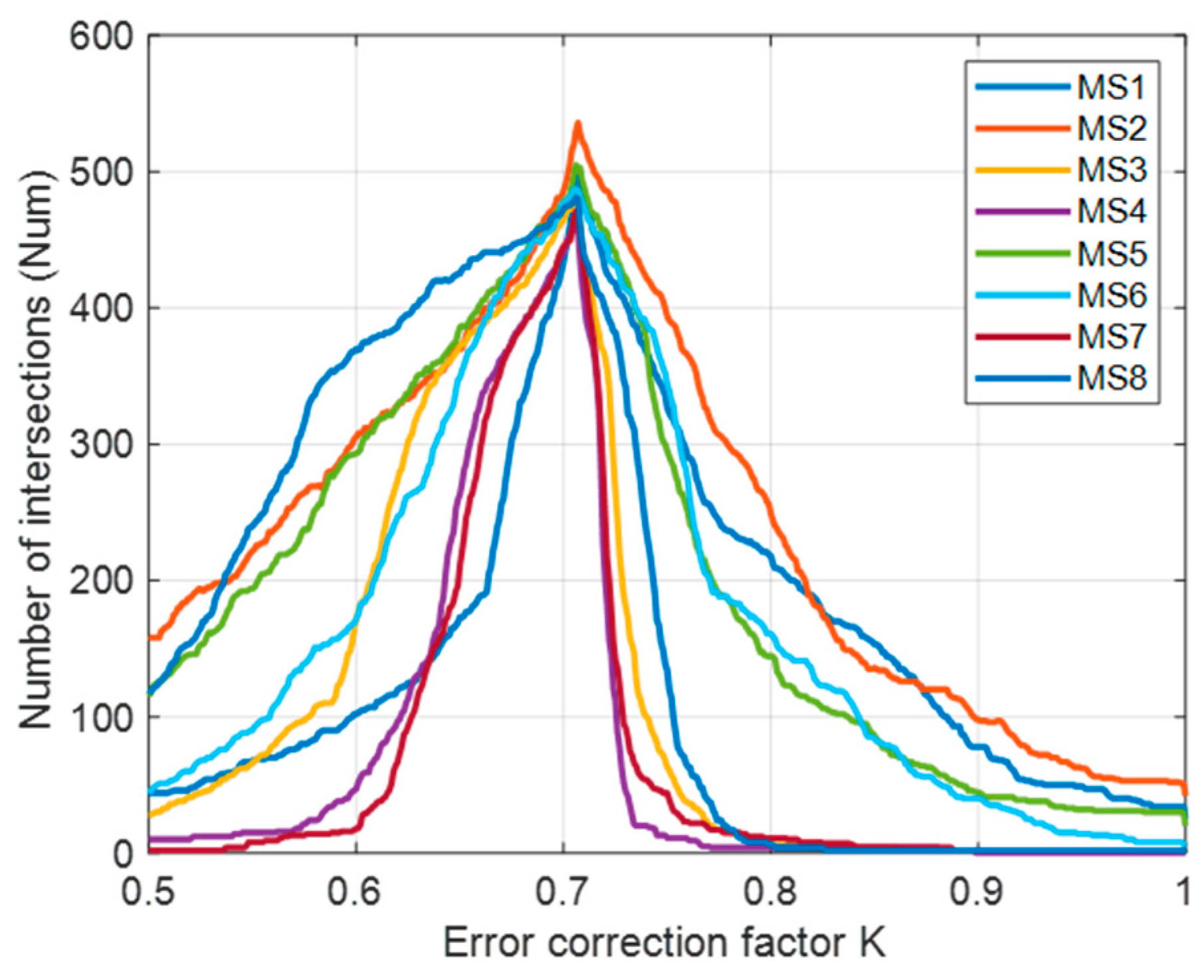
We randomly selected 8 of the 1100 sets of measured data obtained from the 30-BAS localization environment and drew a broken line diagram (Figure 10) based on the frequency statistics on N u m i .
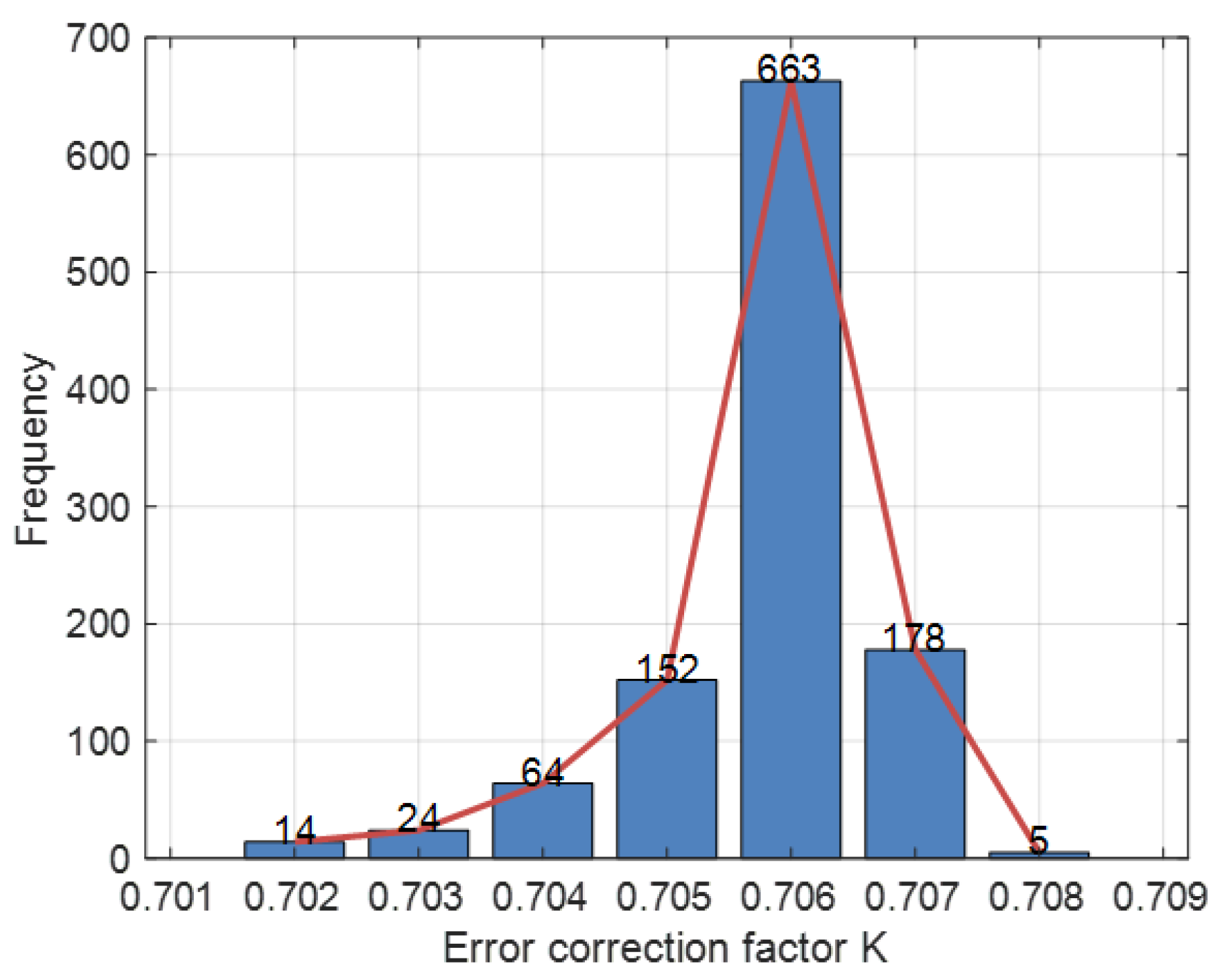
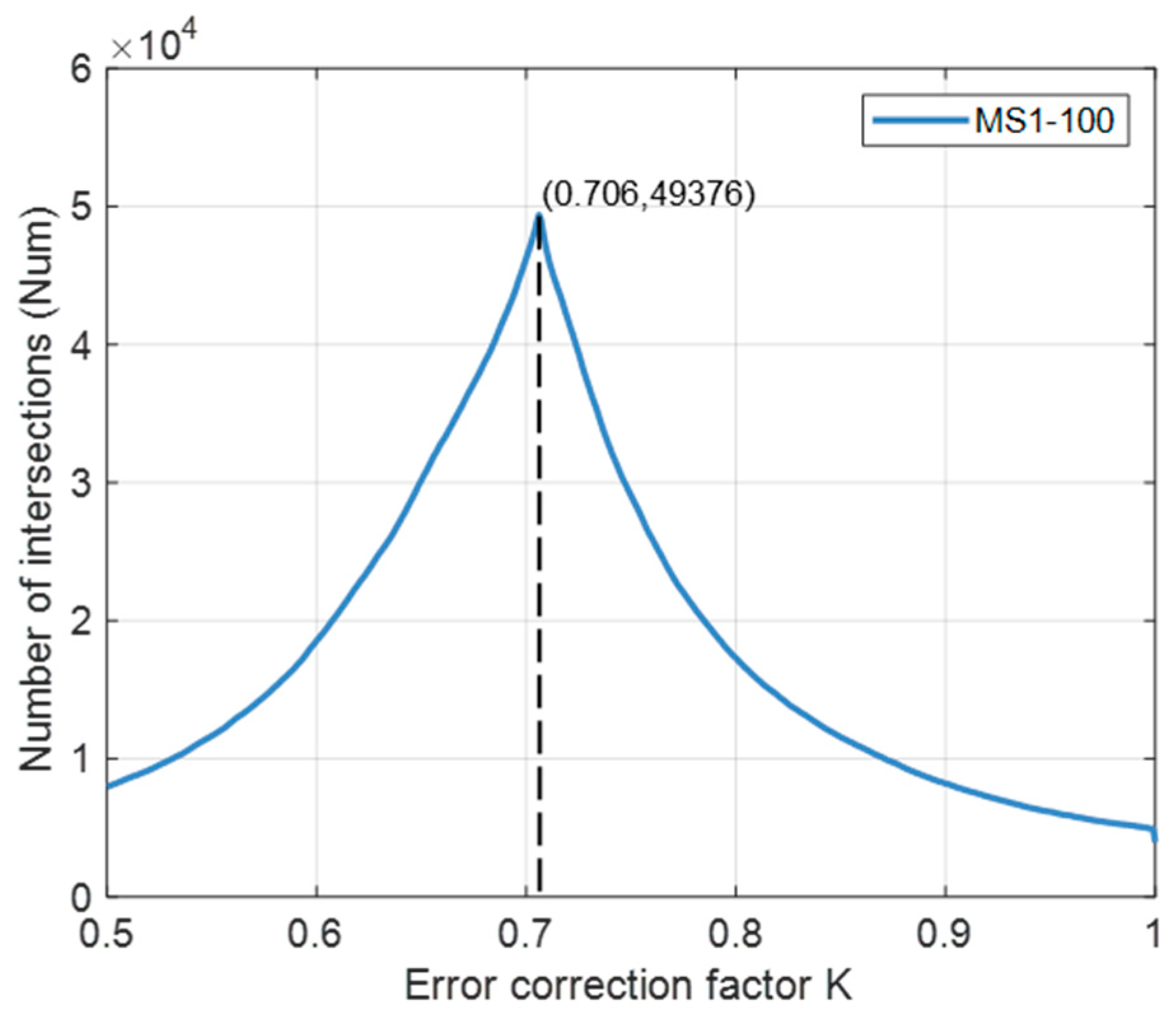
In the same localization environment, the error correction factors K obtained by different MSs are approximately the same. In other words, in a specific range, the time-delay error E i caused by shadow fading, environmental factors and multipath effects accounts for the same proportion of the measured data. As shown in Figure 11, in the 30-BAS localization environment, intersection frequency statistics of the error correction factor K of 1100 sets of measured data were carried out at 0.001 intervals. The values of K are concentrated in 0.705, 0.706, and 0.707, and more than half of the K values are 0.706.
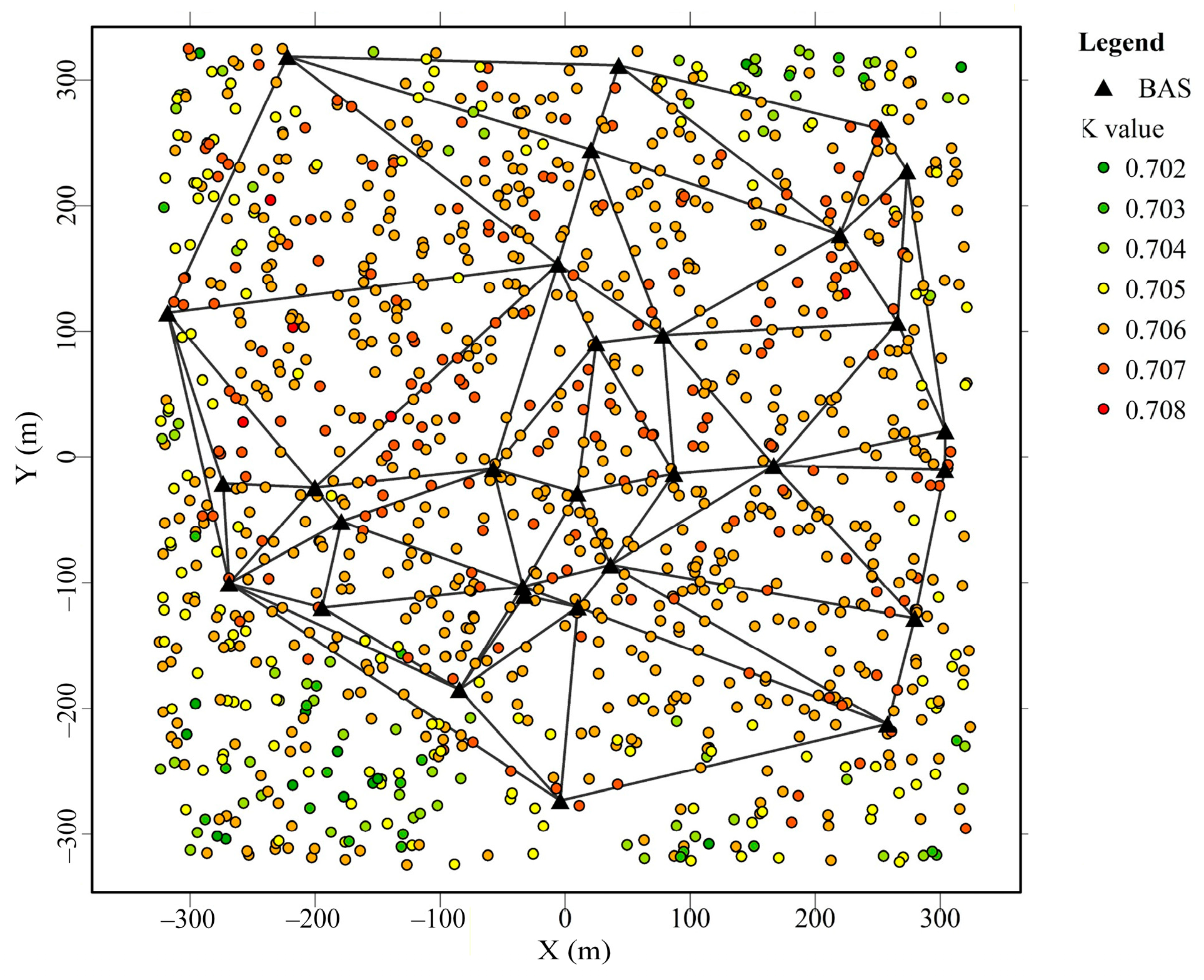
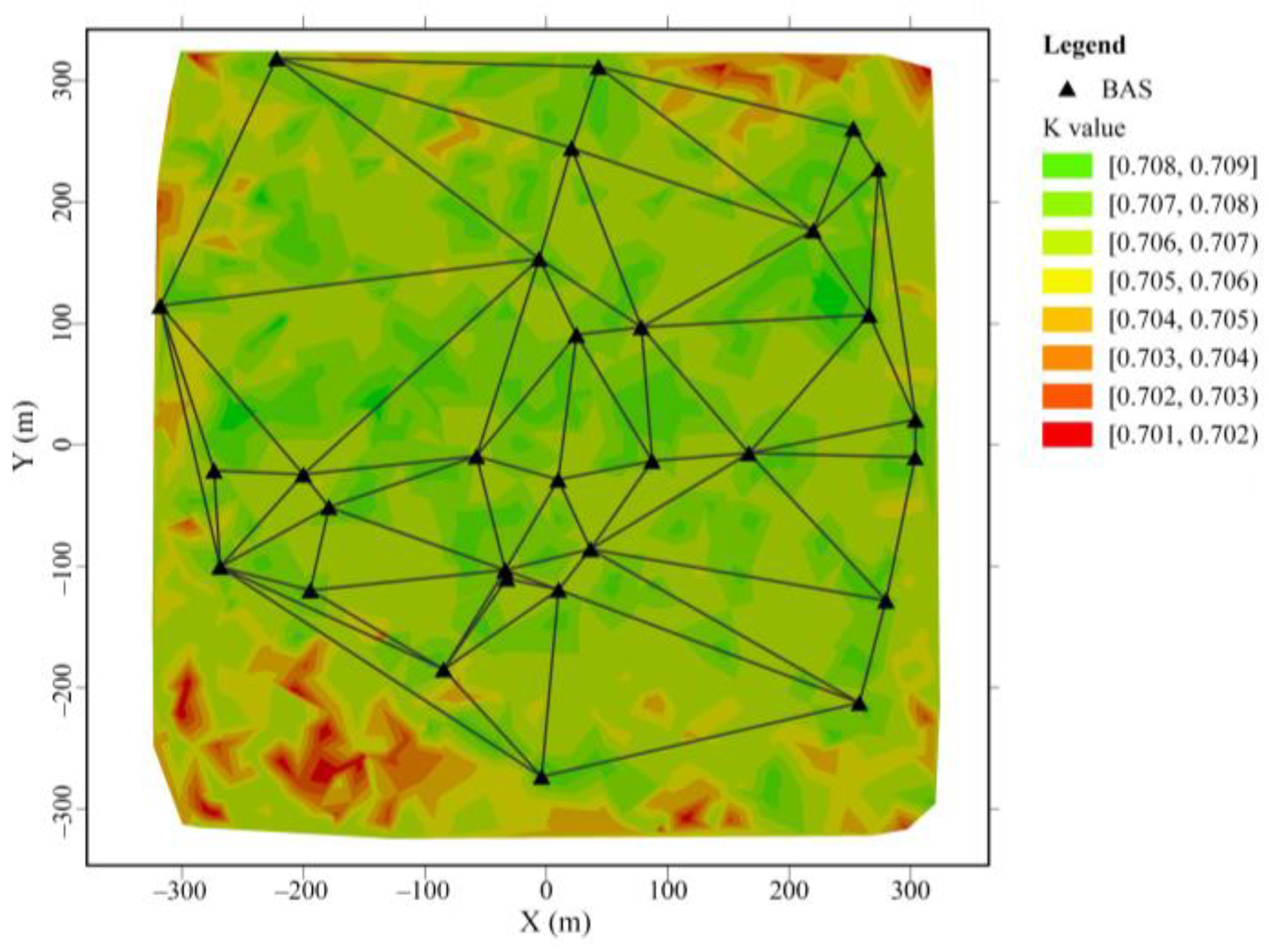
Under the constraint of Delaunay BAS triangulation, K value distributions are drawn based on the localization of MSs (Figure 12 and Figure 13). When MSs are inside the BAS network, the K values are mostly 0.706 and 0.707, and when outside the BAS network, the K values are mostly 0.703, 0.704, and 0.705. The K values inside the network are slightly larger than those outside the network, and those inside the network are more stable.
We can calculate the cumulative frequency of N u m i from numerous measured data in the same localization environment. The peak value K 0 , a universal error correction factor for the corresponding localization environment, can be obtained from Figure 14. In the 30-BAS localization environment, the universal error correction factor K 0 is 0.706. In localization applications within a specific area, directly applying a universal error correction factor to correct the time-delay error may potentially improve localization efficiency. The time complexity can be further reduced to O ( N 2 ) .
In the 30-BAS localization environment, the error distribution of 1100 sets of MS localization results was obtained based on the universal error correction factor, as shown in Figure 15 and Table 4. The average absolute error is 0.547 m, the maximum error is 7.791 m, and the minimum error is 0.001 m. Additionally, 85.82% of the absolute values of localization errors are less than 1 m. The experimental analysis shows that the localization error based on the universal error correction factor is slightly larger, but still meets the general applications’ requirements, and the localization time efficiency is improved.
By jointly examining the spatial error distribution shown in Figure 8 and Figure 15 together with the spatial distribution of K values in Figure 12 and Figure 13, a consistent pattern can be observed. Regions located near or outside the convex hull of the BAS deployment exhibit larger fluctuations in the estimated K values as well as higher localization errors. This behavior suggests that the spatial variability of K reflects the weakening of geometric constraints in these boundary regions, where TOA measurements are more strongly influenced by NLOS-dominated paths and asymmetric multipath propagation. As the corrected TOA radii become less geometrically consistent in these areas, the resulting intersection patterns become more dispersed, leading to increased positioning deviations. This observation indicates that the spatial variation of K may serve as an indicator of reliability for TOA-based localization within the coverage area.
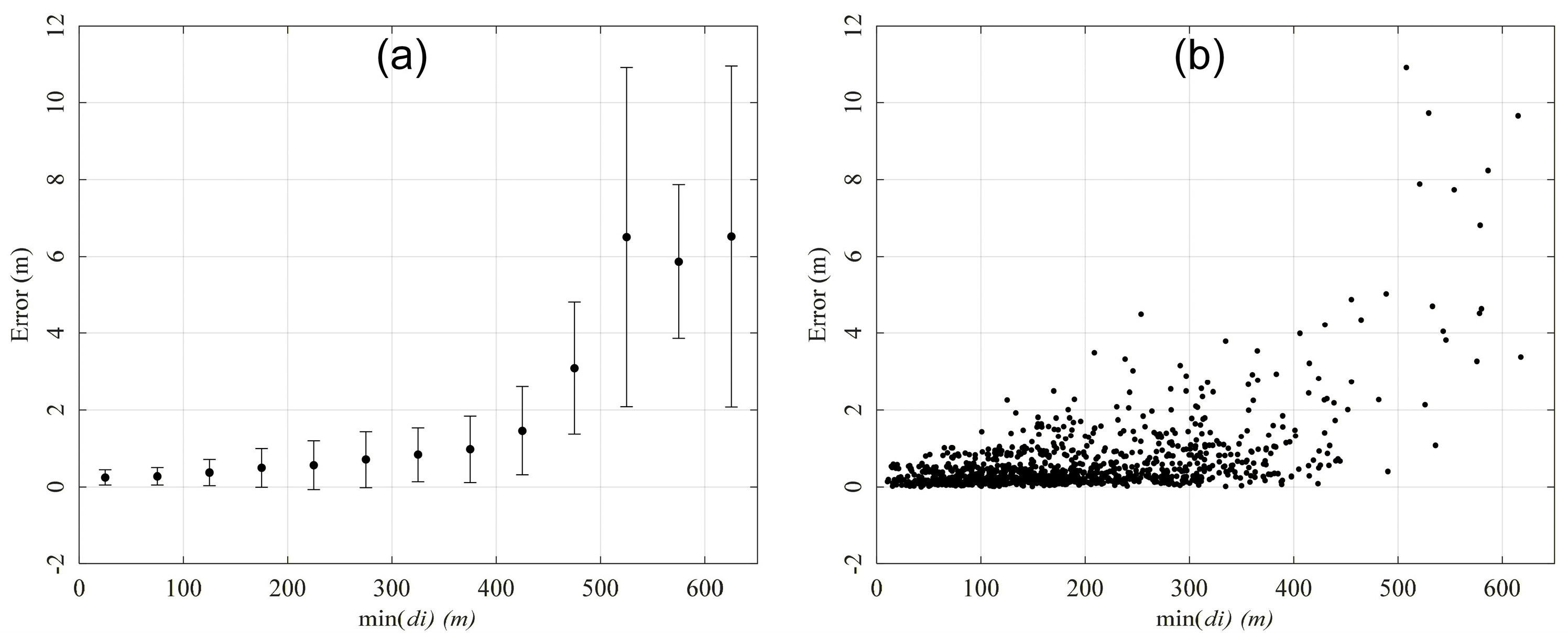
In addition to the spatial analysis of K and positioning error, a parameter sensitivity study was conducted to further evaluate the robustness of the proposed method. Since the minimum circle radius r used in the intersection-statistics process is adaptively defined as r = m i n ( d i ) , the positioning error was examined across different ranges of r by grouping m i n ( d i ) into 50 m intervals. The results indicate (Figure 16) that smaller r values generally lead to more stable localization performance, as overly large radii include more dispersed intersections and weaken the geometric consistency used in the estimation of K . When r is below approximately 400 m, the mean positioning error remains within 1 m, whereas larger r values—typically corresponding to MS locations outside the BAS network coverage region—lead to more noticeable fluctuations. For r values exceeding 600 m, the number of available samples becomes limited, resulting in lower statistical reliability. These findings suggest that the proposed method maintains stable performance when r remains within a practically reasonable range.

4.3. Analysis of K Value Changes in the Different BAS Localization Environments

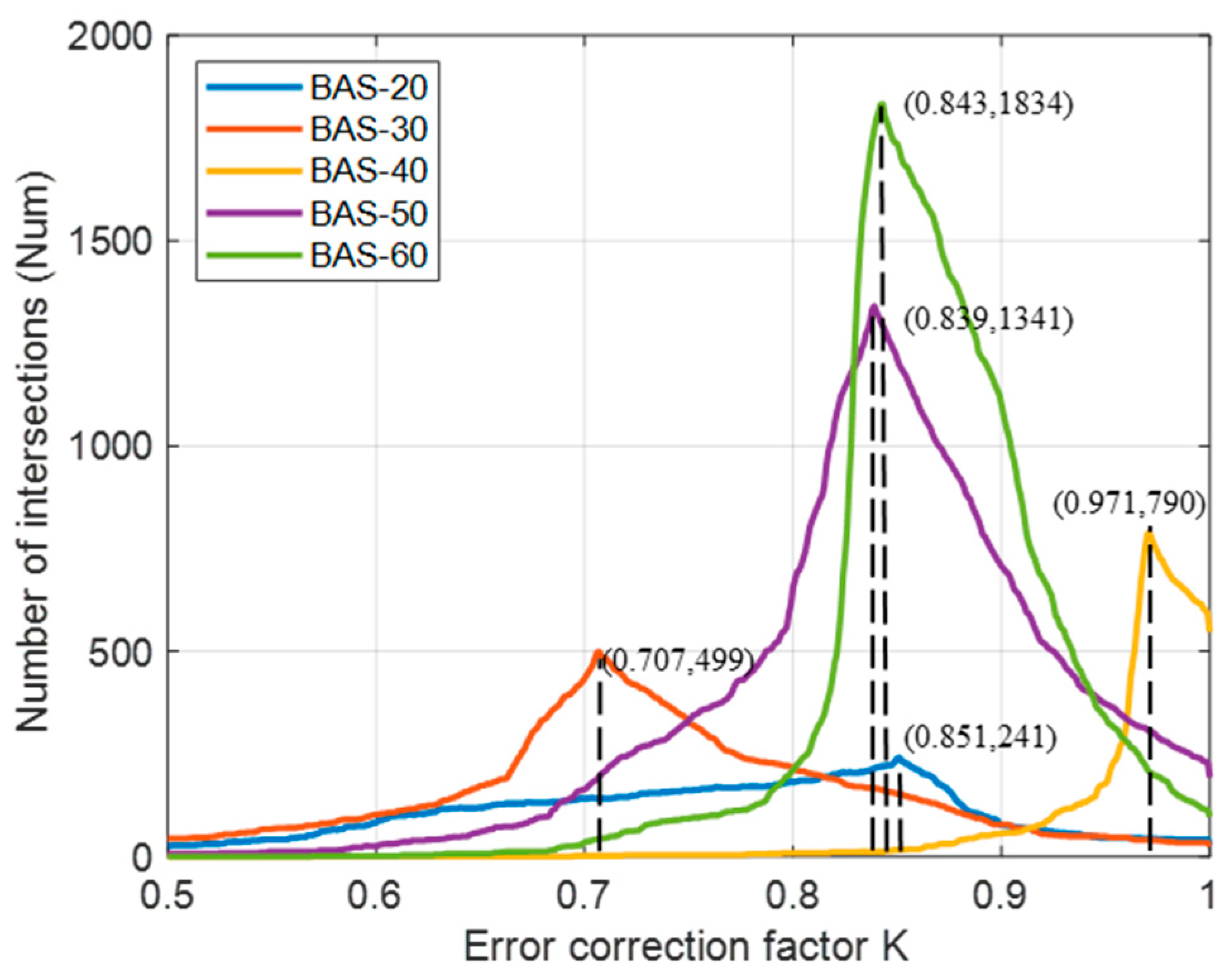
We calculated the N u m frequency statistics of the measured data in the localization environments with 20, 30, 40, 50, and 60 BASs to analyze the change in K value in the different BAS localization environments. The results are shown in Figure 17.
The experimental results show that K values are disparate in the different BAS networks. There is a weak correlation between the magnitude of K values and the number of BASs. Due to the lack of a comprehensive description of the localization environments in the competition dataset—including details on physical layout, characteristics, and relevant influencing factors—an in-depth analysis of the differences in results across various localization environments is hindered. However, the distinctly different K values observed across various environments indicate that the time-delay errors E i are closely related to the layout and localization environment of BASs.
Although TOA measurement errors are highly dependent on the specific multipath and NLOS conditions experienced by each mobile station, our experimental results show that the optimal correction factor K exhibits strong statistical consistency within a given indoor environment. In the 30-BAS test case, more than 1100 MS samples produced nearly identical peaks in the intersection-statistics curves, with K values concentrated around 0.705–0.707. This indicates that, despite local variations in multipath geometry, the dominant proportion of the time-delay error remains stable at the environment level. However, when the algorithm is applied across different BAS deployments, the peak K values change significantly, demonstrating that the correction factor is environment-dependent rather than universally applicable. Therefore, the environment-level universal K serves as an optional approximation that improves computational efficiency when many MS measurements share similar propagation conditions, whereas the adaptive K estimation remains the preferred choice for achieving the highest localization accuracy.

5. Discussion

This study presents a novel indoor TOA localization algorithm based on intersection statistical analysis. The proposed algorithm demonstrates robust anti-jamming capabilities against measurement noise. By eliminating the need to distinguish between LOS and NLOS propagation environments, we introduced an adaptive error correction factor K to compensate for time-delay errors E i in TOA measurements. Experimental results indicate that the algorithm achieves satisfactory performance. Specifically, when applying the adaptive error correction factor, 97.36% of the absolute localization errors are maintained below 1 m. Even with a universal error correction factor, the localization accuracy remains acceptable, with 85.82% of errors staying within the 1 m threshold, meeting the requirements for general indoor positioning applications. Furthermore, when compared with classical geometric algorithms and representative learning-based TOA localization methods reported in the literature, the proposed framework achieves competitive accuracy while retaining advantages in simplicity, environment independence, and training-free deployment, highlighting its practical applicability across diverse indoor scenarios.
The error model used in this work, in which the time delay error is represented as a multiple of the measured TOA value, serves as a practical simplification to enable parameter optimization in real-world scenarios. However, it should be noted that this representation does not capture the full complexity of signal propagation, and current theoretical models do not establish a universally valid proportional relationship between the measured delay and the actual error. In reality, TOA errors are influenced by specific environmental factors, including NLOS propagation, multipath, and other environmental variables such as temperature and humidity. Our correction factor is designed to adaptively fit the empirical distribution of measurements within a given environment by maximizing the concentration of intersection points, rather than representing a strict physical constant. We acknowledge the limitation of this approach, and future work will investigate more physically grounded or data-driven error models that can incorporate additional environmental variation.
Although the proposed intersection-statistics-based TOA localization algorithm performs robustly in environments with moderate-to-dense BAS deployments, its performance may degrade when the number of available BASs is very limited. When fewer than approximately 15–20 BASs are present, the number of pairwise circle intersections becomes insufficient to generate a pronounced statistical peak during the optimization of the correction factor K . As a result, the intersection points become more spatially dispersed, and the optimal K value cannot be identified as distinctly as in dense deployments, leading to reduced localization accuracy. This behavior is consistent with the geometric limitations inherent in circle-based TOA localization methods. Nevertheless, most practical indoor localization scenarios, such as large public buildings, shopping malls, industrial sites, and indoor 4G/5G small-cell systems, typically involve more than 20 active BASs within the coverage area. Therefore, the proposed method remains well suited to realistic deployment conditions. Future work will explore refined statistical models or hybrid fusion strategies to further improve algorithm robustness under sparse BAS configurations.
While the current study demonstrates promising performance using the available dataset, we acknowledge that a comprehensive assessment of positioning algorithms requires validation across a broader range of real-world environments, including variations in environmental factors such as temperature and humidity. Moreover, the present evaluation is conducted on a single publicly available dataset, which constitutes a limitation of the study. In a practical setting, the mobile station is often in continuous motion, and the number of usable BASs may fluctuate, introducing additional challenges for accurate localization. Integrating environmental sensing (such as temperature and humidity measurements) or developing adaptive signal-correction mechanisms that respond to real-time environmental changes represent an important direction for future research. Additionally, exploring high-precision positioning and efficient tracking techniques under these constrained conditions could greatly enhance the robustness and accuracy of indoor localization systems.

Author Contributions

Conceptualization, H.L. and Z.W.; methodology, H.L., M.X., P.Z. and C.Z.; validation, L.D., Y.L., M.W. and L.S.; formal analysis, Z.W.; writing—original draft preparation, H.L. and Z.W.; writing—review and editing, H.L.; visualization, C.Z.; supervision, Z.W.; project administration, H.L.; funding acquisition, C.Z. All authors have read and agreed to the published version of the manuscript.

Funding

This research was supported by the Key R&D “Pioneer” Tackling Plan Program of Zhejiang Province, China (No. 2025C01216).

Institutional Review Board Statement

Not applicable.

Informed Consent Statement

Not applicable.

Data Availability Statement

The original contributions presented in this study are included in the article. The full dataset and relevant documentation used in this study have been made available at: https://pan.baidu.com/s/1XieH0zg3iRdXxdaZHtQoPA?pwd=7yx8 (accessed on 20 January 2026). Further inquiries can be directed to the corresponding authors.

Acknowledgments

Discussions with G.Q., K.D., C.Z. and X.W. on the existing indoor TOA localization algorithm are acknowledged.

Conflicts of Interest

Authors Z.W., C.Z., P.Z., L.D., Y.L. and L.S. were employed by the China Satellite Network Digital Technology. The remaining authors declare that the research was conducted in the absence of any commercial or financial relationships that could be construed as a potential conflict of interest.

Abbreviations

The following abbreviations are used in this manuscript:
NLOSNon-line of sight
LOSLine of sight
LSLeast squares
WLSWeighted least squares
BASBase station
MSMobile station
TOATime of arrival
TDOATime difference of arrival
ANNArtificial neural network
LPWANLow-Power Wide-Area Network
IoTInternet of Things
LoRaLong Range
Wi-FiWireless Fidelity
AOAAngle of arrival
RSSIReceived signal strength indication
LBSLocation-Based Service
GPSGlobal Positioning System
RECRanging error classification
LSTMLong-short term memory
CNNConvolutional neural network
WLANsWireless local area networks

References

  1. Xia, L.; Lu, J.; Lu, Y.; Zhang, H.; Fan, Y.; Zhang, Z. Augmented reality and indoor positioning based mobile production monitoring system to support workers with human-in-the-loop. Robot. Comput.-Integr. Manuf. 2024, 86, 102664. [Google Scholar] [CrossRef]
  2. Wei, Z.; Chen, J.; Tang, H.; Zhang, H. RSSI-based location fingerprint method for RFID indoor positioning: A review. Nondestruct. Test. Eval. 2024, 39, 3–31. [Google Scholar] [CrossRef]
  3. Obeidat, H.; Shuaieb, W.; Obeidat, O.; Abd-Alhameed, R. A review of indoor localization techniques and wireless technologies. Wirel. Pers. Commun. 2021, 119, 289–327. [Google Scholar] [CrossRef]
  4. Tomic, S.; Beko, M. Target Localization via Integrated and Segregated Ranging Based on RSS and TOA Measurements. Sensors 2019, 19, 230. [Google Scholar] [CrossRef] [PubMed]
  5. Aubry, A.; Babu, P.; De Maio, A.; Fatima, G.; Sahu, N. A robust framework to design optimal sensor locations for TOA or RSS source localization techniques. IEEE Trans. Signal Process. 2023, 71, 1293–1306. [Google Scholar] [CrossRef]
  6. Caffery, J.; Stuber, G. Overview of Radiolocation in CDMA Cellular Systems. IEEE Commun. Mag. 1998, 36, 38–45. [Google Scholar] [CrossRef]
  7. Lee, S.; Kim, J.; Moon, N. Random forest and WiFi fingerprint-based indoor location recognition system using smart watch. Hum.-Centric Comput. Inf. Sci. 2019, 9, 6. [Google Scholar] [CrossRef]
  8. Chen, G.; Zhang, Y.; Wang, Y.; Meng, X. Unscented Kalman Filter Algorithm for WiFi-PDR Integrated Indoor Positioning. Acta Geod. Cartogr. Sin. 2015, 44, 1314–1321. [Google Scholar]
  9. Cao, H.; Wang, Y.; Bi, J.; Zhang, Y.; Yao, G.; Feng, Y.; Si, M. LOS compensation and trusted NLOS recognition assisted WiFi RTT indoor positioning algorithm. Expert Syst. Appl. 2024, 243, 122867. [Google Scholar] [CrossRef]
  10. Jurdi, R.; Chen, H.; Zhu, Y.; Ng, B.L.; Dawar, N.; Zhang, C.; Han, J.K.H. WhereArtThou: A WiFi-RTT-based indoor positioning system. IEEE Access 2024, 12, 41084–41101. [Google Scholar] [CrossRef]
  11. Bai, L.; Ciravegna, F.; Bond, R.; Mulvenna, M. A low-cost indoor positioning system using bluetooth low energy. IEEE Access 2024, 8, 136858–136871. [Google Scholar] [CrossRef]
  12. Wu, N.; Yang, A.; Fen, L.; QI, X. Review on indoor positioning technology based on visible light communications. J. Nanjing Univ. Inf. Sci. Technol. 2017, 9, 159–167. [Google Scholar]
  13. Bastiaens, S.; Alijani, M.; Joseph, W.; Plets, D. Visible light positioning as a next-generation indoor positioning technology: A tutorial. IEEE Commun. Surv. Tutor. 2024, 26, 2867–2913. [Google Scholar] [CrossRef]
  14. Pak, J.; Ahn, C.; Shi, P.; Shmaliy, Y.; Lim, M. Distributed Hybrid Particle/FIR Filtering for Mitigating NLOS Effects in TOA-Based Localization Using Wireless Sensor Networks. IEEE Trans. Ind. Electron. 2017, 64, 5182–5191. [Google Scholar] [CrossRef]
  15. Liu, S.; Yang, H.; Mei, Z.; Xu, X.; He, Q. Ultra-wideband high accuracy distance measurement based on hybrid compensation of temperature and distance error. Measurement 2023, 206, 112276. [Google Scholar] [CrossRef]
  16. Olivera, R.; Flores, J.; Olivera, R.; Perez, J.; Munoz, J. Heuristic Approach to Indoor Localization Using LoRa RSSI Measurements. Radioengineering 2025, 34, 509–525. [Google Scholar] [CrossRef]
  17. Simka, M.; Polak, L. On the RSSI-based Indoor Localization Employing LoRa in the 2.4 GHz ISM Band. Radioengineering 2022, 31, 135–143. [Google Scholar] [CrossRef]
  18. Zeleny, O.; Fryza, T.; Bravenec, T.; Azizi, S.; Nair, G. Detection of Room Occupancy in Smart Buildings. Radioengineering 2024, 33, 432–441. [Google Scholar] [CrossRef]
  19. Khalil, R.A.; Saeed, N. Hybrid TOA/AOA localization for indoor multipath-assisted next-generation wireless networks. Results Eng. 2024, 22, 102200. [Google Scholar] [CrossRef]
  20. Wu, P.; Su, S.; Zuo, Z.; Guo, X.; Sun, B.; Wen, X. Time Difference of Arrival (TDoA) Localization Combining Weighted Least Squares Firefly Algorithm. Sensors 2019, 19, 2554. [Google Scholar] [CrossRef]
  21. Jin, B.; Xu, X.; Zhang, T. Robust Time-Difference-of-Arrival (TDOA) Localization Using Weighted Least Squares with Cone Tangent Plane Constraint. Sensors 2018, 18, 778. [Google Scholar] [CrossRef]
  22. Bottigliero, S.; Milanesio, D.; Saccani, M.; Maggiora, R. A low-cost indoor real-time locating system based on TDOA estimation of UWB pulse sequences. IEEE Trans. Instrum. Meas. 2021, 70, 5502211. [Google Scholar] [CrossRef]
  23. Kim, J. Three-Dimensional Localization of Heterogeneous Underwater Networks Using Hybrid TOA-AOA Measurements Under Random DoS Attack. IEEE Internet Things J. 2025, 12, 22257–22266. [Google Scholar] [CrossRef]
  24. Tomic, S.; Beko, M.; Dinis, R.; Montezuma, P. Estimating Directional Data From Network Topology for Improving Tracking Performance. J. Sens. Actuator Netw. 2019, 8, 2224–2708. [Google Scholar] [CrossRef]
  25. Zheng, X.; Fu, J. Study on PDR and RSSI Based Indoor Localization Algorithm. Chin. J. Sci. Instrum. 2015, 36, 1177–1185. [Google Scholar]
  26. Pascacio, P.; Casteleyn, S.; Torres-Sospedra, J.; Lohan, E.S.; Nurmi, J. Collaborative indoor positioning systems: A systematic review. Sensors 2021, 21, 1002. [Google Scholar] [CrossRef] [PubMed]
  27. Li, H. Low-Cost 3D Bluetooth Indoor Positioning with Least Square. Wirel. Pers. Commun. 2014, 78, 1331–1344. [Google Scholar] [CrossRef]
  28. Luan, F.; Wang, P.; Hu, J. A Weighted TOA Indoor Localization Algorithm for Underground Space. Ind. Control. Comput. 2014, 27, 73–75. [Google Scholar]
  29. Nanotron Corporation. NanoLOC development Kit 3.0 factsheet. 2007. Available online: https://nanotron.com/assets/pdf/products/Factsheet_nanoLOC-Dev-Kit.pdf (accessed on 20 January 2026).
  30. Lin, Y.; Yu, K.; Zhu, F.; Bu, J.; Dua, X. The state of the art of deep learning-based Wi-Fi indoor positioning: A review. IEEE Sens. J. 2024, 24, 27076–27098. [Google Scholar] [CrossRef]
  31. Nguyen, V.; Nguyen, M.; Choi, J.; Kim, Y. NLOS Identification in WLANs Using Deep LSTM with CNN Features. Sensors 2018, 18, 4057. [Google Scholar] [CrossRef]
  32. Wang, Q.; He, J.; Zhang, Q.; Liu, B.; Yu, Y. Ranging error classification based indoor TOA localization algorithm. Chin. J. Sci. Instrum. 2011, 32, 2851–2856. [Google Scholar]
  33. Wu, S.; Zhang, S.; Xu, K.; Huang, D. Neural Network Localization with TOA Measurements Based on Error Learning and Matching. IEEE Access 2019, 7, 19089–19099. [Google Scholar] [CrossRef]
  34. Pu, J.; Chen, D. A TOA Positioning Algorithm Based on Least Square Method and BP Neural Network. Comput. Technol. Dev. 2018, 28, 5–8. [Google Scholar]
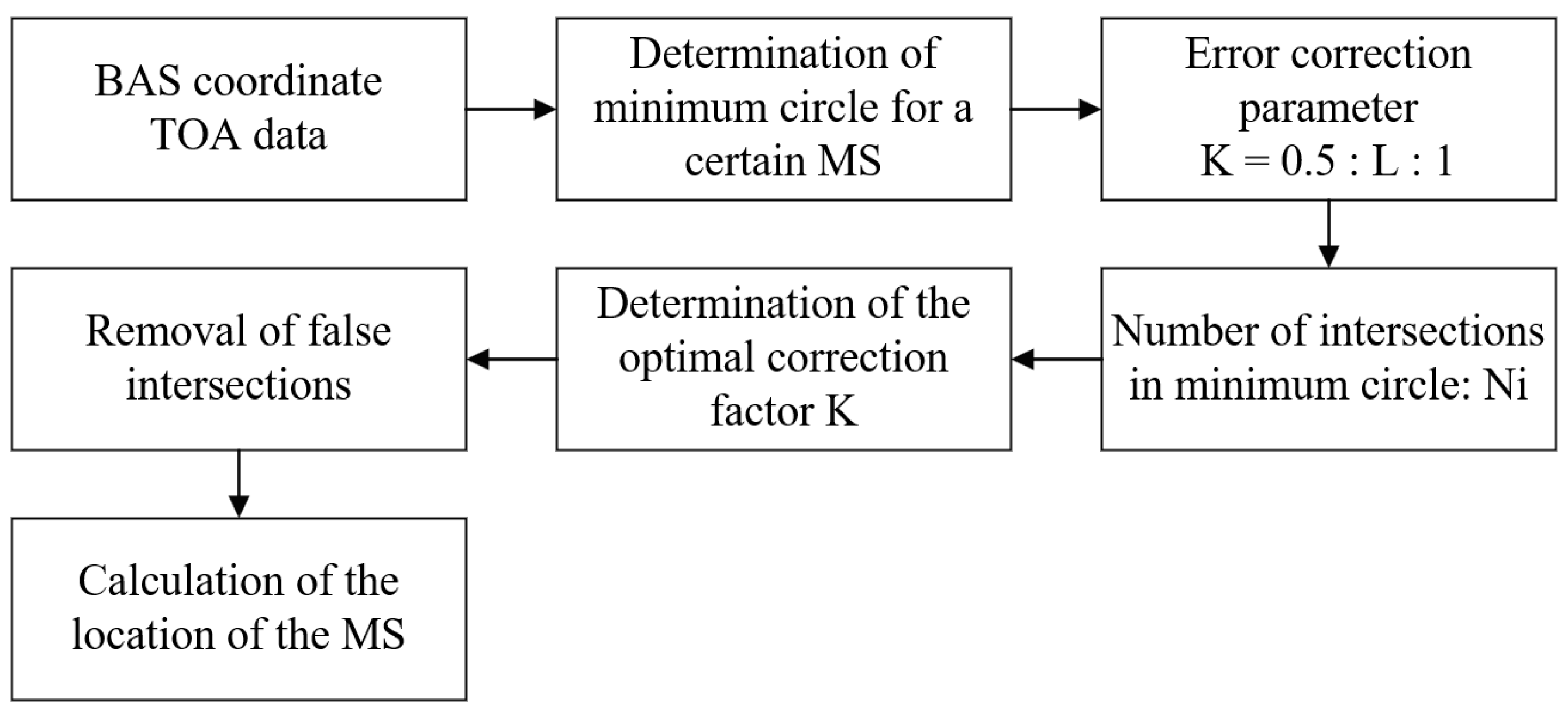
Figure 1. The process flow of the algorithm.
Electronics 15 00639 g001
Figure 2. The relation between the minimum circle and the actual position of MS.
Electronics 15 00639 g002
Figure 3. TOA localization model under ideal error-free conditions.
Electronics 15 00639 g003
Figure 4. The correction of time-delay error with different K values. The yellow region denotes the m i n ( d i ) -radius circle, and the plus sign represents the true value of the MS position.
Electronics 15 00639 g004
Figure 5. Statistical chart of the number of the total intersections in the minimum circle.
Electronics 15 00639 g005
Figure 6. The correction effect on the time-delay error with K = 0.707 . The yellow region denotes the m i n ( d i ) -radius circle.
Electronics 15 00639 g006
Figure 7. The solution of MS coordinates.
Electronics 15 00639 g007
Figure 8. Error distribution in the 30-BAS localization environment.
Electronics 15 00639 g008
Figure 9. Error distribution in the 30-BAS localization environment obtained by the Nano algorithm.
Electronics 15 00639 g009
Figure 10. The statistical chart of N u m i values of different MSs in the 30-BAS localization environment.
Electronics 15 00639 g010
Figure 11. The intersection statistical chart of the error correction factor K in the 30-BAS localization environment.
Electronics 15 00639 g011
Figure 12. Distribution of the estimated correction factor K in the 30-BAS localization environment. The X- and Y-axes represent the spatial coordinates in meters.
Electronics 15 00639 g012
Figure 13. Contour map of the correction factor K in the 30-BAS localization environment. The color scale indicates the estimated K values at different spatial locations.
Electronics 15 00639 g013
Figure 14. Statistical chart of the cumulative number of intersections in the minimum circle.
Electronics 15 00639 g014
Figure 15. Error distribution in the 30-BAS localization environment based on the universal error correction factor.
Electronics 15 00639 g015
Figure 16. Relationship between localization error and the minimum TOA-derived BAS–MS distance m i n ( d i ) . (a) Mean error with error bars computed over 50 m intervals of m i n ( d i ) . (b) Scatter distribution of all individual samples. Larger fluctuations are observed when m i n ( d i ) exceeds 400 m, which corresponds to MS positions approaching or lying outside the BAS network.
Electronics 15 00639 g016
Figure 17. Statistical chart of N u m in the different localization environments.
Electronics 15 00639 g017
Table 1. (a) Part of the experimental data: 1100 TOA-measured data in a 30-base-station localization environment (unit: ns). (b) Part of the experimental data: coordinates of 30 base stations and 1100 mobile stations (unit: m).
(a)
MSBAS1BAS2BAS3BAS29BAS30
11.20 × 10−65.21 × 10−72.16 × 10−71.54 × 10−61.54 × 10⁻⁶
29.85 × 10−78.63 × 10−75.94 × 10−71.84 × 10−61.83 × 10⁻⁶
31.24 × 10−61.29 × 10−61.01 × 10−62.12 × 10−62.19 × 10⁻⁶
41.07 × 10−71.81 × 10−61.45 × 10−62.83 × 10−62.84 × 10⁻⁶
10987.40 × 10−71.03 × 10−66.98 × 10−72.03 × 10−62.03 × 10−6
10992.18 × 10−69.09 × 10−71.04 × 10−61.11 × 10−61.23 × 10−6
11001.47 × 10−61.85 × 10−61.58 × 10−62.63 × 10−62.72 × 10−6
(b)
IDXY IDXY
1−273.67−21.14 1−21.194.48
287.23−13.20 2−81.1458.24
30304.0420.83 1100−164.27−313.63
Symbol description: base station (BAS) and mobile station (MS).
Table 2. Analysis results of experimental error.
Inside and Outside
BAS Network
Inside
BAS Network
Outside
BAS Network
Average error/m0.4160.2970.587
Maximum error/m7.1871.3017.187
Minimum error/m0.0040.0040.163
Variance/m20.2530.1470.302
Table 3. Performance comparison of different algorithms.
AlgorithmProposed AlgorithmLSNano
Average error/m0.4164.9910.642
Maximum error/m7.18737.5147.071
Variance/m20.3695.5571.107
Table 4. Analysis results of experimental error of the universal error correction factor.
Inside and Outside
BAS Network
Inside
BAS Network
Outside
BAS Network
Average error/m0.5470.2980.911
Maximum error/m7.7912.3617.791
Minimum error/m0.0010.0010.063
Variance/m20.5960.2580.844
Disclaimer/Publisher’s Note: The statements, opinions and data contained in all publications are solely those of the individual author(s) and contributor(s) and not of MDPI and/or the editor(s). MDPI and/or the editor(s) disclaim responsibility for any injury to people or property resulting from any ideas, methods, instructions or products referred to in the content.