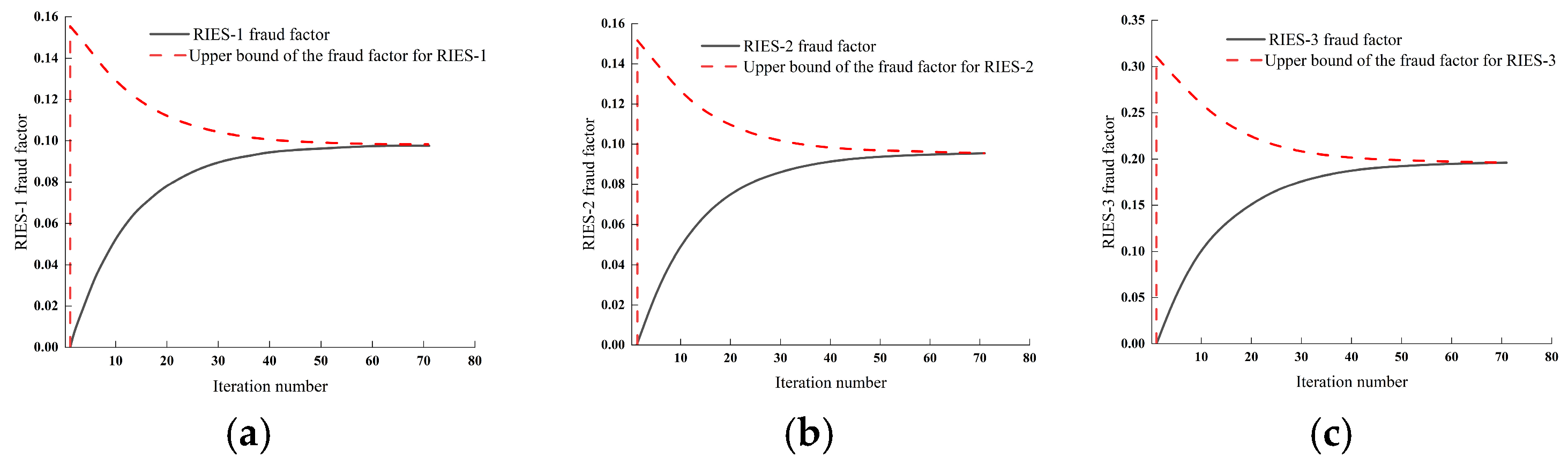
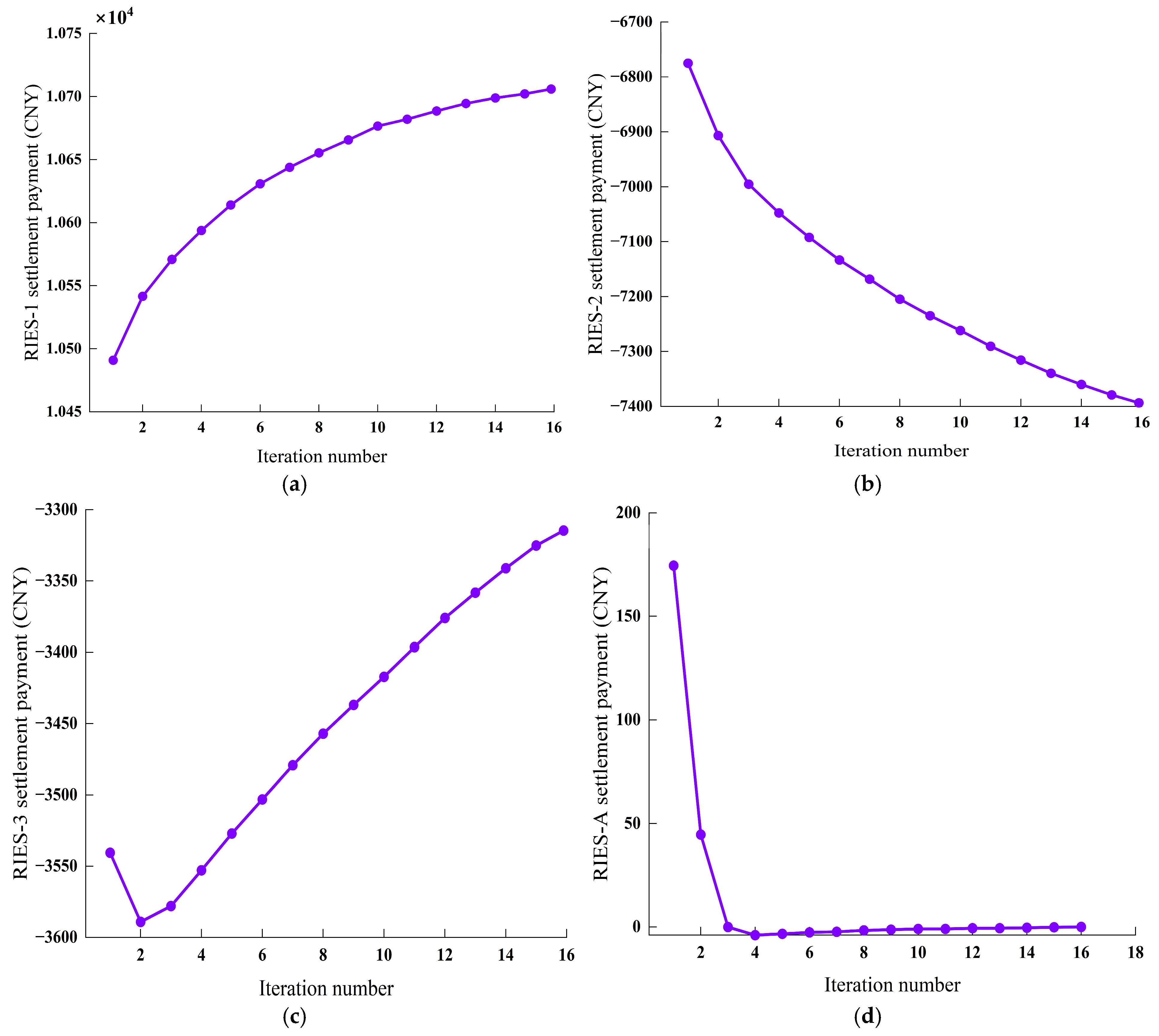
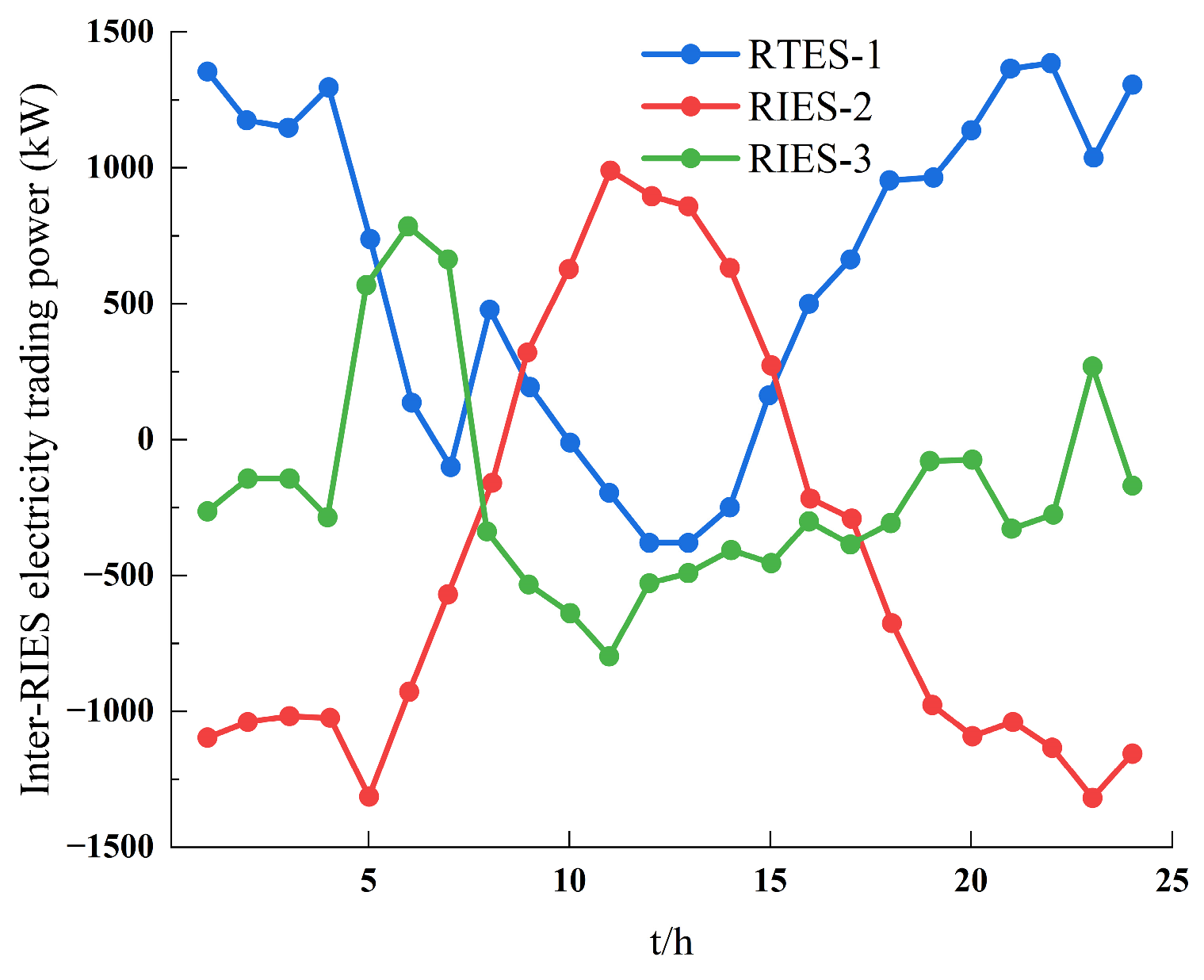
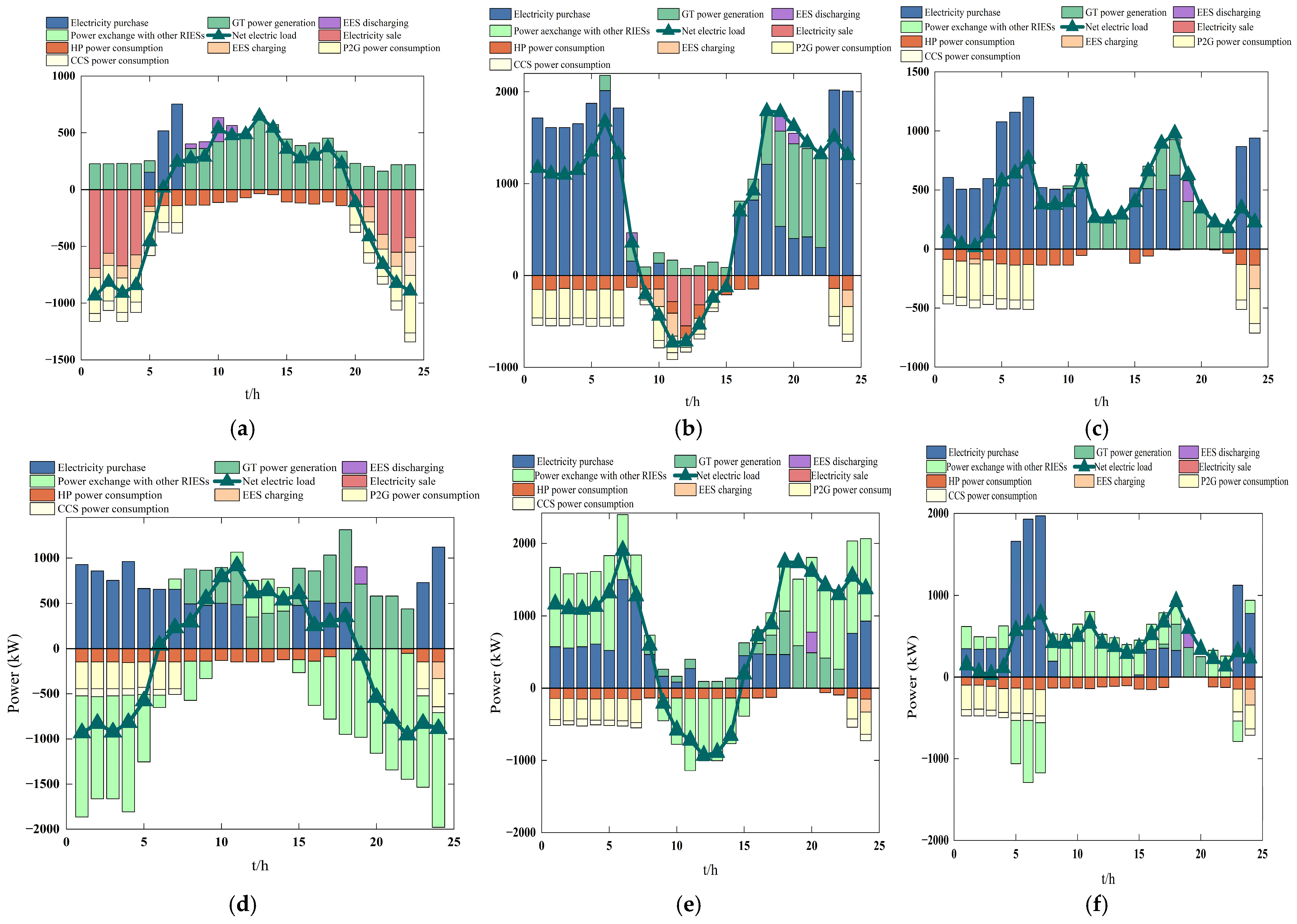
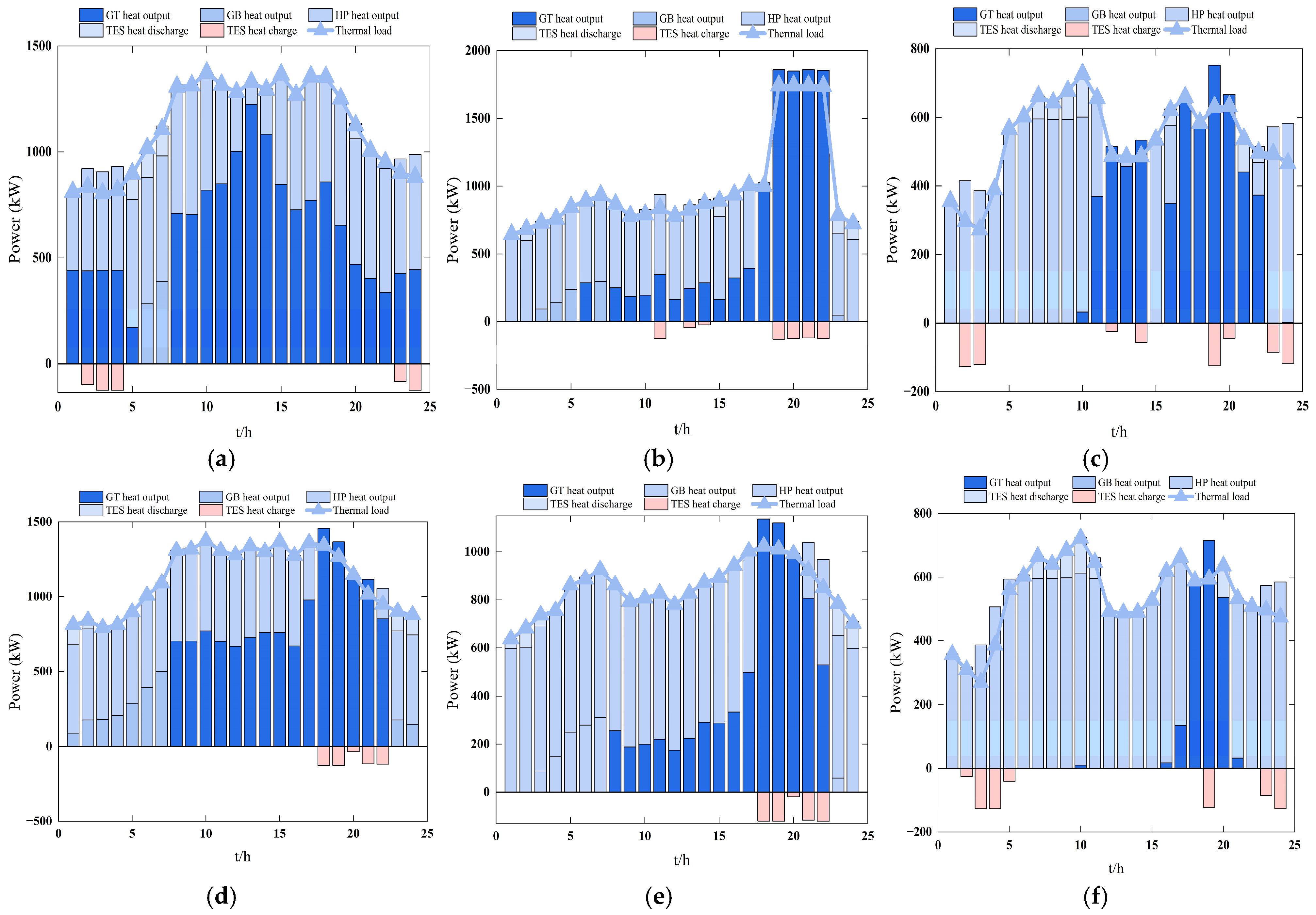
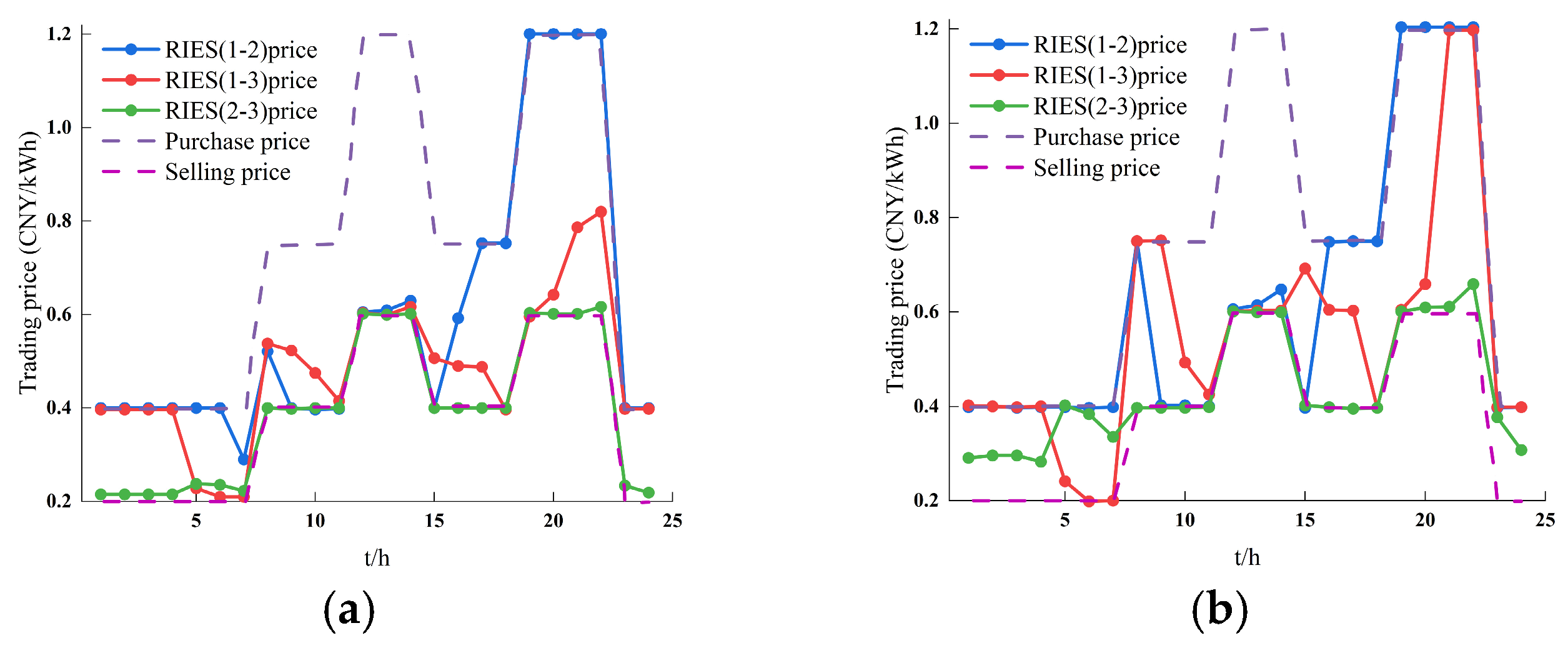
3.1. Adjustable Interval-Based Robust Optimization Method for System Operation
In the dispatch optimization of multi-regional integrated energy systems, various uncertainty-handling approaches are commonly introduced to address the issues caused by renewable energy fluctuations and load variations. Typical methods include stochastic programming, fuzzy programming, interval programming, and robust optimization, all of which aim to enhance the stability and adaptability of scheduling schemes across multiple scenarios. In this paper, a robust optimization approach is adopted to deal with the random fluctuations of wind and PV generation, load demand, and electricity prices. Unlike traditional stochastic methods that rely on detailed probabilistic information, robust optimization does not require the exact probability distribution of uncertain parameters. Instead, it characterizes their possible values through discrete scenarios or interval ranges. The objective is to construct a solution that is immune to uncertainties within an acceptable level of optimality loss, such that all constraints are satisfied for any realization within the uncertainty set, thereby improving the robustness of the scheduling scheme.
This study adopts the interval-based adjustable robust optimization framework proposed by Bertsimas et al., in which a tuning factor is introduced to control the conservatism level of the model, and interval bounds are used to characterize the possible values of uncertain parameters, thereby enhancing the stability of the dispatch results. Under this mechanism, the originally complex interval uncertainty constraints can be reformulated as structurally clearer deterministic expressions or transformed into linear robust constraints that are more amenable to computation. On this basis, a corresponding scheduling model is established, together with tailored solution strategies, so as to effectively mitigate the impact of uncertainties and achieve the optimization objectives in a robust manner.
The optimal scheduling problem of regional integrated energy systems can typically be formulated as a mixed-integer linear programming (MILP) model, whose standard form is given in (1)–(4):
In the proposed model, the parameters
,
and
may be influenced by external factors and therefore exhibit a certain degree of uncertainty. When the above parameters fluctuate within given intervals, a robust optimization framework can be adopted to reformulate the scheduling problem as a mixed-integer linear programming (MILP) model, thereby mitigating the impact of parameter perturbations on the decision results. The uncertainty is mainly reflected in slight fluctuations of the variable coefficients in the constraints; specifically,
represents the deviation in the coefficient associated with the
-th variable in the
-th constraint. These coefficients are usually treated as independent, symmetrically distributed, and bounded random variables, whose values lie in the interval
, where
denotes the nominal value of the coefficient and
represents its maximum deviation. If the prediction error with respect to the nominal value is denoted by
, the coefficient
can then be further expressed as follows:
The expression for
is given as follows:
Moreover, by introducing an integer control parameter
, the conservatism of the robust optimization results can be flexibly adjusted. The value of this parameter is defined in the interval
, where
denotes the index set of uncertain parameters. Considering that, in practical operation, it is impossible for all uncertain parameters to simultaneously reach both bounds of their fluctuation intervals, it is usually assumed in the
-th constraint that, for the uncertain coefficients
and their corresponding deviations
, the total magnitude of these deviations does not exceed a prescribed threshold
, so as to ensure the feasibility and rationality of the model. This constraint can be written as (7):
To avoid an overly generic description of “interval linear robust optimization,” this study adopts the Bertsimas–Sim budgeted interval uncertainty set to characterize uncertain coefficients. Specifically, for the i-th constraint, let
denote the index set of coefficients subject to perturbations. Each uncertain coefficient is represented by an interval in the form of “nominal value plus maximum deviation,” as given in (8).
In (8),
denotes the proportional deviation coefficient, which quantifies the normalized perturbation intensity of the forecasting error relative to the nominal value. Furthermore, since uncertain parameters in practical operation are unlikely to simultaneously attain their respective interval bounds, a budget constraint is introduced in (7) to restrict the extent of “simultaneous worst-case” deviations. Accordingly, the resulting uncertainty set can be equivalently expressed as (9):
Case corresponds to the non-robust setting, i.e., the model degenerates into a deterministic formulation, whereas Case represents the most conservative configuration, in which all uncertain parameters simultaneously take their worst-case values over the full intervals.
The maximum deviation
of the uncertainty interval (i.e., the deviation bounds for wind/PV output, load demand, and electricity price) is recommended to be determined based on statistical analysis of historical forecasting error samples. Taking wind power, photovoltaic generation, load demand, and electricity price forecasting as examples, the corresponding prediction error series is defined as in (10):
Accordingly, the deviation bounds can be determined using quantile-based confidence limits. For example, given a confidence level of
(e.g., 90% or 95%), the corresponding bound can be obtained as in (11).
This approach enables a data-driven construction of a bounded uncertainty interval when the exact probability distribution is unavailable, while allowing the interval width to be explicitly aligned with the risk preference ().
To fully account for all potential uncertain constraint coefficients, the model introduces worst-case-based robust constraints, which transform the original optimization problem into a bilevel mixed-integer linear programming (MILP) problem. This reformulation not only guarantees the robustness of the solution but also provides a mathematically tractable way to handle the impact of uncertain parameters. The specific model formulation and constraint definitions are given in (12)–(17):
The specific form of the inner mixed-integer programming model is given in (18)–(20):
According to duality theory, the inner model given in (18)–(20) can be transformed into its dual formulation as shown in (21)–(24):
By introducing the auxiliary variables
,
and
of the dual problem, constraints (21)–(24) are incorporated into (12)–(17), thereby constructing a solvable mixed-integer linear programming model for the worst-case scenario. After the robust optimization reformulation, this model can effectively cope with the impact of uncertainties, and its specific form is given in (25)–(31).
3.2. Optimization of Integrated Energy Systems Considering Carbon Trading and Demand Response
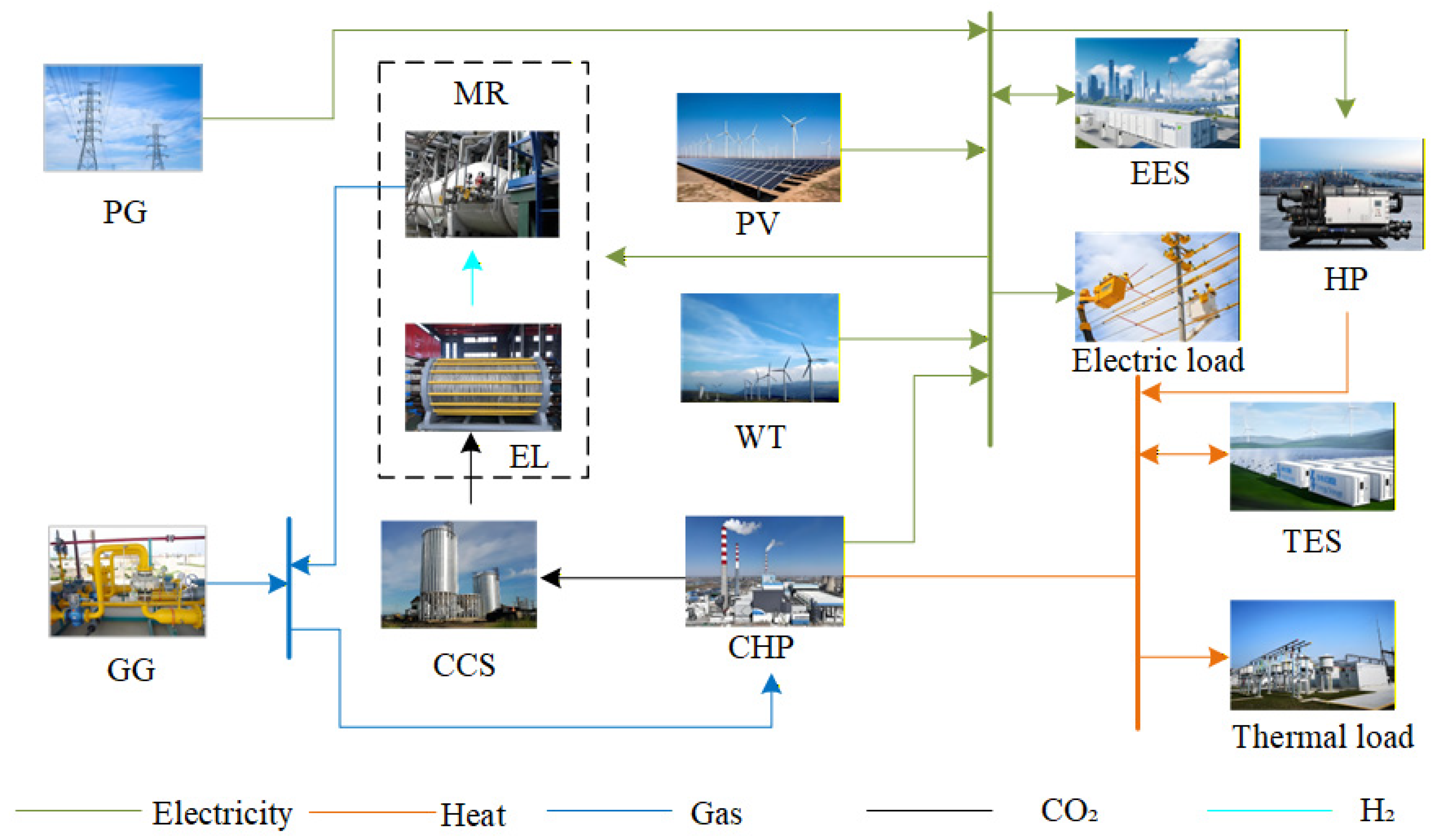
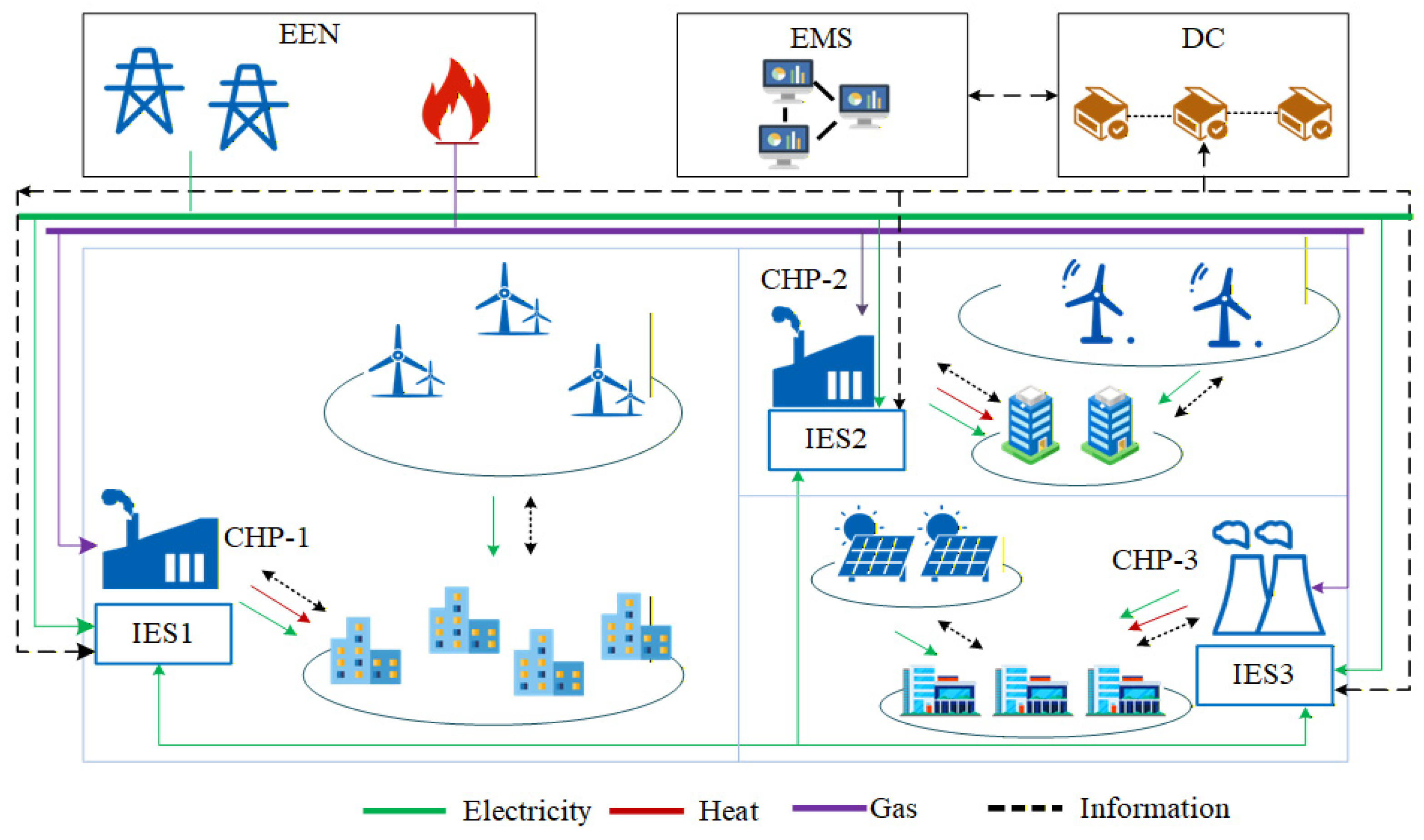
Building on the mathematical models of the various energy devices in the system, this paper formulates an optimization model for a single integrated energy system with the objective of minimizing the total operating cost. Demand response strategies are incorporated in conjunction with a tiered carbon emission trading mechanism, thereby providing a directly applicable basic framework for the optimization and scheduling of multi-energy systems.
3.2.1. Objective Function
Here, n denotes the index of different RIESs, ; represents the total operating cost of a RIES under independent operation; , , and denote, respectively, the equipment operation and maintenance (O&M) cost, demand response cost, carbon emission cost, and energy purchasing/selling cost at time period t.
(1) Equipment operation and maintenance (O&M) cost
Here, , , , , , , , and denote the O&M cost coefficients of the corresponding devices. and represent the natural gas consumption of the gas turbine and the gas boiler at time period t, respectively. denotes the heat output of the heat pump at time period t. and are the wind power and photovoltaic power generation at time period t, respectively. and denote the charging and discharging power of the electrical energy storage system at time period t, respectively. and represent the charging (heat storage) power and discharging (heat release) power of the thermal energy storage system at time period t, respectively. and denote the electric power of the CCS and P2G units at time period t, respectively.
Here, , , and denote the compensation coefficients for load shifting, electric load curtailment, and heat load curtailment in the RIES, respectively; and and represent, at time period t, the corresponding shifted load, electric load curtailment, and heat load curtailment amounts, respectively.
(3) Carbon trading cost
This study adopts a tiered (stepwise) carbon trading mechanism. Compared with conventional carbon trading schemes with a single carbon price, the tiered structure provides more flexible regulation of carbon emissions through segmented pricing. Given a predefined total carbon emission allowance, the available quota is divided into multiple tiers, each associated with a specific emission interval and a corresponding trading price. When actual emissions exceed the free allowance, the excess portion is charged according to the tier in which it falls, and higher tiers are assigned higher unit carbon prices. This increasing-price design raises the marginal cost of emissions and incentivizes enterprises to proactively reduce carbon emissions, thereby lowering the overall carbon trading expenditure while complying with emission reduction constraints. The carbon trading cost is calculated as follows:
Here, denotes the baseline carbon trading price, is the incremental step of the unit carbon price, represents the payable carbon trading volume, and is the interval length of each carbon-emission tier.
(4) Energy purchasing/selling cost
Here, and denote the electricity purchase and selling prices of the RIES, respectively; is the natural gas purchase price; and , and represent, respectively, the electricity purchased from the energy retailer, the electricity sold to the retailer, and the natural gas purchased at time period t.
3.2.2. Constraints
(1) Device constraints
Constraints of the gas turbine (GT):
Here, denotes the maximum electric power output of the gas turbine.
Constraints of the gas boiler (GB):
Here, denotes the maximum thermal output power of the gas boiler.
Constraints of the heat pump (HP):
Here, denotes the maximum heat output of the heat pump (HP).
Constraints of the electrical energy storage (EES):
Here, and are binary indicators denoting the charging and discharging states of the electrical energy storage system, respectively; and and represent the minimum and maximum state of charge (SOC) limits of the EES, respectively.
Constraints of the thermal energy storage (TES):
Here, and are binary indicators denoting the charging (heat storage) and discharging (heat release) states of the thermal energy storage system, respectively; and and represent the minimum and maximum stored heat limits of the TES, respectively.
(2) Demand response constraints
Here, and denote the initial electric load and thermal load, respectively. and represent, at time period t, the minimum electric load curtailment and the minimum/maximum transferable electric load, respectively; and , and denote, at time period t, the minimum thermal load curtailment and the minimum/maximum transferable thermal load, respectively.
(3) Carbon trading constraints
Here, and denote the actual carbon emissions of the microgrid and its allocated carbon emission allowance at time period t, respectively; and and represent the carbon emission factor and the allowance (quota) coefficient, respectively.
(4) Energy purchasing/selling constraints
Here, and denote the maximum amounts of electricity and natural gas that the RIES can purchase, respectively; and and are binary status indicators for electricity purchasing and electricity selling, respectively.
(5) Power balance constraints
Taking a renewable generation unit consisting only of wind turbines as an example, its electric power output can be expressed as Equation (65).
It should be emphasized that demand response (DR) and the tiered carbon trading mechanism are not independent add-on terms that are simply superimposed. Instead, they jointly reshape the system’s effective marginal cost structure and consequently influence the conservatism of the subsequent robust dispatch. Specifically, the DR compensation coefficient defined in (34) reflects the opportunity cost of load shifting/curtailment, thereby providing controllable flexibility on the demand side. When the system encounters supply scarcity or an elevated carbon cost during unfavorable periods, the optimization tends to utilize DR to substitute part of the purchased electricity or the marginal output of high-emission units, which reduces operating costs and improves feasibility margins. Meanwhile, the tiered carbon trading scheme in (35) increases the marginal carbon price in a stepwise manner for excess emissions, significantly raising the effective marginal costs of emission-intensive devices such as gas turbines and gas boilers. This cost signal steers the dispatch toward low-carbon pathways, including renewable generation, energy storage, and carbon-mitigation technologies (e.g., CCS/P2G). Furthermore, after incorporating worst-case robust constraints under multi-source uncertainties in
Section 3.2.3, the DR decision variables continue to participate in the power balance and load-related constraints through (50)–(57). The available DR adjustment range serves as a “buffer” against forecasting deviations, reducing the required reserve capacity and external energy procurement under worst-case scenarios for a given robustness budget. As a result, the excessive conservatism induced by robust optimization can be alleviated while preserving sufficient trading and coordination potential among the participating entities.
3.2.3. Robust Optimization Analysis Under Multiple Uncertainties
Since demand response and carbon trading reshape the marginal cost structure and the feasible adjustment domain, the mitigation strategy under the worst-case robust scenario will be jointly reflected in both the source-side dispatch decisions and the demand-side load adjustments. Building on the interval-adjustable robust optimization framework introduced in
Section 3.1, this study develops a robust formulation for wind and photovoltaic generation outputs as well as load demand uncertainties, thereby establishing a RIES independent-operation model with robust optimization at its core.
(1) Uncertainty modeling of renewable generation and load demand
Here, and denote the maximum allowable deviation bounds of the wind turbine output at time period t relative to its actual value; and denote the maximum allowable deviation bounds of the photovoltaic output at time period ; and denote the maximum allowable deviation bounds of the electric load at time period t relative to its actual value; and and denote the maximum allowable deviation bounds of the thermal load at time period t relative to its actual value.
It should be noted that the maximum deviation bounds in (67)–(70) are determined using the historical forecast error statistics described in
Section 3.1. Together with the robustness budget parameter
, they jointly specify the coverage intensity of the “worst-case scenario.” As the deviation upper bounds or
increases, the model provides stronger risk protection, but it may also lead to higher reserve requirements and a more conservative dispatch outcome.
The core idea of robust optimization is to design decisions against the worst-case operating conditions, i.e., ensuring that the system can still maintain electricity–heat supply–demand balance and operate safely and stably when renewable generation and load forecast errors reach their extreme values. Taking a renewable generation unit in a RIES that is equipped only with wind turbines as an example, under the worst-case scenario the power balance constraints no longer follow the conventional forms in Equations (65) and (66) but should be reformulated as robust constraints, as given in Equations (71)–(76).
Here, is the robustness parameter used to adjust the conservativeness of the robust optimization; its value is restricted to , where denotes the set (cardinality) of coefficients affected by uncertainty. is the proportional deviation coefficient, defined as the ratio of the forecast error to the expected value, and it is used to characterize the relative fluctuation level of the uncertain variables.
It is worth noting that, as the robustness budget parameter increases, the model must satisfy feasibility constraints over a broader uncertainty set, which typically leads to higher reserve requirements and/or increased external energy procurement. Meanwhile, the tradable electricity volume among RIESs may be reduced, thereby narrowing the coalition’s trading space and diminishing the allocable cooperative surplus. Given that demand response provides additional load-side adjustment margins (see (34) and (50)–(57)) and that tiered carbon trading raises the effective marginal costs of high-emission units (see (35)), both mechanisms interact with in shaping dispatch decisions under the worst-case scenario. Therefore, we recommend jointly selecting and the related parameters via sensitivity analysis so as to achieve a balanced trade-off among risk protection, economic performance, and decarbonization objectives.
As indicated by Equations (71)–(76), to ensure the tractability (solvability) of the robust constraints, it is necessary to further handle the two embedded maximization subproblems involved, namely those in Equations (77) and (78).
Based on the strong duality principle, by introducing the dual variables
,
,
,
,
,
,
and
, Equations (77) and (78) can be transformed into their corresponding dual problems, as given in Equations (79) and (80).
Therefore, the power balance constraints in Equations (65) and (66) can be linearized using the robust optimization approach, leading to the following form:
(2) Handling electricity price uncertainty
Following Method (1), the purchasing price of electricity from the external grid is bounded within a prescribed range:
Here, and denote the maximum deviation bounds of the electricity purchase price relative to its actual value.
Under the worst-case condition where the external grid purchase price reaches the upper bound of its allowable interval, the price constraint can be reformulated as follows by introducing the robustness parameter and the proportional deviation coefficient:
Based on the strong duality principle, by introducing the dual variables
,
and
, Equation (84) can be transformed into the corresponding dual problem as follows:
Therefore, when electricity price uncertainty is considered, the electricity purchasing/selling cost can be expressed as follows:
It should be clarified that the treatment of electricity price uncertainty in (83)–(86) does not necessarily require adopting the “upper-bound worst case over all time periods.” Rather, it represents a commonly used risk-protection modeling paradigm in robust optimization. To ensure a proper balance between robustness and economic efficiency, the electricity price uncertainty is also incorporated into the budgeted interval robust framework, and an electricity-price robustness budget parameter
is introduced to tune the degree of conservatism. Specifically, the purchasing price at time period (t) is assumed to satisfy the interval uncertainty model given in (87):
and is further subject to the following budget constraint in (88):
This indicates that controls the extent to which electricity prices in multiple time periods simultaneously approach their worst-case deviations. When , the model degenerates into an economically optimal schedule based on the nominal electricity price ; when , it corresponds to the upper-bound robust schedule under the worst-case scenario across all time periods. Therefore, Equations (83)–(86) do not contradict the modeling objective of balancing robustness and economic efficiency, since the level of conservativeness can be tuned by adjusting .
To avoid overly conservative solutions induced by excessive price robustness, this paper recommends selecting based on sensitivity analysis. Specifically, given an upper bound of electricity price deviations (which can be obtained from the quantile statistics of historical price forecasting errors), the operating cost and worst-case feasibility under different values of are compared. The range of that satisfies the prescribed risk tolerance while yielding a relatively low operating cost is then selected, thereby enabling a tunable trade-off between economic performance and risk protection.
(3) Single-region RIES model incorporating robust optimization
Building on the interval robust optimization method in
Section 3.2, this study provides a unified treatment of multiple uncertainty sources in the system. Accordingly, the original power balance constraints in Equations (65) and (66) are reformulated into their robust counterparts in Equations (81) and (82), and the energy purchasing cost model is revised from Equation (36) to Equation (86). By further incorporating the output characteristics and operational constraints of various devices, the objective function and constraint set of the single-region RIES scheduling model under the robust optimization framework can be established as follows: